SSL Accelerating Test Bench
    SSL accelerating Test Method

 Stefan Deelen & Maurits van der Schee (master 
           students SNE at the UvA)
       Supervised by: Jan Meijer (Surfnet)
Contents

• Objectives 
• Test Method
• Scope
• Types of testing
• Other tests
• Conclusions & Future Work
• Questions
Objectives
Finding a test method which answers these questions:


1) What is the actual added value of an 
  accelerator to a web server?

2) How to compare accelerator performance? 
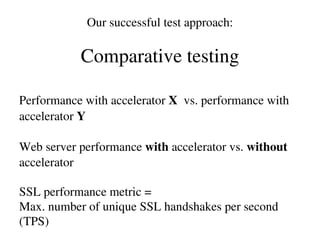
Our successful test approach:

           Comparative testing

Performance with accelerator X  vs. performance with 
accelerator Y

Web server performance with accelerator vs. without 
accelerator

SSL performance metric = 
Max. number of unique SSL handshakes per second 
(TPS)
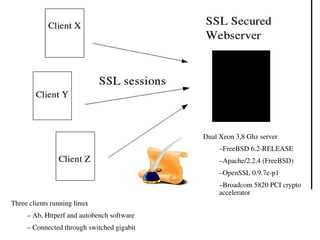
Dual Xeon 3,8 Ghz server
                                                 –FreeBSD 6.2­RELEASE
                                                 –Apache/2.2.4 (FreeBSD)
                                                 –OpenSSL 0.9.7e­p1
                                                 –Broadcom 5820 PCI crypto 
                                                 accelerator
Three clients running linux
     – Ab, Httperf and autobench software
     – Connected through switched gigabit
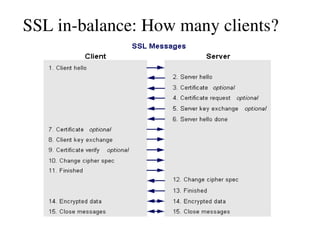
SSL in­balance: How many clients?
Test Operation
1. Use Autobench to do a quick test to find 
   the saturation point
2. “Zoom into” the saturation point for more 
   accurate results.
3. Add or remove clients to verify you hit a 
   server limit
Research Scope

•   Open source operating system
•   OpenSSL
•   SSL handshake  (RSA cipher)
•   Apache 2.2
•   Benchmark tools “Autobench and Httperf”
Types of testing
• Black box
  – Testing focused on software’s external 
    attributes and behavior. 
  – From a user’s point of view.
• White box
  – Testing with full knowledge of the algorithms, 
    internal states, architectures, etc.
  – From a developers point of view.
Gray box testing
• “Tests designed based on the knowledge of 
  algorithms, internal states, architectures, or 
  other high level descriptions of program 
  behavior”. – Doug Hoffman
• Needed because black and white box testing 
  do not allow for balanced testing
• Integral to the effective testing of Web 
  applications
Other testing
2. OpenSSL speed benchmark
  • Test the performance of the crypto library used 
    by Apache
3. Single session
  • Test the response time of a single request
OpenSSL speed results
[root@test ~]# openssl speed rsa1024
Doing 1024 bit private rsa's for 10s: 
  2989 1024 bit private RSA's in 9.97s
Doing 1024 bit public rsa's for 10s: 
  48265 1024 bit public RSA's in 9.99s
timing function used: getrusage
rsa 1024 bits:
  sign      verify    sign/s   verify/s
  0.0033s   0.0002s   299.8    4832.8
Algorithm
• Accelerators may be optimized for certain 
  algorithms and block sizes
• Algorithm balance can influence 
  preformance
  – RSA vs DSA balance
  – Rebalanced RSA
• Driver may not be implemented optimal
  – CRT parameters used or not
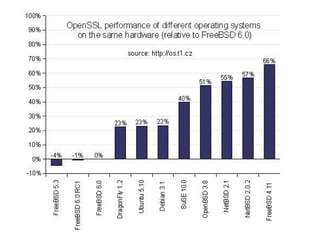
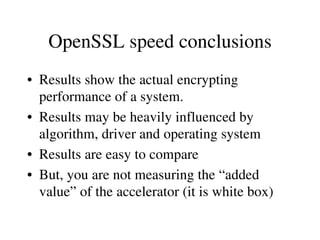
OpenSSL speed conclusions
• Results show the actual encrypting 
  performance of a system.
• Results may be heavily influenced by 
  algorithm, driver and operating system
• Results are easy to compare
• But, you are not measuring the “added 
  value” of the accelerator (it is white box) 
Single session
• Httperf results are equal to Ab (Apache 
  bench) results
• We measured a 2 ms difference between the 
  situation with and without accelerator
• The handshake takes 7 ms longer 
  (calculated value)
• We are not able to explain the difference
Httperf testing
• We used a 0 byte file to focus on handshake
• We used HTTP 1.0 to avoid keep­alive (and 
  thus connection limits)
• We disabled caching on the client and 
  server side (to simulate connections from 
  different hosts)
• We measured the actual request rate
  (number of HTTP GET requests per 
  second)
Autobench
•   …is a Perl script (OS indepent)
•   …automates doing series of Httperf tests
•   …has a client/server architecture
•   …enables you to do distributed tests
•   …produces its results in a graph
Conclusions
• We developed a method that enables easy 
  and comparable tests for SSL accelerators
• Gray box testing is needed to find the actual 
  added value of an accelerator
• Choices in algorithm, operating system and 
  drivers may multiply (!) performance
• Future work may prove this method useful 
  for a wider scope
Future work
•   Throughput testing
•   Virtual users: script that emulates site visit
•   Automated searching for saturation point
•   Other (maybe better) testing software
•   High performance accelerators and/or other 
    algorithms may require an easy scalable 
    client pool
Questions …?

Ssl Accelerator Test Bench