SAGE SSAT Answer Document
Pg.
10-12 1. C. Amusing is a lesser form of being uproarious, and interesting is a lesser form of mesmerizing.
Therefore, this is the best answer choice.
2. D. A jar is used to contain things, and a pillar is used to support things. Therefore, this would be
the best answer choice.
3. D. Dance is what a ballerina does, and digging is what a miner does. Though reading is what an
author also may do, his primary job is to write, rather than read.
4. C. The word amorphous means to lack shape. If something is odorless it makes scent.
5. A. One may be articulate in their speech, just as one may be agile in their movement. Though
one may be stunning in their appearance, this is not something they do, rather it’s how they appear.
6. B. Stark is the opposite of embellished, just as stoic is the opposite of flamboyant. Some of the
answer choices may come close to being opposites, but none truly is the way that B is.
7. C. First, you must know that a league in this context is used to described a type of measurement.
Depth is measured in leagues. Height is also measured in meters.
8. E. Donors give to others, and a guardian protects others. Here it is useful to think about this in
terms of what they do for others.
9. D. A porcupine has quills (for protection). A moose has antlers (for protection). Though it is true
that a cat has a paw, a kangaroo has a pouch, a swine has a snout, and a horse has a hoof, we must
choose the answer that best fits the relationship. A porcupine has quills for a specific purpose, just
as a moose has antlers for that same specific purpose.
10. D. Aquatic (water related) is the opposite of terrestrial (land related). If something is abstract it
is the opposite of concrete.
11. C. A type of dessert is an eclair. A type of evergreen is a pine. The other choices are not types
of evergreens.
12. D. Kind is the opposite of malevolent (wishing evil). Being idiotic is the opposite of being bril-
liant.
13. E. Monochromatic refers to a type of color, as monotonically refers to a type of sound. Here it
is useful to break down monotonic. Notice the word tonic is like “tone.” The word tone is related to
sounds.
14. D. A bouquet is a group of flowers, and a litter is a group of kittens. This one is a bit tricky
because it is common for students to choose A (trash). The key in choosing the right answer is de-
ciphering which kind of litter is being referred to. A group of trash doesn’t make as much sense as
a group of kittens. You may have a pile of trash, but not a litter of it.
SAGE SSAT Answer Document
Pg.
17-19 1. D. is the correct answer because 0, 6, 2, and 4 are all even.
2. B. If a number is prime then it only has 2 factors: itself and the number 1. Here we are being
asked to identify the smallest prime number that is bigger than 50. 51 has a few factors (1,3,7, 51),
but 53 has none other than itself and one.
3. E. 756 is the only answer that could be a multiple of 2 because it’s the only even number.
4. C. To find the answer easily you may want to cross cancel. From there you can easily multiply
the simplified remainders.
5. C. The LCM is a term which refers to the lowest number that is the product of both the numbers
18 and 24. The lowest product, in this case, would be 72.
6. C. 465 is the correct answer, and can be found easily by utilizing the division rules found in the
table on page 16. 4 + 6 + 5 equals 15, which is a multiple of 3, so you know that 465 would be the
correct answer.
7. E. For this problem, you need to remember PEMDAS. Start by dealing with the problems within
the parenthesis. Within the parenthesis you would want to start by multiplying and then subtract-
ing. Finally, you would multiply -6 to your answer.
8. B. 10,030 is the correct answer because it’s the only answer choice which ends in a 0.
9. D. 7,790 is the correct answer because it is the only one that satisfies the division rules for both
5 & 2. It’s even and ends in a 0 (making it divisible by 5).
10. C. 210 is a multiple of 3 & 10 because it ends in a 0 (making it divisible by 10), and the sum of
the digits add up to 3, which is a multiple of 3 (meaning it is also divisible by 3).
11. D. 420 is a multiple of 2,3, & 5 because it ends in a 0, is even, and the sum of the digits add up
to 6 (making it divisible by 3).
12. E. Seeing as it is asking for an even multiple you can eliminate A and B. 390 is the correct an-
swer because the sum of the digits is 12 which is a multiple of 3. The fact that it ends in a 0 means
that it is also divisible by 5.
13. C. For this problem, you would want to see which answer choice is evenly divisible by 3. Here,
252 would be the only number that fits.
14. E. 555 is correct because it is not only evenly divisible by 3 but also by 5. Team A and B would
each be able to divide up the candy evenly, whether that be with 3 pieces of candy per member or
5.
15. E. Here you might want to use the process of elimination. It can’t be A because that is the sec-
ond multiple of 4, and therefore it can’t be the greatest out of three. B though it is the third multiple
of 4, the sum of those 3 do not add up to equal 60. C and D, though they are multiples of 4, do not
add up to equal when combined with the other 2 multiples.
16. E. 918 is not odd because it ends with an even number.
SAGE SSAT Answer Document
Pg.
17-19
Cont.
17. E. -1 is the only logical choice because if you are adding two negative numbers, then the an-
swer must also be negative.
18. D. 87 is not a prime number because it is a multiple of 3.
19. A. Seeing as the question asks “which of the following can be a product of one negative, and
one positive integer except” you want to look for the answer that is incorrect. 1 is incorrect, be-
cause when you multiply a negative and a positive you would get a negative answer.
20. C. 60 times 9 equals 540, making it a multiple of 60.
21. C. You can find this by choosing the first two odd integers (1 and 3) and choosing the first even
integer (2) and multiplying them together.
22. B. You would add 9,899,399 to 2,082 and your answer would be B. To increase a number is a
fancy way to say add.
23. C. Since you know the middle number is 13, and that it is in the middle of a consecutive se-
quence you can fill in the remaining numbers. There is going to be two numbers preceding the 13
and the following 13. Since you know that this is a consecutive set of numbers, 11, 12, 13, 14, 15,
would be the answer, and from there you would add up the numbers to get the sum of the 5 con-
secutive integers.
24. C. Think PEMDAS. Parenthesis first [1 minus 2], next would be Exponents [-2 cubed, -1
cubed, and -2 cubed], then multiplication [-8 times -1], and from there addition [8 + -8].
25. C. First, you want to find all of the odd integers between 10 and 19. So, they would be 11, 13,
15, and 17. From there you would add them up, and divide by the number of terms in order to find
the mean of all the possible odd integers.
26. D. Again, think PEMDAS. The first parenthesis [3 times 2, and also, 6 divided by 2], next ex-
ponents, next multiplication/division, and finally addition/subtraction.
27. C. The product of 48.9 and 21.2 is 1,036.68. Of the options given 1000 is the closest to that
amount.
28. E. Though this doesn’t appear to be similar to a PEMDAS problem, it is. You start by dealing
with operations under the square root sign and within the absolute value signs. Once you have
solved for those, you would add your answers together [9 + 3], and get 12.
29. C. If you are rounding to the nearest 100’s, you want to assess the number in the 10’s place to
see whether or not the 100’s place will round up or stay the same. Since it is the number 5 you
would round the number in the 100’s place up. Note: if that number were to have been below 5,
then the number in the 100s place would have stayed the same.
30. C. Here the problem is defining a number as “blue” if it’s product and sum are equal to one
another. here, 3 + 2+ 1 equals 6, and 3 times 2 times 1 also equals 6. This makes 321 a blue num-
ber.
31. B. It may be helpful to guess and check. 7 + 9 + 11 + 13 +15 = 55. Divided by 5 gives you an
average of 11.
3
1
14
13
2
16
3
4
21
13
3
20
71
6
SAGE SSAT Answer Document
Pg.
17-19
Cont.
23
24-25
32. E. This is “strange symbolism” problem. Here, you want to follow the instructions given in
order to fix the given number. This problem is doing nothing more than testing your ability to fol-
low directions, the arithmetic shouldn’t feel too strenuous.
33. C. To find “D” you will need to multiply 15 and 6 and then add 2. This is going to give you 92.
Now you divide 92 by 6, and you’ll get a remainder of 2.
34. C. This is also a “strange symbolism” problem. Look at the example they provided carefully,
and follow the rules. Here, it appears that they want you to replace the letter “a” with the first num-
ber in the given set (7), and “b” with the second number in the given set (5). From there you would
solve arithmetically.
35. C. The greatest number less than may be found by first seeing how many times 6 goes into
71: which is 11.71. From there we can see that 11 would be the greatest integer, that is also less
than 11.71.
1. would be your answer. You would need to find the common denominator, which is 20.
2. would be the correct answer. You would need to find a common denominator, which is
28.
3. is the correct answer. You would first want to turn the mixed numbers fraction into an
improper fraction. Remember, you can also cross cancel if that makes it easier to solve.
4. Is the correct answer. Here you want to make the mixed numbers into improper fractions,
**then flip the second fraction and finally, multiply. (**division rules for fractions).
1. D. ⅗ is less than ⅔. Feel free to either make both denominators the same to see which numera-
tor is smaller, or try drawing it out!
2. A. Here it is important to note that the term “of” refers to multiplication. So, ⅗of 5/7 is really
saying ⅗ times 5/7.
3. C. Here you would want to try and find a common denominator. From there you would add them
straight across, and keep the common denominator the same.
4. E. It may be helpful here to cross cancel before multiplying. In addition to cross-canceling, you
want to be careful to not forget to flip the last fraction, seeing as it is being divided!
5. D. If you want the sum on the left side of the greater than sign to exceed 1, then you need to
choose an answer that can be added to ⅙, and then exceed the value of 1. 6/7 is the only choice that
does so.
SAGE SSAT Answer Document
Pg.
27
29
1. C. Here you want to be careful and read the question carefully. Note: it asks for 16 thousandths.
So, with the place values in mind (refer to page 26), we should choose C.
2. B. You want to be sure that the number 245.388 is the dividend, and that 13.2 is the divisor.
From there you also want to ensure to move the decimal to the right once on the divisor, and also
for the dividend.
3. C. Let's break this down step by step. First: You want to identify how much of the total weight is
due to the eggs, so you want to multiply 0.093 by 7 (single egg’s weight by the number of eggs).
Second: You want to take your answer (which should be 0.651) and subtract it from the weight
given (0.87-0.651). The remaining weight will be that of just the basket.
4. A. Work left to right arithmetically, and keep track of your answers along the way.
5. B. You would divide 85,007 by 4,095 and get 20.75. Using rounding you can see that 21 would
be closer to the answer you got.
1. A. You would set up the proportion according to the is over of method. 28 = is, 68 = of, x = the
percent, which is over 100. From there you cross multiply and solve for x.
2. D. Sometimes for word problems, it is helpful if you reword the question. Here what is really
being asked is: what percent of the 22 total animals are the 8 dogs? From there you can solve it as
a normal “is over of” problem.
3. E. This question requires that you solve it in two parts. First: you want to find the “of” in the first
part of the question (30 would be your is, x would be your of, 40 is the %, and the percent is over
100). After cross multiplying you’ll find that x equals 75. Now you may move on to the second
part of the question. It asks what 15% of that number would be (which we now know is 75). So,
you can either use the is over of method or multiply 75 by .15.
4. B. The real takeaway from this question is: What percent (x) of the total ice cream (77) is choco-
late (42)? You can plug in your variables to the is over of method and find that the answer is 54.5,
which is approximately 55%.
5. C. 30 is the is, 16 is the percent (over 100) and the of is your variable (x).
6. B. What is the question really asking is: What are 22 pounds of 11%? So, 22 is the is, 11 is the
percent over 100, and the of would be your variable (x).
SAGE SSAT Answer Document
Pg.
31
33-34
1. B. Since Chandler bought the Ipad for 300 and had to pay sales tax, the new percent that he is
paying for the item is 118% (100 % just for the Xbox + 18 % sales tax). The question asks for the
total amount that he paid for the Ipad, or in other words, what is 118% of 300? Is = x (the variable),
of = 300, % = 118 over 100. After cross multiplying and isolating x, we’ll find that the total was
$354.
2. D. Since Rachel gets a 40% discount, that means she’ll be paying 60% of the original price. The
question is really asking: What is 60% of 27? From there you plug the information into the is over
of, and solve! (** remember to plug in the 60 for the percent - NOT the discount %)
3. B. First step: Find out how much the 4 sunflowers will cost at their normal price (8 times 4 =
$32). Second step: Recognize what they are actually asking: If the discount is 15 % off, then what a
consumer would pay is 85% for the flowers. So, they are asking what is 85% of 32 dollars? Third
step: Plug into the is over of formula and solve! (x = is, 32 = of, and 85% over 100).
4. D. Since he tipped 20%, that means that the total percent he spent on lunch that day would be
120%. They are asking: what is 120% of $22 (the amount that the lunch cost)? X = is, 120% =
percent over 100, and 22 = of.
5. E. This question is asking: $63 is 105% of what number? The price of the shoes represents
100%, then you add 5% tax to that. So, 63 = is, 105 = percent over 100, and x = of.
1. B. Make sure to read page 33 prior to working on the following questions. So, if the jersey’s
value increased from 45 to 54, then we know that the difference is $9. From there we plug in the
given information to the “difference over the original equals % over 100” formula (found on page
33) and solve.
2. E. First, you want to find the difference between the original and the increased price ($399), then
identify the original price ($200). From there you will plug in the information into the formula and
solve for x.
3. C. Like the other two questions, you want to first find the difference between the original and
lowered price ($2.25), and then identify the original price ($6.00). Then, plug the given information
into the formula, and solve for X (the percent).
4. D. Here, the question gives you the difference, or how much the tree grew (30.78 inches). You
don’t need to subtract, but just put the difference over the original. In this case, the tree was origi-
nally 324 inches. You plug that information to the difference over original formula and find that X
is 9.5%.
5. E. First start by finding the difference in price (which turns out to be $342). From there you will
plug in the information and solve for x.
6. B. Since she increased her money by 42%, this means that she now has 142% of her original
amount in her account. If you want to find out how much total money she has, then it may be help-
ful to reframe the question. What is 142% of $65? Now, you just plug in and solve.
7. A. Since the car decreased in value after the first year by 23%, we know that it now cost 77% of
its original amount. We can reframe the question as: What is 77% of 25,500, and set it up as an “is
over of” problem.
SAGE SSAT Answer Document
Pg.
35
38
39
40
41
42-42
1. B. These problems are all balancing acts. Since here they divided 50 by 2 to get 25, and then
multiplied r by 2 to get 2r, they really did nothing at all. The actions canceled one another out.
Therefore, the answer is going to stay the same: 9.
2. B. Here, 16% was divided by 4, in order to get 4%, and q was multiplied by 4 to get 4q. So,
again nothing really was changed. The answer remains 16.
3. E. 20% was divided by 5 to get 4%, and x was multiplied by 5 to get 5x. The equation was bal-
anced, so the answer will remain 75.
4. C. 15% was multiplied by 3 to get 45%, and m was divided by 3 to get m/3. So, the answer, once
again, remains 35.
5. D. 28% was multiplied by 3 to get 84% and 3k was divided by 3 to get k. Again, the answer re-
mains 9.
6. D. This is the only problem on this page that isn’t balanced. 60% was divided by 2 to get 30%,
but nothing is done to the variable y. In this case, you would want to then divide the answer by 2 in
order to solve the unbalanced equation properly. 24 divided by 2 is 12. You would divide by 2 be-
cause that's the same thing that happened with the percents.
1. D. This is an inference question. You want to make an educated guess as to what was meant by
using the phrase “unremarkable details.” The passage is trying to allude to the fact that solving
these mysteries would be almost impossible, if not C.
1. C. This is a main idea question. You don’t want to answer with too broad a statement (E), or a
detail oriented statement (A). You want to be mindful not to choose an answer which contains trig-
ger language (B).
1. A. These are detail questions. Watch out for trigger language! Line 2 contains the correct an-
swer.
2. E. Line 12 contains the correct answer.
E. This is an inference question. The concluding sentence reveals conversation as an “engaging”
learning strategy. Engaging is a synonym for “interesting" so A, C, and D can all be eliminated. B
is mistaken: although the passage states talking to others, it specifically states talking to others
“with vocabularies larger than their own,” which fellow students do not have.
1. B. This is a Main Idea question. A and E are too broad while C and D are detail oriented. “An
art movement” in this case is specifically referencing the Hudson River School.
2. E. This is a detail question. All of the other answer choices were mentioned in the passage while
E was NOT.
SAGE SSAT Answer Document
Pg.
42-43
Cont.
44
50
57-58
3. C. This is an inference question, and you know this by the use of the word “suggested.” It's refer-
ring to a specific statement in the passage. If you go back and read the sentences surrounding line
18 you can see why it fitted the bill perfectly- “to compete with Europe” and to be “unmistakably
American.” Both are ways to display pride.
1. D. Since this is a main idea question, D is the most logical answer. It is the only choice that ac-
curately describes what the passage is discussing and in a way that is not too broad nor specific.
2. A. This is an inference question, and you know this by the use of the word “suggests.” It directs
us towards line 2, which states that few of us realize the complexities that go into designing a con-
cert/lecture hall. If that be true, then it wouldn’t be too far of a stretch to assume that since we don’t
recognize it, we don’t appreciate it.
3. E. This is a detail question. All three of the roman numerals were addressed within the passage,
therefore, E would be the correct answer.
4. C. This is also a detail question. Lines 10-12 contain the correct answer.
5. B. This, again, is a detail question. The last line of the passage contains the correct answer.
1. ⅝ is the correct answer. Start by adding up the total number of boxes and place that number in
the denominator and place the thin mint box amount in the numerator.
2. He has 27 German stamps. First, you want to set up a proportion. To do this: write the German
stamps to British stamps ratio and set it equal to the ratio of real number of German stamps (x) -
over real number of British stamps (90). Now, cross multiply and solve for x.
3. 6:19 is the ratio of free-throws missed to free throws made. It’s important to remember that order
matters. If LeBron missed 6 free throws out of 25, then your first number would be 6, and the sec-
ond aspect of the ratio would be the remaining free throws (19).
4. The answer is 119 Pink Jelly Bellies. You would want to set this problem up in the exact same
way that you would number 2. First, you want to set up a proportion, which contains two ratios.
The first ratio would be 2 (red) over 7 (pink) and set it equal to the real number of Red Jelly Bellies
(34), over the real number of Pink Jelly Bellies (x).
5. The answer is 3:8. One thing to keep in mind is that the ratio will need to be in the same units, so
you will need to convert accordingly. It would be easiest to convert everything to inches. So, for 2
feet 3 inches you would write that as a single number: 27 inches. For the second part of the ratio,
you would need to convert 2 yards into inches, which would be: 72 inches. From there you’ll have
27:72, and that can be simplified to 3:8.
1. A. Bleak and dismal are both ways to say: gloomy, dreary, or miserable.
2. A. Though it may be tempting to choose C (hot), damp is more closely related to humid. Humid-
ity has more to do with precipitation than temperature. Precipitation is most closely related to being
damp.
SAGE SSAT Answer Document
Pg.
57-58
Cont.
3. B. To deport someone means to remove them from a country. Though it sounds harsher, banish-
ing is the word most closely related to removing.
4. E. Sell would be the best answer choice because "peddle" means to sell or promote.
5. C. When you see the word terminate, you may think about the movie - The Terminator. To ter-
minate something means to end its existence.
6. C. "Dearth" means scarcity or lacking. The word "shortage" is the best answer choice.
7. B. This one may be a bit tricky. In situations like this, define it in your head, and choose the an-
swer that most closely relates to the definition. Obscure means uncertain, or unknown. With that in
mind, dark is the closest answer choice.
8. E. To mourn is to feel deep sorrow and sadness. When someone grieves they are also expressing
deep sorrow/sadness over the death of another.
9. E. A recluse is someone who is extremely shy. They tend to live a solitary life. The word hermit
is a synonym because it is a term that is commonly used to describe extremely shy individuals.
10. C. Though affection may seem like a good answer choice, respect is more closely related to the
true definition of the word homage. Homage: Special honor, or respect, shown publicly.
11. D. To be herbivorous insinuates that that animal/human only eats plants.
12. A. Though a synopsis can be written in a paragraph form, and may feel like an update, it is
truly more of an overview of a novel, movie, or what have you. So, here the most closely related
word would be a summary. The definition of a synopsis is a brief summary or general survey of
something.
13. C. Wanton has two primary definitions. The first: deliberate or unprovoked violence. the sec-
ond: sexually immodest, or promiscuous. With this definition in mind, we can see that of the an-
swer choices given lustful would be the one which most closely resembles the second definition of
wanton.
14. D. Though it may be a good assumption to think that imperious means royal, there is an even
better answer choice, which more closely relates to the true definition of the word. To be imperious
means: assuming power or authority without justification; arrogant and domineering. Even though
royal individuals are given power assumingly, imperious describes a personality trait, rather than a
social class.
15. A. Hallow means to honor something as holy. When something is being honored as holy it is
being revered.
16. A. Though bliss is fun, fun is not as intense of a word as bliss is. Bliss is described as perfect
happiness or a state of pure and uncontained joy. "Fun" doesn’t really meet those requirements. So,
ecstasy would be the best answer choice because it is described as an overwhelming feeling of joy,
happiness, or pure joy.
SAGE SSAT Answer Document
Pg.
87-58
Cont.
60-61
17. C. Just because something is indecent, it doesn’t necessarily mean immoral (seeing as every-
one’s definition of morality is different). If something is not decent, then it would be true to assume
that it is not proper in the given context - improper.
18. C. Touchable is the best answer choice because if something is tangible then it is perceivable
by touch. In other words, you can physically touch, or feel it.
19. E. Though someone may appear as being rough, or hard, when exhibiting ferocity, the better
answer choice would be fierceness. Ferocity comes from the word ferocious, as does fierceness.
20. B. To be tenacious means to be determined! With this in mind, we can see that B, would be the
best answer choice.
[For these answers be sure to refer to page 59, because (if completed) the analogy relation-
ships are there for you to refer to! :) ]
1. D. Though A, B, and E, are also whole/part relationships, they do not describe a group of ani-
mals. A school of fish swim together, and act as a unit, just as a herd of sheep does.
2. E. Ravenous is a more intense version of being hungry (degree relationship). With this relation-
ship in mind, we can see that stunning is a more intense version of pretty. None of the other answer
choices exhibit a degree relationship.
3. B. Since you use a scale to measure weight, you want to look for an answer choice that also
measures something. You use a kitchen to cook, but not to measure cooking. This is why B is the
correct answer - you use a yardstick to measure.
4. C. A sphere is round, and a trait of a plane is that it's flat. The other answer choices do not de-
scribe trait relationships.
5. E. A mosaic's composed of tiles (whole/part relationship). Though a shirt may have a button, the
buttons are not necessarily the only thing composing the shirt. A cast can not be a cast without ac-
tors because the actors compose the cast.
6. C. This is a “not” relationship. If something is illegible, then you cannot read it. If something is
inedible then you cannot eat it. Sidenote: a pair of words are “not” relationships if they twp words
are from two different parts of speech.
7. B. Modest is the opposite of pompous. Delicate is the opposite of indestructible. The other an-
swer choices aren’t opposites of one another. Sidenote: a pair of words that display a relationship
of being “opposite,” are the same parts of speech.
8. C. Here we also see an opposite relationship. The opposite of enlisting (signing up) is resigning
(quitting/leaving). The opposite of severing (to cut apart) would be to mend (bring together/bind
one thing to another).
9. B. A spade is used to dig, and though you may use a spoon to sip, that is not the main thing that
a spoon is used for, which would be eating. Same concept with finger and poke. Though a finger
can poke, one doesn’t solely use their finger for poking. On the other hand, a whisk is primarily
used for mixing.
SAGE SSAT Answer Document
Pg.
60-61
Cont.
10. C. This can be classified as either a not relationship or an opposite one. If someone carries a
burden, then do not feel soothed (or relaxed/calm). If something is restricted then it is not yielding
(or giving way).
11. A. An incentive (which can be described as money, a prize, or internal satisfaction) is used to
motivate individuals. For example, an incentive to get people to work would be the money that
they make, or for others, the positive feeling they get from working. Though in some cases, candy
may be used to reward individuals, candy is not the only thing used to reward individuals.
Rather, a lure (or a temptation) is a more broad and accurate way to entice an individual into doing
something.
12. B. Inquire and interrogate are examples of a degree relationship. Inquiring is much less formal/
intense, then interrogating someone about a matter. Though thinking may seem less intense than
wondering, thinking about something challenging would be much more intense then wondering.
When someone tastes a piece food, they’re eating at a regular pace. On the other hand, when some-
one devours something, they eat extremely quickly, and many times without really enjoying the
food.
13. C. Absorb is the opposite of emitting. If you draw (create) something, that can be considered
the opposite of erasing (or destroying) it. Though walk and run seem like opposites, they are still
both forms of movement, and perhaps would be better described as a degree relationship.
14. E. This is an example of a degree relationship type. If someone is picky, then perhaps they
don’t like tomatoes in their salad, but if someone is fastidious: they don’t want tomatoes, need the
onions diced into ½ inch cubes, and want dressing served on the side in a plastic bowl. Being fas-
tidious is much more intense than being picky. Just as being ancient is much more intense than
being old.
15. C. This is a trait relationship. A trait of a beet is that it is red. Just as a trait of an ice cube is that
is is cold. Though sunny and warm also seem accurate, it is important to look at the parts of speech.
Beet (noun) is to red (adjective), and sunny (adjective) is to warm (adjective) - they are not the
same. Ice (noun) is too cold (adjective) are the same parts of speech and are in the same order as
the question.
16. D. A ruler is used to measure, and a needle is used to sew.
17. E. A snowflake is a part of the whole - snow. Though a berry may be in a pie, it isn’t always. In
addition, though an ant may have antennae, this is a trait relationship, not a part/whole. A star is a
part of a constellation; a constellation wouldn't exist with stars.
18. B. A protagonist is the opposite of an antagonist. Even though it may seem logical to consider a
waiter as the opposite of a customer, they are not always the opposite. In a waiter’s real life he/she
also may play the role of a customer at some point. On the other hand, a wimp is the opposite of a
bully because of their characteristics.
19. D. This is an example of another opposite relationship. Stark is used to describing something
that is bare in appearance, and embellished is used to describe something made more attractive by
decor/details. Still (not moving) is the opposite of shaky (moving).
 
32 6
6 3
8
and so your full answer will be
x x
x y

SAGE SSAT Answer Document
Pg.
60-61
Cont.
65
20. D. Here, we see a boggle question. The letters in ape have been “boggled” to make the words
pe a. In other words, the letters have been mixed around to create another, new, word. Ate is bog-
gled to create the word tea. Sidenote: Letter order matters for this relationship type, so be sure to
keep that in mind.
21. A. Being nimble (quick and light in movement) is a trait of having coordination. Though C
would be ideal, not all parents have the trait of patience. In addition, being smart isn’t a trait of
grades, it would be a trait of good grades. Though some pies are sliced, this isn’t a vital trait of a
pie. Lastly, not all racers are speedy, though they would like to be. If someone is flexible, then they
must have the trait of being limber (stretchable/in shape).
22. E. A tongue is used to taste. A nose is used to smell. A bike can be used to travel, but it’s not
the only form of transportation. Our nose is the only way that we may smell, just as our tongue is
our main way to taste. In addition, they are both senses, so even more similar.
23. E. A gull (a bird) is a part of a flock (the whole). Seeing as the example uses an animal group to
display the part/whole relationship, the wolf to pack example would be the best choice, seeing as it
too describes animals under the part/whole context.
24. E. We end this section with a boggle relationship. The letters in “Laws” are mixed up to create
the word slaw. “Tars” is also mixed up to create the word star.
1. B. Seeing as the negative sign is on the inside of the parenthesis, you must raise the entire thing
by 3. So, -8 times -8 times -8.
2. B. This one can be a bit tricky. The problem is as follows: -52
(5) The only thing that would be
squared is the 5, not negative 5, seeing as there are no parentheses around it. From there you’ll get
25, and now you’ll have to tack the negative back onto your answer. From there you’ll have -25
multiplied by 5, which is -125.
3. B. The rule of multiplying exponents states that when multiplying numbers with exponents, as
long as they have the same base, you add their exponents. So, 5 +8 + 10 = 23.
4. B. Here the only thing you’ll need to memorize is that ANYTHING raised to a 0 will equal 1
whether it’s a number or a letter.
5. E. Here the parenthesis indicates that the only thing being raised by the 3rd power is the number
4, not the negative sign. So, you’ll raise 4 to the 3rd power and then add on the negative at the end.
You may also think about it as multiplying your answer by a negative one.
6. E. It would be helpful to use the rule of raising exponents to another exponent, which states that
you multiply the exponents together. But first, deal with the number, and raise it accordingly (2
times 2 times 2 = 8). Secondly, deal with the exponents attached to the letters by multiplying them
together (group like bases). For example
1
2
144
SAGE SSAT Answer Document
Pg.
66
67-77
1. D. We are back to PEMDAS again! Think left to right, and completing the arithmetic in the or-
der that is prescribed to you in PEMDAS.
2. A. Since anything raised to the 0 power is 1, the problem is 1 plus the square root of 169, which
is 13. 13 + 1 = 14.
3. C. Make sure to utilize PEMDAS, and to work from left to right.
4. D. Here it can get a little tricky with all of the parenthesis floating around, but if you look closely
you can see that inside the parenthesis is really just saying 11 minus negative 3. So, from there you
would square 14, and go on with division and then addition.
5. E. This is PEMDAS again. The only thing that seems different is . This is really just a fan-
cier way of saying 144. So, inside the parenthesis would end up being -12 + 12. Then, 0 divided by
6 is 0.
1. A. This is a tone question. Seeing as the passage is informative and educational it would be best
to guess that this came from a textbook.
2. C. This is an inference question. You need to consider the main ideas and theme of the passage
in order to give it an appropriate title. E, A, and D are too specific, and B doesn’t particularly make
sense as a title for this passage.
3. D. This is a detail question. Be sure to read the question carefully. It is asking you to find which
one is not true. In lines 15-20, you’ll see that D is debunked.
4. C. This is an inference question. With all of the information given in the passage, it would be
logical to assume that the lemur is not aggressive. The other answer choices are details, rather than
inferences which go beyond the passage, and are also incorrect.
5. D. This is a detail question. D is the correct answer because she was working on humanitarian
causes all throughout her life, not just after her marriage. Line 16 also directly refers to this fact.
6. B. This is a tone question. The passage is clearly pointing out all of her good qualities, and all of
her accomplishments. For this reason, we can assume that the tone is admiring.
7. B. This is a main idea question. A and E are wrong. D is too specific, and C is as well.
8. E. This is an inference question. You can assume, thanks to lines 5-10, that this passage was
written to show that she deserves individual recognition, even though her husband and family were
a part of her life. A through D are all too much of a leap from the information given in the passage.
9. D. This is a main idea question. If you read the second paragraph you’ll see that it is explaining
Wilson’s lack of knowledge surrounding international politics. It is that lack of insight which added
to the causes of the war. Lines 20-25 are also great lines to read when looking for the main idea of
the paragraph.
10. C. This is a tone question. When answering tone questions it is vital to not chose words that are
overly emotional. B is too emotionally charged, E and A wouldn’t make sense, and D is wrong,
seeing as the topic is war.
SAGE SSAT Answer Document
Pg.
67-77
Cont.
11. A. This is an inference question. A is the correct answer because you can take clues given to
you in the second paragraph. Lines 23-25 explain his opinion on this topic. The other answer
choices are not explicitly touched on throughout the passage.
12. C. This is a detail question. Again, the reasoning behind this answer choice can be found by
carefully reading the second paragraphs line 20 onward, especially 25-28.
13. C. This is an inference question. Seeing as the last thing discussed in the second paragraph is
the fact that war is usually ignited because of territorial disputes, it wouldn't be too much of a
stretch to say that next the author may begin to discuss examples of this.
14. C. In lines 1 - 10 we see the seasons being compared to the life cycle. A few hints to help you
come to this conclusion can be found by reading lines 1-5 carefully: “Live thy Life young and old”
and “Like yon oak Bright in spring” are great examples of this comparison.
15. C. The poem is personifying the Oak, and that is what the he refers to in line 15. Another clue
that may be helpful in answering this question is the title of the poem.
16. A. In line 9 we see that “autumn changed,” so we can infer that the words, “gold again,” are
referring to autumn as well.
17. A. Spring is the right answer because in lines 4-5 it says “Bright in Spring. Living Gold”
18. A. This is an inference question. D is not correct because that poem speaks of the seasons in a
predictable manner, C wouldn’t make sense because the poem doesn’t talk about anything regard-
ing pleasant versus unpleasant experiences in life, and E doesn’t work because this idea is never
alluded to in the poem. Between A and B, A would be the better choice because the poem breaks
down each season and explains it with colorful and full writing. This can be interpreted as a meta-
phor for living one’s life to the fullest.
19. A. This is a main idea question. Starting in line 4 and continuing on through the passage, vari-
ous aspects of the tea plant are elaborated on.
20. B. This is a detail question. The answer can be found on line 18.
21. B. This is an inference question. Though it may be hard to choose between B and E, the main
difference to focus on between the 2 is that a history textbook would be much more focused on the
historical dates/facts of the tea plants throughout the passage. The last paragraph in the passage is
history focused, but not the entire thing. This is why an encyclopedia would be a better choice.
22. E. This is a detail question. The answer to this question can be found by reading the sentence
which starts on line 16 and goes through line 19.
23. C. This is an inference question. Seeing as every paragraph in the passage talks about a differ-
ent aspect of the tea plants, we want to stay with that trend. A wouldn't be right because the passage
is not about the Boston Tea Party, B isn’t correct because the passage is not about imports, and E
and D are not correct because they also do not focus on the tea plants.
24. D. This is a main idea question about one paragraph. In lines 15 through 26, we can see that the
only thing discussed is the cultivation of tea.
SAGE SSAT Answer Document
Pg.
67-77
Cont.
25. A. This is a main idea question. During this paragraph, the youth talks about memories from
lines 4 through 14. Line 4 says the words “he remembered”. You can assume it is about childhood,
because in line 6 the words, “thrillful boy” was used.
26. C. This is an inference question. You can assume that since the words, “Someone cried” was
used, that this is a very intense event. The most intense answer would be one describing enemy
soldiers. The next paragraph immediately references cartridges.
27. B. This is a tone question. You can rule out A and D because there is no sense of anger in the
first paragraph, nor reluctance. Seeing as the first paragraph was talking about youth memories, it
is logical to assume that the tone of that paragraph would be that of a reminiscent. The second para-
graph is very anticipatory seeing as the only thing anyone says is “Here they come!”
28. E. This is a detail question. In lines 23-29, the author describes how the soldiers prepare for
war, and saddling horses are not one of them.
29. D. This is an inference question. When answering an inference question you want to choose an
answer that is most logical in the sequence of events. For this reason, A, B, C, and E are assuming
too much without any supporting details. The reason why D is correct is because it is not explicitly
said in the passage, yet you can logically assume this from the one line given regarding the flag.
30. A. This is a detail question. Remember not to be fooled by trigger language. Roman numeral 2
is incorrect because this was not happening since the ancient times, but rather during the 1970’s
(lines 24-29). Roman numeral 3 is not correct because it’s effectiveness was discovered long before
the 1970’s (lines 9-11).
31. D. This is a main idea question. A is not mentioned, B is too specific, C is wrong because only
one type of medical therapy is focused on (acupuncture), and E is incorrect because it is too broad.
32. A. This is a detail question. The answer can be found on lines 9 - 15.
33. D. This is a detail question. The answer can be found on lines 13 - 17.
34. B. This is an inference question. You can infer that since these forces are said to be comple-
mentary, the author gives us an example in order to make sure we understand what is meant by this
rather abstract concept. For inference questions always remember to choose the answer which is
the next most logical step.
35. C. This is a detail question. The answer is C because throughout the passage the other choices
are mentioned as they pertain to her artwork, but not C.
36. A. This is an inference question. You can assume that A would be the best answer because of
the way in which the passage describes O’Keeffe’s interaction with nature in lines 9 - 13. She cre-
ates art (paints) the images within nature, and a photographer creates art (photography) with hu-
mans/models.
37. D. This is a detail question. The answer to this question can be found on lines 28 - 33.
38. C. This is a detail question. The answer to this question can be found on lines 24 - 28.
SAGE SSAT Answer Document
Pg.
67-77
Cont.
80.
81-82
39. B. This is a main idea question. A is an over generalization, seeing as the passage never alluded
to that. C is wrong because she was able to paint abstract things, which are unfamiliar in general. D
is wrong because the tone of this passage is admiring. Lastly, E is incorrect because that is not
something that is mentioned, and it is too specific to be the answer to a main idea question.
40. C. This is an inference question. The last portion of the passage focuses on the abstract nature
of her art. Based on that information we can infer that the European art of that time also portrayed
shapes in an unnatural way. Though B seems correct, it is too much of a generalization. And
though E seems correct we don’t truly know that information based on the last paragraph of the
passage. A and D don’t really align with the last paragraph in the passage.
1. x = -75. In order to isolate x you must subtract 35 from both sides. From there you will get
x = -40 -(35).
2. x=13. In order to get x alone, you’ll need to fraction bust by multiplying the entire equation by
13.
3. q = -3. Start by subtracting 12 from both sides, then in order to get q by itself divide the entire
equation by -2. This isolates q and gives you your answer.
4. x = 4. You’ll want to combine like terms, and isolate your variable. There are a few ways that
you can do this. One way being: Subtract x from both sides, leaving you with 6x. Then subtract 3
from both sides to isolate x. this gives you 6x=24. From there, divide by 6 and solve.
5. m = 120. Start by combining like terms (m + 18m = 19m). In order to then isolate M add ½ to
both sides. From there you’ll have 19m = -m + 2/2 (1). To finish combining like terms add m to
both sides. You’ll end up with 20m = 1 and from there you’ll want to divide the entire equation by
20 in order to isolate and solve for m.
1. A. The question is asking “by what integer would you multiply both sides by...” With this in
mind, you would choose 3 because 3 is what is the variable.
2. C. Using the same logic from number 1, -9 is the right answer because it is what is attached to
the variable.
3. E. To solve for this one try guessing and checking. The first integer greater than 5 would be 6.
So, plug it in and see what you get. You’ll get 24 - 5, which is 19.
4. E. Using the same logic from number 3, choose the first integer less than 8 to see what you’d
get. -21 + 4 equals -17.
5. C. In order to find the smallest answer, you’ll want to choose the answer choice with a negative
in it. Negative numbers are smaller than positives, as long as it is not being multiplied by another
negative number, which it is not in this case.
6. E. Here you may want to use the answer choices given and eliminate as you go. It can not be any
numbers 7 - 10 because the 4 consecutive numbers leading up to those numbers do not equal 45
when added all together. 7 + 8 +9 +10 + 11 = 45 AND 11 is the largest number out of that se-
quence.
SAGE SSAT Answer Document
Pg.
81-82
Cont.
83
84
86
7. D. It is easiest to set this question up algebraically. consider your first integer to be x, your sec-
ond to be x+1, the third x + 2, and the fourth x + 3. Now read the problem again, and set up the
proper equation. If twice the smallest minus the greatest equals - 10, what is the smallest of the 4
consecutive integers? The equation will end up looking like this: 2x - 1(x+3) = -10. Now solve for
x, which would be your smallest integer.
To complete this Quick Practice section be sure to use the slope formula- provided in the
middle of page 81.
1. slope = -2
2. slope = -2
3. slope = 2
4. slope =
5. slope = 0.
ProTip: When there is a 0 in the numerator, the slope will always equal 0.
6. slope = undefined
ProTip: When there is a 0 in the denominator the slope is always going to be undefined.
When finding the slopes for the graphs on this page, always be sure to read the
points from Left to right. For example, the leftmost point on the graph will serve to
be x1 and y1 while the rightmost point will serve to be x2 and y2.
1. Top left corner graph - slope = 1
2. Top right corner graph - slope = 0
3. Middle left graph - slope = -1
4. Middle right graph - slope = -3
5. Bottom Left graph - slope =
6. Bottom Right graph - slope = Undefined. To find this slope read the graph top to bottom.
To answer the questions on this page try expanding out the variables so
that you may more clearly see which variables cancel one another out.
8
7

1
3
4 6
2
4
5
6 4
1
3
1
2
1.
2.
3. k
4.
5.
x y
q
x
p
x y
SAGE SSAT Answer Document
Pg.
87-92 1. D. To plead means to make an emotional appeal to someone, or to beg.
2. B. Though it may seem right to choose growl when an animal hunts they “prowl,” which means
they sneak up on their prey.
3. E. A vessel is not only a large boat but also a large container
4. D. If someone approves an idea or an action, then they are judging it favorably. You can approve
something without considering it carefully.
5. A. If something is seeping (not to be confused with sleeping), then something is leaking. In other
words, it could be oozing (slowly trickling out).
6. E. Vex means to make someone feel irritated, or annoyed. With this definition in mind, the an-
swer is clearly irritated.
7. B. Although bore may seem to be a good answer choice seeing as things which make you doze
off may be boring, it is not the best answer choice. To doze means to sleep, therefore, sleep would
be the best answer choice.
8. E. The word bounty means generous gift.
9. E. If something is coarse it is rough in texture, therefore, rough would be the best answer choice.
10. A. here it is important to know the definition of the word meek : the state of being quiet and
gentle. The closest word to this definition would be submissive, which means to be obedient or
passive.
11. C. Though this word has many meanings, one pertaining to a type of fat, here it is being used as
a verb. The definition being: to cause something to soak thoroughly with a liquid. With this in mind
we can easily choose soak as our answer.
12. E. Be sure to not confuse this word with the word gentle. Genteel means polite, refined, and
well-mannered. With this in mind we can clearly see that refined is the best answer choice.
13. B. Winsome is an adjective that describes something that is attractive, or appealing in appear-
ance. Though the word has the word “win” in it, it has nothing to do with athletics. The correct
synonym is charming.
14. B. Reproach means to express disapproval in someone or something. Be careful not to chose
retreat just because it has the same prefix as reproach. The better answer choice would be B - to
blame.
15. B. When something is demonstrated then it is being shown. This is why show is the best answer
choice.
16. C. Though a helmet may be used to camouflage, this is not the best synonym for the definition
of the word. To camouflage means to blend in, or hide, within one’s surroundings. This is why
disguise is the best synonym.
SAGE SSAT Answer Document
Pg.
86-92
Cont.
17. A. The word aghast is a way to describe being filled with shock/horror. This is why shock is the
best answer choice.
18. E. The word recollect means to bring to mind, or to remember. This question may be easier to
answer if it is being pronounced properly.
19. C. To initiate means begin, or to start. This is why start is the best answer choice.
20. E. Though one may be surrounded completely while being suffocated, it is important to remem-
ber that that isn’t what the words means. To suffocate means to be deprived of air.
21. A. Prevail means: to prove more powerful than the opposing forces. This is why the word tri-
umph would be the best answer choice.
22. C. The word prance means: moving with high springy steps. This word often is used when
referring to how a horse walks. The word strut means to walk with arrogance. With these defini-
tions in mind we can see that strut and prance are the most similar.
23. E. When something is profound, it may appear to be perplexing (or confusing), but that is not
the true definition of the word profound. If something is profound than it communicates something
deep, or intense in emotion.
24. A. Limber means: flexible, or nimble. Likewise, supple means flexible as well. This is why this
is the best answer choice.
25. E. To terminate something means to end it. This is why end is the correct synonym.
26. A. To contemplate means to wonder, or think deeply about a topic. For this reason ponder
would be the best answer choice. Ponder also means to wonder deeply.
27. C. The word caprice is defined as: a sudden and unaccountable change of mood or behavior.
Though this change in behavior may be due to an idea, or a guess, those answer choices would not
be accurately describing the definition of the word caprice.
28. E. An adage is a short story expressing a general truth. With this definition in mind we can see
that the word proverb, which means a short story designed to express a truth or moral, would be the
most similar word among the answer choices.
29. B. The word din means: a loud/unpleasant and prolonged noise. Clamor means: a loud noise.
30. A. To expunge means to remove or erase completely. This is why the word erase is the best
answer choice.
31. C. A pilot controls an airplane, and a captain controls a ship. They share the same relationship
type.
32. C. Fidelity (staying faithful within the context of a monogamous relationship) is the opposite of
unfaithfulness. Honesty is the opposite of deceit (lying).
33 A. A type is snake is a python, and a type of dog would be a terrier. Though a dog is part of the
canine family, and can be a pet, this is not the same relationship as the one being expressed in the
question.
SAGE SSAT Answer Document
Pg.
87-92
Cont.
34. E. Towers are near the airport, and lighthouses are near the shoreline.
35. A. A mayor is in charge of the city, and the governor is in charge of the state. The relationship
being expressed portrays power dynamics among officials and the people that they serve.
37. A. Confirm is the opposite of deny. To accept is the opposite of reject. The other answer
choices do not show opposite relationships.
38. C. A paper is used to write a novel on, and a canvas is used to paint a portrait on. A doesn't
make sense, B is swapped, and D and E do not portray a use relationship type.
39. A. Dessert is the last portion of a meal, and a finale is the last portion of a performance. The
other options do not exhibit that type of relationship.
40. B. Refined (meaning elegant) is the opposite of vulgar (lacking sophistication). Submissive
(meaning ready to conform) is the opposite of recalcitrant (meaning resisting authority).
41. B. A director tells their actors what to do, and a coach tells their players what to do.
42. E. A whip is used to lash (or hit), and a club is used to beat. Though you wear a shoe while
walking you use your feet to walk. Though a saddle can be sat on, you use your body to sit, and
though food can be eaten it is not used to eat, you simply eat it. In addition, though a stick can be
thrown it is not solely used to throw.
43. B. A track is used for horse-races, just as a court is used for tennis. The other options do not
show this sort of “use” relationship.
44. A. Migrating is something that swallows (a type of bird) do, while hibernating is something
groundhogs do. Though fish reproduce, this is not the right answer because it does not pertain to
movement.
45. E. The weather is what a meteorologist specializes in, just as vegetation is what botanist spe-
cialize in.
46. E. A banana is protected by its peel, and corn is protected by its husk. It may seem correct to
say that a banana can be peeled, and therefore A would seem correct seeing as an egg can be
cracked. This is incorrect because peel is being used as a noun not as a verb.
47. C. Widespread is the opposite of limited, and broad is the opposite of narrow. The other letters
do not exhibit any sort of opposite relationship.
48. A. To smile is the opposite of frown, and cheer is the opposite of jeer (to taunt). When you are
cheering something/someone on you are rooting for the, but when you are jeering then you are
taunting, or making fun of something/someone.
49. C. A saw is used by a carpenter, and a plow is used by a farmer. None of the other professions
would need a plow for their line of work.
50. C. Before taking a test one should study, and before participating in a play one should rehearse.
Though it is true that before getting a job one must apply, the act of applying doesn’t always lead
to getting a job.
SAGE SSAT Answer Document
Pg.
87-92
Cont.
101
51. A. A sword is used to jab during a fence match, and a glove is used to jab (or hit) during a box-
ing match. Baseball would be incorrect because the glove is not used to hit during the game, rather
it’s used to catch.
52. E. Vain (conceited) is the opposite of humble, just as extroverted (being outgoing) is the oppo-
site of being shy (reserved).
53. C. To encourage is less intense than to demand. Just as suggesting is less intense than ordering.
A is switched, and B/D/E do not show the same relationship.
54. D. Amorphous means lacking shape, and odorless means lacking scent. The other answer
choices do not match the definition of what it means to be odorless.
55. B. When one experiences delight they may grin, just as when one experiences dismay they may
frown. Note that to come to this conclusion we did have to swap the words. Though one may laugh
if they are happy, this is not a facial expression as grin and frown are.
56. E. Our bones support, and provide structure, to our body. Beams support, and provide structure,
to buildings. B, C and D don’t exhibit this same type of relationship. Though in A, a floor may be
within a house, it is not the only thing supporting the house.
57. E. Mysterious is not understandable. Just as obscure (uncertain/unknown) is not clear. The
other answer choices do not exhibit a “not” relationship.
58. B. Jogging is slower than sprinting, and trotting is slower than galloping. Gallop is the only
answer choice pertaining to a fast movement, so this is the clear answer choice.
59. A. An injury is fixed once it has healed, and a malfunction is fixed once it has been repaired. A
bandage wouldn't repair a malfunction.
60. B. Tactile describes the sense of touch, as the word olfactory describes the sense of smell.
61. D. Articulateness is a quality of clear speech, just as legibility is a quality of clear handwriting.
**You’ll find the answers by using the Perimeter and Area formulas found on pages 99-100
1. P= 61 , A=225.
2. P=30 , A=30 **note: To solve this one, you’ll first need to use Pythagorean Theorem - to find
the missing side of the triangle are the lengths of the three sides of the triangle - C being the hy-
potenuse.
3. P=23.5 , A=19.25
4. C= 12π and A=36π
5. Volume= 787.5. You find the volume by multiplying the length, width, and height together.
 30 40
2

SAGE SSAT Answer Document
Pg.
102
103
1. A = 18 ft. First: Use the Area formula: Area = Length times Width. Secondly: Identify the length
and width. This question states that the length is twice the width. You can label the length mathe-
matically as 2w. The width would just be w. Now that you have identified the formulas you can
begin to find the actual dimensions. You are told that the perimeter equals 18. If you know that the
perimeter is 18, you can fill in the Perimeter formula in order to find out the length and the width.
It’ll look like this: 18=2w + 2w + w + w → 18 = 6w → w=3. Finally, you can fill in the length and
width into the Area formula and solve. 6 x 3 = 18.
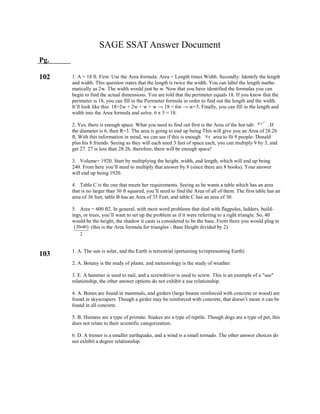
2. Yes, there is enough space. What you need to find out first is the Area of the hot tub: . If
the diameter is 6, then R=3. The area is going to end up being This will give you an Area of 28.26
ft. With this information in mind, we can see if this is enough area to fit 9 people- Donald
plus his 8 friends. Seeing as they will each need 3 feet of space each, you can multiply 9 by 3, and
get 27. 27 is less than 28.26, therefore, there will be enough space!
3. Volume= 1920. Start by multiplying the height, width, and length, which will end up being
240. From here you’ll need to multiply that answer by 8 (since there are 8 books). Your answer
will end up being 1920.
4. Table C is the one that meets her requirements. Seeing as he wants a table which has an area
that is no larger than 30 ft squared, you’ll need to find the Area of all of them. The first table has an
area of 36 feet, table B has an Area of 35 Feet, and table C has an area of 30.
5. Area = 600 ft2. In general, with most word problems that deal with flagpoles, ladders, build-
ings, or trees, you’ll want to set up the problem as if it were referring to a right triangle. So, 40
would be the height, the shadow it casts is considered to be the base. From there you would plug in
(this is the Area formula for triangles - Base Height divided by 2).
1. A. The sun is solar, and the Earth is terrestrial (pertaining to/representing Earth)
2. A. Botany is the study of plants, and meteorology is the study of weather.
3. E. A hammer is used to nail, and a screwdriver is used to screw. This is an example of a "use"
relationship, the other answer options do not exhibit a use relationship.
4. A. Bones are found in mammals, and girders (large beams reinforced with concrete or wood) are
found in skyscrapers. Though a girder may be reinforced with concrete, that doesn’t mean it can be
found in all concrete.
5. B. Humans are a type of primate. Snakes are a type of reptile. Though dogs are a type of pet, this
does not relate to their scientific categorization.
6. D. A tremor is a smaller earthquake, and a wind is a small tornado. The other answer choices do
not exhibit a degree relationship.
2
r
9
SAGE SSAT Answer Document
Pg.
104
105-106
107-111
1. A. The word antagonist means - someone who openly opposes or is hostile towards another. The
word foe means - an enemy.
2. B. the word defiance means to openly resist something or someone. For this reason, the word
opposition would be the best choice.
3. D. Meritorious means - deserving of praise. This is why the word praiseworthy is the best an-
swer choice.
4. E. Distinct means to be recognizably different. If something is recognizably different then it
would be obvious, or in other words, evident.
5. C. When someone entrust another with information, they are telling secrets. When someone tells
secrets they are confiding (which means to tell secrets).
6. A. Extort means - to obtain by force/to compel. With this definition in mind, we see that force
would be the best answer choice.
1. C. This is a vocabulary in context question. You know that C is the correct answer because it’s
the only one that refers to the piano, which is the topic of the passage.
2. E. This is a main idea question. A and D are too specific, B is too broad, and C isn’t really men-
tioned.
3. B. This is a detail question. The answer can be found on line 19.
4. E. This is a tone question. C and D are too emotionally charged. A and B do not accurately.
5. B. This is an inference question. This is asking one to infer from the passage what a genre is in
general. With this in mind, we can rule out any of the answer choices that are too specific, such as
C, D, and E. A is incorrect because that is not true.
1. D. The best way to get this answer is to multiply 3 and 4 together. From there you’ll get 12, and
then identify all of the multiples of 12 between 1-75. You can use this trick for any question which
asks you to find the multiples of two different numbers.
2. E. The smallest multiple of 6 that is greater than 90 can be found by identifying the multiples.
3. B. The base stays the same, and you add the exponents. 4 + 3 + 3 = 10.
4. E. For this question you will want to plug in the answer choices and see which one gives you the
correct answer.
5. D. If 4 is ⅓ of the total then you can multiply 4 by 3 to find the total amount of Sage students. 4
times 3 is 12.
6. B. First, you’ll want to find the answer to x in the first equation. x equals 15. From here you’ll
plug in 15-5, and get 10.
2
p
75 45
75 100
x

65
40 100
x

SAGE SSAT Answer Document
Pg.
107-111
Cont.
2
p
20 40
45 100 25 100
and
x x
 
7. A. Again, here you’ll want to find the value of x in the first equation, and you’ll get 7. From
there you’ll get 7/7, which equals 1.
8. C. If you were to algebraically set up this word problem it would look like this: ⅔ x = 6. This is
because the problem states ⅔ of the chairs are rolly, and if they added 4 more it would be 10,
meaning that currently they have 6 chairs. X equals total number of chairs. To find how many
chairs total they originally had, you would solve for x.
9. A. You can find the percentage by first finding the fraction which represents the number of
canned beans over the total number of donated food. This faction would look like this: 15120 From
here you can simplify the fraction to be ⅛ . To convert this fraction into a percentage we multiply
the fraction (⅛ ) by 1001. This will give you 12.5.
10. B. This is a percent change problem. So, be sure to use the percent change formula. One top of
the first fraction you would write 2 (which is 8-6) over 8 (the original), and set that equal to x100.
From there you’ll cross multiply and solve for x.
11. A. You would use the is over of method to find this answer. This question is really asking: what
number is 65% of 40. The equation will look like this → . You’ll get 26, which is closest to
25.97.
12. D. This question is really asking: What % of the hotels (30) contain a gym or sauna (15). Use
this information to set up an is over of equation: 15 over 30 equals x over 100.
13. D. This question is really asking: What is 17.50 of a price at 35% off? You can set up the is
over of equation as follows: 17.5 over x equals 35 over 100. From there you’ll cross multiply and
solve.
14. C. This is a percent change problem. So, you are going to set up the equation as such:
. From here you’ll cross multiply and solve for x.
15. C. There’s a few steps involved with this question. First, you want to group the items that are
discounted at the same rate. So, the scarf and the hat would be grouped (20% off), and the head-
bands would be grouped (40% off). We need to answer the question: What is the discount of 45
dollars (the price of the scarf and the hat) at 20% off & What is the discount of 25 dollars (5 head-
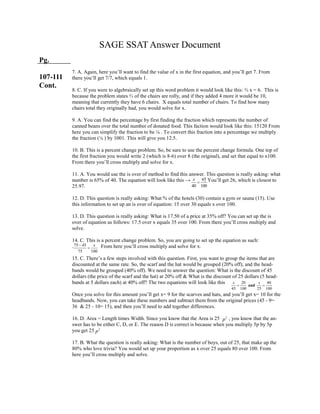
bands at 5 dollars each) at 40% off? The two equations will look like this
Once you solve for this amount you’ll get x= 9 for the scarves and hats, and you’ll get x= 10 for the
headbands. Now, you can take these numbers and subtract them from the original prices (45 - 9=
36 & 25 - 10= 15), and then you’ll need to add together differences.
16. D. Area = Length times Width. Since you know that the Area is 25 , you know that the an-
swer has to be either C, D, or E. The reason D is correct is because when you multiply 5p by 5p
you get 25
17. B. What the question is really asking: What is the number of boys, out of 25, that make up the
80% who love trivia? You would set up your proportion as x over 25 equals 80 over 100. From
here you’ll cross multiply and solve.
SAGE SSAT Answer Document
Pg.
107-111
Cont.
113
18. D. This question is really asking: What is the number that Lindsey got right out of 30 questions,
which gave her a 90% on the test? You would set up the is over of proportion like x over 30 equals
90 over 100. From here you’ll cross multiply and solve.
19. D. The Perimeter for a Pentagon can be found by adding up all of the sides together. So, 1 + 1 +
1+ 1 +1 = 5.
20. A. If you know the perimeter of a square is 60, you also know that since it is a square that the
length and widths are going to be equal. With this in mind you can simply divide 60 by 4, and get
15.
21. D. First, solve for the Perimeter of the square. If you know the length is 5, then you know the
width is also 5, from here you’ll find that the perimeter is 20. Second, solve for the Perimeter of the
rectangle. This is going to turn out to be 28. Third, subtract 20 from 28, and you’ll get 8.
22. D. Since this is an isosceles triangle (you know this because the two given side lengths are
equal), you can assume that the angle adjacent to the given 65 degree one, is also 65 degrees. With
this in mind, you add them up (65 + 65), and subtract that from 180 (180 - 130). This will give you
the remaining angle x’s degree.
23. D. First, Find the difference between the number of degrees in a square and triangle. This will
be 360-180=180. Secondly, To find ⅓ of that you multiply 1801 13 this will give you 60.
24. D. Since you know that the rectangle has a length of 6 and a width of 5, you know that the Area
is going to be 30 for both the triangle and the rectangle. From here you can work backwards. The
Area formula for a triangle is: Area = ( Height x Base ) /2 . From here, you can plug in 30 for the
Area, 6 for the base, 6 H over 2, and solve for the Height.
25 .C. You’re being asked what the total sum of the degrees within the figure is. The corners of the
rectangles are going to be 90 degrees, so to find the total sum of the other angles you’ll subtract 90
from 180 seeing as each of the triangle's angles will add up to equal 180. From there you’ll get 90
for w and x, and then 90 for y and z. 90 + 90 = 180.
Supplemental Work
1. 16. The product of 2 and 9 is 18, the sum of 26 and 8 is 34. When you subtract 18 from 34 you’ll
get 16.
2. 57. The result of 200 divided by 10 is 20, and the result of 18 plus 19 is 37. When you add 20
and 37 together you get 57.
3. C. Of the choices given none of the other choices are multiples of 9. You can quickly check to
find multiples of 9 by adding up the digits with in the number, if it equals 9, then yes, it is a multi-
ple of 9 ( 6 + 3 = 9)
4. A. A factor is a number that you can multiply with another, to create a some other number. 3 is
the only number in the given choices that can be multiplied by something to get 45 (3 times 15 is
45).
SAGE SSAT Answer Document
Pg.
113 Cont.
114
115
5. 55. Here you’ll want to add up 9, 10, 11, 12, 13. This is because, you’re told that 11 has to be the
middle number in a set of 5 consecutive numbers.
6. 384. Four consecutive even integers ending in 8 would be: 2, 4, 6, 8. So, you would multiply
them together and get 384.
7. 10. The first three prime consecutive integers are 2, 3, and 5. If you add those together you’ll get
10.
8. C. Reciprocal means to flip the number (seeing it as a fraction) so: 18/1 would be flipped to be
1/18. For example the reciprocal of 3/4 is 4/3.
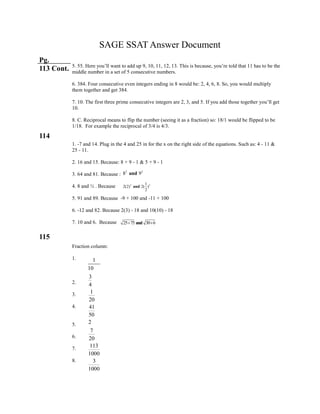
1. -7 and 14. Plug in the 4 and 25 in for the x on the right side of the equations. Such as: 4 - 11 &
25 - 11.
2. 16 and 15. Because: 8 + 9 - 1 & 5 + 9 - 1
3. 64 and 81. Because :
4. 8 and ½ . Because
5. 91 and 89. Because -9 + 100 and -11 + 100
6. -12 and 82. Because 2(3) - 18 and 10(10) - 18
7. 10 and 6. Because
Fraction column:
1.
2.
3.
4.
5.
6.
7.
8.
2 2
8 9and
2 21
2(2) 2( )
2
and
25 75 30 6and 
1
10
3
4
1
20
41
50
2
7
20
113
1000
3
1000
350 83 4200 83 4117 1
343
1 12 12 12 12 12
    
SAGE SSAT Answer Document
Pg.
115 Cont.
116
Decimal Column:.25
.75
.40
.35
3.5
.05
Percent Column:
50%
5%
82%
40%
200%
350%
11.3%
5%
0.3%
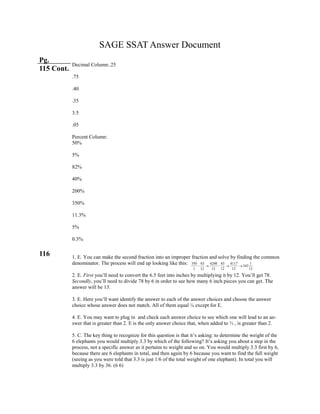
1. E. You can make the second fraction into an improper fraction and solve by finding the common
denominator. The process will end up looking like this:
2. E. First you’ll need to convert the 6.5 feet into inches by multiplying it by 12. You’ll get 78.
Secondly, you’ll need to divide 78 by 6 in order to see how many 6 inch pieces you can get. The
answer will be 13.
3. E. Here you’ll want identify the answer to each of the answer choices and choose the answer
choice whose answer does not match. All of them equal ¼ except for E.
4. E. You may want to plug in and check each answer choice to see which one will lead to an an-
swer that is greater than 2. E is the only answer choice that, when added to ⅓ , is greater than 2.
5. C. The key thing to recognize for this question is that it’s asking: to determine the weight of the
6 elephants you would multiply 3.3 by which of the following? It’s asking you about a step in the
process, not a specific answer as it pertains to weight and so on. You would multiply 3.3 first by 6,
because there are 6 elephants in total, and then again by 6 because you want to find the full weight
(seeing as you were told that 3.3 is just 1/6 of the total weight of one elephant). In total you will
multiply 3.3 by 36. (6 6)
5 2
1
3 3
is
SAGE SSAT Answer Document
Pg.
119 Cont.
118
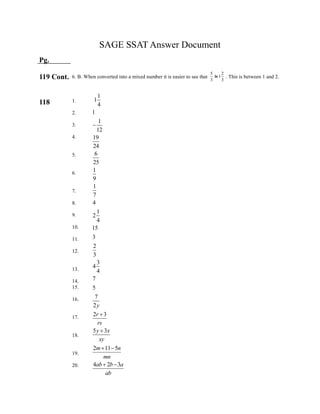
6. B. When converted into a mixed number it is easier to see that . This is between 1 and 2.
1.
2.
3.
4.
5.
6.
7.
8.
9.
10.
11.
12.
13.
14.
15.
16.
17.
18.
19.
20.
1
1
4
1
1
12
19
24
6
25
1
9
1
7
4
1
2
4
15
3
2
3
3
4
4
7
5
7
2
2 3
5 3
2 11 5
4 2 3
y
r
rs
y x
xy
m n
mn
ab b a
ab



 
 
SAGE SSAT Answer Document
Pg.
119
120
121
1. C. You move the decimal point over to the right 3 times since you’re multiplying by 1000 (there
are 3 zeros, so that’s how many times you will move the decimal to the right, and since you are
multiplying you move the decimal to the right).
2. D. You move the decimal to the left since you are dividing. Seeing as there are 2 zeros in 100,
you move the decimal to the left twice.
3. A. Quotient means division, so you would divide 3.77 by 0.26. Remember that when you divide
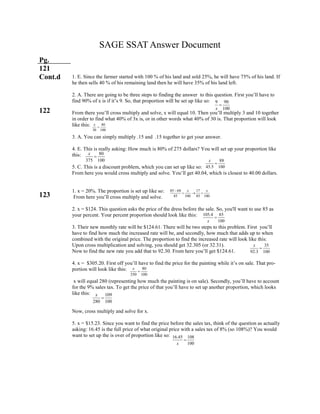
with decimals you need to move the decimal of the divisor until it makes a whole number. You
then have to move the dividend’s decimal point the same number of spaces.
4. A. Product means multiplication. You multiply 0.6 and 0.02 together and get 0.012. Since all of
the answer choices are in faction you must convert this decimal into a fraction. This will look like
this: 12/1000. Now, simplify it down, and eventually you'll get 3/250
5. E. The 4 is in the hundredths place seeing as it is 2 spaces behind the decimal point.
1. C. You’ll want to order the fractions in decreasing order. It may be easier to answer by making a
visual representation and ordering them based on what you see.
2. B. To find the missing number you’ll want to find the difference between the numbers given. So,
51-44 is 7, and 58 - 51 is 7. So, you can assume that 44 - 7 is going to give you the first number in
the sequence.
3. C. The difference between the given numbers in the set is -2/3. To find the next number in the
sequence you would add -⅔ to the last number in the sequence.
4. C. Using the same logic as the other sequence questions you would find the difference between
the numbers, which is 2.15. Once you find the difference you would add that to 4.55 to find the
next number.
x = 75. Your proportion will look like this:
x = 19.8. Your proportion will look like this:
x = 65. Your proportion will look like this:
x = 24. Your proportion will look like this:
x = 760. Your proportion will look like this:
x = 91. Your proportion will look like this:
x = 900. Your proportion will look like this:
x = 700. Your proportion will look like this:
x = 19. Your proportion will look like this:
x = 196. Your proportion will look like this:
30
250 100
x

38
192 100
x

26 40
100x

150
625 100
x

456 60
100x

35
260 100
x

90
1000 100
x

497 71
100x

19
100 100
x

147 75
100x

80
350 100
x

35
92.3 100
x

105.4 85
100x

80
375 100
x

9 90
100x

SAGE SSAT Answer Document
Pg.
121
Cont.d
122
123
109
280 100
x

40
30 100
x

88
45.5 100
x

85 68 17
85 100 85 100
x x
  
16.45 108
100x

1. E. Since the farmer started with 100 % of his land and sold 25%, he will have 75% of his land. If
he then sells 40 % of his remaining land then he will have 35% of his land left.
2. A. There are going to be three steps to finding the answer to this question. First you’ll have to
find 90% of x is if it’s 9. So, that proportion will be set up like so:
From there you’ll cross multiply and solve, x will equal 10. Then you’ll multiply 3 and 10 together
in order to find what 40% of 3x is, or in other words what 40% of 30 is. That proportion will look
like this:
3. A. You can simply multiply .15 and .15 together to get your answer.
4. E. This is really asking: How much is 80% of 275 dollars? You will set up your proportion like
this:
5. C. This is a discount problem, which you can set up like so:
From here you would cross multiply and solve. You’ll get 40.04, which is closest to 40.00 dollars.
1. x = 20%. The proportion is set up like so:
From here you’ll cross multiply and solve.
2. x = $124. This question asks the price of the dress before the sale. So, you'll want to use 85 as
your percent. Your percent proportion should look like this:
3. Their new monthly rate will be $124.61. There will be two steps to this problem. First you’ll
have to find how much the increased rate will be, and secondly, how much that adds up to when
combined with the original price. The proportion to find the increased rate will look like this:
Upon cross multiplication and solving, you should get 32.305 (or 32.31).
Now to find the new rate you add that to 92.30. From here you’ll get $124.61.
4. x = $305.20. First off you’ll have to find the price for the painting while it’s on sale. That pro-
portion will look like this:
x will equal 280 (representing how much the painting is on sale). Secondly, you’ll have to account
for the 9% sales tax. To get the price of that you’ll have to set up another proportion, which looks
like this:
Now, cross multiply and solve for x.
5. x = $15.23. Since you want to find the price before the sales tax, think of the question as actually
asking: 16.45 is the full price of what original price with a sales tax of 8% (so 108%)? You would
want to set up the is over of proportion like so:
3 2 2
2 2 1
x
x



2
r
107.25
35800 100
x

106
36200 100
x

SAGE SSAT Answer Document
Pg.
123
Cont.d
124-125
6. The BMW would be the best deal. Here you’ll want to set up two proportions and see which one
yields you the smaller amount.
The first for the BMW, with the 6% sales tax, should look like this:
The one for the Mercedes with the 7.25 % sales tax should look like this: x35800= 107.25100:
You’ll cross multiply and solve for both, and then compare the two answers.
1. B. First, add up all of the vegetables. This will total to be 26. Now you compare the number of
eggplants to the total, so your ratio would look like this: 6/26. Upon simplifying you’ll get 3/13.
2. D. If you know that they won 29 out of 46 games, you can simply subtract the two numbers to
find the number of games lost. So, that would be 46 - 29 = 17. The ratio of games lost to game won
would be 17:29. Remember - order matters!
3. C. The ratio will be P : A. First, find the perimeter of the rectangle by adding up all of the sides
(58). Secondly, find the Area by multiplying the Length by the Width (204). So, 58:294. Simplify
this down, and you’ll get 29:102.
4. B. This problem requires you to find the real number lengths using the ratios and information
given. You are going to multiply the ratio of 3:2 by x and for Phoebe you are going to add 2, and
for Monica you are going to subtract 2. and you will then set it equal to the new ratio of 2:1. This
equation will look like this:
With this you will then want to solve for x. So, cross multiply and solve. You will get x=6. You
will now multiply 6 by the original ratio of 3:2 in order to find the real lengths. You will get 18:12.
From there, to find the difference, you will subtract 18 and 12, and you will get a difference of 6.
5. C. You need to have the same units in order to compare the 2 measurements, so convert the yard
into inches. 36 inches is in a yard. Your ratio will be 36: 52, prior to simplification. Upon simplify-
ing you’ll should get, 9:13.
6. A. First, total up the number of clothing items he bought in total. That will be 32. Seeing as he
bought 12 pairs of pants, the ratio will be 12:32, which can be simplified to 3:8.
7. E. First, find the Area of the circle. The formula for this is: . The Area is going to come out
to be 36π. Secondly, find the circumference. The circumference formula is as follows: D. This
means your circumference is going to be 12π. Your ratio will look like this: 36:12. Upon simplify-
ing you’ll get: 3:1.
8. A. We are given the Base Area, so we know the first part of the ratio will be 18. To find the vol-
ume you will need multiply the height by the Base Area. 18 40 = 720. The ratio will look like this:
18:720. Upon simplification the new ratio will look like this: 1:40.
4
1. 11. We start by dealing with everything in the parenthesis. So, 4/2, then the exponent so now
you’ll have 3+24. From here, multiply 2 and 4, and you’ll get 8, then add 3 and you’ll get 11
2. 42 After dealing with the parenthesis your equation will look like this: 8-(-9) + 52
. Now, 8-(-9) +
25. Next, Add/Subtract from left to right. 17 + 25 = 42.
3. 31 Start with in the parentheses: 11+52
+(-5). Next exponents: 11+25-5. Now add/subtract left to
right. 36-5 = 31.
4. -16 Start with the parenthesis so 40
= 1. Next, you can deal with the square root sign (same im-
portance level as an exponent). Your equation should now look like this: 1+5-8+4-2-16(1). Multi-
ply the 1 and the 16 and you’ll get 16. Now, you just add/subtract left to right.
5. 0 Deal with the parentheses first so: -160 + 16 + 144. Now, add left to right, and you’ll get 0.
6. 28 Within the parenthesis you’ll get 10+3(6). Now multiply, and you’ll get 10+18. Finally add.
7. 13 There is a lot going on within the parenthesis, so let's start by dividing/multiplying within the
parentheses from left to right. (3+311 - (-8))/ 4+2. Next, (3+33+8) / 4+2. Now: 44/ 4 +2. Finally:
11+2 = 13.
8. 1 Since the negative is on the outside of the parenthesis, think about the equation like this: -(1)
(1) + 2. (anything raised to the 0 is 1). So, now you’ll have -1+2 = 1.
9. 12 In the first set of parenthesis you’ll end up getting (-6)2
+ - 26. Now, you should deal with
the exponents and the square root. So, 36+2-26. Work left to right and solve.
10. 130 The key here is to stay organized. So after completing the first two steps (parenthesis and
exponents) your equation will look like this: 10+1010 +10-10-10/10+ 100 + 20 -100 +1. Now,
working left to right multiply/divide. After completing that your equation will look like this:
10+100+10-10-10-1+100+20-100+1. Now you add/subtract left to right and get 130.
SAGE SSAT Answer Document
Pg.
126
3
4
p
p
SAGE SSAT Answer Document
Pg.
127
129
1. 41 The only way that 40 multiplied by some number would produce 40, is if the number was 1.
So, 40 plus 1 is 41.
2. 35 35 divided by 7 equals 5.
3. When simplified you would get . You can cancel out one of the p’s on top, with the p on the
bottom. From there you’re left with only p3, and a 4 in the denominator.
4. 2 You would start by multiplying together 25 and 64, you’ll get 1,600. now the equation reads
1,600 = 3,200R. 3,200 divided by 2 equals 1600. So, the answer is 2.
5. This is not possible to solve. The number of variable s must be equal to the number of equations
given in order to solve . Since they only gave you one equation, and two missing variable it is im-
possible.
6. q = (m+6)/4 The equation starts by looking like this: m = 4q - 6. To find what q equals you
would want to combine like terms and isolate the variable. So, divided by 4 and add 6 to both sides.
7. r = -2 & s = 8 Since you know that s = r + 10, you will want to substitute s for r + 10. The equa-
tion will look like this: r + (r+10)=6 → 2r+10=6 → 2r=-4 → r=-2. Now, plug that into your S
equation: S= -2 + 10.
8. 6p = m You’ll cross multiply and get 24p=4m. To isolate m, you’ll divide both sides by 4 and
get 6p = m.
9 C Seeing as x must equal 5, you can plug that into the answer options to see which equation
would end up equaling 35.
3
3
8
3
12
2 7
6
5
7 5
15
8
3
4
4
5
3
p q
nz
q
r
k
q
r
n q
b
fr
x y
g
r

SAGE SSAT Answer Document
Pg.
130
132
1. E. To find the Area of the shaded region you must find the area of the total square, and the Area
of the circle, and subtract the two from one another. So, The area of the square is going to be 12 x
12 (144). And the area of the circle is going to be 36π. So, 144 - 36π is your answer.
2. C. In order to find the Perimeter you first need to find the length and width. We know that the
length is going to equal 6w (6 times the width). And we will let the width be represented by w. So,
if you know that the Area is 54, You can work backward to find the length and width. 54=(6w)(w)
→ 54=6w2
→ divide both sides by 6 → 9=w2
→ square root both sides, and you’ll get the width =
3. That means that the length is 18 (6 x 3). Now, that you know the length and width you can sim-
ply plug it into the Perimeter formula, and get 42.
3. C. Since the tick marks on the triangle's sides indicate that they are the same, we can assume that
the 2 bottom angles are also congruent. This means that they are both 47 degrees. Since we know
that there is 180 degrees in a triangle we can simply subtract the known angles to find how much is
remaining. 180 - 2(47) = 86.
4. D. 3, 8, and 9 are the correct side lengths because the sum of 2 sides must be bigger than the
length of the 3rd. 8+3= 11, which is greater than 9.
5. C. If two lies have a perpendicular slope than that means the slopes are opposite signs, and they
are the reciprocal of one another. So a perpendicular slope of -2 would be positive ½
1. B. To find the sum of the terms you can multiply 4 and 20 together, from there you’ll get 80. To
find what 3 times that number is, simply multiply 3 and 80, and you’ll get 240.
2. B. Since you know that the set contains 5 numbers, and it’s average is 9, you can multiply them
together to find the sum of terms (45). Knowing that the sums of terms has to be 45, you can elimi-
nate A because that wouldn't leave any room for the other four numbers. 41 is the correct choice
because the largest number could have been 41, while the other 4 numbers in the set could have
been all 1’s.
3. C. Sometimes to solve average questions, it is helpful to use 2 average pies. Here you’ll want to
make one for the boys and one for the girls information. You know that the boys average was 2 and
the number of participants were 16, so you can find the sum of their speeches by multiplying those
two numbers together (32 = sum total). For the girls we can use the same logic, just with their in-
formation: 20 x 3 = 60. To find the sum of total number of speeches written by the students in total
we can add up 60 and 32, which will yield 92 total poems.
4. B. Here you may find it useful to also create two separate average pies. One pie for before, and
one for after the 9th student transfers in. To find what the exact test score needs to be to raise the
class average, you will want to find the total sum of the terms. The sum of the scores prior to the
9th student is going to be 640 (80 x 8). The sum of the terms after the ninth student enters the class,
and hopefully raises the average, is going to be 738 (9 x 82). From here you can subtract the two
sums from one another in order to see what the test score had to have been in order to raise the
class average to an 82. 738 - 640 = 98.
5. D. We know that the number of terms is ultimately going to be 4, and that he wants an average
of 90. So, with that information we can work backwards in a sense. 90 x 4 = 360. This means that
the sum of his test scores must be 360. To find what his 4th test score must be we can set up the
algebraic expression like so: 83+ 84+ 97+ x = 360 → 264 + x = 360 → x = 360 - 264 → x = 96
SAGE SSAT Answer Document
Pg.
134
135
1. D. First, find the number of students who studied for 3 hours (7) and the number of students for
studied for 6 hours (2). To find how many more studied for 3 instead of 6, you can subtract the
two: 7 - 2 = 5.
2. B. To find the average number of hours studied, you want to find identify how many total stu-
dents were counted in this graph, and then add up how many total hours that were accounted for.
With those two number you divide the total number of studied hours by the number of students,
and you’ll get your average. There are 26 total students, and the total number of hours studied is
66. 66 divided by 26 is 2.53. Rounded to the nearest whole number will give you 3.
3. C. You can set up a proportion to find the percent of time Carl spent sleeping. The question is
really asking: How many hours of 48 did Carl spend sleeping (35%). So, the proportion would look
like this: x/48= 35/100. You can cross multiply and the solve for x.
4. B. Using the same logic as number 3 you would set up your proportion like this: x/48= 3/100.
From here you’ll cross multiply and solve for x.
5. D. Again, you would set up a similar proportion to numbers 3 and 4. The only difference is that
you’ll need to combine the percent total of listening to Fetty Wap and reading (27 + 20 = 47). Your
proportion should look like this: x/48= 47/100. Cross multiply and solve for x.
PROTIP: If you divide by a negative number the direction of your less or greater than sign flips!
Also, the circle is closed if the inequality indicates: or and the circle remains open if the inequality
indicates: < or >
Page 135 ** The answer to the top equation: x + 37 is A.
1.
2.
3.
4.
5.
6.
7.
8.
9.
“Factor the following polynomials”
1. (x + 9)(x + 4)
2. (x + 1)(x + 3)
3. (x + 11)(x + 4)
4. (x - 8)(x - 3)
5. (x - 9)(x + 5)
SAGE SSAT Answer Document
Pg.
136
137
138
1. 3 and 4 add to make 7 and multiply to make 12
2. 9 and -3 add to make 6 and multiply to make -27
3. -4 and -2 add to make -6 and multiply to make 8
When being asked to “factor the following” you're simply looking for the 2 numbers which add to
make the last number in the polynomial, and also multiply to produce the second number in the
polynomial (the one attached to the x). It’s the same thing as before just within parentheses and
with the x.
(x - 6)(x - 3)
(x - 5)(x + 6)
(x + 5)(x - 5) **The last term in this equation would be 0 (positive 5 and negative 5 add to equal 0.
“FOIL the following binomials”
1. x2
+11x+10.
2. x2
-7x+10.
3. x2
-9x-10.
4. x2
+5x+6.
5. x2
-6x+8.
1. E. There a few subtle clues which indicate the comparison going on in this poem. The first is the
title, “Nature,” and the first line, “As a fond mother….” The second clue can be found on lines 1
and 9. The first part of the poem is describing the mother and her child, and the second part of the
poem describes nature and it’s way of dealing with us throughout life.
2. B. This is a tone question. Seeing as the poem is modest and does not hone in on the idea of chil-
dren not being afraid of death, nor any suffering associated with death, B would be the most accu-
rate answer.
3.C. This is an inference question. Line 9 - 11 discuss how nature slowly leads us towards death,
seeing as it is inevitable. The play things referred to in line 10 most likely describe the people and
things that fill our life because those are the things that join us on our journey towards death. The
other answer choices are materialistic, and there are no clues given in the poem that indicates mate-
rial possessions being important.
4. A. This is a tone question. B → E are all too emotionally charged to be the correct answer to a
tone question. In addition, the poem is none of those emotions. A is correct because it is moderate
and accurate.
5. C. This is a detail question. Line 9 is the correct answer because it is at line 9 where the point of
view switches from a mother to nature.
SAGE SSAT Answer Document
Pg.
139
140
1. C. This is a detail question. 1 and 3 can be found in the poem on lines 2-3 and lines 5-6. There is
no mention of anyone becoming immortal.
2. A. This is an inference question. We can assume that this is being used to refer to someone’s life
because this poem is describing the transition from life to death.
3. E. This is an inference question. This is correct because in the beginning of line 8 it states, “My
God shall raise me up...” Raising up most likely means having a life after death. When he ends the
line with, “I trust,” he is most likely stating that he trusts that God will have some form of life after
death, or at least so he hopes.
4. C. This is an inference question. The poem doesn’t discuss material possession so D can be dis-
counted. A and B do not carry the same tone as the poem, in other words, the poem isn’t very up-
lifting or healing focused. E is simply not mentioned within the poem. C though is the main pur-
pose of this poem. It describes the idea of knowing for sure that inevitably everyone who is born,
will eventually die.
1. C. This is a main idea question. From the first sentence onwards the passage is criticizing the
practices of English poetry. You can see this in line 1, 4, 5, 6, 8, and 9.
2. B. This is a vocabulary in context question. You can assume that traditional in this line means
formal because the other answer choices wouldn’t make too much sense, and though conservative
may seem right that isn’t usually a term associated with literature/poetry.
3. A. This is an inference question. Since the entire poem is criticizing English poetry, it is a safe
assumption to say that the passage is implying that Romantic poets were better than those that they
are criticizing.
4. A. This is an inference question. When men are speaking to men you can assume that they are
participating in some form of dialogue, which usually is spontaneous. This spontaneity is organic,
and that is the type of poetry that was considered by them to be good literature.

SSAT Answer Doc

  • 1.
    SAGE SSAT AnswerDocument Pg. 10-12 1. C. Amusing is a lesser form of being uproarious, and interesting is a lesser form of mesmerizing. Therefore, this is the best answer choice. 2. D. A jar is used to contain things, and a pillar is used to support things. Therefore, this would be the best answer choice. 3. D. Dance is what a ballerina does, and digging is what a miner does. Though reading is what an author also may do, his primary job is to write, rather than read. 4. C. The word amorphous means to lack shape. If something is odorless it makes scent. 5. A. One may be articulate in their speech, just as one may be agile in their movement. Though one may be stunning in their appearance, this is not something they do, rather it’s how they appear. 6. B. Stark is the opposite of embellished, just as stoic is the opposite of flamboyant. Some of the answer choices may come close to being opposites, but none truly is the way that B is. 7. C. First, you must know that a league in this context is used to described a type of measurement. Depth is measured in leagues. Height is also measured in meters. 8. E. Donors give to others, and a guardian protects others. Here it is useful to think about this in terms of what they do for others. 9. D. A porcupine has quills (for protection). A moose has antlers (for protection). Though it is true that a cat has a paw, a kangaroo has a pouch, a swine has a snout, and a horse has a hoof, we must choose the answer that best fits the relationship. A porcupine has quills for a specific purpose, just as a moose has antlers for that same specific purpose. 10. D. Aquatic (water related) is the opposite of terrestrial (land related). If something is abstract it is the opposite of concrete. 11. C. A type of dessert is an eclair. A type of evergreen is a pine. The other choices are not types of evergreens. 12. D. Kind is the opposite of malevolent (wishing evil). Being idiotic is the opposite of being bril- liant. 13. E. Monochromatic refers to a type of color, as monotonically refers to a type of sound. Here it is useful to break down monotonic. Notice the word tonic is like “tone.” The word tone is related to sounds. 14. D. A bouquet is a group of flowers, and a litter is a group of kittens. This one is a bit tricky because it is common for students to choose A (trash). The key in choosing the right answer is de- ciphering which kind of litter is being referred to. A group of trash doesn’t make as much sense as a group of kittens. You may have a pile of trash, but not a litter of it.
  • 2.
    SAGE SSAT AnswerDocument Pg. 17-19 1. D. is the correct answer because 0, 6, 2, and 4 are all even. 2. B. If a number is prime then it only has 2 factors: itself and the number 1. Here we are being asked to identify the smallest prime number that is bigger than 50. 51 has a few factors (1,3,7, 51), but 53 has none other than itself and one. 3. E. 756 is the only answer that could be a multiple of 2 because it’s the only even number. 4. C. To find the answer easily you may want to cross cancel. From there you can easily multiply the simplified remainders. 5. C. The LCM is a term which refers to the lowest number that is the product of both the numbers 18 and 24. The lowest product, in this case, would be 72. 6. C. 465 is the correct answer, and can be found easily by utilizing the division rules found in the table on page 16. 4 + 6 + 5 equals 15, which is a multiple of 3, so you know that 465 would be the correct answer. 7. E. For this problem, you need to remember PEMDAS. Start by dealing with the problems within the parenthesis. Within the parenthesis you would want to start by multiplying and then subtract- ing. Finally, you would multiply -6 to your answer. 8. B. 10,030 is the correct answer because it’s the only answer choice which ends in a 0. 9. D. 7,790 is the correct answer because it is the only one that satisfies the division rules for both 5 & 2. It’s even and ends in a 0 (making it divisible by 5). 10. C. 210 is a multiple of 3 & 10 because it ends in a 0 (making it divisible by 10), and the sum of the digits add up to 3, which is a multiple of 3 (meaning it is also divisible by 3). 11. D. 420 is a multiple of 2,3, & 5 because it ends in a 0, is even, and the sum of the digits add up to 6 (making it divisible by 3). 12. E. Seeing as it is asking for an even multiple you can eliminate A and B. 390 is the correct an- swer because the sum of the digits is 12 which is a multiple of 3. The fact that it ends in a 0 means that it is also divisible by 5. 13. C. For this problem, you would want to see which answer choice is evenly divisible by 3. Here, 252 would be the only number that fits. 14. E. 555 is correct because it is not only evenly divisible by 3 but also by 5. Team A and B would each be able to divide up the candy evenly, whether that be with 3 pieces of candy per member or 5. 15. E. Here you might want to use the process of elimination. It can’t be A because that is the sec- ond multiple of 4, and therefore it can’t be the greatest out of three. B though it is the third multiple of 4, the sum of those 3 do not add up to equal 60. C and D, though they are multiples of 4, do not add up to equal when combined with the other 2 multiples. 16. E. 918 is not odd because it ends with an even number.
  • 3.
    SAGE SSAT AnswerDocument Pg. 17-19 Cont. 17. E. -1 is the only logical choice because if you are adding two negative numbers, then the an- swer must also be negative. 18. D. 87 is not a prime number because it is a multiple of 3. 19. A. Seeing as the question asks “which of the following can be a product of one negative, and one positive integer except” you want to look for the answer that is incorrect. 1 is incorrect, be- cause when you multiply a negative and a positive you would get a negative answer. 20. C. 60 times 9 equals 540, making it a multiple of 60. 21. C. You can find this by choosing the first two odd integers (1 and 3) and choosing the first even integer (2) and multiplying them together. 22. B. You would add 9,899,399 to 2,082 and your answer would be B. To increase a number is a fancy way to say add. 23. C. Since you know the middle number is 13, and that it is in the middle of a consecutive se- quence you can fill in the remaining numbers. There is going to be two numbers preceding the 13 and the following 13. Since you know that this is a consecutive set of numbers, 11, 12, 13, 14, 15, would be the answer, and from there you would add up the numbers to get the sum of the 5 con- secutive integers. 24. C. Think PEMDAS. Parenthesis first [1 minus 2], next would be Exponents [-2 cubed, -1 cubed, and -2 cubed], then multiplication [-8 times -1], and from there addition [8 + -8]. 25. C. First, you want to find all of the odd integers between 10 and 19. So, they would be 11, 13, 15, and 17. From there you would add them up, and divide by the number of terms in order to find the mean of all the possible odd integers. 26. D. Again, think PEMDAS. The first parenthesis [3 times 2, and also, 6 divided by 2], next ex- ponents, next multiplication/division, and finally addition/subtraction. 27. C. The product of 48.9 and 21.2 is 1,036.68. Of the options given 1000 is the closest to that amount. 28. E. Though this doesn’t appear to be similar to a PEMDAS problem, it is. You start by dealing with operations under the square root sign and within the absolute value signs. Once you have solved for those, you would add your answers together [9 + 3], and get 12. 29. C. If you are rounding to the nearest 100’s, you want to assess the number in the 10’s place to see whether or not the 100’s place will round up or stay the same. Since it is the number 5 you would round the number in the 100’s place up. Note: if that number were to have been below 5, then the number in the 100s place would have stayed the same. 30. C. Here the problem is defining a number as “blue” if it’s product and sum are equal to one another. here, 3 + 2+ 1 equals 6, and 3 times 2 times 1 also equals 6. This makes 321 a blue num- ber. 31. B. It may be helpful to guess and check. 7 + 9 + 11 + 13 +15 = 55. Divided by 5 gives you an average of 11.
  • 4.
    3 1 14 13 2 16 3 4 21 13 3 20 71 6 SAGE SSAT AnswerDocument Pg. 17-19 Cont. 23 24-25 32. E. This is “strange symbolism” problem. Here, you want to follow the instructions given in order to fix the given number. This problem is doing nothing more than testing your ability to fol- low directions, the arithmetic shouldn’t feel too strenuous. 33. C. To find “D” you will need to multiply 15 and 6 and then add 2. This is going to give you 92. Now you divide 92 by 6, and you’ll get a remainder of 2. 34. C. This is also a “strange symbolism” problem. Look at the example they provided carefully, and follow the rules. Here, it appears that they want you to replace the letter “a” with the first num- ber in the given set (7), and “b” with the second number in the given set (5). From there you would solve arithmetically. 35. C. The greatest number less than may be found by first seeing how many times 6 goes into 71: which is 11.71. From there we can see that 11 would be the greatest integer, that is also less than 11.71. 1. would be your answer. You would need to find the common denominator, which is 20. 2. would be the correct answer. You would need to find a common denominator, which is 28. 3. is the correct answer. You would first want to turn the mixed numbers fraction into an improper fraction. Remember, you can also cross cancel if that makes it easier to solve. 4. Is the correct answer. Here you want to make the mixed numbers into improper fractions, **then flip the second fraction and finally, multiply. (**division rules for fractions). 1. D. ⅗ is less than ⅔. Feel free to either make both denominators the same to see which numera- tor is smaller, or try drawing it out! 2. A. Here it is important to note that the term “of” refers to multiplication. So, ⅗of 5/7 is really saying ⅗ times 5/7. 3. C. Here you would want to try and find a common denominator. From there you would add them straight across, and keep the common denominator the same. 4. E. It may be helpful here to cross cancel before multiplying. In addition to cross-canceling, you want to be careful to not forget to flip the last fraction, seeing as it is being divided! 5. D. If you want the sum on the left side of the greater than sign to exceed 1, then you need to choose an answer that can be added to ⅙, and then exceed the value of 1. 6/7 is the only choice that does so.
  • 5.
    SAGE SSAT AnswerDocument Pg. 27 29 1. C. Here you want to be careful and read the question carefully. Note: it asks for 16 thousandths. So, with the place values in mind (refer to page 26), we should choose C. 2. B. You want to be sure that the number 245.388 is the dividend, and that 13.2 is the divisor. From there you also want to ensure to move the decimal to the right once on the divisor, and also for the dividend. 3. C. Let's break this down step by step. First: You want to identify how much of the total weight is due to the eggs, so you want to multiply 0.093 by 7 (single egg’s weight by the number of eggs). Second: You want to take your answer (which should be 0.651) and subtract it from the weight given (0.87-0.651). The remaining weight will be that of just the basket. 4. A. Work left to right arithmetically, and keep track of your answers along the way. 5. B. You would divide 85,007 by 4,095 and get 20.75. Using rounding you can see that 21 would be closer to the answer you got. 1. A. You would set up the proportion according to the is over of method. 28 = is, 68 = of, x = the percent, which is over 100. From there you cross multiply and solve for x. 2. D. Sometimes for word problems, it is helpful if you reword the question. Here what is really being asked is: what percent of the 22 total animals are the 8 dogs? From there you can solve it as a normal “is over of” problem. 3. E. This question requires that you solve it in two parts. First: you want to find the “of” in the first part of the question (30 would be your is, x would be your of, 40 is the %, and the percent is over 100). After cross multiplying you’ll find that x equals 75. Now you may move on to the second part of the question. It asks what 15% of that number would be (which we now know is 75). So, you can either use the is over of method or multiply 75 by .15. 4. B. The real takeaway from this question is: What percent (x) of the total ice cream (77) is choco- late (42)? You can plug in your variables to the is over of method and find that the answer is 54.5, which is approximately 55%. 5. C. 30 is the is, 16 is the percent (over 100) and the of is your variable (x). 6. B. What is the question really asking is: What are 22 pounds of 11%? So, 22 is the is, 11 is the percent over 100, and the of would be your variable (x).
  • 6.
    SAGE SSAT AnswerDocument Pg. 31 33-34 1. B. Since Chandler bought the Ipad for 300 and had to pay sales tax, the new percent that he is paying for the item is 118% (100 % just for the Xbox + 18 % sales tax). The question asks for the total amount that he paid for the Ipad, or in other words, what is 118% of 300? Is = x (the variable), of = 300, % = 118 over 100. After cross multiplying and isolating x, we’ll find that the total was $354. 2. D. Since Rachel gets a 40% discount, that means she’ll be paying 60% of the original price. The question is really asking: What is 60% of 27? From there you plug the information into the is over of, and solve! (** remember to plug in the 60 for the percent - NOT the discount %) 3. B. First step: Find out how much the 4 sunflowers will cost at their normal price (8 times 4 = $32). Second step: Recognize what they are actually asking: If the discount is 15 % off, then what a consumer would pay is 85% for the flowers. So, they are asking what is 85% of 32 dollars? Third step: Plug into the is over of formula and solve! (x = is, 32 = of, and 85% over 100). 4. D. Since he tipped 20%, that means that the total percent he spent on lunch that day would be 120%. They are asking: what is 120% of $22 (the amount that the lunch cost)? X = is, 120% = percent over 100, and 22 = of. 5. E. This question is asking: $63 is 105% of what number? The price of the shoes represents 100%, then you add 5% tax to that. So, 63 = is, 105 = percent over 100, and x = of. 1. B. Make sure to read page 33 prior to working on the following questions. So, if the jersey’s value increased from 45 to 54, then we know that the difference is $9. From there we plug in the given information to the “difference over the original equals % over 100” formula (found on page 33) and solve. 2. E. First, you want to find the difference between the original and the increased price ($399), then identify the original price ($200). From there you will plug in the information into the formula and solve for x. 3. C. Like the other two questions, you want to first find the difference between the original and lowered price ($2.25), and then identify the original price ($6.00). Then, plug the given information into the formula, and solve for X (the percent). 4. D. Here, the question gives you the difference, or how much the tree grew (30.78 inches). You don’t need to subtract, but just put the difference over the original. In this case, the tree was origi- nally 324 inches. You plug that information to the difference over original formula and find that X is 9.5%. 5. E. First start by finding the difference in price (which turns out to be $342). From there you will plug in the information and solve for x. 6. B. Since she increased her money by 42%, this means that she now has 142% of her original amount in her account. If you want to find out how much total money she has, then it may be help- ful to reframe the question. What is 142% of $65? Now, you just plug in and solve. 7. A. Since the car decreased in value after the first year by 23%, we know that it now cost 77% of its original amount. We can reframe the question as: What is 77% of 25,500, and set it up as an “is over of” problem.
  • 7.
    SAGE SSAT AnswerDocument Pg. 35 38 39 40 41 42-42 1. B. These problems are all balancing acts. Since here they divided 50 by 2 to get 25, and then multiplied r by 2 to get 2r, they really did nothing at all. The actions canceled one another out. Therefore, the answer is going to stay the same: 9. 2. B. Here, 16% was divided by 4, in order to get 4%, and q was multiplied by 4 to get 4q. So, again nothing really was changed. The answer remains 16. 3. E. 20% was divided by 5 to get 4%, and x was multiplied by 5 to get 5x. The equation was bal- anced, so the answer will remain 75. 4. C. 15% was multiplied by 3 to get 45%, and m was divided by 3 to get m/3. So, the answer, once again, remains 35. 5. D. 28% was multiplied by 3 to get 84% and 3k was divided by 3 to get k. Again, the answer re- mains 9. 6. D. This is the only problem on this page that isn’t balanced. 60% was divided by 2 to get 30%, but nothing is done to the variable y. In this case, you would want to then divide the answer by 2 in order to solve the unbalanced equation properly. 24 divided by 2 is 12. You would divide by 2 be- cause that's the same thing that happened with the percents. 1. D. This is an inference question. You want to make an educated guess as to what was meant by using the phrase “unremarkable details.” The passage is trying to allude to the fact that solving these mysteries would be almost impossible, if not C. 1. C. This is a main idea question. You don’t want to answer with too broad a statement (E), or a detail oriented statement (A). You want to be mindful not to choose an answer which contains trig- ger language (B). 1. A. These are detail questions. Watch out for trigger language! Line 2 contains the correct an- swer. 2. E. Line 12 contains the correct answer. E. This is an inference question. The concluding sentence reveals conversation as an “engaging” learning strategy. Engaging is a synonym for “interesting" so A, C, and D can all be eliminated. B is mistaken: although the passage states talking to others, it specifically states talking to others “with vocabularies larger than their own,” which fellow students do not have. 1. B. This is a Main Idea question. A and E are too broad while C and D are detail oriented. “An art movement” in this case is specifically referencing the Hudson River School. 2. E. This is a detail question. All of the other answer choices were mentioned in the passage while E was NOT.
  • 8.
    SAGE SSAT AnswerDocument Pg. 42-43 Cont. 44 50 57-58 3. C. This is an inference question, and you know this by the use of the word “suggested.” It's refer- ring to a specific statement in the passage. If you go back and read the sentences surrounding line 18 you can see why it fitted the bill perfectly- “to compete with Europe” and to be “unmistakably American.” Both are ways to display pride. 1. D. Since this is a main idea question, D is the most logical answer. It is the only choice that ac- curately describes what the passage is discussing and in a way that is not too broad nor specific. 2. A. This is an inference question, and you know this by the use of the word “suggests.” It directs us towards line 2, which states that few of us realize the complexities that go into designing a con- cert/lecture hall. If that be true, then it wouldn’t be too far of a stretch to assume that since we don’t recognize it, we don’t appreciate it. 3. E. This is a detail question. All three of the roman numerals were addressed within the passage, therefore, E would be the correct answer. 4. C. This is also a detail question. Lines 10-12 contain the correct answer. 5. B. This, again, is a detail question. The last line of the passage contains the correct answer. 1. ⅝ is the correct answer. Start by adding up the total number of boxes and place that number in the denominator and place the thin mint box amount in the numerator. 2. He has 27 German stamps. First, you want to set up a proportion. To do this: write the German stamps to British stamps ratio and set it equal to the ratio of real number of German stamps (x) - over real number of British stamps (90). Now, cross multiply and solve for x. 3. 6:19 is the ratio of free-throws missed to free throws made. It’s important to remember that order matters. If LeBron missed 6 free throws out of 25, then your first number would be 6, and the sec- ond aspect of the ratio would be the remaining free throws (19). 4. The answer is 119 Pink Jelly Bellies. You would want to set this problem up in the exact same way that you would number 2. First, you want to set up a proportion, which contains two ratios. The first ratio would be 2 (red) over 7 (pink) and set it equal to the real number of Red Jelly Bellies (34), over the real number of Pink Jelly Bellies (x). 5. The answer is 3:8. One thing to keep in mind is that the ratio will need to be in the same units, so you will need to convert accordingly. It would be easiest to convert everything to inches. So, for 2 feet 3 inches you would write that as a single number: 27 inches. For the second part of the ratio, you would need to convert 2 yards into inches, which would be: 72 inches. From there you’ll have 27:72, and that can be simplified to 3:8. 1. A. Bleak and dismal are both ways to say: gloomy, dreary, or miserable. 2. A. Though it may be tempting to choose C (hot), damp is more closely related to humid. Humid- ity has more to do with precipitation than temperature. Precipitation is most closely related to being damp.
  • 9.
    SAGE SSAT AnswerDocument Pg. 57-58 Cont. 3. B. To deport someone means to remove them from a country. Though it sounds harsher, banish- ing is the word most closely related to removing. 4. E. Sell would be the best answer choice because "peddle" means to sell or promote. 5. C. When you see the word terminate, you may think about the movie - The Terminator. To ter- minate something means to end its existence. 6. C. "Dearth" means scarcity or lacking. The word "shortage" is the best answer choice. 7. B. This one may be a bit tricky. In situations like this, define it in your head, and choose the an- swer that most closely relates to the definition. Obscure means uncertain, or unknown. With that in mind, dark is the closest answer choice. 8. E. To mourn is to feel deep sorrow and sadness. When someone grieves they are also expressing deep sorrow/sadness over the death of another. 9. E. A recluse is someone who is extremely shy. They tend to live a solitary life. The word hermit is a synonym because it is a term that is commonly used to describe extremely shy individuals. 10. C. Though affection may seem like a good answer choice, respect is more closely related to the true definition of the word homage. Homage: Special honor, or respect, shown publicly. 11. D. To be herbivorous insinuates that that animal/human only eats plants. 12. A. Though a synopsis can be written in a paragraph form, and may feel like an update, it is truly more of an overview of a novel, movie, or what have you. So, here the most closely related word would be a summary. The definition of a synopsis is a brief summary or general survey of something. 13. C. Wanton has two primary definitions. The first: deliberate or unprovoked violence. the sec- ond: sexually immodest, or promiscuous. With this definition in mind, we can see that of the an- swer choices given lustful would be the one which most closely resembles the second definition of wanton. 14. D. Though it may be a good assumption to think that imperious means royal, there is an even better answer choice, which more closely relates to the true definition of the word. To be imperious means: assuming power or authority without justification; arrogant and domineering. Even though royal individuals are given power assumingly, imperious describes a personality trait, rather than a social class. 15. A. Hallow means to honor something as holy. When something is being honored as holy it is being revered. 16. A. Though bliss is fun, fun is not as intense of a word as bliss is. Bliss is described as perfect happiness or a state of pure and uncontained joy. "Fun" doesn’t really meet those requirements. So, ecstasy would be the best answer choice because it is described as an overwhelming feeling of joy, happiness, or pure joy.
  • 10.
    SAGE SSAT AnswerDocument Pg. 87-58 Cont. 60-61 17. C. Just because something is indecent, it doesn’t necessarily mean immoral (seeing as every- one’s definition of morality is different). If something is not decent, then it would be true to assume that it is not proper in the given context - improper. 18. C. Touchable is the best answer choice because if something is tangible then it is perceivable by touch. In other words, you can physically touch, or feel it. 19. E. Though someone may appear as being rough, or hard, when exhibiting ferocity, the better answer choice would be fierceness. Ferocity comes from the word ferocious, as does fierceness. 20. B. To be tenacious means to be determined! With this in mind, we can see that B, would be the best answer choice. [For these answers be sure to refer to page 59, because (if completed) the analogy relation- ships are there for you to refer to! :) ] 1. D. Though A, B, and E, are also whole/part relationships, they do not describe a group of ani- mals. A school of fish swim together, and act as a unit, just as a herd of sheep does. 2. E. Ravenous is a more intense version of being hungry (degree relationship). With this relation- ship in mind, we can see that stunning is a more intense version of pretty. None of the other answer choices exhibit a degree relationship. 3. B. Since you use a scale to measure weight, you want to look for an answer choice that also measures something. You use a kitchen to cook, but not to measure cooking. This is why B is the correct answer - you use a yardstick to measure. 4. C. A sphere is round, and a trait of a plane is that it's flat. The other answer choices do not de- scribe trait relationships. 5. E. A mosaic's composed of tiles (whole/part relationship). Though a shirt may have a button, the buttons are not necessarily the only thing composing the shirt. A cast can not be a cast without ac- tors because the actors compose the cast. 6. C. This is a “not” relationship. If something is illegible, then you cannot read it. If something is inedible then you cannot eat it. Sidenote: a pair of words are “not” relationships if they twp words are from two different parts of speech. 7. B. Modest is the opposite of pompous. Delicate is the opposite of indestructible. The other an- swer choices aren’t opposites of one another. Sidenote: a pair of words that display a relationship of being “opposite,” are the same parts of speech. 8. C. Here we also see an opposite relationship. The opposite of enlisting (signing up) is resigning (quitting/leaving). The opposite of severing (to cut apart) would be to mend (bring together/bind one thing to another). 9. B. A spade is used to dig, and though you may use a spoon to sip, that is not the main thing that a spoon is used for, which would be eating. Same concept with finger and poke. Though a finger can poke, one doesn’t solely use their finger for poking. On the other hand, a whisk is primarily used for mixing.
  • 11.
    SAGE SSAT AnswerDocument Pg. 60-61 Cont. 10. C. This can be classified as either a not relationship or an opposite one. If someone carries a burden, then do not feel soothed (or relaxed/calm). If something is restricted then it is not yielding (or giving way). 11. A. An incentive (which can be described as money, a prize, or internal satisfaction) is used to motivate individuals. For example, an incentive to get people to work would be the money that they make, or for others, the positive feeling they get from working. Though in some cases, candy may be used to reward individuals, candy is not the only thing used to reward individuals. Rather, a lure (or a temptation) is a more broad and accurate way to entice an individual into doing something. 12. B. Inquire and interrogate are examples of a degree relationship. Inquiring is much less formal/ intense, then interrogating someone about a matter. Though thinking may seem less intense than wondering, thinking about something challenging would be much more intense then wondering. When someone tastes a piece food, they’re eating at a regular pace. On the other hand, when some- one devours something, they eat extremely quickly, and many times without really enjoying the food. 13. C. Absorb is the opposite of emitting. If you draw (create) something, that can be considered the opposite of erasing (or destroying) it. Though walk and run seem like opposites, they are still both forms of movement, and perhaps would be better described as a degree relationship. 14. E. This is an example of a degree relationship type. If someone is picky, then perhaps they don’t like tomatoes in their salad, but if someone is fastidious: they don’t want tomatoes, need the onions diced into ½ inch cubes, and want dressing served on the side in a plastic bowl. Being fas- tidious is much more intense than being picky. Just as being ancient is much more intense than being old. 15. C. This is a trait relationship. A trait of a beet is that it is red. Just as a trait of an ice cube is that is is cold. Though sunny and warm also seem accurate, it is important to look at the parts of speech. Beet (noun) is to red (adjective), and sunny (adjective) is to warm (adjective) - they are not the same. Ice (noun) is too cold (adjective) are the same parts of speech and are in the same order as the question. 16. D. A ruler is used to measure, and a needle is used to sew. 17. E. A snowflake is a part of the whole - snow. Though a berry may be in a pie, it isn’t always. In addition, though an ant may have antennae, this is a trait relationship, not a part/whole. A star is a part of a constellation; a constellation wouldn't exist with stars. 18. B. A protagonist is the opposite of an antagonist. Even though it may seem logical to consider a waiter as the opposite of a customer, they are not always the opposite. In a waiter’s real life he/she also may play the role of a customer at some point. On the other hand, a wimp is the opposite of a bully because of their characteristics. 19. D. This is an example of another opposite relationship. Stark is used to describing something that is bare in appearance, and embellished is used to describe something made more attractive by decor/details. Still (not moving) is the opposite of shaky (moving).
  • 12.
      32 6 63 8 and so your full answer will be x x x y  SAGE SSAT Answer Document Pg. 60-61 Cont. 65 20. D. Here, we see a boggle question. The letters in ape have been “boggled” to make the words pe a. In other words, the letters have been mixed around to create another, new, word. Ate is bog- gled to create the word tea. Sidenote: Letter order matters for this relationship type, so be sure to keep that in mind. 21. A. Being nimble (quick and light in movement) is a trait of having coordination. Though C would be ideal, not all parents have the trait of patience. In addition, being smart isn’t a trait of grades, it would be a trait of good grades. Though some pies are sliced, this isn’t a vital trait of a pie. Lastly, not all racers are speedy, though they would like to be. If someone is flexible, then they must have the trait of being limber (stretchable/in shape). 22. E. A tongue is used to taste. A nose is used to smell. A bike can be used to travel, but it’s not the only form of transportation. Our nose is the only way that we may smell, just as our tongue is our main way to taste. In addition, they are both senses, so even more similar. 23. E. A gull (a bird) is a part of a flock (the whole). Seeing as the example uses an animal group to display the part/whole relationship, the wolf to pack example would be the best choice, seeing as it too describes animals under the part/whole context. 24. E. We end this section with a boggle relationship. The letters in “Laws” are mixed up to create the word slaw. “Tars” is also mixed up to create the word star. 1. B. Seeing as the negative sign is on the inside of the parenthesis, you must raise the entire thing by 3. So, -8 times -8 times -8. 2. B. This one can be a bit tricky. The problem is as follows: -52 (5) The only thing that would be squared is the 5, not negative 5, seeing as there are no parentheses around it. From there you’ll get 25, and now you’ll have to tack the negative back onto your answer. From there you’ll have -25 multiplied by 5, which is -125. 3. B. The rule of multiplying exponents states that when multiplying numbers with exponents, as long as they have the same base, you add their exponents. So, 5 +8 + 10 = 23. 4. B. Here the only thing you’ll need to memorize is that ANYTHING raised to a 0 will equal 1 whether it’s a number or a letter. 5. E. Here the parenthesis indicates that the only thing being raised by the 3rd power is the number 4, not the negative sign. So, you’ll raise 4 to the 3rd power and then add on the negative at the end. You may also think about it as multiplying your answer by a negative one. 6. E. It would be helpful to use the rule of raising exponents to another exponent, which states that you multiply the exponents together. But first, deal with the number, and raise it accordingly (2 times 2 times 2 = 8). Secondly, deal with the exponents attached to the letters by multiplying them together (group like bases). For example
  • 13.
    1 2 144 SAGE SSAT AnswerDocument Pg. 66 67-77 1. D. We are back to PEMDAS again! Think left to right, and completing the arithmetic in the or- der that is prescribed to you in PEMDAS. 2. A. Since anything raised to the 0 power is 1, the problem is 1 plus the square root of 169, which is 13. 13 + 1 = 14. 3. C. Make sure to utilize PEMDAS, and to work from left to right. 4. D. Here it can get a little tricky with all of the parenthesis floating around, but if you look closely you can see that inside the parenthesis is really just saying 11 minus negative 3. So, from there you would square 14, and go on with division and then addition. 5. E. This is PEMDAS again. The only thing that seems different is . This is really just a fan- cier way of saying 144. So, inside the parenthesis would end up being -12 + 12. Then, 0 divided by 6 is 0. 1. A. This is a tone question. Seeing as the passage is informative and educational it would be best to guess that this came from a textbook. 2. C. This is an inference question. You need to consider the main ideas and theme of the passage in order to give it an appropriate title. E, A, and D are too specific, and B doesn’t particularly make sense as a title for this passage. 3. D. This is a detail question. Be sure to read the question carefully. It is asking you to find which one is not true. In lines 15-20, you’ll see that D is debunked. 4. C. This is an inference question. With all of the information given in the passage, it would be logical to assume that the lemur is not aggressive. The other answer choices are details, rather than inferences which go beyond the passage, and are also incorrect. 5. D. This is a detail question. D is the correct answer because she was working on humanitarian causes all throughout her life, not just after her marriage. Line 16 also directly refers to this fact. 6. B. This is a tone question. The passage is clearly pointing out all of her good qualities, and all of her accomplishments. For this reason, we can assume that the tone is admiring. 7. B. This is a main idea question. A and E are wrong. D is too specific, and C is as well. 8. E. This is an inference question. You can assume, thanks to lines 5-10, that this passage was written to show that she deserves individual recognition, even though her husband and family were a part of her life. A through D are all too much of a leap from the information given in the passage. 9. D. This is a main idea question. If you read the second paragraph you’ll see that it is explaining Wilson’s lack of knowledge surrounding international politics. It is that lack of insight which added to the causes of the war. Lines 20-25 are also great lines to read when looking for the main idea of the paragraph. 10. C. This is a tone question. When answering tone questions it is vital to not chose words that are overly emotional. B is too emotionally charged, E and A wouldn’t make sense, and D is wrong, seeing as the topic is war.
  • 14.
    SAGE SSAT AnswerDocument Pg. 67-77 Cont. 11. A. This is an inference question. A is the correct answer because you can take clues given to you in the second paragraph. Lines 23-25 explain his opinion on this topic. The other answer choices are not explicitly touched on throughout the passage. 12. C. This is a detail question. Again, the reasoning behind this answer choice can be found by carefully reading the second paragraphs line 20 onward, especially 25-28. 13. C. This is an inference question. Seeing as the last thing discussed in the second paragraph is the fact that war is usually ignited because of territorial disputes, it wouldn't be too much of a stretch to say that next the author may begin to discuss examples of this. 14. C. In lines 1 - 10 we see the seasons being compared to the life cycle. A few hints to help you come to this conclusion can be found by reading lines 1-5 carefully: “Live thy Life young and old” and “Like yon oak Bright in spring” are great examples of this comparison. 15. C. The poem is personifying the Oak, and that is what the he refers to in line 15. Another clue that may be helpful in answering this question is the title of the poem. 16. A. In line 9 we see that “autumn changed,” so we can infer that the words, “gold again,” are referring to autumn as well. 17. A. Spring is the right answer because in lines 4-5 it says “Bright in Spring. Living Gold” 18. A. This is an inference question. D is not correct because that poem speaks of the seasons in a predictable manner, C wouldn’t make sense because the poem doesn’t talk about anything regard- ing pleasant versus unpleasant experiences in life, and E doesn’t work because this idea is never alluded to in the poem. Between A and B, A would be the better choice because the poem breaks down each season and explains it with colorful and full writing. This can be interpreted as a meta- phor for living one’s life to the fullest. 19. A. This is a main idea question. Starting in line 4 and continuing on through the passage, vari- ous aspects of the tea plant are elaborated on. 20. B. This is a detail question. The answer can be found on line 18. 21. B. This is an inference question. Though it may be hard to choose between B and E, the main difference to focus on between the 2 is that a history textbook would be much more focused on the historical dates/facts of the tea plants throughout the passage. The last paragraph in the passage is history focused, but not the entire thing. This is why an encyclopedia would be a better choice. 22. E. This is a detail question. The answer to this question can be found by reading the sentence which starts on line 16 and goes through line 19. 23. C. This is an inference question. Seeing as every paragraph in the passage talks about a differ- ent aspect of the tea plants, we want to stay with that trend. A wouldn't be right because the passage is not about the Boston Tea Party, B isn’t correct because the passage is not about imports, and E and D are not correct because they also do not focus on the tea plants. 24. D. This is a main idea question about one paragraph. In lines 15 through 26, we can see that the only thing discussed is the cultivation of tea.
  • 15.
    SAGE SSAT AnswerDocument Pg. 67-77 Cont. 25. A. This is a main idea question. During this paragraph, the youth talks about memories from lines 4 through 14. Line 4 says the words “he remembered”. You can assume it is about childhood, because in line 6 the words, “thrillful boy” was used. 26. C. This is an inference question. You can assume that since the words, “Someone cried” was used, that this is a very intense event. The most intense answer would be one describing enemy soldiers. The next paragraph immediately references cartridges. 27. B. This is a tone question. You can rule out A and D because there is no sense of anger in the first paragraph, nor reluctance. Seeing as the first paragraph was talking about youth memories, it is logical to assume that the tone of that paragraph would be that of a reminiscent. The second para- graph is very anticipatory seeing as the only thing anyone says is “Here they come!” 28. E. This is a detail question. In lines 23-29, the author describes how the soldiers prepare for war, and saddling horses are not one of them. 29. D. This is an inference question. When answering an inference question you want to choose an answer that is most logical in the sequence of events. For this reason, A, B, C, and E are assuming too much without any supporting details. The reason why D is correct is because it is not explicitly said in the passage, yet you can logically assume this from the one line given regarding the flag. 30. A. This is a detail question. Remember not to be fooled by trigger language. Roman numeral 2 is incorrect because this was not happening since the ancient times, but rather during the 1970’s (lines 24-29). Roman numeral 3 is not correct because it’s effectiveness was discovered long before the 1970’s (lines 9-11). 31. D. This is a main idea question. A is not mentioned, B is too specific, C is wrong because only one type of medical therapy is focused on (acupuncture), and E is incorrect because it is too broad. 32. A. This is a detail question. The answer can be found on lines 9 - 15. 33. D. This is a detail question. The answer can be found on lines 13 - 17. 34. B. This is an inference question. You can infer that since these forces are said to be comple- mentary, the author gives us an example in order to make sure we understand what is meant by this rather abstract concept. For inference questions always remember to choose the answer which is the next most logical step. 35. C. This is a detail question. The answer is C because throughout the passage the other choices are mentioned as they pertain to her artwork, but not C. 36. A. This is an inference question. You can assume that A would be the best answer because of the way in which the passage describes O’Keeffe’s interaction with nature in lines 9 - 13. She cre- ates art (paints) the images within nature, and a photographer creates art (photography) with hu- mans/models. 37. D. This is a detail question. The answer to this question can be found on lines 28 - 33. 38. C. This is a detail question. The answer to this question can be found on lines 24 - 28.
  • 16.
    SAGE SSAT AnswerDocument Pg. 67-77 Cont. 80. 81-82 39. B. This is a main idea question. A is an over generalization, seeing as the passage never alluded to that. C is wrong because she was able to paint abstract things, which are unfamiliar in general. D is wrong because the tone of this passage is admiring. Lastly, E is incorrect because that is not something that is mentioned, and it is too specific to be the answer to a main idea question. 40. C. This is an inference question. The last portion of the passage focuses on the abstract nature of her art. Based on that information we can infer that the European art of that time also portrayed shapes in an unnatural way. Though B seems correct, it is too much of a generalization. And though E seems correct we don’t truly know that information based on the last paragraph of the passage. A and D don’t really align with the last paragraph in the passage. 1. x = -75. In order to isolate x you must subtract 35 from both sides. From there you will get x = -40 -(35). 2. x=13. In order to get x alone, you’ll need to fraction bust by multiplying the entire equation by 13. 3. q = -3. Start by subtracting 12 from both sides, then in order to get q by itself divide the entire equation by -2. This isolates q and gives you your answer. 4. x = 4. You’ll want to combine like terms, and isolate your variable. There are a few ways that you can do this. One way being: Subtract x from both sides, leaving you with 6x. Then subtract 3 from both sides to isolate x. this gives you 6x=24. From there, divide by 6 and solve. 5. m = 120. Start by combining like terms (m + 18m = 19m). In order to then isolate M add ½ to both sides. From there you’ll have 19m = -m + 2/2 (1). To finish combining like terms add m to both sides. You’ll end up with 20m = 1 and from there you’ll want to divide the entire equation by 20 in order to isolate and solve for m. 1. A. The question is asking “by what integer would you multiply both sides by...” With this in mind, you would choose 3 because 3 is what is the variable. 2. C. Using the same logic from number 1, -9 is the right answer because it is what is attached to the variable. 3. E. To solve for this one try guessing and checking. The first integer greater than 5 would be 6. So, plug it in and see what you get. You’ll get 24 - 5, which is 19. 4. E. Using the same logic from number 3, choose the first integer less than 8 to see what you’d get. -21 + 4 equals -17. 5. C. In order to find the smallest answer, you’ll want to choose the answer choice with a negative in it. Negative numbers are smaller than positives, as long as it is not being multiplied by another negative number, which it is not in this case. 6. E. Here you may want to use the answer choices given and eliminate as you go. It can not be any numbers 7 - 10 because the 4 consecutive numbers leading up to those numbers do not equal 45 when added all together. 7 + 8 +9 +10 + 11 = 45 AND 11 is the largest number out of that se- quence.
  • 17.
    SAGE SSAT AnswerDocument Pg. 81-82 Cont. 83 84 86 7. D. It is easiest to set this question up algebraically. consider your first integer to be x, your sec- ond to be x+1, the third x + 2, and the fourth x + 3. Now read the problem again, and set up the proper equation. If twice the smallest minus the greatest equals - 10, what is the smallest of the 4 consecutive integers? The equation will end up looking like this: 2x - 1(x+3) = -10. Now solve for x, which would be your smallest integer. To complete this Quick Practice section be sure to use the slope formula- provided in the middle of page 81. 1. slope = -2 2. slope = -2 3. slope = 2 4. slope = 5. slope = 0. ProTip: When there is a 0 in the numerator, the slope will always equal 0. 6. slope = undefined ProTip: When there is a 0 in the denominator the slope is always going to be undefined. When finding the slopes for the graphs on this page, always be sure to read the points from Left to right. For example, the leftmost point on the graph will serve to be x1 and y1 while the rightmost point will serve to be x2 and y2. 1. Top left corner graph - slope = 1 2. Top right corner graph - slope = 0 3. Middle left graph - slope = -1 4. Middle right graph - slope = -3 5. Bottom Left graph - slope = 6. Bottom Right graph - slope = Undefined. To find this slope read the graph top to bottom. To answer the questions on this page try expanding out the variables so that you may more clearly see which variables cancel one another out. 8 7  1 3 4 6 2 4 5 6 4 1 3 1 2 1. 2. 3. k 4. 5. x y q x p x y
  • 18.
    SAGE SSAT AnswerDocument Pg. 87-92 1. D. To plead means to make an emotional appeal to someone, or to beg. 2. B. Though it may seem right to choose growl when an animal hunts they “prowl,” which means they sneak up on their prey. 3. E. A vessel is not only a large boat but also a large container 4. D. If someone approves an idea or an action, then they are judging it favorably. You can approve something without considering it carefully. 5. A. If something is seeping (not to be confused with sleeping), then something is leaking. In other words, it could be oozing (slowly trickling out). 6. E. Vex means to make someone feel irritated, or annoyed. With this definition in mind, the an- swer is clearly irritated. 7. B. Although bore may seem to be a good answer choice seeing as things which make you doze off may be boring, it is not the best answer choice. To doze means to sleep, therefore, sleep would be the best answer choice. 8. E. The word bounty means generous gift. 9. E. If something is coarse it is rough in texture, therefore, rough would be the best answer choice. 10. A. here it is important to know the definition of the word meek : the state of being quiet and gentle. The closest word to this definition would be submissive, which means to be obedient or passive. 11. C. Though this word has many meanings, one pertaining to a type of fat, here it is being used as a verb. The definition being: to cause something to soak thoroughly with a liquid. With this in mind we can easily choose soak as our answer. 12. E. Be sure to not confuse this word with the word gentle. Genteel means polite, refined, and well-mannered. With this in mind we can clearly see that refined is the best answer choice. 13. B. Winsome is an adjective that describes something that is attractive, or appealing in appear- ance. Though the word has the word “win” in it, it has nothing to do with athletics. The correct synonym is charming. 14. B. Reproach means to express disapproval in someone or something. Be careful not to chose retreat just because it has the same prefix as reproach. The better answer choice would be B - to blame. 15. B. When something is demonstrated then it is being shown. This is why show is the best answer choice. 16. C. Though a helmet may be used to camouflage, this is not the best synonym for the definition of the word. To camouflage means to blend in, or hide, within one’s surroundings. This is why disguise is the best synonym.
  • 19.
    SAGE SSAT AnswerDocument Pg. 86-92 Cont. 17. A. The word aghast is a way to describe being filled with shock/horror. This is why shock is the best answer choice. 18. E. The word recollect means to bring to mind, or to remember. This question may be easier to answer if it is being pronounced properly. 19. C. To initiate means begin, or to start. This is why start is the best answer choice. 20. E. Though one may be surrounded completely while being suffocated, it is important to remem- ber that that isn’t what the words means. To suffocate means to be deprived of air. 21. A. Prevail means: to prove more powerful than the opposing forces. This is why the word tri- umph would be the best answer choice. 22. C. The word prance means: moving with high springy steps. This word often is used when referring to how a horse walks. The word strut means to walk with arrogance. With these defini- tions in mind we can see that strut and prance are the most similar. 23. E. When something is profound, it may appear to be perplexing (or confusing), but that is not the true definition of the word profound. If something is profound than it communicates something deep, or intense in emotion. 24. A. Limber means: flexible, or nimble. Likewise, supple means flexible as well. This is why this is the best answer choice. 25. E. To terminate something means to end it. This is why end is the correct synonym. 26. A. To contemplate means to wonder, or think deeply about a topic. For this reason ponder would be the best answer choice. Ponder also means to wonder deeply. 27. C. The word caprice is defined as: a sudden and unaccountable change of mood or behavior. Though this change in behavior may be due to an idea, or a guess, those answer choices would not be accurately describing the definition of the word caprice. 28. E. An adage is a short story expressing a general truth. With this definition in mind we can see that the word proverb, which means a short story designed to express a truth or moral, would be the most similar word among the answer choices. 29. B. The word din means: a loud/unpleasant and prolonged noise. Clamor means: a loud noise. 30. A. To expunge means to remove or erase completely. This is why the word erase is the best answer choice. 31. C. A pilot controls an airplane, and a captain controls a ship. They share the same relationship type. 32. C. Fidelity (staying faithful within the context of a monogamous relationship) is the opposite of unfaithfulness. Honesty is the opposite of deceit (lying). 33 A. A type is snake is a python, and a type of dog would be a terrier. Though a dog is part of the canine family, and can be a pet, this is not the same relationship as the one being expressed in the question.
  • 20.
    SAGE SSAT AnswerDocument Pg. 87-92 Cont. 34. E. Towers are near the airport, and lighthouses are near the shoreline. 35. A. A mayor is in charge of the city, and the governor is in charge of the state. The relationship being expressed portrays power dynamics among officials and the people that they serve. 37. A. Confirm is the opposite of deny. To accept is the opposite of reject. The other answer choices do not show opposite relationships. 38. C. A paper is used to write a novel on, and a canvas is used to paint a portrait on. A doesn't make sense, B is swapped, and D and E do not portray a use relationship type. 39. A. Dessert is the last portion of a meal, and a finale is the last portion of a performance. The other options do not exhibit that type of relationship. 40. B. Refined (meaning elegant) is the opposite of vulgar (lacking sophistication). Submissive (meaning ready to conform) is the opposite of recalcitrant (meaning resisting authority). 41. B. A director tells their actors what to do, and a coach tells their players what to do. 42. E. A whip is used to lash (or hit), and a club is used to beat. Though you wear a shoe while walking you use your feet to walk. Though a saddle can be sat on, you use your body to sit, and though food can be eaten it is not used to eat, you simply eat it. In addition, though a stick can be thrown it is not solely used to throw. 43. B. A track is used for horse-races, just as a court is used for tennis. The other options do not show this sort of “use” relationship. 44. A. Migrating is something that swallows (a type of bird) do, while hibernating is something groundhogs do. Though fish reproduce, this is not the right answer because it does not pertain to movement. 45. E. The weather is what a meteorologist specializes in, just as vegetation is what botanist spe- cialize in. 46. E. A banana is protected by its peel, and corn is protected by its husk. It may seem correct to say that a banana can be peeled, and therefore A would seem correct seeing as an egg can be cracked. This is incorrect because peel is being used as a noun not as a verb. 47. C. Widespread is the opposite of limited, and broad is the opposite of narrow. The other letters do not exhibit any sort of opposite relationship. 48. A. To smile is the opposite of frown, and cheer is the opposite of jeer (to taunt). When you are cheering something/someone on you are rooting for the, but when you are jeering then you are taunting, or making fun of something/someone. 49. C. A saw is used by a carpenter, and a plow is used by a farmer. None of the other professions would need a plow for their line of work. 50. C. Before taking a test one should study, and before participating in a play one should rehearse. Though it is true that before getting a job one must apply, the act of applying doesn’t always lead to getting a job.
  • 21.
    SAGE SSAT AnswerDocument Pg. 87-92 Cont. 101 51. A. A sword is used to jab during a fence match, and a glove is used to jab (or hit) during a box- ing match. Baseball would be incorrect because the glove is not used to hit during the game, rather it’s used to catch. 52. E. Vain (conceited) is the opposite of humble, just as extroverted (being outgoing) is the oppo- site of being shy (reserved). 53. C. To encourage is less intense than to demand. Just as suggesting is less intense than ordering. A is switched, and B/D/E do not show the same relationship. 54. D. Amorphous means lacking shape, and odorless means lacking scent. The other answer choices do not match the definition of what it means to be odorless. 55. B. When one experiences delight they may grin, just as when one experiences dismay they may frown. Note that to come to this conclusion we did have to swap the words. Though one may laugh if they are happy, this is not a facial expression as grin and frown are. 56. E. Our bones support, and provide structure, to our body. Beams support, and provide structure, to buildings. B, C and D don’t exhibit this same type of relationship. Though in A, a floor may be within a house, it is not the only thing supporting the house. 57. E. Mysterious is not understandable. Just as obscure (uncertain/unknown) is not clear. The other answer choices do not exhibit a “not” relationship. 58. B. Jogging is slower than sprinting, and trotting is slower than galloping. Gallop is the only answer choice pertaining to a fast movement, so this is the clear answer choice. 59. A. An injury is fixed once it has healed, and a malfunction is fixed once it has been repaired. A bandage wouldn't repair a malfunction. 60. B. Tactile describes the sense of touch, as the word olfactory describes the sense of smell. 61. D. Articulateness is a quality of clear speech, just as legibility is a quality of clear handwriting. **You’ll find the answers by using the Perimeter and Area formulas found on pages 99-100 1. P= 61 , A=225. 2. P=30 , A=30 **note: To solve this one, you’ll first need to use Pythagorean Theorem - to find the missing side of the triangle are the lengths of the three sides of the triangle - C being the hy- potenuse. 3. P=23.5 , A=19.25 4. C= 12π and A=36π 5. Volume= 787.5. You find the volume by multiplying the length, width, and height together.
  • 22.
     30 40 2  SAGESSAT Answer Document Pg. 102 103 1. A = 18 ft. First: Use the Area formula: Area = Length times Width. Secondly: Identify the length and width. This question states that the length is twice the width. You can label the length mathe- matically as 2w. The width would just be w. Now that you have identified the formulas you can begin to find the actual dimensions. You are told that the perimeter equals 18. If you know that the perimeter is 18, you can fill in the Perimeter formula in order to find out the length and the width. It’ll look like this: 18=2w + 2w + w + w → 18 = 6w → w=3. Finally, you can fill in the length and width into the Area formula and solve. 6 x 3 = 18. 2. Yes, there is enough space. What you need to find out first is the Area of the hot tub: . If the diameter is 6, then R=3. The area is going to end up being This will give you an Area of 28.26 ft. With this information in mind, we can see if this is enough area to fit 9 people- Donald plus his 8 friends. Seeing as they will each need 3 feet of space each, you can multiply 9 by 3, and get 27. 27 is less than 28.26, therefore, there will be enough space! 3. Volume= 1920. Start by multiplying the height, width, and length, which will end up being 240. From here you’ll need to multiply that answer by 8 (since there are 8 books). Your answer will end up being 1920. 4. Table C is the one that meets her requirements. Seeing as he wants a table which has an area that is no larger than 30 ft squared, you’ll need to find the Area of all of them. The first table has an area of 36 feet, table B has an Area of 35 Feet, and table C has an area of 30. 5. Area = 600 ft2. In general, with most word problems that deal with flagpoles, ladders, build- ings, or trees, you’ll want to set up the problem as if it were referring to a right triangle. So, 40 would be the height, the shadow it casts is considered to be the base. From there you would plug in (this is the Area formula for triangles - Base Height divided by 2). 1. A. The sun is solar, and the Earth is terrestrial (pertaining to/representing Earth) 2. A. Botany is the study of plants, and meteorology is the study of weather. 3. E. A hammer is used to nail, and a screwdriver is used to screw. This is an example of a "use" relationship, the other answer options do not exhibit a use relationship. 4. A. Bones are found in mammals, and girders (large beams reinforced with concrete or wood) are found in skyscrapers. Though a girder may be reinforced with concrete, that doesn’t mean it can be found in all concrete. 5. B. Humans are a type of primate. Snakes are a type of reptile. Though dogs are a type of pet, this does not relate to their scientific categorization. 6. D. A tremor is a smaller earthquake, and a wind is a small tornado. The other answer choices do not exhibit a degree relationship. 2 r 9
  • 23.
    SAGE SSAT AnswerDocument Pg. 104 105-106 107-111 1. A. The word antagonist means - someone who openly opposes or is hostile towards another. The word foe means - an enemy. 2. B. the word defiance means to openly resist something or someone. For this reason, the word opposition would be the best choice. 3. D. Meritorious means - deserving of praise. This is why the word praiseworthy is the best an- swer choice. 4. E. Distinct means to be recognizably different. If something is recognizably different then it would be obvious, or in other words, evident. 5. C. When someone entrust another with information, they are telling secrets. When someone tells secrets they are confiding (which means to tell secrets). 6. A. Extort means - to obtain by force/to compel. With this definition in mind, we see that force would be the best answer choice. 1. C. This is a vocabulary in context question. You know that C is the correct answer because it’s the only one that refers to the piano, which is the topic of the passage. 2. E. This is a main idea question. A and D are too specific, B is too broad, and C isn’t really men- tioned. 3. B. This is a detail question. The answer can be found on line 19. 4. E. This is a tone question. C and D are too emotionally charged. A and B do not accurately. 5. B. This is an inference question. This is asking one to infer from the passage what a genre is in general. With this in mind, we can rule out any of the answer choices that are too specific, such as C, D, and E. A is incorrect because that is not true. 1. D. The best way to get this answer is to multiply 3 and 4 together. From there you’ll get 12, and then identify all of the multiples of 12 between 1-75. You can use this trick for any question which asks you to find the multiples of two different numbers. 2. E. The smallest multiple of 6 that is greater than 90 can be found by identifying the multiples. 3. B. The base stays the same, and you add the exponents. 4 + 3 + 3 = 10. 4. E. For this question you will want to plug in the answer choices and see which one gives you the correct answer. 5. D. If 4 is ⅓ of the total then you can multiply 4 by 3 to find the total amount of Sage students. 4 times 3 is 12. 6. B. First, you’ll want to find the answer to x in the first equation. x equals 15. From here you’ll plug in 15-5, and get 10.
  • 24.
    2 p 75 45 75 100 x  65 40100 x  SAGE SSAT Answer Document Pg. 107-111 Cont. 2 p 20 40 45 100 25 100 and x x   7. A. Again, here you’ll want to find the value of x in the first equation, and you’ll get 7. From there you’ll get 7/7, which equals 1. 8. C. If you were to algebraically set up this word problem it would look like this: ⅔ x = 6. This is because the problem states ⅔ of the chairs are rolly, and if they added 4 more it would be 10, meaning that currently they have 6 chairs. X equals total number of chairs. To find how many chairs total they originally had, you would solve for x. 9. A. You can find the percentage by first finding the fraction which represents the number of canned beans over the total number of donated food. This faction would look like this: 15120 From here you can simplify the fraction to be ⅛ . To convert this fraction into a percentage we multiply the fraction (⅛ ) by 1001. This will give you 12.5. 10. B. This is a percent change problem. So, be sure to use the percent change formula. One top of the first fraction you would write 2 (which is 8-6) over 8 (the original), and set that equal to x100. From there you’ll cross multiply and solve for x. 11. A. You would use the is over of method to find this answer. This question is really asking: what number is 65% of 40. The equation will look like this → . You’ll get 26, which is closest to 25.97. 12. D. This question is really asking: What % of the hotels (30) contain a gym or sauna (15). Use this information to set up an is over of equation: 15 over 30 equals x over 100. 13. D. This question is really asking: What is 17.50 of a price at 35% off? You can set up the is over of equation as follows: 17.5 over x equals 35 over 100. From there you’ll cross multiply and solve. 14. C. This is a percent change problem. So, you are going to set up the equation as such: . From here you’ll cross multiply and solve for x. 15. C. There’s a few steps involved with this question. First, you want to group the items that are discounted at the same rate. So, the scarf and the hat would be grouped (20% off), and the head- bands would be grouped (40% off). We need to answer the question: What is the discount of 45 dollars (the price of the scarf and the hat) at 20% off & What is the discount of 25 dollars (5 head- bands at 5 dollars each) at 40% off? The two equations will look like this Once you solve for this amount you’ll get x= 9 for the scarves and hats, and you’ll get x= 10 for the headbands. Now, you can take these numbers and subtract them from the original prices (45 - 9= 36 & 25 - 10= 15), and then you’ll need to add together differences. 16. D. Area = Length times Width. Since you know that the Area is 25 , you know that the an- swer has to be either C, D, or E. The reason D is correct is because when you multiply 5p by 5p you get 25 17. B. What the question is really asking: What is the number of boys, out of 25, that make up the 80% who love trivia? You would set up your proportion as x over 25 equals 80 over 100. From here you’ll cross multiply and solve.
  • 25.
    SAGE SSAT AnswerDocument Pg. 107-111 Cont. 113 18. D. This question is really asking: What is the number that Lindsey got right out of 30 questions, which gave her a 90% on the test? You would set up the is over of proportion like x over 30 equals 90 over 100. From here you’ll cross multiply and solve. 19. D. The Perimeter for a Pentagon can be found by adding up all of the sides together. So, 1 + 1 + 1+ 1 +1 = 5. 20. A. If you know the perimeter of a square is 60, you also know that since it is a square that the length and widths are going to be equal. With this in mind you can simply divide 60 by 4, and get 15. 21. D. First, solve for the Perimeter of the square. If you know the length is 5, then you know the width is also 5, from here you’ll find that the perimeter is 20. Second, solve for the Perimeter of the rectangle. This is going to turn out to be 28. Third, subtract 20 from 28, and you’ll get 8. 22. D. Since this is an isosceles triangle (you know this because the two given side lengths are equal), you can assume that the angle adjacent to the given 65 degree one, is also 65 degrees. With this in mind, you add them up (65 + 65), and subtract that from 180 (180 - 130). This will give you the remaining angle x’s degree. 23. D. First, Find the difference between the number of degrees in a square and triangle. This will be 360-180=180. Secondly, To find ⅓ of that you multiply 1801 13 this will give you 60. 24. D. Since you know that the rectangle has a length of 6 and a width of 5, you know that the Area is going to be 30 for both the triangle and the rectangle. From here you can work backwards. The Area formula for a triangle is: Area = ( Height x Base ) /2 . From here, you can plug in 30 for the Area, 6 for the base, 6 H over 2, and solve for the Height. 25 .C. You’re being asked what the total sum of the degrees within the figure is. The corners of the rectangles are going to be 90 degrees, so to find the total sum of the other angles you’ll subtract 90 from 180 seeing as each of the triangle's angles will add up to equal 180. From there you’ll get 90 for w and x, and then 90 for y and z. 90 + 90 = 180. Supplemental Work 1. 16. The product of 2 and 9 is 18, the sum of 26 and 8 is 34. When you subtract 18 from 34 you’ll get 16. 2. 57. The result of 200 divided by 10 is 20, and the result of 18 plus 19 is 37. When you add 20 and 37 together you get 57. 3. C. Of the choices given none of the other choices are multiples of 9. You can quickly check to find multiples of 9 by adding up the digits with in the number, if it equals 9, then yes, it is a multi- ple of 9 ( 6 + 3 = 9) 4. A. A factor is a number that you can multiply with another, to create a some other number. 3 is the only number in the given choices that can be multiplied by something to get 45 (3 times 15 is 45).
  • 26.
    SAGE SSAT AnswerDocument Pg. 113 Cont. 114 115 5. 55. Here you’ll want to add up 9, 10, 11, 12, 13. This is because, you’re told that 11 has to be the middle number in a set of 5 consecutive numbers. 6. 384. Four consecutive even integers ending in 8 would be: 2, 4, 6, 8. So, you would multiply them together and get 384. 7. 10. The first three prime consecutive integers are 2, 3, and 5. If you add those together you’ll get 10. 8. C. Reciprocal means to flip the number (seeing it as a fraction) so: 18/1 would be flipped to be 1/18. For example the reciprocal of 3/4 is 4/3. 1. -7 and 14. Plug in the 4 and 25 in for the x on the right side of the equations. Such as: 4 - 11 & 25 - 11. 2. 16 and 15. Because: 8 + 9 - 1 & 5 + 9 - 1 3. 64 and 81. Because : 4. 8 and ½ . Because 5. 91 and 89. Because -9 + 100 and -11 + 100 6. -12 and 82. Because 2(3) - 18 and 10(10) - 18 7. 10 and 6. Because Fraction column: 1. 2. 3. 4. 5. 6. 7. 8. 2 2 8 9and 2 21 2(2) 2( ) 2 and 25 75 30 6and  1 10 3 4 1 20 41 50 2 7 20 113 1000 3 1000
  • 27.
    350 83 420083 4117 1 343 1 12 12 12 12 12      SAGE SSAT Answer Document Pg. 115 Cont. 116 Decimal Column:.25 .75 .40 .35 3.5 .05 Percent Column: 50% 5% 82% 40% 200% 350% 11.3% 5% 0.3% 1. E. You can make the second fraction into an improper fraction and solve by finding the common denominator. The process will end up looking like this: 2. E. First you’ll need to convert the 6.5 feet into inches by multiplying it by 12. You’ll get 78. Secondly, you’ll need to divide 78 by 6 in order to see how many 6 inch pieces you can get. The answer will be 13. 3. E. Here you’ll want identify the answer to each of the answer choices and choose the answer choice whose answer does not match. All of them equal ¼ except for E. 4. E. You may want to plug in and check each answer choice to see which one will lead to an an- swer that is greater than 2. E is the only answer choice that, when added to ⅓ , is greater than 2. 5. C. The key thing to recognize for this question is that it’s asking: to determine the weight of the 6 elephants you would multiply 3.3 by which of the following? It’s asking you about a step in the process, not a specific answer as it pertains to weight and so on. You would multiply 3.3 first by 6, because there are 6 elephants in total, and then again by 6 because you want to find the full weight (seeing as you were told that 3.3 is just 1/6 of the total weight of one elephant). In total you will multiply 3.3 by 36. (6 6)
  • 28.
    5 2 1 3 3 is SAGESSAT Answer Document Pg. 119 Cont. 118 6. B. When converted into a mixed number it is easier to see that . This is between 1 and 2. 1. 2. 3. 4. 5. 6. 7. 8. 9. 10. 11. 12. 13. 14. 15. 16. 17. 18. 19. 20. 1 1 4 1 1 12 19 24 6 25 1 9 1 7 4 1 2 4 15 3 2 3 3 4 4 7 5 7 2 2 3 5 3 2 11 5 4 2 3 y r rs y x xy m n mn ab b a ab       
  • 29.
    SAGE SSAT AnswerDocument Pg. 119 120 121 1. C. You move the decimal point over to the right 3 times since you’re multiplying by 1000 (there are 3 zeros, so that’s how many times you will move the decimal to the right, and since you are multiplying you move the decimal to the right). 2. D. You move the decimal to the left since you are dividing. Seeing as there are 2 zeros in 100, you move the decimal to the left twice. 3. A. Quotient means division, so you would divide 3.77 by 0.26. Remember that when you divide with decimals you need to move the decimal of the divisor until it makes a whole number. You then have to move the dividend’s decimal point the same number of spaces. 4. A. Product means multiplication. You multiply 0.6 and 0.02 together and get 0.012. Since all of the answer choices are in faction you must convert this decimal into a fraction. This will look like this: 12/1000. Now, simplify it down, and eventually you'll get 3/250 5. E. The 4 is in the hundredths place seeing as it is 2 spaces behind the decimal point. 1. C. You’ll want to order the fractions in decreasing order. It may be easier to answer by making a visual representation and ordering them based on what you see. 2. B. To find the missing number you’ll want to find the difference between the numbers given. So, 51-44 is 7, and 58 - 51 is 7. So, you can assume that 44 - 7 is going to give you the first number in the sequence. 3. C. The difference between the given numbers in the set is -2/3. To find the next number in the sequence you would add -⅔ to the last number in the sequence. 4. C. Using the same logic as the other sequence questions you would find the difference between the numbers, which is 2.15. Once you find the difference you would add that to 4.55 to find the next number. x = 75. Your proportion will look like this: x = 19.8. Your proportion will look like this: x = 65. Your proportion will look like this: x = 24. Your proportion will look like this: x = 760. Your proportion will look like this: x = 91. Your proportion will look like this: x = 900. Your proportion will look like this: x = 700. Your proportion will look like this: x = 19. Your proportion will look like this: x = 196. Your proportion will look like this: 30 250 100 x  38 192 100 x  26 40 100x  150 625 100 x  456 60 100x  35 260 100 x  90 1000 100 x  497 71 100x  19 100 100 x  147 75 100x 
  • 30.
    80 350 100 x  35 92.3 100 x  105.485 100x  80 375 100 x  9 90 100x  SAGE SSAT Answer Document Pg. 121 Cont.d 122 123 109 280 100 x  40 30 100 x  88 45.5 100 x  85 68 17 85 100 85 100 x x    16.45 108 100x  1. E. Since the farmer started with 100 % of his land and sold 25%, he will have 75% of his land. If he then sells 40 % of his remaining land then he will have 35% of his land left. 2. A. There are going to be three steps to finding the answer to this question. First you’ll have to find 90% of x is if it’s 9. So, that proportion will be set up like so: From there you’ll cross multiply and solve, x will equal 10. Then you’ll multiply 3 and 10 together in order to find what 40% of 3x is, or in other words what 40% of 30 is. That proportion will look like this: 3. A. You can simply multiply .15 and .15 together to get your answer. 4. E. This is really asking: How much is 80% of 275 dollars? You will set up your proportion like this: 5. C. This is a discount problem, which you can set up like so: From here you would cross multiply and solve. You’ll get 40.04, which is closest to 40.00 dollars. 1. x = 20%. The proportion is set up like so: From here you’ll cross multiply and solve. 2. x = $124. This question asks the price of the dress before the sale. So, you'll want to use 85 as your percent. Your percent proportion should look like this: 3. Their new monthly rate will be $124.61. There will be two steps to this problem. First you’ll have to find how much the increased rate will be, and secondly, how much that adds up to when combined with the original price. The proportion to find the increased rate will look like this: Upon cross multiplication and solving, you should get 32.305 (or 32.31). Now to find the new rate you add that to 92.30. From here you’ll get $124.61. 4. x = $305.20. First off you’ll have to find the price for the painting while it’s on sale. That pro- portion will look like this: x will equal 280 (representing how much the painting is on sale). Secondly, you’ll have to account for the 9% sales tax. To get the price of that you’ll have to set up another proportion, which looks like this: Now, cross multiply and solve for x. 5. x = $15.23. Since you want to find the price before the sales tax, think of the question as actually asking: 16.45 is the full price of what original price with a sales tax of 8% (so 108%)? You would want to set up the is over of proportion like so:
  • 31.
    3 2 2 22 1 x x    2 r 107.25 35800 100 x  106 36200 100 x  SAGE SSAT Answer Document Pg. 123 Cont.d 124-125 6. The BMW would be the best deal. Here you’ll want to set up two proportions and see which one yields you the smaller amount. The first for the BMW, with the 6% sales tax, should look like this: The one for the Mercedes with the 7.25 % sales tax should look like this: x35800= 107.25100: You’ll cross multiply and solve for both, and then compare the two answers. 1. B. First, add up all of the vegetables. This will total to be 26. Now you compare the number of eggplants to the total, so your ratio would look like this: 6/26. Upon simplifying you’ll get 3/13. 2. D. If you know that they won 29 out of 46 games, you can simply subtract the two numbers to find the number of games lost. So, that would be 46 - 29 = 17. The ratio of games lost to game won would be 17:29. Remember - order matters! 3. C. The ratio will be P : A. First, find the perimeter of the rectangle by adding up all of the sides (58). Secondly, find the Area by multiplying the Length by the Width (204). So, 58:294. Simplify this down, and you’ll get 29:102. 4. B. This problem requires you to find the real number lengths using the ratios and information given. You are going to multiply the ratio of 3:2 by x and for Phoebe you are going to add 2, and for Monica you are going to subtract 2. and you will then set it equal to the new ratio of 2:1. This equation will look like this: With this you will then want to solve for x. So, cross multiply and solve. You will get x=6. You will now multiply 6 by the original ratio of 3:2 in order to find the real lengths. You will get 18:12. From there, to find the difference, you will subtract 18 and 12, and you will get a difference of 6. 5. C. You need to have the same units in order to compare the 2 measurements, so convert the yard into inches. 36 inches is in a yard. Your ratio will be 36: 52, prior to simplification. Upon simplify- ing you’ll should get, 9:13. 6. A. First, total up the number of clothing items he bought in total. That will be 32. Seeing as he bought 12 pairs of pants, the ratio will be 12:32, which can be simplified to 3:8. 7. E. First, find the Area of the circle. The formula for this is: . The Area is going to come out to be 36π. Secondly, find the circumference. The circumference formula is as follows: D. This means your circumference is going to be 12π. Your ratio will look like this: 36:12. Upon simplify- ing you’ll get: 3:1. 8. A. We are given the Base Area, so we know the first part of the ratio will be 18. To find the vol- ume you will need multiply the height by the Base Area. 18 40 = 720. The ratio will look like this: 18:720. Upon simplification the new ratio will look like this: 1:40.
  • 32.
    4 1. 11. Westart by dealing with everything in the parenthesis. So, 4/2, then the exponent so now you’ll have 3+24. From here, multiply 2 and 4, and you’ll get 8, then add 3 and you’ll get 11 2. 42 After dealing with the parenthesis your equation will look like this: 8-(-9) + 52 . Now, 8-(-9) + 25. Next, Add/Subtract from left to right. 17 + 25 = 42. 3. 31 Start with in the parentheses: 11+52 +(-5). Next exponents: 11+25-5. Now add/subtract left to right. 36-5 = 31. 4. -16 Start with the parenthesis so 40 = 1. Next, you can deal with the square root sign (same im- portance level as an exponent). Your equation should now look like this: 1+5-8+4-2-16(1). Multi- ply the 1 and the 16 and you’ll get 16. Now, you just add/subtract left to right. 5. 0 Deal with the parentheses first so: -160 + 16 + 144. Now, add left to right, and you’ll get 0. 6. 28 Within the parenthesis you’ll get 10+3(6). Now multiply, and you’ll get 10+18. Finally add. 7. 13 There is a lot going on within the parenthesis, so let's start by dividing/multiplying within the parentheses from left to right. (3+311 - (-8))/ 4+2. Next, (3+33+8) / 4+2. Now: 44/ 4 +2. Finally: 11+2 = 13. 8. 1 Since the negative is on the outside of the parenthesis, think about the equation like this: -(1) (1) + 2. (anything raised to the 0 is 1). So, now you’ll have -1+2 = 1. 9. 12 In the first set of parenthesis you’ll end up getting (-6)2 + - 26. Now, you should deal with the exponents and the square root. So, 36+2-26. Work left to right and solve. 10. 130 The key here is to stay organized. So after completing the first two steps (parenthesis and exponents) your equation will look like this: 10+1010 +10-10-10/10+ 100 + 20 -100 +1. Now, working left to right multiply/divide. After completing that your equation will look like this: 10+100+10-10-10-1+100+20-100+1. Now you add/subtract left to right and get 130. SAGE SSAT Answer Document Pg. 126
  • 33.
    3 4 p p SAGE SSAT AnswerDocument Pg. 127 129 1. 41 The only way that 40 multiplied by some number would produce 40, is if the number was 1. So, 40 plus 1 is 41. 2. 35 35 divided by 7 equals 5. 3. When simplified you would get . You can cancel out one of the p’s on top, with the p on the bottom. From there you’re left with only p3, and a 4 in the denominator. 4. 2 You would start by multiplying together 25 and 64, you’ll get 1,600. now the equation reads 1,600 = 3,200R. 3,200 divided by 2 equals 1600. So, the answer is 2. 5. This is not possible to solve. The number of variable s must be equal to the number of equations given in order to solve . Since they only gave you one equation, and two missing variable it is im- possible. 6. q = (m+6)/4 The equation starts by looking like this: m = 4q - 6. To find what q equals you would want to combine like terms and isolate the variable. So, divided by 4 and add 6 to both sides. 7. r = -2 & s = 8 Since you know that s = r + 10, you will want to substitute s for r + 10. The equa- tion will look like this: r + (r+10)=6 → 2r+10=6 → 2r=-4 → r=-2. Now, plug that into your S equation: S= -2 + 10. 8. 6p = m You’ll cross multiply and get 24p=4m. To isolate m, you’ll divide both sides by 4 and get 6p = m. 9 C Seeing as x must equal 5, you can plug that into the answer options to see which equation would end up equaling 35. 3 3 8 3 12 2 7 6 5 7 5 15 8 3 4 4 5 3 p q nz q r k q r n q b fr x y g r 
  • 34.
    SAGE SSAT AnswerDocument Pg. 130 132 1. E. To find the Area of the shaded region you must find the area of the total square, and the Area of the circle, and subtract the two from one another. So, The area of the square is going to be 12 x 12 (144). And the area of the circle is going to be 36π. So, 144 - 36π is your answer. 2. C. In order to find the Perimeter you first need to find the length and width. We know that the length is going to equal 6w (6 times the width). And we will let the width be represented by w. So, if you know that the Area is 54, You can work backward to find the length and width. 54=(6w)(w) → 54=6w2 → divide both sides by 6 → 9=w2 → square root both sides, and you’ll get the width = 3. That means that the length is 18 (6 x 3). Now, that you know the length and width you can sim- ply plug it into the Perimeter formula, and get 42. 3. C. Since the tick marks on the triangle's sides indicate that they are the same, we can assume that the 2 bottom angles are also congruent. This means that they are both 47 degrees. Since we know that there is 180 degrees in a triangle we can simply subtract the known angles to find how much is remaining. 180 - 2(47) = 86. 4. D. 3, 8, and 9 are the correct side lengths because the sum of 2 sides must be bigger than the length of the 3rd. 8+3= 11, which is greater than 9. 5. C. If two lies have a perpendicular slope than that means the slopes are opposite signs, and they are the reciprocal of one another. So a perpendicular slope of -2 would be positive ½ 1. B. To find the sum of the terms you can multiply 4 and 20 together, from there you’ll get 80. To find what 3 times that number is, simply multiply 3 and 80, and you’ll get 240. 2. B. Since you know that the set contains 5 numbers, and it’s average is 9, you can multiply them together to find the sum of terms (45). Knowing that the sums of terms has to be 45, you can elimi- nate A because that wouldn't leave any room for the other four numbers. 41 is the correct choice because the largest number could have been 41, while the other 4 numbers in the set could have been all 1’s. 3. C. Sometimes to solve average questions, it is helpful to use 2 average pies. Here you’ll want to make one for the boys and one for the girls information. You know that the boys average was 2 and the number of participants were 16, so you can find the sum of their speeches by multiplying those two numbers together (32 = sum total). For the girls we can use the same logic, just with their in- formation: 20 x 3 = 60. To find the sum of total number of speeches written by the students in total we can add up 60 and 32, which will yield 92 total poems. 4. B. Here you may find it useful to also create two separate average pies. One pie for before, and one for after the 9th student transfers in. To find what the exact test score needs to be to raise the class average, you will want to find the total sum of the terms. The sum of the scores prior to the 9th student is going to be 640 (80 x 8). The sum of the terms after the ninth student enters the class, and hopefully raises the average, is going to be 738 (9 x 82). From here you can subtract the two sums from one another in order to see what the test score had to have been in order to raise the class average to an 82. 738 - 640 = 98. 5. D. We know that the number of terms is ultimately going to be 4, and that he wants an average of 90. So, with that information we can work backwards in a sense. 90 x 4 = 360. This means that the sum of his test scores must be 360. To find what his 4th test score must be we can set up the algebraic expression like so: 83+ 84+ 97+ x = 360 → 264 + x = 360 → x = 360 - 264 → x = 96
  • 35.
    SAGE SSAT AnswerDocument Pg. 134 135 1. D. First, find the number of students who studied for 3 hours (7) and the number of students for studied for 6 hours (2). To find how many more studied for 3 instead of 6, you can subtract the two: 7 - 2 = 5. 2. B. To find the average number of hours studied, you want to find identify how many total stu- dents were counted in this graph, and then add up how many total hours that were accounted for. With those two number you divide the total number of studied hours by the number of students, and you’ll get your average. There are 26 total students, and the total number of hours studied is 66. 66 divided by 26 is 2.53. Rounded to the nearest whole number will give you 3. 3. C. You can set up a proportion to find the percent of time Carl spent sleeping. The question is really asking: How many hours of 48 did Carl spend sleeping (35%). So, the proportion would look like this: x/48= 35/100. You can cross multiply and the solve for x. 4. B. Using the same logic as number 3 you would set up your proportion like this: x/48= 3/100. From here you’ll cross multiply and solve for x. 5. D. Again, you would set up a similar proportion to numbers 3 and 4. The only difference is that you’ll need to combine the percent total of listening to Fetty Wap and reading (27 + 20 = 47). Your proportion should look like this: x/48= 47/100. Cross multiply and solve for x. PROTIP: If you divide by a negative number the direction of your less or greater than sign flips! Also, the circle is closed if the inequality indicates: or and the circle remains open if the inequality indicates: < or > Page 135 ** The answer to the top equation: x + 37 is A. 1. 2. 3. 4. 5. 6. 7. 8. 9.
  • 36.
    “Factor the followingpolynomials” 1. (x + 9)(x + 4) 2. (x + 1)(x + 3) 3. (x + 11)(x + 4) 4. (x - 8)(x - 3) 5. (x - 9)(x + 5) SAGE SSAT Answer Document Pg. 136 137 138 1. 3 and 4 add to make 7 and multiply to make 12 2. 9 and -3 add to make 6 and multiply to make -27 3. -4 and -2 add to make -6 and multiply to make 8 When being asked to “factor the following” you're simply looking for the 2 numbers which add to make the last number in the polynomial, and also multiply to produce the second number in the polynomial (the one attached to the x). It’s the same thing as before just within parentheses and with the x. (x - 6)(x - 3) (x - 5)(x + 6) (x + 5)(x - 5) **The last term in this equation would be 0 (positive 5 and negative 5 add to equal 0. “FOIL the following binomials” 1. x2 +11x+10. 2. x2 -7x+10. 3. x2 -9x-10. 4. x2 +5x+6. 5. x2 -6x+8. 1. E. There a few subtle clues which indicate the comparison going on in this poem. The first is the title, “Nature,” and the first line, “As a fond mother….” The second clue can be found on lines 1 and 9. The first part of the poem is describing the mother and her child, and the second part of the poem describes nature and it’s way of dealing with us throughout life. 2. B. This is a tone question. Seeing as the poem is modest and does not hone in on the idea of chil- dren not being afraid of death, nor any suffering associated with death, B would be the most accu- rate answer. 3.C. This is an inference question. Line 9 - 11 discuss how nature slowly leads us towards death, seeing as it is inevitable. The play things referred to in line 10 most likely describe the people and things that fill our life because those are the things that join us on our journey towards death. The other answer choices are materialistic, and there are no clues given in the poem that indicates mate- rial possessions being important. 4. A. This is a tone question. B → E are all too emotionally charged to be the correct answer to a tone question. In addition, the poem is none of those emotions. A is correct because it is moderate and accurate. 5. C. This is a detail question. Line 9 is the correct answer because it is at line 9 where the point of view switches from a mother to nature.
  • 37.
    SAGE SSAT AnswerDocument Pg. 139 140 1. C. This is a detail question. 1 and 3 can be found in the poem on lines 2-3 and lines 5-6. There is no mention of anyone becoming immortal. 2. A. This is an inference question. We can assume that this is being used to refer to someone’s life because this poem is describing the transition from life to death. 3. E. This is an inference question. This is correct because in the beginning of line 8 it states, “My God shall raise me up...” Raising up most likely means having a life after death. When he ends the line with, “I trust,” he is most likely stating that he trusts that God will have some form of life after death, or at least so he hopes. 4. C. This is an inference question. The poem doesn’t discuss material possession so D can be dis- counted. A and B do not carry the same tone as the poem, in other words, the poem isn’t very up- lifting or healing focused. E is simply not mentioned within the poem. C though is the main pur- pose of this poem. It describes the idea of knowing for sure that inevitably everyone who is born, will eventually die. 1. C. This is a main idea question. From the first sentence onwards the passage is criticizing the practices of English poetry. You can see this in line 1, 4, 5, 6, 8, and 9. 2. B. This is a vocabulary in context question. You can assume that traditional in this line means formal because the other answer choices wouldn’t make too much sense, and though conservative may seem right that isn’t usually a term associated with literature/poetry. 3. A. This is an inference question. Since the entire poem is criticizing English poetry, it is a safe assumption to say that the passage is implying that Romantic poets were better than those that they are criticizing. 4. A. This is an inference question. When men are speaking to men you can assume that they are participating in some form of dialogue, which usually is spontaneous. This spontaneity is organic, and that is the type of poetry that was considered by them to be good literature.