Manager Training
Making Salary Review Decisions
Common Review Date for 2008 (CRD)
7th
-8th
January 2008
Manager Training By HR
Travelport GDS
Robert Mosley
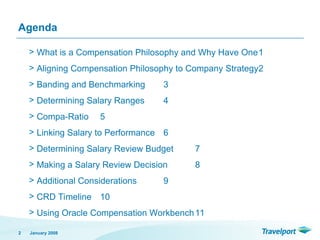
Agenda
> What is a Compensation Philosophy and Why Have One1
> Aligning Compensation Philosophy to Company Strategy2
> Banding and Benchmarking 3
> Determining Salary Ranges 4
> Compa-Ratio 5
> Linking Salary to Performance 6
> Determining Salary Review Budget 7
> Making a Salary Review Decision 8
> Additional Considerations 9
> CRD Timeline 10
> Using Oracle Compensation Workbench11
January 2008
2
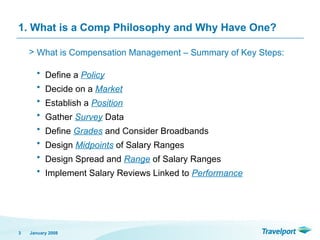
> What is Compensation Management – Summary of Key Steps:
• Define a Policy
• Decide on a Market
• Establish a Position
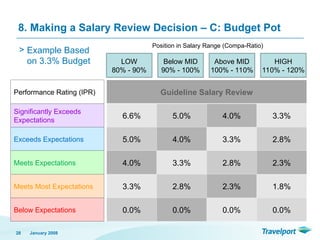
• Gather Survey Data
• Define Grades and Consider Broadbands
• Design Midpoints of Salary Ranges
• Design Spread and Range of Salary Ranges
• Implement Salary Reviews Linked to Performance
January 2008
3
1. What is a Comp Philosophy and Why Have One?
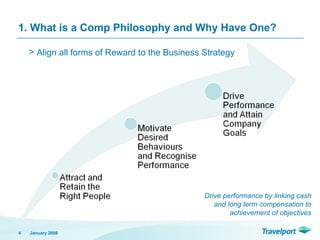
> Align all forms of Reward to the Business Strategy
1. What is a Comp Philosophy and Why Have One?
January 2008
4
Drive performance by linking cash
and long term compensation to
achievement of objectives
2. Aligning Comp Philosophy to Company Strategy
> Define Key Compensation Components and Policy
2.1
> Define the Market
2.2
> Define Desired “Salary Position” Relative to Market
2.3
> Factors Affecting Compensation Philosophy
2.4
January 2008
5
2.1 Define Key Compensation Components and Policy
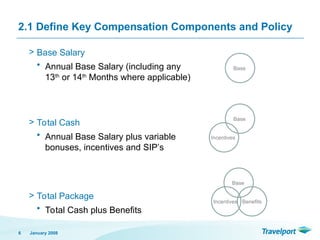
> Base Salary
• Annual Base Salary (including any
13th
or 14th
Months where applicable)
> Total Cash
• Annual Base Salary plus variable
bonuses, incentives and SIP’s
> Total Package
• Total Cash plus Benefits
January 2008
6
Base
Base
Incentives
Base
Incentives Benefits
2.2 Define the Market
> External Salary Market (Benchmarking)
• Where do We Recruit From?
• Where do Employees go When They Leave?
• Who Are Our Competitors?
• Sources of Data?
> Internal Salary Market
• Job Banding for Internal Equity
• Address Known Problem Areas
January 2008
7
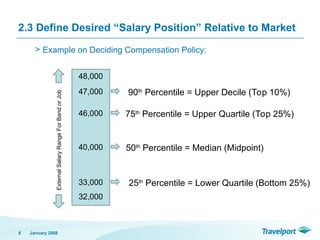
2.3 Define Desired “Salary Position” Relative to Market
> Example on Deciding Compensation Policy:
January 2008
8
32,000
48,000
External
Salary
Range
For
Band
or
Job
33,000 25th
Percentile = Lower Quartile (Bottom 25%)
40,000 50th
Percentile = Median (Midpoint)
46,000 75th
Percentile = Upper Quartile (Top 25%)
47,000 90th
Percentile = Upper Decile (Top 10%)
January 2008
9
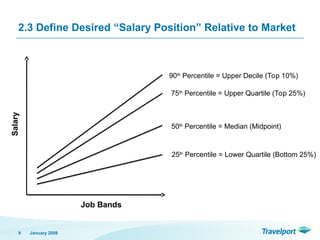
Salary
Job Bands
90th
Percentile = Upper Decile (Top 10%)
75th
Percentile = Upper Quartile (Top 25%)
50th
Percentile = Median (Midpoint)
25th
Percentile = Lower Quartile (Bottom 25%)
2.3 Define Desired “Salary Position” Relative to Market
> Business Strategy
• Key Financial Performance Indicators
• Key Non-Financial Performance Indicators
> Operating Plans
• Productivity Indices and Cost Reduction Targets
> Management Philosophy and Values
• Mission Statement and Company Values and Beliefs
• Employment Brand
• Sacred Cows
> Organisation Structure
• Autonomy of Business and Operating Units
• Nature of Work Design (Teams vs Individuals)
• Centralised vs Decentralised
> Workforce Demographics
• Organisation Growth and Future Recruitment
• Employee Turnover and Intentions
• Age/Gender/Ethnicity/Status
> Ability to Pay
January 2008
10
2.4 Factors Affecting Comp Philosophy – Internal
January 2008
11
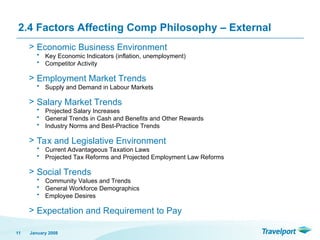
> Economic Business Environment
• Key Economic Indicators (inflation, unemployment)
• Competitor Activity
> Employment Market Trends
• Supply and Demand in Labour Markets
> Salary Market Trends
• Projected Salary Increases
• General Trends in Cash and Benefits and Other Rewards
• Industry Norms and Best-Practice Trends
> Tax and Legislative Environment
• Current Advantageous Taxation Laws
• Projected Tax Reforms and Projected Employment Law Reforms
> Social Trends
• Community Values and Trends
• General Workforce Demographics
• Employee Desires
> Expectation and Requirement to Pay
2.4 Factors Affecting Comp Philosophy – External
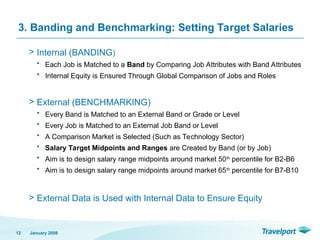
> Internal (BANDING)
• Each Job is Matched to a Band by Comparing Job Attributes with Band Attributes
• Internal Equity is Ensured Through Global Comparison of Jobs and Roles
> External (BENCHMARKING)
• Every Band is Matched to an External Band or Grade or Level
• Every Job is Matched to an External Job Band or Level
• A Comparison Market is Selected (Such as Technology Sector)
• Salary Target Midpoints and Ranges are Created by Band (or by Job)
• Aim is to design salary range midpoints around market 50th
percentile for B2-B6
• Aim is to design salary range midpoints around market 65th
percentile for B7-B10
> External Data is Used with Internal Data to Ensure Equity
January 2008
12
3. Banding and Benchmarking: Setting Target Salaries
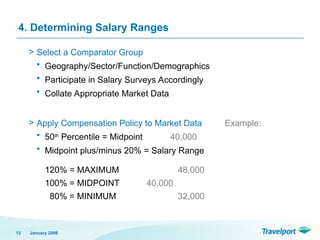
4. Determining Salary Ranges
> Select a Comparator Group
• Geography/Sector/Function/Demographics
• Participate in Salary Surveys Accordingly
• Collate Appropriate Market Data
> Apply Compensation Policy to Market Data Example:
• 50th
Percentile = Midpoint 40,000
• Midpoint plus/minus 20% = Salary Range
120% = MAXIMUM 48,000
100% = MIDPOINT 40,000
80% = MINIMUM 32,000
January 2008
13
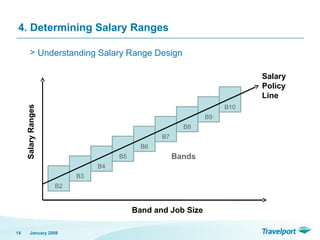
> Understanding Salary Range Design
January 2008
14
B2
B3
B4
B5
B6
B7
B8
B9
B10
Salary
Ranges
Band and Job Size
Bands
Salary
Policy
Line
4. Determining Salary Ranges
5. Compa-Ratio and Salary Ranges
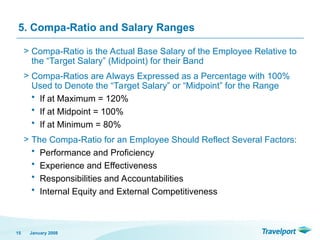
> Compa-Ratio is the Actual Base Salary of the Employee Relative to
the “Target Salary” (Midpoint) for their Band
> Compa-Ratios are Always Expressed as a Percentage with 100%
Used to Denote the “Target Salary” or “Midpoint” for the Range
• If at Maximum = 120%
• If at Midpoint = 100%
• If at Minimum = 80%
> The Compa-Ratio for an Employee Should Reflect Several Factors:
• Performance and Proficiency
• Experience and Effectiveness
• Responsibilities and Accountabilities
• Internal Equity and External Competitiveness
January 2008
15
5. Compa-Ratio and Salary Ranges
January 2008
16
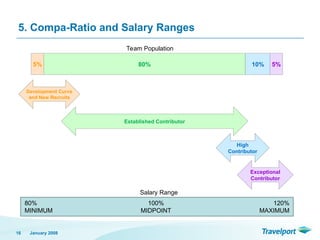
Team Population
5% 80% 10% 5%
Development Curve
and New Recruits
Established Contributor
Exceptional
Contributor
High
Contributor
Salary Range
80%
MINIMUM
100%
MIDPOINT
120%
MAXIMUM
6. Linking Salary to Performance
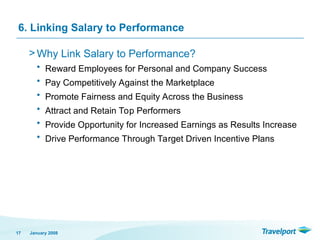
> Why Link Salary to Performance?
• Reward Employees for Personal and Company Success
• Pay Competitively Against the Marketplace
• Promote Fairness and Equity Across the Business
• Attract and Retain Top Performers
• Provide Opportunity for Increased Earnings as Results Increase
• Drive Performance Through Target Driven Incentive Plans
January 2008
17
7. Determining Salary Review Budget
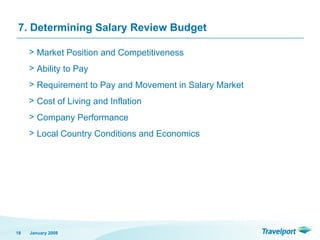
> Market Position and Competitiveness
> Ability to Pay
> Requirement to Pay and Movement in Salary Market
> Cost of Living and Inflation
> Company Performance
> Local Country Conditions and Economics
January 2008
18
8. Making a Salary Review Decision
> Consideration Factors
• Budget (Based on Country)
• Salary Range for Band/Job to be Market Competitive
• Individual Performance
• Career Progression
• Internal Equity
> Salary Review Decision Methodology Guideline
• Rainbow Curve
• Making a Salary Review Decision to Reflect Performance
January 2008
19
8. Making a Salary Review Decision – Country Budgets
January 2008
20
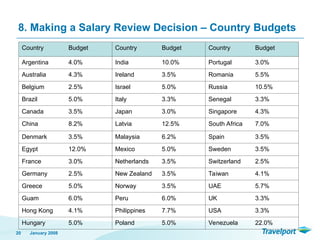
Country Budget Country Budget Country Budget
Argentina 4.0% India 10.0% Portugal 3.0%
Australia 4.3% Ireland 3.5% Romania 5.5%
Belgium 2.5% Israel 5.0% Russia 10.5%
Brazil 5.0% Italy 3.3% Senegal 3.3%
Canada 3.5% Japan 3.0% Singapore 4.3%
China 8.2% Latvia 12.5% South Africa 7.0%
Denmark 3.5% Malaysia 6.2% Spain 3.5%
Egypt 12.0% Mexico 5.0% Sweden 3.5%
France 3.0% Netherlands 3.5% Switzerland 2.5%
Germany 2.5% New Zealand 3.5% Taiwan 4.1%
Greece 5.0% Norway 3.5% UAE 5.7%
Guam 6.0% Peru 6.0% UK 3.3%
Hong Kong 4.1% Philippines 7.7% USA 3.3%
Hungary 5.0% Poland 5.0% Venezuela 22.0%
8. Making a Salary Review Decision - Old Approach
January 2008
21
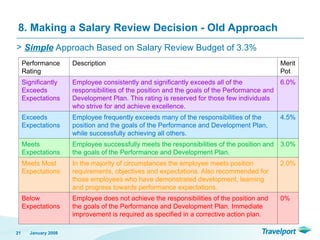
Performance
Rating
Description Merit
Pot
Significantly
Exceeds
Expectations
Employee consistently and significantly exceeds all of the
responsibilities of the position and the goals of the Performance and
Development Plan. This rating is reserved for those few individuals
who strive for and achieve excellence.
6.0%
Exceeds
Expectations
Employee frequently exceeds many of the responsibilities of the
position and the goals of the Performance and Development Plan,
while successfully achieving all others.
4.5%
Meets
Expectations
Employee successfully meets the responsibilities of the position and
the goals of the Performance and Development Plan.
3.0%
Meets Most
Expectations
In the majority of circumstances the employee meets position
requirements, objectives and expectations. Also recommended for
those employees who have demonstrated development, learning
and progress towards performance expectations.
2.0%
Below
Expectations
Employee does not achieve the responsibilities of the position and
the goals of the Performance and Development Plan. Immediate
improvement is required as specified in a corrective action plan.
0%
> Simple Approach Based on Salary Review Budget of 3.3%
8. Making a Salary Review Decision - New Approach
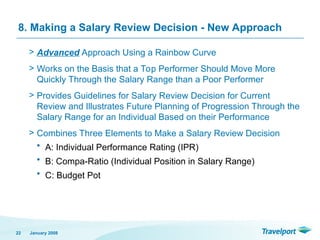
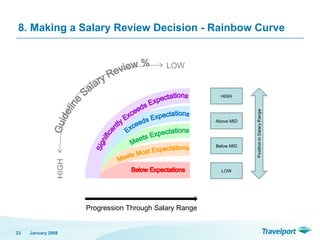
> Advanced Approach Using a Rainbow Curve
> Works on the Basis that a Top Performer Should Move More
Quickly Through the Salary Range than a Poor Performer
> Provides Guidelines for Salary Review Decision for Current
Review and Illustrates Future Planning of Progression Through the
Salary Range for an Individual Based on their Performance
> Combines Three Elements to Make a Salary Review Decision
• A: Individual Performance Rating (IPR)
• B: Compa-Ratio (Individual Position in Salary Range)
• C: Budget Pot
January 2008
22
8. Making a Salary Review Decision - Rainbow Curve
January 2008
23
Progression Through Salary Range
HIGH
LOW
LOW
Below MID
Above MID
HIGH
8. Making a Salary Review Decision - Rainbow Curve
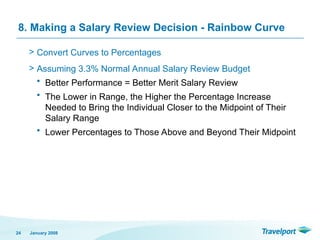
> Convert Curves to Percentages
> Assuming 3.3% Normal Annual Salary Review Budget
• Better Performance = Better Merit Salary Review
• The Lower in Range, the Higher the Percentage Increase
Needed to Bring the Individual Closer to the Midpoint of Their
Salary Range
• Lower Percentages to Those Above and Beyond Their Midpoint
January 2008
24
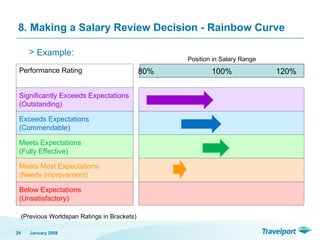
8. Making a Salary Review Decision - Rainbow Curve
January 2008
25
Performance Rating
Significantly Exceeds Expectations
(Outstanding)
Exceeds Expectations
(Commendable)
Meets Expectations
(Fully Effective)
Meets Most Expectations
(Needs Improvement)
Below Expectations
(Unsatisfactory)
Position in Salary Range
80% 100% 120%
(Previous Worldspan Ratings in Brackets)
> Example:
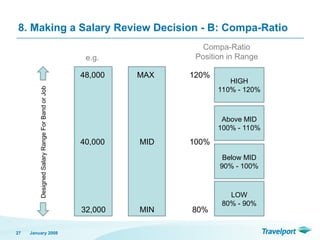
8. Making a Salary Review Decision - B: Compa-Ratio
January 2008
27
Designed
Salary
Range
For
Band
or
Job
80%
MIN
MID
MAX
100%
120%
LOW
80% - 90%
Below MID
90% - 100%
Above MID
100% - 110%
HIGH
110% - 120%
e.g.
32,000
40,000
48,000
Compa-Ratio
Position in Range
8. Making a Salary Review Decision – C: Budget Pot
January 2008
28
LOW
80% - 90%
Below MID
90% - 100%
Above MID
100% - 110%
HIGH
110% - 120%
> Example Based
on 3.3% Budget
Performance Rating (IPR)
Significantly Exceeds
Expectations
Exceeds Expectations
Meets Expectations
Meets Most Expectations
Below Expectations
Guideline Salary Review
6.6% 5.0% 4.0% 3.3%
5.0% 4.0% 3.3% 2.8%
4.0% 3.3% 2.8% 2.3%
3.3% 2.8% 2.3% 1.8%
0.0% 0.0% 0.0% 0.0%
Position in Salary Range (Compa-Ratio)
January 2008
29
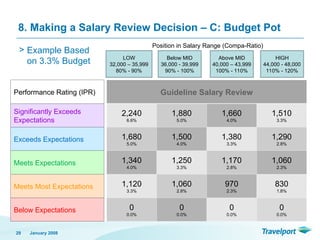
8. Making a Salary Review Decision – C: Budget Pot
LOW
32,000 – 35,999
80% - 90%
Below MID
36,000 - 39,999
90% - 100%
Above MID
40,000 – 43,999
100% - 110%
HIGH
44,000 - 48,000
110% - 120%
Performance Rating (IPR)
Significantly Exceeds
Expectations
Exceeds Expectations
Meets Expectations
Meets Most Expectations
Below Expectations
Guideline Salary Review
2,240
6.6%
1,880
5.0%
1,660
4.0%
1,510
3.3%
1,680
5.0%
1,500
4.0%
1,380
3.3%
1,290
2.8%
1,340
4.0%
1,250
3.3%
1,170
2.8%
1,060
2.3%
1,120
3.3%
1,060
2.8%
970
2.3%
830
1.8%
0
0.0%
0
0.0%
0
0.0%
0
0.0%
> Example Based
on 3.3% Budget
Position in Salary Range (Compa-Ratio)
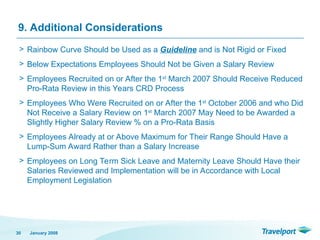
9. Additional Considerations
> Rainbow Curve Should be Used as a Guideline and is Not Rigid or Fixed
> Below Expectations Employees Should Not be Given a Salary Review
> Employees Recruited on or After the 1st
March 2007 Should Receive Reduced
Pro-Rata Review in this Years CRD Process
> Employees Who Were Recruited on or After the 1st
October 2006 and who Did
Not Receive a Salary Review on 1st
March 2007 May Need to be Awarded a
Slightly Higher Salary Review % on a Pro-Rata Basis
> Employees Already at or Above Maximum for Their Range Should Have a
Lump-Sum Award Rather than a Salary Increase
> Employees on Long Term Sick Leave and Maternity Leave Should Have their
Salaries Reviewed and Implementation will be in Accordance with Local
Employment Legislation
January 2008
30
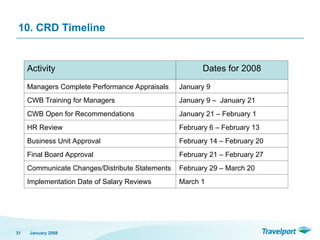
10. CRD Timeline
January 2008
31
Activity Dates for 2008
Managers Complete Performance Appraisals January 9
CWB Training for Managers January 9 – January 21
CWB Open for Recommendations January 21 – February 1
HR Review February 6 – February 13
Business Unit Approval February 14 – February 20
Final Board Approval February 21 – February 27
Communicate Changes/Distribute Statements February 29 – March 20
Implementation Date of Salary Reviews March 1

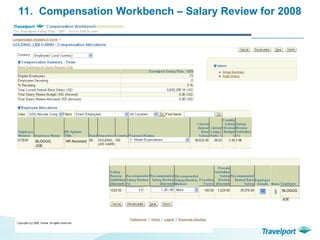
11. Compensation Workbench – Salary Review for 2008
January 2008
33
Questions?

SS-HANDOUT-11=MANAGER-TRAINING comp& ben

  • 1.
    Manager Training Making SalaryReview Decisions Common Review Date for 2008 (CRD) 7th -8th January 2008 Manager Training By HR Travelport GDS Robert Mosley
  • 2.
    Agenda > What isa Compensation Philosophy and Why Have One1 > Aligning Compensation Philosophy to Company Strategy2 > Banding and Benchmarking 3 > Determining Salary Ranges 4 > Compa-Ratio 5 > Linking Salary to Performance 6 > Determining Salary Review Budget 7 > Making a Salary Review Decision 8 > Additional Considerations 9 > CRD Timeline 10 > Using Oracle Compensation Workbench11 January 2008 2
  • 3.
    > What isCompensation Management – Summary of Key Steps: • Define a Policy • Decide on a Market • Establish a Position • Gather Survey Data • Define Grades and Consider Broadbands • Design Midpoints of Salary Ranges • Design Spread and Range of Salary Ranges • Implement Salary Reviews Linked to Performance January 2008 3 1. What is a Comp Philosophy and Why Have One?
  • 4.
    > Align allforms of Reward to the Business Strategy 1. What is a Comp Philosophy and Why Have One? January 2008 4 Drive performance by linking cash and long term compensation to achievement of objectives
  • 5.
    2. Aligning CompPhilosophy to Company Strategy > Define Key Compensation Components and Policy 2.1 > Define the Market 2.2 > Define Desired “Salary Position” Relative to Market 2.3 > Factors Affecting Compensation Philosophy 2.4 January 2008 5
  • 6.
    2.1 Define KeyCompensation Components and Policy > Base Salary • Annual Base Salary (including any 13th or 14th Months where applicable) > Total Cash • Annual Base Salary plus variable bonuses, incentives and SIP’s > Total Package • Total Cash plus Benefits January 2008 6 Base Base Incentives Base Incentives Benefits
  • 7.
    2.2 Define theMarket > External Salary Market (Benchmarking) • Where do We Recruit From? • Where do Employees go When They Leave? • Who Are Our Competitors? • Sources of Data? > Internal Salary Market • Job Banding for Internal Equity • Address Known Problem Areas January 2008 7
  • 8.
    2.3 Define Desired“Salary Position” Relative to Market > Example on Deciding Compensation Policy: January 2008 8 32,000 48,000 External Salary Range For Band or Job 33,000 25th Percentile = Lower Quartile (Bottom 25%) 40,000 50th Percentile = Median (Midpoint) 46,000 75th Percentile = Upper Quartile (Top 25%) 47,000 90th Percentile = Upper Decile (Top 10%)
  • 9.
    January 2008 9 Salary Job Bands 90th Percentile= Upper Decile (Top 10%) 75th Percentile = Upper Quartile (Top 25%) 50th Percentile = Median (Midpoint) 25th Percentile = Lower Quartile (Bottom 25%) 2.3 Define Desired “Salary Position” Relative to Market
  • 10.
    > Business Strategy •Key Financial Performance Indicators • Key Non-Financial Performance Indicators > Operating Plans • Productivity Indices and Cost Reduction Targets > Management Philosophy and Values • Mission Statement and Company Values and Beliefs • Employment Brand • Sacred Cows > Organisation Structure • Autonomy of Business and Operating Units • Nature of Work Design (Teams vs Individuals) • Centralised vs Decentralised > Workforce Demographics • Organisation Growth and Future Recruitment • Employee Turnover and Intentions • Age/Gender/Ethnicity/Status > Ability to Pay January 2008 10 2.4 Factors Affecting Comp Philosophy – Internal
  • 11.
    January 2008 11 > EconomicBusiness Environment • Key Economic Indicators (inflation, unemployment) • Competitor Activity > Employment Market Trends • Supply and Demand in Labour Markets > Salary Market Trends • Projected Salary Increases • General Trends in Cash and Benefits and Other Rewards • Industry Norms and Best-Practice Trends > Tax and Legislative Environment • Current Advantageous Taxation Laws • Projected Tax Reforms and Projected Employment Law Reforms > Social Trends • Community Values and Trends • General Workforce Demographics • Employee Desires > Expectation and Requirement to Pay 2.4 Factors Affecting Comp Philosophy – External
  • 12.
    > Internal (BANDING) •Each Job is Matched to a Band by Comparing Job Attributes with Band Attributes • Internal Equity is Ensured Through Global Comparison of Jobs and Roles > External (BENCHMARKING) • Every Band is Matched to an External Band or Grade or Level • Every Job is Matched to an External Job Band or Level • A Comparison Market is Selected (Such as Technology Sector) • Salary Target Midpoints and Ranges are Created by Band (or by Job) • Aim is to design salary range midpoints around market 50th percentile for B2-B6 • Aim is to design salary range midpoints around market 65th percentile for B7-B10 > External Data is Used with Internal Data to Ensure Equity January 2008 12 3. Banding and Benchmarking: Setting Target Salaries
  • 13.
    4. Determining SalaryRanges > Select a Comparator Group • Geography/Sector/Function/Demographics • Participate in Salary Surveys Accordingly • Collate Appropriate Market Data > Apply Compensation Policy to Market Data Example: • 50th Percentile = Midpoint 40,000 • Midpoint plus/minus 20% = Salary Range 120% = MAXIMUM 48,000 100% = MIDPOINT 40,000 80% = MINIMUM 32,000 January 2008 13
  • 14.
    > Understanding SalaryRange Design January 2008 14 B2 B3 B4 B5 B6 B7 B8 B9 B10 Salary Ranges Band and Job Size Bands Salary Policy Line 4. Determining Salary Ranges
  • 15.
    5. Compa-Ratio andSalary Ranges > Compa-Ratio is the Actual Base Salary of the Employee Relative to the “Target Salary” (Midpoint) for their Band > Compa-Ratios are Always Expressed as a Percentage with 100% Used to Denote the “Target Salary” or “Midpoint” for the Range • If at Maximum = 120% • If at Midpoint = 100% • If at Minimum = 80% > The Compa-Ratio for an Employee Should Reflect Several Factors: • Performance and Proficiency • Experience and Effectiveness • Responsibilities and Accountabilities • Internal Equity and External Competitiveness January 2008 15
  • 16.
    5. Compa-Ratio andSalary Ranges January 2008 16 Team Population 5% 80% 10% 5% Development Curve and New Recruits Established Contributor Exceptional Contributor High Contributor Salary Range 80% MINIMUM 100% MIDPOINT 120% MAXIMUM
  • 17.
    6. Linking Salaryto Performance > Why Link Salary to Performance? • Reward Employees for Personal and Company Success • Pay Competitively Against the Marketplace • Promote Fairness and Equity Across the Business • Attract and Retain Top Performers • Provide Opportunity for Increased Earnings as Results Increase • Drive Performance Through Target Driven Incentive Plans January 2008 17
  • 18.
    7. Determining SalaryReview Budget > Market Position and Competitiveness > Ability to Pay > Requirement to Pay and Movement in Salary Market > Cost of Living and Inflation > Company Performance > Local Country Conditions and Economics January 2008 18
  • 19.
    8. Making aSalary Review Decision > Consideration Factors • Budget (Based on Country) • Salary Range for Band/Job to be Market Competitive • Individual Performance • Career Progression • Internal Equity > Salary Review Decision Methodology Guideline • Rainbow Curve • Making a Salary Review Decision to Reflect Performance January 2008 19
  • 20.
    8. Making aSalary Review Decision – Country Budgets January 2008 20 Country Budget Country Budget Country Budget Argentina 4.0% India 10.0% Portugal 3.0% Australia 4.3% Ireland 3.5% Romania 5.5% Belgium 2.5% Israel 5.0% Russia 10.5% Brazil 5.0% Italy 3.3% Senegal 3.3% Canada 3.5% Japan 3.0% Singapore 4.3% China 8.2% Latvia 12.5% South Africa 7.0% Denmark 3.5% Malaysia 6.2% Spain 3.5% Egypt 12.0% Mexico 5.0% Sweden 3.5% France 3.0% Netherlands 3.5% Switzerland 2.5% Germany 2.5% New Zealand 3.5% Taiwan 4.1% Greece 5.0% Norway 3.5% UAE 5.7% Guam 6.0% Peru 6.0% UK 3.3% Hong Kong 4.1% Philippines 7.7% USA 3.3% Hungary 5.0% Poland 5.0% Venezuela 22.0%
  • 21.
    8. Making aSalary Review Decision - Old Approach January 2008 21 Performance Rating Description Merit Pot Significantly Exceeds Expectations Employee consistently and significantly exceeds all of the responsibilities of the position and the goals of the Performance and Development Plan. This rating is reserved for those few individuals who strive for and achieve excellence. 6.0% Exceeds Expectations Employee frequently exceeds many of the responsibilities of the position and the goals of the Performance and Development Plan, while successfully achieving all others. 4.5% Meets Expectations Employee successfully meets the responsibilities of the position and the goals of the Performance and Development Plan. 3.0% Meets Most Expectations In the majority of circumstances the employee meets position requirements, objectives and expectations. Also recommended for those employees who have demonstrated development, learning and progress towards performance expectations. 2.0% Below Expectations Employee does not achieve the responsibilities of the position and the goals of the Performance and Development Plan. Immediate improvement is required as specified in a corrective action plan. 0% > Simple Approach Based on Salary Review Budget of 3.3%
  • 22.
    8. Making aSalary Review Decision - New Approach > Advanced Approach Using a Rainbow Curve > Works on the Basis that a Top Performer Should Move More Quickly Through the Salary Range than a Poor Performer > Provides Guidelines for Salary Review Decision for Current Review and Illustrates Future Planning of Progression Through the Salary Range for an Individual Based on their Performance > Combines Three Elements to Make a Salary Review Decision • A: Individual Performance Rating (IPR) • B: Compa-Ratio (Individual Position in Salary Range) • C: Budget Pot January 2008 22
  • 23.
    8. Making aSalary Review Decision - Rainbow Curve January 2008 23 Progression Through Salary Range HIGH LOW LOW Below MID Above MID HIGH
  • 24.
    8. Making aSalary Review Decision - Rainbow Curve > Convert Curves to Percentages > Assuming 3.3% Normal Annual Salary Review Budget • Better Performance = Better Merit Salary Review • The Lower in Range, the Higher the Percentage Increase Needed to Bring the Individual Closer to the Midpoint of Their Salary Range • Lower Percentages to Those Above and Beyond Their Midpoint January 2008 24
  • 25.
    8. Making aSalary Review Decision - Rainbow Curve January 2008 25 Performance Rating Significantly Exceeds Expectations (Outstanding) Exceeds Expectations (Commendable) Meets Expectations (Fully Effective) Meets Most Expectations (Needs Improvement) Below Expectations (Unsatisfactory) Position in Salary Range 80% 100% 120% (Previous Worldspan Ratings in Brackets) > Example:
  • 26.
    8. Making aSalary Review Decision - B: Compa-Ratio January 2008 27 Designed Salary Range For Band or Job 80% MIN MID MAX 100% 120% LOW 80% - 90% Below MID 90% - 100% Above MID 100% - 110% HIGH 110% - 120% e.g. 32,000 40,000 48,000 Compa-Ratio Position in Range
  • 27.
    8. Making aSalary Review Decision – C: Budget Pot January 2008 28 LOW 80% - 90% Below MID 90% - 100% Above MID 100% - 110% HIGH 110% - 120% > Example Based on 3.3% Budget Performance Rating (IPR) Significantly Exceeds Expectations Exceeds Expectations Meets Expectations Meets Most Expectations Below Expectations Guideline Salary Review 6.6% 5.0% 4.0% 3.3% 5.0% 4.0% 3.3% 2.8% 4.0% 3.3% 2.8% 2.3% 3.3% 2.8% 2.3% 1.8% 0.0% 0.0% 0.0% 0.0% Position in Salary Range (Compa-Ratio)
  • 28.
    January 2008 29 8. Makinga Salary Review Decision – C: Budget Pot LOW 32,000 – 35,999 80% - 90% Below MID 36,000 - 39,999 90% - 100% Above MID 40,000 – 43,999 100% - 110% HIGH 44,000 - 48,000 110% - 120% Performance Rating (IPR) Significantly Exceeds Expectations Exceeds Expectations Meets Expectations Meets Most Expectations Below Expectations Guideline Salary Review 2,240 6.6% 1,880 5.0% 1,660 4.0% 1,510 3.3% 1,680 5.0% 1,500 4.0% 1,380 3.3% 1,290 2.8% 1,340 4.0% 1,250 3.3% 1,170 2.8% 1,060 2.3% 1,120 3.3% 1,060 2.8% 970 2.3% 830 1.8% 0 0.0% 0 0.0% 0 0.0% 0 0.0% > Example Based on 3.3% Budget Position in Salary Range (Compa-Ratio)
  • 29.
    9. Additional Considerations >Rainbow Curve Should be Used as a Guideline and is Not Rigid or Fixed > Below Expectations Employees Should Not be Given a Salary Review > Employees Recruited on or After the 1st March 2007 Should Receive Reduced Pro-Rata Review in this Years CRD Process > Employees Who Were Recruited on or After the 1st October 2006 and who Did Not Receive a Salary Review on 1st March 2007 May Need to be Awarded a Slightly Higher Salary Review % on a Pro-Rata Basis > Employees Already at or Above Maximum for Their Range Should Have a Lump-Sum Award Rather than a Salary Increase > Employees on Long Term Sick Leave and Maternity Leave Should Have their Salaries Reviewed and Implementation will be in Accordance with Local Employment Legislation January 2008 30
  • 30.
    10. CRD Timeline January2008 31 Activity Dates for 2008 Managers Complete Performance Appraisals January 9 CWB Training for Managers January 9 – January 21 CWB Open for Recommendations January 21 – February 1 HR Review February 6 – February 13 Business Unit Approval February 14 – February 20 Final Board Approval February 21 – February 27 Communicate Changes/Distribute Statements February 29 – March 20 Implementation Date of Salary Reviews March 1
  • 31.
    11. Compensation Workbench– Salary Review for 2008
  • 32.

Editor's Notes

  • #1 Set up the chairs in ½ circle as today is about change