Learning Objectives
• -Theories of charismatic leadership
• - Consequences of charismatic leadership
• - Transformational leadership
• - Evaluation of theories
• - Practical application for managers
3.
Max Weber
• Themost important early research on
charismatic leadership was completed by
Max Weber, who maintained that societies
could be identified in terms of one of three
types of authority systems: traditional,
legal-rational, and charismatic.
4.
In the 1980s,management researchers became
very interested in
the emotional and symbolic aspects of leadership.
These processes help us to understand how
leaders influence followers to make self sacrifices
‐
and put the needs of the mission or organization
above their materialistic self interests. Theories of
‐
charismatic and transformational leadership
describe this important aspect of leadership.
5.
charisma is acertain quality of an individual
personality, by virtue of which he is set apart
from ordinary men and treated as endowed with
supernatural, superhuman, or at least
specifically exceptional powers or qualities.
6.
Charisma occurs oftenduring a social crisis when a
leader
emerges with a radical vision that offers a solution
to the crisis and
attracts followers who believe in the vision.
The followers experience some successes that
make the vision appear attainable, and they come
to perceive the leader as extraordinary.
7.
The Rise ofCharisma in Leadership
• Charisma: Greek for 'divinely inspired gift'
• Max Weber: Influence not from authority but
perceived exceptional qualities
• Charismatic leaders emerge in crisis with
compelling visions
8.
Attribution Theory ofCharisma
• Followers attribute charisma based on:
• - Novel vision, emotional appeals,
unconventional behavior
• - Self-sacrifice, confidence and optimism
• Influence: Personal identification,
internalization of values
9.
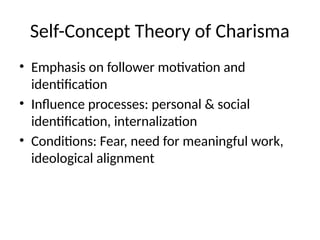
Self-Concept Theory ofCharisma
• Emphasis on follower motivation and
identification
• Influence processes: personal & social
identification, internalization
• Conditions: Fear, need for meaningful work,
ideological alignment
10.
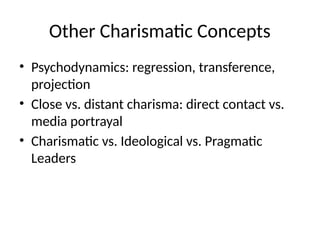
Other Charismatic Concepts
•Psychodynamics: regression, transference,
projection
• Close vs. distant charisma: direct contact vs.
media portrayal
• Charismatic vs. Ideological vs. Pragmatic
Leaders
11.
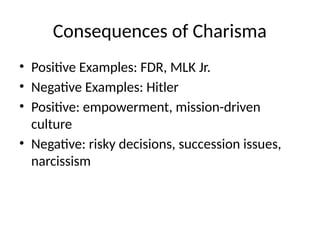
Consequences of Charisma
•Positive Examples: FDR, MLK Jr.
• Negative Examples: Hitler
• Positive: empowerment, mission-driven
culture
• Negative: risky decisions, succession issues,
narcissism
12.
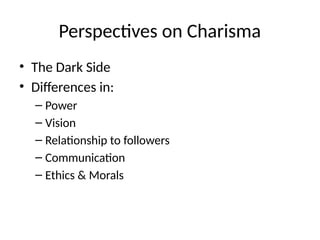
Perspectives on Charisma
•The Dark Side
• Differences in:
– Power
– Vision
– Relationship to followers
– Communication
– Ethics & Morals
13.
The Dark Sideof Charisma
• Failures of vision
• Misarticulation of goals
• Poor management
• Who are the charismatic leaders we can agree
on?
14.
Transformational leadership
Transformational leadershipin another type of
theory used to describe how effective leaders
inspire and transform followers by appealing to
their ideals and emotions.
The terms transformational and charismatic are
used interchangeably by many writers, but
despite the similarities there are some important
distinctions.
15.
Bass’s Theory ofTransformational and Transactional
Leadership
• Transformational leaders possess charismatic-leader
characteristics (vision, rhetorical skills, etc.).
• Transactional leaders do not possess these leader
characteristics, nor are they able to develop strong
emotional bonds with followers or inspire followers to do
more than they thought they could.
• Instead, transactional leaders motivate followers by
setting goals and promising rewards for desired
performance.
16.
Theory of Transformationaland
Transactional Leadership
• James McGregor Burns’s Theory of
Transformational and Transactional Leadership
– focused on the differences between power versus
leadership and charismatic versus non-charismatic
leadership
Transformational vs. Charismatic
•Overlap exists, but key differences:
• - Charisma: personal identification, rare
• - Transformational: empowerment, more
frequent
• - Different reactions, contexts, longevity
20.
Common Characteristics ofCharismatic and
Transformational Leadership
• Vision
• Rhetorical skills
• Image and trust building
• Personalized leadership
21.
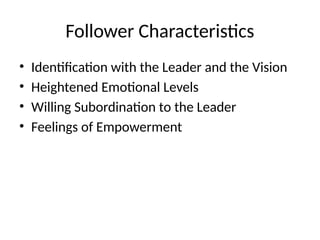
Follower Characteristics
• Identificationwith the Leader and the Vision
• Heightened Emotional Levels
• Willing Subordination to the Leader
• Feelings of Empowerment
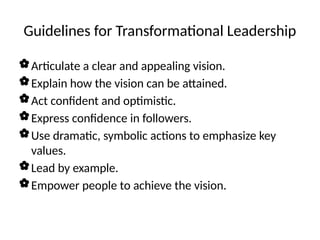
Guidelines for TransformationalLeadership
Articulate a clear and appealing vision.
Explain how the vision can be attained.
Act confident and optimistic.
Express confidence in followers.
Use dramatic, symbolic actions to emphasize key
values.
Lead by example.
Empower people to achieve the vision.
25.
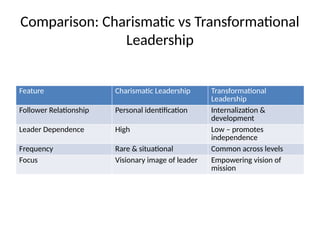
Comparison: Charismatic vsTransformational
Leadership
Feature Charismatic Leadership Transformational
Leadership
Follower Relationship Personal identification Internalization &
development
Leader Dependence High Low – promotes
independence
Frequency Rare & situational Common across levels
Focus Visionary image of leader Empowering vision of
mission
26.
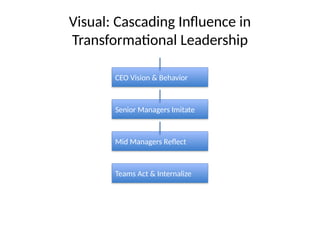
Visual: Cascading Influencein
Transformational Leadership
CEO Vision & Behavior
Senior Managers Imitate
Mid Managers Reflect
Teams Act & Internalize
27.
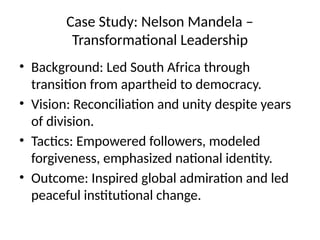
Case Study: NelsonMandela –
Transformational Leadership
• Background: Led South Africa through
transition from apartheid to democracy.
• Vision: Reconciliation and unity despite years
of division.
• Tactics: Empowered followers, modeled
forgiveness, emphasized national identity.
• Outcome: Inspired global admiration and led
peaceful institutional change.
Editor's Notes
#2 Introduce the core concepts: charisma, transformation, and their relevance in leadership.
#7 Explain the historical and sociological roots of charisma. Highlight Weber's view and modern relevance.
#8 Discuss how followers perceive charisma. Emphasize leader behaviors and emotional connection.
#9 Explain the self-concept theory and its layered influence methods, including identity and emotion.
#10 Illustrate with psychodynamic processes, and compare different types of charismatic influence.
#11 Use examples to contrast good vs. bad charismatic leadership. Introduce risks and rewards.