Building a
Compensation Plan
Part 1: Strategy &
Executive Support


Stacey Carroll, SPHR, CCP
Principal Consultant
PayScale, Inc.
PayScale is a market leader in global online compensation data.
With the world's largest database of individual employee
compensation profiles, PayScale provides an immediate and
precise snapshot of the job market.
Our patent-pending, real-time profiling system indexes custom
employee attributes (such as industry-specific certifications) and
specific job titles for every industry.
Our secure, on-demand business solutions, PayScale MarketRate
and PayScale Insight, provide employers with accurate, reliable
compensation detail never before available.


       13,000 Positions. 50 Major Industries. 11 Countries
Agenda

• Why a comp plan?
• How to gain executive support
• Compensation Strategy
•     Who is my market?
•     How competitive do I want/need to be ?
•     What do I want to reward?
• Writing a compensation philosophy
Have you ever . . . .
Had an employee come to you
with a ransom job offer from
down the street?

Had a hiring manager who insists
on paying a new hire $10,000 above
the market rate because “they must have this individual”?

Worried about the equity among your employee’s when it
comes to compensation?
The solution . . .
Create a formal
compensation program
Support for a plan has to be more than “HR”


 Unfortunately HR’s pain points are often different
  than your senior executive’s pain points

 So, to get executive support we MUST:
   Identify the Exec’s pain points

   Solve real problems

   Address the costs and consequences of the plan

   Report on ROI


 Most importantly, the process should be owned by
  the organization (not HR).
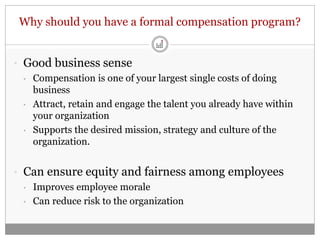
Why should you have a formal compensation program?


• Good business sense
  • Compensation is one of your largest single costs of doing
    business
  • Attract, retain and engage the talent you already have within
    your organization
  • Supports the desired mission, strategy and culture of the
    organization.


• Can ensure equity and fairness among employees
  • Improves employee morale

  • Can reduce risk to the organization
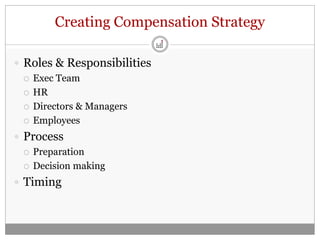
Creating Compensation Strategy

 Roles & Responsibilities
   Exec Team

   HR

   Directors & Managers

   Employees

 Process
   Preparation

   Decision making

 Timing
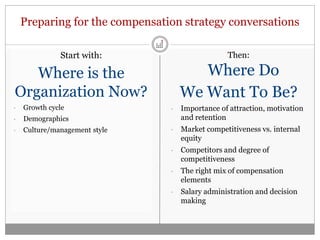
Preparing for the compensation strategy conversations

              Start with:                        Then:

   Where is the                        Where Do
Organization Now?                   We Want To Be?
•   Growth cycle                •   Importance of attraction, motivation
•   Demographics                    and retention
•   Culture/management style    •   Market competitiveness vs. internal
                                    equity
                                •   Competitors and degree of
                                    competitiveness
                                •   The right mix of compensation
                                    elements
                                •   Salary administration and decision
                                    making
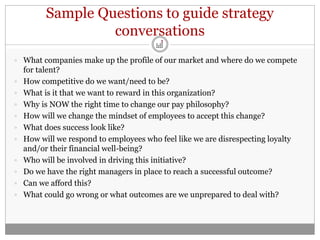
Sample Questions to guide strategy
                   conversations
 What companies make up the profile of our market and where do we compete
    for talent?
   How competitive do we want/need to be?
   What is it that we want to reward in this organization?
   Why is NOW the right time to change our pay philosophy?
   How will we change the mindset of employees to accept this change?
   What does success look like?
   How will we respond to employees who feel like we are disrespecting loyalty
    and/or their financial well-being?
   Who will be involved in driving this initiative?
   Do we have the right managers in place to reach a successful outcome?
   Can we afford this?
   What could go wrong or what outcomes are we unprepared to deal with?
Strategy Outcomes

 Clear idea on how to benchmark
 Clear idea on how competitive to be with salaries
 Clear idea on the right mix of compensation
  elements
 Clear idea of how people will be rewarded
 Strong executive support for compensation structure
 A commitment to clear communication
Communication Strategy

• Communicate about the project
  • What is the organization doing and why

  • What is the process

  • Choose the right messenger

• Be transparent about the process
  • Be realistic about the goal – no promises should be made

  • Don’t give employees the opportunity to assume what the
    outcome will be
  • Let employees know what to expect in terms of additional
    communication regarding the project.
Writing a compensation philosophy

 Recognize the goals of the organization
 Discuss how talent links to these goals
 Discuss how the compensation programs will
  support these goals
 The philosophy should be optimistic yet not
  unrealistic (representative of your organization)
 Demonstrates your commitment to ensuring fair,
  equitable and competitive pay practices
Sample Compensation Philosophy & Strategy

Compensation Philosophy and Strategy

  The philosophy behind XYZ company’s compensation program is to provide an attractive,
  flexible and market-based total compensation program tied to performance and aligned
  with shareholder interests. Our goal is for XYZ Company to be competitive in recruiting
  and retaining employees through its high-quality compensation practices. Equally
  important, we view compensation practices as a means for communicating our goals and
  standards of performance and for motivating and rewarding employees in relation to
  their achievements.

  XYZ company competes in several different businesses, most of which are involved in
  helping individuals manage financial risk and secure their financial futures. These
  businesses draw their key people from different segments of the marketplace. Thus, our
  compensation programs are designed with the flexibility to be competitive and
  motivational within the different marketplaces in which we compete for talent, while
  being subject to centralized design, approval and control.
Questions?
Save Time and Money on Your
                                    Compensation Initiatives

PayScale is your key to saving money, recruiting talent at the right price, and retaining top performers
       with accurate, real-time compensation data matched to your workplace and workforce.


                   Visit our blog: http://blogs.payscale.com/compensation/


             Connect with me on LinkedIN: http://www.linkedin.com/in/hrstacey

Building a Compensation Plan Part 1: Strategy & Executive Support

  • 1.
    Building a Compensation Plan Part1: Strategy & Executive Support Stacey Carroll, SPHR, CCP Principal Consultant PayScale, Inc.
  • 2.
    PayScale is amarket leader in global online compensation data. With the world's largest database of individual employee compensation profiles, PayScale provides an immediate and precise snapshot of the job market. Our patent-pending, real-time profiling system indexes custom employee attributes (such as industry-specific certifications) and specific job titles for every industry. Our secure, on-demand business solutions, PayScale MarketRate and PayScale Insight, provide employers with accurate, reliable compensation detail never before available. 13,000 Positions. 50 Major Industries. 11 Countries
  • 3.
    Agenda • Why acomp plan? • How to gain executive support • Compensation Strategy • Who is my market? • How competitive do I want/need to be ? • What do I want to reward? • Writing a compensation philosophy
  • 4.
    Have you ever. . . . Had an employee come to you with a ransom job offer from down the street? Had a hiring manager who insists on paying a new hire $10,000 above the market rate because “they must have this individual”? Worried about the equity among your employee’s when it comes to compensation?
  • 5.
    The solution .. . Create a formal compensation program
  • 6.
    Support for aplan has to be more than “HR”  Unfortunately HR’s pain points are often different than your senior executive’s pain points  So, to get executive support we MUST:  Identify the Exec’s pain points  Solve real problems  Address the costs and consequences of the plan  Report on ROI  Most importantly, the process should be owned by the organization (not HR).
  • 7.
    Why should youhave a formal compensation program? • Good business sense • Compensation is one of your largest single costs of doing business • Attract, retain and engage the talent you already have within your organization • Supports the desired mission, strategy and culture of the organization. • Can ensure equity and fairness among employees • Improves employee morale • Can reduce risk to the organization
  • 8.
    Creating Compensation Strategy Roles & Responsibilities  Exec Team  HR  Directors & Managers  Employees  Process  Preparation  Decision making  Timing
  • 9.
    Preparing for thecompensation strategy conversations Start with: Then: Where is the Where Do Organization Now? We Want To Be? • Growth cycle • Importance of attraction, motivation • Demographics and retention • Culture/management style • Market competitiveness vs. internal equity • Competitors and degree of competitiveness • The right mix of compensation elements • Salary administration and decision making
  • 10.
    Sample Questions toguide strategy conversations  What companies make up the profile of our market and where do we compete for talent?  How competitive do we want/need to be?  What is it that we want to reward in this organization?  Why is NOW the right time to change our pay philosophy?  How will we change the mindset of employees to accept this change?  What does success look like?  How will we respond to employees who feel like we are disrespecting loyalty and/or their financial well-being?  Who will be involved in driving this initiative?  Do we have the right managers in place to reach a successful outcome?  Can we afford this?  What could go wrong or what outcomes are we unprepared to deal with?
  • 11.
    Strategy Outcomes  Clearidea on how to benchmark  Clear idea on how competitive to be with salaries  Clear idea on the right mix of compensation elements  Clear idea of how people will be rewarded  Strong executive support for compensation structure  A commitment to clear communication
  • 12.
    Communication Strategy • Communicateabout the project • What is the organization doing and why • What is the process • Choose the right messenger • Be transparent about the process • Be realistic about the goal – no promises should be made • Don’t give employees the opportunity to assume what the outcome will be • Let employees know what to expect in terms of additional communication regarding the project.
  • 13.
    Writing a compensationphilosophy  Recognize the goals of the organization  Discuss how talent links to these goals  Discuss how the compensation programs will support these goals  The philosophy should be optimistic yet not unrealistic (representative of your organization)  Demonstrates your commitment to ensuring fair, equitable and competitive pay practices
  • 14.
    Sample Compensation Philosophy& Strategy Compensation Philosophy and Strategy The philosophy behind XYZ company’s compensation program is to provide an attractive, flexible and market-based total compensation program tied to performance and aligned with shareholder interests. Our goal is for XYZ Company to be competitive in recruiting and retaining employees through its high-quality compensation practices. Equally important, we view compensation practices as a means for communicating our goals and standards of performance and for motivating and rewarding employees in relation to their achievements. XYZ company competes in several different businesses, most of which are involved in helping individuals manage financial risk and secure their financial futures. These businesses draw their key people from different segments of the marketplace. Thus, our compensation programs are designed with the flexibility to be competitive and motivational within the different marketplaces in which we compete for talent, while being subject to centralized design, approval and control.
  • 15.
  • 16.
    Save Time andMoney on Your Compensation Initiatives PayScale is your key to saving money, recruiting talent at the right price, and retaining top performers with accurate, real-time compensation data matched to your workplace and workforce. Visit our blog: http://blogs.payscale.com/compensation/ Connect with me on LinkedIN: http://www.linkedin.com/in/hrstacey