ABSTRACT
As the techniques of creating augmented reality become more advanced, there is
an increase in its use to create engaging digital teaching materials or a more efficient
e-Learning environment. Recently, most relevant applications are limited to
marker-based augmented reality techniques. However, markerless augmented reality
techniques are more flexible and not limited by the use of markers, providing a
broader range of applications. Visual tracking techniques is a critical core technique
of augmented reality, and its use is often affected by the four factors of
environmental lighting, image angle recognition, image resolution and image texture
recognition. On the other hand, in a “markerless augmented reality e-Learning
system”, the complexity and moving speed of the tracked object will also strongly
affect tracking recognition. Only with high quality object identification and tracking
abilities will the learners recognize objects and move them as they wish when
operating the system, making it more applicable for its purpose.
The purpose of this thesis is to provide recommendations on the use of
augmented reality techniques to create digital learning material and e-Learning
environments, and to analyze limiting factors in tracking techniques currently
employed in “markerless augmented reality e-Learning systems”. We also
recommend apply object tracking techniques for real-time tracking in which object
speed has reduced effects on tracking ability. The methods that this study suggests
will be able to raise the practicality and popularization of markerless augmented
reality systems on a technical basis. On the basis of application, the methods will
also allow people to understand the relevant issues in the creation of augmented
reality digital learning materials and e-Learning environments. For example, when
applied to the military equipment maintenance in the army of Taiwan, such digital
learning schemes can effectively reduce personnel training time and costs, helping to
vi
7.
improve maintenance qualityand hence the performance of military equipments.
When applied to training schemes of military tactics, the contents can be made
dynamic to increase learners’ motivation and interest.
Keywords: Marker-based Augmented Reality, Markerless Augmented Reality,
e-Learning, Virtuality Environment, Feature Tracking。
vii
1 0 0 0
R −Rt
q ≅ K �0 1 0 0� � T � = K[R |−Rt] = M
0 1
0 0 1 0 (2.20)
公式(2.20)中 K 為相機校正矩陣公式如(2.21),當中 Cx 與 Cy 分別代表 x 與
y 上的偏移量, 而 fx 與 fy 分別代表在真實的感光耦合元件(Charge Coupled
Devices, CCD)相機中,在物理意義上 X 方向與 Y 方向之量值不一定為 1 比 1,
而影像上的像素並非 1 比 1,則必須在 X 與 Y 方向各導入一個比例參數,故
fx 與 fy 分別代表比例參數的座標點;另在感光耦合元件相機中,物理意義上的
像素也不一定是矩形,故 s 則代表 X 軸與 Y 軸的歪斜參數。
fx s cx
K = �0 fy cy �
0 0 1 (2.21)
R −Rt
� 代表相機座標系統( Q c ),展開後公式(2.22),其中
0T 1
為世界座標系統三維座標點,t 為位移轉換代表攝影機在世界座標系統位置,
公式(2.20)中�
R 為旋轉矩陣代表攝影機之方向。
R1 R2 R3 t x Xm
R6 t y Ym
�R 4 R5 �� �
R7 R8 R9 t z Zm
0 0 0 1 1 (2.22)
38
參考文獻
[1] 吳聲毅,數位學習觀念與實作,學貫行銷股份有限公司,台北、台灣,第
3.2-3.3 頁,2008。
[2] Johnson, L., Levine, A., Smith, R., and Stone, S., “The 2010 Horizon Report,”
The NEW MEDIA CONSORT IUM and EDUCASE Learning Initiative,
California, U.S.A, pp. 9-12、21-24, 2010
[3] 薛凱文,“擴增實境應用探討—使用無標記技術”,嶺東科技大學數位媒體
研究所碩士論文,台中,2009。
[4] 鄒景平 數位學習最佳指引
, -數位學習概論 資策會數位教育研究所 台北、
, ,
台灣,第 1.2 頁-第 1.23 頁,2007。
[5] Johnson, L., Levine, A., and Smith, R., “The 2009 Horizon Report,” The NEW
MEDIA CONSORT IUM and EDUCASE Learning Initiative, California,
U.S.A, pp. 8-10, 2009。
[6] Paul Milgram, Haruo Takemura, Akira Utsumi, Fumio Kishino, “Augmented
reality:A class of display on the reality-virtuality continuum,” Telemanipulator
and Telepresence Technologies, SPIE Vol. 2351, pp. 282-292, 1994.
[7] 吳鴻譯,Steven K. Feiner 撰文,“擴增實境-虛擬實境的無限延伸”,科學人
雜誌,第 04 期,2002 年 06 月。
[8] Azuma, R. T.,“A survey of augmented reality,” Teleoperators and Virtual
Environments ,6,4, pp. 355-385,1997.
[9] Oliver Bimber. and Ramesh Raskar., Spatial Augmented Reality Merging Real
and Virtual Worlds, Wellesley, assachusetts, U.S.A ,A K Peters, Ltd ,Chap.1,
pp. 1-7, 2005
[10] ARToolket Maker, http://roarmot.co.nz/ar/。
[11] ARToolket Support Library, http://www.artoolworks.com/support/library/Cr
eating_and_training_new_ARToolKit_markers
55
69.
[12] ARToolket, http://www.hitl.washington.edu/artoolkit/。
[13]Georgia Tech Augmented Environments Lab,http://www.augmentedenviron
ments.org/lab/research/handheld-ar/arhrrrr/
[14] Andre´ Buchau , Wolfgang M. Rucker , Uwe Wo¨ssner and Martin Beck
er, “Augmented reality in teaching of electrodynamics, ” The International
Journal for Computation and Mathematics in Electrical and Electronic En
gineering, Vol. 28 No. 4, pp. 948-963,2009.
[15] Trond Nilsen, Julian Looser, “Tankwar Tabletop war gaming in augmented
reality,” In Proceedings of 2nd International Workshop on Pervasive Gam
ing Applications, 2005.
[16] Steve Henderson and Steve Feiner, “Evaluating the Benefits of Augmented
Reality for Task Localization in Maintenance of an Armored Personnel Carrier
Turret,” Proceeding of IEEE International Symposium on Mixed and Augmented
Reality (ISMAR '09), October 2009, pp. 135-144.
[17] TOTAL IMMERSION, http://www.t-immersion.com
[18] METAIO, http://www.metaio.com
[19] W. Hu, T. Tan, L. Wang, and S. Maybank, “A survey on visual surveillance of
object motion and behaviors,” IEEE Transactions on Systems, Man and
Cybernetics, Part C: Applications and Reviews, Vol. 34, pp. 334-352, 2004.
[20] B.K.P. Horn and B.G. Schunck, “Determining optical flow.,” Artificial
Intelligence, vol 17, pp. 185-203, 1981.
[21] 陳冠儒,“光流值準確性之提升”,私立逢甲大學電機工程研究所碩士論
文,台中,2007。
[22] B. D. Lucas and T. Kanade,“An Iterative Image Registration Technique
with an Application to Stereo Vision” Proceedings of Imaging Understan
ding Workshop , pp. 121-130, 1981.
56
70.
[23] Bradski, G.,Kaehler, A., “Learning OpenCV,” O'Reilly Media, September
2008.
[24] Bouguet, J.-Y. “Pyramidal Implementation of the Lucas Kanade Feature Tr
acker Description of the Algorithm”, Intel Corporation, Microprocessor Res
earch Labs., 1074-1082, 1999.
[25] Aires, K.R.T., Stantana A.M, Medeiros A. A. D., “Optical flow using col
or ingormation : preliminary results,” ACM symposium on Applied compu
ting table of contents, pp.1607-1611, 2008.
[26] A. J. Lipton, H. Fujiyoshi, and R. S. Patil, “Moving target classification and
tracking from real-time video,” in Proc. IEEE Workshop Applications of
Computer Vision, pp. 8–14 , 1998.
[27] Collins, R., Lipton, A., Kanade, T. , Fujiyoshi, H. , Duggins, D. , Tsin, Y. ,
Tolliver, D., Enomoto, N., Hasegawa, O., “A system for video surveillance and
monitoring,” Carnegie Mellon University of Robotics Institute of Technology
Report, U.S.A, 2000.
[28] 賴丙全,“利用多攝影機進行移動物三維定位及追蹤”,國立中央大學土木
工程研究所碩士論文,桃園,pp. 3-6,2007.
[29] J. C. S. Jacques, C. R. Jung, S. R. Musse, “Background subtraction and shadow
detection in grayscale video sequences, ” Proceedings of IEEE International
Conference on Computer Graphics And Image Processing, pp. 189-196, 2005.
[30] Qi Zang and Reinhard Klette, "Object Classification and Tracking in Video
Surveillance," Computer analysis of images and patterns, Vol. 2756, pp.
198-205, Aug. 2003.
[31] Gonzalez, C., Woods,E., “Digital Image Processing, ” Pearson Education ,Inc,
2008。.
[32] 姚文翰、蔡孟修、陳宜賢及王聖智,“物體追蹤系統簡介技術報導”,電
腦視覺監控產學研聯盟,桃園,No.2,2005。
57
71.
[33] D. Comaniciuand P. Meer, “Mean shift analysis and applications,” IEEE
Intern ational Conference on Computer Vision, vol. 2, pp.1197, 1999.
[34] Lowe, D.G. “Distinctive image features from scale-invariant keypoints,”
International Journal of Computer Vision, pp.91-110, 2004.
[35] Y. Ke and R. Sukthankar, “PCA-SIFT: A more distinctive representation for
local image descriptors,” In Proceedings of the Conference on Computer
Vision and Pattern Recognition, pp. 506-513, 2004.
[36] Mikolajczyk, K. and Schmid, C.“A performance evaluation of local
descriptors ”, IEEE Transactions on Pattern Analysis and Machine Intelligence,
Vol. 10, No. 27, pp.1615-1630, 2005.
[37] Morel, J.M. and Yu, G., “ASIFT: A New Framework for Fully Affine Invariant
Image Comparison,” SIAM Journal on Imaging Sciences, Vol. 2, Issue 2, 2009.
[38] Herbert Bay, Andreas Ess, Tinne Tuytelaars, Luc Van Gool, “Speeded-Up
Robust Features (SURF), ” Computer Vision and Image Understanding,
pp.346-359, 2008.
[39] 韓承翰,“以降維 SURF 為基礎的手勢辨識”,國立臺灣科技大學電機工
程研究所碩士論文,台北,2010。
[40] J. Heikkila and O. Silven, “A Four-Step Camera Calibration Procedure with
Implicit Image Correction,” In Proc. of IEEE Computer Vision and Pattern
Recognition, pp. 1106-1112, 1997.
[41] SIFT Library,http://blogs.oregonstate.edu/hess/code/sift/
[42] OpenCV 2.2, http://sourceforge.net/projects/opencvlibrary/files/opencv-win/
2.2/
58





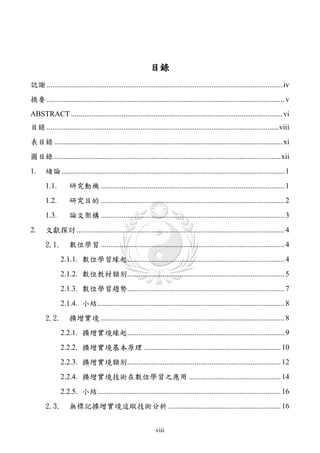
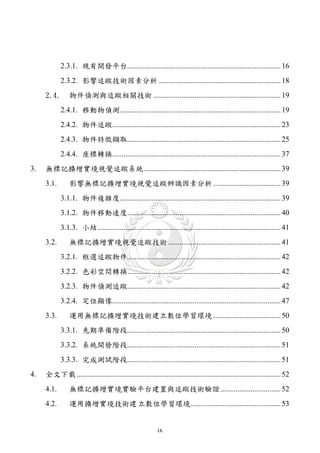


![圖目錄
圖 2.1:數位教材種類 ................................................................................................ 5
圖 2.2:虛擬連續性的理論[6] ................................................................................... 9
圖 2.3:擴增實境的基礎架構[9] ............................................................................. 10
圖 2.4:擴增實境運作步驟 ...................................................................................... 11
圖 2.5:標記圖樣[10] ............................................................................................... 12
圖 2.6:標記擴增實境示意圖 .................................................................................. 13
圖 2.7:標記擴增實境運作流程圖 .......................................................................... 13
圖 2.8:無標記擴增實境示意圖 .............................................................................. 14
圖 2.9:無標記擴增實境運作流程圖 ...................................................................... 14
圖 2.10:電磁學教學系統[14] ................................................................................. 15
圖 2.11:擴增實境坦克大戰遊戲[15] ..................................................................... 15
圖 2.12:美軍維修LAV-25A1 裝甲運兵車[16]...................................................... 16
圖 2.13:ARToolKit NFT無標記示意圖[12] .......................................................... 17
圖 2.14:光流法示意圖[25] ..................................................................................... 21
圖 2.15:時序差異法示意圖[28] ............................................................................. 21
圖 2.16:背景相減法結果圖[29] ............................................................................. 23
圖 2.17:高斯差分濾波示意圖[34] ......................................................................... 28
圖 2.18:極值搜尋示意圖[34] ................................................................................. 28
圖 2.19:特徵點描述示意圖[34] ............................................................................. 31
圖 2.20:GLOH特徵描述子示意圖[36] .................................................................. 32
圖 2.21:積分影像運算示意圖[39] ......................................................................... 33
圖 2.22:積分影像計算矩形框示意圖[38] ............................................................. 33
xii](https://image.slidesharecdn.com/random-111009121906-phpapp01/85/slide-12-320.jpg)
![圖 2.23:SIFT與SURF金字塔尺度空間建立示意圖: ......................................... 34
圖 2.24:主方向示意圖[38] ..................................................................................... 36
圖 2.25:特徵點描述示意圖[38] ............................................................................. 37
圖 3.1:物件複雜度對物件辨識追蹤之影響: ...................................................... 40
圖 3.2:物件移動速度對追蹤物件之影響: .......................................................... 40
圖 3.3:無標記擴增實境系統流程圖 ...................................................................... 41
圖 3.4:物件偵測追蹤流程圖 .................................................................................. 43
圖 3.5:SIFT與SURF特徵點表示圖:.................................................................... 44
圖 3.6:金字塔L-K光流法連續追蹤表示圖 ........................................................... 46
圖 3.7:單應性計算示意圖 ...................................................................................... 47
圖 3.8:定位顯像流程圖 .......................................................................................... 47
圖 3.9:物件近距離擴增實境畫面 .......................................................................... 49
圖 3.10:物件中距離擴增實境畫面 ........................................................................ 49
圖 3.11:物件遠距離擴增實境畫面 ........................................................................ 50
xiii](https://image.slidesharecdn.com/random-111009121906-phpapp01/85/slide-13-320.jpg)
![1. 緒論
1.1. 研究動機
21 世紀以來由於網際網路的蓬勃發展,使得地理上的距離不再是距離,人
們籍由電腦科技的進步使得在資訊搜集上更加容易,讓世界各地的人們在知識
的獲得上,不再有時間和空間的落差。在這個知識經濟的時代,如何有效且快
速的學習,可以說是生存在 21 世紀的人們,一個很重要的課題,而「數位學習」
是提供學習者一個没有環境、時間、空間及地域限制,且更有效率及學習自由
度高的途徑及方法,因此「數位學習」成了人們快速學習的方法之一。
由於數位學習與傳統課堂教學方式不同,現今數位學習大多由學習者經由
網際網路來進行學習,相較傳統課堂教學少了一份真實感,故在數位學習的教
材製作上,就變的相當重要。2008 年吳聲毅在「數位學習觀念與實作」書中[1],
依教材呈現的方式不同,將教材分成網頁式、演講式、模擬式、視訊式及電子
書等 5 類教材,其中演講式、模擬式及視訊式等 3 類教材可使用於正式授課,
而網頁式及電子書等 2 類教材可使用於補充教學。
在2010年美國新媒體聯盟(The NEW MEDIA CONSORTIUM)和主動學習教
育機構(EDUCASE Learning Initiative)「The Horizon Report 2010 Edition」報告中
[2],提出未來五年的數位學習科技技術發展6項預測,其中「行動運算(Mobile
Computing)」可以提供人們隨心所欲在任何地方上網,而「簡單擴增實境(Simple
Augmented Reality)」讓學習者有身歷其境的感受, 逹到快速且有效的學習。故
近年來已有許多研究提出相關應用,如運用在英語學習、電磁學教學、化學元
素的化學分子結構、太陽系的運轉、汽車維修教學及球類運動教學等等。
而其中擴增實境系統的底層技術是以影像處理之物件追蹤為核心,若以視
覺追蹤技術來分類的話,可分為「標記 (Marker)」或「無標記 (Markerless)」2
1](https://image.slidesharecdn.com/random-111009121906-phpapp01/85/slide-14-320.jpg)
![大系統。近年來擴增實境在「數位學習」的應用絶大多數都為「標記」系統,
原因不外乎大多數開發平台都為使用「美國華盛頓大學人機介面實驗室」所開
發出來的ARToolkit,而ARToolkit本身所使用就是「標記」系統,故相對所開發
出來的系統,均為「標記」系統。然就運用於「數位學習」上來說,要開發出
操作人性化、內容豐富,且多樣化的教材系統,顯然「標記」較為不適用,因
為會受限於使用上不方便之問題,例如:操作介面較不美觀,進而影響學習系
統的實用性。
綜上所述,要開發出操作介面可以更加便利、親切及人性化,且實用性高的
擴增實境數位學習系統,本文建議應採用「無標記」系統,因為其受限於「標
記」之限制,在追蹤、辨識及定位的物件,可由系統開發者或學習者自行設定,
使用上更為方便,實用性也隨之提昇。
無標記擴增實境之物件追蹤辨識正確與否,易受周邊環境光源、辨識圖樣
角度、影像解析度以及辨識圖樣材質等 4 點因素影響[3]。而且物件本身的複雜
度及移動速度更會影響系統的實用性,高複雜度物件表示「多特徵點」、「與
環境顏色成強烈對比」或「明顯紋理與輪廓」,這類物件容易從影像中辨識與
追蹤。反之,低複雜度物件則表示「較少特徵點」、「與環境顏色相似」或「無
明顯紋理與輪廓」,這類物件不易從影像中辨識與追蹤。另外在即時追蹤辨識
中,系統運算速度必須夠快,否則移動物件速度太快,可能造成在系統運算完
畢後,而物件已不在該位置,形成誤判。故在「無標記擴增實境數位學習系統」
中物件的複雜度分析及移動速度之影響與評估是相當重要 事先瞭解物件特性
, ,
學習者在操作系統時,才可以正確使用辨識的物件,以增加系統的實用性。
1.2. 研究目的
現行擴增實境數位學習系統大多採用標記系統,然而標記系統使用上較不
方便,會降低系統實用性,故本論文提出如何運用擴增實境的技術,來製作數
2](https://image.slidesharecdn.com/random-111009121906-phpapp01/85/slide-15-320.jpg)
![2. 文獻探討
本章首先對數位學習介紹,接著介紹何謂擴增實境,分析現行無標記擴增
實境追蹤技術,最後說明物件偵測與追蹤相關技術。
2.1.數位學習
本節首先介紹數位學習緣起,接著說明數位教材的分類及其在數位學習的
重要性,最後介紹未來影響數位學習發展及教材製作之技術。
2.1.1. 數位學習緣起
根據鄒景平在「數位學習最佳指引-數位學習概論」書中所提[4],「數位學
習(e-Learning)」這個名詞,最早係由一位美國數位學習大師 Jay Cross 於 1999
年率先提出,然美國訓 練與發展協會ASTD (American Society for Training an
d Development)定義 e-Learning 為「學習者應用數位媒介學習的過程,數位媒
介包括網際網路、企業網路、電腦、衛星廣播、錄音帶、錄影帶、互動式電視
及光碟等。應用的範圍包括網路化學習、電腦化學習、虛擬教室及數位合作」,
由此可知 e-Learning 包含的應用範圍相當廣泛,如利用網際網路、衛星廣播、
互動電視、以及光碟片教材等來進行課程學習,都屬於數位學習的範疇。另外
美國知名的網路科技公司思科(Cisco)對 e-Learning 的定義為「數位學習是透過
網際網路,即時傳遞各種資訊及知識給所需要的人,包含有正式的訓練及課程,
也包括資訊的傳遞及網路上的互動,知識管理及績效管理亦在其範圍之中」
,由
此可知 Cisco 對 e-Learning 定義,加入了在職訓練的觀念,不在侷限於我們一
般所認知的知識學科上的學習。
4](https://image.slidesharecdn.com/random-111009121906-phpapp01/85/slide-17-320.jpg)
![2.1.2. 數位教材類別
由於數位學習與傳統課堂教學的環境並不相同,傳統課堂教學是以授課老
師口頭講授為主,教材為輔,學習者則以被動學習,而數位學習則以教材為主,
由學習者主動學習,依自已的能力來設定學習進度,老師這時改變為輔助者的
角色,故數位學習的教材製作設計,就相對顯的相當重要,2008 年吳聲毅在「數
位學習觀念與實作」書中,依教材呈現的方式不同,將數位學習教材區分為下
列 5 類[1],如圖 2.1 所示:
圖 2.1:數位教材種類
2.1.2.1. 網頁式教材
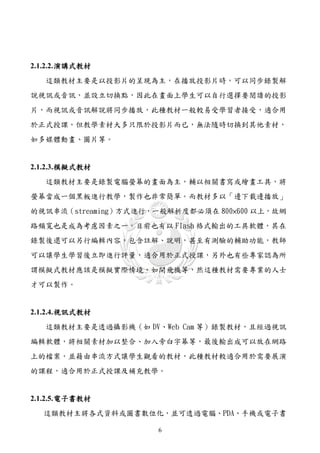
這類教材是我們一般最為常見的數位教材,其將傳統課堂上的教材以網頁
方式呈現,並加入多媒體(如動畫、圖片、Flash 等)
,製作方式可透過網頁製
作軟體製作,或將文書、簡報軟體製作的教材直接另行輸出成網頁格式,此種
數位教材製作最為簡易,但學生只是瀏覽教材,無法聽到教師講解,在學習效
果上並無太大的幫助,適合用於補充教學。
5](https://image.slidesharecdn.com/random-111009121906-phpapp01/85/slide-18-320.jpg)
![閱讀機來供人閱讀,一般多用於輔助教學之用,製作方式是將所有的教學素材
加以編輯後,包裝儲存成一個檔案,好處是可以讓學生可以下載教材並隨時觀
看,學生並可利用查詢功能快速搜尋, 逹到快速學習的目的。
2.1.3. 數位學習趨勢
依據由美國新媒體聯盟和主動學習教育機構所提出的「The Horizon Report
2010 Edition」報告中[2],提出未來五年的數位學習科技技術發展幾項預測,在
1 年內成熟的技術「行動運算(Mobile Computing)」及「開於式內容(Open
,在 2~3 年內成熟的技術「電子書(Electronic Book)」及「簡單擴增實
Content)」
境(Simple Augmented Reality)」,在 5 年內成熟的技術「互動手勢操作技術
(Gesture-Based Computing)」及「資料視覺化與分析(Visual Data Analysis)」,本
文主要為提出對現有運用在「無標記擴增實境數位學習系統」追蹤技術的限制
因素來進行分析,故僅對上述「行動學習」及「簡單擴增實境」做說明,說明
如下 :
2.1.3.1. 行動運算
在 The Horizon Report 2009 的預測中[5],預測「行動學習」將於未來的 1~2
年內成熟,而在 2010 年的報告中預測「行動運算」的技術也已逐漸成型,原因
是近年來由於無線網路的蓬勃發展及結合上智慧型手機(Smart Phone)、筆記型
電腦(Notebook Computer)的普及化,使得人們可以隨心所欲在任何地方上網,
這也表示學生可以藉由智慧型手機或筆記型電腦,透過無線網路來學習。在美
國許多研究指出,由學生使用 iPhone、iPod 或 BlackBerry,經由自行開發平台
或現有互動平台,如 Facebook、Twitter,來進行討論、提問和回答問題,研究
指出成效良好;此外在美國富蘭克林馬紹爾學院,長達一年的行動學習試驗性
計劃中,使用 iPod Touches 來探討行動運算,可應用於教學、學習和研究,這
7](https://image.slidesharecdn.com/random-111009121906-phpapp01/85/slide-20-320.jpg)
![些在都證明了行動運算及行動學習,將成為未來數位學習的主流。
2.1.3.2. 簡單擴增實境
擴增實境的技術雖然已經發展 10 多年了,但一直受限於需要攝影機、桌上
型電腦及顯示螢幕,才能觀看得到現實世界與虛擬物件的結合的影像,但是現
在只需要一部有攝影機的智慧型手機或筆記型電腦,即可達成,因此對於使用
者來說,擴增實境是很容易融入操作的技術;此外目前擴增實境的發展大多在
於娛樂的商業行為上,然目前這個趨勢,將促使擴增實境的技術可以一直被改
良操作更加簡單並讓更多的使用者接受並使用,故文中預測在未來的 2~3 年內
「擴增實境」的技術成熟後,未來運用到數位學習上是指日可待的。
2.1.4. 小結
綜合本節所述,就美國新媒體聯盟和主動學習教育機構所提出的「The
Horizon Report 2010 Edition」報告中,指出在未來幾年「行動運算」及「簡單
擴增實境」的技術便會成熟;另外就教材分類而言,本文所研究的內容就本質
而言應屬模擬式教材,適合用於正式授課,而若未來可結合「行動運算」那便
可開發成網頁式教材,適合用於補充教學,所以本文所提「無標記擴增實境數
位學習系統」可以同時運用在正式授課或補充教學的教材。
2.2.擴增實境
何謂「擴增實境」?對許多人而言是一個新的名詞,但對另一個名詞「虛
擬實境」一定不會感到陌生,故先說明擴增實境與虛擬實境之差別,根據 1994
年 Milgram 等人[6],將真實到虛擬之間的變化程度,提出了「真實-虛擬連續性
(reality–virtuality Continuum)」的理論,為擴增實境與虛擬實境做了有所區別。
如圖 2.2 所示,兩端點分別代表著真實的環境和虛擬的世界,統稱為混合實境
(Mixed Reality,MR),在不含兩端點的線段的「連續範圍」稱之為「真實-虛擬
8](https://image.slidesharecdn.com/random-111009121906-phpapp01/85/slide-21-320.jpg)
![連續性(Reality–Virtuality Continuum,RV)」
。若是比較靠近「真實」端者,即「真
實」的成份高於「虛擬」者,則稱之「擴增實境」(Augmented Reality,AR);
相對而言,如果是「虛擬」之比例較高時,則稱之為「擴增虛境」(Augmented
Virtuality,AV)。 簡單的說,
「擴增實境」是真實場景與虛擬物件結合,「擴增
虛境」虛擬場景與真實物件結合。
圖 2.2:虛擬連續性的理論[6]
2.2.1. 擴增實境緣起
擴增實境相關技術早在 50 年前就有人提出,從 1960 年電腦繪圖先鋒 Ivan
Sutherland 和他的學生,開發出第一套系統。1970 年代,美國空軍阿姆斯壯實
驗室、航太總署艾密斯研究中心及北卡羅來納大學教堂山分校等機構,有幾個
人從事擴增實境的研究。到 1990 年代初波音公司有幾個科學家才創造了「擴增
實境」這個名詞,他們當時正在開發一種實驗性擴增實境系統,協助工人裝配
管線設備[7]。到了 1997 年 Azuma 對擴增實境提出了定義[8]:「擴增實境是由
虛擬實境(或俗稱虛擬現實,VE)所變化而來的,虛擬實境的技術是該使用者
完全沉浸於一個合成環境中 使用者無法看到在他周圍真實的世界 相比之下,
, 。
擴增實境在真實的世界與虛擬物體複合疊加後 則允許使用者看到真實的世界
, 。
9](https://image.slidesharecdn.com/random-111009121906-phpapp01/85/slide-22-320.jpg)
![因此,擴增實境是增強的現實環境,而不是完全取代它」,Azuma 並提出擴增
實境至少具有三大特性:(1)結合虛擬與真實世界(Combines real and virtual),(2)
可供即時性互動 (Interactive in real time), (3)資訊必 需呈現在三
度空間內
(Registered in 3-D)。
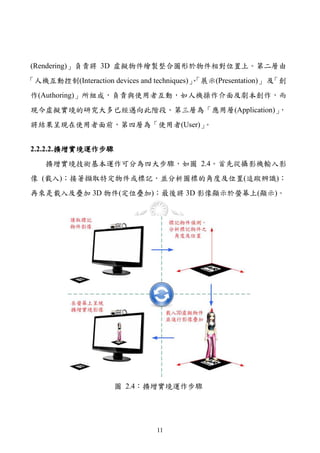
2.2.2. 擴增實境基本原理
本節首先介紹在 2005 年 Oliver Bimber 和 Ramesh Raskar 所提出擴增實境
基礎架構,由當中可以瞭解擴增實境的底層技術,接著說明如何實現擴增實境
運作步驟。
2.2.2.1. 擴增實境基礎架構
Oliver Bimber 和 Ramesh Raskar 在 2005 年「Spatial Augmented Reality
Merging Real and Virtual Worlds」的書中提出擴增實境的基礎架構[9],如圖 2.3
所示。
圖 2.3:擴增實境的基礎架構[9]
由於擴增實境是真實環境與 3D 虛擬物件結合,故最底層技術為「影像處
理」領域的「追蹤及定位(Tracking and Registration)」負責辨識物件及追蹤物件
位置,
「電腦圖學」領域的「3D 物件顯示技術(Display Techniques)」和「渲染
10](https://image.slidesharecdn.com/random-111009121906-phpapp01/85/slide-23-320.jpg)
![2.2.3. 擴增實境類別
擴增實境是將真實場景與虛擬物件結合,其基礎技術為影像追蹤及辨識,
可區分為「標記」及「無標記」等二類[9],定義分述如下:
2.2.3.1. 標記系統
標記系統代表擴增實境系統 必須經由特定標記 圖樣供系統辨識及定位,
, 、
而其標記的圖樣如圖 2.5 所示[10]。而在標記系統大多數使用由美國華盛頓大
學人機介面實驗室所開發出來的 ARToolkit 免費軟體來進行開發 然而為 了3D
,
定位準確及快速,ARToolkit 標記必須符合「必須是正方形」「邊框必需與背
、
景是對比顏色」及「標記圖案 不可旋轉對稱」等 3 個原則,才可以準確且快速
的定位[11]。
圖 2.5:標記圖樣[10]
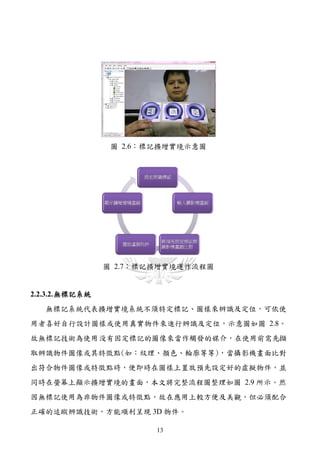
標記技術需透過系統特別的標記,來當作觸發的媒介,當攝影機畫面比對
出符合標記的圖樣時,便即時在圖樣上置放預先設定好的虛擬物件,並同時在
螢幕上顯示出擴增實境的畫面,示意圖如圖 2.6,本文將完整流程圖整理如圖
2.7 所示。然而標記受限於上述 3 個原則,在應用上較不美觀,但也因為符合上
述原則,使用標記時,可方便追蹤、辨識及定位。
12](https://image.slidesharecdn.com/random-111009121906-phpapp01/85/slide-25-320.jpg)
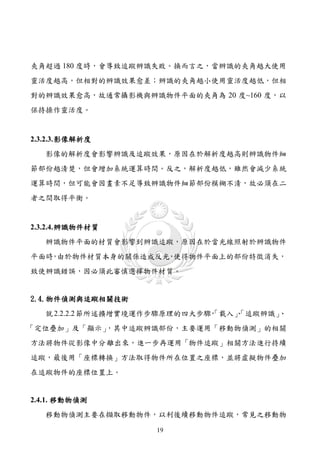
![圖 2.8:無標記擴增實境示意圖
圖 2.9:無標記擴增實境運作流程圖
2.2.4. 擴增實境技術在數位學習之應用
近年來已有許多研究提出擴增實境在數位學習的運用,在考量篇幅關係,
故列舉「電磁學教學」「電腦兵棋推演」及「軍事裝備維修」等 3 例,分別介
、
紹如下:
2.2.4.1. 電磁學教學
2009 年德國 Andre´ Buchau 等人[14]提出運用擴增實境可視化特性,將人
眼無法看見的電磁場模擬出來,這樣的技術運用在電磁學教學上,可以使得學
生輕鬆瞭解其特性及物理現象,如圖 2.10 所示。
14](https://image.slidesharecdn.com/random-111009121906-phpapp01/85/slide-27-320.jpg)
![圖 2.10:電磁學教學系統[14]
2.2.4.2. 電腦兵棋推演
在 2005 年紐西蘭坎特伯雷大學 Trond Nilsen 及 Julian Looser 等人[15],設
計出可 2 人以上同時操作使用的擴增實境坦克大戰遊戲,如圖 2.11 所示,這項
技術若引進至軍方,運用在爾後軍中的戰術教學部份,相信更可提昇學習者的
學習興趣。
圖 2.11:擴增實境坦克大戰遊戲[15]
2.2.4.3. 軍事裝備維修
在 2009 年美國哥倫比亞大學的 Steve Henderson 和 Steve Feiner 與美國海軍
陸戰隊配合[16],將擴增實境的技術運用在維修 LAV-25A1 裝甲運兵車,如圖
2.12 所示,在繁複的維修作業中,透過擴增實境技術的幫助,使用者可以藉由
頭戴顯示器(HMD)快速獲知維修機器時所需的資訊,逹到快速維修節省時間、
15](https://image.slidesharecdn.com/random-111009121906-phpapp01/85/slide-28-320.jpg)
![人力的目的。擴增實境的技術運用在軍事裝備維修上,除可以有效降低人員訓
練時間及成本外,另外亦可迅速指引維修人員進行裝備檢修。
圖 2.12:美軍維修 LAV-25A1 裝甲運兵車[16]
2.2.5. 小結
綜觀近年的許多擴增實境在「數位學習」的應用發現, 絶大多數的應用系
統,開發平台都為使用「美國華盛頓大學人機介面實驗室」所開發出來的
ARToolkit 2.72.1 版,而 ARToolkit 2.72.1 版本之前,所使用就為「標記」系統,
故相對所開發出來的系統,均為「標記」系統,然就運用在「數位學習」上來
說,要開發出操作人性化、內容豐富,且多樣化的教材系統,建議使用「無標
記」。因為其不受「標記」的限制,操作介面可以更加便利、親切及人性化。
2.3.無標記擴增實境追蹤技術分析
本節將首先介紹現有無標記擴增實境開發平台,接著分析影響追蹤技術因
素。
2.3.1. 現有開發平台
擴增實境現有絶大多數的開發平台均有支援「標記」,而支援「無標記」
的開發平台不多,以下僅介紹支援無標記的開發平台。
16](https://image.slidesharecdn.com/random-111009121906-phpapp01/85/slide-29-320.jpg)
![2.3.1.1. ARToolkit Professional Edition
ARToolkit 是由 C 語言撰寫的函式庫,透過 C 或 C++語言可以讓使用者輕
鬆地使用「標記」開發出擴增實境的應用。起初是由「美國華盛頓大學人機介
面實驗室」所開發出來的免費版本,目前最新的免費版本是 2.72.1,而在之後
便推出 ARToolKit Professional Edition 商業化版本,其中結合了許多新的影像
處理技術,而在「無標記」的部份 ARToolkit 也推出了 ARToolKit NFT[12],對
物件的自然特徵的紋理表面進行追踪,讓使用者可以輕鬆地使用開發出「無標
記擴增實境系統」,但在無標記辨識時物件影像周圍必須設置傳統標記如圖
2.13 所示,以利追蹤辨識。
圖 2.13:ARToolKit NFT 無標記示意圖[12]
2.3.1.2. D’ Fusion
D’Fusion是由TOTAL IMMERSION公司所開發出來擴增實境應用軟體[17],
所使用的語言為Script ,其也支援「無標記」,但在物件追蹤會受限於物件本身
的複雜度。物件複雜度越高,追蹤、辨識效果越好;反之,物件複雜度越低,
追蹤、辨識效果越差。其目前「無標記」相關應用以平面圖卡為主,並未有以
真實物件供追蹤辨識及在真實物件上呈現3D物件之運用案例。
17](https://image.slidesharecdn.com/random-111009121906-phpapp01/85/slide-30-320.jpg)
![2.3.1.3. Unifeye Design
Unifeye Design 是由 Metaio 公司的所開發出來擴增實境應用軟體[18],所
使用的語言為 C#,其也支援「無標記」,然他的限制在於目前所呈現出來均為
運用於故事書上製作為主,並未有以真實物件供追蹤辨識及在真實物件上呈現
3D 物件之運用案例。
2.3.1.4. 小結
綜觀上述無標記開發平台,其在追蹤辨識技術均有所侷限,ARToolkit 受
限於辨識時物件影像周圍必須設置傳統標記 D’Fusion 及 Unifeye Design 就目
,
前所知,均無法對真實物件追蹤辨識,故無法滿足本文所提須能追蹤各式真實
物件。
2.3.2. 影響追蹤技術因素分析
由於擴增實境的底層核心技術之一是影像處理領域的追蹤及辨識,然在進
行影像追蹤、辨識及定位時,會受「環境光源」、「辨識圖樣角度」、「影像
解析度」、「辨識圖樣材質」等 4 點因素限制[3],原因分述如下:
2.3.2.1. 環境光源
一般我們從攝影機獲得影像通常為 RGB 色彩模型,而周邊環境的光源明
亮會導致影像 RGB 值出現變化,當物件追蹤周邊光源有強烈變化時,將會因
RGB 值出現變化而致使辨識錯誤,另外光線照射所產生的陰影,也都會造成辨
識失敗。
2.3.2.2. 辨識圖樣角度
攝影機與辨識物件平面的夾角以 90 度為最佳,但會降低使用的靈活度。當
18](https://image.slidesharecdn.com/random-111009121906-phpapp01/85/slide-31-320.jpg)
![件偵測追蹤方法可分為光流法(Optical Flow Method)、時序差異法(Temporal
Differencing)與背景相減法(Background Subtraction)等三類[19],分述如下。
2.4.1.1. 光流法
光流法係運用連續影像中,圖像像素的亮度變化,來找出影像中的光流場
(Optical Flow Field),再藉由光流場來估計移動物體的運動向量後進行特徵匹
配。簡單來說,光流法就是藉由偵測光線強弱的變化來進行偵測移動物件,示
意圖如圖 2.14 所示。
在眾多光流法中,目前常用的方法為「H-S光流法」[20],以及「L-K光流
法」[22]。前者為Horn及Schunck於1981年提出,此方法較不易受到雜訊之影響,
但因使用疊代法求解,故在計算速度上會顯的較慢[21]。「L-K光流法」為Lucas
及Kanade 於1981年所提出,其基本原理基於下列三項假設[23]:
1.亮度不變性:以灰階影像而言,其意義為一物體的亮度不會在相鄰二幅影像中
出現巨大的變化。
2.時間連續性:假設一物體在即時相鄰二幅影像中移動距離是很微小,然由於實
際上在即時環境下1秒為15至30張圖像,故物體在相鄰二幅影像
中所移動距離並不會移動過大。
3.空間一致性:畫面中相鄰的點屬同一物體平面,則會有相似的移動,在影像內
不會距離太遠。
「L-K光流法」優點在於僅對部分區域的光流場進行分析計算,故在計算上
相對更顯快速簡單,缺點則為僅能計算較短的移動向量,對於長距離的移動則
無法有效的偵測。為解決上述問題,Bouguet於1999年提出「金字塔L-K光流法」
[24],主要將「L-K光流法」結合金字塔結構特性,追蹤時先從低解析度的影像
開始追蹤,再追蹤到高解析度影像。藉由計算低解析度的移動矩離來對應回至
20](https://image.slidesharecdn.com/random-111009121906-phpapp01/85/slide-33-320.jpg)
![高解析度的矩離,便可解決因移動離過大導致無法正確追蹤物件之缺點。
圖 2.14:光流法示意圖[25]
2.4.1.2. 時序差異法
時序差異法的原理,是利用連續二幅或三幅的影像做一對一的像素相減,
若是兩者差異不為零,則為前景物件[19]。在 1998 年 Lipton 等人成功的運用此
方法檢測出前景物件[26];2000 年卡內基美隆大學機器人研究所在其研究報告
中,運用連續三張的影像來取得移動特徵,並利用設定一個門檻值來決定那些
是前景物件[27]。上述二者方法在計算效能上都有非常好的效率,但缺點就是
無法取得完整的前景物件[28],如圖 2.15 所示,其中物件移動時,因影像 K-1
及影像 K 部份區域有重疊,導致在比較時造成錯判,故無法取得完整的前景物
件。
圖 2.15:時序差異法示意圖[28]
21](https://image.slidesharecdn.com/random-111009121906-phpapp01/85/slide-34-320.jpg)
![2.4.1.3. 背景相減法
背景相減法的原理,係先行運用幾秒的連續影像來建立初步背景,背景建
立完成後,再以目前影像與背景影像比較,符合背景條件的則判定為背景,反
之則判定前景物件。但因判定時完全參照背景影像,故在動態場景光線或背景
改變時易形成誤判[19]。此方法之優點在於運算快速,且可擷取到完整的前景
物件。
在 2005 年 Jacques 等人提出背景相減法,背景模型 B(x,y)建立公式如公式
(2.1)[29]。
m(i, j) zV (i, j)
min z
B(i, j) = � n(i, j) � = � zV (i, j)
max z �
d(i, j) max|V z (i,
j) − V z−1 (i, j)|
(2.1)
z
where |V z (i, j) − λ(i, j)| < 2σ(i, j)
其中 V 為連續 n 張影像,Vz(i,j)為第 n 張影像中(i,j)的像素值,m(i,j)和 n(i,j)
分別為 V 中相對位置(i,j)的最大值及最小值,而 d(i,j)則為二張相鄰影像相對位
置(i,j)的最大差異值,λ(i,j)和σ(i,j)分別為連續 n 張影像中相對位置(i,j)的中位
數(Median)和標準差(Standard Deviation) 當新影像 It(i,j)進入時 經由與公式(2.2)
, ,
比對,擷取出前景物件。
0 , I t (i, j) > (m(i, j) − kμ) and I t (i, j) < (m(i, j) + kμ)
F(i, j) = �
1 , otherwise
(2.2)
當中μ為最大差異值 d(i,j)的中位數,k 則為一常數,而 F(i,j)為前景物件,擷取
結果如圖 2.16 所示。
22](https://image.slidesharecdn.com/random-111009121906-phpapp01/85/slide-35-320.jpg)
![圖 2.16:背景相減法結果圖[29]
2.4.1.4. 小結
分析上述 3 種方法,其中光流法及時序差異法都不需先行建立背景,然時
序差異法問題在於無法擷取完整的前景物件,這樣對於後續的移動物件追蹤與
辨識將無法提供完整的資訊 背景相減法則需先行運用一段時間影像建立背景
。 ,
所以前置準備作業較長。
光流法雖易受光源影響且計算方式較複雜,但優點在於不需先行得知目標
物的特徵,僅藉由影像亮度的變化, 即可求得物體位移距離。而「金字塔 L-K
光流法」可以僅對部分區域光流場進行分析計算,計算上相對更顯快速簡單,
再搭配其他特徵點尋找的方法(如 SIFT SURF 等等) 即可達成物件追蹤辨識,
: 、 ,
可應用在「無標記擴增實境數位學習系統」上開發出追蹤各式物件技術。
2.4.2. 物件追蹤
物件追蹤(Object Tracking)是藉由比對連續影像間物件的相似程度,此範疇
涵蓋物件特徵擷取、目標物搜尋及物件辨識等,而現有物件追蹤的方法可分為
「區域式追蹤 (Region-Based Tracking)」「主動式輪廓追蹤(Active Contour-Based
、
Tracking)」 「特徵追蹤(Feature-Based Tracking)」及「模型追蹤(Model-Based
、
Tracking)」等四類[19][30][32],分述如下:
23](https://image.slidesharecdn.com/random-111009121906-phpapp01/85/slide-36-320.jpg)
![2.4.2.1. 區域式追蹤
此類方法的原理係將影像變動的區域視為移動物件,藉著偵測這些變動區
域的位置,來達到追蹤的目的。常用的方法是利用目前的影像與背景相減或運
用連續二張影像相減,所偵測出變化的區域,然後再進一步設立規則做篩選,
或劃分。
2.4.2.2. 主動式輪廓追蹤
此方法的原理係為運用物件的輪廓線(例如影像邊緣、形狀等)來描述移
動的物件,再利用每張影像上輪廓的資訊更新來追蹤物件。這種方法相對於區
域式追蹤對描述物件較為簡單且更有效率,也因輪廓線是封閉曲線,即使物體
交錯,也不會受到影響,但追蹤效果和初步輪廓的偵測或選取密切相關,故較
難用於全自動的偵測追蹤系統。
2.4.2.3. 特徵追蹤
這種方法的原理係運用物件本身的特徵來進行追蹤,但首先要對追蹤物件
本身擷取其特徵。然而根據不同的特徵,可分為「整體性特徵(global feature
based),如重心、色彩、面積、紋理,
」 「局部性特徵(local feature based),如
」
線段、頂點,
「相依圖形特徵(dependence graph based)」
,如特徵間的結構變化等
3 類。此方法可以用來即時追蹤多個物體(相依圖形特徵方法除外),並可利用運
動特徵、局部特徵或相依圖形特徵來解決物體交錯的問題。
1999 年 Comaniciu 以及 Meer 提出「平均值移動的追蹤技術(Mean Shift
Object Tracking)」[33],其原理是統計移動區域內的亮度值,依不同位置給予不
同的亮度比重,組合成目標物的特徵模型,然後再從影像中找出和目標物模型
最相像的區域,藉此達到追蹤的目的。
2004 年 由 Lowe 所 提 出 「 尺 度 不 變 特 徵 轉 換 (Scale-Invariant Features
24](https://image.slidesharecdn.com/random-111009121906-phpapp01/85/slide-37-320.jpg)
![Transform,SIFT)」[34],是目前最為熱門的局部性特徵,該特徵對旋轉、尺度
縮放、亮度變化可保持不變性,另對視角變化、仿射變換也可以保有一定穩定
性 2008 年 Bay 等人提出
。 「加速強健性特徵(Speeded-Up Robust Features SURF)」
,
[38],該特徵係將影像轉換為積分影像並擷取特徵點,特徵點描述改良 SIFT 特
徵點描述之方法,其優點為運算速度較 SIFT 快。
2.4.2.4. 模型追蹤
此類方法之原理係先建立物體模型,再利用已知或假設的運動特徵建立運
動模型,用運動模型去預測下一張影像的物體模型變化,最後透過搜尋和比對
來完成。而模型追蹤的方法會提供較精細且準確的判斷,因此需要良好的物體
結構模型,所以基本上比較不受附近背景或其他物件干擾影響,也較能抵抗物
體間交錯問題,但相對地運算量也比較大。
2.4.2.5. 小結
要開發出適用於「無標記擴增實境數位學習系統」的追蹤技術,如何選取
有效的特徵將是非常重要的課題,從上述 4 種分類上來講,本文將採取「特徵
追蹤」中的「局部性特徵」
,因其中 SIFT 及 SURF 等 2 項特徵點,對旋轉、尺
度縮放變化都可保持不變性,在開發「無標記擴增實境數位學習系統」追蹤技
術上,可提供有效的特徵點,以逹即時且穩定快速追蹤的目的。
2.4.3. 物件特徵擷取
本節介紹「局部性特徵」中 SIFT 及 SURF 等 2 項特徵比對原理。
2.4.3.1. SIFT特徵比對原理
SIFT 是 1999 年 Lowe 所提出,並在 2004 年整合總結 [34],是目前最為熱
門的局部性特徵。該特徵對旋轉、尺度縮放、亮度變化可保持不變性,另對視
25](https://image.slidesharecdn.com/random-111009121906-phpapp01/85/slide-38-320.jpg)
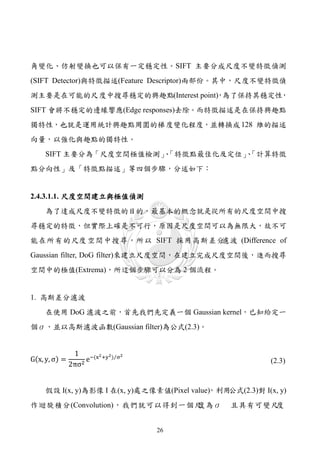
![分濾波器所產生尺度空間,就是偵測極值的尺度空間。
圖 2.17:高斯差分濾波示意圖[34]
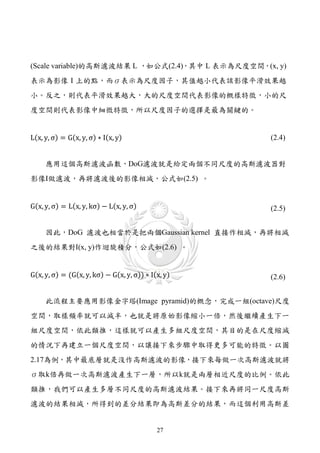
2.尺度空間極值偵測
從上一個步驟中所獲得的尺度空間,接下來就可以這尺度空間中搜尋可能
的特徵點(也就是興趣點),其方法是搜尋空間中的極値(Extrema),以圖 2.18為
例,若尺度空間中存在一個X點,為周圍26個點中的最大值或最小值(上一層9個
鄰近點、同一層8個鄰近點與下一層9個鄰近點),則該點即判定為特徵點。最後
若確定興趣點為特徵點時,若當初該特徵點尺度縮減的取樣頻率為1/ f 倍,就將
該特徵點的座標皆乘以f倍,即可得到該特徵點在原始影像尺 度中的座標位置。
圖 2.18:極值搜尋示意圖[34]
28](https://image.slidesharecdn.com/random-111009121906-phpapp01/85/slide-41-320.jpg)
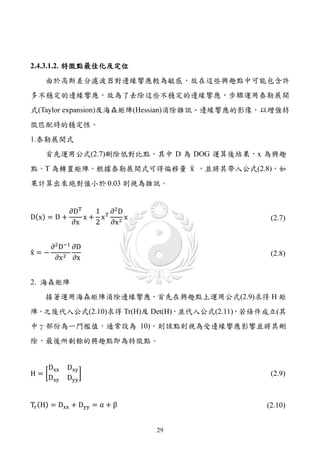
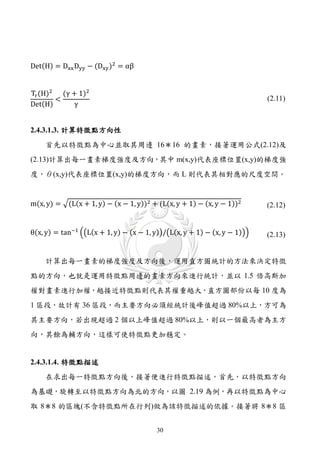
![塊切成 2*2 子區塊,如圖 2.19 右圖所示,透過 Gaussian kernel 的加權再統計
每一個子區塊中 8 個梯度方向。因此,可以得到 32 維向量資訊,這種結合鄰
近畫素向量資訊的特徵描述方法逹成旋轉不變的目的。最後在實際的計算過程
中,為了讓特徵的匹配有更強的穩健性,作者建議 8*8 的區塊改為 16*16 區
塊,並切割為 4*4 子區塊,這樣獲得的向量資訊會從原 32 維改為 128 維,使
其在特徵的匹配更具有容錯性。
圖 2.19:特徵點描述示意圖[34]
2.4.3.1.5. SIFT相關技術發展
2004 年 Ke 與 Sukthankar 等人提出「PCA-SIFT」的方法[35],主要概念是將
SIFT 結合主成份分析(Principle component analysis, PCA),將原本 128 維的特徵
描述向量,運用 PCA 的技術原理,投影到低維度的向量空間中,於特徵比對時
降低維度增加運算效率。2005 年 Mikolajczyk 與 Schmid 提出「GLOH (Gradient
Location Orientation Histogram)」的方法[36],主要將原特徵描述子中 4*4 棋盤
式子區塊,改為放射狀同心圓子區塊替代,如圖 2.20 所示。其中共有 17 個子
區塊,統計每一個子區塊中 16 個梯度方向,所以每一特徵點可得 272 維度的描
述向量,再運用 PCA 的技術原理將 272 維投影至 128 維的向量空間中,使其
較 SIFT 的特徵描述子更加穩定。
31](https://image.slidesharecdn.com/random-111009121906-phpapp01/85/slide-44-320.jpg)
![圖 2.20:GLOH 特徵描述子示意圖[36]
2.4.3.2. SURF
SURF 於 2008 年由 Bay 等人所提出[38],該特徵係將影像轉換為積分影像
以擷取特徵點,並改良 SIFT 特徵點描述之方法,因此運算速度較 SIFT 快。主
要分為「特徵點檢測」「計算特徵點分向性」及「特徵點描述」等三個步驟,
、
分述如下:
2.4.3.2.1. 特徵點檢測
此步驟主要檢測影像中的特徵點,可分為「積分影像(Integral Images)」
、「尺
度空間建立」「海森矩陣(Hessian)特徵檢測」及「特徵點定位」等四個流程,
、
分述如下:
1. 積分影像
積分影像的目的在於可以利用查表(look-up table) 的方式快速計算影像中
任意矩形區域的像素值總和,此方法在 SURF 中使用遮罩運算時,當處理的區
域面積很大時,可以降低運算量和處理時間,其計算方法如公式(2.14),所得積
分影像示意如圖 2.21 所示。
32](https://image.slidesharecdn.com/random-111009121906-phpapp01/85/slide-45-320.jpg)
![i≤x j≤y
IΣ (x) = � � I(i, j)
i=0 j=0
(2.14)
圖 2.21:積分影像運算示意圖[39]
以圖 2.22 為例,A、B、C、D 表示積分影像中四個積分值位置,可藉由
公式(2.15)計算矩形框灰階值總和 這種計算方式可以大幅降低 SURF 在建立尺
,
度空間遮罩運算時的運算量和處理時間。
Σ=A−B−C+D (2.15)
圖 2.22:積分影像計算矩形框示意圖[38]
2. 尺度空間建立
33](https://image.slidesharecdn.com/random-111009121906-phpapp01/85/slide-46-320.jpg)
![SURF 以 SIFT 建立金字塔尺度空間的概念為基礎,但二者截然不同。SIFT
以固定高斯核函數遮罩大小,改變原始影像大小;而 SURF 則以固定原始影像
大小 改變 Hessian 偵測子的遮罩大小以實現尺度空間的效果 實際上 SURF 採
, 。
用三個倍頻,且每個倍頻內有四個不同尺度的 Hessian 偵測子。第一個倍頻尺
度空間的尺度參數定義為 1.2,2,2.8,3.6,其相對應的遮罩為 9×9,15×15,
21×21,27×27;第二倍頻尺度參數則定義為 2,3.6, 5.2,6.8,遮罩為 15×15,
27×27,39×39,51×51;第三倍頻尺度參數定義為 3.6,6.8,10,13.2,遮罩為
27×27,51×51,75×75,99×99。如圖 2.23 所示,圖中(a)為 SIFT 尺度空間建立
時,遮罩不變改變原圖尺寸大小,(b)為 SURF 尺度空間建立時原圖尺寸不變但
改變遮罩大小。
圖 2.23:SIFT 與 SURF 金字塔尺度空間建立示意圖: 圖(a) 為 SIFT;(b) 為
SURF[38]。
3. 海森矩陣(Hessian)特徵檢測
海森矩陣是 SURF 的運算核心,為了方便運算,假設函數 f(x,y),海森矩陣
同的尺度空間下所求的海森矩陣公式如(2.18),其中Gyy (x, y, σ)為高斯核函數對
H 是由函數 f 的偏導數組成,公式如(2.16)所示,展開後如公式(2.17),而在不
y 的二次偏微分,其餘類推。
34](https://image.slidesharecdn.com/random-111009121906-phpapp01/85/slide-47-320.jpg)
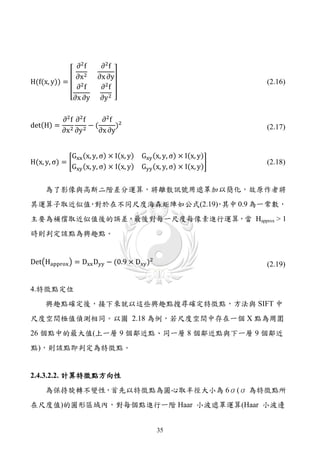
![長為 4σ),並以高斯加權進行加權,其一階導數可表示運算區域於與方向的梯
度。再以圓心角(60 度)扇形視窗繞著特徵點掃描,並根據每個掃描角度,統計
扇形視窗內的一階導數值(dx 與 dy)的加總,以扇形區域內有最大加總值的掃描
角度作為其特徵的主要方向。如圖 2.24 所示,斑點部份為 Haar 小波遮罩運算
一階導數值(dx 與 dy),灰色扇形為掃描視窗,箭頭長度為經過加總後的大小,
箭頭方向則表示為特徵點方向。
圖 2.24:主方向示意圖[38]
2.4.3.2.3. 特徵點描述
SURF 特徵點描述的建立是以特徵點為中心建立一個邊長為20σ大小的正
方形區域,並將區域內每5σ邊長大小劃分成子區域。在各個子區域中,進行以
邊長為2σ大小的一階Haar 小波遮罩進行運算(dx與dy),以最左上角第一個像素
點起,每隔σ像素的距離進行一次運算,因此每個Haar 小波在每個子區域內共
計算25次,如圖 2.25所示。
36](https://image.slidesharecdn.com/random-111009121906-phpapp01/85/slide-49-320.jpg)
![圖 2.25:特徵點描述示意圖[38]
最後每個子區域分別累計成 Σdx、Σdy、︱Σdx︱與︱Σ dy︱的一組四個加
總值表示向量,此 16 個子區域的特徵向量便可形成一個描述該特徵點的 4*4
*4=64 維度的特徵描述子。
2.4.3.3. 小結
在開發「無標記擴增實境數位學習系統」追蹤技術上,必須講求的是即時
且穩定快速的追蹤,而上述 SIFT 及 SURF 等 2 項特徵點比對方法,對旋轉、
尺度縮放等變化都可保持不變性 另對視角變化 仿射變換也保有相當穩定性,
, 、
可用於「無標記擴增實境數位學習系統」追蹤技術極為合適。本文將於錯誤! 找
不到參照來源。節比較分析兩種方法用在「無標記擴增實境數位學習系統」適
用性,並採用效能較佳之方法。
2.4.4. 座標轉換
由於在3D物件要在螢幕上與現實場景結合,而螢幕上的影像平面為2D座標,
故必需將3D圖形投影成2D圖形,並運用一些3D效果,讓2D圖形看起來有3D感
覺。轉換公式如(2.20),而攝影機的參數矩陣計算採用1997年Heikkila和Silven的
方法[40]。
37](https://image.slidesharecdn.com/random-111009121906-phpapp01/85/slide-50-320.jpg)
![1 0 0 0
R −Rt
q ≅ K �0 1 0 0� � T � = K[R |−Rt] = M
0 1
0 0 1 0 (2.20)
公式(2.20)中 K 為相機校正矩陣公式如(2.21),當中 Cx 與 Cy 分別代表 x 與
y 上的偏移量, 而 fx 與 fy 分別代表在真實的感光耦合元件(Charge Coupled
Devices, CCD)相機中,在物理意義上 X 方向與 Y 方向之量值不一定為 1 比 1,
而影像上的像素並非 1 比 1,則必須在 X 與 Y 方向各導入一個比例參數,故
fx 與 fy 分別代表比例參數的座標點;另在感光耦合元件相機中,物理意義上的
像素也不一定是矩形,故 s 則代表 X 軸與 Y 軸的歪斜參數。
fx s cx
K = �0 fy cy �
0 0 1 (2.21)
R −Rt
� 代表相機座標系統( Q c ),展開後公式(2.22),其中
0T 1
為世界座標系統三維座標點,t 為位移轉換代表攝影機在世界座標系統位置,
公式(2.20)中�
R 為旋轉矩陣代表攝影機之方向。
R1 R2 R3 t x Xm
R6 t y Ym
�R 4 R5 �� �
R7 R8 R9 t z Zm
0 0 0 1 1 (2.22)
38](https://image.slidesharecdn.com/random-111009121906-phpapp01/85/slide-51-320.jpg)
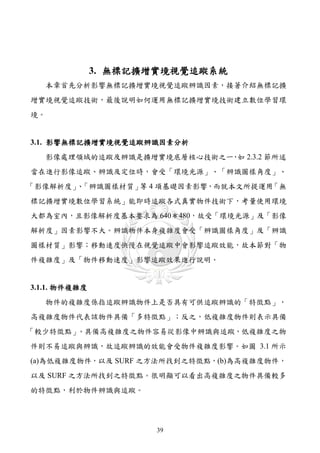
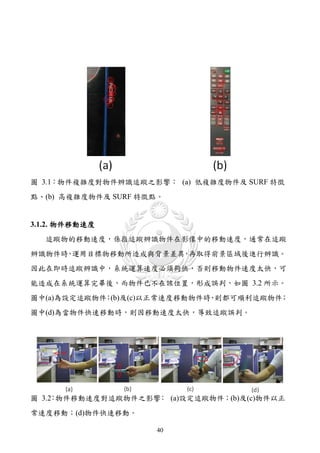
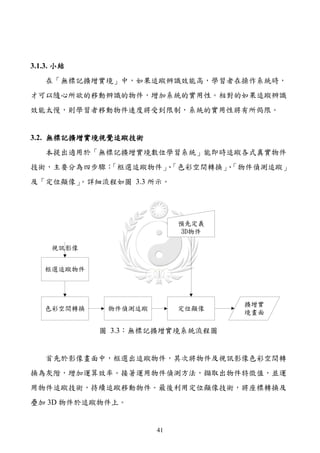
![3.2.1. 框選追蹤物件
為了能正確且快速將 3D 物件疊加於追蹤物件,本文採用手動方式框選追
蹤物件,主要原因在於若採用自動偵測影像中移動物件,在取得初步移動物件
影像後,仍需經過複雜程序以判斷或去除其他非移動物件之部份,以正確且完
整取得移動物件。其次若欲同時處理多個移動物件,則須比對判斷出各正確物
件,會增加系統運算時間且降低整體效能。故本文採用手動框選方式以降低運
算複雜度,有效提昇整體系統效能。另在框選物件時須注意下列事項:
1.框選時應儘量避免框選過多背景部份(非物件區域)。
2.若物件外觀為不規則形,則框選時應以物件內最大矩形為框選區域。
此外,可採用載入物件圖像的方法,來取代框選追蹤物件,以增加本文所
提技術實用性。
3.2.2. 色彩空間轉換
為快速比對及追蹤移動物件,本文將框選之移動物件及擷取之視訊框轉換
為灰階影像,以降低計算維度,增加運算效率,轉換公式如(3.1) [31]。
I = 0.299 × R + 0.587 × G + 0.114 × B (3.1)
3.2.3. 物件偵測追蹤
本流程主要在於能持續辨識與追蹤框選物件,以獲取追蹤物件在影像中的
相對位置及方向,俾利後續定位顯像放置 3D 物件使用。流程圖如圖 3.4 所示,
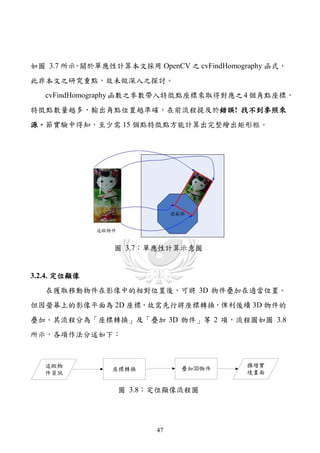
主要步驟分為「擷取特徵點」「物件追蹤」「擷取移動區域特徵點」及「單應
、 、
性計算」等 4 項,詳細說明分述如后:
42](https://image.slidesharecdn.com/random-111009121906-phpapp01/85/slide-55-320.jpg)
![載入
全幅區域影像
物件特徵點
框選 擷取
框選區域影像 特徵點 設定影像
全幅區域
< 15
判斷載入
或是框選 擷取移動 移動區域 特徵點
物件
區域特徵 特徵點 比對
灰階影像
影像
> 15
特徵點
框選物件 載入物件
單應性
計算
物件移
動區域 4個角點
追蹤物件
灰階影像 物件追蹤 4個角點 定位顯像
資訊
影像 4個角點
圖 3.4:物件偵測追蹤流程圖
3.2.3.1. 特徵點擷取
本文提出「無標記擴增實境數位學習系統」,期望能即時追蹤各式真實物
件,且持續穩定呈現 3D 物件,以獲得良好學習成效,因此持續對物件偵測追蹤
更顯相當重要,而且必須審慎擷取物件特徵點。在擴增實境實際運用中,物件
會隨著不同的需求而有所旋轉、尺度縮放、亮度、視角及仿射變化等等,因此
物件特徵點必須能抵抗這些變化。所以本文採用 SIFT[34]及 SURF[38]特徵點擷
取方法,詳如方法如 2.4.3.1 節及 2.4.3.2 節所述,本文將分析兩種方法用在「無
標記擴增實境數位學習系統」之優缺點。SIFT 方法係採用美國俄勒岡州州立大
學 Rob Hess 所提供之 SIFT 函式庫[41],影像金字塔層數設為 4 層,高斯模糊
σ 設定為 1.6,共產生 16 個不同尺度空間,8 個尺度極值搜尋層,特徵向量維
度設為 128 維。另 SURF 係採用 OpenCV2.2 版所提供函式庫[42],參數設定為
金字塔層數設為 4 層,共產生 16 個不同尺度空間,8 個尺度極值搜尋層,特徵
向量維度設為 64 維。詳細步驟如下所述:
步驟一:影像輸入可分為框選或載入物件,首先判斷影像來源為框選或載入。
43](https://image.slidesharecdn.com/random-111009121906-phpapp01/85/slide-56-320.jpg)
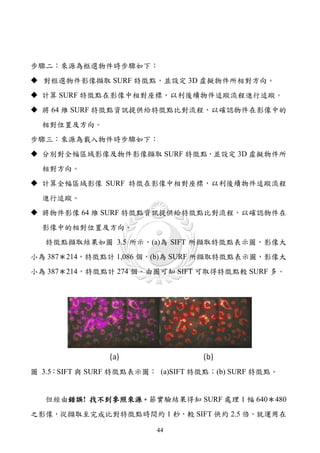
![即時系統(每秒 15~30 張影像)上,SURF 較能實現在即時系統上,故本文採用
SURF 特徵演算法擷取特徵。
3.2.3.2. 物件追蹤
經由錯誤! 找不到參照來源。節實驗結果得知 SURF 處理 1 幅 640*480 之
影像,從擷取至完成比對特徵點時間約 1 秒,在匹配比對時,若對匹配影像全
域擷取特徵點再與目標影像特徵點一一比對,然而當匹配區域越小相對匹配時
間,可縮短幅度越大,但若縮小影像大小,則所獲得特徵點相對越少不利於後
續追蹤匹配,故若配合光流法在獲得移動區域後,可以有效降低匹配區域大小
而不是縮小影像大小,應可縮短匹配時間,且並不會減少匹配點,對後續追蹤
可更加有利。
由上所述本流程主要目的為偵測出移動區域,以縮小 SURF 擷取特徵及影
像比對匹配區域,以縮短 SURF 處理時間。而方法將採用 2.4.1.1 節所述「金字
塔 L-K 光流法」[24]原因係其僅對所提供特徵點座標位置區域光流場進行分析
計算,故在計算上更顯快速簡單。所使用 OpenCV 所提供函式,金字塔結構採
用 5 層,為原始輸入影像解析度為 640*480,故 L0 為原始影像解析度,L1 為
L0 層解析度一半為 320*240,L2 又為 L1 層解析度的一半為 160*120,L3 又
為 L2 層解析度一半為 80*60,L4 又為 L3 層解析度一半為 40*30,其連續追
蹤情形如圖 3.6 所示,圖中最左第 1 張為手動框選追蹤物件,綠色點部份則為
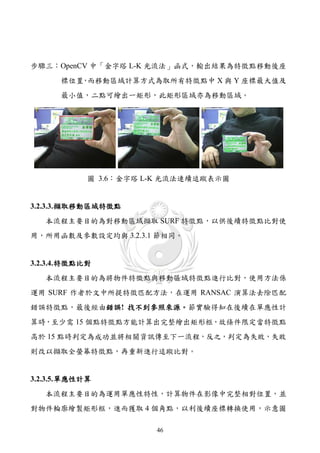
SURF 特徵點座標,依序為連續追蹤情形。詳細步驟如下所述:
步驟一:輸入影像為框選物件時,則「金字塔 L-K 光流法」追蹤用特徵點座標
為框選物件 SURF 特徵點在影像中的相對座標。
步驟二:輸入影像為載入物件時,首先「金字塔 L-K 光流法」追蹤用特徵點座
標為全幅區域影像 SURF 特徵點在影像中的相對座標,其後因可知物
件準確位置,故後續僅對物件準確位置特徵點座標進行追蹤。
45](https://image.slidesharecdn.com/random-111009121906-phpapp01/85/slide-58-320.jpg)
![3.2.4.1. 座標轉換
本流程為將影像平面之 2D 座標轉換為 3D 座標,以利後續 3D 物件疊加,
座標轉換方法為 2.4.4 節所述 1997 年 Heikkila 和 Silven 所提出的計算攝影機的
參數矩陣方法[40],所使用函式 ARStudio 中所設計視覺追蹤模組之 Markerless
功能,其設計原理為將單應性計算流程中所得 4 個角點座標帶入 ARToolKit 之
座標轉換函式進行座標轉換。
3.2.4.2. 疊加 3D物件
本流程為將 3D 虛擬物件疊加至移動物件在影像中的相對位置,關於相關
繪製三維影像,本文採用 ARStudio 中所設計之影像繪製模組,其設計原理為運
用 OpenVRML 函式庫繪製三維影像,故只需要將物件追蹤之座標資訊及虛擬
物件資訊填入相對應之結構變數中,影像繪圖模組便可將指定之三維模型疊加
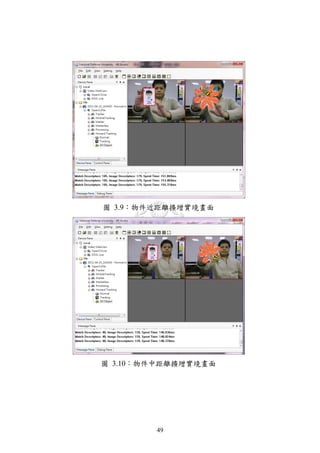
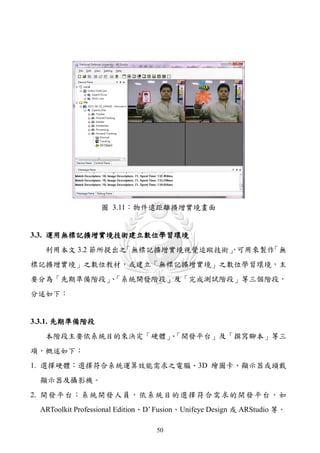
在移動物件上。疊加後影像如圖 3.9 至圖 3.11 所示,其中分別為物件近、中及
遠距離擴增實境畫面。
48](https://image.slidesharecdn.com/random-111009121906-phpapp01/85/slide-61-320.jpg)

![參考文獻
[1] 吳聲毅,數位學習觀念與實作,學貫行銷股份有限公司,台北、台灣,第
3.2-3.3 頁,2008。
[2] Johnson, L., Levine, A., Smith, R., and Stone, S., “The 2010 Horizon Report,”
The NEW MEDIA CONSORT IUM and EDUCASE Learning Initiative,
California, U.S.A, pp. 9-12、21-24, 2010
[3] 薛凱文,“擴增實境應用探討—使用無標記技術”,嶺東科技大學數位媒體
研究所碩士論文,台中,2009。
[4] 鄒景平 數位學習最佳指引
, -數位學習概論 資策會數位教育研究所 台北、
, ,
台灣,第 1.2 頁-第 1.23 頁,2007。
[5] Johnson, L., Levine, A., and Smith, R., “The 2009 Horizon Report,” The NEW
MEDIA CONSORT IUM and EDUCASE Learning Initiative, California,
U.S.A, pp. 8-10, 2009。
[6] Paul Milgram, Haruo Takemura, Akira Utsumi, Fumio Kishino, “Augmented
reality:A class of display on the reality-virtuality continuum,” Telemanipulator
and Telepresence Technologies, SPIE Vol. 2351, pp. 282-292, 1994.
[7] 吳鴻譯,Steven K. Feiner 撰文,“擴增實境-虛擬實境的無限延伸”,科學人
雜誌,第 04 期,2002 年 06 月。
[8] Azuma, R. T.,“A survey of augmented reality,” Teleoperators and Virtual
Environments ,6,4, pp. 355-385,1997.
[9] Oliver Bimber. and Ramesh Raskar., Spatial Augmented Reality Merging Real
and Virtual Worlds, Wellesley, assachusetts, U.S.A ,A K Peters, Ltd ,Chap.1,
pp. 1-7, 2005
[10] ARToolket Maker, http://roarmot.co.nz/ar/。
[11] ARToolket Support Library, http://www.artoolworks.com/support/library/Cr
eating_and_training_new_ARToolKit_markers
55](https://image.slidesharecdn.com/random-111009121906-phpapp01/85/slide-68-320.jpg)
![[12] ARToolket, http://www.hitl.washington.edu/artoolkit/。
[13] Georgia Tech Augmented Environments Lab,http://www.augmentedenviron
ments.org/lab/research/handheld-ar/arhrrrr/
[14] Andre´ Buchau , Wolfgang M. Rucker , Uwe Wo¨ssner and Martin Beck
er, “Augmented reality in teaching of electrodynamics, ” The International
Journal for Computation and Mathematics in Electrical and Electronic En
gineering, Vol. 28 No. 4, pp. 948-963,2009.
[15] Trond Nilsen, Julian Looser, “Tankwar Tabletop war gaming in augmented
reality,” In Proceedings of 2nd International Workshop on Pervasive Gam
ing Applications, 2005.
[16] Steve Henderson and Steve Feiner, “Evaluating the Benefits of Augmented
Reality for Task Localization in Maintenance of an Armored Personnel Carrier
Turret,” Proceeding of IEEE International Symposium on Mixed and Augmented
Reality (ISMAR '09), October 2009, pp. 135-144.
[17] TOTAL IMMERSION, http://www.t-immersion.com
[18] METAIO, http://www.metaio.com
[19] W. Hu, T. Tan, L. Wang, and S. Maybank, “A survey on visual surveillance of
object motion and behaviors,” IEEE Transactions on Systems, Man and
Cybernetics, Part C: Applications and Reviews, Vol. 34, pp. 334-352, 2004.
[20] B.K.P. Horn and B.G. Schunck, “Determining optical flow.,” Artificial
Intelligence, vol 17, pp. 185-203, 1981.
[21] 陳冠儒,“光流值準確性之提升”,私立逢甲大學電機工程研究所碩士論
文,台中,2007。
[22] B. D. Lucas and T. Kanade,“An Iterative Image Registration Technique
with an Application to Stereo Vision” Proceedings of Imaging Understan
ding Workshop , pp. 121-130, 1981.
56](https://image.slidesharecdn.com/random-111009121906-phpapp01/85/slide-69-320.jpg)
![[23] Bradski, G., Kaehler, A., “Learning OpenCV,” O'Reilly Media, September
2008.
[24] Bouguet, J.-Y. “Pyramidal Implementation of the Lucas Kanade Feature Tr
acker Description of the Algorithm”, Intel Corporation, Microprocessor Res
earch Labs., 1074-1082, 1999.
[25] Aires, K.R.T., Stantana A.M, Medeiros A. A. D., “Optical flow using col
or ingormation : preliminary results,” ACM symposium on Applied compu
ting table of contents, pp.1607-1611, 2008.
[26] A. J. Lipton, H. Fujiyoshi, and R. S. Patil, “Moving target classification and
tracking from real-time video,” in Proc. IEEE Workshop Applications of
Computer Vision, pp. 8–14 , 1998.
[27] Collins, R., Lipton, A., Kanade, T. , Fujiyoshi, H. , Duggins, D. , Tsin, Y. ,
Tolliver, D., Enomoto, N., Hasegawa, O., “A system for video surveillance and
monitoring,” Carnegie Mellon University of Robotics Institute of Technology
Report, U.S.A, 2000.
[28] 賴丙全,“利用多攝影機進行移動物三維定位及追蹤”,國立中央大學土木
工程研究所碩士論文,桃園,pp. 3-6,2007.
[29] J. C. S. Jacques, C. R. Jung, S. R. Musse, “Background subtraction and shadow
detection in grayscale video sequences, ” Proceedings of IEEE International
Conference on Computer Graphics And Image Processing, pp. 189-196, 2005.
[30] Qi Zang and Reinhard Klette, "Object Classification and Tracking in Video
Surveillance," Computer analysis of images and patterns, Vol. 2756, pp.
198-205, Aug. 2003.
[31] Gonzalez, C., Woods,E., “Digital Image Processing, ” Pearson Education ,Inc,
2008。.
[32] 姚文翰、蔡孟修、陳宜賢及王聖智,“物體追蹤系統簡介技術報導”,電
腦視覺監控產學研聯盟,桃園,No.2,2005。
57](https://image.slidesharecdn.com/random-111009121906-phpapp01/85/slide-70-320.jpg)
![[33] D. Comaniciu and P. Meer, “Mean shift analysis and applications,” IEEE
Intern ational Conference on Computer Vision, vol. 2, pp.1197, 1999.
[34] Lowe, D.G. “Distinctive image features from scale-invariant keypoints,”
International Journal of Computer Vision, pp.91-110, 2004.
[35] Y. Ke and R. Sukthankar, “PCA-SIFT: A more distinctive representation for
local image descriptors,” In Proceedings of the Conference on Computer
Vision and Pattern Recognition, pp. 506-513, 2004.
[36] Mikolajczyk, K. and Schmid, C.“A performance evaluation of local
descriptors ”, IEEE Transactions on Pattern Analysis and Machine Intelligence,
Vol. 10, No. 27, pp.1615-1630, 2005.
[37] Morel, J.M. and Yu, G., “ASIFT: A New Framework for Fully Affine Invariant
Image Comparison,” SIAM Journal on Imaging Sciences, Vol. 2, Issue 2, 2009.
[38] Herbert Bay, Andreas Ess, Tinne Tuytelaars, Luc Van Gool, “Speeded-Up
Robust Features (SURF), ” Computer Vision and Image Understanding,
pp.346-359, 2008.
[39] 韓承翰,“以降維 SURF 為基礎的手勢辨識”,國立臺灣科技大學電機工
程研究所碩士論文,台北,2010。
[40] J. Heikkila and O. Silven, “A Four-Step Camera Calibration Procedure with
Implicit Image Correction,” In Proc. of IEEE Computer Vision and Pattern
Recognition, pp. 1106-1112, 1997.
[41] SIFT Library,http://blogs.oregonstate.edu/hess/code/sift/
[42] OpenCV 2.2, http://sourceforge.net/projects/opencvlibrary/files/opencv-win/
2.2/
58](https://image.slidesharecdn.com/random-111009121906-phpapp01/85/slide-71-320.jpg)
![論文發表
[1] 李正豪、鍾德煥、王順吉,“運用擴增實境技術建立數位學習環境”,第十
九屆國防科技學術研討會論文集,桃園龍潭,pp.843-850,2010。
[2] 王順吉、鍾德煥、李正豪、翁志嘉,“無標記擴增實境實驗平台建置與視覺
追蹤技術分析”,2011 電子商務與數位生活研討會論文集,台北,2011。
59](https://image.slidesharecdn.com/random-111009121906-phpapp01/85/slide-72-320.jpg)