1
Eyal Horowitz ()
Tax Planning
()
2
Objectives
• A. Understand what our leaders have said
regarding taxes
• B. Understand the importance of tax planning
and how it helps attain your personal goals
• C. Understand the tax process
• D. Understand strategies to help lower your
taxes (legally and honestly)
• E. Understand the major tax features of our tax
system
3
Your Personal Financial Plan
• Section V.: Taxes
• What Tax Form and Tax Strategies did
you use last year?
• What was your marginal and average
tax rates?
• Action Plan:
• What Tax Form and Tax Strategies should you
use this year?
• What else can and should you do to reduce
your tax bill to Uncle Sam (for a given level
of income)?
4
A. Understand our Leaders
Counsel on Taxes
• The Lord has said:
• Let no man break the laws of the land, for he
that keepeth the laws of God hath no need to
break the laws of the land. Wherefore, be
subject to the powers that be, until he reigns
whose right it is to reign, and subdues all
enemies under his feet (D&C 58:21-22).
• The 12th Article of Faith states:
• We believe in being subject to kings,
presidents, rulers, and magistrates, in
obeying, honoring, and sustaining the law.
5
Our Leaders Counsel (continued)
• Some have tried to minimize this obligation.
President Harold B. Lee instructed:
• There seem to be those among us who are as
wolves among the flock, trying to lead some who
are weak and unwary, . . . who are taking the law
into their own hands by refusing to pay their
income tax (Ensign, January 1973, p. 106).
• In the April 1973 Priesthood Bulletin the Church
reaffirmed its position stating:
• We ask priesthood leaders to be on guard against
such persons. . . Priesthood leaders should teach
the necessity of abiding the law according to the
revelations (Priesthood bulletin, April 1973).
6
Questions
• Any questions about what our leaders
have said about paying taxes?
7
B. Understand How Tax Planning can
help attain your Personal Goals
• Why tax planning?
• Taxes are your largest single annual expense
• The average American works more than 4
months just to pay his or her taxes
• In sum: the less you pay Uncle Sam (for a
given level of income), the more you have for
your personal and financial goals!
8
Tax Freedom Day 1967-2010
• Source: Tax Foundation, Washington, D.C., http://www.taxfoundation.org/taxfreedomday/ January 18, 2012.
9
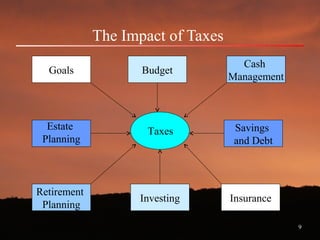
The Impact of Taxes
Estate
Planning
Investing
Budget
Savings
and Debt
Retirement
Planning
Insurance
Cash
Management
Goals
Taxes
10
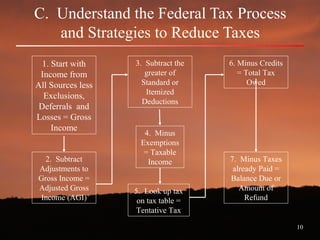
C. Understand the Federal Tax Process
and Strategies to Reduce Taxes
1. Start with
Income from
All Sources less
Exclusions,
Deferrals and
Losses = Gross
Income
2. Subtract
Adjustments to
Gross Income =
Adjusted Gross
Income (AGI)
3. Subtract the
greater of
Standard or
Itemized
Deductions
4. Minus
Exemptions
= Taxable
Income
5. Look up tax
on tax table =
Tentative Tax
6. Minus Credits
= Total Tax
Owed
7. Minus Taxes
already Paid =
Balance Due or
Amount of
Refund
11
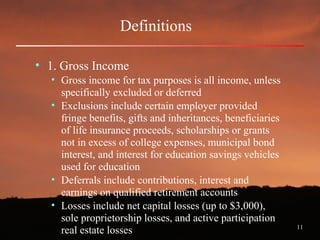
Definitions
• 1. Gross Income
• Gross income for tax purposes is all income, unless
specifically excluded or deferred
• Exclusions include certain employer provided
fringe benefits, gifts and inheritances, beneficiaries
of life insurance proceeds, scholarships or grants
not in excess of college expenses, municipal bond
interest, and interest for education savings vehicles
used for education
• Deferrals include contributions, interest and
earnings on qualified retirement accounts
• Losses include net capital losses (up to $3,000),
sole proprietorship losses, and active participation
real estate losses
12
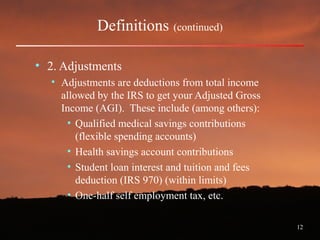
Definitions (continued)
• 2. Adjustments
• Adjustments are deductions from total income
allowed by the IRS to get your Adjusted Gross
Income (AGI). These include (among others):
• Qualified medical savings contributions
(flexible spending accounts)
• Health savings account contributions
• Student loan interest and tuition and fees
deduction (IRS 970) (within limits)
• One-half self employment tax, etc.
13
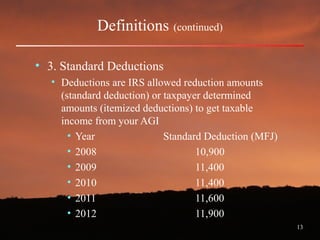
Definitions (continued)
• 3. Standard Deductions
• Deductions are IRS allowed reduction amounts
(standard deduction) or taxpayer determined
amounts (itemized deductions) to get taxable
income from your AGI
• Year Standard Deduction (MFJ)
• 2008 10,900
• 2009 11,400
• 2010 11,400
• 2011 11,600
• 2012 11,900
14
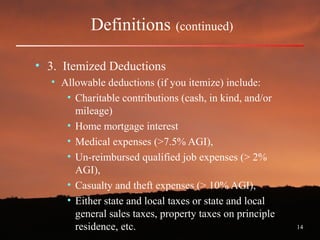
Definitions (continued)
• 3. Itemized Deductions
• Allowable deductions (if you itemize) include:
• Charitable contributions (cash, in kind, and/or
mileage)
• Home mortgage interest
• Medical expenses (>7.5% AGI),
• Un-reimbursed qualified job expenses (> 2%
AGI),
• Casualty and theft expenses (> 10% AGI),
• Either state and local taxes or state and local
general sales taxes, property taxes on principle
residence, etc.
15
Definitions (continued)
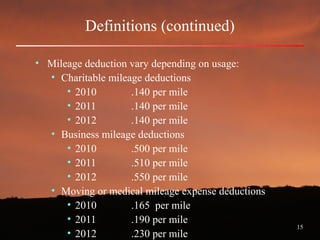
• Mileage deduction vary depending on usage:
• Charitable mileage deductions
• 2010 .140 per mile
• 2011 .140 per mile
• 2012 .140 per mile
• Business mileage deductions
• 2010 .500 per mile
• 2011 .510 per mile
• 2012 .550 per mile
• Moving or medical mileage expense deductions
• 2010 .165 per mile
• 2011 .190 per mile
• 2012 .230 per mile
Definitions (continued)
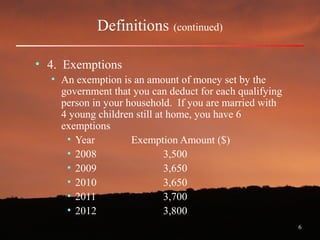
• 4. Exemptions
• An exemption is an amount of money set by the
government that you can deduct for each qualifying
person in your household. If you are married with
4 young children still at home, you have 6
exemptions
• Year Exemption Amount ($)
• 2008 3,500
• 2009 3,650
• 2010 3,650
• 2011 3,700
• 2012 3,800
6
17
Definitions (continued)
• 5. Tax Tables (married filing jointly [Schedule Y-1])
Year If Taxable But not Tax Plus this Of the
income is over over is percentage Excess
2010 0 $16,750 0 10% 0
$16,750 $68,000 1,675 15% 16,750
$68,000 $137,300 9,363 25% 68,000
$137,300 $209,250 26,688 28% 137,300
2011 $0 $17,000 $0 10% $0
17,000 69,000 1,700 15% 17,000
69,000 139,350 9,500 25% 69,000
139,350 212,300 27,088 28% 139,350
2012 0 17,400 0 10% 0
17,400 70,700 1,740 15% 17,400
70,700 142,700 9,735 25% 70,700
142,700 217,450 27,735 28% 142,700
18
Definitions (continued)
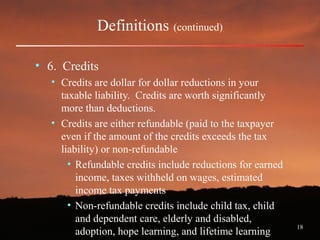
• 6. Credits
• Credits are dollar for dollar reductions in your
taxable liability. Credits are worth significantly
more than deductions.
• Credits are either refundable (paid to the taxpayer
even if the amount of the credits exceeds the tax
liability) or non-refundable
• Refundable credits include reductions for earned
income, taxes withheld on wages, estimated
income tax payments
• Non-refundable credits include child tax, child
and dependent care, elderly and disabled,
adoption, hope learning, and lifetime learning
Definitions (continued)
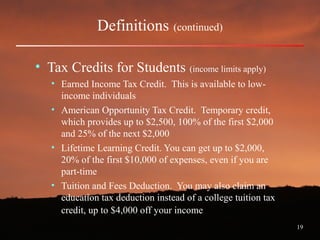
• Tax Credits for Students (income limits apply)
• Earned Income Tax Credit. This is available to low-
income individuals
• American Opportunity Tax Credit. Temporary credit,
which provides up to $2,500, 100% of the first $2,000
and 25% of the next $2,000
• Lifetime Learning Credit. You can get up to $2,000,
20% of the first $10,000 of expenses, even if you are
part-time
• Tuition and Fees Deduction. You may also claim an
education tax deduction instead of a college tuition tax
credit, up to $4,000 off your income
19
20
D. Understand Strategies to Minimize Tax
Payments for a Given Level of Income
Four key strategies:
1. Maximize Deductions
• Key Suggestions
• Use your home as a tax shelter
• Shift and bunch your deductions to get maximum
benefit in a specific year
• Continue to give, with tithes and offerings
• Keep good records of all other charitable
contributions, including mileage and in-kind
donations
• Keep good records of health and moving expenses
21
Tax Planning Strategies (continued)
2. Minimize Taxes Owed
• Key Suggestions
• Maximize long-term capital gains
• Taxes are not paid until the assets are sold
• Long-term capital gains rates are taxed less
than earned income (in some cases as much
as 20% less - 35% versus 15%).
• Emphasize stock dividends over bond interest
• Stock dividends have a 15% preferential tax rate
• Utilize a buy and hold strategy on financial assets
• You pay no taxes until you sell
• Manage your portfolio in a tax-efficient basis.
22
Tax Planning Strategies (continued)
3. Receive Tax-Exempt Income
• Key Suggestions
• Look to tax-free investments
• Municipal bond interest is federal-tax free, and
may be state and local tax-free as well
• Treasury securities are state tax-free
• Use Medical Savings Accounts (also called flexible
spending accounts) to pay medical bills with before-
tax dollars and to reduce income
• Donate to charities with appreciated assets. That
way you do not pay capital gains taxes on the
appreciated assets
23
Tax Planning Strategies (continued)
4. Defer Taxes to the Future or Eliminate Taxes
• Key Suggestions
• Defer taxes to the future by investing in
401k/403b/457 and other tax-deferred qualified
retirement plans, especially if they are matched
• Eliminate future taxes by investing in Roth
retirement vehicles (Roth IRA, Roth 401k, etc.)
• Prepare for future education expenses and
eliminate future taxes by investing in education
savings vehicles (i.e., 529 Plans and Education
IRAs) which eliminate future taxes on earnings
if the assets are used for qualified educational
expenses (exclusions)
24
Tax Recommendations
for Soon to be Graduating Students
• 1. Be organized with your record keeping
• Have a folder that you put all your tax receipts into
for tax time—keep it current
• Use an electronic system such as Quicken or
Mint.com to organize your finances
• These programs make taxes easier if you use
them as they help you remember when and
where you made tax-deductible contributions
25
Tax Recommendations
for Students (continued)
• 2. Keep prior year’s return
• Use prior year’s returns as examples for your
current year’s return
• Make sure you take the same deductions each year
—or at least be aware of them
• Keep prior year’s returns for 7 years, including
returns and backup for key deductions and credits
26
Tax Recommendations
for Students (continued)
• 3. Go through checkbook and remember:
• Keep good records so you can itemize deductions,
including charity, insurance, and other key areas
• Get good at showing what non-cash charitable
contributions you make, such as miles you travel for
church or scout related activities. These can be
deducted at 14 cents per mile in 2012
• Keep records of the non-cash donations you give to
Deseret Industries, Salvation Army, etc. as these can be
deducted if you itemize
27
Tax Recommendations
for Students (continued)
• 4. Spend time in December estimating capital
gains, and offset them if possible with capital
losses
• Offset capital gains with capital losses to manage
your investment income
• You can deduct up to $3,000 per year in capital
losses (every little bit helps) in 2012
28
Tax Recommendations
for Students (continued)
• 5. Pay your tithes and offerings with
appreciated long-term capital assets (if you have
them).
• If you donate appreciated assets instead of selling
them, you do not have to pay the capital gains on
those assets
• Donate the appreciated assets directly to the
charities of your choice
• For an example of paying tithing and other
offerings with appreciated assets, see Learning
Tool 8: Tithing Share Transfer Example
29
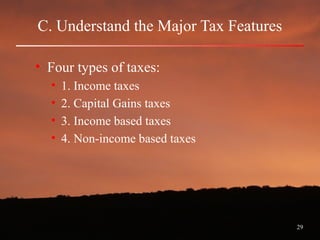
C. Understand the Major Tax Features
• Four types of taxes:
• 1. Income taxes
• 2. Capital Gains taxes
• 3. Income based taxes
• 4. Non-income based taxes
30
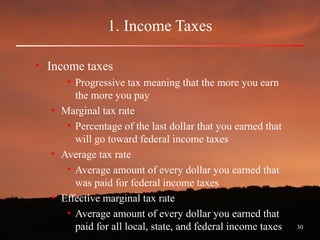
1. Income Taxes
• Income taxes
• Progressive tax meaning that the more you earn
the more you pay
• Marginal tax rate
• Percentage of the last dollar that you earned that
will go toward federal income taxes
• Average tax rate
• Average amount of every dollar you earned that
was paid for federal income taxes
• Effective marginal tax rate
• Average amount of every dollar you earned that
paid for all local, state, and federal income taxes
31
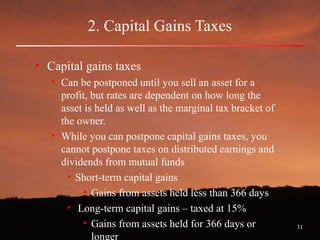
2. Capital Gains Taxes
• Capital gains taxes
• Can be postponed until you sell an asset for a
profit, but rates are dependent on how long the
asset is held as well as the marginal tax bracket of
the owner.
• While you can postpone capital gains taxes, you
cannot postpone taxes on distributed earnings and
dividends from mutual funds
• Short-term capital gains
• Gains from assets held less than 366 days
• Long-term capital gains – taxed at 15%
• Gains from assets held for 366 days or
longer
32
Capital Gains:
What does Mean For You?
Investing:
• Avoid frequent trading
• Buy for the long-term—don’t churn your portfolio
• Buy low-turnover, “tax managed” mutual funds
• Index funds are very tax efficient
• New laws make it a requirement to show tax
effects of mutual fund ownership
• Buy individual stocks and make your own mutual
fund
• Hold for the long term
• You are not required to make annual distributions
as do mutual funds for individual portfolios
33
Capital Gains: What Does This Mean
For You (continued)
Home Ownership:
• Gains up to $500,000 for couples and $250,000 for
individuals from home ownership is exempt from taxes
• Home must be your principal residence
• Must have lived there 2 of the last 5 years
• No need to “rollover gain” as before the Taxpayer
Relief Act of 1997
34
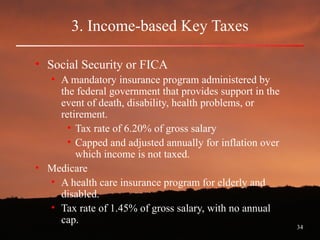
3. Income-based Key Taxes
• Social Security or FICA
• A mandatory insurance program administered by
the federal government that provides support in the
event of death, disability, health problems, or
retirement.
• Tax rate of 6.20% of gross salary
• Capped and adjusted annually for inflation over
which income is not taxed.
• Medicare
• A health care insurance program for elderly and
disabled.
• Tax rate of 1.45% of gross salary, with no annual
cap.
35
Income-based Key Taxes (continued)
• Total FICA tax rate is 15.3% (12.4% Social
Security + 2.9% Medicare).
• You are only responsible for half of the tax unless
you’re self-employed. Then you must pay all
15.3%
• State and Local Income Taxes
• Most states impose an income tax; however, some,
like Texas and Nevada do not
• Alaska actually pays you to live in that state
• Local income taxes are uncommon; but some larger
cities, for example, New York City, impose such a
tax
36
4. Non-Income based Key Taxes
• Excise “sin taxes” and state sales taxes
• Imposed when goods are purchased
• Real estate and property taxes
• Imposed annually or semi-annually on assets
owned
• Gift and estate taxes
• Imposed when assets are transferred from one
owner to another

תכנון אסטרטגיות מס איל הורוביץ-קומון

  • 1.
  • 2.
    2 Objectives • A. Understandwhat our leaders have said regarding taxes • B. Understand the importance of tax planning and how it helps attain your personal goals • C. Understand the tax process • D. Understand strategies to help lower your taxes (legally and honestly) • E. Understand the major tax features of our tax system
  • 3.
    3 Your Personal FinancialPlan • Section V.: Taxes • What Tax Form and Tax Strategies did you use last year? • What was your marginal and average tax rates? • Action Plan: • What Tax Form and Tax Strategies should you use this year? • What else can and should you do to reduce your tax bill to Uncle Sam (for a given level of income)?
  • 4.
    4 A. Understand ourLeaders Counsel on Taxes • The Lord has said: • Let no man break the laws of the land, for he that keepeth the laws of God hath no need to break the laws of the land. Wherefore, be subject to the powers that be, until he reigns whose right it is to reign, and subdues all enemies under his feet (D&C 58:21-22). • The 12th Article of Faith states: • We believe in being subject to kings, presidents, rulers, and magistrates, in obeying, honoring, and sustaining the law.
  • 5.
    5 Our Leaders Counsel(continued) • Some have tried to minimize this obligation. President Harold B. Lee instructed: • There seem to be those among us who are as wolves among the flock, trying to lead some who are weak and unwary, . . . who are taking the law into their own hands by refusing to pay their income tax (Ensign, January 1973, p. 106). • In the April 1973 Priesthood Bulletin the Church reaffirmed its position stating: • We ask priesthood leaders to be on guard against such persons. . . Priesthood leaders should teach the necessity of abiding the law according to the revelations (Priesthood bulletin, April 1973).
  • 6.
    6 Questions • Any questionsabout what our leaders have said about paying taxes?
  • 7.
    7 B. Understand HowTax Planning can help attain your Personal Goals • Why tax planning? • Taxes are your largest single annual expense • The average American works more than 4 months just to pay his or her taxes • In sum: the less you pay Uncle Sam (for a given level of income), the more you have for your personal and financial goals!
  • 8.
    8 Tax Freedom Day1967-2010 • Source: Tax Foundation, Washington, D.C., http://www.taxfoundation.org/taxfreedomday/ January 18, 2012.
  • 9.
    9 The Impact ofTaxes Estate Planning Investing Budget Savings and Debt Retirement Planning Insurance Cash Management Goals Taxes
  • 10.
    10 C. Understand theFederal Tax Process and Strategies to Reduce Taxes 1. Start with Income from All Sources less Exclusions, Deferrals and Losses = Gross Income 2. Subtract Adjustments to Gross Income = Adjusted Gross Income (AGI) 3. Subtract the greater of Standard or Itemized Deductions 4. Minus Exemptions = Taxable Income 5. Look up tax on tax table = Tentative Tax 6. Minus Credits = Total Tax Owed 7. Minus Taxes already Paid = Balance Due or Amount of Refund
  • 11.
    11 Definitions • 1. GrossIncome • Gross income for tax purposes is all income, unless specifically excluded or deferred • Exclusions include certain employer provided fringe benefits, gifts and inheritances, beneficiaries of life insurance proceeds, scholarships or grants not in excess of college expenses, municipal bond interest, and interest for education savings vehicles used for education • Deferrals include contributions, interest and earnings on qualified retirement accounts • Losses include net capital losses (up to $3,000), sole proprietorship losses, and active participation real estate losses
  • 12.
    12 Definitions (continued) • 2.Adjustments • Adjustments are deductions from total income allowed by the IRS to get your Adjusted Gross Income (AGI). These include (among others): • Qualified medical savings contributions (flexible spending accounts) • Health savings account contributions • Student loan interest and tuition and fees deduction (IRS 970) (within limits) • One-half self employment tax, etc.
  • 13.
    13 Definitions (continued) • 3.Standard Deductions • Deductions are IRS allowed reduction amounts (standard deduction) or taxpayer determined amounts (itemized deductions) to get taxable income from your AGI • Year Standard Deduction (MFJ) • 2008 10,900 • 2009 11,400 • 2010 11,400 • 2011 11,600 • 2012 11,900
  • 14.
    14 Definitions (continued) • 3.Itemized Deductions • Allowable deductions (if you itemize) include: • Charitable contributions (cash, in kind, and/or mileage) • Home mortgage interest • Medical expenses (>7.5% AGI), • Un-reimbursed qualified job expenses (> 2% AGI), • Casualty and theft expenses (> 10% AGI), • Either state and local taxes or state and local general sales taxes, property taxes on principle residence, etc.
  • 15.
    15 Definitions (continued) • Mileagededuction vary depending on usage: • Charitable mileage deductions • 2010 .140 per mile • 2011 .140 per mile • 2012 .140 per mile • Business mileage deductions • 2010 .500 per mile • 2011 .510 per mile • 2012 .550 per mile • Moving or medical mileage expense deductions • 2010 .165 per mile • 2011 .190 per mile • 2012 .230 per mile
  • 16.
    Definitions (continued) • 4.Exemptions • An exemption is an amount of money set by the government that you can deduct for each qualifying person in your household. If you are married with 4 young children still at home, you have 6 exemptions • Year Exemption Amount ($) • 2008 3,500 • 2009 3,650 • 2010 3,650 • 2011 3,700 • 2012 3,800 6
  • 17.
    17 Definitions (continued) • 5.Tax Tables (married filing jointly [Schedule Y-1]) Year If Taxable But not Tax Plus this Of the income is over over is percentage Excess 2010 0 $16,750 0 10% 0 $16,750 $68,000 1,675 15% 16,750 $68,000 $137,300 9,363 25% 68,000 $137,300 $209,250 26,688 28% 137,300 2011 $0 $17,000 $0 10% $0 17,000 69,000 1,700 15% 17,000 69,000 139,350 9,500 25% 69,000 139,350 212,300 27,088 28% 139,350 2012 0 17,400 0 10% 0 17,400 70,700 1,740 15% 17,400 70,700 142,700 9,735 25% 70,700 142,700 217,450 27,735 28% 142,700
  • 18.
    18 Definitions (continued) • 6.Credits • Credits are dollar for dollar reductions in your taxable liability. Credits are worth significantly more than deductions. • Credits are either refundable (paid to the taxpayer even if the amount of the credits exceeds the tax liability) or non-refundable • Refundable credits include reductions for earned income, taxes withheld on wages, estimated income tax payments • Non-refundable credits include child tax, child and dependent care, elderly and disabled, adoption, hope learning, and lifetime learning
  • 19.
    Definitions (continued) • TaxCredits for Students (income limits apply) • Earned Income Tax Credit. This is available to low- income individuals • American Opportunity Tax Credit. Temporary credit, which provides up to $2,500, 100% of the first $2,000 and 25% of the next $2,000 • Lifetime Learning Credit. You can get up to $2,000, 20% of the first $10,000 of expenses, even if you are part-time • Tuition and Fees Deduction. You may also claim an education tax deduction instead of a college tuition tax credit, up to $4,000 off your income 19
  • 20.
    20 D. Understand Strategiesto Minimize Tax Payments for a Given Level of Income Four key strategies: 1. Maximize Deductions • Key Suggestions • Use your home as a tax shelter • Shift and bunch your deductions to get maximum benefit in a specific year • Continue to give, with tithes and offerings • Keep good records of all other charitable contributions, including mileage and in-kind donations • Keep good records of health and moving expenses
  • 21.
    21 Tax Planning Strategies(continued) 2. Minimize Taxes Owed • Key Suggestions • Maximize long-term capital gains • Taxes are not paid until the assets are sold • Long-term capital gains rates are taxed less than earned income (in some cases as much as 20% less - 35% versus 15%). • Emphasize stock dividends over bond interest • Stock dividends have a 15% preferential tax rate • Utilize a buy and hold strategy on financial assets • You pay no taxes until you sell • Manage your portfolio in a tax-efficient basis.
  • 22.
    22 Tax Planning Strategies(continued) 3. Receive Tax-Exempt Income • Key Suggestions • Look to tax-free investments • Municipal bond interest is federal-tax free, and may be state and local tax-free as well • Treasury securities are state tax-free • Use Medical Savings Accounts (also called flexible spending accounts) to pay medical bills with before- tax dollars and to reduce income • Donate to charities with appreciated assets. That way you do not pay capital gains taxes on the appreciated assets
  • 23.
    23 Tax Planning Strategies(continued) 4. Defer Taxes to the Future or Eliminate Taxes • Key Suggestions • Defer taxes to the future by investing in 401k/403b/457 and other tax-deferred qualified retirement plans, especially if they are matched • Eliminate future taxes by investing in Roth retirement vehicles (Roth IRA, Roth 401k, etc.) • Prepare for future education expenses and eliminate future taxes by investing in education savings vehicles (i.e., 529 Plans and Education IRAs) which eliminate future taxes on earnings if the assets are used for qualified educational expenses (exclusions)
  • 24.
    24 Tax Recommendations for Soonto be Graduating Students • 1. Be organized with your record keeping • Have a folder that you put all your tax receipts into for tax time—keep it current • Use an electronic system such as Quicken or Mint.com to organize your finances • These programs make taxes easier if you use them as they help you remember when and where you made tax-deductible contributions
  • 25.
    25 Tax Recommendations for Students(continued) • 2. Keep prior year’s return • Use prior year’s returns as examples for your current year’s return • Make sure you take the same deductions each year —or at least be aware of them • Keep prior year’s returns for 7 years, including returns and backup for key deductions and credits
  • 26.
    26 Tax Recommendations for Students(continued) • 3. Go through checkbook and remember: • Keep good records so you can itemize deductions, including charity, insurance, and other key areas • Get good at showing what non-cash charitable contributions you make, such as miles you travel for church or scout related activities. These can be deducted at 14 cents per mile in 2012 • Keep records of the non-cash donations you give to Deseret Industries, Salvation Army, etc. as these can be deducted if you itemize
  • 27.
    27 Tax Recommendations for Students(continued) • 4. Spend time in December estimating capital gains, and offset them if possible with capital losses • Offset capital gains with capital losses to manage your investment income • You can deduct up to $3,000 per year in capital losses (every little bit helps) in 2012
  • 28.
    28 Tax Recommendations for Students(continued) • 5. Pay your tithes and offerings with appreciated long-term capital assets (if you have them). • If you donate appreciated assets instead of selling them, you do not have to pay the capital gains on those assets • Donate the appreciated assets directly to the charities of your choice • For an example of paying tithing and other offerings with appreciated assets, see Learning Tool 8: Tithing Share Transfer Example
  • 29.
    29 C. Understand theMajor Tax Features • Four types of taxes: • 1. Income taxes • 2. Capital Gains taxes • 3. Income based taxes • 4. Non-income based taxes
  • 30.
    30 1. Income Taxes •Income taxes • Progressive tax meaning that the more you earn the more you pay • Marginal tax rate • Percentage of the last dollar that you earned that will go toward federal income taxes • Average tax rate • Average amount of every dollar you earned that was paid for federal income taxes • Effective marginal tax rate • Average amount of every dollar you earned that paid for all local, state, and federal income taxes
  • 31.
    31 2. Capital GainsTaxes • Capital gains taxes • Can be postponed until you sell an asset for a profit, but rates are dependent on how long the asset is held as well as the marginal tax bracket of the owner. • While you can postpone capital gains taxes, you cannot postpone taxes on distributed earnings and dividends from mutual funds • Short-term capital gains • Gains from assets held less than 366 days • Long-term capital gains – taxed at 15% • Gains from assets held for 366 days or longer
  • 32.
    32 Capital Gains: What doesMean For You? Investing: • Avoid frequent trading • Buy for the long-term—don’t churn your portfolio • Buy low-turnover, “tax managed” mutual funds • Index funds are very tax efficient • New laws make it a requirement to show tax effects of mutual fund ownership • Buy individual stocks and make your own mutual fund • Hold for the long term • You are not required to make annual distributions as do mutual funds for individual portfolios
  • 33.
    33 Capital Gains: WhatDoes This Mean For You (continued) Home Ownership: • Gains up to $500,000 for couples and $250,000 for individuals from home ownership is exempt from taxes • Home must be your principal residence • Must have lived there 2 of the last 5 years • No need to “rollover gain” as before the Taxpayer Relief Act of 1997
  • 34.
    34 3. Income-based KeyTaxes • Social Security or FICA • A mandatory insurance program administered by the federal government that provides support in the event of death, disability, health problems, or retirement. • Tax rate of 6.20% of gross salary • Capped and adjusted annually for inflation over which income is not taxed. • Medicare • A health care insurance program for elderly and disabled. • Tax rate of 1.45% of gross salary, with no annual cap.
  • 35.
    35 Income-based Key Taxes(continued) • Total FICA tax rate is 15.3% (12.4% Social Security + 2.9% Medicare). • You are only responsible for half of the tax unless you’re self-employed. Then you must pay all 15.3% • State and Local Income Taxes • Most states impose an income tax; however, some, like Texas and Nevada do not • Alaska actually pays you to live in that state • Local income taxes are uncommon; but some larger cities, for example, New York City, impose such a tax
  • 36.
    36 4. Non-Income basedKey Taxes • Excise “sin taxes” and state sales taxes • Imposed when goods are purchased • Real estate and property taxes • Imposed annually or semi-annually on assets owned • Gift and estate taxes • Imposed when assets are transferred from one owner to another