Difference of Language between Social Classes2007130597 최치영2007130616 이수철
TABLEOFCONTENTS1. MY FAIR LADY2. WHY LANGUAGE VARIATION HAS OCCURRED?3. EXAMPLE OF LANGUAGE VARIATION BY SOCIAL CLASS   - COCKNEY & BLACK ENGLISH4. REASEARCH  ABOUT  LANGUAGE  USAGE  BETWEEN  SOCIAL CLASSES    - WILLIAM LABOV & U / NON – U ENGLISH5.  CONCLUSION
My Fair Lady(1964)▶ Prof. Henry Higgins : Rex Harrison▶ Eliza Doolittle :  Audrey Hepburn▶ Based upon George Bernard Shaw’s Pygmalion
Why Language Variation Has Occurred? 1. Variation by Region2. Variation by Social-class
Example of Language Variation by Social Class1. Cockney English2. Black  English
COCKNEY ENGLISH1.Dropped ‘h’ at beginning of words    e.g.) house = ‘ouse          hammer = ‘ammer2.Omission of ‘t’                  3. TH fronting    e.g.) Gatwick = Ga’wick                     e.g.)Scotland = Sco'land         Statement = Sta'emen         Network = Ne’workBrother = BruvverThree = Free Bath = Barf Thin = Fin `
BLACK ENGLISH
Research About Language Usage Between Social ClassesWiiliamLabov2. U / Non – U English
William Labov▶ 1927.12.4. ~▶ Born in Rutherford, New Jersey▶ American linguist▶ Professor of Linguistics University of    Pennsylvania
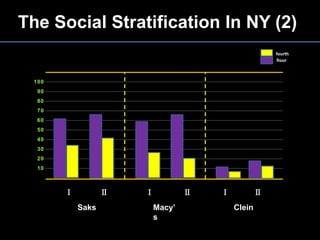
The Social Stratification In NY (1)Q : Where are the woman’s shoes?A : Fourth FloorⅠ. Department store where main customers are high social class    pronounces /r/ more than others.Ⅱ. When they speak ‘floor’ ,they pronounce /r/ more strongly thanspeak ‘fourth’
The Social Stratification In NY (2)fourthfloor100908070605040302010ⅠⅡⅡⅡⅠⅠSaksMacy’sClein
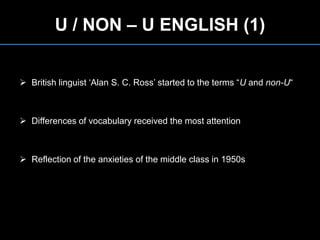
U / NON – U ENGLISH (1)British linguist ‘Alan S. C. Ross’ started to the terms “Uand non-U“
Differences of vocabulary received the most attention
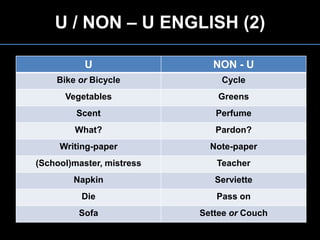
Reflection of the anxieties of the middle class in 1950s BritainU / NON – U ENGLISH (2)
CONCLUSIONVariation's form of use in different social classes is arbitrary 2. Variation is not use exclusively in a particular class3. Rules of language use are different across social classes

계층별 언어 변이

  • 1.
    Difference of Languagebetween Social Classes2007130597 최치영2007130616 이수철
  • 2.
    TABLEOFCONTENTS1. MY FAIRLADY2. WHY LANGUAGE VARIATION HAS OCCURRED?3. EXAMPLE OF LANGUAGE VARIATION BY SOCIAL CLASS - COCKNEY & BLACK ENGLISH4. REASEARCH ABOUT LANGUAGE USAGE BETWEEN SOCIAL CLASSES - WILLIAM LABOV & U / NON – U ENGLISH5. CONCLUSION
  • 3.
    My Fair Lady(1964)▶Prof. Henry Higgins : Rex Harrison▶ Eliza Doolittle : Audrey Hepburn▶ Based upon George Bernard Shaw’s Pygmalion
  • 4.
    Why Language VariationHas Occurred? 1. Variation by Region2. Variation by Social-class
  • 5.
    Example of LanguageVariation by Social Class1. Cockney English2. Black English
  • 6.
    COCKNEY ENGLISH1.Dropped ‘h’at beginning of words e.g.) house = ‘ouse hammer = ‘ammer2.Omission of ‘t’ 3. TH fronting e.g.) Gatwick = Ga’wick e.g.)Scotland = Sco'land Statement = Sta'emen Network = Ne’workBrother = BruvverThree = Free Bath = Barf Thin = Fin `
  • 7.
  • 8.
    Research About LanguageUsage Between Social ClassesWiiliamLabov2. U / Non – U English
  • 9.
    William Labov▶ 1927.12.4.~▶ Born in Rutherford, New Jersey▶ American linguist▶ Professor of Linguistics University of Pennsylvania
  • 10.
    The Social StratificationIn NY (1)Q : Where are the woman’s shoes?A : Fourth FloorⅠ. Department store where main customers are high social class pronounces /r/ more than others.Ⅱ. When they speak ‘floor’ ,they pronounce /r/ more strongly thanspeak ‘fourth’
  • 11.
    The Social StratificationIn NY (2)fourthfloor100908070605040302010ⅠⅡⅡⅡⅠⅠSaksMacy’sClein
  • 12.
    U / NON– U ENGLISH (1)British linguist ‘Alan S. C. Ross’ started to the terms “Uand non-U“
  • 13.
    Differences of vocabularyreceived the most attention
  • 14.
    Reflection of theanxieties of the middle class in 1950s BritainU / NON – U ENGLISH (2)
  • 15.
    CONCLUSIONVariation's form ofuse in different social classes is arbitrary 2. Variation is not use exclusively in a particular class3. Rules of language use are different across social classes