1
e-Health Initiatives in Poland
Edyta Rokicka
Departament of Infrastructure and
eHealth
Ministry of Health
2
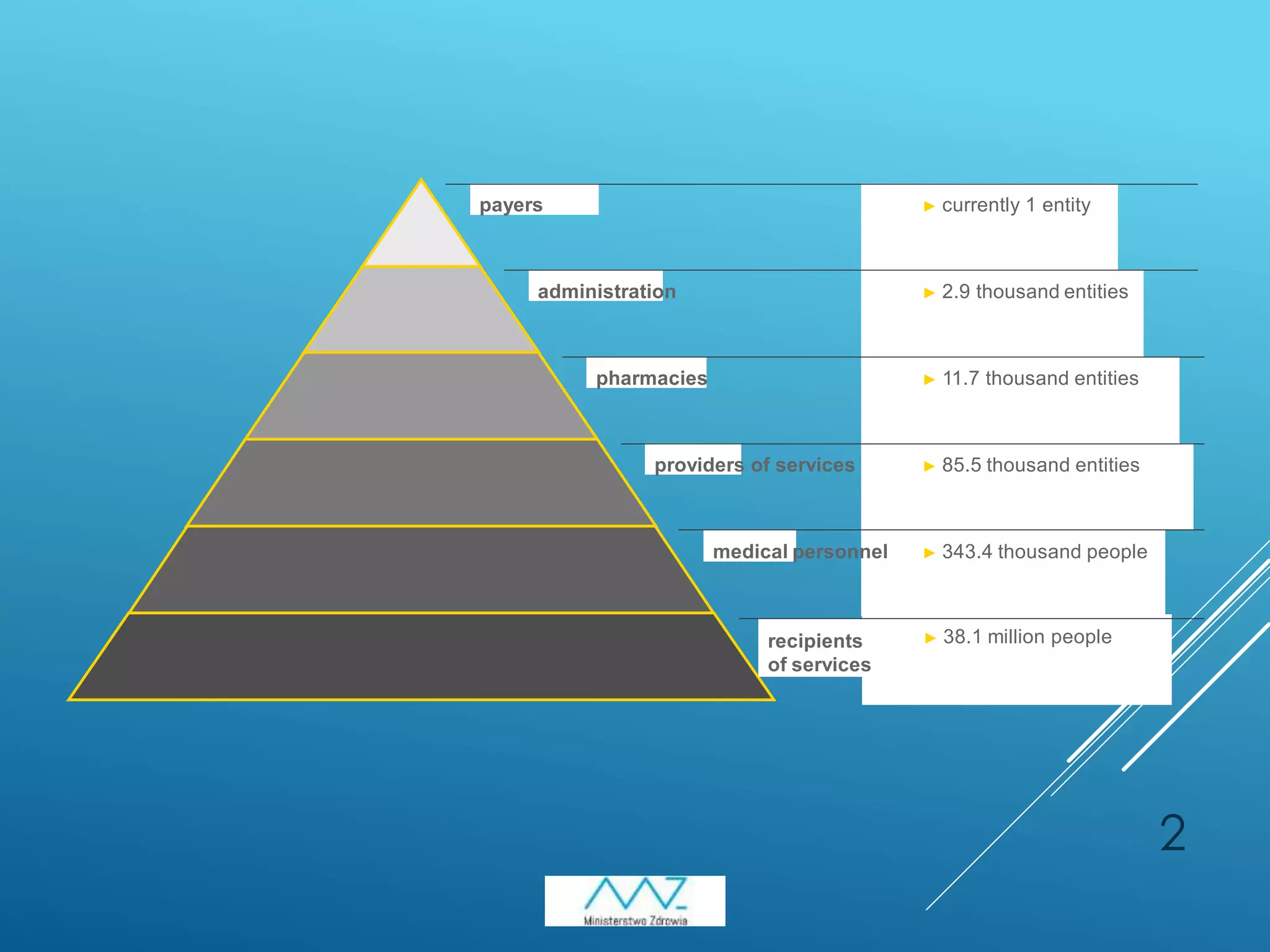
► currently 1 entitypayers
► 2.9 thousand entitiesadministration
► 11.7 thousand entitiespharmacies
► 85.5 thousand entitiesproviders of services
► 343.4 thousand peoplemedical personnel
► 38.1 million peoplerecipients
of services
3
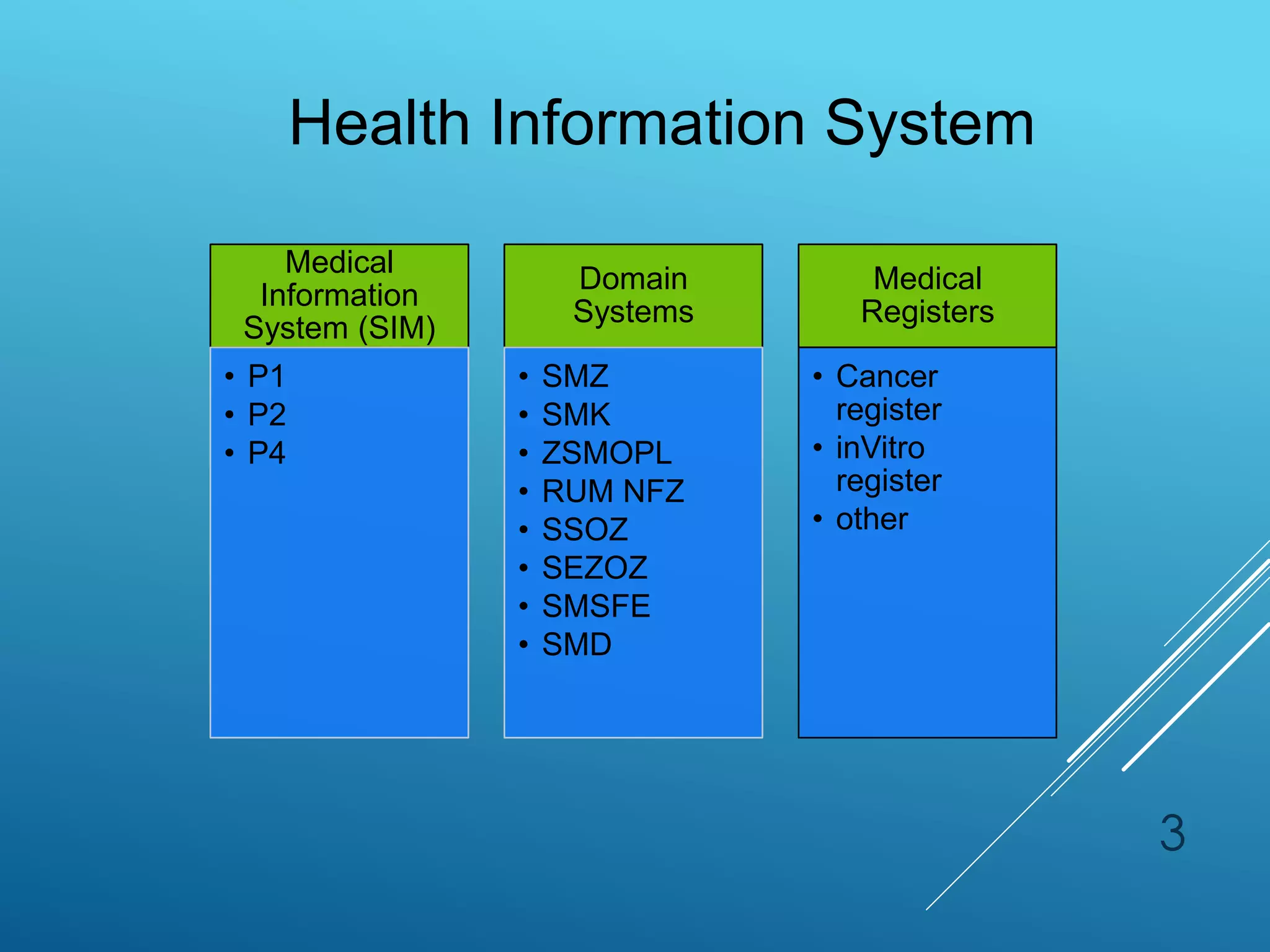
Medical
Information
System (SIM)
• P1
• P2
• P4
Domain
Systems
• SMZ
• SMK
• ZSMOPL
• RUM NFZ
• SSOZ
• SEZOZ
• SMSFE
• SMD
Medical
Registers
• Cancer
register
• inVitro
register
• other
Health Information System
4
Project: Electronic Platform for Collection, Analysis and
Sharing of Digital Medical Records
Time frame: 29.11.2007 – 15.12.2015
Budget: 713 000 000 PLN
Medical Information System - P1
5
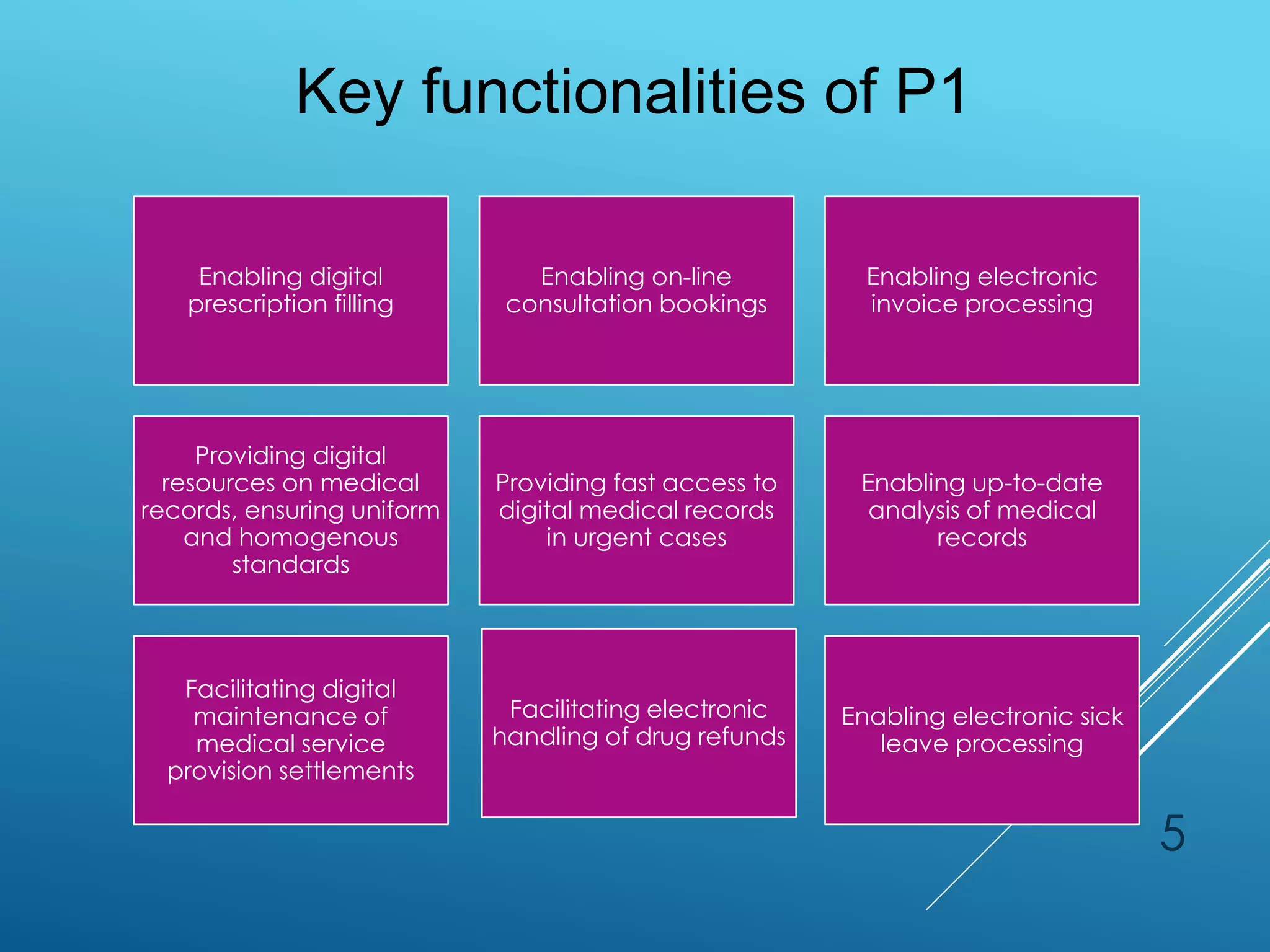
Enabling digital
prescription filling
Enabling on-line
consultation bookings
Enabling electronic
invoice processing
Providing digital
resources on medical
records, ensuring uniform
and homogenous
standards
Providing fast access to
digital medical records
in urgent cases
Enabling up-to-date
analysis of medical
records
Facilitating digital
maintenance of
medical service
provision settlements
Facilitating electronic
handling of drug refunds
Enabling electronic sick
leave processing
Key functionalities of P1
6
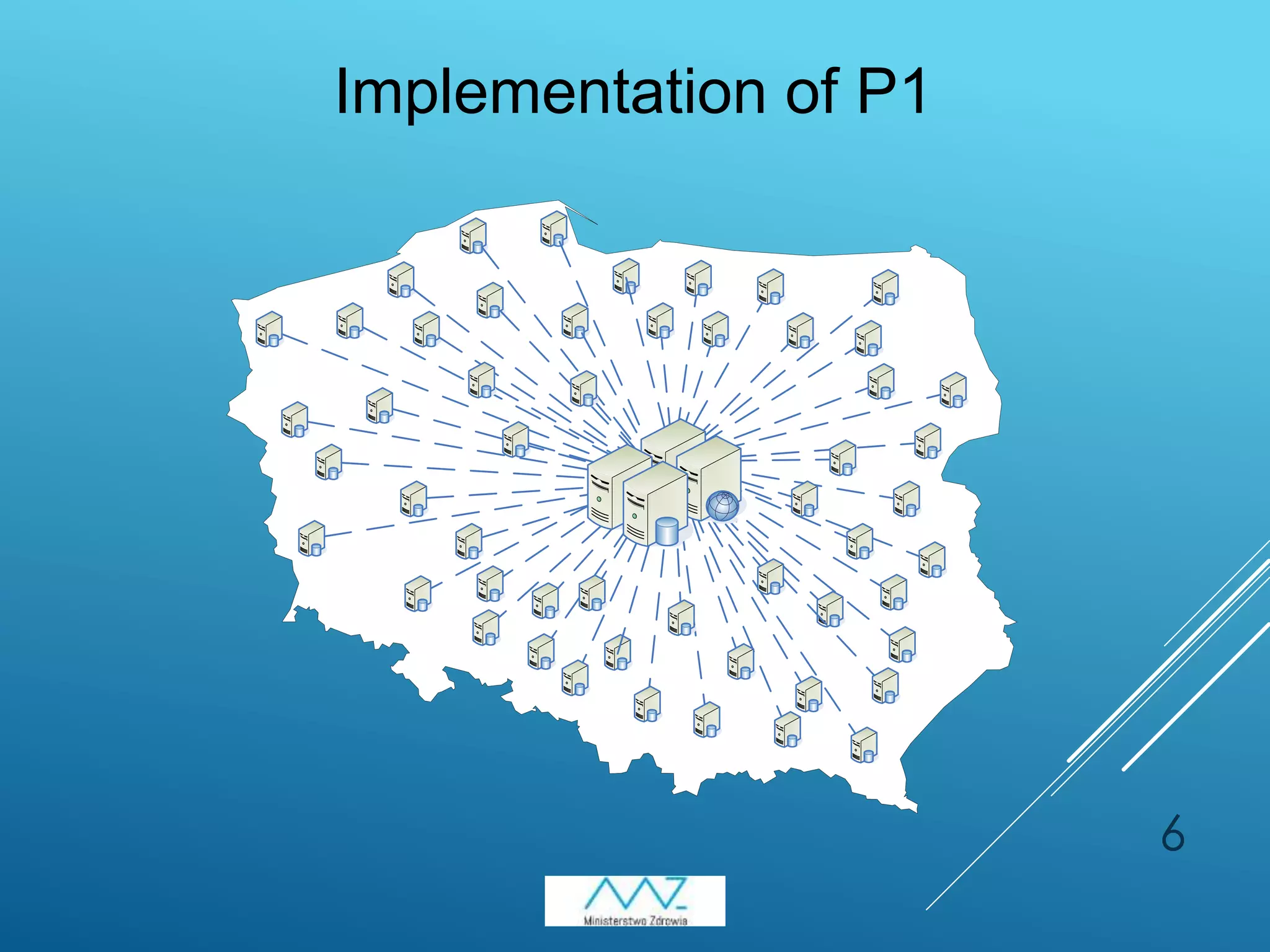
Implementation of P1
7
Project: Platform for sharing services and resources of
digital medical records with on-line business (P2)
Time frame: 18.12.2007 – 31.12.2012 Budget: 6 500 000 euro
SIM - Projekt P2
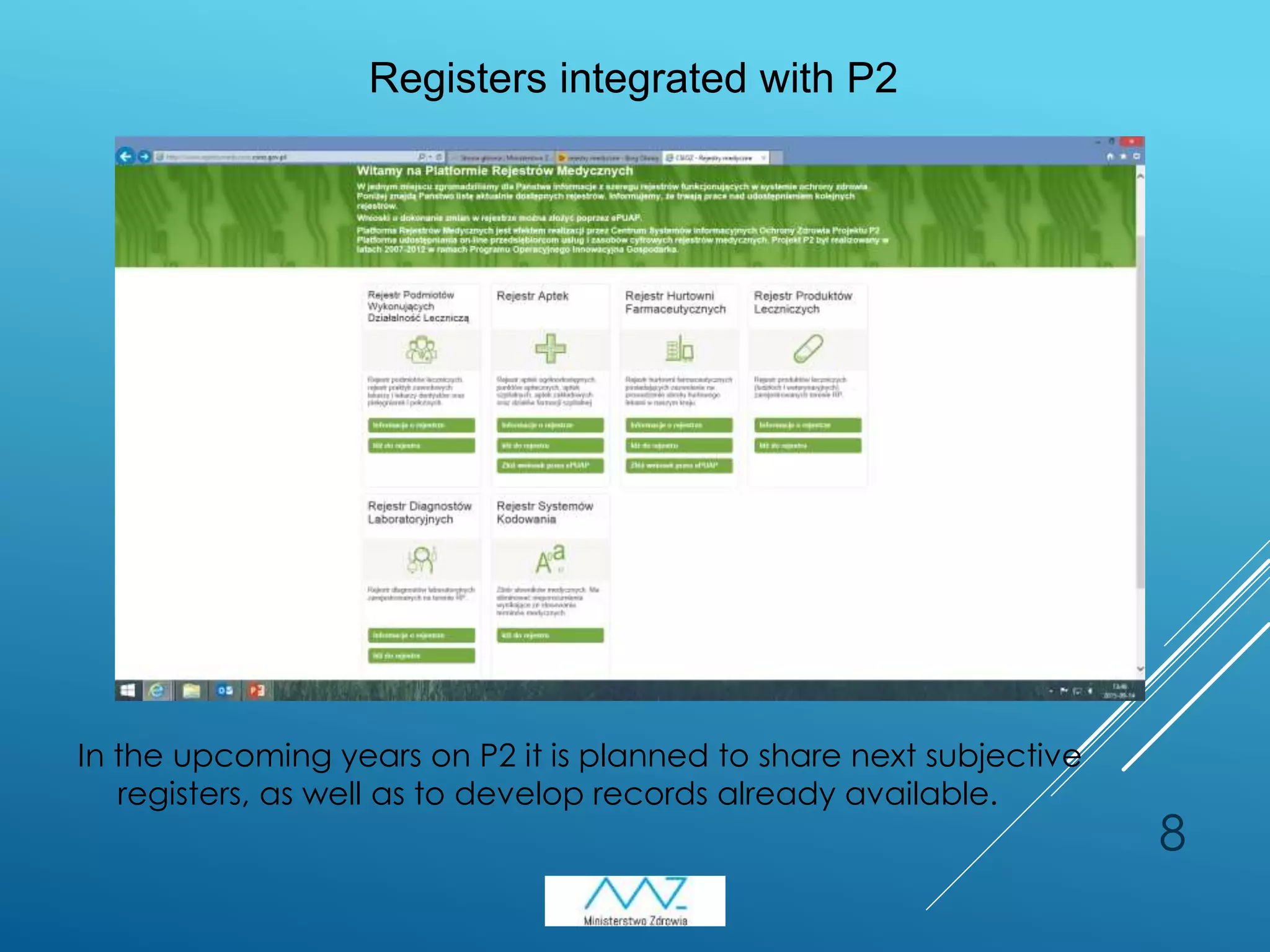
In the upcoming years on P2 it is planned to share next subjective
registers, as well as to develop records already available.
8
Registers integrated with P2
9
Project: Domain systems supplementary to health
information system
Time frame: 30.09.2015
Budget: 25 000 000 mln PLN
SIM - Project P4
 Statistics System in Health Care;
 Risks Monitoring System;
 Integrated Monitoring System of Medicinal Products Trading;
 Medical Workers Training Monitoring System;
 Health Resources Registration System.
10
Project P4
11
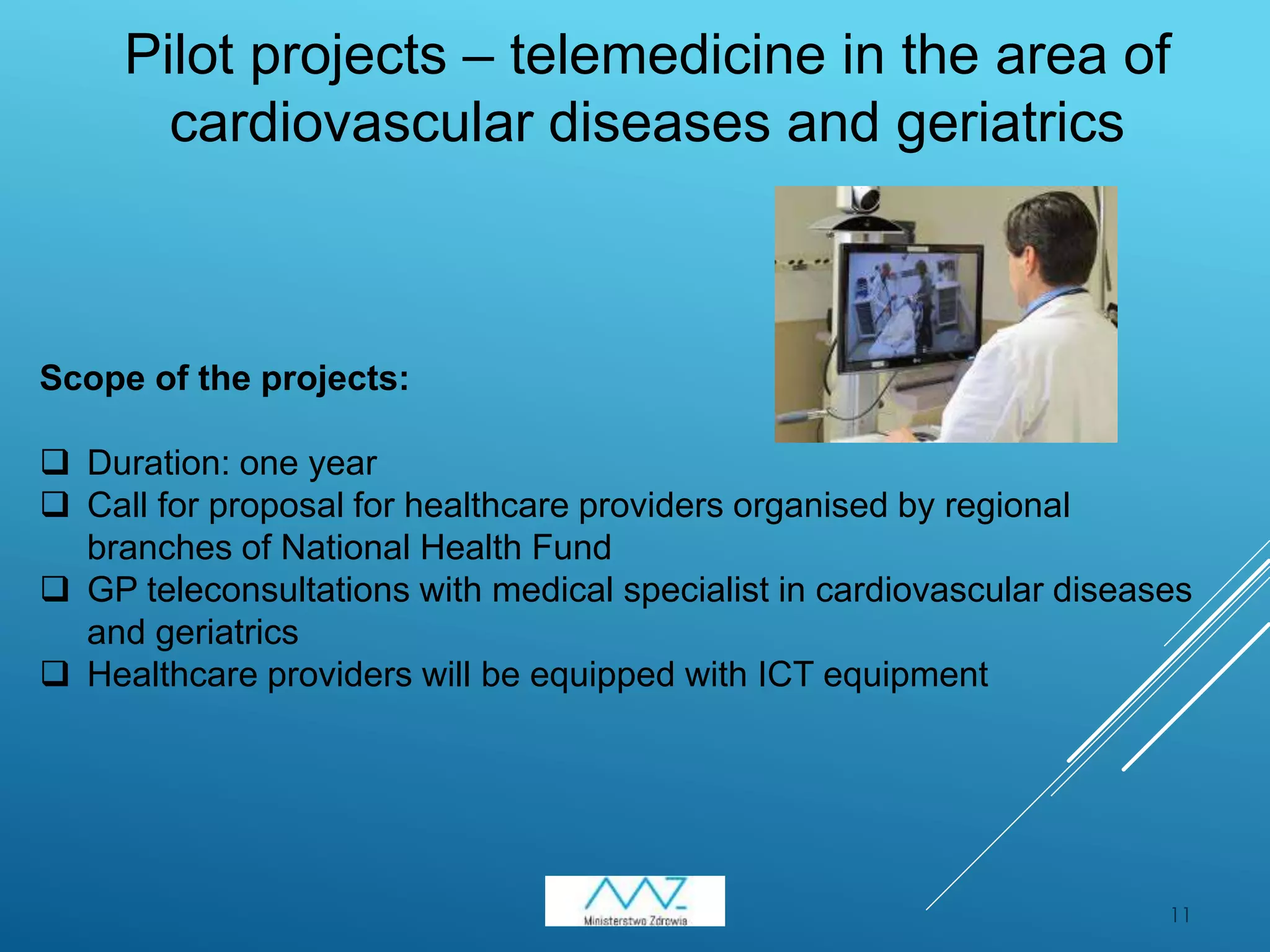
Pilot projects – telemedicine in the area of
cardiovascular diseases and geriatrics
Scope of the projects:
 Duration: one year
 Call for proposal for healthcare providers organised by regional
branches of National Health Fund
 GP teleconsultations with medical specialist in cardiovascular diseases
and geriatrics
 Healthcare providers will be equipped with ICT equipment
12
Expected results
Limiting of waiting lists
Facilitating access to the medical
specialists
Reducing unnecessary diagnostic
hospitalisation
Evaluation report for the Agency for Health
Technology Assessment and Pricing
13
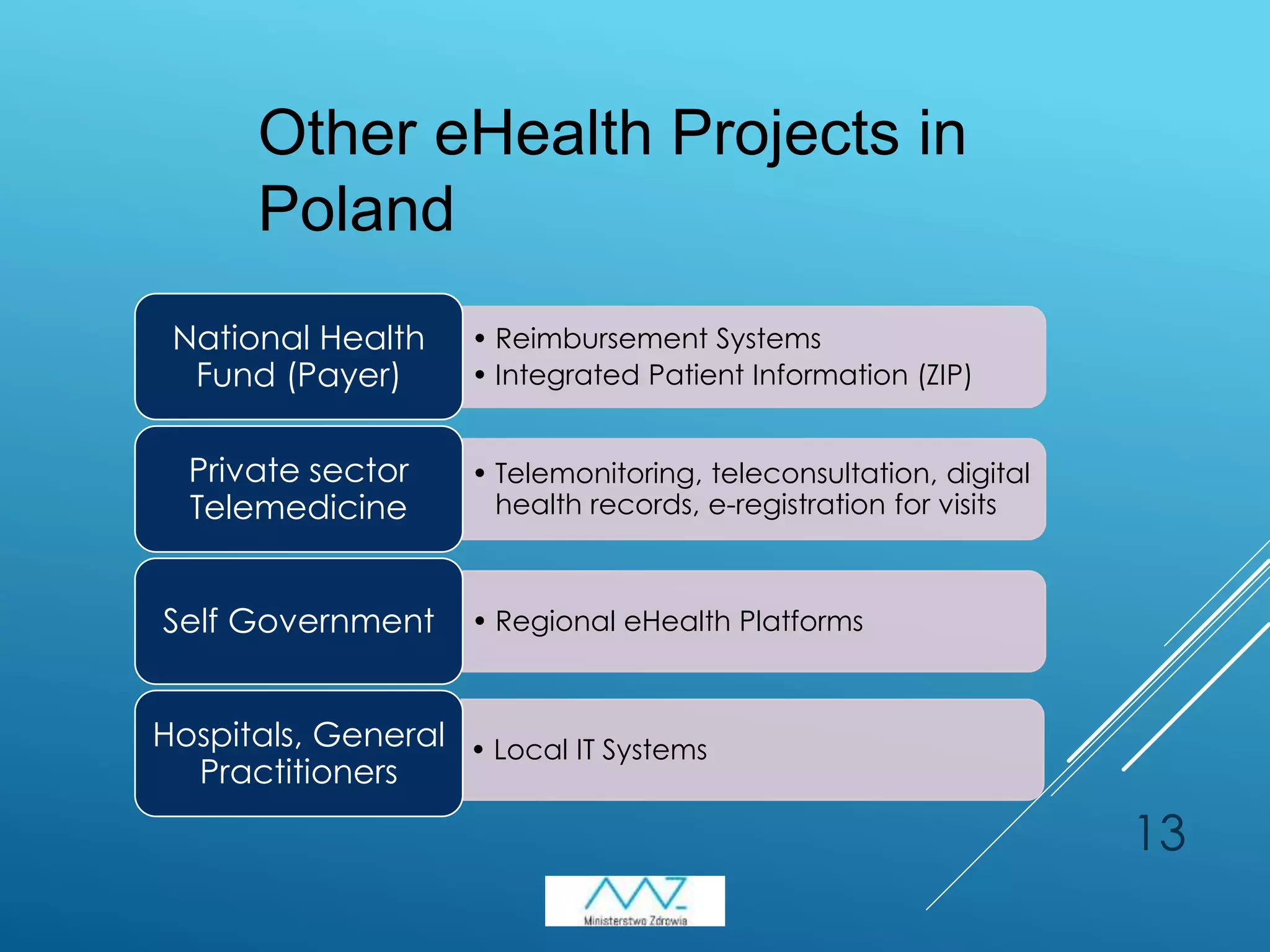
• Reimbursement Systems
• Integrated Patient Information (ZIP)
National Health
Fund (Payer)
• Telemonitoring, teleconsultation, digital
health records, e-registration for visits
Private sector
Telemedicine
• Regional eHealth PlatformsSelf Government
• Local IT SystemsHospitals, General
Practitioners
Other eHealth Projects in
Poland
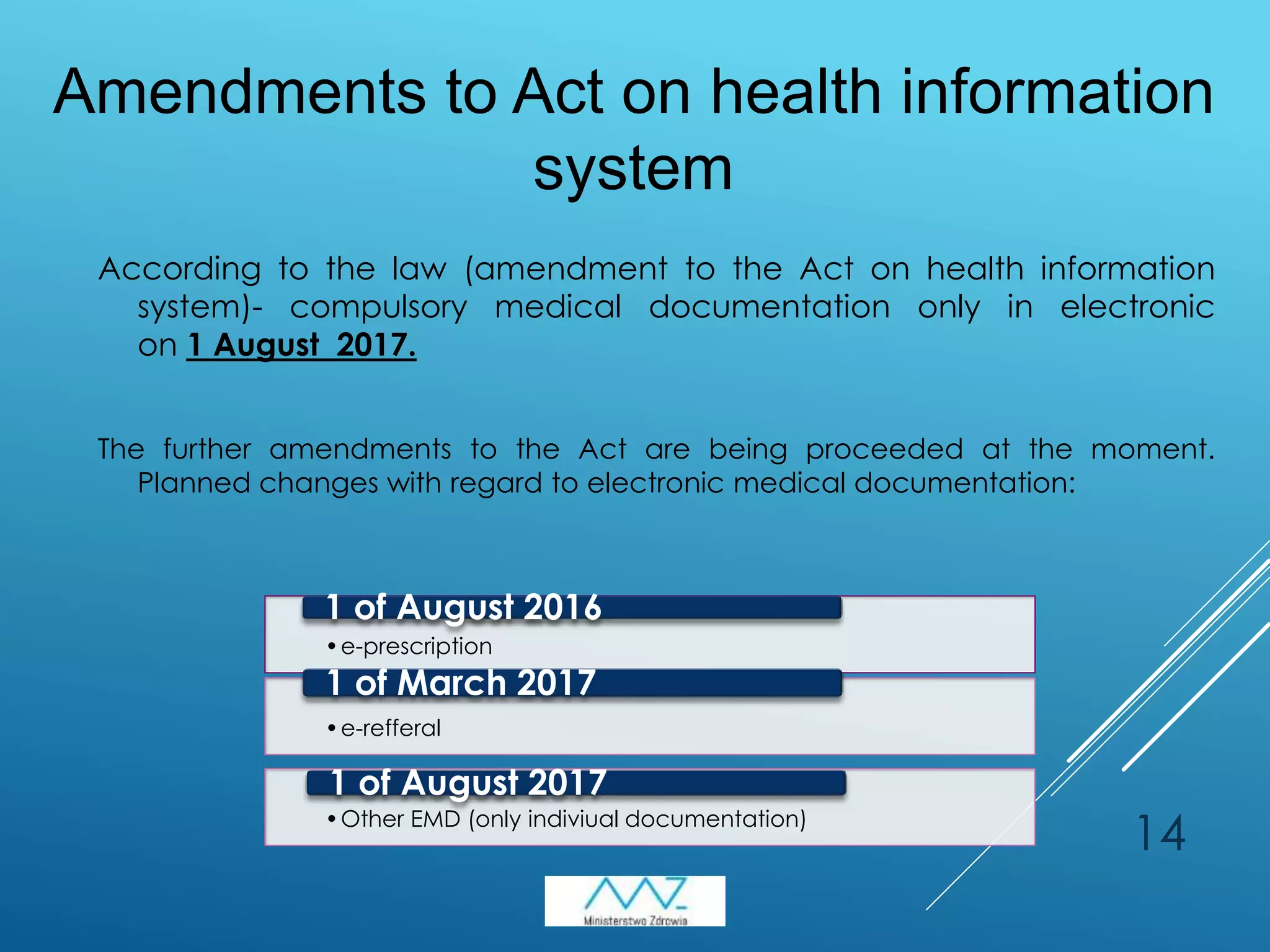
According to the law (amendment to the Act on health information
system)- compulsory medical documentation only in electronic
on 1 August 2017.
The further amendments to the Act are being proceeded at the moment.
Planned changes with regard to electronic medical documentation:
14
Amendments to Act on health information
system
•e-prescription
1 of August 2016
•e-refferal
1 of March 2017
•Other EMD (only indiviual documentation)
1 of August 2017
15
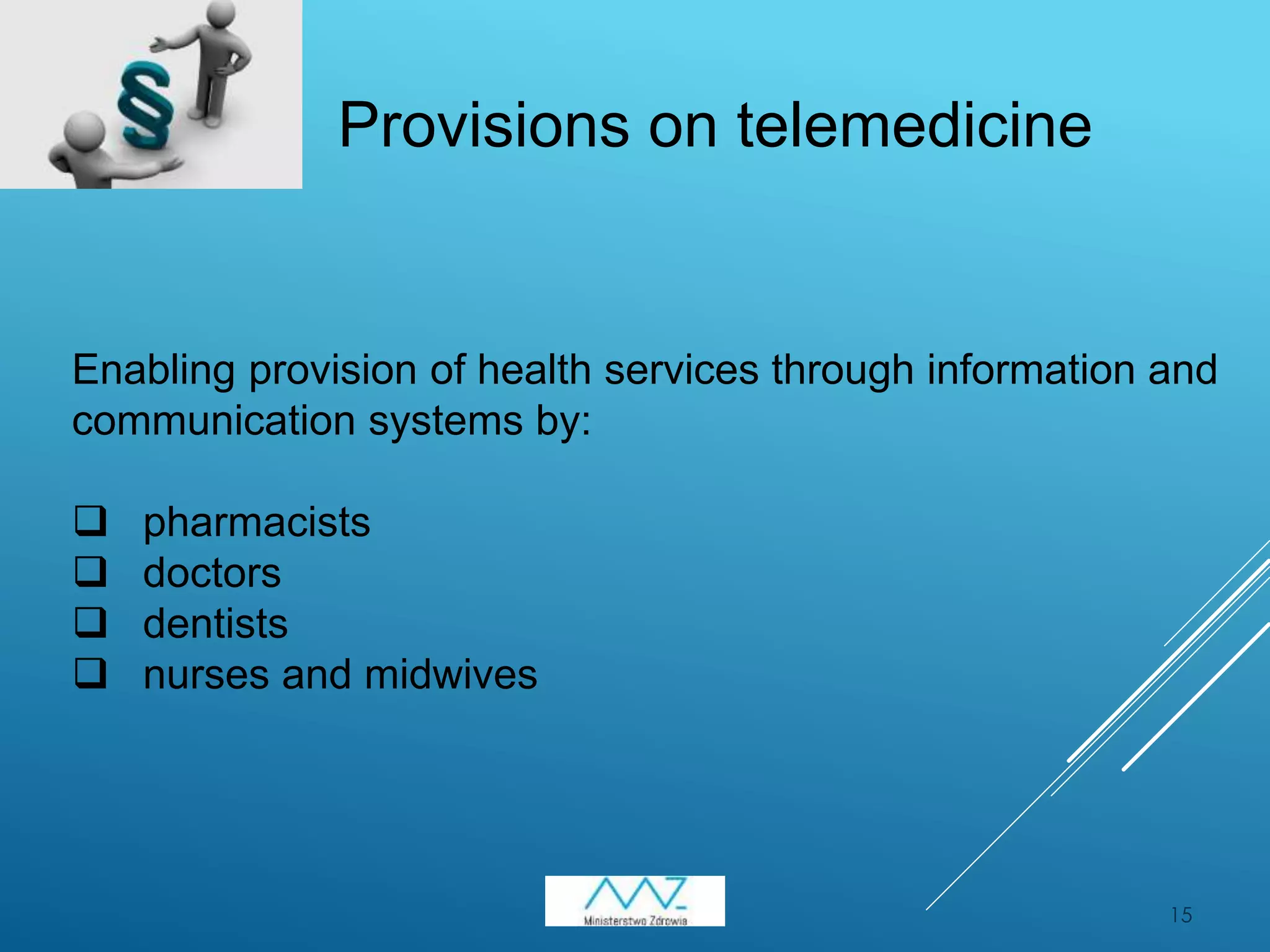
Enabling provision of health services through information and
communication systems by:
 pharmacists
 doctors
 dentists
 nurses and midwives
Provisions on telemedicine
16
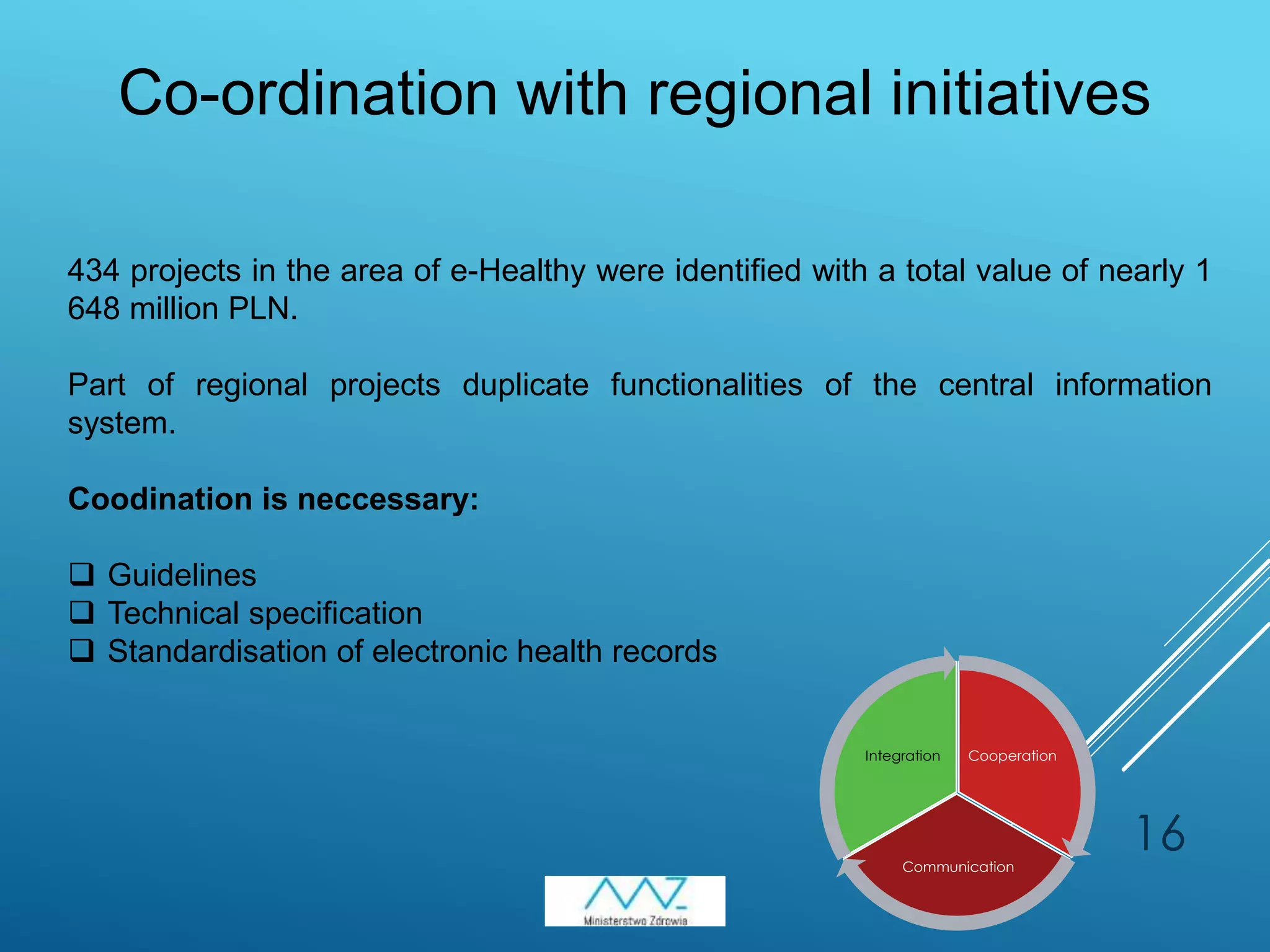
Co-ordination with regional initiatives
Cooperation
Communication
Integration
434 projects in the area of e-Healthy were identified with a total value of nearly 1
648 million PLN.
Part of regional projects duplicate functionalities of the central information
system.
Coodination is neccessary:
 Guidelines
 Technical specification
 Standardisation of electronic health records
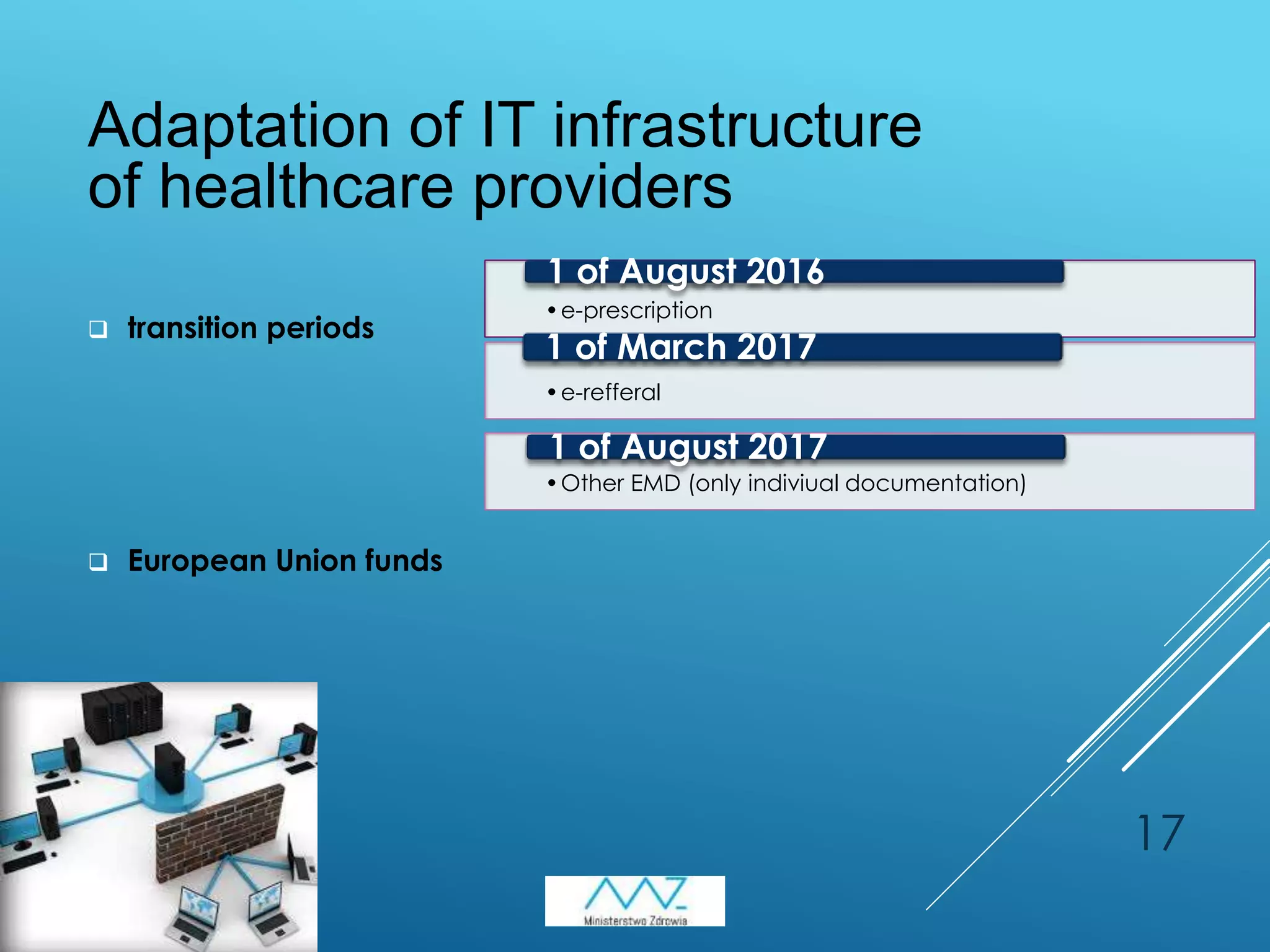
Adaptation of IT infrastructure
of healthcare providers
 transition periods
 European Union funds
17
•e-prescription
1 of August 2016
•e-refferal
1 of March 2017
•Other EMD (only indiviual documentation)
1 of August 2017
18
Thank you for your
attention.

Едіта Рокіцка

  • 1.
    1 e-Health Initiatives inPoland Edyta Rokicka Departament of Infrastructure and eHealth Ministry of Health
  • 2.
    2 ► currently 1entitypayers ► 2.9 thousand entitiesadministration ► 11.7 thousand entitiespharmacies ► 85.5 thousand entitiesproviders of services ► 343.4 thousand peoplemedical personnel ► 38.1 million peoplerecipients of services
  • 3.
    3 Medical Information System (SIM) • P1 •P2 • P4 Domain Systems • SMZ • SMK • ZSMOPL • RUM NFZ • SSOZ • SEZOZ • SMSFE • SMD Medical Registers • Cancer register • inVitro register • other Health Information System
  • 4.
    4 Project: Electronic Platformfor Collection, Analysis and Sharing of Digital Medical Records Time frame: 29.11.2007 – 15.12.2015 Budget: 713 000 000 PLN Medical Information System - P1
  • 5.
    5 Enabling digital prescription filling Enablingon-line consultation bookings Enabling electronic invoice processing Providing digital resources on medical records, ensuring uniform and homogenous standards Providing fast access to digital medical records in urgent cases Enabling up-to-date analysis of medical records Facilitating digital maintenance of medical service provision settlements Facilitating electronic handling of drug refunds Enabling electronic sick leave processing Key functionalities of P1
  • 6.
  • 7.
    7 Project: Platform forsharing services and resources of digital medical records with on-line business (P2) Time frame: 18.12.2007 – 31.12.2012 Budget: 6 500 000 euro SIM - Projekt P2
  • 8.
    In the upcomingyears on P2 it is planned to share next subjective registers, as well as to develop records already available. 8 Registers integrated with P2
  • 9.
    9 Project: Domain systemssupplementary to health information system Time frame: 30.09.2015 Budget: 25 000 000 mln PLN SIM - Project P4
  • 10.
     Statistics Systemin Health Care;  Risks Monitoring System;  Integrated Monitoring System of Medicinal Products Trading;  Medical Workers Training Monitoring System;  Health Resources Registration System. 10 Project P4
  • 11.
    11 Pilot projects –telemedicine in the area of cardiovascular diseases and geriatrics Scope of the projects:  Duration: one year  Call for proposal for healthcare providers organised by regional branches of National Health Fund  GP teleconsultations with medical specialist in cardiovascular diseases and geriatrics  Healthcare providers will be equipped with ICT equipment
  • 12.
    12 Expected results Limiting ofwaiting lists Facilitating access to the medical specialists Reducing unnecessary diagnostic hospitalisation Evaluation report for the Agency for Health Technology Assessment and Pricing
  • 13.
    13 • Reimbursement Systems •Integrated Patient Information (ZIP) National Health Fund (Payer) • Telemonitoring, teleconsultation, digital health records, e-registration for visits Private sector Telemedicine • Regional eHealth PlatformsSelf Government • Local IT SystemsHospitals, General Practitioners Other eHealth Projects in Poland
  • 14.
    According to thelaw (amendment to the Act on health information system)- compulsory medical documentation only in electronic on 1 August 2017. The further amendments to the Act are being proceeded at the moment. Planned changes with regard to electronic medical documentation: 14 Amendments to Act on health information system •e-prescription 1 of August 2016 •e-refferal 1 of March 2017 •Other EMD (only indiviual documentation) 1 of August 2017
  • 15.
    15 Enabling provision ofhealth services through information and communication systems by:  pharmacists  doctors  dentists  nurses and midwives Provisions on telemedicine
  • 16.
    16 Co-ordination with regionalinitiatives Cooperation Communication Integration 434 projects in the area of e-Healthy were identified with a total value of nearly 1 648 million PLN. Part of regional projects duplicate functionalities of the central information system. Coodination is neccessary:  Guidelines  Technical specification  Standardisation of electronic health records
  • 17.
    Adaptation of ITinfrastructure of healthcare providers  transition periods  European Union funds 17 •e-prescription 1 of August 2016 •e-refferal 1 of March 2017 •Other EMD (only indiviual documentation) 1 of August 2017
  • 18.
    18 Thank you foryour attention.

Editor's Notes

  • #3 Although computers are used in the majority of health care units in Poland, usage in single-physician medical practices and middle-sized ambulatories is low. Medical documentation is still maintained in paper form. Several voivodeships have well-developed IT systems in large clinics and specialist hospitals, in which the administration is connected to the flow of medical data from hospital wards, hospital pharmacies and surgery management systems. However, the use of IT in secondary care still seems to be much less advanced than in western Europe. The use of e-health in Poland is very low, but some initiatives in this area have been piloted. For example, although virtually all prescriptions are dispensed in printed form, prototype e-prescriptions were implemented in 16 pharmacies, 2 medical practices and 2 outpatient clinics in 2011 in Leszno. A prototype of internet patient accounts (with information on medical history) was introduced in 2011 in several diabetic medical centres in Kraków.
  • #4 Registers contain records, list or other ordered collection of personal or individual medical data, i.e. all information necessary for provision of health services. Registers provide data for different purposes (statistical, scientific, medical records) . The system is built both on existing registers, as well as on completely new records. Some registers were merged into one (Register of Entities Providing Healthcare Services was built from separate registers). Register of pharmacies; Register of pharmaceutical wholesalers; Register of coding systems; Register of medicinal products; Register of laboratory diagnosticians; National Cancer Register; National Register of Cardiac Surgery; National Register of Acute Coronary Syndrome; InVitro Register. Domain systems – ICT systems supporting specific area of the health care system: NHF Medical Services Registration System, Healthcare Statistics System, Healthcare Resources Registration System , Medical Emergency Support System, Hazard Monitoring System, Accessibility of Healthcare Services Monitoring System, Treatment Costs and Financial Condition of Healthcare entities Monitoring System, Medical products Trading Integrated Monitoring System , Medical Workers Training Monitoring System.
  • #5 Project P1 – „Electronic Platform for Collection, Analysis and Sharing of Digital Medical Records” : the implementation of the project has started since 2007, and is planned to be completed in 2015. P1 is the largest project of ICT and the basis is for the entire program in Healthcare. The platform will enable various interested parties to collect, analyse and share digital resources regarding medical events. As part of the project the necessary level of security of the data processed will be ensured. As regards the data processed, the system assumes that both data entry into the system and their processing will be performed with the full knowledge of the patient, ensuring the required security measures and confidentiality. Key benefits of the Project: access to patient medical data regardless of time and place, faster access to case history, more effective treatment owing to updating data in the patient's medical documentation, better time management owing to on-line registration, easy access to medical information through online portals, secure storage of medical data, e-Prescription – convenient, safe and practical form of purchasing drugs, possibility of monitoring by a doctor if prescription was purchased, easier self-control of health owing to access to examination results
  • #7  . W celu realizacji tej wymiany zostały wybrane standardy komunikacji, które sprawią, że proces ten będzie mógł przebiegać w sposób zunifikowany. P1 platform will be used for communication between service providers and will enable exchange of medical records in electronic form. Medical documentation will still be stored by the service provider (producer of the documentation). P1 Platform will store information on location of the documentation. Each service provider through the P1 Platform can access medical data of another provider, if this is necessary to diagnose or further treatment of the patient. However, there are a few specific documents which will be stored and proces by the P1 Platform such as prescription, referral and an order for medical devices. Information about these documents will be sent to the P1 in complete form (all the information inherent in a document) – P1 will be the custodian of these documents . In order to implement this exchange communication standards will be implemented.
  • #8 In the financial perspective for the years 2007-2013, within the 7th priority axis of the Innovative Economy Operational Program, a project has been implemented, entitled: Platform for sharing services and resources of digital medical records with on-line businesses (P2). Within the P2 project a platform for medical records was established and launched at the beginning of 2013. The Medical Records Platform is a universal IT tool used to keep registers and provide electronic services that ensure the optimal level of safety. During integration with the P2 platform the registers are rebuilt so that they are consistent with the reference architecture of a medical register. This allows them to communicate with the P2 platform by means of web services or to be entirely embedded on the P2 platform. In 2013 and in the first quarter of 2014 the following registers were integrated with the P2 platform: Register of permits for running commonly available pharmacies, pharmacy points and register of permits for running hospital and company pharmacies as well as hospital pharmacy departments, Register of permits for running pharmaceutical warehouses, Coding Systems Register, Register of Medically Assisted Procreation mentioned in the programme "Infertility treatment by in vitro fertilisation for the years 2013 – 2016", Residency IT System (SIR) handling the process of residency contracts implementation, Register of Medicinal Products Authorised for the Market on the territory of the Republic of Poland. The National Centre for Health Information Systems (CSIOZ) based on a system and technical infrastructure independent from P2 holds the National Register of Blood Donors, the National Register of Cardiovascular Operations, the Central Register of Patients with Cerebral Palsy (CRCMPD), the Monitoring System of Consumer Accidents (SMWK) and the Healthcare Communication System (ZOZMAIL). In addition, CSIOZ is currently working on the integration of other medical registers on the P2 platform in 2014, i.e. the Central List of Pharmacists and the List of Laboratory Diagnosticians. The functionality of the Document Exchange Platform allows public administration entities and entrepreneurs to download the registered data, exchange electronic documents between entrepreneurs and registration bodies, track current request state, receive automatic confirmation of document delivery and mark electronic documents (e.g. with date and time or electronic signature).
  • #9 The project implementation was connected with the functioning in Poland 30 subjective records kept by different administrators. These registers have not been able to exchange information with each other, for the most part also with the outside world, and were not able to provide e-services. Currently at Medical Registry Platform (http://www.rejestrymedyczne.csioz.gov.pl/) are available:   - Register of pharmacies; - Register of pharmaceutical wholesalers; - Register of coding systems; - Register of medicinal products; - Register of laboratory diagnosticians. In the upcoming years on P2 it is planned to share next subjective registers, as well as to develop records already available. In the early phase of entering P2 platform, the quality of the data reported by individual administrators left much to be desired, but now thanks to the cooperation between National Centre for Healthcare Information Systems, and individual administrators quality of publicly available data is meeting high standards.
  • #10 The project will improve business processes related with access to:   a) the statistical data as referred in the Public Statistics Research Programme (PBSSP) b) information on preventing the adverse effects of events affecting the health and life of humans, c) information on the turnover of medicinal products, d) information on medical professionals resources including the age, specialization, placement, training courses, e) information on the health care resources that will allow to assess the needs of the medical equipment necessary to ensure adequate protection of the health of patients across the country, planning funds for the implementation of such purchases, according to current needs, provide access to information collected by the system to the needs of contracting medical services.
  • #11 Project P4 - "Domain systems supplementary to health information system" (in progress). As part of the project in 2015 ICT systems will be built and implemented in support of specific business areas, respectively:   - Statistics System in Health Care; - Risks Monitoring System; - Integrated Monitoring System of Medicinal Products Trading; - Medical Workers Training Monitoring System; - Health Resources Registration System.
  • #14 The information system operated by the NFZ is mainly used for the purpose of contract settlement. Data on the provision of health services is electronically transmitted by health care providers to the payer (the NFZ), which uses it to draw up reports for the Ministry of Health on the provision of services financed from public means. The range of data submitted by service providers is defined by the 2004 Law on Health Care Services Financed from Public Sources and includes the amount (or number) of health services provided, the number of patients on the waiting lists, drug prescriptions and consumption of refunded pharmaceuticals, and payment of insurance contributions by the insured. Some university clinics and specialist hospitals use telemedicine in areas such as cardiology and orthopedics. Electronic appointment booking is not widespread but there are encouraging examples of such practices (e.g. for online booking of specialist appointments in hospitals). Electronic patient registration is one of the tools foreseen in Project P1 of the Healthcare Computerization Programme, which was launched in 2009 and is 85% co-financed by the EU under the Innovative Economy Programme 2007–2013.
  • #15 Legal framework concerning e-Health in Poland The Act from 28th April 2011 about information system in health care, other “Law System” in accordance with Art. 58 came into force on 1st January 2012, with the exception of certain provisions whose entry into force was provided on 1st August 2014. This applies to art. 7 paragraph. 1 point. 3 and 4, Art. 11 and Art. 50 Section 1, which regulate the conduct by providers of electronic medical records, the exchange of data in electronic medical records and electronic documents between service providers. System Act defines the organization and operation of information systems in health care, which process data necessary to carry out state health policy, improve the quality and accessibility of health care services. It is assumed that information systems in health care is structured datasets (registers and medical records) that are able to be shared across the system. According to the Law on the system, information system is operated by: Electronic Platform for Collection, Analysis and Sharing of digital Medical Records (P1) and On-line Platform for the Services and Resources related to Digital Medical Registries (P2). In addition, last year, the Regulation of the Council of Ministers of April 12 2012, on the National Interoperability Framework, the minimum requirements for public registry and electronic information exchange as well as the minimum requirements for IT systems, which is an important step to structure the government's information infrastructure. The regulation defines, inter alia methods and guidelines for building IT systems of public administration, system architecture, language description and referral of state registers. It also contains a series of guidelines for IT security
  • #17 In 2013 National Centre for Healthcare Information Systems conducted a questionnaire survey on the analysis investigating the status and the development directions of information projects implemented in different regions of the country in the e-Health. As part of the audit, 434 projects in the area of e-Healthy were identified with a total value of nearly 1 648 million PLN. They included regional medical information systems, implementation of IT systems in health care units, and purchase of IT and communication technology infrastructure for health care units. Part of regional projects duplicate functionalities of the central information system. Thus coordination mechanism is neccessary. Ministry of Health issues guidelines, technical specification and stanadrs of electronic health records
  • #18 In order to proces the digital medical information investment in IT are neccessary. Large hospitals are more likely to use IT infrastructure, for both administrative purposes and for medical record keeping. According to a survey there is a wide variation in terms of IT use, which seems to be correlated with hospital size. In general, 83% of the surveyed hospitals had access to the Internet – mostly in administrative departments. Although computers are used in the majority of health care units in Poland, usage in single-physician medical practices and middle-sized ambulatories is low. Medical documentation is still maintained in paper form. Service providers in the field of primary care, who do not have their own systems, will be freely available on-line application: Application Service Providers and Pharmacies, which is part of the P1 platform and enables fulfillment law obligations: record medical events in the system, download the EDM of the patients, issue of e-presribtions, e-refferal. Other therapeutic entities (hospitals, AOS) will comunicate with the P1 through local IT systems: His (hospital information system). Support for these activities will be available in EU funds.