‫منذر‬ ‫المهندس‬ ‫الدكتور‬
‫القادري‬
‫والتطوير‬ ‫للتدريب‬ ‫األوروبي‬ ‫األعمال‬ ‫مركز‬
info@ebctraining.net
‫والتحكم‬ ‫والجدولة‬ ‫الصيانة‬ ‫تخطيط‬
Maintenance
Preventive M.
“To Keep”
Corrective M.
“To Restore”
A facility to an acceptable standard
What is Maintenance?
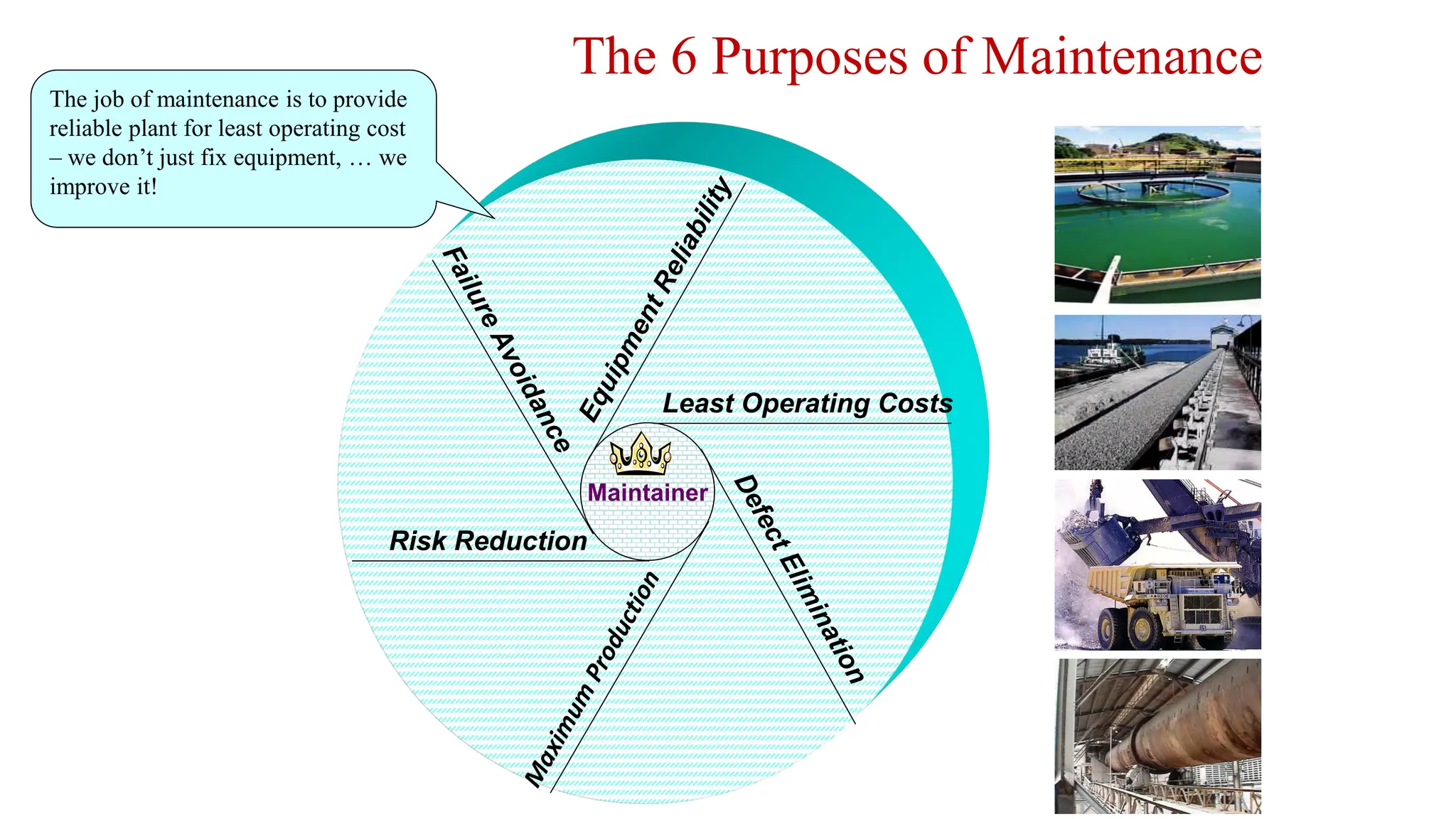
The 6 Purposes of Maintenance
Risk Reduction
Least Operating Costs
Maintainer
The job of maintenance is to provide
reliable plant for least operating cost
– we don’t just fix equipment, … we
improve it!
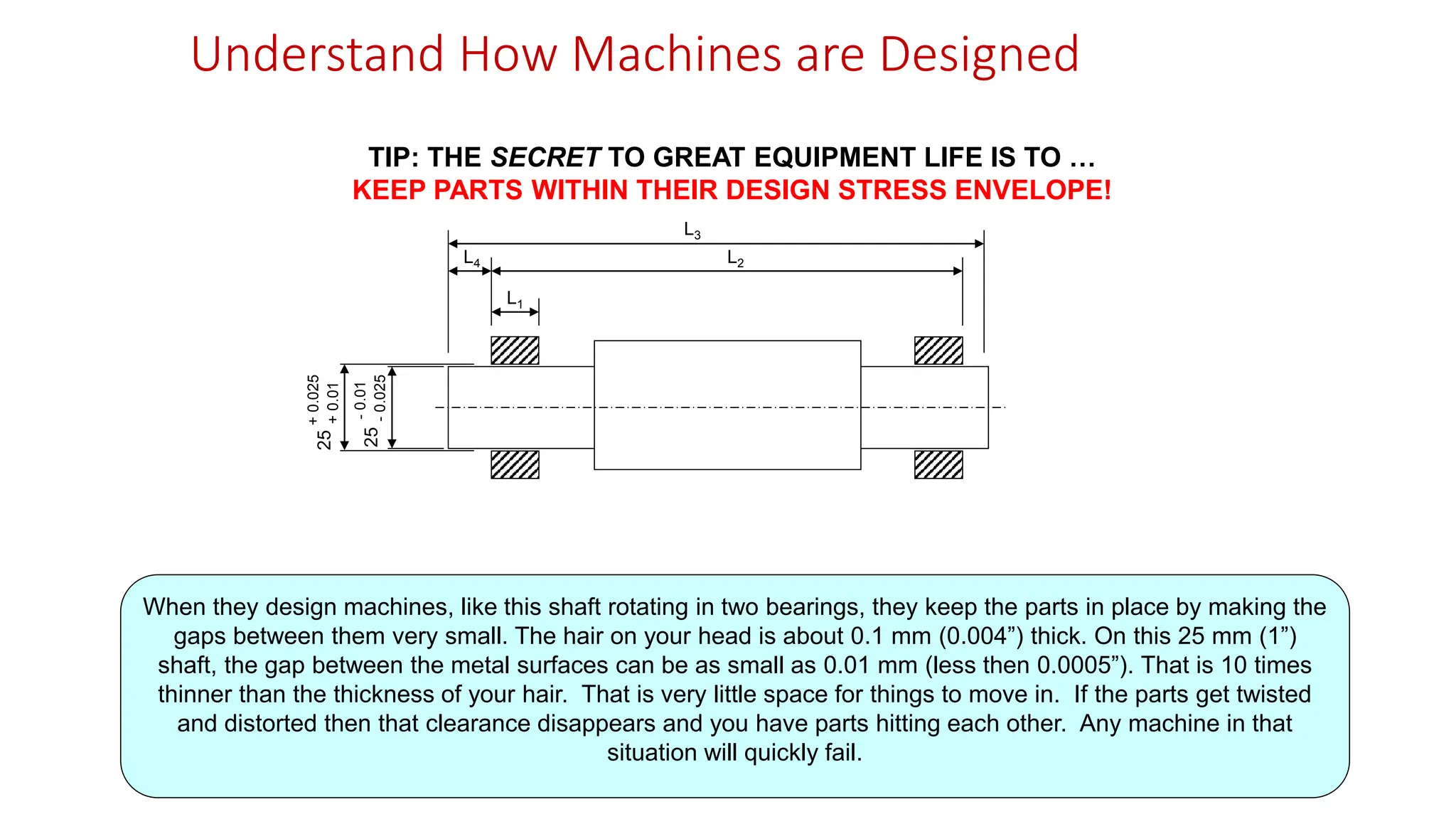
Understand How Machines are Designed
When they design machines, like this shaft rotating in two bearings, they keep the parts in place by making the
gaps between them very small. The hair on your head is about 0.1 mm (0.004”) thick. On this 25 mm (1”)
shaft, the gap between the metal surfaces can be as small as 0.01 mm (less then 0.0005”). That is 10 times
thinner than the thickness of your hair. That is very little space for things to move in. If the parts get twisted
and distorted then that clearance disappears and you have parts hitting each other. Any machine in that
situation will quickly fail.
25
-
0.01
-
0.025
25
+
0.01
+
0.025
L1
L2
L3
L4
TIP: THE SECRET TO GREAT EQUIPMENT LIFE IS TO …
KEEP PARTS WITHIN THEIR DESIGN STRESS ENVELOPE!
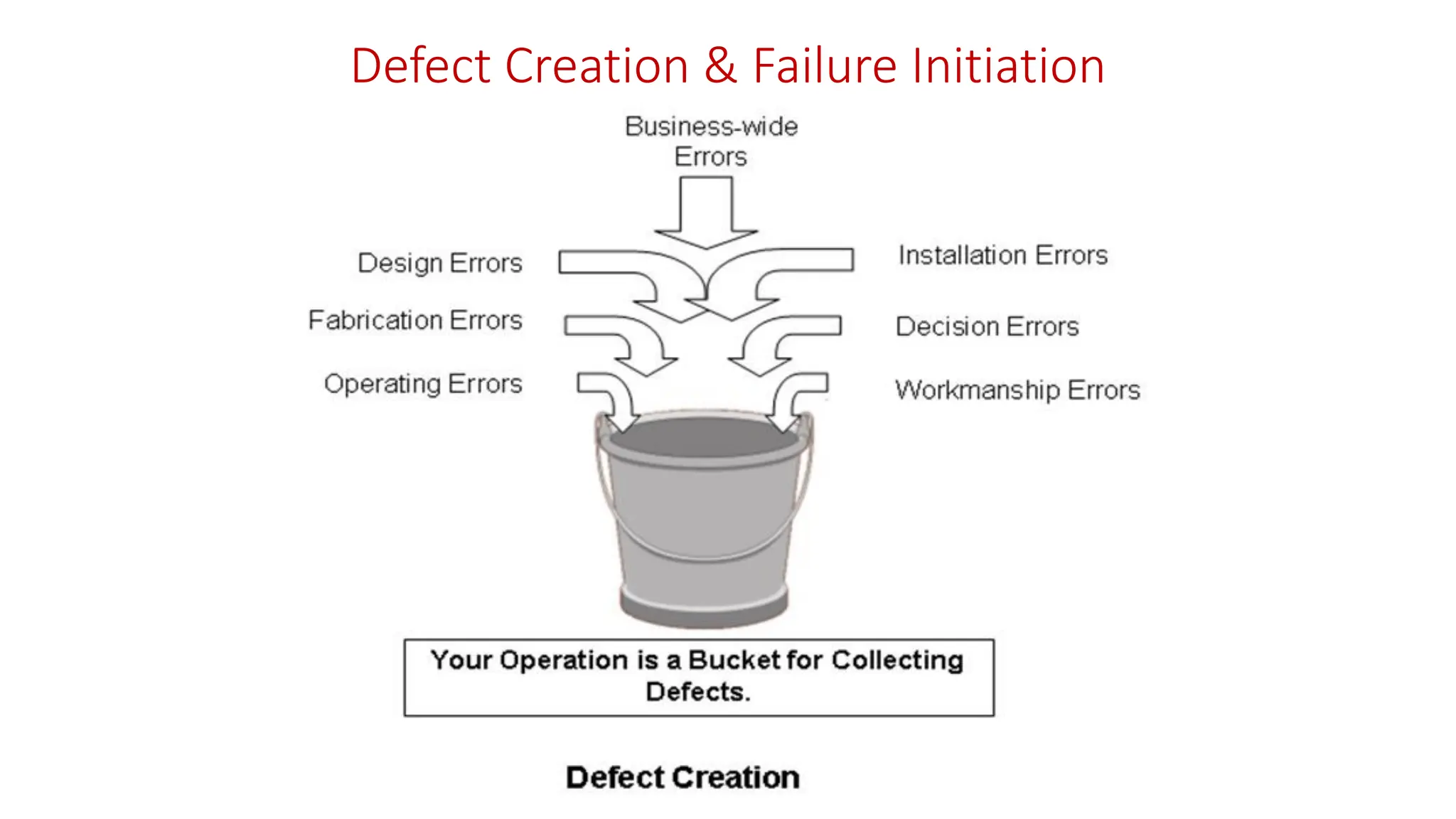
Defect Creation & Failure Initiation
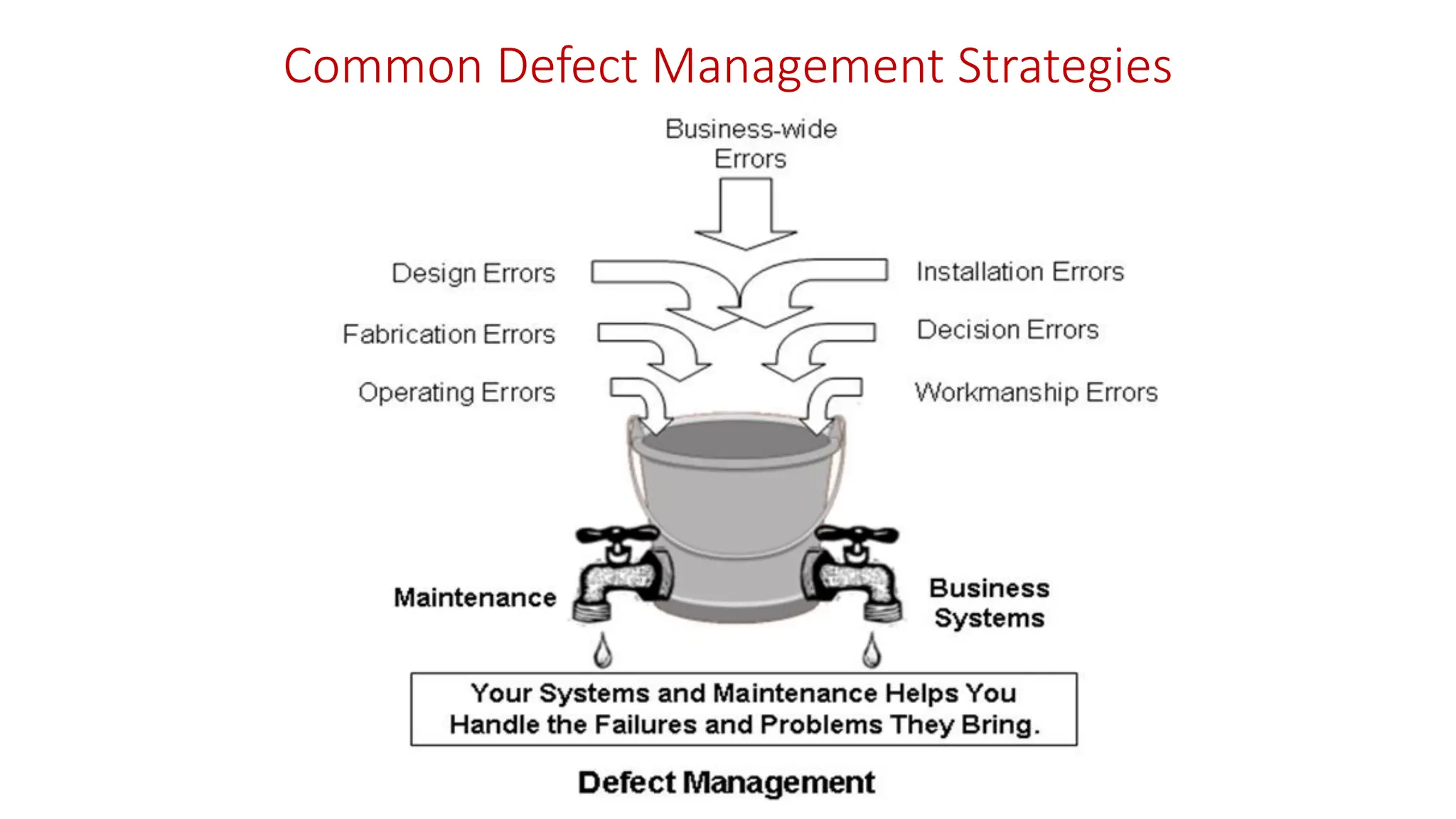
Common Defect Management Strategies
Defect Elimination & Failure Prevention
If you don’t want
problems you
need to prevent
their cause.
If you don’t want
high maintenance
you need to
prevent the
causes of that
maintenance.
Plant and Equipment Life Cycle
Profits come from this stage of the life cycle,
and are maximised when the operating costs
are minimised.
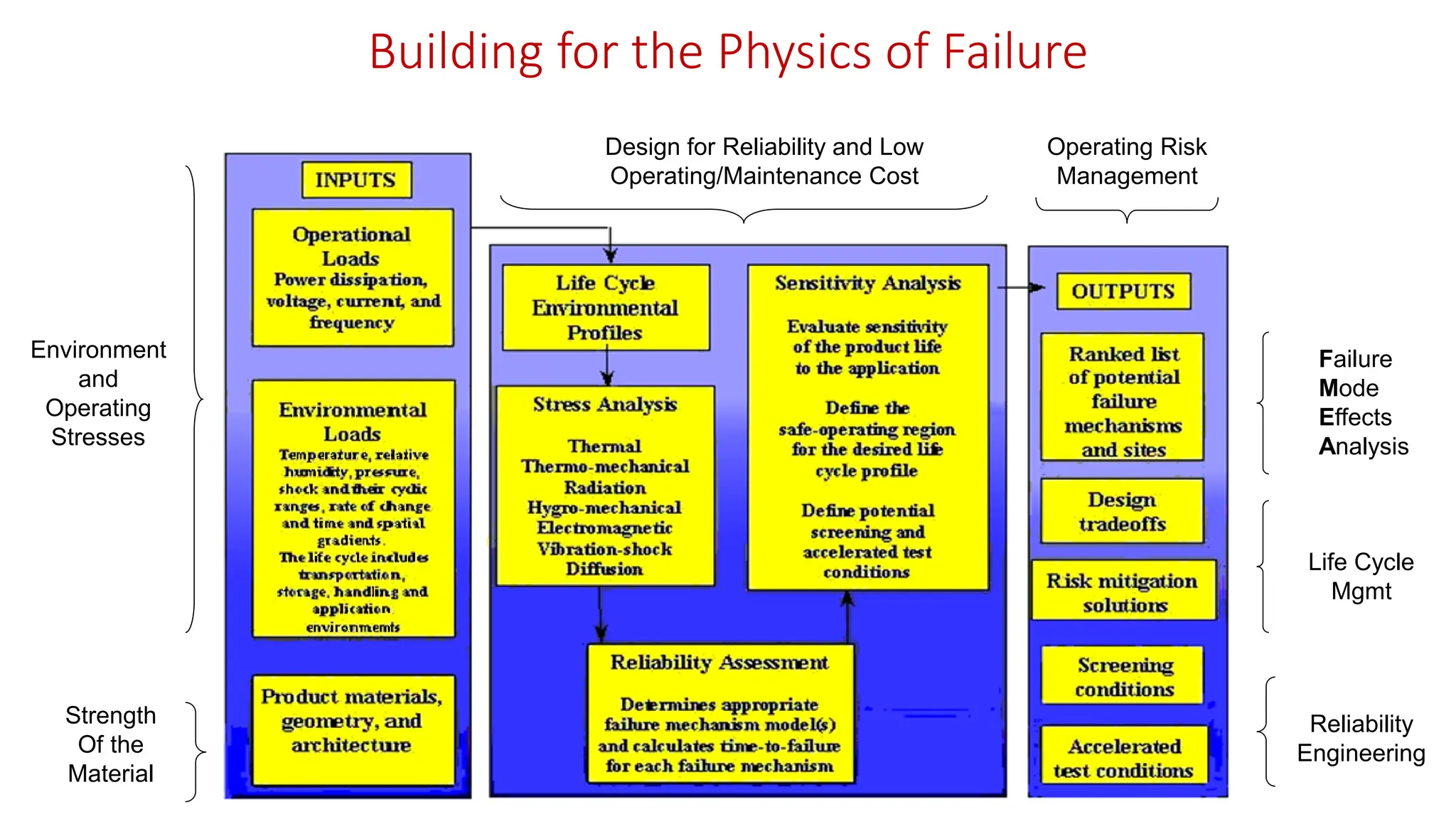
Building for the Physics of Failure
Strength
Of the
Material
Environment
and
Operating
Stresses
Operating Risk
Management
Design for Reliability and Low
Operating/Maintenance Cost
Failure
Mode
Effects
Analysis
Reliability
Engineering
Life Cycle
Mgmt
The Degradation Cycle
Smooth Running
Time (Depending on the situation this can be from
hours to months.)
Operating
Performance
Failed
Impending Failure
Change in
Performance is
Detectable
Do Maintenance &
Condition Monitor
Equipment Unusable
Repair or Replace
The Failure Degradation Sequence
P-F Interval
Condition Inspection Interval
P
F
Most parts show evidence, or
exhibit warning signs, of failing
– they follow a sequence of
gradual degrading. As the vast
majority of parts degrade their
condition changes. These
changed conditions can be
observed and the parts
replaced before they fail.
Some items, like electronic
parts, can fail without warning.
Situations of huge, sudden
stress or overload can cause
parts to immediately fail
without warning.
Replace before
parts’ condition
gets to
functional
failure point
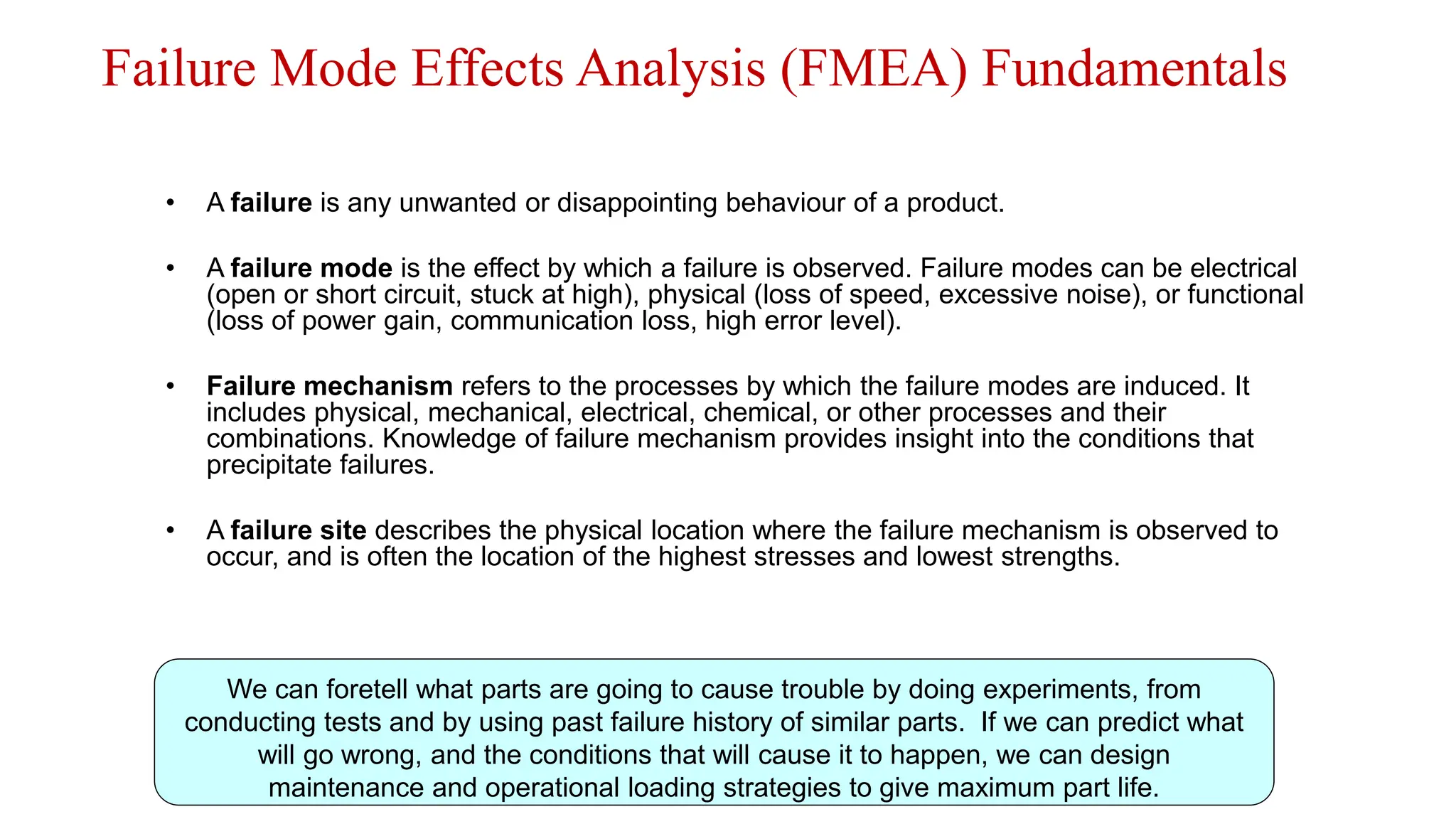
Failure Mode Effects Analysis (FMEA) Fundamentals
• A failure is any unwanted or disappointing behaviour of a product.
• A failure mode is the effect by which a failure is observed. Failure modes can be electrical
(open or short circuit, stuck at high), physical (loss of speed, excessive noise), or functional
(loss of power gain, communication loss, high error level).
• Failure mechanism refers to the processes by which the failure modes are induced. It
includes physical, mechanical, electrical, chemical, or other processes and their
combinations. Knowledge of failure mechanism provides insight into the conditions that
precipitate failures.
• A failure site describes the physical location where the failure mechanism is observed to
occur, and is often the location of the highest stresses and lowest strengths.
www.BIN95.com
We can foretell what parts are going to cause trouble by doing experiments, from
conducting tests and by using past failure history of similar parts. If we can predict what
will go wrong, and the conditions that will cause it to happen, we can design
maintenance and operational loading strategies to give maximum part life.
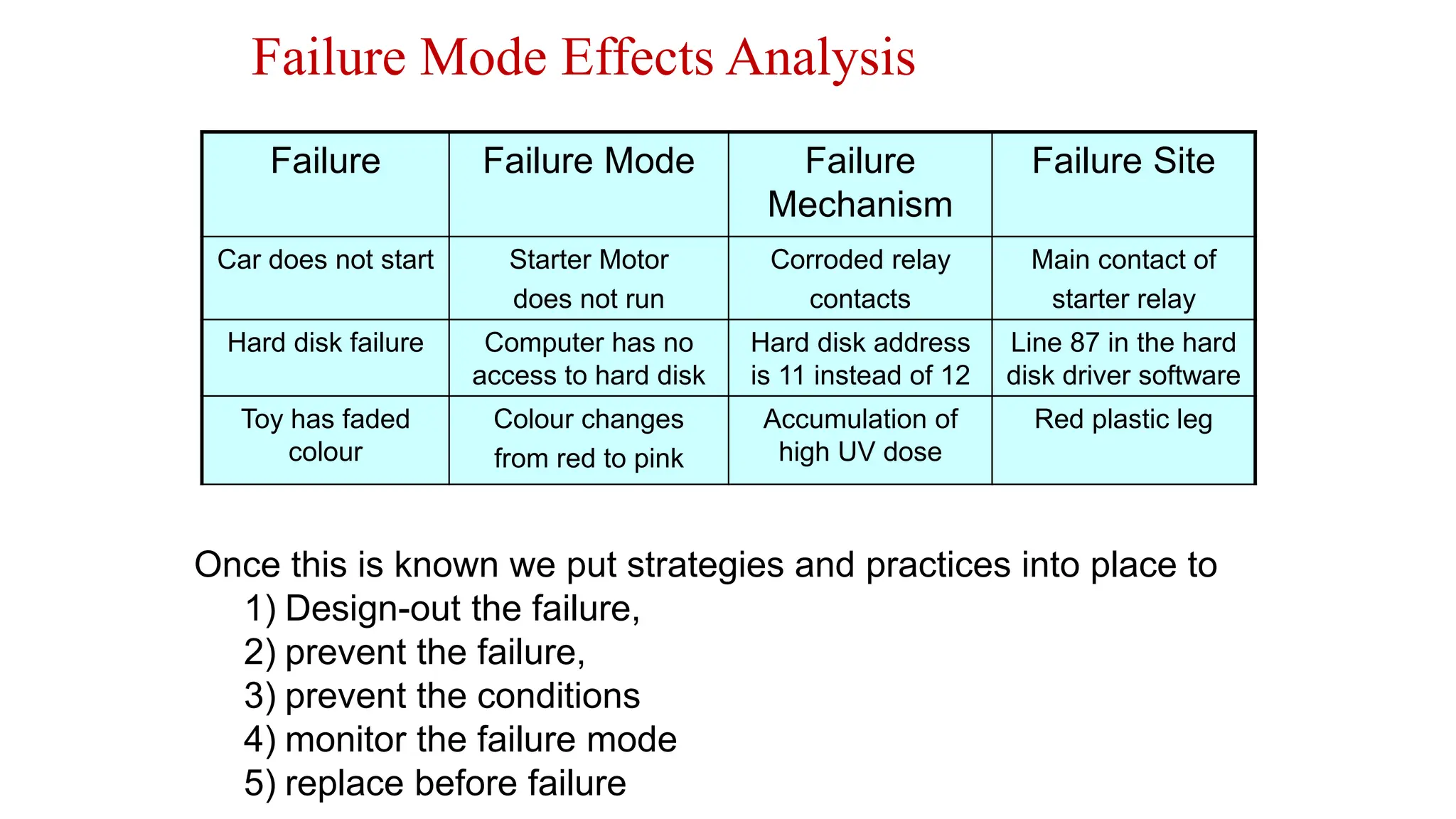
Failure Mode Effects Analysis
Failure Failure Mode Failure
Mechanism
Failure Site
Car does not start Starter Motor
does not run
Corroded relay
contacts
Main contact of
starter relay
Hard disk failure Computer has no
access to hard disk
Hard disk address
is 11 instead of 12
Line 87 in the hard
disk driver software
Toy has faded
colour
Colour changes
from red to pink
Accumulation of
high UV dose
Red plastic leg
Once this is known we put strategies and practices into place to
1) Design-out the failure,
2) prevent the failure,
3) prevent the conditions
4) monitor the failure mode
5) replace before failure
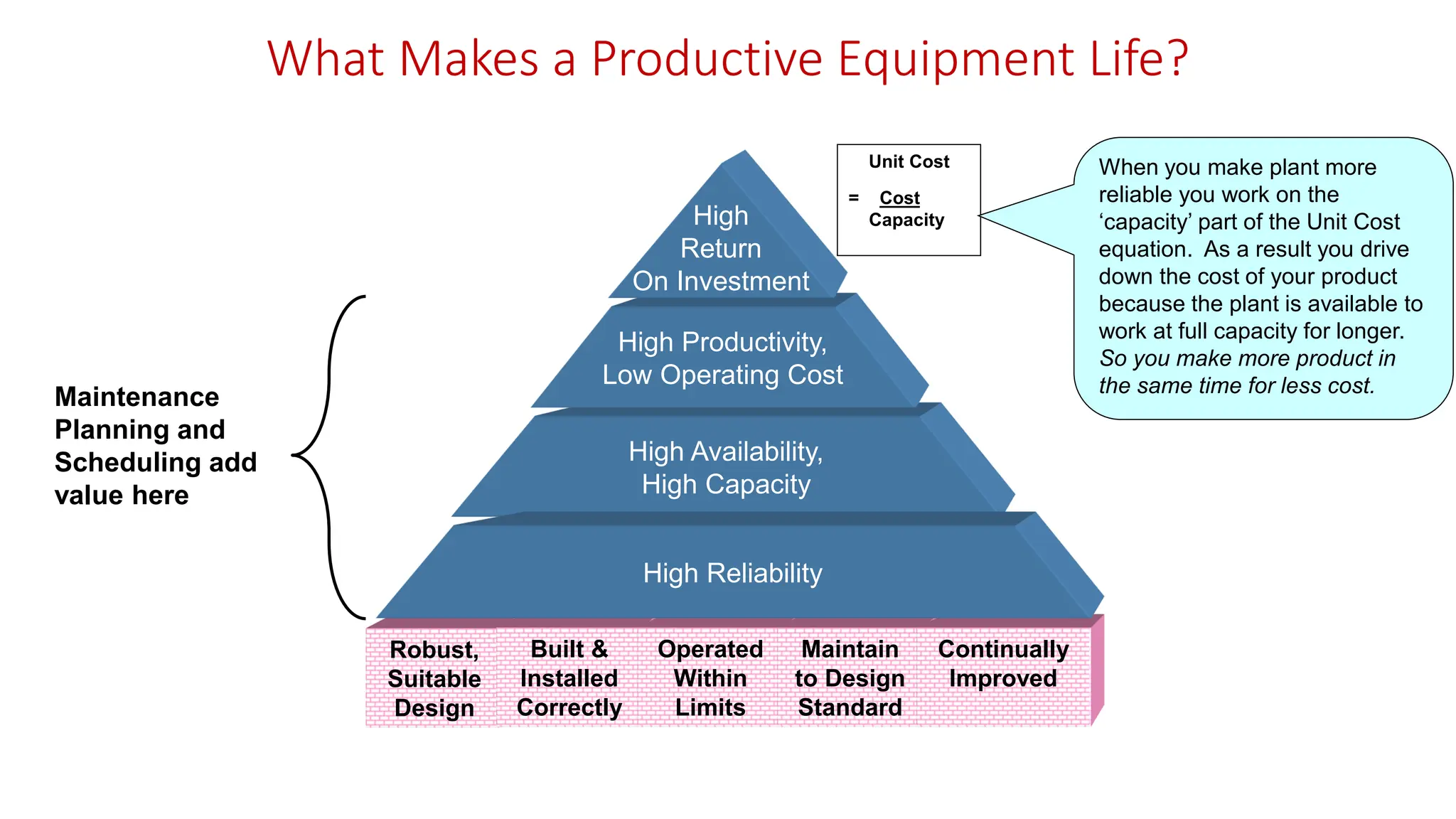
What Makes a Productive Equipment Life?
Robust,
Suitable
Design
Built &
Installed
Correctly
High Availability,
High Capacity
High Productivity,
Low Operating Cost
High
Return
On Investment
Maintenance
Planning and
Scheduling add
value here
Operated
Within
Limits
Maintain
to Design
Standard
Continually
Improved
High Reliability
Unit Cost
= Cost
Capacity
When you make plant more
reliable you work on the
‘capacity’ part of the Unit Cost
equation. As a result you drive
down the cost of your product
because the plant is available to
work at full capacity for longer.
So you make more product in
the same time for less cost.
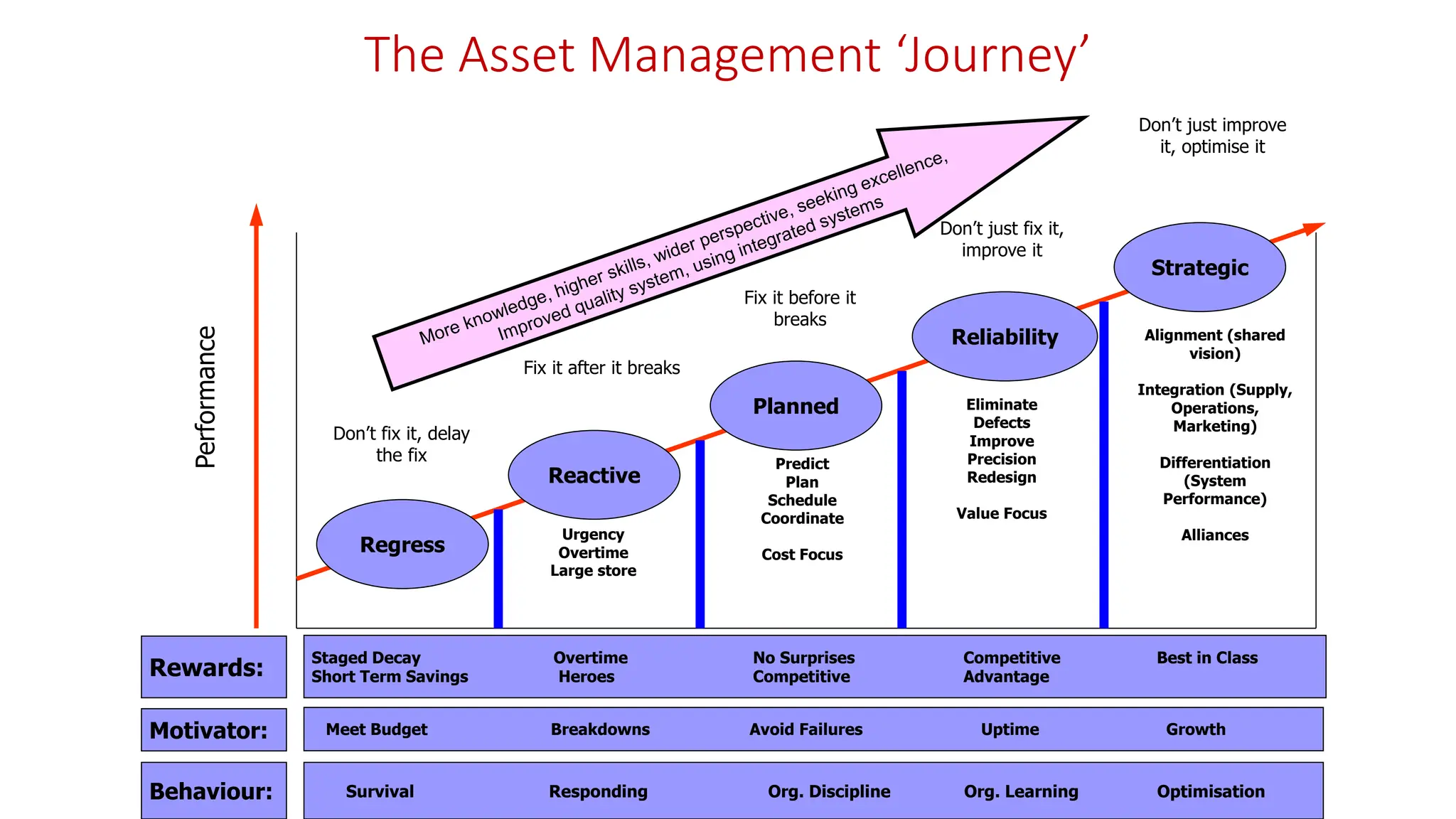
The Asset Management ‘Journey’
Regress
Reactive
Planned
Reliability
Strategic
Fix it after it breaks
Fix it before it
breaks
Don’t just fix it,
improve it
Don’t just improve
it, optimise it
Predict
Plan
Schedule
Coordinate
Cost Focus
Eliminate
Defects
Improve
Precision
Redesign
Value Focus
Alignment (shared
vision)
Integration (Supply,
Operations,
Marketing)
Differentiation
(System
Performance)
Alliances
Performance
Don’t fix it, delay
the fix
Urgency
Overtime
Large store
Rewards:
Motivator:
Behaviour:
Staged Decay Overtime No Surprises Competitive Best in Class
Short Term Savings Heroes Competitive Advantage
Meet Budget Breakdowns Avoid Failures Uptime Growth
Survival Responding Org. Discipline Org. Learning Optimisation
Type of
Maintenance
Maintenance Types and Policies
17
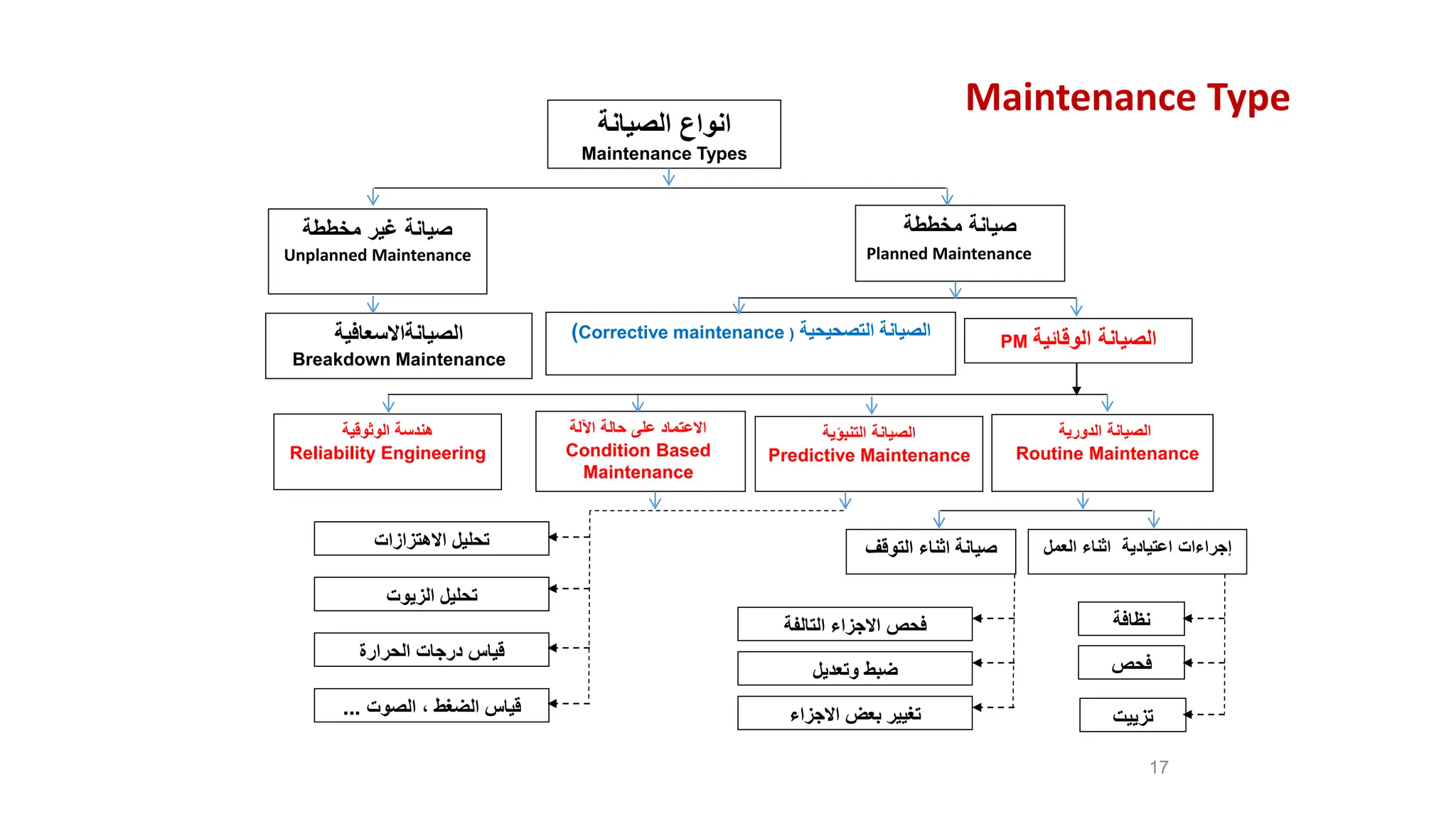
‫الصيانة‬ ‫انواع‬
Maintenance Types
‫مخططة‬ ‫صيانة‬
‫مخططة‬ ‫غير‬ ‫صيانة‬
Unplanned Maintenance
‫الصيانةاالسعافية‬
Breakdown Maintenance
‫التصحيحية‬ ‫الصيانة‬
(Corrective maintenance )
‫الدورية‬ ‫الصيانة‬
Routine Maintenance
‫اآللة‬ ‫حالة‬ ‫على‬ ‫االعتماد‬
Condition Based
Maintenance
‫التنبؤية‬ ‫الصيانة‬
Predictive Maintenance
‫هندسة‬
‫الوثوقية‬
Reliability Engineering
‫الوقائية‬ ‫الصيانة‬
PM
‫العمل‬ ‫اثناء‬ ‫اعتيادية‬ ‫إجراءات‬
‫التوق‬ ‫اثناء‬ ‫صيانة‬
‫ف‬
‫نظافة‬
‫فحص‬
‫تزييت‬
‫التالفة‬ ‫االجزاء‬ ‫فحص‬
‫وتعديل‬ ‫ضبط‬
‫االجزاء‬ ‫بعض‬ ‫تغيير‬
‫االهتزازات‬ ‫تحليل‬
‫الزيوت‬ ‫تحليل‬
‫الحرارة‬ ‫درجات‬ ‫قياس‬
‫قياس‬
‫الضغط‬
،
‫الصوت‬
...
Planned Maintenance
Maintenance Type
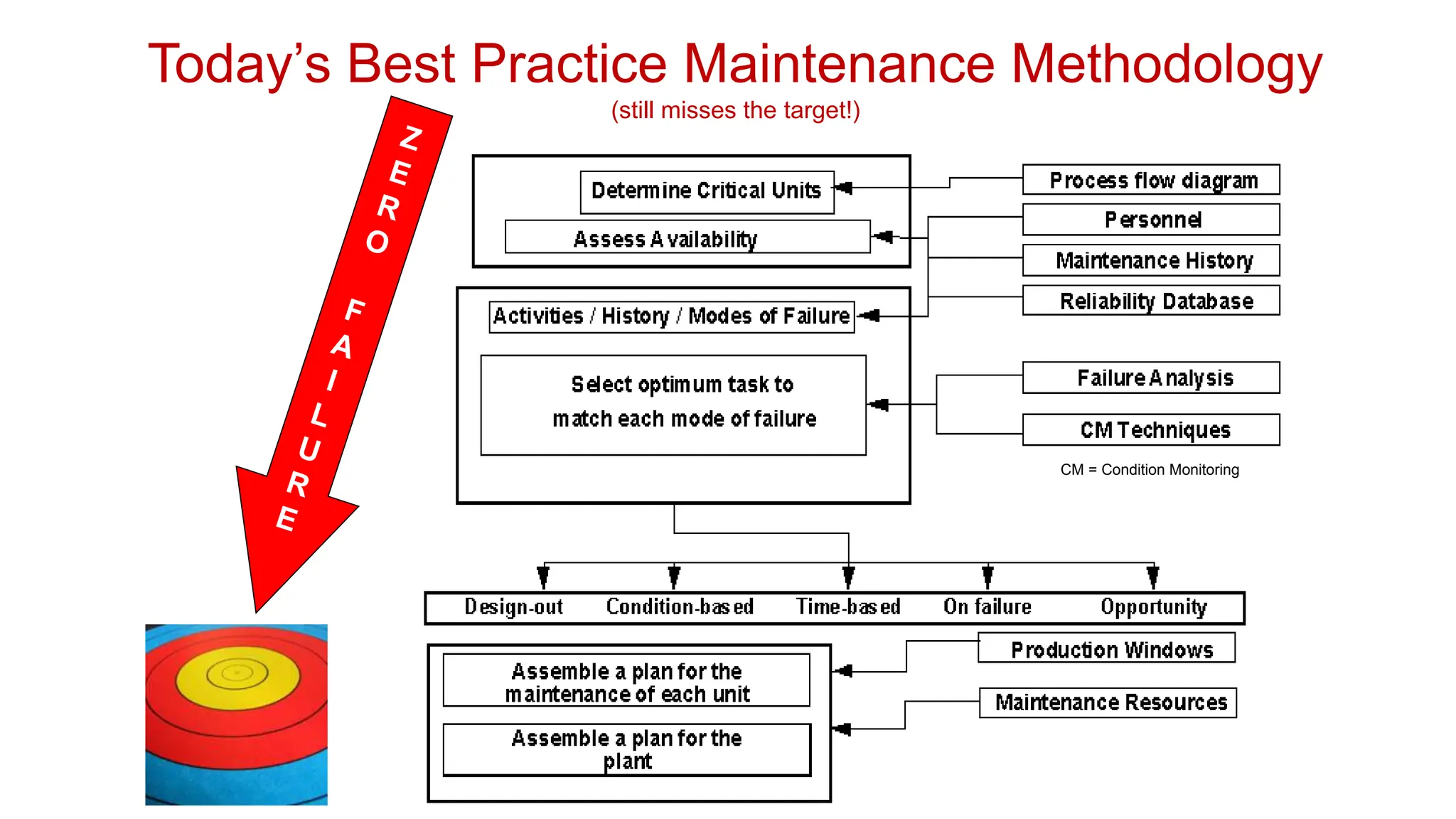
Today’s Best Practice Maintenance Methodology
(still misses the target!)
CM = Condition Monitoring
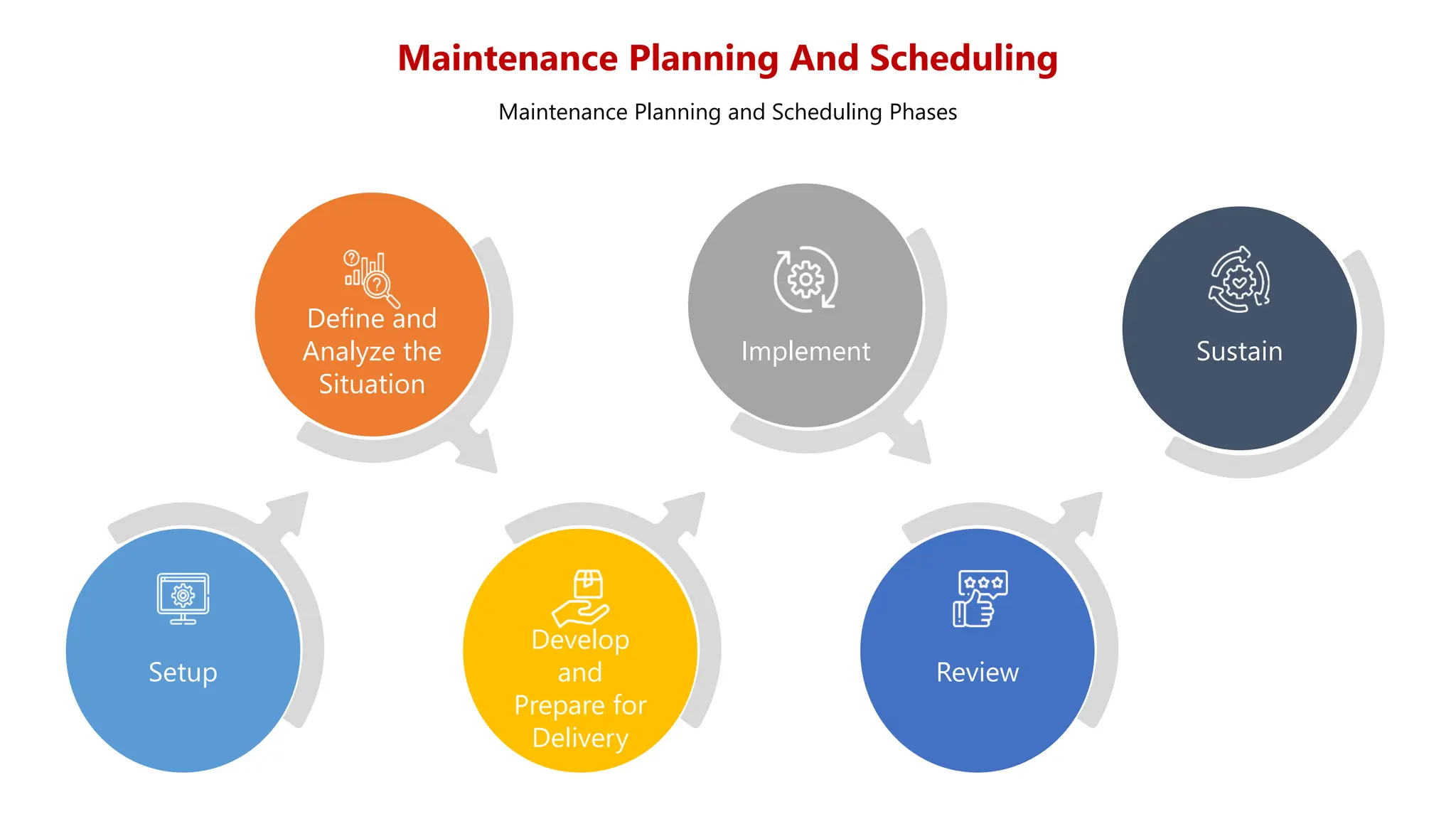
Maintenance Planning And Scheduling
Maintenance Planning and Scheduling Phases
Setup
Define and
Analyze the
Situation
Develop
and
Prepare for
Delivery
Implement
Review
Sustain
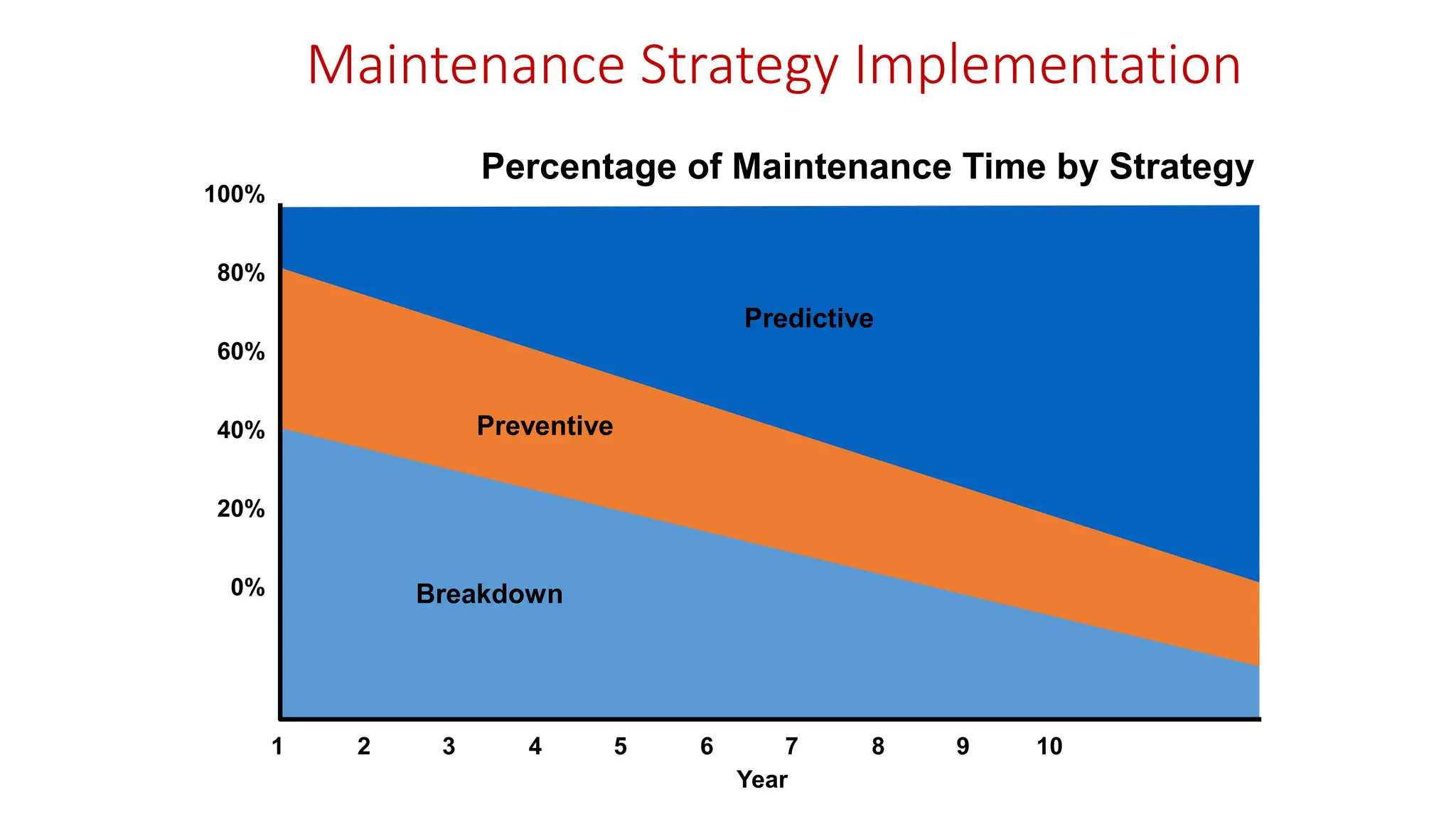
Maintenance Strategy Implementation
Breakdown
Preventive
Predictive
1 2 3 4 5 6 7 8 9 10
Year
100%
80%
60%
40%
20%
0%
Percentage of Maintenance Time by Strategy
‫خطوات‬
‫اعداد‬
‫صيانة‬ ‫خطة‬
8
.
‫اعداد‬
‫خطة‬
‫األجل‬ ‫قصيرة‬
.a
‫األعمال‬ ‫توزيع‬
.b
‫جانت‬ ‫جدول‬ ‫اعداد‬
.1
‫قائمة‬ ‫اعداد‬
‫المنشأة‬ ‫في‬ ‫الصول‬ ‫بجميع‬
2
.
‫تصنيف‬
‫أل‬ ‫وتقسيمها‬ ‫المشروع‬ ‫أو‬ ‫المنشأة‬ ‫في‬ ‫الموجود‬ ‫األصول‬ ‫كافة‬
‫نممة‬
3
.
‫تحديد‬
‫األولويات‬
:
‫أهميتها‬ ‫حسب‬ ‫المعدات‬ ‫تصنيف‬
4
.
‫ادراج‬
‫المعدات‬ ‫بيانات‬
/
‫بطاقة‬
‫أصل‬
( /
‫رقم‬
(
‫كود‬
)
‫تاري‬ ،‫المعدة‬ ‫تصنيع‬ ‫تاريخ‬ ،‫المعدة‬ ‫عن‬ ‫المسؤول‬ ،‫المعدة‬ ‫موقع‬ ، ‫المعدة‬ ‫وميفة‬ ، ‫المعدة‬ ‫اسم‬ ،‫المعدة‬
‫عمل‬ ‫بدء‬ ‫خ‬
،‫المعدة‬
‫حالة‬ ،‫باختصار‬ ‫المعدة‬ ‫مواصفات‬
‫االستهالكية‬ ‫المواد‬ ،‫الصيانة‬ ‫منفذ‬ ‫وفني‬ ‫المستبدلة‬ ‫والمواد‬ ‫والتواريخ‬ ‫باألعمال‬ ‫اعطالها‬ ‫سجل‬، ‫االستهالك‬
،
).
5
.
‫الوقائية‬ ‫الصيانة‬ ‫ملف‬ ‫تحديد‬
‫مكون‬ ‫لكل‬ ‫المطلوبة‬
.a
‫توفير‬
‫المصنعة‬ ‫الشركة‬ ‫وتعليمات‬ ‫الكتالوجات‬ ‫المخططات‬
.
.b
‫تحديد‬
‫وأعمال‬ ‫الفحص‬ ‫قوائم‬
‫وإجراءات‬ ‫وخطوات‬ ‫الصيانة‬
‫الصيانة‬
.c
‫ومواد‬ ‫التبديلية‬ ‫القطع‬ ‫قوائم‬ ‫تحديد‬
‫الصيانة‬
.
.d
‫الصيانة‬ ‫دورية‬ ‫تحديد‬
(
‫سنوي‬ ،‫سنوي‬ ‫نصف‬ ، ‫ربعي‬ ،‫شهري‬ ، ‫أسبوعي‬ ، ‫يومي‬
)
.e
‫صيانة‬ ‫دورة‬ ‫كل‬ ‫في‬ ‫الصيانة‬ ‫مدة‬ ‫تحديد‬
(
‫الساعات‬ ‫عدد‬
)
.f
‫تحديد‬
‫صيانة‬ ‫دورة‬ ‫كل‬ ‫في‬ ‫المطلوبة‬ ‫العمالة‬
.g
‫تحديد‬
‫األدوات‬
‫صيانة‬ ‫دورة‬ ‫كل‬ ‫في‬ ‫الصيانة‬ ‫ألعمال‬ ‫المطلوبة‬ ‫واألجهزة‬
.h
‫صيانة‬ ‫دورة‬ ‫كل‬ ‫في‬ ‫الصيانة‬ ‫تكاليف‬ ‫تقدير‬
.i
‫الصيانة‬ ‫بطاقات‬ ‫اعداد‬
6
.
‫اعداد‬
‫خطة‬
‫األجل‬ ‫طويلة‬
7
.
‫اعداد‬
‫خطة‬
‫األجل‬ ‫متوسطة‬
.9
‫االعتماد‬
‫الميزانية‬ ‫و‬
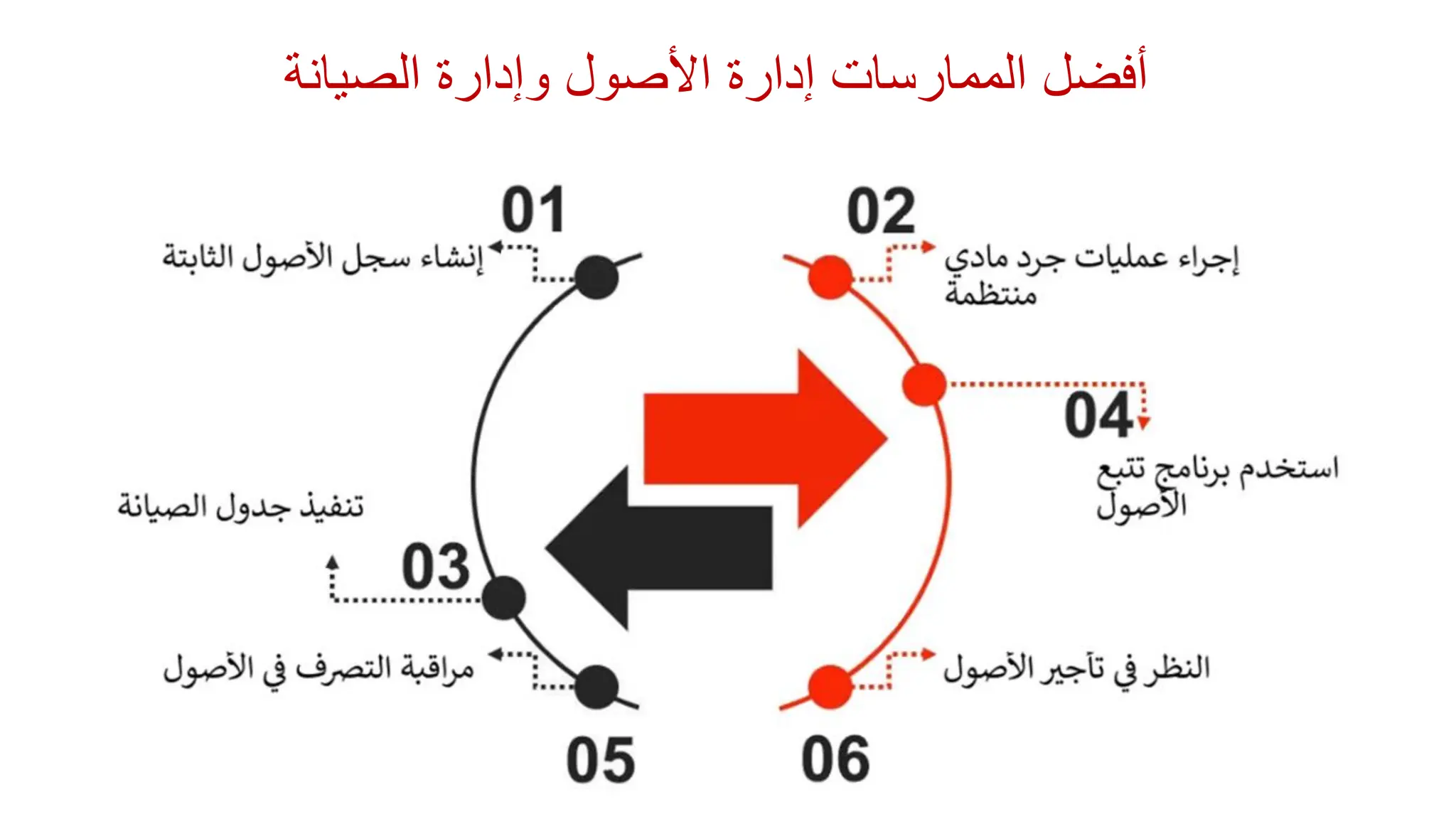
‫الصيانة‬ ‫وإدارة‬ ‫األصول‬ ‫إدارة‬ ‫الممارسات‬ ‫أفضل‬
‫األصول‬ ‫نصنف‬ ‫كيف‬
‫الفئة‬ ‫التفاصيل‬
‫إنتاجية‬ ‫أصول‬ ‫الخدمة‬ ‫تقديم‬ ‫في‬ ‫مباشرة‬ ‫ستخدم‬ُ‫ت‬ ‫التي‬ ‫األصول‬
(
‫مثل‬
:
‫تول‬ ‫توربينات‬
‫الكهرباء‬ ‫يد‬
)
.
‫داعمة‬ ‫أصول‬ ‫العملية‬ ‫ن‬ّ‫ك‬‫تم‬ ‫التي‬ ‫األصول‬
‫اإلنتاجية‬
)
‫مثل‬
:
‫شبكات‬ ،‫المحطات‬ ‫تبريد‬ ‫أنممة‬
(IT
‫تحتية‬ ‫بنية‬ ‫أصول‬ ‫الطويل‬ ‫العمر‬ ‫ذات‬ ‫الثابتة‬ ‫األصول‬
(
‫مثل‬
:
‫الم‬ ‫خزانات‬ ،‫الكهرباء‬ ‫نقل‬ ‫خطوط‬
‫ياه‬
)
.
‫على‬ ‫تعتمد‬ ‫رئيسية‬ ‫معايير‬ ‫لعدة‬ ً‫ا‬‫وفق‬ ‫األصول‬ ‫تصنيف‬ ‫يتم‬
‫أهميتها‬ ،‫وظيفتها‬ ،‫طبيعتها‬
‫االستراتيجية‬
،
‫المادية‬ ‫وقيمتها‬
.
‫االستراتيجية‬ ‫األهمية‬ ‫حسب‬ ‫التصنيف‬
(
‫الحرجة‬
)
‫المستوى‬ ‫المعايير‬ ‫أمثلة‬
‫حرجة‬ ‫أصول‬
-
‫تح‬ ‫أو‬ ‫بالكامل‬ ‫الخدمة‬ ‫تتوقف‬ ‫تعطلت‬ ‫إذا‬
‫دث‬
‫كبيرة‬ ‫أضرار‬
.
-
‫استبدالها‬ ‫صعوبة‬
.
‫الج‬ ‫محوالت‬ ،‫الرئيسية‬ ‫التحلية‬ ‫محطات‬
‫هد‬
‫العالي‬
‫حرجة‬ ‫شبه‬ ‫أصول‬
-
‫ولكن‬ ‫الخدمة‬ ‫من‬ ‫جزء‬ ‫على‬ ‫يؤثر‬ ‫تعطلها‬
‫كامل‬ ‫بشكل‬ ‫ليس‬
.
‫التوز‬ ‫كابالت‬ ،‫الفرعية‬ ‫المياه‬ ‫مضخات‬
‫يع‬
‫حرجة‬ ‫غير‬ ‫أصول‬
-
‫تأجيل‬ ‫مكن‬ُ‫ي‬‫و‬ ‫الخدمة‬ ‫يوقف‬ ‫ال‬ ‫تعطلها‬
‫إصالحها‬
.
‫الخارجية‬ ‫اإلنارة‬ ‫أنممة‬ ،‫المكاتب‬ ‫أثاث‬
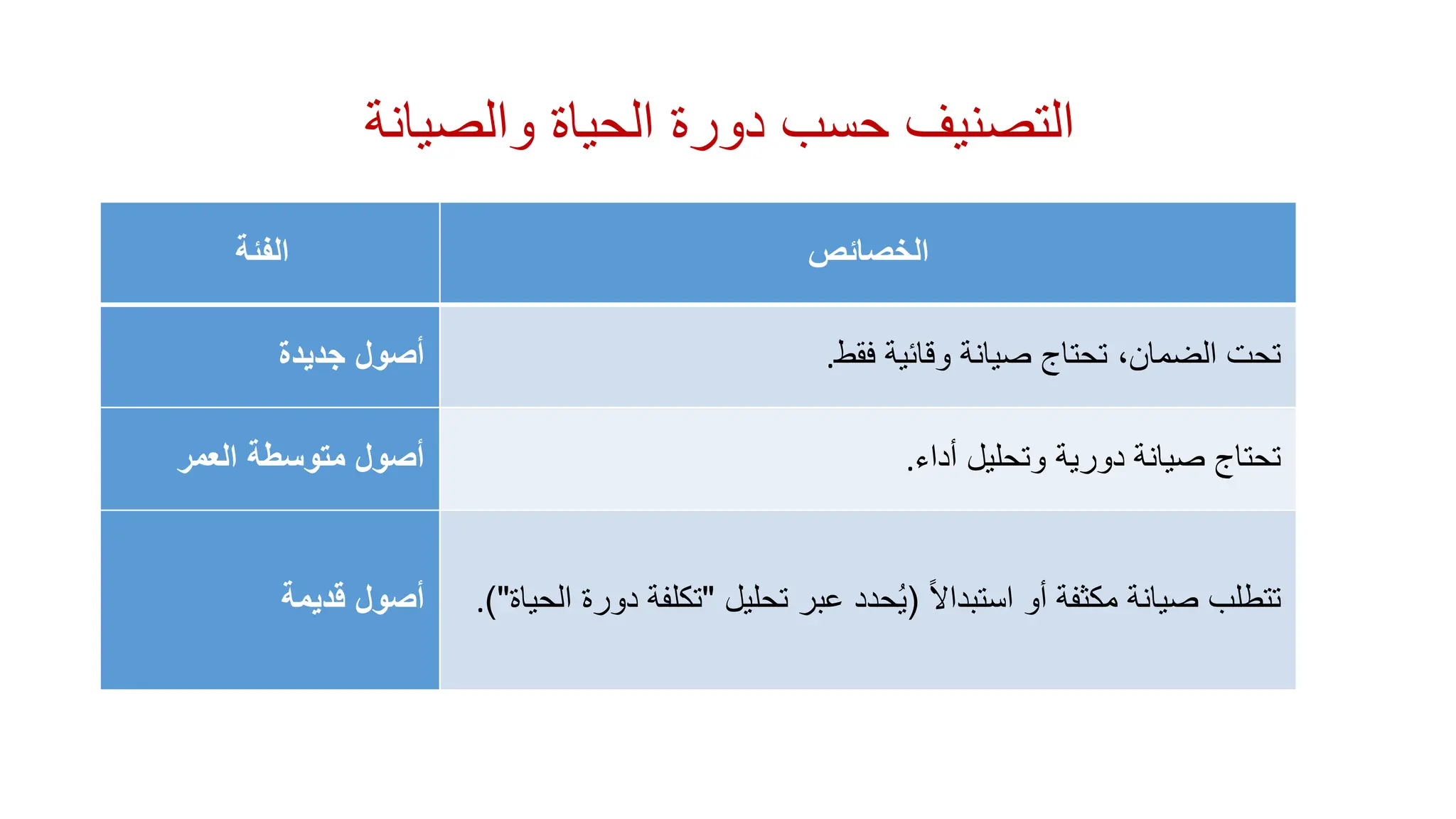
‫والصيانة‬ ‫الحياة‬ ‫دورة‬ ‫حسب‬ ‫التصنيف‬
‫الفئة‬ ‫الخصائص‬
‫جديدة‬ ‫أصول‬ ‫فقط‬ ‫وقائية‬ ‫صيانة‬ ‫تحتاج‬ ،‫الضمان‬ ‫تحت‬
.
‫العمر‬ ‫متوسطة‬ ‫أصول‬ ‫أداء‬ ‫وتحليل‬ ‫دورية‬ ‫صيانة‬ ‫تحتاج‬
.
‫قديمة‬ ‫أصول‬ ً‫ال‬‫استبدا‬ ‫أو‬ ‫مكثفة‬ ‫صيانة‬ ‫تتطلب‬
(
‫تحليل‬ ‫عبر‬ ‫حدد‬ُ‫ي‬
"
‫تكل‬
‫الحياة‬ ‫دورة‬ ‫فة‬
)"
.
‫المالية‬ ‫القيمة‬ ‫حسب‬ ‫التصنيف‬
•
‫القيمة‬ ‫عالية‬ ‫أصول‬
:
‫مرتفعة‬ ‫استبدالها‬ ‫تكلفة‬
(
‫مثل‬
:
‫الكهرباء‬ ‫توليد‬ ‫محطات‬
)
.
•
‫متوسطة‬ ‫أصول‬
‫القيمة‬
)
‫مثل‬
:
‫أنممة‬
‫المركزي‬ ‫والتبريد‬ ‫التكييف‬
(
•
‫منخفضة‬ ‫أصول‬
‫القيمة‬
)
‫مثل‬
:
‫متوسطة‬ ‫ونسخ‬ ‫طباعة‬ ‫ألة‬
,
‫أدوات‬
‫الصيانة‬
‫الروتينية‬
(
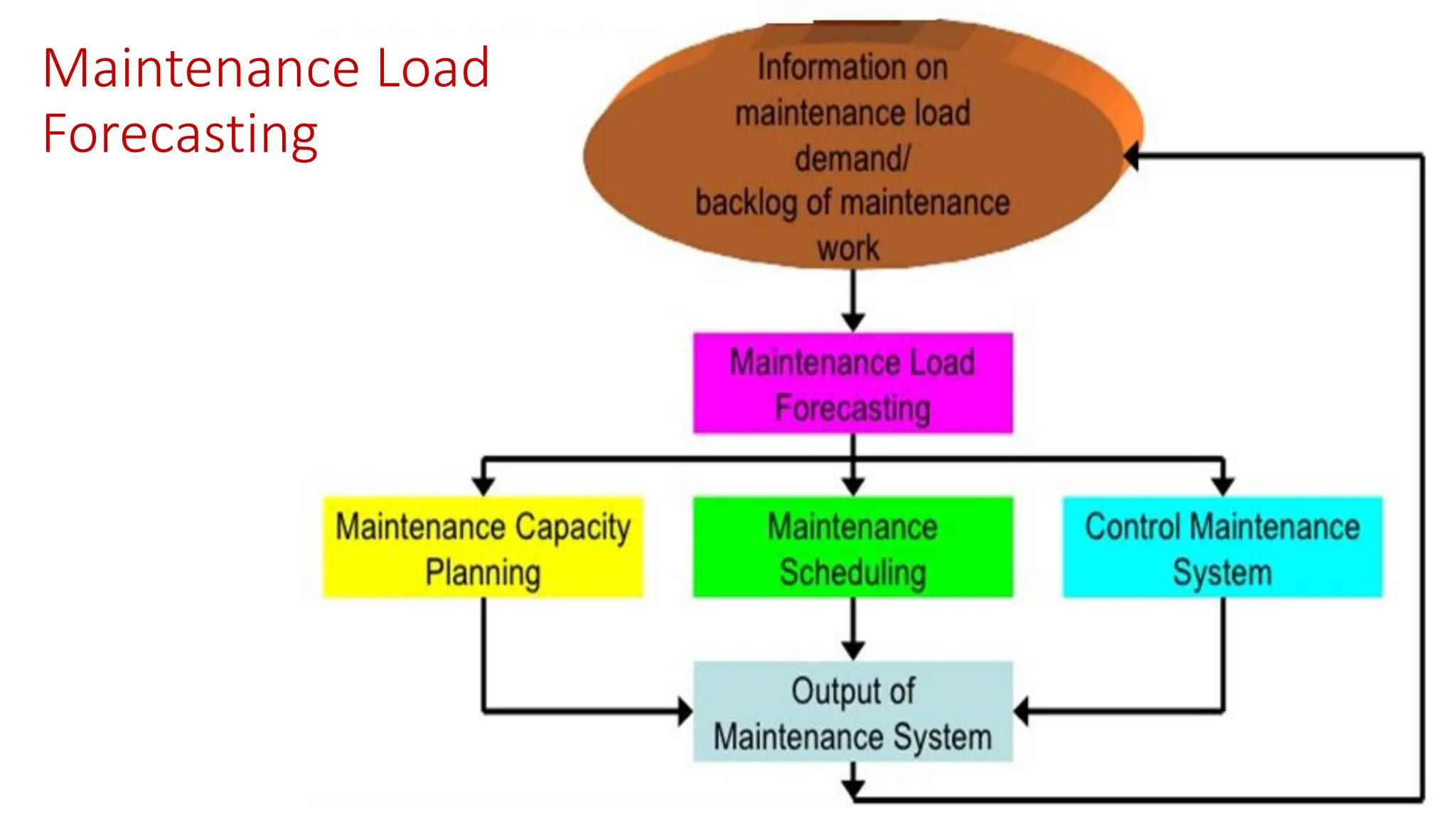
Maintenance Load
Forecasting
‫اسبوعية‬ ‫توزيع‬ ‫مثال‬
‫الفعلية‬ ‫األسبوعية‬ ‫العمل‬ ‫ساعات‬ ‫عدد‬
Actual weekly working hours
20
%
‫الطارئة‬ ‫للصيانة‬ ‫الساعات‬ ‫من‬
Emergency Maintenance
%
80
‫الوقائية‬ ‫للصيانة‬ ‫الساعات‬ ‫من‬
‫والتصحيحية‬
Heavy PM & CM
80%
Visual PM 20%
Evolution and Ranking
of Maintenance
Policies
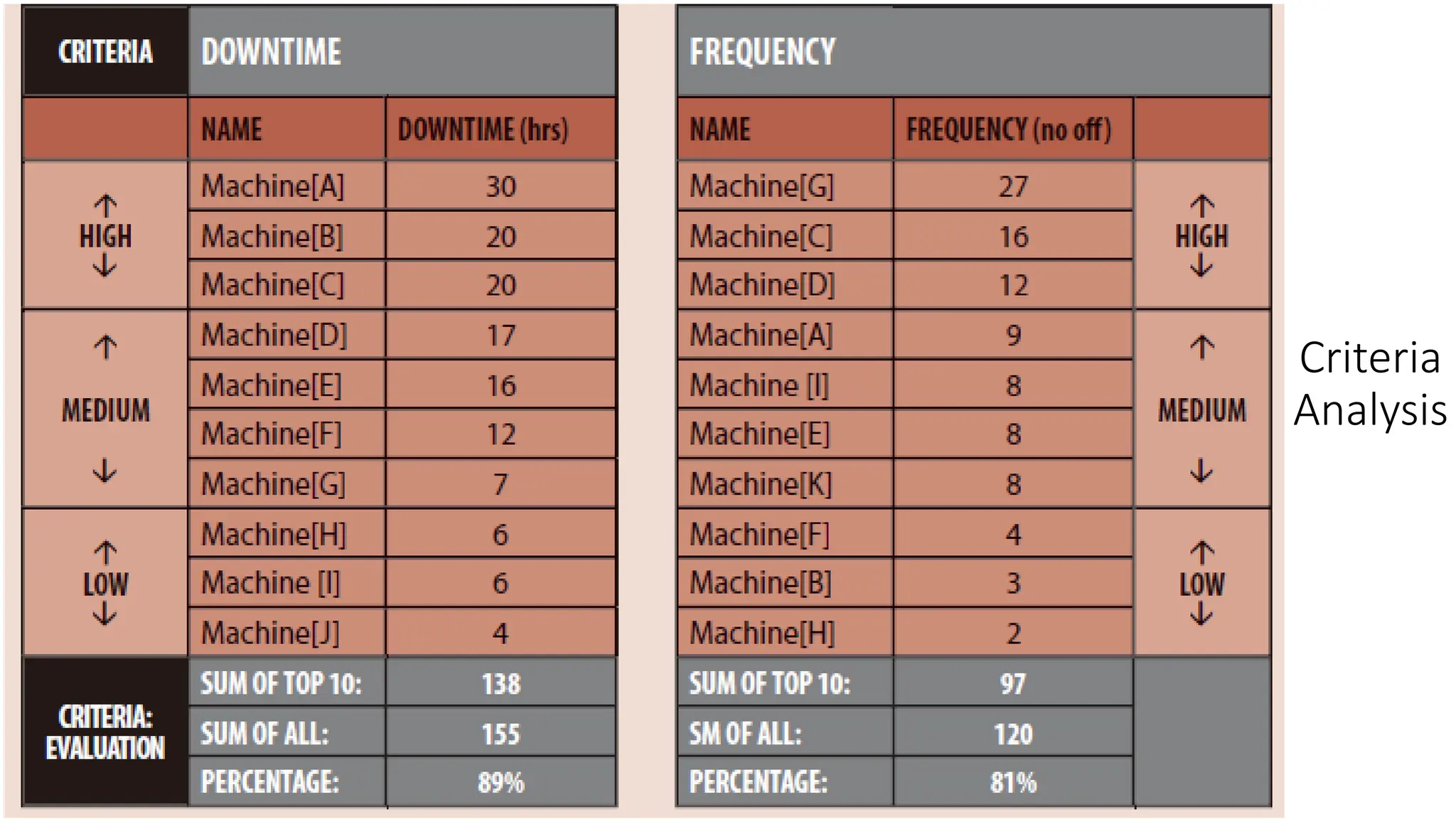
Criteria
Analysis
Decision Mapping
CBM: Condition Base Monitoring
OTF: Operate To failure
SLU: Skill Level Upgrade
DOM: Design Out M/C.
FTM: Fixed Time Maintenance
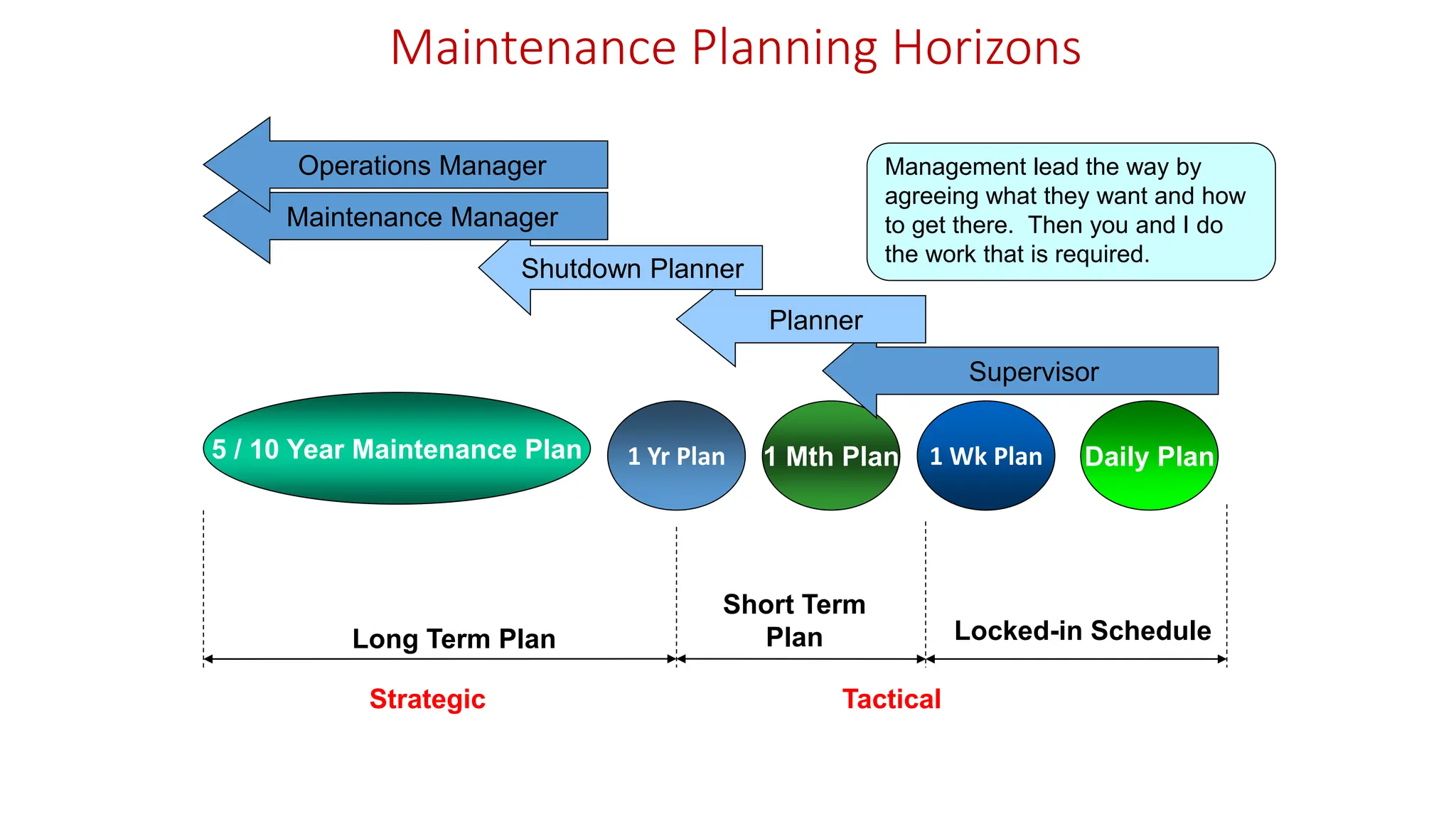
Maintenance Planning Horizons
5 / 10 Year Maintenance Plan 1 Yr Plan 1 Mth Plan 1 Wk Plan Daily Plan
Long Term Plan
Short Term
Plan Locked-in Schedule
Supervisor
Planner
Shutdown Planner
Maintenance Manager
Management lead the way by
agreeing what they want and how
to get there. Then you and I do
the work that is required.
Operations Manager
Strategic Tactical
Putting Maintenance Strategy into Action
The strategy gets
turned into plans,
that if achieved,
will deliver the
operating goals.
These plans
become what we
work on during the
years and months
ahead.
‫توجيه‬
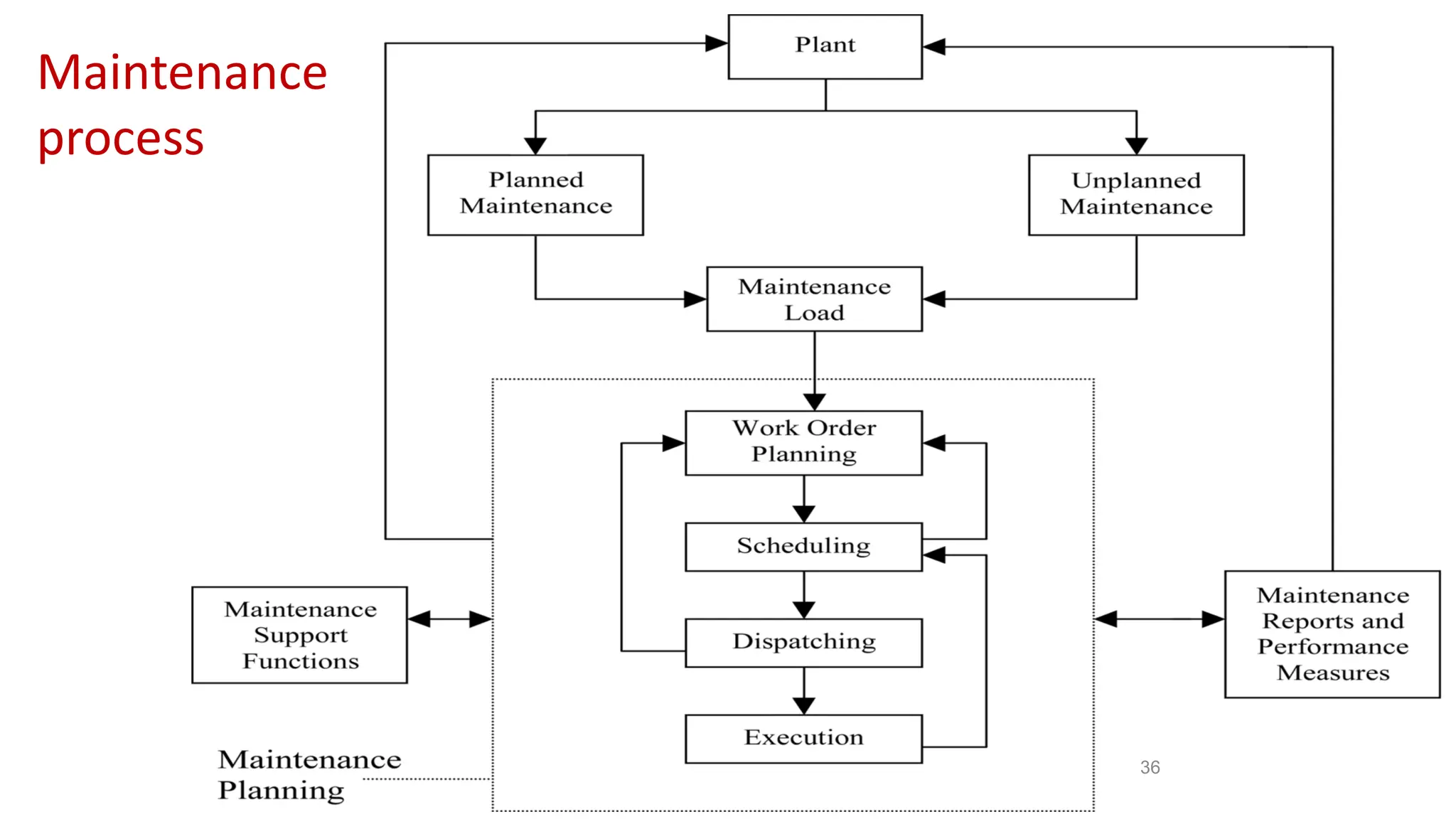
36
Maintenance
process
The work planning and Scheduling Process
‫في‬ ‫المعلومات‬ ‫ة‬
‫ر‬‫إدا‬ ‫نظام‬
‫الصيان‬
‫ة‬
‫مخطط‬
‫سريان‬
‫المعلومات‬
‫للرقابة‬
‫على‬
‫المواد‬
‫العمل‬ ‫أمر‬ ‫إصدار‬
‫على‬ ‫اد‬‫و‬‫م‬ ‫طلب‬
‫العمل‬ ‫أمر‬ ‫رقم‬
‫اآللي‬ ‫الحاسب‬
‫هل‬
‫المطلوبة‬ ‫اد‬‫و‬‫الم‬
‫موجودة‬
‫إصدار‬
‫تقرير‬
‫عن‬
‫مختلف‬
‫المردين‬ ‫و‬ ‫المواد‬
‫العمل‬ ‫أمر‬ ‫اد‬‫و‬‫م‬ ‫تسليم‬
‫اد‬‫و‬‫الم‬ ‫اء‬
‫ر‬‫ش‬
‫اد‬‫و‬‫الم‬ ‫استالم‬
‫المستودعات‬
‫اآللي‬ ‫الحاسب‬
‫اء‬
‫ر‬‫الش‬ ‫امر‬ ‫اصدار‬
‫اد‬‫و‬‫الم‬ ‫عن‬ ‫معلومات‬
‫الالزمة‬ ‫وكميتها‬
‫استخدامها‬‫و‬
(
‫العمل‬ ‫أمر‬
)
‫التخزين‬ ‫رقم‬
‫التخزين‬ ‫موقع‬
‫الشراء‬ ‫كمية‬ ‫تحديد‬
‫ومستوى‬ ‫االقتصادية‬
‫األدنى‬ ‫التخزين‬
‫لدى‬ ‫الشراء‬ ‫أمر‬ ‫يصدر‬
‫المخزنة‬ ‫الكمية‬ ‫وصول‬
‫للتخزين‬ ‫األدنى‬ ‫للحد‬
‫نعم‬
‫ال‬
decision/activity
scheme
Maintenance Planning
And Scheduling
Benefits of Maintenance
Planning and Scheduling
Decreased
Asset
Downtime
Increased
Asset Life
Minimized
Sudden
Breakdown
Improved
Workflow
Increased
Productivity
Decreased
Maintenance
Expenses
Better
Coordination
Enhanced
Asset
Performance
Maintenance Planning And Scheduling
Do's and Don'ts
• Choose the Right
Maintenance Planner
• Train Maintenance
Planner
• Keep Maintenance
History
• Check Equipment &
Inventory Availability
• Don't Ignore KPΙ
• Don't Give
Incomplete
Information
• Don't Take Small
Feedbacks
Do's of
Maintenance Planning and
Scheduling
Don'ts of
Maintenance Planning and
Scheduling
Maintenance Planning And Scheduling
Useful Tips
Properly Train the
Planner
Make Changes Based
on Feedback
Ensure Job Plans are
Clear and Concise
Understand the
Difference Between
Planning & Scheduling
Provide Feedback on
Completed Tasks
Choose a Good
Maintenance Planner
01
02
03
04
05
06
Maintenance Planning And Scheduling
Recognize the skills of the techs
Protect the planner
Focus on future work
Component level-files
Use planner judgment for time estimates
Daily work is handled by the crew leader
Job plans are needed for scheduling
Scheduling and job priorities are
important
Schedule based on the highest skills
available
Schedule for every available work hour
VS
Planning Principles Scheduling Principles
Control Activities
 Cost Control
 Quality Control
 Inventory Control
 Work Control
Cost Types & Control
Quality Control
Inventory &Work Control
The Purpose of Business
Profit ($) = Revenue - Total Costs Total Costs ($) = Fixed Costs + Variable Costs
EBITDA = Earnings before Interest, Tax, Depreciation, Amortization – it represents the operating profit.
I want to show
you the disaster
that plant and
equipment failures
are to a business.
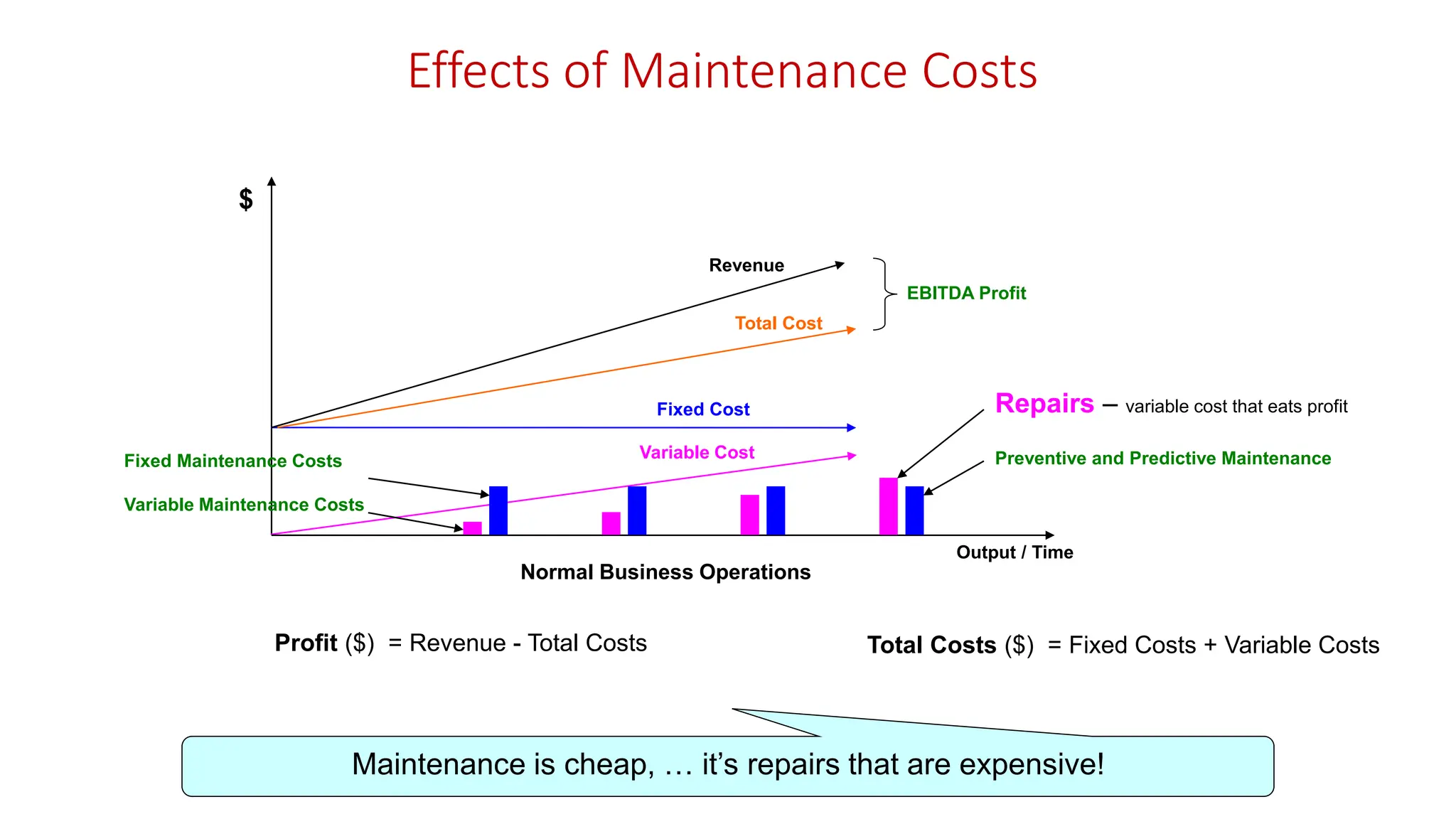
Effects of Maintenance Costs
Profit ($) = Revenue - Total Costs Total Costs ($) = Fixed Costs + Variable Costs
$
Output / Time
EBITDA Profit
Variable Cost
Fixed Cost
Normal Business Operations
Revenue
Total Cost
Fixed Maintenance Costs
Variable Maintenance Costs
Preventive and Predictive Maintenance
Repairs – variable cost that eats profit
Maintenance is cheap, … it’s repairs that are expensive!
Impact of Defects and Failures
Total Costs ($) = Productive Fixed Costs ($) + Productive Variable Costs ($) + Costs of Loss ($)
Cost of Loss ($/Yr) = Frequency of Loss Occurrence (/Yr) x Cost of Loss Occurrence ($)
Effects on Costs and Profit of a Failure Incident
$
Output / Time
Revenue
Total Cost
Fixed Cost
t1 t2
Profits forever lost
Increased and Wasted Variable Costs
Wasted Fixed Costs
Added Cost Impact of a Failure
Incident
Variable Cost
Stock-out
Once the equipment fails, new costs and losses start appearing.
Maintenance Costs
Maintenance
Commitment
Cost
PM Cost
Total Maintenance Cost
Breakdown Cost
Optimal
Defect and Failure True (DAFT) Costs go Company-wide
www.BIN95.com
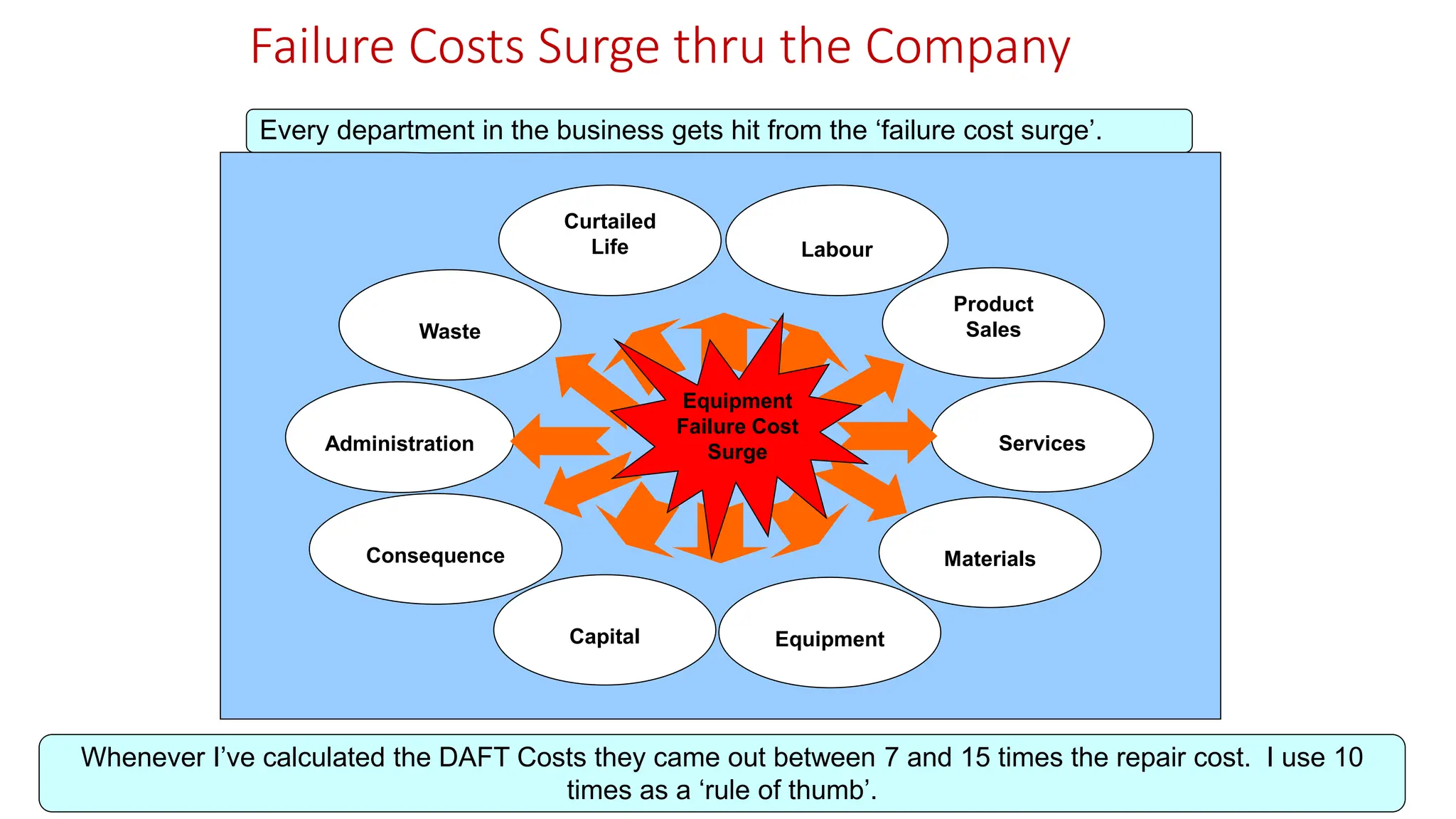
It’s unbelievable how much money is wasted all over the business with each failure. The one I like is the time lost matching
invoices against purchase orders that did not need to be raised, but for the failure! The ‘lost life value’ of parts is expensive too.
Whenever I’ve calculated the DAFT Costs they came out between 7 and 15 times the repair cost. I use 10
times as a ‘rule of thumb’.
Failure Costs Surge thru the Company
Labour
Product
Sales
Services
Capital Equipment
Consequence
Waste
Materials
Administration
Equipment
Failure Cost
Surge
Curtailed
Life
Every department in the business gets hit from the ‘failure cost surge’.
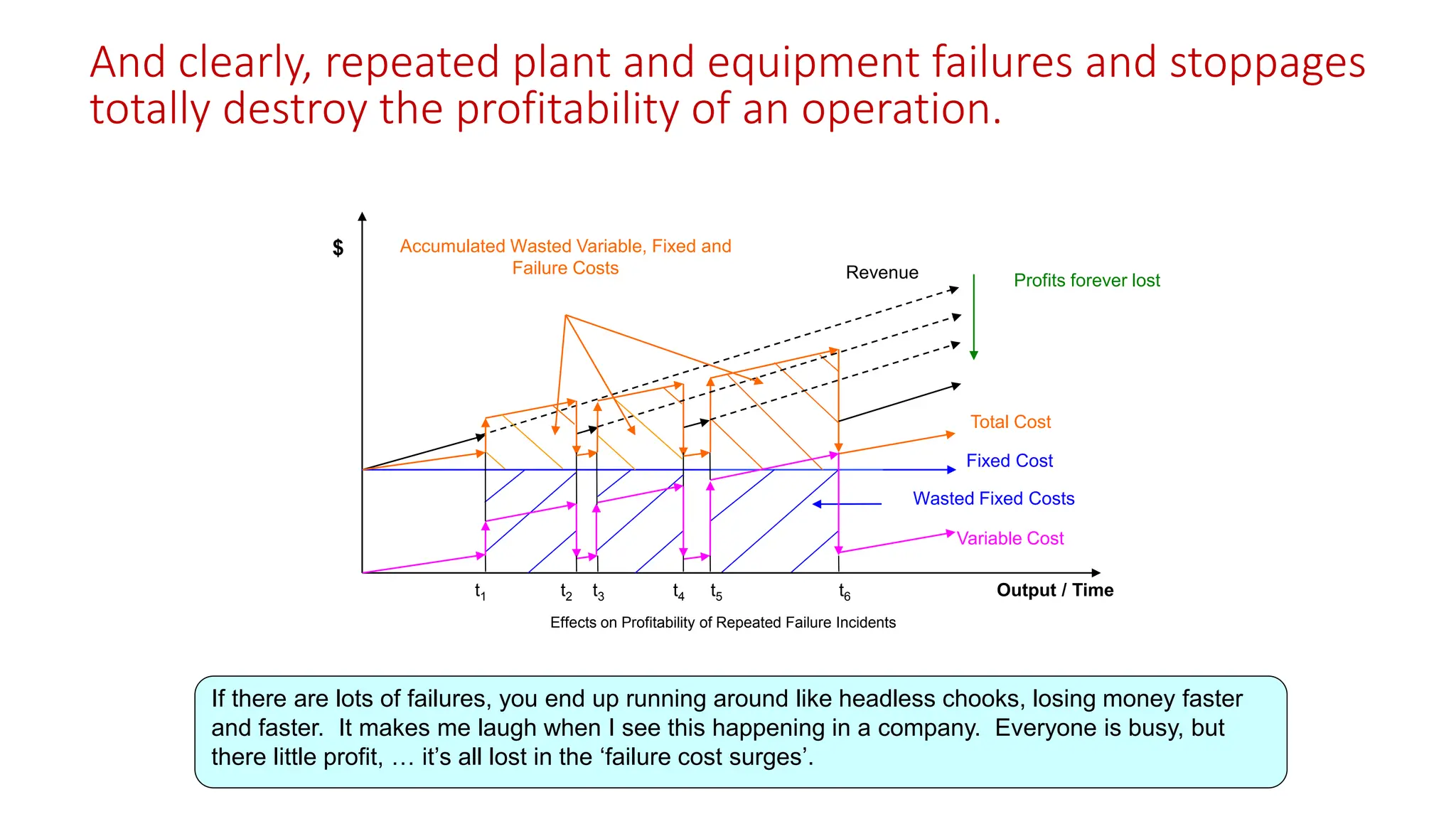
And clearly, repeated plant and equipment failures and stoppages
totally destroy the profitability of an operation.
$
Output / Time
Effects on Profitability of Repeated Failure Incidents
t1 t2 t3 t4 t5 t6
Profits forever lost
Accumulated Wasted Variable, Fixed and
Failure Costs
Wasted Fixed Costs
Revenue
Total Cost
Fixed Cost
Variable Cost
If there are lots of failures, you end up running around like headless chooks, losing money faster
and faster. It makes me laugh when I see this happening in a company. Everyone is busy, but
there little profit, … it’s all lost in the ‘failure cost surges’.
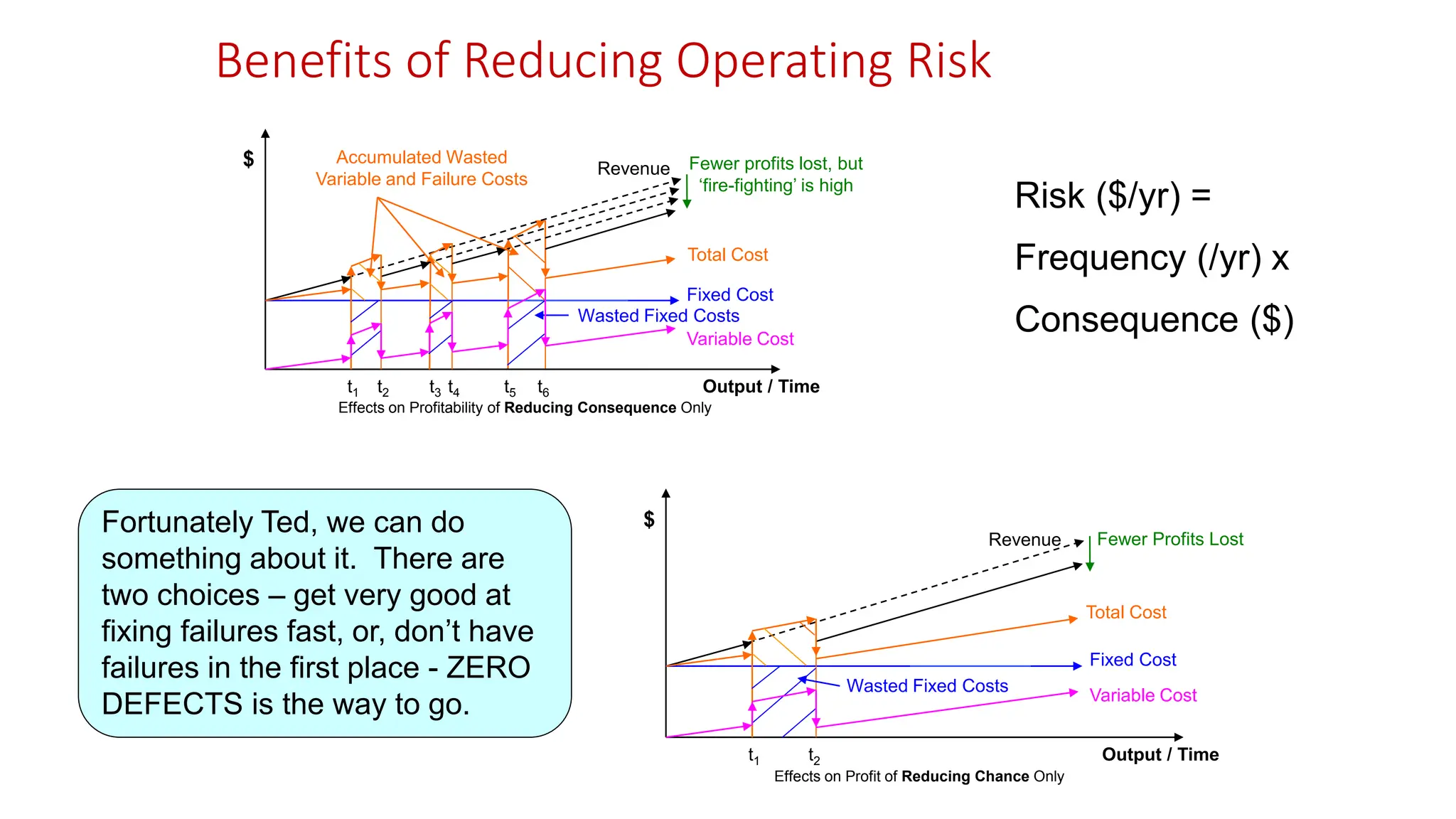
Fortunately Ted, we can do
something about it. There are
two choices – get very good at
fixing failures fast, or, don’t have
failures in the first place - ZERO
DEFECTS is the way to go.
Benefits of Reducing Operating Risk
$
Output / Time
Effects on Profitability of Reducing Consequence Only
t1 t2 t3 t4 t5 t6
Fewer profits lost, but
‘fire-fighting’ is high
Accumulated Wasted
Variable and Failure Costs
Wasted Fixed Costs
Revenue
Variable Cost
Fixed Cost
Total Cost
$
Output / Time
Effects on Profit of Reducing Chance Only
t1 t2
Fewer Profits Lost
Wasted Fixed Costs
Revenue
Total Cost
Fixed Cost
Variable Cost
Risk ($/yr) =
Frequency (/yr) x
Consequence ($)
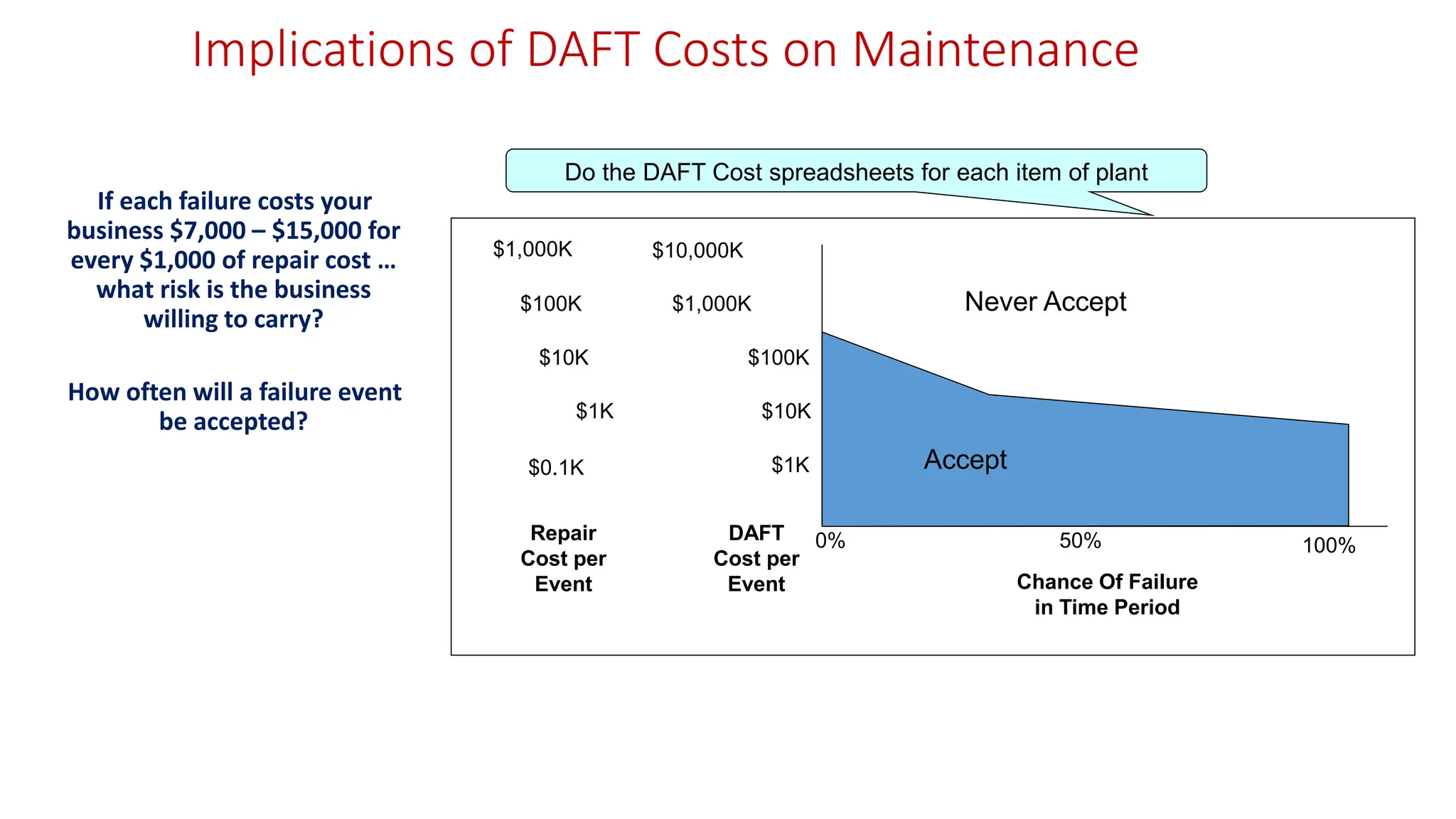
Implications of DAFT Costs on Maintenance
Chance Of Failure
in Time Period
DAFT
Cost per
Event
$1K
$10K
$100K
$1,000K
$10,000K
0% 100%
$0.1K
$1K
$10K
$100K
$1,000K
Repair
Cost per
Event
Accept
Never Accept
50%
Do the DAFT Cost spreadsheets for each item of plant
If each failure costs your
business $7,000 – $15,000 for
every $1,000 of repair cost …
what risk is the business
willing to carry?
How often will a failure event
be accepted?
Acceptable Equipment Item Failure Domain
DAFT
Cost per
Failure Event
$1K
$10K
$100K
$1,000K
$10,000K
$0.1K
$1K
$10K
$100K
$1,000K
Repair
Cost per
Failure Event
Outside the Volume Never Accept Failure
1
2
3
4
Limit of
$10,000/Period
What is your tolerance for problems on a
piece of equipment?
Inside this Volume Accept Failure
Chance Of Failure in Time Period
100%
50%
10%
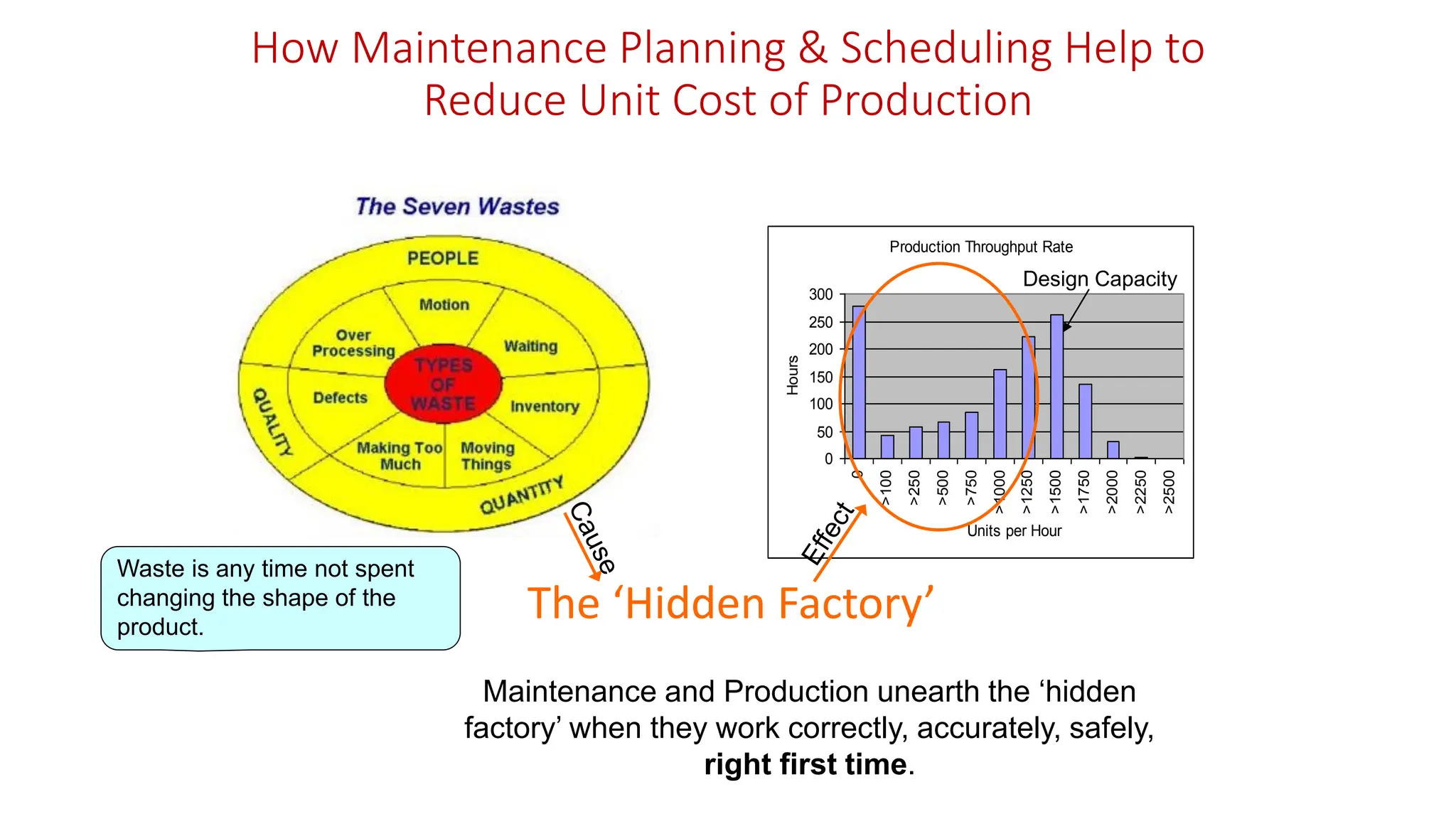
How Maintenance Planning & Scheduling Help to
Reduce Unit Cost of Production
The ‘Hidden Factory’
Maintenance and Production unearth the ‘hidden
factory’ when they work correctly, accurately, safely,
right first time.
Production Throughput Rate
0
50
100
150
200
250
300
0
>100
>250
>500
>750
>1000
>1250
>1500
>1750
>2000
>2250
>2500
Units per Hour
Hours
Waste is any time not spent
changing the shape of the
product.
Design Capacity
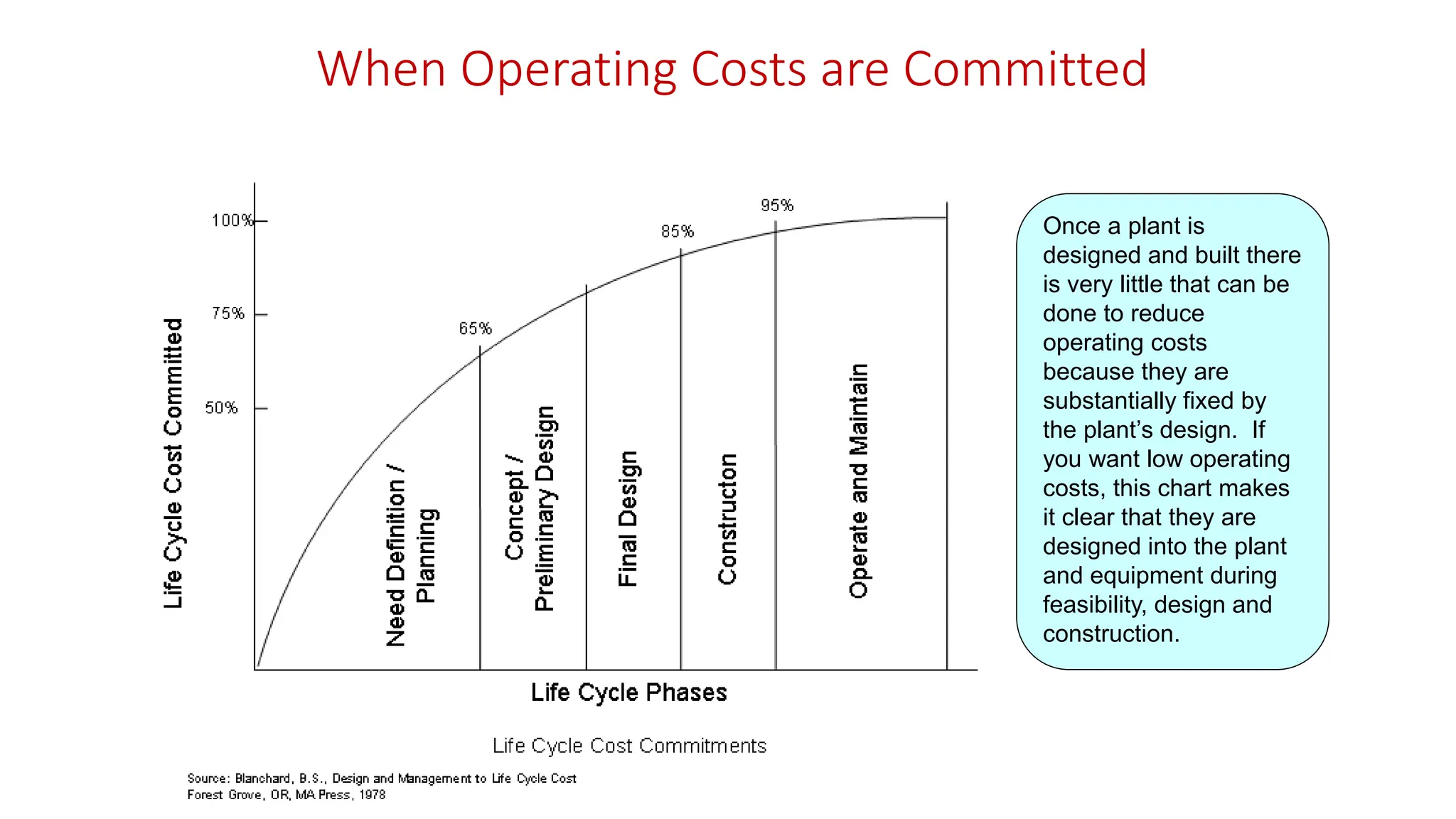
When Operating Costs are Committed
Once a plant is
designed and built there
is very little that can be
done to reduce
operating costs
because they are
substantially fixed by
the plant’s design. If
you want low operating
costs, this chart makes
it clear that they are
designed into the plant
and equipment during
feasibility, design and
construction.
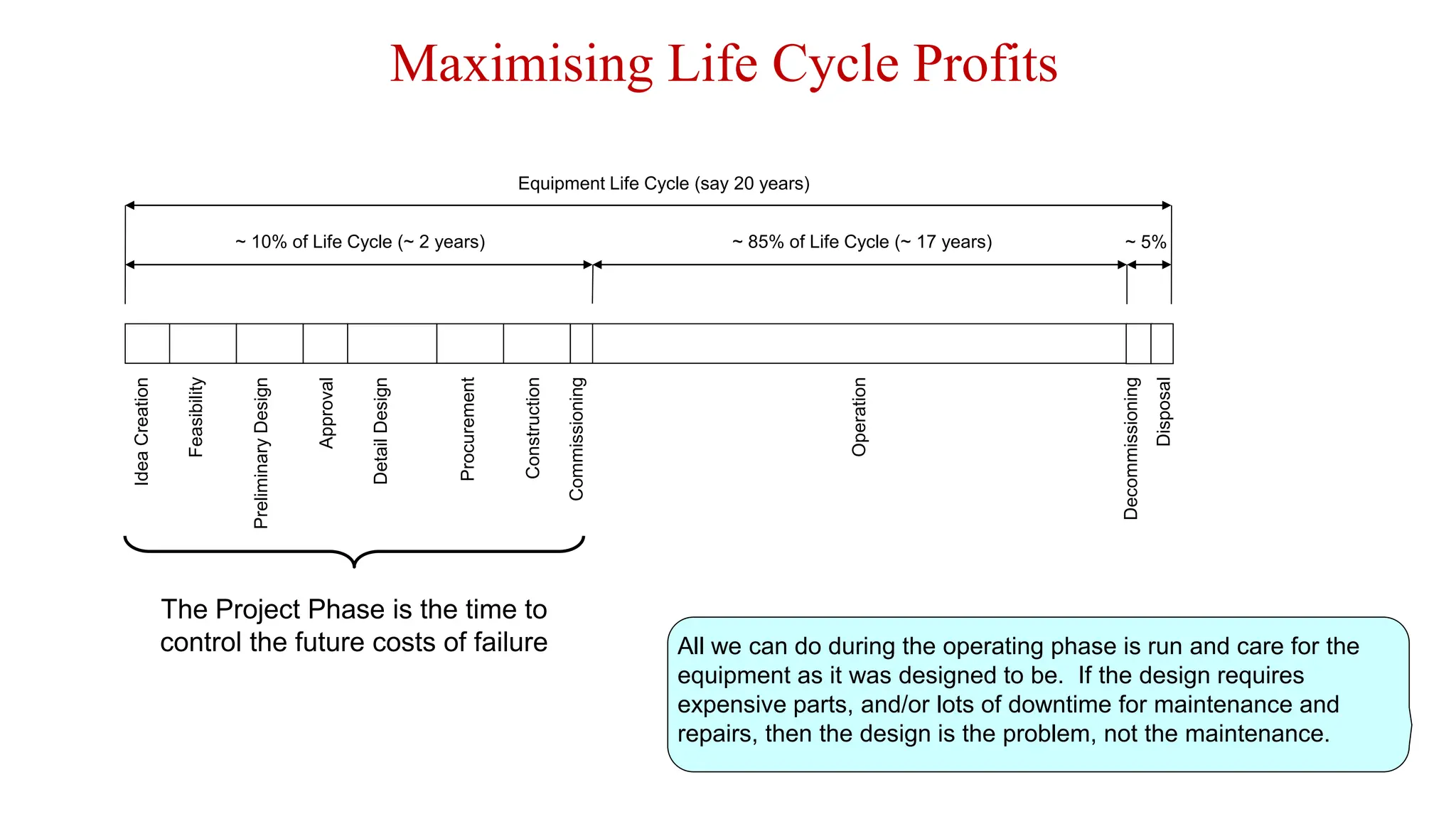
Maximising Life Cycle Profits
Idea
Creation
Approval
Detail
Design
Procurement
Construction
Commissioning
Decommissioning
Equipment Life Cycle (say 20 years)
~ 10% of Life Cycle (~ 2 years) ~ 85% of Life Cycle (~ 17 years) ~ 5%
Preliminary
Design
Feasibility
Operation
Disposal
The Project Phase is the time to
control the future costs of failure All we can do during the operating phase is run and care for the
equipment as it was designed to be. If the design requires
expensive parts, and/or lots of downtime for maintenance and
repairs, then the design is the problem, not the maintenance.
Life Cycle Risk Management Strategy
Optimised Operating Profit Method
Design
Drawings
Assume
Equipment
Failure
DAFT
Costs
Spreadsheet
Applicable
O & M
Strategies
Redesign
with FMEA;
Revise
O & M
Strategies,
Revise
Project
Strategies
Projected
R & M
Costs
Busine$$
Ri$k Ba$ed
Equipment
Criticality
Applicable
Project
Strategies
Frequency
Achievable?
N
Y
Quality Procedures
Precision Maint
Predictive Maint
Preventive Maint
RCFA
Maint Planning
Etc.
FMEA/RCM
HAZOP
Precision Standards
Precision Instaln
Reliability Eng
Etc.
Failure Cost
Acceptable?
N
Y
Profit Optimisation Loop
It is possible to
make great
operating cost
savings during
the design, if the
designers
reduce the
operating risks
that their choices
cause the
business.
www.BIN95.com
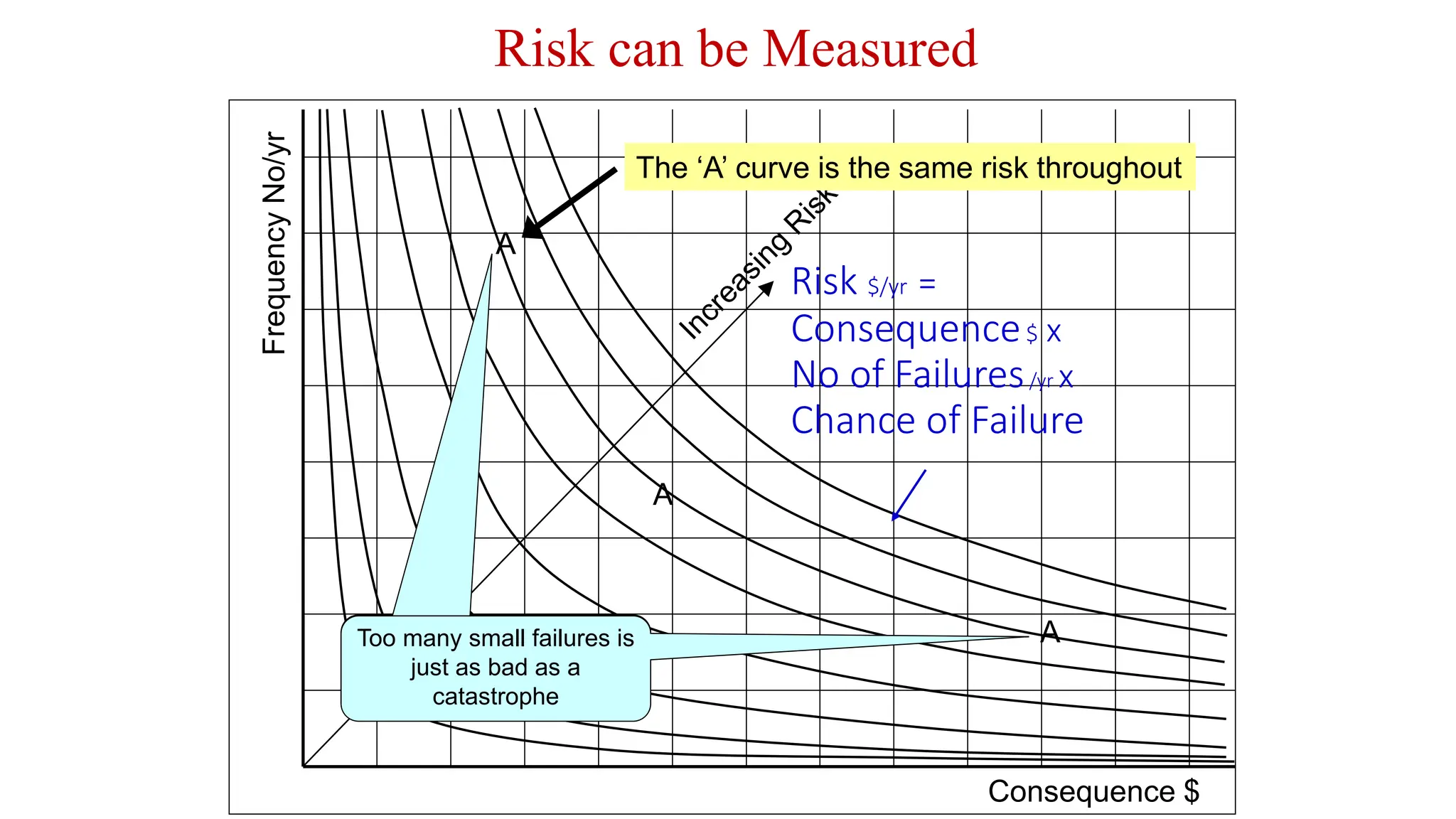
Consequence $
Frequency
No/yr Risk $/yr =
Consequence$ x
No of Failures/yr x
Chance of Failure
Risk can be Measured
The ‘A’ curve is the same risk throughout
A
A
A
Too many small failures is
just as bad as a
catastrophe
Too many small failures is
just as bad as a
catastrophe
www.BIN95.com
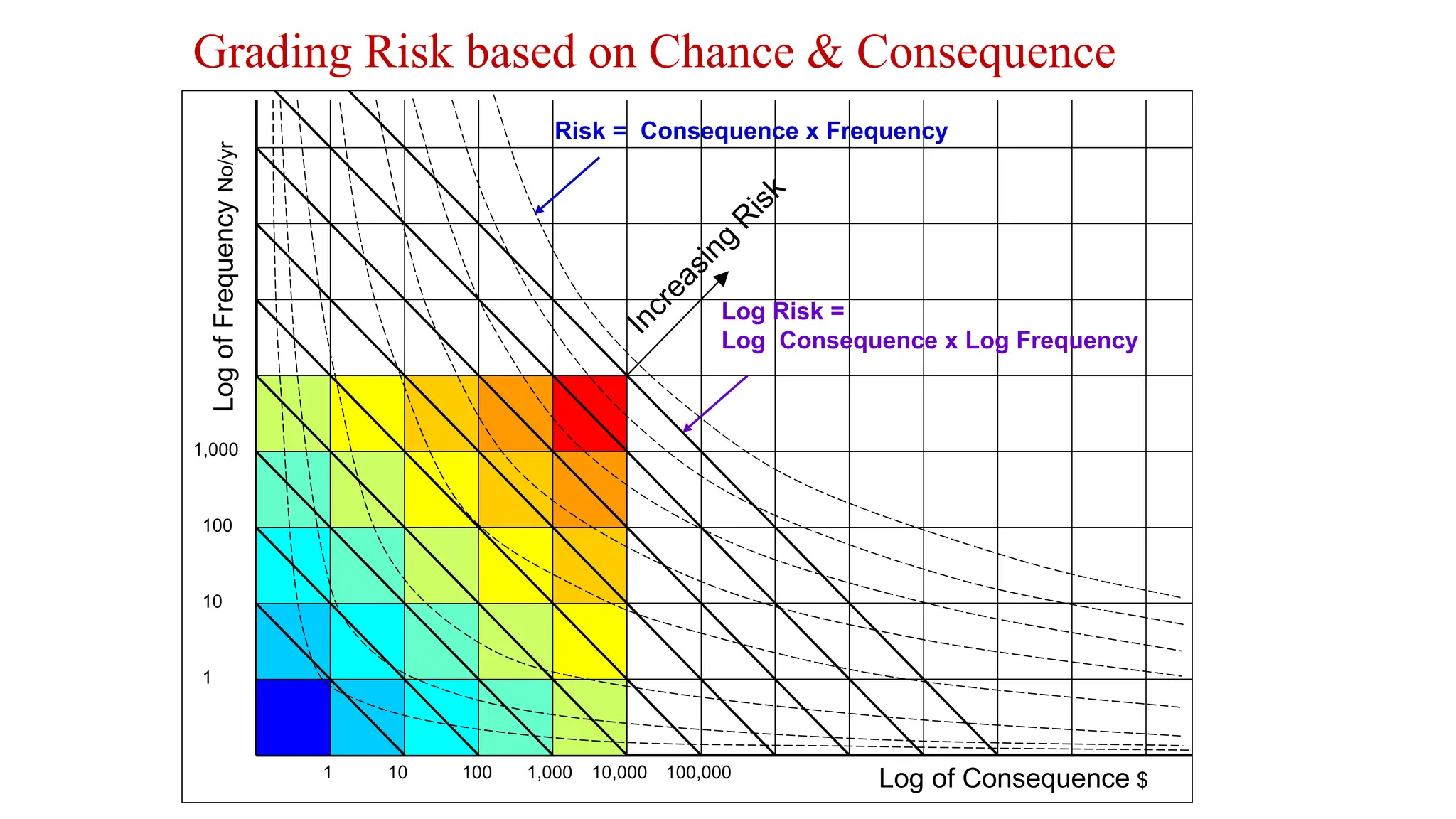
Grading Risk based on Chance & Consequence
Log of Consequence $
Log
of
Frequency
No/yr
Log Risk =
Log Consequence x Log Frequency
1 10 100 1,000 10,000 100,000
1
10
100
1,000
Risk = Consequence x Frequency
www.BIN95.com
What Risk Means
Log Consequence $
Log
Frequency
No/yr
Hazard
Consequences
All
threat
barriers
in place
can
have
‘holes’
in them.
What is
the
likely
cause of
the
‘holes’
in the
barriers
?
I used to wonder why we
were so lucky that more
things didn’t go wrong!
Log-log plot
In reality, extreme risk
doesn't arise often.
What is
the
chance
the
‘holes’
line-up
at the
same
time?
Risk – Reduce Chance or Reduce Consequence?
Risk = Chance x Consequence
 Engineering and Maintenance Standards
 Failure Design-out - Corrective Maintenance
 Failure Mode Effects Criticality Analysis (FMECA)
 Statistical Process Control
 Hazard and Operability Study (HAZOP)
 Root Cause Failure Analysis (RCFA)
 Precision Maintenance
 Hazard Identification (HAZID)
 Training and Up-skilling
 Quality Management Systems
 Planning and Scheduling
 Continuous Improvement
 Supply Chain Management
 Accuracy Controlled Enterprise SOPs (ACE 3T)
 Design, Operation, Cost Total Optimisation
Review (DOCTOR)
 Defect and Failure True Cost (DAFTC)
 Oversize/De-rate Equipment
 Reliability Engineering
 Preventative Maintenance
 Predictive Maintenance
 Total Productive Maintenance (TPM)
 Non-Destructive Testing
 Vibration Analysis
 Oil Analysis
 Thermography
 Motor Current Analysis
 Prognostic Analysis
 Emergency Management
 Computerised Maintenance Management
System (CMMS)
 Key Performance Indicators (KPI)
 Risk Based Inspection (RBI)
 Operator Watch-keeping
 Value Contribution Mapping (Process step
activity based costing)
 Logistics, stores and warehouses
 Maintenance Engineering
Chance Reduction Strategies Consequence Reduction Strategies
Done to reduce the chance of failure Done to reduce the cost of failure
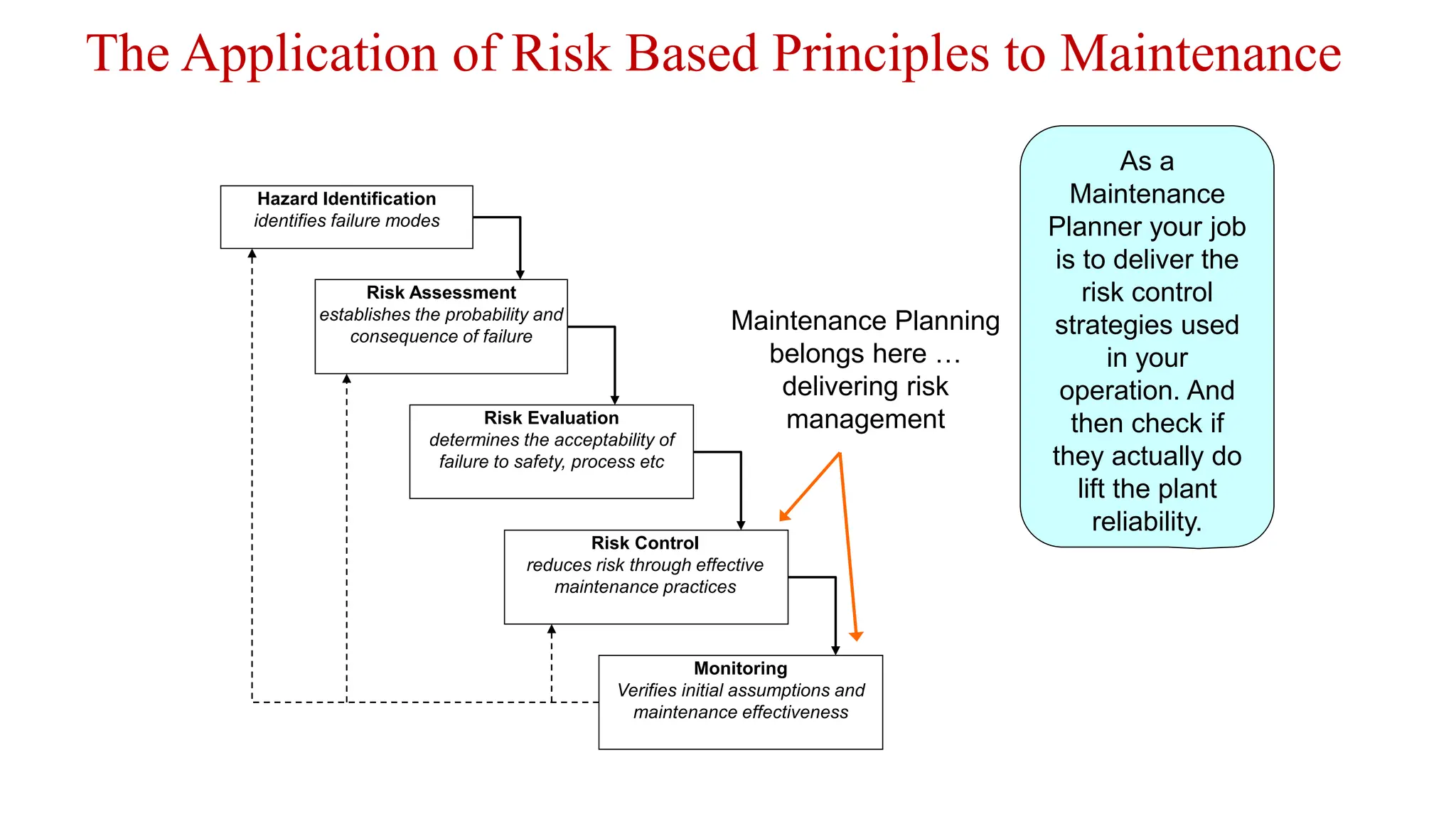
The Application of Risk Based Principles to Maintenance
Hazard Identification
identifies failure modes
Risk Assessment
establishes the probability and
consequence of failure
Risk Evaluation
determines the acceptability of
failure to safety, process etc
Risk Control
reduces risk through effective
maintenance practices
Monitoring
Verifies initial assumptions and
maintenance effectiveness
Maintenance Planning
belongs here …
delivering risk
management
As a
Maintenance
Planner your job
is to deliver the
risk control
strategies used
in your
operation. And
then check if
they actually do
lift the plant
reliability.
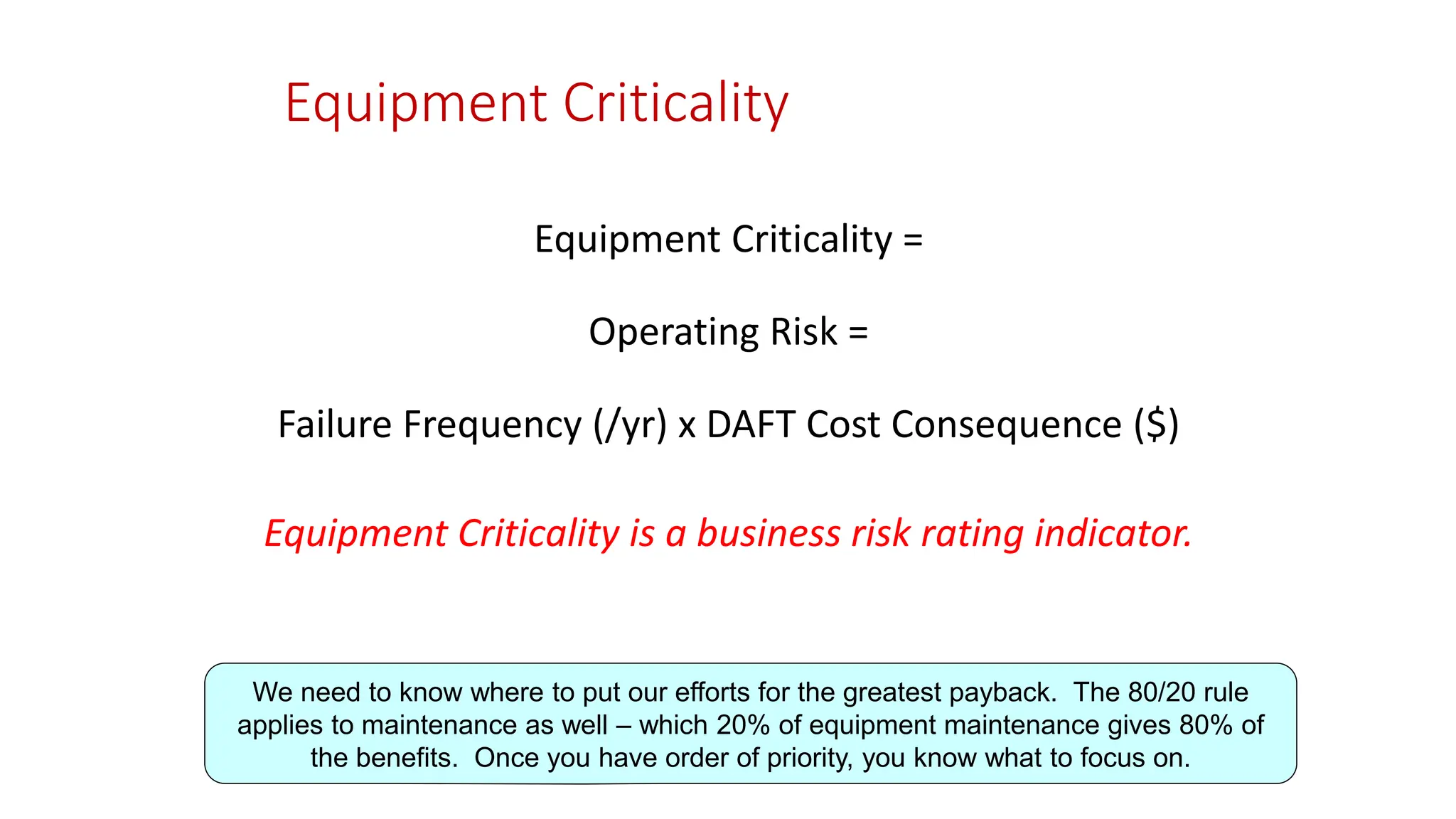
Equipment Criticality
Equipment Criticality =
Operating Risk =
Failure Frequency (/yr) x DAFT Cost Consequence ($)
Equipment Criticality is a business risk rating indicator.
We need to know where to put our efforts for the greatest payback. The 80/20 rule
applies to maintenance as well – which 20% of equipment maintenance gives 80% of
the benefits. Once you have order of priority, you know what to focus on.
Match Maint Type to Equipment Criticality Risk Based Method
Breakdown Based
Maintenance
Hazardous, Safety,
Environmental dangers
from process
Breakdown, stops
production, affects quality
Breakdown, stops
production, affects quality
Affects downstream plant Affects downstream plant
Can be fixed on-line Can be fixed on-line
S C
B
A
Equipment
Time Based
Maintenance
Condition Based
Maintenance
S = Safety ; A,B,C = Maintenance Type
Once you decide the
criticality, you match
the type of
maintenance to it by
using this risk based
chart, or the next one,
which uses the
inherent reliability of
the item as the
criteria.
Choosing of Maintenance Type - Simplified RCM Method
Consequence
of failure
acceptable ?
Life
reasonably
predictable ?
Condition
Monitoring
practical ?
Condition
Monitoring
economic ?
Condition
based
maintenance
Design
out cause of
failure practical?
Designing out
cause of failure
economical ?
Time based
maintenance
Breakdown
maintenance
Plant
Change
yes
yes
yes
yes
yes
no
no
no
no
no
yes
no
Be very, very wary
of choosing to do
Breakdown
Maintenance if you
have not done the
full DAFT Costing.
My experience is
that Breakdown
Maintenance costs
a company 7 – 15
times the repair
cost. A $10,000
repair really costs
the business
between $70,000 to
$150,000. You can
buy a lot of
maintenance for
that!
RCM =
Reliability
Centred
Maintenance
Planning is a Process, and needs Control
Remember this …?
One fails … all fails! One
poor … all poor! Rsystem= R1 x R2 x R3 …
1 1 1 n
In a series process we must
be precise because there is
no redundancy. In a series
work process the only way to
do a 100% reliable job is to
make sure every task in it is
done 100% reliably.
Because planning is a series process, the task variability problem needs a work system
that standardizes what to do, and how to do it. This makes planning repeatable and
reliable. The ‘planning system’ comprises the accumulated planning procedures.
Scope Standards Parts Procedures Handover
Plan the Job
Rplan =
R1 x R2 x R3 x R4 x R5
Each task 95% reliable 0.95 x 0.95 x 0.95 x 0.95 x 0.95 = 0.77
Each task 90% reliable 0.9 x 0.9 x 0.9 x 0.9 x 0.9 = 0.59
Planning is a series process.
Track Planning Performance & Benefits
• Percent of Plan Followed During the Job
• Work Orders With Complete Work Packs
• Improved Equipment Reliability
• Improved Plant Availability
• Maintenance Backlog by Type
• Preventive Maintenance Complete On-Time
You’ll want to know how well you are going. You can work that out in three ways. First, by seeing how
closely the plan is followed. If it is done with 100% compliance and the final condition monitoring check is
within standard, you can say the plan was perfect. Second, you can see what effect the work had on the
plant’s operation. Third, is by seeing if maintenance productivity improves. If all three trend positively,
you are on-track.
Plan
Compliance
Plant
Performance
Maintenance
Performance
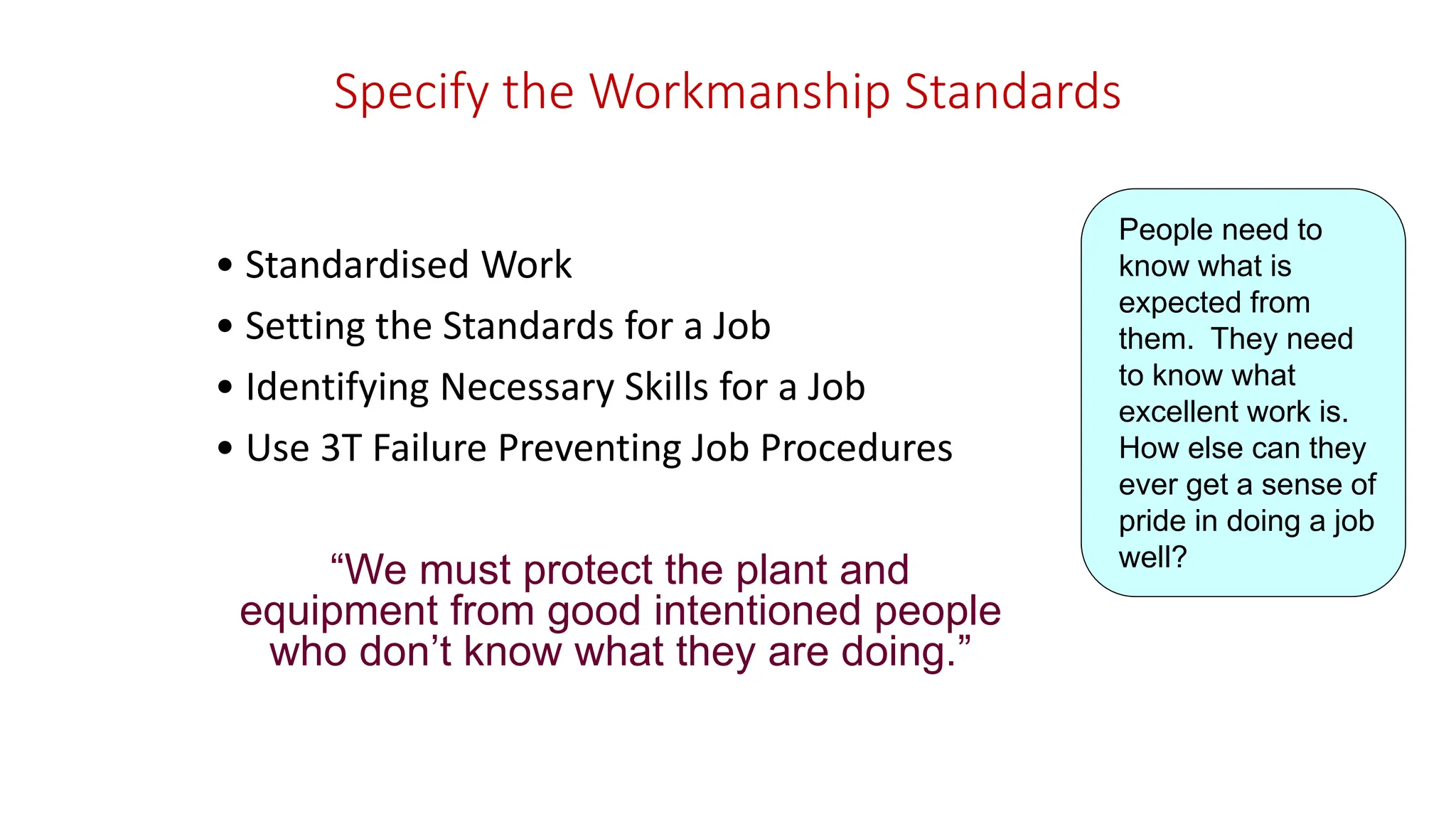
Specify the Workmanship Standards
• Standardised Work
• Setting the Standards for a Job
• Identifying Necessary Skills for a Job
• Use 3T Failure Preventing Job Procedures
“We must protect the plant and
equipment from good intentioned people
who don’t know what they are doing.”
People need to
know what is
expected from
them. They need
to know what
excellent work is.
How else can they
ever get a sense of
pride in doing a job
well?
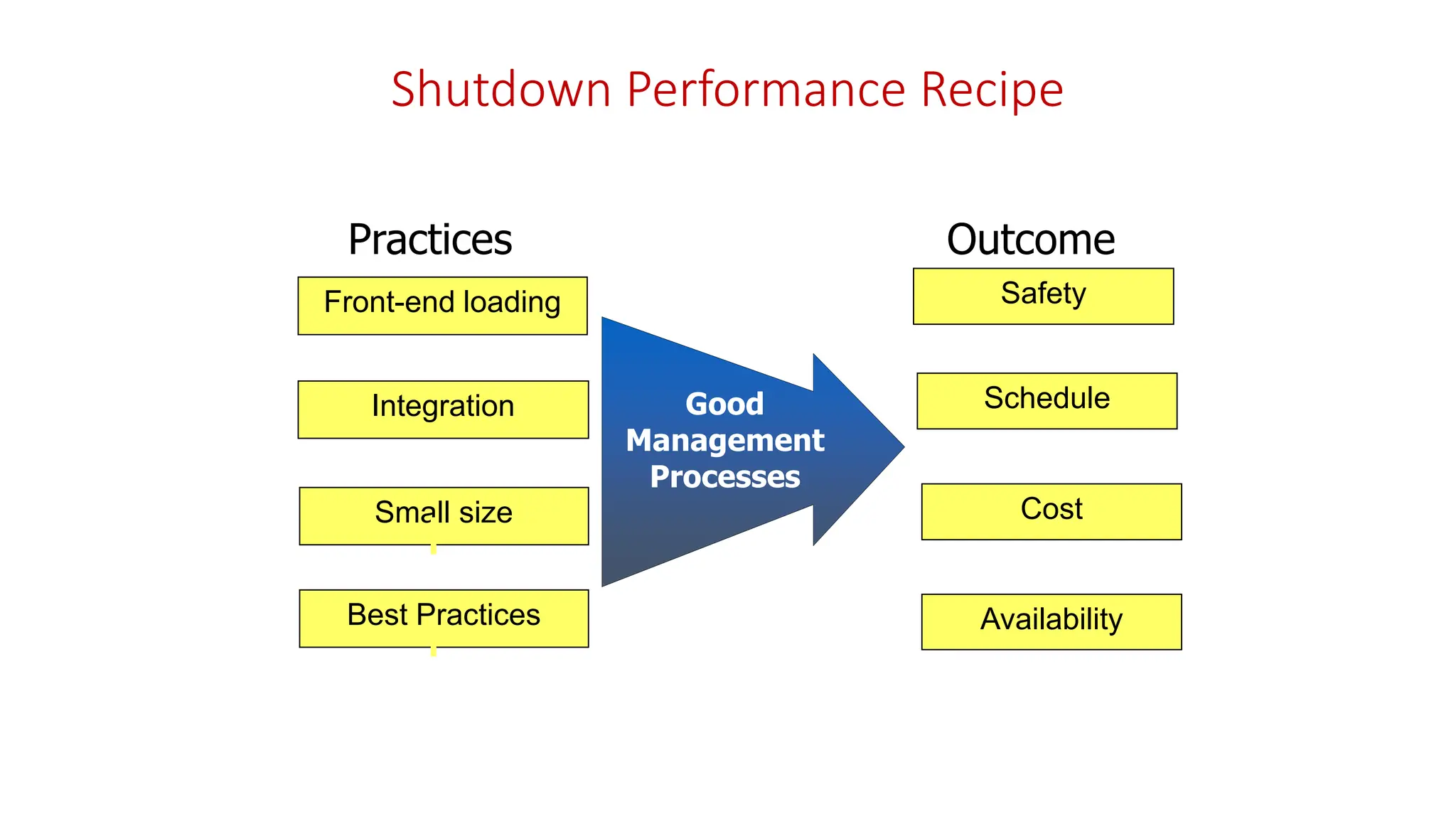
Shutdown Performance Recipe
Practices Outcome
s
Good
Management
Processes
Integration
Small size
Front-end loading
Availability
Schedule
Safety
Cost
Best Practices
Trend to Monitor KPIs
Work Orders in Backlog
0
50
100
150
200
1 2 3 4 5 6 7 8 9 10 11 12 13 14 15 16 17 18 19 20
Weeks in Backlog
Work
orders
Work Orders
0.0%
5.0%
10.0%
15.0%
20.0%
25.0%
30.0%
35.0%
40.0%
A
u
g
-
0
3
S
e
p
-
0
3
O
c
t
-
0
3
N
o
v
-
0
3
D
e
c
-
0
3
J
a
n
-
0
4
F
e
b
-
0
4
M
a
r
-
0
4
A
p
r
-
0
4
M
a
y
-
0
4
J
u
n
-
0
4
J
u
l
-
0
4
A
u
g
-
0
4
S
e
p
-
0
4
O
c
t
-
0
4
N
o
v
-
0
4
BREAKDOWN
BREAKDOWN
TARGET
CORRECTIVE
PREVENTATIVE
PROJECT
REWORK
PREDICTIVE
Target Line
Trend Line
Trending KPIs turns measurement into monitoring
Individual
KPI
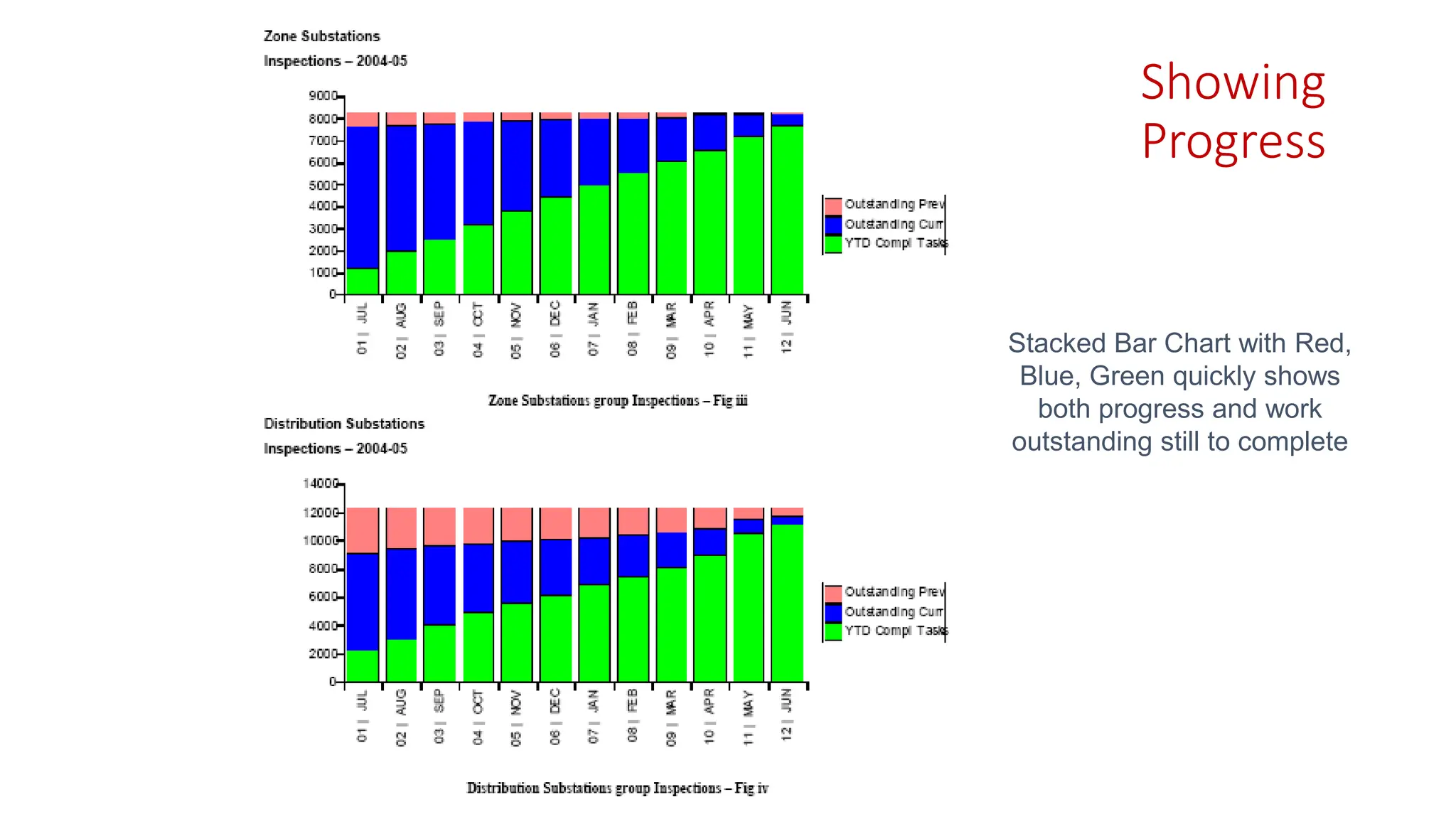
Showing
Progress
Stacked Bar Chart with Red,
Blue, Green quickly shows
both progress and work
outstanding still to complete
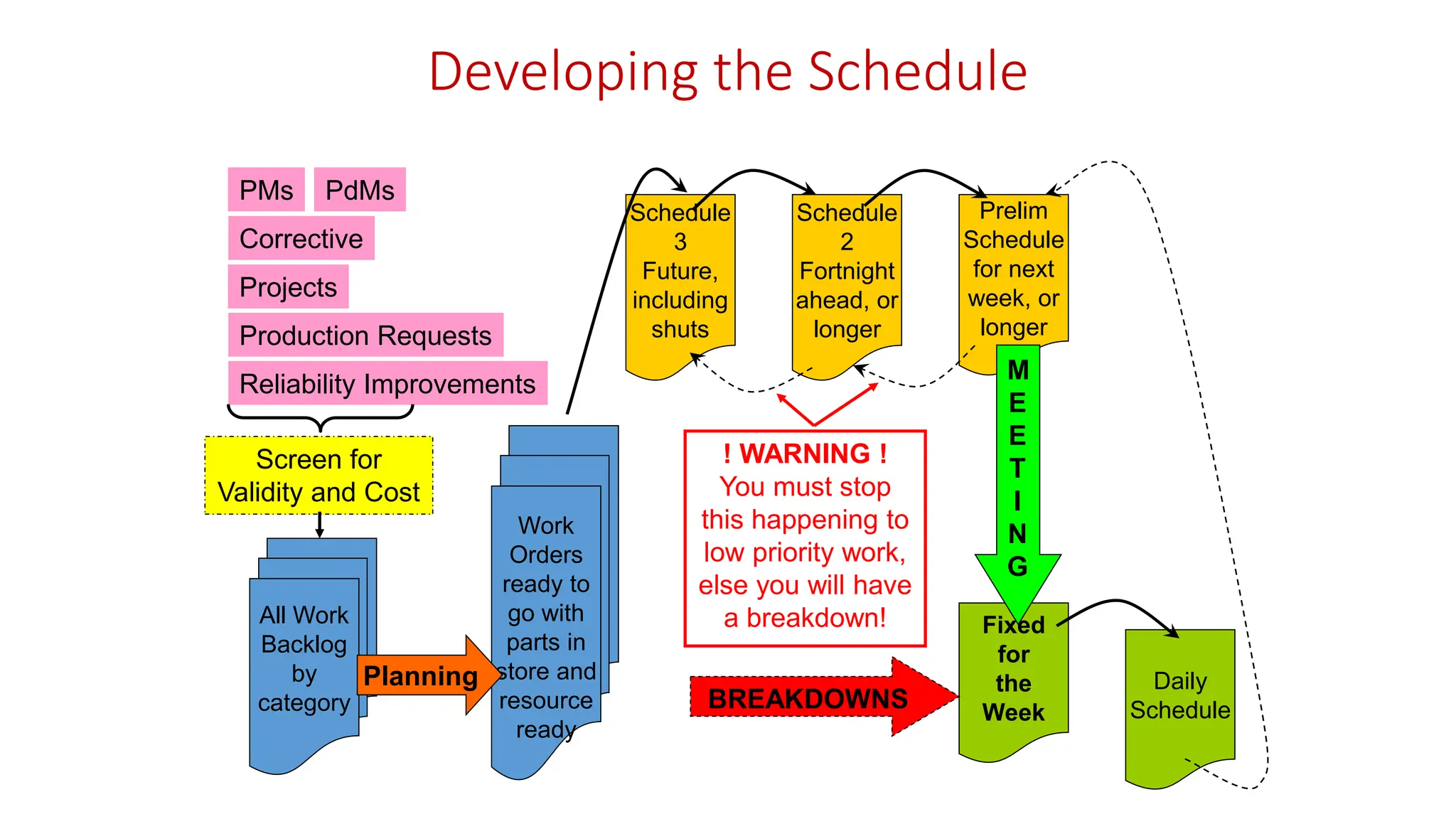
Developing the Schedule
All Work
Backlog
by
category
Prelim
Schedule
for next
week, or
longer
Schedule
2
Fortnight
ahead, or
longer
Schedule
3
Future,
including
shuts
Fixed
for
the
Week
PMs PdMs
Corrective
Projects
Reliability Improvements
Work
Orders
ready to
go with
parts in
store and
resource
ready
Planning
Production Requests
Daily
Schedule
M
E
E
T
I
N
G
BREAKDOWNS
! WARNING !
You must stop
this happening to
low priority work,
else you will have
a breakdown!
Screen for
Validity and Cost
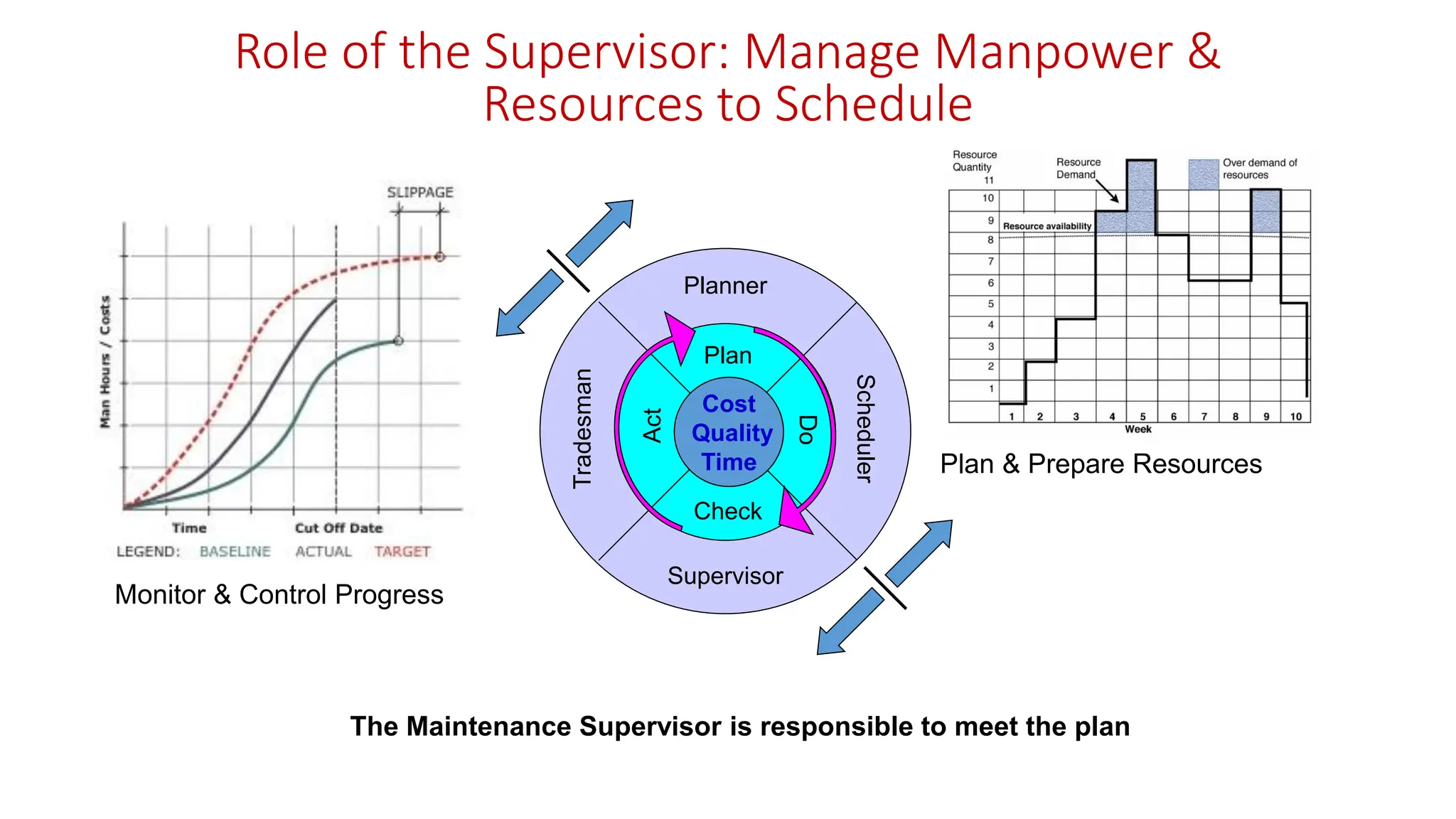
Role of the Supervisor: Manage Manpower &
Resources to Schedule
The Maintenance Supervisor is responsible to meet the plan
Planner
Supervisor
Tradesman
Scheduler
Cost
Quality
Time
Plan
Do
Check
Act
Monitor & Control Progress
Plan & Prepare Resources
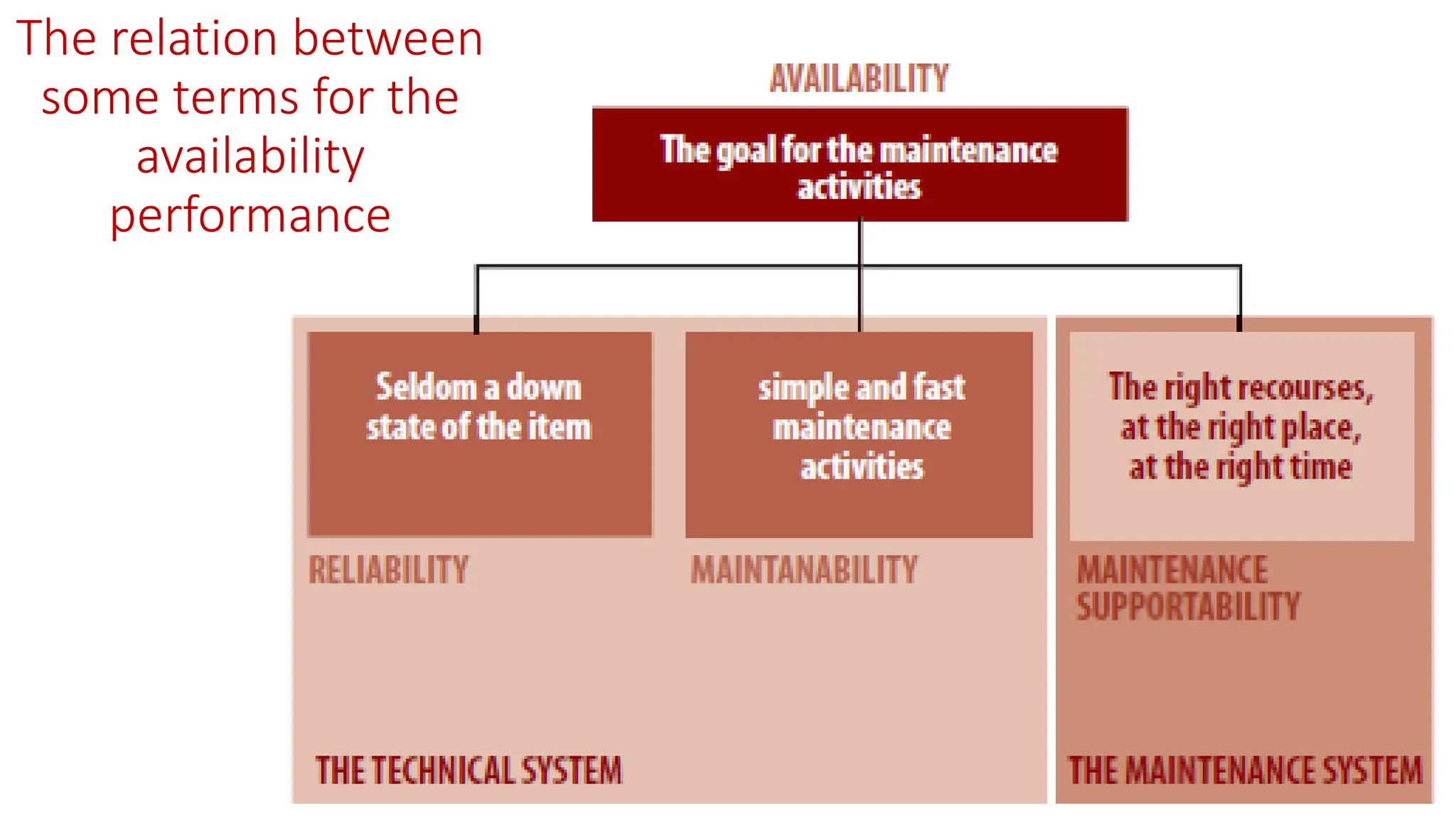
The relation between
some terms for the
availability
performance
THEORETICAL BACKGROUND: Fault Finding in the Total Picture
MEAN TIME TO FAILURE [MMTF]
Where f(t) is the failure probability density function
MEAN TIME TO REPAIR [MTTR]
Formulas for Availability Performance
Ai =Inherent Avail ability (e.g. an availability only depending upon the technical system.)
Aa = Achieved Availability (e.g. an availability depending upon both the technical system and the
maintenance organization.)
Ao = Operational Availability
MTTM = Mean Time To Maintenance (Maintenance = preventive and corrective maintenance actions)
M = Mean Maintenance Time (Time for preventive and corrective maintenance actions)
Mean Time Between Failure, MTBF
MDT (Mean Down Time) and MTTF (Mean Time To Failure).
Percentage of Breakdowns Hours = Breakdown Hours / Production Hours x 100
Availability = M a i n t e n a n c e H o u r s / Available Production Hours x 100
where:
Breakdown Hours: the hours spent for repairing breakdowns
Production Hours: the net production hours
where:
Maintenance Hours: the hours spent for repairing breakdowns and executing preventive maintenance
programs
Available Production Hours: the total production hours available except weekends
(for example the available production hours in a week are: 24 hours x 5 days=120 hours)
Reliability Properties for Systems
• Series Systems
Rsystem= R1 x R2 x R3
• Parallel Systems
Rsystem= 1-[(1- R1)x(1- R2)x(1-R3)]
1
1
1
n
1 1 1 n
R = 0.95 x 0.95 = 0.9025
R = 1 – [(1 - 0.6) x (1 - 0.6)] = 0.84
The mathematics can be difficult. But you need to know that such mathematics exists
and be able to use the principles to optimise maintenance.
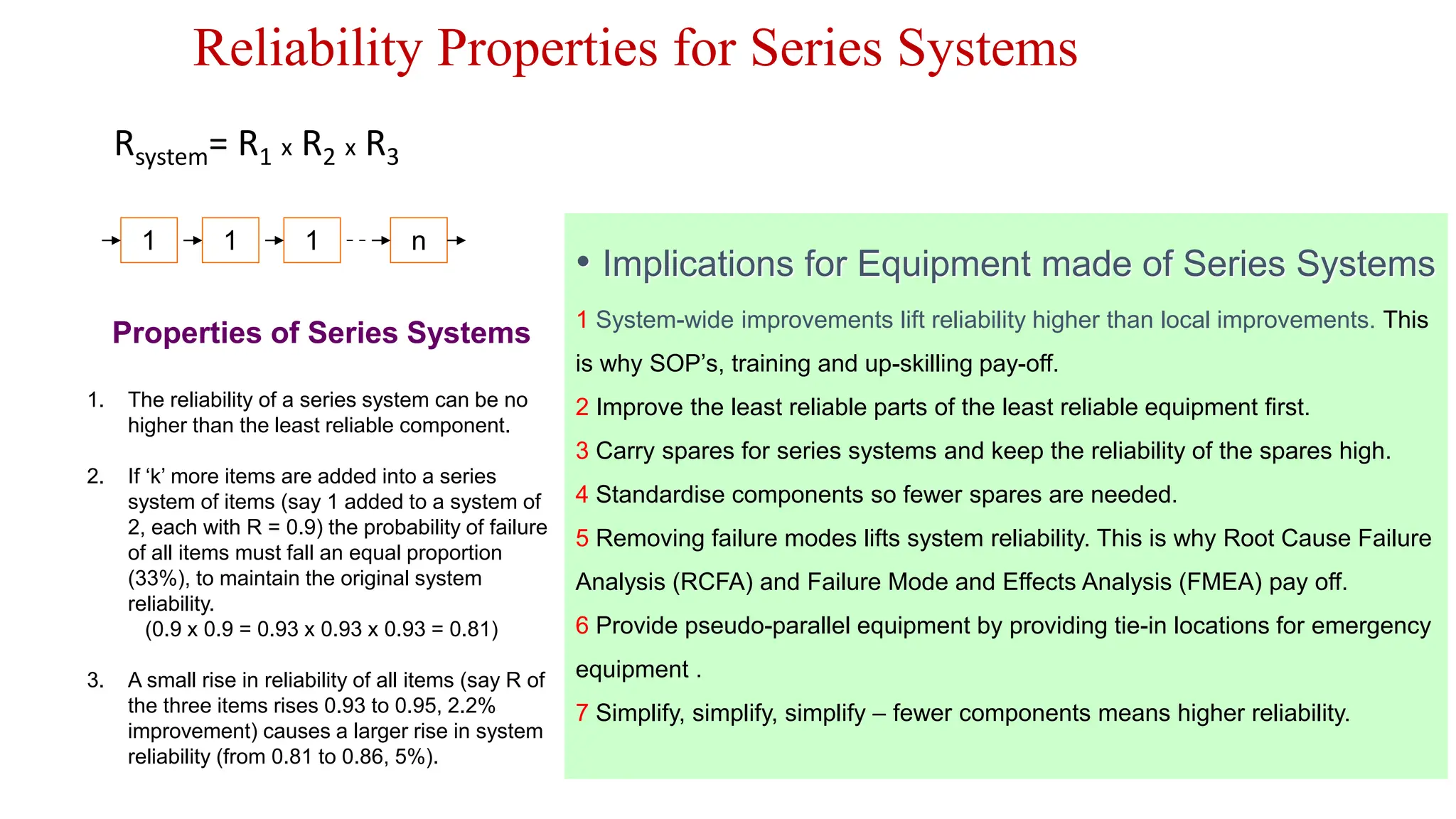
Reliability Properties for Series Systems
Rsystem= R1 x R2 x R3
1 1 1 n
Properties of Series Systems
1. The reliability of a series system can be no
higher than the least reliable component.
2. If ‘k’ more items are added into a series
system of items (say 1 added to a system of
2, each with R = 0.9) the probability of failure
of all items must fall an equal proportion
(33%), to maintain the original system
reliability.
(0.9 x 0.9 = 0.93 x 0.93 x 0.93 = 0.81)
3. A small rise in reliability of all items (say R of
the three items rises 0.93 to 0.95, 2.2%
improvement) causes a larger rise in system
reliability (from 0.81 to 0.86, 5%).
• Implications for Equipment made of Series Systems
1 System-wide improvements lift reliability higher than local improvements. This
is why SOP’s, training and up-skilling pay-off.
2 Improve the least reliable parts of the least reliable equipment first.
3 Carry spares for series systems and keep the reliability of the spares high.
4 Standardise components so fewer spares are needed.
5 Removing failure modes lifts system reliability. This is why Root Cause Failure
Analysis (RCFA) and Failure Mode and Effects Analysis (FMEA) pay off.
6 Provide pseudo-parallel equipment by providing tie-in locations for emergency
equipment .
7 Simplify, simplify, simplify – fewer components means higher reliability.
Reliability Properties for Parallel Systems
1 1 1 n
Rsystem= 1-[(1- R1)x(1- R2)x(1-R3)]
Properties of Parallel Systems
1. The more number of components in
parallel the higher the system reliability.
2. The reliability of the parallel arrangement
is higher than the reliability of the most
reliable component.
m
m m
m
m
m m
m
Which arrangement is more reliable if m = 0.9?
• Implications of Parallel Systems for
Equipment
1 Use parallel arrangements when the risk of failure has high DAFT
Cost consequences.
2 Consider providing various paths for product to take in production
plants with in-series equipment.
3 Build redundancy into your systems so there is more than one
way to do a thing.
Failure Prediction Mathematics – Weibull
Reliability of Parts and Components
An increasing failure
rate >1 suggests
"wear out" - parts are
more likely to fail as
time goes on.
Hence change parts as
part of a PM on a time
basis.
The Maintenance Zones of Component Life
Rate of
Failing
Infant
Mortality Constant Likelihood of Failure
End of
Life
A constant failure rate ~
1 suggests that items
are failing from random
events.
Hence cannot predict
when a particular part
will fail so use condition
monitoring to check for
failure mechanism.
A decreasing failure rate
< 1 would suggest ‘infant
mortality’. That is, defective
items fail early and the
failure rate decreases over
time as they fall out of the
population.
Hence need high quality
control and accuracy in
manufacture and assembly
or ‘burn-in’ on purpose.
www.BIN95.com
Mr Weibull (say Vaybull) discovered the mathematics to model the life of parts. It uses
historic failure data from your CMMS to estimate what life a part has in your operation.
Time – Age of Part
Equipment Reliability Strategies
Time – Age of Equipment
Strategies for the Infant Mortality Maintenance Zone
Rate of
Failing
How to Drive the Chance Curve Down?
How to Pull the Position of the Curve Lower?
How to Push the Time of the Curve Back?
Time – Age of Equipment
Strategies for the Random Failure Maintenance Zone
How to Drive the Position of the Curve Lower?
Rate of
Failing
Time – Age of Equipment
Strategies for the Wear-Out Failure Maintenance Zone
Rate of
Failing
How to Push the Start of the
Rising Curve Back?
How to Lower the Curve Steepness?
With the new
understanding of risk
and chance from
reliability engineering
we now understand
which operating and
maintenance practices
to use to reduce the
likelihood of failure
happening at every
stage of an equipment’s
life cycle
Quality Control,
Training,
Precision Assembly
PM,
PdM,
Precision
Operation
Replace Equipment,
Add more components
to renewal PM
6 Mechanical Equipment Care Standards to Set,
Use and Keep Using
Vibration:
Balancing:
Alignment:
Fastener Torque:
Deformation:
Lubricant Cleanliness:
These are the
BIG 6 that
maintenance can
control.
Using Condition Monitoring to
Optimise Availability
Condition
monitoring is not
only a tool for
checking the
equipment
condition. It is
equally as valid to
use it to improve
the machine
conditions.
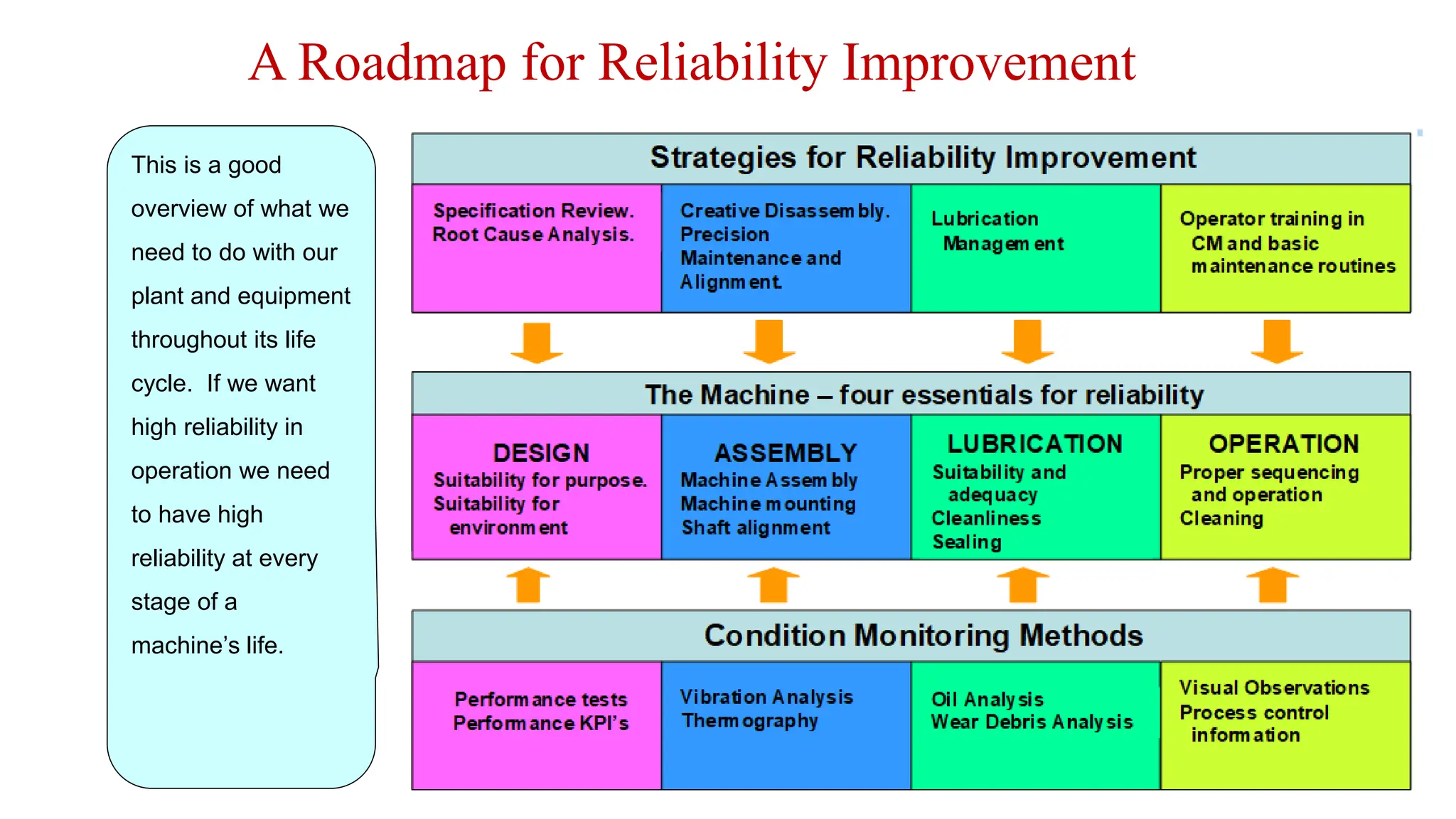
This is a good
overview of what we
need to do with our
plant and equipment
throughout its life
cycle. If we want
high reliability in
operation we need
to have high
reliability at every
stage of a
machine’s life.
A Roadmap for Reliability Improvement
Maintenance Management Best Practice –
Profit-Focused, Ultra-High Reliability
Precision
Operating Risk
Life
Cycle
Profit
Optimisation
Loop
Precision Domain
(with ACE 3Ts)
Assemble & use a plan for operation,
maintenance & improvement of units
Assemble & use a plan for continually
removing defects from processes
Business
Value
Contribution
Z
E
R
O
F
A
I
L
U
R
E
‫دراسة‬
‫الموثوقية‬
‫يوضح‬
‫المنحنى‬
‫معدل‬
‫الفشل‬
‫لهذه‬
‫المراحل‬
‫هي‬
:
1
-
‫مرحلة‬
‫التسخين‬
‫حيث‬
‫يقل‬
‫معدل‬
‫الفشل‬
‫بسرعة‬
‫وبتوزيع‬
‫خاص‬
2
-
‫مرحلة‬
‫العمر‬
‫المفيد‬
‫حيث‬
‫يكون‬
‫معدل‬
‫الفشل‬
‫ثابتا‬
‫ويمثل‬
‫فشال‬
‫عشوائيا‬
‫تماما‬
‫و‬
‫بتوزيع‬
‫أسي‬
‫سالب‬
3
-
‫مرحلة‬
‫االهتراء‬
‫حيث‬
‫يزداد‬
‫معدل‬
‫الفشل‬
‫ويمثل‬
‫فشال‬
‫بتوزيع‬
‫معتدل‬
‫زمن‬
(t)
1
‫التسخين‬ ‫فترة‬
Running in
2
‫المفيد‬ ‫العمر‬ ‫فترة‬
Useful life
3
‫االهتراء‬ ‫فترة‬
Wear-out
‫تعريف‬
‫عمر‬
‫التشغيل‬
‫يمكن‬
‫تمثيل‬
‫عمر‬
‫التشغيل‬
‫لمعدة‬
‫أو‬
‫جزء‬
‫بمنحنى‬
‫على‬
‫شكل‬
‫حوض‬
Bath-TUb
‫يمر‬
‫بثالث‬
‫مراحل‬
‫كما‬
‫في‬
‫الشكل‬
‫التالي‬
:
‫دراسة‬
‫الموثوقية‬
‫خلفية‬
‫رياضية‬
‫لقياس‬
‫الموثوقية‬
‫تحسب‬
‫الموثوقية‬
‫من‬
‫معدالت‬
‫الفشل‬
‫وتوزيعاتها‬
‫التكرارية‬
‫لألعطال‬
‫الممكن‬
‫حدوثها‬
‫خ‬
‫الل‬
‫فترة‬
‫زمنية‬
‫لعدد‬
‫من‬
‫نوع‬
‫معين‬
‫لقطعة‬
‫الغيار‬
‫والمعدالت‬
‫األساسية‬
‫العامة‬
‫التي‬
‫يمكن‬
‫التعر‬
‫ف‬
‫عليها‬
‫هي‬
:
2
-
‫طريقة‬
‫حساب‬
‫الموثوقية‬
1
-
‫دالة‬
‫كثافة‬
‫احتمال‬
‫الفشل‬
Probability density function of failure
)
(
1 t
f

2
-
‫التوزيع‬
‫التراكمي‬
‫لدالة‬
‫احتمال‬
‫الفشل‬
Cumulative distribution function of failure



t
dt
t
f
t
F
0
)
(
)
(
2
3
-
‫دالة‬
‫الموثوقية‬
(
‫البقاء‬
)
:
‫احتمال‬
‫بقاء‬
‫العنصر‬
‫دون‬
‫عطل‬
Reliability function (survival)
)
(
1
)
(
3 t
F
t
R 


4
-
‫العمر‬
‫المحدد‬
(
‫اللحمي‬
)
‫للفشل‬
(
‫معدل‬
‫الخطر‬
)
Age-
specific (instantaneous) failure {Hazard rate)
)
(
1
)
(
)
(
4 t
F
t
f
t
Z 


5
-
‫متوسط‬
‫الزمن‬
‫إلى‬
‫الفشل‬
Mean time to failure




o
dt
t
tf
MTTF )
(
5
‫دراسة‬
‫الموثوقية‬
‫طريقة‬
‫مبسطة‬
‫لحساب‬
‫الدوال‬
1
-
‫دالة‬
‫كثافة‬
‫احتمال‬
‫الفشل‬
Probability density function of failure

 )
(
1 t
f ‫عدد‬
‫الوحدات‬
‫الفاشلة‬
‫عند‬
‫زمن‬
(t)
‫عدد‬
‫الوحدات‬
‫عند‬
‫بداية‬
‫الوقت‬
(t=0)
2
-
‫التوزيع‬
‫التراكمي‬
‫لدالة‬
‫احتمال‬
‫الفشل‬
Cumulative distribution function of failure

 )
(
2 t
F ‫عدد‬
‫الوحدات‬
‫الفاشلة‬
‫المتراكمة‬
‫عند‬
‫زمن‬
(t)
‫عدد‬
‫الوحدات‬
‫عند‬
‫بداية‬
‫الوقت‬
(t=0)
3
-
‫دالة‬
‫الموثوقية‬
(
‫البقاء‬
)
:
‫احتمال‬
‫بقاء‬
‫العنصر‬
‫دون‬
‫عطل‬
Reliability function (survival)
)
(
1
)
(
3 t
F
t
R 

 ‫عدد‬
‫الوحدات‬
‫العاملة‬
‫عند‬
‫زمن‬
(t)
‫عدد‬
‫الوحدات‬
‫عند‬
‫بداية‬
‫الوقت‬
(t=0)
4
-
‫العمر‬
‫المحدد‬
(
‫اللحمي‬
)
‫للفشل‬
(
‫معدل‬
‫الفشل‬
‫أو‬
‫الخطر‬
)
Age-specific (instantaneous)
failure {Hazard rate or Failure rate)
)
(
1
)
(
)
(
4 t
F
t
f
t
Z 

 ‫عدد‬
‫الوحدات‬
‫الفاشلة‬
‫عند‬
‫زمن‬
(t)
‫عدد‬
‫الوحدات‬
‫العاملة‬
‫عند‬
‫زمن‬
(t)
‫دراسة‬
‫الموثوقية‬
‫مثال‬
‫تم‬
‫تركيب‬
(
150
)
‫وحدة‬
‫في‬
‫قسم‬
‫وقد‬
‫تم‬
‫جمع‬
‫البيانات‬
‫حول‬
‫فش‬
‫لها‬
‫خالل‬
(
30
)
‫فترة‬
‫زمنية‬
‫كم‬
‫مبين‬
‫في‬
‫الجدول‬
‫المرفق‬
.
‫احسب‬
‫لكل‬
‫فترة‬
1
-
‫دالة‬
‫الفشل‬
2
-
‫دالة‬
‫الموثوقية‬
3
-
‫معدل‬
‫العمر‬
‫المحدد‬
‫للفشل‬
‫وارسم‬
‫النتائ‬
‫ج‬
.
‫الفترة‬
‫في‬ ‫الزمنية‬
‫زمن‬ ‫وحدة‬
‫الوحدات‬ ‫عدد‬
‫عند‬ ‫العاملة‬
‫الفترة‬ ‫بداية‬
0
-
1
150
1
-
2
124
2
-
3
107
3
-
4
95
4
-
5
87
5
-
6
80
6
-
7
75
7
-
8
70
8
-
9
66
9
-
10
62
10
-
11
59
11
-
12
56
12
-
13
53
13
-
14
50
14
-
15
47
‫الفترة‬
‫في‬ ‫الزمنية‬
‫زمن‬ ‫وحدة‬
‫الوحدات‬ ‫عدد‬
‫عند‬ ‫العاملة‬
‫الفترة‬ ‫بداية‬
15
-
16
44
16
-
17
42
17
-
18
40
18
-
19
38
19
-
20
36
20
-
21
34
21
-
22
32
22
-
23
29
23
-
24
26
24
-
25
24
25
-
26
22
26
-
27
20
27
-
28
17
28
-
29
15
29
-
30
13
‫دراسة‬
‫الموثوقية‬
‫الفترة‬
‫في‬ ‫الزمنية‬
‫زمن‬ ‫وحدة‬
‫الوحدات‬ ‫عدد‬
‫عند‬ ‫العاملة‬
‫الفترة‬ ‫بداية‬
A
B
0
-
1
150
1
-
2
124
2
-
3
107
3
-
4
95
4
-
5
87
5
-
6
80
6
-
7
75
7
-
8
70
8
-
9
66
9
-
10
62
10
-
11
59
11
-
12
56
12
-
13
53
13
-
14
50
14
-
15
47
‫الوحدات‬ ‫عدد‬
‫عند‬ ‫الفاشلة‬
‫الفترة‬ ‫نهاية‬
‫الوحدات‬ ‫عدد‬
‫عند‬ ‫العاملة‬
‫الفترة‬ ‫نهاية‬
C
D
26
124
17
107
12
95
8
87
7
80
5
75
5
70
4
66
4
62
3
59
3
56
3
53
3
50
3
47
3
44
‫الفش‬ ‫كثافة‬ ‫دالة‬
‫ل‬
f(t) %
‫الفشل‬ ‫دالة‬
‫التراكمي‬
F
%
‫دالة‬
‫الموثوقية‬
R %
‫الفشل‬ ‫معدل‬
Z(t) %
f=(C/B0)
F=(f)
R=100-F
Z=C/B
17.3
17.3
82.7
17.3
11.4
28.7
71.3
13.7
8.0
36.7
63.3
11.2
5.3
42.0
58.0
8.4
4.7
46.7
53.3
8.0
3.3
50.0
50.0
6.3
3.3
53.3
46.7
6.7
2.7
56.0
44.0
5.7
2.7
58.7
41.3
6.1
2.0
60.7
39.3
4.8
2.0
62.7
37.3
5.1
2.0
64.7
35.3
5.4
2.0
66.7
33.3
5.7
2.0
68.7
31.3
6.0
2.0
70.7
29.3
6.4
‫دراسة‬
‫الموثوقية‬
‫الزمن‬ ‫فترة‬
1 2 3 4 5 6 7 8 9 10 11 12 13 14 15 16 17 18 19 20 21 22 23 24 25 26 27 28 29
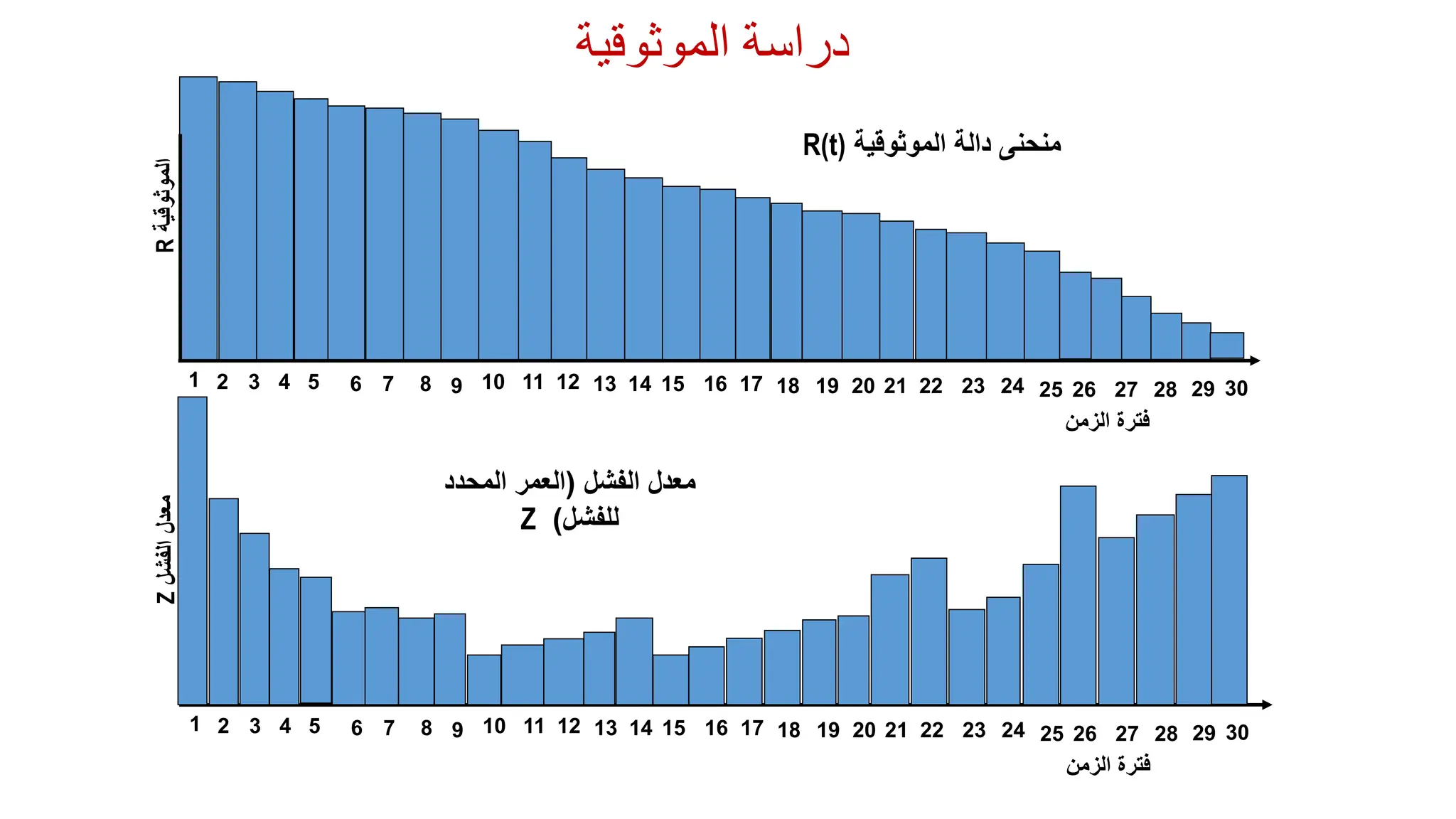
‫الفشل‬ ‫كثافة‬ ‫دالة‬
f(t)
30
‫الزمن‬ ‫فترة‬
1 2 3 4 5 6 7 8 9 10 11 12 13 14 15 16 17 18 19 20 21 22 23 24 25 26 27 28 29
‫الفشل‬ ‫التراكمي‬ ‫التوزيع‬ ‫دالة‬ ‫منحنى‬
F(t)
30
‫دراسة‬
‫الموثوقية‬
‫الزمن‬ ‫فترة‬
1 2 3 4 5 6 7 8 9 10 11 12 13 14 15 16 17 18 19 20 21 22 23 24 25 26 27 28 29
‫الموثوقية‬ ‫دالة‬ ‫منحنى‬
R(t)
30
‫الزمن‬ ‫فترة‬
1 2 3 4 5 6 7 8 9 10 11 12 13 14 15 16 17 18 19 20 21 22 23 24 25 26 27 28 29
‫الفشل‬ ‫معدل‬
(
‫المحدد‬ ‫العمر‬
‫للفشل‬
)
Z
30
‫دراسة‬
‫الموثوقية‬
‫مالحظة‬
:
1
-
‫يمكن‬
‫كتابة‬
‫هذه‬
‫المعادالت‬
‫كالتالى‬
:
 
   
 
i
i
i
i
i
i
i t
t
Q
Q
Q
Z 

 

 1
1
1
, 1
‫حيث‬
Qi
=
‫عدد‬
‫الوحدات‬
‫العاملة‬
‫التي‬
‫بدأ‬
‫في‬
‫اختيارها‬
‫في‬
‫بداية‬
‫الفترة‬
Q i+1
=
‫َدد‬‫ع‬
‫الوحدات‬
‫العاملة‬
‫في‬
‫نهاية‬
‫الفترة‬
ti
=
‫زمن‬
‫الفترة‬
‫عند‬
‫بدايتها‬
t i+1
=
‫زمن‬
‫الفترة‬
‫في‬
‫نهاية‬
‫الفترة‬
  i
i
i dt
dQ
Q
1


 dt
dt
dQ 



‫وعند‬
‫تصغير‬
‫الفترة‬
‫الزمنية‬
‫الى‬
‫ماال‬
‫نهاية‬
‫فان‬
‫معدل‬
‫الفشل‬
‫يصبح‬
:
  t
e
Q
Q
R 


 0
2
-
‫يتم‬
‫حساب‬
‫الموثوقية‬
‫كالتالي‬
:
 

1

MTBF 3
-
‫يحسب‬
‫متوسط‬
‫العمر‬
‫ما‬
‫بين‬
‫االخفاق‬
‫دراسة‬
‫الموثوقية‬
‫مالحظة‬
:
‫يمكن‬
‫وصف‬
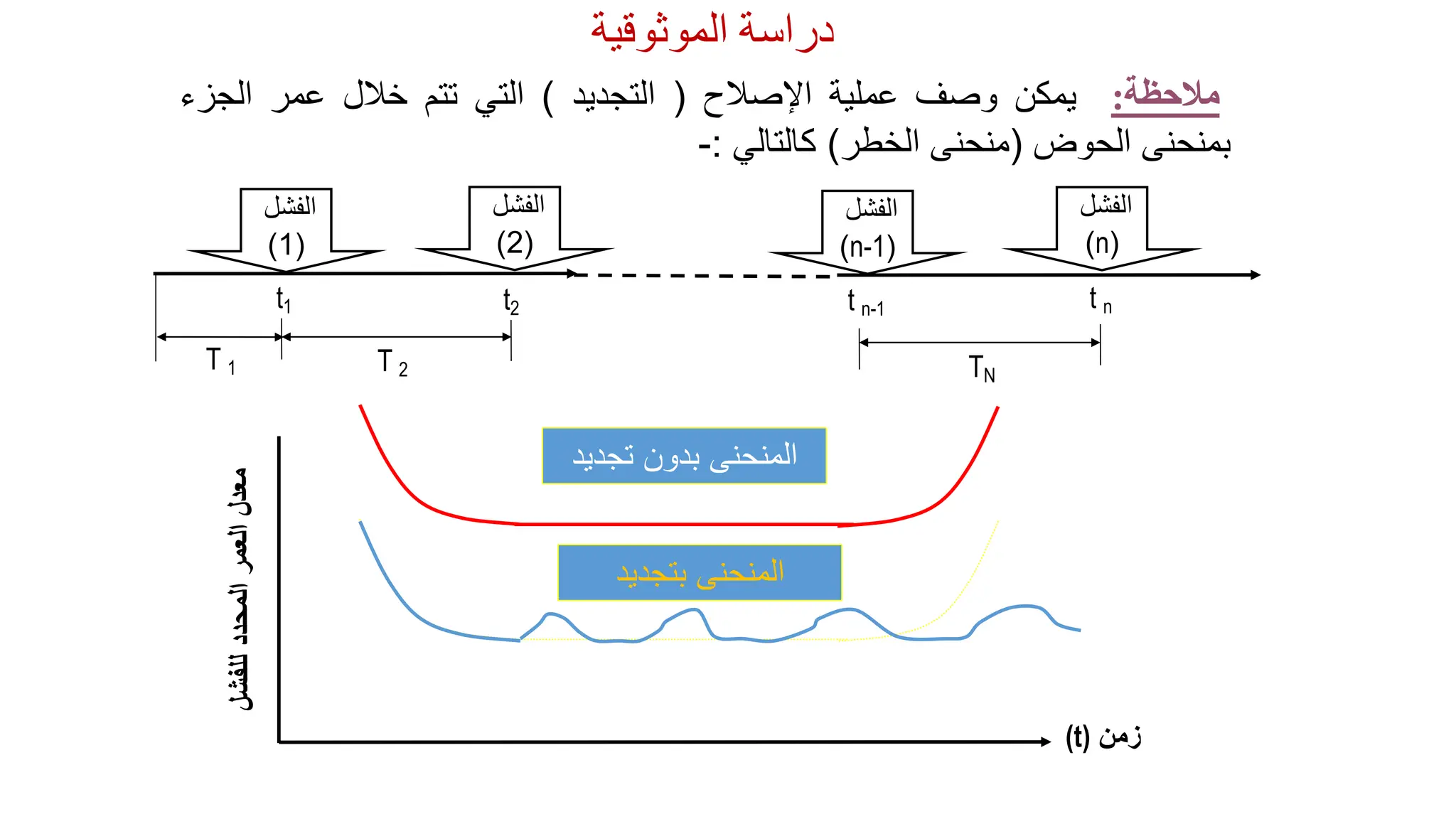
‫عملية‬
‫اإلصالح‬
(
‫التجديد‬
)
‫التي‬
‫تتم‬
‫خالل‬
‫عمر‬
‫الجزء‬
‫بمنحنى‬
‫الحوض‬
(
‫منحنى‬
‫الخطر‬
)
‫كالتالي‬
:
-
‫الفشل‬
(
1
)
‫الفشل‬
(
2
)
‫الفشل‬
(
n-1
)
‫الفشل‬
(
n
)
t1 t2 t n-1 t n
T 1 T 2 TN
‫زمن‬
(t)
‫تجدي‬ ‫بدون‬ ‫المنحنى‬
‫د‬
‫بتجديد‬ ‫المنحنى‬
‫دراسة‬
‫الموثوقية‬
‫تعرف‬
‫اإلتاحة‬
‫بمقدار‬
‫االستعداد‬
‫واحتمالية‬
‫اتاحتها‬
‫للعمل‬
‫تحت‬
‫الطلب؛‬
‫ومفهو‬
‫م‬
‫اإلتاحة‬
‫يجمع‬
‫ما‬
‫بين‬
‫الموثوقية‬
‫وقابلية‬
‫الصيانة‬
‫حيث‬
‫يعبر‬
‫عنها‬
‫بالتالي‬
:
3
-
‫اإلتاحة‬
ِ
Availability
MTTR
MTBF
MTBF
A


‫حيث‬
MTBF
=
‫متوسط‬
‫الزمن‬
‫بين‬
‫األعطال‬
(
‫الفشل‬
)
MTTR
=
‫متوسط‬
‫الزمن‬
‫لإلصالح‬
‫وعليه‬
‫تعتمد‬
‫اإلتاحة‬
‫على‬
‫مقدار‬
‫موثوقية‬
‫المعدة‬
‫أو‬
‫الجزء‬
‫للعمل‬
,
‫ومقدار‬
‫الزمن‬
‫الم‬
‫طلوب‬
‫للقيام‬
‫باإلصالح‬
‫وهي‬
‫تتأثر‬
‫بالتالي‬
:

‫مقدار‬
‫اإلتاحة‬
‫لقطع‬
‫الغيار‬
‫ويحسب‬
‫من‬
‫احتمالية‬
‫توفر‬
‫مستويات‬
‫االستيداع‬
.

‫عامل‬
‫االستخدام‬
=
{
‫زمن‬
‫التشغيل‬
(t1)
[/
‫زمن‬
‫التشغيل‬
(t1)
+
‫زمن‬
‫الصيانة‬
(t2)
+
‫زمن‬
‫توقف‬
(t3)
]
}

‫مقدار‬
‫إتاحة‬
‫افراد‬
‫الصيانة‬
‫ويحسب‬
‫وفقا‬
‫الحتمال‬
‫توفر‬
‫العمالة‬
‫المتخصصة‬
.
‫دراسة‬
‫الموثوقية‬
4
-
‫موثوقية‬
‫النظام‬
‫تنقسم‬
‫موثوقية‬
‫النظام‬
‫إلى‬
‫نوعين‬
:
1
(
‫نظم‬
‫متتالية‬
:
R1 R2
‫في‬
‫هذه‬
‫الحالة‬
‫يفشل‬
‫النظام‬
‫لفشل‬
‫إحدى‬
‫الوحدات‬
,
‫وتكون‬
‫الموثوقية‬
‫الفعالة‬
‫للنظام‬
‫هي‬
:
n
R
R
R
R 


 .......
2
1
‫وعليه‬
‫فان‬
‫موثوقية‬
‫النظام‬
‫أقل‬
‫من‬
‫موثوقية‬
‫كل‬
‫وحدة‬
.
‫مثال‬
:
R1= 0.95 , R2= 0.9  R= 0.855
‫وبفرض‬
‫معادلة‬
‫الموثوقية‬
=
‫تصبح‬
‫المعادلة‬
t
e
R 


 t
n
e
R 

 *
.....
*
* 2
1


‫دراسة‬
‫الموثوقية‬
‫وعليه‬
‫فان‬
‫موثوقية‬
‫النظام‬
‫أكبر‬
‫من‬
‫موثوقية‬
‫كل‬
‫وحدة‬
.
‫مثال‬
:
R1= 0.95 , R2= 0.9  R= 0.995
2
(
‫نظم‬
‫متوازية‬
:
‫في‬
‫هذه‬
‫الحالة‬
‫يؤدي‬
‫فشل‬
‫إحدى‬
‫الوحدات‬
‫إلى‬
‫انخفاض‬
‫أداء‬
‫النظام‬
,
‫وتكون‬
‫الموثوقية‬
‫الفعال‬
‫ة‬
‫للنظام‬
‫هي‬
:
     
n
R
R
R
R 






 1
.......
1
1
1 2
1
R2
R1
‫وبفرض‬
‫معادلة‬
‫الموثوقية‬
=
‫تصبح‬
‫المعادلة‬
t
e
R 


    
 
t
t
t n
e
e
e
R 

 






 1
.......
1
1
1 2
1
‫دراسة‬
‫الموثوقية‬
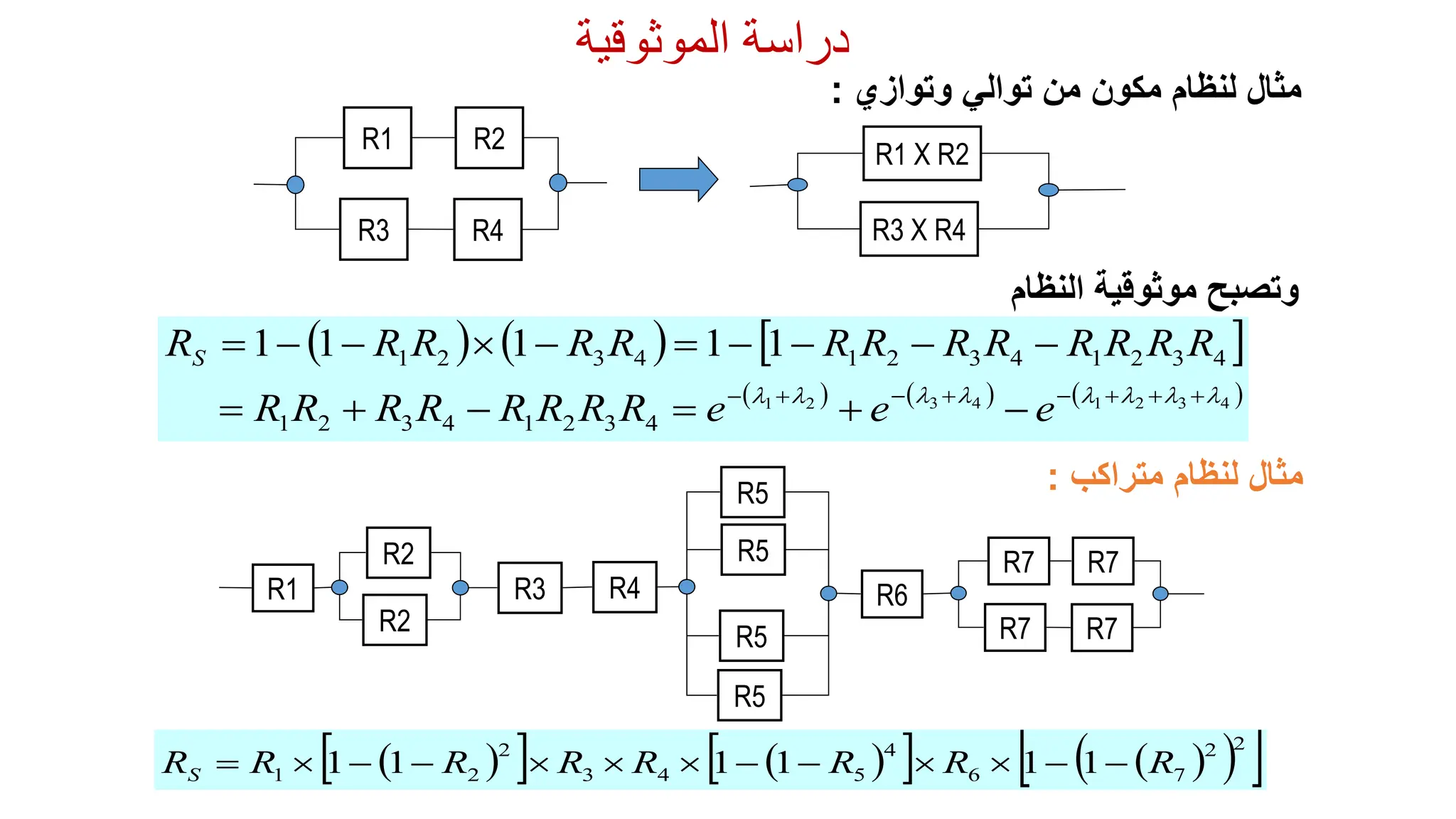
‫مثال‬
‫لنظام‬
‫مكون‬
‫من‬
‫توالي‬
‫وتوازي‬
:
‫وتصبح‬
‫موثوقية‬
‫النظ‬
‫ام‬
     
     
4
3
2
1
4
3
2
1
4
3
2
1
4
3
2
1
4
3
2
1
4
3
2
1
4
3
2
1 1
1
1
1
1







 























e
e
e
R
R
R
R
R
R
R
R
R
R
R
R
R
R
R
R
R
R
R
R
RS
R1 R2
R3 R4
R1 X R2
R3 X R4
‫مثال‬
‫لنظام‬
‫متراكب‬
:
R2
R3
R2
R4
R7 R7
R7 R7
R6
R1
R5
R5
R5
R5
 
   
   
 
 
2
2
7
6
4
5
4
3
2
2
1 1
1
1
1
1
1 R
R
R
R
R
R
R
RS 












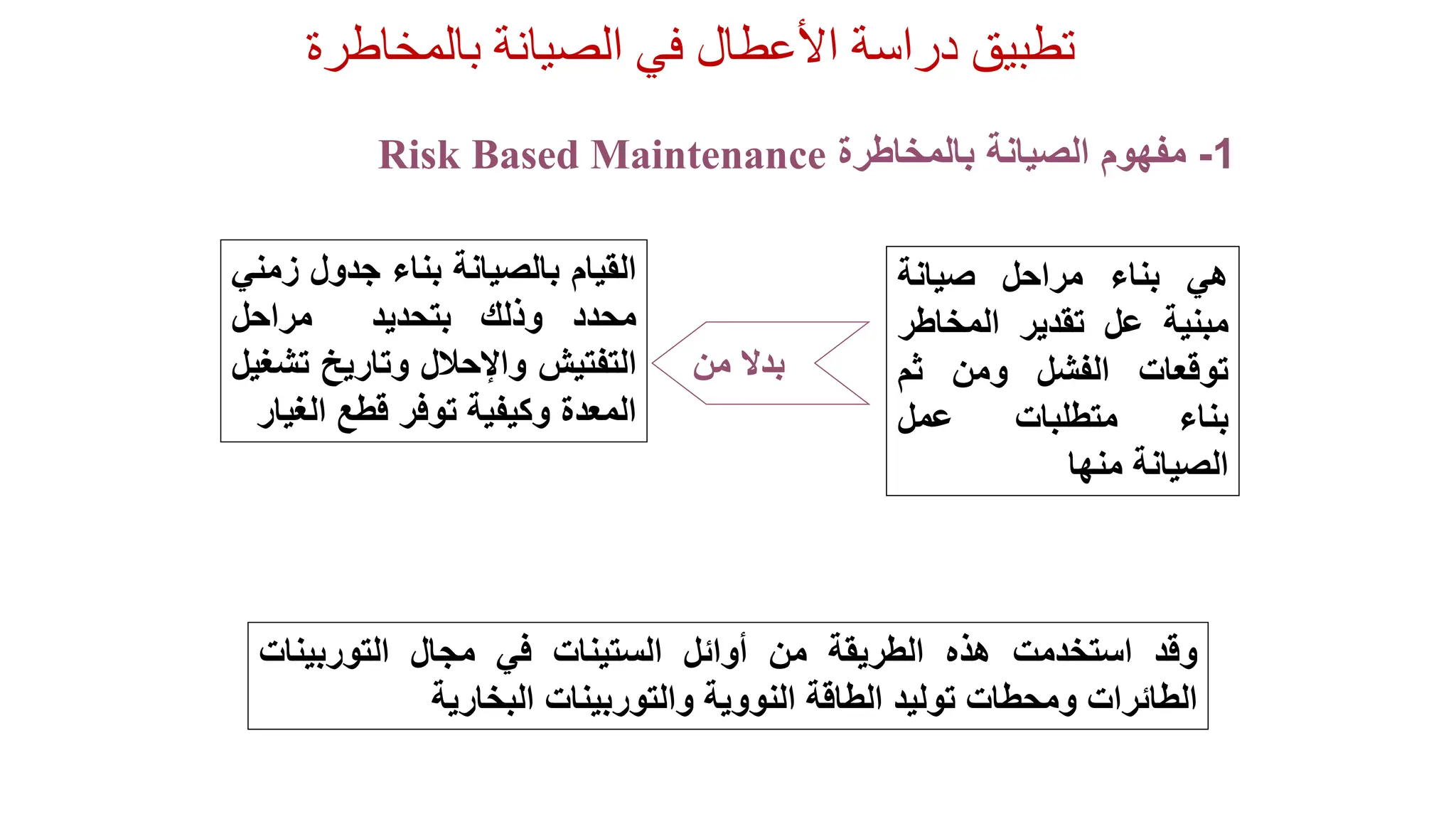
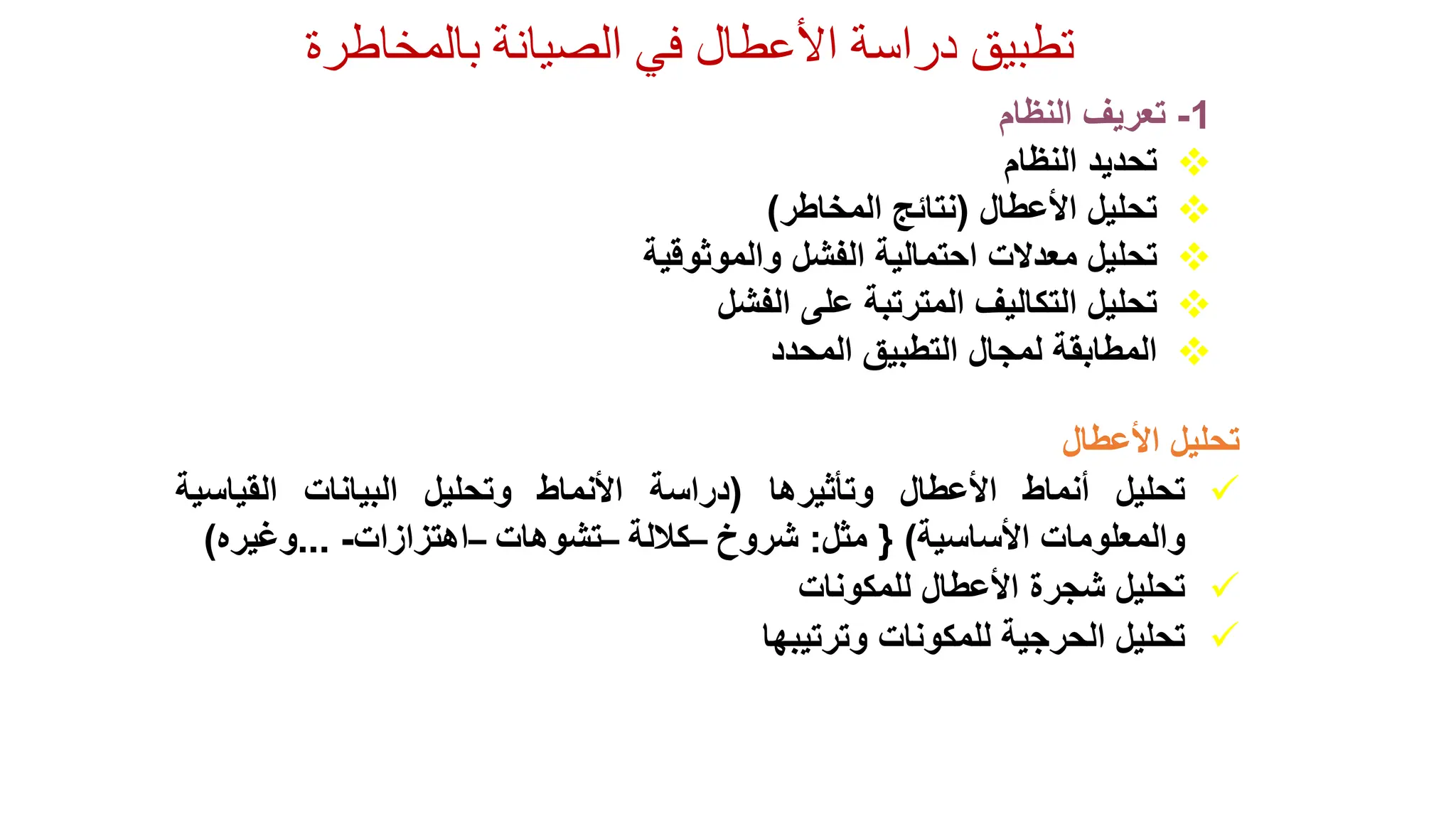
‫الصيانة‬ ‫في‬ ‫األعطال‬ ‫دراسة‬ ‫تطبيق‬
‫بالمخاطرة‬
1
-
‫مفهوم‬
‫الصيانة‬
‫بالمخاطرة‬
Risk Based Maintenance
‫هي‬
‫بناء‬
‫مراحل‬
‫صيانة‬
‫مبنية‬
‫عل‬
‫تقدير‬
‫المخاطر‬
‫توقعات‬
‫الفشل‬
‫ومن‬
‫ثم‬
‫بناء‬
‫متطلبات‬
‫عمل‬
‫الصيانة‬
‫منها‬
‫القيام‬
‫بالصيانة‬
‫بناء‬
‫جدول‬
‫ز‬
‫مني‬
‫محدد‬
‫وذلك‬
‫بتحديد‬
‫مراحل‬
‫التفتيش‬
‫واإلحالل‬
‫وتاريخ‬
‫ت‬
‫شغيل‬
‫المعدة‬
‫وكيفية‬
‫توفر‬
‫قطع‬
‫الغ‬
‫يار‬
‫من‬ ‫بدال‬
‫وقد‬
‫استخدمت‬
‫هذه‬
‫الطريقة‬
‫من‬
‫أوائل‬
‫الستينات‬
‫في‬
‫مجال‬
‫التوربينات‬
‫الطائرات‬
‫ومحطات‬
‫توليد‬
‫الطاقة‬
‫النووية‬
‫والتوربينات‬
‫البخارية‬
‫الصيانة‬ ‫في‬ ‫األعطال‬ ‫دراسة‬ ‫تطبيق‬
‫بالمخاطرة‬
2
-
‫أهداف‬
‫الصيانة‬
‫بالمخاطرة‬

‫التحديد‬
‫الكمي‬
‫للمخاطرة‬
‫المرتبطة‬
‫باألعطال‬
‫للمكونات‬
‫واألنظمة‬
.

‫التحديد‬
‫لموارد‬
‫الصيانة‬
‫مبنية‬
‫على‬
‫أولويات‬
‫المخاطرة‬
‫المحددة‬
‫كميا‬
3
-
‫تعريف‬
‫المخاطرة‬
Risk ; Defined
1
-
‫المخاطرة‬
=
‫احتمال‬
‫الفشل‬
×
‫التكلفة‬
‫المترتبة‬
‫على‬
‫ذلك‬
2
-
‫احتمال‬
‫الفشل‬
=
(
‫فشل‬
‫نمط‬
‫أحد‬
‫المكونات‬
‫في‬
‫النظام‬
)
/
(
‫مجموع‬
‫عدد‬
‫هذا‬
‫المكون‬
‫معرفا‬
‫بالزمن‬
‫أو‬
‫بفترة‬
‫الحدث‬
)
3
-
‫التكلفة‬
‫المترتبة‬
‫على‬
‫الفشل‬
=
‫تكلفة‬
‫اإلصالح‬
+
‫تكلفة‬
‫الفاقد‬
(
‫تكل‬
‫فة‬
‫التوقف‬
)
+
‫تكلفة‬
‫عدم‬
‫اكتمال‬
‫الصيانة‬
‫الصيانة‬ ‫في‬ ‫األعطال‬ ‫دراسة‬ ‫تطبيق‬
‫بالمخاطرة‬
4
-
‫كيفية‬
‫تحديد‬
‫المخاطرة‬
‫كميا‬

‫جمع‬
‫البيانات‬
‫عن‬
‫نمط‬
‫فشل‬
‫ومعدالته‬
‫لمكونات‬
‫النظام‬
‫وفقا‬
‫للبيانات‬
‫التاريخية‬
‫لمكونات‬
‫مماثلة‬
‫في‬
‫تطبيقات‬
‫مماثلة‬
.

‫تحليل‬
‫وصفي‬
‫لتوجهات‬
‫المخاطر‬
‫وأثارها‬
‫وذلك‬
‫لتقليل‬
‫الجهد‬
‫في‬
‫تحدي‬
‫د‬
‫كمي‬
‫للمخاطرة‬
.
5
-
‫الخطوات‬
‫االرشادية‬
‫لتحديد‬
‫وتقييم‬
‫المخاطرة‬
‫أعطت‬
‫جمعية‬
‫المهندسين‬
‫الميكانيكيين‬
‫األمريكية‬
ASME
‫خطوات‬
‫ارشادية‬
‫يمكن‬
‫ابرازها‬
‫في‬
‫التالي‬
:
(1
‫تعريف‬
‫النظام‬
(2
‫تقييم‬
‫المخاطرة‬
‫للمكونات‬
‫وصفيا‬
‫وترتيب‬
‫التقييم‬
‫للنظا‬
‫م‬
(3
‫تطوير‬
‫برنامج‬
‫الصيانة‬
‫المطلوب‬
(4
‫دراسة‬
‫األفضلية‬
‫االقتصادية‬
‫الصيانة‬ ‫في‬ ‫األعطال‬ ‫دراسة‬ ‫تطبيق‬
‫بالمخاطرة‬
1
-
‫تعريف‬
‫النظام‬

‫تحديد‬
‫النظام‬

‫تحليل‬
‫األعطال‬
(
‫نتائج‬
‫المخاطر‬
)

‫تحليل‬
‫معدالت‬
‫احتمالية‬
‫الفشل‬
‫والموثوقية‬

‫تحليل‬
‫التكاليف‬
‫المترتبة‬
‫على‬
‫الفشل‬

‫المطابقة‬
‫لمجال‬
‫التطبيق‬
‫المحدد‬
‫تحليل‬
‫األعطال‬

‫تحليل‬
‫أنماط‬
‫األعطال‬
‫وتأثيرها‬
(
‫دراسة‬
‫األنماط‬
‫وتحليل‬
‫البيانات‬
‫القياسية‬
‫والمعلومات‬
‫األساسية‬
)
{
‫مثل‬
:
‫شروخ‬
–
‫كاللة‬
–
‫تشوهات‬
–
‫اهتزازات‬
-
...
‫وغيره‬
)

‫تحليل‬
‫شجرة‬
‫األعطال‬
‫للمكونات‬

‫تحليل‬
‫الحرجية‬
‫للمكونات‬
‫وترتيبها‬
‫الصيانة‬ ‫في‬ ‫األعطال‬ ‫دراسة‬ ‫تطبيق‬
‫بالمخاطرة‬
‫تحليل‬
‫معدالت‬
‫االحتمالية‬

‫إيجاد‬
‫أنماط‬
‫الفشل‬
:
‫حساب‬
‫احتماالت‬
‫الفشل‬
‫والموثوقية‬
(
‫دراسة‬
‫احتماالت‬
‫ال‬
‫عطل‬
‫من‬
‫البيانات‬
‫التاريخية‬
‫والخبرات‬
‫المكتسبة‬
‫عن‬
‫العطل‬
)
‫تحليل‬
‫التكلفة‬
‫المترتبة‬
‫على‬
‫الفشل‬

‫تكلفة‬
‫اإلصالح‬
(
‫تكلفة‬
‫صيانة‬
‫المعدة‬
‫وتكاليف‬
‫الهالك‬
‫واإلحالل‬
)

‫تكلفة‬
‫الفقد‬
(
‫تكلفة‬
‫توقف‬
‫المنظومة‬
‫هن‬
‫العمل‬
)

‫تكلفة‬
‫الفرصة‬
‫المفقودة‬
(
‫تكلفة‬
‫عدم‬
‫اكتمال‬
‫الصيانة‬
)
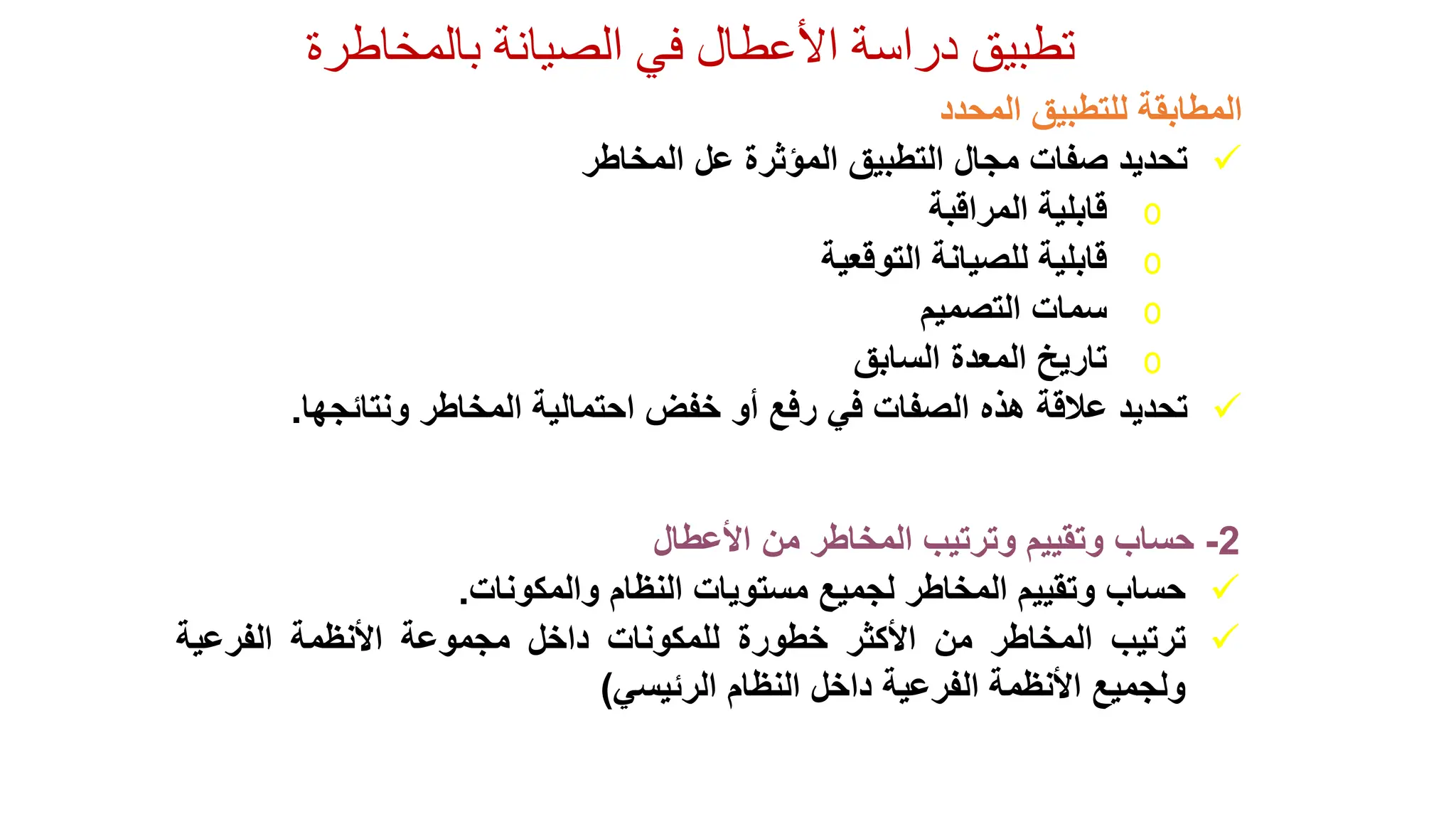
‫الصيانة‬ ‫في‬ ‫األعطال‬ ‫دراسة‬ ‫تطبيق‬
‫بالمخاطرة‬
2
-
‫حساب‬
‫وتقييم‬
‫وترتيب‬
‫المخاطر‬
‫من‬
‫األعطال‬

‫حساب‬
‫وتقييم‬
‫المخاطر‬
‫لجميع‬
‫مستويات‬
‫النظام‬
‫والمكونات‬
.

‫ترتيب‬
‫المخاطر‬
‫من‬
‫األكثر‬
‫خطورة‬
‫للمكونات‬
‫داخل‬
‫مجموعة‬
‫األنظمة‬
‫الفرعية‬
‫ولجميع‬
‫األنظمة‬
‫الفرعية‬
‫داخل‬
‫النظام‬
‫الرئيسي‬
)
‫المطابقة‬
‫للتطبيق‬
‫المحدد‬

‫تحديد‬
‫صفات‬
‫مجال‬
‫التطبيق‬
‫المؤثرة‬
‫عل‬
‫المخاطر‬
o
‫قابلية‬
‫المراقبة‬
o
‫قابلية‬
‫للصيانة‬
‫التوقعية‬
o
‫سمات‬
‫التصميم‬
o
‫تاريخ‬
‫المعدة‬
‫السابق‬

‫تحديد‬
‫عالقة‬
‫هذه‬
‫الصفات‬
‫في‬
‫رفع‬
‫أو‬
‫خفض‬
‫احتمالية‬
‫المخاطر‬
‫ونتائجها‬
.
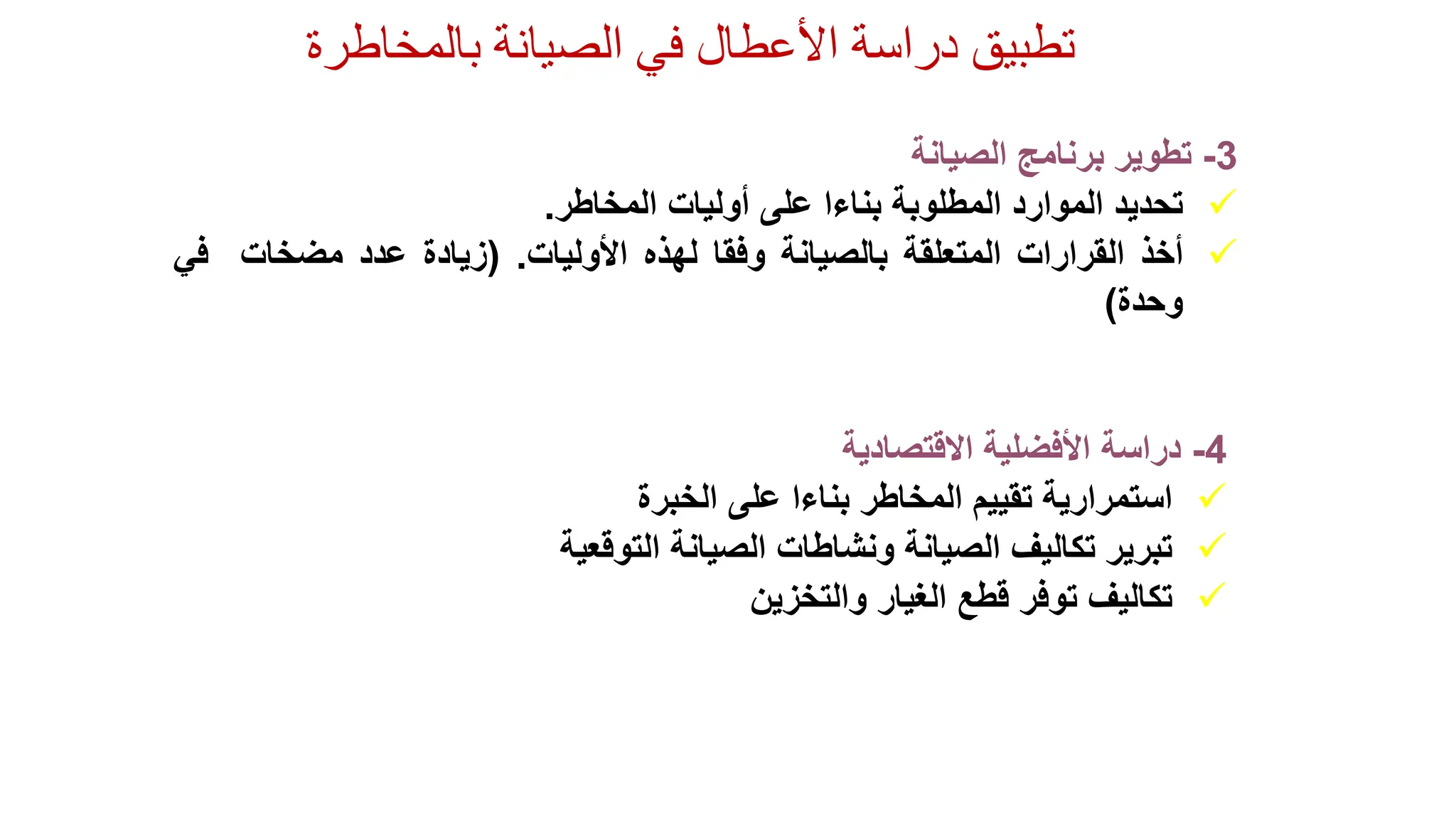
‫الصيانة‬ ‫في‬ ‫األعطال‬ ‫دراسة‬ ‫تطبيق‬
‫بالمخاطرة‬
4
-
‫دراسة‬
‫األفضلية‬
‫االقتصادية‬

‫استمرارية‬
‫تقييم‬
‫المخاطر‬
‫بناءا‬
‫على‬
‫الخبرة‬

‫تبرير‬
‫تكاليف‬
‫الصيانة‬
‫ونشاطات‬
‫الصيانة‬
‫التوقعية‬

‫تكاليف‬
‫توفر‬
‫قطع‬
‫الغيار‬
‫والتخزين‬
3
-
‫تطوير‬
‫برنامج‬
‫الصيانة‬

‫تحديد‬
‫الموارد‬
‫المطلوبة‬
‫بناءا‬
‫على‬
‫أوليات‬
‫المخاطر‬
.

‫أخذ‬
‫القرارات‬
‫المتعلقة‬
‫بالصيانة‬
‫وفقا‬
‫لهذه‬
‫األوليات‬
.
(
‫زيادة‬
‫عدد‬
‫مضخات‬
‫ف‬
‫ي‬
‫وحدة‬
)

دورة متقدمة في تخطيط الصيانة وجدولتها - الدكتور منذر القادري

  • 1.
    ‫منذر‬ ‫المهندس‬ ‫الدكتور‬ ‫القادري‬ ‫والتطوير‬‫للتدريب‬ ‫األوروبي‬ ‫األعمال‬ ‫مركز‬ info@ebctraining.net ‫والتحكم‬ ‫والجدولة‬ ‫الصيانة‬ ‫تخطيط‬
  • 2.
    Maintenance Preventive M. “To Keep” CorrectiveM. “To Restore” A facility to an acceptable standard What is Maintenance?
  • 3.
    The 6 Purposesof Maintenance Risk Reduction Least Operating Costs Maintainer The job of maintenance is to provide reliable plant for least operating cost – we don’t just fix equipment, … we improve it!
  • 4.
    Understand How Machinesare Designed When they design machines, like this shaft rotating in two bearings, they keep the parts in place by making the gaps between them very small. The hair on your head is about 0.1 mm (0.004”) thick. On this 25 mm (1”) shaft, the gap between the metal surfaces can be as small as 0.01 mm (less then 0.0005”). That is 10 times thinner than the thickness of your hair. That is very little space for things to move in. If the parts get twisted and distorted then that clearance disappears and you have parts hitting each other. Any machine in that situation will quickly fail. 25 - 0.01 - 0.025 25 + 0.01 + 0.025 L1 L2 L3 L4 TIP: THE SECRET TO GREAT EQUIPMENT LIFE IS TO … KEEP PARTS WITHIN THEIR DESIGN STRESS ENVELOPE!
  • 5.
    Defect Creation &Failure Initiation
  • 6.
  • 7.
    Defect Elimination &Failure Prevention If you don’t want problems you need to prevent their cause. If you don’t want high maintenance you need to prevent the causes of that maintenance.
  • 8.
    Plant and EquipmentLife Cycle Profits come from this stage of the life cycle, and are maximised when the operating costs are minimised.
  • 9.
    Building for thePhysics of Failure Strength Of the Material Environment and Operating Stresses Operating Risk Management Design for Reliability and Low Operating/Maintenance Cost Failure Mode Effects Analysis Reliability Engineering Life Cycle Mgmt
  • 10.
    The Degradation Cycle SmoothRunning Time (Depending on the situation this can be from hours to months.) Operating Performance Failed Impending Failure Change in Performance is Detectable Do Maintenance & Condition Monitor Equipment Unusable Repair or Replace The Failure Degradation Sequence P-F Interval Condition Inspection Interval P F Most parts show evidence, or exhibit warning signs, of failing – they follow a sequence of gradual degrading. As the vast majority of parts degrade their condition changes. These changed conditions can be observed and the parts replaced before they fail. Some items, like electronic parts, can fail without warning. Situations of huge, sudden stress or overload can cause parts to immediately fail without warning. Replace before parts’ condition gets to functional failure point
  • 11.
    Failure Mode EffectsAnalysis (FMEA) Fundamentals • A failure is any unwanted or disappointing behaviour of a product. • A failure mode is the effect by which a failure is observed. Failure modes can be electrical (open or short circuit, stuck at high), physical (loss of speed, excessive noise), or functional (loss of power gain, communication loss, high error level). • Failure mechanism refers to the processes by which the failure modes are induced. It includes physical, mechanical, electrical, chemical, or other processes and their combinations. Knowledge of failure mechanism provides insight into the conditions that precipitate failures. • A failure site describes the physical location where the failure mechanism is observed to occur, and is often the location of the highest stresses and lowest strengths. www.BIN95.com We can foretell what parts are going to cause trouble by doing experiments, from conducting tests and by using past failure history of similar parts. If we can predict what will go wrong, and the conditions that will cause it to happen, we can design maintenance and operational loading strategies to give maximum part life.
  • 12.
    Failure Mode EffectsAnalysis Failure Failure Mode Failure Mechanism Failure Site Car does not start Starter Motor does not run Corroded relay contacts Main contact of starter relay Hard disk failure Computer has no access to hard disk Hard disk address is 11 instead of 12 Line 87 in the hard disk driver software Toy has faded colour Colour changes from red to pink Accumulation of high UV dose Red plastic leg Once this is known we put strategies and practices into place to 1) Design-out the failure, 2) prevent the failure, 3) prevent the conditions 4) monitor the failure mode 5) replace before failure
  • 13.
    What Makes aProductive Equipment Life? Robust, Suitable Design Built & Installed Correctly High Availability, High Capacity High Productivity, Low Operating Cost High Return On Investment Maintenance Planning and Scheduling add value here Operated Within Limits Maintain to Design Standard Continually Improved High Reliability Unit Cost = Cost Capacity When you make plant more reliable you work on the ‘capacity’ part of the Unit Cost equation. As a result you drive down the cost of your product because the plant is available to work at full capacity for longer. So you make more product in the same time for less cost.
  • 14.
    The Asset Management‘Journey’ Regress Reactive Planned Reliability Strategic Fix it after it breaks Fix it before it breaks Don’t just fix it, improve it Don’t just improve it, optimise it Predict Plan Schedule Coordinate Cost Focus Eliminate Defects Improve Precision Redesign Value Focus Alignment (shared vision) Integration (Supply, Operations, Marketing) Differentiation (System Performance) Alliances Performance Don’t fix it, delay the fix Urgency Overtime Large store Rewards: Motivator: Behaviour: Staged Decay Overtime No Surprises Competitive Best in Class Short Term Savings Heroes Competitive Advantage Meet Budget Breakdowns Avoid Failures Uptime Growth Survival Responding Org. Discipline Org. Learning Optimisation
  • 15.
  • 16.
  • 17.
    17 ‫الصيانة‬ ‫انواع‬ Maintenance Types ‫مخططة‬‫صيانة‬ ‫مخططة‬ ‫غير‬ ‫صيانة‬ Unplanned Maintenance ‫الصيانةاالسعافية‬ Breakdown Maintenance ‫التصحيحية‬ ‫الصيانة‬ (Corrective maintenance ) ‫الدورية‬ ‫الصيانة‬ Routine Maintenance ‫اآللة‬ ‫حالة‬ ‫على‬ ‫االعتماد‬ Condition Based Maintenance ‫التنبؤية‬ ‫الصيانة‬ Predictive Maintenance ‫هندسة‬ ‫الوثوقية‬ Reliability Engineering ‫الوقائية‬ ‫الصيانة‬ PM ‫العمل‬ ‫اثناء‬ ‫اعتيادية‬ ‫إجراءات‬ ‫التوق‬ ‫اثناء‬ ‫صيانة‬ ‫ف‬ ‫نظافة‬ ‫فحص‬ ‫تزييت‬ ‫التالفة‬ ‫االجزاء‬ ‫فحص‬ ‫وتعديل‬ ‫ضبط‬ ‫االجزاء‬ ‫بعض‬ ‫تغيير‬ ‫االهتزازات‬ ‫تحليل‬ ‫الزيوت‬ ‫تحليل‬ ‫الحرارة‬ ‫درجات‬ ‫قياس‬ ‫قياس‬ ‫الضغط‬ ، ‫الصوت‬ ... Planned Maintenance Maintenance Type
  • 19.
    Today’s Best PracticeMaintenance Methodology (still misses the target!) CM = Condition Monitoring
  • 20.
    Maintenance Planning AndScheduling Maintenance Planning and Scheduling Phases Setup Define and Analyze the Situation Develop and Prepare for Delivery Implement Review Sustain
  • 21.
    Maintenance Strategy Implementation Breakdown Preventive Predictive 12 3 4 5 6 7 8 9 10 Year 100% 80% 60% 40% 20% 0% Percentage of Maintenance Time by Strategy
  • 22.
    ‫خطوات‬ ‫اعداد‬ ‫صيانة‬ ‫خطة‬ 8 . ‫اعداد‬ ‫خطة‬ ‫األجل‬ ‫قصيرة‬ .a ‫األعمال‬‫توزيع‬ .b ‫جانت‬ ‫جدول‬ ‫اعداد‬ .1 ‫قائمة‬ ‫اعداد‬ ‫المنشأة‬ ‫في‬ ‫الصول‬ ‫بجميع‬ 2 . ‫تصنيف‬ ‫أل‬ ‫وتقسيمها‬ ‫المشروع‬ ‫أو‬ ‫المنشأة‬ ‫في‬ ‫الموجود‬ ‫األصول‬ ‫كافة‬ ‫نممة‬ 3 . ‫تحديد‬ ‫األولويات‬ : ‫أهميتها‬ ‫حسب‬ ‫المعدات‬ ‫تصنيف‬ 4 . ‫ادراج‬ ‫المعدات‬ ‫بيانات‬ / ‫بطاقة‬ ‫أصل‬ ( / ‫رقم‬ ( ‫كود‬ ) ‫تاري‬ ،‫المعدة‬ ‫تصنيع‬ ‫تاريخ‬ ،‫المعدة‬ ‫عن‬ ‫المسؤول‬ ،‫المعدة‬ ‫موقع‬ ، ‫المعدة‬ ‫وميفة‬ ، ‫المعدة‬ ‫اسم‬ ،‫المعدة‬ ‫عمل‬ ‫بدء‬ ‫خ‬ ،‫المعدة‬ ‫حالة‬ ،‫باختصار‬ ‫المعدة‬ ‫مواصفات‬ ‫االستهالكية‬ ‫المواد‬ ،‫الصيانة‬ ‫منفذ‬ ‫وفني‬ ‫المستبدلة‬ ‫والمواد‬ ‫والتواريخ‬ ‫باألعمال‬ ‫اعطالها‬ ‫سجل‬، ‫االستهالك‬ ، ). 5 . ‫الوقائية‬ ‫الصيانة‬ ‫ملف‬ ‫تحديد‬ ‫مكون‬ ‫لكل‬ ‫المطلوبة‬ .a ‫توفير‬ ‫المصنعة‬ ‫الشركة‬ ‫وتعليمات‬ ‫الكتالوجات‬ ‫المخططات‬ . .b ‫تحديد‬ ‫وأعمال‬ ‫الفحص‬ ‫قوائم‬ ‫وإجراءات‬ ‫وخطوات‬ ‫الصيانة‬ ‫الصيانة‬ .c ‫ومواد‬ ‫التبديلية‬ ‫القطع‬ ‫قوائم‬ ‫تحديد‬ ‫الصيانة‬ . .d ‫الصيانة‬ ‫دورية‬ ‫تحديد‬ ( ‫سنوي‬ ،‫سنوي‬ ‫نصف‬ ، ‫ربعي‬ ،‫شهري‬ ، ‫أسبوعي‬ ، ‫يومي‬ ) .e ‫صيانة‬ ‫دورة‬ ‫كل‬ ‫في‬ ‫الصيانة‬ ‫مدة‬ ‫تحديد‬ ( ‫الساعات‬ ‫عدد‬ ) .f ‫تحديد‬ ‫صيانة‬ ‫دورة‬ ‫كل‬ ‫في‬ ‫المطلوبة‬ ‫العمالة‬ .g ‫تحديد‬ ‫األدوات‬ ‫صيانة‬ ‫دورة‬ ‫كل‬ ‫في‬ ‫الصيانة‬ ‫ألعمال‬ ‫المطلوبة‬ ‫واألجهزة‬ .h ‫صيانة‬ ‫دورة‬ ‫كل‬ ‫في‬ ‫الصيانة‬ ‫تكاليف‬ ‫تقدير‬ .i ‫الصيانة‬ ‫بطاقات‬ ‫اعداد‬ 6 . ‫اعداد‬ ‫خطة‬ ‫األجل‬ ‫طويلة‬ 7 . ‫اعداد‬ ‫خطة‬ ‫األجل‬ ‫متوسطة‬ .9 ‫االعتماد‬ ‫الميزانية‬ ‫و‬
  • 23.
    ‫الصيانة‬ ‫وإدارة‬ ‫األصول‬‫إدارة‬ ‫الممارسات‬ ‫أفضل‬
  • 24.
    ‫األصول‬ ‫نصنف‬ ‫كيف‬ ‫الفئة‬‫التفاصيل‬ ‫إنتاجية‬ ‫أصول‬ ‫الخدمة‬ ‫تقديم‬ ‫في‬ ‫مباشرة‬ ‫ستخدم‬ُ‫ت‬ ‫التي‬ ‫األصول‬ ( ‫مثل‬ : ‫تول‬ ‫توربينات‬ ‫الكهرباء‬ ‫يد‬ ) . ‫داعمة‬ ‫أصول‬ ‫العملية‬ ‫ن‬ّ‫ك‬‫تم‬ ‫التي‬ ‫األصول‬ ‫اإلنتاجية‬ ) ‫مثل‬ : ‫شبكات‬ ،‫المحطات‬ ‫تبريد‬ ‫أنممة‬ (IT ‫تحتية‬ ‫بنية‬ ‫أصول‬ ‫الطويل‬ ‫العمر‬ ‫ذات‬ ‫الثابتة‬ ‫األصول‬ ( ‫مثل‬ : ‫الم‬ ‫خزانات‬ ،‫الكهرباء‬ ‫نقل‬ ‫خطوط‬ ‫ياه‬ ) . ‫على‬ ‫تعتمد‬ ‫رئيسية‬ ‫معايير‬ ‫لعدة‬ ً‫ا‬‫وفق‬ ‫األصول‬ ‫تصنيف‬ ‫يتم‬ ‫أهميتها‬ ،‫وظيفتها‬ ،‫طبيعتها‬ ‫االستراتيجية‬ ، ‫المادية‬ ‫وقيمتها‬ .
  • 25.
    ‫االستراتيجية‬ ‫األهمية‬ ‫حسب‬‫التصنيف‬ ( ‫الحرجة‬ ) ‫المستوى‬ ‫المعايير‬ ‫أمثلة‬ ‫حرجة‬ ‫أصول‬ - ‫تح‬ ‫أو‬ ‫بالكامل‬ ‫الخدمة‬ ‫تتوقف‬ ‫تعطلت‬ ‫إذا‬ ‫دث‬ ‫كبيرة‬ ‫أضرار‬ . - ‫استبدالها‬ ‫صعوبة‬ . ‫الج‬ ‫محوالت‬ ،‫الرئيسية‬ ‫التحلية‬ ‫محطات‬ ‫هد‬ ‫العالي‬ ‫حرجة‬ ‫شبه‬ ‫أصول‬ - ‫ولكن‬ ‫الخدمة‬ ‫من‬ ‫جزء‬ ‫على‬ ‫يؤثر‬ ‫تعطلها‬ ‫كامل‬ ‫بشكل‬ ‫ليس‬ . ‫التوز‬ ‫كابالت‬ ،‫الفرعية‬ ‫المياه‬ ‫مضخات‬ ‫يع‬ ‫حرجة‬ ‫غير‬ ‫أصول‬ - ‫تأجيل‬ ‫مكن‬ُ‫ي‬‫و‬ ‫الخدمة‬ ‫يوقف‬ ‫ال‬ ‫تعطلها‬ ‫إصالحها‬ . ‫الخارجية‬ ‫اإلنارة‬ ‫أنممة‬ ،‫المكاتب‬ ‫أثاث‬
  • 26.
    ‫والصيانة‬ ‫الحياة‬ ‫دورة‬‫حسب‬ ‫التصنيف‬ ‫الفئة‬ ‫الخصائص‬ ‫جديدة‬ ‫أصول‬ ‫فقط‬ ‫وقائية‬ ‫صيانة‬ ‫تحتاج‬ ،‫الضمان‬ ‫تحت‬ . ‫العمر‬ ‫متوسطة‬ ‫أصول‬ ‫أداء‬ ‫وتحليل‬ ‫دورية‬ ‫صيانة‬ ‫تحتاج‬ . ‫قديمة‬ ‫أصول‬ ً‫ال‬‫استبدا‬ ‫أو‬ ‫مكثفة‬ ‫صيانة‬ ‫تتطلب‬ ( ‫تحليل‬ ‫عبر‬ ‫حدد‬ُ‫ي‬ " ‫تكل‬ ‫الحياة‬ ‫دورة‬ ‫فة‬ )" .
  • 27.
    ‫المالية‬ ‫القيمة‬ ‫حسب‬‫التصنيف‬ • ‫القيمة‬ ‫عالية‬ ‫أصول‬ : ‫مرتفعة‬ ‫استبدالها‬ ‫تكلفة‬ ( ‫مثل‬ : ‫الكهرباء‬ ‫توليد‬ ‫محطات‬ ) . • ‫متوسطة‬ ‫أصول‬ ‫القيمة‬ ) ‫مثل‬ : ‫أنممة‬ ‫المركزي‬ ‫والتبريد‬ ‫التكييف‬ ( • ‫منخفضة‬ ‫أصول‬ ‫القيمة‬ ) ‫مثل‬ : ‫متوسطة‬ ‫ونسخ‬ ‫طباعة‬ ‫ألة‬ , ‫أدوات‬ ‫الصيانة‬ ‫الروتينية‬ (
  • 28.
  • 29.
    ‫اسبوعية‬ ‫توزيع‬ ‫مثال‬ ‫الفعلية‬‫األسبوعية‬ ‫العمل‬ ‫ساعات‬ ‫عدد‬ Actual weekly working hours 20 % ‫الطارئة‬ ‫للصيانة‬ ‫الساعات‬ ‫من‬ Emergency Maintenance % 80 ‫الوقائية‬ ‫للصيانة‬ ‫الساعات‬ ‫من‬ ‫والتصحيحية‬ Heavy PM & CM 80% Visual PM 20%
  • 30.
    Evolution and Ranking ofMaintenance Policies
  • 31.
  • 32.
    Decision Mapping CBM: ConditionBase Monitoring OTF: Operate To failure SLU: Skill Level Upgrade DOM: Design Out M/C. FTM: Fixed Time Maintenance
  • 33.
    Maintenance Planning Horizons 5/ 10 Year Maintenance Plan 1 Yr Plan 1 Mth Plan 1 Wk Plan Daily Plan Long Term Plan Short Term Plan Locked-in Schedule Supervisor Planner Shutdown Planner Maintenance Manager Management lead the way by agreeing what they want and how to get there. Then you and I do the work that is required. Operations Manager Strategic Tactical
  • 34.
    Putting Maintenance Strategyinto Action The strategy gets turned into plans, that if achieved, will deliver the operating goals. These plans become what we work on during the years and months ahead.
  • 35.
  • 36.
  • 37.
    The work planningand Scheduling Process
  • 38.
    ‫في‬ ‫المعلومات‬ ‫ة‬ ‫ر‬‫إدا‬‫نظام‬ ‫الصيان‬ ‫ة‬ ‫مخطط‬ ‫سريان‬ ‫المعلومات‬ ‫للرقابة‬ ‫على‬ ‫المواد‬ ‫العمل‬ ‫أمر‬ ‫إصدار‬ ‫على‬ ‫اد‬‫و‬‫م‬ ‫طلب‬ ‫العمل‬ ‫أمر‬ ‫رقم‬ ‫اآللي‬ ‫الحاسب‬ ‫هل‬ ‫المطلوبة‬ ‫اد‬‫و‬‫الم‬ ‫موجودة‬ ‫إصدار‬ ‫تقرير‬ ‫عن‬ ‫مختلف‬ ‫المردين‬ ‫و‬ ‫المواد‬ ‫العمل‬ ‫أمر‬ ‫اد‬‫و‬‫م‬ ‫تسليم‬ ‫اد‬‫و‬‫الم‬ ‫اء‬ ‫ر‬‫ش‬ ‫اد‬‫و‬‫الم‬ ‫استالم‬ ‫المستودعات‬ ‫اآللي‬ ‫الحاسب‬ ‫اء‬ ‫ر‬‫الش‬ ‫امر‬ ‫اصدار‬ ‫اد‬‫و‬‫الم‬ ‫عن‬ ‫معلومات‬ ‫الالزمة‬ ‫وكميتها‬ ‫استخدامها‬‫و‬ ( ‫العمل‬ ‫أمر‬ ) ‫التخزين‬ ‫رقم‬ ‫التخزين‬ ‫موقع‬ ‫الشراء‬ ‫كمية‬ ‫تحديد‬ ‫ومستوى‬ ‫االقتصادية‬ ‫األدنى‬ ‫التخزين‬ ‫لدى‬ ‫الشراء‬ ‫أمر‬ ‫يصدر‬ ‫المخزنة‬ ‫الكمية‬ ‫وصول‬ ‫للتخزين‬ ‫األدنى‬ ‫للحد‬ ‫نعم‬ ‫ال‬
  • 39.
  • 40.
    Maintenance Planning And Scheduling Benefitsof Maintenance Planning and Scheduling Decreased Asset Downtime Increased Asset Life Minimized Sudden Breakdown Improved Workflow Increased Productivity Decreased Maintenance Expenses Better Coordination Enhanced Asset Performance
  • 41.
    Maintenance Planning AndScheduling Do's and Don'ts • Choose the Right Maintenance Planner • Train Maintenance Planner • Keep Maintenance History • Check Equipment & Inventory Availability • Don't Ignore KPΙ • Don't Give Incomplete Information • Don't Take Small Feedbacks Do's of Maintenance Planning and Scheduling Don'ts of Maintenance Planning and Scheduling
  • 42.
    Maintenance Planning AndScheduling Useful Tips Properly Train the Planner Make Changes Based on Feedback Ensure Job Plans are Clear and Concise Understand the Difference Between Planning & Scheduling Provide Feedback on Completed Tasks Choose a Good Maintenance Planner 01 02 03 04 05 06
  • 43.
    Maintenance Planning AndScheduling Recognize the skills of the techs Protect the planner Focus on future work Component level-files Use planner judgment for time estimates Daily work is handled by the crew leader Job plans are needed for scheduling Scheduling and job priorities are important Schedule based on the highest skills available Schedule for every available work hour VS Planning Principles Scheduling Principles
  • 44.
    Control Activities  CostControl  Quality Control  Inventory Control  Work Control
  • 45.
    Cost Types &Control
  • 46.
  • 47.
  • 48.
    The Purpose ofBusiness Profit ($) = Revenue - Total Costs Total Costs ($) = Fixed Costs + Variable Costs EBITDA = Earnings before Interest, Tax, Depreciation, Amortization – it represents the operating profit. I want to show you the disaster that plant and equipment failures are to a business.
  • 49.
    Effects of MaintenanceCosts Profit ($) = Revenue - Total Costs Total Costs ($) = Fixed Costs + Variable Costs $ Output / Time EBITDA Profit Variable Cost Fixed Cost Normal Business Operations Revenue Total Cost Fixed Maintenance Costs Variable Maintenance Costs Preventive and Predictive Maintenance Repairs – variable cost that eats profit Maintenance is cheap, … it’s repairs that are expensive!
  • 50.
    Impact of Defectsand Failures Total Costs ($) = Productive Fixed Costs ($) + Productive Variable Costs ($) + Costs of Loss ($) Cost of Loss ($/Yr) = Frequency of Loss Occurrence (/Yr) x Cost of Loss Occurrence ($) Effects on Costs and Profit of a Failure Incident $ Output / Time Revenue Total Cost Fixed Cost t1 t2 Profits forever lost Increased and Wasted Variable Costs Wasted Fixed Costs Added Cost Impact of a Failure Incident Variable Cost Stock-out Once the equipment fails, new costs and losses start appearing.
  • 51.
    Maintenance Costs Maintenance Commitment Cost PM Cost TotalMaintenance Cost Breakdown Cost Optimal
  • 52.
    Defect and FailureTrue (DAFT) Costs go Company-wide www.BIN95.com It’s unbelievable how much money is wasted all over the business with each failure. The one I like is the time lost matching invoices against purchase orders that did not need to be raised, but for the failure! The ‘lost life value’ of parts is expensive too.
  • 53.
    Whenever I’ve calculatedthe DAFT Costs they came out between 7 and 15 times the repair cost. I use 10 times as a ‘rule of thumb’. Failure Costs Surge thru the Company Labour Product Sales Services Capital Equipment Consequence Waste Materials Administration Equipment Failure Cost Surge Curtailed Life Every department in the business gets hit from the ‘failure cost surge’.
  • 54.
    And clearly, repeatedplant and equipment failures and stoppages totally destroy the profitability of an operation. $ Output / Time Effects on Profitability of Repeated Failure Incidents t1 t2 t3 t4 t5 t6 Profits forever lost Accumulated Wasted Variable, Fixed and Failure Costs Wasted Fixed Costs Revenue Total Cost Fixed Cost Variable Cost If there are lots of failures, you end up running around like headless chooks, losing money faster and faster. It makes me laugh when I see this happening in a company. Everyone is busy, but there little profit, … it’s all lost in the ‘failure cost surges’.
  • 55.
    Fortunately Ted, wecan do something about it. There are two choices – get very good at fixing failures fast, or, don’t have failures in the first place - ZERO DEFECTS is the way to go. Benefits of Reducing Operating Risk $ Output / Time Effects on Profitability of Reducing Consequence Only t1 t2 t3 t4 t5 t6 Fewer profits lost, but ‘fire-fighting’ is high Accumulated Wasted Variable and Failure Costs Wasted Fixed Costs Revenue Variable Cost Fixed Cost Total Cost $ Output / Time Effects on Profit of Reducing Chance Only t1 t2 Fewer Profits Lost Wasted Fixed Costs Revenue Total Cost Fixed Cost Variable Cost Risk ($/yr) = Frequency (/yr) x Consequence ($)
  • 56.
    Implications of DAFTCosts on Maintenance Chance Of Failure in Time Period DAFT Cost per Event $1K $10K $100K $1,000K $10,000K 0% 100% $0.1K $1K $10K $100K $1,000K Repair Cost per Event Accept Never Accept 50% Do the DAFT Cost spreadsheets for each item of plant If each failure costs your business $7,000 – $15,000 for every $1,000 of repair cost … what risk is the business willing to carry? How often will a failure event be accepted?
  • 57.
    Acceptable Equipment ItemFailure Domain DAFT Cost per Failure Event $1K $10K $100K $1,000K $10,000K $0.1K $1K $10K $100K $1,000K Repair Cost per Failure Event Outside the Volume Never Accept Failure 1 2 3 4 Limit of $10,000/Period What is your tolerance for problems on a piece of equipment? Inside this Volume Accept Failure Chance Of Failure in Time Period 100% 50% 10%
  • 58.
    How Maintenance Planning& Scheduling Help to Reduce Unit Cost of Production The ‘Hidden Factory’ Maintenance and Production unearth the ‘hidden factory’ when they work correctly, accurately, safely, right first time. Production Throughput Rate 0 50 100 150 200 250 300 0 >100 >250 >500 >750 >1000 >1250 >1500 >1750 >2000 >2250 >2500 Units per Hour Hours Waste is any time not spent changing the shape of the product. Design Capacity
  • 59.
    When Operating Costsare Committed Once a plant is designed and built there is very little that can be done to reduce operating costs because they are substantially fixed by the plant’s design. If you want low operating costs, this chart makes it clear that they are designed into the plant and equipment during feasibility, design and construction.
  • 60.
    Maximising Life CycleProfits Idea Creation Approval Detail Design Procurement Construction Commissioning Decommissioning Equipment Life Cycle (say 20 years) ~ 10% of Life Cycle (~ 2 years) ~ 85% of Life Cycle (~ 17 years) ~ 5% Preliminary Design Feasibility Operation Disposal The Project Phase is the time to control the future costs of failure All we can do during the operating phase is run and care for the equipment as it was designed to be. If the design requires expensive parts, and/or lots of downtime for maintenance and repairs, then the design is the problem, not the maintenance.
  • 61.
    Life Cycle RiskManagement Strategy Optimised Operating Profit Method Design Drawings Assume Equipment Failure DAFT Costs Spreadsheet Applicable O & M Strategies Redesign with FMEA; Revise O & M Strategies, Revise Project Strategies Projected R & M Costs Busine$$ Ri$k Ba$ed Equipment Criticality Applicable Project Strategies Frequency Achievable? N Y Quality Procedures Precision Maint Predictive Maint Preventive Maint RCFA Maint Planning Etc. FMEA/RCM HAZOP Precision Standards Precision Instaln Reliability Eng Etc. Failure Cost Acceptable? N Y Profit Optimisation Loop It is possible to make great operating cost savings during the design, if the designers reduce the operating risks that their choices cause the business.
  • 62.
    www.BIN95.com Consequence $ Frequency No/yr Risk$/yr = Consequence$ x No of Failures/yr x Chance of Failure Risk can be Measured The ‘A’ curve is the same risk throughout A A A Too many small failures is just as bad as a catastrophe Too many small failures is just as bad as a catastrophe
  • 63.
    www.BIN95.com Grading Risk basedon Chance & Consequence Log of Consequence $ Log of Frequency No/yr Log Risk = Log Consequence x Log Frequency 1 10 100 1,000 10,000 100,000 1 10 100 1,000 Risk = Consequence x Frequency
  • 64.
    www.BIN95.com What Risk Means LogConsequence $ Log Frequency No/yr Hazard Consequences All threat barriers in place can have ‘holes’ in them. What is the likely cause of the ‘holes’ in the barriers ? I used to wonder why we were so lucky that more things didn’t go wrong! Log-log plot In reality, extreme risk doesn't arise often. What is the chance the ‘holes’ line-up at the same time?
  • 65.
    Risk – ReduceChance or Reduce Consequence? Risk = Chance x Consequence  Engineering and Maintenance Standards  Failure Design-out - Corrective Maintenance  Failure Mode Effects Criticality Analysis (FMECA)  Statistical Process Control  Hazard and Operability Study (HAZOP)  Root Cause Failure Analysis (RCFA)  Precision Maintenance  Hazard Identification (HAZID)  Training and Up-skilling  Quality Management Systems  Planning and Scheduling  Continuous Improvement  Supply Chain Management  Accuracy Controlled Enterprise SOPs (ACE 3T)  Design, Operation, Cost Total Optimisation Review (DOCTOR)  Defect and Failure True Cost (DAFTC)  Oversize/De-rate Equipment  Reliability Engineering  Preventative Maintenance  Predictive Maintenance  Total Productive Maintenance (TPM)  Non-Destructive Testing  Vibration Analysis  Oil Analysis  Thermography  Motor Current Analysis  Prognostic Analysis  Emergency Management  Computerised Maintenance Management System (CMMS)  Key Performance Indicators (KPI)  Risk Based Inspection (RBI)  Operator Watch-keeping  Value Contribution Mapping (Process step activity based costing)  Logistics, stores and warehouses  Maintenance Engineering Chance Reduction Strategies Consequence Reduction Strategies Done to reduce the chance of failure Done to reduce the cost of failure
  • 66.
    The Application ofRisk Based Principles to Maintenance Hazard Identification identifies failure modes Risk Assessment establishes the probability and consequence of failure Risk Evaluation determines the acceptability of failure to safety, process etc Risk Control reduces risk through effective maintenance practices Monitoring Verifies initial assumptions and maintenance effectiveness Maintenance Planning belongs here … delivering risk management As a Maintenance Planner your job is to deliver the risk control strategies used in your operation. And then check if they actually do lift the plant reliability.
  • 67.
    Equipment Criticality Equipment Criticality= Operating Risk = Failure Frequency (/yr) x DAFT Cost Consequence ($) Equipment Criticality is a business risk rating indicator. We need to know where to put our efforts for the greatest payback. The 80/20 rule applies to maintenance as well – which 20% of equipment maintenance gives 80% of the benefits. Once you have order of priority, you know what to focus on.
  • 68.
    Match Maint Typeto Equipment Criticality Risk Based Method Breakdown Based Maintenance Hazardous, Safety, Environmental dangers from process Breakdown, stops production, affects quality Breakdown, stops production, affects quality Affects downstream plant Affects downstream plant Can be fixed on-line Can be fixed on-line S C B A Equipment Time Based Maintenance Condition Based Maintenance S = Safety ; A,B,C = Maintenance Type Once you decide the criticality, you match the type of maintenance to it by using this risk based chart, or the next one, which uses the inherent reliability of the item as the criteria.
  • 69.
    Choosing of MaintenanceType - Simplified RCM Method Consequence of failure acceptable ? Life reasonably predictable ? Condition Monitoring practical ? Condition Monitoring economic ? Condition based maintenance Design out cause of failure practical? Designing out cause of failure economical ? Time based maintenance Breakdown maintenance Plant Change yes yes yes yes yes no no no no no yes no Be very, very wary of choosing to do Breakdown Maintenance if you have not done the full DAFT Costing. My experience is that Breakdown Maintenance costs a company 7 – 15 times the repair cost. A $10,000 repair really costs the business between $70,000 to $150,000. You can buy a lot of maintenance for that! RCM = Reliability Centred Maintenance
  • 70.
    Planning is aProcess, and needs Control Remember this …? One fails … all fails! One poor … all poor! Rsystem= R1 x R2 x R3 … 1 1 1 n In a series process we must be precise because there is no redundancy. In a series work process the only way to do a 100% reliable job is to make sure every task in it is done 100% reliably. Because planning is a series process, the task variability problem needs a work system that standardizes what to do, and how to do it. This makes planning repeatable and reliable. The ‘planning system’ comprises the accumulated planning procedures. Scope Standards Parts Procedures Handover Plan the Job Rplan = R1 x R2 x R3 x R4 x R5 Each task 95% reliable 0.95 x 0.95 x 0.95 x 0.95 x 0.95 = 0.77 Each task 90% reliable 0.9 x 0.9 x 0.9 x 0.9 x 0.9 = 0.59 Planning is a series process.
  • 71.
    Track Planning Performance& Benefits • Percent of Plan Followed During the Job • Work Orders With Complete Work Packs • Improved Equipment Reliability • Improved Plant Availability • Maintenance Backlog by Type • Preventive Maintenance Complete On-Time You’ll want to know how well you are going. You can work that out in three ways. First, by seeing how closely the plan is followed. If it is done with 100% compliance and the final condition monitoring check is within standard, you can say the plan was perfect. Second, you can see what effect the work had on the plant’s operation. Third, is by seeing if maintenance productivity improves. If all three trend positively, you are on-track. Plan Compliance Plant Performance Maintenance Performance
  • 72.
    Specify the WorkmanshipStandards • Standardised Work • Setting the Standards for a Job • Identifying Necessary Skills for a Job • Use 3T Failure Preventing Job Procedures “We must protect the plant and equipment from good intentioned people who don’t know what they are doing.” People need to know what is expected from them. They need to know what excellent work is. How else can they ever get a sense of pride in doing a job well?
  • 73.
    Shutdown Performance Recipe PracticesOutcome s Good Management Processes Integration Small size Front-end loading Availability Schedule Safety Cost Best Practices
  • 77.
    Trend to MonitorKPIs Work Orders in Backlog 0 50 100 150 200 1 2 3 4 5 6 7 8 9 10 11 12 13 14 15 16 17 18 19 20 Weeks in Backlog Work orders Work Orders 0.0% 5.0% 10.0% 15.0% 20.0% 25.0% 30.0% 35.0% 40.0% A u g - 0 3 S e p - 0 3 O c t - 0 3 N o v - 0 3 D e c - 0 3 J a n - 0 4 F e b - 0 4 M a r - 0 4 A p r - 0 4 M a y - 0 4 J u n - 0 4 J u l - 0 4 A u g - 0 4 S e p - 0 4 O c t - 0 4 N o v - 0 4 BREAKDOWN BREAKDOWN TARGET CORRECTIVE PREVENTATIVE PROJECT REWORK PREDICTIVE Target Line Trend Line Trending KPIs turns measurement into monitoring Individual KPI
  • 78.
    Showing Progress Stacked Bar Chartwith Red, Blue, Green quickly shows both progress and work outstanding still to complete
  • 79.
    Developing the Schedule AllWork Backlog by category Prelim Schedule for next week, or longer Schedule 2 Fortnight ahead, or longer Schedule 3 Future, including shuts Fixed for the Week PMs PdMs Corrective Projects Reliability Improvements Work Orders ready to go with parts in store and resource ready Planning Production Requests Daily Schedule M E E T I N G BREAKDOWNS ! WARNING ! You must stop this happening to low priority work, else you will have a breakdown! Screen for Validity and Cost
  • 80.
    Role of theSupervisor: Manage Manpower & Resources to Schedule The Maintenance Supervisor is responsible to meet the plan Planner Supervisor Tradesman Scheduler Cost Quality Time Plan Do Check Act Monitor & Control Progress Plan & Prepare Resources
  • 81.
    The relation between someterms for the availability performance
  • 82.
    THEORETICAL BACKGROUND: FaultFinding in the Total Picture
  • 83.
    MEAN TIME TOFAILURE [MMTF] Where f(t) is the failure probability density function
  • 84.
    MEAN TIME TOREPAIR [MTTR]
  • 85.
    Formulas for AvailabilityPerformance Ai =Inherent Avail ability (e.g. an availability only depending upon the technical system.) Aa = Achieved Availability (e.g. an availability depending upon both the technical system and the maintenance organization.) Ao = Operational Availability MTTM = Mean Time To Maintenance (Maintenance = preventive and corrective maintenance actions) M = Mean Maintenance Time (Time for preventive and corrective maintenance actions)
  • 86.
    Mean Time BetweenFailure, MTBF MDT (Mean Down Time) and MTTF (Mean Time To Failure).
  • 87.
    Percentage of BreakdownsHours = Breakdown Hours / Production Hours x 100 Availability = M a i n t e n a n c e H o u r s / Available Production Hours x 100 where: Breakdown Hours: the hours spent for repairing breakdowns Production Hours: the net production hours where: Maintenance Hours: the hours spent for repairing breakdowns and executing preventive maintenance programs Available Production Hours: the total production hours available except weekends (for example the available production hours in a week are: 24 hours x 5 days=120 hours)
  • 88.
    Reliability Properties forSystems • Series Systems Rsystem= R1 x R2 x R3 • Parallel Systems Rsystem= 1-[(1- R1)x(1- R2)x(1-R3)] 1 1 1 n 1 1 1 n R = 0.95 x 0.95 = 0.9025 R = 1 – [(1 - 0.6) x (1 - 0.6)] = 0.84 The mathematics can be difficult. But you need to know that such mathematics exists and be able to use the principles to optimise maintenance.
  • 89.
    Reliability Properties forSeries Systems Rsystem= R1 x R2 x R3 1 1 1 n Properties of Series Systems 1. The reliability of a series system can be no higher than the least reliable component. 2. If ‘k’ more items are added into a series system of items (say 1 added to a system of 2, each with R = 0.9) the probability of failure of all items must fall an equal proportion (33%), to maintain the original system reliability. (0.9 x 0.9 = 0.93 x 0.93 x 0.93 = 0.81) 3. A small rise in reliability of all items (say R of the three items rises 0.93 to 0.95, 2.2% improvement) causes a larger rise in system reliability (from 0.81 to 0.86, 5%). • Implications for Equipment made of Series Systems 1 System-wide improvements lift reliability higher than local improvements. This is why SOP’s, training and up-skilling pay-off. 2 Improve the least reliable parts of the least reliable equipment first. 3 Carry spares for series systems and keep the reliability of the spares high. 4 Standardise components so fewer spares are needed. 5 Removing failure modes lifts system reliability. This is why Root Cause Failure Analysis (RCFA) and Failure Mode and Effects Analysis (FMEA) pay off. 6 Provide pseudo-parallel equipment by providing tie-in locations for emergency equipment . 7 Simplify, simplify, simplify – fewer components means higher reliability.
  • 90.
    Reliability Properties forParallel Systems 1 1 1 n Rsystem= 1-[(1- R1)x(1- R2)x(1-R3)] Properties of Parallel Systems 1. The more number of components in parallel the higher the system reliability. 2. The reliability of the parallel arrangement is higher than the reliability of the most reliable component. m m m m m m m m Which arrangement is more reliable if m = 0.9? • Implications of Parallel Systems for Equipment 1 Use parallel arrangements when the risk of failure has high DAFT Cost consequences. 2 Consider providing various paths for product to take in production plants with in-series equipment. 3 Build redundancy into your systems so there is more than one way to do a thing.
  • 91.
    Failure Prediction Mathematics– Weibull Reliability of Parts and Components An increasing failure rate >1 suggests "wear out" - parts are more likely to fail as time goes on. Hence change parts as part of a PM on a time basis. The Maintenance Zones of Component Life Rate of Failing Infant Mortality Constant Likelihood of Failure End of Life A constant failure rate ~ 1 suggests that items are failing from random events. Hence cannot predict when a particular part will fail so use condition monitoring to check for failure mechanism. A decreasing failure rate < 1 would suggest ‘infant mortality’. That is, defective items fail early and the failure rate decreases over time as they fall out of the population. Hence need high quality control and accuracy in manufacture and assembly or ‘burn-in’ on purpose. www.BIN95.com Mr Weibull (say Vaybull) discovered the mathematics to model the life of parts. It uses historic failure data from your CMMS to estimate what life a part has in your operation. Time – Age of Part
  • 92.
    Equipment Reliability Strategies Time– Age of Equipment Strategies for the Infant Mortality Maintenance Zone Rate of Failing How to Drive the Chance Curve Down? How to Pull the Position of the Curve Lower? How to Push the Time of the Curve Back? Time – Age of Equipment Strategies for the Random Failure Maintenance Zone How to Drive the Position of the Curve Lower? Rate of Failing Time – Age of Equipment Strategies for the Wear-Out Failure Maintenance Zone Rate of Failing How to Push the Start of the Rising Curve Back? How to Lower the Curve Steepness? With the new understanding of risk and chance from reliability engineering we now understand which operating and maintenance practices to use to reduce the likelihood of failure happening at every stage of an equipment’s life cycle Quality Control, Training, Precision Assembly PM, PdM, Precision Operation Replace Equipment, Add more components to renewal PM
  • 93.
    6 Mechanical EquipmentCare Standards to Set, Use and Keep Using Vibration: Balancing: Alignment: Fastener Torque: Deformation: Lubricant Cleanliness: These are the BIG 6 that maintenance can control.
  • 94.
    Using Condition Monitoringto Optimise Availability Condition monitoring is not only a tool for checking the equipment condition. It is equally as valid to use it to improve the machine conditions.
  • 95.
    This is agood overview of what we need to do with our plant and equipment throughout its life cycle. If we want high reliability in operation we need to have high reliability at every stage of a machine’s life. A Roadmap for Reliability Improvement
  • 96.
    Maintenance Management BestPractice – Profit-Focused, Ultra-High Reliability Precision Operating Risk Life Cycle Profit Optimisation Loop Precision Domain (with ACE 3Ts) Assemble & use a plan for operation, maintenance & improvement of units Assemble & use a plan for continually removing defects from processes Business Value Contribution Z E R O F A I L U R E
  • 97.
    ‫دراسة‬ ‫الموثوقية‬ ‫يوضح‬ ‫المنحنى‬ ‫معدل‬ ‫الفشل‬ ‫لهذه‬ ‫المراحل‬ ‫هي‬ : 1 - ‫مرحلة‬ ‫التسخين‬ ‫حيث‬ ‫يقل‬ ‫معدل‬ ‫الفشل‬ ‫بسرعة‬ ‫وبتوزيع‬ ‫خاص‬ 2 - ‫مرحلة‬ ‫العمر‬ ‫المفيد‬ ‫حيث‬ ‫يكون‬ ‫معدل‬ ‫الفشل‬ ‫ثابتا‬ ‫ويمثل‬ ‫فشال‬ ‫عشوائيا‬ ‫تماما‬ ‫و‬ ‫بتوزيع‬ ‫أسي‬ ‫سالب‬ 3 - ‫مرحلة‬ ‫االهتراء‬ ‫حيث‬ ‫يزداد‬ ‫معدل‬ ‫الفشل‬ ‫ويمثل‬ ‫فشال‬ ‫بتوزيع‬ ‫معتدل‬ ‫زمن‬ (t) 1 ‫التسخين‬ ‫فترة‬ Running in 2 ‫المفيد‬‫العمر‬ ‫فترة‬ Useful life 3 ‫االهتراء‬ ‫فترة‬ Wear-out ‫تعريف‬ ‫عمر‬ ‫التشغيل‬ ‫يمكن‬ ‫تمثيل‬ ‫عمر‬ ‫التشغيل‬ ‫لمعدة‬ ‫أو‬ ‫جزء‬ ‫بمنحنى‬ ‫على‬ ‫شكل‬ ‫حوض‬ Bath-TUb ‫يمر‬ ‫بثالث‬ ‫مراحل‬ ‫كما‬ ‫في‬ ‫الشكل‬ ‫التالي‬ :
  • 98.
    ‫دراسة‬ ‫الموثوقية‬ ‫خلفية‬ ‫رياضية‬ ‫لقياس‬ ‫الموثوقية‬ ‫تحسب‬ ‫الموثوقية‬ ‫من‬ ‫معدالت‬ ‫الفشل‬ ‫وتوزيعاتها‬ ‫التكرارية‬ ‫لألعطال‬ ‫الممكن‬ ‫حدوثها‬ ‫خ‬ ‫الل‬ ‫فترة‬ ‫زمنية‬ ‫لعدد‬ ‫من‬ ‫نوع‬ ‫معين‬ ‫لقطعة‬ ‫الغيار‬ ‫والمعدالت‬ ‫األساسية‬ ‫العامة‬ ‫التي‬ ‫يمكن‬ ‫التعر‬ ‫ف‬ ‫عليها‬ ‫هي‬ : 2 - ‫طريقة‬ ‫حساب‬ ‫الموثوقية‬ 1 - ‫دالة‬ ‫كثافة‬ ‫احتمال‬ ‫الفشل‬ Probability density functionof failure ) ( 1 t f  2 - ‫التوزيع‬ ‫التراكمي‬ ‫لدالة‬ ‫احتمال‬ ‫الفشل‬ Cumulative distribution function of failure    t dt t f t F 0 ) ( ) ( 2 3 - ‫دالة‬ ‫الموثوقية‬ ( ‫البقاء‬ ) : ‫احتمال‬ ‫بقاء‬ ‫العنصر‬ ‫دون‬ ‫عطل‬ Reliability function (survival) ) ( 1 ) ( 3 t F t R    4 - ‫العمر‬ ‫المحدد‬ ( ‫اللحمي‬ ) ‫للفشل‬ ( ‫معدل‬ ‫الخطر‬ ) Age- specific (instantaneous) failure {Hazard rate) ) ( 1 ) ( ) ( 4 t F t f t Z    5 - ‫متوسط‬ ‫الزمن‬ ‫إلى‬ ‫الفشل‬ Mean time to failure     o dt t tf MTTF ) ( 5
  • 99.
    ‫دراسة‬ ‫الموثوقية‬ ‫طريقة‬ ‫مبسطة‬ ‫لحساب‬ ‫الدوال‬ 1 - ‫دالة‬ ‫كثافة‬ ‫احتمال‬ ‫الفشل‬ Probability density functionof failure   ) ( 1 t f ‫عدد‬ ‫الوحدات‬ ‫الفاشلة‬ ‫عند‬ ‫زمن‬ (t) ‫عدد‬ ‫الوحدات‬ ‫عند‬ ‫بداية‬ ‫الوقت‬ (t=0) 2 - ‫التوزيع‬ ‫التراكمي‬ ‫لدالة‬ ‫احتمال‬ ‫الفشل‬ Cumulative distribution function of failure   ) ( 2 t F ‫عدد‬ ‫الوحدات‬ ‫الفاشلة‬ ‫المتراكمة‬ ‫عند‬ ‫زمن‬ (t) ‫عدد‬ ‫الوحدات‬ ‫عند‬ ‫بداية‬ ‫الوقت‬ (t=0) 3 - ‫دالة‬ ‫الموثوقية‬ ( ‫البقاء‬ ) : ‫احتمال‬ ‫بقاء‬ ‫العنصر‬ ‫دون‬ ‫عطل‬ Reliability function (survival) ) ( 1 ) ( 3 t F t R    ‫عدد‬ ‫الوحدات‬ ‫العاملة‬ ‫عند‬ ‫زمن‬ (t) ‫عدد‬ ‫الوحدات‬ ‫عند‬ ‫بداية‬ ‫الوقت‬ (t=0) 4 - ‫العمر‬ ‫المحدد‬ ( ‫اللحمي‬ ) ‫للفشل‬ ( ‫معدل‬ ‫الفشل‬ ‫أو‬ ‫الخطر‬ ) Age-specific (instantaneous) failure {Hazard rate or Failure rate) ) ( 1 ) ( ) ( 4 t F t f t Z    ‫عدد‬ ‫الوحدات‬ ‫الفاشلة‬ ‫عند‬ ‫زمن‬ (t) ‫عدد‬ ‫الوحدات‬ ‫العاملة‬ ‫عند‬ ‫زمن‬ (t)
  • 100.
    ‫دراسة‬ ‫الموثوقية‬ ‫مثال‬ ‫تم‬ ‫تركيب‬ ( 150 ) ‫وحدة‬ ‫في‬ ‫قسم‬ ‫وقد‬ ‫تم‬ ‫جمع‬ ‫البيانات‬ ‫حول‬ ‫فش‬ ‫لها‬ ‫خالل‬ ( 30 ) ‫فترة‬ ‫زمنية‬ ‫كم‬ ‫مبين‬ ‫في‬ ‫الجدول‬ ‫المرفق‬ . ‫احسب‬ ‫لكل‬ ‫فترة‬ 1 - ‫دالة‬ ‫الفشل‬ 2 - ‫دالة‬ ‫الموثوقية‬ 3 - ‫معدل‬ ‫العمر‬ ‫المحدد‬ ‫للفشل‬ ‫وارسم‬ ‫النتائ‬ ‫ج‬ . ‫الفترة‬ ‫في‬ ‫الزمنية‬ ‫زمن‬ ‫وحدة‬ ‫الوحدات‬‫عدد‬ ‫عند‬ ‫العاملة‬ ‫الفترة‬ ‫بداية‬ 0 - 1 150 1 - 2 124 2 - 3 107 3 - 4 95 4 - 5 87 5 - 6 80 6 - 7 75 7 - 8 70 8 - 9 66 9 - 10 62 10 - 11 59 11 - 12 56 12 - 13 53 13 - 14 50 14 - 15 47 ‫الفترة‬ ‫في‬ ‫الزمنية‬ ‫زمن‬ ‫وحدة‬ ‫الوحدات‬ ‫عدد‬ ‫عند‬ ‫العاملة‬ ‫الفترة‬ ‫بداية‬ 15 - 16 44 16 - 17 42 17 - 18 40 18 - 19 38 19 - 20 36 20 - 21 34 21 - 22 32 22 - 23 29 23 - 24 26 24 - 25 24 25 - 26 22 26 - 27 20 27 - 28 17 28 - 29 15 29 - 30 13
  • 101.
    ‫دراسة‬ ‫الموثوقية‬ ‫الفترة‬ ‫في‬ ‫الزمنية‬ ‫زمن‬ ‫وحدة‬ ‫الوحدات‬‫عدد‬ ‫عند‬ ‫العاملة‬ ‫الفترة‬ ‫بداية‬ A B 0 - 1 150 1 - 2 124 2 - 3 107 3 - 4 95 4 - 5 87 5 - 6 80 6 - 7 75 7 - 8 70 8 - 9 66 9 - 10 62 10 - 11 59 11 - 12 56 12 - 13 53 13 - 14 50 14 - 15 47 ‫الوحدات‬ ‫عدد‬ ‫عند‬ ‫الفاشلة‬ ‫الفترة‬ ‫نهاية‬ ‫الوحدات‬ ‫عدد‬ ‫عند‬ ‫العاملة‬ ‫الفترة‬ ‫نهاية‬ C D 26 124 17 107 12 95 8 87 7 80 5 75 5 70 4 66 4 62 3 59 3 56 3 53 3 50 3 47 3 44 ‫الفش‬ ‫كثافة‬ ‫دالة‬ ‫ل‬ f(t) % ‫الفشل‬ ‫دالة‬ ‫التراكمي‬ F % ‫دالة‬ ‫الموثوقية‬ R % ‫الفشل‬ ‫معدل‬ Z(t) % f=(C/B0) F=(f) R=100-F Z=C/B 17.3 17.3 82.7 17.3 11.4 28.7 71.3 13.7 8.0 36.7 63.3 11.2 5.3 42.0 58.0 8.4 4.7 46.7 53.3 8.0 3.3 50.0 50.0 6.3 3.3 53.3 46.7 6.7 2.7 56.0 44.0 5.7 2.7 58.7 41.3 6.1 2.0 60.7 39.3 4.8 2.0 62.7 37.3 5.1 2.0 64.7 35.3 5.4 2.0 66.7 33.3 5.7 2.0 68.7 31.3 6.0 2.0 70.7 29.3 6.4
  • 102.
    ‫دراسة‬ ‫الموثوقية‬ ‫الزمن‬ ‫فترة‬ 1 23 4 5 6 7 8 9 10 11 12 13 14 15 16 17 18 19 20 21 22 23 24 25 26 27 28 29 ‫الفشل‬ ‫كثافة‬ ‫دالة‬ f(t) 30 ‫الزمن‬ ‫فترة‬ 1 2 3 4 5 6 7 8 9 10 11 12 13 14 15 16 17 18 19 20 21 22 23 24 25 26 27 28 29 ‫الفشل‬ ‫التراكمي‬ ‫التوزيع‬ ‫دالة‬ ‫منحنى‬ F(t) 30
  • 103.
    ‫دراسة‬ ‫الموثوقية‬ ‫الزمن‬ ‫فترة‬ 1 23 4 5 6 7 8 9 10 11 12 13 14 15 16 17 18 19 20 21 22 23 24 25 26 27 28 29 ‫الموثوقية‬ ‫دالة‬ ‫منحنى‬ R(t) 30 ‫الزمن‬ ‫فترة‬ 1 2 3 4 5 6 7 8 9 10 11 12 13 14 15 16 17 18 19 20 21 22 23 24 25 26 27 28 29 ‫الفشل‬ ‫معدل‬ ( ‫المحدد‬ ‫العمر‬ ‫للفشل‬ ) Z 30
  • 104.
    ‫دراسة‬ ‫الموثوقية‬ ‫مالحظة‬ : 1 - ‫يمكن‬ ‫كتابة‬ ‫هذه‬ ‫المعادالت‬ ‫كالتالى‬ :        i i i i i i i t t Q Q Q Z       1 1 1 , 1 ‫حيث‬ Qi = ‫عدد‬ ‫الوحدات‬ ‫العاملة‬ ‫التي‬ ‫بدأ‬ ‫في‬ ‫اختيارها‬ ‫في‬ ‫بداية‬ ‫الفترة‬ Q i+1 = ‫َدد‬‫ع‬ ‫الوحدات‬ ‫العاملة‬ ‫في‬ ‫نهاية‬ ‫الفترة‬ ti = ‫زمن‬ ‫الفترة‬ ‫عند‬ ‫بدايتها‬ t i+1 = ‫زمن‬ ‫الفترة‬ ‫في‬ ‫نهاية‬ ‫الفترة‬   i i i dt dQ Q 1    dt dt dQ     ‫وعند‬ ‫تصغير‬ ‫الفترة‬ ‫الزمنية‬ ‫الى‬ ‫ماال‬ ‫نهاية‬ ‫فان‬ ‫معدل‬ ‫الفشل‬ ‫يصبح‬ :   t e Q Q R     0 2 - ‫يتم‬ ‫حساب‬ ‫الموثوقية‬ ‫كالتالي‬ :    1  MTBF 3 - ‫يحسب‬ ‫متوسط‬ ‫العمر‬ ‫ما‬ ‫بين‬ ‫االخفاق‬
  • 105.
  • 106.
    ‫دراسة‬ ‫الموثوقية‬ ‫تعرف‬ ‫اإلتاحة‬ ‫بمقدار‬ ‫االستعداد‬ ‫واحتمالية‬ ‫اتاحتها‬ ‫للعمل‬ ‫تحت‬ ‫الطلب؛‬ ‫ومفهو‬ ‫م‬ ‫اإلتاحة‬ ‫يجمع‬ ‫ما‬ ‫بين‬ ‫الموثوقية‬ ‫وقابلية‬ ‫الصيانة‬ ‫حيث‬ ‫يعبر‬ ‫عنها‬ ‫بالتالي‬ : 3 - ‫اإلتاحة‬ ِ Availability MTTR MTBF MTBF A   ‫حيث‬ MTBF = ‫متوسط‬ ‫الزمن‬ ‫بين‬ ‫األعطال‬ ( ‫الفشل‬ ) MTTR = ‫متوسط‬ ‫الزمن‬ ‫لإلصالح‬ ‫وعليه‬ ‫تعتمد‬ ‫اإلتاحة‬ ‫على‬ ‫مقدار‬ ‫موثوقية‬ ‫المعدة‬ ‫أو‬ ‫الجزء‬ ‫للعمل‬ , ‫ومقدار‬ ‫الزمن‬ ‫الم‬ ‫طلوب‬ ‫للقيام‬ ‫باإلصالح‬ ‫وهي‬ ‫تتأثر‬ ‫بالتالي‬ :  ‫مقدار‬ ‫اإلتاحة‬ ‫لقطع‬ ‫الغيار‬ ‫ويحسب‬ ‫من‬ ‫احتمالية‬ ‫توفر‬ ‫مستويات‬ ‫االستيداع‬ .  ‫عامل‬ ‫االستخدام‬ = { ‫زمن‬ ‫التشغيل‬ (t1) [/ ‫زمن‬ ‫التشغيل‬ (t1) + ‫زمن‬ ‫الصيانة‬ (t2) + ‫زمن‬ ‫توقف‬ (t3) ] }  ‫مقدار‬ ‫إتاحة‬ ‫افراد‬ ‫الصيانة‬ ‫ويحسب‬ ‫وفقا‬ ‫الحتمال‬ ‫توفر‬ ‫العمالة‬ ‫المتخصصة‬ .
  • 107.
    ‫دراسة‬ ‫الموثوقية‬ 4 - ‫موثوقية‬ ‫النظام‬ ‫تنقسم‬ ‫موثوقية‬ ‫النظام‬ ‫إلى‬ ‫نوعين‬ : 1 ( ‫نظم‬ ‫متتالية‬ : R1 R2 ‫في‬ ‫هذه‬ ‫الحالة‬ ‫يفشل‬ ‫النظام‬ ‫لفشل‬ ‫إحدى‬ ‫الوحدات‬ , ‫وتكون‬ ‫الموثوقية‬ ‫الفعالة‬ ‫للنظام‬ ‫هي‬ : n R R R R    ....... 2 1 ‫وعليه‬ ‫فان‬ ‫موثوقية‬ ‫النظام‬ ‫أقل‬ ‫من‬ ‫موثوقية‬ ‫كل‬ ‫وحدة‬ . ‫مثال‬ : R1= 0.95 , R2= 0.9  R= 0.855 ‫وبفرض‬ ‫معادلة‬ ‫الموثوقية‬ = ‫تصبح‬ ‫المعادلة‬ t e R     t n e R    * ..... * * 2 1  
  • 108.
    ‫دراسة‬ ‫الموثوقية‬ ‫وعليه‬ ‫فان‬ ‫موثوقية‬ ‫النظام‬ ‫أكبر‬ ‫من‬ ‫موثوقية‬ ‫كل‬ ‫وحدة‬ . ‫مثال‬ : R1= 0.95 ,R2= 0.9  R= 0.995 2 ( ‫نظم‬ ‫متوازية‬ : ‫في‬ ‫هذه‬ ‫الحالة‬ ‫يؤدي‬ ‫فشل‬ ‫إحدى‬ ‫الوحدات‬ ‫إلى‬ ‫انخفاض‬ ‫أداء‬ ‫النظام‬ , ‫وتكون‬ ‫الموثوقية‬ ‫الفعال‬ ‫ة‬ ‫للنظام‬ ‫هي‬ :       n R R R R         1 ....... 1 1 1 2 1 R2 R1 ‫وبفرض‬ ‫معادلة‬ ‫الموثوقية‬ = ‫تصبح‬ ‫المعادلة‬ t e R           t t t n e e e R            1 ....... 1 1 1 2 1
  • 109.
    ‫دراسة‬ ‫الموثوقية‬ ‫مثال‬ ‫لنظام‬ ‫مكون‬ ‫من‬ ‫توالي‬ ‫وتوازي‬ : ‫وتصبح‬ ‫موثوقية‬ ‫النظ‬ ‫ام‬            4 3 2 1 4 3 2 1 4 3 2 1 4 3 2 1 4 3 2 1 4 3 2 1 4 3 2 1 1 1 1 1 1                                 e e e R R R R R R R R R R R R R R R R R R R R RS R1 R2 R3 R4 R1 X R2 R3 X R4 ‫مثال‬ ‫لنظام‬ ‫متراكب‬ : R2 R3 R2 R4 R7 R7 R7 R7 R6 R1 R5 R5 R5 R5               2 2 7 6 4 5 4 3 2 2 1 1 1 1 1 1 1 R R R R R R R RS             
  • 110.
    ‫الصيانة‬ ‫في‬ ‫األعطال‬‫دراسة‬ ‫تطبيق‬ ‫بالمخاطرة‬ 1 - ‫مفهوم‬ ‫الصيانة‬ ‫بالمخاطرة‬ Risk Based Maintenance ‫هي‬ ‫بناء‬ ‫مراحل‬ ‫صيانة‬ ‫مبنية‬ ‫عل‬ ‫تقدير‬ ‫المخاطر‬ ‫توقعات‬ ‫الفشل‬ ‫ومن‬ ‫ثم‬ ‫بناء‬ ‫متطلبات‬ ‫عمل‬ ‫الصيانة‬ ‫منها‬ ‫القيام‬ ‫بالصيانة‬ ‫بناء‬ ‫جدول‬ ‫ز‬ ‫مني‬ ‫محدد‬ ‫وذلك‬ ‫بتحديد‬ ‫مراحل‬ ‫التفتيش‬ ‫واإلحالل‬ ‫وتاريخ‬ ‫ت‬ ‫شغيل‬ ‫المعدة‬ ‫وكيفية‬ ‫توفر‬ ‫قطع‬ ‫الغ‬ ‫يار‬ ‫من‬ ‫بدال‬ ‫وقد‬ ‫استخدمت‬ ‫هذه‬ ‫الطريقة‬ ‫من‬ ‫أوائل‬ ‫الستينات‬ ‫في‬ ‫مجال‬ ‫التوربينات‬ ‫الطائرات‬ ‫ومحطات‬ ‫توليد‬ ‫الطاقة‬ ‫النووية‬ ‫والتوربينات‬ ‫البخارية‬
  • 111.
    ‫الصيانة‬ ‫في‬ ‫األعطال‬‫دراسة‬ ‫تطبيق‬ ‫بالمخاطرة‬ 2 - ‫أهداف‬ ‫الصيانة‬ ‫بالمخاطرة‬  ‫التحديد‬ ‫الكمي‬ ‫للمخاطرة‬ ‫المرتبطة‬ ‫باألعطال‬ ‫للمكونات‬ ‫واألنظمة‬ .  ‫التحديد‬ ‫لموارد‬ ‫الصيانة‬ ‫مبنية‬ ‫على‬ ‫أولويات‬ ‫المخاطرة‬ ‫المحددة‬ ‫كميا‬ 3 - ‫تعريف‬ ‫المخاطرة‬ Risk ; Defined 1 - ‫المخاطرة‬ = ‫احتمال‬ ‫الفشل‬ × ‫التكلفة‬ ‫المترتبة‬ ‫على‬ ‫ذلك‬ 2 - ‫احتمال‬ ‫الفشل‬ = ( ‫فشل‬ ‫نمط‬ ‫أحد‬ ‫المكونات‬ ‫في‬ ‫النظام‬ ) / ( ‫مجموع‬ ‫عدد‬ ‫هذا‬ ‫المكون‬ ‫معرفا‬ ‫بالزمن‬ ‫أو‬ ‫بفترة‬ ‫الحدث‬ ) 3 - ‫التكلفة‬ ‫المترتبة‬ ‫على‬ ‫الفشل‬ = ‫تكلفة‬ ‫اإلصالح‬ + ‫تكلفة‬ ‫الفاقد‬ ( ‫تكل‬ ‫فة‬ ‫التوقف‬ ) + ‫تكلفة‬ ‫عدم‬ ‫اكتمال‬ ‫الصيانة‬
  • 112.
    ‫الصيانة‬ ‫في‬ ‫األعطال‬‫دراسة‬ ‫تطبيق‬ ‫بالمخاطرة‬ 4 - ‫كيفية‬ ‫تحديد‬ ‫المخاطرة‬ ‫كميا‬  ‫جمع‬ ‫البيانات‬ ‫عن‬ ‫نمط‬ ‫فشل‬ ‫ومعدالته‬ ‫لمكونات‬ ‫النظام‬ ‫وفقا‬ ‫للبيانات‬ ‫التاريخية‬ ‫لمكونات‬ ‫مماثلة‬ ‫في‬ ‫تطبيقات‬ ‫مماثلة‬ .  ‫تحليل‬ ‫وصفي‬ ‫لتوجهات‬ ‫المخاطر‬ ‫وأثارها‬ ‫وذلك‬ ‫لتقليل‬ ‫الجهد‬ ‫في‬ ‫تحدي‬ ‫د‬ ‫كمي‬ ‫للمخاطرة‬ . 5 - ‫الخطوات‬ ‫االرشادية‬ ‫لتحديد‬ ‫وتقييم‬ ‫المخاطرة‬ ‫أعطت‬ ‫جمعية‬ ‫المهندسين‬ ‫الميكانيكيين‬ ‫األمريكية‬ ASME ‫خطوات‬ ‫ارشادية‬ ‫يمكن‬ ‫ابرازها‬ ‫في‬ ‫التالي‬ : (1 ‫تعريف‬ ‫النظام‬ (2 ‫تقييم‬ ‫المخاطرة‬ ‫للمكونات‬ ‫وصفيا‬ ‫وترتيب‬ ‫التقييم‬ ‫للنظا‬ ‫م‬ (3 ‫تطوير‬ ‫برنامج‬ ‫الصيانة‬ ‫المطلوب‬ (4 ‫دراسة‬ ‫األفضلية‬ ‫االقتصادية‬
  • 113.
    ‫الصيانة‬ ‫في‬ ‫األعطال‬‫دراسة‬ ‫تطبيق‬ ‫بالمخاطرة‬ 1 - ‫تعريف‬ ‫النظام‬  ‫تحديد‬ ‫النظام‬  ‫تحليل‬ ‫األعطال‬ ( ‫نتائج‬ ‫المخاطر‬ )  ‫تحليل‬ ‫معدالت‬ ‫احتمالية‬ ‫الفشل‬ ‫والموثوقية‬  ‫تحليل‬ ‫التكاليف‬ ‫المترتبة‬ ‫على‬ ‫الفشل‬  ‫المطابقة‬ ‫لمجال‬ ‫التطبيق‬ ‫المحدد‬ ‫تحليل‬ ‫األعطال‬  ‫تحليل‬ ‫أنماط‬ ‫األعطال‬ ‫وتأثيرها‬ ( ‫دراسة‬ ‫األنماط‬ ‫وتحليل‬ ‫البيانات‬ ‫القياسية‬ ‫والمعلومات‬ ‫األساسية‬ ) { ‫مثل‬ : ‫شروخ‬ – ‫كاللة‬ – ‫تشوهات‬ – ‫اهتزازات‬ - ... ‫وغيره‬ )  ‫تحليل‬ ‫شجرة‬ ‫األعطال‬ ‫للمكونات‬  ‫تحليل‬ ‫الحرجية‬ ‫للمكونات‬ ‫وترتيبها‬
  • 114.
    ‫الصيانة‬ ‫في‬ ‫األعطال‬‫دراسة‬ ‫تطبيق‬ ‫بالمخاطرة‬ ‫تحليل‬ ‫معدالت‬ ‫االحتمالية‬  ‫إيجاد‬ ‫أنماط‬ ‫الفشل‬ : ‫حساب‬ ‫احتماالت‬ ‫الفشل‬ ‫والموثوقية‬ ( ‫دراسة‬ ‫احتماالت‬ ‫ال‬ ‫عطل‬ ‫من‬ ‫البيانات‬ ‫التاريخية‬ ‫والخبرات‬ ‫المكتسبة‬ ‫عن‬ ‫العطل‬ ) ‫تحليل‬ ‫التكلفة‬ ‫المترتبة‬ ‫على‬ ‫الفشل‬  ‫تكلفة‬ ‫اإلصالح‬ ( ‫تكلفة‬ ‫صيانة‬ ‫المعدة‬ ‫وتكاليف‬ ‫الهالك‬ ‫واإلحالل‬ )  ‫تكلفة‬ ‫الفقد‬ ( ‫تكلفة‬ ‫توقف‬ ‫المنظومة‬ ‫هن‬ ‫العمل‬ )  ‫تكلفة‬ ‫الفرصة‬ ‫المفقودة‬ ( ‫تكلفة‬ ‫عدم‬ ‫اكتمال‬ ‫الصيانة‬ )
  • 115.
    ‫الصيانة‬ ‫في‬ ‫األعطال‬‫دراسة‬ ‫تطبيق‬ ‫بالمخاطرة‬ 2 - ‫حساب‬ ‫وتقييم‬ ‫وترتيب‬ ‫المخاطر‬ ‫من‬ ‫األعطال‬  ‫حساب‬ ‫وتقييم‬ ‫المخاطر‬ ‫لجميع‬ ‫مستويات‬ ‫النظام‬ ‫والمكونات‬ .  ‫ترتيب‬ ‫المخاطر‬ ‫من‬ ‫األكثر‬ ‫خطورة‬ ‫للمكونات‬ ‫داخل‬ ‫مجموعة‬ ‫األنظمة‬ ‫الفرعية‬ ‫ولجميع‬ ‫األنظمة‬ ‫الفرعية‬ ‫داخل‬ ‫النظام‬ ‫الرئيسي‬ ) ‫المطابقة‬ ‫للتطبيق‬ ‫المحدد‬  ‫تحديد‬ ‫صفات‬ ‫مجال‬ ‫التطبيق‬ ‫المؤثرة‬ ‫عل‬ ‫المخاطر‬ o ‫قابلية‬ ‫المراقبة‬ o ‫قابلية‬ ‫للصيانة‬ ‫التوقعية‬ o ‫سمات‬ ‫التصميم‬ o ‫تاريخ‬ ‫المعدة‬ ‫السابق‬  ‫تحديد‬ ‫عالقة‬ ‫هذه‬ ‫الصفات‬ ‫في‬ ‫رفع‬ ‫أو‬ ‫خفض‬ ‫احتمالية‬ ‫المخاطر‬ ‫ونتائجها‬ .
  • 116.
    ‫الصيانة‬ ‫في‬ ‫األعطال‬‫دراسة‬ ‫تطبيق‬ ‫بالمخاطرة‬ 4 - ‫دراسة‬ ‫األفضلية‬ ‫االقتصادية‬  ‫استمرارية‬ ‫تقييم‬ ‫المخاطر‬ ‫بناءا‬ ‫على‬ ‫الخبرة‬  ‫تبرير‬ ‫تكاليف‬ ‫الصيانة‬ ‫ونشاطات‬ ‫الصيانة‬ ‫التوقعية‬  ‫تكاليف‬ ‫توفر‬ ‫قطع‬ ‫الغيار‬ ‫والتخزين‬ 3 - ‫تطوير‬ ‫برنامج‬ ‫الصيانة‬  ‫تحديد‬ ‫الموارد‬ ‫المطلوبة‬ ‫بناءا‬ ‫على‬ ‫أوليات‬ ‫المخاطر‬ .  ‫أخذ‬ ‫القرارات‬ ‫المتعلقة‬ ‫بالصيانة‬ ‫وفقا‬ ‫لهذه‬ ‫األوليات‬ . ( ‫زيادة‬ ‫عدد‬ ‫مضخات‬ ‫ف‬ ‫ي‬ ‫وحدة‬ )