학습자중심교과교육연구
 Journal of Learner-Centered Curriculum and Instruction
 2010. 제10권 제3호, pp. 271-285.


                     The relationship between
     emotional-behavioral traits and rhythm
imitation tasks in elementary school students
                                                                                            *
                           Cho Rong Won(Seoul Dangsan Elementary School)*
                                 Hyun Ju Chong(Ewha Womans University)****

                                        <ABSTRACT>


  Current studies have raised many issues regarding children's emotional and
behavioral problems in school setting which has been increasing with time. Various
educational and therapeutic strategies are implemented to alleviate these problems by
meeting the students' needs.
   In light of this, the purpose of this study was to examine if there is any
relationship between the students' emotional-behavioral traits and rhythm task
performances. A total of 100 students in 5th grade participated in the study. In order
to assess their emotional-behavioral trait, Koirean Children Behavior Check
Llist(K-CBCL) and Korean Youth Self Report (K-YSR) was administered. To assess
their   rhythm   task   performance,    Music   Assessment    on     Cognitive,
Emotional-Behavioral Domain (MACEB) was used as an assessment tool and data
were collected in the following criteria: task completion, accuracy of imitation,
intensity, pace, and grouping skills involved in the task.
   The results indicated that there were significant differences in rhythm imitation
task between internalized emotional-behavioral traits and externalized traits, in terms
of rhythm accuracy, task completion, intensity, grouping and pacing in the
performance. Results indicated that there were significant difference between the
students with internalized and externalized emotional-behavioral traits for the task
completion(t=4.47**), accuracy, (t=2.76**), intensity (t=-15.46**), and pacing(t=5.54**).
 These results imply that one's musical behavior is part of the human behavior,
therefore, their rhythm performance carry certain attributes of human emotional and
behavioral traits. The results further suggest that rhythm activity can be one medium


* First author
** Corresponding author (hju@ewha.ac.kr)
272 학습자중심교과교육연구 10(3)


 which can used as an efficient intervention depending on the behavioral traits.


  ⋆ Key words: Rhythm Imitation Performance, Emotional Behavioral
Traits, Music Assessment


                                Ⅰ. Introduction

  It is the global interest to enhance one's emotional health to become a better
functioning person. This is also the case for the elementary school which is the
first educational institute where students learn appropriate emotional and social
skills in growing up as an agent of the society. According to the study on the
mental health of elementary school students carried out by the Seoul National
Psychiatric Team in 2006, the result showed that every one out of three have
significant emotional and behavioral problems(Seoul District of Education, 2006).
This result throws a critical agenda for the school related officials and teachers.
  Emotional and behavioral issues negatively effect healthy adjustment of
students in their school setting and brings poor social skills in the relationships
with peers (Kauffman, 1993: Lee & Park, 2006). Students with these problems
lack motivation in the school work which brings attention deficit hindering their
academic achievement as well (Kim, 2006). Students' emotional and behavioral
problems are manifested in two different ways: either they are externalized or
internalized(Achenbach & Edelbrock, 1983). Some students repress and inhibit their
impulse or needs, whereas the others express and discharge them either verbally
or physically(Park, 2002).
  In order to help these students in the extra-curricular setting using educational
and therapeutic strategies, various after-school programs are implemented. Among
the many programs initiated by the schools were arts programs which involved
both music and art. Because arts medium carry intrinsic attributes which deal
with human emotionality and nonverbal expression, their efficiency for working on
the emotional and behavior problems were shown to be evident. Mason and
Chung (2001) found out that arts-oriented programs in the after-school setting
promoted students' self-esteem, social skills and leadership. These changes were
especially vivid for children who are from low-income families as they were more
vulnerable to the delinquency. Gottfredson and his colleges(2004) stated that
after-school programs were not only effective as intervention for the emotional
The relationship between emotional-behavioral traits and rhythm imitation tasks in elementary school students 273


problems, but also as the preventive strategy for the students. These findings are
also consistent with the studies by Riggs and Greenberg(2004) and Tebes and
others(2007).
  With these findings arts-oriented programs are developed to integrate the
educational and therapeutic attributes of arts medium for students who have
emotional and behavioral difficulties(Haeberlin, 1990: Speck, 1991). Among the arts
media, music has been an active intervention where students sublimated their
energy which could not be ventilated elsewhere. Music programs in elementary
school setting specifically were developed and distributed for students who have
emotional and behavioral problems(Cripe, 1986: Jackson, 2003). Group music
activities and musical plays served to be a moment to interact and establish
relationships among peers(Gunsberg, 1998; Jellison, Brooks & Huck, 1990). Among
all the music activities, rhythm activity was found to be very effective for
ventilating students' repressed energy(Montello & Coons, 1998; Rickson &
Watkins, 2003; Took & Weiss, 1994).
  Rhythm is the periodic succession or regular recurrent of events in time which
constitute the organization of temporal relationships (Rider, 1981). Along with this
cognitive processes of rhythm, it has also been assumed that rhythm can be
perceived in various ways, since all of the senses are capable of experiencing
rhythmic organization of sensations.
  Rhythm can moderate human energy and physical activity since it has the
entrainment function, namely called as pacemaker, or timekeeper(Thaut, 1999).
Brower(1993) has found out that rhythmic task not only structures human
physical response but also cognitive skills to reproduce the beats in certain
rhythmic pattern, understanding the meter system using temporal reasoning.
Rhythm task as part of performance task, offered students to control their impulse
and strengthen their attention span, since rhythm making and imitating task
involved listening, remembering, memory retrieving, reproducing and grouping of
the beats (Lipscomb, 1996).
  Grouping tasks in rhythmic and melodic patterns involve identifying part-whole
relationship in the patterns. Organizing sound elements with one another to form
a coherent whole is a high-level mental ability(Sloboda, 1985). Sorting out the
auditory information between figure and ground, and grouping or "chunking" the
message by meaningful units involves cognitive skills to comprehend the musical
units and make relationships among them. Such processing of auditory grouping
274 학습자중심교과교육연구 10(3)


mechanism employs several Gestalt principles such as principles of proximity,
continuity, closure, and constancy (Drake, 1998; Handel, 1993; Ledahl &
Jackendoff, 1983).
  According to Bruscia(1987)'s assessment profile, rhythm manifests one's energy
level. The tempo is considered berg the gauge of the energy level. According to
the theories and concepts behind this profile, performance in rhythm and melody
can be indicatives of one's affective behavior. Bruscia(1987) stated that tempo is
the indicative of the energy level: fast tempo indicating increased activity,
whereas slower tempo indicated decreased activity.
  Instrument performance accompanies both cognitive and emotional ability. One's
attitude towards producing his or her own sound is good indicative of how each
of them is comfortable with expressing oneself. Those who are self-conscious
would have more passive use of the instrument,        whereas those who are more
active will play the instrument with fuller sound. Therefore, a soft volume may
manifest internalized emotional tendencies, whereas the loud volume may manifest
the externalized tendencies(Chong & Duerksen, 2009).
  When it comes to student's ability to complete the music tasks, it also
indicates   the   students'   compliance   to   following   directions   and   impulse
control(Boxil, 1985; Hanser, 2002). If the student has hyperactive tendencies, task
completion may be challenging. At the same time, the overall level of task
performance will indicate whether the student is able to maintain the initial tempo
with appropriate impulse control by following the musical cues.
  With these findings, this study purported to examine if there is any significant
difference in the rhythm imitation performance between the students who have
internalized emotional-behavior traits and those who have externalized traits.


                                  Ⅱ. METHOD

Participants:
  A total of 104 students in 5th grade were selected to participate in the study.
They were recruited from 5 different classes with recommendations of the
teachers who were informed of the study's purpose and scope.              In order to
minimize the gender difference equal number of female and male students
participated. However, in the assessment procedures, four participants did not
complete the task, therefore, their data were excluded from the analyses.
The relationship between emotional-behavioral traits and rhythm imitation tasks in elementary school students 275


  The participants did not have any developmental or clinical diagnosis. Upon the
teacher's     recommendation,           their    parents       were      contacted       for    consent       and
participants were selected accordingly upon the consent.


Procedures
  In the first stage, the assessment of participatns emotional-behavioral traits
was administered. Upon the result, they were categorized into two: externalized
behavior and internalized behavior traits. Secondly, all participants had rhythm
imitation task. Each students were test individually which took about 15 minutes.
All of their rhythmic responses and playing were recorded for analysis. Lastly,
the results of the K-CBCL and K-YSR scores were analyzed along with
rhythmic performance scores for the significant differences.


Measurement Tools:
  In order to assess             students' emotional and behavioral traits, two kinds of
assessment tools were selected. One is administered by the parents and one by
the student.


1. Korean Children Behavior Checklist (K-CBCL)
  This tool is developed by Achenbach (1991) for age 6 to 18 in order to
evaluate children's behavioral and emotional functioning, social problems and
competencies. This tool was translated into Korean namely as Korean Children
Behavior Checlist(K-CBCL) by Kyung Ja Oh, Hye Ryun Lee, Kang Yui, Hong
and Eun Hye, Ha (2007). CBCBL also comes with Youth Self Report which is
translated as Korean Youth Self Report(K-YSR).
  CBCL is a standardized assessment tool which has subscales to assess
children's internalizing behavior, externalizing behavior and social, attention and
thought problems. The subscale of CBCL for internalized behavior evaluates
children direct emotions and feelings inward. Three kinds of internalizing
behaviors measured by the CBCL include somatic complaints, anxious/depressed
behavior and withdrawn behavior. Somatic problems include tired, headaches and
dizziness and complaints about stomach. Withdrawn behaviors are addressed by
questions regarding social withdrawal, shyness, staring, sulking and sadness.
Problems with anxiety/depression are identified by questions regarding crying,
276 학습자중심교과교육연구 10(3)


fear, loneliness, nervousness, worthlessness, suspiciousness, guilt, fear and worries.
   For externalizing behavior, emotional problems are directed outward into
aggressive or delinquent behavior. Delinquent externalizing behaviors assessed by
the CBCL include lying, swearing, truancy, stealing and vandalism. The CBCL
assess several types of aggressive behaviors, including arguing, screaming,
attention-seeking, teasing, demanding, threatening and displaying a temper.


2. Music Assessment on Cognitive-Emotional-Behavioral Domain (MACED)
  MACED is developed by Chong & Duerksen(2009) to assess skills in cognitive,
emotional and behavioral domain using music as the assessment medium. MACED
consists of two major categories of Rhythmic Components, and Melodic
Components. Items in each section are sequenced in developmentally referring to
the comprehensive capacity of the student in mental development. For this study,
only the Rhythmic Components items were used. Rhythmic section has 15 rhythm
tasks developing from a simple rhythms and moving to more complex rhythms
based on the Bloom’s Taxonomy.
  Before the main experiment, three exercise items were provided so that the
participants understand the procedure. All the items were recorded in a CD with
the tempo of 90BMP. Each item is played at the loudness of 70 decibel, and then
the participant is asked to play back.
  From the reproduction task, the following measures are obtained and analyzed.
    i. Task Completion: Measures the amount of items reproduced during the
assessment
    ii. Accuracy:    Measures the rhythmic accuracy of the temporal distances
among the beats duplicated
    iii. Loudness: Measures the amount of energy put into the sound production
    iv. Pacing: Measures the general tempo of the rhythm reproduction.
    v. Grouping: Measures the chunking of rhythmic units with an appropriate
gestalt in order to organize the information for short-term memory.


Data Collection

  The experiment took 8 weeks and the students were test individually. The data
were collected along with the experiments for four weeks. The test was carried
The relationship between emotional-behavioral traits and rhythm imitation tasks in elementary school students 277


out in a music room with sound proof system to minimize the external sound
input. The digital roll-up drum kit was installed to the computer using USB
cable. The equipment allows the sounds played by the student to be recorded,
saved and reproduced. The data were analyzed for following criteria:
    i. Task Completion: The number of items completed for rhythm imitation was
counted.
    ii. Accuracy:         Degree of accuracy in the rhythmic task was measured by
analyzing the difference from the item presented by counting the number of beats,
based on the temporal distances. In order to derive accuracy on this, each playing
back was recorded both audio and visual recording equipment.
    iii. Loudness: The intensity of the rhythmic playing was measured. In order
to convert the intensity of the playing to the quantitative figure, TES-1352A was
used which not only gives the quantified measure of the loudness in decibel for
each beat, but also the minimum and maximum loudness for the playing of whole
item.
    iv. Pacing: Consistent tempo of the rhythm was measured. In order to
measure the pacing of the rhythm task, metronome Intelli IMT-301 was used to
tract the number of beats played per minute.
    v. Grouping: Participant's ability to chunk the beat into grouping was
measured as it indicates the skills for cognitively identifying the temporal gestalt.


  From the K-CBCL and K-YSL, the participants' score                                collected to determine
their internalized and externalized emotional-behavior traits. Following this step,
the scores were analyzed using a t-test if there was any significant differences
between the two traits for the rhythmic tasks performance in terms of completion,
accuracy, loudness, pacing, and grouping.


                                           Ⅲ. RESULTS

1. Emotional-behavioral traits of the Participants
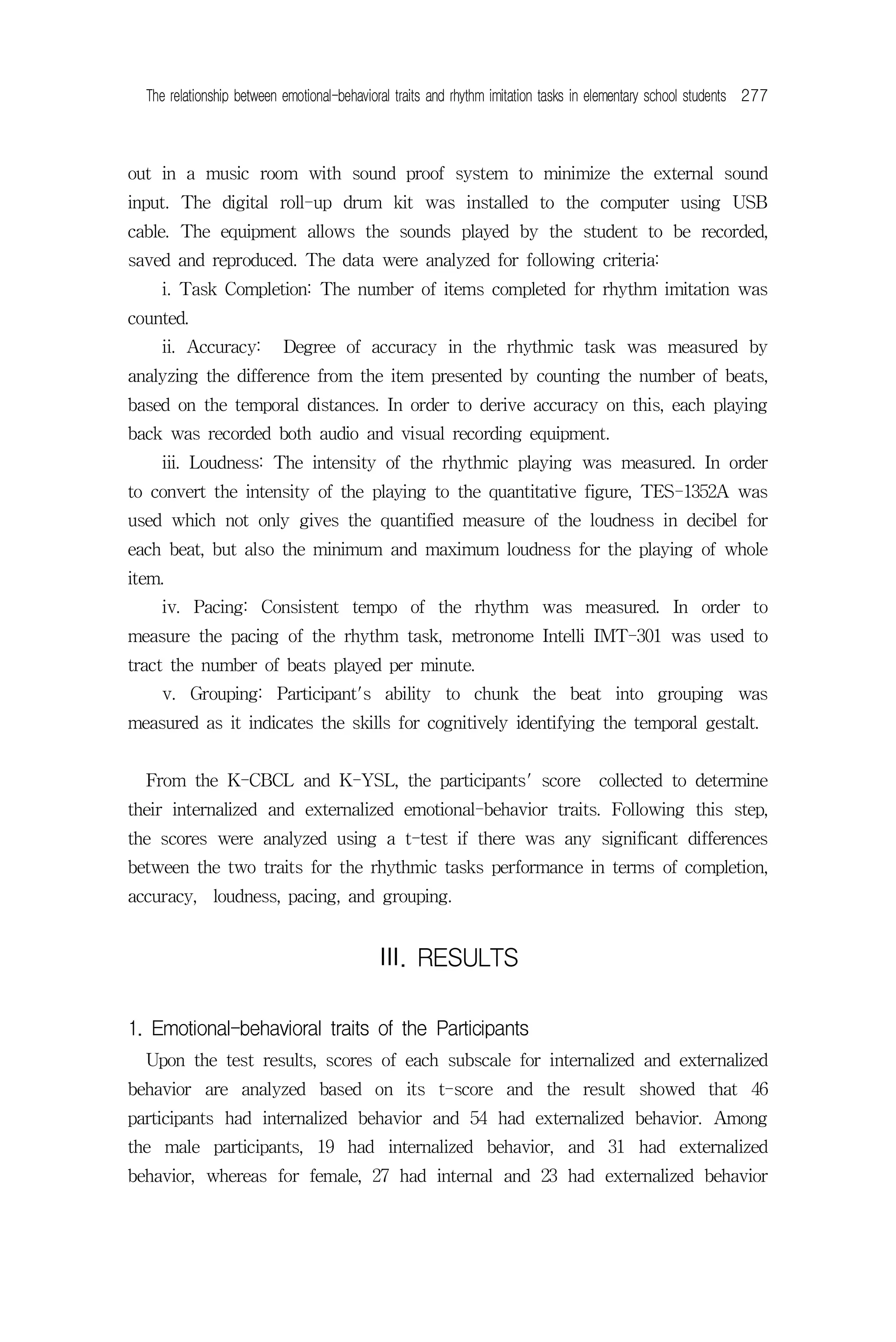
  Upon the test results, scores of each subscale for internalized and externalized
behavior are analyzed based on its t-score and the result showed that 46
participants had internalized behavior and 54 had externalized behavior. Among
the male participants, 19 had internalized behavior, and 31 had externalized
behavior, whereas for female, 27 had internal and 23 had externalized behavior
278 학습자중심교과교육연구 10(3)


<Table 1>.


  <Table 1> Number of participants with internalized and externalized behavior.


                           Internalized Behavior            Externalized Behavior

          Male                         19                            31

          Female                       27                            23

          Total                        46                            54


2. Rhythm imitation task in relation to emotional-behavioral traits.
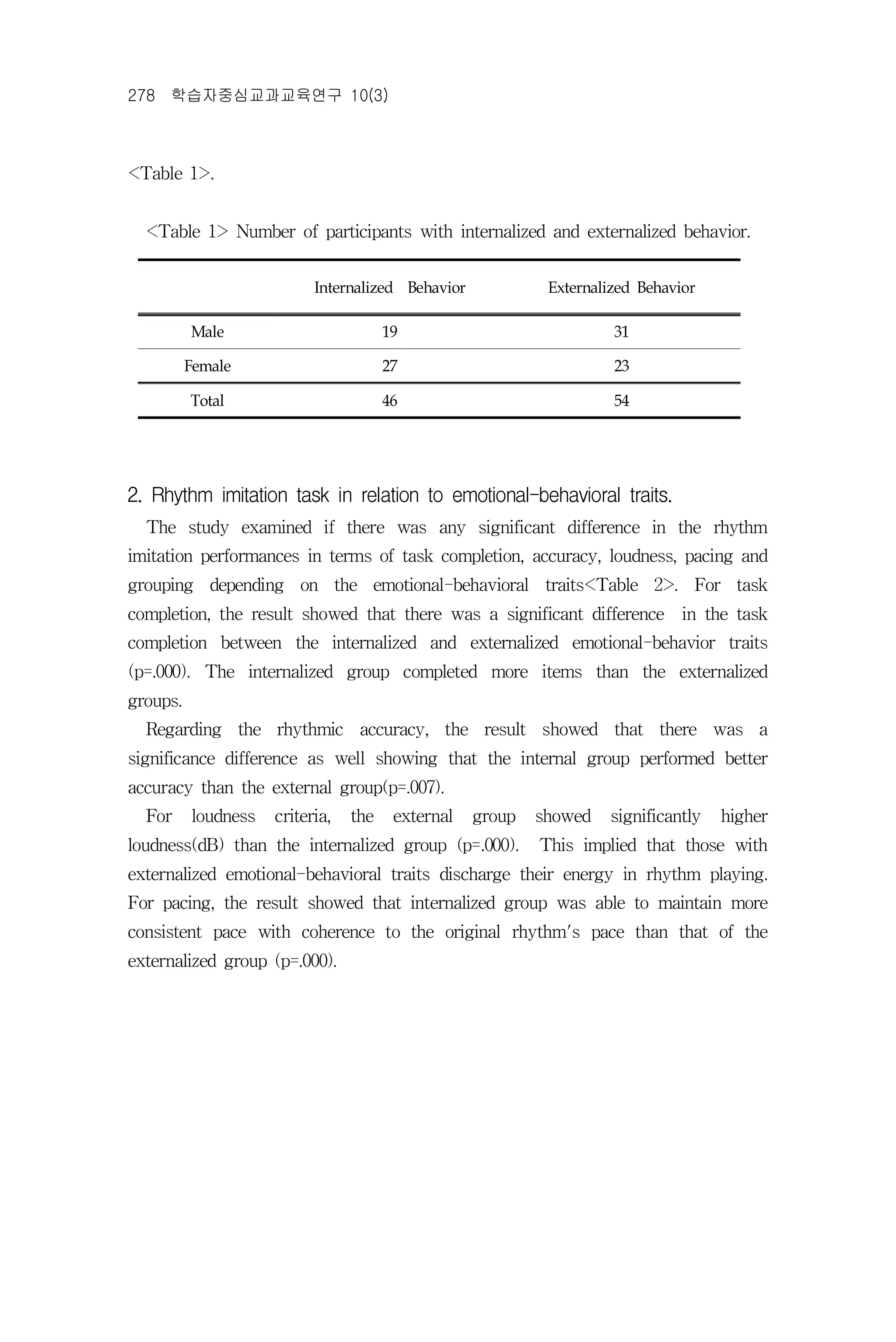
  The study examined if there was any significant difference in the rhythm
imitation performances in terms of task completion, accuracy, loudness, pacing and
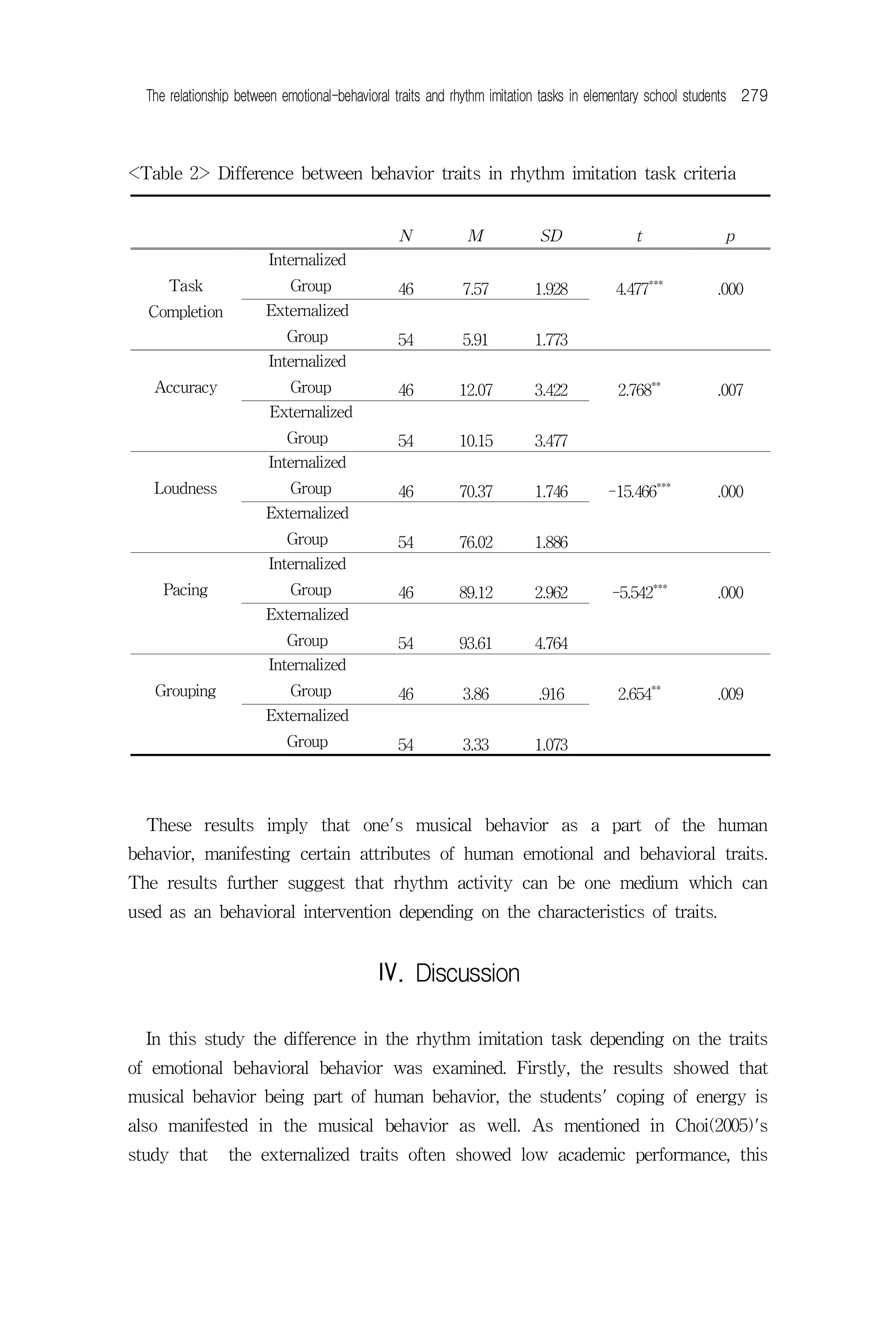
grouping depending on the emotional-behavioral traits<Table 2>. For task
completion, the result showed that there was a significant difference in the task
completion between the internalized and externalized emotional-behavior traits
(p=.000). The internalized group completed more items than the externalized
groups.
  Regarding the rhythmic accuracy, the result showed that there was a
significance difference as well showing that the internal group performed better
accuracy than the external group(p=.007).
  For     loudness   criteria,   the    external   group   showed   significantly   higher
loudness(dB) than the internalized group (p=.000).         This implied that those with
externalized emotional-behavioral traits discharge their energy in rhythm playing.
For pacing, the result showed that internalized group was able to maintain more
consistent pace with coherence to the original rhythm's pace than that of the
externalized group (p=.000).
The relationship between emotional-behavioral traits and rhythm imitation tasks in elementary school students 279


<Table 2> Difference between behavior traits in rhythm imitation task criteria


                                               N            M            SD                t               p
                        Internalized
      Task                  Group                                                              ***
                                               46          7.57         1.928          4.477             .000
  Completion           Externalized
                           Group               54          5.91         1.773
                        Internalized
   Accuracy                 Group              46         12.07         3.422          2.768**           .007
                        Externalized
                           Group               54         10.15         3.477
                        Internalized
   Loudness                 Group                                                               ***
                                               46         70.37         1.746        -15.466             .000
                       Externalized
                           Group               54         76.02         1.886
                        Internalized
     Pacing                 Group              46         89.12         2.962         -5.542***          .000
                       Externalized
                           Group               54         93.61         4.764
                        Internalized
   Grouping                 Group                                                              **
                                               46          3.86          .916          2.654             .009
                       Externalized
                           Group               54          3.33         1.073


  These results imply that one's musical behavior as a part of the human
behavior, manifesting certain attributes of human emotional and behavioral traits.
The results further suggest that rhythm activity can be one medium which can
used as an behavioral intervention depending on the characteristics of traits.


                                           Ⅳ. Discussion

  In this study the difference in the rhythm imitation task depending on the traits
of emotional behavioral behavior was examined. Firstly, the results showed that
musical behavior being part of human behavior, the students' coping of energy is
also manifested in the musical behavior as well. As mentioned in Choi(2005)'s
study that      the externalized traits often showed low academic performance, this
280 학습자중심교과교육연구 10(3)


study also has shown that their rhythm performance was lower than the group
who had externalized traits. Along the same line, the results of this study also
supported the findings of Kim(2003) who stated that students who have
externalized behavioral traits have negative corelation with logical and positive
problem solving skill. This was partially consistent in the result of this study as
the students with internalized traits completed higher number of rhythm imitation
task.
  Secondly, this study further supported the assumption that there is some
relationship   between    the   cognitive   skills   involved   in   the   task   with
emotional-behavioral traits. For example, Sarason, Shearin, Pierce & Sarason(1987)
showed that students with internalized emotional problems often accompany high
anxiety and tension which adversely effect academic performance. Likely in this
study, the students who had internalized traits showed less of task accuracy than
that of the students with externalized traits.
  Third, it was very vivid that the loudness performed by the students with
externalized traits was much higher than those with internalized traits. Again, this
result is consistent with the finding of Yook(2007)'s study which stated that
those with externalized emotional-behavioral traits carry much higher level of
energy. This was certainly evident in their rhythm playing task. Furthermore this
is one implication that rhythm activity can be an efficient intervention for the
students with externalized traits. Unless their high energy is sublimated
elsewhere, it constantly effects their academic attitude and performance which
work as a vicious circle negatively influencing each other.
  Along with the above statements, students with externalized traits had faster
pacing compare to those with internalized traits. As Bruscia (1987) stated that the
tempo can be considered as the gauge of the energy level, the result supported
this statement as well.
  Lastly, when it comes to the grouping task, the students with internalized
behavior trait performed better which implies that unlike the externalized trait,
they use the contained energy for creating a musical output. Rhythm grouping
involves much of the cognitive skills. According to the gestalt concepts, sorting
the incoming musical information into chunks are crucial skills in learning. For
both academic and music learning, auditory and visual grouping and segregation
are important concepts.
  Rhythm playing involves various skills in cognitive, emotional and behavioral
The relationship between emotional-behavioral traits and rhythm imitation tasks in elementary school students 281


domain for task engagement and reproduction. The results of this study provided
implications of significant relationship between rhythm performance and behavioral
traits, however, it is difficult to draw any linear relationship among them as the
emotional-behavioral traits have significant qualitative attributes that can not be
quantified. Therefore, for the future studies, more feasible tools with higher
reliability to measure children's emotional-behavioral traits are needed.
282 학습자중심교과교육연구 10(3)


                                    Reference

Achenbach, T. M. (1991) Integrative Guide to the 1991 CBCL/4-18, YSR, and TRF
      Profiles. Burlington, VT: University of Vermont, Department of Psychology
Achenbach, T. M., Edelbrock, C. S. (1983). Manual for the child behavior checklist
      and revised child behavior profiles. Burlington : University of Vermont.
Boxill, E. H. (1985). Music therapy developmentally disabled. Rockville, MD :
      Aspen Systems.
Brower, G. H. (1993). Memory and the perception of rhythm. Music Therapy
      Spectrum, 15, 19-35
Bruscia, K. (1987). Improvisational models of music therapy. Springfield, IL:
      Charles C. Thomas Publishers.
Buchremer, H (1990). Bilder einer zerrissenen Welt. Heiderberg: Edition
Choi, S. I (2005). Comparison of behavioral problems in gifted children and
      non-gifted children in middle school. Master's Thesis, Konkuk University,
      Graduate School of Education.
Chong, H. J. & Durken, G. (2009). Music assessment on cognitive and
      emotional-behavioral      domain(MACED).          Unpublished       Manuscript.
      University of Kansan.
Cripe, F. F. (1986). Rock music as therapy for children attention deficit
      disorder. Journal of Music Therapy, 34. 30-37.
Drake, C. (1998). Psychological processes involved in the temporal organization of
      complex auditory sequences:      Universal and acquired processes.          Music
      Perception, 16, 11-16
Gottfredson, D., Gerstenblith, S., Soule, D., Womer, & S., Lu, (2004). Do after
      school programs reduce deliquency? Prevention Science, 5(4), 252-266.
Gunsberg, F. M (1998). Improvised musical play: A strategy for fostering social
      play between developmentally delayed and non-delayed preschool children.
      Journal of Music Therapy, 4, 178-191.
Hanser, S. (2002) Music therapy handbook. PA: Barchelona Publishers
Haeberlin, U. (1990). Das Menschenbild fur die Heilgadagogik. Stuttgart: Haupt.
Handel, S. (1993). The effect of tempo and tone duration on rhythm
      discrimination. Perception & Psychophysics 7, 370-382
Jackson, N. A. (2003). A survey of music therapy methods and their role in the
      treatment of early elementary school children with ADHD. Journal of
      Music Therapy, 11(4), 302-323.
The relationship between emotional-behavioral traits and rhythm imitation tasks in elementary school students 283


Jellison, J., Brooks, B., & Huck, A (1990). Structuring small groups and                                  music
        reinforcement to facilitate positive interactions and
        acceptance of severely handicapped students in the regular music
        classroom. Journal of Research in Music Education, 32(4),                                         243-264.
Kauffman,       J.     M.     (1993).      Characteristics          of     emotional        and      behavioral
        disorders of children and youth. New York : Macmillan.
Kim, S. H. (2003). The effect of music tempo on the responses of the autonomic
        nervous system. The Graduate School of Music Therapy, Sookmyung
        Womans University.
Kluth, B. L. (1986). A procedure to teach rhythm reading: Development,
        implementation, and effectiveness in urban junior high school music classes
        (Theory,          instruction,         middle         school).         Dissertation           Abstracts
        International A, 47(5). (AATNo.8617078)
Lee, S. H. & Park, E. H (2006). Exceptional Children Education. Seoul: Hakjisa
Lerdahl, F & Jackendoff, R. (1983). A generative theory of tonal music.
        Cambridge, MA: The MIT Press
Lipe, A. (1995). Use of music performance tasks in the assessment of cognitive
        functioning         among      older     adults      with        dementia.     Journal       of     music
        Therapy 32(3). 137-151.
Lipscomb, S. (1996). The cognitive organization of musical sound. In Handbook of
        Music Psychology (Ed. D Hodges). IMR Press.
Mason, M. J., Chung, S. (2001). Culturally-based after-school arts programming
        for low-income urban children: Adoaptive and preventive effects. Journal of
        Primary Prevention, 22(1), 133-145.
Montello, L., & Coons, E (1998). Effects of active versus passive group music
        therapy on preadolescent with emotional, learning and behavioral disorders.
        Journal of Music Therapy, 35(1), 49-67.
Oh, K. J., Lee, H. R., Hong, K. E., & Ha, E. H. (2007). K-YSR: Youth Self
        Report. Seoul: Huno Consulting
Oh, K. J., Lee, & Lee, H. R., (1990). K-CBCL. Pediatric Adolescent Psychiatry,
        9(1), 33-55.
Park, J. J. (2002). A comparison of the results of the K-CBCL and the K-YSR
        on emotional and behavioral problems of adolescents in Je-ju Do. The
        Graduate School of Education, Chosun University.
Rickson, D. & Watkins, W. (2003). Music therapy to promote prosocial behaviors
        in aggressive adolescent boys. Journal of Music Therapy, 40, 283-301.
284 학습자중심교과교육연구 10(3)


Rickson, D. (2006). instructional and improvisational models of music therapy with
       adolescents who have attention deficit hyperactivity disorder(ADHD).
       Journal of Music Therapy, 43(1), 39-53.
Rider, M. (1981). The assessment of cognitive function level through musical
       perception. Journal of Music Therapy; 18(3), 110-119
Riggs N., Greenberg, M (2004). After-school youth development programs: A
       developmental-ecological model of current research. Clinical Child and
       Family Psychology Review, 7(3). 177-190.
Tebes, J., Keinn, R., Vanderploe, J., Chinman, M., Shepard, J., Brabham, T.,
       Genovese, M., & Connel, C. (2007). Impact of a positive youth development
       program in urban after-school settings on the prevention of adolescent
       substance use. Journal of Adolescent Health, 8(1),      1-19.
Sarason, B. R., Shearin, E. N., Pierce, G. R., & Sarason, I. G. (1987). Interrelations
       of social support measures: Theoretical and practical implications. Journal
       of Personality and Social Psychology, 4, 813–832.
Seoul District of Education (2006). Report of After-School Project Evalution. Seoul
       Education District
Smith, D. S., Hairston, M. J. (1999). Music therapy in school settings: Current
        practice, Journal of Music Therapy; 36(4). 274-292
Sloboda, J. A. (1985). The musical mind: The cognitive psychology of music.
       Oxford: Oxford University Press
Speck, O. (1991). System Heildagogik: eine okologisch reflexive Grundlegung.
       Munchen: Reinhardt
Thaut, M. H. (1999). Music therapy in neurological rehabilitation. In W. B. Davis, K.
       E. Gfeller., & M. H. Thaut (Eds.), An introduction to music therapy : theory
       and practices. Dubuque, IA : Mcgraw-Hill College.
Took & Weiss, D. (1994). The relationship between heavy metal and rap
       music in adolescent turmoil : real or artifact. Adolescent, 29. 513-521.
Yook, G. J. (2007). Analysis on Rorschach Reponse for children with
         externalized   and    internalized   behavior. Master's       Thesis. Seoul
         Women's University. Graduate School


  논문 접수: 2010년 10월 30일
  논문 심사: 2010년 11월 15일
  게재 승인: 2010년 12월 20일
The relationship between emotional-behavioral traits and rhythm imitation tasks in elementary school students 285


                      아동의 정서 행동적 특성과
            리듬 모방 수행력의 상관관계 연구

                                                                          원초롱(서울당산초등학교)
                                                                             정현주(이화여자대학교)

                                             <국문초록>

  본 연구에서는 아동의 정서행동특성에 따라 리듬모방 수행력이 어떠한 차이가
 있는지를 보고자 하였다. 본 연구에는 초등학교 5학년의 일반 아동 100명을 대상
 으로 실시하였으며 아동의 정서 행동적 특성을 파악하기 위하여 학부모가
 ‘K-CBCL' 검사를, 아동 자신이 ’K-YSR' 검사를 실시하였다. 두 번째로 ‘MACED'
 의 리듬으로 아동의 리듬 모방 능력을 평가하는 개별 진단 세션을 실시하였다. 아
 동의 리듬 과제 수행도, 리듬 정확도, 리듬 강도, 리듬 빠르기, 리듬 덩이짓기 수를
 수치화하여 이러한 모방 수행력이 정서행동 특성과 유의미한 차이가 있는지를 분
 석하였다. 마지막으로 정서 행동 검사 결과와 리듬 모방 활동에서 보인 리듬 모방
 능력의 상관관계를 분석하였다.
  연구 결과 아동의 정서 행동적 특성별로 우세한 리듬 모방 수행력이 각각 다르게
 나타난다는 것을 알 수 있었다. 내재화 정서 행동적 특성을 보이는 아동은 외현화
 정서 행동적 특성을 보이는 아동보다 리듬 과제 수행도(t=4.477***)와 리듬 정확도
 (t=2.768**)에서 더 높은 점수를 나타냈다. 이에 반하여 리듬 강도(t=-15.466***)와
 리듬 빠르기(t=-5.542***)에 있어서는 외현화 정서 행동적 특성을 보이는 아동이
 내재화 정서 행동적 특성을 보이는 아동보다 더 높은 점수를 나타냈다. 또한 내재
 화 정서 행동적 특성을 보이는 아동이 외현화 정서 행동적 특성을 보이는 아동보다
 리듬 덩이짓기를 많이 하였다(t=2.654**).
  본 연구에서는 아동의 내재화 또는 외현화 정서 행동 특성에 따라 리듬 모방 수
 행력에 유의미한 차이가 있음을 보여주었으며 이는 음악이 인간 행동의 한 부분으
 로서 아동의 정서적 상태와 행동적 특성을 충분히 반영함을 의미한다. 또한 이러한
 결과는 리듬 연주가 아동의 정서 행동 진단과 행동 문제에 대한 개입 및 예방 차원
 에서도 효과적인 음악활동이 될 수 있음을 시사한다.


   ⋆ 주제어: 리듬모방 수행, 정서 행동적 특성, 음악 측정

정서 리듬모방력 상관관계

  • 1.
    학습자중심교과교육연구 Journal ofLearner-Centered Curriculum and Instruction 2010. 제10권 제3호, pp. 271-285. The relationship between emotional-behavioral traits and rhythm imitation tasks in elementary school students * Cho Rong Won(Seoul Dangsan Elementary School)* Hyun Ju Chong(Ewha Womans University)**** <ABSTRACT> Current studies have raised many issues regarding children's emotional and behavioral problems in school setting which has been increasing with time. Various educational and therapeutic strategies are implemented to alleviate these problems by meeting the students' needs. In light of this, the purpose of this study was to examine if there is any relationship between the students' emotional-behavioral traits and rhythm task performances. A total of 100 students in 5th grade participated in the study. In order to assess their emotional-behavioral trait, Koirean Children Behavior Check Llist(K-CBCL) and Korean Youth Self Report (K-YSR) was administered. To assess their rhythm task performance, Music Assessment on Cognitive, Emotional-Behavioral Domain (MACEB) was used as an assessment tool and data were collected in the following criteria: task completion, accuracy of imitation, intensity, pace, and grouping skills involved in the task. The results indicated that there were significant differences in rhythm imitation task between internalized emotional-behavioral traits and externalized traits, in terms of rhythm accuracy, task completion, intensity, grouping and pacing in the performance. Results indicated that there were significant difference between the students with internalized and externalized emotional-behavioral traits for the task completion(t=4.47**), accuracy, (t=2.76**), intensity (t=-15.46**), and pacing(t=5.54**). These results imply that one's musical behavior is part of the human behavior, therefore, their rhythm performance carry certain attributes of human emotional and behavioral traits. The results further suggest that rhythm activity can be one medium * First author ** Corresponding author (hju@ewha.ac.kr)
  • 2.
    272 학습자중심교과교육연구 10(3) which can used as an efficient intervention depending on the behavioral traits. ⋆ Key words: Rhythm Imitation Performance, Emotional Behavioral Traits, Music Assessment Ⅰ. Introduction It is the global interest to enhance one's emotional health to become a better functioning person. This is also the case for the elementary school which is the first educational institute where students learn appropriate emotional and social skills in growing up as an agent of the society. According to the study on the mental health of elementary school students carried out by the Seoul National Psychiatric Team in 2006, the result showed that every one out of three have significant emotional and behavioral problems(Seoul District of Education, 2006). This result throws a critical agenda for the school related officials and teachers. Emotional and behavioral issues negatively effect healthy adjustment of students in their school setting and brings poor social skills in the relationships with peers (Kauffman, 1993: Lee & Park, 2006). Students with these problems lack motivation in the school work which brings attention deficit hindering their academic achievement as well (Kim, 2006). Students' emotional and behavioral problems are manifested in two different ways: either they are externalized or internalized(Achenbach & Edelbrock, 1983). Some students repress and inhibit their impulse or needs, whereas the others express and discharge them either verbally or physically(Park, 2002). In order to help these students in the extra-curricular setting using educational and therapeutic strategies, various after-school programs are implemented. Among the many programs initiated by the schools were arts programs which involved both music and art. Because arts medium carry intrinsic attributes which deal with human emotionality and nonverbal expression, their efficiency for working on the emotional and behavior problems were shown to be evident. Mason and Chung (2001) found out that arts-oriented programs in the after-school setting promoted students' self-esteem, social skills and leadership. These changes were especially vivid for children who are from low-income families as they were more vulnerable to the delinquency. Gottfredson and his colleges(2004) stated that after-school programs were not only effective as intervention for the emotional
  • 3.
    The relationship betweenemotional-behavioral traits and rhythm imitation tasks in elementary school students 273 problems, but also as the preventive strategy for the students. These findings are also consistent with the studies by Riggs and Greenberg(2004) and Tebes and others(2007). With these findings arts-oriented programs are developed to integrate the educational and therapeutic attributes of arts medium for students who have emotional and behavioral difficulties(Haeberlin, 1990: Speck, 1991). Among the arts media, music has been an active intervention where students sublimated their energy which could not be ventilated elsewhere. Music programs in elementary school setting specifically were developed and distributed for students who have emotional and behavioral problems(Cripe, 1986: Jackson, 2003). Group music activities and musical plays served to be a moment to interact and establish relationships among peers(Gunsberg, 1998; Jellison, Brooks & Huck, 1990). Among all the music activities, rhythm activity was found to be very effective for ventilating students' repressed energy(Montello & Coons, 1998; Rickson & Watkins, 2003; Took & Weiss, 1994). Rhythm is the periodic succession or regular recurrent of events in time which constitute the organization of temporal relationships (Rider, 1981). Along with this cognitive processes of rhythm, it has also been assumed that rhythm can be perceived in various ways, since all of the senses are capable of experiencing rhythmic organization of sensations. Rhythm can moderate human energy and physical activity since it has the entrainment function, namely called as pacemaker, or timekeeper(Thaut, 1999). Brower(1993) has found out that rhythmic task not only structures human physical response but also cognitive skills to reproduce the beats in certain rhythmic pattern, understanding the meter system using temporal reasoning. Rhythm task as part of performance task, offered students to control their impulse and strengthen their attention span, since rhythm making and imitating task involved listening, remembering, memory retrieving, reproducing and grouping of the beats (Lipscomb, 1996). Grouping tasks in rhythmic and melodic patterns involve identifying part-whole relationship in the patterns. Organizing sound elements with one another to form a coherent whole is a high-level mental ability(Sloboda, 1985). Sorting out the auditory information between figure and ground, and grouping or "chunking" the message by meaningful units involves cognitive skills to comprehend the musical units and make relationships among them. Such processing of auditory grouping
  • 4.
    274 학습자중심교과교육연구 10(3) mechanismemploys several Gestalt principles such as principles of proximity, continuity, closure, and constancy (Drake, 1998; Handel, 1993; Ledahl & Jackendoff, 1983). According to Bruscia(1987)'s assessment profile, rhythm manifests one's energy level. The tempo is considered berg the gauge of the energy level. According to the theories and concepts behind this profile, performance in rhythm and melody can be indicatives of one's affective behavior. Bruscia(1987) stated that tempo is the indicative of the energy level: fast tempo indicating increased activity, whereas slower tempo indicated decreased activity. Instrument performance accompanies both cognitive and emotional ability. One's attitude towards producing his or her own sound is good indicative of how each of them is comfortable with expressing oneself. Those who are self-conscious would have more passive use of the instrument, whereas those who are more active will play the instrument with fuller sound. Therefore, a soft volume may manifest internalized emotional tendencies, whereas the loud volume may manifest the externalized tendencies(Chong & Duerksen, 2009). When it comes to student's ability to complete the music tasks, it also indicates the students' compliance to following directions and impulse control(Boxil, 1985; Hanser, 2002). If the student has hyperactive tendencies, task completion may be challenging. At the same time, the overall level of task performance will indicate whether the student is able to maintain the initial tempo with appropriate impulse control by following the musical cues. With these findings, this study purported to examine if there is any significant difference in the rhythm imitation performance between the students who have internalized emotional-behavior traits and those who have externalized traits. Ⅱ. METHOD Participants: A total of 104 students in 5th grade were selected to participate in the study. They were recruited from 5 different classes with recommendations of the teachers who were informed of the study's purpose and scope. In order to minimize the gender difference equal number of female and male students participated. However, in the assessment procedures, four participants did not complete the task, therefore, their data were excluded from the analyses.
  • 5.
    The relationship betweenemotional-behavioral traits and rhythm imitation tasks in elementary school students 275 The participants did not have any developmental or clinical diagnosis. Upon the teacher's recommendation, their parents were contacted for consent and participants were selected accordingly upon the consent. Procedures In the first stage, the assessment of participatns emotional-behavioral traits was administered. Upon the result, they were categorized into two: externalized behavior and internalized behavior traits. Secondly, all participants had rhythm imitation task. Each students were test individually which took about 15 minutes. All of their rhythmic responses and playing were recorded for analysis. Lastly, the results of the K-CBCL and K-YSR scores were analyzed along with rhythmic performance scores for the significant differences. Measurement Tools: In order to assess students' emotional and behavioral traits, two kinds of assessment tools were selected. One is administered by the parents and one by the student. 1. Korean Children Behavior Checklist (K-CBCL) This tool is developed by Achenbach (1991) for age 6 to 18 in order to evaluate children's behavioral and emotional functioning, social problems and competencies. This tool was translated into Korean namely as Korean Children Behavior Checlist(K-CBCL) by Kyung Ja Oh, Hye Ryun Lee, Kang Yui, Hong and Eun Hye, Ha (2007). CBCBL also comes with Youth Self Report which is translated as Korean Youth Self Report(K-YSR). CBCL is a standardized assessment tool which has subscales to assess children's internalizing behavior, externalizing behavior and social, attention and thought problems. The subscale of CBCL for internalized behavior evaluates children direct emotions and feelings inward. Three kinds of internalizing behaviors measured by the CBCL include somatic complaints, anxious/depressed behavior and withdrawn behavior. Somatic problems include tired, headaches and dizziness and complaints about stomach. Withdrawn behaviors are addressed by questions regarding social withdrawal, shyness, staring, sulking and sadness. Problems with anxiety/depression are identified by questions regarding crying,
  • 6.
    276 학습자중심교과교육연구 10(3) fear,loneliness, nervousness, worthlessness, suspiciousness, guilt, fear and worries. For externalizing behavior, emotional problems are directed outward into aggressive or delinquent behavior. Delinquent externalizing behaviors assessed by the CBCL include lying, swearing, truancy, stealing and vandalism. The CBCL assess several types of aggressive behaviors, including arguing, screaming, attention-seeking, teasing, demanding, threatening and displaying a temper. 2. Music Assessment on Cognitive-Emotional-Behavioral Domain (MACED) MACED is developed by Chong & Duerksen(2009) to assess skills in cognitive, emotional and behavioral domain using music as the assessment medium. MACED consists of two major categories of Rhythmic Components, and Melodic Components. Items in each section are sequenced in developmentally referring to the comprehensive capacity of the student in mental development. For this study, only the Rhythmic Components items were used. Rhythmic section has 15 rhythm tasks developing from a simple rhythms and moving to more complex rhythms based on the Bloom’s Taxonomy. Before the main experiment, three exercise items were provided so that the participants understand the procedure. All the items were recorded in a CD with the tempo of 90BMP. Each item is played at the loudness of 70 decibel, and then the participant is asked to play back. From the reproduction task, the following measures are obtained and analyzed. i. Task Completion: Measures the amount of items reproduced during the assessment ii. Accuracy: Measures the rhythmic accuracy of the temporal distances among the beats duplicated iii. Loudness: Measures the amount of energy put into the sound production iv. Pacing: Measures the general tempo of the rhythm reproduction. v. Grouping: Measures the chunking of rhythmic units with an appropriate gestalt in order to organize the information for short-term memory. Data Collection The experiment took 8 weeks and the students were test individually. The data were collected along with the experiments for four weeks. The test was carried
  • 7.
    The relationship betweenemotional-behavioral traits and rhythm imitation tasks in elementary school students 277 out in a music room with sound proof system to minimize the external sound input. The digital roll-up drum kit was installed to the computer using USB cable. The equipment allows the sounds played by the student to be recorded, saved and reproduced. The data were analyzed for following criteria: i. Task Completion: The number of items completed for rhythm imitation was counted. ii. Accuracy: Degree of accuracy in the rhythmic task was measured by analyzing the difference from the item presented by counting the number of beats, based on the temporal distances. In order to derive accuracy on this, each playing back was recorded both audio and visual recording equipment. iii. Loudness: The intensity of the rhythmic playing was measured. In order to convert the intensity of the playing to the quantitative figure, TES-1352A was used which not only gives the quantified measure of the loudness in decibel for each beat, but also the minimum and maximum loudness for the playing of whole item. iv. Pacing: Consistent tempo of the rhythm was measured. In order to measure the pacing of the rhythm task, metronome Intelli IMT-301 was used to tract the number of beats played per minute. v. Grouping: Participant's ability to chunk the beat into grouping was measured as it indicates the skills for cognitively identifying the temporal gestalt. From the K-CBCL and K-YSL, the participants' score collected to determine their internalized and externalized emotional-behavior traits. Following this step, the scores were analyzed using a t-test if there was any significant differences between the two traits for the rhythmic tasks performance in terms of completion, accuracy, loudness, pacing, and grouping. Ⅲ. RESULTS 1. Emotional-behavioral traits of the Participants Upon the test results, scores of each subscale for internalized and externalized behavior are analyzed based on its t-score and the result showed that 46 participants had internalized behavior and 54 had externalized behavior. Among the male participants, 19 had internalized behavior, and 31 had externalized behavior, whereas for female, 27 had internal and 23 had externalized behavior
  • 8.
    278 학습자중심교과교육연구 10(3) <Table1>. <Table 1> Number of participants with internalized and externalized behavior. Internalized Behavior Externalized Behavior Male 19 31 Female 27 23 Total 46 54 2. Rhythm imitation task in relation to emotional-behavioral traits. The study examined if there was any significant difference in the rhythm imitation performances in terms of task completion, accuracy, loudness, pacing and grouping depending on the emotional-behavioral traits<Table 2>. For task completion, the result showed that there was a significant difference in the task completion between the internalized and externalized emotional-behavior traits (p=.000). The internalized group completed more items than the externalized groups. Regarding the rhythmic accuracy, the result showed that there was a significance difference as well showing that the internal group performed better accuracy than the external group(p=.007). For loudness criteria, the external group showed significantly higher loudness(dB) than the internalized group (p=.000). This implied that those with externalized emotional-behavioral traits discharge their energy in rhythm playing. For pacing, the result showed that internalized group was able to maintain more consistent pace with coherence to the original rhythm's pace than that of the externalized group (p=.000).
  • 9.
    The relationship betweenemotional-behavioral traits and rhythm imitation tasks in elementary school students 279 <Table 2> Difference between behavior traits in rhythm imitation task criteria N M SD t p Internalized Task Group *** 46 7.57 1.928 4.477 .000 Completion Externalized Group 54 5.91 1.773 Internalized Accuracy Group 46 12.07 3.422 2.768** .007 Externalized Group 54 10.15 3.477 Internalized Loudness Group *** 46 70.37 1.746 -15.466 .000 Externalized Group 54 76.02 1.886 Internalized Pacing Group 46 89.12 2.962 -5.542*** .000 Externalized Group 54 93.61 4.764 Internalized Grouping Group ** 46 3.86 .916 2.654 .009 Externalized Group 54 3.33 1.073 These results imply that one's musical behavior as a part of the human behavior, manifesting certain attributes of human emotional and behavioral traits. The results further suggest that rhythm activity can be one medium which can used as an behavioral intervention depending on the characteristics of traits. Ⅳ. Discussion In this study the difference in the rhythm imitation task depending on the traits of emotional behavioral behavior was examined. Firstly, the results showed that musical behavior being part of human behavior, the students' coping of energy is also manifested in the musical behavior as well. As mentioned in Choi(2005)'s study that the externalized traits often showed low academic performance, this
  • 10.
    280 학습자중심교과교육연구 10(3) studyalso has shown that their rhythm performance was lower than the group who had externalized traits. Along the same line, the results of this study also supported the findings of Kim(2003) who stated that students who have externalized behavioral traits have negative corelation with logical and positive problem solving skill. This was partially consistent in the result of this study as the students with internalized traits completed higher number of rhythm imitation task. Secondly, this study further supported the assumption that there is some relationship between the cognitive skills involved in the task with emotional-behavioral traits. For example, Sarason, Shearin, Pierce & Sarason(1987) showed that students with internalized emotional problems often accompany high anxiety and tension which adversely effect academic performance. Likely in this study, the students who had internalized traits showed less of task accuracy than that of the students with externalized traits. Third, it was very vivid that the loudness performed by the students with externalized traits was much higher than those with internalized traits. Again, this result is consistent with the finding of Yook(2007)'s study which stated that those with externalized emotional-behavioral traits carry much higher level of energy. This was certainly evident in their rhythm playing task. Furthermore this is one implication that rhythm activity can be an efficient intervention for the students with externalized traits. Unless their high energy is sublimated elsewhere, it constantly effects their academic attitude and performance which work as a vicious circle negatively influencing each other. Along with the above statements, students with externalized traits had faster pacing compare to those with internalized traits. As Bruscia (1987) stated that the tempo can be considered as the gauge of the energy level, the result supported this statement as well. Lastly, when it comes to the grouping task, the students with internalized behavior trait performed better which implies that unlike the externalized trait, they use the contained energy for creating a musical output. Rhythm grouping involves much of the cognitive skills. According to the gestalt concepts, sorting the incoming musical information into chunks are crucial skills in learning. For both academic and music learning, auditory and visual grouping and segregation are important concepts. Rhythm playing involves various skills in cognitive, emotional and behavioral
  • 11.
    The relationship betweenemotional-behavioral traits and rhythm imitation tasks in elementary school students 281 domain for task engagement and reproduction. The results of this study provided implications of significant relationship between rhythm performance and behavioral traits, however, it is difficult to draw any linear relationship among them as the emotional-behavioral traits have significant qualitative attributes that can not be quantified. Therefore, for the future studies, more feasible tools with higher reliability to measure children's emotional-behavioral traits are needed.
  • 12.
    282 학습자중심교과교육연구 10(3) Reference Achenbach, T. M. (1991) Integrative Guide to the 1991 CBCL/4-18, YSR, and TRF Profiles. Burlington, VT: University of Vermont, Department of Psychology Achenbach, T. M., Edelbrock, C. S. (1983). Manual for the child behavior checklist and revised child behavior profiles. Burlington : University of Vermont. Boxill, E. H. (1985). Music therapy developmentally disabled. Rockville, MD : Aspen Systems. Brower, G. H. (1993). Memory and the perception of rhythm. Music Therapy Spectrum, 15, 19-35 Bruscia, K. (1987). Improvisational models of music therapy. Springfield, IL: Charles C. Thomas Publishers. Buchremer, H (1990). Bilder einer zerrissenen Welt. Heiderberg: Edition Choi, S. I (2005). Comparison of behavioral problems in gifted children and non-gifted children in middle school. Master's Thesis, Konkuk University, Graduate School of Education. Chong, H. J. & Durken, G. (2009). Music assessment on cognitive and emotional-behavioral domain(MACED). Unpublished Manuscript. University of Kansan. Cripe, F. F. (1986). Rock music as therapy for children attention deficit disorder. Journal of Music Therapy, 34. 30-37. Drake, C. (1998). Psychological processes involved in the temporal organization of complex auditory sequences: Universal and acquired processes. Music Perception, 16, 11-16 Gottfredson, D., Gerstenblith, S., Soule, D., Womer, & S., Lu, (2004). Do after school programs reduce deliquency? Prevention Science, 5(4), 252-266. Gunsberg, F. M (1998). Improvised musical play: A strategy for fostering social play between developmentally delayed and non-delayed preschool children. Journal of Music Therapy, 4, 178-191. Hanser, S. (2002) Music therapy handbook. PA: Barchelona Publishers Haeberlin, U. (1990). Das Menschenbild fur die Heilgadagogik. Stuttgart: Haupt. Handel, S. (1993). The effect of tempo and tone duration on rhythm discrimination. Perception & Psychophysics 7, 370-382 Jackson, N. A. (2003). A survey of music therapy methods and their role in the treatment of early elementary school children with ADHD. Journal of Music Therapy, 11(4), 302-323.
  • 13.
    The relationship betweenemotional-behavioral traits and rhythm imitation tasks in elementary school students 283 Jellison, J., Brooks, B., & Huck, A (1990). Structuring small groups and music reinforcement to facilitate positive interactions and acceptance of severely handicapped students in the regular music classroom. Journal of Research in Music Education, 32(4), 243-264. Kauffman, J. M. (1993). Characteristics of emotional and behavioral disorders of children and youth. New York : Macmillan. Kim, S. H. (2003). The effect of music tempo on the responses of the autonomic nervous system. The Graduate School of Music Therapy, Sookmyung Womans University. Kluth, B. L. (1986). A procedure to teach rhythm reading: Development, implementation, and effectiveness in urban junior high school music classes (Theory, instruction, middle school). Dissertation Abstracts International A, 47(5). (AATNo.8617078) Lee, S. H. & Park, E. H (2006). Exceptional Children Education. Seoul: Hakjisa Lerdahl, F & Jackendoff, R. (1983). A generative theory of tonal music. Cambridge, MA: The MIT Press Lipe, A. (1995). Use of music performance tasks in the assessment of cognitive functioning among older adults with dementia. Journal of music Therapy 32(3). 137-151. Lipscomb, S. (1996). The cognitive organization of musical sound. In Handbook of Music Psychology (Ed. D Hodges). IMR Press. Mason, M. J., Chung, S. (2001). Culturally-based after-school arts programming for low-income urban children: Adoaptive and preventive effects. Journal of Primary Prevention, 22(1), 133-145. Montello, L., & Coons, E (1998). Effects of active versus passive group music therapy on preadolescent with emotional, learning and behavioral disorders. Journal of Music Therapy, 35(1), 49-67. Oh, K. J., Lee, H. R., Hong, K. E., & Ha, E. H. (2007). K-YSR: Youth Self Report. Seoul: Huno Consulting Oh, K. J., Lee, & Lee, H. R., (1990). K-CBCL. Pediatric Adolescent Psychiatry, 9(1), 33-55. Park, J. J. (2002). A comparison of the results of the K-CBCL and the K-YSR on emotional and behavioral problems of adolescents in Je-ju Do. The Graduate School of Education, Chosun University. Rickson, D. & Watkins, W. (2003). Music therapy to promote prosocial behaviors in aggressive adolescent boys. Journal of Music Therapy, 40, 283-301.
  • 14.
    284 학습자중심교과교육연구 10(3) Rickson,D. (2006). instructional and improvisational models of music therapy with adolescents who have attention deficit hyperactivity disorder(ADHD). Journal of Music Therapy, 43(1), 39-53. Rider, M. (1981). The assessment of cognitive function level through musical perception. Journal of Music Therapy; 18(3), 110-119 Riggs N., Greenberg, M (2004). After-school youth development programs: A developmental-ecological model of current research. Clinical Child and Family Psychology Review, 7(3). 177-190. Tebes, J., Keinn, R., Vanderploe, J., Chinman, M., Shepard, J., Brabham, T., Genovese, M., & Connel, C. (2007). Impact of a positive youth development program in urban after-school settings on the prevention of adolescent substance use. Journal of Adolescent Health, 8(1), 1-19. Sarason, B. R., Shearin, E. N., Pierce, G. R., & Sarason, I. G. (1987). Interrelations of social support measures: Theoretical and practical implications. Journal of Personality and Social Psychology, 4, 813–832. Seoul District of Education (2006). Report of After-School Project Evalution. Seoul Education District Smith, D. S., Hairston, M. J. (1999). Music therapy in school settings: Current practice, Journal of Music Therapy; 36(4). 274-292 Sloboda, J. A. (1985). The musical mind: The cognitive psychology of music. Oxford: Oxford University Press Speck, O. (1991). System Heildagogik: eine okologisch reflexive Grundlegung. Munchen: Reinhardt Thaut, M. H. (1999). Music therapy in neurological rehabilitation. In W. B. Davis, K. E. Gfeller., & M. H. Thaut (Eds.), An introduction to music therapy : theory and practices. Dubuque, IA : Mcgraw-Hill College. Took & Weiss, D. (1994). The relationship between heavy metal and rap music in adolescent turmoil : real or artifact. Adolescent, 29. 513-521. Yook, G. J. (2007). Analysis on Rorschach Reponse for children with externalized and internalized behavior. Master's Thesis. Seoul Women's University. Graduate School 논문 접수: 2010년 10월 30일 논문 심사: 2010년 11월 15일 게재 승인: 2010년 12월 20일
  • 15.
    The relationship betweenemotional-behavioral traits and rhythm imitation tasks in elementary school students 285 아동의 정서 행동적 특성과 리듬 모방 수행력의 상관관계 연구 원초롱(서울당산초등학교) 정현주(이화여자대학교) <국문초록> 본 연구에서는 아동의 정서행동특성에 따라 리듬모방 수행력이 어떠한 차이가 있는지를 보고자 하였다. 본 연구에는 초등학교 5학년의 일반 아동 100명을 대상 으로 실시하였으며 아동의 정서 행동적 특성을 파악하기 위하여 학부모가 ‘K-CBCL' 검사를, 아동 자신이 ’K-YSR' 검사를 실시하였다. 두 번째로 ‘MACED' 의 리듬으로 아동의 리듬 모방 능력을 평가하는 개별 진단 세션을 실시하였다. 아 동의 리듬 과제 수행도, 리듬 정확도, 리듬 강도, 리듬 빠르기, 리듬 덩이짓기 수를 수치화하여 이러한 모방 수행력이 정서행동 특성과 유의미한 차이가 있는지를 분 석하였다. 마지막으로 정서 행동 검사 결과와 리듬 모방 활동에서 보인 리듬 모방 능력의 상관관계를 분석하였다. 연구 결과 아동의 정서 행동적 특성별로 우세한 리듬 모방 수행력이 각각 다르게 나타난다는 것을 알 수 있었다. 내재화 정서 행동적 특성을 보이는 아동은 외현화 정서 행동적 특성을 보이는 아동보다 리듬 과제 수행도(t=4.477***)와 리듬 정확도 (t=2.768**)에서 더 높은 점수를 나타냈다. 이에 반하여 리듬 강도(t=-15.466***)와 리듬 빠르기(t=-5.542***)에 있어서는 외현화 정서 행동적 특성을 보이는 아동이 내재화 정서 행동적 특성을 보이는 아동보다 더 높은 점수를 나타냈다. 또한 내재 화 정서 행동적 특성을 보이는 아동이 외현화 정서 행동적 특성을 보이는 아동보다 리듬 덩이짓기를 많이 하였다(t=2.654**). 본 연구에서는 아동의 내재화 또는 외현화 정서 행동 특성에 따라 리듬 모방 수 행력에 유의미한 차이가 있음을 보여주었으며 이는 음악이 인간 행동의 한 부분으 로서 아동의 정서적 상태와 행동적 특성을 충분히 반영함을 의미한다. 또한 이러한 결과는 리듬 연주가 아동의 정서 행동 진단과 행동 문제에 대한 개입 및 예방 차원 에서도 효과적인 음악활동이 될 수 있음을 시사한다. ⋆ 주제어: 리듬모방 수행, 정서 행동적 특성, 음악 측정