SRS FOR IMS www.dhavisoft.com Page 1
Inventory management system
1-Introduction
Purpose of the system
When we analyze small merchants case study we find that they are facing problem to keep track
of their inventory levels they have to calculate a list of the groceries utilized during a course of
time, calculate and analyze the requirements for the future, and place their next order to the
vendors if needed. This process takes up a lot of time and human effort, and is also prone to
human error. It takes up a lot of time to manually keep track of sales and place correct orders to
vendors, wasting useful labor in trivial works. A product which would assist in tackling the
above mentioned problems would prove to be fruitful to clients.
For the need of small merchants we decided to develop an inventory system for them so that
according to online order they can deliver their product and can manage their product store
record. This Inventory management system has three User Interface one for admin manager for
adding merchants, second for merchants so that they can join their products and third for user or
client to order on online portal.
Scope of the system
The project aims at providing an efficient interface to the merchants for managing their
grocery inventory based on each item sold. The basic idea involved here is that each item
is linked to its atomic products which are stored in a database. At the end of each day, the
system analyzes the total sale of menu items and proportionately deducts appropriate
amount from the resource database. Then it compares the current available resources with
the threshold level of each product. If it finds that certain products are below the
threshold, it will generate a purchase order for those item(s) and send it to the manager
(admin) for approval.
We also propose to include a special feature “Prediction”. This feature keeps track of
any upcoming occasions, climatic changes and special events that may influence
inventory needs for the upcoming week. The system will then predict the required
resources for these events based on previously accumulated information/knowledge. It
will now generate an updated purchase order in accordance with the predictions.
The product also aims to keep track of the shelf life of resources. If any resource nears
the end of its shelf life, it would intimate to the manager (admin) the details of the
quantity that is near its expiration date. The restaurant must function efficiently, the
groceries must be tracked correctly, timely orders must be sent out to the vendors, and
the inventory must be maintained and updated at all times.
SRS FOR IMS www.dhavisoft.com Page 2
Objectives and success criteria of the project
The objective of the project is to provide an efficient inventory control whose main
functionality apart from calculating the inventory include predicting the requirement
for the next order and also if there is a “Special Occasion” then accordingly the
manager selects the particular occasion and extra requirements is added to the next
issuing order to the vendors which needs to be approved by the manager. The product
also aims to keep track of the shelf life of resources. If any resource nears the end of its
shelf life, it would intimate to the manager (admin) the details of the quantity that is
near its expiration date.
The success criteria depends on
 The accuracy in maintaining the inventory levels
 The accuracy in predicting the requirements of the next order
 The accuracy in relating brands(size/color/material) to their respective products
 Ease of use when it comes to updating inventory levels and placing orders to vendors
The Domain
Our target domain is full of software to track sales of all items, for all areas of
inventory management. Our software can be scaled from small/middle/large
corporate all the way to small privately-owned merchants. It is also fairly domain
specific: the database runs off categories which generate the necessary products. It
also updates the inventory based off of the sale of those categories. This
requirement focuses our product to all domains and makes it more appealing to
those looking for a solution to this specific problem.
The Client
The client can vary from private merchant owners to corporate merchant management
companies. Our product can be applied to the entire domain of the merchants.
Focusing on a specific business provides us with more precise and consistent data. All
groups of citizens would be an ideal client, across the nation and even they can
Google. A large scale merchant can apply for our software to each and every domain,
cutting down costs on a very large scale.
Our software will allow our client to customize the database to suit the needs of each
merchant individually. They can vary in prices, vendors from which they order their
products, and threshold levels. This provides a uniform product that can be
customized at a smaller scale. Our client would need to purchase multiple licenses, or
more likely a corporate subscription that would allow them to use the software in
multiple Shops. We would also offer single user licenses to appeal to merchants that
SRS FOR IMS www.dhavisoft.com Page 3
only need to manage a single inventory of goods.
2-Proposed system
Overview
We propose to develop software that keeps track of inventory in the “back of shop”,
and updates it according to daily sales. Each product item is linked to respective
resources (or categories) and as each product is sold and the products utilized. These
changes in inventory are kept track of through product database.
We propose to keep track of each and every product by dynamically linking it to the
product and as a result create a dependent relationship to that product. At a specific
time period (typically the end of the week); if the inventory is below the threshold
level, order forms to the specific vendors are generated in order to restock the required
items for the next week. The project also makes smart predictions on required
inventory for the following week based upon the predicted climate and possible
occasions or events that may influence near future sales. At the end of the week, the
software takes into account all threshold levels, predictions, and other factors to
generate an order form, which after being verified by the manager is sent out to the
vendors/shopkeepers/merchants.
Functional requirements
The System aims at providing an efficient interface to the merchant for managing of
inventory; it shall also provide the merchant varied options for managing the inventory
through various functions at hand. The product levels are continuously monitored based
on their usage and are checked for the threshold levels in the inventory and accordingly
the merchant is alerted about low levels of certain products. The design is such that the
merchant does not have to manually update the inventory every time, the System does if
for the merchant.
The System calculates and predicts the amount of usage for specific set days that are pre-
set by the Merchant (admin); it also alerts the merchant of an impending action to order
products before the specific day set by the merchant. Therefore the merchant never has to
worry about manually calculating the estimated usage of the products as the System does
it for the merchant.
The simple interface of the System has functions like adding a category/product, removing or
updating the product detail. It also extends to functions such as adding a merchant for a product,
removing the merchant, checking threshold levels, processing orders, altering processed orders
etc.
SRS FOR IMS www.dhavisoft.com Page 4
Nonfunctional requirements
2.2.1 Usability
 The system must be easy to use by both admin managers and
merchants such that they do not need to read an extensive
amount of manuals.
 The system must be quickly accessible by both users and merchants.
 The system must be intuitive and simple in the way it displays
all relevant data and relationships.
 The menus of the system must be easily navigable by the users
with buttons that are easy to understand.
2.2.2 Reliability
 The System must give accurate inventory status to the
merchant continuously. Any inaccuracies are taken care by
the regular confirming of the actual levels with the levels
displayed in the system.
 The System must successfully add any categories,
products, merchant or special occasions given by the
merchant and provide estimations and inventory status in
relevance with the newly updated entities. The system must
provide a password enabled login to the merchant to avoid
any foreign entity changing the data in the system.
 The system should provide the merchant updates on
completion of requested processes and if the requested
processes fail, it should provide the user the reason for the
failure. The system should not update the data in any
database for any failed processes.
2.2.3 Performance
 The system must not lag, because the workers using it don‟t
have down-time towait for it to complete an action.
 The system must complete updating the databases, adding of
product, Brand and occasions successfully every time the
merchant requests such a process.
 All the functions of the system must be available to the
merchant every time the system is turned on.
 The calculations performed by the system must comply
according to the norms set by the merchant and should not vary
unless explicitly changed by the merchant.
SRS FOR IMS www.dhavisoft.com Page 5
2.2.4 Supportability
 The software is designed such that it works even on systems
having the minimum configuration.
 The system is adaptable even if additional plugins or modules
are added at a later point.
 The data can be exported to the manager so as to make the
system more portable.
2.2.5 Packaging
 The system must be able to run on the Windows operating
systems beginning with Windows XP, 8 and must be able to run
on future releases.
 The software must incorporate a license key authentication process.
 The packaging must come with a manual that details the use
of the system, and also the instructions on how to use the
program. This manual may be included either in a booklet
that comes with the software, or on the disc that the software
itself is on.
2.2.6 Implementation
 The System User Interface is built on Angular JS(version--) and
Bootstrap(version---).
 The Programming is done in JAVA (version---) and eclipse IDE.
 The Database is implemented on the MySQL(Version------).
 The connection between the Database and the System is achieved
using JDBC connection.
2.2.7 Interfacing
The system must offer an easy and simple way of viewing the current
inventory.
The system must be able to display the relationships between merchant,
products, and recipes in an intuitive manner.
2.2.8 Legal
The software must be licensed on an individual basis for smaller
merchants, as well as through a multi-license deal for larger
corporations.
The client should agree to EULA (End User License Agreement) before
using our software.
SRS FOR IMS www.dhavisoft.com Page 6
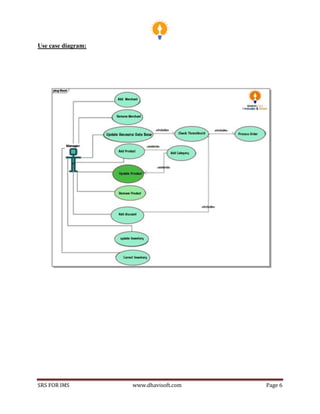
Use case diagram:
SRS FOR IMS www.dhavisoft.com Page 7
1
1
*
*
Merchants
Categories
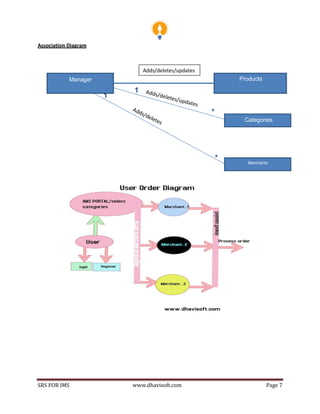
Association Diagram
Manager Products
Adds/deletes/updates

Srs for ims dhavisoft

  • 1.
    SRS FOR IMSwww.dhavisoft.com Page 1 Inventory management system 1-Introduction Purpose of the system When we analyze small merchants case study we find that they are facing problem to keep track of their inventory levels they have to calculate a list of the groceries utilized during a course of time, calculate and analyze the requirements for the future, and place their next order to the vendors if needed. This process takes up a lot of time and human effort, and is also prone to human error. It takes up a lot of time to manually keep track of sales and place correct orders to vendors, wasting useful labor in trivial works. A product which would assist in tackling the above mentioned problems would prove to be fruitful to clients. For the need of small merchants we decided to develop an inventory system for them so that according to online order they can deliver their product and can manage their product store record. This Inventory management system has three User Interface one for admin manager for adding merchants, second for merchants so that they can join their products and third for user or client to order on online portal. Scope of the system The project aims at providing an efficient interface to the merchants for managing their grocery inventory based on each item sold. The basic idea involved here is that each item is linked to its atomic products which are stored in a database. At the end of each day, the system analyzes the total sale of menu items and proportionately deducts appropriate amount from the resource database. Then it compares the current available resources with the threshold level of each product. If it finds that certain products are below the threshold, it will generate a purchase order for those item(s) and send it to the manager (admin) for approval. We also propose to include a special feature “Prediction”. This feature keeps track of any upcoming occasions, climatic changes and special events that may influence inventory needs for the upcoming week. The system will then predict the required resources for these events based on previously accumulated information/knowledge. It will now generate an updated purchase order in accordance with the predictions. The product also aims to keep track of the shelf life of resources. If any resource nears the end of its shelf life, it would intimate to the manager (admin) the details of the quantity that is near its expiration date. The restaurant must function efficiently, the groceries must be tracked correctly, timely orders must be sent out to the vendors, and the inventory must be maintained and updated at all times.
  • 2.
    SRS FOR IMSwww.dhavisoft.com Page 2 Objectives and success criteria of the project The objective of the project is to provide an efficient inventory control whose main functionality apart from calculating the inventory include predicting the requirement for the next order and also if there is a “Special Occasion” then accordingly the manager selects the particular occasion and extra requirements is added to the next issuing order to the vendors which needs to be approved by the manager. The product also aims to keep track of the shelf life of resources. If any resource nears the end of its shelf life, it would intimate to the manager (admin) the details of the quantity that is near its expiration date. The success criteria depends on  The accuracy in maintaining the inventory levels  The accuracy in predicting the requirements of the next order  The accuracy in relating brands(size/color/material) to their respective products  Ease of use when it comes to updating inventory levels and placing orders to vendors The Domain Our target domain is full of software to track sales of all items, for all areas of inventory management. Our software can be scaled from small/middle/large corporate all the way to small privately-owned merchants. It is also fairly domain specific: the database runs off categories which generate the necessary products. It also updates the inventory based off of the sale of those categories. This requirement focuses our product to all domains and makes it more appealing to those looking for a solution to this specific problem. The Client The client can vary from private merchant owners to corporate merchant management companies. Our product can be applied to the entire domain of the merchants. Focusing on a specific business provides us with more precise and consistent data. All groups of citizens would be an ideal client, across the nation and even they can Google. A large scale merchant can apply for our software to each and every domain, cutting down costs on a very large scale. Our software will allow our client to customize the database to suit the needs of each merchant individually. They can vary in prices, vendors from which they order their products, and threshold levels. This provides a uniform product that can be customized at a smaller scale. Our client would need to purchase multiple licenses, or more likely a corporate subscription that would allow them to use the software in multiple Shops. We would also offer single user licenses to appeal to merchants that
  • 3.
    SRS FOR IMSwww.dhavisoft.com Page 3 only need to manage a single inventory of goods. 2-Proposed system Overview We propose to develop software that keeps track of inventory in the “back of shop”, and updates it according to daily sales. Each product item is linked to respective resources (or categories) and as each product is sold and the products utilized. These changes in inventory are kept track of through product database. We propose to keep track of each and every product by dynamically linking it to the product and as a result create a dependent relationship to that product. At a specific time period (typically the end of the week); if the inventory is below the threshold level, order forms to the specific vendors are generated in order to restock the required items for the next week. The project also makes smart predictions on required inventory for the following week based upon the predicted climate and possible occasions or events that may influence near future sales. At the end of the week, the software takes into account all threshold levels, predictions, and other factors to generate an order form, which after being verified by the manager is sent out to the vendors/shopkeepers/merchants. Functional requirements The System aims at providing an efficient interface to the merchant for managing of inventory; it shall also provide the merchant varied options for managing the inventory through various functions at hand. The product levels are continuously monitored based on their usage and are checked for the threshold levels in the inventory and accordingly the merchant is alerted about low levels of certain products. The design is such that the merchant does not have to manually update the inventory every time, the System does if for the merchant. The System calculates and predicts the amount of usage for specific set days that are pre- set by the Merchant (admin); it also alerts the merchant of an impending action to order products before the specific day set by the merchant. Therefore the merchant never has to worry about manually calculating the estimated usage of the products as the System does it for the merchant. The simple interface of the System has functions like adding a category/product, removing or updating the product detail. It also extends to functions such as adding a merchant for a product, removing the merchant, checking threshold levels, processing orders, altering processed orders etc.
  • 4.
    SRS FOR IMSwww.dhavisoft.com Page 4 Nonfunctional requirements 2.2.1 Usability  The system must be easy to use by both admin managers and merchants such that they do not need to read an extensive amount of manuals.  The system must be quickly accessible by both users and merchants.  The system must be intuitive and simple in the way it displays all relevant data and relationships.  The menus of the system must be easily navigable by the users with buttons that are easy to understand. 2.2.2 Reliability  The System must give accurate inventory status to the merchant continuously. Any inaccuracies are taken care by the regular confirming of the actual levels with the levels displayed in the system.  The System must successfully add any categories, products, merchant or special occasions given by the merchant and provide estimations and inventory status in relevance with the newly updated entities. The system must provide a password enabled login to the merchant to avoid any foreign entity changing the data in the system.  The system should provide the merchant updates on completion of requested processes and if the requested processes fail, it should provide the user the reason for the failure. The system should not update the data in any database for any failed processes. 2.2.3 Performance  The system must not lag, because the workers using it don‟t have down-time towait for it to complete an action.  The system must complete updating the databases, adding of product, Brand and occasions successfully every time the merchant requests such a process.  All the functions of the system must be available to the merchant every time the system is turned on.  The calculations performed by the system must comply according to the norms set by the merchant and should not vary unless explicitly changed by the merchant.
  • 5.
    SRS FOR IMSwww.dhavisoft.com Page 5 2.2.4 Supportability  The software is designed such that it works even on systems having the minimum configuration.  The system is adaptable even if additional plugins or modules are added at a later point.  The data can be exported to the manager so as to make the system more portable. 2.2.5 Packaging  The system must be able to run on the Windows operating systems beginning with Windows XP, 8 and must be able to run on future releases.  The software must incorporate a license key authentication process.  The packaging must come with a manual that details the use of the system, and also the instructions on how to use the program. This manual may be included either in a booklet that comes with the software, or on the disc that the software itself is on. 2.2.6 Implementation  The System User Interface is built on Angular JS(version--) and Bootstrap(version---).  The Programming is done in JAVA (version---) and eclipse IDE.  The Database is implemented on the MySQL(Version------).  The connection between the Database and the System is achieved using JDBC connection. 2.2.7 Interfacing The system must offer an easy and simple way of viewing the current inventory. The system must be able to display the relationships between merchant, products, and recipes in an intuitive manner. 2.2.8 Legal The software must be licensed on an individual basis for smaller merchants, as well as through a multi-license deal for larger corporations. The client should agree to EULA (End User License Agreement) before using our software.
  • 6.
    SRS FOR IMSwww.dhavisoft.com Page 6 Use case diagram:
  • 7.
    SRS FOR IMSwww.dhavisoft.com Page 7 1 1 * * Merchants Categories Association Diagram Manager Products Adds/deletes/updates