Understanding Beacons
The market research perspective
(c) Squawk Surveys
© 2015 Squawk Surveys Inc. USA
Table of contents
Beacons
Why should researchers care
Technical details
Adoption of the technology
Research feasibility
Research applications
Case study
About Squawk Surveys
© 2015 Squawk Surveys Inc. USA
Beacons
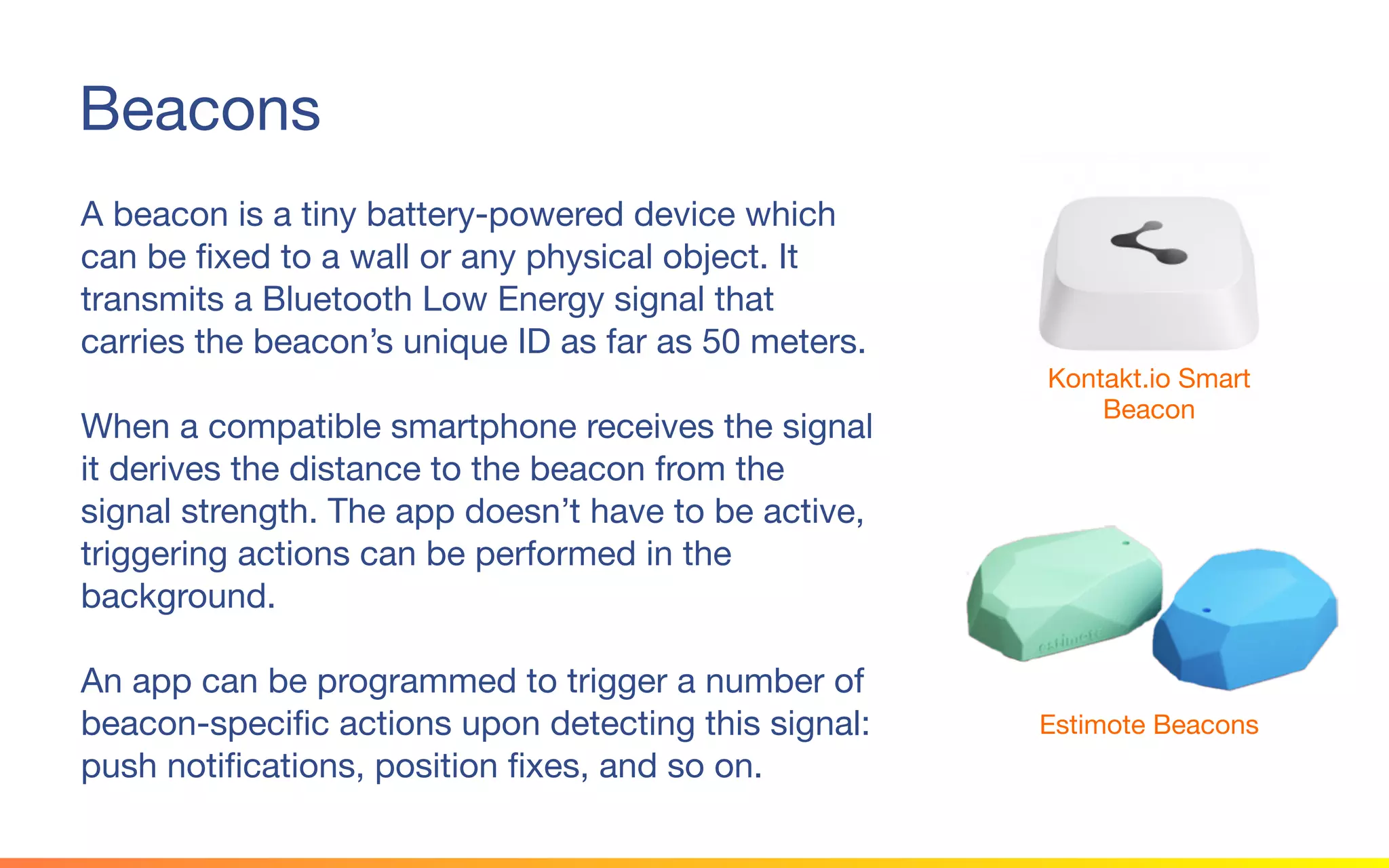
A beacon is a tiny battery-powered device which
can be fixed to a wall or any physical object. It
transmits a Bluetooth Low Energy signal that
carries the beacon’s unique ID as far as 50 meters.
When a compatible smartphone receives the signal
it derives the distance to the beacon from the signal
strength. The app doesn’t have to be active,
triggering actions can be performed in the
background.
An app can be programmed to trigger a number of
beacon-specific actions upon detecting this signal:
push notifications, position fixes, and so on.
Kontakt.io Smart
Beacon
Estimote Beacons
© 2015 Squawk Surveys Inc. USA
Why should researchers care
The two most obvious research applications
of the beacon technology are:
1. In-store footprinting
2. Post-transaction surveys
© 2015 Squawk Surveys Inc. USA
Technical details
It takes a smartphone
The functionality of beacon-enabled indoor
location systems may vary depending on the
smartphone hardware and the OS version. It
requires Bluetooth 4.0 and above, which has to
be enabled by the user. The phone needs to be
running iOS 7 or later, or Android 4.4 or later.
Beacon vs GPS
GPS can be very accurate outdoors but
is virtually useless indoors: on the store level,
e.g. in a mall or in the aisle of a store.
Unfortunately, this is precisely where most
interactions happen that have tangible market
research value, at least for brick and mortar
businesses.
It takes an app
In order to receive relevant indoor location data
and push notifications, the phone has to have a
corresponding beacon- enabled app installed.
Range and accuracy
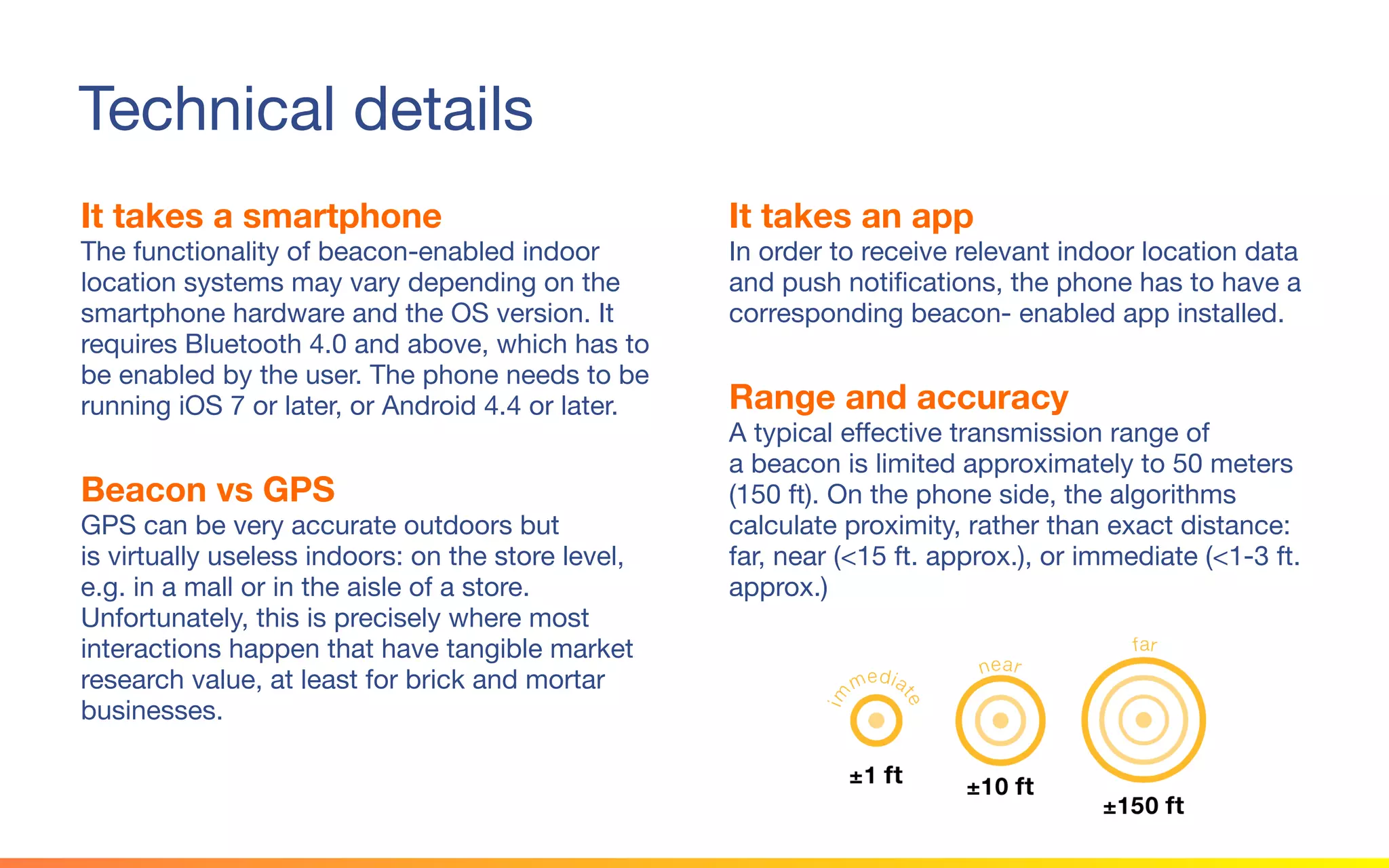
A typical effective transmission range of
a beacon is limited approximately to 50 meters
(150 ft). On the phone side, the algorithms
calculate proximity, rather than exact distance:
far, near (<15 ft. approx.), or immediate (<1-3 ft.
approx.)
© 2015 Squawk Surveys Inc. USA
Technical details
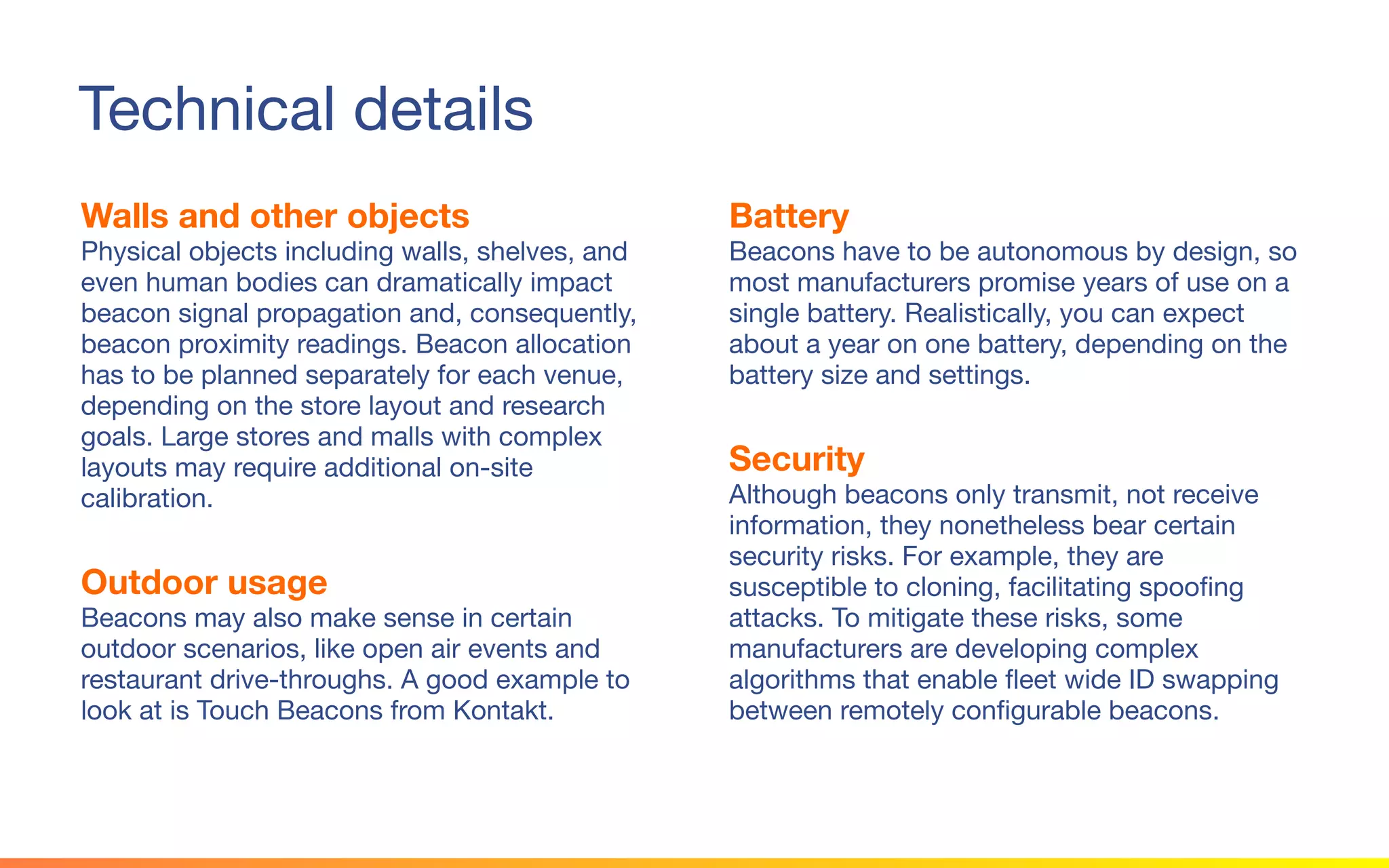
Walls and other objects
Physical objects including walls, shelves, and
even human bodies can dramatically impact
beacon signal propagation and, consequently,
beacon proximity readings. Beacon allocation
has to be planned separately for each venue,
depending on the store layout and research
goals. Large stores and malls with complex
layouts may require additional on-site
calibration.
Outdoor usage
Beacons may also make sense in certain
outdoor scenarios, like open air events and
restaurant drive-throughs. A good example to
look at is Touch Beacons from Kontakt.
Battery
Beacons have to be autonomous by design, so
most manufacturers promise years of use on a
single battery. Realistically, you can expect
about a year on one battery, depending on the
battery size and settings.
Security
Although beacons only transmit, not receive
information, they nonetheless bear certain
security risks. For example, they are susceptible
to cloning, facilitating spoofing attacks. To
mitigate these risks, some manufacturers are
developing complex algorithms that enable fleet
wide ID swapping between remotely
configurable beacons.
© 2015 Squawk Surveys Inc. USA
Technical details
Installation
While planning indoor beacon coverage may
require certain skills, a deep understanding of
both the technology and the research
objectives, installing them is much easier. All
you need is a plan, a number of beacons, and
some double-sided tape. This is something
regular retail personnel are definitely capable of
figuring out. The beacons should come pre-
configured, with unique IDs set up.
Fleet management
Installation is just the first step of the process.
Since beacons are supposed to help achieve a
wide range of research and marketing
objectives, a need may arise to reconfigure
them by changing their identifying parameters.
There should be a way to track their status,
presence, and battery charge, and there’s no
way all that can be done manually when there’s
a large-scale, distributed system. Certain
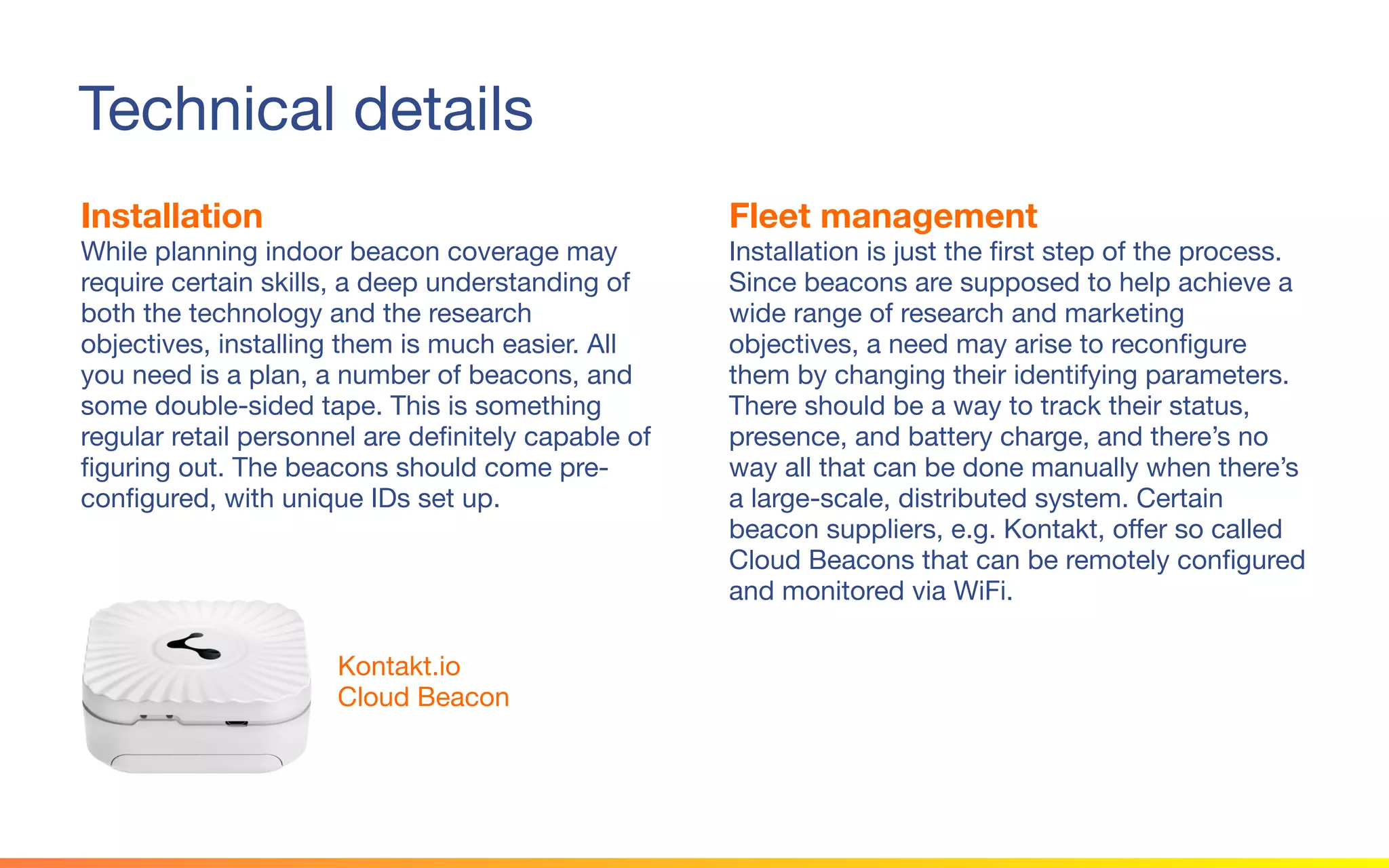
beacon suppliers, e.g. Kontakt, offer so called
Cloud Beacons that can be remotely configured
and monitored via WiFi.
Kontakt.io
Cloud Beacon
© 2015 Squawk Surveys Inc. USA
Adoption of the technology
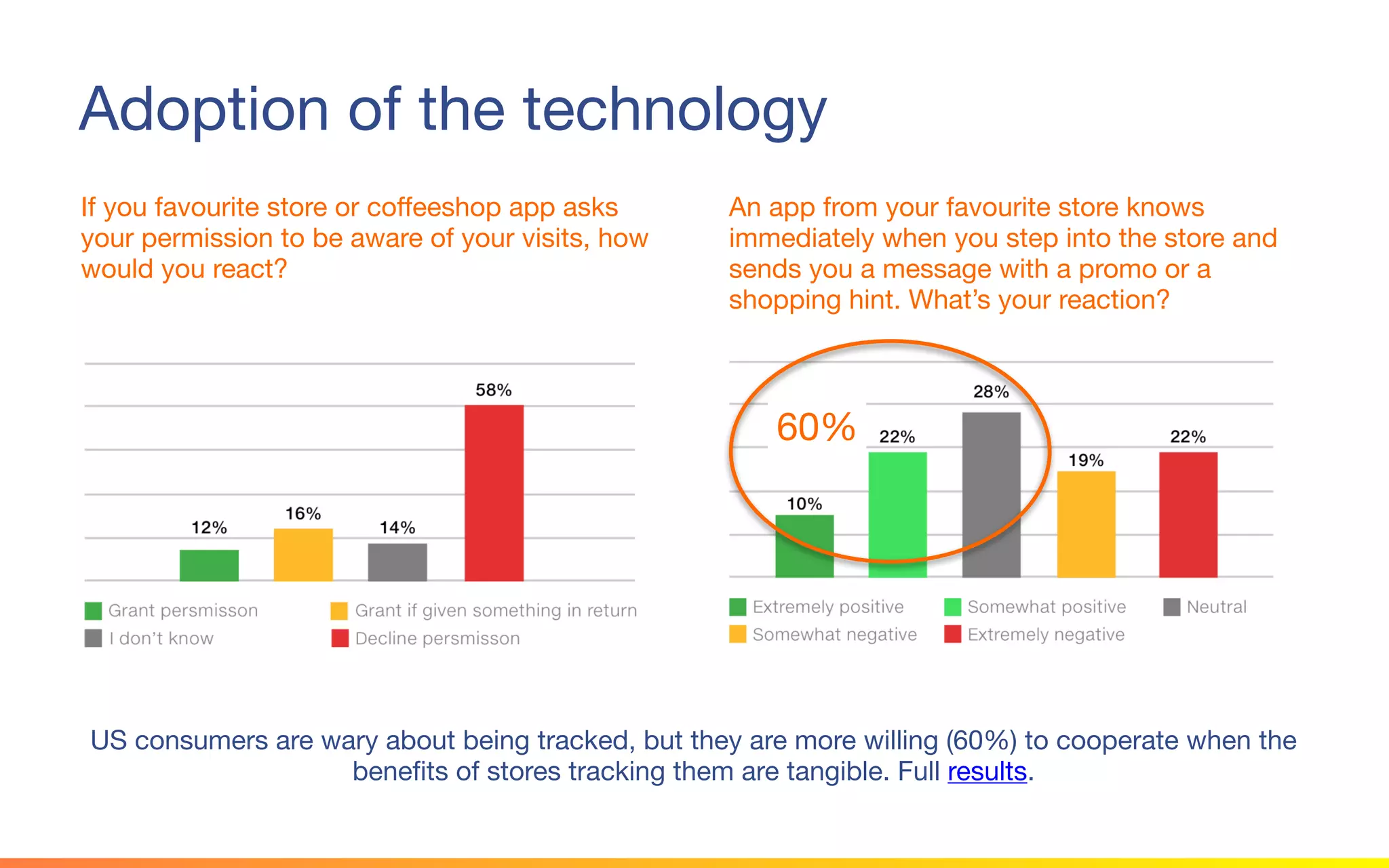
If you favourite store or coffeeshop app asks
your permission to be aware of your visits, how
would you react?
An app from your favourite store knows
immediately when you step into the store and
sends you a message with a promo or a
shopping hint. What’s your reaction?
US consumers are wary about being tracked, but they are more willing (60%) to cooperate when the
benefits of stores tracking them are tangible. Full results.
60%
© 2015 Squawk Surveys Inc. USA
Research feasibility
You need both and an overlap between them:
1. Potential respondent reach
2. Venue reach
Reach of venues
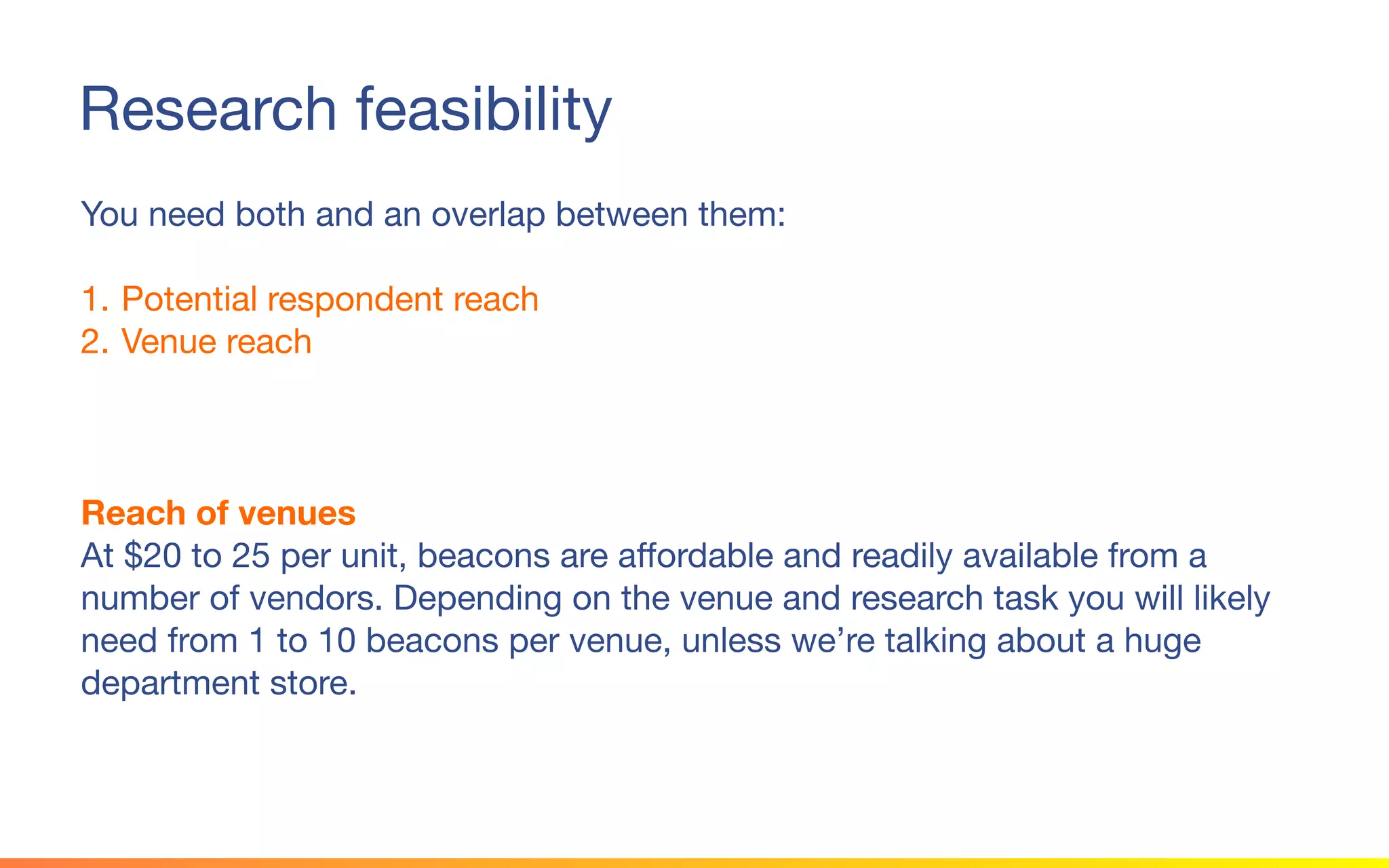
At $20 to 25 per unit, beacons are affordable and readily available from a
number of vendors. Depending on the venue and research task you will likely
need from 1 to 10 beacons per venue, unless we’re talking about a huge
department store.
© 2015 Squawk Surveys Inc. USA
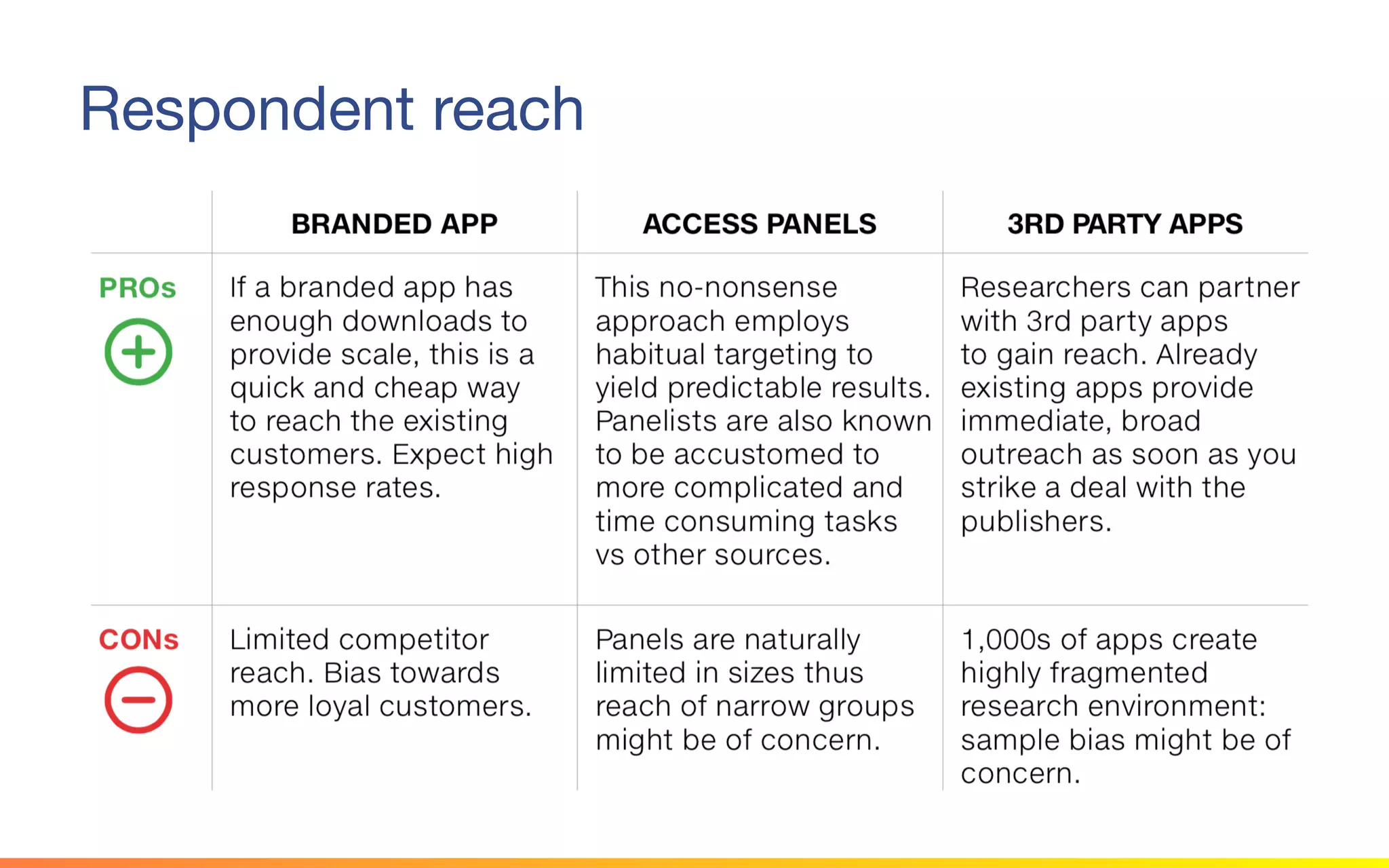
Respondent reach
© 2015 Squawk Surveys Inc. USA
Research applications
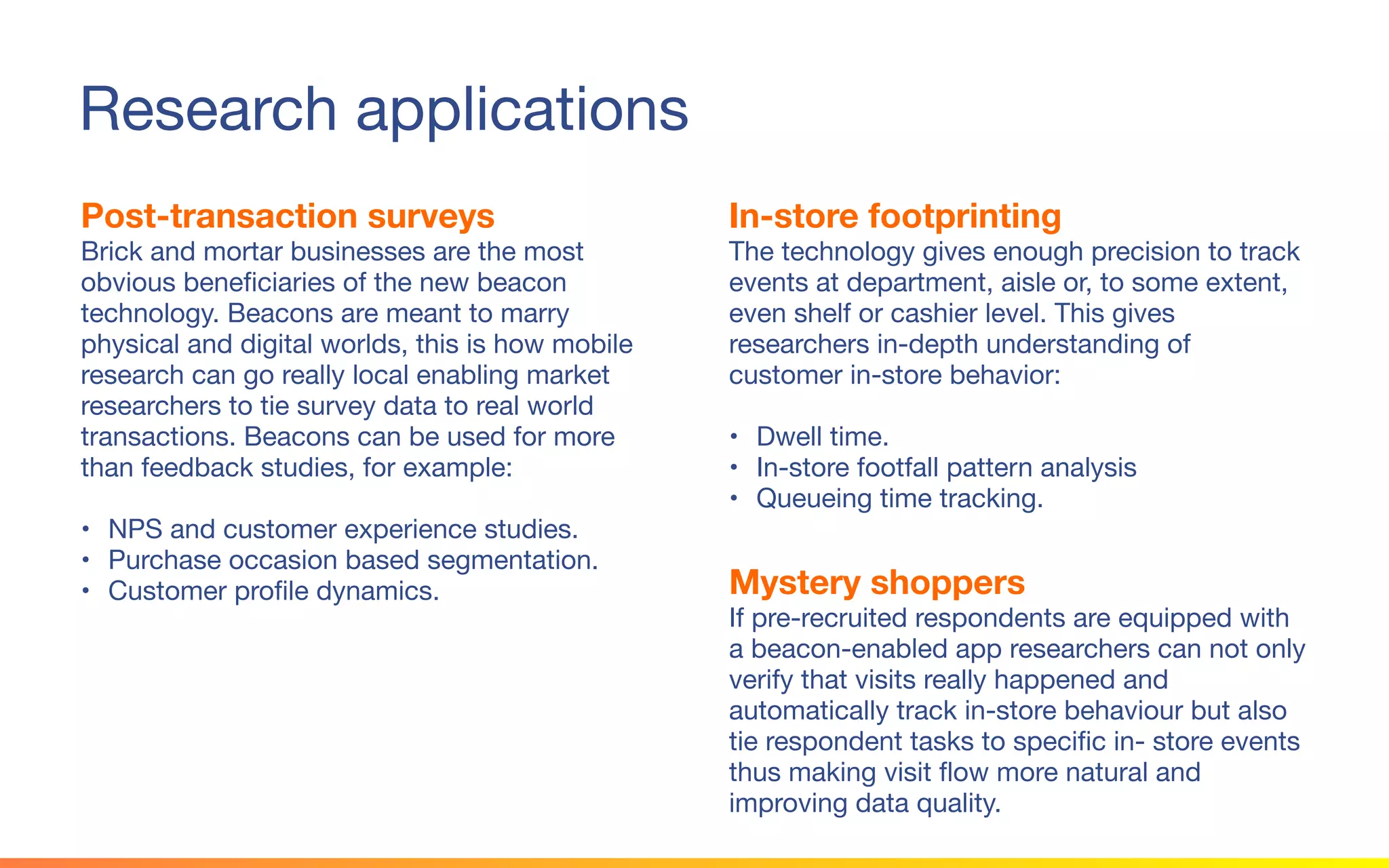
Post-transaction surveys
Brick and mortar businesses are the most
obvious beneficiaries of the new beacon
technology. Beacons are meant to marry
physical and digital worlds, this is how mobile
research can go really local enabling market
researchers to tie survey data to real world
transactions. Beacons can be used for more
than feedback studies, for example:
• NPS and customer experience studies.
• Purchase occasion based segmentation.
• Customer profile dynamics.
In-store footprinting
The technology gives enough precision to track
events at department, aisle or, to some extent,
even shelf or cashier level. This gives
researchers in-depth understanding of customer
in-store behavior:
• Dwell time.
• In-store footfall pattern analysis
• Queueing time tracking.
Mystery shoppers
If pre-recruited respondents are equipped with a
beacon-enabled app researchers can not only
verify that visits really happened and
automatically track in-store behaviour but also
tie respondent tasks to specific in- store events
thus making visit flow more natural and
improving data quality.
© 2015 Squawk Surveys Inc. USA
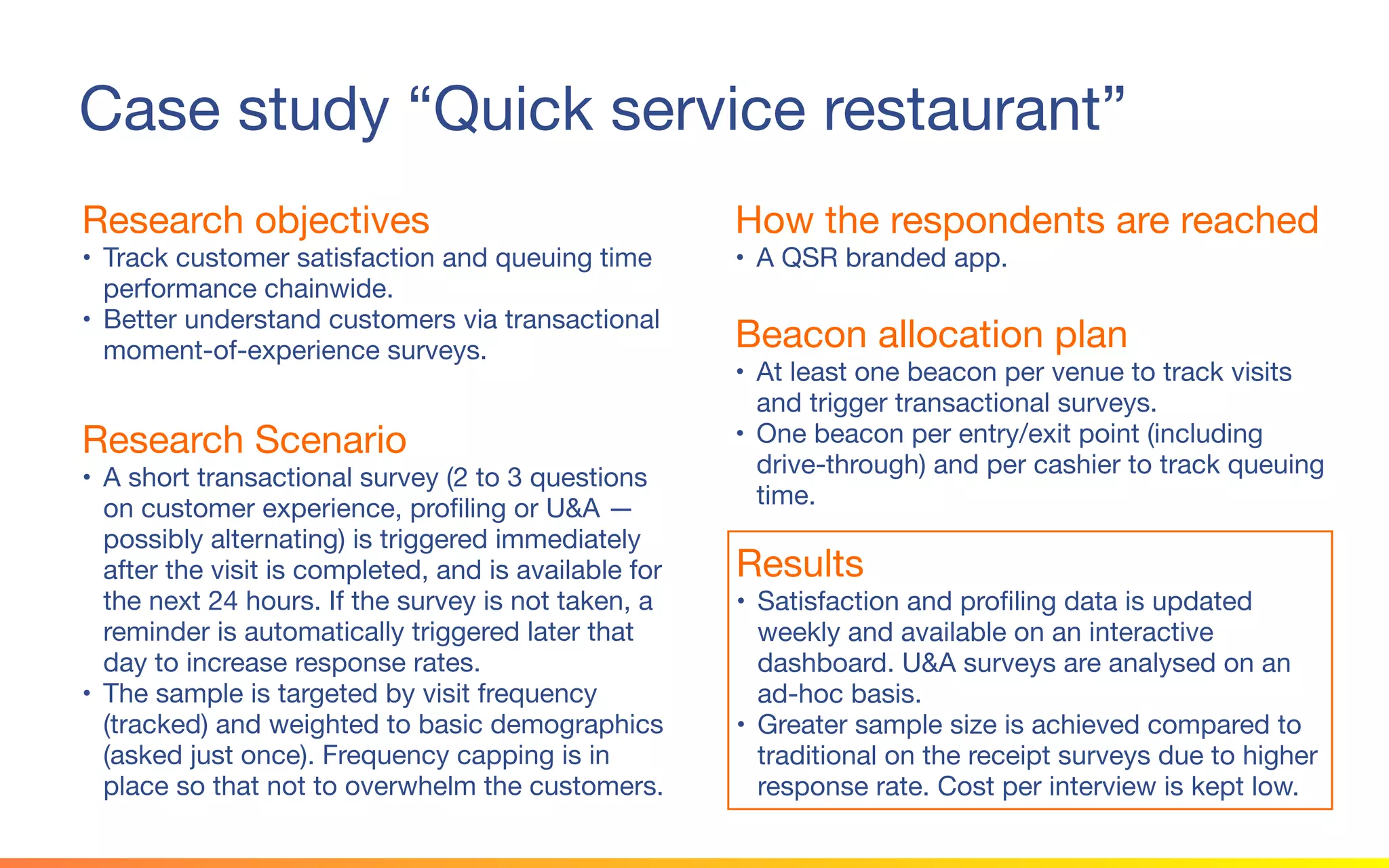
Case study “Quick service restaurant”
Research objectives
• Track customer satisfaction and queuing time
performance chainwide.
• Better understand customers via transactional
moment-of-experience surveys.
How the respondents are reached
• A QSR branded app.
Beacon allocation plan
• At least one beacon per venue to track visits and
trigger transactional surveys.
• One beacon per entry/exit point (including drive-
through) and per cashier to track queuing time.
Research Scenario
• A short transactional survey (2 to 3 questions on
customer experience, profiling or U&A —
possibly alternating) is triggered immediately
after the visit is completed, and is available for
the next 24 hours. If the survey is not taken, a
reminder is automatically triggered later that day
to increase response rates.
• The sample is targeted by visit frequency
(tracked) and weighted to basic demographics
(asked just once). Frequency capping is in place
so that not to overwhelm the customers.
Results
• Satisfaction and profiling data is updated weekly
and available on an interactive dashboard. U&A
surveys are analysed on an ad-hoc basis.
• Greater sample size is achieved compared to
traditional on the receipt surveys due to higher
response rate. Cost per interview is kept low.
© 2015 Squawk Surveys Inc. USA
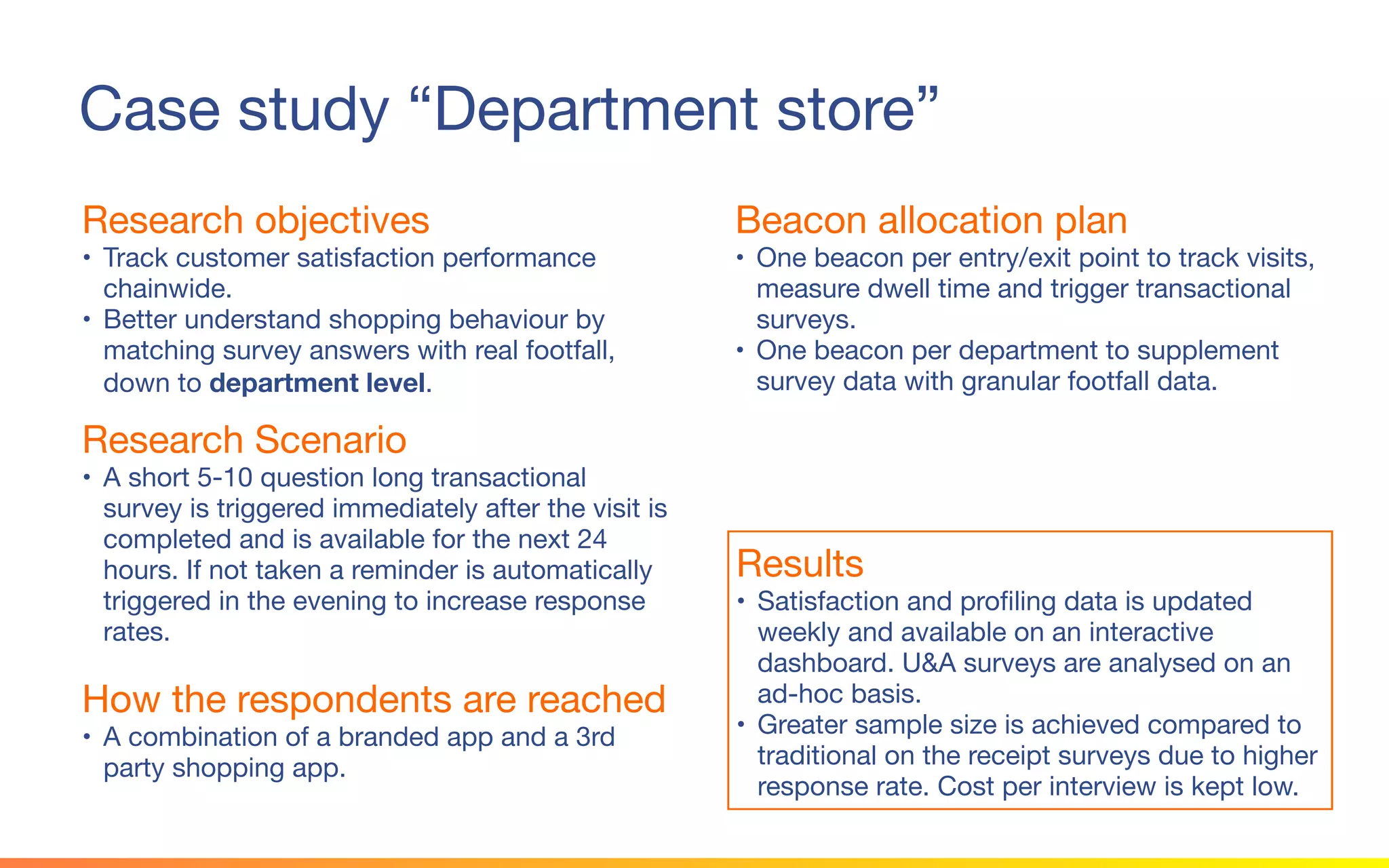
Case study “Department store”
Research objectives
• Track customer satisfaction performance
chainwide.
• Better understand shopping behaviour by
matching survey answers with real footfall, down
to department level.
Beacon allocation plan
• One beacon per entry/exit point to track visits,
measure dwell time and trigger transactional
surveys.
• One beacon per department to supplement
survey data with granular footfall data.
Research Scenario
• A short 5-10 question long transactional survey
is triggered immediately after the visit is
completed and is available for the next 24 hours.
If not taken a reminder is automatically triggered
in the evening to increase response rates.
Results
• Satisfaction and profiling data is updated weekly
and available on an interactive dashboard. U&A
surveys are analysed on an ad-hoc basis.
• Greater sample size is achieved compared to
traditional on the receipt surveys due to higher
response rate. Cost per interview is kept low.
How the respondents are reached
• A combination of a branded app and a 3rd party
shopping app.
Squawk Surveys
Squawk Surveys is a mobile touchpoint specially tailored to the needs of market
researchers. It delivers targeted and engaging survey invitations to your
respondents based on their where-when-what context.
Learn more:
www.squawksurveys.com
ping@squawksurveys.com
+1 347 510 8646
Squawk Surveys

Squawk Surveys - Understanding Beacons - White Paper

  • 1.
    Understanding Beacons The marketresearch perspective (c) Squawk Surveys
  • 2.
    © 2015 SquawkSurveys Inc. USA Table of contents Beacons Why should researchers care Technical details Adoption of the technology Research feasibility Research applications Case study About Squawk Surveys
  • 3.
    © 2015 SquawkSurveys Inc. USA Beacons A beacon is a tiny battery-powered device which can be fixed to a wall or any physical object. It transmits a Bluetooth Low Energy signal that carries the beacon’s unique ID as far as 50 meters. When a compatible smartphone receives the signal it derives the distance to the beacon from the signal strength. The app doesn’t have to be active, triggering actions can be performed in the background. An app can be programmed to trigger a number of beacon-specific actions upon detecting this signal: push notifications, position fixes, and so on. Kontakt.io Smart Beacon Estimote Beacons
  • 4.
    © 2015 SquawkSurveys Inc. USA Why should researchers care The two most obvious research applications of the beacon technology are: 1. In-store footprinting 2. Post-transaction surveys
  • 5.
    © 2015 SquawkSurveys Inc. USA Technical details It takes a smartphone The functionality of beacon-enabled indoor location systems may vary depending on the smartphone hardware and the OS version. It requires Bluetooth 4.0 and above, which has to be enabled by the user. The phone needs to be running iOS 7 or later, or Android 4.4 or later. Beacon vs GPS GPS can be very accurate outdoors but is virtually useless indoors: on the store level, e.g. in a mall or in the aisle of a store. Unfortunately, this is precisely where most interactions happen that have tangible market research value, at least for brick and mortar businesses. It takes an app In order to receive relevant indoor location data and push notifications, the phone has to have a corresponding beacon- enabled app installed. Range and accuracy A typical effective transmission range of a beacon is limited approximately to 50 meters (150 ft). On the phone side, the algorithms calculate proximity, rather than exact distance: far, near (<15 ft. approx.), or immediate (<1-3 ft. approx.)
  • 6.
    © 2015 SquawkSurveys Inc. USA Technical details Walls and other objects Physical objects including walls, shelves, and even human bodies can dramatically impact beacon signal propagation and, consequently, beacon proximity readings. Beacon allocation has to be planned separately for each venue, depending on the store layout and research goals. Large stores and malls with complex layouts may require additional on-site calibration. Outdoor usage Beacons may also make sense in certain outdoor scenarios, like open air events and restaurant drive-throughs. A good example to look at is Touch Beacons from Kontakt. Battery Beacons have to be autonomous by design, so most manufacturers promise years of use on a single battery. Realistically, you can expect about a year on one battery, depending on the battery size and settings. Security Although beacons only transmit, not receive information, they nonetheless bear certain security risks. For example, they are susceptible to cloning, facilitating spoofing attacks. To mitigate these risks, some manufacturers are developing complex algorithms that enable fleet wide ID swapping between remotely configurable beacons.
  • 7.
    © 2015 SquawkSurveys Inc. USA Technical details Installation While planning indoor beacon coverage may require certain skills, a deep understanding of both the technology and the research objectives, installing them is much easier. All you need is a plan, a number of beacons, and some double-sided tape. This is something regular retail personnel are definitely capable of figuring out. The beacons should come pre- configured, with unique IDs set up. Fleet management Installation is just the first step of the process. Since beacons are supposed to help achieve a wide range of research and marketing objectives, a need may arise to reconfigure them by changing their identifying parameters. There should be a way to track their status, presence, and battery charge, and there’s no way all that can be done manually when there’s a large-scale, distributed system. Certain beacon suppliers, e.g. Kontakt, offer so called Cloud Beacons that can be remotely configured and monitored via WiFi. Kontakt.io Cloud Beacon
  • 8.
    © 2015 SquawkSurveys Inc. USA Adoption of the technology If you favourite store or coffeeshop app asks your permission to be aware of your visits, how would you react? An app from your favourite store knows immediately when you step into the store and sends you a message with a promo or a shopping hint. What’s your reaction? US consumers are wary about being tracked, but they are more willing (60%) to cooperate when the benefits of stores tracking them are tangible. Full results. 60%
  • 9.
    © 2015 SquawkSurveys Inc. USA Research feasibility You need both and an overlap between them: 1. Potential respondent reach 2. Venue reach Reach of venues At $20 to 25 per unit, beacons are affordable and readily available from a number of vendors. Depending on the venue and research task you will likely need from 1 to 10 beacons per venue, unless we’re talking about a huge department store.
  • 10.
    © 2015 SquawkSurveys Inc. USA Respondent reach
  • 11.
    © 2015 SquawkSurveys Inc. USA Research applications Post-transaction surveys Brick and mortar businesses are the most obvious beneficiaries of the new beacon technology. Beacons are meant to marry physical and digital worlds, this is how mobile research can go really local enabling market researchers to tie survey data to real world transactions. Beacons can be used for more than feedback studies, for example: • NPS and customer experience studies. • Purchase occasion based segmentation. • Customer profile dynamics. In-store footprinting The technology gives enough precision to track events at department, aisle or, to some extent, even shelf or cashier level. This gives researchers in-depth understanding of customer in-store behavior: • Dwell time. • In-store footfall pattern analysis • Queueing time tracking. Mystery shoppers If pre-recruited respondents are equipped with a beacon-enabled app researchers can not only verify that visits really happened and automatically track in-store behaviour but also tie respondent tasks to specific in- store events thus making visit flow more natural and improving data quality.
  • 12.
    © 2015 SquawkSurveys Inc. USA Case study “Quick service restaurant” Research objectives • Track customer satisfaction and queuing time performance chainwide. • Better understand customers via transactional moment-of-experience surveys. How the respondents are reached • A QSR branded app. Beacon allocation plan • At least one beacon per venue to track visits and trigger transactional surveys. • One beacon per entry/exit point (including drive- through) and per cashier to track queuing time. Research Scenario • A short transactional survey (2 to 3 questions on customer experience, profiling or U&A — possibly alternating) is triggered immediately after the visit is completed, and is available for the next 24 hours. If the survey is not taken, a reminder is automatically triggered later that day to increase response rates. • The sample is targeted by visit frequency (tracked) and weighted to basic demographics (asked just once). Frequency capping is in place so that not to overwhelm the customers. Results • Satisfaction and profiling data is updated weekly and available on an interactive dashboard. U&A surveys are analysed on an ad-hoc basis. • Greater sample size is achieved compared to traditional on the receipt surveys due to higher response rate. Cost per interview is kept low.
  • 13.
    © 2015 SquawkSurveys Inc. USA Case study “Department store” Research objectives • Track customer satisfaction performance chainwide. • Better understand shopping behaviour by matching survey answers with real footfall, down to department level. Beacon allocation plan • One beacon per entry/exit point to track visits, measure dwell time and trigger transactional surveys. • One beacon per department to supplement survey data with granular footfall data. Research Scenario • A short 5-10 question long transactional survey is triggered immediately after the visit is completed and is available for the next 24 hours. If not taken a reminder is automatically triggered in the evening to increase response rates. Results • Satisfaction and profiling data is updated weekly and available on an interactive dashboard. U&A surveys are analysed on an ad-hoc basis. • Greater sample size is achieved compared to traditional on the receipt surveys due to higher response rate. Cost per interview is kept low. How the respondents are reached • A combination of a branded app and a 3rd party shopping app.
  • 14.
    Squawk Surveys Squawk Surveysis a mobile touchpoint specially tailored to the needs of market researchers. It delivers targeted and engaging survey invitations to your respondents based on their where-when-what context. Learn more: www.squawksurveys.com ping@squawksurveys.com +1 347 510 8646
  • 15.