OFFICIATING PROGRAM
DOUBLES CERTIFICATION CLINIC
The material presented in these slides is from the Squash Canada Doubles
Officiating Certification Program. The material in these slides may not be
reproduced or used in any manner without the permission of Squash Canada.
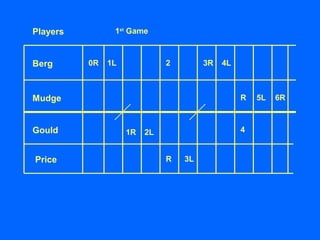
Recording the Score
There are various methods for recording the
score, and there is no one official method.
However there is a system which requires
less writing. It is very easy and from it one
can see the pattern of the match at a glance.
Take a match between Berg/Mudge vs
Gould/Price.
Berg
Mudge
Gould
Price
0R 1L
1R 2L
R
2
3L
3R 4L
R
4
5L 6R
Players 1st
Game
Right to Play the Ball
Immediately after he or his partner has struck
the ball, each player must get out of his
opponents’ way and must:
a)Give his opponents a fair opportunity to get
to and strike at the ball from any position on
the court elected by an opponent.
b)Allow either opponent to play the ball to any
part of the front wall or back wall and to that
part of each side wall in front of the red floor
service line.
d) Refrain from creating a visual or audible
distraction.
c) Give his opponents a fair view of the ball.
REFEREE’S LINE OF THINKING
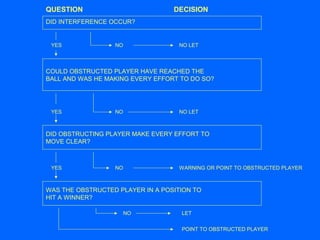
The Referee’s Line of Thinking is a useful
tool that will help guide a Referee to the
correct decision each time there is an appeal
on interference or obstruction.
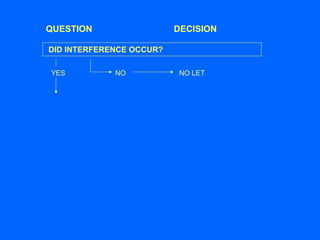
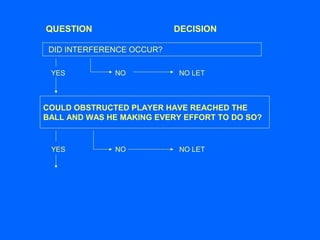
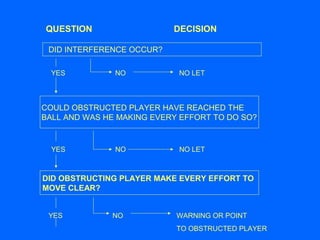
QUESTION DECISION
DID INTERFERENCE OCCUR?
YES NO NO LET
In his Line of Thinking the first question
the Referee will ask is did interference
occur? Normally it is obvious whether
interference has occurred. However, it is
not always a clear-cut decision. If, in the
opinion of the Referee, there has been NO
interference then he should refuse the
appeal. Otherwise, he moves to the next
question.
Did Interference Occur?
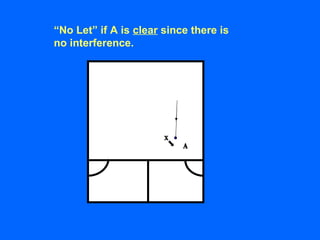
“No Let” if A is clear since there is
no interference.
QUESTION DECISION
COULD OBSTRUCTED PLAYER HAVE REACHED THE
BALL AND WAS HE MAKING EVERY EFFORT TO DO SO?
DID INTERFERENCE OCCUR?
YES NO NO LET
YES NO NO LET
Could Obstructed Player Have Reached
The Ball And Made A Good Return And
Was He Making Every Effort To Do So?
The Referee must be satisfied that the player
could have reached the ball, not only by the
direction of his movement but also by his
speed and ability. His speed may well
deteriorate as the game progresses when his
fitness deserts him. So what might be a
positive answer early in a match could
become a negative one toward the end of a
long five game match.
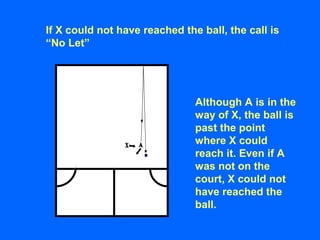
If X could not have reached the ball, the call is
“No Let”
Although A is in the
way of X, the ball is
past the point
where X could
reach it. Even if A
was not on the
court, X could not
have reached the
ball.
A player cannot expect a “Let” if he just
stands there appealing. He must satisfy
the Referee that he could have reached the
ball and made a good return and the best
way to do this is to make every effort to get
to the ball.
If the Referee is unsure whether the player
could have reached the ball, he moves to
the next question.
QUESTION DECISION
COULD OBSTRUCTED PLAYER HAVE REACHED THE
BALL AND WAS HE MAKING EVERY EFFORT TO DO SO?
DID OBSTRUCTING PLAYER MAKE EVERY EFFORT TO
MOVE CLEAR?
DID INTERFERENCE OCCUR?
YES NO NO LET
YES NO NO LET
YES NO WARNING OR POINT
TO OBSTRUCTED PLAYER
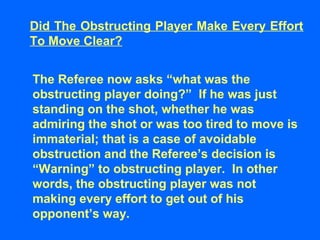
Did The Obstructing Player Make Every Effort
To Move Clear?
The Referee now asks “what was the
obstructing player doing?” If he was just
standing on the shot, whether he was
admiring the shot or was too tired to move is
immaterial; that is a case of avoidable
obstruction and the Referee’s decision is
“Warning” to obstructing player. In other
words, the obstructing player was not
making every effort to get out of his
opponent’s way.
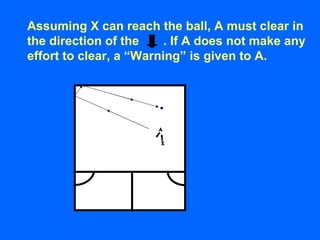
Assuming X can reach the ball, A must clear in
the direction of the . If A does not make any
effort to clear, a “Warning” is given to A.
Subsequent decisions on similar
situations would be “Point” to
obstructed player. A worse case
scenario is when the obstructing
player is actually moving into the
striker’s swing. This would be
classified as deliberate obstruction in
which case it would again be “Point” to
obstructed player.
QUESTION DECISION
NO LET
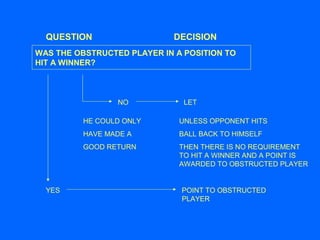
WAS THE OBSTRUCTED PLAYER IN A POSITION TO
HIT A WINNER?
HE COULD ONLY UNLESS OPPONENT HITS
HAVE MADE A BALL BACK TO HIMSELF
GOOD RETURN THEN THERE IS NO REQUIREMENT
TO HIT A WINNER AND A POINT IS
AWARDED TO OBSTRUCTED PLAYER
YES POINT TO OBSTRUCTED
PLAYER
Was The Obstructed Player In A Position To
Play A Winner?
We could have a situation where the
obstructing player was making every effort to
move clear but despite this effort there was still
interference. This would be a case of
accidental obstruction rather than deliberate
obstruction so the Referee would now ask
himself “was the obstructed player prevented
from playing a winning shot?”
In answering this question the Referee would not
take into account the player’s ability. The player is
assumed to be able to hit the winner. He would,
however, assess the position of the players and
decide whether a winning shot could have been hit
IN THAT SITUATION.
If in the opinion of the Referee, when answering the
last question in his line of thinking, the obstructed
player COULD ONLY JUST HAVE REACHED the ball
and therefore could not hit a winning shot but
COULD ONLY JUST PLAY THE BALL, then the
Referee would allow a “Let”.
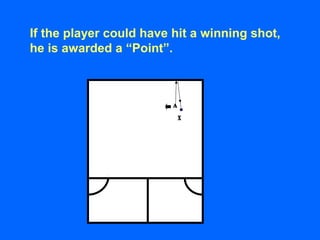
If the player could have hit a winning shot,
he is awarded a “Point”.
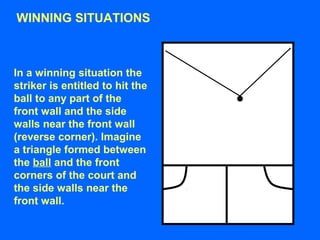
WINNING SITUATIONS
In a winning situation the
striker is entitled to hit the
ball to any part of the
front wall and the side
walls near the front wall
(reverse corner). Imagine
a triangle formed between
the ball and the front
corners of the court and
the side walls near the
front wall.
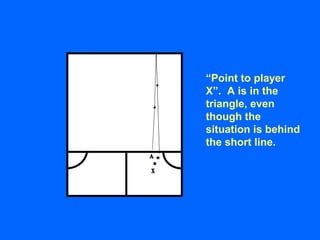
“Point to player
X”. A is in the
triangle, even
though the
situation is behind
the short line.
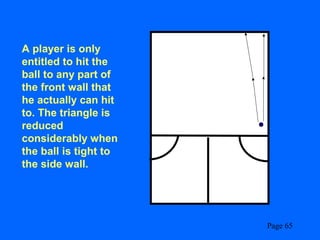
Page 65
A player is only
entitled to hit the
ball to any part of
the front wall that
he actually can hit
to. The triangle is
reduced
considerably when
the ball is tight to
the side wall.
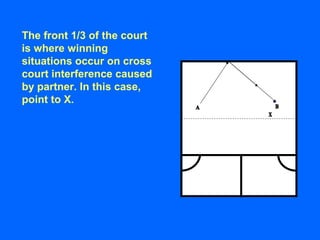
The front 1/3 of the court
is where winning
situations occur on cross
court interference caused
by partner. In this case,
point to X.
QUESTION DECISION
COULD OBSTRUCTED PLAYER HAVE REACHED THE
BALL AND WAS HE MAKING EVERY EFFORT TO DO SO?
DID OBSTRUCTING PLAYER MAKE EVERY EFFORT TO
MOVE CLEAR?
DID INTERFERENCE OCCUR?
YES NO NO LET
YES NO NO LET
YES NO WARNING OR POINT TO OBSTRUCTED PLAYER
WAS THE OBSTRUCTED PLAYER IN A POSITION TO
HIT A WINNER?
POINT TO OBSTRUCTED PLAYER
NO LET
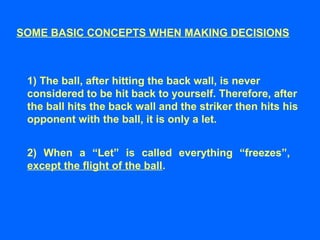
SOME BASIC CONCEPTS WHEN MAKING DECISIONS
1) The ball, after hitting the back wall, is never
considered to be hit back to yourself. Therefore, after
the ball hits the back wall and the striker then hits his
opponent with the ball, it is only a let.
2) When a “Let” is called everything “freezes”,
except the flight of the ball.
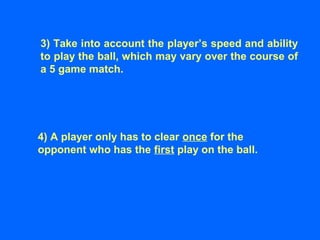
4) A player only has to clear once for the
opponent who has the first play on the ball.
3) Take into account the player’s speed and ability
to play the ball, which may vary over the course of
a 5 game match.
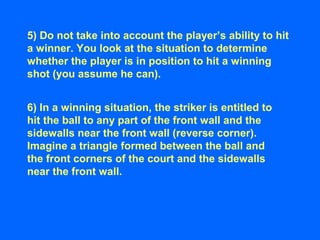
5) Do not take into account the player’s ability to hit
a winner. You look at the situation to determine
whether the player is in position to hit a winning
shot (you assume he can).
6) In a winning situation, the striker is entitled to
hit the ball to any part of the front wall and the
sidewalls near the front wall (reverse corner).
Imagine a triangle formed between the ball and
the front corners of the court and the sidewalls
near the front wall.
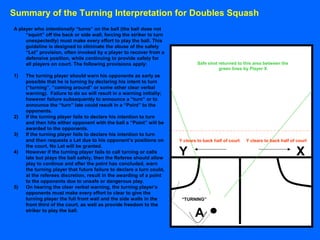
Summary of the Turning Interpretation for Doubles Squash
Y X
A
“TURNING”
A player who intentionally “turns” on the ball (the ball does not
“squirt” off the back or side wall, forcing the striker to turn
unexpectedly) must make every effort to play the ball. This
guideline is designed to eliminate the abuse of the safety
“Let” provision, often invoked by a player to recover from a
defensive position, while continuing to provide safety for
all players on court. The following provisions apply:
1) The turning player should warn his opponents as early as
possible that he is turning by declaring his intent to turn
(“turning”, “coming around” or some other clear verbal
warning). Failure to do so will result in a warning initially;
however failure subsequently to announce a “turn” or to
announce the “turn” late could result in a “Point” to the
opponents.
2) If the turning player fails to declare his intention to turn
and then hits either opponent with the ball a “Point” will be
awarded to the opponents.
3) If the turning player fails to declare his intention to turn
and then requests a Let due to his opponent’s positions on
the court, No Let will be granted.
4) However if the turning player fails to call turning or calls
late but plays the ball safely, then the Referee should allow
play to continue and after the point has concluded, warn
the turning player that future failure to declare a turn could,
at the referees discretion, result in the awarding of a point
to the opponents due to unsafe or dangerous play.
5) On hearing the clear verbal warning, the turning player’s
opponents must make every effort to clear to give the
turning player the full front wall and the side walls in the
front third of the court, as well as provide freedom to the
striker to play the ball.
Y clears to back half of court Y clears to back half of court
Safe shot returned to this area between the
green lines by Player X
6. After clearly stating his intention to turn, the turning player, where possible, should play the ball to
the front wall or to the sidewalls in the front third of the court. If the turning player does not play
the ball he will not be granted a “Let” if he is considered to be unreasonably trying to get out of an
unfavourable position, especially when the opponents have cleared properly.
7. If after declaring his intention to turn, the turning player’s ball hits an opponent who has cleared to
allow the turning player to play the ball safely to the front wall or the front third of the side wall ,
the turning player will lose the “Point”. Also to ensure the safety of the players on the court in
enforcing the Turning Rule, if the turning player plays a shot which is considered reckless or
dangerous (not safe) the striker will be penalized and a “Point” will be awarded to the opponents.
The exceptions are as follows:
Where the striker, while planning to play his normal shot, is forced to turn to play the ball due
to the ball “squirting” off the back or side wall, forcing the striker to turn unexpectedly; in this
case a “Let” will be allowed, provided the striker could have played the ball.
When the opponents do not make every effort to clear, after turning has been declared, then
the striker need not play the ball and a “Let” will be allowed and the Referee should warn the
opponents that future failure to clear will result in a “Point” to the striker.
Footnote to Referees: The overriding principle for all Referees is that the game should be played
safely and fairly, and Referees calls should be made to promote safety while preserving the
integrity of the Rules, and the flow of the game. The Referee should include, when making his
judgement, whether or not the turning player could have reached the ball and played it to the
front wall and would it have resulted in a safe return.
Ultimately it is the responsibility of the player turning to play the ball in a safe manner. Failure to
do so may, at the discretion of the Referee, result in a Warning, or if the Referee deems the
conduct offensive, a Point.
An initial warning applies to both players of the team warned.
Some Possible Situations a Referee
may Encounter
Assumptions in all situations:
1. Players are right handed
2. Teams are Players A and B versus X and Y
3. Incoming striker could have reached the ball and was in a
position ready to play the ball unless stated otherwise
4. On a normal return, the striker is entitled to play the ball to
any part of the side wall or back wall in order for the ball to
then reach the front wall
5. The player’s ability to hit a shot is not considered. It is the
winning situation, as previously discussed, which should be
taken into account
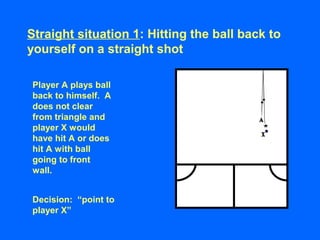
Straight situation 1: Hitting the ball back to
yourself on a straight shot
Player A plays ball
back to himself. A
does not clear
from triangle and
player X would
have hit A or does
hit A with ball
going to front
wall.
Decision: “point to
player X”
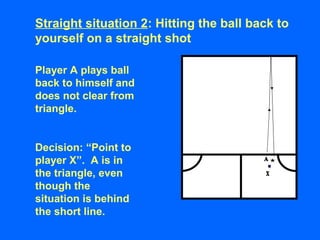
Decision: “Point to
player X”. A is in
the triangle, even
though the
situation is behind
the short line.
Player A plays ball
back to himself and
does not clear from
triangle.
Straight situation 2: Hitting the ball back to
yourself on a straight shot
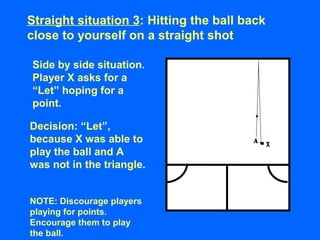
Side by side situation.
Player X asks for a
“Let” hoping for a
point.
Decision: “Let”,
because X was able to
play the ball and A
was not in the triangle.
NOTE: Discourage players
playing for points.
Encourage them to play
the ball.
Straight situation 3: Hitting the ball back
close to yourself on a straight shot
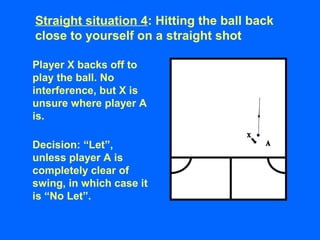
Player X backs off to
play the ball. No
interference, but X is
unsure where player A
is.
Decision: “Let”,
unless player A is
completely clear of
swing, in which case it
is “No Let”.
Straight situation 4: Hitting the ball back
close to yourself on a straight shot
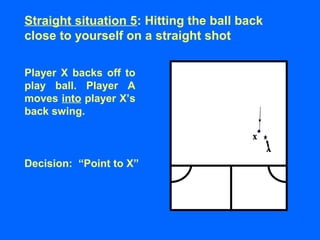
Player X backs off to
play ball. Player A
moves into player X’s
back swing.
Decision: “Point to X”
Straight situation 5: Hitting the ball back
close to yourself on a straight shot
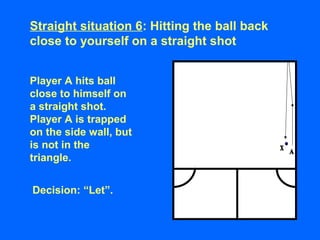
Player A hits ball
close to himself on
a straight shot.
Player A is trapped
on the side wall, but
is not in the
triangle.
Decision: “Let”.
Straight situation 6: Hitting the ball back
close to yourself on a straight shot
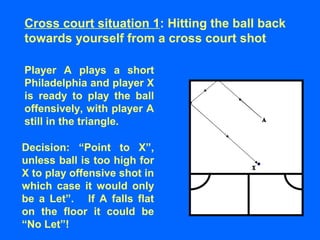
Player A plays a short
Philadelphia and player X
is ready to play the ball
offensively, with player A
still in the triangle.
Decision: “Point to X”,
unless ball is too high for
X to play offensive shot in
which case it would only
be a Let”. If A falls flat
on the floor it could be
“No Let”!
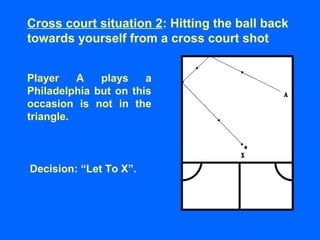
Cross court situation 1: Hitting the ball back
towards yourself from a cross court shot
Player A plays a
Philadelphia but on this
occasion is not in the
triangle.
Decision: “Let To X”.
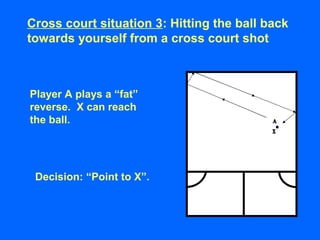
Cross court situation 2: Hitting the ball back
towards yourself from a cross court shot
Player A plays a “fat”
reverse. X can reach
the ball.
Decision: “Point to X”.
Cross court situation 3: Hitting the ball back
towards yourself from a cross court shot
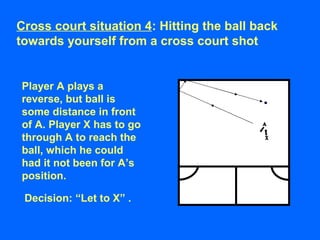
Player A plays a
reverse, but ball is
some distance in front
of A. Player X has to go
through A to reach the
ball, which he could
had it not been for A’s
position.
Decision: “Let to X” .
Cross court situation 4: Hitting the ball back
towards yourself from a cross court shot
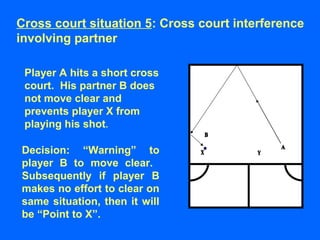
Player A hits a short cross
court. His partner B does
not move clear and
prevents player X from
playing his shot.
Decision: “Warning” to
player B to move clear.
Subsequently if player B
makes no effort to clear on
same situation, then it will
be “Point to X”.
Cross court situation 5: Cross court interference
involving partner
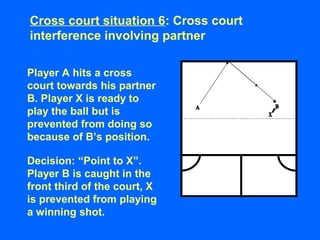
Player A hits a cross
court towards his partner
B. Player X is ready to
play the ball but is
prevented from doing so
because of B’s position.
Decision: “Point to X”.
Player B is caught in the
front third of the court, X
is prevented from playing
a winning shot.
Cross court situation 6: Cross court
interference involving partner
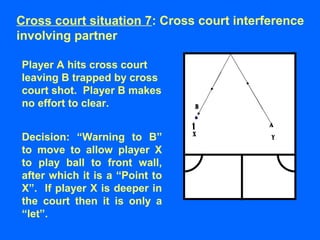
Player A hits cross court
leaving B trapped by cross
court shot. Player B makes
no effort to clear.
Decision: “Warning to B”
to move to allow player X
to play ball to front wall,
after which it is a “Point to
X”. If player X is deeper in
the court then it is only a
“let”.
Cross court situation 7: Cross court interference
involving partner

Squash Canada - Doubles Certification Clinic

  • 1.
    OFFICIATING PROGRAM DOUBLES CERTIFICATIONCLINIC The material presented in these slides is from the Squash Canada Doubles Officiating Certification Program. The material in these slides may not be reproduced or used in any manner without the permission of Squash Canada.
  • 2.
    Recording the Score Thereare various methods for recording the score, and there is no one official method. However there is a system which requires less writing. It is very easy and from it one can see the pattern of the match at a glance. Take a match between Berg/Mudge vs Gould/Price.
  • 3.
    Berg Mudge Gould Price 0R 1L 1R 2L R 2 3L 3R4L R 4 5L 6R Players 1st Game
  • 4.
    Right to Playthe Ball Immediately after he or his partner has struck the ball, each player must get out of his opponents’ way and must: a)Give his opponents a fair opportunity to get to and strike at the ball from any position on the court elected by an opponent. b)Allow either opponent to play the ball to any part of the front wall or back wall and to that part of each side wall in front of the red floor service line.
  • 5.
    d) Refrain fromcreating a visual or audible distraction. c) Give his opponents a fair view of the ball. REFEREE’S LINE OF THINKING The Referee’s Line of Thinking is a useful tool that will help guide a Referee to the correct decision each time there is an appeal on interference or obstruction.
  • 6.
  • 7.
    In his Lineof Thinking the first question the Referee will ask is did interference occur? Normally it is obvious whether interference has occurred. However, it is not always a clear-cut decision. If, in the opinion of the Referee, there has been NO interference then he should refuse the appeal. Otherwise, he moves to the next question. Did Interference Occur?
  • 8.
    “No Let” ifA is clear since there is no interference.
  • 9.
    QUESTION DECISION COULD OBSTRUCTEDPLAYER HAVE REACHED THE BALL AND WAS HE MAKING EVERY EFFORT TO DO SO? DID INTERFERENCE OCCUR? YES NO NO LET YES NO NO LET
  • 10.
    Could Obstructed PlayerHave Reached The Ball And Made A Good Return And Was He Making Every Effort To Do So? The Referee must be satisfied that the player could have reached the ball, not only by the direction of his movement but also by his speed and ability. His speed may well deteriorate as the game progresses when his fitness deserts him. So what might be a positive answer early in a match could become a negative one toward the end of a long five game match.
  • 11.
    If X couldnot have reached the ball, the call is “No Let” Although A is in the way of X, the ball is past the point where X could reach it. Even if A was not on the court, X could not have reached the ball.
  • 12.
    A player cannotexpect a “Let” if he just stands there appealing. He must satisfy the Referee that he could have reached the ball and made a good return and the best way to do this is to make every effort to get to the ball. If the Referee is unsure whether the player could have reached the ball, he moves to the next question.
  • 13.
    QUESTION DECISION COULD OBSTRUCTEDPLAYER HAVE REACHED THE BALL AND WAS HE MAKING EVERY EFFORT TO DO SO? DID OBSTRUCTING PLAYER MAKE EVERY EFFORT TO MOVE CLEAR? DID INTERFERENCE OCCUR? YES NO NO LET YES NO NO LET YES NO WARNING OR POINT TO OBSTRUCTED PLAYER
  • 14.
    Did The ObstructingPlayer Make Every Effort To Move Clear? The Referee now asks “what was the obstructing player doing?” If he was just standing on the shot, whether he was admiring the shot or was too tired to move is immaterial; that is a case of avoidable obstruction and the Referee’s decision is “Warning” to obstructing player. In other words, the obstructing player was not making every effort to get out of his opponent’s way.
  • 15.
    Assuming X canreach the ball, A must clear in the direction of the . If A does not make any effort to clear, a “Warning” is given to A.
  • 16.
    Subsequent decisions onsimilar situations would be “Point” to obstructed player. A worse case scenario is when the obstructing player is actually moving into the striker’s swing. This would be classified as deliberate obstruction in which case it would again be “Point” to obstructed player.
  • 17.
    QUESTION DECISION NO LET WASTHE OBSTRUCTED PLAYER IN A POSITION TO HIT A WINNER? HE COULD ONLY UNLESS OPPONENT HITS HAVE MADE A BALL BACK TO HIMSELF GOOD RETURN THEN THERE IS NO REQUIREMENT TO HIT A WINNER AND A POINT IS AWARDED TO OBSTRUCTED PLAYER YES POINT TO OBSTRUCTED PLAYER
  • 18.
    Was The ObstructedPlayer In A Position To Play A Winner? We could have a situation where the obstructing player was making every effort to move clear but despite this effort there was still interference. This would be a case of accidental obstruction rather than deliberate obstruction so the Referee would now ask himself “was the obstructed player prevented from playing a winning shot?”
  • 19.
    In answering thisquestion the Referee would not take into account the player’s ability. The player is assumed to be able to hit the winner. He would, however, assess the position of the players and decide whether a winning shot could have been hit IN THAT SITUATION. If in the opinion of the Referee, when answering the last question in his line of thinking, the obstructed player COULD ONLY JUST HAVE REACHED the ball and therefore could not hit a winning shot but COULD ONLY JUST PLAY THE BALL, then the Referee would allow a “Let”.
  • 20.
    If the playercould have hit a winning shot, he is awarded a “Point”.
  • 21.
    WINNING SITUATIONS In awinning situation the striker is entitled to hit the ball to any part of the front wall and the side walls near the front wall (reverse corner). Imagine a triangle formed between the ball and the front corners of the court and the side walls near the front wall.
  • 22.
    “Point to player X”.A is in the triangle, even though the situation is behind the short line.
  • 23.
    Page 65 A playeris only entitled to hit the ball to any part of the front wall that he actually can hit to. The triangle is reduced considerably when the ball is tight to the side wall.
  • 24.
    The front 1/3of the court is where winning situations occur on cross court interference caused by partner. In this case, point to X.
  • 25.
    QUESTION DECISION COULD OBSTRUCTEDPLAYER HAVE REACHED THE BALL AND WAS HE MAKING EVERY EFFORT TO DO SO? DID OBSTRUCTING PLAYER MAKE EVERY EFFORT TO MOVE CLEAR? DID INTERFERENCE OCCUR? YES NO NO LET YES NO NO LET YES NO WARNING OR POINT TO OBSTRUCTED PLAYER WAS THE OBSTRUCTED PLAYER IN A POSITION TO HIT A WINNER? POINT TO OBSTRUCTED PLAYER NO LET
  • 26.
    SOME BASIC CONCEPTSWHEN MAKING DECISIONS 1) The ball, after hitting the back wall, is never considered to be hit back to yourself. Therefore, after the ball hits the back wall and the striker then hits his opponent with the ball, it is only a let. 2) When a “Let” is called everything “freezes”, except the flight of the ball.
  • 27.
    4) A playeronly has to clear once for the opponent who has the first play on the ball. 3) Take into account the player’s speed and ability to play the ball, which may vary over the course of a 5 game match.
  • 28.
    5) Do nottake into account the player’s ability to hit a winner. You look at the situation to determine whether the player is in position to hit a winning shot (you assume he can). 6) In a winning situation, the striker is entitled to hit the ball to any part of the front wall and the sidewalls near the front wall (reverse corner). Imagine a triangle formed between the ball and the front corners of the court and the sidewalls near the front wall.
  • 29.
    Summary of theTurning Interpretation for Doubles Squash Y X A “TURNING” A player who intentionally “turns” on the ball (the ball does not “squirt” off the back or side wall, forcing the striker to turn unexpectedly) must make every effort to play the ball. This guideline is designed to eliminate the abuse of the safety “Let” provision, often invoked by a player to recover from a defensive position, while continuing to provide safety for all players on court. The following provisions apply: 1) The turning player should warn his opponents as early as possible that he is turning by declaring his intent to turn (“turning”, “coming around” or some other clear verbal warning). Failure to do so will result in a warning initially; however failure subsequently to announce a “turn” or to announce the “turn” late could result in a “Point” to the opponents. 2) If the turning player fails to declare his intention to turn and then hits either opponent with the ball a “Point” will be awarded to the opponents. 3) If the turning player fails to declare his intention to turn and then requests a Let due to his opponent’s positions on the court, No Let will be granted. 4) However if the turning player fails to call turning or calls late but plays the ball safely, then the Referee should allow play to continue and after the point has concluded, warn the turning player that future failure to declare a turn could, at the referees discretion, result in the awarding of a point to the opponents due to unsafe or dangerous play. 5) On hearing the clear verbal warning, the turning player’s opponents must make every effort to clear to give the turning player the full front wall and the side walls in the front third of the court, as well as provide freedom to the striker to play the ball. Y clears to back half of court Y clears to back half of court Safe shot returned to this area between the green lines by Player X
  • 30.
    6. After clearlystating his intention to turn, the turning player, where possible, should play the ball to the front wall or to the sidewalls in the front third of the court. If the turning player does not play the ball he will not be granted a “Let” if he is considered to be unreasonably trying to get out of an unfavourable position, especially when the opponents have cleared properly. 7. If after declaring his intention to turn, the turning player’s ball hits an opponent who has cleared to allow the turning player to play the ball safely to the front wall or the front third of the side wall , the turning player will lose the “Point”. Also to ensure the safety of the players on the court in enforcing the Turning Rule, if the turning player plays a shot which is considered reckless or dangerous (not safe) the striker will be penalized and a “Point” will be awarded to the opponents. The exceptions are as follows: Where the striker, while planning to play his normal shot, is forced to turn to play the ball due to the ball “squirting” off the back or side wall, forcing the striker to turn unexpectedly; in this case a “Let” will be allowed, provided the striker could have played the ball. When the opponents do not make every effort to clear, after turning has been declared, then the striker need not play the ball and a “Let” will be allowed and the Referee should warn the opponents that future failure to clear will result in a “Point” to the striker. Footnote to Referees: The overriding principle for all Referees is that the game should be played safely and fairly, and Referees calls should be made to promote safety while preserving the integrity of the Rules, and the flow of the game. The Referee should include, when making his judgement, whether or not the turning player could have reached the ball and played it to the front wall and would it have resulted in a safe return. Ultimately it is the responsibility of the player turning to play the ball in a safe manner. Failure to do so may, at the discretion of the Referee, result in a Warning, or if the Referee deems the conduct offensive, a Point. An initial warning applies to both players of the team warned.
  • 31.
    Some Possible Situationsa Referee may Encounter Assumptions in all situations: 1. Players are right handed 2. Teams are Players A and B versus X and Y 3. Incoming striker could have reached the ball and was in a position ready to play the ball unless stated otherwise 4. On a normal return, the striker is entitled to play the ball to any part of the side wall or back wall in order for the ball to then reach the front wall 5. The player’s ability to hit a shot is not considered. It is the winning situation, as previously discussed, which should be taken into account
  • 32.
    Straight situation 1:Hitting the ball back to yourself on a straight shot Player A plays ball back to himself. A does not clear from triangle and player X would have hit A or does hit A with ball going to front wall. Decision: “point to player X”
  • 33.
    Decision: “Point to playerX”. A is in the triangle, even though the situation is behind the short line. Player A plays ball back to himself and does not clear from triangle. Straight situation 2: Hitting the ball back to yourself on a straight shot
  • 34.
    Side by sidesituation. Player X asks for a “Let” hoping for a point. Decision: “Let”, because X was able to play the ball and A was not in the triangle. NOTE: Discourage players playing for points. Encourage them to play the ball. Straight situation 3: Hitting the ball back close to yourself on a straight shot
  • 35.
    Player X backsoff to play the ball. No interference, but X is unsure where player A is. Decision: “Let”, unless player A is completely clear of swing, in which case it is “No Let”. Straight situation 4: Hitting the ball back close to yourself on a straight shot
  • 36.
    Player X backsoff to play ball. Player A moves into player X’s back swing. Decision: “Point to X” Straight situation 5: Hitting the ball back close to yourself on a straight shot
  • 37.
    Player A hitsball close to himself on a straight shot. Player A is trapped on the side wall, but is not in the triangle. Decision: “Let”. Straight situation 6: Hitting the ball back close to yourself on a straight shot
  • 38.
    Player A playsa short Philadelphia and player X is ready to play the ball offensively, with player A still in the triangle. Decision: “Point to X”, unless ball is too high for X to play offensive shot in which case it would only be a Let”. If A falls flat on the floor it could be “No Let”! Cross court situation 1: Hitting the ball back towards yourself from a cross court shot
  • 39.
    Player A playsa Philadelphia but on this occasion is not in the triangle. Decision: “Let To X”. Cross court situation 2: Hitting the ball back towards yourself from a cross court shot
  • 40.
    Player A playsa “fat” reverse. X can reach the ball. Decision: “Point to X”. Cross court situation 3: Hitting the ball back towards yourself from a cross court shot
  • 41.
    Player A playsa reverse, but ball is some distance in front of A. Player X has to go through A to reach the ball, which he could had it not been for A’s position. Decision: “Let to X” . Cross court situation 4: Hitting the ball back towards yourself from a cross court shot
  • 42.
    Player A hitsa short cross court. His partner B does not move clear and prevents player X from playing his shot. Decision: “Warning” to player B to move clear. Subsequently if player B makes no effort to clear on same situation, then it will be “Point to X”. Cross court situation 5: Cross court interference involving partner
  • 43.
    Player A hitsa cross court towards his partner B. Player X is ready to play the ball but is prevented from doing so because of B’s position. Decision: “Point to X”. Player B is caught in the front third of the court, X is prevented from playing a winning shot. Cross court situation 6: Cross court interference involving partner
  • 44.
    Player A hitscross court leaving B trapped by cross court shot. Player B makes no effort to clear. Decision: “Warning to B” to move to allow player X to play ball to front wall, after which it is a “Point to X”. If player X is deeper in the court then it is only a “let”. Cross court situation 7: Cross court interference involving partner

Editor's Notes

  • #3 Move to after relationship slide
  • #5 Add picture of a court to show b)
  • #21 Add “ after point
  • #27 Add slide showing ball going into nick and rolling out to illustrate first point Add slide for where opponent has moved into position to be first striker (covering for your opponent) Make these 1, 2, 3 …