The importance of physical activity in the first six years of life
Information for parents, caregivers and early childhood educators
!"#$%& '#()#
Why different types of play?
To fully develop the brain and body, children need different types of
play. When children play with small toys, building
blocks or crayons, they are developing control over
the small muscles of the fingers and hands - this is
important. This type of play develops what is
called fine motor skill, which involves fine and
delicate control of the fingers. These skills will be
useful later when the child starts to learn to use
tools like knives, forks, and scissors, and to learn
to write and draw.
The other type of play that every child needs is
play that uses all of their big muscles, and
moves the whole body around, which
includes vigorous activity. It is this kind of
whole-body physical activity that
strengthens the muscles and the heart, and
develops balance, coordination and agility. This
helps children develop life-long habits of being active, and will help
children stay healthier throughout their lives. This type of play is called
“being physically active.”
Being physically active - what is important
Being active builds healthy bodies, and there are two things that are
really important for young children when it comes to being physically
active.
Being active builds healthy bodies, and there are two things that are
really important for young children when it comes to being physically
active.
1.The chance to be active by running, chasing, jumping, or just
throwing stones into a pond all contribute to helping the child’s body
develop.
Stronger bones: Children need to support the weight of their
body through activities such as running, jumping or hanging from
a climbing bar in order to put more calcium into their bones. This
makes bones stronger, and when children eventually reach
middle-age, stronger bones help prevent osteoporosis (weakening
of the bones in the body due to a lack of calcium).This is especially
important for young girls due to women’s increased risk of
developing osteoporosis later in life.
Stronger muscles come from making them work - lifting,
carrying, jumping, hanging, throwing, pushing and pulling.
Stronger muscles also strengthen bones.
Stronger heart: Vigorous activities make the heart beat faster,
and doing this many times makes the heart stronger, and gives a
child more stamina. It is also likely to make a child sleep better.
2. The opportunity to learn basic movement skills. Children who learn
basic movement skills can use those skills to play games alone or with
friends, and being skillful makes it more likely that children will become
and remain active.These skills include:
Body control skills: The brain controls the body, and every skill
learned and used during play strengthens the brain-body link. To
really develop body control, the body should be used in many
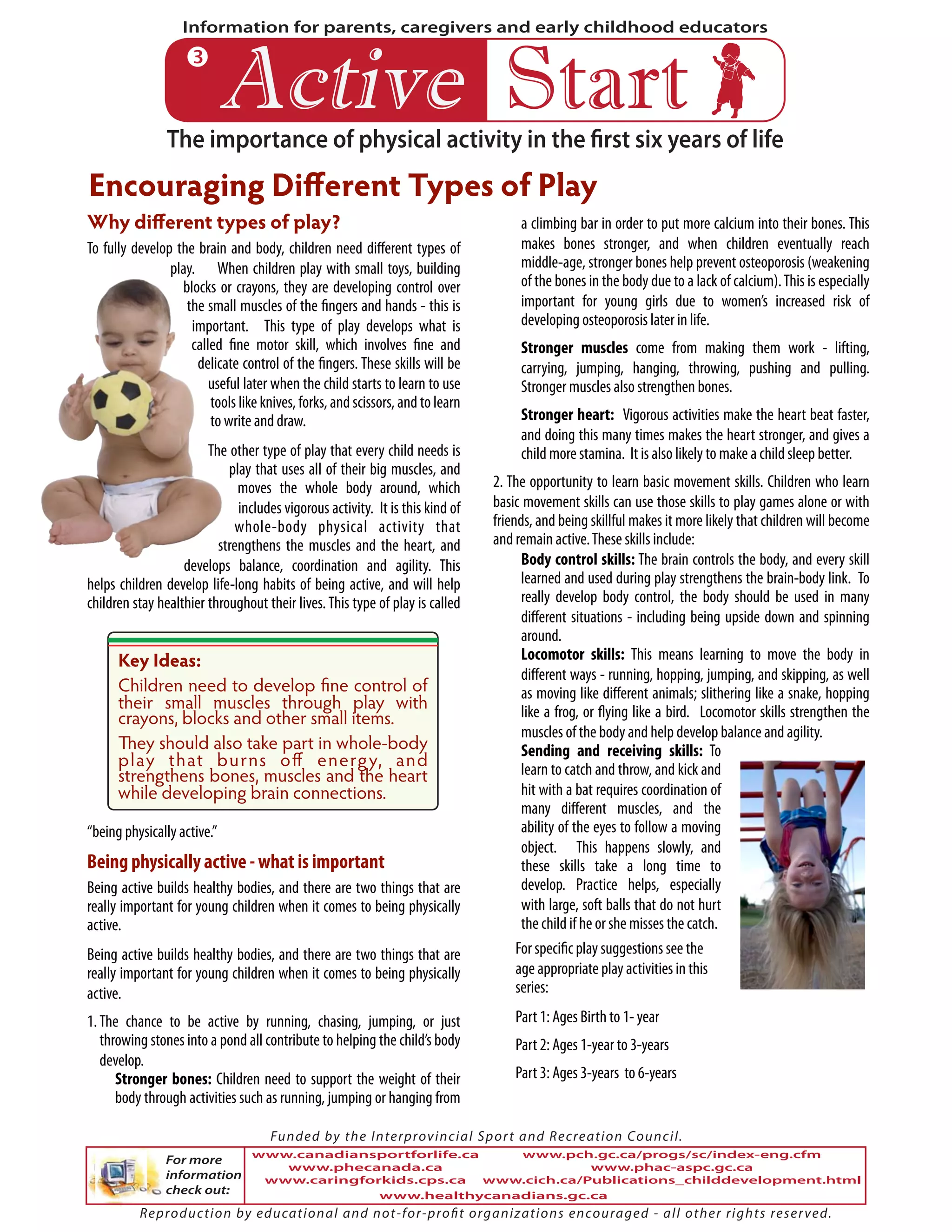
different situations - including being upside down and spinning
around.
Locomotor skills: This means learning to move the body in
different ways - running, hopping, jumping, and skipping, as well
as moving like different animals; slithering like a snake, hopping
like a frog, or flying like a bird. Locomotor skills strengthen the
muscles of the body and help develop balance and agility.
Sending and receiving skills: To
learn to catch and throw, and kick and
hit with a bat requires coordination of
many different muscles, and the
ability of the eyes to follow a moving
object. This happens slowly, and
these skills take a long time to
develop. Practice helps, especially
with large, soft balls that do not hurt
the child if he or she misses the catch.
For specific play suggestions see the
age appropriate play activities in this
series:
Part 1: Ages Birth to 1- year
Part 2: Ages 1-year to 3-years
Part 3: Ages 3-years to 6-years
Encouraging Different Types of Play
!
Key Ideas:
Children need to develop fine control of
their small muscles through play with
crayons, blocks and other small items.
They should also take part in whole-body
play that burns off energy, and
strengthens bones, muscles and the heart
while developing brain connections.
For more
information
check out:
Reproduction by educational and not-for-profit organizations encouraged - all other rights reserved.
Funded by the Interprovincial Sport and Recreation Council.
www.canadiansportforlife.ca
www.phecanada.ca
www.caringforkids.cps.ca
www.healthycanadians.gc.ca
www.pch.gc.ca/progs/sc/index-eng.cfm
www.phac-aspc.gc.ca
www.cich.ca/Publications_childdevelopment.html

Activestart3

  • 1.
    The importance ofphysical activity in the first six years of life Information for parents, caregivers and early childhood educators !"#$%& '#()# Why different types of play? To fully develop the brain and body, children need different types of play. When children play with small toys, building blocks or crayons, they are developing control over the small muscles of the fingers and hands - this is important. This type of play develops what is called fine motor skill, which involves fine and delicate control of the fingers. These skills will be useful later when the child starts to learn to use tools like knives, forks, and scissors, and to learn to write and draw. The other type of play that every child needs is play that uses all of their big muscles, and moves the whole body around, which includes vigorous activity. It is this kind of whole-body physical activity that strengthens the muscles and the heart, and develops balance, coordination and agility. This helps children develop life-long habits of being active, and will help children stay healthier throughout their lives. This type of play is called “being physically active.” Being physically active - what is important Being active builds healthy bodies, and there are two things that are really important for young children when it comes to being physically active. Being active builds healthy bodies, and there are two things that are really important for young children when it comes to being physically active. 1.The chance to be active by running, chasing, jumping, or just throwing stones into a pond all contribute to helping the child’s body develop. Stronger bones: Children need to support the weight of their body through activities such as running, jumping or hanging from a climbing bar in order to put more calcium into their bones. This makes bones stronger, and when children eventually reach middle-age, stronger bones help prevent osteoporosis (weakening of the bones in the body due to a lack of calcium).This is especially important for young girls due to women’s increased risk of developing osteoporosis later in life. Stronger muscles come from making them work - lifting, carrying, jumping, hanging, throwing, pushing and pulling. Stronger muscles also strengthen bones. Stronger heart: Vigorous activities make the heart beat faster, and doing this many times makes the heart stronger, and gives a child more stamina. It is also likely to make a child sleep better. 2. The opportunity to learn basic movement skills. Children who learn basic movement skills can use those skills to play games alone or with friends, and being skillful makes it more likely that children will become and remain active.These skills include: Body control skills: The brain controls the body, and every skill learned and used during play strengthens the brain-body link. To really develop body control, the body should be used in many different situations - including being upside down and spinning around. Locomotor skills: This means learning to move the body in different ways - running, hopping, jumping, and skipping, as well as moving like different animals; slithering like a snake, hopping like a frog, or flying like a bird. Locomotor skills strengthen the muscles of the body and help develop balance and agility. Sending and receiving skills: To learn to catch and throw, and kick and hit with a bat requires coordination of many different muscles, and the ability of the eyes to follow a moving object. This happens slowly, and these skills take a long time to develop. Practice helps, especially with large, soft balls that do not hurt the child if he or she misses the catch. For specific play suggestions see the age appropriate play activities in this series: Part 1: Ages Birth to 1- year Part 2: Ages 1-year to 3-years Part 3: Ages 3-years to 6-years Encouraging Different Types of Play ! Key Ideas: Children need to develop fine control of their small muscles through play with crayons, blocks and other small items. They should also take part in whole-body play that burns off energy, and strengthens bones, muscles and the heart while developing brain connections. For more information check out: Reproduction by educational and not-for-profit organizations encouraged - all other rights reserved. Funded by the Interprovincial Sport and Recreation Council. www.canadiansportforlife.ca www.phecanada.ca www.caringforkids.cps.ca www.healthycanadians.gc.ca www.pch.gc.ca/progs/sc/index-eng.cfm www.phac-aspc.gc.ca www.cich.ca/Publications_childdevelopment.html