1.Difference between SQL Server and PostgreSQL

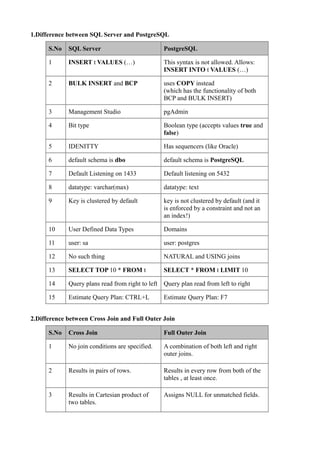
      S.No   SQL Server                          PostgreSQL

      1      INSERT t VALUES (…)                 This syntax is not allowed. Allows:
                                                 INSERT INTO t VALUES (…)

      2      BULK INSERT and BCP                 uses COPY instead
                                                 (which has the functionality of both
                                                 BCP and BULK INSERT)

      3      Management Studio                   pgAdmin

      4      Bit type                            Boolean type (accepts values true and
                                                 false)

      5      IDENITTY                            Has sequencers (like Oracle)

      6      default schema is dbo               default schema is PostgreSQL

      7      Default Listening on 1433           Default listening on 5432

      8      datatype: varchar(max)              datatype: text

      9      Key is clustered by default         key is not clustered by default (and it
                                                 is enforced by a constraint and not an
                                                 an index!)

      10     User Defined Data Types             Domains

      11     user: sa                            user: postgres

      12     No such thing                       NATURAL and USING joins

      13     SELECT TOP 10 * FROM t              SELECT * FROM t LIMIT 10

      14     Query plans read from right to left Query plan read from left to right

      15     Estimate Query Plan: CTRL+L         Estimate Query Plan: F7


2.Difference between Cross Join and Full Outer Join

      S.No   Cross Join                          Full Outer Join

      1      No join conditions are specified.   A combination of both left and right
                                                 outer joins.

      2      Results in pairs of rows.           Results in every row from both of the
                                                 tables , at least once.

      3      Results in Cartesian product of     Assigns NULL for unmatched fields.
             two tables.
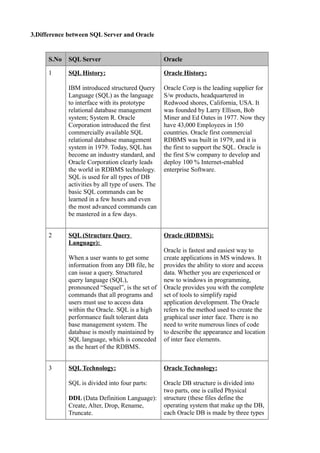
3.Difference between SQL Server and Oracle


      S.No   SQL Server                             Oracle

      1      SQL History:                           Oracle History:

             IBM introduced structured Query        Oracle Corp is the leading supplier for
             Language (SQL) as the language         S/w products, headquartered in
             to interface with its prototype        Redwood shores, California, USA. It
             relational database management         was founded by Larry Ellison, Bob
             system; System R. Oracle               Miner and Ed Oates in 1977. Now they
             Corporation introduced the first       have 43,000 Employees in 150
             commercially available SQL             countries. Oracle first commercial
             relational database management         RDBMS was built in 1979, and it is
             system in 1979. Today, SQL has         the first to support the SQL. Oracle is
             become an industry standard, and       the first S/w company to develop and
             Oracle Corporation clearly leads       deploy 100 % Internet-enabled
             the world in RDBMS technology.         enterprise Software.
             SQL is used for all types of DB
             activities by all type of users. The
             basic SQL commands can be
             learned in a few hours and even
             the most advanced commands can
             be mastered in a few days.


      2      SQL (Structure Query                   Oracle (RDBMS):
             Language):
                                                    Oracle is fastest and easiest way to
             When a user wants to get some          create applications in MS windows. It
             information from any DB file, he       provides the ability to store and access
             can issue a query. Structured          data. Whether you are experienced or
             query language (SQL),                  new to windows in programming,
             pronounced “Sequel”, is the set of     Oracle provides you with the complete
             commands that all programs and         set of tools to simplify rapid
             users must use to access data          application development. The Oracle
             within the Oracle. SQL is a high       refers to the method used to create the
             performance fault tolerant data        graphical user inter face. There is no
             base management system. The            need to write numerous lines of code
             database is mostly maintained by       to describe the appearance and location
             SQL language, which is conceded        of inter face elements.
             as the heart of the RDBMS.


      3      SQL Technology:                        Oracle Technology:

             SQL is divided into four parts:        Oracle DB structure is divided into
                                                    two parts, one is called Physical
             DDL (Data Definition Language):        structure (these files define the
             Create, Alter, Drop, Rename,           operating system that make up the DB,
             Truncate.                              each Oracle DB is made by three types
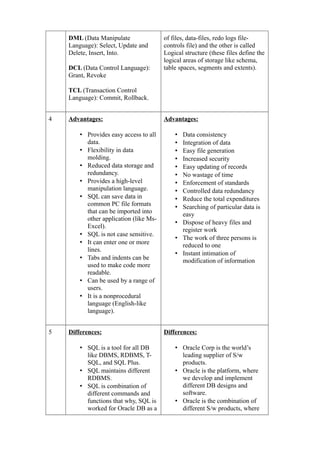
DML (Data Manipulate                of files, data-files, redo logs file-
    Language): Select, Update and       controls file) and the other is called
    Delete, Insert, Into.               Logical structure (these files define the
                                        logical areas of storage like schema,
    DCL (Data Control Language):        table spaces, segments and extents).
    Grant, Revoke

    TCL (Transaction Control
    Language): Commit, Rollback.


4   Advantages:                         Advantages:

        • Provides easy access to all       • Data consistency
          data.                             • Integration of data
        • Flexibility in data               • Easy file generation
          molding.                          • Increased security
        • Reduced data storage and          • Easy updating of records
          redundancy.                       • No wastage of time
        • Provides a high-level             • Enforcement of standards
          manipulation language.            • Controlled data redundancy
        • SQL can save data in              • Reduce the total expenditures
          common PC file formats            • Searching of particular data is
          that can be imported into           easy
          other application (like Ms-
                                            • Dispose of heavy files and
          Excel).
                                              register work
        • SQL is not case sensitive.
                                            • The work of three persons is
        • It can enter one or more            reduced to one
          lines.
                                            • Instant intimation of
        • Tabs and indents can be             modification of information
          used to make code more
          readable.
        • Can be used by a range of
          users.
        • It is a nonprocedural
          language (English-like
          language).


5   Differences:                        Differences:

        • SQL is a tool for all DB          • Oracle Corp is the world’s
          like DBMS, RDBMS, T-                leading supplier of S/w
          SQL, and SQL Plus.                  products.
        • SQL maintains different           • Oracle is the platform, where
          RDBMS.                              we develop and implement
        • SQL is combination of               different DB designs and
          different commands and              software.
          functions that why, SQL is        • Oracle is the combination of
          worked for Oracle DB as a           different S/w products, where
command prompt                      they work together for
                    shell (SQL is the command           designing DB.
                    prompt shell, where we            • Oracle works with different
                    can communicate with any            front and back end
                    DB).                                products/tools (like SQL).


4.Difference between View and Stored Procedure


      S.No   View                                 Stored Procedure

      1      Does not accepts parameters          Accept parameters

      2      Can be used as a building block in   Cannot be used as a building block in
             large query.                         large query.

      3      Can contain only one single Select Can contain several statement like if,
             query.                             else, loop etc.

      4      Cannot perform modification to       Can perform modification to one or
             any table.                           several tables.

      5      Can be used (sometimes) as the       Cannot be used as the target for Insert,
             target for Insert, update, delete    update, delete queries.
             queries.

5.Difference between IN and EXISTS


      S.No   IN                                   EXISTS

      1      Returns true if specified value      Return true if sub query contain any
             matches any value in the sub         rows.
             query or a list.

      2      The sub query will run first and     The Outer query will ran first and then
             then only outer query.               only sub query.

      3      IN is slower than EXISTS. The IN     Exists is faster than IN.The Outer
             is used in the widely For Static     query will run first and then only inner
             variables for eg: select name from   query.So it will reduce the over head.
             table where ID in (Select ID from    The Exists is useful mostly in IF
             table2).                             conditional statements.

      4      Example:                             Example:

             SELECT id,                           SELECT id,
             [Name]                               [Name]
             FROM dbo.tablea                      FROM dbo.tablea AS a
             WHERE id IN (SELECT id               WHERE EXISTS (SELECT id2
FROM dbo.tableb)                   FROM dbo.tableb
                                                WHERE id2 = a.id)


Please visit my blog @ http://onlydifferencefaqs.blogspot.in/

Sql server difference faqs- 6

  • 1.
    1.Difference between SQLServer and PostgreSQL S.No SQL Server PostgreSQL 1 INSERT t VALUES (…) This syntax is not allowed. Allows: INSERT INTO t VALUES (…) 2 BULK INSERT and BCP uses COPY instead (which has the functionality of both BCP and BULK INSERT) 3 Management Studio pgAdmin 4 Bit type Boolean type (accepts values true and false) 5 IDENITTY Has sequencers (like Oracle) 6 default schema is dbo default schema is PostgreSQL 7 Default Listening on 1433 Default listening on 5432 8 datatype: varchar(max) datatype: text 9 Key is clustered by default key is not clustered by default (and it is enforced by a constraint and not an an index!) 10 User Defined Data Types Domains 11 user: sa user: postgres 12 No such thing NATURAL and USING joins 13 SELECT TOP 10 * FROM t SELECT * FROM t LIMIT 10 14 Query plans read from right to left Query plan read from left to right 15 Estimate Query Plan: CTRL+L Estimate Query Plan: F7 2.Difference between Cross Join and Full Outer Join S.No Cross Join Full Outer Join 1 No join conditions are specified. A combination of both left and right outer joins. 2 Results in pairs of rows. Results in every row from both of the tables , at least once. 3 Results in Cartesian product of Assigns NULL for unmatched fields. two tables.
  • 2.
    3.Difference between SQLServer and Oracle S.No SQL Server Oracle 1 SQL History: Oracle History: IBM introduced structured Query Oracle Corp is the leading supplier for Language (SQL) as the language S/w products, headquartered in to interface with its prototype Redwood shores, California, USA. It relational database management was founded by Larry Ellison, Bob system; System R. Oracle Miner and Ed Oates in 1977. Now they Corporation introduced the first have 43,000 Employees in 150 commercially available SQL countries. Oracle first commercial relational database management RDBMS was built in 1979, and it is system in 1979. Today, SQL has the first to support the SQL. Oracle is become an industry standard, and the first S/w company to develop and Oracle Corporation clearly leads deploy 100 % Internet-enabled the world in RDBMS technology. enterprise Software. SQL is used for all types of DB activities by all type of users. The basic SQL commands can be learned in a few hours and even the most advanced commands can be mastered in a few days. 2 SQL (Structure Query Oracle (RDBMS): Language): Oracle is fastest and easiest way to When a user wants to get some create applications in MS windows. It information from any DB file, he provides the ability to store and access can issue a query. Structured data. Whether you are experienced or query language (SQL), new to windows in programming, pronounced “Sequel”, is the set of Oracle provides you with the complete commands that all programs and set of tools to simplify rapid users must use to access data application development. The Oracle within the Oracle. SQL is a high refers to the method used to create the performance fault tolerant data graphical user inter face. There is no base management system. The need to write numerous lines of code database is mostly maintained by to describe the appearance and location SQL language, which is conceded of inter face elements. as the heart of the RDBMS. 3 SQL Technology: Oracle Technology: SQL is divided into four parts: Oracle DB structure is divided into two parts, one is called Physical DDL (Data Definition Language): structure (these files define the Create, Alter, Drop, Rename, operating system that make up the DB, Truncate. each Oracle DB is made by three types
  • 3.
    DML (Data Manipulate of files, data-files, redo logs file- Language): Select, Update and controls file) and the other is called Delete, Insert, Into. Logical structure (these files define the logical areas of storage like schema, DCL (Data Control Language): table spaces, segments and extents). Grant, Revoke TCL (Transaction Control Language): Commit, Rollback. 4 Advantages: Advantages: • Provides easy access to all • Data consistency data. • Integration of data • Flexibility in data • Easy file generation molding. • Increased security • Reduced data storage and • Easy updating of records redundancy. • No wastage of time • Provides a high-level • Enforcement of standards manipulation language. • Controlled data redundancy • SQL can save data in • Reduce the total expenditures common PC file formats • Searching of particular data is that can be imported into easy other application (like Ms- • Dispose of heavy files and Excel). register work • SQL is not case sensitive. • The work of three persons is • It can enter one or more reduced to one lines. • Instant intimation of • Tabs and indents can be modification of information used to make code more readable. • Can be used by a range of users. • It is a nonprocedural language (English-like language). 5 Differences: Differences: • SQL is a tool for all DB • Oracle Corp is the world’s like DBMS, RDBMS, T- leading supplier of S/w SQL, and SQL Plus. products. • SQL maintains different • Oracle is the platform, where RDBMS. we develop and implement • SQL is combination of different DB designs and different commands and software. functions that why, SQL is • Oracle is the combination of worked for Oracle DB as a different S/w products, where
  • 4.
    command prompt they work together for shell (SQL is the command designing DB. prompt shell, where we • Oracle works with different can communicate with any front and back end DB). products/tools (like SQL). 4.Difference between View and Stored Procedure S.No View Stored Procedure 1 Does not accepts parameters Accept parameters 2 Can be used as a building block in Cannot be used as a building block in large query. large query. 3 Can contain only one single Select Can contain several statement like if, query. else, loop etc. 4 Cannot perform modification to Can perform modification to one or any table. several tables. 5 Can be used (sometimes) as the Cannot be used as the target for Insert, target for Insert, update, delete update, delete queries. queries. 5.Difference between IN and EXISTS S.No IN EXISTS 1 Returns true if specified value Return true if sub query contain any matches any value in the sub rows. query or a list. 2 The sub query will run first and The Outer query will ran first and then then only outer query. only sub query. 3 IN is slower than EXISTS. The IN Exists is faster than IN.The Outer is used in the widely For Static query will run first and then only inner variables for eg: select name from query.So it will reduce the over head. table where ID in (Select ID from The Exists is useful mostly in IF table2). conditional statements. 4 Example: Example: SELECT id, SELECT id, [Name] [Name] FROM dbo.tablea FROM dbo.tablea AS a WHERE id IN (SELECT id WHERE EXISTS (SELECT id2
  • 5.
    FROM dbo.tableb) FROM dbo.tableb WHERE id2 = a.id) Please visit my blog @ http://onlydifferencefaqs.blogspot.in/