SQL Server 2005 Reporting Services in Action 1 / Rev. ed Edition Bret Updegraff
SQL Server 2005 Reporting Services in Action 1 / Rev. ed Edition Bret Updegraff
SQL Server 2005 Reporting Services in Action 1 / Rev. ed Edition Bret Updegraff
SQL Server 2005 Reporting Services in Action 1 / Rev. ed Edition Bret Updegraff
SQL Server 2005 Reporting Services in Action 1 / Rev. ed Edition Bret Updegraff
1.
SQL Server 2005Reporting Services in Action 1 /
Rev. ed Edition Bret Updegraff download
https://ebookgate.com/product/sql-server-2005-reporting-services-
in-action-1-rev-ed-edition-bret-updegraff/
Get Instant Ebook Downloads – Browse at https://ebookgate.com
2.
Get Your DigitalFiles Instantly: PDF, ePub, MOBI and More
Quick Digital Downloads: PDF, ePub, MOBI and Other Formats
Professional SQL Server Reporting Services Paul Turley
https://ebookgate.com/product/professional-sql-server-reporting-
services-paul-turley/
Professional Microsoft SQL Server 2012 Reporting
Services 1., Auflage Edition Bruckner
https://ebookgate.com/product/professional-microsoft-sql-
server-2012-reporting-services-1-auflage-edition-bruckner/
Professional Microsoft SQL Server 2012 Reporting
Services 1st Edition Paul Turley
https://ebookgate.com/product/professional-microsoft-sql-
server-2012-reporting-services-1st-edition-paul-turley/
Microsoft Reporting Services in Action 1st Edition Teo
Lachev
https://ebookgate.com/product/microsoft-reporting-services-in-
action-1st-edition-teo-lachev/
3.
Microsoft SQL Server2005 Express Edition for Dummies
Robert Schneider
https://ebookgate.com/product/microsoft-sql-server-2005-express-
edition-for-dummies-robert-schneider/
Microsoft sql server 2008 integration services problem
design solution 1st ed Edition Erik Veerman
https://ebookgate.com/product/microsoft-sql-
server-2008-integration-services-problem-design-solution-1st-ed-
edition-erik-veerman/
Microsoft SQL Server 2005 Express Edition for dummies
Robert D Schneider
https://ebookgate.com/product/microsoft-sql-server-2005-express-
edition-for-dummies-robert-d-schneider/
Knight s 24 Hour Trainer Microsoft SQL Server 2008
Integration Services Volume 1 1st Edition Brian Knight
https://ebookgate.com/product/knight-s-24-hour-trainer-microsoft-
sql-server-2008-integration-services-volume-1-1st-edition-brian-
knight/
SQL Server DMVs in Action Better Queries with Dynamic
Management Views 1st Edition Ian W. Stirk
https://ebookgate.com/product/sql-server-dmvs-in-action-better-
queries-with-dynamic-management-views-1st-edition-ian-w-stirk/
SQL Server 2005
ReportingServices
in Action
Revised Edition of
Microsoft Reporting Services in Action
BRET UPDEGRAFF
M A N N I N G
Greenwich
(74° w. long.)
vii
brief contents
1 IntroducingSQL Server 2005 Reporting Services 1
2 Report authoring basics 41
3 Working with data 64
4 Designing reports 104
5 Using expressions and functions 150
6 Using custom code 185
7 Ad hoc reporting with the Report Builder application 215
8 Managing the Reporting Services environment 259
9 Securing Reporting Services 311
10 On-demand report delivery 341
11 Mastering the ReportViewer controls 389
12 Subscribed report delivery 420
13 Extending Reporting Services 453
14 Performance and scalability 497
appendix A Installing SQL Server Reporting Services 524
appendix B Understanding .NET code access security 531
13.
ix
contents
foreword xvii
foreword tothe first edition xix
preface xxi
preface to the first edition xxii
acknowledgments xxiv
about this book xxvi
about the source code xxix
about the authors xxxiv
about the cover illustration xxxv
1 Introducing SQL Server 2005 Reporting Services 1
1.1 What is Reporting Services? 2
Solving reporting problems with Reporting Services 3
Choosing a Reporting Services edition 4
Reporting Services and the Microsoft SQL Server platform 6
1.2 Reporting Services at a glance 7
Authoring features 8 ✦ Management features 10
Delivery features 11 ✦ Extensibility features 11
Scalability features 12 ✦ Security features 12
Deployment features 12
1.3 RS architecture 13
The Report Server engine 15 ✦ The Report Server
database 16 ✦ The Report Manager 17
1.4 Understanding report processing 19
Execution stage 20 ✦ Rendering stage 20
1.5 Delivering reports 22
On-demand delivery 22 ✦ Subscribed delivery 23
1.6 What is the report lifecycle? 24
14.
x CONTENTS
1.7 RSin action 25
About the Adventure Works Reporter 26
Your first report 26
1.8 Evaluating RS 36
1.9 Summary 37
Part 1 Authoring reports 39
2 Report authoring basics 41
2.1 The report-authoring process: step by step 42
Analysis 43 ✦ Construction 43 ✦ Testing 44
Deployment 44
2.2 Authoring reports in VS .NET 44
Authoring reports with the Report Wizard 45
Authoring reports with the Report Designer 46
Importing reports from Microsoft Access 55
2.3 Creating reports programmatically 57
Generating RDL: The AW Ad Hoc Reporter 59
Implementation details 60
2.4 Summary 62
3 Working with data 64
3.1 Working with data sources 64
Connecting to the database 65 ✦ Choosing an authentication
mechanism 70 ✦ Deploying data sources 78
3.2 Working with report datasets 78
Understanding the dataset definition 79 ✦ Creating a report
dataset 80 ✦ Using multiple datasets 84
3.3 Authoring dataset queries 85
Using the Graphical Query Designer 85 ✦ Using the Generic
Query Designer 87
3.4 Parameter-driven reports 90
The role of parameters 90 ✦ Building parameter-driven
queries 91 ✦ Setting up the report-level parameters 93
3.5 Working with stored procedures 98
Using a stored procedure as a dataset query 98
Defining query-based lookup parameter values 100
Creating cascading parameters 101 ✦ Working with
multivalued parameters 102
3.6 Summary 102
15.
CONTENTS xi
4 Designingreports 104
4.1 Anatomy of a report 105
Getting started with a new report 106 ✦ Understanding report
sections 106 ✦ Understanding report items 107
Understanding data regions 110
4.2 Designing tabular reports 112
Tabular reports with groups 113 ✦ Parameterized tabular
reports 116 ✦ Tabular reports with interactive features 121
Table region limitations 123
4.3 Designing freeform reports 123
Freeform reports with nested regions 123
Grouping freeform data 125
Freeform reports with side-by-side data regions 127
4.4 Designing chart reports 128
The chart data region 129 ✦ Working with charts 129
Nesting chart regions 132
4.5 Designing crosstab (matrix) reports 133
Matrix region advantages 133 ✦ Working with the matrix
region 134 ✦ Adjusting the report layout 138
4.6 Using other design features in your reports 140
Setting up multiple columns 140 ✦ Adding interactive
sort 142 ✦ Passing multivalued parameters into a stored
procedure 144 ✦ Designing subreports 145
4.7 Summary 148
5 Using expressions and functions 150
5.1 Understanding expressions 151
Using the Expression Editor 152 ✦ Expression syntax 153
Determining expression execution order 154 ✦ Understanding
expression scope 154 ✦ Dealing with expression errors 156
5.2 Exploring the Report Object Model 157
Using the ReportItems collection 159 ✦ Using the Fields
collection 163 ✦ Using the Parameters collection 166
Using the Globals collection 166 ✦ Using the User
collection 167
5.3 Working with functions 167
Referencing external functions 168 ✦ Using aggregate
functions 168 ✦ Using other internal functions 173
5.4 Designing reports with navigational features 175
Reports with hyperlinks 176 ✦ Reports with
document maps 178
16.
xii CONTENTS
5.5 Reportrendering considerations 181
Exporting reports to HTML 181 ✦ Exporting reports to
MHTML 182 ✦ Exporting reports to other formats 182
5.6 Summary 183
6 Using custom code 185
6.1 Understanding custom code 186
Using embedded code 186 ✦ Using external assemblies 189
6.2 Custom code in action: implementing report forecasting 193
Forecasting with OpenForecast 194 ✦ Implementing report
forecasting features 194
6.3 Using XML-based reports 207
Understanding XML exporting 208 ✦ Exposing the report
content as an RSS feed 209
6.4 Summary 213
7 Ad hoc reporting with the Report Builder application 215
7.1 About the Report Builder application 216
A quick tour of the Report Builder 217 ✦ Setting up
for ad hoc reporting 218 ✦ The Developer toolset for
ad hoc reporting 220
7.2 Building the Report Model using BIDS 221
Building a report model project 222 ✦ Setting up
the data source 223 ✦ Creating a data source view 227
Building the report model 233 ✦ Deploying report
models 241
7.3 Ad hoc reporting in action 242
Launching the Report Builder 242 ✦ Creating the Product
Profit Margin report 244 ✦ Getting more with infinite
drill-through reporting 247 ✦ Advanced filtering with the
Report Builder 249
7.4 Implementing Report Builder security 252
Securing the Report Builder with roles 252 ✦ Securing report
model items 253
7.5 Summary 255
17.
CONTENTS xiii
Part 2Managing reports 257
8 Managing the Reporting Services environment 259
8.1 Managing RS with the Report Manager 260
How the Report Manager works 260 ✦ Managing Report Server
settings 263 ✦ Managing content 268 ✦ Managing report
execution 275 ✦ Managing linked reports 286
8.2 Managing RS with the Web service 288
Using the Web service management API 288 ✦ Tracing calls to
the SOAP API 289 ✦ Deploying reports
programmatically 292 ✦ Batching methods together 295
8.3 Managing RS with the WMI provider 296
Understanding the WMI provider 296 ✦ Implementing an RS
management console 297
8.4 Other ways to manage Reporting Services 299
Managing RS with SQL Management Studio 299 ✦ Managing
RS with the script host 300 ✦ Using the Reporting Services
configuration tool 302
8.5 Analyzing report execution 305
Analyzing the Report Server execution log 305 ✦ Analyzing
trace log files 307
8.6 Summary 309
9 Securing Reporting Services 311
9.1 Role-based security basics 312
The purpose of role-based security 312 ✦ Authentication
models: using Windows or creating your own 312
9.2 Windows authentication: a closer look 313
Exploring the Client-to-Report Server model 314 ✦ Exploring
the Client-to-Façade-to-Report Server model 316
9.3 Using role-based authorization 318
Understanding tasks 319 ✦ Defining roles 320
Understanding securable items 321 ✦ Defining policies 322
9.4 Managing role-based security with the Report Manager 324
Creating Windows user accounts and groups 325 ✦ Creating
custom roles 326 ✦ Defining security policies 327
9.5 Managing role-based security with the Web service 329
Determining role-based security policies 329 ✦ Calling security-
related Web service methods 330 ✦ Implementing “pseudo”
report events 332
18.
xiv CONTENTS
9.6 Techniquesfor advanced security issues 333
Filtering data 334 ✦ Using dynamic dataset queries 335
Hiding data 337 ✦ Implementing custom security
models 337 ✦ Enforcing a secured connection to the
Report Server 337
9.7 Summary 338
Part 3 Delivering reports 339
10 On-demand report delivery 341
10.1 How RS provides on-demand report delivery 342
10.2 URL-based report access 343
Understanding URL syntax 344 ✦ Requesting resources
by URL 345 ✦ Requesting reports by URL 347
Working with report commands 348 ✦ Working with the
HTML Viewer 351
10.3 URL access in action 354
URL Access with WinForms: AccessOptions 355 ✦ URL Access
with WebForms: AWReporterWeb 358
10.4 Web service-based report access 366
Requesting reports with SOAP 368 ✦ Rendering images 370
Handling report sessions 373
10.5 Web service access (SOAP) in action 376
Generating report requests with SOAP on the client side 376
An automation solution: AW Campaigner 379
10.6 Evaluating URL and Web service access options 383
Evaluating URL access 384 ✦ Evaluating Web service
access 385 ✦ Choosing an integration approach 386
10.7 Summary 387
11 Mastering the ReportViewer controls 389
11.1 How the .NET ReportViewer controls work 390
Controls for web and Windows applications 390 ✦ Choosing
remote or local mode 391 ✦ Managing properties of the
ReportViewer controls 392
11.2 Using ReportViewer in remote mode 394
Creating, configuring, and running the control 394
Additional customizations for the ReportViewer control 397
19.
CONTENTS xv
11.3 UsingReportViewer in local mode 397
Creating a local report with a database as the data source 398
Creating a local report with an object as the data source 401
11.4 Custom validation with the ReportViewer control 406
Creating a parameters section 407 ✦ Creating event
methods 407 ✦ Write validation code 410
11.5 Converting report files 411
Converting RDL files into RDLC files 412
Converting RDLC files into RDL files 415
11.6 Deploying applications that use ReportViewer controls 416
Redistributing the ReportViewer controls 416 ✦ ReportViewer
deployment for Windows applications 417 ✦ ReportViewer
deployment for web applications 418 ✦ Using the
ReportViewer web server control in a web farm 418
11.7 Summary 418
12 Subscribed report delivery 420
12.1 Understanding subscribed report delivery 421
Subscription-based reporting scenarios 421 ✦ The subscriber-
publisher design pattern 422 ✦ How the RS subscription-based
model works 422
12.2 Configuring subscribed report delivery 425
Creating a new subscription 426 ✦ Choosing the
subscription type 427 ✦ Configuring delivery extensions 430
Managing subscriptions 432
12.3 Subscribed report delivery in action 434
“Pushing” reports via standard e-mail subscriptions 434
Archiving reports to a file share 437 ✦ Sending reports to a data-
driven list of recipients 440 ✦ Triggering subscriptions
programmatically 446
12.4 Summary 450
Part 4 Advanced reporting 451
13 Extending Reporting Services 453
13.1 Understanding Reporting Services extensibility 454
Interface-based programming 454 ✦ Working with interface
inheritance 456 ✦ Extending RS with interface
inheritance 459
20.
xvi CONTENTS
13.2 Reportingwith a custom dataset data extension 460
Identifying design goals and trade-offs 461 ✦ Authoring dataset-
bound reports 462 ✦ Implementing the custom dataset
extension 469 ✦ Debugging dataset extensions 473
13.3 Distributing reports to Web services using custom delivery extensions 473
Design goals and trade-offs 474 ✦ Using the custom delivery
extension 475 ✦ Implementing the custom delivery
extension 476 ✦ Debugging custom delivery extensions 480
13.4 Implementing custom security 482
Design goals and trade-offs 485 ✦ Intranet reporting
with custom security 486 ✦ Implementing the custom
security extension 488 ✦ Debugging the custom security
extension 495
13.5 Summary 496
14 Performance and scalability 497
14.1 Understanding capacity planning 498
Capacity-planning fundamentals 498 ✦ The capacity-planning
process 503
14.2 Capacity planning for Reporting Services in action 508
Determining requirements 508 ✦ Setting up the testing
environment 511 ✦ Performance testing 515 ✦ Analyzing
performance results 516 ✦ Identifying resource
constraints 519 ✦ Eliminating resource constraints 520
14.3 Summary 523
appendix A Installing SQL Server Reporting Services 524
A.1 Software requirements 524
A.2 Installing SQL Server Reporting Services 525
appendix B Understanding .NET code access security 531
B.1 Code access security basics 532
B.2 Understanding code access terminology 532
B.3 Exploring the RS default security policy 536
B.4 Managing RS code access security 538
resources 542
index 549
21.
xvii
foreword
In my forewordto the first edition, I wrote about the process of creating software at
Microsoft, specifically the first version of SQL Server Reporting Services. Although
the organic style of software development we used for the initial release of the prod-
uct had proven to be a success, creating the follow-on version would have its own set
of challenges.
After launching the product in early 2004, we turned to planning for the new
release, which was synchronized with the rest of SQL Server. The release was on track
for a delivery in 2005, which meant we had comparatively little time for development
of new features. In addition, joining the SQL Server mainline product required the
team to adopt new versions of Visual Studio and the .NET Framework, and we had
to merge our setup with a new, integrated setup engine. To accommodate this accel-
erated schedule, our original plan was to provide a small set of incremental improve-
ments over the original version. The broad adoption of the product had already given
us a good amount of feedback about what customers felt was missing from the initial
release. From an architectural standpoint, we wouldn’t change the core of Reporting
Services, allowing us to safely add selected features.
At the same time, we also realized that something major was missing from the first
version of the product. While developers and IT professionals liked the fact that
Report Designer integrated fully into Visual Studio, the most frequent question we
received was, “How can nondevelopers build their own reports?” We knew we had to
address this need with a tool that was easy to use and that didn’t require users to under-
stand a database query language. Fortunately, we didn’t have to start from scratch and
were able to acquire a small company called ActiveViews to provide the core technol-
ogy. The result of this acquisition was Report Builder (discussed in chapter 7). As we
had in our adoption of the .NET Framework in the first release, we took a gamble
again in adoption of the new ClickOnce technology for Report Builder.
The last piece of the puzzle was to continue our investment in a rich platform for
reporting. Many customers told us that they wanted to easily embed reporting func-
tionality into their applications. So we separated the report viewing components from
the Report Server and provided a rich set of report controls in the release of Visual Stu-
dio 2005. These are covered in depth in chapter 11. We actually rebuilt both the
22.
xviii FOREWORD
Report Managerweb application and the Report Designer to leverage the new con-
trols. The end user of these tools will see little difference in the new release, but build-
ing them with the new controls helped us validate their functionality and usability.
Even more than with the first release, books such as Bret Updegraff’s SQL Server
2005 Reporting Services in Action are critical for helping you get the most out of
Reporting Services. As the capabilities of the product have increased, the information
and guidance that this book provides will help you leverage the Reporting Services
platform to the fullest in your own environment. There are many parts of the product
that we weren’t fully able to expose or document, and this book will help you unlock
some of these hidden gems.
BRIAN WELCKER
Group Program Manager
Microsoft SQL Server Reporting Services
23.
xix
foreword to thefirst edition
May I let you in on a little secret: creating software at Microsoft is pretty similar to
creating software at any other company. I think many people’s perception is that
Microsoft designs products by having an army of market researchers carefully exam-
ine competitive products and survey consumers to determine exactly what features to
include in the next release.
The reality is that most of the ideas that go into Microsoft products are the result
of small teams of people brainstorming in front of whiteboards or chatting in hall-
ways. I’m not saying we don’t know what competitors are doing or what customers
are asking for, but the process of translating real-world scenarios to requirements and
designs is much more organic than you might think. This flexible approach allows
teams to take a fresh look at existing problems, as well as adapt to industry trends
and customer demands.
Case in point: when we started building Reporting Services, we didn’t set out to
copy what other companies had already done. Instead, we asked questions like “What
does it mean to build an enterprise reporting product?” “How do we enable people to
create powerful data visualizations without writing code?” and, most important of all,
“How can we build a platform that people can leverage in their own applications?” The
answer to this final question ended up driving a major portion of the product’s design.
Building a platform is not something to be taken lightly. It requires that you spend
extra time factoring and documenting the interfaces between software components. It
means that your components should not use any “back doors” that are not available
to other developers using the platform. It also can change the order in which you build
the product—you have to focus on the nonvisual parts of the product before you work
on the user-facing ones. For example, the Reporting Services report processing engine
was up and running about a year before the graphical report design tool was ready.
During this time, report definition files had to be hand-coded in order to test any new
report processing features.
The decision to build a platform also means that you will have to spend time on
infrastructure and interfaces at the expense of end-user features. We knew that this
trade-off would mean the first version of Reporting Services might look less feature-rich
than other more “mature” reporting products. We believed this was the right long-term
24.
xx FOREWORD TOTHE FIRST EDITION
strategy, as a strong platform would enable others to fill the gaps instead of having to
wait for us to add every feature. When asked about this approach, I sometimes pose
the question, “Is it better to build a car with a powerful engine and fewer lights on the
dashboard, or one with lots of lights that can’t go anywhere?”
One decision we made for our new platform was to bet on another new platform:
.NET. As we had no legacy code to support, we decided early on to make Reporting
Services a 100 percent .NET application. While this may seem like a no-brainer today,
when we started building Reporting Services the CLR and the .NET Framework had
not yet been released. Although building an enterprise-quality server product on such
a new technology stack was a little risky at the time, the decision has paid major div-
idends in developer productivity and product quality.
Ultimately, the barometer of whether we have succeeded is what our customers and
partners are able to build on the platform. Since we released the first version of the
product earlier this year, I have seen applications built by customers leveraging the
Reporting Services platform in ways I never imagined. But a platform isn’t useful if
all developers don’t have the know-how to take advantage of it. Because the product
is so new, detailed information and good examples have been sparse and hard to find.
That’s where resources like Teo’s excellent book come in. This book starts by pro-
viding a solid foundation for using the built-in tools included with Reporting Services,
but quickly takes you to the next level by focusing on the programmability and exten-
sibility aspects of the product. The focus on these parts of Reporting Services will help
you leverage and extend the product feature set in your own applications. Teo’s
approach is to provide real-world examples and useful scenarios that walk you through
the details and give you new ideas to explore. Teo has the ability to take complex topics
and break them into smaller sections that can be easily understood. I enjoyed being
one of the book’s technical reviewers as I was able to see how various parts of the prod-
uct came to life on the page. I encourage you to use the ideas in this book and take
Reporting Services to the next level.
BRIAN WELCKER
Group Program Manager
Microsoft SQL Server Reporting Services
25.
xxi
preface
Never say never!
Aboutfive years ago, I had the unfortunate task of modifying existing reports for
an e-commerce application. I use the word unfortunate because I did not enjoy the
work. My employer at the time was using a reporting application that required writing
Visual Basic 6.0 code to create reports. The idea of programming reports in Visual
Basic was strange to me. I felt I could have simply created web pages to generate the
reports with less effort. After several weeks of working with this application, I vowed
that I would never work with a reporting application again.
For a few years, I managed to successfully avoid any sort of report writing. Then,
about two years ago as I was preparing for one of my exams for my MSDBA certifica-
tion, an executive at Crowe Chizek, my current employer, came up to me and said
something along the lines of, “Since you are working on your SQL exam, why don’t
you also spend some time looking into product called Reporting Services?” I admit
that I was hesitant to spend any time with this product. But what I found over time
was not what I expected: I really enjoyed working with Reporting Services—so much,
in fact, that over the next year I made presentations to numerous user groups in three
states touting my newfound knowledge of Reporting Services. This excitement
brought me to TechEd 2005 in Florida, where I met Bill Baker (Microsoft) and his
SQL Server Business Intelligence team. I was motivated by what I learned about SQL
Server 2005 and the Business Intelligence tools, such as Reporting Services, Integra-
tion Services, and Analysis Services.
After returning from TechEd, I helped start a successful SQL Server user group that
meets monthly in Indianapolis. I spent the last 12 months at Crowe Chizek working
on applications built around Reporting Services. And now, I have coauthored on this
second edition of a book on Reporting Services, a reporting application!
Never say never!
BRET UPDEGRAFF
26.
xxii
preface to thefirst edition
In archeology, the Rosetta stone was the key that solved the mysteries of Egyptian
hieroglyphics. I believe that with the release of Microsoft SQL Server 2000 Reporting
Services, code-named Rosetta, Microsoft gives organizations the key they need to
unlock the secrets of enterprise data and unleash the power hidden within.
Looking retrospectively, Microsoft’s reporting strategy has been confusing, at least
for me. Microsoft Access debuted in the early ’90s with a powerful report designer that
made desktop reporting child’s play.
Enterprise developers, however, have not been that lucky. The lack of comprehen-
sive native reporting capabilities continues even today in the .NET Framework. True,
some progress has been made with the advent of print-related controls, such as Print-
Document, PrintPreviewControl, and so on, but still, dealing with the GDI+ (Graphics
Device Interface) API is usually the last thing a developer wants to tackle when creating
the next line-of-business application. For reasons such as these, report-enabling
Microsoft-centric solutions has been traditionally regarded as a tedious chore.
To address this problem, many of us defected to third-party tools. Others chose to
fill the void with homegrown, customized solutions. While these solutions address
particular needs, they can also be costly, time-consuming, and difficult to implement.
I remember with nostalgia a project that I worked on about five years ago. It called
for developing a reporting solution for a major Fortune 100 company. I implemented
the solution as a server-based framework, following a design pattern similar to the one
discussed in chapter 13. I used Microsoft Access as a reporting tool to generate reports
and save them as snapshot files. Once the report was ready, the Report Server would
e-mail it back to the user or send the user a link to the snapshot file.
Implementing this solution was a lot of fun, but it took a significant development
effort. I wouldn’t have had to go through all this if I had had Reporting Services back
then. Instead of implementing a homegrown solution, I could have used RS to report-
enable the applications.
For this reason, I was very excited when I heard about Reporting Services in late
2003. Finally, there was an easy way to report-enable different types of applications.
Subsequently, I was involved in a project where I was able to confirm to myself that,
indeed, RS was the reporting platform I had been dreaming about for years.
27.
PREFACE TO THEFIRST EDITION xxiii
To share my enthusiasm I decided to write a book about Reporting Services. While
I contemplated what the book’s scope would be, it dawned on me that I could bring
the most value by following my heart and approaching Reporting Services from a
developer’s point of view. I put myself in a position that many developers could relate
to. Here I am, a developer, consultant, and architect, who is tasked with adding report-
ing features to a given application. How would I go about this?
To answer this question, my book takes a solution-oriented approach, and more
than half of it is devoted to integrating different types of applications with RS. As you
read this book, you will discover a common pattern. It starts by discussing the require-
ments and design goals of a given reporting scenario. Then it discusses the implemen-
tation choices, and finally it explains how the solution is implemented.
I firmly believe that a technical book should go beyond rehashing the product doc-
umentation. I tried my best to follow this path and take up where the RS documenta-
tion (which, by the way, is excellent) leaves off. For this reason, my book should be used
in conjunction with it. When you read the book, you will notice that sometimes, when
I believe I can’t explain things any better, I refer you to the product documentation.
Microsoft Reporting Services in Action is written for report authors, administrators, and
developers who need a detailed and practical guide to the functionality provided by RS.
In the first half, report authors will master the skills they need to create versatile reports.
Administrators will learn the ropes of managing and securing the report environment.
The second half of the book is primarily aimed at intermediate-to-advanced .NET
developers who are planning to leverage RS to add reporting capabilities to their Win-
dows Forms or web-based applications. However, because of the service-oriented
architecture of Reporting Services, the book will also benefit developers who target
other platforms but want to integrate their applications with RS.
Microsoft SQL Server 2000 Reporting Services is a great piece of technology. With
RS, report authors can create reports as easily as they would in Microsoft Access. Make
no mistake, though. RS is a sophisticated server-based platform, and its feature set goes
well beyond that of a desktop reporting tool. To use RS effectively, you need to have
a solid grasp of how it works and how it can be integrated with different types of client
applications. I hope this book makes it easier.
TEO LACHEV
28.
xxiv
acknowledgments
Writing the secondedition of this book has been exciting and yet challenging for me.
Many people have helped me meet those challenges.
Most important, I want to thank my wife Jane for sticking with me through the
numerous evenings, late nights, and weekends that it took to finish the book. SQL
Server 2005 Reporting Services in Action could not have been written without her tre-
mendous support. Jane, I love you for what you endured for me.
The Manning team has been amazing throughout the process of writing, editing,
and publishing this book. Thanks to publisher Marjan Bace and editor Michael
Stephens for finding me and believing in me. Your support has been instrumental. I
want to thank my development editor, Lianna Wlasiuk, for her help in converting my
disorganized thoughts into organized writing. Lianna, I appreciate your above-and-
beyond dedication to this book. As project editor, Mary Piergies has been outstanding
in orchestrating the production process. My copyeditor, Liz Welch, did a great job of
polishing my manuscript. Special thanks to my technical editor, Monte Holyfield,
for verifying that the book is technically correct. Thanks also to Karen Tegtmeyer for
managing the review process; the book’s publicists, Helen Trimes and Ron Tomich,
for getting the word out; and Denis Dalinnik for his deft typesetting and page layout.
I am grateful to the rest of the Manning team for their many contributions to this book.
Brian Welcker, Microsoft Group Product Manager for SQL Server Reporting Ser-
vices, has been phenomenal in helping me with my project on several fronts, includ-
ing reviewing the book and providing valuable technical feedback, as well as writing
the foreword.
I am grateful to the many reviewers of this book. Your comments and reviews
helped to shape and tweak the final manuscript. Thanks to Dave Corun, Steve
Wright, Aleksey Nudelman, Robbe Morris, Berndt Hamboeck, Andrew Grothe, Nuo
Yan, Richard Xin, Dan Hounshell, Vipul Patel, Vinita Paunikar, Arul Kumaravel, and
Sergey Koshcheyev.
I would like to thank my parents for always believing in me—and the rest of my
family and friends for encouraging and supporting me through the writing of this book.
I would also like to thank my coworkers at Crowe Chizek and Company LLC. I am
grateful to Tim Landgrave for introducing me to Manning. Thanks to Paul Thomas,
29.
ACKNOWLEDGMENTS xxv
Mindy Herman,Mark Strawmyer, Caleb Decker, and Derek Bang for creating a fun
yet professional environment that has challenged me to be the best person I can be.
I am honored to work with such a group of talented and dedicated individuals.
A few others contributed indirectly to the book. Thanks to Steven Gould for his
Open Source OpenForecast package that we used in chapter 6 for the report-forecasting
example. Thanks to Dino Esposito for his CodeDom sample. Kudos to Peter Bromberg
for the ASP.NET menu control, and to Christian Weyer for the dynamic Web services
invocation sample.
Finally, thank you for purchasing this book! I sincerely hope that you will find it
as enjoyable to read as it has been for me to write.
Thanks and happy reporting!
30.
xxvi
about this book
Followingthe report lifecycle’s logical path, this book explains how you can author,
manage, and deliver RS-based reports.
Part 1, “Authoring reports,” teaches you the skills that you will need as a report
author to create Reporting Services–based reports. Part 1 encompasses chapters 1–7.
Chapter 1 provides a panoramic overview of Reporting Services. The chapter is
intended to provide you with a firm grounding in what Reporting Services really is.
We look at how RS addresses the reporting problem area, its feature set, and its archi-
tecture. To round out the chapter, we jump right in and create our first report. The
chapter concludes with discussing RS’s strengths and weaknesses.
Chapter 2 focuses on discussing various options for authoring reports. We start by
explaining the report-authoring process. We continue by looking at how you can author
reports with Visual Studio .NET by using the Report Wizard and the Report Designer,
and by importing from Microsoft Access. We also discuss how developers can leverage
the open nature of the report definition schema by creating reports programmatically.
Chapter 3 gets to the gist of the report-authoring process by teaching you how to
work with report data. It discusses the RS data architecture and shows you how to
work with data sources, datasets, and report queries. It emphasizes the role of param-
eters and walks you through the steps for creating parameterized reports.
Chapter 4 teaches you the practical skills needed for authoring different types of
reports with the Report Designer. We create various report samples to complement
our discussion, including tabular, freeform, chart, crosstab, subreports, and multicol-
umn reports.
Chapter 5 shows you how to use expressions and functions to extend your reports
programmatically. It starts by emphasizing the role of expressions and how they can
be used to manipulate the report item properties. It continues by giving you an in-
depth understanding of the RS object model and its collections. Next, we look at the
Reporting Services internal functions and how they can be leveraged to add interactive
features to our reports, such as reports with navigational features and document maps,
as well as localized reports.
Chapter 6 explains how you can supercharge the capabilities of your reports by using
embedded Visual Basic .NET code and external code in the form of .NET assemblies.
31.
ABOUT THIS BOOKxxvii
It presents an end-to-end example that demonstrates how you can leverage custom
.NET code to add forecasting features to your reports.
Chapter 7 shows how to enable ad hoc reporting by using the new Report Builder
application. This chapter covers how to create report models using Visual Studio as
well as how to configure these models. We cover the security around report models
and Report Builder. We conclude this chapter by creating both simple and complex
ad hoc reports with the Report Builder application.
Part 2, “Managing reports,” explains how report administrators can manage and
secure the report repository. It includes chapters 8–9.
Chapter 8 discuses different ways of managing the report catalog. It starts by
explaining how report administrators can use the Report Manager to perform various
management activities. Then it presents other management options, including using
the RS Web service, WMI provider, RS script host, SQL Server Management Studio,
and other utilities.
Chapter 9 teaches you how to secure the report catalog. It explores the RS role-
based security model and the ways it can be leveraged to enforce restricted access to
the Report Server.
Part 3, “Delivering reports,” discusses how developers can integrate RS with dif-
ferent application scenarios. This part includes chapters 10–12.
Chapter 10 provides an overview of the two application integration options avail-
able with RS, URL, and Web services, and how they compare with one another. This
chapter teaches you the skills necessary to report-enable WinForm-based applications
as well as web-based applications. The chapter walks you through an end-to-end sam-
ple, the Report Wizard, that demonstrates various practical techniques you can use to
integrate a WinForm application with RS. This chapter also covers various techniques
for generating reports on both the client and server sides of a web application. Here
we create an enhanced version of the Report Viewer sample control that facilitates
server-side web reporting.
Chapter 11 features the ReportViewer controls that are new with Visual Studio
2005. You learn how to use, configure, and program against the different modes of
these controls for both Windows and web applications. We show you how to use these
controls to help create custom validation for the parameters of your RS reports. We
also look into the steps required to deploy these controls into your applications.
Chapter 12 demonstrates how you can distribute reports via subscriptions. It starts
by explaining how the RS subscribed-delivery process works. Then, it looks at how you
can distribute reports via e-mail and file-share delivery extensions.
Part 4, “Advanced reporting,” provides you with advanced techniques so you can
make the most out of Reporting Services. It consists of chapters 13–14.
Chapter 13 discusses the implementation details of three custom extensions that
can be used to extend the features of RS. It starts by implementing a custom dataset
extension to report off ADO.NET datasets. Then, we discuss a custom delivery exten-
sion that can be used to distribute reports to an arbitrary Web service. Next, we author
32.
xxviii ABOUT THISBOOK
a custom security extension. Finally, we show you how to plug in custom HTTP mod-
ules to implement preprocessing tasks before the request reaches the Report Server.
Chapter 14 shows you how to conduct a capacity-planning study to evaluate RS
in terms of performance and scalability. You learn how to establish performance goals,
how to create test scripts with the Application Center Test, and how to stress-test your
Report Server installation. You can apply the skills you harvest in this chapter for stress
testing not only the Report Server, but any web-based application.
CODE CONVENTIONS
All source code in listings or in text is in a fixed-width font like this to sep-
arate it from ordinary text. We make use of many languages and markups in this
book—C#, Visual Basic .NET, JavaScript, HTML, CSS, XML, and Java—but we try
to adopt a consistent approach. Method and function names, object properties, XML
elements, and attributes in text are presented using this same font.
In many cases, the original source code has been reformatted: we’ve added line
breaks and reworked indentation to accommodate the available page space in the
book. In rare cases even this was not enough, and listings include line-continuation
markers. Additionally, many comments have been removed from the listings.
Code annotations accompany many of the listings, highlighting important con-
cepts. In some cases, numbered bullets link to explanations that follow the listing.
AUTHOR ONLINE
Your purchase of SQL Server 2005 Reporting Services in Action includes free access to a
private web forum run by Manning Publications, where you can make comments
about the book, ask technical questions, and receive help from the author and from
other users. To access the forum and subscribe to it, point your web browser to
www.manning.com/updegraff. This page provides information on how to get
onto the forum once you are registered, what kind of help is available, and the rules of
conduct on the forum.
Manning’s commitment to our readers is to provide a venue where a meaningful
dialogue among individual readers and between readers and the author can take place.
It is not a commitment to any specific amount of participation on the part of the
author, whose contribution to the AO remains voluntary (and unpaid). We suggest
you try asking the author some challenging questions, lest his interest stray! The
Author Online forum and the archives of previous discussions will be accessible from
the publisher’s website as long as the book is in print.
33.
xxix
about the sourcecode
The book’s source code can be downloaded from Manning’s website at www.man-
ning.com/updegraff.
Instead of partitioning the source code on a per-chapter basis, we decided to con-
solidate most of it in two applications: a WinForm-based AWReporterWin application
and a web-based AWReporterWeb application. This approach has several advantages:
• It simplifies the setup—for example, you need only one virtual folder to host
the AWReporterWeb web application.
• It allows the reader to launch the samples conveniently from a single applica-
tion menu.
• It simulates real-world applications—for example, you can encapsulate the code
logic in a set of common classes.
SOFTWARE REQUIREMENTS
Table 1 outlines the software requirements needed to run all code samples.
Table 1 Software requirements
Software Reason
Used in
chapters...
Reporting Services 2.0
(Developer or Enterprise
edition)
The Standard edition doesn’t include custom
security extensions and data-driven
subscriptions.
All
Microsoft Visual Studio 2005 Required by Reporting Services 2005 for
development.
All
Microsoft SQL Server 2005 Required by Reporting Services. You will
need to install the AdventureWorks database
from the SQL Server media.
All
Microsoft WebService Behavior For invoking Web services on the client side
of a web application. Can be downloaded for
free from MSDN.
10
Application Center Test ACT is included with Visual Studio. 14
continued on next page
34.
xxx ABOUT THESOURCE CODE
SETTING UP THE SOURCE CODE
Once you download the source code archive, you can extract the zip file to any folder of
your hard drive. Once this is accomplished, the folders listed in table 2 will be created.
Most of the code samples include README files with specific step-by-step instruc-
tions that you follow to set up the code sample.
Running the sample reports in Visual Studio .NET
Most of you will be eager to run the sample reports immediately. To execute the reports
successfully under the Visual Studio .NET Report Designer, follow these steps:
Analog Web Analyzer For analyzing IIS logs. Can be downloaded for
free from www.analog.cx/.
14
Report Magic For reporting off analog files. Can be down-
loaded for free from www.reportmagic.org/.
14
Table 1 Software requirements (continued)
Software Reason
Used in
chapters...
Table 2 Source code folders
Folder Purpose Used in chapters...
AWReporterWeb An ASP.NET web-based application that demon-
strates various web-based reporting techniques.
You will need to set up an IIS virtual folder point-
ing to this folder.
10, 11, 13
AWReporterWin A WinForm-based application that demonstrates
how you can add reporting features to WinForm
applications.
2, 8, 10, 11
AWModel A simple project used for creating Report Models
against the AdventureWorks sample database.
7
AWRsLibrary For report forecasting. 6
Database A database projects that includes SQL scripts to
create stored procedures and views in the
AdventureWorks database.
As dictated by the code
sample setup instructions
Extensions Includes the custom data, delivery, and security
extensions.
13
OpenForecast The OpenForecast package, converted to J#. 6
Performance Testing Includes the test scripts for performance-
testing RS.
14
Reports Includes the sample reports that we author in
this book.
All
35.
SETTING UP THESOURCE CODE xxxi
Step 1 Copy AWC.RS.Library.dll and OpenForecast.dll to the Report
Designer binary folder, C:Program FilesMicrosoft Visual Stu-
dio 8Common7IDEPrivateAssemblies.
Step 2 Open AWReporter.rptproj (found under the Reports folder) in Visual
Studio .NET 2003.
Step 3 Change the data source credentials of the AW Shared DS data source by dou-
ble-clicking the AW Shared DS.rds file and switching to the Credentials
tab. Enter the username and password of a database login that has at least
Read permissions to the tables in the AdventureWorks database.
At this point, you should be able to run most of the reports.
Some reports require a more involved setup process. For example, some reports
require that additional assemblies, such as AWC.RS.Extensions.dll and
AWC.RS.Library.dll, be configured properly. The README files that accom-
pany the sample code include specific step-by-step instructions on how to configure
these assemblies.
Deploying the reports to the Report Server
To run most of the code samples successfully, you need to deploy the sample reports
to the Report Server. Assuming that you have Administrator rights to the report cata-
log, the easiest way to do this is to follow these steps:
Step 1 Copy AWC.RS.Library.dll and OpenForecast.dll to the Report
Server binary folder, C:Program FilesMicrosoft SQL Server
MSSQL.3Reporting ServicesReportServerbin. This step is
needed because some reports reference these assemblies, and the deploy-
ment process will fail if these assemblies are not found in the Report Server
binary folder.
Step 2 If you haven’t done this already, copy AWC.RS.Library.dll and Open-
Forecast.dll to the Report Designer binary folder, C:Program
FilesMicrosoft Visual Studio 8Common7IDEPrivate-
Assemblies.
Step 3 Open the AWReporter.rptproj project (found under the Reports
folder) in Visual Studio .NET 2003.
Step 4 Right-click the AWReporter project in the Visual Studio .NET Solution
Explorer and choose Properties to open the project’s properties.
Step 5 Verify that TargetFolder is set to AWReporter and that TargetServerURL is set
to http://<servername>/ReportServer, in which <servername> is the com-
puter name where the Report Server is installed. If RS is installed locally, the
TargetServerURL setting should be http://localhost/ReportServer.
36.
xxxii ABOUT THESOURCE CODE
If you installed RS as a named instance the path will be http://<server-
name>/ReportServer$<instance name>, where <instance name> is the name
you provided during installation.
Step 6 Click the Configuration Manager button and verify that both the Build and
Deploy check boxes are selected for Debug configuration. Click OK to dis-
miss the Property Pages dialog box.
Step 7 Right-click the AWReporter project again and choose Deploy. This will build
the reports and then deploy them to the report catalog.
Step 8 To verify the setup, open the Report Manager web portal. If RS is installed
locally, the default Report Manager URL will be http://localhost/reports
(http://localhost/reports$<instance name> for nondefault instance installa-
tions). Under the Home folder, verify that the AWReporter folder exists.
Click its link and run the Sales By Territory report. If everything is OK, the
report will render in the browser.
Configuring the AWReporterWeb application
To configure the web-based samples, you need to set up the AWReporterWeb virtual
folder by following these steps:
Step 1 Right-click the AWReporterWeb folder in Windows Explorer and choose
Properties.
Step 2 Select the Web Sharing tab.
Step 3 Click the Share This Folder radio button.
Step 4 In the Edit Alias dialog box, enter AWReporterWeb as an alias.
Step 5 Make sure that the Read Access Permission check box and the Scripts radio
button are selected. Click OK to close the Edit Alias dialog box.
Step 6 Open the Internet Information Manager (IIS) console. Right-click the
AWReporterWeb folder, choose Properties, and then select the Directory
Security tab. Click the Edit button in the Authentication and Access Control
panel. Deselect the Enable Anonymous Access check box. Make sure that the
Integrated Windows Authentication check box is selected, and click OK.
WHAT’S NEW WITH SQL REPORTING
SERVICES 2005?
Reporting Services 2000 was a great product and provided a complete platform for
authoring, managing, and distributing reports. However, because it was a first release
of the product, it came with common side effects, such as limitations in features that
many developers expected to see. The Microsoft RS team did a superb job of listening
to the developer audience who used RS 2000, and we saw some exciting additions
37.
WHAT’S NEW WITHSQL REPORTING SERVICES 2005? xxxiii
and enhancements with the RS 2005 release. Table 3 shows some of these additions
and enhancements.
Table 3 New features in SQL RS 2005
Feature Purpose
Direct client printing Allows you to send a report directly to a printer without having to
export to printable format first.
End-user sort You can provide the ability for an end user to re-sort the data
within the report.
Multivalued parameters Allows you to use multiple values for parameters.
Custom Report Items Enables ISVs to extend report processing by building custom
server controls and embedding them into reports.
Report Designer improvements There are many improvements to the Designer. We discuss
these further in chapter 3.
Analysis Services Query Builder Lets you easily build complex multidimensional queries using
a slick UI.
Web Parts for SharePoint Lets you easily integrate reports into your SharePoint Portal
Server 2003 or Windows SharePoint Services environment.
Report Viewer controls for
window forms or ASP.NET
Allows for better integration for .NET web and Windows
development.
Report Builder Allows end users to create ad hoc reports in an easy-to-use
Microsoft Office-like environment tool.
38.
xxxiv
about the authors
Anexperienced software designer and developer, Bret Updegraff works as a manager
with the Mid Market Microsoft practice of Crowe Chizek and Company LLC. Bret
was honored with the MVP status from Microsoft in the category of Windows Server
System—SQL Server. He is also a Microsoft Certified Solution Developer, a Microsoft
Certified Application Developer, and a Microsoft Certified Database Administrator.
Bret, who lives in Fishers, Indiana, is president of the Indianapolis Professional Asso-
ciation of SQL Server (PASS) users group. You can contact him through Manning’s
Author Online forum or by sending him e-mail at bretupdegraff@yahoo.com.
Teo Lachev, the author of the first edition, has many years of experience designing and
developing Microsoft-centered solutions. He works as a technology consultant for the
Enterprise Application Services practice of Hewlett-Packard. Teo is a Microsoft Certi-
fied Solution Developer and Microsoft Certified Trainer. He lives in Atlanta, Georgia.
39.
xxxv
about the coverillustration
The illustration on the cover of SQL Server 2005 Reporting Services in Action is taken
from a French travel book, Encyclopedie des Voyages by J. G. St. Saveur, published in
1796. Travel for pleasure was a relatively new phenomenon at the time and travel
guides such as this one were popular, introducing both the tourist as well as the arm-
chair traveler to the inhabitants of other regions of France and abroad.
The diversity of the drawings in the Encyclopedie des Voyages speaks vividly of the
uniqueness and individuality of the world’s towns and provinces just 200 years ago.
This was a time when the dress codes of two regions separated by a few dozen miles
identified people uniquely as belonging to one or the other. The travel guide brings
to life a sense of isolation and distance of that period and of every other historic period
except our own hyperkinetic present.
Dress codes have changed since then and the diversity by region, so rich at the time,
has faded away. It is now often hard to tell the inhabitant of one continent from
another. Perhaps, trying to view it optimistically, we have traded a cultural and visual
diversity for a more varied personal life. Or a more varied and interesting intellectual
and technical life.
We at Manning celebrate the inventiveness, the initiative, and the fun of the com-
puter business with book covers based on the rich diversity of regional life two cen-
turies ago brought back to life by the pictures from this travel guide.
41.
1
C H AP T E R 1
Introducing SQL Server
2005 Reporting Services
1.1 What is Reporting Services? 2
1.2 Reporting Services at a glance 7
1.3 RS architecture 13
1.4 Understanding report processing 19
1.5 Delivering reports 22
1.6 What is the report lifecycle? 24
1.7 RS in action 25
1.8 Evaluating RS 36
1.9 Summary 37
“So much information, so little time...” the character Poison Ivy would likely say if
the Batman saga were taking place in today’s enterprise.
Organizations tend to spend much of their IT budgets on streamlining internal
processes to gain a competitive advantage. Various data is pulled into Microsoft Excel
and passed around departments; mainframe data is exported and loaded into flat files,
Excel spreadsheets, and Microsoft Access databases. If users don’t have the data they
need, they typically have to issue a request for this data to be made available in a new
report. In many organizations, these requests consume significant IT and develop-
ment resources. Too often, Excel spreadsheets are the prevalent reporting tools today,
and inaccurate data, and thus wrong decisions, often result from manual data entry,
or “pencil pushing.” According to Microsoft, today’s information workers spend as
much as 80 percent of their time gathering information, with only 20 percent left to
analyze it and make a decision. Aware of these issues, Microsoft initiated the
Microsoft SQL Server 2000 Reporting Services project at the beginning of the new
millennium, with a bold vision to “enable employees at all levels of an organization
42.
2 CHAPTER 1INTRODUCING SQL SERVER 2005 REPORTING SERVICES
to realize the promise of Business Intelligence to promote better decision making.”
Now in its second release, Reporting Services 2005 offers you an even more robust
feature set.
This chapter provides a panoramic view of Reporting Services (RS). Throughout
the rest of this book we use the terms Reporting Services and RS interchangeably. You
will learn:
• Why RS is such a compelling choice for enterprise reporting
• The main parts of the RS architecture
• The report-generation process and report lifecycle
• The steps for creating your first RS report
1.1 WHAT IS REPORTING SERVICES?
Microsoft SQL Reporting Services is a full-featured, server-based, end-to-end report-
ing application that includes services, tools, and APIs to create, publish, and manage
reporting solutions. SQL Reporting Services was originally slated for an initial release
with SQL Server 2005. Thanks to the convergence of customer demand and product
readiness, RS was introduced as an add-on to SQL Server 2000 at the beginning of
2004. This revised edition book covers the SQL Server 2005 release of Reporting Ser-
vices, and compares, when relevant, the changes from the SQL Server 2000 release.
Let’s consider a typical scenario that Reporting Services can address effectively.
Let’s say that an organization has built a web portal for submitting orders online. As
the business grows, the same organization may need to implement a reporting infra-
structure to analyze sales data and understand its business; for example, to identify the
top-selling products, customer demographics, and so forth. To accomplish this goal,
the organization could leverage RS.
We use the term report to refer to the web-based or saved-to-file counterpart of a
standard paper-oriented report. For example, an organization may want to give its
customers an option to generate various reports online—an Order History report, for
instance. Web reporting has traditionally been difficult to implement. Even more dif-
ficult has been exporting reports to different file formats. RS solves both problems ele-
gantly by providing an out-of-the-box web-enabled reporting platform, and by
providing the ability to manually or programmatically generate exports in the most
popular export formats.
Let’s get started. In this section we do the following:
• Take a look at the problems that Reporting Services helps us solve
• Learn about the different versions and editions of Reporting Services
• Find out where Reporting Services fits into the SQL Server platform
43.
WHAT IS REPORTINGSERVICES? 3
1.1.1 Solving reporting problems with Reporting Services
Ironically, despite the important role that reporting plays in today’s enterprises, creat-
ing and distributing reports have traditionally been painstaking and laborious chores.
To understand why we need RS, let’s analyze the reporting problem space.
Table 1.1 lists some of the most pressing issues surrounding the reporting arena
and how RS addresses them.
Depending on your particular situation you may find other compelling reasons to tar-
get RS as your reporting platform of choice. We revisit these RS features throughout
this chapter.
Multiple report type support
Your reporting requirements may call for authoring various types of reports that differ
in complexity. For example, your users may request that a large report include a doc-
ument map for easy navigation. RS lets you design a variety of report types, as listed in
table 1.2.
Table 1.1 How Microsoft RS deals with the reporting problem space
Reporting issue How RS addresses it
Report authoring can be labor intensive. By using the powerful Report Designer, you can author
reports as easily as you can with Microsoft Access.
There is high demand for centralized
report management.
RS enables you to save and manage your reports in a
single report repository.
Reports need to be distributed to
various destinations.
RS supports both on-demand and subscription-based
reporting. Reports can be requested on-demand by
WinForm and web-based applications. Alternatively,
reports can be distributed to a list of subscribers.
Reports often need to be exported
in different electronic formats.
RS supports many popular export formats out of the box.
If the format you need is not available out of the box, you
can create your own custom format extensions. Report
authors have extensive control over the format of the
report content.
The proprietary nature of reporting tools
doesn’t allow you to extend them.
RS has a flexible architecture that allows you to extend RS
capabilities by writing custom code.
Reports need to be secured. RS offers a comprehensive security model that
administrators can leverage to enforce secured access to
reports by assigning users to roles. When the default
Windows-based authentication is not a good fit, it can be
replaced with custom security implementations.
Enterprise reporting solutions can be
costly.
To minimize cost, RS is bundled and licensed with SQL
Server. If you have a licensed copy of SQL Server, you may
run RS on the same server for no additional license fee.
44.
4 CHAPTER 1INTRODUCING SQL SERVER 2005 REPORTING SERVICES
Although most popular reporting tools support many of the report types shown in
table 1.2, RS makes the report-authoring process very simple. For example, report
authors can drag and drop items to define the report’s appearance.
1.1.2 Choosing a Reporting Services edition
At a very high level, RS can be defined as a server-based platform for authoring, man-
aging, and distributing reports. We discuss the RS architecture in more detail in a
moment. For now, note that RS is integrated with and requires several other Microsoft
products. Here are the installation requirements for both RS 2000 and RS 2005:
SQL Reporting Services 2000
• Windows 2000 or above as a server operating system
• Microsoft SQL Server 2000 (with Service Pack 3a) and above
• Internet Information Server (IIS) 5.0 or above
• .NET Framework 1.1
• Visual Studio .NET 2003 (any edition) for report authoring and testing
SQL Reporting Services 2005
• Microsoft Windows Installer 3.0
• Windows 2000 SP4 or above as a server operating system
Table 1.2 Various report types supported by RS
Report type Purpose Example
Tabular Displays data in a table format with a
fixed number of columns.
Excel-type reports
Freeform Data regions are positioned arbitrarily on
the page by the report author.
Invoice details reports
Chart Presents data graphically. Employee performance chart
Crosstab (matrix) The Crosstab (matrix) allows data to be
summarized by two or more facts. The
columns and rows can be dynamically
generated, and/or they can be static and
defined by the report author.
A report that shows products in rows
and time in columns to summarize
sales by product and quarter
Drilldown Includes expandable sections. A company performance crosstab
report where product can be
expanded by category and brand
Drill-through Link content from one report to another
report or website. Clicking the hyperlink
executes and displays the linked report.
Customer Order History with
hyperlinks on the order identifier to
show the order details report
Interactive Includes interactive features, such as
document maps, hyperlinks, visible-on-
demand sections, and so forth.
Adobe Acrobat–type reports with
document maps on the left side
45.
WHAT IS REPORTINGSERVICES? 5
• Microsoft SQL Server 2005 (included)
• Internet Information Server (IIS) 5.0 or above
• .NET Framework 2.0 (included)
• Microsoft Data Access Components (MDAC) 2.8 for systems running Win-
dows 2000
NOTE With RS 2005 you do not need to have a licensed version of Visual Stu-
dio installed. If you do not have Visual Studio, RS will install a shell ver-
sion of Visual Studio 2005, called the Business Intelligence Development
Studio (BIDS).
For more information about installing RS, refer to appendix A.
To address different user needs, RS is available in several editions, as you can see
by looking at table 1.3. The release of SQL Server 2005 introduces two new edi-
tions, called Workgroup and Express. While these new editions offer limited fea-
tures and functionality of RS, they allow for more flexibility and options across the
RS product set.
For more information about how the RS editions differ, refer to the product docu-
mentation or the “Reporting Services Features Comparison” section in the RS official
website at http://www.microsoft.com/hk/sql/reportingservices/
productinfo/features.mspx (RS 2000) or www.microsoft.com/sql/
2005/productinfo/rsfeatures.mspx (RS 2005).
Table 1.3 RS editions to meet various reporting needs
Edition Choose when…
Express You only need basic functionality on a single computer. Express only supports limited
rendering formats. Also, you can only use a local and relational database with
Express. Security roles are fixed with Express and you cannot use the Management
Studio or Report Builder with this edition.
Workgroup You only need basic functionality on a single computer. Workgroup only supports
limited rendering formats. Also, you can only use a local and relational database with
Workgroup.
Standard You need to install RS on a single computer. The Standard edition doesn’t support
clustered deployment to load-balance multiple RS instances.
Enterprise You need all RS features, including load balancing, data-driven subscriptions, and
Report Builder infinite drill-through.
Developer You have to integrate RS with client applications or extend its capabilities by writing
.NET code. The Developer edition supports the same feature set as the Enterprise
edition, but it is for use as a test and development system, not as a production server.
Evaluation You need to evaluate RS. The Evaluation edition expires after 180 days. This trial
edition supports all of the features of the Enterprise edition.
46.
6 CHAPTER 1INTRODUCING SQL SERVER 2005 REPORTING SERVICES
For information about RS licensing requirements, visit the Microsoft Reporting
Services page at www.microsoft.com/sql/reporting/.
Now that we understand what RS is, let’s see how it fits into the Microsoft Busi-
ness Intelligence vision.
1.1.3 Reporting Services and the
Microsoft SQL Server platform
With the release of SQL Server 2005, Microsoft added some feature-rich tools to SQL
Server. Many of these new tools fit into the area of Business Intelligence (BI). With
this focus, some new tools are available that enable developers to easily build and
deploy applications that address the most common data management and analysis
challenges facing many organizations every day, such as analysis of vast volumes of
data, trend discovery, data management, and of course, comprehensive reporting.
Given that, RS is positioned as an integral part of Microsoft’s data management and
analysis platform. Figure 1.1 shows the placement of RS in the Microsoft SQL Server
platform offering.
Table 1.4 outlines the purpose of the major building blocks within the Microsoft
SQL Server platform.
Figure 1.1 The Microsoft SQL Server platform consists of several products
layered on top of the SQL Server database engine and addresses various data
management and reporting needs.
47.
REPORTING SERVICES ATA GLANCE 7
Most of you have probably used more than one of these products in the past to solve
your data management and analysis needs. Some of these products are new with SQL
2005, while some of them have been around for quite some time. What has been
missing is a product for authoring, managing, and generating reports that can easily
be integrated with all types of applications. RS fills the bill nicely.
Having introduced you to RS, let’s take a panoramic view of its features to under-
stand why it can be such a compelling choice for enterprise reporting.
1.2 REPORTING SERVICES AT A GLANCE
ReportingServicesoffersabroadarrayoffeaturesthatcanaddressvariousreportingneeds:
• Information workers can leverage RS to author both standard (“canned”) reports and
reports with interactive features—Here we use the term standard to refer to
reports that display static data. An interesting aspect of RS is that your reports
can include a variety of features that provide interactivity to users. For example,
the end user can show or hide items in a report and click links that launch other
reports or web pages.
• Third-party vendors can target RS to package reports as a part of their applica-
tions—With RS 2000 and RS 2005, if customers have RS installed, the vendor
setup program can upload the report files to the Report Server. RS 2005
includes stand-alone controls for generating reports directly from report files,
Table 1.4 The key Microsoft SQL Server platform components
Component Purpose
Microsoft SQL Server
Relational Database Engine
A relational database to store data
Integration Services Tools for extracting, transforming, and loading data
Analysis Services An analytical processing (OLAP) and data mining engine
Reporting Services A full-featured, server-based, end-to-end reporting application that
includes services, tools, and APIs to create, publish, and manage
reporting solutions
Notification Services A development platform that lets you build “push” functionality of
your applications quickly
Replication Services Replicates data to heterogeneous data sources
Microsoft Office Desktop applications for data analysis and reporting
SharePoint Portal Server Business Intelligence collaboration
Visual Studio 2005 A development tool to create .NET-based applications, including
analytical and reporting solutions
Management Tools Windows and web-based tools for managing and configuring the
various services of SQL Server
48.
8 CHAPTER 1INTRODUCING SQL SERVER 2005 REPORTING SERVICES
and does not require RS to be installed. Microsoft is partnering with a number
of independent software vendors (ISVs) to create add-ons to RS to extend its
capabilities. For a full list of the Microsoft partners for RS, visit www.
microsoft.com/sql/reporting/partners/default.asp.
• Organizations can use RS to report-enable their business-to-business (B2B) or business-
to-consumer (B2C) applications—For example, an organization can selectively
expose some of its data in the form of reports to its business partners.
• Business workers can use Report Builder, which is bundled with RS 2005, to create
ad hoc reports without having to understand the relational or multidimensional
data structure that they are reporting against—Report Builder provides a
Microsoft Office–like report-authoring tool that allows end users to create their
own reports in a very simple environment.
Let’s now take a look at the RS landscape and observe some of RS’s most prominent
landmarks. Don’t worry if you find you are not getting the Big Picture yet. In sec-
tion 1.3, we take a closer look at the main pieces of the RS architecture.
1.2.1 Authoring features
As a report author, with RS you have several choices for creating reports. We discuss
each of these options in detail in chapters 2 and 7. For now, we’d like to introduce you
to the Report Designer and the Report Builder application. For advanced report
authoring, the Report Designer will likely be your tool of choice. The Report Builder
application is an Office-like application that is used to create on-the-fly reports.
Introducing the Report Designer
Using the Report Designer graphical environment, you can create reports of different
types, such as drilldown crosstab reports, like the one shown in figure 1.2.
RS doesn’t restrict your report-authoring options to static paper-oriented reports.
Instead, you can make your reports more versatile and easy to use by adding interac-
tive features, such as expandable sections, hyperlinks, and document maps. Given its
tight integration with the Visual Studio integrated development environment (IDE),
the Report Designer provides you with access to all report design features as well as
team development features, such as source code management.
About the Report Definition Language
At this point, you may be wondering what an RS-based report file looks like and how
it is stored. RS saves the report as an Extensible Markup Language (XML) file that is
described using the Report Definition Language (RDL) schema.
Presently he beganto tell me that he alone among pashas had grasped modern
necessities. He meant to build a fine metalled road to Alexandretta—not that it
will be of much use, thought I, if there are no camels to walk in it—like the road
he had built from Samaria to Jerusalem. That was a road like none other in
Turkey—did I know it? I had but lately travelled over it, and seized the
opportunity of congratulating the maker of it; but I did not think it necessary to
mention that it breaks off at the bottom of the only serious ascent and does not
begin again till the summit of the Judæan plateau is reached.
This is all that need be said of Kiāzim Pasha's methods.
A far more sympathetic acquaintance was the Greek Catholic Archbishop, a
Damascene educated in Paris and for some time cure of the Greek Catholic
congregation in that city, though he is still comparatively young. I had been given
a letter to him, on the presentation of which he received me with great affability
in his own house. We sat in a room filled with books, the windows opening on to
the silent courtyard of his palace, and talked of the paths into which thought had
wandered in Europe; but I found to my pleasure that for all his learning and his
long sojourn in the West, the Archbishop had remained an Oriental at heart.
"I rejoiced," said he, "when I was ordered to return from Paris to my own land.
There is much knowledge, but little faith in France; while in Syria, though there is
much ignorance, religion rests upon a sure foundation of belief."
The conclusion that may be drawn from this statement is not flattering to the
Church, but I refrained from comment.
He appeared in the afternoon to return my call—from the Vāli downwards all
must conform to this social obligation—wearing his gold cross and carrying his
archiepiscopal staff in his hand. From his tall brimless hat a black veil fell down
his back, his black robes were edged with purple, and an obsequious chaplain
walked behind him. He found another visitor sitting with me in the inn parlour,
Nicola Ḥomṣi, a rich banker of his own congregation. Ḥomṣi belongs to an
important Christian family settled in Aleppo, and his banking house has
representatives in Marseilles and in London. He and the Archbishop between
them were fairly representative of the most enterprising and the best educated
classes in Syria. It is they who suffer at the hands of the Turk,—the ecclesiastic,
because of a blind and meaningless official opposition that meets the Christian at
every turn; the banker, because his interests call aloud for progress, and progress
is what the Turk will never understand. I therefore asked them what they thought
would be the future of the country. They looked at one another, and the
Archbishop answered:
"I do not know. I have thought deeply on the subject, and I can see no future for
Syria, whichever way I turn."
51.
That is theonly credible answer I have heard to any part of the Turkish question.
The air of Aleppo is judged by the Sultan to be particularly suitable for pashas
who have fallen under his displeasure at Constantinople. The town is so full of
exiles that even the most casual visitor can scarcely help making acquaintance
with a few of them. One was lodged in my hotel, a mild-mannered dyspeptic,
whom no one would have suspected of revolutionary sympathies. Probably he
was indeed without them, and owed his banishment merely to some chance
word, reported and magnified by an enemy or a spy. I was to see many of these
exiles scattered up and down Asia Minor, and none that I encountered could tell
me for what cause they had suffered banishment. Some, no doubt, must have
had a suspicion, and some were perfectly well aware of their offence, but most of
them were as innocently ignorant as they professed to be. Now this has a wider
bearing on the subject of Turkish patriotic feeling than may at first appear; for
the truth is that these exiled pashas are very rarely patriots paying the price of
devotion to a national ideal, but rather men whom an unlucky turn of events has
alienated from the existing order. If there is any chance that they may be taken
back into favour you will find them nervously anxious, even in exile, to refrain
from action that would tend to increase official suspicion; and it is only when
they have determined that there is no hope for them as long as the present
Sultan lives, that they are willing to associate freely with Europeans or to speak
openly of their grievances. There is, so far as I can see, no organised body of
liberal opinion in Turkey, but merely individual discontents, founded on personal
misfortune. It seems improbable that when the exiles return to Constantinople on
the death of the Sultan they will provide any scheme of reform or show any
desire to alter a system under which, by the natural revolution of affairs, they will
again find themselves persons of consideration.
There is another form of exile to be met with in Turkey, the honourable
banishment of a distant appointment. To this class, I fancy, belongs Nāzim Pasha
himself, and so does my friend Muḥammad 'Ali Pasha of Aleppo. The latter is an
agreeable man of about thirty, married to an English wife. He accompanied me to
the Vāli's house, obtained permission that I should see the citadel, and in many
ways contrived to make himself useful. His wife was a pleasant little lady from
Brixton; he had met her in Constantinople and there married her, which may, for
ought I know, have been partly the reason of his fall from favour, the English
nation not being a gens grata at Yildiz Kiosk. Muḥammad 'Ali Pasha is a
gentleman in the full sense of the word, and he seems to have made his wife
happy; but it must be clearly understood that I could not as a general rule
recommend Turkish pashas as husbands to the maidens of Brixton. Though she
played tennis at the Tennis Club, and went to the sewing parties of the European
colony, she was obliged to conform to some extent to the habits of Moslem
52.
women. She neverwent into the streets without being veiled; "because people
would talk if a pasha's wife were to show her face," said she.
We reached the citadel in the one hour of sunlight that shone on Aleppo during
my stay, and were taken round by polite officers, splendid in uniforms and
clanking swords and spurs, who were particularly anxious that I should not miss
the small mosque in the middle of the fortress, erected on the very spot where
Abraham milked his cow. The very name of Aleppo, said they, is due to this
historic occurrence, and there can be no doubt that its Arabic form, Ḥaleb, is
composed of the same root letters as those that form the verb to milk. In spite of
the deep significance of the mosque, I was more interested in the view from the
top of the minaret. The Mesopotamian plain lay outspread before us, as flat as a
board—Euphrates stream is visible from that tower on a clear day, and indeed
you might see Baghdad but for the tiresome way in which the round earth
curves, for there is no barrier to the eye in all that great level. Below us, were the
clustered roofs of bazaar and khān, with here and there a bird's-eye glimpse of
marble courtyards, and here and there the fine spire of a minaret. Trees and
water were lacking in the landscape, and water is the main difficulty in Aleppo
itself. The sluggish stream that flows out of the Maṭkh dries up in the summer,
and the wells are brackish all the year round. Good drinking water must be
brought from a great distance and costs every household at least a piastre a day,
a serious addition to the cost of living. But the climate is good, sharply cold in
winter and not over hot for more than a month or two in the summer. Such is
Aleppo, the great city with the high-sounding name and the traces of a splendid
past.
[11]The line is now completed as far as Aleppo.
53.
A WATER-CARRIER
CHAPTER XII
Allmy leisure moments during the two days in Aleppo were occupied in changing
muleteers. It seemed a necessary, if a regrettable measure. At Antioch we should
reach the limits of the Arabic speaking population. Ḥabīb and his father had no
word of Turkish, Mikhāil owned to a few substantives such as egg, milk and
piastre, while I was scarcely more accomplished. I shrank from plunging with my
small party into lands where we should be unable to do more than proclaim our
most pressing needs or ask the way. The remarkable aptitude of north Syrian
muleteers had been much vaunted to me—the title of muleteer is really a
misnomer, for as a fact the beast of burden in these parts is a sorry nag, kadish,
as it is called in Arabic; from Alexandretta to Konia I doubt if we ever saw a mule,
certainly we never saw a caravan of mules. I had heard, then, that I should not
begin to know what it was to travel in comfort, without worry or responsibility,
and with punctuality and speed, until I had reorganised my service, and that
54.
when I reachedKonia I should be able to break up my caravan if I pleased, and
as I pleased, and the Aleppo men would find their way home with another load.
So I said good-bye to my Beyroutīs—and to peace.
The system on which the journey was henceforth conducted was the sweating
system. The sweater was a toothless old wretch, Fāris by name, who shared with
his brother one of the largest teams of baggage animals in Aleppo. Owing to his
lack of teeth he spoke Arabic and Turkish equally incomprehensibly; he supplied
me with four baggage-horses and rode himself on a fifth, for his own
convenience and at his own expense, though he tried vainly to make me pay for
his mount when we reached Konia; he hired two boys, at a starvation wage, to
do all the work of the camp and the march, and fed them on starvation fare. This
unhappy couple went on foot (the independent men of the Lebanon had provided
themselves with donkeys), and it was a part of their contract with Fāris that he
should give them shoes, but he refused to do so until I interfered and threatened
to dock his wages of the price of the shoes and buy them myself. I was obliged
also to look into the commissariat and see that the pair had at least enough food
to keep them in working condition; but in spite of all my efforts the hired boys
deserted at every stage, and I suffered continual annoyance from the delays
caused by the difficulty of finding others, and, still more, from the necessity of
teaching each new couple the details of their work—where the tent pegs were to
be placed, how the loads were to be divided, and a hundred other small but
important matters. I had also to goad Fāris, who was furnished with a greater
number of excuses for shirking labour than any man in Aleppo, into doing some
share of his duty, and to superintend night and morning the feeding of my
horses, which would otherwise have escaped starvation as narrowly as the hired
boys. Finally, when we came to Konia, I found that Fāris had turned the last of
his slaves on to the street, and had refused categorically to take them back to
their home at Adana, saying that when he escaped from my eye he could get
cheaper men than they; and since I would not abandon two boys who had,
according to their stupid best, done what they could to serve me, I was obliged
to help them to return to their native place. To sum up the evidence, I should say
that those who recommend the muleteers of Aleppo and their abominable system
can never have directed a well-trained and well-organised camp, where the work
goes as regularly as Big Ben, and the men have cheerful faces and willing hands,
nor can they have experience of real businesslike travel, for that is possible only
with servants who show courage in difficulties, enterprise and resource. I admit
that my experience is small, and I confidently assert that it will never be larger,
for I would bring muleteers from Baghdad rather than engage Fāris or his like a
second time.
It was just when the difficulties of the journey multiplied that Mikhāil's virtue
collapsed. Two days spent in drinking the health of his departing companions,
55.
with whom hewas on excellent terms, as the members of a good camp should
be, were enough to shatter the effects of two months' sobriety. From that time
forward the 'arak bottle bulked large in his saddle-bags, and though an 'arak
bottle can be searched for and found in saddle-bags and broken on a stone, no
amount of vigilance could keep Mikhāil out of the wine shop when we reached a
town. Adversity teaches many lessons; I look back with mingled feelings upon
the uneasy four weeks between our departure from Aleppo and the time when
Providence sent me another and a better man and I hardened my heart to
dismiss Mikhāil, but I do not regret the schooling that was forced on me.
Ḥājj Maḥmūd reached at Aleppo the term of his commission, and from him also I
took a most reluctant farewell. The Vāli provided me with a zaptieh whose name
was Ḥājj Najīb, a Kurd of unprepossessing appearance, who proved on
acquaintance a useful and obliging man, familiar with the district through which
we travelled together, and with the people inhabiting it. We were late in starting,
Mikhāil being sodden with 'arak and the muleteers unhandy with the loads. The
day (it was March 30) was cloudless, and for the first time the sun was
unpleasantly hot. When we rode away at ten o'clock it was already blazing
fiercely upon us, and the whole day long there was not a scrap of shade in all the
barren track. We followed for a mile or so the Alexandretta high road, passing a
café with a few trees about it, soon after which we struck away to the left and
entered a path that led us into the bare rocky hills, and speedily became as rocky
as they. Our course was east with a touch of north. At half-past twelve we
stopped to lunch, and waited a full hour for the baggage, during which, time I
had leisure to reflect upon the relative marching speed of the new servants and
the old, and on the burning heat of the sun that had not been so noticeable
when we were ridings Half an hour further we passed a hovel, Yaḳit 'Ades, where
Najīb suggested that we might camp. But I decided that it was too early, and
after we had given strict injunctions to Fāris concerning the route he was to
follow and the exact spot where we should camp, the zaptieh and I bettered our
pace, and without going beyond a walk were soon out of sight of the others. We
rode along the bottom of a bare winding valley, past several places that were
marked on the map though they were no more than the smallest heaps of ruins,
and at four o'clock turned up the northern slope of the valley and reached a
hamlet, unknown to Kiepert, which Najīb informed me to be Kbeshīn. Here amid
a few old walls and many modern refuse heaps we found a Kurdish camp, one of
the spring-time camps in which half nomadic people dwell with their flocks at the
season of fresh grass. The walls of the tents, if tents they may be called, were
roughly built of stone to a height of about five feet, but the roofs were of goats'
hair cloth, raised in the centre by tent poles. The Kurdish shepherds crowded
round us and conversed with Najīb in their own tongue, which sounded vaguely
familiar on account of its likeness to Persian. They spoke Arabic also, a queer
jargon full of Turkish words. We sat for some time on the rubbish-heap watching
56.
for the baggageanimals till I became convinced, in spite of Najīb's assurances,
that some hitch must have occurred and that we might watch for ever in vain. At
this point the Kurdish sheikh announced that it was dinner time, and invited us to
share the meal. One of the advantages of out-door life on short commons being
that there is no moment of the day when you are not willing and ready to eat,
we fell in joyfully with the suggestion.
ḲAL'AT SIM'ĀN
The Kurd has not been given a good name in the annals of travel. Report would
have him both sulky and quarrelsome, but for my part I have found him to be
endowed with most of the qualities that make for agreeable social intercourse.
We were ushered into the largest of the houses; it was light and cool, airy and
clean, its peculiar construction giving it the advantages of house and of tent. The
food consisted of new bread and sour curds and of an excellent pillaf, in which
cracked wheat was substituted for rice. It was spread upon a mat, and we sat
round upon rugs while the women served us. By the time we had finished it was
six o'clock but no caravan had appeared. Najīb was much perplexed, and our
hosts sympathised deeply with our case, while declaring that they were more
than willing to keep us for the night. Our hesitation was cut short by a small boy
who came running in with the news that a caravan had been seen to pass by the
village of Fāfertīn on the opposite side of the valley, and that it was then heading
for Ḳal'at Sim'ān, our ultimate destination. There was no time to be lost, the sun
had set, and I had a vivid recollection of our wanderings in the night about El
Bārah in a country not dissimilar from that which lay in front of us, but before we
started I took Najīb aside and asked him whether I might give money in return
for my entertainment. He replied that on no account was it to be thought of,
57.
Kurds do notexpect to be paid by their guests. All that was left me was to
summon the children and distribute a handful of metalīks among them, an
inexpensive form of generosity, and one that could not outrage the most
susceptible feelings. We set off, Najīb leading the way and riding so quickly along
the stony path that I had the greatest difficulty in keeping up with him. I knew
that the great church of St. Simon Stylites stood upon a hill and must be visible
from afar, though the famous column of the saint, round which the church was
built, had fallen centuries ago. After an hour's stumbling ride Najīb pointed
silently to the dim hills, and I could just make out a mass of something that
looked like a fortress breaking the line of the summit. We hurried on for another
half hour and reached the walls at 7.30 in complete darkness. As we rode
through the huge church we heard to our relief a tinkle of caravan bells that
assured us of the arrival of the tents—we heard also the shouts and objurgations
of Mikhāil, who, under the influence of potations of 'arak, was raging like a wild
beast and refusing to give the new muleteers any hint as to the way in which to
deal with my English tent. Since I was the only sane person who knew how the
poles were to be fitted together, the pegs driven in and the furniture opened out,
I was obliged to do the greater part of the work myself by the light of two
candles, and when that was over to search the canteen for bread and semen for
the muleteers, an order to my rebellious cook that he should prepare the
customary evening meal of rice having been greeted with derisive howls mingled
with curses on all and sundry. It is ill arguing with a drunken man, but with what
feelings I kept silence I hope that the recording angel may have omitted to note.
ḲAL'AT SIM'ĀN
58.
At last, whenall was ready, I wandered away into the sweet Spring night,
through the stately and peaceful church below the walls of which we were lying,
and presently found myself in a circular court, open to the sky, from whence the
four arms of the church reach out to the four points of the compass. The court
had been set round with a matchless colonnade, of which many of the arches are
still standing, and in the centre rose in former days the column whereon St.
Simon lived and died. I scrambled over the heaps of ruin till I came to the rock-
hewn base of that very column, a broad block of splintered stone with a
depression in the middle, like a little bowl, filled with clear rain water in which I
washed my hands and face. There was no moon; the piers and arches stood in
ruined and shadowy splendour, the soft air lay still as an unruffled pool,
weariness and vexation dropped from the spirit, and left it bare to Heaven and
the Spring. I sat and thought how perverse a trick Fortune had played that night
on the grim saint. She had given for a night his throne of bitter dreams to one
whose dreams were rosy with a deep content that he would have been the first
to condemn. So musing I caught the eye of a great star that had climbed up
above the broken line of the arcade, and we agreed together that it was better to
journey over earth and sky than to sit upon a column all your days.
ḲAL'AT SIM'ĀN, THE
WEST DOOR
59.
The members ofthe American survey have mapped and thoroughly explored the
northern mountains as far as Ḳal'at Sim'ān, but neither they nor any other
travellers have published an account of the hilly region to the north-east of the
shrine.[12] I, who rode through it, and visited almost all the ruined villages, found
that it was generally known to the inhabitants as the Jebel Sim'ān, by which title
I shall speak of it. The Mountains of Simon, with the Jebel Bārisha, to the south-
west, and the Jebel el 'Ala still further to the west, belong to the same
architectural system as the Jebel Zāwdyyeh, through which we had passed on
our way to Aleppo. It would be possible to draw distinctions of style between the
northern group and the southern; the American architect, Mr. Butler, with his
wide experience of the two districts, has been able to do so, but to the hasty
observer the differences appear to depend chiefly on natural conditions and on
the fact that the northern district fell more directly under the influence of
Antioch, the city which was one of the main sources of artistic inspiration (not for
Syria alone) in the early centuries of the Christian era. The settlements in the
Jebel Sim'ān are smaller and the individual houses less spacious, possibly
because the northern mountains were much more rugged and unable to support
so large and wealthy a population; they would seem to have begun earlier and to
have reached the highest point of their prosperity a little later, nor did they suffer
the period of decline which is evident in the South during the century preceding
the Arab invasion.[13] The finest sixth-century churches in the north show an
almost florid luxuriance of decoration unapproached in the latest of the Southern
churches, all of which are to be dated a century earlier, except the Bizzos church
at Ruweiḥā. It is interesting to observe that the Ruweiḥā church, though it is a
little later than Ḳal'at Sim'ān, is far more severe in detail, and to this it may be
added that even small houses in the north present not infrequently a greater
variety and lavishness of decoration than is customary in the South.[14] When the
traveller reads the inscriptions on church and dwelling, and finds the dates
reckoned in the north always by the era of Antioch, he may be pardoned for
surmising that it was the magnificent hand of Antioch that touched here
architrave and capital, moulding and string-course. The church of St. Simon was
raised not by local effort only but as a tribute to the famous saint from the whole
Christian world, and probably it was not executed by local workmen but by the
builders and stone-cutters of Antioch; if that be so it is difficult not to attribute
the lovely church of Ḳalb Lōzeh to the same creative forces, and a dozen smaller
examples, such as the east church at Bāḳirḥa, must be due to similar influences.
60.
ḲAL'AT SIM'ĀN, THECIRCULAR COURT
I spent the morning examining the church of St. Simon and the village at the foot
of the hill, which contains some very perfect basilicas and the ruins of a great
hostelry for pilgrims. At lunch time there appeared upon the scene a Kurd, so
engaging and intelligent that I immediately selected him to be my guide during
the next few days, the district I proposed to visit being blank on the map, stony
and roadless. Mūsa was the name of my new friend, and as we rode together in
the afternoon he confided to my private ear that he was by creed a Yezīdi, whom
the Mohammedans call Devil Worshippers, though I fancy they are a harmless
and well-meaning people. The upper parts of Mesopotamia are their home, and
from thence Mūsa's family had originally migrated. We talked of beliefs as we
went, guardedly, since our acquaintance was as yet young, and Mūsa admitted
that the Yezīdis worshipped the sun. "A very proper object of adoration," said I,
and thinking to please him went on to mention that the Ismailis worshipped both
sun and moon, but he could scarcely control his disgust at the thought of such
idolatry. This led me to consider within myself whether the world had grown
much wiser since the days when St. Simon sat on his column, and the conclusion
that I reached was not flattering.
61.
ḲAL'AT SIM'ĀN, THECIRCULAR COURT
The rain interrupted our wanderings among the villages at the foot of Jebel
Sheikh Barakāt, the high peak to the south-east of Ḳal'at Sim'ān, and drove us
home, but the clouds lifted again towards evening, and I, watching from the
marvellous west door, saw the hills turn the colour of red copper and the grey
walls of the church to gold. Mikhāil, depressed and repentant, served me with an
excellent dinner, in spite of which I should have dismissed him if St. Simon could
have supplied me with another cook. Indeed, I was half inclined to send back to
Aleppo for a new man, but the doubt whether I should secure a good servant by
proxy, combined with the clemency of indolence, led me to a course of inaction
which I attempted to justify by the hope that Mikhāil's repentance would be of a
lasting nature. Thus for a month we lived on a volcano with occasional eruptions,
and were blown up at the end. But enough of this painful subject.
Next day Iset off with Mūsa to explore the villages in the Jebel Sim'ān to the
east and north-east of the church of St. Simon. We rode almost due east for
rather less than an hour to Burjkeh, which exhibited all the characteristics of
these villages of the extreme north. It had the tall square tower, which is nearly
universal. All the stone work was massive, the blocks frequently laid not in
courses, or if so laid, the courses showed great variety of depth. The church had
a square apse, built out beyond the walls of the nave, and a running moulding
hooded each window, passed along the level of the sill from one window to
another, and ended beyond the last in a spiral, as though it had been a bit of
ribbon festooned over the openings with the surplus rolled up. This moulding is
peculiar to sixth-century decoration in North Syria. The houses of Burjkeh were
very simple square cottages, built of polygonal masonry. Mūsa got wind of a
newly opened tomb near the church. I contrived with some difficulty to crawl
down into it, and was rewarded by finding on one of the loculi the date 292 of
the era of Antioch, which corresponds to 243 A.D. Below the date were three
lines of Greek inscription, much defaced. We rode on for half an hour to
Surkanyā, a deserted village, charmingly situated at the head of a shallow rocky
valley in which there were even a few trees. The houses were exceptionally
massive in construction, with heavy stone balconies forming a porch over the
door. One was dated, and the year was 406 A.D. The church was almost exactly
similar to that at Burjkeh. Another three quarters of an hour to the north and we
reached Fāfertīn, where, it began to rain. We took shelter under an apse, which
was all that remained of a church larger than any we had yet seen, but rude in
workmanship.[15] The village was inhabited by a few families of Yezīdi Kurds. In
the streaming rain we rode for an hour north-east to Khirāb esh Shems, but
could do nothing there owing to the weather, and so north by Kalōteh to Burj el
Kās, where I found my tents pitched on a damp sward. Mūsa was much
distressed by the heavy rain, and said that the wet spring had been disastrous to
his fields, washing down the soil from the high ground into the valleys. The work
of denudation, which has so greatly diminished the fertility of North Syria, is still
going forward.
64.
A FUNERAL
MONUMENT, ḲĀṬURĀ
AtBurj el Kās there was a square tower on the top of the hill and some old
houses that had been repaired and re-inhabited by the Kurds. On one lintel I saw
the date 406 A.D., on another an inscription difficult to decipher. The end of this
stone was hidden by the angle of a rebuilt house, but peering along it I could just
make out that there was a small carving at the extreme point. The owner of the
house announced that it represented without doubt the Lady Mary. This would
have been a curious addition to the meagre collection of sculpture in North Syria,
as well as a theological innovation, and I expressed my regret that I could not
see it better. Thereupon my friend fetched a pickaxe and chipped off a corner of
his house, and the figure of the Virgin proved to be a Roman eagle.
With Najīb andMūsa I returned to the villages that I had passed in the rain the
previous day. We left Najīb with the horses at Kalōteh, and ourselves walked to
Khirāb esh Shems, the path being so rocky that I wished to spare my beasts a
second journey over it. Khirāb esh Shems contained a fine church, twenty-one
paces long from the west door to the chord of the apse. The outer walls to north
and south had fallen, leaving only the five arches on either side of the nave with
a clerestory pierced by ten small round-headed windows, a charming fragment
like a detached loggia. Further up the hill stood a massive chapel, destitute of
aisles, with an apse built out and roofed with a semi-dome of square slabs,
resembling the fifth-century baptistery at Dār Kīta.[16] In the hill side we found a
number of rock-hewn tombs, in one of which I had the satisfaction to discover
some curious reliefs. On the loculus to the left of the door were four roughly
carved figures, their arms raised in the attitude of prayer, and on the rock wall in
a dark corner a single figure clothed in a shirt and a pointed cap, holding a
curious object, like a basket, in the right hand. Returning to Kalōteh we visited an
isolated church on some high ground to the west of the village. On the wall by
the south door there was a long inscription in Greek. The nave was separated
from the aisles by four columns on either side, some of which (to judge by the
fragments) had been fluted and some plain. The arcade ended against the corner
of the apse with engaged fluted columns carrying beautiful Corinthian capitals.
The apse, prothesis and diaconicum were all contained within the outer wall of
the church. The west door showed a stilted relieving arch above a broken lintel,
the lintel decorated with a row of dentils. To the south of the church there was a
detached baptistery, some 9 ft. square inside, the walls still carrying the first
course of the stone vault. The church must have been roofed with tiles, for I saw
a number of fragments lying in the nave. A massive enclosing wall surrounded
both church and baptistery. The village below contained two churches, that to the
west measuring 38 ft. by 68 ft., the other 48 ft. by 70 ft. The mouldings round
the doors in both churches indicate that they cannot have been earlier than the
sixth-century. There Were also some houses with stone verandahs.
An hour anda half to the north-west of Kalōteh lies Barād, the largest and most
interesting of the villages in the Jebel Sim'ān. It is partly re-inhabited by Kurds. I
found my camp pitched in an open space opposite a very lovely funeral
monument consisting of a canopy carried by four piers set on a high podium.
Near it stood a large rock-cut sarcophagus and a number of other tombs, partly
rock-cut and partly built. I examined two churches in the centre of the town. In
one the nave, 68 ft. 6 in. long, was divided from the aisles by four great piers, 6
ft. deep from east to west, with an intercolumniation of 18 ft. The nave was 23
ft. wide and the apse 12 ft. deep. The wide intercolumniation is a proof of a
comparatively late date, sixth century or thereabouts. The second church was still
larger, 118 ft. 6 in. by 73 ft. 6 in., but completely ruined except for the west wall
and part of the apse. To the north of it there was a small chapel, with an apse
perfectly preserved; near it lay a sarcophagus which suggested that the chapel
may have been a mausoleum. The eastern end of the town contained a complex
of buildings of polygonal masonry, including a square enclosure with a square
chamber ill the centre of it, resting on a vault that was possibly a tomb. To the
extreme west of the town stood a fine tower with some large and well preserved
houses near it. A small church lay between it and the main body of the town.
Near my camp was a curious building with two apses irregularly placed in the
east wall. I take it to have been pre-Christian. The walls stood up to the vault,
which was perfectly preserved. While Mūsa and I measured and planned this
building we were watched by two persons in long white robes and turbans, who
exhibited the greatest interest in our movements. They were, said Mūsa,
Government officials, sent into the Jebel Sim'ān to take a census of the
population with a view to levying the capitation tax.
The next day was one of the most disagreeable that I remember. A band of thick
cloud stretched across the sky immediately above the Jebel Sim'ān, keeping us in
a cold grey shadow, while to north and south we saw the mountains and the
plain bathed in sunshine. We rode north for about an hour to Keifār, a large
village near the extreme edge of the Jebel Sim'ān. Beyond the valley of the Afrīn,
which bounds the hills to the north-west, rose the first great buttresses of the
Giour Dāgh. Mūsa observed that in the valley and the further hills there were no
more ruined villages; they end abruptly at the limits of the Jebel Sim'ān, and
Syrian civilisation seems to have penetrated no further to the north, for what
reason it is impossible to say. At Keifār there were three churches much ruined,
but showing traces of decoration exquisitely treated, a few good houses, and a
canopy tomb something like the one at Barād. There was a large population of
Kurds. We rode back to Barād and so south-east to Kefr Nebu, about an hour and
a half away through bitter wind and rain. There was a Syriac inscription here on a
lintel, one or two Kufic tombstones, and a very splendid house partially restored,
but I was a great deal too cold to give them the attention they deserved. Chilled
to the bone and profoundly discouraged by attempts at taking time exposures in
69.
a high wind,I made straight for my tents at Bāsufān, an hour's ride from Kefr
Nebu, leaving unexplored a couple of ruined sites to the south.
BARĀD, TOWER TO THE WEST OF THE TOWN
Mūsa's home is at Bāsufān; we met his father in the cornfields as we came up,
and:
"God strengthen your body!" cried Mūsa, giving the salutation proper to one
working in the fields.
"And your body!" he answered, lifting his dim eyes to us.
"He is old," explained Mūsa as we rode on, "and trouble has fallen on him, but
once he was the finest man in the Jebel Sim'ān, and the best shot."
70.
Welcome to OurBookstore - The Ultimate Destination for Book Lovers
Are you passionate about books and eager to explore new worlds of
knowledge? At our website, we offer a vast collection of books that
cater to every interest and age group. From classic literature to
specialized publications, self-help books, and children’s stories, we
have it all! Each book is a gateway to new adventures, helping you
expand your knowledge and nourish your soul
Experience Convenient and Enjoyable Book Shopping Our website is more
than just an online bookstore—it’s a bridge connecting readers to the
timeless values of culture and wisdom. With a sleek and user-friendly
interface and a smart search system, you can find your favorite books
quickly and easily. Enjoy special promotions, fast home delivery, and
a seamless shopping experience that saves you time and enhances your
love for reading.
Let us accompany you on the journey of exploring knowledge and
personal growth!
ebookgate.com
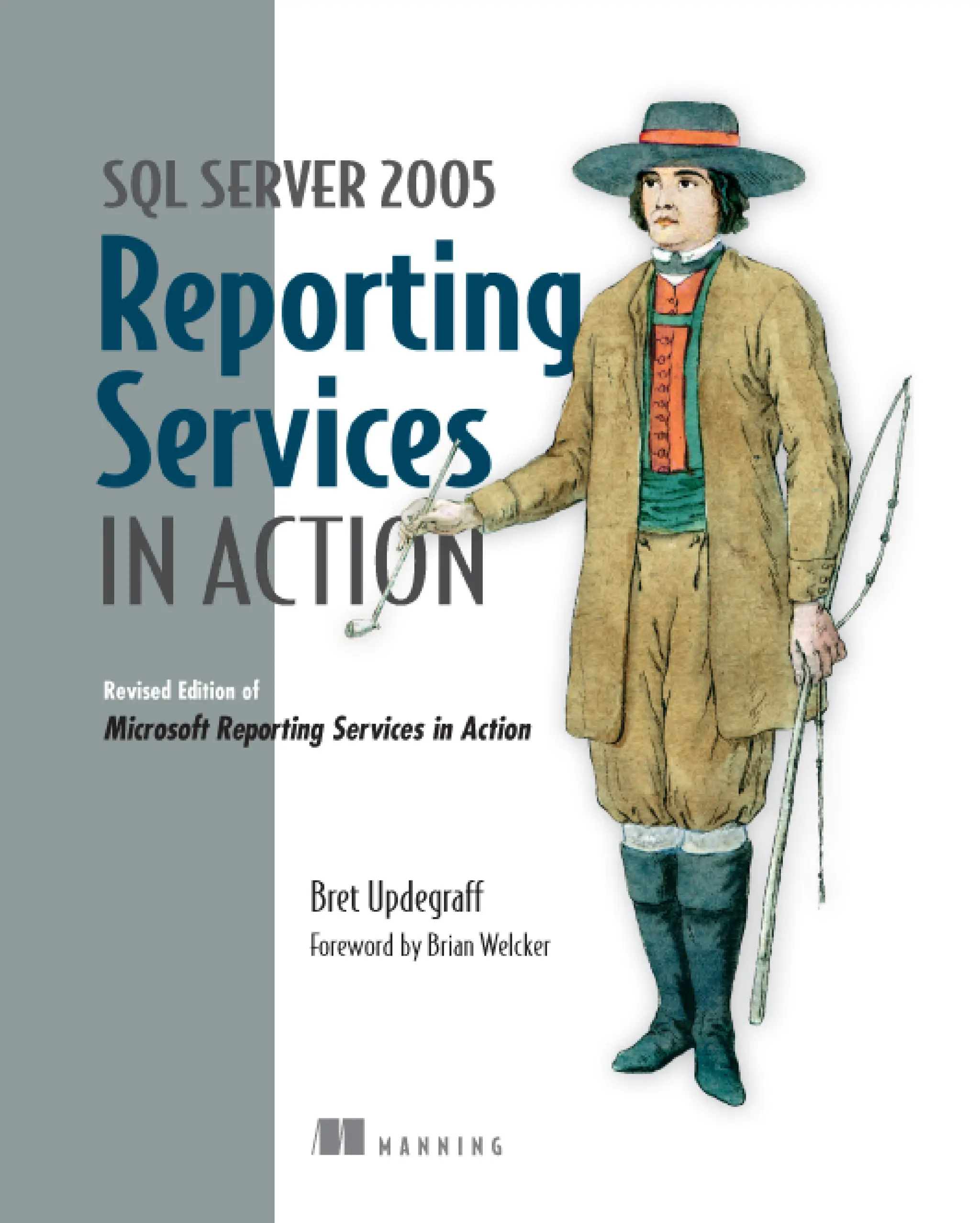





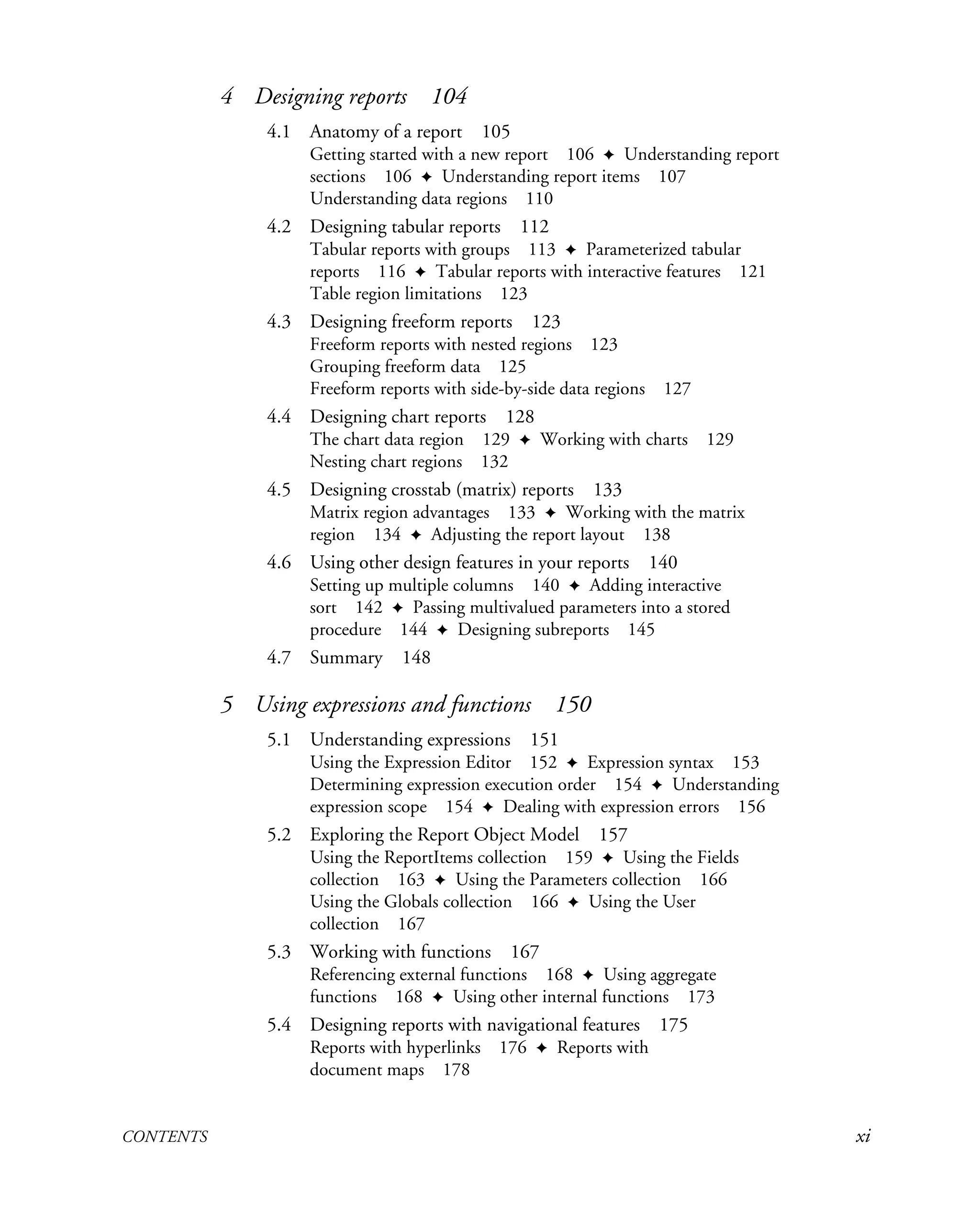
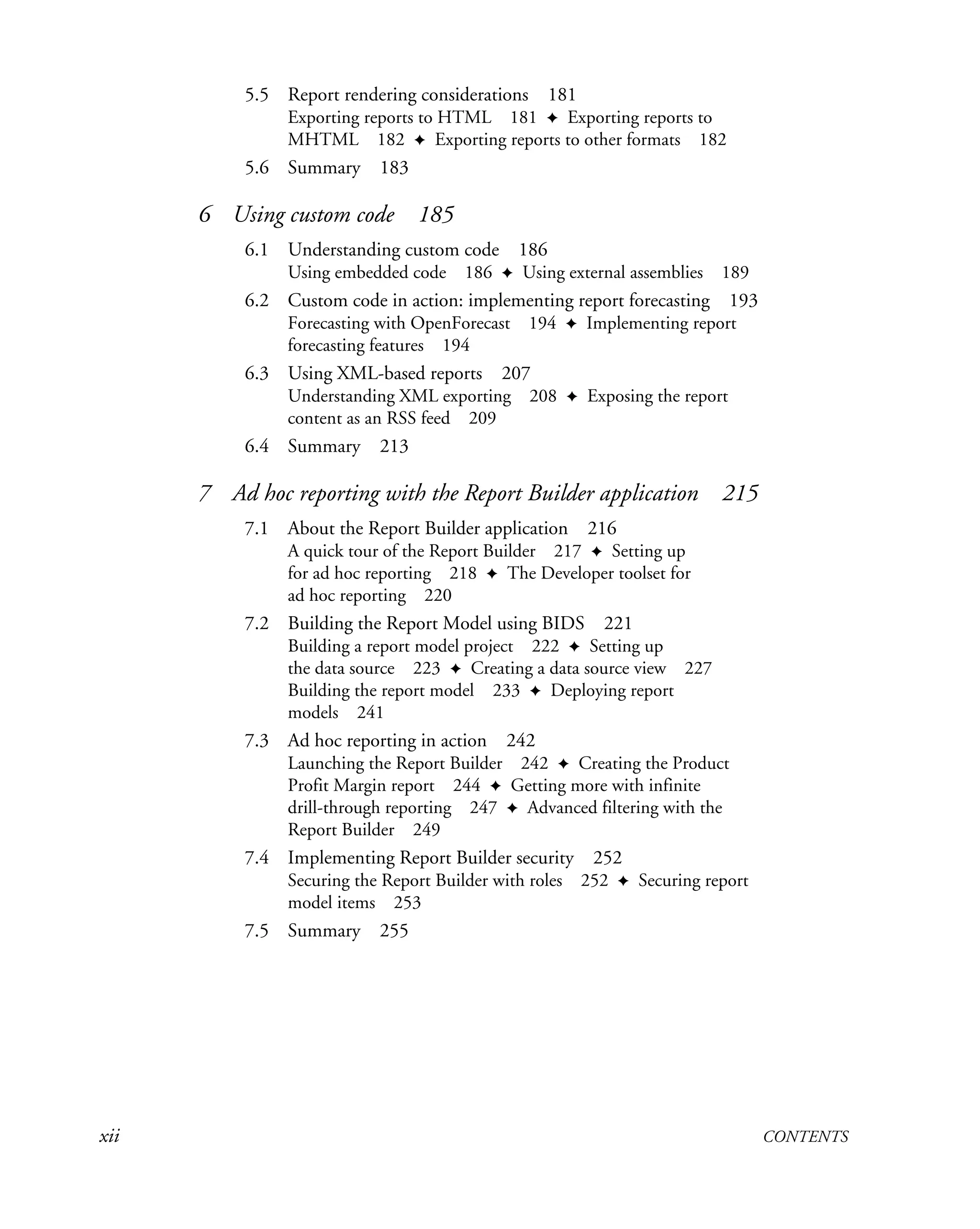
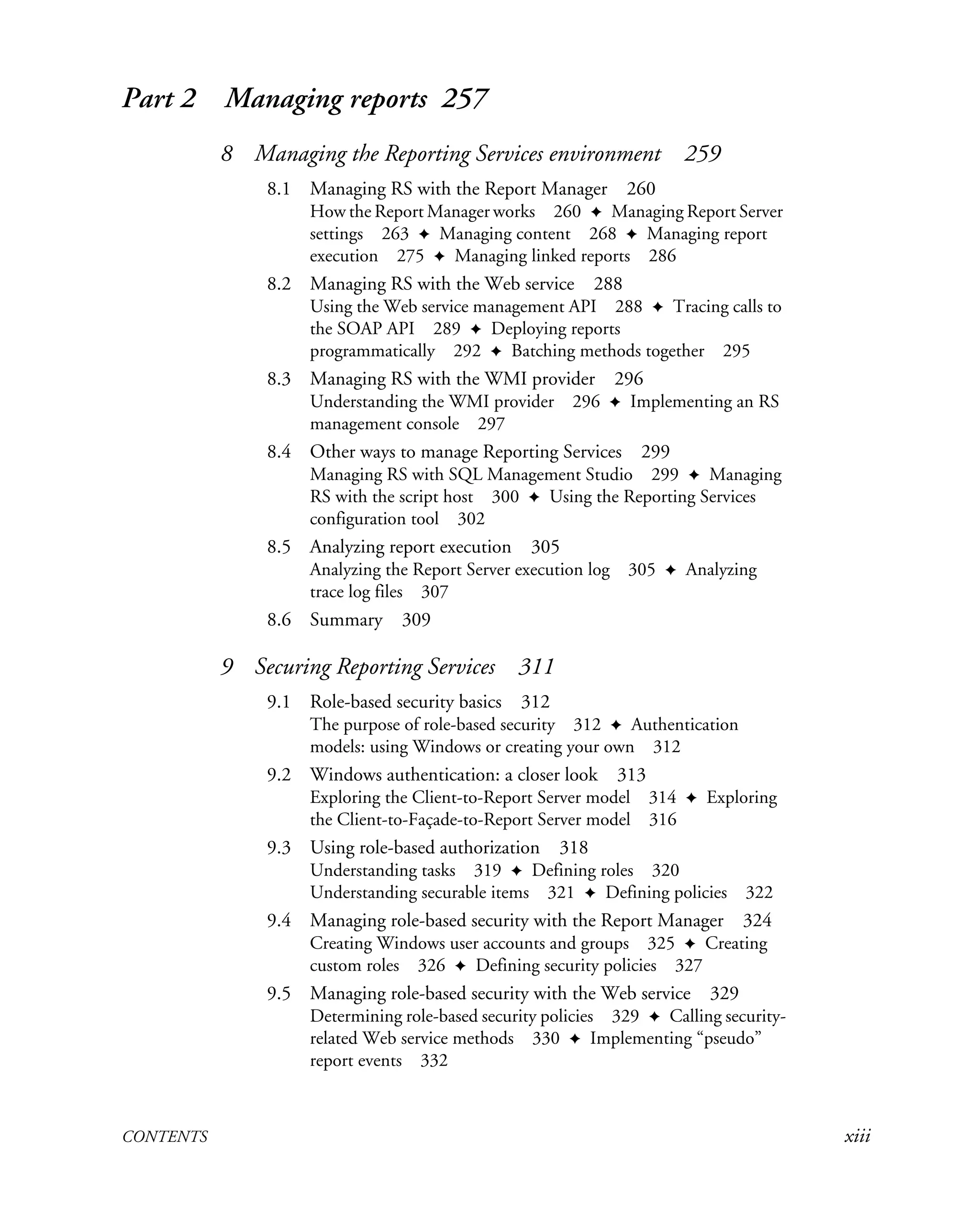
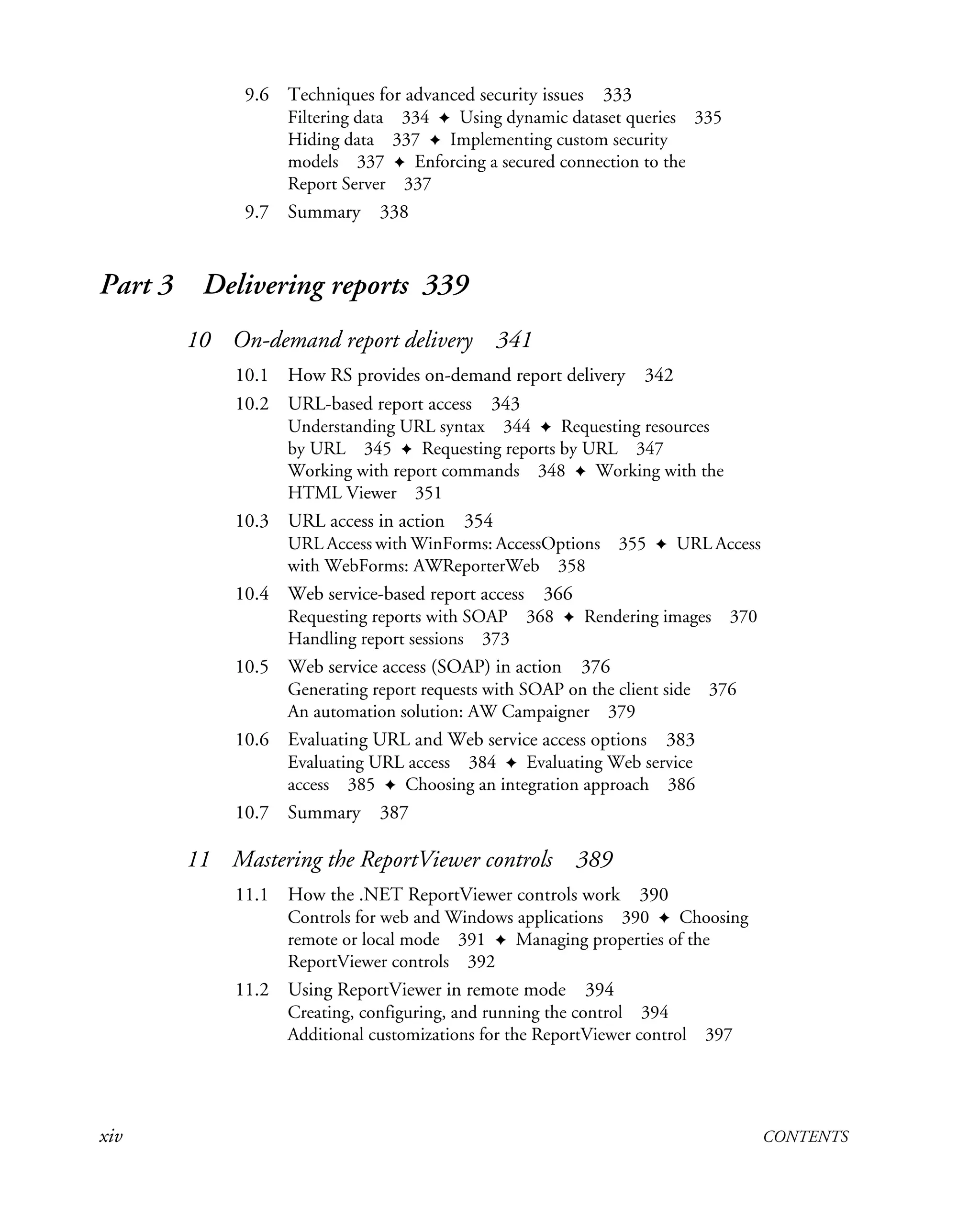

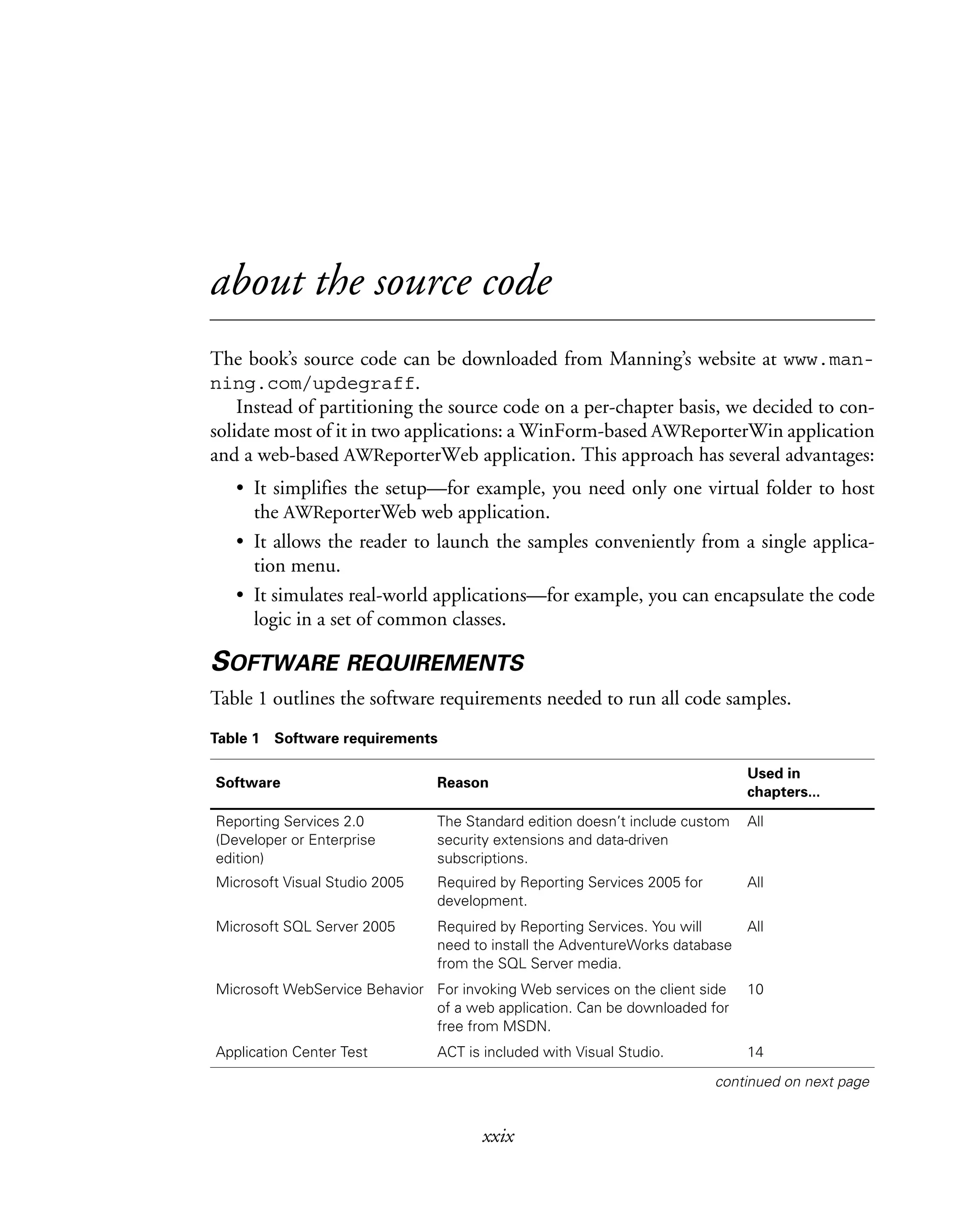
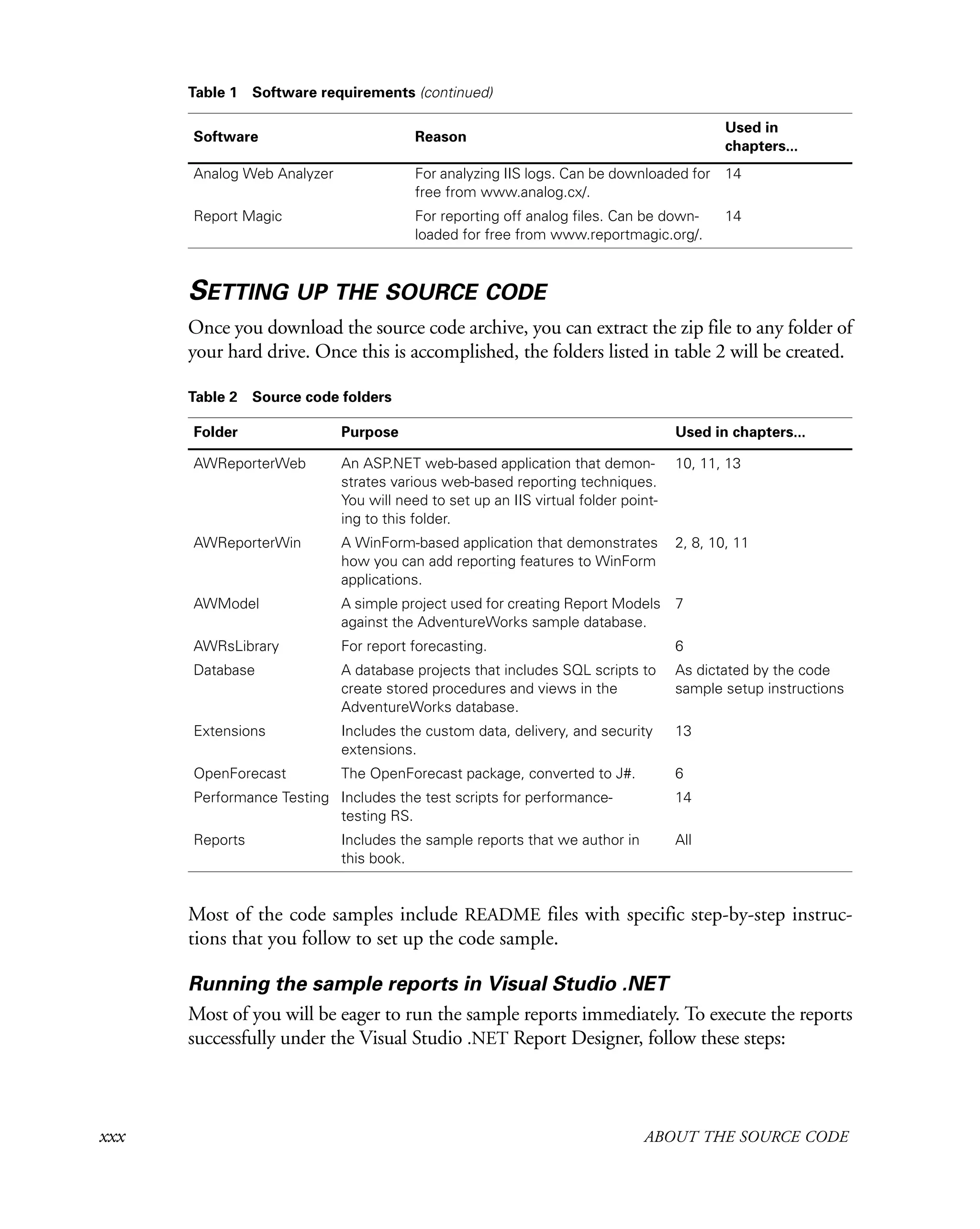
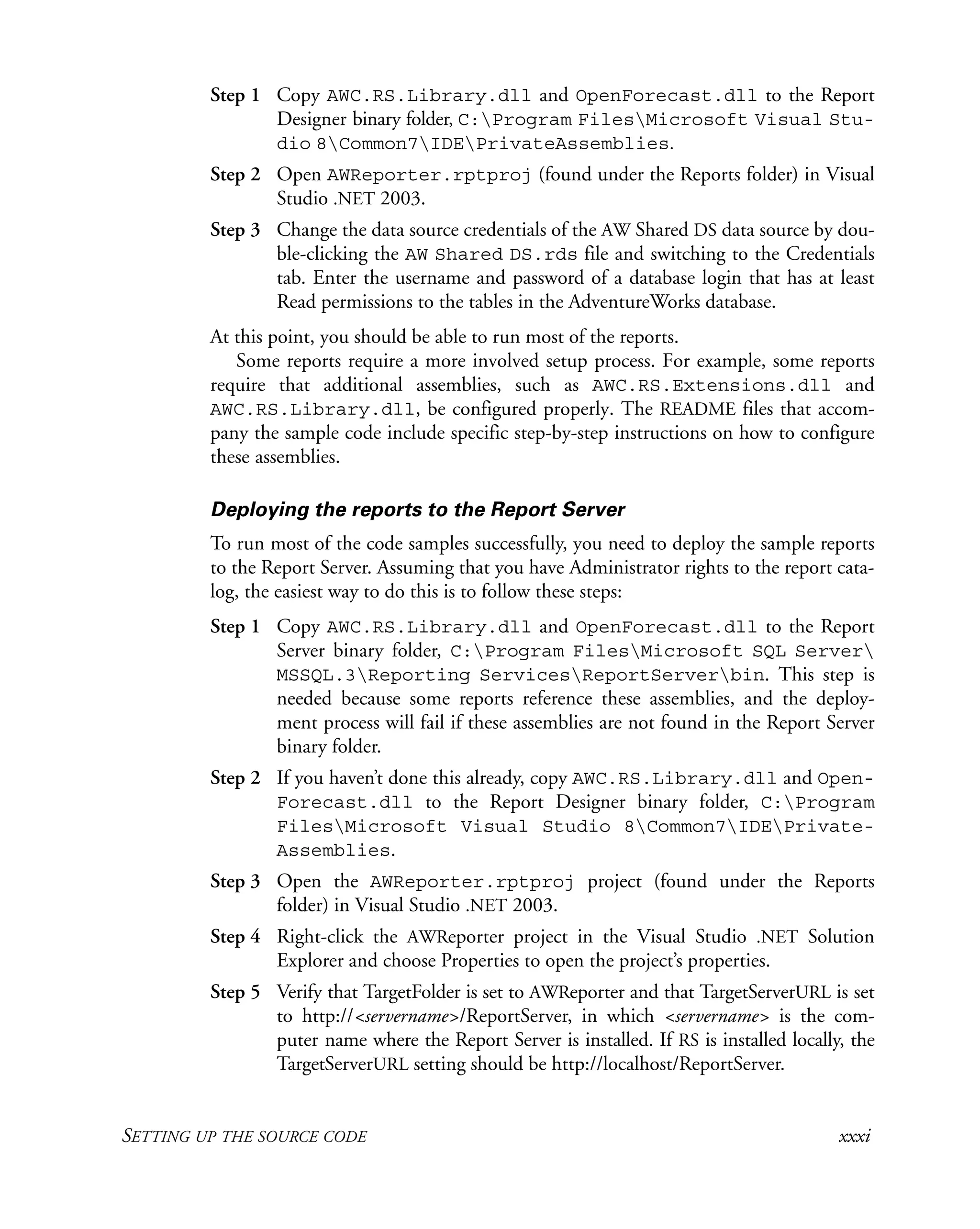
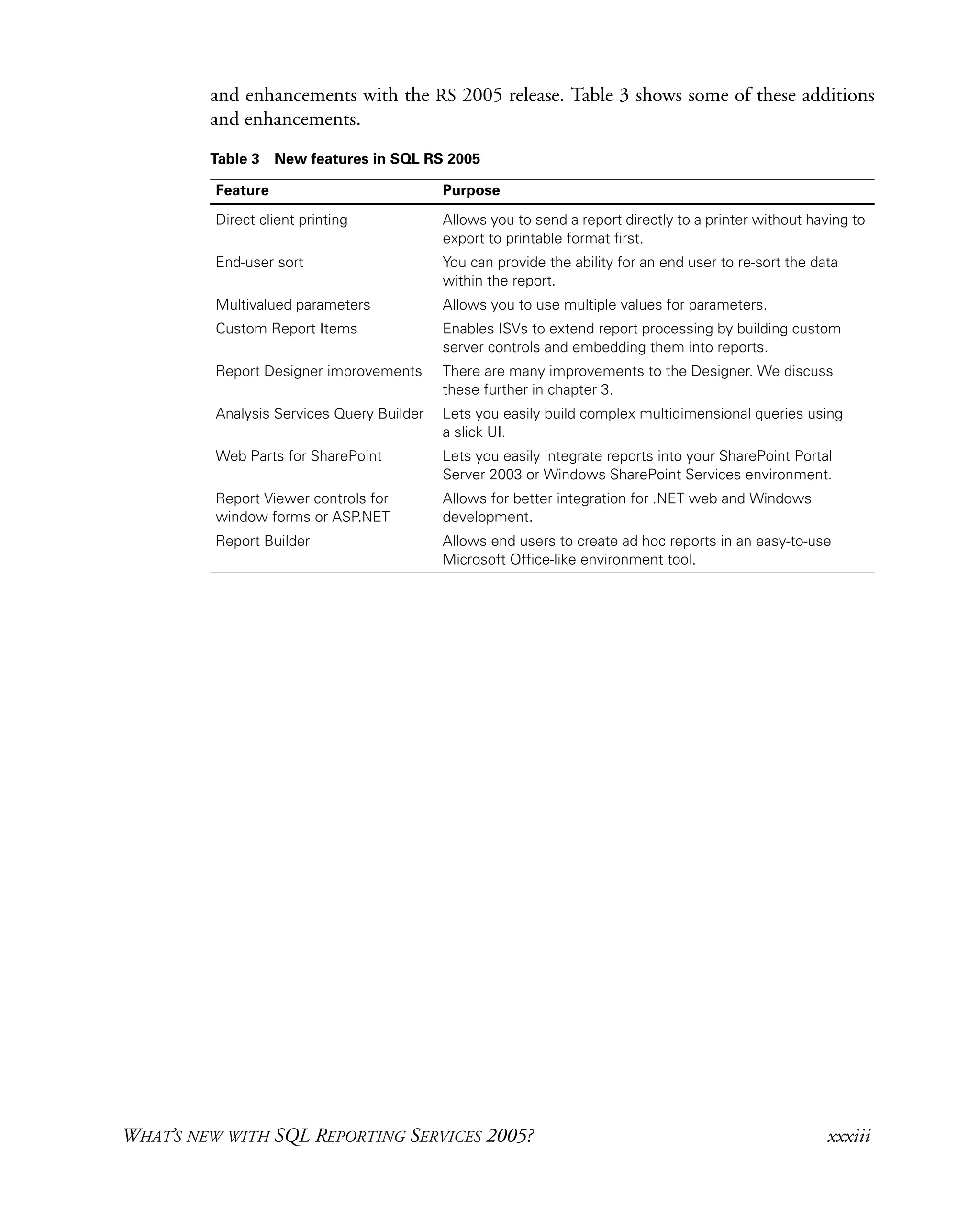

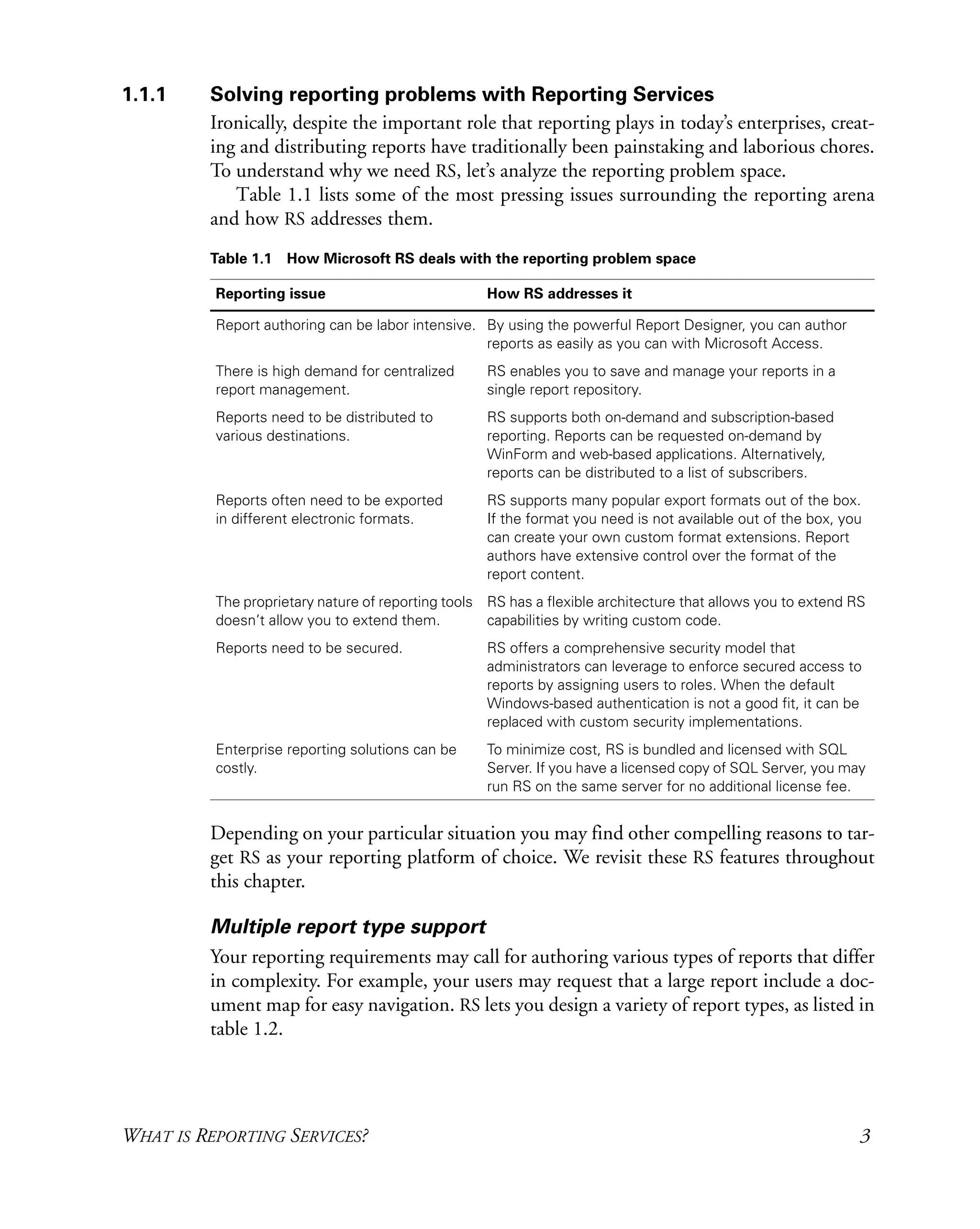
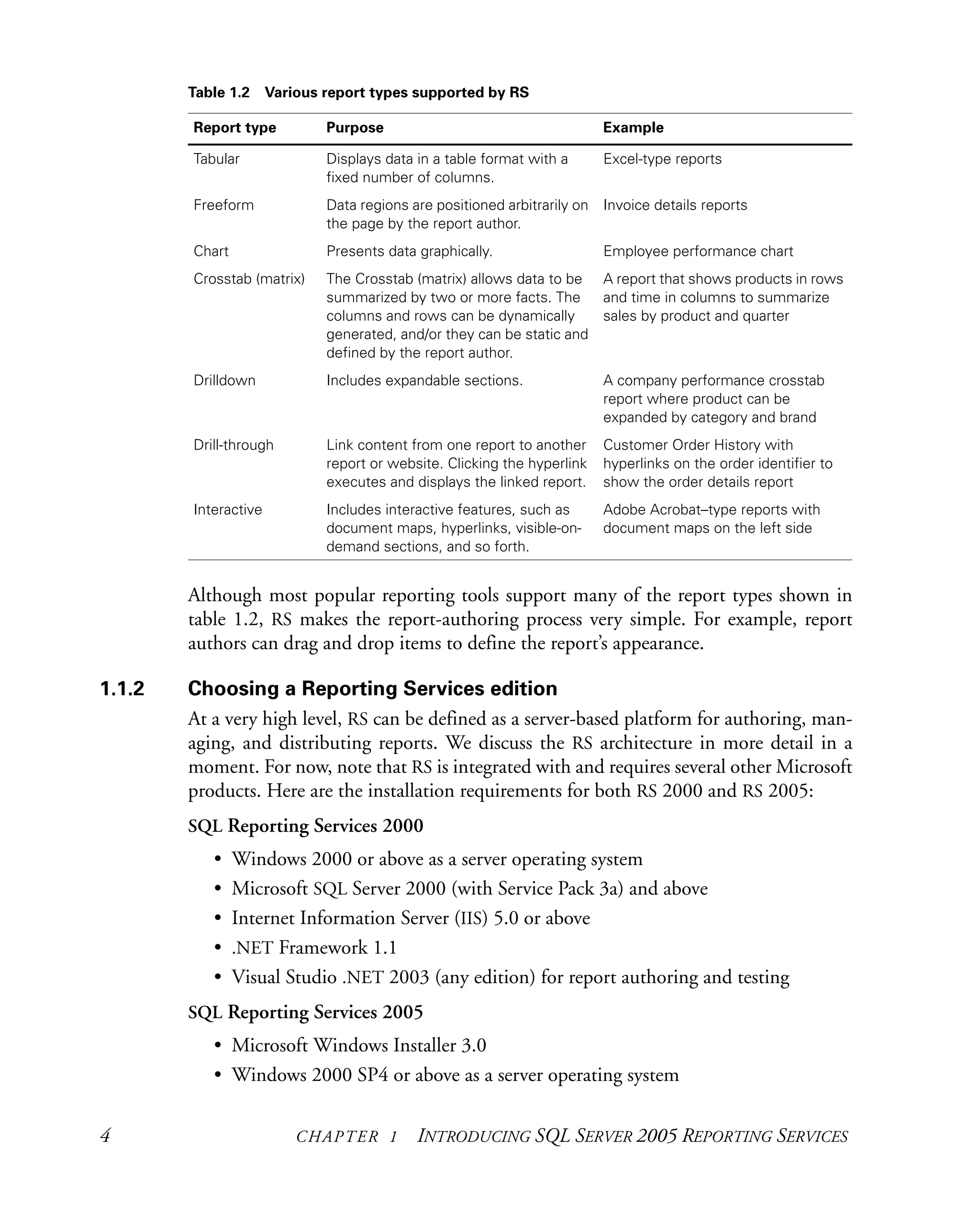
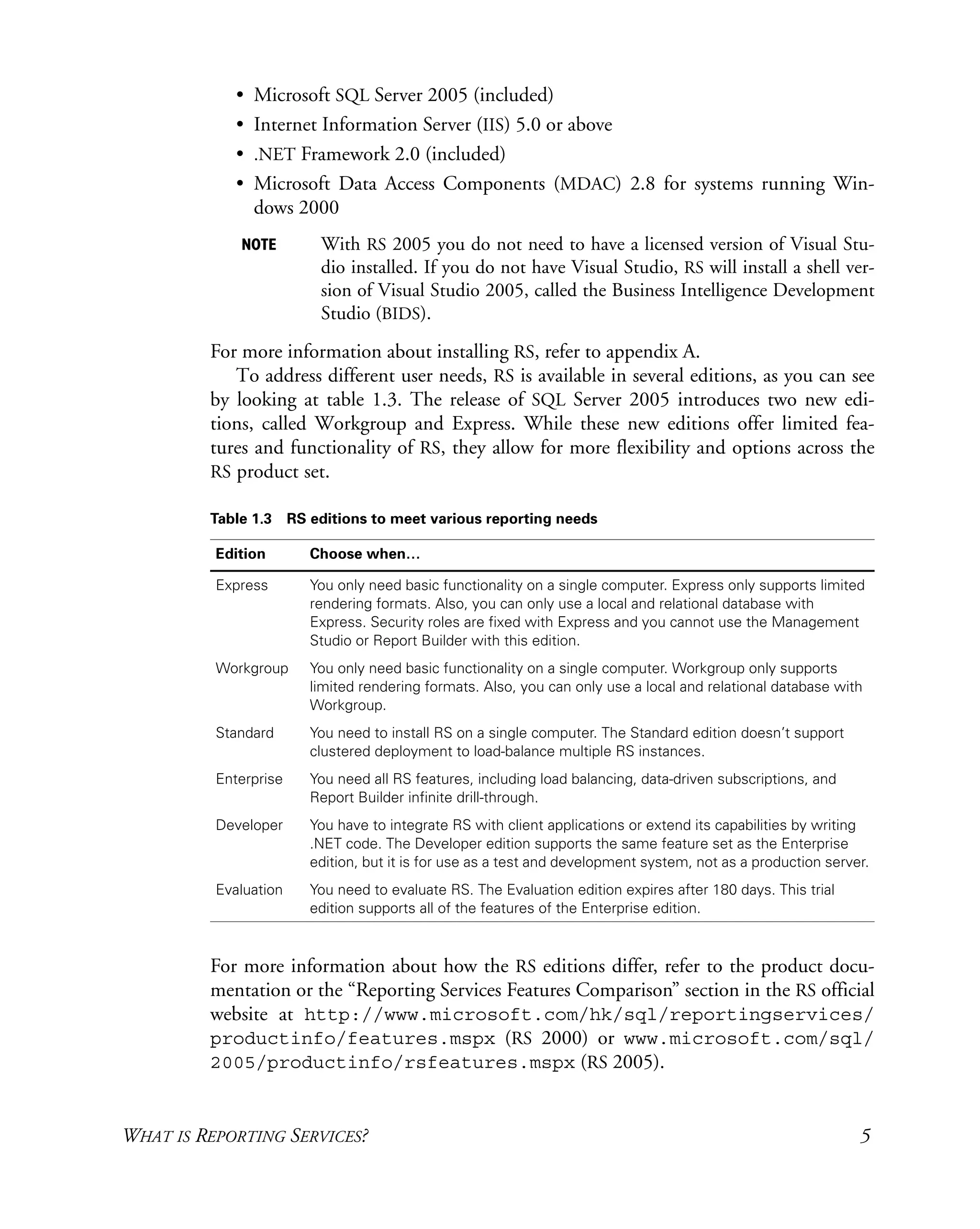
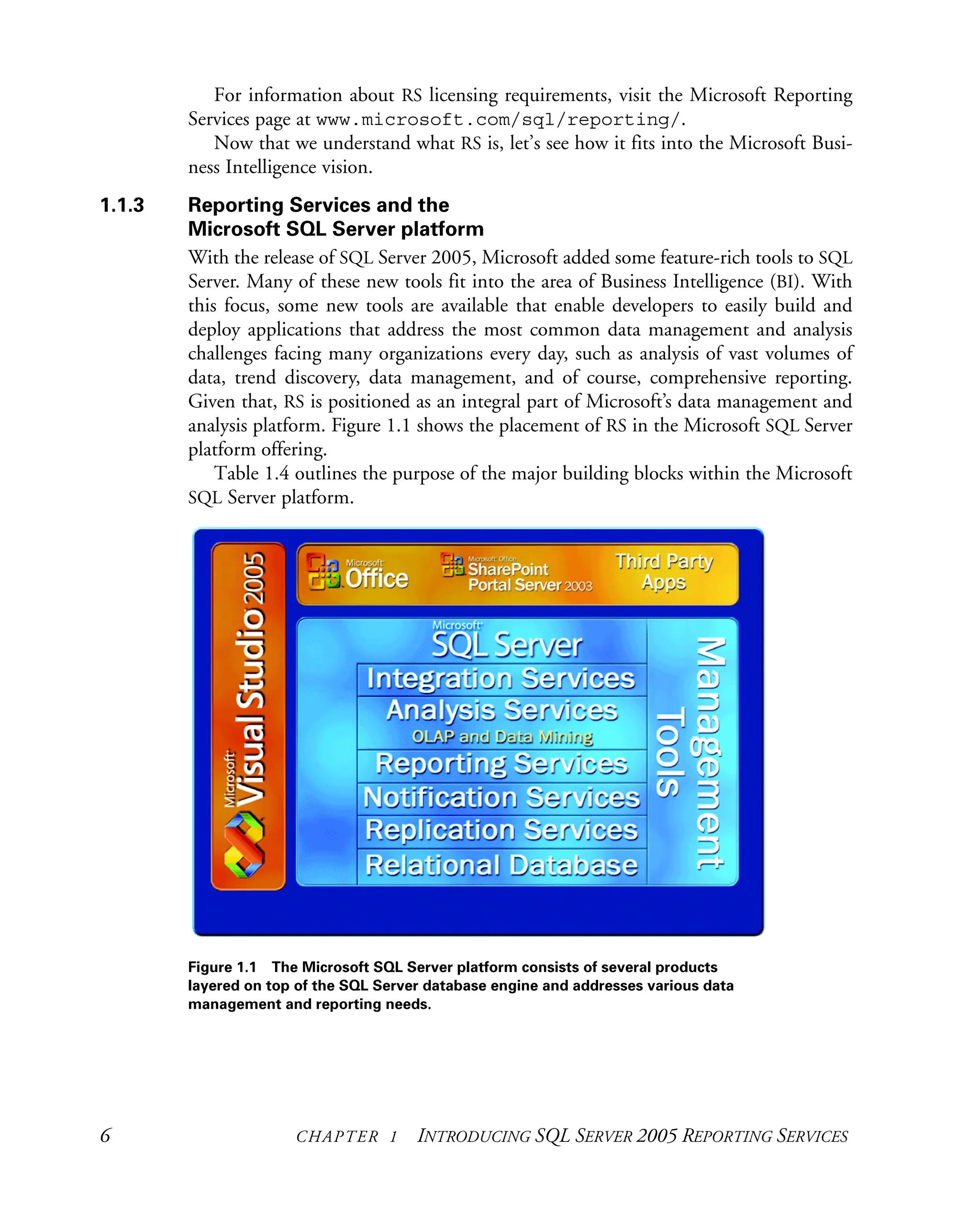
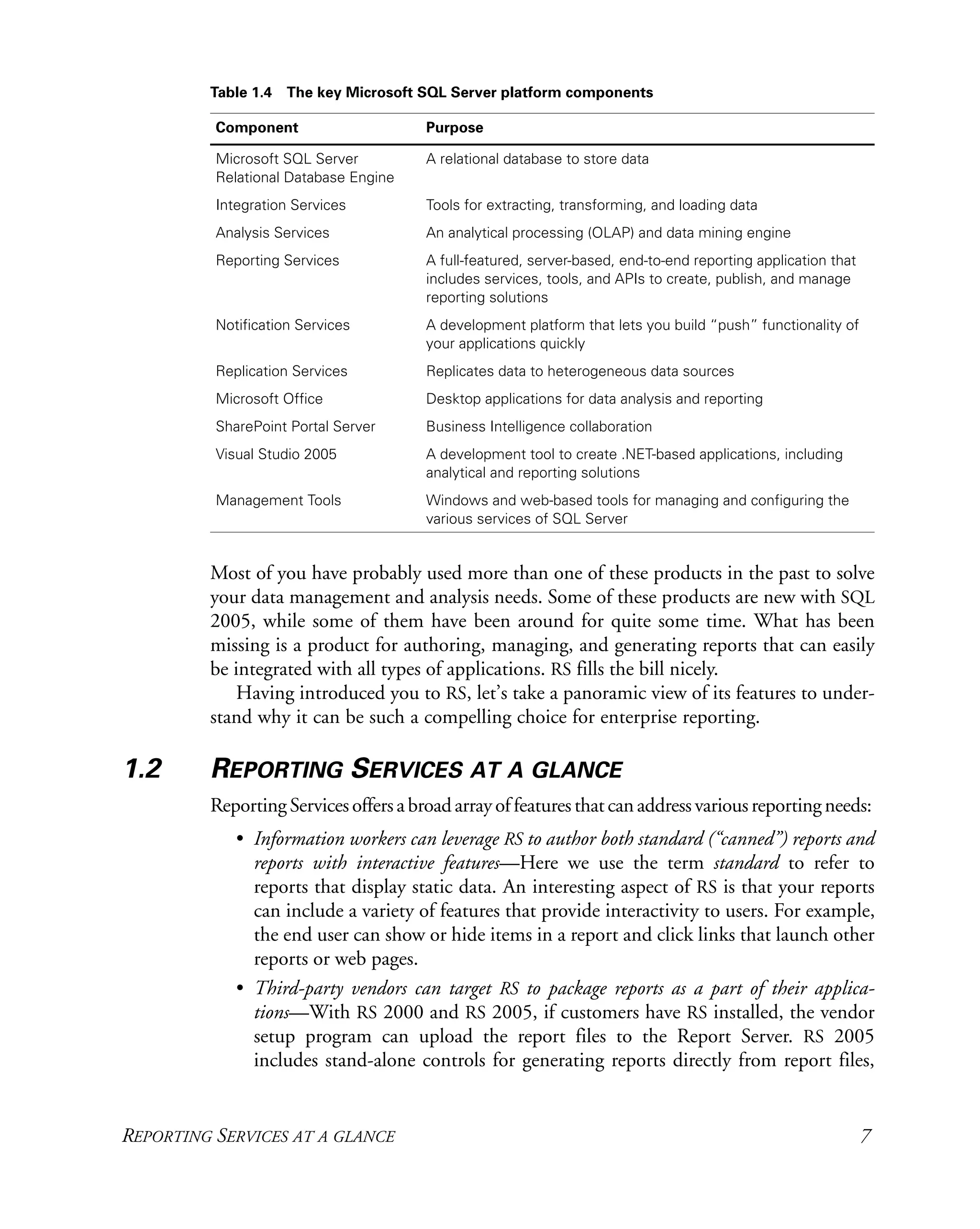

![women. She never went into the streets without being veiled; "because people
would talk if a pasha's wife were to show her face," said she.
We reached the citadel in the one hour of sunlight that shone on Aleppo during
my stay, and were taken round by polite officers, splendid in uniforms and
clanking swords and spurs, who were particularly anxious that I should not miss
the small mosque in the middle of the fortress, erected on the very spot where
Abraham milked his cow. The very name of Aleppo, said they, is due to this
historic occurrence, and there can be no doubt that its Arabic form, Ḥaleb, is
composed of the same root letters as those that form the verb to milk. In spite of
the deep significance of the mosque, I was more interested in the view from the
top of the minaret. The Mesopotamian plain lay outspread before us, as flat as a
board—Euphrates stream is visible from that tower on a clear day, and indeed
you might see Baghdad but for the tiresome way in which the round earth
curves, for there is no barrier to the eye in all that great level. Below us, were the
clustered roofs of bazaar and khān, with here and there a bird's-eye glimpse of
marble courtyards, and here and there the fine spire of a minaret. Trees and
water were lacking in the landscape, and water is the main difficulty in Aleppo
itself. The sluggish stream that flows out of the Maṭkh dries up in the summer,
and the wells are brackish all the year round. Good drinking water must be
brought from a great distance and costs every household at least a piastre a day,
a serious addition to the cost of living. But the climate is good, sharply cold in
winter and not over hot for more than a month or two in the summer. Such is
Aleppo, the great city with the high-sounding name and the traces of a splendid
past.
[11]The line is now completed as far as Aleppo.](https://image.slidesharecdn.com/41859-250506120330-e0afc3db/75/SQL-Server-2005-Reporting-Services-in-Action-1-Rev-ed-Edition-Bret-Updegraff-52-2048.jpg)
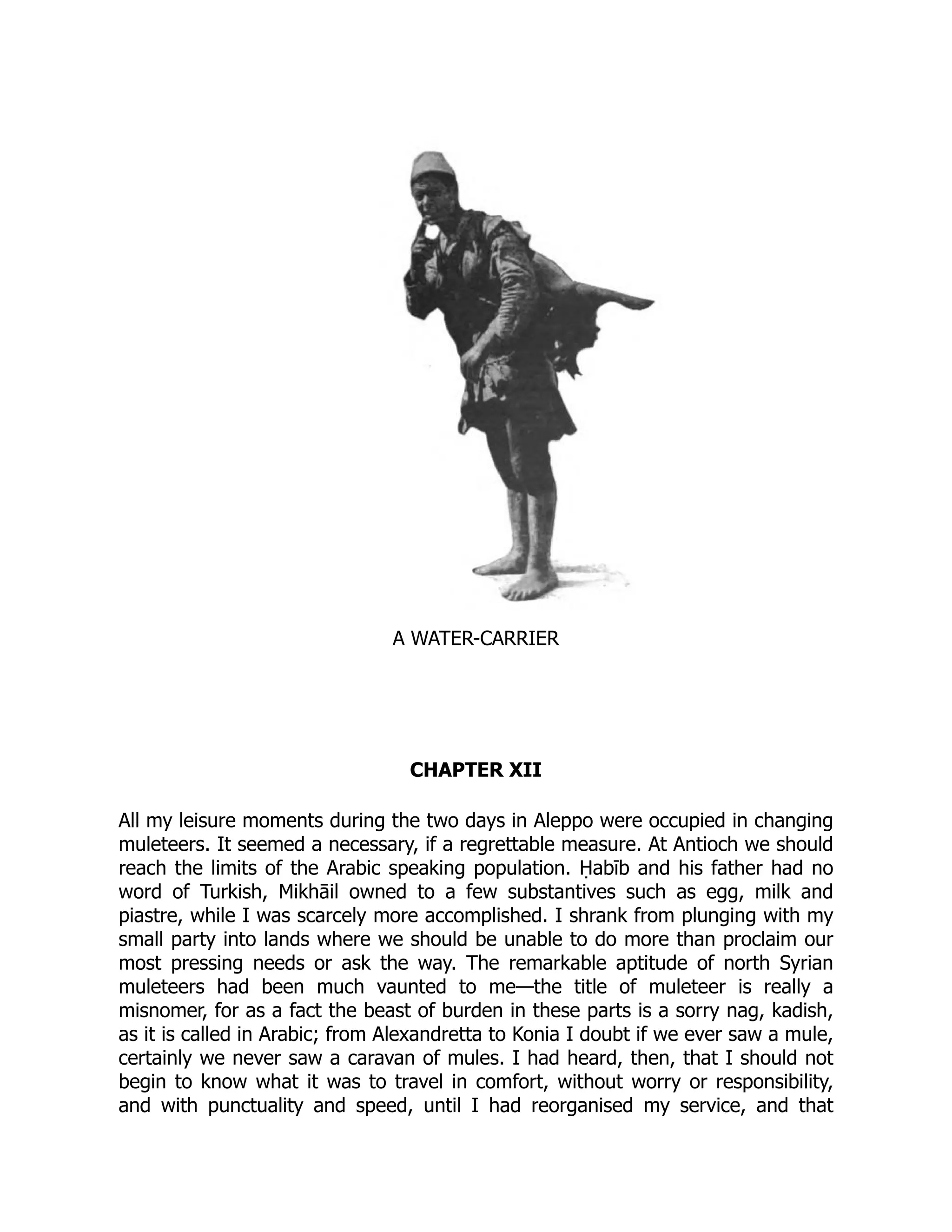
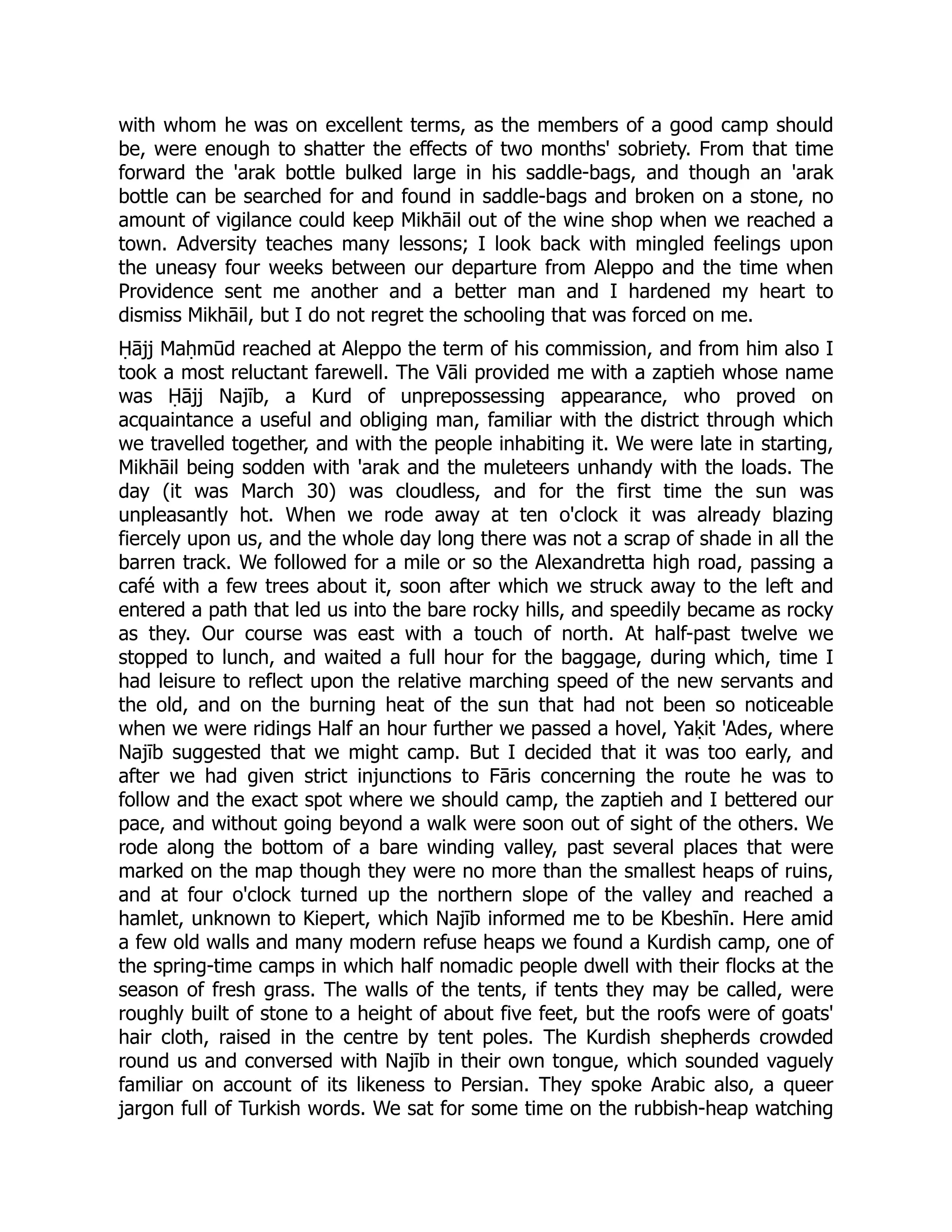
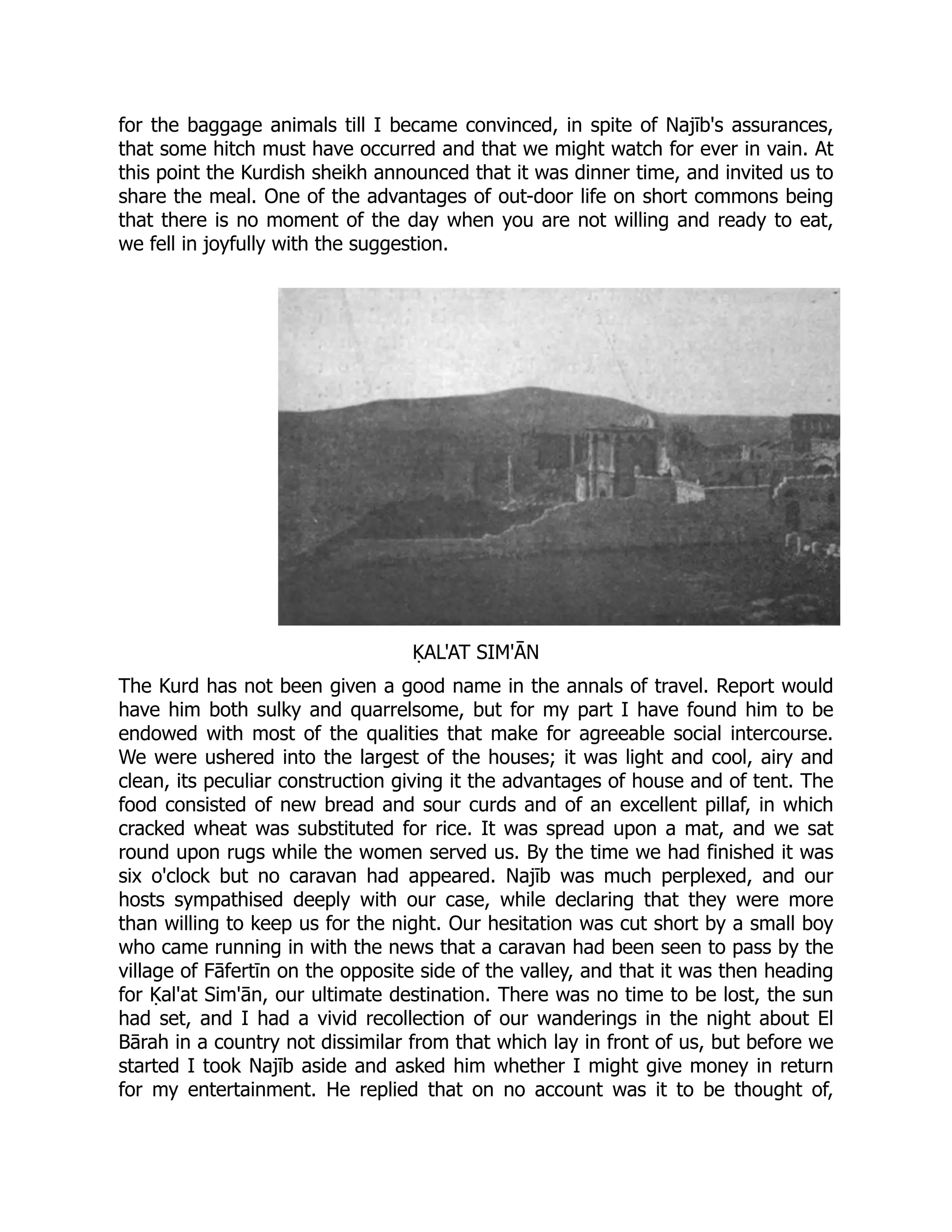
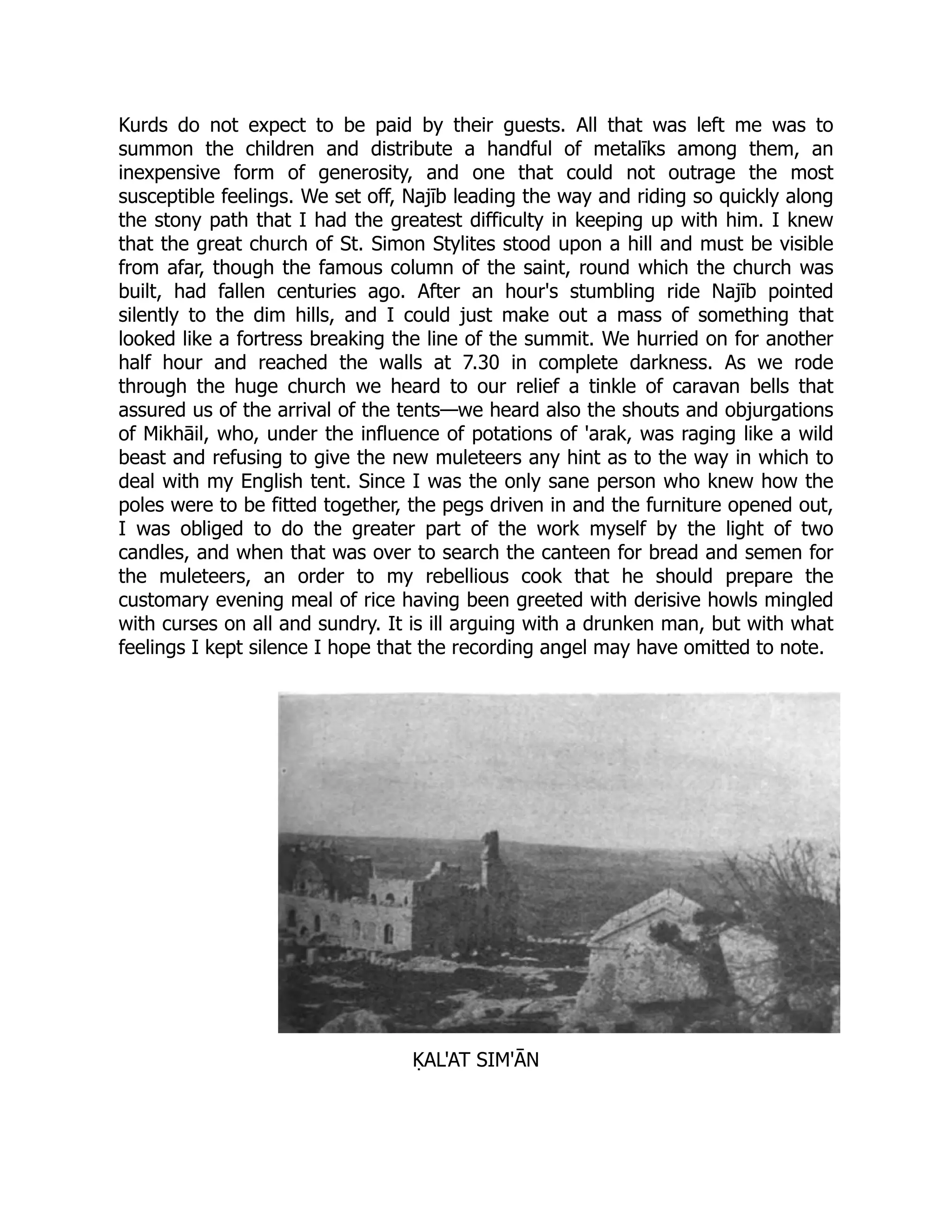
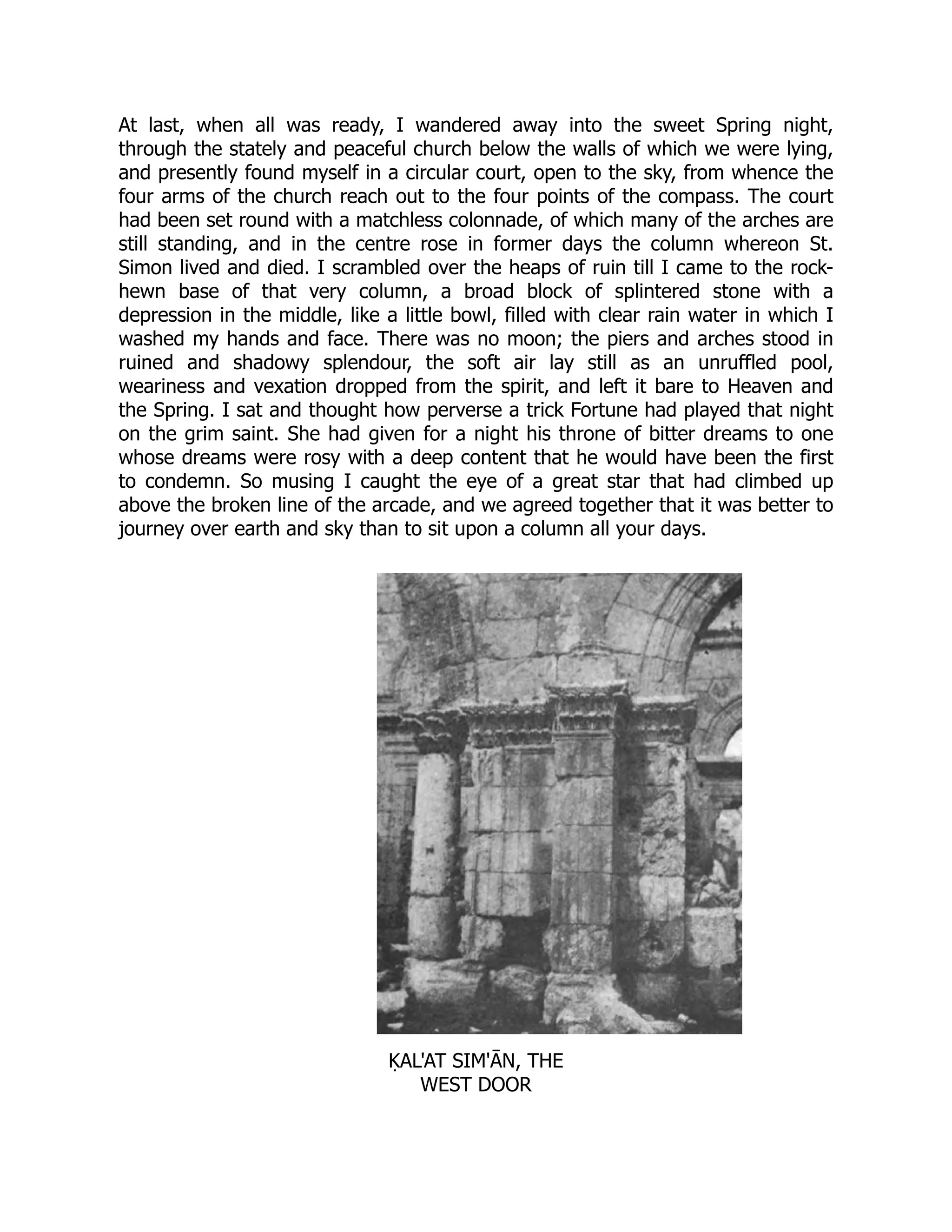
![The members of the American survey have mapped and thoroughly explored the
northern mountains as far as Ḳal'at Sim'ān, but neither they nor any other
travellers have published an account of the hilly region to the north-east of the
shrine.[12] I, who rode through it, and visited almost all the ruined villages, found
that it was generally known to the inhabitants as the Jebel Sim'ān, by which title
I shall speak of it. The Mountains of Simon, with the Jebel Bārisha, to the south-
west, and the Jebel el 'Ala still further to the west, belong to the same
architectural system as the Jebel Zāwdyyeh, through which we had passed on
our way to Aleppo. It would be possible to draw distinctions of style between the
northern group and the southern; the American architect, Mr. Butler, with his
wide experience of the two districts, has been able to do so, but to the hasty
observer the differences appear to depend chiefly on natural conditions and on
the fact that the northern district fell more directly under the influence of
Antioch, the city which was one of the main sources of artistic inspiration (not for
Syria alone) in the early centuries of the Christian era. The settlements in the
Jebel Sim'ān are smaller and the individual houses less spacious, possibly
because the northern mountains were much more rugged and unable to support
so large and wealthy a population; they would seem to have begun earlier and to
have reached the highest point of their prosperity a little later, nor did they suffer
the period of decline which is evident in the South during the century preceding
the Arab invasion.[13] The finest sixth-century churches in the north show an
almost florid luxuriance of decoration unapproached in the latest of the Southern
churches, all of which are to be dated a century earlier, except the Bizzos church
at Ruweiḥā. It is interesting to observe that the Ruweiḥā church, though it is a
little later than Ḳal'at Sim'ān, is far more severe in detail, and to this it may be
added that even small houses in the north present not infrequently a greater
variety and lavishness of decoration than is customary in the South.[14] When the
traveller reads the inscriptions on church and dwelling, and finds the dates
reckoned in the north always by the era of Antioch, he may be pardoned for
surmising that it was the magnificent hand of Antioch that touched here
architrave and capital, moulding and string-course. The church of St. Simon was
raised not by local effort only but as a tribute to the famous saint from the whole
Christian world, and probably it was not executed by local workmen but by the
builders and stone-cutters of Antioch; if that be so it is difficult not to attribute
the lovely church of Ḳalb Lōzeh to the same creative forces, and a dozen smaller
examples, such as the east church at Bāḳirḥa, must be due to similar influences.](https://image.slidesharecdn.com/41859-250506120330-e0afc3db/75/SQL-Server-2005-Reporting-Services-in-Action-1-Rev-ed-Edition-Bret-Updegraff-59-2048.jpg)
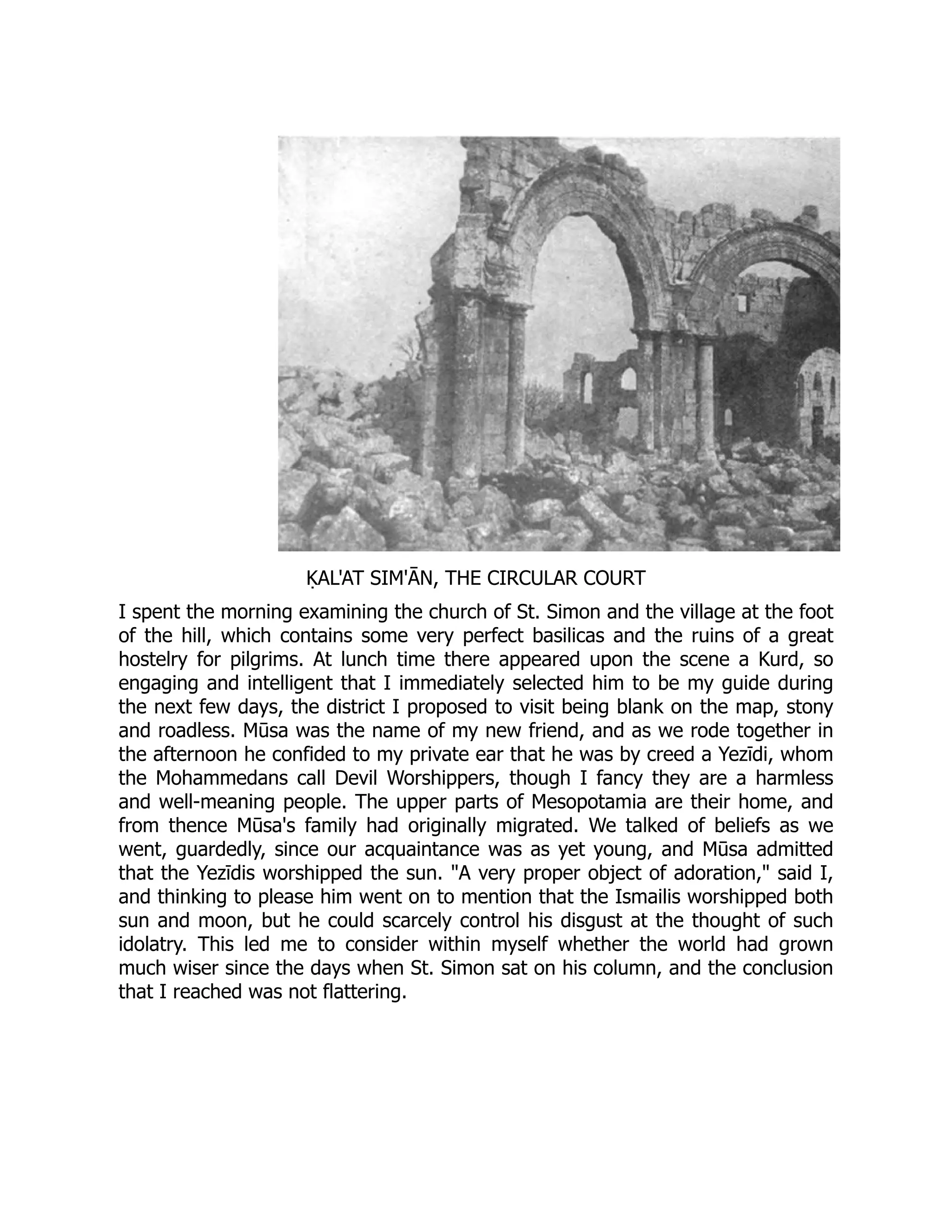
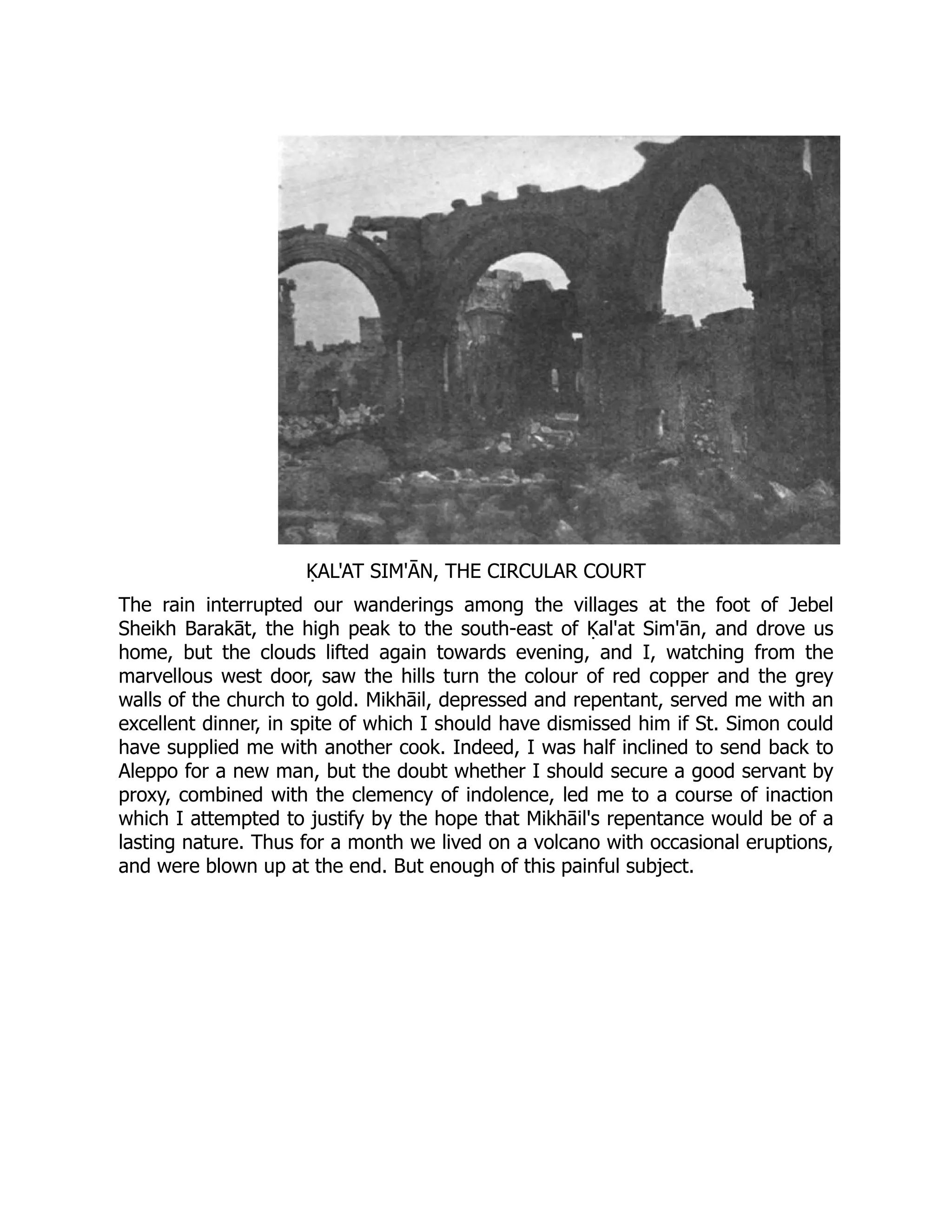
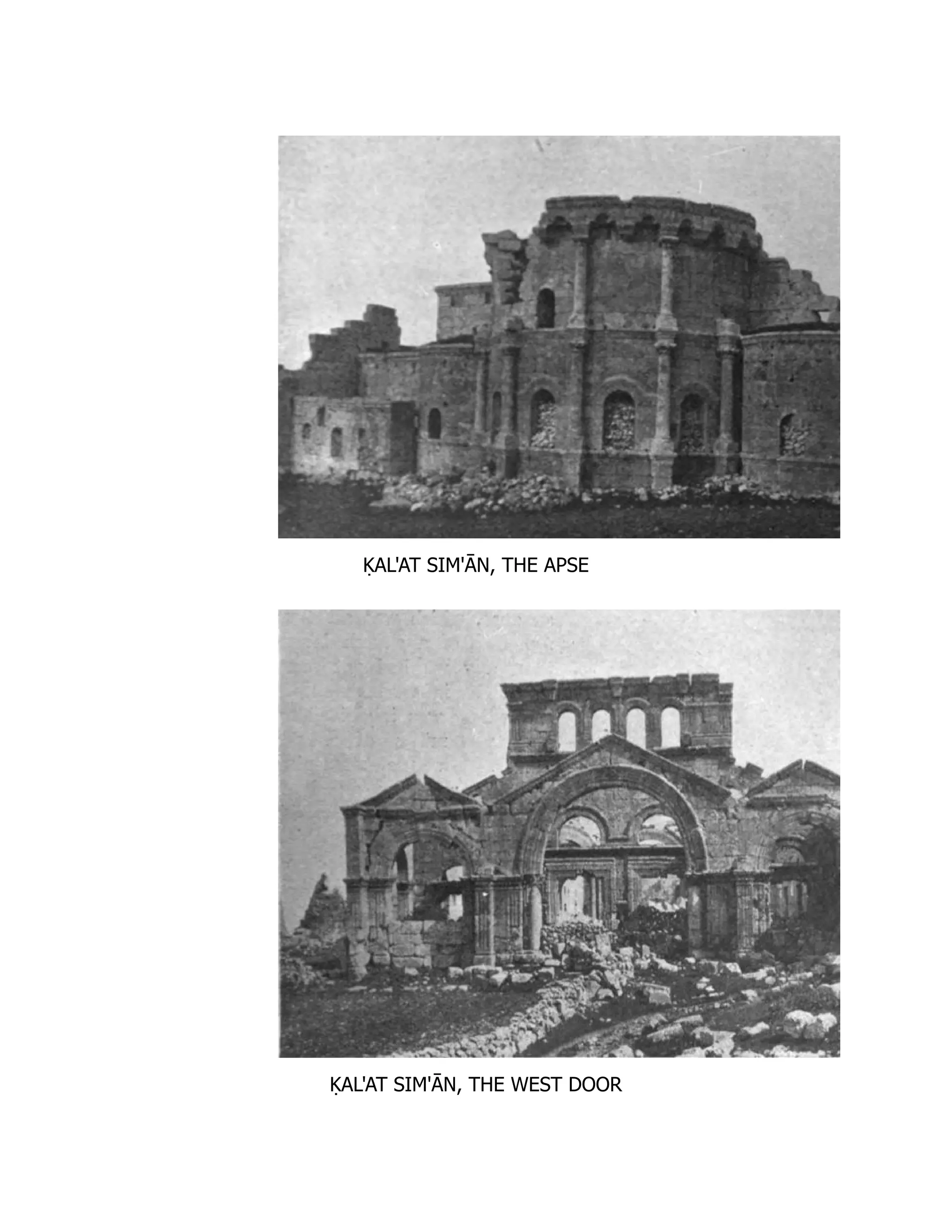
![Next day I set off with Mūsa to explore the villages in the Jebel Sim'ān to the
east and north-east of the church of St. Simon. We rode almost due east for
rather less than an hour to Burjkeh, which exhibited all the characteristics of
these villages of the extreme north. It had the tall square tower, which is nearly
universal. All the stone work was massive, the blocks frequently laid not in
courses, or if so laid, the courses showed great variety of depth. The church had
a square apse, built out beyond the walls of the nave, and a running moulding
hooded each window, passed along the level of the sill from one window to
another, and ended beyond the last in a spiral, as though it had been a bit of
ribbon festooned over the openings with the surplus rolled up. This moulding is
peculiar to sixth-century decoration in North Syria. The houses of Burjkeh were
very simple square cottages, built of polygonal masonry. Mūsa got wind of a
newly opened tomb near the church. I contrived with some difficulty to crawl
down into it, and was rewarded by finding on one of the loculi the date 292 of
the era of Antioch, which corresponds to 243 A.D. Below the date were three
lines of Greek inscription, much defaced. We rode on for half an hour to
Surkanyā, a deserted village, charmingly situated at the head of a shallow rocky
valley in which there were even a few trees. The houses were exceptionally
massive in construction, with heavy stone balconies forming a porch over the
door. One was dated, and the year was 406 A.D. The church was almost exactly
similar to that at Burjkeh. Another three quarters of an hour to the north and we
reached Fāfertīn, where, it began to rain. We took shelter under an apse, which
was all that remained of a church larger than any we had yet seen, but rude in
workmanship.[15] The village was inhabited by a few families of Yezīdi Kurds. In
the streaming rain we rode for an hour north-east to Khirāb esh Shems, but
could do nothing there owing to the weather, and so north by Kalōteh to Burj el
Kās, where I found my tents pitched on a damp sward. Mūsa was much
distressed by the heavy rain, and said that the wet spring had been disastrous to
his fields, washing down the soil from the high ground into the valleys. The work
of denudation, which has so greatly diminished the fertility of North Syria, is still
going forward.](https://image.slidesharecdn.com/41859-250506120330-e0afc3db/75/SQL-Server-2005-Reporting-Services-in-Action-1-Rev-ed-Edition-Bret-Updegraff-63-2048.jpg)
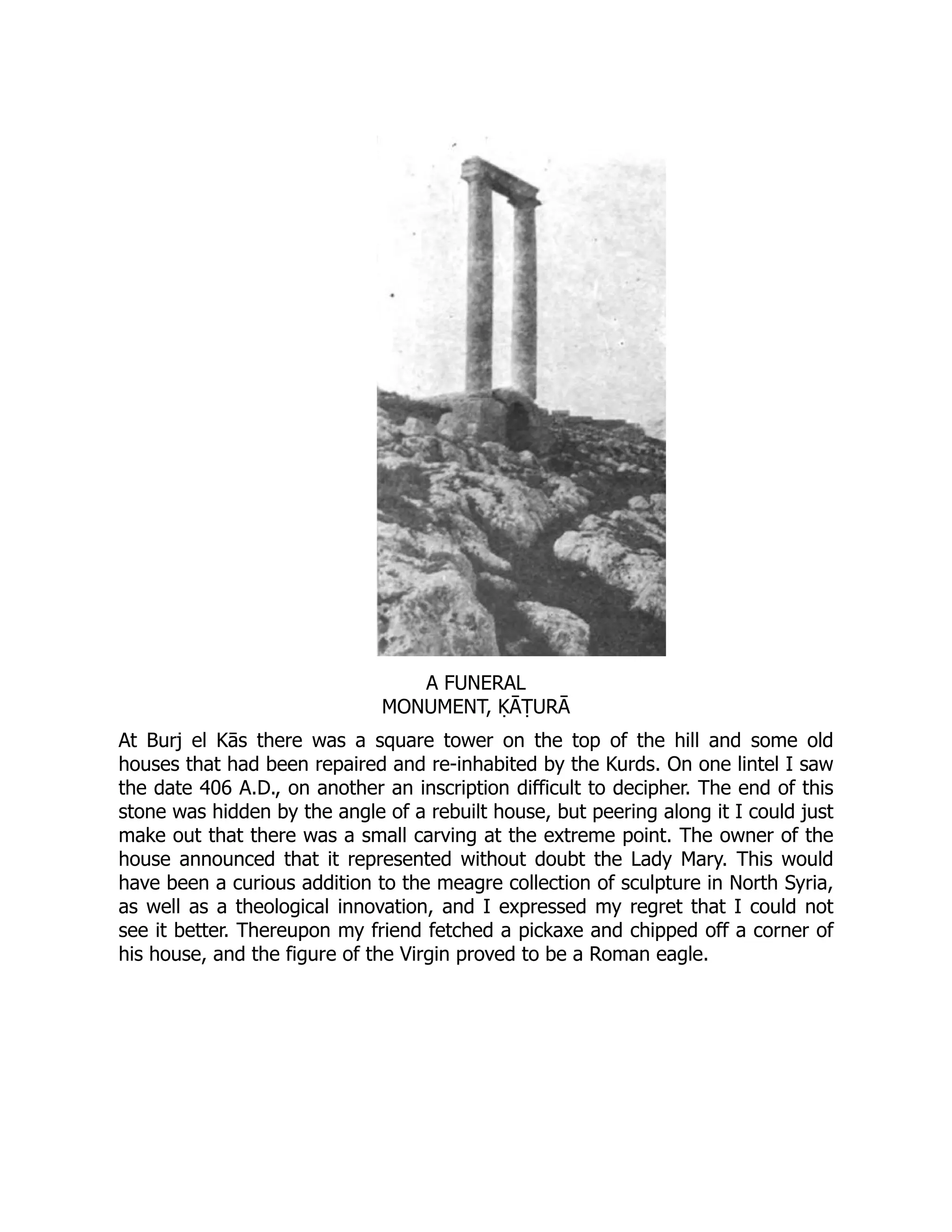
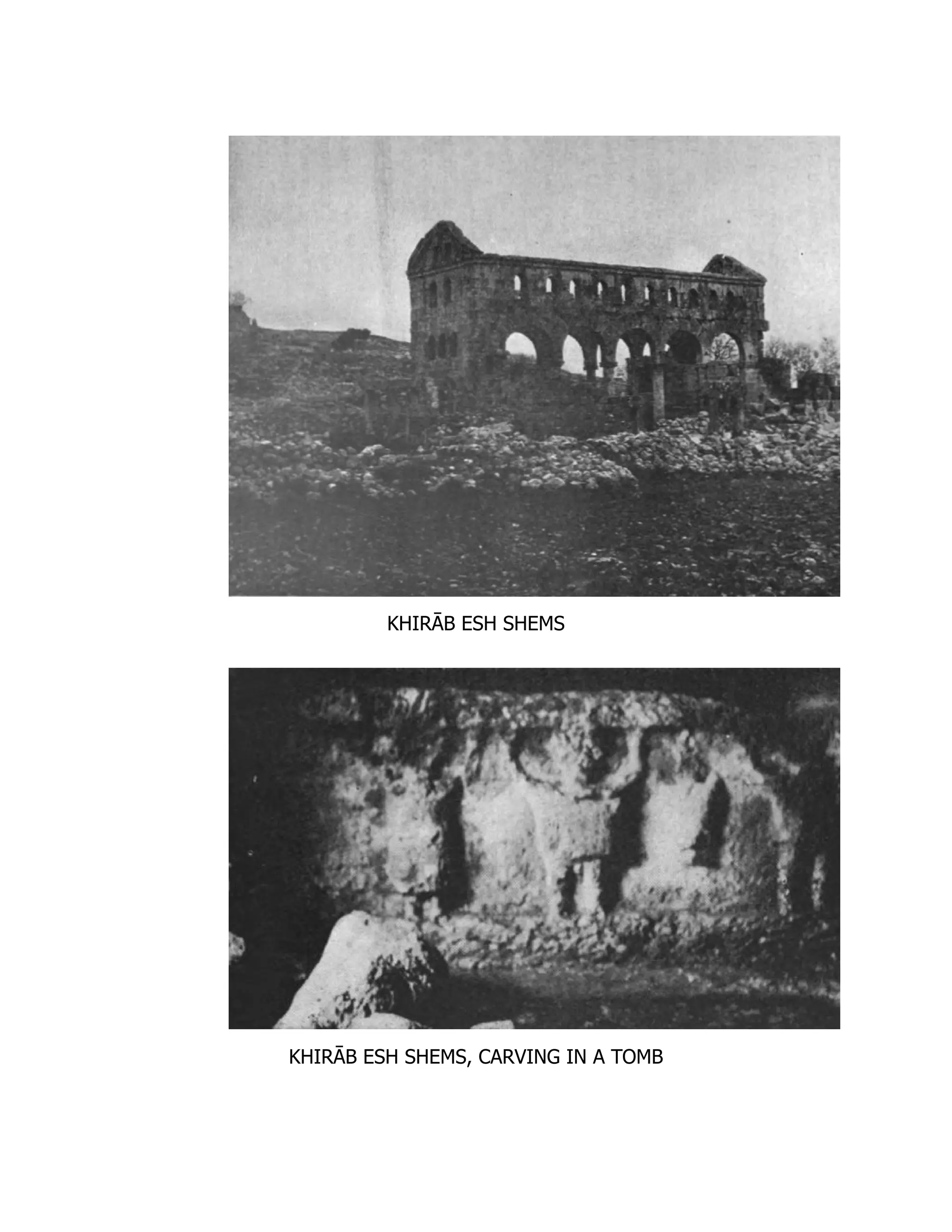
![With Najīb and Mūsa I returned to the villages that I had passed in the rain the
previous day. We left Najīb with the horses at Kalōteh, and ourselves walked to
Khirāb esh Shems, the path being so rocky that I wished to spare my beasts a
second journey over it. Khirāb esh Shems contained a fine church, twenty-one
paces long from the west door to the chord of the apse. The outer walls to north
and south had fallen, leaving only the five arches on either side of the nave with
a clerestory pierced by ten small round-headed windows, a charming fragment
like a detached loggia. Further up the hill stood a massive chapel, destitute of
aisles, with an apse built out and roofed with a semi-dome of square slabs,
resembling the fifth-century baptistery at Dār Kīta.[16] In the hill side we found a
number of rock-hewn tombs, in one of which I had the satisfaction to discover
some curious reliefs. On the loculus to the left of the door were four roughly
carved figures, their arms raised in the attitude of prayer, and on the rock wall in
a dark corner a single figure clothed in a shirt and a pointed cap, holding a
curious object, like a basket, in the right hand. Returning to Kalōteh we visited an
isolated church on some high ground to the west of the village. On the wall by
the south door there was a long inscription in Greek. The nave was separated
from the aisles by four columns on either side, some of which (to judge by the
fragments) had been fluted and some plain. The arcade ended against the corner
of the apse with engaged fluted columns carrying beautiful Corinthian capitals.
The apse, prothesis and diaconicum were all contained within the outer wall of
the church. The west door showed a stilted relieving arch above a broken lintel,
the lintel decorated with a row of dentils. To the south of the church there was a
detached baptistery, some 9 ft. square inside, the walls still carrying the first
course of the stone vault. The church must have been roofed with tiles, for I saw
a number of fragments lying in the nave. A massive enclosing wall surrounded
both church and baptistery. The village below contained two churches, that to the
west measuring 38 ft. by 68 ft., the other 48 ft. by 70 ft. The mouldings round
the doors in both churches indicate that they cannot have been earlier than the
sixth-century. There Were also some houses with stone verandahs.](https://image.slidesharecdn.com/41859-250506120330-e0afc3db/75/SQL-Server-2005-Reporting-Services-in-Action-1-Rev-ed-Edition-Bret-Updegraff-66-2048.jpg)