PRESENTATION ON JOINS
By:- BIHARA SINGH
What Are Joins ??
#JOINS
•Joins help retrieving data from two or
more database tables.
•The tables are mutually related using
primary and foreign keys.
WHY TO USE JOINS ????
• We can run queries one by one, use output of each in
successive queries. Of course, that is possible. But using
JOINs, you can get the work done by using only a one
query with any search parameters.
• On the other hand MySQL can achieve better
performance with JOINs as it can use Indexing.
• Simply use of single JOIN query instead running multiple
queries do reduce server overhead.
WHAT JOIN DO ??
• Joins help retrieving data from two or more database tables.
• The tables are mutually related using primary and foreign keys.
• It can join the table vertically as well as horizontally.
Table A
Table B
Table A Table B
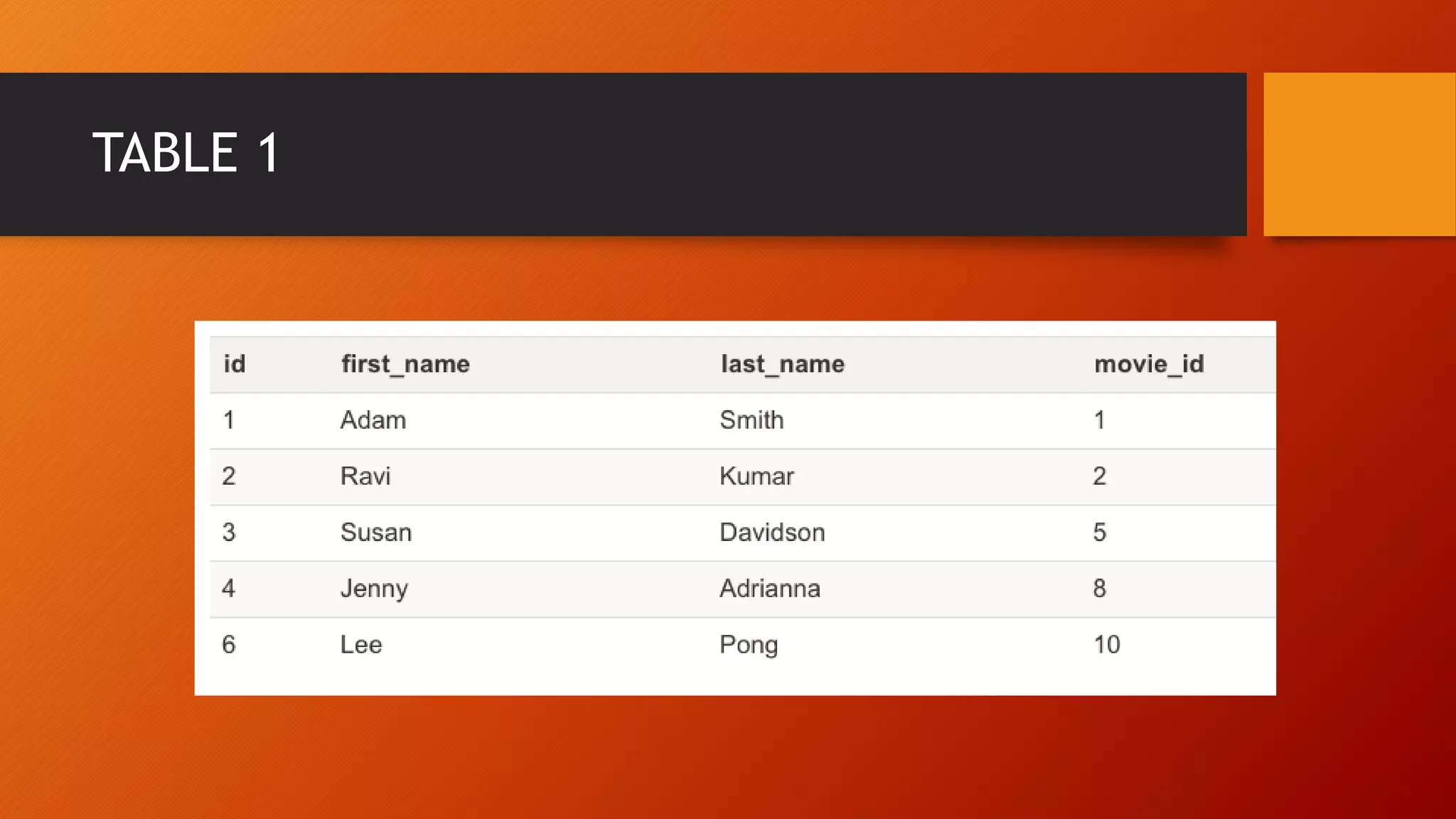
TABLES WE WILL USE …
TABLE 1
TABLE 2
TYPES OF JOINS
• CROSS JOIN OR CARTESSIAN PRODUCT
• INNER JOIN
• OUTER JOINS
• LEFT JOIN
• RIGHT JOIN
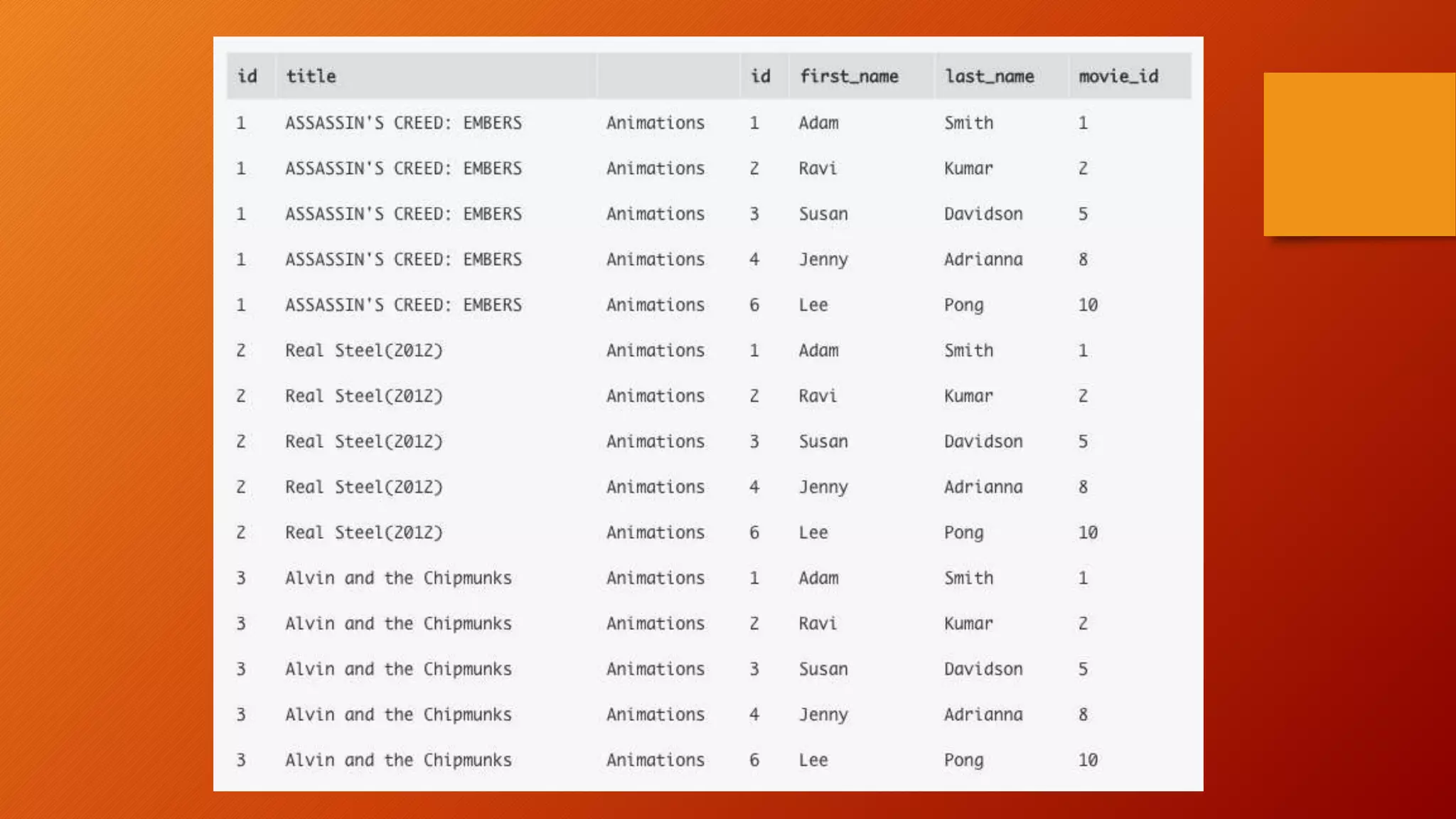
CROSS JOIN
• Cross JOIN is a simplest form of JOINs which matches
each row from one database table to all rows of
another
• In other words it gives us combinations of each row of
first table with all records in second table.
• Syntax: SELECT * FROM ‘movies’ CROSS JOIN ‘members’
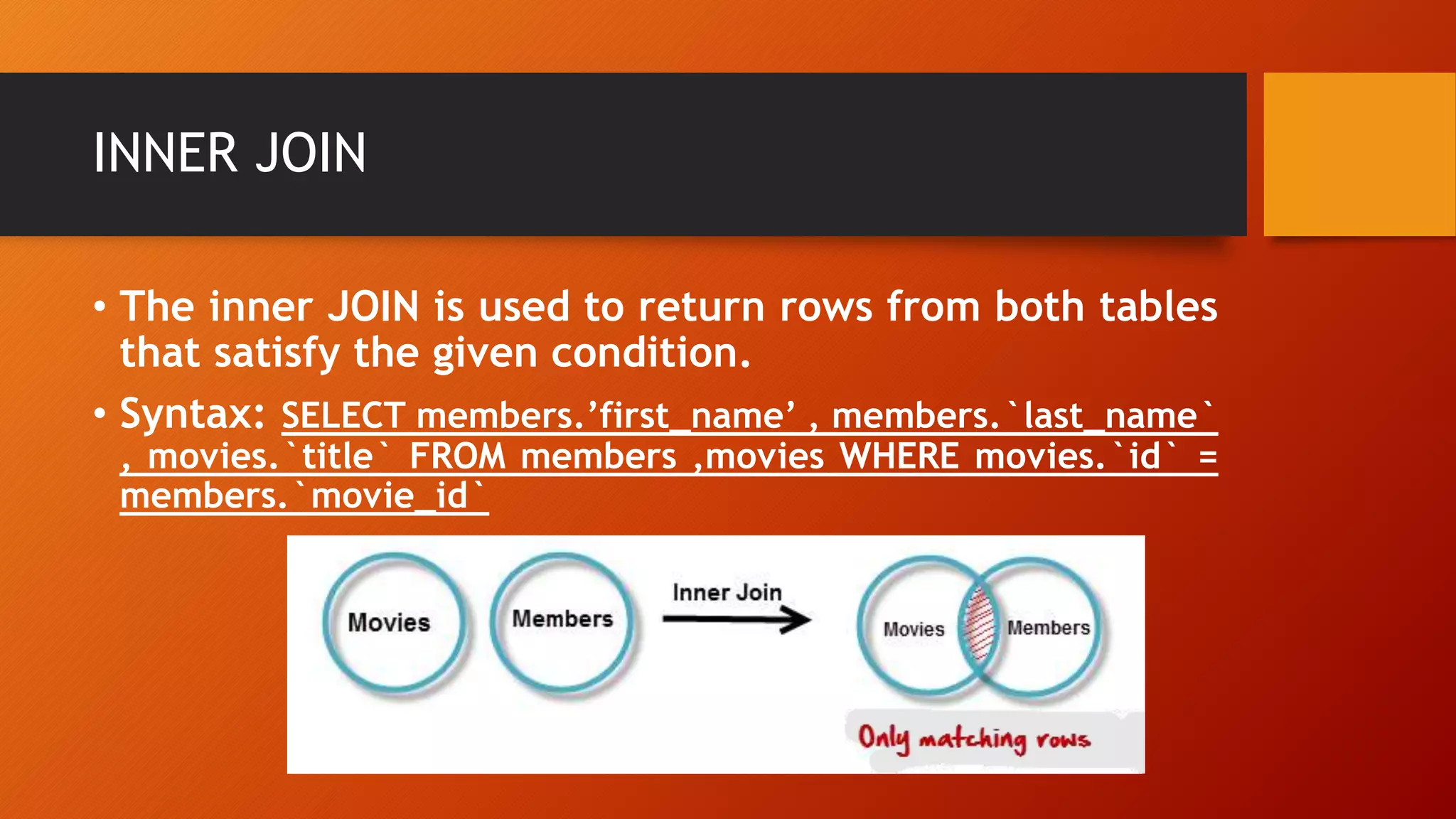
INNER JOIN
• The inner JOIN is used to return rows from both tables
that satisfy the given condition.
• Syntax: SELECT members.’first_name’ , members.`last_name`
, movies.`title` FROM members ,movies WHERE movies.`id` =
members.`movie_id`
OUTER JOIN
• MySQL Outer JOINs return all records matching from
both tables .
• It can detect records having no match in joined table.
It returns NULL values for records of joined table if no
match is found.
• Sounds Confusing ? Let's look into an example -
LEFT JOIN
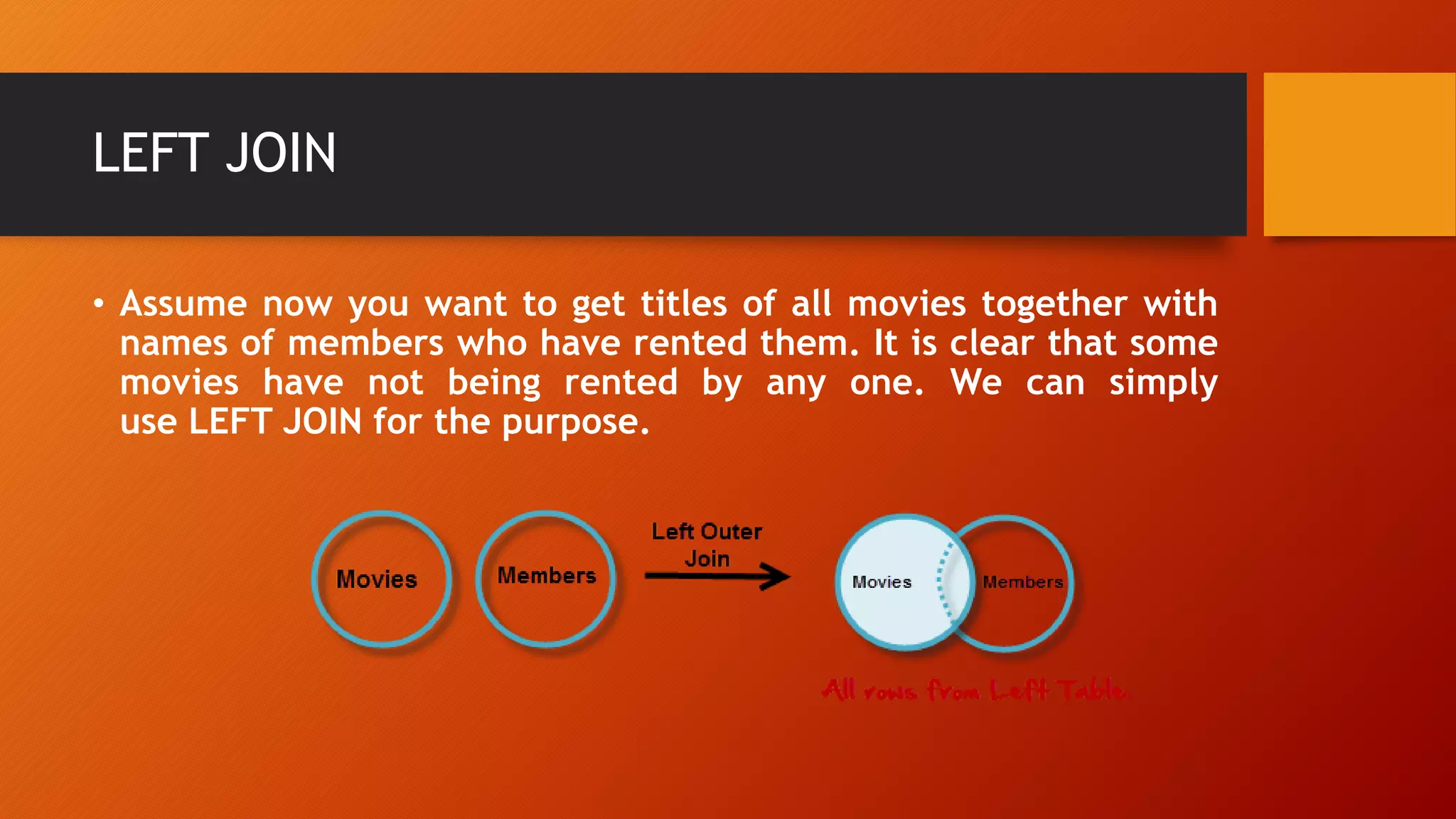
• Assume now you want to get titles of all movies together with
names of members who have rented them. It is clear that some
movies have not being rented by any one. We can simply
use LEFT JOIN for the purpose.
SYNTAX
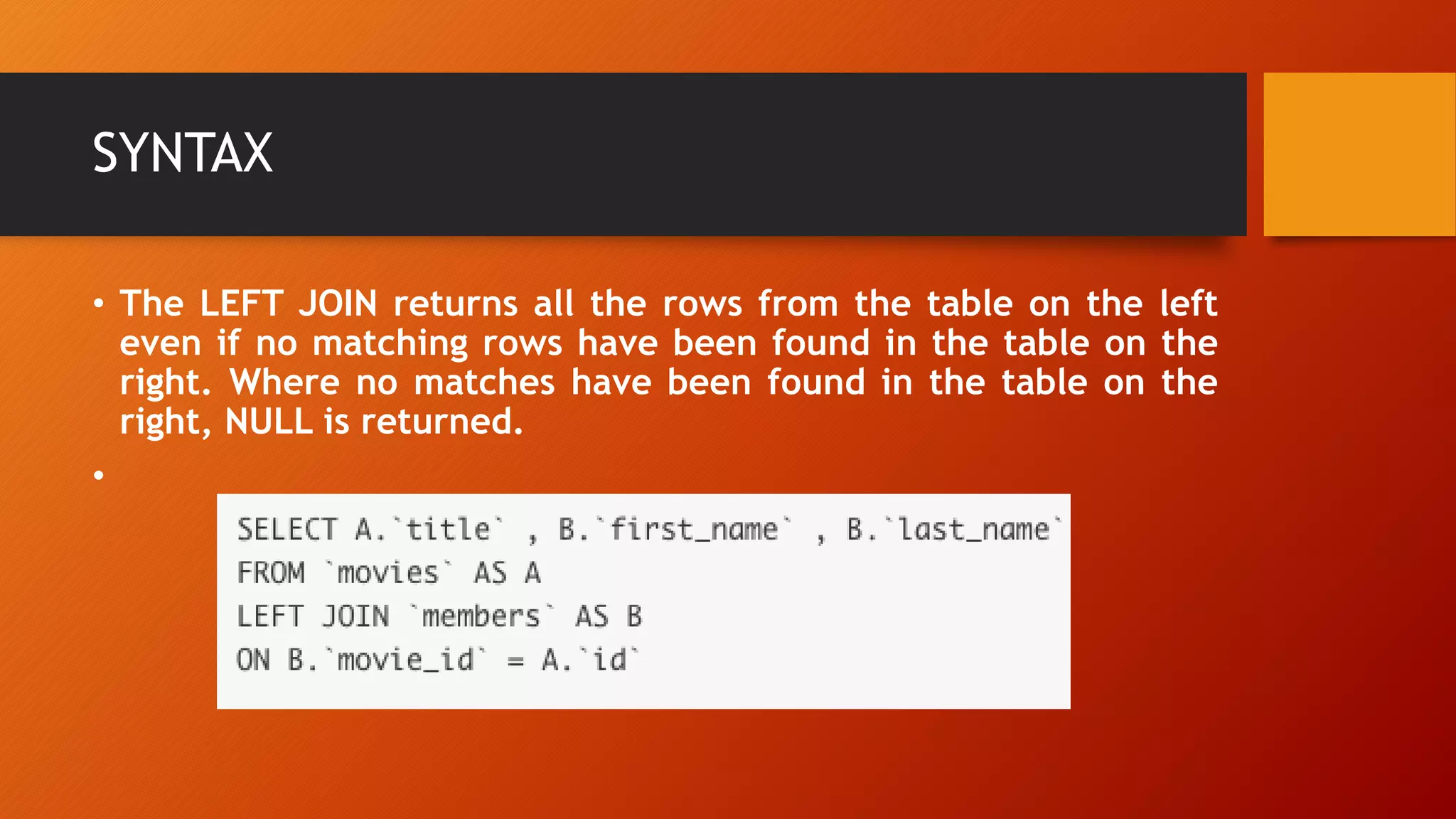
• The LEFT JOIN returns all the rows from the table on the left
even if no matching rows have been found in the table on the
right. Where no matches have been found in the table on the
right, NULL is returned.
•
RIGHT JOIN
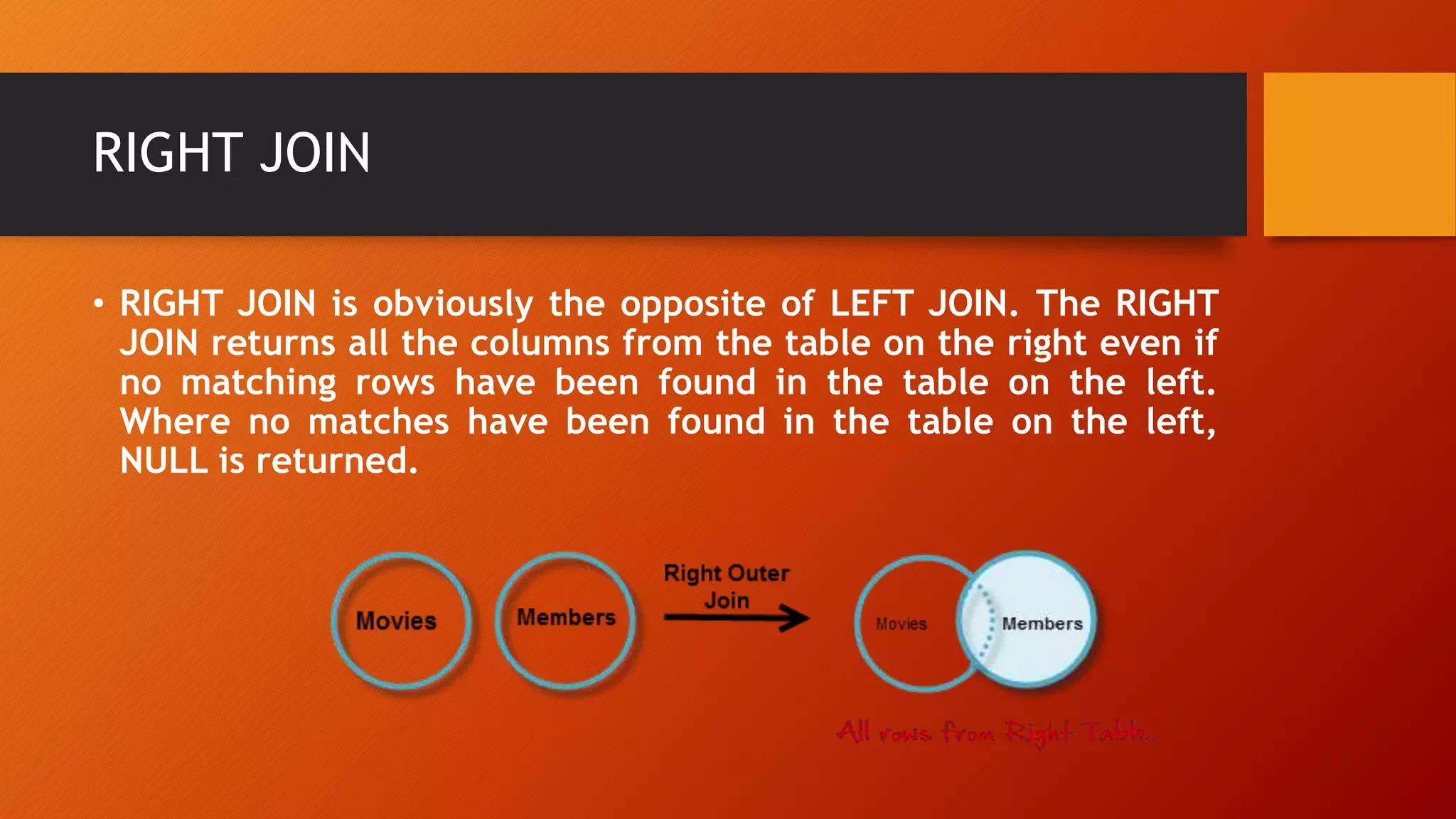
• RIGHT JOIN is obviously the opposite of LEFT JOIN. The RIGHT
JOIN returns all the columns from the table on the right even if
no matching rows have been found in the table on the left.
Where no matches have been found in the table on the left,
NULL is returned.
SYNTAX
SUMMARY
• JOINS allow us to combine data from more than one
table into a single result set.
• JOINS have better performance compared to sub
queries
• INNER JOINS only return rows that meet the given
criteria.
• OUTER JOINS can also return rows where no matches
have been found. The unmatched rows are returned
with the NULL keyword.
Continue…
• The major JOIN types include Inner, Left Outer, Right
Outer, Cross JOINS etc.
• The frequently used clause in JOIN operations is "ON".
"USING" clause requires that matching columns be of
the same name.
• JOINS can also be used in other clauses such as GROUP
BY, WHERE, SUB QUERIES, AGGREGATE FUNCTIONS etc.
R
E
F
E
R
E
N
C
E
S
WWW.W3RESOURCES.COM
WWW.WIKIPEDIA.COM
WWW.TUTORIALSPOINT.COM
THANKS FOR LISTENING ME …

Joins

  • 1.
  • 2.
  • 3.
    #JOINS •Joins help retrievingdata from two or more database tables. •The tables are mutually related using primary and foreign keys.
  • 4.
    WHY TO USEJOINS ???? • We can run queries one by one, use output of each in successive queries. Of course, that is possible. But using JOINs, you can get the work done by using only a one query with any search parameters. • On the other hand MySQL can achieve better performance with JOINs as it can use Indexing. • Simply use of single JOIN query instead running multiple queries do reduce server overhead.
  • 5.
    WHAT JOIN DO?? • Joins help retrieving data from two or more database tables. • The tables are mutually related using primary and foreign keys. • It can join the table vertically as well as horizontally. Table A Table B Table A Table B
  • 6.
  • 7.
  • 8.
  • 9.
    TYPES OF JOINS •CROSS JOIN OR CARTESSIAN PRODUCT • INNER JOIN • OUTER JOINS • LEFT JOIN • RIGHT JOIN
  • 10.
    CROSS JOIN • CrossJOIN is a simplest form of JOINs which matches each row from one database table to all rows of another • In other words it gives us combinations of each row of first table with all records in second table. • Syntax: SELECT * FROM ‘movies’ CROSS JOIN ‘members’
  • 12.
    INNER JOIN • Theinner JOIN is used to return rows from both tables that satisfy the given condition. • Syntax: SELECT members.’first_name’ , members.`last_name` , movies.`title` FROM members ,movies WHERE movies.`id` = members.`movie_id`
  • 14.
    OUTER JOIN • MySQLOuter JOINs return all records matching from both tables . • It can detect records having no match in joined table. It returns NULL values for records of joined table if no match is found. • Sounds Confusing ? Let's look into an example -
  • 15.
    LEFT JOIN • Assumenow you want to get titles of all movies together with names of members who have rented them. It is clear that some movies have not being rented by any one. We can simply use LEFT JOIN for the purpose.
  • 16.
    SYNTAX • The LEFTJOIN returns all the rows from the table on the left even if no matching rows have been found in the table on the right. Where no matches have been found in the table on the right, NULL is returned. •
  • 18.
    RIGHT JOIN • RIGHTJOIN is obviously the opposite of LEFT JOIN. The RIGHT JOIN returns all the columns from the table on the right even if no matching rows have been found in the table on the left. Where no matches have been found in the table on the left, NULL is returned.
  • 19.
  • 21.
    SUMMARY • JOINS allowus to combine data from more than one table into a single result set. • JOINS have better performance compared to sub queries • INNER JOINS only return rows that meet the given criteria. • OUTER JOINS can also return rows where no matches have been found. The unmatched rows are returned with the NULL keyword.
  • 22.
    Continue… • The majorJOIN types include Inner, Left Outer, Right Outer, Cross JOINS etc. • The frequently used clause in JOIN operations is "ON". "USING" clause requires that matching columns be of the same name. • JOINS can also be used in other clauses such as GROUP BY, WHERE, SUB QUERIES, AGGREGATE FUNCTIONS etc.
  • 23.
  • 24.