

SQLSERVER PERFORMANCE
TUNING
Presenter: Trịnh Hồng Chương
AGENDA
About my company – ANS-ASIA, and me
About SQL Performance
Indexing
Rewrite query
SQLServer tools to improve performance.
ABOUT
100% subsidiary of ANS Japan
Address : 10F CMC Tower, Duy Tan Street
Foudation : November 2012
Employees : 30
Business function :Business function :
Software development
Enterprise system (100% Japanese customer up to now)
(Sales management system, Enterprise system for transportation
industry, Tuition management system for university...)
IT consulting
ABOUT ME
Name: Trinh Hong Chuong
Skill: 6 years experience in software development
(.Net (VB.Net, C#), T-SQL, PL-SQL, VBA)
Beginner in PHP, PostgreSQL
Interesting in: Reading book, listening music,
walking alone, travelling, ….walking alone, travelling, ….
SQL PERFORMANCE
Assess the problem and establish numeric values
that categorize acceptable behavior.
Measure the performance of the system before
modification.
Identify the part of the system that is critical for
improving the performance. This is called
the bottleneck.
improving the performance. This is called
the bottleneck.
Modify that part of the system to remove the
bottleneck.
Measure the performance of the system after
modification.
If the modification makes the performance better,
adopt it. If the modification makes the
performance worse, put it back the way it was.
WHAT’S INDEXING
Index is shortcuts to real data
Data type structure: B-Tree
Types of indexes: Clustered, Non-Clustered, XML
index, Fulltext index
WHY’S INDEXING
An index is used to speed up searching in the
database.
Indexes can be helpful for a variety of queries
that contain SELECT, UPDATE, DELETE, or
MERGE statements.
Less items in primary keyLess items in primary key
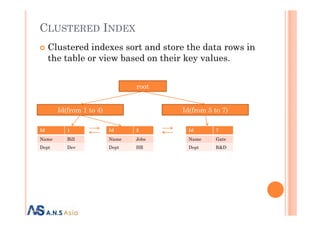
CLUSTERED INDEX
Clustered indexes sort and store the data rows in
the table or view based on their key values.
root
Id(from 1 to 4) Id(from 5 to 7)Id(from 1 to 4) Id(from 5 to 7)
Id 1
Name Bill
Dept Dev
Id 2
Name Jobs
Dept HR
Id 7
Name Gate
Dept R&D
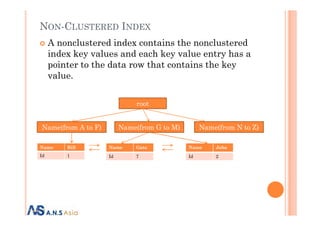
NON-CLUSTERED INDEX
A nonclustered index contains the nonclustered
index key values and each key value entry has a
pointer to the data row that contains the key
value.
root
Name(from A to F)
Name Bill
Id 1
Name Gate
Id 7
Name Jobs
Id 2
Name(from G to M) Name(from N to Z)
IMPROVE INDEX
Create Highly-Selective Indexes
Indexing on columns used in the WHERE clause of
your critical queries frequently improves
performance.
Selectivity is the ratio of qualifying rows to total
rows. If the ratio is low, the index is highly selective.
Create Multiple-Column IndexesCreate Multiple-Column Indexes
REWRITE QUERY
Use a search argument (SARG)
SARG operators include =, >, <, >=, <=, IN,
BETWEEN, and sometimes LIKE (in cases of prefix
matching, such as LIKE ‘Bill%')
Non-SARG operators include NOT, <>, NOT EXISTS,
NOT IN, NOT LIKE, and intrinsic functions
REWRITE QUERY
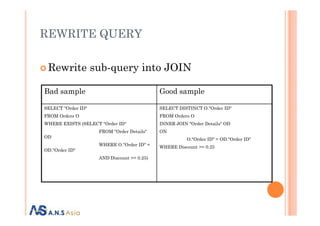
Rewrite sub-query into JOIN
Bad sample Good sample
SELECT "Order ID" SELECT DISTINCT O."Order ID"
FROM Orders O
WHERE EXISTS (SELECT "Order ID"
FROM "Order Details"
OD
WHERE O."Order ID" =
OD."Order ID"
AND Discount >= 0.25)
FROM Orders O
INNER JOIN "Order Details" OD
ON
O."Order ID" = OD."Order ID"
WHERE Discount >= 0.25
REWRITE QUERY
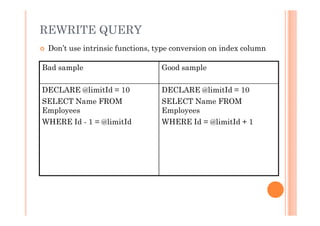
Don’t use intrinsic functions, type conversion on index column
Bad sample Good sample
DECLARE @limitId = 10
SELECT Name FROM
Employees
DECLARE @limitId = 10
SELECT Name FROM
EmployeesEmployees
WHERE Id - 1 = @limitId
Employees
WHERE Id = @limitId + 1
REWRITE QUERY
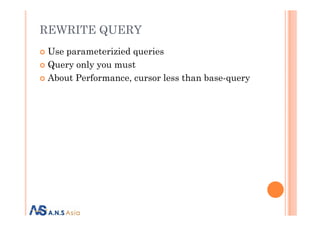
Use parameterizied queries
Query only you must
About Performance, cursor less than base-query
REWRITE QUERY
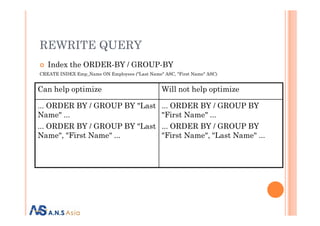
Index the ORDER-BY / GROUP-BY
CREATE INDEX Emp_Name ON Employees ("Last Name" ASC, "First Name" ASC)
Can help optimize Will not help optimize
... ORDER BY / GROUP BY "Last
Name" ...
... ORDER BY / GROUP BY
"First Name" ...Name" ...
... ORDER BY / GROUP BY "Last
Name", "First Name" ...
"First Name" ...
... ORDER BY / GROUP BY
"First Name", "Last Name" ...
REWRITE QUERY
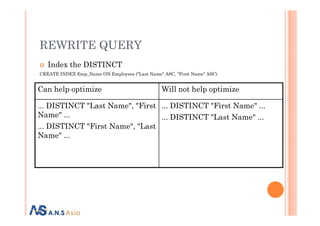
Index the DISTINCT
CREATE INDEX Emp_Name ON Employees ("Last Name" ASC, "First Name" ASC)
Can help optimize Will not help optimize
... DISTINCT "Last Name", "First
Name" ...
... DISTINCT "First Name" ...
... DISTINCT "Last Name" ...Name" ...
... DISTINCT "First Name", "Last
Name" ...
... DISTINCT "Last Name" ...
SQLServer tools to improve performance.
Execution plan
CREATE TABLE Employees
(
Id BIGINT NOT NULL,
Name VARCHAR(20) NOT NULL,
Dept VARCHAR(10),
CONSTRAINT [PK_Employee] PRIMARY KEY
CLUSTERED
(Id ASC)
)
CREATE TABLE Employees_Mid
(
Id BIGINT NOT NULL,
Name VARCHAR(20) NOT NULL,
Dept VARCHAR(10),
CONSTRAINT [PK_Employee_Mid] PRIMARY KEY
CLUSTERED
(Id ASC)
)
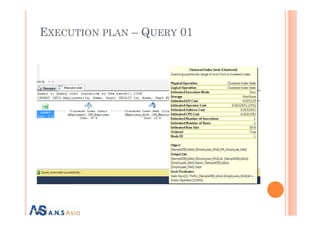
Query 01
INSERT INTO Employees(Id, Name, Dept)
SELECT Id, Name, Dept FROM Employees_Mid
WHERE Employees_Mid.Id = 1000
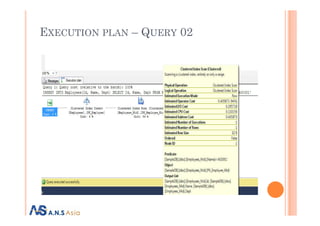
Query 02
INSERT INTO Employees(Id, Name, Dept)
SELECT Id, Name, Dept FROM Employees_Mid
WHERE Employees_Mid.Name = ‘A00001’
EXECUTION PLAN – QUERY 01
EXECUTION PLAN – QUERY 02
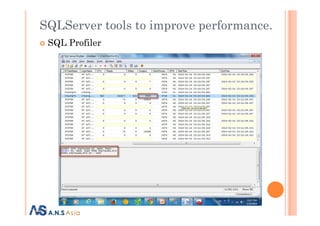
SQLServer tools to improve performance.
SQL Profiler
REFERENCE
http://technet.microsoft.com
http://www.sqlviet.com
SQA server performance tuning

SQA server performance tuning

  • 1.
  • 2.
    AGENDA About my company– ANS-ASIA, and me About SQL Performance Indexing Rewrite query SQLServer tools to improve performance.
  • 3.
    ABOUT 100% subsidiary ofANS Japan Address : 10F CMC Tower, Duy Tan Street Foudation : November 2012 Employees : 30 Business function :Business function : Software development Enterprise system (100% Japanese customer up to now) (Sales management system, Enterprise system for transportation industry, Tuition management system for university...) IT consulting
  • 4.
    ABOUT ME Name: TrinhHong Chuong Skill: 6 years experience in software development (.Net (VB.Net, C#), T-SQL, PL-SQL, VBA) Beginner in PHP, PostgreSQL Interesting in: Reading book, listening music, walking alone, travelling, ….walking alone, travelling, ….
  • 5.
    SQL PERFORMANCE Assess theproblem and establish numeric values that categorize acceptable behavior. Measure the performance of the system before modification. Identify the part of the system that is critical for improving the performance. This is called the bottleneck. improving the performance. This is called the bottleneck. Modify that part of the system to remove the bottleneck. Measure the performance of the system after modification. If the modification makes the performance better, adopt it. If the modification makes the performance worse, put it back the way it was.
  • 6.
    WHAT’S INDEXING Index isshortcuts to real data Data type structure: B-Tree Types of indexes: Clustered, Non-Clustered, XML index, Fulltext index
  • 7.
    WHY’S INDEXING An indexis used to speed up searching in the database. Indexes can be helpful for a variety of queries that contain SELECT, UPDATE, DELETE, or MERGE statements. Less items in primary keyLess items in primary key
  • 8.
    CLUSTERED INDEX Clustered indexessort and store the data rows in the table or view based on their key values. root Id(from 1 to 4) Id(from 5 to 7)Id(from 1 to 4) Id(from 5 to 7) Id 1 Name Bill Dept Dev Id 2 Name Jobs Dept HR Id 7 Name Gate Dept R&D
  • 9.
    NON-CLUSTERED INDEX A nonclusteredindex contains the nonclustered index key values and each key value entry has a pointer to the data row that contains the key value. root Name(from A to F) Name Bill Id 1 Name Gate Id 7 Name Jobs Id 2 Name(from G to M) Name(from N to Z)
  • 10.
    IMPROVE INDEX Create Highly-SelectiveIndexes Indexing on columns used in the WHERE clause of your critical queries frequently improves performance. Selectivity is the ratio of qualifying rows to total rows. If the ratio is low, the index is highly selective. Create Multiple-Column IndexesCreate Multiple-Column Indexes
  • 11.
    REWRITE QUERY Use asearch argument (SARG) SARG operators include =, >, <, >=, <=, IN, BETWEEN, and sometimes LIKE (in cases of prefix matching, such as LIKE ‘Bill%') Non-SARG operators include NOT, <>, NOT EXISTS, NOT IN, NOT LIKE, and intrinsic functions
  • 12.
    REWRITE QUERY Rewrite sub-queryinto JOIN Bad sample Good sample SELECT "Order ID" SELECT DISTINCT O."Order ID" FROM Orders O WHERE EXISTS (SELECT "Order ID" FROM "Order Details" OD WHERE O."Order ID" = OD."Order ID" AND Discount >= 0.25) FROM Orders O INNER JOIN "Order Details" OD ON O."Order ID" = OD."Order ID" WHERE Discount >= 0.25
  • 13.
    REWRITE QUERY Don’t useintrinsic functions, type conversion on index column Bad sample Good sample DECLARE @limitId = 10 SELECT Name FROM Employees DECLARE @limitId = 10 SELECT Name FROM EmployeesEmployees WHERE Id - 1 = @limitId Employees WHERE Id = @limitId + 1
  • 14.
    REWRITE QUERY Use parameteriziedqueries Query only you must About Performance, cursor less than base-query
  • 15.
    REWRITE QUERY Index theORDER-BY / GROUP-BY CREATE INDEX Emp_Name ON Employees ("Last Name" ASC, "First Name" ASC) Can help optimize Will not help optimize ... ORDER BY / GROUP BY "Last Name" ... ... ORDER BY / GROUP BY "First Name" ...Name" ... ... ORDER BY / GROUP BY "Last Name", "First Name" ... "First Name" ... ... ORDER BY / GROUP BY "First Name", "Last Name" ...
  • 16.
    REWRITE QUERY Index theDISTINCT CREATE INDEX Emp_Name ON Employees ("Last Name" ASC, "First Name" ASC) Can help optimize Will not help optimize ... DISTINCT "Last Name", "First Name" ... ... DISTINCT "First Name" ... ... DISTINCT "Last Name" ...Name" ... ... DISTINCT "First Name", "Last Name" ... ... DISTINCT "Last Name" ...
  • 17.
    SQLServer tools toimprove performance. Execution plan CREATE TABLE Employees ( Id BIGINT NOT NULL, Name VARCHAR(20) NOT NULL, Dept VARCHAR(10), CONSTRAINT [PK_Employee] PRIMARY KEY CLUSTERED (Id ASC) ) CREATE TABLE Employees_Mid ( Id BIGINT NOT NULL, Name VARCHAR(20) NOT NULL, Dept VARCHAR(10), CONSTRAINT [PK_Employee_Mid] PRIMARY KEY CLUSTERED (Id ASC) ) Query 01 INSERT INTO Employees(Id, Name, Dept) SELECT Id, Name, Dept FROM Employees_Mid WHERE Employees_Mid.Id = 1000 Query 02 INSERT INTO Employees(Id, Name, Dept) SELECT Id, Name, Dept FROM Employees_Mid WHERE Employees_Mid.Name = ‘A00001’
  • 18.
  • 19.
  • 20.
    SQLServer tools toimprove performance. SQL Profiler
  • 21.