Presented By: Carrie Smith
 Creator   of www.carefulcents.com

            for SpringCoin‟s blog
 Contributor
 (www.springcoin.com/blog)

 Blogger   for Huffington Post
 Understanding    & improving your credit
 score

 Using   credit cards responsibly

 Debt   Relief Options
 What   is a credit score?
 • Ranges from 300-850
 • Most common type of score: FICO
 • (3) Major Credit Reporting Agencies:
    Equifax
    Transunion
    Experian
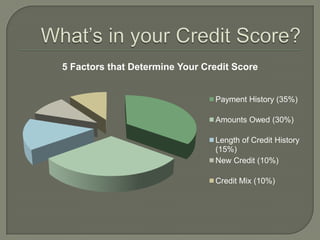
5 Factors that Determine Your Credit Score


                                Payment History (35%)

                                Amounts Owed (30%)

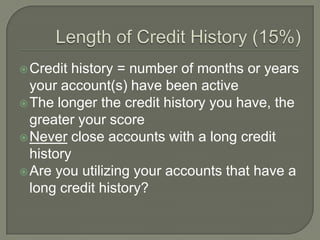
                                Length of Credit History
                                (15%)
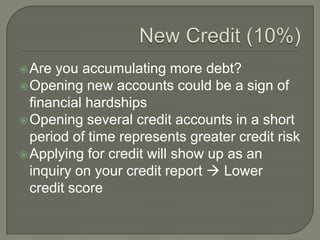
                                New Credit (10%)

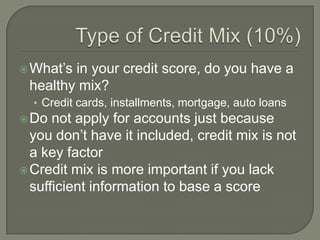
                                Credit Mix (10%)
   What‟s your track record?
     • Do you have a proven track record of paying your bills on time?
   What factors into your payment history?
     • Public Records/Collections
     • Bankruptcy
     • Liens
     • Judgments
   Missed Payments
     • How late were they? (30, 60, 90+ days late)
     • A 30 day late payment that just happened a month ago will have more weight than
       a 90 day late payment that happened two years ago.
 Ruleof thumb is to utilize <30% of your
 available credit
  • Example: A credit card with a $10,000 credit limit
   shouldn‟t exceed a balance of more then $3,000
 Carrying a balance doesn‟t mean you‟re a
 high risk borrower
 Credit history = number of months or years
  your account(s) have been active
 The longer the credit history you have, the
  greater your score
 Never close accounts with a long credit
  history
 Are you utilizing your accounts that have a
  long credit history?
 Are you accumulating more debt?
 Opening new accounts could be a sign of
  financial hardships
 Opening several credit accounts in a short
  period of time represents greater credit risk
 Applying for credit will show up as an
  inquiry on your credit report  Lower
  credit score
 What‟sin your credit score, do you have a
 healthy mix?
  • Credit cards, installments, mortgage, auto loans
 Do  not apply for accounts just because
  you don‟t have it included, credit mix is not
  a key factor
 Credit mix is more important if you lack
  sufficient information to base a score
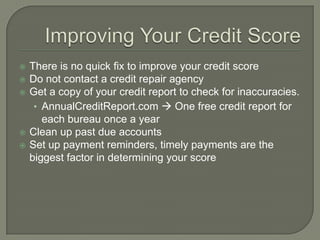
   There is no quick fix to improve your credit score
   Do not contact a credit repair agency
   Get a copy of your credit report to check for inaccuracies.
     • AnnualCreditReport.com  One free credit report for
       each bureau once a year
   Clean up past due accounts
   Set up payment reminders, timely payments are the
    biggest factor in determining your score
 Apply for a secured credit card
  • Easy approval
  • Cash as collateral in case of default
  • Make sure bank is reporting to all three major credit
       bureaus
   •   Utilize this account while paying off balance every
       month, do not exceed more than 30% of your credit
       limit
   •   Will not get a rejection on your credit report (this will
       hurt your credit)
   •   Rejections are easily spotted if there is an inquiry and
       no corresponding accounts opened
   •   If possible, try to open 2-3 secured credit cards
 Payment History = Single most important
  factor, establish trust with creditors
 Don‟t utilize more than 30% of your available credit
  limit
 Never close accounts with a long credit history
 Get a free copy of your credit report at
  www.annualcreditreport.com
 Avoid credit repair agencies
 Secured credit cards are the best way to improve
  your credit score
 Creditcards are necessary in today‟s
 society
  • Rental Cars
     Security Deposit
  • Hotels
     Incidentals
  • Fraud Protection
     Better protection over debit cards
 Interest   Rate

 Annual     Fees

 Available   Credit Limit

 Cash   back/Rewards
 Typically   carry a high interest rate
  • Monthly payments get credited towards general
   purchases first

 Look   over monthly statements
  • Subscription Services
  • Transaction Errors, interest rates
 Don‟t   carry a balance over 30% of your
  credit limit
 If you can‟t pay off the balance in
  full, always try to pay more than the
  minimum payment
 Don‟t mistaken your available credit as
  “free money”
 Limit the number of credit cards you have
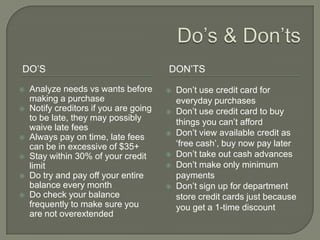
DO‟S                                    DON‟TS

   Analyze needs vs wants before          Don‟t use credit card for
    making a purchase                       everyday purchases
   Notify creditors if you are going      Don‟t use credit card to buy
    to be late, they may possibly           things you can‟t afford
    waive late fees
   Always pay on time, late fees          Don‟t view available credit as
    can be in excessive of $35+             „free cash‟, buy now pay later
   Stay within 30% of your credit         Don‟t take out cash advances
    limit                                  Don‟t make only minimum
   Do try and pay off your entire          payments
    balance every month                    Don‟t sign up for department
   Do check your balance                   store credit cards just because
    frequently to make sure you             you get a 1-time discount
    are not overextended
 Watch  out for introductory/teaser rates
 Monitor monthly statements
 Always pay off balance in full or more than
  minimum payment
 Don‟t carry a balance over 30% of
  available credit
 Avoid cash advances
 Separate needs vs wants
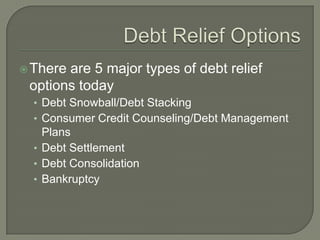
 Thereare 5 major types of debt relief
 options today
  • Debt Snowball/Debt Stacking
  • Consumer Credit Counseling/Debt Management
    Plans
  • Debt Settlement
  • Debt Consolidation
  • Bankruptcy
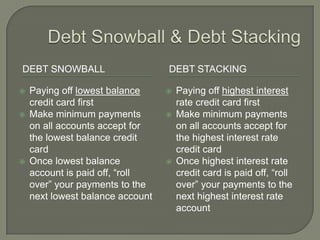
DEBT SNOWBALL                     DEBT STACKING

   Paying off lowest balance        Paying off highest interest
    credit card first                 rate credit card first
   Make minimum payments            Make minimum payments
    on all accounts accept for        on all accounts accept for
    the lowest balance credit         the highest interest rate
    card                              credit card
   Once lowest balance              Once highest interest rate
    account is paid off, “roll        credit card is paid off, “roll
    over” your payments to the        over” your payments to the
    next lowest balance account       next highest interest rate
                                      account
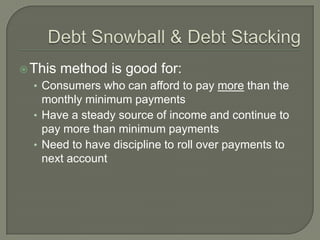
 This   method is good for:
  • Consumers who can afford to pay more than the
    monthly minimum payments
  • Have a steady source of income and continue to
    pay more than minimum payments
  • Need to have discipline to roll over payments to
    next account
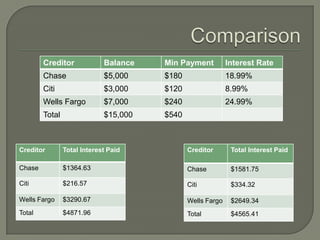
Creditor             Balance   Min Payment          Interest Rate
        Chase                $5,000    $180                 18.99%
        Citi                 $3,000    $120                 8.99%
        Wells Fargo          $7,000    $240                 24.99%
        Total                $15,000   $540


Creditor        Total Interest Paid           Creditor       Total Interest Paid

Chase           $1364.63                      Chase          $1581.75

Citi            $216.57                       Citi           $334.32

Wells Fargo     $3290.67                      Wells Fargo    $2649.34
Total           $4871.96                      Total          $4565.41
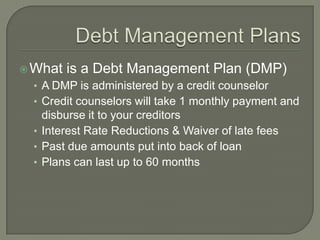
 What   is a Debt Management Plan (DMP)
 • A DMP is administered by a credit counselor
 • Credit counselors will take 1 monthly payment and
   disburse it to your creditors
 • Interest Rate Reductions & Waiver of late fees
 • Past due amounts put into back of loan
 • Plans can last up to 60 months
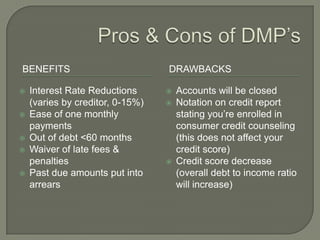
BENEFITS                          DRAWBACKS

   Interest Rate Reductions         Accounts will be closed
    (varies by creditor, 0-15%)      Notation on credit report
   Ease of one monthly               stating you‟re enrolled in
    payments                          consumer credit counseling
   Out of debt <60 months            (this does not affect your
   Waiver of late fees &             credit score)
    penalties                        Credit score decrease
   Past due amounts put into         (overall debt to income ratio
    arrears                           will increase)
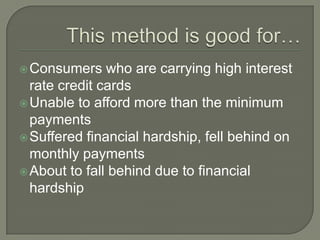
 Consumers    who are carrying high interest
  rate credit cards
 Unable to afford more than the minimum
  payments
 Suffered financial hardship, fell behind on
  monthly payments
 About to fall behind due to financial
  hardship
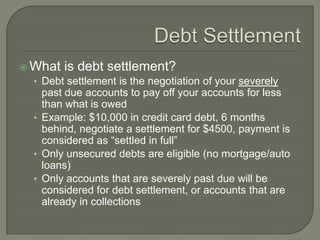
 What is debt settlement?
  • Debt settlement is the negotiation of your severely
     past due accounts to pay off your accounts for less
     than what is owed
   • Example: $10,000 in credit card debt, 6 months
     behind, negotiate a settlement for $4500, payment is
     considered as “settled in full”
   • Only unsecured debts are eligible (no mortgage/auto
     loans)
   • Only accounts that are severely past due will be
     considered for debt settlement, or accounts that are
     already in collections
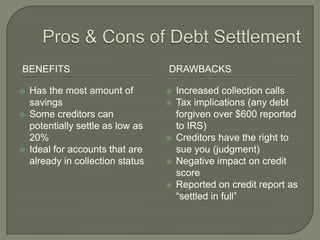
BENEFITS                           DRAWBACKS

   Has the most amount of            Increased collection calls
    savings                           Tax implications (any debt
   Some creditors can                 forgiven over $600 reported
    potentially settle as low as       to IRS)
    20%                               Creditors have the right to
   Ideal for accounts that are        sue you (judgment)
    already in collection status      Negative impact on credit
                                       score
                                      Reported on credit report as
                                       “settled in full”
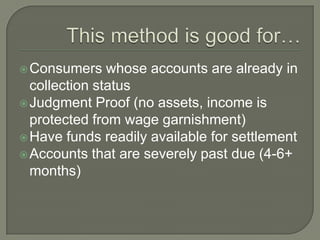
 Consumers    whose accounts are already in
  collection status
 Judgment Proof (no assets, income is
  protected from wage garnishment)
 Have funds readily available for settlement
 Accounts that are severely past due (4-6+
  months)
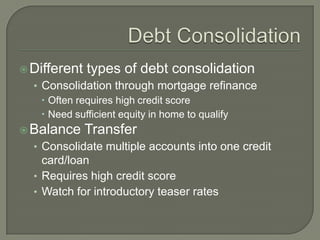
 Different   types of debt consolidation
  • Consolidation through mortgage refinance
     Often requires high credit score
     Need sufficient equity in home to qualify
 Balance     Transfer
  • Consolidate multiple accounts into one credit
    card/loan
  • Requires high credit score
  • Watch for introductory teaser rates
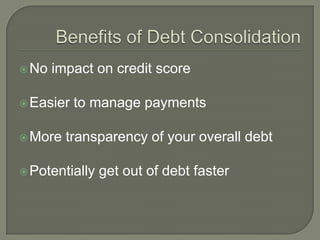
 No   impact on credit score

 Easier   to manage payments

 More   transparency of your overall debt

 Potentially   get out of debt faster
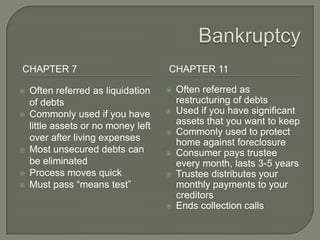
CHAPTER 7                            CHAPTER 11

   Often referred as liquidation       Often referred as
    of debts                             restructuring of debts
   Commonly used if you have           Used if you have significant
    little assets or no money left       assets that you want to keep
                                        Commonly used to protect
    over after living expenses           home against foreclosure
   Most unsecured debts can            Consumer pays trustee
    be eliminated                        every month, lasts 3-5 years
   Process moves quick                 Trustee distributes your
   Must pass “means test”               monthly payments to your
                                         creditors
                                        Ends collection calls
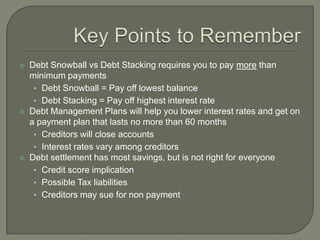
   Debt Snowball vs Debt Stacking requires you to pay more than
    minimum payments
     • Debt Snowball = Pay off lowest balance
     • Debt Stacking = Pay off highest interest rate
   Debt Management Plans will help you lower interest rates and get on
    a payment plan that lasts no more than 60 months
     • Creditors will close accounts
     • Interest rates vary among creditors
   Debt settlement has most savings, but is not right for everyone
     • Credit score implication
     • Possible Tax liabilities
     • Creditors may sue for non payment
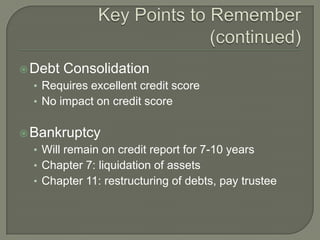
 Debt   Consolidation
  • Requires excellent credit score
  • No impact on credit score


 Bankruptcy
  • Will remain on credit report for 7-10 years
  • Chapter 7: liquidation of assets
  • Chapter 11: restructuring of debts, pay trustee
 Email:   support@springcoin.com

 Phone:   866-771-3511

Understanding Your Credit with SpringCoin

  • 1.
  • 2.
     Creator of www.carefulcents.com for SpringCoin‟s blog  Contributor (www.springcoin.com/blog)  Blogger for Huffington Post
  • 3.
     Understanding & improving your credit score  Using credit cards responsibly  Debt Relief Options
  • 4.
     What is a credit score? • Ranges from 300-850 • Most common type of score: FICO • (3) Major Credit Reporting Agencies:  Equifax  Transunion  Experian
  • 5.
    5 Factors thatDetermine Your Credit Score Payment History (35%) Amounts Owed (30%) Length of Credit History (15%) New Credit (10%) Credit Mix (10%)
  • 6.
    What‟s your track record? • Do you have a proven track record of paying your bills on time?  What factors into your payment history? • Public Records/Collections • Bankruptcy • Liens • Judgments  Missed Payments • How late were they? (30, 60, 90+ days late) • A 30 day late payment that just happened a month ago will have more weight than a 90 day late payment that happened two years ago.
  • 7.
     Ruleof thumbis to utilize <30% of your available credit • Example: A credit card with a $10,000 credit limit shouldn‟t exceed a balance of more then $3,000  Carrying a balance doesn‟t mean you‟re a high risk borrower
  • 8.
     Credit history= number of months or years your account(s) have been active  The longer the credit history you have, the greater your score  Never close accounts with a long credit history  Are you utilizing your accounts that have a long credit history?
  • 9.
     Are youaccumulating more debt?  Opening new accounts could be a sign of financial hardships  Opening several credit accounts in a short period of time represents greater credit risk  Applying for credit will show up as an inquiry on your credit report  Lower credit score
  • 10.
     What‟sin yourcredit score, do you have a healthy mix? • Credit cards, installments, mortgage, auto loans  Do not apply for accounts just because you don‟t have it included, credit mix is not a key factor  Credit mix is more important if you lack sufficient information to base a score
  • 11.
    There is no quick fix to improve your credit score  Do not contact a credit repair agency  Get a copy of your credit report to check for inaccuracies. • AnnualCreditReport.com  One free credit report for each bureau once a year  Clean up past due accounts  Set up payment reminders, timely payments are the biggest factor in determining your score
  • 12.
     Apply fora secured credit card • Easy approval • Cash as collateral in case of default • Make sure bank is reporting to all three major credit bureaus • Utilize this account while paying off balance every month, do not exceed more than 30% of your credit limit • Will not get a rejection on your credit report (this will hurt your credit) • Rejections are easily spotted if there is an inquiry and no corresponding accounts opened • If possible, try to open 2-3 secured credit cards
  • 13.
     Payment History= Single most important factor, establish trust with creditors  Don‟t utilize more than 30% of your available credit limit  Never close accounts with a long credit history  Get a free copy of your credit report at www.annualcreditreport.com  Avoid credit repair agencies  Secured credit cards are the best way to improve your credit score
  • 14.
     Creditcards arenecessary in today‟s society • Rental Cars  Security Deposit • Hotels  Incidentals • Fraud Protection  Better protection over debit cards
  • 15.
     Interest Rate  Annual Fees  Available Credit Limit  Cash back/Rewards
  • 16.
     Typically carry a high interest rate • Monthly payments get credited towards general purchases first  Look over monthly statements • Subscription Services • Transaction Errors, interest rates
  • 17.
     Don‟t carry a balance over 30% of your credit limit  If you can‟t pay off the balance in full, always try to pay more than the minimum payment  Don‟t mistaken your available credit as “free money”  Limit the number of credit cards you have
  • 18.
    DO‟S DON‟TS  Analyze needs vs wants before  Don‟t use credit card for making a purchase everyday purchases  Notify creditors if you are going  Don‟t use credit card to buy to be late, they may possibly things you can‟t afford waive late fees  Always pay on time, late fees  Don‟t view available credit as can be in excessive of $35+ „free cash‟, buy now pay later  Stay within 30% of your credit  Don‟t take out cash advances limit  Don‟t make only minimum  Do try and pay off your entire payments balance every month  Don‟t sign up for department  Do check your balance store credit cards just because frequently to make sure you you get a 1-time discount are not overextended
  • 19.
     Watch out for introductory/teaser rates  Monitor monthly statements  Always pay off balance in full or more than minimum payment  Don‟t carry a balance over 30% of available credit  Avoid cash advances  Separate needs vs wants
  • 20.
     Thereare 5major types of debt relief options today • Debt Snowball/Debt Stacking • Consumer Credit Counseling/Debt Management Plans • Debt Settlement • Debt Consolidation • Bankruptcy
  • 21.
    DEBT SNOWBALL DEBT STACKING  Paying off lowest balance  Paying off highest interest credit card first rate credit card first  Make minimum payments  Make minimum payments on all accounts accept for on all accounts accept for the lowest balance credit the highest interest rate card credit card  Once lowest balance  Once highest interest rate account is paid off, “roll credit card is paid off, “roll over” your payments to the over” your payments to the next lowest balance account next highest interest rate account
  • 22.
     This method is good for: • Consumers who can afford to pay more than the monthly minimum payments • Have a steady source of income and continue to pay more than minimum payments • Need to have discipline to roll over payments to next account
  • 23.
    Creditor Balance Min Payment Interest Rate Chase $5,000 $180 18.99% Citi $3,000 $120 8.99% Wells Fargo $7,000 $240 24.99% Total $15,000 $540 Creditor Total Interest Paid Creditor Total Interest Paid Chase $1364.63 Chase $1581.75 Citi $216.57 Citi $334.32 Wells Fargo $3290.67 Wells Fargo $2649.34 Total $4871.96 Total $4565.41
  • 24.
     What is a Debt Management Plan (DMP) • A DMP is administered by a credit counselor • Credit counselors will take 1 monthly payment and disburse it to your creditors • Interest Rate Reductions & Waiver of late fees • Past due amounts put into back of loan • Plans can last up to 60 months
  • 25.
    BENEFITS DRAWBACKS  Interest Rate Reductions  Accounts will be closed (varies by creditor, 0-15%)  Notation on credit report  Ease of one monthly stating you‟re enrolled in payments consumer credit counseling  Out of debt <60 months (this does not affect your  Waiver of late fees & credit score) penalties  Credit score decrease  Past due amounts put into (overall debt to income ratio arrears will increase)
  • 26.
     Consumers who are carrying high interest rate credit cards  Unable to afford more than the minimum payments  Suffered financial hardship, fell behind on monthly payments  About to fall behind due to financial hardship
  • 27.
     What isdebt settlement? • Debt settlement is the negotiation of your severely past due accounts to pay off your accounts for less than what is owed • Example: $10,000 in credit card debt, 6 months behind, negotiate a settlement for $4500, payment is considered as “settled in full” • Only unsecured debts are eligible (no mortgage/auto loans) • Only accounts that are severely past due will be considered for debt settlement, or accounts that are already in collections
  • 28.
    BENEFITS DRAWBACKS  Has the most amount of  Increased collection calls savings  Tax implications (any debt  Some creditors can forgiven over $600 reported potentially settle as low as to IRS) 20%  Creditors have the right to  Ideal for accounts that are sue you (judgment) already in collection status  Negative impact on credit score  Reported on credit report as “settled in full”
  • 29.
     Consumers whose accounts are already in collection status  Judgment Proof (no assets, income is protected from wage garnishment)  Have funds readily available for settlement  Accounts that are severely past due (4-6+ months)
  • 30.
     Different types of debt consolidation • Consolidation through mortgage refinance  Often requires high credit score  Need sufficient equity in home to qualify  Balance Transfer • Consolidate multiple accounts into one credit card/loan • Requires high credit score • Watch for introductory teaser rates
  • 31.
     No impact on credit score  Easier to manage payments  More transparency of your overall debt  Potentially get out of debt faster
  • 32.
    CHAPTER 7 CHAPTER 11  Often referred as liquidation  Often referred as of debts restructuring of debts  Commonly used if you have  Used if you have significant little assets or no money left assets that you want to keep  Commonly used to protect over after living expenses home against foreclosure  Most unsecured debts can  Consumer pays trustee be eliminated every month, lasts 3-5 years  Process moves quick  Trustee distributes your  Must pass “means test” monthly payments to your creditors  Ends collection calls
  • 33.
    Debt Snowball vs Debt Stacking requires you to pay more than minimum payments • Debt Snowball = Pay off lowest balance • Debt Stacking = Pay off highest interest rate  Debt Management Plans will help you lower interest rates and get on a payment plan that lasts no more than 60 months • Creditors will close accounts • Interest rates vary among creditors  Debt settlement has most savings, but is not right for everyone • Credit score implication • Possible Tax liabilities • Creditors may sue for non payment
  • 34.
     Debt Consolidation • Requires excellent credit score • No impact on credit score  Bankruptcy • Will remain on credit report for 7-10 years • Chapter 7: liquidation of assets • Chapter 11: restructuring of debts, pay trustee
  • 35.
     Email: support@springcoin.com  Phone: 866-771-3511