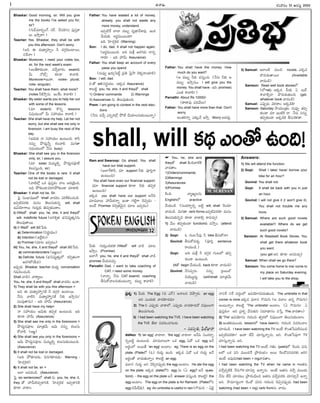
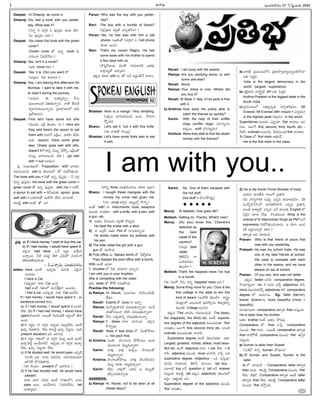
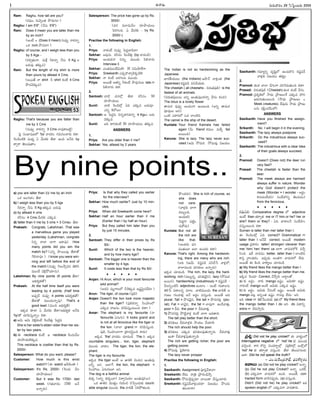
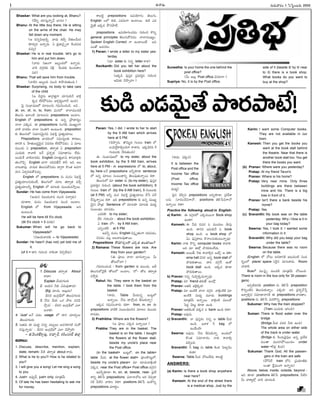
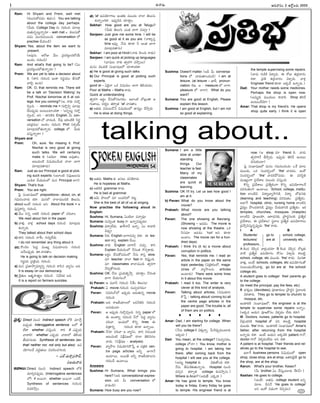
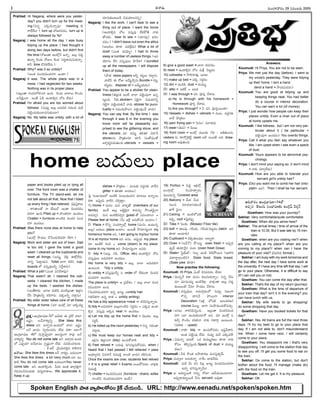
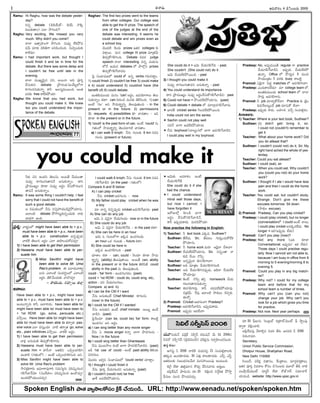
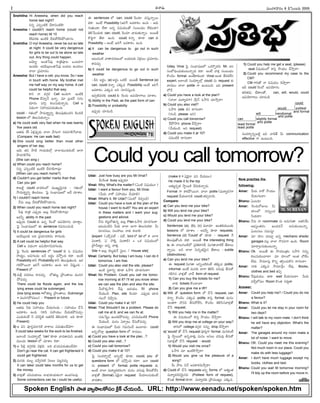
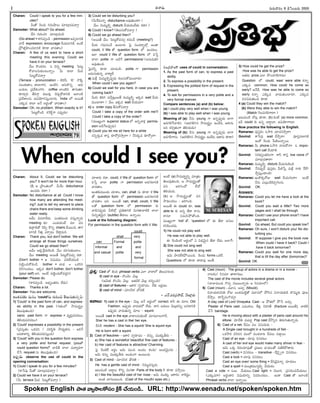
Kavita : How did you do in yesterday's
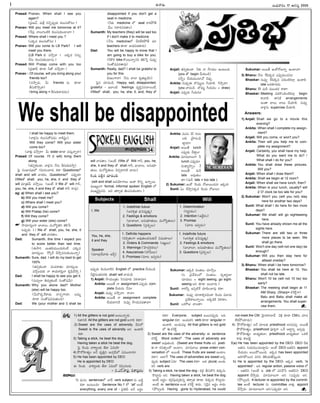
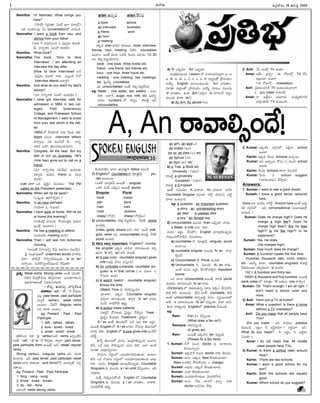
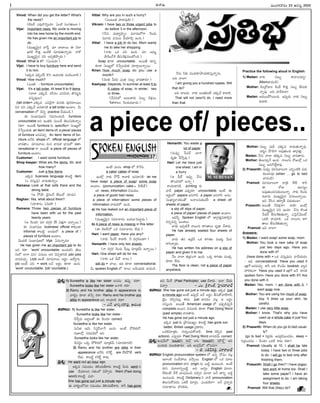
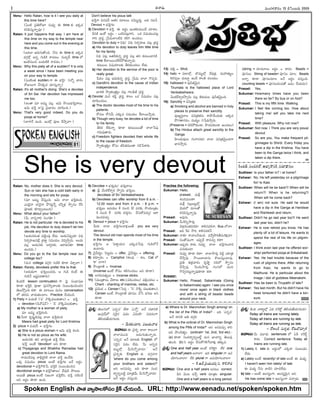
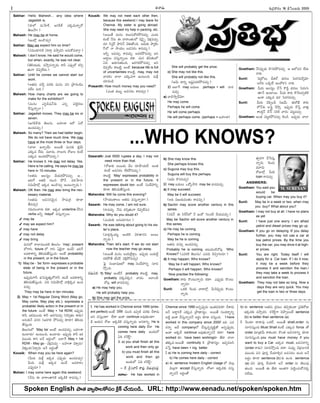
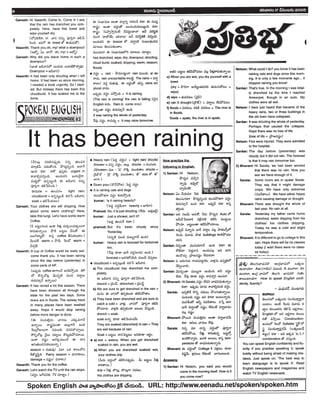
exam?
(Eìo í£K-¤Ûõª Óö° ô¦ø‹îËÂ?)
Suji : Well, I think. How did you do ?
(ò°Þ¥û¶ ô¦ø‹-ì-ìª-ÚÛªÙ-åª-û¦oìª. ìªîµyö°
ô¦ø‹îËÂ?)
Kavita: Not bad. I could have done better.
(í£ô¦y-ö¶ë]ª. ÏÙÚ¥ú£h ò°Þ¥ ô¦ú‡ ÑÙè[-
ֈٻa)
Suji: What group are going to study in
Inter?
(ÏÙå-ôÂö˺ Ô vÞœ«íà Bú£ª-ÚÛªÙ-åª-û¦oîËÂ?)
Kavita : MPC. What about you ?
(ÓÙíˆúˆ. ìª÷±y...!)
Suji : Not sure yet, though dad wants me
to do MPC.
(ÏÙÚ¥ ÔNª Íìª-ÚÁ-ö¶ë]ª. ÷« û¦ìo
ÓÙíˆúˆ Íû¶ ÍÙåª-û¦oô¢ª)
Kavita : Which college? (Ô Ú¥ö¶@?)
Suji : No idea as yet. What's going to be
your college?
(ÔNª Íìª-ÚÁ-ö¶ë]ª... ìª÷±y!)
Kavita : Same here. Not decided yet.
(û¶ìª ÍÙê¶. ÏÙÚ¥ ÔÙ Íìª-ÚÁ-ö¶ë]ª.)
Supriya : Hi, Suneetha, What a relief! The
final degree exams are over. But
What next for you?
(Í÷ªtóŸªu! í£K-¤Û-öµj-ð¼-óŸ«óÀª ú£ªFê¦.
êŸô¦yêŸ ÔÙ à¶þ§hîËÂ)
Suneetha : Not yet decided. What are your
plans?
(ÏÙÚ¥ ÔÙ Íìª-ÚÁ-ö¶ë]ª. F ú£ÙÞœ-
ê¶Ùæ¨?)
Supriya : Well, You know I've taken the
CAT for joining in IIM. Waiting for
the results. If I make it, I'll join
one of the IIMs. Hope I shall be
fortunate.
(ÕÕ-Ó-îªö˺ â°ô³ûË ڥ÷-è¯-EÚ¨ Ú¥uæËÀ
ô¦ø‹ìª ÚÛë¯! íÆ£L-ê¦õ ÚÁú£Ù
àŸ«ú£ªhû¦o. ÷ú£ªhÙ-ë]û¶ Íìª-ÚÛªÙ-åªû¦o)
Suneetha : I wish I had appeared for CAT
too. It's too late now. I think I'll
do MCA. I am preparing for the
entrance tests of all MCA
courses. I may also take PG
entrance tests and do MSc
Computers or Electronics.
(û¶ì« ô¦ú‡ ÑÙç¶ ò°ÞœªÙ-è¶C. Íô³ê¶
Ïí£±pè[ª Íìª-Ú•E ÔÙ ö°òÅ¡Ù? û¶ìª
ÓÙú‡Ó à¶þ§hìª. í‡> ví£î¶øŒ í£K-¤Ûõª
ÚÛ«è¯ ô¦óŸ«-õE ÑÙC. Ótúˆq
ÚÛÙí£²u-åôÂq ö¶ë¯ Óõ-Ú¥Z-EÚÂq Ú¥F
à¶þ§h)
Ð ú£ÙòŰ-ù£-é-õFo Þœ÷ª-EÙ-à¦ô¢ª ÚÛë¯...!
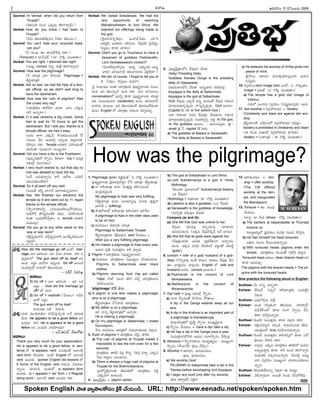
Spoken Englishö˺ Grammar ò°Þ¥ êµõªú£ª-ÚÁ-
÷è[Ù Í÷-ú£ô¢Ù. Íô³ê¶ Grammar êµLú‡-ìÙêŸ
÷«vê¦ì English ò°Þ¥ ÷«æ°xè[è[Ù ÷ú£ªhÙ-ë]-ìª-ÚÁ-
÷è[Ù ð»ô¢-ð§åª. Í÷-ú£-ô¢îµªiì ÚÛFú£ grammar êµõª-
ú£ª-ÚÁ-î¦L. ÷³Ùë]ªÞ¥...
VOCABULARY
Vocabulary ÍÙç¶ òŰù£ö˺ ÑÙè¶ ÷«å-õ-Foì«.
Spoken Englishö˺ Í÷-ú£-ô¢-iì ÷«åõª þ§÷«-
ìuÙÞ¥ ëµjìÙ-Cì @N-ê¦-EÚ¨, ÚÛFú£ Í÷ú£-ô¦õÚÛª, ÏêŸ-
ô¢ªõêÁ Ñìo ú£ÙñÙ-ëůõÚÛª, ÚÁô¢ªÚÛª-û¶-î¦-æ¨Ú©, ð»Ùë¶-î¦-
æ¨Ú© ú£ÙñÙ-CÅÙ-#ìîµj ÑÙæ°ô³. à¦ö° ÷ªÙCÚ¨ ÏÙTx-
ùÃö˺ šíë]l-šíë]l ÷«åõª êµõªþ§hô³. Ú¥F #ìo-#ìo
Nù£-óŸ«-õÚÛª ÏÙTxùà ÷«åõª, î¦æ¨ î¦è[ªÚÛ êµL-óŸªë]ª.
Íö°¸Þ Listening. ÏêŸ-ô¢ªõª ÷«æ°xè¶ English
Íô¢nÙ à¶ú£ªÚÁ-Þœ-õ-Þœè[Ù. DEÚ¨ ÚÛ«è¯ daily lifeö˺ þ§ëů-
ô¢-éÙÞ¥ î¦è¶ ÷«åõª, î¦æ¨ Pronunciation ÚÛ«è¯
êµõª-ú£ª-ÚÁ-î¦L.
Ð î¦Ú¥uõª í£J-Q-LÙ-àŸÙè….
1. Vijayawada is on the banks of the Krishna
(Ná-óŸª-î¦è[ ÚÛ'ù£g Öè[ªfì ÑÙC)
2. They do not speak English
(î¦üŒ‰x ÏÙTxùà ÷«æ°x-è[ô¢ª)
3. Where is Ramesh?
(ô¢î¶ªøÉ ÓÚÛè[?)
4. How beautiful the Taj is!
(ê¦âÉÀ-÷ª-öËÀ ÓÙêŸ ÍÙë]ÙÞ¥ ÑÙC)
šíj Sentencesö˺ ví£AD
ÔëÁ ÖÚÛ Nù£-óŸ«Eo ÞœªJÙ#
àµñª-êÁÙC. îµ³ë]æ¨
Sentence
'Vijayawada'ìª, ·ôÙèÁC
'They'ìª, ÷´èÁC
'Ramesh'ìª, û¦õªÞÁC
'Taj'ìª ÞœªJÙ# àµñª-꟪-
û¦oô³. Ïö° Sentence
൛íp Nù£-óŸ«Eo ë¯E
'Subject' ÍÙæ°Ù. Ú¥ñæ¨d îµ³ë]æ¨ Sentence
Subject Vijayawada, ·ôÙèÁ î¦ÚÛuÙ Subject
They, ÷´èÁ î¦ÚÛuÙ Subject Ramesh, û¦õªÞÁ
î¦ÚÛuÙ Subject The Taj.
Íö°¸Þ ví£A SentenceöËºì« 'Subject'ìª
ÞœªJÙ# ൛íp òŰޜ٠ÖÚÛæ¨ ÑÙåªÙ-ë]E Þœ÷ª-EÙà¶
ÑÙæ°ô¢ª. šíjì 1st sentenceö˺'.... is on the
banks of the Krishna' Î Sentence subject
Ná-óŸª-î¦è[ ÞœªJÙ# àµñªêÁÙC.
'She sings well'
Ð Sentenceö˺ 'She' Subject. 'Sings well'
Íû¶C Subject She ÞœªJÙ# ൛íp òŰޜÙ. 'sings
well'ö˺ 'sings' ö¶ÚÛð¼ê¶ sentence ö¶ë]ª. (She
well - ÍÙç¶ Íô¢nÙ ö¶ë]ª. Sentence ö¶ë]ª). ÍÙç¶
'She sings well' - Ð sentenceö˺ Subject
'She' êŸô¦yêŸ 'Sings' Íû¶ ÷«å SentenceÚÛª
à¦ö° ÷³ÜuÙ. Íö°Ùæ¨ ÷«åû¶ 'VERB' ÍÙæ°ô¢ª.
Subject, Verb êµõªú£ª-ÚÁ-÷è[Ù à¦ö°-÷³ÜuÙ.
îµ³åd-îµ³ë]å Ï#aì û¦õªÞœª Sentencesö˺ Verbs
àŸ«ë¯lÙ.
Sentence-1ö˺ verb is, Sentence-2 ö˺
verb 'do speak', Sentence-3, 4 õö˺ 'is'.
Spoken Englishö˺ ÖÚÛ Sentence Subject,
Verb ÞœªJhÙ-àŸÞœõÞœè[Ù à¦ö° Í÷-ú£ô¢Ù. î¦æ¨E
ÞœªJh›úh NªÞœ-ê¦-÷Fo à¦ö° ú£ªõòÅ¡Ù.
a) Andhra Pradesh is the biggest state in
South India
b) The Eenadu was published first from
Vizag.
Ð ·ôÙè[ª Sentences ÖÚÛ Nù£-óŸ«Eo ൛ípN.
ÍÙç¶ Statements Íìo-÷«å.
c) Is AP the biggest state in South India?
d) Was the Eenadu first published from
Vizag?
(c), (d)õª Questions ÚÛë¯. (a), (b) õÚÛ« (c),
(d) õÚÛ« ê¶è¯ àŸ«ë¯lÙ.
Englishö˺ (a), (b)õö°Ùæ¨ StatementsÚÛª,
(c), (d)õö°Ùæ¨ QuestionsÚÛª ví£ëů-ìÙÞ¥ ê¶è¯
î¦ÚÛu-E-ô¦téÙ (sentence structure)ö˺ ÑÙåªÙC.
(sentence structure ÍÙç¶ Ô ÷«å ÷³Ùë]ª, Ô
÷«å êŸô¦yêŸ Íû¶ Í÷ªJÚÛ.)
Statement : AP is the
(DE Structure ) Subject + Verb
biggest state in south India.
Question : Is AP the biggest
Verb + Subject
state in South India!
Statementö˺ Subject ÷³Ùë]ª, Verb êŸô¦yêŸ
÷þ¼hÙC.Questionö˺ DEÚ¨ ÷uA-¸ô-ÚÛÙÞ¥ verb
÷³Ùë]ª subject êŸô¦yêŸ ÷ú£ªh-û¦oô³. ÏC English
ö˺ à¦ö° ví£ëů-ì-iì ê¶è¯.
Statement : The Eenadu was published first
structure : Subject + Verb
from Vizag.
Question : Was the Eenadu published first
structure : Verb + Subject ( Verb)
from Vizag?
Ð Ú¨ÙC Statements ìª quesitons Þ¥ ÷«Ja
practice à¶óŸªÙè….
Statements Questions
a) (Yes), They are students -----?
b) (Yes), Rani is the leader -----?
c) (No), I am not happy -----?
d) (Yes), He was here last night -----?
e) (No), She is not hungry ? -----?
I
I
ÎÙÞœxòŰù£é
ÎÙÞœxòŰù£é
ÎÙÞœxòŰù£é
ÎÙÞœxòŰù£é
ÎÙÞœxòŰù£é
ÎÙÞœxòŰù£é
ÎÙÞœxòŰù£é
M. SURESAN
Oªô¢ª ÔÙ àŸC-Nû¦
OªÚÛª ÓÙêŸ êµL-ú‡û¦
Oªö˺ ÓÙêŸæ¨ ûµjí£±éuÙ Ñû¦o
Oª þ§nô³ Ôëµjû¦
Oª ví£AòÅ¡ìª Ó÷ô¢ª ÞœªJhÙà¦õû¦o
Oª ÷uÚ¨h-ÞœêŸ N÷-ô¦-öµjû¦
÷ª¸ô Nù£óŸª Nø™x-ù£é Íô³û¦...
OªÚÛª Oªô¢ªÞ¥ àµí£±p-ÚÁ-î¦L!
ÏÙvšíú‡îËÂÞ¥ ÑÙè¯L!
ÏÙvçµ-ú‡dÙÞ¥ àµð§pL!
ÏÚÛè¶ ÎÙÞœxí£J-â°cìÙ Í÷-ú£ô¢Ù!
ÍÙë]ªÚÛª þ¼p·ÚûËÂ ÏÙTxùÃ
ú£·ôjì ÎóŸ³ëÅ]Ù!
Oª õ¤Ûu-þ§-ëÅ]-ìö˺ OªÚÛª êÁè[p-è¶Ù-ë]ª¸Ú
‘Ðû¦-è[ª–-ví£-AòÅ¡’ ôÁV Nè…# ôÁV
ú£ªõòÅ¡ø˜jLö˺ þ¼p·ÚûË ÏÙTxùÃ
î¦uþ§õìª ÍÙC-þ¼hÙC.
Ðû¦è[ª-- ÎCî¦ô¢Ù 12 WûË 2005
#ìo#ìoNêµL󟪸Ú#ÚÛªõª!
#ìo#ìoNêµL󟪸Ú#ÚÛªõª!
#ìo#ìoNêµL󟪸Ú#ÚÛªõª!
#ìo#ìoNêµL󟪸Ú#ÚÛªõª!
II
Spoken Englishû¶ Conversational English ÍE ÚÛ«è¯ ÍÙæ°ô¢ª.
÷ªÙ# Career ÚÁô¢ª-ÚÛªû¶ Në¯u-ô¢ªn-õÙ-ë]-JÚ© Í÷-ú£-ô¢-iì
Communications Skillsö˺ ÷³Üu-iì òŰޜÙSpoken English.
÷ªÙ# ÑëÁuÞ¥ö˺x, ÚÁô¢ªqö˺x ví£î¶-ø‹-EÚ¨ Eô¢y-Ùà¶Interviews, group
discussions, presentations, self sketches ö˺ NáóŸªÙ þ§CÅÙ-à¦-
õÙç¶ Spoken English Oªë] í£åªd Í÷-ú£ô¢Ù.
1
Ðû¦è[ª--
I ÷ªÙÞœüŒî¦ô¢Ù 14 WûË 2005
PRONUNCIATION GUIDE
❐ English pronunciation confusion ÚÛª
Ú¥ô¢éÙ Ö¸Ú Í¤Ûô¢Ù ·ôÙè[ª ôyô¢ª øŒò°l-õÚÛª
ú£Ù¸Ú-êŸÙÞ¥ ÑÙè[è[Ù.
Ñë¯: Car ö˺ c-ÚÛ, centre ö˺ c-ú£
❐ Ö¸Ú øŒò°l-EÚ¨ ·ôÙè[ª ôyô¢ª ͤÛ-ô¦õª î¦è[è[Ù.
Ñë¯: centre - c ÏÚÛè[ ú£, sentry - s ÏÚÛè[
ú£).
Óö° í£õ-Ú¥L?
English ÷«åö˺x ÓÚÛª÷ õÙ-ê¦õª. ÍÙç¶
#÷-ô¢-ð»-õªxêÁ ÑÙè¶ øŒò°lõª ÓÚÛª÷. Pen - šíûËÂ;
Book- ñªÚÂ, Watch - î¦àÂ; Phone - ðƼûËÂ; Take
- ç¶óÀªÚÂ. Ïö°Ùæ¨ ÷«åö˺x #÷J ð»õªxìª ð»õªxÞ¥
í£L-򬐦 ò°ÞœªÙ-åªÙC. šíìªo, ñªÚÛª, î¦<, ðƼìª,
ç¶ÚÛª ÍìÙ. Englishö˺ ÷«æ°x-è¶-åí£±pè[ª ð»õªx
#÷ô¢ ÑÙè¶ ÷«åõª ð»õªxÞ¥ í£L-Ú¨-ê¶û¶ ÍÙë]Ù.
ÏC ÷³ÜuÙ!
ÏÙTxùà ÷«åö˺x #÷J 'r'ìª í£õÚÛÙ. Ñë¯--ô¢é
Doctor (è¯ÚÛd), car (Ú¥), for (ðƼ), paper
(šíóÀªí£).
Ô ÷«å #÷ô¢ 'r' Ñû¦o ë¯Eo í£õ-ÚÛ-ÚÛªÙè¯ ÷C-
ö¶þ§hÙ.ÍÚÛè['r' silent. Ô ÷«åõ ÷ªëÅ]uö˺
Íô³û¦ a, e, i, o, uõö˺ ë¶E êŸô¦yêŸ 'r' ÷#aû¦
ÍC silent. ë¯Eo í£õÚÛÙ. ë¯E êŸô¦yêŸ a, e, i, o,
u, õö˺ Ôëµjû¦ ÷›úh êŸí£p.
Ñë¯: form (ðƧÙ); Card (Ú¥èÂ); Fur (íÆ£); sir
(ú£), her (); information (ÏûËÂ-íÆ£--
óÀª-ù£ûËÂ).
ÏO Í÷ú£ô¢î¶ª!
Oæ¨-êÁ-ð§åª
Conversationö˺ Í÷-
ú£-ô¢-iì Ú•Eo ÷«åõª
êµõª-ú£ª-ÚÛªÙë¯Ù. îµ³ë]å
parts of the human
body- øŒKô¢ òŰޥõÚÛª
ÏÙTxùà ÷«åõª
àŸ«ë¯lÙ. head, face,
eyes, ears, neck,
shoulder, hand,
legs, fingers ö°Ùæ¨
÷«åõ Íô¦lÄõª ÍÙë]JÚ©
êµõªú£ª. thumb (ò˹å-
ì-î¶õª), forefinger
(àŸ«í£±-è[ª-î¶õª), middle
finger (÷ªëÅ]uî¶õª),
ring finger (ÑÙÞœô¢Ù
î¶õª), little finger
(#æ¨-·Úì î¶õª). toe
(Ú¥L-î¶õª), big toe
(Ú¥L ò˹å-ì-î¶õª), nail (ÞÁô¢ª), waist (ìè[ªÙ),
wrist (÷ªé¨-ÚÛåªd), arm (÷ªé¨-ÚÛåªd ìªÙ# òÅ¡ªáÙ
÷ô¢ÚÛª), forearm (÷ªé¨-ÚÛåªd ìªÙ# à¶ô³
(elbow) ÷ô¢ÚÛª), back arm (elbow ìªÙ# òÅ¡ªáÙ
÷ô¢ÚÛª), buttocks (í‡ô¢ª-ë]ªõª), Knee (ڥõª).
Knee ìªÙ# ð§ë]Ù ÷ô¢ÚÛª Ú¥L ÷³Ùë]ô¢ òŰޜÙ
shin, Ú¥L-îµ-ìÚÛ òŰޜ٠calf (Ú¥íÆÃ), Ú¥LÚ© ð§ë¯-EÚ¨
÷ªëÅ]u joint (Ú©õª)– ankle, ð§ë]Ù Íè[ªÞœª–Sole,
í‡è…-Ú¨L– fist, Íô¢-à¶ô³– Palm, ÚÛìª-ò˹-÷ªõª– eye-
brows, ìªë]ªô¢ª – forehead. cheeks - àµÚ¨üŒ‰x,
pupil - ÚÛÙæ¨-ð§í£, eyelid- ÚÛìª-·ôí£p, nostril-
÷³ÚÛª ô¢ÙvëÅ]Ù, gums - í£Ùæ¨-#-ÞœªüŒ‰x, skull-í£±v·ô,
scalp- Våªd Ú¨ÙC êŸõ-šíj-òŰޜÙ.
VERBS
Kranthi: Was anything special in the sun-
day Eenadu?
(ÎC-î¦ô¢Ù ‘Ðû¦-è[ª’ö˺ Ôëµjû¦ ví£ê¶u-ÚÛêŸ ÑÙë¯?)
Karuna: Yes. There was the first lesson in
Spoken English.
(Í÷±ìª. þ¼p·ÚûË ÏÙTxùà ë]æ¨ ð§ôÈ¢Ù ÑÙC.)
Kranthi: Was anything important in it?
(ÍÙë]ªö˺ Ôiû¦ ví£ê¶u-ÚÛêŸ ÑÙë¯?)
Karuna: Yes. Very important point was
there- the difference between the
statement structure and question
structure.
(Í÷±ìª. à¦ö° ÷³Üu-iì Nù£óŸªÙ...
›údæËÀ-îµªÙæËÀ ú£ZÚÛa-ôÂÚ¨ Ú•ø˜aûË ú£ZÚÛa-ôÂÚ¨ ê¶è¯
àµð§pô¢ª.)
Kranthi: Is it so important?
(ÍC ÍÙêŸ ÷³Üu÷«?)
Karuna: Very. The statement has the sub-
ject first, and the verb next. The
question has verb first and the
subject next.
(à¦ö°... ›údæËÀ-îµªÙæËºx îµ³ë]å ú£òµbÚÛªd êŸô¦yêŸ
îµôÂs ÑÙæ°ô³. Ú¥F Ú•ø˜a-ûËÂö˺ ÷³Ùë]ª îµôÂs
êŸô¦yêŸ ú£òµbÚÛªd ÑÙæ°ô³.)
Ð ú£ÙòŰ-ù£é àŸ«ø‹ô¢ª ÚÛë¯! ÏÙë]ªö˺ vÚ¥ÙA-÷Fo
ví£øŒoõª. ÚÛô¢ª-é-÷Fo ›údæËÀ-Ùåªx.
Ð î¦Ú¥uõª Þœ÷ª-EÙ-àŸÙè…...
I am here- verb: 'am'
You are in class- verb: 'are'
My pen is in my pocket-
verb: 'is'
šíj sentencesö˺ Ñìo Verbs
'am', 'is', 'are. Oæ¨ Íô¢nÙ
‘ÑÙè[è[Ù’ Íû¶ ë¯EÚ¨ ú£ÙñÙ-CÅÙ-#-
ìN. Ð Ú¨ÙC êµõªÞœª ví£øŒoõª,
Statements Englishö˺ prac-
tice à¶óŸªÙè….
1. (Ïí£±pè[ª) Oªô¢ª ÓÚÛè[
Ñû¦oô¢ª?
English: Where are you?
2. (Ïí£±pè[ª) û¶ìª Ú¥xú£ªö˺
Ñû¦oìª.
––––––––––––––––––––––––––––––––––
3. (Ïí£±pè[ª) î¦üŒ‰x ú£ÙêÁ-ù£ÙÞ¥
Ñû¦oô¢ª.
––––----–––––––––––––––––––––––––––––––––––––––––––
4. (Ïí£±pè[ª) Oªô¢ª ú£ÙêÁ-ù£-ÙÞ¥ Ñû¦oô¦?
––––----–––––––––––––––––––––––––––––––––––––––––––
5. (Ïí£±pè[ª) Oªô¢ª ÏÚÛè[ ÓÙë]ª-ÚÛª-û¦oô¢ª?
––––----–––––––––––––––––––––––––––––––––––––––––––
6. (Ïí£±pè[ª) î¦üŒ‰x ÷« àŸªæ°dõª.
–––––––––––––––––––––––––––––––––
Answers:
2. I am in class
3. They are happy
4. Are you happy?
5. Why are you here?
6. They are our relatives
am, is, are Ïí£±pè[ª (now) ÍÙç¶ ví£ú£ªhêŸÙ
(present) ÑÙè[-è¯Eo êµLóŸª-â¶-þ§hô³. ÍÙê¶ Ú¥ë]ª–
am, is, are regular Þ¥ ÑÙè[-è¯Eo êµL-óŸª-â¶-óŸª-è¯-
EÚ¨ Ñí£-óµ«-T-þ§hô¢ª. ÍÙç¶ Ôëµjû¦ ÓÚÛèµjû¦ vÚÛ÷ªÙ
êŸí£p-ÚÛªÙè¯ ÑÙè[-è¯Eo ÚÛ«è¯ am, is, are
êµõªí£±ê¦ô³. Ú¨ÙC sentencesìª practice
à¶óŸªÙè….
Oª Ú¥xú£ª-öµ-í£±pè[ª? (ví£A ôÁW – ÏC regular)
When are your classes every day?
ÏÚÛè[ 'are' ÓÙë]ªÚÛª î¦è[ª-꟪û¦oÙ? ÏC ví£A
ôÁW vÚÛ÷ªÙ êŸí£pE Nù£óŸªÙ Ú¥ñæ¨d.
÷ªSx àŸ«è[Ùè….
1st show Óí£±pè[ª?
1st show Óí£±pè[« Ö¸Ú çµjîªÚÛª ÑÙåªÙC ÚÛë¯?
ÍÙç¶ regularÞ¥ ÑÙè[è[Ù. Ú¥ñæ¨d is î¦è[è[Ù
ÚÛ·ôÚÂd.
When is the first show?
Oª·ô-í£±p-è[ªÙ-æ°ô¢ª Collegeö˺ (ví£A ôÁV)
ÏC ÚÛ«è¯ 'regular' Ú¥ñæ¨d,
When are you at college (every day)?
ÏÚÛè[ every day ö¶ÚÛ-ð¼-ô³û¦ íÆ£ô¢-î¦-ö¶ë]ª.
ÓÙë]ª-ÚÛÙç¶ 'are' ÍÙç¶ regularÞ¥ ÑÙè[è[Ù Ú¥ñæ¨d.
Íö°¸Þ ‘û¶ìª þ§óŸªÙ-vê¦õª ÏÙæËºxû¶ ÑÙæ°ìª’
Íìè[Ù Óö°?
'I am at home in the evenings'.
Evenings ÍÙç¶ ví£A evening- regular.
Ú¥ñæ¨d regular states of being (vÚÛ÷ªÙ êŸí£p-
ÚÛªÙè¯ ÑÙè[è[Ù) àµí£p-è¯-EÚ¨ am, is, are î¦è[è[Ù
ÚÛ·ôÚÂd. Ð Ú¨ÙC î¦æ¨Ú¨ English àµí£pÙè…. prac-
tice à¶óŸªÙè….
1. Ð çµjîªö˺ Óí£±pè[« Oª·ôÙ-ë]ª-ÚÛªÙ-æ°-J-ÚÛè[?
(Regular ÚÛë¯?)
Answer: Why are you here at this time
every day?
2. Oª û¦ìo-Þ¥ô¢ª ÎíÆˆ-ú£ªö˺ Óí£±p-è[ªÙ-æ°ô¢ª?
––––----–––––––––––––––––––––––––––––––––––––––––––
3. î¦è… šíûË Óí£±pè[« î¦è… â¶ñªö˺ ÑÙåªÙC.
––––----–––––––––––––––––––––––––––––––––––––––––––
4. ôÁW Oª êŸô¢-Þœ-꟪õª Óí£±pè[ª?
––––----–––––––––––––––––––––––––––––––––––––––––––
5. ÷« êŸô¢-Þœ-꟪õª ôÁW 10 ìªÙ# 4 ÷ô¢ÚÛª
––––----–––––––––––––––––––––––––––––––––––––––––––
6. Oªô¢ª ôÁW Ú¥ö¶-@ö˺ Óí£±p-è[ªÙ-æ°ô¢ª?
––––----–––––––––––––––––––––––––––––––––––––––––––
7. ٠ڥö¶@ö˺ 10 ìªÙ# 4 ÷ô¢ÚÛª ÑÙæ°Ù?
––––––––––––––––––––––––––––––––––
Answers:
2. When is your father at office?
3. His pen is always in his pocket.
4. When are your classes (every day)?
5. Our classes are from 10 a.m. to 4 p.m.
6. When are you at college (every day)?
7. We are at college from 10 to 4 (every
day)?
6, 7î¦Ú¥uö˺x every
day Í÷-ú£ô¢Ù ö¶ë]ª. (are
ÍÙç¶û¶ ·ôÞœªu-õ-ôÂÞ¥
ÑÙè[è[Ù.)
VOCABULARY
þ§÷«-ìu-iì Íû¦-ôÁ-
Þ¥uõª, î¦æ¨Ú¨ ú£ÙñÙ-CÅÙ-#ì
÷«åõª êµõª-ú£ª-ÚÛªÙë¯Ù–
1. áõªñª– Cold. 2. ë]Þœª_ Cough (Ú¥íÆÃ). 3.
꟪÷³t– Sneeze (úˆoâÉÀ– ‘âÉÀ’ sizeö˺ #÷J
øŒñlÙö°Þ¥ í£õ-Ú¥L.) 4. <ë]è[Ù– blow the nose.
5. Ú¥¸ô ÷³ÚÛª – running nose. 6. ûË•í‡p – ache
(ÓóÀªÝËÀ), ò°ëÅ] – pain, suffering;
ë¶ï£° òŰޥõ ûË•í£±põª: ÚÛè[ª-í£±-ûË•í‡p, êŸõ-ûË•í‡p,
ìè[ªÙûË•í‡p Oæ¨Ú¨ Î òŰޥõ ›íô¢ª êŸô¦yêŸ 'ache'
î¦è[ªê¦Ù.pain î¦è[Ù.
stomach ache- stomach pain Ú¥ë]ª.
head ache, back ache etc.
áyô¢Ù (fever) ÷à¶aåªx, ÷#a-ìåªx 'feel' Íô³ê¶
'feeling feverish'.
ë]ªô¢ë] itch (ÏàÂ) ÞÁÚÛåÙ scratch (vþ§àÂ),
Þ•Ù꟪ ûË•í‡p – sore throat; ò°ëÅ]êÁ Íô¢-÷è[Ù
groan; Î÷±-LÙ-àŸè[Ù yawn, î¦í£± – swelling,
ÚÛÙC-ì-î¦í£± – inflammation. Ï÷Fo practice à¶ú‡
÷«æ°x-è¶-åí£±pè[ª î¦è[Ùè….
û¦ÚÛª êŸõ-ûË•-í‡pÞ¥ ÑÙC.
I have a head ache.
÷« Í÷ªtÚÛª áõªñª.
My mother has a cold.
Ïö°Ù-æ¨N ÷ªJÚ•Eo practice à¶óŸªÙè….
PRONUNCIATION GUIDE
ÏÙTxùà Consonant ending øŒò°lõª ÓÚÛª-÷Þ¥
Ñìo òŰù£. ÍÙç¶ ð»õªxõª #÷ô¢ ÑÙè¶ øŒò°lõª
ÓÚÛª÷. #÷ô¢ ð»õªxõìª ð»õªx-õª-Þ¥û¶ í£õ-Ú¥L.
Ñë¯: book, ñªÚÂ, ñªÚÛª Ú¥ë]ª.
šíûËÂ, šíìªo Ú¥ë]ª. Tub - åòËÀ, åñªs Ú¥ë]ª.
Hotel- É˹ç¶öËÀ (‘ç¶’ ûË•ÚÛÙè…). mag-
azine- Ïö° #÷ô¢ 'ine', 'ile' ÑÙç¶
ÐûËÂ, ÐöËÀö° í£õ-Ú¥L. Magazine -
ޜ-@ûË (@, ÏÚÛè[ easyö˺ #÷J øŒñlÙ-
ö°Ù-æ¨C) Automobile- ÎæË¹-îµ³-HöËÀ,
intestine (›íÞœª) ÏÙçµ-ú‡dûË etc.
ÎÙÞœxòŰù£é
ÎÙÞœxòŰù£é
ÎÙÞœxòŰù£é
ÎÙÞœxòŰù£é
ÎÙÞœxòŰù£é
ÎÙÞœxòŰù£é
M. SURESAN
Oªô¢«ô¦óŸªÙè…!
þ¼p·ÚûË ÏÙTxùÃö˺ Oª ú£Ùë¶ï£„õìª
þ¼p·ÚûË ÏÙTxùÃ,ví£AòÅ¡èµúÃ,Ðû¦è[ª,
þ¼÷«>Þœ«è[,šïj°ë]ô¦ò°ë–82
#ô¢ªû¦÷«ÚÛª í£Ùí‡ÙàŸ÷àŸªa.
email: pratibha@ eenadu.net
÷ªìÙôÁW÷«æ°xè¶ÎÙÞœxÙú£·ôjìë¶ÍEí‡Ù#û¦,ÚÛ«õÙÚÛù£ÙÞ¥àŸ«›úh
êŸí£±põªñóŸªåí£è[ê¦ô³.NìoëÁ,ú£·ôjìë]EòŰNÙàÁ ú£ÙòŰù£éö˺x
Ñí£óµ«Tþ§hÙ.ÚÛ·ôÚ¥dÚ¥ë¯ÍEÎö˺#Ù#÷«æ°xè[Ù.Ú¥FìõªÞœªôÁx
÷«æ°xè¶åí£±pè[ªþ§ëÅ]uiìÙêŸ ÷ªÙ#òŰù£Í÷ú£ô¢Ù.÷ªìÚÛªêµLú‡Ùë¶
ÚÛ·ôÚÂdÍìªÚÛªÙç¶êµõªú£ªÚÁ÷è¯EÚ¨íÆ£±öËÀþ§díÃí£è…ìç¶d.
í£õªÚÛªö˺ R ÞœõxÙ꟪!
í£õªÚÛªö˺ R ÞœõxÙ꟪!
í£õªÚÛªö˺ R ÞœõxÙ꟪!
2
WAS, WERE
Ram: Were you there yesterday?
(Eìo ìª÷±y ÍÚÛè[ Ñû¦oî¦?)
Raghav: I was there, of course.
(Í÷±ìª ÍÚÛè[ Ñû¦oìª)
Ram: When were you there?
(Óí£±p-è[ª-û¦oîËÂ?)
Raghav: I was there exactly at 6 when the
function began.
(ú£JÞ¥_ íÆ£ÙÚÛ{ûË ë]-öµjì 6 ÞœÙå-õÚÛª
ÍÚÛè¶ Ñû¦oìª)
Ram: Who else was there yesterday?
(Eìo ÏÙÚ¥ Ó÷-ô¢ª-û¦oô¢ª?)
Raghav: Anil, and Sunil were also there.
(ÍEöËÀ, ú£ªFöËÀ ÚÛ«è¯ ÍÚÛè[ Ñû¦oô¢ª)
Ð ú£ÙòŰ-ù£é Þœ÷ª-EÙ-àŸÙè…. Ram, Raghav Eìo
ÍÙç¶ ÞœêŸÙö˺ ÑÙè[-è¯Eo was, wereö˺ àµí£±p-ÚÛª-
û¦oô¢ª. English ö˺ çµjÙìªñæ¨d Verb forms
÷«ô¢ªêŸ« ÑÙæ°ô³. Ïí£±pè[ª, Óí£±pè[ª, êŸô¢-àŸªÞ¥ ÑÙè[-
è¯Eo am, is, areö˺ àµñªê¦Ù. Íö°¸Þ ÞœêŸÙö˺ Ñìo
î¦æ¨E Óí£±pè[« was, wereõö˺ àµñªê¦Ù.
was- singular
were- plural
1. Ïí£±pè[ª û¶E-ÚÛè[ Ñû¦oìª.
I am here
2. Eìo ÏÚÛè[ Ñû¦oìª.
I was here yesterday
3. Oªô¢ª Eìo ÏÚÛè[ Ñû¦oô¦? ÏC Question.
Ú¥ñæ¨d verb ÷³Ùë]ª ô¦î¦L
Were you here yesterday?
4. Eìo î¦èµ-ÚÛ-è[ª-û¦oè[ª? (Question)
Where was he yesterday?
5. òŰô¢-êŸ-ë¶øŒÙ vGæ¨ùà ð§õ-ìö˺ ÑÙè¶C.
India was under British rule.
6. 1947 ÷ô¢ÚÛª ÷ªì ð§õ-ÚÛªõª (rulers) Ó÷ô¢ª?
Who were our rulers till 1947?
ÏÙTx-ùÃö˺ çµjîª êµLóŸª-â¶›ú ÷«åõª ÍÙç¶ ê¶D, ú£Ù÷-
êŸqô¢Ù, ûµõ, çµjîª Óí£±pè[« sentence #÷ô¢û¶
ÑÙè¯L.
7. Eìo ìª÷±y ÏÚÛè[ ÓÙë]ªÚÛªû¦o÷±?
Why were you here yesterday?
8. ÷« ›úo-꟪è[ª ÞœêŸ ÎC-î¦ô¢Ù ÏÚÛè[ Ñû¦oè[ª.
My friend was here last Sunday.
Ú¥ñæ¨d ÞœêŸÙ (past)ö˺ ÑÙè¶ Nù£-óŸ«õìª
Óí£±pè[« was, wereõö˺ àµñªê¦Ù.
Ú¨ÙC sentencesìª englishö˺ practice à¶óŸªÙè….
1. Praveen: Oªô¢ª Eìo ÏÙæËºx Ñû¦oô¦?
2. Pranav: Í÷±ìª, ÏÙæËºxû¶ Ñû¦oìª.
3. Praveen: Oª Íìo ÚÛ«è¯ ÏÙæËºxû¶ Ñû¦oè¯?
4. Pranav: ö¶è[ª.
5. Praveen: Eìo Oªô¢ª ÓÚÛè[ª-û¦oô¢ª?
6. Pranav: û¶ìª Ú¥ö¶-@ö˺ Ñû¦oìª.
7. Praveen: ví£A ôÁW Ð çµjîªö˺ Ú¥ö¶-@ö˺
ÑÙæ°ô¦? (Regular)
8. Pranav: Í÷±ìª.
9. Praveen: Oªô¢ª ÷«÷´-õªÞ¥ ÏÙæËºx Óí£±p-è[ªÙ-
æ°ô¢ª?
10. Pranav: þ§óŸªÙ-vê¦õª ÏÙæËºxû¶ ÑÙæ°ìª. Eìo
þ§óŸªÙvêŸÙ ÷«vêŸÙ ÏÙæËºx ö¶ìª.
11. Praveen: ÷ª·ô-ÚÛè[û¦oô¢ª?
12. Pranav: Oªæ¨Ù-ÞÂö˺
Answers:
1. Were you at home yesterday?
2. Yes, I was at home.
3. Was your brother too/also at home?
4. No, he was not at home.
(ú£ÙòŰ-ù£-éö˺ No, he wasn't. ÍE Λí-þ§hô¢ª)
(wasn't = was not)
5. Where were you?
6. I was at College.
7. Are you at college at this time every day?
8. Yes, I am (at college... every day - conver-
sationö˺ Ð òŰޜ٠÷C-ö¶-óŸª-÷àŸªa.)
9. When are you at home usually? (÷«÷´-
õªÞ¥ Ú¥ñæ¨d 'are')
10. I am at home in the evenings (Regular,
therefore, am) but I was not (wasn't) at
home last evening.
(Eìo þ§óŸªÙvêŸÙ, Eìo ô¦vA – last evening,
last night).
11. Where else were you? (Eìo Ú¥ñæ¨d)
12. I was at a meeting.
➠ Ð ú£ÙòŰ-ù£éìª Oªô¢ª, Oª friendêÁÞ¥F, Oª
ÏÙæËºx Ó÷-J-êÁ-Þ¥F practice à¶óŸªÙè….
➠ îµ³ë]å Oªô¢ª practice à¶ú‡ êŸô¦yê¶ answers
àŸ«ú£ªÚÁÙè….
➠ Ïí£±pè[ª àŸ«ø‹ô¦? ÖÚÛ am, is, are, was,
wereõêÁû¶ ÓÙêŸ English ÷«æ°x-è[-÷àÁa?
PRONUNCIATION GUIDE
ÏÙTx-ùÃö˺ pure sounds ö¶÷Ù-æ°ô¢ª. ÍÙç¶
ÓÚÛèµjû¦ 'a' ͤÛô¢Ù–
➠ bake, cake, case, date, face, game, hate,
lane ö°Ùæ¨ ÷«åö˺x ÷#a-ì-í£±pè[ª ë¯Eo ‘ÓóÀª’Þ¥
í£õ-Ú¥L.
bake- òµóÀªÚÂ
cake- ·ÚóÀªÚÂ
case- ·ÚóÀªúÃ
face- šíÆóÀªúÃ
game- ·ÞóÀªîª
hate- šï°óÀªæËÀ
lane- öµóÀªûËÂ
date- èµóÀªæËÀ
(I hate you- ÍóÀª
šï°óÀªæËÀ óŸ´).
Íö°¸Þ NªÞœê¦ ÷«å-õö˺ Ú۫诖
tale, tail pronunciation ÖÚÛç¶ – çµóÀªöËÀ.
➠ Óí£±pè[ª 'a', Óí£±pè[ª 'an' Íû¶C šíë]l ví£ø™o.
'a, e, i o, uõêÁ vð§ô¢Ùòš٠Íó¶ªu ÷«åõ ÷³Ùë]ª,
'an' ÍE, NªÞœê¦ î¦æ¨ ÷³Ùë]ª 'a' ÍE ÍÙåªÙ-
æ°ô¢ª. Ú¥F ÍC Óí£±pè[« ÚÛ·ôÚÂd Ú¥ë]ª. a univer-
sity, a European ÍÙåªÙæ°Ù. Íë¶ ÚÛ·ôÚÂd.
'the' E ‘C’ ÍE Óí£±pè[ª, ‘ë]’ ÍE Óí£±pè[ª
í£õ-Ú¥L?
Í, Î, Ï, Ð, Ñ, Ò, Ó, Ô, Õ, Ö, ×, Ø– Ð êµõªÞœª
øŒò°l-õêÁ vð§ô¢Ùòš٠Íó¶ªu English ÷«åõ ÷³Ùë]ª
'an' î¦è¯L. Ð øŒò°lõ ÷³Ùë]ª ÷à¶a 'the'E ‘C’Þ¥
í£õÚ¥L. NªÞœê¦ øŒò°l-õêÁ vð§ô¢ÙòÅ¡÷ªó¶ªu ÷«åõ
÷³Ùë]ª 'a' î¦è¯L.
Íö°¸Þ 'the'E ‘ë]’Þ¥ í£õÚ¥L.
a University (‘óŸ´’êÁ vð§ô¢Ùòš٠ڥñæ¨d 'a')
an example (‘Ó’êÁ vð§ô¢ÙòÅ¡Ù, Ú¥ñæ¨d 'an')
the egg (ÏÚÛè[ ‘C’, egg, 'a'êÁ vð§ô¢ÙòÅ¡Ù
Ú¥ñæ¨d)
the tree (‘ë]’ væ©. ÏÚÛè[ ‘Í’ ìªÙ# ‘Ø’ ÷ô¢ÚÛª
ÑÙè¶ øŒò°l-õêÁ vð§ô¢Ùòš٠ڥö¶ë]ª Ú¥ñæ¨d).
➠ Communications/informationÚÛª
ú£ÙñÙ-CÅÙ-#ì Ð ÷«åõª àŸ«è[Ùè….
ðƼûË à¶óŸªè[Ù– phone, ringup, give a ring,
call- Oå-Eo-æ¨ö˺ Ïí£±pè[ª ò°Þ¥ î¦è[ª-ÚÛö˺ Ñìo ÷«å,
'call', phone to a person, phone a person
í£²JhÞ¥ ð§êŸ-ñ-è…-ð¼-óŸ«ô³. ring up, give a ring
ÏÙÚ¥ î¦è[ª-ÚÛö˺ Ñû¦oô³.
1) Oªô¢ª û¦ÚÁ-þ§J ðƼûË à¶óŸªÙè….
Please call me.
Please give me a ring.
Please ring me up.
êŸí£p-ÚÛªÙè¯ à¶þ§hìª.
I will certainly call you.
Sure, I will call you.
÷ªSx OªÚÛª ðƼûË à¶þ§hìª.
I will get back to you.
2) û¦Ú¥ Nù£óŸªÙ ϖ-ô³öËÀ à¶óŸªÙè….
Please mail me the matter.
Please mail the matter to me at
yours@yahoo.com
3) Ú•JóŸªô ë¯yô¦ í£Ùí£Ùè….
Send it by courier.
4) ÷«÷´õª ð¼úÃd ë¯yô¦ í£Ùí£Ùè….
Post it.
Send it by ordinary post.
Sent it by snail mail.
'snail mail' ÍÙç¶ ìêŸh-ö°Þ¥ à¦ö° Îõ-ú£uÙÞ¥
îµü™x post ÍE Íô¢nÙ.
÷ªJEo ÷«åõª!
chew (àŸ«u) - ì÷ªõè[Ù
swallow (þ§yö˺)- NªÙÞœè[Ù
swallow in a gulp - ÖÚÛ ÞœªÚÛö˺ NªÙÞœåÙ
trim (væ¨îª)(mustache, beard)
- (Oªú£Ù, Þœè[fÙ) ÚÛAh-JÙ# ú£Jà¶óŸªè[Ù
clench (·ÚxûËÂàÂ)- GTÙ-àŸåÙ (í‡è…-Ú¨L – fist)
injure (ÏûËÂáôÂ) - Þ¥óŸªí£è[è[Ù
injury (ÏûËÂáK)- Þ¥óŸªÙ
twist (æ¨yúÃd)the arm - à¶ô³ L-A-í£pè[Ù
snap the fingers - #æ¨ÚÛ î¶óŸªè[Ù
shatter (›ùåôÂ)- ñë]lõª Ú•ådè[Ù
swelling (šúyLÙÞÂ)- î¦í£±
inflammation (ÏûËÂíÆ£xóÀªî¶ªù£ûËÂ)- ÚÛÙCì î¦í£±
fracture(vðƧÚÛa)- Ó÷³ÚÛ Nô¢-Þœè[Ù
sprain(všúpóÀªûËÂ)- òµéªÚÛª
itch(ÏàÂ)- ë]ªô¢ë], scratch(vþ§àÂ)- ÞÁÚÛè[Ù
abscess (ÎòËÀšúúÃ)- ÚÛªô¢ªí£± (<÷³êÁ)
boil (ò°óÀªöËÀ)- Þœè[f
pimple (í‡ÙíÃöËÀ)- îµ³æ¨÷ª
scar (þ§)- Þ¥óŸªÙ ÷õx ÷ªàŸa
pus (í£úÃ)- <÷³ blister (Gxú£d)-í£±Ùè[ª
÷ªSx Verbs: ví£ú£ªhêŸÙ, Óí£±pè[« ÑÙè[-è¯Eo ൛ípN–
am, is, are. ÞœêŸÙö˺ ÑÙè[-è¯Eo ൛ípN– was,
were. òÅ¡N-ù£u-꟪hö˺ ÑÙè[-è¯Eo ൛ípN– shall be,
will be
¸ôí£± û¶ì-ÚÛè[ ÑÙæ°ìª.
I shall be/will be there tomorrow.
٠ÎC-î¦ô¢Ù îµjâ°-ÞÂö˺ ÑÙæ°Ù.
We shall be/we will be in Vizag on Sunday.
ÍêŸè…E àŸ«è[è[Ù û¦ÚÛª ú£ÙêÁ-ù£î¶ª.
I shall be happy to see him.
¸ôí£± ÍêŸìª ÏÚÛè[ ÑÙæ°è[ª.
He will be here tomorrow.
Ðû¦è[ª--
I Þœªô¢ªî¦ô¢Ù 16 WûË 2005
the- ÓÚÛè[‘C’,Óí£±pè[ª‘ë]’?
M. SURESAN
Oªô¢«ô¦óŸªÙè…!
þ¼p·ÚûË ÏÙTxùÃö˺ Oª ú£Ùë¶ï£„õìª
þ¼p·ÚûË ÏÙTxùÃ,ví£AòÅ¡èµúÃ,Ðû¦è[ª,
þ¼÷«>Þœ«è[,šïj°ë]ô¦ò°ë–82
#ô¢ªû¦÷«ÚÛª í£Ùí‡ÙàŸ÷àŸªa.
email: pratibha@ eenadu.net
ÎÙÞœxòŰù£é
ÎÙÞœxòŰù£é
ÎÙÞœxòŰù£é
ÎÙÞœxòŰù£é
ÎÙÞœxòŰù£é
ÎÙÞœxòŰù£é 3
áî¦ñª: 'd ìª Oªô¢-ìoåªx had ÚÛª î¦è[-ê¦ô¢ª.
would ÚÛ« î¦è[-ê¦ô¢ª. Íô³ê¶ ÓÚÛè[ had ÓÚÛè[
would Íû¶C ú£Ùë]-ô¦sÄEo ñæ¨d ÷«vêŸî¶ª êµõªq-ÚÁ-
ÞœõÙ.
A) He'd gone before I saw him.
ÏÚÛè[ He'd = He had
ÓÙë]ª-ÚÛÙç¶ 'gone' ö°Ùæ¨ past participles
÷³Ùë]ª would Óí£±pè[« ô¦ë]ª. had ÷«vêŸî¶ª
÷ú£ªhÙC.
B) I thought he'd do it.
ÏÚÛè[ 'd êŸô¢-î¦êŸ past participle ö¶ë]ª Ú¥ñæ¨d
would Íû¶ Íô¢nÙ à¶ú£ª-ÚÁ-î¦L. ÖÚÛ Nù£óŸªÙ Þœªô¢ªh-ší-
åªd-ÚÁ-î¦L. Past participles ÷³Ùë]ª, 'been'
êŸô¦yêŸ ing form ÷#a-ì-í£±pè[ª, Oæ¨ ÷³Ùë]ª 'd
Óí£±pè[« had Í÷±-꟪ÙC. Do, go, come ö°Ùæ¨
verb forms ÷³Ùë]ª, be + ing ÷³Ùë]ª 'd Óí£±pè[«
would Í÷±-꟪ÙC.
Example: They'd done it.
(done past participle Ú¥ñæ¨d 'd = had)
They'd been doing it. (ÏÚÛè[ been + ing
÷³Ùë]ª Ú¥ñæ¨d 'd = had).
She'd marry him. 'd êŸô¦yêŸ marry ÍE ÷#aÙC
Ú¥ñæ¨d 'd = would
She'd be going. ÏÚÛè[ be + ing form ÷³Ùë]ª
Ú¥ñæ¨d 'd = would.
Have been + ing ÷³Ùë]ª ÚÛ«è¯ 'd = would.
ví£øŒo: Had, would ·ôÙè…Ùæ¨ short forms Íô³ì I had/would - I'd
ÕèÂ. We had/would -We'd OèÂ, Ö¸Úö° Ñû¦oô³. I'd ö¶ë¯
We'd ìª àŸ«ú‡ ú£òµbÚÛªd êŸô¦yêŸ had ÑÙë¯, would ÑÙë¯ Óö°
êµõª-ú£ª-ÚÁ-î¦L?
– ë¶÷ìx ÍEêŸ, ìª-÷ª-Ú•Ùè[
Ôí£ë]ÙÓÚÛè[ Óí£±pè[ªÓö°í£õÚ¥ö˺Íö°í£LÚ¨ê¶û¶òŰù£þ»Þœú£ªÞ¥
ÑÙåªÙC.êµLúˆêµLóŸªEví£óµ«Þ¥õªÓë]ªæ¨î¦JEÍóµ«÷ªóŸªÙö˺ڨ
ûµç¶dóŸª÷àŸªaö¶ë¯Nú£ªÞœªÚÛLTÙàŸ÷àŸªa.÷«êŸ'òŰù£Ñà¦aô¢éêÁû¶
ÎÙÞ¥xEoí£õÚÛè[ÙÚÛ«è¯Ú•ÙêŸÚÛ'êŸÚÛÙÞ¥ÑÙåªÙC.ÍÙë]ª¸Ú÷ªìÙ
û¶ô¢ªaÚÛªû¶òŰù£ö˺Eú£ï£°áiìí£ë]lÄ꟪õìªÍìªú£JÙàŸè[ÙÍ÷ú£ô¢Ù.
Ðû¦è[ª--
I øŒEî¦ô¢Ù 18 WûË 2005
êµõªÞœªî¦ÚÛuEô¦té°EoóŸªëǯêŸëÇ]ÙÞ¥Íìyô³ú£«hÎÙÞœxÙ÷«æ°xè[è[Ù
þ§ëÅ]uÙÚ¥ë]ª.·ôÙè…Ùæ¨î¦uÚÛô¢é°õ«í£²JhÞ¥î¶ô¢ªî¶ô¢ª.·ôÙè[ªòŰù£õÚÛ«
÷ª¾LÚÛÙÞ¥Ñìoê¶è¯õªêµõªú£ªÚÛªÙç¶êµõªÞœªêÁú£÷«ìÙÞ¥ÏÙTxùÃE
ú£ÙòŰù‡ÙàŸè[Ùšíë]lÚÛù£diìí£EÚÛ«è¯Ú¥ë]ª.ÏÙë]ªö˺÷³ÜuÙÞ¥Ú¥õÙ
ÞœªJÙ#àŸ«›úhÎÙÞœxÙö˺ Ú¥ö°EÚ¨ú£ÙñÙCÅÙ#ìí£ë¯õª#÷ô¢o÷þ§hô³.
SHALL BE, WILL BE
Kiran: Will you be here tomorrow?
¸ôí£± ìª÷±y ÏÚÛè[ ÑÙåª-û¦oî¦?
Kranthi: What for?
ÓÙë]ªÚÛª?
Kiran: All our friends will be here tomor-
row. Will you not be (won't you be).
÷ªì ›úo-꟪-õÙ-ë]ô¢« ¸ôí£± ÍÚÛ-è[ªÙ-åª-
û¦oô¢ª. ÷ªJ ìª÷±yÙ-è[î¦?
Kranti: I shall be very happy to be with all of
you. What will be the programme?
Oª ÍÙë]-J-êÁì« ÑÙè[è[Ù û¦ÚÛ« ú£ÙêÁ-
ù£î¶ª. vð¼vÞ¥îª ÔÙæ¨?
Kiran: Let's decide when we meet.
÷ªìÙ ÚÛL-ø‹ÚÛ Eô¢g-ô³ë¯lÙ.
Ð ú£ÙòŰ-ù£é Þœ÷ª-EÙ-à¦ô¢ª ÚÛë¯! ¸ôí£± ÑÙè¶ Nù£-
óŸ«Eo ÞœªJÙ# ÷«æ°x-è[ª-ÚÛªÙ-åª-û¦oô¢ª. will be, shall
be î¦è¯ô¢ª ÚÛë¯!
I shall be there tomorrow.
(¸ôí£± û¶ì-ÚÛè[ ÑÙæ°ìª.)
He will be a graduate soon.
(êŸyô¢ö˺ ÍêŸè[ª vÞ¥è[ªu-ó¶ªæËÀ Í÷±-ê¦è[ª.)
The train will be here in five min-
utes.
(ÏÙÚÁ Íô³ë]ª ENªÿ§ö˺x ·ôjõª
ÏÚÛ-è…Ú¨ ÷ú£ªhÙC.)
How long will you be here?
(ìª÷±y ÏÚÛè[ ÓÙêŸ-›úí£±
ÑÙæ°÷±?)
shall be, will be ÍÙç¶ òÅ¡N-
ù£u-꟪hö˺ ÑÙè[è[Ù (A future
state of being)
êµõª-ÞœªÚÛª ÷uA-¸ô-ÚÛÙÞ¥ 'Time words'
ÍÙç¶ Ú¥ö°Eo êµLóŸª-â¶›ú ÷«åõª Englishö˺
sentence #÷ô¢ ÑÙæ°ô³.
eg: He will be here tomorrow.
They were here yesterday.
The meeting will begin at 6 this
evening.
Order: time, day, date, month, year
eg: The meeting will be at 6 PM (Time)
on Monday (day), the 28th (date)
May (month) 2005 (year)
ÏC Englishö˺ à¦ö° ÷³ÜuÙ.
(÷ªSx Question order Þœªô¢ªhÙ-àŸª-ÚÁÙè…–
Vb+Sub/1st Word of the Verb+Sub+the other
words of the verb.)
Ð Ú¨ÙC î¦æ¨E Englishö˺ practice à¶óŸªÙè….
1. ÍêŸìª ÏÚÛè[ Óí£±p-è[ªÙ-æ°è[ª?
2. Oªô¢ª šïj°ë]-ô¦-ò°ëÂö˺ ÓEo-ôÁ-V-õªÙ-æ°ô¢ª?
3. Î í£±ú£hÚÛÙ ¸ôí£± Oª ë]Þœ_-ô¢ªÙ-åªÙë¯?
4. û¶E-ÚÛè[ ÓÚÛª-÷-›úí£± ÑÙè[ìª.
5. ÷ªÙ-ë]ô¢Ù ¸ôí£± šïj°ë]-ô¦-ò°ëÂö˺ ÑÙæ°Ù.
6. Ð î¶è… ÏÙÚ¥ ·ôÙè[ª ôÁV-õªÙ-åªÙC.
7. í£C ENª-ÿ§-õÚÛª û¶ìª CÇó¶ª-å-ôÂö˺ ÑÙæ°ìª.
8. F êŸô¦yA àŸô¢u ÔNªæ¨?(next step)
9. ¸ôí£± ÏÚÛè[ Ó÷ô¢« ÑÙè[ô¢ª.
10. Î ÏÚÛè[ ÓÙêŸ-›ú-í£±Ù-åªÙC?
Answers:
1. When will he be here?
2. How long will you be in Hyderabad?
3. Will the book be with you tomorrow?
4. I shall not be here for long?
5. We shall all be in Hyderabad tomorrow.
6. It will be hot for another two days.
7. I will be in the theatre in another 10 min-
utes.
8. What will be your next step?
9. Nobody will be here tomorrow.
10. How long will she be here?
VOCABULARY
ð§vꟖ dish (è…ùÃ), bowl (ò®öËÀ)
ÏÙæËºx ð§vêŸõª – Vessels (îµú£öËÀq),
utensils (óŸ³çµ-EqöËÀq)
àµÙñª – ewer (óŸ´îËÂ)
Þ¥xú£ª – tumbler (åîªñx)
÷´êŸ – lid (LèÂ)
šíìÙ– pan (ð§ûËÂ)
ÞœÙÞ¥üŒÙ – cauldron (Ú¥öËÀ-vè[ûËÂ)
÷ªJ-TÙ-àŸè[Ù– boil (ò˺óÀªöËÀ)
î¶í£±è[ª– fry (wšíÆj)
Ú¥õaè[Ù (Aû¶Ù-ë]ªÚÛª) = bake (òµóÀªÚÂ)
Ïí£±pè[ª ÏÙÚ¥ Ú•Eo 'be' forms (ÍÙç¶ ÑÙè[-è¯Eo
êµL›í Verbs):
can be - ÑÙè[ÞœõÞœè[Ù (Ïí£±pè[ª, òÅ¡N-ù£u-꟪hö˺)
could be - ÑÙè[ޜޜõè[Ù (ÞœêŸÙö˺)
may be - ÑÙè[-÷àŸªa (Ïí£±pè[ª, òÅ¡N-ù£u-꟪hö˺)
might be - ÑÙè[÷àŸªa (ÞœêŸÙö˺)
should be, must be = ÑÙè¯L
1. He can be here in five minutes.
ÍêŸè[ª ÏÚÛè[ Íô³ë]ª ENª-ÿ§ö˺x ÑÙè[-Þœ-õè[ª.
2. She could be the Prime Minister.
Î ví£ëů-EÞ¥ ÑÙè[-Þœ-L-TÙC.
3. She may be there now.
Î Ïí£±è[ª ÍÚÛè[ ÑÙè[÷àŸªa
(ÑÙë¶îµ«?).
4. They might be happy.
î¦üŒ‰x ú£ÙêÁ-ù£ÙÞ¥ ÑÙè… ÑÙè[-÷àŸªa (ÞœêŸÙö˺).
5. You should be here at 10 a.m.
ìª÷±y Ñë]óŸªÙ í£CÙ-æ¨Ú¨
ÏÚÛè[ ÑÙè¯L.
6. Ravi must be in office
from 10 a.m. to 5 p.m.
ô¢N Ñë]óŸªÙ 10 ìªÙ#
þ§óŸªÙvêŸÙ 5 ÷ô¢ÚÛª ÎíÆˆ-
ú£ªö˺ ÑÙè¯L.
ÏÙêŸ-÷-ô¢ÚÛª Ð 'be' forms
(ÑÙè[-è¯Eo êµL›í 'verb-
s'ìª àŸ«ø‹Ù.
Ð Ú¨ÙC î¦Ú¥u-õìª ÏÙTxùÃö˺ practice à¶óŸªÙè….
1. ìªNy-ÚÛè[ ÓÙêŸ-›úí£± ÑÙè[-Þœ-õ÷±?
2. Eìo î¦üŒ‰x ÏÚÛè[ Óí£±pè[ª Ñû¦oô¢ª?
3. ¸ôí£± ÍÚÛè[ Ú•ÙêŸ ÏñsÙC ÑÙè[-÷àŸªa.
4. Ú¥ú£h ×ô¢ªpêÁ ÑÙè[-ö¶î¦?
5. ÍÚÛè[ ٠ÓEoÙ-æ¨Ú¨ ÑÙè¯L?
6. ÍêŸè[ª Eìoû¶ ÏÚÛè[ ÑÙè[-Þœ-L-Þ¥è[ª.
7. ÓûËÂ.æ¨. ô¦÷«-ô¦÷± ÷³Üu-÷ªÙ-vAÞ¥ ÑÙè[-Þœ-L-Þ¥ô¢ª
ÓÙë]ª-ÚÛÙç¶ ÎóŸªì ìåªè[ª Ú¥ñæ¨d.
8. ÏÚÛè[ ú£ªÜÙÞ¥ ÑÙç¶, û¶ìª ÓÙꟛúšíjû¦ ÑÙè[-Þœ-
õìª.
9. Eìo à¦ö° àŸõxÞ¥ ÑÙC.
10. Oªô¢ª ÏÚÛè[ ÓÙêŸ-›úí£± ÑÙè[÷àŸªa?
Answers:
ÏÙTx-ùÃö˺ ÓÙêŸ-›úí£±– How long?
ÓÙêŸ ë]«ô¢Ù – How far? ÓEo-þ§ô¢ªx – How often?
1. How long can you be here?
2. When could they be here yesterday?
3. There may be some trouble there tomor-
row.
4. Can't you be patient? (Can you not = Can't
you)
5. When should we be there?
6. He could be here yesterday itself (Eìoû¶).
7. NT Ramarao could be the CM because he
was an actor.
8. If it is comfortable here, I can be here for
as long as possible.
9. It was very cool yesterday.
Yesterday was very cool.
10. How long can you be here?
'Be' forms (ÍÙç¶ am, is, are, was, were,
shall be, should be ö˺ 'be' #÷ô¢ ÑÙè¶ í£ë¯õª,
'been' #÷ô¢ ÷à¶aN – have been, has been,
had been, should have been ö°Ùæ¨N) ÑÙè[è[Ù
Íû¶ Íô¢nÙ ÷à¶a Verbs. ÏN Ú¥ÚÛªÙè¯ í£EE êµL›í
÷«åõª ÚÛ«è¯ Verbs. Ú¨Ùë] A ö˺ Ï#aì î¦æ¨E B
ö˺ Ï#aì î¦æ¨êÁ ð¼õaÙè….
A
I am a teacher (Ñû¦oìª).
She is a player (playerÞ¥ ÑÙC).
They are singers.
B
I teach (à¶þ§hìª).
She plays (Îè[ªêŸªÙC).
They sing (ð§è[-ê¦ô¢ª).
ÎÙÞœxòŰù£é
ÎÙÞœxòŰù£é
ÎÙÞœxòŰù£é
ÎÙÞœxòŰù£é
ÎÙÞœxòŰù£é
ÎÙÞœxòŰù£é 4
M. SURESAN
î¦ÚÛuÙ#÷¸ôÚ¥õÙ!
î¦ÚÛuÙ#÷¸ôÚ¥õÙ!
î¦ÚÛuÙ#÷¸ôÚ¥õÙ!
î¦ÚÛuÙ#÷¸ôÚ¥õÙ!
î¦ÚÛuÙ#÷¸ôÚ¥õÙ!
Oªô¢«ô¦óŸªÙè…!
þ¼p·ÚûË ÏÙTxùÃö˺ Oª ú£Ùë¶ï£„õìª
þ¼p·ÚûË ÏÙTxùÃ,ví£AòÅ¡èµúÃ,Ðû¦è[ª,
þ¼÷«>Þœ«è[,šïj°ë]ô¦ò°ë–82
#ô¢ªû¦÷«ÚÛª í£Ùí‡ÙàŸ÷àŸªa.
email: pratibha@ eenadu.net
ví£øŒo: The machine is out of service.
The machine has out of service.
šíj î¦æ¨ö˺ ú£·ôjìC ÔC? î¦ÚÛuÙö˺ has
÷›úh Íô¢nÙ Óö° ÷ú£ªhÙC? has ô¦ÚÛð¼ê¶
Óö° ÷ú£ªhÙC?
India won the match.
India has won the match.
Ïö° has à¶J›úh Íô¢nÙ Óö° ÷ú£ªhÙC.
B›ú›úh Óö°Ùæ¨ Íô¢nÙ ÷ú£ªhÙC?
– Îó¶ªÿ§, šïj°ë]ô¦ò°ëÂ
áî¦ñª :
The machine is out of service. Íû¶ î¦ÚÛuÙ
correct.
The machine has out of service Íû¶C
English Ú¥ë]ª.
Has êŸô¢-î¦êŸ Óí£±pè[ª out ö°Ùæ¨ prepositions
ô¦÷±.
India won the match. Ð ú£Ùë]-ô¢sÄÙö˺ ú£J-
Ú¥ë]ª. ÓÙë]ª-ÚÛÙç¶ ·ÞL-#ì ôÁVÞ¥F, ê¶DÞ¥F ൛íp-åx-
ô³ê¶ won correct.
India won the match last week. ÏC ÚÛ·ôÚÂd.
ÓÙë]ª-ÚÛÙç¶ last week ÍE çµjîª àµñª-꟪û¦oÙ
Ú¥ñæ¨d.
India ·ÞL-#Ùë]E, Óí£±pè[ª ·ÞL-#ÙëÁ çµjîª àµí£p-
ÚÛªÙè¯ ÷C-ö¶›úh India has won the match Íû¶C
correct. Ð Ú¨ÙC î¦Ú¥uõª àŸ«è[Ùè….
A. He has gone out.
Óí£±pè[ª îµRxÙD çµjîª àµí£p-è[Ù-ö¶ë]ª. Ú¥ñæ¨d
has + past participle correct.
B. He went out this morning.
ÏÚÛè[ Óí£±pè[ª ñóŸª-æ¨Ú¨ îµRxÙD, this morn-
ing ÍE çµjîª àµñªêŸªû¦oÙ. Ú¥ñæ¨d past
simple tense correct.
C. She has bought a car.
has + past participle (çµjîª àµí£pè[Ù ö¶ë]ª
Ú¥ñæ¨d).
D. She bought it yesterday.
(bought - past simple- yesterday ÍE
çµjîª àµñª-꟪û¦oÙ Ú¥ñæ¨d).
She is a player.
She plays.
Ðû¦è[ª--
I þ¼÷ªî¦ô¢Ù 20 WûË 2005
í£ë¯õî¦è[ªÚÛö˺ú£ªEoêŸîµªiìê¶è¯êµLóŸªÚÛð¼÷è[Ù÷õxÖÚÁþ§J÷ªì
ú£ÙòŰù£é Íô¢nÙ÷«¸ôví£÷«ë]ÙÑÙC.DEÚ¨÷«êŸ'òŰù£ví£òŰ÷ÙÚÛ«è¯
Ú¥ô¢éÙÚ¥÷àŸªa. Ö¸Úí£ë¯EoÖÚÁàÁåÖÚÁNëÅ]ÙÞ¥ î¦è¯LqÑÙåªÙC.
ÔCÓÚÛè[Óö°ví£óµ«TÙà¦ö˺êµõªú£ªÚÛªÙç¶÷ªìÙ÷«æ°xè¶òŰù£
Óë]ªæ¨î¦JEÎÚÛåªdÚÛªÙåªÙC.
Ram: Where is your brother?
Oª þ¼ë]-ô¢ªè[ª ÓÚÛè[ Ñû¦oè[ª?
Raghav: He is watching the t.v. at home
ÍêŸìª ÏÙæËºx æ©O àŸ«ú£ªh-û¦oè[ª.
Ram: Where does he study?
ÍêŸìª ÓÚÛè[ àŸë]ª÷±êŸªû¦oè[ª?
Raghav: He is a student of Learn well school
ÍêŸìª öµôÂo-îµöËÀ ú£«öËÀ Në¯uJn
Ram: Which class is he in?
ÍêŸìª ví£ú£ªhêŸÙ ÓûËÁo êŸô¢-ÞœA àŸë]ª-÷±-
꟪-û¦oè[ª?
Raghav: He is doing the 8th class
ÓE-NªëÁ êŸô¢-ÞœA àŸë]ª-÷±-꟪-û¦oè[ª.
Ram: What games does he play?
ÍêŸìª Ôó¶ª Îåõª Îè[-ê¦è[ª?
Raghav: He plays cricket and hockey.
vÚ¨·ÚæËÀ, ک Îè[-ê¦è[ª.
šíj ú£ÙòŰ-ù£-éìª Þœ÷ª-EÙ-àŸÙè….
is verb ÍEo àÁæ°x ÑÙè[-è¯Eo àµñª-꟪ÙC. is
watching, does study ( = studies), is doing,
(does play = plays) plays Ï÷Fo ÚÛ«è¯ à¶êŸ-õìª
(actions) êµL›í Verbs.
A
The teacher is in class.
(æ©àŸô ڥxúÃö˺ ÑÙC)
He was on the playground.
(Play groundö˺ Ñû¦oè[ª ÞœêŸÙö˺)
B
The teacher is teaching (Verb)
(ò˺CÅ-þ¼hÙC)
He was playing
(Îè[ª-꟪-û¦oè[ª ÞœêŸÙö˺)
B Ú¨Ùë] verbs ÍFo à¶êŸõìª (Actions) êµL›í
Verbs.
A Ú¨ÙC verbs ÑÙè[-æ°Eo êµõª-í£±-ê¦ô³. Ð à¶êŸ-
õìª àµ›íp verbs, action words.
eg: go, come, eat, talk, run, sleep, read,
dance.
1. The boys are playing
2. The girl is reading
3. These students talk in class
4. The cheetah runs fast
5. A dog barks
êµõª-ÞœªÚÛ«, English ÚÛ« Ñìo ê¶è¯ ÏÙÚÁæ¨ Þœ÷ª-
EÙ-àŸÙè….
Î í£±ú£hÚÛÙ ç¶ñªöËÀ Oªë] ÑÙC
The book is on the table.
÷ªìÙ, ‘Oªë]’ ç¶ñªöËÀ êŸô¦yêŸ î¦è[ê¦Ù. ÏÙTx-ùÃö˺
Oªë] Íû¶ Íô¢nÙêÁ, on 'table' ÷³Ùë]ª î¦è[ê¦Ù.
ÍEo Nù£-óŸ«-õöËºì« ÍÙê¶.
from school - ú£«õª ìªÙ#
at home - ÏÙæ¨ö˺
In the bag - ú£Ù#ö˺
to Guntur - ÞœªÙå«-ô¢ªÚÛª.
Ð Nù£óŸªÙö˺ ÷ªìÙ ÏÙTxùÃö˺ ÷«æ°x-è¶-å-í£±pè[ª
â°vÞœ-êŸh-í£-è¯L. Ú¨ÙC verbs ×þ§J àŸ«è[Ùè….
A B
come comes
go goes
write writes
take takes
sing sings
teach teaches
speak speaks
A Ú¨ÙC î¦æ¨Ú©, B Ú¨ÙC î¦æ¨Ú© Íô¢nÙ ÖÚÛç¶. Ú¥F
I, We, You, They êÁ A Ú¨ÙC î¦æ¨E Ñí£-óµ«-Tþ§hÙ.
He, she, it êÁ B Ú¨ÙC î¦æ¨E î¦è[ê¦Ù.
I/We/You/Andhras (they) speak Telugu
My father (he)
My Mother (she)
}speaks Telugu
This class (it)
I/We/you/these trains (they) go there
My mother (she)
My friend (he/she)
}goes there every day
This train
Fans (they) give air
A Fan (it) gives air
Dogs (they) bark
A dog (it) barks
ÏN Oªô¢ª í£²Jh-à¶ú£«h practice à¶óŸªÙè…
(Bracketsö˺ Ñìo verbêÁ í£²Jh à¶óŸªÙè…)
1) Wrist watches --- the time
A Wrist watch --- the time (show)
2) A doctor --- patients
Doctors --- patients (treat)
3) A lawyer --- cases
Lawyers --- cases (argue)
4) Pens ---
A pen --- (Write)
5) A cricketer --- cricket
Cricketers --- cricket
(Play)
Answers:
1) Wrist watches
(They) show the
time
A Wrist Watch (It)
shows the time
2) A doctor (He/She) treats patients
Doctors (They) treat patients
3) A lawyer (He/She) argues cases
Lawyers (They) argue cases
4) Pens (They) write
A pen (It) writes
5) A cricketer (He/She) plays cricket
Cricketers (They) play cricket
Ð ô¢«í£Ùö˺ ÑÙè¶ verbs, vÚÛ÷ªÙ êŸí£p-ÚÛªÙè¯ áJ¸Þ
í£ìª-õÚÛª î¦è[ê¦Ù. ÍÙç¶ regular actionsÚÛª.
Óí£±pè[« áJ¸Þ í£ìª-õÚÛª ÚÛ«è¯ Oæ¨E Ñí£-óµ«-Tþ§hÙ.
I go to college at 10 AM (ví£A-ôÁW)
My mother cooks for me (Óí£±pè[«)
Ïö° Oªô¢ª ÷ªJ-Ú•Eo sentences ô¦óŸªÙè….
÷ªS} ÖÚÛ-þ§J àŸ«è[Ùè…:
(I) am; (he, she, it) is; they (are).
ÏÚÛè[ am, is, are ÍÙç¶ Ïí£±pè[ª ÑÙè[åÙ, Óí£±pè[«
ÑÙè[åÙ. Íö°¸Þ was, were- ÞœêŸÙö˺ ÑÙè[åÙ;
shall be / will be futureö˺ ÑÙè[åÙ
I. I am in class
(Ïí£±pè[ª Ú¥xúÃö˺ Ñû¦oìª)
My friend (he/she) is in the next room
(÷« friend, í£ÚÛ ÞœCö˺ Ñû¦o-è[ª/-ÑÙC
–Ïí£±pè[ª)
My parents (they- î¦üŒ‰x) are at home
(ÏÙæËºx Ñû¦oô¢ª– Ïí£±pè[ª)
Ú¥ñæ¨d am, is, are ÍÙç¶ Ïí£±pè[ª ÑÙè[åÙ
II. I was/he was here yesterday.
(ÏÚÛè[ Ñû¦o쪖 Ñû¦oè[ª – Eìo)
My friends were in Hyderabad last week
(û¦ ›úo-꟪õª šïj°ë]-ô¦-ò°ëÂö˺ Ñû¦oô¢ª,
ÞœêŸî¦ô¢Ù) -was, were, ÞœêŸÙö˺ ÑÙè[åÙ
III. Shall be/will be- future (òÅ¡N-ù£u-êÂö˺ ÑÙè[åÙ)
1. India will be a great country by 2010
(2010 ú£Ù÷-êŸq-ô¦-EÚ¨ òŰô¢ê ޕí£p ë¶øŒÙÞ¥
ÑÙåªÙC)
2. Anil will be here next week
(÷à¶a î¦ô¢Ù ÍEöËÀ ÏÚÛè[ ÑÙæ°è[ª)
ÎÙÞœxòŰù£é
ÎÙÞœxòŰù£é
ÎÙÞœxòŰù£é
ÎÙÞœxòŰù£é
ÎÙÞœxòŰù£é
ÎÙÞœxòŰù£é 5
M. SURESAN
Íô¢nÙ ÖÚÛç¶ Ú¥F...!
Íô¢nÙ ÖÚÛç¶ Ú¥F...!
Íô¢nÙ ÖÚÛç¶ Ú¥F...!
Íô¢nÙ ÖÚÛç¶ Ú¥F...!
Íô¢nÙ ÖÚÛç¶ Ú¥F...!
Oªô¢«ô¦óŸªÙè…!
þ¼p·ÚûË ÏÙTxùÃö˺ Oª ú£Ùë¶ï£„õìª
þ¼p·ÚûË ÏÙTxùÃ,ví£AòÅ¡èµúÃ,Ðû¦è[ª,
þ¼÷«>Þœ«è[,šïj°ë]ô¦ò°ë–82
#ô¢ªû¦÷«ÚÛª í£Ùí‡ÙàŸ÷àŸªa.
email: pratibha@ eenadu.net
ví£øŒo: have í£ÚÛì had ìª ÖÚÛ î¦ÚÛuÙö˺ Ñí£-óµ«-
TÙ-àŸ-÷à¦a? Íö° ô¦›úh Î î¦ÚÛuÙ Íô¢nÙ
ÔNªæ¨? ÍC Ô tense Í÷±-꟪ÙC? Íö°¸Þ
î¦ÚÛuÙö˺ had êŸô¦yêŸ í£ÚÛû¶ ÷ªSx had
÷ú£ªhÙë¯? ë¯E Íô¢nÙ ÔNªæ¨?
– êŸêŸhJ ô¢î¶ªøÉÂ, ìt-Ú•Ùè[
áî¦ñª: 'have' í£ÚÛì 'had'___ have had_ ÏC
present perfect tense of have. present perfect
ö˺ verbform: have/has + past participle (pp);
eg: have seen, have gone etc.
Present perfect tense ÷³ÜuÙÞ¥ êµL-›íC Ïí£p-æ¨-
÷-ô¢ÚÛª áJ-Tì í£E. DEÚ¨ for the past, for the last,
since ÷þ§hô³.
a) I have studied (have+ pp of study) here for
the past two years- û¶E-ÚÛè[ Ïí£p-æ¨-÷-ô¢ÚÛª
·ôÙè¶üŒ‰x àŸC-î¦ìª.
b) He has worked (has + pp of work)
here since 2004 = 2004 ìªÙ# Ïí£p-æ¨-÷-ô¢ÚÛª
ÎóŸªì ÏÚÛè[ í£E-à¶-ø‹è[ª.
Ïí£±pè[ª û¦ÚÛª Ú¥ô¢ª ÑÙC ÍE àµð§põÙç¶–
I have a car ÍÙæ°Ù. ·ôÙè¶-üŒ‰xÞ¥ û¦ÚÛª Ð Ú¥ô¢ª
ÑÙC ÍE Íû¦õÙç¶, 'have' ÚÛª present perfect
tense, ÍÙç¶ have + past participle of have
(=had) î¦è¯L ÚÛë¯! Íí£±p-è¶-÷ªÙæ°Ù?
I have had this car for the past two years
ÍÙæ°Ù. have + had (pp of 'have'_ ÚÛLT
Ñû¦oìª) ÍE. She has had (has + pp of 'have')
this job for the last one year.
(ú£Ù÷-êŸq-ô¢ÙÞ¥ ÎN-è[Ú© ÑëÁuޜ٠ÑÙC)
They have had two cups of coffee so far.
(Ïí£p-æ¨-÷-ô¢ÚÛ« ·ôÙè[ª ÚÛí£±põ Ú¥íÆˆ ê¦Þ¥ô¢ª)
Present perfect tense ÞœêŸÙö˺ áJ-Tì í£E,
Óí£±pè[ª (Ô ôÁV, Ô ê¶D, Ô çµjÙ) áJ-TÙD àµí£p-ÚÛ-
ð¼ê¶ î¦è[ê¦Ù.
I have had my lunch. (û¦ òÅ˺áìÙ Íô³-ð¼-ô³ÙC)
★ had had- ÏC past perfect tense of 'have'.
Past perfect ö˺ verb form: had + past par-
ticiple
Past perfect ÷³ÜuÙÞ¥ êµL-›íC: ÞœêŸÙö˺ áJ-Tì
·ôÙè[ª í£ìªö˺x îµ³ë]-æ¨-í£-EE.
He told me that he had passed
(had + pp of pass)
ð§ú£-óŸ«u-ìE û¦êÁ àµð§pè[ª.
pass Í÷åÙ, àµí£påÙ, ·ôÙè[« ÞœêŸÙö˺ í£ìªö¶.
pass Í÷åÙ ÷³Ùë]ª, àµí£påÙ êŸô¦yêŸ. ÷³Ùë]ª,
'pass' Í÷åÙ Ú¥ñæ¨d had passed ÍE past per-
fect î¦è[ê¦Ù.
Ð Ú¥ô¢ª Ú•ìÚÛ ÷³Ùë]ª ÍêŸ-EÚ¨ ú£«åô ÑÙè¶C.
ÏÚÛè[ ·ôÙè[« past actions. ú£«åô ÑÙè[åÙ
÷³Ùë]J past action. ‘ú£«åô ÑÙè[åÙ’ ÍÙç¶
'have a scooter.' Ú¥ñæ¨d past perfect of have =
had + past partciple of have (=had) = had
had.
He had had a scooter before he bought the
car.
(Ú¥ô¢ª Ú•û¶ ÷³Ùë]ª, ÍêŸ-EÚ¨ ú£«åô ÑÙè¶C)
★ He had had his breakfast when his friend
came in.
(î¦üŒx všíÆÙè ÷à¶aåí£p-æ¨Ú¨ ÍêŸE breakfast
Íô³-ð¼-ô³ÙC)
★ She had had the information before I told
her of it.
(û¶ìª ൛íp ÷³Ùë¶ Î ë]Þœ_ô¢ Î ú£÷«-à¦ô¢Ù ÑÙC)
The girl is
reading
Ðû¦è[ª--
I
Pooja: Are you happy?
(ú£ÙêÁ-ù£ÙÞ¥ Ñû¦oî¦?)
Durga: Certainly I am.
(Í÷±ìª)
Pooja: Why are you happy?
(ÓÙë]ªÚÛª ú£ÙêÁ-ù£ÙÞ¥ Ñû¦o÷±?)
Durga: My cousin Saraswathi is here for
vacation. We shall be happy in each
other's company.
(÷« ÚÛ>ûË ú£ô¢-ú£yA šúõ-÷±-õÚ¨ ÏÚÛ-è…Ú¨
÷#aÙC. ٠ÚÛõ-÷è[Ù Ïë]l-JÚ© ÓÙêÁ
ÎìÙë]ÙÞ¥ ÑÙåªÙC.)
Pooja: What will be your plan?
(F ð§xûË ÔNªæ¨?)
Druga: Come home tomorrow.You will know.
(¸ôí£± ÏÙæ¨Ú¨ ô¦. F¸Ú êµõª-ú£ªhÙC.)
Ð ú£ÙòŰ-ù£é àŸ«ø‹ô¢ª ÚÛ믖
am, is, are; was, were; shall be, will be êŸô¦yêŸ
happy, plan ö°Ùæ¨ Ô ÷«åöµjû¦ î¦è[-÷àŸªa. Ð
Ú¨ÙC î¦æ¨E ÷«æ°xè[ªêŸ« practice à¶óŸªÙè….
Blanks ìª Brackets ö˺ Ï#aì ÷«å-õêÁ
EÙí£Ùè….
I am ________
(Oª ›íô¢ª àµí£pÙè…. Ñë¯: I am Pavan)
I am _____
He is _______
They are ________
My friends will be ______
šíjì Ï#aìN sampleÞ¥ ÷«vêŸî¶ª.
ú£«dèµÙæËÀ, ú£«dèµÙæËÀq, ð»è[ªÞœª, ð»æ¨d, ö°÷±, ú£ìoÙ
ú£ÙêÁ-ù£Ù-Þ¥/-ë]ªÌ-ÜÙÞ¥, ë]óŸª-Þœõ, vÚÛ«ô¢-iì, ÷ªÙ#,
àµè[ª, þ¼÷ªJ, àŸªô¢ªÚÛª, ÚÁí£Ù Þœõ, ×ô¢ªp-Þœõ, êµL-îµjì,
êµL-N-ö¶E, î¦Þœªè[ª, ÷³òŰ÷Ù Þœõ, Eâ°-óŸªB Þœõ,
Eâ°-óŸªB ö¶E, ì÷ªt-ë]Þœ_, ì÷ªt-ö¶E– Ð í£ë¯õÚÛª,
ÏÙÚ¥ Oªô¢ª àµí£p-Þœõ í£ë¯õÚÛª ú£·ôjì English ÷«å-
õìª ô¦óŸªÙè…. am, is, are; was, were; shall be,
will be í£ÚÛì î¦æ¨E à¶Ja ÷«æ°x-è[Ùè….
šíj ÷«å-õÚÛª ÏÙTxùà ÷«åõª–
tall, short, fat, slim, happy, sad/sorrowful,
kind, cruel, good, bad, lazy, active, patient,
clever/intelligent/wise, foolish, talkative,
reserved, honest, dishonest, reliable, unreli-
able
ÏÙÚÁ ÍÙøŒÙ...
öµÚÛ-ší-ç¶d-î¦-æ¨E English ö˺ countables
ÍÙæ°ô¢ª.
Ñë¯: man, book, student, pen, town, village
etc.
Oæ¨Ú¨ singular, plural ÑÙæ°ô³. Íô³ê¶ Oæ¨
singular ÷³Ùë]ª Óí£±pè[« 'a' Ú¥F, 'an' Ú¥F
ô¦î¦-õû¶C Þœªô¢ªhÙ-àŸª-ÚÁ-î¦L.
I am a student.
He is an engineer.
She is a doctor.
She is an eye surgeon.
He is an uncle of mine.
It is an ox. etc.
Ð ÏÙUxù£ª ÷«å-õêÁ Questions ÚÛ«è¯ prac-
tice à¶óŸªÙè….
eg: Is he happy?
Are they clever? etc.
šíjì àµí‡pì ÷«å-õ-EoÙæ¨Ú¨ English ÷«å-
õö˺ question practice à¶óŸªÙè….
Question structure Þœªô¢ªhÙC ÚÛë¯?
a) vb+Sub [Are (verb) you (sub) happy?]
b) first word of the verb + sub + other words
of the verb.
[Has (first word of the verb) he (sub) been helping
(other words of the verb) you?]
1. ÍêŸè[ª ò°Þ¥ ð»è[ªÞ¥?
2. Î ÍÙë]ÙÞ¥ ÑÙåªÙë¯?
3. Î ú£ÙêÁ-ù£ÙÞ¥ ÑÙåªÙë¯? (futureö˺)
4. î¦üŒ‰x Eâ°-óŸªBÞ¥ ÑÙè¶ î¦ü‹x? (past)
5. î¦ü˜xí£±pè[ª ÏÚÛè[ ÑÙæ°ô¢ª??
6. ¸ôí£± Oª·ô-ÚÛè[ ÑÙæ°ô¢ª?
7. î¦è[ª Eâ°-óŸªB Þœõî¦-è[E OªÚÛª ì÷ªtÚÛÙ
ÑÙë¯?
8. ÍêŸè[ª â°vÞœ-êŸhÞ¥ ÑÙæ°è¯?
(futureö˺)?
9. Oªô¢ª ú£ÙêÁ-ù£ÙÞ¥ ÑÙè¶-î¦ü‹x?
10. ÖÚÛ-í£±pè[ª Î ö°÷±Þ¥ ÑÙè¶ë¯?
Answers:
1) Is he very tall?
2) Is she beautiful?
3) Will she be happy?
4) Were they honest?
5) Where are they now?
6) Where will you be tomorrow?
7) Are you sure that he is honest?
8) Will he be careful?
9) Were you happy?
10) Was she fat once?
ÏÙTxùÃö˺ ÞœêŸÙö˺ ÑÙç¶, was, were.
Ïí£±pè[ª ÑÙç¶ am, is, are ÞœêŸÙ ìªÙ#
Ïí£pæ¨ ÷ô¢ÚÛª Ú¥F, ÏÙÚ¥ Ú¥F ÑÙè[è¯Eo
àµí£p-è¯-EÚ¨ have been, has been î¦è[ê¦Ù.
I, we, you, they Íô³ê¶ have; he, she, it
Íô³ê¶ has î¦è[ê¦Ù.
1. ÍêŸè[ª û¦õª¸ÞüŒx vÚ¨êŸÙ ÏÚÛè[ Ñû¦oè[ª.
He was here four years ago.
2. ÍêŸè[ª Ïí£±p-è…-ÚÛè[ Ñû¦oè[ª.
He is here.
3. ÍêŸè[ª û¦õª-¸Þ-üŒ‰xÞ¥ ÏÚÛè¶ Ñû¦oè[ª.
He has been here for the past four years.
4. ·ôÙè[ª ôÁV-õªÞ¥ ò°Þ¥ ÓÙè[Þ¥ ÑÙC.
It has been very hot for the past two days.
5. òŰô¢ê 1947 ìªÙ# ú£yêŸÙ-vêŸÙÞ¥ ÑÙC.
India has been independent since
1947 (for the past 57 years)
6. ٠í£ë¶-üŒ‰xÞ¥ šïj°ë]-ô¦-ò°ëÂö˺ Ñû¦oÙ.
We have been in Hyderabad for the
past ten years (since 1995)
7. ÏÙêŸ-›úí£² ÓÚÛ-è[ª-û¦o÷±?
Where have you been all this time?
8. Oªô¢ª ÓÙêŸ-Ú¥-õÙÞ¥ ÏÚÛè[ª-û¦oô¢ª?
How long have you been here?
9. í£²á ÏÙêŸÚ¥õÙ ÓÚÛ-è[ªÙC?
Where has Pooja been all these days?
ÏÙTx-ùÃö˺ have been / has been ÚÛª à¦ö°
vð§÷³ÜuÙ ÑÙC. ÞœêŸÙö˺ ÖÚÛ-í£pæ¨ ìªÙ# Ïí£pæ¨
÷ô¢ÚÛª Þ¥F, ÏÙÚ¥-Þ¥F Ôëµjû¦ ÑÙç¶ Î ÑÙè[-è¯Eo I,
We, you and theyêÁ
Íô³ê¶ 'have been'êÁ Þ¥F
he, she, it êÁ Íô³ê¶ 'has
been' êÁÞ¥F ú£«#þ§hÙ.
ÏÙÚÁ-N-ù£óŸªÙ...
ÞœêŸ Ú•Eo ôÁV-õªÞ¥/ Ú•Eo
ÞœÙå-õªÞ¥/ Ú•Eo ûµõ-õªÞ¥/
Ú•Eo ú£Ù÷-êŸq-ô¦-õªÞ¥ ÍÙç¶ for
the past (The last)... days/
... hours/ ... months / ...
years (ݰSö˺x ôÁVõª,
ÞœÙåõª, ûµõõª, ú£Ù÷-êŸq-ô¦õ ú£ÙÜu.)
eg: for the past (The last) 2 days / 2 hours/ 2
months / 2 years
ö¶ë¯ for 2 days / hours / months / years
now ÍÙæ°Ù.
íÆ£ö°û¦ ôÁV/ ÞœÙå/ ûµõ/ ú£Ù÷-êŸqô¢Ù ìªÙ#
Íì-è¯-EÚ¨ since ÍÙæ°Ù.
✫ I have been here for the past (last) two
years.
I have been here since 2003
✫ She has been here for the (last) past two
months.
She has been here since February end.
✫ India has been independent for the past
(last) 57 years.
India has been independent since 1947.
Ð for the past (last)ÚÛª, since ÚÛª ê¶è¯ à¦ö°
÷³ÜuÙ. Ð Ú¨ÙC î¦Ú¥uõª àŸ«è[Ùè….
ë]ªô¢_ Eìo ÏÚÛè[ ÑÙC.
Durga was here yesterday.
ë]ªô¢_ Ïí£±pè[ª ÏÚÛè[ ÑÙC.
Durga is here.
ë]ªô¢_ Eìoæ¨ ìªÙ# ÏÚÛè¶ ÑÙC.
Durga has been here since yesterday.
î¦üŒ‰x îµ³ìo ÓÚÛè[ªû¦oô¢ª?
Where were they the day before?
î¦üŒ‰} Ïí£±p-èµÚÛè[ªû¦oô¢ª?
Where are they?
î¦üŒ‰x îµ³ìoæ¨ ìªÙ# ÓÚÛ-è[ª-û¦oô¢ª?
Where have they been since the day
before?
Ú¨ÙC î¦Ú¥u-õÚÛª Oæ¨Ú¨ English practice à¶óŸªÙè….
1. Oª·ôÙêŸ Ú¥õÙÞ¥ ÏÚÛ-è[ª-û¦oô¢ª?
2. çµÙè[«-õô ÓÙêŸ-Ú¥-õÙÞ¥ vÚ¨·Ú-å-ôÂÞ¥ Ñû¦oè[ª?
3. ÎóŸªì 2001 ìªÙ# ÚÛöµ-ÚÛd-ôÂÞ¥ Ñû¦oè[ª.
(since, for the past ·ôÙè[« Ñí£-óµ«-TÙ#
àµí£pÙè….)
4. ÎóŸªì 2001 ìªÙ# 2003 ÷ô¢ÚÛª ÏÚÛè[ æ©àŸ-ôÂÞ¥
Ñû¦oè[ª.
5. à¦ö°-Ú¥-õÙÞ¥ èÅ…Mx ÏÙè…óŸ«ÚÛª ô¦á-ëůEÞ¥ ÑÙC.
6. ·ôÙè[ª ôÁV-õªÞ¥ ÎóŸªì Fô¢-ú£ÙÞ¥ Ñû¦oè[ª.
(Fô¢Ùú£Ù– Weak)
7. Oªô¢ª î¦ô¢Ù ôÁV-õªÞ¥ G@Þ¥ Ñû¦oô¦?
8. ÎóŸªì ÓÙêŸ Ú¥õÙÞ¥ áñªsêÁ Ñû¦oô¢ª? (áñªs–
ill/sick)
9. ÓÙêŸ Ú¥õÙÞ¥ îµjÓúà ÷³Üu-÷ªÙvAÞ¥ Ñû¦oô¢ª?
10. Oªô¢ª à¦ö° Ú¥õÙÞ¥ ÏÚÛ-è[ª-û¦oô¦?
Answers:
1. How long have you been here?
2. How long has Tendulkar been a cricketer?
3. He has been a collector since 2001/ for the
past (last) 4 Years.
4. He was a teacher here from 2001 to 2003.
5. Delhi has been the capital of India for a
long time.
6. He has been weak for two days now (for
the past/ for the last two days)
7. Have you been busy for the past (last) one
week?
8. How long has he been ill?
9. How long has YS been the Chief Minister?
10. Have you been here for long?
šíj Sentencesö˺ have been/ has been
î¦è[ÚÛÙ Þœ÷ª-EÙàŸÙè…. Ú•ÙêŸ-Ú¥õÙ vÚ¨êŸÙ ìªÙ# Ïí£pæ¨
÷ô¢ÚÛª Þ¥F, ÏÙÚ¥-Þ¥F ÑÙè[-è¯Eo have been/ has
been êµL-óŸª-â¶-þ§hô³. Question structure
Óí£±pè[« verb + subject Þ¥F, verb ö˺ ·ôÙè[ª-
÷´è[ª ÷«å-õªÙç¶, Ist word of the verb +
Subject + other words of the verb Þ¥F
ÑÙåªÙC.
ÎÙÞœxòŰù£é
ÎÙÞœxòŰù£é
ÎÙÞœxòŰù£é
ÎÙÞœxòŰù£é
ÎÙÞœxòŰù£é
ÎÙÞœxòŰù£é 6
M. SURESAN
Oªô¢«ô¦óŸªÙè…!
þ¼p·ÚûË ÏÙTxùÃö˺ Oª ú£Ùë¶ï£„õìª
þ¼p·ÚûË ÏÙTxùÃ,ví£AòÅ¡èµúÃ,Ðû¦è[ª,
þ¼÷«>Þœ«è[,šïj°ë]ô¦ò°ë–82
#ô¢ªû¦÷«ÚÛª í£Ùí‡ÙàŸ÷àŸªa.
email: pratibha@ eenadu.net
ñªëÅ]î¦ô¢Ù 22 WûË 2005
ví£øŒo: áì-ô¢-öËÀÞ¥ ‘Í÷ªt-ñ-è[ªìª’ – ‘à¶óŸª-ñ-è[ªìª’ –
‘û¶JpÙ-àŸ-ñ-è[ªìª’ Íû¶ ú£Ùë]-ô¦sÄö˺x verb v3 E
ÓÙë]ªÚÛª Ñí£-óµ«-T-þ§hô¢ª? Ñë¯--ô¢-éÚÛª–
Milk 'sold' here; Job work 'done' here;
'Spoken' English Institute - Ïö° verb
ìª v1 Ú¥ÚÛªÙè¯ v3 E ÓÙë]ªÚÛª Ñí£-óµ«-T-
ú£ªhû¦oôÁ N÷-JÙ-àŸ-Þœ-õô¢ª.
– ¸ôÿ§t, òµõxÙí£Lx
áî¦ñª :
1. verb v3 ÍÙç¶ past participle: done, spo-
ken, seen etc.
passive form ö˺ verb Óí£±pè[«, 'be' form +
past participle.
'Milk sold here' Íû¶C, 'Milk is sold here'
ÚÛª short form.
ÏÚÛè[ verb 'is (be form) + sold (past par-
ticiple of sell)' ÚÛª Íô¢nÙ– Í÷ªt-ñ-è[ª-꟪ÙC.
Íö°¸Þ 'Job work done here' ÍÙç¶ 'Job
work is done here' ÍE Íô¢nÙ. is done,
(passive) ÍÙç¶ à¶óŸª-ñ-è[ªìª ÍE. (is - be
form + done - past participle).
2. past participle (p.p.) ÚÛª ÏÙÚÁ Íô¢nÙ ‘ñè…ì’,
‘ñè¶’ ÍE.
eg: The man seen here every day - ÏÚÛè[
àŸ«è[-ñè¶ ÷uÚ¨h. torn paper - #Ùí£-ñ-è…ì
Ú¥TêŸÙ. Íö°¸Þ spoken english ÍÙç¶
÷«æ°x-è[-ñè¶ ÏÙTxùà ÍE Íô¢nÙ.
÷³ÜuÙÞ¥ ÷ªìÙ ôÁW ÷«æ°xè¶ êµõª-Þœªö˺
passive voice î¦è[Ù.
‘Í÷«t, ÍìoÙ ÷Ùè[-ñ-è…Ùë¯?’ ÍìÙ ÚÛë¯!
Íö°¸Þ ‘#Ùí£-ñè[f Ú¥TêŸÙ’ ÍE ÚÛ«è¯ ÍìÙ.
‘#E-Tì Ú¥TêŸÙ’ ÍÙæ°Ù.
Iamastudent
Îû¦æ¨ ìªÙ<...
Ðû¦æ¨ ë¯Ú¥..!
Îû¦æ¨ ìªÙ<...
Ðû¦æ¨ ë¯Ú¥..!
Îû¦æ¨ ìªÙ<...
Ðû¦æ¨ ë¯Ú¥..!
Îû¦æ¨ ìªÙ<...
Ðû¦æ¨ ë¯Ú¥..!
Îû¦æ¨ ìªÙ<...
Ðû¦æ¨ ë¯Ú¥..!
Ðû¦è[ª--
I
Sudha: I meet Padmaja here everyday. I
miss her today.
(ôÁW ÏÚÛè[ í£ë]t-áìª ÚÛõª-þ§hìª. Ð
ôÁV ÚÛE-í‡Ù-àŸ-ö¶ë]ª.)
Valli: Yes. She comes here everyday. I
too see that.
(Î ôÁW ÏÚÛ-è[ÚÛª ÷ú£ªhÙC. û¶ìª
ÚÛ«è¯ àŸ«ø‹ìª (ví£A-ôÁV))
Sudha: I remember now. Today is Sunday.
She does not come here on sun-
day.
(û¦ÚÛª Þœªô•h-þ¼hÙC. Ð ôÁV ÎC-î¦ô¢Ù.
Î ÎC-î¦-ô¦õª ÏÚÛ-è[ÚÛª ô¦ë]ª.)
Valli: I do not know that.
(û¦ÚÛª êµL-óŸªë]ª.)
Sudha: She goes to her aunt's place every
sunday. I too visit my cousin every
sunday evening.
(Î ÎCî¦ô¦õª î¦üŒx ÍêŸhóŸªu ÏÙæ¨Ú¨
îµüŒ‰-꟪ÙC. û¶ìª ÚÛ«è¯ ÎC-î¦ô¢Ù
þ§óŸªÙvêŸÙ ÷« ÚÛ>ûË ÏÙæ¨Ú¨ îµüŒ-ê¦ìª.)
be forms ö°Þ¥ ÑÙè[-è¯Eo êµõ-í£è[Ù Ú¥ÚÛªÙè¯ šíj
î¦Ú¥uö˺xE meet, comes, remember, does
come, goes, visit í£ë¯õª í£ìª-õìª êµLóŸª-â¶-
þ§hô³.
í£ìª-õìª êµL›í Ð Ú¨ÙC ÷«åõª àŸ«è[Ùè….
I Regular Doing II Regular Doing
Words Words
A B
eat eats (eat+s)
take takes (take+s)
give gives (give+s)
wash washes (Wash+es)
like likes (like+s)
sing sings (Sing+s)
dance dances (dance+s)
go goes (go+es)
'A' Ú¨ÙC ÷«å-õìª I Regular Doing Words, B
Ú¨ÙC ÷«å-õìª II Regular Doing Words ÍÙæ°Ù.
I Regular Doing Words ÚÛª (A Ú¨ÙC ÷«å-õÚÛª)
's' Ú¥F 'es' Ú¥F à¶J›úh II Regular doing words
÷þ§hô³.
A Ú¨ÙC ÷«åõª [I Regular Doing Words
(I RDWs)], I, We, you and they êÁ î¦è[ê¦Ù. B
Ú¨ÙC ÷«å-õìª [II Regular Doing Words
(II RDWs)] He, She, itêÁ î¦è[ê¦Ù.
I
We
You
}like milk
My parents
(They)
My father (he)
My mother (she)
}likes milk
The Cat (it)
šíjì àŸ«í‡ì NëÅ]ÙÞ¥ A group ÚÛª í£C Verbs, B
group ÚÛª í£C verbs àµí£pÙè….
eg: ê¦Þœè[Ù
I He
We
}drink coffee She
}drinks coffee
You It
They
Íö°¸Þ Ð Ú¨ÙC Íô¦nõª ÷à¶a NëÅ]ÙÞ¥ ÷«åõª
àµí£pÙè….
ô¦óŸªè[Ù, Îè[è[Ù, ìè[÷è[Ù, í£ô¢ª-·Þ-êŸhè[Ù, ÷Ùè[è[Ù,
v›íNªÙ-àŸè[Ù, EvCÙ-àŸè[Ù, ÷'ëǯ à¶óŸªè[Ù, Ñí£-óµ«-TÙ-
àŸè[Ù, Þœªô¢ªhÙàŸªÚÁ÷è[Ù, ÷ªô¢#-ð¼-÷è[Ù– ÏÙÚ¥ Oªô¢ª
ÓEo í£ìªõ ÷«åõª àµí£p-Þœ-L-Tê¶ ÍEo-æ¨êÁ prac-
tice à¶óŸªÙè….
Answers :
I write sleep
We play waste
You walk use
The boys } run remember
(They) cook forget
love
Hemant (he) writes cooks uses
Sarala (she)
} plays loves remembers
It (Íô¢nÙ walks sleeps forgets
ú£J-ð¼-ó¶ª-åªxÞ¥) runs wastes
Oæ¨E í£J-Q-LÙ-àŸÙè….
a) Pens (They) write.
A pen (It) writes.
b) Wrist watches (They) show the time.
A wrist watch (It)
shows the time.
c) Doctors (They) treat
patients.
A doctor (He/She)
treats patients.
d) Fans (They) give air.
A fan gives air.
e) Teachers (They)
teach.
A Teacher (He/She) teaches. Ïö° ÍEo
verbs ÚÛª practice à¶óŸªÙè….
COUNTABLES, UNCOUNTABLES
a) countables ÍÙç¶ öµÚÛ šíç¶dN.
book, pen, teacher, boy, dog etc.
b) uncountables ÍÙç¶ öµÚÛ-šíådö¶EN.
milk, sugar, rice, water etc.
c) countables ÚÛª ÷«vêŸî¶ª singular (ÖÚÛæ¨),
plural (ÖÚÛæ¨ ÚÛÙç¶ ÓÚÛª÷) ÑÙæ°ô³.
book (singular) books (plural)
pen (singular) pens (plural)
teacher (singular) teachers (plural)
boy (singular) boys (plural)
d) uncountables ÚÛª plural ÑÙè[ë]ª. milks, sug-
ars, rices ÍìÙ.
e) Very Important: countable singulars
(ÍÙç¶ öµÚÛ-šíç¶dN– ÖÚÛ-ë¯Eo, ÖÚÛJE ÞœªJÙ#
൛íp-å-í£±pè[ª) ÷³Ùë]ª Óí£±pè[« 'a' Ú¥F
'an' Ú¥F ô¦î¦-LqÙë¶.
eg:
1) A doctor treats patients (doctor -
countable, singular).
2) I have an idea (idea - countable, singular).
3) An umbrella is useful in rain (umbrella-
countable, singular).
4) A pen is for writing (pen- countable, singu-
lar)
'a' Óí£±pè[ª? 'an' Óí£±pè[ª?
Í, Î, Ï, Ð, Ñ, Ò, Ó, Ô, Ö, ×, Ø– Ð êµõªÞœª
øŒò°lõêÁ vð§ô¢Ù-òÅ¡÷ªó¶ªu î¦æ¨ ÷³Ùë]ª 'an' î¦è¯L.
NªÞœê¦ ÷«åõ ÷³Ùë]ª 'a' Ñí£-óµ«-TÙ-à¦L.
an umbrella (ÍÙvòµö° – Ú¥ñæ¨d an)
an hour (Í÷ô – an)
an honour (ÎìôÂ – an)
an idea (Õè…óŸ« – an)
an owl (ØöËÀ –an)
an egg (ÓÞÂ – an)
Ð ú£«vêŸÙ ð§æ¨›úh a, an Nù£-óŸªÙö˺con-
fusion ÑÙè[ë]ª.
NªÞœê¦ øŒò°lõ ÷³Ùë]Ùê¦ a î¦è[Ùè….
countable singular ÓÚÛè[ ÷#aû¦ ë¯E ÷³Ùë]ª a
Ú¥F an Ú¥F ÑÙè¯-LqÙë¶.
Mother loves her child (wrong)
A Mother (countable singular) loves her child.
f) Uncountable ÷³Ùë]ª a Ú¥F an Ú¥F Óí£±pè[«
ô¦ë]ª.
÷ªSx ÖÚÛ-þ§J 1st RDW (1st Regular doing
word ÍÙç¶ come, go, walk), 2nd RDW (2nd
Regular doing word ÍÙç¶ comes, goes,
walks) õìª í£J-Q-Lë¯lÙ.
I, We, you, they Íô³ê¶ 1st RDW;
he, she, it Íô³ê¶ 2nd RDW î¦è¯L.
Ð ·ôÙè[ª Regular doing words vÚÛ÷ªÙ êŸí£p-
ÚÛªÙè¯, EêŸuÙ áJ¸Þ í£ìªõÚÛª î¦è[ê¦Ù– ÍÙç¶
Regular actions ÚÛª. Óí£±pè[« áJ¸Þ í£ìª-õÚÛª
ÚÛ«è¯ Oæ¨û¶ î¦è[ê¦Ù.
1) û¶ìª ôÁW ÎJÙ-æ¨Ú¨ Evë]-ö¶-þ§hìª.
ÏC regular action. Ú¥ñæ¨d I get up at 6 a.m.
ÏÚÛè[ every day ÍE àµí‡pû¦, àµí£p-ÚÛ-ð¼-ô³û¦
ÖÚÛç¶. get Íû¶ 1st RDW ö˺û¶ regular Íû¶C
Íô¢n-÷ª-÷±-꟪ÙC.
2) ٠ê•NªtCÙ-æ¨Ú¨ ÚÛü‹-ø‹õÚÛª ñóŸªõªë¶-ô¢ê¦Ù.
We start for college at 9 a.m.
(Regular action - start - 1st RDW)
3) ÷« ›úo-꟪õª ò°Þ¥ Îè[ê¦ô¢ª.
ÏC regular action.
Our friends (They) play well.
4) Oª·ô-í£±pè[« Îõú£uÙÞ¥ ÷þ§hô¢ª.
(Óí£±pè[« áJ-¸Þ-í£E).
You always come late.
5) ÷« û¦ìo-Þ¥ô¢ª Ñë]óŸªÙ 9Ú¨ ÎíÆˆúÃÚÛª ñóŸª-õª-ë¶-ô¢-
ê¦ô¢ª (Regular- ví£A-ôÁV).
My father (He) starts for office at 9 a.m.
(everyday ÍE àµð§pLqì Í÷-ú£ô¢Ù ö¶ë]ª.
starts ÍÙç¶û¶ regular)
6) ÷« Í÷ªt ÷Ùè[ª-꟪ÙC (Óí£±pè[«).
My mother (She) cooks for us.
7) 1st show Îô¢ªÙ-ò°-÷±ÚÛª vð§ô¢Ùòš٠Í÷±-꟪ÙC
(ôÁW ÚÛë¯).
The 1st show (It) starts at 6.15 p.m.
Ú¨ÙC regular actions ìª English ö˺ àµí£pÙè….
1. ÎÚÛª Ð vèµúà à¦ö° Ïù£dÙ.(like î¦è[Ùè…)
2. û¶ìª ôÁW ‘Ðû¦è[ª’ àŸë]ª-÷±-ê¦ìª.
3. ÷« êŸô¢-Þœ-꟪õª Ñë]óŸªÙ í£C-ÞœÙ-å-õÚÛª vð§ô¢ÙòÅ¡Ù
Í÷±-ê¦ô³.
4. ÷« Í÷ªt æ©O úˆJ-óŸªöËÀq àŸ«ú£ªhÙC.
(watch - úˆJ-óŸªöËÀq, ú‡E-÷«õª àŸ«è[è[Ù)
5. ÷« û¦ìo-Þ¥ô¢ª ôÁV ÎJÙ-æ¨Ú¨ ÏÙæ¨Ú¨ AJ-T-÷-
þ§hô¢ª. (return, come back; ÏÙæ¨Ú¨– 'home')
6. ví£A-ôÁW Ñë]óŸªÙ ÞœÙå-›úí£± àŸë]ª-÷±-ê¦ìª.
(study; for an hour, every morning)
7. ÷« Í÷ªt Ú¥íÆˆ ê¦Þœª-꟪ÙC.
(ví£A-ôÁW – Íõ-î¦åª – regular)
Answers:
1. She likes this dress.
2. I read the Eenadu (every day).
3. Our classes (They) begin / start at 10 a.m.
4. My mother (She) watches TV serials.
5. My father (He) returns / comes back home
at 6 a.m.
6. I study for an hour every morning.
7. My mother (She) takes coffee (every day).
M. SURESAN
Oªô¢«ô¦óŸªÙè…!
þ¼p·ÚûË ÏÙTxùÃö˺ Oª ú£Ùë¶ï£„õìª
þ¼p·ÚûË ÏÙTxùÃ,ví£AòÅ¡èµúÃ,Ðû¦è[ª,
þ¼÷«>Þœ«è[,šïj°ë]ô¦ò°ë–82
#ô¢ªû¦÷«ÚÛª í£Ùí‡ÙàŸ÷àŸªa.
email: pratibha@ eenadu.net
øŒ‰vÚÛî¦ô¢Ù 24 WûË 2005
ví£øŒo: Oxford advanced dictionary ö˺ word
í£ÚÛì Ïú£ªhìo pronunciationö˺ letters
Ú•Eo Íè[fÙÞ¥, Ú•Eo êŸõ-Ú¨Ù-ë]ª-õªÞ¥ ÑÙæ°-
óµªÙ-ë]ªÚÛª? Oæ¨E Óö° ÑàŸa-JÙ-à¦L?
ÍÙë]ª-¸Ú-iû¦ EóŸª-÷«-õªÙ-æ°óŸ«?
Dictionary page bottom line Ú¨Ùë] ÚÛ«è¯
Ïö°¸Þ ÑÙæ°ô³. Oæ¨ ÞœªJÙ# êµL-óŸª-â¶-
óŸªÙè….
– ô¢÷«-ë¶îËÂ, šïj°ë]-ô¦-ò°ëÂ.
áî¦ñª: ÏÙTx-ùÃ-ö˺E ͤÛ-ô¦õª (alphabet), ÏÙTxùÃ
Ñà¦a-ô¢-éö˺ ÷à¶a øŒò°l-õ-EoÙ-æ¨Ú© ú£J-ð¼÷±. ÍÙë]ª-
÷ö¶x pronunciationö˺ ÍÙêŸ confusion. Ñìo
ͤÛ-ô¦õª ÍEo øŒò°l-õìª ú£«#Ù-àŸ-è¯-EÚ¨ ú£J-ð¼÷±.
Ú¥ñæ¨d êŸõ-Ú¨Ù-ë]ª-õªÞ¥, Íè[fÙÞ¥ Ñìo ͤÛ-ô¦-õìª
Ú•Eo øŒò°lõ ÚÁú£Ù î¦è[-ê¦ô¢ª. Íö° ÑÙè¶ Í¤Û-ô¦õª
Ú•Eo øŒò°l-õÚÛª Þœªô¢ªhõª.
'v'E veryö˺ ‘îµ’ øŒò°l-EÚ¨ î¦è[-ê¦ô¢ª. êŸõ-Ú¨Ù-ë]ª-õªÞ¥
Ñìo v = ‘∧’ E but, shut, cut ö°Ùæ¨ ÷«åö˺x
÷à¶a ‘Í’ øŒò°l-EÚ¨ î¦è[-ê¦ô¢ª. but- DE pronunci-
ation, dictionary ö˺ Ïö° ÑÙåªÙC. b∧t; cut =
k∧t etc. è…ÚÛ{-vFö˺ key to Pronunciation ö˺
àŸ«›úh Ô Þœªô¢ªh Ô øŒò°l-EÚ¨ Íû¶C N÷-ô¢ÙÞ¥
ÑÙåªÙC. î¦æ¨-êÁ-ò°åª pronunciation
casettes, CDs Ñí£-óµ«-Þœ-í£-è[-ê¦ô³.
ví£øŒo:‘Óí£±p-èµjû¦ ›ú-î¦J Oªë]û¶ ÏÙÚ¥ú£h òŰô¢Ù
í£è[ª-꟪ÙC’ ÍE àµí£p-è¯-EÚ¨ ÏÙTx-ùÃö˺ ú£÷«-ì-
iì proverb ÑÙç¶ êµL-óŸª-â¶-óŸªÙè….
– ÓÙ. -ûËÂ-ô¦÷±, ìt-Ú•Ùè[.
áî¦ñª : Oªô¢-ìo-ë¯-EÚ¨ ú£÷«-ì-iì proverb ÔD
Englishö˺ ö¶ë]ª.
ÎÙÞœxòŰù£é
ÎÙÞœxòŰù£é
ÎÙÞœxòŰù£é
ÎÙÞœxòŰù£é
ÎÙÞœxòŰù£é
ÎÙÞœxòŰù£é 7
A, AN...
ÓÙë]ªÚÛªÞœÙë]ô¢ÞÁüŒÙ?
A, AN...
ÓÙë]ªÚÛªÞœÙë]ô¢ÞÁüŒÙ?
A, AN...
ÓÙë]ªÚÛªÞœÙë]ô¢ÞÁüŒÙ?
A, AN...
ÓÙë]ªÚÛªÞœÙë]ô¢ÞÁüŒÙ?
A, AN...
ÓÙë]ªÚÛªÞœÙë]ô¢ÞÁüŒÙ?
Ðû¦è[ª--
I
Ramu: Do you know Mr. venu?
(FÚÛª î¶éª êµõªþ§?)
Vasu: Of course, I know him.
(Í÷±ìª û¦ÚÛª êµõªú£ª)
Ramu: How do you know him?
(ÍêŸìª FÚÛª Óö° êµõªú£ª?)
Vasu: We work in the same department.
But he works in another section.
(î¶ªÙ Ö¸Ú è…ð§-ô¢ªd-îµªÙæËºx ÷ô à¶ú£ªhû¦oÙ.
Ú¥F ÍêŸìª ô šúÚÛ{ûËÁx í£E-à¶-þ§hè[ª)
Ramu: Which section does he work in?
(ÍêŸìª Ô šúÚÛ{ûËÁx í£E à¶þ§hè[ª?)
Vasu: Why do you want to know all this?
(ìª÷±y Ð N÷-ô¦õª ÓÙë]ªÚÛª êµõª-ú£ª-ÚÁ-î¦-
õ-ìª-ÚÛªÙ-åª-û¦o÷±?)
šíj ú£ÙòŰ-ù£é Þœ÷ª-EÙ-àŸÙè…. Question õö˺ do,
does ÷ú£ªh-û¦oô³. Oæ¨ î¦è[ÚÛÙ êµõª-ú£ª-ÚÁ-÷è[Ù
Englishö˺ à¦ö° ÷³ÜuÙ.
Regular doing words (1st RDW, 2nd RDW)
- come, comes; go, goes- Ïö°Ù-æ¨N not ö˺,
question ö˺ î¦è¶-å-í£±pè[ª à¦ö° â°vÞœ-êŸhÞ¥ ÑÙè¯L.
÷ªìÚ¨ ÏÙTxùÚíj í£åªd ÑÙë¯ ö¶ë¯ Íû¶ Nù£óŸªÙ
Ïö°Ùæ¨ ÷«åö˺x êµõª-ú£ªhÙC.
û¶ìª ÚÛü°ø‹õÚÛª ví£A ôÁW Ñë]óŸªÙ
ê•NªtCÙæ¨Ú¨ îµüŒê¦ìª.
I go to college at 9 AM.
û¶ìª Ñë]óŸªÙ ê•Nªt-CÙ-æ¨Ú¨ îµüŒx쪖 Íû¦-õÙç¶
I do not (don't) go to college at 9 AM.
ví£A ôÁV î¦üŒ‰x ììªo ÚÛõªú£ª-ÚÛªÙ-æ°ô¢ª.
They meet me every day.
î¦üŒ‰x ÚÛõª-ú£ª-ÚÁô¢ª.
They do not meet
me every day.
'not' î¦è…-ì-í£±pè[ª (÷uA-
¸ô-ÚÛÙÞ¥ àµí£p-è¯-EÚ¨),
question Íè…¸Þåí£±pè[ª
1st RDW (come, go
ö°Ùæ¨N)êÁ 'do'
÷ú£ªhÙC.
Ú•Eo Ïö°Ùæ¨ î¦Ú¥uõª–
1) I go there every Sunday.
a) I do not go there every Sunday.
b) Do I go there every Sunday?
2) They speak Telugu.
a) They do not speak Telugu.
b) Do they speak Telugu?
(1) ö˺ go not êÁ î¦è…-ì-í£±pè[ª 1 (a) ö˺ do
go Í÷±-꟪ÙC. Question 1 (b)ö˺ ÚÛ«è¯ do
go Í÷±-êÁÙC.
Íö°¸Þ (2)ö˺ Speak notêÁ î¦è…-ì-í£±pè[ª
2(a)ö˺, questionÞ¥ 2(b)ö˺ do speak Í÷±-
êÁÙC.
3) We like mangoes
a) We do not like mangoes
b) Do we like mangoes?
ÏÚÛè[ ÚÛ«è¯ like notêÁ Ú¥F questionö˺
Ú¥F î¦è…-ì-í£±pè[ª do like Í÷è[Ù Þœ÷ª-EÙ-
àŸÙè….
Ú¥ñæ¨d 1 RDW + not/?= do + 1st RDW.
ÍÙç¶1st Regular Doing Words (come,
go ö°Ùæ¨-N)E not êÁ questionö˺ î¦è…-ì-
í£±pè[ª do + 1st RDW Í÷±-꟪ÙC.
Ð Ú¨ÙCî¦-æ¨Ú¨ not êÁ ÷uA-¸ôÚ¥õª, questions
practice à¶óŸªÙè…. Ú•Eo Ñë¯--ô¢éõª...
1. î¦üŒxÚÛª ÏÙTxùà êµõªú£ª.
They know English.
î¦üŒxÚÛª ÏÙTxùà êµL-óŸªë]ª.
They do not know English.
î¦üŒxÚÛª ÏÙTxùà êµõªþ§?
Do they know English?
(Question Structure Þœªô¢ªhÙC ÚÛë¯ – 'verb'
Óí£±pè[« ÷³Ùë]ª)
2. ìªîµy-í£±è[« Îõ-ú£uÙÞ¥ ÷þ§h÷±.
You always come late.
ìªîµy-í£±pè[« Îõ-ú£uÙÞ¥ ô¦÷±. (not)
You do not come late.
ìªîµy-í£±è[« Îõ-ú£uÙÞ¥ ÷þ§hî¦?
Do you always come late?
3. ÍêŸè… ›úo-꟪õª ÍêŸ-è…Ú¨ þ§óŸªÙ à¶þ§hô¢ª.
His friends help him.
ÍêŸè… ›úo-꟪õª ÍêŸ-è…Ú¨ þ§óŸªÙ à¶óŸªô¢ª.
His friends do not help him.
ÍêŸè… ›úo-꟪õª ÍêŸ-è…Ú¨ þ§óŸªÙ à¶þ§hô¦?
Do his friends help him?
know = do know
come = do come
help = do help
Í÷è[Ù šíj î¦Ú¥uö˺x Þœ÷ª-EÙ-àŸÙè….
Ð Ú¨ÙC êµõªÞœª î¦Ú¥u-õìª Englishö˺ practice
à¶óŸªÙè….
1. î¦Rx-ÚÛ-è…Ú¨ ôÁW ÷þ§hô¢ª.
î¦RxÚÛ-è…Ú¨ ôÁW ô¦ô¢ª.
î¦Rx-ÚÛ-è…Ú¨ ôÁW ÷þ§hô¦?
2. ìª÷±y î¦è…E ôÁW ÚÛõªú£ª-ÚÛªÙ-æ°÷±.
ìª÷±y î¦è…E ôÁW ÚÛõª-ú£ª-ÚÁ÷±.
ìª÷±y î¦è…E ôÁW ÚÛõª-ú£ª-ÚÛªÙ-æ°î¦?
3. ٠ò°Þ¥ ð§è[ê¦Ù.
٠ò°Þ¥ ð§è[Ù.
٠ò°Þ¥ ð§è[-ê¦÷«?
4. û¦ÚÛª ÏÙTxùà êµõªú£ª.
û¦ÚÛª ÏÙTxùà êµL-óŸªë]ª.
OªÚÛª ÏÙTxùÃ êµõªþ§?
5. Ð æ©àŸô¢ªx ò°Þ¥ ò˺CÅ-þ§hô¢ª.
Ð æ©àŸô¢ªx ò°Þ¥ ò˺CÅÙ-àŸô¢ª.
Ð æ©àŸô¢ªx ò°Þ¥ ò˺CÅ-þ§hô¦?
6. ٠ÏÙTxùà ú‡E-÷«õª àŸ«þ§hÙ.
٠ÏÙTxùà ú‡E-÷«õª àŸ«è[Ù.
Oªô¢ª ÏÙTxùà ú‡E-÷«õª àŸ«þ§hô¦?
7. ÏÚÛè[ è¯ÚÛdô¢ªx ò°Þ¥ îµjë]uÙ à¶þ§hô¢ª.
(îµjë]uÙ à¶óŸªè[Ù = treat)
ÏÚÛè[ è¯ÚÛdô¢ªx ò°Þ¥ îµjë]uÙ à¶óŸªô¢ª.
ÏÚÛè[ è¯ÚÛdô¢ªx ò°Þ¥ îµjë]uÙ à¶þ§hô¦?
8. î¦üŒ‰x ò°Þ¥ ìæ¨-þ§hô¢ª.
î¦üŒ‰x ò°Þ¥ ìæ¨Ù-àŸô¢ª.
î¦üŒ‰x ò°Þ¥ ìæ¨-þ§hô¦?
Answers:
1. They come here daily.
They do not come here daily.
Do they come here daily?
2. You meet him every day.
You do not meet him every day.
Do you meet him everyday?
3. We sing well.
We do not sing well.
Do we sing well?
4. I know English.
I do not know English.
Do you know English?
5. These teachers teach well.
These teachers do not teach well.
Do these teachers teach well?
6. We watch English movies.
We do not watch English movies.
Do you watch English movies?
7. The doctors here treat well.
The doctors here do not treat well.
Do the doctors here treat well?
8. They act well.
They do not act well.
Do they act well?
Englishö˺ what, where, when, which,
whose, whom and whyêÁ ÚÛ«è¯ questions
Íè[ª-Þœªê¦Ù ÚÛë¯? Oæ¨E 'wh' words ÍÙæ°ô¢ª.
Oæ¨êÁ Íè…¸Þ questions 'wh' questions. Ð
'wh' ÷«å-õêÁ ÍÙç¶ 'wh' questionsÚÛª ÚÛ«è¯ 1
st RDWêÁ do + 1 st RDW ÷ú£ªhÙC.
1. Oª¸ÚÙ êµõªú£ª?
What do you know?
2. Oª·ô-ÚÛ-è[ªÙ-æ°ô¢ª?
Where do you live?
3. î¦ü˜xö° ð§è[ê¦ô¢ª?
How do they sing? (How = Óö°?)
Ans: ò°Þ¥ ð§è[ê¦ô¢ª.
They sing well
4. Oª·ôÙ-ë]ªÚÛª Óí£±pè[« Îõ-ú£uÙÞ¥ ÷þ§hô¢ª?
Why do you always come late?
Ans: I miss the bus.
5. Oªô¢ª ÚÛü‹-ø‹-õÚÛª Óí£±pè[ª ñóŸªö¶lô¢ê¦ô¢ª?
(ôÁW)
When do you start for college? (every
day)
Ans: I start at 9 AM.
6. ÓÙë]ªÚÛª çµjÙ î¶úÃd à¶þ§h÷±?
Why do you waste time?
Ans: û¶û¶Ù î¶úÃd à¶óŸª-è[Ù-ö¶ë]ª.
I do not waste time.
Ð Ú¨ÙC questions English ö˺ practice
à¶óŸªÙè….
1. î¦üŒ‰x ôÁW ÏÚÛ-è…Ú¨ ÓÙë]ªÚÛª ÷þ§hô¢ª?
2. Oªô¢ª ÍEo ú‡E-÷«-öµÙ-ë]ªÚÛª àŸ«þ§hô¢ª?
3. Oªô¢ª ÷«÷´-õªÞ¥ í£±ú£h-Ú¥-öµ-ÚÛè[ Ú•Ùæ°ô¢ª?
4. î¦üŒ‰x Ô í£vAÚÛ àŸë]ª-÷±-ê¦ô¢ª?
5. Óí£pæ¨ ìªÙ# Oª šúõ-÷±õª?
6. Oª·ôÙêŸ ú£Ùð§-C-þ§hô¢ª?
7. î¦üŒ‰x ôÁW ÏÚÛ-è…Ú¨ Óí£±p-è•-þ§hô¢ª?
8. ví£A ÎC-î¦ô¢Ù ìªîµy-÷-JE ÚÛõªú£ª-ÚÛªÙ-æ°÷±?
9. Óö°Ùæ¨ ú‡E-÷«õª FÚ¨ù£dÙ?
10. Oªô¢ª í£à¦K ú£ô¢ª-ÚÛªõª ÷«÷´-õªÞ¥ ÓÚÛè[
Ú•Ùæ°ô¢ª?
šíj questions ÚÛª ví£A-ë¯-EÚ© ú£÷«-ëů-û¦õª ÚÛ«è¯
ô¦óŸªÙè….
Answers:
1. Why do they come here every day?
Ans: They come here to see me.
2. Why do you watch so many movies?
Ans: I watch them because I like them.
3. Where do you buy books usually?
Ans: I buy them at that stall.
4. What newspaper do they read?
Ans: They read the Eenadu.
5. When do your holidays begin?
Ans: They usually begin in April 3rd week.
6. How much do you earn?
Ans: Why do you want to know?
(Oª·ôÙ-ë]ªÚÛª êµõª-ú£ª-ÚÁ-î¦-õ-ìª-ÚÛªÙ-åª-û¦oô¢ª?)
7. When do they come here every day?
Ans: They come here at 7 PM
8. Whom do you meet every sunday?
Ans: I meet my friend.
9. What kind of movies do you like?
Ans: I like suspense movies.
10. Where do you buy provisions usually?
Ans: I buy them at that shop.
ÎÙÞœxòŰù£é
ÎÙÞœxòŰù£é
ÎÙÞœxòŰù£é
ÎÙÞœxòŰù£é
ÎÙÞœxòŰù£é
ÎÙÞœxòŰù£é 8
M. SURESAN
ÎCî¦ô¢Ù 26 WûË 2005
ví£øŒo: standard è…ÚÛ{vFE Óö° JíÆ£ôÂ
à¶óŸ«L? Ôëµjû¦ ÖÚÛ Word ìª êŸyô¢Þ¥
îµAÚ¨šíç¶d ø‹úˆYóŸªí£ë]lÄA êµL-óŸª-â¶-óŸªÙè….
Íö°¸Þ Key to dictionary entries
ÍÙç¶ ÔNªæ¨?
– ø˜jõá, ÚÛKÙ-ì-ÞœôÂ
áî¦ñª: Ô Standard dictionary ö˺
Íô³û¦ ÖÚÛ Word ìª îµAÚ¨-šíç¶d í£ë]lÄA ÖÚÛç¶.
Íë¶ Alphabetical order ö˺ refer à¶óŸªè[Ù.
ê¶LÞ¥_ refer à¶óŸ«-õÙç¶ Ð Ú¨ÙC ÍÙø‹õìª
êµõª-ú£ª-ÚÁ-î¦L.
➻ English alphabetö˺ ͤÛô¢ vÚÛ÷ªÙ a-z
÷ô¢ÚÛª êµL-óŸ«L.
➻ îµA¸Ú í£ë]Ù Spelling ÚÛ«è¯ ÚÛ#a-êŸÙÞ¥
êµLú‡ ÑÙè¯L. ÖÚÛ-î¶üŒ ÷ªì šúpLxÙÞ êŸí£p-
ô³ê¶ í£ë]Ù ë•ô¢-ÚÛë]ª. Íö°Ù-å-í£±pè[ª ví£ê¦u-
÷«oóŸª Spellings ìª ÒÙàŸªÚ•E îµêŸ-
Ú¥L. existence Íû¶ í£ë]Ù spelling ìª
÷ªìÙ ð»ô¢-ð§-åªÞ¥ existance ÍìªÚÛªE
îµA-Ú¨ê¶ Ð í£ë]Ù Dictionary ö˺ ë•ô¢-ÚÛë]ª.
Íö°Ù-å-í£±pè[ª a ñë]ªõª e ví£ê¦u-÷«o-
óŸªÙêÁ îµêŸ-ÚÛè[Ù êŸô¢ª-î¦A ë]øŒ.
➻ Word ìª îµA-Ú¨-šíç¶d ø‹úˆYóŸª í£ë]lÄA ÑÙC.
÷ªìÚÛª ͤÛô¢vÚÛ÷ªÙ Þœªô¢ªhÙ-è¶-ë¯Eo ñæ¨d
êŸyô¢Þ¥ í£ë]Ù ë•ô¢-ÚÛè[Ù Îëů-ô¢-í£è…
ÑÙåªÙC.
➻ îµ³ë]å ví£A ›í@šíjì Ñìo Lead Word
àŸ«ú£ª-ÚÁ-î¦L.
➻ ÏÚÛSpelling ìª ñæ¨d îµêŸ-Ú¥L.
Key to dictionary entries ÍÙç¶ Íô¢nÙ
è…ÚÛ{vFö˺ Ïà¶a ÷«åÚÛª ú£ÙñÙ-CÅÙ-#ì N÷-
ô¦õª. ÍN–
★ Î ÷«å Pronunciation
★ parts of speech
★ Ôó¶ª parts of speech ö˺, Ôó¶ª ô¢ÚÛ-iì
Print ö˺, ͤÛ-ô¦õ Type ö˺ ÑÙC.
★ ÖÚÛ-î¶üŒ Parts of speech Noun, Verb õª
Íô³ê¶ î¦æ¨ö˺ Ô ô¢Ú¥Eo Óö° ú£«#þ¼hÙC.
★ Íë¶ ÷«åêÁ ÷à¶a IdiomÚÛª Ïà¶a Þœªô¢ªh,
î¦æ¨Ú¨Synonyms, antonyms Óö°
êµLð§ô¢ª.
...êŸCêŸô¦õª. Oæ¨E Key to dictionary
entries N÷-J-þ§hô³.
Ð NëůìÙ è…ÚÛ{vF NE-óµ«-Þ¥Eo ÍêŸuÙêŸ ú£ô¢-
üŒ-êŸô¢Ù à¶ú£ªhÙC.
Oªô¢«ô¦óŸªÙè…!
þ¼p·ÚûË ÏÙTxùÃö˺ Oª ú£Ùë¶ï£„õìª
þ¼p·ÚûË ÏÙTxùÃ,ví£AòÅ¡èµúÃ,Ðû¦è[ª,
þ¼÷«>Þœ«è[,šïj°ë]ô¦ò°ë–82
#ô¢ªû¦÷«ÚÛª í£Ùí‡ÙàŸ÷àŸªa.
email: pratibha@ eenadu.net
í£åªdêµL›íí£ë¯õª!
Ðû¦è[ª--
I
Raghu: Does your friend meet you regular-
ly?
(Oª všíÆÙè Eìªo ·ôÞœªu-õ-ôÂÞ¥ ÚÛõª-þ§hè¯?)
Ramu: Which friend? (Ô všíÆÙèÂ?)
Raghu: Seshu (ø™ù£ª)
Ramu: Yes, he meets me regularly. But
he does not meet me on sundays.
(Í÷±ìª. ·ôÞœªu-õ-ôÂÞ¥ ÚÛõª-þ§hè[ª Ú¥F
ÎC-î¦ô¢Ù ÷«vêŸÙ ÚÛõ-÷è[ª.)
Raghu: Why does he not (doesn't he) meet
you on sundays?
(ÎC-î¦-ô¦õª ÓÙë]ªÚÛª ÚÛõ-÷è[ª?)
Ramu: He does not move out of home on
sunday.
(ÍêŸìª ÎC-î¦ô¢Ù Ïõªx ÚÛë]-õè[ª.)
šíj ú£ÙòŰ-ù£é àŸ«ø‹ô¢ª ÚÛë¯! 2nd RDW meets
question ö˺ not êÁ does meet Í÷±-êÁÙC.
Íö°¸Þ does move ÍÙç¶ moves (not êÁ ÷#a-
ì-í£±pè[ª).
Come, go, Walk ö°Ùæ¨ 1st RDWs
(Regular Doing Words)ìª notêÁ,
questionsö˺ î¦è…-ì-í£±pè[ª do ÷ú£ªhÙ-ë]E
êµõªú£ªÚÛªû¦oÙ.
eg:
1) They come here everyday.
a) they do not come here every day.
b) Do they come here every day?
2) You come here often.
a) You do not come here often.
b) Do you come here often?
Ïö°¸Þ Ïí£±pè[ª 2nd Regular Doing Words-
comes, goes, walks, talks ö°Ùæ¨ verbs ìª not
êÁÚ¥F, question ö˺ڥF î¦è…ìí£±pè[ª 'does'
÷ú£ªhÙC. 2nd RDWs- he, she, it êÁû¶ î¦è[ê¦Ù.
Ú¥ñæ¨d 'does' ÚÛ«è¯ he, she, itêÁû¶ Ñí£-óµ«-TÙ-
à¦L.
1) Sunita (She) sings well.
2nd RDW
a) Sunita does not sing well.
2nd RDW
ÏÚÛè[ verb 'does sing' - not êÁ.
b) Does Sunita sing well?
ÏÚÛè[ ÚÛ«è¯ verb 'does sing' - question ö˺.
ÍÙç¶ ÏÚÛè[ sings + not/?
= does sing
sings ìª not êÁ Ú¥F,
question ö˺ Ú¥F î¦è…-ì-
í£±pè[ª 'does sing'
Í÷±êÁÙC.
2) Kumar (he) knows
English.
a) Kumar does not
know English.
b) Does Kumar know English?
(Þœ÷ª-EÙ-à¦ô¢ª ÚÛë¯! knows + not/? = does know)
3) Hari likes music.
a) Hari does not like music.
b) Does Hari like music?
Ïö° 'not' êÁ questionsö˺ ÷ªJ-Ú•Eo 2nd RDWs
ô¢«ð§õª àŸ«è[Ùè….
1) works (+ not) = does not work;
Q: Does (he) work?
2) takes (+ not) = does not take;
Q: Does (she) take?
3) finds (+ not) = does not find;
Q: Does (Sunil) find?
4) goes (+ not) = does not go;
Q: Does (Sita) go?
Ïö° Þœªô¢ªhÙ-àŸª-ÚÁÙè….
takes = does take (with not/?)
comes = does come (with not/?)
writes = does write (with not/?)
Ïí£±pè[ª Ð Ú¨ÙC î¦æ¨E practice à¶óŸªÙè….
ÏN 1st RDW, 2nd RDW ·ôÙè…Ùæ¨Ú© ú£ÙñÙ-CÅÙ-#-
ìN. ÍÙç¶ Ú•Eo ú£Ùë]ô¦sÄö˺x 'do', ÷ªJ Ú•Eo
ú£Ùë]ô¦sÄö˺x 'does' î¦è¯Lq ÑÙåªÙC. â°vÞœ-êŸhÞ¥
Þœ÷ª-EÙ# practice à¶óŸªÙè….
eg:
1. a) û¶ìª 11 í‡.ÓÙ. Ú¨ í£è[ª-ÚÛªÙ-æ°ìª.
I go to bed at 11 PM.
b) û¶ìª 11 í‡.ÓÙ. Ú¨ í£è[ª-ÚÁìª.
I do not go to bed at 11 PM.
c) Oª·ô-EoÙ-æ¨Ú¨ í£è[ª-ÚÛªÙ-æ°ô¢ª?
When do you go to bed?
2. a) Ñù£ ò°Þ¥ Îè[ª-꟪ÙC.
Usha plays well.
b) Ñù£ ò°Þ¥ Îè[ë]ª.
Usha does not play well.
c) Ñù£ ò°Þ¥ Îè[ª-꟪Ùë¯?
Does Usha play well?
Ð Ú¨ÙC î¦Ú¥u-õìª vð§Ú©dúà à¶óŸªÙè….
1. a) ÎìÙ-ë]-ô¦÷± ò°Þ¥ ò˺CÅ-þ§hô¢ª.
b) ÎìÙ-ë]-ô¦÷± ò°Þ¥ ò˺CÅÙ-àŸô¢ª.
c) ÎìÙ-ë]-ô¦÷± ò°Þ¥ ò˺CÅ-þ§hô¦?
2. a) î¦üŒ‰x ÏêŸ-ô¢ª-õÚÛª ú£ï£„óŸªÙ à¶þ§hô¢ª.
b) î¦üŒ‰x ÏêŸ-ô¢ª-õÚÛª ú£ï£„óŸªÙ à¶óŸªô¢ª.
c) î¦üŒ‰x ÏêŸ-ô¢ª-õÚÛª ú£ï£„óŸªÙ à¶þ§hô¦?
3. a) ô¦÷±-Þ¥ô¢ª ÏÚÛè…Ú¨ ôÁW ÷þ§hô¢ª.
b) ô¦÷±-Þ¥ô¢ª ÏÚÛ-è…Ú¨ ôÁW ô¦ô¢ª.
c) ô¦÷±-Þ¥ô¢ª ÏÚÛ-è…Ú¨ ôÁW ÷þ§hô¦?
4. a) ٠Ñë]óŸªÙ ÖÚÛ ÞœÙå æ©O àŸ«þ§hÙ.
b) ٠Ñë]óŸªÙ ÖÚÛ ÞœÙå æ©O àŸ«è[Ù.
c) Oªô¢ª ôÁW æ©O Óí£±pè[ª àŸ«þ§hô¢ª?
5. a) ôÁW Ñë]óŸªÙ 6 ÞœÙåõÚÛª ›íí£ô ÷ú£ªhÙC.
b) ôÁW Ñë]óŸªÙ 6 ÞœÙå-õÚÛª ›íí£ô ô¦ë]ª.
c) ôÁW ÓEoÙ-æ¨Ú¨ ›íí£ô ÷ú£ªhÙC?
6. a) î¦üŒxÚÛª ÎóŸªì ò˺ëÅ]ì ò°Þ¥ Íô¢n÷ª÷±-꟪ÙC.
b) î¦üŒxÚÛª ÎóŸªì ò˺ëÅ]ì ò°Þ¥ Íô¢nÙ Ú¥ë]ª.
c) î¦üŒxÚÛª ÎóŸªì ò˺ëÅ]ì ÓÙêŸ ò°Þ¥
Íô¢n÷ª÷±êŸªÙC?
7. a) Oªô¢ª ôÁW ›íí£ô àŸë]ª-÷±-ê¦ô¢ª.
b) Oªô¢ª ôÁW ›íí£ô àŸë]-÷ô¢ª.
c) Oªô¢ª ôÁW Ô ›íí£ô àŸë]ª-÷±-ê¦ô¢ª?
8. a) Î ÎC-î¦-ô¦õª î¦üŒx všíÆÙèÂq ÏÙæ¨Ú¨
îµüŒ‰êŸªÙC.
b) Î ÎC-î¦-ô¦õª î¦üŒx všíÆÙèÂq ÏÙæ¨Ú¨ îµüŒxë]ª.
c) Î î¦üŒx všíÆÙèÂq ÏÙæ¨Ú¨ ÓÙêŸ êŸô¢-àŸªÞ¥ îµüŒ‰-
꟪ÙC?
9. a) ÎÚÛª ÍêŸ-ìÙç¶ Ïù£dÙ.
b) ÎÚÛª ÍêŸ-ìÙç¶ Ïù£dÙ ö¶ë]ª.
c) ÎÚÛª ÍêŸ-ìÙç¶ ÓÙë]ª-ÚÛÙêŸ Ïù£dÙ?
10. a) ÍêŸìª ví£A-î¦ô¢Ù îµjâ°Þ îµüŒê¦è[ª.
b) ÍêŸìª ví£A-î¦ô¢Ù îµjâ°Þ îµüŒxè[ª.
c) ÍêŸìª ví£A-î¦ô¢Ù îµjâ°Þ ÓÙë]ªÚÛª îµüŒê¦è[ª?
11. a) î¶ªÙ Ú¥íÆˆ Bú£ª-ÚÛªÙæ°Ù.
b) î¶ªÙ Ú¥íÆˆ Bú£ªÚÁÙ.
c) Oª¸ôÙ Bú£ªÚÛªÙ-æ°ô¢ª, Ú¥íÆˆóŸ« æ©óŸ«?
ANSWERS:
1. a) Mr Ananda Rao teaches well.
b) Mr Ananda Rao does not teach well.
c) How does Mr Ananda Rao teach?
2. a) They help others.
b) They do not help others.
c) Do they help others?
3. a) Mr Rao comes here every day.
b) Mr Rao does not come here every day.
c) Does Mr Rao come here every day?
4. a) We watch the TV for an hour every
morning.
b) We do not watch TV for an hour every
morning.
c) When do you watch the TV every day?
5. a) The paper comes every day at 6 AM.
b) The paper does not come here at 6
AM.
c) When does the paper come?
5. a) We get the paper at 6 AM
b) We do not get the paper at 6 AM
c) When do you get the paper?
6. a) They understand his teaching well.
b) They do not understand his teaching
well.
c) How well do they understand his teach-
ing?
7. a) You read the paper every day.
b) You do not read the paper everyday.
c) What paper do you read everyday?
8. a) She goes to her friends' on Sundays.
b) She does not go to her friends' on
Sundays.
c) How often does she go to her friends'?
9. a) She likes him.
b) She does not like him.
c) Why does she like him so much?
10. a) He goes to Vizag every week.
b) He does not go to Vizag every week.
c) Why does he go to Vizag every week?
11. a) We take coffee.
b) We do not take coffee.
c) What do you take, coffee or tea?
ÎÙÞœxòŰù£é
ÎÙÞœxòŰù£é
ÎÙÞœxòŰù£é
ÎÙÞœxòŰù£é
ÎÙÞœxòŰù£é
ÎÙÞœxòŰù£é
M. SURESAN
÷ªÙÞœüŒî¦ô¢Ù 28 WûË 2005
9
áî¦ñª: I know you have stolen my book
DE Íô¢nÙ– ìª÷±y û¦ í£±ú£hÚÛÙ ë•ÙÞœ-LÙ-à¦-÷E
û¦ÚÛª êµõªú£ª.
ÏÙë]ªö˺ ë•ÙT-LÙ-#ÙC ÞœêŸÙö˺ Íô³û¦ êµLú‡ÙC
Ïí£±pè[ª.
I knew you had stolen my book.
F÷± û¦ í£±ú£hÚÛÙ ë•ÙT-LÙ-à¦-÷E û¦ÚÛª êµõªú£ª.
ÏÚÛè[ ë•ÙT-LÙ-àŸ-è[÷´ ÞœêŸî¶ª. êµL-óŸª-è[÷´
ÞœêŸî¶ª.
I Knew you stole my book.
ÔëÁ ÖÚÛ ú£Ùë]-ô¦sÄEo ñæ¨d DEÚ¨ Íô¢nÙ ô¦÷-à¶a
Ú¥F ÷«÷´-õªÞ¥ Íô³ê¶ Ð î¦ÚÛuÙ êŸí£±p. Ð
î¦Ú¥uEo Ïö° ô¦óŸª-÷àŸªa–
I knew you had stolen my book.
ÏÚÛè[ ·ôÙè[ª í£ìªõ« past ö˺ ÖÚÛæ¨ ÷³Ùë]ª,
ÏÙÚÁæ¨ êŸô¦yêŸ áJ-Þ¥ô³ Ú¥ñæ¨d knew, had
stolen î¦è¯L.
Simple Present, Present perfect combina-
tion ú£·ôj-ìë¶. Oªô¢ª ô¦ú‡ì îµ³ë]æ¨ î¦ÚÛuÙ Íë¶.
I Know (simple present) you've stolen
(present perfect).
simple past, past perfect combination Ñìo
·ôÙè[ª, Íô³ë]ª î¦Ú¥uõª ÚÛ·ôÚÂd.
û¦õªÞÁ î¦ÚÛuÙ ÚÛ«è¯ ú£·ôj-ìë¶.
eg:
I have just noticed that he has not attend-
ed class for the past two days.
have noticed, have attended ·ôÙè[« pres-
ent perfect ö¶ ÚÛë¯! Ïö° ·ôÙè[« î¦è•àŸªa.
NªÚÂqè çµûËÂq î¦è¯Lq ÷#a-ì-í£±pè[ª Óö°Ùæ¨
â°vÞœ-êŸhõª Bú£ª-ÚÁ-î¦L.
1. I know you've stolen my book.
Ïë¶ î¦Ú¥uEo Ïö° ô¦óŸª-÷à¦a?
2. I knew you had stolen my book.
3. I Knew you stole my book
4. I have just Know (that) you've stolen
my book.
5. I know (that) you stolen my book
yesterday.
6. I knew that you had stolen my book
yesterday.
šíj î¦Ú¥uõª Ô ú£Ùë]-ô¢sÄÙö˺ î¦è¯L. Ð
î¦Ú¥uõª ú£·ôj-ìî¦ Ú¥î¦?
simple present ÚÛª present perfect
combination ú£·ôj-ì-ë¶û¦? Íö°¸Þ simple
past Ú¨ past perfect ú£·ôj-ì-ë¶û¦?
simple pastÚ¨ simple past ú£·ôj-ìë¯? just
÷Ùæ¨ recent actionsÚ¨ present perfect +
present perfect ú£·ôj-ìë¯ N÷-JÙ-àŸ-Þœ-õô¢ª.
– óŸªÙ. ÎÚ¥Ù¤Û, 궸ôo-ÚÛöËÀ, ÚÛô¢«oõª
ví£øŒo:
Oªô¢«ô¦óŸªÙè…!
þ¼p·ÚûË ÏÙTxùÃö˺ Oª ú£Ùë¶ï£„õìª
þ¼p·ÚûË ÏÙTxùÃ,ví£AòÅ¡èµúÃ,Ðû¦è[ª,
þ¼÷«>Þœ«è[,šïj°ë]ô¦ò°ë–82
#ô¢ªû¦÷«ÚÛª í£Ùí‡ÙàŸ÷àŸªa.
email: pratibha@ eenadu.net
He does not
move out of home
on sunday.
Does Óí£±pè•ú£ªhÙC?
Does Óí£±pè•ú£ªhÙC?
Does Óí£±pè•ú£ªhÙC?
Does Óí£±pè•ú£ªhÙC?
Does Óí£±pè•ú£ªhÙC?
Does Óí£±pè•ú£ªhÙC?
Ðû¦è[ª--
I
÷ªÙ êŸí£p-ÚÛªÙè¯ áJ¸Þ, à¶›ú í£ìª-õÚÛª 1st
RDW (Regular Doing Words- come, go)
ö°Ùæ¨N, 2nd RDW (Regular Doing
Words- comes, goes) ö°Ùæ¨N î¦è[ê¦Ù. 1st
RDW ìª 'not' êÁ Þ¥E, questionö˺ Þ¥F î¦è…ê¶
'do', 2nd RDW ìª 'not' êÁÞ¥E, question ö˺ޥE
î¦è…ê¶ 'does' ÷ú£ªhÙC ÍE êµõªú£ª-ÚÛªû¦oÙ.
Ravi: Hello Ramana when did you return
from Vizag?
(ô¢÷ªé, îµjâ°Þ ìªÙ# Óí£±pè[ª AJ-Þ•-
à¦aô¢ª?)
Ramana: I returned yesterday.
(Eìo AJ-Þ•-à¦aìª.)
Ravi: Why did you go to Vizag?
(îµjâ°Þ ÓÙë]ªÚÛª îµü‹xô¢ª?)
Ramana: I went there to attend a marriage
the day before.
(ÖÚÛ šíRxÚ¨ á-ô¢-ó¶ªuÙ-ë]ªÚÛª îµ³ìo
ÍÚÛ-è…Ú¨ îµü‹xìª.)
Ravi: How did the marriage go off?
(šíRx Óö° áJ-TÙC?)
Ramana: Oh, it went off very well.
(šíRx à¦ö° ò°Þ¥ áJ-TÙC.)
šíj ú£ÙòŰ-ù£é Þœ÷ª-EÙ-àŸÙè…. return (yester-
day), went (day before), went (also day
before) Ï÷Fo ÚÛ«è¯ ÞœêŸÙö˺ áJ-Tì í£ìªõª.
Óí£±pè[ª (yesterday, day before) áJÞ¥óµ« ÚÛ«è¯
÷ªìÚÛª êµõªú£ª.
past actions ÚÛª (ÞœêŸÙö˺ áJ-T-ð¼-ô³ì í£ìª-õÚÛª Ô
ôÁV, Ô ûµõ, Ô ú£Ù÷-êŸqô¢Ù ÍE ÚÛ#aêŸÙÞ¥ êµL-ú‡-ì-
í£±pè[ª) î¦è¶ verb - past doing word. Ð Ú¨ÙC
î¦Ú¥uõª àŸ«è[Ùè….
A
1) He comes here every day.
(ví£A-ôÁW) regular action
2) I go to movies every sunday.
ÏC regular Ú¥ñæ¨d 'go'
B
1) He came here yesterday.
(ÍêŸìª Eìo ÷à¦aè[ª)
(past action ÚÛë¯, Eìo ÍÙç¶? Eìo ÍE çµjîª
ÚÛ«è¯ àµñªêŸªû¦oÙ Ú¥ñæ¨d came)
2) He went to a movie last night.
ÏC Eìo ô¦vA ÍÙç¶ ÞœêŸÙö˺ × íÆ£ö°û¦ çµjîªö˺
áJ-TÙ-ë]E àµñªêŸªû¦oÙ Ú¥ñæ¨d went.
Ð Ú¨ÙC í£æ¨dÚÛ àŸ«è[Ùè….
Regular actions
(vÚÛ÷ªÙ êŸí£p-ÚÛªÙè¯ áJ-¸ÞN)
Regular Doing Words
I RDW II RDW
(I, We, You & they) (He, She & It)
go goes
see sees
come comes
know knows
tell tells
teach teaches
write writes
sing sings
keep keeps
learn learns
walk walks
Past actions, Time stated
(ÞœêŸÙö˺ × çµjîªö˺ áJ-T-ìN)
Past Doing Words
went saw
came knew
told taught
wrote sang
kept learnt
walked
Ïö°¸Þ Ð Ú¨ÙC Íô¦nõª ÷à¶a English verbs Ú¨,
Regular Doing Words, Past Doing Words
practice à¶óŸªÙè….
eg: Aìè[Ù – eat (I RDW), eats (II RDW), ate
(Past Doing Word- PDW).
ÚÛ«ôÁa-÷è[Ù, Eõñ-è[è[Ù, EvCÙ-àŸè[Ù, ÚÛõ-Þœ-ìè[Ù, Íô¢nÙ
à¶ú£ªÚÁ-÷è[Ù, Ú•ìè[Ù, ê¶÷è[Ù, ú‡ë]lÄ-í£-è[è[Ù,
îµªàŸªaÚÁ÷è[Ù, û¦åuÙ à¶óŸªè[Ù, ìæ¨Ù-àŸè[Ù, Îè[è[Ù,
Nvø‹ÙA Bú£ªÚÁ-÷è[Ù, í£E-à¶óŸªè[Ù, ÷'ëǯ à¶óŸªè[Ù,
î¦è[è[Ù, ð§è[ª à¶óŸªè[Ù, ÚÛådè[Ù, E÷-ú‡Ù-àŸè[Ù,
ñêŸÚÛè[Ù.
ÔÙ êµõª-ú£ª-ÚÛªû¦oÙ?
Let's go over what we've learnt so far.
ÏÙêŸ-÷-ô¢ÚÛ« û¶ô¢ªa-ÚÛª-ìoC ×þ§J àŸ«ë¯lÙ.
am, is, are; was, were; have/has been; shall
be/will be;1st Regular Doing Words (go,
come, walk ö°Ùæ¨ verbs), 2nd Regular Doing
Words (goes, comes, walks ö°Ùæ¨ verbs)
Oæ¨êÁ 'not' êÁ, question ö˺ do, does î¦è[è[Ù
êµõª-ú£ª-ÚÛªû¦oÙ.
Ïí£±pè[ª Oæ¨E Þœ÷ª-EÙ-àŸÙè….
Ó÷-J/-Ó-÷-JC = whose
Ó÷-J-E/-Ó-÷-JÚ¨ = whom
a) Whose book is this?
ÏC Ó÷J í£±ú£hÚÛÙ?
b) Whose is this book?
Ð í£±ú£hÚÛÙ Ó÷-JC?
c) ìª÷±y Ó÷-JE ÓÚÛª÷ Ïù£d-í£-è[-ê¦÷±?A û¦, B û¦?
Whom do you like more, A or B?
d) ìª÷±y Ó÷-JÚ¨ ú£ï£„-óŸª-í£-
è[-ê¦÷±?
Whom do you help?
e) ÎÚÛª Ó÷ô¢ª êµõªú£ª?
Whom does she know?
ÏÙÚ¥– my- û¦; mine- û¦C.
a) ÏC û¦ ÚÛõÙ.
This is my pen.
b) Ð ÚÛõÙ û¦C.
This pen is mine.
our - ÷«; ours - ÷«C
your- F/Oª
yours- FC/-OªC
This is my book; Where is yours?
(ÏC û¦ í£±ú£hÚÛÙ; Fëµ-ÚÛè[?)
his- ÍêŸ-E/-Í-êŸ-EC;
her- Î óµ³ÚÛ
hers- ÎC
her ÍÙç¶ Îîµªìª ÍE ÚÛ«è¯ Íô¢nÙ ÑÙC.
This is Ramesh's shirt.
ÏC ô¢î¶ªùà à•Ú¥. ÍÙç¶ ô¢î¶ª-ùÃC, ô¢î¶ª-ùÃÚÛª àµÙCì
ÍE êµLóŸª-â¶-óŸª-è¯-EÚ¨ 's (Apostrophe- s)
î¦è[ê¦Ù.
÷« û¦ìo Þ¥J ë]ªú£ªhõª.
My father's cloths.
÷« Í÷ªt ìÞœõª
My mother's jewels
ÖÚÛJ ÍE Þ¥E, ÖÚÛ-JÚ¨ àµÙCì ÍE Þ¥F àµí£p-è¯-EÚ¨
English ö˺ 's (apostrophe- s) î¦è[ê¦Ù. Íô³ê¶
vð§éÙ ö¶E Íà¶-êŸ-ì-iì î¦æ¨Ú¨ ‘àµÙCì’ Íì-è¯-EÚ¨ 's
î¦è[Ù. ë¯E ñë]ªõª 'of' î¦è[ê¦Ù.
Î í£±ú£hÚÛÙ ›í@õª.
The pages of the book (book's- î¦è[-ÚÛ«-è[ë]ª)
ç¶ñªöËÀ Ú¥üŒ‰x.
legs of the table (table's êŸí£±p)
ÏÙæ¨ êŸõª-í£±õª– Doors of the house.
Ú¥ô¢ª-àŸ-vÚ¥õª– Wheels of the car.
Ïí£±pè[ª Ð ú£ÙòŰ-ù£é àŸ«è[Ùè….
Ramu: I went to my uncle's place last
evening.
(Eìo þ§óŸªÙvêŸÙ ÷« ÷«÷ªóŸªu ÏÙæ¨Ú¨
îµü‹xìª.)
Raghu: What was the matter?
(ÓÙë]ªÚÛª?)
Ramu: My cousin returned from the states
the day before. He wanted to see
me.
(îµ³ìoû¶ î¦üŒx-ò°sô³ Í-JÚ¥ ìªÙ#
AJ-Þ•-à¦aè[ª. ÍêŸìª ììªo ÚÛõ-î¦-õ-ìª-ÚÛª-
û¦oè[ª.)
Raghu: I tried to get you over phone this
morning; but your people told me
you were out.
(Ð ôÁV ð»ë]ªlì ÚÛ«è¯ Oª ÚÁú£Ù
ðƼûËÂ à¶ø‹ìª. Ú¥F Oª î¦üŒ‰x ö¶ô¢E
àµð§pô¢ª.)
Ramu: Yes, I spent the whole of last night
at my uncle's.
(Í÷±ìª. Eìo ô¦vêŸÙê¦ ÷« ÷«÷ªóŸªu
î¦üŒx-êÁû¶ Ñû¦oìª.)
Ð ú£ÙòŰ-ù£é í£J-Q-L›úh ÞœêŸÙö˺ î¦JÚ¨ êµL-ú‡ì
ú£÷ª-óŸªÙö˺ áJ-Tì ú£ÙíÆ£ª-å-ì-õìª ÞœªJÙ# ÷«æ°x-è…-
ìåªx êµõª-þ¼hÙC. Î verbs: went (last evening),
returned (the day before), wanted (after he
came), tried (this morning), told (this morn-
ing). went, returned, wanted, tried, told - Oæ¨E
÷«÷´-õªÞ¥ past tense ÍÙæ°Ù. Ïö°Ùæ¨ past
verbs- ìª ÷ªìÙ Past Doing Words ÍÙë¯Ù.
Oæ¨E ÷³ÜuÙÞ¥ ÞœêŸÙö˺ áJ-Tì í£ìªõª, Ô ôÁV,
Ô ú£Ù÷-êŸqô¢Ù, Ô çµjîªö˺ ÍE êµL-ú‡-ì-í£±pè[ª
î¦è[ê¦Ù.
I met him yesterday.
(Eìo û¶ìª ÍêŸè…E ÚÛõª-ú£ª-ÚÛª-û¦oìª)
They lost a lot of money last year.
(ð¼ô³ì ú£Ù÷-êŸqô¢Ù î¦üŒ‰x à¦ö° è[ñªs ð¼Þ•-åªd-
ÚÛª-û¦oô¢ª)
ÍÙç¶ çµjîª êµL-ú‡ì past actions ìª (ÞœêŸÙö˺ áJ-
Tì í£ìª-õìª) past doing words ö˺ (past sim-
ple ö˺) êµLóŸª-â¶-óŸ«L. past doing words (past
simple) Ñë¯--ô¢-éõª–
go - went
see - saw
write - wrote
come - came
like - liked
talk - talked
smell - smelt
kill - killed
etc.
Oæ¨E çµjîª êµL-ú‡ì past actions ÚÛª î¦è[ê¦Ù.
Ïí£±pè[ª àŸ«è[Ùè….
1) He comes on time everyday, but he came
late yesterday.
(ví£AôÁW çµjîªÚÛª ÷þ§hè[ª, Eìo Îõ-ú£uÙÞ¥
÷à¦aè[ª – yesterday - came)
2) My mother goes to bed early (regular-
goes). She went late to bed yesterday
(yesterday ÍE çµjîª àµñªêŸªû¦oÙ Ú¥ñæ¨d –
went).
3) India became independent in 1947.
(òŰô¢ê 1947ö˺ ú£yêŸÙvêŸ ë¶øŒÙ Íô³uÙC.)
4) The movie flopped on the first day of its
release last week (flopped - last week).
5) She passed Intermediate 2 years ago.
Ð Ú¨Ùë] Ï#aì I & II Regular Doing Words
Ú¨ past forms àµí£pÙè….
eg: buy/buys (regular) - bought (past- Ú•ìåÙ
áJ-T-ð¼-ô³ÙC)
sing/sings (regular) - sang (past- ð§è[è[Ù
Íô³-ð¼-ô³ÙC)
Oæ¨E vð§Ú©dúà à¶óŸªÙè….
Aìè[Ù (Regular), Ú•ìè[Ù, ìè[-÷è[Ù, û¶ô¢ªa-ÚÁ÷è[Ù,
ô¦óŸªè[Ù, ÷«æ°xè[è[Ù, Íô¢÷è[Ù, Ôè[÷è[Ù, ÚÛådè[Ù,
ê¦Þœè[Ù, ÚÛë]õè[Ù, ÷«ô¢è[Ù
Answers:
eat/eats - ate;
buy/buys - bought;
walk/walks - walked;
learn/ learns - learnt;
write/writes - wrote;
talk/talks - talked;
shout/shouts - shouted;
weep/weeps - wept;
build/builds - built;
drink/drinks - drank;
move/moves - moved;
change/changes - changed.
ÎÙÞœxòŰù£é
ÎÙÞœxòŰù£é
ÎÙÞœxòŰù£é
ÎÙÞœxòŰù£é
ÎÙÞœxòŰù£é
ÎÙÞœxòŰù£é
M. SURESAN
10
Þœªô¢ªî¦ô¢Ù 30 WûË 2005
Íà¶êŸû¦õÚÛªof
vÚÛ
ví£øŒo: present tense, past tense, future
tense õìª Ô NëÅ]ÙÞ¥, Ôó¶ª Ú¥ö°ö˺x Ñí£-
óµ«-TÙ-à¦ö˺ N÷-JÙ-àŸ-Þœ-õô¢ª.
– ú‡. ò°ñª, ÷³ë]l-ì«ô¢ª
áî¦ñª: ÏÙTxùà ÷«æ°x-è¶Ù-ë]ªÚÛª tenses ›íô¢ªx êµõª-
ú£ª-ÚÁ-î¦-Lqì Í÷-ú£ô¢Ù ö¶ë]ª. Time of action (í£E-
á-J¸Þ Ú¥õÙ) ñæ¨d î¦è¯-Lqì verb ô¢«í£Ù (verb
form) êµõª-ú£ª-ÚÛªÙç¶ à¦õª. Ïí£pæ¨÷ô¢ÚÛª Ð QJ{-ÚÛö˺
÷#aì ÍÙø‹-õFo tense ÚÛª ú£ÙñÙ-CÅÙ-#-ìî¶. î¦æ¨E
vð§Ú©dúà à¶óŸªÙè….
ûËÁæËÀ: ÷ªÙÞœüŒî¦ô¢Ù (WûË 28ì) Q&A ö˺
ví£àŸªJÙ#ì ví£øŒoö˺E û¦õªÞÁ î¦ÚÛuÙ
ú£·ôjìC Ú¥ë]ª. Î î¦ÚÛuÙ Ïö° ÑÙè¯L–
I have known (that) you've stolen my
book.
Ðû¦è[ª--
I
Sridhar: Where were you last Evening?
(Eìo þ§óŸªÙêŸÙ ÓÚÛ-è[ª-û¦o÷±?)
Srikanth: I was at Sankar's. We spent the
evening together.
(û¶ìª øŒÙÚÛô î¦RxÙæËºx Ñû¦oìª.
þ§óŸªÙvêŸÙ Ïë]lô¢Ù ÚÛL›ú Ñû¦oÙ.)
Sridhar: Do you see him everyday?
(ôÁW ìª÷±y ÍêŸEo ÚÛõª-ú£ª-ÚÛªÙ-æ°î¦?)
Srikanth: No. He is out some evenings. He
attends music classes two or three
evenings a week.
(ö¶ë]ª Ú•Eo-ôÁ-Võª ÍêŸìª þ§óŸªÙvêŸÙ
ÏÙæËºx ÑÙè[è[ª. î¦ô¦-EÚ¨ ·ôÙè[ª, ÷´è[ª
þ§óŸªÙ-vê¦õª ú£ÙUêŸÙ û¶ô¢ªa-ÚÛªÙ-æ°è[ª.)
Sridhar: When did he start learning?
(û¶ô¢ªa-ÚÁ-÷è[Ù Óí£±pè[ª îµ³ë]õª šíæ°dè[ª?)
Srikanth: I don't know. I think he has been
at, is for at least 6 to 7 months
now.
(û¦ÚÛª êµLóŸªë]ª. Ú¥F θôè[ª ûµõ-õªÞ¥
ë¯E Oªë¶ Ñû¦o-è[-ìª-ÚÛªÙæ°.)
Sridhar: How about a movie tomorrow? Will
you be free?
(¸ôí£± ú‡E÷«Ú¨ îµüŒë¯÷«? ¸ôí£± ìª÷±y
ݰSó¶ªû¦?)
Srikanth: I will be away tomorrow. I will be
free the day after tomorrow.
(¸ôí£± û¶ìªÙ-è[ìª. ÓõªxÙè… Ý°SÞ¥
ÑÙæ°ìª.)
šíj ú£ÙòŰ-ù£é Þœ÷ª-EÙ-àŸÙè….
Timeìª ñæ¨d î¦è…ì verb forms àŸ«ø‹ô¢ª Þœë¯?
Ð Ú¨ÙC ú£ÙòŰ-ù£é Oª friends êÁ Ú¥F, OªêÁ ú£ï£°-
ÚÛ-JÙà¶ î¦ü˜x-÷-J-êÁ-ûµjû¦ practice à¶óŸªÙè…. Ïí£p-æ¨-÷-
ô¢ÚÛª Ð Spoken English Columns ö˺ Ï#aì
N÷-ô¦õª Oªô¢ª follow Íô³ ÑÙç¶, Ð ú£ÙòŰ-ù£é
OªÚÛª à¦ö° ú£ªõòÅ¡Ù. (Ð Ú¨ÙC ›íô¢xÚÛª ñë]ªõª OªOª
friends ›íô¢xêÁ practice à¶óŸªÙè….)
Ramesh: óÀª ì¸ôùà Óö° Ñû¦o÷±?
Naresh: ò°Þ¥û¶ Ñû¦o, ëǯuÙÚÛ«u. ìª÷±y Óö°
Ñû¦o÷±?
Ramesh: û¶ìª ò°Þ¥û¶ Ñû¦o. ëǯuÙÚÛ«u. ÔÙæ¨
Ïí£±pè[ª ÏÚÛ-è[ª-û¦oîËÂ?
Naresh: Ð í£±ú£h-Ú¥õ ÿ§í£±ö˺ ð»ë]ªlì Ú•Eo í£±ú£h-
Ú¥õª Ú•û¦oìª. î¦æ¨ö˺ ÖÚÛæ¨ ú£JÞ¥
ö¶ë]ª. ë¯Eo AJT Ïà¶a-óŸ«-õE Íìª-ÚÛªÙ-
åªû¦o.
Ramesh: ÔÙæ¨ Î í£±ú£h-ÚÛÙö˺ ö˺í£Ù?
Naresh: Ú•Eo ›í@õª ö¶÷±.
Ramesh: Ñë]óŸªÙ Ú•ìo-í£±è[ª Þœ÷ª-EÙ-àŸ-ö¶ë¯?
Naresh: Ú•ClÞ¥ ê•Ùë]-ô¢ö˺ Ñû¦o!
Ramesh: FÚÛª í£±ú£h-Ú¥õª àŸCî¶ Íõ-î¦-åªÙë¯?
Naresh: à¦ö° ÓÚÛª÷ àŸë]ª-÷±-ê¦ìª. àŸë]-÷åÙ
û¦ÚÛª Îú£¸Úh.
Ramesh: ú‡E-÷«õª àŸ«è[î¦?
Naresh: ìª÷±y ò°Þ¥ àŸ«þ§hî¦?
Ramesh: Î. ÚÛFú£Ù î¦ô¦-E-ÚÁ-þ§J.
Naresh: ¸ôí£± ÷«ÚÛª šúõ÷± (tomorrowêÁ begin
à¶óŸªÙè….) ÷« ÚÛ>ûË áÞœ-Dùà ÚÛ«è¯ ÏÚÛ-
è[ªÙ-æ°è[ª. ìªîµ-ÚÛ-è[ªÙ-æ°÷±?
Ramesh: Ô û¦ÚÛª êµMë]ª. ÓÙë]ªÚÛª êµõªq-ÚÁ-î¦-
õ-ìª-ÚÛªÙ-åª-û¦o÷±?
Naresh: Eìªo ÷« ÏÙæ¨Ú¨ í‡õ-î¦-õE (want to
î¦è[Ùè…).
Answer:
Ramesh: Hi Naresh? How are you?
(Ð í£õ-ÚÛ-JÙ-í£±õª ò°Þ¥ practice
à¶óŸªÙè…)
Naresh: Fine. Thank you. How are you?
Ramesh: Fine too. Thank you. Why are you
here?
(How is it you are here?/What brings you
here?/How do I see you here now?- Oå-Eoæ¨
Íô¢nÙ ÖÚÛç¶. Ð î¦Ú¥u-õìª ò°Þ¥ practice
à¶óŸªÙè….)
Naresh: I bought some books in this shop
here this morning. One of them is
not in a good condition / is in a bad
condition. I want to return it.
Ramesh: What's (=What is) wrong with the
book?
(What's wrong- ÏC ÏÙTx-ùÃö˺ ú£ô¢y-þ§-ëů-ô¢-éÙÞ¥
î¦è[ê¦ô¢ª– Íô¢nÙ: ÔÙæ¨ ð»ô¢-ð§åª?, ê¶è¯ ÔÙæ¨?,
ꟛíp-÷ª-û¦oû¦?)
Naresh: Some pages are missing.
Ramesh: Didn't you (did you not) notice it
this morning when you bought it?
þ§÷«-ìuÙÞ¥ à¦ö°-÷ªÙC Ú•ìè[Ù Íû¶ í£ë¯-EÚ¨, pur-
chase(s) past doing word 'purchased' î¦è[ª-
꟪Ù-æ°ô¢ª– ÏC ð§Ùè…êŸuÙ. ÷«÷´õª ú£ÙòŰ-ù£-é-ö˺-
Þ¥E, ô¢àŸ-ìö˺, buy, buys, bought etc. ÚÛ·ôÚÂd. Ú•ìª-
ÞÁõª Íû¶Ù-ë]ªÚÛª purchase î¦è[-÷àŸªa.
I have a few purchases to make.
Ú•Eo ÷ú£ªh-÷±õª Ú•ìª-ÞÁõª à¶óŸ«L.
OöµjìÙêŸ÷ô¢ÚÛª buy, buys, boughtû¶ î¦è[Ùè…. ú£ï£°-
áÙÞ¥ ÑÙåªÙC.
Naresh: I was in a little hurry
Ð ÷«å ÚÛ«è¯ ò°Þ¥ î¦è[Ùè…
Ramesh: Do you read a lot?
(Have you/do you have the habit of reading?)
Naresh: Yes, I read a lot. Reading interests
me/ I am interested in reading.
Ramesh: Don't you (Do you not) watch
movies?
(ÏÚÛè[ Þœ÷ª-EÙ-àŸÙè…. àŸ«þ§hî¦? Do you watch?
àŸ«è[î¦ – Do you not watch / Don't you
watch?
Naresh: Do you?
ÏÚÛè[ Do you watch movies ÍE í£²JhÞ¥
Íû¦Lqì Í÷-ú£ô¢Ù ö¶ë]ª. / Do you sea a lot?
Ramesh: Oh, yes. I
watch at least
one movie a
week. / I watch
movies at least
once a week.
ÏÚÛè[ ÚÛ«è¯ Oªô¢ª Íõ-î¦åª
à¶ú£ªÚÁ-Þœ-L-Tê¶– Oh, yes, I
do. At least once a weak.
ÍE clipped sentences (ÚÛªCÙ-#ì î¦Ú¥uõª) î¦è[-
÷àŸªa. ÍÙç¶ I do= I watch.
Naresh: Tomorrow is/will be a holiday for
us. My cousin Jagadish also will
be here tomorrow. Where will you
be?
Ramesh: I don't (do not) know. Why do you
want to know?
Naresh: I wish to/want to invite you to my
place.
àŸ«ø‹ô¦. ÷ªìÙ ÏÙêŸ-÷-ô¢ÚÛª Spoken English ö˺
êµõªú£ª-ÚÛªìo Ú•Cl ÍÙø‹-õ-êÁû¶ ÓÙêŸ ú£ÙòŰ-ù‡Ù-àŸ-Þœ-
õ. ÍÙê¦ ÷ªì practice Oªë¶ ÑÙC.
VOCABULARY
Sentence structures ÏÙÚ¥ ò°Þ¥ practice
à¶óŸ«-õÙç¶ vocabulary (í£ë¯õª ÍÙç¶ ÏÙÚ•Eo
÷«åõª) êµõªú£ªÚÁ-î¦L.
climb up = ÓÚÛè[Ù
climb down = CÞœè[Ù
rush = êŸyô¢êŸyô¢Þ¥ îµüŒxè[Ù/ è¯-N-è…Þ¥
îµüŒxè[Ù/urgentÞ¥ ë¶Eûµjû¦ í£Ùí£è[Ù.
Hurry up, please = êŸyô¢Þ¥ Ú¥FóÀª.
Why are you in a hurry?
ÓÙë]ª-ÚÛÙêŸ ê•Ùë]ô¢ FÚÛª?/-ê•Ù-ë]ô¢ í£è[ª-꟪-û¦oîËÂ?
hurry(J) = ê•Ùë]ô¢
Crawl (vÚ¥öËÀ) = ð§ÚÛè[Ù
÷³ÜuÙÞ¥ Ú¥üŒ‰x ö¶E áÙ꟪-÷±õª, ÷ªK ÓÚÛª÷
Ú¥üŒ‰xìo âµvô¢ªõª, ê¶üŒŠx ö°Ùæ¨N, ÏÙÚ¥ ìè[÷-ö¶E î¦üŒ‰x
ò˺ô¦xí£è… ð§ÚÛè[Ù, í‡õxõª, û¦õªÞœª Ú¥üŒx áÙ꟪÷±õª
ð§ÚÛè¯Eo creep (vÚ©íÖ-vÚ©íÃq, v·ÚíÃd) ÍÙæ°ô¢ª. Íô³ê¶
·ôÙè[ª ÷«åõÚÛª ð¼LÚÛ à¦ö° Eë¯-ìÙÞ¥ ÚÛë]õè[Ù.
Creep-ô¢ï£°-ú£uÙÞ¥, ë•ÙÞœ-êŸ-ìÙÞ¥ ÚÛë]-õè[Ù Íû¶
Íô¢nÙ ÚÛ«è¯ ÑÙC.
ÚÛõêŸ = worry (÷J);
ê¦íˆÞ¥ ìè[-÷è[Ù =amble (ÎÙñªöËÀ)
(campö˺ am ö°Þ¥ ‘ÎÙ’ í£õ-Ú¥L)
ê•Ùë]-ô¢-ð§åª = haste (šï°óÀªúÃd)
PRONUNCIATION GUIDE
1) Englishö˺ hitting, betting, selling, hum-
ming, cunning ö°Ùæ¨ ÷«å-õö˺ ÷à¶a ·ôÙè[-¤Û-
ô¦õ« Ú¥ÚÛªÙè¯ ÖÚÛ Í¤Û-ô¢î¶ª í£õ-Ú¥L.
hitting = æ¨ÙÞÂ
betting = òµæ¨ÙÞÂ
selling = šúLÙÞÂ
humming = NªÙÞÂ
cunning = ÚÛEÙÞÂ,
(æ¨dÙÞÂ, òµæ¨dÙÞÂ, šúLxÙÞ etc ÍìÚÛ«è[ë]ª)
2) Looked, booked, talked, pressed, jumped
- Ïåª-÷Ùæ¨ ÷«åö˺x #÷J 'ed'E t Þ¥ í£õ-Ú¥L.
Looked= Lookt; talked=talkt etc.
ÎÙÞœxòŰù£é
ÎÙÞœxòŰù£é
ÎÙÞœxòŰù£é
ÎÙÞœxòŰù£é
ÎÙÞœxòŰù£é
ÎÙÞœxòŰù£é
M. SURESAN
11
øŒEî¦ô¢Ù 2 Vöµj 2005
Do you? êÁ
í£ë¯õª Îë¯!
Do you? êÁ
í£ë¯õª Îë¯!
Do you? êÁ
í£ë¯õª Îë¯!
Do you? êÁ
í£ë¯õª Îë¯!
Do you? êÁ
í£ë¯õª Îë¯!
Do you? êÁ
í£ë¯õª Îë¯!
ví£øŒo: 'She has had this job for the last
one year' , 'She has been this job
for the last one year' Ð ·ôÙè[ª
î¦Ú¥uõÚÛª ê¶è¯ ÔNªæ¨?
– Ná-óŸª-õ¤¨t, Ná-óŸª-î¦è[
áî¦ñª: 'She has had this job for the last
one year' Íû¦o, She has been in this job
for the last one year' Íû¦o Íô¢nÙ ÖÚÛç¶.
ÎÚÛª Ð ÑëÁuޜ٠ÖÚÛ ú£Ù÷-êŸq-ô¢ÙÞ¥ ÑÙë]E
îµ³ë]æ¨ î¦Ú¥u-EÚ¨ Íô¢nÙ. ·ôÙèÁ î¦Ú¥u-EÚ¨ Íô¢nÙ–
Î Ð ÑëÁu-ÞœÙö˺ ú£Ù÷-êŸqô¢Ù ìªÙ< ÑÙC.
'She has been this job for the last one year
Íû¶ î¦ÚÛuÙ ÚÛ·ôÚÂd Ú¥ë]ª. She has been in this
job Íû¦L (in ÑÙè¯L).
ví£øŒo: Simple present tenseö˺ subject's
singularö˺ Ñìo-í£±pè[ª verbÚÛª 's' Þ¥E,
'es'Þ¥E à¶ô¢ª-þ§hô¢ª. Subject - 'I' Ñìo-
í£±pè[ª verbÚÛª 's', 'es' à¶ô¢a-·ôÙ-ë]ªÚÛª?
– ÓÙ. òŰìª-àŸÙ-ë]ôÂ, ÷ªCl-î¦-E-ð§öµÙ
áî¦ñª: Simple presentö˺ Singular sub-
jects ÍEoÙ-æ¨Ú¨ VerbÚÛª 's' / 'es'à¶ô¢aÙ. III
Person singular subjects- He, She, It ÚÛª
÷«vêŸî¶ª's' / 'es' à¶ô¢ªþ§hÙ.
ví£øŒo: ‘û¶ìª Î í£E à¶ô³-þ§h쪒. DEE ÏÙTx-ùÃö˺
Óö° ÍÙæ°ô¢ª?
– âµ.·Ú ví£þ§ëÂ, ÚÛè[í£
áî¦ñª: I will make him / her / them / you
do it.
ví£øŒo: I got married, I was married Ð
·ôÙè[ª î¦Ú¥uõª ú£·ôj-ì-î¶û¦? Ô ú£Ùë]-
ô¢sÄÙö˺ Óö°Ùæ¨ î¦Ú¥uEo Ñí£-óµ«-TÙ-
à¦L?
– ÓöËÀ. û¦¸ÞøŒyô¢ô¦÷±, Þœªè…-î¦è[
áî¦ñª: I got married, I was married ·ôÙè[«
ÚÛ·ô¸Úd. Íô¢nÙö˺ ÷«vêŸÙ Ú•ClÞ¥ ê¶è¯ ÑÙåªÙC.
I got married = û¦ÚÛª šíüŒx-ô³ÙC ( Ô ôÁV, Ô
ú£Ù÷-êŸqô¢Ù êŸC-êŸô¢ N÷-ô¦õª ú£Ùë]-ô¦sÄEo ñæ¨d
clearÞ¥ ÑÙç¶).
Ex: I got married (on Monday last/ last
year / in 2004 / 22nd June etc.)
I was married = DE Íô¢nÙ Íí£p-æ¨¸Ú û¦ÚÛª
šíüŒx-ô³-ð¼-ô³Ù-ë]E.
Q: Were you married (at the time)?
A: yes, I was married.
Oªô¢«ô¦óŸªÙè…!
þ¼p·ÚûË ÏÙTxùÃö˺ Oª ú£Ùë¶ï£„õìª
þ¼p·ÚûË ÏÙTxùÃ,ví£AòÅ¡èµúÃ,Ðû¦è[ª,
þ¼÷«>Þœ«è[,šïj°ë]ô¦ò°ë–82
#ô¢ªû¦÷«ÚÛª í£Ùí‡ÙàŸ÷àŸªa.
email: pratibha@ eenadu.net
Ðû¦è[ª--
I
Pranav: How is everybody, Praveen?
(ví£OéÉÂ! ÍÙë]ô¢« Óö° Ñû¦oô¢ª,
ÚÛªøŒ-õ÷«?)
Praveen: Not bad, I suppose. How is it with
you?
(ò°Þ¥û¶ Ñû¦o-÷ª-ìª-ÚÛªÙ-åªû¦o. ìªîµyö°
Ñû¦oîËÂ)
Pranav: Fine. Thank you.
(ò°Þ¥û¶ Ñû¦o)
šíj÷Fo ÚÛ«è¯ í£õ-ÚÛ-JÙí£± ÷«åö¶. Oª všíÆÙèÂqìª,
ú£Eo--꟪-õìª ÚÛõª-ú£ª-ÚÛª-ìo-í£±pè[ª Ïö° í£õ-ÚÛ-JÙí£±
÷«åõª î¦è[ª-꟪Ù-è[Ùè….
Praveen: How about practising the following
exercise? (How about Íû¶ ÷«å
ú£ÙòŰ-ù£é vð§ô¢Ù-òŰ-EÚ¨ Englishö˺
êŸô¢àŸª î¦è[-ê¦ô¢ª. ÍÙç¶ Ð exerciseìª
practice à¶ë¯l÷«? ÍE Íô¢nÙ)
Pranav: It suits me fine.
ÏC ÚÛ«è¯ êŸô¢àŸª ÷ªì ú£÷ªt-AE êµL-óŸª-
â¶-óŸª-è¯-EÚ¨ î¦è[ê¦Ù.
Let's (= let us) see what it is.
(ÔÙæËº àŸ«ë¯lÙ/àŸ«è[F)
Exercise -1:
Ð Ú¨ÙC î¦Ú¥u-ö˺xE subjectìª, He/she/It Þ¥
÷«Ja, ÍÙë]ªÚÛª êŸTì ÷«ô¢ªpõª NªÞœê¦ sen-
tenceö˺ à¶ú‡ practice à¶óŸªÙè….
eg:
I know the subject well.
(û¦ÚÛª Î ú£òµbÚÂd êµõªú£ª)
ÏÚÛè… subject 'I'. I Ú¨ ñë]ªõª, He/She (ÏÚÛè[
it šíè…ê¶ ú£·ôjì Íô¢nÙ ô¦ë]ª Ú¥ñæ¨d ÷C-ö¶-óŸªÙè….)
ö¶ÚÛ-ð¼ê¶ Ô ›í·ôjû¦ Shravan ÍûËÁ, Anjali ÍûËÁ
î¦è¯-÷ª-ìª-ÚÁÙè…. Íí£±pè[ª I know the subject well
Íû¶ î¦ÚÛuÙ He/She/Shravan/Anjali knows the
subject well. Þ¥ ÷«ô¢ª-꟪ÙC.
eg2:
These books give a lot of information.
(Ð í£±ú£h-Ú¥õª à¦ö° ú£÷«-à¦-ô¦Eo Ïþ§hô³.)
Ð sentenceö˺ subject 'These books'.
'These books' ÚÛª ñë]ªõª He/She/Ó÷J
›í·ôjû¦(Ramu/Sita) / this book/it, subject Þ¥
î¦è…ê¶
These books give a lot of information Íû¶
î¦ÚÛuÙ
He/She/Ram/Sita/This book/ It gives a lot of
information Þ¥ ÷«ô¢ª-꟪ÙC.
Ïí£±pè[ª ÏÚÛè[ Ï#aì Ú•Eo sentenceö˺E sub-
ject ìª He/She/It/Any name (Ô ÷uÚ¨h ›íô¢-ô³û¦,
Ô ÷ú£ªh÷± ›íô¢-ô³û¦) šíæ¨d practice à¶óŸªÙè….
ú£«àŸì: 'pron' –ÍÙç¶ pronunciation ÍE.
1. I think I am right.
(û¶ìª ·ôjæËÀ Íìª-ÚÛªÙ-åª-û¦oìª).
2. They help their father quite often.
(î¦üŒ‰x î¦üŒx û¦ìoÚÛª êŸô¢àŸª ú£ï£„-óŸª-í£-è[-ê¦ô¢ª.)
pron: often ÎíÆ£-ûËÂ/-Î-íÆ£dûËÂ
3. My dogs often trouble my neighbours.
(û¦ ÚÛªÚÛõª ÷« ð»ô¢ªÞœª î¦üŒxìª êŸô¢àŸª
ÏñsÙC šíè[ª-꟪Ù-æ°ô³.)
ÏÚÛè[ subject 'My dogs' - DEo Oªô¢ª
His/Her/any name šíæ¨d àµí£pÙè…. 'My dog'êÁ
ÚÛ«è¯ àµí£pÙè….
4. I go to temple on fridays.
5. Good children always obey their parents.
(ñªClÄ-÷ªÙ-꟪-öµjì í‡õxõª î¦üŒx parents ÚÛª NëŶ-
óŸªÙÞ¥ ÑÙæ°ô¢ª.)
pron: obey ÖòµóÀª = Íé-ÚÛª-÷Þ¥ ÑÙè[è[Ù, ÷«å
Nìè[Ù, NëŶ-óŸªêŸ ÚÛLT
ÑÙè[è[Ù.
children (plural) - child (singular)
child ÚÛª ñë]ªõª ÷«÷´-õªÞ¥ he/she Ú¥ÚÛªÙè¯ It
ÍÙæ°Ù.
6. Do snakes lay eggs?
(ð§÷³õª Þœªè[ªx šíè[-ê¦óŸ«?)
pron: lay : (öµóÀª) = Þœªè[ªx-ö°Ù-æ¨N šíådè[Ù
7. These hotels do good business.
do good business = î¦uð§ô¢Ù ò°Þ¥ ÑÙè[è[Ù
8. Why do students waste time?
(Në¯u-ô¢ªnõª ú£÷ªóŸªÙ ÓÙë]ªÚÛª ÷'ëǯ à¶þ§hô¢ª?)
9. How well they swim!
(î¦üŒ‰x ÓÙêŸ ò°Þ¥ Ðë]ª-ê¦ôÁ!)
ÏC ÎøŒa-ô¦u-ô¢nÚÛÙ (exclamation )!. question Ú¥ë]ª.
10. Do I look ill?
(û¶ìª Íû¦-ôÁ-ÞœuÙÞ¥ ÚÛE-í‡-ú£ªh-û¦oû¦?)
11. Where do they work?
(î¦üŒ‰x ÓÚÛè[ í£E-à¶-þ§hô¢ª? / î¦üŒx ÑëÁuÞœÙ
ÓÚÛè[?)
12. Do you go to movies often?
(Oªô¢ª êŸô¢àŸª ú‡E-÷«-õ-·Ú-ü‹hô¦?)
13. What do they think of this plan?
(î¦üŒ‰x Ð í£ëÇ]ÚÛÙ ÞœªJÙ# Ô÷ª-ìª-ÚÛªÙ-åª-û¦oô¢ª?)
14. What do they do in the evenings?
(î¦üŒ‰x þ§óŸªÙ-vê¦õª ÔÙ à¶þ§hô¢ª?)
15. Do you like tea? What do they prefer, cof-
fee or tea?
(FÚÛª æ© Ïù£d÷«? î¦üŒxÚÛª ÔC ÓÚÛª÷ Ïù£dÙ,
æ©û¦ Ú¥íÆˆû¦?)
Answers:
1. He/She/any name thinks he/she is right.
2. He/She/any name helps their/his/her
father quite often.
3. My dog/It/He/She often troubles my/ his/
her neighbours.
4. He/ She/any name goes to temple on fri-
days.
5. He/ She/ A good child/ It/ any name obeys
his/her/its/ any name's parent.
6. Does a snake/It lay eggs?
7. This hotel/It does good business.
8. Why does a student waste his/her/any
name's time?
9. How well he/she /any name/ It (áÙ꟪÷±
Íô³ê¶)swims?
10. Does he/she/any name look ill?
11. Where does he/she/any name work?
12. Does he/she/any name go to movies
often?
13. What does he/she/any name think of this
plan?
14. What does he/she/any name do in the
evenings?
15. Does he/she/any name like tea? What
does he/she prefer?
★ ★ ★
Pranav: Well, how was that exercise?
(Óö° ÑÙë¯ exercise?)
Praveen: Which exercise do you mean?
(Ô ÓÚÛq-ôÂ-šújâÉÀ ÞœªJÙ# ìª÷±y ÷«æ°x-è[ª-
꟪-û¦o÷±?)
Pranav: The last exercise about rewriting
sentences after changing the sub-
ject?
(ÏÙêŸÚÛª ÷³Ùë]-JC. sentences ö˺
subject ÷«Ja ô¦óŸªè[Ù)
Praveen: It helps us to know when to use
the 1st RDW- Regular Doing
Words (come,
go ö°Ùæ¨N),
2nd RDW
(comes, goes
ö°Ùæ¨N), do,
does.
(ÏN 1st RDW, 2nd RDW,
do, does ö°Ùæ¨N êµõª-ú£ª-ÚÁ-
è¯-EÚ¨ Ñí£-óµ«Þœè[ê¦ô³)
Ð Ú¨ÙC ÷«åõª vð§Ú©dúà à¶óŸªÙè….
ú£ÙòŰ-ù£-éö˺x î¦è[ªêŸ« ÑÙè[Ùè….
turn on the tap/turn the tap on= í£Ùí£± ÷ë]-õè[Ù
turn off the tap/turn the tap off= í£Ùí£± ÚÛç¶d-
óŸªè[Ù
Ram: Turn on the tap please, I need some
water.
(Ú¥ú£h í£Ùí£± Aí£pÙè…. û¦ÚÛª FüŒ‰x Ú¥î¦L.)
Shyam: As soon as you draw enough water,
please turn it off. Don't waste water.
(OªÚÛª Ú¥î¦-Lq-ìEo FüŒ‰x Bú£ªÚÛªìo êŸô¢-î¦êŸ
í£Ùí£± Λí-óŸªÙè…. FüŒ‰x ÷'ëǯ à¶óŸª-ÚÛÙè….)
ÏÚÛè[ draw Íû¶ ÷«å àŸ«è[Ùè….
draw:
1) FüŒ‰x ö°Ùæ¨N êÁè[è[Ù, à¶ë]è[Ù
We draw water from the tap/ the well/ the
river etc.,
2) draw ÚÛª ·ôÙèÁ Íô¢nÙ ÷ªìÙ-ë]-JÚ© êµõªú£ª.
ò˹÷ªtõª î¶óŸªè[Ù.
Bapu draws beautiful pictures
(ò°í£± ÍÙë]-iì ò˹÷ªtõª Uþ§hô¢ª)
1st RDW= draw, 2nd RDW = draws, Past
Doing Word = drew.
Ð Ú¨ÙC ú£ÙòŰ-ù£é Englishö˺ vð§Ú©dúà à¶óŸªÙè….
ô¢íÆ£³: Î ò˹÷ªt Uú‡Ù-ëµ-÷ô¢ª?
ô¦÷³: õêŸ
ô¢íÆ£³: Î ÍÙêŸ ò°Þ¥ Uú£ªhÙë¯?
ô¦÷³: Î à¦ö° ò°Þ¥ Uú£ªhÙC. ÞœêŸ-î¦ô¢Ù ñ-
÷ªA ÚÛ«è¯ êµàŸªa-ÚÛªÙC. (get î¦è[Ùè….)
ô¢íÆ£³: UóŸªè[Ù ÓÚÛè[ û¶ô¢ªa-ÚÛªÙC?
ô¦÷³: þ»ÙêŸÙ-Þ¥û¶ û¶ô¢ªa-ÚÛªÙC.
Answer:
Raghu: Who drew that picture?
Ramu: Lata
Raghu: Does she draw so well?
Ramu: She draws very well. She got even
a prize last week.
(even a prize= ñ-÷ªA ÚÛ«è¯)
Raghu: Where did she learn it?
Ramu: She learnt it on her own.
(on her own = þ»ÙêŸÙÞ¥, on my own = û¦
ÍÙêŸ-å- û¶û¶, on their own = î¦üŒxÙêŸå î¦ü™x,
on his own = ÍêŸ-ìÙ-êŸå ÍêŸû¶)
÷ªSx draw Íû¶ ÷«åìª Bú£ª-ÚÛªÙë¯Ù.
DEÚ¨ ·ôÙè[ª Íô¦nõª êµõª-ú£ª-ÚÛªû¦oÙ ÚÛë¯.
3) draw = Ôëµjû¦ ÓÚÛ-èµjû¦ regular Þ¥ supply
ð»Ùë]è[Ù.
û¶ìª Ð ñ«êÂ-ö˺û¶ ð§õª Bú£ª-ÚÛªÙ-æ°ìª.
I draw milk from this booth.
People of this area draw milk from this
booth.
4) draw= bank ö˺Ù# þ»÷³t Bú£ª-ÚÁ-÷è[Ù.
He drew Rs. 5000 from the bank.
withdraw ÍE ÚÛ«è¯ Íì-÷àŸªa.
5) draw= ð»Ùë]è[Ù
Freedom fighters drew inspiration from
Gandhi.
þ§yêŸÙvêŸu ú£÷ª-ô¢-óµ«-ëÅ]ªõª Þ¥ÙDÅ ìªÙ# ú£«pÄJh
ð»Ùë¯ô¢ª.
pron: Inspiration ÏûËÂ-ú‡p-·ô-óÀª-ù£ûË = ú£«pÄJh
6) ú£÷«-à¦ô¢Ù ð»Ùë]è[Ù = draw information
The police were unable to draw informa-
tion from the accused.
(ð¼M-ú£ªõª EÙC-êŸªè… ìªÙ# ú£÷«-à¦ô¢Ù ð»Ùë]-
ö¶ÚÛ/ ô¦ñ-åd-ö¶-ÚÛ-ð¼-óŸ«ô¢ª.)
accused (ÍÚÛ«uúÃd) = EÙC-꟪è[ª (àŸåd í£J-òŰù£).
ÎÙÞœxòŰù£é
ÎÙÞœxòŰù£é
ÎÙÞœxòŰù£é
ÎÙÞœxòŰù£é
ÎÙÞœxòŰù£é
ÎÙÞœxòŰù£é
M. SURESAN
12
þ¼÷ªî¦ô¢Ù 4 Vöµj 2005
ví£øŒo: WûË 24 ‘ví£AòÅ¡’ þ¼p·ÚûË ÏÙTxùà Q&A QJ{-
ÚÛö˺ ÓÙ. -ûËÂ-ô¦÷±, ìt-Ú•Ùè[ ìªÙ#
‘Óí£±p-èµjû¦ ›ú-î¦J Oªë¶ ÏÙÚ¥ òŰô¢Ù
í£è[ª-꟪ÙC’ Íû¶ î¦Ú¥u-EÚ¨ ú£÷«-ì-iì eng-
lish proverb ÑÙç¶ àµí£p-÷ªE Íè…-Þ¥ô¢ª.
ë¯EÚ¨ ú£·ôjì proverb ö¶ë]E àµð§pô¢ª. Ú¥F
Íë¶ Íô¢nÙö˺ ÖÚÛ saying ÑÙC ÚÛë¯?
'All lay loads on a willing horse'
– âµ. òµEê¦ è¶NèÂ, ÚÛô¢«oõª
áî¦ñª: Í÷±ìª. Thank you very much òµEê¦
è¶NèÂ. One is never too old to learn (ÓÙêŸ
÷óŸªú£ª ôjû¦ êµõª-ú£ª-ÚÁ-î¦-Lq-ìN ÑÙæ°ô³)
Íû¶C Óí£±pè[« ÚÛ·ôÚÂd.
Oªô¢«ô¦óŸªÙè…!
þ¼p·ÚûË ÏÙTxùÃö˺ Oª ú£Ùë¶ï£„õìª
þ¼p·ÚûË ÏÙTxùÃ,ví£AòÅ¡èµúÃ,Ðû¦è[ª,
þ¼÷«>Þœ«è[,šïj°ë]ô¦ò°ë–82.
#ô¢ªû¦÷«ÚÛª í£Ùí‡ÙàŸ÷àŸªa.
email: pratibha@ eenadu.net
÷«åÖÚÛç¶
Íô¦nõªî¶ô¢ªî¶ô¢ª!
÷«åÖÚÛç¶
Íô¦nõªî¶ô¢ªî¶ô¢ª!
÷«åÖÚÛç¶
Íô¦nõªî¶ô¢ªî¶ô¢ª!
÷«åÖÚÛç¶
Íô¦nõªî¶ô¢ªî¶ô¢ª!
÷«åÖÚÛç¶
Íô¦nõªî¶ô¢ªî¶ô¢ª!
Ðû¦è[ª--
I
Ajitha: Hi Naresh, how goes Life?
(à¦õ í£õ-ÚÛ-JÙí£± ÷«åö˺x ÏC ÚÛ«è¯
ÖÚÛæ¨. Practice à¶ú‡ î¦è[Ùè…. Dìô¢nÙ,
Óö° Ñû¦o÷± ÍE)
Naresh: No regrets. Getting on.
(ò°ëÅ]-ö¶Oª ö¶÷±. ÔëÁ áJ-T-ð¼-êÁÙC.)
Ajitha: Did you go through the Eenadu this
morning?
(Ð ôÁV ð»ë]ªlì ‘Ðû¦è[ª’ àŸC-î¦î¦?)
Naresh: No, I didn't. What's new?
(ö¶ë]ª. Ôiû¦ Nø™ù£Ù ÑÙë¯?)
Ajitha: Don't you (Do not you/Do you not)
read the newspaper?
(ì«uúÃ-›í-í£ô àŸë]-÷î¦?)
Naresh: I do, of course. But this morning I
was in a hurry. I just ran through the
headlines. My sister reads the
paper in detail.
(àŸë]ª-÷±-ê¦ìª. Ú¥F ð»ë]ªlì è¯-N-è…ö˺
šï°èÂ-öµjûËÂq ÷«vêŸÙ àŸCî¦. ÷« àµöµxõª
›íí£ô êŸhÙ àŸë]ª-÷±-꟪ÙC.)
Ajitha: Does she?
(Í÷±û¦?)
Ð ú£ÙòŰ-ù£-éö˺ 'do, does, did' Óö° î¦è¯ôÁ
àŸ«ø‹ô¢ª ÚÛë¯. ÏÙêŸÚÛª ÷³Ùë]ª ÚÛ«è¯ Oæ¨E
N÷JÙà¦Ù. ÷ªSx ÷ªô¢#ð¼ÚÛªÙè¯ ÑÙè¶Ù-ë]ªÚÛª Ð
Ú¨ÙC î¦Ú¥uõª ÏÙTx-ùÃö˺ vð§Ú©dúà à¶óŸªÙè….
eg:
1)
Pavan: Eìo Oª Ú¥ô¢ª-¸Ú-÷ª-ô³ÙC?
(Í÷è[Ù– happen. what, who êŸô¦yêŸ Ú•Eo
ú£Ùë]ô¦sÄö˺x questionsö˺ 'do', 'does', 'did'
ô¦÷±. eg: Oª·Ú-÷-J-à¦aô¢ª Î í£±ú£hÚÛÙ? Who
gave you the book?)
(What happened to your car yes-
terday?)
Prakash: ÍC ë¯Jö˺ ÎT-ð¼-ô³ÙC.
(It broke down yesterday.)
(Ú¥ô¢ª, óŸªÙvê¦õª í£E-à¶-óŸª-ÚÛ-ð¼-÷è[Ù- break
down)
Pavan: ÍC êŸô¢àŸ« ÎT-ð¼-꟪Ù-åªÙë¯?
(Does it break down frequently?)
Prakash: êŸô¢àŸ« áô¢-Þœë]ª. Eìo ÷«vêŸÙ Ñìo-
åªxÙè… ÎT-ð¼-ô³ÙC.
(No, it doesn't (does not)).
No êÁ ÚÛ«è¯ ÎT-ð¼-÷àŸªa. Ú•ÙàµÙ clear Þ¥ Íô³ê¶,
No, it doesn't ÍÙç¶ à¦õª.
No it doesn't breakdown frequently ÍE í£²JhÞ¥
àµð§pLqì í£E-ö¶ë]ª.
2)
Pradeep: Sreenivas sings well.
(XE-î¦úà ò°Þ¥ ð§è[-ê¦è[ª).
Prasanth: Does he?
(Í÷±-û¦?/-ð§-è[-ê¦è¯?)
ÏÚÛè[ ÚÛ«è¯ does he sing so well ÍE í£²JhÞ¥
Íû¦Lqì í£E-ö¶ë]ª.
3)
Vinai: She scored the highest marks in last
week's exam.
(ÞœêŸ î¦ô¢Ù í£K-¤Ûö˺ ÎÚÛª ÍÙë]J ÚÛû¦o
ÓÚÛª÷ ÷«ô¢ªõª ÷à¦aô³.)
Varun: Did she?
(ÏÚÛè[ ÚÛ«è¯ Did she score... ÍE
í£²JhÞ¥ Íû¦Lqì Í÷-ú£ô¢Ù ö¶ë]ª.)
Íö°¸Þ Í÷±ìª, Ú¥ë]ª í£ë¯õÚÛª ÚÛ«è¯ do, does, did
î¦è[-÷àŸªa.
eg:
1)
Laxman: Did you meet Ram yesterday?
Bharat: Yes, I did.
÷«÷´-õªÞ¥ Íô³ê¶, Yes I met him ÍÙæ°Ù.
Conversational Þ¥ Íô³ê¶ 'Yes I did' à¦õª.
2)
Divya: Does she sing well?
Deepika: She does, very well.
conversational Þ¥ She does ÍÙç¶ à¦õª.
÷«÷´õªÞ¥ Íô³ê¶, Yes, she sings very well
ÍÙæ°Ù.
3)
Champa: Do you practice the game regu-
larly?
Charan: Oh, yes, I do.
I practice the game regularly ÍE îµ³êŸhÙ Íì-
ÚÛªÙè¯, 'I do' ÍÙç¶ ú£ï£°-áÙÞ¥ ÑÙåªÙC.
4)
Prameela: Does Kranthi meet you often?
Prasanthi: No, she doesn't (= does not)
ÏÚÛè[ answer, 'no' Ú¥ñæ¨d she doesn't ÍÙæ°Ù.
No, she does not meet me often ÍE í£²JhÞ¥
Íì-ÚÛ-ô¢-ö¶ë]ª.
5)
Sekhar: Did you talk to Kalyan yesterday?
Chandra: No, I didn't (= did not)
í£²JhÞ¥ No, I did not talk to him. Íû¦Lqì í£E-
ö¶ë]ª.
6)
Mallik: Do you like cricket?
Madhav: No, I don't (= do not)
I don't like cricket ÍE í£²JhÞ¥ Íì-ÚÛ-ô¢-ö¶ë]ª.
Ð Ú¨ÙC conversation í£J-Q-LÙ-àŸÙè…. Do, does
did ö°Þ¥û¶ am, is, are, was, were õêÁ ÚÛªxí£hÙÞ¥
responses Ï÷y-÷àŸªa.
1)
Padma: Are you a teacher?
(Oªô¢ª æ©àŸô¦?)
Prakash: Yes I am. (Í÷±ìª)
Yes, I am a teacher Íì-ÚÛ-ô¢-ö¶ë]ª.
2)
Sita: Is Uma a good singer?
Alivelu: No, she isn't (= is not)
(Î Ú¥ë]ª)
3)
Ramesh: Are you students?
Jagan & Naresh: No, we aren't/yes, we are
(šíj áî¦-ñªö˺x 2 ö˺ No, she is not a good
singer ÍE Ú¥E, 3 ö˺ No, we are not students
ÍE Ú¥F í£²JhÞ¥ Íì-ÚÛ-ô¢-ö¶ë]ª)
Ú•ÙàµÙ ›ï°üŒ-ìÞ¥ áî¦-G-÷y-è¯-EÚ¨ ÚÛ«è¯ Ð clipped
responses- ÚÛªCÙ-#ì ú£pÙë]-ìõª– î¦è[ª-êŸªÙæ°Ù.
Ð Ú¨ÙC ú£ÙòŰ-ù£é àŸ«è[Ùè….
Govind: I play better than Sachin.
(û¶ìª ú£#ûË ÚÛÙç¶ ò°Þ¥ Îè[-ê¦ìª.)
Govardhan: Oh, do you? People don't know
that, unfortunately
(×É˺, Íö°Þ¥?ví£á-õ-ÚÛC êµLóŸªë]ª,
ë]ªô¢ë]'ù£dÙ – ÏC ›ï°üŒì)
OªJ-í£±pè[ª do, does, did, am, is, are etc...
î¦è[ªêŸ« Ð Ú¨ÙC conversation English ö˺ Oª
friends êÁ practice à¶óŸªÙè…:
Ú¨ÙC Ñë¯--ô¢-éõª àŸ«è[Ùè….
Krishna: OªÚÛª ÙD êµõªþ§?
(Do you know Hindi?)
Srinivas: êµMë]ª
(No, I don't)/
êµõªú£ª (yes, I do).
1)
Pratima: Oªô¢ª êŸNªüŒÙ
÷«æ°x-è¯-ê¦ô¦?
Pratibha: ÷«æ°x-è[ª-ê¦-ìª/-
÷«-æ°x-è[ìª.
2)
Janaki: î¶éªÚÛª çµEúÃ
Ïù£d÷«? (like î¦è[Ùè…)
Jayanthi: Ïù£d-/-Ú¥ë]ª
3)
Shyam: û¶ìª ÷³Üu-÷ªÙvAE Ú¥î¦õ-ìª-Ú•Ù-åª-
û¦oìª.
Sundar: ×É˺ Íö°Þ¥? ÍC à¦ö°?
4)
Prabhat: Eìo ÚÛ÷ªöËÀ ÷³Ùò°óÀª îµü‹xè[ª (go /
leave î¦è[Ùè…)
Praveen: Íö°Þ¥? ÓÙë]ªÚÛª?
5)
Sukumar: ÷« Òô¢ª ÎÙvëÅ]-ví£-ë¶øÉ êŸhÙö˺
Þ•í£pC (best î¦è[Ùè…)
Suman: Íö°Þ¥? Ô Òô¢Ùè† ÍC?
Sukumar: Ná-óŸª-î¦è[
Suman: ÍC Þ•í£pëÁ Ú¥ëÁ û¦ÚÛª êµMë]ª, Ú¥E one
of the hottest ÍE ÷«vêŸÙ êµõªú£ª.
6)
Madan: ìª÷±y à¦ö° ÷ªÙ#-î¦-è…ö° ÚÛE-í‡-ú£ªh-û¦o÷±.
(seem; a good fellow î¦è[Ùè…)
Manoj: Í÷±û¦? ÍC F ÷ªÙ#-êŸìÙ ÷õx
7)
Mukund: î¦üŒ‰x òŰô¢-B-óŸ³ö°?
Murari: Ú¥ô¢ª/ Í÷±ìª.
8)
Nelson: Ð í£±ú£h-Ú¥õª Oªî¦?
Neeraj: Í÷±ìª. Í÷Fo û¦î¶/-Ú¥÷±.
9)
Taruni: Oªô¢ª æ©O úˆJ-óŸªöËÀq àŸ«þ§hô¦?
Sania: Í÷±ìª àŸ«þ§h-ìª/-àŸ«-è[ìª.
Taruni: ÍN Îú£Ú¨hÞ¥ ÑÙæ°óŸ«.
Sania: Í÷±-ìª/-Ú¥ë]ª ('are' î¦è[Ùè…)
10)
Bhaskar: î¦Rx-ÚÛè[ ÑÙè¶-î¦ü‹x? (were î¦è[Ùè…)
Bhanu: Í÷±-ìª/-Ú¥ë]ª (were î¦è¯L)
11)
Teacher: Ð ví£øŒo ÚÛù£d÷«?
Pupil: Í÷±-ìª/-Ú¥ë]ª (is ô¦î¦L)
Answers:
1)
Pratima: Do you speak Tamil?
Pratibha: Yes, I do / No, I don't.
2)
Janaki: Does Venu like Tennis?
Jayanthi: Yes, he does / No, he doesn't.
3)
Shyam: I want to become the CM
Sundar: Oh, do you? Is that enough?
4)
Prabhat: Kamal left for/went to Mumbai
yesterday
Praveen: Did he? Why?
5)
Sukumar: Our city is the best in A.P.
Suman: Oh, is it? which city is it?
Sukumar: Vijayawada
Suman: I don't know whether it is the
best, but I know it is one of the
hottest places.
6)
Madan: You seem/appear to be a good fel-
low
Manoj: Do I? That's because of your good-
ness.
7)
Mukund: Are they Indians?
Murari: No, they aren't / yes, they are
8)
Nelson: Are these books your's?
Neeraj: Yes, they are all mine / No,they
aren't. (= are not)
9)
Taruni: Do you watch TV serials?
Sania: Yes, I do / No, I don't (=do not)
Taruni: Are they interesting?
Sania: Yes, they are / No, they aren't
10)
Bhaskar: Were they here?
Bhanu: Yes, they were / No, they weren't
11)
Teacher: Is this question difficult?
Pupil: Yes, it is / No it isn't
ÎÙÞœxòŰù£é
ÎÙÞœxòŰù£é
ÎÙÞœxòŰù£é
ÎÙÞœxòŰù£é
ÎÙÞœxòŰù£é
ÎÙÞœxòŰù£é
M. SURESAN
13
ñªëÅ]î¦ô¢Ù 6 Vöµj 2005
ví£øŒo: 'Best' ÚÛª ÷³Ùë]ª First, second, next
Íû¶ í£ë¯õª Ñí£-óµ«-TÙ-àŸ-÷à¦a?
– >.N.-X-ë¶N, Î÷ª-ë¯-õ-÷-õú£
áî¦ñª: 'First best' ÍE ÍìÙ. ÓÙë]ª-ÚÛÙç¶,
'best' ö˺û¶ first Íû¶ òŰ÷Ù ÑÙC. next best,
second best, third best... Íì-÷àŸªa.
ví£øŒo: Interrogative sentences ö˺ helping
verbsìª Ñí£-óµ«-TÙ-à¶-å-í£±pè[ª was
ö¶ë¯ did Ôó¶ª ú£Ùë]-ô¦sÄö˺x î¦è¯L?
Ú¨ÙC î¦Ú¥uö˺x ÔC ú£·ôj-ìëÁ êµõ-í£Ùè….
1) What was he do?
2) What did he do?
–ÓúÃ.-îµj.·Ú., õ·Úq-æ¨d-›íå
áî¦ñª: îµ³ë]æ¨ î¦ÚÛuÙ ÚÛ·ôÚÂd Ú¥ë]ª. was
êŸô¦yêŸ, ÍÙç¶ Ô 'be' form êŸô¦yêŸ ÚÛ«è¯, do,
go, come, walk ö°Ùæ¨ 1st RDW (1st
Regular Doing Words) ô¦÷±. ÏÚÛè[ was
do Íû¶C English Ú¥ë]ª. ·ôÙèÁ î¦ÚÛuÙ 'What
did he do?' ÚÛ·ôÚÂd. ÏÚÛè[ verb: did do = did.
Answer: He played / sang; He did not do
anything ö°Þ¥ ô¦÷àŸªa.
ví£øŒo: This stone was laid by somebody
Íû¶ î¦ÚÛuÙö˺ 'laid' ÞœªJÙ# N÷-JÙ-àŸ-Þœ-
õô¢ª. Íö°¸Þ lying Íû¶, lie Íû¶ verbs
ÚÛª, laid Íû¶ verb ÚÛª present, past,
past participle êµõ-í£Ùè….
– Xìª, òÅ¡vë¯-àŸõÙ
áî¦ñª: This stone was laid by somebody
ÏÚÛè[ stone ÍÙç¶ í£±û¦-C-ô¦ô³. ÍÙç¶,
Dams, GLfÙ-ÞÂq-ö°Ùæ¨ Eô¦t-é°õª vð§ô¢Ù-GÅÙ-à¶-å-
í£±pè[ª VIPõª í£±û¦-C-ô¦ô³ î¶óŸªè[Ù / øŒÙÚÛª-þ§n-
í£ì à¶óŸªè[Ù.
The CM laid the foundation stone for the
bridge.
(÷³Üu-÷ªÙvA ÷Ùêµ-ìÚÛª í£±û¦-C-ô¦ô³ î¶ø‹ô¢ª /
øŒÙÚÛª-þ§n-í£ì à¶ø‹ô¢ª.)
lie (present tense) (Íñë]lÄÙ àµí£pè[Ù), lied (past
tense), lied (past participle).
lie (present) (í£è[ª-ÚÁ-÷è[Ù, Nvø‹ÙA Bú£ª-ÚÁ-
÷è[Ù...), lay (past), laim(past participle).
lay (present) (ÑÙàŸè[Ù, Þœªè[ªx-ší-ådè[Ù, øŒÙÚÛª-þ§n-
í£ì à¶óŸªè[Ù), laid (past), laid (past participle).
í£²JhÞ¥....àµí£pÚÛ¸ôxë]ª!
Ðû¦è[ª--
Venkat: Someone wants to see you.
(Ó÷ôÁ Nª÷ªtLo àŸ«è¯-õ-ìª-ÚÛªÙ-åª-û¦oô¢ª.)
Venu: Let him come in. (ö˺í£-LÚ¨ ô¢÷ªt-ìÙè….)
Venkat: He wants to talk you sir.
(ÎóŸª-ì OªêÁ ÷«æ°x-è¯-õ-ìª-ÚÛªÙ-åª-û¦oô¢ª.)
Venu: Ok, what does he want to talk to me?
(ú£¸ô, ÎóŸªì û¦êÁ ÔÙ ÷«æ°x-è¯-õ-ìª-ÚÛªÙ-
åª-û¦oô¢ª?)
Venkat: I do not know.
(û¦ÚÛª êµL-óŸªë]ª.)
Venu: Ok, let him talk. First of all let him
come in.
(ú£¸ô, ÍêŸ-è…E ÷«æ°x-è[-F-óŸªÙè…. ÷³Ùë]ª
ö˺í£-LÚ¨ ô¦F-óŸªÙè….)
šíj ú£ÙòŰ-ù£-éö˺ let î¦è[ªÚÛ Þœ÷ª-EÙ-àŸÙè…. DEo ÷ªì
ú£ÙòŰ-ù£-éö˺ ú£ô¢y-þ§-ëů-ô¢-éÙÞ¥ î¦è[ª-êŸªÙæ°Ù.
English ö˺ I RDW (Regular Doing Words-
go, come ö°Ùæ¨ verbs)ìª notêÁ questions ö˺
î¦è…ìí£±pè[ª 'do'; II RDW (goes, comes ö°Ùæ¨
verbs) ÚÛª questionsö˺ 'not' êÁ î¦è…ìí£±pè[ª
'does'; Past Doing Words (PDW- went, came
ö°Ùæ¨ verbs) ÚÛª 'not' êÁ questions ö˺
î¦è…ìí£±pè[ª 'did' ÷ú£ªhÙ-ë]E êµõªú£ª-ÚÛªû¦oÙ. Íô³ê¶
Ú•Eo ú£Ùë]-ô¦sÄö˺x what, who êŸô¦yêŸ do, does,
did Íû¶N ô¦÷E Þœ÷ª-EÙ-à¦L.
eg:
1) What gives light and heat to the
world?
(ví£í£Ù-à¦-EÚ¨ îµõª-Þœªìª, î¶è…E Ïà¶aC ÔC?)
2) What happened yesterday?
(Eìo ÔÙ áJ-TÙC?)
Ð ·ôÙè[ª î¦Ú¥uö˺x what êŸô¦yêŸ does
give ÍE Ú¥E, did happen ÍE Ú¥F
ÍìÙ. Íö°¸Þ, 'who' êŸô¦yêŸ ÚÛ«è¯.
eg:
1) Who knows the answer?
(ú£÷«-ëůìÙ Ó÷-JÚ¨ êµõªú£ª? 'Who
does know?' ÍìÙ.)
2) Who gave you the book last night?
(Eìo ô¦vA FÚÛª Î í£±ú£hÚÛÙ Ó÷-J-
à¦aô¢ª?– Who did give you? ÍìÙ.)
Ð ú£ÙòŰ-ù£é practice à¶óŸªÙè….
Ram: Eìo ÔÙ áJ-TÙC?
Rahim: û¦ Ú¥ô¢ª ð§èµjð¼ô³ ÎT-ð¼-ô³ÙC
(break down î¦è[Ùè….)
(break down ÍÙç¶ Ú¥ô¢ª, ö°K, ñúÃ, Ôëµjû¦
óŸªÙvêŸÙ àµè…-ð¼ô³ ÎT-ð¼÷è[Ù)
Ram: êŸô¢àŸ« àµè…-ð¼ô³ ÎT-ð¼-꟪Ùë¯?
Rahim: ö¶ë]ª, ö¶ë]ª. Eìo ÷«vêŸî¶ª áJ-TÙC.
Ram: ë¯Eo Ó÷ô¢ª J›íô¢ª à¶ø‹ô¢ª?
Rahim: ë]Þœ_-ôÁxû¶ Ñìo ڥ-EÚÂ.
(nearby= ë]Þœ_-ô¢ªìo)
Ram: ìª÷±y wèµjîË à¶þ§hî¦?
Rahim: à¶þ§hìª.
Ram: FÚÛª wèµj÷ô¢ªû¦oè¯? ìªî¶y wèµjîËÂ
à¶þ§hî¦?
Rahim: wèµj÷ô ö¶è[ª. û¶û¶ wèµjîË à¶þ§h.
Ram: ìª÷±y ò°Þ¥ wèµjîË à¶þ§hî¦? (Good at
driving/well ·ôÙè[« î¦è[Ùè…)
Rahim: ìª÷±y àŸ«þ§hî¦ Óö° à¶þ§hûËÁ? ô¦,
Ú¥ú£h ë]«ô¢Ù îµü‹lÙ.
(Ú¥ô¢ª, ñúà ö°Ùæ¨ î¦æ¨ö˺x îµüŒxè[Ù – ride)
Answer:
Ram: What happened yesterday?
Rahim: My car broke down.
Ram: Does it breakdown often?
Rahim: No. It doesn't usually. Only yester-
day.
Ram: Who repaired it?
Rahim: A nearby mechanic.
Ram: Do you drive?
Rahim: Oh, Yes, I do.
Ram: Have you/ Do you have a driver, or
do you drive it yourself?
Rahim: I don't have a driver. I drive it
myself.
Ram: Do you drive well? / Are you good
at driving?
Rahim: (Do you) Want to see how I drive?
Come, let's have a ride.
ÏÚÛè[ 'let' Ñí£-óµ«-TÙ# àŸ«è[Ùè….
Ïö°Ùæ¨ ú£Ùë]-ô¦sÄö˺x 'let' ÍÙç¶ Ôëµjû¦ í£E à¶ë¯lÙ
ÍE ú£«#Ù-àŸè[Ù.
eg:
1) ú‡E-÷«·ÚüŒë¯Ù í£ë].
Let's (= Let us) go to a movie
2) Ú¥ú£h Ú¥íÆˆ ê¦Þœªë¯Ù
Let's have Coffee
3) ÏÙæ¨Ú¨ îµüŒë¯Ù í£ë].
Let's go home
4) ÏÙTxùÃö˺ ÷«æ°x-è[ª-ÚÛªÙë¯Ù
Let us (Let's) converse in English
5) ÏÙTxùà û¶ô¢ªa-ÚÛªÙë¯Ù
Let's (Let us) learn English.
II.
'Let' ÍÙç¶ ÏÙÚÁ Íô¢nÙ à¶óŸªE÷±y, AìE÷±y,
àŸ«è[E÷±y-ö°Ùæ¨ òŰ÷Ù (= ú£÷ªt-AÙ-àŸè[Ù)
1) î¦è…E ÏÚÛè…Ú¨ ô¦FóŸªÙè….
Let him come here
2) î¦üŒxìª îµüŒxFóŸªÙè….
Let them go
3) ììªo ÷«æ°x-è[FóŸªÙè….
Let me talk
4) ÎN-è[ìª ð§è[FóŸªÙè….
Let her sing
5) ììªo NìFóŸªÙè….
Let me hear
III.
Let ÍÙç¶ ÏÙÚÁ Íô¢nÙ ú£÷ªt-AÙ-àŸè[Ù (allow)
1) ÷ªSx î¦è…E ÏÚÛ-è…Ú¨ ô¦F-óŸªìª
I don't let him come here again.
2) î¦è…E çµjîª î¶úÃd à¶óŸªE÷yÚÛª
Don't let him waste time/ Let him not waste
time.
3) DEo î¦è…Ú¨ êµLóŸª-E-÷yÚÛª
Don't let him know it / Let him not know it.
4) ÎN-è[êÁ î¦è…E ÷«æ°xè[E÷yÚÛª
Don't let him talk to her.
5) î¦è…E ÏÚÛè[ ÑÙè[E÷yÚÛª
Don't let him stay here/ Let him not stay
here.
6) ٠í‡õx-õìª ÷«æ°x-è[-E÷yÙ
We don't let children talk.
Ð î¦Ú¥u-õ-EoÙ-æ¨ö˺ let ÍÙç¶ allow ÍE
êµõªþ¼hÙC ÚÛë¯.
M. SURESAN
øŒ‰vÚÛî¦ô¢Ù 8 Vöµj 2005
ví£øŒo: Being ìª þ§ëů-ô¢-éÙÞ¥ passive
voiceö˺ î¦è[ê¦Ù. Ú¥F He is being
difficult î¦ÚÛuÙö˺ being ìª ÔN-ëÅ]ÙÞ¥
î¦è¯ôÁ êµL-óŸª-â¶-óŸª-Þœ-õô¢ª.Actually
being êŸô¦yêŸ verb past participle ö˺
ÑÙè¯L ÚÛë¯! being ìª Ô ú£Ùë]-ô¢sÄÙö˺
î¦è[-ê¦ôÁ êµL-óŸª-â¶-óŸª-Þœ-õô¢ª.
– óŸªÙ. ú£ô¢pÄ-ô¦âÉÀ ìî¦âÉÀ, ÚÛô¢«oõª
áî¦ñª: He is being difficult- ÍÙç¶ ÍêŸìª
Ïí£±pè[ª ú£÷ªú£uÞ¥ Ñû¦oè[ª ÍE Íô¢nÙ. ÏÚÛè[
'is being' ÍÙç¶ Ïí£±pè[ª ÑÙè[è[Ù (continu-
ous), is being êŸô¦yêŸ past participle ÑÙç¶
ÍC passive voice Í÷±-꟪ÙC.
The letter is being written (ô¦óŸªñè[ªêŸ«
ÑÙC I am/We are writing the letter ÚÛª pas-
sive). is being í£ÚÛì difficult ö°Ùæ¨ Þœªé°-
õìª êµL›í ÷«å-õªÙç¶ ÍN ÑÙè¶ î¦üŒ‰xÞ¥
Ñû¦o-ô¢E Íô¢nÙ.
I am being good to you.
F í£åx û¶ìª ÷ªÙ#Þ¥ ÑÙåª-û¦oìª (Ïí£±pè[ª).
He is being harsh.
ÍêŸè[ª à¦ö° ÚÛJÈ-ìÙÞ¥ Ñû¦oè[ª ÍE Íô¢nÙ.
ví£øŒo: î¦uÚÛ-ô¢é ú£«vê¦-õìª Íìª-ú£-JÙ#
What will you be?
Where will you be?
What will your plan be?
How will your plan be?
ÍE ví£øŒo î¦Ú¥uõª ÑÙè¯L. ví£øŒoö˺
ú£òµbÚÛªd ÷³Ùë]ª will be/ shall be/ can
be/ may be ô¦ÚÛ«-è[ë]ª ÚÛë¯! Ú¥F Ïæ©-
÷õ Oªô¢ª þ¼p·ÚûË ÏÙTxùà ÎôÁ òŰޜÙö˺
ô¦ú‡ì ú£ÙòŰ-ù£-éö˺ What will be your
plan? ÍE ô¦ø‹ô¢ª ÍC êŸí£±p ÚÛë¯!
Öí£±p Íô³ê¶ vÞ¥÷ªô ú£«vêŸÙ êµL-óŸª-â¶-
óŸª-Þœ-õô¢ª.
– ÍõxÙ-ô¦V ÚÛ'ù£d-U-ê¦-ô¢ªbì, Eè[-ë]-îËÁõª
áî¦ñª: What will be your plan? ÚÛ·ô¸Úd.
Íô³ê¶ Oª ú£Ùë¶ï£°Ù ÚÛ«è¯ ú£·ôj-ìë¶. what êÁ
vð§ô¢Ù-GÅÙà¶ ví£øŒo-õÚÛª Ú•Eo ú£Ùë]ô¦sÄö˺x will be,
shall be õª ÚÛL›ú ÷þ§hô³. ÏN 'what ques-
tions' ÚÛª ÷«vêŸî¶ª. Íô³ê¶ What will your
plan be? Íìè[Ù ÚÛ«è¯ ÚÛ·ô¸Úd. ÓÚÛª-÷Þ¥ What
will be your plan? ÍÙæ°Ù.
ví£øŒo: having ìª Ôó¶ª ú£Ùë]-ô¦sÄö˺x î¦è[-
ê¦ô¢ª? Ð í£ë]Ù ÷#a-ì-í£±pè[ª verb
ÚÛ«è¯ past participle ö˺û¶ î¦è¯ö°?
Ñë¯--ô¢-é-õêÁ N÷-JÙ-àŸÙè….
– Ú¥·ô ô¢N-ÚÛª-÷«ôÂ, òÅËºÞ¥í£±ô¢Ù
áî¦ñª: I, We, You, They Íô³ê¶ have
ÍÙæ°Ù. He, She, It Íô³ê¶ has ÍÙæ°Ù.
a) I/We/You/My friends (they) have the
book.
b) My friend (He/She) has the book.
c) The fan (It) has three blades.
have/has ·ôÙè[ª Íô¦nõª:
1. Ôëµjû¦ ÖÚÛ-JÚ¨ ÑÙè[è[Ù (ÚÛLT ÑÙè[è[Ù).
šíj î¦Ú¥uö˺x have Íô¢nÙ Ïë¶.
2. Aìè[Ù, ê¦Þœè[Ù (Îô¢Ù)
a) I have coffee in the mornings.
(û¶ìª Ñë]óŸªÙ Ú¥íÆˆ Bú£ª-ÚÛªÙ-æ°ìª.)
b) My mother has breakfast at 8 AM.
(Í÷ªt Ñë]óŸªÙ ÓE-Nª-CÙ-æ¨Ú¨ vò¶ÚÂ-ðƧúÃd
à¶ú£ªhÙC.)
am having, is having, are having Íû¶N
Aìè[Ù, Bú£ªÚÁ-÷è[Ù Íû¶ Íô¦nE¸Ú î¦è[-ê¦ô¢ª.
ÚÛLT ÑÙè[è[Ù Íû¶ Íô¢nÙêÁ î¦è[ô¢ª.
I am having a car ÍÙç¶ û¶ìª Ú¥ô¢ªìª AÙåª-
û¦o-ìû¶ Ní£-K-ê¦ô¢nÙ ÷ú£ªhÙC.
û¦ÚÛª Ú¥ô¢ªÙC– Íì-è¯-EÚ¨ I have a car.
û¦ ›úo-꟪-è…Ú¨ ÖÚÛ Ú•è[ªÚÛª, ÖÚÛ Ú۫꟪ô¢ª
Ñû¦oô¢ª.
My friend has a son and a daughter.
My friend is having a son and a daughter.
ÍÙç¶ ÷à¶a Ní£-K-ê¦ô¢nÙ– ÎóŸªì î¦üŒxìª AÙåª-
û¦o-ô¢E ÚÛë¯!
Ú¥ñæ¨d Ïåª-÷Ùæ¨àÁåx am having / is having /
are having î¦è[Ù.
I am having tea, because coffee is not
available. ÏÚÛè[ am having correct.
(Ú¥íÆˆ ö¶ë]ª Ú¥ñæ¨d æ© ê¦Þœª-꟪-û¦oìª)
She is having a beautiful necklace.
ÏC ·ôjæËº Ú¥ëÁ àŸ«è[Ùè…. Ú¥ë]ª-ÚÛë¯. Î ûµ·Úx-
úÃìª Aìë]ª. Ú¥ñæ¨d she has a beautiful
necklace Íû¦L.having ÚÛª ú£ÙñÙCÅÙ# ÷ªJEo
Nù£óŸ«õª ô¦òËºó¶ª î¦uþ§ö˺x àŸJaë¯lÙ.
ÎÙÞœxòŰù£é
ÎÙÞœxòŰù£é
ÎÙÞœxòŰù£é
ÎÙÞœxòŰù£é
ÎÙÞœxòŰù£é
ÎÙÞœxòŰù£é 14
I
Let's go to a movie
ô¦F...ô¦F...÷›úhô¦F!!
Ðû¦è[ª--
Murali: Hi Sravanthi, keeping well?
(vú£÷ÙB, ò°Þœª-û¦oî¦?)
ÏC ÚÛ«è¯ í£õ-ÚÛ-JÙ›í. Oª conversation ö˺
î¦è[Ùè….
Sravanthi: I am, of course. How about you?
(û¶ìª-ÚÛª-ö°-þ§û¶. F ú£ÙÞœA?)
(How about you?= F ú£ÙÞœA)
Murali: I am OK. I saw you at the park
last evening.
(ò°Þ¥û¶ Ñû¦oìª. Eìo þ§óŸªÙvêŸÙ
û¶ìª Eìªo ð§ôÂö˺ àŸ«ø‹ìª.)
Sravanthi: But I didn't (= did not) see you.
Why didn't you (= did you not)
talk to me.
(û¶ìª Eìªo àŸ«è[-ö¶ë]ª. ÷ª·ôÙ-ë]ªÚÛª
û¦êÁ ÷«æ°x-è[-ö¶ë]ª?)
Murali: I had a call from home. My
mother wanted me immediate-
ly. So I rushed home.
(û¦ÚÛª ÏÙæ¨ ìªÙ# ðƼûË ÷#aÙC.
Í÷ªt ììªo îµÙåû¶ ô¢÷ªtÙC.
è¯-÷±-è…Þ¥ ÏÙæ¨-·Ú-ü‹xìª.)
Sravanthi: I stayed at with my friend
Sudha till 7 PM.
(û¦ ›úo-꟪-ô¦õª ú£ªëÅ]êÁ ô¦vA 7
ÞœÙåõ ÷ô¢ÚÛª ð§ôÂ-ö˺û¶ Ñû¦oìª.)
Ð conversation ö˺ verbs- saw, had, want-
ed, rushed and stayed. Íî¶ Questions ö˺ ÷#a-
ì-í£±pè[ª did see, did talk Í÷è[Ù Þœ÷ª-EÙ-àŸÙè…. Ð
verbs ìª Past Doing Words ÍÙæ°Ù. ÏN
ÞœêŸÙö˺ ÷ªìÚÛª êµL-ú‡ì ú£÷ª-óŸªÙö˺ (Ô ôÁV, Ô
ú£Ù÷-êŸqô¢Ù, Ô ú£÷ªóŸªÙ, Ô ûµõ êŸC-êŸô¢ N÷-ô¦õª)
áJ-Tì ú£ÙíÆ£ª-åìõìª ÞœªJÙ# àµñª-ê¦ô³. î¦æ¨E
÷ªSx ÖÚÛþ§J Þœªô¢ªh-êµ-àŸªa-ÚÛªÙë¯Ù.
Past doing Words ÚÛª ÷ªJ-Ú•Eo Ñë¯--ô¢-éõª
àŸ«è[Ùè….
Regular Doing Past Doing
Words Words
Come, Comes Came
Sing, Sings Sang
Like, Likes Liked
Talk, Talks Talked
Smell, Smells Smelt
Regular Doing Words ÚÛª not êÁ questions ö˺
do, does ÷þ§hô³.
come - not êÁ/ question ö˺ do come
comes - not êÁ/ question ö˺ does come
Walk - not êÁ/ question ö˺ do walk
Walks - not êÁ/ question ö˺ does walk
(For Regular actions)
Íö°¸Þ Past Doing Words (came, walked,
talked, sang, stood ö°Ùæ¨ verbs) ÚÛª not êÁ,
questionö˺ 'did' ÷ú£ªhÙC. (÷ªSx Þœªô¢ªhÙ-àŸª-ÚÁÙè….
çµjîª êµL-ú‡ì past action ÚÛª Past Doing Word
î¦è[ê¦Ù.)
He sang well yesterday.
(Eìo ò°Þ¥ ð§è¯è[ª)
Eìo ò°Þ¥ ð§è[-ö¶ë]ª (ÍÙç¶ not êÁ)
He did not sing well yesterday.
'did' not êÁ ô¦÷è[Ù Þœ÷ª-EÙ-àŸÙè….
Eìo ò°Þ¥ ð§è¯è¯? (ÏC question)
Did he sing well yesterday?
ÏÚÛè[ question ö˺ ÚÛ«è¯ 'did' ô¦÷è[Ù Þœ÷ª-EÙ-
àŸÙè….
Eìo Óö° ð§è¯è[ª?
How did he sing?
Óí£±pè[ª ð§è¯è[ª?
When did he sing?
Ú¥ñæ¨d Þœªô¢ªhÙ-àŸª-ÚÁ-î¦-Lqì Nù£óŸªÙ–
Past Doing Word ìª (past simple form) not êÁ
Þ¥E, question ö˺ Þ¥F î¦è…ê¶ did + 1st Regular
Doing Word Í÷±-꟪ÙC.
He sang well yesterday.
a) He did not sing well yesterday.
b) Did he sing well yesterday?
sang + not/? = did sing
Ð Ú¨ÙC î¦Ú¥uõª ÏÙTx-ùÃö˺ practice à¶óŸªÙè….
eg: ÍêŸìª Eìo ÏÚÛ-è…Ú¨ ÷à¦aè[ª.
He came here yesterday.
ÍêŸìª Eìo ÏÚÛ-è…Ú¨ ô¦ö¶ë]ª.
He did not come here yesterday.
ÍêŸìª Eìo ÏÚÛ-è…Ú¨ ÷à¦aè¯?
Did he come here yesterday?
1. a) Î ÞœêŸ î¦ô¢Ù Í-JÚ¥ îµRxÙC.
b) Î ÞœêŸ-î¦ô¢Ù Í-JÚ¥ îµüŒx-ö¶ë]ª.
c) Î ÍJÚ¥ îµRxÙë¯?
2. a) ÍêŸìª ÞœêŸ ú£Ù÷-êŸqô¢Ù è…vU í£²Jh-à¶-ø‹è[ª.
b) ÍêŸìª ÞœêŸ ú£Ù÷-êŸqô¢Ù è…vU í£²Jh à¶óŸª-
ö¶ë]ª.
c) ÍêŸìª è…vU Óí£±pè[ª í£²Jh-à¶-ø‹è[ª?
3. a) êŸô¢-Þœ-꟪õª Ñë]óŸªÙ í£CÙ-æ¨Ú¨
vð§ô¢ÙòÅ¡÷ªóŸ«uô³.
b) êŸô¢-Þœ-꟪õª Ñë]óŸªÙ í£CÙ-æ¨Ú¨ vð§ô¢ÙòÅ¡Ù
Ú¥ö¶ë]ª.
c) êŸô¢-Þœ-꟪õª Ñë]óŸªÙ í£CÙ-æ¨Ú¨ vð§ô¢Ù-òÅ¡-÷ª-
óŸ«uóŸ«?
4. a) Eìo ìª÷±y ÍêŸè…E ÚÛõª-ú£ª-ÚÛª-û¦o÷±.
b) Eìo ìª÷±y ÍêŸ-è…E ÚÛõª-ú£ª-ÚÁ-ö¶ë]ª.
c) Eìo ìª÷±y ÍêŸ-è…E ÓÙë]ªÚÛª ÚÛõªú£ª-ÚÛª-
û¦o÷±?
5. a) ÞœêŸ î¦ô¢Ù î¦üŒ‰x ÏÚÛè…Ú¨ ÷à¦aô¢ª.
b) ÞœêŸ î¦ô¢Ù î¦üŒ‰x ÏÚÛ-è…Ú¨ ô¦ö¶ë]ª.
c) ÞœêŸ î¦ô¢Ù î¦üŒ‰x ÏÚÛè…Ú¨ Óí£±pè[ª ÷à¦aô¢ª?
d) ÞœêŸ î¦ô¢Ù î¦üŒ‰x ÏÚÛ-è…Ú¨ ÓÙë]ªÚÛª ÷à¦aô¢ª?
e) ÞœêŸ î¦ô¢Ù î¦üŒ‰x ÏÚÛè…Ú¨ ÓÙë]ªÚÛª ô¦ö¶ë]ª?
6. a) û¶û¦-îµªìª îµ³ë]å û¦õª¸ÞüŒx vÚ¨êŸÙ (ago)
ÚÛõªú£ª-ÚÛª-û¦oìª.
b) û¶û¦-îµªìª îµ³ë]å û¦õª-¸ÞüŒx vÚ¨êŸÙ ÚÛõª-ú£ª-ÚÁ-
ö¶ë]ª.
c) ìª÷±y Îîµªìª Óí£±pè[ª ÚÛõªú£ª-ÚÛª-û¦o÷±?
d) Íí£±pè[ª Î FêÁ ÔÙ àµí‡pÙC?
e) Íí£±pè[ª Î FêÁ Ô÷ªû¦o àµí‡pÙë¯?
7. a) ٠Eìoæ¨¸Ú Ï÷Fo ú‡ë]lÄÙ à¶ø‹Ù.
b) ٠Eìo-æ¨¸Ú Ï÷Fo ú‡ë]lÄÙ à¶óŸª-ö¶ë]ª.
c) Oªô¢ª Eìo-æ¨¸Ú Ï÷Fo ú‡ë]lÄÙ à¶ø‹ô¦?
d) Oªô¢ª Eìo-æ¨¸Ú Ï÷Fo ÓÙë]ªÚÛª ú‡ë]lÄÙ à¶óŸª-
ö¶ë]ª?
e) Oªô¢ª Eìo-æ¨¸Ú Ï÷Fo ÓÙë]ªÚÛª ú‡ë]lÄÙ
à¶ø‹ô¢ª?
8. a) û¶ìª ÞœêŸ ú£Ù÷-êŸqô¢Ù ûµõ«x-ô¢ªö˺ àŸC-î¦ìª.
b) û¶ìª ÞœêŸ ú£Ù÷-êŸqô¢Ù ûµõ«x-ô¢ªö˺ àŸë]-÷-
ö¶ë]ª.
c) ìª÷±y ÓÚÛè[ àŸC-î¦÷±?
d) ìª÷±y ûµõ«x-ô¢ªö˺ àŸC-î¦î¦?
9. a) Eìo û¶ìª ú‡E÷«ÚÛª îµü‹xìª.
b) Eìo û¶ìª ú‡E-÷«ÚÛª îµüŒx-ö¶ë]ª.
c) ìª÷±y Eìo ú‡E÷«ÚÛª îµü‹xî¦?
d) Eìo û¶ìª ú‡E÷« ·Úü‹xû¦?
e) Eìo ìª÷±y ú‡E-÷«ÚÛª ÓÙë]ª--·Ú-ü‹x÷±?
f) Eìo û¶ìª Ô ú‡E÷«ÚÛª îµü‹xìª?
10. a) ›ï°÷ªÙêÂ ÞœêŸ î¦ô¢Ù Ú¥ô¢ª Ú•û¦oè[ª.
b) ›ï°÷ªÙêÂ ÞœêŸ î¦ô¢Ù Ú¥ô¢ª Ú•ì-ö¶ë]ª.
c) ›ï°÷ªÙêÂ ÞœêŸ î¦ô¢Ù Ú¥ô¢ª Ú•û¦oè¯?
d) ›ï°÷ªÙêÂ ÞœêŸ î¦ô¢Ù Ô Ú¥ô¢ª Ú•û¦oè[ª?
Answers:
1. a) She went to / left for the US last Week.
b) She did not go to / leave for the US last
Week.
c) Did she go to / leave for the US?
2. a) He completed (his) degree last year.
b) He did not complete (his) degree last
year.
c) When did he complete (his) degree?
ÏÚÛè[ 'Complete' ñë]ªõª, 'take', 'pass' î¦è…
practice à¶óŸªÙè….
3. a) The classes began at 10 AM.
b) The classes did not begin at 10 AM.
c) Did the classes begin at 10 AM.?
4. a) You met him yesterday.
b) You did not meet him yesterday.
c) Why did you meet him yesterday?
5. a) They came here last week.
b) They did not come here last week.
c) When did they come here last week?
d) Why did they come here last week?
e) Why didn't they come here last week?
(didn't they = did they not / did not they)
6. a) I met her first (for the first time) four
years ago (back Ú¥ë]ª).
b) I did not meet her four years ago.
c) When did you meet her?
d) What did she tell you / say to you then?
e) Did she tell you / say anything to you?
7. a) We made all these ready yesterday.
b) We did not make all these ready yes-
terday.
c) Did you make all
these ready yes-
terday?
d) Why didn't you
(did you not / did
not you) make all
these ready yes-
terday?
e) Why did you
make all these ready yesterday?
8. a) I studied in Nellore last year.
b) I did not study in Nellore last year.
c) Where did you study?
d) Did you study in Nellore?
9. a) I went to a movie yesterday.
b) I did not go to a movie yesterday.
c) Did you go to a movie yesterday?
d) Did I go to a movie yesterday?
e) Why did you go to a movie yesterday?
f) Which movie did I go to, yesterday?
10. a) Hemant bought a car last week.
b) Hemant did not buy a car last week.
c) Did Hemant buy a car last week?
d) Which car did Hemant buy (last week)?
Ú¥ñæ¨d past actions, time stated (çµjîª êµLú‡,
ÞœêŸÙö˺ áJ-Tì) î¦æ¨Ú¨ Past Doing Word (came,
sang, wrote ö°Ùæ¨N) î¦è[ê¦Ù. áô¢-ÞœE î¦æ¨Ú¨
questions êÁ did + 1st Regular Doing Word
î¦è[ê¦Ù.
M. SURESAN
ÎCî¦ô¢Ù 10 Vöµj 2005
ÎÙÞœxòŰù£é
ÎÙÞœxòŰù£é
ÎÙÞœxòŰù£é
ÎÙÞœxòŰù£é
ÎÙÞœxòŰù£é
ÎÙÞœxòŰù£é 15
I
How about you?
ví£øŒo: Standard English ví£Ú¥ô¢Ù ÏêŸ-ô¢ªõ ðƼûËÂ
ûµÙñô ÷ªì Ívè[-úÃÞ¥ Ï›úh Ô÷ªE í‡õ-
î¦L.
– XëÅ]ôÂ, Aô¢ª-í£A
áî¦ñª: pp number Íìè[Ù ú£J Ú¥ë]ª. ð§êŸ-ôÁ-
Vö˺x ðƼìªx à¦ö° Íô¢ª-ë]ªÞ¥ ÑÙè…, STD ö¶ÚÛªÙè¯
Trunk booking Ñìo-í£±pè[ª ðƼûË ûµÙñô¢ª Ï#a
íÆ£ö°û¦ ÷uÚ¨hÚ¨ (Particular Person -PP) call ÍE
àµGê¶ Î ÷u¸Úh ÷#a ÷«æ°xè¶ ÷ô¢ÚÛª θÞî¦ô¢ª. ÏêŸ-
ô¢ªõ ðƼûËÂ-ûµÙ-ñô ÷ªìE í‡õ-÷-è¯-EÚ¨ î¦è…ê¶ ÍC
CONTACT NUMBER- ÍÙç¶ Î ìÙñô Oªë]
ë•ô¢ª-ÚÛª-ê¦ìª ÍE Íô¢nÙ.
áJTìO...áô¢ÞœEO!
áJTìO...áô¢ÞœEO!
áJTìO...áô¢ÞœEO!
áJTìO...áô¢ÞœEO!
Ðû¦è[ª--
Prasanthi: Hi Preethi, where were you yes-
terday?
(víˆA, Eìo ìª÷±y ÓÚÛè[ª-û¦o÷±?)
Preethi: I went to Ameerpet to see my
cousin Prema.
(÷« cousin Premaìª àŸ«è[è¯-EÚ¨
Ameerpet îµü‹xìª.)
Prasanthi: I called you yesterday to ask you
for some books. Why is Prema in
Hyderabad now?
(Ú•Eo í£±ú£h-Ú¥õª Íè[Þœ-è¯-EÚ¨ Eìo FÚÛª
ðƼûËÂ à¶ø‹ìª. v›í÷ª šïj°ë]-ô¦-ò°-ëÂö˺
ÓÙë]ª-ÚÛªÙC?)
Preethi: To join a software institute here.
(ÏÚÛè[ software institute ö˺ à¶ô¢-è¯-
EÚ¨)
Prasanthi: Which institute does she want to
study in?
(Ô ÏûËÂú‡d-å«u-æËÀö˺ àŸë]-î¦-õ-ìª-ÚÛªÙ-
æËºÙC?)
Preethi: I don't know. To learn software in
some good place is all that she
wants.
(êµMë]ª. ÎÚÛª Ú¥î¦-LqÙ-ë]ö°x ÔëÁ
ÖÚÛ ÷ªÙ# institute ö˺ software
û¶ô¢ªaÚÁ÷è[Ù)
šíj ú£ÙòŰ-ù£-éö˺ to see, to ask, to join, to learn
Íìo ÷«åõª Þœ÷ª-EÙ-àŸÙè….
Ï÷Fo Ô ô¢«í£Ùö˺ Ñû¦oô³?
To êŸô¦yêŸ 1st Regular Doing Words (see, ask,
join, learn) ÷ú£ªh-û¦oô³ ÚÛë¯. Oæ¨E infinitives
ÍÙæ°Ù.
Englishö˺ infinitive ÚÛª à¦ö° vð§÷³ÜuÙ ÑÙC.
Infinitive ÚÛª ÷ªJ-Ú•Eo Ñë¯--ô¢-éõª–
✦ to eat
✦ to smoke
✦ to buy
✦ to sell etc.
Infinitive ìª ÷´è[ª Íô¦n-õêÁ î¦è[ê¦Ù. šíj ú£ÙòŰ-
ù£-éö˺ Oªô¢ª Þœ÷ª-EÙà¶ ÑÙæ°ô¢ª.
✒ Ñë¶løŒÙ (purpose) êµLóŸª-â¶-óŸªè[Ù.
a) Students go to college to study.
(àŸë]-÷-è¯-EÚ¨)
b) Suseela came here to join a college.
(college ö˺ à¶ô¢-è¯-EÚ¨)
c) He went out an hour ago to buy vegeta-
bles. (Ú•ì-è¯-EÚ¨)
✒ Want, wish, hope, expect, desire ö°Ùæ¨ ÚÁJ-
ÚÛõª êµL›í verbs í£ÚÛì infinitive ÷›úh ‘à¶óŸ«-
õE’ Íû¶ Íô¢nÙ ÷ú£ªhÙC.
a) She wants to sing.
(ð§è¯-õE Íìª-ÚÛªÙ-æËºÙC.)
b) He wishes to go home.
(ÏÙæ¨Ú¨ îµü‹x-õE Íìª-ÚÛªÙ-åª-û¦oè[ª.)
c) They hope to pass.
(pass Íî¦yõ-E/-Í-÷±-ê¦-÷ªE ÎP-ú£ªh-û¦oô¢ª.)
d) Kamala expects to get a prize.
(wšíjâÉÀ ð»Ùë]ª-ê¦-ìE Íìª-ÚÛªÙ-æËºÙC.)
✒ ô¦óŸªè[Ù, (to write), Aìè[Ù (to eat) etc Íû¶
í£ìªõìª infinitive êµL-óŸª-â¶-ú£ªhÙC.
a) To sit in the class for five hours a day is
not a joke.
(Íô³ë]ª ÞœÙåõª Ú¥xúÃö˺ ÚÛ«ôÁa÷è[Ù
êŸ÷«ÿ§ Ú¥ë]ª.)
b) To drive a car in such traffic is difficult.
(Ïö°Ùæ¨ traffic ö˺ car drive à¶óŸªè[Ù à¦ö°
ÚÛù£dÙ.)
c) To smoke is bad for health.
(ð»Þœ íˆõaè[Ù ÎôÁ-Þ¥u-EÚ¨ E-ÚÛô¢Ù.)
Ð ÷´èÁ Íô¢nÙ (ô¦óŸªè[Ù, Aìè[Ù ö°Þ¥) ÷#a-
ì-í£±pè[ª infinitive ñë]ªõª 'ing' from (eating,
smoking, etc) î¦è[-÷àŸªa. Íô¢nÙ ÷«ô¢ë]ª.
a) To sit in the class for five hours is not a
joke.
Sitting in the class for five hours is not a
joke (to sit - sitting).
b) To drive a car is difficult.
Driving a car is difficult
c) To smoke is bad for health.
Smoking is bad for health.
Ð Ú¨ÙC î¦Ú¥u-õìª Englishö˺ practice à¶óŸªÙè….
1) û¶ìª îµü‹xõ-ìª-ÚÛªÙ-åª-û¦oìª.
2) Î ð§è¯õE Íìª-ÚÛªÙ-æËºÙC.
3) ví£A Në¯uJn best college ö˺û¶ à¶ô¦-õ-ìª-
ÚÛªÙ-æ°è[ª.
4) ÖÚÛ ôÁTE àŸ«è[-è¯-EÚ¨ Eìo Îú£ªí£vAÚ¨
îµü‹xìª.
5) î¶éª àŸë]-ô¢Ùޜ٠Îè[-è¯-EÚ¨ ôÁW ú£ªò°s-
ô¦÷± ÏÙæ¨Ú¨ îµüŒê¦è[ª.
6) Ð vÞœ«íà àŸë]-÷è[Ù
v›íîªڨ Ïù£dÙ ö¶ë]ª.
7) ÍÙêŸ-ë]«ô¢Ù ìè[-
÷è[Ù ú£ªõòš٠ڥë]ª.
8) î¦è[ª Eìo ú£Jd-íÆ‡-
·Úåªx êµàŸªa-ÚÁ-è¯-EÚ¨
college Ú¨ îµüŒx-ö¶ë]ª.
9) Î Î <ô¢-Ú•-û¦õE
Íìª-ÚÛªÙ-æËºÙë¯?
10) FÚÛª àŸë]-÷è[Ù Ïù£dÙ
ö¶ë¯? (like
î¦è[Ùè…)
11) Î ÑëÁuޜ٠÷ú£ªhÙë]E ví£Oªõ
ÎPþ¼hÙë¯?(hope, get) î¦è[Ùè….
12) í£±ú£hÚÛÙ Ú•ì-è¯-EÚ¨ Eìo ÓÚÛ-è…Ú¨ îµü‹x÷±?
13) ô¦íÆ£ª-÷Ú¨ àŸë]-î¦-õE ö¶ë]ª.
Answers:
1) I want to go.
2) She wishes to sing.
3) Every student wants to join the best col-
lege.
4) I went to the hospital yesterday to see a
patient.
5) Venu goes to Subbarao's everyday to play
chess.
6) Prem does not like to study this group.
7) To walk/walking such a distance is not
easy.
8) He did not go to college yesterday to get
the certificates.
9) Does she want/wish to buy the sari?
10) Don't you like (Do you not like) to study?
11) Does Pramila hope to get that job?
12) Where did you go yesterday to buy the
book?
13) Raghava does not want to study.
Ð ÷«åõª Þœ÷ª-EÙ-àŸÙè…
Scold, chide, reprimand = ÚÁí£p-è[è[Ù, ÷ªÙë]-LÙ-
àŸè[Ù, ¸ÚÚÛ-ö¶-óŸªè[Ù
crush = ìõ-í£è[Ù, í‡Ùè[è[Ù, ìL-T-ð¼-÷è[Ù
Squeeze = (ô¢ú£Ù ÚÁú£Ù) í‡Ùè[è[Ù
Squeeze tooth paste/shaving cream on the
brush.
(vñùà Oªë] paste î¶óŸªè[Ù).
Squeeze dry = ë]ªú£ªhõª ð»è…Þ¥ Íó¶ªuÙêŸ ÷ô¢ÚÛª
í‡Ùè[è[Ù.
Ïë¶ Íô¢nÙêÁ ÏÙÚÁ ÷«å wring.
twist = ÷ÙàŸè[Ù, L-ší-ådè[Ù
twist the arm = à¶ô³ L-ší-ådè[Ù
fold = ÷ªè[êŸ, ÷ªè[êŸ šíådè[Ù
Ð Ú¨ÙC ›íô¢ªx êµõª-ú£ª-ÚÁÙè….
lizard - ñLx
(Dinosaurs ö°Ùæ¨ î¦æ¨E giant lizards ÍÙæ°ô¢ª)
giant - òŰK øŒK-ô¢Ù-Þœ-õ-î¦è[ª
(WWE ö˺ wrestlers ö°Þ¥). giant, gigantic
(áóŸªÙæËÀ, âµjÞ¥Ù-æ¨ÚÂ) Íû¦o à¦õšíë]l size ÍE.
His is a gigantic figure.
(òŰK ÎÚ¥ô¢Ù); Giant wheel êµõª-ú£ª-ÚÛë¯.
ê¦ò¶õª – tortoise (æ°æ¨úÃ).
Òú£-ô¢-îµLx – chameleon (ÚÛOª-L-óŸªûËÂ)
ð§÷±ô¢Ù – dove/pigeon
#õªÚÛ – parrot
ÏüŒxö˺x šíÙàŸª-Ú•û¶ ÚÁüŒ‰x ö°Ùæ¨N – domestic fowl.
M. SURESAN
÷ªÙÞœüŒî¦ô¢Ù 12 Vöµj 2005
ÎÙÞœxòŰù£é
ÎÙÞœxòŰù£é
ÎÙÞœxòŰù£é
ÎÙÞœxòŰù£é
ÎÙÞœxòŰù£é
ÎÙÞœxòŰù£é 16
I
Students go to college to study
ví£øŒo: þ¼p·ÚûË ÏÙTxùà í£ë]-Ú•ÙèÁ òŰޜÙö˺ ô¢î¶ªøÉÂ,
ì¸ô-øÉÂõ ú£ÙòŰ-ù£é Î ôÁV áJ-T-ìë¶.
Ñë]óŸªÙ í£²ô¢h-ô³ì í£ìª-õÚÛª ú£ÙñÙ-CÅÙ-#ì
ú£ÙòŰ-ù£é present perfect tense ö˺
ÑÙè¯L ÚÛë¯. Oªô¢ª past tense ö˺ Ïà¦a-
¸ô-Nªæ¨? Eìo ö¶ë¯ ÞœêŸÙö˺ Óí£±p-èµjû¦ áJ-
Tì Nù£-óŸ«-õÚÛª past tense î¦è¯L ÚÛë¯.
÷³ÜuÙÞ¥ bought, didn't you õÚÛª ñë]ª-
õªÞ¥ have bought, haven't you ö°Ùæ¨
present perfect Ñí£-óµ«-TÙàŸ ÷àŸªa ÚÛë¯
N÷-JÙ-àŸ-Þœ-õô¢ª.
– ú‡šï°àÂ. ô¦÷ª-àŸÙ-vë]-÷´Jh, Ú¥Ú¨-û¦è[
áî¦ñª:Past actions, time known ÞœêŸÙö˺ áJ-
TìN Ô çµjîªö˺ Ô ûµõö˺, Ô ôÁV ÍE ÚÛ#aêŸÙÞ¥
àµí£p-Þœ-L-Tê¶ Íí£±pè[ª ÷ªìÙ past simple ÷«vêŸî¶ª
î¦è[ê¦Ù. ÞœêŸÙö˺ áJ-Tì í£E Óí£±pè[ª, Ô ûµõ, Ô
ôÁV, Ô çµjîªö˺ ÍE àµí£pì-í£±pè[ª (ÍÙêŸÚÛª
÷³Ùë]ª çµjîª ú£Ùë]-ô¦sÄ-ìª-þ§-ô¢ÙÞ¥ êµLú‡-ì-í£±pè[ª
êŸí£p) present perfect î¦è[ê¦Ù.
a) He has brought a car.
(çµjîª êµL-óŸª-â¶óŸªè[Ù ö¶ë]ª)
b) He bought the car this morning.
(çµjîª àµñªêŸªû¦oÙ)
Ð Ú¨ÙC Vocabulary items Oª ú£ÙòŰ-ù£-éö˺x
î¦è[Ùè…
1) Ðô¢{u-í£-è[è[Ù– envy
she envies her sister.
(þ¼ë]J Oªë] Î Ðô¢{u-í£-è[ª-êÁÙC)
2) jealousy- ꜣǗٻ
jealous - Íú£«-óŸªêÁ ÑÙè[è[Ù
ÏêŸ-ô¢ª-õ-ÚÛª-ìoN ÷ªìÚÛª ö¶ì-í£±pè[ª ÷ªìÚÛª ÚÛL¸Þ
ò°ëÅ]– Ðô¢{u (envy).
÷ªì-ÚÛª-ìoC ÏêŸô¢ªõÚÛª ÚÛ«è¯ ÑÙè… ÷ªì vð§÷³ÜuÙ
êŸT_Ùë]ìª-ÚÛªÙç¶ ÍC Íú£«óŸª (jealousy).
A poor man may envy a rich man.
(ëÅ]ì÷Ù-꟪-è…E àŸ«›úh ›íë] î¦è…Ú¨ Ðô¢{u ÚÛõ-Þœ-÷àŸªa)
She is jealous of her neighbour because
she bought the same necklace as hers.
(êŸì-ÚÛªìo ûµ·Úxúà ö°Ùæ¨ë¶ í£Ú¨Ùæ°Nè[ Ú•ìoÙ-ë]ªÚÛª
ÎÚÛª Íú£«óŸª)
3) gratitude - (vÞ¥æ¨-å«uèÂ) ÚÛ'êŸ-ácêŸ.
He has gratitude.
He has no gratitude.
4) grateful - (v·ÞóÀª-æËÀ-íÆ£±öËÀ) ÚÛ'êŸ-ácêŸ ÚÛLTì
I am grateful to you for your help.
(Oª ú£ï£„-óŸ«-EÚ¨ ÚÛ'êŸ-Vc-è…E)
5) ë¶÷±è… í£åx ÚÛ'êŸ-ác-êŸ-Þœõ – thankful
I am thankful that I have such parents.
(Íö°Ùæ¨ êŸLxë]Ùvè[ª-õª-ìoÙ-ë]ªÚÛª ë¶÷±-è…Ú¨ ÚÛ'êŸ-Vc-è…E)
(grateful - ÷ªEù‡ í£åx ÚÛ'êŸ-ác-êŸ-Þœõ,
thankful - ë¶÷±è… í£åx ÚÛ'êŸ-ácêŸ Þœõ)
VOCABULARY
÷´è[ªÍô¦nõêÁ infinitive
Ðû¦è[ª--
Bhaskar: Hi, Bhanu. What are you doing?
(òÅ°ìª ÔÙ à¶ú£ªh-û¦o÷±)
Bhanu: Don't you see? I am preparing for
an exam.
(àŸ«è[è[Ù ö¶ë¯? í£K-¤ÛÚÛª v퇛í-ô¢-÷±-꟪-û¦oìª)
Bhaskar: Oh, are you? Where is your
brother?
(Íö°Þ¥, Oª vñë]ôÂ ÓÚÛè[?)
Bhanu: He is getting ready to go to college
(ÚÛü‹ø‹õÚÛª îµüŒx-è¯-EÚ¨ ú‡ë]lÄ-÷ª-÷±-꟪-û¦oè[ª)
Bhaskar: And What about your parents?
(÷ªJ Oª êŸLx-ë]Ù-vè[ªõ ú£ÙÞœê¶Ùæ¨?)
Bhanu: They are watching the T.V.
(î¦üŒ‰x æ©O àŸ«ú£ªhû¦oô¢ª.)
'What about', 'How about' õìª ‘ú£ÙÞœ-ê¶Ùæ¨?’
Íû¶Ù-ë]ªÚÛª î¦è[ª-êŸªÙæ°Ù. practice à¶óŸªÙè….
a) How about my money?
û¦ è[ñªs ú£ÙÞœ-ê¶Ùæ¨?
b) What about that book?
Î í£±ú£hÚÛÙ ú£ÙÞœ-ê¶Ùæ¨?
c) How about a movie this evening?
Ð þ§óŸªÙvêŸÙ ú‡E-÷«·ÚüŒë¯÷«?
d) What about the dinner you promised me?
û¦Ú¨-þ§h-ììo è…ìoô Nù£óŸªÙ ÔÙ à¶ø‹îËÂ?
šíj ú£ÙòŰ-ù£éö˺ are doing, am preparing, is
getting, are watching - Ð verbs Þœ÷ª-EÙ-àŸÙè….
Oæ¨ ô¢«í£Ù: am + ... ing, is + ... ing, are + ...ing.
Ð formö˺ ÷ªJ-Ú•Eo verbs.
am studying / is studying / are studying
am walking / is walking / are walking
am singing / is singing / are singing
am working / is working / are working
Ð am + ing, is + ing, are + ing verb forms
(present continuous / present progressive
tense ÍÙæ°ô¢ª) Ïí£±pè[ª Ð ¤ÛéÙö˺ áô¢ª-Þœª-꟪ìo
í£ìª-õìª êµLóŸª-â¶-þ§hô³.
★ 'I' êÁ am + ing,
★ he, she (Ô ›í·ôjû¦ sin-
gular ö˺), it (Ô ÷ú£ªhîµjû¦,
áÙ꟪-îµjû¦– singular ö˺)
Íô³ê¶ is + ing,
★ plural subjects ÍEo-
æ¨êÁ, you êÁ Íô³ê¶ are +
ing ÷þ§hô³.
a) I am watching the T.V.
û¶ìª æ©O àŸ«ú£ªh-û¦oìª (Ïí£±pè[ª).
b) My mother is cooking.
÷« Í÷ªt ÷Ùå à¶þ¼hÙC (Ïí£±pè[ª).
c) Kumar is not studying.
ÚÛª÷«ô àŸë]-÷è[Ù ö¶ë]ª (Ïí£±pè[ª).
d) What is your father doing?
Oª û¦ìoÞ¥¸ôÙ à¶ú£ªh-û¦oô¢ª (Ïí£±pè[ª).
e) Where is he going?
î¦èµ-ÚÛ-è…Ú¨ îµüŒ‰êŸª-û¦oè[ª (Ïí£±pè[ª).
f) Are you threatening me?
ììªo òµC-J-ú£ªh-û¦oî¦? (Ïí£±pè[ª).
g) She is not dancing well.
Î û¦åuÙ ò°Þ¥ à¶óŸªè[Ù ö¶ë]ª (Ïí£±pè[ª).
h) Am I troubling you?
û¶ìª Nª÷ªtLo ÏñsÙC šíè[ªêŸª-û¦oû¦?
(Ïí£±pè[ª).
i) Why aren't they (are they not) coming?
î¦ü˜xÙ-ë]ªÚÛª ô¦÷è[Ùö¶ë]ª (Ïí£±pè[ª).
j) You are wasting time.
ìª÷±y çµjîª ÷'ëǯ à¶ú£ªh-û¦o÷± (Ïí£±pè[ª).
am + ing, is + ing, are + ing verbs ìª Ïí£±pè[ª
áô¢ª-Þœª-꟪ìo í£ìª-õÚÛª î¦è[ê¦Ù. Ð Ú¨ÙC î¦æ¨E
English ö˺ GÞœ_-ô¢Þ¥ practice à¶óŸªÙè….
Aruna: óÀª Í÷ªõ! ÔÙ à¶ú£ªh-û¦o÷±?
Amala: Ð ví£øŒo-õÚÛª áî¦ñªõª ô¦ú£ªh-û¦oìª.
Aruna: û¶ìª Eìªo disturb à¶ú£ªh-û¦oû¦?
Amala: Íë¶Ù ö¶ë]ª. TV ììªo disturb à¶þ¼hÙC.
Aruna: Ó÷ô¢ª àŸ«ú£ªh-û¦oô¢ª?
Amala: Í÷ªt àŸ«þ¼hÙë]ìª-ÚÛªÙæ°.
Aruna: Oª brother ÚÛ«è¯ àŸ«ú£ªh-û¦oè[ª.
Amala: î¦è[« àŸ«ú£ªhû¦oè¯?
Aruna: Í÷±ìª. Oª Í÷ªt Ïí£±pè[ª ÷Ùå-ÞœCÚ¨ îµüŒ‰-
êÁÙC.
Amala: ÷ªìÚÛª æ© šíåd-è¯-EÚ¨ îµüŒ‰êÁÙ-ë]-ìª-ÚÛªÙæ°.
(I think êÁ begin à¶óŸªÙè…) ÷« broth-
er english movie àŸ«ú£ªhû¦oè[ìª-ÚÛªÙæ°.
Aruna: Ú¥ë]ª. english movie àŸ«è[è[Ù ö¶ë]ª.
êµõªÞœª serial àŸ«ú£ªh-û¦oè[ª.
Answers:
Aruna: Hi, Amala, what are you doing?
Amala: I am writing answers to these ques-
tions.
Aruna: Am I disturbing you?
Amala: Not at all. (Ð expression practice à¶ú‡
Oª ú£ÙòŰ-ù£-éö˺x î¦è[Ùè…. ‘Íë¶Ù ö¶ë]ª, Ú¥û¶-
Ú¥ë]ª, ö¶û¶-ö¶ë]ª ÍE Íô¢nÙ) The TV is dis-
turbing me.
Aruna: Who is watching the TV?
Amala: I think my mother is watching the TV
Aruna: Your brother is also watching.
Amala: Is he also watching?
Aruna: Yes, but your mother is going into
the kitchen.
Amala: I think she is going to make tea for
us. I think my brother is watching an
English movie.
Aruna: No. He is watching a Telugu serial.
à¦ö° ÷³Üuiì Nù£óŸªÙ
1. am + ing, is + ing, are + ing - Ð verbs
Ïí£±pè[ª áô¢ª-Þœª-꟪ìo í£ìª-õÚÛª ÷«vêŸî¶ª î¦è[ê¦Ù.
vÚÛ÷ªÙ êŸí£pE, Óí£±pè[« áJ¸Þ í£ìª-õÚÛª, OªÚÛª
êµõª-ú£ª-ÚÛë¯, Regular Doing Words (go, goes,
come, comes, sing, sings ö°Ùæ¨ verbs)
÷«vêŸî¶ª î¦è[ê¦Ù. Every day, very often, fre-
quent, rarely, never, once, twice, three
times etc., a day, a week, a month etc.
(ÍÙç¶ regularity E ú£«#Ùà¶ ÷«å-õêÁ î¦è[è[Ù
Íìo÷«å.)
2. am + ing, is + ing, are + ing, çµjîª êµL›úh
ÍÙç¶ Ô çµjîª, Ô ôÁV, Ô ûµõ, Ô ú£Ù÷-êŸqô¢Ù,
ÓEo ôÁVõª, ÓÙêŸ-›úí£± Íû¶ N÷-ô¦õª êµL›úh
áô¢-Þœ-òËºó¶ª í£ìª-õÚÛ« î¦è[-÷àŸªa.
a) û¶ìª ¸ôí£± šïj°ë]-ô¦-ò°ë îµüŒ‰êŸª-û¦oìª
(I am leaving for Hyderabad tomorrow.
ÏÚÛè[ tomorrow ÍE àµí£pè[Ù ÷õx future
action ÚÛª î¦è[ª-꟪û¦oÙ. tomorrow ö¶ÚÛ-ð¼ê¶ ' I
am leaving for Hyderabad' ÍÙç¶ Ïí£±pè[ª
îµüŒ‰êŸªû¦o ÍE Íô¢nÙ.)
b) ÷« ÍÚÛ ÷à¶a î¦ô¢Ù ÏÚÛ-è…Ú¨ ÷þ¼hÙC.
My sister is coming here next week.
c) î¦üŒ‰x ·ôÙè[ª ÷´è[ª ôÁVö˺x Ú¥ô¢ª Ú•Ùæ°ô¢ª.
They are buying a car in two or three days.
d) ú£ª÷ªÙê ÷à¶a-ûµõ Í-JÚ¥ îµüŒ‰êŸª-û¦oè[ª.
Sumanth is leaving for the US next month.
(futureÚÛª will, shall î¦è[-÷àŸªa. Íô³ê¶ çµjîª
ÚÛ#aêŸÙÞ¥ êµL-ú‡-ì-í£±pè[ª, áJ-¸Þ-í£E ÚÛ#aêŸ-i-ì-í£±pè[ª,
am + ing/ is + ing/ are + ing ÓÚÛª÷ î¦è[ª-꟪Ù-
æ°ô¢ª.)
Ð Ú¨ÙC î¦æ¨E English ö˺ practice à¶óŸªÙè….
a) ÍêŸè[ª ¸ôí£± ÏÚÛè[Ú¨ ÷ú£ªh-û¦oè[ª.
b) ÷³ Íô¢-ÞœÙ-åö˺ ñóŸª-ö¶l-ô¢ª-꟪û¦oÙ.
c) ÷à¶a-î¦ô¢Ù ð§Ú¨-þ§nûË áåªd ÏÚÛè[ ·ôÙè[ª ÷«uàÂõª
Îè[ª-꟪ÙC.
d) ÷à¶a-î¦ô¢Ù Ó÷ô¢ª ÷ú£ªh-û¦oô¢ª?
e) è¯ÚÛdôÂE Óí£±pè[ª ÚÛìqöËÀd à¶ú£ªh-û¦o÷±?
f) ÷à¶a-î¦ô¢Ù û¶ì-ÚÛ-è…Ú¨ îµüŒxè[Ù ö¶ë]ª. Κíj î¦ô¢Ù
îµüŒê¦ìª. (Κíj î¦ô¢Ù = week after the next).
g) ÷ªÙvA vGèÂbE ¸ôí£± vð§ô¢Ù-GÅ-þ§hô¢ª (inaugura-
tion).
h) óŸ´E-÷-Jqæ© í£C ôÁVö˺x íÆ£Lê¦õìª Nè[ª-ë]õ
à¶ú£ªhÙC (Nè[ª-ë]õ = release).
i) î¦üŒ‰x î¦ô¢Ùö˺ AJT ÷þ§hô¢ª.
j) ¸ôí£± û¶ìª ú‡Ó-îÂªìª ÚÛõª-ú£ª-ÚÛªÙæ°.
Answers:
a) He is coming here tomorrow.
b) We are starting/leaving in half an hour.
c) The Pak team is playing two matches here
next week.
d) Who is coming next week?
e) When are you consulting the doctor?
f) I am not going there next week. I am going
there the week after next.
g) The minister is inaugurating the bridge
tomorrow.
h) The University is releasing the results in
ten days.
i) They are returning within a week.
j) I am meeting the CM tomorrow.
M. SURESAN
Þœªô¢ªî¦ô¢Ù 14 Vöµj 2005
I
áî¦ñª:Oªô¢ª ô¦ú‡ì sentences ö˺ îµ³ë]-æ¨C
'...complained that... is not consulting'
ÚÛ·ôÚÂd Ú¥ë]ª. OªÚÛª ÷#aì ú£Ùë¶ï£°Ù ú£·ôj-ìë¶.
ÏÚÛè[ 'is' ñë]ªõª, 'was' ÑÙè¯L. Íô³ê¶
complain à¶ú‡-ì-í£±pè¶ Ú¥ÚÛªÙè¯ Î êŸô¦yêŸ ÚÛ«è¯
consult à¶óŸª-ÚÛ-ð¼-÷è[Ù áô¢ª-ÞœªêŸ« ÑÙç¶
Íí£±pè[ª Óö° Íû¶ ú£Ùë¶ï£°Ù ô¦÷àŸªa. ÷«ô¦_Ù-
êŸô¢Ù 'complained' ñë]ªõª 'has com-
plained' ÍE ô¦›úh, 'is not consulting' êÁ ÚÛ·ô-
ÚÛd-ô³ì Íô¢nÙ ÷ú£ªhÙC. Ð Ú¥ô¢éÙ ÷õx Oªô¢ª
ô¦ú‡ì Sentence No (2) ÚÛ·ôÚÂd. ÏÚÛè[
reporting verb, 'has said' present perfect
tense Ú¥ñæ¨d, will ÚÛ·ô¸Úd. Íë¶ '...Naidu said'
ÍE vð§ô¢Ù-GÅ›úh Íí£±pè[ª 'would' correct.
Sentence No. 3: '... contradicted... dis-
obeying' ÚÛ·ôÚÂd Ú¥ë]ª. 'was obeying' ÍE
ÑÙè¯L. ö¶ÚÛð¼ê¶ Uma Bharathi has con-
tradicted ÍE present perfect tense ö˺
ÑÙç¶ 'is disobeying' correct.
Sentence 4: '... only NDA could' ÍE
ÑÙè¯L. ÏÚÛè[ '... only NDA can' êŸí£±p.
Sentence 5: '... Naidu said that only sec-
ular parties will play' êŸí£±p. 'Would play'
correct.
Sentence 6: '... Reddy said, ... are being
taken up' ú£J-Ú¥ë]ª. 'were being taken up'
correct. ÏÚÛè[ ÚÛ«è¯ '...Reddy has said'
ÍE ÷«J›úh (said ÚÛª ñë]ªõª), Íí£±pè[ª 'are
being taken up' ÚÛ·ôÚÂd.
ÖÚÛ Nù£óŸªÙ– Direct speech ö˺ inverted
commas îµõª-í£õ ÑÙè¶ verbs- say, tell,
ask, question ö°Ùæ¨ î¦æ¨E Reporting
verbs ÍÙæ°Ù. Inverted commas ö˺í£õ
ÑÙè¶ verbs ìª Reported verbs ÍÙæ°Ù.
Reporting verbs present tense ö˺ ÑÙç¶
Indirect speech ÚÛª ÷«Ja-ì-í£±pè[ª, Reported
verbs tense ÷«ô¢a-ÚÛ«-è[ë]ª.
a) "They play well," says Ram to Rahim.
ÏÚÛè[ Quotations ñóŸªå Ñìo reporting
verb 'says' present tense. Ú¥ñæ¨d
Quotations ö˺í£õ Ñìo reported verb
'play' tense ÷«ô¢a-ÚÛ«-è[ë]ª. DEÚ¨ Indirect
speech-
Ram says to (tells) Rahim that they play
well.
Íö°-Ú¥-ÚÛªÙè¯ "They play well," said Ram to
Rahim Íìo sentence ö˺ Reporting verb
'said' past tense. Ïí£±pè[ª quotations ö˺
Ñìo play Íû¶ reported verb ìª past tense
ö˺ڨ êŸí£p-E-ú£-JÞ¥ ÷«ô¦aL. DEÚ¨ Indirect
speech-
Ram told Rahim that they played well.
All India Radio News NÙåª-ìo-í£±pè[ª Ú•Eo ú£Ùë¶-õª ÚÛL-Þ¥ô³.
Ð Ú¨ÙC î¦Ú¥u-õšíj û¦ ú£Ùë¶--õìª Bô¢a-Þœ-õô¢ª.
1. The Nationalist Congress party headed by Mr. Sarad
Pawar complained that the congress is not consulting its
constituent parties on important issues.
2. The BJP president Mr. Venkaiah Naidu has said that BJP
will not support Congress at the centre.
3. However, Miss Umabharati contradicted the rumour that
she is disobeying the party rules.
4. The PM Vajpayee said only NDA can provide stability to
the country.
5. The TDP supremo Chandrababu Naidu said that only
secular parties will play a major role in the elections.
6. The Municipal Commissioner Mr. Raghu Rami reddy said
immediate measures are being taken up to provide drink-
ing water to the residents of Kurnool.
û¦ ú£Ùë¶---Nª-åÙç¶ News reader àŸë]ª-÷±-꟪ìo ú£÷«-à¦ô¢Ù
ÍÙê¦ áJ-T-ð¼-ô³-ìë¶. Ú¥ñæ¨d ÏC Indirect Speech.
îµ³ë]æ¨ î¦ÚÛuÙö˺ is not consulting ñë]ªõª was not consult-
ing ÍE, ·ôÙèÁ î¦ÚÛuÙö˺ will not support ñë]ªõª would not
support ÍE, ÎôÁ î¦ÚÛuÙö˺ measures are being taken up
ñë]ªõª measure were being taken up ÍE ÑÙè¯L ÚÛë¯. Íö°
News reader ÓÙë]ªÚÛª àŸë]-÷-ö¶ë]ª? ÷ªì vÞ¥÷ªôÂ í£±ú£h-Ú¥ö˺x Indirect
Speech EóŸª-÷«õ ví£Ú¥ô¢Ù present continuous ìª past
continuousÞ¥, will + present verb ìª would + present verb Þ¥
÷«ô¦aL ÚÛë¯! Ú¥F News ö˺ Íö° ÓÙë]ªÚÛª ÷«Ja àŸë]-÷-ö¶ëÁ Íô¢nÙ
Ú¥ö¶ë]ª. ë]óŸª-à¶ú‡ û¦ ú£Ùë¶--õìª Bô¢a-Þœ-õô¢ª.
– ìª-÷ªÙ꟪, ví‡óŸ«ÙÚÛ (Þ¥ô¢x-Cûµo)
ví£øŒo:
ÎÙÞœxòŰù£é
ÎÙÞœxòŰù£é
ÎÙÞœxòŰù£é
ÎÙÞœxòŰù£é
ÎÙÞœxòŰù£é
ÎÙÞœxòŰù£é 17
Ïí£±pè[ª... Ð ¤ÛéÙ!!
Ðû¦è[ª--
Mohan: Hi, Manoj, How are you getting
along?
(óÀª ÷ªûËÁâÉÀ, Óö° Ñû¦oîËÂ?)
ÏC ÚÛ«è¯ í£õ-ÚÛ-JÙ›í. practice à¶ú‡ î¦è[Ùè…
Oª ú£ÙòŰ-ù£-éö˺x
Manoj: Fine. Thank you. How are you?
(ò°Þ¥û¶ Ñû¦oìª. ìª÷±y Óö° Ñû¦o÷±?)
Mohan: Ok too. I am going to a movie. Why
don't you come along?
(û¶ìª ú‡E÷«·ÚüŒ‰êŸª-û¦oìª. ìª÷±y ÚÛ«è¯
ô¦÷àŸªa ÚÛë¯!)
Manoj: Like to. But I am going for a walk now.
This is the time when I go for walk
every day.
(ô¦î¦-õû¶ ÑÙC. Ú¥F Ïí£±pè[ª î¦Ú¨Ù-ÞÂÚ¨
îµüŒ‰-꟪û¦o. ôÁW Ð çµjîªڨ û¶ìª î¦Ú¨Ù-
ÞÂÚ¨ îµüŒê¦)
Mohan: Do you walk everyday along this
road?
(ôÁV Ð ôÁèÂ-ö˺û¶ î¦Ú¨ÙÞ à¶þ§hî¦?)
Manoj: No. Usually I walk along the college
road, but now I am walking along
this road because that road is under
repair.
(Ú¥ë]ª. þ§ëů-ô¢-éÙÞ¥ û¶ìª ÚÛü‹-ø‹õ
ôÁèÂö˺ îµüŒ-ê¦ìª. Î ôÁèÂÚ¨ ÷ªô¢-÷ªt-꟪õª
à¶ú£ªh-û¦oô¢ª.)
Mohan: So long (ÍÙç¶ bye ö°Þ¥ OèÁõª
÷«å) see you. (÷ªSx ÚÛõª-ú£ª-ÚÛªÙë¯Ù)
Manoj: Bye (òµj)
Ð ú£ÙòŰ-ù£-éö˺ am going, go; walk, am
walking ê¶è¯õª Þœ÷ª-EÙ-àŸÙè…. ÷ªìÚÛª êµõªú£ª – 1st
Regular Doing words (1st RDWs- go, walk
ö°Ùæ¨ verbs), 2nd Regular Doing Words (2nd
RDWs- goes, walks ö°Ùæ¨ verbs) vÚÛ÷ªÙ êŸí£p-
ÚÛªÙè¯ áJ¸Þ î¦æ¨Ú¨ î¦è[ê¦Ù. am+ing/ is+ing/
are+ing Ïí£±pè[ª áô¢ª-Þœª-꟪ìo í£ìª-õÚÛª î¦è[ê¦Ù.
a) I take coffee (take 1st RDW).
(û¶ìª Ú¥íÆˆ Bú£ª-ÚÛªÙ-æ°ìª– Regular- ví£A-ôÁV
ÍC Íõ-î¦åª)
b) I am taking coffee.
(am + ing - Ïí£±pè[ª û¶ìª coffee Bú£ªÚÛªÙ-åª-
û¦oìª.)
c) She goes to college at 10 AM.
(goes- 2nd RDW- Î Ñë]óŸªÙ 10 ÞœÙå-õÚÛª
ÚÛü‹-ø‹-õÚÛª îµüŒ‰êŸªÙC– ôÁW)
d) She is going to college.
(is going - is+ing - Ïí£±pè[ª Î ÚÛü‹-ø‹-õÚÛª
îµüŒ‰-êÁÙC.)
e) They come here on sundays.
(come - 1st RDW ÏC ví£A ÎC-î¦ô¢Ù –
Regular Þ¥ áJ-¸ÞC– ÎC-î¦-ô¦õª î¦üŒ‰x ÏÚÛ-è…Ú¨
÷þ§hô¢ª.)
f) They are coming.
(are + ing - î¦üŒ‰x Ïí£±pè[ª ÷ú£ªh-û¦oô¢ª.)
Ð ê¶è¯ English ö˺ à¦ö° ÷³ÜuÙ. Regular
actions ÚÛª am + ing, is + ing, are + ing verbs
(present continuous tense) Óí£±pè[« ô¦÷±. ÷›úh
ÍC êŸí£±p.
ÖÚÛç¶ Þœªô¢ªhÙ-àŸª-ÚÁ-î¦L.
Regular actions ÚÛª Regular Doing Words
(come, comes, take, takes ö°Ùæ¨N) ÷þ§hô³.
û¶E-í£±pè[ª æ© Bú£ª-ÚÛªÙ-åª-û¦oìª ÏÚÛè[ coffee
ò°ÞœªÙ-è[ë]ª Ú¥ñæ¨d.
a) Mr. Sen teaches English.
(ÎóŸª-ûµ-í£±pè[« English ò˺CÅ-þ§hè[ª. ÍÙç¶
ÎóŸªì English lecturer/teacher Íô³-
ÑÙ-è¯-L/-Í-÷yàŸªa)
b) Mr. Sen is teaching English
(ÎóŸªì Ïí£±pè[ª English àµñª-꟪-û¦oè[ª.)
Ð ê¶è¯ English ö˺ à¦ö° ÷³ÜuÙ.
c) Dogs bark.
(ÚÛªÚÛõª Óí£±pè[« îµ³ô¢ª-Þœª-ê¦ô³– ÍC î¦æ¨
ûµjáÙ.)
d) Dogs are barking.
(ÚÛªÚÛõª Ïí£±pè[ª îµ³ô¢ª-Þœª-꟪-û¦oô³– Ú•êŸh-î¦üÉÁx,
ë•ÙÞœö˺ ÷#a ÑÙè¯L)
Ð Ú¨ÙC î¦Ú¥u-õìª English ö˺ GÞœ_-ô¢Þ¥ prac-
tice à¶óŸªÙè….
a) ÎóŸªì Óí£±pè[« punctual Þ¥ ÷þ§hè[ª. Ð ôÁV
÷«vêŸÙ Ú¥ú£h Îõ-ú£uÙÞ¥ ÷ú£ªh-û¦oè[ª.
b) ÷«÷´-õªÞ¥ î¦üŒ‰x ÏÙè…-óŸ«-åªè¶ àŸë]ª-÷±-ê¦ô¢ª.
Ð ôÁV ÷«vêŸÙ ÏÙÚÁ ÷«uÞœ-@ûË (some other
magazine î¦è[Ùè…) àŸë]ª-÷±-꟪-û¦oô¢ª.
c) ìªîµyÙ-ë]ªÚÛª çµjîª waste à¶þ§h÷±? Ïí£±p-èµÙ-ë]ªÚÛª
à¶ú£ªh-û¦o÷±?
d) ví£A ôÁV Ð çµjîªڨ ìª÷±y ÓÚÛ-è…-·Ú-üŒ-ê¦÷±?
ÓÚÛè…Ú¨ îµüŒ‰-꟪-û¦o÷±?
e) Ô ì«uúà ›íí£ô àŸë]ª-÷±-ê¦÷±? Ïí£±pè[ª Ô ì«uúÃ
›íí£ô àŸë]ª-÷±-꟪-û¦o÷±?
f) ÷«÷´-õªÞ¥ ô¦vA àŸð§B AÙæ°÷± ÚÛë¯? ÐôÁV
ÍìoÙ (rice) AÙåª-û¦oî¶Ù?
g) ÍêŸè[ª ÎC-î¦-ô¦õª všíÆÙèÂqE ÚÛõª-ú£ª-ÚÁè[ª. ÐôÁV
ÚÛõª-ú£ª-ÚÛªÙ-åª-û¦oè[ª.
h) Î Óí£±pè[ª êµõªÞœª ð§åö¶ ð§è[ª-꟪ÙC. Ïí£±pè[ª
÷«vêŸÙ ÙD ð§å ð§è[ª-êÁÙC.
i) ÍêŸìª Ú¥íÆˆ ê¦Þœè[ª. Ïí£±pè[ª ê¦Þœª-꟪-û¦oè[ª
('take' î¦è[Ùè…).
j) ÷«÷´-õªÞ¥ ÍêŸìª ÎêÁ ÷«æ°x-è[è[ª. Ïí£±pè[ª
÷«æ°x-è[ª-꟪-û¦oè[ª.
Answers:
a) He comes punctually (always/usually). He
is coming late only today.
b) They usually read India Today, but now
they are reading some
other magazine.
c) Why do you waste
time? Why are you
wasting time?
d) Where do you go at
this time every day?
Where are you going?
e) What news paper do
you read? What news paper are you read-
ing?
f) You usually take chapathis at night. Why
are you taking rice (now)?
g) He does not meet his friends on sundays,
but he is meeting them today.
h) She always sings Telugu songs, but she is
now singing a Hindi song.
i) He doesn't take (does not take) coffee. He
is taking it now.
j) He doesn't (does not) usually talk to her,
but he is talking to her.
÷³Üu ú£«àŸì
Ú•Eo verbs ìª am + ing/ is + ing/ are + ing
ô¢«í£Ùö˺ î¦è[Ù. am + ing/ are + ing/ is + ing -
verb Ð ô¢«í£Ùö˺ Ñìoí£±pè[ª Ïí£±pè[ª áô¢ª-Þœª-꟪ìo
í£ìª-õÚÛª î¦è[ê¦Ù. Íô³ê¶ Ú•Eo verbs Nù£-óŸªÙö˺
Î verbs ൛íp-í£E Ïí£±pè[ª áô¢ª-Þœª-꟪û¦o î¦æ¨E
am + ing/ is + ing/ are + ing forms ö˺ î¦è[Ù.
ÍÙë]ªÚÛª ñë]ªõª Regular Doing Words (love,
loves, etc.) form ö˺û¶ àµñªê¦Ù.
am + ing/ is + ing/ are + ing from ö˺ î¦è[E
verbs ÷ªì ÷ªì-ú£ªÚÛª ú£ÙñÙ-CÅÙ-#ì Nù£-óŸ«-õìª
êµL›í verbs-
1) like (Ïù£d-í£-è[è[Ù) -am liking, is liking, are lik-
ing î¦è[Ù. ÏN î¦è¯-Lq-ì-àÁå like, likes
î¦è[ê¦Ù.
Kumar likes that shirt very much ÍÙæ°Ù.
ÍêŸìª Ïù£d-í£-è[è[Ù Ïí£±pèµjû¦ Kumar is liking that
shirt ÍìÙ.
2) dislike (Ïù£dÙ-ö¶-ÚÛ-ð¼-÷è[Ù)
They dislike his class.
î¦üŒxÚÛª ÎóŸªì Ú¥xú£ª Ïí£±pè[ª Ïù£dÙ ö¶ÚÛ-ð¼ô³û¦
Ïö°¸Þ àµñªê¦Ù. are disliking, is disliking, am
disliking Íìo forms ô¦÷±. ÍN-êŸí£±p. î¦æ¨ ñë]ªõª
dislike, dislikes ÍE ÍÙæ°Ù.
Ïö°Ùæ¨N ÏÙÚ•Eo verbs, (am + ing, is + ing,
are + ing) ö˺ î¦è[EN.
3) love - love, loves, (am/ is/ are loving
ñë]ªõª)
4) hate - hate, hates (am/ is/ are hating
ñë]ªõª)
5) hope - hope, hopes (am/ is/ are hoping
ñë]ªõª)
6) want - want, wants (am/ is/ are wanting
ñë]ªõª)
7) wish - wish, wishes (am/ is/ are wishing
ñë]ªõª)
8) desire - desire, desires (am/ is/ are desir-
ing ñë]ªõª)
9) envy - envy, envies(am/ is/ are envying
ñë]ªõª)
10) feel (Ú•Eo ú£Ùë]-ô¦sÄö˺x) feel, feels, (am/ is/
are feeling ñë]ªõª).
M. SURESAN
øŒEî¦ô¢Ù 16 Vöµj 2005
I
ÎÙÞœxòŰù£é
ÎÙÞœxòŰù£é
ÎÙÞœxòŰù£é
ÎÙÞœxòŰù£é
ÎÙÞœxòŰù£é
ÎÙÞœxòŰù£é 18
I am taking Coffee
Ïí£±pè¶ áô¢ªÞœªêŸªû¦o...
áî¦ñª:He was not come yesterday ÚÛ·ô-ÚÂd
Ú¥ë]ª. ÏÙTxùÃö˺ Óí£±pè[« 'be' forms (am, is ,
are , was, were, etc.) êŸô¦yêŸ come,
go,ö°Ùæ¨ 1st Regular Doing Words ô¦÷±.
Ú¥ñæ¨d He was not come êŸí£±p.He did not
come Íû¦L.
Î AE ÑÙè[-ö¶ë]ª, Î ÷#a ÑÙè[ö¶ë]ª
(û¶ìª àŸ«ú‡-ì-í£±pè[ª).
ÏÚÛè[ û¶ìª àŸ«ú‡-ì-í£±pè[ª When I looked
for him/her Íìª-ÚÛªÙç¶ She had not eaten;
She had not come Íì-÷àŸªa. Íô³ê¶ had
eaten, had come Íû¶ had + pp forms
î¦è¶åí£±pè[ª ú£Ùë]-ô¦sÄEo â°vÞœêŸhÞ¥ Þœ÷ª-EÙ-à¦L.
When I went for him, he was not at
home- ÚÛ·ôÚÂd. Íô³ê¶ He was not complet-
ed the work Íìo sentence ÚÛ·ôÚÂd Ú¥ë]ª.
ë¯EÚ¨ Íô¢nÙ ö¶ë]ª. He had not completed
Íû¦L. Íö°¸Þ She had not completed
Íû¦L. êŸô¦yêŸ î¦uþ§ö˺x DE ÞœªJÙ# ÷ªJÙêŸ
N÷-ô¢é ÑÙåªÙC.
ví£øŒo: Leave letter ô¦›ú-å-í£±pè[ª As I am
suffering from fever î¦ÚÛuÙö˺ as Ú¨
ñë]ªõª since î¦è[-÷à¦a?
– ÚÛOÙ-ë]ôÂ, ÷ªè…-Ú•Ùè[, ÷ô¢Ù-ÞœöËÀ
áî¦ñª: 'since' ìª 'as' ñë]ªõª î¦è[-÷àŸªa. Ð
·ôÙæ¨Ù-è…Ú© êÁè[ª because ÚÛ«è¯ î¦è[-÷àŸªa.
÷´è…Ù-æ¨Ú¨ Ð ú£Ùë]-ô¢sÄÙö˺ ‘ÍÙë]ª÷-õx/ -ÓÙ-ë]ª-
ÚÛÙç¶’ ÍE Íô¢nÙ.
ví£øŒo: How long- ÍÙç¶ ÓÙêŸ-›úí£±, How far-
ÍÙç¶ ÓÙêŸ ë]«ô¢Ù ö°Þ¥û¶ ÖÚÛ ÷uÚ¨h
ÓûËÁo î¦è[ª Íû¶ Íô¢nÙ ÷à¶a-ö°Þ¥ Óö°
ô¦óŸ«L?
Ñë¯: òŰô¢-êŸ-ë¶øŒ ví£ëůì ÷ªÙv꟪ö˺x
÷ªûËÁt--ûËÂ-ú‡ÙÞ ÓûËÁo-î¦è[ª?
– è…. ÚÛª÷«-ô¢-þ§yNª, ìõx-Þ•Ùè[
áî¦ñª: Ð ví£øŒoÚÛª ú£·ôjì î¦ÚÛuÙ ÍÙç¶–
ÓûËÁo Íìo ví£øŒoÚÛª ú£·ôjì ÷«å English ö˺
ö¶ë]ª.
ÍêŸìª Eìo ÷#a ÑÙè[-ö¶ë]ª– Íì-è¯-EÚ¨ He
was not come yesterday Íì-÷à¦a?
û¶ìª îµRx-ì-í£±pè[ª ÍêŸìª ÏÙæ¨ ÷ë]l ö¶ÚÛªÙ-
èµìª– Íì-è¯-EÚ¨ ÏÙTx-ùÃö˺ He was not at
home, when I went for him ÍE
ÍÙæ°Ù. Íö°¸Þ û¶ìª Íè…-T-ì-í£±pè[ª ÍêŸè[ª
í£EE í£²Jh à¶ú‡ ÑÙè[-ö¶ë]ª– ÍE àµí£p-è¯-EÚ¨
He was not completed the work yet
when I ask him ÍE àµí£p-÷à¦a?Î AE
ÑÙè[-ö¶ë]ª. Î ÷#a ÑÙè[-ö¶ë]ª (û¶ìª
àŸ«ú‡-ì-í£±pè[ª).
ÍêŸìª Î í£E í£²Jh à¶ú‡ ÑÙè[-ö¶ë]ª (û¶ìª
îµRx-ì-í£±pè[ª).
Ïö°Ùæ¨ òŰî¦-õìª ÏÙTx-ùÃö˺ Óö°
àµð§pL.
– ÓúÃ. ë¯ì-Ú¨-øÉÁôÂ, ÚÛô¢«oõª
ví£øŒo:
Ðû¦è[ª--
Durga: Look at Leela's dress. Isn't it (= Is it
not) really wonderful?
(Mõ vèµúÃ àŸ«è[ª, à¦ö° ò°ÞœªÙC ÚÛë¯!)
Valli: Ok I like it really. In fact, I wish now to
buy one such dress for myself.
(û¦ÚÛª à¦ö° ì#aÙC. Ïí£±pè¶ Íö°Ùæ¨
vèµúà ڕû¶óŸ«õE ÑÙC.)
Durga: Renuka too likes it. I desire one like
that too. I feel like buying it, but I
haven't (= do not have) the money.
(¸ôéªÚÛ ÚÛ«è¯ Î vèµúà ÍÙç¶ Ïù£d-í£-è[ª-
êÁÙC. û¦ÚÛ« Ú•û¦-õE ÑÙC. Ïí£±pè¶ Ú•û¶-
óŸ«-õEí‡þ¼hÙC. Ú¥F è[ñªs ö¶ë]ª.) feel
like +...ing = Ôëµjû¦ à¶óŸ«-õ-E-í‡Ù-àŸè[Ù.
feel like going to bed = Evë] ð¼î¦õEí‡-
þ¼hÙC)
Valli: I really envy Leela for the dress.
(û¦ÚÛª Mõ vèµúÃ ÍÙç¶ Ðô¢{uÞ¥ ÑÙC.
Envy = Ðô¢{u/-Ðô¢{u í£è[è[Ù)
Ð ú£ÙòŰ-ù£-éö˺ like, wish, desire, have,
envy, feel - Ð verbs ÍFo Ïí£±pè[ª áô¢ª-Þœª-꟪ìo
Nù£óŸ«õû¶ àµñªêŸª-û¦oô³. Ïí£±pè[ª áJ¸Þ Nù£-óŸ«-
õìª êµL›í verbs Óí£±pè[« am + ing, is + ing,
are + ing form (present continuous) ö˺ ÑÙè¯-
õE êµõª-ú£ª-ÚÛªû¦oÙ. Íô³-ì-í£p-æ¨Ú© šíj ú£ÙòŰù£é-ö˺E
verbs- like, wish ö°Ùæ¨N ÷ªì-ú£ªÚÛª, òŰî¦õÚÛª
ú£ÙñÙ-CÅÙ-#ì verbs ö˺ Ú•Eo Ú¥ñæ¨d, Íö°Ùæ¨
verbs ìª am + ing/ is + ing/ are + ing ô¢«í£Ùö˺
î¦è[Ù. Íö°Ùæ¨ ú£Ùë]-ô¦sÄö˺x Regular Doing
Words (like, likes, wish, wishes, desire,
desires, envy, envies) Þ¥û¶ î¦è[ê¦Ù. Ïö°Ùæ¨
verbs ÷ªJ-Ú•Eo–
dislike, love, hate, hope, want, appreciate
(J{Ù-àŸè[Ù), admire (îµªàŸªaÚÁ÷è[Ù) Ú•Eo ú£Ùë]-
ô¦sÄö˺x feel, (feel ÍÙç¶ × Íìª-òÅ¡«-AE, ú£pô¢zìª
êµLóŸª-â¶-ú‡-ì-í£±pè[ª) prefer -
Oæ¨ûµí£±pè[« ÷ªìÙ am + ing, is + ing, are + ing
ö˺ î¦è[Ù Íû¶ Nù£óŸªÙ ÚÛ#aêŸÙÞ¥ Þœªô¢ªh-ší-åªd-ÚÁ-î¦L.
a) Î ÍêŸè…E v›íNª-þ¼hÙC.
She loves him.
(She is loving him Ú¥ë]ª. v›íNªÙ-àŸè[Ù Ïí£±pè[ª
áô¢ª-Þœª-꟪û¦o ú£¸ô.)
b) î¦üŒ‰x ð§ú£-÷±-ê¦-÷ªE ÎP-ú£ªh-û¦oô¢ª.
They hope to pass.
(They are hoping to pass Ú¥ë]ª. î¦üŒ‰x
ÎPÙàŸè[Ù Ïí£±pè¶ Íô³û¦)
šíj list ö˺ NªÞœê¦ verbs ÚÛª ÚÛ«è¯ Ïë¶ rule.
Actions of the mind (Îö˺-àŸ-ì-õÚÛª, ñªClÄÚ¨ ú£ÙñÙ-
CÅÙ-#ì àŸô¢uõìª) êµL›í verbs ÚÛª ÚÛ«è¯ am +
ing, is + ing, are + ing form ö¶ë]ª. ÍN–
1) know = êµL-óŸªè[Ù
2) understand = Íô¢nÙ à¶ú£ª-ÚÁ-÷è[Ù
3) remember = â°cí£ÚÛÙ à¶ú£ªÚÁ-÷è[Ù
4) forget = ÷ªô¢-#-ð¼-÷è[Ù
5) decide = Eô¢g-ô³Ù-àŸè[Ù
6) doubt = ú£Ùë¶-Ù-àŸè[Ù
7) think = Îö˺-#Ù-àŸè[Ù
8) suppose = Íìª-ÚÁ-÷è[Ù
9) believe = ì÷ªtè[Ù
10) imagine = ÒÙ-àŸè[Ù (à¦ö°-÷ª-åªÚÛª
am/ is/ are ô¦ë]ª)
ÍÙç¶ Ð verbs ö˺ ë¶Fo am + ing, is + ing, are
+ ing form ö˺ î¦è[Ù.
î¦üŒ‰x û¦ ÷«åõª Íô¢lÄÙ à¶ú£ª-ÚÛªÙ-åª-û¦oô¢ª.
They understand my words. (They are under-
standing my words Ú¥ë]ª)
am/ is/ are understanding ô¦ë]ª.
ÍêŸ-è…Ú¨ ÏÙÚ¥ û¦ ›íô¢ª Þœªô¢ªhÙC.
He still remembers my name. (He is still
remembering my name
ÍìÙ ÚÛë¯)
Íö°¸Þ šíj list ö˺ Ñìo
NªÞœê¦ verbs ìª ÚÛ«è¯ am
+ ing, is + ing, are + ing
form ö˺ î¦è[Ù.
a) û¦ Qö°û¶o ú£Ùë¶--ú£ªh-
û¦oî¦?
DEo English ö˺ Óö°
àµñªê¦Ù? ÏÚÛè[
'doubt' î¦è¯L ÚÛë¯. am doubting/ is
doubting/ are doubting ÍìÙ. 'doubt'
question ö˺ î¦è¯L. ÍÙç¶ do ô¦î¦L. Ú¥ñæ¨d
sentence-
Do you doubt my character ?
(Are you doubting my character Ú¥ë]ª.)
b) OªÚÛª ÙD êµõªþ§?
Do you know Hindi? (Are you knowing
Ú¥ë]ª.)
c) î¦è[ª ììoô¢nÙ à¶ú£ªÚÁ-÷è[Ù ö¶ë]ª.
He is not understanding me ÍìÚÛ«-è[ë]ª.
ÓÙë]ª-ÚÛÙç¶ am/ is/ are + understanding
English Ú¥ë]ª Ú¥ñæ¨d. ÷ª¸ô-÷ªÙæ°Ù? He does
not understand (= understand + not) me.
d) ìªî¶y-÷ª-ìª-ÚÛªÙ-åª-û¦o÷±?
What do you think?
(What are you thinking ÍìÙ.)
÷³Üu Nù£óŸªÙ
šíjì àµí‡pì verbs Nù£-óŸªÙö˺ liking, loving,
thinking, understanding etc. 'ing' forms ìª
ú£Ùë]-ô¦sÄEo ñæ¨d î¦è[-÷àŸªa.
î¦è[-ÚÛ«-è[-EC: Ð 'ing' forms ÷³Ùë]ª, am, is,
are à¶ô¢aè[Ù. knowing - ú£Ùë]-ô¦sÄEo ñæ¨d î¦è[-
÷àŸªa. Am/ is/ are + knowing î¦è[Ù. Íö°¸Þ
am/ is/ are understanding Óí£±pè[« ô¦ë]ª.
Ïö°¸Þ NªÞœ-ê¦-î¦æ¨ Nù£-óŸªÙö˺.
am + ing, is + ing, are + ing forms ö˺ î¦è[E
÷ªJ-Ú•Eo verbs Ñû¦oô³. ÍN êµõª-ú£ª-Ú•û¶ ÷³Ùë]ª,
Ð Ú¨ÙC î¦Ú¥u-õìª English ö˺ GÞœ_-ô¢Þ¥ practice
à¶óŸªÙè….
1. ÍêŸìª ð§ôȦEo àŸÚÛÞ¥ Íô¢nÙ à¶ú£ªÚÛªÙ-åª-û¦oè[ª.
2. î¦è… ÞœªJÙ# î¦è[ª Ô÷ªìª-ÚÛªÙ-åª-û¦oè[ª? (think
î¦è[Ùè…)
3. ìª÷±y Ð ·ôþ§d-·ôÙæËÀö˺ Ú¥íÆˆ Ïù£dí£è[ªêŸª-û¦oî¦?
4. ÍêŸè… ›íô¢ª û¦ÚÛª Þœªô¢ªh ô¦÷è[Ù ö¶ë]ª. (remem-
ber) î¦è[Ùè….
5. ÔÙæ¨ö° ÍEo Nù£óŸ«õª ÷ªJað¼êŸªû¦o÷±?
(why êÁ vð§ô¢Ù-GÅÙ-àŸÙè…)
6. ÍêŸ-è…E ìª÷±y ÓÙë]ªÚÛª Íìª-÷«-E-ú£ªh-û¦o÷±?
7. û¦ÚÛª ÏÚÛè[ àŸë]-î¦-õEí‡ÙàŸè[Ù ö¶ë]ª. (feel like
= ÍE-í‡Ù-àŸè[Ù)
8. î¦è[ª ììªo ú£JÞ¥ Íô¢nÙ à¶ú£ªÚÁ-÷è[Ù ö¶ë]ª.
9. Î Ïí£±pè[ª ÏÙæ¨Ú¨ îµü‹xõE Íìª-ÚÛªÙ-æËºÙë¯?
(think î¦è[Ùè…).
10. ÍêŸ-ìÙ-ë]-J-ÚÛÙç¶ Þ•í£pî¦è…E Íìª-ÚÛªÙ-åª-û¦oè¯?
(suppose Ñí£-óµ«-TÙ-àŸÙè….)
11. F ví£÷-ô¢hì ÍêŸ-è…Ú¨ ìàŸaè[Ù ö¶ë]ª. (dislike
î¦è[Ùè….)
12. û¦ ÷«åõª ìª÷±y ì÷ªtè[Ù ö¶ë¯? (believe/
doubt) î¦è[Ùè…)
13. ìª÷±y æ© ÚÛû¦o Ú¥íÆˆû¶ ÓÙë]ªÚ¨ù£dí£-è[ª-꟪-û¦o÷±?
(prefer î¦è[Ùè…)
14. FÚÛª F í£Jú‡nA êµLóŸªè[Ù ö¶ë]ª (know Ñí£-óµ«-
TÙ-àŸÙè….)
15. Ïô¦-Ú©õª Í-J-ÚÛ-ìxìª ë¶yù‡-ú£ªh-û¦oô¦?
Answers:
1. He understands the lesson well.
2. What does he think of himself? ( is think-
ing ô¦ë]ª ÚÛë¯!)
3. Do you like (are you liking ÍìÙ) the coffee
in this restaurant?
4. I don't (= do not) remember (am not +
remembering êŸí£±p) his name.
5. Why do you forget (are you forgetting Ú¥ë]ª)
things like this?
6. Why do you doubt him?
7. I do not feel like studying here.
8. He does not understand me properly.
9. Does she think of going home now?
10. Does he suppose that he is the greatest
of all?
11. He doesn't (= does not) like your behav-
iour.
12. Don't you (Do you not/ Do not you)
believe my words/ Do you doubt my
words?
13. Why do you prefer coffee to tea? (prefer
êŸô¦yêŸ 'to' ÷ú£ªhÙC).
14. You do not know your position.
15. Do Iraquis hate Americans?
VOCABULARY
Shopping ÚÛª ú£ÙñÙ-CÅÙ-#ì ÷«åõª:
buy, sell êµL-ú‡ì ÷«åö¶.
sale = Í÷ªtÚÛÙ
bargain = ò¶ô¢Ù, ò¶ô¢Ù à¶óŸªè[Ù
(A good bargain, a bad bargain best bargain
etc.)
good/ bad at bargaining = ò°Þ¥ ò¶ô¢Ù
à¶óŸªÞœõÞœè[Ù/ ò°Þ¥ ò¶ô¢Ù à¶óŸªö¶ÚÛ-ð¼-÷è[Ù
bargain- pronunciation – ò°ÞœûËÂ)
purchase = Ú•ìè[Ù
(Ð Íô¢nÙêÁ purchase Íìè[Ù ÚÛû¦o 'buy' Íìè[Ù
ú£ï£°-áÙÞ¥ ÑÙåªÙC).
purchase = Ú•ìo ÷ú£ªh÷±
My important purchase this week is the TV.
(Ð î¦ô¢Ù û¶ìª Ú•ìo ÷³Üu-iì ÷ú£ªh÷± TV)
return = Ú•ìo ÷ú£ªh÷± AJT Ï÷yè[Ù
exchange = Ú•ìo ÷ú£ªh÷± ÿ§íÃö˺ ÷«ô¢ªa-ÚÁ÷è[Ù
replace = Ú•ìo ÷ú£ªh-÷±ö˺ ëÁù£Ù ÑÙç¶ ë¯EÚ¨
ñë]ªõª ÿ§í£± î¦üŒ‰x ÏÙÚ•-ÚÛæ¨ ÷ªìÚÛª
Ï÷yè[Ù
refund = ÿ§í£± î¦üŒ‰x è[ñªs î¦í£úà Ï÷yè[Ù
durable = (÷ú£ªh-÷±ÚÛª) ÷ªEoÚÛ Ñìo, ÷ªEo-ÚÛ-Þœõ
allow a discount = êŸT_Ù# Í÷ªtè[Ù;
expensive = ÜKëµjì
cheap = à½ÚÛ Íô³ì
moderate (price) = ú£ô¢-ú£-iì (ëÅ]ô¢)
cost = ÜKë]ª, ÜK-ë]-÷è[Ù
M. SURESAN
þ¼÷ªî¦ô¢Ù 18 Vöµj 2005
I
ÎÙÞœxòŰù£é
ÎÙÞœxòŰù£é
ÎÙÞœxòŰù£é
ÎÙÞœxòŰù£é
ÎÙÞœxòŰù£é
ÎÙÞœxòŰù£é 19 Look at Leela's dress.
Isn't it really wonderful?
ví£øŒo: Simple present tense ö˺ noun í£ÚÛì
verb ÚÛª s ÑÙè¯L ÚÛë¯.
Ñë¯: Rama sells mangoes.
God bless you ÍÙæ°ô¢ª, God blesses
you Íû¦L ÚÛë¯!
– û¦÷« ú£ÙêÁ-ùÃ-ö°öËÀ,
Íè[y-¸ÚæËÀ, Ná-óŸª-î¦è[
áî¦ñª: simple present ö˺ verb ÚÛª 's' à¶ô¦aL.
ÚÛ·ôÚÂd. Íô³ê¶ "God bless you" Íû¶ sentence
statement Ú¥ë]ª. ÍC 'May God bless you' Íû¶
Dîµì. Íö° DNÙ-à¶-å-í£±pè[ª 'May God bless you'
ö˺ 'May' ÷C-ö¶ú‡ 'God bless you' ÍÙåªÙæ°Ù.
ÍÙë]ª-÷õx ÏÚÛè[ 'blesses' ô¦ë]ª.
ví£øŒo: Not bad ÍÙç¶ very good ÍE àŸCî¦Ù.
Oªô¢ª not bad ÍÙç¶ í£ô¢-î¦-ö¶ë]ª ÍE
ô¦ø‹ô¢ª. Ð ·ôÙè…Ù-æ¨ö˺ ÔC ÚÛ·ôÚÂd.
– è….ÎôÂ., áT-ê¦uõ
áî¦ñª: 'Not bad' ÍÙç¶ í£ô¢î¦-ö¶ë]ª ÍE Íô¢nÙ
Ú¥ë]ª. Very good Íû¶.
ví£øŒo: The E Óö° ÑàŸa-JÙ-à¦L. à¦ö° ÷ªÙC ‘ë]’
ÍE í£õª-ÚÛª-ê¦ô¢ª. ‘C’ Íì-ÚÛ«-è[ë¯?
– ·Ú.N. ô¢÷ªé, áóŸª-í£±ô¢Ù, ÖJþ§q
áî¦ñª: ÏÙêŸÚÛª÷³Ùë]ª DE ÞœªJÙ# WûË 16ì
ví£àŸª-JÙ-#ì ÷´èÁ òŰޜÙö˺ N÷JÙà¦Ù. Í, Î, Ï,
Ð, Ñ, Ò, Ó, Ô, Õ, Ö, ×, Ø– Ð êµõªÞœª
øŒò°lõêÁ vð§ô¢Ùòš٠Íó¶ªu English ÷«åõ
÷³Ùë]ª 'the' E ‘C’ Þ¥ í£õª-ÚÛªê¦Ù. NªÞœê¦ ÷«åõ
÷³Ùë]ª ‘ë]’ ÍÙæ°Ù.
The (C) apple, ant, egg, air, owl, umbrel-
la etc.
The (ë]) tree, book, shop, college etc.
ing ÍEoàÁæ°x ô¦ë]ª!!
Ðû¦è[ª--
Ravi: Hi Pavan, what do I see in that glass
there? It appears to be some juice.
(í£÷ûË ΠޥxúÃö˺ ÚÛEí‡-ú£ªh-ìo-ë¶-Nªæ¨? ÔëÁ
WuúÃö° ÑÙC.)
Pavan: Yea. The glass contains fresh lemon
juice.
(Í÷±ìª ÍÙë]ªö˺ ê¦â° E÷ªt-ô¢ú£Ù ÑÙC.)
contain = ÖÚÛ ë¯ûËÁx Ôëµjû¦ ÑÙè[è[Ù
the jug contains milk = Î áÞÂö˺ ð§õª Ñû¦oô³
Ravi: A new bike is parked outside. Whose
is it?
(ñóŸªå × Ú•êŸh òµjÚ ð§ô à¶ú‡ ÑÙC.
Ó÷-J-ë]C?)
Pavan: It belongs to Mahesh. He bought it
the day before.
(ÍC ÷ª›ï°-ùÃC. Eìo-Ú•-û¦oè[ª.)
Belong = àµÙë]è[Ù
The house belongs to my uncle.
Î Ïõªx ÷« ÷«÷ª-óŸªuC (ÎóŸª-ìÚÛª àµÙCÙC).
Ravi: What's that fat book on the table?
(Î ç¶ñªöËÀ Oªë] Ñìo Î šíë]l í£±ú£hÚÛÙ
ÔNªæ¨?)
Pavan: It contains a lot of information about
the latest versions in computers. It
comprises ten chapters.
(ÚÛÙí£²u-å-ôÂqÚ¨ ú£ÙñÙ-CÅÙ-#ì ê¦â° îµô¢{ìx
Íê¦u-ëÅ]ª-EÚÛ ú£÷«-à¦ô¢Ù ÍÙë]ªö˺ ÑÙC.
ÍÙë]ªö˺ í£C Íëůu-óŸ«õª Ñû¦oô³.)
comprises = include = à¶J ÑÙè[è[Ù
Ravi: Coming to the bike, does Mahesh
really need a bike now? He does not
go about much.
(òµjÚ Nù£-óŸ«-E-Ú•ë¯lÙ. ÷ª›ï°-ùÃ-Ú¨-í£±pè[ª òµjÚÂ
EáÙÞ¥ Í÷-ú£-ô¢÷«? ÓÚÛª÷ Aô¢-Þœ-è[ª-
ޜ�)
Pavan: Yes, he needs it very much now. He
has a new job. Marketing. He has to
move about a lot.
(Ïí£±pè[ª ÍêŸ-è…Ú¨ òµjÚ à¦ö° Í÷-ú£ô¢Ù.
÷«·ô-æ¨Ù-ÞÂö˺ Ú•êŸh ÑëÁuޜ٠÷#aÙC.
à¦ö° Aô¢-Þ¥Lq ÑÙåªÙC.)
Ravi: The bike seems very stylish, doesn't
it?
( òµjÚ à¦ö° ÎÚÛ-ô¢{-é©-óŸªÙÞ¥ ÑÙC ÚÛë¯!)
Pavan: It comes with a package. The pack-
age consists of a CD Player and a
set of CDs.
(Î òµjÚ ڕÙç¶ ÖÚÛ ð§u¸ÚâÉÀ ÷ú£ªhÙC.
ÍÙë]ªö˺ ÖÚÛ ú‡è… ›íxóŸªôÂ, Ú•Eo úˆè†õª
ÑÙæ°ô³.)
consists of = ÚÛL-T-ÑÙ-è[è[Ù
The fan consists of three blades and a motor.
(ðƧuûËÂÚÛª ÷´è[ª ò¶xèÂõª, ÖÚÛ îµ«æ°ô ÑÙæ°ô³.)
Ravi: By the way, where does Ganesh live?
(÷ªJ Þœé¶ùà ÓÚÛè[ ÑÙæ°è[ª?)
(By the way - Ð ÷«åìª topic ÷«ô¢a-è¯-EÚ¨
ú£ÙòŰ-ù£-éö˺ î¦è[ê¦Ù. êµõª-Þœªö˺ ÷ªJ, Í÷±ìª ÍE
ú£ÙòŰ-ù£-éö˺ topic ÷«¸ôa÷³Ùë]ª î¦è¶ NëÅ]ÙÞ¥.)
Pavan: He lives quite nearby.
(ÏÚÛ-è…Ú¨ ë]Þœ_-ôÁxû¶ ÑÙæ°è[ª.)
Ð ú£ÙòŰ-ù£-éö˺ verbs- see, appears, contains,
belongs, comprises, needs, seems, consists
of, live - Oæ¨E- ÚÛ«è¯ ÏÙêŸÚÛª ÷³Ùë]ª ÷ªìÙ
àŸ«ú‡ì verbs ö°Þ¥ am + ing/ is + ing/ are + ing
form ö˺ î¦è[Ù (ÍN êµLóŸª-â¶›ú í£ìªõª áô¢ª-Þœª-꟪-
ìoC Ïí£±pèµjû¦). šíj ú£ÙòŰ-ù£é ÷ªôÁ-þ§J vøŒë]lÄÞ¥
practice à¶óŸªÙè….
ÔÙ êµõª-ú£ª-ÚÛªû¦oÙ?
★ ÷ªì-ú£ªÚÛª ú£ÙñÙ-CÅÙ-#ì Nù£-óŸ«-õìª êµLóŸª-â¶›ú
verbs (verbs expressing feelings and
emotions).
★ ÷ªì ñªClÄÚ¨, Îö˺-àŸ-ì-õÚÛª ú£ñÙ-CÅÙ-#ì Nù£-óŸ«õª
êµL›í verbs (verbs expressing actions of
the mind) Óí£±pè[« am + ing, is + ing, are +
ing forms ö˺ ô¦÷±. î¦æ¨E Íö° î¦è¯-Lq-ì-
í£±pè[ª, Regular Doing Words (like, likes,
think, thinks) form ö˺û¶ î¦è[ê¦Ù.
★ ·ôÙè[ª ô¢Ú¥õ verbs êÁ ð§åª šíjì àµí‡pì verbs
(appear, belong, comprise, consist of,
contain, live, need, seem) ÚÛ«è¯ am + ing/
is + ing/ are + ing form ö˺ ô¦÷±. Íö°
î¦è¯Lq ÷#a-ì-í£±pè[ª Regular Doing Words
Þ¥û¶ î¦è[ê¦Ù. Ð Ú¨ÙC sentences ö˺ î¦æ¨
î¦è[Ú¥Eo Þœ÷ª-EÙ-àŸÙè…. 'not' Ú¥F, question
Ú¥F Íô³ê¶ do, does ÷þ§h-óŸªE êµõªú£ª ÚÛë¯?
1) î¦è[ª ÷ªÙ#î¦è…ö° ÚÛEí‡-ú£ªh-û¦oè[ª.
He appears (is appearing Ú¥ë]ª) to be a
good fellow.
2) Ð GLfÙÞÂq î¦üŒx-N- Ú¥÷± (= î¦üŒxÚÛª àµÙC-ìN
Ú¥÷±).
These buildings do not belong to them
(are not belonging to them Ú¥ë]ª).
3) Î Þ¥xúÃö˺ Ô÷³ÙC?
What does the glass contain? (What is
the glass containing ÍìÙ ÚÛë¯?)
4) ò°öËÀ-ší-ûËÂö˺ Ô÷³Ù-åªÙC?
What does a ball pen consist of? (What is
a ball pen consisting of ÍìÙ ÚÛë¯).
5) Î ÚÛNª-æ©ö˺ ìõªÞœªô¢ª ú£òÅ¡ªu-õª-û¦oô¢ª.
The committee comprises four mem-
bers/Four members comprise the commit-
tee. (The committee is comprising...; Four
members are comprising... ÍìÙ. êµõª-ú£ª-
ÚÛë¯?)
6) ÍêŸìª ÓÚÛè[ ÑÙæ°è[ª? (E÷-ú‡-þ§hè[ª Íû¶
Íô¢nÙêÁ).
Where does he live? (Where is he living
Ú¥ë]ª).
7) î¦Rxí£±pè[ª ÏÚÛè[ ÑÙåª-û¦oô¢ª (E÷-ú‡-ú£ªh-û¦oô¢ª).
They live here (They are living here Ú¥ë]ª).
8) î¦Rx-í£±pè[ª ÏÚÛè[ ÑÙè[-è[Ù-ö¶ë]ª.
They do not live here any more (They are
not living ÍìÙ).
9) û¦ÚÛª Ïí£±pè[ª F ú£ï£„óŸªÙ Í÷-ú£ô¢Ù.
I need your help now (am needing Ú¥ë]ª).
10) î¦üŒx-Ú¨í£±pè[ª ÏC Í÷-ú£ô¢Ù ö¶ë]ª.
They do not need it now (They are not
needing Ú¥ë]ª).
11) ÍC ÎÚÛª Ïí£±pè[ª ÓÙë]ªÚÛª Í÷-ú£ô¢Ù?
Why does she need it now? (Why is she
needing it Ú¥ë]ª).
12) î¦è[ª ë]ªô¦t-ô¢ª_-è…ö° ÚÛEí‡-ú£ªh-û¦oè[ª.
He seems (is seeming ô¦ë]ª) to be a bad
fellow.
13) ÍêŸè[ª ë¯ÙæËºx Îú£-Ú¨hÞ¥ ö¶è[ª.
He does not seem to be interested in it (is
not seeming ô¦ë]ª).
ÏÙêŸ÷ô¢ÚÛª ÷´è[ª-ô¢-Ú¥õ verbs, am + ing/ is +
ing/ are + ing ö˺ î¦è[-EN àŸ«ø‹Ù. ÷ªJ-Ú•Eo
verbs ÚÛ«è¯ Ñû¦oô³. ÍN- êµ-õª-ú£ª-Ú•û¶ ÷³Ùë]ª Ð
Ú¨ÙC sentences ìª english ö˺ GÞœ_-ô¢Þ¥ practice
à¶óŸªÙè….
1) ví£A-î¦üŒŠx Î ú‡E-÷«ìª Ïù£d-í£-è[ª-꟪-û¦oô¢ª.
2) î¦è…Ú¨ Ð Ú¥xú£ªõÙç¶ Ïù£dÙ ÑÙè[-è[Ù-ö¶ë]ª (dis-
like î¦è[Ùè…).
3) ÍêŸè…E Î v›íNª-þ¼hÙë¯?
ÍC û¦ÚÛª êµLóŸªè[Ù ö¶ë]ª. ÍêŸè[ª ÷«vêŸÙ
Îîµªìª v›íNª-ú£ªh-û¦oè[ª.
ÎÚÛª Î Nù£óŸªÙ êµõªþ§?
Ó÷-JÚ¨ êµõªú£ª?
4) ÔÙ àµñªêŸª-û¦oîË ìª÷±y?
ìª÷±y ìûµoÙ-ë]ªÚÛª Íô¢nÙ à¶ú£ªÚÁ-÷è[Ù ö¶ë]ª?
û¶ìª Eìªo ò°Þ¥û¶ Íô¢nÙ à¶ú£ªÚÛªÙ-åªû¦o. û¶ìª
FÚÛª íÆ£²öËÀ-ö°Þ¥ ÚÛEí‡-ú£ªh-
û¦oû¦? (appear
î¦è[Ùè…).
ìª÷±y û¦ ð§ô³ÙæËÀ Íô¢nÙ
à¶ú£ªÚÛªÙ-åª-ìoåªx ÚÛEí‡Ù-
àŸè[Ù ö¶ë]ª (seem
î¦è[Ùè…).
Íö°Þœ ÓÙë]ª-ÚÛ-ìª-ÚÛªÙ-åª-
û¦o÷±? (think...so
î¦è[Ùè…. so= Íö°Þœ)
û¦ÚÛö° ÍEí‡-þ¼hÙC (feel î¦è[Ùè…)
ìª÷±y ììªo Íð§ô¢nÙ à¶ú£ªÚÛªÙ-åª-û¦o÷±. F
÷«åõª û¶ìª vøŒë]lÄÞ¥ NÙåª-û¦oìª (Íð§ô¢nÙ=
misunderstand). F Oªë] û¦ Þ½ô¢-î¦Eo øŒÙÚ¨-
ú£ªh-û¦oî¦? (doubt....my respect for you
î¦è[Ùè…).
5) î¦üŒ‰x ÓÚÛè[ªÙ-åª-û¦oô¢ª? (live î¦è[Ùè…).
î¦üŒ‰x æ®ûËÂöËÀ ë]Þœ_ô¢ ÑÙæ°ô¢ª (live î¦è[Ùè…).
î¦üŒ‰x Oª ÏÙæ¨ ë]Þœ_ô¢ ÑÙè[-è[Ù-ö¶ë¯?
î¦ü˜x-í£±pèÁ ÍÚÛ-è…Ú¨ ÷«J-ð¼-óŸ«ô¢ª (Óí£±pèÁ=
long ago, Ïõªx ÷«ô¢è[Ù= move).
Ïí£±p-è[ªìo Ïõªx î¦üŒx-ë¶û¦? (ÍÙç¶ þ»ÙêŸ÷«?
Íû¶ Íô¢nÙêÁ–own/ belong î¦è[Ùè…).
6) û¦ÚÛª Ú•ÙêŸ è[ñªs-Ú¥-î¦L (need/want î¦è[Ùè…).
ÓÙêŸ Ú¥î¦L? (How much êÁ vð§ô¢Ù-GÅÙ-
àŸÙè…).
ÚÛFú£Ù îµô³u ô¢«ð§-óŸªõª Ú¥î¦L. (í£²Jh î¦ÚÛuÙ
àµí£pÙè…).
ÍÙêµÙ-ë]ªÚÛª Ú¥î¦L FÚÛª?
FÚ¨-î¦y-õE ÑÙë¯, ö¶ë¯? (want î¦è[Ùè…).
ÍÙêŸ šíë]l-îµ³êŸhÙ û¦Ú¨-î¦y-õE ö¶ë]ª. (ÍÙêŸ šíë]l
îµ³êŸhÙ– such a big amount/ sum/ that kind
of money).
7) Î í£±ú£hÚÛÙ Óí£±pè[ª Ú•û¦o÷±?
Ú•ì-ö¶ë]ª. Eìo ÷ª›ï°ùà ë]Þœ_ô¢ ìªÙ# êµàŸªa-
ÚÛªû¦oìª (í£±ú£hÚÛÙ, è[ñªs, ÏÙÚ•-ÚÛJ ë]Þœ_ô¢ êµàŸªa-
ÚÁåÙ– borrow from).
ìªNy-í£±pè[ª ë¯Eo àŸë]ª-÷±-꟪-û¦oî¦?
ÓÙë]ªÚÛª Íè[ªÞœªêŸªû¦o÷± Î ví£øŒo?
û¶ìª àŸë]-î¦-õ-ìª-ÚÛªÙ-åª-û¦oìª.
Ú¥F û¶ìª FÚÛª Ïî¦yõìª-ÚÁ÷è[Ù ö¶ë]ª (í£±ú£hÚ¥Eo
Ï÷yè[Ù= lend).
ÓÙë]ªÚÛª Íö° Íìª-ÚÛªÙ-åª-û¦o÷±?
ìª÷±y í£±ú£hÚ¥õª û¦Ú¨-÷y÷± Ú¥ñæ¨d.
Answers:
1) Every one likes that movie (is liking Ú¥ë]ª).
2) He does not like these classes (is not lik-
ing Ú¥ë]ª).
3) Does she love him?
I don't (do not) know that. But he loves
her.
Does she know that?
Who knows?
4) What do you say?/ What are you saying?
Why don't you (do you not) understand
me?
I understand you well. Do I appear (to be)
a fool to you?'
You don't (do not) seem to understand my
point.
Why do you think so?
I feel so.
You misunderstand me. I am listening to
you carefully. Do you doubt my respect for
you?
5) Where do they live?
They live near the townhall.
Don't they (do they not) live near your
place?
They moved long ago.
Do they own the house?/ Does the house
belong to them?
(am/ is/ are owning Ú¥ë]ª).
6) I want/ need some money.
How much do you need?
I need at at least a thousand rupees.
Why do you need such a big amount/ so
much/ such a big sum/ that kind of
money?
Do you want to give or not?
I don't want to give/ feel like giving such a
big amount.
7) When did you buy the book?
No, I didn't (did not) buy it. I borrowed it
from Mahesh yesterday.
Are you reading it (now)?
Why are you asking that question?
I want to read it.
But I don't want to give/ lend it to you.
Why do you feel so/ think so?
Because you don't give books to me.
M. SURESAN
ñªëÅ]î¦ô¢Ù 20 Vöµj 2005
I
ÎÙÞœxòŰù£é
ÎÙÞœxòŰù£é
ÎÙÞœxòŰù£é
ÎÙÞœxòŰù£é
ÎÙÞœxòŰù£é
ÎÙÞœxòŰù£é 20
ví£øŒo: ÖÚÛ ú£ÙòŰ-ù£-éö˺ He wants to talk you,
Sir. ÍE àŸC-î¦ìª. Ú¥F He wants to
talk to you, Sir ÍE ÑÙè¯L ÚÛë¯!
– ¸ôÿ§t ô¦âÉÀ, Nø‹-Ü-í£åoÙ
áî¦ñª: 'talk' êŸô¦yêŸ 'to' Ú¥F 'with' Ú¥F êŸí£pÚÛ
ÑÙè¯L. 'talk you, Sir' êŸí£±p. talk to you, Sir
ÚÛ·ôÚÂd.
By the way, where does Ganesh live?
... Íö° ÍìÙ ÚÛë¯ !
... Íö° ÍìÙ ÚÛë¯ !
... Íö° ÍìÙ ÚÛë¯ !
... Íö° ÍìÙ ÚÛë¯ !
... Íö° ÍìÙ ÚÛë¯ !
Ðû¦è[ª--
Sudha: What are you looking at so
steadily?
(ÔNªæ©, êŸë¶-ÚÛÙÞ¥ Íåª àŸ«ú£ªh-û¦o÷±?)
Madhuri: I see an interesting sight over
there.
(ÍÚÛèÁ Îú£-Ú¨h-ÚÛ-ô¢-iì ë]'øŒuÙ ÚÛEí‡-þ¼hÙC.)
Sudha: What is it you see there? I do not
see any thing. Saritha, do you see
any thing?
(ÔÙ ÚÛEí‡-þ¼hÙ-ë]-ÚÛè[? û¦¸ÚÙ ÚÛEí‡Ù-
àŸè[Ù ö¶ë]ª. ú£Jê¦, F¸Ú-iû¦ ÚÛEí‡-
þ¼hÙë¯?)
Saritha: No. Nothing unusual.
(ö¶ë]ª. ÍÙê¦ ÷«÷´õªÞ¥û¶ ÑÙC.)
unusual = ÷«÷´õª Ú¥EC, Ú•êŸh Nù£óŸªÙ
Sudha: Do you hear Madhuri? Saritha
sees nothing unusual. Come on,
What attracts you there?
(÷«ëÅ]ªK NEí‡Ù-#Ùë¯? ú£J-êŸÚÛª ÚÛ«è¯
Ú•êŸhë¶Oª ÚÛEí‡Ù-àŸè[Ù ö¶ë]ª. ÍÚÛè[ ÔÙ
ÎÚÛ-J{Ù-#ÙC Eìªo.)
Madhuri: Don't you observe that man there?
All made up like Gandhi, and
standing still like a statue?
(ÍÚÛè[ Î ÷ªE-ù‡E Þœ÷ª-EÙ-àŸè[Ù ö¶ë¯
ìª÷±y? Þ¥ÙDÅö° ÚÛíà î¶ú£ª-Ú•E, NvÞœ-
Ù-ö°Þ¥ Eõñè… Ñû¦oè[ª.)
Made up = û¦åÚ¥ö˺x ÚÛíà à¶ú£ª-ÚÁ-÷è[Ù
still = àŸõìÙ ö¶E
Sudha and Saritha: Yes, We see now
Saritha. I really don't see how he is able to
stand still for so long?
(ÍÙêŸ-›úí£± ÚÛë]-LÚÛ ö¶ÚÛªÙè¯ Óö° Eõ-ñè…
ÑÙè[ÞœõªÞœª-꟪û¦oèÁ Íô¢nÙ Ú¥ÚÛªÙè¯ ÑÙC.)
See = understand.
Íí£±p-è[-í£±pè[ª, Ó÷-ô¢û¦o Ôë]û¦o àµGê¶ "I see"
ÍÙæ°Ù. ë¯ìô¢nÙ ‘Íô¢lÄ-÷ª-÷±-êÁÙC’ ÍE.
Sudha: But don't you hear some thing too?
(OªÚÛª ÔOª NEí‡Ù-àŸè[Ù ö¶ë¯?)
Madhuri & Saritha: What is it?
(ÔNªæ¨ ÍC?)
Sudha: The gibber of the monkey there. It's
performing to the boy's commands.
(Î Íò°sô³ Îè…-ú£ªhìo Î ÚÁA Ú¨àŸ-Ú¨-àŸõª
NE-í‡Ù-àŸè[Ù ö¶ë¯?)
gibber - pronunciation : >ñ
performing = à¶óŸªè[Ù, ví£ë]-JzÙ-àŸè[Ù
Madhuri and Saritha: What's new about it?
(ÔÙå÷«t ÍÙë]ªö˺ NÙêŸ?)
Ð ú£ÙòŰ-ù£-éö˺ see, hear, observe î¦è[ÚÛÙ Þœ÷ª-
EÙ-àŸÙè…. ÏÚÛè[ see, hear, observe Ð verb ìª
Ïí£±pè[ª ÚÛEí‡Ù-àŸè[Ù, Ïí£±pè[ª NEí‡Ù-àŸè[Ù, Ïí£±pè[ª
Þœ÷ª-EÙ-àŸè[Ù Íû¶ Íô¦n-õêÁ î¦è…-ì-í£p-æ¨Ú© am/ is/
are seeing; am/ is/ are hearing, am/ is/ are
observing Íìè[Ù ö¶ë]ª. am/ is/ are seeing,
am/ is/ are hearing, am/ is/ are observing ÚÛª
ñë]ªõª see, hear, observe Íû¶ ÍÙåª-û¦oô¢ª ÚÛë¯
÷«ëÅ]ªJ, ú£ªëÅ], ú£JêŸ. Íö°¸Þ Ïí£±pè[ª ÚÛEí‡Ù-àŸè[Ù
ö¶ë]ª/ Ïí£±pè[ª NEí‡Ù-àŸè[Ù ö¶ë]ª/ Ïí£±pè[ª Þœ÷ª-EÙ-
àŸè[Ù ö¶ë]ª Íû¶Ù-ë]ªÚÛª am not/ is not/ are not
seeing/ hearing/ observing ÍE Íìè[Ù ö¶ë]ª
àŸ«ø‹ô¦?
Do not see/ does not see; do not hear/ does
not hear, do not observe/ does not observe
ÍÙåª-û¦oô¢ª. Ú¥ñæ¨d ÷ªìÙ Íô¢nÙ à¶ú£ªÚÁ-î¦-LqÙC–
Ïí£pæ¨÷ô¢ÚÛª ÷ªìÙ àŸ«ú‡ì am/ is/ are + ing
forms ö˺ î¦è[E verbs êÁð§åª, see, hear,
observe ö°Ùæ¨ verbs ìª ÚÛ«è¯ am/ is/ are +
ing forms ö˺ Ñí£-óµ«-TÙàŸÙ. Íö° î¦è¯-Lq-ì-í£±pè[ª
see, sees, hear, hears, observe, observes
ÍE, not êÁquestion ö˺ Íô³ê¶ do/ does see,
do/ does hear, do/ does observe ÍE î¦è[ê¦Ù.
a) I see a picture on the wall.
Î ÞÁè[ OªC ò˹÷ªt û¦ÚÛª ÚÛEí‡-þ¼hÙC.
b) She sees what he is doing.
î¦è[ª à¶ú£ªh-ìoC ÎÚÛª ÚÛEí‡-þ¼hÙC.
c) They are standing on the balcony. They
see the Sunrise.
î¦üŒ‰x ò°õ-Fö˺ Eõñ-è¯fô¢ª. ú£«ôÁu-ë]óŸªÙ î¦üŒxÚÛª
ÚÛEí‡-þ¼hÙC.
am seeing/ is seeing/ are seeing ÚÛª ñë]ªõª,
am looking at/ is looking at/ are looking at
î¦è[-÷àŸªa. Ú¥F see Ú¨ look at ÚÛª Íô¢nÙö˺ ê¶è¯
ÑÙC.
see = ÷ªìÚÛª ÚÛEí‡Ù-àŸè[Ù
look at = ÷ªìÙ (ví£óŸªêŸoÙ à¶ú‡) àŸ«è[è[Ù
I see the picture on the wall.
ÞÁè[ Oªë] ò˹÷ªt ÚÛEí‡-þ¼hÙC.
I am looking at the picture on the wall.
ÞÁè[ Oªë] ò˹÷ªtìª àŸ«ú£ªh-û¦oìª.
Look at the sky, you see the stars.
ÎÚ¥øŒÙ îµjí£± àŸ«è[Ùè… (look). ì¤Û-vê¦õª ÚÛEí‡-þ§hô³
(see).
When you look up, you see the blue sky.
šíjÚ¨ àŸ«›úh Fö°-Ú¥øŒÙ ÚÛEí‡-ú£ªhÙC.
ÍêŸè[ª Îîµªìª àŸ«ú£ªh-û¦oè[ª.
He is looking at her.
(He is seeing her ÍìÙ ÚÛë¯?)
æ©àŸô Eìªo Þœ÷ª-E-þ¼hÙC.
The teacher is watching you.
(am/ is/ are observing ÍìÙ Ú¥ñæ¨d.)
Íô³ê¶, ‘àŸ«è[ª’ Íì-è¯-EÚ¨ 'see' î¦è[-ê¦ô¢ª. 'See if
any one is there?' Ú¥ñæ¨d see ÚÛª, look ÚÛª ê¶è¯
ÑÙC.
ÏC ÷³ÜuÙ!
see ÍÙç¶ ÚÛõª-ú£ªÚÁ÷è[Ù (meet) Íû¶ Íô¢nÙ ÚÛ«è¯
ÑÙC. Î Íô¢nÙêÁ am seeing/ is seeing/ are
seeing î¦è[è[Ù ÚÛ·ô¸Úd.
ÚÛõª-ú£ªÚÁ÷è[Ù Ïí£±pè[ª áô¢ª-Þœª-꟪-ìo-åx-ô³ê¶–
She is seeing the CM today.
Î ú‡Ó-îªE ÚÛõª-ú£ª-ÚÛªÙ-æËºÙC.
I am not seeing the Governor today.
(û¶ìª Ð ôÁV Þœ÷-ô¢o-ôÂìª ÚÛõª-ú£ªÚÁ÷è[Ù ö¶ë]ª.)
Am hearing/ is hearing/ are hearing ö¶ë]ª ÚÛë¯.
Íô³ê¶ 'see' Ú¨ ñë]ªõª 'look' am + ing/ is + ing/
are + ing form ö˺ î¦è…-ìç¶x,
am hearing/ is hearing/
are hearing ÚÛª ñë]ªõª, am
listening to/ is listening to/
are listening to î¦è[-÷àŸªa.
see Ú¨, look at Ú© ê¶è¯
Ñìoç¶x, hear ÚÛª listen to ÚÛª
Íô¢nÙ ê¶è¯ ÑÙC.
'hear' ÍÙç¶ ÷ªìÚÛª Nì-í£-
è¶C.
'listen to' ÍÙç¶ ÷ªìÙ (ví£óŸªêŸoÙ) à¶ú‡ Nìè[Ù.
Listen carefully. You hear footsteps.
â°vÞœ-êŸhÞ¥ Nìª. Íè[ª-Þœªõ àŸí£±pè[ª NEí‡-ú£ªhÙC
(FÚÛª).
÷ªìÙ Ú¥xúÃö˺ ÔÙ à¶þ§hÙ?
Do we hear the teacher or Do we listen to the
teacher? OªÚÛª êµõªú£ª ÚÛë¯ ÷ªÙ# students
Óí£±pè[« listen to the teacher. (ÍÙç¶ æ©àŸô¢ª
൛ípC î¦üŒ‰x vøŒë]lÄ šíæ¨dNÙæ°ô¢ª).
Ú¨ÙC î¦Ú¥uõª àŸ«è[Ùè…
a) As we walk along the road, we hear the
noise of the traffic.
ôÁè[ªf Oªë] ìè[ª-ú£ªh-ìo-í£±pè[ª væ°íƇÚÂ îµ«êŸ NEí‡-
ú£ªhÙC.
b) We switch on the CD player/ the two-in-
one to listen to music.
(÷ªìÙ ú£ÙUêŸÙ Nìè¯-EÚ¨ ú‡è… ›íxóŸªôÂ/ åªÏ-ûËÂ-
÷ûËÂ ÎûËÂ à¶þ§hÙ)
c) û¶ìª ൛ípC FÚÛª NEí‡-þ¼hÙë¯?
Do you hear me?
û¶ìª à¶›ípC ìª÷±y NÙåª-û¦oî¦?
Are you listening?
Ð Ú¨ÙC î¦æ¨E English ö˺ GÞœ_-ô¢Þ¥ practice
à¶óŸªÙè….
1) Î ·ôÙè[ª ò˹÷ªtõª àŸ«è[Ùè…. Ôiû¦ ê¶è¯ ÚÛEí‡-
þ¼hÙë¯?
2) ÍÚÛè[ àŸ«è[Ùè…. ÖÚÛ >ÙÚÛ ÚÛEí‡Ù-àŸè[Ù ö¶ë]«?
(deer - >ÙÚÛ)
3) ÍÚÛè[ FÚÛª ÔÙ ÚÛEí‡-þ¼hÙC? Î àµåªd îµj›í
àŸ«ú£ªh-û¦o÷±.
4) Ïí£±pè¶ àŸ«è[ÚÛª. F ÚÁú£Ù Ó÷ôÁ ô¦÷è[Ù ÚÛEí‡-
þ¼hÙC û¦ÚÛª (û¶ìª àŸ«ú£ªh-û¦oìª).
5) Ó÷ô¢-ÚÛè[ û¦ÚÛª ÚÛEí‡-þ¼hÙC? (whom...see
î¦è[Ùè…). i¸ÚöËÀâ°ÚÛqûË ڥë]ª ÚÛë¯?
6) ÓÚÛè…ìªÙàÁ ÷ªëÅ]ª-ô¢-iì ú£ÙUêŸÙ NEí‡-þ¼hÙC
(we êÁ vð§ô¢Ù-GÅÙ#, some where î¦è[Ùè…).
7) î¦èµ-í£±pè[« ÷ªÙ# ú£õ-õª Nìè[ª. î¦è…Ú¨ Ïù£dÙ
ö¶ë]ª.
8) ö˺, ðƼûËÁx ÔîËÁ øŒò°lõª NEí‡-ú£ªh-û¦oô³. û¶ìª
൛ípC FÚÛª NEí‡-þ¼hÙë¯? ìª÷±y ൛ípC û¦¸ÚÙ
NEí‡Ù-àŸè[Ù ö¶ë]ª.
9) ÷ªì-¸ÚëÁ Ú•Eo NÙêŸ (strange) ë]'ø‹uõª ÚÛEí‡-
ú£ªh-û¦oô³. Ú•Eo NÙêŸ øŒò°lõª NEí‡-ú£ªh-û¦oô³.
10) ÷ªì-¸ÚëÁ Ú•Eo NÙêŸ ë]'ø‹uõª ÚÛEí‡Ù-àŸè[Ù
ö¶ë]«, Ú•Eo NÙêŸ øŒò°lõª NEí‡Ù-àŸè[Ù ö¶ë]«?
Answers:
1) Look at those two pictures. Do you see
any difference (between the two) (Are you
seeing ÍìÙ ÚÛë¯?).
2) Look there! Don't (= do not) you see a
deer?
>ÙÚÛ ÚÛEí‡-þ¼hÙë¯?
Do you see a deer?
>ÙÚÛ ÚÛìí£-è[è[Ù ö¶ë¯?
Don't (Do not) you see a deer?
Are you not seeing? ñë]ªõª, Don't you
see?
3) What do you see there?
(What are you seeing ô¦ë]ª)
You are looking so much at the tree.
4) Don't look now. I see someone coming for
you.
5) Whom do I see there?
(Whom am I seeing? ô¦ë]ª)
Isn't (is it not) Michael Jackson?
(Michael Jackson ÚÛë¯ = It is Michael
Jackson)
6) We hear some sweet music from some
where.
7) He never listens to good advice. He does-
n't (does not) like advice.
never= Óìo-æ¨Ú© Ú¥ë]ª/-ö¶ë]ª.
Advice ÚÛª plural ö¶ë]ª. Óí£±pè[« singular.
Advice ÷³Ùë]ª a/an î¦è[Ù.
8) Hello! I hear some noises over the phone.
Do you hear me What I say ? I don't (do
not)/am not able to hear what you say.
9) We see some strange sights and we hear
some strange sounds.
10) Don't (do not) we see some strange
sights and hear some strange sounds?
M. SURESAN
øŒ‰vÚÛî¦ô¢Ù 22 Vöµj 2005
I
ÎÙÞœxòŰù£é
ÎÙÞœxòŰù£é
ÎÙÞœxòŰù£é
ÎÙÞœxòŰù£é
ÎÙÞœxòŰù£é
ÎÙÞœxòŰù£é 21
I really don't see how he is able to stand still for so long?
ví£øŒo: Housewife ñë]ªõª Homemaker ÍE
î¦è[-÷à¦a? My mother is housewife
Íìè[Ù ÚÛÙç¶ My mother is homemaker
ÍÙç¶ ò°ÞœªÙ-åªÙC ÚÛë¯?
– ÎôÂ. ÚÛ'ÿ§g-ô¦÷±, Ú¨è…Nª, XÚ¥-ÚÛª-üŒÙ->ö°x
áî¦ñª: 'Housewife' Íû¶ ÷«å ð§êŸ-ñ-è…-ð¼-
ô³ÙC. Homemaker Íû¶C ò°Þ¥ î¦è[ª-ÚÛ-ö˺ڨ
÷þ¼hÙC. Ð ·ôÙè…Ùæ¨ÚÛÙç¶ Ïí£±p-è…-í£±pè¶ î¦è[ª-ÚÛ-ö˺ڨ
÷ú£ªh-ìo-÷«å (÷³ÜuÙÞ¥ Í-J-Ú¥ö˺)
Houseworker. ÍC ÷ªìÚÛª ÍÙêŸ ìàŸa-ÚÛ-ð¼-÷àŸªa
Þ¥F î¦üŒ‰x Ð í£ë¯û¶o ÓÚÛª÷ Ñí£-óµ«-T-ú£ªh-û¦oô¢ª.
ÚÛEí‡Ù-à¶N...ví£óŸªAoÙ#àŸ«›úN...
Ðû¦è[ª--
Lakshmi: Hi, Ajitha, how are you?
(óÀª Í>êŸ, Óö° Ñû¦oîËÂ?)
Ajitha: Fine, thank you. How are you?
(ò°Þœªû¦o, ìªîµyö° Ñû¦o÷±?)
Lakshmi: OK. thank you. Do I smell some-
thing sweet?
(ò°Þ¥û¶ Ñû¦o, ÔëÁ ú£ªî¦-ú£ì ÷ú£ªh-
ìoåªxÙC ÚÛë]«?)
Ajitha: That's right. You smell the jasmine
spray I use.
(Eá! û¶ìª î¦è…ì â°ú‡tûË v›úp î¦ú£ì
ÍC.)
Lakshmi: Well, why have you brought me
here?
(ÏÚÛ-è…Ú¨ ìûµoÙ-ë]ªÚÛª Bú£ª-Ú•-à¦a÷±?)
Ajitha: The coffee here tastes fine and
fresh.
(ÏÚÛè[ Ú¥íÆˆ à¦ö° ò°ÞœªÙ-åªÙC.)
Lakshmi: O, thank you (After a sip) I am
tasting real good coffee for the first
time in weeks. ((Ú•ÙàµÙ Ú¥íÆˆ ê¦T)
Ú•Eo î¦ô¦õ êŸô¦yêŸ îµ³ë]æ¨þ§JÞ¥
÷ªÙ# Ú¥íÆˆ ô¢ª# àŸ«ú£ªh-û¦oìª.)
Ajitha: Wait a minute. I feel some thing
creeping up my arm. (ÑÙè[ª. ÔëÁ û¦
à¶A Oªë] ð§ÚÛª-꟪ìoåªd ÍEí‡-þ¼hÙC.)
Lakshmi: Don't worry. It is only an ant.
(òÅ¡óŸª-í£-è[ÚÛª... ÍC <ö¶!)
Ð ú£ÙòŰ-ù£-éö˺ smell, taste, feel- verbs î¦è[ÚÛÙ
Þœ÷ª-EÙ-àŸÙè…. see, hear, smell, taste, feel -
Ï÷Fo ò°›ï°uÙ-vC-óŸ«-õÚÛª ú£ÙñÙ-CÅÙ-#ìN. Hear
and see- Ð ·ôÙè[ª verbs ìª am + ing/ is + ing/
are + ing forms ö˺ î¦è[Ù. Íö°¸Þ Ú•Eo ú£Ùë]-
ô¦sÄö˺x smell, taste, feel ÚÛ«è¯ am + ing/ are +
ing form ö˺ î¦è[Ù.
a) smell ÍÙç¶ ÖÚÛ ÷ú£ªh÷± Ïú£ªhìo î¦ú£ì Íû¶
Íô¢nÙêÁ î¦è…-ì-í£±pè[ª am smelling/ is
smelling/ are smelling form ö˺ î¦è[Ù.
The rose smells sweet.
(Þœªö°G ú£ªî¦-ú£ììª Ïú£ªhÙC.)
The rose is smelling sweet ÍìÙ.
Íë¶ ÷ªìÙ ë¶ûµjoû¦ Ïí£±pè[ª î¦ú£ì àŸ«ú£ªhìo
Nù£óŸªÙ àµð§p-õÙç¶ am smelling/ is smelling/
are smelling î¦è[ê¦Ù.
She is smelling the flower in her hand.
(Î à¶A-ö˺E í£±÷±yìª î¦ú£ì àŸ«þ¼hÙC.)
ÏC ÏÚÛè[ ÚÛ·ô¸Úd. Ú¥ñæ¨d ÖÚÛ ÷ú£ªh÷± ÖÚÛ î¦ú£ì
Ïú£ªhÙC Íû¶ Íô¢nÙêÁ Íô³ê¶ is smelling/ are
smelling ô¦ë]ª.
The spray smells fine.
Î spray ÷ªÙ# î¦ú£ì Ïú£ªhÙC Íû¶ Íô¢nÙêÁ
Íô³ê¶. The spray is smelling fine Ú¥ë]ª.
They are smelling the spray.
î¦üŒ‰x Î v›úpìª î¦ú£ì àŸ«ú£ªh-û¦oô¢ª.
ÏC ÚÛ·ô¸Úd – ÓÙë]ª-ÚÛÙç¶ ÷ªìÙ î¦ú£ì àŸ«è[è[Ù
Ú¥ñæ¨d.
b) 'taste' Nù£óŸªÙ ÚÛ«è¯ ÍÙê¶. ÖÚÛ ÷ú£ªh÷± Ð
NëÅ]-iì ô¢ª#E Ïú£ªhÙC Íû¶ Íô¢nÙêÁ Íô³ê¶
taste, tastes Íû¶ ÍÙæ°Ù. am tasting/ is
tasting/are tasting ÍE ÍìÙ.
Biriyani serves here
tastes fine.
(ÏÚÛè[ Gô¦uF ÷ªÙ# ô¢ª#-
E-þ¼hÙC – The biriyani is
tasting fine Ú¥ë]ª.)
Íë¶ ÷ªìÙ- ë¶-ûµjoû¦ ô¢ª#-
àŸ«-ú£ªh-ìo-í£±pè[ª– am tast-
ing, is tasting, are tast-
ing ÚÛ·ô¸Úd.
I am tasting the biriyani.
(û¶ìª Gô¦uFE ô¢ª# àŸ«ú£ªh-û¦oìª.)
ÏÚÛè[ am tasting ÚÛ·ô¸Úd.
She is tasting the dish to see how good it is.
(Î ÷ÙåÚÛÙ ÓÙêŸ ò°ÞœªÙëÁ êµõª-ú£ª-ÚÁ-è¯-EÚ¨ ë¯Eo
Î ô¢ª# àŸ«þ¼hÙC).
c) 'feel' Nù£óŸªÙ ÚÛ«è¯ ÍÙê¶. ÷ªìÚÛª Íìª-òÅ¡«A,
òŰ÷Ù Ôëµjû¦ ÚÛL-T-ì-í£±pè[ª feel/ feels ÷«vêŸî¶ª.
am feeling/ is feeling/ are feeling ÍìÙ.
i) I feel the cold wind blowing on my face.
(û¦ OªtCÚ¨ Oú£ªhìo àŸõxE Þ¥LE Íìª-òÅ¡-N-
ú£ªh-û¦oìª.)
ii) She feels (is feeling Ú¥ë]ª) strange in this
new place.
(Ð Ú•êŸh ví£ë¶-øŒÙö˺ ÎÚÛª ÔëÁ NÙêŸÞ¥ ÍEí‡-
þ¼hÙC.)
iii) They feel quite at home in the new place.
(They are feeling Ú¥ë]ª)
(Ð Ú•êŸh ví£ë¶øŒÙ î¦üŒxÚÛª ÔOª Ú•êŸhÞ¥ ÍEí‡Ù-
àŸè[Ù ö¶ë]ª.)
Íô³ê¶ How are you feeling? Íû¶C î¦è[ª-ÚÛö˺
ÑÙC– Óö° Ñû¦o÷±? Íû¶ Íô¢nÙêÁ.
ò°›ï°uÙvCóŸ«õ Nù£-óŸªÙö˺ Þœ÷ª-E-Ùà¦-Lqì
÷³Ý°uÙ-ø‹õª
i) am seeing/ is seeing/ are seeing î¦è[Ù (ÚÛE-
í‡Ù-àŸè[Ù Íû¶ Íô¢nÙêÁ)
am hearing/ is hearing/ are hearing ö¶ë]ª.Ð
·ôÙè…Ùæ¨ Nù£-óŸªÙö˺ am/ is/ are looking/ lis-
tening î¦è[ê¦Ù.
ii) ÖÚÛ ÷ú£ªh÷± Ïú£ªhìo î¦ú£ì Íô³ê¶ is smelling/
are smeling ö¶ë]ª. smell/ smells ÷«vêŸî¶ª.
÷ªìÙ î¦ú£ì àŸ«ú£ªh-ìo-í£±p-èµjê¶ am smelling/ is
smelling/ are smelling correct.
iii) ÖÚÛ ÷ú£ªh÷± Ïà¶a ô¢ª# Íô³ê¶ taste/ tastes
ÍÙæ°Ù. is/ are tasting ÍìÙ.
iv) 'feel' Nù£-óŸªÙö˺– Íìª-òÅ¡÷Ù, Íìª-òÅ¡«A Íô¢nÙêÁ
Íô³ê¶ feel/ feels ÚÛ·ôÚÂd. am/ is/ are feeling
ö¶ë]ª.
êŸè…Nª àŸ«è[è[Ù– Íô¢nÙêÁ Íô³ê¶ am/ is/ are
feeling î¦è[-÷àŸªa.
M. SURESAN
ÎCî¦ô¢Ù 24 Vöµj 2005
I
ÎÙÞœxòŰù£é
ÎÙÞœxòŰù£é
ÎÙÞœxòŰù£é
ÎÙÞœxòŰù£é
ÎÙÞœxòŰù£é
ÎÙÞœxòŰù£é 22
Well, why have you brought me here?
ví£øŒo: Give ÍÙç¶ Ï÷yè[Ù. Given ÍÙç¶ Ï÷y-ñ-
è[è[Ù. I have given ÍÙç¶ ‘û¦ÚÛª Ïà¦aô¢ª’ ÍE
Íô¢nÙ ÚÛë¯ (û¶ìª Ï÷y-ñ-è¯fìª ÍE). Ú¥F à¦ö°-
àÁåx ÏêŸ-ô¢ªõ ÞœªJÙ# ൛íp-å-í£±pè[ª 'He has
given' ÍE ‘ÍêŸìª Ïà¦aè[ª’ Íû¶ Íô¢nÙêÁ
î¦è[ª-꟪-û¦oô¢ª. ÏC êŸí£±p ÚÛë¯? ‘ÍêŸìª Ï÷y-
ñ-è¯fè[ª’ ÍE ÚÛë¯ Íô¢nÙ?
–ô¦ëů-ÚÛ'ù£g, šïj°ë]-ô¦-ò°ëÂ
áî¦ñª: English ÚÛª, êµõªÞœªÚÛª Ñìo ê¶è¯õ ÷õx,
`given' ö°Ùæ¨ past participles ÷ªìÚÛª Ú•ÙàµÙ con-
fusing Þ¥û¶ ÑÙæ°ô³. `Given' Íû¶C past partici-
ple. ÍÙç¶ ë¯ìô¢nÙ ‘Ï÷y-ñ-è…ì’ ÍE. (‘Ï÷y-ñ-è[è[Ù’
Ú¥ë]ª)
a) The book given to him.
ÍêŸ-è…Ú¨ Ï÷y-ñ-è…ì í£±ú£hÚÛÙ.
b) The man seen near the school.
(ÏÚÛè[ seen past participle Íô¢nÙ school ë]Þœ_ô¢
àŸ«è[-ñ-è…ì ÷uÚ¨h ÍE. Past participleÚÛª Íô¢nÙ ‘...
ñè…ì’ ÍE Íú£Ù-í£²-JhÞ¥ ÑÙåªÙC.)
c) The book torn by the child.
(Î Gè[f à¶êŸ #Ùí£-ñ-è…ì í£±ú£hÚÛÙ)
d) The movie released yesterday.
(Eìo Nè[ª-ë]õ à¶óŸª-ñ-è…ì ú‡E÷«)
Íô³ê¶ êµõª-Þœªö˺ Íö° ÍìÙ.
a) ÍêŸEÚ¨ Ï#aì í£±ú£hÚÛÙ.
b) school ë]Þœ_ô¢ àŸ«ú‡ì/ ÚÛEí‡Ù-#ì ÷uÚ¨h.
c) Gè[f #Ùí‡ì í£±ú£hÚÛÙ.
d) Eìo Nè[ª-ë]õ à¶ú‡ì ú‡E÷« ÍÙæ°Ù.
Past participles ÷³Ùë]ª had given, have/
has/ had ÷›úh NNëÅ] ú£Ùë]-ô¦sÄö˺x– Ïà¦aìª, Ïà¦a÷³,
Ïà¦aô¢ª, Ïà¦aè[ª, Ïà¦a÷± Íû¶ Íô¢nÙ
÷ú£ªhÙC.have/has+ participle- ÞœêŸÙö˺ áJ-Tì í£E
Ô çµjîªö˺ áJ-TÙC êµLóŸª-â¶-óŸª-ÚÛ-ð¼ê¶ ÷ú£ªhÙC.
I have given the book.
û¶ìª í£±ú£hÚÛÙ Ïà¦aìª.
(past- Óí£±pè[ª, Ô ôÁV, Ôçµjîªö˺ Ï#aÙC àµí£pè[Ù
ö¶ë]ª– Ï÷yè[Ù ÷«vêŸÙ áJ-TÙC.)
I, we you, they - have given.
he, she, it - has given.
He has given.
ÍêŸìª Ïà¦aè[ª (Ï÷yè[Ù Íô³-ð¼-ô³ÙC – past, çµjîª
êµLóŸª-â¶-óŸªè[Ù ö¶ë]ª).
'given' ö°Ùæ¨ past participles ÷³Ùë]ª 'be' forms-
(am, is, are, was, were, shall be, will be, have
been, has been – #÷ô¢ be, been ÷à¶a verbs
ÍFo be- forms.) ÷›úh Íí£±pè[ª ÷«vêŸî¶ª à¶óŸª-ñ-è…ÙC,
Ï÷y-ñ-è¯fè[ª, etc. passive voice forms ÷þ§hô³.
êµõªÞœª ú£ÙòŰ-ù£-éö˺ passive voice à¦ö° Íô¢ªë]ª.
He is seen here every day.
ví£A-ôÁV ÏÚÛè[ àŸ«è[-ñ-è[-ê¦è[ª.
He is given salary on the first of every month.
ÍêŸìª ví£A ûµö° îµ³ë]æ¨ ê¶D @êŸÙ Ï÷y-ñ-è[-ê¦è[ª.
He has given a lecture.
ÍêŸìª Ñí£-û¦uú£Ù Ïà¦aè[ª.
He is given Rs. 10000 every month. ÍêŸìª ví£A
ûµö° ô¢«. 10000 Ï÷y-ñ-è[-ê¦è[ª (ÍêŸ-è…Ú¨ Ïþ§hô¢ª).
They are given. î¦üŒ‰x Ï÷y-ñ-è[-ê¦ô¢ª.
Children are given milk everyday. ôÁW í‡õxõª
ð§L-÷y-ñ-è[-ê¦ô¢ª.
ví£øŒo: I give more prefer coffee than tea Íû¦L.
Ú¥F I give more prefer coffee to tea ÍE
ÓÙë]ªÚÛª ÍÙæ°ô¢ª?
I am suffering from fever ÍÙæ°ô¢ª
ÓÙë]ªÚÛª? I am suffering with fever Íì-
ÚÛ«-è[ë¯?
– ·Ú ûËÂ, ÚÛ'ù£g, Þœìo-÷ô¢Ù
áî¦ñª: I give more prefer coffee... Ð sen-
tence ú£J-Ú¥ë]ª.
I prefer coffee to tea Íû¦L ö¶ë¯ I give prefer-
ence to coffee over tea Íû¦L.
1) prefer êŸô¦yêŸ Óí£±pè[« 'to' ÷ú£ªhÙC. 'than' ô¦ë]ª.
2) 'more preference' Íû¶ î¦è[ªÚÛ ö¶ë]ª. ÓÙë]ª-ÚÛÙç¶
preference ö˺û¶ 'more' Íû¶ òŰ÷Ù ÑÙC.
'Suffering from' correct êµõªÞœª, English
î¦è[ª-ÚÛõª ð¼õa-ÚÛ«-è[ë]ª. ô òŰù£õª ÚÛë¯. êµõª-Þœªö˺
ÖÚÛJ Oªë] ÚÁí£Ù ÷ú£ªhÙC. Englishö˺ angry with
(a person) ÍÙæ°Ù. Ïåª-÷Ùæ¨ Nù£-óŸ«ö˺x î¦è[ª-ÚÛìª
ñæ¨d ð¼î¦L. ÍC ÓÙêŸ ÓÚÛª÷ English àŸC-Nê¶
ÍÙêŸ ò°Þ¥ ÷ú£ªhÙC.
ví£øŒo: I am going to go Ú¨ I am going Ú¨ ê¶è¯
ÔNªæ¨?
– ÷ªûËÁ-ô¢Ù-áE, Ná-óŸª-î¦è[
áî¦ñª: 'I am going to go' ÍÙç¶ îµüŒx-ò˺-꟪-û¦oìª
ÍE, 'I am going' ÍÙç¶ îµüŒ‰êŸª-û¦oìª ÍE.
Ôëµjì í£E-à¶-óŸª-ò˺-꟪-ìo-í£±pè[ª going to do/ sing/
teach etc. î¦è[ê¦Ù.
ví£øŒo: 1. û¶ìª ðÆ»æËº Bô³Ù-àŸª-ÚÁ-î¦L/ Bô³Ù-àŸª-ÚÛª-
û¦oìª
2. íÆ£ö°û¦ ÓÙvæ© û¦ ú£KyúÃ í£±ú£h-ÚÛÙö˺
ô¦ô³Ù-à¦L (ö¶ë¯ ÓÙåô à¶ô³Ù-à¦L/
ô¦ô³Ùà¦ìª).
Ð î¦Ú¥u-õìª ÏÙTx-ùÃö˺ Óö° àµð§pL.
– ·Ú. ô¦¸ÚøÉÂàŸÙë]ª, áÙÞ¥-·ôè…fÞœ«èµÙ
áî¦ñª:
1. I should/ have to get/ have myself pho-
tographed./ I got/ had myself photographed.
2. I have to get the entry made/ recorded in my
service register (I got the entry made/
recorded in my service register).
Ú•EoàÁåx Ú•Eo ׸Ú!
Ú•EoàÁåx Ú•Eo ׸Ú!
Ú•EoàÁåx Ú•Eo ׸Ú!
Ú•EoàÁåx Ú•Eo ׸Ú!
Ú•EoàÁåx Ú•Eo ׸Ú!
Ðû¦è[ª--
Raghu: Hi Pavan, you look dull. What's the
matter?
(óÀª í£÷ûËÂ, ÔÙæ¨ è[öËÀÞ¥ Ñû¦o÷±?)
Pavan: I have a headache. I don't have (do
not have) at home the tablets I usual-
ly take.
(êŸõ-ûË•-í‡pÞ¥ ÑÙC. ÷«÷´-õªÞ¥ û¶ìª
î¶ú£ª-ÚÛªû¶ ÷«vêŸõª ÏÙæËºx ö¶÷±.)
Raghu: Sorry to know that. Do you have that
novel with you? I mean the novel you
bought last week.
(þ§K, Ú¨Ùë]-æ¨-î¦ô¢Ù ìª÷±y Ú•ìo ì÷õ F
ë]Þœ_-ô¢ªÙë¯?)
Pavan: Sorry. I don't have it. Prakash took it
from me yesterday. He has it now.
(þ§K, ÍC û¦ ë]Þœ_ô¢ ö¶ë]ª. ví£Ú¥ùà Eìo
Bú£ª-ÚÛª-û¦oè[ª. ÍC ÍêŸè… ë]Þœ_¸ô ÑÙC.)
Raghu: I have no work today. So I want to
spend time reading the book.
(û¦ÚÛª Ð ôÁâ¶Ù í£E-ö¶ë]ª. í£±ú£hÚÛÙ àŸë]ª-
÷±êŸ« Þœè…-›íë¯lÙ Íìª-ÚÛªÙ-åª-û¦oìª.)
Pavan: Go ahead. My brother has another
book with him. Take it.
(Íô³ê¶ Ú¥EóÀª. ÷« vñë]ô ë]Þœ_ô¢ ÏÙÚÁ
í£±ú£hÚÛÙ ÑÙC. ÍC Bú£ªÚÁ.)
Raghu: Where is he?
(ÍêŸìª ÓÚÛè[?)
Pavan: He is having breakfast. Wait for a few
minutes.
(î¦è[ª vò¶ÚÂ-ðƧúÃd à¶ú£ªhû¦oè[ª. Ú¥›úí£± ÎÞœª)
Raghu: Aren't (Are you not) having any?
(ìª÷±y ÔOª Aìî¦?)
Pavan: I don't feel like, with this head ache.
(Ð êŸõ-ûË•í‡p ÷õx Aû¦-õE ö¶ë]ª)
Ð ú£ÙòŰ-ù£-éö˺ ÷ªìÙ Þœ÷ª-EÙ-à¶-ë¶-Nªæ¨? Ú•Eo-
àÁåx Ïí£±pè[ª áJ¸Þ í£E-·Újû¦ have/ has î¦è[è[Ù,
Ú•Eo-àÁåx am having/ is having/ are having
î¦è[è[Ù. 'am + ing/ is + ing/ are + ing' form ö˺
î¦è[E verbs ö˺ have ÚÛ«è¯ ÑÙC. Íô³ê¶ am
having/ is having/ are having form Ú•Eo ú£Ùë]-
ô¦sÄö˺x Íô¦n-Eo-ñæ¨d î¦è[ê¦Ù.
1. have/ has ÚÛª Ñìo ÷³Üu-iì Íô¢nÙ– ÚÛLT
ÑÙè[è[Ù.
I, we, you, they Íô³ê¶ have.
He, she, it Íô³ê¶ 'has'.
I have a scooter.
û¦ÚÛª ú£«åô ÑÙC.
She has a lot of jewellry.
ÎÚÛª à¦ö° ìÞœõª Ñû¦oô³.
My friends (they) have bikes.
÷« všíÆÙèÂqÚÛª òµjÚÂq Ñû¦oô³.
ÚÛLT ÑÙè[è[Ù Íû¶ Íô¢nÙêÁ am having/ is hav-
ing/ are having ô¦÷±.
a) î¦üŒxÚÛª ÍÙë]iì ÏõªxÙC.
They have a beautiful house.
(They are having a beautiful house Ú¥ë]ª)
b) This coffee has a fine taste.
Ð Ú¥íÆˆÚ¨ ÷ªÙ# ô¢ª# ÑÙC. (is having Ú¥ë]ª)
c) Ð ìÞœ-ô¢Ùö˺ îµè[-õp-ô³ì ôÁè[ªx-û¦oô³.
This city has wide roads.
(This city is having... Ú¥ë]ª)
2. ÷ªìª-ù£ªõÚÛª, áÙ꟪-÷±õÚÛª Ñìo Þœªé°õª ൛íp-å-
í£±pè[ª am/ is/ are having ô¦ë]ª. Have/ has
÷«vêŸî¶ª ÷ú£ªhÙC.
a) She has patience.
(ÎÚÛª ×ô¢ªp ÑÙC.) is having Ú¥ë]ª.
b) The wife and husband have (are hav-
ing Ú¥ë]ª) a good understanding for
each other.
(Î òŰô¦u-òÅ¡-ô¢hõ ÷ªëÅ]u ÷ªÙ# Í÷-Þ¥-ì
ÑÙC.)
3. ÷ªì-ÚÛªìo í£E ÞœªJÙ# ൛ípÙ-ë]ªÚÛª am/ is/ are
having î¦è[Ù.
a) û¦ÚÛª à¦ö° í£ìªÙC.
I have (am having Ú¥ë]ª) a lot of work.
b) ÚÛª÷«-ôÂÚÛª ÏÚÛè[ Ñë]óŸªÙ 8 ìªÙ# þ§óŸªÙvêŸÙ
6 ÷ô¢ÚÛª è[«uæ© ÑÙC.
Kumar has (is having Ú¥ë]ª) duty here from
8 AM - 6 PM.
4. òŰî¦õª, Íìª-òÅ¡«-꟪õª ൛íp-åí£±pè[ª am/ is/
are having ô¦ë]ª.
a) ÎÚÛª ÍêŸ-ìÙç¶ Þ¥èÅ[iì v›í÷ª.
She has (is having Ú¥ë]ª) deep love for
him.
b) šúöµÚÂd Í÷±-ê¦-ìû¶ ÎøŒ û¦ÚÛª ÑÙC.
I have (am having Ú¥ë]ª) the hope I will
be selected.
5. ÷ªìÚÛª Ñìo ô¢ªÞœtêŸö°xÙæ¨ î¦æ¨E êµLóŸª-â¶-›ú-å-
í£±pè[ª am/ is/ are having ô¦ë]ª. have/ has
÷«vêŸî¶ª ÷ú£ªhÙC.
a) û¦ÚÛª êŸõ-ûË•-í‡pÞ¥ ÑÙC.
I have a headache (am having Ú¥ë]ª.)
b) ÎÚÛª ڥô¢ªx.
She has jaundice (is having Ú¥ë]ª).
c) ÍêŸ-EÚ¨ ò°Þ¥ áõªñª à¶ú‡ÙC.
He has (is having Ú¥ë]ª) a bad cold.
ÏÚÛð¼ê¶ am having/ is having/ are having
î¦è[ë]-Tì ú£Ùë]-ô¦sÄõª ÷³ÜuÙÞ¥–
★ Aìè[Ù, ê¦Þœè[Ù ö°Ùæ¨N–
1) û¶E-í£±pè[ª Ú¥íÆˆ Bú£ªÚÛªÙ-åª-û¦oìª (ê¦Þœª-꟪-
û¦oìª).
I am having coffee.
2) î¦Rx-í£±pè[ª òÅ˺áìÙ à¶ú£ªh-û¦oô¢ª.
They are having meals now.
3) ÍêŸìª ú‡T-·ôæËÀ ê¦Þœª-꟪-û¦oè[ª.
He is having a smoke.
(He is smoking ñë]ªõª)
★ am having/ is having/ are having- `bath'ÚÛª
î¦è[-÷àŸªa.
a) ÷« û¦ìoÞ¥ô¢ª þ§oìÙ à¶ú£ªh-û¦oô¢ª. Ú¥ú£h
ÎÞœÙè….
My father is having a bath. Please wait.
b) Î ù£÷ô ò°ê à¶þ¼hÙC.
She is having a shower.
Þœ÷ª-EÙ-àŸÙè…– am/ is/ are having from ÷³ÜuÙÞ¥
Aìè[Ù, ê¦Þœè[Ù Íû¶ Íô¦n-õ¸Ú í£J-NªêŸÙ. ÍÙë]ª-ÚÛE
am having/ is having/ are having NªÞœê¦ ú£Ùë]-
ô¦sÄö˺x î¦è…ê¶ Ní£-K-ê¦ô¢nÙ ÷ú£ªhÙC. eg:
a) I am having a scooter.
(Ð sentence ví£Ú¥ô¢Ù ÷à¶a Íô¢nÙ, ‘û¶ìª
ú£«å-ôÂE AÙåª-û¦o쪒 ÍE ÚÛë¯. ÍÙêŸ-øŒÚ¨h
÷«ì-÷±-è…-Ú¨ÙÚ¥ ô¦ö¶ë]ª, Ú¥ñæ¨d ÏÚÛè[ àµð§p-
LqÙC– I have a scooter.)
b) My friend is having a son and a daughter.
(ÍÙç¶– Î všíÆÙè êŸì Ú•è[ªÚÛªìª, Ú۫꟪JE
AÙåª-û¦o-è[û¦? ÍC Ú¥ë]ª ÚÛë¯?– My friend
has a son and a daughter.)
c) Saritha is having a wonderful pair of ear
rings.
(ÍÙç¶ – ú£JêŸ à¦ö° ÍÙë]-iì àµN ÎòÅ¡-ô¢-é°õª
AÙæËºÙ-ë]û¦? Ú¥ë]ª Ú¥ñæ¨d She has a won-
derful pair of ear rings.)
Ð Ú¨ÙC î¦Ú¥u-õìª practice à¶óŸªÙè…. (ÍEoÙ-
æ¨Ú¨ have- correct form î¦è[Ùè…).
1) û¦ ë]Þœ_ô¢ ÚÛ«è¯ Î í£±ú£hÚÛÙ ÑÙC. F ë]Þœ_-ô¢ªÙë¯?
2) FÚÛª Ïí£±pè¶îµªiû¦ Ú¥xúà ÑÙë¯?
3) ÓÙë]ªÚÛª Ú¥íÆˆ Bú£ªÚÛªÙ-åª-û¦o÷±. ÷«÷´-õªÞ¥
ìª÷±y æ© ê¦Þœª-ê¦÷± ÚÛë¯?
4) (ðƼûËÁx) ‘× ìªî¦y? û¶ìª õÙà Bú£ª-ÚÛªÙ-åªû¦o!
Ú¥ú£h îµô³-æËÀ-àµóÀª’
‘û¦ÚÛª ÷ª›ï°ùà ðƼûË ûµÙñô ڥî¦L. F ë]Þœ_ô¢
ÑÙë¯?’
‘û¦ ë]Þœ_ô¢ ö¶ë]ª. ô¢î¶ªùà ë]Þœ_ô¢ ÑÙC.’
‘û¦ ë]Þœ_ô¢ ô¢î¶ªùà ðƼûË ûµÙñô ÚÛ«è¯ ö¶ë]ª.’
5) ‘Î <ô¢ à¦ö° ò°ÞœªÙC ÚÛë¯?’
‘Íô³ê¶ Bþ¼’
‘û¦ ë]Þœ_ô¢ Ïí£±pè[ª è[ñªs-ö¶ë]ª.’
‘û¦ ë]Þœ_ô¢ è[ñªs ÑÙC Ú¥F, û¦ÚÛª Î <ô¢ ìàŸa-
ö¶ë]ª.
6) ÷«÷´-õªÞ¥ ð»ë]ªlì vò¶ÚÂ-ðƧúÃd ÔÙ
Bú£ªÚÛªÙ-æ°÷±?’
‘ÓÚÛª-÷Þ¥ Ïè†x Bú£ªÚÛªÙæ°’
‘÷ªJ Ïí£±p-èµÙ-ë]ªÚÛª ëÁøŒ AÙåª-û¦o÷±?’
‘Ð ·ôþ§d-·ôÙæËÀö˺ Ïè†xõª ò°ÞœªÙ-è[÷±. ëÁøŒõª
ò°ÞœªÙ-æ°ô³.’
‘û¦ÚÛª ÏÚÛè… ·ôþ§d-·ôÙæËÀq ÞœªJÙ# ÍÙêŸÞ¥ êµL-
óŸªë]ª.’
‘Ïí£±pè[ª ìª÷±y ÚÛ«è¯ ëÁøŒ AÙåª-û¦o÷± ÚÛë¯.
Óö° ÑÙC?’
7) ô¦÷³: ÍÚÛè[ªìo ÚÛªÚÛ-í‡õx Óö° ÑÙC?
(ÚÛªÚÛ-í‡õx= Pup)
ô¢íÆ£³: û¦ÚÛª ÏÙæËºx ÚÛªÚÛ-í‡õx ÑÙC. ÍC DE-
ÚÛû¦o šíë]lC.
ô¦÷³: ë¯EÚ¨ ›íô¢ªÙë¯?
ô¢íÆ£³: ë¯EÚ¨ ÍÙë]-iì ›íô¢ªÙC. ô¢«H. ìª÷±y
ÏÙæËºx Ô áÙ꟪÷±ûµjû¦ šíÙàŸª-꟪-û¦oî¦?
ô¦÷³: ö¶ë]ª.
8) ú£ªFöËÀ: Ð òÅ¡÷-û¦-EÚ¨ à¦ö° ÍÙë]-iì
appearance ÑÙC ÚÛë¯?
ú£ªÚÛª-÷«ôÂ: Î Nù£óŸªÙö˺ û¦¸ÚÙ ú£Ùë¶ï£°Ù
ö¶ë]ª.
ú£ªFöËÀ: ë¯EÚ¨ ÖÚÛ ÍÙë]-iì ð¼JdÚÁ, ò°õF,
šíë]l Ú¨æ¨-Ú©õª, ÖÚÛ šíë]l õª Ñû¦oô³.
ú£ªÚÛª-÷«ôÂ: û¦ ë]Þœ_ô¢ è[ñªs ÑÙç¶, Ð Ïõªx Ú•û¦-õE
ÑÙC. (have, wish î¦è[Ùè…).
9) ÿ§LE: ú£ªFêŸ ÓÚÛè[?
ø‹ÙA: þ§oìÙ à¶þ¼hÙC
ÿ§LE: ú£ªF-êŸÚÛª ·ôjö¶y ñªÚ¨Ù-ÞÂö˺ všíÆÙèÂq Ó÷-
·ôjû¦ Ñû¦oô¦?
ø‹ÙA: Ñû¦oô¢ª. ÓÙë]ªÚÛª?
ÿ§LE: û¦ÚÛª ÓõªxÙè… òµÙÞœª-üŒŠ-ô¢ªö˺ ÏÙåô¢«yu
ÑÙC. Já-¸ôy-ù£ûË ÚÛù£dÙÞ¥/ú£÷ª-ú£uÞ¥
ÑÙC.
Answers:
1. I also have that book. Have you?/Do you
have it.
2. Have you/Do you have any class now.
3. Why are you having coffee now? You usu-
ally have tea.
4. (Over phone) Is it you? I am having lunch.
Please wait.
I want Mahesh's phone no. Do you have it?
I don't (do not) have it. Ramesh has it.
I don't (do not) have Ramesh's phone
number either.
(not Ñìo sentenceö˺ 'also' ô¦ë]ª. ÍÙë]ª-ÚÛE
'either.')
5. Isn't that sari nice/beautiful?
Then have it.
I do not (don't) have/I
haven't (have not)
the money now.
I have the money but
I don't (do not) like
that sari.
6. What do you have for
breakfast usually.
I have mostly idles.
Why are you having
dosa now?
This restaurant doesn't (does not) have a
good name for idles. It has a good name
for dosas.
I don't have (do not have)/ haven't (have
not) much knowledge of the restaurants
here.
You are having a dosa now. How is it?
7. Ramu: How is that pup there?
Raghu: I have a pup at home. That's big-
ger than this.
Ramu: Has it/Does it have a name?
Raghu: Yes. It has a beautiful name.
Ruby. Have you/Do you have any
pets at home?
Ramu: No.
8. Suneel: Hasn't (has not) this building/
Doesn't (does not) this building
have a beautiful/ grand appear-
ance.
Sukumar: I don't have/I haven't any doubt
about it.
Suneel: It has a beautiful portico, a bal-
cony, big windows and a
large/spacious hall.
Sukumar: If I have the money, I wish to buy
this house.
9) Shalini: Where is Suneeta?
Santhi: She is having a bath.
Shalini: Has Suneeta/ Does Suneeta
have any friends in railway book-
ing?
Santhi: She has, but why?
Shalini: I have an interview in Bangalore
the day after tomorrow. I am hav-
ing a problem/difficulty about
reservation.
problem, difficulty ö°Ùæ¨- î¦-æ¨êÁ am
having/is having/ are having
î¦è[÷àŸªa.
M. SURESAN
÷ªÙÞœüŒî¦ô¢Ù 26 Vöµj 2005
I
ÎÙÞœxòŰù£é
ÎÙÞœxòŰù£é
ÎÙÞœxòŰù£é
ÎÙÞœxòŰù£é
ÎÙÞœxòŰù£é
ÎÙÞœxòŰù£é 23
‘û¶ìª ú£«å-ôÂE AÙåª-û¦o쪒
She has a lot of jewellry
Ðû¦è[ª--
Krishna: Hi Nikhila, How are you?
(óÀª E"õ, Óö° Ñû¦oîËÂ?)
Nikhila: Fine, thank you, How go your stud-
ies?
(ò°Þœª-û¦oìª. ìª÷±y Óö° àŸë]ª-÷±-꟪-û¦o÷±?)
Krishna: Studying well. My brother was
come yesterday.
Nikhila: Was come? Look here, Krishna, we
never use verb forms like was
come. That isn't English.
(was come vÚ¨óŸª ô¢«ð§Eo ÷ªìÙ Ñí£-
óµ«-TÙàŸÙ. ÍC ÏÙTxùà ڥë]ª.)
Krishna: ë¯ûËÁx ꟛíp-÷³ÙC?
Nikhila: Oª vñë]ô Eìo ÷à¦a-è[E ÚÛ믖 ìª÷yÙ-åª-
û¦o÷±. ÏÚÛè[ was come ÍE verb
î¦è¯÷±. ÍC êŸí£±p. English ö˺ verb ÚÛª
Îô¢ª ô¢«ð§õª Ñû¦oô³. Îô¢ª ô¢«ð§ö˺x
ÔëÁ ÖÚÛ ô¢«í£Ùö˺ verb ö¶ÚÛ-ð¼ê¶, ÍC
English Ú¥ë]ª.
(à¦ö° ÷ªÙC ð§ôÈ¢-ÚÛªõª, was come, has going,
ö°Ùæ¨ verbs ÚÛ·ôÚ¥d, Ú¥ë¯ ÍE ÍE Íè[ª-Þœª-꟪ìo ví£øŒo-
õ-Eo-æ¨Ú© Ð lesson Ñí£-óµ«-Þœ-í£-è[ª-꟪ÙC. â°vÞœ-êŸhÞ¥
àŸë]-÷Ùè…, Þœªô¢ªhÙ-àŸª-ÚÁÙè…, practice à¶óŸªÙè…, Oª
ú£ÙòŰ-ù£-éö˺ î¦è[Ùè….)
÷ªìÚÛª Spoken English ÚÛù£d÷ª-E-í‡Ù-à¶C, êŸí£±põª
à¶›úD verb Nù£-óŸªÙ-ö˺û¶.
verb ÍÙç¶ êµõªú£ª ÚÛë¯? subject ÑÙè¶ ú‡nAE
(state of being ÍÙç¶ ÑÙè[è[Ù) Ú¥F, subject à¶›ú
í£EE (action) Ú¥F êµLóŸª-â¶-ú£ªhÙC.
Eg: He is here.
ÍêŸ-E-ÚÛè[ Ñû¦oè[ª.
ÏÚÛè[ verb 'is' ÑÙè[-è¯Eo êµõªí£±-꟪ÙC.
Sunitha works hard.
ú£ªFêŸ ÚÛù£dí£è… í£E-à¶-ú£ªhÙC.
ÏÚÛè[ verb 'works' í£EE (action) êµõªí£±-êÁÙC
ÚÛë¯!
English ö˺ verb ÚÛª Îô¢ª ÚÛ#aêŸ-iì ô¢«ð§õª
Ñû¦oô³. Þœªô¢ªhÙ-àŸª-ÚÁÙè…. Oªô¢ª Oª sentence ö˺
î¦è¶ verb ÷ªìÙ àŸ«è[-òËºó¶ª Îô¢ª ô¢«ð§ö˺x (six
forms) ö˺ ÔëÁ ÖÚÛ ô¢«í£Ùö˺ ÑÙè[-ÚÛ-ð¼ê¶ Oª sen-
tence correct Ú¥ë]ª. ÏÚÛ àŸ«è[Ùè….
I form of the verb (verb îµ³ë]æ¨ ô¢«í£Ù)
'be' forms
am, is, are, was, were, shall be, should be,
will be, would be, can be, could be, may be,
might be, must be, ought be, dare be, need
be
Ð be forms ÍEo-Ùæ¨Ú© #÷ô¢ 'be' ô¦÷è[Ù Þœ÷ª-EÙ-
àŸÙè….
have been, has been, had been, shall have
been, should have been, will have been,
would have been, may have been, might
have been, can have been, could have been,
must have been, need have been, ought have
been, dare have been
Ð be forms #÷-ô¢-õ-EoÙ-æ¨Ú© been ô¦÷è[Ù Þœ÷ª-EÙ-
àŸÙè….
šíj÷Fo 'be' forms. Oå-Eo-æ¨Ú© Íô¢nÙ ‘ÑÙè[è[Ù’ Íû¶
ë¯EÚ¨ ú£ÙñÙ-CÅÙ# ÑÙåªÙC. Oæ¨ö˺x Ú•Eoæ¨ î¦è[ÚÛÙ
÷ªìÙ àŸ«ø‹Ù. šíj î¦æ¨-ì-EoÙæ¨F ÷ªìÙ àµð§p-õ-ìª-
ÚÛªû¶ Íô¦nEo ñæ¨d independent Þ¥ î¦è[-÷àŸªa.
He is here.
They could be here yesterday itself.
She might be dangerous, etc.
II form (verb ·ôÙèÁ ô¢«í£Ù)
'be' form+ ...ing form ÍÙç¶ verb, Ôëµjû¦ 'be'
form êŸô¦yêŸ Ôëµjû¦ '...ing' form (going, coming,
singing, dancing etc., ö°Ùæ¨-N)êÁ ÷ú£ªhÙC.
Kumar is writing.
verb: is (be form) + writing (ing form)]
She has been singing for the past one hour.
ÏÚÛè[ verb- has been singing
has been ('be' form) + singing (ing)form
verb šíjsentences ö˺, 'be' form + ing form
ô¢«í£Ùö˺ ÑÙC ÚÛë¯. Íö°¸Þ–
They could be going there.
could be (be form) + going (ing form).
III form (verb ÷´èÁ ô¢«í£Ù)
Doing Words Oæ¨E ÷ªìÙ êµõª-ú£ª-Ú•E Ñû¦oÙ
ÚÛë¯.
1st Regular 2nd Regular Past
Doing word Doing word Doing Word
come comes came
sing sings sang
do does did
talk talks talked
like likes liked
smell smells smelt
Þœªô¢ªh à¶ú£ªÚÛªÙë¯Ù!
Regular actions- vÚÛ÷ªÙ êŸí£p-ÚÛªÙè¯ áJ¸Þ í£ìª-
õÚÛª I, we, you, they Íô³ê¶ 1st Regular Doing
word (1st RDW); He, She, It Íô³ê¶ 2nd RDW
î¦è[ê¦Ù. Oæ¨êÁ not Ú¥F, Questions ö˺ Þ¥F
Íô³ê¶ 1st RDW êÁ 'do', 2nd RDW êÁ 'does'
î¦è[ê¦Ù. ÏN ÷ªìÚÛª êµõªú£ª ÚÛë¯. Íö°¸Þ Past
Doing Word ìª ÞœêŸÙö˺ Ô çµjîªö˺ áJ-TÙëÁ êµL-
ú‡- ÑÙç¶ Íåª-÷Ùæ¨ actions ÚÛª î¦è[ê¦Ù. Past
Doing Word E notêÁ Ú¥F, QuestionsêÁ Ú¥F
î¦è…ê¶ did ÷ú£ªhÙC. ÏC ÚÛ«è¯ OªÚÛª êµõªú£ª.
IV form (verb û¦õªÞÁ ô¢«í£Ù)
shall, will, should, would,
can, could, may, might, + 1st RDW
must, need, ought, dare }
I shall go there tomorrow.
ÏÚÛè[ verb- shall go. DE ô¢«í£Ù–
shall + go (1st Regular Doing Word)
Srinu will help me.
verb: will help- will + help (1st RDW)
They can sing.
can sing- verb - can + sing (1st RDW)
Íö° Oæ¨ö˺x ë¶E í£ÚÛ-ûµjû¦ 1st RDW î¦è…ê¶ verb
Í÷±-꟪ÙC.
Þœ÷ª-EÚÛ: 'shall, will, should, would, etc 'be'
forms Ú¥÷±. shall, should, will, would, etc.,
í£ÚÛì 'be' Ñìo-í£±pè¶ ÍN 'be' forms Íìo
Nù£óŸªÙ Þœªô¢ªhÙ-àŸª-ÚÁ-î¦L.
V form (verb Íô³ëÁ ô¢«í£Ù)
have, has, had, shall have,
should have, will have,
would have, can have, + past
could have, may have, participle
might have, must have,
ought have, dare have
need have
}
ÏN ÚÛ«è¯ be forms Ú¥÷±. Oæ¨ö˺x ë¶E í£ÚÛ-ûµjû¦
'been' Ñìo-í£±pè¶ ÍC 'be' form Í÷±-꟪ÙC.
shall have been - ÏC 'be' form.
shall have - ÏC 'be' form Ú¥ë]ª.
Past Participle (PP) ÍÙç¶ êµõªú£ª ÚÛë¯?
(PP)
go went gone
see saw seen
do did done
like liked liked
talk talked talked
verb, V form ö˺ šíjì àŸ«í‡Ù-#ì have, has, had,
shall have, should have, etc., ö°Ùæ¨ î¦æ¨
í£ÚÛì past participle à¶J›úh Î combination-
verb Í÷±-꟪ÙC.
eg: He has seen me.
verb: has seen - has + past participle (PP)
She will have gone by then.
verb: will have gone- will have + gone (PP)
They should have done it.
should have done - should have + done (PP)
Ïö° NªÞœê¦ î¦æ¨êÁ ÚÛ«è¯.
VI form (verb ÎôÁ ô¢«í£Ù)
'be' form + past participle
ÔëÁ ÖÚÛ 'be' form í£ÚÛì Ôëµjû¦past participle
(PP) ÷›úh ÍC verb Í÷±-꟪ÙC.
a) He was seen there yesterday.
verb: was seen- was (be form) + seen
(PP).
b) The snake has been killed.
verb: has been killed, has been (be form) +
killed (PP).
c) It can be done.
verb: can be done- can be (be form) + done
(PP)
d) He had been killed before he was thrown
on the railway track.
verbs: had been killed - had been (be form)
+ killed (PP);
was thrown- was (be form) + thrown (PP).
Ð VI form of verb ÚÛª ÖÚÛ ví£ê¶u-ÚÛêŸ ÑÙC. Ð
verb form- 'be form + past participle'. Ð
ô¢«í£Ùö˺ Ñìo verb Óí£±pè[« PASSIVE VOICE
ö˺ ÑÙåªÙC. verb- English ö˺ passive voice
ö˺ Ñìoí£±pè[ª êµõª-Þœªö˺ ‘ñè[ª’ ÍE Íô¢nÙ ÷ú£ªhÙC.
a) He was seen here yesterday.
(ÍêŸìª ÏÚÛè[ Eìo àŸ«è[ñè¯fè[ª).
b) All kinds of books are sold here.
(verb - passive ÏÚÛè[ ÍEo ô¢Ú¥õ í£±ú£hÚ¥õª Í÷ªt-
ñ-è[-ê¦ô³).
c) The film will be released next week.
(verb- passive ú‡E÷« ÷à¶a-î¦ô¢Ù Nè[ª-ë]õ
à¶óŸª-ñ-è[ª-꟪ÙC).
ÖÚÛ VI form of the verb ÷«vêŸî¶ª passive.
NªÞœê¦ forms ÍFo active voice. êµõª-Þœªö˺
÷ªìÙ passive voice ë¯ë¯í£± î¦è[Ù ÚÛë¯! ÍÙç¶
÷ªìÙ ÏÙæËºx ‘Í÷«t’ ÍìoÙ ÷Ùè[ñè…Ùë¯ ÍìÙ.
Ú•åªdÚÛª îµRx Ð í£±ú£hÚÛÙ ÏÚÛè[ Í÷ªt-ñ-è[ª-꟪Ùë¯
ÍìÙ. spoken telugu ö˺ passive voice î¦è[Ù.
English ö˺ ÚÛ«è¯ ÓÙêŸ êŸÚÛª÷Þ¥ î¦è…ê¶ ÷ªì
òŰù£ ÍÙêŸ simple Þ¥ ú£ï£°-áÙÞ¥ ÑÙåªÙC.
conversational ease ÑÙåªÙC.
àŸ«ø‹ô¢ª ÚÛë¯ English verb Óí£±pè[« šíj singu-
lar forms ö˺ ÔëÁ ÖÚÛ ô¢«í£Ùö˺ ÑÙè¯L. ö¶ÚÛ-ð¼ê¶
Oªô¢ª ÷«æ°x-è¶C sentence Ú¥ë]ª. Íö° ÷«æ°x-è…ê¶
êŸí£±p. Ïí£±pè[ª àŸ«è[Ùè…–
He was come.
ÏÚÛè[ verb Ô÷ª-î¦yL?
was come - (was (be form) + come (1st
RDW)
be form + 1st RDW-
six forms of verb ö˺, Ð form ö¶ë]ª. Ú¥ñæ¨d
He was come- sentence Ú¥ë]ª.
was come = was (be
form) + come (past par-
ticiple)
be form + past participle
ÏC passive voice verb
Í÷àŸªa ÚÛë¯ Íû¶ ú£Ùë¶ï£°Ù
OªÚÛª ô¦÷àŸªa. ÏÚÛè[
÷³Üu-iì Nù£óŸªÙ come,
go, walk, sit ö°Ùæ¨ verbs
ÚÛª passive voice ÑÙè[ë]ª.
verb ÚÛª Ó÷-JE, ë¶EE ÍE ví£øŒo-î¶-óŸªÙè… Answer
÷›úh passive ÑÙåªÙC. Answer ô¦ÚÛ-ð¼ê¶ pas-
sive ÑÙè[ë]ª.
They came yesterday.
verb ÏÚÛè[ came. DE Íô¢nÙ– ‘÷à¦aô¢ª’ ÍE. Ó÷-
JE ÷à¦aô¢ª? ë¶EE ÷à¦aô¢ª? Íû¶ ví£øŒo-õÚÛª
'Answer' ô¦ë]ª. Ú¥ñæ¨d Oæ¨Ú¨ passive ÑÙè[ë]ª.
Íë¶ He writes books ö˺ 'writes' verb. ÍÙç¶
Íô¢nÙ ‘ô¦þ§hè[ª’ ÍE. ë¶EE ô¦þ§hè[ª? ÍÙç¶ ‘í£±ú£h-
Ú¥õª’ Íû¶ answer ÷ú£ªhÙC. DEÚ¨ passive êŸí£pÚÛ
ÑÙåªÙC. Books are written by him ÍE pas-
sive àµí£p-÷àŸªa.
M. SURESAN
Þœªô¢ªî¦ô¢Ù 28 Vöµj 2005
I
ÎÙÞœxòŰù£é
ÎÙÞœxòŰù£é
ÎÙÞœxòŰù£é
ÎÙÞœxòŰù£é
ÎÙÞœxòŰù£é
ÎÙÞœxòŰù£é 24
Fine, thank you, How go your studies?
ví£øŒo: Were you there then yesterday?
Eìo Oªô¢ª Íí£±pè[ª ÍÚÛè[ Ñû¦oô¦?
Ïö° ô¦óŸª-÷à¦a?
– N. û¦ô¦-óŸª-é-·ôè…f, Të]l-õ«ô¢ª
áî¦ñª: ô¦óŸª-÷àŸªa.
ví£øŒo: ÖÚÛ î¦ô¦h-í£-vA-ÚÛö˺ ÷ªï‡°-ü‹-¸ÞóŸª ô¢àŸô³êŸE
poet ÍE ú£Ùò˺-CÅÙ-à¦ô¢ª. poetess Íû¦L
ÚÛë¯.
– ·Ú. û¦Þœ-àµj-êŸìu, ð§óŸª-ÚÛ-ô¦÷±›íå
áî¦ñª: English ö˺ ô¦ì« ô¦ì« gender dif-
ference (LÙÞœ-òŶë]Ù) ð§æ¨Ù-àŸè[Ù êŸT_-ð¼-êÁÙC.
poet ÚÛ÷ô³v꟪õÚÛ« î¦è[è[Ù þ§ëů-ô¢-é-÷ª-÷±-êÁÙC.
êŸí£±p ö¶ë]ª ÍÙåª-û¦oô¢ª.
Íú£õª ú£ÙÞœA Î ÎJÙæ¨ö˺û¶!
Ðû¦è[ª--
Sasank: Where is your brother, Radha?
(ô¦ëů, Oª vñë]ô ÓÚÛè[?)
Radha: He coming slowly. I seen him a few
minutes ago.
(ÍêŸìª Eë¯-ìÙÞ¥ ÷ú£ªh-û¦oè[ª. Ú•Cl ENª-
ÿ§õ Ú¨Ùë]å ÍêŸè…E àŸ«ø‹)
Sasank: Look here, Radha. Your words, 'He
coming slowly', and 'I seen him a
few minutes ago' are not sentences
because there are no verbs in them,
they don't have complete meaning.
(F ÷«åö˺x 'he coming slowly', 'I
seen him a few minutes ago'
î¦Ú¥uõª Ú¥÷±. î¦æ¨ö˺x verbs ö¶÷±.
î¦æ¨Ú¨ Íô¢nÙ í£²Jh Ú¥ö¶ë]ª ÚÛë¯)
Radha: But 'coming' and 'seen' are verbs.
Why to doubt that?
(coming, seen verbs ÚÛë¯?, Íìª-
÷«ìÙ ë¶EÚ¨?)
Sasank: 'coming' is only an 'ing' form, and
'seen' is just a past participle. In our
last article, we have seen the six
forms of verbs.
a) 'be' form + ing form is a verb
b) 'be' form/ have/ has/ will have/
shall have etc + past participle is
a verb.
(coming Íû¶C ¸Ú÷õÙ 'ing' form, +
seen Íû¶C past participle- ing
form÷³Ùë]ª 'be' form ÑÙç¶ verbÍ÷±-
꟪ÙC. + past participle ÷³Ùë]ª 'be'
form Ú¥F have/ has/ had/ shall have
÷Ùæ¨N ÑÙç¶ verb Í÷±-꟪ÙC. Ï÷Fo
÷ªìÙ Ú¨Ùë]æ¨ î¦uú£Ùö˺ àŸ«ø‹Ù.)
Radha: So, you say a sentence in English
must have a verb- one of the six
forms we saw in last article.
(ÍÙç¶ English sentence correct Þ¥
ÑÙè¯-õÙç¶ ÞœêŸ î¦uú£Ùö˺ N÷-JÙ-#ìåªxÞ¥
verb Îô¢ªô¢«ð§ö˺x ÖÚÛæ¨Þ¥ ÑÙè¯L.)
Sasank: That's right
(Í÷±ìª)
Ú¨ÙCî¦æ¨ö˺x correct verbs ìª ÞœªJhÙ-àŸÙè….
verb correct Íô³ê¶ brackets ö˺ (c) ô¦óŸªÙè….
êŸí£p-ô³ê¶ (w) šíådÙè…. verb form correct Ú¥ÚÛ-
ð¼ê¶, correct verb formô¦óŸªÙè…. verb correct
Íô³ê¶ ÍC Ô form verb Í÷±-꟪ÙëÁ ô¦óŸªÙè….
eg:
1) He was do it (W)
He was doing it (C)
He did it.
2) She looking at it (W)
She is/was/any be form looking at it. (C)
3) They have seen me (C)
(have + past participle)
Exercise:
1. They know me.
2. She seen him.
3. They are take coffee.
4. She will help him.
5. The snake been killed.
6. The book stolen.
7. The class going on.
8. We known him.
9. They saw him yesterday.
10. The snake has been killed.
Answers:
1. (C) I Regular Doing Word.
2. (W) Correct form: She has/ will have/
would have + seen him
3. (W) Correct form: They are taking cof-
fee.
4. (C)
5. (W) Correct form: The snake has
been/had been/will have been (any
such 'be' form) + killed.
6. (W) Correct form: The book is/ was/
has/ been (any be form) + stolen
7. (W) Correct form: The class is/ was/ will
be going on.
8. (W) Correct form: We have/ had/ will
have etc. + known him
9. (C) - Past Doing Word
10. (C) - has been + killed (PP) - Passive
voice
verbs ÚÛ·ô-ÚÂdÞ¥ form à¶ú‡-ì-í£±pè¶ ÷ªì sen-
tences ÚÛ·ô-ÚÛd-÷±-ê¦ô³ ÚÛë¯. ÏÙêŸ÷ô¢ÚÛ« ÷ªìÙ
û¶ô¢ªaÚÛªìo-ë¶Ùæ¨?
a) subject - sentence ë¶EE ÞœªJÙ# àµñª-êÁÙëÁ
ÍC.
b) Verb - sentence ö˺ subject êŸô¦yêŸ Ô
÷«-å/-÷«-åõª ö¶ÚÛ-ð¼ê¶ sentence ÑÙè[ëÁ
ÍC/-ÍN verb.
c) English verb six forms ö˺ ÔëÁ ÖÚÛ form
ö˺ ÑÙè¯L.
d) English ö˺ statement ÚÛª (ÔëÁ ÖÚÛ
Nù£óŸªÙ ൛íp sentence) , question ÚÛª
order of words ö˺ à¦ö° ê¶è¯ ÑÙåªÙC.
i) Statement structure: subject + verb
ii) Question structure:
1) verb + subject
2) 1st word of the verb + subject +
other words of the verb. (verbö˺
·ôÙè[ª ÷´è[ª ÷«å-õªÙç¶...)
Questions ·ôÙè[ª ô¢Ú¥õª:
1) 'Wh' questions- what, when, etc.,êÁ
vð§ô¢Ù-òÅ¡÷ªó¶ªuN.
2) Non 'wh' questions- what, when etc
ö¶EN. Ô ô¢ÚÛ-iû¦ subject ÷³Ùë]ª
verbÚ¥E, verb îµ³ë]-æ¨-÷«å Ú¥F ÑÙè…
êŸô¦yêŸ subject, Î êŸô¦yêŸ verb NªÞœê¦
÷«åõª ÷þ§hô³.
e) verbs ö˺ ÑÙè[-è¯Eo ൛íp verbs ìª 'be'
forms ÍÙæ°Ù.
I) am, is, are - ví£ú£ªhêŸÙ ÑÙè[-è¯Eo Ú¥E,
vÚÛ÷ªÙ-êŸ-í£p-ÚÛªÙè¯ ÑÙè[-è¯Eo Ú¥F àµñªê¦ô³.
am- I êÁ; he, she, it- is êÁ; you, we,
they- are êÁ ÷þ§hô³.
II) was, were ÞœêŸÙö˺ ÑÙè[-è¯Eo àµñªê¦ô³.
III) shall be, will be òÅ¡N-ù£u-꟪hö˺ ÑÙè[è¯Eo
àµñªê¦ô³.
IV) have been (I, We, You, TheyêÁ), has
been (he, she, itêÁ) ÞœêŸÙö˺ Óí£pæ¨
ìªÙàÁ, Ïí£pæ¨÷ô¢ÚÛªÞ¥E, ÏÙÚ¥-Þ¥F ÑÙè[-
è¯Eo àµñªê¦ô³.
šíj÷Fo ÑÙè[-è¯Eo ൛íp 'be' forms.
f) subject à¶›ú í£ìª-õìª êµLóŸª-â¶›ú î¦æ¨E action
words ÍÙæ°Ù. Oæ¨ö˺x 1st Regular Doing
Words (come, go, take, sit ö°Ùæ¨ verbs - I,
we, you, they êÁ î¦è[ê¦Ù), 2nd Regular
Doing Words (comes, goes, takes, sits
ö°Ùæ¨ verbs - Oæ¨E He,
She, It êÁ î¦è[ê¦Ù)
vÚÛ÷ªÙ êŸí£p-ÚÛªÙè¯ áJ¸Þ
Regular Actions ÚÛª Ñí£-
óµ«-Tþ§hÙ.
i) 1st Regular Doing
Word ìª Question ö˺
Þ¥E, not êÁÞ¥F î¦è…ê¶
do ÷ú£ªhÙC.
ii) 2nd Regular Doing
Word ìª Question ö˺ޥE, not êÁÞ¥F
î¦è…ê¶ does ÷ú£ªhÙC.
g) Past Doing Words (came, went, took, sat
ö°Ùæ¨ verbs) ÞœêŸÙö˺ Ôçµj-îªö˺ áJ-TÙD êµL›úh
Íåª-÷Ùæ¨ í£ìª-õÚÛª î¦è[ê¦Ù.
Past Doing Word ìª not êÁÞ¥E, Question
êÁÞ¥F î¦è…ê¶ did ÷ú£ªhÙC.
h) am + ing/ is + ing/ are + ing form (be form
+ ing form) verbs Ïí£±pè[ª áô¢ª-Þœª-꟪ìo í£ìª-õÚÛª
î¦è[ê¦Ù.
Íô³ê¶ Ïí£±pè[ª áô¢ª-Þœª-꟪ìo í£ìª-õìª àµí£p-
è¯E·Újû¦, Ú•Eo ô¢Ú¥õ verbs ìª am + ing/ is +
ing/ are + ing form ö˺ î¦è[Ù. ÍN–
I) verbs expressing feelings and emotions.
(òŰî¦-õìª, ÷ªì-ú£ªÚÛª ú£ÙñÙ-CÅÙ-#ì Nù£-óŸ«-
õìª êµL›í verbs - like, love etc.)
II) verbs expressing actions of the mind.
(÷ªì ñªClÄÚ¨, Îö˺-àŸ-ìõÚÛª ú£ÙñÙ-CÅÙ-#ì
verbs - know, understand etc.)
III) certain other verbs like appear, belong
etc.
IV) verbs of sense perception.
(ò°›ï°uÙvCóŸ«õ í£ìª-õÚÛª ú£ÙñÙ-CÅÙ# am/
is/ are ing ÑÙè[÷±. am/ is/ are looking,
listening î¦è[-÷àŸªa.)
V) have ÚÛª Aìè[Ù/ ê¦Þœè[Ù Íô¢nÙ Íô³ê¶ am
having/ is having/ are having î¦è[÷àŸªa.
NªÞœê¦ Íô¦n-õêÁ am/ is/ are having î¦è[Ù.
Bath ÚÛª am/ is/ are having î¦è[ê¦Ù.
i) English verbs six forms ö˺ ÑÙæ°ô³. Î
six forms ö˺ ö¶E î¦æ¨E verbs ÍìÙ.
šíjì àµí‡pìî¶ Ú¥ÚÛªÙè¯ Ú•Eo vocabulary items
ÚÛ«è¯ êµõªú£ª-ÚÛªû¦oÙ. ÷ªìÙ ëµjìÙ-Cì @N-êŸÙö˺
î¦è¶ ÷ú£ªh-÷±õÚÛª, ÷ªì ÏÙæ¨Ú¨, Cì-àŸ-ô¢uõÚÛª, ÷ªìÚÛª
÷«÷´-õªÞ¥ ÷à¶a áñªs-õÚÛª, ÏêŸô¢ ò°ëÅ]-õÚÛª, ÷ªì-
ÚÛ-ë]-L-ÚÛõÚÛª English ÷«åõª êµõª-ú£ª-ÚÛªû¦oÙ.
DE-êÁ-ò°åª Ú•Eo principles of pronunciation
(English Ñà¦a-ô¢é ú£«vê¦õª) ÚÛ«è¯ êµõªú£ª-ÚÛªû¦oÙ.
M. SURESAN
øŒEî¦ô¢Ù 30 Vöµj 2005
I
ÎÙÞœxòŰù£é
ÎÙÞœxòŰù£é
ÎÙÞœxòŰù£é
ÎÙÞœxòŰù£é
ÎÙÞœxòŰù£é
ÎÙÞœxòŰù£é 25
There are no verbs in your sentences
ví£øŒo: 1) The match is to start.
2) The match is going to start.
3) The match is about to start.
Oæ¨ ÷ªëÅ]u ê¶è¯ ÔNªæ¨? Oæ¨E êµõª-
Þœªö˺ Óö° àµð§pL.
– Ú•í£±põ ô¢N-ÚÛª-÷«ôÂ, ÷ô¢Ù-ÞœöËÀ
áî¦ñª:
1) The match is to start- DE Íô¢nÙ
match vð§ô¢ÙòÅ¡ÙÚ¥î¦L/ Í÷±-꟪ÙC
Ú¥›úqí£æËºx ÍE. ÏÙêŸ-÷-ô¢ÚÛª Í÷-ö¶ë]ª ÍE.
2) The match is about to start- Ú•Cl
¤Ûé°ö˺x match vð§ô¢Ù-òÅ¡-÷ª-÷±êÁÙC ÍE.
3) The match is going to start- match
vð§ô¢Ùòš٠ڥìªÙC.
·ôÙèÁî¦ÚÛuÙ about to start ö˺ ÷u÷CÅ à¦ö°
êŸÚÛª÷.
÷´èÁî¦ÚÛuÙö˺ vð§ô¢Ùòš٠ڥò˺-êÁÙC. ·ôÙèÁ
î¦ÚÛuÙö˺ ÷´èÁ î¦ÚÛuÙö˺ ÚÛÙç¶ vð§ô¢Ù-
òÅ¡÷ªó¶ªu ÷u÷CÅ êŸÚÛª÷.
ví£øŒo: One word substitutions ÍÙç¶
ÔNªæ¨? Oæ¨E Óö° Ñí£-óµ«-T-þ§hôÁ
êµL-óŸª-â¶-óŸª-Þœ-õô¢ª. might E ÓEo
ú£Ùë]-ô¦sÄö˺x Ñí£-óµ«-T-þ§hô¢ª?
– è…. ô¢OÙ-ë]ôÂ ·ôè…f, áìÞ¥Ù
áî¦ñª: Ú•Eo ÷«åõ ÚÛ«ô¢ªp Ïà¶a Íô¦nEo
êµLóŸªâ¶›ú ÖÚÛ ÷«åìª one word substi-
tute (one word substitution Ú¥ë]ª)
ÍÙæ°Ù.
eg: one who does not believe that god
exists. (ë¶÷±-è[ª-û¦o-è[E ì÷ªtE î¦è[ª – û¦ú‡h-
ÚÛªè[ª) Ð ÷«åõ îµ³êŸhÙ Íô¦nEo êµL›í Ö¸Ú
÷«å – atheist (ÓóÀª-CÇ-ô³úÃd). Ú¥ñæ¨d
ÏÚÛè[ 'atheist' Íû¶C one word substi-
tute.
a) ví£ú£ªhêŸÙö˺ ÷«vêŸî¶ª ÑÙå« òÅ¡N-ù£u-êÂö˺
ö¶E ú£Ùë¶-Eo ÷uÚÛhí£J-à¶Ù-ë]ªÚÛª 'might'
î¦è[ê¦Ù.
eg: Hari might help you.
(J FÚÛª ú£ï£„óŸªÙ à¶óŸª-÷àŸªa/ à¶þ§h-
è¶îµ«– ú£Ùë¶ï£°Ù)
They might leave tomorrow.
(î¦üŒ‰x ¸ôí£± îµü‹h-¸ô/ îµüŒx-÷àŸªa –
ú£Ùë¶ï£°Ù).
Past ö˺ ú£Ùë¶-Eo ÷uÚÛh-í£-ô¢-àŸ-è¯-EÚ¨, 'might'
î¦è[ê¦Ù. Ð Ú¨ÙC î¦æ¨E ð¼õaÙè…–
a) I think he may help me.
(î¦è[ª û¦ÚÛª ú£ï£„óŸªÙ à¶þ§h-è¶--ìE/
àµóŸªu-÷-àŸaE û¶ì-ìª-ÚÛªÙ-åªû¦o.)
b) I thought he might help me.
(î¦è[ª û¦ÚÛª ú£ï£„-óŸªÙ- à¶-þ§h-è¶--ìE/
àµóŸªu-÷-àŸaE Íìª-ÚÛªû¦o past).
Íô¢nÙÍÙê¦ÍÙë]ªö˺û¶!
Ðû¦è[ª--
Hari: Hi Hema, What's new?
(óÀª ›ï°÷ª, ÔÙæ¨ Nø™-ÿ§õª?)
Hema: Every thing OK. Thank you. How is
the world with you?
(ÍÙê¦ ò°Þ¥û¶ ÑÙC. ìªîµyö° Ñû¦oîËÂ?)
Hari: Good so far, Thanks.
(Ïí£pæ¨ ÷ô¢ÚÛª ò°Þ¥û¶ ÑÙC.)
Hema: I've (I have) been waiting here for the
bus for the past twenty minutes. It
hasn't turned up. By the way, Where
are you coming from?
(ñúà ÚÁú£Ù 20 ENª-ÿ§-õªÞ¥ Óë]ªô¢ª àŸ«ú£ªh-
û¦oìª. ÍC Ïí£pæ¨÷ô¢ÚÛª ô¦ö¶ë]ª. ú£¸ô-Ú¥F,
ìªîµy-ÚÛè… ìªÙ# ÷ú£ªh-û¦o÷±?)
turn up = ô¦÷è[Ù, áô¢÷è[Ù
by the way- topic ÷«ô¢a-è¯-EÚ¨ î¦è¶ ÷«å
Hari: From college. I have been going
round the college for my certificates
for the past three days. They haven't
(have not) made them ready yet. The
clerk hasn't (has not) been attending
college since the college reopened
last week.
(÷´è[ª ôÁV-õªÞ¥ ú£Jd-íÆ‡-·Úåx ÚÁú£Ù ÚÛü‹-ø‹õ
àŸªå«d Aô¢ª-Þœª-꟪û¦o. î¦RxÙêŸ÷ô¢ÚÛª î¦æ¨E
·ôè† à¶óŸª-ö¶ë]ª. Ú¨Ùë]æ¨ î¦ô¢Ù ÚÛü‹-ø‹õ êµJ-
#-ì-í£pæ¨ ìªÙ# Î ÚÛxô ô¦÷è[Ù ö¶ë]ª)
Hema: I understand your trouble.
šíj ú£ÙòŰ-ù£-éö˺ have been waiting, have
been going, has been attending Íû¶ verbs
Þœ÷ª-EÙ-à¦ô¢ª ÚÛë¯. Oæ¨ form- have been + ing/
has been + ing. OªÚÛª êµL-ú‡Ùë¶ ÚÛë¯?
I, We, You and They Íô³ê¶ have been+ ing;
He, She, It Íô³ê¶ has been + ing î¦è[ê¦Ù. Ð
formö˺ verb ìª present perfect continuous
tense ÍÙæ°Ù.
(Ú¨Ùë]æ¨ lesson ö˺ ÷ªìÙ àŸ«ú‡ì verb form-
have + PP/has + PP - Present Perfect tense)
have been + ing/has been + ing êÁ ÷ªJ-Ú•Eo
sentences í£J-Q-LÙ-àŸÙè…. î¦æ¨-êÁ-ð§åª Ï#aì
have + PP, has + PP êÁ Ñìo î¦Ú¥u-õìª ú£J-ð¼-
õaÙè….
1. a) Tendulkar has been playing cricket for
the past fifteen years. (since 1989/1990)
b) Tendulkar has played cricket for the
past fifteen years (since 1989/1990).
2. a) She has been working here since the
opening of the office.
b) She has worked here since the opening
of the office.
1 (b), 2 (b) Íô¢nÙ OªÚÛª êµõªú£ª–
1(b) çµÙè[«-õôÂ ÞœêŸ í£C-›ï°-û¶-üŒ‰xÞ¥ (for) / 1989-
90 ìªÙ# (since) vÚ¨·ÚæËÀ Îè¯è[ª (Ïí£pæ¨÷ô¢ÚÛª).
Ð sentence ö˺ verb- has+ PP.
DEE 1(a) êÁ ð¼õaÙè….
1(a) Tendulkar has been playing cricket for
the past fifteen years/ since 1989-90
1(a) ö˺ verb- has been + playing (has been +
ing). DE Íô¢nÙ çµÙè[«-õôÂ ÞœêŸ í£C-›ï°-û¶-üŒ‰xÞ¥
(1989–90 ìªÙ#) cricket Îè[ª-꟪-û¦oè[ª (ÏÙÚ¥).
has played (has + past participle) = Ïí£pæ¨
÷ô¢ÚÛª Îè¯è[ª.
has been playing (has been + ing) = ÏÙÚ¥ Îè[ª-
꟪-û¦oè[ª.
Íö°¸Þ 2(a) She has been working here since
the opening of the office.
ÏÚÛè[ verb- has been working = (has been +
ing) ÏÚÛè[ ÎíÆˆúà vð§ô¢Ù-GÅÙ-#-ì-í£pæ¨ ìªÙ< ÏÚÛè[
í£Eà¶þ¼hÙC.
(Íí£pæ¨ ìªÙ# Ïí£pæ¨÷ô¢¸Ú Ú¥ÚÛªÙè¯ ÏÙÚ¥ ÚÛ«è¯).
Íë¶ 2 (b) Íô³ê¶ verb has + pp - ÏÙêŸ÷ô¢ÚÛª í£E-
à¶-ú‡ÙC ÍE.
for ÚÛª, since ÚÛª ê¶è¯
a) ÏEo ÞœÙå-õªÞ¥, ÏEo ôÁV-õªÞ¥, Ïû¶o-üŒ‰xÞ¥
Íô³ê¶ for the past (so many) hours/ days/
years ÍÙæ°Ù.
b) íÆ£ö°û¦ çµjÙ ìªÙ#, íÆ£ö°û¦ ôÁV ìªÙ#, íÆ£ö°û¦
ú£Ù÷-êŸqô¢Ù ìªÙ# Íô³ê¶ since ÍÙæ°Ù.
(since = ÞœêŸÙö˺ × ú£÷ªóŸªÙ ìªÙ#)
He has worked/ has been working here for
the past 2 years/ since 2003 (2005-
2=2003)
for the past 50 years - since 1955 (2005-
50=1955)
Ð Ú¨ÙC ú£ÙòŰ-ù£é Þœ÷ª-EÙ-àŸÙè….
Shyam: What have you been doing since
this morning?
(ð»ë]ªlæ¨ìªÙ# ÔÙ à¶ú£ªh-û¦o÷±?– Ïí£±pè[ª ÚÛ«è¯)
Ramu: I have been studying for exam
tomorrow.
(¸ôí£æ¨ í£K¤Û ÚÁú£Ù àŸë]ª-÷±-꟪-û¦oìª – Ïí£±pè[ª ÚÛ«è¯)
Shyam: How many chapters have you cov-
ered?
(Ïí£pæ¨÷ô¢ÚÛª ÓEo à¦í£dô¢ªx í£²Jh-à¶-ø‹÷±?)
Ramu: I have finished nine chapters so far.
(ÏÙêŸ-÷-ô¢ÚÛª ê•NªtC à¦í£dô¢ªx í£²Jh-à¶-ø‹ìª)
Shyam: How long have you been using your
scooter?
(ìª÷±y ÓÙêŸ-Ú¥-õÙÞ¥ F ú£«å-ôÂìª Ñí£-
óµ«-T-ú£ªh-û¦o÷±?)
Ramu: It has been serving me well for the
last two years. It hasn't given me any
trouble.
(·ôÙè¶-üŒ‰xÞ¥ ÍC û¦ÚÛª Ñí£-óµ«-Þœ-í£-è[ª-êÁÙC.
ÏÙêŸ÷ô¢ÚÛª ÔÙ våñªöËÀ Ï÷y-ö¶ë]ª.)
... Þœ÷ª-EÙ-à¦ô¢ª ÚÛë¯!
1) have + pp/ has + pp - Ú•ÙêŸÚ¥õÙ vÚ¨êŸÙ ìªÙ#
Ïí£pæ¨÷ô¢ÚÛª áJ-Tì í£ìª-õÚÛª î¦è[ê¦Ù.
2) have been + ing/ has been + ing - Ú•ÙêŸ
Ú¥õÙ vÚ¨êŸÙ ìªÙ# ÏÙÚ¥ áô¢ª-Þœª-꟪ìo í£ìª-õÚÛª
î¦è[ê¦Ù.
3) þ§÷«-ìuÙÞ¥ so far, for the past, for the last,
since õìª have + pp/has + pp; have been
+ ing/ has been + ing- verb õêÁ î¦è[ª-
êŸªÙæ°Ù. Oæ¨êÁð§åª have + pp/has + pp êÁ
already (Ïí£p-樸Ú), yet (ÏÙÚ¥... ö¶ë]ª) Íû¶
÷«åõª ÚÛ«è¯ ÷ú£ªhÙ-æ°ô³.
Ú¨ÙC î¦Ú¥u-õìª English ö˺ practice à¶óŸªÙè….
1) ÓÙêŸÚ¥õÙÞ¥ Oªô¢ª ÏÚÛè[ í£E à¶ú£ªh-û¦oô¢ª?
2) Ïí£pæ¨÷ô¢ÚÛª Oªô¢ª Ð ûµõö˺ ÓEo ú‡E-÷«õª
àŸ«ø‹ô¢ª?
3) û¶ìª í£ë¶-üŒ‰xÞ¥ Ð ›íí£ô àŸë]ª-÷±-꟪-û¦oìª/ Ð
›íí£ô ð§ôÈ¢-ÚÛª-è…Þ¥ Ñû¦oìª (reader î¦è[Ùè…).
4) ô¢÷ªé: ÍøÉÁÚ ÷à¦aè¯?
ô¢N: ÏÙÚ¥ ô¦ö¶ë]ª. ÍêŸE ÚÁú£Ù Íô¢-ÞœÙ-åÞ¥
àŸ«ú£ªh-û¦oìª (wait î¦è[Ùè…).
ô¢÷ªé: ìª÷±y ÍêŸè…Ú¨ ðƼûËÂ à¶ø‹î¦?
ô¢N: ÍêŸ-è…Ú¨ ðƼûË à¶óŸª-è¯-EÚ¨ Íô¢-ÞœÙ-åÞ¥ ví£óŸª-
Ao-ú£ªh-û¦oìª. î¦RxÙæËºx Ó÷ô¢« ðƼûË BóŸª-
ö¶ë]ª.
(ðƼûË à¶óŸª-è¯-EÚ¨= to call; ðƼûË BóŸªè[Ù= lift)
ô¢÷ªé: ñø‹ î¦üŒxÙ-ë]ô¢« ÓÚÛ-è…-·Újû¦ îµü‹x-
¸ô?
(ñø‹= perhaps)
5) ví£þ§ëÂ: íÆ£é¨ Íô¢-ÞœÙ-åÞ¥ Î í£E à¶ú£ªh-û¦oè[ª.
ÏÙÚ¥ í£²Jh à¶óŸª-ö¶ë]ª.
ví£Ú¥ùÃ: ·ôÙvèÁ-V-õªÞ¥ ÍêŸ-è…êÁ × Nù£óŸªÙ
÷«æ°x-è¯f-EÚ¨ ví£óŸª-Ao-ú£ªh-û¦oìª. ÏÙêŸ-÷-
ô¢ÚÛª çµjÙ ë•ô¢-ÚÛ-ö¶ë]ª.
ví£þ§ëÂ: Ð í£û¶ ÍêŸè…E øŒE-î¦ô¢Ù ìªÙ# G@Þ¥
ÑÙàŸª-êÁÙC. è¯ÚÛdôÂìª ÚÛõ-÷-è¯-EÚ¨ ÚÛ«è¯
ÍêŸ-EÚ¨ çµjÙ ë•ô¢-ÚÛ-ö¶ë]ª.
(çµjÙ ë•ô¢-ÚÛÚÛð¼÷è[Ù = not find the time;
ÚÛ«è¯= even)
ví£Ú¥ùÃ: ÔNªæ¨ ÍêŸè… ú£÷ªú£u?
ví£þ§ëÂ: ÍêŸ-è…Ú¨ î¦ô¢ÙÞ¥ áõª-ñªÞ¥, êŸõ-ûË•-í‡pÞ¥
ÑÙC.
6) áóŸªÙêÂ: Ð ôÁV ›íí£ô àŸC-î¦î¦?
áóŸª-ÚÛôÂ: ÏÙêŸ-÷-ô¢ÚÛª ÷«ÚÛª ›íí£ô ô¦ö¶ë]ª. Ð
÷ªëÅ]u ÷«ÚÛª ›íí£ô à¦ö° Îõ-ú£uÙÞ¥
÷þ¼hÙC (get î¦è[Ùè…).
áóŸªÙêÂ: ÔâµÙ-æËÀÚÛª complain à¶óŸª-ö¶ë¯?
áóŸª-ÚÛôÂ: ÎC-î¦ô¢Ù ìªÙ# complain à¶ú£ªhû¦o.
Ú¥F ÍêŸè[ª í£æ¨dÙ-àŸªÚÁ÷è[Ù ö¶ë]ª. Î
ôÁV ìªÙ# ÷«ÚÛª ›íí£ô Ôè[ª-ìo-ô¢ÚÛª
÷þ¼hÙC. ÔNªæ¨ ›íí£ôÁx Nø™ù£Ù?
(í£æ¨dÙ-àŸª-ÚÁ-ÚÛ-ð¼-÷è[Ù = not care).
áóŸªÙêÂ: Ú¥QtôÁx ÖÚÛ çµvô¢-Jú£ªd ë¯è… ÞœªJÙ#
›íí£ô Jð¼ôÂd à¶ú‡ÙC.
áóŸª-ÚÛôÂ: ÓÙêŸ-÷ªÙC àŸE-ð¼-óŸ«-¸ô-Nªæ¨?
áóŸªÙêÂ: ÓE-Nª-C-÷ªÙC. ví£òÅ¡ª-ê¦y-ú£ª-í£vAE çµvô¢-J-
ú£ªdõª êŸÞœ-õ-òµ-æ°dô¢ª.
(êŸÞœ-õ-òµ-ådè[Ù = set fire)
Answers:
1) How long have you been working here?
2) How many movies have you seen so far
this month?
3) I have been reading/ I have been a reader
of this paper for the past ten years.
4) Ramana: Has Ashok come?
Ravi: No. I've (have) been waiting for
him for the past half an hour.
Ramana: Have you phoned him?/ Have
you called him?
Ravi: I have been trying to phone him/
ring him up/ call him for the past
half an hour. No one in his place
has lifted the phone.
Ramana: Perhaps they have all gone
somewhere.
5) Prasad: Phani has been doing that work
for the past half an hour. He has-
n't (has not) yet completed it.
Prakash: I've (I have) been trying to talk to/
discuss with him something. I
haven't (have not) found the time.
Prasad: This work has been keeping him
busy since saturday. He hasn't
found the time even to see the doc-
tor.
Prakash: What's (What is) his problem?
Prasad: For the past (one) week he has
been having a bad cold and
headache.
6) Jayanth: Have you read (gone through)
today's paper?
Jayakar: We haven't received/ got the
paper yet/ so far. Of late we
have been getting the paper
late.
(of late = lately = Ð ÷ªëÅ]u)
Jayanth: Haven't you
(have you not)
complained to
the agent?
Jayakar: I have been
complaining
since sunday.
He hasn't
cared. Since
sunday we've
(have) been getting the paper at
7:30 AM. What's the news in the
paper?
Jayanth: The paper has reported a terrorist
attack in Kashmir
Jayakar: How many have died?
Jayanth: Eight. The terrorists have set fire
the Government Hospital.
M. SURESAN
ñªëÅ]î¦ô¢Ù 3 ÎÞœú£ªd 2005
I
ÎÙÞœxòŰù£é
ÎÙÞœxòŰù£é
ÎÙÞœxòŰù£é
ÎÙÞœxòŰù£é
ÎÙÞœxòŰù£é
ÎÙÞœxòŰù£é 27
ví£øŒo: How do you do? ÍÙç¶ Íô¢nÙ ÔNªæ¨?
DEÚ¨ ú£÷«-ëůìÙ Óö° àµð§pL?
– þ§ëÅ]ªõ ví£òŰ-ÚÛôÂ, ÚÛKÙ-ì-ÞœôÂ
áî¦ñª: How do you do? ÍÙç¶ ÚÛªøŒ-
õ÷«?/ò°Þœª-û¦oô¦?/Óö°-Ñ-û¦oô¢ª? Íô³ê¶ Ð
expressionìª ÷ªìÚÛª Ó÷-ô¢o-ô³û¦ îµ³åd-îµ³-ë]-æ¨-
þ§J í£J-àŸóŸªÙ à¶ú‡-ì-í£±pè[ª ÍÙæ°Ù. î¦üŒxìª ÷ªìÚÛª
í£J-àŸóŸªÙ à¶óŸª-Þ¥û¶ 'How do you do?' ÍE í£õ-
ÚÛ-Jþ§hÙ. ÍÙë]ªÚÛª Í÷-êŸL î¦üŒx ú£pÙë]ì ÚÛ«è¯ How
do you do?û¶. êŸô¦yA ìªÙ# How are you ÏêŸô¢
÷«åõª î¦è[ê¦Ù.
ví£øŒo: I have finished my work.
Have I finished my work.
I haven't finished my work.
DEÚ¨ interrogative- have In't finished
my work? ÏC ú£·ôj-ìë¯ Ú¥ë¯?
– Ó. ô¢íÆ£³-í£A, û¦óŸ³-è[ª-›íå
áî¦ñª: 'Haven't I finished my work? Íû¶C
‘û¶ìªû¦ í£E í£²Jh à¶óŸª-ö¶ë¯?’ (ÍÙç¶– û¶ìª í£E-
í£²Jh à¶ø‹ìª Þœë¯?) Íû¶ Íô¢nÙêÁ Íô³ê¶ ÚÛ·ô¸Úd.
Íö°¸Þ I haven't finished my work Íû¶C, Have
you finished your work? Íû¶ question ÚÛª
answerÞ¥ ÚÛ·ôÚÂd. šíj î¦uú£Ùö˺ present perfect
continuous tenseìª ÞœªJÙ# N÷-ô¢é ÑÙC.
àŸ«è[Ùè….
Tendulkar has been playing cricket ...
Ïí£±pè[ªÚÛ«è¯...!
Ðû¦è[ª--
Sukumar: My bike has been giving trouble
since monday. I haven't been able
to find a good mechanic.
(þ¼÷ª-î¦ô¢Ù ìªÙ# û¦ òµjÚ våñªöËÀ
Ïþ¼hÙC. ÷ªÙ# ڥ-EÚ Ó÷ô¢« ë•ô¢-ÚÛ-
ç¶xë]ª)
Sudheer: Why don't you try my mechanic?
He has been attending to my bike
for a long time now, and he has
done a good job of it so far.
(û¦ ڥ-E-ÚÂÚÛª ÓÙë]ªÚÛª àŸ«í‡ÙàŸ-ÚÛ«-
è[ë]ª? û¦ òµjÚ ÍêŸû¶ àŸ«ú£ªhÙ-æ°è[ª.
Ïí£p-æ¨-÷-ô¢ÚÛª ò°Þ¥û¶ àŸ«ø‹è[ª).
Sukumar: I haven't thought of it. Thank you.
Let's take my bike to him.
(û¶û¦ Nù£óŸªÙ ÏÙêŸ-÷-ô¢ÚÛª Îö˺-#Ù-àŸ-
ö¶ë]ª. û¦ òµjÚ ÍÚÛ-è…Ú¨ Bú£ª·Ú-üŒë¯Ù.)
Sudheer: He hasn't opened shop yet. 10 o'
clock will be OK.
(ÍêŸ-EÙÚ¥ ÿ§íà êµô¢-÷-ö¶ë]ª. 10 ÞœÙå-
õÚÛª îµRê¶ ú£J-ð¼-꟪ÙC).
Sukumar: OK then. I haven't (have not) had
my bath and breakfast yet. I will
be at your place by 9.30.
(û¶ìª ÏÙÚ¥ þ§oìÙ à¶óŸª-ö¶ë]ª. vò¶ÚÂ-ðƧúÃd
ÏÙÚ¥ Í÷-ö¶ë]ª. Oª ÏÙæ¨Ú¨ û¶ìª 9.30
ÚÛö°x ÷þ§h).
Sudheer: OK (ú£¸ô)
have + pp/ has + pp, have been + ing/ has
been + ing Ñí£-óµ«Þ¥õìª ÏÙêŸ-÷-ô¢ÚÛª ÷ªìÙ
àŸ«ø‹Ù.
I He has+pp
we have+pp She
}has been+
you } It ing
they have been+ing
have + pp/ has + pp Ñí£-óµ«-TÙà¶ ú£Ùë]ô¦sÄõª
1) (÷«÷´-õªÞ¥) çµjÙ êµLóŸªE past actions.
2) Íí£p-æ¨-ìªÙ# Ïí£p-æ¨-÷-ô¢ÚÛª (Íí£±p-è[-í£±pè[ª) ÏÙÚ¥
áô¢ª-Þœª-꟪ìo í£ìª-õÚÛª (actions from then till
now/ (sometimes) even now;
3) just ö°Ùæ¨N î¦è…-ì-í£±pè[ª Ïí£±pè¶ Íô³-ð¼-ô³ì
í£ìª-õÚÛª (actions just completed).
Have been + ing/ has been + ing: ÞœêŸÙö˺ Óí£p-
æ¨-ìªÙ-àµjû¦ vð§ô¢Ùòši, ÏÙÚ¥ áô¢ª-Þœª-꟪ìo í£ìª-õÚÛª.
Ram: How long have you been waiting here?
(ìª÷±y ÏÚÛè[ Óí£pæ¨ìªÙ# îµô³æËÀ
à¶ú£ªhû¦o÷±?)
Raghu: I have been waiting for you for ten
minutes now.
(í£C ENª-ÿ§-õªÞ¥ F ÚÁú£Ù îµô³æËÀ
à¶ú£ªhû¦o).
ÏÚÛè… situation Þœ÷ª-EÙ-àŸÙè….
'I have been waiting for you for the past ten
minutes (for ten minutes now) ÍE ô¢íÆ£³ Ó÷-
JêÁ ÍÙåª-û¦oè[ª? ô¦îªêÁ. Óí£±pè[ª? ô¦îª ÷#aì
êŸô¦yêŸ... ÍÙç¶ ô¦îª ÷#a Ñû¦oè[ª Ú¥ñæ¨d wait-
ing í£²ô¢hô³ìç¶x ÚÛë¯. Íô³û¦ have been waiting
ÍE ô¢íÆ£³ ÍÙåª-û¦oè[ª.
I have waited for you for ten minutes now Íì-
ö¶ë]ª.
ÏÚÛè[ have been waiting/ have waited
·ôÙè[« ÚÛ·ô¸Úd. ÍÙç¶ Ð ·ôÙè…Ùæ¨Ú© ÷«÷´õª î¦è[ª-
ÚÛö˺ šíë]l ê¶è¯ ö¶ë]ª. Íô³ê¶
ÏÙÚ¥ continue Í÷±-êÁÙC
ÍE continuity Ú¨
vð§÷³ÜuÙ Ïî¦yLq ÷›úh
have been + ing/ has
been + ing better.
a) î¦üŒ‰x ñóŸª-æ¨Ú¨ îµü‹xô¢ª.
They have gone out.
b) ÷« êŸLx-ë]Ù-vè[ªõª šïj°ë]-ô¦-
ò°ë îµü‹xô¢ª.
My parents have gone to Hyderabad.
ÏÚÛè[ Þœ÷ª-EÙ-àŸÙè….
a) They have gone ÍÙç¶ î¦üŒ‰x îµü‹x-ô¢E ÚÛë¯.
ÍÙç¶ î¦üŒ‰x ÏÙÚ¥ AJT ô¦ö¶ë]ª. îµü™x ë¯Jö˺ Íô³û¦
ÑÙè•àŸªa, ö¶ë¯ îµü‹x-õ-ìª-ÚÛªìo àÁåªö˺ Íô³û¦
ÑÙè•àŸªa ÍE. Íö°¸Þ–
b) My parents have gone to Hyderabad ÍÙç¶
î¦üŒ‰x šïj°ë]-ô¦-ò°ë îµü™x-ë¯-Jö˺ Íô³û¦ ÑÙè¯L, ö¶ÚÛ-
ð¼ê¶ šïj°ë]-ô¦-ò°ë à¶J Íô³û¦ ÑÙè¯L ÍE. Ïí£±pè[ª
ÏC àŸ«è[Ùè…–
I have gone to Hyderabad.
Dìô¢nÙ– û¶ìª šïj°ë]-ô¦-ò°ë îµü‹xìª ÍE ÍìªÚÛªÙç¶
û¶ìª šïj°ë]-ô¦-ò°ë îµü™x ë¯Jö˺ޥF (on the way to
Hyderabad) , šïj°ë]-ô¦-ò°ë à¶JÞ¥F ÑÙè¯L ÍE
ÚÛë¯.
Íö° ÍE û¶ìª Ó÷-JêÁ àµí£p-Þœ-õìª?
êÁæ¨ ví£óŸ«-é¨-ÚÛªè… (fellow passenger) êÁ Íì-ö¶ìª
ÚÛë¯. šïj°ë]-ô¦-ò°ë à¶Jì êŸô¦yêŸ I have gone to
Hyderabad ÍE Íì-ö¶ìª. ÏÚÛè[ Ö¸Ú í£J-ú‡nA. û¶ìª
šïj°ë]-ô¦-ò°ë ìªÙ# AJT ÷#aì êŸô¦yêŸ šïj°ë]-ô¦-ò°ëÂ
îµRx-÷-à¦a-ìE àµí£pÞœõÞœè[Ù. Ú¥ñæ¨d English ö˺ ÏC
àµí£p-è¯-EÚ¨ I have gone to Hyderabad ú£J-Ú¥ë]ª
ÚÛë¯. We (Ù)êÁ ÚÛ«è¯ Ïë¶ ú£÷ªú£u.
÷³Üu-iì ÍÙøŒÙ
I/ We êÁ 'have gone' verb ô¦ë]ª. ÓÙë]ª-ÚÛÙç¶
û¶ìª Ú¥F ٠ڥF ÓÚÛ-è…-·Újû¦ îµRx ÷#aì êŸô¦yê¶
ÍÚÛ-è…Ú¨ îµü‹xÙ Íì-ÞœõÙ. ë¯EÚ¨ English- 'have
gone' Ú¥ë]ª.
Saritha: Sudha, where have you been?
(ú£ªëů, ÓÚÛ-è[ª-û¦o÷± ÏÙêŸ-›úí£²?)
Sudha: I have been to college.
(û¶ìª ÚÛü‹-ø‹-õÚÛª îµRx ÷à¦aìª).
ÏÚÛè[ I have gone to college ÍÙç¶ Íô¢nÙ ÔÙ
÷ú£ªhÙC? û¶ìª ÚÛü‹-ø‹-õÚÛª îµü‹xìª (ÍÚÛè¶ Ñû¦oìª)
ÍE. ÍÚÛè¶ ÑÙç¶ ú£J-êŸêÁ ÷«æ°xè¶ Í÷-Ú¥øŒÙ ö¶ë]ª.
û¶ìª ÷³Ùò°ô³ îµRx- ÷-à¦aìª.
I have been to Mumbai
(I have gone to Mumbai Ú¥ë]ª).
٠àµûµjo îµü‹xÙ (ÍE AJT ÷#aì êŸô¦yêŸ àµGê¶).
We have been to Chennai.
(We have gone to Chennai Ú¥ë]ª)
I, We êÁ 'have gone' î¦è[Ù. NªÞœê¦ subjects êÁ
î¦è[-÷àŸªa.
Ú¨ÙC î¦Ú¥uõª àŸ«è[Ùè…
a) î¦üŒ‰x Í-JÚ¥ îµü‹xô¢ª.
They have gone to the US/ They have left
for the US.
b) ÷« ÍìoóŸªu èÅ…Mx îµü‹xè[ª.
My brother has left for/ My brother has
gone to Delhi.
c) ٠šïj°ë]-ô¦-ò°ë îµRx ÷à¦aÙ.
We have been to Hyderabad.
d) û¶ìª òµÙÞœª-üŒŠô¢ª îµRx-÷-à¦aìª.
I have been to Bangalore.
û¶ìª/ ٠iú£«ô îµRx-÷-à¦aìª/îµRx-÷à¦aÙ.
I/ We have been to Mysore.
ÍÙç¶ ÏÚÛè[ Íô¢nÙ, û¶ìª Î ÷²JÚ¨ îµü‹xìû¶ Ú¥ÚÛªÙè¯
Î ÒJ ÞœªJÙ# û¦ÚÛª êµõªú£ª ÍE ÚÛ«è¯.
a) Smitha: Do you know Mumbai well?
(FÚÛª ÷³Ùò°ô³ ò°Þ¥ êµõªþ§?)
b) Sridhar: Oh, Yes. I have been there a
number of times.
(Î Òô¢ª û¦ÚÛª ò°Þ¥ êµõªú£ª. û¶ì-ÚÛ-
è…Ú¨ à¦ö°-þ§ô¢ªx îµü‹xìª.)
Ð ‘êµõªú£ª’ Íû¶ Íô¢nÙêÁ NªÞœê¦ subjects ÚÛ«è¯
î¦è[-÷àŸªa.
Mithun: How familiar is he with Chennai?
(ÎóŸªìÚÛª àµûµjo ÓÙêŸ ò°Þ¥ êµõªú£ª? famil-
iar= êµLú‡ ÑÙè[è[Ù/ í£J-àŸóŸªÙ ÑÙè[è[Ù)
Mittal: He has been there a number of times.
(ÎóŸªì ÍÚÛ-è…Ú¨ à¦ö°-þ§ô¢ªx îµü‹xè[ª– ÍÙç¶
ÎóŸª-ìÚÛª Î Òô¢ª ÞœªJÙ# ò°Þ¥ êµõªú£ª
ÍE)
Mithun: Have you ever been to Chennai?
(ìªîµy-í£±p-èµjû¦ àµûµjo îµü‹xî¦?– ÏÚÛè[
ÚÛ«è¯ Have you gone ÚÛÙç¶ Have you
been î¦è[è[Ù ÷ªÙ#C.)
Mittal: I haven't (have not) been there so
far.
(û¶ìª ÍÚÛ-è…Ú¨ ÏÙêŸ-÷-ô¢ÚÛª îµüŒx-ö¶ë]ª.)
'have gone'/ 'has gone'- îµRx-ð¼-óŸ«ô¢ª Íû¶ Íô¢nÙ
÷«vêŸî¶ª ÷ú£ªhÙC. îµRx AJ-T-÷-#aì í£J-ú‡nA ÞœªJÙ#
àµí£pë]ª.
Suneel: I returned from Delhi the day before.
(û¶ìª èÅ…Mx ìªÙ# îµ³ìo AJT ÷à¦aìª.)
Sumanth: Why did you go there at all?
When did you go there?
(Íú£õª ÍÚÛ-è…Ú¨ ÓÙë]ªÚÛª îµü‹x÷±?
Óí£±p-èµ-ü‹x÷±?) (at all = Íú£õª)
Suneel: I went there last saturday.
(ð¼ô³ì øŒE-î¦ô¢Ù îµü‹xìª – I/we êÁ went î¦è[-
ֈٻa.)
Ð sentences English ö˺ practice à¶óŸªÙè….
1) ÚÛKÙ: ô¢O, Eìo þ§óŸªÙvêŸÙ ìªNyÙæËºx ö¶÷±.
ÓÚÛ-è…-·Ú-ü‹x÷±?
ô¢N: Eìo ÷« ÍÚÛóŸªu í£±æ¨dì ôÁV. î¦RxÙ-æ¨Ú¨
îµü‹xìª.
ÚÛKÙ: ìª÷±y Ð ÷ªëÅ]u áóŸª-ÚÛª-÷«ôÂìª Ôiû¦
ÚÛõªú£ª-ÚÛª-û¦oî¦?
ô¢N: ö¶ë]ª. î¦è…-í£±pè[ª ÷³Ùò°ô³ö˺ Ñû¦oè[ª.
ÚÛKÙ: ìªîµy-í£±p-è[-ô³û¦ ÷³Ùò°ô³ îµü‹xî¦?
ô¢N: à¦ö°-þ§ô¢ªx îµü‹xìª. ÷ªJ ìª÷±y?
ÚÛKÙ: ÏÙêŸ-÷-ô¢ÚÛª îµüŒx-ö¶ë]ª. Íú£õª û¶ìª šïj°ë]-
ô¦ò°ë¶ îµüŒx-ö¶ë]ª.
2) ú£ª÷ªÙêÂ: Oª û¦ìo-Þ¥-·ô-ÚÛè[?
ú£ªFöËÀ: ñóŸª-æ¨-·Ú-ü‹xô¢ª.
ú£ª÷ªÙêÂ: ÓÚÛ-è…-·Ú-ü‹xô¢ª?
ú£ªFöËÀ: î¦üŒx všíÆÙè ÏÙæ¨Ú¨.
ú£ª÷ªÙêÂ: ÓÙêŸ-›ú-í£-ô³ÙC ñóŸª-æ¨-·ÚRx? (has
been ÷«vêŸî¶ª î¦è[Ùè…)
ú£ªFöËÀ: Íô¢-ÞœÙå
Answers:
1) Karim: Ravi, you were not at home yes-
terday. Where did you go?
Ravi: Yesterday was my sister's birthday.
I went to her place.
Karim: Have you met Jayakumar, of late?
Ravi: No. He is in Mumbai
Karim: Have you ever been to Mumbai?
(ever = Óí£±p-èµjû¦)
Ravi: I have been there a number of
times. What about you?
Karim: I haven't (have not) been there so
far. I haven't been even to
Hyderabad. (even= ÚÛ«è¯)
2) Sumanth: Where's (where is) your father?
Sunil: He has gone out.
Sumanth: Where did he go?
Sunil: He went to his friend's.
(friend's= všíÆÙè ÏÙæ¨Ú¨. friend's house
ÍìÙ. friend's home íÆ£ô¦y-ö¶ë]ª. friend's
ÍÙç¶ best)
Sumanth: How long has he been out?
Sunil: He has been out for half an
hour now.
M. SURESAN
øŒ‰vÚÛî¦ô¢Ù 5 ÎÞœú£ªd 2005
I
ÎÙÞœxòŰù£é
ÎÙÞœxòŰù£é
ÎÙÞœxòŰù£é
ÎÙÞœxòŰù£é
ÎÙÞœxòŰù£é
ÎÙÞœxòŰù£é 28
Sudha, where have you been?
ví£øŒo: 1) Will she have played?
Will she has played?
2) He never uses pencil.
He never use pencil.
3) Which is your native place?
What is your native place?
4) At what time does Bangalore
express reach Bangalore?
At what time Bangalore express
reaches Bangalore?
Ð î¦Ú¥uö˺x ÔN ú£·ôj-ìN?
5) 'God' third person ÚÛë¯! ÷ªJ 'God
blesses you' Íû¦L Ú¥F 'God bless
you' ÍE ÍÙæ°ô¢ª ÓÙë]ªÚÛª?
6) ‘FÚÛª êµõªþ§?’ Íû¶ î¦Ú¥uEo ÏÙTx-ùÃö˺
'Do you know?' ÍE ô¦þ§hÙ. ‘ FÚÛª
êµL-óŸªë¯?’ Íû¶ î¦Ú¥uEo ÏÙTx-ùÃö˺
Óö° ô¦óŸ«L?
– ÎôÂ. P÷, ·ôjö¶y-ÚÁ-è[«ô¢ª
áî¦ñª: Oªô¢ª ô¦ú‡ì î¦Ú¥uö˺x Ð Ú¨ÙCN
Correct.
1) Will she have played?
2) He never uses pencil
3) What is your native place?
4) At what time does the Bangalore
express reach Bangalore?
5) 'God bless you' í£²Jh-ô¢«í£Ù 'May God
bless you' Íû¶ ÎQú£ªq. 'May' ÷C-ö¶ú‡
'God bless you' ÍÙåªÙæ°Ù.
6) Don't you (Do you not) konw? (FÚÛª
êµMë¯?)
îµü°xô¦...îµRx÷à¦aô¦?
Ðû¦è[ª--
Gowtham: Hi Jagadeesh, it's you! How long
have you been here?
(áÞœ-DùÃ, ìªî¦y? ÓÙêŸ-Ú¥-õÙÞ¥ ÏÚÛè[
Ñû¦o÷±? – ÏC ÚÛ«è¯ í£õ-ÚÛ-JÙ›í.
÷³ÜuÙÞ¥ Íìª-ÚÁ-ÚÛªÙè¯ ÷ªìÚÛª
÷ªìî¦ü˜x÷·ôjû¦ ÚÛEí‡Ù-#-ì-í£±pè[ª Ñí£-
óµ«-TÙ-àŸ-÷àŸªa.)
Jagadeesh: I've (have) been here since the
day before. I joined an I-CET
coaching centre here yesterday.
(îµ³ìoæ¨ ìªÙ# ÏÚÛè¶ Ñû¦o. ÏÚÛè[
û¶ìª Õ–šúæËÀ ÚÁ#ÙÞ šúÙå-ôÂö˺
à¶ô¦ìª.)
Gowtham: How long will your course last?
(Oª ÚÁôÂq ÓÙêŸ-Ú¥õÙ ÑÙåªÙC?
last = ÑÙè[è[Ù)
Jagadeesh: It's a forty day course, so it will
continue for another forty days.
(ÍC ìõòŵj ôÁVõ ÚÁô¢ªq. ÏÙÚÁ 40
ôÁVõª ÚÛÙæ¨ì«u Í÷±-꟪ÙC.)
Gowtham: Shall we meet this evening?
(Ð ôÁV þ§óŸªÙvêŸÙ ÚÛõª-ë¯l÷«?)
Jagadeesh: Certainly. Where shall we meet?
(êŸí£p-ÚÛªÙè¯. ÓÚÛè[ ÚÛõªë¯lÙ?)
Gowtham: I will return home at 5 PM.We will
meet then at my home.
(û¶ìª Íô³ë]ª ÞœÙå-õÚÛª ÏÙæ¨Ú¨ ÷þ§h.
Íí£±pè[ª ÷« ÏÙæËºx ÚÛõªë¯lÙ.)
Jagadeesh: I will make it then. Bye.
(û¶ìª êŸí£p-ÚÛªÙè¯ ÷þ§h. òµj)
šíj ú£ÙòŰ-ù£-é-ö˺E verbs ìª Þœ÷ª-EÙ-àŸÙè….
have been - Ú•ÙêŸ-Ú¥-õÙÞ¥ ÑÙè[-è¯Eo êµLóŸª-â¶-
þ¼hÙC. (since = íÆ£ö°-û¦çµjÙ ìªÙ#– ÞœêŸÙö˺)
joined (yesterday) - Past Doing Word - past
action time known ÚÛª î¦è¯Ù.
Ï÷Fo ÷ªìÚÛª êµL-ú‡ìî¶. Ð ú£ÙòŰ-ù£-éö˺ Ú•êŸh
verbs:
1) will last (will + last - 1st Regular Doing
Word)
2) will continue (will + continue - 1st Regular
Doing Word)
3) shall meet (shall + meet - 1st Regular
Doing Word)
4) will return (will + return - 1st Regular Doing
Word)
5) will make (will + make - 1st Regular Doing
Word)
6) will meet (will + meet - 1st Regular Doing
Word)
ÍÙç¶ Ï÷Fo shall/ will + 1st Regular Doing
Word (I RDW) form ö˺, ÍÙç¶ ÷ªìÙ àŸ«ú‡ì six
forms of verb ö˺ ÏN V form ÚÛë¯.
(shall be/ will be- 'be' forms. ÍÙç¶ ÏN ·ôÙè[«
future (òÅ¡N-ù£u-꟪h)ö˺ ÑÙè[-è¯Eo àµñªê¦ô³ ÚÛë¯)
Sumant: Where will you be at 7 this evening?
(þ§óŸªÙvêŸÙ Ôè[ª ÞœÙåõÚÛª ÓÚÛè[
ÑÙæ°÷±?)
Sumeet: I will be at home. (ÏÙæËºx ÑÙæ°)
Sumant: I shall be a little late. Please wait for
me.
(û¶ìª Ú¥ú£h Îõ-ú£uÙÞ¥ ÷þ§h. û¦ ÚÁú£Ù îµô³-æËÀ-
àµô³u.)
Sumeet: I'll (I will) be there till 7.30. Don't
worry.
(û¶ìª 7.30 ÷ô¢ÚÛª ÑÙæ°. ÷vK Í÷ÚÛª.)
šíj ú£ÙòŰ-ù£-éö˺ 'shall be', 'will be'- be forms
Ú¥ñæ¨d ÑÙè[-è¯Eo àµñªê¦ô³.
Íë¶ shall + 1st RDW/will + 1st RDW - shall
come, will go, shall see, will meet - Ïö°Ùæ¨
verbs òÅ¡N-ù£u-꟪hö˺ áô¢-Þœ-òËºó¶ª í£ìªõìª àµñªê¦ô³.
a) I shall be there tomorrow.
û¶ìª ¸ôí£± ÍÚÛè[ ÑÙæ°ìª.
b) I shall go (shall + 1st RDW) there tomor-
row.
û¶ìª ¸ôí£± ÍÚÛ-è…Ú¨ îµüŒê¦ìª. (shall go = action)
Ú¨ÙC î¦Ú¥u-õìª í£J-Q-LÙ-àŸÙè….
a) î¦üŒ‰x ¸ôí£± ÏÚÛè[ ÑÙæ°ô¢ª.
They will be here tomorrow.
b) î¦üŒ‰x ¸ôí£± ÏÚÛ-è…Ú¨ ÷þ§hô¢ª (action).
They will come here tomorrow (will + come
- action)
c) ٠÷ªSx ¸ôí£± ÏÚÛè[ ÑÙæ°Ù.
We shall be here again tomorrow.
d) ٠¸ôí£± ÏÚÛ-è…Ú¨ AJ-T-÷þ§hÙ.
We shall return here tomorrow.
shall be, will be- òÅ¡N-ù£u-꟪hö˺ ÑÙè[è[Ù
shall + 1st RDW/ will + 1st Regular Doing
Word (RDW) = òÅ¡N-ù£u-꟪hö˺ í£E-Í-÷è[Ù(action)
Íô³ê¶ shall Óí£±pè[ª, will Óí£±pè[ª? ÍN î¦è¶
ú£Ùë]-ô¦sÄ-ö¶N? â°vÞœ-êŸhÞ¥ Þœ÷ª-EÙ-àŸÙè….
Pradeep: I shall buy a car soon.
(û¶ìª êŸyô¢ö˺ Ú¥ô¢ª Ú•Ùæ°ìª)
Pratap: When will you buy it?
(Óí£±pè[ª Ú•Ùæ°÷±?)
Pradeep: Depends. I expect some money
next week. Once I get it, I will buy
it.
(÷à¶aî¦ô¢Ù Ú•ÙêŸ è[ñªs ô¦î¦L. ÍC
ÍÙCê¶ Ú•Ùæ°.)
Depends = ÷ªìÙ Ôëµjû¦ ÷ªì ÚÛÙvæËº-öËÀö˺ ö¶E
ÏêŸô¢ Nù£-óŸ«õ Oªë] Îëů-ô¢-í£-è…ì ÍÙø‹-õìª ÞœªJÙ#
൛íp-å-í£±pè[ª It all depends/ depends ÍÙæ°Ù.
ÏC conversational bit. Practice à¶ú‡ Oª ú£ÙòŰ-
ù£-éö˺ î¦è[Ùè….
÷ªôÁ Ñë¯--ô¢é:
Prameela: Will you help me with a little
money?
(û¦ÚÛª Ú•ClÞ¥ è[ñªs þ§óŸªÙ à¶þ§hî¦?)
Pramoda: It all depends, I expect some
money tomor-
row. If I get it,
I will give it.
(It all depends/ depends
= Ïí£±pè¶Ù àµí£p-ö¶ìª. û¦ÚÛª
¸ôí£± è[ñªs ÷›úh FÚ¨-þ§hìª.
û¶E-÷yè[Ù, û¦ÚÛª ô¦î¦-Lqì
è[ñªsšíj Îëů-ô¢-í£è… ÑÙC)
ví£Díà ë]å, 'I shall buy'
ÍE, êŸô¦yêŸ 'I will buy' ÍÙåª-û¦oè[ª. ví£ê¦íà '...will
you buy it?' ÍE Íè[ª-Þœª-꟪-û¦oè[ª ÚÛë¯? Ð Ú¨ÙC
ê¶è¯õª Þœ÷ª-EÙ-àŸÙè….
I and we + shall (I, We êÁ shall); you, he, she,
it, they + will (you, he, she, it, they êÁ will)
î¦è…ê¶ ÍÙêŸÞ¥ ÚÛ#aêŸÙÚ¥E òÅ¡N-ù£u-꟪hìª êµL-óŸª-â¶-
þ§hô³. Future ö˺ ÚÛ#aêŸ÷«, Ú¥ë¯ Íû¶ ë¯Eo ñæ¨d
shall, will î¦è[ê¦Ù.
I, We êÁ shall î¦è…ê¶ future ö˺ ÑÙè[è[ÙÞ¥E, í£E
áô¢-Þœè[ÙÞ¥F ÍÙêŸ ÚÛ#aêŸÙ Ú¥ë]ª (indefinite).
1. I/We shall be there tomorrow.
(û¶ìª/٠¸ôí£± ÍÚÛè[ ÑÙæ°ìª/ÑÙæ°Ù.
ÑÙè[è[Ù (indefinite) ÍÙêŸ ÚÛ#aêŸÙÚ¥ë]ª)
2. I/We shall meet you there.
(û¶ìª/٠Eìªo ÍÚÛè[ ÚÛõª-ú£ª-ÚÛªÙæ°/ ÚÛõª-ú£ª-
ÚÛªÙæ°Ù– ÚÛ#aêŸÙÚ¥ë]ª áJ-Tê¶ áô¢ª-Þœª-꟪ÙC
ö¶ÚÛð¼ê¶ ö¶ë]ª.)
Ú¥ñæ¨d I/ We êÁ shall ÷›úh future ö˺ ÍÙêŸ
ÚÛ#aêŸÙ-Ú¥E state of being (ÑÙè[-è[Ù)-Þ¥E, í£E
(action) Þ¥E Í÷±-꟪ÙC.
Íö°¸Þ you, he, she, it and they êÁ will î¦è…ê¶,
ÍC-ÚÛ«è¯ ÚÛ#aêŸÙ-Ú¥E (indefinite) òÅ¡N-ù£u-꟪hìª êµL-
óŸª-â¶-ú£ªhÙC. ÑÙè[è[Ù Íô³û¦ ú£¸ô, í£E Íô³û¦
ú£¸ô.
3. My friends (they) will be here next week.
÷« všíÆÙèÂq ÷à¶a-î¦ô¢Ù ÏÚÛè[ ÑÙæ°ô¢ª.
(ÑÙè[è[Ù ÚÛ#aêŸÙ-Ú¥ë]ª)
4. She will help you.
Î FÚÛª ú£ï£„óŸªÙ à¶ú£ªhÙC (indefinite =
ÚÛ#aêŸÙ-Ú¥ë]ª)
5. You will know it soon.
(FÚÛC êŸyô¢-ö˺û¶ êµõª-ú£ªhÙC– indefinite)
6. It will happen.
(ÍC áô¢ª-Þœª-꟪ÙC– Indefinite)
7. Kiran (He) will return soon.
(Ú¨ô¢éÉ êŸyô¢-ö˺û¶ AJ-T-÷-þ§hè[ª– Indefinite)
8. Kamala (She) will shop for saris tomorrow.
(ÚÛ÷ªõ ¸ôí£± <ô¢õª Ú•ÙåªÙC– Indefinite)
Íô³ê¶ þ§÷«-ìuÙÞ¥ Questions Íè…-¸Þ-å-í£±pè[ª I
and we êÁ will Þ¥E, you, he, she, it and they
êÁ shall Þ¥E ô¦÷±. Questions ö˺ ë¯ë¯í£±
Ó-í£±pè[« I and we êÁshall; you, he, she, it and
they êÁ will ÷«vêŸî¶ª î¦è[ê¦Ù.
Preethi: I want to see you about those
books. When shall I see you?
(Î í£±ú£h-Ú¥õ Nù£-óŸªÙö˺ Eìªo ÚÛõª-ú£ª-ÚÁ-
î¦-õìªÚÛªÙåªû¦o. Óí£±pè[ª ÚÛõ-÷ìª?)
Prema: When will you be free?
(F·Ú-í£±pè[ª BJÚÛ?)
Preethi: When will you be free? Shall I see
you tomorrow?
(FÚÛª BJ-·Ú-í£±pè[ª? Eìªo ¸ôí£± ÚÛõª-
ú£ªÚÁû¦?)
Prema: That's OK. (ú£¸ô)
Preethi: Will the books (they) be with you
tomorrow?
(¸ôí£± Î í£±ú£h-Ú¥õª F ë]Þœ_-ô¢ªÙ-æ°óŸ«?)
Prema: Will your father (he) get new books
this evening?
(Oª û¦ìo-Þ¥ô¢ª Ú•êŸh í£±ú£h-Ú¥õª Ð
þ§óŸªÙvêŸÙ êµþ§hô¦?)
šíj ú£ÙòŰ-ù£-éö˺ questions ÍEoÙ-æ¨ö˺ I/we Íô³ê¶
shall; you, he, she, it, they Íô³ê¶ will ô¦÷è[Ù
àŸ«ø‹ô¢ª ÚÛë¯.
Ïí£±pè[ª Ú¨ÙC î¦Ú¥u-õìª English ö˺ practice
à¶óŸªÙè….
1) ÷ªSx ÷ªìÙ ¸ôí£± ÚÛõª-ú£ª-ÚÛªÙë¯Ù.
2) ¸ôí£± ÚÛü‹-ø‹-õÚÛª Óí£±pè[ª ñóŸª-õª-ë¶-ô¢-ê¦÷±? (start
for î¦è[Ùè…)
3) ¸ôí£± û¶ìª ÷³Ùò°ô³ îµüŒ-ê¦ìª. ÍÚÛè[ í£C
ôÁVõª ÑÙæ°ìª. ûµö°-Ü-ô¢ªÚÛª AJT ÷þ§hìª.
4) áóŸªÙêÂ: Oª·ô-í£±p-è•-þ§hô¢ª?
áú£yÙêÂ: ÷à¶a-î¦ô¢Ù ÷þ§hìª. (í£²Jh î¦ÚÛuÙ
practice à¶óŸªÙè…)
áóŸªÙêÂ: Î ú£Jd-íÆ‡-·ÚæËÀq ÍFo êµþ§hô¦?
áú£yÙêÂ: ÍFo Bú£ª-ÚÛª-ô¦ìª. ÷³Üu-i-ìî¶ êµþ§h.
áóŸªÙêÂ: Oª è…vU ú£Jd-íÆ‡-·ÚæËÀ êµþ§hô¦?
áú£yÙêÂ: ÍC Í÷-ú£-ô¢÷«? (necessary
î¦è[Ùè…)
áóŸªÙêÂ: ÷à¶a-î¦ô¢Ù Óí£±pè[ª ÷þ§hô¢ª?
áú£yÙêÂ: ÷à¶a Þœªô¢ª-î¦ô¢Ù ÷þ§hìª.
Answers:
1) We shall meet again tomorrow.
2) When will you start for college tomorrow?
3) I shall go to Mumbai tomorrow. I shall be
there for 10 days. I shall return by the
month end.
4) Jayanth: When will you come?
Jaswanth: I shall come next week.
Jayanth: Will you bring all the certifi-
cates?
Jaswanth: I shall not bring all of them. I
shall bring only the important
ones.
Jayanth: Will you bring the degree certifi-
cate?
Jaswanth: Is it necessary/ Will it be nec-
essary?
Jayanth: When will you come next week?
Jaswanth: I shall come next Thursday.
M. SURESAN
ÎCî¦ô¢Ù 7 ÎÞœú£ªd 2005
I
ÎÙÞœxòŰù£é
ÎÙÞœxòŰù£é
ÎÙÞœxòŰù£é
ÎÙÞœxòŰù£é
ÎÙÞœxòŰù£é
ÎÙÞœxòŰù£é 29
When will you be free?
ví£øŒo: They cut forests- ö˺cut ìª V1 Þ¥ òŰNÙ-
à¦ö°? V2 Þ¥ òŰNÙ-à¦ö°?
Ð î¦Ú¥u-EÚ¨ passive form-
Forests are cut by them/ Forests
were cut by them Ð ·ôÙè…Ù-æ¨ö˺ ÔC
ÚÛ·ôÚÂd?
– ô¦üŒx-ñÙè… ú£ÙÞœÙû¦óŸ³è[ª, ûµLx-÷ªô¢x
áî¦ñª: They cut forests- ÏÚÛè[ 'cut' V1
(ÍÙç¶ past simple). V2 Óí£±pè[« verb Ú¥ë]ª.
Óí£±p-èµjû¦ V2 (Past Participle) ÷³Ùë]ª 'be'
form Ú¥F, have, has, had etc Ú¥F ÷#a-ì-í£±pè¶
verb. ú£Ùë]-ô¦sÄEo ñæ¨d forests are cut, forests
were cut ·ôÙè[« ÚÛ·ô¸Úd.
ví£øŒo: ÖÚÛ í£ë¯-EÚ¨ ing form à¶ô¢aè[Ù ÷õx ÍC
noun Í÷±-꟪Ùë¯? verb Í÷±-꟪Ùë¯? êµõª-
ú£ª-ÚÁ-÷è[Ù Óö°? walking, eating, giving
÷Ùæ¨ í£ë¯õª verb forms Í÷±-ê¦óŸ«?
noun forms Í÷±-ê¦óŸ«?
– Þœªvô¢Ù øŒÙÚÛôÂ, ¸ÚøŒ-÷-í£åoÙ
áî¦ñª: 'ing' form à¶J›úh noun Í÷±-꟪ÙC. 'ing'
form ÷³Ùë]ª 'be' form ÑÙç¶û¶ verb Í÷±êŸªÙë]E
ÏÙêŸÚÛª÷³Ùë]ª ÖÚÛ-þ§J êµL-óŸª-â¶ø‹Ù.
ví£øŒo: He is Ravi Íû¶ î¦ÚÛuÙö˺ subject ÔC?
He Íû¦o, Ravi Íû¦o ÖÚÛç¶ ÚÛë¯!
– ÞœÙÞ¥-ëÅ]ôÂ, Þœá-í£-A-ì-Þœô¢Ù
áî¦ñª: He is Ravi î¦ÚÛuÙö˺ subject he.
Sentence- 'He'E ÞœªJÙ# àµñªêÁÙC Ú¥ñæ¨d Íë¶
subject.
ÓÚÛè[ will, Óí£±pè[ª shall?
Ðû¦è[ª--
Pranav: Mom, I will go to the first show today.
(Í÷«t, û¶ìª ÐôÁV íÆ£úÃd-ÿ¼ÚÛª îµüŒ-ê¦ìª.)
Narmada: You shall finish your home work
first.
(ìª÷±y îµ³ë]å É˺Ù÷ôÂ í£²Jhà¶óŸ«L.)
Pranav: Tapan, my friend, will be here in a
few minutes. We will finish our
homework together.
(û¦ všíÆÙè êŸí£ûË ڕCl ENª-ÿ§ö˺x ÏÚÛ-è…-Ú•-
þ§hè[ª. ٠Ïë]lô¢Ù ÚÛLú‡ É˺Ù÷ô à¶ú£ª-
ÚÛªÙæ°Ù)
Narmada: Look here, Pranav, You shall see
the next movie only a month later.
I will not allow you to waste your
time.
(÷ªSx ûµõ ÷ô¢ÚÛª ìª÷±y ú‡E÷«
Nù£óŸªÙ ÓêŸh-ÚÛ«-è[ë]ª. û¶ìª Eìªo îµüŒx-
E-÷yìª.)
Pranav: But if my friends invite?
(÷« všíÆÙèÂq í‡L›úh?)
Narmada: I will tell them they shall not invite.
You shall study well, and get good
marks. Dad and I will allow you to
watch movies only then.
(Eìªo í‡õîË•ë]lE û¶ìª î¦üŒxêÁ àµñªê¦.
ìª÷±y ò°Þ¥ àŸCN ÷ªÙ# ÷«ô¢ªõª
êµàŸªa-ÚÁ-î¦L. Íí£±pè¶ ìª÷±y ú‡E-÷«õª
àŸ«è[è¯-EÚ¨ û¶ìª, û¦ìo Íìª-÷ª-Aþ§hÙ.)
šíj ú£ÙòŰ-ù£-éö˺ verbs Óö° Ñû¦oóµ« Þœ÷ª-EÙ-
àŸÙè…. Ú¨Ùë]æ¨ lessonö˺ ÷ªìÙ àŸ«ú‡ìî¦æ¨Ú¨
GÅìoÙÞ¥ I, and We êÁ will; you, he, she, it and
they êÁ shall ÷à¦aô³ ÚÛë¯.
ÖÚÛ-þ§J Þœªô¢ªh-êµ-àŸªa-ÚÛªÙë¯Ù.
I/WeêÁ shall; you, he, she, it and they êÁ will
ÚÛ#a-êŸÙ-Ú¥E òÅ¡N-ù£u-꟪hìª êµL-óŸª-â¶-þ§hô³. shall be,
will be Íô³ê¶ òÅ¡N-ù£u-꟪hö˺ ÑÙè[-è¯Eo, shall + 1st
Regular Doing Word (1st RDW), will + 1st
RDW Íô³ê¶ òÅ¡N-ù£u-꟪hö˺ í£ìª-õìª êµLóŸªâ¶þ§hô³.
Ïí£±pè[ª I/WeêÁ will; you, he, she, it and theyêÁ
shall ë¶EE êµLóŸª-â¶þ§hóµ« àŸ«ë¯lÙ.
1) I/We êÁ will ÷«æ°x-è[ª-꟪-ìo-î¦üŒx Eô¢g-óŸ«Eo
êµLóŸª-â¶-ú£ªhÙC.
I will buy a car soon.
û¶ìª ÚÛ#a-êŸÙÞ¥ êŸyô¢ö˺ Ú¥ô¢ª Ú•Ùæ°ìª– ÏC
Eô¢góŸªÙ. Íë¶
I shall buy a car soon.
ÍÙç¶ ÷ªìÙ êµõª-ú£ª-ÚÛªû¦oÙ– û¶ìª Ú¥ô¢ªÚ•ìè[Ù–
ÍÙêŸ ÚÛ#aêŸÙ Ú¥ë]ª.
a) Teacher: You will get a prize only if you
score more than 90% marks.
(90 ø‹êŸÙ ÚÛû¦o ÓÚÛª÷ ÷«ô¢ªõª
êµàŸªa-Ú•Ùç¶û¶ FÚÛª wšíjâÉÀ ÷ú£ªhÙC).
Ramana: OK Teacher, I will work hard.
I will do my best to get the
more than 90%
(û¶ìª ÚÛù£d-í£è… àŸë]ª-÷±-ê¦ìª. 90%
ÚÛû¦o ÓÚÛª÷ êµàŸªaÚÁè¯-EÚ¨ ví£óŸª-
Ao-þ§h쪖 I will - Eô¢góŸªÙ)
Teacher: Will you and Mohan come to
me tomorrow? I will clear your
doubts.
(¸ôí£± ìª÷±y, ûË û¦ ë]Þœ_-JÚ¨
÷þ§hô¦? ú£Ùë¶-ö¶îµªiû¦ ÑÙç¶
Bô¢ª-þ§h쪖 I will - Eô¢góŸªÙ)
b) Rahim: Will you buy that car?
(Î Ú¥ô¢ª Ú•Ùæ°î¦?)
Rasheed: I will buy it whatever the price.
(ÓÙêŸ ÜK-ëµjû¦ Ú•Ùæ°ìª. I will -
Eô¢góŸªÙ)
c) Teacher: Will you all come for the picnic
on sunday?
(Oªô¢Ùê¦ ÎC-î¦ô¢Ù í‡Ú¨oÚÂÚÛª ÷þ§hô¦?)
Pupils: We will come, teacher.
(÷þ§hÙ æ©àŸô– we will - Eô¢góŸªÙ)
d) Kumar: Won't you see that movie?
(Î ú‡E÷« àŸ«è[î¦? Won't you=
will you not)
Peter and John: We will see it, of course.
(ÚÛ#a-êŸÙÞ¥ àŸ«þ§hÙ.
ú£Ùë¶ï£°Ù ö¶ë]ª)
Ú¥ñæ¨d I/We + will Eô¢g-óŸ«Eo êµLóŸª-â¶-ú£ªhÙC.
2) I/We êÁ will ÷«æ°x-è¶-î¦J Ñë¶l-ø‹Eo (intention)
êµLóŸª-â¶-ú£ªhÙC.
a) SriRam: What do you want to Shravan?
Shravan: I will be (will become) a doctor.
(û¶ìª è¯ÚÛd-ô¢ªÞ¥ ÑÙæ°/ è¯ÚÛd-ô¢ª-ì-÷±ê¦
(Ñë¶løŒÙ) – will be/ become
Ñë¶løŒÙ (intention)).
b) Praneetha: My friend Pratibha will be
here in a few minutes.
Prasanna: We will take her home, then.
(Íô³ê¶ Îîµªìª ÷ªìÙ ÏÙæ¨Ú¨ Bú£ª·Ú-
üŒë¯Ù – Ñë¶løŒÙ (intention))
Praneetha: Later, I will take you and her to
a movie. We will have some
time together.
(êŸô¦yêŸ Eìªo, Îîµªìª ú‡E-÷«ÚÛª
Bú£ª·Ú-üŒ-ê¦ìª. ÷ªìÙ Ú•ÙêŸ çµjÙ ÚÛL-
ú£ªÙë¯Ù – we will have (inten-
tion))
3) I/we êÁ will î¦è…ê¶ ÷ªìÙ ÷«å Ï#a-ìåªx
(Promise).
a) Surekha: Teacher, I have some doubts in
English.
(æ©àŸôÂ, ÏÙTx-ùÃö˺ û¦ÚÛª Ú•Eo ú£Ùë¶-
õª Ñû¦oô³.)
Teacher: I will clear all your doubts. Don't
worry.
(F ú£Ùë¶--õFo û¶ìª Bô¢ª-þ§h쪖 ÏC
teacher's promise)
b) Prasanth: Dad, the course costs Rs.
20,000/- a year.
Dad: Don't you worry son. I will give you
all the money you want. Just study
well and come out with success.
(FÚÛª Ú¥î¦Lq-ìÙêŸ è[ñªs û¶Eþ§h – I will
give; IêÁ will - promise - ÷«å
Ï÷yè[Ù)
c) Vijay: I want to contest in the coming
municipal elections.
(÷à¶a ÷³Eq-í£öËÀ ÓEo-ÚÛö˺x ð¼æ©-à¶-óŸ«-õ-
ìª-ÚÛªÙ-åªû¦o.)
Vinai and Vikram: Go ahead. We will sup-
port you.
(Íö°¸Þ. ٠Eìªo ú£ð¼ôÂd à¶þ§hÙ
– We will support - promise)
Vijay: I will file my nomination then.
(Íô³ê¶ û¦Nª-û¶-ù£ûË î¶þ§h – Eô¢góŸªÙ)
Vinai and Vikram: We will help you with
money also.
(è[ñªs þ§óŸªÙ ÚÛ«è¯ à¶þ§hÙ – Promise)
Ú¨ÙC î¦Ú¥uõìª English ö˺ practice à¶óŸªÙè….
1) û¶ìª ¸ôí£± ÚÛ#a-êŸÙÞ¥ àµûµjo îµüŒê¦ìª.
2) î¦üŒxìª ÏÚÛ-è…Ú¨ ô¦E÷yÙ.
3) û¶ìª FÚÛª Ô í£±ú£hÚÛÙ Ú¥î¦-Lqû¦ Ïþ§hìª.
4) ٠¸ôí£± êŸí£p-ÚÛªÙè¯ ú‡Ó-îÂªìª ÚÛõªþ§hÙ.
5) Ïö°Ùæ¨N ٠áô¢-Þœ-E÷yÙ (such things,
allow î¦è[Ùè…).
6) òÅ¡ô¢êÂ: û¶E-í£±pè[ª îµüŒxû¦?
òŰô¢_îËÂ: ÓÚÛè…Ú¨ îµüŒ-ê¦÷±?
òÅ¡ô¢êÂ: ÚÛü‹-ø‹-õÚÛª îµüŒ-ê¦ìª.
òŰô¢_îËÂ: Oª všíÆÙèÂq Óí£±p-è•-þ§hô¢ª?
òÅ¡ô¢êÂ: ¸ôí£± ٠îµü™x í‡Ú¨o-ÚÂÚÛª ìª÷±y ô¦î¦?
7) Nù£ªg: û¶ìª ÷³Ùò°ô³ à¦ö°-þ§ô¢ªx îµü‹xìª.
ÐøŒyôÂ: û¶ìª ÖÚÛ-þ§J ÷«vêŸî¶ª îµü‹xìª.
Nù£ªg: vñtÙ ÚÛ«è¯ ÷³Ùò°ô³ îµü‹xè¯?
ÐøŒyôÂ: ÍêŸìª ÚÛ«è¯ ÔëÁ ÖÚÛæ¨ ·ôÙè[ª-þ§ô¢ªx
îµü‹xè[ª.
8) ví£ø‹ÙA: ìª÷±y ÷« ÏÙæ¨Ú¨ ô¦î¦? (won't
you î¦è[Ùè….)
ø‹ÙAX: ìª÷±y ¸ôí£± ÏÙæËºx Óí£±pè[ª ÑÙæ°÷±?
ví£ø‹ÙA: ¸ôí£Ùê¦ ÏÙæËºxû¶ ÑÙæ°.
ø‹ÙAX: ÷ªJ-¸ôí£± û¶ìª ÞœªÙå«ô¢ª îµüŒê¦.
ví£ø‹ÙA: ÷ªSx Óí£±p-è•-þ§h÷±?
ø‹ÙAX: î¦ô¢Ù êŸô¦yêŸ àµûµjo îµRx ÍÚÛè… ìªÙ#
AJT ÷þ§h.
ví£ø‹ÙA: û¶ìª ¸ôí£± šúöËÀ-ðƼûËÂ Ú•Ùæ°ìª.
ø‹ÙAX: Íô³ê¶ ¸ôí£æ¨ ìªÙ# û¦êÁ åàÂö˺
ÑÙæ°î¦?
9) êŸô¢ªéÉÂ: óÀª ÷ô¢ªéÉÂ, ÚÛªö°-þ§û¦?
÷ô¢ªéÉÂ: Î, ÚÛªö°-þ§û¶...
ìªîµyö° Ñû¦o÷±?
êŸô¢ªéÉÂ: ò°Þ¥û¶ Ñû¦oìª.
ÓÙG-Óö˺
à¶ô¦î¦?
÷ô¢ªéÉÂ: ÏÙÚ¥ ÔÙ Eô¢g-
ô³Ù-àŸª-ÚÁ-ö¶ë]ª.
êŸô¢ªéÉÂ: û¶ìª ÓÙú‡Óö˺
à¶ô¦ìª. Eìoû¶
ÏûËÂ-ú‡d-å«u-æËÀö˺ à¶ô¦ìª.
÷ô¢ªéÉÂ: ÷« û¦ìoÞ¥ô¢ª û¦õªÞœª ôÁV-õªÞ¥ ÒüÉÁx
ö¶ô¢ª. û¶ìª ÎóŸªì ÚÁú£Ù àŸ«ú£ªh-û¦oìª.
ÎóŸªì ÷#aì êŸô¦yêŸ Eô¢góŸªÙ Bú£ª-
ÚÛªÙæ°Ù.
Answers:
1) I will go to Chennai tomorrow.
2) We will not let them come here.
3) I will give you whatever book you want.
4) We will meet the CM tomorrow.
5) We will not allow such things.
6) Bharat: Shall I go now?
Bhargav: Where will you go?
Bharat: To college
Bhargav: When will your friends come?
Bharat: Won't you (will you not) join us
for the picnic tomorrow?
7) Vishnu: I have been to Mumbai quite a
number of times.
Eshwar: I have been there too; just once.
Vishnu: Has Brahmam too been to
Mumbai?
Eshwar: He has been to Mumbai just
once or twice.
8 )Prasanthi : Won't you come home to
me?/ Won't you come to our
place?
Santhisri: When will you be at home
tomorrow?
Prasanthi: I am/ shall be at home all the
day tomorrow.
Santhisri: But I shall go to Guntur tomor-
row.
Prasanthi: When will be back?/ When will
you return?
Santhisri: I shall go to Chennai in a week
and from there return.
Prasanthi: I shall buy a cell phone tomor-
row.
Santhisri: Will you be in touch with me
from tomorrow ?
9) Tarun: Hi Varun, How are you?
Varun: Fine. Thank you. How are you?
Tarun: Fine. Have you joined MBA?
Varun: I haven't (have not) decided yet.
Tarun: I have joined MCA. I joined the
institute yesterday.
Varun: My father has been out of town for
the past four days. I am waiting for
him. Decision is possible only after
he comes back.
M. SURESAN
÷ªÙÞœüŒî¦ô¢Ù 9 ÎÞœú£ªd 2005
I
ÎÙÞœxòŰù£é
ÎÙÞœxòŰù£é
ÎÙÞœxòŰù£é
ÎÙÞœxòŰù£é
ÎÙÞœxòŰù£é
ÎÙÞœxòŰù£é 30
ví£øŒo: a) The meeting will be held on tomor-
row evening Íû¶ sentence Ô tense
Ú¨ àµÙë]ª-꟪ÙC? Ð tense voice
ÔNªæ¨?
b) Definite article 'the'E ÓÚÛè[ Ñí£-óµ«-
TÙ-à¦L. The French, The whip ÍE
ô¦óŸª-÷à¦a?
– æ¨.ÓöËÀ. ví‡óŸ«ÙÚÛ, Nø‹-Ü-í£åoÙ
áî¦ñª: a) 'will be held tomorrow evening'
(on tomorrow evening ú£J-Ú¥ë]ª). ÏÚÛè[ verb-
will be held.
Tense: future simple/ indefinite.
Voice: passive.
b) The French ÍÙç¶ vðƧûËÂq ë¶øŒ-ú£ªnõª. French
ÍÙç¶ french òŰù£.
'The' î¦è[ÚÛÙ îµ³êŸhÙ N÷-ô¢é êŸyô¢ö˺ ÷ú£ªhÙC.
ví£øŒo: šíô¢ªÞœª Íû¶ í£ë¯Eo curd Íû¦ö°? curds
Íû¦ö°?
– ·Ú. î¶ªíÆ£ª-÷«õ, Íø‹y-í£±ô¢Ù
áî¦ñª: 'Curd', 'curds' ·ôÙè[« ÚÛ·ô¸Úd. Íô³ê¶
curd êŸô¦yêŸ singular verb, curds êŸô¦yêŸ plu-
ral verb ô¦î¦L. The curd is tasty.
The curds are tasty.
ví£øŒo: 'Obey the parents' Íû¶ î¦Ú¥u-EÚ¨ pas-
sive ÔNªæ¨?
– ÓÙ. øŒÙÚÛôÂ, Íø‹y-í£±ô¢Ù
áî¦ñª: Let the parents be obeyed.
Ïö°Ùæ¨ sentences Ú¨ passive à¦ö° ÚÛ'êŸ-ÚÛÙÞ¥
ÑÙåªÙC.
÷«å Ïî¦yõÙç¶...!
Ðû¦è[ª--
Sumathi: Hi, Vimala, well met. When shall
we sit to plan our holiday?
(óÀª N÷ªõ! ÷ªìÙ ÚÛõª-ú£ª-ÚÁ-÷è[Ù
÷ªÙ#-ëµjÙC. Mè¶ ð§xûË à¶óŸª-è¯-EÚ¨
Óí£±pè[ª ÚÛ«ô¢ªaÙë¯Ù?)
Holiday = ÷«÷´õª Íô¢nÙ šúõ÷±. ÏÙÚÁ
Íô¢nÙ ÷ªìÙ ÓÚÛè…·Újû¦ ú£ô¢-ë¯Þ¥ îµRx ޜ腛í
ôÁVõª ÍE.
Vimala: Why not this evening? I shall be
away from tomorrow onwards.
(Ð þ§óŸªÙvêŸÙ ÓÙë]ªÚÛª ÚÛ«ôÁaÚÛ«-è[ë]ª?
û¶ìª ¸ôí£æ¨ ìªÙ# G@Þ¥ ÑÙæ°.)
why not = ÓÙë]ªÚÛª ÚÛ«è[ë]ª?
Sumathi: It shall be this evening then. You
shall be here at 7 PM.
(Íô³ê¶ ÐôÁV þ§óŸªÙvêŸî¶ª
ÚÛ«ô¢ªaÙë¯Ù. Ôè…Ù-æ¨Ú¨ ìª÷±y ÏÚÛè[
ÑÙè¯L.)
Vimala: How about Sourabha? Won't she
(will not she) join us?
(þ¿ô¢òÅ¡ ú£ÙÞœ-ê¶Ùæ¨? Î ÷ªìêÁ ô¦ë¯?)
Sumathi: She shall come, ofcourse. She has
promised me.
(Î êŸí£pÚÛ ÷ú£ªhÙC. ÷þ§h-ìE ÷«å
Ï#aÙC.)
Vimala: What about Sudhakar, Your cousin?
(Oª ÚÛ>ûË ú£ªëů-ÚÛô ú£ÙÞœ-ê¶Ùæ¨?)
Sumathi: He shall join us too.
(ÍêŸì« êŸí£p-ÚÛªÙè¯ ÷þ§hè[ª.)
Vimala: Won't Neeraj and Kalyan come?
(Fô¢âÉÀ, ÚÛü‹uéÉ ô¦÷è[Ù ö¶ë¯?)
Sumathi: Why they? They shall not. I don't
like them.
(î¦ü˜xÙ-ë]ªÚÛª? î¦üŒ‰x ô¦ÚÛ«-è[ë]ª. û¦Ú¨ù£dÙ ö¶ë]ª)
Ð ú£ÙòŰ-ù£-éö˺ you, he, she, it and theyêÁ
shall ô¦÷è[Ù Þœ÷ª-EÙ-àŸÙè….
It shall be;
She shall come;
He shall join;
They shall (not);
You shall be
ÏÙêŸ-÷-ô¢ÚÛª ÷ªìÙ êµõª-ú£ª-ÚÛªÙC ÖÚÛþ§J Þœªô¢ªh-à¶-ú£ª-
ÚÛªÙë¯Ù.
1) I/We êÁ shall; you, he, she, it and they êÁ
will ÚÛ#a-êŸÙ-Ú¥E òÅ¡N-ù£u꟪h (Indefinite future)
ìª êµLóŸª-â¶-þ§hô³.
2) I/We êÁ will ÷ªì Eô¢g-óŸ«-õìª (decisions),
Ñë¶l-ø‹õìª (intentions) êµLóŸª-â¶-þ§hô³.
3) I/We êÁ will ÷ªìÙ promise à¶óŸª-è¯-EÚ¨
î¦è[ê¦Ù.
÷ªìÙ Þœ÷ª-EÙ-#ì Nù£-óŸ«õª ú£ÙvÞœ-ÙÞ¥–
★ I/WeêÁ shall - Indefinite future
★ I/WeêÁ will -
determination (Eô¢góŸªÙ)
★ You, he, she, it and theyêÁ will -
Indefinite (ÚÛ#a-êŸÙ-Ú¥E) future.
Ïí£±pè[ª šíj ú£ÙòŰ-ù£-éö˺ you, he, she, it and
theyêÁ shall î¦è¶ ú£Ùë]-ô¦sÄõª–
îµ³ë]å Ï#aì ú£ÙòŰ-ù£-éö˺
1) ÚÛ#a-êŸÙÞ¥ future ö˺ áô¢ª-Þœª-ê¦-óŸª-ìª-ÚÛªìo Nù£-
óŸ«õª.
a) It shall be this evening.
Ð þ§óŸªÙvêŸÙ ÍC ÚÛ#a-êŸÙÞ¥ ÑÙåªÙ-C/-Í-÷±-
꟪ÙC, ÑÙè¯-L/-Í-î¦yL.
b) She shall come.
Î êŸí£p-ÚÛªÙè¯ ÷ú£ªhÙ-C/-ô¦-î¦L.
c) He shall join.
êŸí£p-ÚÛªÙè¯ ÷ªìêÁ ÷þ§h-è[ª/-ô¦-î¦L.
d) They shall not.
î¦üŒ‰x ô¦ÚÛ«-è[ë]ª/ô¦ô¢ª
e) You shall be here.
ìªNy-ÚÛè[ ÑÙè¯L.
Manoj: How long am I to be here, Sir?
(û¶ûµÙ-êŸ-›úí£± ÏÚÛè[ ÑÙè¯õÙè†?)
Officer: You shall be here till 7 in the
evening.
(ìª÷±y ÏÚÛè[ þ§óŸªÙvêŸÙ Ôè…Ù-æ¨-÷ô¢ÚÛª
ÑÙè¯L– Îác)
Manoj: Why so long, Sir?
(ÍÙêŸ-›úí£± ÓÙë]ª-ÚÛÙè†?)
Officer: You shall finish all this work and then
only go.
(ìª÷±y Ð í£E í£²Jh à¶ú‡ îµü‹xL.)
Manoj: I want leave on Friday Sir.
(øŒ‰vÚÛ-î¦ô¢Ù û¦ÚÛª šúõ÷± Ú¥î¦L.)
Officer: You shall not
go on leave till
Monday. You
shall stay here
as long as I
want you to.
(þ¼÷ª-î¦ô¢Ù
÷ô¢ÚÛª šúõ÷± šíåd-
ÚÛ«-è[ë]ª. û¶ìª
ÓÙêŸ-›úí£± Ú¥î¦-
õÙç¶ ÍÙêŸ-›úí£± ìªNy-ÚÛè[ ÑÙè¯-LqÙë¶.)
Manoj: What about the others Sir?
(NªÞœê¦ ú‡ñsÙC ú£ÙÞœ-ê¶Ù-åÙè†?)
Officer: They shall stay too. They shall not
apply for leave either, till Monday. My
steno shall stay longer than all of
you. I have a lot of letters to dictate,
and she shall take out their print
outs before tomorrow morning. For
two more days the office shall work
till 7PM.
(î¦üŒŠx êŸí£p-ÚÛªÙè¯ ÑÙæ°ô¢ª. þ¼÷ª-î¦ô¢Ù
÷ô¢ÚÛª î¦üŒ‰x ÚÛ«è¯ MîË Íè[ÞœÚÛ«-è[ë]ª. û¦
šúdûËÁ Oª ÍÙë]-J-ÚÛÙç¶ ÓÚÛª-÷-›úí£±
ÑÙåªÙC. û¶ìª à¦ö° öµåô¢ªx è…¸ÚdæËÀ
à¶óŸ«L. ¸ôí£± Ñë]-óŸ«-E-ÚÛö°x Î êŸí£p-E-
ú£-JÞ¥ î¦æ¨ ví‡Ùå-÷±åªx Bú£ª-ÚÁ-î¦L. ÏÙÚÁ
·ôÙè[ª ö¶ë¯ ÓÚÛª÷ ôÁVõª þ§óŸªÙvêŸÙ
Ôè…Ùæ¨ ÷ô¢ÚÛª ÎíÆˆúà í£E-à¶óŸ«L.)
Ð ú£ÙòŰ-ù£-éö˺ Officer, you, he, she it and
they êÁ shall î¦è[è[Ù Þœ÷ª-EÙ-àŸÙè…. Íö° î¦è[è[Ù
ÎóŸªì Îácõª (commands) Ï÷y-è¯-EÚ¨. ÍÙç¶
you, he, she, it and they êÁ shall Îác-õìª
(commands) êµLóŸªâ¶ú£ªhÙC.
a) You shall be here.
ìªNy-ÚÛè[ ÑÙè¯L (Îác– command)
b) You shall finish.
ìª÷±y í£²Jh à¶óŸ«L (Îác– command)
c) You shall not go on leave.
ìª÷±y šúõ÷± šíåd-ÚÛ«-è[ë]ª (Îác– command)
d) You shall stay.
ìª÷±y ÑÙè¯L (Îác– command)
e) They shall stay too.
î¦üŒŠx ÏÚÛè[ ÑÙè¯L. (Îác– command)
f) My steno shall stay.
û¦ šúdûËÁ ÏÚÛè[ ÑÙè¯L (Îác– command)
g) She shall take print outs.
Î ví‡Ùå-÷±åªx êŸí£p-ÚÛªÙè¯ BóŸ«L (Îác–
command)
h) The office (it) shall work.
ÎíÆˆúà í£E-à¶-óŸ«L (Îác– command)
– êµõª-þ¼hÙC ÚÛë¯ you, he, she, it and they êÁ
shall î¦è… Îácõª (Commands/ orders) Ï÷yàŸªa.
ÏÙÚ¥ àŸ«è[Ùè….
i) You shall not smoke here.
ìª÷±y ÏÚÛè[ þ¼tÚ à¶óŸª-ÚÛ«-è[ë]ª.
j) Oª public, university exams answer books
ö˺ instructions ÍFo shall î¦è[ÚÛÙêÁ
ÑÙæ°ô³.
i) No candidate (he/she) shall bring any slips
of paper into the exam hall.
(í£K¤Û öËÀ-ö˺ڨ Ó÷ô¢« Ú¥TêŸÙ ú‡xí£±põª Bú£ª-ÚÛª-
ô¦-ÚÛ«-è[ë]ª. - order)
ii) Absolute silence shall be observed.
(í£²Jh EøŒzñlÙ ð§æ¨Ù-à¦L– order)
ví£òÅ¡ªêŸy í£vê¦õª, EñÙ-ëÅ]ìõª ÍEoæËºx you, he,
she, it, they êÁ shall Îác-õÚÛª î¦è[è[Ù Oªô¢ª
Þœ÷ªEÙàŸ÷àŸªa. Court orders ö˺ ÚÛ«è¯ ÍÙê¶.
orders â°K à¶óŸª-è¯-EÚ¨ you, he, she, it and they
êÁ ÍCÅ-Ú¥-J-ÚÛÙÞ¥ (official) Íô³û¦, Íì-CÅ-Ú¥-JÚÛÙÞ¥
(unofficial) Íô³û¦ 'shall' î¦è[-ê¦ô¢ª.
Ú¨ÙC î¦Ú¥uõª English ö˺ practice à¶óŸªÙè…. ú£Ùë]-
ô¦sÄEo ñæ¨d shall, will ·ôÙè[« î¦è[Ùè….
1) Íåª-÷Ù-æ¨-ë¶Oª ìª÷±y à¶óŸª-ÚÛ«-è[ë]ª (such= Íåª-
÷Ùæ¨).
2) ìª÷±y ¸ôí£± ÏÚÛè…Ú¨ Ôè…Ù-æ¨Ú¨ ô¦ (order).
3) ¸ôí£± þ§óŸªÙ-vê¦-E-ÚÛö°x í£E í£²Jh-à¶-óŸ«L.
4) Ram: ÷ªSx û¶ìª Óí£±pè[ªô¦ìª ÏÚÛè…Ú¨?
Raghu: ìª÷±y ÷ªSx ÏÚÛ-è…Ú¨ ô¦ÚÛ«-è[ë]ª.
Ram: ìª÷yö° ÷«æ°x-è[-ÚÛ«-è[ë]ª.
Raghu: ìª÷±y í£E í£²Jh-à¶-óŸ«L. Î êŸô¦yê¶
ììªo ÚÛõª-ú£ª-ÚÁ-î¦L.
Ram: û¶ìª Ð þ§óŸªÙ-vêŸî¶ª ÚÛ#a-êŸÙÞ¥ í£E
í£²Jh-à¶þ§hìª.
Raghu: Íô³ê¶ þ§óŸªÙ-vê¦-EÚ¨ ìª÷±y í£E í£²Jh-
à¶-óŸ«L.
Answers:
1) You shall do no such thing/ You shall not
do any such thing.
2) You shall be/ shall come here at 7 tomor-
row.
3) You/He/She/They shall finish/ complete
the work by tomorrow.
4) Ram: When shall I come here again?
Raghu: You shall not (shan't) come here
again.
Ram: You shall not (shan't) talk like that.
Raghu: You shall finish the work. Then
only you shall see/ meet me.
Ram: I'll (I will) finish the work by this
evening.
Raghu: You shall (finish), then.
M. SURESAN
Þœªô¢ªî¦ô¢Ù 11 ÎÞœú£ªd 2005
I
ÎÙÞœxòŰù£é
ÎÙÞœxòŰù£é
ÎÙÞœxòŰù£é
ÎÙÞœxòŰù£é
ÎÙÞœxòŰù£é
ÎÙÞœxòŰù£é 31
à¶óŸ«L... êŸí£pë]ª!
ví£øŒo: a) Infinitives ÍÙç¶ ÔNªæ¨?
b) 'to + have +V3' ÍÙç¶ Íô¢nÙ
ÔNªæ¨?
c) to í£ÚÛì being ö¶ë¯ be î¦è…ê¶
ë¯E Íô¢nÙ ÔNªæ¨?
– í‡. ÐøŒy-ô¢-ô¦÷±, ÞœªÙå«ô¢ª
áî¦ñª: a) Infinitives ìª ÞœªJÙ# ÏÙêŸ-ÚÛª-
÷³Ùë]ª ÷#aì ð§ôȦö˺x N÷-JÙà¦Ù ÍC
àŸ«è[Ùè….
b) to have + V3 - V3 ÍÙç¶ past partici-
ple. To have + V3 Ú¨ Ñë¯--ô¢-éõª:
to have gone, to have killed, to have
done etc.
i) He seems to have done it.
(Î í£E ÍêŸè[ª à¶ú‡-ìç¶d ÑÙC (pastö˺
Ôëµjû¦ áJ-T-ìåªx ÍE-í‡Ù-#ÙC).
ii) They appear to have killed the tiger.
(Tiger àŸE-ð¼-ô³ÙC-- ---past ö˺ î¦ü‹x í£E
à¶ú‡ìç¶x Ïí£±pè[ª ÚÛEí‡-ú£ªh-û¦oô¢ª.)
iii) I like to have gone with them.
(î¦üŒxêÁ îµRx ÑÙè[-è¯-EÚ¨ Ïù£dí£è[ªêŸª-
û¦o쪖 ÍÙç¶ î¦üŒ‰x îµRx-ð¼-óŸ«ô¢ª. û¶ìª
Ïí£±pè[ª ÷«æ°x-è[ªêŸªû¦oìª.)
She likes to sing.
(Î ð§è¯-õ-ìª-ÚÛªÙ-æËºÙC)
She likes to have sung
(Î ÞœêŸÙö˺– ð§è… ÑÙè¯-õE
ÍìªÚÛªÙæËºÙC)
c) To í£ÚÛì be Þ¥F being î¦è[-ê¦ô¢ª êŸí£±p-
ö¶ë]ª.
i) I like to be here for sometime.
(û¶ìª ÏÚÛè[ Ú¥›úí£± ÑÙè¯õE
ÍìªÚÛªÙåª-û¦oìª.)
ii) I object to being treated as a
stranger.
(ììªo Ú•êŸhî¦è…Þ¥ àŸ«è[è¯EÚ¨ û¶ìª
ÍòÅ¡uÙ-êŸô¢Ù àµñª-꟪-û¦oìª.)
ví£øŒo: Oªô¢ª ÎÙÞœxòŰù£é ÷´èÁ-òŰ-ÞœÙö˺
Ï#aì I was there exactly at 6
when the function began Íû¶
î¦Ú¥uEo 'I had been there exact-
ly at 6 when the function began'
ÍE ô¦óŸª-÷à¦a?
– #ìªo, ûµõ«xô¢ª
áî¦ñª: a) I was there exactly at 6
when the function began. DE Íô¢nÙ
function begin Íô³-ì-í£±pè[ª û¶ì-ÚÛè[ ÚÛ·ô-
ÚÂdÞ¥ ÎJÙ-æ¨Ú¨ Ñû¦oìª ÍE. Function
begin Í÷è[Ù ÎJÙ-樸Ú, û¶ì-ÚÛè[ ÑìoC
ÚÛ«è¯ ÎJÙ-æ¨¸Ú ÍE.
b) I had been there exactly at 6 when
the function began- ÏC ÍÙêŸ ú£J-Ú¥ë]ª.
DEo 'I had been there when the func-
tion began exactly at 6', ÍE ÷«J›úh
sentenceÚÛª ú£·ôjì Íô¢nÙ ÷ú£ªhÙC. Íô³ê¶
DEÚ¨ šíjì sentence (a)Ú¨ Íô¢nÙö˺ ê¶è¯
÷ú£ªhÙC. (b) î¦Ú¥u-EÚ¨ Íô¢nÙ function ÚÛ·ô-
ÚÂdÞ¥ ÎJÙ-æ¨Ú¨ vð§ô¢ÙòšiÙC. ÍÙêŸÚÛª ÷³Ùë]ª
ìªÙà¶ û¶ìª ÍÚÛè[ Ñû¦oìª ÍE.
ví£øŒo: a) Would E Ôó¶ª ú£Ùë]-ô¦sÄö˺x Ñí£-
óµ«-T-þ§hô¢ª?
b) Let you write ÍÙç¶ êŸð§p?
Öð§p? ÓÙë]ªÚÛª?
– ñÙè… P÷-ví£-þ§ëÂ, ÚÛå«ôÂ
áî¦ñª:
a) 'would' Ñí£óµ«Þ¥Eo êŸyô¢-ö˺û¶ N÷Jþ§hÙ.
b) Let you write - ÏC êŸí£±p. Let Ñí£-
óµ«ÞœÙ ÏÙêŸÚÛª ÷³Ùë]ª î¦uþ§ö˺x N÷-
JÙà¦Ù. þ§÷«-ìuÙÞ¥ Letìª 'you'êÁ
î¦è[è[Ù ÑÙè[ë]ª. ÖÚÁ-þ§J î¦è[-÷àŸªa.
You let yourself into the room, when he
opens the door.
(ÍêŸìª êŸõªí£± êµô¢-÷-Þ¥û¶, ìª÷y ví£î¶-PÙàŸª–
ÍE Íô¢nÙ. Íô³ê¶ ÏÚÛè[ yourself Íû¶
reflexive î¦è[ÚÛÙ Þœ÷ª-EÙ-àŸÙè…)
Let you write Íô¢nÙ– ìª÷±y ô¦ô³. Íô³ê¶
'write' ÍÙç¶ ú£Jð¼êŸªÙC ÚÛë¯.
-Ñ-Ø√-úø’
Bhaskar: Good morning, sir. Will you give
me the books I've asked you for,
sir?
(í∫’-ú˛-´÷-Joçí˚ Ææ®˝. ØË†-úÕ-T† °æ¤Ææh-é¬-
©’ -É≤ƒh®√?)
Teacher: Yes, Bhaskar, they shall be with
you this afternoon. Don't worry.
(ÅN Ñ ´’üµ∆u£æ«oç F ü¿í∫_-®Ω’ç-ö«®·,
ÆæÍ®Ø√?)
Bhaskar: Moreover, I need your notes too,
sir, for the next week's exam.
(ÅçûË-é¬-èπ◊çú≈, ´îËa-¢√®Ωç examèπ◊
O’ ØÓö¸q èπÿú≈ 鬢√L.
Moreover=Éçé¬; notes- plural;
note- singular)
Teacher: You shall have them, what more?
(notes FéÀ-≤ƒh†’. ÉçÍéç 鬢√L?)
Bhaskar: My sister wants you to help her out
with some of the lessons.
(´÷ sisterèπ◊ éÌEo lessons
N≠æ-ߪ’ç™ O’ Ææ£æ…ߪ’ç 鬢√L.)
Teacher: She shall have my help. Let her not
worry, but she shall see me only in
forenoon. I am busy the next of the
day.
(Ç¢Á’èπ◊ Ø√ Ææ£æ…ߪ’ç Öçô’çC. é¬F
††’o §Òü¿’lØËo éπ©-¢√L. N’í∫û√
Ææ´’-ߪ’ç™ ØË†’ busy)
Bhaskar: She shall see you in the forenoon
only, sir, I assure you.
(´÷ sister N’´’tLo §Òü¿’l-†-°æ‹õ‰
éπ©’-Ææ’hçC, sir)
Teacher: One of the books is rare. It shall
not be lost or damaged.
(¢√öÀ™x äéπ °æ¤Ææhéπç î√© Å®Ω’-üÁjçC,
ÅC §Úèπ◊çú≈,-*-J-T-§Ú-èπ◊çú≈ îª÷ú≈L.
Bhaskar: It shall not be, Sir.
°j Ææç¶µ«-≠æ-ù™ 'shall' ¢√úøéπç °æJ-Q-Lç-îªçúÕ.
ɰæp-öÀ-´-®Ωèπ◊ ´’†ç ûÁ©’-Ææ’-èπ◊†o will, shall
Ö°æ-ßÁ÷-í¬©’ í∫’®Ω’hèπ◊ ûÁa-èπ◊çü∆ç.
i) I/WeûÓ shall- you, he, she, it and theyûÓ
will- indefinite future (ÅE-Paûª ¶µºN-≠æu-ûª’h)†’
ûÁ©’-°æ¤-û√®·.
ii) I/ WeûÓ will ûÁL-ʰC:
a) Determination (E®Ωgߪ’ç)
b) Intention (ÖüËl¨¡ç)
c) Promise (´÷ô É´yôç)
iii) You, he, she, it and theyûÓ shall ûÁL-ʰC.
a) commands/orders (Çïc©’)
b) Definite future (¶µºN-≠æu-ûª’h™ éπ*aûªçí¬
ï®Ω-í∫-¶-ßË’N)
ɰæ¤púø’ Bhaskar, teacher ´’üµ¿u conversation
í∫´’-Eç-îªçúÕ:
Shall ¢√úÕ† ¢√é¬u©’:
You, he, she, it and theyûÓ shall ¢√úøéπç Éçé¬:
1) They shall be with you this afternoon =
ÅN Ñ ´’üµ∆u-£æ…o-EéÀ F ü¿í∫_®Ω Öçö«®·.
-ØË-†’ ¢√öÀE ´’üµ∆u-£æ…o-EéÀ Fèπ◊ É≤ƒh-†’/-
°æç-°æ¤-û√†’) – ÉC £æ…O’ (Assurance)
2) She shall have my help=
Ø√ Ææ£æ…ߪ’ç Ç¢Á’èπ◊ ûª°æpéπ Öçô’çC. ÉC
èπÿú≈ £æ…O’ (Assurance)
3) She shall see me only in the forenoons =
§Òü¿’l-†-°æ‹ô ´÷vûª¢Ë’ Ç¢Á’ ††’o éπ©’-Ææ’-
éÓ-¢√L. (Çïc)
4) She shall see you only in the forenoons =
Ç¢Á’ §Òü¿’l†°æ‹ô N’´’tLo éπ©’-Ææ’-èπ◊ç-ô’çC.
(Assurance)
5) It shall not be lost or damaged.
(ÅC §Úèπÿ-úøü¿’, *†-í∫-èπÿ-úøü¿’– Warning -
£«îªa-Jéπ)
6) It shall not be, sir =
Å-™« Å´-ü¿çúÕ. (Assurance)
°j six sentences™ shall †’ you, he, she, it,
they ûÓ £æ…O’-L-´y-ú≈-EéÀ, £«îªa-Jéπ É´y-ú≈-EéÀ
èπÿú≈ ¢√ú≈ç.
Father: You have wasted a lot of money,
already. you shall not waste any
more money, understand.
ɰæp-öÀÍé î√™« úø•’s ´%ü∑∆-îË-¨»´¤. Éçéπ
îËߪ’èπ◊. Å®Ωn-´’-®·çü∆?
ÉC £«îªa-Jéπ (Warning)
Son: I do, dad. It shall not happen again.
(Å®Ωn-´’-®·çC. ÅC ´’Sx ï®Ω-í∫ü¿’ Ø√†o-
í¬®Ω÷ – ÉC £æ…O’ Assurance)
Father: You shall keep an account of every
paise you spend.
(†’´¤y ê®Ω’a-°õ‰d v°æA °j≤ƒ ™„éπ-®√-ߪ÷L)
Son: I will, dad.
(I ûÓ will-E®Ωgߪ’ç –Ééπúø Assurance)
鬕öÀd you, he, she, it and theyûÓ shall
1) Orders/ commands 2) Warnings
3) Assurances †’ ûÁ©’-°æ¤-ûª’çC.
Prem: I am going to contest in the next elec-
tions
(ØË†’ ´îËa áEo-éπ™x §Úöà îËߪ÷-©-†’-èπ◊ç-ô’Ø√o)
Ram and Swaroop: Go ahead. You shall
have our total support.
(Å™«-Íí-é¬F, ´÷ support Fèπ◊ °æ‹Jhí¬
Öçô’çC)
You shall have even our financial support.
(´÷ financial support èπÿú≈ Fèπ◊ ûª°æpéπ
Öçô’çC)
Ééπúø you shall have our support ÅØËC
´÷´‚©’ £æ…O’-éπØ√o Éçé¬ í∫öÀdí¬ îÁ°æp-úøç –
Åçõ‰ Promise éπ*aûª-¢Á’i† ´÷ô É´yúøç)
O’èπ◊ í∫’®Ω’hçCéπü∆.I/WeûÓ will ¢√úÕ ´÷ô
É≤ƒhç. (Promise)
Å™«Íí you, he, she it and theyûÓ shall ¢√úÕ
promise îËߪ’-´îª’a.
Parvathi: Dad, I want to take coaching of
CAT. I need some money.
(-Ø√-Ø√o, ØË†’ CAT examèπ◊ coaching
BÆæ’-éÓ-¢√-©-†’-èπ◊ç-ô’Ø√o. úø•’s 鬢√L)
Father: You shall have the money. How
much do you want?
(Ç úø•’s Fèπ◊ ´Ææ’hçC. (ØË†’ Fèπ◊ Ç
úø•’s É≤ƒh†’= I will give you the
money. You shall have - ÉC promise)
áçûª 鬢√L?)
Parvathi: About Rs 10000/-
(ü∆ü∆°æ¤ °æC-¢Ë©’)
Father: You shall have more than that. Don't
worry.
Åçûª-éπØ√o áèπ◊¢Ë É≤ƒh. Worry Å´ü¿’l.
☛ You, he, she and
theyûÓ shall éÀçC-¢√-öÀéÀ
¢√úøû√ç.
1)Orders/commands
2)Warnings
3)Assurances
4)Promise
éÀçC ¢√uêu-©†’
English™ practice
îËߪ’çúÕ. (Ææçü¿-®√s¥Eo •öÀd will, shall È®çúø÷
¢√úøçúÕ. N’í∫û√ verb forms ɰæp-öÀ-´-®Ωèπÿ ´’†ç
ûÁ©’-Ææ’-èπ◊†oN èπÿú≈ ¢√ú≈Lq ®√´îª’a).
1) ¢Ë’ç ûª°æp-èπ◊çú≈ functionèπ◊ ´≤ƒhç. (attend
¢√úøçúÕ)
2) Gopi: ã í∫çô-ÊÆ°æ¤ F bike BÆæ’-éÓØ√?
Govind: BÆæ’-éÓ-´ü¿’l. (°æ‹Jh sentence
®√ߪ’çúÕ.)
Gopi: ÅC ´’Sx F ü¿í∫_®Ω í∫çô™ ûª°æp-
èπ◊çú≈ Öçô’çC.
(ItûÓ begin îËߪ’çúÕ, back èπÿú≈ ¢√úøçúÕ)
Govind: ØËE-´y†’. ††’o vô•’™¸
îÁßÁ·uü¿’l. (will/shall ´÷vûª¢Ë’
¢√úøçúÕ)
3) Samuel: É™«çöÀ ´’ç* novels áéπúø
üÌ®Ω’-èπ◊-û√®·? (Available
¢√úøçúÕ)
Samson: Read well book stores™.
(™=at). Åéπúø O’èπ◊ à •’é˙
鬢√-LqØ√ üÌ®Ω’-èπ◊-ûª’çC (get,
whatever book ¢√úøçúÕ)
Samuel: á°æ¤púø’ ¢Á∞¡ü∆ç Åéπ-úÕéÀ?
Samson: Saturday ≤ƒßª’çvûªç †’´¤y ûª°æp-
èπ◊çú≈ ´÷ ÉçöÀéÀ ®√. ØË†’ E†’o
ûª°æp-èπ◊çú≈ Åéπ-úÕéÀ BÆæ’-Èé-∞¡û√.
Answers:
1) We will attend the function.
2) Gopi: Shall I take/ have/ borrow your
bike for an hour?
Govind: You shall not.
Gopi: It shall be back with you in just
an hour.
Govind: I will not give it (I won't give it).
You shall not trouble me any
more.
3) Samuel: Where are such good novels
available?/ Where do we get
such good novels?
Samson: At Readwell Book Stores. You
shall get there whatever book
you want.
(you get ÅE èπÿú≈ ņ-´îª’a)
Samuel: When shall we go there?
Samson: You come home to me/ come to
my place on Saturday evening.
I will take you to the shop.
M. SURESAN
-¨¡-E¢√®Ωç 13 ---Çí∫Ææ’d 2005
I
-Ççí∫x--¶µ«-≠æ-ù
-Ççí∫x--¶µ«-≠æ-ù
-Ççí∫x--¶µ«-≠æ-ù
-Ççí∫x--¶µ«-≠æ-ù
-Ççí∫x--¶µ«-≠æ-ù
-Ççí∫x--¶µ«-≠æ-ù 32
shall, will éπ--ü∑¿-áç-ûÓ-Öç-C!
v°æ¨¡o: 1) O’®Ω’ The Egg (C áí˚) ÅØ√-©E îÁ§ƒp®Ω’. an egg
ÅE áçü¿’èπ◊ ¢√úø-èπÿ-úøü¿’?
2) The E á°æ¤púø’ ¢√ú≈™, á°æ¤púø’ ¢√úø-èπÿ-úøüÓ N°æ¤-©çí¬
ûÁ©’-°æ-í∫-©®Ω’.
3) I had been watching the TVéÀ, I have been watching
the TVéÀ ûËú≈ N´-Jç-îª-í∫-©®Ω’.
– Ææ®Ω-ÆæyA, °∂‘™¸-ë«Ø√
ï¢√•’: 1) 'an egg' ¢√ú≈™«, 'the egg' ¢√ú≈™« ÅØËC Ææçü¿-®√s¥-
Eo-•öÀd Öçô’çC. ´÷´‚-©’í¬ äéπ egg, àüÓ äéπ egg ÅØË
Å®Ωnç™ Å®·ûË 'an egg' Åçö«ç. eg: There is an egg on the
plate. (Plate™ (ã) í∫’úø’f ÖçC. Ééπúø àüÓ äéπ í∫’úø’f ÅØË
Å®ΩnçûÓ ¢√úø’-ûª’Ø√oç 鬕öÀd an egg.
°∂晫-† í∫’úø’f ÅE îÁ°œp-†-°æ¤púø’ the egg Åçö«ç. He ate the egg
on the plate. Ééπúø plate™E egg †’ (à egg? ÅØË ques-
tionèπ◊ - the egg on the plate ÅØË answer ´Ææ’hçC 鬕öÀd) the
egg Åçö«ç. The egg on the plate is for Ramesh. (Plate™E
egg ®Ω¢Ë’-≠ˇèπ◊). eg: An umbrella is useful in rain (íÌúø’í∫’ – àüÁj-
Ø√-ÆæÍ® ÆæÍ® ´®Ω{ç™ Ö°æ-ßÁ÷-í∫-°æ-úø’-ûª’çC. The umbrella in that
corner is mine Ééπúø °∂晫-† íÌúø’í∫’ (Ç ´‚© Ö†o íÌúø’í∫’)
Åçô’Ø√oç 鬕öÀd 'The umbrella' Åçö«ç. (à íÌúø’í∫’? à
°æ¤Ææhéπç? ÅE v°æ¨¡o ¢ËÆæ’-èπ◊E Ææ´÷-üµ∆†ç ´ÊÆh, The ¢√úøû√ç)
2) 'The' Ö°æ-ßÁ÷í∫ç í∫’Jç* ûªy®Ω™ N°æ¤-©çí¬ ûÁ©’-Ææ’-èπ◊çö«ç.
3) Éçûª-èπ◊-´·çü¿’ lesson™ have been†’ í∫’Jç* N´-Jçî√ç
îª÷úøçúÕ. I have been watching the TV Åçõ‰ éÌçûª-ÊÆ-°æ-öÀ-†’ç*
ɰæp-öÀ-´-®Ωèπÿ/ Éçé¬ öÃO îª÷Ææ’h-Ø√o†’, ÅE. éÌçûª-ÊÆ-°æ¤í¬ TV
îª÷Ææ’h-Ø√o†’ ÅE.
I had been watching the TV Åçõ‰ í∫ûªç (past)™ È®çúø’ °æ†’-
©™ äéπ °æE ´·çü¿Í® v§ƒ®Ωç¶µºç Å®· È®çúÓ-°æ-E-´-®Ωèπ◊ ïJ-T-
Öçõ‰ Űæ¤úø’had been + ing¢√úøû√ç.
I had been watching the TV when he came in =Åûª†’
´îËa°æpöÀéÀ ØË†’TV îª÷Ææ÷h ÖØ√o†’. Åçõ‰ Åûª†’ ´îËa ´·çü¿’
ØË†’ -öÃ-O îª÷úøôç v§ƒ®Ωç-Gµç* Åûª†’ ´îËa-´-®Ωèπ◊ îª÷Ææ÷hØË ÖØ√o
ÅE. ≤ƒ´÷-†uçí¬ È®çúÓ °æEE í∫’Jç* îÁ°æp-†-°æ¤púø’ had been
watching (had been + ing) verb from†’ ¢√úøç.
Ðû¦è[ª--
PRONUNCIATION GUIDE
★ Countable singulars ÷³Ùë]ª êŸí£pÚÛ article
'a' î¦è¯L.
a book, a pen, etc.
ÏÚÛè[ 'a' pronunciation- ‘Ó’ Ú¥ë]ª. Ó ñªÚÂ, Ó
šíûË – ÏÚÛè[ ú£J-Ú¥ë]ª. ÏÚÛè[ article 'a'ìª pro-
nounce à¶óŸ«-Lqì NëÅ]Ù êµLóŸªâ¶›ú Þœªô¢ªh ' '. ÏC
ë¯ë¯í£± êµõªÞœª ‘Í’ êÁ ú£÷«-ì-÷ª-÷±-꟪ÙC. Ú¥ñæ¨d 'a
book' = Í ñªÚÂ
'a pen' = Í šíûËÂ etc.
Íö°¸Þ about, above - ë¯ë¯í£± ab- combinations
êÁ ÷à¶a ÷«å-õ-Eo-æ¨ö˺ 'a' E ' ' (êµõªÞœª– Í)
øŒñlÙêÁ í£õª-ÚÛª-ê¦ô¢ª.
about = Íò®æËÀ (ò®– û˕ڨ í£õ-Ú¥L) Óò˺æËÀ– Ú¥ë]ª.
above = Íò®îË (ò®– û˕ڨ í£õ-Ú¥L) Óò˺– Ú¥ë]ª.
★ ÖÚÛ-÷«-åö˺ ÑÙè¶ øŒò°l-õìª syllables ÍÙæ°ô¢ª.
sentence Íû¶ í£ë]Ùö˺'sen' ÖÚÛ syllable, tence
÷ªôÁ syllable Í÷±-꟪ÙC. ÍÙç¶ sentence Íû¶C
two syllables ÚÛõ-ô³ÚÛ Íìo÷«å.
English (ÏÙTxùÖ ÏÙUxùà ڥë]ª) òŰù£ö˺ êµõª-Þœª-
ö˺ö°Þ¥ Ú¥ÚÛªÙè¯ ÖÚÛ ÷«å í£L¸Úå-í£±pè[ª Î ÷«å-
ö˺E ÖÚÛ syllableìª NªÞœê¦ syllables ÚÛÙç¶
ÓÚÛª÷Þ¥ û˕ڨ-í£-õª-ÚÛª-ê¦ô¢ª. Ð í£õÚÛè¯Eo stress
ÍÙæ°ô¢ª. DEo dictionaryö˺ ' Þœªô¢ªh ë¯yô¦ àŸ«í‡-
þ§hô¢ª.
eg. English-
'
English – ÍÙç¶ ‘Ï’ øŒò°lEo û˕ڨ
í£õ-Ú¥-õ-ìo-÷«å.
a
'
bove - ÏÚÛè[ b êÁ ÑÙè¶ syllable ìª
ÓÚÛª÷ stress à¶ú‡ ë¯Eo û˕ڨ í£õ-Ú¥L.
Ú¨ÙC î¦Ú¥u-õìª ÏÙTx-ùÃö˺ practice à¶óŸªÙè….
1) Chandra: û¶ìª ¸ôí£± ÏÚÛè[ (êŸí£pÚÛ) ÑÙæ°ìª.
÷« vñë]ôÂÚÛ«è¯ (êŸí£pÚÛ) ÑÙæ°è[ª.
Tara: Íô³ê¶ ¸ôí£± Eûµo-í£±pè[ª ÚÛõ-÷-Þœ-õìª?
Chandra: F·ÚÙêŸ êŸyô¢Þ¥ Oõ-ô³ê¶ ÍÙêŸ
êŸyô¢Þ¥ ô¦î¦L. Oª Íìo ÚÛ«è¯
ô¦î¦L. ìª÷±y Îõú£uÙ à¶óŸª-ÚÛ«-
è[ë]ª.
Tara: Îõú£uÙ Ú¥ÚÛªÙè¯ ÑÙè[-è¯-EÚ¨ ví£óŸª-
Ao-þ§hìª.
Chandra: ìªîµy-í£±pè[« Îõ-ú£u. ¸ôí£±
Íô³û¦ ú£÷ª-óŸ«-EÚ¨ ô¦.
Tara: û¶ìª ¸ôí£± Îõ-ú£uÙÞ¥ ô¦û¶-ô¦ìª.
÷ªìÙ ÏÚÛè[ ìªÙ# Óí£±pè[ª ñóŸª-
õª-ë¶-ô¢ê¦Ù?
Chandra: Ñë]óŸªÙ í£CÙæ¨Ú¨ (êŸí£p-ÚÛªÙè¯)
ñóŸª-õª-ë¶-ô¢ê¦Ù.
2) Basheer: ÿ§ô¢«Ú ÏÚÛè[ Óí£±p-è[ªÙæ°è[ª?
Roshan: Ñë]óŸªÙ í£D-í£-CÚ¨ êŸí£p-ÚÛªÙè¯
ÏÚÛè[ ÑÙæ°è[ª.
Basheer: ù£«æ¨ÙÞ Ñë]óŸªÙ í£ë]-Ú•Ù-è…Ù-æ¨-
ÚÛö°x vð§ô¢Ùòš٠ڥî¦L.
Roshan: êŸí£p-ÚÛªÙè¯ vð§ô¢ÙòÅ¡÷ª÷±-꟪ÙC.
Basheer: û¶ìª ¸ôí£± Ú¥ú£h Îõ-ú£uÙÞ¥ ÷þ§h-
û¶îµ«. ìª÷±y ÷«vêŸÙ Ñë]óŸªÙ
10.30 Ú¨ ÍÙê¦ ú‡ë]lÄÙ à¶óŸ«L.
Roshan: Íô³ê¶ ÷à¶aî¦üŒxÚÛª JvšíÆ-ùÃ-îµªÙæËÀq
(æ¨íƇûËÂ) ú£ÙÞœ-ê¶Ùæ¨?
Basheer: î¦æ¨ Nù£óŸªÙ ÎOªôÂ àŸ«ú£ª-ÚÛªÙ-
æ°è[ª. (take care î¦è[Ùè…)
3) Karim: ìª÷±y øŒ‰vÚÛ-î¦ô¢Ù ì÷«-âÉÀÚÛª ô¦î¦L.
Kowser: û¶F ÒJÚ¨ Ú•êŸh. Ô ÷ªúˆëÂÚ¨
îµüŒê¦Ù? (÷ªúˆëÂ=Masjid or
Mosque)
Karim: ÏÚÛ-è…Ú¨ ë]Þœ_-ô¢-ö˺û¶ ÖÚÛ ÷ªúˆë ÑÙC.
ë¯E·ÚüŒê¦Ù. ÷ªëůuoÙ 12.30Ú¨
ìªNy-ÚÛ-è…Ú¨ ô¦î¦L. Îõú£uÙ à¶óŸª-ÚÛ«-
è[ë]ª.
Kowser: û¶ìª Îõú£uÙ à¶óŸªìª. û¦ všíÆÙèÂìª
ÚÛ«è¯ Bú£ª-ÚÛª-
ô¦û¦?
Karim: Î ÷«vêŸÙ
êµMë¯?
ܪô¦ûËÂ
ví£Ú¥ô¢Ù ÓÙêŸ-
÷ªÙCE Oõ-
ô³ê¶ ÍÙêŸ-
÷ªÙ-CE Bú£ª-ÚÛª-
ô¦-î¦L.
(ܪô¦ûË ví£Ú¥ô¢Ù = According to
the Koran)
4) ví‡óŸª: ÷ªìÙ Oªæ¨Ù-ÞÂö˺ ÔÙ àŸJaë¯lÙ?
(àŸJaÙ-àŸè[Ù = discuss, meeting ö˺
= at the meeting)
áìE: ÷à¶a î¦ô¢Ù college day Ôô¦påªx
àŸJaë¯lÙ.
(college day Ôô¦påªx = arrange-
ment for the college day)
ví‡óŸª: ììªo ô¢÷ªtÙ-æ°î¦?
áìE: ìª÷±y êŸí£pÚÛ ô¦î¦L. ÍD Îõú£uÙ
Ú¥ÚÛªÙè¯. (ÍD = That too)
ví‡óŸª: ìª÷±y êŸí£p-ë]Ùç¶ û¶ìª ÚÛ#a-êŸÙÞ¥
÷þ§hìª. Oªæ¨ÙÞ çµjîªڨ vð§ô¢Ù-òÅ¡-÷ª-
÷±-꟪Ùë¯?
(ìª÷±y êŸí£p-ë]Ùç¶ = if you insist, insist =
ÖÚÛ Nù£óŸªÙ Oªë] í£åªd-ë]-õÞ¥ ÑÙè[è[Ù. Ïí£±pè¶
îµü‹x-õE í£åªd-ñ-è[ª-꟪-û¦oè[ª – He insists on
going now)
áìE: þ§óŸªÙvêŸÙ 4.15Ú¨ vð§ô¢Ùòš٠ڥî¦L.
ví‡óŸª: ú£¸ô.
Answers:
1) Chandra: I will be (I'll be) here tomorrow.
My brother shall also be here.
Tara: When shall I see you (meet
you) tomorrow, then?
Chandra: You shall come as early as
possible. Your brother shall
come too.You shall not be late.
Tara: I'll (I will) try my best not to be
late.
Chandra: You are always late. Come
early tomorrow at least.
Tara: I will not be (won't be) late, I
assure you. When shall we
start from here?
Chandra: We will start at 10 AM.
2) Basheer: When will Sharook be here?
Roshan: He shall be here at 10.10AM.
Basheer: The shooting shall begin at 11
AM.
Roshan: It shall (begin).
Basheer: I shall be a little late. But you
shall make every thing ready by
10.30 AM
(ÏÚÛè[ ú£Ùë¶ï£°Ù – indefinite – Ú¥ñæ¨d I shall be)
Roshan: What about refreshments for
them?
Basheer: Ameer shall take care of them.
3) Karim: You shall attend Namaz on Friday.
Kowser: I am new to this place/I am a
stranger here. Which Masjid
(Mosque) shall we go to?
Karim: There is one nearby. We shall go
to it. You shall come here at
12.30 PM. You shall not be late.
Kowser: I won't (will not) be late. Shall I
bring along my friend?
Karim: Don't you know that much?
According to the Koran you shall
bring to prayer as many as pos-
sible.
4) Priya: What shall we discuss at the
meeting?
Janani: We shall/ We will/ Let us discuss
the arrangements for the college
day next week.
Priya: Do you want me to come?/
Shall I come?
Janani: You shall come. That too, on
time/ without being late.
Priya: If you insist, I will come. Will the
meeting being on time.
Janani: It shall at 4.15 PM.
Priya: OK.
M. SURESAN
þ¼÷ªî¦ô¢Ù 15 ÎÞœú£ªd 2005
I
ÎÙÞœxòŰù£é
ÎÙÞœxòŰù£é
ÎÙÞœxòŰù£é
ÎÙÞœxòŰù£é
ÎÙÞœxòŰù£é
ÎÙÞœxòŰù£é 33
e
e
What shall we discuss at the meeting?
Oªô¢«ô¦óŸªÙè…!
þ¼p·ÚûË ÏÙTxùÃö˺ Oª ú£Ùë¶ï£„õìª
þ¼p·ÚûË ÏÙTxùÃ,ví£AòÅ¡èµúÃ,Ðû¦è[ª,
þ¼÷«>Þœ«è[,šïj°ë]ô¦ò°ë–82
#ô¢ªû¦÷«ÚÛª í£Ùí‡ÙàŸ÷àŸªa.
email: pratibha@ eenadu.net
ÏÙUxùà ڥë]ª... ÏÙTxùÃ!
ví£øŒo: êµõªÞœª–ÏÙTxùà è…ÚÛ{vFõª î¦è¯-Lqì Í÷-
ú£ô¢Ù ÔNªæ¨?
– ÷ªÙVõ, ÎëÁE
áî¦ñª: English-Telugu dictionary ÓÙêŸ
Ñí£-óµ«-Þœ-ÚÛô¢îµ« Telugu-English dictionary
ÚÛ«è¯ ÍÙê¶ Ñí£-óµ«-Þœ-ÚÛô¢Ù. Îî¦õª, NªJ-
óŸ«õª ö°Ùæ¨ ÷«å-õÚÛª English Ú¥î¦-õÙç¶
ê¶LÞ¥_ ë•ô¢ª-ÚÛ-ê¦ô³. English ÷«æ°x-è¶-å-í£±pè[ª
ú£ï£„-óŸª-í£-è[ª-꟪ÙC.
ví£øŒo: You, He, She Íû¶N singular forms.
Singulars ìª êµL-óŸª-â¶›ú ÷³Ùë]ª
verb singularö˺ ÑÙè¯L. Ú¥F ÷ªìÙ
ôÁW ÷«æ°xè¶ òŰù£ö˺ How are you,
Are you fine? ÍÙæ°Ù. Oæ¨ö˺ are
ÓÙë]ªÚÛª î¦è[-ê¦ô¢ª?
– ô¢N, Ná-óŸª-ì-Þœô¢Ù
áî¦ñª: Englishö˺ singular form of the
verb î¦è¯-LqÙC ÍEo singular subjects ÚÛª
Ú¥ë]ª. III person- singular subjectsÚÛª
÷«vêŸî¶ª singular verbs î¦è[ê¦Ù. ·ôÙèÁ
Nù£óŸªÙ English ö˺ you, singular (ìª÷±y),
plural (Oªô¢ª). Íô³ê¶ verb Nù£-óŸªÙö˺ you
êŸô¦yêŸ Óí£±pè[« plural verb ÷«vêŸî¶ª î¦è¯L.
'How are you?' ÍÙç¶ (you ÚÛª Óí£±pè[« plu-
ral verb) áî¦ñª– 'I am fine' Íìè[Ù î¦è[ª¸Ú.
Íô³ê¶ Oªô¢ª ÚÛªøŒ-õ÷« Íì-è¯-EÚ¨ 'Are you
fine?' ÍìÙ. 'How are you?', 'Are you
OK?' ÷Ùæ¨ ÷«åõª î¦è[ê¦Ù.
ví£øŒo: Present Perfect Tense ô¦›ú-å-í£±pè[ª
EJl-ù£dÙÞ¥ time/ period àµí£pô¢ª ÚÛë¯!
Oªô¢ª
I have coffee in the morning.
My mother has breakfast at 8 AM.
ÍE ô¦ø‹ô¢ª ÚÛ·ô-¸Údû¦?
– >. ø™yêŸ, ÎC-ö°-ò°ëÂ
áî¦ñª: I have coffee in the morning.
My mother has breakfast at 8 AM.
Ð sentences ö˺ ÷ªìÙ past actions
(ÞœêŸÙö˺ áJ-Tì í£ìª-õìª) ÞœªJÙ# Ú¥ë]ª-ÚÛë¯
÷«æ°xè[ªêÁÙC. Regular actions (vÚÛ÷ªÙ
êŸí£p-ÚÛªÙè¯ áJ¸Þ í£ìª-õìª) ÞœªJÙ# àµñª-꟪ìo
sentences ÏN. Past actions ÚÛª çµjîª àµGê¶
Íí£±pè[ª Past Doing Word ÷ú£ªhÙC. šíj
î¦Ú¥uõª Regular actions Ú¥ñæ¨d verb
forms ÚÛ·ô¸Úd.
ví£øŒo: See, Watch õ ÷ªëÅ]u ê¶è¯ ÔNªæ¨?
I see movie.
I watch movie
– ÍÙæ°Ù. ÔC ÚÛ·ôÚÂd?Eg. ÍÙç¶ Íô¢nÙ
ÔNªæ¨? Eg., Ex. õö˺ ÔC ÚÛ·ôÚÂd.
– ÖÚÛ ð§ôÈ¢-ÚÛªè[ª, ÷«àŸô¢x
áî¦ñª: I see movies, I watch movies
·ôÙè[« ÚÛ·ô¸Úd. Íô³ê¶ am seeing/ is seeing/
are seeing î¦è[Ù Ú¥ñæ¨d, ë¯E ñë]ªõª am
watching/ is watching/ are watching
î¦è¯L.
e.g.- ÏC for example (Ñë¯--ô¢-éÚÛª)
Íû¶ë¯EÚ¨ abbreviation.
e.g.- Íû¶C ÚÛ·ôÚÂd. ex ÚÛ·ôÚÂd Ú¥ë]ª. ÍC exer-
cise Ú¨ abbreviation.
ví£øŒo: I wish I had joined the Army.
I wish I joined Army.
šíj ·ôÙè[ª î¦Ú¥uö˺x ÔC Ô ú£Ùë]-ô¢sÄÙö˺
î¦è¯L? ·ôÙè…Ùæ¨ ÷ªëÅ]u ê¶è¯ ÔNªæ¨?
– Þœí£²ôÂ, õ·Úq-æ¨d-›íå
áî¦ñª: 'I wish I joined the army' ÍÙç¶
Ïí£±pè[ª û¶ìª Armyö˺ à¶Jê¶ ÓÙêŸ ò°ÞœªÙ-
åªÙC– ÍE.
'I wish I had joined the army! ÍÙç¶
ÞœêŸÙö˺ û¶ìª Army ö˺ à¶J ÑÙç¶ ÓÙêŸ
ò°ÞœªÙ-è¶C– ÍE.
ví£øŒo: Have been, has been, had been
Íû¶ í£ë¯-õìª î¦ÚÛuÙö˺ Óö°Ùæ¨ ú£Ùë]-
ô¦sÄö˺x Ñí£-óµ«-T-þ§hô¢ª? Have, has,
had õìª Ô tenseö˺x î¦è[-ê¦ô¢ª?
– ÓÙ. ÎÙá-û¶-óŸ³õª, ·Ú. û¦¸Þ-øŒy-ô¢-ô¦÷±,
îµ³õ-Þœ-÷Lx
áî¦ñª: þ¼p·ÚûË ÏÙTxùÃ ÞœêŸ Lessons ö˺
have been, has been, have, has Ñí£-óµ«-
Þ¥õª N÷JÙà¦Ù. àŸ«è[Ùè….
-Ñ-Ø√-úø’
Prasad: Pranav, When shall I see you
again?
(-v°æ-ù-¢˛, ´’Sx EØÁo-°æ¤púø’ éπ©’-Ææ’-éÓ†’?)
Pranav: Will you meet me tomorrow at 4?
(Í®°æ¤ Ø√©’-Tç-öÀéÀ éπ©’-Ææ’-èπ◊ç-ö«¢√?)
Prasad: Where shall I meet you ?
(áéπúø éπ©’-Ææ’-éÓ†’?)
Pranav: Will you come to LB Park? I will
meet you there.
(LB Park èπ◊ ´≤ƒh¢√ ? Åéπúø E†’o
ØË†’ éπ©’-Ææ’-èπ◊ç-ö«†’.)
Prasad: Will Pratap come with you too
(v°æû√°ˇ èπÿú≈ FûÓ ´≤ƒhú≈?)
Pranav : Of course, will you bring along your
friends too?
(-´≤ƒh-úø’, O’ friends †’ èπÿú≈
BÆæ’éÌ≤ƒh¢√)
(bring along = BÆæ’èπ◊-®√´-úøç)
I shall be happy to meet them.
(¢√∞¡x†’ éπ©’-Ææ’-éÓ-´-úøç Ø√éÀ≠ædç).
Will they come? Will your sister
come too?
(¢√∞¡Ÿx -´≤ƒh®√? O’ sister èπÿú≈ ´Ææ’h-Ø√o®√)
Prasad: Of course. I'll (I will) bring them
along.
(ûª°æp-èπ◊çú≈, ¢√∞¡x†’ ØË†’ BÆæ’-èπ◊-´≤ƒh).
°j Ææç¶µ«-≠æ-ù™ í∫´’-Eç-î√®Ω’ éπü∆ Questions™
shall and will -¢√-úøéπç. Questions™ á°æ¤p-úø÷
I/WeûÓ shall; you, he, she, it and they ûÓ
will ´÷vûª¢Ë’ ´≤ƒh®·. (Åçõ‰ I/ We ûÓ will í¬-F,
you, he, she, it and they ûÓ shall í¬-F ®√´¤).
eg: a) When shall I see you?
b) Will you meet me?
c) Where shall I meet you?
d) Will you come?
e) Will Pratap (he) come?
f) Will they come?
g) Will your sister (she) come?
☛ ≤ƒ´÷-†uçí¬ ¶µ«¢√©’, ´’-ØÓÆœn-AE --ûÁ-Lʰ -
ô-°æ¤púø’ I / We ûÓ shall; you, he, she, it
and they ûÓ will ¢√-úøû√ç.
Dad: Sumanth, this time I expect you
to score better than last time.
(Ñ≤ƒJ -Éç-ûªèπ◊-´·ç-ü¿’éπçõ‰ áèπ◊´
´÷®Ω’©’ -≤Ú®˝ -îË≤ƒh-´-†’-èπ◊ç-ô’Ø√o)
Sumanth: Sure, dad. I will do my best to get
100%
(-ûª°æpèπ◊ç-ú≈. -´ç-ü¿-¨»-ûªç -´÷®Ω’--©’ -
´-îËaç-ü¿’èπ◊ -Ø√ -¨»-ߪ’-¨¡èπ◊h-™« éπ%-≠œ-îË≤ƒh.)
Dad: I shall be happy to see you get it.
(†’´y™« ûÁa-èπ◊çõ‰ Ææç-ûÓ-≠æ-¢Ë’)
Sumanth: Why you alone dad? Mother
(she) will be happy too.
(O’®Ì-éπÍ®é¬ü¿’ Ø√†o-í¬®Ω÷, Å´’t
èπÿú≈ ÆæçûÓ-≠æ-°æ--úø’-ûª’çC)
Dad: We (your mother and I) shall be
disappointed if you don't get a
seat in medicine.
(Fèπ◊ medicine ™ seat ®√éπ-§ÚûË
¢Ë’ç E®√-¨¡-°æ-úø-û√ç)
Sumanth: My teachers (they) will be sad too
if I don't make it to medicine .
(ØË†’ medicine™ îË®Ω-™‰-éπ-§ÚûË ´÷
teachers èπÿú≈ ¶«üµ¿-°æ-úø-û√®Ω’)
Dad: You will be happy to know that I
am going to buy a bike for you.
(FéÌéπ bike éÌçô’Ø√o†E ûÁLÊÆh †’´¤y
ÆæçûÓ-≠æ-°æ-úø-û√´¤)
Sumanth: Really, dad? I shall be grateful to
you for this.
(Eïç-í¬Ø√? ØË†’ î√™« éπ%ûª-Vc-úÕE)
°j† îª÷úøçúÕ: Happy, sad, disappointed,
grateful - É™«çöÀ feelings ´uéπh-°æ-®Ω-î√-©çõ‰,
I/WeûÓ shall; you, he, she, it, and, they ûÓ
will -¢√-úø¿-û√ç. (Åçõ‰ I/We ûÓ Will í¬-F, you, he,
she, it and they ûÓ shall í¬-F, ¶µ«¢√©’, ņ’-¶µº÷-
ûª’©’, ´’-ØÓ-Æœn-ûª’©’ îÁ°æp-ö«-EéÀ ¢√úøç)
éÀçC °æöÀdéπ îª÷úøçúÕ:
(will and shall Ö°æ-ßÁ÷-í¬©’ Éçé¬ éÌEo ÖØ√o®·.
´·êuçí¬ formal, informal spoken English ™
´·êu-¢Á’i-†N. ÅN -ûª®√y-ûª ûÁ©’-Ææ’-èπ◊çü∆ç.)
ɰæ¤púø’ éÀçC¢√öÀE English ™ practice îËߪ’çúÕ.
O-™„j-†çûª´®Ωèπ◊ shall/ will ¢√úøçúÕ.
1) Anjali: ≤ƒßª’çvûªç ÆœE-´÷èπ◊ -¢Á-∞¡--ü∆-´÷--?
Ankita: Å®·ûË Ø√ assignment á°æ¤púø’ com-
plete îËߪ’†’ ØË†’?
Anjali: †’´¤y ´≤ƒh¢√? ®√¢√?
Ankita: Å®·ûË Ø√ assignment complete
îËߪ’-ö«-EéÀ †’´¤y ≤ƒßª’-°æ--úø-û√¢√?
Anjali: ûª°æp-èπ◊çú≈. Fèπ◊ -Ø√ ≤ƒßª’ç Öçô’çC.
(you ûÓ begin îËߪ’çúÕ)
†ØËoç îËߪ’-´’ç-ö«¢Ó îÁ°æ¤p.
Ankita: †’-´¤yÑ ¶Ô´’t©’ -Uߪ÷L. U≤ƒh¢√?
(you ¢√úøçúÕ. ¶Ô´’t Uߪ’-úøç = draw)
Anjali: á°æ¤púø’ Uߪ’†’?
Ankita: ´’†ç 12 í∫ç-ô-
©èπ◊ v§ƒ®Ωç-Gµ-
ü∆l´÷?
Anjali: Å®·ûË lunch
á°æ¤púø’ îËü∆lç?
Ankita: ´÷´‚-©’í¬ F
lunch á°æ¤púø’?
´’üµ∆u£æ«oç 2
Å®·ûË ´’K
late Å´¤-ûª’ç--
ü∆?(´’K late = too late )
2) Sukumar: ÉçéÓ È®çúø’ ®ÓV-©’ç-úø¢√ Ééπúø?
Sunil: àç îË≤ƒh-E-éπúø È®çúø’ ®ÓV©’?
Sukumar: -ÉéπúÕ Nçûª©’ îª÷≤ƒhç.
(ã v°æüË-¨¡ç™ Nçûª©’, ü¿%¨»u©÷
îª÷úøôç = sight seeing, go sight-
seeing ÅE èπÿú≈ Åçö«®Ω’.)
Sunil: Ø√éπ-Fo -ɰæp-öÀÍé -îª÷°œç-î√-´¤ éπ-ü∆!
Sukumar: †’´¤y îª÷ú≈-Lq-†Nçé¬ -È®çúø’ ´‚úø’
v°æüË-¨»-©’-Ø√o®·. Åéπ--úÕéÀ -¢Á-∞¡-ü∆ç.
Sunil: äéπ®ÓV î√©ü∆?
Sukumar: Å®·ûË ÉçéÓ®Ó-ï-Ø√o Öçö«¢√?
3) Bhanu: ØË†’ Í®°œ-éπúø á°æ¤p-úø’ç-úø†’?
Bhaskar: †’´¤y Í®°œ-éπúø °æCç-öÀ-éπ-™«x Öçú≈L.
late Å´-èπÿ-úøü¿’.
Bhanu: 10 ´’K ´·çü¿®Ω é¬ü∆?
Bhaskar: Meeting °æü¿-éÌç-úÕç-öÀéπ-™«x begin
鬢√L. ü∆EéÀ arrangements
Åçû√ ¶«©’, ¶«•’ îËߪ÷L. †’´¤y
¢√∞¡x†’ supervise îËߪ÷L.
Answers:
1) Anjali: Shall we go to a movie this
evening?
Ankita: When shall I complete my assign-
ment?
Anjali: Will you come, or won't you?
Ankita: Then will you help me to com-
plete my assignment?
Anjali: Certainly, you shall have my help.
What do you want me to do? /
What shall I do for you?
Ankita: You shall draw these pictures.
Will you?
Anjali: When shall I draw them?
Ankita: Shall we begin at 12 noon?
Anjali: When shall we have lunch, then?
Ankita: When is your lunch, usually? will
2 O' clock be too late for you?
2) Sukumar: Won't you (will you not) stay
here for another two days?
Sunil: What shall I do here for two more
days?
Sukumar: We shall/ will go sightseeing
here.
Sunil: You have already shown me all the
sights here.
Sukumar: There are still two or three
more places to be seen. We
shall go there.
Sunil: Won't one day (will not one day) be
enough?
Sukumar: Will you then stay here for
atleast oneday?
3) Bhanu: When shall I be here tomorrow?
Bhaskar: You shall be here at 10. You
shall not be late.
Bhanu: Won't 10 be (will not 10 be) too
early?
Bhaskar: The meeting shall begin at 11
AM Sharp. (Sharp= éπÈ®-é˙dí¬)
Balu and Babu shall make all
arrangements. You shall super-
vise them.
M. SURESAN
-•’-üµ¿-¢√®Ωç 17 -Çí∫Ææ’d 2005
I
-Ççí∫x-¶µ«-≠æ-ù
-Ççí∫x-¶µ«-≠æ-ù 34
We shall be disappointed
-Ççí∫x-¶µ«-≠æ-ù
I, We
1. Indefinite future
(ÅE-Paûª ¶µºN-≠æuûª’h)
2. Feelings & emotions
(¶µ«¢√©÷, ņ’-¶µº÷-ûª’©’, ´’ØÓ-Æœn-ûª’©’)
3. Questions (v°æ¨¡o©’)
1. Determination
(E®Ωgߪ’ç)
2. Intention (ÖüËl¨¡ç)
3. Promise
(´÷ô É´y-úøç)
1. Definite happens
(éπ*a-ûªçí¬ Å´¤-ûª’ç-ü¿-†’-èπ◊ØË N≠æ-ߪ÷©’)
2. Orders & Commands (Çïc©’)
3. Warnings (£«îªa-J-éπ©’)
4. Assurances (£æ…O’©’)
5. Promises (´÷ô É´y-úøç)
1. Indefinite future
(ÅE-Paûª ¶µºN-≠æuûª’h)
2. Feelings & emotions
(¶µ«¢√©÷, ņ’-¶µº÷-ûª’©’ ´’ØÓ-Æœn-ûª’©’)
3. Questions (v°æ¨¡o©’)
You, he, she,
it and they
Speaker
(´÷ö«x-úË-¢√®Ω’ ÉîËa)
Subjects Shall Will
v°æ¨¡o: 1) All the glitters is not gold Åç-ô’-Ø√o®Ω’. -
E-ñ«-EéÀ All the glitters are not gold -Å--Ø√L éπü∆?
2) Sweet are the uses of adversity. DE™
Sweet is the uses of adversity ÅE Öçú≈L
éπü∆.
3) Taking a stick, he beat the dog.
Having taken a stick he beat the dog.
°j È®çúø’ ¢√é¬u-©èπ◊ ûËú≈ àN’öÀ?
4) §˘®Ó-£œ«---ûªuç ÅØË -´%AhE Éç-Tx-≠ˇ™ à´’ç-ö«®Ω’?
5) He has been appointed by DEO
He is appointed by DEO
Ñ È®ç-úø’ ¢√é¬u-©èπ◊ ûËú≈ àN’ö îÁ°æp-í∫-©-®Ω’.
– °œ.-áÆˇ.®√-´¤, °œ®∏√°æ¤®Ωç
ï¢√•’:
1) ´’†ç sentence-™ ¢√úË verb subject †’ •öÀd
éπü∆ Öçô’çC? Sentence No.1 ™ 'all' Åçõ‰
everything, every one of - v°æAD ÅØË Å®Ωnç
éπü∆? Everyone, subject Å®·-†-°æ¤púø’ ÅC
singular éπü∆. Åçü¿’-éπE verb èπÿú≈ singular í¬
Öçú≈L. Åçü¿’-´©x All that glitters is not gold
™ is éπÈ®é˙d.
2) Sweet are the uses of the adversity- Ñ sentence
éπÈ®é˙d. Word order™ 'The uses of adversity are
sweet' Å´¤-ûª’çC. (Sweet are these fruits ÅE poet-
ic í¬ éπN-ûªyç™ Åçö«ç. ´÷´‚©’ prose order/ con-
versation ™ Å®·ûË, These fruits are sweet Åçö«ç
éπü∆). Å™«Íí The uses of adversities are sweet ņo-
°æ¤púø’ subject àC? The uses éπü∆? ÅC plural, Åçü¿’-
éπE verb are.
3) Taking a stick, he beat the dog - éπv®Ω BÆæ’éÌE èπ◊éπ†’
éÌö«d--úø’ -ÅE. Having taken a stick, he beat the dog
Åçõ‰ Å®Ωnç– éπv®Ω-°æ¤-a-èπ◊†o ûª®√yûª èπÿú≈, èπ◊éπ†’ éÌö«dúø’–
Åçõ‰ Ñ sentence Åçûª éπÈ®é˙d é¬ü¿’. ÆæÈ®j† Å®Ωnç ®√ü¿’
(§Ú©açúÕ: Having gone to Hyderabad, he could
not meet the CM. £j«ü¿-®√-¶«ü˛ ¢ÁRx èπÿú≈ CM†’ îª÷úø-
™‰-éπ-§Ú-ߪ÷úø’).
4) '§˘®Ó-£œ«ûªuç— ÅØË ´÷ôèπ◊ priesthood ņ-´îª’a. Å®·ûË
§˘®Ó-£œ«ûªuç, priesthood °æ‹Jhí¬ äÍé -Å®√n-Eo -É-´y-´¤. -
§˘®Ó£œ«-ûªuç -¶«-üµ¿u-ûª--©÷, priesthood -¶«-üµ¿u-ûª--©÷ -äéπ-öÀ
é¬-´¤ é¬-•-öÀd.
5)a) He has been appointed by the DEO- DEO îËûª
Åûª†’ -E-ߪ’-N’ç-îª-•-ú≈f-úø’– Åçõ‰ DEO ÅûªúÕ-E appoint
îË-ߪ’-úøç Å®·-§Ú-®·çC. Ééπúø has been appointed
ïJ-T-§Ú-®·† °æEE ûÁ-L-ߪ’-ñ‰Ææ’hç-C.
b) He is appointed by the DEO- Ééπúø verb, 'is
appointed' – -É-C regular action, passive voice -™
– -ÅûªúÕ-E (Åçõ‰ Ç Job ™ °æE-îËÊÆ ÅûªúÕ-E) DEO
appoint îË≤ƒhúø’. ´÷´‚©’í¬ -Å-E /-á-°æ¤p-úø’ -Å-E.
(§Ú©açúÕ: A lecturer is appointed by the commit-
tee Åçõ‰ lecturer †’ committee ¢√∞¡Ÿx appoint
îË≤ƒh®Ω’– ´÷´‚-©’í¬ ÅE/-á-°æ¤púø÷ ÅE.
-Ñ-Ø√-úø’
Namitha: Hi Namrata, What brings you
here?
(£æ…-ß˝’ -†-v´’-û√, àçöÀ É™« ´î√a¢˛)
ÉC °æ©-éπ-Jç°æ¤– O’ conversation™ ¢√úøçúÕ
Namratha: I want a book from you, and
advice from your father
(Ø√èπ◊ F ü¿í∫_-®Ω-†’ç* ã °æ¤Ææhéπç 鬢√L.
O’ Ø√†o-í¬J Ææ©£æ… 鬢√L)
Namitha: What book?
Namratha: The book, 'How to face
Interviews'. I am attending an
interview the day after.
(How to face Interviews ÅØË
°æ¤Ææhéπç 鬢√L Ø√èπ◊. á©’xçúÕ ØËØÓ
Interview attend Å¢√yL)
Namitha: And what do you want my dad's
advice?
(´÷ Ø√†o-í¬J Ææ©£æ… áçü¿’èπ◊?)
Namratha: I have got interview calls for
admission in MBA in two col-
leges- Potti Sreeramulu
College, and Prakasam School
of Management. I want to know
from your dad which is the bet-
ter
(MBA ™ îË®Ω-ú≈-EéÀ Ø√èπ◊ È®çúø’ col-
leges †’ç* interview letters
´î√a®·. àC ´’ç*üÓ O’ Ø√†o
-í¬-J-E -Å-úÕT ûÁ©’-Ææ’-èπ◊ç-ü∆-´’E).
Namitha: Congrats. All the best. But my
dad is out on business. He's
(=He has) gone out to call on a
friend.
(´÷ Ø√†o-í¬®Ω’ °æE-O’ü¿ •ߪ’-öèπ◊
¢Á∞«}®Ω’, Çߪ’† friend †’ éπ©-´
-ú≈-EéÀ).
(call on= äéπ ´uéÀhE éπ©-´ôç– The PM
called on the President yesterday).
Namratha: When will he be back?
(á°æ¤púø’ AJ-íÌ-≤ƒh®Ω’?)
Namitha: In an hour perhaps.
(•£æ›¨¡ ã í∫çôèπ◊)
Namratha: I have work at home. Will he be
at home this evening?
(Ø√éÀçöx °æ†’çC. ≤ƒßª’çvûªç Çߪ’†
Éçöx Öçö«®√?)
Namitha: He has a meeting to attend.
(Çߪ’-†èπ◊ meeting ÖçC).
Namratha: Then I will see him tomorrow
morning
(Å®·ûË ØËØ√-ߪ’Eo Í®°æ¤ -Ö-ü¿-ߪ’ç éπ©’≤ƒh).
°j Ææç¶µ«-≠æ-ù™ underlined words îª÷¨»®Ω’
éπü∆? ¢√öÀ™x éÌEoç-öÀ-´·çü¿’ 'a' or 'an'
ÖØ√o®·. -´’-JéÌEo-çöÀ´·çü¿’ ™‰´¤-éπü∆.
a/an Ö†oN a/an ™‰EN
a book advice
an interview business
a friend work
an hour
a meeting
Ééπúø a/an ¢√úÕ† ´÷ô©’– book, interview,
friends, hour, meeting- OöÀE countables
Åçö«ç. Åçõ‰ ´’†ç äéπöÀ, È®çúø’, ´‚úø’, 10, 20
ÅE ™„éπ-°-ôd-í∫-L-T-†N.
book - one book, three books etc.
friend - one friend, two friends etc.
hour - one hour, three hours etc.
meeting - one meeting, two meetings,
etc. °j´Fo countables.
Ééπ uncountables. Åçõ‰ ™„éπ-°-ôd-™‰-EN.
eg: Water - one water, two waters - ņç
éπü∆. Å™«Íí, sugar, rice, milk, etc. É´Fo
´’†ç numbers ™ îÁ°æpç. 鬕öÀd ÉN
uncountables.
éÀç-C-¢√-öÀ-E î√™« ñ«ví∫-ûªhí¬ follow Å´çúÕ.
1) English™ countables èπ◊ ´÷vûª¢Ë’ plu-
rals Öçö«®·.
(äéπöÀ ´÷vûª¢Ë’ Å®·ûË – singular,
äéπöÀ éπçõ‰ áèπ◊´ Å®·ûË plural)
Singular Plural
book books
pen pens
man men
child children
sheep (íÌvÈ®) sheep (íÌvÈ®©’)
2) uncountables –™„éπ-°-ôd-™‰-EN. OöÀéÀ plural
Öçúøü¿’.
(milks, golds, silvers ņç éπü∆. Åçõ‰ milk,
gold, silver ÉN uncountables 鬕öÀd OöÀéÀ
plural Öçúøü¿’.
3) Very very important: English™ counta-
ble singular áéπúø ¢√úÕØ√ ü∆E-´·çü¿’ éπ*a-
ûªçí¬ 'a' é¬F 'an' é¬F ®√¢√L.
a) A cow (cow - countable singular) gives
milk (Ç´¤ §ƒ©’ ÉÆæ’hçC)
b) An umbrella (umbrella- countable sin-
gular) is in that corner ( Ç ´‚© ã
íÌúø’í∫’ ÖçC)
c) A watch (watch - countable singular)
shows the time
(Watch Time †’ îª÷°œ-Ææ’hçC)
îª÷¨»®√, áéπúø Countable singular
´*aØ√ ü∆E-´·çü¿’ ûª°æpéπ 'a' 'an' ®√´-©-
ÆœçüË. ®√éπ-§ÚûË ûª°æ¤p.
d) A doctor treats patients
(ú≈éπd®˝ ®Óí∫’-©èπ◊ ¢Ájü¿uç îË≤ƒhúø’ Treat -
¢Ájü¿uç îËߪ’úøç Treatment - ¢Ájü¿uç)
A / an Åçõ‰ ûÁ©’-í∫’™ 'äéπ— ÅE éπü∆ Å®Ωnç.
Å®·ûË English ™ A / an ¢√úÕ† îÓô™«x ûÁ©’-í∫’™
¢√úøç éπü∆. English ™ A cow gives milk Åçõ‰ØË
éπÈ®é˙d.
ü∆ØËo ûÁ©’-í∫’™ ´’†ç, 'Ç´¤-§ƒ-L-Ææ’hçC— Åçö«ç
é¬F, 'äéπ Ç´¤ §ƒL-Ææ’hçC— ņç éπü∆. Å™« Åçõ‰
N’í∫û√ Ç´¤-L-´y-´Ø√?
'íÌúø’í∫’ ´®Ω{ç™ Ö°æ-ßÁ÷-í∫-°æ-úø’-ûª’çC— Åçö«ç
é¬F, äéπ íÌúø’í∫’ ´®Ω{ç™ Ö°æ-ßÁ÷-í∫-°æ-úø’-ûª’çC ņç
éπü∆. ´’†ç English ´÷ö«x-úË-ô-°æ¤púø’ Countable
Singulars èπ◊ ´·çü¿’ a / an omit îËÆæ’hçö«ç. ÉC
ÆæJ-é¬ü¿’.
´’S} í∫’®Ω’hç--éÓçúÕ. English ™ Countable
Singulars èπ◊ ´·çü¿’ a / an ¢√úøû√ç. ¢√ú≈L.
¢√úø-éπ-§ÚûË ûª°æ¤p
4) 'A' á°æ¤púø’? 'An' á°æ¤púø’?
Éçûª-èπ◊-´·çü¿’ Lesson ™ N´-Jç-*-†-ô’xí¬ Å, Ç
É, Ñ, Ö, Ü, á, à, â, ä, ã, å ¨¡¶«l-©ûÓ v§ƒ®Ωç¶µºç
ÅßË’u English ´÷ô-©-´·çü¿’ 'An' ¢√úøû√ç.
N’í∫û√ ¨¡¶«l-©ûÓ v§ƒ®Ωç¶µºç ÅßË’u ´÷ô© ´·çü¿’
'a' ¢√úøû√ç. Éçé¬ Ant (Ééπúø 'a' Ææ÷*çîË ¨¡•lç
´·çü¿’ èπÿú≈ 'an')
a) An Ant, An abode (Å);
an arm, an egg(á);
An Indian (Éç);
An ox, an idea (â) etc.
an honour (Ç);
an hour (Å) etc
b) a Tree, a Book etc
University - (ߪ‚) –
鬕öÀd a University
European - (ߪ‚)
鬕öÀd a European
ÉçéÓ N≠æßª’ç: A ¢√ú≈™«, An ¢√ú≈™« ÅØËC
Countable Singular ´·çü¿’ ´îËa ´÷ô†’ •öÀd
èπÿú≈ Öçô’çC.
eg: a question - an important question
a story - an uninteresting story
an idea - a useless idea
a boy - an honest boy
5) Uncountables ´·çü¿’ A/an á°æ¤púø÷ ¢√úøç.
a Water, a milk ņç éπü∆!
´’†ç Å®Ωnç îËÆæ’-éÌE English ´÷ö«x-úË-ô-°æ¤púø’
í∫’®Ω’hç--éÓ-¢√-Lq† N≠æ-ߪ÷©’:
a) countables èπ◊ ´÷vûª¢Ë’ singular, plural
Öçö«®·
b) countable singular ´·çü¿’ A/ an ®√¢√-
LqçüË
c) Uncountables èπ◊ Plural Öçúøü¿’
d) Uncountable èπ◊ ´·çü¿’ A/ an ®√ü¿’.
Åçõ‰ ´’†ç Å®Ωnç îËÆæ’-éÓ-¢√-Lq† important
points:
äéπ ´÷ô Uncountable Å®·ûË, ü∆EéÀ plural
Öçúøü¿’, ü∆E-´·çü¿’ A/ an ®√ü¿’.
(Dictionary ™ ¢Áûª’-èπ◊-ûª’†o ´÷ô °æéπ† (C) é¬F,
(U) é¬F Öçô’çC. (C) Åçõ‰ countable, (U)
Åçõ‰ uncountable. ü∆Eo•öÀd ´’†ç E®Ωg-®·ç--éÓ-
¢√L. Ç ´÷ô´·çü¿’ 'A/ an' ´Ææ’hçü∆, ®√ü∆ ÅE)
éÀçC ¢√é¬u-©†’ English™ practice îËߪ’çúÕ.
eg:
Ram: Fan àç îËÆæ’hçC?
(What does a fan do?)
Ramana: í¬L-E-Ææ’hçC.
(It gives air)
Ram: Å®·ûË Ééπ-úÌéπ fan °ôdçúÕ.
(Please fix a fan here).
1. Suman: ØËØÓ ´’ç* doctor †’ îª÷ú≈-©-†’-
éÌç-ô’-Ø√o†’.
Suresh: Ééπ-úÌéπ ´’ç* doctor Ø√èπ◊ ûÁ©’Ææ’.
Suman: ¶«í¬ áèπ◊´ fees BÆæ’-èπ◊ç-ö«ú≈?
(fees ™«çöÀN BÆæ’-éÓ-´úøç = charge)
Suresh: Å´¤†’ áèπ◊¢Ë BÆæ’-èπ◊ç-ö«úø’.
Suman: áçûª BÆæ’-èπ◊ç-ö«úø’?
Suresh: ´çü¿-®Ω÷-§ƒ-ߪ’©’ ¢Á·ü¿-öÀ-≤ƒJ.
Suman: î√©’. ØË†’ ¶«í¬ØË ÖØ√o. Ø√èπ◊
doctor Å´-Ææ®Ωç ™‰ü¿’.
2. Anil: O’ Éçöx TV Öçü∆?
Amar: ÅüËç v°æ¨¡o? Ñ ®ÓV™x TV ™‰E
É©xçô÷ Öçü∆?
(Ñ ®ÓV™x – nowadays)
Anil: v°æï-©ç-ü¿-Jéà TV Öçô’ç-ü¿ç-ö«¢√?
(... you mean ¢√úøçúÕ)
Amar: Ø√ ÖüËl¨¡ç ÅC-é¬ü¿’. ´’üµ¿u-ûª-®Ω-í∫A
¢√∞¡xç-ü¿-JéÀ TV Öçô’çC.
3. Kumar: Ééπ-úÕéÀ ü¿í∫_-®Ω™ àüÁjØ√ school
Öçü∆?
Karim: Ééπúø È®çúø’ schools ÖØ√o®·.
Kumar: ´÷ Ŷ«s®· éÓÆæç ã ´’ç* school
鬢√L.
Karim: È®çúø’ schools èπÿú≈ ´’ç*¢Ë.
Kumar: O’®Ω’ -à school suggest
(Ææ÷*ç-îªúøç) îË≤ƒh®Ω’?
Answers:
1. Suman: I want to see a good doctor.
Suresh: I know a good doctor (around)
here.
(here ÅE ņúøç éπÈ®Íéd. Around here Åçõ‰ Ééπ-
úÕéÀ ü¿í∫_-®Ω™ – ÉC conversational. Ææç¶µ«-≠æ-ù™x
¢√úøçúÕ.)
Suman: Does he charge high?/ Does he
charge a high fee?/ Does he
charge high fees?/ Are his fees
high?/ Is his fee high?/ Is he
expensive?
Suresh: Yes. He does.
(He charges high)
Suman: How much does he charge?
Suresh: A hundred rupees the first time.
(hundred, thousand, lakh, crore, million,
etc - É´Fo èπÿú≈ countable singulars. 鬕öÀd
OöÀ-´·çü¿’ ûª°æp-èπ◊çú≈ 'a' ®√¢√L.
132 = A hundred and thirty two.
1500= A thousand and five hundred. Å®·ûË
bank notes ™ ´÷vûªç 'A' •ü¿’©’ one ®√≤ƒhç)
Suman: OK. That's enough. I am all right. I
don't need a doctor now/ any
more.
2) Anil: Have you a TV at home?
Amar: What a question! Is there a home
without a TV nowadays?
Anil: Do you mean that all people have
TVs?
(Do you mean, - ÉC ¢√úøôç practice
îËߪ’çúÕ. Å®Ωnç– F ÖüËl-¨¡´÷?/ Å®Ωn´÷? ÅE.
What do you mean? - F Å®Ωnç, F ÖüËl¨¡ç
àN’öÀ?)
Amar: I do not mean that. All middle
class people have TVs.
3) Kumar: Is there a school near/ around
here?
Karim: There are two schools.
Kumar: I want a good school for my
son?
Karim: Both the schools are equally
good.
Kumar: Which school do you suggest?
M. SURESAN
-¨¡Ÿ-véπ-¢√®Ωç 19 -Çí∫Ææ’d 2005
I
-Ççí∫x-¶µ«-≠æ-ù 35
-Ççí∫x-¶µ«-≠æ-ù
v°æ¨¡o: Weak verbs, Strong verbs Åçõ‰ àN’öÀ?
OöÀE ØË®Ω’a-éÓ-´úøç ûª°æp-E-Ææ®√? Ö°æ-ßÁ÷-í¬-©†’
Öü∆-£æ«-®Ω-ù-©ûÓ N´-Jç-îª-í∫-©®Ω’.
– 鬴u, ņ÷≠æo, £æ«†t-éÌçúø
ï¢√•’: '-ed', '-d', '-t' îË®Ωaúøç
´©x past tense, past participle
à®ΩpúË verbs†’ weak verbs
Åçö«ç. OöÀØË Regular verbs
ÅE èπÿú≈ Åçö«ç.
eg: Present - Past - Past
Participle
1. talk - talked - talked
2. love - loved - loved
3. smell - smelt - smelt
ûÁL-ÆœçC éπü∆ °j verbs™«çöÀ verbs ÅEoç-öÀE
Åçõ‰ '-ed', '-d' or '-t' îË®Ωaúøç ü∆y®√ past tense,
past participle form Å®·ûË ÅN weak/ regular
verbs.
Strong verbs†’ irregular verbs ÅE èπÿú≈
Åçö«®Ω’. ÉN past tense, past participle, weak
verbs ™«í¬ é¬èπ◊çú≈, verb form™ØË ´÷®Ω’pûÓ à®Ωp-
úø-û√®·.
eg: Present - Past - Past Participle
1. Sing - sang - sung
2. Know - knew - known
3. do - did - done
É™«çöÀ verbs strong verbs.
A, An ®√-¢√-Lqç-üË!
-Ñ-Ø√-úø’
(Éçûª-´-®Ω π◊ ´’†ç ûÁ©’-Ææ’- π◊çC: Countable
Singulars èπ◊ ´·çü¿’ A/ an ¢√úøû√ç.
Uncountablesèπ◊ plural Öçúøü¿’. ¢√öÀ-´·çü¿’
A/an ®√ü¿’).
Gowtham: Hi Gowri, What news?
Gowri: Certainly I have news for you
(FéÓ ¢√®Ωh îÁ§ƒpL)
Gowtham: Out with it please
(Å®·ûË îÁ°æ¤p)
Out with it. ÅüËüÓ îÁʰpß˝’. ÉC O’
conversations ™ practice îËߪ’çúÕ
Gowri: I have information. Tomorrow's
exam has been put off until next
Thursday)
(Í®°æöÀ exam ´îËa í∫’®Ω’-¢√®Ωç ´®Ωèπ◊ ¢√®·-ü∆-
°æ-úÕ-†ô’x Ø√èπ◊ Ææ´÷-î√®Ωç ÅçCçC)
Put off = ¢√®·ü∆ ¢Ëߪ’úøç.
Gowtham: That's good news. Thank you
(ÅC ´’ç* ¢√®Ωh).
Gowri: That's from the horse's mouth,
you know
[ÅC (Ñ ¢√®Ωh) ÅÆæ-©’-¢√∞¡x ü¿í∫_-®Ω-†’ç*
´*açC.Horse's mouth = Ææ´÷-î√-®Ωç-™«ç-öÀC
îÁ°æp-í∫-L-T† ¢√∞¡Ÿx îÁʰh. Municipal polls date
´·êu-´’çvA v°æéπ-öÀÊÆh ÅC, from the horse's
mouth; collegeéÀ ÂÆ©´¤ Principal v°æéπ-öÀÊÆh
ÅC from horse's mouth].
Gowtham: OK. I have work. I am off.
(ÆæÍ® Ø√èπ◊ °æ†’çC. ØË´≤ƒh.)
I'm (I am) off= ØË¢Á-∞¡ŸhØ√o.
Conversation™ ¢√úøçúÕ.
Ééπúø îª÷¨»®Ω’ éπü∆. news, information,
work ´·çü¿’ A/ An ™‰éπ-§Ú-´úøç, Åçõ‰ news,
information, work™«çöÀN English™ uncount-
ables. Åçõ‰ OöÀéÀ plurals Öçúø´¤. OöÀ-´·çü¿’ A/
An ®√ü¿’.
鬯æh Ç™-*ç-îªçúÕ: ûÁ©’-í∫’™ ´’†ç °j ¢√öÀE
countablesí¬ ¢√úøû√ç éπü∆– news (¢√®Ωh/
¢√®Ωh©’) information (Ææ´÷-î√-®√©’ Åçô’çö«ç);
work (°æE/ °æ†’©’). í∫’®Ω’hç--éÓçúÕ. News,
information, work- uncountables. ¢√öÀ-´·çü¿’
A/ An ¢√úø-éπçúÕ. ¢√öÀéÀ plurals ¢√úø-éπçúÕ. É™«Íí
ÉçéÌEo uncountables... advice, bread, busi-
ness, furniture, luggage, paper, soap.
News, information, workûÓ§ƒô’ É´Fo èπÿú≈
uncountables- Åçõ‰ ¢√öÀ-´·çü¿’ A/ An ®√ü¿’.
OöÀéÀ plurals™‰´¤. ´’J conversations™ OöÀE
uncountablesí¬ ¢√úøúøç Å©-¢√ô’ îËÆæ’-éÓ-¢√L.
a) FéÓ ¨¡Ÿ¶µº-¢√®Ωh = good news for you/
I have good news for you
(A good news/ I have a
good news for you é¬ü¿’)
b) Ç letter™ î√© ´·êu-¢Á’i† Ææ´÷-î√®Ωç ÖçC.
= The letters has important information.
(... has an important information é¬-ü¿’)
c) Ø√èπ◊ ´·êu-¢Á’i† °æE ÖçC =
I have urgent work.
(I have an urgent work é¬ü¿’).
éÀçC¢√öÀE English™ practice îËߪ’çúÕ.
1) Purnima : Ø√èπ◊ Ææ©£æ… 鬢√L.
Preethi : üËE í∫’Jç*?
Purnima: ØËØÓ ¢√u§ƒ®Ωç îËߪ÷-©-†’-èπ◊ç-
ô’Ø√o.
Preethi: àç ¢√u§ƒ®Ωç?
2) Krishna: Ø√èπ◊ ≤ƒo†ç îËߪ÷-©E -Öç-C.
Ææ•’s 鬢√L.
Kesav: †’´¤y --•-ߪ’-ôèπ◊ -¢Á-∞¡Ÿ-ûª’Ø√o¢√?
Krishna: Å´¤†’. FÍé-´’Ø√o 鬢√™«?
Kesav: ʰ°æ®˝ 鬢√L. äéπ ü¿≤ƒh (Quire)
Krishna: ûÁ≤ƒh™‰.
3) Brahmam: Ç ´·Ææ-™«--Núø î√™« ≤ƒ-´’--vT
BÆæ’-Èé-∞¡Ÿ-ûÓçC. ÇN-úøèπ◊ ≤ƒßª’ç
îËü∆lç °æü¿.
Vishnu: OK ûªy®Ωí¬ §Úü∆ç °æü¿. Å´-ûª©
Ø√èπ◊ urgent °æ†’©’ È®çúø’ ´‚úø’
ÖØ√o®·.
ANSWERS:
1) Purnima: I want/ need advice
(an adviceé¬ü¿’).
Preethi: What about?
(üËE í∫’Jç*, üËE N≠æßª’ç?)
'What about' èπÿú≈ spoken English™
Ö°æ-ßÁ÷-í∫-°æúË expression. Å©-¢√ô’ îËÆæ’-
éÓçúÕ.
Purnima: I want to do business
(a business é¬ü¿’).
Preethi: What business?
2) Krishna: I want to have a bath/ I feel like
having a bath. I want soap.
(a soap é¬ü¿’ éπü∆?)
Kesav: Are you going out?
Krishna: Yes, Do you want anything?
Kesav: I want paper. A Quire
(Papers ņç éπü∆?)
Krishna: I'll (= I will) get it.
3) Brahmam: That old woman is carrying a
lot of luggage. Let us help
her.
(a Luggage/ many luggages ™‰´¤).
Vishnu: OK. Let's hurry up. I have two or
three urgent jobs attend to.
(a work/ works ¢√úøç éπü∆?)
í∫´’-Eç-î√®Ω’ éπü∆. °j¢√-öÀéÀ ¢ËöÀéà Plural
®√™‰ü¿’. A/ An ¢√úø-™‰ü¿’. áçü¿’-éπçõ‰ English
usage™ Å´Fo èπÿú≈ uncountables.
Uncountables ™ ÉçéÓöÀ-– hair (Vô’d).
hairs ÅØË °æü¿ç (¢Áçvô’-éπ©’ ÅØË Å®ΩnçûÓ)
English ™ ™‰ü¿’
Ç¢Á’èπ◊ ´’ç* Vô’d ÖçC.
She has fine dark / luxuriant hair.
Ç¢Á’ Vô’d †©xí¬ §Òúø’í¬_ †’†’-°æ¤í¬ Öçô’çC.
She has black smooth hair.
(A Hair/ Hairs ņç)
ɰæp-öÀ-´-®Ωèπ◊ éÌEo Uncountables îª÷¨»ç-éπü∆.
¢√öÀ™ éÌEoç-öÀéÀ éÌçûª Specific í¬ (ÉEo ÅE)
îÁʰp Å´-é¬-¨»-©’-Ø√o®·.
a) Advice. a piece of advice ņ-´îª’a. A few
pieces of advice ÅEèπÿú≈ ņ-´îª’a.
Eg: 1) Let me give you advice/ Let me
give you a piece of advice.
2) I want a piece of advice from you.
3) He had two or three pieces of
advice for students in his speech.
b) bread. ÉC á°æ¤púø÷ Uncountable. Åçõ‰
'breads' ÅE plural ™‰ü¿’. ´’†ç
bakery ™
éÌØËC. loaf
of bread.
(A loaf of
bread or
three
loaves of
bread.
milk ™«í¬ – a litre/ 2 or 3 litres of
milk) bread †’ slices ™ Açö«ç
Govind: What did you have for break-
fast?
(Break Fast àç AØ√o´¤)
Gopal: I had two slices of bread and
omlet
c) Business - È®çúø’Å®√n©’– 1) °æE 2) ¢√u§ƒ®Ωç,
È®çúø’ Å®√n-™x†÷ Business
uncountable. (Åçõ‰ A busi-
ness/ businesses ™‰ü¿’)
Seenu: Hi, long since we met. what are
you and where are you?
(£æ…ß˝’ Q†’, îª÷Æœ î√™«-鬩´’®·çC.
àç îËÆæ’h-Ø√o´¤ (ÖüÓuí∫ç)? áéπúø
ÖØ√o´¤?)
Srikanth: I am doing business
(¢√u§ƒ®Ωç îËÆæ’hØ√o)
Seenu: What Business?
(àç ¢√u§ƒ®Ωç?)
Srikanth: I have two or three lines
(È®çúø’ ´‚úø’ ¢√u§ƒ-®√©’ Åçõ‰
Business †’ Ææçêuí¬ îÁ§ƒp-©çõ‰,
lines of business Åçö«ç. ÅçûË-é¬F
Businesses ņç)
Tatas èπ◊ î√™« ¢√u§ƒ-®√-©’-Ø√o®·.
The Tatas have a number of lines of
business.
O’üËç ¢√u§ƒ®Ωç?
= What's your business? what is your
line?
Å®·ûË business èπ◊ shop/ company ÅØË Å®Ωnç
èπÿú≈ ÖçC. Űæ¤p-úøC countable.
a) Åûª-úÕéÀ stationary shop ÖçC.
He has a stationary business.
b) ¢√∞¡xèπ◊ •ôd© éπç°F ÖçC.
They have a cloth business.
(very important: °j† îÁ°œp†´Fo spoken
English™ ´·êu-¢Á’i† Åçûª-®√s¥-í¬©’. °j ´÷ô-©†’
¢√úË B®Ω’-†’-•öÀd ´’†èπ◊ English´î√a, ®√ü∆ ÅØËC
ûË©a-´îª’a).
°j† îÁ°œp† uncountable ÅEoçöÀéÃ, ¶«í¬
áèπ◊-´í¬ ÅE îÁ°æp-ú≈-EéÀ a lot of, éÌçûª ņú≈-EéÀ
some ņ-´îª’a.
A lot of/ some advice, bread, business,
information, news etc.
Now practice the following conversation
in English:
a) Sandhya: F Vô’d áçûª Åçü¿çí¬ ÖçüÓ!
Ø√èπ◊ î√™« Ñ®Ω{uí¬ ÖçC.
(Ñ®Ω{u-°æ-úøúøç=envy)
Swathi: ØË†’ soap ¢√úø†’. 'Darksilk'
shampoo ¢√úø-û√†’. ÅC Ø√èπ◊
´’ç* Vô’d °®Ω-í∫-ú≈-EéÀ ≤ƒßª’-°æ-úø’-
ûª’çC.
Sandhya: ØË†’ ÅEo Ææ•’s©÷ ¢√úÕ îª÷¨»†’.
°∂æLûªç ™‰ü¿’.
Swathi: Ææ•’s©’ ü¿çúøí∫
b) Pramod: Hi Prasanth, ¢√®Ωh-™‰-´’-®·Ø√
ÖØ√oߪ÷?
Prasanth: ØË†’ ¢√u§ƒ®Ωç v§ƒ®Ωç-Gµç-îª-¶-ûª’-
Ø√o†’.
Pramod: àç ¢√u§ƒ®Ωç? (Line ¢√úøçúÕ)
Prasanth: Éçé¬ à ¢√u§ƒ-®Ω¢Á÷ E®Ωg-®·ç--éÓ-
™‰ü¿’.
C) Vikram: Breakfast àç BÆæ’-èπ◊-Ø√o´¤?
Vikranth: v¶„ú˛, í∫’úø’x
Vikram: v¶„ú˛ áçûª BÆæ’-èπ◊-Ø√o´¤?
Vikranth: È®çúø’ slices, ñ«ç.
M. SURESAN
-Ç-C-¢√®Ωç 21 -Çí∫Ææ’d 2005
I
-Ççí∫x-¶µ«-≠æ-ù 36
-Ççí∫x-¶µ«-≠æ-ù
a lot of.. some
v°æ¨¡o: Princess ÅØË °æü∆-EéÀ
Apostrophe 's' E îË®√a-©çõ‰ à
Nüµ¿çí¬ ®√ߪ÷L? Princess's ring
ÅE ®√ߪ’-´î√a? ví¬´’®˝ ®Ω÷™¸qE
N´-®Ωçí¬ ûÁL-ߪ’-ñ‰-ߪ’-í∫-©®Ω’.
– áç.Å-E-®Ω’üµ˛, Ũ»y-°æ¤®Ωç, ê´’tç >™«x.
ï¢√•’:
PrincesséÀ Apostrophe s =
Princess's. Princess's ring éπÈ®Íéd. Éçûª-
èπ◊-´·çü¿’ lesson™ ûÁL§ƒç. 'ßÁ·éπ— ÅØË
Å®ΩnçûÓ Apostrophe s v§ƒùç Ö†o ¢√öÀéÀ,
¶µ«¢√-©èπ◊ ´÷vûª¢Ë’ ¢√úøû√ç. v§ƒùç-™‰E ÅîË-
ûª-†-¢Á’i† ¢√öÀéÀ ¢√úøç. ¢√öÀ-´·çü¿’ of
°úøû√ç. Eg: The Pages of the book.
Advice, advise .. àCéπÈ®é˙d?
Advice, advise ™ àC éπÈ®é˙d ÅØË v°æ¨¡o î√™«-´’çC Åúø’-í∫’-ûª’-Ø√o®Ω’.
Advice Åçõ‰ Ææ©£æ…. He gives advice - Çߪ’† ´’ç* Ææ©£æ… É≤ƒh®Ω’.
Her advice is always good - Ç¢Á’ Ææ©£æ… á°æ¤púø÷ ¶«í∫’ç-ô’çC.
Advise= Åçõ‰ Ææ©£æ… É´yúøç – ÉC verb
Nv¨»çA BÆæ’-éÓ-¢√-©E ØË†’ Fèπ◊ Ææ©£æ… ÉÆæ’h-Ø√o†’= I advise you to take rest.
ú≈éπd®Ω’x Ç¢Á’†’ Nv¨»çA BÆæ’-éÓ-¢√-Lqç-Cí¬ Ææ©£æ… ÉÆæ’h-Ø√o®Ω’ =
Doctors advise her to take rest.
DEéÀ English îÁ°æpçúÕ: ØË†’ á´-JéÃ Ææ©£æ… É´y†’
Ans: a) I don't give advice to anybody b) I don't advise anybody
°j È®ç-úÕç-öÀ-E -§Ú©açúÕ -¢Á·-ü¿-öÀ -¢√éπuç a) ™ advice= Ææ©£æ…
È®ç-úÓ -¢√éπuç b) ™ advise = Ææ©£æ… É´yúøç.
Advise: present tense - advise; past tense and past participle = advised.
He, She it subjects ûÓ advises.
-Ñ-Ø√-úø’
Vinod: When did you get the letter? What's
the news?
(™„ô®˝ á°æ¤-úÌ-*açC? àçöÀ Ææçí∫-ûª’©’?)
Vijai: Important news. My uncle is moving
into his new home by the month end.
He has given me an important job to
do.
(´·êu-¢Á’i† ¢√Í®h. ´÷ ¶«¶«®· Ñ ØÁ™«-
ê-JéÀ éÌûªh ÉçöÀéÀ ´÷®Ω’-ûª’-Ø√oúø’. Ø√éÓ
´·êu-¢Á’i† °æE Űæp-ñ„-§ƒpúø’.)
Vinod: What is it? (àçôC?)
Vijai: I have to buy furniture here and send
it to him.
(Ééπúø °∂æJo-˝ éÌE Çߪ’-†èπ◊ °æç°œç-î√L.)
Vinod: How much?
(áçûª? - furniture uncountable)
Vijai: It's a tall order. At least 8 to 9 items.
(î√™« áèπ◊¢Ë. éπFÆæç áE-N’C, ûÌN’tC
´Ææ’h-´¤©’)
(tall order= áèπ◊´. á´-È®jØ√ ´’†èπ◊ °æ¤®Ω-´÷-®·ç-
*† °æE áèπ◊¢Ë ņ-ú≈-EéÀ a tall order Åçö«ç. O’
conversation ™ DEo practice îËߪ’çúÕ.)
Ñ Ææç¶µ«-≠æù†’ í∫´’-Eç-îªçúÕ. furniture
uncountable ÅE Éçûªèπ◊ ´·çüË ûÁ©’-Ææ’-èπ◊-Ø√oç
í∫ü∆? Å®·ûË furniture †’ specificí¬ Ææçêu™
îÁʰpç-ü¿’èπ◊ an item/ items of; a piece/ pieces
of furniture ņ-´îª’a. An item/ items of fur-
niture ÅØËC shops ™, official language ™
¢√úøû√ç. ´÷´‚©’ ´’† ¢√úø’éπ ¶µ«≠æ™ con-
versational í¬ Å®·ûË a piece of/ pieces of
furniture Åçö«ç.
Customer: I want some furniture.
Shop keeper: What are the items, Sir, and
how many?
Customer: Just a few items
Ééπúø business language 鬕öÀd item
(= ´Ææ’h´¤) ¢√úø’-ûª’Ø√oç.
Ramana: Look at that sofa there and the
dining table.
(Ç ≤Ú§∂ƒ, úÁjEçí˚ õ‰•’™¸ îª÷úø’)
Raghav: Yes, what about them?
(îª÷¨»†’, àN’öÀ?)
Ramana: Those two pieces of furniture
have been with us for the past
twenty years.
(Ç È®çúø÷ ´÷ ü¿í∫_®Ω 20 à∞¡Ÿxí¬ ÖØ√o®·.)
Ñ Ææç¶µ«-≠æù business/ official é¬èπ◊çú≈
informal 鬕öÀd Åçü¿’™ a piece of /
pieces of furniture Åçö«ç.
¢Á·ü¿öÀ Ææç¶µ«-≠æ-ù™ Vijai à´’Ø√oúø’?
He has given me an important job to do
ÅE éπü∆. 'work' uncountable. Åçü¿’-éπE ûÁ©’-
í∫’™ ™«í¬ °æE/ °æ†’©’ ÅE îÁ°æp-ú≈-EéÀ job/ jobs
¢√úø-´îª’a. (Job Åçõ‰ ´÷´‚©’ Å®Ωnç ÖüÓuí∫ç.
job Åçõ‰ °æE = work ÅØË Å®Ωnç èπÿú≈ ÖçC.
'work' uncountable; 'job' countable.)
Vittal: Why are you in such a hurry?
(àçôçûª £æ«ú≈-´¤úÕ?)
Vikram: I have two or three urgent jobs to
do before 3 in the afternoon.
(ØË†’ ´’üµ∆u£æ«oç ´‚úø’™í¬ È®çúø’
´‚úø’ °æ†’©’ îËߪ÷Lq ÖçC.)
Vittal: I have a job to do too. Mom wants
me to take her shopping.
(Ø√èπ◊ äéπ °æE ÖçC. ´÷ Å´’t
≥ƒ°œçí˚éÀ BÆæ’-Èé-∞¡x´’çöçC.)
Soap èπÿú≈ uncountable. Å®·ûË ü∆Eo-
èπÿú≈ Ææçêu™ îÁʰpç-ü¿’èπ◊ ´÷®√_-©’-Ø√o®·.
Kiran: How much soap do you use a
month?
(ØÁ©èπ◊ O’®Ω’ áçûª Ææ•’s ¢√úø-û√®Ω’?)
Kashyap: Depends. In summer at least 5 to
6 cakes of soap. In winter, two
or three.
(¢ËÆæ-N™ Å®·-ü∆®Ω’ Ææ•’s G∞¡x©’,
Qû√-鬩ç È®çúø’´‚úø’.)
Åçõ‰ ´’†ç shop ™ éÌØËC.
a cake/ cakes of soap
Éçöx Ø√èπ◊ ≤Ú°ˇ 鬢√L ņ-ú≈-EéÀ– let me
have soap/ a piece of soap/ some soap
Åçö«ç. (pronunciation- cake = Èéß˝’é˙)
Ééπ news, information N≠æßª’ç.
a piece of good/ bad news;
a piece of information/ some pieces of
information ¢√úø’-éπ™ ÖçC.
a) He has leaked out an important piece of
information.
(´·êu-¢Á’i† Ææ´÷-î√®Ωç •ßª’-ô-°-ö«dúø’.)
b) A piece of news is missing in this letter.
(Ñ ™„ô-®˝™ äéπ Ææ´÷-î√®Ωç ™‰ü¿’.)
Hari: I want paper. Have you any?
(Ø√èπ◊ ʰ°æ®˝ 鬢√L. F ü¿í∫_-®Ω’çü∆?)
Hemanth: I have only two sheets.
(Ø√ ü¿í∫_®Ω È®çúø’ ≠‘ô’x ´÷vûª¢Ë’ ÖØ√o®·.)
Hari: One sheet will do for me.
(Ø√èπ◊ äéπ ≠‘ö¸ î√©’.)
will do = î√©’. ÉC èπÿú≈ conversational.
O’ spoken English ™ 'î√©’— ÅØËç-ü¿’èπ◊ ¢√úøçúÕ.
ØË†’ -Fèπ◊ ´çü¿-®Ω÷-§ƒ-ߪ’-L-Ææ’h-Ø√o†’,
ÅC î√™«?
I am giving you a hundred rupees. Will
that do?
ÅC î√©ü¿’. Ø√èπ◊ Åçûª-éπçõ‰ áèπ◊¢Ë 鬢√L.
That will not (won't) do. I need more
than that.
Hemanth: You waste a
lot of paper.
(†’´¤y ʰ°æ®˝ ¶«í¬
´%ü∑∆ îË≤ƒh´¤.)
Hari: Let me have just
one sheet. I am in
a hurry
(Ç ≠‘ö¸ É´¤y. ØË†’
ûÌçü¿-®Ω™ ÖØ√o.)
®√ߪ’-ú≈-EéÀ, printing èπ◊
¢√úË paper á°æ¤púø÷ uncountable. Åçõ‰ Ñ
Å®Ωnç™ papers ÅE-í¬F, a paper ÅE-í¬F ņç.
Ææçë«u-¢√-îªéπçûÓ ÅØ√-©-†’-èπ◊çõ‰– a sheet of/
sheets of paper;
a slip of/ slips of paper;
a piece of paper/ pieces of paper Åçö«ç.
É´Fo Spoken English ™ ñ«ví∫-ûªh-°æ-ú≈-Lq†
*†o-*†o Å稻©’.
¢√úø’ ɰæp-öÀÍé Ø√©’í∫’ é¬T-û√©’ ´%ü∑∆ î˨»úø’.
He has already wasted four sheets of
paper.
¢√úø’ ûª† ÅvúøÆˇ äéπ é¬Tûªç ´·éπ O’ü¿
®√Æœ-î√aúø’.
He has written his address on a slip of
paper and given it to me.
ØË© î√™« ¨¡Ÿv¶µºçí¬ ÖçC. äéπ é¬Tûªç ´·éπ
èπÿú≈ ™‰ü¿’.
The floor is clean, not a piece of paper
anywhere.
Practice the following aloud in English:
1) Madan: Ø√èπ◊ Ææ•’s 鬢√-©´÷t?
(Mom¢√úøçúÕ)
Mother: È®çvúÓ-V© éÀçüË éÌûªh Ææ•’s BÆæ’èπ◊-
Ø√o´¤. ÅC ¢√úË-¨»¢√?
Madan: Åü¿-®·-§Ú-®·çC. ɰæ¤púø’ Ø√èπ◊ Ææ•’s
鬢√L.
Mother: Ææ•’s ´’K áèπ◊´ ¢√úø’-ûª’-Ø√o´¤.
Ωtç §ÒúÕí¬ Å´¤-ûª’çC ñ«ví∫ûªh!
Madan: ØË†’ î√™« ûªèπ◊´ Ææ•’s ¢√úø-û√†’.
Mother: ûÁ©’-Ææ÷hØË ÖçC. Ø√©’í∫’ ®ÓV™x äéπ
Ææ•’s Å´-íÌ-õ‰d-¨»´¤.
2) Prasanth: †’´¤y ´÷´‚-©’í¬ áEoç-öÀéÀ °æúø’-
èπ◊ç-ö«´¤?(when ... go to bed
¢√úøçúÕ).
Pramod: ´÷´‚-©’í¬ ®√vA 10éÀ. é¬F
Ñ ®ÓV Ç©Ææuç
Å´¤ûª’çü¿†’èπ◊çô’Ø√o. Ø√èπ◊ È®çúø’
´‚úø’ ´·êu-¢Á’i† °æ†’-©’-Ø√o®·.
ÅN îËÆœ† ûª®√yûË °æúø’-èπ◊çö«.
Prasanth: Å®·ûË ØË¢Á-∞¡xØ√? Ø√èπÿ Éçöx
´·êu-¢Á’i† °æE ÖçC? ØË†’ éÌçûª
ʰ°æ®˝ BÆæ’Èé-∞¡Ÿ-ûª’Ø√o. áÂÆj-Ø˛-¢Á’çö¸
äéπöÀ ®√ߪ÷L. äéπ Ø√©’í∫’ é¬T-
û√©’ BÆæ’Èé-∞¡Ÿ-ûª’Ø√o.
Pramod: ÅN î√™«?
Answers:
1) Madan: I want soap/ some soap, mom.
Mother: You took a new cake of soap
just two days ago. Have you
done with it?
(have done with = äéπ ´Ææ’h´¤†’ ¢√úËߪ’úøç
– ÉC conversational. 'Have you used it
up?' ņ-´îª’a. é¬F ÅC éÌçîÁç bookish. ¢√u´-
£æ…-J-éπçí¬ 'Have you used it up?' ÅØË ü∆EéÀ
spoken form- Have you done with it?/ Are
you done with it.
Madan: Yes, mom. I am done with it. I
want soap now.
Mother: You are using too much of soap,
boy. It dries up your skin, be
careful.
Madan: I use very little soap.
Mother: I know. That's why you have
used up a whole cake in just four
days.
2) Prasanth: When do you go to bed usual-
ly?
(go to bed = Evü¿èπ◊ Ö°ævéπ-N’-çîªúøç, sleep =
EvCç-îªúøç – È®çúø÷ äéπöÀ é¬ü¿’ éπü∆!)
Pramod: Usually at 10. I shall be late
today. I have two or three jobs
to do. I will go to bed only after
finishing them.
Prasanth: Shall I go then? I have impor-
tant work at home too. Shall I
take some paper? I have an
assignment to do. I am taking
four sheets.
Pramod: Will that (they) do?
M. SURESAN
-´’çí∫-∞¡-¢√®Ωç 23 -Çí∫Ææ’d 2005
I
-Ççí∫x-¶µ«-≠æ-ù 37
-Ççí∫x-¶µ«-≠æ-ù
a piece of/ pieces..
v°æ¨¡o:1) Suneetha is like her sister ņúøç ûª°æ¤p éπü∆?
Suneetha looks like her sister ÅØ√L éπü∆!
2) Ramu and his brother alike in appearance Ñ
¢√éπuç èπÿú≈ ûªÊ°p éπü∆! Ramu and his brother are
alike in appearance ÅE ®√ߪ÷L éπü∆?
– áØ˛. ¶µ«Ææ-®Ω-®√´¤, Çîªçô
ï¢√•’: 1) Suneetha is like her sister,
Suneetha looks like her sister -
¢ËÍ®y®Ω’ Å®√n-©ûÓ Ñ È®çúø÷ correct.
Suneetha is like her sister.
Ææ’Fûª Ç¢Á’ ÆœÆæd®˝™«Íí ÖçC– Åçõ‰ §ÚL-éπ™,
í∫’ù«™x, †úø-´-úÕ™ ÅE.
Suneetha looks like her sister.
D†®Ωnç äéπ §ÚL-éπ™ ´÷vûª¢Ë’ (îª÷úø-ú≈-EéÀ).
2) Ramu and his brother are alike in their
appearance ÅØËC éπÈ®é˙d. are ™‰éπ-§ÚûË verb
™‰ü¿’. 鬕öÀd éπÈ®é˙d é¬ü¿’.
v°æ¨¡o: He went out an hour ago.
Ééπúø Ææ´’ߪ’ç ûÁL-ߪ’ñ‰¨»®Ω’ 鬕öÀd O’®Ω’ went E
use îËߪ÷©E í∫ûªç™ îÁ§ƒp®Ω’. Went (Past doing
word) 鬕öÀd. ´’J–
She has gone out just a minute ago.
Ñ ¢√éπuç™†÷ Ææ´’ߪ’ç ûÁLߪ’ñ‰-¨»®Ω’. é¬F has gone
ÅE O’Í® (Past Participle) use î˨»®Ω’. Å™« îËߪ’-
´î√a? -– áç. Xé¬çû˝, £j«ü¿-®√-¶«ü˛
ï¢√•’: She has gone out just a minute ago. Ééπúø just
a minute ago Åçõ‰ ɰæ¤púË ÅØË Å®Ωnç BÆæ’éÓ-¢√-™‰-í¬F,
õ„jç îÁ°œp-†ô’x é¬ü¿’. just ¢√úøúøç ´©x Ç Å®Ωnç
´Ææ’hçC. Å®·ûË American usage ™ ɰæ¤p-úÕ-°æ¤púË
complete Å®·† °æ†’-©èπ◊ èπÿú≈ Past Doing Word
(past simple) ¢√úøû√®Ω’.
He has gone out just a minute ago.
Ééπúø just èπ◊ v§ƒ´·êuç 鬕öÀd has gone out-
better, British usage v°æé¬®Ωç.
äéπöÀ´÷vûªç í∫’®Ω’hç--éÓ-¢√L. time îÁ°œp† past
actionèπ◊ á°æ¤púø÷ Past Doing Word ¢√úø-úø¢Ë’ correct.
v°æ¨¡o:ÉçTx≠ˇ™ 'could'E 'èπ◊ú˛— ÅE, 'mould'E '´’¯™¸f— ÅE
áçü¿’èπ◊ °æ©’-èπ◊-û√®Ω’? ÉC ÉçTx-≠ˇ™ ™°æ´÷?
– öÀ. ÆæB-≠ˇ-È®úÕf, Né¬-®√-¶«ü˛
ï¢√•’:English pronunciation system ™ Ö†o üÓ≠æç ´©x
É™«çöÀ ÆæçüË-£æ…©’ ´≤ƒh®·. English ™ äéπ ´÷ô
pronunciation ü∆E origin †’ •öÀd Öçô’çC. Åçõ‰
ü∆E ´‚™«-Eo-•öÀd. ÅC Åîªaç English ´÷ö«,
™‰èπ◊çõ‰ ¢ËÍ® ¶µ«≠憒ç* ´*a† ´÷ö« ÅØË ü∆Eo •öÀd
Öçô’çC. 鬕öÀd Dictionery E ¢√úÕ pronunciation
ûÁ©’Ææ’-éÓ-´úøç äéπõ‰ ´÷®Ω_ç. áçü¿’-éÀ™«? ÅØË v°æ¨¡oèπ◊
Ææ´÷-üµ∆†ç üÌ®Ω-éπü¿’.
-Ñ-Ø√-úø’
Jagadeesh: I came for you yesterday. You
were out.
(E†o ØË†’ FéÓÆæç ´î√a†’.
†’Nyçöx ™‰´¤)
You were out = †’´¤y Éçöx ™‰´¤.
Were you in? = †’Nyçöx -ÖØ√o¢√?
îª÷úøçúÕ. Ñ in, out, be forms ™«çöÀ *†o-
´÷ô©ûÓØË áçûÓ conversation †úø-°æ-´îª’a. *†o-
*†o Ææ®Ω-∞¡-¢Á’i† ´÷ô-©ûÓ spoken english ´÷ö«x-úÕ-
ûËØË ÅC Ææ£æ«-ïçí¬ ÅE°œ-Ææ’hçC. *†o ´÷ô-©-èπ◊çúË
ÅEo ¶µ«¢√-©†’ ûÁ©’-Ææ’-éÓ-´úøç conversation èπ◊
î√™« ´·êuç.
Jayanth: I was at Sekhar's. I was playing
chess with him.
(ØË†’ ¨Ïê®˝ ¢√Rxçöx ÖØ√o†’. ¨Ïê-®˝ûÓ
îÁÆˇ Çúø’-ûª’-Ø√o†’)
Sekhar's Åçõ‰ î√©’; Sekhar's home,
Sekhar's place ÅØ√Lq† °æE-™‰ü¿’
Jagadeesh: On my way home I saw your
father and his friend. They
were taking a walk.
(ØË†’ ÉçöÀ-Èé∞Ïx ü∆J™ O’ Ø√†o-í¬®Ω’, Çߪ’†
ÊÆo£œ«-ûª’úŒo îª÷¨»†’. ¢√∞¡Ÿx †úø’-Ææ’h-Ø√o®Ω’)
Jayanth: Why did you come for me?
(Ø√éÓÆæç áçü¿’-éÌ-î√a´¤?)
Jagadeesh: I was just going this way. I
thought of seeing you. Nothing
special.
(Ñ ü∆JØË ¢Á∞¡Ÿh-Ø√o†’. E†’o îª÷ü∆l-´’-†’-
èπ◊Ø√o. à v°æûËu-éπ-¢Á’i† ÖüËl-¨¡çûÓ é¬ü¿’)
Jayanth: Weren't (were not) my brother
and sister at home when you
called?
(†’´¤y ´*a-†-°æ¤púø’ ´÷ brother, sister
Éçöx ™‰®√?)
call = °œ©-´úøç, call at = äéπ-îÓ-öÀéÀ ¢Á∞¡xúøç.
ØË†’ E†o O’ ÉçöÀ-éÌî√a = I called at your place
yesterday.
ÉC èπÿú≈ spoken english expression.
practiceîËߪ’çúÕ.
He often calls at his uncle's =Åûª†’ ûª®Ωîª÷
¢√∞¡x uncle ÉçöÀéÀ ¢Á∞¡-û√úø’
Jagadeesh: They were, of course. They
were watching the T.V.
°j Ææç¶µ«-≠æ-ù™ verbs í∫´’-Eç-îªçúÕ.
Verbs Forms
1. Was playing - was +...ing
2. Were taking - were+... ing
3. Was going - was+... ing
4. Were watching - were+...ing
Åçõ‰ verbsèπ◊ verb form: was + ing / Were
+ ing.
Singular subjects (I, he, she, it, they)©èπ◊
was + ing ¢√úøû√ç. Plural subjects (we, you,
they) Å®·ûË were + ing Å´¤-ûª’çC.
(English ™ you = †’´¤y / O’®Ω’; à Å®Ωnç™
Å®·Ø√ ÅC plural verb ûÓØË ¢√úøû√ç)
Was + ing / were + ing form™ verb, past
continuous tense ™ Öçô’çC.
éÀçC sentences îª÷úøçúÕ.
a) Åûª†’ ™°æ-LéÀ ´*a-†-°æ¤púø’ ØË†’ °æ¤Ææhéπç îªü¿’-´¤-
ûª’Ø√o = I was reading a book when he
came in.
b) ¢Ë’´· •ߪ’--ôèπ◊ ´*a-†-°æ¤púø’ áçúø-í¬ØË ÖçC =
The sun was shining when we went out.
c) Warden ™°æL-éÌ*a†°æ¤púø’ °œ©x©’ (pupils)
îªü¿’-´¤-èπ◊ç-ô’-Ø√o®Ω’ = The pupils were study-
ing when the Warden came in.
d) E†oçû√ ´®Ω{ç èπ◊®Ω’Ææ÷hØË ÖçC = It was rain-
ing the whole of yesterday.
e) °ü¿l ¨¡•lç NE-°œç-*-†-°æ¤púø’ ØË†’ ¶µçîË-Ææ’hØ√o =
I was having my meal when I heard that
noise.
í∫´’-Eç-îªçúÕ– °j ¢√é¬u™x í∫ûªç™ ï®Ω’-í∫’ûª÷
Ö†o °æ†’-©†’ (Continuous actions in the past-
actions over a duration in the past) was + ing
/ were + ing form™ îÁ§ƒhç.
°j ¢√öÀ™x–
a) Åûª†’ ™°æ-LéÀ ´*a-†-°æ¤púø’ ØË†’ °æ¤Ææhéπç îª-ü¿’´¤-
ûª÷ç-úøúøç continuing past action 鬕öÀd
was reading (was + ing)
b) ¢Ë’´· •ߪ’--ôèπ◊ ´*a-†-°æ¤púø’ áçúøí¬ Öçúøúøç
continuing action in the past, 鬕öÀd was
shining (was + ing)
c) warden ™°æ-L-éÌ-*a-†-°æ¤púø’ °œ©x©’ (pupils)
îªü¿’-´¤-ûª÷ç-úøúøç - a continuous past action
- 鬕öÀd were studying (were + ing)
d) ´®Ω{ç èπ◊®Ω´úøç E†oçû√ é̆-≤ƒ-í∫’-ûª÷ØË ÖçC –
a continuing past action 鬕öÀd – was rain-
ing (was +ing)
e) ØË-†’ ¶µçîË-Ææ’hç-úø-úøç a continuing past action
鬕öÀd was having (was + ing)
ÉC-èπÿú≈ îª÷úøçúÕ.
Teacher §ƒ®∏Ωç îÁ°æ¤h-†-°æ¤púø’ °œ©x©’ ´÷ö«x-úø’-
èπ◊ç-ô’-Ø√o®Ω’
While the teacher was teaching the
pupils were talking
Ñ ¢√éπuç™ teacher teach îËߪ’úøç, °œ©x©’
´÷ö«x-úø’ûª÷ Öçúøúøç– È®çúø’ Continuous past
actions éπü∆! Åçü¿’-éπE was + ing / were + ing.
Éô’-´ç-öÀ-îÓôx á°æ¤púø÷
'while' ¢√úøû√ç.
She was singing
while her students
were dancing
(Ç¢Á’ §ƒúø’-ûª’-†o-
°æ¤púø’ Ç¢Á’ Nü∆u-®Ω’n©’
dance îËÆæ’h-Ø√o®Ω’)
What were you doing when he knocked
at the door?
(¢√úø’ ûª©’°æ¤ ûªöÀd-†-°æ¤púø’ †’¢Ëyç îËÆæ’h-Ø√o´¤?)
Ééπúø îËÆæ’h-Ø√o´¤ ņúøç continuous past
action éπü∆ – 鬕öÀd 'were you doing?'
The boy jumped from the bus while it
was moving
(•Ææ’q ¢Á∞¡Ÿ-ûª’-†o-°æ¤púø’ ¢√úø’ ü¿÷Íé-¨»úø’)
Now, Practice the following in English
(Ææçü¿-®√s¥Eo •öÀd ÅEo verb forms ¢√úøçúÕ)
a) Ç¢Á’ •ߪ’ôèπ◊ ¢Á∞¡Ÿ-ûª’-†o-°æ¤púø’ ØËØ√-¢Á’†’
îª÷¨»†’.
b) ¢√úø’ îªü¿’-´¤-èπ◊ç-ô’çõ‰ Ç¢Á’ ´çô îË≤ÚhçC.
c) Venkat: Éü¿çû√ ïJ-T-†-°æpúø’ †’¢Ëyç îËÆæ’h-
Ø√o´¤?
Vinai: ØË†’ news paper îªü¿’-´¤-ûª’-Ø√o†’.
Venkat: Table O’ü¿’†o watch E í∫´’-Eç-îª-
™‰ü∆?
Vinai: îÁ§ƒp†’ éπü∆ ØË†’ news paper îªü¿’-
´¤-ûª’-Ø√o†’
Venkat: †’´¤y news paper îªü¿’-´¤-ûª’-†o-
°æ¤púø’ ¢√úø’ watch üÌçT-Lç-î√úø’.
(üÌçT-Lç-îªúøç = steal)
d) Pradeep: ØË†’ îªü¿’-´¤-èπ◊ç-ô’-†-°æ¤púø’ ¢√-∞¡Ÿx
Çúø’-èπ◊ç-ô’-Ø√o®Ω’.
Pratap: O’ Å´’t-í¬Í®ç îËÆæ’h-Ø√o®Ω’?
Pradeep: Ç¢Á’ TV îª÷≤ÚhçC.
Pratap: Åûª†’ ´Ææ’hØ√oúøE O’Èé-´-Jéà ûÁL-
ߪ’ü∆?
Pradeep: Åûª†’ ´Ææ’h-Ø√o-úøE ûÁ©’Ææ’. é¬F
ÅûªEûÓ§ƒô’ úø•’s BÆæ’-éÌ-Ææ’h-†oô’x
´÷èπ◊ ûÁL-ߪ’ü¿’.
ANSWERS:
a) I saw her when she was going out.
b) He was studying while she was cooking.
c) Venkat: What were you doing when all
this happen?
Vinai: I was reading the newspaper.
Venkat: Didn't you (Did you not)
observe the watch on the
table?
Vinai: I've (I have) told you/ I told you,
I was reading the newspaper.
Venkat: He stole the watch while you
were reading the newspaper.
d) Pradeep: I was studying while they were
playing
Pratap: What was your mother doing?
Pradeep: She was watching the TV
Pratap: Didn't (Did not) any of you
know that he was coming?
Pradeep: We knew that he was coming,
but we didn't know he was
bringing money.
Important: ≤ƒ´÷-†uçí¬ Ñ éÀçC verbs†’
was + ing/ were + ing form™ ¢√úøúøç Å®Ω’ü¿’.
Åçõ‰ Ñ éÀçC verbs ü∆ü∆°æ¤ ¢√úøç. Was see-
ing/ were seeing; was noticing/ were notic-
ing; (´Ææ’h-´¤© ¢√Ææ† í∫’Jç*)was smelling/ were
smelling; was believing/ were believing; was
knowing/ were knowing; was understanding/
were understanding; was wanting/ were
wanting; was loving/ were loving; was hating/
were hating; was containing/ were contain-
ing; was consisting/ were consisting; was
possessing/ were possessing etc. Oô-EoçöÀ
•ü¿’©’ ¢√öÀ-¢√öÀ past doing words¢√úøû√ç.
eg: He loved her.
(He was loving her é¬ü¿’)
She understood his point.
(She was understanding his point
é¬ü¿’) N’í∫-û√-¢√-öÀéÀ èπÿú≈ ÅçûË.
M. SURESAN
í∫’®Ω’--¢√®Ωç 25 -Çí∫Ææ’d 2005
I
-Ççí∫x-¶µ«-≠æ-ù 38
-Ççí∫x-¶µ«-≠æ-ù
You were out
v°æ¨¡o: 1) I am having lunch
2) They are having juice
3) She is having a bath
4) He is having a lesson
OöÀ™ àN éπÈ®é˙d, àN é¬ü¿’. N´-Jç-îª-í∫-©®Ω’.
– öÀ.N.-®Ω-´’-ù- π◊-´÷®˝, ï´’t-©-´’-úø’í∫’,
éπúø°æ >™«x
ï¢√•’: O’®Ω’ ®√Æœ† ¢Á·ü¿öÀ ´‚úø’ ¢√é¬u-©™ am
having lunch, are having juice, is having
a bath éπÈ®é˙d. 'He is having a lesson' ™ is
having a lesson éπÈ®é˙d é¬ü¿’. 'He has a les-
son' ņúøç better.
v°æ¨¡o: Present perfect tense, present perfect
continuous tense © ´’üµ¿u ûËú≈ àN’öÀ?
They have been living here for 10 years,
They have lived here for 10 years. ûËú≈ N´-
Jç-îª-í∫-©®Ω’.
– ®√∞¡x-•çúÕ Ææçí∫ç-Ø√-ߪ·úø’, ï®Ω-ñ«-°æ¤-ʰô,
Nï-ߪ’-†-í∫®Ωç >™«x
ï¢√•’: a) Present Perfect tense †’ éÌçûª-鬩ç éÀçü¿
v§ƒ®Ωç-¶µº-¢Á’i-†-°æp-öÀ-´-®Ωèπ◊ ïJ-T† °æ†’-©èπ◊
¢√úøû√ç. Present Perfect Continuous
Tense †’ éÌçûª-鬩ç éÀçü¿ v§ƒ®Ωç-¶µº¢Á’i Éçé¬
ï®Ω’-í∫’-ûª’†o °æ†’-©èπ◊ ¢√úøû√ç.
(ûËú≈ Ææ÷éπ~tçí¬ Present perfect - ɰæp-öÀ-´-®Ωèπ◊, Present
perfect continuous - á°æp-ô’oçîÓ Éçé¬). Å®·ûË OöÀ
È®çöÀéÀ î√™«-´’-ô’èπ◊ áèπ◊´ ûËú≈-™‰-ü¿ØË îÁ°æp-´îª’a. Éçûª-èπ◊-
´·çü¿’ lessons™ OöÀ í∫’Jç* îªJaç--èπ◊Ø√oç.
b) They have been living here for 10 years -
10 à∞¡Ÿxí¬ Ééπúø Öçô’-Ø√o®Ω’ – ɰæp-öÀéà Éçé¬
ÉéπúË ÖØ√o®Ω’
They have lived here for 10 years -
10 à∞¡Ÿxí¬ ¢√∞¡Ÿx Ééπúø ÖØ√o®Ω’. ɰæp-öÀ-´-®Ωèπÿ ÖØ√o®Ω’.
ɰæ¤p-úø’-Ø√o®√, ™‰ü∆ ÅØË N≠æßª’ç Ñ
Sentence -îÁ°æpü¿’.
-Ñ-Ø√-úø’
Bharat: You were reading a book yester-
day. Whose book was that?
(E†o †’¢Óy °æ¤Ææhéπç îªü¿’-´¤-ûª’-Ø√o´¤.
ÅC á´J °æ¤Ææhéπç?)
Bhargav: My book of course. I lent you a
book last week. I want it back this
evening. If your assignment is
complete, let me have it. It is not
mine.
(Ø√ °æ¤Ææh-éπ¢Ë’. ¢√®Ωç-éÀçü¿ FéÓ °æ¤Ææhéπç
Éî√a†’. Ñ ≤ƒßª’çvûªç Ø√éπC 鬢√L.
ü∆EûÓ F °æE Å®·-§ÚûË ÉîÁaß˝’. ÅC
Ø√C é¬ü¿’)
(Lent - Lend èπ◊ Past doing word. Lend-
Å®Ω’-N-´yúøç)
Bharat: Not yours? Whose is it then?
(FC é¬ü∆? âûË ´’È®-´-JC?)
Bhargav: I got it from Ramu. It is his book.
This note book is his too.
(ØË†C ®√´· ü¿í∫_®Ω †’ç* BÆæ’-èπ◊-
Ø√o†’. ÅC ÅûªE °æ¤Ææh-éπ¢Ë’. Ñ note
book èπÿú≈ Åûª-EüË)
Bharat: I attended your sister's dance
programme the other day. It was
really good. Who is her dance
teacher?
(Ç®ÓV O’ sister Ø√ôu v°æü¿-®Ωz†
îª÷¨»†’. î√™« ¶«í∫’çC. Ç¢Á’ dance
teacher á´®Ω’?)
Bhargav: Our family friend Mrs. Nrityasri.
The Choreography was com-
pletely hers. The Singer is also a
friend of ours.
(ÇNúø ´÷ family friend. Ç †%ûªu
ü¿®Ωz-éπûªyç (Choreography)
(Pronunciation éÌJ-ßÁ÷-ví∫°∂‘) èπÿú≈
ÇN-úøüË. §ƒúÕ-Ø√-Núø èπÿú≈ ´÷ friend)
Bharat: Does Mrs. Nrityasri run a school?
(Ç¢Á’ Ææ÷©’ †úø’-°æ¤-ûÓçü∆?)
run †úø-°æúøç/E®Ωy-£œ«ç-îªúøç
Bhargav: Yes, She and her husband. Their
school is famous. Some of great
movie dancers were students of
theirs.
(Å´¤†’. Ç¢Á’, Ç¢Á’ ¶µº®Ωh †úø’-°æ¤
-ûª’-Ø√o®Ω’. ʰ®Ω’†o school. ÆœE-´÷-™xE
ḭ́æp dancers ™ éÌçûª-´’çC ¢√∞¡x
Nü∆u-®Ω’n™‰)
famous – °∂-ß˝’´’Æˇ =ʰ®Ω’†o, v°æÆœ-Cl¥-í∫©
dancers - ú≈†qñ¸
°j Ææç¶µ«-≠æ-ù™ underline îËÆœ† ´÷ô-©†’
í∫´’-Eç-îªçúÕ.
´÷ô Å®Ωnç
1. Whose (book)? á´J (°æ¤Ææhéπç)? / á´-JC?
2. My (book) Ø√ (°æ¤Ææhéπç)
3. Mine Ø√C
4. Your (book) O’ / F (°æ¤Ææhéπç)
5. Yours O’C / FC
6. his (book) ÅûªúÕ (°æ¤Ææhéπç)
7. his Åûª-úÕC
8. her Ç¢Á’ (ßÁ·éπ dance teacher)
9. hers Ç¢Á’C
10. our ´÷ (family friend)
11. ours ´÷C
12. their ¢√J, ¢√∞¡x
13. theirs ¢√JC, ¢√∞¡xC, ¢√JN, ¢√∞¡xN
°j ´÷ô-©Fo èπÿú≈ äéπ-JéÀ îÁçC-†-¢√-öÀE
(Possessions) ûÁ©’-°æ¤-û√®·. ´’† English
´·êuçí¬ spoken english simple í¬, Ææ£æ«ïçí¬
Öçúø-ú≈-EéÀ OöÀ ¢√úø’éπ ûÁ©’-Ææ’-éÓ-´úøç î√™« ´·êuç.
Prakash: Whose idea is this?
(ÉC á´J idea?)
Prasad: My idea. Why? Is it not so good
as your idea?
(Ø√ idea. àç? F idea Åçûª ¶«í¬ ™‰ü∆?)
Prakash: It is certainly better than my idea.
Only, I thought it was your dad's
(his) idea.
(™‰ü¿’. Ø√ idea éπØ√o ÅüË ¶«í∫’çC.
Å®·ûË ØË†C O’ Ø√†o-í¬J idea ņ’-
èπ◊Ø√o)
Prakash: No. My mom thinks better than
my dad. It is her idea.
(é¬ü¿’. ´÷ Ø√†oéπçõ‰ ´÷ Å´’t ¶«í¬
Ç™-*-Ææ’hçC. ÉC Ç¢Á’ idea)
Prasad: Any way, it is for our good. Their
interest is our success.
(àüË-´’-®·Ø√, ÅC ´’† ´’ç* éÓÆæ¢Ë’.
¢√∞¡x-é¬-´-©-ÆœçC ´’† Nï-ߪ’¢Ë’)
Prakash: OK, then. When shall we begin?
(Å®·ûË, á°æ¤púø’ v§ƒ®Ωç-Gµü∆lç?)
Prasad: Depends on money. Its availabili-
ty is everything.
(Åçû√ úø•’s O’üË Çüµ∆-®Ω-°æúÕ ÖçC.
ü∆E availability (©¶µºuç)ßË’ Åçû√)
°j Ææç¶µ«-≠æ-ù-™E possessives †’ éÀçC-
¢√-öÀ-™ îª÷°œ† possessives ûÓ §Ú©açúÕ.
1. Whose? (á´J?) –
Whose? (á´-JC? / á´-JN?)
2. my (Ø√) –
mine (Ø√C / Ø√N)
3. your (F / O’) –
yours (FC, O’C / FN, O’N)
4. his (ÅûªúÕ) –
his (Åûª-úÕC / Åûª-úÕN)
5. her Ç¢Á’ (ßÁ·éπ) – hers (Ç¢Á’C / Ç¢Á’N)
6. our (´÷ / ´’†) --–
ours (´’†C / ´’†N,
´÷C / ´÷N)
7. their (¢√∞¡x, ¢√öÀ) theirs (¢√∞¡xN, ¢√öÀC /
¢√∞¡xN, ¢√öÀN)
8. its (ü∆E) – its (ü∆EC / ü∆EN)
a) ÉC á´J °æ¤Ææhéπç? = whose book is this?
ÉüË ÉçéÓ-N-üµ¿çí¬,
Ñ °æ¤Ææhéπç á´-JC? = Whose is this book?
b) I) ÅC Ø√ °æ¤Ææhéπç= That is my book
ii) Ç °æ¤Ææhéπç Ø√C = That book is mine
c) i) ÉC F Ææ©£æ… = This is your advice
ii) Ñ Ææ©£æ… Fü∆? = Is this advice yours?
d) i) ÉC Ç¢Á’ (ßÁ·éπ)
<®Ω? = Is this her
sari?
ii) Ñ <®Ω Ç¢Á’C é¬ü¿’ =
This sari is not hers
e) i) Ç¢Á’ ´÷ teacher =
She is our teacher
ii) Ñ ûª°æ¤p ´÷C ᙫ
Å´¤-ûª’çC? = How
is this fault ours?
f) i) ÉC ÅûªúÕ watch = This is his watch
ii) Ñ watch Åûª-úÕC é¬ü∆? = Isn't (Is not)
this watch his?
g) i) ÉC ¢√∞¡x ÇÆœh = This is their property
ii) ÉC ¢√∞¡x ÇÆœh ᙫ Å´¤-ûª’çC? = How is
this property theirs?
h) i) Ç É©’x.. Ç °æJ-Ææ-®√©’ Ø√éÀ≠ædç = I like the
house and its surroundings
ii) Ñ îªv鬩’ ü∆EN =The wheels are its.
Very important: ü∆E, ü∆EE ņ-ú≈Eo its
Åçö«ç. Ééπúø S ´·çü¿’ apostrophe (')
¢√úøç. Apostrophe ûÓ It's Åçõ‰ It is ÅE.
Apostrophe (') äéπ ´÷ô™ äéπ ¨¡•lç ™°œç-îª-
ú≈Eo îª÷°œ-Ææ’hçC)
Eg: 1) This car and its wheels= 鬮Ω÷, ü∆E
îªv鬩’.
2) It's my car = It is my car. (ÅC Ø√
鬮Ω’)
Now practice the following aloud in
English: (ÆæÈ®j† possessive †’ ¢√úøçúÕ)
1) Ñ é¬®Ω’ FüËØ√? ü∆E û√∞«-™‰N?
2) Kasim: E†o ´*aç-üÁ-´®Ω’?
Krishna: Ø√ ÊÆo£œ«-ûª’úø’ (my, mine È®çúø÷
¢√úøçúÕ)
Kasim: Åûªúø’ F bike BÆæ’-Èé-∞«xú≈?
Krishna: ÅC Ø√C é¬ü¿’. ÅC ÅûªúÕ bike.
Ø√D, ¢√úÕD äÍ陫 Öçö«®·.
Å®·ûË Ø√C éÌçûª §ƒûªC.
3) Avinash: áçü¿’èπ◊ É©’x ë«S îËÆæ’h-Ø√o´¤? ÉC
O’C é¬ü∆?
Alankar: ´÷C é¬ü¿’.
Avinash: Å®·ûË á´-JC?
Alankar: ´÷ Uncle C
Avinash: áçûªé¬-©çí¬ ÉC ¢√∞¡xC?
Alankar: ¢√∞¡x Grand father's time †’ç*
¢√∞¡xüË.
4) Prameela: E†o á´J necklace §Ú®·çC?
O’ ö«d©’ ´î√a-®Ω’-éπü∆?
¢√∞¡xü∆? (ö«d©’: relatives)
Laxmi: ÅC ¢√∞¡x-C-é¬ü¿’. ¢√∞¡x †í∫-©Fo ¶µºvü¿çí¬
ÖØ√o®·.
ANSWERS:
1) Is this your car? / Is this car yours? where
are its keys?
2) Kasim: Who came yesterday? / Who
was it that came yesterday?
Krishna: My friend / A friend of mine
(Ñ È®çúÓ expression conversation™
áèπ◊´ ¢√úø-û√®Ω’)
Kasim: Did he take your bike?
Krishna: That was not mine. That was
his bike. Mine and his look the
same / look alike only, mine is
slightly older than his.
Ééπúø 'only' ¢√úøéπç í∫´’-Eç-îªçúÕ– ÉC the
only things ÅØË ü∆EéÀ short farm- DE
Å®Ωnç– 'äéπ N≠æßª’ç àN’-ôçõ‰ / äéπ-õ‰-N’-
ôçõ‰—– simpleí¬ 'Å®·ûË— ÅE. slightly=
éÌClí¬.
Ñ È®çúø÷ èπÿú≈ conversational bits.
3) Avinash: Why are you vacating the
house? Is it not yours? / Don't
you own it?
(Vacate pronunciation: ´Èé-ß˝’ö¸ /
¢Áß˝’-Èé-ß˝’ö¸ – Èé ØÌéÀ °æ©-é¬L– Å®Ωnç– ë«S-
îË-ߪ’úøç (É©’x ™«çöÀN)
Alankar: No, it's (it is) not ours.
Avinash: Whose is it, then?
Alankar: Our uncle's
Avinash: How long has it been theirs?
Alankar: (It has been theirs) since their
grandfather's time.
4) Prameela: Whose necklace was lost /
was missing yesterday?
You had relatives yesterday,
was it theirs?
Laxmi: No, not theirs; their ornaments /
jewels are all safe.
M. SURESAN
-Ç-C-¢√®Ωç 28 -Çí∫Ææ’d 2005
I
-Ççí∫x-¶µ«-≠æ-ù 39
-Ççí∫x-¶µ«-≠æ-ù
Whose is it?
v°æ¨¡o: -ØË-†’ -Ñ-´’-üµ¿u -spoken english -ØË®Ω’aèπ◊ç-ô’-Ø√o-†’.
-Éç-ü¿’-™ tenses -´·-êu-´÷? spoken english -¶«í¬
®√-¢√-©ç-õ‰ -àç -îË-ߪ÷-L?
– Èé.Æœ.-Ö-¢Ë’-¨¸-îªçvü¿, éπ®Ω÷o©’
ï¢√•’: Tenses ØË®Ω’a-éÓ-´úøç î√™« ´·êuç. ¢√öÀ-ûÓ-¶«ô’
vocabulary (´÷ô©÷, ¢√öÀ Å®√n©’, ÅN ᙫ ¢√ú≈™
èπÿú≈ ûÁ©’-Ææ’-éÓ-´úøç Å´-Ææ®Ωç). ®ÓW English
Newspaper Å®Ωnç Å®·Ø√, é¬éπ-§Ú-®·Ø√ îªü¿-´çúÕ. Å™«
v§ƒéÃdÆæ’ îËߪ’-úøç-´©x °∂æLûªç Öçô’çC. Ñ ´’üµ¿u les-
sons™ simple present, N’í∫û√ tense†’ N¨¡-ü¿çí¬
N´-Jçî√ç. îªü¿-´çúÕ.
v°æ¨¡o: éÀç-C ¢√é¬u-©†’ ÉçTx-≠ˇ™ ᙫ ÅØ√™ ûÁL-ߪ’-ñ‰-ߪ’-í∫-©®Ω’.
1. O’ †™«x •çü˛ Å®·çü∆?
2. Åûª-úÕE 鬙‰-@™ îËJpç-î√†’
3. Ö§ƒ-üµ∆u-ߪ·©’ °œ©x-©ûÓ í∫ü¿’©’ ÜúÕ-°œ-Ææ’h-Ø√o®Ω’
4. ØË†’ E†’o ÆœE-´÷èπ◊ BÆæ’-èπ◊-§Ú-û√†’
5. Åûª-úÕéÀ ÂÆjéÀ™¸ ûÌéπúøç ØËJpç-î√†’
6. Åûª-úÕE °æúø’-éÓ-¶„-ö«d†’
7. ††’o Éûª-®Ω’-©ûÓ §Ú™Ôaü¿’l
8.Sir, Madam ÅE E®Ω-éπ~-®√-Ææ’u-©†’ èπÿú≈ °œ©-¢Ìî√a?
9. S.C., S.T. ©†’ ≥ƒ®˝d-§∂ƒ-¢˛’™ ᙫ ®√ߪ÷L?
– >. N¨»™¸, ¢Á’ö¸-°æLx
ï¢√•’: 1. Is your tap off? / Have you turned off your tap?
/ Has your tap been turned off?
2. I have admitted him in college
3. The teachers are making the students sweep
the class rooms / The teachers are getting the
students to sweep the rooms / The teachers
have the students sweep the rooms.
4. I will take you to the movie
5. I taught him cycling
6. I put him to bed
7. Don't compare me with others / Don't compare
me to others- Ææçü¿-®√s¥-Eo-•öÀd
8. á´-J-ØÁjØ√ Sir / Madam ÅE °œ©-¢Ìa.
9. S.C.s and S.T.s
-Ñ-Ø√-úø’
Srilekha: Did you meet them yesterday?
(E†o †’´¤y ¢√∞¡x†’ éπ©’-Ææ’-èπ◊-Ø√o¢√?)
Surekha: Whom do you mean?
(†’´y-ØËC á´J í∫’Jç*?)
Srilekha: Savithri and her husband
(≤ƒNvA, Ç¢Á’ ¶µº®Ωh í∫’Jç*)
Surekha: I met her, but not him
(Ç¢Á’†’ éπ©’-Ææ’-èπ◊-Ø√o†’, é¬E Åûª-úÕE
éπ©’-Ææ’-éÓ-™‰ü¿’)
Srilekha: Did you show her the letter?
(Ç¢Á’èπ◊ letter îª÷°œç-î√¢√?)
Surekha: Yes, I Showed it to her. She will
show it to him today.
(ØËØ√-¢Á’èπ◊ îª÷°œç-î√†’. Ç¢Á’ É¢√∞¡
Åûª-úÕéÀ îª÷°œ-Ææ’hçC)
Srilekha: Did she enquire about me?
(Ç¢Á’ Ø√ í∫’Jç* ÅúÕTçü∆?)
Surekha: She wishes to see you. She
asked me to give you her best
wishes. She wants us to visit her
soon. She likes to give us a din-
ner.
(Ç¢Á’ E†’o îª÷ú≈-©-†’-èπ◊ç-öçC. E†o-úÕ-
T-†ô’x îÁ°æp-´’çC. ´’†Lo ¢√Rxç-öÀ-éÓ-≤ƒJ
®Ω´’tçC. ´’†èπ◊ dinner É¢√y-©-†’-èπ◊ç-
öçC.)
Srilekha: That's fine. Let's go to them
tomorrow in my car. I will show
them my new car.
(¶«í∫’çC. ´’†ç Í®°æ¤ Ø√ 鬮Ω’™ ¢√∞¡x
ü¿í∫_-®Ωèπ◊ ¢Á∞¡ü∆ç. Ø√ éÌûªh 鬮Ω’†’ ¢√∞¡xèπ◊
îª÷°œ-≤ƒh†’.)
Ñ Ææç¶µ«-≠æ-ù™ them, whom, her, him,
you, us, me ´÷ô©’ í∫´’-Eç-îªçúÕ.
´’† English conversation natural í¬,
simple í¬ ≤ƒí¬-©-†’-èπ◊çõ‰ OöÀ Å®Ωnç, OöÀE áEo
®Ωé¬-©’í¬ à Ææçü¿-®√s¥™x ¢√úËC ûÁ©’-Ææ’-éÓ-´úøç áçûÓ
´·êuç. *†o-*†o ´÷ô-©èπ◊ Ö†o ¢√úø’-éπ-™E Å®√n-
©Fo áçûªí¬ ûÁ©’-Ææ’-èπ◊çõ‰ Åçûª simple í¬ con-
versation áçûª-ÊÆ-°æ-®·Ø√ †úø-°æ-´îª’a. Ñ lesson
™ ´’†ç ¢√úË ´÷ô© í∫’Jç* ûÁ©’-Ææ’-èπ◊çü∆ç.
I = ØË†’
me = ††’o; Ø√èπ◊
we = ¢Ë’´·
us = ´’´·t-©†’, ´÷èπ◊/ ´’†-©†’, ´’†èπ◊
you = †’´¤y / O’®Ω’
you = E†’o, N’´·t-©-†’ / Fèπ◊, O’èπ◊
he = Åûªúø’
him = Åûª-úÕE, Åûª-úÕéÀ
she = Ç¢Á’
her = Ç¢Á’†’, Ç¢Á’èπ◊ (Ç¢Á’ ßÁ·éπ)
it = ÅC
it = ü∆EE, ü∆EéÀ
they = ¢√∞¡Ÿx, ÅN
them = ¢√∞¡x†’, ¢√öÀE/ ¢√∞¡xèπ◊, ¢√öÀéÀ
who = á´®Ω’
whom = á´-JE/ á´-JéÀ.
Ñ Å®√n-©†’ ´’†-Ææ’™ °ô’d-èπ◊E ¢Á·ü¿ô É*a†
Surekha, Srilekha dialogue Gí∫_-®Ωí¬ ´’®Ó-≤ƒJ
îªü¿-´çúÕ.
Practice the following aloud in English.
Suchithra: ´÷ brother Ø√èπ◊ ¶«í¬ ≤ƒßª’ç
îË≤ƒhúø’. ††’o î√™« É≠æd-°æ-úø-û√úø’.
(like ¢√úøçúÕ)
Supriya: †’´¤y èπÿú≈ Åûª-úÕéÀ ≤ƒßª’-°æ-úø’-ûª’ç-
ö«¢√? Åûª-úÕE †’´¤y É≠æd-°æ-úø-û√¢√?
Suchithra: O’èπÿ v•ü¿®˝ ÖØ√o-úø’-éπü∆! Åûª-úÕE É≠æd-
°æ-úø-¢√?
(Åûª-úøçõ‰ FéÀ-≠æd´÷ Åçö«ç éπü∆ ´÷´‚-©’í¬)
Supriya: Brother, sister äéπ-J-ØÌ-éπ®Ω’ É≠æd-°æ-
úøúøç™ NçûËç ™‰ü¿’
Suchithra: âûË ´÷ v•ü¿-®˝èπ◊ îªü¿’-´¤-O’ü¿ v¨¡ü¿l¥
™‰ü¿’. ÅüË ††’o worry îË≤ÚhçC.
(neglect ¢√úøçúÕ)
Supriya: ´÷ v•ü¿®˝ Ø√èπ◊ Åô’-´çöÀ trouble
É´yúø’. ´÷ Å´’tèπÿ Ø√†oèπ◊ ≤ƒßª’-°æ-úø’-
ûª’ç-ö«úø’. ¢√∞¡x-†’ î√™« ñ«ví∫-ûªhí¬
-îª÷Ææ’-èπ◊ç-ö«úø’. ´÷èπ◊ àC 鬢√-©Ø√o
BÆæ’-éÌ-≤ƒhúø’. ñé˙qûÓ ´’´’tLo ¶«í¬
†Ny-≤ƒhúø’.
Suchithra: ´÷ brother èπÿú≈ ´÷èπ◊ ¶«í¬
≤ƒßª’-°æ-úø-û√úø’. E†o ´÷ Å´’tèπ◊
ïy®Ωçí¬ Öçõ‰ Ç¢Á’†’ doctor ü¿í∫_-®Ωèπ◊
BÆæ’-Èé-∞«}úø’. ´÷ Ø√†oèπ◊ ´÷ v•ü¿®˝
Åçõ‰ î√™« É≠ædç. ¢√úÕ-ÍéC 鬢√-©Ø√o
É≤ƒh®Ω’.-¶«í¬ îªü¿-¢√-©E ´÷vûªç
Åçô’ç-ö«®Ω’.
Supriya: ÅC-ÆæÍ®, E†o öÃ˝ ´’†éÓ assign-
ment Éî√a®Ω’ éπü∆. á°æ¤úø’ °æ‹Jh-îË-ߪ’-´’-
Ø√o®Ω’ ´’†Lo?
Suchithra: ´îËa ¨¡E-¢√®Ωç ņ’-èπ◊çö«. Å®·ûË
´’†-é¬-®ÓV ÂÆ©´¤ éπü∆?
Supriya: á´®Ω’ îÁ§ƒp®Ω’ Å™« ÅE? á´-®Ωo-úÕ-í¬´¤
†’´¤y?
Answers:
Suchithra: My brother helps me a lot (Ø√èπ◊)
He likes me very much
Supriya: Do you help him too? Do you like
him too?
(Åûª-úÕéÀ; Åûª-úÕE: Do you also help him?
éπØ√o Do you help him too- áèπ◊-´í¬ ¢√úø-û√®Ω’
Spoken English™)
Suchithra: You have a brother too.
(Éçûª-èπ◊-´·çü¿’ îÁ°œp-†ô’x also éπØ√o too better.)
Don't you (=Do you not) like him? (ÅûªúÕo)
Supriya: Nothing surprising a brother and a
sister liking each other.
Suchithra: But my brother neglects stud-
ies. That worries me. (††’o)
Supriya: My brother doesn't (does not) give
me that kind of trouble/ such trou-
ble. (such=that kind=Å™«çöÀ)
He helps my parents too a lot. He
takes good care of them.
(Them=¢√∞¡x†’)
He gets us what we want (´÷èπ◊).
He makes us laugh with his jokes
(´’´’tLo)
Suchithra: My brother helps us too. My
mother had a fever yesterday
and he took her to doctor.
(English™ fever, countable,
鬕öÀd 'a fever', her=Ç¢Á’†’)
My father likes my brother very
much. He gives him (¢√úÕéÀ)
whatever he wants. only, he asks
him to study well (him=¢√úÕE)
Supriya: By the by, our teacher gave us an
assignment yesterday.
(Éçûª-èπ◊-´·çü¿’ ûÁ©’-Ææ’-èπ◊Ø√oç éπü∆– conver-
sation ™ topic ´÷Í®a-ô-
°æ¤púø’ 'by the by'- ûÁ©’-í∫’™
'ÅC-ÆæÍ®— Åçô’çö«ç. us =
´’†èπ◊). When did he ask
us (´’†Lo) to complete
it.?
Suchithra: The coming
Saturday, I
think. But
isn't it (= is it not) a holiday for
us? (us = ´’†èπ◊)
Supriya: Who told you so?/ Who told you
that? Whom did you ask?
[[[[[
a) †’´¤y E†o á´-JE éπ©’-Ææ’-èπ◊-Ø√o´¤? = Whom
did you meet yesterday? ÅØË ÅØ√L. áçü¿’-
éπçõ‰ á´Jo = whom. Å®·ûË ®√†’-®√†’ spo-
ken English ™ whom •ü¿’©’ who ¢√úË-Ææ’h-
Ø√o®Ω’. ÅC ¢√úøôç éπÈ®é˙d spoken English.
Who did you meet yesterday?
ÉC §ƒçúÕûªuç– formal written English
(®√ûª™ Åçûª ûª°æ¤p é¬ü¿’).
Who did you meet yesterday?
ÉC spoken form, conversational.
b) †’´¤y E†o á´-JûÓ ´÷ö«x-úø’-ûª’-Ø√o¢˛?
(Spoken) Who (Whom é¬ü¿’)
Were you talking to yesterday?
(®Ωîª-†™, î√™« formal í¬ Å®·ûË, To whom
were you talking yesterday? ÅE ®√ߪ’çúÕ.)
Ééπúø í∫´’-Eç-î√-Lq† N≠æßª’ç: Preposition
'to'- sentence èπ◊ ´·çü¿®Ω ®√´úøç. ´’†ç sen-
tence †’ 'to' ûÓ begin îËÊÆh whom ¢√ú≈L.
(to whom were you talking?)
Å®·ûË ÅC writing™, ÅD formal writ-
ing™ØË Å™« ®√≤ƒhç.
Spoken form ™ ´÷vûªç, 'to' - sentence
*´®Ω ´Ææ’hçC. sentence †’ 'whom'ûÓ •ü¿’©’,
who ûÓ v§ƒ®Ωç-Gµ≤ƒhç. 'who' ûÓ (whom ¢√ú≈-Lq†
îÓô™«x) questions v§ƒ®Ωç-Gµç-îª-úø¢Ë’ spoken
English ™ éπÈ®é˙d.
á´Jo îª÷ú≈-©-†’-èπ◊ç-ô’-Ø√o®Ω’?
Who (whom é¬ü¿’) do you want to see?
á´-JéÀ Öûªh-®√©’ ®√Ææ’h-Ø√o´¤?
Who are you writing (letters) to ?
c) á´-JE í∫’Jç* ´÷ö«x-úø’-ûª’-Ø√o´¤?
Who are you talking about? (whom é¬ü¿’)
d) á´-JûÓ ¢√úø’ §Úö«x-úÕçC?
Who did he quarrel with?
e) á´-JE îª÷¨»´¤ E†o?
Who (Whom é¬ü¿’) did you see yesterday.
f) Ç¢Á’ á´Jo °Rx îËÆæ’-èπ◊çüÓ Ø√èπ◊ ûÁMü¿’
I do not know who she married
(É™«çöÀ sentences ™ èπÿú≈ whom ¢√úøúøç
™‰ü¿’. Who ¢√úøúøç î√™« common, spoken
English™)
ɰæ¤púø’ Ñ Ææç¶µ«-≠æù îª÷úøçúÕ
Hari: (over phone) Hello, who is it please?
(á´®Ω÷?)
Hemanth: It's (it is) me, Hemanth (ØËØË,
Ê£«´’ç-û˝†’)
Hari: That's nice, hearing your voice... after
a long time.
(î√™« ÆæçûÓ≠æç, î√™« 鬩ç ûª®√yûª F
íÌçûª’ N†úøç)
Hemanth: Was that your brother who
appeared in the TV serial yester-
day?
(E†o TV serial ™ éπE-°œç-*çC O’
brother éπü∆?)
Hari: Yes, it's (= it is) him (Å´¤†’, ¢√úË) and
the little girl he was walking with... do
you know who she is? (¢√úÕûÓ †úø’-Ææ’h†o
*†o-§ƒ°æ á´®Ó Fèπ◊ ûÁ©’≤ƒ?)
Hemanth: Wasn't it (was it not) your
youngest sister?
Hari: Yes, it's her.
°j Ææç¶µ«-≠æ-ù™ í∫´’-Eç-îªçúÕ: It's me, it's him,
It's her. ´÷´‚-©’í¬ Å®·ûË, It is I, It is he, It is
she ÅØ√-©E ņ’-èπ◊çö«ç. é¬F spoken
English™ It's me, It's her, It's him ņ-úø¢Ë’
éπÈ®é˙d.
M. SURESAN
-´’çí∫-∞¡-¢√®Ωç 30 -Çí∫Ææ’d 2005
I
-Ççí∫x-¶µ«-≠æ-ù 40
-Ççí∫x-¶µ«-≠æ-ù
-Å®√n-©’ -ûÁ-LÊÆh...
-v°æ-¨¡o: 1. Shop closed -Ñ ¢√éπuç Negative.
2. Shop n't closed ÆæJ-Å-®·-†ü∆?
3. Not shop closed Åçõ‰ Å®Ωnç?
4. School going children. DEE Negativeí¬ à Nüµ∆-†ç™ îËߪ÷L?
5. World's largest selling Newspaper. DEE Negative -ᙫ îËߪ÷-™
ûÁ©’-°æ-í∫-©®Ω’.
– °œ. ¶«©’, £j«-ü¿®√¶«ü˛
-ï-¢√-•’: 1, 2, 3 Shop closed - DEéÀ shop not closed. Shopn't closed - n't
form Éô’-´çöÀ îÓôx ¢√úøç. an, is, are... ¢√öÀéÀ ´÷vûª¢Ë’ ¢√úø’û√ç. Not
shop closed ÆæÈ®j† English é¬ü¿’. Ééπúø shop not closed ÅØË •ü¿’©’
'shop open' Åçõ‰ better éπü∆. 4. Non school going children ÅØËC
school going childrenèπ◊ negative. 5. The world's largest selling
News paper èπ◊ negative - not the world's largest selling newspaper
ņ-´îª’a.
Ðû¦è[ª--
Radha: Hi Roja, how are you? long since we
met.
(óÀª ôÁâ° Óö° Ñû¦oîËÂ? ÷ªìÙ ÚÛLú‡
à¦ö° ôÁV-öµjÙC.)
Roja: Fine thank you. How are you?
(û¶ìª ò°Þ¥û¶ Ñû¦oìª. ìªîµyö° Ñû¦o÷±?)
Radha: Fine to. Thanks. How about going to
the movie Black?
(ò°Þœªû¦o! ò°xÚ ú‡E÷«Ú¨ îµüŒ-ë¯÷«?)
Roja: I've (I have) seen it. Think of some
other movie.
(û¶ìC àŸ«ø‹ìª. ÏÙÚÁ ú‡E÷« Ôëµjû¦ àµí£±p)
Radha: I haven't (I have not) seen it so far.
(Ïí£pæ¨÷ô¢ÚÛª û¶ìC àŸ«è[-ö¶ë]ª. so far=
Ïí£pæ¨÷ô¢ÚÛª)
Roja: That's surprising. It has run for three
weeks now, and you haven't seen it!
(ÎøŒaô¢uÙÞ¥ ÑÙë¶! ÍC ÷´è[ª î¦ô¦-õªÞ¥
Îè[ª-êÁÙC. ìª÷±y àŸ«è[-ö¶ë¯?)
Radha: How about some coffee before going
to a movie?
(ú‡E-÷«·Úü™x ÷³Ùë]ª Ú¥ú£h Ú¥íÆˆ ê¦Þœª-ë¯÷«?)
Roja: I have just had coffee. I don't feel like
drink any more.
(Ïí£±pè¶ ê¦Þ¥ìª. ÷ªSx ê¦Þ¥-õE ö¶ë]ª.)
Ð ú£ÙòŰ-ù£-éö˺ Þœ÷ª-EÙ-à¦-Lqì Nù£óŸªÙ–
have + past participle (have + pp) / has + pp
Ñí£-óµ«ÞœÙ. I, We, You and They Íô³ê¶ have +
pp î¦è[ê¦Ù. He, She, It Íô³ê¶ has + pp
î¦è[ê¦Ù. DEopresent perfect tense ÍÙæ°Ù. Ð
form verb ÚÛª ÷ªJ-Ú•Eo Ñë¯--ô¢-éõª–
a) My father (he) has gone out.
(÷« û¦ìoÞ¥ô¢ª ñóŸªåÚÛª îµü‹xô¢ª)
b) My mother has bought a saree for my sis-
ter.
(÷« Í÷ªt ÷« ú‡ú£d-ôÂÚÛª <ô¢ Ú•ìoC.)
c) My friends (they) have left for Hyderabad.
(÷« všíÆÙèÂq šïj°ë]-ô¦-ò°ë îµü‹xô¢ª.)
d) Tendulkar has scored thirty five centuries
so far.
(çµÙè[«-õô ÏÙêŸ÷ô¢ÚÛª 35 šúÙàŸ-Kõª Ú•æ°dè[ª.)
e) The class has just begun.
(Ú¥xúà Ïí£±pè¶ vð§ô¢ÙòšiÙC)
f) We haven't (have not) read the report yet.
(٠Ïí£pæ¨÷ô¢ÚÛª Jð¼ôÂd àŸë]-÷-ö¶ë]ª)
Ïí£±pè[ª â°vÞœ-êŸhÞ¥ Þœ÷ªEÙ-àŸÙè…–
I) ÏÙêŸÚÛª÷³Ùë]ª êµõª-ú£ª-ÚÛªû¦oÙ past actions,
time stated (ÞœêŸÙö˺ áJT, çµjÙ êµL›í í£ìª-õÚÛª)
Past Doing Words (came, sang, liked, knew
ö°Ùæ¨ verbs) î¦è[ê¦Ù.
1) ÞœêŸÙö˺ áJT çµjÙ êµL-óŸªE, êµLóŸª-â¶-óŸªE í£ìª-
õÚÛª have + past participle (pp)/ has +
past participle (pp) î¦è[ê¦Ù.
a) ÍêŸè…E û¶ìª ÚÛõª-ú£ª-ÚÛª-û¦oìª.
I have met (have + pp) him.
ÏÚÛè[ ÞœêŸÙö˺, Ô çµjÙö˺ (Ô ôÁV, ûµõ, î¦ô¢Ù,
etc.) ÚÛõª-ú£ª-ÚÛª-ìoD êµLóŸª-â¶-óŸª-ÚÛ-ð¼-÷è[Ù ÷õx
have met- have + pp î¦è[ª-꟪û¦oÙ.
b) I met him yesterday.
ÏÚÛè[ yesterday ÍE çµjÙ êµLóŸª-â¶-óŸªè[Ù
÷õx Past Doing Word î¦è[ª-꟪û¦oÙ)
c) He has gone out.
time êµLóŸª-â¶-óŸªè[Ù ö¶ë]ª. Ú¥ñæ¨d has gone
- has + pp
d) He went out an hour ago.
(ÞœÙå vÚ¨êŸÙ ÍE çµjÙ êµLóŸª-â¶-óŸªè[Ù ÷õx
went- Past Doing Word)
e) She has bought a car.
(Î Ú¥ô¢ª Ú•ìoC.)
f) She bought it last week.
(Î ë¯EE Ú¨Ùë]æ¨ î¦ô¢Ù Ú•ìoC)
Þœ÷ª-EÙ-à¦ô¢ª ÚÛ믖
÷«÷´-õªÞ¥ çµjÙ êµLóŸªâ¶óŸªE Past Actions
(ÞœêŸÙö˺ í£ìª-õª)ìª have/ has + pp ö˺ àµñªê¦Ù.
ÞœêŸÙö˺ áJT çµjÙ êµL›í Past Actions ÚÛª Past
Doing Words î¦è[ê¦Ù.
Ú¥ñæ¨d have + pp/ has + pp îµ³åd-îµ³-ë]æ¨ Ñí£-
óµ«ÞœÙ – Past actions, time not stated (çµjÙ
êµLóŸª-â¶-óŸªE, ÞœêŸÙö˺ áJ-Tì) í£ìª-õÚÛª î¦è[ê¦Ù.
eg: 1) ìªî¦y ú‡E-÷«- àŸ«-ø‹î¦?
Have you seen the movie?
2) î¦è[ª ÷à¦aè¯?
Has he come?
3) FÚÛª í‡õªí£± ÷#aÙë¯?
Have you received the invitation?
4) Î ÓÚÛ-è…Ú¨ îµRxÙC?
Where has she gone?
5) ÍêŸìª Ïí£pæ¨¸Ú ·ôÙè[ª Ú¥ô¢ªx ÷«ô¦aè[ª.
He has already (Ïí£p-樸Ú) changed two
cars.
II) have + pp/ has + pp ·ôÙèÁ Ñí£óµ«ÞœÙ–
ÞœêŸÙö˺ vð§ô¢Ùòši Ïí£pæ¨÷ô¢ÚÛª áJ-Tì/ ÏÙÚ¥
áô¢ª-ÞœªêŸªìo í£ìªõÚÛª (Íí£±p-è[-í£±pè[«) have +
pp/ has + pp î¦è[ê¦Ù.
1) û¶ìª ÏÚÛè[ í£ë¶üŒ‰xÞ¥ Ñû¦oìª.
I have lived here for the past/ for the last
ten years.
(for the past / for the last ten years = ÞœêŸ
í£ë¶-üŒ‰xÞ¥ ÍÙç¶ í£ë¶üŒx vÚ¨êŸÙ ìªÙ# Ïí£pæ¨÷ô¢ÚÛª)
2) ÎóŸªì û¦õª-¸Þ-üŒ‰xÞ¥ ÏÙTxùà ò˺CÅÙà¦ô¢ª.
(Ïí£pæ¨÷ô¢ÚÛª)
He has taught English for the past/ for the
last four years.
3) Î Ïí£pæ¨÷ô¢ÚÛª 100 #vê¦ö˺x ìæ¨Ù-#ÙC.
She has acted in 100 movies so far.
4) ÍêŸìª ÏÙÚ¥ ô¦ö¶ë]ª.
He has not come yet/ so far.
(Ïí£pæ¨÷ô¢ÚÛª ÍêŸìª ô¦ö¶ë]ª– ô¦ÚÛ-ð¼÷è[Ù
Ïí£pæ¨ ÷ô¢ÚÛª áJ-TÙC).
(yet = ÏÙÚ¥; so far = Ïí£pæ¨÷ô¢ÚÛª)
ÏÚÛè[ ÖÚÛæ¨ Þœ÷ª-EÙ-àŸÙè….
have been/ has been- ÏN forms. ÏÙêŸÚÛª
÷³Ùë]ª êµõªú£ª-ÚÛªû¦oÙ.
Íí£pæ¨ ìªÙ# Ïí£pæ¨÷ô¢ÚÛª
ÑÙè[-è¯Eo 'have been/
has been'ö˺ êµL-óŸª-â¶þ§hÙ.
Ú¨ÙC î¦Ú¥u-õìª
í£J-Q-LÙ-àŸÙè….
a) He has been a
teacher of English for
the past two years.
(ÎóŸªì ·ôÙè¶üŒ‰xÞ¥ ÏÙTxùÃ
æ©àŸôÂÞ¥ Ñû¦oè[ª.)
b) He has taught English for the past two
years.
(ÎóŸªì ·ôÙè¶-üŒ‰xÞ¥ ÏÙTxùà ò˺CÅÙ-à¦ô¢ª– Ïí£pæ¨
÷ô¢ÚÛª.)
c) He has been an English teacher.
ÏC æ©àŸ-ôÂÞ¥ ÑÙè[è[Ù.
d) He has taught (ÏC action) English for the
past two years.
šíj·ôÙè[ª sentences Ö¸Ú òŰî¦Eo ·ôÙè[ª Nëů-
õªÞ¥–
state of being (ÑÙè[è[Ù)Þ¥,
action (í£E)Þ¥ êµL-óŸª-â¶-ú£ªh-û¦oô³.
III) have + pp/ has + pp, just, just now Ïí£±p-è…-
í£±pè¶ í£²ô¢h-ô³ì í£ìª-õÚÛª î¦è[ê¦Ù.
a) Ú¥xúà Ïí£±pè¶ vð§ô¢Ù-òÅ¡-iÙC.
The class has just begun.
b) î¦Rx-í£±pè¶ ÷à¦aô¢ª.
They have just arrived.
c) Î ENªù£Ù vÚ¨êŸî¶ª ñóŸªåÚÛª îµRxÙC.
She has gone out just a minute ago.
Ð sentences ö˺ just ö¶ë]-ìª-ÚÁÙè…. Íí£±pè[ª
past action time not stated Í÷±-꟪ÙC.
They have just gone.
î¦Rx-í£±pè¶ îµü‹xô¢ª.
They have gone.
î¦üŒ‰x îµü‹xô¢ª.
Ú¨ÙC î¦Ú¥u-õìª English ö˺ GÞœ_-ô¢Þ¥ practice
à¶óŸªÙè….
1) çµÙè[«-õôÂ ÞœêŸ 15 ú£Ù÷-êŸq-ô¦-õªÞ¥ vÚ¨·ÚæËÀ
Îè¯è[ª.
2) î¦Rx-ÚÛè[ ÓÙêŸ Ú¥õÙÞ¥ í£E-à¶-ø‹ô¢ª? ( How
long î¦è[Ùè…)
3) Î Ïí£pæ¨÷ô¢ÚÛª æ© ê¦Þœ-ö¶ë]ª.
4) î¦üŒ‰x û¦õªÞœª ûµõ-õªÞ¥ û¦ÚÛª ÑêŸhô¢Ù ô¦óŸª-ö¶ë]ª.
5) ú‡E÷« Ïí£±pè¶ vð§ô¢ÙòšiÙC.
6) î¦üŒ‰x Î í£±ú£hÚÛÙ àŸC-î¦ô¦?
7) ìªîµy-í£±p-è[û¦o û¦ÚÛª ú£ï£„óŸªÙ à¶ø‹î¦?
8) ٠÷« ú£«õª ôÁVõ ìªÙ# ÚÛLú‡ àŸë]ª-÷±-
ÚÛªû¦oÙ. (since our school days î¦è[Ùè…).
9) ÓÙêŸÚ¥õÙ ÏÚÛè[ í£E à¶ø‹÷±?
10) î¦RxÙêŸ÷ô¢ÚÛª ô¦ö¶ë]ª.
Answers:
1) Tendulkar has played cricket for the past
fifteen years.
2) How long have they worked here?
3) She has not taken/ has not had tea so far.
4) They haven't (have not) written a letter to
me for the past four months.
5) The movie has just begun.
6) Have they read the book?
7) Have you ever helped me?
8) We have studied together since our school
days (since = ìªÙ#).
9) How long have you worked here?
10) They have not come so far.
M. SURESAN
þ¼÷ªî¦ô¢Ù 1 ÎÞœú£ªd 2005
I
ÎÙÞœxòŰù£é
ÎÙÞœxòŰù£é
ÎÙÞœxòŰù£é
ÎÙÞœxòŰù£é
ÎÙÞœxòŰù£é
ÎÙÞœxòŰù£é 26
How about going to the movie Black?
ví£øŒo: ÞœêŸ î¦uþ§ö˺x ‘ÍêŸè[ª 2001 ìªÙ#
2003 ÷ô¢ÚÛª ÏÚÛè[ æ©àŸ-ôÂÞ¥ Ñû¦oè[ª’
Íû¶ î¦Ú¥uEo ÏÙTx-ùÃö˺ 'He was a
teacher here from 2001 to 2003'
ÍE ô¦ø‹ô¢ª. êµõª-Þœªö˺ verb- pres-
ent tense, English ö˺ past tense
ÏC ÚÛ·ô-¸Údû¦ N÷-JÙ-àŸÙè….
ÖÚÛ ÷uÚ¨h ñAÚ¨ ÑÙè[Þ¥ ÍêŸè… ÷'Ah
ÞœªJÙ# ൛íp-å-í£±pè[ª Ô Ú¥õÙö˺
Íô³û¦ be form verb Óö° Ñí£-óµ«-
TÙ-à¦L? Question tag ö˺ Am I/
Are I, Amn't I/ Aren't I õö˺ ÔC
Ñí£-óµ«-TÙ-à¦L?
– X÷ªA ô¢êŸo-ví£-þ§-ë]-ô¦÷±, ÚÛõ-øŒ-ð§è[ª
áî¦ñª: êµõª-Þœªö˺ Óí£±pè[ª Ñû¦o– Ñû¦oè[ª,
ÑÙC ÍÙæ°Ù. ÍC past Ú¥E, present
Ú¥E. Íô³ê¶ English ö˺ ÷«vêŸÙ Ïí£±pè[ª
ÑÙè[è[Ù, Óí£±pè[« ÑÙè[è¯Eo àµí£p-è¯-EÚ¨
am, is, are; ÞœêŸÙö˺ Ñìoåªx àµí£p-è¯-EÚ¨–
was, were Ñí£-óµ«-Tþ§hÙ.
2001 ìªÙ# 2003 ÷ô¢ÚÛª ÞœêŸÙ (past)
Ú¥ñæ¨d, He was a teacher here from
2001 to 2003 ÚÛ·ôÚÂd.
ÏÚÛ-ð¼ê¶ ÖÚÛ ÷uÚ¨h ñAÚ¨ Ñìo-í£±pè[ª ÍêŸè…
÷'Ah past Íô³ê¶ was, present Íô³ê¶ is,
future ö˺ Íô³ê¶ will be/ shall be Ñí£-
óµ«-TÙ-à¦L.
Manmohan Singh was a Finance
Minister (ÞœêŸÙö˺)
Manmohan Singh is Prime Minister
(ví£ú£ªhêŸÙ)
Manmohan Singh will be the PM for
some time to come (future)
Am I- not êÁ Íô³ê¶ Aren't I î¦è¯L.
ví£øŒo: þ¼p·ÚûË ÏÙTx-ùÃö˺ active voice Ú¨
passive voice Ú¨ ê¶è¯ ÔNªæ¨?
– Ó. šíÙàŸ-õóŸªu, ô¦áÙ-›íå
áî¦ñª: verb 'be' form + past participte
(PP) Íô³ê¶ ÍC passive voice. NªÞœê¦
forms ö˺ ÍC active. Passive voice ö˺
verb ÑÙç¶ ‘ñè[ª’ Íû¶ Íô¢nÙ êµõª-Þœªö˺
÷ú£ªhÙC.
Shops are closed on sundays.
(verb- are closed- are (beform) + closed
(PP), verb- passive) -
ÎC-î¦-ô¦õª shops ÷´óŸª-ñ-è[-ê¦ô³.
êµõª-Þœªö˺ passive ë¯ë¯í£± î¦è[Ù. English
ö˺ ÚÛ«è¯ ÓÙêŸ êŸÚÛª÷ î¦è…ê¶ ÷ªì òŰù£
ÍÙêŸ simple Þ¥ ú£ï£°-áÙÞ¥ ÑÙåªÙC.
çµjÙ êµõªþ§ êµLóŸªë¯..?
-Ñ-Ø√-úø’
Sukanya: Hi Sumithra? I saw you at Sell All
Super Market yesterday. Busy
buying things?
(E†’o ØË†’ E†o Sell All Super Market ü¿í∫_®Ω
îª÷¨»†’. àç î√™« éÌØË-¨»¢√?)
Sumithra: Mom was inside. She was buying
provisions. I was waiting outside.
By the by, you know we have
moved. We now live in Gandhi
Nagar.
(Å´’t™°æ©’çC éÀ®√ù« Ææ®Ω-èπ◊©’ éÌçô÷.
ØË†’ •ߪ’ô wait îËÆæ’hØ√o. Ç... ņoô’d,
¢Ë’ç É©’x ´÷®√ç. ɰæ¤púø’ í¬çDµ-†-í∫-®˝™
Öçô’Ø√oç.)
´÷´‚-©’í¬ É©’x, Ü®Ω’ ´÷®Ω--ú≈Eo shift
Åçô’çö«ç. move ņ-úøç éπÈ®é˙d.
¢Ë’ç Í®°æ¤ É©’x ´÷®Ω’-ûª’Ø√oç
We are moving to a new house tomorrow
Sukanya: My uncle is in Gandhi Nagar too.
Where exactly is your home
there?
(´÷ uncle ¢√∞¡Ÿx èπÿú≈ í¬çDµ-†-í∫-®˝-™ØË
Öçö«®Ω’. O’ É©’x correct í¬ áéπúø?)
Sumithra: At 12-14-16 on Nehru Street. It is
to the right of make Money Bank
Ltd., if you stand in front of it. We
live on the ground floor.
(Nehru Street ™ Door No. 12-14-16 ™.
Make Money Bank ´·ç-ü¿’ E-©’çõ‰ ü∆E
èπ◊úÕ--¢Áj°æ¤).
Sukanya: Hei, your place is just under my
uncle's. He lives on the first floor.
(O’®Ω’ç-úËC ´÷ uncle ¢√∞¡x ÉçöÀ éÀçüË. O’C
ground floor, ¢√∞¡xC I floor).
Sumithra: Happy to know that they are on
the 1st floor just above us. Just
across the road is an ice cream
shop. I think it was your uncle's
son sitting at the back of the shop
and enjoying an ice cream.
(¢√∞¡x-éπúø ´÷ °j -§Ú®Ω{-Ø˛-™ Öçúø-úøç ÆæçûÓ-
≠æçí¬ ÖçC. ®Óú˛ Å´ûª©üËüÓ ice cream
shop ÖçC. O’ uncle í¬J Ŷ«sßË’ ņ’-
èπ◊çö«, ice cream shop ¢Á†’éπ èπÿ®ÌaE ice
cream Açô’-Ø√oúø’)
Ééπúø prepositions †’ í∫´’-Eç-îªçúÕ:
éÌEo≤ƒ®Ω’x ã preposition ™ È®çúø’, ´‚úø’
´÷ô©’ èπÿú≈ Öçö«®·. Eg: at the back of.
Éçûª-´-®Ωèπ◊ conversation ™ prepositions:
at, inside, outside, in, to the right of, on,
under, above, across, at the back of.
-O--öÀ-E position (-Åç-õ‰ ã ´Ææ’h´¤/ ´’E≠œ
ÖçúË îÓô’) --ûÁ-©°æ-ú≈EéÀ ¢√-úø-û√-´’-E -É-C-´®Ω-™ -ûÁ-
©’Ææ’èπ◊-Ø√oç. -ɰæ¤p-úø’ ´’J-éÌEo N´-®√©’:
at: éπÈ®-é˙dí¬ äéπ îÓô. in = äéπ îÓöÀ™
1. I saw you at the Super Market
Super Market ü¿í∫_®Ω–
Åçõ‰ éπÈ®-é˙dí¬ Super Market ü¿í∫_-®Ω (™).
In the Super Market = Super Market ™
I was at the Super Market from 5 p.m. to
6 p.m.
The goods in the Super Market are
expensive.
°j ¢√é¬u™x at èπ◊, in èπ◊ ûËú≈ í∫´’-Eç-îªçúÕ.
ØË†’ 5 †’ç* 6 ´®Ωèπ◊ Super Market ™
ÖØ√o, ´Ææ’h-´¤©’ éÌçô÷.
Goods in the Super Market
Super Market ™E ´Ææ’h-´¤©’.
°œ©x©’ School ™ ÖØ√o®Ω’
The children are at school.
°œ©x©’ ¢√∞¡x Class ™ ÖØ√o®Ω’
The children are in class.
There are four hundred pupils in the school
Ç school --™ -Ø√--©’í∫’´çü¿© ´’çC °œ©x-©’-Ø√o®Ω’.
2. inside ÅØ√o in ÅØ√o ü∆ü∆°æ¤ äéπõ‰. Å®·ûË
inside Åçõ‰ äéπ v°æüË-¨¡ç-™-°æ© ÅØË Å®Ωnç
´Ææ’hçC. in Åçõ‰ ™ ÅE Å®Ωnç.
Pranav: Where are your friends?
Prabhat: They are in the car. Look inside
and you will see them. They were
outside the car till ten minutes ago.
(Car ™ ÖØ√o®Ω’. ™°æ© îª÷úø’, ¢√∞¡Ÿx
éπ-E°œ≤ƒh®Ω’.°æC EN’-≥ƒ© éÀç-ü¿-öÀ´®Ωèπ◊ ¢√∞¡Ÿx 鬮Ω’
•ߪ’ô -ÖØ√o®Ω’)
3. above = °j†.
The government has the duty to see that
every person has a roof above their
head.
v°æA-¢√J°jØ√ äéπ éπ°æ¤p ÖçúËô’x îª÷úøôç
v°æ¶µº’ûªyç NCµ
(v°æA-¢√-JéÀ E¢√Ææç éπLpç-îª-úøç)
The fan is just above you
Fan correct í¬ - -F °jØË ÖçC.
'above' Åçõ‰ ã ´Ææ’h-´¤èπ◊/ ´’E-≠œ °j†. fan
above your head Åç-õ‰ ûª©èπ◊, fan èπ◊ éÌçûª ë«S
Öçü¿E. äéπ-ü∆-E°j éÌç-ûª ë«S Öçõ‰ ÅC 'above'.
Å™«é¬èπ◊çú≈ äéπ-ü∆-E-°j äéπöÀ dž’-èπ◊E Öçõ‰, ÅC
'on'.
Pen, table O’ü¿ ÖçC
the pen is on the table.
Table O’ü¿ lamp ÖçC
There is a lamp above the table.
(Åçõ‰ table O’ü¿ light °æúË-ô’xí¬ lamp table
°j† ÖçC).
'On' í∫’Jç* ´·êu-¢Á’i† N≠æßª’ç. ´’†ç ûÁ©’-
í∫’™ Ææ÷n©çí¬ Â°j†, O’ü¿ -Å-ØË ¢√-ôEoç-öÀéÀ 'on'
¢√-úø-û√ç. ™, ™°æ© ÅØË Å®ΩnçûÓ 'in' ¢√úø’-ûª’çö«ç.
Å®·ûË English ¢√úø’-éπ™– ™, ™°æ© Å--E
ûÁ©’í∫’™ ÅØË Ææçü¿-®√s¥™x 'on' ´Ææ’hçC.
eg:
a) ØË†’ ¢Á·ôd-¢Á·-ü¿ô ÅûªEo train ™ éπ©’-Ææ’-èπ◊-Ø√o†’
I first met him on a train. (In a train é¬ü¿’)
b) ñ«G-û√™ Åûª-úÕʰ®Ω’ ™‰ü¿’
His name is not on the list.
c) ¢√úø’ team ™ ÖØ√oú≈? Is he on the team?
d) Ç É©’x ´’çô™x ÖçC The house is on fire.
e) Plane ™ 50 ´’çC v°æßª÷--ùÀèπ◊-©’-Ø√o®Ω’
There are fifty passengers on the plane.
f) ÅûªúÕ Ê°®Ω’ £æ…ï®Ω’ °æöÃd™ ™‰ü¿’ =
His name is not on the row.
ÉN spoken English ™ ñ«ví∫ûªh °æú≈-Lq†N.
≤ƒ´÷-†uçí¬ Â°j† éπ°æ¤p†o ¢√£æ«-Ø√™x ņ-ú≈-EéÀ, 'by'
¢√-úøû√ç.
a) O’®Ω’ 鬮Óx ´î√a®√?
Did you come by car?
b) ¢√úø’ bus ™ -´-î√a-úø’. He came by bus
Å™«Íí by train, by plane, by ship
c) Ææ®Ω-èπ◊©’ ™«K™ ´î√a®·
The goods came
by lorry.
Top (éπ°æ¤p) ™‰E
¢√£æ«-Ø√© ´·ç-ü¿’
'on' ´Ææ’hçC.
on cycle, on
scooter, on bike,
on camel, on ele-
phant on horse-
back.
4. under, below:
Ñ È®ç-úÕçöÀ Å®Ωnç™ éÌçûª ûËú≈ ÖçC.
¢√∞¡Ÿx îÁô’d éÀçü¿ èπÿ®Ω’a-Ø√o®Ω’
They sat under a tree.
(Åçõ‰ îÁô’d éÌ´’t©’ ¢√∞¡x-°jéÀ ÖØ√o®·)
From the helicopter, the minister saw
below him the areas under water
Helicopter †’ç* ´’çvA- éÀçü¿èπ◊ îª÷ÊÆh F∞¡x-éÀçC
v°æüË-¨»©’ éπ-E°œç-î√®·.
Correct í¬ äéπ ü∆E-éÀçü¿ ÉçéÌ-éπöÀ Öçõ‰ under.
äéπ-ü∆E éÀçü¿ ÉçÈé-éπ-úø-®·Ø√ Öçõ‰ below.
From the window of the II Floor, he saw
below a man or the road.
Road ™ E-©’†o Çߪ’† Correct í¬ éÀöÀéÃ
éÀçü¿ Öçúø-úø’ éπü∆. éÀ-öÀéÃéÀ ûªèπ◊´ level ™ 鬯æh
ü¿÷®Ωçí¬ Öçö«úø’.
ÉC îª÷úøçúÕ:
The ground floor is under the first floor.
(ground floor ¢Á·ü¿öÀ ÅçûªÆæ’h éÀç-ü¿ Öçô’çC)
5. Across = Å´-ûª-L-¢Ë°æ¤.
My home is across the road from the bank
Bank †’ç* road èπ◊ Å´-ûª-L-¢Ë°æ¤ ´÷ -É©’x.
†C-éÀ -Å´-ûªL --¢Áj°æ¤ = across the river.
Çé¬-¨¡ç™ äéπ-¢Áj°æ¤ †’ç* ÉçéÓ-¢Áj°æ¤ =
across the sky.
The plane flew at great speed across the
sky
plane Çé¬-¨¡ç™ î√™« ¢Ëí∫çí¬ äéπ-¢Áj°æ¤ †’ç*
ÉçéÓ-¢Áj°æ¤ ¢Á-R}çC.
6. at the back of = ¢Á†-éπ-¢Áj°æ¤
(back side é¬-ü¿’, backside èπ◊ Å®Ωnç °œ®Ω’-ü¿’©’,
ÅE)
Åûª--ØÁ-°æ¤p-úø÷ class ™ ¢Á†éπ¢Áj°æ¤ èπÿ®Ω’aç-ö«úø’
He always sits at the back of the class.
Bus ¢Á†é𶵫í∫ç™ èπÿ®Ω’a†o v°æßª÷---ùÀèπ◊©’
Íé~´’çí¬ -Ö-Ø√o®Ω’.
The passenger at the back of the bus were
safe.
at the back of the room = í∫C™ ¢Á-†éπ
behind the room = í∫CéÀ ¢Á†éπ
some one at the back of the hall was
shouting
Hall ™ ¢Á-†éπ á´®Ó Å®Ω’-Ææ’h-Ø√o®Ω’.
There is a tap behind the hall
Hall ¢Á-†éπ ã °æç°æ¤ ÖçC. (Åçõ‰ Hall •ߪ’ô)
Practice the following aloud in English.
a) Stella: O’®Ω’ E†o Í®≠æØ˛ Card B-Ææ’éÓ™‰ü∆?
Nikhila: E†o ØË†’ Ü-∞} ™‰†’. £j«ü¿-®√-¶«-ü˛™
ÖØ√o†’.
Stella: O’È®-éπ-úø’ç-ö«®Ω’?
Nikhila: í∫´-®Ωo-®˝-ʰ-ô™, ÇM-¶‰í˚ O-Cµ™.
Stella: O’ ÉçöÀéÀ áü¿’-®Ω’í¬ road èπ◊ Å´-ûª-L-¢Áj°æ¤
-School ÖçC-éπü∆?
Nikhila: Å´¤†’. ü∆E áü¿’-®Ω’í¬ØË ´÷ É©’x.
Stella: Å®·ûË O’®Ω’ Ñ application O’ü¿
Ææçûªéπç °ôdçúÕ. Yours faithfully ÅØË
ü∆E-éÀçü¿. Application èπ◊úÕ-¢Áj°æ¤.
ANSWERS:
Stella: Didn't you (Did you not) take your
ration card yesterday?
Nikhila: I was out of town yesterday
(Out of station é¬ü¿’).
I was in Hyderabad.
Stella: Where do you live?
Nikhila: In Governorpeta; in / on Alibaig
Street
(Road ´·çü¿’, Street ´·çü¿’ in, on àüÁjØ√)
Stella: Isn't there a School across the
road from your place?
Nikhila: Yes. My home is just opposite
the school.
Stella: Please sign on this application,
below the 'yours faithfully' line. on
the right side.
M. SURESAN
-Ç-C¢√®Ωç 4 -ÂÆÂ°dç-•®Ω’ 2005
I
-Ççí∫x-¶µ«-≠æ-ù 42
-Ççí∫x-¶µ«-≠æ-ù
-v°æ-¨¡o: 'Over', 'above' © ´’üµ¿u ûËú≈ àN’öÀ? à Ææçü¿-®Ωs¥ç™ àC ¢√ú≈L?
– -áÆˇ.-öÀ.£«-î˝ -v°æ≤ƒ-ü˛, Æœ-ü∆l¥ç-ûªç, °æ-Pa-´’íÓ-ü∆-´-J ->-™«x
-ï-¢√---•’: Prepositions í¬ Over, above - Ñ È®çöÀF °j† ÅØË Å®ΩnçûÓ ¢√úø-´îª’a.
1) Our class room is above / over your class room.
b) My father wants to have two roomed portion above / over the first floor.
Éô’-´çöÀîÓôx above, over ™ àüÁjØ√ ¢√úø-´îª’a.
ii) He is over 35 years of age but looks younger.
(Çߪ’† ´ßª’Ææ’q 35 à∞¡}-éπçõ‰ áèπ◊-´-®·Ø√, *†oí¬ éπ-E°œ≤ƒhúø’.)
Ééπúø over ´÷vûª¢Ë’ ¢√úøû√ç. Above é¬ü¿’.
iii) éπü¿-Léπ™ °jéÀ ņo-°æ¤púø’ èπÿú≈ Over Åçö«ç.
He jumped over the wall. (íÓúø O’CéÀ Èíçû√úø’. Ééπúø above ®√ü¿’)
iv) Ææçêu©’, úø•’s, time èπÿú≈ éÌçûª-éπØ√o áèπ◊´ ÅE îÁ°æp--ú≈-EéÀ over ¢√úøû√ç.
The book costs over Rs. 300 = Ç °æ¤Ææhéπç êKü¿’ ®Ω÷. 300éπØ√o áèπ◊´.
He waited over three hours = ´‚úø’í∫çô-©-éπØ√o áèπ◊¢Ë wait î˨»úø’.
There are over 30 students = 30 students éπØ√o áèπ◊¢Ë ÖØ√o®Ω’.
Shift é¬-ü¿’.. move
-v°æ-¨¡o: Have éÀ ing form ÖçC éπü∆. Has éÀ ing
form áçü¿’èπ◊ ™‰ü¿’?
– ú≈éπd®˝ °æ®Ω’-îª÷J íÓ§ƒ-©-éπ%≠æg, £j«ü¿-®√-¶«ü˛
-ï-¢√---•’: Has ÅØËC He, She, It ûÓ ¢√úøû√ç
(éπL-T--Öç-úøúøç, A†úøç, û√í∫úøç ÅØË
Å®ΩnçûÓ). Have ÅØËC Verb form.
ü∆EéÀ ´÷vûª¢Ë’ ing ´Ææ’hçC. Has éÀ
®√ü¿’. áçü¿’-éπçõ‰ He, She, It ûÓ
Speak ÅØË verb – speaks Å´¤-
ûª’çC. Űæ¤púø’ ing form speak éÀ
´÷vûª¢Ë’ ¢√úøû√ç. Speaks éÀ ¢√úÕ
speaking ņç éπü∆. Å™«Íí Have éÀ
•ü¿’©’ He, She, It ûÓ has ¢√úøû√ç.
Speaks éÀ ing îË®Ωa-†ô’d has èπ◊ èπÿú≈
ing îË®Ωaç. Å™«Íí talk. Talk- He,
She, It ûÓ talks Å´¤-ûª’çC. ing form
talk éÀ îË®Ω’≤ƒhçí¬F talks éÀ îË®Ωaç éπü∆.
-Ñ-Ø√-úø’
Rama Rao: What are your College hours?
(O’ College °æE-¢Ë-∞¡©’ àçöÀ?)
Prakash: Our College works from 9 to 3.30.
We go for lunch between 12.30
and 1.30
(´÷ College 9 †’ç* 3.30 ´®Ωèπ◊
°æE-îË-Ææ’hçC. ¢Ë’´· 12.30, 1.30 ´’üµ¿u
¶µçîË≤ƒhç)
Rama Rao: When do you usually start for
college?
(O’®Ω’ ÉçöÀ †’ç* college èπ◊
á°æ¤púø’ •ߪ’-©’-üË-®Ω-û√®Ω’?)
Prakash: Because our Classes begin at
9.00 in the morning, I usually start
about 8.30, as it takes around half
an hour for me to reach college. I
am at college by 8.55. But why
are you asking me all the these
questions?
(Classes 9 èπ◊ v§ƒ®Ωç¶µºç Å´¤-û√®·
鬕öÀd, ØË†’ ´÷´‚-©’í¬ 8.30
v§ƒçûªç™ •ߪ’-©’-üË-®Ω-û√†’. College
îË®Ω-ú≈-EéÀ ü¿í∫_®Ω ü¿í∫_®Ω Å®Ω-í∫çô °æúø’-
ûª’çC. àüË-¢Á’iØ√ ØË†’ 8.55 éπ™«xcol-
lege ™ Öçö«†’. âØ√ Ñ v°æ¨¡o-©Fo
áçü¿’èπ◊ Åúø’-í∫’-ûª’-Ø√o®Ω’?)
Rama Rao: I am from the RTC. We are
gathering information to plan
our bus services to suit stu-
dents needs. When does the
college usually reopen after
summer vacation?
(ØË†’ RTC †’ç* ´Ææ’h-Ø√o†’.
Nü∆u-®Ω’n© Å´-Ææ-®√-©èπ◊ ņ’-í∫’-ùçí¬
Bus services †úø-°æ-ú≈-EéÀ Ñ
Ææ´÷-î√®Ωç ÊÆéπ-J-Ææ’hØ√oç. ¢ËÆæN
ÂÆ©´¤© ûª®√yûªCollege 鬙‰ñ¸
á°æ¤púø’ ûÁ®Ω’-≤ƒh®Ω’?
Prabhakar: Usually in June, on the 3rd
Monday
(´÷´‚-©’í¬ June ™, ´‚úÓ
≤Ú´’-¢√®Ωç)
Rama Rao: For howmany days does the
college work in a year?
(ã Ææç´-ûªq-®Ωç™, College áEo
®ÓV©’ °æE-îË-Ææ’hçC?)
Paul: For about 180 days, without counting
exam days
(exams ®ÓV©’ ™‰èπ◊çú≈ Å®·ûË ü∆ü∆°æ¤
180 ®ÓV©’)
°j Ææç¶µ«-≠æ-ù-™E Prepositions í∫´’-Eç-îªçúÕ.
from, to, between, about, around, by, at
after, in, on, for.
O’®Ω’ í∫´’-EçîË Öçö«®Ω’ °j Prepositions
ÅFo èπÿú≈ Time (Ææ´’-ߪ÷-EéÀ) Ææç•ç-Cµç-*†
Prepositions ÅE. °j´Fo èπÿú≈Time – Ææ´’ߪ’ç,
®ÓV, ØÁ©, Ææç´-ûªq®Ωç, ´u´Cµ – ûÁLʰ ´÷ô©
´·çü¿’ ´Ææ’h-Ø√o®· éπü∆!
at (9.00 in the morning), about (8.30),
around (half an hour), after (summer vaca-
tion), in (June), on (the 3rd Monday), in (a
year), for (howmany days) - Ééπúø brackets
™ Ö†oN time expressions éπü∆! Åçü¿’-éπE Oô-
Eoç-öÀE prepositions of place and position -
Åçõ‰ v°æüË-¨»-©†’ ´’E≠œ/ ´Ææ’h-´¤©’ Ö†o-îÓôx†’ ûÁL-
ʰN Åçö«ç.
´’J-éÌEo prepositions of time îª÷ü∆lç.
Naresh: what is the last date for the sub-
mission of application?
(Application submit îËߪ÷-Lq† *´-J-
ûËC àC?)
Narayana: On or before the 15th of next
month. we issue applications
upto the 28th of this month.
Applications will be available
even after that date till the 30th
of this month, but we charge a
late fee of Rs 5 per day. We
have been selling applications
since the 5th. Our Office is open
from 10 AM to 5 PM, and appli-
cations are issued during that
time.
Ñ Ææç¶µ«-≠æ-ù-™E Prepositions of time –
before (the 15th), upto (the 28th of this
month), till (the 30th), Since (the 5th), during
(that time).
ɰæ¤púø’ Ñ Prepositions of time Ö°æ-ßÁ÷í∫ç
îª÷ü∆l´÷?
1. at: Our classes begin at 9
(9èπ◊ ´÷ classes v§ƒ®Ωç¶µº´’´¤-û√®·)
éπ*a-ûªçí¬ °∂晫† õ„jç ÅE îÁ•’-ûª’-†o-°æ¤púø’
Ç time ´·çü¿’ at ´Ææ’hçC.
Our College closes for the day at 4
(Ø√©’-Tç-öÀéÀ college Å®·-§Ú-ûª’çC.)
Ééπúø í∫´’-Eç-îªçúÕ. §Òü¿’l†, ≤ƒßª’çvûªç
°∂晫† time ÅE Ææ÷*ç-îª-ú≈-EéÀ spoken English,
´÷´‚©’ Conversation ™ AM, PM ¢√úøç.
´÷´‚©’ conversation ™ in the morn-
ing, in the evening etc., Åçö«ç. Purely offi-
cial spoken/ written form ™ ´÷vûª¢Ë’ AM,
PM¢√úøû√ç.
At 4 PM, at 9.30, at half past ten (10.30), etc.
2. on: On á°æ¤púø÷, days (¢√®√© ʰ®Ω’x, °∂晫†
®ÓV) ´·çü¿’, dates (ûËD©) ´·çü¿÷
¢√úøû√ç.
Suseela: When are you leaving for
Hyderabad?
Suguna: On Sunday, that is, on the 4th.
Suseela: When is the interview?
Suguna: On Monday. I will be back here
on the 6th, that is, on Tuesday
3. in: Months (ØÁ©©’), years (Ææç´-ûªq-®√©’),
´u´Cµ (duration) ´·çü¿’ IN ´Ææ’hçC.
Pranav: I will be in Kashmir in June.
(June™Kashmir™ Öçö«)
Paul: For how long?
(áçûª-鬩ç, áEo-®Ó-V©’?)
Pranav: My friend will join me there in July.
Together we will return in August.
(´÷ friend Åéπ-úÕéÀ July™ ´≤ƒhúø’.
Éü¿l®Ωç éπ©Æœ August™ AJ-T-´≤ƒhç)
There are 30/ 31
days in a month.
(ØÁ©™ 30/ 31
®ÓV©’çö«®·)
There are only 28/ 29
days in February.
(February ™ 28/ 29
®ÓV©’ Öçö«®·.)
My sister was born in 1999. (1999™)
The Government came to power in 2004.
(2004™)
There are 12 months in a year
(Ææç´-ûªq-®Ωç™ 12 ØÁ©-©’ç-ö«®·)
´u´Cµ(Period of time) Ææ÷*ç-îª-ú≈-EéÀ 'in'
¢√úøû√ç.
The police were able to catch the killer in a
day
(ØË®Ω-Ææ’h-úÕE §ÚM-Ææ’©’ äéπ-®Ó-V™ °æô’d-éÓ-í∫-L-í¬®Ω’.)
The teacher finished the whole chapter in
just a week
(Teacher ¢Á·ûªhç chapter †’ ¢√®Ωç™
°æ‹Jhî˨»®Ω’)
´u´-CµØË ´’®Ó Nüµ¿çí¬, Åçõ‰ éÌçûª-é¬©ç ™°æ©
ïJÍí Ææç°∂æ’-ô-†í¬ ʰ®ÌØË Ææçü¿-®√s¥™x–
Manoj: Why are you so happy, Mohan?
(àçöÀ, Åçûª ÆæçûÓ-≠æçí¬ ÖØ√o´¤
¢Á÷£æ«Ø˛?)
Mohan: Why not? I got the first mark in last
week's exam. The first time I
scored so high in a year.
(Eïç-í¬ØË. last week exam ™ first
mark ´*açC. Ñ -à-ú≈-C ÉØÁo-èπ◊´
´÷®Ω’©’ ®√´úøç ÉüË ¢Á·ü¿-öÀ-≤ƒJ)
äéπ ´u´Cµ °æ‹®Ωh-ßË’u-´-®Ωèπ◊ ÅØË Å®ΩnçûÓ IN
¢√úøû√ç.
Kumar: (Over to phone) Where are you
Krishna? I am waiting for you
Krishna: Sorry, I'll be with you in five min-
utes.
(sorry, âü¿’ EN’≥ƒ©èπ◊, Åçõ‰ âü¿’
EN’-≥ƒ©’ ü∆öÀ† ûª®√yûª F ü¿í∫_-®Ω’çö«)
He came back in ten minutes.
¢√úø’ 10 EN’-≥ƒ-©èπ◊ (°æC EN’-≥ƒ-©™
é¬ü¿’) AJT ´î√aúø’.
It'll be ready in a week's time.
ÅC ¢√®√-EéÀ (¢√®Ωç ®ÓV©’ °æúø’-
ûª’çC) ûªßª÷È®j Öçô’çC.
Important: every, next, last, that, this
´·çü¿’ in é¬F, on é¬F ¢√úøç.
Shops are closed every Sunday
(on every Sunday é¬ü¿’)
He comes here next Monday
(on next Mondayé¬ü¿’)
He was here last Saturday
(on last Saturday é¬ü¿’)
I'll begin it this Monday
(On this Monday é¬ü¿’)
He didn't see her that day (on that day é¬ü¿’)
Å™«Íí in èπÿú≈ ®√ü¿’.
The tournaments will begin next June
(in next June é¬ü¿’)
She met him last December
(in last December é¬ü¿’)
They go to Kashmir every May
(in every May é¬ü¿’)
Ñ éÀçC Vocabulary îª÷úøçúÕ.
É´Fo í∫’ù«-©†’ ûÁL-ʰN. (Pronunciation)
1) Charming = î√N’çí˚ = Çéπ-®Ω{-ùÃ-ߪ’-¢Á’i†
ÉC Çé¬-®Ωç™ 鬴a; v°æ´-®Ωh†™ 鬴a;
´’E-≠œéÀ, ´Ææ’h-´¤èπ◊ ¢√úø-´îª’a.
a) She is very Charming in that dress.
(Ç¢Á’ Ç dress™ î√© Çéπ-®Ω{-ùÃ-ߪ’çí¬ ÖçC)
b) He was Charming towards us
(Åûªúø’ ´÷ûÓ î√™« Ç£æ…x-ü¿-éπ-®Ωçí¬ ÖØ√oúø’)
2) Chase (îÁß˝’ñ¸) = ¢Áçô-•úÕ ûª®Ω-´’úøç.
a) The tiger chased the deer.
(°æ¤L >çéπ ¢Áçô-•-úÕçC)
b) The police were chasing the thief.
(-§Ú-MÆæ’-©’ üÌçí∫-¢Áç-•úÕ °æú≈f®Ω’)
3) Drag (vú≈í˚ – Ééπúø 'vú≈—,
Bank™ ba ™«í¬ °æ©-é¬L)= ™«í∫úøç
i) He dragged the boy into the room
(í∫C-™éÀ ™«í¬úø’)
ii) She dragged him into the quarrel
Ç¢Á’ Åûª-úÕE §Òö«xô™éÀ ™«TçC.
iii) The movie dragged on
Ç ÆœE´÷ ≤ƒí∫-D-¨»®Ω’
M. SURESAN
-´’çí∫-∞¡¢√®Ωç 6 -ÂÆÂ°dç-•®Ω’ 2005
I
-Ççí∫x-¶µ«-≠æ-ù 43
-Ççí∫x-¶µ«-≠æ-ù
v°æ¨¡o: what does he think of himself? ÅE Éî√a®Ω’. what does he think
about himself ņ-èπÿ-úøü∆? preposition í∫’Jç* -N-´-Jç-îªí∫-©®Ω’
– N.°æ-´-Ø˛- π◊-´÷®˝ ®√V, £j«ü¿-®√-¶«ü˛
ï¢√•’:
i) î√™« Ææçü¿-®√s¥™x of, about äéπ-ü∆E •ü¿’©’ äéπöÀ
¢√úø-´îª’a. Think of, think about È®çúø÷ correct.
ii) Prepositions í∫’Jç* N´-JÆæ’h-Ø√oç.
iii) agree with = ´uéÀhûÓ àéÃ-¶µº-Nç-îªúøç.
agree to = üËE-ÈéjØ√ ä°æ¤p-éÓ-´úøç
He agreed to stay for another day
ÉçéÓ ®ÓVç-úø-ú≈-EéÀ ä°æ¤p-éÌ-Ø√oúø’.
She agreed to the proposal
Ç v°æA-§ƒ-ü¿†é¬¢Á’ ä°æ¤p-éÌçC.
I agree with you that he is the best player
Åûªúø’ best player ÅE ÅçU-éπ-J-Ææ’h-Ø√o†’/ FûÓ àéÃ-¶µº-N-Ææ’h-Ø√o†’.
iv) Join a college/ a group/ a course - Éô’-´çöÀ Ææçü¿-®√s¥™x join ûª®√yûª
à preposition ®√ü¿’.
v) attend = £æ…ï-®Ω-´úøç – attend college/ class/ marriage etc.
attend to = àüÁjØ√ ¶«üµ¿u-ûªí¬ îËߪ’úøç.
My Father is attending to the repairs of our house.
(Çߪ’† Ç °æE îª÷Ææ’-èπ◊ç-ô’-Ø√o®Ω’)
attend on = ®Óí∫’-©èπ◊, ÅA-ü∑¿’-©èπ◊ Ææ°æ-®Ωu©’ îËߪ’úøç
a) Please attend on the guests
(Gusets †’ îª÷Ææ’-éÓçúÕ)
b) When I was ill my sister attend on me.
(Ø√èπ◊ ¶«í¬-™‰-†-°æ¤púø’ ´÷ sister îª÷Ææ’-èπ◊çC)
v°æ¨¡o: Letter writing™ *´®Ω "Thanking you" Åçö«®Ω’. ÅC È®jõ‰Ø√, ™‰éπ
Thank you ÅØ√™«– N´-Jç-îª-í∫-©®Ω’.
– N.éπ%-≠æg-´‚Jh, Nï-ߪ’-¢√úø
ï¢√•’: ÆæÈ®j† correspondence ™, letter *´®Ω thanking you/ Thank you
ņ-´-Ææ®Ωç. é¬E î√™«´’çC É™« ®√Ææ’hç-úø-úøçûÓ ÅC ¢√úø’-éπí¬
´÷J§Ú®·çC. British correspondence™ Thanking you Å®Ω’ü¿’.
AM, PM -á°æ¤p-úø’?..
-Ñ-Ø√-úø’
Ravi: Hi Rahul, going somewhere?
(£æ…-ß˝’ ®√£æ›-™¸, -áéπ-úÕÈéj-Ø√ ¢Á∞¡Ÿ-
ûª’-Ø√o-¢√?)
Rahul: I am on my way to class.
(Class èπ◊ ¢Á∞¡Ÿ-ûª’-Ø√o†’)
Ravi: So early?
(Éçûª §Òü¿’l-ØËoØ√?)
Rahul: Yes. Our Classes are in the morning
from 7.
(´÷ Classes Öü¿ßª’ç àúÕç-öÀéÀ)
Ravi: But I saw you at the temple on the
morning of the 15th.
(15´ û√Kê’ §Òü¿’l† E†’o í∫’úÕ™
îª÷¨»†’ ´’J)
Rahul: Yes. The 15th was a Saturday. We
did not have classes on the morning
of Saturday.
(15´ ûËD ¨¡E-¢√®Ωç. -Ç®Ó-V §Òü¿’l† ´÷èπ◊
classes ™‰´¤)
Ravi: You were planning to go home,
when are you leaving?
(ÉçöÀéÀ ¢Á∞«}-©-†’-èπ◊-Ø√o´¤ éπü∆, á°æ¤púø’
¢Á∞¡Ÿ-ûª’-Ø√o´¤?)
Rahul: Yes, on the evening of the 25th
(Å´¤†’, 25 ≤ƒßª’çvûªç)
Ravi: How do you spend your evenings?
(F´¤ ≤ƒßª’ç-vû√©’ àç îËÆæ’hçö«´¤?)
Rahul: Usually I go for a long walk in the
evening
(≤ƒßª’çvûªç ≤ƒ´÷†uçí¬ ¢√éÀç-í˚èπ◊ ¢Á∞¡Ÿ-
ûª’ç-ö«†’)
ÉéπúÕ Prepositions í∫´’-EçîªçúÕ. in (the
morning), on (the morning of saturday), in
(the evening), on the (the evening of the
25th) etc.
éÀçü¿öÀ lesson ™ ´’†ç îª÷ÆœçC
Prepositions of time. Éçûª-´-®Ωèπ◊ ´’†ç ûÁ©’-Ææ’-èπ◊-
†oC.. 1) at, éπ*aûªçí¬ °∂晫Ø√ time ÅE ûÁLʰ
´÷ô© ´·çü¿’; 2) on, days and dates ´·çü¿’,
3) in, months and years ´·çü¿’ ÅE. 4) in,
´u´Cµ (a period of time) †’ ûÁLʰ
´÷ô©´·çü¿’ ¢√úøû√ç.
'In' °æ‹ô© (Parts of the day) ´·çü¿’ èπÿú≈
¢√úøû√ç.
In the morning, in the evening, in the
after noon, in the night or at night.
Krishna: When do you get up?
(F´¤ á°æ¤púø’ Evü¿ ™‰≤ƒh´¤?)
Kesav: At 5 in the morning
(Öü¿ßª’ç âCç-öÀéÀ)
Krishna: When do you usually have lunch?
(Lunch á°æ¤púø’ îË≤ƒh´¤?)
Kesav: In the afternoon between 1.00 and
1.30
(´’üµ∆u£æ«oç 1, 1.30èπ◊ ´’üµ¿u)
í∫´’-Eç-îªçúÕ. °æ‹ô© (Parts of the day)
´·çü¿’ in ¢√úø-úø¢Ë’ é¬èπ◊çú≈, morning, evening
etc., ´·çü¿’ 'the' ûª°æpéπ ´Ææ’hçC. (In the morn-
ing, in the evening etc.)
Ñ lesson ™ conversation í∫´’-Eç-îªçúÕ.
a) In the morning; On the morning of
Saturday
b) In the evening; on the evening of the 25th.
Åçõ‰, morning, evening ÅØË parts of the
day ´·çü¿’ in ´Ææ’hçC. Å®·ûË °∂晫Ø√ ®ÓV
morning, °∂晫Ø√ ûËD evening ņo°æ¤púø’ ¢√öÀ-
´·çü¿’ on ´Ææ’hçC.
a) We have classes in the morning everyday
except on the morning of Sunday.
b) The accident took place in the evening, it
was on the evening of last Saturday, the
29th.
Kumar: How do I go to Learnwell College
from here?
(Ééπ-úÕ-†’ç* Learnwell College éÀ
ᙫ ¢Á∞«}L?
Kamala: You have been here for the past 15
days. Strange that you don't know
the way yet.
(†’´¤y 15 ®ÓV-©’í¬ Ééπúø’-Ø√o´¤ éπü∆?
ü∆J ûÁL-ߪ’-éπ-§Ú-´úøç N*-vûª¢Ë’)
Kumar: No, not 15
days. I have
been here only
since last
Sunday. Only
5 days.
(ÅüËçé¬ü¿’. ØË†’
Ééπúø §Ú®·†
ÇC-¢√®Ωç †’çîË
éπü∆ Ö†oC. Åçõ‰ 5 ®ÓV™‰)
Kamala: And what have you been doing
during the 5 days?
(´’J Ñ âü¿’-®Ó-V™x †’´¤y îËÆœçüËN’öÀ?)
Kumar: During these five days I have been
busy buying books, clothes etc.
Ñ Ææç¶µ«-≠æ-ù™ prepositions of time: for,
since, during.
for the past 15 days - 15 ®ÓV-©’í¬
Since last Sunday - last sunday †’ç*
During these 5 days - Ñ âü¿’ ®ÓV™x
'for' äéπ period of time ´·çü¿’ ´Ææ’hçC. for an
hour, for a day, for 10 days (°æC ®ÓV-©’í¬).
ÅüË since Åçõ‰ í∫ûªç™ ã Ææ´’ßª’ç †’ç* ÅE.
since 1999 (1999 †’ç*)
since he last saw me
(¢√úø’ ††’o îª÷Æœ-†-°æpöÀ†’ç*).
a) India has been independent for the past
58 years.
b) India has been independent since 1947
a) b) ¢√é¬u-©èπ◊ Å®Ωnç äéπõ‰. Å®·ûË–
a) ¶µ«®Ωû˝ áØËo-∞¡Ÿxí¬ Ææyûªçvûª-üË-¨¡çí¬ Ö†oüÓ
îÁ•’-ûÓçC.
b) ¶µ«®Ωû˝ á°æp-öÀ-†’ç* Ææyûªç-vûªçí¬ Ö†oüÓ
îÁ•’-ûÓçC éπü∆.
Period of time èπ◊ ´·çü¿’ 'for',
point of time (°∂晫Ø√ í∫çô †’ç*/ ®ÓV †’ç*/
Ææç´-ûªq®Ωç †’ç*) ņo-°æ¤púø’ ‘since’ ¢√ú≈L.
Since the vedic times (¢Ëü∆© é¬©ç †’ç*)
for the past last five thousand years
(5000 à∞¡Ÿxí¬)
I met him last in 2000 Jan
(ØË†’ Åûª-úÕE *´-®Ωí¬ 2000 -ï-†-´-J-™
éπ©’-Ææ’-èπ◊-Ø√o†’.)
a) I have not met him for the past/ the last
four years and ten months
-Ø√-©’Íí∞¡x °æCØÁ©-©’í¬ ØË†’ Åûª-úÕE éπ©’-Ææ’-éÓ-™‰ü¿’.
b) I have not met him since January 2000
January 2000 †’ç* ØË†-ûª-úÕE éπ©’-Ææ’-éÓ-™‰ü¿’.
c) During this period he has changed a lot
(Ñ Ø√©’Íí-∞¡x-™ Åûªúø’ î√™« ´÷J-§Ú-ߪ÷úø’)
Officer: When did you take your degree?
(O’®Ω’ úÕvU á°æ¤púø’ BÆæ’-èπ◊-Ø√o®Ω’?)
Candidate: In April 2000 (April 2000™)
Officer: What have you been doing
since then?
(ŰæpöÀ †’ç*– Since then -
O’Í®ç îËÆæ’h-Ø√o®Ω’?)
Candidate: I was a teacher for two years
upto 2002.
Since then I have been a
Software Programmer.
(2002 ´®Ωèπ◊ È®çúË-∞¡x-§ƒô’ teacher
í¬ ÖØ√o†’. Űæp-öÀ-†’ç* Software
Programmer í¬ ÖØ√o†’ (ɰæp-öÀ
-´-®Ωèπ◊/ Éçé¬)
Officer: During your period as Software
Programmer what computer
skills have you used?
(Software Programmer í¬ Ö†o 鬩ç™, à
computer skills O’®Ω’ ¢√ú≈®Ω’?)
É™« for, since, during ÅØË prepositions of
time †’ ¢√úø-û√®Ω’. ´·êuçí¬ since ¢√úÕ-†-°æ¤púø’
ü∆ü∆°æ¤ á°æ¤púø÷ èπÿú≈ verb, have been/ has
been; have + past participle/ has + Past par-
ticiple form ™ØË Öçö«®·. áçü¿’-éπçõ‰ °∂晫Ø√
õ„jç †’ç* ɰæp-öÀ-´-®Ω-èπ◊-í¬F, Éçé¬ ÅEí¬F Å®Ωnç
鬕öÀd.
a) Delhi has been the capital of India since
the time of the Pandavas
(§ƒçúø-´¤© é¬©ç †’ç* ¶µ«®Ω-û˝èπ◊ úµÕMx ®√ï-üµ∆-Eí¬
ÖçC– Åçõ‰ Éçé¬ ÅE èπÿú≈.)
b) India was under the British rule during the
18th, 19th and part of the 20th Centuries
(18, 19 ¨¡û√-¶«l©’, 20´ ¨¡û√•lç™ éÌçûª-´-®Ωèπ◊
¶µ«®Ωû˝ British §ƒ©-†™ ÖçC.
Ééπ-§ÚûË about, around, prepositions of
time í¬ ¢√úø’-éπ™ ÖØ√o®·.
Kushal: When did the meeting begin?
(Meeting á°æ¤púø’ begin Å®·çC?)
Koushik: (At) about 6.30 in the evening
(≤ƒßª’çvûªç 6.30, Ç v§ƒçûªç™)
Kushal: When did it end?
(á°æ¤púø’ ´·T-ÆœçC?)
Koushik: Around 8. (8, Ç v§ƒçûªç™)
About, Around, ÅØË Ñ prepositions of
time, ü∆ü∆°æ¤, ÅØË Å®ΩnçûÓ time †’ ûÁLʰ ´÷ô-©-
´·çü¿’ ¢√úøû√ç.
a) ØË†’ Åéπúø ü∆ü∆°æ¤ Å®Ω-í∫çô ÖØ√o†’
I was there for about half an hour.
b) Ç¢Á’ 2002 ´®Ωèπ◊ ü∆ü∆°æ¤ È®çúË∞¡Ÿx teacher í¬
°æE-îË-ÆœçC.
She worked as a teacher for about/
around two years till 2002.
c) We reached home (at) about 1.30
¢Ë’´· ü∆ü∆°æ¤ 1.30 éÀ ÉçöÀéÀ îË®√ç.
õ„jç expression- 6 O' Clock, 5.30, 2.00
(AM/ PM)- OöÀ-´·çü¿’ ü∆ü∆°æ¤ Ç time èπ◊ ÅE
îÁ°æp-ú≈-EéÀ at about Åçö«®Ω’. ™‰èπ◊çõ‰ at ´C-™‰Æœ
Íé´©ç about èπÿú≈ ¢√úø’-ûª’çö«ç.
ã period of time ´·çü¿’ 'over' ´ÊÆh °jí¬
ÅE Å®Ωnç.
Bhaskar: How long were you there yester-
day?
(E†o †’´¤y Åéπúø áçûª-ÊÆ-°æ¤-Ø√o´¤?)
Bhavan: For over an hour (= for more than
an hour = í∫çô-èπ◊-°jí¬).
Bhaskar: When did he come?
(Åûªúø’ á°æ¤p-úÌ-î√aúø’?)
Bhavan: It was over five when he came.
(Åûªúø’ ´îËa-Ææ-JéÀ 5 ü∆öÀçC.)
í∫’®Ω’¢√®Ωç 8 -ÂÆÂ°dç-•®Ω’ 2005
I
®Ó-V-©--´·ç-ü¿’in.. on
-Ççí∫x-¶µ«-≠æ-ù 44
-Ççí∫x-¶µ«-≠æ-ù
v°æ¨¡o: Ø√èπ◊ Active Voice, Passive éÀ Ææç•ç-Cµç* äéπ doubt ÖçC. I shall do my
home work èπ◊ passive ®Ω÷°æç Öçô’çC. é¬E I shall go to market.. ™«çöÀ
¢√é¬u-©èπ◊ Passive voice Öçúøü¿’. 鬮Ωùç àN’öÀ? N´-Jç-îªçúÕ.
– N.íı-ûªN’, û√öÀ-°æLx, éπKç-†-í∫®˝ >™«x
ï¢√•’: I shall go to market- É™«çöÀ verbs (go - Ééπúø shall go) èπ◊ passive
Öçúøü¿’. verb èπ◊ á´-JE, üËEE ÅE v°æ¨¡o ¢ËÆæ’-èπ◊çõ‰ Ææ´÷-üµ∆†ç ´îËa
Ææçü¿-®√s¥-©™ ´÷vûª¢Ë’ passive Öçô’çC.
Shall go- Ééπúø go Åçõ‰ ¢Á∞¡}úøç– á´-JE ¢Á∞¡}úøç, üËEE ¢Á∞¡}úøç ÅE v°æ¨¡o
¢ËÆæ’-èπ◊çõ‰ Ææ´÷-üµ∆†ç ®√ü¿’. 鬕öÀd passive Öçúøü¿’.
'do' Åçõ‰ üËEE îËߪ’úøç Åçõ‰ Ææ´÷-üµ∆†ç ÖçC – 鬕öÀd ü∆EéÀ passive
Öçô’çC.
v°æ¨¡o: ÉçTx-≠ˇ™ õ„j¢˛’ îÁʰp-ô-°æ¤púø’ O' clock ÅE áçü¿’èπ◊ Åçö«®Ω’. ´öÀd Clock ´÷vûª¢Ë’ ņ-´-a-éπü∆!
– Ƒ£«î˝.´’™‰x¨¡ç, ÆœCl-ʰô
ï¢√•’: O' Clock Åçõ‰ of the clock. Of the clock E èπ◊Cç* îÁ°æpúøç, ®√ߪ’-úø¢Ë’ O' clock. ÉéπúÕ
apostrophe (') ´C-™‰ÊÆ ¨¡¶«lEo Ææ÷*-Ææ’hçC. ´öÀd clock Åçõ‰ Ç Å®Ωnç ®√ü¿’. °æ‹®Ωh-®·† í∫çô-©èπ◊
´·çü¿’ ´÷vûª¢Ë’ O' clock ¢√úøû√ç. 7.25 O' clock ņç.
Corrections:
Spoken English 43 (6.9.2005 Ææç-*éπ)™:
 ¢Á·ü¿öÀ Column *´®Ω, *´J line ™ ''Oô-Eoç-
öÀF prepositions of place and position-
Åçõ‰ v°æüË-¨»-©†’ ´’E≠œ/ ´Ææ’h-´¤©’ Ö†o îÓôx†’
ûÁL-ʰN Åçö«ç—— ÅE ´*açC. Åçü¿’èπ◊ •ü¿’©’
''Oô-Eoç-öÀE Prepositions of time—— ÅE
îªü¿’-´¤-éÓ-¢√L.
 Last Column 5´ ™„jØ˛™– Kumar: (Over to
Phone) •ü¿’©’ (Over Phone) ÅE Öçú≈L.
 Ñ éÀçC Vocabulary îª÷úøçúÕ Å†o Line éÀçü¿
''É´Fo í∫’ù«-©†’ ûÁL-ʰN—— ÅØË •ü¿’©’ ''OöÀ™
No. 1) í∫’ù«Eo, No. 2) and 3) °æ†’-©†’ ûÁL-
ʰN—— ÅE îªü¿’-´¤-éÓ-¢√L.
M. SURESAN
-Ñ-Ø√-úø’
Subhash: Hi pranav, How are you getting
along?
Pranav: O fine. How is it with you?
Subhash: Fine too, thanks. Where in the
work have you been? Ages since
we met.
(Éçûª-鬩ç áéπ-úø’-Ø√o´¤. ´’†ç éπ©’-Ææ’-
éÌE ߪ·í¬-©-®·-†-ô’xçC).
-É´Fo èπÿú≈ èπ◊¨¡© v°æ¨¡o©’.
Pranav: I was in Bangalore for a month
from Aug. 1st to/ till Aug 31st, and
then in Chennai from Sept. 1st to/
till Sept 6 th, and since then here.
(Bangalore ™ äéπ-ØÁ©, Chennai ™
Sept. 6 th ´®Ωèπ◊. Űæp-öÀ-†’ç* Ééπúø)
Subhash: Happy you are back, and in a
good shape too. You remember
my cousin Harsha? He is here
now. He has been here since the
last Saturday. He will be here
upto the end of this month.
(†’´¤y Ç®Óí∫uçûÓ AJT ´*a-†ç-ü¿’èπ◊
ÆæçûÓ≠æç. -´÷ éπ--Ø˛ £æ«®Ω{ í∫’®Ω’h-Ø√o-ú≈?
-Å-ûª-E°æ¤p-úø’ -Ééπ-úË -Ö-Ø√o-úø’ -§Ú®·-† -¨¡-E-
¢√®Ωç -†’ç-*. -Ñ -ØÁ-™«-ê®Ω’ -´®Ωèπ◊
-Öç-ö«-úø’)
Pranav: What does he do here until then?
(Åçûª-´-®Ωèπ◊ ÉéπúøûªØËç îË≤ƒhúø’?)
Subhash: He is attending coaching classes
for ICET.
(Ééπúø Åûªúø’ ICET Coaching BÆæ’-
èπ◊ç-ô’-Ø√oúø’)
Ñ Conversation ™E prepositions: of,
from, to, since, till, until, upto.
´’†ç-ü¿-Jéà ûÁ©’Ææ’– from Åçõ‰ '†’ç*—– °∂晫†
Ææ´’ߪ’ç †’ç* ÅF, to Åçõ‰ °∂晫† Ææ´’ߪ’ç
´®Ωèπÿ ÅE.
'from-to' ïûªí¬ ´Ææ’hç-ö«-®·-éπü∆– Ñ ïûªèπ◊
Å®Ωnç: °∂晫† Ææ´’ߪ’ç/ ®ÓV/ ¢√®Ωç/ ØÁ©/ Ææç´-
ûªq®Ωç †’ç* (from) °∂晫† Ææ´’ߪ’ç/ ®ÓV/ ¢√®Ωç/
ØÁ©/ Ææç´-ûªq®Ωç ´®Ωèπ◊ (to) ÅE.
Sukanya: What are your college hours?
(O’ College ¢Ë∞¡-™‰-N’-öÀ?)
Ramakanth: Our College works from 9 am
to 4 pm.
(´÷ College 9 †’ç* 4 ´®Ωèπÿ
°æE-îË-Ææ’hçC)
Sukanya: Do you have classes upto?
(-O’èπ◊ Ø√©’í∫’´®Ωèπ◊ Classes
Öçö«ßª÷?)
Ramakanth: Except on Saturdays when the
College works until 2 pm.
(äéπ ¨¡E-¢√®Ωçûª°æp – Ç®ÓV 2´®ΩÍé)
îª÷¨»-®Ω’-éπü∆: from Åçõ‰ °∂晫† time/ day/
week/ years etc., -†’ç-* -Å-E. To Åçõ‰ °∂晫†
time/ day/ week/ years etc., -´®Ωèπ◊ ÅE.
Űæ¤p-úø-°æ¤púø’ to èπ◊ •ü¿’©’, till èπÿú≈
¢√úø’-ûª’çö«ç, ´®Ωèπ◊ ÅØË Å®ΩnçûÓ.
Pratibha: When is he here everyday?
Prabha: He is here from morning 9 till
evening 5.
Pratibha: Is he here upto 5?
(5 ´®Ωèπ◊ Öçö«ú≈?)
Prabha: He is here until 5 everyday.
(v°æA-®ÓW 5 ´®Ωèπ◊ Öçö«-úÕ-éπúø)
'´®Ωèπ◊— ÅØË Å®ΩnçûÓ to, upto, till, until ÅFo
äéπõ‰. Å®·ûË spoken English ™ to, till ¢√úøéπç
áèπ◊´.
Sriram: Raghu, for how long has your sister
been here?
Raghu: for the past five days, since the 4th of
this month.
from èπ◊, since èπÿ ûËú≈: 'from' ≤ƒ´÷-†uçí¬
°∂晫† Ææ´’ߪ’ç †’ç* °∂晫† Ææ´’ߪ’ç ´®Ωèπ◊, ÅØË
expressions ™ ¶µ«í∫çí¬ ¢√úøû√ç. Å®·ûË since
Å™«-é¬ü¿’. í∫ûªç™ °∂晫† Ææ´’ߪ’ç/ û√Kê’/ ¢√®Ωç/
ØÁ©/ Ææç´-ûªq®Ωç †’ç* ɰæp-öÀ-´-®Ωèπ◊, Éçé¬ ÅØË Å®Ωnç-
ûÓØË ¢√úøû√ç. í∫ûªç™ ã Ææ´’ßª’ç †’ç* í∫ûªç-™ØË
ÉçéÓ Ææ´’ߪ’ç ´®Ωèπ◊ Å®·Ø√, í∫ûªç™ ã Ææ´’ßª’ç
†’ç* present (v°æÆæ’h-ûªç)™ ã Ææ´’ßª’ç ´®Ω-éπ-®·Ø√,
í∫ûªç™ ã Ææ´’ßª’ç †’ç* future ™ ã Ææ´’ßª’ç
´®Ω-ÈéjØ√, future ™ ã Ææ´’ßª’ç †’ç* ÉçéÓ Ææ´’ߪ’ç
´®Ω-ÈéjØ√ from ´÷vûª¢Ë’ ¢√úøû√ç to ûÓ.
a) Çߪ’† 2003†’ç* 2004´®Ωèπ◊ Ééπúø teacher í¬
ÖØ√o®Ω’.
He was teacher here from 2003 to 2004
(È®çúø÷ past)
b) Ç¢Á’ Ééπúø Öçú≈-Lq† period 2004 †’ç* 2006
´®Ωèπ◊.
Her period/ tenure here is from 2004 to
2006.
(from the past to the future)
c) Cricket matches 2005 December †’ç*
2006 January ´®Ωèπ◊.
The Cricket matches are from Dec 2005 to
January 2006. (Both future)
Since: Past™ ã time †’ç* (from some time
in the past) ɰæp-öÀ-´-®Ωèπ◊ ņ-ú≈-EéÀ ¢√ú≈-
LqçC Since ´÷vûª¢Ë’. from ¢√-úøç.
My sister has been here since 2004 February.
(2004 February †’ç* ´÷ sister ÉéπúË ÖçC)
´÷´‚-©’í¬ She has been here from 2004
ņç.
´’†ç ɰæp-öÀ-´-®Ωèπ◊ prepositions of place,
position and time ûÁ©’-Ææ’-èπ◊Ø√oç.
Now practice the following sentences/
conversation aloud in English.
a) ´÷ Office È®çúÓ Åçûª-Ææ’h™ ÖçC. ÅC ¢Á·ü¿öÀ
Åçûª-Ææ’h-™E fancy shop °j† ÖçC.
b) Sunil: Ç °æ¤Ææhéπç áéπ-
úø’çC?
Anil: Ç shelf ™
Sunil: ØË†’ Ç Â°õ„d™
Öçü¿-†’-èπ◊Ø√o.
™°æ-©çû√
¢Á--Aé¬.
Anil: Ç shelf ™ F
note book O’ü¿ ÖçC.
Sunil: ØË†’ E†o-öÀ-†’ç* ü∆E-éÓÆæç ¢Á--Aé¬.
c) Prabhat: Ç match áéπúø ïJ-TçC?
Prakash: ´÷ college play grounds ™
Prabhat: á°æ¤púø’ ïJ-TçC?
Prakash: E†o §Òü¿’l† àúÕç-öÀéÀ ¢Á·ü¿™„j ûÌN’t-
Cç-öÀéÀ Å®·-§Ú-®·çC.
Prabhat: Sunday morning èπÿú≈ Match
ÖçúÕçü∆?
Prakash: Matches ÅFo mornings ïJ-í¬®·.
Sunday morning ïJ-T† match
î√© interesting í¬ ÖçC.
d) Suseela: ØËE-éπúø 2003 †’ç* ÖØ√o. äéπ-
≤ƒJ ´÷vûª¢Ë’ Charminar °jéÀ
¢Á∞«x†’. éÀçü¿èπ◊ CT ´îËa--ô°æ¤púø’
ü∆ü∆°æ¤ °æúÕ-§Ú-ߪ÷†’.
Sucharita: F ¢Á†’é¬, F ´·çü¿÷ á´®Ω÷ ™‰®√
EØ√o-°æ-ú≈-EéÀ?
Suseela: Ææ’v°œßª’ áéπúÓ Â°j† ÖçC.
Sulekha Ø√éπçõ‰ î√© éÀçü¿ ÖçC.
ØËØË ᙫíÓ control îËÆæ’èπ◊-Ø√o.
Sucharita: ÉüÁ-°æ¤púø’ ïJ-TçC?
Suseela: ã January ≤ƒßª’çvûªç. ã
ÇC-¢√®Ωç.
ANSWERS:
a) Our office is on the 2nd floor. It is just
above the fancy shop on the first floor.
b) Sunil: Where is the book?
Anil: In the shelf.
Sunil: I thought it was in the box. I
searched inside the box.
(search for = ¢Áü¿-éπôç)
I looked for it inside the box.
Anil: It is on the notebook in the shelf.
Sunil: I have searched for it since yester-
day.
c) Prabhat: Where did the match take
place?
(take place = ï®Ω-í∫-úøç)
Prakash: On our college playgrounds.
Prabhat: When?
Prakash: It began at 7 in the morning
yesterday and was over by 9
Prabhat: Was there a match on Sunday
morning too?
Prakash: All matches were in the morn-
ing. But the match on Sunday
morning was very interesting.
d) Suseela: I have been here since 2003
but I have been up the
Charminar only once. While
coming down I almost fell.
(almost = ü∆ü∆°æ¤)
Sucharita: Was there none before you
and behind you to stop you?
Suseela: Supriya was far above me,
and sulekha far below me. I
controlled myself somehow.
(far = (Ééπúø) î√©)
Sucharita: When did this happen?
Suseela: On a January evening, on a
Sunday.
-Ç-C¢√®Ωç 11 -ÂÆÂ°dç-•®Ω’ 2005
I
till.. until..
-Ççí∫x-¶µ«-≠æ-ù 45
-Ççí∫x-¶µ«-≠æ-ù
-v°æ-¨¡o: 1. O’®Ω’ A, An í∫’Jç* É*a† N´-®Ωù °æ‹Jhí¬ ™‰ü¿’.
áçü¿’-éπçõ‰ éÌ-Eo Ææç-ü¿®√s¥-™x capital letters ´*a-†-°æp-
öÀéà a ¢√úø-û√ç. Öü∆: A Union, A European, A
One-way traffic etc.,
2. ‘Mother loves her child’ wrong ÅØ√o®Ω’. é¬E
widest sense ™ article ®√ü¿’. Öü∆: Rose is
beautiful ņo-°æ¤púø’ All Roses ÅE Å®Ωnç. A rose
Åçõ‰ äÍé rose Å´¤-ûª’çC éπü∆! -Űæ¤p-úø’ ÅEo Roses
Åçü¿-¢Á’i-†N ÅE Å®Ωnç-®√ü¿’. DE í∫’Jç* °æ‹Jh N´-®Ωù
-É-´yí∫-©®Ω’.
3. Water uncountable éπ†’éπ plural - ‘s’ ®√ü¿’
ÅØ√o®Ω’. é¬E ´Ææ’hçC. Deep waters, Troubled
waters ÅE Åçö«ç éπü∆! N´-Jç-îªçúÕ.
4. I get up at 6 a.m. ņo-°æ¤púø’ Everyday ÅE ®√ߪ’-
éπ-®Ω-™‰ü¿’. ÅC habitual éπ†’éπ everyday ÅE ®√ߪ’-
èπÿ-úøü¿’. N´--Jç-îªí∫-©®Ω’.
– -N.-N.-Ç®˝.Èé.®√-´¤, -N-¨»-ê°æ-ôoç
-ï-¢√-•’:1. A, An í∫’Jç* -N-´-Jç-*-† Ææç-ü¿®Ωs¥ç-™ áéπú≈
Capital letters ´·çü¿’ a/ an ¢√úø-èπÿ-úø-ü¿Eí¬-F,
¢√úøç ÅEí¬F ™‰ü¿’éπü∆.
2. countable, singular áéπúø ÖØ√o ü∆E´·çü¿’ a/ ané¬F,
Ææçü¿-®√s¥Eo •öÀd 'The' é¬F ¢√úø-´-©-ÆœçüË. Mother loves her
Child ûªÊ°péπü∆. 'mother' countable singular éπ†’éπ.
A/ anèπ◊ 'äéπ— ÅØË Å®Ωn¢Ë’ é¬èπ◊çú≈, 'any' ÅE, 'all' ÅF èπÿú≈
Å®√n©’Ø√o®· éπü∆. Generalise îËÊÆ-ô-°æ¤púø’ A mother
loves her child Åçö«ç. ü∆E Å®Ωnç every mother ÅE, -
™‰-ü∆ 'any mother' ÅE. ÅçûË-é¬F äéπ mother ÅE é¬ü¿’.
'A dog is a faithful animal' ņo-°æ¤púø’ A dog = all ani-
mals of the species (Ç ñ«AéÀ Å®Ωnç ´Ææ’hçC). O’®Ω-†oô’x,
Countable singular, Widest sence ™ A/ an ®√EC äéπ
'Man' N≠æ-ߪ’ç-™ØË. eg: Man is mortal: Man proposes,
God disposes. N’í∫û√îÓôx éπ*aûªçí¬ àüÓ äéπ article
®√¢√-LqçüË éπü∆. 'Rose' is beautiful ņ-úøç ûªÊ°p. A rose
(any rose/ every rose) is beautiful ņ-úøç correct. 'A/
an' é¬éπ-§ÚûË, The rose (all flowers of the rose species)
is beautiful ÅØÁjØ√ ÅØ√L. 'Rose' is beautiful éπÈ®é˙d é¬ü¿’
Rose Å-ØË-C -Å´÷t®· ʰȮjûË ûª°æp. (îª÷úøçúÕ. Oxford/
longman's/ Collins Dictionary/ any standard gram-
mar book.
3. Waters ÅØË plural form èπ◊ Å®Ωnç äéπ †C-/ Ææ´·-vü¿ç-™E
F∞¡Ÿx ÅE. (Eg: The waters of the Krishna (river).
´÷´‚©’ F∞¡} í∫’-Jç-* ´÷ö«x-úË-ô-°æ¤púø’ Water ÅØË Åçö«ç.
Water dissolves salt. É™«ç-ô°æ¤p-úø’ Waters ņç éπü∆.
ÅC Űæ¤púø’ uncountable.
4. I get up at 6 AM ņo-°æ¤púø’ every day ņ-éπ-®Ω-™‰ü¿’. éπÈ®é˙d.
é¬F ņ-úøç ûª°æ¤p é¬ü¿’.
'How often do you go there?' ņo v°æ¨¡oèπ◊ v°æA-®ÓW
¢Á∞«h†’ ÅE Ææ´÷-üµ∆†ç.
I go there every day. Ééπúø everyday ûª°æ¤p é¬ü¿’.
I go to bed at 10 every night. Ééπúø every night
ņ-´-Ææ-®Ω¢Ë’é¬E, ûª°æ¤pé¬ü¿’.
M. SURESAN
-Ñ-Ø√-úø’
Janaki: Jamuna, Who are you looking at?
(ï´·Ø√, á´-JE/ á´-J-¢Áj°æ¤ îª÷Ææ’h-Ø√o´¤?)
Jamuna: The man walking across the road
and turning towards the bank
building. He is going into the bank
now.
(Road ü∆ô’ûª÷ bank building ¢Áj°æ¤
†úø’-Ææ’h†o Åûª-úÕE. Åûª-E-°æ¤púø’ bank
™éÀ ¢Á∞¡Ÿh-Ø√oúø’)
Janaki: He is turning to the left in the bank
now. Is that the man? Why are you
interested in him?
(ɰæ¤p-úø-ûªúø’ ¶«uçèπ◊™ áúø-´’-¢Áj°æ¤ A®Ω’-í∫’-ûª’-
Ø√oúø’. Åûª-úËØ√? ÅûªúÕ í∫’Jç* áçü¿’-éπçûª
ÇÆæéÀh?)
Jamuna: Don't you remember? The other
day he jumped into the river to
save my drowning cousin, that five
year old Ramesh
(í∫’®Ω’h-™‰ü∆? Ç®ÓV Ø√ cousin, âüË∞¡x
èπ◊v®√úø’ ®Ω¢Ë’¨¸ ´·E-T-§Ú-ûª’çõ‰ †C-™éÀ
ü¿÷éÀ ®ΩéÀ~ç-î√úø’)
Janaki: Yes, I remember. Really brave
(Ç í∫’®Ìh-*açC. Eïçí¬ üµÁj®Ωu-Ææ’húË)
Jamuna: I wish to go to him and thank him
(ÅûªúÕ ü¿í∫_-®Ω-ÈéR} thanks îÁ§ƒp-©-†’çC)
Janaki: He is out of the bank now and walk-
ing away very fast.
(Åûªúø’ bank •ߪ’-ô-éÌ*a, î√™« ûªy®Ωí¬
¢Á∞¡Ÿh-Ø√oúø’)
Janaki: He is already past the 'tiffin centre'.
We shall not be able to reach him. It
is too late. And walking through this
crowd will delay us.
(ɰæp-öÀÍé öÀ°∂œØ˛ centre ü∆öÀ ¢ÁRx-§Ú-
ߪ÷úø’. Åûª-úÕE ´’†ç îË®Ω’-éÓ-´úøç éπ≠ædç.
ɰæp-öÀÍé Ç©Ææuç Å®·çC. Ñ ï†ç-™ç*
†úø-´úøç Éçé¬ Ç©Ææuç Å´¤-ûª’çC)
Ñ Ææç¶µ«-≠æ-ù-™E prepositions: at, across,
towards, into, to, outof, past, through
Ñ prepositions ÅEoç-öÀF prepositions of
direction Åçö«ç. Åçõ‰ OöÀE directions
(Cèπ◊©’) îª÷°œç-îËç-ü¿’èπ◊ ¢√úøû√ç.
1. across:
Éçûª-èπ◊-´·çü¿’ lessons ™ across the road
™«çöÀ Ææçü¿-®√s¥™x 'across' Åçõ‰ Å´-ûª©, Å´-ûª-L-
¢Áj°æ¤ ÅE ûÁ©’-Ææ’-èπ◊Ø√oç. Ééπúø across Åçõ‰
(walking across ņo-°æ¤púø’) Åúøfçí¬ ÅE.
®Óúø’f†’ ü∆ô’ûª÷ Öçõ‰, Åûª-úÕE ™«K úµŒéÌçC
While he was walking across the road, a
lorry knocked him down
(while crossing the road ÅE èπÿú≈ ņ-´îª’a)
Sailing across the sea in a rudderless boat is
foolish
(é¬E ™‰E Ø√´™ Ææ´·-vü∆Eo ü∆ôúøç ÅN-¢Ëéπç)
(rudder = é¬E)
2. Towards/ to:
Ç police Ø√¢Ájʰ ´Ææ’h-Ø√oúø’, Ø√ÍéüÓ ¶µºßª’çí¬
ÖçC
The policeman is coming towards to me. I'm
(I am) afraid
Ééπúø to = towards = äéπJ/ äéπ v°æü˨¡ç ¢Áj°æ¤
Walk across the sands towards the shore,
you will find the blue water of the sea
ÉÆæéπ ü∆öÀ B®Ωç-¢Áj°æ¤ ¢ÁRûË Fèπ◊ Ææ´·-vü¿ç™E FL-F∞¡Ÿx
éπE-°œ-≤ƒh®·.
The arrow points to the north
Ç ¶«ùç í∫’®Ω’h Öûªh®Ωç Cèπ◊èπ◊ îª÷°œ-≤ÚhçC.
3. Into: Into - Åçõ‰ ™EéÀ.
Åûªúø’ Bank ™éÀ ¢Á∞¡Ÿh-Ø√oúø’
He is walking into the bank.
†C-™éÀ ü¿÷éπúøç = Jumping into the river
Walk into my place at midnight and I shall be
happy to invite you with a cup of coffee or tea
†’´¤y Å®Ωl¥-®√-vûª-®·Ø√ ´÷ ÉçöÀ-éÀ®√. ã éπ°æ¤p 鬰∂‘-ûÓ-
í¬F öÃûÓ-í¬F Fèπ◊ ≤ƒyí∫ûªç °æ©’-èπ◊û√!
á´-J-ØÁjØ√ ´’†ç £æ«%ü¿-ߪ’-°æ‹-®Ωy-éπçí¬ ''F´¤ ´÷
ÉçöÀÈé-°æ¤-úø-®·Ø√ EÆæqç-éÓ-îªçí¬ ®√´îª’a—— ņú≈-EéÀ
É™« Åçö«ç.
Into - àüÁjØ√ ®Ωçí∫ç™ °æE-îË-ߪ’-ú≈Eo èπÿú≈ Ææ÷*-
Ææ’hçC. ÉC Ñ´’üµ¿u ¶«í¬ ¢√úø’-éπ-™éÀ ´≤ÚhçC.
He is into business
ÅûªØËüÓ ¢√u§ƒ®Ωç îËÆæ’h-Ø√oúø’
Ç¢Á’ software (computers)™ °æE-îË-≤ÚhçC
She is into software.
éÀçü¿öÀ Ææç´-ûªq®Ωç Åûªúø’ §ƒ© ¢√u§ƒ®Ωç v§ƒ®Ωç-Gµç-
î√úø’. ɰæ¤púËç îËÆæ’hØ√oúÓ ûÁL-ߪ’ü¿’
He was into dairy last year. No idea what he
is now.
4. Out of: ÉC into èπ◊ opposite.
üËE™†’ç·Ø√ •ߪ’-ôèπ◊ ®√´úøç.
Ramesh: Have you seen Manyam?
(´’ùuç à´’Ø√o éπE-°œç-î√ú≈ Fèπ◊?)
Naresh: I saw him coming out of the home
and getting into an auto. Perhaps
he has gone to the doctor. (Åûªúø’
ÉçöÀ †’ç* •ߪ’ôèπ◊ ´*a Auto ™
¢Á∞¡xúøç îª÷¨»†’. •£æ›¨¡ doctor ü¿í∫_-®Ωèπ◊
¢Á∞«x-úË¢Á÷?
Ramesh: Why doctor?
(Doctor ü¿í∫_®Ωèπ◊ áçü¿’èπ◊?)
Naresh: Don't you know? He isn't (is not) yet
out of his fever. Add to that his boss
is troubling him a lot.
(O’èπ◊ ûÁL-ߪ’ü∆? Åûª-úÕçé¬ ïy®Ωç †’ç*
•ߪ’-ô-°æ-úø-™‰ü¿’. ü∆EéÀûÓúø’ (Add to
that) ¢√∞¡x boss Åûª-úÕE î√™« É•sçC
°úø’-ûª’-Ø√oúø’)
Ramesh: Why doesn't he get out of the job?
(Ç job †’ç* •ߪ’-ô-°æ-úø-èπÿ-úøü¿÷/ ´C-
L-°-ôd-èπÿ-úøü¿÷?)
ÉN 'out of' Å®Ωnç, Ö°æ-ßÁ÷-í∫-´‚†’.
5. Past - ü∆öÀ ¢Á∞¡}úøç.
Anwar: I saw you hurrying past our shop
this morning. Where were you
going?
(-†’-´¤y §Òü¿’l† £æ«ú≈-N-úÕí¬ ´÷ ≥ƒ°ˇ
´·çü¿’ †’ç* /shop ü∆öÀ ¢Á∞¡}úøç
îª÷¨»†’. áéπ-úÕéÀ ¢Á∞¡Ÿh-Ø√o´¤?)
Aswin: My uncle was coming by the 7 AM
train- I was rushing to the station to
receive him.
(´÷ uncle 7 AM train ™ ´Ææ’h-Ø√oúø’.
Çߪ’†’o receive îËÆæ’-éÓ-ú≈-EéÀ station èπ◊
£æ«ú≈-N-úÕí¬ ¢Á∞«}†’)
Anwar: Is he here now?
(Çߪ’† ɰæ¤púÕéπúø’-Ø√o®√?)
Aswin: No, he got off the train, and drove to
the college. He is delivering a lecture
there.
(Çߪ’† train CT ÉéπúÕ college éÀ ¢ÁR}-
§Ú-ߪ÷®Ω’. -Åéπ-ú≈-ߪ’† àüÓ lecture ÉÆæ’h-
Ø√oúø’)
Anwar: You are still on your bike. Get off it
and have some tea with me.
(-†’-´¤y Éçé¬ bike O’ü¿ØË ÖØ√o´¤. CT
Ø√ûÓ é¬Ææh tea û√í∫’)
Ééπúø past, off ÅØË prepositions ¢√ú≈ç-éπü∆.
past Åçõ‰ äéπ ´uéÀh-E-í¬E, äéπ v°æüË-¨»Eoí¬E ü∆öÀ
¢Á∞¡}úøç, ™‰èπ◊çõ‰ °æéπ†’ç*/ Åô’-¢Áj°æ¤ †’ç*
¢Á∞¡}úøç.
Åûªúø’ post office ü∆öÀ ¢Á∞«xúø’
He is now past the post office.
Åûªúø’ ɰæ¤púË Ø√ °æéπ-†’ç*/ ††’o ü∆öÀ ¢Á∞«xúø’
He has just walked past me.
('Ø√ ´·çü¿’-†’ç*— ÅØË Å®Ωnç
èπÿú≈ ÖçC)
By the time he joined us,
we were past our school
¢√úø’ ´÷ûÓ éπL-ÊÆ-ô-°æp-öÀéÀ
´÷ school ü∆öÀ ¢ÁR}-
§Úߪ÷ç.
6. Off: Ñ preposition
Å®Ωnç äéπ-îÓöÀ †’ç*
éπCL ¢ÁR}-§Ú-´úøç.
Sankar: (On the bus = bus™) Hi Sanjeev,
where are you going?
Sanjeev: To Nampalli station, where are you
going?
Sankar: I am getting off the bus at Abids. I
am going my aunt's, half a kilome-
tre off Tilak Road.
(ØË†’ ÇG-ú˛q™ CT-§Ú-ûª’Ø√o. Åéπ-úÕ-
†’ç* Tilak Road èπ◊ Å®ΩéÀ™-O’-ô®˝
ü¿÷®Ωç™ Ö†o ´÷ Aunt ÉçöÀéÀ
¢Á∞¡ŸhØ√o.)
(off Åçõ‰ Ééπúø away from ÅE).
Sanjeev: Your top shirt button has come off
your shirt.
(F shirt button, shirt †’ç* ÜúÕ
´îËa-ÆœçC)
Off uses Éçé¬ îª÷úøçúÕ.
a) Take off your feet from on the table
Table O’ü¿-†’ç* F §ƒü∆©’ (é¬∞¡Ÿx) BÊÆ®·.
b) Police ÅûªúÕ driving license BÊÆ-Ææ’èπ◊Ø√oúø’
The police have taken off his driving
license.
c) õ„çúø÷-©®˝ ɰæ¤púø’ team ™ ™‰úø’
Tendulkar is off the team.
d) ÆœE-´÷™x Åûªúø’ villain §ƒvûª©’ ¢ËÆœØ√, •ߪ’ô
î√™« ´’ç*-¢√úø’
Though he acts the roles of villain on the
screen, he is a fine gentleman off the
screen
e) •ߪ’ô Ç-¢Á’ à´’çûª Åçü¿çí¬ Öçúøü¿’
Off the screen she is not so glamourous, I
mean off her make up (Make up ™‰èπ◊çú≈)
Éô’-´çöÀ îÓôxçû√ off = away from (äéπ îÓô-
†’ç* ü¿÷®Ωçí¬) ÅE.
7. Through: ûÁ©’í∫’ Å®Ωnç 'í∫’çú≈—
a) Bhaskar: Where is the manager's
room, please?
Receptionist: Please pass through
the door on the left and
then turn left
(áúø-´’-¢Ë°æ¤ ü∆y®Ωç í∫’çú≈
¢ÁRx ´’Sx left A®Ω-í∫çúÕ)
b) As the train went through the tunnel, it
became suddenly dark
Train ≤Ò®Ωçí∫ç í∫’çú≈/™ç* ¢Á∞Ïx-°æ¤púø’, Åçû√
äéπ-≤ƒ-Jí¬ éπ-õ„j-§Ú-®·çC.
c) Chandan: Did you get your favourite
hero's autograph yesterday?
(--E-†o O’ ÅGµ-´÷† †ô’úÕ auto-
graph BÆæ’èπ◊-Ø√o¢√?)
Chandra: No, It was impossible to push
my way through the crowd to
get to him
(ï†ç™ç* ûÓÆæ’-èπ◊E Çߪ’† ü¿í∫_-
®Ωèπ◊ ¢Á∞¡x-úøç ≤ƒüµ¿uç 鬙‰ü¿’)
d) Please pass the thread through the eye
of the needle.
(Ç Ææ÷C-™éÀ ü∆®Ωç áéÀç-îªçúÕ.
Eye of the needle= Ææ÷C- éπçûª)
e) Bhagavan: When am I getting the
money?
(Ø√èπ◊ úø¶„s-°æ¤p-úø’ -´-Ææ’hçC?)
Brahman: Tomorrow. I will send it
through Vishnu.
(Í®°æ¤ N≠æflg ü∆y®√ °æç°œ-≤ƒh†’)
Bhagwan: Why through Vishnu? You
yourself give if to me.
(N≠æflg ü∆y®√/ --ûÓ áçü¿’èπ◊?†’¢Ëy
É´¤y)
Now practice the following in English:
Prabhakar: áéπ-úÕoç* ´Ææ’h-Ø√o´¤?
Pramod: ɰæ¤púË train Cí¬†’. Chennai †’ç*
´Ææ’h-Ø√o†’.
Prabhakar: v°æßª÷ùç ᙫ ÖçC?
Pramod: ®√vûªçû√ ¢√†-™ØË v°æßª÷ùç. v°æßª÷-
ùç™ Åçû√ Evü¿-§Ú-ߪ÷-†-†’éÓ. Evü¿ ™‰îË-
Ææ-JéÀ train ûÁØ√L ü∆öÀçC.
Answers:
Prabhakar: Where are you coming from?
Pramod: I have got off the train just now;
from Chennai.
Prabhakar: How was the journey?
Pramod: The Journey the whole night was
through rain. I slept through the
journey. The train was past Tenali
When I got up.
-´’çí∫-∞¡-¢√-®Ωç 13 -ÂÆÂ°dç-•®Ω’ 2005
I
take off your...
-Ççí∫x-¶µ«-≠æ-ù 46
-Ççí∫x-¶µ«-≠æ-ù
-v°æ-¨¡o: Says Rakhi, designer, since I was
walking on footpath the offender could
not get too close to me. So he caught
hold of my duppatta and almost choked
me. The incident left an ugly scar on my
neck.
Ñ ¢√®Ωh eve teasers í∫’Jç* English daily ™
´*a-çC. Éçü¿’™ since ¢√úøéπç Å®Ωnç, Ö°æ-ßÁ÷í∫ç
îÁ°æpçúÕ. Å™«Íí äéπ example sentence É´yçúÕ.
– -áÆˇ.®√-ñ‰-¨¸, -¶µº’-´-†-T-J, -†-™Ô_ç-úø --™«x
-ï-¢√-•’:
i) Ééπúø since Åçõ‰ because (Åçü¿’-´©x). since
I was walking on the foot path - ØË†’ foot
path O’ü¿ †úø’-Ææ’h†oç-ü¿’-´©x ÅE. (Since it is
raining, I want an umbrella- ´®Ω{ç- ´-Ææ’h-†oç-ü¿’-
´©x Ø√èπ◊ íÌúø’í∫’ 鬢√L.)
ii) Road èπ◊ É®Ω’-¢Áj-°æ¤© ÖçúËN foot path, platform
é¬ü¿’. ÅC ÆæÈ®j† English é¬ü¿’. Road èπ◊ É®Ω’
-¢Áj-°æ¤™« ÖçúËN Pavements. American
English ™ sidewalk.
iii) Eve teasers ÅØË-´÷ô èπÿú≈ English ™ ™‰ü¿’.
M. SURESAN
-Ñ-Ø√-úø’
Murali: Hi! Manoj, what brings you to this
office again?
(£æ…-ß˝’ -´’-ØÓ-ñ¸, àçöÀ ´’Sx office èπ◊
-´-î√a´¤?)
Manoj: I've (I have) come for my service cer-
tificate.
(Ø√ service certificate éÓÆæç ´î√a.)
Murali: How long did you work here?
(†’¢Áyçûªé¬©ç °æE-îË-¨»-N-éπúø?)
Manoj: I joined here at the age of 20 and
left at the age of 23. That means 3
years. To be exact it is a little over
three years.
(ØËE-éπúø 20´ àô îË®√†’. 23´ àô ¢Á-R}-
§Ú-ߪ÷†’. Åçõ‰ ´‚úË∞¡Ÿx. correct í¬
Å®·ûË ´‚úË∞¡xèπ◊ éÌClí¬ Â°jØË)
Murali: Murthy has also left us. isn't he (is he
not) the same age as you?
(´‚Jh èπÿú≈ Ñ office ´CL
¢ÁRx§Úߪ÷úø’. Åûª†’ èπÿú≈ F ´ßª’ÊÆ
éπü∆?)
Manoj: No, I am 23 now, and he is above 24.
He is atleast a year older than I.
What about you?
(é¬ü¿’. Ø√èπ◊ É®Ω-¢Áj-´‚úË∞¡Ÿx. Åûª-úÕéÀ É®Ω-¢Áj
-Ø√-©’-Íí∞¡x éπçõ‰ áèπ◊¢Ë. F Ææçí∫ûË-N’-öÀ?)
Murali: I am under twenty one. I am slight-
ly, that is, just a few months over 20.
(É®Ω-¢Áj-ä-Íé-∞¡x-éπçõ‰ éÌçîÁç ûªèπ◊´. 20 à∞¡x
éπçõ‰ éÌEo ØÁ©©’ áèπ◊´)
ÉéπúÕ prepositions îª÷úøçúÕ: at (the age of),
above (24), under (20), over (20) -í∫-´’-Eç-î√®Ω’
éπü∆. Ñ prepositions ÅFo-èπÿú≈ ´ßª’-Ææ’qèπ◊
Ææç•ç-Cµç-*† Ææçü¿-®√s¥™x ¢√ú≈ç. 鬕öÀd OöÀE
prepositions of Age Åçü∆ç.
1. at (the age of)
°∂晫-† ´ßª’-Ææ’q-èπ◊/ -°∂æ-™«-† ´ßª’-Ææ-°æ¤púø’/ ÉØÓo-à-ô/-
É-ØËo-∞¡x-°æ¤púø’ – OöÀ--™ àC îÁ§ƒp-©Ø√o ¢√öÀ
´·ç-ü¿’ at ¢√úøû√ç.
a) ¢√úø’ 16 à∞¡xèπ◊ school ´C-L-°-ö«dúø’.
He left school at 16/ at the age of 16/
at 16 years of age.
b) Ç¢Á’èπ◊ 22´ àô °-∞¡}-®·çC.
she got married at 22/ at the age of 22
c) *†o/ °ü¿l/- Ææ-È®j† ´ßª’Ææ’™
at a young age/ at an old age/ at the
proper age
2. äéπ ´ßª’-Ææ’èπ◊ °j•úÕ Öçõ‰ = above
a) 60 à∞¡x °j•-úÕ-†- -¢√--∞¡Ÿx senior citizens
people above 60 years of age are
senior citizens.
b) Åûª-úø’ 40 à∞¡x-éπçõ‰ °ü¿l-¢√-úø’í¬ éπ-E°œç-îª-úøç
-™‰-ü¿÷?
Doesn't he (does he not) appear to be
above 40?
c) 35 à∞¡x éπçõ‰ °ü¿l-¢√∞¡Ÿx Government jobs èπ◊
Å®Ω’|-©’-鬮Ω’
Those above 35 years of age are not
qualified for govt. jobs
Éô’-´çöÀîÓôx above •ü¿’©’ over èπÿú≈
¢√úø-´îª’a.
Those above 35 = Those over 35
3. äéπ ´ßª’-Ææ’èπ◊ ûªèπ◊´ Å®·ûË = below
i) È®çúË∞¡xéπçõ‰ ûªèπ◊´ -´-ߪ’Ææ’-†o °œ©x-©èπ◊
´÷vûª¢Ë’ Ñ ´’çü¿’ É≤ƒhç
We give this medicine only to children
below the age two.
ii) Åûª-úÕ ´ßª’Ææ’q 20 à∞¡x-éπçõ‰ ûªèπ◊¢Ë
He is below 20
iii) Åûª-úÕ -´-ߪ’Ææ’q business -v§ƒ®Ωç-Gµç-*-†-°æ¤púø’
20 à∞¡x-™ʰ
He was below twenty (years of age)
when he started his business.
iv) 15 à∞¡x™°æ¤ °œ©x-©èπ◊ é¬D ÆœE´÷
This movie is not for those below 15
Ééπúø below •ü¿’©’ under ¢√úø-´îª’a.
(below = under Ééπúø)
v) 14 à∞¡xéπç-õ‰ ûªèπ◊´ -´-ߪ’Ææ’ °œ©x-©†’ °æ†’-™x-
°-ô’d-éÓ-èπÿ-úøü¿’.
Nobody shall appoint for any work
boys or girls under 14
4. È®çúø’ ´ßª’-Ææ’© ´’üµ¿u = between
Parent: Will you let my daughter partici-
pate in the competition
(§ÚöÙ ´÷ Å´÷t®·E §ƒ-™Ô_†E-≤ƒh®√?)
Teacher: How old is she? which class is
she in?
(´-ߪ’ÂÆçûª? à class ™ ÖçC?)
Parent: She is ten plus. she is in VI
class.
(°æüË-∞¡x-éπØ√o áèπ◊´. -Ç®Ó -ûª®Ωí∫-A
îª-ü¿’-´¤-ûÓç-C)
(above ten/ over ten/ ten plus)
Teacher: I'm sorry. This competition is
for children between five and
nine years of age, that is, for
pupils of I class to V class.
(Sorry, Ñ §Úöà âü¿’, ûÌN’t-üË∞¡x ´ßª’-
Ææ’qçúÕ, I Class †’ç* V Class îªC¢Ë
¢√∞¡xèπ◊ ´÷vûª¢Ë’)
îª÷¨»®Ω’ éπü∆! Prepositions of age:
a) at the age of/ at a young age/ at an old
age/ at the proper age
°∂晫† ´ßª’-Ææ’q-™/ èπ◊,
*†o/ -°-ü¿l/ -Ææ-È®j†
´ßª’-Ææ’™.
b) above/ over a certain
age
°∂晫--† ´-ߪ’-Ææ’qèπ◊ °j•úÕ
(Éô’-´çöÀîÓôx more
than so many years
ņ-´îª’a).
c) below/ under äéπ ´ßª’-Ææ’èπ◊ ™•úÕ.
(Less than/ lower than é¬ü¿’)
d) between = È®çúø’ ´ßª’-Ææ’q-© ´’üµ¿u.
NOW PRACTICE THE FOLLOWING:
a) Pavan: †’´¤y á´-JûÓ ´÷ö«x-úø’-ûª’-Ø√o´¤
(Éçü∆éπ)
Ravikanth: ´÷ ´÷´’-ߪ’uûÓ
Pavan: O’ ´÷´’ߪ÷u? 25 à∞¡x-™°æ¤ -¢√-úÕ-™«
éπ-E°œÆæ’h-Ø√o-úø’. Féπçõ‰ È®çúø’ ´‚úË∞ÏxØ√
°ü¿l?
Ravikanth: °œ*a-°œ-*aí¬ ´÷ö«x-úøèπ◊. Ø√Íé¢Á÷
É®Ω¢Áj. Çߪ’†èπ◊ 35 -éπçõ‰ áèπ◊¢Ë.
Pavan: Åçûª-´-ߪ’-Ææ’-†oô’x éπ†-°æ-úøúË.
Ravikanth: *†o-´-ߪ’-Ææ’-™ØË Çߪ’† foreign
¢Á∞«xúø’. Last week AJ-íÌ-î√aúø’.
b) Jagdeesh: Féà §ÚöÙ §ƒ™Ô_ØË Å®Ω|ûª Öçü∆?
(Å®Ω|ûª Öçúøôç = eligible,
§ƒ™Ô_-†ôç = participate/ take part,
§ÚöÃ = competition/ contest)
Suma: 20, 30 à∞¡x ´’üµ¿u ¢√∞¡xèπ◊ ´÷vûª¢Ë’ ÅC.
Jagadeesh: Å®·ûË Fèπ◊ Å®Ω|ûª ÖçC éπü∆?
Suma: Ø√èπ◊ 30 à∞¡Ÿx ü∆öÀç-ü¿E îÁ°œpç-î√-©E
ņ’-èπ◊ç-ô’-Ø√o®√?
Jagadeesh: Sorry, F´¤ 30 à∞¡x-™ʰ ņ’-
èπ◊Ø√o.
c) Naresh: Hi, Ajitha, Åçü¿®Ω÷ èπ◊™«-≤ƒØ√?
Ajitha: ¢√®Ωç éÀçü¿ ´÷ û√ûª-í¬®Ω’ §Úߪ÷®Ω’.
Naresh: ÅßÁ÷u! Çߪ’† ´ßª’-ÂÆqçûª?
Ajitha: °ü¿l-´-ߪ’-Ææ’-™ØË îªE-§Ú-ߪ÷úø’. Å®·ûË
Çߪ’† ™‰E ™ô’ ™õ‰. Çߪ’-†èπ◊ 78
à∞¡Ÿx. ØË†’ °æ¤öÀd-†-°æp-öÀÍé Çߪ’-†èπ◊ 55
à∞¡x°jØË. ´÷ Å´’t-´’tèπ◊ 50 ™°æ¤.
Naresh: Åçûª ´ßª’-Ææ’-™†÷ Çߪ’† î√™«
èπ◊™«-≤ƒ-í¬ØË ÖØ√oúø’ éπü∆!
ANSWERS
a) Pavan: Who were you talking to?
Ravikanth: To my uncle.
Pavan: Your uncle? He appears to be
below 25 years. Is he older than
you by two or three years only?
Ravikanth: Don't be silly. I am 20 years
Old. He is above 35.
Pavan: He doesn't (does not) look his
age
Ravikanth: He went abroad at a very
young age. He returned only
last week.
b) Jagadeesh: Are you eligible to partici-
pate in the competition?
Suma: It is only for those between 20 and
30 (years of age)
Jagadeesh: Then you are eligible
Suma: Do you want to make me say that
I am above 30
Jagadeesh: Sorry, I thought you were
under thirty.
c) Naresh: Hi Ajitha, how is every body?
Ajitha: My grandfather died a week ago
(Week back é¬ü¿’)
Naresh: Sorry to hear that. What was his
age? / How old was he?
Ajitha: He died at an old age. We do
miss him, of course. He was 78.
When I was born he was above/
over 55. Grand mother was
below/ under 50.
Naresh: Even at such an age he was
healthy.
í∫’®Ω’¢√®Ωç 15 -ÂÆÂ°dç-•®Ω’ 2005
I
He left school at..
-Ççí∫x-¶µ«-≠æ-ù 47
-Ççí∫x-¶µ«-≠æ-ù
-v°æ-¨¡o: 1) I' asked him not to Åçõ‰ àN’öÀ?Sentence *´®Ω not to
à Ææçü¿-®Ωs¥ç™ ¢√úøû√®Ω’?
2) What the postman must do is provide the address-
Åç-õ‰ Å®Ωn-¢Ë’N’-öÀ?
do ûª®Ω’-¢√ûª is à Ææçü¿-®Ωs¥ç™ ´Ææ’hçC?
– -G.®√-ñ‰ç-ü¿®˝, -N’®√u-©í∫÷-úø, -†--™Ô_ç-úø ---™«x
--ï-¢√-•’: 1) 'I asked him not to' Åçõ‰ á´-È®jØ√ àüÁjØ√ îË≤ƒh-´’E
Åçõ‰, ´ü¿’l ÅE Å®Ωnç.
A: He said he would complain to the police.
B: I asked him/ told him not to.
(Åçõ‰ Police complaint É´y-´-ü¿lE îÁ§ƒp†’, ÅE)
2) What the postman must do is Åçõ‰ Postman àç îËߪ÷-©çõ‰
ÅE Å®Ωnç. What the Postman must do is provide the
address = Postman îËߪ÷-Lqç-üËç-ôçõ‰ address É´y-úøç. ÉD
D†®Ωnç. Ñ éÀçC Ææçü¿-®Ωs¥ç™ do is ´Ææ’hçC.
What you must do (now) is, study well and get good marks
†’Ny-°æ¤p-úø’ îËߪ÷-Lqç-ü¿™«x ¶«í¬ îªCN marks ûÁa-éÓ-´-úøç.
-v°æ-¨¡o: I Know her (A.V.)
She is Known by me (P.V.) or
She is known to me (P.V.)
°j ¢√éπu-ç-™ A.V.E P.V.™éÀ -´÷-JÊÆh à ¢√éπuç Correct?
áçü¿’-èπ◊?-N-´-Jç-îªí∫-©®Ω’.
ÅüË Nüµ¿çí¬ –
The Water fills the tank (A.V.)
The tank is filled by the water (P.V.)
(or)
The tank is filled with the water (P.V.)
P.V.™ à ¢√éπuç Correct?
-– ü¿-´·t -¢Áçéπ-ô -Å-§ƒp®√-´¤,
-´·-†í∫-§ƒéπ, -N-¨»-ê°æ-ôoç --™«x
--ï-¢√-•’: Passive ™, know -N-≠æ-ߪ’ç-™-†÷, fill -N-≠æ-ߪ’ç-™-†÷
by ®√-ü¿’. is known to, is filled with ÅE ´Ææ’hçC.
'fill' N≠æ-ߪ’ç™ á´®Ω’ fill î˨»®Ω’ ÅE îÁ°æp--ú≈-EéÀ by ´Ææ’hçC.
The tank is filled with water by Ram.
M. SURESAN
-Ñ-Ø√-úø’
Kranthi: Hi Karuna, How are you?
Karuna: Fine. Thank you. How are you?
Kranthi: Fine too. How is your new job?
(F éÌûªh job ᙫ ÖçC?)
Karuna: Absolutely no complaints. None
above me. I am the boss.
(¶«üµ¿™‰ç ™‰´¤. °æ‹Jhí¬ ¶«í∫’çC. Ø√°j†
á´®Ω÷ ™‰®Ω’. boss †’ ØËØË.)
absolute = °æ‹Jhí¬
Kranthi: How many are there in all?
(O’ office ™ ¢Á·ûªhç áçûª´’çC?)
(in all = ¢Á·ûªhç)
Karuna: There are five under me. My posi-
tion is below that of the Area
Manager.
(Ø√ éÀçü¿ âü¿’-í∫’-®Ω’- °æ-E-îËÆæ’hØ√o®Ω’. ØË†’
Area Manager -ûª®√y-ûª ≤ƒn®·-™
ÖØ√o†’)
Kranthi: How many branches has your
Company?
Karuna: Between 12 and 14.
(12, 14 ´’üµ¿u. branches – Ææçêu)
Kranthi: Is the work heavy?
(î√-™« °æ†’ç-ô’çü∆)
heavy– áèπ◊-´í¬ (Ééπúø)
Karuna: No. Not above 15 files a day. On
Saturday it is even below 7 or 8.
(®ÓVèπ◊ 15 files éπçõ‰ Öçúø´¤.
Saturday Å®·ûË 7, 8 éπØ√o ûªèπ◊¢Ë)
Kranthi: How Hours at office?
(®ÓVèπ◊ áEo í∫çô©’?)
Karuna: Not so rigid. We are there between
10 AM and 6 PM for above six to
six and a half hours.
(Åçõ‰ éπ*a-ûª-¢Á’i† Ææ´’-ߪ÷©’ ™‰´¤. °æCç-
öÀéÀ ÇJç-öÀéÀ ´’üµ¿u 6, 6 1/2 í∫çô©
§ƒô’ Öçö«ç)
Ñ Ææç¶µ«-≠æ-ù-™E prepositions í∫´’-Eç-î√®Ω’ éπü∆:
above, below, under, between.
1. 'Above' èπ◊ -Ö†o éÌEo Ö°æ-ßÁ÷-í¬©’ Éçûª-èπ◊-
´·çü¿’ lesson™ ûÁ©’-Ææ’-èπ◊Ø√oç. Ééπúø
'above' Ö°æ-ßÁ÷í∫ç -îª÷ü∆lç.
Karuna: None above me. I am the boss.
Åçõ‰ ´÷ office™ Ø√°j† á´®Ω÷ ™‰®Ω’.
ØËØË ÅCµ-é¬-JE.
ÅCµ-é¬-®Ωç™, £æ«Ùü∆™ äéπ-J-°j† ÉçéÌ-éπ®Ω’ Öçúø-ö«Eo
'above' Åçö«ç. Å™«Íí 'there are five under
me' – Ééπúø under Åçõ‰ ÅCµ-é¬-®Ωç™, £æ«Ùü∆™
éÀçü¿ Öçúøôç.
Home Minister £æ«Ùü∆ Chief Minister £æ«Ùü∆
éπØ√o ûªèπ◊´
The rank of the Home Minister is below that
of the Chief minister. The Home Minister
under the Chief Minister in power and rank.
(Ééπúø í∫´’-Eç-î√-Lq† Å稡ç. äéπ £æ«Ùü∆ éπØ√o
ûªèπ◊-´/ -ä-éπJ éÀçü¿= below.
äéπJ éÀçü¿= under Åçö«ç. Å®·ûË 'Officers
below/ under the rank of the district collector
– É™«çöÀ sentences ™ below, under È®çúø÷
¢√úø-´îª’a)
a) VEO £æ«Ùü∆ °j† Ö†o officers èπ◊ ´÷vûª¢Ë’
jeep -Ö°æ-ßÁ÷-Tç-îË Å®Ω|ûª Öçô’çC. Those /
officers above the rank of the VEO are eli-
gible for jeeps. (eligible= Å®Ω|ûª éπL-T†)
b) Collector £æ«Ùü∆èπ◊ ûªèπ◊´ ÅCµ-é¬-®Ω’-©èπ◊ Ñ
ÅCµ-鬮Ωç ™‰ü¿’
Those below/ under the rank/ position of
the Collector do not have this power.
c) v°æA °æC´’çC-°j† ã Supervisor Öçö«úø’ Ñ
Office™
There is a supervisor over/ above every
ten workers.
Éô’-´çöÀîÓôx rank èπ◊ •ü¿’©’, position, level,
designation -Å-Eèπÿú≈ ņ-´îª’a. '£æ«Ùü∆—- Å®Ωnç™.
2. Between: È®çúø’ £æ«Ùü∆© ´’üµ¿u
a) MROèπ◊ Collectorèπ◊ ´’üµ¿u™ Sub-collector
Öçö«®Ω’.
The Sub collector is between the MRO
and the collector in rank and power.
Ñ prepositions í∫’-Jç-* Ææçví∫-£æ«çí¬:
a) above/ over= °j†/ áèπ◊-´-®·†/ N’ç*† –
£æ«Ùü∆™/ Ææçêu™
b) below/ under = éÀçü¿/ ûªèπ◊-´-®·† / ûªT_† –
£æ«Ùü∆™/ Ææçêu™
c) between = ´’üµ¿u (£æ«Ùü∆™/ Ææçêu™)
NOW PRACTICE THE FOLLOWING:
1) Bharani: Hi Dharani, ᙫ ÖØ√o´¤?
Dharani: èπ◊™«-≤ƒØË, Éçûªéà ¢Á·†o F birthday
party éÀ -áç-ûª´’çC ´î√a®Ω’?
Bharani: ØË†’ éπÈ®-é˙dí¬ ™„éπ-°-ôd-™‰ü¿’. 35, 40
´’üµ¿u -´-*a-†--ô’d-Ø√o®Ω’.
Dharani: éÌçûª ´’çC Officers èπÿú≈ ´*a-†-
ô’d-Ø√o®Ω’?
Bharani: ¢√∞¡Ÿx ´÷Ø√†o
Colleagues
(Ææ£æ«Ù-üÓu-
í∫’©’). ¢√-
∞¡x™ Éü¿l®Ω’
´·í∫’_®Ω’
Marketing
Manager
éπçõ‰ °j
¢√∞¡Ÿx.
Dharani: O’ Ø√†oí¬J éπçõ‰ °j¢√∞«x?
Bharani: î√™«-´’çC ´÷Ø√†oí¬J-éπçõ‰ éÀçC-
¢√∞Ïx. äéπ-J-ü¿l®Ω’ ´÷Ø√†oéπç-õ‰ áèπ◊´
£æ«Ùü∆™ Ö†o-¢√∞¡Ÿx.
2) Chandra: Hi Surya, come in. E†o áéπ-úø’-
Ø√o´¤?
Surya: ØË†÷, Ø√ Classmates Picnic èπ◊
¢Á∞«xç. -ü∆-ü∆°æ¤ °æC´’çC-N’.
Chandra: ¶«í¬ í∫úÕ§ƒ®√?
Surya: Ç, E†o î√™« Ç£æ…x-ü¿-éπ-®Ωçí¬ ÖçC.
Ö≥Úg-ví∫ûª 25 úÕvU© éπØ√o ûªèπ◊¢Ë.
xí¬ £æ…®·í¬ ÖçC. ¢Ë’-´’éπúø -
Ç®Ω’í∫çô© °jØË í∫úÕ-§ƒ´·. ´÷™
äéπ®Ω’ äéπ Cake ûÁî√a®Ω’. È®ç-úø’
éÀ™© éπØ√o áèπ◊´ •®Ω’´¤ç-C.
Chandra: äéÌ-éπ-JéÀ áçûª -ê®Ωa-®·çC?
Surya: 250, 300 ®Ω÷§ƒ-ߪ’© ´’üµ¿u.
ANSWERS
1) Bharani: Hi Dharani, how are you?
Dharani: Fine, By the by, how many
attended your birthday party the
day before (yesterday)?
Bharani: I didn't count exactly. There
were between 35 and 40
(The people present were
between 35 and 40)
Dharani: Some Officers were also there, I
think.
Bharani: They are all my dad's col-
leagues. Two or three of them
are above the rank of marketing
Managers.
Dharani: Are they above your dad?
Bharani: Most of them are below/ under
my dad. one or two of them are
above my dad.
2) Chandra: Hi, Surya, come in. Where
were you yesterday.
Surya : My classmates and I went for a
picnic. We were about ten.
Chandra: Did you enjoy yourselves?/ Did
you enjoy the day (Picnic)? /
Had a good time?
Surya: Yesterday was very pleasant.
The temperature was below 20
degrees. cool and pleasant. We
were there for over six hours.
one of us brought a Cake. It was
above 2 Kgs.
Chandra: How much did each spend?
Surya: Between Rs 250 and 300 each.
   
Dharmendra: We are all going on a Picnic.
Won’t you join us?
(¢Ë’´’çû√ Picnic ¢Á∞¡ŸhØ√oç.
†’´¤y ®√èπÿ-úøü¿÷?)
Damodar: When is the Picnic?
(Picnic á°æ¤púø÷?)
Dharmendra: On Sunday. It is a nice spot.
(Sunday ¢Á∞¡ŸhØ√oç. Ç °œéÀoé˙ ¢Á∞Ïx
v°æü˨¡ç èπÿú≈ ¶«í∫’ç-ô’çC.)
Damodar: Where is the spot?
(Ç îÓô’ áéπúø?)
Dharmendra: It is on the riverside. Far off
from the town. A lonely spot.
It is an ideal spot for a picnic.
(†C äúø’f† ÜJéÀ ü¿÷®Ωçí¬. î√™«
Åçü¿-¢Á’i† îÓô’. Picnic èπ◊ ņ’-
¢Áj† îÓô’).
-Éç-ü¿’-™ a, an, the Ö°æ-ßÁ÷í∫ç °æJ-Q-Lü∆lç. -É-C-
´®Ω-™ a/ an Ö°æ-ßÁ÷í∫ç ûÁ©’-Ææ’-èπ◊Ø√oç éπü∆.
1) Countable singulars (™„éπ-°õ‰d ¢√-öÀ-™ äéπ-
ü∆Eo ´÷vûª¢Ë’ îÁ°œp-†-°æ¤p-úø’) ´·çü¿’ A/ An
´Ææ’hçC. (ûÁ©’í∫’ ¨¡¶«l©’, Å, Ç, É, Ñ, á, à,
â, ä, ã, å ©ûÓ v§ƒ®Ωç¶µºç ÅßË’u English
´÷ô©´·çü¿’ An, N’í∫û√ ¢√öÀ´·çü¿’ A ÅE
îª÷¨»ç éπü∆.)
2) Uncountables (™„éπ-°-ôdE ¢√öÀ´·çü¿’ A/ An
®√ü¿’. ɰæ¤púø’ 'The' ¢√úøéπç îª÷ü∆lç.
A) ¢Á·ü¿ô 'The' pronunciation: ûÁ©’í∫’
¨¡¶«l©’ 'Å, Ç, É, Ñ, á, à, â., ä, ã, å—
ûÓ v§ƒ®Ωç¶µºç ÅßË’u English ´÷ô©
´·çü¿’, 'C— -¢√-úø-û√-ç.
The order (C Çúø), The egg (C áí˚),
The industry (C ÉçúøÆ‘Z), The Owl (C
噸), The honour (C dž) etc. a †’
bank, ant ™ ™«í¬ °æL-éÀ-†-°æ¤púø’ èπÿú≈ 'C—
Åçö«ç. The ant (C ant), the (C) hour,
etc. N’í∫û√ ¨¡¶«l-©èπ◊ ´·çü¿’, 'ü¿— °æ-©’-èπ◊û√ç.
The (ü¿) book, the (ü¿) tree, the (ü¿)
University etc.
B) Countables, uncountables, singulars,
plurals- OöÀE í∫’--Jç-* °∂æ-™«-Ø√ ÅE
v°æûËu-éπçí¬ îÁ°œp-†-°æ¤púø’ 'The' ¢√úøû√ç.
A book is there. (ÅéπúÓ °æ¤Ææhéπç ÖçC).
The book is my borther's
(ÅC ´÷ brotherC).
Ééπúø A, the ¢√úøéπç §Ú©açúÕ. ¢Á·ü¿ô àüÓ/ ã
ÅØË Å®ΩnçûÓ 'A' ¢√ú≈ç. È®çúÓ sentence ™ Ç
(Åçõ‰ °∂晫Ø√) ÅØË Å®ΩnçûÓ 'The' ¢√ú≈ç. 鬕öÀd
°∂晫Ø√ ÅØË ¶µ«´çûÓ countables (singular 
plural), uncountables (singular and plural)
´·çü¿’ the ¢√úøû√ç, ¢√ú≈L.
(´·êu-¢Á’i† Å稡ç: éÌEoîÓôx ûª°æp Ææçü¿-®√s¥Eo,
Å®√nFo•öÀd English™ A é¬F, An é¬F, the é¬F
nouns ™ éÌEo ûÁí∫© ´·çü¿’ ¢√ú≈-LqçüË)
´’Sx í∫’®Ω’hç--éÓçúÕ: äéπöÀ/ àüÓ ÅØË Å®ΩnçûÓ Å®·ûË
A/ An ¢√úøû√ç. °∂晫-Ø√ Å®·ûË 'The' ¢√úøû√ç.
a) A pen is for writing (pen ®√ߪ’--ú≈EéÀ)
(ûÁ©’-í∫’™ A/ Anèπ◊ ûªí∫_ô’d ¢√úøéπç ™‰ü¿’ éπü∆.)
b) The pen in your pocket is mine.
(F ñ‰•’™ Ö†o pen -Ø√-C).
Ééπúø The ¢√úø-ö«-EéÀ äéπ rule. à-C? ÅE v°æ¨¡o
¢ËÆæ’-èπ◊çõ‰ Ææ´÷-üµ∆†ç ®√éπ-§ÚûË, A/ An ¢√úøû√ç.
Ææ-´÷--üµ∆†ç ´ÊÆh 'The' ¢√úøû√ç.
-Ç-C¢√®Ωç 18 -ÂÆÂ°dç-•®Ω’ 2005
I
The pen is mine
-Ççí∫x-¶µ«-≠æ-ù 48
-Ççí∫x-¶µ«-≠æ-ù
-v°æ-¨¡o: 1) Where did you go?
Where have you went?
2) It is time we left
It is high time we left.
O-öÀ-´’-üµ¿u -ûË-ú≈ -N-´-J-ç-îªí∫-©®Ω’.
3) No, ifs and buts, young man, you
must speak out your mind.
Ñ ¢√é¬u-EéÀ ûÁ©’í∫’ Å®Ωnç àN’öÀ?
4) I want to ask him for help
ØË†’ Åûª--úÕE Ææ£æ…ߪ’ç Åúø-í¬-©E
ņ’-èπ◊ç-ô’-Ø√o†’.
ØË†’ Åûª--úÕE Ææ£æ…ߪ’ç Åúø-í¬-©E
ņ’-èπ◊-ØË-¢√úÕo (í∫ûªç™).
-D-E-E English ™ -á-™« -Å-Ø√-L?
– -ñ„.®Ω-¢Ë’-¨¸, -ñ„-.-Å-E---™¸, -´-úøx-´‚®Ω’,
-ûª÷®Ω’píÓ-ü∆-´-J --™«x.
-ï-¢√-•’: 1) Where did you go? Åçõ‰ – †’¢Áy-éπ-úÕ-Èé-∞«x´¤? ÅE.
Where did you went? Correct é¬ü¿’.
Did ûª®√yûª go ´Ææ’hçC; went ®√ü¿’.
2) It is time we left. It is high time we left-
OöÀ È®çöÀéà ŮΩnç äéπõ‰ – ´’†ç á°æ¤púÓ ¢Á-∞¡Ÿ}ç-ú≈-LqçC, ÅE.
Åçõ‰ ´’†ç ¢Á∞«}-Lq† Time ü∆öÀ-§Ú-®·ç-ü¿E.
3) -Ñ -¢√é¬u-EéÀ -Å®Ωnç – Å®·-ûË, T®·-ûË ÅE Ü£œ«ç--éÓ--´-úøç -´ü¿’l, F ´’†-Ææ’™
à´·çüÓ îÁ°æ¤p – ÅE. ´’†ç @N-ûªç™ î√-™«-≤ƒ®Ω’x ÅüË ïJT Öçõ‰/-ï-JT Öçúø-
éπ-§ÚûË à´’-ßË’uüÓ ÅE Ü£œ«ç--èπ◊ç-ô’çö«ç. Å™«Íí Å™« ïJ-T-ûË/- ï-®Ω-éπ-§ÚûË
à´’-´¤-ûª’ç-ü¿E Ü£œ«ç--èπ◊ç-ô’çö«ç. Å™«çöÀ Ææçü¿-®√s¥-©†’ 'ifs and buts'
Åçö«ç. If Åçõ‰– Å®·ûË; but Åçõ‰– Å®·-†-°æp-öÀéÀ.
If Gandhi had been alive... í¬ç-Dµ •AéÀ Öçõ‰...
but he is not... Å®·ûË, Çߪ’† ™‰úø’í¬...
no ifs and buts Åç-õ‰ É™«çöÀN Ü£œ«ç--éÓ-´-úøç E®Ω-®Ωnéπç ÅE.
4) I used to think of asking him for help
Åûª-úÕ-E ØË†’ Ææ£æ…ߪ’ç Åúø-í¬-©E ņ’-èπ◊-ØË-¢√úÕo.
(I used to feel like asking him for help)
M. SURESAN
-Ñ-Ø√-úø’
Gowtham: Hi Gambhir, I saw a bike in front
of the bank by your home.
(O’ ÉçöÀ °æéπ bank ´·çü¿’ ã
bike†’ -îª÷-¨»-†’)
Gambhir: Wasn't it (was it not) yesterday? I
saw the bike too. Really stunning.
(E†o éπü∆? ØË†÷ îª÷-¨»†’ bike †’.
î√™« ¶«í∫’çC.
Stunning = Ǩ¡a®Ωuç íÌLʰ (Åçü¿ç)
Gowtham: (Do you) know the owner?
(ÅüÁ-´-JüÓ ûÁ©’≤ƒ?)
conversations ™ Åçõ‰ spoken form ™
(Do you) ™«çöÀN ´C-™‰Æœ know him? ™«çöÀ
questions ¢ËÊÆh ¶«í∫’ç-ô’çC.Practice îËߪ’çúÕ.
Gambhir: Yes. It is the bank manager's
(ûÁ©’Ææ’. ÅC Ç bank manager C)
Gowtham: Perhaps you have an account
with the bank. A big account,
(Ç bank ™ Fèπ◊ account Öçü¿-†’-
èπ◊çö«. °ü¿l ¢Á·ûªh-¢Ë’-Ø√?)
1) ´’†ç last lesson™ 'The' E í∫’--Jç-* ûÁ©’-Ææ’-
èπ◊-†o-C: äéπ ´÷ô´·çü¿’ 'The' ¢√ú≈™«, -´-ü∆l -
Å-E -ûÁ-©’Ææ’èπ◊-ØËç-ü¿’èπ◊– Ç ´÷ôèπ◊ ´·çü¿’ 'à-?—/
which? ņo question -¢ËÆæ’èπ◊-E -ü∆-EéÀ Ææ´÷-
üµ∆†ç ´ÊÆh The ¢√ú≈---L.
a) He bought a book yesterday.
E†oÅûª-úø’ °æ¤Ææhéπç éÌ-Ø√o-úø’. à °æ¤Ææhéπç– which
book? (éÌØ√oúø’) ÅØË question èπ◊, no
answer. So 'a book' in the sentence.
b) The book there is mine.
Åéπ-úø’†o °æ¤Ææhéπç -Ø√-C. 'à °æ¤Ææhéπç/ which
book?' ÅØË question èπ◊, The book there –
Åéπ-úø’†o °æ¤Ææhéπç ÅE answer ´Ææ’hçC 鬕öÀd.
2) Éü¿l®Ω’ ´·í∫’_®Ω’ ´÷ö«x-úø’-èπ◊ç-ô’-†o-°æ¤úø’ ¢√∞¡xç-ü¿-JéÃ
ûÁL-Æœ† N≠æßª’ç ´·çü¿’ The ´Ææ’hçC. °j Ææç¶µ«-
≠æ-ù™ îª÷úøçúÕ. The bank by your home,
the bike, the owner, the bank manager.
Ééπúø Oô-EoçöÀ´·çü¿’ 'The' ´≤ÚhçC.
áç-ü¿’éπF?É-´-Fo èπÿú≈ ´÷ö«x-úø’-èπ◊ç-ô’†o
Gowtham, Gambhir Éü¿l-Jéà ûÁ©’Ææ’ 鬕öÀd.
Bank, bike, owner, bank manager v°æ≤ƒh-´-
†çû√ èπÿú≈ ¢√∞¡xèπ◊ ûÁL-Æœ† N≠æ-ߪ÷™‰– Åçü¿’-éπE.
Pavan: Where are the books?
(Ç °æ¤-Ææh-é¬-™„-éπúø?)
Ravi: Can't you see? They are on the
table.
(éπ-E°œç-îª-úøç ™‰ü¿÷? Ç table O’ü¿’-Ø√o®·.)
Pavan: And where's (where is) the pen?
Ravi: There too. On the table.
(ÅéπúË. Ç table O’üË)
Pavan: Where is the paper for me to write
(®√ߪ’--ú≈EéÀ paper àC?)
Ravi: You find a lot of paper in the shelf
there.
(Ç shelf ™ 鬴-©-Æœ-†ç-ûª paper ÖçC)
Ééπúø The books, The table, The pen,
The shelf Åçô’Ø√oç. áçü¿’-éπçõ‰ Ravi, Pavan
v°æ≤ƒh-N-Ææ’h†o books, table, pen, shelf ¢√Rx-ü¿l-JéÃ
ûÁL-Æœ-†-¢Ë. Åçü¿’-éπE Ééπ-úøçû√ 'The' -¢√-úø’--ûª’-Ø√oç.
3) Robert: Where is Vijayawada?
(Nï-ߪ’-¢√úø áéπ-úø’çC)
Guide: About 300 kms to the South East
of Hyderabad. On the banks of
the Krishna.
(Hyderabad èπ◊ ØÁj®Ω’A -C-¨¡-™,
ü∆ü∆°æ¤ 300 kms ü¿÷®Ωç™ éπ%≠æg
äúø’f† -Öç-C)
Robert: I have heard of Rajahmundry.
Where is it?
(®√ï-´’çvúÕ í∫’-Jç-* NØ√o†’.
ÅüÁ-éπúø -Öç-ô’ç-C?)
Guide: A little distance from
Vijayawada. It is on the
Godavari. Where are you com-
ing from?
(Nï-ߪ’-¢√úøèπ◊ éÌçûª-ü¿÷-®Ωç™. íÓü∆-´J
äúø’f†. O’È®-éπ-úÕ-†’ç-* ´Ææ’h-Ø√o®Ω’?)
Robert: From Goa. The beaches of the
Arabian sea are really grand. How
far is
Vijayawada
from the Bay
of Bengal?
(íÓ¢√ †’ç*.
ÅéπúÕ ÅÍ®-Gߪ÷
Ææ´·-vü¿ -B®√-©’
-áç-ûÓ -Åç-ü¿çí¬
-Ö-Ø√o®·. Nï-ߪ’-
¢√úø Bay of Bengal †’ç*
áçûªü¿÷®Ωç?)
Guide: About 40 kms
Ñ Ææç¶µ«-≠æ-ù™ 'The' Ö°æ-ßÁ÷-í¬©’ îª÷úøçúÕ:
To the Southeast, The Krishna, The
Godavari, The Arabia Sea, The Bay of
Bengal. Åçõ‰ †ü¿’© ʰ®Ωx´·çü¿’, Ææ-´·-vü∆-© ʰ®Ωx-
´·ç-ü¿’ éπ*a-ûªçí¬ the ¢√ú≈-LqçüË. Å™«Íí Cèπ◊©-†’
Ææ÷*ç-îª--ú≈EéÀ èπÿú≈ (to the southeast) ¢√úøû√ç.
NOW PRACTICE THE FOLLOWING:
1) Ram: Ééπúø library áéπúø?
Raghu: éÌClí¬ Öûªh®Ωç --¢Áj°æ¤ ¢Á-R}, áúø-´’---¢Áj°æ¤
A®Ω-í∫çúÕ. library éπ-E°œÆæ’hçC.
Ram: -Ç library °ü¿l-üËØ√? (Is ûÓ begin
îËߪ÷L)
Raghu: GLfçí˚ *†oüË. °æ¤Ææh-鬩’ ´÷vûªç ¶™„-
úø’-Ø√o®·.
2) Pranav: Nï-ߪ’-¢√úø áéπúø?
Prakash: Ææ´·vü¿B®√-EéÀ ü∆ü∆°æ¤ 40 km
ü¿÷®√† ÖçC.
Pranav: éπ%-≠æg °-ü¿l -†-üË-Ø√?
Prakash: î√-™« °ü¿l †C. ¶µ«®Ω-û˝-™E 12 °ü¿l
†ü¿’™x ÅC äéπöÀ.
ANSWERS:
1) Ram: Where is the library here?
Raghu: Walk a little to the north and turn
(to the) left. You see the library.
Ram: Is the library big/ a big one?
Raghu: The building is small, but the
books are many.
2) Pranav: Where is Vijayawada?
Prakash: About 40 kms off the sea coast.
(Ééπúø about = ü∆ü∆°æ¤, off =
ü¿÷®√† ÅØË prepositions ¢√úøéπç
í∫÷ú≈ í∫´’-Eç-îªçúÕ)
Pranav: Is the Krishna a big river?
Prakash: Yes. It is a very big river. One of
the twelve major rivers in India.
    
Khalid: The mangoes are good. How much
did you buy them for?
(Ñ ´÷N’úÕ°æ-ç-úø’x ¶«í∫’-Ø√o®·. ᙫ éÌØ√o¢˛?)
Kesav: At Rs. 80 a dozen. I bought all these
for Rs. 160/-. There was a better
variety, but the price I felt was too
high. I was not prepared to buy them
at that price.
(Dozen 80 ®Ω÷-§ƒ-ߪ’-© -ḭ̂æ¤p-† éÌ-Ø√o.-
O-öÀéÀ 160 ®Ω÷§ƒ-ߪ’-©-®·çC. Éçûª-éπØ√o
´’ç*-®Ωéπç ÖçC. é¬F Ø√èπ◊ üµ¿®Ω ´’K
áèπ◊´ -ÅE-°œç-*çC. Åçûª üµ¿®Ωèπ◊ éÌØËç-
ü¿’èπ◊ ØË†’ Æœü¿l¥çí¬ ™‰†’)
Ééπúø 'at' 'for' prepositions Ö°æ-ßÁ÷í∫ç
îª÷ü∆lç. Rate ´·çü¿’ ã dozen üµ¿®Ó, ã éÀ™ üµ¿®Ó,
ã O’ô®Ω’ üµ¿®Ó Å®·ûË at ¢√úøû√ç.
1) Ñ Gߪ’uç éÀ™ 20 ®Ω÷. -ḭ̂æ¤p-† éÌØ√o
I bought this rice at Rs 20 a Kg.
2) She bought her dress material at Rs. 300
a metre.
(-Ç-¢Á’ -vúÁÆˇ -¢Á’-öÃ-J-ߪ’-™¸ O’ô®˝ 300 ®Ω÷. ḭ̂æ¤p†
éÌ-†oC)
When we say we bought mangoes at Rs.80
a dozen, (´’†ç dozen 80®Ω÷. v°æé¬®Ωç éÌØ√oç)
Åçõ‰, ÅC Rate. 鬕öÀd ü∆E-´·çü¿’ at. Ñ
N≠æßª’ç îÁ°œp-†-°æ¤púø’ ¢Á·ûªhç áEo °æ∞¡Ÿx éÌØ√oç,
¢Á·ûªhç üµ¿®Ω áçûª Å®·çD --ûÁL-ߪ’ü¿’.
He bought these mangoes for Rs.200
Ñ °æç-úø’x ¢Á·ûªhç ®Ω÷.200 °öÀd-éÌ-Ø√o†’.
(ÉC price; rate é¬ü¿’, 鬕öÀd for)
Ñ •≤ƒh Gߪ’uç 1600 ®Ω÷§ƒ-ߪ’-©-®·çC
I bought this bag of rice for Rs. 1600/-
(ÉC èπÿú≈ price, rate é¬ü¿’. Rate á°æ¤púø÷ äéπ
unit ߪ‚Eö¸ üµ¿®Ω ´÷vûª¢Ë’.)
PRACTICE THE FOLLOWING:
Vinai: Ñ É©’x O’ ≤Òçûª-¢Ë’Ø√?
(Do ûÓ begin îËߪ’çúÕ)
Vijai: Å´¤†’. ´÷ Ø√†o-í¬®Ω’ È®çúË∞¡x éÀçü¿-ô 11
©éπ~-©èπ◊ éÌØ√o®Ω’.
Vinai: Éçöx curtains ÅFo ¶«í∫’-Ø√o®·. Ç cur-
tain í∫’úøf áçûªèπ◊ éÌØ√o®Ω’? ÅFo äéπ í∫’úøf-
´·éπ™‰Ø√?
Vijai: Å´¤†’. O’ô®Ω’ ®Ω÷.320 v°æé¬®Ωç éÌØ√oç.
¢Á·ûªhç ü∆ü∆°æ¤ 4500 ®Ω÷§ƒßª’©’ Å®·çC.
Vinai: Ñ chairs ?
Vijai: Ñ chairs, Ç sofa, Ç table ÅFo-éπ-L°œ
12000 ®Ω÷§ƒßª’©’ Å®·çC.
ANSWER:
Vinai: Do you own this house ?
Vijai: Yes. My father bought it for Rs.11 lakh
two years ago.
Vinai: The curtains are really nice. How
much did you buy the curtain cloth
for? Are all of them the pieces of the
same cloth?
Vijai: Yes. We bought it at Rs.320 a metre.
We bought the whole cloth for about
Rs.4500 (The whole thing cost us
about Rs.4500)
Vinai: What about these chairs?
Vijai: These (the) chairs, that (the) sofa,
that (the) table - we bought all of them
together for Rs.12000/- (All these cost
us Rs.12000/-)
ɰæ¤púø’ Ñ Vocabulary items îª÷úøçúÕ.
1) ÆœE-´÷-Èé--∞¡}-úøç = go to a movie/ film/ picture.
2) ¶µï-†ç-™«çöÀN ´úÕfç-îª-úøç
serve a meal/ food/ lunch/ dinner
3) öé’, 鬰∂‘-©-™«çöÀN ÉçöÀéÀ ´*a† ¢√∞¡x-éÀ-´y-úøç
offer tea/ coffee/ a drink/ a seat
(èπÿîÓ-´’E -îÁ°æp-úøç)
4) Åûª†’ coffee Éî√aúø’ é¬E ØË†’ BÆæ’éÓ-™‰ü¿’
He offered me coffee but I didn't take it.
5) ØË-†ûª-EéÀ coffee É*aØ√ Ø√ O’ü¿ éÓ°æç ´©x
BÆæ’éÓ-™‰ü¿’
I offered him coffee, but because he was
angry with me, he refused it/ to take it.
refuse= A®Ω-Ææ-Jç-îª-úøç, ä°æ¤p-éÓ-éπ-§Ú-´-úøç
6) Æ‘yéπ-Jç-îª-úøç = accept
ØËE-*a† 鬆’éπ Åûª†’ BÆæ’éÓ™‰ü¿’
He did not accept my gift
´÷´‚-©’í¬ Åûª†’ 鬆’-éπ©’ Æ‘yéπ-Jçîªúø’
(BÆæ’éÓúø’)
He doesn't (does not) accept gifts.
not accept = reject
He rejected my gift =
He did not accept my gift.
-´’çí∫-∞¡¢√®Ωç 20 -ÂÆÂ°dç-•®Ω’ 2005
I
rate.. at, price.. for
-Ççí∫x-¶µ«-≠æ-ù 49
-Ççí∫x-¶µ«-≠æ-ù
-v°æ-¨¡o: 1) O’®Ω’ QA QJ{-éπ™ -ã v°æ¨¡oèπ◊ Ææ-´÷-üµ∆-†-N’Ææ÷h...
''regular í¬ ™‰ü∆ ´÷´‚-©’í¬ ïJÍí actions †’
present passive ™ îÁ§ƒh-®Ω-Ø√o®Ω’. Åçü¿’èπ◊ Öü∆-£æ«-
®Ω-ùí¬ ''A lecturer is appointed by the commit-
tee Å-ØË ¢√é¬uEo -îª÷°œç-î√®Ω’. é¬F äéπ text book™
regular í¬ ™‰ü∆ ≤ƒüµ∆-®Ω-ùçí¬ ïJÍí actions †’
present passive ™ í¬éπ simple future passive
™ Ö°æ-ßÁ÷-Tç-î√®Ω’. Öü∆: In every business
enterprise, the accounts will be classified on
the basis of one key factor. That key factor is
debit and credit. îª÷¨»-®Ω’í¬ ¢√é¬uEo. ''ë«û√-©†’
Debit, Credit Å稻© Çüµ∆-®Ωç-í¬ØË ´K_-éπ-J-≤ƒh®Ω’——. ÉC
á°æ¤púø÷ ïJÍí °æØË éπü∆. accounts are classified
ÅE áçü¿’èπ◊ ®√ߪ’-™‰ü¿’? ÆæçüË£æ«ç B®Ωa-í∫-©®Ω’.
2) éÀçC situation ™ ¢√é¬u-Eo present passive ™
Ö°æßÁ÷-Tç---î√-™«, perfect passive ™ Ö°æ-ßÁ÷-Tç--î√-™«?
-à-C éπÈ®é˙d?
Input:- A computer accepts data which is provided
by means of a input device like mouse, or key board
(Input device -™„j-† éö®Ω’f, ´’¯Æˇ-©ûÓ éπç°æ‹u-ô®˝ ü¿û√hç---¨»-Eo
Æ‘yéπ-Jç-îª--ú≈Eo input Åçö«®Ω’). ûÁ©’í∫’ v°æé¬®Ωç ¢√éπuç-™E
Å®Ωnç îª÷ÊÆh ''éπç°æ‹u-ô®˝ O’èπ◊ 'data' †’ ÅçCç-*† ûª®√y-ûË
éπü∆ ÅC Æ‘yéπ-Jç-îËC. 鬕öÀd ¢√öÀ--™- A computer accepts
data which has been provided by means of input
device like a mouse or key board ÅE îÁ°æp-´î√a?
– Ç®˝.-á-Æˇ.-´’-Ê£«≠ˇ, ņç-ûª-°æ¤®Ωç
-ï-¢√-•’: 1) Ééπúø The accounts are classified
ņ--úø¢Ë’ correct, will be classified ÅØËC
future ™ ïJÍí °æEE Ææ÷*-Ææ’hçC.
2) Which is provided ÅØËC correct. áçü¿’-éπçõ‰ á°æ¤púø÷
ïJ-Íí-üËçöÀ..? Mouse, keyboard ™«çöÀ input
devices data †’ ÅçC-≤ƒh®·. ü∆EE computer
BÆæ’èπ◊ç-ô’çC. O’J-*a† sentence †’ È®çúø’í¬
Núø-íÌ-ôdçúÕ. Űæ¤úË´’´¤-ûª’çC?
1) An input device like a mouse or keyboard pro-
vides the data.
2) The computer accepts it. ɰæ¤púø’ sentence no.1
passive í¬ ´÷Ja È®çúÕç-öÀ-E éπL°œûË is provides
éπÈ®é˙d ÅE ûÁ©’-≤ÚhçC éπü∆. äéπ ´÷ô. data,
´÷´‚-©’í¬ plural. Computer °æJ-¶µ«-≠æ™ ´÷vûªç
singular í¬ØË ¢√úøû√®Ω’.
M. SURESAN
Ðû¦è[ª--
Ganesh: Hi Harish, pleasure seeing you
here. Welcome. Do come in.
(óÀª, KùÃ! Eìªo ÏÚÛè[ àŸ«è[è[Ù/
ìª÷±y ÏÚÛ-è…Ú¨ ô¦÷è[Ù à¦ö° ú£ÙêÁ-ù£ÙÞ¥
ÑÙC. ö˺í£-LÚ¨ ô¦!) Do come in = ö˺í£-
LÚ¨ ô¦ ÍE Þœæ¨dÞ¥ àµí£pè[Ù.
Oª conversation ö˺ practise à¶óŸªÙè….
Harish: Pleasure is equally mine/ Pleasure
is mine too. So this is your new
home. Really splendid. The furniture
is elegant too.
(û¦ÚÛª ÚÛ«è¯ ú£ÙêÁù£ÙÞ¥ ÑÙC. Ïë]-ìo-
÷«å Oª Ú•êŸh Ïõªx. à¦ö° ò°ÞœªÙC. Oª
íÆ£Jo-àŸô ÚÛ«è¯ à¦ö° û¦W-ÚÛªÞ¥ ÑÙC.)
Ð 'pleasure' -expressions ÍFo conversa-
tional bits. Oª conversationö˺ î¦è[ªêŸ«
ÑÙè[Ùè….
Splendid = excellent
Elegant = û¦W-·Újì
Ganesh: Thank you. The furniture is all
made of teak. Dad got the wood
specially from Bhadrachalam
forests. How about having this
sweet? It's vilakand. Mom's (Mom
has) made it.
(íÆ£Jo-àŸô ÍÙê¦ ç¶ÚÛªêÁ à¶ú‡Ùë¶. ÷«
û¦ìo-Þ¥ô¢ª òÅ¡vë¯-àŸõÙ Íè[÷±õ ìªÙ#
êµí‡pÙ-à¦ô¢ª. Ð úˆyæËÀ Bú£ªÚÁ. ÍC Nö°-
ÚÛÙèÂ. Í÷ªt à¶ú‡ÙC.)
Harish: (After taking a bite) It's delicious!
What's the stuff it is made of?
((Ú•ÙêŸ AE) à¦ö° ô¢ª#Þ¥ ÑÙC. ë¶EêÁ
à¶þ§hô¢ª DEo?)
stuff = í£ë¯ô¢nÙ
Ganesh: It's a new variety. It is made from a
mix of rice and wheat flour, milk,
ghee etc.
(GóŸªu-í‡pÙè…, ÞÁëÅ]ª-÷ª-í‡Ùè…, ð§õª, ûµô³u
ÚÛLí‡ à¶þ§hô¢ª.)
ûËÁæËÀ: Nö°-ÚÛÙè úˆyæËÀ ú£ÙòŰ-ù£é ÚÁú£Ù ÚÛLpÙ#ìC
÷«vêŸî¶ª. êŸóŸ«-ô¢ªà¶›úÙë]ªÚÛª ví£óŸª-AoÙ-àŸ-ÚÛÙè….
(flour = í‡Ùè…, pronunciation- íÆ£xÍ, flour, flower
- ·ôÙè…Ùæ¨Ú© Ö¸Ú pronunciation)
Harish: That flower vase stand over there,
that particularly attracts me. Is it very
expensive?
(ÍÚÛè… íÆ£xÍ î¦âÉÀ þ§dÙè à¦ö° ò°ÞœªÙC.
ÍC à¦ö° ÜKë¯?)
flower vase= í£²õªÙà¶ Þ¥V/ åöËÀð§vêŸ
vase- pronunciation- British - î¦âÉÀ,
American - îµóÀª-úÃ/-îµ-óÀªâÉÀ)
Ganesh: No. Our carpenter made it out of
the wooden pieces left over.
(ö¶ë]ª. NªT-L-ð¼-ô³ì àµÚÛ÷³-ÚÛ-õêÁ
÷« ÷vè[ÙT ë¯Eo à¶ø‹è[ª.)
left over = NªT-L-ð¼-ô³-ÙC.
eg. She gave the left overs to the beggar.
(Î NªT-L-ð¼-ô³ì î¦æ¨E GàŸa-Þ¥-è…Ú¨ Ï#aÙC.)
šíj ú£Ù-òŰ-ù£-éö˺ made (make) êÁ ÷#aì prepo-
sitions Þœ÷ª-EÙàŸÙè…– made of, made from,
made out of.
1) All the furniture is made of teak.
íÆ£Jo-àŸô ÍÙê¦ ç¶ÚÛªêÁ à¶ø‹ô¢ª.
ÖÚÛ ÷ú£ªh÷± ë¶EêÁ Íô³û¦ à¶óŸª-è¯Eo made of
ÍÙæ°Ù. `of' ÏÚÛè[ êŸí£p-E-ú£J.
We make tables of wood.
(÷ªìÙ tables (çµóÀª-ñªöËÀq)ìª àµÚÛêÁ à¶þ§hÙ.)
a) Ð ôÁVö˺x ÷ªìÙ Eô¦t-é°-÷-ú£-ô¦-õÚÛª Ïìª÷³,
ÑÚÛªêÁ à¶ú‡ì šíjí£±-õÚÛª ñë]ªõª Þœæ¨d ð§xú‡d-ÚÂêÁ
à¶ú‡ì šíjí£±-õû¶ î¦è[ª-꟪û¦oÙ.
Nowadays we are using pipes made of
(pipes of) hard plastic instead of pipes
made of iron and steel for construction pur-
poses.
êŸóŸ«-·ôjì ÷ú£ªh÷± (finished product) ë¶EêÁ
êŸóŸ«·ôjìëÁ ÚÛEí‡ú£«h ÑÙç¶ Íí£±pè[ª made of
ÍÙæ°Ù.
This Table is made of wood- Íìo-í£±pè[ª àµÚÛ
ÚÛEí‡-ú£«hû¶ ÑÙåªÙC. Ú¥ñæ¨d made of.
2) The sweet is made from flour and milk.
(Î úˆyæËÀ í‡Ùè…, ð§õêÁ à¶þ§hô¢ª (à¶óŸª-ñ-è[ª-꟪ÙC)).
ÏÚÛè[ made êŸô¦yêŸ from ÷þ¼hÙC ÚÛë¯! í‡Ùè…,
ð§õêÁ(from flour and milk) Íìo-í£±pè[ª ÏÚÛè[
êŸóŸ«-·ôjì ÷ú£ªh÷± (finished product) Ô í£ë¯-ô¦n-
õêÁ (raw material - ÷³è…-ú£-ô¢ªÚÛª/ ú£ô¢ª-ÚÛªõª)
êŸóŸ«·ôjÙëÁ ÚÛEí‡Ù-àŸë]ª. Ú¥ñæ¨d made from.
Made of ÚÛª, made from ÚÛª ê¶è¯ Þœ÷ª-EÙàŸÙè….
ÍÙê¶-Ú¥-ÚÛªÙè¯ ·ôÙè[ª, ÷´è[ª ÷ú£ªh-÷±õ ÚÛõ-ô³-ÚÛêÁ
êŸóŸ«-·ôj-ì-í£±pè[ª ÚÛ«è¯ from Ñí£-óµ«-TÙ-à¦L.
a) Ú¥T-ê¦Eo àµêŸhêÁ (ìªÙ#) êŸóŸ«ô¢ª à¶þ§hô¢ª.
Paper is made from waste material.
Paper ö˺ àµêŸh ÚÛEí‡Ù-àŸë]ª Ú¥ñæ¨d `from'.
b) è¯ÚÛdô Р÷ªÙë]ª Ú•Eo ÷´L-ÚÛ-õêÁ à¶ø‹ô¢ª.
The doctor made this medicine from some
herbs.
(÷´L-ÚÛõª=herbs)
3) Our carpenter made it out of the wooden
pieces.
(÷« ÷vè[ÙT DEo NªT-L-ð¼-ô³ì àµÚÛ-÷³-ÚÛ-õêÁ
êŸóŸ«-ô¢ª-à¶-ø‹è[ª.)
ÏÚÛè[ out of î¦è[ª-꟪û¦oÙ. Ú•Eo ÷ú£ªh-÷±-õ쪖 ÓÚÛª-
÷Þ¥ Ö¸Ú ô¢Ú¥EN Íô³ìí£±pè[ª `make out of'
ÍÙæ°Ù.
a) She made the curtain out of the sari
pieces.
(Î ô¢õ ÷³ÚÛ-õêÁ Î curtain à¶ú‡ÙC.)
b) She made a beautiful figure out of the
pieces of coloured paper.
(Î ô¢ÙÞœª Ú¥T-ê¦õ ÷³ÚÛ-õêÁ ò˹÷ªt êŸóŸ«ô¢ª
à¶ú‡ÙC).
ÏD made of, made from, made out of ÷ªëÅ]u-
ê¶è¯.
Now practise the following aloud in English.
1) Raghu: ÔÙ Ú¥î¦-õÙè† OªÚÛª?
Ram: ñõxõª, ÚÛªKaõª ÷ªÙ#-î¶-÷ªû¦o Ñû¦o-
ó¶ªîµ« àŸ«ú£ªhû¦o.
Raghu: Ð ñõxõª, ÚÛªKaõª àŸ«è[Ùè….
Ram: ÍN ð§xú‡d-ÚÂêÁ
à¶ú‡ìN ÚÛë¯.
û¦ÚÛª ÷ªÙ#
ç¶ÚÛªêÁ
à¶ú‡ìN
Ú¥î¦L.
Raghu: ÍN ÍÚÛ-è[ª-
û¦oô³. ÷ªÙ#
ç¶ÚÛªêÁ, NNëÅ]
ô¢Ú¥õè…âµj-ìxö˺.
Ram: ÏN ò°Þ¥û¶ Ñû¦oô³. û¦ÚÛª Ú•Eo
í£ô¢ª-í£±õª, CÙè[ªx Ú¥î¦L.
Raghu: ÏÚÛ-è[ª-û¦oô³ àŸ«è[Ùè…. î¶ú£-Nö˺
ÏñsÙC ö¶ÚÛªÙè¯ ÑÙæ°ô³. ÑêŸh
þ§pÙâÉÀêÁ Ú¥ÚÛªÙè¯ sponge, rubber-
ized íˆàŸªêÁ êŸóŸ«-·ôj-ìN.
(íˆàŸª= coir)
Ram: ÍC ú£¸ô. ëÅ]ô¢õª Óæ°x Ñû¦oô³?
2) Suguna: ìªNy-#aì vè…ÙÚ à¦ö° ò°ÞœªÙC.
Óö° à¶ø‹÷±?
Suseela: v믤Ûô¢ú£Ù, ÚÛ÷ª-ö°-ô¢ú£Ù, Ú•ClÞ¥ ÍõxÙ-
ô¢ú£Ù, ë¯ÙêÁ-ð§åª í£ÙàŸ-ë¯ô¢, NªJ-óŸ«-
õ-ð»è… ÚÛL-í‡ì NªvøŒ-÷ªÙêÁ.
(Þœ÷ª-EÚÛ: ÏC Ð î¦uú£Ù ÚÁú£Ù ô¦ú‡Ùë¶. ví£óŸªêŸoÙ
à¶óŸª-ÚÛÙè….)
Suguna: à¦ö° ò°ÞœªÙC. Ïë¶Ùæ¨ Ð vèµúÃ?
Suseela: îµ³êŸhÙ í£åªdêÁ êŸóŸ«ô¢ª à¶ú‡ÙC
ò°ÞœªÙë¯?
Suguna: ÏÙêŸ ÓÙè[ö˺ í£åªd vèµúà Óö° î¶ú£ªÚÛªÙ-
æ°÷±? àµ÷ªå í£åd-è[Ù-ö¶ë¯?
sweat- àµ÷ªå – šúyæËÀ
Suseela: ö¶ë]ª. û¶ìª ÓÚÛª-÷-›úí£± ÷« Óú‡ ÎíÆˆ-
úÃö˺û¶ ÑÙæ°Þ¥?
Answers:
1. Raghu: What do you want, sir?
Ram: I am looking for good tables and
chairs.
Raghu: How about these tables and
chairs, sir?
Ram: They are made of plastic. I want
tables and chairs made of good
teak.
Raghu: There they are sir. Of good teak
and in a variety of designs.
Ram: They're (they are) OK. I need
some mattresses and pillows too.
mattress = í£ô¢ªí£±
bed = í£ô¢ª-í£±êÁ Ñìo ÷ªÙàŸÙ
Raghu: Here are they sir. Made from
Sponge, rubberized coir- no prob-
lem in summer as they are not
made only of sponge.
Ram: That's OK. How much are they?
2) Suguna: Your drink is good. How did you
make it?
Suseela: From a mix of grape juice,
orange juice, ginger extract,
sugar, and a little pepper pow-
der.
(ginger = ÍõxÙ, extract = Bú‡ì ô¢ú£Ù)
Suguna: Really fine. How about this
dress of yours?
Suseela: It is made of pure silk. Is it good?
Suguna: How are you able to wear it in
such hot sun? Don't you sweat?
Suseela: No. I am most of the time in our
air conditioned office.
M. SURESAN
Þœªô¢ªî¦ô¢Ù 22 šúšídÙñô¢ª 2005
I
ÎÙÞœxòŰù£é
ÎÙÞœxòŰù£é
ÎÙÞœxòŰù£é
ÎÙÞœxòŰù£é
ÎÙÞœxòŰù£é
ÎÙÞœxòŰù£é 50
áî¦ñª: a) An amount of Rs. 104
crores would be paid in Rajampet con-
stituency of Cuddapah district on
Saturday- Ð î¦ÚÛuÙ Indirect Speech ö˺
ÑÙë¯ ö¶ë¯ Íû¶C, ÍÙêŸÚÛª ÷³Ùë]ª î¦Ú¥uEo
ñæ¨d ÷«vêŸî¶ª àµí£p-ÞœõÙ. ÍÙêŸÚÛª ÷³Ùë]ª
î¦ÚÛuÙ Ïö° ÑÙë]-ìª-ÚÁÙè…– The Minister
said that money would be disbursed to
the deserving (Íô¢ª|-öµjì î¦JÚ¨ è[ñªs Ï÷y-
ñ-è[ª-꟪ÙC.) Ð sentence ÑÙë]ìªÚÛªÙç¶
Íí£±pè[ª Oª sentence DEÚ¨ continuation
Íô³ê¶ ÚÛ·ô¸Úd. Íö° Ú¥ÚÛªÙè¯ an amount of
Rs. 104 Crore would be paid... Íû¶C
independent sentence Íô³ê¶ ÏÚÛè[
would be paid ÚÛ·ôÚÂd Ú¥ë]ª. ÏÚÛè[ ÑÙè¯-
Lqì verb will be paid. Íë¶ ÚÛ·ôÚÂd. Oªô¢ª
›íí£ô àŸC-î¶-û¦-æ¨Ú¨ í£Ùí‡é© áô¢-Þœ-ìç¶x. Future
ö˺ áô¢ª-Þœª-꟪ÙC ÍE Íô¢nÙ.
b) Dr YSR is sure that the availability
of funds would not be a hindrance-
÷ªìÙ Óí£±pè[ª main clause verbìª ñæ¨d
sub-ordinate clause verbìª ú£÷-JÙ-à¦L.
ÏÚÛè[ Dr YSR is sure ÍE report à¶ú£ªh-
ì-í£±pè[ª will not be Íû¶ ô¦î¦L. Íë¶ Ð
sentence ÚÛª correct form. ÖÚÛ î¶üŒ Dr
YSR was sure ÍE report à¶›úh (ÓÙë]ª-
ÚÛÙç¶ YSR ÞœêŸÙö˺ Ñìo ú‡nAE Ïí£±pè[ª
report à¶ú£ªhû¦oÙ Ú¥ñæ¨d was) would not
be- correct.
ví£øŒo: An awareness programme will be held at kurnool on saturday. Ð î¦ÚÛuÙ
future tense ö˺ ÑÙë]E êµõªú£ª. Íô³ê¶ Ð î¦ÚÛuÙ àŸ«è[Ùè….
a) An amount of Rs. 104 crores would be paid in Rajampet constituen-
cy of Cuddapah district on Saturday.
·ôÙèÁ î¦ÚÛuÙ Indirect Speech ö˺ ÑÙë¯? ö¶ë¯ ¸Ú÷õÙ past tense ìª refer
à¶ú£ªhÙë¯? û¶ìª ›íí£ôÁx ú£÷«-à¦ô¢Ù àŸ«›ú-û¦-æ¨Ú¨ è[ñªs í£Ùí‡é© áJ-Tìæ°x ö¶ë¯ áô¢-
Þœìæ°x?
b) 'Dr YSR is sure that availability of funds would not be a hindrance'- Ð
î¦ÚÛuÙ Indirect Speech Íìª-ÚÛªÙç¶ YSR was sure ÍE ÑÙè¯L ÚÛë¯! Ú¥F
ÓÙë]ªÚÛª News paper ö˺ is sure ÍE î¦è¯ô¢ª? ÖÚÛ-î¶üŒ is sure ÍE î¦è¯Lq
÷›úh will be hindrance ÍE ÑÙè¯L ÚÛë¯! N÷-JÙ-àŸ-Þœ-õô¢ª.
– ÓúÃN FL÷ª, ò˹õx-÷ô¢Ù
Your drink is good. How did you make it?
of... from... out of
-Ñ-Ø√-úø’
Radhika: Hi Rama, (are you) in a hurry?
ûÌçü¿-®Ω™ ÖØ√o¢√?
Rama: You bet I am. I am on my way to
class. I'm afraid I shall be late. It's
already 7.50 and the class is at 8
(O' clock)
éπ-*a-ûªçí¬. (you bet I am - ØË†’
ûÌçü¿-®Ω™ ÖØ√o-†E †’´¤y bet é¬ßª’-
´îª’a. Åçõ‰ éπ*a-ûªçí¬ ÅE éπü∆.)
class èπ◊ ¢Á∞¡ŸhØ√o. Late Å´¤-û√-ØË¢Á÷.
ɰæp-öÀÍé 7.50 Å®·çC. é¬xÆæ’ 8 éÀ)
Radhika: Shall I see you in the evening
then?
Å®·ûË E†’o ≤ƒßª’çvûªç éπ©’-Ææ’-éÓØ√?
Rama: I'm afraid it's a bit early. Make it
quarter past five. Past that will be
too late again.
ÅC éÌçîÁç ûÌçü¿®Ω Å´¤ûª’çüË¢Á÷.
(Ééπúø I'm afraid = I am afraid
Åçõ‰ ÆæçüË-£æ…Eo ûÁ-©°æ-úøç; üËØÁjoØ√
´’®√u-ü¿í¬ ™‰ü¿-†-úøç.
eg: I'm afraid it is not possible for
me to give it = ÅC É´y--™‰-ØË-¢Á÷ –
É´y†’ ÅE ´’®√u-ü¿í¬ îÁ°æp-úøç.) 5-15
èπ◊ ®√. (Make it ¢√úø’éπ í∫´’-Eç-îªçúÕ.
5.15èπ◊ ´îËaô’d îª÷ú≈-©E) Å-C ü∆-öÀ-ûË
´’Sx Ç©-Ææu-´’-´¤-ûª’çC.
Radhika: That suits me fine.
(Åçõ‰ Ø√èπ◊ ok ØË ÅE)
ÉC èπÿú≈ conversation ™ ¢√úøçúÕ
ɰæp-öÀ-´-®Ωèπ◊ Ñ lessons ™ ¢√úÕ† dia-
logues ÅFo èπÿú≈ NNüµ¿ Ææçü¿-®√s¥™x ¢√úË
Spoken English forms. OöÀE Éü¿l®Ω’ ´·í∫’_®Ω’
éπLÆœ áçûª practise îËÊÆh Åçûª ¶«í¬ ´÷ö«x-úø-í∫-
©®Ω’. O’ conversation Éûª-®Ω’-©†’ Çéπ-ô’d-èπ◊ç-ô’çC
°j Ææç¶µ«-≠æ-ù-™E time expressions †’ í∫´’-
Eç-îªçúÕ. 7.50, 8 (O' clock), half past five,
quarter past 5, past that.
É-C-´®Ω-™ -ûÁ-©’Ææ’èπ◊-Ø√oç éπü∆: °∂晫-Ø√ õ„jçèπ◊
ÅE éπ*a-ûªçí¬ îÁ°æp-í∫-L-T-†-°æ¤púø’ at ¢√úøû√ç.
Ææ´’ߪ’ç ´·çü¿’ At 3 pm, at 4.15 etc.
English ™ ´÷´‚©’ conversation ™
AM, PM (AM = Ante Meridian, PM = Post
Meridian) ü∆ü∆°æ¤ ¢√úøç. ®√ÊÆ-ô-°æ¤púø’í¬F, formal
í¬ v°æéπ-ô† ÉîËa-ô-°æ¤púø’í¬F ¢√úøû√ç. ´’†ç con-
versation îËÆæ’h†o°æ¤púø’ Ææçü¿-®√s¥Eo•öÀd §Òü¿’lØ√,
´’üµ∆u-£æ«o´÷ ÅØËC ûÁ-©’-Ææ÷hØË Öçô’çC éπü∆.
Åçûªí¬ éπ*a-ûªçí¬ -ûÁ-©-§ƒLq ´ÊÆh Űæ¤púø’ èπÿú≈ in
the morning, in the evening etc Åçö«ç.
°æ‹®Ωh-®·† í∫çô-©èπ◊ ´÷vûª¢Ë’ O' clock
Åçö«ç. O' clock = of the clock. Éçü¿’™ f the
omit îË≤ƒhç 鬕öÀd O °æéπ† apostrophe (')
°úøû√ç. N’í∫û√ Ææ´’-ߪ÷Eo ûÁLʰ Nüµ¿ç:
10.00 AM/ PM - 10 O' clock - Ten O' Clock
10.40 AM/ PM - Ten forty
04.20 - four twenty
äéπ í∫ç-ô™ 15´ EN’≠æç, 30´ EN’≠æç, 45´
EN’≠æç È®çúø’ Nüµ∆-©’í¬ ûÁ©’-°æ¤û√ç.
02.15 - Two fifteen/ Quarter past two
(Quarter = 1/4 hour)
02.30 - Two thirty/ Half past two
02.45 - Two forty five/ Quarter to three
British English™ Quarter past, half past
etc., áèπ◊-´í¬ ¢√úø-û√®Ω’. N’í∫û√ Ææ´’-ߪ÷©’
èπÿ-ú≈ É™« îÁ°æp-´îª’a.
02.10- Ten minutes past two
(´÷´‚-©’í¬ Two ten),
02.50- Ten (minutes) to three
(´÷´‚-©’í¬ Two fifty)
°j expressions ™ past Å®Ωnç: 'ü∆öÀ— ÅE.
(Past - pronunciation = §ƒÆˇd)
Éçûªèπ◊´·çü¿’ lessons ™ îª÷¨»ç, Ææn™«Eo
ü∆öÀ ¢Á-∞¡}-úøçèπÿú≈ past. He is past the building.
äéπ ´ßª’Ææ’ ü∆ô-úøç = Past the age.
Kapil Dev is past the age of playing cricket.
cricket ÇúË ´ßª’Ææ’ ü∆öÀ-§Ú-®·çC.
♦ ♦ ♦ ♦ ♦
Saikiran: Hi Lakshman, where are you
coming from?
Lakshman: (I am) returning from a party.
Saikiran: Where?
Lakshman: At the wine n' dine Hotel.
Saikiran: Where is it?
Lakshman: Don't you know? It's near the
the Krishna Studio.
Saikiran: A nice place, isn't it? What about
the Shelton Hotel near the
Charminar?
î√™« ¶«í∫’ç-ô’çC éπü∆?
Charminar ü¿í∫_®Ω Shelton Hotel
ᙫ Öçô’çC?
Laxman: Don't know much about it. By the
by I am leaving for Delhi tonight. I
am going to stop for two days at
Agra to see my uncle
-ü∆-E í∫’-Jç-* -Ø√èπ◊ Åçûªí¬ -ûÁ-L-ߪ’-ü¿’.
ÅC ÆæÍ® é¬F, -Ñ-¢√-∞¡ ®√vA úµÕMx ¢Á∞¡Ÿ-
ûª’Ø√o. ü∆J™ È®çvúÓ-V©’ Çví¬™ ´÷
uncle Éçöx Öçö«
Saikiran: You will sure see the Taj, Won't
you?
û√ñ¸-´’-£æ«™¸ ûª°æpéπ îª÷≤ƒh´¤ í∫ü∆?
Laxman: And also the Rashtrapathi
Bhavan in New Delhi.
úµÕMx™ ®√≠æZ-°æA ¶µº´Ø˛ èπÿú≈ îª÷≤ƒh.
°j Ææç¶µ«-≠æ-ù™ 'The' ¢√úøéπç í∫´’-Eç-îªçúÕ:
The Wine n' Dine Hotel, The Krishna Studio,
The Charminar, The Taj, The Rashtrapathi
Bhavan. éÌçúø í∫’®Ω’h-©’í¬ îÁʰp v°æÆœü¿l¥ ¶µº´-Ø√©
´·çü¿’, ḭ́æp ḭ́æp hotels ´·çü¿’, î√J-vûªéπ éπôd-
ú≈©÷ ñ«c°æéπ *£æ…o-© (monuments/ memorials)
´·çü¿’ The ¢√úøû√ç. Å®·ûË Hotel ûÓ v§ƒ®Ωç¶µºç
ÅßË’u Hotels ʰ®Ωx ´·çü¿’ The ®√ü¿’– At the
Centurian, at the Krishna Oberoi Åçö«ç. é¬F
at the Hotel Sheraton ņç. At the Sheraton
Hotel éπÈ®é˙d.
ɰæp-öÀ-´-®Ωèπ◊ ´’†ç ûÁ©’-Ææ’-èπ◊-†oC.
The ¢√úË Ææçü¿-®√s¥©’.
1) °∂晫-Ø√ ÅE ûÁL-Æœ† ¢√öÀ-´·çü¿’ ( à?/ which
Å-ØË questions èπ◊ answer ´îËa îÓôx)
2) ´÷ö«x--úø’èπ◊ç-ô’†o ¢√∞¡xç-ü¿-JéÀ ûÁL-Æœ† N≠æ-ߪ÷©
´·çü¿’
3) †ü¿’©’, Ææ®Ω-Ææ’q©’, Ææ´·-vü∆©’, ´’£æ… Ææ´·-vü∆©
ʰ®Ωx ´·çü¿’
4) °æ®Ωyûª °æçèπ◊h© (mountain ranges) ʰ®Ωx
´·çü¿’, (äÍé °æ®Ωyûªç ´·çü¿’ The ®√ü¿’)
5) Before the names of groups of islands
(D´¤© Ææ´‚-£æ…© ʰ®Ωx ´·çü¿’) but not
before the name of a single island (äÍé
Dy°æç ʰ®Ω’ ´·çü¿’ The ®√ü¿’)
6) Before 'of' phrases, if 'of' comes after a
plural (plural form ûª®√yûª of phrases ´ÊÆh Ç
plural form ´·çü¿’ The ¢√-úø-û√ç).
7) Before the names of famous buildings, of
historical buildings, of big hotels, of mon-
uments, etc.
Pavithra: Hi, Puneetha, did you see the
professor?
v§Ò°∂-Ææ-®˝†’ îª÷¨»¢√?
Puneetha: No, she left for the US yesterday.
No idea when she will be back.
On her way back she is going to
spend a week in the UK. She will
return home by the UAE.
Pavithra: I think she is the first in her
department to be invited to so
many countries.
°j Ææç¶µ«-≠æ-ù™: The Professor, The US,
The UK, The UAE. Åçõ‰ -v°æ-üË-¨»-©’, £æ«Ùü∆-©’
(designations), °æü¿-´¤© ´·çü¿’ 'The' ´Ææ’hçC.
The District Collector, The Prime Minister of
India, etc.
(a) The Prime
Minister of India,
Mr Manmohan
Singh
(b) Mr Manmohan
Singh, Prime
Minister of India.
ʰ®Ω’ ´·çü¿’ £æ«Ùü∆,
°æü¿N ´ÊÆh -Ç £æ«Ùü∆/
-°æ-ü¿N ´·çü¿’ 'The'
´Ææ’hçC (a) ™- ´-™„. ´·ç-ü¿’ ´uéÀh ʰ®Ω÷, ûª®√yûª
£æ«Ùü∆/ -°æ-ü¿N´ÊÆh ü∆E´·çü¿’ 'The' ®√ü¿’ (b) ™
--´-™„. ÉC î√™« ´·êuç. ≤ƒ´÷-†uçí¬ £æ«Ùü∆, °æü¿N
(designation, office - office Åçõ‰ Ééπ-úø
鬮√u-©ßª’ç é¬ü¿’, °æü¿N -Å-E Å®Ωnç) ´·çü¿’ The
¢√úø-û√®Ω’.
éÌEo ®√≥ƒZ© éπ©-®·éπûÓ à®Ωpúøf ü˨»© ´·çü¿’
èπÿú≈ 'the' ¢√úøû√ç. îª÷¨»-®Ω’-éπü∆: The US (The
United states of America - ÉC éÌEo ®√≥ƒZ©
éπ©®·éπ), the UK (The United Kingdom -
England, Scotland, Wales and Northern
Ireland éπLÆœ à®Ωpúøf Ææ´÷êu), The UAE (The
United Arab Emirates - ´’†ç ´÷´‚-©’í¬
Gulf countries ÅF, Dubai ÅF, Abudabhi,
Sharja ÅE Åçô’çö«ç). ¶µ«®Ω-ûª-üË--¨¡ç™ èπÿú≈
®√≥ƒZ™‰ éπü∆, ´’J The India ņç. ´’†ç äÍé
ü˨¡çí¬ Ö†o ü∆Eo ®√≥ƒZ-©’í¬ N¶µº-çî√ç. ÅüË
The US, The UK N≠æ-ߪ÷™x, Çߪ÷ ®√≥ƒZ©÷,
v°æüË-¨»©÷ äÍé ü˨¡çí¬ à®Ωp-ú≈f®·. India N≠æ-ߪ’ç™
èπÿú≈, Indian Union ÅE ´u´-£æ«-Jç-*-†-°æ¤púø’ The
Indian Union Åçö«ç.
Prabhat: What movie did you go to,
Yesterday?
Prakash: The Ten Commandments. An Old
one
Prabhat: Isn’t it an episode from the Bible?
ÅC Bible ™E Episode éπü∆
Prakash: Yes. From the old testament in the
Bible.
Bible ™E old testament ™-EC
Prabhat: Just as Maya Bazar is an episode
from the Mahabharatam
´’£æ…-¶µ«-®Ω-ûªç-™--E -ã -¶µ«-í¬-Eo ´÷ߪ÷ -
•-ñ«®˝ ÆœE´÷ --BÆœ-†-ô’x
Prakash: But I Doubt if Maya Bazar is from
the Original Mahabharatam
Å®·ûË ´’£æ…-¶µ«-®Ωûªç ´‚©ç™ -´÷-ߪ÷-
•-ñ«®˝ -Öç-ü∆ -Å-E -Ø√ -Å-†’-´÷-†ç.
îª÷¨»-®Ω’-éπü∆, ḭ́æp ḭ́æp ví∫çü∑∆©, °æNvûª
ví∫çü∑∆© ʰ®Ωx ´·çü¿’ 'the' ûª°æpéπ ¢√úø-û√®Ω’.
This is the Telugu translation of the koran.
ÉC èπ◊®√Ø˛ ûÁ©’í∫’ ņ’-¢√ü¿ç.
Å™«Íí the Grandhsahib etc. Å®·ûË ®Ωîª-®·-
ûª© ʰ®Ωx ûª®√yûª ví∫çü∑∆© ʰ®Ω’x îÁ°œûË 'the' ®√ü¿’.
Valmiki's Ramayanam, Vyasa's Maha
bharatam etc.
Practise the following aloud in English.
Karuna: Hi Kranthi, É¢√-Rd ÑØ√úø’ îª÷¨»¢√?
E®Ω’-üÓu-í∫’-©èπ◊ ´·êu-´’ç-vA éÌûªh °æü∑¿-é¬Eo
v°æéπ-öÀç-î√®Ω’.
Kranthi: àçö« °æü∑¿éπç?
Karuna: 22†’ç* 32´’üµ¿u ´ßª’-Ææ’-©ç-ü¿-JéÀ
E®Ω’-üÓuí∫ -¶µº%A É≤ƒh®Ω’
(éπLpûªç – ÉC Íé-´-©ç -Ö-ü∆£æ«®Ω-ùÍé)
Kranthi: Å™«í¬? Å¢Á’-Jé¬ (US) ™, Britain
(UK) ™ Ñ °æü∑¿éπç î√-™«-é¬-©çí¬
Å´’™x ÖçC éπü∆?
Karuna: Å´¤†’. ´’†-¢√∞¡Ÿx î√™«-´’çC Ééπúø
ÖüÓu-í¬-´-é¬-¨»©’ ™‰éπ UAE, US, UK ©èπ◊
¢ÁRx §Úûª’-Ø√o®Ω’. ¶µ«®Ωûª ®√-≠æZ°æ-A -Å-•’l-™¸
éπ-™«ç Ñ ¢Ë’üµ∆-N-´-©Ææ (brain drain)
í∫’-Jç-* ¢Á·†o ã Ö°æ-¢√u-Ææç™ -î√-™«
ÇçüÓ-∞¡† ´uéπh-°æ-J-î√®Ω’ éπü∆.
Kranthi: ´÷ ņoߪ’u èπÿú≈ Maldives ™
Lecturer Post èπ◊ Apply î˨»úø’. ´ÊÆh
¢ÁRx-§Ú-û√úø’. Ç Job ´ÊÆh £œ«´÷-©-ߪ÷©’
áéÀ-†çûª ÆæçûÓ≠æç Åçô’-Ø√oúø’.
Answer:
Karuna: Did you see/ go through the
Eenadu Today ? The Chief Minister
has announced a new scheme for
the benefit of the unemployed peo-
ple.
Kranthi: What's (What is) the scheme?
Karuna: All the unemployed persons
between the age of 22 and 32 will
get unemployment allowance
Kranthi: Is it so? This has been in force in
the US and the UK
(in force - Å´’™x)
Karuna: Yes. A good number of our people
are leaving for the UAE, the US
and the UK. All because of there
are no employment opportunities.
The President of India, Mr Abdul
Kalam expressed concern over this
brain drain in his speech the day
before yesterday.
Kranthi: My brother too has applied for a
lecturer’s job in the maldives. If he
gets it he will go. He says getting a
job will make him as happy as if he
had climbed up the Himalayas.
-Ç-C¢√®Ωç 25 -ÂÆÂ°dç-•®Ω’ 2005
I
India.. The US..
-Ççí∫x-¶µ«-≠æ-ù 51
-Ççí∫x-¶µ«-≠æ-ù
M. SURESAN
-Ñ-Ø√-úø’
Deepak: Hi Dheeraj, do come in.
Dheeraj: You had a book with you yester-
day. What was it?
(E†o F ü¿í∫_®Ω ã °æ¤Ææhéπç ÖçC éπü∆.
àç °æ¤Ææhéπç ÅC?)
Deepak: You mean the book with the green
cover?
(Green cover ûÓ Ö†o book †’
í∫’-Jç-î√ F´-úÕ-ÍíC?)
Dheeraj: Yes, Isn't it a novel?
(ÅC novel éπü∆?)
Deepak: Yes, it is. (Do) you want it?
(Å´¤†’. Fèπ◊ 鬢√™«?)
Dheeraj: Yes, I am leaving this afternoon for
Mumbai. I want to take it with me,
to read it during the journey.
(-Å-´¤-†’. -Ñ -´’-üµ∆u£æ«oç -ØË-†’
-´·ç-¶«®·éÀ -¢Á-∞¡Ÿ-ûª’-Ø√o-†’. Ø√ûÓ BÆæ’Èé-
-∞«}-©-†’èπ◊ç-ô’-Ø√o-†’. v°æßª÷-ùç™ îªü¿’-
´¤-éÓ-¢√-©E)
Deepak: First let's have some hot idlis
(¢Á·ü¿ô ÉúŒx Açü∆ç ®√.) Here are
they and here's the spoon to eat
them with (ÉNíÓ ÉúŒx©’. ¢√öÀE AØËç-
ü¿’èπ◊ spoon). Have some ghee
also. Ghees goes well with idlis,
doesn't it? (鬯æh ØÁ®·u ¢Ë≤Ú, ÉúŒx-©ûÓ
ØÁ®·u ¶«í∫’ç-ô’çC éπü∆.) (go well
with = suit Å´-úøç)
°j Ææç¶µ«-≠æ-ù™ Preposition- 'with' ¢√úøéπç
í∫´’-Eç-îªçúÕ. with èπ◊ ûÁ©’í∫’-™ 'ûÓ— ÆæJ-§Ú-ûª’çC.
The book with you = FûÓ Ö†o °æ¤Ææhéπç – F ü¿í∫_-
®Ω’†o °æ¤Ææhéπç; the book with the green cover =
green cover ûÓ Ö†o- °æ¤-Ææhéπç. with me = Ø√ûÓ;
a spoon to eat with = AØËç-ü¿’èπ◊ spoon. goes
well with = äéπü∆EûÓ ÉçéÓöÀ éπLÆœ ¶«í∫’çõ‰.
鬕öÀd with Åçõ‰ '-ûÓ— ÅE.
Pavan: Who was the boy with you yester-
day?
Ravi: The boy with a bundle of books?
(°æ¤Ææh-鬩 éπôdûÓ Ö†oûªØËØ√?)
Pavan: Yes, he had also with him a cell
phone. (Åûª-EûÓ (ü¿í∫_®Ω) ã Cell phone
èπÿú≈ ÖçC)
Ravi: That's my cousin Raghu. He has
come down with his mother to spend
a few days with us.
(éÌCl-®Ó-V©’ ´÷ûÓ í∫úø-°æ--ú≈-EéÀ -Å-ûª-úø’
¢√∞¡x-´’tûÓ ´î√aúø’)
Ééπúø èπÿú≈ with †’ 'ûÓ— ÅØË Å®ΩnçûÓØË ¢√ú≈ç.
Bhaskar: Here is a mango. Very tempting.
(Ééπúø ´÷N’úÕ°æçúø’ ÖçC. ØÓ®Ω÷-J-
≤ÚhçC)
Bhanu: Let's eat it. Cut it with this knife.
(Ñ î√èπ◊ûÓ éÌ®·u)
Bhaskar: Let's have some forks also to eat
it with.
(éÌEo forks- ´·∞¡x-îÁç-î√©’ –èπÿú≈ °ævö«)
Bhanu: I bought these mangoes with the
money my uncle had given me.
(´÷ uncle É*a† úø•’s™h éÌØ√o)
Åçõ‰ 'with' †’ instruments, tools, weapons
´·çü¿’ ¢√úøû√ç. with a knife, with a pen, with
a gun, etc.
1) Åûªúø’ §ƒ-´·†’ éπv®ΩûÓ éÌö«dúø’
He beat the snake with a stick
2) Ø√ ÅvúøÆˇ ÅûªE Pen ûÓ ®√Ææ’èπ◊Ø√oúø’
He wrote/ noted down my address with
his pen.
3) The killer killed the girl with a gun
gun ûÓ îªç§ƒúø’
4) Post office †’ Naxals bomb ûÓ Ê°™‰a-¨»®Ω’
They blasted the post office with a bomb.
With Åçõ‰ ÇÆæ®√:
F troubles ™ Fèπ◊ -ÇÆæ®√í¬ ÖØ√o-†’
I am with you in your troubles.
She is competing with her sister
Ç¢Á’ sister ûÓ §Úöà °æúø’-ûÓçC.
Practise the following:
a) Ramya: Hi Ravali, àçôÆæ©’ éπ-E°œç-îª-úø-¢Ë’
™‰ü¿’?
Ravali: Exams ûÓ busy í¬ ÖØ√o.
Ramya: †’¢Ìy-éπ-ü∆-E¢Ë îªü¿’-´¤-ûª’-Ø√o¢√? ÉçÈé-
´-J-ûÓ-†-®·Ø√ éπLÆœ îªü¿’-´¤--ûª’-Ø√o¢√?
Ravali: ØË†’ äéπ-ü∆ØËo îªü¿’-´¤-èπ◊ç-ô’Ø√o.
Ramya: F dress î√™« ¶«í∫’çC. áéπ-úø-
éÌ-Ø√o´¤?
Ravali: Wear n' See shop ™. DçûÓ-§ƒô’
ã hot pack free.
b) Krishna: àçöÀ? üÌçí∫-©-†’ --§Ú-MÆæ’-©’ Åçûª
Ææ’©-¶µºçí¬ °æô’d-èπ◊-Ø√o®√?
Karim: ¢√∞¡Ÿx ¢√∞¡x èπ◊éπ© ≤ƒßª’çûÓ
°æô’d-èπ◊-Ø√o®Ω’
Krishna: üÌçí∫-©-ûÓ-§ƒô’, ¢√∞¡Ÿx üÌçT-Lç-*†
úø•’s èπÿú≈ °æô’d-èπ◊-Ø√o®√?
Karim: ™‰ü¿’. ¢√∞¡x™ äéπúø’ Ç úø•’sûÓ
ûª°œpç--èπ◊-Ø√oúø’.
ANSWERS:
a) Ramya: Hi, Ravali, not to be seen at all
(these days)?
Ravali: I am busy with the exams.
Ramya: Are you studying alone, or with
some one else?
Ravali: Alone.
Ramya: Your dress is nice. Where did
you buy it?
Ravali: At Wear n' See. A hot pack is free
with it.
b) Krishna: How were the police able to
catch the thieves so quickly?
Karim: With the help of their sniffer
dogs (sniffer dogs- °æÆœ-í∫-ôd-í∫©
èπ◊éπ©’. sniff- °æÆœ-í∫-ôd-úøç).
Krishna: Were they able to find the stolen
money with the thieves?
Karim: No. One of them escaped with
the hot stuff.
(hot stuff = üÌçí∫-≤Òûª’h)
    
Manoj: Hi Mallesh, how goes life?
Mallesh: Getting on, Thanks; What's new?
Manoj: (Do you) know this, Chandra's
selection as
the best
cadet of the
country?
(îªçv-ü¿ best
cadet
(NCC) í¬
áç°œéπ´-úøç
ûÁ©’≤ƒ?)
Mallesh: That's the happiest news I've had
in a month.
(Ñ ØÁ©™ ØË†’ N†o happiest news ÅC.)
Manoj: Some thing more for you. Ours is the
first college in the state to win this
kind of award. (ÉçéÓöÀ ûÁ©’≤ƒ? ®√≠æZç
¢Á·ûªhç™ Éô’-´çöÀ °æ¤®Ω-≤ƒ®Ωç ûÁa-èπ◊†o
¢Á·ü¿öÀ College ´’†C)
Ééπúø 'The' ¢√úøéπç í∫´’-Eç-îªçúÕ. The (best),
the (happiest), the (first) etc. Åçõ‰ superla-
tive degree of the adjective ´·çü¿-®Ωçû√ 'the'
¢√úøû√ç; Å™«Íí, first, second, third, etc., ™«çöÀ
ordinals ´·çü¿-®Ωçû√ ®√¢√L.
Superlative degree Åçõ‰ ûÁ©’-Ææ’-éπü∆: Öü∆:
Largest, greatest, richest, tallest, most beau-
tiful etc. Åçõ‰ adjective *´®Ω + est -™‰-ü∆ + st
í¬F, adjective ´·çü¿’ most ÅEí¬F ´ÊÆh ÅC
superlative degree. (Adjective - äéπ ´Ææ’h-´¤/
´’-E≠œ í∫’ù«-©†’ ûÁLʰ ´÷ô©’; tall boy -
ᙫçöÀ boy ©ØË question èπ◊ tall ÅØË answer
´Ææ’hçC 鬕öÀd, tall Ééπúø adjective). ûÁ©’-í∫’™
Å®Ωnç 'Åûªuçûª— ÅE.
Superlative degree of the adjective ´·çü¿’
'the' ¢√úøû√ç.
a) ¶µ«®Ωû˝ v°æ°æç-îªç™E v°æñ«-≤ƒy-´÷u-©Eoç-öÀ-™†÷
ÅA °ü¿lC
India is the largest democracy in the
world. (largest - superlative)
b) ü¿éÀ~-ù«C ®√≥ƒZ™x AP ÅA °ü¿lC
Andhra Pradesh is the biggest state in the
South India.
c) v°æ°æç-îªç™ Åûª’u-†oûª °æ®Ωy-ûªPê®Ωç Mt
Everest. Mt Everest (Mt= mount = °æ®Ωyûªç)
is the highest peak (Pê®Ωç) in the world.
Superlatives ´·çü¿’ á°æ¤p-úø÷ 'the' ¢√úøôç Å´-
Ææ®Ωç. Å™«Íí first, second, third, fourth, etc. -
OöÀE ordinals Åçö«®Ω’, OöÀ-´·çü¿’'the' ¢√úøû√ç.
1) Class ™ first mark Åûª-EüË
His is the first mark in the class.
2) He is the fourth Prime Minister of India
Çߪ’† ¶µ«®Ω-û˝èπ◊ -Ø√-©’íÓ v°æüµ∆E
(O’ Ø√†o-í¬-JéÀ †’´¤y á†o´ èπ◊´÷-®Ω’-úÕN?, Dr
´’ØÓt-£æ«-Ø˛-Æœçí˚ ¶µ«®Ωûªü˨»-EéÀ á†o´ v°æüµ∆E,
™«çöÀ ¢√é¬u--™x 'á†o´— ÅØË ´÷ôèπ◊ English ™
ÆæÈ®j† ´÷ô ™‰ü¿’. éÌçûª-´’çC What is the
ordinal of Dr Manmohan Singh as PM? ÅØË
expression ÆæJ-§Ú-ûª’ç-ü¿ç-ö«®Ω’. Ç ´÷ô Åçü¿-
Jéà ŮΩn-´’¢√yL éπü∆?)
ûª®√yûª ÉC îª÷úøçúÕ.
Pranav: Who is that friend of yours that
was with you yesterday.
Prakash: He was my school mate. He was
one of my best friends at school.
We used to compete with each
other in the exams, and we have
always on top at school.
Pranav: Of you two, who was not better
Ééπúø better -Å-ØËC comparative degree.
≤ƒ´÷-†uçí¬ +er, 'r' *´®Ω ´îËa adjectives é¬F,
more ´·çü¿-®Ω-´îËa adjectives é¬F comparative
degree ™ Öçö«®·. Eg: Taller (tall+er),
braver (brave+r), more beautiful (more +
beautiful).
´÷´‚-©’í¬ comparative ûª®√yûª than ´Ææ’hçC.
He is taller than his brother.
ÅûªE brother éπçõ‰ Åûª†’ §Òúø´¤.
Comparative ™ than ´ÊÆh, comparative
´·çü¿’ the ®√-ü¿’. Å®·ûË comparative ûª®√yûª
than ®√éπ-§ÚûË, comparative ´·çü¿’ 'the' ûª°æpéπ
´Ææ’hçC.
a) Suman is taller than Suseel
(Ææ’Q™¸ éπØ√o Suman §Ò-úø’í∫’)
b) Of Suman and Suseel, Suman is the
taller.
a) ™ îª÷úøçúÕ – Comparative, taller ûª®√yûª
than ÖçC. 鬕öÀd Comparative ´·çü¿’ 'the'
™‰ü¿’. b)™, Comparative ûª®√yûª Åçõ‰ taller
ûª®√yûª than ™‰ü¿’, 鬕öÀd, Comparative taller
´·çü¿’ 'the' ´≤ÚhçC.
-´’çí∫-∞¡-¢√®Ωç 27 -ÂÆÂ°dç-•®Ω’ 2005
I
I am with you..
-Ççí∫x-¶µ«-≠æ-ù 52
-Ççí∫x-¶µ«-≠æ-ù
M. SURESAN
-v°æ-¨¡o: a) If I have money, I wish to buy this car.
b) If I had money. I would have spent It.
-Ééπ-úø had, have äÍé Å®Ωnç ´îËa™«
ÖØ√o®·.- O-öÀ -´’-üµ¿u ûËú≈ àN’-ö N´-®Ωçí¬
ûÁL-ߪ’-ñ‰-ߪ’-í∫-©®Ω’.
– °œ.-á.≤ƒy-N’, -N-ï-ߪ’-†í∫®Ωç
-ï-¢√-•’: have Åçõ‰ ɰæ¤púø’ ´’†èπ◊ àüÁj-Ø√
Öçúø-úøç.
I have a Car
(ɰæ¤púø’) Ø√èπ◊ Car ÖçC.
had Åçõ‰ í∫ûªç™ ´’†-Íé-üÁjØ√ Öç-úø-úøç
I had a car. äéπ-°æ¤púø’ Ø√èπ◊ Car ÖçúËC.
If I had money. I would have spent it - Ñ
sentence correct é¬ü¿’.
a) If I had money, I would spend it -Å-Ø√-L,
-™‰-ü∆ (b) If I had had money, I would have
spent it ÅØ√L. Å®·ûË È®ç-úÕç-öÀéÀ Å®Ωnç™ ûËú≈
ÖçC.
a) éÀ Å®Ωnç, Ø√ ü¿-í∫_®Ω ɰæ¤púø’ -úø-•’s™‰ü¿’, Öçõ‰
ê®Ω’a °úø-û√†’. ™‰ü¿’ 鬕öÀd ê®Ω’a °ôd†’. (ÉC
present situation) ÉC ï®Ω-í∫ü¿’.
b) éÀ Å®Ωnç í∫ûªç™ Ø√ ü¿í∫_®Ω úø•’s ÖçúÕ Öçõ‰,
ê®Ω’a-°öÀd ÖçúË-¢√-úÕØË. Űæ¤púø’ Ø√ ü¿í∫_®Ω úø-•÷s
™‰ü¿’, ê®Ω’a °ôd-†÷ -™‰ü¿’.
c) If he studied well, he would pass. É-°æp-öÀ
Ææçí∫A ÉC. ¢√úø’ îªü¿-´-úø’; îªü¿-´-úø-´’çô÷
ïJ-TûË §ƒÆæ-´¤-û√úø’.
(Ñ È®çúø÷ present ™ ï®Ω-í∫-EN.)
d) If he had studied well, he would have
passed
¢√úø’ ¶«í¬ îªCN -Öçõ‰ (í∫ûªç™), ¢√úø’
pass Å®· ÖçúË¢√úø’ (îªü¿-´-™‰ü¿’, fail
Åߪ÷uúø’).
-Ñ-Ø√-úø’
Ram: Raghu, how tall are you?
(®Ω°∂æ·, †’¢Áyçûª §Òúø’í∫’?)
Raghu: I am 5'9. (ØË†’ 5'9)
Ram: Does it mean you are taller than me
by an inch?
(Åçõ‰ = (Does it mean) †’´¤y Ø√éπØ√o
äéπ inch §Òúø¢√?)
Raghu: of course, and I weigh less than you
by 5 Kgs -
(éπ*a-ûªçí¬. ´’Sx FéπØ√o ØË†’ 5 Kg ©
•®Ω’´¤ ûªèπ◊´)
Ram: But the length of my shirt is more
than yours by atleast 4 Cms.
(Å®·ûË Ø√ shirt -F shirt éπçõ‰ 4 Cms
§Òúø-¢Á-èπ◊´)
Raghu: That's because you are fatter than
me by 3 Cms
(†’´¤y Ø√éπØ√o 3 Cms ™«´¤-é¬-•öÀd)
°j Ææç¶µ«-≠æ-ù™ 'by' ¢√úøéπç í∫´’-Eç-î√®Ω’ éπü∆.
È®çúÕç-öÀéÀ ´’üµ¿u à ¢Ë’®Ωèπ◊ ûËú≈ ÖçC ÅØËC by
ü∆y®√ ûÁ©’°æ¤û√ç.
a) you are taller than (I)/ me by an inch
äéπ Åçí∫’∞¡ç ûËú≈
b) I weigh less than you by 5 kgs
FéπØ√o ØË†’ 5 Kg ûªèπ◊´ •®Ω’´¤
c) by atleast 4 cms
éπFÆæç 4 Cms ¢Ë’®Ωèπ◊ áèπ◊´
d) fatter than I/ me by 3 cms = 3 Cms© ûËú≈.
Prakash: Congrats, Lakshman. That was
a marvellous game you played
yesterday (Lakshman, congrats
E†o î√-™« ¶«í¬ Çú≈´¤). How
many points did you win the
match by? (áEo §ƒ®·çôx ûËú≈ûÓ
Èí-L-î√´¤?). I know you were win-
ning and left before the end of
the match (†’´¤y Èí©’-≤ƒh-´E ûÁLÆœ
´·çüË ¢ÁRx-§Ú-ߪ÷†’).
Lakshman: By nine points (9 points ûËú≈/
ÇCµ-éπu-ûªûÓ)
Prakash: At the half time itself you were
leading by 4 points. (Half time
Űæ¤p-úË †’´¤y 4 points ÇCµ-éπu-ûª-ûÓ/
-ûË-ú≈ûÓ ´·çü¿’-Ø√o´¤) That's a
good lead. (´’ç* ÇCµ-éπuûË)
Ééπúø èπÿú≈ à ¢Ë’®Ωèπ◊ ûËú≈/-Ç-Cµ-éπuûª ÅØËC
'by'ûÓ îª÷°œ-Ææ’h-Ø√oç éπü∆.
a) Ç¢Á’ Ç¢Á’ îÁLx-éπçõ‰ È®çúË∞¡Ÿx °ü¿lC
She is her sister's elder/ older than her sis-
ter by two years.
b) Ñ necklace éπçõ‰ Ç necklace È®çúø’¢Ë©
®Ω÷§ƒ-ߪ’-™„-èπ◊´.
This necklace is costlier than that by Rs.
2000/-
Salesperson: What do you want, please?
Customer: How much is this wrist
watch? (Ñ watch êK-üÁçûª?)
Salesperson: It's Rs. 2000/- (È®çúø’ ¢Ë©
®Ω÷§ƒ-ߪ’©’)
Customer: But it was Rs 1700/- last
week. (í∫ûª-¢√®Ωç 1700 ÅØË
ÅØ√o®Ω’)
Salesperson: The price has gone up by Rs.
3000/-
(üµ¿®Ω ´‚úø’¢Ë© ®Ω÷§ƒ-ߪ’©’
°J-TçC. à ¢Ë’-®Ωèπ◊ – by Rs.
3000/-)
Practise the following in English:
1.
Priya: Ø√éπçõ‰ †’´¤y °ü¿l-¢√-úÕ¢√?
Sekhar: Å´¤†’. éπFÆæç È®çúË∞¡Ÿx (by ¢√úøçúÕ).
Priya: Åçü¿’-éπØ√ E†’o ´·çü¿’ °œL-î√®Ω’
Interview éÀ.
Sekhar: áçûª-´·çüËN’öÀ? 10 EN’-≥ƒ-™‰í¬.
Priya: Sreekanth á°æ¤p-úÌ-î√a-úÕ-éπ-úÕéÀ?
Sekhar: Ø√ éπçõ‰ Å®Ω-í∫çô ´·çü¿’.
Priya: Å®·ûË ÅûªEo Féπçõ‰ §ƒ´¤-í∫çô late í¬
°œL-î√®Ω’ éπü∆.
2.
Santosh: ¢√öÀ üµ¿®Ω™x ûËú≈ éπFÆæç 50
®Ω÷§ƒ-ߪ’©’.
Sunil: ¢√öÀ È®çúÕöx àC áèπ◊´ •®Ω’´¤?
áEo éÀ™©’?
Santosh: Ç Â°ü¿lC, *†o-ü∆-E-éπØ√o 4 Kg©’ •®Ω’-
¢Á-èπ◊´.
Sunil: ÉC ü∆E-éπçõ‰ 50 ®Ω÷§ƒ-ߪ’©’ ûªèπ◊´.
ANSWERS
1.
Priya: Are you older than I/ me?
Sekhar: Yes, atleast by 2 years.
Priya: Is that why they called you earlier
for the interview?
Sekhar: How much earlier? Just by 10 min-
utes.
Priya: When did Sreekanth come here?
Sekhar: Half an hour earlier than I/ me
(Earlier than I by half an hour)
Priya: But they called him later than you
by just 15 minutes.
2.
Santosh: They differ in their prices by Rs
50/-
Sunil: Which of the two is the heavier,
and by how many kgs?
Santosh: The bigger one is heavier than the
smaller by 4 kgs.
Sunil: It costs less than that by Rs 50/-
♦ ♦ ♦ ♦ ♦
Anjan: Hi Arun, which is your most favourite
wild animal?
(ÅúøN ´’%í¬-©™ FÈé-èπ◊´ É≠æd-¢Á’i-†-üËC?)
Arun: The tiger, of course (°æ¤L)
Anjan: Doesn't the lion look more majestic
than the tiger? (°æ¤L-éπØ√o Æœç£æ«ç™
áèπ◊´ ®√ïÆæç éπ-E°œÆæ’hç-ô’çC éπü∆?)
Amar: The elephant is my favourite (Ø√
favourite à†’í∫’). It looks grand and
is not at all ferocious like the tiger or
the lion. (î√-™« grand í¬ éπ-E°œÆæ’hç-C.
°æ¤L, Æœç£æ«ç-™«í¬ vèπÿ®Ω-¢Á’içC é¬ü¿’)
Ééπúø, 'the' ¢√úøéπç îª÷úøçúÕ. The E Ééπúø
countable singulars... lion, tiger, elephant
´·çü¿’ ¢√ú≈ç. The tiger, the lion, the ele-
phant.
The tiger is my favourite
Ééπúø the tiger Åçõ‰ Ç ñ«AéÀ îÁçC† ïçûª’-´¤-
©Fo ÅE. Å™«Íí the lion, the elephant =
Æœç£æ…©’, à†’-í∫’©÷ ÅE.
The dog is a faithful animal
èπ◊éπ (ÅEo èπ◊éπ©÷) N¨»y-Ææç-éπ© ïçûª’´¤(©’)
äéπ ñ«AE ¢Á·ûªhç í∫’-Jç-* îÁʰpç-ü¿’èπ◊ count-
able singular ´·çü¿’ the ¢√úÕûË ÆæJ-§Ú-ûª’çC.
The Indian is not so hardworking as the
Japanese.
¶µ«®Ω-B-ߪ·©’ (the Indians) ï§ƒØ˛ ¢√∞¡xçûª (the
Japanese) éπ≠æd-°æúÕ °æE-îË-ߪ’®Ω’.
The cheetah ( all cheetahs - *®Ω’-ûª-°æ¤L) is the
fastest of all animals.
(*®Ω’-ûª-°æ¤-©’©’ ÅEo ïçûª’-´¤-©-éπØ√o ¢Ëí∫ç éπ©N)
The lotus is a lovely flower
û√´’®Ω °æ¤´¤y Åçü¿çí¬ Öçô’çC (ÅEo û√´’®Ω
°æ‹´¤©’ ÅE).
äçõ„ áú≈-J™ ãúø ™«çöÀC
The camel is the ship of the desert.
Kuntala: Your friend Kamala has failed
again (O’ friend éπ´’© ´’S} fail
Å®·çC)
Karuna: She is lazy. The lazy never suc-
ceed (Ç¢Á’ ≤Ú´’J. ≤Ú´’®Ω’x Nïߪ’ç
§Òçü¿®Ω’). She is rich of course, so
she does
not care.
(¢√∞¡xèπ◊ ¶«í¬
úø•’sçC,
Åçü¿’-éπE
°ü¿lí¬ °æöÀdç-
-éÓü¿’)
Kuntala: But not all
the rich are
like that.
(Åçü¿®Ω’ üµ¿†-
´ç-ûª’©÷ Å™« Öçúø®Ω’ éπü∆)
Karuna: That's right. Among the hardwork-
ing, there are many who are rich.
(ÅC Eï¢Ë’. éπ≠æd-°æúÕ °æE-îËÊÆ ¢√∞¡x™,
î√™«-´’çC üµ¿E-èπ◊©’ ÖØ√o®Ω’)
Ééπúø îª÷úøçúÕ: The rich, the lazy, the hard-
working. rich (úø•’s†o, üµ¿E-èπ◊-™„j†), lazy (≤Ú´’J
Å®·-†), hardworking (industrious) = éπ≠æd-°æúË –
Oô-Eoç-öÀF adjectives Åçö«ç – Åçõ‰ í∫’ù«-©†’
ûÁLʰ °æü∆-©†o ´÷ô. ¢√öÀ´·çü¿’ the ¢√úÕûË Ç
í∫’ùç í∫©-¢√∞¡Ÿx ÅØË Å®Ωnç ´Ææ’hçC. Å®·ûË ÅC
plural. Tall = §Òúø-¢Áj†, the tall = §Òúø-í∫®Ω’x (plu-
ral); Fat = ™«¢Áj†, the fat = ™«´¤í¬ ÖçúË-¢√∞¡Ÿx;
poor = Hü¿, the poor = Hü¿-¢√∞¡Ÿx.
1) §Òúø-í∫®Ω’x §ÒöÀd-¢√∞¡x éπçõ‰ ¶«í¬ Çúø-û√®Ω’
The tall play better than the short.
2) üµ¿E-èπ◊©’ Hü¿-¢√∞¡xèπ◊ ≤ƒßª’ç îËߪ÷L.
The rich should help the poor.
3) üµ¿E-èπ◊©’ áèπ◊´ üµ¿E-èπ◊-©-´¤-ûª’-Ø√o®Ω’. Hü¿-¢√∞¡Ÿx
Éçé¬ Hü¿-¢√-∞¡x-´¤-ûª’-Ø√o®Ω’
The rich are getting richer, the poor are
getting poorer.
4) ≤Ú´’®Ω’x °jéÀ-®√®Ω’
The lazy never prosper
Practise the following in English:
1.
Sasikanth: Assignment °æ‹Jh-îË-¨»-¢√?
Sreekanth: ™‰ü¿’. ®√vA v§ƒ®Ωç-Gµ≤ƒh.
Sasikanth: ≤Ú´’È®x°æ¤púø÷ ¢√®·ü∆ ¢ËÆæ’hç-ö«®Ω’.
Sreekanth: éπ≠æd-°æ-úË-¢√-∞¡xç-ü¿®Ω÷ Nïߪ’ç §Òçü¿’-
ûª’ç-ö«®√?
Sasikanth: í∫´÷uEo ü¿%≠œd™ Öç-éÌ-E éπ≠æd-°æ-úË
-¢√-∞¡xèπ◊ Nïߪ’ç ûªü∑¿uç
2.
Pramod: çéπ î√™« ¢Ëí∫çí¬ °æJ-Èí-úø’-ûª’çC éπü∆?
Prasad: *®Ω’ûª°æ¤L (Cheetah) çéπ éπçõ‰ ¢Ëí∫ç.
Pramod: -v°æéπ%-A-™ ≤ƒüµ¿’ v§ƒù’-©Íé -áèπ◊-´ £æ…E
ï®Ω’-í∫’-ûª’ç-ô’çC (≤ƒüµ¿’ v§ƒ-ù’©’ =
Meek creatures). üË´¤-úø’ ≤ƒüµ¿’ v§ƒù’-
©†’ ®ΩéÀ~ç--îª-úËç-ö?
ANSWERS
Sasikanth: Have you finished the assign-
ment?
Srikanth: No. I will begin it in the evening.
Sasikanth: The lazy always postpone
Srikanth: Do the industrious always suc-
ceed?
Sasikanth: The industrious with a clear idea
of their goals always succeed.
2.
Pramod: Doesn't (Does not) the deer run
very fast?
Prasad: The cheetah is faster than the
deer.
Pramod: The meek always are harmed/
always suffer in nature. Wonder
why God doesn't protect the
meek (Wonder = I wonder - Å®Ωnç
鬴--úøç-™‰-ü¿E/ ÆæçüË-£æ…Eo ûÁ-©°æ-úøç)
from the ferocious.
♦ ♦ ♦ ♦ ♦
í∫´’-Eéπ: Comparative degree ™ adjective
Öçõ‰ than ûª®√yûª me or I? him or he? her or
she? them or they? - -à-C -¢√-ú≈-©-ØË ÆæçüË£æ«ç
´Ææ’hçô’çC éπü∆.
Suman is taller than me/ taller than I.
Ñ È®ç-úÕç-öx àC correct? Grammatical í¬
taller than I ÅØËüË correct. Å®·ûË modern
usage v°æé¬®Ωç taller/ stronger/ cleverer than
me/ him/ her/ them/ us ¶«í¬ ¢√úø’-éπ™éÀ ´îËa-
ÆœçC. ÉüË ¢√úø-úøç better. taller than I ™«çöÀC
鬯æh ví¬çC∑éπç. ɰæ¤púø’ Åçûªí¬ ¢√úø’éπ™ ™‰ü¿’.
Å®·ûË Ñ éÀçC ¢√é¬u©’ îª÷úøçúÕ.
a) My friend likes the mango better than I
b) My friend likes the mango better than me.
Ééπúø È®çúø÷ Correct, ¢ËÍ®y®Ω’ Å®√n-©ûÓ.
a) èπ◊ Å®Ωnç. Ø√èπ◊ mango É≠ædç. Ç¢Á’èπÿ É≠ædç.
Ø√éπçõ‰ mango Åçõ‰ Ç¢Á’èπ◊ áèπ◊´ É≠ædç.
b) èπ◊ Å®Ωnç. Ç¢Á’èπ◊ ØË†çõ‰ É≠ædç. Å®·ûË Ç¢Á’èπ◊
mango °æôx Ö†oçûª É≠ædç Ø√°æôx ™‰ü¿’– ÅE.
ÉC clear í¬ ûÁL-ʰç-ü¿’èπ◊ (a) ™ My friend likes
the mango better than I do ÅE do °æ-ü∆--Eo
extra í¬ îË®Ω’-≤ƒh®Ω’.
í∫’®Ω’¢√®Ωç 29 -ÂÆÂ°dç-•®Ω’ 2005
I
By nine points..
-Ççí∫x-¶µ«-≠æ-ù 53
-Ççí∫x-¶µ«-≠æ-ù
M. SURESAN
-v°æ--¨¡o: Did not he play cricket? -Ñ -¢√éπuç-™
Interrogative negative-- ™ ‘not’ he èπ◊ -´·ç-ü¿’
-´-*aç-C. é¬-E éÌ-Eo Ææç-ü¿®√s¥-™x °æ-vAéπ-™x, -•’é˙q-™
‘not’ he èπ◊ -ûª®√y-ûª -´Ææ’hç-C. -ûË-ú≈ -ûÁ-©’°æí∫-©®Ω’.
-Ö-ü∆: Did he not speak the truth?
– -áç.Ææ’Í®ç-vü¿-Ø√-ü∑˛, -üµ¿-´-∞Ï-¨¡y®Ωç
-ï-¢√--•’:(a) Did not he play cricket? ÅØ√o,
(b) Did he not play Cricket? ÅØ√o äéπõ‰.
(b) áèπ◊-´í¬ ¢√úø’-éπ™ ÖçC. Å®·ûË, con-
tracted form ¢√úÕ-†-°æ¤púø’, (a) ´Ææ’hçC.
Didn't (Did not he) he play cricket? ÉC
spoken english ™ áèπ◊-´í¬ ¢√úøû√®Ω’.
-Ñ-Ø√-úø’
Bhaskar: What are you looking at, Bhanu?
(üËEo îª÷Ææ’h-Ø√o¢˛ ¶µ«†’?)
Bhanu: At the little boy there; He is sitting
on the arms of the chair. He may
fall down any moment.
(Ç *†o-°œ-™«xúÕo. ¢√úø’ èπ◊Ka îËûª’-©-O’ü¿
èπÿ®Ω’aE ÖØ√oúø’. à éπ~ù«-ØÁjoØ√ éÀçü¿-°æ-úø-
´îª’a)
Bhaskar: He is in real trouble. let's go to
him and put him down.
(¢√úø’ Eïçí¬ É•sç-C™ ÖØ√oúø’.
¢√úÕ ü¿í∫_®Ωèπ◊ ¢ÁRx éÀçü¿èπ◊ Cçü∆ç
°æü¿)
Bhanu: That will save him from trouble.
(¢√úÕE É•sçC †’ç* 鬧ƒ-úø’-ûª’çC.)
Bhaskar: Surprising, no body to take care
of the child
(Ç Gúøf†’ ñ«ví∫-ûªhí¬ îª÷Ææ’-èπ◊ØË ¢√Rx-
éπúø ™‰éπ-§Ú-´úøç Ǩ¡a®Ωuçí¬ØË ÖçC)
°j Ææç¶µ«-≠æ-ù™ ´÷ô-©†’ í∫´’-Eç-îªçúÕ. ÅN...
at, on, of, in, to, from. ´’†™ î√™«-´’ç-CéÀ
ûÁ©’Ææ’ É™«çöÀ ´÷ô-©†’ prepositions Åçö«ç.
English ™ prepositions èπ◊ Ö†o v§ƒüµ∆†uç
î√™« áèπ◊´. Ñ prepositions Ææçí∫A, ´·êuçí¬
¢√öÀ ¢√úøéπç î√™« Nçûªí¬ Öçô’çC. preposition
èπ◊ ûÁ©’-í∫’™ Ææ´÷-†¢Á’i†N N¶µºéÀh v°æûªu-ߪ÷©’.
Prepositions ¢√úø-éπç™ Ææ´’-Ææu©èπ◊ 鬮Ωùç,
ü∆EéÀ ã Ê£«ûª’-•ü¿l¥¢Á’i† N´-®Ωù ™‰éπ-§Ú-´úøç. à ´÷ô
´·çü¿’ à preposition, ûª®√yûª à preposition
áçü¿’èπ◊ ®√¢√L ÅØË v°æ¨¡oèπ◊ Ææ´÷-üµ∆†ç ™‰ü¿’.
Åçü¿’Íé ¢√öÀ-¢√-úøéπç English ´÷ûª%-¶µ«≠æ é¬E-¢√-∞¡xèπ◊
ûª©-ØÌ°œp. English ¶«í¬ îªC-N-ûËØË é¬F ÅN Å©-
¢√ô’鬴¤. ¢√úø’éπ ûÁ©’-Ææ’-éÓ-´úøç ü∆y®√ éÌçûª Å´-í¬-
£æ«† à®Ωp-®Ω--éÓ-´îª’a.
English ™ prepositions †’ ´’†ç N¶µºéÀh
v°æûªu-ߪ÷-©-†’-èπ◊çõ‰, ûÁ©’-í∫’™ ´÷ô ûª®√yûª ´îËa
v°æûªu-ߪ÷-©-Fo English ™ ´÷ôèπ◊ ´·çü¿’-´-≤ƒh®·.
Sundar: He has come from Vijayawada.
(Çߪ’† Nï-ߪ’-¢√úø †’ç* ´î√aúø’)
îª÷¨»®√, ´’†ç Nï-ߪ’-¢√úø †’ç* Åçö«ç.
English ™ from Vijayawada -Å-E
Öçô’çC.
He will be here till 5'o clock.
(till 5'o clock = 5 ´®Ωèπ◊)
Sukumar: When will he go back to
Vijayawada?
(Nï-ߪ’-¢√-úøèπ◊ = to Vijayawada)
Sundar: He hasn't (has not) yet told me of
it.
(of it = ü∆E í∫’Jç* Ø√éÀçé¬ îÁ°æp-™‰ü¿’)
鬕öÀd prepositions Ö°æ-ßÁ÷í∫ç ûÁ©’í∫’,
English ©™ èπ◊-úÕ, áúø´’í¬ Öçö«®·. èπ◊úÕ áúø-
¢Á’iûË Ééπúø §Ò®Ω-§ƒõ‰.
prepositions -Ö°æ-ßÁ÷-Tç-îª-úøç í∫’Jç* éÌEo
general principles --ûÁ-©’Ææ’-éÓ-´úøç î√™«-´·êuç.
Spoken English Correct í¬ Öçú≈-©çõ‰ ÅN
áç-ûÓ -Å-´Ææ®Ωç.
1) Pavan: I wrote a letter to my sister yes-
terday
(´÷ sister èπ◊ E†o letter ®√¨»)
Ravikanth: Did you tell her about the
book exhibition here?
(ÉéπúÕ °æ¤Ææhéπ v°æü¿-®Ωz† í∫’Jç*
Ç¢Á’èπ◊ îÁ§ƒp¢√?)
Pavan: Yes, I did. I wrote to her to start
by the 9 AM train which arrives
here at 5 PM.
(îÁ§ƒp†’. ûÌN’tC í∫çô© train ™
•ߪ’-™‰l-®√-Lqç-Cí¬ ®√¨»†’. Ééπ-úÕ-éπC 5
í∫çô-©èπ◊ îË®Ω’-ûª’çC)
Ñ Ææç¶µ«-≠æ-ù™ to my sister, about the
book exhibition, by the 9 AM train, arrives
here at 5 PM - Ñ expressions ™ to, about,
by, here ÅØË prepositions ÅFo-èπÿú≈ sentence
™ Ö†o ´÷ô© Ææç•ç-üµ∆Eo ûÁ©’-°æ¤-ûª’-Ø√o®· éπü∆.
ûÁ©’-í∫’™ ´÷ sister èπ◊ (to my sister), °æ¤Ææhéπ
v°æü¿-®Ωz† í∫’Jç* (about the book exhibition), 9
í∫çô© train ™ (by the 9 AM train), 5 í∫çô-©èπ◊
(at 5 PM) ÅFo ´’† N¶µºéÀh v°æûªu-ߪ÷©’ îËÊÆ °æØË
îËÆæ’h-Ø√o®· éπü∆. ÉC prepositions èπ◊ Ö†o ´·êu-
¢Á’i† §ƒvûª. Sentence ™ ´÷ôèπÿ ´÷ôèπ◊ ´’üµ¿u
Ææç•çüµ¿ç îª÷°æúøç.
á´-JéÀ? to my sister;
üËE í∫’Jç*?: about the book exhibition;
à train ™?: by 9 AM train;
áEoç-öÀéÀ : at 5 PM.
É´Fo ´’†ç English NÆæh%-ûªçí¬ îªü¿-´úøç,
N†úøç ´©x Å©-¢√-ô-´¤-û√®·.
Prepositions ≤ƒ´÷-†uçí¬ áéπúø Öçö«®·?
2) Ramana: These flowers are nice. Are
they from your garden?
(Ñ °æ‹©’ î√™« ¶«í∫’-Ø√o®·. O’
ûÓ-ô-™¢√?)
í∫´’-Eç-îªçúÕ – from- garden èπ◊ ´·çü¿’. ÅüË
ûÁ©’-í∫’-™-ØÁjûË 'ûÓô™— Åçö«ç. '™—– ûÓô ûª®√yûª
´îËaC.
Rahul: No. They were in the basket on
the table. I took them from the
basket.
(é¬ü¿’, Table O’ü¿’†o •’ôd™
ÖØ√o®·. ØË†’ ü∆ØÓxç* BÆæ’èπ◊Ø√o)
Ééπúø í∫´’-Eç-î√®Ω’ éπü∆? from, in, on Ñ
prepositions ¢√öÀéÀ Ææç•ç-Cµç-*† ´÷ô© ´·çü¿’
®√´úøç.
3) Prathibha: Where are the flowers?
(Ç °æ‹©’ áéπúø ÖØ√o®·?)
Prabha: They are in the basket. The
basket is on the table. I bought
the flowers at the flower stall,
beside my uncle's place near
the Post office.
(in the basket= •’ôd™, on the table=
table O’ü¿; at the flower stall= °æ‹©-éÌ-ô’d™;
beside my uncle's place= ´÷ ´÷´’-¢√-RxçöÀ
°æéπ†; near the Post office= Post office ü¿í∫_®Ω)
É´-Fo-èπÿú≈– in, on, at, beside, near- v°æüË-
¨»Eo ûÁLʰ prepositions. °∂晫Ø√-îÓô ÅE îÁ°æp-ú≈-
EéÀ OöÀE ¢√ú≈ç éπü∆? positions ûÁLʰ ÉçéÌEo
prepositions îª÷ü∆lç.
Suneetha: Is your home the one behind the
post office?
(O’ É©’x Post office ¢Á†-éπØ√?)
Supriya: No, it is by the Post office.
(é¬ü¿’. °æéπ†)
It is between the
Post office and the
Income Tax office
(Post office,
Income Tax office
´’üµ¿u)
°j† îÁ°œp† prepositions ÅEo-èπÿú≈, v°æüË-¨»-
©†’ Ææ÷*çîËNí¬ØÓ, positions ûÁL-ʰ-N-í¬ØÓ
ÖØ√o®· éπü∆?
Practice the following aloud in English:
a) Karim: Ñ ü¿í∫_-®Ω™ áéπ-úø-®·Ø√ Book shop
Öçü∆?
Kamesh: Ñ OCµ *´®Ω ã ´’çü¿’© ≥ƒ°æ¤
ÖçC. ü∆EE dž’-èπ◊ØË ã book
shop ÖçC. Ç book shop ™
àç °æ¤Ææh-鬩’ éÌØ√-©-†’-èπ◊ç-ô’-Ø√o´¤?
Karim: Ø√èπ◊ éÌEo computer books 鬢√L.
ÅN ´÷ Ü∞x üÌ®Ω-éπ-úøç-™‰ü¿’.
Kamesh: Å®·ûË, Fèπ◊ 鬢√-Lq† •’é˙q Ç cin-
ema hall ¢Á†éπ Ö†o book stall ™
üÌ®Ω’-èπ◊-û√®·. ü∆E ü¿í∫_Í® ÉçéÓ
book stall ÖçC. Åéπúø èπÿú≈
üÌ®Ω’-èπ◊-û√®·.
b) Pranav: E†o †’¢Áyéπúø’Ø√o´¤?
Pratap: ´÷ friend ûª®Ω’ù˝ Éçöx
Pranav: ÅûªúÕ É™„x-éπúø?
Pratap: ´÷ ÉçöÀéÀ î√™« ü¿í∫_®Ω. ¢√Rxç-öÀéÀ ´÷
ÉçöÀéÀ ´’üµ¿u ´‚úø’ buildings
´÷vûª¢Ë’ ÖØ√o®·. ¢√RxçöÀ ´·çüÓ
°ü¿l îÁô’d èπÿú≈ ÖçC.
Pranav: ÅûªúÕçöÀ °æéπ† ã bank ÖçC éπü∆?
Pratap: Å´¤†’.
c) Sravanthi: Ø√ °æ¤Ææhéπç E†o Ç table O’ü¿
ÖçC. É¢√∞¡ F bag ™
ÖçüËçöÀ?
Swarna: Å´¤†’. ØË†’ BÆæ’-èπ◊Ø√o. Åçü¿’™
éÌçûª Ææ´÷-î√®Ωç Ø√èπ◊ 鬢√Lq
´*açC.
Sravanthi: F bag †’ table éÀçü¿ °ö«d-¢Áç-
ü¿’èπ◊?
Swarna: Table O’ü¿ îÓô’-™‰ü¿’ 鬕öÀd
ANSWERS:
(a) Karim: Is there a book shop anywhere
near here?
Kamesh: At the end of the street there
is a medical shop. Just by the
side of it (beside it/ by it/ near
to it) there is a book shop.
What books do you want to
buy at the shop?
Karim: I want some Computer books.
They are not available in our
town.
Kamesh: Then you get the books you
want at the book stall behind
the theatre. Near that there is
another book stall too. You get
there the books you want.
(b) Pranav: Where were you yesterday?
Pratap: At my friend Tarun's
Pranav: Where is his home?
Pratap: Very near mine. Only three
buildings are there between
mine and his. There is a big
tree in front of it.
Pranav: Isn't there a bank beside his
home?
Pratap: Yes.
(c) Sravanthi: My book was on the table
yesterday. Why / How is it in
your bag today?
Swarna: Yes, I took it. I wanted some
information in it.
Sravanthi: Why did you keep your bag
under the table?
Swarna: Because there was no room
on the table.
(English ™ îÓô’ ņ-ú≈-EéÀ Éô’-´çöÀ Ææçü¿-
®Ωs¥ç™ place/ space ÆæÈ®j† ´÷ô-é¬ü¿’. Room
¢√ú≈L.
Bus™ ´·Â°jp¥ ´’çCéÀ ´÷vûª¢Ë’ îÓô’çC.
There is room in the bus only for 30 passen-
gers)
ɰæp-öÀ-´-®Ωèπ◊ position †’ ûÁLʰ preposition
éÌEoç-öÀE ûÁ©’-Ææ’-èπ◊Ø√oç. áéπúø? ÅE v°æ¨¡o-¢ËÊÆh
É¢√y-Lq† Ææ´÷-üµ∆-Ø√-EéÀ Ñ prepositions ¢√úøû√ç.
positions †’ ûÁLʰ ´’JéÌEo prepositions:
Sukumar: Why has the train stopped?
(Train áçü¿’èπ◊ ÇTçC)
Suman: There is flood water over the
bridge
(Bridge O’ü¿ ´®Ωü¿ F®Ω’ ÖçC)
The whole area on either side
of the track is under water.
(Bridge èπ◊ È®çúø’-¢Áj-°æ¤© Ö†o v°æüË-¨¡-
´’çû√ ´·E-T-§Ú-®·çC= under
water =F∞¡x éÀçü¿)
Sukumar: Thank God, All the passen-
gers in the train are safe
(§ÚF™‰ train ™E v°æßª÷-ùÀ-èπ◊-
©çû√ Íé~´’çí¬ ÖØ√o®Ω’)
Above, below, inside, outside, beyond -
ÉN èπÿú≈ positions ûÁLʰ prepositions. OöÀE
O’ ¢√é¬u™x ¢√úÕ îª÷úøçúÕ.
M. SURESAN
í∫’®Ω’¢√®Ωç 1 -ÂÆÂ°dç-•®Ω’ 2005
I
-Ççí∫x-¶µ«-≠æ-ù 41
-Ççí∫x-¶µ«-≠æ-ù
v°æ¨¡o:
1. Discuss ûª®√yûª About
®√ü∆?
Explain îËߪ’-í∫-©®Ω’
2. Çߪ’† Fèπ◊ à´’-´¤-û√úø’?
(Eg: ´÷´’, Å©’xúø’)
DEE ÉçTx-≠ˇ™ ûÁ©’-°æ-í∫-©®Ω’
3. 'ØË†’ O’èπ◊ äé𠧃ô NE-°œ-
≤ƒh†’— – DEE ÉçTx-≠ˇ™ ᙫ
ÅØ√L?
4. 'Just' ÅØË °æü¿ç usage ™ ü∆E ´÷®Ω’p©’
ûÁ©’-°æ-í∫-©®Ω’.
5. 'Åûªúø’ Ñ ´’üµ¿u ††’o úø•’s©’ Åúø-í∫-ú≈-EéÀ ÆæçéÓ-
*-Ææ’h-Ø√oúø’— – DEE ÉçTx-≠ˇ™ ᙫ îÁ§ƒpL?
– .¢Áç-éπ-õ‰-¨¡y®Ω’x, éπ†÷o®˝, éπKç-†-í∫®˝ ™«x
ï¢√•’:
1. Discuss, describe, mention, explain,
state, remark- OöÀ ûª®√yûª about ®√ü¿’.
2. What is he to you?/ How is he related to
you?
3. I will give you a song/ Let me sing a song
to you.
4. Just= ɰæ¤púË, just= only, ´÷vûª¢Ë’
5. Of late he has been hesitating to ask me
for money.
èπ◊-úÕ-á-úø-¢Á’i-ûË-§Ò®Ω-§ƒ--õ‰!
-Ñ-Ø√-úø’
Ram: Hi Shyam and Prem, well met
(éπ©’Ææ’-éÓ-´-úøç ¨¡Ÿ¶µºç). You are talking
about the college day perhaps.
(O’®Ω’ College Day †’ í∫’-Jç-* ´÷ö«x-
úø’-ûª’-†o-ô’d-Ø√o®Ω’?- well met = éπ©’-Ææ’-éÓ-
´-úøç ´’ç*-ü¿-®·çC. conversation ™
practise îËߪ’çúÕ)
Shyam: Yea, about the item we want to
present.
(Å´¤†’. Ç®ÓV ¢Ë’ç v°æü¿-Jzç-îª-¶ßË’
Å稡ç í∫’Jç*)
Ram: And what's that going to be? (àç
v°æü¿-Jzç-îª-¶-ûª’-Ø√o®Ω’?)
Prem: We are yet to take a decision about
it. (ü∆E í∫’-Jç-* Éçé¬ E®Ωgߪ’ç BÆæ’éÓ-
¢√Lq ÖçC)
Ram: OK. O, that reminds me. There will
be a talk on 'Decision Making' by
Prof. Nischai tomorrow at 6 at col-
lege. Are you coming? (Ç, Ø√èπ◊ í∫’®Ìh-
*açC. – reminds me = í∫’®Ìh*a ´÷ö«x-
úË-ô°æ¤p-úø’ -Åç-ô’ç-ö«ç-éπü∆ – 'ņoô’d í∫’®Ìh-
*açC—, ÅE – ü∆E-éÀC English. O’ con-
versation ™ ¢√úøçúÕ. Í®°æ¤ ÇJç-öÀéÀ 'E®Ωg-
ߪ’-véπ´’ç— Å稡ç í∫’-Jç-* Prof. E¨¡a-ß˝’-
´÷ö«x-úø-¶-ûª’--Ø√o®Ω’ college ™. --O’®Ω’-
´Ææ’h-Ø√o®√?)
Shyam and
Prem: Oh, sure. No missing it. Prof.
Nischai is very good at giving
such talks. We will certainly
make it. (ÅüÁ™« miss Å´¤û√ç.
Åô’-´çöÀ N≠æ-ߪ’ç-O’ü¿ î√™« ¶«í¬
´÷ö«x-úøû√úø’)
Ram: Just as our Principal is good at pick-
ing such experts. (Å™«çöÀ E°æ¤-ù’-©†’
áç°œéπ îËߪ’--úøç™ ´’† Principal -™«í∫)
Shyam: That's true.
Prem: You are right.
°j Ææç¶µ«-≠æ-ù™ prepositions– about, on, at
í∫´’-Eç-î√®Ω’ éπü∆. ´’†™ î√-™«´’ç-CéÀ ûÁ©’Ææ’,
about Åçõ‰ í∫’Jç* ÅE. About the book = Ç
°æ¤Ææh-é¬Eo í∫’Jç*.
a) ¢Ë’ç E†o Åûª-úÕ í∫’-Jç-* paper ™ îªC¢√ç
We read about him in the paper.
b) ¢√∞¡Ÿx ¢√-∞¡x school days í∫’Jç* ´÷ö«x-úø’
-èπ◊-Ø√o®Ω’
They talked about their school days.
c) ü∆E í∫’-J-ç-* Ø√Íéç í∫’®Ω’h-™‰ü¿’
I do not remember any thing about it.
on: éÌçîÁç °ü¿l, ´·êu N≠æ-ߪ÷-©†’ í∫’-J-ç-*
ÅØË--ô°æ¤p-úø’ on ¢√úøû√ç.
He is going to talk on decision making
E®Ωgߪ’ v°ævéÀߪ’ í∫’-J-ç-*.
a) ´’† v°æñ«-≤ƒy--´÷u-Eo í∫’-J-ç-* ®√Æœ† ¢√uÆæç ÅC
It is essay on our democracy.
b) È®jûª’© Çûªt-£æ«-ûªu-© í∫’-J-ç-* E¢Ë-Céπ ÅC
It is a report on farmers suicides.
at: 'at' Ö°æ-ßÁ÷-í¬--©’ -Éç-ûªèπ◊ ´·çü¿’ î√™« ûÁ©’-Ææ’-
èπ◊-Ø√oç-í∫ü∆. ɰæ¤p-úÕC îª÷ü∆lç.
Sekhar: How good are you at Telugu?
(O’èπ◊ ûÁ©’í∫’ áçûª -¶«í¬ ´îª’a?)
Sanjeev: Just give me some time. I will be
as good at it as you are. (Ø√鬯æh
time É´¤y. ØË†’ èπÿú≈ F Åçûª ¶«í¬
´÷ö«x-úø-û√†’)
Sekhar: I am poor at Hindi (Ø√èπ◊ £œ«çC ®√ü¿’)
Sanjeev: I am quick at picking up languages
(¶µ«≠æ-©’ Ø√èπ◊ ûªy®Ωí¬ ´≤ƒh®·)
´’†ç ¢Á·ü¿--öÀ Ææç¶µ«-≠æ-ù™ îª÷¨»ç-éπü∆.
a) He is good at giving such talks.
b) Our Principal is good at picking such
experts.
good at – àüÁjØ√ äéπ N≠æßª’ç ¶«í¬ ûÁL-ߪ’-úøç.
Poor at Maths – Maths ®√ü¿’.
Quick at understanding
ûªy®Ωí¬ Å®Ωnç îËÆæ’-éÓ-í∫--©í∫-úøç. É™«çöÀ îÓôxçû√ Ç
í∫’ù«©’, Ωu© ûª®√yûª 'at' ¢√úøû√ç.
a) Åûª-úø’ °æ†’-©’-îËÊÆ N≠æ-ߪ’ç™ ñ«°æuç îË≤ƒhúø’
He is slow at doing things.
b) Åûª-úø’ Maths èπ◊ ÅÆæ©’ °æE-éÀ-®√úø’
He is hopeless at Maths.
c) Åûª--úÕéÀ grammar ®√ü¿’
He is bad at grammar.
d) Ç¢Á’ §ƒô™ ´÷ Åç-ü¿-J™ Côd
She is the best of all of us at singing.
Now practise the following aloud in
English:
Sushma: Hi, Sumana, àçöÀ™« ´î√a´¤?
Sumana: †’¢Áyçûª busy í¬ ÖØ√o-N-°æ¤púø’?
Sushma: °∂æ®√y-™‰ü¿’. -ë«S-í¬ØË ÖØ√o, àç 鬢√L
îÁ°æ¤p?
Sumana: Fèπ◊ English ¶«í¬-´îª’a éπü∆. Ñ les-
son 鬯æh explain -îË®·.
Sushma: Ø√èπ◊ English ¶«í¬ØË -´-a. é¬-E
Explain îËߪ’--úøç-™ ØË†çûª ḭ́æp-é¬ü¿’.
Sumana: Å®Ωnç îËÆæ’-éÓ--´-úøç-™ ØË†’ 鬯æh slow.
´÷ teacher î√-™« fast í¬ îÁ°æ¤hçC.
´÷ classmates î√-™«-´’çC ûªy®Ωí¬
ØË®Ω’a-éÓ-í∫-©®Ω’.
Sushma: OK. ØË†’ v°æßª’-Ao≤ƒh. îª÷ü∆lç ØËØÁçûª
¶«í¬ îËߪ’-í∫-©ØÓ.
b) Pavan: Ç ´‚O í∫’-Jç-* FÍéç ûÁ©’Ææ’?
Prakash: à movie í∫’-Jç-* †’´yúø-í∫-úøç?
Pavan: †´-®Ωç-í˚™ ɰæ¤p-úø’ -Ç-úø’-ûª’†o movie
í∫’Jç*
Prakash: ÅC ®√ï-éÃ-ߪ÷-©™ ÅN-F-AE í∫’Jç*
ņ’-èπ◊çö«.
Pavan: Ç É°æ¤púø’ í∫’®Ìh-*açC. E†o paper ™
Ñ Å稻Eo í∫’-J-ç-* ØËØÓ °ü¿l ¢√uÆæç
îªC¢√. Åçü¿’™ éÌEo lines Ñ
*vû√Eo í∫’-J-ç-* èπÿú≈ -Ö-Ø√o®·.
Prakash: ØË†÷ îªC¢√ Ç ¢√uÆæç. ü∆E ®Ωîª-®·ûª
Éô’-´çöÀ N¨Ïx-≠æ-ù™ î√-™« ûÁL-N-í∫-©-
¢√úø’. (N¨Ïx-≠æù – analysis)
Pavan: ¢√u≤ƒ© N≠æ-ߪ÷-E-éÌÊÆh, Ç °ævAéπ cen-
tre page articles ÅFo ¶«í¬ØË
Öçö«®·. Å®·ûË ÅFo ®√ï-éÃ-ߪ÷-©-†’-
í∫’-Jç-îË Öçö«®·.
Answers
Sushma: Hi Sumana, What brings you
here? (ÉC conversational expres-
sion. ÉC O’ conversation ™
¢√úøçúÕ)
Sumana: How busy are you now?
Sushma: Doesn't matter. (ÉD O’ conversa-
tions ™ ¢√úø’-ûª÷ç-úøçúÕ-) I am at
leisure. (at leisure – ë«-S; pronun-
ciation: -™„ï. ï – measure ™ ™«í¬,
pleasure ™ ™«í¬). What do you
want?
Sumana: You are good at English, Please
explain this lesson.
Sushma: I am good at English, but I am not
so good at explaining.
Sumana: I am a little
slow at under-
standing
things. Our
teacher is fast.
Many of my
classmates
are quick at
learning.
Sushma: OK I'll try. Let us see how good I
am at it.
b) Pavan: What do you know about the
movie?
Prakash: What movie are you talking
about?
Pavan: The one showing at Navrang.
(Showing – Çúø-úøç. The movie is
now showing at the theatre. äéπ
ÆœE´÷ Çúø-úøç 'run' ÅE èπÿú≈
Åçö«ç. The movie ran for a hun-
dred days)
Prakash: I think it’s (it is) a movie about
corruption in politics.
Pavan: Yes, that reminds me. I read an
article in the paper on the same
topic yesterday. (°ævA-éπ-©™, maga-
zines ™ ¢√u≤ƒ-©†’ articles
Åçö«®Ω’) There were some lines
in it about this movie.
Prakash: I read it too. The writer is very
clever at this kind of analysis.
Pavan: Talking about articles, (N≠æ-ߪ÷-E-
éÌÊÆh – talking about/ coming to) all
the centre page articles in the
paper are good. The trouble is, all
of them are on politics.
    
Amar: Dad, I am starting for college. When
will you be there?
(ØË†’ college éÀ ¢Á∞¡ŸhØ√o. O’È®-°æ¤p-úø’ç-ö«®Ω’
Åéπúø?)
Dad: You mean, at the college? (†’´y-†-úøç,
college ™Ø√?) You know, mother is
going to hospital. I am taking her
there; after coming back from the
hospital I will see you at the college.
(Å´’t hospital èπ◊ -¢Á-∞¡Ÿ-ûÓç-C éπü∆.
ØË†’ BÆæ’-Èé--∞¡Ÿ-ûª’Ø√o†’. Hospital †’ç*
´*a-† ûª®√yûª college èπ◊-´≤ƒh†’.)
Where is Arun? (Å®Ω’ù˝ áéπúø?)
Amar: He has gone to temple. You know
today is friday. Every friday he goes
to temple. His engineer friend is at
the temple supervising some repairs.
(¢√úø’ í∫’úÕ-éÀ -¢Á-∞«}-úø’. Ñ ®ÓV ¨¡Ÿvéπ-¢√®Ωç
éπü∆. v°æA ¨¡Ÿvéπ-¢√®Ωç ¢Á∞«húø’. ¢√∞¡x
Engineer friend èπÿú≈ ÅéπúË ÖØ√oúø’.)
Dad: Your mother needs some medicines.
Perhaps the shop is open now.
(Å´’tèπ◊ ´’çü¿’©’ 鬢√L. Shop ûÁJîË
Öçô’ç-üË¢Á÷?)
Amar: That shop is my friend’s. He opens
shop quite early. I think it is open
now. (Ç shop ´÷ friend C. ¢√úø’
ûªy®Ωí¬-ØË B≤ƒhúø’. ɰæ¤púø’ ûÁJîË Öçô’ç-
ü¿-†’-èπ◊çö«)
°j Ææç¶µ«-≠æ-ù™ ´’†ç í∫´’-Eç-*çC– äÍé ´÷ô
´·çü¿’, äéπ Ææçü¿-®Ωs¥ç™ 'the' ¢√úø-úøç, ÉçéÓ
Ææçü¿-®Ωs¥ç™ 'the' ¢√úø-éπ-§Ú-´-úøç. Ñ °æJ-ÆœnA
´·êuçí¬ v°æüË-¨»© ´·çü¿’ ´Ææ’hçC.
éÌEo v°æüË-¨»©’ v°æûËu-éπçí¬ éÌEo Ö°æ-ßÁ÷-í¬-©Íé
°æJ-N’-ûªçí¬ Öçö«®·. School, college, institu-
tion ™«çöÀN Nü∆u-¶µ«u-≤ƒ-EéÀ, Nü∆u ¶üµ¿-†èπ◊
(learning and teaching) °æJ-N’ûªç, v°æûËuéπç.
Å™«Íí hospital, clinic, nursing home ™«çöÀN
¢Ájü¿uç §Òçü¿--ú≈EéÀ, ¢Ájü¿uç îËߪ’--ú≈-EéÀ v°æûËuéπç. Ééπ
temples, churches, mosques (masjids)
™«çöÀN °æ‹ï-©èπÿ, Ç®√-üµ¿-†èπ◊, v§ƒ®Ωn-†-©èπ◊ v°æûËuéπ
v°æüË-¨»©’. Ñ v°æüË-¨»©/ Ææn™«© v°æûËuéπ Ö°æ-ßÁ÷-í¬©’
v°æ≤ƒh-N-Ææ’h-†o-°æ¤púø’ 'the' ®√ü¿’.
I A B
Students/ go to school, college,
lecturers/ are at university etc.
professors...
A éÀçü¿ îÁ°œp† ¢√∞¡xç-ü¿®Ω÷ B éÀçü¿ îÁ°œp† îÓôxèπ◊
¢√öÀ v°æûËuéπ Ö°æ-ßÁ÷í∫ç éÓÆæç ¢Á∞«h®Ω’ 鬕öÀd,
school, college, etc ´·çü¿’ 'the' ®√ü¿’. N’í∫-û√-
¢√∞¡Ÿx, Åçõ‰ schools, colleges, etc Ö°æ-ßÁ÷-í∫çûÓ
Ææç•ç-üµ¿ç-™‰E¢√∞¡Ÿx, go to/ are at the school/
college etc.
A student goes to college/ their parents go
to the college.
(to meet the principal, pay the fees, etc)
II ¶µºèπ◊h©’ (devotees), °æ‹ñ«-®Ω’©’ -v§ƒ®Ωn-† Ææ-n-™«-©èπ◊
-¢Á-∞¡-û√®Ω’. They go to temple/ to church/ to
mosque, etc.
Éçü∆-éπöÀ Ææç¶µ«-≠æ-ù™, the engineer is at the
temple to supervise some repairs -Å-Ø√oç.
(-Åéπúø Çߪ’† °æ‹ïéÓÆæç ¢Á-∞¡}-úøç ™‰ü¿’ éπü∆)
III Doctors, nurses, patients go to hospital.
O∞¡xç-ü¿-JéÀ hospital ûÓ °æE 鬕öÀd, hospital
´·çü¿’ 'the' ®√ü¿’. Éçü∆-éπöÀ Ææç¶µ«-≠æ-ù™ Amar's
father, after returning from the hospital
ÅØ√oúø’ éπü∆. Åçõ‰ Çߪ’† Åéπ-úÕéÀ patient í¬ØÓ,
doctor í¬ØÓ ¢Á-∞¡}-úøç-™‰-ü¿’ ÅE éπü∆.
A patient is at hospital. Their friends and rel-
atives go to the hospital to see.
-É™«Íí business persons -N-≠æ-ߪ’ç-™ open
shop, close shop, are at shop. Éûª-®Ω’-™„j-ûË go to
the shop, are at the shop.
Karun: What's your brother, Kesav?
(O’ brother àç îËÆæ’hç-ö«úø’ Íé-¨¡-¢˛?)
Keshav: He goes to college.
(Åçõ‰– Åûª-úø’ college student ņo-
´÷ô. D-E-ØË 'He goes to college'
-Å-E ÉçéÓ Nüµ¿çí¬ îÁ°æp-úøç).
-Ç-C¢√®Ωç 2 --ÅéÓd-•®Ω’ 2005
I
talking about..
-Ççí∫x-¶µ«-≠æ-ù 54
-Ççí∫x-¶µ«-≠æ-ù
M. SURESAN
-v°æ-¨¡o: Direct †’ç-* Indirect speech ™éÀ ´÷Í®a-
ô°æ¤púø’ Interoggative sentence --©--™ if
™‰ü∆ whether ´Ææ’hçC. é¬E if á°æ¤púø’
¢√ú≈L? whether á°æ¤púø’ ¢√ú≈-™ ûÁL-ߪ’
--ñ‰-ߪ’-í∫-©®Ω’. Synthesis of sentences (so-
that/ neither nor, not only but also) Ö°æ-
ßÁ÷-Tç-îË °æ-ü¿l¥-ûª’-©’ -N-´-Jç-îª-í∫-©®Ω’.
– ᙸ.-ü¿’-®√_-v°æ-≤ƒü˛,
Nï-ߪ’-¢√úø
-ï-¢√-•’:Direct †’ç* Indirect speech ™éÀ
´÷Ja-†-°æ¤púø’, (Interrogative sentences
™) if Å®·Ø√, whether Å®·Ø√ äéπõ‰.
Synthesis of sentences í∫’-Jç-*
N´-J≤ƒhç.
-Ñ-Ø√-úø’
Aravind: When are you starting for college?
(College èπ◊ -á°æ¤p-úø’ •ߪ’--™‰l®Ω’-
ûª’-Ø√o´¤?)
Bhanu: Why, as usual at 9.
(àç? ´÷´‚-©’í¬ØË ûÌN’t-Cç-öÀéÀ)
Aravind: But yesterday you left even at 8.
(é¬E E†o †’´¤y áE-N’-CçöÀÍé •ßª’-™‰l-
®√´¤ éπü∆. Even at 8= at 8 itself =
áE-N’-Cç-öÀÍé)
Bhanu: No, I started at 8, but it was not for
college. I went to Suman's and
from there, we two set out for col-
lege at 8.45.
(áE-N’-Cç-öÀéÀ •ߪ’-™‰l-JçC, college éÀ
é¬ü¿’. Ææ’´’Ø˛ ÉçöÀéÀ. Åéπ-úÕoç* éπLÆœ
college éÀ •ߪ’-™‰l®√ç)
set out= •ߪ’-™‰l-®Ω-úøç– conversation
™ ¢√úøçúÕ.
Aravind: Have you sent for Bharat yet?
(¶µº®Ωû˝ éÓÆæç/ ¶µº®Ωû˝èπ◊ éπ•’®Ω’
°ö«d¢√?)
Bhanu : What for? (áçü¿’èπ◊?– ≤ƒ´÷-†uçí¬
for what ÅE ņ®Ω’)
Aravind : Have you forgotten? We have got
to practise for the match next
week. (´’-®Ω-*-§Ú-ߪ÷-¢√? ´îËa-¢√®Ωç
Match éÀ practise îËÆæ’éÓ-¢√L éπü∆?)
Bhanu : He is in Chennai for his cousin's
wedding. I'll (I will) call him today
and tell him that we should pre-
pare for the match.
(¢√∞¡x cousin °R}éÀ îÁØÁjo -¢Á-∞«}úø’.
Ñ¢√∞¡ phone îËÆœ match éÀ ready
Å¢√Lq Öçü¿E îÁ§ƒh)
Aravind: Tell him to start early. He is known
for his game but notorious for his
lack of time sense.
(ûªy®Ωí¬ ®Ω´’t†’. Game ¶«í¬ Ç-úø-
û√úøE ʰ®Ω’çC. -Å-™«Íí Time sense =
punctuality = Ææ´’-ߪ’-§ƒ-©† ™‰ü¿F
ʰ®Ω’çC.)
Notorious=ØÌ-öÔJ-ߪ’Æˇ– öÔ ØÌéÀ-°æ-©-é¬L
= îÁ-úø’ °æ†xèπ◊, îÁúø’ í∫’ù«-©èπ◊ ʰ®Ω’
§Òçü¿-úøç. a notorious murderer= ʰ®Ω’
§ÒçC† £æ«çûª-èπ◊úø’. Famous actor =
v°æÆœ-ü¿l¥ †ô’úø’)
°j Ææç¶µ«-≠æ-ù™ for ¢√úøéπç îª÷úøçúÕ.
1) Éçûªèπ◊ ´·çü¿’ îª÷¨»ç– äéπ ´u´Cµ (period of
time) ´·çü¿’ for ´Ææ’hçC– for 10 minutes
(10 E-N’-≥ƒ©’í¬), for an hour (í∫çôí¬), for 3
years (´‚úË-∞¡Ÿxí¬) etc.
2) 'for' ´·êuçí¬ ¢√-úø-úøç– éÓÆæç, ÖüËl-Pç-*† ÅØË
Å®√n-©ûÓ.
°j Ææç¶µ«-≠æ-ù™
a) Send for Bharat = ¶µº®Ω-û˝-èπ◊ /-¶µº-®Ωû˝ éÓÆæç
b) what for? = áçü¿’-èπ◊ /- áç-ü¿’éÓÆæç
c) for the match = match éÓÆæç/match éÀ
(ÖüËl¨¡ç)
d) for his cousin's marriage = cousin
°Rx-éÓ-Ææç/- °-RxéÀ
e) ´÷ Ø√†o Ñ vúÁÆˇ Ø√èπ◊ Delhi ™ éÌØ√o®Ω’ =
Dad bought this dress for me in Delhi. (Ø√
éÓÆæç/ -Ø√èπ◊ ÖüËl-Pç-*†)
f) Ñ °æ¤Ææhéπç ®Ω¢Ë’-≠ˇèπ◊ = This book is for
Ramesh.
g) Praphul: some one has come for you.
(-F -éÓÆæç á´®Ó ´î√a®Ω’.)
Prasanth: for me? at this hour?
(Ø√éÓ-Ææ´÷? Ñ -õ„iç™Ø√?)
Praphul: Too many visitors for you
(FéÓÆæç ´îËa-¢√∞¡Ÿx ´’K -áèπ◊-´)
3) For •ߪ’-™‰l-®Ω-úøç, ¢Á-∞¡}-úøç, ûªßª÷-®Ω-´-úøç (pre-
pare), ûªßª÷-®Ω’í¬ Öçúø-úøç (ready) ™«çöÀ
¢√öÀE ûÁ-Lʰ verbs °æéπ† ´Ææ’hçC. °j Ææç¶µ«-
≠æ-ù™–
a) start for, leave for, set out for (ÅEo-öÀéÃ
Å®Ωnç •ßª’-™‰l-®Ω-úøç Å-ØË)
Delhi éÀ •ߪ’-™‰l-®Ω--úøç / -¢Á-∞¡xúøç
leave for Delhi (setout for Delhi)
b) prepare for the match; be ready for the
match; practise for the match
4) Famous, well known, known, (ʰ®Ω’-§Òç-C†/
v°æÆœ-Cl¥-îÁç-C†, etc) ûª®√yûª èπÿú≈ 'for' -´Ææ’hç-C.
Notorious for.
Practise the following:
Subha: (over phone) Hi Sobha, î√-™« thanks
Sobha: áçü¿’èπ◊ (for ¢√úøçúÕ)
Subha: †’´¤y ´÷N’úÕ °æç-úø’x °æç°œ-†ç-ü¿’èπ◊.
áéπ-úÕ-†’ç* ÅN?
Sobha: Nï-ߪ’-¢√úø †’ç*. Nï-ߪ’-¢√úø v°æÆœ-Cl¥-éπü∆
®Ω≤ƒ©÷, •çT-†-°æLx ®Ωé¬-©èπ◊ (®Ω鬩’ –
varieties)
Subha: Å®·ûË Â£j«ü¿-®√-¶«-ü˛èπ◊ -á-°æ¤púø’ •ߪ’-©’-üË-
®Ω’-ûª’-Ø√o´¤? (Start ¢√úøçúÕ.)
Sobha: £j«ü¿-®√-¶«ü˛? áçü¿’èπ◊?
Subha: Ø√ûÓ È®çvúÓ-V--©’ç-úø-ú≈EéÀ.
Sobha: ´÷Ø√†o Ñ ®√vA ´·ç•®· ¢Á∞¡Ÿh-Ø√o®Ω’.
Çߪ’† AJ-íÌ-*aç-ûª-®√yûË Â£j«ü¿-®√-¶«ü˛
Ææçí∫A Ç™-*-≤ƒh†’. (Leave ¢√úøçúÕ).
Å´’t äçô-Jí¬ Öçô’çC éπü∆.
Subha: †’´¤y í∫†éπ ´ÊÆh éπFÆæç ¢√®Ωç ®ÓV-©’ -
Öç-ú≈-©E Ø√ éÓJéπ.
Sobha: OK.
Answer:
Shubha: (over phone) Hi Sobha, Thanks a
lot.
Sobha: What for?
Shubha: For sending me mangoes. Where
are they from?
Sobha: From Vijayawada. You know
Vijayawada is famous for the two
varieties. Rasaalu and
Banginapalli.
Shubha: Then when are you starting for
Hyderabad?
Sobha: Hyderabad, what for?
Subha: To spend a few days with me/
for spending a few days with me.
Sobha: Dad is leaving for Mumbai tonight.
Only after he returns, do I think of
Hyderabad.
Subha: If you come I want you to be here
for a week.
Sobha: Ok.
z z z z z z
-ɰæp-öÀ-´®Ωèπ◊ éÌEo lessons ™ 'the' ¢√úøéπç
í∫’-Jç-* ØË®Ω’a-èπ◊†o N≠æ-ߪ÷©’ Ææçví∫-£æ«çí¬:
We use ‘the’ before
a) The names of great and holy books (The
Ramayanam, etc.)
b) The names of things unique of their kind
(Unique = àÈéj-éπ – äéπ ñ«AéÀ îÁçC† ´Ææ’h´¤
äéπõ‰ äéπ-ô-®·ûË)
c) The names of rivers, seas, oceans,
ranges of mountains, groups of islands,
countries formed by groups of states.
[Imp: No 'the' before the name of a single
mountain/ single island]
d) Designations and offices (No 'the' before
designations and
offices if you mention
thereafter the name
of the person)
e) before a countable
singular, to talk of the
whole class
f) the superlative degree
of the adjective,
g) the comparative degree, when it is not fol-
lowed by 'then'.
ɰæ¤púø’ îª÷úøç-úÕ:
Manohar: Good morning Mahesh, why are
you up so early? (àçôçûª ûªy®Ωí¬
Evü¿ ™‰î√´¤? Up Ééπúø Evü¿-™‰-´-úøç.
îª÷úøçúÕ áçûª simpleí¬ ÖçüÓ.
Conversation ™ ¢√úøçúÕ).
Mahesh: I get up (am up) by this time
every day. I go for a morning walk
(ØËØÁ-°æ¤púø’ Ñ timeÍé ™‰* †úø’-≤ƒh†’).
Manohar: Walking is good. The longer you
walk the stronger you are. (áçûª
ü¿÷®Ωç †úÕÊÆh Åçûª •©ç)
Mahesh: That's true. But my classmate
Sudheer walks 6 kms every morn-
ing. And really he is the Amitab of
our College. (´÷ classmate
Sudheer ®ÓW 6 Kms †úø’-≤ƒhúø’.
Åûªúø’ ´÷ College ÅN’-û√¶¸)
Manohar: Why so? (áçü¿’-éπE?)
Mahesh: He is as tall as Amitab (ÅN’-û√¶¸
Åçûª §Òúø’í∫’)
Manohar: And who is the Sharook Khan of
your class?
(O’ class Sharook Khan á´®Ω’?)
Mahesh: I haven't (have not) thought of it
(ü∆E í∫’-Jç-* -ØËØ√-™-*ç-îª-™‰ü¿’)
Ñ Ææç¶µ«-≠æù™ éÌ-Eo-îÓôx 'The' ¢√ú≈ç éπü∆!
The longer you walk, The stronger you are.
The Amitab of the College; The Sharook
Khan.
No. 1: áçûª îËÊÆh Åçûª ´’ç*C. É™«çöÀ ûÁ©’í∫’
¢√é¬u-©†’ English ™ îÁʰp-°æ¤púø’ Comparatives
¢√úøû√ç. -¢√-öÀ -´·ç-ü¿’ 'the' ûª°æpéπ ®√¢√L.
a) Ç ÆœE´÷ -Fèπ◊ îª÷Æœ† éÌDl îª÷ú≈-©-E-°œ-Ææ’hçC.
The more you see it, the more you wish to
see it.
b) A†o-éÌDl ™«¢Á-èπ◊û√ç = The more we eat,
the fatter we become.
c) †úÕ-*-†-éÌDl ®Ω’í¬_ Öçö«´¤ = The more you
walk, the more active you are.
d) áûª’h áéÀ-†-éÌDl îªL áèπ◊´ = The higher
you climb, the colder it.
No.2: ´uèπ◊h© ʰ®Ωx ´·çü¿’, °∂晫-Ø√ ´Ææ’h´¤, °∂晫Ø√
îÓô, ʰ®Ωx (proper nouns) ´·çü¿’, the ®√ü¿’.
Å®·ûË Ééπúø The Amitab, The Sharook Khan
áçü¿’-éπØ√oç – ¢√∞¡x-™E ´·êu-¢Á’i† í∫’ù«©’ ÉçéÌ-éπ-
J™ Öçõ‰, ¢√∞¡xèπ◊ Ç Ê°Jx*a, ü∆E ´·çü¿’ 'the'
°úøû√ç.
1) Ñߪ’† 21´ ¨¡û√-•l°æ¤ í¬çDµ –
He is the Gandhi of the 20th C.
(Åçõ‰ í¬çDµ-í¬J í∫’ù«™x Ñߪ’-†èπ◊ î√™«
ÖØ√o®·. í¬çDµE ûª©-°œç-°æ-ñ‰-≤ƒh-úø’ ÅE)
2) He is the Bhima of class - ¢√úø’ -Ç class
Hµ´·úø’.
Now Practise the Following:
a) Krishna: Hi Kumar ɰæp-öÀ-´-®Ωèπ◊áéπúø’Ø√o´¤?
Kumar: ¶µ«®Ω-û˝èπ◊ Hollywood ™«çöÀ-îÓô.
Krishna: Åçõ‰ Mumbai ™Ø√?
Kumar: Å´¤†’. Åéπúø Ö-†oéÌ--Dl Éçé¬ Öçú≈-©-
E-°œç-*çC. áçûª ¶«í∫’çüÓ Mumbai.
Krishna: v°æéπ%A ≤˘çü¿®Ωuç (Beauty of Nature)
鬢√-©çõ‰ é¬QtÍ®. ÅC ¶µ«®Ω-û˝èπ◊
Switzerland ™«çöÀC. Åéπúø Dal Ææ®Ω-
Ææ’q™ Boat trip î√™« ¶«í∫’ç-ô’çC.
Åéπúø èπÿú≈ áçûª-ÊÆ-°æ¤Ø√o Éçé¬ -Öç-ú≈-
©-E°œ-Ææ’hçC.
b) Prabhat: Hi Prakash, àçöÀ Å™« Cí∫’-©’í¬
ÖØ√o´¤?
Prakash: ´÷ ´÷´’ߪ’u ´î√aúø’. ´÷ fami-
ly™ Çߪ’† ¨¡èπ◊E ™«çöÀ-¢√úø’.
Prabhat: àç Åçûª ü¿’®√t-®Ω’_ú≈?
Prakash: Å™«çöÀ ¢√∞¡x†’ í∫’-Jç-* áçûª -ûªèπ◊´
´÷ö«x-úÕûË Åçûª ´’ç*C.
ANSWERS:
a) krishna: Hi Kumar, Where have you
been?
Kumar: I was in the Hollywood of india
Krishna: You mean Mumbai?
Kumar: Yes, the more I stayed there, the
more/ the longer I wanted to stay.
How beautiful Mumbai is.
Krishna: If you talk of the beauty of nature,
nothing to beat Kashmir (Kashmir
†’ éÌöÀdçC ™‰ü¿’. Nothing to beat
Kashmir). That is the Switzerland
of India. The boat trip in the Dal
lake is very pleasant. There too
the more you stay, the more you
want to stay.
b) Prabhat: Hi Prakash, you look sad
Prakash: My Uncle has come he is the
Sakuni of our Family
Prabhat: Is he so bad?
Prakash: The less we talk about such
people, the better for us.
-´’çí∫-∞¡¢√®Ωç 4 --ÅéÓd-•®Ω’ 2005
I
What for?..
-Ççí∫x-¶µ«-≠æ-ù 55
-Ççí∫x-¶µ«-≠æ-ù
M. SURESAN
-Ñ-Ø√-úø’
Charan: Hi Chandra, how are you?
Chandra: Fine Thanks, how are you?
Charan: Same here. Thanks. Congrats.
(Congrats = Congratulations éπç-ví¬-
ô’u-™„-ß˝’-≠æ-Ø˛q – -™„-ß˝’ -ØÌéÀ °æ-©éπç-úÕ =
-Å-Gµ-†ç-ü¿-†-©’)
Chandra: What on? (áçü¿’èπ◊?)
Charan: On your fine performance in the
play yesterday.
(†’´¤y E†o Ø√ô-éπç™ î√™« ¶«í¬ îËÆœ-
†ç-ü¿’èπ◊ – †öÀç-*-†ç-ü¿’èπ◊)
Performance - °æ-§∂ƒ--´’-Ø˛q – -§∂ƒ ØÌéÀ-
°æ-©’-èπ◊û√ç = à °æØÁjØ√, ´·êuçí¬
éÌçîÁç ´·êu-¢Á’i† N≠æ-ߪ÷Eo îËߪ’-úøç
Performance in a play/ movie/
game/ as a leader = Ø√ô-éπç™/ ÆœE-
´÷™/ Ø√ߪ’-èπ◊-úÕí¬ äéπJ perform-
ance ¢√J E®Ωy-£æ«ù/ °æE-B®Ω’.play=
°xß˝’ = Çúø-úøç ´÷-´‚-©’í¬; Ø√ôéπç
ÅØË Å®Ωnç èπÿ-ú≈ ÖçC.
Chandra: Thank you.
Charan: Every one was commenting on
your action only. They were all
praise for you
Chandra: Oh, that's (that was nothing).
Thanks any way. How's your
practice of cricket going? Hope
you will be on the college team for
the finals. (-Åç-ûËç-™‰-ü¿’-™‰. é¬E
thanks. F cricket practice ᙫ
ÖçC? College finals team ™
†’´¤yç--ö«-´E ÇP-Ææ’hØ√o)
Charan: Not so bad. Every thing depends
on my game in the first two
matches.
Chandra: And what are you going to do dur-
ing the vacation?
(ÂÆ©-´¤™x àç îËߪ’-¶-ûª’-Ø√o´¤?)
Charan: (I am going to) spend some time
on bowling practice. (I) need to
improve my bowling. (éÌçûª bowl-
ing practice îËߪ÷L. Ø√ bowling
¢Á’®Ω’-í∫’-°æ-®Ω-éÓ-¢√Lq† Å´-Ææ®Ωç ÖçC)
Chandra: Ok, then. Good luck, bye.
(ÆæÍ®, F Åü¿%≠ædç ¶«í∫’ç-ú≈-©E éÓJéπ,
´≤ƒh-´’J)
Charan: Bye
°j Ææç¶µ«-≠æ-ù™ preposition– 'on' ¢√úøéπç
í∫´’-Eç-îªçúÕ.
1) Ωù˝ Congratulations îÁ°œp-†-°æ¤púø’,
îªçvü¿: What on?
Ωù˝: On your fine performance.
2) commenting on
3) on the college team
4) depends on
5) spend time on
ÉO preposition 'on' ¢√úË éÌEo Ææçü¿-®√s¥©’.
1) Congratulations (Congrats ÅE èπÿú≈
Åçö«®Ω’) ûª®√yûª á°æ¤púø÷ On.
a) F´¤ ´’ç* ´÷®Ω’©’ ûÁa-èπ◊†oçü¿’èπ◊ ÅGµ-†ç-ü¿-
†©’ = congratulations/ congrats on your
good marks.
Congratulations = á´-È®jØ√ -à-üÁj-Ø√ ≤ƒ-Cµç-*-†°æ¤p-úø’
-îÁʰp-C. -ü∆-EéÀ -•-ü¿’-©’í¬ thanks îÁ§ƒhç.
b) †’´¤y áEo-Èéj-†ç-ü¿’èπ◊ Congrats
Congrats on your election.
c) î√™« ¶«í¬ †öÀç-*-†ç-ü¿’èπ◊ congrats
Congrats on your excellent action/ per-
formance.
d) Congress î√™« ¶«í¬ ÈíL*-†ç-ü¿’èπ◊ con-
grats. Congrats to congress on its excel-
lent performance in the elections.
(Performance ¢√úøéπç í∫´’-Eç-îªçúÕ)
2) Comment on: Comment Åçõ‰ ¢√uêu©’
îËߪ’--úøç/-Å-Gµ-v§ƒ-ߪ÷©’ ¢ÁL-•’-îªa-úøç. Comment
ûª®√yûª èπÿú≈ 'on'.
a) á°æ¤púø÷ Éûª-®Ω’-©-†’ í∫’-Jç-* àüÓ äéπöÀ Åçô’ç-
ö«úø’= He always on comments on others.
make comments/ pass comments ÅE
èπÿú≈ ¢√úøû√ç ¢√uêu©’ îËߪ’-úøç ÅØË Å®ΩnçûÓ.
b) -Å-ûª-ØÁ-°æ¤p-úø÷ Éûª-®Ω’-©†’ í∫’-Jç-* ¢√uë«u-Eç-îª-úø’
He never comments/ makes comments/
passes comments on others.
c) Éûª-®Ω’© performance í∫’-Jç-* ¢√uêu©’ îËߪ’-
úøç Ææ’©-¶µº¢Ë’. é¬-E ÅüË ´’†ç -Ç °æ-E áçûª-
´-®Ωèπ◊ îË≤ƒhç ÅØË-C v°æ¨¡o.
It's (It is) easy to comment/ pass com-
ments/ make comments on others' per-
formance but how well we do a thing is the
question.
3) On the team. team ™. Éçûª-èπ◊-´·çü¿’ ûÁ©’-
Ææ’-èπ◊Ø√oç. ûÁ©’-í∫’™ '™— (in Å®ΩnçûÓ) ¢√úË
î√™«-îÓ-ôx English ™ on ´Ææ’hçC. ñ«G-û√™
= on the list; £æ…ï®˝ °æöÃd™ = on the rolls,
Ç´-®Ω-ù™= on the premises; Nü∆u-©ßª’ Ç´-
®Ω-ù™ = on the campus, etc.
a) E†’o team ™ îË®Ω’aéÓç
We do not take you on the team.
b) ñ«G-û√™ -Å-ûªúÕ Ê°®Ω’ ¢Á·ü¿-öÀC
His name is first on the list.
c) Ø√ Ç´-®Ω-ù™ ØËE-™«ç-öÀN Ææ´’t-Aç-’
I do not allow such things on my premises.
d) ÅC College Ç´-®Ωù™ ï®Ω-í∫-™‰ü¿’
It did not happen on the campus.
4) Depend on = ÉC î√™« common. î√™«-
´’çCéÀ ûÁ©’Ææ’ depend = Çüµ∆-®Ω-°æ-úø-úøç. ûÁ©’-
í∫’™ èπÿú≈ äéπü∆E/ äéπJO’ü¿ Çüµ∆-®Ω-°æ-úø-úøç
Åçö«ç éπü∆. English ™†÷ ÅçûË. Depend
ûª®√yûª á°æ¤púø÷ 'on'.
a) ¢√úø’ v°æA-ü∆-Eéà ¢√∞¡x Åéπ O’ü¿ Çüµ∆-®Ω-°æ-úø-û√úø’
He depends on his sister for every thing.
b) °æçô©’ ´®√{Eo •öÀd Öçö«®·
Crops depend on rains.
c) ÅFo úø•’s†’-•-õ‰d éπü∆?
Everything depends on money.
d) Nïߪ’ç v¨¡´’†’ •öÀd -Öç-ô’ç-C
Success depends on hard work.
5) Spend on: ÉC î√™«
´·êuç.
Spend = ê®Ω’a-°-ôd-úøç.
í∫úø-°æ-úøç (®ÓV©÷,
Ææ´’ߪ’ç Å®·ûË)
a) ¢√ú≈ ÉçöÀ-O’ü¿ î√™«
ê®Ω’a °ö«dúø’
He has spent a lot
(of money) on the house.
b) ØË†’ ®ÓW È®çúø’í∫çô©’ ¢√uߪ÷´’ç îË≤ƒh†’
I spend two hours (every day) on exercise.
c) §Ú®·†¢√®Ωç Åçû√ practice ™ØË í∫úÕ-§ƒúø’
He spent the whole of last week on prac-
tice.
d) ÅE™¸ á°æ¤púø÷ •ôd-©èπ◊ áèπ◊´ ê®Ω’a °úø-û√úø’
Anil spends a lot (of money) on clothes.
Spend ûª®√yûª on ™«í¬ØË, waste ûª®√yûª èπÿú≈
on.
e) TV îª÷Ææ÷h time ´%ü∑∆ îË≤ƒhúø’
He wastes time on the TV/watching the TV.
f) î√™«-ÊÆ°æ¤ friends ûÓ time ´%ü∑∆ îË≤ƒhúø’
He wastes time/ a lot of time on friends.
Now practise the following in English:
a) Girija: †’´¤y Ç dress áçûª °öÀd éÌØ√o¢˛?
(Spend ¢√úøçúÕ)
Sailaja: 2500 ®Ω÷§ƒ-ߪ’©’. Åü¿çûª îËÆæ’hçC éπü∆?
Girija: éπFÆæç 400 ®Ω÷§ƒ-ߪ’©’ ü∆E O’ü¿ ´%ü∑∆
ņ’-èπ◊çö«. ØË†-®·ûË 2000 ®Ω÷§ƒ-ߪ’-©-
éπçõ‰ °ôd†’.
Sailaja: éπFÆæç È®çúø’ í∫çô©’ °æöÀdçC selec-
tion èπ◊. (spend, I ûÓ ¢√úøçúÕ)
Mohan: ´÷´‚-©’í¬ Çúø-¢√∞¡Ÿx •ôd© O’ü¿ áèπ◊´
úø•’s, Éçé¬ áèπ◊´ time ´%ü∑∆ îËÆæ’hç-
ö«®Ω’. Åçûª-éπçõ‰ áèπ◊´ time Å©ç-éπ-®Ω-
ù™.
Girija and
Sailaja: †’´¤y ´÷ O’ü¿ comments îËÆæ’h-†oô’d.
b) Lakshman: á°æ¤púø’ •ߪ’-™‰l-®Ω’ü∆ç?
Madhu: Åçû√ F O’ü¿ Çüµ∆-®Ω-°æúÕ -ÖçC.
†’¢Áy-°æ¤púø’ ready Å®·ûË Å°æ¤púË.
Lakshman: éÌçûª late Å®·Ø√ °∂æ®√y-™‰-ü¿’™‰. ´’†
ʰ®Ω’x ñ«G-û√™ *´®Ω éπü∆ ÖØ√o®·.
´’† ʰ®Ω’x °œL-îË-ô°æp-öÀéÀ ´’†ç îË®Ω’-
èπ◊çö«ç.
Madhu: ´’†ç é¬éπ Éçé¬ öÃç™ îË®Ω--ú≈-EéÀ
á´-®Ì-Ææ’h-Ø√o®Ω’?
Lakshman: F áç°œéπ -éπ*aûªç. ü∆EéÀ congrats.
´’J -Ø√ Ææçí∫Açé¬ ûÁMü¿’.
Lakshmi: Ñ selections áéπúø ï®Ω-í∫-†’-
Ø√o®·?
Lakshman: ´÷ College campus ™ØË.
Answers:
a) Girija: How much did you spend on the
dress?
Sailaja: I spent Rs. 2500/- on it. Isn't (is not)
it worth so much?
(worth = N©’´; is worth = N©’´ Öçúø-úøç
ûÁ©’-í∫’™ Åçûª N©’´ îËߪ’-úøç / -îË-ߪ’-éπ-
§Ú-´úøç = Worth/ not worth. The movie
is not worth half the price of the ticket =
Ç ÆœE´÷ ticket èπ◊ °öÀd† úø•’s-™ Ææí∫-´’çûª
èπÿú≈ îËߪ’ü¿’. Waste.
Girija: I think you wasted at least Rs. 400.
I won't (will not) spend more than
Rs. 2000/- on it.
Sailaja: I spent at least two hours on that
selection.
Mohan: Generally women waste a lot (of
money), a lot more of time, on
dresses, and still more on make up
(still = Éçé¬).
Girija and
Sailaja: Just as you are commenting on us.
b) Lakshman: When shall we start?
Madhu: (Everything) depends on you,
whenever you are ready.
Lakshman: Doesn't matter if we are late.
Doesn't (does not) matter = °∂æ®√y-™‰ü¿’.
Conversation™ practise îËߪ’çúÕ.
Our names are the last on the
list. We shall be able to reach by
the time our turn comes.
Madhu: Who else (ÉçÈé-´®Ω’) is coming to
be on the team?
Lakshman: Your selection is definite
(éπ*aûªç). Congrats on that. I
don't know about my position
(position = °æJ-Æœn-A/ -Ææç-í∫A)
Lakshmi: Where are the selections?
Lakshman: On our college campus.
-Ç-C¢√®Ωç 9 --ÅéÓd-•®Ω’ 2005
I
on the campus..
-Ççí∫x-¶µ«-≠æ-ù 56
-Ççí∫x-¶µ«-≠æ-ù
M. SURESAN
--v°æ-¨¡o: Home, House, Residence - Ñ ´‚úø’
°æü∆© Å®√n™x ¶µ‰ü∆-™‰-N’öÀ? OöÀE á°æ¤p-úÁ-
°æ¤púø’ ᙫ Ö°æ-ßÁ÷-Tç-î√™ N´-Jç-îª-í∫-©®Ω’.
– -¢√C Ææ’v•-£æ«tùuç,
´’*-M-°æôoç
-ï-¢√--•’: I. Home- ´’†ç,
´’† èπ◊ô’ç•Ææ¶µº’u-©ûÓ E´-
ÆœçîË É©’x home. á´-È®jØ√
¢√J ûªLx-ü¿ç-vúø’-©ûÓ, ņo-ü¿-´·t-
©ûÓ, Åéπ-îÁ-™„x-∞¡xûÓ ÖçúËC–
home. ≤ƒ´÷-†uçí¬ home
´·çü¿’ î√-™« Ææçü¿-®√s¥™x my,
your, his, her, etc. ¢√úø-†-éπ-®Ω-
™‰ü¿’.
I am going home
ÉçöÀ-Èé-∞¡Ÿh-Ø√o†’. (to my home ņç)
He went home an hour ago
í∫çô véÀûªç ÉçöÀ-Èé-∞«xúø’. (His home Å-†éπ-®Ω-™‰ü¿’)
á´J ÉçöÀE í∫’-Jç-* ´÷ö«xúø’ûª’-Ø√o¢Á÷ ¢√∞¡x É©’x,
home.
Home Åçõ‰ ÆæyÆæn©ç ÅØË Å®Ωnç èπÿ-ú≈ ÖçC.
My home is Nellore. ´÷ ÆæyÆæn©ç ØÁ©÷x®Ω’.
He left his books at home
¢√úø’ ¢√úÕ books †’ (¢√úÕ) --Éçöx ´C-™‰-¨»úø’.
3) Home = ü˨¡ç. His home is England.
4) Home = üËQߪ’. Minister for home affairs.
(üËQߪ’– Åçûª-®Ω_ûª ´u´-£æ…®√© ´’çvA)
5) at home and abroad = ÆæyüË-¨¡ç™, NüË-¨»™x.
6) Old age Home, Home for the blind- É™«çöÀ
îÓôx 'Çv¨¡ßª’ç—.
II. House = à Éç-öÀØÁjØ√ house Åçö«ç.
He bought a house last year
í∫ûª Ææç´-ûªq®Ωç É©’x éÌØ√oúø’.
She has two houses in Hyderabad, and one
in Vijayawada = Ç¢Á’èπ◊ £j«ü¿-®√-¶«-ü˛™ È®çúÕ∞¡⁄x, Nï-
ߪ’-¢√-úø™ äéπ É©÷x -ÖØ√o®·. But She lives in
Guntur. Her home there is very close to the sta-
tion = Ç¢Á’ ÖçúËC ´÷vûªç Guntur™. Ç¢Á’ É©’x
(E¢√Ææç) í∫’çô÷®Óx. House †’, business house,
The House of Tatas- ™«çöÀ Ææçü¿-®√s¥™x ¢√u§ƒ®Ω
E©ßª’ç ÅØË Å®ΩnçûÓ ¢√úøû√ç.
III. Residence: ÉC éÌç-îÁç formal. Phone
numbers, address ©’ ´’† ÉçöÀN îÁʰp--ô°æ¤púø’
¢√úøû√ç. Residence phone no; Residential
address (office phone no; office address èπ◊
Gµ†oçí¬). Ééπúøèπÿ-ú≈ home phone no.,/ address
ņ-´îª’a.
éÌçîÁç £æ«Ùü∆-í∫© ´uèπ◊h© E¢√-≤ƒ-©ØË Residence
ņúøç Ææ••’– The Prime Minister's residence,
The governor's residence, etc.
Home, house - -à-N’-öÀ ûË-ú≈?
-Ñ-Ø√-úø’
Sheriff: Peter, Who are you waiting for?
á´J éÓÆæç îª÷Ææ’h-Ø√o´¤?
Peter: For sagar. I've (I have) asked him
for some information and a few
books.
≤ƒí∫®˝ éÓÆæç. ¢√úÕo ØË†’ àüÓ Ææ´÷-î√®Ωç,
éÌEo °æ¤Ææh-鬩’ ÅúÕ-í¬†’.
Sheriff: You have waited for an hour now.
He hasn't even phoned you.
†’´¤y ÅûªE éÓÆæç í∫çôí¬ îª÷Ææ’h-Ø√o´¤
éπü∆. Fèπ◊ Phone èπÿú≈ îËߪ’-™‰ü¿’ ´’J.
Peter: I am sure he will come. Any way,
let's hope for the best. I need the
books badly.
¢√úø’ ´≤ƒh-úøØË Ø√ †´’téπç. àüË-¢Á’iØ√
´’çîË ÇPü∆lç. Ø√é¬ °æ¤Ææh-鬩’ î√™«
Å´-Ææ®Ωç.
(need badly = î√™« Å´-Ææ®Ωç)
Sheriff: How long more are you going to
wait? It's already time for dinner.
ÉçÈéç-ûª-ÊÆ°æ¤ îª÷≤ƒh´¤? ɰæp-öÀÍé ¶µï†
Ææ´’ߪ’ç Å®·çC éπü∆?
Peter: I told him to be here for dinner. So
I'm sure he will come in a few min-
utes. Ah, look, here he comes. Hi,
Sagar, why the delay?
¶µï-Ø√-EéÀ ®Ω´’t-Ø√o†’ ¢√úÕE. 鬕öÀd é¬ÊÆq-
°æ-öÀ™ ´îËa-≤ƒh-úøØË †´’téπç Ø√èπ◊çC.
ÅCíÓ ´÷ô-™xØË ´îËa-¨»úø’. àçöÀ ≤ƒí∫®˝,
áçü¿’-é¬-©Ææuç?
Sagar: Looking for an auto took all my time.
Çö éÓÆæç îª÷Ææ’h-†oç-ü¿’-´©x Ç©-Ææu-¢Á’içC.
°j Ææç¶µ«-≠æ-ù™ preposition 'for' ¢√úøéπç í∫´’-
Eç-îªçúÕ.1) Waiting for 2) asked for 3) hope for
4) time for 5) look for. -É-C-´®Ω-™ for èπ◊ -Ö†o
Å®√n©÷, Ö°æ-ßÁ÷-í¬©÷ éÌEo îª÷¨»ç.
English áèπ◊´ ¢√úøéπç Ö†o prepositions ™
for äéπöÀ. Åçü¿’-éπE ü∆E Ö°æ-ßÁ÷-í¬©’ ÆæJí¬ ûÁ©’-
Ææ’-èπ◊E conversation ™ ¢√úÕûË ´’† conversa-
tion effective í¬ Öçô’çC.
1. Wait for: äéπJ éÓÆæç, äéπ ´Ææ’h´¤, Ææç°∂æ’-ô†
éÓÆæç ¢Ë* îª÷úøúøç.
Wait for me, please
鬯æh Ø√éÓÆæç îª÷úø¢√?
a) Train éÓÆæç îª÷Ææ’hØ√oç
We are waiting for the train
b) Exams Å®·§ÚßË’ ´®Ωèπ◊ îª÷ü∆lç
Let's wait for the exams to be over
(Let's wait till the exams are over)
c) ¢√úÕ ûªLx-ü¿ç-vúø’©’ ¢√∞¡x--´÷t®· °Rx éÓÆæç é¬îª’-
éÌE ÖØ√o®Ω’. Å®·-§ÚûË ¢√úÕéà îËÊÆ-≤ƒh®Ω’.
His parents are waiting for their daugh-
ter's marriage. Once that is over, they will
marry him off.
d) Ø√èπ◊ Çéπ-™‰-≤ÚhçC. ÉçÈéçûªÊÆ§Ú ¶µï-Ø√-EéÀ wait
îËߪ’-™‰†’.
I'm (I am) very hungry. I am not able to
wait for the meal any more.
Wait for = await. Å®·ûË await éÌçîÁç
ví¬çC∑éπç. conversation ™ wait for ¢Á’®Ω’í∫’.
2) Ask for: á´-J-ØÁjØ√ àüÁjØ√ Åúø-í∫úøç
a) ¢√úÕo Ææ£æ…ߪ’ç ÅúÕ-í¬†’. ¢√úø’ îËߪ’-™‰ü¿’.
I asked (him) for his help. But he did not
help me.
b) ÅûªúÕo Ç¢Á’ éÌEo °æ¤Ææh-鬩’ ÅúÕ-TçC
She asked him for some books.
Å®·ûË v°æ¨¡o©’ Åúø-í∫úøç
ÅØË Å®ΩnçûÓ, äéπ °æE îËߪ’-
´’ØË Å®ΩnçûÓ ask ûª®√yûª
for ®√ü¿’.
-Ö-ü∆: I asked him a few
questions
éÌEo v°æ¨¡o©’ ÅúÕ-í¬†’.
She asked her friend to
wait
é¬ÊÆ°æ¤ Öçúø-´’E ÅúÕ-TçC.
They asked me why I was there
ØË†-éπúø áçü¿’-èπ◊-Ø√o-†E ¢√∞¡Ÿx ††o-úÕ-í¬®Ω’.
°j Ææçü¿-®√s¥™x ask ûª®√yûª for ®√ü¿’.
3) hope for: üËE-ØÁj-Ø√ ÇPç-îª-úøç. hope ûª®√yûª
for Å´-Ææ®Ωç.
a) ´’ç* ï®Ω’-í∫’-ûª’ç-ü¿ØË ÇPü∆lç. let's (let us)
hope for the best.
b) They hope for an early appointment.
ûªy®Ω™ ã ÖüÓuí∫ç ´Ææ’hç-ü¿E ÇP-Ææ’h-Ø√o®Ω’.
Å®·ûË hope ûª®√yûª 'that' ûÓ begin ÅßË’u
´÷ô©’ ´ÊÆh for ®√ü¿’.
c) He hopes that he will get the job
4) time for: üËE-ÈéjØ√ time ´îËa-ÆœçC/Å®·çC
ņ--ú≈-EéÀ time for Åçö«ç. ÉC î√™«
Common.
a) It's time for dinner (Dinner time Å®·çC)
b) Time has come for us to leave
´’†ç •ߪ’-™‰l-®√-Lq† time Å®·çC
Å™«Íí time for breakfast, for dinner, etc.
5) Look for: ¢Áü¿-éπ-úøç
a) I am looking for a good book on Spoken
English
Spoken English O’ü¿ ´’ç* °æ¤Ææhéπç éÓÆæç
îª÷Ææ’h-Ø√o†’. ¢Áü¿’-èπ◊-ûª’-Ø√o†’.
b) What are you looking for?
üËE-éÓÆæç îª÷Ææ’h-Ø√o¢˛/ ¢Áü¿’-èπ◊-ûª’-Ø√o¢˛?
c) Åûª-úÕ-éÓÆæç Ééπúø îª÷úøúøç E®Ω’°æßÁ÷í∫ç. ÉC
Åûªúø’ College èπ◊ ¢Á∞Ï} time
No use looking for him here. It's the time
for his college.
Practise the following:
Suman: á´-J-éÓÆæç îª÷Ææ’h-Ø√o´¤?
Suresh: College bus éÓÆæç.
Suman: ØË†’ N≠æflg éÓÆæç îª÷Ææ’h-Ø√o†’. Åûªúø’
††’oéÌçûª úø•’s ÅúÕ-í¬úø’.
Suresh: ¢√úÕ-éπúø Öçú≈-Lq† time Å®·çC.
´≤ƒh-úË¢Á÷ È®çúø’ ´‚úø’ EN’-≥ƒ-©èπ◊.
Suman: ¢√∞¡x Ø√†o È®çúø’ ´‚úø’ ®ÓV™x °æçʰ
úø•’s éÓÆæç îª÷Ææ’h-Ø√oúø’. (Wait
¢√úøçúÕ)
Suresh: ¢√úËüÓ job èπ◊ apply îËÆœ-†-ô’d-Ø√oúø’.
Next week orders ´≤ƒh-ߪ’E ÇP-Ææ’h-
Ø√oúø’.
Answer:
Suman: Who are you waiting for?
Suresh: For the college bus.
Suman: I am waiting for Vishnu. He has
asked me for some money.
Suresh: (It is) time for him to be here.
Perhaps he will be here in a few
minutes.
Suman: He is waiting for the money his dad
will send him in two or three days.
Suresh: He has applied for a job. He hopes
for the orders next week.
2) Ñ éÀçCN a/ an, the éÀ Ææç•ç-Cµç-*-†N.
Practise îËߪ’çúÕ.
a) Sarat: Ç table O’ü¿ Ö†o °æ¤Ææhéπç îªC-¢√¢√?
Samrat: üËEéÀ Ææç•ç-Cµç-*† °æ¤Ææhéπç ÅC?
Sarat: È®çúÓ v°æ°æçîª ßª·ü¿l¥ç-™E ã ´·êu-¢Á’i†
Ææç°∂æ’-ô† í∫’Jç*. Ç Å稡ç O’ü¿ °æ¤Ææh-
é¬-©™ ÉC best.
Samrat: ®Ωîª-®·ûª á´®Ω’?
(®Ωîª-®·ûª = author/ writer)
Sarat: Åûª-úø’ èπÿú≈ ã ÂÆjE-èπ◊úË. Åûª-úÕ Ê°®Ω’
John stall.
Samrat: Eïçí¬ Åçûª ḭ́æp °æ¤Ææhéπ´÷?
Sarat: FéπC îªC-N-†-éÌDl îªü¿-¢√-©-E-°œ-Ææ’hçC.
ü∆Eo îªü¿-´-úøç -ã Å®Ω’-üÁj† ņ’-¶µº´ç
(Å®Ω’-üÁj† = rare)
b) Chakri: F ü¿í∫_®Ω pen Öçü∆?
Charan: ÖçC. Fèπ◊ 鬢√™«?
Chakri: Ø√ pen refill Å®·-§Ú-®·çC.
Assignment complete îËߪ’-™‰ü¿’ ØË†’.
Charan: Assignment?
Chakri: Å´¤†’. Physics ™ ã chapter O’ü¿.
Charan: Ø√èπÿú≈ pen Å´-Ææ®Ωç. Ééπúø à shop
™ ØÁjØ√ refill ûÁa-éÓ-´-a/ -üÌ-®Ω’-èπ◊-
ûª’çC.
Chakri: Ç Ææ©-£æ…èπ◊ thanks.
Answers:
a) Sarat: Have you read the book on the
table?
Samrat: What's the book on?
Sarat: It's (It is) on an important event/
episode in World War II. This is one
of the best books on the subject.
Samrat: Who is the Writer?
Sarat: He was also a soldier. Name, John
stall.
Samrat: Is it such a great book?
Sarat: The more you read it, the more you
feel like reading it. Reading it is a
rare experience.
b) Chakri: Have you a pen?
Charan: I have. Do you want it?
Chakri: My refill is/ has gone dry (has run
out of ink - is dry/ has gone dry -
ü∆ØÓx ink Å®·-§Ú-®·çC = run out of
ink). I have not (haven't) completed
my assignment.
Charan: Assignment?
Chakri: Yes. It's on a chapter in Physics.
Charan: I need the pen too. You get a refill
in any of the shops here. (Refills
are available in any of the shops
here.)
Chakri: Thank you for the advice.
-´’çí∫-∞¡¢√®Ωç 11 --ÅéÓd-•®Ω’ 2005
I
Have you a pen?
-Ççí∫x-¶µ«-≠æ-ù 57
-Ççí∫x-¶µ«-≠æ-ù
M. SURESAN
-v°æ-¨¡o: Below, beneath © ÆæJ-ßÁi’† Å®√n-©†’ ûÁL°œ,
¢√öÀE ¢√úË Ææçü¿-®√s¥-©†’; -Å-™«Íí Famous,
Popular © ÆæJ-ßÁi’† Å®√n-©†’ ûÁL°œ, ¢√öÀE ¢√úË
Ææçü¿-®√s¥-©†’ N´-Jç-îªçúÕ.
– Èé.´ç-Q-éπ%≠æg, °æ®Ω-鬩, ´®Ωç-í∫™¸ --™«x
-ï-¢√-•’: Below, beneath © ûËú≈ -ûªy®Ω-™ N´-J≤ƒhç.
Famous Åçõ‰ v°æÆœ-Cl¥-Èé-éÀ†, v°æë«uA îÁçC†. Åçõ‰
v°æñ«-F-éπç™ î√-™«´’çCéÀ ûÁL-Æœ†, î√-™«-´’çC NE Ö†o
ÅE.
Abdul Kalam is a famous scientist = Çߪ’† v°æÆœCl¥
îÁçC† ¨»ÆæY-¢Ëûªh – î√-™«´’ç-CéÀ, ¨»ÆæYçûÓ Ææç•ç-üµ¿ç-™‰E
¢√∞¡xèπ◊ èπÿ-ú≈ -Ç-ߪ’-†- í∫’-Jç-* ûÁ©’Ææ’– Çߪ’† í∫’-Jç-* NE
ÖØ√o®Ω’ ÅE.
popular Åçõ‰ v°æñ«-Gµ-´÷†ç éπ© ÅE. famous ņo-
°æ¤púø’ ûÁLÆœ, NE Öçúø-ö«-EéÀ v§ƒüµ∆†uç ûªèπ◊´. 'popu-
lar' ™ äéπ ®Ωçí∫ç™ ®√ùÀç-*-†-¢√-JE Ç ´®√_-EéÀ Ææç•ç-
Cµç-*† v°æï©’ ÅGµ-´÷-Eç-îª-úøç, É≠æd-°æ-úø-úøç. v°æÆœ-Cl-Èé-éÀ-†-
¢√∞¡x/ ¢√öÀ °æôx ´’†èπ◊ É≥ƒd-E-éπçõ‰, ¢Á’°æ¤p, íı®Ω´ç
áèπ◊´. Popular Å®·† ´uèπ◊h-©†’ ´’†ç É≠æd-°æ-úøû√ç,
¢√∞¡x-†’ í∫’-Jç-* Éûª®Ω ®Ωçí¬© ¢√∞¡xèπ◊ ûÁL-ߪ’-éπ-§Ú-´îª’a–
A famous movie star - v°æÆœ-Cl¥-Èé-éÀ† ÆœE-´÷-û√®Ω– ÆœE-
´÷-©-†’ í∫’-Jç-* Åçûªí¬ ûÁL-ߪ’E/ interest ™‰E ¢√∞¡xèπ◊
Åûª--úÕ/- Ç-¢Á’ í∫’-Jç-* ûÁ©’Ææ’.
A popular movie star- v°æñ«-Gµ-´÷†ç §ÒçC† û√®Ω–
ÆœE-´÷-©†’ í∫’-Jç-* ûÁL-Æœ-†-¢√∞¡⁄x, ÆœE-´÷©’ ¶«í¬ îª÷ÊÆ-
¢√∞¡Ÿx É≠æd-°æúË û√®Ω©’.
ã cinema star, famous, popular È®çúø÷ 鬴a.
°æ®Ω-¶µ«≥ƒ *vû√© ḭ́æp actor ©†’ í∫’-Jç-* ´’†èπ◊ ûÁLÊÆh
¢√∞¡Ÿx famous. ´’† ¶µ«≥ƒ *vû√© ḭ́æp-û√-®Ω©’, ´’†ç
ÅGµ-´÷-Eç-îË-¢√∞¡Ÿx popular stars.
A famous song - Åçü¿®Ω÷ ¢Á’a-éÌØË §ƒô.
A popular song- Åçü¿®Ω÷ ÅGµ-´÷-EçîË, Åçõ‰ éÌClí¬
'mass' song ÅE.
Tendulkar is a famous cricketer- Ééπúø popular
ņç éπü∆.
Famous.. Popular.. -Åç-õ‰?
-Ñ-Ø√-úø’
Anil: Hi, Trishal, where were you last
evening?
(E†o ≤ƒßª’çvûªç áéπ-úø’--Ø√o´¤?)
Trishal: Most of the time at home.
(E†o áèπ◊´ÊÆ°æ¤ ÉçöxØË ÖØ√o)
Why, what's the matter?
(àçöÀ N≠æßª’ç?)
Anil: But Sunil told me he had seen you
going somewhere
(Å®·ûË †’-¢Áy-éπ-úÕéÓ ¢Á∞¡Ÿhç-úø-úøç-
îª÷¨»†E Sunil îÁ§ƒpúø’)
Trishal: He seen me on my way to the sta-
tion to receive my uncle. But by the
time I reached the station the train
had left. My uncle too had waited for
me for 10 minutes. Seeing that I
had not come, he started for home
on his own.
(ØË†’ ´÷ uncle éÓÆæç station èπ◊ ¢Á∞¡Ÿh-
†o-°æ¤púø’ îª÷¨»úø’. Å®·ûË ØË†’ station
èπ◊ -¢Á-∞Ï}Ææ-JÍé train -´-*a -¢Á-R}-§Ú®·ç-C.
´÷ uncle èπÿú≈ Ø√ éÓÆæç 10 EN’-≥ƒ©’
îª÷Æœ ÉçöÀéÀ •ߪ’-™‰l-®√úø’)
But why did you want to see me?
(Å®·ûË †’´¤y †ØÁoç-ü¿’èπ◊ éπ©-¢√-©-†’-èπ◊-
Ø√o´¤?)
Anil: I wanted that book on computers
from you.
(F ü¿í∫_®Ω †’ç* Ç computer book
BÆæ’éÓ-¢√-©-†’-èπ◊Ø√o)
Trishal: I am sorry, I don't have it. I had kept
it for only two days till the day
before when I returned it to the
library.
(Ø√ ü¿í∫_®Ω ™‰C-°æ¤púø’, È®çvúÓ-V©’ Öç-
èπ◊E ¢Á·†oØË library ™ -ÉîËa¨».)
°j Ææç¶µ«-≠æ-ù-™E verbs: had seen, had left,
had waited, had come, had kept É´Fo èπÿú≈
had + past participle form ™ ÖØ√o®· éπü∆.
Éçûª-´-®Ωèπ◊ Ñ form of verb †’ ´’†ç Ñ les-
sons ™ îª÷úø-™‰ü¿’. Ñ verb form: had + past
participle. DØËo past perfect tense Åçö«®Ω’.
DE Ö°æ-ßÁ÷-í∫ç- îª÷ü∆lç:
a) Sunil told me he had seen you. Ééπúø two
past actions (í∫ûªç™ ïJ-T† È®çúø’ °æ†’--©’–
äéπöÀ Sunil E†’o îª÷úø-úøç, Ç N≠æßª’ç Ø√ûÓ
îÁ°æp-úøç) ÖØ√o®·. Ççü¿’™ äéπöÀ ´·çü¿’,
ÉçéÓöÀ ûª®√yûªéπü∆. Sunil, Trishal †’ îª÷-úø-úøç
´·çü¿’, Ç N≠æßª’ç Anil ûÓ îÁ°æpúøç ûª®√yûª
éπü∆. Ééπúø ´·çü¿’ ïJ-T† °æE Sunil,
Trishal †’ îª÷úø-úøç, had seen – had + past
participle form ™ Öçúø-úøç í∫´’-Eç-î√L
´’†ç. Åçõ‰ È®çúø’ past actions ™ äéπöÀ
´·çü¿’, ÉçéÓöÀ ûª®√yûª ïJ-TûË, ´·çü¿’ ïJ-T†
past action á°æ¤púø÷ had + past participle
form ™ Öçô’çC.
Éçé¬ îª÷úøçúÕ:
b) By the time I reached the station, the train
had left. ØË†’ station îËÍ®-Ææ-JéÀ, train ¢ÁR}§Ú-
®·çC. Train ¢Á-R}-§Ú-´-úøç ´·çü¿÷, ØË†’ sta-
tion îË®Ω-úøç ûª®√yûª, 鬕öÀd the train had left.
c) My uncle too had waited for me for ten
minutes - Ø√ éÓÆæç 10 EN’-≥ƒ©’ îª÷Æœ, ûª®√yûª
ÉçöÀéÀ •ߪ’-™‰l-®√úø’, had waited - had + pp
d) Seeing that I had not come– ØË†’ ®√™‰-ü¿E
îª÷Æœ, he started for home. ØË†’ ®√éπ-§Ú-´-úøç,
earlier past action, 鬕öÀd had come - had
+ past participle.
e) I had kept it for two days... when I
returned it to the library. Ééπúø èπÿú≈ had
kept – had + past participle (pp) ´·çü¿®Ω
ïJ-T† past action †’ ûÁ-L-ߪ’-ñ‰-≤Úhç-C éπü∆.-
Ééπ-úø ´’†ç ûÁ©’Ææ’-èπ◊†o ´·êu N≠æßª’ç:
had + past participle always expresses the
earlier of two past actions.
a) ¢√úø’ pass Åߪ÷u-úøE Ø√ûÓ îÁ§ƒpúø’.
He told me that he had passed. (pass
Å´-úøç ´·çü¿÷, îÁ°æp-úøç ûª®√yûª éπü∆. 鬕öÀd
´·çü¿J past action, had + passed (had +
pp)
b) Ç¢Á’ °R}éÀ ´·çü¿’ teacher í¬ °æE-îË-ÆœçC.
She had worked as teacher before she
got married.
had + pp éÀ Ææç•ç-Cµç-*† 'be' form had been.
´’†èπ◊ ûÁ©’-Ææ’-éπü∆, 'be' form á°æ¤púø÷ Öçúø-ú≈-Eo
ûÁ©’°æ¤-ûª’çC.
Ñ éÀçC È®ç-úø÷ §Ú©açúÕ:
a) NTR had acted in movies before he
entered politics (politics -™ v°æ¢Ë-PçîË
´·çü¿’, ÆœE-´÷™x †öÀç-î√úø’. †öÀç-îª--úøç – -ÉC
action (Ωu). ´·çü¿’ ïJ-T† past action
鬕öÀd, had acted - had + past participle)
b) NTR had been an actor before he was a
CM (CM í¬ ÖçúË ´·çü¿’, actor í¬ ÖØ√oúø’).
Ééπ-úø verbs – had been, was. Ñ È®çúø÷
èπÿú≈ 'be' forms ü∆. Åçü¿’-éπØË, he was a CM -
(äéπ-°æ¤púø’) CM í¬ ÖçúË¢√®Ω’ (ɰæ¤púø’ -™‰®Ω’).
Åçûª-èπ◊-´·çü¿’ actor - 鬕öÀd had been an
actor.
Ñ éÀçC È®çúø÷ §Ú©açúÕ:
a) The Moghuls had ruled India before the
British ruled it (British ¢√-Jéπç-õ„ -´·ç-ü¿’
-¢Á·í∫-©’-©’ ¶µ«®Ω-û˝†’ §ƒLç-î√®Ω’. had ruled,
ruled).
b) India had been under Moghul rule before
it was under British rule (British §ƒ©-†™
ÖçúË ´·çü¿’, Moghul §ƒ©-†™ ÖçúËC).
Éçûª-´-®Ωèπÿ, Ñ lesson ™ ´’†ç ûÁ©’Ææ’èπ◊†o
verbs: had been (be
form - í∫ûªç™ Ö†o
È®çúø’ N≠æ-ߪ÷-©™
´·çü¿®Ω Ö†o N≠æ-ߪ÷Eo
îÁ°æ¤hçC), had + pp
(action - í∫ûªç™ ïJ-
T† È®çúø’ °æ†’™x
¢Á·ü¿öÀ °æEE ûÁ-Lʰç-
ü¿’èπ◊ ¢√úøû√ç)
a) ¢√u§ƒ®Ωç v§ƒ®Ωç-Gµç-îË-´·çü¿’ Çߪ’† teacher í¬
ÖçúË-¢√úø’ = He had been a teacher before
he started business.
b) Lawyer í¬ practice v§ƒ®Ωç-Gµç-îË -´·çü¿’ rail-
ways ™ °æEî˨»®Ω’ = He had worked/ He
had been (ÖØ√o®Ω’) in the railways before
he started practising as a lawyer.
c) ¢√∞¡x sisters °R} ÅßË’uç-ûª-´-®Ωèπ◊ unmarried
í¬ØË ÖØ√oúø’ = He had been unmarried
until his sisters got married.
Now practise the following in English.
a) Lakshmi: Hi Ajitha á°æ¤púø’ AJ-íÌ-î√a´¤? O’
ÉçöÀéÀ ØË†’ E†o phone îËÊÆh O’
Å´’t †’Nyçé¬ ®√™‰-ü¿E îÁ°œpçC.
Ajitha: Å´¤†’. †’´¤y phone îËÆœ† Å®Ω-í∫çô
ûª®√yûª ØË†’ ÉçöÀéÀ îË®√†’. àçöÀ
N≠æßª’ç?
Lakshmi: M© ´·ç¶„j †’ç* éÌEo ®Ω©’ ûÁî√a-
†E îÁ°œpçC E†o. ´’†ç ¢ÁRx
îª÷ü∆l´÷?
Ajitha: ɰæp-öÀÍé î√-™« ÉîËa-¨»-†E ¢Á·†oØË
îÁ°œpçC Ø√ûÓ.
Lakshmi: Éçé¬ éÌEo ÖØ√o®·. ´’†ç ¢Á-R}
îª÷ü∆lç °æü¿.
b) Pratap: Hi Pramod, †’´¤y bike éÌØ√o-´E
Prasanth îÁ§ƒpúø’ Ø√ûÓ, ¢Á·†o-†’-
èπ◊çö«.
Pramod: Éçé¬ é̆-™‰ü¿’. éÌØ√-©E ņ’-èπ◊ç-ô’Ø√o.
Pratap: O’ cousin bike éÌçô’-Ø√o¢√?
Pramod: ™‰ü¿’. E†oØË ûÁL-ÆœçC, ¢√úøC
Ţ˒t-¨»-úøE.
Pratap: á´-JéÀ?
Pramod: ¢√úÕ §ƒûª bike †’ éÌûªh bike ûÓ
exchange îËÆæ’èπ◊Ø√o-†E îÁ§ƒpúø’.
Answers:
a) Lakshmi: Hi Ajitha, when did you return?
When I phoned yesterday your
mother told me you had not
returned yet.
Ajitha: That's right. I arrived half an hour
after you had phone. What's the
matter?
Lakshmi: Leela told me yesterday she had
brought some sarees from
Mumbai. How about seeing
them?
Ajitha: She told me the day before she
had given away most of them.
Lakshmi: Still some more are there. Let's go
and see.
b) Pratap: Prasanth told me that you had
bought a bike. I think, the day
before (yesterday).
Pramod: Not yet. I think of buying one.
Pratap: (Are you) buying your cousin's
bike?
Pramod: No. Only yesterday I came to know
he had sold it off.
Pratap: Who to?
Pramod: He told me he had exchanged his
old bike for a new one.
-Ç-C¢√®Ωç 16 --ÅéÓd-•®Ω’ 2005
I
He had been an actor
-Ççí∫x-¶µ«-≠æ-ù 58
-Ççí∫x-¶µ«-≠æ-ù
M. SURESAN
-v°æ-¨¡o:1) Would you come please?
Could you come please?
Ñ È®çúÕç-öÀéÀ ûËú≈ àN’öÀ? would - past tense of will
éπ-ü∆. Ééπúø would, could áçü¿’èπ◊ Ö°æ-ßÁ÷-Tç-î√®Ω’?
2) Sell this vehicle off (Active Voice),
What does she want (Active Voice). -O-öÀE Passive Voice ™
à N-üµ¿çí¬ ®√ߪ÷™ N´-Jç-îª-í∫-©®Ω’.
3) The function went off well Åçõ‰ Å®Ωnç ûÁL-ߪ’-ñ‰Ææ÷h, went off
™«çöÀ ¢√öÀéÀ Å®√n©’ áéπúø, ᙫçöÀ °æ¤Ææh-é¬--™-x -Öç-ö«-ßÁ÷ ûÁL-ߪ’-
ñ‰-ߪ’-í∫-©®Ω’.
– ÅçûªöÀ °çîª--©ßª’u,
®√ïç-ʰô.
-ï-¢√-•’:
1) would, should, could í∫’-Jç-* ûªy®Ω™ -ûÁ-©’Ææ’èπ◊ç-ö«®Ω’. could
you come please? ÅØËC, 'would you come please' éπØ√o
áèπ◊´ ´’®√uü¿ Ææ÷*çîË request. Å®·ûË would you come,
please? ÅØËC more formal (áèπ◊´ ™«ç-†-v§ƒßª’ç,
could éπçõ‰). Åçõ‰ ´’†-éπç-ûªí¬ °æJ-îªßª’ç ™‰E, ´’†ç íı®Ω-NçîË
´uèπ◊h-©†’ îËÊÆ request.
2) sell this vehicle off. DEéÀ passive voice – Let this vehicle
be sold off.
What does she want èπ◊ passive – what is wanted by her.
éÌEo Ææçü¿-®√s¥--™x-ØË ûª°æp Éô’-´çöÀ sentences active ™ Öçõ‰ØË
natural í¬ Öçô’çC.
3) went off well - Åçõ‰ ¶«í¬ ïJ-TçC ÅE. Éô’-´çöÀ phrases èπ◊
Å®Ωnç oxford/ longman's ™«çöÀ ´’ç* dictionaries ™, 'go' éÀçü¿
îª÷úøçúÕ.
-v°æ-¨¡o: English Newspapers ™ Headlines Å-Fo simple present
tense ™ ®√≤ƒhÈ®çü¿’-éπE?Å-´-Fo ïJ-T-§Ú-®·† N≠æ-ߪ÷©’ éπü∆!
2) Could éÀ would éÀ difference -à-N’-öÀ? -¢√-öÀ-E -à-ßË’
Ææçü¿-®√s¥™x use îËߪ’-´îª’a?
– °œ.í∫-ù‰-¨¸, é¬éÀ-Ø√-úø.
-ï-¢√-•’:
1) î√-™« -´’ç-* question. English èπ◊ -Ö†o v°æûËuéπ ©éπ~ùç, historic
present. Åçõ‰ í∫ûªç™ ïJ-T-†-¢√-öÀéÀ èπÿú≈ present tense (sim-
ple) ¢√úø-úøç. ÉC newspaper headlines ™ áèπ◊´.
Prime Minister Inaugurates the conference.
Ééπúø Inaugurates Åçõ‰ îËÆæ’h-Ø√o-®ΩF é¬ü¿÷, îËߪ’-¶-ûª’-Ø√o-®ΩF
é¬ü¿’. îËÊÆ-¨»-®ΩE. ÉC English ™ ûª°æ¤p-é¬ü¿’.
Here was I already late to the station. Just then my brother
comes with the news that I have forgotten my ticket. Ééπúø
comes ûª°æ¤p-é¬ü¿’. effect éÓÆæç ¢√úø-û√®Ω’.
2) could, would í∫’-Jç-* ÆæN-´-®Ωçí¬ -ûÁ-©’Ææ’èπ◊ç-ö«®Ω’.
-Ñ-Ø√-úø’
Sivaram: Hi Unni, what's new?
(°æ©-éπ-Jç°æ¤ ´÷ô -É-C. Practice it in
your conversation)
Unni: Have you seen Kiran of late?
éÀ®Ω-ù˝†’ Ñ ´’üµ¿u à´’Ø√o îª÷¨»¢√?
(of late = lately = Ñ ´’üµ¿u)
Sivaram: No, yesterday I did go to Kiran's.
But by the time I reached there, he
had gone out. I missed him by
minutes.
™‰ü¿’. E†o ¢√R}ç-öÀÍé ¢Á∞«}†’. é¬F
ØË†’ ¢Á∞Ï}-ô°æp-öÀéÀ Åûª-úø’ •ߪ’-öÀéÀ
¢ÁR}§Ú-ߪ÷úø’. Åûª-úÕ-E éÌ-Eo -E-N’-≥ƒ-© -
ûË-ú≈-ûÓ miss Åߪ÷u†’.
Unni: Why did you want to see him?
áçü¿’-Èé-∞«}´¤ ¢√-R}ç-öÀéÀ?
Sivaram: He had promised to lend me the
CDs of some latest movies. So I
went to him to get them.
Ø√éÌEo ÆœE-´÷© CDs É≤ƒh-†-Ø√oúø’.
ÅN ûÁa-èπ◊ç-ü∆-´’E ¢Á∞«x†’.
Unni: Let's go now and get them now.
ɰæ¤p-úÁR} ûÁa-èπ◊ç-ü∆´÷ ¢√öÀE?
Sivaram: No chance. His mom told me yes-
terday that some one had stolen
the suit case with the CDs in it. It
was to the police that he had gone
when I went there. He wanted to
report it to the police.
Ç Å´-鬨¡ç ™‰ü¿’. Ç CDs Ö†o suit
case á´®Ó üÌçT-Lç-î√-®ΩE E†o
¢√∞¡x´’t Ø√ûÓ îÁ°œpçC. ØËEo†o Åéπ-
úÕéÀ ¢ÁR}-†-°æ¤púø’ ¢√úø’ ¢ÁR}çC police
report É´y--ú≈EÍé.
Unni: Does he hope to get them back?
ÅN üÌ®Ω’-èπ◊-û√-ߪ’ØË Ǩ¡ Éçé¬ Öçü∆
Åûª--úÕéÀ?
Sivaram: I don't know. His mother was how-
ever sure that they had gone for
good.
à¢Á÷ ´’J. ¢√∞¡x´’t ´÷vûªç Éçéπ üÌ®Ω-
éπ-ü¿ØË †´’t-éπç™ ÖçC.
(For good = permanently = °æ‹Jhí¬/
¨»¨¡y-ûªçí¬. Practise it in your con-
versation)
Unni: Really unfortunate.
Eïçí¬ ü¿’®Ω-ü¿%-≠æd-éπ®Ωç.
°j Ææç¶µ«-≠æ-ù™ Ö°æ-ßÁ÷-Tç-*† verbs sets
îª÷úøçúÕ: a) reached- had gone out; b) had
promised- went; c) told- had stolen; d) had
gone, went; d) was- had gone.
°j verbs v°æA ïçô™ éÀçü¿öÀ lesson™
´’†ç îª÷Æœ† had + participle form ™ Ö†o
verbs ÖØ√o®· éπü∆. a) had gone out, b) had
promised, c) had stolen, d) had gone.
´’†ç éÀçü¿-öÀ-≤ƒJ îª÷¨»ç éπü∆– had + past
participle (PP) form ™ Ö†o verb á°æ¤púø÷, the
earlier of two past actions (í∫ûªç™ ïJ-T†
È®ç-úø’ °æ-†’-™x ´·çü¿’ ïJ-T† ü∆Eo) îÁ°æ¤hç-ü¿E.
ɰæ¤púø’ °j Ææç¶µ«-≠æ-ù™ ´’J-éÌEo Öü∆-£æ«-®Ω-ù©’:
a) By the time I reached his place he had
gone out.
ØË†’ Åéπ-úÕéÀ îËÍ®-Ææ-JéÀ Åûª-úø’ -¢Á-R}-§Ú-ߪ÷úø’.
b) He had promised the CDs and I went
there to get them.
CD©’ É≤ƒh-†-†-úøç ´·çü¿’, ØË†’ ¢Á-∞¡}-úøç
ûª®√yûª– 鬕öÀd had promised.
c) His mother told me that some one had
stolen them.
üÌçT-Lç-îª-úøç ´·çü¿’, îÁ°æp-úøç ûª®√yûª– 鬕öÀd
had stolen (had + pp)
d) She was sure that they had gone for
good.
ÅN §Ú´--úø-¢Ë’í¬-F -Éçéπ ---üÌ®Ωéπ-úø-´’ç-ô÷ -Öç--úø-ü¿-E
Ç¢Á’ †´’t-éπçí¬ ÖçC. §Ú´-úøç ´·çü¿’, 鬕öÀd
had gone (had + pp)
had + pp N≠æ-ߪ’ç™ í∫´’-Eç-î√-Lq† ´·ê-u¢Á’i†
N≠æ-ߪ÷©’ È®çúø’-Ø√o®·.
a) had + pp ¢√úË Å´-鬨¡ç, Å´-Ææ®Ωç – í∫ûªç™
È®çúø’ °æ†’©’ ïJT, ¢√öÀ™x äéπöÀ ´·çü¿’,
ÉçéÓöÀ ûª®√yûª ïJ-T-†-°æ¤púø’ ´÷vûª¢Ë’.
b) í∫ûªç™ ïJ-T† äÍé °æEE v°æ≤ƒh-Nç-îË-ô-°æ¤púø’
had + pp Å´-Ææ®Ωç Öçúøü¿’.
Anil: I saw the movie, 'Nenodda Neeku?' on
the TV last night. (E†o ®√vA TV™,
'ØËØÌü∆l Fèπ◊?— ÆœE´÷ îª÷¨»)
Krishna: I have seen it too. What a bore!
(ØË†÷ îª÷¨»ØËx. áçûª NÆæ’íÓ!)
I saw it last Saturday, I think.
Anil Ç ÆœE´÷
îª÷¨»úø’ E†o-®√vA – ÉC
past action, time
known - Åçü¿’-éπE saw
(past doing word)
Krishna èπÿú≈ Ç
ÆœE´÷ îª÷¨»--†Ø√oúø’ –
ÉC past action, time
not known - Åçü¿’-éπE
Ééπúø have + pp. ´’S}
last Saturday ÅE time îÁ°æ¤h-Ø√oúø’ 鬕öÀd saw.
îª÷úøçúÕ– Ñ independent, single past actions
èπ◊ ¢ËöÀE èπÿú≈, had+pp ™ îÁ°æp-úøç ™‰ü¿’. õ„jç
ûÁL-Æœ† past actions - past doing word; time
îÁ°æpE past action have+ pp/ has + pp.
Å®·ûË Ææçü¿-®√s¥Eo •öÀd È®çúø’ related past
actions, È®çúø’ NúÕ sentences ™ îÁʰh Űæ¤púø’
had + pp ¢√úø-´îª’a.
I went there at 4 PM. He had already gone.
ØË†-éπ-úÕéÀ ≤ƒ-ߪ’ç-vûªç -Ø√-©’í∫’ í∫ç-ô-©èπ◊ ¢Á∞«}†’.
Űæp-öÀÍé Åûª-úø’ ¢ÁR}-§Ú-ߪ÷úø’.
Practise the following aloud in English:
a) Krishna: E†o †’´y-éπ-úÕéÀ ¢Á-∞Ï}-ô°æp-öÀÍé
á´È®jØ√ ÖØ√o®√?
Gopal: á´y®Ω÷ ™‰®Ω’. Åçûª-èπ◊-´·çüË
Åçü¿®Ω÷ ¢Á-R}-§Ú-ߪ÷®Ω’.
Krishna: Åéπúø watchman ™‰ú≈?
Gopal: Åûª-úË îÁ§ƒpúø’ Principal ´’üµ∆u£æ«oç
classes ÅFo cancel î˨»-®ΩF, Åçü¿’-
éπØË Åçü¿®Ω÷ ¢ÁR}§Ú-ߪ÷-®ΩE.
Krishna: †’´¤y TC (Transfer certificate) éÀ
apply îËÆœç-üÁ-°æ¤púø’?
Gopal: Apply îËߪ’-´’E †’´¤y îÁ°æp-ú≈-EéÀ
´·çüË î˨»†’.
Krishna: Åçõ‰ †’´¤y last saturday ØË apply
î˨»-´-†o-´÷ô.
b) Sarat: á´JéÓÆæç ¢Áü¿’èπ◊ûª’Ø√o®Ω’ police
¢√∞¡Ÿx?
Karim: Chit Company director éÓÆæç.
Sarat: àç ïJ-TçC?
Karim: Åçü¿J ü¿í∫_®Ω úø•’s BÆæ’-éÌE §ƒJ-§Ú-ߪ÷úø’
(§ƒJ-§Ú-ߪ÷úø’= disappeared/ left
town)
Sarat: Åûª-úø’ §ƒJ-§Ú-ߪ÷-úøE á°æ¤púø’ ûÁLÆœçC?
Karim: E†oØË. §ƒJ-§Ú-ßË’-ô-°æp-öÀéÀ company
È®çúË∞¡Ÿx †úÕ-§ƒúø’. Űæp-öÀÍé È®çúø’ éÓôx
®Ω÷§ƒ-ߪ’©’ collect î˨»úø’.
(Collect= ´Ææ÷©’)
Sarat: á°æ¤púø’ í∫’ù-§ƒ®∏Ωç ØË®Ω’a-èπ◊ç-ö«®Ω’ ï†ç?
DEéÀ ´·çü¿’ î√™« Chit Fund
Companies ´‚ûª-°æ-ú≈f®· éπü∆.
ANSWERS:
a) Krishna: Was there any one/ Was any
one there when you went there?
Gopal: None. People (Every one) had left
the place.
Krishna: Wasn't (was not) the watchman
there?
Gopal: He told me that the principal had
cancelled all afternoon classes.
That was why all of them had gone
away.
Krishna: When did you apply for the TC?
Gopal: I had applied for it before you told
me to.
Krishna: That means you applied for it last
Saturday
b) Sarat: Who are the police searching for?
(Police ¢√∞¡Ÿx (Plural). äéπ Police = a
Police man. Plural í¬ Policemen/
Police persons èπÿú≈ ¢√úÌa.)
Karim: For the chitfund company director
Sarat: What happened?
Karim: He had collected money from all and
disappeared/ left town
Sarat: When did people know he had dis-
appeared?
Karim: Just Yesterday. He had run the com-
pany for two years when he ran
away. He had collected by then
Rs. 2 crore.
Sarat: When do people learn? A number of
chitfund companies had closed
shops even before this (happened).
Practise the following also:
Prasad: ɰæ¤pú≈ •çúÕ áéπ-úø’çC?
(•çúÕ= Vehicle)
Kumar: éÀ®Ωù˝ ü∆Eo ÉçöÀéÀ BÆæ’Èé-∞«}úø’.
Prasad: Mechanic --ü∆-Eo- á°æ¤p-úø’ °æ‹Jhí¬
repair î˨»úø’?
Kumar: E†o repairs °æ‹Jh î˨»úø’. ɰæ¤púø’
´’ç* condition ™ØË ÖçC.
Prasad: á´®Ω’ ¢√úø’-ûª’-Ø√o®Ω’ ü∆Eo-°æ¤púø’?
Kumar: éÀ®Ωù˝ ¢√∞¡x†o. Åûª--úÕéÀ ¢Á·†oØË sales-
man í¬ ÖüÓuí∫ç ´*açC.
Prasad: Çߪ’† Åçûª-èπ◊-´·çü¿’ àç îËÊÆ-¢√úø’?
Kumar: Student. Åûª--úÕéÀ job ´îËa time èπ◊
îªü¿’´¤ °æ‹®Ωh-´-™‰ü¿’.
Answer:
Prasad: Where is the vehicle (now)?
Kumar: Kiran has taken it home.
Prasad: When did the mechanic complete
the repairs?
Kumar: Yesterday. It is now in good condi-
tion.
Prasad: Who is using it now?
Kumar: Kiran's elder brother. He got the job
of a salesman just the day before
(yesterday).
Prasad: What was he before that?
Kumar: He was a student. But he had not
completed his studies when he got
the job.
-´’çí∫-∞¡¢√®Ωç 18 --ÅéÓd-•®Ω’ 2005
I
They had gone for..
-Ççí∫x-¶µ«-≠æ-ù 59
-Ççí∫x-¶µ«-≠æ-ù
M. SURESAN
-v°æ-¨¡o: General - DE pronunciation -ï†-®Ω™¸
éπü∆! ≤ƒ-üµ∆®Ω-ùçí¬ G ûª®Ω’-¢√ûª e ÅØË Åéπ~®Ωç
´ÊÆh ü∆EE ''ñ„—— í¬-ØË °æ©-é¬-©çö«®Ω’. -´’-J
Get pronunciation -†’ -Å-™«í¬éπ ''Èíö¸——
Åçö«®Ω’ áçü¿’èπ◊?
– °œ. Ææ’üµ∆-éπ®˝, *†o-´’-™«x-È®úÕf, £j«-ü¿®√-¶«-ü˛
-ï-¢√-•’:
'g' ûª®√yûª 'e' ´ÊÆh 'ï—í¬ °æ©-é¬-©E
rule àO’ ™‰ü¿’. English
Pronunciation ™ á°æ¤púø÷
§ƒöÀç-îª-í∫© rules î√™« ûªèπ◊´.
G ûª®√yûª e ´ÊÆh 'ï— í¬ °æ©-鬙«,
'í∫— í¬ °æ©-鬙« ÅØËC, Ç ´÷ô à
¶µ«≠æ-†’ç* English™éÀ ´*aç-ü¿-ØË-
ü∆Eo •öÀd Öçô’çC.
Dictionary™ É*a† Phonetic symbols †’ •öÀd,
TV English News Caste †’ îª÷Æœ, NE ûÁ©’-Ææ’-éÓ-
´-©-ÆœçüË.
-v°æ-¨¡o: 1) Would †’ Present ™, Past ™
Future ™†÷ ¢√úø-û√-®Ωô éπü∆. Ñ ´‚úø’
鬙«-©èπ◊ Ææç•ç-Cµç* usage †’ °æ‹Jhí¬
ûÁ©’-°æ-í∫-©®Ω’.
2) ǧƒu-ߪ’ûª, ņ’-®√í∫ç, ņ’-•çüµ¿ç– Ñ ´‚úø’
°æü∆-©†’ Éç-Tx-≠ˇ-™ -à-´’ç-ö«®Ω’? ''®√ùÀç-îªôç——
ÅØË °æü∆-EéÀ ÆæJ-ßÁi’† Éç-Tx--≠ˇ °æü¿ç àC?
– Èé.Ææ’v•-´’ùuç, ´·†-í¬©§ƒúø’
ï-¢√-•’:
1) Would Ö°æ-ßÁ÷í∫ç ûªy®Ω-™ØË --ûÁ-©’Ææ’èπ◊ç-ö«®Ω’.
2) ǧƒu-ߪ’ûª – Warmth/ affection;
ņ’-®√í∫ç– affection; ņ’-•çüµ¿ç– attachment.
®√ùÀç-îªôç – make a mark / distinguish
(oneself).
-v°æ-¨¡o: 1) She goes to her friend's on sundays
2) She goes her friends on sundays.
- Ñ È®ç-úÕç-öÀ-™ -à-C ÆæÈ®j-†-C?
-v°æ-¨¡o-© Ææç-ü¿®√s¥-™x -When, Why, What,
How ©-†’ -Ö°æ-ßÁ÷-Tç-îª-úø-¢Á’-™«?
– -´’-ØÓ-ñ¸, ´÷Ωx
ï-¢√-•’:
Ñ È®ç--úø’ -¢√é¬u-™x -1) Correct; 2) Wrong.
English™ È®çúø’®Ω鬩Questions: i) 'Wh' words
(What, When, Where, etc.,)ûÓ ¢Á·ü¿-©ßË’u
v°æ¨¡o©÷, ii) ÅN ™‰E v°æ¨¡o©’. 'Wh' ûÓ ¢Á·ü¿-©ßË’u
v°æ¨¡o™x 'Wh' word ´·ç-ü¿’ ®√¢√L.
-Ñ-Ø√-úø’ í∫’®Ω’-¢√®Ωç 20 --ÅéÓd-•®Ω’ 2005
I
Pavan: How long can we be here?
´’†ç áçûª-ÊÆ-°œ-éπúø Öçúø-í∫©ç?
Ravi: Why? There's no hurry. We can be
here as long as we like. What's the
matter?
àç? ´’†ç áçûª-ÊÆ°æ¤ 鬢√-©-†’-èπ◊çõ‰
Åçûª-ÊÆ°æ¤ Öçúø-í∫©ç. àçöÀ N≠æßª’ç?
Pavan: Then let's listen to this man. He is
saying some thing in Tamil. Can you
understand what he says?
Å®·ûË Éûª†’ îÁ°æ¤h-†oC Nçü∆ç. ûªN’-
∞¡ç™ àüÓ îÁ°æ¤h-Ø√oúø’. Åûª†’ îÁʰpC
†’´¤y Å®Ωnç îËÆæ’-éÓ-í∫-©¢√?
Ravi: I can, but only a little. He says he is a
palmist. He can read our palms and
tell us of our future.
àüÓ éÌçûª (Å®Ωnç îËÆæ’éÓ-í∫-©†’). Åûª†’
Palmist - £æ«Ææh-≤ƒ-´·-vCéπç-– îË®· îª÷Æœ
ñÆæuç îÁʰp-¢√úø’. ´’† £æ«Ææhͮ꩒ îª÷Æœ
´’† ¶µºN-≠æuû˝ îÁ°æp-í∫-©-†çô’-Ø√o--úø’.
(Read the palm – ͮ꩒ îª÷úøôç–
£æ«Ææh-Í®-ê©’)
Pavan: But how can we understand him? He
can't (can not) speak Telugu and we
can't follow his Tamil.
Åûª-úÕ -´÷-ô-©’ ᙫ Å®Ωnç îËÆæ’èπ◊-ØË-C? Åûª-
úËË¢Á÷ ûÁ©’-í∫’™ ´÷ö«x-úø-™‰úø’. ´’†ç ÅûªE
Tamil Å®Ωnç îËÆæ’éÓ-™‰ç. ᙫí¬?
Ravi: Ah, here comes Mohan. He can
speak Tamil.
Mohan ´Ææ’h-Ø√oúø’. Åûª-úø’ Tamil ´÷ö«x-úø-
í∫-©úø’.
Mohan: What's going on? (àç ï®Ω’-í∫’-ûÓçC?)
Ravi: Here's a Tamil Palmist. Can you
translate his tamil for us?
Éûª†’ Tamil palmist. -Ñ-ߪ’-† Tamil ™
îÁʰpC ´÷èπ◊ ûÁ©’-í∫’™ îÁ°æp-í∫-©¢√?
Mohan: That's OK. Go on then.
(The Palmist studies Ravi's palm
and says some thing in Tamil - Åûª†’
Tamil™ àüÓ îÁ§ƒhúø’)
Mohan: He says you will soon be a minister
Ravi: I, A minister!! It's sheer nonsense.
How can I be a Minister
ØË†’ ´’çvAØ√!! Åçûª-éπçõ‰ Å®Ωnç ™‰E
N≠æßª’ç ÉçéÓöÀ Öçúøü¿’.
°j Ææç¶µ«-≠æ-ù™ look at the expressions- can
be, can understand, can read, can't (Cannot)
speak, cannot follow, can translate etc.
É´Fo èπÿú≈ can ûÓ èπÿúÕ† verbs éπü∆. ÉN two
forms (È®çúø’ ®Ω÷§ƒ-©)™ ÖØ√o®· éπü∆?
1) can be- ÉC be form - Öçúø-ú≈Eo ûÁ©’°æ¤ûª’çC.
2) can understand, can read, can speak, etc.
É´Fo can + 1st Regular Doing Word (1st
RDW) form.
ÉN °æ†’-©†’ (Actions) Ææ÷*-≤ƒh®·.
1. Can: -É-C ≤ƒ´’-®√nuEo (ability) ûÁLʰ verb.
v°æÆæ’hûªç (present)™ é¬F, ¶µºN-≠æuû˝
(Future)™ é¬F Öçúø-í∫-©í∫úøç, îËߪ’-í∫-
©í∫úøç ÅE îÁʰpç-ü¿’èπ◊ can ¢√úøû√ç.
a) He can be here in ten minutes.
Åûª†’ 10 EN’-≥ƒ--™x Ééπúø Öçúø-í∫-©úø’.
(can be - be form éπü∆ – Öçúø-í∫-©-í∫úøç -ûÁ-©’°æ¤-
ûª’ç-C)
b) FÈéç-ûª-ÊÆ°æ¤ 鬢√-©çõ‰ Åçûª-ÊÆ°æ¤ ØËE-éπúø Öçúø-
í∫-©†’
I can be here as long as you like/ want.
c) ¢√úÕ-éπúø í∫çô-éπçõ‰ Öçúø-™‰úø’
He cannot be (can't be) here for more than
an hour.
d) ¶µ«®Ω-Bߪ’ §˘®Ω’úÁ´-®Ω-®·Ø√ President í¬ Öçúø-
í∫-©úø’
Any Indian citizen can be the president.
(ÖçúËç-ü¿’èπ◊ Å®Ω’|úø’)
e) F ï†t™ †’´¤y CMí¬ Öçúø-™‰´¤
You cannot (can't) be a CM for your life
É´Fo èπÿú≈ (can be) be forms- Öçúø-í∫-©í∫ú≈Eo -
ûÁ-L---ߪ’-ñ‰≤ƒh®·.
2. can + 1st RDW - action.
a) ØË†’ £œ«çC ¶«í¬ ´÷ö«x-úø-í∫-©†’
I can speak Hindi well.
b) Åûª†’ Tendulkar ™« Çúø-í∫-©ú≈?
Can he play like Tendulkar?
c) O’Í® subjects ¶Cµç-îª-í∫-©®Ω’?
What subjects can you teach?
d) O’È®çûª ¶«í¬ English ´÷ö«x-úø-í∫-©®Ω’?
How well can you speak English?
e) Ç¢Á’ ÉéπúÕéÀ°æ¤púø’ ®√™‰ü¿’
She can't (cannot) come here now.
f) Éçûª *†o N≠æßª’ç Å®Ωnç îËÆæ’éÓ-™‰¢√?
Can't you (can you not) understand this
simple thing?
Practise the following in English:
Prabha: ØË†’ CM †’ é¬í∫-L-T-ûË...-(become
¢√úøçúÕ)
Prasanthi: Çí¬í∫’. †’´¤y CM ᙫ Å´-í∫-©´¤?
Prabha: ØË†’ Å´-™‰-†Ø√ F †´’téπç?
Prasanthi: †’´¤y CM
é¬í∫-©¢Ó,
™‰üÓ é¬F,
nonsense
´÷vûªç
î√™« ´÷ö«x-
úø-í∫-©´¤.
Prabha: †’´¤y Ø√
N≠æ-ߪ’ç™
Åçûª éπJ∏-
†çí¬ á™« Öçúø-í∫-©¢Ë? (harsh/
unkind - éπJ∏-†-¢Á’i†)
Prasanthi: Å®·ûË †’´yçûª nonsense ᙫ
´÷ö«x-úø-í∫-©¢˛?
Answer:
Prabha: If I can become the C.M..
Prasanthi: Wait. How can you become the
CM?
Prabha: Are you sure (that) I can't (can-
not) be the CM?
Prasanthi: I don't (do not) know if you can
become the CM or not; but you
can certainly talk a lot of non-
sense.
Prabha: Come, Prasanthi, how can you
be so harsh/ unkind to me?
Prasanthi: How can you talk so much non-
sense?
Ñ éÀçC day to day situations ™ ¢√úË vocab-
ulary/ expressions practise îËߪ’çúÕ: (Prn:
Pronunciation)
1. get up - Evü¿-™‰-´-úøç
(wakeup ÅØÌa – é¬F ÅC 鬯æh §ƒçúÕûªuç)
2. have/ take a bath - ≤ƒo†ç îËߪ’úøç.
(bathe - ≤ƒo†ç îËߪ’úøç, Ææ´·vü¿ ≤ƒo†ç – Ñ
´÷ô Ö†o-°æp-öÀéà DØÁo-´®Ω÷ ɰæ¤púø’ ¢√úøúøç ™‰ü¿’.
§ƒûª-•-úÕ† ¢√úø’éπ – Ææ´·-vü¿-≤ƒo†ç – a swim in
the sea)
3. have/ take breakfast (Prn: -v¶„é˙-°∂æÆˇd) – §Òü¿’-l-öÀ
°∂æ-™«-£æ…®Ωç.
4. boil: (prn: ¶«ß˝’™¸) ´’J-Tç-îª-úøç/-´’-®Ω-í∫úøç
5. fry: ¢Ë®·ç-îªúøç, ¢Ë°æ¤úø’ èπÿ®Ω
6. bake: (prn: ¶„ß˝’é˙) †÷ØÁ-™«ç-öÀN ™‰èπ◊çú≈
E°æ¤p© O’ü¿ 鬩aúøç. Bread Å™«Íí îË≤ƒh®Ω’
鬕öÀd Bread îËÊÆ îÓô’: Bakery (¶„ß˝’-éπ-J)
Snacks/ refreshments/ eats - ´’†ç
´÷´‚-©’í¬ -Å-ØË öÀ°∂œ-Ø˛èπ◊ correct English
´÷ô©’. öÀ°∂œØ˛ English ´÷ô é¬ü¿’.
7. pastime: 鬩-Íé~-§ƒ-EéÀ NØÓü¿ç.
8. lunch: °æí∫-öÀ/ -´’-üµ∆u£æ«oç ¶µï†ç.
9. Dinner: (´’†èπ◊) ®√vA ¶µï†ç. (prn: úÕ†– 'úÕ—
E ØÌéÀ-°æ-©’-èπ◊û√ç.) äéπ ®ÓV™ ´’†ç îËÊÆ
´·êu-¢Á’i† ¶µï†ç. ´’† ü˨¡ Ææçü¿-®Ωs¥ç™
Dinner ®√vA ¶µï-†¢Ë’ Å´¤-ûª’çC. îªL-üË-¨»™x
´’üµ∆u£æ«o ¶µï†ç 鬴a.
10. Supper: (prn: Ææ°æ– Ææ ØÌéÀ °æ©’-èπ◊û√ç) –
®ÓV™ *´J ¶µï†ç – v°æA-®ÓW Öçú≈-©E
™‰ü¿’. Åçûª ´·êuç é¬ü¿’.
breakfast, lunch, dinner, supper - ´’†ç
®ÓW îËÊÆ¢ÁjûË OöÀ ´·çü¿’, A/ An, The ®√´¤.
-v°æ-¨¡o:Infinitive ûÓ, modal verbs ûÓ éÌEo ®Ω鬩 ¢√é¬u©’ Aéπ-´’éπ
°úø’-ûª’-Ø√o®·. -Ñ -¢√é¬u-™x -ûË-ú≈-©’ -N-´-Jç--îªí∫-©®Ω’.
1) a) They have to have gone there
b) They should have gone there
2) a) They have to have been there
b) They should have been there
3) a) The book was to have been sent to Madras
b) The book should been sent to Madras
4) a) You have to have your car painted green
b) You should have painted your car green
5) a) She was to have taken that bus
b) She must/ should have taken that bus .
– áÆˇ.-®√-ï-¨Ï-ê®˝, éπ®Ω÷o©’
-ï-¢√-•’:
1 a) They have to have gone there
¢√∞¡xéπúÕéÀ ¢ÁR} Öçú≈-LqçC, ¢Á∞«}®Ó ™‰üÓ ûÁ-L-ߪ’ü¿’.
b) They should have gone there
¢√∞¡x-éπ-úÕéÀ -¢Á-∞«}-LqçC, é¬F ¢Á∞¡}-™‰ü¿’.
Sentence 1) a Åçûª ´’ç* construction é¬ü¿’. have to have
gone ™«çöÀ expressions, usage ™ î√™« Å®Ω’ü¿’. ü∆E •ü¿’©’
They had to go there Åçõ‰ simple í¬ ÅüË Å®Ωnç-ûÓ ÆæJ-§Ú-ûª’çC.
2 a) DEéà 1a) Ææ-´÷-üµ∆-†-¢Ë’ ÆæJ-§Ú-ûª’çC. Ééπúø èπÿú≈ Ñ sentence
•ü¿’-©’ They had to be there, Åçõ‰ simpler í¬ direct í¬
Öçô’çC. Ñ sentence Å®Ωnç ¢√Rx-éπúø Öçú≈-LqçC (í∫ûªç™).
(é¬F ÖØ√o®Ó ™‰üÓ ûÁ-L-ߪ’ü¿’). DEo Ñ sentence clear í¬
îÁ°æpü¿’.
b) -D-†®Ωnç: ¢√Rx-éπúø Öçú≈-LqçC, é¬F ™‰®Ω’.
3 a) Book, Madras èπ◊ °æç°œç-î√-Lqç-üË.
(é¬F °æç°œç-î√®Ó ™‰üÓ-ûÁLߪ’ü¿’)
ÉC clear í¬ -ûÁ-L-ߪ’ü¿’ Ñ sentence ™.
b) -™ should been sent •ü¿’©’, should have been sent
Å®·-ûËØË correct. Űæ¤púø’ Å®Ωnç. °æ¤Ææhéπç °æç°æ-•-ú≈-LqçüË é¬F
°æç°æ-•-úø-™‰ü¿’.
4 a) O’ car †’ green í¬ paint îË®·ç* Öçú≈-LqçC.
(Å™« îË®·ç-î√®Ó ™‰üÓ, Ñ sentence clear í¬ ûÁ-©°æü¿’)
b) O’ car †’ green í¬ paint îËÆœ Öçú≈-LqçC.
(Å™« îËߪ’-™‰ü¿’, O’®Ω’. ÉçéÓ colour ûÓ paint î˨»®Ω’)
5 a) Ç¢Á’ Ç bus áéÀ Öçú≈-LqçC.
(áéÀçüÓ ™‰üÓ, Ñ sentence ´©x clear í¬ ûÁ-L-ߪ’ü¿’)
b) She must have taken that bus.
Ç¢Á’ éπ*a-ûªçí¬ Ç bus ØË áéÀ Öçô’çC.
(ÆæçüË£æ«ç ™‰ü¿’, áéÀçC)
She should have taken that bus.
Ç¢Á’ Ç bus áé¬Lq ÖçúÕçC, é¬F áéπ-™‰ü¿’.
(ÉçÍé-üÓ bus áéÀçC).
-v°æ-¨¡o:Éç-Tx-≠ˇ™ commands, orders ûÁ©-°æ-ú≈-EéÀ (™‰ü∆) Conditions
NCµç-îª--ú≈-EéÀ Should ™‰ü∆ must ©†’ ¢√úøû√ç éπü∆. é¬F ØËØÌéπ
text book ™ îª÷ÊÆh be forms Å®·† is, are ©†’ ¢√ú≈®Ω’.
áçü¿’-éπ™«?
1) äéπ Çü∆ߪ’ç ´u´-≤ƒßª’ Çü∆ߪ’ç. ÅC ¶µº÷N’ †’ç* -Öçú≈L – ÅØË
≠æ®Ω-ûª’-©†’ text book ™ To be an agricultural income... The
revenue is derived from land ÅE ≠æ®Ω-ûª’í¬ Ê°®Ì-Ø√o®Ω’. Å™«-é¬éπ
The revenue should be derived.. ÅE ¢√úÌa éπü∆.
2) Å™«Íí äéπ vôÆæ’d Çü∆ߪ’ç °æ†’o †’ç-* N’†-£æ…-®·ç°æ¤ §Òçü∆-©çõ‰
ÅC ÉØ˛-éπç-ö«èπ◊q éπ-N’≠æ-†®˝îË †¢Á÷üÁj -Öçú≈L ÅØË ≠æ®Ω-ûª’†’; äéπ text
book ™ The trust should be registered with the commis-
sioner of I.T ÅE ¢√úøí¬, ´’®Ìéπ text ™ The trust is registered
with commissioner of I.T as per the provision of 12A ÅE -
ÖçC. ´’J Ééπ-úø is registered éÀ should be registered éÀ ´’üµ¿u
í∫© ûËú≈ àçöÀ? È®çúÕç-öÀ™ à ¢√éπuç áô’-´çöÀ Å®√nEo ÉÆæ’hçC?
™‰ü∆ È®çúø’ ¢√é¬u©’ äéπ-õ‰Ø√?
–Ê≠é˙ Ű∂æb™¸ ë«Ø˛, ´·çîÁ´·†-í¬©§ƒúø’
-ï-¢√-•’:
1) 'The revenue should be derived' Åçõ‰-ØË correct,
O’®Ωç-ô’-†oô’x.
2) ÉC èπÿú≈, The trust should be registered Åçõ‰ØË correct.
O’®Ω’ Å®Ωnç îËÆæ’-èπ◊-†o-ô’xí¬, is derived, is registered Åçõ‰
´÷´‚-©’í¬ ïJ-ÍíC ÉüË ÅE. Å™« é¬èπ◊çú≈ äéπ rule í¬ îÁ§ƒp-©çõ‰
should be derived, should be registered ÅØË¢Ë correct.
I can speak..
-Ççí∫x-¶µ«-≠æ-ù 60
-Ççí∫x-¶µ«-≠æ-ù
M. SURESAN
-Ñ-Ø√-úø’ -Ç-C-¢√®Ωç 23 --ÅéÓd-•®Ω’ 2005
I
Mahesh: Hi Ramesh, you can sing, can't you?
®Ω-¢Ë’-¨¸, †’´¤y §ƒúø-í∫-©´¤ éπü∆?
Ramesh: Of course I can. Why, what's the mat-
ter?
Å´¤†’. áçü¿’-éπ-úø’-í∫’-ûª’-Ø√o´¤?
Mahesh: You can participate in the singing
competition at college next week.
´îËa-¢√®Ωç §ƒô-© -§Ú-öÙ §ƒ™Ô_-†-´îª’a.
Ramesh: Oh, no. I can sing but not in a com-
petition.
Åçûª ™‰ü¿’. àüÓ §ƒúø-í∫-©†’ é¬F §ÚöÙx
´÷vûªç é¬ü¿’.
Mahesh: O come Ramesh. Tell yourself you
can, and you will.
®Ω¢Ë’≠ˇ, Ø√ ´÷ô N†’. †’´¤y §ƒúø-í∫-©-´E
Fèπ◊ †’¢Ëy îÁ°æ¤péÓ, §ƒúË-ߪ’-í∫-©´¤.
Ramesh: I am not so sure. (Åçûª- †-´’téπç Ø√èπ◊
™‰ü¿’)
Mahesh: You can try at least, Keep telling your-
self you can, and you will be able to
do it.
ØË†’ §ƒúø-í∫-©†’, §ƒúø-í∫-©†’, ÅE îÁ°æ¤p-
èπ◊çô÷ (ņ’-èπ◊çô÷) Öçúø’. †’´¤y §ƒúø-
í∫-©’í∫’-û√´¤.
(keep telling - îÁ°æ‹h-Öç--úø-úøç – continue
telling. keep doing something / contin-
ue to do some thing - äéπ °æE îËÆæ÷h
Öçúøôç)
Ramesh: Ok, I'll try. v°æßª’-Ao-≤ƒh†’.
°j Ææç¶µ«-≠æ-ù™ canûÓ Ö†o verbs†’ í∫´’-Eç-î√®Ω’
éπü∆. ´’†ç éÀçü¿öÀ lesson™ ûÁ©’-Ææ’èπ◊†o Å®ΩnçûÓØË
Ééπúø can †’ ¢√ú≈ç. Åçõ‰ 'í∫©— ÅØË Å®ΩnçûÓ –
≤ƒ´’®Ωnuç (ability) ûÁL-ߪ’-°æ®Ω-îËç-ü¿’èπ◊ can ¢√ú≈ç.
Ñ response (reply) îª÷úøçúÕ. Ramesh: Of
course, I can. conversation ™ can you do
something? Å-ØË question èπ◊ îËߪ’-í∫-©†’ ÅØË
Ææ´÷-üµ∆†ç É´y--ú≈-EéÀ I can do it, ÅE °æ‹Jhí¬ Å†-
èπ◊çú≈, I can Åçõ‰ ÆæJ-§Ú-ûª’çC. îËߪ’-™‰-éπ-§ÚûË I
can't (cannot) Åçö«ç. °æ‹Jh sentence ņç.
Bhaskar: I can play cricket very well. In fact I
can play better than some of the
players in the Indian team.
Bhavan: Oh, can you? (Å™«í¬?)
Bhaskar: You think I can't (cannot) ?
Bhavan: (Do) You mean the selectors don't
know your greatness?
Åçõ‰ selectors èπ◊ F ḭ́æp-ûª†ç ûÁ-L-ߪ’-ü¿ç-ö«¢√?
Bhaskar: They can't. Moreover, I can, but I
don't play.
¢√∞¡x®Ωnç îË≤ÚéÓ-™‰ü¿’. ØË†’ Çúø-í∫-©†’, é¬E
Çúø†’.
îª÷¨»®Ω’ éπü∆? Spoken English ™ can, can't
(can not) -ûÓ äéπJ ability (≤ƒ´’-®Ωnuç) í∫’-Jç-*
áçûª-ÊÆ-°æ-®·Ø√ Ææç¶µ«-≠æù ï®Ω-°æ-´îª’a.
Now, Practise the following aloud in English.
a) Kumar: Hi Kishore, àçöÀ N¨Ï-≥ƒ©’?
Kishore: Ñ ¢√®√çûªç picnic èπ◊ ´≤ƒh¢√? Ñ
weekend ã °æC-´’ç-CN’ ¢Á∞¡ŸhØ√oç.
Kumar: Ñ ¢√®√ç-ûª´÷? ®√™‰-ØË¢Á÷.
Kishore: àçöÀ problem?
Kumar: ´÷ cousins Ñ weekend Ééπúø
Öçö«®Ω’.
Kishore: ¢√∞¡x†’ èπÿú≈ ´’†ûÓ ®Ω´’t†’.
Kumar: ¢√∞¡Ÿx ®√™‰®Ω’. ¢√Rx-éπ--úÕéÀ -ã interview -éÓÆæç
-´Ææ’hØ√o®Ω’. ¢√∞¡x-é¬-¢Ë∞¡ interview ÖçC.
Kishore: --†’-´¤y -™‰èπ◊ç-ú≈ -ØË-Ø√ picnic enjoy -îË-ߪ’-
™‰-†’. -†’-¢Áy-™«Èíj-Ø√ ®√-´-ú≈-EéÀ -v°æ-ߪ’-Aoç-.
Kumar: ´÷ cousins Ééπ-úø’-†o-°æ¤púø’ ᙫ ®√í∫-
©†’? îª÷ü∆lç. ¢√∞¡Ÿx Í®§Ú, á©’xçúÓ
phone îË≤ƒh®Ω’. correctí¬ á°æ¤p-úÌ-≤ƒh®Ó?
ü∆Eo-•öÀd Fèπ◊ îÁ§ƒh†’.
Kishore: †’´¤y ††’o E®√-¨¡-°æ-®Ω-îª-´ØË (disappoint)
ņ’-èπ◊ç-ô’-Ø√o†’. †’´¤y ņ’-èπ◊çõ‰ ûª°æpéπ
®√í∫-©´¤. ´’†-Ææ’çõ‰ ´÷®Ω_ç Öçô’çC éπü∆.
Kumar: §ÚF picnic postpone îËÆæ’éÓ-™‰-¢√?
Picnic miss Å´-úøç Ø√éπ-Ææ©’ É≠ædç ™‰ü¿’.
Kishore: Å-Eo -à®√p-ô’x -îËÊÆ-¨»ç. -Éçéπ -á-™« post-
pone -îË-ߪ’-´’ç-ö«--´¤?
Kumar: Ok. äéπ-®ÓV Çí∫’. Í®°æ¤ îÁ§ƒh à N≠æßª’ç.
Kishore: †’´¤y ûª°æp-èπ◊çú≈ ´Ææ’h-Ø√o´¤.
b) Bhavan: Hi, congrats Bhaskar.
Bhaskar: üËEéÀ?
Bhavan: FÍéüÓ prize ´*aç-ü¿E ¨Ïê®˝ E†o Ø√ûÓ
ÅØ√oúø’.
Bhaskar: Åü∆. ÅüË-´’çûª °ü¿l N≠æßª’ç é¬ü¿’. ´÷
college §ÚöÙx Åûª’u-ûªh´’ ¢√u≤ƒ-EéÀ
prize ´*açC.
Bhavan: †’´yçûª ¶«í¬ ®√ߪ’-í∫-©-´E Ø√èπ◊ ¶«í¬
ûÁ©’Ææ’. Å®·ûË Fèπ◊ prize ´*a† N≠æßª’ç
-¨Ï-ê®˝ îÁʰp-´-®Ωèπ◊ ûÁ-L-ߪ’™‰ü¿’. îÁ°æ¤hØ√o éπü∆.
ØË†’ F Åçûª ¶«í¬ ®√ߪ’-™‰†’. ´’®Ó≤ƒ-J
ÅGµ-†ç-ü¿-†©’.
Bhaskar: †’´¤y ††’o ´’K §ÒT-úË-Ææ’h-Ø√o´¤. Thank
you. F cricket practice ᙫ ÖçC?
Bhavan: í∫ûª ¢√®Ωç ®ÓV-©’í¬ practice îËÆæ’hØ√oç.
Ééπ tournaments èπ◊ Ø√-©’í∫’ -®Ó-V™‰í¬
ÖçC. Ø√ fielding éÌçûª ¢Á’®Ω’-í∫’-°æ-ú≈-Lq†
Å´-Ææ®Ωç ÖçC. ´÷ team finals ü∆é¬ ®√í∫-
©-ü¿ØË †´’téπç Ø√èπ◊çC.
Bhaskar: £j«vü∆-¶«-ü˛™ éπü∆ Ñ tournaments.
O’È®-°æ¤púø’çö«®Ω’ Åéπúø 1st matchéÀ?
Bhavan: 22´ û√K-ê’†. ´÷ 1st match ê´’tç
team ûÓ.
Bhaskar: OK. ´’J Ø√èπ◊ time Å®·çC. -¢Á-∞«}-L.
All the best.
Bhavan: Thank you.
Answers:
a) Kumar: Hi Kishore, What news?
Kishore: How about coming for a picnic / join-
ing a picnic this weekend? will you
come for/ will you join a picnic this
weekend? Ten of us are going.
Kumar: This weekend? I'm (I am) afraid I can't
(cannot) come.
Kishore: What's (What is) the problem?
Kumar: My cousins will be here this weekend.
Kishore: Ask them to join us too.
Kumar: They can't (can
not). They are
coming here
for an inter-
view. They
have an inter-
view that day.
Kishore: I can't (can not)
enjoy the picnic
without you. Do try to come/ try to
come. (Do try - í∫öÀdí¬ îÁ°æp-ú≈-EéÀ Å-™«
Åçö«ç)
Kumar: How can I come when my cousins are
here? Let's (let us) see. They will
phone/ call / ring me tomorrow or the
day after, when they will be/ will come
here exactly. Depending on that I'll (I
will) let you know.
Kishore: I'm (I am) sure you will not disappoint
me. If you want you can come. Where
there is a will there is a way, you
know. (you know - éπü∆-)
Kumar: Why don't you postpone your picnic?
Kishore: We have made all arrangements.
How can we postpone it?
Kumar: Wait for a day I'll let you know tomor-
row.
Kishore: You are coming definitely.
(Definitely) certainly - éπ*a-ûªçí¬).
b) Bhavan: Hi Bhaskar, Congrats.
Bhaskar: What on?
Bhavan: Sekhar told me yesterday (that) you
had got/ won a prize.
Bhaskar: O, That's nothing. I got that prize for
the best essay in the essay writing
competition.
Bhavan: I Know you can write very well/ I know
you are very / quiet good at writing.
But I didn't know that you had got/
won the prize until sekhar told me. let
me tell you. I can't (cannot) write so
well as you. congrats again.
Bhaskar: O, You're praising me too much/
that's praising too much. How is your
cricket practice?/ How is your cricket
practice going on?
(That's praising too much- spoken
English ™ áèπ◊´)
Bhavan: We have been practising for the past
one week. only four days are left
(N’TL ÖØ√o®·) for the tournament.
My Fielding needs some improve-
ment. I am sure our team will make it/
reach the finals.
(make it - (àüÁjØ√) îËߪ’-í∫--©í∫-úøç)
Bhaskar: Isn't' (Is not) the tourney (tournament
èπ◊ ÉçéÓ-´÷ô) in Hyderabad?/ the
tourney is in hyderabad, isn't it? when
will you be there for the first match?
Bhavan: On the 22nd. Our first match is with
the khammam team/ the team from
khammam.
Bhaskar: Ok It's time for me to leave. All the
best.
Bhavan: Thank you.
Vocabulary / Expressions:
(Prn- Pronunciation)
1. Attend (Prn: Åõ„çú˛– õ„ç ØÌ-éÀ-°æ-©’-èπ◊û√ç) -– £æ…ï-
®Ω-´-úøç– attend/ school/ college/ place of work
(´’†ç ´%Ah/ NCµ E®Ωy-£œ«çîË îÓôxèπ◊ ¢Á∞¡}-úøç/
£æ…ï-®Ω-´-úø-ç)/ Marriage/ meeting/ dinner/ party/
celebrations etc. Oô-Eo-öÀéÀ èπÿú≈ £æ…ï-®Ω-´-úøç,
®√´-úøç, ¢Á-∞¡}-úøç ÅØË Å®√n-©ûÓ come, go, be
present •ü¿’©’ attend áèπ◊´ ¢√úøû√ç.
a) E†o-¢√úø’ School èπ◊ ®√-™‰ü¿’.
He didn't (did not) attend school yesterday.
b) O’®Ω’ °-R}-Èéç-ü¿’èπ◊ ®√™‰ü¿’?
Why didn't you (did you not) attend the mar-
riage?
c) Ææ¶µºèπ◊ î√-™«-´’çC ´î√a®Ω’.
A large number (of people) attended the
meeting.
d) Í®°æ¤ dinner éÌÆæ’h-Ø√o®√?
Will you/ are you going to, attend the dinner
tomorrow? / Are you attending the dinner
tomorrow?
How can we..
-Ççí∫x-¶µ«-≠æ-ù 61
-Ççí∫x-¶µ«-≠æ-ù
M. SURESAN
-v°æ-¨¡o: 1) Rajani has to work along with Ravi
Rajani is to work along with Ravi
2) They have to hold the programme
They are to hold the programme
3) The SP, Naveen Chand who was to
attend as a chief guest in this pro-
gramme was not / had not/ did not come
yesterday.
°j ¢√é¬u-™xE is/ has to, how to/ are to, was/ had
not -Ö°æ-ßÁ÷-í¬©’ éπÈ®Íéd-Ø√?-N-´-Jç-îªí∫-©®Ω’.
– Å•’l™¸ ´·Ø√°∂ˇ, †çC-éÌ-ô÷®Ω’
-ï-¢√-•’:
1) Rajani has to work along with Ravi Åçõ‰ – ®ΩïE ®ΩNûÓ °æE-îË-ߪ÷-L/-°æE
îËߪ÷Lq Öçô’çC. Ééπúø Rajani has to – °æE îËߪ÷L. á´-JûÓ?– Ç¢Á’-éÀ-
*a† Çïc-´©x/ Ç¢Á’-èπ◊†o Å´-Ææ-®Ωç-´©x/ °æJ-Æœn-ûª’© v§Úü¿s-©ç-´©x– Ñ é¬®Ω-ù«-©™
üËE-´-©x-ØÁjØ√ Ç¢Á’ ®ΩNûÓ °æE-îË-ߪ÷-L/ -îË-ߪ÷Lq ´Ææ’hçC ÅE. has to †’ he,
she, it ûÓ ¢√úøû√ç. have to †’ I, We, You and they ûÓ ¢√úøû√ç.
We have to start now to meet him - Åûª-úÕ-E éπ-©’Ææ’éÓ-´-ú≈-EéÀ ´’†ç ɰæ¤púø’
•ߪ’-©’-üË-®√L– ÉC ´’† Å´-Ææ-®√Eo/ °æJ-Æœn-ûª’© -äAh-úÕE Ææ÷*-Ææ’hçC.
She has to stay at office from 10 to 4.
Ç¢Á’ Office ™ 10 †’ç* 4 ´®Ωèπ◊ Öçú≈L– NCµ.
She has to take care of her child, so she is unable to come.
Ç¢Á’ °æJ-ÆœnA (Gúøf†’ îª÷Ææ’éÓ-´-úøç) Ç¢Á’†’ ®√E-´y-ü¿’.-
You have to be here at 10 – O’J-éπúø 10éÀ Öçú≈L– ÉC Çïc.
2) Rajani is to work along with Ravi – Rajani Ravi ûÓ éπ-LÆœ °æE-îË-ߪ÷-L/
-îË-ߪ’-¶-ûª’ç-C/ -îË-Ææ’hçC– Ééπúø ÉC ï®Ω-í∫-¶-ßË’-ü∆Eo í∫’-Jç-* -îÁ-•’-ûª’ç-C. ÉC
ïJÍí Å´-鬨¡ç ü∆ü∆°æ¤ éπ*aûªç. Åçõ‰ Åçûª-èπ◊-´·çü¿’ îËÆæ’èπ◊†o à®√p-ô’-´©xé¬F,
Ç Rajani, Ravi ©èπ◊ ´*a† Çïc´©xé¬E ¢√∞¡Ÿx -éπ-LÆœ °æEîËߪ’-¶-ûª’-Ø√o®Ω’/ îË≤ƒh®Ω’
ÅE. have to/ has to Åçõ‰ îËߪ÷L– îË≤ƒh®Ó, ™‰üÓ ûÁ-L-ߪ’ü¿’. am to/ is to/
are to/ was to/ were to N≠æ-ߪ’ç™ Å®·ûË îËߪ÷L, îËÊÆ Å´-鬨¡ç î√™«
áèπ◊´, îËߪ’-úøç ï®Ω’-í∫’-ûª’çC.
3) ´·êu-Å-AC∑ †O-Ø˛-îªçü˛ ®√´-©-ÆœçC/ ®√-¢√-Lq-†-¢√úø’, é¬F Çߪ’† ®√™‰ü¿’, ÅE DE
¶µ«´ç. Ñ Å®Ωnç correct í¬ ´îËa-ôô’x îÁʰp sentence- The SP, Navin
Chand who was to have attended as the chief guest did not come yes-
terday. was not come- ÆæÈ®j† English é¬ü¿’. had not come Ééπúø ÆæJ-é¬ü¿’.
-Ñ-Ø√-úø’ í∫’®Ω’-¢√®Ωç 27 --ÅéÓd-•®Ω’ 2005
I
Sridhar: Hi Neeraj, just how busy are you?
-F®Ω-ñ¸, †’´¤y busy Ø√?/ áçûª busy í¬
ÖØ√o´¤?
(Ééπúø just = ÅÆæ©’. conversation ™
ûÁ©’-í∫’™ '´’J— -™«í¬ just ¢√úø’-ûª’ç-ö«®Ω’.)
Tarun: Not at all. What's the matter?
-Å-üËç -™‰-ü¿’. àçöÀ N≠æßª’ç?
Sridhar: I am in a hurry to get home. Can you
drive me home on your bike?
ÉçöÀéÀ ûªy®Ωí¬ ¢Á∞«xL. F bike O’ü¿ †-†’o -
Éç-öÀéÀ -BÆæ’Èé-∞¡-û√-¢√?
Tarun: Drive you home? O no. You can take
my bike if you want. I am tired of driv-
ing for the day.
EEoç-öÀéÀ BÆæ’Èé-∞¡}-úø-´÷? Ø√´©x -é¬ü¿’. Å©-
Æœ-§Ú-ߪ÷†’. 鬢√-©ç-õ‰ Ø√ bike BÆæ’éÓ-.
Sridhar: How long can I have it?
áçûª-ÊÆ-°æ¤ç--éÓ†’?
Tarun: Will three hours do?
´‚úø’ í∫çô©ÊÆ°æ¤ î√™«?
(will do = î√©’. An income of Rs
10000/- a day will do for me. I don't
want more. ®ÓVèπ◊ °æC-¢Ë© ®Ω÷§ƒ-ߪ’©
Çü∆ߪ’ç î√©’ Ø√èπ◊. Åçûª-éπçõ‰ ´ü¿’l)
Sridhar: O that's fine. Thank you.
Tarun: You can keep the bike till 5 o'clock. Go
by the other road. The traffic along this
road at this hour can be heavy. Driving
in such traffic can be dangerous.
鬢√-©çõ‰ 5 í∫çô© ü∆é¬ -ÖçéÓ. Ç ®Ó-úø’f
í∫’ç-ú≈ ¢Á--∞¡Ÿ}. Ñ road ´ü¿’l. Ñ time ™
Ñ road ™ traffic ®ΩDl áèπ◊-´í¬
ÖçúÌa. Driving Ñ Ææ´’-ߪ’ç™ éÌçîÁç
v°æ´÷-ü¿-éπ-®Ω¢Ë’ Ŵa.
°j Ææç¶µ«-≠æ-ù™ can ûÓ Ö†o verbs îª÷úøçúÕ.
1) Can you drive me home?
ÉçöÀéÀ BÆæ’Èé-∞¡}-í∫-©¢√?
2) You can take my bike – Ø√ bike BÆæ’Èé-∞¡Ÿ}.
3) How long can I have it?
áçûª-ÊÆ-°æ¤ç--éÓ-´’ç-ö«´¤?
4) You can keep the bike till 5'o clock.
5) The traffic at this hour can be heavy.
6) Driving in such traffic can be dangerous.
can í∫’Jç* ´’†ç Éçûª´®Ωèπ◊ ûÁ©’-Ææ’-èπ◊-†oN: can
ability (≤ƒ´’-®√nuEo) ûÁ-©’°æ¤-ûª’ç-ü¿E éπü∆. Åçõ‰–
'í∫©— – Öçúø-í∫-©í∫-úøç, îËߪ’-í∫--©í∫-úøç ™«çöÀ Å®√n-©ûÓ.
Ñ Ææç¶µ«-≠æ-ù™ can èπ◊ -Ö†o ´’J-éÌEo Å®√n©’,
Ö°æ-ßÁ÷-í¬©’ îª÷ü∆lç:
1. Can you drive me home? Ééπúø can drive,
ability é¬ü¿’ í∫ü∆! Ééπúø Tarun †’ request
îËߪ’ú≈-EéÀ Sudheer can ¢√úø’-ûª’-Ø√oúø’ éπü∆
(ÉçöÀéÀ BÆæ’Èé-∞Ï}-ü∆?ÅØË Å®ΩnçûÓ). Åçõ‰ can †’
request (Nïc°œh) îËߪ’-ú≈-EéÀ ¢√úø-´îª’a, question
form ™.
1) 鬯æh -F pen -É≤ƒh-¢√?
Can you give me your pen? / Can I have
your pen?
2) O’ûÓ È®çúø’ EN’-≥ƒ©’ ´÷ö«x-úø-´î√a?
Can I speak to you/ see you for a few min-
utes?
3) Can you lend me some money?
鬯æh Űœp-≤ƒh®√?
-Ééπ-úø can †’ question form ™ requests èπ◊ -
Ö°æ-ßÁ÷-Tç-*-†-ô’x -ûÁ-©’-≤Úhç-C éπ-ü∆! Åçõ‰ can †’
question form ™ ´·êuçí¬ you ûÓ, I/ we ûÓ
requests èπ◊ ¢√úø-´îª’a.
2. How long can I have it?
áçûªÊÆ°æ¤ -ØË†’ F bike Öç-éÓ-´îª’a?
Ééπ-úø can -†’ question form ™, permission
Åúø-í∫-ú≈-EéÀ (ņ’-´’-A- §Òç-ü¿-ú≈-EéÀ) ¢√úø’-ûª’Ø√oç.
a) ´’-S} á°æ¤púø’ éπ©-´-´’ç-ö«®Ω’ N’´’tLo?
When can I see you again?
(asking for permission)
b) ØËEéπ ¢Á∞¡xØ√?
Can I go now? (asking for permission)
c) Can I use your pen?
O’ pen ¢√úø’-éÓØ√? (permission)
3. Question form ™ permission Åúø-í∫-ú≈-EéÀ
¢√úÕ-†õ‰x, can †’ statement form ™ permission
É´y-ú≈-EéÀ ¢√úøû√ç.
a) You can keep the bike till 5'o clock.
†’´¤y bike †’ Å®·-Cç-öÀ-ü∆é¬ Öç-éÓ-´îª’a.
(giving permission)
b) You can take my bike.
Ø√ bike BÆæ’éÓ´-a/ -BÆæ’éÓ.
(giving permission)
c) †’Nyéπ ¢Á-∞Ô}a. -
You can go now. (giving permission)
d) †’´¤y ´çü¿-®Ω÷-§ƒ-ߪ’-©-éπçõ‰ áèπ◊´ ê®Ω’a °ôd-ú≈-
EéÀ -O-™‰x-ü¿’.
you cannot spend more than Rs. 100/-.
(you can spend = you have permission to
spend upto Rs. 100/-)
4. Ææ’Dµ®˝:
a) Driving in such traffic can be dangerous.
É™«çöÀ traffic ™ drive îËߪ’-úøç v°æ´÷-ü¿-éπ®Ωç
鬴a/ í¬ Öçô’çC.
Ééπúø can, possibility (≤ƒüµ¿u-¢Ë’¢Á÷ ņ’-èπ◊-ØË-
ü∆-E-E) ûÁ©’°æ¤ûª’çC éπü∆. ÅC can èπ◊ ÉçéÓ
Ö°æ-ßÁ÷í∫ç.
b) éπöx ¢Á∞Ô}ü¿’l. §ƒ´·-©’ç-ö«®·.
Don't go out in the dark. There can be
snakes. (possibility)
c) Ç v°æßª÷ùç î√™« Å©-Ææ-ô éπ-L-Tç-îª-´-a.
(Å´-鬨¡ç ÖçC)
The journey can be very tiresome/ tiring.
d) He can give you trouble. Be careful.
ñ«ví∫ûªh. ¢√úø’ Fèπ◊ trouble É≤ƒh-úË¢Á÷/ É´y-í∫-©úø’
(possibility / ability).
ÉO can èπ◊ -Ö†o Éûª®Ω uses. Ææçví∫-£æ«çí¬ 'can' †’–
a) Question form ™ ´·êuçí¬, I/ we ûÓ
REQUESTS èπ◊ ¢√úøû√ç.
b) Question form ™ I/ we ûÓ permission Åúø-í∫--
ú≈-EéÀ ¢√úøû√ç.
c) Statement form ™ request, permission É´y-
ú≈-EéÀ ¢√úøû√ç.
d) Statement form ™ possibility éÀ (≤ƒüµ¿u¢Ë’ Å´¤-
ûª’ç-ü¿-†’-èπ◊†o -N-≠æ-ߪ÷-EéÀ) ¢√úøû√ç.
Practise the following aloud in English:
Kareem: ØË†’ O’ûÓ é¬ÊÆ°æ¤ (a few minutes) ´÷ö«x-
úø-´î√a? (see/ speak ¢√úøçúÕ)
Kasyap: üËE N≠æßª’ç?
Kareem: 鬯æh ´·êu-¢Á’i†
N≠æßª’ç.
Kasyap: ɰæ¤púø’ ´÷ö«x-
úøçúÕ. ØË†’ BJ-
í¬_ØË ÖØ√o†’.
Kareem: O’ friend com-
pany ™ typist
jobs ë«Sí¬
ÖØ√o®·. ØË†’
èπÿú≈ apply î˨»†’. ´÷ Ø√†o-í¬®Ω’ O’ûÓ
´÷ö«x-úø-´’-Ø√o®Ω’. Ø√é¬ job ´îËaç-ü¿’èπ◊ O’®Ω’
≤ƒßª’-°æ-úø-û√®√?
Kasyap: O’ Ø√†o-í¬-È®-´®Ω’?
Kareem: Syed Mustafa.
Kasyap: Ø√é¬-ߪ’† ¶«í¬ûÁ©’Ææ’. Ø√ friend O’ Ø√†o-
í¬-JéÀ èπÿú≈ ûÁ©’Ææ’. Çߪ’ØË ´÷ö«x-úø-´îª’a
éπü∆.
Kareem: O’®Ω-®·ûË áèπ◊´ influence îËߪ’-í∫-©-®ΩE.
Kasyap: Í®°æ¤ †’Ny-éπ-úÕéÀ ®√í∫-©¢√?
Kareem: ûª°æp-èπ◊çú≈. ͮ°-°æ¤púø’ ®√†’?
Kasyap: ≤ƒßª’çvûªç Ñ õ„jçèπ◊ ®√.
Answer:
Kareem: Can I see you/ speak to you for a few
minutes?
kasyap: What about?
Kareem: It's a bit important.
kasyap: You can talk now. I am at leisure.
Kareem: There are a few vacancies for typists
jobs in your friend's company. I've
(have) applied for one of them. Can
you help me to get the job? My father
told me to talk to you.
Kasyap: Who is your father?
Kareem: Syed Mustafa.
kasyap: O, I know him well. Your father knows
my friend too. Your father can talk to
him.
Kareem: You can influence him better.
Kasyap: Can you come here tomorrow?
Kareem: Certainly- when shall I come?
Kasyap: (At) this time tomorrow.
Vocabulary/ Expressions
(prn=pronunciation)
tnap = é¬ÊÆ°æ¤ Evü¿/ Evü¿-§Ú-´-úøç; ´·êuçí¬ ´’üµ∆u£æ«o
¶µï†ç ûª®√yûª (After lunch, he usually
has a nap)
tCut it out = Ééπ ǰæ¤. Åü¿çû√ éπöÀd-°ô’d
(á´-È®jØ√ ņ-´-Ææ®Ω N≠æ-ߪ÷-©-ûÓ NÆœ-TÊÆh
cut it out, come to the point Åçö«ç)
tClass áíÌ_-ôdúøç = bunk;
tï•’s †öÀç*, class, °æE áíÌ_-ôdúøç = malinger
(prn: ´’Lçí∫; 'Lç— ØÌéÀ °æ©’-èπ◊û√ç),
•úÕ üÌçí∫ = malingerer.
tÇö/ Jé~¬/ ö«éÃq ™«çöÀN îËÆæ’éÓ-´úøç (-áéπ-úøç,
-¢Á-∞¡}-úøç) = take an auto/ rickshaw/ taxi, etc.
You take bus no.7 to go to the station.
(7´ number bus áéπçúÕ)
t´·JéÀ •ôd©’ = soiled clothes
ÅûªE •ôd©’ ´·J-éπ-ߪ÷u®·–His clothes are soiled.
trags = °‘L-éπ©’. The beggar is in rags
Ç ´·≠œd-¢√úø’ *J-T† í∫’úøf™x ÖØ√oúø’.
You can talk now
-Ççí∫x-¶µ«-≠æ-ù 62
-Ççí∫x-¶µ«-≠æ-ù
M. SURESAN
v°æ¨¡o:O’®Ω’ Spoken English QJ{-éπ™ ''¢√é¬u-©†’ Practice
îËߪ’çúÕ—— ÅE noun form ¢√úø’-ûª’-Ø√o®Ω’.
Å™«é¬èπ◊çú≈ ''practise îËߪ’çúÕ—— ÅE verb form -
Ö°æ-ßÁ÷-Tç-îªúøç ÆæÈ®j-†-C éπü∆!
– §Úûª’© XE-¢√Ææ’, ¢Ëí¬-ߪ’´’tʰô, ûª÷.íÓ.-™«x
-ï-¢√-•’:Practice, Practise èπ◊ -ÖçúË ûËú≈ advice èπ◊,
advise èπ◊ -ÖçúË ûËú≈ äéπõ‰. Practice Ŷµ«uÆæç;
practise- Ŷµºu-Æœç-îª-úøç.
a) I have the practice - Ø√èπ◊ Ŷµ«u-Ææç/-
Å-©-¢√ô’ ÖçC. Practice makes us
perfect - Ŷµ«uÆæç ´©x °æJ-°æ‹-®Ωgûª ´Ææ’hçC.
b) We practise the game everyday - ¢Ë’ç ®ÓW Çô†’
Ŷµºu-Æœ≤ƒhç (Çúøû√ç). Åçü¿’-éπE Ééπúø practise Ŷµ«uÆæç îËߪ’çúÕ
ÅØË Å®Ωnç ®√¢√-©çõ‰ practice îËߪ’çúÕ ÅØ√L éπü∆.
v°æ¨¡o:1) Seventh class English Reader (Mother tongue) page No 52
'Trees' Poem ™ When evening changes into night, and when
a moon floats on the sky. They hum a drowsy lullaby. Ééπúø the
moon Öç-ú≈-L éπ-ü∆. a moon áçü¿’èπ◊ ¢√-ú≈®Ó ûÁL-ߪ’-ñ‰-ߪ’-í∫-©®Ω’.
2) Are you studying in Seventh Class? DEéÀ ï¢√-¶„-™« -îÁ°æp-´-a?
–í∫’-v®Ωç -¨¡çéπ®˝, Íé-¨¡-´°æ-ôoç
-ï-¢√-•’: 1) 'a moon' Ñ line ™ Åa ûª°æ¤p (printer's error). The moon
ÅØË îªü¿’-´¤-éÓ-¢√L.
2) Yes, I am.
v°æ¨¡o:How about you? What about you Ñ È®çúÕçöÀ Å®Ωnç äéπõ‰ Å®·ûË Ñ
È®çúø÷ Ö°æ-ßÁ÷-Tç-îª--úøç™ ûËú≈ àN’öÀ? ´’†ç Ö°æ-ßÁ÷-Tç-î√-©-†’-èπ◊-†o-°æ¤púø’
Ñ È®çúÕç-öÀ™ àüÁjØ√ ¢√úø-´î√a? ü¿ßª’-îËÆœ ûÁ©’-°æ-í∫-©®Ω’. I haven't
money / I have no money Å®Ωnç äéπ-õ‰Ø√, é¬-†-ôx®·-ûË ¢√öÀE ᙫ
Ö°æ-ßÁ÷-Tç-î√L? ûÁ©’-°æ-í∫-©®Ω’.
– ´çQ, £j«ü¿-®√-¶«ü˛
-ï-¢√-•’: 1) What about you? ÅØËC ü∆ü∆°æ¤ How about you? ûÓ Ææ´÷-†¢Ë’.
°ü¿l ûËú≈ ™‰ü¿’. àC ¢√ú≈L ÅØËC á°æ¤p-úÁjØ√ Ææçü¿-®√s¥Eo •öÀd O’Íé
ûÁ©’-Ææ’hçC.
2) I haven't money ÅE ≤ƒ´÷-†uçí¬ Å†ç. I haven't any money
ÅEí¬F, I haven't the money ÅE-í¬E Åçö«ç. I have no money
éÀ éπÈ®-é˙dí¬ Ææ´÷-†-¢Á’i-†C I haven't any money.
I haven't the money éÀ Å®Ωnç, ü∆EéÀ (àüÓ °∂晫--Ø√-ü∆-EéÀ) 鬴-©-Æœ†
úø•’s Ø√ ü¿í∫_®Ω ™‰ü¿’ ÅE.
'Are you buying a car?/ Why don't you buy a car?'
'I'd like to, but I haven't the money/ but I don't have the
money.' (the money = car éÌØËç-ü¿’èπ◊ úø•’s)
v°æ¨¡o:May èπ◊ •ü¿’©’ can ¢√úø’-ûª’-Ø√o®Ω’. May I help you éÀ •ü¿’-©’í¬ can I
help you ÅE ®√Ææ’h-Ø√o®Ω’. Can ÅØËC Natural ability éÀ Ææç•ç-Cµç-*-ç-
ü¿®·-ûË may •ü¿’©’ can áçü¿’èπ◊ use îËߪ÷L? can E Natural ability
™ é¬èπ◊çú≈ Éçé¬ áEo Nüµ∆-©’í¬ use îËߪ’-´îª’a.
– °œ.-í∫-ù‰-¨¸, é¬éÀ-Ø√-úø
-ï-¢√-•’:Can, natural ability E ûÁL-ߪ’-ñ‰-Ææ’hçC, correct í¬ 'í∫©— ÅØË Å®ΩnçûÓ.
He can do it, Åçõ‰ ¢√úø’ ÅC îËߪ’-í∫-©úø’. Å®·ûË can èπ◊ -Ö-†o
´’J-éÌEo Ö°æ-ßÁ÷-í¬-©™ offer äéπöÀ. Åçõ‰ ÉçéÌ-éπ®Ω’ Åúø-èπ◊çú≈ ´’†ç
¢√∞¡xèπ◊ àüÁjØ√ É´y--úøç/-îË-ߪ’-úøç. ü∆EéÀ can question form ™
¢√úøû√ç, may ™«í¬.
May I help you? = O’èπ◊ Ø√ ≤ƒßª’ç 鬢√-™«?/- ØË-ØË-´’Ø√o O’èπ◊
≤ƒßª’-°æ-úø-í∫-©-Ø√? – ÉC offer. Å®·ûË ÉC éÌçîÁç formal - Åçõ‰ Åçûª
°æJ-îªßª’ç ™‰E ¢√∞¡xèπ◊ ´’† offer.
Can I help you? D†®Ωnç èπÿú≈ O’èπ◊/ -Fèπ◊ Ø√ ≤ƒßª’ç 鬢√-™«?/
-O’-èπ◊/ -Fèπ◊ ØËØË Nüµ¿çí¬ Å®·Ø√ ≤ƒßª’ç îËߪ’-í∫-©Ø√? ÅE informal
í¬, Åçõ‰ ´’†èπ◊ ¶«í¬ °æJ-îªßª’ç Ö†o ¢√∞¡xèπ◊ îËÊÆ offer. May I help
you? - formal offer. Can I help you? - less formal/ informal
offer.
-Ñ-Ø√-úø’ -≤Ú-´’-¢√®Ωç 31 --ÅéÓd-•®Ω’ 2005
I
Pooja: Hi Raasi, what a surprise! you, here!
àçöÀ ®√Q, †’-Ny-éπúø! àçöÃ Nçûª?
Raasi: I am on my way to the spoken English
Institution near here. You know it. The
4th building from your place.
Ééπúø ü¿í∫_®Óx spoken English Institution èπ◊
¢Á∞¡Ÿh-Ø√o†’. Fèπ◊ ûÁ©’-Ææ’í¬. O’ ÉçöÀ-†’ç*
Ø√-©’íÓ building.
(I am on my way to – ØË†-éπ-úÕéÀ ¢Á∞¡ŸhØ√o†’.
On the way – ü∆J™)
Pooja: Come, Raasi, you go there everyday,
and you can't find the time to drop in at
my place.
®ÓW ÅéπúÕ ¢Á∞¡Ÿh-Ø√o´¤, ´÷ ÉçöÀéÀ ®√´--ú≈-EéÀ
´÷vûªç -B-Jéπ îËÆæ’éÓ-™‰éπ§Ú-ûª’-Ø√o´¤ éπü∆!
Raasi: I joined there only a week ago. I had
been thinking of seeing you and we met.
Can you do me a favour?
ØË†-éπúø îËJ ¢√®Ω-¢Ë’ -Å-®·çC. O’ ÉçöÀéÀ
®√¢√-©-†’-èπ◊ç-ô’-Ø√o†’, ´’†ç éπ©’-Ææ’-èπ◊Ø√oç. ã
*†o ≤ƒ-ߪ’ç îËÆœ-°-ôd-í∫-©-¢√ Ø√èπ◊?
(Do a favour – ≤ƒßª’ç îËߪ’-úøç)
Pooja: Doing you a favour! That will be a real
pleasure for me. What's it?
Fèπ◊ ≤ƒßª’ç îËߪ’-úøç Ø√èπ◊ Eïçí¬ ÆæçûÓ-≠æ¢Ë’.
àçöÀ îÁ°æ¤p.
Raasi: Can you let me spend the lunch break in
your home? We have two sessions with
a break of an hour in between.
I can neither go home nor stay at the
institution.
ØË†’ lunch break O’ Éçöx í∫úø-§Òî√a.
´÷èπ◊ classes ´’üµ¿u™ ã í∫çô break
Öçô’çC. ÉçöÀéà ¢Á∞¡x†÷ ™‰†’, Åçûª-ÊÆ-°æ-éπúø
Öçúø-†÷ ™‰†’.
Pooja: You can, by all means. Only I can't be
there at the time. I am sorry I can't give
you company. I go for my dance classes
at the time. Don't worry. You can have
my sister Pallavi's company.
ûª°æp-èπ◊çú≈, Å®·ûË, Ç time ™ Ø√éÀçöx
Öçúø-úøç èπ◊ü¿-®Ωü¿’. Fèπ◊ company É´y-™‰†’.
ÅüË time ™ ØË†’ dance é¬xÆæ’-©-Èé-∞«h†’.°∂æ®Ω-¢√-
™‰-ü¿’™‰. ´÷ îÁLx °æ©xN Fèπ◊ ûÓúø’ç-úø-í∫-©ü¿’.
F鬢Á’ company Öçô’çC.
(By all means – ûª°æp-èπ◊çú≈, ÅEoNüµ∆™«)
Raasi: Thank you.
°j Ææç¶µ«-≠æ-ù™ í∫´’-EçîË Öçö«®Ω’, canûÓ ´îËa
verbs Ö°æ-ßÁ÷í∫ç. Éçûª-´-®Ωèπ◊ ´’†ç-îª÷-Æœ-†¢Ë éπü∆.
1. You can't (cannot) find the time
F´¤ BJ-éπ- -îËÆæ’éÓ-™‰èπ◊ç-ú≈ -Ö-Ø√o-´¤. (ability)
2. Can you do me a favour?
ã ≤ƒßª’ç îËߪ’-í∫-©¢√? (Can - request)
3. Can you let me spend...
O’ Éçöx ØË†’ç-úøØ√? (Permission/ request)
4. I can neither go home...
ØËEç-öÀéÀ ¢Á∞¡x†÷ ™‰†’, Öçúø†÷ ™‰†’ (ability)
5. You can, by all means– †’´¤yçúÌa, ûª°æp-èπ◊çú≈
(can – permission/ request)
6. I can't (cannot) give – É´y-™‰†’. (ability)
7. You can have– Öçô’çC. Possibility– Å´-鬨¡ç.
É´Foèπÿú≈ ɰæp-öÀ-´-®Ωèπ◊ ´’†ç ûÁ-©’Ææ’èπ◊-†o 'can'
Ö°æ-ßÁ÷-í¬©’.
Now Practise the following aloud in English.
(Use all that you have learnt so far)
a) Bhavani: Í®°æ¤ Ø√ birthday. O’J-ü¿l®Ω÷ ûª°æpéπ
´≤ƒh®Ω’ éπü∆?
Sucharitha: O’ Éçöx á°æ¤púø’çúø´’ç-ö«´¤
´’´’tLo?
Chandra: Cake á°æ¤púø’ éÓ≤ƒh´¤?
Bhavani: Correct í¬ ≤ƒßª’çvûªç 5.30éÀ.
Sucharitha: àç °∂æ®Ω-¢√-™‰ü¿’,. âCç-öÀÍé ØË†-éπúø
Öçö«.
Chandra: Ø√èπ◊ Í®°æ¤ 5 ´®Ωèπ◊ class ÖçC. 5.30éÀ
ØË®√-™‰†’. äéπ Å®Ω-í∫çô late í¬ ´≤ƒh.
Bhavani: ûª°æp-èπ◊ç-ú≈®√.
b) Prakash: Sekhar †’ í∫’-Jç-* F ÅGµ-v§ƒßª’ç
àN’öÀ?
Vinai: áçü¿’-éπ-úø’-í∫’-ûª’-Ø√o´¤?
Prakash: Åûª†’ ´’ç* player Å®·ûË ´’† team
™éÀ BÆæ’-èπ◊ç-ü∆-´’E.
Vinai: Åûª†’ î√™« ¶«í¬
Çúø-í∫-©úø’. E©-éπ-úøí¬
Concentration ûÓ -
Çúø-û√úø’.
Prakash: Å®·ûË ´’†ç
ÅûªEo
BÆæ’éӴa éπü∆.
Vinai: Å®·ûË ØË-†’ Åûª-EéÃ
N≠æßª’ç îÁ-°æpØ√? ´’† match á°æpúø’ éπÈ®-
é˙dí¬?
Prakash: Fèπ◊ ûÁMü∆. ´îËa Sunday ØË éπü∆?
Å´-ûªL team ™ î√-™«´’ç* players
ÖØ√o®Ω’. ¢√∞¡xç-ü¿®Ω’ ¶«í¬ Çúø-í∫--L-T† ¢√∞Ïx.
Vinai: Ø√èπ◊ ûÁ©’Ææ’. Éçûªèπ◊ ´·çü¿’ ¢√∞¡xûÓ È®çúø’
matches Çú≈ç. äéπöÀ ´’†ç, ÉçéÓöÀ ¢√∞¡⁄x
Èí-L-î√®Ω’.
c) Manoj: üË-E í∫’-Jç-* îªJa-Ææ’h-Ø√o®Ω’ O’®Ω’?
Rajeev: ®Ω¢Ë’≠ˇ ´’†èπ◊ Ææ£æ…ߪ’°æúø-í∫-©ú≈, ™‰-ú≈ ÅE.
(Whether -ûÓ begin îËߪ’çúÕ)
Manoj: àçô-Ææ©’ N≠æßª’ç?
Raghav: £j«ü¿-®√-¶«-ü˛™ Cricket Match éÀ tickets
鬢√L ´÷èπ◊. ®Ω¢Ë’-≠ˇèπ◊ cricket board ™
Éü¿l®Ω’ ´·í∫’_®Ω’ ûÁ©’Ææ’. Åçü¿’-éπE Åûª-ØË-
´’Ø√o ûÁ°œpç-îª-í∫-©-úË-¢Á÷-†E.
Manoj: ¢√úø’ îËߪ’-í∫-©úø’ é¬F îËߪ’úø’. Åûª-ØÁ°æ¤púø÷
á´-JéÀ ≤ƒßª’ç îËߪ’úø’. Ø√éÀç-ûª-´-®Ωèπÿ à
Ææ£æ…ߪ’ç èπÿú≈ îËߪ’-™‰-ü¿-ûª†’.
Rajeev: ÉC î√™« E®√---¨¡ éπ-L-Tç-îË -N-≠æ-ߪ’ç.
Raghav: àç worry Å´èπ◊. -ØË-†’ ûÁ°œpç-îª-í∫-©-†’-™‰
ᙫíÓ äéπ™«.
d) Nagaraj: †’Ny-°æp-öÀÍé Ø√ time î√™« waste
î˨»´¤ ††’o ¢Á∞¡}F.
Prahlad: ´’S} ØËØÁ-°æ¤púø’ éπ©’-Ææ’-éÓ†’. E†’o?
Nagaraj: Í®°æ¤ à time ™-ØÁj-Ø√.
Prahlad: Í®°æ¤ éπ©’-Ææ’-éÓ-™‰†’. Ø√èπ◊ examÖçC. Ç
N≠æßª’ç Fèπ◊ ûÁ©’-Ææ’-éπü∆.
Nagaraj: á©’xçúÕ ´÷ ÉçöÀéÀ ®√í∫-©¢√?
Prahlad: ûª°æp-èπ◊çú≈.
I can't give..
-Ççí∫x-¶µ«-≠æ-ù 63
-Ççí∫x-¶µ«-≠æ-ù
M. SURESAN
-v°æ-¨¡o: ''Ç ®Ω î√™« ¶«í∫’çC éπü∆?—— ÅØË ¢√é¬uEo O’®Ω’ Éç-Tx-≠ˇ™ ''Isn't
that sari nice/ beautiful? ÅØ√o®Ω’. ûÁ©’í∫’¢√éπuç™ ØÁí∫-öÀ¢˛ÂÆØ˛q
™‰ü¿’ é¬E Éç-Tx-≠ˇ ´îËaÆæJéÀ ØÁí∫-öÀ-¢˛ÂÆØ˛q™ ÖçC. Ç ûÁ©’í∫’ ¢√é¬uEo
''Is that sari nice/ beautiful? ņ-èπÿ-úøü∆?
– -Ê≠é˙ -†-@®Ω’-Fo≤ƒ, -Å-´’%-ûª-©÷®Ω’
-ï-¢√-•’: A very good question. ûÁ©’-í∫’™ negative sense ûÁ-Lʰ
´÷ô ™‰èπ◊-†o-°æp-öÀéÃ, 'éπü∆— ÅØË ´÷ô™ negative tone ´Ææ’hçC
éπü∆. Is that sari beautiful Åçõ‰ Å®Ωn-¢Ë’-N’öÀ? Ç ®Ω
¶«í∫’çü∆? ÅE éπü∆. 'Ç ®Ω ¶«í∫’çü∆?— Å-†-ú≈-EéÀ, 'Ç ®Ω
¶«í∫’çC éπü∆?— ņ-ú≈-EéÀ ûËú≈ English ™ îÁ§ƒp-©çõ‰, 'Isn't
that sari beautiful?' ÅE-é¬F, 'That sari is beautiful, isn't
it?' ÅE-é¬F Åçõ‰ ûª°æp, ûÁ©’-í∫’-™E ¶«í∫’çC éπü∆? ÅØË Å®Ωnç
®√ü¿’. í∫´’-Eç-îªçúÕ.
-v°æ-¨¡o:Ñ -´‚-úø’ -¢√é¬u-©èπ◊ English Translation îÁ°æpí∫-©®Ω’.
1. ØË†’ Í®°æ¤ áéπ-úÕéÀ ¢Á∞«h-†E O’®Ω’ ņ’-éÌç-ô’-Ø√o®Ω’?
2. Ç¢Á’ Ø√ í∫’Jç* à´’†’éÌçöç-ü¿E O’®Ω’ ņ’-éÌç-ô’-Ø√o®Ω’?
3. Åûª†’ ††’o NÆæ’-èπ◊ç-ô’-Ø√oúø’.
– -vQ-E-¢√Æˇ, -A®Ω’°æ-A
-ï-¢√-•’: 1. Where, do you think, I am going/ I will go tomorrow?
2. What do you think she thinks of me?
3. He feels vexed with me.
-v°æ-¨¡o:1. véÀÈé-ö¸™ Man of the match ÉîËa-ô-°æ¤púø’ ''to be given'' ÅE
Åçö«®Ω’. Å™«Íí °R} 鬮Ω’f-©™ ''to be solemnised by (some
body)'' ÅE ®√≤ƒh®Ω’. Ø√ ÆæçüË£æ«ç– to be •ü¿’©’ will be ÅE
¢√úÌa éπü∆! To be + PP á°æ¤púø’ ¢√úø-û√®Ω’?
2. ''I could have found the way all right''.
Ñ ¢√éπuç Å®Ωnç àN’öÀ? ÉC à õ„Ø˛q™ Öç-C?
– -áÆˇ.--ñ-≠œ, -äçíÓ-©’
-ï-¢√-•’: To be given, to be seen ™«çöÀN passive infinitives.
1) To be given Åçõ‰ É´y-•-úø-ôç/ -É-´y-•-úø-ö«-EéÀ/ É´y-•-úËç-ü¿’èπ◊–
´÷´‚©’ ûÁ©’-í∫’™ Å®·ûË É´y-úøç, É´y--ú≈-EéÀ, ÉîËaç-ü¿’èπ◊ Åçö«ç
éπü∆. Man of the match award to be given to Åçõ‰ Man of the
match °æ¤®Ω-≤ƒ®Ωç x îËûª y éÀ É´y-•-úø-¶-ûª’çC ÅØË Å®Ωnç ´Ææ’hçC;
´÷´‚©’ ûÁ©’-í∫’™ x, y éÀ É´y-†’-Ø√o-®ΩE Å®Ωnç ´Ææ’hçC. Will be
given ÅE èπÿú≈ ņ-´îª’a. Å®·ûË ¢√úø’-éπ™ Man of the match
award to be given áèπ◊´.
(wedding) to be solemnized by x ņ’-èπ◊çü∆ç. Ééπúø èπÿú≈ °æNvûª
鬮Ωuç E®Ωy-£œ«ç-°æ-•-úø-¶-ûª’-†oC (by somebody), Åçõ‰ --´÷´‚©’
ûÁ©’-í∫’™ somebody (x), to solemnize the wedding (Ñ °æNvûª
鬮√uEo E®Ωy-£œ«ç-îª-†’-Ø√o®Ω’ ÅE). To be solemnized correct í¬
Å®·ûË is to be solemnized ÅE ÅØ√L. is, omit îËÆœ to be sol-
emnized ÅØËC ¢√úø’éπ. Will be solemnized ÅE èπÿú≈
Å-†´îª’a ¢√éπu E®√t-ù«Eo •öÀd.
b) To be + past participle ´·êuçí¬ passive construction. He is
to do it (active) - It is to be done by him.
(îª÷¨»®Ω’ éπü∆ - to be done - to be + pp)
I am to take them home (active) - They are to be taken (to
be + pp) home by me.
2) I could have found the way all right - ØË†’ ü∆J ûÁ©’-Ææ’-éÓ-í∫-LÍí
¢√úÕØË (é¬E, ûÁ©’-Ææ’-éÓ-™‰ü¿’) - Past tense.
-v°æ-¨¡o:Parts of speech ™ Preposition †’ áéπúø ᙫ ¢√ú≈™, The
†’ èπÿú≈ áéπúø ¢√ú≈™ ûÁL-ߪ’-ñ‰-ߪ’çúÕ. OöÀûÓ§ƒô’ Tenses,
direct  indirect speech í∫’-Jç-* -N-´-Jç-îªí∫-©®Ω’.
– -öÀ.Ææç-ûÓ-≠ˇ π◊-´÷®˝, -ߪ÷®√-úø
-ï-¢√-•’: Parts of speech ™ prepositions †’ í∫’-Jç-* lessons ™
N´-JÆæ’h-Ø√oç. Å™«Íí tenses í∫’Jç* -Éçûª-èπ◊-´·çü¿’ N´-
Jçî√ç, Å®·ûË tenses ʰ®Ω’x îÁ°æp-èπ◊çú≈. English ¶«í¬
´÷ö«x-úËç-ü¿’èπ◊ tenses + ʰ®Ω’x ûÁ©’-Ææ’-éÓ-¢√-Lq† Å´-Ææ-®Ωç-™‰ü¿’.
verb form ´·êuç– ÅC N´-Jçî√ç. §ƒûª papers îª÷úøçúÕ.
-v°æ-¨¡o:I saw a devil, I happend to see a devil – Ñ È®çúÕç-öÀéÀ ûÁ©’í∫’
Å®Ωnç, ü¿ßª÷uEo îª÷¨»†’. é¬E verbs ™ Ç ´÷®Ω’p áçü¿’èπ◊ ´*açC.
Model auxiliary verbs °æéπ† have been ´ÊÆh ûÁ©’í∫’ Å®Ωnç
à´’E ´Ææ’hçC?Å™«Íí could be E áEo ®Ω鬩 Å®√n-©’ ´îËa-ôô’x
Ö°æ-ßÁ÷-Tç-îª-´îª’a. ü¿ßª’-îËÆœ ûÁ©’-°æ-í∫-©®Ω’.
– XE-¢√-Ææ-®√´¤, ´÷®Ω÷d®Ω’
-ï-¢√-•’: I saw a devil- ØË†’ devil †’ îª÷¨»†’/devil éπ†-•-úÕçC.
I happend to see a devil- ØË†’ devil †’ îª÷úøôç ûªô-Æœnç-
*çC/ devil Ø√èπ◊ éπ†-°æ-úøôç ûªô-Æœnç-*çC. I happened to -
ņ’-éÓ-èπ◊çú≈/ áü¿’-®Ω’-îª÷-úøE Ææç°∂æ’-ô-††’ í∫’-Jç-* É™« îÁ§ƒhç.
I bought it in that shop – ØË†C Ç shop ™ éÌØ√o†’.
I happened to buy it in that shop – ØË†C Ç shop ™
é̆ôç ïJ-TçC (Ç shop -™ éÌçö«-†E ņ’-éÓ-™‰ü¿’ é¬F
ÅéπúË éÌØ√o†’).
-v°æ-¨¡o:àéπ-é¬-©ç™ ï®Ω’-í∫’-ûª’†o È®çúø’ Ωu-©†’ É™« îÁ§Òpî√a? He is think-
ing by walking (-†-úø’Ææ÷h -Ç-™-*Ææ’h-Ø√-o-úø’). Gita is singing by
working (§ƒúø’ûª÷ °æE-îË-Ææ’-èπ◊ç--öçC).
– §Úûª’© XE-¢√Ææ’, ¢Ëí¬-ߪ’-´’t-ʰô, ûª÷.íÓ.-™«x.
-ï-¢√-•’: O’®Ω’ ®√Æœ† È®çúø÷ ÆæÈ®j-†-N é¬-´¤. Ist sentence: D-E-™ È®çúø÷
àéπ-鬩 Ωu--©’– ɰæ¤púø’ ï®Ω’-í∫’-ûª’-†o-´-†’éÓç-úÕ. Űæ¤púø’ (is
thinking correct é¬ü¿’). He thinks as he is walking/ He
thinks and is walking at the same time, ņ-´îª’a. Å®·ûË
Ñ È®çúø’ èπÿú≈ 鬯æh á¶„s-ô’dí¬ éπEp-Ææ’hØ√o®· 鬕öÀd, He
thinks as he walks ņ-úøç better. äéÓ-≤ƒ-J I/ II regular
doing word †’ ɰæp¤úø’ ïJÍí °æ†’-©èπ◊ èπÿú≈ ¢√úøû√ç 鬕öÀd.
He thinks as he walks ÅØË sentence èπ◊ ¢√-úÁ°æ¤p-úø÷ îËÊÆ
°æE ÅC (¢√-úÁ°æ¤p-úø÷ †úø’Ææ÷h Ç™-*-≤ƒhúø’/ Ç™-*ç-îË---ô°æ¤p-úø’
†úø’-≤ƒhúø’) ÅØË Å®Ωnç èπÿú≈ ´Ææ’hçC.
2nd sentence: Gita is singing and working at the same
time Åçõ‰ ÆæJ-§Ú-ûª’çC éπü∆ (Ç¢Á’ Ç °æ†’©’ îËÆæ’h-†oC ɰæ¤p-
úø-®·ûË). Ç¢Á’ °æE îËÊÆ--ô°æ¤p-úøçû√ §ƒúø’-ûª’çC ÅØ√-©-†’-èπ◊çõ‰
Gita sings as/while she works ņ-´îª’a éπü∆.
-Ñ-Ø√-úø’ í∫’®Ω’-¢√®Ωç 3 -†-´ç-•®Ω’ 2005
I
Kalyan: Hi Sasikanth, good to see you
though after a long time. Where are
you and what are you?
î√©-®Ó-V© ûª®√yûª®·Ø√ îª÷úø-úøç î√©
ÆæçûÓ≠æç. áéπ-úø’-Ø√o´¤? àçîË-Ææ’h-Ø√o´¤?
Good to see you – °æ©-éπ-Jç°æ¤ ´÷ô;
(practise îËߪ’çúÕ conversation™)
Sasikanth: Equally glad to see you.
I am here very much. I am with a
tyre company now. I have had a
better offer from one of the leading
telecom company. I am leaving this
company.
Ø√èπÿ ÆæçûÓ-≠æç-í¬ØË ÖçC. ØËE-éπúË
ÖØ√o†’. ã -õ„i®Ωx company ™ °æE-îË-Ææ’h-
Ø√o†’. ʰ®Ω’†o telecom company ™
Ø√éÀç-ûª-éπØ√o ´’ç* Å´-鬨¡ç ´*açC.
Ñ job ´C-™‰-Ææ’hØ√o.
Kalyan: When are you going to resign this
Job?
Sasikanth: In a week's time at the most. The
Telecom company is going to open
its branch here and I am going to be
the first branch manager.
Kalyan: Glad to hear that. Congrats. Is your
salary going to be any the better?
ÆæçûÓ≠æç. congrats. @ûªç à´’Ø√o
áèπ◊-´í¬ Öçô’çü∆?
Sasikanth: There's going to be a difference of
atleast Rs. 2000/-
éπFÆæç 2000 ®Ω÷-§ƒ-ߪ’© ûËú≈ Öçô’ç-C.
Kalyan: Very glad then. Hope you will call
me before you join. By the by, I am
going to buy a flat soon, that too, in
a week. I will move in soon after.
Here's the new address.
éÌûªh éπç°-F™ îËÍ®-´·çü¿’ Ø√èπ◊ Phone
îË≤ƒh-´-E -Ç-PÆæ’h-Ø√o. ņoô’x îÁ°æpôç
´’Jî√ (by the by) éÌûªh flat é̆-¶-
ûª’Ø√o, ã ¢√®Ωç-™ØË. ¢ÁçôØË îË®Ω’-ûª’Ø√o-
†ç-ü¿’-™. ÉD éÌûªh address.
Ñ Ææç¶µ«-≠æ-ù™ am going to, is going to, are
going to ©ûÓ ¢√úÕ† expressions îª÷úøçúÕ:
1) When are you going to resign?
2) The company is going to open its branch
here.
3) I am going to be the first branch manager.
4) Is your salary going to be any the better?
5) There's going to be a difference.
6) I am going to buy a flat.
´’†ç àüÁjØ√ °æ-E-E, îË-ߪ’-¶-ûª’†o °æEE am going
to, is going to, are going to ™«çöÀ expressions ™
ûÁ©’°æ¤-ûª’çö«ç.
1) When are you going to resign?
á°æ¤púø’ ®√@-Ø√´÷ îËߪ’-¶-ûª’-Ø√o´¤?
2) The company is going to open its branch
here.
Ç Company ûª† ¨»ê†’ Ééπúø v§ƒ®Ωç-Gµç-îª-
¶-ûª’-†oC.
3) I am going to be the first branch manager.
Ç ¨»êèπ◊ ØË†’ first manager í¬ Öçúø-¶-ûª’-Ø√o†’.
4) Is your salary going to be any the better?
F @ûªç ¢Á’®Ω’í¬_ Öçúø-¶-ûÓçü∆?
5) There's going to be a difference.
àüÓ éÌçûª ûËú≈ Öçúø-¶-ûÓçC.
6) I am going to buy a flat.
ØË†’ flat é̆-¶-ûª’-Ø√o-†’.
future ™ ï®Ω-í∫-¶-ûª’†o °æ†’©’, ´’†ç ´·çü¿Í®
ņ’èπ◊-E éπ*a-ûªçí¬ îËߪ’-¶ßË’ °æ†’-©èπ◊ am going to/
is going to/ are going to + 1st regular doing word
¢√úøû√ç.
a) She is going to buy a new dress.
Ç¢Á’ éÌûªh dress é̆-¶-ûÓçC. (éÌØËç-ü¿’èπ◊ E¨¡a-
®·ç--èπ◊çC. Ééπ é̆--úø¢Ë’ ûª®Ω’-¢√®·)
b) ¢√úÕ-éπúø ¢√®Ωç--§ƒ-ô’ classes attend Å´-¶-ûª’-
Ø√oúø’.
He is going to attend classes here for a week.
c) Ñ bank ™ç* ¢Á·ûªhç úø•’s†’ BÊÆ-ߪ’-¶-ûª’-Ø√o®Ω’.
They are going to withdraw all the money
from this bank.
d) ØË†’ éÌûªh ÖüÓu-í∫ç™ îË®Ω-¶-ûª’Ø√o.
I am going to take a new job.
Å®·ûË Ééπúø will/ shall èπÿú≈ future éπü∆? ÅN
¢√úø-èπÿ-úøü∆? ¢√úø-´îª’a. ûª°æ¤p-™‰ü¿’. Å®·ûË, will/ shall
éπçõ‰ èπÿú≈ am/ is/ are going to ņo-°æ¤púø’, °æE ï®Ω-
í∫-¶-´--úøç éπ*aûªç, ü∆EE í∫’-Jç-* E®Ωg-®·ç--éÓ-´úøç
Å®·-§Ú-®·çD, Ééπ ï®Ω-í∫-úø¢Ë’ ûª®Ω’-¢√-®· -Å-ØË Å®Ωnç
´Ææ’hçC. am/ is/ are going to ņo-°æ¤púø’ ÅC 鬯æh
ûªy®Ωí¬ ïJÍí Ææ÷îª-†©’ áèπ◊´.
a) I will buy a car soon.
ØË†’ ûªy®Ω™ car
éÌçö«†’.
(E¨¡a-®·ç--èπ◊-Ø√o†’)
b) I am going to a buy a
car.
ØË†’ car é̆-¶-ûª’Ø√o
(O©-®·-†çûª ûªy®Ω™).
(ÉC °j-ü∆-EéπØ√o áèπ◊´
éπ*aûªç)
c) He will join duty soon.
¢√úø’ ûªy®Ω-™ØË duty ™ îË®Ω-¶-ûª’-Ø√oúø’.
d) He is going to join duty soon.
¢√úø’ ûªy®Ω™ duty ™ îË®Ω’-ûª’-Ø√oúø’
(ÉC will join éπØ√o áèπ◊´ éπ*aûªç)
ÅC ûªy®Ω™ ï®Ω-í∫-¶-ûª’çC. †’¢Ëyç Cí∫’-©’-°æ-úøèπ◊.
It is going to happen. Don't you worry.
(î√™«-≤ƒ®Ω’x 'you don't worry' éÀ •ü¿’©’ 'Don't you
worry' ¢√úø’-ûª’ç-ö«®Ω’).
ɰæp-öÀ-´-®Ωèπ◊ ´’†ç ûÁ©’-Ææ’-èπ◊†o N≠æßª’ç: will/ shall
éπØ√o am going to/ is going to/ are going to + 1st
regular word (am going to/ is going to/ are going
to sing, talk, etc) áèπ◊´ éπ*a-ûªçí¬, ï®Ω-í∫-¶ßË’
°æ†’-©†’ ûÁ©’°æ¤-û√®·.
ØË†’ CM -†’ É¢√∞Ï éπ©’-Ææ’-èπ◊ç-ö«-†’/ -éπ-©’-Ææ’éÓ
-¶-ûª’-Ø√o†’–
I am going to meet the CM today.
Ç¢Á’ party ™ §ƒúø-†’çC –
She is going to sing at the party.
¢√∞¡Ÿx debate ™ §ƒ™Ô_-†-†’-Ø√o®Ω’ –
They are going to participate in the debate.
Now practise the following aloud in English:
Sasikanth: àçöÀ Åçûª £æ«ú≈-N-úÕí¬ ¢Á∞¡Ÿh-Ø√o´¤?
(Hurry ¢√úøçúÕ)
Ravikanth: °æ´Ø˛ bike é̆-¶-ûª’-Ø√oúø’. ††’o
Selection èπ◊ ®Ω´’t-Ø√oúø’.
Sasikanth: É¢√∞Ï é̆-¶-ûª’-Ø√oú≈?
Ravikanth: Å´¤†’. ¢√∞¡x Ø√†o ü¿í∫_®Ω †’ç-* ¢√úÕéÀ
DD ®√¶-ûª’çC. ÅC BÆæ’èπ◊-E shop
ü¿í∫_®Ωèπ◊ ´≤ƒhúø’. ØË†-ûªEo shop ™
éπ-©’Ææ’éÓ-¶-ûª’Ø√o.
Sasikanth: †’¢Áy-°æ¤púø’ é̆-¶-ûª’-Ø√o´¤ bike †’?
Ravikanth: Bike Ø√ status èπ◊ ´’K ûªèπ◊´.
Helicopter é̆-¶-ûª’Ø√o.
Answer:
Sasikanth: Why are you in a hurry?
Ravikanth: Pavan is going to buy a bike. He
wanted me to help him in the selec-
tion.
Sasikanth: Is he going to buy it today?
Ravikanth: Yes. He is going to get the DD from
his dad today. He will take it and
come to the shop. I am going to
meet him at the shop.
Sasikanth: When are you going to buy a bike?
Ravikanth: A bike is too low for my status. I am
going to buy a helicopter.
He is going to..
-Ççí∫x-¶µ«-≠æ-ù 64
-Ççí∫x-¶µ«-≠æ-ù
M. SURESAN
-v°æ-¨¡o:1) I have to attend meeting
2) I must leave this place
3) I ought to obey the order
The underlined words give same meaning. So
kindly explain, is there any difference in mean-
ing? In what context those words are to used?-
– -úÕ.Ææ’-¶«s-®√-´¤, é¬V-©÷®Ω’, ûª÷.íÓ. ™«x
-ï-¢√-•’: 1) I have to attend the meeting ØË†’ meeting èπ◊
¢Á∞«}L – Ééπúø ¢Á-∞¡}-úøç-™ Ø√ Å-´-Ææ®Ωç áèπ◊´.
Éûª-®Ω’© order ´©x 鬴a– é¬F Ø√ Å´-Ææ-®√-EéÀ
áèπ◊´ v§ƒ´·êuç – ¢Á-∞¡}-éπ-§ÚûË Ø√èπ◊ †≠ædç.
2) I must leave the place - Ééπúø Éûª-®Ω’© order ´©x ØË†’
¢Á-R}-§Ú-¢√Lq ÖçC ÅØË ¶µ«´ç, Ø√ Å´-Ææ®Ωç ´©x ØË†’
¢Á-R}-§Ú-¢√L ÅØË ¶µ«´ç éπØ√o áèπ◊´ Ææ’p¥J-Ææ’hçC.
I must do this. ØËEC îËߪ÷L, order ´©x 鬴a, -Ø√
Å´-Ææ®Ωç 鬴a – îËߪ’-éπ-§ÚûË Ø√èπ◊ éπ≠ædç 鬴a. must
ÅØËC have to/ has to éπØ√o 鬯æh áèπ◊´ powerful.
3) I ought to obey the order: Çïc §ƒöÀç-îª-úøç Ø√NCµ.
Ought to ÅØ√o èπÿú≈ äéπ °æE-îË-ߪ÷L ÅØË Å®Ωnç ´Ææ’hçC.
Å®·ûË ´·êuçí¬ DEo FA v°æé¬®Ωç, ØÁjAéπ ¶«üµ¿u-ûª†’ í∫’-Jç-*
ûÁL-ߪ’-ñ‰ÊÆç-ü¿’èπ◊ -¢√-úø-û√®Ω’.
You ought to respect elders – °ü¿l¢√∞¡x†’ íı®Ω-Nç-î√L.
°ü¿l¢√∞¡x†’ íı®Ω-Nç-îª-úøç ÅØËC ã E•ç-üµ¿ØÓ, îªôd¢Á÷, -Ç-ñc
é¬ü¿’í∫ü∆. ØÁjA-éπçí¬, FA v°æé¬®Ωç ´’†ç íı®Ω-Nç-î√L.
É™«çöÀîÓôx ought to Åçö«ç.
a) She ought not to speak so rudely.
Åçûª ü¿’®Ω’-Ææ’í¬ ´÷ö«x-úø-í∫÷-úøü¿’.
b) You ought not to waste money.
Åçûª úø•’s ´%ü∑∆ îËߪ’-èπÿ-úøü¿’.
É´Fo †úø-´-úÕéÀ Ææç•ç-Cµç-*-†N, îªö«d-©ûÓ Ææç•çüµ¿ç ™‰EN.
You ought to have helped her
Ç¢Á’èπ◊ Ææ£æ…ߪ’ç îËÆœ Öçú≈-LqçC.
É™«çöÀ îÓôx should, must, have to/ has to ®√´¤.
-v°æ-¨¡o: 1) House Åçõ‰ ÅüÁl-èπ◊-†o- É©’x, Home Åçõ‰ ≤Òçûªç É©’x-éπü∆!
2) Åô’-´ç-ô-°æ¤úø’ House wife ÅE áçü¿’èπ◊ ¢√ú≈L. ÅÆæ©’ Home wife ÅE
áçü¿’èπ◊ îÁ°æp®Ω’?ØË-†’ -Ñ Ææç-üË£æ…-Eo -ã -Éç-Tx-≠ˇ -™„éπa®Ω®˝ -ü¿%-≠œdéÀ -B-Ææ’Èé-R-ûË ÅÆæ©’
Homewife ņo-°æü¿ç ™‰ü¿’ ÅØ√o®Ω’. Homewife ÅE °œ©-´-éπ-§Ú-´-ú≈-EéÀ 鬮Ωùç
àN’öÀ?
House wife ÅØË áçü¿’èπ◊ °œ©’-Ææ’h-Ø√o®Ω’.
ûÁL-ߪ’-ñ‰-ߪ’-í∫-©-®Ω’.
3) Communication skills °ç-éÓ-´-ú≈-
EéÀ -Ö°æ-ßÁ÷í∫-éπ®Ω-¢Á’i-† ã ´’ç*
°æ¤Ææh-éπç ʰ®Ω’ îÁ°æpçúÕ.
– -áç.-á-™¸.-áÆˇ.®√-ߪ·-úø’, éπ®Ω÷o-©’
-ï-¢√-•’:House Åçõ‰ ÅüÁl É©’x é¬ü¿’. à ÉçöÀ-ØÁjØ√, Åçü¿’Ø√ ´’†’-≠æfl©’ E´-Æœç-îª-í∫© -
ü∆-E-E (any building for people to live in) house Åçö«ç, ≤Òçûª, ÅüÁl ÅØË
v°æÆæéÀh ™‰èπ◊çú≈.Home Åçõ‰ ≤Òçûª É©’x 鬆-éπ-®Ω-™‰ü¿’. ÅüÁl É©x-®·Ø√, ´’†
èπ◊ô’ç-•-Ææ-¶µº’u-©ûÓ ´’†ç ÖçúË É©’x, home. O’èπ◊ £j«ü¿-®√-¶«-ü˛™ ≤Òçûª É©’x
ÖçúÕ, éπ®Ω÷o™x ÅüÁl Éçöx O’J-°æ¤úø’ E¢√Ææç Öçô’çõ‰, éπ®Ω÷o™x O’®Ω’ç-ô’†o-C
É©’x, O’ home. Hyderabad ™ ≤Òçûª É©’x-†o-°æp-öÀéÃ, O’®Ω-éπúø E¢√Ææç
-Öç-úø-úøç™‰ü¿’ 鬕öÀd you have a house in Hyderabad. Your home éπ®Ω÷o™x,
O’®Ω’ç-ô’†o É©’x ≤Òçûª-üÁj-Ø√, ÅüÁl-üÁjØ√.
2) Homewife ÅØË ´÷ô ¢√úø’-éπ™ ™‰ü¿’. Housewife ÅØËüË correct. ™‰èπ◊çõ‰
Housewife ÅØË Å®ΩnçûÓ home maker éÌûªhí¬ ¢√úø’-éπ-™éÀ ´Ææ’h†o´÷ô. DE-éπçõ‰
Éçé¬ éÌûªh ´÷ô ´·êuçí¬ American usage™, houseworker (=housewife/
home maker).
3) Communication skills °ç-éÓ--ú≈-EéÀ ´’ç* English newspaper v°æA-®ÓW ã
í∫çô-§ƒô’ îªü¿-´çúÕ. TV newscasts N†çúÕ. English story books *†o-*†o
¢√öÀ--ûÓ v§ƒ®Ωç-Gµç* °ü¿lN îªü¿-´çúÕ.
-v°æ-¨¡o:Having †’ Ö°æ-ßÁ÷-TÆæ÷h A.Voice, P.Voice ™ éÌEo Öü∆-£æ«-®Ω-ù-
L´y-ç-úÕ. Having †’ à Ææçü¿-®Ωs¥ç™ Ö°æ-ßÁ÷-T≤ƒhç? to have †’
Ö°æ-ßÁ÷-TÆæ÷h éÌEo Öü∆-£æ«-®Ω-ù-L-´yí∫-©®Ω’. – -á.--vQ-E-¢√Æˇ, -´÷®Ω÷d®Ω’
-ï-¢√-•’: Having AV ™ØË ´Ææ’hçC. Passive ™ ®√ü¿’éπü∆. Passive
™ á°æ¤púø÷ past participle, ü∆E´·çü¿’ 'be' form ´≤ƒh®·.
Having ®√ü¿’. Active voice ™ having ûÓ áØÁjoØ√ sen-
tences ´≤ƒh®·. I am having coffee; My father is hav-
ing a bath,etc. To have ûÓ– eg: I am happy to have a
car. To have a car like this makes me happy. É™«
áØÁjoØ√ ´≤ƒh®·.
-v°æ-¨¡o:Present Continuous tense ™– -This land belongs
to him (Correct). é¬E This land is belonging to
him ÅE áçü¿’èπ◊ ®√-ߪ’èπÿ-úø-ü¿’? 鬮Ωùç ûÁ-©’°æ-í∫-©®Ω’.
– éπçü¿í∫ôx ®√Íé≠ˇ π◊´÷®˝, áv®Ω-¶„-Lx-í∫÷úÁç
-ï-¢√-•’: éÌEo verbs, am+ing, is+ing, are+ing forms ™
®√´¤. ¢√öÀ™x belong äéπöÀ. áçü¿’èπ◊ am
belonging/ is belonging/ are belonging ®√ü¿’
Åçõ‰ Åçü¿’èπ◊ rule àç ™‰ü¿’. ÅC English ¶µ«≠æ
©éπ~ùç. É™«çöÀ verbs †’ í∫’-Jç-* î√™« N´-®Ωçí¬
Éçûªèπ◊´·çü¿J lessons ™ îªJaçî√ç. îª÷úøçúÕ.
-Ñ-Ø√-úø’ -Ç-C-¢√®Ωç 6 -†-´ç-•®Ω’ 2005
I
Bhavan: I am going to apply for the job. What
about you?
ØË†’ job èπ◊ apply îËߪ’-¶-ûª’-Ø√o†’. F
´÷õ‰çöÀ?
Chalam: I have filled in the application. I will
post it as soon as I get my certificates.
Application °æ‹Jh î˨»†’. Ø√ certificates
ready Å´-í¬ØË post îË≤ƒh†’.
Bhavan: Haven't you got them yet?
-¢√-öÀ-Eçé¬ -ûÁ-aéÓ-™‰-ü∆?
Chalam: I am going to collect them from college
tomorrow. Nagaraj is going to apply
too.
Í®°æ¤ ØË†’ college †’ç* certificates
-ûÁa-éÓ-¶-ûª’Ø√o. Nagaraj èπÿú≈ apply
îËߪ’-¶-ûª’-Ø√oúø’.
Bhavan: Why? Isn't he happy with his present
job?
áçü¿’èπ◊? ɰæ¤p-úø’†o job Åûª-EéÀ≠ædç ™‰ü∆?
Chalam: They are going to transfer him to
Tamilnadu. His father is against it. So
once he gets this job he will resign the
present job. But if he doesn't get the
transfer he will continue in it.
°j Ææç¶µ«-≠æ-ùçû√ future actions †’ í∫’-Jç-îË
≤ƒ-TçC éπü∆? éÌEoÆæç-ü¿-®√s¥™x future -ûÁ-©°æ-ú≈-EéÀ will/
shall ´’J-éÌEoîÓôx am going to/ is going to/ are
going to + 1st Regular doing word ¢√ú≈ç-éπü∆?
Shall/ Will, am going to/ is going to/ are going
to forms È®çúÕç-öÀF future ûÁ©°æ-ú≈-EÍé ¢√úøû√ç.
Å®·ûË ¢√öÀéÀ ûËú≈ ÖçC. Ç ûËú≈ ûÁ©’-Ææ’-éÓ-´-úøç
î√-™« ´·êuç. éÀçü¿öÀ lesson ™ ´’†ç îª÷¨»ç éπü∆.
shall, will ´’† control ™ ™‰E future ûÁ©’°æ¤û√®·.
Am going to/ is going to/ are going to forms
Éçü¿’èπ◊ éÌç-îÁç ûËú≈í¬ ´’† E®Ωgߪ’ç O’ü¿ Çüµ∆-®Ω-°æúÕ
´’†ç îËߪ’-¶ßË’ °æ†’-©†’ ûÁ©’°æ¤-û√®·. îª÷úøçúÕ
a) I am going to apply for the job;
job èπ◊ apply îËߪ’-¶-ûª’-Ø√o†’. îËߪ’-úøç ü∆ü∆°æ¤
éπ*aûªç. E®Ωgߪ’ç BÆæ’éÓ-´-úøç ïJ-TçC.
b) I will post it as soon as I get my certificates.
certificates ®√í¬ØË ØË†’ post îË≤ƒh†’. Ééπúø
application †’ post îËߪ’-úøç certificates ûÁa-éÓ-
´-úøç O’ü¿ Çüµ∆-®Ω-°æúÕ ÖçC. Certificates ®√´-úøç
ØË†’ apply îËߪ’--ú≈-EéÀ condition 鬕öÀd Ééπúø
will post Åçô’Ø√oç. É™«çöÀîÓôx I am going to
post ņç.
c) I am going to collect them from college
tomorrow. ØË†’ Í®°æ¤ ¢√öÀE college †’ç* ûÁa-
èπ◊çö«-†’. -¢Á-R} -ûÁ-a-éÓ-´-úø-¢Ë’ ûª®Ω’-¢√®·. ÉC ï®Ω’-í∫’-
ûª’çC. DEéÀ conditions à--O’™‰´¤ 鬕öÀd am
going to collect. will collect ¢√úø-´îª’aí¬F Ñ
Å®Ωnç ®√ü¿’ éπü∆.
d) Nagaraj is going to apply too. Ø√í∫-®√ñ¸ èπÿú≈
apply îËߪ’-¶-ûª’-Ø√oúø’. îË≤ƒhúø’. He will apply
too èπ◊ Ñ force ™‰-ü¿’. will apply -Å-ØË-C is going
to apply Åçûª éπ*aûªçé¬ü¿’.
e) They are going to transfer him.
¢√∞¡x-ûªEo transfer îËߪ’-¶-ûª’-Ø√o®Ω’. E®Ωgߪ’ç --BÆæ’èπ◊-
Ø√o®Ω’. îË≤ƒh®Ω’. Ééπúø will transfer èπ◊ are going
to transfer Åçûª éπ*aûªç™‰ü¿’.
f) Once he gets this job, he will resign the pres-
ent job. Ñ job ®√í¬ØË, ɰæpöÀ job ´÷ØË-≤ƒhúø’.
Ééπúø 'will' Ö°æ-ßÁ÷í∫ç í∫´’-Eç-îªçúÕ; Åûª-úø’ resign
îËߪ’-úø-´’-ØË-C ´’®Ó job ®√´-úøç O’ü¿ Çüµ∆-®Ω-°æúÕ
ÖçC. °æ‹Jhí¬ Åûª-úÕ- îËûª’™x ™‰ü¿’. Åçü¿’-éπE Ééπúø
will.
g) If he doesn't get the transfer he will continue.
Åûª-úø’ éÌ-†≤ƒí∫-úø-´÷ -™‰-ü∆ -Å-ØË-C transfer Å´-úøç,
é¬éπ-§Ú-´--ú≈-Eo •öÀd Öçô’çC éπü∆– Åçü¿’-éπE will.
ÉO will/ shall èπÿ am going to/ is going to/ are
going to + 1st RDW èπÿ Ö†o ûËú≈. Ñ ûËú≈
í∫´’-Eç* ´÷ö«x-úø-úøç spoken english ™ î√-™«
´·êuç. ≤ƒ´÷-†uçí¬ If, unless, suppose, in case
Ö†o sentences ™ am going to/ is going to/ are
going to ®√ü¿’. (If = in case = suppose = Å®·ûË,
Ç °æJ-Æœn-ûª’™x; unless– Å®·ûË ûª°æp;) when = Å™«ç-
ô-°æ¤púø’ ÅØË Å®ΩnçûÓ ¢√úÕ-†-°æ¤púø’ èπÿú≈, am/ is/ are
going to ®√´¤.
Now practise the following aloud in English:
1) Sankar: ¢Ë’-´· Í®°æ¤ éÌûªh ÉçöxéÀ ´÷®Ω-¶-ûª’Ø√oç.
Tarun: ɰæ¤púø’†o É©’x Ţ˒t-Ææ’h-Ø√o®√?
Sankar: ´’ç*üµ¿®Ω ´ÊÆh Ţ˒t-≤ƒh-†ç--ô’Ø√oúø’ ´÷
Ø√†o.
Tarun: áçûª-鬩ç Ç ÉçöÀE ë«Sí¬ Öçîª-¶-ûª’-
Ø√o®Ω’? (ë«S = vacant)
Sankar: ´÷Íéç Åçûª ûÌçü¿®Ω ™‰ü¿’. ɰæ¤púø’ ü∆Eo
ÅüÁl-éÀ-´y-¶-ûª’Ø√oç. á°æ¤púø’ ´’ç* -üµ¿-®Ω ´ÊÆh
Űæ¤p-úø-¢Ë’t≤ƒhç.
(ÅüÁléÀ´y-úøç– let out. ûÌçü¿®Ω – in a hurry)
Tarun: ´÷ Ø√†o-†’ Åúø’-í∫’-û√†’, Çߪ’†Íé´’Ø√o
ÇÆæéÀh ÖçüË-¢Á÷-†E. ¢Á·-ØÁo-°æ¤púÓ É©’x éÌ-†-úøç
í∫’Jç* ´÷ö«x-ú≈®Ω’.
Sankar: ûÌçü¿Í®ç™‰ü¿’. O’ Ø√†oí¬J-Íé-´’Ø√o Interest
ÖçüË¢Á÷ éπ†’éÓ. O’Íé Å´·tû√ç. éÌçûª üµ¿®Ω
èπÿú≈ ûªT_≤ƒhç.
Tarun: Í®°æ¤ îÁ§ƒhØË N≠æßª’ç.
2) Akhil: Hi Venkat, àçöÀ-™«-´-î√a´¤?
Venkat: Passport èπ◊ apply îËߪ’-¶-ûª’Ø√o. 鬯æh F
Ææ£æ…ߪ’ç 鬢√L.
Akhil: á°æ¤púø’ apply îËߪ’-¶-ûª’-Ø√o´¤?
Venkat: Í®°æ¤ ´’ç*®ÓïE ´÷ Å´’t îÁ°œpçC. Í®°æ¤ -
îË≤ƒh. -§ƒÆˇ-§Ú®Ω’dèπ◊ application, D.D. ÅFo
Í®°æ¤ BÆæ’èπ◊çö«. 鬯æh procedure à-N’ö
îÁ°æp¢√? (´’ç*-®ÓV = Auspicious day)
Akhil: ûª°æp-èπ◊çú≈. Å®·ûË ã Å®Ω-í∫ç-ô™ ´÷
friend äéπúø’ ††’o éπ©-´-¶-ûª’-Ø√oúø’.
Åûª-úÕ-E ØË†’ doctor ü¿í∫_-®Ωèπ◊ BÆæ’-Èé--∞¡-û√-†’.
Åü¿-®·ç-ûª-®√yûª ´’†ç BJí¬_ èπÿ®Ω’a-E
´÷ö«x-úø’-éÓ-´îª’a.
Venkat: Å®·ûË á°æ¤púø’ free í¬ Öçö«´¤?
≤ƒßª’çvûªç Ø√©’-Tç-öÀéÀ ®√Ø√?
(Ñ È®çúø’ exercises ™ Shall/ Will èπÿ
am/ is/ are going to èπ◊ ûËú≈©’
í∫´’-Eç-îªçúÕ.)
Akhil: ã Å™«Íí.
3) Manoj: Hi Fareed, áéπ-úÕ-†’ç* ´Ææ’h-Ø√o´¤?
Fareed: Ø√ bike 鬯æh trouble ÉÊÆh, mechanic
èπ◊ -É-*a ÉçöÀ-Èé-∞¡ŸhØ√o.
Manoj: F bike ûª®Ω-îª’í¬ trouble ÉÆæ’hç-üËçöÀ?
Fareed: II hand bike é̆-úøç -ØË-†’ îËÆœ†
§Ò®Ω-§ƒô’.
Manoj: áçûª-é¬-©çí¬ ¢√úø’-ûª’-Ø√o´¤ ü∆Eo?
Fareed: È®çúË-∞¡Ÿxí¬. Ñ È®çúË-∞¡x™ repairs Íé ü∆ü∆°æ¤
È®çúø’¢Ë© ®Ω÷§ƒ-ߪ’©’ °ö«d.
Manoj: á´J ü¿í∫_®Ω éÌØ√o´¤ ü∆Eo?
Fareed: ´÷ ü¿÷®Ω°æ¤ ôdç †’ç*. Çߪ’†üËç
ûª°æ¤p ™‰ü¿’. Ç bike é̆--´ü¿lF îÁ§ƒpúø’.
ØËØË foolish í¬ éÌØ√o, ûªèπ◊´ üµ¿®ΩéÌÆæ’hçC
éπü∆ -ÅE.
Manoj: Ţ˒t--ßÁ·îª’a éπü∆?
Answers:
Sankar: We are moving into the new home
tomorrow.
Tarun: Are you selling away/ going to sell the
house you are in?
Sankar: We will, if we get a good price.
Tarun: How long are you going to keep it
vacant?
Sankar: We are not in a hurry. We are going to
let it out. Whenever we get a good
price we will sell it (off)/ dispose it of.
Tarun: I will ask my father if he is interested.
The other day he was talking of buying
a house.
Sankar: No hurry at all. Find out from your
father if he is interested. We will
reduce the price if it is for you.
Tarun: I will let you know tomorrow.
2) Akhil: Hi Venkat,
What brings
you here?
Venkat: I am going to
apply for a
passport. I
need your
help.
Akhil: When are you
going to apply?
Venkat: Mom says/ has said that tomorrow is
an auspicious day. I will take the pass
port application, DD, etc., tomorrow.
won't you (will you not) let me know
the procedure?
Akhil: Sure. But in half an hour my friend/
a friend of mine is going to meet me.
I am going to take him to doctor. Once
that's over we can sit over your pass-
port business at leisure.
Venkat: When will you be free then? Shall I
see you at 4 this evening?
Akhil: That's OK
3) Manoj: Hi Fareed, where are you coming
from?
Fareed: My bike has had/ had some trouble. I
have left it at the mechanic's and am
on my way home/ am going home.
Manoj: Why does your bike give trouble so
often?
Fareed: Buying a used bike (modern word for
II hand) is the mistake I made/ I made
a mistake - buying a used bike.
Manoj: How long have you been using it?
Fareed: For two years now/ For the past two
years. I have spent Rs 2000/- on
repairs so far.
Manoj: Who did you buy it from?
Fareed: From a distant relative of ours. I can't
(cannot) blame him. He told me not
to buy it/ He advised me/ warned me
against buying it. I bought it foolishly
because I got it cheap.
Manoj: Why don't you sell it (off)?
When will you be free?
-Ççí∫x-¶µ«-≠æ-ù 65
-Ççí∫x-¶µ«-≠æ-ù
M. SURESAN
-v°æ-¨¡o:Contrary sense  positive sense Åç-õ‰ -à-N’-ö N´-®Ωçí¬ ûÁ©’-°æ-í∫-©®Ω’.
Contrary sense ™ -Ö†o Ñ -¢√é¬u-©’ -ûª°æ¤p -Å-E éÌEo ví¬´’®˝ °æ¤Ææh-é¬-™x ʰ®Ì-
Ø√o®Ω’. -É-N áçûª-´-®Ωèπ◊ éπÈ®éÓd ûÁ©’-°æ-í∫-©®Ω’.
1. He should not have gone - -Ñ v°æßÁ÷-í∫ç ™‰ü¿’ ÅE ®√-¨»®Ω’.
2. He might not have gone - -Ñ v°æßÁ÷-í∫ç ™‰ü¿’.
3. He must not have gone - -Ñ v°æßÁ÷-í∫ç ™‰ü¿’.
Mood and model verbs, subjunctive í∫’Jç* N´-®Ωçí¬ ûÁ©’-°æ-í∫-©®Ω’.
subjunctive usage, perfect subjunctive verbs í∫’Jç* -ûÁ-L-ߪ’-ñ‰-ߪ’í∫-©®Ω’.
– Èé-.-†-Jqç£æ…È®-úÕf, £j«-ü¿®√-¶«-ü˛
-ï-¢√-•’: Positive sense Åçõ‰ - '™‰ü¿’, é¬ü¿’— ÅE
Å®Ωnç ®√èπ◊çú≈ Öçúø-úøç.
Contrary sense - ´uA-Í®-鬮Ωnç ®√´-úøç
1) He should not have gone.
Åûª†’ ¢ÁR} Öçúø-èπÿ-úøü¿’
(¢Á-∞¡Ÿ}ç-ú≈-LqçC é¬ü¿’) – é¬F ¢Á-∞«}úø’.
Ééπúø 'He should not have gone' ÅØË-ü∆-
EéÀ '¢Á∞«}úø’— ÅE ´uA-Í®-鬮Ωnç ´≤ÚhçC,
鬕öÀd ÉC contrary sense - ÉC ûª°æ¤p é¬ü¿’. O’®Ω’ ÉC à gram-
mar book™ îª÷¨»®Ó ®√ߪ’-™‰ü¿’.
They should not have talked like that.
Å™« ´÷ö«x-ú≈-LqçC é¬ü¿’ (é¬F Å™« ´÷ö«x-ú≈®Ω’) - contrary sense.
They should have done that.
¢√-∞¡x-C îËÆæ’ç-ú≈-LqçC (é¬F îËߪ’-™‰ü¿’) - contrary sense.
2) He might not have gone -¢Á∞¡Ÿ}ç-úø-éπ-§Ú-´îª’a (¢Á∞¡Ÿ}ç-úø-´îª’a èπÿú≈)
Ééπúø contrary sense ™‰ü¿’ – ÆæçüË£æ«ç.
They might have seen you - E†’o ¢√∞¡Ÿx îª÷Ææ’ç-úÌa (îª÷úø-éπ-§Ú®‚
Öç-úÌa) – No contrary sense - doubt.
3) He must not have gone - Éü¿ç-ûªí¬ ¢√úø®Ω’. Ééπúø contrary sense
®√´-úøç éÓÆæç, Ñ sentence ûª°æ¤p. (D†®Ωnç– ¢ÁR} Öçúøúø’– éπ*aûªç– ¢Á∞¡}-™‰ü¿’)
Ééπúø Ñ È®çúø÷ §Ú©açúÕ.
a) He should not have gone - ¢Á∞«}úø’ (contrary sense) - correct
b) He must not have gone - éπ*a-ûªçí¬ ¢ÁR}
Öçúøúø’ – ¢Á∞¡}-™‰ü¿’ (ÉC contrary sense - ´uA-
Í®-鬮Ωnç ®√ü¿’) – positive sense ´Ææ’hçC.
-´’®Ó È®ç-úø’ -¢√é¬u-©-†’ -§Ú-La -îª÷-úøç-úÕ:
a) He should have gone - ¢Á∞¡Ÿ}ç-ú≈-LqçC – ¢Á∞¡}-
™‰ü¿’ – contrary sense.
b) He must have gone - ¢Á∞Ï} Öçö«úø’ ûª°æp-èπ◊çú≈
– ¢Á∞«}úø’ Positive sense.
-´’®Ó -Ö-ü∆£æ«®Ω-ù:
He must have passed the exam. Otherwise he would not have applied
for the job.
-Å-ûªúø’ éπ*a-ûªçí¬ pass Å®· Öçö«úø’. (pass Åߪ÷uúø’– positive sense)
™‰èπ◊çõ‰ job èπ◊ apply îËÆœ Öçúøúø’ (î˨»úø’– contrary sense).
Subjunctive usage, etc., ûªy®Ω™ N´-J≤ƒhç-.
-Ñ-Ø√-úø’ -´’çí∫-∞¡-¢√®Ωç 8 -†-´ç-•®Ω’ 2005
I
Kapil: Hi Subhash, Well met. Any idea of how
many of us are going on the picnic next
weekend?
éπ-©’Ææ’éÓ-´-úøç ´’ç*-ü¿-®·çC(well met). ´îËa-
¢√®Ωç picnic èπ◊ áçûª´’çCN’ ¢Á∞¡Ÿ-ûª’Ø√oç?
Suhas: About 15 of us. ã °æC-Ê£«-†’-´’ç-ü¿-´îª’a.
Kapil: Does Rahul know about it?
®√£æ›™¸èπ◊ ûÁ©’≤ƒ?
Suhas: He does. I told him of it yesterday.
ûÁ©’Ææ’. ØË-†’ E†o Åûª--úÕ-éÀ -îÁ-§ƒp†’.
Kapil: What did he say? Is he joining us?
à´’-Ø√oúø’. ´Ææ’h-Ø√oú≈?
Suhas: He said that he was not sure.
®√´-úøç éÌçûª ÆæçüË-£æ«¢Ë’ ÅØ√oúø’.
Kapil: Didn't he (Did not he) tell you why he
was doubtful? Has he any other pro-
gramme that day?
®√´-úøç áçü¿’èπ◊ ÆæçüË-£æ«¢Á÷ FûÓ îÁ°æp-™‰-ü∆?-
Ç®Ó-V -¢ËÍ® °æ--ØË-¢Á’i-Ø√ -Öç-ü∆?
Suhas: I don't know. All that he said was he was
doubtful about coming. I was in a hurry.
I had no time to ask him.
Ø√èπ◊ ûÁ-L-ߪ’-ü¿’. ûª†’ îÁ°œpçü¿-™«x ûª†’
®√´-úøç ÆæçüË-£æ«-´’E. ØË†’ éÌçîÁç ûÌçü¿-®Ω™
ÖØ√o. Åçü¿’-éπE Åûª-Eoç-ÍéO’ Åúø-í∫-™‰ü¿’.
Kapil: OK. I'll call him and tell him to come
without fail. Without him the picnic can't
be fun.
ÆæÍ®™‰! ØË†’ Phone îËÆœ ûª°æpéπ ®Ω´’tç-ö«†’.
Åûª†’ ™‰éπ-§ÚûË picnic èπ◊ ¢ÁR}-†õ‰d Öçúøü¿’.
Suhas: That's true. Tell him not to disappoint
us. He makes jokes and tell stories too.
He is good at these. You had better call
him now itself.
Correct. ´’†Lo E®√-¨¡-°æ-®Ωa-´-ü¿lE îÁ°æ¤p. ¢√úø’
Jokes ¢Ëߪ’-í∫-©úø’, éπü∑¿©’ îÁ°æp-í∫-©úø’. †’´¤y
¢√úÕ-éÀ-°æ¤púË §∂ÚØ˛ îËߪ’úøç ´’ç*C.
{Had better do (some thing) = îËߪ’úøç
´’ç*C. Ééπúø had Ö†o-°æp-öÀéà ÉC
Present N≠æ-ߪ÷ØËo îÁ°æ¤hçC. You have
better buy that book = †’¢√y °æ¤Ææhéπç
é̆-úøç ´’ç*C}
-Ñ Ææç¶µ«-≠æ-ù™ say, tell ¢√úøéπç í∫´’-Eç-îªçúÕ.
(Say - past tense and past participle - said;
tell - past tense and past participle - told)
´’†ç-ü¿-Jéà ûÁL-Æœ† N≠æßª’ç – say éÀ, tell éà î√™«
Ææçü¿-®√s¥™x Å®Ωnç äéπõ‰ – îÁ°æp-úøç, ņ-úøç ÅE.
Å®·ûË OöÀ Ö°æ-ßÁ÷-í∫ç™ î√™« ûËú≈ ÖçC. °j
Ææç¶µ«≠æù™ØË îª÷ü∆lç.
A (tell)
i) I told him of it
B (say)
i) What did he say?
ii) He said that he was not sure.
iii) All that he said was ...
tell π◊ Ææç-•ç-Cµç-*-† -´’-JéÌ--Eo...
ii) Didn't he tell you
Why he was doubtful?
iii) ... tell him to come
iv) ... tell him not to disappoint us.
v) tell stories
A éÀçü¿ tell ûÓ sentences †’, B éÀçü¿ say ûÓ Ö†o
sentences †’ §Ú©açúÕ. -É-°æp-öÀÍé í∫´’-Eç* Öçö«®Ω’.
1) tell ûª®√yûª á´-JûÓ îÁ°œpçD ÅØËC éπ*aûªçí¬
´≤ÚhçC éπü∆ (Sentence V ™ ûª°æp) – ÅüË 'say'
°æéπ† á´JûÓ îÁ°œpçD ®√´--úøç-™‰ü¿’. ¢Á·ü¿öÀ ûËú≈,
tell èπÿ, say èπÿ. tell ûª®√yûª á´-JûÓ îÁ°œpçD
éπ*aûªçí¬ ®√¢√-LqçüË. say ûª®√yûª Åéπ-®Ω-™‰ü¿’. say
ûª®√yûª á´-JûÓ îÁ°œpçD ûÁ©-§ƒ-©çõ‰ to ¢√úøû√ç.
a) He told her that he was busy,
b) He said to her that he was busy.
Å®·ûË -Ñ È®ç-úÕç-öÀ-™ (b) éπØ√o (a) áèπ◊-´í¬
¢√úø’-ûª’çö«ç. Åçõ‰ ´’†ç îÁ°œpçC á´-JûÓ ÅE
îÁ°æ¤h-†o-°æ¤p-úø™«x 'tell' better.
2) äéπ®Ω’ îÁ°œp† ´÷ô-©†’ ¢√∞¡Ÿx îÁ°œp-†-ô’xí¬, repeat
îËÆœ-†-°æ¤p--úø÷, ™‰èπ◊çõ‰ ¢√∞¡x ´÷ô-©†’ report îËÆœ-†-
°æ¤púø’, say ¢√úøû√ç.
a) 'sit down', said the teacher/ the teacher said.
b) He said that he was happy. í∫´’-Eç-îªçúÕ: °j
sentences ™ á´-JûÓ îÁ°œpçD ûÁ-L-ߪ’-úøç ™‰ü¿’.
c) 'sit down', said the teacher to the pupils.
'Note down the points'. ÉC teacher ´÷ô-©†’
ߪ’-ü∑∆-ûª-ü∑¿çí¬ repeat îËÆæ’hØ√oç. Ééπúø said
•ü¿’©’ told ®√ü¿’. ÅüË Ñ ´÷ô-©†’ report
îËߪ÷-©-†’-éÓçúÕ. Űæ¤púø’–
The teacher told the students to sit down
and to note down the points.
É™«çöÀ îÓôx say ®√ü¿’ éπü∆. (The teacher said
to the pupils to sit down é¬ü¿’.)
d) say ûª®√yûª thanks, good bye, hello, sorry, a
few words, a little/ little (about something/
some one) ÅE ¢√úø-´îª’a. É™«çöÀîÓôx tell ®√ü¿’.
e) Tell ¢Áç•úË to ¢√úøç. He told to me to go/
He told to her that he liked cricket ™«çöÀ
sentences ¢√úøç. áçü¿’-
éπçõ‰ Ééπúø tell °æéπØË to
®√ü¿’ 鬕öÀd.
f) ÉN îª÷úøçúÕ: a) He told
me why he was happy.
b) He said to me why
he was happy. Ééπúø
sentence (a) ´÷vûª¢Ë’
correct. (b) ™ ™«í∫ said á°æ¤púø÷ ¢√úøç. Åçõ‰
'wh' words ûÓ begin ÅßË’u clause (verbûÓ Ö†o
´÷ô© Ææ´‚£æ«ç)- Tell ûª®√yûª ´÷vûª¢Ë’ ´Ææ’hçC.
ÅC èπÿú≈ á´-JûÓ îÁ°œpçD ûÁL-ߪ’-°æ-J-ÊÆhØË. (a) ´’Sx
îª÷úøçúÕ:
He told me why he was... (me ´·çü¿’, Ç
ûª®√yûª why ûÓ -v§ƒ®Ωç¶µº-´’ßË’u clause ´Ææ’hçC).
Pranav: Did he attend class yesterday?
Praveen: No, he didn't.
Pranav: Why?
Praveen: He did not tell me why he was absent
yesterday.
Ééπúø He did not say to me why... ®√ü¿’.
He never tells me where he goes, what he
does, when he studies or how he studies.
(Ééπúø èπÿú≈ ´÷´‚-©’í¬ say ®√ü¿’).
Tell me why you have done it. (say to me why
you have done it é¬ü¿’).
g) á´-JéÀîÁ°œpçDûÁ©’-°æ-èπ◊çú≈ Tell†’ StoryéÀ ¢√úøû√ç.
Please tell a story. Å®·ûË ÉC old fashioned.
ÉO Tell, Say èπ◊ Ææç-•ç-Cµç-*-† N´-®√©’. É´Fo
èπÿú≈ Practice -ûÓ, îªü¿´-úøç ´©x ûÁ©’-Ææ’-éÓ-´îª’a.
Practise the following aloud in English:
a) Raghu: ®ΩN FûÓ áçü¿’èπ◊ ®√´--úøç-™‰üÓ îÁ§ƒpú≈?
Ram: ™‰ü¿’
Raghu: ††’o éπ©’-Ææ’-éÓ-´-úøçí∫’-Jç-* à´’Ø√o îÁ§ƒpú≈?
Ram: -Å-D -îÁ°æp-™‰-ü¿’.
Raghu: -ØË-Eéπ-úø’--Ø√o-†-E -îÁ-§ƒp-¢√-?
Ram: îÁ§ƒp†’. ¢√úÕo-éπ-úÕéÀ ®Ω´’t-Ø√o†’ èπÿú≈. ÆæÍ®
ÅØ√oúø’. ¢√úÌîËa time -Ø√-ûÓ -îÁ°æp-™‰-ü¿’.
Raghu: -†-ØÁoç-ü¿’èπ◊ avoid îËÆæ’h-Ø√o-úÓ -†’-¢Ëy-´’®·-Ø√ -
îÁ-°æp-í∫-©-¢√?
b) Pavan: Hi Ravi, EØÁo-éπ-úø’-Ø√o´¤ †’´¤y?
Ravi: ØËØ√ N≠æßª’ç ɰæ¤púø’ îÁ°æp-™‰†’
Pavan: àçôçûª ®Ω£æ«Ææuç?
Ravi: ûª®√yûª îÁ§ƒh àçöÀ Åçûª ®Ω£æ«Ææuç ÅE
Pavan: O’Ø√-†o-í¬-Í®-´’Ø√o îÁ§ƒp®√ FûÓ?
Ravi: üËEo-í∫÷Ja?
Pavan: ØË†C îÁ°æp†’ Fèπ◊. †’´¤y ´·çü¿’ F ®Ω£æ«Ææuç
îÁ°æ¤p. ûª®√yûª ØËç îÁ§ƒh
Answers:
Raghu: Has Ravi told you why he is not coming?
Ram: No.
Raghu: Did he say anything about meeting me?
Ram: Not that either.
Raghu: Have you told him (that) I am here?
Ram: I did. I told him to come here too. He
said yes. He did not tell me the time of
his coming here
Raghu: Can you say why he is avoiding me?
b) Pavan: Hi Ravi, Where were you yesterday?
Ravi: I cannot tell you now about it. / I Can't
say anything about it now.
Pavan: What is so secret about it?
Ravi: I'll tell you later what the secret about it is.
Pavan: Did your father tell you anything?
Ravi: What about?
Pavan: I will not tell you that. First you tell me of
your secret. Then I will tell you of mine.
What did he say?
-Ççí∫x-¶µ«-≠æ-ù 66
-Ççí∫x-¶µ«-≠æ-ù
M. SURESAN
v°æ-¨¡o: Ø√èπ◊ Indirect Speech í∫’-Jç-* éÌçûª ÅÆæp-≠ædûª -Öç-C. Ñ ¢√é¬u©’
°æ-J-Q-Lç-* Ææç-üË£æ…-©’ -B®Ωaí∫-©®Ω’.
1) An amount of Rs.104 Crores would be paid in Rajampet con-
stituency of Cuddappah District on Saturday. Ñ ¢√é¬u-Eo ØË†’
ʰ°æ-®Ω’™ îª÷¨». Ñ ¢√éπuç Indirect Speech ™ -Öç-ü∆?
(™‰ü∆) news paper ¢√®Ω’ Íé´©ç Ç Fact †’ (will be paid
†’ would paid í¬) îÁ°æ¤p-ûª’-Ø√o®√? Éçûªéà ØË†’ ʰ°æ®Ω’
îª÷Æœ†Ø√öÀéÀ Ç úø•’s °æç°œ-ùÀ/ -îÁ-Lxç°æ¤ ïJ-T-†ö«x? ™‰ü∆?
2) As the Offense was not cognisable a Magistrate
would carry out a investigation. Ñ Ææç°∂æ’-ô† -äéπ®Ó-V
ïJ-TûË --Ç ´’®Ω’Ææ-öÀ®Ó-V ʰ°æ-®Ω’™ ´*açC. -Ñ ¢√éπuç™ would carry
out ÅE -Öç-C. -Ç v°æé¬®Ωç ü¿®√u°æ¤h ïJ-T-§Ú-®·-†ö«d? ï®Ω-í∫-´-©Æœ -Öç-ü∆?
– -áÆˇ. FL´’, ¶Ô-©x-´®Ωç
-ï-¢√-•’: Sentence No 1 - ÉC indirect speech™ Öçü∆ ™‰ü∆ ÅØËC ü∆E
´·çü¿®Ω ¢√é¬uEo •öÀd ûÁ©’-Ææ’hçC. ÅC Mr x said ÅE ÖçúÕ, Ñ sen-
tence ü∆E continuation Å®·ûË, ÅC indirect speech Å®·ûË,
would correct. Ñ sentence †’ independent í¬ BÆæ’èπ◊çõ‰ Ééπúø
would ûª°æ¤p; will correct Å´¤-ûª’çC.
Sentence No 2 - Ééπúø èπÿú≈ °j rule ´Jh-Ææ’hçC. Independent sen-
tence í¬ BÆæ’èπ◊çõ‰ will carry out, better. Å®·ûË indirect speech
ņ’-èπ◊çõ‰ would carry out ņo-°æ¤púø’ ü¿®√u°æ¤h ï®Ω-í∫-´-©Æœ Ö†oõ‰x.
-v°æ-¨¡o:-Please clarify the difference between simple present
and present perfect tenses used in these sentences.
1) We are inside. We have been inside.
What's the difference?
2) We are behind them.
We have been behind them.
3) She is in town.
She has been in town.
4) I am uneasy about the situation.
I have been uneasy about the situa-
tion. -O-öÀ Å®Ωnç™ ûËú≈ -N-´-Jç-îªí∫-©®Ω’.
As per tense rule, I know the difference of above each
sentence which are in simple present as well as in present
perfect tense. But, what is/ may the meaning of above
sentences whether they are used in simple present or
present perfect? Please explain it in detail.
– -Ê≠é˙ -¢Á·£œ«--†’-Cl-Ø˛, éπ®Ω÷o-©’
-ï-¢√-•’: 1) We are inside = we are inside NOW.
ɰæ¤úø’ ¢Ë’ç ™°æ© ÖØ√oç.
We have been inside.
é¬ÊÆ-°æöÀ†’ç* ɰæpöÀ´®Ωèπ◊ ¢Ë’ç ™°æ© ÖØ√oç.
we were here some time ago, say 10 minutes ago/ an
hour ago, and since then, we have continued to be here
till now/ we are here even now.
¢Ë’ç Ééπúø Öçúøôç í∫ûªç™ v§ƒ®Ωç-¶µº-´’®·, ɰæp-öÀ-´-®Ωèπ◊
ïJ-Tç-C/ -Éçé¬ ï®Ω’-í∫’-ûÓçC, ÅE.
Abdul Kalam is our President (Çߪ’† ´’† president -
ï®Ω’-í∫’-ûª’†o N≠æßª’ç)
Abdul Kalam has been our president for the past two
and a half years= È®çúø’-†o-Í®-∞¡Ÿxí¬ Çߪ’† ´’† presidentí¬
ÖØ√o®Ω’. (È®çúø’-†o-Í®∞¡x véÀûªç †’ç* ɰæpöÀ ´®Ω-èπ◊/-Éçé¬)
Å™«Íí N’í∫û√ sentences èπÿú≈:
2) i) We are behind them = ¢√∞¡x ¢Á†’éπ ¢Ë’ç ÖØ√oç (ɰæ¤púø’)
ii) We have been behind them.
éÌçûª-é¬-©çí¬ ¢√∞¡x ¢Á†’éπ ¢Ë’ç ÖØ√oç.
3) She is in town = Ç--¢Á’ Ü∞x ÖçC (ɰæ¤úø’)
She has been in town = éÌçûª-é¬-©çí¬ Ç¢Á’ Ü∞x ÖçöçC.
4) I am uneasy about the situation.
°æJ-ÆœnA Ø√èπ◊ É•sç-Cí¬ ÖçC ɰæ¤púø’.
I have been uneasy about the situation.
éÌçûª-é¬-©çí¬ °æJ-ÆœnA É•sç-Cí¬ ÖçöçC.
Please refer to the earlier lessons on 'be' forms for
more information.
-Ñ-Ø√-úø’ í∫’®Ω’¢√®Ωç 10 -†-´ç-•®Ω’ 2005
I
Preethi: Mom, can I have some more milk?
Å´÷t, Éç鬯æh §ƒ©’ 鬢√L Ø√èπ◊.
Laxmi: Sorry child. You can't have anymore.
There is some milk left, of course, but
we need it for the payasam this
evening.
Éçéπ-™‰-´´÷t. éÌEo §ƒ©’-Ø√o-®·-í¬F, ÅN
≤ƒßª’çvûªç §ƒßª’≤ƒ-EéÀ 鬢√L.
Preethi: Can I have something to eat? I am
hungry.
AØËçü¿’Íé¢Á’iØ√ Öçü∆? Ø√èπ◊ Çéπ-Lí¬ ÖçC.
Laxmi: There are plenty of biscuits in the
fridge. Have as many as you want.
There is bread too. Eat it if you like.
Fridge ™ 鬴-©-Æœ-†Eo / î√™« biscuits
ÖØ√o®·. Fé¬-´©Æœ†Eo A†’. bread èπÿú≈
ÖçC. É≠ædç Öçõ‰ A†’.
Preethi: I'll (I will) have bread then. Can I have
some jam or butter go with it?
Å®·ûË bread Açö«ØËx. ü∆EéÀ jam é¬F
¢Á†o-é¬F à¢Á’iØ√ Öçü∆?
(go with= äéπ ǣ慮Ω °æü∆®Ωnç ÉçéÓ Ç£æ…®Ω
°æü∆®ΩnçûÓ ÆæJ-§Ú-´úøç.Idli goes well with sam-
bar ÉúŒxûÓ ≤ƒç¶«®Ω’ ¶«í∫’ç-ô’çC. We have only
chapathis, no kurma to go with it. ƒ-B©’
´÷vûªç ÖØ√o®·. ü∆EûÓ ÆæJ-§ÚßË’ èπ◊®√t ™‰ü¿’)
Laxmi: No butter any more for you. You put on
weight. Have jam.
Butter àç ´ü¿’l. ™«¢Á-èπ◊-û√´¤.
Preethi: What about you? You haven't had any-
thing since morning. Why don't you
have something to eat?
´’J O’ Ææçí∫-ûË-N’öÀ? §Òü¿’l-†’oç* àç A†-
™‰ü¿’. àüÁjØ√ A†-èπÿ-úøü∆?
Laxmi: We are fasting today. You know today
is Karthika Somavaram.
¢Ë’O’®ÓV Ö°æ-¢√Ææç. é¬Khéπ ≤Ú´’-¢√®Ωç éπü∆.
(fast = Ö°æ-¢√Ææç/ Ç®Óí∫u 鬮Ω-ùçí¬ AçúÕ ´÷ØË-
ߪ’úøç, starve = AçúÕéÀ ™‰éπ °æÆæ’hç-úøúøç. ¶«í¬ Çéπ-
™‰-≤Úhç-ü¿E £æ…Ææuçí¬ îÁ°æpúøç– I am starving. Let
me have something to eat)
Preethi: Don't you eat anything then?
O’Í®ç A†®√ ´’J?
Laxmi: Not until after the pooja after sunset.
éπöÀ°æúøf ûª®√yûª °æ‹ï-ßË’uç-ûª-´-®Ωèπ◊ àç A†ç.
Preethi: Why do people fast on Kartheeka
Somavaram?
é¬Khéπ ≤Ú´’-¢√®Ωç áçü¿’èπ◊ Ö°æ-¢√Ææç
Öçö«®Ω’?
Laxmi: Good question. But I haven't the time
now to tell you.
´’ç* v°æ¨¡o. é¬F Ø√éÀ-°æ¤púø’ îÁ°æp-ú≈-EéÀ time
™‰ü¿’.
°j Ææç¶µ«-≠æ-ù™ some, any Ö°æ-ßÁ÷-í¬©’ í∫´’-Eç-
îªçúÕ.OöÀ Å®√n©’ ´’†èπ◊ ûÁ©’Ææ’ éπü∆? Some=
éÌçûª, éÌEo. Åçõ‰ some †’ Countables ûÓ†÷
¢√úø-´îª’a, uncountablesûÓ†÷ ¢√úø-´îª’a. Some
milk = éÌCl-§ƒ©’, Some books = éÌEo °æ¤Ææh-鬩’.
Any = àüÁjØ√, à¢ÁjØ√. DEo èπÿú≈ Countables ûÓ,
Uncountables ûÓ È®çúÕç-öÀûÓ†÷ ¢√úø-´îª’a. Any
book = à °æ¤Ææh-éπ-¢Á’iØ√; any milk = à¢ÁjØ√ §ƒ©’.
Some, any Ö°æ-ßÁ÷í∫ç English ™ î√™«
áèπ◊´. áçûª éπÈ®é˙dí¬ ¢√úÕûË conversation Åçûª
¶«í∫’ç-ô’çC. Å™«Íí plenty = áèπ◊´ – counta-
bles, uncountables ûÓ È®çúÕç-öÀûÓ ¢√úø-´îª’a.
Plenty of milk = Ææ´’%-Cl¥í¬ §ƒ©’; plenty of time;
plenty of money, etc. Plenty of books = î√™«
°æ¤Ææh-鬩’; plenty of runs - î√™« °æ®Ω’-í∫’©’; plen-
ty of eggs, plenty of biscuits etc.
°j Ææç¶µ«-≠æù™ expressions îª÷úøçúÕ
1) You can't have any more.
2) There's some milk left.
3) Can I have something to eat?
4) Can I have some jam or butter...?
5) No butter any more.
6) You haven't had anything since the morning.
7) Don't you eat anything then?
-Ñ -´÷-ô-™x -àç -ûÁ-©’-≤Úhç-C?
i) not ´*a-†-°æ¤p-úø™«x any ´≤ÚhçC. Not ™‰†-°æ¤púø’
some ´≤ÚhçC éπü∆? ÉC important point.
ii) Questions ™ èπÿú≈ ÅçûË. ™‰ü¿’ (not) ÅØË
answer †’ repeat îËÆœ-†-°æ¤púø’ èπÿú≈ question
™ any ´Ææ’hçC.
a) He has some money.
éÌçûª ÖçC (Ééπúø 'not' ™‰ü¿’)
b) He hasn't any money.
(ÅÆæ©’) ™‰ü¿’ (Ééπúø not ûÓ)
He hasn't any money = He has no money.
Å®·ûË conversation ™ He hasn't any money
ÅØËC more common. ÅC áèπ◊-´í¬ ¢√úø’-
ûª’ç-ö«®Ω’. ÅçûË-é¬-èπ◊çú≈ Have you any money
ņo-°æ¤púø’ answer í¬ No, I haven't any ÅE
Åçö«®Ω’ money ´C-™‰Æœ (repeat îËߪ’-èπ◊çú≈).
™‰èπ◊çõ‰, No, I haven't ÅE èπÿú≈ Å-†-´-a.
Questions ™ èπÿú≈ 'not' -Ö-†o-°æ¤púø’, some ®√ü¿’,
any ´÷vûª¢Ë’ ´Ææ’hçC. Not ™‰éπ-§ÚûË some, any
È®çúø÷ ®√´îª’a.
Pranav: Can you lend me some money?
-™‰-ü∆ Can you lend me any money?
éÌç-îÁç -Űœp-´yí∫-©-¢√? (-Ééπ-úø not -™‰-ü¿’)
Prakash: I'm afraid, I haven't any. Ø√ ü¿í∫_®Ω ™‰ü¿’.
(I am afraid - Nî√®Ωç ´uéπhç îËߪ’úøç)
Pranav: Haven't you any. really?
Eïçí¬ ™‰ü∆?
(Ééπúø not ÖçC 鬕öÀd any)
Prakash: I Have some money of course, but I
need it for paying fees. I shan't (shall
not) have any left after that.
éÌçûª ÖçC. é¬F ÅC fees éπôd-ú≈-EéÀ
鬢√L. ÅC éπõ‰dÆœ† ûª®√yûª àç N’í∫-©ü¿’.
Not ™‰E-îÓô some ´≤ÚhçC. Not Ö†o-°æ¤púø’ any
´≤ÚhçC éπü∆. ÉC ñ«ví∫-ûªhí¬ í∫’®Ω’hç--éÓ¢√L.
2) No any ÅE á°æ¤púø÷ ņç.
No ÅØÁjØ√ Åçö«ç. not any, contracted form-
n't any ÅØÁjØ√Åçö«ç. ÅçûË-é¬F no any ®√ü¿’.
3) Suseela: I have nothing to do today. (I
haven't any thing to do today).
Have you any novel that I can
read?
Ñ®Óñ‰ç °æE-™‰ü¿’. F ü¿í∫_-Í®-´’Ø√o †´©
Öçõ‰ É´y¢√?
Chandana: There are some here. Take any of
them.
Ééπúø éÌEo ÖØ√o®·. àüÁjØ√ BÆæ’éÓ.
Suseela: Let me have some novel that I can
finish in a day.
äéπ®ÓV™ °æ‹JhîËߪ’-í∫© novel àüÁjØ√
Öçõ‰ É´¤y.
Chandana: I'm afraid that there aren't any
such. All of them are lengthy.
Å™«çöÀ¢ËO’ ™‰´¤. ÅFo °ü¿l †´-©™‰.
Suseela: Any by Chase?
Chase †´-™‰x-´’Ø√o ÖØ√oߪ÷?
Ééπúø any °æ‹Jhí¬ àüÁjØ√ ÅØË Å®Ωnç-ûÓØË ¢√ú≈ç.
鬕öÀd Ééπúø not ™‰èπ◊Ø√o any ´Ææ’hçC.
i) Any novel = à novel Å®·-Ø√/-à-üÁjØ√ novel.
ii) Any by Chase = Chase ®√Æœ† †´-™‰-üÁjØ√?
iii) Some novel = àüÁjØ√ novel.
Ææ£æ…ߪ’ç îËÊÆ ¢√∞Îx-´È®jØ√ ÖØ√o®√?
Any one/ anybody who can help me?
í∫´’-Eç-îªçúÕ: Some àüÓ äéπ / á´®Ó äéπ ÅØË
Å®ΩnçûÓ ¢√úø’-ûª’çö«ç.
Some book was lying on the table.
table O’ü¿ -à-üÓ °æ¤Ææhéπç ÖçC / °æúÕ ÖçC.
I came here with the hope that some
teacher will help me.
á´®Ó äéπ / à teacher Å®·Ø√ Ææ£æ…ߪ’ç
îË≤ƒh-®ΩØË Ǩ¡ûÓ ´î√a.
Now practise the following aloud in
English:
1) Ratnakar: FÍé-´’Ø√o news ´*açü∆ Suman
†’ç*?
Venkat: ™‰ü¿’. üËE-í∫’-Jç*?
Ratnakar: í∫’®Ω’h-™‰ü∆? ÅûªEo ´’†ç äéπ job
í∫’Jç* éÌçûª Ææ´÷-î√®Ωç ÅúÕí¬ç éπü∆.
Venkat: ÅûªE ü¿í∫_®Ω †’ç* ɰæpöÀ´®Ωèπÿ à
phone call ®√™‰ü¿’. ´’†èπ◊ Ææ´÷-î√®Ωç
îÁʰp-¢√∞¡Ÿx ÉçÈé-´®Ω÷ ™‰®√?
Ratnakar: á´®Ω÷ ™‰®Ω’. Fèπ◊ ÉçÈé-´-®ΩØ√o ûÁ©’≤ƒ?
Venkat: äé¬-ߪ’† ÖØ√oúø’. Å®·ûË Çߪ’† Ü∞x-
™‰®Ω’.
Ratnakar: Sumanèπ◊ Ç éπç°-F™ á´®Ó friend
ÖØ√oúø’. Åûª†’ Suman èπ◊ à infor-
mation Å®·Ø√ É´y-í∫-©úø’.
2) Manoj: Ø√èπ◊ Botany O’ü¿ ´’ç* °æ¤Ææh-鬩’
鬢√L. O’ ü¿í∫_-Í®-´’Ø√o ÖØ√oߪ÷?
Shopkeeper: ´÷ ü¿í∫_®Ω éÌEo ´’ç* °æ¤Ææh-é¬-©’-
Ø√o®·.Botany O’ü¿ à ´’ç* °æ¤Ææh-éπ-
´’Ø√o îÁ°æpçúÕ. ÅC ´÷ ü¿í∫_®Ω
Öçô’çC.
Manoj: O’ ü¿í∫_-®Ω’†o ¢√öÀ™x éÌEoç-öÀE îÁ°æpçúÕ.
Shopkeeper: éÌØËo áçü¿’èπ◊? Ñ list îª÷úøçúÕ.
ÅEo °æ¤Ææh-鬩 ʰ®Ω÷x Åçü¿’™
ÖØ√o®·. Åéπ-úø’†o ¢√öÀ™x àüÁjØ√
´’ç* °æ¤Ææh-éπ¢Ë’.
Manoj: Thank you.
Answers:
1) Ratnakar: Have you /
Have You
had / Do
you have
any news
from
suman?
Venkat: No. (I don't have / haven't had any.)
What about?
Ratnakar: Don't you remember? We asked
him for some information about a
job.
Venkat: I haven't had any phone call from
him (No Phone call from him so
far). Isn't there anyone else who
can give us this information?
(Anyone= á´-®ΩØ√o, Anyone else=
ÉçÈé-´-®ΩØ√o)
Ratnakar: None. (Do) you know anyone?
Venkat: I know some one, but he is not in
town/ out of town (out of station
é¬ü¿’)
Ratnakar: Suman has some friend in the com-
pany. He can give suman any infor-
mation he wants.
2) Manoj: I want some good books on Botany.
Do you have/ Have you any?
Shopkeeper: We do have some good books.
Name any good book on botany,
and we have them.
Manoj: Please let me know some of the good
books you have.
Shopkeeper: Why only some? Please see go
through this list. It has all the
titles. Any book on the list is a
good book (go through= îªü¿-´úøç
titles = °æ¤Ææh-鬩 ʰ®Ω’x – Ééπúø)
Manoj: Thank you.
Have you any?
-Ççí∫x-¶µ«-≠æ-ù 67
-Ççí∫x-¶µ«-≠æ-ù
M. SURESAN
-v°æ-¨¡o:1) ØË†’ E†o Ø√ £«®·®˝ éπöÀçí˚
îË®·ç--èπ◊-Ø√o†’.
I got/ had my hair cut yes-
terday.
2) ØË†’ Í®°æ¤ -Ø√ £«®·®˝ éπöÀçí˚
îËÆæ’-èπ◊ç-ö«†’.
I will get my hair cut tomorrow
3) ¢Ë’´· E†o ´÷ ÉçöÀéÀ Ææ’†oç
¢Ë®·çî√ç.
we had/ got our house white wash yesterday
4) ¢Ë’´· Í®°æ¤ ´÷ ÉçöÀéÀ Ææ’†oç ¢Ë®·≤ƒhç
we will get our house white wash tomorrow.
had -Å®√n-Eo -N-´-JÆæ÷h, éπÈ®éÓd é¬--¢Ó -ûÁ-©’°æí∫-©®Ω’.
– -áÆˇ.-´ç-Qéπ%-≠æg, £j«-ü¿®√-¶«-ü˛
-ï-¢√-•’: Hair-cut (äÍé-´÷-ô) = -éπ~-´®Ωç
I have a hair-cut once a month-
ØË†’ ØÁ©-éÓ-≤ƒJ éπ~´®√-EéÀ ¢Á∞«h†’.
He had a hair-cut (äÍé´÷ô) yesterday
E†o Åûª†’ éπ~´-®√-EéÀ ¢Á∞«xúø’.
1) I got/ had my hair cut yesterday.
Ééπúø hair ¢ËÍ® ´÷ö«, cut ¢ËÍ® ´÷ô.
E†o ØË†’ (barber îËûª) éπ~´®Ωç îË®·ç--
èπ◊-Ø√o†’.
Got, had- ÉçéÌ-éπJîË ÅØË Å®Ωnç ´Ææ’hçC.
2) I will get my hair cut tomorrow
Í®°æ¤ ØË†’ éπ~´®Ωç (Barber îËûª) îË®·ç--èπ◊ç-
ö«†’. (hair ¢ËÍ®, cut ¢ËÍ®)– D†®Ωnç O’®Ω-†’-èπ◊-
†oô’d îËÆæ’-èπ◊-Ø√o†’ é¬ü¿’.
3) We had/ got our house white washed
(white wash Ééπúø correct é¬ü¿’)
¢Ë’ç ÉçöÀéÀ Ææ’†oç ¢Ë®·ç-î√´·.
4) We will have/ get our house white washed.
(White wash é¬ü¿’) tomorrow.
Í®°æ¤ ÉçöÀéÀ ¢Á©x ¢Ë®·≤ƒhç.
ûËú≈ í∫´’-Eç-îªçúÕ.
I will wash my clothes tomorrow.
Í®°æ¤ ØË†’ Öûª’-èπ◊ç-ö«†’.
I will have/ get my clothes washed tomor-
row. Ø√ •ôd©’ Í®°æ¤ ÖA-éÀ-≤ƒh†’.
have/ get ûª®√yûª á°æ¤úø÷ past participle
´Ææ’hçC.
-Ñ-Ø√-úø’ - Ç-C-¢√®Ωç 13 -†-´ç-•®Ω’ 2005
I
Prabha: Hi Vineela, how was the movie yester-
day? I am sure you enjoyed it.
-N-F-™«, E†o movie ᙫ ÖçC? ¶«í¬
enjoy î˨»-´-†’-èπ◊çö«.
Vineela: What a bore! I thought it would be fun
watching the movie, but it was thor-
oughly disappointing.
Å•s î√™« bore. áçûÓ NØÓ-ü¿çí¬ Öçô’ç-
ü¿-†’-èπ◊-Ø√o†’. é¬F î√™« E®√¨¡°æJ-*çC.
Prabha: Thank god, I didn't go with you. I
thought I would, but fortunately my
music class came in the way.
•AéÀ§Úߪ÷†’. F-ûÓ ®√éπ-§Ú-´-úøç ´’ç*-ü¿-
®·uçC. Åü¿%-≠æd-´-¨»ûª÷h Ø√ music class
ÅúÌf-*açC.
(Thank God - àüÁjØ√ v°æ´÷ü¿ç ™«çöÀC
ûª°œp-§Ú-ûË 'Thank God' Åçö«ç. ûÁ©’-í∫’™
'•A-éÀ-§Ú-ߪ÷†’— ņ’-éÓ-´îª’a)
Vineela: You are right. When you told me you
would not come I felt sorry you were
going to miss a lot. But now I know I
am wrong.
†’´¤y right. †’´¤y ®√†-†o-°æ¤púø’ †’´¤y
´’ç* ÆœE´÷ miss Å´¤-û√-´E ¶«üµ¿-°æú≈f.
é¬E §Ò®Ω-§ƒ-ôE ɰæ¤púø’ ûÁ©’-≤ÚhçC.
Prabha: Did Smitha accompany you?
Æœtûª FûÓ ´*açü∆?
(accompany = éπ©Æœ ¢Á-∞¡}-úøç– á´-J-ûÓ-ØÁjØ√)
Vineela: No. Smitha said she would accompa-
ny me to the movie if her cousin came
along.
®√-™‰-ü¿’. ¢√∞¡x cousin ´ÊÆhØË ûª†’ ´≤ƒh-†E
îÁ°œpçC Ø√ûÓ.
Prabha: By the way, what is your programme
this evening?
Vineela: My dad told me that he would buy me
a new dress for my birthday next
week. So I will go shopping.
Next week Ø√ birthday éÀ Ø√†o éÌûªh
dress éÌE-≤ƒh-†-Ø√oúø’. 鬕öÀd Ñ ≤ƒßª’çvûªç
shopping ¢Á∞¡ŸhØ√o.
Prabha: All the best then. Bye.
Ñ Ææç¶µ«-≠æ-ù™ would ûÓ ´*a† verbs í∫´’-Eç-îªçúÕ.
1) I thought (that) it would be fun.
2) I thought (that) I would
3) You told me you would not come
4) Smitha said (that) she would accompany me.
5) Dad told me (that) he would buy me a new
dress.
1) Ñ ØÁ© November. November- v°æÆæ’hûªç–
present. December - future (¶µºN-≠æuûª’h) éπü∆.
ñ«ví∫-ûªhí¬ í∫´’-Eç-îªçúÕ:
November †’ç*, Åçõ‰ present †’ç*,
December future. É™«çöÀ future †’ îÁʰpç-ü¿’èπ◊
will, shall ¢√úøû√ç. [will, shall ©-†’ future îÁ°æp-
ú≈-EéÀ -á-™« -Ö°æ-ßÁ÷--T≤ƒh-¢Á÷ Éçûªèπ◊´·çü¿’ les-
sons ™ î√-™« N´-®Ωçí¬ ûÁ©’-Ææ’-èπ◊Ø√oç]
2) August 2005 - ÉC í∫ûªç - Past.
September 2005 - ÉC èπÿú≈ í∫ûªç - past.
Å®·ûË August 2005 †’ç* September 2005
à´’-´¤-ûª’çC? Future (¶µºN-≠æuûª’h) éπü∆? Å®·ûË
á°æp-öÀ-†’ç* – August (past) †’ç* September
2005 future. Åçõ‰ August 2005 †’ç*, Åçõ‰
past †’ç* September 2005 future Å´¤-ûª’çC.
鬕öÀd – ´’†ç ɰæ¤púø’ ûÁ©’-Ææ’-èπ◊çC:
a) November 2005 †’ç* December 2005 -
Present †’ç* future.
b) August 2005 †’ç* September 2005 -
past †’ç* future.
Åçõ‰ English usage v°æé¬®Ωç, there are two
kinds of future:
a) Future from the present
b) Future from the past
1. Important:
i) will, shall á°æ¤púø÷ future from the present †’
îÁ§ƒh®·.
ii) WOULD, SHOULD á°æ¤púø÷ future from the
past †’ îÁ§ƒh®·.
2. Future from the present èπ◊ will ¢√úËîÓô, future
from the past èπ◊ would, future from the pres-
ent èπ◊ shall ¢√úË-îÓô future from the past èπ◊
should ¢√úøû√ç. ɰæ¤púø’ °j Ææç¶µ«-≠æ-ù-™E would
ûÓ Ö†o verbs í∫´’-Eç-îªçúÕ. Åçûª-èπ◊-´·çü¿’ Ñ
éÀçC sentences §Ú©açúÕ.
3. a) He says (that) he will buy the book this
evening.
Ñ ≤ƒßª’çvûªç °æ¤Ææhéπç éÌçö«-†ç-ô’-Ø√oúø’– ÉC
ɰæ¤púø’. ɰæ¤púø’ – present ™ Åçô’-Ø√oúø’...
≤ƒßª’çvûªç – future ™ éÌçö«-†E. ÉC pres-
ent †’ç* future 鬕öÀd will buy.
b) He told me yesterday that he would buy
the book soon.
ÉC– past – told – E†o îÁ§ƒpúø’ – ûªy®Ω™ –
future – éÌçö«-†E – 鬕öÀd would buy – Åçõ‰
ÉéπúÕ future, past †’ç* future 鬕öÀd would
buy.
4. ´’S} §Ú©açúÕ:
a) I think (that) he will help me.
b) I thought (that) he would help me.
[(a) Å®Ωnç – ¢√úø’ ≤ƒßª’ç îË≤ƒh-úøE ØË†-†’-èπ◊ç-ô’-
Ø√o†’. (b) Å®Ωnç – ¢√úø’ ≤ƒßª’ç îË≤ƒh-úøE ØË†-†’-
èπ◊-Ø√o†’]
ɰæ¤úø’ ¢Á·ü¿öÀ Ææç¶µ«-≠æ-ù™ Ö†o would ûÓöÀ verbs
í∫´’-Eç-îªçúÕ: v°æ¶µº, NF™« E†oöÀ N≠æßª’ç í∫’Jç*
´÷ö«x-úø’-ûª’-Ø√o-®ΩE í∫’®Ω’hç--éÓçúÕ.
1) I thought (that) it would be fun: NØÓ-ü¿çí¬
Öçô’ç-ü¿E ņ’-èπ◊Ø√o. (ņ’-éÓ-´-úøç ÆœE´÷èπ◊ -¢Á-∞Ï}-
´·ç-ü¿’ - past ™ - îª÷úø-¶ßË’ ÆœE´÷ í∫’-Jç-* -
future)
would be - 'be' form - Öçúø-úøç
2) I thought (that) I would (go to the movie)
would go - ¢Á∞«l-´’E - (future from the past)
3) You told me you would not come -
†’´¤y ®√¶-´-úøç ™‰ü¿E ÅØ√o´¤.
4) Smitha said that she would accompany me.
Sunitha Ø√ûÓ ´≤ƒh-†E -Åç-C.
5) Dad told me that he would buy a new dress.
Ø√èπ◊ éÌûªh dress éÌçö«-†E ´÷ Ø√†o îÁ§ƒp®Ω’.
ÉD 'would' Ö°æ-ßÁ÷í∫ç. Åçõ‰ past †’ç* future
îÁ°æp-ú≈-EéÀ ¢√-úø-û√ç.
a) would be - be form - Öçúøúøç
b) would + 1st Regular Doing Word (would go,
would come, would see, etc) - action (°æEE
ûÁ©’°æ¤-ûª’çC)
a i) ¢√úø-éπúø Öçö«-úøE ØË†-†’-èπ◊ç-ô’Ø√o–
I think he will be there
ii) ¢√úø-éπúø Öçö«-úøE ØË†-†’-èπ◊Ø√o –
I thought he would be there.
b i) Ø√èπ◊ I Class ´Ææ’hç-ü¿E ØË†-†’-èπ◊ç-ô’Ø√o –
I think I will get a first class.
ii) Ø√èπ◊ I Class ´Ææ’hç-ü¿E ņ’-èπ◊Ø√o –
I thought that I would get a I class.
Now practise the following aloud in english:
1) Krishna: Å®·ûË †’´¤y Rajkot èπ◊ ¢Á-∞¡}-™‰-ü∆,
Cricket match îª÷-úø-ö«-EéÀ?
Kumar: ¢Á∞«l-´’ØË ņ’-èπ◊Ø√o, é¬E ´÷†’-èπ◊Ø√o.
v°æûªu-éπ~çí¬ îª÷-úø-úøçéπ-Ø√o, TV ™ îª÷ÊÆhØË
¶«í¬ enjoy îËߪ’-í∫©ç éπü∆ ÅE.
Krishna: ØË-†’ îÁ§ƒp†’ éπü∆ – TV ™ ™«í¬ replays,
slow motion view Öçúø´¤ ÅE, -†’-´¤y
N†-™‰ü¿’.
Kumar: †’´¤y right. Train tickets E†o ≤ƒßª’ç-
vûª¢Ë’ cancel îË≤ƒh-†-Ø√oúø’, ´÷ ûª-´·túø’.
Krishna: Ø√èπ◊ Űæ¤púË ûÁ©’Ææ’ †’´¤y ¢Á∞¡x-¶-´F, tick-
ets cancel îË≤ƒh-´E, úø•’s †≠æd-§Ú-û√-´-F†’.
Kumar: Rajkot ™ -´÷ ´÷´’ߪ’u ÖØ√oúø’ 鬕öÀd
¢Á∞«l-´’-†’-èπ◊Ø√o. Å®·ûË match N≠æßª’ç
à´’-†’-èπ◊ç-ô’-Ø√o´¤?
Krishna: Indians Èí©’-≤ƒh-®ΩE ûÁ©’Ææ’é¬F, Sri Lanka
ÅEo NÈé-ô-x ûËú≈ûÓ ãúÕ-§Ú-ûª’ç-ü¿†’-éÓ-™‰ü¿’.
Kumar: Tendulkar ´’®Ó Century éÌ-úø-û√-úø-E
éπ*a-ûªçí¬ Å†’-èπ◊Ø√o. (sure ¢√úøçúÕ)
Krishna: Sri Lanka C î√™« low score. í∫çHµ®˝,
-õ„ç-úø÷-©®˝ Éü¿l®Ω÷ éπ©Æœ (together) Ç
score ≤ƒCµ-≤ƒh-®Ω-†’-èπ◊Ø√o.
Kumar: -Ø√èπ◊ N¨»y-Ææç-í¬ØË
ÖçúÕçC – äéπ
Wicket §Úèπ◊çú≈
Èí©’-≤ƒh-®ΩE.
Krishna: Yuvraj Åçûª-¶«í¬
Ç-úø-û√-úø-E
†’´y†’èπ◊Ø√o¢√?
Kumar: Yuvraj éπçõ‰ Kaif
áèπ◊´ runs éÌ-úø-
û√-úø-†’-èπ◊Ø√o. R.P. Singh Åçûª ¶«í¬
bowl îË≤ƒh-úø-†’-éÓ-™‰ü¿’.
2) Dayakar: E†o O’ ÉçöÀ-éÌ-î√a-ØËo†’. †’Nyçöx
Öçö«-´-†’-èπ◊Ø√o.
Prabhakar: †’´¤y ´≤ƒh-´E Ø√èπ◊ ûÁ-L-ߪ’-ü¿’.
†’¢Áyç-ü¿’èπ◊ Phone îËߪ’-™‰ü¿’.
Dayakar: †’¢√y time ™ •ߪ’-ôèπ◊ ¢Á∞«h-´-†’-éÓ-
™‰ü¿’. ´÷´‚©’í¬ Ç time ™ ÉçöxØË
Öçö«-´¤í¬?
Prabhakar: Eï-¢Ë’-†-†’éÓ. é¬E E†o ´÷ -Å-´’t
-ûª-†-†’ doctor ü¿í∫_-®ΩéÀ BÆæ’Èé-∞¡}-´’ç-C. Ç
time ™ †’´¤y- ´-≤ƒh-´E ØË†-†’-éÓ-™‰ü¿’.
Sorry.
Dayakar: ÆæÍ®-é¬F, Ææ’´’ç-ûË-´’Ø√o bike éÌçö«-†E
îÁ§ƒp-ú≈ -FûÓ?
Prabhakar: àç îÁ°æp-™‰ü¿’. éÌçô’-Ø√oú≈?
Dayakar: Ñ ¢√®Ωç™ éÌçö«--†E îÁ§ƒpúø’. ¢√∞¡x
Ø√†o úø•’s °æç°œ-≤ƒh-†E îÁ§ƒp-úøô.
Prabhakar: Eïçí¬ Åü¿%-≠æd-´ç-ûª’úË. ´÷ Ø√†o
´÷vûªç îÁʰp-¨»úø’ E†o éπ*a-ûªçí¬, ÉçéÓ
Ææç´-ûªq®Ωçü∆é¬ Ø√èπ◊ bike é̆-†E.
Answers:
1) Krishna: Didn't you (Did you not) go to
Rajkot to see the cricket match?
Kumar: I thought I would, but dropped the
idea. We would enjoy it better viewing
it on the TV than watching it live.
(Ééπúø live = ™„j¢˛ – v°æûªu-éπ~çí¬)
Krishna: I told you, there wouldn't (would not)
be the replays, the slow motion views.
Kumar: You are right. My brother told me that
he would cancel the train tickets yes-
terday itself.
Krishna: I knew that you wouldn't be going,
that you would cancel the tickets and
that you would lose money.
Kumar: You know my uncle is in Rajkot. So I
thought I would go. So what do you
think of the match?
Krishna: I knew India would win but didn't
think/ never thought that Sri Lanka
would lose by so many wickets.
Kumar: I was sure that Tendulkar would score
another century.
Krishna: Sri Lanka's was a low score. I thought
Gambhir and Tendulkar together
would score all the runs needed for
the victory.
Kumar: I was confident too that they would
win without losing a single wicket.
Krishna: Did you think Yuvraj would play so
well?
Kumar: I thought Kaif would score more runs
than Yuvraj. I didn't think that RP
Singh would bowl so well/ I didn't
expect RP Singh to bowl so well.
2) Dayakar: I came to your place / for you yes-
terday.
Prabhakar: I didn't know you would come. Why
didn't you call me before coming?
Dayakar: I didn't think you would go out at
that time/ I didn't expect you to be
out at that time. Aren't you usually
at home at that time?
Prabhakar: That's true. But my mother wanted
me to take her to the doctor. I did-
n't think you would come. / I didn't
expect you at that time. sorry.
Dayakar: That's Ok. Did Sumanth tell you
that he would buy a bike?
Prabhakar: No. Is he buying one?
Dayakar: Yes. He said that he would be buy-
ing it this week. His father told him
that he would send the money
shortly.
Prabhakar: Luck fellow. Dad told me yesterday
very strongly / Dad made it clear
yesterday that he would not buy
me a bike for another year.
He would buy me a...
-Ççí∫x-¶µ«-≠æ-ù 68
-Ççí∫x-¶µ«-≠æ-ù
M. SURESAN
v°æ-¨¡o:To be ÅØË Phrase -†’ Ö°æ-ßÁ÷-TÆæ÷h Ñ vʰ∂ñ¸
áEo Nüµ∆-©’í¬ Å®Ωnç ´Ææ’hçüÓ -ûÁ-L-ߪ’-ñ‰-ߪ’í∫-©®Ω’.
happened + to + verb1
; sub+V2
®Ω÷-§ƒ-™x-†÷ éÌEo ¢√é¬u©’ -ûÁ-©’°æí∫-©®Ω’.
– ®√ñ¸- π◊-´÷®˝, -ü¿--Jz
-ï-¢√-•’: To be phrase È®çúø’ Nüµ∆©’:
1) to be + ing form;
2) To be + Past participle.
OöÀûÓ áEo ¢√é¬u-©-®·Ø√ îËߪ’-´îª’a.
1) to be + ing form -™..
a) We expect him to be studying now
b) We found to be sleeping soundly, etc.
2) to be + pp -™..
a) We ordered the work to be finished in
an hour
b) He wanted them to be seen there.
Ñ 'to be...' phrases †’ subject í¬ sen-
tences ®√ߪ’çúÕ.
a) I wanted to see him (sub + vb2)
b) She tried to meet him (sub + v2)
c) They wished to succeed (sub + v2)
Ðû¦è[ª--
Dinesh: Hi Saleem, Welcom. Good to see
you though after a long time. Have a
seat. How about some Coffee?
(óÀª ú£Mîª! à¦ö°-ôÁ-V-öµjÙC ÚÛLú‡.
Ú¥ú£h Ú¥íÆˆ Bú£ª-ÚÛªÙ-æ°î¦?)
Saleem: No Coffee for me, Dinesh. Thanks
all the same.
(Ú¥íÆˆ ÷ë]ªl ëǯÙÚÂq.)
all the same = Íô³-ì-í£p-æ¨Ú© (ÍÙç¶ Ú¥íÆˆ Bú£ª-ÚÁ-ÚÛ-
ð¼-ô³-ì-í£p-æ¨Ú©).
Dinesh: Would you fancy tea then?
(Íô³ê¶ æ© Bú£ª-ÚÛªÙ-æ°î¦?)
fancy = Ïù£d-í£-è[è[Ù. ÏÚÛè[ fancy ñë]ªõª, like/
prefer î¦è[-÷àŸªa.
ÏÙæ¨Ú¨ ÷#aì î¦üŒxìª ‘Ú¥íÆˆ Bú£ªÚÛªÙ-æ°ô¦, æ©
Bú£ªÚÛªÙ-æ°ô¦?’ ÍE Íè[-Þœè[Ù, ÷ªì í£ë]lÄ-꟪õ ví£Ú¥ô¢Ù
ú£JÞ¥ ÷ªô¦uë] à¶óŸªè[Ù Ú¥ë]ª-ÚÛë¯? Ú¥íÆˆ, æ© Bú£ª-
Ú•#a ÷#a-ì-î¦-üŒxìª Bú£ªÚÁ-÷ªÙæ°Ù. Íô³ê¶
English í£ë]lÄ-꟪õ ví£Ú¥ô¢Ù Coffee/Tea Bú£ªÚÛªÙ-
æ°ô¦ ÍE Íè[-Þœè[Ù êŸí£±p-Ú¥ë]ª. ÍA-ëÇ]ªõª ÚÛ«è¯ ÷ªì-
ö°Þ¥ Gè…-óŸª-í£-è[-ÚÛªÙè¯ ‘Bú£ªÚÛªô¦’ ÍE ö¶ë¯ ‘ÑÙç¶
Ú¥î¦L’ ÍE Íè…T Bú£ªÚÛªÙ-æ°ô¢ª.
Saleem: I don't mind tea.
(æ© û¦ÚÛª ÍòÅ¡uÙ-êŸô¢Ù ö¶ë]ª.)
Mind = ÍòÅ¡uÙ-êŸô¢Ù.
Dinesh: Would you mind/ Mind waiting for a
while? I'll make the tea in no time.
(Ú¥›úí£± ÎÞœª-ê¦÷± ÚÛë¯? #æ¨-·Úö˺ à¶þ§h.)
In no time = ¤ÛéÙö˺/ #æ¨-·Úö˺)
Saleem: Take your (own) time. No hurry.
(BJÞ¥_ àµô³u. ê•Ùë]-¸ôÙ-ö¶ë]ª.)
take your (own) time = F Ïù£dÙ ÷#aìÙꟛúí£±
Bú£ªÚÁ.
Dinesh: Would you move aside a little? The
tea tin is in the shelf behind you.
(Ú¥ú£h í£ÚÛÚÛª áô¢ª-Þœª-ê¦î¦? æ© è[ò°s Fîµ-
ìªÚÛ Ñìo šùöËÀpÄö˺ ÑÙC.)
Saleem: Not at all.
(ÔÙ í£ô¦y-ö¶ë]ª.)
Dinesh: So you like tea more than coffee.
(FÚÛª Ú¥íÆˆ-ÚÛÙç¶ æ© Ïù£dÙ Íìo-÷«å)
Saleem: That's right. I think I got it from my
grandad. He would drink a lot of
tea, my dad often says.
(Í÷±ìª. ÷«ê¦-êŸ-Þ¥J ìªÙ# û¦Ú•-#aÙ-ë]C.
÷« ê¦êŸ à¦ö° æ© ê¦¸Þ-î¦-ô¢E ÷«û¦ìo
ÍÙåªÙ-æ°-·ô-í£±pè[«.)
Dinesh: My dad would never drink tea. He
would always prefer coffee. He
would have the coffee ground fresh,
and make coffee for himself.
(÷« û¦ìo Óí£±pè[« æ© ê¦Þœô¢ª. Ú¥íÆˆ
ê¦Þœª-ê¦ô¢ª. ÎóŸªû¶ Ú¥íÆˆ TÙáõª í£æ¨dÙ#,
ð»è… à¶ô³Ù# Ú¥íÆˆ ÎóŸªû¶ à¶ú£ªÚÛª-û¶-î¦ô¢ª.)
Ground - ÏC grindÚ¨ past tense.
grind = ð»è…/ í‡Ùè… à¶óŸªè[Ù. grinder= í‡Ùè…/
ð»è… machine ÍC grind à¶ú£ªhÙC.
ground coffee = ð»è… à¶óŸªè[Ù.
Coffee seeds/ Coffee beans =Ú¥íÆˆ TÙáõª.
fresh = ê¦â°.
šíj ú£ÙòŰ-ù£-éö˺ wouldêÁ ÷#aì verbs Þœ÷ª-EÙ-
àŸÙè….
1. Would you fancy?
2. Would you mind waiting for a while?
3. Would you move aside a little?
4. He would drink.
5. My dad would never drink.
6. He would have the coffee ground.
Ú¨Ùë]æ¨ lessons ö˺ êµõªú£ª-ÚÛªìo 'would' use-
would expresses future from the past ÍE,
ÍÙç¶ past ìªÙ# future ൛ípÙ-ë]ªÚÛª would
î¦è[ê¦Ù.
Ramana: He wrote to me that he would see
me last weekend. But he did not
turn up.
(ÞœêŸ î¦ô¢Ù ÚÛõª-ú£ª-ÚÛªÙ-æ°-ìE öµåôÂ
ô¦ø‹è[ª. Ú¥F ô¦ö¶ë]ª.)
Write = öµåô ô¦óŸªè[Ù.
turn up = ô¦÷è[Ù/ á-ô¢-÷è[Ù.
Kesav: He called me yesterday to tell me
that he would be very busy till next
week, so he wouldn't be able to
come until after next week.
(÷à¶a-î¦-ô¢Ù-ë¯Ú¥ G@Þ¥ ÑÙæ°-ìE û¦ÚÛª
Eìo ðƼûËÂ à¶ø‹è[ª. ÍÙë]ª-÷õx ÷à¶a î¦ô¢Ù
êŸô¦y-êŸ-Þ¥F ô¦ö¶-ì-û¦oè[ª.)
ÏÚÛè[ àŸ«è[Ùè…. would ìª past ìªÙ# future ÚÛª
î¦è[ª-꟪û¦oÙ ÚÛë¯. ÍÙç¶ past ìªÙ#, ÏÚÛ ÷³Ùë]ª
áJ¸Þ future ÚÛª ÚÛ«è¯ would î¦è[ê¦Ù.
Ïí£±pè[ª vð§ô¢Ù-òÅ¡Ùö˺E ú£ÙòŰù£éö˺ would ÚÛª Ñìo
÷ªJ Ú•Eo Ñí£-óµ«-Þ¥õª àŸ«ë¯lÙ.
Would you fancy = FÚÛª Ïù£dû¦?
ìª÷±y Ú¥íÆˆ Bú£ªÚÛªÙ-æ°î¦? Dû¶o ô NëÅ]ÙÞ¥–
Would you mind/ Would you like/ Would you
like to take/ Would you take/ Would you care
for some coffee?
ÍEoÙ-æ¨Ú© Ö¸Ú Íô¢nÙ. Oªô¢ª Ú¥ú£h Ú¥íÆˆ Bú£ªÚÛªÙ-æ°ô¦/
Ú¥íÆˆ Bú£ªÚÁÙè… ÍE.
ÍÙç¶ would ìª you êÁ question form ö˺
offerÚÛª (ÏÙæ¨Ú¨ ÷#aì î¦üŒxÚÛª, friends ÚÛª Ôëµjû¦
coffee ö°Ùæ¨N offer à¶óŸª-è¯-EÚ¨) î¦è[ê¦Ù.
Would you like a little tea?
How about a little tea?
What about some tea?
Ï÷Fo ÚÛ«è¯ offer à¶óŸªè[Ù. ÍÙç¶ would ÚÛª ·ôÙèÁ
Ñí£-óµ«ÞœÙ offer (presentö˺).
Ïåª-÷Ùæ¨ offer ÚÛª responses àŸ«ë¯lÙ. ÍÙç¶
Ú¥íÆˆ/ æ© ö°Ùæ¨N Ó÷·ôjû¦ offer à¶›úh, Ú¥î¦L– ÷ë]ªl
Íì-è¯-EÚ¨ î¦è¶ ÷«åõª.
a) Offer ÷ë]ªl Íû¦-õÙç¶–
i) No, thanks
ii) Not now, please. Thanks all the same.
(Ïí£±pè¶Oª Bú£ªÚÁö¶ìª. ëǯÙÚÂq.)
iii) I have had some just now. No more
please. Thanks.
(Ïí£±pè¶ ê¦Þ¥ìª. ÏÚÛ-÷ë]ªl. ëǯÙÚÂq.)
b) Ï#aì offer, accept à¶›úåxô³ê¶–
English î¦üŒx í£ë]lÄA ví£Ú¥ô¢Ù Ï#aì offer ìª Bú£ªÚÁ-
î¦-õE Ñìoí£±pè[ª, -÷«-åí£è¶å-í£±pè[ª
responses-
i) I don't mind (a little coffee/ tea), thanks.
(Î... Ï÷yÙè… íÆ£ô¦y-ö¶ë]ª.)
ii) That'd (that would) be welcome, thanks.
iii) That'd (that would) certainly be a pleas-
ure, thank you.
iv) That's kind of you, thanks.
Ïö°Ùæ¨ ú£Ùë]-ô¦sÄö˺x would Ñí£-óµ«ÞœÙ offers.
★ Would ìª Present ö˺ requests ÚÛª ÚÛ«è¯
î¦è[ê¦Ù.
Kumar: Can I see your
father?
Bhaskar: Please come
in. Have a seat.
Would you
mind waiting
some time?/
Would you wait
for some time?
Kumar: Not at all. I don't
mind waiting.
ÏÚÛè[ àŸ«è[Ùè… 'would' ìª question from ö˺
÷³ÜuÙÞ¥ you êÁ request ÚÛª î¦è[è[Ù–
a) Oªô¢ª Ú¥ú£h û¦êÁ-÷-þ§hô¦!
Would you accompany me?
b) ÏÚÛè[ Ú¥›úí£± ÚÛ«ôÁa-÷à¦a!
Would you let me sit here for a while? ÏC
would ÚÛª ÏÙÚÁ Ñí£-óµ«ÞœÙ.
Mind: Mind ÚÛª Íô¦nõª ·ôÙè[ª–
1) Mind ÍÙç¶ ÍòÅ¡uÙ-êŸô¢Ù šíådè[Ù, ÷³ÜuÙÞ¥
questions ö˺ î¦è[ê¦Ù.
a) Do you mind waiting for some time?
(Ú¥›úí£± wait à¶óŸªè[Ù Oª¸Ú-÷ªû¦o ÍòÅ¡uÙ-êŸ-ô¢÷«?
Ú¥›úí£± wait à¶þ§hô¦? ÍE request.)
ÏÚÛè[ Do you mind Íû¦o Would you mind?
Íû¦o ÖÚÛç¶. Íô³ê¶ would you mind? Íû¶C
ÓÚÛª÷ polite and formal – ÍÙç¶ ÍÙêŸ í£J-àŸóŸªÙ
ö¶E î¦üŒxêÁ.
b) (Would you/ Do you) mind my sitting here?
êŸyô¢Þ¥ ÷«æ°xè¶ conversation ö˺ Do you/
Would you ÷C-ö¶-ú£ªhÙæ°Ù. ÏD ò°Þ¥û¶ ÑÙåªÙC.
c) Mind my using your pen/ Mind if I use your
pen?
(Oª pen î¦è•à¦a.)
mind î¦è¶ Bô¢ª: mind êŸô¦yêŸ 'ing' form Þ¥F/
mind if Ú¥F ÷ú£ªhÙC.
d) Mind of I accompany you?
(OªêÁ û¶ìª ô¦÷à¦a?)
Mind my accompanying you?
Mind Ïö° conversation ö˺ practice à¶óŸªÙè….
2) Mind ÚÛª ·ôÙèÁ Íô¢lÄÙ manage à¶óŸªè[Ù, Ôëµjû¦
÷u÷--ô¦Eo àŸ«ú£ªÚÁ-÷è[Ù.
a) Who minds the office here?
(Ð ÎíÆˆúÃ àŸ«›ú-ëµ-÷ô¢ª?
b) My brother minds the office when my
father is away.
(÷« û¦ìo-Þ¥ô¢ª ö¶ì-í£±pè[ª ÷« vñë]ôÂ
àŸ«ú£ªÚÛªÙ-æ°è[ª.
c) Mind your (own) business.
(F í£E ìª÷±y àŸ«ú£ªÚÁ.)
Don't poke your nose in others' affairs.
(ÏêŸ-ô¢ªõ ÷u÷--ô¢Ùö˺ êŸõ-ë]«-ô¢aÚÛª.)
÷ªìÙ êŸõ-ë]«-ô¢ª-ú£ªhÙæ°Ù. English î¦üŒ‰x ÷³ÚÛª
ë]«ô¢ªþ§hô¢ìo-÷«å.
d) Mind you. Don't make any mistake.
(â°vÞœêŸh ð»ô¢-ð§åªx à¶óŸªÚÛª.)
Now practise the following in English.
Kishore: óÀª ú£yô¢«íÃ, ìª÷±y ·ôè†û¦? çµjîª
Íô³uÙC ÚÛë¯!
Swaroop: Ú¥›úí£± îµô³æËÀ à¶þ§hî¦? û¶ìª Ù
ÚÛè[ª-Ú•E ÷þ§hìª.
Kishore: F ðƼûË ڥú£h î¦è[ª-ÚÁ-E-þ§hî¦? ÚÛª÷«ôÂÚÛª
ðƼûË à¶ú‡ î¦è…E ÚÛ«è¯ ô¢÷ªtÙæ°.
Swaroop: êŸyô¢Þ¥ Ú¥F. î¦è…E ·ôè†Þ¥ ÑÙè[-÷ªìª.
ë¯Jö˺ î¦è…E í‡ÚÛíà à¶ú£ª-ÚÛªÙë¯Ù.
Kishore: Íö°¸Þ.
Answer
Kishore: Hi Swaroop, Are you ready? It's
time.
Swaroop: Would you wait for minutes? I will
wash my face and come.
Kishore: Mind my using your phone? I would
call Kumar and ask him to come.
Swaroop: Be quick. Tell him to be ready. We
can pick him up on our way.
Kishore: Ok
M. SURESAN
÷ªÙÞœüŒî¦ô¢Ù 15 ì÷Ùñô¢ª 2005
I
ÎÙÞœxòŰù£é
ÎÙÞœxòŰù£é
ÎÙÞœxòŰù£é
ÎÙÞœxòŰù£é
ÎÙÞœxòŰù£é
ÎÙÞœxòŰù£é 69
Would you care for some coffee?
Ú¥ú£h... Ú¥íÆ̂ Bú£ªÚÛªÙæ°ô¦?
Spken English ð§êŸ î¦uþ§õ ÚÁú£Ù Ú¨xÚ à¶óŸªÙè…...
URL: http://www.eenadu.net/spoken/spoken.htm
ví£øŒo: tell, say... Oæ¨E Ôó¶ª ú£Ùë]-ô¦sÄö˺x Ñí£-
óµ«-TÙ-à¦L?c ͤÛ-ô¦Eo Ú•Eo-þ§ô¢ªx ú‡ ÍE
Ú•Eo-þ§ô¢ªx ·Ú ÍE Ñí£-óµ«-Tþ§hÙ ÚÛë¯.
Óö°Ùæ¨ ú£Ùë]-ô¢sÄÙö˺ Ô Í¤Û-ô¦Eo ÑàŸa-JÙ-
à¦L?
– ô¢N-ÚÛª-÷«ôÂ, Ú¥Ú¨-û¦è[
áî¦ñª: Usually when the letter 'c' is fol-
lowed by 'e', or i, it is pronounced as s, as
certificate, or as in cinema. In most other
cases it is pronounced as k. So rule about it.
only the dictionary can help us.
ví£øŒo: I don't think you should buy it ÍÙç¶
Íô¢nÙ ÔNªæ¨?
‘û¶ìª ÷« Í÷«t-ô³E Oª ð§ôÈ¢-ø‹-õÚÛª í£Ùí£-
ö¶ìª’ Íû¦-õÙç¶ ÏÙTx-ùÃö˺ Ô÷ª-û¦L?
– ÚÛOÙ-ë]ôÂ, ÷ô¢Ù-ÞœöËÀ
áî¦ñª: îµ³ë]æ¨ î¦Ú¥u-EÚ¨ Íô¢nÙ– Oªô¢ª ë¯Eo Ú•û¦-
õE ö¶ë]ª/ Oªô¢ª ë¯Eo Ú•û¦õE û¶ìª ÍìªÚÁè[Ù-
ö¶ë]ª. ·ôÙèÁ î¦Ú¥uEo ÏÙTx-ùÃö˺ Ïö° Íì-÷àŸªa–
I cannot send my daughter to your school.
-Ñ-Ø√-úø’ í∫’®Ω’-¢√®Ωç 17 -†-´ç-•®Ω’ 2005
I
Anand: Janaki, how about giving us a song?
-ñ«-†éÃ, ã §ƒô §ƒúø¢√?
(give a song = §ƒô §ƒúøôç)
Janaki: Me? giving a song? Are you Joking?
ØËØ√? §ƒ--úø-ô´÷? Joke îËÆæ’h-Ø√o¢√?
Bhanu: Oh. Can Janaki sing? This is news to
me.
Åçõ‰, ñ«†éÀ §ƒúø-í∫-©ü∆? ÉC Ø√èπ◊ éÌûªh
N≠æßª’ç.
(news to me = Éçûª-èπ◊-´·çü¿’ ûÁ-L-ߪ’-E
-N-≠æßª’ç ɰæ¤púø’ ûÁLÊÆh, This is news to
me Åçö«ç. conversation ™ ¢√úøçúÕ)
Anand: O, She would sing for hours when we
were at school. That too very well.
¢Ë’-´· School ™ Ö†o-°æ¤púø’ í∫çô© ûª®Ω-•úÕ
§ƒúËC, Å-D -î√-™« -¶«í¬.
(That too = ÅC èπÿú≈)
Bhanu: Janaki, wouldn't you sing for us now?
just one song.
-ñ«-†éÃ, -´÷éÓÆæç §ƒô §ƒúø¢√? äéπ-≤ƒJ.
Janaki: Would you stop bothering me, please?
鬯æh ††’o trouble îËߪ’ôç ǰæ¤-û√®√?
Anand: She would sing on. I mean, at school
even if none were there to listen to her.
My English teacher would, when she
had the time make it a point to listen to
her sweet songs.
NØË-¢√-∞Îx-´®Ω÷ ™‰éπ-§Ú-®·Ø√ Å™«Íí §ƒúø’-ûª’ç-
úËC.Űæ¤p-úø-°æ¤púø’ ´÷ English Teacher °æE-
í∫-ô’d-èπ◊E Janaki §ƒô NØËC.
Janaki: Ok. I am going to sing just to please
you.
Å™«Íí O’ ÆæçûÓ-≠æç-éÓÆæç §ƒúø-¶-ûª’Ø√o.
Ééπúø would ûÓ ´*a† verbs í∫’-Jç-* ûÁ©’-Ææ’-èπ◊-ØË-
´·çü¿’, would †’ í∫’-Jç-* Éçûª-´-®Ωèπ◊ ûÁ©’-Ææ’-èπ◊†o
N≠æ-ߪ÷©’ îª÷ü∆lç.
1) 'I thought he would help me' -
Ø√èπ◊- ¢√úø’ Ææ£æ…ߪ’ç îË≤ƒh-úø-†’-èπ◊Ø√o.
Ééπúø 'would help' - future from the past †’
ûÁ©’-°æ¤-ûÓçC.
2) Would you like some tea?
鬯æh tea BÆæ’èπ◊ç-ö«®√?
É™«çöÀîÓôx 'would' offer èπ◊ ¢√-úø-û√ç– you ûÓ
question form ™.
3) Would you wait for a while?
é¬ÊÆ°æ¤ wait îË≤ƒh®√?
Ééπúø ´·êuçí¬ you ûÓ question form ™
request èπ◊ ¢√úøû√ç.
ɰæ¤púø’ Ñ lesson v§ƒ®Ωç-¶µºç™E Ææç¶µ«-≠æ-ù™
'would' Ö°æ-ßÁ÷í∫ç îª÷ü∆lç.
a) She would sing for hours when we were at
School.
´÷ School ®ÓV™x í∫çô© ûª®Ω-•úÕ §ƒúËC.
b) She would sing on = Å™«Íí §ƒúø’-ûª’ç-úËC.
c) My English teacher would, when she had the
time, make it a point...
´÷ teacher time Ö†o-°æ¤p-úø™«x °æE-í∫-ô’d-èπ◊E NØËC.
Ñ ´‚úø’ Ææçü¿-®√s¥™x 'would' ã past habit/
habitual action in the past †’ ûÁ©’-°æ¤-ûÓçC éπü∆?
Åçõ‰ í∫ûªç™ àüÁjØ√ véπ´’ç-ûª-°æpE °æEéÀ èπÿú≈
would ¢√úøû√ç.
d) ¢√úø’ *†o-°æ¤púø’ ®√v-A°æ‹-ô ûÁí∫ àúËa-¢√úø’.
As a child he would cry a lot at night.
e) î√™«-ü¿÷®Ωç †úÕ-îË-¢√úø’.
He would walk for long distances.
ÉO 'would' ´’J-éÌEo Ö°æ-ßÁ÷-í¬©’. -¢√u´-£æ…-J-
éπçí¬ English ¢√úø-éπç™ Would î√™« ûª®Ω-í¬
´Ææ’hç-ô’çC. Do ûÓ begin ÅßË’u î√™« ques-
tions E would ûÓ èπÿú≈ begin îËߪ’ôç ¢√úø’Íé.
Å®·ûË would Å™«çöÀ Ææçü¿-®√s¥™x éÌçîÁç for-
mal. ´’J-éÌEo N≠æ-ߪ÷©’ -ûª®√y-ûª îª÷ü∆lç!
Now Practise the following aloud in English:
(O©-®·-†EoîÓôx 'would' ¢√úøçúÕ)
a) Jayanthi: Function èπ◊ -¢Á-∞¡Ÿ-ûª’-Ø√o. F
Necklace 鬯æh É≤ƒh¢√?
(lend = Å®Ω’-N-´yôç)
Suguna: ÅC ´÷ Å´’tC. ´÷ Å´’t ä°æ¤p-éÓü¿’.
鬢√-©çõ‰ Fèπ◊ Ø√ chain É≤ƒh. É≠æd-¢Ë’Ø√?
Jayanthi: ÅD ¶«í¬ØË Öçô’çC. Thanks. á°æ¤púø’
B≤Ú†’?
Suguna: á°æ¤púø’ function? á©’xçúÕ éπü∆? Í®°æ¤
≤ƒßª’çvûªç ´÷ ÉçöÀéÌ≤ƒh¢√? FéÀ-´yôç
Ø√èπ◊ Eïçí¬ ÆæçûÓ-≠æ¢Ë’. Ç chain ™
†’´¤y î√™« Åçü¿çí¬ Öçö«´¤.
Jayanthi: Eïçí¬ B≤Úôç É≠ædç-™‰üË. Ø√ †-í∫-©Fo
´÷ bank locker ™ ÖØ√o®·. ´÷ Ø√†o-
á©’xçúÕéÀí¬E ®√®Ω’. locker û√∞«©’ Çߪ’†
ü¿í∫_-®Ω’-Ø√o®·. äéπ †í∫ èπÿú≈ Éçöx Öçúø-
ö«-EéÀ ä°æ¤p-éÓ®Ω’ Ø√†o-.
Suguna: Ééπ ǰæ¤-û√¢√? ÉEo ´÷ô-©-´-Ææ-®Ω´÷?
ØË†’ É≠ædç-í¬ØË ÉÆæ’hØ√o éπü∆. Í®°æ¤ ®√.
Jayanthi: Thank you.
b) Brahmam: Sekhar O’öÀç-í˚èπ◊ Öçô’-Ø√oú≈?
(Öçô’-Ø√oú≈ = Stay on)
Damodar: FûÓ àç îÁ§ƒpúø’? í∫çô™ meeting
begin Å´¤-ûª’çC. 鬯æh Ç chairs †’ Ñ
stage O’ü¿ °-úø-û√¢√?
(°ôdúøç= put/ place/ keep)
Brahmam: ØË†’ ¢√úøo-úÕ-í¬†’ é¬E ¢√úËç îÁ°æp-™‰ü¿’.
Damodar: Ø√ûÓ ÅØ√oúË ûª°æpèπ◊çú≈ Öçö«-†E. Ñ
table 鬯æh stage O’ü¿ °ôd-ú≈-EéÀ
≤ƒßª’ç îË≤ƒh¢√?
Brahmam: ÆæçûÓ-≠æçí¬. Å®·ûË ¨Ïê®˝ N≠æßª’ç 鬯æh
clear í¬ îÁ°æp¢√? ¢√úÕûÓ Ø√é¬-Ææh-°æE
ÖçC.
Damodar: ¢√úøç-ûªí¬ ´÷ö«x-úø-úøE ûÁ©’-Ææ’-éπü∆ Fèπ◊?
*†o-°æ¤púø’ èπÿú≈ ÅçûË -¢√úø’. áèπ◊´
´÷ö«x-úË-¢√úø’ é¬ü¿’. á°æ¤púø÷ äçô-Jí¬
èπÿ®Ω’aE àüÓ Ç™-*Ææ÷h ÖçúË-¢√úø’. Éûª-
®Ω’-©ûÓ Çô™x éπL-ÊÆ-¢√úø’é¬ü¿’.
Brahmam: ¢√úÕ îªJvûª îÁ°æpôç ǰæ¤-û√¢√? §ÚF
¢√úÁ-éπ-úø’-Ø√oúÓ îÁ§ƒh¢√?
Damodar: Sorry, Ø√èπ◊ ûÁMü¿’.
Answers:
a) Jayanthi: I am attending a function. Would
you lend me your necklace?
Suguna: It is my mother's. She wouldn't
(would not) let me lend it. If you want
I can lend you my chain. Would you
like it? / Do you like it?
Jayanthi: That'd be (That would be) fine.
Thank you. When shall I take it?
Suguna: When is the function? Isn't it the day
after (tomorrow)? I'd very much like
to give you the chain. You look beau-
tiful/ splendid/ gorgeous with it
around your neck.
Jayanthi: Really I don't / wouldn't like to borrow
it. All my Jewels are in the bank lock-
er. The keys are with my father. He'll
be back only
the day after
(tomorrow). He
wouldn't/ does-
n't allow us to
keep even a
single orna-
ment at home.
Suguna: Would you
stop it? No more words please. I am
giving it to you willingly. Come tomor-
row and take it.
Jayanthi: Thank you.
b) Brahmam: Is Sekhar staying on for the
meeting? / Would Sekhar stay
on for the meeting?
(Is Sekhar staying on...? better,
would Sekhar? éπçõ‰)
Damodar: What did he tell you? The meeting
will begin in an hour. Would you put
those chairs on the stage / dais?
Brahmam: I asked him but he wouldn't say
anything / didn't say anything.
(Wouldn't Åçõ‰ É≠ædç ™‰ü¿’ ÅØË -¶µ«´†
´Ææ’hçC– îÁ°æp-ö«-EéÀ É≠æd癉éπ îÁ°æp-™‰-ü¿E)
Damodar: He told me he would stay on. Would
you help me place the table on the
stage?
Brahmam: With pleasure / that'd be a pleasure.
Would you mind telling me more
clearly about Sekhar? I have some
work with him.
Damodar: You know he doesn't talk much.
Even as a boy he was like that. He
wouldn't talk much. He would
always sit alone and think of some-
thing. He would not join others at
play.
Brahmam: Would you stop telling me of his his-
tory? Would you atleast tell me
where he is?
Damodar: I don't know.
Practise the following:
Mounika: áØ√o-∞¡Ÿxí¬ °æE-îË-Ææ’h-Ø√o-N-éπúø?
Sarika: âüË-∞¡Ÿxí¬.
Mounika: Åçõ‰ †’´¤y Ñ company v§ƒ®Ωç¶µºç
†’ç* ÉéπúË -ÖØ√o¢√?
(Do you mean/ Does it mean ¢√úøçúÕ)
Sarika: v§ƒ®Ωç-¶µºç†’ç-* é¬ü¿’. v§ƒ®Ωç¶µºç Å®·†
éÌEo ®ÓV©†’ç*. Ç.. ü∆ü∆°æ¤ v§ƒ®Ωç--¶µºç
-†’ç-îË Å†-´îª’a. Å®·ûË É´Fo O’È®ç-ü¿’èπ◊
-Å-úø’-í∫’-ûª’-Ø√o®Ω’?
Mounika: Ø√ friend †´u éÌEo®ÓV-L-éπúø °æE-
îË-ÆœçC. FÍé-´’Ø√o ûÁ©’-ÊÆ-¢Á÷-†E.
Sarika: †¢√u? Ø√èπ◊ î√™« ¶«í¬ ûÁ©’Ææ’.
Mounika: ɰæ¤p-úÁ-éπ-úø’çC? ûª††’ éπ©’-Ææ’-éÌE ü∆ü∆°æ¤
´‚úË-∞¡x-®·çC.
Sarika: ûª†èπ◊ °∞¡x-®·ç-ü¿E --O’èπ◊ û-Á-L--ߪ’ü∆? Last
September ™. ɰæ¤púø’ India ™ ™‰ü¿’.
¢√∞¡x husband ûÓ states èπ◊ ¢Á-R}-
§Ú-®·çC.
Mounika: ØË†’ ´îËa ØÁ© ¢Á∞¡ŸhØ√o. O’ ü¿í∫_®Ω Ç¢Á’
address í¬F, phone number í¬F
Öçü∆. Öçõ‰ 鬯æh É≤ƒh®√?
Sarika: ÆæçûÓ-≠æçí¬.
Answer:
Mounika: How long have you worked/ have
you been working here?
Sarika: For the past five years/ for the last
five years/ for five years now.
Mounika: (Do) you mean/ Does it mean that
you have been here since the begin-
ning of the company?
Sarika: Not right from the beginning. A few
days after the beginning. You can
say, almost from the beginning. But
why do you ask? / Why are you ask-
ing all this? (Almost = ü∆ü∆°æ¤)
Mounika: My friend Navya worked here for
some time. I was wondering if you
knew her. (Ééπúø wondering Åçõ‰
Ǩ¡a®Ωuç é¬ü¿’. ¢√úø’-éπ™ 'I was wonder-
ing' Åçõ‰ àüÁjØ√ ïJ-Tç-üË¢Á÷ ÅE ÆæçüË-
£æ«çí¬ Å†’-éÓ-´ôç)
Sarika: (Do) you mean Navya? I know her
very well, of course.
Mounika: Where is she now? It is three years
since I met her/ I met her last three
years ago.
(ûª††’ ´‚úË∞¡xvéÀûªç éπ©’-Ææ’-èπ◊Ø√o)
Sarika: Don't you know she has been / is
married? She got married last
September. She has with her hus-
band for the states.
Mounika: I am going to the states too, next
month. Do you have / have you her
address or phone no.? would you
mind giving them to me if you have
them?
Sarika: With pleasure.
Wouldn't you sing?
-Ççí∫x-¶µ«-≠æ-ù 70
-Ççí∫x-¶µ«-≠æ-ù
M. SURESAN
-v°æ-¨¡o: -ØË-†’ Éç-Tx-≠ˇ-™ Grammatical mistakes -™‰èπ◊ç-ú≈-
´÷-ö«x-úø--™‰-†’. Spoken English, Grammar -ØËÍ®p
Institutes -áéπ--úø’-Ø√o®·? -•’é˙q -™‰-ü∆ Æ‘-úŒ-©’, é¬uÂÆ-ô’x
-Åç-ü¿’-¶«-ô’-™- -Ö-Ø√o-ߪ÷?
– -áç.-Ű拮˝y, -îª-©÷x®Ω’
-ï-¢√-•’:Spoken English Institutes î√-™« Öç-ô’Ø√o®· v°æA
-°ü¿l--Ü®Óx. -áéπ-úø áçûª ¶«í¬ îÁ§ƒh-®Ω-ØËC ûÁ©’-Ææ’-éÓ-¢√-L. CD,
Casettes - Spoken English èπ◊ Ææç•ç-Cµç-*-†N î√™«ØË
ÖØ√o®·. CIEFL- Central Institute of English and Foreign
Languages ¢√J casettes, CDs °ü¿l Ü∞¡x™ üÌ®Ω’-èπ◊-û√®·.
Oô-Eo-öÀ-éπçõ‰ O’®Ω’ TV English news channels regular í¬
watch îËߪ’çúÕ. O’ îÁNéÀ Å©-¢√ô’ îËÆæ’éÓçúÕ.
-v°æ-¨¡o: 'Do' -E -N-E-ßÁ÷-TÆæ’h-†o°æ¤p-úø’ 1st person example -í¬ I know English,
We watch English movies --Å-E -É-î√a®Ω’. é¬-E questions -™ -´÷-vûªç 2nd
person (you) --¢√-ú≈®Ω’. -Åç-õ‰ 1st person ûª-†-†’ -û√-†’ -v°æ-Po-ç-éÓèπÿ-úø-ü∆?
For example: Do I know English? Do we watch English movies
-Å-†èπÿ-úø-ü∆? -O’Í® éÌ-Eo-îÓ-ôx Do I go there every sunday?, Do we sing
well? Å--E -îÁ-§ƒp®Ω’. -à-C éπÈ®éÓd -ûÁ-©’°æí∫-©®Ω’.
– -¢Á÷-£æ«-Ø˛ π◊-´÷®˝, -vQé¬ π◊-∞¡ç
-ï-¢√-•’: Å™« Ist person ™ äéπ®Ω’ ûª´’†’ -û√-´· v°æPoç--éÓ-´îª’a. Å®·ûË
English ™ ´÷ö«x-úø’-ûª÷-ØË 'Do I know English?' ÅE Åúø-í∫ôç áçûª
Ææ£æ«ïç?Do we watch English movies? ņôç ûª°æ¤p鬨Ëé¬ü¿’. Å®·ûË ¢Ë’ç
English movies îª÷≤ƒh´÷? ÅE ÅúÕ-T-†-°æ¤púø’ ´’†ç expect îËÊÆ Answer
àN’öÀ? -Å£æ…, îª÷úø®Ω’ ÅE, éπü∆. Ææçü¿-®√s¥Eo•öÀd E®Ωg-®·ç--éÓ-´îª’a.
-¢Á÷-úø-™¸ éÌy-¨¡a-Ø˛q --ï-†®Ω-™¸ -á-G--L-öÀ ï-¢√-•’-©’
1.c 2.a 3.c 4.a 5.a 6.b 7.d 8.a 9.b 10.c
11.b 12.d 13.b 14.b 15.b 16.a 17.d 18.a
19.c 20.a 21.c 22.d 23.c 24.a 25.a 26.b
27.c 28.c 29.b 30.b 31.d 32.a 33.b 34.c
35.b 36.a 37.c 38.a 39.a 40.b 41.d 42.c
43.a 44.a 45.b 46.c 47.a 48.a 49.d 50.b
51.c 52.b 53.b 54.d 55.a 56.d 57.c 58.d
59.b 60.c 61.a 62.b 63.b 64.c 65.d.
-Ñ-Ø√-úø’ -Ç-C-¢√®Ωç 20 -†-´ç-•®Ω’ 2005
I
Sukumar: Hi Bhaskar, am I late?
-¶µ«-Ææ®˝, -ØË-ØË-´’-Ø√o Ç©-Ææuçí¬ ´î√aØ√?
Bhaskar: You are, of Course. But (that/ it)
doesn't matter. The function hasn't
yet begun.
†’´¤y late é¬F °∂æ®√y-™‰-ü¿’™‰, Éçé¬ func-
tion v§ƒ®Ωç¶µºç Å´-™‰-ü¿’-éπü∆.
Sukumar: Where is Shekhar? He always
claims that he is punctual.
¨Ïê®˝ àúÕ? ûªØÁ-°æ¤púø÷ punctual ÅE
Åçô’ç-ö«úø’.
(punctual = time èπ◊ ÆæJí¬ ®√´ôç)
Shekhar: I am here. I was here exactly at 4.30
-Ééπ-úø’-Ø√o-†’. Ææ-Jí¬_ 4.30 éπ-™«x -´-îËa-¨»-†’.
Sukumar: I am just a few minutes late. A few
minutes' delay makes no difference.
ØË†’ éÌCl EN’-≥ƒ™‰ Ç©Ææu-´’-ߪ÷u-†’. éÌCl
EN’-≥ƒ© Ç©Ææuç àç °∂æ®Ω-¢√-™‰ü¿’.
Bhaskar: It makes little difference whether you
are a few minutes late or half an
hour late. You are late. That's the
point.
†’´¤y éÌCl EN’-≥ƒ©’ Ç©-Ææu-´÷, Å®Ω-í∫çô
Ç©-Ææu-´÷ ÅØËC é¬ü¿’ ´·êuç. †’´¤y
Ç©Ææuç ÅØËüË -Åç-¨¡ç.
Shekhar: Let's not talk any more of it. What
are there for the dinner after the
function?
Ç N≠æßª’ç ´C-™‰-ߪ’çúÕ. Function
ûª®√yûª dinner èπ◊ -à´·-Ø√o®·?
Sukumar: As for me so long as things are good
to eat, it makes no difference to me
what I eat.
A†-ú≈-EéÀ ®Ω’*í¬ Öçõ‰ àç ÖØ√o®·
A†-ú≈-EéÀ -Å-ØË-C Åçûª- ´·êuçé¬ü¿’ Ø√èπ◊.
Bhaskar: So long as the things are tasty, I
never mind what I eat.
A†-ú≈-EéÀ ®Ω’*í¬ Öçõ‰ Ø√Íé-üÁjØ√ °∂æ®√y-™‰ü¿’
Shekhar: I'd have none of the hot stuff.
Ø√èπ◊ 鬮Ωç ´Ææ’h-´¤©’ É≠æd癉ü¿’/ BÆæ’éÓ-†’
Bhaskar: Never mind. You have a variety of
things to eat.
àç °∂æ®√y-™‰-ü¿’™‰. ®Ωéπ-®Ω-鬩 ´Ææ’h-´¤-©’-Ø√o®·
AØËç-ü¿’èπ◊.
Ñ Ææç¶µ«-≠æ-ù-™E Ñ expressions í∫´’-Eç-îªçúÕ.
1. Doesn't (Does not matter)
2. Makes no difference
3. Makes little difference
4. Never mind.
English Conversation ™ -É´Fo èπÿú≈ ûª®Ω-í¬
¢√úË expressions. °j¢√-ô-Eo-öÀéà ü∆ü∆°æ¤ Å®Ωnç, ´’†ç
´÷´‚©’ Conversation ™ ¢√úË '°∂æ®Ω-¢√-™‰-ü¿’™‰/ àç
°∂æ®Ω-¢√-™‰ü¿’/ °ü¿l §Ú®·ç-üËç-™‰ü¿’— ÅØË ´÷ô-©èπ◊
Ææ´÷†ç. ´’†ç àü¿Ø√o °ü¿lí¬ -°æ-öÀdç--éÓ-éπ-§ÚûË
Doesn't matter = It does'nt matter Åçö«ç.
a) Bhavan: Did he come here or did you go to
him?
¢√úÕ-éπ-úÕéÀ ´î√aú≈, †’´y-éπ-úÕéÀ ¢Á∞«x¢√?
Sumanth: What does it matter? We met.
That's important.
(It doesn't matter/ Doesn't matter
whether he came here or I went to
him. we met)
ÅC ´·êu´÷ ɰæ¤púø’?/ ¢√úÕ-éπ-úÕéÀ ®√´-
ô´÷, ØË†-éπ-úÕéÀ ¢Á∞¡x-ô´÷ ÅØËC é¬ü¿’,
´·êuç. ¢Ë’ç éπ©’-Ææ’-èπ◊Ø√oç. ÅD
´·êuç.
b) Santan: Have you the money?
(F ü¿í∫_®Ω úø-•’sçü∆?)
Krishna: Yes. I have it. (ÖçC)
Santan: How did you get it? (ᙫ ´*açC?)
Krishna: Never mind how I got it. I have it.
(ᙫ ´*açüÓ Å†-´-Ææ®Ωç. Ø√ ü¿í∫_J°æ¤p-úø’
úø•’sçC. ÅD ´·êuç)
c) It makes little difference/ It makes no differ-
ence whether you come at 10.30 or 11.00
when you do not come at 10.
(†’´¤y °æCç-öÀéÀ ®√†-°æ¤púø’, Ç ûª®√yûª á°æ¤p-úÌ-*aØ√
°∂æ®√y-™‰ü¿’/ °æC-†o-®Ω-éÌ-*aØ√ äéπõ‰, °æü¿-éÌç-úø’-éÌ-*aØ√
äéπõ‰.)
í∫-´’-Eç-î√®√? -É-´-Fo..
a) What does it matter?
b) It matters little/ It matters nothing/ It doesn't
matter much
c) What difference does it make?/ It doesn't
make any difference/ It makes no/ Little dif-
ference
d) Never mind ÅØË expressions èπ◊ Å®Ωnç, Ö°æ-ßÁ÷-
í¬-©÷†’. OöÀE Conversation ™ ¢√úøçúÕ. -î√-™«
natural í¬ effective í¬ Öçô’çC.
Now practise the following aloud in English:
1) Mukund: ØË†’ ®√Ø√ ´ü∆l Station èπ◊?
Shankar: àüÁjØ√ °∂æ®√y-™‰-ü¿’™‰. †´¤y ´îËa-ôd-®·ûË
Phone îË®·.
Mukund: Phone îËߪ’ôç Ø√éπ-¶µºuç-ûª®Ωç ™‰ü¿’é¬F
´’Ja-§Ú-û√-†E.
Shankar: §ÚF™‰. ØË-†’ ¢ÁR} džç-ü¿’†’ receive
îËÆæ’èπ◊çö«. †’´¤y ¢√úÕE ûª®√yûª éπ©’-Ææ’-éÓ-
´îª’a.
Mukund: -DEéÀ ††’o ŧƒ®Ωnç îËÆæ’éÓ-´-ü¿-l-E -¢√-úÕéÀ
îÁ°æ¤p. ¢√úÕ-E -ØË-†’ ûª®√yûª ûª°æpéπ éπ©’-Ææ’-
èπ◊çö«.
Shankar: àç °∂æ®√y-™‰-ü¿’™‰. ØË†’ ¢√úÕéÀ îÁ§ƒh †’¢Áyç-
ü¿’èπ◊ ®√™‰-ü¿-E.
2) Shriya: Hi Rekha, áéπ-úø -éÌ-Ø√o´¤ F dress?
áçûª ¶«í∫’çüÓ?
Rekha: áéπúø éÌØ√o-†ØË N≠æßª’ç Åô’ç. Eïçí¬
¶«í∫’çü∆?
Shriya: áçûª-®·uçüË?
Rekha: üµ¿®Ω N≠æßª’ç ´·êuç é¬ü¿’. îÁ°æ¤p. ¶«í∫’çü∆,
™‰ü∆?
Shriya: Eïçí¬ î√™« ¶«í∫’çC. ØË†’ èπÿú≈
é̆’-èπ◊çö«. áéπúø éÌØ√o´¤?
Rekha: ´ÆæY-≤ƒ-í∫-®˝™. Fèπ◊ gift èπÿú≈ É≤ƒh®Ω’, ®Ω÷.
200/– N©’´ îËÊÆC.
3) Jagan: Í®°æ¤ †’Oy time ™ Éçöx -Öçö«¢√?
Suman: àçöÀ N≠æßª’ç?
Jagan: Ø√èπ◊ Physics ™ éÌEo doubts ÖØ√o®·.
¢√öÀØË´’Ø√o Clear îËߪ’-í∫-©-¢Ë-¢Á÷-†E?
Suman: ØË†’ Fèπ◊ îÁ°æp-í∫-©-†E †’¢Áyç-ü¿’-éπ-†’-èπ◊ç-ô’-Ø√o-
´¶«s?
Jagan: †’´¤y Physics ™ Ø√éπçõ‰ ¢Á’®Ω’í∫-E.
Suman: ÆæÍ®, v°æßª’-Ao≤ƒh. îÁ°æp-™‰-éπ-§ÚûË ´÷vûªç †’´¤y
disappoint Å´èπ◊.
Jagan: Ø√èπ◊ disappoint Å´-†ØË †´’téπç ÖçC.
Suman: Å™« Å®·ûË OK. Best of luck.
4) Pramod: Hi Venkat, Éçûªéà College ™
îË®√¢√?
Venkat: Éçé¬-™‰ü¿’. ´÷Ø√†o -Ü∞x ™‰®Ω’. Çߪ’†
Í®§Ò-≤ƒh®Ω’. à College ™ îË®√™
Çߪ’†ûÓ ´÷ö«xúÕ îË®√h†’.
Pramod: à group BÆæ’èπ◊ç-ô’-Ø√o´¤?
Venkat: ØËØË¢Á÷ MPC îËߪ÷-©-†’-èπ◊ç-ô’Ø√o. ´÷
Ø√†oèπ◊ ´÷vûªç ØË†’ BiPC îËߪ÷-©E
ÖçC. ´÷ family ™ Éçûª-´-®Ωèπÿ doctors
™‰®Ω’. ´÷ Ø√†oèπ◊ ØË†’ ¢Á·ôd-¢Á·-ü¿öÀ doc-
tor Å¢√-©E ÖçC.
Pramod: Ç °æØË îÁ®·u-´’J.
Venkat: é¬F Ø√èπ◊ Åçûª interest ™‰ü¿’.Biology ™
î√™« ʰ®Ω’x ñ«c°æéπç Öç-éÓ-¢√L.
•öÀd-°æ-ôdôç Ø√èπ◊ îËûª-é¬ü¿’.
Pramod: ÅC éπÈ®é˙d. Biology éÀ ´’ç* ñ«c°æ-éπ-¨¡éÀh
Å´-Ææ®Ωç. Å®·ûË O’ Ø√†oèπ◊ -á-™« †îªa
îÁ°æp-í∫-©´¤?
Venkat: ᙫ †îªaîÁ°æp-í∫-©†’? ÅüË Ç™-*-Ææ’hØ√o.
5) Mohan: Ø√éÓ È®çvúÓ-V™« °æ¤Ææhéπç É´y-í∫-©¢√?
John: ûª°æp-èπ◊çú≈, BÆæ’éÓ. ¨¡E-¢√-®√-EéÀ AJT´yôç
´’Ja-§Úèπ◊.
Mohan: Åçûª-èπ◊-´·çüË ÉîËa-≤ƒhØËx. Å®·ûË äéπ
N≠æßª’ç Åúø-í∫Ø√ E†’o? †’¢Ëy-´’-†’-éÓ-éπ-§ÚûË.
John: àçôC?
Mohan: †’´¤y v°æA °æ¤Ææhéπç éÌçö«´¤. ¢√öÀ™x áEo
§ÒíÌ-ô’d-èπ◊ç-ö«´¤?
John: Åü¿-´-Ææ-®Ω´÷ ɰæ¤púø’? °æ¤Ææhéπç 鬢√™« ´ü∆l
Fèπ◊?
Answers:
1) Mukund: Shall I go to the station with you or
not?
Shankar: It makes no difference/ Little differ-
ence (Whether you go with me or
not). If you are coming just call me.
Mukund: I don't mind giving a call. But I'm
afraid I will forget.
Shankar: Doesn't matter. I will receive Anand
at the station. You can meet him later.
Mukund: Tell him not to misunderstand me. I
will meet him later, certainly.
Shankar: Never mind. I will tell him why you
aren't able to come.
2) Shriya: Hi Rekha, where did you buy your
(the/ this) dress. It's really fine/ fan-
tastic/ gorgeous.
Rekha: Never mind where I bought it. Is it real-
ly good?
Shriya: How much is it?
Rekha: It doesn't matter how much it is. Is it
good or not?
Shriya: It is really marvellous. I want to buy it
(one like that) too. Where did you buy it?
Rekha: At Vasthra Sagar. You can also get a
gift worth Rs. 200/-
3) Jagan: Will you be at home tomorrow at this
time?
Suman: What's the matter?
Jagan: I have some doubts in Physics. I feel
you can clear them.
Suman: Just what makes you think I can clear
them?
Jagan: Because you are better at Physics
than me (Than I èπÿú≈ correct)
Suman: OK. I'll try. But don't be/ get disap-
pointed if I cannot.
Jagan: I am sure I
shan't (shall
not) be disap-
pointed.
Suman: Then it's OK.
Best of luck.
4) Pramod: Hi Venkat,
have you
joined any
college?
Venkat: Not yet. Dad is not in town. He will
come back tomorrow. I will talk to dad
what college I am going to join.
Pramod: What group are you going to take?
Venkat: I want to do MPC. But dad wants me
to do BiPC. There hasn't been a doc-
tor in our family so far (No doctor so
far in my family). Dad wants me to be
the first doctor in the family.
Pramod: Go ahead then.
Venkat: But I am not so interested. A lot of
names to remember in biology. I am
poor at mugging.
(mugging = •öÃd °æôdôç)
Pramod: That's right. Biology needs good
memory. Then how can you convince
your dad? (convince = †îªaîÁ°æpôç)
Venkat: Yes, how can I? That's what I think of.
5) Mohan: Can you/ would you lend me the
book for two days?
John: Certainly. Take it. Don't forget to return
it by saturday.
Mohan: I will return it even before that. Shall I
ask you one thing if you don't mind?
(don't mind = -à-´’-†’-éÓ-éπ-§ÚûË)
John: What is it?
Mohan: You buy every book. How many of
them do you lose?
John: Is that important now? Do you want
the book or not?
It doesn't matter
-Ççí∫x-¶µ«-≠æ-ù 71
-Ççí∫x-¶µ«-≠æ-ù
M. SURESAN
-v°æ--¨¡o: 1) How to express the Telugu word
''Üûª-°æü¿ç—— in English.
2) What can I do to get 'American Accent'
3) Why do we use the word 'spoken' in
spoken English?
– ®√-ñ‰-¨¸ Ƒ£«-î˝, --Ø√í¬-ߪ’-©çéπ
-ï-¢√-•’: 1) Üûª-°æü¿ç = catch word.
2) You can get American accent by listening to
CNN news channels and also with the help
of Webster's dictionary. Other English dic-
tionaries also give American spelling, pro-
nunciation and accent. Watching Hollywood
movies will help.
3) Ééπúø 'spoken' is past participle and not past
tense. Past participle èπ◊ á°æ¤púø÷ '•úø’-ûª’-†o,—
'•úÕ†— ÅØË Å®√n©’ ´≤ƒh®·. spoken english
Åçõ‰ ´÷ö«x-úø-•-úË/ -•-úø’-ûª’†o English ÅE Å®Ωnç.
ûÁ©’-í∫’™ Å®·ûË ´÷ö«xúË English Åçö«ç.
'The boy bitten by the snake,' Åçõ‰ – §ƒ´·îËûª
éπ®Ω-´-•úøf Ŷ«s®·. ûÁ©’-í∫’™ É™« ņç éπü∆.
§ƒ´· éπJ-*† Ŷ«s®· Åçö«ç.
-Ñ-Ø√-úø’ -´’çí∫-∞¡¢√®Ωç 22 -†-´ç-•®Ω’ 2005
I
Sandhya: Where are you going so early,
Shyam?
áéπúÕéÀçûª ûªy®Ωí¬ ¢Á∞¡Ÿh-Ø√o´¤ -¨»uç?
Shyam: Mom, I told you yesterday (that) I
would go to Ram's today. I have
some difficulty with Physics, and he
said (that) he would help me.
E†o îÁ§ƒp-éπ-ü¿´÷t, ®√ç ¢√-R}ç-öÀéÀ ¢Á∞«h-
†E. Ø√èπ◊ Physics éÌçûª éπ≠ædçí¬ ÖçC.
¢√úø’ ≤ƒßª’ç-îË-≤ƒh-†E îÁ§ƒpúø’.
Sandhya: But Dad said (that) he would take
you to the eye specialist today. You
were complaining of frequent
headaches.
Ø√†o E†’o doctor ü¿í∫_-®Ωèπ◊
BÆæ’Èé∞«h†Ø√o®Ω’ éπü∆. †’´¤y ´÷öÀ, ´÷öÀéÀ
ûª©-ØÌ-°æpç-ô’ç-ö«´¤.
Shyam: Not today. I have the Physics exam
tomorrow. I told dad (that) I would
not be able to go to the doctor today.
Ñ¢√∞¡ é¬ü¿’™‰. Í®°æ¤ Ø√èπ◊ physics exam
ÖçC éπü∆. Ø√†oûÓ îÁ§ƒp™‰ Ñ®Ó-V
ú≈éπd®Ω’ ü¿í∫_-®Ωèπ◊ ¢Á∞¡x-™‰-†E.
Sandhya: That's OK. Would you promise me
(that) you would go tomorrow? No
more postponement, understand? I
warn you (that) it will worsen if you
neglect.
ÆæÍ®. Í®°æ¤ ¢Á∞«h-†E ´÷öÀ-≤ƒh¢√? Éçéπ
¢√®·ü∆ ¢Ëߪ’èπ◊. †’´¤y ü∆Eo Öʰ-éÀ~ç-
*†éÌDl áèπ◊´´¤ûª’çC.
(worsen- éÃ~ùÀç-îªôç)
°jÆæç-¶µ«-≠æ-ù™ that ¢√úøéπç í∫´’-Eç-îªçúÕ:
1) I told you yesterday that I would go...
2) he said that he would...
3) I told Dad that I wouldn't be...
4) Would you promise me that you would...
5) I warn you that it will worsen.
Ñ sentences ™ that èπ◊ Å®Ωnç 'ÅE— ÅE. ã
N≠æßª’ç á´-®ΩØ√o îÁʰh, Ç N≠æßª’ç ´·çü¿’ 'that'
´Ææ’hçC.
He told me that he would go.
¢√úø’ ¢Á∞«h-†E Ø√ûÓ îÁ§ƒp-úø’/- Å-Ø√oúø’.
a) I told you yesterday that I would go
Åéπ-úÕéÀ ¢Á∞«h-†E E†o FûÓ ÅØ√o.
b) He said that he would help me
≤ƒßª’ç îË≤ƒh-†E ÅØ√oúø’.
c) I told dad that I wouldn't be... (would not be)
ØË†’ ¢Á∞¡}™‰-†E Ø√†oûÓ îÁ§ƒp.
d) Would you promise me that you would go
tomorrow? Í®°æ¤ ¢Á∞«h-†E ´÷öÀ-≤ƒh¢√?
e) I warn you that it would worsen
£«îªa-J-Ææ’hØ√o– ÅC áèπ◊-´-´¤-ûª’ç-ü¿E.
鬕öÀd °j sentences ÅEoç-öÀ™ that Åçõ‰ 'ÅE—.
Å®·ûË ´÷´‚©’ conversations ™, writing ™
èπÿú≈ 'that' ´C-™‰-ߪ’ôç Ææ®Ωy-≤ƒ-üµ∆-®Ωùç. ¢√úø’éπ.
ûª°æ¤p-é¬ü¿’.
°j sentenses that ™‰èπ◊çú≈ ņçúÕ– Å®Ωnç™ ûËú≈
àç Öçúøü¿’.
I told you I would go.
I told you that I would go.
He said he would help me.
He said (that) he would help me.
She says she can't sing any more.
she says that she can't sing any more.
Éé𠧃úø-™‰-†E ÅçöçC.
I hope I'll (I will) get a class.
I hope that I will get a class.
´’†ç ¢Á·ôd-¢Á·-ü¿öÀ lessons ™ îª÷¨»ç– English
™ Question structure èπÿ, statement struc-
ture èπÿ Ö†o ûËú≈:
Statement ™ á°æ¤púø÷ subject ¢Á·ü¿ô, ü∆E
ûª®√yûª verb -´Ææ’hç-C.
-¢√-úø’ -´-î√aúø’ = He has come (sub + verb)
ÅüË question Å®·ûË:
1) verb + subject
Is he here?
2) Å®·ûË verb ™ È®çúø’ ´‚úø’ ´÷ô-©’çõ‰, Űæ¤púø’
question structure:
1st word of the verb + subject + other word(s)
of the verb
Is he coming?
(ÉéπúÕ verb, Is coming- Éçü¿’™ È®çúø’ ´÷ô©’
éπü∆?)
3) 'wh' words ûÓ begin ÅßË’u questions ™
Å®·ûË 'wh' word + verb + sub.
where is he?
4) 'wh' question Å®·, verb ™ È®çúø’ ´‚úø’
´÷ô-©’çõ‰:
'wh' word + 1st word of the verb + subject +
other words of the verb.
where is he going?
Ѱj N≠æ-ߪ÷©’ O’èπ◊ í∫’®Ω’h-Ø√o-®·-éπü∆. ɰæ¤púø’ Ñ
sentence îª÷úøçúÕ:
I know where he is
¢√úÁ-éπ-úø’-Ø√oúÓ Ø√èπ◊ ûÁ©’Ææ’.
Ñ sentence statement. Question é¬ü¿’.
'where' ÅØË 'wh' ´÷ô
Öçúø-ôç-´©x Ñ sen-
tence question à¢Á÷
ÅE ÅE°œç-îª-´îª’a. é¬F
é¬ü¿’. ÉC ¢Á·ûªhç state-
ment. Åçü¿’-éπE state-
ment structure (sub-
ject ´·çü¿÷, verb
ûª®√yûª ´≤ƒh®·)
´÷vûª¢Ë’ Öçô’çC.
É™«çöÀ sentences ™.
E†o áçü¿’èπ◊ ®√™‰-ü¿E ¢√-úÕ-E ÅúÕ-í¬†’
I asked him why he was absent yesterday.
(why was he absent é¬ü¿’éπü∆?)
a) Where can I get some good tea?
(´’ç* tea áéπúø üÌ®Ω’-èπ◊-ûª’çC?)
b) Tell me where I can get some good tea.
(´’ç* tea áéπúø üÌ®Ω’-èπ◊-ûª’çüÓ îÁ°æ¤p)
sentence (a) question, Åçü¿’-éπE ü∆ØÓx can I
get Åçö«ç.
sentence (b) statement; question é¬ü¿’–
Åçü¿’-éπE where I can get Åçö«ç.
c) where does he go every evening?
(v°æA ≤ƒßª’çvûªç áéπúÕéÀ ¢Á∞«húø’?)
d) Ask him where he goes every evening.
(v°æA ≤ƒßª’çvûªç áéπ-úÕ-Èé-∞«húÓ ¢√-úÕ-†-úø’í∫’)
sentence (c) question 鬕öÀd where does
he go?
sentence (d) statement 鬕öÀd where he
goes. ÉC English ™ î√-™« ´·êu-¢Á’i† ûËú≈.
e) ¢√úÁ-éπúø éÌØ√oúø’ Ç °æ¤Ææhéπç?
Where did he buy the book?
f) He did not tell me where he had bought the
book
Ç °æ¤Ææhéπç áéπúø éÌØ√oúÓ Ø√ûÓ îÁ°æp-™‰ü¿’.
(°æ¤Ææhéπç é̆ôç ´·çü¿’, îÁ°æpôç ûª®√yûª – 鬕öÀd
had bought)
g) ¢√úÁ-éπ-úÕ-Èé-∞«}úø’? = Where has he gone?
(Question - So, has he gone?)
h) No one knows where he has gone
¢√úÁ-éπ-úÕ-Èé-∞«}úÓ á´-Jéà ûÁ-L-ߪ’-ü¿’.
(Statement; so - he has gone.
i) ¢√úÁ-éπ-úø’ç-ö«úø’? = Where does he live?
¢√úÁ-éπ-úø’ç-ö«úÓ Fèπ◊ ûÁ©’≤ƒ?
Do you know where he lives?
(Ééπúø ¢Á·ü¿öÀ Do you know ´÷vûª¢Ë’ question
- È®çúÓ ¶µ«í∫ç, ¢√úÁ-éπ-úø’ç-ö«úÓ question é¬ü¿’ -
statement)
Now practise the following aloud in English:
1) Naresh: Hi Ajitha, O’ Ø√†o-í¬®Ω’ áéπúø?
Ajitha: Çߪ’† •ߪ’-öÀ-Èé-∞«}®Ω’.
Naresh: áéπ-úÕ-Èé-∞«}®Ω’?
Ajitha: Çߪ’-ØÁ-éπ-úÕ-Èé-∞Ï-}-C Ø√ûÓ îÁ°æp®Ω’. á°æ¤púø’
AJ-íÌ-≤ƒh®Ó Ø√èπ◊ ûÁ-L-ߪ’ü¿’.
Naresh: ØË-†’ -E-†o Çߪ’† éÓÆæç ´î√a-†E îÁ§ƒp¢√?
Ajitha: Ç. îÁ§ƒp†’. O’È®ç-ü¿’-éÌ-î√a®Ó -ÅúÕT ûÁ©’-Ææ’-
éÓ-´’-Ø√o®Ω’.
Naresh: FûÓ îÁ°æp-™‰-†’™‰, Í®§Ò-≤ƒh†’.
2) Omkar: Hi Srikar, †’-´¤y -á°æ¤púø’ •ߪ’-©’- üË®Ω’-
ûª’-Ø√o-´¤?
Srikar: ØËØÁ-°æ¤púø’ •ߪ’--©’-üË-®Ω’-û√ØÓ -Ø√Íé -ûÁ-L-ߪ’-ü¿’.
Åçû√ Venkat ´îËa-ü∆-E-O’ü¿ Çüµ∆-®Ω-°æ-úÕ-
ÖçC.
Omkar: ¢√úÁ-°æ¤p-úÌ-îËaC Fèπ◊ phone îËߪ’-™‰ü∆?
Srikar: àç ïJ-TçüÓ ûÁ-L-ߪ’-ü¿’. ¢√úÁç-ü¿’èπ◊ phone
îËߪ’-™‰üÓ èπÿú≈ -ûÁ-L-ߪ’-ôç ™‰ü¿’.
Omkar: ¢√úÕéÀ O’ train time ûÁ-L-ߪ’ü∆?
Srikar: ûÁ©’Ææ’. ØË†’ èπÿú≈ îÁ§ƒp†’.
Omkar: ÅCíÓ ´Ææ’h-Ø√oúø’. Worry Å´èπ◊.
Srikar: à´’-®·çC ¢Áçéπö¸? Éçûª late àçöÀ?
Venkat: Traffic î√™« áèπ◊-´í¬ ÖçC. Ø√ auto
´’üµ¿u™ ÇT-§Ú-®·çC.
Srikar: Åéπúø ü¿í∫_-È®-éπú≈ phone ™‰ü∆?
Venkat: Ø√Íéç éπ-E°œç-îª-™‰ü¿’. Ç auto ¢√úÕéÀ èπÿú≈
phone áéπ-úø’çüÓ ûÁ--L-ߪ’-™‰-ü¿’.
Answers:
1) Naresh: Hi Ajitha, where is your father?
Ajitha: He has gone out.
Naresh: Where has he gone?
Ajitha: He doesn't tell me / He never tells me
where he goes. I do not know when he
will return / he will be back.
Naresh: Did you tell him / Have you told him
that I came for him yesterday?
Ajitha: I did / I have. He told me / wanted me
to find out why you had come.
Naresh: I can't tell you (of it). I'll (will) come
tomorrow.
2) Omkar: Hi Srikar, when are you starting?
Srikar: I myself (Ø√Íé) do not know when I am
going to start. (It) depends on when
Venkat comes here. / On venkat's com-
ing here.
Omkar: Has'nt he phoned you when he is com-
ing.
Srikar: I don't know what has happened. I
don't know either (not ûÓ èπÿú≈ = either)
why he has'nt phoned.
Omkar: Doesn't he know the time of your train.
Srikar: He does / He knows. I told him too.
Omkar: There he is. Don't worry.
Srikar: What happened / What has happened
Venkat? Why are you so late?
Venkat: The traffic was very heavy and the
auto broke down on the way.
Srikar: Didn't you find a phone any where
there?
Venkat: I didn't. Even the auto driver did not
know where a phone was.
Ñ ´÷ô©’ îª÷úøçúÕ:
1) amuse = (Å´‚uñ¸ – ´‚u ØÌéÀ °æ©’-èπ◊û√ç, ñ¸
size ™ z ™«í¬) †´¤y °æ¤öÀdç-îªôç, NØÓü¿ç é-π-L-
Tç-îªôç.
He amuses us with his jokes.
(Jokes ûÓ †Ny-≤ƒhúø’)
The boy in the girl's dress amused us.
Å´÷t®· dress ™ Ŷ«s®· ´÷èπ◊ †´¤y
-ûÁ°œpç-î√-úø’.
An amusing movie/ situation - NØÓü¿ç éπ-L-
Tç-îË/- £æ…-Ææu-éπ-®Ω-¢Á’i† ÆœE-´÷/- °æ-J-ÆœnA.
2) annoy = (ÅØÌß˝’ – 'ØÌ— ØÌéÀ-°æ-©-éπçúÕ)
NÆœ-Tç-îªôç; éÓ°æç ûÁ°œpç-îªôç.
a) The way he talks annoys me
¢√úø’ ´÷ö«xúË B®Ω’ Ø√èπ◊ éÓ°æç éπL-T-Ææ’hçC.
b) His silly jokes annoys us
¢√úÕ silly jokes ´’´’tLo NÆœ-T-≤ƒh®·.
c) Don't be annoyed = éÓ°æp-úø-èπ◊/ -éÓ-°æp-úø-éπçúÕ.
3) bitter= (Gô – 'G— ØÌéÀ °æ©’-èπ◊û√ç) îËü¿’
Coffee/ Tea without milk and sugar is bitter.
§ƒ©’, °æçîª-ü∆®Ω éπ©-°æE 鬰∂‘/ öà îËü¿’.
éÓ°æç: He is bitter that he did not get the pro-
motion.
Promotion ®√™‰-ü¿ØË ¶«üµ¿ûÓ éÓ°æçí¬ ÖØ√oúø’.
bitter pill = îËü¿’-´÷vûª.
4) Chair (îµËÅ) – ´÷´‚©’ Å®Ωnç èπ◊Ka. é¬F I want
him to chair the meeting ÅØË sentence ™
chair Åçõ‰ Åüµ¿u-éπ~ûª ´£œ«ç-îªôç (Çߪ’† Ææ¶µºèπ◊
Åüµ¿u-éπ~ûª ´£œ«ç-î√-©E Ø√ éÓJ-éπ/ -Å-†’-èπ◊ç-ô’-Ø√o†’)
5) Chase = îµÁß˝’b – ¢Áçô-•úÕ ûª®Ω-´’ôç.
The tiger chased the deer - °æ¤L çéπ ¢Áçô-
•-úÕçC. – ¢Ëô, ¢Ëö«-úøôç ÅØË Å®Ωnç èπÿú≈ ÖçC.
He said that..
-Ççí∫x-¶µ«-≠æ-ù 72
-Ççí∫x-¶µ«-≠æ-ù
M. SURESAN
-v°æ-¨¡o: I am poor at spellings. Please, give
information about pronunciation
casettes and CDs.
– -öÀ--.-ñÂÆ°∂ˇÈ®-úÕf, -´®Ωçí∫-™¸
-ï-¢√-•’:A Number of Pronunciation casettes
and CDs are available in leading
Book Shops. Pronunciation and
spelling casettes and CDs prepared
by Central Institute of English and
Foreign Languages are also avail-
able in Hyderabad. A number of for-
eign books on Conversation, pronun-
ciation and spelling carry casettes
and CDs with them. Enquire for them
in the market.
-v°æ-¨¡o: -ØË-†’ -Å-¨é¬ -ô÷u-≠æ-Ø˛ ÂÆç-ô-®˝ °--ö«d-©-†’èπ◊ç-ô’-
Ø√o-†’. -î√-™«-´’ç-C Tutorials, tution cen-
tre, tuition centre -Å-E ®√Ææ’h-Ø√o®Ω’. -à-C
éπÈ®èπ◊d? -ØË-†’ Asoka's tutorials, Asoka
tutorial's – -à-C ®√-ߪ÷-L?
– -áç.-N.-ï-ߪ’ π◊-´÷®˝, -†-Kq°æ-ôoç
-ï-¢√-•’:Tuition ÅØËC Correct spelling. Asoka
Tutorials correct. Ñ È®çúø’ -°æü∆™x üË-EéÃ
Apostrope (') s ('s) ®√ü¿’.
-Ñ-Ø√-úø’ -í∫’®Ω’-¢√®Ωç 24 -†-´ç-•®Ω’ 2005
I
Raghav: Good morning Doctor
Doctor: Good morning. Come in. Name and
other things please.
Raghav: I am Raghav, aged 19, doing my 3rd
year degree.
Ø√ ʰ®Ω’ ®√°∂æ’¢˛, 19 à∞¡Ÿx, 3rd year
degree îËÆæ’h-Ø√o†’.
Doctor: Your complaint? (-F -¶«-üµË-N’-öÀ?)
Raghav: I have had a fever since yesterday
and a headache since last night. I feel
rather weak too.
E†oöÀ †’ç* ïy®Ωç, ®√vA †’ç* ûª©-ØÌ-°œpí¬
ÖçC. éÌçûª F®ΩÆæçí¬ èπÿú≈ ÖçC.
(rather - 鬯æh áèπ◊-´í¬)
Doctor: You have a temperature of above 100.
Well, take these tablets and have
complete rest. Avoid solids today.
Only liquids. That's my prescription.
100 úÕvU©Â°jí¬ temperature ÖçC.
-Ñ®Ó-V solids - °∂æ’†-°æ-ü∆-®√n©’ – ņoç
™«çöÀN ´ü¿’l. vü¿´ °æü∆®√n™‰ BÆæ’éÓ.
( temperature - pronunciation - õ„çv°æîµª–
'õ„ç— ØÌéÀ °æ©’-èπ◊û√ç.
Prescription - Doctor ®√ÆœîËa ´’çü¿’©’)
Raghav: What's the dosage doctor?
à ´÷vûª©’ áØÁoEo á°æ¤púø’ -¢ËÆæ’éÓ-¢√L?
Doctor: The first one, three times a day, after
taking in something. The second one
at bed time. See me again tomorrow
evening.
¢Á·ü¿--öÀ-N ®ÓVèπ◊ ´‚úø’ – àüÁjØ√ ǣ慮Ωç
BÆæ’-èπ◊†o ûª®√y-ûË. È®çúÓC ®√vA °æúø’-éÓ-
¶-ßË’-´·çü¿’ äéπöÀ. Í®°æ¤ ≤ƒßª’çvûªç ´’S}
®ΩçúÕ.
Raghav: Hope it isn't any thing serious, doctor?
àç serious é¬ü¿’ éπü∆, Doctor?
Doctor: I don't think so. Don't Worry. It's just
an ordinary fever. If it doesn't come
down by tomorrow, let's have some
tests done. Nothing to worry about.
Take complete rest.
ØË-††’-éÓ-´-ôç-™‰ü¿’. Worry Å´-éπçúÕ.
´÷´‚©’ ïy®Ωç ņ’-èπ◊ç-ô’Ø√o. Í®°æ-öÀéÀ
ûªí∫_-éπ-§ÚûË éÌEo °æK-éπ~©’ îË®·ü∆lç. àç
°∂æ®√y-™‰-ü¿’.
(ïy®Ωç, temperature ™«çöÀN ûªí∫_ôç =
come down)
°j Ææç¶µ«-≠æù™– ï•’s-©èπ◊, patients èπ◊, doctors
èπ◊ Ææç•ç-Cµç*† expressions í∫´’-Eç-îªçúÕ.
1) Complaint = Patient (®ÓT) ¶«üµ¿, Ææ´’Ææu.
2) English™ fever, headache, temperature ÅFo
countables. Åçõ‰ ¢√öÀéÀ singular, plural num-
bers Öçö«®·. Singular ´·çü¿’ a/ an ´≤ƒh®·.
Åçü¿’Íé a fever, a temperature, a headache.
3) Weak = (Åçü¿-Jéà ûÁ©’Ææ’) F®ΩÆæçí¬ Öçúøôç.
F®ΩÆæç 鬯æh áèπ◊´ ®ÓV©’çúÕ •©-£‘«-†-ûªí¬ Öçõ‰
= debility (EÆæq-ûª’h´)
4) Doctor E®Ωy-£œ«çîË °æKéπ~ (patient èπ◊): examina-
tion. A doctor examines a patient.
5) ®Óí∫¢Ë’çö ûÁ©’-Ææ’-éÓ-´-ú≈-EéÀ îËÊÆ °æK-éπ~©’.
Tests: Blood test, urine (´‚vûª) test, motion
(´’©) test, sputum (éπ∞Îx) test, etc.
6) Diagnosis (úøßª’-íÓo-ÆœÆˇ) – 'íÓo— ØÌéÀ-°æ-©’-èπ◊ü∆ç =
®Óí∫ E®Ωgߪ’ç = ¢√uCµ °∂晫Ø√C ÅE E®Ωg-®·ç-îªúøç.
7) °j† îÁ°œp† tests ÅFo èπÿú≈ diagnostic tests.
(Åçõ‰ ¢√uCµ -à-N’-ö E®Ωg-®·ç-îËç-ü¿’èπ◊îËÊÆ °æK-éπ~©’)
8) Prescription - Doctor ´’çü¿’©’ ®√ÆœîËa é¬Tûªç.
(pronunciation - v°œvÆœ-°æ{Ø˛ 'vÆœ— ØÌé¬L)
9) Prescribe: Doctor Ñ ´’çü¿’©’, Ñ ¢Ájü¿uç
BÆæ’éÓç-úøE îÁ°æpôç. Doctor ´’çü¿’©’ ®√Æœ-´yôç.
(Prescribe - v°œwÂÆj¶¸ – 'wÂÆj— ØÌéÀ °æ©’-èπ◊û√ç)
10) treat - ¢Ájü¿uç îËߪ’ôç/ *éÀûªq îËߪ’ôç
11) treatment - ¢Ájü¿uç/- *-éÀûªq
12) A course of tablets/ injections - ´÷vûª©,
injections Ææçêu – Doctor EÍ®l-¨»-†’-≤ƒ®Ωç.
13) ¢Ájü¿uç §Òçü¿’ûª’çúøôç = to be under treat-
ment, to undergo treatment, to take treat-
ment.
14) diet: ǣ慮Ωç/ °æü∑¿uç
15) symptoms = ¢√uCµ ©éπ~-ù«©’
Look at the following :
(Read it aloud two or three times)
a) He had had a fever and (a) headache since
yesterday. The doctor examined him this
morning and prescribed some tablets. He
took the prescription to the medical shop and
bought the medicines. The doctor advised
him complete rest. The doctor put him on a
liquid diet. (Put this passage in Telugu)
Practise the following:
1 a) This doctor is treating my friend/ the
patient
Ñ doctor Ø√ friend/ ®ÓTéÀ ¢Ájü¿uç îËÆæ’h-Ø√oúø’.
b) My friend/ the patient is taking treatment
from this doctor
´÷ friend/ ®ÓT Ñ doctor ü¿í∫_®Ω *éÀûªq §Òçü¿’-
ûª’-Ø√oúø’.
c) My friend/ the patient is under this doctor's
treatment
My friend/ the patient is undergoing treat-
ment. Oô-Eo-öÀéà äÍé Å®Ωnç.
My friend, patient •ü¿’©’ I, we, you, he,
she, they, any name, any relationship
(brother, cousin, uncle, etc) †’ ¢√úÕ Â°j sen-
tences †’ N’í∫û√ times of action ™ (í∫ûªç™,
Éçûª-´-®Ωèπ◊, future ™) practice îËߪ’çúÕ (Åçõ‰
different tenses ™).
Just one example:
Ramesh took/ has taken/ has been taking/
will take treatment from this doctor- É™« °j†
îÁ°œp† ÅEo-®Ω-鬩 sentences †’ practice
îËߪ’çúÕ.
2) We take treatment from a doctor for a dis-
ease.
a) He is taking treatment from Dr. Sankar for
Jaundice (Jaundice=鬢Á’®Ω’x)
b) She is undergoing treatment for typhoid
(Typhoidèπ◊ ¢Ájü¿uç îË®·ç--éÌç-öçC)
c) He has been under treatment for a week
now. (¢√®Ωçí¬ Çߪ’† *éÀ-ûªq -§Òç-ü¿’-ûª’-Ø√oúø’)
3 a) v°æé¬≠ˇ °æü∑¿uç BÆæ’èπ◊ç-ô’-Ø√oúø’
Prakash is on diet.
b) ØË†’ E†o-öÀ-´-®Ωèπ◊ °æü∑¿u°æ¤ Ç£æ…-®Ωç BÆæ’èπ◊-Ø√o†’
I was on diet till yesterday.
c) Öûªh-§ƒ©’, bread ´÷vûª¢Ë’ BÆæ’èπ◊ç-ô’-Ø√oúø’
He has been on diet of milk and bread for
the past four days/
He has been taking only bread and milk for
the past four days.
ÉO doctors èπÿ, medicines èπÿ, patients èπÿ
Ææç•ç-Cµç-*† conversational expressions. ÉC
èπÿú≈ í∫´’-Eç-îªçúÕ:
4) He is suffering from a fever-
ÉC common í¬ ¢√úø’-ûª’çö«ç. ÉC éÌç-îÁç
§ƒçúÕûªuç. conversational í¬ (spoken form)
Å®·ûË–
a) He has a fever/ He is down with a fever.
b) She has been down with 'flu for the past 2
days.
È®çvúÓ-V-©’í¬ Ç¢Á’èπ◊ 'flu í¬ ÖçC.
5) Doctor °æ‹Jh Nv¨»çA BÆæ’éÓ-´’çõ‰–
The doctor's (the doctor has) advised her
complete rest (for a week/ ten days, etc.)
6) ï•’s = illness/ ailment/ disease. Ñ ´‚úø÷
èπÿú≈ countables. OöÀéÀ plurals – illnesses,
ailments, diseases ¢√úø’-éπ™ ÖØ√o®·. OöÀE
singular í¬ ¢√úÕûË a/ an ûª°æpéπ -Ö°æ-ßÁ÷-T≤ƒhç.
a) He is very weak because of an illness/ an
ailment/ a disease.
Çߪ’† àüÓ ï•’s-´©x F®Ω-Ææçí¬ ÖØ√oúø’.
b) The doctor is unable to diagnose their dis-
eases
¢√∞¡x ¢√uüµ¿’-™‰-N’ö Çߪ’† E®√l¥-Jç-îª-™‰-èπ◊-Ø√oúø’.
c) He has serious ailments
Çߪ’-†èπ◊ Bv´-¢Á’i† ï•’s©’ ÖØ√o®·.
7) ¢√uCµ E¢√-®Ωù = cure = †ßª’ç îËߪ’ôç
a) Doctor ÅûªE ï•’s†’ †ßª’ç î˨»úø’
The doctor has cured his disease/ cured
him.
b) The medicine is a good cure
Ñ ´’çü¿’ ´’ç*C.
c) The medicine has cured him of his illness
ÅûªE ï•’s†’ Ç ´’çü¿’ †ßª’ç îËÆœçC.
8) ï•’sí¬ Öçúøôç = ill.
Åûª-EéÀ ï•’sí¬ ÖçC/- Å-ûª†’ ï•’s-°æ-ú≈fúø’
He is ill. ÉC î√-™« simple expression.
He has been ill for a week
-Å-ûª-úø’ -¢√®Ωçí¬ ï•’sûÓ ÖØ√oúø’
He has been ailing for a week.
These are symptoms of Malaria
´’™‰-Jߪ÷ ©éπ~-ù«©’.
Now Practise the following in English.
1) Doctor: Ñ ïy®Ωç FÈéçûª 鬩çí¬ ÖçC?
Ramesh: í∫ûª È®çvúÓ-V-©’í¬
Doctor: ´·çüË áçü¿’èπ◊ ®√™‰ü¿’?
Ramesh: ØËØË àüÓ ´’çü¿’-¢√-ú≈†’, temperature
ûªÍí_ç-ü¿’èπ◊.
Doctor: Fèπ◊ ü∆E-´©x †ßª’-´’-®·çü∆?
Ramesh: ™‰ü¿’. Åçü¿’Íé O’ ü¿í∫_-®Ω-éÌ-î√a†’.
Doctor: ÆæÍ®, O’¶«üµ¿-™‰çö îÁ°æpçúÕ.(complaint)
Ramesh: Temperature, headache, -ä∞¡Ÿx
ØÌ°æ¤p©’.
Doctor: ï©’-•’çü∆?
Ramesh: Ç. îªLí¬ èπÿú≈ ÖçC.
Doctor: O.K. Ñ ´’çü¿’©’ BÆæ’éÓçúÕ. ÅN
†ßª’ç îË≤ƒh®·.
Ramesh: °æü∑¿uç à´’Ø√o -§ƒ-öÀç-î√-™« doctor?
Doctor: §ƒ©’, bread ´÷vûª¢Ë’. Barley
BÆæ’éÓçúÕ.
2) Ramana: Hi Ravi, àçöÀ N¨Ï-≥ƒ©’?
Ravi: éÌçîÁçbad news. ©éπ~t-ù˝Íéç ¶«í¬-™‰ü¿’.
Ramana: ÅÈ®. Eïçí¬ ¶«üµ¿í¬ ÖçC. áEo
®ÓV-©’í¬ ¶«üµ¿-°æ-úø’-ûª’-Ø√oúø’?
Ravi: Ø√©’í∫’ ®ÓV-©’í¬ temperature
ÖçúÕçC. Ñ®Ó-V Doctor îÁ§ƒpúø’
typhoid ©éπ~-ù«-©E. 3 ¢√®√©’ ¢Ájü¿uç,
rest BÆæ’éÓ-´’-Ø√oúø’.
Ramana: ûªy®Ωí¬ éÓ©’-éÓ-¢√-©E éÓ®Ω’-èπ◊çü∆ç.
(éÓ©’-éÓ-´ôç = recover)
Answers:
1) Doctor: How long have you had this fever?
Ramesh: For the past/ last two days.
Doctor: Why didn't
you come
earlier?
(early =
´·çü¿’, ear-
lier = Åçûª-
éπçõ‰/
Éçûªèπ◊
´·çü¿’)
Ramesh: I took some medicine to bring
down the temperature.
Doctor: Did it cure you?
Ramesh: No. That's why I am here/ I came
to you.
Doctor: O.K. What are your complaints?
Ramesh: Temperature, headache and body
ache/ pains all over the body.
Doctor: Have you/ Do you have a cold
too?
(Cold = ï©’•’ – countable)
Ramesh: Yes. And I fell very cold.
(feel cold - îªLí¬ Öçúøôç)
Doctor: O.K. Take these medicines. They
will cure you.
Ramesh: What about the diet?
Doctor: Just bread and milk. You can take
barley.
2) Ramana: Hi Ravi, what news?
Ravi: A bit of bad news. Lakshman isn't
well/ Lakshman is ailing.
Ramana: I'm (I am) really sorry. How long
has he been suffering?/ How long
has he been down?
Ravi: He has had a temperature for the
past four days. The doctor told him
that it is typhoid. He advised him
rest and treatment for three weeks.
Ramana: Let's wish him a speedy recovery.
He has a fever
-Ççí∫x-¶µ«-≠æ-ù 73
-Ççí∫x-¶µ«-≠æ-ù
M. SURESAN
-v°æ-¨¡o:1) Cheer (nv), cheerful (adj) and yacht
(n) -™ pronunciation -ûÁ-©’°æí∫-©®Ω’.
2) 2X5 = 10. -D-Eo two, five '-ñ«u— ten -Å-E
-îª-ü¿-¢√-©ç-ö«®Ω’. -E-ï-¢Ë’-Ø√?
3) Retired èπ◊ Retd. -™‰-ü∆ Rtd.-©-™ ÆæÈ®j-†
abbreviation -à-C?
– -öÀ.-P-´, -†ç-CéÌ-ô÷®Ω’
-ï-¢√-•’:
1) Cheer- *µßª’ (Jߪ’-™¸™ Jߪ’-™«í∫). cheerful:
*µßª’-°∂ˇ™¸; yacht=ߪ’ö¸/-ߪ÷ö¸. (ߪ’ö¸
ņo°æ¤púø®·ûË, °ü¿-´¤-©†’ í∫’çvúøçí¬ A°œp Ø√©’éπ
éÌçîÁç ™°æ-LéÀ §ÚE-´yçúÕ; ߪ÷ö¸ ņo-°æ¤úø’
Ø√©’éπ flat í¬ Â°ôdçúÕ)
2) 2$5=10†’ two five 'ñ«u— ten ņôç ûª°æ¤p. DEo
îªü¿-¢√-LqçC, Two fives are ten ÅE.
Pronunciation: ô’ °∂j¢√b-õ„Ø˛ ÅE; Ééπ-úø '-ï— -´ûª’h
size ™ z ™«í∫ °æ©-éπçúÕ. Are E 'Ç— í¬ °æ©-éπçúÕ;
*´J 'r' silent. (Tu faivza : ten) - ÉC English
pronunciation.
3) Retd ÅØËC correct.
spoken english -§ƒ-ûª -¢√u≤ƒ-©éÓÆæç -éÀxé˙ -îË-ߪ’ç-úÕ..
URL: http://www.eenadu.net/spoken/spoken.htm
-Ñ-Ø√-úø’ -Ç-C-¢√®Ωç 27 -†-´ç-•®Ω’ 2005
I
Bhaskar: Hi Krishna, When are you leaving for
Delhi?
éπ%-≥ƒg, Delhi á°æ¤p-úÁ-∞¡Ÿh-Ø√o´¤?
Charan: On Sunday, by the AP Express.
´îËa ÇC-¢√®Ωç, AP Express ™.
í∫´’-Eç-îªçúÕ: Next Sunday ´·çü¿’ 'The'
¢√úøç; Å®·ûË Sunday next ņo-°æ¤púø’ sunday
´·çü¿’ The ¢√úøû√ç. Trains ʰ®Ωx ´·çü¿’ 'The
´Ææ’hçC.
Bhaskar: Have you booked the ticket? /
reserve your ticket?
-F ticket reserve -îËÆæ’èπ◊-Ø√o-¢√?
(Ticket = öÀéÀö¸ – 'öÀ— ØÌéÀ °æ©’-èπ◊û√ç)
Charan: yes, yesterday. I am travelling II
sleeper class. There was no accom-
modation in the AC classes.
II sleeper ™ Ø√ v°æßª÷ùç. AC
Classes ™ îÓô’-™‰ü¿’.
(Accommodation = Å鬴’úÁ-ß˝’-≠æØ˛ – 'úÁß˝’—
ØÌéÀ °æ©’-èπ◊û√ç. ´·çü¿’-†o '-Å— ü∆ü∆°æ¤ °æ©éπç.
Å®Ωnç = îÓô’, ´ÆæA)
Bhaskar: Why didn't you go earlier?
(´·çüË áçü¿’èπ◊ ¢Á-∞¡}™‰ü¿’?)
Charan: The booking clerk told me that by last
sunday itself the AC classes were
full. If I wanted AC, I would be 34 on
the wait list.
ÅüË癉ü¿’. éÀç-ü¿-öÀ sunday Íé AC class-
es ÅFo EçúÕ-§Ú-ߪ÷-ߪ’E clerk îÁ§ƒpúø’.
鬢√-©çõ‰ wait (waiting list) ™ 34 -
üÌ®Ω’èπ◊-ûª’ç-ü¿-Ø√o-úø’.
Bhaskar: That's risky. You can't be sure of
accommodation when you are so low
on the wait(ing) list.
Waiting list ™ 34 Å®·ûË Æ‘ô’ üÌ®Ω-éπôç éπ-≠æd-¢Ë’.
Charan: That's why I preferred II sleeper. And
I got the berth of my choice.
Åçü¿’Íé II Sleeper áç-èπ◊Ø√o. Ø√é¬-´-
©-Æœ† berth üÌJ-éÀçC.
(berth pronunciation 'ber', 'bird' ™ 'bir' ™«í¬
'r' silent.
(of my choice = Ø√é¬-´-©-Æœ†. of your choice
= Fé¬-´-©-Æœ†)
Bhaskar: What about your food on the jour-
ney? I suggest you take it from home.
The food on the train is expensive
and not so good.
v°æßª÷-ùç™ ǣ慮Ωç Ææçí∫-ûËçöÀ? †’´¤y
ÉçöÀ †’ç* BÆæ’Èé-∞¡}-ô-¢Ë’ ´’ç*C. ÅüË
Ø√ Ææ©£æ…. Train ™ Ţ˒t-C üµ¿È®-èπ◊-¢Ë
é¬èπ◊çú≈ Åçûª ¶«í∫’ç-úøü¿’.
Charan: Mom is not in town. I am going to
make do with the food on the train.
I've (I have) heard that the catering
service on the AP Express isn't so
bad.
´÷ Å´’t Ü∞x-™‰ü¿’. Train ™ AçúÕ-ûÓØË
ÆæJ-°-ô’d-éÓ-¢√L. AP Express ¢√∞¡x
ǣ慮Ωç °∂æ®√y-™‰-ü¿ØË NØ√o.
Bhaskar: I wish to see you off at the station.
What are its times of arrival and
departure? When do you reach
Delhi?
ØË†’ Fèπ◊ OúÓ©’ É´y-ö«-EéÀ Station èπ◊
´≤ƒh. Train ®√éπ-§Ú-éπ© times àçöÀ?
Delhi á°æ¤púø’ îË®√h´¤?
(see off = send off = OúÓ-©’/-O-úÓ©’ É´yôç)
Charan: It arrives at 10 and departs at 10.10.
It reaches the destination next morn-
ing at 9.
10 éÀ ´Ææ’hçC, 10–10éÀ •ߪ’-™‰l-®Ω’hçC.
Destination (= í∫´’uç/ îË®Ω-´-©-Æœ† îÓô’,
Ééπúø Delhi) ûª®√yA §Òü¿’l†o 9 í∫çô-©èπ◊
îË®Ω’hçC.
Bhaskar: Have you booked your return jour-
ney?
A®Ω’í∫’ v°æßª÷-ù«-EéÀ Reserve îËÆæ’èπ◊Ø√o¢√?
Charan: I am not sure when I return. Depends
on what my uncle says.
á°æ¤púø’ AJ-íÌ-≤ƒhØÓ éπ*a-ûªçí¬ ûÁ-L-ߪ’ü¿’.
´÷ uncle îÁʰp ü∆Eo •öÀd Öçô’çC.
Bhaskar: OK then, see you tomorrow at sta-
tion.
Í®°æ¤ Station ™ éπ©’ü∆lç.
Charan: Bye!
Ñ Ææç¶µ«-≠æ-ù™ ´*a† v°æßª÷-ù«-EéÀ Ææç•ç-Cµç-*†
´÷ô©’ îª÷ü∆lç.
1) Leaving - leave = •ߪ’-™‰l-®Ωôç. ¢Á∞¡xôç.
I leave for college at 9 every day.
(leave - left - left) äéπ îÓ-öÀéÀ ¢Á∞¡xôç/ •ߪ’-™‰l-®Ωôç
leave for a place.
a) Çߪ’† îÁØÁjo †’ç* Delhi éÀ E†o -¢Á-∞«xúø’
He left Chennai for Delhi yesterday.
b) Ç¢Á’ E†o Ééπúø †’ç* ¢ÁRxçC. áéπ-úÕéÓ
ûÁ-L-ߪ’-ü¿’.
She left here yesterday. No idea where for.
(No Idea É™«-¢√-úøôç practice îËߪ’çúÕ)
2) Train ™ /bus ™ /plane ™ = by train, by bus,
by plane.
AP express ™ = By the AP express
3) Tickets reserve îËÆæ’éÓ-´-ôç/ -éÌ-†’-éÓ-´ôç =
book tickets. (book journey. buy tickets
ņ-´îª’a. Reservation Å®·ûË buy tickets in
advance)
Advance booking (´·çü¿’í¬ éÌE Öç-éÓ-´ôç)
current booking (á°æpöÀéπ°æ¤púø’ é̆’-éÓ-´ôç)
[current = ï®Ω’-í∫’-ûª’†o/ v°æÆæ’h-ûª]
4) ã class ™ v°æßª÷-ùÀç-îªôç = travel a class.
a) Åûª†’ á°æ¤púø÷ II sleeper™ v°æßª÷ùç îË≤ƒhúø’
He always travels II class sleeper
b) Ç¢Á’ I class™ v°æßª÷-ùÀ-≤ÚhçC
She is travelling I class
(by/ on/ in first class é¬ü¿’)
5) Accommodation = ´ÆæA. Train ™ Å®·ûË îÓô’
(seat/ berth)
6) Wait (ing) list = Berths/ seats éÓÆæç wait îËÊÆ
v°æßª÷--ùÀèπ◊© ñ«Gû√. á´-È®jØ√ v°æßª÷ùç ´÷†’-
èπ◊çõ‰ ¢√∞¡x Æ‘ô’x ´®Ω’Ææ véπ´’ç™ wait(ing) list™
Ö†o ¢√∞¡xèπ◊ É≤ƒh®Ω’.
7) Wait(ing) list™ Ö†o ¢√∞¡xèπ◊ seat/ berth ë«ßª’-
´’-´ôç - confirmed.
My tickets/ accommodation has been con-
firmed.
Ø√èπ◊ îÓô’ éπ*a-ûªçí¬ - berth/ seat - ÖçC – ë«ßª’-
´’-®·uçC.
High on the waitlist (wait list™ ´·çü¿’ç-úøôç)
low on the wait list (wait list™ éÀçü¿ Öçúøôç)
8) Make do with = ÆæJ-°æ¤-a-éÓ-´ôç/ Ææ®Ω’l-èπ◊-§Ú-´ôç.
a) Fèπ◊ ØË†’ ´çü¿ ®Ω÷§ƒ-ߪ’©’ ´÷vûª¢Ë’ É´y-í∫-©†’.
ü∆çûÓ Ææ®Ω’léÓ.
I can give you only Rs 100/-. Make do
with it.
b) †’NyîËaü∆çûÓ Ææ®Ω’l-èπ◊ç-ö«†’.
I'll make do with whatever you give.
9) Catering service (Èéß˝’-ô-Jçí˚ ÆæNÆˇ) = ´çô,
´úøf†.
Cater = ´çúÕ ´úÕfç-îªôç, ´·êuçí¬ parties èπÿ,
°Rx∞¡⁄x ´Èíj-®√-©èπ◊ (cater = Èéß˝’-ô®˝)
catering = Èéß˝’-ô-Jçí˚ – -Ñ -Å-Eo °æ-ü∆-©-™ 'Èé— -
ØÌéÀ °æ-©é¬-L.
caterers = Èéß˝’-ô®Ω-ñ¸ = ´çúÕ, ´úÕfçîË¢√∞¡Ÿx (com-
pany/ restaurant, etc)
10) See off = send off =
OúÓ-©’/-O-úÓ©’
É´yôç
a) ØË†’ ´÷ friend †’
°æç°œç-îª-ö«-EéÀ
(OúÓ©’ É´y-ö«-EéÀ –
ÉC ûÁ©’-í∫’™ éÌçîÁç
§ƒçúÕûªuç, ´÷´‚©’
´÷ô™x ¢√úøç
éπü∆?) station èπ◊ ¢Á∞¡ŸhØ√o
I am going to the station to see my friend
off (to Delhi)/ to send off my friend (to
Delhi)
b) ØË†’ stationèπ◊ ®√Ø√ †’¢Áy-∞Ïx--ô°æ¤p-úø’?
shall I see you off at the station.
c) Çߪ’† Nü∆u-®Ω’n©’ î√-™«´’çC Çߪ’-†èπ◊
OúÓ-L-î√a®Ω’ (station ™)
A numbers of his students saw him off at
the station.
11) See off X receive
Receive Åçõ‰ á´È®joØ√ BÆæ’-èπ◊-®√-´ôç station
èπ◊ í¬E, bus stand èπ◊ í¬F ¢ÁRx.
a) She has gone to the station to receive
her father
¢√∞¡x Ø√†o-†’ BÆæ’èπ◊-®√-´-ö«-EéÀ station èπ◊
-¢Á-R}ç-C.
b) There was none to receive him at the
station
Çߪ’† éÓÆæç á´®Ω÷ ®√™‰ü¿’.
12) arrival = îËJéπ; Departure = •ߪ’-™‰l-®Ωôç. -´’®Ó
®Ωéπçí¬ – ®√éπ (arrival), §Úéπ (departure)
13) Destination = í∫´’uç, îËÍ®/ -îË-®Ω-´-©-Æœ† îÓô’.
The destination of the AP express from
Hyderabad is New Delhi.
£j«ü¿-®√-¶«ü˛ †’ç* •ߪ’-™‰lÍ® AP Express í∫´’uç
New Delhi.
14) On the train/ on board the train = train ™,
on the journey = v°æßª÷ùç™ (during the
journey ÅE èπÿú≈ Åçö«ç)
on travel = while on travel = -v°æ-ߪ÷-ùç-™
travel = v°æßª÷ùç, v°æßª÷-ùÀç-îªôç (vö«´™¸);
Comfort = Ææ’êç/ -≤˘-éπ®Ωuç
Travel in comfort with less luggage
ûªèπ◊´ luggage ûÓ Ææ’êçí¬ v°æßª÷-ùÀç-îªçúÕ.
Now practise the following in English.
Gowtham: O’ v°æßª÷ùç ᙫ ïJ-TçC?
Sekhar: î√-™« Ææ’êç-í¬ØË ïJ-TçC.
Gowtham: ÉéπúÕéÀ á°æ¤púø’ îË®√®Ω’?
Sekhar: train îË®√-Lq† time 10.35 é¬E 15
EN’-≥ƒ©’ Ç©-Ææu-´’-®·çC.
Gowtham: ´÷ ÉçöÀéÀ á°æ¤p-úÌ≤ƒh®Ω’?
Sekhar: Í®°æ¤, á©’xç-úŒ ØË†’ busy. Ç ûª®√yûª
®ÓV university ™ °æ†’çC. Ç ®ÓV
time Öçõ‰ ´≤ƒh. ™‰èπ◊çõ‰ îÁ°æpôç
éπ≠æd¢Ë’.
Gowtham: Ç ûª®√yûª ®ÓV ®√´îª’a éπü∆?
Sekhar: Ç®ÓV ØË†’ AJT ¢ÁRx-§Ú-ûª’Ø√o.
Gowtham: Ç ®ÓV O’ train á°æ¤púø’? ≤ƒßª’çvûªç
éπü∆, ´÷ Éçöx lunch èπ◊ ®ΩçúÕ.
Sekhar: Ç®ÓV ´÷ ÇNúø shopping ¢Á∞«x-
©ç--öçC.
Gowtham: Ç®ÓV O’ tickets book Åߪ÷uߪ÷?
™‰èπ◊çõ‰ ûª®√yA ®ÓV ¢Á∞¡xçúÕ.
Sekhar: Ç. -Åߪ÷u®·. ûª®√yûª ´‚úø’ ®ÓV©
´®Ωèπ◊ à train ™ ë«S ™‰ü¿’. O©-®·-
†çûª ´®Ωèπÿ Ç ®ÓV O’ ÉçöÀéÀ ®√´-ö«-
EéÀ v°æßª’-Ao-≤ƒh†’. ®√éπ-§ÚûË à´’-†’-éÓ-
´ü¿’l. -Ñ≤ƒJ ´*a-†-°æ¤púø’ O’ ÉçöÀéÀ
´≤ƒh†’.
Gowtham: ††’o E®√¨¡ °æ®Ω’-Ææ’h-Ø√o®Ω’. (disappoint)
OK. Å®·ûË ØË†’ Ç®ÓV station èπ◊
´≤ƒh†’ O’èπ◊ O-úÓ-L-´y-ö«-EéÀ. O’èπ◊
train ™ AØËç-ü¿’èπ◊ food èπÿú≈ BÆæ’éÌ-
≤ƒh†’.
Sekhar: Station èπ◊ ®ΩçúÕ. é¬E food ´ü¿’l. train
™ food ûÓ í∫-úÕʰ≤ƒhç -™„çúÕ.
Gowtham: ††’o BÆæ’-èπ◊-®√-E-´yç-úÕ. Ø√éπüÓ
ÆæçûÓ≠æç.
Sekhar: OK.
How was your journey?
-Ççí∫x-¶µ«-≠æ-ù 74
-Ççí∫x-¶µ«-≠æ-ù
M. SURESAN
spoken english -§ƒ-ûª -¢√u≤ƒ-©éÓÆæç -éÀxé˙ -îË-ߪ’ç-úÕ.. URL: http://www.eenadu.net/spoken/spoken.htm
-v°æ-¨¡o:1. Key words Åç-õ‰ -à-N’-öÀ? -O-öÀ-E ʰ®√-ví¬°∂æ¤-™ -à -N-üµ¿çí¬ í∫’-Jhç-î√-L?
2. 'Phrasal verbs' í∫’-Jç-* -ûÁ--L-ߪ’-ñ‰-ߪ’í∫-©®Ω’. i) Transitive, ii) intransitive
verbs -†’ --á-™« í∫’-Jhç-î√-L?
3. She will be awarded. -D-E-E She will be award -Å-ØÌ-î√a?
– -Åçéπç Ææ’-üµ∆éπ®˝, °-ü¿l-´’-™«xÈ®--úÕf, -Gµ πÿo®˝
-ï-¢√-•’: 1. Key words Åçõ‰ äéπ passage à N≠æ--ߪ’ç í∫’-Jç-* îªJa-Ææ’hçüÓ ûÁLʰ
´÷ô©’. Paragraph/ Passage †’ îªC-¢Ë-°æ¤púø’ ûÁ©’-Ææ’hçC.¢√öÀE
í∫’Jhç-îËç-ü¿’èπ◊ v°æûËu-éπ-¢Á’i† °æü¿l¥-ûªçô÷ à-D-™‰-ü¿’. ÉC îª÷úøçúÕ.
The important task before any government is to provide the
people with the minimum level of education. Ñ sentence ™
key word - 'education' ÅE ûÁ©’-≤Úhç-C -éπü∆. Åçõ‰ Ñ sentence
ÖçúË Passage Ñ N≠æ-ߪ÷ØËo îªJa-Ææ’hç-ü¿-†o-´÷ô.
2. Phrasal verbs - verb ™«í∫ ¢√úø-í∫-L-T-† ´÷ô© èπÿ®Ω’p†’ Phrasal verb Åçö«ç.
È®çúø’ ´‚úø’ -´÷-ô-™-ûÓ -Öç-úÕ, verb ™«í¬ °æEE ûÁ-Lʰ expression, phrasal
verb. He put out the light - Ééπúø put out ÅØËC Phrasal verb, ÇÍ®p-¨»úø’ ÅØË
Å®ΩnçûÓ. take care of - ÉC èπÿú≈ phrasal verb.
i) Transitive verb - object Ö†o verb. 'Buy' (é̆ôç) – DEéÀ object ÖçC –
(á´Jo), üËEo é̆ôç Åçõ‰ – àüÓ äéπ-ü∆Eo é̆ôç ÅØË answer ´Ææ’hçC– 鬕öÀd
ÉC transitive. Å™«Íí 'see' (îª÷úøôç) á´Jo (üËEE îª÷úøôç Åçõ‰, äéπJo/
äéπ ´Ææ’h-´¤†’ îª÷úøôç ÅØË answer ´Ææ’hçC 鬕öÀd ÅC transitive verb.
ii) Intransitive verb: á´Jo, üËEE ÅE v°æ¨¡o ¢ËÆæ’-èπ◊çõ‰ answer ™‰EC. He goes
to Hyderabad every week. go = ¢Á∞¡xôç – á´Jo/ üËEE ¢Á∞¡xôç Åçõ‰
answer ™‰ü¿’ 鬕öÀd, ÉC intransitive.
3. She will be award - Å®Ωnç ™‰ü¿’. Ééπúø be form ûª®√yûª ®√´--©ÆœçC past par-
ticiple – awarded. It will be seen Åçö«ç é¬F, It will be see ņç éπü∆.
v°æA¶µº lessons ™ six forms of the verb ´’®Ó´÷®Ω’ îª÷úøçúÕ.
-Ñ-Ø√-úø’ -´’çí∫-∞¡-¢√®Ωç 29 -†-´ç-•®Ω’ 2005
I
Prahlad: Hi Nagaraj, where were you yester-
day? you didn't turn up for the meet-
ing.(E-†o -áéπ-úø’-Ø√o´¤? meeting èπ◊
®√™‰üËç?) turn up £æ…ï-®Ω-´-úøç; turn up is
always followed by 'for'
Nagaraj: I was home all the day. I was busy
tidying up the place. I had thought it
doing two days before, but didn't find
the time (®Óïçû√ ÉçöxØË ÖØ√o. É©’x Ææ®Ω’l-
ûª’Ø√o.È®ç-úø’ ®Ó-V© éÀçü¿ Ææ®Ω’l--ü∆-´’-†’-èπ◊Ø√o.
é¬F time üÌ®Ω-éπ-™‰ü¿’.)
Prahlad: Why? was it so untidy?
(Åçûª *çü¿-®Ω-´ç-ü¿-®Ωí¬ Öçü∆?)
Nagaraj: It was. The whole place was in a
mess. I had neglected for two weeks.
Nothing was in its proper place
(-É-™xç-û√ í∫ç-ü¿®ΩíÓ-∞¡çí¬- Öç-C. È®ç-úø’ -¢√®√-©’ éÌç--îªç
-ÖʰéÀ~ç-î√...-Åç-ûË àD Öçú≈-Lq† îÓô ™‰ü¿’)
Prahlad: I'm afraid you are too worried about
tidiness (†’´¤y É©’x Å´’-Jéπ í∫’-Jç-* ´’K
°æöÀdç--èπ◊ç-ö«-´-†’-èπ◊çö«)
Nagaraj: No. My table was untidy, with a lot of
paper and books piled up or lying all
over. The front room was a chatter of
furniture. The TV stand-well, let me
not talk about all that. Now that I tided
up every thing I feel relieved. (°æ¤Ææhé¬-©’
, é¬-T-û√-©-ûÓ -Ø√ -õ‰-•’-™¸ -Åç-û√ -*ç-ü¿®Ω-´ç-
ü¿®Ωí¬ -Öç-C.Piled up = üÌçûª-®Ωí¬ Öçúøôç
Chatter = furniture ™«çöÀC *çü¿®Ω ´çü¿-
®Ωí¬ Öçúøôç.
Prahlad: Was there none else at home to help
you?
(Éçöx ≤ƒßª’ç îËÊÆç-ü¿’-Èé-´®Ω÷ -™‰®√?)
Nagaraj: Mom and sister are out of town. Dad
is too old. I gave the toilet a good
wash. I cleaned up the cupboards and
reset all things. (Å´’t, îÁLx -Ü-∞x™‰®Ω’.
Ø√†o °ü∆l-ߪ’†. Toilet ¶«í¬ éπúÕT, cup-
boards ™ ´Ææ’h-´¤©Fo ÆæÍ®l-¨»†’)
Prahlad: What a job! (áçûª °æE-îË-¨»´¤!)
Nagaraj: That wasn't all. I cleaned the cob-
webs. I cleaned the kitchen, I made
up the beds. I washed the dishes.
(ÅçûË-é¬ü¿’. •÷V ü¿’L°œ ´çöÀ-©xçû√ ¨¡Ÿv¶µºç
îËÆœ §ƒvûª-©-Fo éπúÕ-í¬†’. °æéπ-©-Fo Ææ®√l†’)
Prahlad: My elder sister takes care of all these
things at home. (´÷ Éçöx ´÷ Åéπߪ’u
îª÷Ææ’èπ◊ç-ô’ç-D N≠æ-ߪ÷-©-†Eo)
Nagaraj: I like the work. I can't bear to see a
thing out of place. I want the home
(Öçú≈-Lq† îÓô ´Ææ’h´¤ ™‰éπ-§ÚûË Ø√èπ◊
ûÓîªü¿’. bear to see = (îª÷Ææ÷h) ¶µºJç-
îªúøç.) I didn't leave out even the attics
(Åô-éπ©’ èπÿú≈ ´ü¿-™‰xü¿’) What a lot of
dust! (áçûª ü¿’¢Á÷t) I had to throw
away a number of useless things. (Ö°æ-
ßÁ÷í∫ç ™‰E ´Ææ’h-´¤©’ §ƒÍ®¨») I bundled
up all the newspapers. I will dispose
them of today.
(§ƒûª news papers Å-Fo éπôd©’ éπö«d†’.
¢√öÀF Ñ ®ÓV Ţ˒t-≤ƒh†’.Bundle = éπôd;
éπôdúøç. dispose of = Ţ˒t-ߪ’úøç)
Prahlad: You appear to be a stickler for clean-
liness (¨¡Ÿv¶µºûª Åçõ‰ î√-™« °æöÀdç-°æ¤í¬ Ö†o-
ô’dçC, Fèπ◊.stickler= àüÁjØ√ N≠æ-ߪ÷Eo
í∫öÀdí¬ °æöÀdç--èπ◊ØË ¢√®Ω’ stickler for punc-
tuality = Ææ´’-ߪ’-§ƒ-©† °æöÀdç°æ¤çúË ¢√úø’)
Nagaraj: You can say that. By the time I was
through it was 6 in the evening you
know mom will be pleasantly sur-
prised to see the glittering stove, and
the utensils. ´÷ Å´’t ûª∞¡-ûª∞¡ ¢Á’JÊÆ
stove©†’ §ƒvûª-©†÷ îª÷Æœ ÆæçûÓ≠æçûÓ
Ǩ¡a-®Ωu°æúø’ûª’çC.utensils = vessels =
dishes = §ƒvûª©’ – ´çôèπ◊ ´úøf-†èπ◊ -¢√úËN
glitter = ûª∞¡-ûª∞¡ ™«úøôç)
°j Ææç¶µ«-≠æ-ù™ ÉçöÀéÀ Ææç•ç-Cµç-*† ´÷ô©’ -ÖØ√o®·
éπü∆. ɰæ¤púø’ ¢√öÀE îªJaü∆lç.
1) Home = ´’†ç ´’† ¢√∞¡}ûÓ (members of our
family) ÖçúË É©’x ÅüÁl--üÁjØ√ 鬴a, ≤Òçûª-¢Á’iØ√
Ŵa). ´’† ÉçöÀ-éÀ-´-*a† guest ûÓ à´’çö«ç? =
Please feel at home. (O’ É™‰x ņ’-éÓçúÕ Åçö«ç.)
2) Place = éÌEo Ææçü¿-®√s¥™x home (´’†ç Öçô’†o
É©’x) •ü¿’©’ place Åçö«ç. Å®·ûË ≤ƒ´÷-†uçí¬ my
home/our home ÅE, I am going to my/our home
/it is at my/our home ÅE ņç. Űæ¤púø’ my place.
´÷ ÉçöÀéÀ ®ΩçúÕ = come (down) to my place:
come to my home ÅE ≤ƒ´÷-†uçí¬ Å†®Ω’.
3) tidy = (É©’x, í∫C, Office, etc) Öçú≈-Lq† îÓô
´Ææ’h´¤-©’ Å´’-J-éπí¬ Öçúøôç.
His home is very tidy = É©’x î√™« Å´’-J-éπí¬
Öçô’çC. Tidy x untidy.
4) untidy = ´Ææ’h-´¤-©Fo ã order ™ ™‰èπ◊çú≈ -*ç-ü¿®Ω-
´ç-ü¿®Ωí¬ Öçúøúøç.
The place is untidy= Ç v°æü˨¡ç / É©’x î√™« *çü¿-
®Ω-´ç-ü¿-®Ωí¬ ÖçC.
(*çü¿-®Ω-´ç-ü¿-®Ωí¬ Ö†o Vô’d =untidy hair
í∫-G-í¬ Ö†o ®√ûª = untidy writing)
He has a tidy appearance =neat í¬ éπE-°œ-Ææ’h-Ø√oúø’.
5) tidy = Å´’-J-éπí¬ É©’x-™«ç-öÀN Ææ®Ωlúøç = áéπúø Öçú≈-
Lq† ´Ææ’h´¤ -Åéπ-úø neat í¬ Öçîªôç.
a) Let me tidy up the home first = ¢Á·ü¿ô É©’x
Ææ®ΩlF.
b) He tidied up the room yesterday = E†o í∫ü¿çû√
Ææ®√lúø’.
c) We must keep our homes neat and tidy =
É∞¡x†’ ¨¡Ÿv¶µºçí¬ (tidy) Öç-éÓ-¢√L.
6) Feel relived = •®Ω’´¤ CT-†-ôx-†’-éÓ-´úøç when I
heard that I had passed I felt relieved = pass
Åߪ÷u-†E N†-í¬ØË N´·éÀh ™«çöÀ ¶µ«´† éπL-Tç-C.
Once the exams are over, students feel relived
= It is a great relief = Exams Å®·-§Ú-´úøç ¢√∞¡xèπ◊
N´·éÀh.
7) chatter = *çü¿-®Ω-´ç-ü¿®Ω (furniture - chairs, sofas
™«çöÀN *çü¿-®Ω-´ç-ü¿-®Ωí¬ Öçõ‰,)
8) give a good wash = ¶«í¬ éπúø-í∫úøç
9) reset = Öçú≈-Lq† îÓô ´’Sx °ôdúøç
10) cobwebs = ≤ƒ™„-í∫÷∞¡Ÿx, •÷V
11) make up bed = °æéπ Ææ®Ωlúøç
12) dirt = ´·JéÀ, dust = ü¿’´·t
13) attic = ÅöÀé˙ = Åôéπ
14) I was through = °æE °æ‹Jh î˨»†’.
a) He is through with his homework =
Homework °æ‹Jh î˨»úø’.
b) Are you through? = F °æE °æ‹®Ωh-®·çü∆?
15) Vessels = dishes = utensils = ´çô, ´úøf-†èπ◊
¢√úË §ƒvûª©’
16) pan/ frying pan = °†ç/ ´‚èπ◊úø’
17) ewer (Ñ´) = îÁç•’
18) front room = Éçöx ´·çü¿’ í∫C – ÅA-ü∑¿’-©†’,
visitors †’ èπÿ®Óa-¶„õ‰d room ÅüË Å®·-ûË ÅC draw-
ing room Å´¤-ûª’çC.
19) Portico = °ü¿l É∞¡x™x,
•çí¬x™x Æœç£æ«-ü∆y®Ωç
´·çü¿’†o Covered area
20) Balcony = ¢Ë’úø -O’-ü¿ -
†’ç* îª÷úø-ö«-E-èπ◊çúË
ë«S Ææn©ç
21) Ceiling = ÉçöÀ-™-°æL
éπ°æ¤p, roof =°jéπ°æ¤p.
22) Tiles = °çèπ◊; (Mosaic/ Floor tile)
23) bolt = ûª©’-°æ¤-- í∫úÕߪ’, í∫úÕ-ߪ’-°-ôdúøç.(latch ÅE
èπÿú≈ Åçö«®Ω’)
24) Cupboard = -îÁéπ-ûª-©’-°æ¤© Å™«t®√.
25) Oven = (Å-¢˛Ø˛) §Ò®·u. oven fresh = Űæ¤p-úø-
°æ¤púË ûªßª÷È®j† ´çô (oven fresh Dosa)
26) Stale= ÂÆdß˝’™¸– E-©y ÖçúÕ îÁúÕ-§Ú-®·† (ǣ慮Ω
°æü∆-®√n-™«xç-öÀN) Stale food, Stale bread.
(Stale joke èπÿú≈)
Now practise the following:
Koumudi: Hi Priya, àçöà éπ†-°æ-úøúøç ™‰ü¿’?
Priya : ¢Á·†oØË éπü∆ ´’†ç éπ©’-Ææ’-èπ◊Ø√oç. E†o ØË†’
´÷ ´÷´’ߪ’u ÉçöÀ-Èé∞«x. ¢√∞¡xçû√ É©’x Ææ®Ω’l-
èπ◊ç-ô’çõ‰ ØË†÷ ≤ƒßª’-ç -îË-¨»-†’.
Koumudi : ´Ææ’h-´¤©’ Å´’-®Ωa-úøç™ †’´¤y Eïçí¬
ḭ́æp ü∆E¢Ë. £æ…®·í¬ interior
Decoration (É∞¡x ™°æL Å©ç-éπ-®Ωù)
course îÁ®·u. ¶«í¬ Ææç§ƒ-Cç--éÓ-´îª’a.
Priya : ÅÆæ©’ Ø√éπE-°œ-Ææ’hçC... É©xçû√ *çü¿-®Ω-´ç-ü¿-
®Ωí¬ á™« Öç-èπ◊ç-ö«-®Ó -ÅE. ´÷ Éçöx ã
èπ◊Ka éÌçîÁç éπC-LØ√ Ø√èπ◊ *é¬í¬_ Öçô’çC.
(*é¬èπ◊ – upset)
Koumudi : Ø√èπÿ tidy í¬ Öç-éÓ-´úøç É≠æd-¢Ë’-é¬E,
Åçûª °æöÀdç°æ¤ ™‰ü¿’. †’-´¤y ´’K áèπ◊-´™‰!
Priya : à´’Ø√o ņ’éÓ. äéπ ü¿’´·t-éπùç èπÿú≈ Ø√èπ◊
éÓ°æç ûÁ°œp-Ææ’hçC.Speck of dust = ü¿’´·t-
éπùç)
Koumudi : FC éÌçûª Å≤ƒ-üµ∆-®Ωù ´’†-Ææh-ûªy¢Ë’.
Priya: †’´y™« ņ’-èπ◊Ø√o Ø√Íéç ¶«üµ¿-™‰ü¿’.
Koumudi: ´’K O’ °æE °œ©x Vô’d *çü¿-®Ω-´ç-ü¿-®Ωí¬
ÖØ√o ¶µºJ-Ææ’h-Ø√o¢Ëç?
Priya: Ç Å´÷t-®·éÀ ††’o ®ÓW ïúË-ߪ’-´’ç-ö«¢√?
Űæ¤p--ú≈´÷t®·éÀ ØË†’ servant Å´¤û√.
Answers:
Koumudi: Hi Priya, You are not to be seen.
Priya: We met just the day (before). I went to
my uncle's yesterday. They were tidying
up their home. I lent a hand.
(lend a hand = ≤ƒßª’-°æ-úøúøç)
Koumudi: You are good at tidying up and
keeping things neat. You had better
do a course in interior decoration.
You can earn a lot (of money).
Priya: I just wonder how people can keep their
places untidy. Even a chair out of place
at home upsets me.
Koumudi: I like tidiness, but I am not very par-
ticular about it ( be particular =
°æöÀdç-°æ¤í¬ Öçúøúøç) You overdo things.
Priya: Call it what you like say whatever you
like. I am upset when I see even a speck
of dust.
Koumudi: Yours appears to be abnormal psy-
chology.
Priya: I don't mind your saying so. (I don't mind
= Ø√èπ◊ °æ®√y-™‰ü¿’)
Koumudi: How are you able to tolerate your
servant girl's untidy hair?
Priya: (Do) you want me to comb her hair (into-
plait= ïúø). Then I shall be her servant.
-Ççí∫x-¶µ«-≠æ-ù 75
-Ççí∫x-¶µ«-≠æ-ù
M. SURESAN
-v°æ-¨¡o-: -Ççí∫x-¶µ«-≠æ-ù–7-™ -Ç--¢Á’èπ◊ -Ñ --vúÁÆˇ -î√-™«
-É-≠ædç. -Å-ØË-¢√é¬u-Eo... She likes this
dress Å--E -Å-Ø√o®Ω’.-Éç-ü¿’-™ -î√-™« -É-≠ædç
-Å-ØË -¶µ«-´ç Ææ’p¥-Jç-îª-úøç -™‰-ü¿’ éπ-ü∆! -Å--™«Íí-
Ççí∫x-¶µ«-≠æ-ù –8-™ -†’--¢Áy°æ¤p-úø÷ --Ç-©Ææ-uçí¬ ®√-´¤ -Å-ØË-
¢√é¬u-Eo You do not come late -Å--E -É-î√a®Ω’.Éç-ü¿’-
™- á°æ¤p-úø÷ -Å-ØË--¶µ«-´ç Ææp-≠ædçí¬ -™‰-ü¿’. -N-´-Jç-îªí∫--©®Ω’.
– Èé.-Ç®˝. -v°œ-ߪ’-ü¿-Jz-E, é¬éÀ-Ø√-úø
-ï-¢√-•’: -She likes this dress -Å-ØË -¢√éπuç -•-ü¿’-©’í¬
She likes this dress a lot very much Å--E -Öç-
ú≈-L.-You do not come late •-ü¿’-©’í¬You never
come late -Å-E -Öç-ú≈--Lqç-C.-- O’®Ω’ -Éç-ûª -ñ«-ví∫-ûªhí¬
í∫-´’-Eç--*-†ç-ü¿’èπ◊ -üµ¿-†u-¢√-ü∆-©’. We appreciate it.
Keep it up.
-Ç-C-¢√®Ωç --Ççí∫x-¶µ«-≠æ-ù–74-™
-É-*a-† -ûÁ-©’í∫’ Ææç-¶µ«-≠æ-ù π◊ -Éç-Tx---≠ˇ- -¢Á®Ω{-Ø˛
Gowtham: How was your journey?
Sekhar: Very comfortable/quite comfortable
Gowtham: When did you arrive here?
Sekhar: The arrival times / time of arrival of the
train is 10.35. But it was late by 15 min-
utes.
Gowtham: when are you visiting me?/ when
are you calling at my place?/ when are you
coming to my place?/ when can I have the
pleasure of your visit? (*´-JC formal.)
Sekhar: I am busy with my work tomorrow and
the day after, the next day I have some work at
the university. If I have any time left that day, I will
go to your place. Otherwise, it is difficult to say
(If I can visit you or not)
Gowtham: You can come the day after that.
Sekhar: That's the day of my return (journey)
Gowtham: What is the time of departure of
your train that day? isn't it in the evening? you
can have lunch with us.
Sekhar: My wife wants to go shopping/
do some shopping that day
Gowtham: Have you booked tickets for that
day?
Sekhar: Yes. All trains are full the next three
days. I'll try my best to go to your place that
day. If I am not able to, don't misunderstand
me. When I come here next, I will certainly
come to your place.
Gowtham: You disappoint me / that's very
disappointing. I will come to the station that day
to see you off. I'll get you some food to eat on
the train.
Sekhar: Do come to the station, but don't
bother about the food. I'll manage (make do)
with the food on the train.
Gowtham: Let me get it. It is my pleasure.
Sekhar: OK
home •ü¿’©’ place
Spoken English -§ƒ-ûª -¢√u≤ƒ-©éÓÆæç -éÀxé˙ -îË-ߪ’ç-úÕ.. URL: http://www.eenadu.net/spoken/spoken.htm
Ðû¦è[ª--
Bhanu: Ravi, you are late. But what's the
matter? You appear to be in a shock.
(ô¢N, ìª÷±y Îõ-ú£uÙÞ¥ ÷à¦a÷±. ÔÙæ¨
ú£ÙÞœA? ÔëÁ ÿ§ÚÂö˺ Ñìo-åªx-û¦oîËÂ!)
Ravi: You can say that. Some thing terrible
happened.
(Í÷±ìª. íÆ£ªËºô¢Ù áJ-T-ð¼-ô³ÙC.)
terrible = òÅ¡óŸªÙ-ÚÛ-ô¢-iì, íÆ£ªËºô¢-iì
Bhanu: But what happened Ravi?
(ÔÙ áJ-TÙC?)
Ravi: Just wait. Let me recover.
(Ú¥ú£h ÎÞœª. ììªo ê¶ô¢ª-ÚÁF)
recover = ê¶ô¢ªÚÁ÷è[Ù, ÚÁõªÚÁ÷è[Ù
Recover from fever.
áyô¢Ù ìªÙ# ÚÁõªÚÁ÷è[Ù.
recovery = ú£yú£nêŸ
Wish you a speedy recovery.
(ìª÷±y/ Oªô¢ª êŸyô¢Þ¥ ÚÁõª-ÚÁ-î¦-õE û¦/ ÷« ÚÁJÚÛ)
Bhanu: OK OK. Take your time. Calm down.
(ú£¸ô. BJ-Þ¥_û¶ àµí£±p. ÷³Ùë]ª ÚÛªë]ª-å-í£è[ª.)
Ravi: (After a few minutes) I was on my way
here on my bike. Just as I took the turn
at the last cross roads, I heard a loud
noise. I stopped and turned round to
see what it was. Oh, God! a lorry had
hit a boy on his cycle. Believe me, the
boy and his cycle flew into the air and
landed on the road. The boy hit the
ground head on. Blood spilled all over.
In no time a large crowd gathered. The
boy in no more. Spot dead, I am sure.
(û¦ òµjÚ Oªë] ÏÚÛè[ Ú•ú£ªhû¦o. Î vÚ¥úÃ-ôÁèÂq
ë]Þœ_ô¢ ÷ªõªí£± Aô¢ª-Þœª-꟪û¦o. šíë]l øŒñlÙ. ÎT
AJT àŸ«ø‹. šújÚ¨öËÀ Oªë] Ñìo ÚÛªvô¦è…E ö°K
èņڕÙC. ì÷³t... ì÷ªt-ÚÛð¼ šújÚ¨öËÀêÁ ú£ï£„ Î
ÚÛªvô¦è[ª šíjÚ¨ ÓTJ Ú¨Ùë]-í£-è¯fè[ª êŸõ ôÁè[ªfÚ¨
êŸTö¶ö°. ÍÙê¦ ô¢ÚÛhÙ #ÙCÙC. áìÙ ÍÙê¦
ð¼Þœ-óŸ«uô¢ª. ÚÛªvô¦è[ª ÍÚÛ-è…-ÚÛ-ÚÛè¶ àŸE-
ð¼óŸ«è[ª.)
spill = #Ùë]è[Ù/ Öõ-ÚÛè[Ù.
All over = Î àŸªå«d
In no time= ¤ÛéÙö˺
No more = àŸE-ð¼÷è[Ù
spot dead = ÍÚÛ-è…-ÚÛ-ÚÛè¶, Íí£p-æ¨-ÚÛ-í£±pè¶
spot= àÁåª
flew= ÓT-ô¦è[ª (past tense of fly)
Head on= êŸõ êŸTö¶ NëÅ]ÙÞ¥ (Óë]ª-·ô-ë]ª-
ô¢ªÞ¥ – ÏêŸô¢ ú£Ùë]-ô¦sÄö˺x)
Bhanu: How shocking!
(ÓÙêŸ òÅ¡óŸªÙ-ÚÛô¢Ù!)
Ravi: The body is lying there in a pool of
blood. I was unable to bear the sight
any longer. I came away. Poor boy.
(ÍêŸè… ë¶ï£°Ù ô¢ÚÛhÙ ÷ªè[ªÞœªö˺ í£è… ÑÙC.
û¶ìª àŸ«è[-ö¶ÚÛ ÷à¶aø‹. ð§í£Ù!)
pool = ÷ªè[ªÞœª (÷«÷´-õªÞ¥ Íô³ê¶ FüŒx
ÞœªÙåõª)
bear = òÅ¡JÙàŸè[Ù
any longer = ÏÙÚÛ Ô÷«vêŸÙ.
Bhanu: Let's go and see.Where exactly is it?
(îµRx àŸ«ë¯lÙ í£ë]. ÓÚÛè[ áJ-TÙC?)
Ravi: I told you. At the cross roads.You go. I
am still in a shock. I can't bear to see it
again.
(àµð§pìª ÚÛë¯. Î vÚ¥úÃ-ôÁ-èÂqö˺. ìªîµyüŒ‰x.
û¶EÙÚ¥ ÿ§ÚÂ-ö˺û¶ Ñû¦o. ÷ªSx àŸ«è[-ö¶ìª)
ÏÚÛè… ú£ÙòŰ-ù£é traffic, traffic accidents ÞœªJÙà¶
ÚÛë¯. î¦æ¨Ú¨ ú£ÙñÙ-CÅÙ#ì ÷«åõª, î¦æ¨ Ñí£-
óµ«ÞœÙ àŸ«ë¯lÙ.
Traffic accident ÚÛª ú£ÙñÙ-CÅÙ#ì ÷«åõª
1) èņڕ-ìè[Ù = hit, crash into, ram
a) The lorry hit the cyclist.
(ö°K šújÚ¨xúÃdìª èņڕÙC.)
b) The truck crashed into the bus.
(våÚ Óë]ª-ô¢ªÞ¥ ÷ú£ªhìo/ Ñìo ñúÃìª èņڕÙC.)
crash ÚÛª ÷³ÜuÙÞ¥ Óë]ª-ô¢ªÞ¥ ÷ú£ªhìo î¦ï£°-
û¦Eo èņڕìè[Ù ÍE Íô¢nÙ.
c) The truck rammed the bus.
(ñúÃìª våÚ à¦ö° Þœæ¨dÞ¥ èņڕÙC.)
d) The truck ran into the bus from behind/
rammed the bus from behind.
(ñúÃìª våÚ îµìªÚÛ ìªÙ# èņڕÙC.)
e) The car crashed into a tree.
(Ú¥ô¢ª àµåªdÚÛª èņڕÙC.)
f) The vehicle ran over the boy.
(Î î¦ï£°ìÙ ÚÛªvô¦è… Oªë] ìªÙ# îµRxÙC.)
run over = Oªë] ìªÙ# îµüŒxè[Ù (passiveö˺
ÓÚÛª-÷Þ¥ î¦è[ê¦ô¢ª).
The man was ran over by the car.
(ÍêŸè… Oªë] ìªÙ# Ú¥ô¢ª îµRxÙC.)
g) knock down ÚÛ«è¯ î¦è[ê¦ô¢ª.
The lorry knocked down the man.
(ö°K ÍêŸè…E Ú•ç¶d-ú‡ÙC.)
2) die in an accident = ví£÷«-ë]Ùö˺ àŸEð¼÷è[Ù
3) fatal = ÷ªô¢-é°-EÚ¨ Ú¥ô¢-é-÷ªó¶ªu
fatal accident = ÷ªô¢-é°-EÚ¨ ë¯J-B›ú ví£÷«ë]Ù
A fatal road accident- three died in a fatal
road accident.
(÷ªô¢-é°-EÚ¨ Ú¥ô¢-é-iì ví£÷«ë]Ù – íÆ£ªËºô¢ví£÷«-
ë]Ùö˺ ÷³Þœª_ô¢ª àŸE-ð¼-óŸ«ô¢ª.)
fatal - šíÆ
' óÀª-æËÀöËÀ (‘šíÆóÀª’ û˕ڨ í£õ-Ú¥L)
4) injury (ÏÙ
' áJ – ‘ÏÙ’ û˕ڨ í£õÚ¥L) = Þ¥óŸªÙ
5) injure (ÏÙ
' á – ‘ÏÙ’ û˕ڨí£õÚ¥L) =
Þ¥óŸªí£ô¢àŸè[Ù
a) People have/ suffer/ sustain injuries in
an accident.
(ví£÷«-ë]Ùö˺ ví£áõª Þ¥óŸª-í£-è[-ê¦ô¢ª)
b) The accident killed one and injured at
least five.
(ví£÷«-ë]Ùö˺ ÖÚÛô¢ª àŸE-ð¼-óŸ«ô¢ª, ÚÛFú£Ù
Íô³-ë]ª-Þœªô¢ª Þ¥óŸª-í£-è¯fô¢ª.)
c) severe (ú‡
' NóŸª)/serious injury = Bv÷-iì
Þ¥óŸªÙ
d) With severe injuries he joined a hospital.
(Bv÷-iì Þ¥óŸ«-õêÁ Îú£p-vAö˺ à¶ô¦è[ª.)
e) severe injury = major injury (major -

' óÀªá)x minor injury.
6) die of an injury = Þ¥óŸªÙ ÷õx àŸEð¼÷è[Ù
7) spilling of blood = ô¢ÚÛhÙ #Ùë]è[Ù
8) bleed = ô¢ÚÛhÙ Ú¥ô¢è[Ù
bleeding injuries = ô¢ÚÛhÙ-
Ú¥-ô¢ªêŸªìo Þ¥óŸ«õª
uncontrollable bleeding
= Îí£-ö¶E ô¢ÚÛh-vþ§÷Ù
Bleed- bled (past)- bled
(past participle)
They admitted him into
hospital with bleeding
injuries.
(Þ¥óŸ«-õêÁ ô¢ÚÛhÙ Ú¥ô¢ª-꟪ìo
ÍêŸè…E î¦üŒ‰x Îú£p-vAö˺
à¶JpÙ-à¦ô¢ª.)
Hospitalise = Îú£pvAö˺ à¶JpÙàŸè[Ù
9) peak traffic = ÍêŸuÙêŸ ô¢DlÞ¥ Ñìo væ°íƇÚÂ
10) cross roads = û¦õªÞœª OëÅ]ªõ ÚÛ«è[L
11) overtake = ÷³Ùë]ªìo î¦ï£°-û¦Eo ë¯æ¨-îµ-üŒxè[Ù
12) cross = î¦ï£°-û¦-EÚ¨ Óë]ª-ô¢ªîµüŒxè[Ù
overtake x cross (opposites)
Now practise the following in English
1) Kiran: Ð ö°K, ÎæËº wèµj÷ô¢ªx Óí£p-æ¨Ú© êµõª-ú£ª
ÚÁô¢ª!
Venu: ÔÙæ¨ ú£ÙÞœA?
Kiran: Ð ì«uúà ›íí£ôÂ àŸ«è[ª. ·ôÙè[ª ví£÷«-
ë¯õª. ÖÚÛ-ë¯ÙæËºx Óë]ª-ô¢ªÞ¥ ÷ú£ªhìo
ñúÃE èņڕìo ö°K. í£C-÷ªÙC Þ¥óŸª-í£-
è¯fô¢ª. ÏÙÚÁ ví£÷«-ë]Ùö˺ ÷ªEù‡ Oªë]
ìªÙ# ö°K îµRxÙC. Þ¥óŸªí£è…ì ÍêŸ-è…E
Îú£p-vAÚ¨ Bú£ª·Ú-üŒ‰-꟪Ùç¶ ÷ªëÅ]uö˺û¶ àŸE-
ð¼-óŸ«è[ª.
Venu: îµ³ìo ÎæËº èņ Ú•ì-è[ÙêÁ ÖÚÛ-JÚ¨ Bv÷ÙÞ¥
Þ¥óŸ«öµj ô¢ÚÛhÙ Ú¥ô¢è[Ù àŸ«ø‹. ÍêŸè[ª
væ°íƇÚ ÓÚÛª-÷Þ¥ Ñìo-í£±pè[ª ôÁè ë¯åª-
꟪Ùç¶ ÎæËº èņڕÙC.
Kiran: àŸE-ð¼-óŸ«è¯?
Venu: û¦ÚÛª êµMë]ª. Ú¥F ÍêŸè… Þ¥óŸ«õª ÷«vêŸÙ
à¦ö° Bv÷-i-ìî¶. êŸõÚ¨ ÚÛ«è¯ Þ¥óŸªîµªiÙC.
ÍÙêŸ-šíë]l ëµñs-õêÁ ñêŸ-ÚÛè[Ù ÚÛù£d.
Kiran: væ°íƇÚ ví£÷«-ë¯ö˺x àŸE-ð¼-ó¶ª-î¦J ú£ÙÜu
à¦ö° ë¶ø‹ö˺x ÚÛÙç¶ ÷ªì-ë¶-øŒÙö˺ ÓÚÛªî¶.
Answers
1) Kiran: These lorry, auto drivers never
learn.
Venu: What is the matter?
Kiran: See this newspaper. Two acci-
dents. In one of the accidents, a
lorry hit/ crashed. In another acci-
dent a lorry ran over a man, while
they were taking him to hospital,
with severe injuries, he died on the
way.
Venu: The other day I saw a man bleeding
from injuries. An auto hit him. While
he was crossing the road in peak
traffic, the auto knocked him down.
Kiran: Did he die? (Hope he did not die)
Venu: I don't know. But his injuries were
serious. It is difficult for any one to
survive such injuries.
(survive = ë¶E ìªÙ# Íô³û¦ ñóŸª-å-
í£è… ñêŸÚÛè[Ù)
Kiran: The number of people dying in traffic
accidents is more in our country than
in many other countries.
M. SURESAN
Þœªô¢ªî¦ô¢Ù 1 è…šúÙñô¢ª 2005
I
ÎÙÞœxòŰù£é
ÎÙÞœxòŰù£é
ÎÙÞœxòŰù£é
ÎÙÞœxòŰù£é
ÎÙÞœxòŰù£é
ÎÙÞœxòŰù£é 76
Spoken English ð§êŸ î¦uþ§õ ÚÁú£Ù Ú¨xÚ à¶óŸªÙè…...
URL: http://www.eenadu.net/spoken/spoken.htm
ví£øŒo: 1. Where do we keep Quotation
marks at the end of the sentence?
(after full stop or before full stop)
2. Kindly give a ‘Pronunciation Guide’
for all the typical words which we
use in regular English.
3. Tatas and Birlas are tycoons. Is this
correct to say the above sentence
as‘‘ Both the Tatas and Birlas are
Tycoons.’’
4. Kindly give some examples with the
operators must, need, dare, used
to, ought to (Positive statement,
Negative, Yes-No Q, wh-Q)
5. Is it correct to say passive forms for
present perfect continuous,
future continuous and future perfect
continuous tenses.
– ÓúÃ. ô¦@, ꟪E
áî¦ñª:
1. If the whole sentence is to be placed in
quotations, they are placed after the full
stop question mark exclamation.
She said, ‘‘I am no longer interested in it .’’
He said, ‘How can you do that?’
The tourist said, ‘How beautiful the Taj is !’
If a word or group of words is to be placed
in quotation the full stop comes after the
question.
The Minister wants this to be, ‘‘Indiraraj’’.
2. We will do it, in fact we are doing it.
3. Correct sentences:
a) The Tatas and the Birlas are tycoons.
b) Both the Tatas and the Birlas are
tycoons.
(a) is better than (b) 'Both’ is unneces-
sary here as even without it the meaning is
clear.
4. We are going to discuss all these in the
coming lessons. please wait.
5. It is bookish. The best thing is to avoid
them totally.
Oh, God! a lorry had hit a boy on his cycle
íÆ£ªËºô¢Ù áJTð¼ô³ÙC...!
-Ñ-Ø√-úø’ -Ç-C-¢√®Ωç 4 -úÕÂÆç-•®Ω’ 2005
I
Ramu: Hi Raghu, how was the debate yester-
day?
E†o debate (úÕ¶„-ß˝’ö¸– ¶„ß˝’ ØÌéÀ
°æ©’-èπ◊û√ç) ᙫ ≤ƒTçC?
Raghu: Very exciting. We missed you very
much. Why didn't you come?
î√-™« Öû√q-£æ«çí¬ ≤ƒTçC. †’´¤y ™‰éπ-§Ú-´-
úø¢Ë’ ´÷èπ◊ ¢ÁL-Aí¬ ÅE°œç-*çC. †’¢Áyç-ü¿’èπ◊
®√™‰ü¿’?
Ramu: I had important work, but thought I
could finish it and be in time for the
debate. But there was some delay and
I couldn't be free until late in the
evening.
î√-™« ´·êu-¢Á’i† °æE, Å®·Ø√ ÅC °æ‹Jh
îËÆæ’èπ◊E debate v§ƒ®Ωç¶µº-´’-ßË’u-™í¬
®√í∫©††’-èπ◊Ø√o. é¬F Ç©-Ææu-´’-®·çC. Åçûª-
´-®Ωèπ◊ free é¬-™‰-éπ-§Úߪ÷.
Raghu: We know that you had work, but
thought you could make it. We knew
too you could understand the impor-
tance of the debate.
Fèπ◊ °æE Öçü¿E ûÁ©’Ææ’, Å®·ûË ¢Ë’´’çû√
†’´¤y ®√í-∫-©’í∫’-û√-´-ØË ņ’-èπ◊Ø√oç. ü∆E
v§ƒ´·êuç èπÿú≈ †’´¤y Å®Ωnç -îËÆæ’éÓí∫-©’í∫’-
û√-´-ØË ņ’-èπ◊Ø√oç.
Ramu: It was some thing I couldn't help. I feel
sorry that I could not have the benefit of
such a good debate.
-Ç -N-≠æ-ߪ’ç-™ -ØË--†’ -EÆæq£æ…-ߪ·-úÕ-ØÁj-§Ú-ߪ÷-†’.
Å™«çöÀ debate §ÚíÌ-ô’d-èπ◊-†oç-ü¿’èπ◊ Ø√èπ◊
¶«üµ¿í¬ ÖçC.
Raghav: The first two prizes went to the teams
from other colleges. Our college was
able to get the III prize. The speech of
one of the judges at the end of the
debate was interesting. It seems he
could debate and win prizes even as
a school boy.
¢Á·ü¿öÀ È®çúø’ prizes Éûª®Ω colleges èπ◊
¢Á∞«x®·. ´’† college III prize ´÷vûª¢Ë’
ûÁa-éÓ-í∫-L-Tç-C. Debate *´®Ω judge
speech î√-™« interesting. *†o ´ßª’-Ææ’-
™ØË Çߪ’† debates ™ §ƒ™Ô_E prizes
ûÁa-éÓ-í∫--LÍí-¢√-úøô.
°j Ææç¶µ«-≠æ-ù™ could ûÓ Ö†o verbs í∫´’-Eü∆lç.
1) could finish 2) couldn't be free 3) could make
it 4) could understand 5) couldnot have (the
benefit of) 6) could debate.
Éçûª-èπ◊-´·çü¿’ ´’†ç 'can' Å®Ωnç, Ö°æ-ßÁ÷-í¬©’ ûÁ©’-
Ææ’-èπ◊Ø√oç éπü∆? can í∫’-Jç-* ´’†èπ◊ ûÁL-ÆœçC. 1) can
Åçõ‰ 'í∫©— ÅE ≤ƒ´’-®√nuEo --ûÁ-©’°æ¤-ûª’çC - in the
present or in the future. 2) permissions
3) requests 4) possibilities èπÿ ¢√--úø-û√ç – ÉN
èπÿú≈ in the present or in the future.
1) 'could' is the past form of can. Åçõ‰ 'could' †’
í∫ûªç™ ≤ƒ´’-®√nuEo ûÁ-©°æ-ö«-EéÀ ¢√úøû√ç.
a) I can walk 6 kmph: ØË†’ í∫çôèπ◊ 6 km †úø-´-
í∫-©†’ (present or future)
I could walk 6 kmph: ØË†’ í∫çôèπ◊ 6 km †úø-´-
í∫-LÍí-¢√-úÕE (in the past - í∫ûªç™)
Compare A and B below:
A) I can play cricket
ØË†’ cricket Çúø-í∫-©†’ – now
B) My father could play cricket when he was
a boy
-´÷- Ø√-†o *†o°æ¤p-úø’- cricket Çúø-í∫-LÍí-¢√úø’-– past
A) She can do any job
Ç¢Á’ à °æØÁjØ√ îËߪ’-í∫-©ü¿’– now or in the future
B) She could do any job
Ç¢Á’ à °æØÁjØ√ îËߪ’-í∫--LÍíC – in the past éπü∆?
A) She can be here in an hour
Ç¢Á’ ã í∫çô-™í¬ Ééπúø Öçúø-í∫-©ü¿’.
an hour äéπ í∫çôèπ◊ - future éπü∆?
B) She could be here in
Ééπúø Öçúø-í∫-L-TçC - past
îª÷¨»ç éπü∆ – can, could - È®çúø÷ èπÿú≈ ≤ƒ´’-
®√nuEo (ability) ûÁ©’°æ¤û√®·. Å®·ûË can, ability
in the present or in the future ûÁ-L°œûË could
ability in the past †’ ûÁ©’°æ¤ûª’çC.
could - 'be' form - Öçúø-í∫--©í∫úøç (past)
could + 1st RDW - could do, could sing, etc,.
action - °æE îËߪ’-í∫-©í∫ôç.
Compare a) and b)
a) I can be the CM if I want
ØË†’ ņ’-èπ◊çõ‰ Chief Minister é¬-í∫-©†’.
(now/ in the future)
b) I could be the CM if I wanted
ØË†’ ņ’-èπ◊E Öçõ‰ chief minister -Å®·u -Öç-úË--
¢√-úÕ-E. (past)
°jÈ®çúø÷ (can be, could be) 'be' form. 鬕öÀd
'Öçúø-í∫©— ÅE Å®Ωnç.
a) I can sing better than any movie singer
ØË†’ -à movie singer éπ-Ø√o -¶«í¬ -§ƒ-úøí∫-©-†’ –
Now / in the future
b) I could sing better than Ghantasala
ØË†’ °∂æ’çô-≤ƒ© éπçõ‰ ¶«í¬ §ƒúø-í∫--LÍí¢√-úÕE. (past)
ÉD 1st use of could - Åçõ‰ past ability ûÁ-L-ߪ’
°æ®Ω-îª-ôç.
¢Á·ü¿ô É*a† Ææç¶µ«-≠æ-ù™ 'could verbs' îª÷ü∆lç.
1) I thought I could finish it
ØË†’ °æ‹Jh îËߪ’-í∫-©-†E ņ’-èπ◊Ø√o (past)
2) I couldn't (could not) be free
-ë«-S Å´-™‰éπ§Úߪ÷†’.
She could do it = Ç¢Á’ îËߪ’-í∫--LÍíC - past,
She couldn't (She could not) do it
Ç¢Á’ îËߪ’-™‰-éπ-§Ú-®·çC - past
3) I thought you could make it
†’´¤y ®√í∫-©’-í∫’-û√-´E ņ’-èπ◊Ø√o - past
4) You could understand its importance
ü∆E v§ƒ´·êuç †’´¤y Å®ΩnçîËÆæ’éÓí∫-LÍí-¢√-úÕ-N– past
5) Could not have = §Òçü¿-™‰-éπ-§Ú-ߪ÷†’. (past)
6) Could debate = debate ™ ´÷ö«x-úø-í∫--LÍí-¢√úø’.
 ¶µ«®Ωû˝ cricket series Èí©-´-™‰-éπ-§Ú-®·çC
India could not win the series.
 Sachin could not play well
Ææ*Ø˛ ¶«í¬ Çúø-™‰-éπ-§Ú-ߪ÷úø’.
 ØË†’ boyhood (¶«©uç)™ ¶«í¬ Çúø-í∫--LÍí-¢√-úÕE
I could play well in my boyhood.
 Ç¢Á’èπ◊ Å´-鬨¡ç Öçõ‰
îËߪ’í∫-LÍí-üË.
She could do it if she
had the chance.
 I could understand
Hindi well those days,
but now I cannot. I
have forgotten it
Ç®Ó-V™x £œ«çD -¶«í¬
Å®Ωnç îËÆæ’éÓí∫-LÍí¢√-úÕØË,
é¬F ɰæ¤púø’é¬ü¿’. ´’®Ω-*-§Úߪ÷.
Now practise the following in English:
1) Teacher: F text book áéπúø, Sudheer?
Sudheer: ûË™‰ü¿’, Sir, -ûË-´-ôç í∫’®Ω’hç--éÓ-™‰-éπ-
§Ú-ߪ÷†’.
Teacher: F home work ´’J? ÅüÁjØ√ î˨»¢√?
Sudheer: îËߪ’-™‰-éπ-§Ú-ߪ÷†’, Sir, E†oçû√ Ø√
èπ◊úÕ îË®· -ØÌ°œp.
Teacher: ņo-¢Á’iØ√ A†-í∫--Lí¬¢√?
Sudheer: ÅC ´÷vûªç îËߪ’-í-∫-Lí¬-†çúÕ.
Teacher: ÅC îËߪ’-í∫-L-T†-°æ¤púø’, ÉüÁ™« îËߪ’-™‰-éπ-
§Ú-ߪ÷´¤?
Sudheer: Açõ‰ ØÌ°œp ûªT_, homework îËߪ’-
í∫-©’í∫’û√-†-†’-èπ◊Ø√o.
Teacher: A†-í∫--Lí¬´¤, é¬F îªü¿-´-™‰-éπ-§Ú-ߪ÷´¤.
*vûª¢Ë’. Í®°æ¤ É™«çöÀ ≤ƒèπ◊©’ îÁ°æpèπ◊.
èπÿ®Óa.
2) Pramod: Cricket Çúø-í∫-©¢√?Pradeep?
Pradeep: Çúø-í∫--LÍí-¢√-úÕE, ɰæ¤p-úø’-é¬ü¿’.
Pramod: ɰæ¤púø’ Çúø-™‰¢√?
Pradeep: No, Űæ¤p-úø-®·ûË regular í¬ practice
îËߪ’-í∫--LÍí¢√-úÕE. ɰæ¤púø’ îËߪ’-™‰-éπ-§Ú-
ûª’Ø√o, Office ™ §Òü¿’l† 8 †’ç*
≤ƒßª’çvûªç 5 ´®Ωèπ◊ busy 鬕öÀd.
Pramod: àüÁjØ√ °ü¿l matches ™ Çúø-í∫-Lí¬¢√?
Pradeep: áçü¿’-é¬-úø-™‰ü¿’? ´÷ college team ™,
Åçûª-èπ◊-´·çü¿’ school team ™ î√™«-
≤ƒ®Ω’x Çúø-í∫--Lí¬†’.
Pramod: F job ´÷®Ω’a-éÓ-™‰¢√? Practice èπ◊ õ„jç
èπ◊C-Í®-ô-ô’dçúË job îª÷Ææ’éÓ ™‰¢√?
Pradeep: ɰæ¤púø’ é¬ü¿’. •£æ›¨¡, ´îËa Ææç´-ûªq®Ωç.
Answers:
1) Teacher: Where is your text book, Sudheer?
Sudheer: (I) didn't get/ bring it, sir.
I could not (couldn't) remember to
get it.
Teacher: What about your home work? Did
you do atleast that?
Sudheer: I couldn't (could not) do it, Sir, My
right hand ached the whole of yes-
terday.
Teacher: Could you eat atleast?
Sudheer: I could (eat), sir.
Teacher: When you could eat, Why couldn't
you (could you not) do your home
work?
Sudheer: I thought if I ate I would have less
pain and then I could do the home
work.
Teacher: You could eat, but couldn't study.
Strange. Don't give me these
excuses tomorrow. Sit down
(≤ƒèπ◊= excuse).
2) Pramod: Pradeep, Can you play cricket?
Pradeep: I could (play cricket), but no longer
(conversation™ I could Åçõ‰ î√©’,
I could play cricket ņ-éπ-®Ω-™‰ü¿’. No
longer = Ééπ/-É-°æ¤púø’ ™‰ü¿’).
Pramod: Can't you play (now)?
Pradeep: Not any more (ÉC èπÿú≈
Conversational. ɰæ¤p-úø’/ -Ééπ- ™‰ü¿’).
Those days I could practise regu-
larly. Now I cannot/ am not able to,
because I am busy in office from 8
morning to 5 evening/morning 8 to
evening 5.
Pramod: Could you play in any big match-
es?
Pradeep: Why not? I could for my college
team and before that for my
school team a number of times.
Pramod: Why can't you (can you not)
change your job. Why can't you
look for a job which gives you time
for practice.
Pradeep: Not now. Next year perhaps.
you could make it
-Ççí∫x-¶µ«-≠æ-ù 77
-Ççí∫x-¶µ«-≠æ-ù
M. SURESAN
Spoken English -§ƒ-ûª -¢√u≤ƒ-©éÓÆæç -éÀxé˙ -îË-ߪ’ç-úÕ.. URL: http://www.eenadu.net/spoken/spoken.htm
ߪ‚E-ߪ’Ø˛ °æGxé˙ ÆæKyÆˇ éπN’-≠æØ˛ ¢Ë’ 14, 2006†
ÆœN™¸ ÆæKyÂÆ-Æˇ (-v°œ-L-N’-†K) °æK-éπ~†’ E®Ωy-£œ«ç-îª-†’çC.
Å®Ω|-ûª©’:
Çí∫Ææ’d 1, 2006 Ø√öÀéÀ -´-ߪ’Ææ’q 21 Ææç´-ûªq-®√©èπ◊-
ûªèπ◊-´ -Öç-úøèπÿ-úø-ü¿’. 30 à-∞¡Ÿx -ü∆-ôèπÿ-úø-ü¿’. áÆ‘q, áÆ‘d,
-É-ûª®Ω’-©èπ◊ -E-•ç-üµ¿-†-©-¢Ë’®Ω N’†-£æ…-®·ç°æ¤ Öçô’çC.
úÕvU ™‰ü∆ ûªûªq-´÷† éÓ®Ω’q îËÆœ†¢√®Ω’ Å®Ω’|©’.
Űœx-Íé-≠æØ˛ §∂ƒ®Ω熒 ®Ω÷.20 îÁLxç* -EÍ®l-P-ûª §Ú≤ƒd-
°∂‘-Ææ’© †’ç* §Òçü¿-´îª’a.
®Ω÷.50 °∂‘V†’ ÂÆçvô™¸ Jvèπÿ-ö¸-¢Á’çö¸ °∂‘ ≤ƒdç°æ¤
ü∆y®√ îÁLxç-î√L.
Űœx-Íé-≠憒x îË®√-Lq† *´J ûËC: ï†-´J 2, 2006.
*®Ω’-Ø√´÷:
Secretary,
Union Public Service Commission,
Dholpur House, Shahjahan Road,
New Delhi 110069
Æœ-©-•Æˇ, °æ-Kéπ~ -N-üµ∆-†ç, Íéç--vü∆-©’, -´÷®Ω_-ü¿®Ωzé¬-©’,
-É-ûª®Ω °æ‹Jh N´-®√-© éÓÆæç úÕÂÆç-•®Ω’ ´‚úÓ ûËD Ø√öÀ
á秃x--ß˝’-¢Á’çö¸ †÷uÆˇ -™‰-ü∆ ®Óñ¸-í¬®˝ Ææ´÷-î√®˝
îª÷úøçúÕ. website: http://www.upsc.gov.in
-v°æ-¨¡o: -¢√éπuç-™ might have been able to + p.v.,
must have been able to + p.v., have been
able to + p.v. construction -Ö-†o°æ¤p-úø’
-¢√-öÀéÀ -ûÁ-©’í∫’ -Å®Ωnç -á-™« -Ü£œ«ç-éÓ-´-a?
1) I have been able to get their permission
2) Haseena must have been able to per-
suade him
3) Miss Savithri might have
been able to solve Mr. Uma
Rao's problem. -Ñ -´‚-úø’-¢√é¬u-
©-†’ -á-™«ç-öÀ Ææç-ü¿®Ωs¥ç-™ -á-™«ç-öÀ
-Å®Ωnç -ûÁ-Lʰç-ü¿’èπ◊ -¢√-úÌ-a?
– §ƒ®∏Ω- π◊úø’, éπ®Ω÷o©’ ™«x
-ï-¢√-•’:
Have been able to + p.v., might have been
able to + p.v., must have been able to + p.v.
Åçô’-Ø√o®Ω’ é¬F, Å™«-®√ü¿’. have been able to/
might have been able to/ must have been to
+ 1st RDW (go, solve, persuade etc.)
´≤ƒh®·. Have been able to/ might have been
able to/ must have been able to ûª®√yûª pas-
sive voice ᙫ ´Ææ’hçC? ¢√öÀ ûª®√yûª go, solve
etc., plain infinitives ´≤ƒh®·. ¢√öÀéÀ Å®Ωnç:
1) I have been able to get their permission
¢√∞¡x ņ’-´’A ûÁa-éÓ-í∫--Lí¬†’.
2) Haseena must have been able to per-
suade him = £æ«Æ‘Ø√ Åûª-úÕ-E ä°œpç-îª-í∫-L-T
Öçú≈L (í∫ûªç™) – Åçõ‰ ä°œpç-îª-í∫-L-TçC ÅE.
3) Miss Savithri might have been able to
solve Mr. Uma Rao's problem
≤ƒN-vA-í¬®Ω’ Ö´÷-®√´¤í¬J Ææ´’-Ææu†’ °æJ-≠æ-Jç-îª-
í∫--LÍí¢√-Í®¢Á÷. (ÆæçüË£æ«ç– °æJ-≠æ-Jç* ÖçúÌa/
Öçúø-éπ-§Ú-ߪ·ç-úøîª’a).
Æœ-N-™¸ Ææ-KyÂÆÆˇ 2006
-Ñ-Ø√-úø’ -´’ç-í∫-∞¡¢√®Ωç 6 -úÕÂÆç-•®Ω’ 2005
I
Snehitha: Hi Aneesha, when did you reach
home last night?
E†o áEoç-öÀéÀ îË®√-Nç-öÀéÀ?
Aneesha: I couldn't reach home (could not
reach home) till 10
10´®Ωèπ◊ ÉçöÀéÀ îË®Ω’-éÓ-™‰-éπ-§Ú-ߪ÷†’
Snehitha: O my! Aneesha, never be out so late
at night. It could be very dangerous
for girls to be out to be alone so late
out. Any thing could happen.
Å¢Á÷t! Åçûª-ÊÆ°æ¤ ®√vA-°æ‹ô äçô-Jí¬
Öçúøèπ◊. Çúø-°œ-©x-©ç-ûª-ÊÆ°æ¤ •ߪ’ô Öçúøôç
î√™« v°æ´÷ü¿ç.
Aneesha: But I have a cell, you know. So I was
in touch with home. My brother met
me half way on my way home. A cell
could be helpful that way.
é¬E Ø√ ü¿í∫_®Ω Cell ÖçCí¬. ÉçöÀéÀ
Phone îËÆæ÷hØË ÖØ√o. ´÷ v•ü¿®˝ Ææí∫ç
ü¿÷®Ωç ´*a éπ©’-Ææ’-èπ◊-Ø√oúø’. Cell Ç
Nüµ¿çí¬ Ææ£æ…-ߪ’-°æ-úø’-ûª’çC.
could – í∫ûªç™ ≤ƒ´’-®√nuEo ûÁ©’-°æ¤-ûª’ç-ü¿E éÀçü¿öÀ
lesson ™ ûÁ©’-Ææ’-èπ◊Ø√oç.
a) He could walk very fast when he was twenty
five years old.
Åûªúø’ 25 à∞¡x°æ¤púø’ î√™« ¢Ëí∫çí¬ †úø-´-í∫-L-Íí-¢√úø’
(Compare: He can walk fast)
b) She could sing better than most other
singers of her day.
Ç¢Á’ ûª† ≤ƒöÀ í¬ßª’-èπ◊™x î√™«-´’ç-C-éπçõ‰ ¶«í¬
§ƒúø-í∫-L-ÍíC
(She can sing-)
c) When could you reach home?
E†o áEoç-öÀéÀ ÉçöÀéÀ îË®Ω-í∫-L-í¬´¤?
(When can you reach home?)
d) Couldn't you get better marks than that.
Can you get-
鬕öÀd could ¢√úø-éπç™ ´·êu-¢Á’i-†C – í∫ûªç™
≤ƒ´’-®√nuEo ûÁ©-°æôç. °j Ææç¶µ«-≠æ-ù™ ÅüË îª÷¨»ç.
1) I couldn't reach home
ØË†’ É©’x îË®Ω’-éÓ-™‰-éπ-§Ú-ߪ÷†’.
2) When could you reach home last night?
F´¤ ®√-vA á°æ¤púø’ É©’x îË®Ω’-éÓ-í∫-L-í¬´¤?
É´Fo ability in the past
ɰæ¤p-úø’ Could èπ◊ Ö†o È®çúÓ Ö°æ-ßÁ÷í∫ç îª÷ü∆lç.
°j Ææç¶µ«-≠æ-ù™ Ñ sentence í∫´’-Eç-îªçúÕ.
1) It could be dangerous for girls
Çúø-°œ-©x-©èπ◊ ÅC v°æ´÷-ü¿-éπ®Ωç é¬í∫-©ü¿’.
2) A cell could be helpful that way
Cell Ç Nüµ¿çí¬ Ö°æ-ßÁ÷-í∫-°æ-úø-í∫-©ü¿’.
°j È®çúø’ sentences ™ 'could' èπ◊ ã N≠æßª’ç
≤ƒüµ¿uç, Å´-í∫-©ü¿’ ÅØË Å®Ωnç ´≤ÚhçC éπü∆. Åçõ‰
Possibility é¬F Probability é¬F ûÁ©’-°æ¤-ûª’çC. ï®Ω-
í∫-éπ-§Ú-®·Ø√ ïJÍí Å´-鬨¡ç ÖçC ÅE îÁ°æ¤hçC –
Present ™
1) ´’Sx ´®Ω-ü¿©’ ®√´îª’a, ™ûªô’d v§ƒçû√©’ ´·E-T-
§Ú-´îª’a.
There could be floods again, and the low
lying areas could be submerged.
(low lying areas =™ûªô’d v§ƒçû√©’, Submerge
= ´·E-T-§Ú-´ôç) – Present or future.
2) He could help you
Åûªúø’ Fèπ◊ Ææ£æ…ߪ’ç îËߪ’-í∫-©úø’ – Ææ£æ…ߪ’ç îËÊÆ
Å´-鬨¡ç ÖçC. (é¬F Ææ£æ…ߪ’ç îËߪ’-éπ-§Ú-´îª’a–
áçü¿’-éπçõ‰ F °æJ-ÆœnA Åûª-úÕéÀ ûÁL-ߪ÷L. ÉC èπÿú≈
Present)
3) Ç °æE °æ‹®Ωh-´-ö«-EéÀ ¢√®√©’ °æúø’-ûª’ç-üË¢Á÷?
It could take weeks for the work to be finished.
É™«çöÀ Ææçü¿-®√s¥™x 'can' èπÿú≈ ¢√úø-û√-´’E Éçûª-èπ◊-
´·çü¿’ lesson ™ îª÷¨»ç éπü∆!
1) Ç °œLx ü¿í∫_-®Ωèπ◊ ¢Á∞¡xèπ◊. ÅC ¶µºßª’-°æ-úø’-ûª’ç-üË¢Á÷.
Don't go near the cat. It can get frightened/ it
could get frightened.
2) ´’†èπ◊ úø•’s ´îËa-Ææ-JéÀ ØÁ©©’ °æôd-´îª’a
It can take/ could take months for us to get
the money.
3) ¢√∞¡xûÓ °æJ-îª-ߪ÷©’ ™«¶µº-ü∆-ߪ’-éπçí¬ Öçúø-í∫-©´¤.
Some connections can be / could be useful.
-Ñ sentences ™ can, could È®çúø÷ ´Ææ’h-Ø√o®·
éπü∆. Åçõ‰ Possibility (ïJÍí Å´-鬨¡ç ÖçC – ï®Ω’-
í∫’-ûª’çü∆, ™‰ü∆ ņo N≠æ-ߪ’çûÓ Ææç•çüµ¿ç ™‰èπ◊çú≈)
ûÁL-ʰç-ü¿’èπ◊ can, could, È®çúø÷ ¢√úø’-ûª’Ø√oç. Å®·ûË
éÌClí¬ ûËú≈ ÖçC. could éπØ√o èπÿú≈ can èπ◊
Possibility – Åçõ‰ ïJÍí Å´-鬨¡ç ÖçC.
a) It can be dangerous to go out in such
weather
Éô’-´çöÀ ¢√û√-´-®Ω-ùç™ •ߪ’-ôèπ◊ ¢Á∞¡xôç v°æ´÷ü¿ç
鬴a.
b) It could be dangerous to go out in such
weather
- DE Å®Ωnç, (a) Å®Ωnç äéπõ‰. Å®·ûË Sentence (a)
can, could éπØ√o áèπ◊´ Possibility Åçõ‰ ïJÍí
Å´-鬨¡ç áèπ◊´ ÅE Ææ÷*-Ææ’hçC.
ɰæp-öÀ-´-®Ωèπ◊ could èπ◊ È®çúø’ Ö°æ-ßÁ÷-í¬©’ îª÷¨»ç.
1) Ability in the Past, as the past form of can
2) Possibility or probability
ɰæ¤púø’ îª÷úøçúÕ.
Udai: Just how busy are you Mr.Vinai?
O’È®çûª busy ɰæ¤púø’?
Vinai: Why, What's the matter? (àçöÀ N≠æßª’ç?)
Udai: I want a favour from you, Mr.Vinai.
(O’®Ω’ Ø√éÓ Ææ£æ…ߪ’ç îËߪ÷L)
Vinai: What's it, Mr Udai? (àçö îÁ°æpçúÕ)
Udai: Could you have a look at the plan of the
house I want to built? You are an expert
in these matters and I want your sug-
gestions and advice.
ØË†’ éπôd-¶-ûª’†o É©’x Plan ã≤ƒJ îª÷úø-í∫-©®√.
Éô’´çöÀN O’èπ◊ î√™« ¶«í¬ ûÁ©’-Ææ’-éπü∆. O’
Ææ÷îª-†©’, Ææ©-£æ…©’ Ø√èπ◊ 鬢√L.
{expert (áé˙q-°æö¸ – °æö¸, bird ™ bir ™ ir ™«í¬
°æ©-é¬L, 'á— ØÌéÀ °æ©-é¬L) = äéπ N≠æ-ߪ’ç™
v§ƒOùuç Ö†o ¢√∞¡Ÿx.
Site = É©’x éπô’d-èπ◊ØË Ææn©ç / House site}
Vinai: Certainly. But today I am busy. I can do it
tomorrow. I am free.
Udai: Could you also visit the site, please?
ÉçöÀ Ææn™«Eo èπÿú≈ ã≤ƒJ îª÷úø-í∫-©®√?
Vinai: No Problem. Could you call me tomor-
row morning at 8? I'll let you know when
we can see the plan and also the site.
O’®Ì-éπ-≤ƒJ Í®°æ¤ Öü¿ßª’ç 8éÀ phone
îËߪ’çúÕ. Plan, site È®çúø÷ á°æ¤púø’ îª÷úø-
í∫-©ØÓ îÁ§ƒh†’.
Udai: Could you make it at 10?
Vinai: That Shouldn't be a problem. Please do
call me at 8, and we can fix at.
Ææ´’ÊÆuç Öçúø-éπ-§Ú-´îª’a. áE-N’-Cç-öÀéÀ Phone
îËߪ’çúÕ. ´’†ç à®√pô’ îËÆæ’-éÓ-´îª’a
Ñ Ææç¶µ«-≠æ-ù™ O’®Ω’ í∫´’-EçîË Öçö«®Ω’– could
ÅEo-îÓö«x question form ™ ®√´ôç.
a) Could you have a look at the plan...?
b) Could you also visit...?
c) Could you call tomorrow?
d) Could you make it at 10?
°j Ææçü¿-®√s¥™x ÅEoöx èπÿú≈, could, you ûÓ
questions form ™ ´≤ÚhçC éπü∆? É™« could
†’ present ™ formal, polite requests èπ◊,
Åçõ‰ î√™« ´’®√u-ü¿-éπ-®Ωçí¬, ´’†ç ’´¤ BÆæ’-éÓ-™‰E
¢√∞¡xûÓ (formal) àüÁjØ√ request îËߪ÷-©-†’-èπ◊çõ‰
¢√úøû√ç.
Uday, Vinai °j Ææç¶µ«-≠æ-ù™ äéπ-®Ìo-éπ®Ω’ Mr. ÅE
Ææç¶-Cµç--èπ◊ç-ô’-Ø√o®Ω’ éπü∆. Åçõ‰ ¢√∞¡x Ææç•çüµ¿ç
éÌçîÁç formal. ÅçûË-é¬-èπ◊çú≈ Vinai Åçûª BJ-éπ-™‰E
expert. Å™«çöÀ Ææçü¿-®√s¥™x could †’ request èπ◊
¢√úøôç î√™« polite í¬ Öçô’çC. ÉC present
™ØË.
a) Could you have a look at the plan?
(î√™« ´’®√u-ü¿í¬) §ƒxØ˛ ã≤ƒJ îª÷≤ƒh®√?
b) Could you also visit?
ã≤ƒJ (site èπ◊) ®√í∫-©®√?
(®ΩçúÕ, please ÅE)
c) Could you call tomorrow?
Í®§Ú-≤ƒJ phone îË≤ƒh®√?
(îËߪ’çúÕ. ÅE request)
d) Could you make it at 10?
°æCç-öÀéÀ ®√í∫-©®√?
(make it = àüÁjØ√ °æE îËߪ’ôç)
He made it to the top
Åûª’u-†oûª ≤ƒn®·éÀ îË®Ω’-èπ◊-Ø√oúø’.
Formal í¬ é¬éπ-§Ú-®·Ø√, î√™« polite (´’®√u-ü¿)í¬
request îËߪ’-ö«-EéÀ could ûª°æp-E-ÆæJ.
Compare:
a) Can you lend me your bike?
b) Will you lend me your bike?
c) Would you lend me your bike?
d) Could you lend me your bike?
Sentences (a), (b), (c) ´‚úø÷ Éçûª-èπ◊-´·çü¿’
lessons ™ îª÷¨»ç – Å´Fo èπÿú≈ requests.
Sentence (d) 'Could' ûÓ èπÿú≈ – request ØË
ûÁ©’-°æ¤-ûÓçC éπü∆. Å®·ûË the interesting thing
is, Ñ Ø√©’-Tç-öÀ™ v°æA-ü∆-EéÃ, N’í∫-û√-¢√-öÀéà ûËú≈-©’-
Ø√o®·. ÅN î√™« Ææ’Eo-ûª-¢Á’i† ûËú≈©’ - subtle
(distinctions)
a) Can you lend me your bike?
Ñ request N’í∫û√ ÅEoç-öÀ-éπçõ‰ ûªèπ◊´ polite,
informal. Åçõ‰ ´’†èπ◊ ¶«í¬ ûÁLÆœ ’´¤ BÆæ’-éÓ-
í∫-L-T† ¢√∞¡xûÓ ¢√úË form of request.
1) Can you buy the tickets for me?
Ø√èπ◊ tickets éÌçö«¢√?
2) Can you give me a lift?
b) Will ûÓ question form ™ îËÊÆ request, can
éπØ√o éÌçîÁç áèπ◊´ polite, 鬯æh formal. ´’†ç
Åçûªí¬ îÌ®Ω´ BÆæ’-éÓ-™‰E, éÌçîÁç ûÁL-Æœ-†-¢√-∞¡xûÓ
îËÊÆ request.
1) Will you help me in the matter?
Ñ N≠æßª’ç™ 鬯æh ≤ƒßª’ç îË≤ƒh®√?
2) Will you drop me at college on your way?
ü∆J™ college ü¿í∫_®Ω ††’o drop îË≤ƒh®√?
c) 'would' ûÓ îËÊÆ request °æ‹Jhí¬ formal. ´’†-éπçõ‰
°j ≤ƒn®·™ Ö†o-¢√∞¡Ÿx, ´’†ç ÅÆæ©’ ’´¤ BÆæ’-éÓ-
E-¢√-∞¡xûÓ îËÊÆ request - would.
1) Would you visit me once?
ã≤ƒJ ´÷ ÉçöÀ-éÌ-≤ƒh®√?
2) Would you give us the pleasure of a
song?
O’ §ƒô NØË Å´-é¬--¨¡-N’≤ƒh®√?
d) Could ûÓ îËÊÆ requests ÅEo forms ™ Åûªuçûª
´’®√u-ü¿-éπ-®Ω-¢Á’i-†C (Politest form of request),
éÌçûª formal èπÿú≈. ´’®√u-ü¿èπ◊ v§ƒ´·êuç áèπ◊´.
1) Could you help me get a seat, (please)
seat N≠æ-ߪ’ç™ 鬯æh ≤ƒßª’ç îË≤ƒh®√?
2) Could you recommend my case to the
CM?
CM í¬JûÓ Ø√ N≠æßª’ç îÁ§ƒh®√?
ÉD could È®çúÓ Ö°æ-ßÁ÷í∫ç.
ûª®Ω-ûª´’ ¶µ‰ü∆©ûÓ, can, will, would, could
Ö°æ-ßÁ÷-í¬©’ îª÷úøçúÕ.
Ææçü¿-®√s¥Eo•öÀd ÉN ¢√úÕûË O’ communication
effective í¬ Öçô’çC.
Now practise the
following:
Amar: -O’®Ω’ Ø√éÓ ≤ƒ-ߪ’ç
îËߪ’-í∫-©®√?
Bhanu: àçôC?
Amar: È®ç-úø’®Ó-V©’ -O’
®Ω÷ç™ ††’oç-úø-
F-ߪ’®√?
Bhanu: ØË†’ Ø√ roommate †’ Åúø’-í∫’û√. Åûª-EÍéç
Ŷµºuç-ûª®Ωç Öçúø-ü¿ØË ņ’-èπ◊ç-ô’Ø√o.
àçô-Ææ©’ Ææ´’Ææu?
Amar: ´÷ ®Ω÷ç ô÷d Ö†o mechanic sheds/
garages ´©x î√™« íÌúø-´í¬ ÖçC. Room
´÷®√a-©-†’-èπ◊ç-ô’Ø√o.
Bhanu: Ok. Å®·ûË Ñ ≤ƒßª’çvûªç ã≤ƒJ ††’o
éπ©’-Ææ’-èπ◊ç-ö«®√? ´÷ ®Ω÷ç™ Åçûª îÓõ‰ç
™‰ü¿’. ≤ƒ´÷†’x éÌEo ûªT_ç--éÌE ®√í∫-©®√?
Amar: Ø√èπ◊ áèπ◊´ ≤ƒ´÷ØËxç ™‰´¤. Books,
clothes and bed ûª°æp.
Bhanu: Í®°æ¤-ü¿ßª’ç ü∆é¬ wait îËߪ’-í∫-©®√? -O’®Ω’
´îËa-™-°æ© Room éÌçûª Ææ®Ω’lû√.
Answer:
Amar: Could you help me? / Could you do me
a favour?
Bhanu: What is it?
Amar: Could you let me stay in your room for
two days?
Bhanu: I will talk to my room mate. I don't think
he will have any objection. What's the
matter?
Amar: The garages around my room make a
lot of noise. I want to move.
Bhanu: OK. Could you meet me this evening?
Not much room in our place. Could you
make do with less luggage?
Amar: I don't have much luggage except my
books, clothes and bed.
Bhanu: Could you wait till tomorrow morning?
I'll tidy up the room before you move in.
Could you call tomorrow?
-Ççí∫x-¶µ«-≠æ-ù 78
-Ççí∫x-¶µ«-≠æ-ù
M. SURESAN
Spoken English -§ƒ-ûª -¢√u≤ƒ-©éÓÆæç -éÀxé˙ -îË-ߪ’ç-úÕ.. URL: http://www.eenadu.net/spoken/spoken.htm
could
would politest
will veryformal
and formal
can slightly formal
and polite
least formal
and polite
least polite
-Ñ-Ø√-úø’ í∫’®Ω’¢√®Ωç 8 -úÕÂÆç-•®Ω’ 2005
I
Charan: Could I speak to you for a few min-
utes?
O’ûÓ È®çúø’ EN’-≥ƒ©’ ´÷ö«x-úø-´î√a?
Damodar: What about? Go ahead.
üËE í∫’Jç*? ´÷ö«x-úøçúÕ.
(Go ahead = é¬E-´yçúÕ - permission É´y-ö«-EéÀ
¢√úË expression; encourage îËߪ’-ö«-EéÀ, Åçõ‰
v§Úûªq-£œ«ç-îª-ö«-EéÀ èπÿú≈ ¢√úøû√ç)
Charan: A few of us want to have a short
meeting this evening. Could we
have it on your terrace?
¢Ë’ç éÌç-ü¿®Ωç ã *†o meeting °ô’d-
éÓ-¢√-©-†’-èπ◊ç-ô’Ø√oç. O’ ú≈¶« O’ü¿
°ô’d-éÓ-´î√a?
(Terrace - pronunciation - õ„JÆˇ; 'õ„— ØÌéÀ
°æ©’-èπ◊û√ç; ú≈¶«-í¬E, ÉçöÀE dž’-é̆o Ç®Ω’-
•-ߪ’ô v°æü˨¡çí¬E. coffee ™«çöÀN û√í∫’ûª÷,
èπÿ®Ω’aE BJí¬_ éπ•’®Ω’x îÁ°æ¤p-éÓ-ú≈-EéÀ É™«çöÀ
v°æüË-¨»-©†’ Ö°æ-ßÁ÷-T-Ææ’hç-ö«®Ω’. India ™ Å®·ûË
áèπ◊´ ú≈¶« ÅØË Å®ΩnçûÓ ¢√úøû√ç)
Damodar: Oh, no problem. When exactly is it?
°ô’d-éÓçúÕ. éπÈ®-é˙dí¬ á°æ¤púø’?
Charan: About 5. Could we be disturbing
you? It won't be for more than hour.
(5, Ç v§ƒçûªç™. O’Íéç disturbance
Öçúøü¿’ éπü∆?)
Damodar: No disturbance at all. Could I know
how many are attending the meet-
ing? Just to tell my servant to place
chairs there and keep some drinking
water ready.
ÅüËç °ææ®Ω-¢√-™‰ü¿’. áçûª-´’çC ´Ææ’h-Ø√o®Ω’
meeting èπ◊? áçü¿’-éπçõ‰ ´÷ °æE
èπ◊v®√-úÕûÓ îÁ°œp éÌEo chairs ¢Ë®·ç*, û√í∫-
ö«-EéÀ F-∞¡Ÿx -à-®√pô’ îËü∆l-´’E.
Charan: Thank you, but don't bother. We will
arrange all those things ourselves.
Could we go ahead then?
Å¢Ëç Åéπ-Í®xü¿’™„çúÕ. -¢Ë’ç îª÷Ææ’-èπ◊çö«ç. -
¢Ë’ç meeting Å®·ûË Â°ô’d-éÓ-´îª’a éπü∆.
(Don't bother = Ç N≠æßª’ç ´C-™‰-ߪ’çúÕ –
°æöÀdç--éÓ-éπçúÕ. bother = ¶«üµ¿ = äéπJE
NÆœ-Tç-îªôç. Ééπúø don't bother, don't bother
(your self) ÅE. Åçõ‰ °æöÀdç--éÓ-´-ü¿lE)
Damodar: Please do.
(é¬E-´yçúÕ. Ŷµºuç-ûª®Ωç ™‰ü¿’)
Charan: Thanks a lot.
Damodar: You are welcome.
Éçûª-´-®Ω π◊ ´’†ç 'could'†’ í∫’Jç* ûÁ©’-Ææ’- π◊-†oN:
1) 'Could' is the past form of can, and express-
es ability in the past. (í∫ûªç™ ≤ƒ´’®Ωnuç
ûÁ©’-°æ¤-ûª’çC)
canèπ◊ past form í¬ express = ´uéπh-°æ-®Ω-îªôç,
ûÁL-ߪ’-°æ-®Ω-îªôç)
2) 'Could' expresses a possibility in the present
(v°æÆæ’hûªç äéπ-°æE / °æJ-ÆœnA ≤ƒüµ¿u-ûª†’ – ïJÍí
Å´-é¬-¨»Eo ûÁL-ߪ’-°æ-®Ω’-Ææ’hçC)
3) 'Could' with you in the question form express
a very polite and formal request. (youûÓ
could question form™ ¢√úÕûË î√™« ´’®√u-ü¿í¬
îËÊÆ request †’ ûÁ©’-°æ¤-ûª’çC)
ɰæ¤púø’ observe the use of could in the
opening conversation:
1) Could I speak to you for a few minutes?
(é¬ÊÆ°æ¤ O’ûÓ ´÷ö«x-úø-´î√a?)
2) Could we have it on your terrace?
(O’ terrace O’ü¿ °ô’d-éÓ-´î√a?)
3) Could we be disturbing you?
(O’Íé-´’Ø√o disturbance Å´¤-ûª’çü∆?/
¢Ë’ç N’´’tLo disturb îËߪ’-úøç-™‰ü¿’ éπü∆?)
4) Could I know? (ûÁ©’-Ææ’-éÓ-´î√a?)
5) Could we go ahead then?
(Å®·ûË ¢Ë’ç °ô’d-éÓ-´îª’a éπü¿çúŒ (meeting?)
O’®Ω’ í∫´’-EçîË Öçö«®Ω’ °j Ææçü¿-®√s¥™x Åçû√
could, I/ We ûÓ question form ™ Öçúøôç.
É™« could I/ We ûÓ question form ™ ´ÊÆh
î√™« polite í¬ ÅúÕÍí permissions/ (ņ’-´’A)
Å´¤-ûª’çC.
°j´Fo èπÿú≈ îª÷úøçúÕ– polite í¬ permission
Åúø’-í∫’-ûª’†o ¢√é¬u™‰.
a) ´’Sx N’´’t-™„o-°æ¤púø’ éπ©’-Ææ’-éÓ-´’ç-ö«®Ω’?
When could I see you again?
b) Could we wait for you here, in case you are
coming back?
O’®Ω’ AJT ´îËa-ôx-®·ûË -´’-´’t-Lo Ééπúø wait îËߪ’-
´’ç-ö«®√?/ ¢Ë’ç Ééπúø wait îËߪ’´÷?
c) Ç order copy BÆæ’-éÓ-´î√a?
Could I take a copy of the order with me?/
Could I take a copy of the order?
(´·êuçí¬ superior status ™ Ö†o-¢√∞¡x permis-
sion ÅúÕ-Íí-ô-°æ¤púø’)
d) Could you let me sit here for a while
†Eo-éπúø 鬯æh èπÿ®Óa-E-≤ƒh®√?/ ØËE-éπúø èπÿ®ÓaØ√?
îª÷¨»®Ω’ éπü∆, could, I/ We ûÓ question form ™
´ÊÆh î√™« polite í¬ permission Åúø-í∫-ö«-EéÀ
¢√úøû√ç.
Éçûª-èπ◊-´·çü¿’ îª÷¨»ç, can, shall †’ èπÿú≈ I/ We
ûÓ question form ™ permission Åúø-í∫-ö«-EéÀ
¢√úøû√ç ÅE. Å®·ûË can, shall, could, I/ We
©ûÓ question form ™ permission èπ◊
¢√úÕ-†-°æ¤púø’ OöÀ™x v°æA-ü∆-EéÀ N’í∫-û√-¢√-öÀéÀ î√™«
Ææ’Eo-ûª-¢Á’i† (subtle) ûËú≈©’ ÖØ√o®·.
Look at the following diagram:
For permission in the question form with I/ We:
Ææçví∫-£æ«çí¬ uses of could in conversation:
1. As the past form of can, to express a past
ability.
2. To express a possibility in the present.
3. Expressing the politest form of request in the
present.
4. To ask for permissions in a very polite and a
very formal manner.
Compare sentences (a) and (b) below:
(a) I could play very well when I was young.
(b) I was able to play well when I was young.
Meaning of (a): ØË†’ young í¬ Ö†o-°æ¤púø’ ¶«í¬
Çúø-í∫-L-Íí-¢√-úÕE. (Çúø-í∫-L-T† ≤ƒ´’®Ωnuç Öç-úËC, Çú≈†’
ÅE éπ*a-ûªçí¬ ûÁL-ߪ’ü¿’)
Meaning of (b): ØË†’ young í¬ Ö†o-°æ¤púø’ ¶«í¬
Çúø-í∫-L-í¬†’. (Çúø-í∫-L-T† ≤ƒ´’®Ωnuç Öç-úËC, Çú≈†’ èπÿú≈)
Åçõ‰ (a) ≤ƒ´’-®√nuEo ´÷vûªç
ûÁ©’-°æ¤-ûª’çC; Ç ≤ƒ´’-®ΩnuçûÓ
°æE ïJ-Tç-üÓ -™‰-üÓ
ûÁL-ߪ’ü¿’.
(b) Ç ≤ƒ´’-®ΩnuçûÓ °æE
≤ƒCµç-îªôç – ïJ-TçC.
Å®·ûË Ñ could èπÿ, was
able to èπ◊ Ö†o ûËú≈ ®√†’,
®√†÷ Ææ´’-Æœ-§Ú-ûÓçC.
´·êuçí¬ 'not' ûÓ, 'question' ™ Ñ ûËú≈ ÅÆæ©’
éπE-°œç-îªü¿’.
1) He could not play well
He was not able to play well.
Ñ È®çúÕçöÀ Å®Ωnç™ à Nüµ¿-¢Á’i† ûËú≈ ™‰ü¿’, Å™«Íí–
2) She could not sing well
She was not able to sing well.
Ç¢Á’ §ƒúø-™‰-éπ-§Ú-®·çC. È®çúø’ forms äéπõ‰.
Questions ™ èπÿú≈ ü∆ü∆°æ¤ ÅçûË.
3) How could he get the prize?
How was he able to get the prize?
Åûªúø’ prize ᙫ §Òçü¿-í∫-L-í¬úø’?
Question ™ could, was/ were able éπØ√o
áèπ◊´ common. How could he come so
early? ÅØËüË, How was he able to come so
early éπØ√o áèπ◊´ ¢√úø’-ûª’ç-ö«®Ω÷, áèπ◊´
N†-°æ-úø’-ûª’çC èπÿú≈.
4 (a) Could they win the match?
(b) Were they able to win the match?
(Match Èí©-´-í∫--Lí¬®√?)
Éô’-´çöÀ îÓôx èπÿú≈, (b) éπçõ‰ (a) more common.
ÉO could èπ◊ Ö†o Å®√n©÷, Ö°æ-ßÁ÷-í¬-©÷.
Now practice the following in English.
Ramarao: °æ¤Ææhéπç ã≤ƒJ îª÷úø-E-≤ƒh®√?
Govind: é¬ÊÆ°æ¤ wait îË≤ƒh®√? °æ‹®Ωh-´-ö«-EéÀ
ÉçéÓ È®çúø’ ʰ@-©’-Ø√o®·.
Ramarao: O’ phone ã≤ƒJ ¢√úø’-éÓØ√? ã impor-
tant call îËߪ÷L.
Govind: E®Ω-¶µºuç-ûª-®Ωçí¬. é¬F 鬯æh low voice ™
´÷ö«x-úø-û√®√?
Ramarao: N’´’tLo disturb îËߪ’-†’-™„çúÕ.
Govind: -ØË-E°æ¤púË °æ¤Ææhéπç O’éÀ-ÊÆh, ´’Sx Ø√èπ◊ Í®§Ò-
îËa-Ææ’hç-ü∆çúÕ?
Ramarao: ÉçéÌ-éπ-®ÓV wait îËߪ’-í∫-©®√? Åçõ‰
ØË†’ á©’xçúÕéÀ´y-í∫-©†’.
Govind: OK.
Answers:
Ramarao: Could you let me have a look at the
book?
Govind: Could you wait a little? Two more
pages and I shall be through.
Ramarao: Could I use your phone once? I have
important call.
Govind: Go ahead, But could you speak low?
Ramarao: Oh sure, I won't disturb you/ No dis-
turbing you.
Govind: If/ suppose I give you the book now
When could I have it back? Could I
have it back tomorrow?
Ramarao: Could you wait for one more day,
that is till the day after (tomorrow)?
Govind: OK.
When could I see you?
-Ççí∫x-¶µ«-≠æ-ù 79
-Ççí∫x-¶µ«-≠æ-ù
M. SURESAN
Spoken English -§ƒ-ûª -¢√u≤ƒ-©éÓÆæç -éÀxé˙ -îË-ߪ’ç-úÕ.. URL: http://www.eenadu.net/spoken/spoken.htm
-v°æ-¨¡o: Cast -ûÓ éÀç-C phrasal verbs -á-™« -¢√-ú≈-™ -ûÁ--©’°æí∫-©®Ω’.
1) cast in eye - éÌç-îÁç -¢Á’-©x
(-Ç-¢Á’èπ◊ éÌç-îÁç -¢Á’-©x. -Å-ûª-úÕéÀ -¢Á’-©x éπ-†’oç-C)-
2) cast of features - Ç鬮Ω Ææy®Ω÷°æç. -K-A, -©éπ~-ùç.
3) cast of mind - -´÷-†Æœéπ -üµÓ®Ω--ùÀ.
– -á-Ø˛.-´®Ω-v°æ≤ƒ-ü˛, -ØÁ-©÷x®Ω’
-ï-¢√-•’: 1) cast in the eye - ¢Á’©x ÅØË Å®Ωnç™ correct. é¬F Ñ ´÷ô Old
Fashion. ɰæ¤púø’ ¢√úø’-éπ™ ™‰ü¿’. ü∆E •ü¿’©’ ¢Á’©x-éπ†’o ņ-ú≈-EéÀ
ɰæ¤púø’ ¢√úø’-ûª’†o ´÷ô – squint.
Å®·ûË cast in the eye ¢√ú≈-©-†’-èπ◊çõ‰ ´÷´‚©’í¬ØË,
She/ he has a cast in the/ her eye.
DEéÀ modern - She has a squint/ She is squint eye.
He is born with a squint.
2) Cast of feautres- - Ç鬮Ω Ææy®Ω÷°æç – éπ†’o, ´·èπ◊-B®Ω’ –
a) She has a wondeful/ beautiful/ fine cast of features -
b) Her cast of features is attractive/ Charming.
°j È®çöÀéà ŮΩnç Ç¢Á’ ´’ç* Åçü¿ç éπ©C/ Åçü¿-¢Á’i-†C –
Ç¢Á’ éπ†’o ´·èπ◊B®Ω’ Åçü¿çí¬ Öçô’çC.
3) Cast of mind - ´÷†-Æœéπ üµÓ®ΩùÀ –
He has a gentle cast of mind - ØÁ´’t-ü¿-Ææ’húø’.
Éô’-´çöÀ Å®√n-©’ éÌEo N’í∫û√ Parts of the body éÀ èπÿú≈ -´≤ƒh®·.
a) I like the beautiful cast of her nose - Ç¢Á’ ´·èπ◊ Ç鬮Ωç Ø√éÀ≠ædç.
Åçûª ¶«í∫’ç-ô’çC. (Cast of the mouth/ eyes etc.)
4) Cast (noun) - The group of actors in a drama or in a movie -
Ø√ôéπç/ ÆœE´÷ û√®√-í∫ùç.
The cast of the movie includes several great actors.
(î√™«-´’çC ḭ́æp †ô’-©’-Ø√o®Ω’ Ç ÆœE-´÷™)
5) Cast (noun) - ´‚Ææ, Åa (Mould).
NØ√-ߪ’éπîªNA ®ÓV •çéπ-´’öÀdûÓ ´‚Ææ™ §ÚÆœ† NØ√-ߪ’-èπ◊úÕ ¶Ô´’tèπ◊ °æ‹ï
îË≤ƒhç. ü∆ØËo´’ØÌa?
A clay cast of Lord Vinayaka. Cast - Ç §Úûª™ §ÚÊÆ Åa.
Plaster of Paris cast: á´·-éπ©’, éÃ∞¡Ÿx NJ-TûË (fracture Å®·ûË), ¢√öÀéÀ
¢ËÊÆ bandage.
He is moving about with a plaster of paris cast around his
elbow. ¢Á÷îËA ô÷d Pop cast ¢Ë≤ÒE A®Ω’-í∫’-ûª’-Ø√oúø’.
6) Cast of a net. îË°æ© ´© NÆæ’-®Ω’úø’ –
A Single cast brought in a hundreds of fish -
äéπ-≤ƒJ NÆœ-J† ´©™ ´çü¿-™«C î˰橒 °æú≈f®·.
Cast of an eye - îª÷°æ¤ NÆæ-®Ωôç
A cast of her evil eye would make many shiver in fear -
Ç¢Á’ äéπ îÁúø’-îª÷-°æ¤ûÓ v°æï©’ ¶µºßª’çûÓ ´ùÀ-éÀ-§Ú-û√®Ω’.
Cast (verb) = NÆæ-®Ωôç – transitive - üËØÁjo-Ø√ NÆæ-®Ωôç
Cast a look = îª÷°æ¤ NÆæ-®Ωôç
Cast an eye over/ some thing = üË-E-¢Áj°æ-Ø√o îª÷úøôç
Cast a spell = ´’çvûª-´·-í∫’l¥Lo îËߪ’úøç
Cast a vote = ãô’ ¢Ëߪ’ôç.Cast light = ¢Á©’í∫’ v°æÆæ-Jç-°æ-îË-ߪ’ôç.
(áèπ◊-´í¬) Å®Ωnç-é¬E N≠æ-ߪ÷Eo N´-Jç-îªôç... Éçé¬ Cast ûÓ É™«çöÀ
Phrasal verbs î√™« ÖØ√o®·.
could
shall very
can Formal polite
Informal and and
and casual polite very
formal
-Ñ-Ø√-úø’ -Ç-C¢√®Ωç 11 -úÕÂÆç-•®Ω’ 2005
I
Govind: Hi Venkat, when did you return from
Tirupati?
(A®Ω’-°æA †’ç* á°æ¤púø’ AJ-íÌ-î√a¢˛?)
Venkat: How do you know I had been to
Tirupati?
(ØË†’ A®Ω’-°æAÈé∞«x-†E FÈ陫 ûÁ©’Ææ’?)
Govind: You can't hide your tonsured head,
can you?
(F í∫’çúø’ ûª© ü∆-éÓ-™‰´¤ éπü∆?)
(Tonsured = 'ö«Ø˛-≠æú˛— ('ö«— ØÌéÀ °æ©’-èπ◊û√ç)
Venkat: You are right. I returned last night.
(†’´¤y correct. E†o ®√vûË AJ-íÌ-î√a†’)
Govind: How was the pilgrimage?
(F ߪ÷vûª ᙫ ≤ƒTçC? Pilgrimage =
B®Ωn-ߪ÷vûª)
Venkat: Not so bad, we had the help of a tem-
ple official, so we didn't wait long to
have the darshanam.
Govind: How was the rush of pilgrims? Was
the crowd very big?
(ߪ÷vA-èπ◊© û√éÀúÁ™« ÖçC? ï†ç áèπ◊-´-
í¬ØË ÖØ√o®√?)
Venkat: O it was certainly a big crowd. Some
had to wait for 72 hours to get the
darshanam. But I told you, thanks to a
temple official, we had it easy.
(ï†ç ¶«í¬ áèπ◊¢Ë. éÌçûª-´’ç-ü¿-®·ûË 72
í∫çô©’ ¢Ë* Öçú≈Lq ´*açC ü¿®Ωz-Ø√-EéÀ.
îÁ§ƒp†’ éπü∆. Temple ÅCµ-é¬J Ææ£æ…-ߪ’çûÓ
´÷éπçû√ Ææ’©-¶µºçí¬ Å®·uçC)
Govind: Did you have a dip in the Pushkarini
(°æ¤≠æ-JùÀ™ ≤ƒo†ç î˨»¢√? Dip = °æNvûª
†ü¿’™x ´·†-í∫ôç)
Venkat: I very much wished to, but that day no
one was allowed to have the dip.
(ÅØË Å†’-èπ◊-Ø√o†’ é¬F Ç®ÓV á´-J-F
ņ’-´’-Aç-îª-™‰ü¿’)
Govind: So it all went off very well.
(Å®·ûË ÅFo ¶«í¬ØË ïJ-í¬-ߪ’-†o-´÷ô)
Venkat: Yea. We finished our ablutions the
temple by 9 and were out by 11. Again
thanks to the temple official.
(≤ƒoØ√-C-é¬-©Fo áE-N’-Cç-öÀ-éπ-®·-§Ú-ߪ÷®·.
í∫’úÕ-™éÀ ûÌN’t-Cç-öÀéÀ ¢Á∞«xç. °æü¿-éÌç-úÕç-öÀ-
éπçû√ •ߪ’-öÀ-éÌ-îËa¨»ç, Ç temple ÅCµ-é¬J
ü¿ßª’-´©x)
Govind: Did you go to any other place on the
way or way back?
-¢Á-∞Ï}°æ¤p-úø’í¬-F, ´îËa-°æ¤púø’í¬F ÉçÈé-éπ-úÕ-éπ-®·Ø√
¢Á∞«x®√?
Venkat: We visited Srikalahasti. We had the
rare opportunity of watching
Mahabhishekam to lord Shiva. We
watched too offerings being made to
the god.
(Xé¬-∞¡-£æ«ÆœhÈé∞«xç. ´’£æ…-Gµ-Ê≠éπç îª÷ÊÆ
Å®Ω’-üÁj† Å´-鬨¡ç éπ-L-TçC. üË´¤-úÕéÀ ØÁj¢Ëü¿uç
°ôdôç èπÿú≈ îª÷¨»ç)
Govind: Didn't you go to Tiruchanur to have a
darsanam of goddess Padmavathi,
Lord Venkateswara's consort?
(¢Áçéπ-õ‰-¨¡y-®Ω-≤ƒyN’ ¶µ«®Ωu °æü∆t-´A Å´’t-
¢√-JE îª÷úø-ö«-EéÀ A®Ω’-î√-†÷®Ω’ ¢Á∞¡x-™‰ü∆?)
Venkat: We did, of course. I forgot to tell you of
it. (¢Á∞«xç. îÁ°æpôç ´’Jî√)
°j Ææç¶µ«-≠æù Åçû√ ߪ÷vûª-©èπ◊ °æ¤ùu-Ææn-™«-©èπ◊ Ææç•ç-
Cµç* ÅE ûÁ©’-Ææ÷hØË ÖçC éπü∆. ´’† ´÷´‚©’
conversation™ É´Fo èπÿú≈ °æ¤ùu-Ææn-™«-©èπ◊ ߪ÷vûª-
©èπ◊ Ææç•ç-Cµç-*† vocabulary; ´’†ç ûª®Ω--¢√úË,
¢√úøí∫© ´÷ô©’. ÉN ûÁ©’-Ææ’-èπ◊çõ‰ ûªúø’-´·-éÓ-èπ◊çú≈
´’†ç English ™ ߪ÷vûª© í∫’-Jç-* îÁ°æp-´îª’a.
1. Pilgrimage (pron: °œw-L_-N’ñ¸– °œ ØÌéÀ °æ©’-èπ◊û√ç)
°æ¤ùu-Ææn-™«-©èπ◊ üÁj´-ü¿-®Ωz-Ø√®Ωnç îËÊÆ ߪ÷vûª. B®Ωn-ߪ÷vûª.
a) Ø√ é¬Q-ߪ÷vûª î√--™« Ææçûª%°œh éπL-Tç-*çC/
°∂æ©-v°æ-ü¿-¢Á’içC.
My pilgrimage to Kasi was very fulfilling.
(B®Ωn-ߪ÷vûª ´’†ç ņ’-èπ◊-†oô’x ´’†èπ◊ ûª%°œhí¬
ïJ-TûË = fulfilling)
b) §ƒûª-®Ó-V™x é¬Q-ߪ÷vûª é¬L-†-úø-éπ† ïJ-ÍíC.
A pilgrimage to Kasi in the older days used
to be on foot.
c) ¨¡•-J-´’-©/- A-®Ω’-°æA ߪ÷vûª
Pilgrimage to Sabarimala/ Tirupati.
B®Ωn-ߪ÷-vûª-©èπ◊ ¢Á∞Ïx-¢√-∞¡x†’ wish îËߪ’ôç =
Wish you a very fulfilling pilgrimage.
d) He makes a pilgrimage to Kasi every year
-Ç-ߪ’-† v°æA Ææç´-ûªq®Ωç é¬Q ¢Á∞«húø’.
2. Pilgrim = ߪ÷vA-èπ◊úø’ (°æ¤ùu-Ææn-™«-©èπ◊)
a) ¨¡•-J-´’© ߪ÷vA-èπ◊©’ †©x-•-ôd©’ ¢ËÆæ’èπ◊ç-ö«®Ω’.
Pilgrims to Sabarimala wear black
clothes.
b) Pilgrims returning from Haj are called
'Hajis'. £æ«ñ¸ †’ç* AJT ´îËa ߪ÷vA-èπ◊-©†’
'£æ…-—©çö«®Ω’.
'pilgrimage' -¢√-úË -B®Ω’:
c) A pilgrim is one who makes a pilgrimage/
who is on a pilgrimage
B®Ωn-ߪ÷-vûª©’ îËÊÆ-¢√®Ω’ ߪ÷vA-èπ◊©’.
d) My father is on a pilgrimage.
´÷ Ø√†o- B®Ωn-ߪ÷-vûª™ ÖØ√o®Ω’.
He is making a pilgrimage.
e) On my pilgrimage to Sabarimala, I visited
Guruvayuru.
ØË†’ ¨¡•-J-´’© ߪ÷vûª™ í∫’®Ω’-¢√-ߪ‚®Ω’ ¢Á∞«x†’.
3. Rush of pilgrims = ߪ÷vA-èπ◊© ®ΩDl/- û√-éÀúÕ.
a) The rush of pilgrims at Tirupati makes it
impossible to see the lord even for a few
seconds
ߪ÷vA-èπ◊© û√éÀúÕ ´©x éÌEo ÂÆéπ†x éπØ√o áèπ◊-´-
ÊÆ°æ¤ ü¿®Ωz†ç ÅÆæç-¶µº´ç.
b) There is always a huge rush of pilgrims at
Tirupati for the Brahmotsavams.
v•£æ«Ùt-ûªq-¢√-©èπ◊ A®Ω’-°æ-A™ ߪ÷vA-èπ◊© ®ΩDl
áèπ◊-´í¬ Öçô’çC.
4. °æ¤ùu-Íé~-vûªç- = pilgrim centre.
5. °æ¤ùu-Íé~-vûªç-™E üË´¤-úø’/- üË-´ûª
Deity/ Presiding Deity.
Goddess Kanaka Durga is the presiding
deity of Vijayawada.
Nï-ߪ’-¢√úø™E üË´-ûª/- Å-´’t¢√®Ω’ éπ†-éπ-ü¿’®Ω_.
Aiyyappa is the deity at Sabarimala.
Aiyyappa is the god at Sabarimala.
God: üË´¤úø’ äéπúË Å†o ¶µ«´çûÓ üË´¤úÕ í∫’-Jç-*
´÷ö«x-úø’-ûª’-†o-°æ¤púø’, ®√Ææ’h-†o-°æ¤púø’, God Åçö«ç.
(Capital G; no 'a/ the' before God.)
Å™« é¬èπ◊çú≈ NNüµ¿ üË´¤∞¡⁄x, üË´-ûª©†’ í∫’-Jç-*
´÷ö«x-úø’-ûª’-†o-°æ¤púø’ Ææçü¿-®√s¥Eo •öÀd A/ the god,
A/ the goddess Åçö«ç – É™«ç-ô-°æ¤úø’ 'g' –
small 'g' ØË, capital 'G' é¬ü¿’.
a) The goddess at Basara is Saraswathi.
The deity at Basara is Saraswathi.
b) The god at Srikalahasti is Lord Shiva.
c) Lord Subrahmanya is a god in Hindu
Mythology.
(£œ«çü¿÷ °æ¤®√-ù«©™ Subrahmanya Swamy
äéπ üË´¤úø’)
(Mythology = N’ü∑∆-©, 'ü∑∆— ØÌéÀ °æ©’-èπ◊û√ç)
d) Lakshmi is also a goddess. (äéπ üË´ûª)
e) Saraswathi is the goddess of knowledge.
(Ææ®Ω-ÆæyA îªü¿’-´¤© üË´ûª)
Compare (a) and (b)
(a) She felt that God was unkind to her.
üË´¤úø’ ûª†-°æôx *†o-îª÷°æ¤ îª÷¨»-úøE
ÇN-úø-†’-èπ◊çC. (Ééπúø üË´¤-úÌ-éπúË ÅØË ¶µ«´ç)
(b) She felt that all gods were against her.
(üË´¤-∞¡xç-ü¿®Ω÷ Ç¢Á’èπ◊ ´uA-Í®-éπçí¬ ÖØ√o-®Ω-†’-
èπ◊çC. Ééπúø NNüµ¿ üË´-ûª-©ØË Å®ΩnçûÓ é¬•öÀd
'gods')
6. consort = wife of a god/ husband of a god-
dess. (ḭ́æp-¢√∞¡x Åçõ‰ ®√V©, ®√ù’©, üË´¤∞¡x, üË´-
ûª© ¶µ«®Ωu-©†’, ¶µº®Ωh-©†’ English ™ wife and
husband -Å-†®Ω’. consort -Åç-ö«®Ω’.)
a) Padmavati is the consort of Lord
Venkateswara.
b) Mallikarjuna is the consort of
Bhramaramba.
7. Dip/ bath = °æ¤ùu †ü¿’™x ≤ƒo†ç.
a) í∫çí¬ ≤ƒo†çûÓ §ƒ§ƒ©’ §Úû√®·
A dip in the Ganga washes away all our
sins.
b) A dip in the Krishna is an important part of
a pilgrimage to Kanakadurga.
ü¿’®√_-ߪ÷vûª™ éπ%≥ƒg ≤ƒo†ç ´·êu¢Á’içC.
c) ≤ƒo†ç îËߪ’ôç = have a dip/ take a dip.
d) He has a dip in the Ganga once a year
Ææç´-ûªq-®√-E-éÓ-≤ƒJ Çߪ’† í∫çí¬-≤ƒo†ç îË≤ƒhúø’.
8. Ablutions = ≤ƒoØ√-C-鬩’, 鬩-éπ%-û√u©’ – ´·êuçí¬
≤ƒo†ç (®ÓWîËÆœ °æ‹ï îË≤ƒhç)
9. Worship = Ç®√-üµ¿†; Ç®√-Cµç-îªôç;
°æ‹ï, °æ‹ç-îªôç.
a) We worship God/
PILGRIMS to Sabarimala take a dip in the
Pamba before worshipping lord Aiyyappa.
b) I begin any work only after my worship.
°æ‹ï ûª®√yûªØË àüÁjØ√.
c) He believes his worship of SriSai gives him
peace of mind.
X≤ƒ®· Ç®√-üµ¿† ´’†-¨»zç-A-E-Ææ’hç-ü¿E -Ç-ߪ’-†
†´’téπç.
10. Nví∫£æ«ç=Idol/ Image (Idol: âúø™¸; 'â— ØÌèπ◊û√ç.
Image = ÉN’ñ¸ –'É— ØÌéÀ °æ©’-èπ◊û√ç)
a) The temple has a gold idol (image of
Vishnu).
í∫’úÕ™ •çí¬®Ω’ Nví∫£æ«ç (N≠æflg-´‚JhC) ÖçC.
11. Idol worship = Nví∫-£æ…-®√-üµ¿† = Idolatry
Christianity and Islam are against idol wor-
ship.
véÀÆœd-ߪ÷-EöÃ, É≤ƒxç-©™ Nví∫-£æ…-®√-üµ¿† E≠œü¿l¥ç.
Idolatry is prohibited in christianity and Islam
(Ñ È®çúø’ ´’û√™x Nví∫-£æ…-®√-üµ¿† èπÿúøü¿’)
Idolatry = (âú≈-©vöÀ – ú≈ ØÌéÀ °æ©’-èπ◊û√ç)
12. Ç®√-Cµç-îªôç = wor-
ship = offer worship.
(The CM offered
worship at the tem-
ple, and inaugurated
the Mandapam)
13. Tonsure = ûª© í∫’çúø’
îËߪ’ôç.
(ö«†{– ö« O’ü¿ stress – ØÌéÀ °æ©’-èπ◊û√ç)
a) The barbers at kalyanakatta at Tirumala
tonsure us.
éπ-™«u-ù-éπ-ôd™ èπ~◊®Ω-èπ◊©’ ´’†èπ◊ í∫’çúø’ îË≤ƒh®Ω’.
b) He had himself/ his head tonsured.
Åûª†’ í∫’çúø’ îË®·ç--èπ◊-Ø√oúø’.
c) With tonsured heads pilgrims enter the
temple. ߪ÷vA-èπ◊©’ í∫’çúø’ûÓ í∫’∞xéÀ ¢Á∞«h®Ω’.
Tonsured head •ü¿’©’ clean shaven head ÅE
èπÿú≈ ņ-´îª’a.
The pilgrims with the shaven heads = The pil-
grims with the tonsured heads
Now practice the following aloud in English:
Sudheer: O’ Ø√†o- -ÖØ√o®√?
Eshwar: ™‰®ΩçúŒ. E†oØË é¬Q-ߪ÷-vûªèπ◊ •ߪ’-™‰lJ
¢Á∞«x®Ω’.
Sudheer: á°æ¤-úÌ-≤ƒh®Ω’ ´’Sx.
Eshwar: Åçûª éπ*a-ûªçí¬ ûÁ-L-ߪ’-ü¿’. £æ«J-ü∆y®˝,
®Ω’≠‘-Íé-¨¸-©™ èπÿú≈ í∫çí¬ ≤ƒo†ç îËÆœ,
AJT ´≤ƒh-´’-Ø√o®Ω’.
Sudheer: éÀç-ü¿-öÀ Ææç´-ûªq®Ωç èπÿú≈ ¢Á∞«x®Ω’ éπü∆?
Eshwar: Jõ„j-®Ω-ߪ÷u®Ω’ éπü¿çúÕ. 鬴--©Æœ†çûª BJéπ.
ߪ÷vûª-©™ time í∫úø-§ƒ-©-†’-èπ◊-Ø√o®Ω’.
Sudheer: éÀç-ü¿-öÀ Ææç´-ûªq®Ωç é¬∞¡-£æ«-Æœh™ èπÿú≈ àüÓ
°æ‹ï©’ î˨»®Ω’ éπü∆?
Eshwar: Å´¤†’. Åéπúø ߪ÷vA-èπ◊© û√éÀ-úÕ™ Çߪ’†
Å´Ææn°æú≈f®Ω’ èπÿú≈. é¬Q †’ç* AJ-íÌ-î√aéπ,
´’üµ¿’-®Ωèπ◊ ¢Á∞«h-†ç-ô’-Ø√o®Ω’. O’Ø√éÀ~ Å´’t-
¢√J Nví∫£æ«ç ´·êuçí¬ îª÷ú≈-©-†’-èπ◊ç-ô’-
Ø√o®Ω’.
Sudheer: A®Ω’-°æAÍé´’Ø√o ¢Á∞«x®√ Ñ ´’üµ¿u?
Eshwar: ¢Á∞Ôx-î√a-®Ω’í¬. Å®·ûË í∫’çúø’ îËÆæ’-éÓ-™‰ü¿’.
How was the pilgrimage?
-Ççí∫x-¶µ«-≠æ-ù 80
-Ççí∫x-¶µ«-≠æ-ù
M. SURESAN
Spoken English -§ƒ-ûª -¢√u≤ƒ-©éÓÆæç -éÀxé˙ -îË-ߪ’ç-úÕ.. URL: http://www.eenadu.net/spoken/spoken.htm
-v°æ-¨¡o:How did the marriage go off Åçõ‰– mar-
riage ᙫ ïJ-TçC– ÅE -O’®Ω’ ®√-¨»®Ω’. é¬-E ã
°æ¤Ææh-éπç™ The gun went off by itself ÅE
-Öç-C. Å®Ωnç ´’®Ó™« ´Ææ’hçC. Go off ᙫçöÀ
Ææçü¿-®√s¥™x ¢√ú≈-™ ûÁ©’-°æ-í∫-©®Ω’.
– -†Í®-¨¸, Æœ-JÆœ-©x
-ï-¢√-•’:
1) Go off = ᙫ ïJ-TçC – ÉC äéπ
Å®Ωnç – How did the marriage go
off? ™ ™«í¬.
2) Go off = explode (ʰ©ôç) ÅØËC
ÉçéÓ Å®Ωnç.
The gun went off by itself.
ü∆†ç-ûªô ÅüË Ê°LçC.
-v°æ-¨¡o:¢√úø’ ´’ç*-¢√-úÕ™« éπE-°œ-Ææ’h-Ø√oúø’ ÅØË ´÷ôèπ◊
O’®Ω’ He appears to be a good fellow ÅE
Éî√a®Ω’. é¬F He is appears to be a good
fellow ÅE áçü¿’èπ◊ ¢√úø-èπÿ-úøü¿’?
– -á--Ø˛-.-Å-E-™¸, -¢Á-©’íÓ-úø’
-ï-¢√-•’:
Thank you very much for your appreciation.
He is appears to be a good fellow. Ñ sen-
tence ™ is appears, verb ņ’-èπ◊çõ‰ Å™«çöÀ
verb form ™‰ü¿’-éπü∆. Åçõ‰ English ™ É™«çöÀ
verb Öçúøü¿’. spoken English old lessons ™
6 forms of the English verb í∫’-Jç-* N´-®√©’-
Ø√o®·. îª÷úøçúÕ. Åçü¿’™ is appears form
Öçúøü¿’. is + appears = 'be' form + II Regular
doing word – É™«çöÀ verb Öçúøü¿’ éπü∆.
-Ñ-Ø√-úø’ -´’çí∫-∞¡¢√®Ωç 13 -úÕÂÆç-•®Ω’ 2005
I
Venu: Hello Ratan, how is it I see you daily at
this time here?
(àçöÀ v°æA-®ÓW †’´¤y Ñ time èπ◊ -Ééπúø
éπ-E°œÆæ’h-Ø√o-´¤?)
Ratan: It just happens that way. I am here at
this time on my way to the temple near
here and you come out in the evening at
this time.
(Åü¿™« ï®Ω’-í∫’-ûÓçC. -ØË-†’ Ñ time èπ◊ Ééπúø
ü¿í∫_®Óx Ö†o í∫’úÕ-éÀ ®√´ôç, †’´yüË time ™
ÉçöÀ†’ç* •ߪ’-öÀéÀ ®√´úøç.)
Venu: Why this piety all of a sudden? It is only
a week since I have been meeting you
on your way to temple.
(àçöÀçûª sudden í¬ Ñ ¶µºéÀh? EØÓo ¢√®Ωç
-®Ó-V-©’í¬ ØËE-éπúø îª÷Ææ’hØ√o)
Ratan: It's all mother's doing. She's a devotee
of Sri Sai. Her devotion has impressed
me too.
(Åçû√ ´÷ Å´’t ´©x. Ç¢Á’ ≤ƒ®·-¶µº-èπ◊h-®√©’.
Ç¢Á’ ¶µºéÀh -Ø√°j -v°æ-¶µ«-´ç -îª÷°œç-C.)
Venu: That's very good indeed. Do you do
pooja at home?
(¶«í¬ØË ÖçC. Éçöx °æ‹ï -îË-≤ƒh¢√?)
Ratan: No, mother does it. She is very devout.
Sun or rain she has a cold bath early in
the morning and sits for pooja.
(´÷ Å´’t îËÆæ’hçC. Ç¢Á’ î√-™« ¶µºéÀh-éπ-©C.
áçúÁjØ√ ¢√ØÁjØ√ §Òü¿’lØËo îªFo∞¡x ≤ƒo†ç îËÆœ
°æ‹ïèπ◊ èπÿ®Ω’aç-ô’çC)
Venu: What about your father?
(O’ Ø√†o-í¬J Ææçí∫A?)
Ratan: He is not particular. He is devoted to his
job. His devotion to duty doesn't let him
devote any time to worship.
(Çߪ’-†-éπçûª °æöÀdç°æ¤ ™‰ü¿’. Çߪ’-ØÁ-°æ¤púø÷ NCµ
E®Ωy-£æ«-ù-°æõ‰x v¨¡ü∆l¥ Ææ´’ߪ’ç ¢Á*a-≤ƒh®Ω’. Åçü¿’-
´©x Çߪ’-†èπ◊ Å®Ωa-†èπ◊, Ç®√-üµ¿-†èπÿ time
Öçúøü¿’.)
Venu: Do you go to the Sai temple near our
college too?
(´’† college ü¿í∫_®Ω í∫’úÕéÀ èπÿú≈ ¢Á∞«h¢√?)
Ratan: Rarely, devotees prefer this to that.
(Å®Ω’-ü¿’í¬. ¶µºèπ◊h-©ç-ü¿®Ω’, Ç í∫’úÕ éπçõ‰ Ñ
í∫’úÕØË É≠æd-°æ--úø-û√®Ω’)
éÀçü¿öÀ lesson continuation í¬ Â°j Ææç¶µ«-≠æù
èπÿú≈ ¶µºéÀhéÀ, °æ‹ñ« °æ¤†-≤ƒ-®√-©èπ◊ Ææç•ç-Cµç-*ç-ü¿E
ûÁ©’-≤ÚhçC éπü∆. Ñ ´÷ö©’ ´’†ç conversation
™ ûª®Ω ¢√úø’-ûª’çö«ç. Practice îËߪ’çúÕ.
1) Piety = °æßª’öÀ ('°æ— ØÌéÀ-°æ-©’-èπ◊-û√ç) = ¶µºéÀh
= devotion (úÕ¢Ó-≠æØ˛) – 'úÕ— ØÌéÀ-°æ-©’-èπ◊û√ç.
a) My mother is a woman of piety.
´÷ Å´’t ¶µºéÀh-éπ-©C.
b) O’®√ éπ%≠æflg-úÕ-°æôx î√-™« ¶µºéÀh-éπ-©C
Meera had great piety for Lord Krishna.
2) pious = °æßª’Æˇ = ¶µºéÀhí∫©
a) She is a pious woman = Ç¢Á’ ¶µºéÀh éπ©C.
b) He is not so pious as his wife.
Çߪ’-†èπ◊ ûª† ¶µ«®Ωuçûª ¶µºéÀh ™‰ü¿’.
'¶µºéÀh— Åçõ‰ 'devotion' ÅE- èπÿú≈.
c) Thyagaraja and Bhaktha Ramadas had
great devotion to Lord Rama.
®√´·-úÕ-°æôx ¢√Rx-ü¿l-JéÀ î√-™« ¶µºéÀh ÖçúËC.
äéπ N≠æßª’ç pious Åçõ‰ ¶µºéÀhí∫© ÅØË Å®Ωnç.
devotional = ¶µºéÀhíÌLʰ, ¶µºéÀhéÀ Ææç•ç-Cµç-*†.
devotional songs = ¶µºéÀh-U-û√-©’/- üË-´¤úÕ §ƒô©’.
Å®·ûË pious Åçõ‰ Eïçí¬ ¶µºéÀh-™‰E, ¶µºéÀh †öÀçîË
ÅE Å®Ωnç èπÿú≈ ÖçC.
Don't believe his pious talk
¶µºéÀhí¬ N†-°æúË ÅûªE ´÷ô©’ †¢Á·tü¿’l. ÅC †ôØË.
Devout = ¶µºéÀh-í∫©
3) Devotion = ¶µºéÀh. Ñ Å®Ωnç Éçûªèπ◊´·çüË îª÷¨»ç.
DEéÀ ÉçéÓ Å®Ωnç – äéπ-J-°æ-ôx-í¬E, äéπ N≠æßª’ç°æôx
í¬-E v¨¡ü¿l¥, vʰ´’-™«çöÀN éπLT Öçúøôç.
Devotion to duty = NCµ/ NCµ E®Ωy-£æ«ù °æôx v¨¡ü¿l¥
a) His devotion to duty leaves him little time
for his family.
NCµ °æôx Åûª--úÕ-èπ◊†o v¨¡ü¿l¥ ´©x -ûª-† èπ◊ô’ç-¶«-EéÀ
time Íéö«-®·ç-îª-™‰-éπ-§Ú-ûª’-Ø√oúø’.
èπ◊ô’ç• N≠æ-ߪ÷-©èπ◊ BJ-èπ◊ç-úøôç ™‰ü¿’.
b) Her devotion to the service of the poor is
really great.
ʰü¿© °æôx Ç¢Á’-èπ◊†o v¨¡ü¿l¥, vʰ´’ î√™« ḭ́æpN.
c) Gandhi's devotion to the cause of Indian
independence.
¶µ«®Ωûª ≤ƒyûªçvûªuç °æôx í¬çDµ@ v¨¡ü¿l¥.
4) Devote: ´’†- ¨¡éÀh, v¨¡ü¿l¥, 鬩ç äéπ N≠æßª’ç °æôx
îª÷°œç-îªôç.
a) The doctor devotes most of his time to his
patients.
®Óí∫’© éÓÆæ¢Ë’ áèπ◊´ Ææ´’ߪ’ç Íéö«-®·-≤ƒhúø’.
b) Though very busy, he devotes a lot of time
to his family.
BJé𠙉èπ◊Ø√o èπÿú≈ èπ◊ô’ç-¶ç-ûÓ î√™«-ÊÆ°æ¤
í∫úø’-°æ¤-û√úø’.
c) Freedom fighters devoted their whole life
to the cause of freedom.
≤ƒyûªçvûªuç éÓÆæç @N-ûª-´’çû√ í∫úÕ-ʰ-¨»®Ω’.
5) Devotee = ¶µºèπ◊h-úø’/ -¶µº-èπ◊h-®√©’
a) X -¢Ëçéπ-õ‰--¨¡y®Ω ≤ƒy-N’ ¶µºèπ◊h©’.
devotees of Sri Venkateshwara.
b) Devotees can offer worship from 6 a.m. -
12.00 noon and from 4 p.m. - 8 p.m. =
¶µºèπ◊h©’ Öü¿ßª’ç 6 †’ç* 12 ´®Ωèπ◊, ≤ƒßª’çvûªç
4 †’ç* 8 ´®Ωèπ◊ ü¿®Ωz†ç îËÆæ’-éÓ-´îª’a/ Ç®√-
Cµç-îª-´îª’a.
6) Devout = pious = ¶µºéÀhí∫-©
O’®Ω’ î√™« ¶µºéÀhí∫©-¢√-∞¡x-®·ûË you are very
devout.
The devout old man spends most of his time
in the temple.
¶µºéÀhí∫-© Ç Â°ü∆l-ߪ’† áèπ◊-´-ÊÆ°æ¤ í∫’úÕ-™ØË
Öçö«úø’.
7) ØÁj¢Ëü¿uç °ôdúøç = offer, ØÁj¢Ëü¿uç = offering.
8) éπ®Ω÷p®Ωç = Camphor (é¬ç°∂æ – é¬ç, Cat ™
'鬗 ™«í¬)
9) ≤ƒçv¶«ùÀ = Incense
(Incense Åçõ‰ éÓ°æç éπL-Tç-îªôç ÅE èπÿú≈).
10) Åí∫-®Ω’-´-ûª’h©’ = Incense sticks.
11) (´’çvû√©’, ¢Ëü∆©’ etc.) °æJ∏ç-îªôç/ ´Lxç-îªôç =
Chant - chanting of mantras, vedas, etc.
12) v°æN’ü¿ = Censer (ÂÆ†q – 'ÂÆ— ØÌéÀ °æ©’-èπ◊û√ç),
Censer Åçõ‰ ≤ƒçv¶«ùÀ üµ¿÷°æç ¢ËÊÆ ¶µºJù ÅE
èπÿú≈.
13) ´Ah = Wick.
14) halo = °æ-ö«-™x, ¶Ô´’t-™x üË´¤∞¡x, ´’£æ…-ûª’t©
P®Ω-Ææ’q© ô÷d ÖçúË é¬çA ´©ßª’ç.
15) hallowed = °æ¤F-ûª-¢Á’i†.
Tirumala is the hallowed place of Lord
Venkateshwara.
¢Áçéπ-õ‰-¨¡y-®Ω-≤ƒyN’ ´©x A®Ω’-´’© °æ¤F-ûª-¢Á’içC.
16) Sanctity = °æN-vûªûª.
a) Smoking and alcohol are banned in holy
places to preserve their sanctity.
°æ¤ùu-Ææn-™«© °æN-vûª-ûª†’ 鬧ƒ-úËç-ü¿’èπ◊ Åéπúø
-§Òí∫-û√í∫-úøç, ´’ü¿u-ç E-Ê≠-Cµ-≤ƒh®Ω’.
(Preserve = îÁúÕ-§Ú-èπ◊çú≈, §ƒúø-´-èπ◊çú≈ Öçîªôç)
b) The Hindus attach great sanctity to the
Ganga
£œ«çü¿’-´¤©’ í∫çí¬-†-CE î√-™« °æN-vûª-¢Á’iç-Cí¬
¶µ«N-≤ƒh®Ω’.
Practise the following:
Sukumar: Hello,
prasad, ´’Sx
¨¡•-J-´’-©é¬?
´’Sx †©x-•-ôd™x,
¢Á’úø™ ´÷©ûÓ
éπ-E°œÆæ’h-Ø√o-´¤.
Prasad: Å´¤†’.
Sukumar: O’È®Eo≤ƒ®Ω’x
¢Á∞«x-Jç-ûª-´-®Ωèπ◊? é¬L-†-úøéπ-Ø√, Bus ™Ø√?
Prasad: ÉC 5´ ≤ƒJ, é¬L-†-úø-éπØË.
Sukumar: Ø√èπÿ ®√¢√-©ØËÖçC. ´îËa-≤ƒJBÆæ’-Èé-∞¡x¢√?
Prasad: ÆæçûÓ-≠æçí¬. ɰæ¤púË ®√´îª’a éπü∆?
Sukumar: -ɰæ¤p-úø’ é¬-ü¿’. †’´¤y î√-™« ¶µºéÀh--í∫-©-¢√-úø-
´-†’-èπ◊çö«.
Prasad: †’´¤y èπÿú≈ éπü∆? î√™«-≤ƒ®Ω’x ≠œKf ߪ÷vûª
îË≤ƒh´¤. ≤ƒ-®·-¶«-¶«†’ éÌ©’-Ææ’hç-ö«´¤.
v°æA ¨¡Ÿvéπ-¢√®Ωç éπ%≥ƒg †C™ ≤ƒo†ç
îË≤ƒh´¤. È®çúø’-≤ƒ®Ω’x í∫çí∫™ ´·E-
íÌ*a†ô’d-Ø√o-´¤-èπÿú≈ éπü∆.
Answer:
Sukumar: Hello, Prasad, Sabarimala (Going
to Sabarimala) again. I see you once
more/ once again in black clothes
and with a string of beads/ beads
around your neck.
(string = ´÷´‚©’ Å®Ωnç = ü∆®Ωç. Beads =
°æ‹Ææ©’. String of beads= °æ‹Ææ© ´÷©. Beads
ÅØ√o- èπÿú≈ °æ‹Ææ©´÷© ÅØË Å®Ωnç ´Ææ’hçC.
counting beads = °æ‹Ææ-©-ü¿ç-úøûÓ ï°æç îËߪ’úøç)
Prasad: Yes,
Sukumar: Howmany times have you been
there so far? By bus or on foot?
Prasad: This is my fifth time. Walking.
Sukumar: I feel like coming too. How about
taking me/ will you take me next
time?
Prasad: With pleasure. Why not now?
Sukumar: Not now. I Think you are very pious/
devout.
Prasad: So are you. You make frequent pil-
grimages to Shirdi. Every friday you
have a dip in the Krishna. You have
been to the Ganga twice I think, and
taken a dip there.
éÀç-ü¿-öÀ Ææç-*éπ-™ -Å-¶µ«u≤ƒ-EéÀ Ææ-´÷-üµ∆-†ç:
Sudheer: Is your father in? / at home?
Eshwar: No, He left yesterday on a pilgrimage
for/ to Kasi.
Sudheer: When will he be back?/ When will he
return?/ When is he returning?/
When will he come back?
Eshwar: (I am) not sure. He said he would
have a dip in the Ganga at Haridwar
and Rishikesh and return.
Sudheer: Didn't he go last year too?/ He went
last year too, didn't he?
Eshwar: He is now retired you know. He has
plenty of/ a lot of leisure. He wants to
spend the rest of his life on pilgrim-
ages.
Sudheer: I think even last year he offered wor-
ship/ performed pooja at Srikalahasti.
Eshwar: Yes. He had trouble because of the
rush of pilgrims there. After returning
from Kasi, he wants to go to
Madhurai. He is particular about the
image / idol of goddess Meenakshi.
Sudheer: Has be been to Tirupathi of late?
Eshwar: Yes last month. But he didn't have his
head tonsured/ he didn't have a ton-
sure.
She is very devout
-Ççí∫x-¶µ«-≠æ-ù 81
-Ççí∫x-¶µ«-≠æ-ù
M. SURESAN
Spoken English -§ƒ-ûª -¢√u≤ƒ-©éÓÆæç -éÀxé˙ -îË-ߪ’ç-úÕ.. URL: http://www.eenadu.net/spoken/spoken.htm
v°æ¨¡o: ûÁ©’-í∫’™ 'á†o´—- -™‰-ü∆ '-á-ØÓo--— Å-ØË °æ-ü∆-EéÀ
-É-ç-T-x-≠ˇ-™ ÆæÈ®j-† °æ-ü¿ç -à-N’-öÀ? N´-®Ω-çí¬
-ûÁ-L-ߪ’-ñ‰-ߪ’í∫-©®Ω’.
– ¢Ë’J- π◊-´÷J, Nï-ߪ’-¢√úø
-ï-¢√-•’:Ñ v°æ¨¡o î√-™« -é¬-©çí¬
î√™«-´’çC Åúø’-í∫’-ûª’-Ø√o®Ω’.
'á†o´— ÅØË ´÷ôèπ◊ English ™
ÆæÈ®j† °æü¿ç ™‰ü¿’. 'O’ ņo-ü¿-
´·t™x O’È®-ØÓo¢√®Ω’?— ÅØË
v°æ¨¡oèπ◊ English èπ◊ ü¿í∫_-®Ωí¬
'where do you come among
your brothers and sisters?'
ÅE ņ-´îª’a. ÉC èπÿú≈ Ææçü¿-
®√s¥Eo•öÀd ´÷vûª¢Ë’, O’È®--ØÓo¢√®Ω’?
ÅØË Å®Ωnç ´Ææ’hçC.
a) Where is Dr. Manmohan Singh among/ on
the list of the PMs of India? - ÉC 'á†o´—
ÅØË ü∆EéÀ ÅA ü¿í∫_®Ω.
b) What is the ordinal of Dr. Manmohan Singh
among the PMs of Inida?' ÅE ņ-´îª’a, é¬E
ÉC §ƒçúÕûªuç. (ordinal= 1st, 2nd, 3rd etc) -
(a) èπÿú≈ Ææçü¿-®√s¥Eo•õ‰d ´’† ¶µ«¢√Eo ûÁ©’-°æ¤-
ûª’çC. (b) E Å®Ωnç îËÆæ’éÓí∫-LÍí-¢√-∞¡Ÿx ûªèπ◊´.
v°æ¨¡o:One and half year Åçõ‰ éπÈ®é¬d? ™‰éπ one
and half years ÅØ√™«? ÉC singular í¬ Ö°æ-
ßÁ÷-Tç-î√™«? ™‰éπ plural í¬ Ö°æ-ßÁ÷-Tç-î√™«?
– Èé-.-Ç®˝.-v°œ-ߪ’-ü¿-Jz-E, é¬éÀ-Ø√-úø
-ï-¢√-•’: One and a half years ņôç correct.
DE ¢Áç-ô ´îËa verb ´÷vûªç singular.
One and a half years is a long period.
v°æ¨¡o: éÀçC ¢√é¬u--™x àC éπÈ®éÓd ûÁL-ߪ’-ñ‰-ߪ’-í∫-©®Ω’?
Today all trains are running lately.
Today all trains are running by late.
Today all trains are running as late.
– ®ÓùçéÀ Ææ’¨¡%ûª, -éÓô-¶Ô-´÷tR
-ï-¢√-•’:O’ ´‚úø’ sentences ™ àD éπÈ®é˙d
é¬ü¿’. Correct sentence: Today all
trains are running late.
1) Lately éÀ, late èπ◊ Å®Ωnç™ áéπú≈ Ææç•çüµ¿ç
™‰ü¿’.
a) Lately Åçõ‰ recently/ of late Åçõ‰ Ñ ´’üµ¿u.
I haven't seen him lately/ of late
Ñ ´’üµ¿u ØË†’ ¢√úÕE îª÷úø-™‰ü¿’.
b) late – Åçõ‰ Ç©-Ææuçí¬, Ç©-Ææu-¢Á’i† ÅE.
He has come late = Ç©-Ææuçí¬ ´î√aúø’.
-Ñ-Ø√-úø’ -¨¡Ÿ-véπ¢√®Ωç 16 -úÕÂÆç-•®Ω’ 2005
I
Sekhar: Hello Mahesh... any idea where
Jagadish is.
(£æ«™ ´’Ê£«¨¸, ïí∫-D¨¸ áéπ-úø’-Ø√oúÓ
ûÁ©’≤ƒ?)
Mahesh: He may be at home.
(Éçöx ÖçúÌa)
Sekhar: May we expect him on time?
(Ææ´’-ߪ÷-EéÀ ÆæJí¬_ ´≤ƒhúøE ņ’-éÓ-´î√a?)
Mahesh: I don’t know. He said he would come,
but when, exactly, he was not clear.
(ûÁLߪ’ü¿’. ´≤ƒh†Ø√oúø’, é¬F á°æ¤púÓ éπ*a-
ûªçí¬ îÁ°æp-™‰ü¿’.)
Sekhar: Until he comes we cannot start our
work.
(Åûªúø’ ´îËa ´®Ωèπ◊ ´’†ç °æE v§ƒ®Ωç-Gµç-
‰ç ´’J.)
Mahesh: How many charts are we going to
make for the exhibition?
(´’†ç áTb-G-≠æØ˛èπ◊ áEo °æöÀd-éπ©’
îËÆæ’hØ√oç?)
Sekhar: Jagadish knows. They may be six or
seven.
(ïí∫D¨¸èπ◊ ûÁ©’Ææ’. •£æ›¨» Ç®Ó àúÓ
Öçúø-´îª’a.)
Mahesh: So many? Then we had better begin.
We do not have much time. We may
have at the most three or four days.
(î√™« ÖØ√oßË’! Å®·ûË ´’†èπ◊ õ„j¢˛’
áèπ◊´ ™‰ü¿’. ´‚úø’, Ø√©’í∫’ ®ÓV© éπçõ‰
áèπ◊´ Öçúø-éπ-§Ú-´îª’a.)
Sekhar: He knows it. He may not delay. Yes.
Here is he calling. He says he may be
here in 15 minutes.
(Åûªúø’ Ç©Ææuç îËߪ’-éπ-§Ú-´îª’a. Ç...
ÉCíÓ ÅûªúÕ †’ç* §∂ÚØ˛. °æC-Ê£«†’
EN’≥ƒ™x Ééπúø ÖçúÌa Åçô’Ø√oúø’.)
Mahesh: OK then. He may also bring the nec-
essary material.
(Åûªúø’ Å´-Ææ-®Ω-¢Á’i† ≤ƒ´’vT èπÿú≈
û˴a).
í∫´’-Eç-î√®Ω’ éπü∆. Ééπúø underline îËÆœ†
verbs ÅFo mayûÓ ´Ææ’hØ√o®·.
✒ may be
✒ may we expect him?
✒ may have
✒ may not delay
✒ may bring
´’†™ î√™«-´’çCéÀ ûÁ©’Ææ’– ‘may’, present
™í¬E, future ™ í¬E àüÁjØ√ ÖçúË/ ïJÍí
Å´-é¬-¨»Eo ûÁLߪ’-ñ‰-Ææ’hçC– Åçõ‰ probability
in the present, or in the future.
1) May be - ‘be’ form- expresses a probable
state of being in the present or in the
future.
ɰæ¤p-úø’-í¬F ¶µºN-≠æu-ûª’h-™-í¬F ÖçúË Å´-é¬-¨»Eo
ûÁLߪ’-ñ‰-Ææ’hçC. °æC EN’-≥ƒ™x ¢√Rx-éπúø Öçúø-
´îª’a.
They may be here in ten minutes.
2) May + 1st Regular Doing Word (May go,
May come, May play etc.)- expresses a
probable/ likely action in the present or in
the future. Åçõ‰ May + 1st RDW, ɰæ¤púø’
é¬F, Ééπ-´·çü¿’ é¬F ï®Ω-í∫-´îª’a (éπ*aûªç é¬ü¿’)
ņ’-èπ◊ØË °æEE (ï®Ωí∫éπ §Ú´îª’a èπÿú≈) ûÁLߪ’-
ñ‰-Ææ’hçC.
ûÁ©’-í∫’™ ‘May be’ Åçõ‰ Öçúø-´îª’a, •£æ›¨»
Öçö«®Ω’/ Öçô’çC, Öçö«úø’– ɰæ¤púø’ é¬F Ééπ-
´·çü¿’ é¬E ÅØË Å®Ωnç™. Å™«Íí May + 1st
RDW - May go - ¢Á∞¡x-´îª’a – •£æ›¨» ¢Á∞«h-®Ω’/-
¢Á-∞¡Ÿhç-C/-¢Á-∞«húø’ ÅØË Å®ΩnçûÓ.
Kousik: When may you be here again?
(O’®Ω’ ´’Sx Ééπúø á°æ¤púø’ Öçúø´îª’a/
O’®Ω’ ´’Sx Ééπúø ÖçúË Å´-鬨¡ç
á°æ¤púø’?)
Mohan: I may come here again this weekend.
(ØË†’ Ñ ¢√®√ç-û√-EéÀ ÉéπúÕéÀ ®√´îª’a.)
Kousik: We may not meet each other then,
because this weekend I may leave for
Chennai. My sister is going abroad.
She may need my help in packing, etc.
(Å®·ûË ´’†ç éπ©’-Ææ’-éÓ-éπ-§Ú-´îª’a, áçü¿’-
éπçõ‰ ØË†’ Ñ ¢√®√çûªç™ îÁØÁjo ¢Á∞¡x-´îª’a,
´÷ ÆœÆæd®˝ §∂ƒJØ˛ ¢Á∞¡Ÿ-ûÓçC. Ç¢Á’èπ◊ §ƒuéÀç-
í˚™ Ø√ ≤ƒßª’ç Å´-Ææ®Ωç 鬴a.)
ÅFo Ŵa, 鬴a, Å´-éπ-§Ú-´îª’a ÅE
Å®√n©’ ´Ææ’h-Ø√o®· éπü∆. ´’† @N-ûªç™
àC ï®Ω’-í∫’-ûª’çC, ï®Ω-í∫-éπ-§Ú-´îª’a ÅE
îÁ°æp™‰ç 鬕öÀd, Åçõ‰ because life is full
of uncertainties 鬕öÀd, may, may not
¢√úøéπç î√™« áèπ◊-´í¬ Öçô’çC. ´’Sx
îª÷úøçúÕ.
Prasanth: How much money may you need?
(áçûª úø•’s Å´-Ææ®Ωç 鬴a?)
Dasarath: Just 5000 rupees a day. I may not
need more than that.
(®ÓVèπ◊ Å®·ü¿’ ¢Ë© ®Ω÷§ƒ-ߪ’™‰. Åçûª-
éπçõ‰ Å´-Ææ®Ωç ™‰éπ-§Ú-´îª’a.)
鬕öÀd ‘May’ expresses probability in
the present or in the future. It
expresses doubt too- Åçõ‰ ÆæçüË-£æ…Eo
èπÿú≈ ûÁLߪ’-ñ‰-Ææ’hçC.
Mahendra: Will he come this evening?
(≤ƒßª’ç-鬩ç Åûªúø’ ´Ææ’h-Ø√oú≈?)
Sasank: He may come, I am not sure.
(®√´îª’a. ØË†’ éπ*a-ûªçí¬ îÁ°æp-™‰†’).
Mahendra: Why do you doubt it?
(áçü¿’èπ◊ ņ’´÷†ç?)
Sasank: He was talking about going to his sis-
ter’s place.
(¢√∞¡x-éπߪ’u ÉçöÀéÀ ¢Á∞¡û√-†E Åçô’-
Ø√oúø’.)
Mahendra: Then let’s start. If we do not start
now the teacher may go away.
(Å®·ûË ´’†ç •ߪ’-™‰l®√lç. ɰæ¤púø’ •ߪ’-™‰l-
®Ω-éπ-§ÚûË öÃ˝ ¢ÁRx-§Ú-´îª’a)
°j Ææç¶µ«-≠æ-ù™ may ÆæçüË-£æ…Eo Ææ÷*-
≤ÚhçC.
í∫´’-Eéπ: 1) ‘May’ Åçõ‰ØË probably 鬕öÀd, may,
probably °æéπ-°æ-éπ† ¢√úøç. Å™«çöÀ
îÓôx will ¢√úø-´îª’a.
a) He may help you.
He will probably help you.
b) She may get the prize.
She will probably get the prize.
c) She may not like this.
She will probably not like this.
(Ç¢Á’ ü∆Eo É≠æd-°æ-úø-éπ-§Ú-´îª’a.)
2) Å™«Íí may •ü¿’©’ perhaps + will ¢√úø-
´îª’a.
a) ¢√úÌ-≤ƒh-úË¢Á÷!
He may come.
Perhaps he will come.
He will come perhaps.
He will perhaps come. (perhaps = •£æ›¨»)
b) She may know this.
She perhaps knows this.
c) Suguna may buy this.
Suguna will buy this perhaps.
(Ç¢Á’ é̆-´îª’a)
3) may •ü¿’©’ äéÓ-≤ƒJ may be ¢√úø-´îª’a.
a) It may succeed.
May be it will succeed.
(ÅC Nï-ߪ’-´çûªç 鬴a.)
b) Sachin may score another century in this
series.
(Ææ*Ø˛ Ñ ÆœK-Æˇ™ ØË ÉçéÓ ÂÆçîªK îËߪ’-´îª’a.)
May be Sachin will score another century in
this series.
c) He may be coming.
Perhaps he is coming.
May be he is coming.
Åûªúø’ ´Ææ÷h Öçúø-´îª’a.
Probably he is coming. Éô’-´ç-öÀ-îÓôx ‘Who
Knows?’ (á´-JéÀ ûÁ©’Ææ’/ á´®Ω’ îÁ°æp-í∫-©®Ω’?)
d) It may happen; Who knows?
May be it will happen; Who knows?
Perhaps it will happen; Who knows?
Now practise the following:
Gowtham: 鬮Ω’ éÌçô’-Ø√o®Ω’ éπü∆? á°æ¤púø’ éÌç-ô’-
Ø√o®Ω’?
Sunil: äéπöÀ È®çúø’ ¢√®√™x. O’È®-°æ¤púø’ éÌç-ô’-
Ø√o®Ω’.
Gowtham: ØËE°æ¤púø’ é̆-éπ-§Ú-´îª’a. Ç Ç™-îª-†- ™‰ü¿’
Ø√èπ◊.
Sunil: °vö©’, úŒ™¸ üµ¿®Ω©’ °®Ω-í∫-´-îËa¢Á÷
ÅØËC äéπõ‰ ÇçüÓ-∞¡† Ø√èπ◊.
Gowtham: O’®Ω’ Ç©Ææuç îËÊÆ éÌDl üµ¿®Ω©’ °®Ω’-í∫’-
ûª÷ØË Öçö«®·. O’®Ω’ 鬮Ω’ éÌØË-ô-°æp-öÀéÀ
Éçé¬ áèπ◊´ -üµ¿®Ω- °®Ωí∫-´-a.
Sunil: O’®Ω’ îÁ°œpçD Eï¢Ë’. Ñ®Óñ‰ 鬮Ω’
™Ø˛èπ◊ Űkx îË≤ƒh. ɰæ¤púø’ îËÊÆh ¢√∞¡Ÿx
¨»çéπ{Ø˛ îËÊÆ ÆæJéÀ ¢√®Ωç °æôd-´îª’a.
Gowtham: Åçûª °æôd-éπ-§Ú-´îª’a ™„çúÕ. ɰæ¤púø’ î√™«
ûªy®Ωí¬ îËÊÆ-Ææ’h-
Ø√o®Ω’. È®çúø’
´‚úø’
®ÓV™x O’èπ◊
loan ®√´îª’a.
ANSWERS:
Gowtham: You said you
would be
buying car. When may you buy it?
Sunil: May be in a week or two. when may
you buy? What about you?
Gowtham: I may not buy at all. I have no plans
as yet
Sunil: I have just one worry. I am afraid
petrol and diesel prices may go up.
Gowtham: If you go on delaying /if you delay
further, you may not use a car at
low petrol prices. By the time you
buy the car, you may drive it at high-
er prices.
Sunil: You are right. Today itself I will
apply for a Car loan. If I do it now,
it may be a week before they
process it and sanction the loan./
they may take a week to process it
and sanction the loan.
Gowtham: They may not take so long. Now a
days they are very quick. You may
get the loan in two or three days.
...WHO KNOWS?
-Ççí∫x-¶µ«-≠æ-ù 82
-Ççí∫x-¶µ«-≠æ-ù
M. SURESAN
Spoken English -§ƒ-ûª -¢√u≤ƒ-©éÓÆæç -éÀxé˙ -îË-ߪ’ç-úÕ.. URL: http://www.eenadu.net/spoken/spoken.htm
1. He has worked in Chennai since 1990 (pres-
ent perfect) Åçõ‰ 1990 †’ç* ɰæpöÀ ´®Ωèπ◊ î˨»úø’
ÅE ´Ææ’hçü∆? ™‰ü∆ Éçé¬ continue Å´¤-ûª’çü∆?
2. Çߪ’† ®ÓV Ééπ-úÕéÀ ´Ææ’h-Ø√oúø’ -Å-†-ú≈-Eo He is
coming here daily -™‰-ü∆ He
comes here daily Éçü¿’™
àC éπÈ®é˙d?
3. a) you shall finish all this
work and then only go
b) you must finish all this
work and then go
Éçü¿’™ àC éπÈ®é˙d?
– Èé. XE-¢√Æˇ ®√´¤, -¢Á-ü¿’-∞¡x-°æLx.
ï-¢√-•’– He has worked in
Chennai since 1990 ņo-°æ¤púø’ Éçûª-´-®Ω’èπÿ î˨»úø’
ÅØË Å®√n-EÍé áèπ◊´ v§ƒüµ∆†uç. Å®·ûË Ææçü¿-®√s¥Eo
•öÀd Éçé¬ îËÆæ’h-Ø√o-úøØË Å®Ωnç èπÿú≈ ´Ææ’hçC. 'I have
worked in this company since 2000’ ÉC á´-
®ΩØ√o ÅüË company™ îËÆæ’h†o´uéÀhûÓ Å†o-°æ¤púø’,
Éçé¬ ÅéπúË continue Å´¤-ûª’-Ø√o-†ØË éπü∆? have
worked èπÿ, have been workingèπÿ ûËú≈ î√™«
ûªèπ◊´.Å®·ûË continuity éÀ v§ƒüµ∆†uç É´y-´-©Æœ
´ÊÆh have been + ing better
2.a) He is coming here daily - correct
b) He comes here daily - correct
a) Ñ sentence modern English Usage ™ ¢Á’©x-
¢Á’-©xí¬ accept îËÆæ’h-Ø√o®Ω’ –®ÓW Ééπ-úøèπ◊ ´Ææ’h-
Ø√o-úøØË Å®ΩnçûÓ
b) Ñ sentence -Åûª†’ véπ´’ç ûª°æp-èπ◊çú≈ v°æA-®ÓV
Ééπ-úøèπ◊ ´≤ƒh-úøE. éπÈ®-é˙dí¬ îÁ§ƒp-©çõ‰ sentence
(b) is better than sentence (a)
3. È®çúø÷ ü∆ü∆°æ¤ äéπõ‰. Å®·ûË shall,order -†’
Ææ÷-*-Ææ’hçC.Must Shall éπçõ‰ áèπ◊´ force ûÓ
order ´÷vûª¢Ë’ é¬èπ◊çú≈, éÌçûª Å´-Ææ-®√Eo èπÿú≈
Ææ÷*-Ææ’hçC.you must have money if you
want to buy a Car -Ééπúø must, Å´-Ææ-®√Eo
(order é¬ü¿’) Ææ÷*-≤ÚhçC éπü∆! †’´¤y ¢Á∞¡x-ö«-EéÀ
´·çü¿’ °æE °æ‹Jh îËߪ÷-Lq† Å´-Ææ®Ωç ÖçC ÅØË
Å®Ωnç èπÿú≈ sentence (b) èπ◊ ÖçC. sentence
(a) °æE °æ‹Jh îËߪ÷L ÅØË order -†’ ûÁ©’-°æ¤-
ûª’çC. Å®·ûË Ñ ûËú≈ Åçûªí¬ °æöÀdç--éÓ-†-éπ-
®Ω-™‰ü¿’.
-Ñ-Ø√-úø’ -≤Ú-´’¢√®Ωç 19 -úÕÂÆç-•®Ω’ 2005
II
Surekha: Hi Deepthi, come in. What a sight you
are! What's (what has) happened?
Why those mud splashes on your
dress?
-D°œh, ®√, àçöÀü¿çû√, É™« ÖØ√o´¤? (What
a sight you are) ᙫ- éπ--E°œÆæ’h-Ø√o-¢Ó, àç
ïJ-TçC? F dress O’ü¿çû√ Ç •’®Ω-ü¿-
F-∞ÏxçöÀ?
Deepthi: Sure, I'm in a terrible mess. I was
walking down the road. A car driving
over a puddle splashed the mud on
me. I felt terribly embarrassed with the
mud on my dress. Took an auto imme-
diately and came down here. This is
the nearest I could think of.
Eï¢Ë’ ØË†’ ¶µºßª’ç-éπ-®Ω-¢Á’i-†/ -ü∆-®Ω’-ù-¢Á’i† °æJ-
Æœn-A™ ÖØ√o†’. ØË†’ road ¢Áç•úÕ †úø’-
Ææ’hçõ‰ ¢√†-í∫’ç-ô-O’ü¿ car ¢Á∞¡x-ôçûÓ Ç
•’®Ωü¿ F∞¡xçû√ Ø√O’ü¿ *-´÷t®·. ¢ÁçôØË
auto -BÆæ’èπ◊-E Ééπ-úÕ-éÀ-´î√a, Åéπ-úÕéÀ -É-C
ÅA ü¿í∫_®Ω 鬕öÀd)
(Terrible = ¶µºßª’ç-éπ-®Ω-¢Á’i† (°æJ-ÆœnA)
mess = í∫çü¿-®Ω-íÓ∞¡ç, *çü¿-®Ω-´ç-ü¿®Ω, Ééπúø trou-
ble.
Puddle = Road O’ü¿ ÖçúË ¢√† F∞¡x-í∫’çô.
splash = F∞¡x-™«ç-öÀN *´’tôç.. Å™«- *-N’t-†-°æ¤púø’
°æúË- F∞¡Ÿx.
embarrass = áç¶«-®ΩÆˇ. ¶« ØÌ-éÀ-°æ-©’-èπ◊û√ç, Æœí∫’_-
°æ-úËô’x É•sçC éπL_ç-îªôç,
embarrassed = É•sç-Cí¬ feel Å´ôç.
•’®Ω-ü¿-F∞¡x ´’®Ω-éπ-©’†o dress ûÓ éπ†-°æ-úøôç
Deepthi éÀ É•sçC (embarrassing í¬
Öçô’çC) éπü∆!
The Son-in-law's behaviour embarrassed
the minister.
Å©’xúÕ v°æ´-®Ωh† ´’çvAéÀ 鬯æh É•sçC éπL-Tç-*çC.
É®Ω’-èπ◊† °æúË-ÆœçC.
embarrassing = áç¶«-®Ω-Æœçí˚ – '¶«— bank ™
ba ™«í¬)
Surekha: Sorry dear, come. Wash your face
and have a change of clothes. Here
you are. Take this dress of mine. I'll
have yours washed and sent home to
you in the evening.
î√--™« ¶«üµ¿í¬ ÖçC. ¢Á·£æ«ç éπúø’-èπ◊E
•ôd©’ ´÷®Ω’aéÓ. ÉCíÓ (ÉC) BÆæ’éÓ =
Here you are. -ØË-†’ -F dress †’ ÖA-éÀç*
≤ƒßª’çvûªç O’ ÉçöÀéÀ °æç°æ¤-û√†’.
Deepthi: Thank you.
Surekha: But why were you out so early in the
morning? It is not even 7 now.
Å®·Ø√ Åçûª §Òü¿’lØËo •ߪ’-öÀÈéç-ü¿’-
éÌ-î√a´¤? ɰæ¤p-úÕçé¬ 7 èπÿú≈ é¬-™‰ü¿’.
Deepthi: I had been on my daily morning walk
when this happened.
ØË†’ morning walk --îËÆæ’h-†o°æ¤p-úø’ -É-C
ïJ-TçC.
Surekha: But why a walk at all? It rained all
through the night.
ÅÆæ©’ ®√vûªçû√ ´®Ω{ç èπ◊JÊÆh ɰæ¤púø’
†úø-´ôç üËEéÃ?
Deepthi: It's quite sultry. Please turn on the fan.
Öéπ-§Ú-ûªí¬ ÖçC. 鬯æh fan ¢Ëߪ’¢√?
Surekha: It is sultry - that means it is going to
rain again.
Eïç-í¬ØË îª´’-ôí¬ ÖçC. Åçõ‰ ´’-S}
¢√ØÌ-Ææ’hç-ü¿-†o-´÷ô.
´®√{-Eéà ¢√û√-´-®Ω-ù«-EéÀ Ææç•ç-Cµç-*† ´÷ô©’
´’J-éÌEo îª÷ü∆lç.
 puddle = roads O’ü¿ ÖçúË ´®Ω{°æ¤ F∞¡x-í∫’çô
puddle water = Å™«çöÀ F∞¡Ÿx
 mud = •’®Ωü¿, muddy = •’®Ω-ü¿í¬ Ö†o
 splash = F∞¡Ÿx (à vü¿´-°æ-ü∆-®Ωn-¢Á’iØ√) *çü¿ôç
a) He splashed water over my face
Ø√ ¢Á·£æ«ç O’ü¿ F∞¡Ÿx éÌö«dúø’.
b) splash of water = *N’t† F∞¡Ÿx
c) a splash of water made him conscious
F∞¡Ÿx éÌôd-í¬ØË ûÁLN ´*aç-ü¿-ûª-EéÀ
d) Blood splashed all over the place as the
lorry hit him.
™«K úµŒ é̆-ôçûÓ Åéπ-úøçû√ ®Ωéπhç *N’tçC.
 Sultry = (¢√û√-´-®Ωùç) Öéπ-§Ú-ûª-í¬/ -îÁ-´’-ôí¬
Öçúøôç
a) I feel very sultry; could you turn on the fan?
î√-™« -îª-´’-ôí¬ ÖçC. 鬯æh fan ¢Áߪ’u®√?
sultry = stuffy. (-Å®·-ûË stuffy -äéπ -v°æ-üË-¨»-EéÀ
-¢√-úø-û√ç.
b) The room is very stuffy. Please open the
windows.
®Ω÷ç î√© ¢ËúÕí¬ -Öç-C. (í¬L ûªèπ◊-´í¬ ÖçC)
éÀöÀéà ûª©’-°æ¤©’ Bߪ’çúÕ.
When the room is stuffy, you sweat
room ™ í¬™«-úø-èπ◊çú≈ Öçõ‰ îª-´’ô§ÚÆæ’hçC.
 sweat = ÂÆyö¸ =- îª-´’ô, ’-ô-°æ-ôdôç.
a) we are sweating a lot here; let's sit out.
Ééπúø î√-™« ’-ô-§Ú-Ææ’hçC, •ߪ’ô èπÿ®Ω’açü∆ç.
b) He is sweating all over
Åûª-EéÀ ä∞¡xçû√ ’-ô- §Ú-≤ÚhçC.
 ’--öúÕa Ææç§ƒ-Cç-îªôç = sweat it out
a) Chiranjeevi has sweated it out to become a
top star éπ-≠æd°æ-úÕ (’-öúÕa) Öûªh´’ †ô’úø’ߪ÷uúø’.
(sweat ûª®√yûª it í∫´’-Eç-îªçúÕ)
b) He sweated it out to educate his daughter
èπÿûª’Jo éπ≠æd-°æúÕ îªC-Nç-î√úø’.
c) How can you get any thing free? you sweat
for it
Ö*-ûªçí¬ àüÁjØ√ ᙫ ´Ææ’hçC? üËE-ÈéjØ√ éπ≠æd-°æ-ú≈L.
 sweat = ¶µºßª’çûÓ îª´’-ô-§Ú-ߪ’ôç.
a) The sight of the police made him sweat.
police ©†’ îª÷úø-í¬ØË Åûª-EéÀ îÁ´’-ô-°æ-öÀdçC.
b) She sweats and shivers at his sight.
ÅûªEo îª÷úø-í¬ØË Ç¢Á’ ’-ô-°æöÀd ´ùÀ-éÀ-§Ú-®·çC.
(shiver = ≠œ-´ = ´-ù-éπôç)
Vighnesh: Have you heard the news? We are
in for another cyclone.
NØ√o¢√, ´’Sx -ûª’-§ƒ-†’-†’ -á-ü¿’-®Ó-¢√Lq
´≤ÚhçC. (We are in = ņ-¶µº-Nçîª-
¶´ôç. He is in for trouble = Åûª-EéÀ
trouble ®√¶-ûÓçC.)
Mahesh: Yea. Cyclone is forecast for another
24 hours.
®√í∫© 24 í∫çô™x cyclone -´-îËa Ææ÷îª-†/-
Å-´-鬨¡ç. (forecast = ´·çü¿’ ïJÍí Ææç°∂æ’-
ô-†© ÅçîªØ√)
Now, practise the following aloud in English:
Suman: íÌúø’í∫’ BÂÆ-∞¡xçúÕ. ´®Ω{ç-´-≤ÚhçC.
Kalyan: ûª’ç°æÍ® éπü∆. íÌúø’-í∫-éπ-Í®x-ü¿’-™„çúÕ.
Suman: °ü¿l ´®Ω{¢Ë’ ´îËaô’xçC. Éçé¬ 24 í∫çô©’ ´®Ω{
Ææ÷ Ö†o-ô’xçC éπü∆?
Kalyan: éπÈ®Íéd††’-éÓçúÕ. Å®·ûË íÌúø’í∫’ ´’-®Ω-*-§Ú-û√-ØË-
¢Á÷-†-E. ɰæp-öÀÍé È®çúø’ íÌúø’-í∫’©’ -§ÚíÌ-ô’d-
èπ◊Ø√o.
Suman: E†oçû√ ´®Ω{ç ´Ææ’hç-ü¿-†’-èπ◊Ø√o.T.V. ™ èπÿú≈
îÁ§ƒp®Ω’. é¬E E†oçû√ î√-™« Öéπ-§Ú-ûªí¬
ÖçC. ü∆E-ûÓ-§ƒ-ô’ éÌçûª-ÊÆ°æ¤ éπÈ®çô’ èπÿú≈
™‰ü¿’. -ä-∞¡xç-û√ äéπõ‰ -îª-´’-ô.
Kalyan: ’-öí¬ØË ÖçC. Å®·ûË Ç鬨¡ç Åçû√
´’¶‰sÊÆ ÖçC.
Suman: §Ú®·† ¢√®Ω-
´’çû√ ¢√ØË
éπü∆. †ü¿’-©çû√
§ÒçT-§Ò-®Ω-©’-ûª’-
Ø√o®·. -§ƒ°æç
È®j-ûª’-©èπ◊
°æçôçû√
†≠æd¢Ë’.
Kalyan: Å®·ûË éÌEoîÓôx ´÷vûªç È®jûª’©’ ÆæçûÓ-≠æç-
í¬ØË ÖØ√o®Ω’. Åçü¿’-éπØË äéπ-JéÀ -ê‰ü¿ç, äéπ-JéÀ
¢Á÷ü¿ç ÅØ√o®Ω’.
Answer:
Suman: Take/ Carry an umbrella. It is raining.
Kalyan: It's only a drizzle/ It is just drizzling. An
umbrella is not necessary.
Suman: It looks like heavy rain./ It appears to
rain heavily./ Heavy rain appears likely./
It may rain heavily. Rain is forecast for
another 24 hours.
Kalyan: You may be right, but I may forget the
umbrella somewhere. I have already
lost two umbrellas.
Suman: The whole of yesterday I expected rain/
I thought it would rain the whole of yes-
terday. Even TV forecast it. But it was
sultry/ The whole day was sultry. fur-
ther/ Besides there was no power for
some time. we were sweating a lot.
Kalyan: It was sultry/ stuffy; true. But the sky
was cloudy.
Suman: We had rain all through last week. All
the rivers are in floods/ spate. (All the
rivers are flooded.) Poor farmers! It has
caused damage to crops.
Kalyan: But the farmers in some areas are
happy. That's why they say, 'One man's
meat is another man's poison'. (äéπ-JéÀ
-ë‰-ü¿ç, äéπ-JéÀ ¢Á÷ü¿ç ÅØËç-ü¿’èπ◊ English
proverb.)
The whole day •ü¿’©’ All day, All
through the day ņôç practise îËߪ’çúÕ.
I feel very sultry
-Ççí∫x-¶µ«-≠æ-ù 84
-Ççí∫x-¶µ«-≠æ-ù
M. SURESAN
Spoken English -§ƒ-ûª -¢√u≤ƒ-©éÓÆæç -éÀxé˙ -îË-ߪ’ç-úÕ.. URL: http://www.eenadu.net/spoken/spoken.htm
-v°æ-¨¡o:1) Thanks îÁ°œp-†-°æ¤púø’ à ´ßª’Ææ’q ¢√JéÀ ᙫ AJT ï¢√-G-¢√yL?
2) Å™«Íí sorry îÁ°œp-†-°æ¤púø’ èπÿú≈ AJT à Nüµ¿çí¬ Ææ´÷-üµ∆-†-N’-¢√yL
(°ü¿l-©èπ◊, °œ©x-©èπ◊, Ææ´’-´-ߪ’-Ææ’-©èπ◊)?
3) Good heavens, Adit! You must have your shoes polished.
Good heavens, Adit! You must have polished your shoes.
ÉN à Nüµ¿çí¬ È®çúø’ ¢Ë®Ω’ ¢Ë®Ω’ Å®√n-©-E-≤ƒh®·. É™«çöÀ ¢√é¬u-©†’ ᙫ
Å®Ωnç îËÆæ’-éÓ-¢√L? phonetics í∫’-Jç- -N-´-Jç-îªí∫--©®Ω’.
– -áç.-á-™¸.°æ®Ω-¢Ë’-¨¡y®Ω®√-´¤, -•’-*-aÈ®-úÕf-§ƒ-™„ç, -ØÁ-©÷x®Ω’ --™«x
-ï-¢√-•’:1) à ´ßª’Ææ’q¢√®Ω’ thanks îÁ°œpØ√ AJT ÉîËa ï¢√•’
äéπõ‰, you are welcome/ welcome. 鬯æh °ü¿l-¢√-∞¡x-
®·ûË, sir îË®Ω’≤ƒhç.
2) Sorry éÀ èπÿú≈ ÅçûË– It's all right, doesn't matter, Åçö«ç.
°ü¿l-¢√-∞¡x-®·ûË sir, îË®Ω’≤ƒhç.
3) a) Good heavens, Adit! you must have your shoes pol-
ished = ¶«¶ß˝’! F shoes polish îË®·ç-î√L †’´¤y.
(Åçõ‰, F shoes èπ◊ §ƒL≠ˇ ™‰éπ dirty í¬ ÖØ√o-ߪ’E)
b) Good heavens, Adit! you must have polished your shoes
F shoes ¶«í¬ polish îËÆœ Öçú≈L †’´¤y
(Åçõ‰ ¶«í¬ polish î˨»´¤. Eí∫-E-í∫-™«-úø’-ûª’-Ø√o®·)
Å®·ûË Ééπúø 'good heavens' ÆæJ-é¬ü¿’.
Hi, Å-ØÓ, It's great ÅØÓ Åçö«ç éπü∆. 'Good heavens' àüÁjØ√ îÁúø’
ïJ-T-†-°æ¤úø’. ´îËa éÌEo Ææç*-éπ™x phonetics N´-®Ωù Öçô’çC.
-v°æ-¨¡o:Accused ÅØË ´÷ô†’ ÅèπÿuÆˇd ÅE Pro. îË--ߪ÷-©-Ø√o®Ω’. Dictionaries ™
accuse ÅØË ´÷ô Åèπÿu-ñ¸í¬ Pro. Å®·uçC. Åçü¿’-´-©x accused ÅØË
´÷ô Åèπÿu-ñ¸fí¬ pronounce é¬ü∆? similarly, learned ÅØË ´÷ô ©Joú˛
(l3:nid) í¬ pronounce Å®·çC. ©Jo-ö¸í¬ Å´-™‰ü¿’. 'ed' ûÓ end Å-ßË’u
verb ©’– (for e.g., looked ©’é˙dí¬, booked •’é˙dí¬ pronouce Å®·-†-
°æ¤púø’)– 't' ûÓ end Å´¤-û√-ߪ’ØË Ææ÷vûªç ÅEo-îÓö«x apply é¬ü∆?
– -áç.Ææ’-¶«s®√-´¤, --à-©÷®Ω’
-ï-¢√-•’:Past tense form éÓÆæç '-ed' îËJÊÆh ÅC p, k, s (z sound ûÓ) ©
ûª®√yûª ´÷vûª¢Ë’ 't' Å´¤-ûª’çC. looked (lookt), peeped (peept),
chased (chaset) etc. ÅEo îÓö«x ÅC apply é¬ü¿’.
-Ñ-Ø√-úø’ -•’-üµ¿¢√®Ωç 21 -úÕÂÆç-•®Ω’ 2005
II
Anil: Hi Hari, we couldn't meet each other the
whole of yesterday.
E†o ´’†ç éπ©-´-™‰-éπ-§Úߪ÷ç.
Hari: Meet? In such a downpour? I didn't feel
like going out in such rain. No let up at all
till late in the night.
éπ©’-Ææ’-éÓ-ô´÷? Åçûª ¢√†-™Ø√? •ߪ’-öÀéÀ ¢Á∞«x-
©-E-°œç-îª-™‰ü¿’. ®√vA ¶«í¬ §Òü¿’l-§ÚßË’´®Ωèπ◊ ûªí∫_-ØË-
™‰ü¿’.
Downpour Åçõ‰ í∫’®Ω’hçC éπü∆– Ö†o-ô’dçúÕ
v§ƒ®Ωç-¶µº¢Á’i î√-™«ÊÆ°æ¤ èπ◊JÊÆ ñ®Ω’-¢√†.
feel like í∫’®Ω’hçC éπü∆? Åçõ‰ ÅE-°œç-îªôç.
I feel like going to a movie =
ÆœE-´÷-Èé-∞«x-©-E-°œ-≤ÚhçC.
I don't feel like tea now =
öà û√í¬-©-E-°œç-îª-ôç-™‰-C-°æ¤púø’.
Let up = ûªí∫_ôç, ûªí∫’_-´·êç °æôdôç; àüÁjØ√
v°æßª’ûªoç ûªT_ç-îªôç. ÉC ûª®Ω-îª’í¬ conversa-
tion ™ practice îËߪ’çúÕ.
There is no let up in her fever =
Ç¢Á’ ïy®Ωç ûªí∫_-ôç-™‰ü¿’.
We are not going to let up our efforts
´÷ v°æßª’-û√o©÷, v¨¡´’ ûªT_çîË °æØË-™‰ü¿’.
Anil: Even in such rain, I went out for some
medicine for dad. My god! there was
knee-deep water on most roads, and I
waded through. The drains were over-
flowing.
Åçûª ¢√†-™†÷ ´÷ Ø√†oèπ◊ ´’çü¿’-éÓÆæç •ߪ’-
ôèπ◊ -¢Á-∞«}-†’. Ŷs! î√-™« roads ™ ¢Á÷é¬-L-
™ûª’ F∞¡Ÿx. Ç F∞¡x™ é¬Sx-úø’a-èπ◊çô÷ †úÕ-î√†’.
Knee deep = ¢Á÷é¬-L-™ûª’. knee = ¢Á÷鬩’.
kneecap = ¢Á÷é¬-L-*°æp. wade = F∞¡x™ é¬Sx-úø’a-
èπ◊çô÷ †úø-´ôç.
Hari: Yes, it was that heavy.
Å´¤†’ Åçûª-°-ü¿l -¢√-ØË.
Anil: The wind was strong too. It blew off two or
three hoardings and the roof tops of some
sheds. I saw atleast two of the hoardings
lying in the water on the road.
í¬L èπÿú≈ î√-™« •©çí¬ O*çC. È®çúø’ ´‚úø’
hoardings, éÌEo sheds éπ°æ¤p©÷, ™‰*-§Ú-ߪ÷®·
Ç í¬LéÀ. ØË†’ éπFÆæç È®çúø’ hoardings road
O’-ü¿ F∞¡x™ °æúÕ Öçúøôç îª÷¨».
Blew off= (í¬L) ™‰Ê°-ÆœçC.
Hoardings = shops O’ü¿, road sides ™ ÖçúË
v°æéπ-ô† (advertisement) boards.
Rooftops = éπ°æ¤p °j¶µ«í¬©’.
Lakshmi: It's seven now cloudy, and a cot wind
is blowing. It looks like rain again any
moment.
Éçé¬ ´’-¶‰sÊÆ ÖçC, îªL í¬-L O≤ÚhçC. à
éπ~ù«-ØÁjoØ√ ´’Sx ´®Ω{ç ´îËa-ô’xçC.
Looks like rain = It may rain = ´®Ω{ç ®√´îª’a.
Anil: We had severe drought last season. The
crops withered. This season we have too
much of rain on and off. The crops are
under water and the low lying areas are all
flooded.
éÀç-ü¿-öÀ Ææç´-ûªq®Ωç ÅØ√-´%-≠œd/ ´®√{-¶µ«-´ç -´©x
°æçô-©Fo áçúÕ-§Ú-ߪ÷®·. Ñ Ææç´-ûªq®Ωç ÅA-
´%≠œd. °æçô-©Fo ï©-´’ߪ’ç. ™ûªô’d v§ƒçû√-
©Fo F∞¡xûÓ EçúÕ-§Ú-ߪ÷®·.
Drought = ´®√{-¶µ«´ç;
on and off = ûª®Ω = often/ frequently.
low lying areas = ™ûªô’d v§ƒçû√©’.
Lakshmi: Hope this would end with today.
Ñ ®ÓVûÓ ÉC Çí∫’-ûª’ç-ü¿E ÇP-Ææ’hØ√o.
Ñ Ææç¶µ«-≠æù èπÿú≈ weather (¢√û√-´-®Ωùç) èπ◊
Ææç•ç-Cµç*† -´÷-ô-©ûÓ ÖçC éπü∆. ÅEo-öÀF
äéπ-≤ƒJ îª÷ü∆lç.
Downpour; let up; knee-deep; drains; wade
wind; blew off; hoardings; looks like rain;
drought; withered; on and off.
 Down pour – î√© °ü¿l-¢√†.
 knee deep - ¢Á÷é¬-L-™ûª’. wade; drain.
a) Areena: Why don't you get me some chips to
eat? (鬯æh chips ûÁ*a-°-ôd´‹?)
Amar: (Do you) want me go out in this down-
pour for your chips? I'll get drenched.
(Éçûª ¢√†™ -†-†’o •ߪ’-öÀ-Èé-∞¡x-´’-Ø√ F
Å®Ωnç. ûªúÕ-Æœ-§Ú-û√†’). The roads are
under kneedeep water. (Roads °j
¢Á÷鬙xûª’-† F-∞¡ŸxØ√o®·). I don't want to
wade through the water mixed with
the water from the drains. (-´·-JéÀ
鬩-´© F∞¡Ÿx éπ©-Æœ† Ç F∞¡x™ †úø-´ôç
Ø√éÀ≠ædç ™‰ü¿’).
¶«í¬ °æE áèπ◊-´í¬ ´¤çúÕ, î√©-ÊÆ°æ¤ °æõ‰d-ôd-®·ûË
ü∆Eo èπÿú≈ wade through Åçö«ç.
b) The officer wades through a lot of files
Ç officer ®ÓW î√-™« files îª÷≤ƒh®Ω’, áçûªèπÿ
Å´ü¿’.
c) We waded through a lot of portion for the last
week's examination.
Last week exam èπ◊ ¢Ë’ç î√-™« portion îª-C¢√ç.
(áçûª time °æöÀdçüÓ ÅE)
 blow: í¬L Oߪ’ôç, blow (present)- blew (past)
blown (past participle)
a) Strong winds blew as it rained cats and dogs
èπ◊çúø-§Úûª ´®Ω{ç, ü∆E-ûÓ-¶«ô’ •©-¢Á’i† í¬©’©’
Oî√®·.
b) Though it isn't raining much, the wind is
blowing strongly.
´®Ω{ç Åçûª-™‰-éπ-§Ú-®·Ø√, í¬L ´÷vûªç -î√-™« •©çí¬
O≤ÚhçC.
blow off = í¬L-´©x àüÁjØ√ ™‰*-§Ú-´ôç. áT-J-§Ú-
´ôç, éÀçü¿-éÀ -°æ-úÕ-§Ú-´ôç, (D°æç ™«çöÀN) ÇJ-§Ú-
´ôç, ¢√öÀE ÇÍ®p-ߪ’ôç.
c) The wind blew off several trees
î√-™« îÁôx†’ í¬L ™‰Ê°-ÆœçC
(í¬LéÀ îÁô’x èπÿL-§Ú-ߪ÷®·)
d) The wind blew off the lamp
í¬L D§ƒ-Ø√o-Í®p-ÆœçC.
e) The lamp blew off. D°æç -Ç-J-§Ú®·ç-C.
f) The wind blew off the wooden structure.
í¬L Ç îÁéπ èπÿ®Ω’p†’ èπÿ™‰a-ÆœçC.
g) blew off the board = board í¬™x áT-J-§Ú-®·çC.
 let up ûªí∫_-ôç/-ûª-T_ç-îªôç.
a) Ç í¬L àç ûªí∫_-™‰ü¿’
There was no let up in the wind.
b) F v°æßª’-û√o© Bv´ûª ûªT_ç-îªèπ◊
Don't let up the seriousness of your
attempts.
c) There has been no let up in the government's
relief efforts, said the CM
v°æ¶µº’ûªy Ææ£æ…-ߪ’éπ Ωu™x -á-™«ç-öÀ -™°æç -Öç--úø-ü¿-E
´·êu-´’ç-vA -Å-Ø√o®Ω’.
 ´®Ω{ç ´îËa-ô’xçC = It looks like rain =
It may rain = It is very likely to rain.
a) As we started out it looked like rain
¢Ë’ç •ßª’-™‰l-Í®-ô-°æ¤púø’ ´®Ω{ç ´îËa-ô-ô’xçC.
b) ØË-†’ ®√†’. ´®Ω{ç ´îËa-ô’dçC. ï©’•’ îËÊÆh ØË†’
ûªô’d-éÓ-™‰†’.
I won't come. It looks like rain. I cannot with-
stand a cold
(withstand = ûªô’d-éÓ-´ôç, ¶µºJç-îªôç)
c) Though it is just 3 o' clock in the afternoon, it
is dark. The sky is cloudy. It is very likely to
rain.
´’üµ∆u£æ«oç ´‚úË Å®·Ø√, éπ-öÀí¬ ÖçC. Ç鬨¡ç
´’¶‰s-ÆœçC. ´®Ω{ç ´îËaõ‰x -Öç-C. (´îËa Ææ÷îª-†©’
áèπ◊-´í¬ ÖØ√o®·).
 drought: ´®√{-¶µ«´ç, ÅØ√-´%-≠œd – -´-®√{©’ ™‰éπ-§Ú-´ôç
wither = (îÁô’x ™«çöÀN) áçúÕ-§Ú-´ôç
When there is a drought the crops wither.
´®√{©’ ™‰†-°æ¤púø’ °æçô©’ áçúÕ-§Ú-û√®·.
a) ¢√†©’ ™‰éπ-§Ú-´ôç ´©x
°æçô©’ áçúÕ-§Ú-ûª’-
Ø√o®·.
The crops are wither-
ing because of
drought/ The crops
are withering because
it hasn't rained.
b) Ñ ´®√{--¶µ«´ç ´’®Ó ¢√®Ωç ´®Ωèπ◊ Öçõ‰ °æçô-™„ç-úÕ-
§Ú-´ôç ûªü∑¿uç.
If the drought continues for/ lasts one more
week, the crops are sure to wither/ will sure-
ly wither.
c) On and off = ûª®Ω-îª’í¬ = ´÷öÀ-´÷-öÀéÀ.
a) Åûª†’ Ø√ Ææ£æ…-ߪ’ç-éÓÆæç ûª®Ωîª÷ ´Ææ’hç-ö«úø’.
He comes to me on and off for help.
b) Don't trouble me on and off.
´÷öÀ-´÷-öÀéÀ ††’o trouble îËߪ’-èπ◊/-N-Æœ-Tç-îªèπ◊.
c) The CM calls for my advice on and off.
CM ûª®Ωîª÷ Ø√ Ææ©£æ… éÓÆæç °œ©’-Ææ’hç-ö«®Ω’/
phone îË≤ƒh®Ω’.
Now practise the following aloud in English:
Sathya: Ñ ¢√† ûªí∫_ü∆?
(let up ¢√úøçúÕ)
Vijaya: ¢√®Ωç-®Ó-V-©’í¬ ûª®Ωîª÷ ´®Ω{ç °æúø’-ûª÷ØË ÖçC.
ÅD ¶µ«Kí¬, í∫ûª 3, 4 à∞¡x™ Éçûª ¢√†
ØËØÁ-°æ¤púø÷ îª÷úø-™‰ü¿’.
Sathya: ɰæp-öÀÍé ™ûªô’d v§ƒçû√-©Fo ï©-´’-ߪ’-
´’-ߪ÷u®·. TV™ îª÷¨» ´’†’-≠æfl©’ ¢Á÷é¬-L-
™ûª’ F∞¡x™ é¬Sx-úø’a-èπ◊çô÷ †úø-´úøç. ¢√†
F∞¡Ÿ} É∞¡}-™éÀ èπÿú≈ ´îËa-¨»®·.
Vijaya: v°æ¶µº’ûªyç î√™«- ´’ç-CE Ææ’®Ω-éÀ~ûª v°æüË-¨»-©èπ◊
ûª®Ω-Lç-*çC. Ææ£æ…-ߪ’éπ Ωu©’ èπÿú≈
î˰æ-öÀdçC.
Sathya: ¢Á·†o ®√vA O*† •©-¢Á’i† í¬LéÀ î√™« îÁô’x
èπÿL-§Ú-ߪ÷®·. ´÷ -ÉçöÀéÀ éÌçîÁç ü¿÷®√†
-Ö†o §ƒûª Shed éπ°æ¤p áT-J-§Ú-®·çC.
Vijaya: á´-J-ÈéjØ√ í¬ßª÷-©--ߪ÷uߪ÷?
Sathya: ™‰ü¿’, Åü¿%-≠æd-´-¨»ûª’h.
Answer:
Sathya: Will there be no let up in the rain?
Vijaya: It has been raining off and on since last
week/ during the past week/ for a week
now. I haven't seen such rain in the last
3 or 4 years.
Sathya: Already the low lying areas are under
water. I saw on the TV, people wading
through kneedeep water. The rain
water has entered houses too.
Vijaya: The government has moved a large
number of people to safe places/
safety. It has taken up relief measures
too.
Sathya: The strong winds the day before (yes-
terday) blew off/ down/ uprooted a
number of trees; They blews off as well
the roof of an old shed some distance
from my home.
Vijaya: Was anyone injured?
Sathya: No, fortunately.
There was no let up
-Ççí∫x-¶µ«-≠æ-ù 85
-Ççí∫x-¶µ«-≠æ-ù
M. SURESAN
Spoken English -§ƒ-ûª -¢√u≤ƒ-©éÓÆæç -éÀxé˙ -îË-ߪ’ç-úÕ.. URL: http://www.eenadu.net/spoken/spoken.htm
-v°æ-¨¡o:1) Pending ÅØË véÀߪ’†’ N´-Jç-îªçúÕ. Ñ verb
simple, past, past participle ®Ω÷-§ƒ©’
ûÁ©-°æçúÕ. 2) Who wrote Ramayana?
Who did write Ramayana?
È®çúø’ ¢√é¬u-© í∫’-Jç-* N´-Jç-îªçúÕ.
– Ø√u©-°æLx °çôߪ’u, -ÅL-ߪ÷-¶«ü¿’
-ï-¢√-•’:1) Pending - ÉC verb é¬ü¿’. 鬕öÀd ü∆EéÀ,
past, past participle ÖçúË v°æ¨¡o-™‰ü¿’.
Pending, preposition Å®·Ø√ Å´¤-
ûª’çC– àüÁjØ√ °æ‹®Ωh-´-èπ◊çú≈ Ö†o-°æ¤púø’
ÅØË Å®ΩnçûÓ, ™‰éπ-§ÚûË adjective Å®·Ø√
Å´¤-ûª’çC– àüÁjØ√ °æ‹®Ωh-´-ú≈-EéÀ ´’†ç
wait îËÆæ’h†o– ÅØË Å®ΩnçûÓ.
a) Preposition: He is suspended pending
enquiry.
Nî√-®Ωù °æ‹-Jh é¬-†ç-ü¿’-† (Nî√-®Ωù Éçé¬ ï®Ω’-í∫’-
ûÓçC é¬-•-öÀd) Çߪ’-†-†’ suspend î˨»®Ω’. Ééπúø
pending preposition.
b) Adjective: An enquiry is pending against
him.
ÅûªE O’ü¿ Nî√-®Ωù °æ‹®Ωh-´-™‰ü¿’.
°æ‹®Ωh-´-ö«-EéÀ wait îËÆæ’hØ√oç.
Ééπúø 'pending' adjective.
2) a) Who wrote Ramayana?
b) Who did write Ramayana?
1) Ramayanam ™«çöÀ ´’£æ…-é¬-¢√u© ´·çü¿’
'The' éπ*a-ûªçí¬ ®√¢√L.
2) The Ramayanam ÅE Öçõ‰, sentence (a)
correct, sentence (b) wrong.
Question form Å®·-†-°æp-öÀéÀ, not ™‰éπ-§ÚûË who
ûª®√yûª 'do' 'does', 'did' ®√´¤. ÉC äéπ who
N≠æ-ߪ’ç-™ØË, ÅD 'á´®Ω’?— ÅØË Å®ΩnçûÓ. á´-JE
Å-†o Å®ΩnçûÓ èπÿú≈ 'who' ¢√úø’-ûª’çö«ç. 'Who
did he meet?' ™«çöÀ sentences ™. Űæ¤púø’
who °æéπ† do, does, did ´≤ƒh®·.
-Ñ-Ø√-úø’ -¨¡Ÿ-véπ¢√®Ωç 23 -úÕÂÆç-•®Ω’ 2005
II
Kavitha: Hi Lakshmi, (It's) rather a cold
evening. How about munching some-
thing to keep ourselves warm?
≤ƒßª’çvûªç î√™« îªLí¬ ÖçC. àüÁjØ√ 鬯æh
†N’™‰h ¢Áîªaí¬ Öçô’ç-üË¢Á÷.
Lakshmi: That's right. Let's have some hot
chips and then hot coffee. That's
make us comfy.
Hot chips, hot coffee BÆæ’-èπ◊çü∆ç. ü∆çûÓ
£æ…®·í¬ Öçô’çC.
(comfy = comfortable ÅØË °æü∆-EéÀ ÉC
èπ◊Cç°æ¤. Å®Ωnç = £æ…®·í¬ Öçô’†o)
Kavitha: Nothing like sipping a hot cup of cof-
fee on a cold evening like this.
É™«çöÀ îªL ≤ƒßª’çvûªç ¢Ë∞¡ ¢ËúÕ é¬°∂‘ û√í∫ôç
´çöÀ Ææ’êç ÉçéÓöÀ Öçúøü¿’.
Lakshmi: Ok, then; here you are. Here's the
snack you are after.
Å™«Íí. ÉCíÓ †’´¤y 鬢√-©-†’-èπ◊†o A†’-•ç-
ú≈®Ωç.
(snack = A†’-•ç-ú≈®Ωç! ´’†ç ´÷´‚-©’í¬
öÀ°∂œØ˛ Åçô’çö«ç. You are after = †’´¤y
鬢√-©-†’-èπ◊†o/ éÓ®Ω’-èπ◊†o)
Kavitha: Oh, these chips are crisp and
crunchy.
Ñ chips éπ®Ω-éπ-®Ω-™«-úø’-ûª’-Ø√o®·
Lakshmi: So do I find them too. Let's buy one
more packet.
Å´¤†’, Ø√èπÿ ¶«í∫’-Ø√o®·. ÉçéÓ packet
éÌçü∆ç.
Kavitha: The other day Trishal bought some
mirchi bajjis for us. They were terribly
hot. We had to gulp down glasses of
water because of it.
¢Á·†o ã ®ÓV vA≥ƒ™¸ N’®Ω-°æ-é¬ßª’ •@b©’
ûÁî√aúø’. ÅN áçûª-é¬-®Ωçí¬ ÖØ√oßÁ÷! ü∆çûÓ
¶™„úø’ ´’ç*-F∞¡Ÿ} û√í¬Lq ´*açC.
Lakshmi: I was there that day. Don't you
remember? Thank God, we had
some chocolates near by to snack
and feel relieved.
Ç ®Óï-éπúø ØË†÷ ÖØ√o, í∫’®Ω’h-™‰ü∆. Åéπúø
chocolates æp-Jç* Ç é¬®Ωç ûªT_ç--
èπ◊Ø√oç.
(Thank God •A-éÀ-§Úߪ÷ç)
Kavitha: Trishal kept chewing something get
rid of the heat of the chilly, later he
had a stomach trouble too. He swal-
lowed some tablets to be relieved of
it.
Trishal Å®·ûË Ç é¬®Ωç ûªí∫_-ö«-EéÀ àüÓ †´·-
©’-ûª÷ØË ÖØ√oúø’. ûª®√yûª Åûª-EéÀ éπúø’-°æ¤™
àüÓ trouble èπÿú≈ ÖçúÕçC. à¢Ó ´÷vûª©’
N’çí¬úø’.
Lakshmi: I am not going to have even a bite of
the bujji from that place.
Éçéπ ´’Sx Ç •@b Åçô÷ A††’.
Ñ Ææç¶µ«-≠æù Åçû√ A†ôç, û√í∫-ö«-EéÀ Ææç•ç-Cµç-
*ç-ü¿E ûÁ©’-Ææ÷hØË ÖçC éπü∆! ÉéπúÕ ´÷ô©’ îª÷ü∆lç.
Munching; have; sipping; snack; crisp and
crunchy; hot; gulp  suck; chewing; swallowed;
have a bite.
 A†ôç û√í∫ôç: ´÷´‚©’ daily situation ™E
conversation ™ àüÁjØ√ A†ôç ÅE é¬F, û√í∫ôç
ÅE é¬F ÅØË Å®ΩnçûÓ áèπ◊´í¬ ¢√úË ´÷ô©’,
have, take, eat. Have ÅEo-öÀ-éπçõ‰ áèπ◊-´í¬
¢√úøû√ç.
Anil: What do you usually have for breakfast?
Breakfast èπ◊ †’¢Ëyç BÆæ’-èπ◊ç-ö«´¤/ Açö«´¤
´÷´·-©’í¬?
Unni: Most of the days we have idli at home.
áèπ◊-´í¬ ´÷ Éçöx ÉúÕx BÆæ’èπ◊çö«ç/ Açö«ç.
Anil: We take idlis only one day a week. Each
day we take something different. I don't
like to eat idli everyday. I like to eat dosa
very much. I have coffee every morning
and tea every evening.
¢Ë’´· ¢√®Ωç™ äéπ-®ÓV ´÷vûª¢Ë’ ÉúÕx BÆæ’-
èπ◊çö«ç. v°æA-®ÓV ¢ËÍ®y®Ω’ Açô’çö«ç. ®ÓW
ÉúÕx A†ôç É≠ædç-™‰ü¿’. üÓ¨¡ A†ôç É≠ædç.
§Òü¿’l† 鬰∂‘, ≤ƒßª’çvûªç tea BÆæ’-èπ◊çö«ç.
îª÷¨»-®Ω’-éπü∆? áèπ◊-´í¬ have, take, eat, A†ôç
û√í∫ôç ÅØË Å®ΩnçûÓ ¢√úøû√ç. Drink û√í∫ôç ÅØË
Å®Ωnç Ö†o-°æp-öÀéÃ, ü∆E •ü¿’©’ have/ take áèπ◊-´í¬
¢√úøû√ç. Eat, drink Ñ È®çúø’ °æü∆©÷, A†ôç,
û√í∫ôç ÅØË v°ævéÀߪ’-©èπ◊ áèπ◊´.
a) Eating too much is bad áèπ◊´ A†ôç, ´’ç*-C-
é¬ü¿’.
Ééπ-úø eating •ü¿’©’ having ÅüË Å®√nEo É´y-ü¿’-
éπü∆.
b) Drinking coffee so often upsets your health
Åçûª ûª®Ω-îª’í¬ coffee û√í∫ôç Ç®Ó-í¬uEo §ƒúø’-îË-
Ææ’hçC.
Ééπúø having, taking ¢√úø-´îª’a, é¬F drinking
¢√úøôç ´©x áèπ◊´ clarity Öçô’çC.
É™«ç-öÀ-îÓôx ûª°æp ´÷´‚-©’í¬ Å®·ûË have/ take
áèπ◊´ ¢√úø-û√®Ω’.
Karim: Here is coffee please have it.
ÉCíÓ, 鬰∂‘ BÆæ’éÓ
Ravi: I have had two cups of coffee already. I
don't wish to have any more.
ɰæp-öÀÍé È®çúø’ éπ°æ¤p©’ 鬰∂‘ û√í¬†’. Ééπ
û√í∫ôç É≠ædç ™‰ü¿’.
Karim: Have some milk then. (§ƒ©’ BÆæ’éÓ)
Ravi: I never take milk. (ØË†’ §ƒ©-Ææ©’ û√í∫†’).
Ééπúø take •ü¿’©’ drink ¢√úø-´îª’a. Have ®√ü¿’
éπü∆?
I never have milk Åçõ‰ Ø√ ü¿í∫_®Ω á°æ¤púø÷
§ƒ©’çúø´¤ ÅØË Å®Ωnç èπÿú≈ ´Ææ’hçC 鬕öÀd.
So, have, take, eat and drink – OöÀE
´÷´‚-©’í¬ A†ôç, û√í∫ôç ÅØË Å®ΩnçûÓ
áèπ◊-´í¬ ¢√úø’-ûª’çö«ç.
2) Å®·ûË A†ôç, û√í∫-ôç™ èπÿú≈ ®Ωé¬-©’-Ø√o®·
éπü∆. ¢√öÀ N≠æßª’ç îª÷ü∆lç.
Jeevan: I find you chewing killis all the time. It
is bad for your health and teeth.
àçöÀ, á°æ¤púø÷ éÀSx †´·-©’ûª÷ éπE-°œ-≤ƒh´¤. ÅC
Ç®Ó-í¬u-EéÃ, °æ∞¡xèπÿ ´’ç*C é¬ü¿’.
Jagadish: I know that to chewing killis is not
good. I will try to give it up.
´’ç*-C-é¬-ü¿E ûÁ©’Ææ’, ´÷†-ö«-EéÀ v°æßª’-Ao≤ƒh.
 chew = †´’-©ôç, †´·-©’ûª÷ A†ôç. (îª÷u)
a) Doctors tell us to chew food well
Ç£æ…-®√Eo ¶«í¬ †N’L AØ√-©Edoctors îÁ§ƒh®Ω’.
b) The dog is trying to bite and chew the bone
Ç èπ◊éπ Ç á´·-éπ†’ éÌJéÀ †´’-™«-©E v°æßª’-Ao-
≤ÚhçC.
c) He is chewing gum.
Åûª†’ (chewing) gum †´·-©’ûª’Ø√oúø’.
3) Prakash: Why don't you eat slowly? You are
swallowing food in a hurry.
F´¤ ØÁ´’t-Cí¬ A†-¢Áç-ü¿’èπ◊? ûÌçü¿-®Ω™
N’çÍí-Ææ’h-Ø√o´¤.
Pranav: I am in a hurry. No time to chew and
swallow.
†N’L N’çí∫-ö«-EéÀ time ™‰ü¿’. ØË†’ î√™«
ûÌçü¿-®Ω™ ÖØ√o.
Swallow = N’çí∫ôç.
a) Lord Siva swallowed poison, so his throat is
black.
P´¤úø’ í∫®Ω-∞«Eo N’çí¬úø’. Åçü¿’-éπE Çߪ’† éπç®∏Ωç
†©’°æ¤.
b) The Tablets are bitter, so I swallow them.
Ç tablets îËü¿’. Åçü¿’-éπE ¢√öÀE N’çÍí-≤ƒh†’.
c) He swallowed a lot of water
î√™« F∞¡Ÿx N’çí¬úø’.
d) The minister swallowed a lot of public money
´’çvA î√™« v°æñ«-üµ¿-Ø√Eo N’çÍí-¨»úø’.
4) srikanth: I am very thirsty. Can I have some
water, Ramesh?
î√™« ü∆£æ«çí¬ ÖçC. ´’ç* FRx-´y¢√?
Ramesh: It's quite hot, isn't it? Here, take it.
î√™« ¢ËúÕí¬/ áçúøí¬ ÖçC éπü∆. ÉCíÓ
BÆæ’éÓ.
Srikanth: One glass won't do (will not do). I can
gulp down a whole jug of water.
ã glass F∞¡Ÿx î√©´¤. äéπ jug F∞¡Ÿx û√Íí-ߪ’-
í∫-©-E-°æ¤púø’. Åçûª ü∆£æ«çí¬ ÖçC.
(won't do = will not do = î√©ü¿’; will do = î√©’.
Rs 20000/- a day will do for me.
®ÓVèπ◊ ®Ω÷ 20000/– î√©’ Ø√èπ◊.
 gulp = í∫’éπ, gulp down = í∫’éπ™ N’çÍí-ߪ’ôç.
a) He drank it in one gulp
äéπ í∫’éπ™ û√Íí¨»úø’.
b) When the medicine is bitter we gulp it down
our throat
´’çü¿’ îËü¿’í¬ Ö†o°æ¤púø’, íÌçûª’™ §ÚÆæ’-èπ◊E äéπ
í∫’éπ™ N’çÍí≤ƒhç.
5) Sita: How about some hot Coffee, Poorna?
Poorna: Nothing like sipping hot coffee on a
cold evening like this.
Éçûª îªLí¬ Ö†o ≤ƒßª’çvûªç coffee æp-JÆæ÷h û√í∫-
ú≈-EéÀ éπØ√o à´·çC?
 sip = æp-JÆæ÷h, ¢Á’©x-¢Á’-©xí¬ û√í∫ôç.
a) It's very hot. Let's sip some soft drink?
î√™« áçúøí¬/ ¢ËúÕí¬ ÖçC. àüÁjØ√ soft drink sip
îËü∆l´÷?
Soft drink = ´÷´‚©’í¬ ´’†ç cool drink ÅØË-
ü∆Eo éπÈ®-é˙dí¬ soft drink ÅØ√L.
Hard drinks, Åçõ‰ alcoholic drinks (beer,
whisky, etc)
b) They are sipping coffee sitting in their gar-
den.
ûÓô™ èπÿ®Ω’aE 鬰∂‘ sip îËÆæ’h-Ø√o®Ω’.
Now practise the fol-
lowing aloud in english:
Namrata: Å´÷t, ã cup
coffee É´y-èπÿ-
úøü∆ Ø√èπ◊?
Leela: ɰæp-öÀÍé È®çúø’
cups û√í¬´¤
éπü∆? ÉçÈéçûª
鬢√L Fèπ◊?
Namrata: Ø√èπ◊ î√™« EvüÌ-≤ÚhçC. ͮʰ¢Á÷ exam.
鬯æh 鬰∂‘ û√TûË ¢Á’©-èπ◊-´í¬ Öçô’ç-ü¿E.
Leela: Å®·ûË öà û√í∫’.
Namrata: àüÁjØ√ AØËç-ü¿’-éÀ-´y¢√?
Leela: ïçA-éπ-L-´yØ√? (ïçA-éπ-©èπ◊ english ™‰ü¿’.
Å™«Íí ņçúÕ)
Namrata: Éçûª-´-®Ωèπ◊ ïçA-é𙉠éπü∆ †N’-™«†’
Leela: Coffee Åçö«´¤, tea Åçö«´¤. Ç ö«¶„xö¸q
¢ËÆæ’-èπ◊ç-ô’-Ø√o¢√ †’´¤y?
Namrata: ØË†Eo tablets N’çí∫-™‰†’. Ø√ ´©x é¬ü¿’.
Leela: §ÚF, Ç ´’çü¿®·Ø√ û√í∫’.
Namrata: ÅD îËüË. àüÓ ã í∫’éπ™ û√Íí≤ƒh. äü¿’l™‰
Ç tablets ¢ËÆæ’-èπ◊çö«. ¢√öÀE N’çí∫ôç
Ææ’©¶µºç.
Answer:
Namrata: Mom, why don't you give me a cup of
coffee?
Leela: You have already had two cups of
coffee. How much more do you want?
Namrata: I feel very sleepy. A little coffee will
keep me awake.
Leela: Then take tea.
Namrata: Won't you give me something to eat?
Leela: Shall I give you Jantikalu?
Namrata: I have been chewing/ munching only
jantikalu till now.
Leela: You talk of coffee and tea, but are you
taking the tablets?
Namrata: I cannot swallow so many tablets.
Leela: Atleast take the medicine/ syrup
(û√Íí ´’çü¿’†’ syrup Åçö«®Ω’ – Æœ®Ω°ˇ)
Namrata: That's bitter too. I just gulp it down/
take it in a gulp. No, I'll take the
tablets. Swallowing them is easier
than taking the syrup.
They swallowed public money
-Ççí∫x-¶µ«-≠æ-ù 86
-Ççí∫x-¶µ«-≠æ-ù
M. SURESAN
Spoken English -§ƒ-ûª -¢√u≤ƒ-©éÓÆæç -éÀxé˙ -îË-ߪ’ç-úÕ.. URL: http://www.eenadu.net/spoken/spoken.htm
v°æ¨¡o: Wedding card, marriage day
-Åç-ö«È®ç-ü¿’èπ◊? -ûË-ú≈ -Öç-ü∆?
– Ææßª’uü˛ VLp¥-éπ®˝ ÅM, éπ©’-¢√®·
ï¢√•’:
a) Wedding èπ◊, marriage èπ◊ éÌClí¬
ûËú≈ ÖçC. ´’ûª Ææçv°æ-ü∆-ߪ÷© v°æé¬®Ωç
ïJÍí °Rx Å®·ûË wedding. Marriage Åçõ‰ à ®Ωéπ-
¢Á’i† °∞¡x-®·Ø√ – Åçõ‰ Registered marriage
™«çöÀN 鬴a.
India™ Ææçv°æ-ü∆ߪ’ç v°æé¬®Ωç ïJÍí °RxE èπÿú≈
marriage Åçö«ç. Å®·ûË America, Britain ™
wedding áèπ◊´ ¢√úø-û√®Ω’, ´’ûª ≤ƒçv°æ-ü∆-ߪ÷©
v°æé¬®Ωç ïJ-TûË.
b) Wedding Åçõ‰ °RxéÀ ´÷vûªç °æJ-N’ûªç.
Marriage Åçõ‰ °∞Ïx-é¬-èπ◊çú≈, °Rx ûª®Ω’-¢√A ¢Áj¢√-
£œ«éπ @Nûªç èπÿú≈. í∫´’-Eç-îªçúÕ:
i) It was a happy wedding
°Rx ÆæçûÓ-≠æçí¬ ïJ-TçC.
ii) Theirs has been a happy marriage
¢√∞¡x °Rx/ ¢Áj¢√-£œ«éπ @Nûªç ÆæçûÓ-≠æçí¬ ≤ƒí∫’-ûÓçC.
-Ñ-Ø√-úø’ -Ç-C¢√®Ωç 25 -úÕÂÆç-•®Ω’ 2005
II
Sravanthi: Come Pratibha, just munching zan-
tikalu isn't going to help us. Let's
think of solving the problem.
(ïçA-éπ©’ †´’-©ôç ´©x v°æßÁ÷-ï†ç Öçúøü¿’
éπü∆. Ææ´’-Ææuèπ◊ °æJ-≥ƒ®Ωç Ç™-*ü∆lç)
Pratibha: (I) can't help it Sravanthi. They are so
crunchy and delicious. You have
them too. Here help yourself to
some.
(ØËØËç îËߪ’†’-– Å´çûª éπ®Ω-éπ-®Ω-™«-úø’ûª÷ ®Ω’*í¬
Öçõ‰? †’´‹y A†’. ®√. 鬯æh BÆæ’éÓ)
I can't help it = -Ç -N-≠æ-ߪ’ç-™ -ØË-ØËç -îË-ߪ’-™‰-†’.
(-ûª°æp-ü¿’)
Help yourself = (AØË-C/- û√-Íí-üË-üÁjØ√) B≤ÚçúÕ.
Sravanthi: I'd rather have crisp potato chips
than those zantikalu.
(Ñ ïçA-éπ© éπçõ‰ éπ®Ω-éπ-®Ω-™«úË potato chips
AØ√-©-†’çC)
Pratibha: Here are some but they have gone
soft.
(Ééπúø éÌEo ÖØ√o®·, é¬E ÅN ¢Á’ûªh-•-úÕ-
§Ú-ߪ÷®·)
Sravanthi: In that case I'd (I would) like to have
an ice cream or some soft drink.
(Å™« Å®·ûË ice cream AØ√-©-†’çC ™‰èπ◊çõ‰
àüÓ soft drink)
soft drink = cola, orange ™«çöÀ bottled
drinks - ´’†ç ´÷´‚-©’í¬ ûª°æ¤pí¬ cool drink
Åçô’çö«ç, ¢√öÀéÀ correct name soft drink;
Åçõ‰ hard drink (beer, whisky ™«çöÀN) èπ◊
´uA-Í®éπç.
Pratibha: Don't you remember the warning
against consuming soft drinks? They
contain pesticides.
(¢√öÀE -û√í∫èπÿ-úø-ü¿†o £«îªa-Jéπ ´’J*§Úߪ÷¢√?
¢√öÀ™ °æ¤®Ω’-í∫’© ´’çü¿’ç-ô’ç-C.)
Sravanthi: But who cares? Moreover, haven't
you seen the recent ads that they
are safe?
(Ç.. á´®Ω’ °æöÀdç--èπ◊ç-ô’-Ø√o®Ω’? ÅN v°æ´÷-
ü¿¢Ë’--O’ é¬ü¿E Ñ ´’üµ¿u v°æéπ-ô-†©’ îª÷úø-™‰ü∆
†’´¤y?)
(recent = Ñ´’üµ¿u, ad = advertisement =
v°æéπ-ô†)
Pratibha: OK then. No drinks now. Have the ice
cream and enjoy licking it.
(ÆæÍ®™‰. ɰæ¤púø’ drinks ™‰´¤. Ice cream enjoy
îË®·.) licking = Ø√éπ-ôç.
éÀç-ü¿-öÀ lesson continuation í¬ Ñ lesson ™
èπÿú≈ A†ôç, û√í∫-ôç™ ®Ωé¬-©†’ í∫’-Jç-*
-ûÁ-©’Ææ’èπ◊ç-ü∆ç. Last lesson ™– have/ take
(BÆæ’éÓ-´ôç)/ eat (A†ôç)/ drink (û√í∫ôç);
chew = †´’-©ôç; swallow = N’çí∫ôç (úø•’s©’
èπÿú≈), gulp = í∫’éπ, sip = æp-JÆæ÷h û√í∫ôç–
í∫’-J-ç-* -ûÁ-©’Ææ’èπ◊-Ø√oç.
ɰæ¤púø’ °j Ææç¶µ«-≠æ-ù™ ´÷ô©’: Munch;
crunch; delicious; crisp; consume; lick.
 Munch: ´’çî˝– ('´’ç— ØÌéÀ °æ©’-èπ◊û√ç) =
†´’-©ôç. Åçõ‰ éÌçîÁç ¨¡•lç ´îËa-ô’xí¬.
Bhaskar: Could you stop munching those
ground nuts? If you like to, keep the
noise low.
(Ç ¢Ë®Ω’-¨¡-†í∫©’ †´’-©ôç ǰæ¤-û√¢√? †´’-™«-
©-†’-èπ◊çõ‰ Ç ¨¡•lç ûªT_ç)
Chandra: I enjoy it. Why don't you munch
some too.
(Ø√ÈéçûÓ ¶«í∫’çC É™« †´’-©ôç. †’´¤y èπÿú≈
鬯œEo †´·©’)
Bhaskar: Go on. Munch till your teeth ache.
You don't know how you irritate me.
Munch on and become fat.
(-A--†÷, -A-†÷, F °æ∞¡Ÿx ØÌ°œp °æ¤õ‰dçûª ´®Ωèπÿ
†´·©’. F †´’-©ôç Ø√Èéçûª *é¬-èπ◊í¬ ÖçüÓ!
¶«í¬ ™«´ßË’u ´®Ωèπ◊ †´·-©’-ûª÷ Öçúø’)
irritate = ÉJ-õ„-ß˝’ö¸ – 'É— ØÌéÀ °æ©’-èπ◊û√ç =-
*é¬èπ◊, éÓ°æç ûÁ°œpç-îªôç.
ɰæ¤úø’ Å®Ωnç Å®·çC éπü∆ – munch Åçõ‰ †´’-
©ôç. Å®·ûË chew -ÅØ√o èπÿú≈ †´’-©ôç
´÷vûª¢Ë’. Chew Åçõ‰ éÌJéÀ (°æéπ, ´·çü¿®Ω
°æ∞¡xûÓ) †´’-©ôç, Åçü¿’™ ®Ω’* ņ’-¶µº-Nç-îªôç.
a) ¢√úø’ îÁ®Ωèπ◊ ´·éπ †´·-©’-ûª’-Ø√oúø’
He is chewing a bit/ piece of cane.
b) Ç¢Á’ toffee E †´·--©’-ûÓçC.
She is chewing a toffee.
(toffee = °œ°æp-®Ω-¢Á’çô’ G∞¡x-™«ç-öÀC)
Munch ™ Öûªh †´’-©-ô¢Ë’.
 lick = Ø√éπôç
a) He is licking a cone of ice cream
Åûª†’ ice cream cone †’ Ø√èπ◊-ûª’-Ø√oúø’.
b) The cow is licking its calf
Ç´¤ ü¿÷úø†’ Ø√èπ◊-ûÓçC (calf = ü¿÷úø) (鬰∂ˇ)
ÉO A†-ôç™, û√í∫-ö«™x ®Ω鬩’.
ɰæ¤púø’ °j Ææç¶µ«-≠æ-ù™ N’í∫û√ ´÷ô©’ îª÷ü∆lç.
 Crunchy (véπç* – 'éπ— ØÌéÀ °æ©’-èπ◊û√ç)
crisp = éπ®Ω-éπ-®Ω-™«-úø’ûª÷ fresh (û√ñ«)í¬ Ö†o.
crunchy/ crisp biscuits = éπ®Ω-éπ-®Ω-™«-úø’ûª÷ û√ñ«í¬
Ö†o biscuits.
´úÕ-ߪ÷©’, Űæp-ú≈©’ ´’†ç AØ√-©E É≠æd-°æ-úË-
üÁ-°æ¤púø’? ÅN crunchy í¬ØÓ crisp í¬ØÓ Ö†o-°æ¤púø’
éπü∆? crunchy/ crisp appadalu or vadiyalu.
(OöÀéÀ English ´÷ô©’ ™‰´¤)
Currency notes ™«çöÀN éÌûªh-í¬ ÖçúÕ, îËAéÀ éπ®Ω-éπ-
®Ω-™«-úø’ûª÷ ûªT-LûË ÅN èπÿú≈ crisp.
Potato chips èπ◊ ÉçéÓ ´÷ô crisps.
Apple ™«çöÀ °æ∞¡Ÿx û√ñ«í¬, juicy í¬ (®ΩÆæç ¶«í¬
Öçúøôç) Öçõ‰, ÅN èπÿú≈ crisp.
 Sudha is biting a crisp apple
Ææ’-üµ¿ û√ñ«í¬ Ö†o apple †’ éÌ®Ω’-èπ◊--ûÓç-C.
 Here is a crisp guava; have a bite
üÓ®Ω ñ«´’ °æçúÕ-CíÓ, éÌJéÀ îª÷úø’.
Guava = í¬y´, í¬y ØÌéÀ °æ©’-èπ◊û√ç, ñ«´’ é¬ßª’/-
°æçúø’
 delicious= ®Ω’*í¬ Ö†o, °æÆæç-üÁj†.
a) ´÷N’úÕ °æçúø’ î√-™« ®Ω’*í¬ -Öç-ô’ç-C.
The Mango is very delicious.
b) Ç £æ«Ùô™x ´’ç* ®Ω’*éπ®Ω-¢Á’i--† -¶µ-ï-†ç -´úÕf-≤ƒh®Ω’.
The restaurant serves a very delicious food.
c) ´÷ Å´’t î√™« ®Ω’*í¬ ´çúø’-ûª’çC.
My mother cooks very deliciously.
delicious- úÕL-≠æÆˇ (L ØÌéÀ °æ©’-èπ◊û√ç).
 consume = (éπØ˛-Ææ÷u¢˛’– Ææ÷u ØÌéÀ °æ©’-èπ◊û√ç)
(ÅÆæ©’ Å®Ωnç – NE-ßÁ÷-Tç-îªôç– ´’†ç ´÷´‚-
©’í¬ Nçô÷çôç– consumer's court- NE-ßÁ÷-í∫-
ü∆-®Ω’© éÓ®Ω’d)
Å®·ûË consume Åçõ‰ A†ôç, û√í∫ôç ÅE Å®Ωnç
èπÿú≈ ÖçC.
a) He consumes a lot of alcohol
Åûª†’ ûÁí∫-û√-í∫’-û√úø’.
b) She committed suicide by consuming poi-
son.
-Ç-¢Á’ -N-≠æç û√T Çûªt-£æ«ûªu îËÆæ’-èπ◊çC.
c) Bhima consumed all the food that was meant
for Bakasura.
•é¬-Ææ’-®Ω’úÕ éÓÆæç -ûÁ-*a-† ǣ慮Ωç Åçû√ Hµ´·úø’
AØË-¨»úø’.
d) He consumed a kilo of cake in 10 minutes
ã éÀ™ cake (Èéß˝’é˙) 10 EN’-≥ƒ™x AØË-¨»úø’.
Å®·ûË consume ´÷´‚©’ conversation ™
î√-™« Å®Ω’-ü¿’í¬ ¢√úøû√ç. ÉC éÌçîÁç §ƒçúÕûªuç.
ÅçûË-é¬-èπ◊çú≈ îªôd, ¢Ájü¿u (legal and medical)
°æJ-¶µ«-≠æ-™ØË áèπ◊´ ¢√úø-û√®Ω’.
a) Doctors advised him against consuming fatty
substance
éÌ´¤y °æü∆-®√n©’ ¢√úø-´-ü¿lE
ú≈éπd®Ω’x Ææ©£æ… Éî√a®Ω’.
b) The post mortem
showed that the
deceased had con-
sumed alcohol
îªE-§Ú-®·†ûª†’ ´’ûª’h
-§ƒ-F-ߪ÷-©†’ û√T-†ô’x ¨¡´-°æ-K-éπ~™ ûËLçC.
(Post mortem - §ÚÆˇd ´÷ô¢˛’ = ¨¡´-°æ-Kéπ~.)
c) People who consume tobacco may get can-
cer
(§Òí¬èπ◊ AØË-¢√-∞¡xèπ◊ cancer ®√´îª’a.)
ÉüË ´÷´‚©’ ¶µ«≠æ™ Å®·ûË, people who chew
tobacco Åçö«ç.
Ñ ´÷ô©’ Ææçü¿-®√s¥-Eo-•öÀd O’ conversation ™
¢√úøçúÕ. -î√-™« effective í¬ Öçô’çC.
Now practise the following aloud in English:
Dinesh: ÉCíÓ, Ñ ñ«´’-é¬ßª’ ¶«í¬ üÓ®Ωí¬ ÖçC.
Açö«¢√? (bite ¢√úøçúÕ)
Vamsi: Å™«çöÀN áØÁjoØ√ Açö«†’. ñ«´’-é¬-ߪ’©’–
´·êuçí¬ üÓ®Ωí¬ ÖçúËN Ø√ favourites.
Dinesh: Doctors èπÿú≈ ñ«´’-é¬ßª’ A†ôç ´’ç*-
ü¿ç-ö«®Ω’. Åçü¿’™ C Vitamin áèπ◊´.
Vamsi: Ñ ®ÓV ≤ƒßª’çvûªç ´÷ ÉçöÀ-éÀ ®√. ´÷ç*
éπ®Ω-éπ-®Ω-™«úË potato chips AØÌa. ü∆EéÀ
´·çü¿’ °æÆæç-üÁj† í∫’™«-¶¸ñ«ç AØÌa. ´÷
Å´’t -îË-≤Úhç-C-°æ¤púø’.
Dinesh: ¢Á·ü¿ô ´÷ ÉçöÀ-Èé∞«lç °æü¿. ´÷ ´÷´’ߪ’u
§Òü¿’l† Å¢Á’-Jé¬ †’ç* biscuits
(American English- cookies) °æô’d-
éÌ-î√aúø’. áçûª éπ®Ω-éπ-®Ω-™«-úø’-ûª’-Ø√oßÁ÷! 鬯æh
Ice cream èπÿú≈ AØÌa.
Vamsi: Chewing gum èπÿú≈ ûÁî√aú≈?
Dinesh: î√-™«. ÅN áçûª-ÊÆ°æ¤ †N’-LØ√, Éçé¬
†´’-™«-©-E-°œ-Ææ’hçC.
Vamsi: ÂÆ©´¤ ®ÓV† ´’ç*- °æ-ØË îËÆæ’hØ√oç. °æü¿.
Answers:
Dinesh: This guava is crisp. How about a bite?/
Why don't you have/ take a bite?
Vamsi: I will eat any number of them (any
number=áØÁjoØ√). Guavas, especially
the crisp ones/ crisp guavas are my
favourites.
Dinesh: Even doctors recommend consuming/
eating of guavas, They contain a lot of
Vitamin C.
Vamsi: You come to my home this evening.
You can eat crisp/ crunchy potato
chips. Before that you can have/ enjoy
delicious gulab jam. My mother is mak-
ing them now.
Dinesh: Let's go to my place first. My uncle
brought biscuits/ cookies from America
this morning. How crunchy/ crisp they
are! You can also eat/ lick some ice-
cream.
Vamsi: Did he bring/ get chewing gum too?
Dinesh: A lot of it. The more you chew it, the
more you feel like chewing it.
Vamsi: That's a good way of spending a holi-
day. Let's go.
She is biting a crisp apple
-Ççí∫x-¶µ«-≠æ-ù 87
-Ççí∫x-¶µ«-≠æ-ù
M. SURESAN
Spoken English -§ƒ-ûª -¢√u≤ƒ-©éÓÆæç -éÀxé˙ -îË-ߪ’ç-úÕ.. URL: http://www.eenadu.net/spoken/spoken.htm
--v°æ-¨¡o:a) 'Shopping' ÅØË °æü¿ç ᙫ
ÇN-®Ωs¥-Nç-*çC?
b) Miss, Mister, Mrs.
°æü∆-©èπ◊ plural îÁ°æpçúÕ.
c) Come, Come on °æü∆©
Å®Ωnç™ ûËú≈ àN’öÀ?
Ñ ´÷ô-©èπ◊ Éç-Tx≠ˇ™ °æü∆©’
îÁ°æpçúÕ. 1.´®Ωü¿ ¶«Cµ-ûª’©’,
2. §˘®ΩgN’, 3.Å´÷-¢√Ææu, 4.£æ›çúÕ, 5.£œ«çü¿÷ °æ‹ñ«J,
6.áçTL, 7.°æçîª-¶µº÷-û√©’, 8.Ææ´’ߪ’Ææ÷p¥Jh.
– .v°æ-¨»çû˝, Ø√í¬-®Ω’b-†-≤ƒ-í∫®˝-
--ï-¢√-•’: a) Shopping. English ™ àüÁjØ√ °æü∆-EéÀ
'-ing' îËJÊÆh Ç îª®Ωu ÅE Å®Ωnç ´Ææ’hçC.
ÉC Íé-´-©ç 'shop' °æ-ü∆-EÍé -v°æ-ûËuéπç é¬-ü¿’.
House, housing; book, booking, etc.,
™«í¬-ØË ÉC èπÿú≈.
b) Miss èπ◊ plural, misses, mister èπ◊ plural
messrs, Mrs èπ◊ plural ™‰-ü¿’. OöÀE í∫’Jç*
´’JEo N´-®√©’ ®√†’†o lessons ™ îª÷úøçúÕ.
c) Come Åçõ‰ ®Ω´’tE, come on Åçõ‰ èπÿú≈
®Ω´’tØË, Å®·ûË éÌçîÁç -í∫-öÀdí¬ °œ©-´ôç.
-°æ-ü∆-©’: 1) ´®Ω-ü¿-¶«-Cµ-ûª’©’ = flood victims 2)
§˘®Ωg-N’ = fool moon; 3) Å´÷-¢√Ææu = new
moon 4) English ™‰ü¿’ – Coin box ņ-´îª’a.
5) £œ«çü¿÷-°æ‹-ñ«J – Correct English ´÷ô ™‰ü¿’.
priest/ purohit ¢√úø-´îª’a é¬F ÆæÈ®j† Å®Ωnç-®√ü¿’.
6) áçTL = Ö´·t Å®·ûË spittle; á´-È®jØ√ A-†o
áçTL Å®·ûË left over. 7) °æçîª ¶µº÷û√©’:
´’†èπ◊ ÅN âü¿’, English ¢√∞¡xèπ◊ Ø√©’Íí= The
(four) elements (earth, air, fire and water)
8) Ææ´’-ߪ’-Ææ÷p¥Jh = resourcefulness.
-Ñ-Ø√-úø’ -´’çí∫-∞¡¢√®Ωç 27 -úÕÂÆç-•®Ω’ 2005
II
Ganesh: Would you have another idli?
(ÉçéÓ ÉúŒx 鬢√™«?)
Harish: No, I am full.
(Ééπ A†-™‰†’. éπúø’°æ¤ EçúÕçC)
Ganesh: Just two idlis and you say you've (you
have) had enough.
(-A-†oN È®ç-úË ÉúŒx©’. Űæ¤púË î√©ç-ô’-
Ø√o´¤)
Harish: You are wrong. I've taken four idlis,
that too with sambar. I can't eat
another thing.
(†’´¤y -îÁʰp-C ûª°æ¤p. ØË†’ Ø√©’í∫’ ÉúŒx©’,
ÅD ≤ƒç¶«®Ω’ûÓ AØ√o. ÉçÍéç A†-™‰†’.)
(That too = ÅC èπÿú≈)
Ganesh: Perhaps you are afraid you may put
on weight. Idlis or no idlis you gain
weight if you don't have any exercise.
I do eat a lot, but you can't say I am
fat.
(-†’-´¤y ™«¢Á-èπ◊-û√-†E ¶µºßª’-°æ--úø’-ûª’-Ø√o´¤.
ÆæÈ®j† exercise ™‰éπ-§ÚûË ÉúŒx©’ AØ√o A†-éπ-
§Ú-®·Ø√, ™«¢Á-èπ◊-û√--´¤. ØË†’ áèπ◊-´-í¬ØË
Açö«, é¬E ††’o ™«´E ņ™‰´¤)
(put on weight = •®Ω’´¤ °®Ω-í∫ôç = ™«´-´ôç)
Harish: O stop lecturing. I don't want to eat
any more only because I am on a full
stomach.
(Ééπ Ç Ö°æ-Ø√uÆæç ǰæ¤. éπúø’°æ¤ EçúÕçC
鬕öÀd ØË†’ ÉçÍéç A†-™‰†’)
Ganesh: If only Jayaram were here he would
finish off atleast 6 to 7 idlis. You are a
poor eater. I enjoy seeing Jayaram
eat.
(ïߪ’-®√¢Ë’ Ééπ-úø’çõ‰ ɰæp-öÀéÀ ÇÍ®úø’ ÉúŒx©’
™«Tç-îË-ÊÆ-¢√úø’. †’´¤y ™«¶µºç ™‰ü¿’.
ïߪ’®√ç Aç-ô’ç-õ‰ îª÷úøôç Ø√èπ◊ ´·îªa-õ‰-
Ææ’hçC)
Harish: You are not a big eater either. You
have eaten only four like me.
(†’´¤y èπÿú≈ áçûª °ü¿l AØË-¢√-úÕ¢Ëç é¬ü¿’.
-†’-´‹y -Ø√-™«Íí -Ø√-©’í∫’ ÉúŒx™‰ éπü∆ A†oC)
Ñ Ææç¶µ«-≠æù èπÿú≈ Éçûªèπ◊´·çü¿’ lessons ™
™«í¬ØË AçúÕéÀ, A†-ú≈-EéÀ Ææç•ç-Cµç-*ç-ü¿E ûÁ©’-
Ææ÷hØË ÖçC éπ-ü∆. ´’†™ éÌçûª-´’çC ¶«í¬ AØË-
¢√-∞¡Ÿxç-ö«®Ω’, éÌçûª-´’çC ÅÆæ™‰ç A†E ¢√∞¡Ÿxç-ö«®Ω’
éπü∆. Ñ≤ƒJ AØË Å©-¢√--ôxèπ◊ Ææç-•ç-Cµç-*-†
expressions éÌEo ûÁ©’Ææ’èπ◊çü∆ç.
1. I am full; 2. I have had enough;
3. Can't eat another thing.
Ñ expressions ÅFo èπÿú≈ éπúø’°æ¤ EçúÕ-§Ú®·,
Ééπ à ´÷vûªç A†-™‰E °æJ-Æœn-ûª’™x Ö†o-°æ¤púø’
¢√úøû√ç.
Krishna: Fancy some more upma/ another
dosa?
(Éç鬯æh Ö§ƒt/ ÉçéÓ üÓ¨¡ BÆæ’èπ◊ç-ö«®√?)
Laxman: Sorry. I am full.
(ÉçÍéç A†-™‰†’. éπúø’°æ¤ EçúÕçC)
Manoj: Don't force us when we are full
please.
(´’´’tLo •©-´çûªç îËߪ’èπ◊, ´÷ éπúø’-
°æ¤©’ EçúÕ-§Ú-ߪ÷®·)
îª÷úøçúÕ conversation ™ full ™«çöÀ simple
word ûÓ áçûª ´÷ö«x-úø-´îÓa.
Krishna: Atleast some more tea? (鬯æh öÃ?)
Laxman: Why the hell don't you listen? We
have had enough.
(N†-¢ËçöÀ?¢Ë’ç A†oC î√©’. Ééπ A†™‰ç)
(why the hell = NÆæ’-í∫’™, éÓ°æç™ ¢√úË-´÷ô.
°ü¿l¢√-∞¡xûÓ, ´’®√u-ü¿í¬ ´÷ö«-ú≈-Lq† ¢√∞¡xûÓ ¢√úø-
èπÿ-úøü¿’)
Krishna: I am on a full stomach too. I can't eat
another thing.
(Ø√èπÿ éπúø’°æ¤ EçúÕçC. ÉçÍé-´÷vûªç A†-™‰†’)
É´Fo èπÿú≈ 'éπúø’°æ¤ EçúÕ† ¢√∞¡Ÿx— ¢√úË ´÷ô©’.
O’®Ω’ --Ñ *†o *†o expressions conversation-
™ practise îËߪ’çúÕ.
 When you are on a full stomach, you nibble.
(O’èπ◊ éπúø’°æ¤ EçúÕ-§ÚûË nibble îË≤ƒh®Ω’. Åçõ‰
°j°j† éÌCl-éÌ-Clí¬ éÌ®Ω’-èπ◊ûª÷ áèπ◊´ A†-èπ◊çú≈
Öçö«®Ω’)
 You nibble when you are not hungry.
ÇéπL ™‰†-°æ¤púø’ nibble îË≤ƒh®Ω’. Åçõ‰ àüÓ áçTL
°æúø-û√®Ω’. 鬕öÀd nibble = Å®·-≠ædçí¬ A†ôç/
áçTL °æúøôç.
[Suppose you eat too much, you may put on
weight = áèπ◊´ AØ√o-®Ω-†’-éÓçúÕ, O’®Ω’ ™«´-´îª’a.
suppose = ņ’-éÓçúÕ.
a) éÌ´¤y °æü∆-®√n©’ AE ™«´-´ôç É≠ædç ™‰ü¿’ Ø√èπ◊.
I don't like to eat fatty substances and gain/
put on weight.
b) Ñ ´’üµ¿u Åûª-úø’ î√-™« ™«´-ߪ÷uúø’.
of late he has put on a lot of weight.
c) Åûª-úø’ ™«´¤ = He is over weight.
OöÀûÓ §ƒô’, ™«´¤èπ◊ ´’†èπ◊ ûÁL-Æœ† ´÷ô©’; fat,
stout, plump.
d) Ç û√®Ω ¶«í¬ ™«´-®·çC.
She has became very fat.
e) Åûª-úø’ ™«´¤ = He is stout.
Fat Åçõ‰ ™«´¤ ´÷vûª¢Ë’, stout Åçõ‰ ™«´¤ûÓ
§ƒô’ 鬯æh §ÒöÀd èπÿú≈.
f) Ç¢Á’ Åçûª ™«´¤ é¬ü¿’, 鬯æh ¶Ôü¿’lí¬ Öçô’çC.
She is not so fat; She is plump ]
´’Sx ǣ慮Ωç N≠æ-ߪ÷-E-éÌü∆lç.
éπúø’°æ¤ EçúÕ Çéπ-™‰x-†-°æ¤púø’ ¢√úË ´÷ô©’ îª÷¨»ç
éπü∆.
ɰæ¤púø’ ¶«í¬ Çéπ-Lí¬ Ö†o-°æ¤púø’ ¢√úË ´÷ô©’
îª÷ü∆lç.
 ÇéπL = hunger, Çéπ-Lí¬ Ö†o = hungry.
Ñ ´÷ô©’ ´’†ç-ü¿Jéà ûÁ©’Ææ’.
a) Åûª-úÕéÀ î√™« Çéπ-Lí¬ ÖçC
He is very hungry (He is hunger ÅE Å-†ç.)
b) Ø√èπ◊ î√™« Çéπ-Lí¬ ÖçC = I am starving.
Starve Åçõ‰ ÅÆæ©’ Å®Ωnç = AçúÕéÀ ™‰éπ °æÆæ’hç-
úøôç ÅE, Å®·ûË ¶«í¬ Çéπ-Lí¬ ÖçC ÅØË Å®ΩnçûÓ
èπÿú≈ Starve ¢√úøû√ç, Conversation ™.
a) °œ©x©’ Çéπ-LûÓ ÖØ√o®Ω’. ´·çü¿’ ØË†’ ¢√∞¡xèπ◊
´çú≈L.
The Children are starving. I must cook some
thing for them first.
(Ééπúø – °œ©x©’ î√-™« Çéπ-Lí¬ ÖØ√o-®ΩE -Å®Ωnç.
°æÆæ’h-Ø√o-®ΩE é¬ü¿’)
b) Å´÷t, î√-™« Çéπ-™‰-≤ÚhçC Ø√èπ◊. ņoç-°ô’d.
Mom, I am starving. Serve the food/ let me
have the food/ Give me something to eat.
c) àüÁjØ√ AØ√-©-E°œ≤ÚhçC.
I feel like eating some thing.
鬯æh àüÁjØ√ °ô’d .
Let me have some thing to eat.
 A big eater = ¶µï†ç ™«çöÀN É≠ædçí¬ AØË-¢√úø’
 A poor eater = ÆæJí¬ ¶µçîË-ߪ’-™‰-E-¢√úø’.
a) Bhima was a big eater.
Hµ´·úø’ --¶µ-ï-† v°œßª·úø’ (AçúÕ-§ÚûË é¬éπ-§Ú-´îª’a)
b) Perhaps because of his fever he eats only a
little now. Even otherwise he is a poor eater.
(ïy®Ωç´©x î√-™« ûªèπ◊´ Açô’-Ø√oúø’. ïy®Ωç
™‰éπ-§Ú-®·Ø√ Åûª†’ °ü¿lí¬ AØË-¢√úø’ é¬ü¿’)
Now practise the following aloud in English:
Ravikanth: Ø√èπ◊ ¶«í¬ Çéπ-™‰-≤ÚhçC. Hotel ÈéRx
àüÁjØ√ Açü∆´÷?
Prashanth: Ø√Íéç AØ√-©-E°œç-îªôç ™‰ü¿’. -§Ò-ü¿’l†
Heavy
breakfast
AØ√o.
Ravikanth: §Òü¿’l-Eoç*
àç A†-™‰ü¿’
ØË†’. àüÓ
äéπ°æE. BJ-éπ-
™‰-éπ-§Ú-®·çC.
Prashanth: FûÓ Hotel èπ◊ ®√´-ö«-EÍéç Ŷµºuç-ûª®Ωç
™‰ü¿’ é¬E Ø√ éπúø’°æ¤ EçúÕçC. ØËØËç
-A-†-™‰-Eçéπ.
Ravikanth: F company É´¤y, î√©’. A†ôç ØË†’
îª÷Ææ’èπ◊çö«.
Prashanth: àç-öÃ, î√-™« Çéπ-Lí¬ Ö†o-ô’xçC Fèπ◊?
Ravikanth: îÁ§ƒp-†’í¬. §Òü¿’l-Eoç* éπúø’°æ¤ ë«S.
(Ææ÷: Éçûªèπ◊´·çü¿’ -ûÁ-©’Ææ’èπ◊Ø√oç. Hotel-
(£æ«Ù-õ„™¸– -õ„ ØÌéÀ °æ©’-èπ◊û√ç) Åçõ‰ lodge-
≤˘éπ®√u-©-ûÓ -ǣ慮Ωç-- Å-¢Ë’t -îÓ-ô’. lodge
≤˘éπ®Ωuç ™‰èπ◊çú≈ Íé-´-©ç Ç£æ…-®Ω-°æ-ü∆-®√n©’, §ƒF-
ߪ÷©’ ©Gµç-îË-îÓô’ Restaurant - È®≤ƒZ-Ø˛-ö¸ – È®
-ØÌéÀ °æ-©’èπ◊-û√ç.)
Answer:
Ravikanth: I am very hungry/ am starving. How
about eating something in a restau-
rant?
(Ñ ´’üµ¿u restaurants †’ eateries/ fast food
joints ÅE èπÿú≈ Åçô’-Ø√o®Ω’)
Prashanth: I don't feel like eating anything/ I
am full/ I am on a full stomach. (I)
had a heavy breakfast this morn-
ing.
Ravikanth: I haven't had anything to eat since
morning/ I have been on an empty
stomach since morning. Something
or the other kept me busy.
Prashanth: I don't mind going to the restaurant
with you. But I cannot eat a thing.
Ravikanth: Just give your company. I'll take
care of the eating part.
Prashanth: You appear to be starving.
Ravikanth: I told you. (I have) been on an
empty stomach since morning.
She is plump
-Ççí∫x-¶µ«-≠æ-ù 88
-Ççí∫x-¶µ«-≠æ-ù
M. SURESAN
Spoken English -§ƒ-ûª -¢√u≤ƒ-©éÓÆæç -éÀxé˙ -îË-ߪ’ç-úÕ.. URL: http://www.eenadu.net/spoken/spoken.htm
-v°æ-¨¡o: éÌ-Eo verbs -ûª®√y-ûª off, away, up ´ç-öÀ °æ-ü∆-©’ -áç-ü¿’èπ◊ç-ú≈-L?-Ö-ü∆: go
-Åç-õ‰ -¢Á-∞¡Ÿ} -Å-E -Å®Ωnç. -Ç-¢Á’ -¢Á-R}ç-C -Å-†-ö«-EéÀ she went -Åç-õ‰
Ææ-J-§Ú-ûª’ç-C éπ-ü∆. -Å-™«é¬éπ she went away -Å-E -áç-ü¿’èπ◊
-¢√-ú≈-L?- -Å-™«Íí peel -Åç-õ‰ -BÆœ-¢Ë-ߪ’-ôç, -ûÌ-©-Tç-îª-ôç -Å-E -Å®Ωnç
éπ-ü∆. é¬-F -Ñ verbs -ûª®√y-ûª off -Å-ØË °æ-ü¿ç -áç-ü¿’èπ◊ -¢√-ú≈-Lq-
´Ææ’hç-C? I will peel off you, if you do it again. Be care-
ful - -¢√éπuç-™ peel verb -ûª®√y-ûª 'off' -¢√-úø-ôç -ûª°æp-EÆæ®√?
Å-™«Íí 'flung' verb -ûª®√y-ûª away -Å-ØË °æ-ü¿ç -áç-ü¿’èπ◊? -¢Á-R}ç-C
-Å-†-ö«-EéÀ went, -ä-©’≤ƒh-†’ -Å-†-ö«-EéÀ will peel -Å-E, -§ƒ-ͮƜç-C
-Å-†-ö«-EéÀ flung -Å-ØË °æ-ü∆-©’ -ûÁ-©’í∫’ -Å®√n-Eo -ü¿%-≠œd-™ °-ô’dèπ◊ç-õ‰
éπÈ®Íédéπ-ü∆?-Å-™«ç-öÀ verbs -ûª®√y-ûª off, up, away -´ç-öÀ °æ-ü∆-© -¢√-úøéπç -áç-ü¿’éÓ
N-´-Jç-îªí∫-©®Ω’.
– Èé-.-C-´u, -•-†-¢√Æœ
-ï-¢√-•’: î√-™« ´’ç* v°æ¨¡o. ´’†ç äéπ N≠æßª’ç í∫’®Ω’hç--éÓ-¢√L. á°æ¤púø÷, à
¶µ«≠æ--™-ØÁj-Ø√ ´÷ô-©-èπ◊çúË Å®Ωnç äéπ ®Ωéπçí¬ Öçô’ç-C. ¢√öÀ ¢√úø’éπ
éÌçîÁç ûËú≈í¬ Öçô’çC.
 She went ņo-°æ¤púø’ 'Ç¢Á’ ¢ÁRxçC— ÅØË Å®Ωnç clear í¬ØË ´Ææ’hçC.
Å®·ûË ¢√úø’-éπ™ (usage) she went away ņo-°æ¤púø’ éÌçîÁç force áèπ◊´.
 O’®Ω-†oô’d peel Åçõ‰ ´©-´ôç (Ωtç ™«çöÀN). Å®·ûË Ééπúø èπÿú≈ peel
off Åçõ‰ ´L-îË-ߪ’ôç (DEéÃ, ´©-´ôç ÅØË ü∆EéÀ ûËú≈ í∫´’-Eç-îªçúÕ: ´L-îË-
ߪ’ôç Åçõ‰ ÉçéÌçîÁç í∫öÀdí¬ îÁ°æpúøç ÅE ûÁ©’-Ææ’hçC éπü∆.)
 ¢√úø’éπ (usage) ÅØËC Dictionary Å®√n-E-éπØ√o, grammar rules éπØ√o èπÿú≈
áèπ◊´ ¨¡éÀh--´’çûªç. ´’†ç °æü∆-©†’ ´÷´‚-©’í¬ ¢√úÕ-¢√úÕ, ´’†ç ņ’-èπ◊-
†oçûª force ü∆E™ Öçúø-ü¿ØË ¶µ«´çûÓ went away, peel off, flung away
(flung- NÆœ-Í®-¨»®Ω’, flung away- NÆœ-J-§ƒ-Í®-¨»®Ω’– ûËú≈ ûÁ©’-≤ÚhçC éπü∆.) ™«çöÀ
´÷ô-©†’ verbs *´®Ω îË®Ω’≤ƒhç. ÉN ¢√úø’-éπ-´©x v§ƒ´÷-ùÀéπç (standard)
Å®·-§Ú®·, ÅN ¢√úø-éπ-§Ú-´ôç Nçûªí¬ éπ-E°œÆæ’hç-C.
 éÌEo Ææçü¿-®√s¥-©™ up, away ™«çöÀN îË®Ωa-ôç-´©x, Å®Ωn¢Ë’ ´÷J-§Ú-ûª’çC--.
He has gone. He has gone up – ûËú≈ ûÁ©’-≤ÚhçC éπü∆.
 ûÁ©’-í∫’™ èπÿú≈– Ç¢Á’ ¢ÁRxçC – ņ-ú≈-EéÀ, Ç¢Á’ ¢ÁRx-§Ú-®·çC ņ-ú≈-EéÀ ûËú≈
ÖçC. -Å-ûª-úÕ-E *ûª-éÌ-ö«d®Ω’, -Å-ûª-úÕ-E *ûª-éÌ-õ‰d-¨»®Ω’– OöÀéÀ ûËú≈ ÖçC.
*ûª-éÌ-õ‰d-¨»®Ω’– Åçõ‰ éÌçîÁç force áèπ◊´ – ¶µ«´ç™. English èπÿú≈ ÅçûË.
They beat him. (¢√∞¡Ÿx -Å-ûª-úÕ-E éÌö«d®Ω’)
They beat him up. (¢√∞¡Ÿx -Å-ûª-úÕ-E éÌõ‰d-¨»®Ω’).
-Ñ-Ø√-úø’ -í∫’®Ω’¢√®Ωç 29 -úÕÂÆç-•®Ω’ 2005
II
Naresh: Hi Ajitha, have you finished reading
the book?
(°æ¤Ææhéπç îªü¿-´ôç °æ‹Jhî˨»¢√?)
Ajitha: Yes, here it is.
(Ç... -îª-C-¢Ë-¨». -ÉCíÓ, BÆæ’éÓ)
Naresh: (It's) interesting, isn't it?
(Interesting í¬ ÖçCéπü∆?)
Ajitha: Quite. You buy such books quite often,
don't you?
(°æ‹Jhí¬. Å™«çöÀ books ûª®Ω-îª’í¬ éÌçô’ç-
ö«´¤ éπü∆?)
Quite = °æ‹Jhí¬. Conversation ™ É™«çöÀ
one word responses, Åçõ‰ ¢Á·ûªhç sentence
ûÓ é¬èπ◊çú≈ äéπ ´÷ôûÓ reply É´yôç î√-™«
Ææ£æ«-ïçí¬ Öçô’çC. Å™«ç-öÀN practice
îËߪ’çúÕ.
Naresh: That's right. I find them a good source
of general knowledge. You found this
book so, didn't you?
(éπÈ®Íéd. ÅN General Knowledge ÉîËa-
Ní¬ Öçö«®·. Ñ °æ¤Ææhéπç èπÿú≈ -Å-™«
Öçúøôç îª÷¨»´¤, éπü∆?)
source, àüÁjØ√ üÌJÍé îÓô’
Ajitha: Sure. It gives a lot of information. You
don't usually lend your books to oth-
ers, do you?
(Correct. Éçü¿’™ î√™« information -
ÖçC. ´÷´‚-©’í¬ F °æ¤Ææh-鬩’ Éûª®Ω’-™„-´y-
Jéà ɴy´¤, éπü∆?)
Naresh: I don't. I gave one to you because I
know you are prompt in returning.
Once you lend a book you are not sure
whether you get it back, are you?
(É´y†’. †’´¤y -îÁ°œp-† time èπ◊ AJT≤ƒh´¤
鬕öÀd Fèπ◊ ´÷vûªç Éî√a†’. äéπ-≤ƒJ °æ¤Ææhéπç
ÉÊÆh ÅC AJT ´Ææ’hç-ü¿ØË †´’téπç ™‰ü¿’,
éπü∆?)
prompt = time èπ◊ ÆæJí¬_
Ajitha: You haven't lost books by lending,
have you?
(†’´¤y É*a† °æ¤Ææh-é¬-Lç-ûª-´-®Ωèπ◊
§ÚíÌô’déÓ™‰ü¿’, éπü∆?)
Naresh: I make sure that I get them back, if at
all I lend.
(AJ-íÌ-îËaô’d îª÷Ææ’èπ◊ç-ö«†’, É´yôç Åçô÷
ïJ-TûË.)
If at all = àüÁj-Ø√ ï®Ω-í∫ôç Åçô÷ Öçõ‰ –
ï®Ω-éπ-§ÚßË’ Å´-鬨¡ç áèπ◊´.
If at all I go = ØË¢Á-∞¡xôç Åçô÷ ïJ-TûË.
conversation ™ practice îËߪ’çúÕ.
Ajitha: You appear to be busy. I am not keep-
ing you from your work, am I?
(†’¢ËyüÓ busy í¬ Ö†o-ô’d-Ø√o´¤. ØË†’ O’
°æØËç ǰæôç ™‰ü¿’ éπü∆?)
îª÷úøçúÕ, °j Ææç¶µ«-≠æ-ùçû√ *†o, *†o v°æ¨¡o-
©ûÓ Åçûª-´’ßË’u sentence ûÓ Öçúøôç í∫´’-
EçîË Öçö«®Ω’. ¢√öÀéÀ ûÁ©’í∫’ ¢√é¬u© *´-®Ω-™
'éπü∆— ÅE v°æ¨¡o- ®√-´ôç í∫´’-Eç-î√®Ω’ éπü∆?
É™« 'éπü∆?— 'é¬ü∆?— 'åØ√!— '™‰ü∆?— ÅE *†o
v°æ¨¡o©’ ´’† conversation ™, ûÁ©’í∫’ é¬E-
´yçúÕ, english é¬E-´yç-úÕ, ®√´ôç Ææ£æ«-ïç, ≤ƒ-
üµ∆®Ω-ùç.
ûÁ©’í∫’™ É™«çöÀ v°æ¨¡o© N≠æ-ߪ’ç™ Ææ´’ÊÆu
™‰ü¿’. áçü¿’-éπçõ‰ à ¢√é¬u-E-ÈéjØ√ ´îËa v°æ¨¡o
éπü∆? é¬ü∆? åØ√? ™‰ü∆? ÅØË ¢√öÀ-™ àüÓ
äéπöÀ´-Ææ’hçC. àüÌ*aØ√ °∂æ®Ω-¢√-™‰ü¿’. é¬F eng-
lish ™ ÉC éÌçîÁç Ææ´’ÊÆu.
sentence *´®Ω ´îËa Ñ *†o *†o
Questions †’ Question tags Åçö«ç -– ÉC
´’†™ î√™« ´’çCéÀ ûÁ©’Ææ’. Ñ question
tags ¢√úË Å´-鬨¡ç î√-™« frequent ´÷vûª¢Ë’
é¬èπ◊çú≈, Åûªuçûª Ææ£æ«-ï-¢Á’i† ´·Tç-°æ¤-E-Ææ’hçC.
English ™ Question tags correct í¬ form
îËÊÆh conversation èπ◊ î√-™« Ææ£æ«-ïûªyç
´Ææ’hçC.
Question èπÿ Question tag èπÿ ûËú≈:-
Question Åçõ‰ ÅC ¢Á·ûªhç ã sentence í¬
Öçô’çC.
Eg: Are you very busy?
(O’®Ω’ î√© busy í¬ ÖØ√o®√?)
– îª÷¨»®√ ÉC ¢Á·ûªhç äéπ sentence.
Question tag Åçõ‰, äéπ sentence *´®Ω
´îËa sentence ¶µ«í∫ç ´÷vûª¢Ë’. Sentence
™ N’í∫û√ ¶µ«í∫ç ™‰èπ◊çú≈, question tag èπ◊
Å®Ωnç Öçúøü¿’.
Eg: You are busy, aren't you?
(O’®Ω’ busy í¬ ÖØ√o®Ω’, éπü∆?)
Ééπúø Aren't you? Question tag. N’í∫û√
sentence ™‰èπ◊çú≈ question tag Å®·† Aren't
you? èπ◊ Å®Ωnç Öçúøü¿’ éπü∆?
 Question tag form îËߪ’ôç ᙫ?
ûÁ©’-í∫’™™« é¬èπ◊çú≈ (éπü∆? éπü∆E åØ√? ™‰ü∆?
OöÀ™x àüÁjØ√ °∂æ®Ω-¢√-™‰ü¿’) english ™ Question
tag, v°æA sentence èπÿ ü∆E verb †’ •öÀd ´÷®Ω’-
ûª÷ç-ô’çC. ÅC form îËߪ’ôç ØË®Ω’a-èπ◊ØË ´·çü¿’,
éÌEo question tags examples îª÷ü∆lç.
a) India is a large democracy, isn't it?
(ÉçúÕߪ÷ °ü¿l v°æñ«-≤ƒy´’u -üË-¨¡ç, éπü∆?)
b) English isn't difficult to learn, is it?
English ØË®Ω’a-éÓ-´ôç éπ≠ædç é¬ü¿’, éπü∆/ -åØ√?)
c) He knows English, doesn't he?
(Åûª-EéÀ English ûÁ©’Ææ’, éπü∆?)
d) She didn't sing well yesterday, did she?
(Ç¢Á’ E†o ÆæJí¬ §ƒúø-™‰ü¿’, éπü∆?)
e) You like coffee, don't you?
(Fèπ◊ 鬰∂‘ É≠ædç éπü∆?)
f) I can bat as well as Tendulkar, Can't I?
(ØË†’ õ„çúø÷-©-®˝™« bat îËߪ’-í∫-©†’ éπü∆?)
°j examples í∫´’-Eç-î√®Ω’ éπü∆? ûÁ©’-í∫’™ ÅEo-
öÀéà éπü∆? ÅE ´ÊÆh, English ™ v°æA Sentence
*´®Ω question tag ûËú≈, ûËú≈í¬...
a) ... isn't it? b) ... is it? c) ... doesn't he? d) ...
did she? e) ... don't you? f) ... can't I? ´Ææ’h-Ø√o®·
éπü∆. ÉC ´’†ç á°æ¤púø÷ í∫’®Ω’h-°-ô’d-éÓ-¢√L. ´’†™
î√™«´’çC à sentence éπ®·Ø√... is it? ÅØË ques-
tion tag îË®Ω’-Ææ’hçö«ç. ÅC ÆæJ-é¬-ü¿E ɰæ¤púø’ ûÁ©’-Ææ’-
èπ◊Ø√oç éπü∆?
ɰæ¤púø’ question tag form îËߪ’ôç ᙫØÓ
îª÷ü∆lç:
´’†ç question tag form îËߪ÷Lq† ¢√éπuç,
Hyderabad is a beautiful city - ņ’-èπ◊çü∆ç.
Ñ ¶µ«í¬Eo stem Åçö«ç.
DE-E question tag form ®Ω÷°æç-™ ®√-ߪ÷-©ç-õ‰...
1) Add a comma at the end of the stem:
Hyderabad is a beautiful city,
2) Note the verb.
Ééπúø verb, 'is' éπü∆? ü∆Eo comma ûª®√yûª
®√≤ƒhç:
Hyderabad is a beau-
tiful city, is
3) Ñ Sentence ™ stem
¶µ«í∫ç™ not ÖçüÓ ™‰üÓ
í∫´’-Eç-îªôç î√™«-
´·êuç:
áçü¿’-éπçõ‰ stem™ not
Öçõ‰, question tag ™
not ®√ü¿’, stem ¶µ«í∫ç™ not ™‰éπ-§ÚûË tag ™ not
éπ*a-ûªçí¬ contracted form (èπ◊Cç-*† ®Ω÷°æç)™
Åçõ‰ n't í¬ ´Ææ’hçC.
Hyderabad is a beautiful city. Éçü¿’™ not ™‰ü¿’-
é¬-•öÀd,
Hyderabad is a beautiful city, is n't í¬ ®√≤ƒhç.
4) *´-Jí¬ Hyderabad •ü¿’©’ 'it' ÅØËC îË®√aL. ü∆E
ûª®√yûª question mark °ö«dL. Űæ¤púø’ °æ‹Jh
Sentence:
Hyderabad is a beautiful city, isn't it?
(£j«ü¿-®√-¶«-ü˛ Åçü¿-¢Á’i† †í∫®Ωç, éπü∆?)
 Hyderabad is not bigger than Mumbai.
Ñ stem èπ◊ Question tag ᙫ îË®Ω’≤ƒhç?
1) Stem (Hyderabad is not bigger than Mumbai)
*´®Ω, comma °-úø-û√ç:
Hyderabad is not bigger than Mumbai,
2) Verb, stem ™ is 鬕öÀd, ü∆Eo comma ûª®√yûª
®√≤ƒhç:
Hyderabad is not bigger than Mumbai, is
3) Stem ™ not Öç-C 鬕öÀd, tag ™ not ®√ü¿’.
4) *´-Jí¬ tag ûª®√yûª question mark °-úø-û√ç.
Űæ¤púø’ ¢Á·ûªhç Sentence:
Hyderabad is not bigger than Mumbai, is it?
Å´¤-ûª’çC.
(£j«ü¿-®√-¶«ü˛ ´·ç•®· éπçõ‰ °ü¿lC é¬ü¿’, éπü∆?)
Now practise the following aloud in English:
Sankar: õ„çúø÷-©®˝ ḭ́æp batsman, éπü∆?
Tarun: é¬E Dravid Åçûª steady é¬ü¿’, éπü∆?
Sankar: î√-™« *†o-´-ߪ’Ææ’™ØË test player í¬
ÖØ√oúø’ éπü∆?
Tarun: Åûª-E-™«ç-öÀ-¢√úø’ Bharat team ™ Öçúøôç,
í∫®Ωy-é¬-®Ω-ù¢Ë’ éπü∆?
Sankar: ÉçéÓ N≠æßª’ç. Tests ™ highest number
of centuries éÌöÀd† ¢√∞¡x™ ¢Á·ü¿öÀ Éü¿l®Ω’
Indians, éπü∆?
Tarun: Kapil Dev and Srinath èπÿú≈ ḭ́æp
bowlers í¬ ÖçúË¢√∞¡Ÿx éπü∆. XØ√ü∑˛ Åçûª
ḭ́æp batsman é¬ü¿’ éπü∆? éπ°œ-™¸-üË¢˛ èπÿú≈
bowler í¬ éπçõ‰ batsman í¬ Åçûªḭ́æp
é¬ü¿’, éπü∆?
Answer:
Sankar: Tendulkar is a great batsman, isn't he?
Tarun: But he is not as steady as Dravid is
he?
Sankar: He was a test player at a very young
age, wasn't he?
Tarun: A Player like him on the Indian team is
a matter of pride for India, isn't it?
Sankar: One more thing. The first two among
those who have scored the highest
number of test centuries are Indians,
aren't they?
Tarun: KapilDev and Srinath were great
bowlers, weren't they? Srinath wasn't
a great batsman, was he? Even Kapil
Dev wasn't as great a batsman as he
was a bowler, was he?
You like coffee, don't you?
-Ççí∫x-¶µ«-≠æ-ù 89
-Ççí∫x-¶µ«-≠æ-ù
M. SURESAN
Spoken English -§ƒ-ûª -¢√u≤ƒ-©éÓÆæç -éÀxé˙ -îË-ߪ’ç-úÕ.. URL: http://www.eenadu.net/spoken/spoken.htm
v°æ¨¡o: a) ØË†’ 11 °œ.áç.éÀ °æúø’-èπ◊ç-ö«†’.
I sleep at 11 PM
b) ØË†’ 11 °œ.áç.éÀ °æúø’-éÓ†’
I do not sleep at 11 PM
c) O’È®EoçöÀéÀ °æúø’-èπ◊ç-ö«®Ω’?
When do you sleep?
°j ¢√é¬u©’ ÆæÈ®j-†¢√, 鬢√?
– Èé.Ææûªuç, £j«ü¿-®√-¶«ü˛
ï¢√•’:°æúø’-éÓ-´ôç (Evü¿èπ◊) = go to bed
a) I go to bed at 11 PM = 11 èπ◊ °æúø’-èπ◊ç-ö«†’.
b) I do not go to bed at 11 PM.
c) When/ At what time do you go to bed?
Éçûªèπ◊´·çüÓ-≤ƒJ go to bed èπ◊, sleep èπ◊ ûËú≈
N´-Jçî√ç.
English™ sleep Åçõ‰ EvCç-îªôç ÅE. English
™ sleep ûÓ á°æ¤púø÷ point of time Åçõ‰ °∂晫-Ø√
Ææ´’-ߪ÷-EéÀ Evü¿èπ◊ Ö°æ-véπ-N’ç-îªôç, °∂晫-Ø√ Ææ´’-ߪ÷-
EéÀ Evü¿-™‰-´ôç Å-E-®√ü¿’.
EvCçîË period èπ◊ ´÷vûª¢Ë’ sleep.
a) Sleep for 7 hours a day.
ØË†’ 7 í∫çô©’ EvC-≤ƒh†’ = Evü¿™ Öçö«†’.
EvCç-îª-ö«-EéÀ °æúø’-éÓ-´ôç sleep.
ÅC go to bed.
Evü¿-™‰-´ôç = get up (from bed)
b) I go to bed at 11 and get up at 6.
(Ééπúø I sleep at 11 ®√ü¿’. I sleep from 11
PM to 6 AM Å-ØÌa.)
v°æ¨¡o: 'Nothing but'- 'of course'- 'ofcourse not
- OöÀ Å®√n©’ àN’öÀ? OöÀE ¢√é¬u-©™ ᙫ
Ö°æ-ßÁ÷-Tç-î√L? -N-´-Jç--îªí∫-©®Ω’.
– ´·éπ®Ωç, ≥ƒ£œ«ü˛, £j«ü¿-®√-¶«ü˛
ï¢√•’:
1) Nothing but = ÅC ûª°æp ÉçÍéO’é¬ü¿’.
This is nothing but cheating.
ÉC ¢Á÷Ææç ûª°æp ÉçÍé-O’é¬ü¿’.
2) Ofcourse Å®Ωnç éπ*a-ûªçí¬ ÅE. Åçõ‰ á´-È®jØ√
ņo N≠æ-ߪ÷Eo ´’†ç ÅçU-éπ-J-Ææ’h-†o-°æ¤púø’
¢√úøû√ç.
'Isn't the movie good?' (ÆœE´÷ ¶«í∫’çC éπü∆.)
'Ofcourse it is' (¶«í¬ØË ÖçC/ Å´¤†’)
3) 'Ofcourse not' - Åçõ‰ 'ÅC é¬ü¿’— ÅE.
A: Is India a rich country?
(¶µ«®Ωû˝ üµ¿Eéπ ü˨¡´÷?)
B: 'Ofcourse not. It is infact a developing
country.
(Å™«Ííç é¬ü¿’. Å-Gµ´%Cl¥ îÁçü¿’-ûª’†o ü˨¡ç)
Of Course not - Å™«ç-öÀ-üËç-™‰ü¿’.
(Åçõ‰ O’éÀC ûÁLÊÆ Öçú≈™‰ ņo-ô’xí¬).
-Ñ-Ø√-úø’ -¨¡-E¢√®Ωç 31 -úÕÂÆç-•®Ω’ 2005
II
Varun: Hi Anand, you are ready, aren't you?
(†’´¤y Æœü¿l¥ç-í¬ØË ÖØ√o´¤, éπü∆?)
Anand: I am ready, but you are not in a hurry,
are you?
(ØË†’ ready ØË. é¬E †’¢Ëyç Åçûª- ûÌç-ü¿-®Ω™
™‰´¤, éπü∆?)
(hurry= ûÌçü¿®Ω)
Varun: Not that I am in a hurry, but (I am) just
making sure we can start at any time.
Not that I want to trouble you, but can
you get me a ticket for the match
(ØË†’ ûÌçü¿-®Ω™ ÖØ√o†E é¬ü¿’. ´’†ç
á°æ¤púø’ 鬢√-©-†’-èπ◊çõ‰ Űæ¤púø’ •ߪ’-™‰l®Ωí∫©ç
ÅE Å®Ωnç. -E-†’o ---vô-•’-™¸ -îË--ߪ÷-©-E é¬-ü¿’.
鬯æh -´÷u-î˝éÀ Ø√éÓ ticket ûÁ*a°úø-û√¢√?)
Not that = Å-™« -Å-E é¬ü¿’.- -É-C -ûª®Ω-îª÷ -ûÁ-©’í∫’-™
èπÿ-ú≈ -¢√-úø’-ûª’ç-ö«ç éπ-ü∆.
Anand: Once we start here we can reach there
in twenty minutes, Can't we?
(´’†ç Ééπúø •ߪ’-™‰l-J† 20 EN’-≥ƒ-©-éπ-éπúø
îË®Ω’-éÓ-í∫©ç éπü∆?)
Varun: Even earlier than that. But where is
Arun? He said he would be coming too,
didn't he?
(Åçûªèπ◊´·çüË îË®Ω’-éÓ-í∫©ç. é¬F Arun àúŒ?
ûª†’ èπÿú≈ ´≤ƒh-†E îÁ§ƒpúø’, éπü∆?)
Anand: He did of course. But we need not wait
for him, need we?
(ÅØ√o-úø-†’éÓ. é¬F Åûª-E-éÓÆæç ´’†ç wait
îËߪ’-éπ-Í®xü¿’, éπü∆?)
Varun: Let's go then, shall we?
(Å®·ûË ´’†ç ¢Á∞«l´÷?)
Ñ Ææç¶µ«-≠æù éÀçü¿öÀ Ææç*-éπ™ ´’†ç îª÷Æœ†
Question tags ûÓ èπÿúÕ† Ææç¶µ«-≠æù‰ éπü∆?
Question tag ᙫ form îËߪ÷-©-ØËC ´’®Ó-≤ƒJ
í∫’®Ω’h-îË-Ææ’èπ◊çü∆ç.
1) They are here, are n't they?
(¢√Rx-éπ-úø’-Ø√o®Ω’, éπü∆?)
°j Sentence ™ 'They are here'- Ñ ¶µ«í¬Eo
stem Åçö«ç; aren't they? (= éπü∆?) ÅØË
¶µ«í¬Eo Question tag Åçö«ç.
2) Question tag form îËÊÆ-°æ¤púø’, stem °æéπ†
comma °úøû√ç.
3) Stem ™ Verb àüÓ í∫´’-Eç*, ü∆Eo comma
°æéπ† ®√≤ƒhç.
4) Stem ™ not ™‰éπ-§ÚûË, tag ™ Verb èπ◊ n't
éπ©’-°æ¤û√ç. Öçõ‰ n't ®√ü¿’.
5) Stem ™ Subject •ü¿’©’ ´îËa-´÷ô -I/ we/ you/
he/ she/ it/ they *´-®Ω- °-úø-û√ç;
6) Question mark (?) îË®Ω’≤ƒhç.
Example.
They were here last night, - ÉC stem Å®·ûË
DEéÀ Question tag:
1) Comma: They were here,
2) Comma ûª®√yûª Verb- Ééπúø stem ™ Verb,
'were' - They were here, were
3) Stem, 'they were here'™ not ™‰ü¿’ 鬕öÀd, tag
™ verb èπ◊ n't (not) éπ-©’°æ¤û√ç.
They were here weren't
4) Stem ™ Subject, Ééπúø 'they' tag *´-®Ω-
°-úø-û√ç: they were here, weren't they
5) Question mark îË®Ω’≤ƒhç: Űæ¤úø’ Question tag
ûÓ Sentence É™« Öçô’çC éπü∆:
They were here last night, weren't they?
¢Á·ü¿ô É*a† Ææç¶µ«-≠æ-ù™ Question tag ûÓ
Ö†o Sentences †’ È®çúÕç-öÀE îª÷ü∆lç.
1) You are ready, are n't you?
(Comma + Verb (are) + n't (no not in stem) +
subject (you) + question mark)
2) You are not in a hurry, are you?
(Comma+Verb (are) (no n't in the tag here
because there is 'not' in the stem) + Subject
(you) + Question Mark)
 Stem™ Verbs †’ •öÀd Question tags ´÷®Ω’-
ûª’ç-ö«®·. éÀçC stem èπ◊ Question tag îª÷ü∆lç.
David is coming. Ééπúø Verb 'is coming' - É™«
am, is, are, was, were, will, would, shall,
should, can, could, may, might, must, need,
ought, have, has, had combinations ûÓ Ö†o
Verbs ´ÊÆh OöÀE ´÷vûª¢Ë’ tag ™éÀ BÆæ’èπ◊çö«ç.
OöÀ ûª®√yûª ´îËa ´÷ô/ ´÷ô©’ tag ™ ®√´¤.
David is coming - Ééπúø verb is coming. (Is
Combination ûÓ Ö†o verb ÉC. tag ™ is
´÷vûª¢Ë’ ´Ææ’hçC.)
a) David is coming, is n't he? (David •ü¿’©’ 'he')
b) Geetha and sita are playing. Ñ stem ™
verb: are coming: tag ™ are ´÷vûª¢Ë’ ´Ææ’hçC
éπü∆? 鬕öÀd question tag.
Geetha and Sita are playing, aren't they?
(Geetha and Sita (¢√∞¡Ÿx) •ü¿’©’ they)
 °j Ææç¶µ«-≠æ-ù-™E sentence:
We can reach there in twenty minutes, can't
we? (cannot èπ◊ •ü¿’©’, can't) Ééπúø verb can
reach, so tag ™ ´÷vûª¢Ë’ ´Ææ’hçC.
ÉC îª÷úøçúÕ:
Many heroes cannot sing.
ÉC question tag ûÓ–
Many heroes cannot sing, can they?
(stem ™ not ÖçC, tag ™ not ®√ü¿’. Verb can
sing - tag ™ can ´÷vûª¢Ë’ ´Ææ’hçC)
 Éçé¬ í∫´’-Eç-î√-Lq-†N.
Stem ™ will + Öç-úÕ, not ™‰éπ-§ÚûË, question tag
™ won't (will + not) ´Ææ’hçC. (¢ÓØ˛d)
a) Ganguly will play in Pak series, won't he?
b) Tarun will come with us, won't he?
(°j sentences ™ ™«Íí áéπ-úÁjØ√ will ûÓ not
¢√ú≈-Lq -´ÊÆh won't Å´¤-ûª’çC)
Å™«Íí shall ûÓ not ®√¢√-Lq- ´ÊÆh, shan't
Å´¤-ûª’çC, (≥ƒØ˛d)
 can, will, shall ûÓ stem ™ not Öçõ‰ tag ™
can, will, shall not ™‰èπ◊çú≈ ´≤ƒh®·.
a) Madhu cannot ( = can't) sing, can he?
b) Bhaskar will not (= won't) come, will he?
c) Sheela shall not (=shan't) sing, shall she?
 Stem ™ I regular doing words (come, go,
sing, etc), II regular doing words (come, go,
sing etc.), past doing words (came, went,
song etc.) question tags î√™« ñ«ví∫-ûªhí¬ form
îËߪ÷L.
[´’†ç Ist lessons spoken english ™ ØË®Ω’a-èπ◊-
†oC ɰæ¤úø’ í∫’®Ω’h-èπ◊ -ûÁ-a-èπ◊çü∆ç.
a) Ist regular doing word †’ not ûÓ é¬F ques-
tion ™ é¬F ¢√úÕûË, do + I regular doing
word Å´¤-ûª’çC. go (+ not / ?) = do (not) go
b) 2nd Regular Doing word †’ not ûÓ é¬F
Question ™ é¬F ¢√úÕûË, does + 1st
Regular Doing Word Å´¤-ûª’çC. goes (+
not  ?) = does (not) go.
c) Past doing word †’ not ûÓ é¬-F question ™
é¬F ¢√úÕûË did + Ist regular doing word Å´¤-
ûª’çC. went (+ not / ?) = did (not) go]
1) Sehwag and Dravid play well.
Ééπúø verb play (1st regular doing word).
ÉC not ûÓ/question ™ do play Å´¤-ûª’çC éπü∆.
Sehwag and Dravid play well ™ play = do
play. 鬕öÀd question tag ™, do ´Ææ’hçC. ü∆EéÀ
n't éπL°œ, don't ¢√úøû√ç, ü∆E ûª®√yûª Sehwag
and Dravid •ü¿’©’, they Åçö«ç. 鬕öÀd ¢Á·ûªhç
sentence É™« Öçô’çC éπü∆?
Sehwag and Dravid play well, don't they?
Stem ™ not ´*aç-ü¿-†’-éÓçúÕ, Űæ¤púø’ tag ™ do
they ´÷vûª¢Ë’ ´Ææ’hçC.
Laxman and Dravid don't (do not) bowl, do
they?
 Å™«Íí II regular doing word (comes, goes,
sleeps ™«çöÀN) ´*a-†-°æ¤púø’ does ´Ææ’hçC éπü∆?
Stem ™ not ™‰éπ-§ÚûË does èπ◊ n't éπL°œ doesn't
Åçö«ç. ÅçûË-éπü∆?
a) Chitra sings well. Ééπúø verb... sings (2nd
regular doing word). ÉC not ûÓ/ question ™
does sing Å´¤-ûª’çC éπü∆. ü∆EéÀ n't éπL°œ does-
n't (úøïØ˛d– ï size ™ ñ¸ ™«í∫) ¢√úøû√ç, ü∆E
ûª®√yûª Chitra •ü¿’©’, she Åçö«ç. Űæ¤púø’
¢Á·ûªhç sentence É™« Öçô’çC éπü∆?
Chitra sings well, doesn't she?
Stem ™ not Öçü¿-†’-éÓçúÕ. Űæ¤púø’ does she ÅE
´÷vûª¢Ë’ ´Ææ’hçC.
Chitra does not act, does she?
Now practise the following aloud in English.
Ravi: ≤˘®Ω-¶µ¸-í∫ç-í∫÷L next test ™ Çúø’-ûª’-Ø√oúø’,
éπü∆?
Aswini: *´-®Ωèπ◊ ᙫíÓ ≤ƒn†ç §Òçü∆úø’ ´’J.
Ravi: Åçü¿’-´©x Kaif †’ BÊÆ-¨»®Ω’ éπü∆?
(BÊÆ-ߪ’ôç = drop. remove ÅE èπÿú≈ ņ-´îª’a)
Aswini: Kaif èπÿú≈ î√™« ¶«í¬ Çú≈úø’. ÅûªEo
BÊÆ-ߪ’ôç ÅØ√uߪ’ç éπü∆?
Ravi: ´’J Laxman
Ææçí∫A í∫ûªç™?
Aswini: Å´¤†’.
Selection com-
mittee Laxman
†’ èπÿú≈ î√-™«
bad í¬ treat
îËÆœçC éπü∆?
Ravi: Selectors merit èπ◊ v§ƒ´·êuç É´y®Ω’
éπü∆?
Answer:
Ravi: Sourabh is playing in the next test,
isn't he?
Aswini: Finally (at last) he has got a place on
the team.
Ravi: Because of that they have dropped
Kaif, haven't they?
Aswini: Kaif plays well too, doesn't he?
Removing/ dropping him is unjust, isn't
it?
Ravi: What about Laxman in the past?
Aswini: Yes, the selection committee has treat
Laxman badly, hasn't it?
(verb- has treated, 鬕öÀd has ´÷vûª¢Ë’ ´Ææ’hçC,
tag™)
Ravi: The selection do not give importance
to merit, do they?
You are ready, are n't you?
-Ççí∫x-¶µ«-≠æ-ù 90
-Ççí∫x-¶µ«-≠æ-ù
M. SURESAN
Spoken English -§ƒ-ûª -¢√u≤ƒ-©éÓÆæç -éÀxé˙ -îË-ߪ’ç-úÕ.. URL: http://www.eenadu.net/spoken/spoken.htm
-v°æ-¨¡o:Continuous tense -†’ -passive voice ™éÀ -
´÷-Í®a-ô°æ¤p-úø’ -´÷-vûª-¢Ë’ -being Ö°æ-ßÁ÷-T≤ƒh®Ω-E
-ûÁ-©’Ææ’. é¬-E -Ççí∫x°æ-vAéπ-™x °æ-©’ ®Ωé¬-©’í¬
-Ö°æ-ßÁ÷-TÆæ’h-Ø√o®Ω’. -Being -à-ßË’ Ææç--ü¿®√s¥-™x
-Ö°æ-ßÁ÷-T≤ƒh®Ó --ûÁ-©’°æí∫-©®Ω’.
– -vQ-E-¢√Ææ®√-´¤, -´÷®Ω÷d®Ω’
-ï-¢√-•’: Active Voice ™E verb 'ing' form ™
Öçõ‰ passive voice ™ being + past participle
´Ææ’hçC.
eg: Active Voice: am/ is/ are + ing form ûÓ
verb (ɰæ¤púø’ ï®Ω’-í∫’-ûª’†o °æEE ûÁ-LʰN)
I am teaching a lesson/
He/ She is lessons
They are
Passive Voice:
A lesson is being taught by me
Lessons are him/
her/
them
Active Voice:
I/he/she was teaching a lesson
We/you/they were
OöÀ Å®Ωnç:
ØË†’ ....... ¶Cµ-Ææ’h-Ø√o†’ §ƒ®∏√Eo
Åûªúø’ ..... ¶Cµ-Ææ’h-Ø√oúø’ §ƒ®∏√-©†’
-ɰæ¤p-úø’ Ç¢Á’ ....... ¶Cµ-≤ÚhçC
†’´¤y ...... ¶Cµ-Ææ’h-Ø√o´¤
O’®Ω’, ¢√∞¡Ÿx ..... ¶Cµ-Ææ’h-Ø√o®Ω’
¢Ë’´·/-´’†ç .... ¶Cµ-Ææ’hØ√oç
OöÀéÀ Passive: Ééπúø being + past
participle ®√´ôç í∫´’-Eç-îªçúÕ.
A lesson is being taught by me
Lessons are him/ her/
you/ us/ them
Å®Ωnç:
§ƒ®∏Ωç Ø√ îË ¶Cµç-îª-•-úø’-ûª’-Ø√o®·.
§ƒ®∏√©’ ÅûªúÕ/Ç¢Á’
F/O’/´÷/¢√∞¡x
(ûÁ©’-í∫’™ É™«çöÀ passive v°æßÁ÷-í¬©’ ¶µºJç-‰ç éπü∆)
 Å™«Íí was teaching, were teaching ™«çöÀ
active forms èπ◊ was being/ were being +
taught ´≤ƒh®·.
I/ he/ she was teaching a lesson
We/ you/ they were lessons
ØË†’ – í∫ûªç™ – ¶Cµ-Ææ’h-Ø√o†’ §ƒ®∏√Eo
¢√úø’ – í∫ûªç™ – ¶Cµ-Ææ’h-Ø√oúø’ §ƒ®∏√-©†’
Ç¢Á’ – í∫ûªç™ – ¶Cµ-Ææ÷hç-úÕçC
†’´¤y – í∫ûªç™ – ¶Cµ-Ææ’h-Ø√o´¤
O’®Ω’/ ¢√∞¡Ÿx – í∫ûªç™– ¶Cµ-Ææ’h-Ø√o®Ω’
¢Ë’´·/ ´’†ç – í∫ûªç™– ¶Cµ-Ææ’hØ√oç
OöÀéÀ passive:
A lesson was being taught by me/ us/
Lessons were him/ her/
you/ them
= Ø√îË/ ´÷îË/ ´’´·t-©îË/ ÅûªúÕ/ Ç¢Á’/ O’/ ¢√∞¡xîË
§ƒ®∏Ωç ¶Cµç-îª-•-úø’-ûª÷ç-úÕçC/ §ƒ®∏√©’ ¶Cµç-îª-•-úø’-
ûª’-Ø√o®· (í∫ûªç™)
É™«çöÀ îÓôx being + PP form ´Ææ’hçC.

Spoken English.pdf

  • 1.
    Kavita : Howdid you do in yesterday's exam? (Eìo í£K-¤Ûõª Óö° ô¦ø‹îËÂ?) Suji : Well, I think. How did you do ? (ò°Þ¥û¶ ô¦ø‹-ì-ìª-ÚÛªÙ-åª-û¦oìª. ìªîµyö° ô¦ø‹îËÂ?) Kavita: Not bad. I could have done better. (í£ô¦y-ö¶ë]ª. ÏÙÚ¥ú£h ò°Þ¥ ô¦ú‡ ÑÙè[- ÷àŸªa) Suji: What group are going to study in Inter? (ÏÙå-ôÂö˺ Ô vÞœ«íà Bú£ª-ÚÛªÙ-åª-û¦oîËÂ?) Kavita : MPC. What about you ? (ÓÙíˆúˆ. ìª÷±y...!) Suji : Not sure yet, though dad wants me to do MPC. (ÏÙÚ¥ ÔNª Íìª-ÚÁ-ö¶ë]ª. ÷« û¦ìo ÓÙíˆúˆ Íû¶ ÍÙåª-û¦oô¢ª) Kavita : Which college? (Ô Ú¥ö¶@?) Suji : No idea as yet. What's going to be your college? (ÔNª Íìª-ÚÁ-ö¶ë]ª... ìª÷±y!) Kavita : Same here. Not decided yet. (û¶ìª ÍÙê¶. ÏÙÚ¥ ÔÙ Íìª-ÚÁ-ö¶ë]ª.) Supriya : Hi, Suneetha, What a relief! The final degree exams are over. But What next for you? (Í÷ªtóŸªu! í£K-¤Û-öµj-ð¼-óŸ«óÀª ú£ªFê¦. êŸô¦yêŸ ÔÙ à¶þ§hîËÂ) Suneetha : Not yet decided. What are your plans? (ÏÙÚ¥ ÔÙ Íìª-ÚÁ-ö¶ë]ª. F ú£ÙÞœ- ê¶Ùæ¨?) Supriya : Well, You know I've taken the CAT for joining in IIM. Waiting for the results. If I make it, I'll join one of the IIMs. Hope I shall be fortunate. (ÕÕ-Ó-îªö˺ â°ô³ûË ڥ÷-è¯-EÚ¨ Ú¥uæËÀ ô¦ø‹ìª ÚÛë¯! íÆ£L-ê¦õ ÚÁú£Ù àŸ«ú£ªhû¦o. ÷ú£ªhÙ-ë]û¶ Íìª-ÚÛªÙ-åªû¦o) Suneetha : I wish I had appeared for CAT too. It's too late now. I think I'll do MCA. I am preparing for the entrance tests of all MCA courses. I may also take PG entrance tests and do MSc Computers or Electronics. (û¶ì« ô¦ú‡ ÑÙç¶ ò°ÞœªÙ-è¶C. Íô³ê¶ Ïí£±pè[ª Íìª-Ú•E ÔÙ ö°òÅ¡Ù? û¶ìª ÓÙú‡Ó à¶þ§hìª. í‡> ví£î¶øŒ í£K-¤Ûõª ÚÛ«è¯ ô¦óŸ«-õE ÑÙC. Ótúˆq ÚÛÙí£²u-åôÂq ö¶ë¯ Óõ-Ú¥Z-EÚÂq Ú¥F à¶þ§h) Ð ú£ÙòŰ-ù£-é-õFo Þœ÷ª-EÙ-à¦ô¢ª ÚÛë¯...! Spoken Englishö˺ Grammar ò°Þ¥ êµõªú£ª-ÚÁ- ÷è[Ù Í÷-ú£ô¢Ù. Íô³ê¶ Grammar êµLú‡-ìÙêŸ ÷«vê¦ì English ò°Þ¥ ÷«æ°xè[è[Ù ÷ú£ªhÙ-ë]-ìª-ÚÁ- ÷è[Ù ð»ô¢-ð§åª. Í÷-ú£-ô¢îµªiì ÚÛFú£ grammar êµõª- ú£ª-ÚÁ-î¦L. ÷³Ùë]ªÞ¥... VOCABULARY Vocabulary ÍÙç¶ òŰù£ö˺ ÑÙè¶ ÷«å-õ-Foì«. Spoken Englishö˺ Í÷-ú£-ô¢-iì ÷«åõª þ§÷«- ìuÙÞ¥ ëµjìÙ-Cì @N-ê¦-EÚ¨, ÚÛFú£ Í÷ú£-ô¦õÚÛª, ÏêŸ- ô¢ªõêÁ Ñìo ú£ÙñÙ-ëůõÚÛª, ÚÁô¢ªÚÛª-û¶-î¦-æ¨Ú©, ð»Ùë¶-î¦- æ¨Ú© ú£ÙñÙ-CÅÙ-#ìîµj ÑÙæ°ô³. à¦ö° ÷ªÙCÚ¨ ÏÙTx- ùÃö˺ šíë]l-šíë]l ÷«åõª êµõªþ§hô³. Ú¥F #ìo-#ìo Nù£-óŸ«-õÚÛª ÏÙTxùà ÷«åõª, î¦æ¨ î¦è[ªÚÛ êµL-óŸªë]ª. Íö°¸Þ Listening. ÏêŸ-ô¢ªõª ÷«æ°xè¶ English Íô¢nÙ à¶ú£ªÚÁ-Þœ-õ-Þœè[Ù. DEÚ¨ ÚÛ«è¯ daily lifeö˺ þ§ëů- ô¢-éÙÞ¥ î¦è¶ ÷«åõª, î¦æ¨ Pronunciation ÚÛ«è¯ êµõª-ú£ª-ÚÁ-î¦L. Ð î¦Ú¥uõª í£J-Q-LÙ-àŸÙè…. 1. Vijayawada is on the banks of the Krishna (Ná-óŸª-î¦è[ ÚÛ'ù£g Öè[ªfì ÑÙC) 2. They do not speak English (î¦üŒ‰x ÏÙTxùà ÷«æ°x-è[ô¢ª) 3. Where is Ramesh? (ô¢î¶ªøÉ ÓÚÛè[?) 4. How beautiful the Taj is! (ê¦âÉÀ-÷ª-öËÀ ÓÙêŸ ÍÙë]ÙÞ¥ ÑÙC) šíj Sentencesö˺ ví£AD ÔëÁ ÖÚÛ Nù£-óŸ«Eo ÞœªJÙ# àµñª-êÁÙC. îµ³ë]æ¨ Sentence 'Vijayawada'ìª, ·ôÙèÁC 'They'ìª, ÷´èÁC 'Ramesh'ìª, û¦õªÞÁC 'Taj'ìª ÞœªJÙ# àµñª-꟪- û¦oô³. Ïö° Sentence ൛íp Nù£-óŸ«Eo ë¯E 'Subject' ÍÙæ°Ù. Ú¥ñæ¨d îµ³ë]æ¨ Sentence Subject Vijayawada, ·ôÙèÁ î¦ÚÛuÙ Subject They, ÷´èÁ î¦ÚÛuÙ Subject Ramesh, û¦õªÞÁ î¦ÚÛuÙ Subject The Taj. Íö°¸Þ ví£A SentenceöËºì« 'Subject'ìª ÞœªJÙ# ൛íp òŰޜ٠ÖÚÛæ¨ ÑÙåªÙ-ë]E Þœ÷ª-EÙà¶ ÑÙæ°ô¢ª. šíjì 1st sentenceö˺'.... is on the banks of the Krishna' Î Sentence subject Ná-óŸª-î¦è[ ÞœªJÙ# àµñªêÁÙC. 'She sings well' Ð Sentenceö˺ 'She' Subject. 'Sings well' Íû¶C Subject She ÞœªJÙ# ൛íp òŰޜÙ. 'sings well'ö˺ 'sings' ö¶ÚÛð¼ê¶ sentence ö¶ë]ª. (She well - ÍÙç¶ Íô¢nÙ ö¶ë]ª. Sentence ö¶ë]ª). ÍÙç¶ 'She sings well' - Ð sentenceö˺ Subject 'She' êŸô¦yêŸ 'Sings' Íû¶ ÷«å SentenceÚÛª à¦ö° ÷³ÜuÙ. Íö°Ùæ¨ ÷«åû¶ 'VERB' ÍÙæ°ô¢ª. Subject, Verb êµõªú£ª-ÚÁ-÷è[Ù à¦ö°-÷³ÜuÙ. îµ³åd-îµ³ë]å Ï#aì û¦õªÞœª Sentencesö˺ Verbs àŸ«ë¯lÙ. Sentence-1ö˺ verb is, Sentence-2 ö˺ verb 'do speak', Sentence-3, 4 õö˺ 'is'. Spoken Englishö˺ ÖÚÛ Sentence Subject, Verb ÞœªJhÙ-àŸÞœõÞœè[Ù à¦ö° Í÷-ú£ô¢Ù. î¦æ¨E ÞœªJh›úh NªÞœ-ê¦-÷Fo à¦ö° ú£ªõòÅ¡Ù. a) Andhra Pradesh is the biggest state in South India b) The Eenadu was published first from Vizag. Ð ·ôÙè[ª Sentences ÖÚÛ Nù£-óŸ«Eo ൛ípN. ÍÙç¶ Statements Íìo-÷«å. c) Is AP the biggest state in South India? d) Was the Eenadu first published from Vizag? (c), (d)õª Questions ÚÛë¯. (a), (b) õÚÛ« (c), (d) õÚÛ« ê¶è¯ àŸ«ë¯lÙ. Englishö˺ (a), (b)õö°Ùæ¨ StatementsÚÛª, (c), (d)õö°Ùæ¨ QuestionsÚÛª ví£ëů-ìÙÞ¥ ê¶è¯ î¦ÚÛu-E-ô¦téÙ (sentence structure)ö˺ ÑÙåªÙC. (sentence structure ÍÙç¶ Ô ÷«å ÷³Ùë]ª, Ô ÷«å êŸô¦yêŸ Íû¶ Í÷ªJÚÛ.) Statement : AP is the (DE Structure ) Subject + Verb biggest state in south India. Question : Is AP the biggest Verb + Subject state in South India! Statementö˺ Subject ÷³Ùë]ª, Verb êŸô¦yêŸ ÷þ¼hÙC.Questionö˺ DEÚ¨ ÷uA-¸ô-ÚÛÙÞ¥ verb ÷³Ùë]ª subject êŸô¦yêŸ ÷ú£ªh-û¦oô³. ÏC English ö˺ à¦ö° ví£ëů-ì-iì ê¶è¯. Statement : The Eenadu was published first structure : Subject + Verb from Vizag. Question : Was the Eenadu published first structure : Verb + Subject ( Verb) from Vizag? Ð Ú¨ÙC Statements ìª quesitons Þ¥ ÷«Ja practice à¶óŸªÙè…. Statements Questions a) (Yes), They are students -----? b) (Yes), Rani is the leader -----? c) (No), I am not happy -----? d) (Yes), He was here last night -----? e) (No), She is not hungry ? -----? I I ÎÙÞœxòŰù£é ÎÙÞœxòŰù£é ÎÙÞœxòŰù£é ÎÙÞœxòŰù£é ÎÙÞœxòŰù£é ÎÙÞœxòŰù£é ÎÙÞœxòŰù£é M. SURESAN Oªô¢ª ÔÙ àŸC-Nû¦ OªÚÛª ÓÙêŸ êµL-ú‡û¦ Oªö˺ ÓÙêŸæ¨ ûµjí£±éuÙ Ñû¦o Oª þ§nô³ Ôëµjû¦ Oª ví£AòÅ¡ìª Ó÷ô¢ª ÞœªJhÙà¦õû¦o Oª ÷uÚ¨h-ÞœêŸ N÷-ô¦-öµjû¦ ÷ª¸ô Nù£óŸª Nø™x-ù£é Íô³û¦... OªÚÛª Oªô¢ªÞ¥ àµí£±p-ÚÁ-î¦L! ÏÙvšíú‡îËÂÞ¥ ÑÙè¯L! ÏÙvçµ-ú‡dÙÞ¥ àµð§pL! ÏÚÛè¶ ÎÙÞœxí£J-â°cìÙ Í÷-ú£ô¢Ù! ÍÙë]ªÚÛª þ¼p·ÚûË ÏÙTxùà ú£·ôjì ÎóŸ³ëÅ]Ù! Oª õ¤Ûu-þ§-ëÅ]-ìö˺ OªÚÛª êÁè[p-è¶Ù-ë]ª¸Ú ‘Ðû¦-è[ª–-ví£-AòÅ¡’ ôÁV Nè…# ôÁV ú£ªõòÅ¡ø˜jLö˺ þ¼p·ÚûË ÏÙTxùà î¦uþ§õìª ÍÙC-þ¼hÙC. Ðû¦è[ª-- ÎCî¦ô¢Ù 12 WûË 2005 #ìo#ìoNêµL󟪸Ú#ÚÛªõª! #ìo#ìoNêµL󟪸Ú#ÚÛªõª! #ìo#ìoNêµL󟪸Ú#ÚÛªõª! #ìo#ìoNêµL󟪸Ú#ÚÛªõª! II Spoken Englishû¶ Conversational English ÍE ÚÛ«è¯ ÍÙæ°ô¢ª. ÷ªÙ# Career ÚÁô¢ª-ÚÛªû¶ Në¯u-ô¢ªn-õÙ-ë]-JÚ© Í÷-ú£-ô¢-iì Communications Skillsö˺ ÷³Üu-iì òŰޜÙSpoken English. ÷ªÙ# ÑëÁuÞ¥ö˺x, ÚÁô¢ªqö˺x ví£î¶-ø‹-EÚ¨ Eô¢y-Ùà¶Interviews, group discussions, presentations, self sketches ö˺ NáóŸªÙ þ§CÅÙ-à¦- õÙç¶ Spoken English Oªë] í£åªd Í÷-ú£ô¢Ù. 1
  • 2.
    Ðû¦è[ª-- I ÷ªÙÞœüŒî¦ô¢Ù 14WûË 2005 PRONUNCIATION GUIDE ❐ English pronunciation confusion ÚÛª Ú¥ô¢éÙ Ö¸Ú Í¤Ûô¢Ù ·ôÙè[ª ôyô¢ª øŒò°l-õÚÛª ú£Ù¸Ú-êŸÙÞ¥ ÑÙè[è[Ù. Ñë¯: Car ö˺ c-ÚÛ, centre ö˺ c-ú£ ❐ Ö¸Ú øŒò°l-EÚ¨ ·ôÙè[ª ôyô¢ª ͤÛ-ô¦õª î¦è[è[Ù. Ñë¯: centre - c ÏÚÛè[ ú£, sentry - s ÏÚÛè[ ú£). Óö° í£õ-Ú¥L? English ÷«åö˺x ÓÚÛª÷ õÙ-ê¦õª. ÍÙç¶ #÷-ô¢-ð»-õªxêÁ ÑÙè¶ øŒò°lõª ÓÚÛª÷. Pen - šíûËÂ; Book- ñªÚÂ, Watch - î¦àÂ; Phone - ðƼûËÂ; Take - ç¶óÀªÚÂ. Ïö°Ùæ¨ ÷«åö˺x #÷J ð»õªxìª ð»õªxÞ¥ í£L-򬐦 ò°ÞœªÙ-åªÙC. šíìªo, ñªÚÛª, î¦<, ðƼìª, ç¶ÚÛª ÍìÙ. Englishö˺ ÷«æ°x-è¶-åí£±pè[ª ð»õªx #÷ô¢ ÑÙè¶ ÷«åõª ð»õªxÞ¥ í£L-Ú¨-ê¶û¶ ÍÙë]Ù. ÏC ÷³ÜuÙ! ÏÙTxùà ÷«åö˺x #÷J 'r'ìª í£õÚÛÙ. Ñë¯--ô¢é Doctor (è¯ÚÛd), car (Ú¥), for (ðƼ), paper (šíóÀªí£). Ô ÷«å #÷ô¢ 'r' Ñû¦o ë¯Eo í£õ-ÚÛ-ÚÛªÙè¯ ÷C- ö¶þ§hÙ.ÍÚÛè['r' silent. Ô ÷«åõ ÷ªëÅ]uö˺ Íô³û¦ a, e, i, o, uõö˺ ë¶E êŸô¦yêŸ 'r' ÷#aû¦ ÍC silent. ë¯Eo í£õÚÛÙ. ë¯E êŸô¦yêŸ a, e, i, o, u, õö˺ Ôëµjû¦ ÷›úh êŸí£p. Ñë¯: form (ðƧÙ); Card (Ú¥èÂ); Fur (íÆ£); sir (ú£), her (); information (ÏûËÂ-íÆ£-- óÀª-ù£ûËÂ). ÏO Í÷ú£ô¢î¶ª! Oæ¨-êÁ-ð§åª Conversationö˺ Í÷- ú£-ô¢-iì Ú•Eo ÷«åõª êµõª-ú£ª-ÚÛªÙë¯Ù. îµ³ë]å parts of the human body- øŒKô¢ òŰޥõÚÛª ÏÙTxùà ÷«åõª àŸ«ë¯lÙ. head, face, eyes, ears, neck, shoulder, hand, legs, fingers ö°Ùæ¨ ÷«åõ Íô¦lÄõª ÍÙë]JÚ© êµõªú£ª. thumb (ò˹å- ì-î¶õª), forefinger (àŸ«í£±-è[ª-î¶õª), middle finger (÷ªëÅ]uî¶õª), ring finger (ÑÙÞœô¢Ù î¶õª), little finger (#æ¨-·Úì î¶õª). toe (Ú¥L-î¶õª), big toe (Ú¥L ò˹å-ì-î¶õª), nail (ÞÁô¢ª), waist (ìè[ªÙ), wrist (÷ªé¨-ÚÛåªd), arm (÷ªé¨-ÚÛåªd ìªÙ# òÅ¡ªáÙ ÷ô¢ÚÛª), forearm (÷ªé¨-ÚÛåªd ìªÙ# à¶ô³ (elbow) ÷ô¢ÚÛª), back arm (elbow ìªÙ# òÅ¡ªáÙ ÷ô¢ÚÛª), buttocks (í‡ô¢ª-ë]ªõª), Knee (ڥõª). Knee ìªÙ# ð§ë]Ù ÷ô¢ÚÛª Ú¥L ÷³Ùë]ô¢ òŰޜ٠shin, Ú¥L-îµ-ìÚÛ òŰޜ٠calf (Ú¥íÆÃ), Ú¥LÚ© ð§ë¯-EÚ¨ ÷ªëÅ]u joint (Ú©õª)– ankle, ð§ë]Ù Íè[ªÞœª–Sole, í‡è…-Ú¨L– fist, Íô¢-à¶ô³– Palm, ÚÛìª-ò˹-÷ªõª– eye- brows, ìªë]ªô¢ª – forehead. cheeks - àµÚ¨üŒ‰x, pupil - ÚÛÙæ¨-ð§í£, eyelid- ÚÛìª-·ôí£p, nostril- ÷³ÚÛª ô¢ÙvëÅ]Ù, gums - í£Ùæ¨-#-ÞœªüŒ‰x, skull-í£±v·ô, scalp- Våªd Ú¨ÙC êŸõ-šíj-òŰޜÙ. VERBS Kranthi: Was anything special in the sun- day Eenadu? (ÎC-î¦ô¢Ù ‘Ðû¦-è[ª’ö˺ Ôëµjû¦ ví£ê¶u-ÚÛêŸ ÑÙë¯?) Karuna: Yes. There was the first lesson in Spoken English. (Í÷±ìª. þ¼p·ÚûË ÏÙTxùà ë]æ¨ ð§ôÈ¢Ù ÑÙC.) Kranthi: Was anything important in it? (ÍÙë]ªö˺ Ôiû¦ ví£ê¶u-ÚÛêŸ ÑÙë¯?) Karuna: Yes. Very important point was there- the difference between the statement structure and question structure. (Í÷±ìª. à¦ö° ÷³Üu-iì Nù£óŸªÙ... ›údæËÀ-îµªÙæËÀ ú£ZÚÛa-ôÂÚ¨ Ú•ø˜aûË ú£ZÚÛa-ôÂÚ¨ ê¶è¯ àµð§pô¢ª.) Kranthi: Is it so important? (ÍC ÍÙêŸ ÷³Üu÷«?) Karuna: Very. The statement has the sub- ject first, and the verb next. The question has verb first and the subject next. (à¦ö°... ›údæËÀ-îµªÙæËºx îµ³ë]å ú£òµbÚÛªd êŸô¦yêŸ îµôÂs ÑÙæ°ô³. Ú¥F Ú•ø˜a-ûËÂö˺ ÷³Ùë]ª îµôÂs êŸô¦yêŸ ú£òµbÚÛªd ÑÙæ°ô³.) Ð ú£ÙòŰ-ù£é àŸ«ø‹ô¢ª ÚÛë¯! ÏÙë]ªö˺ vÚ¥ÙA-÷Fo ví£øŒoõª. ÚÛô¢ª-é-÷Fo ›údæËÀ-Ùåªx. Ð î¦Ú¥uõª Þœ÷ª-EÙ-àŸÙè…... I am here- verb: 'am' You are in class- verb: 'are' My pen is in my pocket- verb: 'is' šíj sentencesö˺ Ñìo Verbs 'am', 'is', 'are. Oæ¨ Íô¢nÙ ‘ÑÙè[è[Ù’ Íû¶ ë¯EÚ¨ ú£ÙñÙ-CÅÙ-#- ìN. Ð Ú¨ÙC êµõªÞœª ví£øŒoõª, Statements Englishö˺ prac- tice à¶óŸªÙè…. 1. (Ïí£±pè[ª) Oªô¢ª ÓÚÛè[ Ñû¦oô¢ª? English: Where are you? 2. (Ïí£±pè[ª) û¶ìª Ú¥xú£ªö˺ Ñû¦oìª. –––––––––––––––––––––––––––––––––– 3. (Ïí£±pè[ª) î¦üŒ‰x ú£ÙêÁ-ù£ÙÞ¥ Ñû¦oô¢ª. ––––----––––––––––––––––––––––––––––––––––––––––––– 4. (Ïí£±pè[ª) Oªô¢ª ú£ÙêÁ-ù£-ÙÞ¥ Ñû¦oô¦? ––––----––––––––––––––––––––––––––––––––––––––––––– 5. (Ïí£±pè[ª) Oªô¢ª ÏÚÛè[ ÓÙë]ª-ÚÛª-û¦oô¢ª? ––––----––––––––––––––––––––––––––––––––––––––––––– 6. (Ïí£±pè[ª) î¦üŒ‰x ÷« àŸªæ°dõª. ––––––––––––––––––––––––––––––––– Answers: 2. I am in class 3. They are happy 4. Are you happy? 5. Why are you here? 6. They are our relatives am, is, are Ïí£±pè[ª (now) ÍÙç¶ ví£ú£ªhêŸÙ (present) ÑÙè[-è¯Eo êµLóŸª-â¶-þ§hô³. ÍÙê¶ Ú¥ë]ª– am, is, are regular Þ¥ ÑÙè[-è¯Eo êµL-óŸª-â¶-óŸª-è¯- EÚ¨ Ñí£-óµ«-T-þ§hô¢ª. ÍÙç¶ Ôëµjû¦ ÓÚÛèµjû¦ vÚÛ÷ªÙ êŸí£p-ÚÛªÙè¯ ÑÙè[-è¯Eo ÚÛ«è¯ am, is, are êµõªí£±ê¦ô³. Ú¨ÙC sentencesìª practice à¶óŸªÙè…. Oª Ú¥xú£ª-öµ-í£±pè[ª? (ví£A ôÁW – ÏC regular) When are your classes every day? ÏÚÛè[ 'are' ÓÙë]ªÚÛª î¦è[ª-꟪û¦oÙ? ÏC ví£A ôÁW vÚÛ÷ªÙ êŸí£pE Nù£óŸªÙ Ú¥ñæ¨d. ÷ªSx àŸ«è[Ùè…. 1st show Óí£±pè[ª? 1st show Óí£±pè[« Ö¸Ú çµjîªÚÛª ÑÙåªÙC ÚÛë¯? ÍÙç¶ regularÞ¥ ÑÙè[è[Ù. Ú¥ñæ¨d is î¦è[è[Ù ÚÛ·ôÚÂd. When is the first show? Oª·ô-í£±p-è[ªÙ-æ°ô¢ª Collegeö˺ (ví£A ôÁV) ÏC ÚÛ«è¯ 'regular' Ú¥ñæ¨d, When are you at college (every day)? ÏÚÛè[ every day ö¶ÚÛ-ð¼-ô³û¦ íÆ£ô¢-î¦-ö¶ë]ª. ÓÙë]ª-ÚÛÙç¶ 'are' ÍÙç¶ regularÞ¥ ÑÙè[è[Ù Ú¥ñæ¨d. Íö°¸Þ ‘û¶ìª þ§óŸªÙ-vê¦õª ÏÙæËºxû¶ ÑÙæ°ìª’ Íìè[Ù Óö°? 'I am at home in the evenings'. Evenings ÍÙç¶ ví£A evening- regular. Ú¥ñæ¨d regular states of being (vÚÛ÷ªÙ êŸí£p- ÚÛªÙè¯ ÑÙè[è[Ù) àµí£p-è¯-EÚ¨ am, is, are î¦è[è[Ù ÚÛ·ôÚÂd. Ð Ú¨ÙC î¦æ¨Ú¨ English àµí£pÙè…. prac- tice à¶óŸªÙè…. 1. Ð çµjîªö˺ Óí£±pè[« Oª·ôÙ-ë]ª-ÚÛªÙ-æ°-J-ÚÛè[? (Regular ÚÛë¯?) Answer: Why are you here at this time every day? 2. Oª û¦ìo-Þ¥ô¢ª ÎíÆˆ-ú£ªö˺ Óí£±p-è[ªÙ-æ°ô¢ª? ––––----––––––––––––––––––––––––––––––––––––––––––– 3. î¦è… šíûË Óí£±pè[« î¦è… â¶ñªö˺ ÑÙåªÙC. ––––----––––––––––––––––––––––––––––––––––––––––––– 4. ôÁW Oª êŸô¢-Þœ-꟪õª Óí£±pè[ª? ––––----––––––––––––––––––––––––––––––––––––––––––– 5. ÷« êŸô¢-Þœ-꟪õª ôÁW 10 ìªÙ# 4 ÷ô¢ÚÛª ––––----––––––––––––––––––––––––––––––––––––––––––– 6. Oªô¢ª ôÁW Ú¥ö¶-@ö˺ Óí£±p-è[ªÙ-æ°ô¢ª? ––––----––––––––––––––––––––––––––––––––––––––––––– 7. ٠ڥö¶@ö˺ 10 ìªÙ# 4 ÷ô¢ÚÛª ÑÙæ°Ù? –––––––––––––––––––––––––––––––––– Answers: 2. When is your father at office? 3. His pen is always in his pocket. 4. When are your classes (every day)? 5. Our classes are from 10 a.m. to 4 p.m. 6. When are you at college (every day)? 7. We are at college from 10 to 4 (every day)? 6, 7î¦Ú¥uö˺x every day Í÷-ú£ô¢Ù ö¶ë]ª. (are ÍÙç¶û¶ ·ôÞœªu-õ-ôÂÞ¥ ÑÙè[è[Ù.) VOCABULARY þ§÷«-ìu-iì Íû¦-ôÁ- Þ¥uõª, î¦æ¨Ú¨ ú£ÙñÙ-CÅÙ-#ì ÷«åõª êµõª-ú£ª-ÚÛªÙë¯Ù– 1. áõªñª– Cold. 2. ë]Þœª_ Cough (Ú¥íÆÃ). 3. ꟪÷³t– Sneeze (úˆoâÉÀ– ‘âÉÀ’ sizeö˺ #÷J øŒñlÙö°Þ¥ í£õ-Ú¥L.) 4. <ë]è[Ù– blow the nose. 5. Ú¥¸ô ÷³ÚÛª – running nose. 6. ûË•í‡p – ache (ÓóÀªÝËÀ), ò°ëÅ] – pain, suffering; ë¶ï£° òŰޥõ ûË•í£±põª: ÚÛè[ª-í£±-ûË•í‡p, êŸõ-ûË•í‡p, ìè[ªÙûË•í‡p Oæ¨Ú¨ Î òŰޥõ ›íô¢ª êŸô¦yêŸ 'ache' î¦è[ªê¦Ù.pain î¦è[Ù. stomach ache- stomach pain Ú¥ë]ª. head ache, back ache etc. áyô¢Ù (fever) ÷à¶aåªx, ÷#a-ìåªx 'feel' Íô³ê¶ 'feeling feverish'. ë]ªô¢ë] itch (ÏàÂ) ÞÁÚÛåÙ scratch (vþ§àÂ), Þ•Ù꟪ ûË•í‡p – sore throat; ò°ëÅ]êÁ Íô¢-÷è[Ù groan; Î÷±-LÙ-àŸè[Ù yawn, î¦í£± – swelling, ÚÛÙC-ì-î¦í£± – inflammation. Ï÷Fo practice à¶ú‡ ÷«æ°x-è¶-åí£±pè[ª î¦è[Ùè…. û¦ÚÛª êŸõ-ûË•-í‡pÞ¥ ÑÙC. I have a head ache. ÷« Í÷ªtÚÛª áõªñª. My mother has a cold. Ïö°Ù-æ¨N ÷ªJÚ•Eo practice à¶óŸªÙè…. PRONUNCIATION GUIDE ÏÙTxùà Consonant ending øŒò°lõª ÓÚÛª-÷Þ¥ Ñìo òŰù£. ÍÙç¶ ð»õªxõª #÷ô¢ ÑÙè¶ øŒò°lõª ÓÚÛª÷. #÷ô¢ ð»õªxõìª ð»õªx-õª-Þ¥û¶ í£õ-Ú¥L. Ñë¯: book, ñªÚÂ, ñªÚÛª Ú¥ë]ª. šíûËÂ, šíìªo Ú¥ë]ª. Tub - åòËÀ, åñªs Ú¥ë]ª. Hotel- É˹ç¶öËÀ (‘ç¶’ ûË•ÚÛÙè…). mag- azine- Ïö° #÷ô¢ 'ine', 'ile' ÑÙç¶ ÐûËÂ, ÐöËÀö° í£õ-Ú¥L. Magazine - ޜ-@ûË (@, ÏÚÛè[ easyö˺ #÷J øŒñlÙ- ö°Ù-æ¨C) Automobile- ÎæË¹-îµ³-HöËÀ, intestine (›íÞœª) ÏÙçµ-ú‡dûË etc. ÎÙÞœxòŰù£é ÎÙÞœxòŰù£é ÎÙÞœxòŰù£é ÎÙÞœxòŰù£é ÎÙÞœxòŰù£é ÎÙÞœxòŰù£é M. SURESAN Oªô¢«ô¦óŸªÙè…! þ¼p·ÚûË ÏÙTxùÃö˺ Oª ú£Ùë¶ï£„õìª þ¼p·ÚûË ÏÙTxùÃ,ví£AòÅ¡èµúÃ,Ðû¦è[ª, þ¼÷«>Þœ«è[,šïj°ë]ô¦ò°ë–82 #ô¢ªû¦÷«ÚÛª í£Ùí‡ÙàŸ÷àŸªa. email: pratibha@ eenadu.net email: pratibha@ eenadu.net email: pratibha@ eenadu.net email: pratibha@ eenadu.net email: pratibha@ eenadu.net email: pratibha@ eenadu.net ÷ªìÙôÁW÷«æ°xè¶ÎÙÞœxÙú£·ôjìë¶ÍEí‡Ù#û¦,ÚÛ«õÙÚÛù£ÙÞ¥àŸ«›úh êŸí£±põªñóŸªåí£è[ê¦ô³.NìoëÁ,ú£·ôjìë]EòŰNÙàÁ ú£ÙòŰù£éö˺x Ñí£óµ«Tþ§hÙ.ÚÛ·ôÚ¥dÚ¥ë¯ÍEÎö˺#Ù#÷«æ°xè[Ù.Ú¥FìõªÞœªôÁx ÷«æ°xè¶åí£±pè[ªþ§ëÅ]uiìÙêŸ ÷ªÙ#òŰù£Í÷ú£ô¢Ù.÷ªìÚÛªêµLú‡Ùë¶ ÚÛ·ôÚÂdÍìªÚÛªÙç¶êµõªú£ªÚÁ÷è¯EÚ¨íÆ£±öËÀþ§díÃí£è…ìç¶d. í£õªÚÛªö˺ R ÞœõxÙ꟪! í£õªÚÛªö˺ R ÞœõxÙ꟪! í£õªÚÛªö˺ R ÞœõxÙ꟪! 2
  • 3.
    WAS, WERE Ram: Wereyou there yesterday? (Eìo ìª÷±y ÍÚÛè[ Ñû¦oî¦?) Raghav: I was there, of course. (Í÷±ìª ÍÚÛè[ Ñû¦oìª) Ram: When were you there? (Óí£±p-è[ª-û¦oîËÂ?) Raghav: I was there exactly at 6 when the function began. (ú£JÞ¥_ íÆ£ÙÚÛ{ûË ë]-öµjì 6 ÞœÙå-õÚÛª ÍÚÛè¶ Ñû¦oìª) Ram: Who else was there yesterday? (Eìo ÏÙÚ¥ Ó÷-ô¢ª-û¦oô¢ª?) Raghav: Anil, and Sunil were also there. (ÍEöËÀ, ú£ªFöËÀ ÚÛ«è¯ ÍÚÛè[ Ñû¦oô¢ª) Ð ú£ÙòŰ-ù£é Þœ÷ª-EÙ-àŸÙè…. Ram, Raghav Eìo ÍÙç¶ ÞœêŸÙö˺ ÑÙè[-è¯Eo was, wereö˺ àµí£±p-ÚÛª- û¦oô¢ª. English ö˺ çµjÙìªñæ¨d Verb forms ÷«ô¢ªêŸ« ÑÙæ°ô³. Ïí£±pè[ª, Óí£±pè[ª, êŸô¢-àŸªÞ¥ ÑÙè[- è¯Eo am, is, areö˺ àµñªê¦Ù. Íö°¸Þ ÞœêŸÙö˺ Ñìo î¦æ¨E Óí£±pè[« was, wereõö˺ àµñªê¦Ù. was- singular were- plural 1. Ïí£±pè[ª û¶E-ÚÛè[ Ñû¦oìª. I am here 2. Eìo ÏÚÛè[ Ñû¦oìª. I was here yesterday 3. Oªô¢ª Eìo ÏÚÛè[ Ñû¦oô¦? ÏC Question. Ú¥ñæ¨d verb ÷³Ùë]ª ô¦î¦L Were you here yesterday? 4. Eìo î¦èµ-ÚÛ-è[ª-û¦oè[ª? (Question) Where was he yesterday? 5. òŰô¢-êŸ-ë¶øŒÙ vGæ¨ùà ð§õ-ìö˺ ÑÙè¶C. India was under British rule. 6. 1947 ÷ô¢ÚÛª ÷ªì ð§õ-ÚÛªõª (rulers) Ó÷ô¢ª? Who were our rulers till 1947? ÏÙTx-ùÃö˺ çµjîª êµLóŸª-â¶›ú ÷«åõª ÍÙç¶ ê¶D, ú£Ù÷- êŸqô¢Ù, ûµõ, çµjîª Óí£±pè[« sentence #÷ô¢û¶ ÑÙè¯L. 7. Eìo ìª÷±y ÏÚÛè[ ÓÙë]ªÚÛªû¦o÷±? Why were you here yesterday? 8. ÷« ›úo-꟪è[ª ÞœêŸ ÎC-î¦ô¢Ù ÏÚÛè[ Ñû¦oè[ª. My friend was here last Sunday. Ú¥ñæ¨d ÞœêŸÙ (past)ö˺ ÑÙè¶ Nù£-óŸ«õìª Óí£±pè[« was, wereõö˺ àµñªê¦Ù. Ú¨ÙC sentencesìª englishö˺ practice à¶óŸªÙè…. 1. Praveen: Oªô¢ª Eìo ÏÙæËºx Ñû¦oô¦? 2. Pranav: Í÷±ìª, ÏÙæËºxû¶ Ñû¦oìª. 3. Praveen: Oª Íìo ÚÛ«è¯ ÏÙæËºxû¶ Ñû¦oè¯? 4. Pranav: ö¶è[ª. 5. Praveen: Eìo Oªô¢ª ÓÚÛè[ª-û¦oô¢ª? 6. Pranav: û¶ìª Ú¥ö¶-@ö˺ Ñû¦oìª. 7. Praveen: ví£A ôÁW Ð çµjîªö˺ Ú¥ö¶-@ö˺ ÑÙæ°ô¦? (Regular) 8. Pranav: Í÷±ìª. 9. Praveen: Oªô¢ª ÷«÷´-õªÞ¥ ÏÙæËºx Óí£±p-è[ªÙ- æ°ô¢ª? 10. Pranav: þ§óŸªÙ-vê¦õª ÏÙæËºxû¶ ÑÙæ°ìª. Eìo þ§óŸªÙvêŸÙ ÷«vêŸÙ ÏÙæËºx ö¶ìª. 11. Praveen: ÷ª·ô-ÚÛè[û¦oô¢ª? 12. Pranav: Oªæ¨Ù-ÞÂö˺ Answers: 1. Were you at home yesterday? 2. Yes, I was at home. 3. Was your brother too/also at home? 4. No, he was not at home. (ú£ÙòŰ-ù£-éö˺ No, he wasn't. ÍE Λí-þ§hô¢ª) (wasn't = was not) 5. Where were you? 6. I was at College. 7. Are you at college at this time every day? 8. Yes, I am (at college... every day - conver- sationö˺ Ð òŰޜ٠÷C-ö¶-óŸª-÷àŸªa.) 9. When are you at home usually? (÷«÷´- õªÞ¥ Ú¥ñæ¨d 'are') 10. I am at home in the evenings (Regular, therefore, am) but I was not (wasn't) at home last evening. (Eìo þ§óŸªÙvêŸÙ, Eìo ô¦vA – last evening, last night). 11. Where else were you? (Eìo Ú¥ñæ¨d) 12. I was at a meeting. ➠ Ð ú£ÙòŰ-ù£éìª Oªô¢ª, Oª friendêÁÞ¥F, Oª ÏÙæËºx Ó÷-J-êÁ-Þ¥F practice à¶óŸªÙè…. ➠ îµ³ë]å Oªô¢ª practice à¶ú‡ êŸô¦yê¶ answers àŸ«ú£ªÚÁÙè…. ➠ Ïí£±pè[ª àŸ«ø‹ô¦? ÖÚÛ am, is, are, was, wereõêÁû¶ ÓÙêŸ English ÷«æ°x-è[-÷àÁa? PRONUNCIATION GUIDE ÏÙTx-ùÃö˺ pure sounds ö¶÷Ù-æ°ô¢ª. ÍÙç¶ ÓÚÛèµjû¦ 'a' ͤÛô¢Ù– ➠ bake, cake, case, date, face, game, hate, lane ö°Ùæ¨ ÷«åö˺x ÷#a-ì-í£±pè[ª ë¯Eo ‘ÓóÀª’Þ¥ í£õ-Ú¥L. bake- òµóÀªÚ cake- ·ÚóÀªÚ case- ·ÚóÀªúà face- šíÆóÀªúà game- ·ÞóÀªîª hate- šï°óÀªæËÀ lane- öµóÀªûË date- èµóÀªæËÀ (I hate you- ÍóÀª šï°óÀªæËÀ óŸ´). Íö°¸Þ NªÞœê¦ ÷«å-õö˺ Ú۫诖 tale, tail pronunciation ÖÚÛç¶ – çµóÀªöËÀ. ➠ Óí£±pè[ª 'a', Óí£±pè[ª 'an' Íû¶C šíë]l ví£ø™o. 'a, e, i o, uõêÁ vð§ô¢Ùòš٠Íó¶ªu ÷«åõ ÷³Ùë]ª, 'an' ÍE, NªÞœê¦ î¦æ¨ ÷³Ùë]ª 'a' ÍE ÍÙåªÙ- æ°ô¢ª. Ú¥F ÍC Óí£±pè[« ÚÛ·ôÚÂd Ú¥ë]ª. a univer- sity, a European ÍÙåªÙæ°Ù. Íë¶ ÚÛ·ôÚÂd. 'the' E ‘C’ ÍE Óí£±pè[ª, ‘ë]’ ÍE Óí£±pè[ª í£õ-Ú¥L? Í, Î, Ï, Ð, Ñ, Ò, Ó, Ô, Õ, Ö, ×, Ø– Ð êµõªÞœª øŒò°l-õêÁ vð§ô¢Ùòš٠Íó¶ªu English ÷«åõ ÷³Ùë]ª 'an' î¦è¯L. Ð øŒò°lõ ÷³Ùë]ª ÷à¶a 'the'E ‘C’Þ¥ í£õÚ¥L. NªÞœê¦ øŒò°l-õêÁ vð§ô¢ÙòÅ¡÷ªó¶ªu ÷«åõ ÷³Ùë]ª 'a' î¦è¯L. Íö°¸Þ 'the'E ‘ë]’Þ¥ í£õÚ¥L. a University (‘óŸ´’êÁ vð§ô¢Ùòš٠ڥñæ¨d 'a') an example (‘Ó’êÁ vð§ô¢ÙòÅ¡Ù, Ú¥ñæ¨d 'an') the egg (ÏÚÛè[ ‘C’, egg, 'a'êÁ vð§ô¢Ùòš٠ڥñæ¨d) the tree (‘ë]’ væ©. ÏÚÛè[ ‘Í’ ìªÙ# ‘Ø’ ÷ô¢ÚÛª ÑÙè¶ øŒò°l-õêÁ vð§ô¢Ùòš٠ڥö¶ë]ª Ú¥ñæ¨d). ➠ Communications/informationÚÛª ú£ÙñÙ-CÅÙ-#ì Ð ÷«åõª àŸ«è[Ùè…. ðƼûË à¶óŸªè[Ù– phone, ringup, give a ring, call- Oå-Eo-æ¨ö˺ Ïí£±pè[ª ò°Þ¥ î¦è[ª-ÚÛö˺ Ñìo ÷«å, 'call', phone to a person, phone a person í£²JhÞ¥ ð§êŸ-ñ-è…-ð¼-óŸ«ô³. ring up, give a ring ÏÙÚ¥ î¦è[ª-ÚÛö˺ Ñû¦oô³. 1) Oªô¢ª û¦ÚÁ-þ§J ðƼûË à¶óŸªÙè…. Please call me. Please give me a ring. Please ring me up. êŸí£p-ÚÛªÙè¯ à¶þ§hìª. I will certainly call you. Sure, I will call you. ÷ªSx OªÚÛª ðƼûË à¶þ§hìª. I will get back to you. 2) û¦Ú¥ Nù£óŸªÙ ϖ-ô³öËÀ à¶óŸªÙè…. Please mail me the matter. Please mail the matter to me at yours@yahoo.com 3) Ú•JóŸªô ë¯yô¦ í£Ùí£Ùè…. Send it by courier. 4) ÷«÷´õª ð¼úÃd ë¯yô¦ í£Ùí£Ùè…. Post it. Send it by ordinary post. Sent it by snail mail. 'snail mail' ÍÙç¶ ìêŸh-ö°Þ¥ à¦ö° Îõ-ú£uÙÞ¥ îµü™x post ÍE Íô¢nÙ. ÷ªJEo ÷«åõª! chew (àŸ«u) - ì÷ªõè[Ù swallow (þ§yö˺)- NªÙÞœè[Ù swallow in a gulp - ÖÚÛ ÞœªÚÛö˺ NªÙÞœåÙ trim (væ¨îª)(mustache, beard) - (Oªú£Ù, Þœè[fÙ) ÚÛAh-JÙ# ú£Jà¶óŸªè[Ù clench (·ÚxûËÂàÂ)- GTÙ-àŸåÙ (í‡è…-Ú¨L – fist) injure (ÏûËÂáôÂ) - Þ¥óŸªí£è[è[Ù injury (ÏûËÂáK)- Þ¥óŸªÙ twist (æ¨yúÃd)the arm - à¶ô³ L-A-í£pè[Ù snap the fingers - #æ¨ÚÛ î¶óŸªè[Ù shatter (›ùåôÂ)- ñë]lõª Ú•ådè[Ù swelling (šúyLÙÞÂ)- î¦í£± inflammation (ÏûËÂíÆ£xóÀªî¶ªù£ûËÂ)- ÚÛÙCì î¦í£± fracture(vðƧÚÛa)- Ó÷³ÚÛ Nô¢-Þœè[Ù sprain(všúpóÀªûËÂ)- òµéªÚÛª itch(ÏàÂ)- ë]ªô¢ë], scratch(vþ§àÂ)- ÞÁÚÛè[Ù abscess (ÎòËÀšúúÃ)- ÚÛªô¢ªí£± (<÷³êÁ) boil (ò°óÀªöËÀ)- Þœè[f pimple (í‡ÙíÃöËÀ)- îµ³æ¨÷ª scar (þ§)- Þ¥óŸªÙ ÷õx ÷ªàŸa pus (í£úÃ)- <÷³ blister (Gxú£d)-í£±Ùè[ª ÷ªSx Verbs: ví£ú£ªhêŸÙ, Óí£±pè[« ÑÙè[-è¯Eo ൛ípN– am, is, are. ÞœêŸÙö˺ ÑÙè[-è¯Eo ൛ípN– was, were. òÅ¡N-ù£u-꟪hö˺ ÑÙè[-è¯Eo ൛ípN– shall be, will be ¸ôí£± û¶ì-ÚÛè[ ÑÙæ°ìª. I shall be/will be there tomorrow. ٠ÎC-î¦ô¢Ù îµjâ°-ÞÂö˺ ÑÙæ°Ù. We shall be/we will be in Vizag on Sunday. ÍêŸè…E àŸ«è[è[Ù û¦ÚÛª ú£ÙêÁ-ù£î¶ª. I shall be happy to see him. ¸ôí£± ÍêŸìª ÏÚÛè[ ÑÙæ°è[ª. He will be here tomorrow. Ðû¦è[ª-- I Þœªô¢ªî¦ô¢Ù 16 WûË 2005 the- ÓÚÛè[‘C’,Óí£±pè[ª‘ë]’? the- ÓÚÛè[‘C’,Óí£±pè[ª‘ë]’? the- ÓÚÛè[‘C’,Óí£±pè[ª‘ë]’? the- ÓÚÛè[‘C’,Óí£±pè[ª‘ë]’? the- ÓÚÛè[‘C’,Óí£±pè[ª‘ë]’? the- ÓÚÛè[‘C’,Óí£±pè[ª‘ë]’? M. SURESAN Oªô¢«ô¦óŸªÙè…! þ¼p·ÚûË ÏÙTxùÃö˺ Oª ú£Ùë¶ï£„õìª þ¼p·ÚûË ÏÙTxùÃ,ví£AòÅ¡èµúÃ,Ðû¦è[ª, þ¼÷«>Þœ«è[,šïj°ë]ô¦ò°ë–82 #ô¢ªû¦÷«ÚÛª í£Ùí‡ÙàŸ÷àŸªa. email: pratibha@ eenadu.net email: pratibha@ eenadu.net email: pratibha@ eenadu.net email: pratibha@ eenadu.net email: pratibha@ eenadu.net email: pratibha@ eenadu.net ÎÙÞœxòŰù£é ÎÙÞœxòŰù£é ÎÙÞœxòŰù£é ÎÙÞœxòŰù£é ÎÙÞœxòŰù£é ÎÙÞœxòŰù£é 3 áî¦ñª: 'd ìª Oªô¢-ìoåªx had ÚÛª î¦è[-ê¦ô¢ª. would ÚÛ« î¦è[-ê¦ô¢ª. Íô³ê¶ ÓÚÛè[ had ÓÚÛè[ would Íû¶C ú£Ùë]-ô¦sÄEo ñæ¨d ÷«vêŸî¶ª êµõªq-ÚÁ- ÞœõÙ. A) He'd gone before I saw him. ÏÚÛè[ He'd = He had ÓÙë]ª-ÚÛÙç¶ 'gone' ö°Ùæ¨ past participles ÷³Ùë]ª would Óí£±pè[« ô¦ë]ª. had ÷«vêŸî¶ª ÷ú£ªhÙC. B) I thought he'd do it. ÏÚÛè[ 'd êŸô¢-î¦êŸ past participle ö¶ë]ª Ú¥ñæ¨d would Íû¶ Íô¢nÙ à¶ú£ª-ÚÁ-î¦L. ÖÚÛ Nù£óŸªÙ Þœªô¢ªh-ší- åªd-ÚÁ-î¦L. Past participles ÷³Ùë]ª, 'been' êŸô¦yêŸ ing form ÷#a-ì-í£±pè[ª, Oæ¨ ÷³Ùë]ª 'd Óí£±pè[« had Í÷±-꟪ÙC. Do, go, come ö°Ùæ¨ verb forms ÷³Ùë]ª, be + ing ÷³Ùë]ª 'd Óí£±pè[« would Í÷±-꟪ÙC. Example: They'd done it. (done past participle Ú¥ñæ¨d 'd = had) They'd been doing it. (ÏÚÛè[ been + ing ÷³Ùë]ª Ú¥ñæ¨d 'd = had). She'd marry him. 'd êŸô¦yêŸ marry ÍE ÷#aÙC Ú¥ñæ¨d 'd = would She'd be going. ÏÚÛè[ be + ing form ÷³Ùë]ª Ú¥ñæ¨d 'd = would. Have been + ing ÷³Ùë]ª ÚÛ«è¯ 'd = would. ví£øŒo: Had, would ·ôÙè…Ùæ¨ short forms Íô³ì I had/would - I'd ÕèÂ. We had/would -We'd OèÂ, Ö¸Úö° Ñû¦oô³. I'd ö¶ë¯ We'd ìª àŸ«ú‡ ú£òµbÚÛªd êŸô¦yêŸ had ÑÙë¯, would ÑÙë¯ Óö° êµõª-ú£ª-ÚÁ-î¦L? – ë¶÷ìx ÍEêŸ, ìª-÷ª-Ú•Ùè[ Ôí£ë]ÙÓÚÛè[ Óí£±pè[ªÓö°í£õÚ¥ö˺Íö°í£LÚ¨ê¶û¶òŰù£þ»Þœú£ªÞ¥ ÑÙåªÙC.êµLúˆêµLóŸªEví£óµ«Þ¥õªÓë]ªæ¨î¦JEÍóµ«÷ªóŸªÙö˺ڨ ûµç¶dóŸª÷àŸªaö¶ë¯Nú£ªÞœªÚÛLTÙàŸ÷àŸªa.÷«êŸ'òŰù£Ñà¦aô¢éêÁû¶ ÎÙÞ¥xEoí£õÚÛè[ÙÚÛ«è¯Ú•ÙêŸÚÛ'êŸÚÛÙÞ¥ÑÙåªÙC.ÍÙë]ª¸Ú÷ªìÙ û¶ô¢ªaÚÛªû¶òŰù£ö˺Eú£ï£°áiìí£ë]lÄ꟪õìªÍìªú£JÙàŸè[ÙÍ÷ú£ô¢Ù.
  • 4.
    Ðû¦è[ª-- I øŒEî¦ô¢Ù 18WûË 2005 êµõªÞœªî¦ÚÛuEô¦té°EoóŸªëǯêŸëÇ]ÙÞ¥Íìyô³ú£«hÎÙÞœxÙ÷«æ°xè[è[Ù þ§ëÅ]uÙÚ¥ë]ª.·ôÙè…Ùæ¨î¦uÚÛô¢é°õ«í£²JhÞ¥î¶ô¢ªî¶ô¢ª.·ôÙè[ªòŰù£õÚÛ« ÷ª¾LÚÛÙÞ¥Ñìoê¶è¯õªêµõªú£ªÚÛªÙç¶êµõªÞœªêÁú£÷«ìÙÞ¥ÏÙTxùÃE ú£ÙòŰù‡ÙàŸè[Ùšíë]lÚÛù£diìí£EÚÛ«è¯Ú¥ë]ª.ÏÙë]ªö˺÷³ÜuÙÞ¥Ú¥õÙ ÞœªJÙ#àŸ«›úhÎÙÞœxÙö˺ Ú¥ö°EÚ¨ú£ÙñÙCÅÙ#ìí£ë¯õª#÷ô¢o÷þ§hô³. SHALL BE, WILL BE Kiran: Will you be here tomorrow? ¸ôí£± ìª÷±y ÏÚÛè[ ÑÙåª-û¦oî¦? Kranthi: What for? ÓÙë]ªÚÛª? Kiran: All our friends will be here tomor- row. Will you not be (won't you be). ÷ªì ›úo-꟪-õÙ-ë]ô¢« ¸ôí£± ÍÚÛ-è[ªÙ-åª- û¦oô¢ª. ÷ªJ ìª÷±yÙ-è[î¦? Kranti: I shall be very happy to be with all of you. What will be the programme? Oª ÍÙë]-J-êÁì« ÑÙè[è[Ù û¦ÚÛ« ú£ÙêÁ- ù£î¶ª. vð¼vÞ¥îª ÔÙæ¨? Kiran: Let's decide when we meet. ÷ªìÙ ÚÛL-ø‹ÚÛ Eô¢g-ô³ë¯lÙ. Ð ú£ÙòŰ-ù£é Þœ÷ª-EÙ-à¦ô¢ª ÚÛë¯! ¸ôí£± ÑÙè¶ Nù£- óŸ«Eo ÞœªJÙ# ÷«æ°x-è[ª-ÚÛªÙ-åª-û¦oô¢ª. will be, shall be î¦è¯ô¢ª ÚÛë¯! I shall be there tomorrow. (¸ôí£± û¶ì-ÚÛè[ ÑÙæ°ìª.) He will be a graduate soon. (êŸyô¢ö˺ ÍêŸè[ª vÞ¥è[ªu-ó¶ªæËÀ Í÷±-ê¦è[ª.) The train will be here in five min- utes. (ÏÙÚÁ Íô³ë]ª ENªÿ§ö˺x ·ôjõª ÏÚÛ-è…Ú¨ ÷ú£ªhÙC.) How long will you be here? (ìª÷±y ÏÚÛè[ ÓÙêŸ-›úí£± ÑÙæ°÷±?) shall be, will be ÍÙç¶ òÅ¡N- ù£u-꟪hö˺ ÑÙè[è[Ù (A future state of being) êµõª-ÞœªÚÛª ÷uA-¸ô-ÚÛÙÞ¥ 'Time words' ÍÙç¶ Ú¥ö°Eo êµLóŸª-â¶›ú ÷«åõª Englishö˺ sentence #÷ô¢ ÑÙæ°ô³. eg: He will be here tomorrow. They were here yesterday. The meeting will begin at 6 this evening. Order: time, day, date, month, year eg: The meeting will be at 6 PM (Time) on Monday (day), the 28th (date) May (month) 2005 (year) ÏC Englishö˺ à¦ö° ÷³ÜuÙ. (÷ªSx Question order Þœªô¢ªhÙ-àŸª-ÚÁÙè…– Vb+Sub/1st Word of the Verb+Sub+the other words of the verb.) Ð Ú¨ÙC î¦æ¨E Englishö˺ practice à¶óŸªÙè…. 1. ÍêŸìª ÏÚÛè[ Óí£±p-è[ªÙ-æ°è[ª? 2. Oªô¢ª šïj°ë]-ô¦-ò°ëÂö˺ ÓEo-ôÁ-V-õªÙ-æ°ô¢ª? 3. Î í£±ú£hÚÛÙ ¸ôí£± Oª ë]Þœ_-ô¢ªÙ-åªÙë¯? 4. û¶E-ÚÛè[ ÓÚÛª-÷-›úí£± ÑÙè[ìª. 5. ÷ªÙ-ë]ô¢Ù ¸ôí£± šïj°ë]-ô¦-ò°ëÂö˺ ÑÙæ°Ù. 6. Ð î¶è… ÏÙÚ¥ ·ôÙè[ª ôÁV-õªÙ-åªÙC. 7. í£C ENª-ÿ§-õÚÛª û¶ìª CÇó¶ª-å-ôÂö˺ ÑÙæ°ìª. 8. F êŸô¦yA àŸô¢u ÔNªæ¨?(next step) 9. ¸ôí£± ÏÚÛè[ Ó÷ô¢« ÑÙè[ô¢ª. 10. Î ÏÚÛè[ ÓÙêŸ-›ú-í£±Ù-åªÙC? Answers: 1. When will he be here? 2. How long will you be in Hyderabad? 3. Will the book be with you tomorrow? 4. I shall not be here for long? 5. We shall all be in Hyderabad tomorrow. 6. It will be hot for another two days. 7. I will be in the theatre in another 10 min- utes. 8. What will be your next step? 9. Nobody will be here tomorrow. 10. How long will she be here? VOCABULARY ð§vꟖ dish (è…ùÃ), bowl (ò®öËÀ) ÏÙæËºx ð§vêŸõª – Vessels (îµú£öËÀq), utensils (óŸ³çµ-EqöËÀq) àµÙñª – ewer (óŸ´îËÂ) Þ¥xú£ª – tumbler (åîªñx) ÷´êŸ – lid (LèÂ) šíìÙ– pan (ð§ûËÂ) ÞœÙÞ¥üŒÙ – cauldron (Ú¥öËÀ-vè[ûËÂ) ÷ªJ-TÙ-àŸè[Ù– boil (ò˺óÀªöËÀ) î¶í£±è[ª– fry (wšíÆj) Ú¥õaè[Ù (Aû¶Ù-ë]ªÚÛª) = bake (òµóÀªÚÂ) Ïí£±pè[ª ÏÙÚ¥ Ú•Eo 'be' forms (ÍÙç¶ ÑÙè[-è¯Eo êµL›í Verbs): can be - ÑÙè[ÞœõÞœè[Ù (Ïí£±pè[ª, òÅ¡N-ù£u-꟪hö˺) could be - ÑÙè[ޜޜõè[Ù (ÞœêŸÙö˺) may be - ÑÙè[-÷àŸªa (Ïí£±pè[ª, òÅ¡N-ù£u-꟪hö˺) might be - ÑÙè[÷àŸªa (ÞœêŸÙö˺) should be, must be = ÑÙè¯L 1. He can be here in five minutes. ÍêŸè[ª ÏÚÛè[ Íô³ë]ª ENª-ÿ§ö˺x ÑÙè[-Þœ-õè[ª. 2. She could be the Prime Minister. Î ví£ëů-EÞ¥ ÑÙè[-Þœ-L-TÙC. 3. She may be there now. Î Ïí£±è[ª ÍÚÛè[ ÑÙè[÷àŸªa (ÑÙë¶îµ«?). 4. They might be happy. î¦üŒ‰x ú£ÙêÁ-ù£ÙÞ¥ ÑÙè… ÑÙè[-÷àŸªa (ÞœêŸÙö˺). 5. You should be here at 10 a.m. ìª÷±y Ñë]óŸªÙ í£CÙ-æ¨Ú¨ ÏÚÛè[ ÑÙè¯L. 6. Ravi must be in office from 10 a.m. to 5 p.m. ô¢N Ñë]óŸªÙ 10 ìªÙ# þ§óŸªÙvêŸÙ 5 ÷ô¢ÚÛª ÎíÆˆ- ú£ªö˺ ÑÙè¯L. ÏÙêŸ-÷-ô¢ÚÛª Ð 'be' forms (ÑÙè[-è¯Eo êµL›í 'verb- s'ìª àŸ«ø‹Ù. Ð Ú¨ÙC î¦Ú¥u-õìª ÏÙTxùÃö˺ practice à¶óŸªÙè…. 1. ìªNy-ÚÛè[ ÓÙêŸ-›úí£± ÑÙè[-Þœ-õ÷±? 2. Eìo î¦üŒ‰x ÏÚÛè[ Óí£±pè[ª Ñû¦oô¢ª? 3. ¸ôí£± ÍÚÛè[ Ú•ÙêŸ ÏñsÙC ÑÙè[-÷àŸªa. 4. Ú¥ú£h ×ô¢ªpêÁ ÑÙè[-ö¶î¦? 5. ÍÚÛè[ ٠ÓEoÙ-æ¨Ú¨ ÑÙè¯L? 6. ÍêŸè[ª Eìoû¶ ÏÚÛè[ ÑÙè[-Þœ-L-Þ¥è[ª. 7. ÓûËÂ.æ¨. ô¦÷«-ô¦÷± ÷³Üu-÷ªÙ-vAÞ¥ ÑÙè[-Þœ-L-Þ¥ô¢ª ÓÙë]ª-ÚÛÙç¶ ÎóŸªì ìåªè[ª Ú¥ñæ¨d. 8. ÏÚÛè[ ú£ªÜÙÞ¥ ÑÙç¶, û¶ìª ÓÙꟛúšíjû¦ ÑÙè[-Þœ- õìª. 9. Eìo à¦ö° àŸõxÞ¥ ÑÙC. 10. Oªô¢ª ÏÚÛè[ ÓÙêŸ-›úí£± ÑÙè[÷àŸªa? Answers: ÏÙTx-ùÃö˺ ÓÙêŸ-›úí£±– How long? ÓÙêŸ ë]«ô¢Ù – How far? ÓEo-þ§ô¢ªx – How often? 1. How long can you be here? 2. When could they be here yesterday? 3. There may be some trouble there tomor- row. 4. Can't you be patient? (Can you not = Can't you) 5. When should we be there? 6. He could be here yesterday itself (Eìoû¶). 7. NT Ramarao could be the CM because he was an actor. 8. If it is comfortable here, I can be here for as long as possible. 9. It was very cool yesterday. Yesterday was very cool. 10. How long can you be here? 'Be' forms (ÍÙç¶ am, is, are, was, were, shall be, should be ö˺ 'be' #÷ô¢ ÑÙè¶ í£ë¯õª, 'been' #÷ô¢ ÷à¶aN – have been, has been, had been, should have been ö°Ùæ¨N) ÑÙè[è[Ù Íû¶ Íô¢nÙ ÷à¶a Verbs. ÏN Ú¥ÚÛªÙè¯ í£EE êµL›í ÷«åõª ÚÛ«è¯ Verbs. Ú¨Ùë] A ö˺ Ï#aì î¦æ¨E B ö˺ Ï#aì î¦æ¨êÁ ð¼õaÙè…. A I am a teacher (Ñû¦oìª). She is a player (playerÞ¥ ÑÙC). They are singers. B I teach (à¶þ§hìª). She plays (Îè[ªêŸªÙC). They sing (ð§è[-ê¦ô¢ª). ÎÙÞœxòŰù£é ÎÙÞœxòŰù£é ÎÙÞœxòŰù£é ÎÙÞœxòŰù£é ÎÙÞœxòŰù£é ÎÙÞœxòŰù£é 4 M. SURESAN î¦ÚÛuÙ#÷¸ôÚ¥õÙ! î¦ÚÛuÙ#÷¸ôÚ¥õÙ! î¦ÚÛuÙ#÷¸ôÚ¥õÙ! î¦ÚÛuÙ#÷¸ôÚ¥õÙ! î¦ÚÛuÙ#÷¸ôÚ¥õÙ! Oªô¢«ô¦óŸªÙè…! þ¼p·ÚûË ÏÙTxùÃö˺ Oª ú£Ùë¶ï£„õìª þ¼p·ÚûË ÏÙTxùÃ,ví£AòÅ¡èµúÃ,Ðû¦è[ª, þ¼÷«>Þœ«è[,šïj°ë]ô¦ò°ë–82 #ô¢ªû¦÷«ÚÛª í£Ùí‡ÙàŸ÷àŸªa. email: pratibha@ eenadu.net email: pratibha@ eenadu.net email: pratibha@ eenadu.net email: pratibha@ eenadu.net email: pratibha@ eenadu.net email: pratibha@ eenadu.net ví£øŒo: The machine is out of service. The machine has out of service. šíj î¦æ¨ö˺ ú£·ôjìC ÔC? î¦ÚÛuÙö˺ has ÷›úh Íô¢nÙ Óö° ÷ú£ªhÙC? has ô¦ÚÛð¼ê¶ Óö° ÷ú£ªhÙC? India won the match. India has won the match. Ïö° has à¶J›úh Íô¢nÙ Óö° ÷ú£ªhÙC. B›ú›úh Óö°Ùæ¨ Íô¢nÙ ÷ú£ªhÙC? – Îó¶ªÿ§, šïj°ë]ô¦ò°ë áî¦ñª : The machine is out of service. Íû¶ î¦ÚÛuÙ correct. The machine has out of service Íû¶C English Ú¥ë]ª. Has êŸô¢-î¦êŸ Óí£±pè[ª out ö°Ùæ¨ prepositions ô¦÷±. India won the match. Ð ú£Ùë]-ô¢sÄÙö˺ ú£J- Ú¥ë]ª. ÓÙë]ª-ÚÛÙç¶ ·ÞL-#ì ôÁVÞ¥F, ê¶DÞ¥F ൛íp-åx- ô³ê¶ won correct. India won the match last week. ÏC ÚÛ·ôÚÂd. ÓÙë]ª-ÚÛÙç¶ last week ÍE çµjîª àµñª-꟪û¦oÙ Ú¥ñæ¨d. India ·ÞL-#Ùë]E, Óí£±pè[ª ·ÞL-#ÙëÁ çµjîª àµí£p- ÚÛªÙè¯ ÷C-ö¶›úh India has won the match Íû¶C correct. Ð Ú¨ÙC î¦Ú¥uõª àŸ«è[Ùè…. A. He has gone out. Óí£±pè[ª îµRxÙD çµjîª àµí£p-è[Ù-ö¶ë]ª. Ú¥ñæ¨d has + past participle correct. B. He went out this morning. ÏÚÛè[ Óí£±pè[ª ñóŸª-æ¨Ú¨ îµRxÙD, this morn- ing ÍE çµjîª àµñªêŸªû¦oÙ. Ú¥ñæ¨d past simple tense correct. C. She has bought a car. has + past participle (çµjîª àµí£pè[Ù ö¶ë]ª Ú¥ñæ¨d). D. She bought it yesterday. (bought - past simple- yesterday ÍE çµjîª àµñª-꟪û¦oÙ Ú¥ñæ¨d). She is a player. She plays.
  • 5.
    Ðû¦è[ª-- I þ¼÷ªî¦ô¢Ù 20WûË 2005 í£ë¯õî¦è[ªÚÛö˺ú£ªEoêŸîµªiìê¶è¯êµLóŸªÚÛð¼÷è[Ù÷õxÖÚÁþ§J÷ªì ú£ÙòŰù£é Íô¢nÙ÷«¸ôví£÷«ë]ÙÑÙC.DEÚ¨÷«êŸ'òŰù£ví£òŰ÷ÙÚÛ«è¯ Ú¥ô¢éÙÚ¥÷àŸªa. Ö¸Úí£ë¯EoÖÚÁàÁåÖÚÁNëÅ]ÙÞ¥ î¦è¯LqÑÙåªÙC. ÔCÓÚÛè[Óö°ví£óµ«TÙà¦ö˺êµõªú£ªÚÛªÙç¶÷ªìÙ÷«æ°xè¶òŰù£ Óë]ªæ¨î¦JEÎÚÛåªdÚÛªÙåªÙC. Ram: Where is your brother? Oª þ¼ë]-ô¢ªè[ª ÓÚÛè[ Ñû¦oè[ª? Raghav: He is watching the t.v. at home ÍêŸìª ÏÙæËºx æ©O àŸ«ú£ªh-û¦oè[ª. Ram: Where does he study? ÍêŸìª ÓÚÛè[ àŸë]ª÷±êŸªû¦oè[ª? Raghav: He is a student of Learn well school ÍêŸìª öµôÂo-îµöËÀ ú£«öËÀ Në¯uJn Ram: Which class is he in? ÍêŸìª ví£ú£ªhêŸÙ ÓûËÁo êŸô¢-ÞœA àŸë]ª-÷±- ꟪-û¦oè[ª? Raghav: He is doing the 8th class ÓE-NªëÁ êŸô¢-ÞœA àŸë]ª-÷±-꟪-û¦oè[ª. Ram: What games does he play? ÍêŸìª Ôó¶ª Îåõª Îè[-ê¦è[ª? Raghav: He plays cricket and hockey. vÚ¨·ÚæËÀ, ک Îè[-ê¦è[ª. šíj ú£ÙòŰ-ù£-éìª Þœ÷ª-EÙ-àŸÙè…. is verb ÍEo àÁæ°x ÑÙè[-è¯Eo àµñª-꟪ÙC. is watching, does study ( = studies), is doing, (does play = plays) plays Ï÷Fo ÚÛ«è¯ à¶êŸ-õìª (actions) êµL›í Verbs. A The teacher is in class. (æ©àŸô ڥxúÃö˺ ÑÙC) He was on the playground. (Play groundö˺ Ñû¦oè[ª ÞœêŸÙö˺) B The teacher is teaching (Verb) (ò˺CÅ-þ¼hÙC) He was playing (Îè[ª-꟪-û¦oè[ª ÞœêŸÙö˺) B Ú¨Ùë] verbs ÍFo à¶êŸõìª (Actions) êµL›í Verbs. A Ú¨ÙC verbs ÑÙè[-æ°Eo êµõª-í£±-ê¦ô³. Ð à¶êŸ- õìª àµ›íp verbs, action words. eg: go, come, eat, talk, run, sleep, read, dance. 1. The boys are playing 2. The girl is reading 3. These students talk in class 4. The cheetah runs fast 5. A dog barks êµõª-ÞœªÚÛ«, English ÚÛ« Ñìo ê¶è¯ ÏÙÚÁæ¨ Þœ÷ª- EÙ-àŸÙè…. Î í£±ú£hÚÛÙ ç¶ñªöËÀ Oªë] ÑÙC The book is on the table. ÷ªìÙ, ‘Oªë]’ ç¶ñªöËÀ êŸô¦yêŸ î¦è[ê¦Ù. ÏÙTx-ùÃö˺ Oªë] Íû¶ Íô¢nÙêÁ, on 'table' ÷³Ùë]ª î¦è[ê¦Ù. ÍEo Nù£-óŸ«-õöËºì« ÍÙê¶. from school - ú£«õª ìªÙ# at home - ÏÙæ¨ö˺ In the bag - ú£Ù#ö˺ to Guntur - ÞœªÙå«-ô¢ªÚÛª. Ð Nù£óŸªÙö˺ ÷ªìÙ ÏÙTxùÃö˺ ÷«æ°x-è¶-å-í£±pè[ª â°vÞœ-êŸh-í£-è¯L. Ú¨ÙC verbs ×þ§J àŸ«è[Ùè…. A B come comes go goes write writes take takes sing sings teach teaches speak speaks A Ú¨ÙC î¦æ¨Ú©, B Ú¨ÙC î¦æ¨Ú© Íô¢nÙ ÖÚÛç¶. Ú¥F I, We, You, They êÁ A Ú¨ÙC î¦æ¨E Ñí£-óµ«-Tþ§hÙ. He, she, it êÁ B Ú¨ÙC î¦æ¨E î¦è[ê¦Ù. I/We/You/Andhras (they) speak Telugu My father (he) My Mother (she) }speaks Telugu This class (it) I/We/you/these trains (they) go there My mother (she) My friend (he/she) }goes there every day This train Fans (they) give air A Fan (it) gives air Dogs (they) bark A dog (it) barks ÏN Oªô¢ª í£²Jh-à¶ú£«h practice à¶óŸªÙè… (Bracketsö˺ Ñìo verbêÁ í£²Jh à¶óŸªÙè…) 1) Wrist watches --- the time A Wrist watch --- the time (show) 2) A doctor --- patients Doctors --- patients (treat) 3) A lawyer --- cases Lawyers --- cases (argue) 4) Pens --- A pen --- (Write) 5) A cricketer --- cricket Cricketers --- cricket (Play) Answers: 1) Wrist watches (They) show the time A Wrist Watch (It) shows the time 2) A doctor (He/She) treats patients Doctors (They) treat patients 3) A lawyer (He/She) argues cases Lawyers (They) argue cases 4) Pens (They) write A pen (It) writes 5) A cricketer (He/She) plays cricket Cricketers (They) play cricket Ð ô¢«í£Ùö˺ ÑÙè¶ verbs, vÚÛ÷ªÙ êŸí£p-ÚÛªÙè¯ áJ¸Þ í£ìª-õÚÛª î¦è[ê¦Ù. ÍÙç¶ regular actionsÚÛª. Óí£±pè[« áJ¸Þ í£ìª-õÚÛª ÚÛ«è¯ Oæ¨E Ñí£-óµ«-Tþ§hÙ. I go to college at 10 AM (ví£A-ôÁW) My mother cooks for me (Óí£±pè[«) Ïö° Oªô¢ª ÷ªJ-Ú•Eo sentences ô¦óŸªÙè…. ÷ªS} ÖÚÛ-þ§J àŸ«è[Ùè…: (I) am; (he, she, it) is; they (are). ÏÚÛè[ am, is, are ÍÙç¶ Ïí£±pè[ª ÑÙè[åÙ, Óí£±pè[« ÑÙè[åÙ. Íö°¸Þ was, were- ÞœêŸÙö˺ ÑÙè[åÙ; shall be / will be futureö˺ ÑÙè[åÙ I. I am in class (Ïí£±pè[ª Ú¥xúÃö˺ Ñû¦oìª) My friend (he/she) is in the next room (÷« friend, í£ÚÛ ÞœCö˺ Ñû¦o-è[ª/-ÑÙC –Ïí£±pè[ª) My parents (they- î¦üŒ‰x) are at home (ÏÙæËºx Ñû¦oô¢ª– Ïí£±pè[ª) Ú¥ñæ¨d am, is, are ÍÙç¶ Ïí£±pè[ª ÑÙè[åÙ II. I was/he was here yesterday. (ÏÚÛè[ Ñû¦o쪖 Ñû¦oè[ª – Eìo) My friends were in Hyderabad last week (û¦ ›úo-꟪õª šïj°ë]-ô¦-ò°ëÂö˺ Ñû¦oô¢ª, ÞœêŸî¦ô¢Ù) -was, were, ÞœêŸÙö˺ ÑÙè[åÙ III. Shall be/will be- future (òÅ¡N-ù£u-êÂö˺ ÑÙè[åÙ) 1. India will be a great country by 2010 (2010 ú£Ù÷-êŸq-ô¦-EÚ¨ òŰô¢ê ޕí£p ë¶øŒÙÞ¥ ÑÙåªÙC) 2. Anil will be here next week (÷à¶a î¦ô¢Ù ÍEöËÀ ÏÚÛè[ ÑÙæ°è[ª) ÎÙÞœxòŰù£é ÎÙÞœxòŰù£é ÎÙÞœxòŰù£é ÎÙÞœxòŰù£é ÎÙÞœxòŰù£é ÎÙÞœxòŰù£é 5 M. SURESAN Íô¢nÙ ÖÚÛç¶ Ú¥F...! Íô¢nÙ ÖÚÛç¶ Ú¥F...! Íô¢nÙ ÖÚÛç¶ Ú¥F...! Íô¢nÙ ÖÚÛç¶ Ú¥F...! Íô¢nÙ ÖÚÛç¶ Ú¥F...! Oªô¢«ô¦óŸªÙè…! þ¼p·ÚûË ÏÙTxùÃö˺ Oª ú£Ùë¶ï£„õìª þ¼p·ÚûË ÏÙTxùÃ,ví£AòÅ¡èµúÃ,Ðû¦è[ª, þ¼÷«>Þœ«è[,šïj°ë]ô¦ò°ë–82 #ô¢ªû¦÷«ÚÛª í£Ùí‡ÙàŸ÷àŸªa. email: pratibha@ eenadu.net email: pratibha@ eenadu.net email: pratibha@ eenadu.net email: pratibha@ eenadu.net email: pratibha@ eenadu.net email: pratibha@ eenadu.net ví£øŒo: have í£ÚÛì had ìª ÖÚÛ î¦ÚÛuÙö˺ Ñí£-óµ«- TÙ-àŸ-÷à¦a? Íö° ô¦›úh Î î¦ÚÛuÙ Íô¢nÙ ÔNªæ¨? ÍC Ô tense Í÷±-꟪ÙC? Íö°¸Þ î¦ÚÛuÙö˺ had êŸô¦yêŸ í£ÚÛû¶ ÷ªSx had ÷ú£ªhÙë¯? ë¯E Íô¢nÙ ÔNªæ¨? – êŸêŸhJ ô¢î¶ªøÉÂ, ìt-Ú•Ùè[ áî¦ñª: 'have' í£ÚÛì 'had'___ have had_ ÏC present perfect tense of have. present perfect ö˺ verbform: have/has + past participle (pp); eg: have seen, have gone etc. Present perfect tense ÷³ÜuÙÞ¥ êµL-›íC Ïí£p-æ¨- ÷-ô¢ÚÛª áJ-Tì í£E. DEÚ¨ for the past, for the last, since ÷þ§hô³. a) I have studied (have+ pp of study) here for the past two years- û¶E-ÚÛè[ Ïí£p-æ¨-÷-ô¢ÚÛª ·ôÙè¶üŒ‰x àŸC-î¦ìª. b) He has worked (has + pp of work) here since 2004 = 2004 ìªÙ# Ïí£p-æ¨-÷-ô¢ÚÛª ÎóŸªì ÏÚÛè[ í£E-à¶-ø‹è[ª. Ïí£±pè[ª û¦ÚÛª Ú¥ô¢ª ÑÙC ÍE àµð§põÙç¶– I have a car ÍÙæ°Ù. ·ôÙè¶-üŒ‰xÞ¥ û¦ÚÛª Ð Ú¥ô¢ª ÑÙC ÍE Íû¦õÙç¶, 'have' ÚÛª present perfect tense, ÍÙç¶ have + past participle of have (=had) î¦è¯L ÚÛë¯! Íí£±p-è¶-÷ªÙæ°Ù? I have had this car for the past two years ÍÙæ°Ù. have + had (pp of 'have'_ ÚÛLT Ñû¦oìª) ÍE. She has had (has + pp of 'have') this job for the last one year. (ú£Ù÷-êŸq-ô¢ÙÞ¥ ÎN-è[Ú© ÑëÁuޜ٠ÑÙC) They have had two cups of coffee so far. (Ïí£p-æ¨-÷-ô¢ÚÛ« ·ôÙè[ª ÚÛí£±põ Ú¥íÆˆ ê¦Þ¥ô¢ª) Present perfect tense ÞœêŸÙö˺ áJ-Tì í£E, Óí£±pè[ª (Ô ôÁV, Ô ê¶D, Ô çµjÙ) áJ-TÙD àµí£p-ÚÛ- ð¼ê¶ î¦è[ê¦Ù. I have had my lunch. (û¦ òÅ˺áìÙ Íô³-ð¼-ô³ÙC) ★ had had- ÏC past perfect tense of 'have'. Past perfect ö˺ verb form: had + past par- ticiple Past perfect ÷³ÜuÙÞ¥ êµL-›íC: ÞœêŸÙö˺ áJ-Tì ·ôÙè[ª í£ìªö˺x îµ³ë]-æ¨-í£-EE. He told me that he had passed (had + pp of pass) ð§ú£-óŸ«u-ìE û¦êÁ àµð§pè[ª. pass Í÷åÙ, àµí£påÙ, ·ôÙè[« ÞœêŸÙö˺ í£ìªö¶. pass Í÷åÙ ÷³Ùë]ª, àµí£påÙ êŸô¦yêŸ. ÷³Ùë]ª, 'pass' Í÷åÙ Ú¥ñæ¨d had passed ÍE past per- fect î¦è[ê¦Ù. Ð Ú¥ô¢ª Ú•ìÚÛ ÷³Ùë]ª ÍêŸ-EÚ¨ ú£«åô ÑÙè¶C. ÏÚÛè[ ·ôÙè[« past actions. ú£«åô ÑÙè[åÙ ÷³Ùë]J past action. ‘ú£«åô ÑÙè[åÙ’ ÍÙç¶ 'have a scooter.' Ú¥ñæ¨d past perfect of have = had + past partciple of have (=had) = had had. He had had a scooter before he bought the car. (Ú¥ô¢ª Ú•û¶ ÷³Ùë]ª, ÍêŸ-EÚ¨ ú£«åô ÑÙè¶C) ★ He had had his breakfast when his friend came in. (î¦üŒx všíÆÙè ÷à¶aåí£p-æ¨Ú¨ ÍêŸE breakfast Íô³-ð¼-ô³ÙC) ★ She had had the information before I told her of it. (û¶ìª ൛íp ÷³Ùë¶ Î ë]Þœ_ô¢ Î ú£÷«-à¦ô¢Ù ÑÙC) The girl is reading
  • 6.
    Ðû¦è[ª-- I Pooja: Are youhappy? (ú£ÙêÁ-ù£ÙÞ¥ Ñû¦oî¦?) Durga: Certainly I am. (Í÷±ìª) Pooja: Why are you happy? (ÓÙë]ªÚÛª ú£ÙêÁ-ù£ÙÞ¥ Ñû¦o÷±?) Durga: My cousin Saraswathi is here for vacation. We shall be happy in each other's company. (÷« ÚÛ>ûË ú£ô¢-ú£yA šúõ-÷±-õÚ¨ ÏÚÛ-è…Ú¨ ÷#aÙC. ٠ÚÛõ-÷è[Ù Ïë]l-JÚ© ÓÙêÁ ÎìÙë]ÙÞ¥ ÑÙåªÙC.) Pooja: What will be your plan? (F ð§xûË ÔNªæ¨?) Druga: Come home tomorrow.You will know. (¸ôí£± ÏÙæ¨Ú¨ ô¦. F¸Ú êµõª-ú£ªhÙC.) Ð ú£ÙòŰ-ù£é àŸ«ø‹ô¢ª ÚÛ믖 am, is, are; was, were; shall be, will be êŸô¦yêŸ happy, plan ö°Ùæ¨ Ô ÷«åöµjû¦ î¦è[-÷àŸªa. Ð Ú¨ÙC î¦æ¨E ÷«æ°xè[ªêŸ« practice à¶óŸªÙè…. Blanks ìª Brackets ö˺ Ï#aì ÷«å-õêÁ EÙí£Ùè…. I am ________ (Oª ›íô¢ª àµí£pÙè…. Ñë¯: I am Pavan) I am _____ He is _______ They are ________ My friends will be ______ šíjì Ï#aìN sampleÞ¥ ÷«vêŸî¶ª. ú£«dèµÙæËÀ, ú£«dèµÙæËÀq, ð»è[ªÞœª, ð»æ¨d, ö°÷±, ú£ìoÙ ú£ÙêÁ-ù£Ù-Þ¥/-ë]ªÌ-ÜÙÞ¥, ë]óŸª-Þœõ, vÚÛ«ô¢-iì, ÷ªÙ#, àµè[ª, þ¼÷ªJ, àŸªô¢ªÚÛª, ÚÁí£Ù Þœõ, ×ô¢ªp-Þœõ, êµL-îµjì, êµL-N-ö¶E, î¦Þœªè[ª, ÷³òŰ÷Ù Þœõ, Eâ°-óŸªB Þœõ, Eâ°-óŸªB ö¶E, ì÷ªt-ë]Þœ_, ì÷ªt-ö¶E– Ð í£ë¯õÚÛª, ÏÙÚ¥ Oªô¢ª àµí£p-Þœõ í£ë¯õÚÛª ú£·ôjì English ÷«å- õìª ô¦óŸªÙè…. am, is, are; was, were; shall be, will be í£ÚÛì î¦æ¨E à¶Ja ÷«æ°x-è[Ùè…. šíj ÷«å-õÚÛª ÏÙTxùà ÷«åõª– tall, short, fat, slim, happy, sad/sorrowful, kind, cruel, good, bad, lazy, active, patient, clever/intelligent/wise, foolish, talkative, reserved, honest, dishonest, reliable, unreli- able ÏÙÚÁ ÍÙøŒÙ... öµÚÛ-ší-ç¶d-î¦-æ¨E English ö˺ countables ÍÙæ°ô¢ª. Ñë¯: man, book, student, pen, town, village etc. Oæ¨Ú¨ singular, plural ÑÙæ°ô³. Íô³ê¶ Oæ¨ singular ÷³Ùë]ª Óí£±pè[« 'a' Ú¥F, 'an' Ú¥F ô¦î¦-õû¶C Þœªô¢ªhÙ-àŸª-ÚÁ-î¦L. I am a student. He is an engineer. She is a doctor. She is an eye surgeon. He is an uncle of mine. It is an ox. etc. Ð ÏÙUxù£ª ÷«å-õêÁ Questions ÚÛ«è¯ prac- tice à¶óŸªÙè…. eg: Is he happy? Are they clever? etc. šíjì àµí‡pì ÷«å-õ-EoÙæ¨Ú¨ English ÷«å- õö˺ question practice à¶óŸªÙè…. Question structure Þœªô¢ªhÙC ÚÛë¯? a) vb+Sub [Are (verb) you (sub) happy?] b) first word of the verb + sub + other words of the verb. [Has (first word of the verb) he (sub) been helping (other words of the verb) you?] 1. ÍêŸè[ª ò°Þ¥ ð»è[ªÞ¥? 2. Î ÍÙë]ÙÞ¥ ÑÙåªÙë¯? 3. Î ú£ÙêÁ-ù£ÙÞ¥ ÑÙåªÙë¯? (futureö˺) 4. î¦üŒ‰x Eâ°-óŸªBÞ¥ ÑÙè¶ î¦ü‹x? (past) 5. î¦ü˜xí£±pè[ª ÏÚÛè[ ÑÙæ°ô¢ª?? 6. ¸ôí£± Oª·ô-ÚÛè[ ÑÙæ°ô¢ª? 7. î¦è[ª Eâ°-óŸªB Þœõî¦-è[E OªÚÛª ì÷ªtÚÛÙ ÑÙë¯? 8. ÍêŸè[ª â°vÞœ-êŸhÞ¥ ÑÙæ°è¯? (futureö˺)? 9. Oªô¢ª ú£ÙêÁ-ù£ÙÞ¥ ÑÙè¶-î¦ü‹x? 10. ÖÚÛ-í£±pè[ª Î ö°÷±Þ¥ ÑÙè¶ë¯? Answers: 1) Is he very tall? 2) Is she beautiful? 3) Will she be happy? 4) Were they honest? 5) Where are they now? 6) Where will you be tomorrow? 7) Are you sure that he is honest? 8) Will he be careful? 9) Were you happy? 10) Was she fat once? ÏÙTxùÃö˺ ÞœêŸÙö˺ ÑÙç¶, was, were. Ïí£±pè[ª ÑÙç¶ am, is, are ÞœêŸÙ ìªÙ# Ïí£pæ¨ ÷ô¢ÚÛª Ú¥F, ÏÙÚ¥ Ú¥F ÑÙè[è¯Eo àµí£p-è¯-EÚ¨ have been, has been î¦è[ê¦Ù. I, we, you, they Íô³ê¶ have; he, she, it Íô³ê¶ has î¦è[ê¦Ù. 1. ÍêŸè[ª û¦õª¸ÞüŒx vÚ¨êŸÙ ÏÚÛè[ Ñû¦oè[ª. He was here four years ago. 2. ÍêŸè[ª Ïí£±p-è…-ÚÛè[ Ñû¦oè[ª. He is here. 3. ÍêŸè[ª û¦õª-¸Þ-üŒ‰xÞ¥ ÏÚÛè¶ Ñû¦oè[ª. He has been here for the past four years. 4. ·ôÙè[ª ôÁV-õªÞ¥ ò°Þ¥ ÓÙè[Þ¥ ÑÙC. It has been very hot for the past two days. 5. òŰô¢ê 1947 ìªÙ# ú£yêŸÙ-vêŸÙÞ¥ ÑÙC. India has been independent since 1947 (for the past 57 years) 6. ٠í£ë¶-üŒ‰xÞ¥ šïj°ë]-ô¦-ò°ëÂö˺ Ñû¦oÙ. We have been in Hyderabad for the past ten years (since 1995) 7. ÏÙêŸ-›úí£² ÓÚÛ-è[ª-û¦o÷±? Where have you been all this time? 8. Oªô¢ª ÓÙêŸ-Ú¥-õÙÞ¥ ÏÚÛè[ª-û¦oô¢ª? How long have you been here? 9. í£²á ÏÙêŸÚ¥õÙ ÓÚÛ-è[ªÙC? Where has Pooja been all these days? ÏÙTx-ùÃö˺ have been / has been ÚÛª à¦ö° vð§÷³ÜuÙ ÑÙC. ÞœêŸÙö˺ ÖÚÛ-í£pæ¨ ìªÙ# Ïí£pæ¨ ÷ô¢ÚÛª Þ¥F, ÏÙÚ¥-Þ¥F Ôëµjû¦ ÑÙç¶ Î ÑÙè[-è¯Eo I, We, you and theyêÁ Íô³ê¶ 'have been'êÁ Þ¥F he, she, it êÁ Íô³ê¶ 'has been' êÁÞ¥F ú£«#þ§hÙ. ÏÙÚÁ-N-ù£óŸªÙ... ÞœêŸ Ú•Eo ôÁV-õªÞ¥/ Ú•Eo ÞœÙå-õªÞ¥/ Ú•Eo ûµõ-õªÞ¥/ Ú•Eo ú£Ù÷-êŸq-ô¦-õªÞ¥ ÍÙç¶ for the past (The last)... days/ ... hours/ ... months / ... years (ݰSö˺x ôÁVõª, ÞœÙåõª, ûµõõª, ú£Ù÷-êŸq-ô¦õ ú£ÙÜu.) eg: for the past (The last) 2 days / 2 hours/ 2 months / 2 years ö¶ë¯ for 2 days / hours / months / years now ÍÙæ°Ù. íÆ£ö°û¦ ôÁV/ ÞœÙå/ ûµõ/ ú£Ù÷-êŸqô¢Ù ìªÙ# Íì-è¯-EÚ¨ since ÍÙæ°Ù. ✫ I have been here for the past (last) two years. I have been here since 2003 ✫ She has been here for the (last) past two months. She has been here since February end. ✫ India has been independent for the past (last) 57 years. India has been independent since 1947. Ð for the past (last)ÚÛª, since ÚÛª ê¶è¯ à¦ö° ÷³ÜuÙ. Ð Ú¨ÙC î¦Ú¥uõª àŸ«è[Ùè…. ë]ªô¢_ Eìo ÏÚÛè[ ÑÙC. Durga was here yesterday. ë]ªô¢_ Ïí£±pè[ª ÏÚÛè[ ÑÙC. Durga is here. ë]ªô¢_ Eìoæ¨ ìªÙ# ÏÚÛè¶ ÑÙC. Durga has been here since yesterday. î¦üŒ‰x îµ³ìo ÓÚÛè[ªû¦oô¢ª? Where were they the day before? î¦üŒ‰} Ïí£±p-èµÚÛè[ªû¦oô¢ª? Where are they? î¦üŒ‰x îµ³ìoæ¨ ìªÙ# ÓÚÛ-è[ª-û¦oô¢ª? Where have they been since the day before? Ú¨ÙC î¦Ú¥u-õÚÛª Oæ¨Ú¨ English practice à¶óŸªÙè…. 1. Oª·ôÙêŸ Ú¥õÙÞ¥ ÏÚÛ-è[ª-û¦oô¢ª? 2. çµÙè[«-õô ÓÙêŸ-Ú¥-õÙÞ¥ vÚ¨·Ú-å-ôÂÞ¥ Ñû¦oè[ª? 3. ÎóŸªì 2001 ìªÙ# ÚÛöµ-ÚÛd-ôÂÞ¥ Ñû¦oè[ª. (since, for the past ·ôÙè[« Ñí£-óµ«-TÙ# àµí£pÙè….) 4. ÎóŸªì 2001 ìªÙ# 2003 ÷ô¢ÚÛª ÏÚÛè[ æ©àŸ-ôÂÞ¥ Ñû¦oè[ª. 5. à¦ö°-Ú¥-õÙÞ¥ èÅ…Mx ÏÙè…óŸ«ÚÛª ô¦á-ëůEÞ¥ ÑÙC. 6. ·ôÙè[ª ôÁV-õªÞ¥ ÎóŸªì Fô¢-ú£ÙÞ¥ Ñû¦oè[ª. (Fô¢Ùú£Ù– Weak) 7. Oªô¢ª î¦ô¢Ù ôÁV-õªÞ¥ G@Þ¥ Ñû¦oô¦? 8. ÎóŸªì ÓÙêŸ Ú¥õÙÞ¥ áñªsêÁ Ñû¦oô¢ª? (áñªs– ill/sick) 9. ÓÙêŸ Ú¥õÙÞ¥ îµjÓúà ÷³Üu-÷ªÙvAÞ¥ Ñû¦oô¢ª? 10. Oªô¢ª à¦ö° Ú¥õÙÞ¥ ÏÚÛ-è[ª-û¦oô¦? Answers: 1. How long have you been here? 2. How long has Tendulkar been a cricketer? 3. He has been a collector since 2001/ for the past (last) 4 Years. 4. He was a teacher here from 2001 to 2003. 5. Delhi has been the capital of India for a long time. 6. He has been weak for two days now (for the past/ for the last two days) 7. Have you been busy for the past (last) one week? 8. How long has he been ill? 9. How long has YS been the Chief Minister? 10. Have you been here for long? šíj Sentencesö˺ have been/ has been î¦è[ÚÛÙ Þœ÷ª-EÙàŸÙè…. Ú•ÙêŸ-Ú¥õÙ vÚ¨êŸÙ ìªÙ# Ïí£pæ¨ ÷ô¢ÚÛª Þ¥F, ÏÙÚ¥-Þ¥F ÑÙè[-è¯Eo have been/ has been êµL-óŸª-â¶-þ§hô³. Question structure Óí£±pè[« verb + subject Þ¥F, verb ö˺ ·ôÙè[ª- ÷´è[ª ÷«å-õªÙç¶, Ist word of the verb + Subject + other words of the verb Þ¥F ÑÙåªÙC. ÎÙÞœxòŰù£é ÎÙÞœxòŰù£é ÎÙÞœxòŰù£é ÎÙÞœxòŰù£é ÎÙÞœxòŰù£é ÎÙÞœxòŰù£é 6 M. SURESAN Oªô¢«ô¦óŸªÙè…! þ¼p·ÚûË ÏÙTxùÃö˺ Oª ú£Ùë¶ï£„õìª þ¼p·ÚûË ÏÙTxùÃ,ví£AòÅ¡èµúÃ,Ðû¦è[ª, þ¼÷«>Þœ«è[,šïj°ë]ô¦ò°ë–82 #ô¢ªû¦÷«ÚÛª í£Ùí‡ÙàŸ÷àŸªa. email: pratibha@ eenadu.net email: pratibha@ eenadu.net email: pratibha@ eenadu.net email: pratibha@ eenadu.net email: pratibha@ eenadu.net email: pratibha@ eenadu.net ñªëÅ]î¦ô¢Ù 22 WûË 2005 ví£øŒo: áì-ô¢-öËÀÞ¥ ‘Í÷ªt-ñ-è[ªìª’ – ‘à¶óŸª-ñ-è[ªìª’ – ‘û¶JpÙ-àŸ-ñ-è[ªìª’ Íû¶ ú£Ùë]-ô¦sÄö˺x verb v3 E ÓÙë]ªÚÛª Ñí£-óµ«-T-þ§hô¢ª? Ñë¯--ô¢-éÚÛª– Milk 'sold' here; Job work 'done' here; 'Spoken' English Institute - Ïö° verb ìª v1 Ú¥ÚÛªÙè¯ v3 E ÓÙë]ªÚÛª Ñí£-óµ«-T- ú£ªhû¦oôÁ N÷-JÙ-àŸ-Þœ-õô¢ª. – ¸ôÿ§t, òµõxÙí£Lx áî¦ñª : 1. verb v3 ÍÙç¶ past participle: done, spo- ken, seen etc. passive form ö˺ verb Óí£±pè[«, 'be' form + past participle. 'Milk sold here' Íû¶C, 'Milk is sold here' ÚÛª short form. ÏÚÛè[ verb 'is (be form) + sold (past par- ticiple of sell)' ÚÛª Íô¢nÙ– Í÷ªt-ñ-è[ª-꟪ÙC. Íö°¸Þ 'Job work done here' ÍÙç¶ 'Job work is done here' ÍE Íô¢nÙ. is done, (passive) ÍÙç¶ à¶óŸª-ñ-è[ªìª ÍE. (is - be form + done - past participle). 2. past participle (p.p.) ÚÛª ÏÙÚÁ Íô¢nÙ ‘ñè…ì’, ‘ñè¶’ ÍE. eg: The man seen here every day - ÏÚÛè[ àŸ«è[-ñè¶ ÷uÚ¨h. torn paper - #Ùí£-ñ-è…ì Ú¥TêŸÙ. Íö°¸Þ spoken english ÍÙç¶ ÷«æ°x-è[-ñè¶ ÏÙTxùà ÍE Íô¢nÙ. ÷³ÜuÙÞ¥ ÷ªìÙ ôÁW ÷«æ°xè¶ êµõª-Þœªö˺ passive voice î¦è[Ù. ‘Í÷«t, ÍìoÙ ÷Ùè[-ñ-è…Ùë¯?’ ÍìÙ ÚÛë¯! Íö°¸Þ ‘#Ùí£-ñè[f Ú¥TêŸÙ’ ÍE ÚÛ«è¯ ÍìÙ. ‘#E-Tì Ú¥TêŸÙ’ ÍÙæ°Ù. Iamastudent Îû¦æ¨ ìªÙ<... Ðû¦æ¨ ë¯Ú¥..! Îû¦æ¨ ìªÙ<... Ðû¦æ¨ ë¯Ú¥..! Îû¦æ¨ ìªÙ<... Ðû¦æ¨ ë¯Ú¥..! Îû¦æ¨ ìªÙ<... Ðû¦æ¨ ë¯Ú¥..! Îû¦æ¨ ìªÙ<... Ðû¦æ¨ ë¯Ú¥..!
  • 7.
    Ðû¦è[ª-- I Sudha: I meetPadmaja here everyday. I miss her today. (ôÁW ÏÚÛè[ í£ë]t-áìª ÚÛõª-þ§hìª. Ð ôÁV ÚÛE-í‡Ù-àŸ-ö¶ë]ª.) Valli: Yes. She comes here everyday. I too see that. (Î ôÁW ÏÚÛ-è[ÚÛª ÷ú£ªhÙC. û¶ìª ÚÛ«è¯ àŸ«ø‹ìª (ví£A-ôÁV)) Sudha: I remember now. Today is Sunday. She does not come here on sun- day. (û¦ÚÛª Þœªô•h-þ¼hÙC. Ð ôÁV ÎC-î¦ô¢Ù. Î ÎC-î¦-ô¦õª ÏÚÛ-è[ÚÛª ô¦ë]ª.) Valli: I do not know that. (û¦ÚÛª êµL-óŸªë]ª.) Sudha: She goes to her aunt's place every sunday. I too visit my cousin every sunday evening. (Î ÎCî¦ô¦õª î¦üŒx ÍêŸhóŸªu ÏÙæ¨Ú¨ îµüŒ‰-꟪ÙC. û¶ìª ÚÛ«è¯ ÎC-î¦ô¢Ù þ§óŸªÙvêŸÙ ÷« ÚÛ>ûË ÏÙæ¨Ú¨ îµüŒ-ê¦ìª.) be forms ö°Þ¥ ÑÙè[-è¯Eo êµõ-í£è[Ù Ú¥ÚÛªÙè¯ šíj î¦Ú¥uö˺xE meet, comes, remember, does come, goes, visit í£ë¯õª í£ìª-õìª êµLóŸª-â¶- þ§hô³. í£ìª-õìª êµL›í Ð Ú¨ÙC ÷«åõª àŸ«è[Ùè…. I Regular Doing II Regular Doing Words Words A B eat eats (eat+s) take takes (take+s) give gives (give+s) wash washes (Wash+es) like likes (like+s) sing sings (Sing+s) dance dances (dance+s) go goes (go+es) 'A' Ú¨ÙC ÷«å-õìª I Regular Doing Words, B Ú¨ÙC ÷«å-õìª II Regular Doing Words ÍÙæ°Ù. I Regular Doing Words ÚÛª (A Ú¨ÙC ÷«å-õÚÛª) 's' Ú¥F 'es' Ú¥F à¶J›úh II Regular doing words ÷þ§hô³. A Ú¨ÙC ÷«åõª [I Regular Doing Words (I RDWs)], I, We, you and they êÁ î¦è[ê¦Ù. B Ú¨ÙC ÷«å-õìª [II Regular Doing Words (II RDWs)] He, She, itêÁ î¦è[ê¦Ù. I We You }like milk My parents (They) My father (he) My mother (she) }likes milk The Cat (it) šíjì àŸ«í‡ì NëÅ]ÙÞ¥ A group ÚÛª í£C Verbs, B group ÚÛª í£C verbs àµí£pÙè…. eg: ê¦Þœè[Ù I He We }drink coffee She }drinks coffee You It They Íö°¸Þ Ð Ú¨ÙC Íô¦nõª ÷à¶a NëÅ]ÙÞ¥ ÷«åõª àµí£pÙè…. ô¦óŸªè[Ù, Îè[è[Ù, ìè[÷è[Ù, í£ô¢ª-·Þ-êŸhè[Ù, ÷Ùè[è[Ù, v›íNªÙ-àŸè[Ù, EvCÙ-àŸè[Ù, ÷'ëǯ à¶óŸªè[Ù, Ñí£-óµ«-TÙ- àŸè[Ù, Þœªô¢ªhÙàŸªÚÁ÷è[Ù, ÷ªô¢#-ð¼-÷è[Ù– ÏÙÚ¥ Oªô¢ª ÓEo í£ìªõ ÷«åõª àµí£p-Þœ-L-Tê¶ ÍEo-æ¨êÁ prac- tice à¶óŸªÙè…. Answers : I write sleep We play waste You walk use The boys } run remember (They) cook forget love Hemant (he) writes cooks uses Sarala (she) } plays loves remembers It (Íô¢nÙ walks sleeps forgets ú£J-ð¼-ó¶ª-åªxÞ¥) runs wastes Oæ¨E í£J-Q-LÙ-àŸÙè…. a) Pens (They) write. A pen (It) writes. b) Wrist watches (They) show the time. A wrist watch (It) shows the time. c) Doctors (They) treat patients. A doctor (He/She) treats patients. d) Fans (They) give air. A fan gives air. e) Teachers (They) teach. A Teacher (He/She) teaches. Ïö° ÍEo verbs ÚÛª practice à¶óŸªÙè…. COUNTABLES, UNCOUNTABLES a) countables ÍÙç¶ öµÚÛ šíç¶dN. book, pen, teacher, boy, dog etc. b) uncountables ÍÙç¶ öµÚÛ-šíådö¶EN. milk, sugar, rice, water etc. c) countables ÚÛª ÷«vêŸî¶ª singular (ÖÚÛæ¨), plural (ÖÚÛæ¨ ÚÛÙç¶ ÓÚÛª÷) ÑÙæ°ô³. book (singular) books (plural) pen (singular) pens (plural) teacher (singular) teachers (plural) boy (singular) boys (plural) d) uncountables ÚÛª plural ÑÙè[ë]ª. milks, sug- ars, rices ÍìÙ. e) Very Important: countable singulars (ÍÙç¶ öµÚÛ-šíç¶dN– ÖÚÛ-ë¯Eo, ÖÚÛJE ÞœªJÙ# ൛íp-å-í£±pè[ª) ÷³Ùë]ª Óí£±pè[« 'a' Ú¥F 'an' Ú¥F ô¦î¦-LqÙë¶. eg: 1) A doctor treats patients (doctor - countable, singular). 2) I have an idea (idea - countable, singular). 3) An umbrella is useful in rain (umbrella- countable, singular). 4) A pen is for writing (pen- countable, singu- lar) 'a' Óí£±pè[ª? 'an' Óí£±pè[ª? Í, Î, Ï, Ð, Ñ, Ò, Ó, Ô, Ö, ×, Ø– Ð êµõªÞœª øŒò°lõêÁ vð§ô¢Ù-òÅ¡÷ªó¶ªu î¦æ¨ ÷³Ùë]ª 'an' î¦è¯L. NªÞœê¦ ÷«åõ ÷³Ùë]ª 'a' Ñí£-óµ«-TÙ-à¦L. an umbrella (ÍÙvòµö° – Ú¥ñæ¨d an) an hour (Í÷ô – an) an honour (Îìô – an) an idea (Õè…óŸ« – an) an owl (ØöËÀ –an) an egg (ÓÞ – an) Ð ú£«vêŸÙ ð§æ¨›úh a, an Nù£-óŸªÙö˺con- fusion ÑÙè[ë]ª. NªÞœê¦ øŒò°lõ ÷³Ùë]Ùê¦ a î¦è[Ùè…. countable singular ÓÚÛè[ ÷#aû¦ ë¯E ÷³Ùë]ª a Ú¥F an Ú¥F ÑÙè¯-LqÙë¶. Mother loves her child (wrong) A Mother (countable singular) loves her child. f) Uncountable ÷³Ùë]ª a Ú¥F an Ú¥F Óí£±pè[« ô¦ë]ª. ÷ªSx ÖÚÛ-þ§J 1st RDW (1st Regular doing word ÍÙç¶ come, go, walk), 2nd RDW (2nd Regular doing word ÍÙç¶ comes, goes, walks) õìª í£J-Q-Lë¯lÙ. I, We, you, they Íô³ê¶ 1st RDW; he, she, it Íô³ê¶ 2nd RDW î¦è¯L. Ð ·ôÙè[ª Regular doing words vÚÛ÷ªÙ êŸí£p- ÚÛªÙè¯, EêŸuÙ áJ¸Þ í£ìªõÚÛª î¦è[ê¦Ù– ÍÙç¶ Regular actions ÚÛª. Óí£±pè[« áJ¸Þ í£ìª-õÚÛª ÚÛ«è¯ Oæ¨û¶ î¦è[ê¦Ù. 1) û¶ìª ôÁW ÎJÙ-æ¨Ú¨ Evë]-ö¶-þ§hìª. ÏC regular action. Ú¥ñæ¨d I get up at 6 a.m. ÏÚÛè[ every day ÍE àµí‡pû¦, àµí£p-ÚÛ-ð¼-ô³û¦ ÖÚÛç¶. get Íû¶ 1st RDW ö˺û¶ regular Íû¶C Íô¢n-÷ª-÷±-꟪ÙC. 2) ٠ê•NªtCÙ-æ¨Ú¨ ÚÛü‹-ø‹õÚÛª ñóŸªõªë¶-ô¢ê¦Ù. We start for college at 9 a.m. (Regular action - start - 1st RDW) 3) ÷« ›úo-꟪õª ò°Þ¥ Îè[ê¦ô¢ª. ÏC regular action. Our friends (They) play well. 4) Oª·ô-í£±pè[« Îõú£uÙÞ¥ ÷þ§hô¢ª. (Óí£±pè[« áJ-¸Þ-í£E). You always come late. 5) ÷« û¦ìo-Þ¥ô¢ª Ñë]óŸªÙ 9Ú¨ ÎíÆˆúÃÚÛª ñóŸª-õª-ë¶-ô¢- ê¦ô¢ª (Regular- ví£A-ôÁV). My father (He) starts for office at 9 a.m. (everyday ÍE àµð§pLqì Í÷-ú£ô¢Ù ö¶ë]ª. starts ÍÙç¶û¶ regular) 6) ÷« Í÷ªt ÷Ùè[ª-꟪ÙC (Óí£±pè[«). My mother (She) cooks for us. 7) 1st show Îô¢ªÙ-ò°-÷±ÚÛª vð§ô¢Ùòš٠Í÷±-꟪ÙC (ôÁW ÚÛë¯). The 1st show (It) starts at 6.15 p.m. Ú¨ÙC regular actions ìª English ö˺ àµí£pÙè…. 1. ÎÚÛª Ð vèµúà à¦ö° Ïù£dÙ.(like î¦è[Ùè…) 2. û¶ìª ôÁW ‘Ðû¦è[ª’ àŸë]ª-÷±-ê¦ìª. 3. ÷« êŸô¢-Þœ-꟪õª Ñë]óŸªÙ í£C-ÞœÙ-å-õÚÛª vð§ô¢Ùòš٠Í÷±-ê¦ô³. 4. ÷« Í÷ªt æ©O úˆJ-óŸªöËÀq àŸ«ú£ªhÙC. (watch - úˆJ-óŸªöËÀq, ú‡E-÷«õª àŸ«è[è[Ù) 5. ÷« û¦ìo-Þ¥ô¢ª ôÁV ÎJÙ-æ¨Ú¨ ÏÙæ¨Ú¨ AJ-T-÷- þ§hô¢ª. (return, come back; ÏÙæ¨Ú¨– 'home') 6. ví£A-ôÁW Ñë]óŸªÙ ÞœÙå-›úí£± àŸë]ª-÷±-ê¦ìª. (study; for an hour, every morning) 7. ÷« Í÷ªt Ú¥íÆˆ ê¦Þœª-꟪ÙC. (ví£A-ôÁW – Íõ-î¦åª – regular) Answers: 1. She likes this dress. 2. I read the Eenadu (every day). 3. Our classes (They) begin / start at 10 a.m. 4. My mother (She) watches TV serials. 5. My father (He) returns / comes back home at 6 a.m. 6. I study for an hour every morning. 7. My mother (She) takes coffee (every day). M. SURESAN Oªô¢«ô¦óŸªÙè…! þ¼p·ÚûË ÏÙTxùÃö˺ Oª ú£Ùë¶ï£„õìª þ¼p·ÚûË ÏÙTxùÃ,ví£AòÅ¡èµúÃ,Ðû¦è[ª, þ¼÷«>Þœ«è[,šïj°ë]ô¦ò°ë–82 #ô¢ªû¦÷«ÚÛª í£Ùí‡ÙàŸ÷àŸªa. email: pratibha@ eenadu.net email: pratibha@ eenadu.net email: pratibha@ eenadu.net email: pratibha@ eenadu.net email: pratibha@ eenadu.net email: pratibha@ eenadu.net øŒ‰vÚÛî¦ô¢Ù 24 WûË 2005 ví£øŒo: Oxford advanced dictionary ö˺ word í£ÚÛì Ïú£ªhìo pronunciationö˺ letters Ú•Eo Íè[fÙÞ¥, Ú•Eo êŸõ-Ú¨Ù-ë]ª-õªÞ¥ ÑÙæ°- óµªÙ-ë]ªÚÛª? Oæ¨E Óö° ÑàŸa-JÙ-à¦L? ÍÙë]ª-¸Ú-iû¦ EóŸª-÷«-õªÙ-æ°óŸ«? Dictionary page bottom line Ú¨Ùë] ÚÛ«è¯ Ïö°¸Þ ÑÙæ°ô³. Oæ¨ ÞœªJÙ# êµL-óŸª-â¶- óŸªÙè…. – ô¢÷«-ë¶îËÂ, šïj°ë]-ô¦-ò°ëÂ. áî¦ñª: ÏÙTx-ùÃ-ö˺E ͤÛ-ô¦õª (alphabet), ÏÙTxùà Ñà¦a-ô¢-éö˺ ÷à¶a øŒò°l-õ-EoÙ-æ¨Ú© ú£J-ð¼÷±. ÍÙë]ª- ÷ö¶x pronunciationö˺ ÍÙêŸ confusion. Ñìo ͤÛ-ô¦õª ÍEo øŒò°l-õìª ú£«#Ù-àŸ-è¯-EÚ¨ ú£J-ð¼÷±. Ú¥ñæ¨d êŸõ-Ú¨Ù-ë]ª-õªÞ¥, Íè[fÙÞ¥ Ñìo ͤÛ-ô¦-õìª Ú•Eo øŒò°lõ ÚÁú£Ù î¦è[-ê¦ô¢ª. Íö° ÑÙè¶ Í¤Û-ô¦õª Ú•Eo øŒò°l-õÚÛª Þœªô¢ªhõª. 'v'E veryö˺ ‘îµ’ øŒò°l-EÚ¨ î¦è[-ê¦ô¢ª. êŸõ-Ú¨Ù-ë]ª-õªÞ¥ Ñìo v = ‘∧’ E but, shut, cut ö°Ùæ¨ ÷«åö˺x ÷à¶a ‘Í’ øŒò°l-EÚ¨ î¦è[-ê¦ô¢ª. but- DE pronunci- ation, dictionary ö˺ Ïö° ÑÙåªÙC. b∧t; cut = k∧t etc. è…ÚÛ{-vFö˺ key to Pronunciation ö˺ àŸ«›úh Ô Þœªô¢ªh Ô øŒò°l-EÚ¨ Íû¶C N÷-ô¢ÙÞ¥ ÑÙåªÙC. î¦æ¨-êÁ-ò°åª pronunciation casettes, CDs Ñí£-óµ«-Þœ-í£-è[-ê¦ô³. ví£øŒo:‘Óí£±p-èµjû¦ ›ú-î¦J Oªë]û¶ ÏÙÚ¥ú£h òŰô¢Ù í£è[ª-꟪ÙC’ ÍE àµí£p-è¯-EÚ¨ ÏÙTx-ùÃö˺ ú£÷«-ì- iì proverb ÑÙç¶ êµL-óŸª-â¶-óŸªÙè…. – ÓÙ. -ûËÂ-ô¦÷±, ìt-Ú•Ùè[. áî¦ñª : Oªô¢-ìo-ë¯-EÚ¨ ú£÷«-ì-iì proverb ÔD Englishö˺ ö¶ë]ª. ÎÙÞœxòŰù£é ÎÙÞœxòŰù£é ÎÙÞœxòŰù£é ÎÙÞœxòŰù£é ÎÙÞœxòŰù£é ÎÙÞœxòŰù£é 7 A, AN... ÓÙë]ªÚÛªÞœÙë]ô¢ÞÁüŒÙ? A, AN... ÓÙë]ªÚÛªÞœÙë]ô¢ÞÁüŒÙ? A, AN... ÓÙë]ªÚÛªÞœÙë]ô¢ÞÁüŒÙ? A, AN... ÓÙë]ªÚÛªÞœÙë]ô¢ÞÁüŒÙ? A, AN... ÓÙë]ªÚÛªÞœÙë]ô¢ÞÁüŒÙ?
  • 8.
    Ðû¦è[ª-- I Ramu: Do youknow Mr. venu? (FÚÛª î¶éª êµõªþ§?) Vasu: Of course, I know him. (Í÷±ìª û¦ÚÛª êµõªú£ª) Ramu: How do you know him? (ÍêŸìª FÚÛª Óö° êµõªú£ª?) Vasu: We work in the same department. But he works in another section. (î¶ªÙ Ö¸Ú è…ð§-ô¢ªd-îµªÙæËºx ÷ô à¶ú£ªhû¦oÙ. Ú¥F ÍêŸìª ô šúÚÛ{ûËÁx í£E-à¶-þ§hè[ª) Ramu: Which section does he work in? (ÍêŸìª Ô šúÚÛ{ûËÁx í£E à¶þ§hè[ª?) Vasu: Why do you want to know all this? (ìª÷±y Ð N÷-ô¦õª ÓÙë]ªÚÛª êµõª-ú£ª-ÚÁ-î¦- õ-ìª-ÚÛªÙ-åª-û¦o÷±?) šíj ú£ÙòŰ-ù£é Þœ÷ª-EÙ-àŸÙè…. Question õö˺ do, does ÷ú£ªh-û¦oô³. Oæ¨ î¦è[ÚÛÙ êµõª-ú£ª-ÚÁ-÷è[Ù Englishö˺ à¦ö° ÷³ÜuÙ. Regular doing words (1st RDW, 2nd RDW) - come, comes; go, goes- Ïö°Ù-æ¨N not ö˺, question ö˺ î¦è¶-å-í£±pè[ª à¦ö° â°vÞœ-êŸhÞ¥ ÑÙè¯L. ÷ªìÚ¨ ÏÙTxùÚíj í£åªd ÑÙë¯ ö¶ë¯ Íû¶ Nù£óŸªÙ Ïö°Ùæ¨ ÷«åö˺x êµõª-ú£ªhÙC. û¶ìª ÚÛü°ø‹õÚÛª ví£A ôÁW Ñë]óŸªÙ ê•NªtCÙæ¨Ú¨ îµüŒê¦ìª. I go to college at 9 AM. û¶ìª Ñë]óŸªÙ ê•Nªt-CÙ-æ¨Ú¨ îµüŒx쪖 Íû¦-õÙç¶ I do not (don't) go to college at 9 AM. ví£A ôÁV î¦üŒ‰x ììªo ÚÛõªú£ª-ÚÛªÙ-æ°ô¢ª. They meet me every day. î¦üŒ‰x ÚÛõª-ú£ª-ÚÁô¢ª. They do not meet me every day. 'not' î¦è…-ì-í£±pè[ª (÷uA- ¸ô-ÚÛÙÞ¥ àµí£p-è¯-EÚ¨), question Íè…¸Þåí£±pè[ª 1st RDW (come, go ö°Ùæ¨N)êÁ 'do' ÷ú£ªhÙC. Ú•Eo Ïö°Ùæ¨ î¦Ú¥uõª– 1) I go there every Sunday. a) I do not go there every Sunday. b) Do I go there every Sunday? 2) They speak Telugu. a) They do not speak Telugu. b) Do they speak Telugu? (1) ö˺ go not êÁ î¦è…-ì-í£±pè[ª 1 (a) ö˺ do go Í÷±-꟪ÙC. Question 1 (b)ö˺ ÚÛ«è¯ do go Í÷±-êÁÙC. Íö°¸Þ (2)ö˺ Speak notêÁ î¦è…-ì-í£±pè[ª 2(a)ö˺, questionÞ¥ 2(b)ö˺ do speak Í÷±- êÁÙC. 3) We like mangoes a) We do not like mangoes b) Do we like mangoes? ÏÚÛè[ ÚÛ«è¯ like notêÁ Ú¥F questionö˺ Ú¥F î¦è…-ì-í£±pè[ª do like Í÷è[Ù Þœ÷ª-EÙ- àŸÙè…. Ú¥ñæ¨d 1 RDW + not/?= do + 1st RDW. ÍÙç¶1st Regular Doing Words (come, go ö°Ùæ¨-N)E not êÁ questionö˺ î¦è…-ì- í£±pè[ª do + 1st RDW Í÷±-꟪ÙC. Ð Ú¨ÙCî¦-æ¨Ú¨ not êÁ ÷uA-¸ôÚ¥õª, questions practice à¶óŸªÙè…. Ú•Eo Ñë¯--ô¢éõª... 1. î¦üŒxÚÛª ÏÙTxùà êµõªú£ª. They know English. î¦üŒxÚÛª ÏÙTxùà êµL-óŸªë]ª. They do not know English. î¦üŒxÚÛª ÏÙTxùà êµõªþ§? Do they know English? (Question Structure Þœªô¢ªhÙC ÚÛë¯ – 'verb' Óí£±pè[« ÷³Ùë]ª) 2. ìªîµy-í£±è[« Îõ-ú£uÙÞ¥ ÷þ§h÷±. You always come late. ìªîµy-í£±pè[« Îõ-ú£uÙÞ¥ ô¦÷±. (not) You do not come late. ìªîµy-í£±è[« Îõ-ú£uÙÞ¥ ÷þ§hî¦? Do you always come late? 3. ÍêŸè… ›úo-꟪õª ÍêŸ-è…Ú¨ þ§óŸªÙ à¶þ§hô¢ª. His friends help him. ÍêŸè… ›úo-꟪õª ÍêŸ-è…Ú¨ þ§óŸªÙ à¶óŸªô¢ª. His friends do not help him. ÍêŸè… ›úo-꟪õª ÍêŸ-è…Ú¨ þ§óŸªÙ à¶þ§hô¦? Do his friends help him? know = do know come = do come help = do help Í÷è[Ù šíj î¦Ú¥uö˺x Þœ÷ª-EÙ-àŸÙè…. Ð Ú¨ÙC êµõªÞœª î¦Ú¥u-õìª Englishö˺ practice à¶óŸªÙè…. 1. î¦Rx-ÚÛ-è…Ú¨ ôÁW ÷þ§hô¢ª. î¦RxÚÛ-è…Ú¨ ôÁW ô¦ô¢ª. î¦Rx-ÚÛ-è…Ú¨ ôÁW ÷þ§hô¦? 2. ìª÷±y î¦è…E ôÁW ÚÛõªú£ª-ÚÛªÙ-æ°÷±. ìª÷±y î¦è…E ôÁW ÚÛõª-ú£ª-ÚÁ÷±. ìª÷±y î¦è…E ôÁW ÚÛõª-ú£ª-ÚÛªÙ-æ°î¦? 3. ٠ò°Þ¥ ð§è[ê¦Ù. ٠ò°Þ¥ ð§è[Ù. ٠ò°Þ¥ ð§è[-ê¦÷«? 4. û¦ÚÛª ÏÙTxùà êµõªú£ª. û¦ÚÛª ÏÙTxùà êµL-óŸªë]ª. OªÚÛª ÏÙTxùà êµõªþ§? 5. Ð æ©àŸô¢ªx ò°Þ¥ ò˺CÅ-þ§hô¢ª. Ð æ©àŸô¢ªx ò°Þ¥ ò˺CÅÙ-àŸô¢ª. Ð æ©àŸô¢ªx ò°Þ¥ ò˺CÅ-þ§hô¦? 6. ٠ÏÙTxùà ú‡E-÷«õª àŸ«þ§hÙ. ٠ÏÙTxùà ú‡E-÷«õª àŸ«è[Ù. Oªô¢ª ÏÙTxùà ú‡E-÷«õª àŸ«þ§hô¦? 7. ÏÚÛè[ è¯ÚÛdô¢ªx ò°Þ¥ îµjë]uÙ à¶þ§hô¢ª. (îµjë]uÙ à¶óŸªè[Ù = treat) ÏÚÛè[ è¯ÚÛdô¢ªx ò°Þ¥ îµjë]uÙ à¶óŸªô¢ª. ÏÚÛè[ è¯ÚÛdô¢ªx ò°Þ¥ îµjë]uÙ à¶þ§hô¦? 8. î¦üŒ‰x ò°Þ¥ ìæ¨-þ§hô¢ª. î¦üŒ‰x ò°Þ¥ ìæ¨Ù-àŸô¢ª. î¦üŒ‰x ò°Þ¥ ìæ¨-þ§hô¦? Answers: 1. They come here daily. They do not come here daily. Do they come here daily? 2. You meet him every day. You do not meet him every day. Do you meet him everyday? 3. We sing well. We do not sing well. Do we sing well? 4. I know English. I do not know English. Do you know English? 5. These teachers teach well. These teachers do not teach well. Do these teachers teach well? 6. We watch English movies. We do not watch English movies. Do you watch English movies? 7. The doctors here treat well. The doctors here do not treat well. Do the doctors here treat well? 8. They act well. They do not act well. Do they act well? Englishö˺ what, where, when, which, whose, whom and whyêÁ ÚÛ«è¯ questions Íè[ª-Þœªê¦Ù ÚÛë¯? Oæ¨E 'wh' words ÍÙæ°ô¢ª. Oæ¨êÁ Íè…¸Þ questions 'wh' questions. Ð 'wh' ÷«å-õêÁ ÍÙç¶ 'wh' questionsÚÛª ÚÛ«è¯ 1 st RDWêÁ do + 1 st RDW ÷ú£ªhÙC. 1. Oª¸ÚÙ êµõªú£ª? What do you know? 2. Oª·ô-ÚÛ-è[ªÙ-æ°ô¢ª? Where do you live? 3. î¦ü˜xö° ð§è[ê¦ô¢ª? How do they sing? (How = Óö°?) Ans: ò°Þ¥ ð§è[ê¦ô¢ª. They sing well 4. Oª·ôÙ-ë]ªÚÛª Óí£±pè[« Îõ-ú£uÙÞ¥ ÷þ§hô¢ª? Why do you always come late? Ans: I miss the bus. 5. Oªô¢ª ÚÛü‹-ø‹-õÚÛª Óí£±pè[ª ñóŸªö¶lô¢ê¦ô¢ª? (ôÁW) When do you start for college? (every day) Ans: I start at 9 AM. 6. ÓÙë]ªÚÛª çµjÙ î¶úÃd à¶þ§h÷±? Why do you waste time? Ans: û¶û¶Ù î¶úÃd à¶óŸª-è[Ù-ö¶ë]ª. I do not waste time. Ð Ú¨ÙC questions English ö˺ practice à¶óŸªÙè…. 1. î¦üŒ‰x ôÁW ÏÚÛ-è…Ú¨ ÓÙë]ªÚÛª ÷þ§hô¢ª? 2. Oªô¢ª ÍEo ú‡E-÷«-öµÙ-ë]ªÚÛª àŸ«þ§hô¢ª? 3. Oªô¢ª ÷«÷´-õªÞ¥ í£±ú£h-Ú¥-öµ-ÚÛè[ Ú•Ùæ°ô¢ª? 4. î¦üŒ‰x Ô í£vAÚÛ àŸë]ª-÷±-ê¦ô¢ª? 5. Óí£pæ¨ ìªÙ# Oª šúõ-÷±õª? 6. Oª·ôÙêŸ ú£Ùð§-C-þ§hô¢ª? 7. î¦üŒ‰x ôÁW ÏÚÛ-è…Ú¨ Óí£±p-è•-þ§hô¢ª? 8. ví£A ÎC-î¦ô¢Ù ìªîµy-÷-JE ÚÛõªú£ª-ÚÛªÙ-æ°÷±? 9. Óö°Ùæ¨ ú‡E-÷«õª FÚ¨ù£dÙ? 10. Oªô¢ª í£à¦K ú£ô¢ª-ÚÛªõª ÷«÷´-õªÞ¥ ÓÚÛè[ Ú•Ùæ°ô¢ª? šíj questions ÚÛª ví£A-ë¯-EÚ© ú£÷«-ëů-û¦õª ÚÛ«è¯ ô¦óŸªÙè…. Answers: 1. Why do they come here every day? Ans: They come here to see me. 2. Why do you watch so many movies? Ans: I watch them because I like them. 3. Where do you buy books usually? Ans: I buy them at that stall. 4. What newspaper do they read? Ans: They read the Eenadu. 5. When do your holidays begin? Ans: They usually begin in April 3rd week. 6. How much do you earn? Ans: Why do you want to know? (Oª·ôÙ-ë]ªÚÛª êµõª-ú£ª-ÚÁ-î¦-õ-ìª-ÚÛªÙ-åª-û¦oô¢ª?) 7. When do they come here every day? Ans: They come here at 7 PM 8. Whom do you meet every sunday? Ans: I meet my friend. 9. What kind of movies do you like? Ans: I like suspense movies. 10. Where do you buy provisions usually? Ans: I buy them at that shop. ÎÙÞœxòŰù£é ÎÙÞœxòŰù£é ÎÙÞœxòŰù£é ÎÙÞœxòŰù£é ÎÙÞœxòŰù£é ÎÙÞœxòŰù£é 8 M. SURESAN ÎCî¦ô¢Ù 26 WûË 2005 ví£øŒo: standard è…ÚÛ{vFE Óö° JíÆ£ô à¶óŸ«L? Ôëµjû¦ ÖÚÛ Word ìª êŸyô¢Þ¥ îµAÚ¨šíç¶d ø‹úˆYóŸªí£ë]lÄA êµL-óŸª-â¶-óŸªÙè…. Íö°¸Þ Key to dictionary entries ÍÙç¶ ÔNªæ¨? – ø˜jõá, ÚÛKÙ-ì-Þœô áî¦ñª: Ô Standard dictionary ö˺ Íô³û¦ ÖÚÛ Word ìª îµAÚ¨-šíç¶d í£ë]lÄA ÖÚÛç¶. Íë¶ Alphabetical order ö˺ refer à¶óŸªè[Ù. ê¶LÞ¥_ refer à¶óŸ«-õÙç¶ Ð Ú¨ÙC ÍÙø‹õìª êµõª-ú£ª-ÚÁ-î¦L. ➻ English alphabetö˺ ͤÛô¢ vÚÛ÷ªÙ a-z ÷ô¢ÚÛª êµL-óŸ«L. ➻ îµA¸Ú í£ë]Ù Spelling ÚÛ«è¯ ÚÛ#a-êŸÙÞ¥ êµLú‡ ÑÙè¯L. ÖÚÛ-î¶üŒ ÷ªì šúpLxÙÞ êŸí£p- ô³ê¶ í£ë]Ù ë•ô¢-ÚÛë]ª. Íö°Ù-å-í£±pè[ª ví£ê¦u- ÷«oóŸª Spellings ìª ÒÙàŸªÚ•E îµêŸ- Ú¥L. existence Íû¶ í£ë]Ù spelling ìª ÷ªìÙ ð»ô¢-ð§-åªÞ¥ existance ÍìªÚÛªE îµA-Ú¨ê¶ Ð í£ë]Ù Dictionary ö˺ ë•ô¢-ÚÛë]ª. Íö°Ù-å-í£±pè[ª a ñë]ªõª e ví£ê¦u-÷«o- óŸªÙêÁ îµêŸ-ÚÛè[Ù êŸô¢ª-î¦A ë]øŒ. ➻ Word ìª îµA-Ú¨-šíç¶d ø‹úˆYóŸª í£ë]lÄA ÑÙC. ÷ªìÚÛª ͤÛô¢vÚÛ÷ªÙ Þœªô¢ªhÙ-è¶-ë¯Eo ñæ¨d êŸyô¢Þ¥ í£ë]Ù ë•ô¢-ÚÛè[Ù Îëů-ô¢-í£è… ÑÙåªÙC. ➻ îµ³ë]å ví£A ›í@šíjì Ñìo Lead Word àŸ«ú£ª-ÚÁ-î¦L. ➻ ÏÚÛSpelling ìª ñæ¨d îµêŸ-Ú¥L. Key to dictionary entries ÍÙç¶ Íô¢nÙ è…ÚÛ{vFö˺ Ïà¶a ÷«åÚÛª ú£ÙñÙ-CÅÙ-#ì N÷- ô¦õª. ÍN– ★ Î ÷«å Pronunciation ★ parts of speech ★ Ôó¶ª parts of speech ö˺, Ôó¶ª ô¢ÚÛ-iì Print ö˺, ͤÛ-ô¦õ Type ö˺ ÑÙC. ★ ÖÚÛ-î¶üŒ Parts of speech Noun, Verb õª Íô³ê¶ î¦æ¨ö˺ Ô ô¢Ú¥Eo Óö° ú£«#þ¼hÙC. ★ Íë¶ ÷«åêÁ ÷à¶a IdiomÚÛª Ïà¶a Þœªô¢ªh, î¦æ¨Ú¨Synonyms, antonyms Óö° êµLð§ô¢ª. ...êŸCêŸô¦õª. Oæ¨E Key to dictionary entries N÷-J-þ§hô³. Ð NëůìÙ è…ÚÛ{vF NE-óµ«-Þ¥Eo ÍêŸuÙêŸ ú£ô¢- üŒ-êŸô¢Ù à¶ú£ªhÙC. Oªô¢«ô¦óŸªÙè…! þ¼p·ÚûË ÏÙTxùÃö˺ Oª ú£Ùë¶ï£„õìª þ¼p·ÚûË ÏÙTxùÃ,ví£AòÅ¡èµúÃ,Ðû¦è[ª, þ¼÷«>Þœ«è[,šïj°ë]ô¦ò°ë–82 #ô¢ªû¦÷«ÚÛª í£Ùí‡ÙàŸ÷àŸªa. email: pratibha@ eenadu.net email: pratibha@ eenadu.net email: pratibha@ eenadu.net email: pratibha@ eenadu.net email: pratibha@ eenadu.net email: pratibha@ eenadu.net í£åªdêµL›íí£ë¯õª!
  • 9.
    Ðû¦è[ª-- I Raghu: Does yourfriend meet you regular- ly? (Oª všíÆÙè Eìªo ·ôÞœªu-õ-ôÂÞ¥ ÚÛõª-þ§hè¯?) Ramu: Which friend? (Ô všíÆÙèÂ?) Raghu: Seshu (ø™ù£ª) Ramu: Yes, he meets me regularly. But he does not meet me on sundays. (Í÷±ìª. ·ôÞœªu-õ-ôÂÞ¥ ÚÛõª-þ§hè[ª Ú¥F ÎC-î¦ô¢Ù ÷«vêŸÙ ÚÛõ-÷è[ª.) Raghu: Why does he not (doesn't he) meet you on sundays? (ÎC-î¦-ô¦õª ÓÙë]ªÚÛª ÚÛõ-÷è[ª?) Ramu: He does not move out of home on sunday. (ÍêŸìª ÎC-î¦ô¢Ù Ïõªx ÚÛë]-õè[ª.) šíj ú£ÙòŰ-ù£é àŸ«ø‹ô¢ª ÚÛë¯! 2nd RDW meets question ö˺ not êÁ does meet Í÷±-êÁÙC. Íö°¸Þ does move ÍÙç¶ moves (not êÁ ÷#a- ì-í£±pè[ª). Come, go, Walk ö°Ùæ¨ 1st RDWs (Regular Doing Words)ìª notêÁ, questionsö˺ î¦è…-ì-í£±pè[ª do ÷ú£ªhÙ-ë]E êµõªú£ªÚÛªû¦oÙ. eg: 1) They come here everyday. a) they do not come here every day. b) Do they come here every day? 2) You come here often. a) You do not come here often. b) Do you come here often? Ïö°¸Þ Ïí£±pè[ª 2nd Regular Doing Words- comes, goes, walks, talks ö°Ùæ¨ verbs ìª not êÁÚ¥F, question ö˺ڥF î¦è…ìí£±pè[ª 'does' ÷ú£ªhÙC. 2nd RDWs- he, she, it êÁû¶ î¦è[ê¦Ù. Ú¥ñæ¨d 'does' ÚÛ«è¯ he, she, itêÁû¶ Ñí£-óµ«-TÙ- à¦L. 1) Sunita (She) sings well. 2nd RDW a) Sunita does not sing well. 2nd RDW ÏÚÛè[ verb 'does sing' - not êÁ. b) Does Sunita sing well? ÏÚÛè[ ÚÛ«è¯ verb 'does sing' - question ö˺. ÍÙç¶ ÏÚÛè[ sings + not/? = does sing sings ìª not êÁ Ú¥F, question ö˺ Ú¥F î¦è…-ì- í£±pè[ª 'does sing' Í÷±êÁÙC. 2) Kumar (he) knows English. a) Kumar does not know English. b) Does Kumar know English? (Þœ÷ª-EÙ-à¦ô¢ª ÚÛë¯! knows + not/? = does know) 3) Hari likes music. a) Hari does not like music. b) Does Hari like music? Ïö° 'not' êÁ questionsö˺ ÷ªJ-Ú•Eo 2nd RDWs ô¢«ð§õª àŸ«è[Ùè…. 1) works (+ not) = does not work; Q: Does (he) work? 2) takes (+ not) = does not take; Q: Does (she) take? 3) finds (+ not) = does not find; Q: Does (Sunil) find? 4) goes (+ not) = does not go; Q: Does (Sita) go? Ïö° Þœªô¢ªhÙ-àŸª-ÚÁÙè…. takes = does take (with not/?) comes = does come (with not/?) writes = does write (with not/?) Ïí£±pè[ª Ð Ú¨ÙC î¦æ¨E practice à¶óŸªÙè…. ÏN 1st RDW, 2nd RDW ·ôÙè…Ùæ¨Ú© ú£ÙñÙ-CÅÙ-#- ìN. ÍÙç¶ Ú•Eo ú£Ùë]ô¦sÄö˺x 'do', ÷ªJ Ú•Eo ú£Ùë]ô¦sÄö˺x 'does' î¦è¯Lq ÑÙåªÙC. â°vÞœ-êŸhÞ¥ Þœ÷ª-EÙ# practice à¶óŸªÙè…. eg: 1. a) û¶ìª 11 í‡.ÓÙ. Ú¨ í£è[ª-ÚÛªÙ-æ°ìª. I go to bed at 11 PM. b) û¶ìª 11 í‡.ÓÙ. Ú¨ í£è[ª-ÚÁìª. I do not go to bed at 11 PM. c) Oª·ô-EoÙ-æ¨Ú¨ í£è[ª-ÚÛªÙ-æ°ô¢ª? When do you go to bed? 2. a) Ñù£ ò°Þ¥ Îè[ª-꟪ÙC. Usha plays well. b) Ñù£ ò°Þ¥ Îè[ë]ª. Usha does not play well. c) Ñù£ ò°Þ¥ Îè[ª-꟪Ùë¯? Does Usha play well? Ð Ú¨ÙC î¦Ú¥u-õìª vð§Ú©dúà à¶óŸªÙè…. 1. a) ÎìÙ-ë]-ô¦÷± ò°Þ¥ ò˺CÅ-þ§hô¢ª. b) ÎìÙ-ë]-ô¦÷± ò°Þ¥ ò˺CÅÙ-àŸô¢ª. c) ÎìÙ-ë]-ô¦÷± ò°Þ¥ ò˺CÅ-þ§hô¦? 2. a) î¦üŒ‰x ÏêŸ-ô¢ª-õÚÛª ú£ï£„óŸªÙ à¶þ§hô¢ª. b) î¦üŒ‰x ÏêŸ-ô¢ª-õÚÛª ú£ï£„óŸªÙ à¶óŸªô¢ª. c) î¦üŒ‰x ÏêŸ-ô¢ª-õÚÛª ú£ï£„óŸªÙ à¶þ§hô¦? 3. a) ô¦÷±-Þ¥ô¢ª ÏÚÛè…Ú¨ ôÁW ÷þ§hô¢ª. b) ô¦÷±-Þ¥ô¢ª ÏÚÛ-è…Ú¨ ôÁW ô¦ô¢ª. c) ô¦÷±-Þ¥ô¢ª ÏÚÛ-è…Ú¨ ôÁW ÷þ§hô¦? 4. a) ٠Ñë]óŸªÙ ÖÚÛ ÞœÙå æ©O àŸ«þ§hÙ. b) ٠Ñë]óŸªÙ ÖÚÛ ÞœÙå æ©O àŸ«è[Ù. c) Oªô¢ª ôÁW æ©O Óí£±pè[ª àŸ«þ§hô¢ª? 5. a) ôÁW Ñë]óŸªÙ 6 ÞœÙåõÚÛª ›íí£ô ÷ú£ªhÙC. b) ôÁW Ñë]óŸªÙ 6 ÞœÙå-õÚÛª ›íí£ô ô¦ë]ª. c) ôÁW ÓEoÙ-æ¨Ú¨ ›íí£ô ÷ú£ªhÙC? 6. a) î¦üŒxÚÛª ÎóŸªì ò˺ëÅ]ì ò°Þ¥ Íô¢n÷ª÷±-꟪ÙC. b) î¦üŒxÚÛª ÎóŸªì ò˺ëÅ]ì ò°Þ¥ Íô¢nÙ Ú¥ë]ª. c) î¦üŒxÚÛª ÎóŸªì ò˺ëÅ]ì ÓÙêŸ ò°Þ¥ Íô¢n÷ª÷±êŸªÙC? 7. a) Oªô¢ª ôÁW ›íí£ô àŸë]ª-÷±-ê¦ô¢ª. b) Oªô¢ª ôÁW ›íí£ô àŸë]-÷ô¢ª. c) Oªô¢ª ôÁW Ô ›íí£ô àŸë]ª-÷±-ê¦ô¢ª? 8. a) Î ÎC-î¦-ô¦õª î¦üŒx všíÆÙèÂq ÏÙæ¨Ú¨ îµüŒ‰êŸªÙC. b) Î ÎC-î¦-ô¦õª î¦üŒx všíÆÙèÂq ÏÙæ¨Ú¨ îµüŒxë]ª. c) Î î¦üŒx všíÆÙèÂq ÏÙæ¨Ú¨ ÓÙêŸ êŸô¢-àŸªÞ¥ îµüŒ‰- ꟪ÙC? 9. a) ÎÚÛª ÍêŸ-ìÙç¶ Ïù£dÙ. b) ÎÚÛª ÍêŸ-ìÙç¶ Ïù£dÙ ö¶ë]ª. c) ÎÚÛª ÍêŸ-ìÙç¶ ÓÙë]ª-ÚÛÙêŸ Ïù£dÙ? 10. a) ÍêŸìª ví£A-î¦ô¢Ù îµjâ°Þ îµüŒê¦è[ª. b) ÍêŸìª ví£A-î¦ô¢Ù îµjâ°Þ îµüŒxè[ª. c) ÍêŸìª ví£A-î¦ô¢Ù îµjâ°Þ ÓÙë]ªÚÛª îµüŒê¦è[ª? 11. a) î¶ªÙ Ú¥íÆˆ Bú£ª-ÚÛªÙæ°Ù. b) î¶ªÙ Ú¥íÆˆ Bú£ªÚÁÙ. c) Oª¸ôÙ Bú£ªÚÛªÙ-æ°ô¢ª, Ú¥íÆˆóŸ« æ©óŸ«? ANSWERS: 1. a) Mr Ananda Rao teaches well. b) Mr Ananda Rao does not teach well. c) How does Mr Ananda Rao teach? 2. a) They help others. b) They do not help others. c) Do they help others? 3. a) Mr Rao comes here every day. b) Mr Rao does not come here every day. c) Does Mr Rao come here every day? 4. a) We watch the TV for an hour every morning. b) We do not watch TV for an hour every morning. c) When do you watch the TV every day? 5. a) The paper comes every day at 6 AM. b) The paper does not come here at 6 AM. c) When does the paper come? 5. a) We get the paper at 6 AM b) We do not get the paper at 6 AM c) When do you get the paper? 6. a) They understand his teaching well. b) They do not understand his teaching well. c) How well do they understand his teach- ing? 7. a) You read the paper every day. b) You do not read the paper everyday. c) What paper do you read everyday? 8. a) She goes to her friends' on Sundays. b) She does not go to her friends' on Sundays. c) How often does she go to her friends'? 9. a) She likes him. b) She does not like him. c) Why does she like him so much? 10. a) He goes to Vizag every week. b) He does not go to Vizag every week. c) Why does he go to Vizag every week? 11. a) We take coffee. b) We do not take coffee. c) What do you take, coffee or tea? ÎÙÞœxòŰù£é ÎÙÞœxòŰù£é ÎÙÞœxòŰù£é ÎÙÞœxòŰù£é ÎÙÞœxòŰù£é ÎÙÞœxòŰù£é M. SURESAN ÷ªÙÞœüŒî¦ô¢Ù 28 WûË 2005 9 áî¦ñª: I know you have stolen my book DE Íô¢nÙ– ìª÷±y û¦ í£±ú£hÚÛÙ ë•ÙÞœ-LÙ-à¦-÷E û¦ÚÛª êµõªú£ª. ÏÙë]ªö˺ ë•ÙT-LÙ-#ÙC ÞœêŸÙö˺ Íô³û¦ êµLú‡ÙC Ïí£±pè[ª. I knew you had stolen my book. F÷± û¦ í£±ú£hÚÛÙ ë•ÙT-LÙ-à¦-÷E û¦ÚÛª êµõªú£ª. ÏÚÛè[ ë•ÙT-LÙ-àŸ-è[÷´ ÞœêŸî¶ª. êµL-óŸª-è[÷´ ÞœêŸî¶ª. I Knew you stole my book. ÔëÁ ÖÚÛ ú£Ùë]-ô¦sÄEo ñæ¨d DEÚ¨ Íô¢nÙ ô¦÷-à¶a Ú¥F ÷«÷´-õªÞ¥ Íô³ê¶ Ð î¦ÚÛuÙ êŸí£±p. Ð î¦Ú¥uEo Ïö° ô¦óŸª-÷àŸªa– I knew you had stolen my book. ÏÚÛè[ ·ôÙè[ª í£ìªõ« past ö˺ ÖÚÛæ¨ ÷³Ùë]ª, ÏÙÚÁæ¨ êŸô¦yêŸ áJ-Þ¥ô³ Ú¥ñæ¨d knew, had stolen î¦è¯L. Simple Present, Present perfect combina- tion ú£·ôj-ìë¶. Oªô¢ª ô¦ú‡ì îµ³ë]æ¨ î¦ÚÛuÙ Íë¶. I Know (simple present) you've stolen (present perfect). simple past, past perfect combination Ñìo ·ôÙè[ª, Íô³ë]ª î¦Ú¥uõª ÚÛ·ôÚÂd. û¦õªÞÁ î¦ÚÛuÙ ÚÛ«è¯ ú£·ôj-ìë¶. eg: I have just noticed that he has not attend- ed class for the past two days. have noticed, have attended ·ôÙè[« pres- ent perfect ö¶ ÚÛë¯! Ïö° ·ôÙè[« î¦è•àŸªa. NªÚÂqè çµûËÂq î¦è¯Lq ÷#a-ì-í£±pè[ª Óö°Ùæ¨ â°vÞœ-êŸhõª Bú£ª-ÚÁ-î¦L. 1. I know you've stolen my book. Ïë¶ î¦Ú¥uEo Ïö° ô¦óŸª-÷à¦a? 2. I knew you had stolen my book. 3. I Knew you stole my book 4. I have just Know (that) you've stolen my book. 5. I know (that) you stolen my book yesterday. 6. I knew that you had stolen my book yesterday. šíj î¦Ú¥uõª Ô ú£Ùë]-ô¢sÄÙö˺ î¦è¯L. Ð î¦Ú¥uõª ú£·ôj-ìî¦ Ú¥î¦? simple present ÚÛª present perfect combination ú£·ôj-ì-ë¶û¦? Íö°¸Þ simple past Ú¨ past perfect ú£·ôj-ì-ë¶û¦? simple pastÚ¨ simple past ú£·ôj-ìë¯? just ÷Ùæ¨ recent actionsÚ¨ present perfect + present perfect ú£·ôj-ìë¯ N÷-JÙ-àŸ-Þœ-õô¢ª. – óŸªÙ. ÎÚ¥Ù¤Û, 궸ôo-ÚÛöËÀ, ÚÛô¢«oõª ví£øŒo: Oªô¢«ô¦óŸªÙè…! þ¼p·ÚûË ÏÙTxùÃö˺ Oª ú£Ùë¶ï£„õìª þ¼p·ÚûË ÏÙTxùÃ,ví£AòÅ¡èµúÃ,Ðû¦è[ª, þ¼÷«>Þœ«è[,šïj°ë]ô¦ò°ë–82 #ô¢ªû¦÷«ÚÛª í£Ùí‡ÙàŸ÷àŸªa. email: pratibha@ eenadu.net email: pratibha@ eenadu.net email: pratibha@ eenadu.net email: pratibha@ eenadu.net email: pratibha@ eenadu.net email: pratibha@ eenadu.net He does not move out of home on sunday. Does Óí£±pè•ú£ªhÙC? Does Óí£±pè•ú£ªhÙC? Does Óí£±pè•ú£ªhÙC? Does Óí£±pè•ú£ªhÙC? Does Óí£±pè•ú£ªhÙC? Does Óí£±pè•ú£ªhÙC?
  • 10.
    Ðû¦è[ª-- I ÷ªÙ êŸí£p-ÚÛªÙè¯ áJ¸Þ,à¶›ú í£ìª-õÚÛª 1st RDW (Regular Doing Words- come, go) ö°Ùæ¨N, 2nd RDW (Regular Doing Words- comes, goes) ö°Ùæ¨N î¦è[ê¦Ù. 1st RDW ìª 'not' êÁ Þ¥E, questionö˺ Þ¥F î¦è…ê¶ 'do', 2nd RDW ìª 'not' êÁÞ¥E, question ö˺ޥE î¦è…ê¶ 'does' ÷ú£ªhÙC ÍE êµõªú£ª-ÚÛªû¦oÙ. Ravi: Hello Ramana when did you return from Vizag? (ô¢÷ªé, îµjâ°Þ ìªÙ# Óí£±pè[ª AJ-Þ•- à¦aô¢ª?) Ramana: I returned yesterday. (Eìo AJ-Þ•-à¦aìª.) Ravi: Why did you go to Vizag? (îµjâ°Þ ÓÙë]ªÚÛª îµü‹xô¢ª?) Ramana: I went there to attend a marriage the day before. (ÖÚÛ šíRxÚ¨ á-ô¢-ó¶ªuÙ-ë]ªÚÛª îµ³ìo ÍÚÛ-è…Ú¨ îµü‹xìª.) Ravi: How did the marriage go off? (šíRx Óö° áJ-TÙC?) Ramana: Oh, it went off very well. (šíRx à¦ö° ò°Þ¥ áJ-TÙC.) šíj ú£ÙòŰ-ù£é Þœ÷ª-EÙ-àŸÙè…. return (yester- day), went (day before), went (also day before) Ï÷Fo ÚÛ«è¯ ÞœêŸÙö˺ áJ-Tì í£ìªõª. Óí£±pè[ª (yesterday, day before) áJÞ¥óµ« ÚÛ«è¯ ÷ªìÚÛª êµõªú£ª. past actions ÚÛª (ÞœêŸÙö˺ áJ-T-ð¼-ô³ì í£ìª-õÚÛª Ô ôÁV, Ô ûµõ, Ô ú£Ù÷-êŸqô¢Ù ÍE ÚÛ#aêŸÙÞ¥ êµL-ú‡-ì- í£±pè[ª) î¦è¶ verb - past doing word. Ð Ú¨ÙC î¦Ú¥uõª àŸ«è[Ùè…. A 1) He comes here every day. (ví£A-ôÁW) regular action 2) I go to movies every sunday. ÏC regular Ú¥ñæ¨d 'go' B 1) He came here yesterday. (ÍêŸìª Eìo ÷à¦aè[ª) (past action ÚÛë¯, Eìo ÍÙç¶? Eìo ÍE çµjîª ÚÛ«è¯ àµñªêŸªû¦oÙ Ú¥ñæ¨d came) 2) He went to a movie last night. ÏC Eìo ô¦vA ÍÙç¶ ÞœêŸÙö˺ × íÆ£ö°û¦ çµjîªö˺ áJ-TÙ-ë]E àµñªêŸªû¦oÙ Ú¥ñæ¨d went. Ð Ú¨ÙC í£æ¨dÚÛ àŸ«è[Ùè…. Regular actions (vÚÛ÷ªÙ êŸí£p-ÚÛªÙè¯ áJ-¸ÞN) Regular Doing Words I RDW II RDW (I, We, You & they) (He, She & It) go goes see sees come comes know knows tell tells teach teaches write writes sing sings keep keeps learn learns walk walks Past actions, Time stated (ÞœêŸÙö˺ × çµjîªö˺ áJ-T-ìN) Past Doing Words went saw came knew told taught wrote sang kept learnt walked Ïö°¸Þ Ð Ú¨ÙC Íô¦nõª ÷à¶a English verbs Ú¨, Regular Doing Words, Past Doing Words practice à¶óŸªÙè…. eg: Aìè[Ù – eat (I RDW), eats (II RDW), ate (Past Doing Word- PDW). ÚÛ«ôÁa-÷è[Ù, Eõñ-è[è[Ù, EvCÙ-àŸè[Ù, ÚÛõ-Þœ-ìè[Ù, Íô¢nÙ à¶ú£ªÚÁ-÷è[Ù, Ú•ìè[Ù, ê¶÷è[Ù, ú‡ë]lÄ-í£-è[è[Ù, îµªàŸªaÚÁ÷è[Ù, û¦åuÙ à¶óŸªè[Ù, ìæ¨Ù-àŸè[Ù, Îè[è[Ù, Nvø‹ÙA Bú£ªÚÁ-÷è[Ù, í£E-à¶óŸªè[Ù, ÷'ëǯ à¶óŸªè[Ù, î¦è[è[Ù, ð§è[ª à¶óŸªè[Ù, ÚÛådè[Ù, E÷-ú‡Ù-àŸè[Ù, ñêŸÚÛè[Ù. ÔÙ êµõª-ú£ª-ÚÛªû¦oÙ? Let's go over what we've learnt so far. ÏÙêŸ-÷-ô¢ÚÛ« û¶ô¢ªa-ÚÛª-ìoC ×þ§J àŸ«ë¯lÙ. am, is, are; was, were; have/has been; shall be/will be;1st Regular Doing Words (go, come, walk ö°Ùæ¨ verbs), 2nd Regular Doing Words (goes, comes, walks ö°Ùæ¨ verbs) Oæ¨êÁ 'not' êÁ, question ö˺ do, does î¦è[è[Ù êµõª-ú£ª-ÚÛªû¦oÙ. Ïí£±pè[ª Oæ¨E Þœ÷ª-EÙ-àŸÙè…. Ó÷-J/-Ó-÷-JC = whose Ó÷-J-E/-Ó-÷-JÚ¨ = whom a) Whose book is this? ÏC Ó÷J í£±ú£hÚÛÙ? b) Whose is this book? Ð í£±ú£hÚÛÙ Ó÷-JC? c) ìª÷±y Ó÷-JE ÓÚÛª÷ Ïù£d-í£-è[-ê¦÷±?A û¦, B û¦? Whom do you like more, A or B? d) ìª÷±y Ó÷-JÚ¨ ú£ï£„-óŸª-í£- è[-ê¦÷±? Whom do you help? e) ÎÚÛª Ó÷ô¢ª êµõªú£ª? Whom does she know? ÏÙÚ¥– my- û¦; mine- û¦C. a) ÏC û¦ ÚÛõÙ. This is my pen. b) Ð ÚÛõÙ û¦C. This pen is mine. our - ÷«; ours - ÷«C your- F/Oª yours- FC/-OªC This is my book; Where is yours? (ÏC û¦ í£±ú£hÚÛÙ; Fëµ-ÚÛè[?) his- ÍêŸ-E/-Í-êŸ-EC; her- Î óµ³ÚÛ hers- ÎC her ÍÙç¶ Îîµªìª ÍE ÚÛ«è¯ Íô¢nÙ ÑÙC. This is Ramesh's shirt. ÏC ô¢î¶ªùà à•Ú¥. ÍÙç¶ ô¢î¶ª-ùÃC, ô¢î¶ª-ùÃÚÛª àµÙCì ÍE êµLóŸª-â¶-óŸª-è¯-EÚ¨ 's (Apostrophe- s) î¦è[ê¦Ù. ÷« û¦ìo Þ¥J ë]ªú£ªhõª. My father's cloths. ÷« Í÷ªt ìÞœõª My mother's jewels ÖÚÛJ ÍE Þ¥E, ÖÚÛ-JÚ¨ àµÙCì ÍE Þ¥F àµí£p-è¯-EÚ¨ English ö˺ 's (apostrophe- s) î¦è[ê¦Ù. Íô³ê¶ vð§éÙ ö¶E Íà¶-êŸ-ì-iì î¦æ¨Ú¨ ‘àµÙCì’ Íì-è¯-EÚ¨ 's î¦è[Ù. ë¯E ñë]ªõª 'of' î¦è[ê¦Ù. Î í£±ú£hÚÛÙ ›í@õª. The pages of the book (book's- î¦è[-ÚÛ«-è[ë]ª) ç¶ñªöËÀ Ú¥üŒ‰x. legs of the table (table's êŸí£±p) ÏÙæ¨ êŸõª-í£±õª– Doors of the house. Ú¥ô¢ª-àŸ-vÚ¥õª– Wheels of the car. Ïí£±pè[ª Ð ú£ÙòŰ-ù£é àŸ«è[Ùè…. Ramu: I went to my uncle's place last evening. (Eìo þ§óŸªÙvêŸÙ ÷« ÷«÷ªóŸªu ÏÙæ¨Ú¨ îµü‹xìª.) Raghu: What was the matter? (ÓÙë]ªÚÛª?) Ramu: My cousin returned from the states the day before. He wanted to see me. (îµ³ìoû¶ î¦üŒx-ò°sô³ Í-JÚ¥ ìªÙ# AJ-Þ•-à¦aè[ª. ÍêŸìª ììªo ÚÛõ-î¦-õ-ìª-ÚÛª- û¦oè[ª.) Raghu: I tried to get you over phone this morning; but your people told me you were out. (Ð ôÁV ð»ë]ªlì ÚÛ«è¯ Oª ÚÁú£Ù ðƼûËÂ à¶ø‹ìª. Ú¥F Oª î¦üŒ‰x ö¶ô¢E àµð§pô¢ª.) Ramu: Yes, I spent the whole of last night at my uncle's. (Í÷±ìª. Eìo ô¦vêŸÙê¦ ÷« ÷«÷ªóŸªu î¦üŒx-êÁû¶ Ñû¦oìª.) Ð ú£ÙòŰ-ù£é í£J-Q-L›úh ÞœêŸÙö˺ î¦JÚ¨ êµL-ú‡ì ú£÷ª-óŸªÙö˺ áJ-Tì ú£ÙíÆ£ª-å-ì-õìª ÞœªJÙ# ÷«æ°x-è…- ìåªx êµõª-þ¼hÙC. Î verbs: went (last evening), returned (the day before), wanted (after he came), tried (this morning), told (this morn- ing). went, returned, wanted, tried, told - Oæ¨E ÷«÷´-õªÞ¥ past tense ÍÙæ°Ù. Ïö°Ùæ¨ past verbs- ìª ÷ªìÙ Past Doing Words ÍÙë¯Ù. Oæ¨E ÷³ÜuÙÞ¥ ÞœêŸÙö˺ áJ-Tì í£ìªõª, Ô ôÁV, Ô ú£Ù÷-êŸqô¢Ù, Ô çµjîªö˺ ÍE êµL-ú‡-ì-í£±pè[ª î¦è[ê¦Ù. I met him yesterday. (Eìo û¶ìª ÍêŸè…E ÚÛõª-ú£ª-ÚÛª-û¦oìª) They lost a lot of money last year. (ð¼ô³ì ú£Ù÷-êŸqô¢Ù î¦üŒ‰x à¦ö° è[ñªs ð¼Þ•-åªd- ÚÛª-û¦oô¢ª) ÍÙç¶ çµjîª êµL-ú‡ì past actions ìª (ÞœêŸÙö˺ áJ- Tì í£ìª-õìª) past doing words ö˺ (past sim- ple ö˺) êµLóŸª-â¶-óŸ«L. past doing words (past simple) Ñë¯--ô¢-éõª– go - went see - saw write - wrote come - came like - liked talk - talked smell - smelt kill - killed etc. Oæ¨E çµjîª êµL-ú‡ì past actions ÚÛª î¦è[ê¦Ù. Ïí£±pè[ª àŸ«è[Ùè…. 1) He comes on time everyday, but he came late yesterday. (ví£AôÁW çµjîªÚÛª ÷þ§hè[ª, Eìo Îõ-ú£uÙÞ¥ ÷à¦aè[ª – yesterday - came) 2) My mother goes to bed early (regular- goes). She went late to bed yesterday (yesterday ÍE çµjîª àµñªêŸªû¦oÙ Ú¥ñæ¨d – went). 3) India became independent in 1947. (òŰô¢ê 1947ö˺ ú£yêŸÙvêŸ ë¶øŒÙ Íô³uÙC.) 4) The movie flopped on the first day of its release last week (flopped - last week). 5) She passed Intermediate 2 years ago. Ð Ú¨Ùë] Ï#aì I & II Regular Doing Words Ú¨ past forms àµí£pÙè…. eg: buy/buys (regular) - bought (past- Ú•ìåÙ áJ-T-ð¼-ô³ÙC) sing/sings (regular) - sang (past- ð§è[è[Ù Íô³-ð¼-ô³ÙC) Oæ¨E vð§Ú©dúà à¶óŸªÙè…. Aìè[Ù (Regular), Ú•ìè[Ù, ìè[-÷è[Ù, û¶ô¢ªa-ÚÁ÷è[Ù, ô¦óŸªè[Ù, ÷«æ°xè[è[Ù, Íô¢÷è[Ù, Ôè[÷è[Ù, ÚÛådè[Ù, ê¦Þœè[Ù, ÚÛë]õè[Ù, ÷«ô¢è[Ù Answers: eat/eats - ate; buy/buys - bought; walk/walks - walked; learn/ learns - learnt; write/writes - wrote; talk/talks - talked; shout/shouts - shouted; weep/weeps - wept; build/builds - built; drink/drinks - drank; move/moves - moved; change/changes - changed. ÎÙÞœxòŰù£é ÎÙÞœxòŰù£é ÎÙÞœxòŰù£é ÎÙÞœxòŰù£é ÎÙÞœxòŰù£é ÎÙÞœxòŰù£é M. SURESAN 10 Þœªô¢ªî¦ô¢Ù 30 WûË 2005 Íà¶êŸû¦õÚÛªof vÚÛ ví£øŒo: present tense, past tense, future tense õìª Ô NëÅ]ÙÞ¥, Ôó¶ª Ú¥ö°ö˺x Ñí£- óµ«-TÙ-à¦ö˺ N÷-JÙ-àŸ-Þœ-õô¢ª. – ú‡. ò°ñª, ÷³ë]l-ì«ô¢ª áî¦ñª: ÏÙTxùà ÷«æ°x-è¶Ù-ë]ªÚÛª tenses ›íô¢ªx êµõª- ú£ª-ÚÁ-î¦-Lqì Í÷-ú£ô¢Ù ö¶ë]ª. Time of action (í£E- á-J¸Þ Ú¥õÙ) ñæ¨d î¦è¯-Lqì verb ô¢«í£Ù (verb form) êµõª-ú£ª-ÚÛªÙç¶ à¦õª. Ïí£pæ¨÷ô¢ÚÛª Ð QJ{-ÚÛö˺ ÷#aì ÍÙø‹-õFo tense ÚÛª ú£ÙñÙ-CÅÙ-#-ìî¶. î¦æ¨E vð§Ú©dúà à¶óŸªÙè…. ûËÁæËÀ: ÷ªÙÞœüŒî¦ô¢Ù (WûË 28ì) Q&A ö˺ ví£àŸªJÙ#ì ví£øŒoö˺E û¦õªÞÁ î¦ÚÛuÙ ú£·ôjìC Ú¥ë]ª. Î î¦ÚÛuÙ Ïö° ÑÙè¯L– I have known (that) you've stolen my book.
  • 11.
    Ðû¦è[ª-- I Sridhar: Where wereyou last Evening? (Eìo þ§óŸªÙêŸÙ ÓÚÛ-è[ª-û¦o÷±?) Srikanth: I was at Sankar's. We spent the evening together. (û¶ìª øŒÙÚÛô î¦RxÙæËºx Ñû¦oìª. þ§óŸªÙvêŸÙ Ïë]lô¢Ù ÚÛL›ú Ñû¦oÙ.) Sridhar: Do you see him everyday? (ôÁW ìª÷±y ÍêŸEo ÚÛõª-ú£ª-ÚÛªÙ-æ°î¦?) Srikanth: No. He is out some evenings. He attends music classes two or three evenings a week. (ö¶ë]ª Ú•Eo-ôÁ-Võª ÍêŸìª þ§óŸªÙvêŸÙ ÏÙæËºx ÑÙè[è[ª. î¦ô¦-EÚ¨ ·ôÙè[ª, ÷´è[ª þ§óŸªÙ-vê¦õª ú£ÙUêŸÙ û¶ô¢ªa-ÚÛªÙ-æ°è[ª.) Sridhar: When did he start learning? (û¶ô¢ªa-ÚÁ-÷è[Ù Óí£±pè[ª îµ³ë]õª šíæ°dè[ª?) Srikanth: I don't know. I think he has been at, is for at least 6 to 7 months now. (û¦ÚÛª êµLóŸªë]ª. Ú¥F θôè[ª ûµõ-õªÞ¥ ë¯E Oªë¶ Ñû¦o-è[-ìª-ÚÛªÙæ°.) Sridhar: How about a movie tomorrow? Will you be free? (¸ôí£± ú‡E÷«Ú¨ îµüŒë¯÷«? ¸ôí£± ìª÷±y ݰSó¶ªû¦?) Srikanth: I will be away tomorrow. I will be free the day after tomorrow. (¸ôí£± û¶ìªÙ-è[ìª. ÓõªxÙè… Ý°SÞ¥ ÑÙæ°ìª.) šíj ú£ÙòŰ-ù£é Þœ÷ª-EÙ-àŸÙè…. Timeìª ñæ¨d î¦è…ì verb forms àŸ«ø‹ô¢ª Þœë¯? Ð Ú¨ÙC ú£ÙòŰ-ù£é Oª friends êÁ Ú¥F, OªêÁ ú£ï£°- ÚÛ-JÙà¶ î¦ü˜x-÷-J-êÁ-ûµjû¦ practice à¶óŸªÙè…. Ïí£p-æ¨-÷- ô¢ÚÛª Ð Spoken English Columns ö˺ Ï#aì N÷-ô¦õª Oªô¢ª follow Íô³ ÑÙç¶, Ð ú£ÙòŰ-ù£é OªÚÛª à¦ö° ú£ªõòÅ¡Ù. (Ð Ú¨ÙC ›íô¢xÚÛª ñë]ªõª OªOª friends ›íô¢xêÁ practice à¶óŸªÙè….) Ramesh: óÀª ì¸ôùà Óö° Ñû¦o÷±? Naresh: ò°Þ¥û¶ Ñû¦o, ëǯuÙÚÛ«u. ìª÷±y Óö° Ñû¦o÷±? Ramesh: û¶ìª ò°Þ¥û¶ Ñû¦o. ëǯuÙÚÛ«u. ÔÙæ¨ Ïí£±pè[ª ÏÚÛ-è[ª-û¦oîËÂ? Naresh: Ð í£±ú£h-Ú¥õ ÿ§í£±ö˺ ð»ë]ªlì Ú•Eo í£±ú£h- Ú¥õª Ú•û¦oìª. î¦æ¨ö˺ ÖÚÛæ¨ ú£JÞ¥ ö¶ë]ª. ë¯Eo AJT Ïà¶a-óŸ«-õE Íìª-ÚÛªÙ- åªû¦o. Ramesh: ÔÙæ¨ Î í£±ú£h-ÚÛÙö˺ ö˺í£Ù? Naresh: Ú•Eo ›í@õª ö¶÷±. Ramesh: Ñë]óŸªÙ Ú•ìo-í£±è[ª Þœ÷ª-EÙ-àŸ-ö¶ë¯? Naresh: Ú•ClÞ¥ ê•Ùë]-ô¢ö˺ Ñû¦o! Ramesh: FÚÛª í£±ú£h-Ú¥õª àŸCî¶ Íõ-î¦-åªÙë¯? Naresh: à¦ö° ÓÚÛª÷ àŸë]ª-÷±-ê¦ìª. àŸë]-÷åÙ û¦ÚÛª Îú£¸Úh. Ramesh: ú‡E-÷«õª àŸ«è[î¦? Naresh: ìª÷±y ò°Þ¥ àŸ«þ§hî¦? Ramesh: Î. ÚÛFú£Ù î¦ô¦-E-ÚÁ-þ§J. Naresh: ¸ôí£± ÷«ÚÛª šúõ÷± (tomorrowêÁ begin à¶óŸªÙè….) ÷« ÚÛ>ûË áÞœ-Dùà ÚÛ«è¯ ÏÚÛ- è[ªÙ-æ°è[ª. ìªîµ-ÚÛ-è[ªÙ-æ°÷±? Ramesh: Ô û¦ÚÛª êµMë]ª. ÓÙë]ªÚÛª êµõªq-ÚÁ-î¦- õ-ìª-ÚÛªÙ-åª-û¦o÷±? Naresh: Eìªo ÷« ÏÙæ¨Ú¨ í‡õ-î¦-õE (want to î¦è[Ùè…). Answer: Ramesh: Hi Naresh? How are you? (Ð í£õ-ÚÛ-JÙ-í£±õª ò°Þ¥ practice à¶óŸªÙè…) Naresh: Fine. Thank you. How are you? Ramesh: Fine too. Thank you. Why are you here? (How is it you are here?/What brings you here?/How do I see you here now?- Oå-Eoæ¨ Íô¢nÙ ÖÚÛç¶. Ð î¦Ú¥u-õìª ò°Þ¥ practice à¶óŸªÙè….) Naresh: I bought some books in this shop here this morning. One of them is not in a good condition / is in a bad condition. I want to return it. Ramesh: What's (=What is) wrong with the book? (What's wrong- ÏC ÏÙTx-ùÃö˺ ú£ô¢y-þ§-ëů-ô¢-éÙÞ¥ î¦è[ê¦ô¢ª– Íô¢nÙ: ÔÙæ¨ ð»ô¢-ð§åª?, ê¶è¯ ÔÙæ¨?, ꟛíp-÷ª-û¦oû¦?) Naresh: Some pages are missing. Ramesh: Didn't you (did you not) notice it this morning when you bought it? þ§÷«-ìuÙÞ¥ à¦ö°-÷ªÙC Ú•ìè[Ù Íû¶ í£ë¯-EÚ¨, pur- chase(s) past doing word 'purchased' î¦è[ª- ꟪Ù-æ°ô¢ª– ÏC ð§Ùè…êŸuÙ. ÷«÷´õª ú£ÙòŰ-ù£-é-ö˺- Þ¥E, ô¢àŸ-ìö˺, buy, buys, bought etc. ÚÛ·ôÚÂd. Ú•ìª- ÞÁõª Íû¶Ù-ë]ªÚÛª purchase î¦è[-÷àŸªa. I have a few purchases to make. Ú•Eo ÷ú£ªh-÷±õª Ú•ìª-ÞÁõª à¶óŸ«L. OöµjìÙêŸ÷ô¢ÚÛª buy, buys, boughtû¶ î¦è[Ùè…. ú£ï£°- áÙÞ¥ ÑÙåªÙC. Naresh: I was in a little hurry Ð ÷«å ÚÛ«è¯ ò°Þ¥ î¦è[Ùè… Ramesh: Do you read a lot? (Have you/do you have the habit of reading?) Naresh: Yes, I read a lot. Reading interests me/ I am interested in reading. Ramesh: Don't you (Do you not) watch movies? (ÏÚÛè[ Þœ÷ª-EÙ-àŸÙè…. àŸ«þ§hî¦? Do you watch? àŸ«è[î¦ – Do you not watch / Don't you watch? Naresh: Do you? ÏÚÛè[ Do you watch movies ÍE í£²JhÞ¥ Íû¦Lqì Í÷-ú£ô¢Ù ö¶ë]ª. / Do you sea a lot? Ramesh: Oh, yes. I watch at least one movie a week. / I watch movies at least once a week. ÏÚÛè[ ÚÛ«è¯ Oªô¢ª Íõ-î¦åª à¶ú£ªÚÁ-Þœ-L-Tê¶– Oh, yes, I do. At least once a weak. ÍE clipped sentences (ÚÛªCÙ-#ì î¦Ú¥uõª) î¦è[- ÷àŸªa. ÍÙç¶ I do= I watch. Naresh: Tomorrow is/will be a holiday for us. My cousin Jagadish also will be here tomorrow. Where will you be? Ramesh: I don't (do not) know. Why do you want to know? Naresh: I wish to/want to invite you to my place. àŸ«ø‹ô¦. ÷ªìÙ ÏÙêŸ-÷-ô¢ÚÛª Spoken English ö˺ êµõªú£ª-ÚÛªìo Ú•Cl ÍÙø‹-õ-êÁû¶ ÓÙêŸ ú£ÙòŰ-ù‡Ù-àŸ-Þœ- õ. ÍÙê¦ ÷ªì practice Oªë¶ ÑÙC. VOCABULARY Sentence structures ÏÙÚ¥ ò°Þ¥ practice à¶óŸ«-õÙç¶ vocabulary (í£ë¯õª ÍÙç¶ ÏÙÚ•Eo ÷«åõª) êµõªú£ªÚÁ-î¦L. climb up = ÓÚÛè[Ù climb down = CÞœè[Ù rush = êŸyô¢êŸyô¢Þ¥ îµüŒxè[Ù/ è¯-N-è…Þ¥ îµüŒxè[Ù/urgentÞ¥ ë¶Eûµjû¦ í£Ùí£è[Ù. Hurry up, please = êŸyô¢Þ¥ Ú¥FóÀª. Why are you in a hurry? ÓÙë]ª-ÚÛÙêŸ ê•Ùë]ô¢ FÚÛª?/-ê•Ù-ë]ô¢ í£è[ª-꟪-û¦oîËÂ? hurry(J) = ê•Ùë]ô¢ Crawl (vÚ¥öËÀ) = ð§ÚÛè[Ù ÷³ÜuÙÞ¥ Ú¥üŒ‰x ö¶E áÙ꟪-÷±õª, ÷ªK ÓÚÛª÷ Ú¥üŒ‰xìo âµvô¢ªõª, ê¶üŒŠx ö°Ùæ¨N, ÏÙÚ¥ ìè[÷-ö¶E î¦üŒ‰x ò˺ô¦xí£è… ð§ÚÛè[Ù, í‡õxõª, û¦õªÞœª Ú¥üŒx áÙ꟪÷±õª ð§ÚÛè¯Eo creep (vÚ©íÖ-vÚ©íÃq, v·ÚíÃd) ÍÙæ°ô¢ª. Íô³ê¶ ·ôÙè[ª ÷«åõÚÛª ð¼LÚÛ à¦ö° Eë¯-ìÙÞ¥ ÚÛë]õè[Ù. Creep-ô¢ï£°-ú£uÙÞ¥, ë•ÙÞœ-êŸ-ìÙÞ¥ ÚÛë]-õè[Ù Íû¶ Íô¢nÙ ÚÛ«è¯ ÑÙC. ÚÛõêŸ = worry (÷J); ê¦íˆÞ¥ ìè[-÷è[Ù =amble (ÎÙñªöËÀ) (campö˺ am ö°Þ¥ ‘ÎÙ’ í£õ-Ú¥L) ê•Ùë]-ô¢-ð§åª = haste (šï°óÀªúÃd) PRONUNCIATION GUIDE 1) Englishö˺ hitting, betting, selling, hum- ming, cunning ö°Ùæ¨ ÷«å-õö˺ ÷à¶a ·ôÙè[-¤Û- ô¦õ« Ú¥ÚÛªÙè¯ ÖÚÛ Í¤Û-ô¢î¶ª í£õ-Ú¥L. hitting = æ¨ÙÞ betting = òµæ¨ÙÞ selling = šúLÙÞ humming = NªÙÞ cunning = ÚÛEÙÞÂ, (æ¨dÙÞÂ, òµæ¨dÙÞÂ, šúLxÙÞ etc ÍìÚÛ«è[ë]ª) 2) Looked, booked, talked, pressed, jumped - Ïåª-÷Ùæ¨ ÷«åö˺x #÷J 'ed'E t Þ¥ í£õ-Ú¥L. Looked= Lookt; talked=talkt etc. ÎÙÞœxòŰù£é ÎÙÞœxòŰù£é ÎÙÞœxòŰù£é ÎÙÞœxòŰù£é ÎÙÞœxòŰù£é ÎÙÞœxòŰù£é M. SURESAN 11 øŒEî¦ô¢Ù 2 Vöµj 2005 Do you? êÁ í£ë¯õª Îë¯! Do you? êÁ í£ë¯õª Îë¯! Do you? êÁ í£ë¯õª Îë¯! Do you? êÁ í£ë¯õª Îë¯! Do you? êÁ í£ë¯õª Îë¯! Do you? êÁ í£ë¯õª Îë¯! ví£øŒo: 'She has had this job for the last one year' , 'She has been this job for the last one year' Ð ·ôÙè[ª î¦Ú¥uõÚÛª ê¶è¯ ÔNªæ¨? – Ná-óŸª-õ¤¨t, Ná-óŸª-î¦è[ áî¦ñª: 'She has had this job for the last one year' Íû¦o, She has been in this job for the last one year' Íû¦o Íô¢nÙ ÖÚÛç¶. ÎÚÛª Ð ÑëÁuޜ٠ÖÚÛ ú£Ù÷-êŸq-ô¢ÙÞ¥ ÑÙë]E îµ³ë]æ¨ î¦Ú¥u-EÚ¨ Íô¢nÙ. ·ôÙèÁ î¦Ú¥u-EÚ¨ Íô¢nÙ– Î Ð ÑëÁu-ÞœÙö˺ ú£Ù÷-êŸqô¢Ù ìªÙ< ÑÙC. 'She has been this job for the last one year Íû¶ î¦ÚÛuÙ ÚÛ·ôÚÂd Ú¥ë]ª. She has been in this job Íû¦L (in ÑÙè¯L). ví£øŒo: Simple present tenseö˺ subject's singularö˺ Ñìo-í£±pè[ª verbÚÛª 's' Þ¥E, 'es'Þ¥E à¶ô¢ª-þ§hô¢ª. Subject - 'I' Ñìo- í£±pè[ª verbÚÛª 's', 'es' à¶ô¢a-·ôÙ-ë]ªÚÛª? – ÓÙ. òŰìª-àŸÙ-ë]ôÂ, ÷ªCl-î¦-E-ð§öµÙ áî¦ñª: Simple presentö˺ Singular sub- jects ÍEoÙ-æ¨Ú¨ VerbÚÛª 's' / 'es'à¶ô¢aÙ. III Person singular subjects- He, She, It ÚÛª ÷«vêŸî¶ª's' / 'es' à¶ô¢ªþ§hÙ. ví£øŒo: ‘û¶ìª Î í£E à¶ô³-þ§h쪒. DEE ÏÙTx-ùÃö˺ Óö° ÍÙæ°ô¢ª? – âµ.·Ú ví£þ§ëÂ, ÚÛè[í£ áî¦ñª: I will make him / her / them / you do it. ví£øŒo: I got married, I was married Ð ·ôÙè[ª î¦Ú¥uõª ú£·ôj-ì-î¶û¦? Ô ú£Ùë]- ô¢sÄÙö˺ Óö°Ùæ¨ î¦Ú¥uEo Ñí£-óµ«-TÙ- à¦L? – ÓöËÀ. û¦¸ÞøŒyô¢ô¦÷±, Þœªè…-î¦è[ áî¦ñª: I got married, I was married ·ôÙè[« ÚÛ·ô¸Úd. Íô¢nÙö˺ ÷«vêŸÙ Ú•ClÞ¥ ê¶è¯ ÑÙåªÙC. I got married = û¦ÚÛª šíüŒx-ô³ÙC ( Ô ôÁV, Ô ú£Ù÷-êŸqô¢Ù êŸC-êŸô¢ N÷-ô¦õª ú£Ùë]-ô¦sÄEo ñæ¨d clearÞ¥ ÑÙç¶). Ex: I got married (on Monday last/ last year / in 2004 / 22nd June etc.) I was married = DE Íô¢nÙ Íí£p-æ¨¸Ú û¦ÚÛª šíüŒx-ô³-ð¼-ô³Ù-ë]E. Q: Were you married (at the time)? A: yes, I was married. Oªô¢«ô¦óŸªÙè…! þ¼p·ÚûË ÏÙTxùÃö˺ Oª ú£Ùë¶ï£„õìª þ¼p·ÚûË ÏÙTxùÃ,ví£AòÅ¡èµúÃ,Ðû¦è[ª, þ¼÷«>Þœ«è[,šïj°ë]ô¦ò°ë–82 #ô¢ªû¦÷«ÚÛª í£Ùí‡ÙàŸ÷àŸªa. email: pratibha@ eenadu.net email: pratibha@ eenadu.net email: pratibha@ eenadu.net email: pratibha@ eenadu.net email: pratibha@ eenadu.net email: pratibha@ eenadu.net
  • 12.
    Ðû¦è[ª-- I Pranav: How iseverybody, Praveen? (ví£OéÉÂ! ÍÙë]ô¢« Óö° Ñû¦oô¢ª, ÚÛªøŒ-õ÷«?) Praveen: Not bad, I suppose. How is it with you? (ò°Þ¥û¶ Ñû¦o-÷ª-ìª-ÚÛªÙ-åªû¦o. ìªîµyö° Ñû¦oîËÂ) Pranav: Fine. Thank you. (ò°Þ¥û¶ Ñû¦o) šíj÷Fo ÚÛ«è¯ í£õ-ÚÛ-JÙí£± ÷«åö¶. Oª všíÆÙèÂqìª, ú£Eo--꟪-õìª ÚÛõª-ú£ª-ÚÛª-ìo-í£±pè[ª Ïö° í£õ-ÚÛ-JÙí£± ÷«åõª î¦è[ª-꟪Ù-è[Ùè…. Praveen: How about practising the following exercise? (How about Íû¶ ÷«å ú£ÙòŰ-ù£é vð§ô¢Ù-òŰ-EÚ¨ Englishö˺ êŸô¢àŸª î¦è[-ê¦ô¢ª. ÍÙç¶ Ð exerciseìª practice à¶ë¯l÷«? ÍE Íô¢nÙ) Pranav: It suits me fine. ÏC ÚÛ«è¯ êŸô¢àŸª ÷ªì ú£÷ªt-AE êµL-óŸª- â¶-óŸª-è¯-EÚ¨ î¦è[ê¦Ù. Let's (= let us) see what it is. (ÔÙæËº àŸ«ë¯lÙ/àŸ«è[F) Exercise -1: Ð Ú¨ÙC î¦Ú¥u-ö˺xE subjectìª, He/she/It Þ¥ ÷«Ja, ÍÙë]ªÚÛª êŸTì ÷«ô¢ªpõª NªÞœê¦ sen- tenceö˺ à¶ú‡ practice à¶óŸªÙè…. eg: I know the subject well. (û¦ÚÛª Î ú£òµbÚÂd êµõªú£ª) ÏÚÛè… subject 'I'. I Ú¨ ñë]ªõª, He/She (ÏÚÛè[ it šíè…ê¶ ú£·ôjì Íô¢nÙ ô¦ë]ª Ú¥ñæ¨d ÷C-ö¶-óŸªÙè….) ö¶ÚÛ-ð¼ê¶ Ô ›í·ôjû¦ Shravan ÍûËÁ, Anjali ÍûËÁ î¦è¯-÷ª-ìª-ÚÁÙè…. Íí£±pè[ª I know the subject well Íû¶ î¦ÚÛuÙ He/She/Shravan/Anjali knows the subject well. Þ¥ ÷«ô¢ª-꟪ÙC. eg2: These books give a lot of information. (Ð í£±ú£h-Ú¥õª à¦ö° ú£÷«-à¦-ô¦Eo Ïþ§hô³.) Ð sentenceö˺ subject 'These books'. 'These books' ÚÛª ñë]ªõª He/She/Ó÷J ›í·ôjû¦(Ramu/Sita) / this book/it, subject Þ¥ î¦è…ê¶ These books give a lot of information Íû¶ î¦ÚÛuÙ He/She/Ram/Sita/This book/ It gives a lot of information Þ¥ ÷«ô¢ª-꟪ÙC. Ïí£±pè[ª ÏÚÛè[ Ï#aì Ú•Eo sentenceö˺E sub- ject ìª He/She/It/Any name (Ô ÷uÚ¨h ›íô¢-ô³û¦, Ô ÷ú£ªh÷± ›íô¢-ô³û¦) šíæ¨d practice à¶óŸªÙè…. ú£«àŸì: 'pron' –ÍÙç¶ pronunciation ÍE. 1. I think I am right. (û¶ìª ·ôjæËÀ Íìª-ÚÛªÙ-åª-û¦oìª). 2. They help their father quite often. (î¦üŒ‰x î¦üŒx û¦ìoÚÛª êŸô¢àŸª ú£ï£„-óŸª-í£-è[-ê¦ô¢ª.) pron: often ÎíÆ£-ûËÂ/-Î-íÆ£dûË 3. My dogs often trouble my neighbours. (û¦ ÚÛªÚÛõª ÷« ð»ô¢ªÞœª î¦üŒxìª êŸô¢àŸª ÏñsÙC šíè[ª-꟪Ù-æ°ô³.) ÏÚÛè[ subject 'My dogs' - DEo Oªô¢ª His/Her/any name šíæ¨d àµí£pÙè…. 'My dog'êÁ ÚÛ«è¯ àµí£pÙè…. 4. I go to temple on fridays. 5. Good children always obey their parents. (ñªClÄ-÷ªÙ-꟪-öµjì í‡õxõª î¦üŒx parents ÚÛª NëŶ- óŸªÙÞ¥ ÑÙæ°ô¢ª.) pron: obey ÖòµóÀª = Íé-ÚÛª-÷Þ¥ ÑÙè[è[Ù, ÷«å Nìè[Ù, NëŶ-óŸªêŸ ÚÛLT ÑÙè[è[Ù. children (plural) - child (singular) child ÚÛª ñë]ªõª ÷«÷´-õªÞ¥ he/she Ú¥ÚÛªÙè¯ It ÍÙæ°Ù. 6. Do snakes lay eggs? (ð§÷³õª Þœªè[ªx šíè[-ê¦óŸ«?) pron: lay : (öµóÀª) = Þœªè[ªx-ö°Ù-æ¨N šíådè[Ù 7. These hotels do good business. do good business = î¦uð§ô¢Ù ò°Þ¥ ÑÙè[è[Ù 8. Why do students waste time? (Në¯u-ô¢ªnõª ú£÷ªóŸªÙ ÓÙë]ªÚÛª ÷'ëǯ à¶þ§hô¢ª?) 9. How well they swim! (î¦üŒ‰x ÓÙêŸ ò°Þ¥ Ðë]ª-ê¦ôÁ!) ÏC ÎøŒa-ô¦u-ô¢nÚÛÙ (exclamation )!. question Ú¥ë]ª. 10. Do I look ill? (û¶ìª Íû¦-ôÁ-ÞœuÙÞ¥ ÚÛE-í‡-ú£ªh-û¦oû¦?) 11. Where do they work? (î¦üŒ‰x ÓÚÛè[ í£E-à¶-þ§hô¢ª? / î¦üŒx ÑëÁuޜ٠ÓÚÛè[?) 12. Do you go to movies often? (Oªô¢ª êŸô¢àŸª ú‡E-÷«-õ-·Ú-ü‹hô¦?) 13. What do they think of this plan? (î¦üŒ‰x Ð í£ëÇ]ÚÛÙ ÞœªJÙ# Ô÷ª-ìª-ÚÛªÙ-åª-û¦oô¢ª?) 14. What do they do in the evenings? (î¦üŒ‰x þ§óŸªÙ-vê¦õª ÔÙ à¶þ§hô¢ª?) 15. Do you like tea? What do they prefer, cof- fee or tea? (FÚÛª æ© Ïù£d÷«? î¦üŒxÚÛª ÔC ÓÚÛª÷ Ïù£dÙ, æ©û¦ Ú¥íÆˆû¦?) Answers: 1. He/She/any name thinks he/she is right. 2. He/She/any name helps their/his/her father quite often. 3. My dog/It/He/She often troubles my/ his/ her neighbours. 4. He/ She/any name goes to temple on fri- days. 5. He/ She/ A good child/ It/ any name obeys his/her/its/ any name's parent. 6. Does a snake/It lay eggs? 7. This hotel/It does good business. 8. Why does a student waste his/her/any name's time? 9. How well he/she /any name/ It (áÙ꟪÷± Íô³ê¶)swims? 10. Does he/she/any name look ill? 11. Where does he/she/any name work? 12. Does he/she/any name go to movies often? 13. What does he/she/any name think of this plan? 14. What does he/she/any name do in the evenings? 15. Does he/she/any name like tea? What does he/she prefer? ★ ★ ★ Pranav: Well, how was that exercise? (Óö° ÑÙë¯ exercise?) Praveen: Which exercise do you mean? (Ô ÓÚÛq-ôÂ-šújâÉÀ ÞœªJÙ# ìª÷±y ÷«æ°x-è[ª- ꟪-û¦o÷±?) Pranav: The last exercise about rewriting sentences after changing the sub- ject? (ÏÙêŸÚÛª ÷³Ùë]-JC. sentences ö˺ subject ÷«Ja ô¦óŸªè[Ù) Praveen: It helps us to know when to use the 1st RDW- Regular Doing Words (come, go ö°Ùæ¨N), 2nd RDW (comes, goes ö°Ùæ¨N), do, does. (ÏN 1st RDW, 2nd RDW, do, does ö°Ùæ¨N êµõª-ú£ª-ÚÁ- è¯-EÚ¨ Ñí£-óµ«Þœè[ê¦ô³) Ð Ú¨ÙC ÷«åõª vð§Ú©dúà à¶óŸªÙè…. ú£ÙòŰ-ù£-éö˺x î¦è[ªêŸ« ÑÙè[Ùè…. turn on the tap/turn the tap on= í£Ùí£± ÷ë]-õè[Ù turn off the tap/turn the tap off= í£Ùí£± ÚÛç¶d- óŸªè[Ù Ram: Turn on the tap please, I need some water. (Ú¥ú£h í£Ùí£± Aí£pÙè…. û¦ÚÛª FüŒ‰x Ú¥î¦L.) Shyam: As soon as you draw enough water, please turn it off. Don't waste water. (OªÚÛª Ú¥î¦-Lq-ìEo FüŒ‰x Bú£ªÚÛªìo êŸô¢-î¦êŸ í£Ùí£± Λí-óŸªÙè…. FüŒ‰x ÷'ëǯ à¶óŸª-ÚÛÙè….) ÏÚÛè[ draw Íû¶ ÷«å àŸ«è[Ùè…. draw: 1) FüŒ‰x ö°Ùæ¨N êÁè[è[Ù, à¶ë]è[Ù We draw water from the tap/ the well/ the river etc., 2) draw ÚÛª ·ôÙèÁ Íô¢nÙ ÷ªìÙ-ë]-JÚ© êµõªú£ª. ò˹÷ªtõª î¶óŸªè[Ù. Bapu draws beautiful pictures (ò°í£± ÍÙë]-iì ò˹÷ªtõª Uþ§hô¢ª) 1st RDW= draw, 2nd RDW = draws, Past Doing Word = drew. Ð Ú¨ÙC ú£ÙòŰ-ù£é Englishö˺ vð§Ú©dúà à¶óŸªÙè…. ô¢íÆ£³: Î ò˹÷ªt Uú‡Ù-ëµ-÷ô¢ª? ô¦÷³: õêŸ ô¢íÆ£³: Î ÍÙêŸ ò°Þ¥ Uú£ªhÙë¯? ô¦÷³: Î à¦ö° ò°Þ¥ Uú£ªhÙC. ÞœêŸ-î¦ô¢Ù ñ- ÷ªA ÚÛ«è¯ êµàŸªa-ÚÛªÙC. (get î¦è[Ùè….) ô¢íÆ£³: UóŸªè[Ù ÓÚÛè[ û¶ô¢ªa-ÚÛªÙC? ô¦÷³: þ»ÙêŸÙ-Þ¥û¶ û¶ô¢ªa-ÚÛªÙC. Answer: Raghu: Who drew that picture? Ramu: Lata Raghu: Does she draw so well? Ramu: She draws very well. She got even a prize last week. (even a prize= ñ-÷ªA ÚÛ«è¯) Raghu: Where did she learn it? Ramu: She learnt it on her own. (on her own = þ»ÙêŸÙÞ¥, on my own = û¦ ÍÙêŸ-å- û¶û¶, on their own = î¦üŒxÙêŸå î¦ü™x, on his own = ÍêŸ-ìÙ-êŸå ÍêŸû¶) ÷ªSx draw Íû¶ ÷«åìª Bú£ª-ÚÛªÙë¯Ù. DEÚ¨ ·ôÙè[ª Íô¦nõª êµõª-ú£ª-ÚÛªû¦oÙ ÚÛë¯. 3) draw = Ôëµjû¦ ÓÚÛ-èµjû¦ regular Þ¥ supply ð»Ùë]è[Ù. û¶ìª Ð ñ«êÂ-ö˺û¶ ð§õª Bú£ª-ÚÛªÙ-æ°ìª. I draw milk from this booth. People of this area draw milk from this booth. 4) draw= bank ö˺Ù# þ»÷³t Bú£ª-ÚÁ-÷è[Ù. He drew Rs. 5000 from the bank. withdraw ÍE ÚÛ«è¯ Íì-÷àŸªa. 5) draw= ð»Ùë]è[Ù Freedom fighters drew inspiration from Gandhi. þ§yêŸÙvêŸu ú£÷ª-ô¢-óµ«-ëÅ]ªõª Þ¥ÙDÅ ìªÙ# ú£«pÄJh ð»Ùë¯ô¢ª. pron: Inspiration ÏûËÂ-ú‡p-·ô-óÀª-ù£ûË = ú£«pÄJh 6) ú£÷«-à¦ô¢Ù ð»Ùë]è[Ù = draw information The police were unable to draw informa- tion from the accused. (ð¼M-ú£ªõª EÙC-êŸªè… ìªÙ# ú£÷«-à¦ô¢Ù ð»Ùë]- ö¶ÚÛ/ ô¦ñ-åd-ö¶-ÚÛ-ð¼-óŸ«ô¢ª.) accused (ÍÚÛ«uúÃd) = EÙC-꟪è[ª (àŸåd í£J-òŰù£). ÎÙÞœxòŰù£é ÎÙÞœxòŰù£é ÎÙÞœxòŰù£é ÎÙÞœxòŰù£é ÎÙÞœxòŰù£é ÎÙÞœxòŰù£é M. SURESAN 12 þ¼÷ªî¦ô¢Ù 4 Vöµj 2005 ví£øŒo: WûË 24 ‘ví£AòÅ¡’ þ¼p·ÚûË ÏÙTxùà Q&A QJ{- ÚÛö˺ ÓÙ. -ûËÂ-ô¦÷±, ìt-Ú•Ùè[ ìªÙ# ‘Óí£±p-èµjû¦ ›ú-î¦J Oªë¶ ÏÙÚ¥ òŰô¢Ù í£è[ª-꟪ÙC’ Íû¶ î¦Ú¥u-EÚ¨ ú£÷«-ì-iì eng- lish proverb ÑÙç¶ àµí£p-÷ªE Íè…-Þ¥ô¢ª. ë¯EÚ¨ ú£·ôjì proverb ö¶ë]E àµð§pô¢ª. Ú¥F Íë¶ Íô¢nÙö˺ ÖÚÛ saying ÑÙC ÚÛë¯? 'All lay loads on a willing horse' – âµ. òµEê¦ è¶NèÂ, ÚÛô¢«oõª áî¦ñª: Í÷±ìª. Thank you very much òµEê¦ è¶NèÂ. One is never too old to learn (ÓÙêŸ ÷óŸªú£ª ôjû¦ êµõª-ú£ª-ÚÁ-î¦-Lq-ìN ÑÙæ°ô³) Íû¶C Óí£±pè[« ÚÛ·ôÚÂd. Oªô¢«ô¦óŸªÙè…! þ¼p·ÚûË ÏÙTxùÃö˺ Oª ú£Ùë¶ï£„õìª þ¼p·ÚûË ÏÙTxùÃ,ví£AòÅ¡èµúÃ,Ðû¦è[ª, þ¼÷«>Þœ«è[,šïj°ë]ô¦ò°ë–82. #ô¢ªû¦÷«ÚÛª í£Ùí‡ÙàŸ÷àŸªa. email: pratibha@ eenadu.net email: pratibha@ eenadu.net email: pratibha@ eenadu.net email: pratibha@ eenadu.net email: pratibha@ eenadu.net email: pratibha@ eenadu.net ÷«åÖÚÛç¶ Íô¦nõªî¶ô¢ªî¶ô¢ª! ÷«åÖÚÛç¶ Íô¦nõªî¶ô¢ªî¶ô¢ª! ÷«åÖÚÛç¶ Íô¦nõªî¶ô¢ªî¶ô¢ª! ÷«åÖÚÛç¶ Íô¦nõªî¶ô¢ªî¶ô¢ª! ÷«åÖÚÛç¶ Íô¦nõªî¶ô¢ªî¶ô¢ª!
  • 13.
    Ðû¦è[ª-- I Ajitha: Hi Naresh,how goes Life? (à¦õ í£õ-ÚÛ-JÙí£± ÷«åö˺x ÏC ÚÛ«è¯ ÖÚÛæ¨. Practice à¶ú‡ î¦è[Ùè…. Dìô¢nÙ, Óö° Ñû¦o÷± ÍE) Naresh: No regrets. Getting on. (ò°ëÅ]-ö¶Oª ö¶÷±. ÔëÁ áJ-T-ð¼-êÁÙC.) Ajitha: Did you go through the Eenadu this morning? (Ð ôÁV ð»ë]ªlì ‘Ðû¦è[ª’ àŸC-î¦î¦?) Naresh: No, I didn't. What's new? (ö¶ë]ª. Ôiû¦ Nø™ù£Ù ÑÙë¯?) Ajitha: Don't you (Do not you/Do you not) read the newspaper? (ì«uúÃ-›í-í£ô àŸë]-÷î¦?) Naresh: I do, of course. But this morning I was in a hurry. I just ran through the headlines. My sister reads the paper in detail. (àŸë]ª-÷±-ê¦ìª. Ú¥F ð»ë]ªlì è¯-N-è…ö˺ šï°èÂ-öµjûËÂq ÷«vêŸÙ àŸCî¦. ÷« àµöµxõª ›íí£ô êŸhÙ àŸë]ª-÷±-꟪ÙC.) Ajitha: Does she? (Í÷±û¦?) Ð ú£ÙòŰ-ù£-éö˺ 'do, does, did' Óö° î¦è¯ôÁ àŸ«ø‹ô¢ª ÚÛë¯. ÏÙêŸÚÛª ÷³Ùë]ª ÚÛ«è¯ Oæ¨E N÷JÙà¦Ù. ÷ªSx ÷ªô¢#ð¼ÚÛªÙè¯ ÑÙè¶Ù-ë]ªÚÛª Ð Ú¨ÙC î¦Ú¥uõª ÏÙTx-ùÃö˺ vð§Ú©dúà à¶óŸªÙè…. eg: 1) Pavan: Eìo Oª Ú¥ô¢ª-¸Ú-÷ª-ô³ÙC? (Í÷è[Ù– happen. what, who êŸô¦yêŸ Ú•Eo ú£Ùë]ô¦sÄö˺x questionsö˺ 'do', 'does', 'did' ô¦÷±. eg: Oª·Ú-÷-J-à¦aô¢ª Î í£±ú£hÚÛÙ? Who gave you the book?) (What happened to your car yes- terday?) Prakash: ÍC ë¯Jö˺ ÎT-ð¼-ô³ÙC. (It broke down yesterday.) (Ú¥ô¢ª, óŸªÙvê¦õª í£E-à¶-óŸª-ÚÛ-ð¼-÷è[Ù- break down) Pavan: ÍC êŸô¢àŸ« ÎT-ð¼-꟪Ù-åªÙë¯? (Does it break down frequently?) Prakash: êŸô¢àŸ« áô¢-Þœë]ª. Eìo ÷«vêŸÙ Ñìo- åªxÙè… ÎT-ð¼-ô³ÙC. (No, it doesn't (does not)). No êÁ ÚÛ«è¯ ÎT-ð¼-÷àŸªa. Ú•ÙàµÙ clear Þ¥ Íô³ê¶, No, it doesn't ÍÙç¶ à¦õª. No it doesn't breakdown frequently ÍE í£²JhÞ¥ àµð§pLqì í£E-ö¶ë]ª. 2) Pradeep: Sreenivas sings well. (XE-î¦úà ò°Þ¥ ð§è[-ê¦è[ª). Prasanth: Does he? (Í÷±-û¦?/-ð§-è[-ê¦è¯?) ÏÚÛè[ ÚÛ«è¯ does he sing so well ÍE í£²JhÞ¥ Íû¦Lqì í£E-ö¶ë]ª. 3) Vinai: She scored the highest marks in last week's exam. (ÞœêŸ î¦ô¢Ù í£K-¤Ûö˺ ÎÚÛª ÍÙë]J ÚÛû¦o ÓÚÛª÷ ÷«ô¢ªõª ÷à¦aô³.) Varun: Did she? (ÏÚÛè[ ÚÛ«è¯ Did she score... ÍE í£²JhÞ¥ Íû¦Lqì Í÷-ú£ô¢Ù ö¶ë]ª.) Íö°¸Þ Í÷±ìª, Ú¥ë]ª í£ë¯õÚÛª ÚÛ«è¯ do, does, did î¦è[-÷àŸªa. eg: 1) Laxman: Did you meet Ram yesterday? Bharat: Yes, I did. ÷«÷´-õªÞ¥ Íô³ê¶, Yes I met him ÍÙæ°Ù. Conversational Þ¥ Íô³ê¶ 'Yes I did' à¦õª. 2) Divya: Does she sing well? Deepika: She does, very well. conversational Þ¥ She does ÍÙç¶ à¦õª. ÷«÷´õªÞ¥ Íô³ê¶, Yes, she sings very well ÍÙæ°Ù. 3) Champa: Do you practice the game regu- larly? Charan: Oh, yes, I do. I practice the game regularly ÍE îµ³êŸhÙ Íì- ÚÛªÙè¯, 'I do' ÍÙç¶ ú£ï£°-áÙÞ¥ ÑÙåªÙC. 4) Prameela: Does Kranthi meet you often? Prasanthi: No, she doesn't (= does not) ÏÚÛè[ answer, 'no' Ú¥ñæ¨d she doesn't ÍÙæ°Ù. No, she does not meet me often ÍE í£²JhÞ¥ Íì-ÚÛ-ô¢-ö¶ë]ª. 5) Sekhar: Did you talk to Kalyan yesterday? Chandra: No, I didn't (= did not) í£²JhÞ¥ No, I did not talk to him. Íû¦Lqì í£E- ö¶ë]ª. 6) Mallik: Do you like cricket? Madhav: No, I don't (= do not) I don't like cricket ÍE í£²JhÞ¥ Íì-ÚÛ-ô¢-ö¶ë]ª. Ð Ú¨ÙC conversation í£J-Q-LÙ-àŸÙè…. Do, does did ö°Þ¥û¶ am, is, are, was, were õêÁ ÚÛªxí£hÙÞ¥ responses Ï÷y-÷àŸªa. 1) Padma: Are you a teacher? (Oªô¢ª æ©àŸô¦?) Prakash: Yes I am. (Í÷±ìª) Yes, I am a teacher Íì-ÚÛ-ô¢-ö¶ë]ª. 2) Sita: Is Uma a good singer? Alivelu: No, she isn't (= is not) (Î Ú¥ë]ª) 3) Ramesh: Are you students? Jagan & Naresh: No, we aren't/yes, we are (šíj áî¦-ñªö˺x 2 ö˺ No, she is not a good singer ÍE Ú¥E, 3 ö˺ No, we are not students ÍE Ú¥F í£²JhÞ¥ Íì-ÚÛ-ô¢-ö¶ë]ª) Ú•ÙàµÙ ›ï°üŒ-ìÞ¥ áî¦-G-÷y-è¯-EÚ¨ ÚÛ«è¯ Ð clipped responses- ÚÛªCÙ-#ì ú£pÙë]-ìõª– î¦è[ª-êŸªÙæ°Ù. Ð Ú¨ÙC ú£ÙòŰ-ù£é àŸ«è[Ùè…. Govind: I play better than Sachin. (û¶ìª ú£#ûË ÚÛÙç¶ ò°Þ¥ Îè[-ê¦ìª.) Govardhan: Oh, do you? People don't know that, unfortunately (×É˺, Íö°Þ¥?ví£á-õ-ÚÛC êµLóŸªë]ª, ë]ªô¢ë]'ù£dÙ – ÏC ›ï°üŒì) OªJ-í£±pè[ª do, does, did, am, is, are etc... î¦è[ªêŸ« Ð Ú¨ÙC conversation English ö˺ Oª friends êÁ practice à¶óŸªÙè…: Ú¨ÙC Ñë¯--ô¢-éõª àŸ«è[Ùè…. Krishna: OªÚÛª ÙD êµõªþ§? (Do you know Hindi?) Srinivas: êµMë]ª (No, I don't)/ êµõªú£ª (yes, I do). 1) Pratima: Oªô¢ª êŸNªüŒÙ ÷«æ°x-è¯-ê¦ô¦? Pratibha: ÷«æ°x-è[ª-ê¦-ìª/- ÷«-æ°x-è[ìª. 2) Janaki: î¶éªÚÛª çµEúà Ïù£d÷«? (like î¦è[Ùè…) Jayanthi: Ïù£d-/-Ú¥ë]ª 3) Shyam: û¶ìª ÷³Üu-÷ªÙvAE Ú¥î¦õ-ìª-Ú•Ù-åª- û¦oìª. Sundar: ×É˺ Íö°Þ¥? ÍC à¦ö°? 4) Prabhat: Eìo ÚÛ÷ªöËÀ ÷³Ùò°óÀª îµü‹xè[ª (go / leave î¦è[Ùè…) Praveen: Íö°Þ¥? ÓÙë]ªÚÛª? 5) Sukumar: ÷« Òô¢ª ÎÙvëÅ]-ví£-ë¶øÉ êŸhÙö˺ Þ•í£pC (best î¦è[Ùè…) Suman: Íö°Þ¥? Ô Òô¢Ùè† ÍC? Sukumar: Ná-óŸª-î¦è[ Suman: ÍC Þ•í£pëÁ Ú¥ëÁ û¦ÚÛª êµMë]ª, Ú¥E one of the hottest ÍE ÷«vêŸÙ êµõªú£ª. 6) Madan: ìª÷±y à¦ö° ÷ªÙ#-î¦-è…ö° ÚÛE-í‡-ú£ªh-û¦o÷±. (seem; a good fellow î¦è[Ùè…) Manoj: Í÷±û¦? ÍC F ÷ªÙ#-êŸìÙ ÷õx 7) Mukund: î¦üŒ‰x òŰô¢-B-óŸ³ö°? Murari: Ú¥ô¢ª/ Í÷±ìª. 8) Nelson: Ð í£±ú£h-Ú¥õª Oªî¦? Neeraj: Í÷±ìª. Í÷Fo û¦î¶/-Ú¥÷±. 9) Taruni: Oªô¢ª æ©O úˆJ-óŸªöËÀq àŸ«þ§hô¦? Sania: Í÷±ìª àŸ«þ§h-ìª/-àŸ«-è[ìª. Taruni: ÍN Îú£Ú¨hÞ¥ ÑÙæ°óŸ«. Sania: Í÷±-ìª/-Ú¥ë]ª ('are' î¦è[Ùè…) 10) Bhaskar: î¦Rx-ÚÛè[ ÑÙè¶-î¦ü‹x? (were î¦è[Ùè…) Bhanu: Í÷±-ìª/-Ú¥ë]ª (were î¦è¯L) 11) Teacher: Ð ví£øŒo ÚÛù£d÷«? Pupil: Í÷±-ìª/-Ú¥ë]ª (is ô¦î¦L) Answers: 1) Pratima: Do you speak Tamil? Pratibha: Yes, I do / No, I don't. 2) Janaki: Does Venu like Tennis? Jayanthi: Yes, he does / No, he doesn't. 3) Shyam: I want to become the CM Sundar: Oh, do you? Is that enough? 4) Prabhat: Kamal left for/went to Mumbai yesterday Praveen: Did he? Why? 5) Sukumar: Our city is the best in A.P. Suman: Oh, is it? which city is it? Sukumar: Vijayawada Suman: I don't know whether it is the best, but I know it is one of the hottest places. 6) Madan: You seem/appear to be a good fel- low Manoj: Do I? That's because of your good- ness. 7) Mukund: Are they Indians? Murari: No, they aren't / yes, they are 8) Nelson: Are these books your's? Neeraj: Yes, they are all mine / No,they aren't. (= are not) 9) Taruni: Do you watch TV serials? Sania: Yes, I do / No, I don't (=do not) Taruni: Are they interesting? Sania: Yes, they are / No, they aren't 10) Bhaskar: Were they here? Bhanu: Yes, they were / No, they weren't 11) Teacher: Is this question difficult? Pupil: Yes, it is / No it isn't ÎÙÞœxòŰù£é ÎÙÞœxòŰù£é ÎÙÞœxòŰù£é ÎÙÞœxòŰù£é ÎÙÞœxòŰù£é ÎÙÞœxòŰù£é M. SURESAN 13 ñªëÅ]î¦ô¢Ù 6 Vöµj 2005 ví£øŒo: 'Best' ÚÛª ÷³Ùë]ª First, second, next Íû¶ í£ë¯õª Ñí£-óµ«-TÙ-àŸ-÷à¦a? – >.N.-X-ë¶N, Î÷ª-ë¯-õ-÷-õú£ áî¦ñª: 'First best' ÍE ÍìÙ. ÓÙë]ª-ÚÛÙç¶, 'best' ö˺û¶ first Íû¶ òŰ÷Ù ÑÙC. next best, second best, third best... Íì-÷àŸªa. ví£øŒo: Interrogative sentences ö˺ helping verbsìª Ñí£-óµ«-TÙ-à¶-å-í£±pè[ª was ö¶ë¯ did Ôó¶ª ú£Ùë]-ô¦sÄö˺x î¦è¯L? Ú¨ÙC î¦Ú¥uö˺x ÔC ú£·ôj-ìëÁ êµõ-í£Ùè…. 1) What was he do? 2) What did he do? –ÓúÃ.-îµj.·Ú., õ·Úq-æ¨d-›íå áî¦ñª: îµ³ë]æ¨ î¦ÚÛuÙ ÚÛ·ôÚÂd Ú¥ë]ª. was êŸô¦yêŸ, ÍÙç¶ Ô 'be' form êŸô¦yêŸ ÚÛ«è¯, do, go, come, walk ö°Ùæ¨ 1st RDW (1st Regular Doing Words) ô¦÷±. ÏÚÛè[ was do Íû¶C English Ú¥ë]ª. ·ôÙèÁ î¦ÚÛuÙ 'What did he do?' ÚÛ·ôÚÂd. ÏÚÛè[ verb: did do = did. Answer: He played / sang; He did not do anything ö°Þ¥ ô¦÷àŸªa. ví£øŒo: This stone was laid by somebody Íû¶ î¦ÚÛuÙö˺ 'laid' ÞœªJÙ# N÷-JÙ-àŸ-Þœ- õô¢ª. Íö°¸Þ lying Íû¶, lie Íû¶ verbs ÚÛª, laid Íû¶ verb ÚÛª present, past, past participle êµõ-í£Ùè…. – Xìª, òÅ¡vë¯-àŸõÙ áî¦ñª: This stone was laid by somebody ÏÚÛè[ stone ÍÙç¶ í£±û¦-C-ô¦ô³. ÍÙç¶, Dams, GLfÙ-ÞÂq-ö°Ùæ¨ Eô¦t-é°õª vð§ô¢Ù-GÅÙ-à¶-å- í£±pè[ª VIPõª í£±û¦-C-ô¦ô³ î¶óŸªè[Ù / øŒÙÚÛª-þ§n- í£ì à¶óŸªè[Ù. The CM laid the foundation stone for the bridge. (÷³Üu-÷ªÙvA ÷Ùêµ-ìÚÛª í£±û¦-C-ô¦ô³ î¶ø‹ô¢ª / øŒÙÚÛª-þ§n-í£ì à¶ø‹ô¢ª.) lie (present tense) (Íñë]lÄÙ àµí£pè[Ù), lied (past tense), lied (past participle). lie (present) (í£è[ª-ÚÁ-÷è[Ù, Nvø‹ÙA Bú£ª-ÚÁ- ÷è[Ù...), lay (past), laim(past participle). lay (present) (ÑÙàŸè[Ù, Þœªè[ªx-ší-ådè[Ù, øŒÙÚÛª-þ§n- í£ì à¶óŸªè[Ù), laid (past), laid (past participle). í£²JhÞ¥....àµí£pÚÛ¸ôxë]ª!
  • 14.
    Ðû¦è[ª-- Venkat: Someone wantsto see you. (Ó÷ôÁ Nª÷ªtLo àŸ«è¯-õ-ìª-ÚÛªÙ-åª-û¦oô¢ª.) Venu: Let him come in. (ö˺í£-LÚ¨ ô¢÷ªt-ìÙè….) Venkat: He wants to talk you sir. (ÎóŸª-ì OªêÁ ÷«æ°x-è¯-õ-ìª-ÚÛªÙ-åª-û¦oô¢ª.) Venu: Ok, what does he want to talk to me? (ú£¸ô, ÎóŸªì û¦êÁ ÔÙ ÷«æ°x-è¯-õ-ìª-ÚÛªÙ- åª-û¦oô¢ª?) Venkat: I do not know. (û¦ÚÛª êµL-óŸªë]ª.) Venu: Ok, let him talk. First of all let him come in. (ú£¸ô, ÍêŸ-è…E ÷«æ°x-è[-F-óŸªÙè…. ÷³Ùë]ª ö˺í£-LÚ¨ ô¦F-óŸªÙè….) šíj ú£ÙòŰ-ù£-éö˺ let î¦è[ªÚÛ Þœ÷ª-EÙ-àŸÙè…. DEo ÷ªì ú£ÙòŰ-ù£-éö˺ ú£ô¢y-þ§-ëů-ô¢-éÙÞ¥ î¦è[ª-êŸªÙæ°Ù. English ö˺ I RDW (Regular Doing Words- go, come ö°Ùæ¨ verbs)ìª notêÁ questions ö˺ î¦è…ìí£±pè[ª 'do'; II RDW (goes, comes ö°Ùæ¨ verbs) ÚÛª questionsö˺ 'not' êÁ î¦è…ìí£±pè[ª 'does'; Past Doing Words (PDW- went, came ö°Ùæ¨ verbs) ÚÛª 'not' êÁ questions ö˺ î¦è…ìí£±pè[ª 'did' ÷ú£ªhÙ-ë]E êµõªú£ª-ÚÛªû¦oÙ. Íô³ê¶ Ú•Eo ú£Ùë]-ô¦sÄö˺x what, who êŸô¦yêŸ do, does, did Íû¶N ô¦÷E Þœ÷ª-EÙ-à¦L. eg: 1) What gives light and heat to the world? (ví£í£Ù-à¦-EÚ¨ îµõª-Þœªìª, î¶è…E Ïà¶aC ÔC?) 2) What happened yesterday? (Eìo ÔÙ áJ-TÙC?) Ð ·ôÙè[ª î¦Ú¥uö˺x what êŸô¦yêŸ does give ÍE Ú¥E, did happen ÍE Ú¥F ÍìÙ. Íö°¸Þ, 'who' êŸô¦yêŸ ÚÛ«è¯. eg: 1) Who knows the answer? (ú£÷«-ëůìÙ Ó÷-JÚ¨ êµõªú£ª? 'Who does know?' ÍìÙ.) 2) Who gave you the book last night? (Eìo ô¦vA FÚÛª Î í£±ú£hÚÛÙ Ó÷-J- à¦aô¢ª?– Who did give you? ÍìÙ.) Ð ú£ÙòŰ-ù£é practice à¶óŸªÙè…. Ram: Eìo ÔÙ áJ-TÙC? Rahim: û¦ Ú¥ô¢ª ð§èµjð¼ô³ ÎT-ð¼-ô³ÙC (break down î¦è[Ùè….) (break down ÍÙç¶ Ú¥ô¢ª, ö°K, ñúÃ, Ôëµjû¦ óŸªÙvêŸÙ àµè…-ð¼ô³ ÎT-ð¼÷è[Ù) Ram: êŸô¢àŸ« àµè…-ð¼ô³ ÎT-ð¼-꟪Ùë¯? Rahim: ö¶ë]ª, ö¶ë]ª. Eìo ÷«vêŸî¶ª áJ-TÙC. Ram: ë¯Eo Ó÷ô¢ª J›íô¢ª à¶ø‹ô¢ª? Rahim: ë]Þœ_-ôÁxû¶ Ñìo ڥ-EÚÂ. (nearby= ë]Þœ_-ô¢ªìo) Ram: ìª÷±y wèµjîË à¶þ§hî¦? Rahim: à¶þ§hìª. Ram: FÚÛª wèµj÷ô¢ªû¦oè¯? ìªî¶y wèµjîË à¶þ§hî¦? Rahim: wèµj÷ô ö¶è[ª. û¶û¶ wèµjîË à¶þ§h. Ram: ìª÷±y ò°Þ¥ wèµjîË à¶þ§hî¦? (Good at driving/well ·ôÙè[« î¦è[Ùè…) Rahim: ìª÷±y àŸ«þ§hî¦ Óö° à¶þ§hûËÁ? ô¦, Ú¥ú£h ë]«ô¢Ù îµü‹lÙ. (Ú¥ô¢ª, ñúà ö°Ùæ¨ î¦æ¨ö˺x îµüŒxè[Ù – ride) Answer: Ram: What happened yesterday? Rahim: My car broke down. Ram: Does it breakdown often? Rahim: No. It doesn't usually. Only yester- day. Ram: Who repaired it? Rahim: A nearby mechanic. Ram: Do you drive? Rahim: Oh, Yes, I do. Ram: Have you/ Do you have a driver, or do you drive it yourself? Rahim: I don't have a driver. I drive it myself. Ram: Do you drive well? / Are you good at driving? Rahim: (Do you) Want to see how I drive? Come, let's have a ride. ÏÚÛè[ 'let' Ñí£-óµ«-TÙ# àŸ«è[Ùè…. Ïö°Ùæ¨ ú£Ùë]-ô¦sÄö˺x 'let' ÍÙç¶ Ôëµjû¦ í£E à¶ë¯lÙ ÍE ú£«#Ù-àŸè[Ù. eg: 1) ú‡E-÷«·ÚüŒë¯Ù í£ë]. Let's (= Let us) go to a movie 2) Ú¥ú£h Ú¥íÆˆ ê¦Þœªë¯Ù Let's have Coffee 3) ÏÙæ¨Ú¨ îµüŒë¯Ù í£ë]. Let's go home 4) ÏÙTxùÃö˺ ÷«æ°x-è[ª-ÚÛªÙë¯Ù Let us (Let's) converse in English 5) ÏÙTxùà û¶ô¢ªa-ÚÛªÙë¯Ù Let's (Let us) learn English. II. 'Let' ÍÙç¶ ÏÙÚÁ Íô¢nÙ à¶óŸªE÷±y, AìE÷±y, àŸ«è[E÷±y-ö°Ùæ¨ òŰ÷Ù (= ú£÷ªt-AÙ-àŸè[Ù) 1) î¦è…E ÏÚÛè…Ú¨ ô¦FóŸªÙè…. Let him come here 2) î¦üŒxìª îµüŒxFóŸªÙè…. Let them go 3) ììªo ÷«æ°x-è[FóŸªÙè…. Let me talk 4) ÎN-è[ìª ð§è[FóŸªÙè…. Let her sing 5) ììªo NìFóŸªÙè…. Let me hear III. Let ÍÙç¶ ÏÙÚÁ Íô¢nÙ ú£÷ªt-AÙ-àŸè[Ù (allow) 1) ÷ªSx î¦è…E ÏÚÛ-è…Ú¨ ô¦F-óŸªìª I don't let him come here again. 2) î¦è…E çµjîª î¶úÃd à¶óŸªE÷yÚÛª Don't let him waste time/ Let him not waste time. 3) DEo î¦è…Ú¨ êµLóŸª-E-÷yÚÛª Don't let him know it / Let him not know it. 4) ÎN-è[êÁ î¦è…E ÷«æ°xè[E÷yÚÛª Don't let him talk to her. 5) î¦è…E ÏÚÛè[ ÑÙè[E÷yÚÛª Don't let him stay here/ Let him not stay here. 6) ٠í‡õx-õìª ÷«æ°x-è[-E÷yÙ We don't let children talk. Ð î¦Ú¥u-õ-EoÙ-æ¨ö˺ let ÍÙç¶ allow ÍE êµõªþ¼hÙC ÚÛë¯. M. SURESAN øŒ‰vÚÛî¦ô¢Ù 8 Vöµj 2005 ví£øŒo: Being ìª þ§ëů-ô¢-éÙÞ¥ passive voiceö˺ î¦è[ê¦Ù. Ú¥F He is being difficult î¦ÚÛuÙö˺ being ìª ÔN-ëÅ]ÙÞ¥ î¦è¯ôÁ êµL-óŸª-â¶-óŸª-Þœ-õô¢ª.Actually being êŸô¦yêŸ verb past participle ö˺ ÑÙè¯L ÚÛë¯! being ìª Ô ú£Ùë]-ô¢sÄÙö˺ î¦è[-ê¦ôÁ êµL-óŸª-â¶-óŸª-Þœ-õô¢ª. – óŸªÙ. ú£ô¢pÄ-ô¦âÉÀ ìî¦âÉÀ, ÚÛô¢«oõª áî¦ñª: He is being difficult- ÍÙç¶ ÍêŸìª Ïí£±pè[ª ú£÷ªú£uÞ¥ Ñû¦oè[ª ÍE Íô¢nÙ. ÏÚÛè[ 'is being' ÍÙç¶ Ïí£±pè[ª ÑÙè[è[Ù (continu- ous), is being êŸô¦yêŸ past participle ÑÙç¶ ÍC passive voice Í÷±-꟪ÙC. The letter is being written (ô¦óŸªñè[ªêŸ« ÑÙC I am/We are writing the letter ÚÛª pas- sive). is being í£ÚÛì difficult ö°Ùæ¨ Þœªé°- õìª êµL›í ÷«å-õªÙç¶ ÍN ÑÙè¶ î¦üŒ‰xÞ¥ Ñû¦o-ô¢E Íô¢nÙ. I am being good to you. F í£åx û¶ìª ÷ªÙ#Þ¥ ÑÙåª-û¦oìª (Ïí£±pè[ª). He is being harsh. ÍêŸè[ª à¦ö° ÚÛJÈ-ìÙÞ¥ Ñû¦oè[ª ÍE Íô¢nÙ. ví£øŒo: î¦uÚÛ-ô¢é ú£«vê¦-õìª Íìª-ú£-JÙ# What will you be? Where will you be? What will your plan be? How will your plan be? ÍE ví£øŒo î¦Ú¥uõª ÑÙè¯L. ví£øŒoö˺ ú£òµbÚÛªd ÷³Ùë]ª will be/ shall be/ can be/ may be ô¦ÚÛ«-è[ë]ª ÚÛë¯! Ú¥F Ïæ©- ÷õ Oªô¢ª þ¼p·ÚûË ÏÙTxùà ÎôÁ òŰޜÙö˺ ô¦ú‡ì ú£ÙòŰ-ù£-éö˺ What will be your plan? ÍE ô¦ø‹ô¢ª ÍC êŸí£±p ÚÛë¯! Öí£±p Íô³ê¶ vÞ¥÷ªô ú£«vêŸÙ êµL-óŸª-â¶- óŸª-Þœ-õô¢ª. – ÍõxÙ-ô¦V ÚÛ'ù£d-U-ê¦-ô¢ªbì, Eè[-ë]-îËÁõª áî¦ñª: What will be your plan? ÚÛ·ô¸Úd. Íô³ê¶ Oª ú£Ùë¶ï£°Ù ÚÛ«è¯ ú£·ôj-ìë¶. what êÁ vð§ô¢Ù-GÅÙà¶ ví£øŒo-õÚÛª Ú•Eo ú£Ùë]ô¦sÄö˺x will be, shall be õª ÚÛL›ú ÷þ§hô³. ÏN 'what ques- tions' ÚÛª ÷«vêŸî¶ª. Íô³ê¶ What will your plan be? Íìè[Ù ÚÛ«è¯ ÚÛ·ô¸Úd. ÓÚÛª-÷Þ¥ What will be your plan? ÍÙæ°Ù. ví£øŒo: having ìª Ôó¶ª ú£Ùë]-ô¦sÄö˺x î¦è[- ê¦ô¢ª? Ð í£ë]Ù ÷#a-ì-í£±pè[ª verb ÚÛ«è¯ past participle ö˺û¶ î¦è¯ö°? Ñë¯--ô¢-é-õêÁ N÷-JÙ-àŸÙè…. – Ú¥·ô ô¢N-ÚÛª-÷«ôÂ, òÅËºÞ¥í£±ô¢Ù áî¦ñª: I, We, You, They Íô³ê¶ have ÍÙæ°Ù. He, She, It Íô³ê¶ has ÍÙæ°Ù. a) I/We/You/My friends (they) have the book. b) My friend (He/She) has the book. c) The fan (It) has three blades. have/has ·ôÙè[ª Íô¦nõª: 1. Ôëµjû¦ ÖÚÛ-JÚ¨ ÑÙè[è[Ù (ÚÛLT ÑÙè[è[Ù). šíj î¦Ú¥uö˺x have Íô¢nÙ Ïë¶. 2. Aìè[Ù, ê¦Þœè[Ù (Îô¢Ù) a) I have coffee in the mornings. (û¶ìª Ñë]óŸªÙ Ú¥íÆˆ Bú£ª-ÚÛªÙ-æ°ìª.) b) My mother has breakfast at 8 AM. (Í÷ªt Ñë]óŸªÙ ÓE-Nª-CÙ-æ¨Ú¨ vò¶ÚÂ-ðƧúÃd à¶ú£ªhÙC.) am having, is having, are having Íû¶N Aìè[Ù, Bú£ªÚÁ-÷è[Ù Íû¶ Íô¦nE¸Ú î¦è[-ê¦ô¢ª. ÚÛLT ÑÙè[è[Ù Íû¶ Íô¢nÙêÁ î¦è[ô¢ª. I am having a car ÍÙç¶ û¶ìª Ú¥ô¢ªìª AÙåª- û¦o-ìû¶ Ní£-K-ê¦ô¢nÙ ÷ú£ªhÙC. û¦ÚÛª Ú¥ô¢ªÙC– Íì-è¯-EÚ¨ I have a car. û¦ ›úo-꟪-è…Ú¨ ÖÚÛ Ú•è[ªÚÛª, ÖÚÛ Ú۫꟪ô¢ª Ñû¦oô¢ª. My friend has a son and a daughter. My friend is having a son and a daughter. ÍÙç¶ ÷à¶a Ní£-K-ê¦ô¢nÙ– ÎóŸªì î¦üŒxìª AÙåª- û¦o-ô¢E ÚÛë¯! Ú¥ñæ¨d Ïåª-÷Ùæ¨àÁåx am having / is having / are having î¦è[Ù. I am having tea, because coffee is not available. ÏÚÛè[ am having correct. (Ú¥íÆˆ ö¶ë]ª Ú¥ñæ¨d æ© ê¦Þœª-꟪-û¦oìª) She is having a beautiful necklace. ÏC ·ôjæËº Ú¥ëÁ àŸ«è[Ùè…. Ú¥ë]ª-ÚÛë¯. Î ûµ·Úx- úÃìª Aìë]ª. Ú¥ñæ¨d she has a beautiful necklace Íû¦L.having ÚÛª ú£ÙñÙCÅÙ# ÷ªJEo Nù£óŸ«õª ô¦òËºó¶ª î¦uþ§ö˺x àŸJaë¯lÙ. ÎÙÞœxòŰù£é ÎÙÞœxòŰù£é ÎÙÞœxòŰù£é ÎÙÞœxòŰù£é ÎÙÞœxòŰù£é ÎÙÞœxòŰù£é 14 I Let's go to a movie ô¦F...ô¦F...÷›úhô¦F!! ô¦F...ô¦F...÷›úhô¦F!! ô¦F...ô¦F...÷›úhô¦F!! ô¦F...ô¦F...÷›úhô¦F!! ô¦F...ô¦F...÷›úhô¦F!! ô¦F...ô¦F...÷›úhô¦F!! ô¦F...ô¦F...÷›úhô¦F!! ô¦F...ô¦F...÷›úhô¦F!! ô¦F...ô¦F...÷›úhô¦F!! ô¦F...ô¦F...÷›úhô¦F!!
  • 15.
    Ðû¦è[ª-- Murali: Hi Sravanthi,keeping well? (vú£÷ÙB, ò°Þœª-û¦oî¦?) ÏC ÚÛ«è¯ í£õ-ÚÛ-JÙ›í. Oª conversation ö˺ î¦è[Ùè…. Sravanthi: I am, of course. How about you? (û¶ìª-ÚÛª-ö°-þ§û¶. F ú£ÙÞœA?) (How about you?= F ú£ÙÞœA) Murali: I am OK. I saw you at the park last evening. (ò°Þ¥û¶ Ñû¦oìª. Eìo þ§óŸªÙvêŸÙ û¶ìª Eìªo ð§ôÂö˺ àŸ«ø‹ìª.) Sravanthi: But I didn't (= did not) see you. Why didn't you (= did you not) talk to me. (û¶ìª Eìªo àŸ«è[-ö¶ë]ª. ÷ª·ôÙ-ë]ªÚÛª û¦êÁ ÷«æ°x-è[-ö¶ë]ª?) Murali: I had a call from home. My mother wanted me immediate- ly. So I rushed home. (û¦ÚÛª ÏÙæ¨ ìªÙ# ðƼûË ÷#aÙC. Í÷ªt ììªo îµÙåû¶ ô¢÷ªtÙC. è¯-÷±-è…Þ¥ ÏÙæ¨-·Ú-ü‹xìª.) Sravanthi: I stayed at with my friend Sudha till 7 PM. (û¦ ›úo-꟪-ô¦õª ú£ªëÅ]êÁ ô¦vA 7 ÞœÙåõ ÷ô¢ÚÛª ð§ôÂ-ö˺û¶ Ñû¦oìª.) Ð conversation ö˺ verbs- saw, had, want- ed, rushed and stayed. Íî¶ Questions ö˺ ÷#a- ì-í£±pè[ª did see, did talk Í÷è[Ù Þœ÷ª-EÙ-àŸÙè…. Ð verbs ìª Past Doing Words ÍÙæ°Ù. ÏN ÞœêŸÙö˺ ÷ªìÚÛª êµL-ú‡ì ú£÷ª-óŸªÙö˺ (Ô ôÁV, Ô ú£Ù÷-êŸqô¢Ù, Ô ú£÷ªóŸªÙ, Ô ûµõ êŸC-êŸô¢ N÷-ô¦õª) áJ-Tì ú£ÙíÆ£ª-åìõìª ÞœªJÙ# àµñª-ê¦ô³. î¦æ¨E ÷ªSx ÖÚÛþ§J Þœªô¢ªh-êµ-àŸªa-ÚÛªÙë¯Ù. Past doing Words ÚÛª ÷ªJ-Ú•Eo Ñë¯--ô¢-éõª àŸ«è[Ùè…. Regular Doing Past Doing Words Words Come, Comes Came Sing, Sings Sang Like, Likes Liked Talk, Talks Talked Smell, Smells Smelt Regular Doing Words ÚÛª not êÁ questions ö˺ do, does ÷þ§hô³. come - not êÁ/ question ö˺ do come comes - not êÁ/ question ö˺ does come Walk - not êÁ/ question ö˺ do walk Walks - not êÁ/ question ö˺ does walk (For Regular actions) Íö°¸Þ Past Doing Words (came, walked, talked, sang, stood ö°Ùæ¨ verbs) ÚÛª not êÁ, questionö˺ 'did' ÷ú£ªhÙC. (÷ªSx Þœªô¢ªhÙ-àŸª-ÚÁÙè…. çµjîª êµL-ú‡ì past action ÚÛª Past Doing Word î¦è[ê¦Ù.) He sang well yesterday. (Eìo ò°Þ¥ ð§è¯è[ª) Eìo ò°Þ¥ ð§è[-ö¶ë]ª (ÍÙç¶ not êÁ) He did not sing well yesterday. 'did' not êÁ ô¦÷è[Ù Þœ÷ª-EÙ-àŸÙè…. Eìo ò°Þ¥ ð§è¯è¯? (ÏC question) Did he sing well yesterday? ÏÚÛè[ question ö˺ ÚÛ«è¯ 'did' ô¦÷è[Ù Þœ÷ª-EÙ- àŸÙè…. Eìo Óö° ð§è¯è[ª? How did he sing? Óí£±pè[ª ð§è¯è[ª? When did he sing? Ú¥ñæ¨d Þœªô¢ªhÙ-àŸª-ÚÁ-î¦-Lqì Nù£óŸªÙ– Past Doing Word ìª (past simple form) not êÁ Þ¥E, question ö˺ Þ¥F î¦è…ê¶ did + 1st Regular Doing Word Í÷±-꟪ÙC. He sang well yesterday. a) He did not sing well yesterday. b) Did he sing well yesterday? sang + not/? = did sing Ð Ú¨ÙC î¦Ú¥uõª ÏÙTx-ùÃö˺ practice à¶óŸªÙè…. eg: ÍêŸìª Eìo ÏÚÛ-è…Ú¨ ÷à¦aè[ª. He came here yesterday. ÍêŸìª Eìo ÏÚÛ-è…Ú¨ ô¦ö¶ë]ª. He did not come here yesterday. ÍêŸìª Eìo ÏÚÛ-è…Ú¨ ÷à¦aè¯? Did he come here yesterday? 1. a) Î ÞœêŸ î¦ô¢Ù Í-JÚ¥ îµRxÙC. b) Î ÞœêŸ-î¦ô¢Ù Í-JÚ¥ îµüŒx-ö¶ë]ª. c) Î ÍJÚ¥ îµRxÙë¯? 2. a) ÍêŸìª ÞœêŸ ú£Ù÷-êŸqô¢Ù è…vU í£²Jh-à¶-ø‹è[ª. b) ÍêŸìª ÞœêŸ ú£Ù÷-êŸqô¢Ù è…vU í£²Jh à¶óŸª- ö¶ë]ª. c) ÍêŸìª è…vU Óí£±pè[ª í£²Jh-à¶-ø‹è[ª? 3. a) êŸô¢-Þœ-꟪õª Ñë]óŸªÙ í£CÙ-æ¨Ú¨ vð§ô¢ÙòÅ¡÷ªóŸ«uô³. b) êŸô¢-Þœ-꟪õª Ñë]óŸªÙ í£CÙ-æ¨Ú¨ vð§ô¢Ùòš٠ڥö¶ë]ª. c) êŸô¢-Þœ-꟪õª Ñë]óŸªÙ í£CÙ-æ¨Ú¨ vð§ô¢Ù-òÅ¡-÷ª- óŸ«uóŸ«? 4. a) Eìo ìª÷±y ÍêŸè…E ÚÛõª-ú£ª-ÚÛª-û¦o÷±. b) Eìo ìª÷±y ÍêŸ-è…E ÚÛõª-ú£ª-ÚÁ-ö¶ë]ª. c) Eìo ìª÷±y ÍêŸ-è…E ÓÙë]ªÚÛª ÚÛõªú£ª-ÚÛª- û¦o÷±? 5. a) ÞœêŸ î¦ô¢Ù î¦üŒ‰x ÏÚÛè…Ú¨ ÷à¦aô¢ª. b) ÞœêŸ î¦ô¢Ù î¦üŒ‰x ÏÚÛ-è…Ú¨ ô¦ö¶ë]ª. c) ÞœêŸ î¦ô¢Ù î¦üŒ‰x ÏÚÛè…Ú¨ Óí£±pè[ª ÷à¦aô¢ª? d) ÞœêŸ î¦ô¢Ù î¦üŒ‰x ÏÚÛ-è…Ú¨ ÓÙë]ªÚÛª ÷à¦aô¢ª? e) ÞœêŸ î¦ô¢Ù î¦üŒ‰x ÏÚÛè…Ú¨ ÓÙë]ªÚÛª ô¦ö¶ë]ª? 6. a) û¶û¦-îµªìª îµ³ë]å û¦õª¸ÞüŒx vÚ¨êŸÙ (ago) ÚÛõªú£ª-ÚÛª-û¦oìª. b) û¶û¦-îµªìª îµ³ë]å û¦õª-¸ÞüŒx vÚ¨êŸÙ ÚÛõª-ú£ª-ÚÁ- ö¶ë]ª. c) ìª÷±y Îîµªìª Óí£±pè[ª ÚÛõªú£ª-ÚÛª-û¦o÷±? d) Íí£±pè[ª Î FêÁ ÔÙ àµí‡pÙC? e) Íí£±pè[ª Î FêÁ Ô÷ªû¦o àµí‡pÙë¯? 7. a) ٠Eìoæ¨¸Ú Ï÷Fo ú‡ë]lÄÙ à¶ø‹Ù. b) ٠Eìo-æ¨¸Ú Ï÷Fo ú‡ë]lÄÙ à¶óŸª-ö¶ë]ª. c) Oªô¢ª Eìo-æ¨¸Ú Ï÷Fo ú‡ë]lÄÙ à¶ø‹ô¦? d) Oªô¢ª Eìo-æ¨¸Ú Ï÷Fo ÓÙë]ªÚÛª ú‡ë]lÄÙ à¶óŸª- ö¶ë]ª? e) Oªô¢ª Eìo-æ¨¸Ú Ï÷Fo ÓÙë]ªÚÛª ú‡ë]lÄÙ à¶ø‹ô¢ª? 8. a) û¶ìª ÞœêŸ ú£Ù÷-êŸqô¢Ù ûµõ«x-ô¢ªö˺ àŸC-î¦ìª. b) û¶ìª ÞœêŸ ú£Ù÷-êŸqô¢Ù ûµõ«x-ô¢ªö˺ àŸë]-÷- ö¶ë]ª. c) ìª÷±y ÓÚÛè[ àŸC-î¦÷±? d) ìª÷±y ûµõ«x-ô¢ªö˺ àŸC-î¦î¦? 9. a) Eìo û¶ìª ú‡E÷«ÚÛª îµü‹xìª. b) Eìo û¶ìª ú‡E-÷«ÚÛª îµüŒx-ö¶ë]ª. c) ìª÷±y Eìo ú‡E÷«ÚÛª îµü‹xî¦? d) Eìo û¶ìª ú‡E÷« ·Úü‹xû¦? e) Eìo ìª÷±y ú‡E-÷«ÚÛª ÓÙë]ª--·Ú-ü‹x÷±? f) Eìo û¶ìª Ô ú‡E÷«ÚÛª îµü‹xìª? 10. a) ›ï°÷ªÙêÂ ÞœêŸ î¦ô¢Ù Ú¥ô¢ª Ú•û¦oè[ª. b) ›ï°÷ªÙêÂ ÞœêŸ î¦ô¢Ù Ú¥ô¢ª Ú•ì-ö¶ë]ª. c) ›ï°÷ªÙêÂ ÞœêŸ î¦ô¢Ù Ú¥ô¢ª Ú•û¦oè¯? d) ›ï°÷ªÙêÂ ÞœêŸ î¦ô¢Ù Ô Ú¥ô¢ª Ú•û¦oè[ª? Answers: 1. a) She went to / left for the US last Week. b) She did not go to / leave for the US last Week. c) Did she go to / leave for the US? 2. a) He completed (his) degree last year. b) He did not complete (his) degree last year. c) When did he complete (his) degree? ÏÚÛè[ 'Complete' ñë]ªõª, 'take', 'pass' î¦è… practice à¶óŸªÙè…. 3. a) The classes began at 10 AM. b) The classes did not begin at 10 AM. c) Did the classes begin at 10 AM.? 4. a) You met him yesterday. b) You did not meet him yesterday. c) Why did you meet him yesterday? 5. a) They came here last week. b) They did not come here last week. c) When did they come here last week? d) Why did they come here last week? e) Why didn't they come here last week? (didn't they = did they not / did not they) 6. a) I met her first (for the first time) four years ago (back Ú¥ë]ª). b) I did not meet her four years ago. c) When did you meet her? d) What did she tell you / say to you then? e) Did she tell you / say anything to you? 7. a) We made all these ready yesterday. b) We did not make all these ready yes- terday. c) Did you make all these ready yes- terday? d) Why didn't you (did you not / did not you) make all these ready yes- terday? e) Why did you make all these ready yesterday? 8. a) I studied in Nellore last year. b) I did not study in Nellore last year. c) Where did you study? d) Did you study in Nellore? 9. a) I went to a movie yesterday. b) I did not go to a movie yesterday. c) Did you go to a movie yesterday? d) Did I go to a movie yesterday? e) Why did you go to a movie yesterday? f) Which movie did I go to, yesterday? 10. a) Hemant bought a car last week. b) Hemant did not buy a car last week. c) Did Hemant buy a car last week? d) Which car did Hemant buy (last week)? Ú¥ñæ¨d past actions, time stated (çµjîª êµLú‡, ÞœêŸÙö˺ áJ-Tì) î¦æ¨Ú¨ Past Doing Word (came, sang, wrote ö°Ùæ¨N) î¦è[ê¦Ù. áô¢-ÞœE î¦æ¨Ú¨ questions êÁ did + 1st Regular Doing Word î¦è[ê¦Ù. M. SURESAN ÎCî¦ô¢Ù 10 Vöµj 2005 ÎÙÞœxòŰù£é ÎÙÞœxòŰù£é ÎÙÞœxòŰù£é ÎÙÞœxòŰù£é ÎÙÞœxòŰù£é ÎÙÞœxòŰù£é 15 I How about you? ví£øŒo: Standard English ví£Ú¥ô¢Ù ÏêŸ-ô¢ªõ ðƼûË ûµÙñô ÷ªì Ívè[-úÃÞ¥ Ï›úh Ô÷ªE í‡õ- î¦L. – XëÅ]ôÂ, Aô¢ª-í£A áî¦ñª: pp number Íìè[Ù ú£J Ú¥ë]ª. ð§êŸ-ôÁ- Vö˺x ðƼìªx à¦ö° Íô¢ª-ë]ªÞ¥ ÑÙè…, STD ö¶ÚÛªÙè¯ Trunk booking Ñìo-í£±pè[ª ðƼûË ûµÙñô¢ª Ï#a íÆ£ö°û¦ ÷uÚ¨hÚ¨ (Particular Person -PP) call ÍE àµGê¶ Î ÷u¸Úh ÷#a ÷«æ°xè¶ ÷ô¢ÚÛª θÞî¦ô¢ª. ÏêŸ- ô¢ªõ ðƼûËÂ-ûµÙ-ñô ÷ªìE í‡õ-÷-è¯-EÚ¨ î¦è…ê¶ ÍC CONTACT NUMBER- ÍÙç¶ Î ìÙñô Oªë] ë•ô¢ª-ÚÛª-ê¦ìª ÍE Íô¢nÙ. áJTìO...áô¢ÞœEO! áJTìO...áô¢ÞœEO! áJTìO...áô¢ÞœEO! áJTìO...áô¢ÞœEO!
  • 16.
    Ðû¦è[ª-- Prasanthi: Hi Preethi,where were you yes- terday? (víˆA, Eìo ìª÷±y ÓÚÛè[ª-û¦o÷±?) Preethi: I went to Ameerpet to see my cousin Prema. (÷« cousin Premaìª àŸ«è[è¯-EÚ¨ Ameerpet îµü‹xìª.) Prasanthi: I called you yesterday to ask you for some books. Why is Prema in Hyderabad now? (Ú•Eo í£±ú£h-Ú¥õª Íè[Þœ-è¯-EÚ¨ Eìo FÚÛª ðƼûËÂ à¶ø‹ìª. v›í÷ª šïj°ë]-ô¦-ò°-ëÂö˺ ÓÙë]ª-ÚÛªÙC?) Preethi: To join a software institute here. (ÏÚÛè[ software institute ö˺ à¶ô¢-è¯- EÚ¨) Prasanthi: Which institute does she want to study in? (Ô ÏûËÂú‡d-å«u-æËÀö˺ àŸë]-î¦-õ-ìª-ÚÛªÙ- æËºÙC?) Preethi: I don't know. To learn software in some good place is all that she wants. (êµMë]ª. ÎÚÛª Ú¥î¦-LqÙ-ë]ö°x ÔëÁ ÖÚÛ ÷ªÙ# institute ö˺ software û¶ô¢ªaÚÁ÷è[Ù) šíj ú£ÙòŰ-ù£-éö˺ to see, to ask, to join, to learn Íìo ÷«åõª Þœ÷ª-EÙ-àŸÙè…. Ï÷Fo Ô ô¢«í£Ùö˺ Ñû¦oô³? To êŸô¦yêŸ 1st Regular Doing Words (see, ask, join, learn) ÷ú£ªh-û¦oô³ ÚÛë¯. Oæ¨E infinitives ÍÙæ°Ù. Englishö˺ infinitive ÚÛª à¦ö° vð§÷³ÜuÙ ÑÙC. Infinitive ÚÛª ÷ªJ-Ú•Eo Ñë¯--ô¢-éõª– ✦ to eat ✦ to smoke ✦ to buy ✦ to sell etc. Infinitive ìª ÷´è[ª Íô¦n-õêÁ î¦è[ê¦Ù. šíj ú£ÙòŰ- ù£-éö˺ Oªô¢ª Þœ÷ª-EÙà¶ ÑÙæ°ô¢ª. ✒ Ñë¶løŒÙ (purpose) êµLóŸª-â¶-óŸªè[Ù. a) Students go to college to study. (àŸë]-÷-è¯-EÚ¨) b) Suseela came here to join a college. (college ö˺ à¶ô¢-è¯-EÚ¨) c) He went out an hour ago to buy vegeta- bles. (Ú•ì-è¯-EÚ¨) ✒ Want, wish, hope, expect, desire ö°Ùæ¨ ÚÁJ- ÚÛõª êµL›í verbs í£ÚÛì infinitive ÷›úh ‘à¶óŸ«- õE’ Íû¶ Íô¢nÙ ÷ú£ªhÙC. a) She wants to sing. (ð§è¯-õE Íìª-ÚÛªÙ-æËºÙC.) b) He wishes to go home. (ÏÙæ¨Ú¨ îµü‹x-õE Íìª-ÚÛªÙ-åª-û¦oè[ª.) c) They hope to pass. (pass Íî¦yõ-E/-Í-÷±-ê¦-÷ªE ÎP-ú£ªh-û¦oô¢ª.) d) Kamala expects to get a prize. (wšíjâÉÀ ð»Ùë]ª-ê¦-ìE Íìª-ÚÛªÙ-æËºÙC.) ✒ ô¦óŸªè[Ù, (to write), Aìè[Ù (to eat) etc Íû¶ í£ìªõìª infinitive êµL-óŸª-â¶-ú£ªhÙC. a) To sit in the class for five hours a day is not a joke. (Íô³ë]ª ÞœÙåõª Ú¥xúÃö˺ ÚÛ«ôÁa÷è[Ù êŸ÷«ÿ§ Ú¥ë]ª.) b) To drive a car in such traffic is difficult. (Ïö°Ùæ¨ traffic ö˺ car drive à¶óŸªè[Ù à¦ö° ÚÛù£dÙ.) c) To smoke is bad for health. (ð»Þœ íˆõaè[Ù ÎôÁ-Þ¥u-EÚ¨ E-ÚÛô¢Ù.) Ð ÷´èÁ Íô¢nÙ (ô¦óŸªè[Ù, Aìè[Ù ö°Þ¥) ÷#a- ì-í£±pè[ª infinitive ñë]ªõª 'ing' from (eating, smoking, etc) î¦è[-÷àŸªa. Íô¢nÙ ÷«ô¢ë]ª. a) To sit in the class for five hours is not a joke. Sitting in the class for five hours is not a joke (to sit - sitting). b) To drive a car is difficult. Driving a car is difficult c) To smoke is bad for health. Smoking is bad for health. Ð Ú¨ÙC î¦Ú¥u-õìª Englishö˺ practice à¶óŸªÙè…. 1) û¶ìª îµü‹xõ-ìª-ÚÛªÙ-åª-û¦oìª. 2) Î ð§è¯õE Íìª-ÚÛªÙ-æËºÙC. 3) ví£A Në¯uJn best college ö˺û¶ à¶ô¦-õ-ìª- ÚÛªÙ-æ°è[ª. 4) ÖÚÛ ôÁTE àŸ«è[-è¯-EÚ¨ Eìo Îú£ªí£vAÚ¨ îµü‹xìª. 5) î¶éª àŸë]-ô¢Ùޜ٠Îè[-è¯-EÚ¨ ôÁW ú£ªò°s- ô¦÷± ÏÙæ¨Ú¨ îµüŒê¦è[ª. 6) Ð vÞœ«íà àŸë]-÷è[Ù v›íîªڨ Ïù£dÙ ö¶ë]ª. 7) ÍÙêŸ-ë]«ô¢Ù ìè[- ÷è[Ù ú£ªõòš٠ڥë]ª. 8) î¦è[ª Eìo ú£Jd-íÆ‡- ·Úåªx êµàŸªa-ÚÁ-è¯-EÚ¨ college Ú¨ îµüŒx-ö¶ë]ª. 9) Î Î <ô¢-Ú•-û¦õE Íìª-ÚÛªÙ-æËºÙë¯? 10) FÚÛª àŸë]-÷è[Ù Ïù£dÙ ö¶ë¯? (like î¦è[Ùè…) 11) Î ÑëÁuޜ٠÷ú£ªhÙë]E ví£Oªõ ÎPþ¼hÙë¯?(hope, get) î¦è[Ùè…. 12) í£±ú£hÚÛÙ Ú•ì-è¯-EÚ¨ Eìo ÓÚÛ-è…Ú¨ îµü‹x÷±? 13) ô¦íÆ£ª-÷Ú¨ àŸë]-î¦-õE ö¶ë]ª. Answers: 1) I want to go. 2) She wishes to sing. 3) Every student wants to join the best col- lege. 4) I went to the hospital yesterday to see a patient. 5) Venu goes to Subbarao's everyday to play chess. 6) Prem does not like to study this group. 7) To walk/walking such a distance is not easy. 8) He did not go to college yesterday to get the certificates. 9) Does she want/wish to buy the sari? 10) Don't you like (Do you not like) to study? 11) Does Pramila hope to get that job? 12) Where did you go yesterday to buy the book? 13) Raghava does not want to study. Ð ÷«åõª Þœ÷ª-EÙ-àŸÙè… Scold, chide, reprimand = ÚÁí£p-è[è[Ù, ÷ªÙë]-LÙ- àŸè[Ù, ¸ÚÚÛ-ö¶-óŸªè[Ù crush = ìõ-í£è[Ù, í‡Ùè[è[Ù, ìL-T-ð¼-÷è[Ù Squeeze = (ô¢ú£Ù ÚÁú£Ù) í‡Ùè[è[Ù Squeeze tooth paste/shaving cream on the brush. (vñùà Oªë] paste î¶óŸªè[Ù). Squeeze dry = ë]ªú£ªhõª ð»è…Þ¥ Íó¶ªuÙêŸ ÷ô¢ÚÛª í‡Ùè[è[Ù. Ïë¶ Íô¢nÙêÁ ÏÙÚÁ ÷«å wring. twist = ÷ÙàŸè[Ù, L-ší-ådè[Ù twist the arm = à¶ô³ L-ší-ådè[Ù fold = ÷ªè[êŸ, ÷ªè[êŸ šíådè[Ù Ð Ú¨ÙC ›íô¢ªx êµõª-ú£ª-ÚÁÙè…. lizard - ñLx (Dinosaurs ö°Ùæ¨ î¦æ¨E giant lizards ÍÙæ°ô¢ª) giant - òŰK øŒK-ô¢Ù-Þœ-õ-î¦è[ª (WWE ö˺ wrestlers ö°Þ¥). giant, gigantic (áóŸªÙæËÀ, âµjÞ¥Ù-æ¨ÚÂ) Íû¦o à¦õšíë]l size ÍE. His is a gigantic figure. (òŰK ÎÚ¥ô¢Ù); Giant wheel êµõª-ú£ª-ÚÛë¯. ê¦ò¶õª – tortoise (æ°æ¨úÃ). Òú£-ô¢-îµLx – chameleon (ÚÛOª-L-óŸªûËÂ) ð§÷±ô¢Ù – dove/pigeon #õªÚÛ – parrot ÏüŒxö˺x šíÙàŸª-Ú•û¶ ÚÁüŒ‰x ö°Ùæ¨N – domestic fowl. M. SURESAN ÷ªÙÞœüŒî¦ô¢Ù 12 Vöµj 2005 ÎÙÞœxòŰù£é ÎÙÞœxòŰù£é ÎÙÞœxòŰù£é ÎÙÞœxòŰù£é ÎÙÞœxòŰù£é ÎÙÞœxòŰù£é 16 I Students go to college to study ví£øŒo: þ¼p·ÚûË ÏÙTxùà í£ë]-Ú•ÙèÁ òŰޜÙö˺ ô¢î¶ªøÉÂ, ì¸ô-øÉÂõ ú£ÙòŰ-ù£é Î ôÁV áJ-T-ìë¶. Ñë]óŸªÙ í£²ô¢h-ô³ì í£ìª-õÚÛª ú£ÙñÙ-CÅÙ-#ì ú£ÙòŰ-ù£é present perfect tense ö˺ ÑÙè¯L ÚÛë¯. Oªô¢ª past tense ö˺ Ïà¦a- ¸ô-Nªæ¨? Eìo ö¶ë¯ ÞœêŸÙö˺ Óí£±p-èµjû¦ áJ- Tì Nù£-óŸ«-õÚÛª past tense î¦è¯L ÚÛë¯. ÷³ÜuÙÞ¥ bought, didn't you õÚÛª ñë]ª- õªÞ¥ have bought, haven't you ö°Ùæ¨ present perfect Ñí£-óµ«-TÙàŸ ÷àŸªa ÚÛë¯ N÷-JÙ-àŸ-Þœ-õô¢ª. – ú‡šï°àÂ. ô¦÷ª-àŸÙ-vë]-÷´Jh, Ú¥Ú¨-û¦è[ áî¦ñª:Past actions, time known ÞœêŸÙö˺ áJ- TìN Ô çµjîªö˺ Ô ûµõö˺, Ô ôÁV ÍE ÚÛ#aêŸÙÞ¥ àµí£p-Þœ-L-Tê¶ Íí£±pè[ª ÷ªìÙ past simple ÷«vêŸî¶ª î¦è[ê¦Ù. ÞœêŸÙö˺ áJ-Tì í£E Óí£±pè[ª, Ô ûµõ, Ô ôÁV, Ô çµjîªö˺ ÍE àµí£pì-í£±pè[ª (ÍÙêŸÚÛª ÷³Ùë]ª çµjîª ú£Ùë]-ô¦sÄ-ìª-þ§-ô¢ÙÞ¥ êµLú‡-ì-í£±pè[ª êŸí£p) present perfect î¦è[ê¦Ù. a) He has brought a car. (çµjîª êµL-óŸª-â¶óŸªè[Ù ö¶ë]ª) b) He bought the car this morning. (çµjîª àµñªêŸªû¦oÙ) Ð Ú¨ÙC Vocabulary items Oª ú£ÙòŰ-ù£-éö˺x î¦è[Ùè… 1) Ðô¢{u-í£-è[è[Ù– envy she envies her sister. (þ¼ë]J Oªë] Î Ðô¢{u-í£-è[ª-êÁÙC) 2) jealousy- Íú£«óŸª jealous - Íú£«-óŸªêÁ ÑÙè[è[Ù ÏêŸ-ô¢ª-õ-ÚÛª-ìoN ÷ªìÚÛª ö¶ì-í£±pè[ª ÷ªìÚÛª ÚÛL¸Þ ò°ëÅ]– Ðô¢{u (envy). ÷ªì-ÚÛª-ìoC ÏêŸô¢ªõÚÛª ÚÛ«è¯ ÑÙè… ÷ªì vð§÷³ÜuÙ êŸT_Ùë]ìª-ÚÛªÙç¶ ÍC Íú£«óŸª (jealousy). A poor man may envy a rich man. (ëÅ]ì÷Ù-꟪-è…E àŸ«›úh ›íë] î¦è…Ú¨ Ðô¢{u ÚÛõ-Þœ-÷àŸªa) She is jealous of her neighbour because she bought the same necklace as hers. (êŸì-ÚÛªìo ûµ·Úxúà ö°Ùæ¨ë¶ í£Ú¨Ùæ°Nè[ Ú•ìoÙ-ë]ªÚÛª ÎÚÛª Íú£«óŸª) 3) gratitude - (vÞ¥æ¨-å«uèÂ) ÚÛ'êŸ-ácêŸ. He has gratitude. He has no gratitude. 4) grateful - (v·ÞóÀª-æËÀ-íÆ£±öËÀ) ÚÛ'êŸ-ácêŸ ÚÛLTì I am grateful to you for your help. (Oª ú£ï£„-óŸ«-EÚ¨ ÚÛ'êŸ-Vc-è…E) 5) ë¶÷±è… í£åx ÚÛ'êŸ-ác-êŸ-Þœõ – thankful I am thankful that I have such parents. (Íö°Ùæ¨ êŸLxë]Ùvè[ª-õª-ìoÙ-ë]ªÚÛª ë¶÷±-è…Ú¨ ÚÛ'êŸ-Vc-è…E) (grateful - ÷ªEù‡ í£åx ÚÛ'êŸ-ác-êŸ-Þœõ, thankful - ë¶÷±è… í£åx ÚÛ'êŸ-ácêŸ Þœõ) VOCABULARY ÷´è[ªÍô¦nõêÁ infinitive
  • 17.
    Ðû¦è[ª-- Bhaskar: Hi, Bhanu.What are you doing? (òÅ°ìª ÔÙ à¶ú£ªh-û¦o÷±) Bhanu: Don't you see? I am preparing for an exam. (àŸ«è[è[Ù ö¶ë¯? í£K-¤ÛÚÛª v퇛í-ô¢-÷±-꟪-û¦oìª) Bhaskar: Oh, are you? Where is your brother? (Íö°Þ¥, Oª vñë]ô ÓÚÛè[?) Bhanu: He is getting ready to go to college (ÚÛü‹ø‹õÚÛª îµüŒx-è¯-EÚ¨ ú‡ë]lÄ-÷ª-÷±-꟪-û¦oè[ª) Bhaskar: And What about your parents? (÷ªJ Oª êŸLx-ë]Ù-vè[ªõ ú£ÙÞœê¶Ùæ¨?) Bhanu: They are watching the T.V. (î¦üŒ‰x æ©O àŸ«ú£ªhû¦oô¢ª.) 'What about', 'How about' õìª ‘ú£ÙÞœ-ê¶Ùæ¨?’ Íû¶Ù-ë]ªÚÛª î¦è[ª-êŸªÙæ°Ù. practice à¶óŸªÙè…. a) How about my money? û¦ è[ñªs ú£ÙÞœ-ê¶Ùæ¨? b) What about that book? Î í£±ú£hÚÛÙ ú£ÙÞœ-ê¶Ùæ¨? c) How about a movie this evening? Ð þ§óŸªÙvêŸÙ ú‡E-÷«·ÚüŒë¯÷«? d) What about the dinner you promised me? û¦Ú¨-þ§h-ììo è…ìoô Nù£óŸªÙ ÔÙ à¶ø‹îËÂ? šíj ú£ÙòŰ-ù£éö˺ are doing, am preparing, is getting, are watching - Ð verbs Þœ÷ª-EÙ-àŸÙè…. Oæ¨ ô¢«í£Ù: am + ... ing, is + ... ing, are + ...ing. Ð formö˺ ÷ªJ-Ú•Eo verbs. am studying / is studying / are studying am walking / is walking / are walking am singing / is singing / are singing am working / is working / are working Ð am + ing, is + ing, are + ing verb forms (present continuous / present progressive tense ÍÙæ°ô¢ª) Ïí£±pè[ª Ð ¤ÛéÙö˺ áô¢ª-Þœª-꟪ìo í£ìª-õìª êµLóŸª-â¶-þ§hô³. ★ 'I' êÁ am + ing, ★ he, she (Ô ›í·ôjû¦ sin- gular ö˺), it (Ô ÷ú£ªhîµjû¦, áÙ꟪-îµjû¦– singular ö˺) Íô³ê¶ is + ing, ★ plural subjects ÍEo- æ¨êÁ, you êÁ Íô³ê¶ are + ing ÷þ§hô³. a) I am watching the T.V. û¶ìª æ©O àŸ«ú£ªh-û¦oìª (Ïí£±pè[ª). b) My mother is cooking. ÷« Í÷ªt ÷Ùå à¶þ¼hÙC (Ïí£±pè[ª). c) Kumar is not studying. ÚÛª÷«ô àŸë]-÷è[Ù ö¶ë]ª (Ïí£±pè[ª). d) What is your father doing? Oª û¦ìoÞ¥¸ôÙ à¶ú£ªh-û¦oô¢ª (Ïí£±pè[ª). e) Where is he going? î¦èµ-ÚÛ-è…Ú¨ îµüŒ‰êŸª-û¦oè[ª (Ïí£±pè[ª). f) Are you threatening me? ììªo òµC-J-ú£ªh-û¦oî¦? (Ïí£±pè[ª). g) She is not dancing well. Î û¦åuÙ ò°Þ¥ à¶óŸªè[Ù ö¶ë]ª (Ïí£±pè[ª). h) Am I troubling you? û¶ìª Nª÷ªtLo ÏñsÙC šíè[ªêŸª-û¦oû¦? (Ïí£±pè[ª). i) Why aren't they (are they not) coming? î¦ü˜xÙ-ë]ªÚÛª ô¦÷è[Ùö¶ë]ª (Ïí£±pè[ª). j) You are wasting time. ìª÷±y çµjîª ÷'ëǯ à¶ú£ªh-û¦o÷± (Ïí£±pè[ª). am + ing, is + ing, are + ing verbs ìª Ïí£±pè[ª áô¢ª-Þœª-꟪ìo í£ìª-õÚÛª î¦è[ê¦Ù. Ð Ú¨ÙC î¦æ¨E English ö˺ GÞœ_-ô¢Þ¥ practice à¶óŸªÙè…. Aruna: óÀª Í÷ªõ! ÔÙ à¶ú£ªh-û¦o÷±? Amala: Ð ví£øŒo-õÚÛª áî¦ñªõª ô¦ú£ªh-û¦oìª. Aruna: û¶ìª Eìªo disturb à¶ú£ªh-û¦oû¦? Amala: Íë¶Ù ö¶ë]ª. TV ììªo disturb à¶þ¼hÙC. Aruna: Ó÷ô¢ª àŸ«ú£ªh-û¦oô¢ª? Amala: Í÷ªt àŸ«þ¼hÙë]ìª-ÚÛªÙæ°. Aruna: Oª brother ÚÛ«è¯ àŸ«ú£ªh-û¦oè[ª. Amala: î¦è[« àŸ«ú£ªhû¦oè¯? Aruna: Í÷±ìª. Oª Í÷ªt Ïí£±pè[ª ÷Ùå-ÞœCÚ¨ îµüŒ‰- êÁÙC. Amala: ÷ªìÚÛª æ© šíåd-è¯-EÚ¨ îµüŒ‰êÁÙ-ë]-ìª-ÚÛªÙæ°. (I think êÁ begin à¶óŸªÙè…) ÷« broth- er english movie àŸ«ú£ªhû¦oè[ìª-ÚÛªÙæ°. Aruna: Ú¥ë]ª. english movie àŸ«è[è[Ù ö¶ë]ª. êµõªÞœª serial àŸ«ú£ªh-û¦oè[ª. Answers: Aruna: Hi, Amala, what are you doing? Amala: I am writing answers to these ques- tions. Aruna: Am I disturbing you? Amala: Not at all. (Ð expression practice à¶ú‡ Oª ú£ÙòŰ-ù£-éö˺x î¦è[Ùè…. ‘Íë¶Ù ö¶ë]ª, Ú¥û¶- Ú¥ë]ª, ö¶û¶-ö¶ë]ª ÍE Íô¢nÙ) The TV is dis- turbing me. Aruna: Who is watching the TV? Amala: I think my mother is watching the TV Aruna: Your brother is also watching. Amala: Is he also watching? Aruna: Yes, but your mother is going into the kitchen. Amala: I think she is going to make tea for us. I think my brother is watching an English movie. Aruna: No. He is watching a Telugu serial. à¦ö° ÷³Üuiì Nù£óŸªÙ 1. am + ing, is + ing, are + ing - Ð verbs Ïí£±pè[ª áô¢ª-Þœª-꟪ìo í£ìª-õÚÛª ÷«vêŸî¶ª î¦è[ê¦Ù. vÚÛ÷ªÙ êŸí£pE, Óí£±pè[« áJ¸Þ í£ìª-õÚÛª, OªÚÛª êµõª-ú£ª-ÚÛë¯, Regular Doing Words (go, goes, come, comes, sing, sings ö°Ùæ¨ verbs) ÷«vêŸî¶ª î¦è[ê¦Ù. Every day, very often, fre- quent, rarely, never, once, twice, three times etc., a day, a week, a month etc. (ÍÙç¶ regularity E ú£«#Ùà¶ ÷«å-õêÁ î¦è[è[Ù Íìo÷«å.) 2. am + ing, is + ing, are + ing, çµjîª êµL›úh ÍÙç¶ Ô çµjîª, Ô ôÁV, Ô ûµõ, Ô ú£Ù÷-êŸqô¢Ù, ÓEo ôÁVõª, ÓÙêŸ-›úí£± Íû¶ N÷-ô¦õª êµL›úh áô¢-Þœ-òËºó¶ª í£ìª-õÚÛ« î¦è[-÷àŸªa. a) û¶ìª ¸ôí£± šïj°ë]-ô¦-ò°ë îµüŒ‰êŸª-û¦oìª (I am leaving for Hyderabad tomorrow. ÏÚÛè[ tomorrow ÍE àµí£pè[Ù ÷õx future action ÚÛª î¦è[ª-꟪û¦oÙ. tomorrow ö¶ÚÛ-ð¼ê¶ ' I am leaving for Hyderabad' ÍÙç¶ Ïí£±pè[ª îµüŒ‰êŸªû¦o ÍE Íô¢nÙ.) b) ÷« ÍÚÛ ÷à¶a î¦ô¢Ù ÏÚÛ-è…Ú¨ ÷þ¼hÙC. My sister is coming here next week. c) î¦üŒ‰x ·ôÙè[ª ÷´è[ª ôÁVö˺x Ú¥ô¢ª Ú•Ùæ°ô¢ª. They are buying a car in two or three days. d) ú£ª÷ªÙê ÷à¶a-ûµõ Í-JÚ¥ îµüŒ‰êŸª-û¦oè[ª. Sumanth is leaving for the US next month. (futureÚÛª will, shall î¦è[-÷àŸªa. Íô³ê¶ çµjîª ÚÛ#aêŸÙÞ¥ êµL-ú‡-ì-í£±pè[ª, áJ-¸Þ-í£E ÚÛ#aêŸ-i-ì-í£±pè[ª, am + ing/ is + ing/ are + ing ÓÚÛª÷ î¦è[ª-꟪Ù- æ°ô¢ª.) Ð Ú¨ÙC î¦æ¨E English ö˺ practice à¶óŸªÙè…. a) ÍêŸè[ª ¸ôí£± ÏÚÛè[Ú¨ ÷ú£ªh-û¦oè[ª. b) ÷³ Íô¢-ÞœÙ-åö˺ ñóŸª-ö¶l-ô¢ª-꟪û¦oÙ. c) ÷à¶a-î¦ô¢Ù ð§Ú¨-þ§nûË áåªd ÏÚÛè[ ·ôÙè[ª ÷«uàÂõª Îè[ª-꟪ÙC. d) ÷à¶a-î¦ô¢Ù Ó÷ô¢ª ÷ú£ªh-û¦oô¢ª? e) è¯ÚÛdôÂE Óí£±pè[ª ÚÛìqöËÀd à¶ú£ªh-û¦o÷±? f) ÷à¶a-î¦ô¢Ù û¶ì-ÚÛ-è…Ú¨ îµüŒxè[Ù ö¶ë]ª. Κíj î¦ô¢Ù îµüŒê¦ìª. (Κíj î¦ô¢Ù = week after the next). g) ÷ªÙvA vGèÂbE ¸ôí£± vð§ô¢Ù-GÅ-þ§hô¢ª (inaugura- tion). h) óŸ´E-÷-Jqæ© í£C ôÁVö˺x íÆ£Lê¦õìª Nè[ª-ë]õ à¶ú£ªhÙC (Nè[ª-ë]õ = release). i) î¦üŒ‰x î¦ô¢Ùö˺ AJT ÷þ§hô¢ª. j) ¸ôí£± û¶ìª ú‡Ó-îÂªìª ÚÛõª-ú£ª-ÚÛªÙæ°. Answers: a) He is coming here tomorrow. b) We are starting/leaving in half an hour. c) The Pak team is playing two matches here next week. d) Who is coming next week? e) When are you consulting the doctor? f) I am not going there next week. I am going there the week after next. g) The minister is inaugurating the bridge tomorrow. h) The University is releasing the results in ten days. i) They are returning within a week. j) I am meeting the CM tomorrow. M. SURESAN Þœªô¢ªî¦ô¢Ù 14 Vöµj 2005 I áî¦ñª:Oªô¢ª ô¦ú‡ì sentences ö˺ îµ³ë]-æ¨C '...complained that... is not consulting' ÚÛ·ôÚÂd Ú¥ë]ª. OªÚÛª ÷#aì ú£Ùë¶ï£°Ù ú£·ôj-ìë¶. ÏÚÛè[ 'is' ñë]ªõª, 'was' ÑÙè¯L. Íô³ê¶ complain à¶ú‡-ì-í£±pè¶ Ú¥ÚÛªÙè¯ Î êŸô¦yêŸ ÚÛ«è¯ consult à¶óŸª-ÚÛ-ð¼-÷è[Ù áô¢ª-ÞœªêŸ« ÑÙç¶ Íí£±pè[ª Óö° Íû¶ ú£Ùë¶ï£°Ù ô¦÷àŸªa. ÷«ô¦_Ù- êŸô¢Ù 'complained' ñë]ªõª 'has com- plained' ÍE ô¦›úh, 'is not consulting' êÁ ÚÛ·ô- ÚÛd-ô³ì Íô¢nÙ ÷ú£ªhÙC. Ð Ú¥ô¢éÙ ÷õx Oªô¢ª ô¦ú‡ì Sentence No (2) ÚÛ·ôÚÂd. ÏÚÛè[ reporting verb, 'has said' present perfect tense Ú¥ñæ¨d, will ÚÛ·ô¸Úd. Íë¶ '...Naidu said' ÍE vð§ô¢Ù-GÅ›úh Íí£±pè[ª 'would' correct. Sentence No. 3: '... contradicted... dis- obeying' ÚÛ·ôÚÂd Ú¥ë]ª. 'was obeying' ÍE ÑÙè¯L. ö¶ÚÛð¼ê¶ Uma Bharathi has con- tradicted ÍE present perfect tense ö˺ ÑÙç¶ 'is disobeying' correct. Sentence 4: '... only NDA could' ÍE ÑÙè¯L. ÏÚÛè[ '... only NDA can' êŸí£±p. Sentence 5: '... Naidu said that only sec- ular parties will play' êŸí£±p. 'Would play' correct. Sentence 6: '... Reddy said, ... are being taken up' ú£J-Ú¥ë]ª. 'were being taken up' correct. ÏÚÛè[ ÚÛ«è¯ '...Reddy has said' ÍE ÷«J›úh (said ÚÛª ñë]ªõª), Íí£±pè[ª 'are being taken up' ÚÛ·ôÚÂd. ÖÚÛ Nù£óŸªÙ– Direct speech ö˺ inverted commas îµõª-í£õ ÑÙè¶ verbs- say, tell, ask, question ö°Ùæ¨ î¦æ¨E Reporting verbs ÍÙæ°Ù. Inverted commas ö˺í£õ ÑÙè¶ verbs ìª Reported verbs ÍÙæ°Ù. Reporting verbs present tense ö˺ ÑÙç¶ Indirect speech ÚÛª ÷«Ja-ì-í£±pè[ª, Reported verbs tense ÷«ô¢a-ÚÛ«-è[ë]ª. a) "They play well," says Ram to Rahim. ÏÚÛè[ Quotations ñóŸªå Ñìo reporting verb 'says' present tense. Ú¥ñæ¨d Quotations ö˺í£õ Ñìo reported verb 'play' tense ÷«ô¢a-ÚÛ«-è[ë]ª. DEÚ¨ Indirect speech- Ram says to (tells) Rahim that they play well. Íö°-Ú¥-ÚÛªÙè¯ "They play well," said Ram to Rahim Íìo sentence ö˺ Reporting verb 'said' past tense. Ïí£±pè[ª quotations ö˺ Ñìo play Íû¶ reported verb ìª past tense ö˺ڨ êŸí£p-E-ú£-JÞ¥ ÷«ô¦aL. DEÚ¨ Indirect speech- Ram told Rahim that they played well. All India Radio News NÙåª-ìo-í£±pè[ª Ú•Eo ú£Ùë¶-õª ÚÛL-Þ¥ô³. Ð Ú¨ÙC î¦Ú¥u-õšíj û¦ ú£Ùë¶--õìª Bô¢a-Þœ-õô¢ª. 1. The Nationalist Congress party headed by Mr. Sarad Pawar complained that the congress is not consulting its constituent parties on important issues. 2. The BJP president Mr. Venkaiah Naidu has said that BJP will not support Congress at the centre. 3. However, Miss Umabharati contradicted the rumour that she is disobeying the party rules. 4. The PM Vajpayee said only NDA can provide stability to the country. 5. The TDP supremo Chandrababu Naidu said that only secular parties will play a major role in the elections. 6. The Municipal Commissioner Mr. Raghu Rami reddy said immediate measures are being taken up to provide drink- ing water to the residents of Kurnool. û¦ ú£Ùë¶---Nª-åÙç¶ News reader àŸë]ª-÷±-꟪ìo ú£÷«-à¦ô¢Ù ÍÙê¦ áJ-T-ð¼-ô³-ìë¶. Ú¥ñæ¨d ÏC Indirect Speech. îµ³ë]æ¨ î¦ÚÛuÙö˺ is not consulting ñë]ªõª was not consult- ing ÍE, ·ôÙèÁ î¦ÚÛuÙö˺ will not support ñë]ªõª would not support ÍE, ÎôÁ î¦ÚÛuÙö˺ measures are being taken up ñë]ªõª measure were being taken up ÍE ÑÙè¯L ÚÛë¯. Íö° News reader ÓÙë]ªÚÛª àŸë]-÷-ö¶ë]ª? ÷ªì vÞ¥÷ªôÂ í£±ú£h-Ú¥ö˺x Indirect Speech EóŸª-÷«õ ví£Ú¥ô¢Ù present continuous ìª past continuousÞ¥, will + present verb ìª would + present verb Þ¥ ÷«ô¦aL ÚÛë¯! Ú¥F News ö˺ Íö° ÓÙë]ªÚÛª ÷«Ja àŸë]-÷-ö¶ëÁ Íô¢nÙ Ú¥ö¶ë]ª. ë]óŸª-à¶ú‡ û¦ ú£Ùë¶--õìª Bô¢a-Þœ-õô¢ª. – ìª-÷ªÙ꟪, ví‡óŸ«ÙÚÛ (Þ¥ô¢x-Cûµo) ví£øŒo: ÎÙÞœxòŰù£é ÎÙÞœxòŰù£é ÎÙÞœxòŰù£é ÎÙÞœxòŰù£é ÎÙÞœxòŰù£é ÎÙÞœxòŰù£é 17 Ïí£±pè[ª... Ð ¤ÛéÙ!!
  • 18.
    Ðû¦è[ª-- Mohan: Hi, Manoj,How are you getting along? (óÀª ÷ªûËÁâÉÀ, Óö° Ñû¦oîËÂ?) ÏC ÚÛ«è¯ í£õ-ÚÛ-JÙ›í. practice à¶ú‡ î¦è[Ùè… Oª ú£ÙòŰ-ù£-éö˺x Manoj: Fine. Thank you. How are you? (ò°Þ¥û¶ Ñû¦oìª. ìª÷±y Óö° Ñû¦o÷±?) Mohan: Ok too. I am going to a movie. Why don't you come along? (û¶ìª ú‡E÷«·ÚüŒ‰êŸª-û¦oìª. ìª÷±y ÚÛ«è¯ ô¦÷àŸªa ÚÛë¯!) Manoj: Like to. But I am going for a walk now. This is the time when I go for walk every day. (ô¦î¦-õû¶ ÑÙC. Ú¥F Ïí£±pè[ª î¦Ú¨Ù-ÞÂÚ¨ îµüŒ‰-꟪û¦o. ôÁW Ð çµjîªڨ û¶ìª î¦Ú¨Ù- ÞÂÚ¨ îµüŒê¦) Mohan: Do you walk everyday along this road? (ôÁV Ð ôÁèÂ-ö˺û¶ î¦Ú¨ÙÞ à¶þ§hî¦?) Manoj: No. Usually I walk along the college road, but now I am walking along this road because that road is under repair. (Ú¥ë]ª. þ§ëů-ô¢-éÙÞ¥ û¶ìª ÚÛü‹-ø‹õ ôÁèÂö˺ îµüŒ-ê¦ìª. Î ôÁèÂÚ¨ ÷ªô¢-÷ªt-꟪õª à¶ú£ªh-û¦oô¢ª.) Mohan: So long (ÍÙç¶ bye ö°Þ¥ OèÁõª ÷«å) see you. (÷ªSx ÚÛõª-ú£ª-ÚÛªÙë¯Ù) Manoj: Bye (òµj) Ð ú£ÙòŰ-ù£-éö˺ am going, go; walk, am walking ê¶è¯õª Þœ÷ª-EÙ-àŸÙè…. ÷ªìÚÛª êµõªú£ª – 1st Regular Doing words (1st RDWs- go, walk ö°Ùæ¨ verbs), 2nd Regular Doing Words (2nd RDWs- goes, walks ö°Ùæ¨ verbs) vÚÛ÷ªÙ êŸí£p- ÚÛªÙè¯ áJ¸Þ î¦æ¨Ú¨ î¦è[ê¦Ù. am+ing/ is+ing/ are+ing Ïí£±pè[ª áô¢ª-Þœª-꟪ìo í£ìª-õÚÛª î¦è[ê¦Ù. a) I take coffee (take 1st RDW). (û¶ìª Ú¥íÆˆ Bú£ª-ÚÛªÙ-æ°ìª– Regular- ví£A-ôÁV ÍC Íõ-î¦åª) b) I am taking coffee. (am + ing - Ïí£±pè[ª û¶ìª coffee Bú£ªÚÛªÙ-åª- û¦oìª.) c) She goes to college at 10 AM. (goes- 2nd RDW- Î Ñë]óŸªÙ 10 ÞœÙå-õÚÛª ÚÛü‹-ø‹-õÚÛª îµüŒ‰êŸªÙC– ôÁW) d) She is going to college. (is going - is+ing - Ïí£±pè[ª Î ÚÛü‹-ø‹-õÚÛª îµüŒ‰-êÁÙC.) e) They come here on sundays. (come - 1st RDW ÏC ví£A ÎC-î¦ô¢Ù – Regular Þ¥ áJ-¸ÞC– ÎC-î¦-ô¦õª î¦üŒ‰x ÏÚÛ-è…Ú¨ ÷þ§hô¢ª.) f) They are coming. (are + ing - î¦üŒ‰x Ïí£±pè[ª ÷ú£ªh-û¦oô¢ª.) Ð ê¶è¯ English ö˺ à¦ö° ÷³ÜuÙ. Regular actions ÚÛª am + ing, is + ing, are + ing verbs (present continuous tense) Óí£±pè[« ô¦÷±. ÷›úh ÍC êŸí£±p. ÖÚÛç¶ Þœªô¢ªhÙ-àŸª-ÚÁ-î¦L. Regular actions ÚÛª Regular Doing Words (come, comes, take, takes ö°Ùæ¨N) ÷þ§hô³. û¶E-í£±pè[ª æ© Bú£ª-ÚÛªÙ-åª-û¦oìª ÏÚÛè[ coffee ò°ÞœªÙ-è[ë]ª Ú¥ñæ¨d. a) Mr. Sen teaches English. (ÎóŸª-ûµ-í£±pè[« English ò˺CÅ-þ§hè[ª. ÍÙç¶ ÎóŸªì English lecturer/teacher Íô³- ÑÙ-è¯-L/-Í-÷yàŸªa) b) Mr. Sen is teaching English (ÎóŸªì Ïí£±pè[ª English àµñª-꟪-û¦oè[ª.) Ð ê¶è¯ English ö˺ à¦ö° ÷³ÜuÙ. c) Dogs bark. (ÚÛªÚÛõª Óí£±pè[« îµ³ô¢ª-Þœª-ê¦ô³– ÍC î¦æ¨ ûµjáÙ.) d) Dogs are barking. (ÚÛªÚÛõª Ïí£±pè[ª îµ³ô¢ª-Þœª-꟪-û¦oô³– Ú•êŸh-î¦üÉÁx, ë•ÙÞœö˺ ÷#a ÑÙè¯L) Ð Ú¨ÙC î¦Ú¥u-õìª English ö˺ GÞœ_-ô¢Þ¥ prac- tice à¶óŸªÙè…. a) ÎóŸªì Óí£±pè[« punctual Þ¥ ÷þ§hè[ª. Ð ôÁV ÷«vêŸÙ Ú¥ú£h Îõ-ú£uÙÞ¥ ÷ú£ªh-û¦oè[ª. b) ÷«÷´-õªÞ¥ î¦üŒ‰x ÏÙè…-óŸ«-åªè¶ àŸë]ª-÷±-ê¦ô¢ª. Ð ôÁV ÷«vêŸÙ ÏÙÚÁ ÷«uÞœ-@ûË (some other magazine î¦è[Ùè…) àŸë]ª-÷±-꟪-û¦oô¢ª. c) ìªîµyÙ-ë]ªÚÛª çµjîª waste à¶þ§h÷±? Ïí£±p-èµÙ-ë]ªÚÛª à¶ú£ªh-û¦o÷±? d) ví£A ôÁV Ð çµjîªڨ ìª÷±y ÓÚÛ-è…-·Ú-üŒ-ê¦÷±? ÓÚÛè…Ú¨ îµüŒ‰-꟪-û¦o÷±? e) Ô ì«uúà ›íí£ô àŸë]ª-÷±-ê¦÷±? Ïí£±pè[ª Ô ì«uúà ›íí£ô àŸë]ª-÷±-꟪-û¦o÷±? f) ÷«÷´-õªÞ¥ ô¦vA àŸð§B AÙæ°÷± ÚÛë¯? ÐôÁV ÍìoÙ (rice) AÙåª-û¦oî¶Ù? g) ÍêŸè[ª ÎC-î¦-ô¦õª všíÆÙèÂqE ÚÛõª-ú£ª-ÚÁè[ª. ÐôÁV ÚÛõª-ú£ª-ÚÛªÙ-åª-û¦oè[ª. h) Î Óí£±pè[ª êµõªÞœª ð§åö¶ ð§è[ª-꟪ÙC. Ïí£±pè[ª ÷«vêŸÙ ÙD ð§å ð§è[ª-êÁÙC. i) ÍêŸìª Ú¥íÆˆ ê¦Þœè[ª. Ïí£±pè[ª ê¦Þœª-꟪-û¦oè[ª ('take' î¦è[Ùè…). j) ÷«÷´-õªÞ¥ ÍêŸìª ÎêÁ ÷«æ°x-è[è[ª. Ïí£±pè[ª ÷«æ°x-è[ª-꟪-û¦oè[ª. Answers: a) He comes punctually (always/usually). He is coming late only today. b) They usually read India Today, but now they are reading some other magazine. c) Why do you waste time? Why are you wasting time? d) Where do you go at this time every day? Where are you going? e) What news paper do you read? What news paper are you read- ing? f) You usually take chapathis at night. Why are you taking rice (now)? g) He does not meet his friends on sundays, but he is meeting them today. h) She always sings Telugu songs, but she is now singing a Hindi song. i) He doesn't take (does not take) coffee. He is taking it now. j) He doesn't (does not) usually talk to her, but he is talking to her. ÷³Üu ú£«àŸì Ú•Eo verbs ìª am + ing/ is + ing/ are + ing ô¢«í£Ùö˺ î¦è[Ù. am + ing/ are + ing/ is + ing - verb Ð ô¢«í£Ùö˺ Ñìoí£±pè[ª Ïí£±pè[ª áô¢ª-Þœª-꟪ìo í£ìª-õÚÛª î¦è[ê¦Ù. Íô³ê¶ Ú•Eo verbs Nù£-óŸªÙö˺ Î verbs ൛íp-í£E Ïí£±pè[ª áô¢ª-Þœª-꟪û¦o î¦æ¨E am + ing/ is + ing/ are + ing forms ö˺ î¦è[Ù. ÍÙë]ªÚÛª ñë]ªõª Regular Doing Words (love, loves, etc.) form ö˺û¶ àµñªê¦Ù. am + ing/ is + ing/ are + ing from ö˺ î¦è[E verbs ÷ªì ÷ªì-ú£ªÚÛª ú£ÙñÙ-CÅÙ-#ì Nù£-óŸ«-õìª êµL›í verbs- 1) like (Ïù£d-í£-è[è[Ù) -am liking, is liking, are lik- ing î¦è[Ù. ÏN î¦è¯-Lq-ì-àÁå like, likes î¦è[ê¦Ù. Kumar likes that shirt very much ÍÙæ°Ù. ÍêŸìª Ïù£d-í£-è[è[Ù Ïí£±pèµjû¦ Kumar is liking that shirt ÍìÙ. 2) dislike (Ïù£dÙ-ö¶-ÚÛ-ð¼-÷è[Ù) They dislike his class. î¦üŒxÚÛª ÎóŸªì Ú¥xú£ª Ïí£±pè[ª Ïù£dÙ ö¶ÚÛ-ð¼ô³û¦ Ïö°¸Þ àµñªê¦Ù. are disliking, is disliking, am disliking Íìo forms ô¦÷±. ÍN-êŸí£±p. î¦æ¨ ñë]ªõª dislike, dislikes ÍE ÍÙæ°Ù. Ïö°Ùæ¨N ÏÙÚ•Eo verbs, (am + ing, is + ing, are + ing) ö˺ î¦è[EN. 3) love - love, loves, (am/ is/ are loving ñë]ªõª) 4) hate - hate, hates (am/ is/ are hating ñë]ªõª) 5) hope - hope, hopes (am/ is/ are hoping ñë]ªõª) 6) want - want, wants (am/ is/ are wanting ñë]ªõª) 7) wish - wish, wishes (am/ is/ are wishing ñë]ªõª) 8) desire - desire, desires (am/ is/ are desir- ing ñë]ªõª) 9) envy - envy, envies(am/ is/ are envying ñë]ªõª) 10) feel (Ú•Eo ú£Ùë]-ô¦sÄö˺x) feel, feels, (am/ is/ are feeling ñë]ªõª). M. SURESAN øŒEî¦ô¢Ù 16 Vöµj 2005 I ÎÙÞœxòŰù£é ÎÙÞœxòŰù£é ÎÙÞœxòŰù£é ÎÙÞœxòŰù£é ÎÙÞœxòŰù£é ÎÙÞœxòŰù£é 18 I am taking Coffee Ïí£±pè¶ áô¢ªÞœªêŸªû¦o... Ïí£±pè¶ áô¢ªÞœªêŸªû¦o... Ïí£±pè¶ áô¢ªÞœªêŸªû¦o... Ïí£±pè¶ áô¢ªÞœªêŸªû¦o... Ïí£±pè¶ áô¢ªÞœªêŸªû¦o... áî¦ñª:He was not come yesterday ÚÛ·ô-ÚÂd Ú¥ë]ª. ÏÙTxùÃö˺ Óí£±pè[« 'be' forms (am, is , are , was, were, etc.) êŸô¦yêŸ come, go,ö°Ùæ¨ 1st Regular Doing Words ô¦÷±. Ú¥ñæ¨d He was not come êŸí£±p.He did not come Íû¦L. Î AE ÑÙè[-ö¶ë]ª, Î ÷#a ÑÙè[ö¶ë]ª (û¶ìª àŸ«ú‡-ì-í£±pè[ª). ÏÚÛè[ û¶ìª àŸ«ú‡-ì-í£±pè[ª When I looked for him/her Íìª-ÚÛªÙç¶ She had not eaten; She had not come Íì-÷àŸªa. Íô³ê¶ had eaten, had come Íû¶ had + pp forms î¦è¶åí£±pè[ª ú£Ùë]-ô¦sÄEo â°vÞœêŸhÞ¥ Þœ÷ª-EÙ-à¦L. When I went for him, he was not at home- ÚÛ·ôÚÂd. Íô³ê¶ He was not complet- ed the work Íìo sentence ÚÛ·ôÚÂd Ú¥ë]ª. ë¯EÚ¨ Íô¢nÙ ö¶ë]ª. He had not completed Íû¦L. Íö°¸Þ She had not completed Íû¦L. êŸô¦yêŸ î¦uþ§ö˺x DE ÞœªJÙ# ÷ªJÙêŸ N÷-ô¢é ÑÙåªÙC. ví£øŒo: Leave letter ô¦›ú-å-í£±pè[ª As I am suffering from fever î¦ÚÛuÙö˺ as Ú¨ ñë]ªõª since î¦è[-÷à¦a? – ÚÛOÙ-ë]ôÂ, ÷ªè…-Ú•Ùè[, ÷ô¢Ù-ÞœöËÀ áî¦ñª: 'since' ìª 'as' ñë]ªõª î¦è[-÷àŸªa. Ð ·ôÙæ¨Ù-è…Ú© êÁè[ª because ÚÛ«è¯ î¦è[-÷àŸªa. ÷´è…Ù-æ¨Ú¨ Ð ú£Ùë]-ô¢sÄÙö˺ ‘ÍÙë]ª÷-õx/ -ÓÙ-ë]ª- ÚÛÙç¶’ ÍE Íô¢nÙ. ví£øŒo: How long- ÍÙç¶ ÓÙêŸ-›úí£±, How far- ÍÙç¶ ÓÙêŸ ë]«ô¢Ù ö°Þ¥û¶ ÖÚÛ ÷uÚ¨h ÓûËÁo î¦è[ª Íû¶ Íô¢nÙ ÷à¶a-ö°Þ¥ Óö° ô¦óŸ«L? Ñë¯: òŰô¢-êŸ-ë¶øŒ ví£ëůì ÷ªÙv꟪ö˺x ÷ªûËÁt--ûËÂ-ú‡ÙÞ ÓûËÁo-î¦è[ª? – è…. ÚÛª÷«-ô¢-þ§yNª, ìõx-Þ•Ùè[ áî¦ñª: Ð ví£øŒoÚÛª ú£·ôjì î¦ÚÛuÙ ÍÙç¶– ÓûËÁo Íìo ví£øŒoÚÛª ú£·ôjì ÷«å English ö˺ ö¶ë]ª. ÍêŸìª Eìo ÷#a ÑÙè[-ö¶ë]ª– Íì-è¯-EÚ¨ He was not come yesterday Íì-÷à¦a? û¶ìª îµRx-ì-í£±pè[ª ÍêŸìª ÏÙæ¨ ÷ë]l ö¶ÚÛªÙ- èµìª– Íì-è¯-EÚ¨ ÏÙTx-ùÃö˺ He was not at home, when I went for him ÍE ÍÙæ°Ù. Íö°¸Þ û¶ìª Íè…-T-ì-í£±pè[ª ÍêŸè[ª í£EE í£²Jh à¶ú‡ ÑÙè[-ö¶ë]ª– ÍE àµí£p-è¯-EÚ¨ He was not completed the work yet when I ask him ÍE àµí£p-÷à¦a?Î AE ÑÙè[-ö¶ë]ª. Î ÷#a ÑÙè[-ö¶ë]ª (û¶ìª àŸ«ú‡-ì-í£±pè[ª). ÍêŸìª Î í£E í£²Jh à¶ú‡ ÑÙè[-ö¶ë]ª (û¶ìª îµRx-ì-í£±pè[ª). Ïö°Ùæ¨ òŰî¦-õìª ÏÙTx-ùÃö˺ Óö° àµð§pL. – ÓúÃ. ë¯ì-Ú¨-øÉÁôÂ, ÚÛô¢«oõª ví£øŒo:
  • 19.
    Ðû¦è[ª-- Durga: Look atLeela's dress. Isn't it (= Is it not) really wonderful? (Mõ vèµúÃ àŸ«è[ª, à¦ö° ò°ÞœªÙC ÚÛë¯!) Valli: Ok I like it really. In fact, I wish now to buy one such dress for myself. (û¦ÚÛª à¦ö° ì#aÙC. Ïí£±pè¶ Íö°Ùæ¨ vèµúà ڕû¶óŸ«õE ÑÙC.) Durga: Renuka too likes it. I desire one like that too. I feel like buying it, but I haven't (= do not have) the money. (¸ôéªÚÛ ÚÛ«è¯ Î vèµúà ÍÙç¶ Ïù£d-í£-è[ª- êÁÙC. û¦ÚÛ« Ú•û¦-õE ÑÙC. Ïí£±pè¶ Ú•û¶- óŸ«-õEí‡þ¼hÙC. Ú¥F è[ñªs ö¶ë]ª.) feel like +...ing = Ôëµjû¦ à¶óŸ«-õ-E-í‡Ù-àŸè[Ù. feel like going to bed = Evë] ð¼î¦õEí‡- þ¼hÙC) Valli: I really envy Leela for the dress. (û¦ÚÛª Mõ vèµúà ÍÙç¶ Ðô¢{uÞ¥ ÑÙC. Envy = Ðô¢{u/-Ðô¢{u í£è[è[Ù) Ð ú£ÙòŰ-ù£-éö˺ like, wish, desire, have, envy, feel - Ð verbs ÍFo Ïí£±pè[ª áô¢ª-Þœª-꟪ìo Nù£óŸ«õû¶ àµñªêŸª-û¦oô³. Ïí£±pè[ª áJ¸Þ Nù£-óŸ«- õìª êµL›í verbs Óí£±pè[« am + ing, is + ing, are + ing form (present continuous) ö˺ ÑÙè¯- õE êµõª-ú£ª-ÚÛªû¦oÙ. Íô³-ì-í£p-æ¨Ú© šíj ú£ÙòŰù£é-ö˺E verbs- like, wish ö°Ùæ¨N ÷ªì-ú£ªÚÛª, òŰî¦õÚÛª ú£ÙñÙ-CÅÙ-#ì verbs ö˺ Ú•Eo Ú¥ñæ¨d, Íö°Ùæ¨ verbs ìª am + ing/ is + ing/ are + ing ô¢«í£Ùö˺ î¦è[Ù. Íö°Ùæ¨ ú£Ùë]-ô¦sÄö˺x Regular Doing Words (like, likes, wish, wishes, desire, desires, envy, envies) Þ¥û¶ î¦è[ê¦Ù. Ïö°Ùæ¨ verbs ÷ªJ-Ú•Eo– dislike, love, hate, hope, want, appreciate (J{Ù-àŸè[Ù), admire (îµªàŸªaÚÁ÷è[Ù) Ú•Eo ú£Ùë]- ô¦sÄö˺x feel, (feel ÍÙç¶ × Íìª-òÅ¡«-AE, ú£pô¢zìª êµLóŸª-â¶-ú‡-ì-í£±pè[ª) prefer - Oæ¨ûµí£±pè[« ÷ªìÙ am + ing, is + ing, are + ing ö˺ î¦è[Ù Íû¶ Nù£óŸªÙ ÚÛ#aêŸÙÞ¥ Þœªô¢ªh-ší-åªd-ÚÁ-î¦L. a) Î ÍêŸè…E v›íNª-þ¼hÙC. She loves him. (She is loving him Ú¥ë]ª. v›íNªÙ-àŸè[Ù Ïí£±pè[ª áô¢ª-Þœª-꟪û¦o ú£¸ô.) b) î¦üŒ‰x ð§ú£-÷±-ê¦-÷ªE ÎP-ú£ªh-û¦oô¢ª. They hope to pass. (They are hoping to pass Ú¥ë]ª. î¦üŒ‰x ÎPÙàŸè[Ù Ïí£±pè¶ Íô³û¦) šíj list ö˺ NªÞœê¦ verbs ÚÛª ÚÛ«è¯ Ïë¶ rule. Actions of the mind (Îö˺-àŸ-ì-õÚÛª, ñªClÄÚ¨ ú£ÙñÙ- CÅÙ-#ì àŸô¢uõìª) êµL›í verbs ÚÛª ÚÛ«è¯ am + ing, is + ing, are + ing form ö¶ë]ª. ÍN– 1) know = êµL-óŸªè[Ù 2) understand = Íô¢nÙ à¶ú£ª-ÚÁ-÷è[Ù 3) remember = â°cí£ÚÛÙ à¶ú£ªÚÁ-÷è[Ù 4) forget = ÷ªô¢-#-ð¼-÷è[Ù 5) decide = Eô¢g-ô³Ù-àŸè[Ù 6) doubt = ú£Ùë¶-Ù-àŸè[Ù 7) think = Îö˺-#Ù-àŸè[Ù 8) suppose = Íìª-ÚÁ-÷è[Ù 9) believe = ì÷ªtè[Ù 10) imagine = ÒÙ-àŸè[Ù (à¦ö°-÷ª-åªÚÛª am/ is/ are ô¦ë]ª) ÍÙç¶ Ð verbs ö˺ ë¶Fo am + ing, is + ing, are + ing form ö˺ î¦è[Ù. î¦üŒ‰x û¦ ÷«åõª Íô¢lÄÙ à¶ú£ª-ÚÛªÙ-åª-û¦oô¢ª. They understand my words. (They are under- standing my words Ú¥ë]ª) am/ is/ are understanding ô¦ë]ª. ÍêŸ-è…Ú¨ ÏÙÚ¥ û¦ ›íô¢ª Þœªô¢ªhÙC. He still remembers my name. (He is still remembering my name ÍìÙ ÚÛë¯) Íö°¸Þ šíj list ö˺ Ñìo NªÞœê¦ verbs ìª ÚÛ«è¯ am + ing, is + ing, are + ing form ö˺ î¦è[Ù. a) û¦ Qö°û¶o ú£Ùë¶--ú£ªh- û¦oî¦? DEo English ö˺ Óö° àµñªê¦Ù? ÏÚÛè[ 'doubt' î¦è¯L ÚÛë¯. am doubting/ is doubting/ are doubting ÍìÙ. 'doubt' question ö˺ î¦è¯L. ÍÙç¶ do ô¦î¦L. Ú¥ñæ¨d sentence- Do you doubt my character ? (Are you doubting my character Ú¥ë]ª.) b) OªÚÛª ÙD êµõªþ§? Do you know Hindi? (Are you knowing Ú¥ë]ª.) c) î¦è[ª ììoô¢nÙ à¶ú£ªÚÁ-÷è[Ù ö¶ë]ª. He is not understanding me ÍìÚÛ«-è[ë]ª. ÓÙë]ª-ÚÛÙç¶ am/ is/ are + understanding English Ú¥ë]ª Ú¥ñæ¨d. ÷ª¸ô-÷ªÙæ°Ù? He does not understand (= understand + not) me. d) ìªî¶y-÷ª-ìª-ÚÛªÙ-åª-û¦o÷±? What do you think? (What are you thinking ÍìÙ.) ÷³Üu Nù£óŸªÙ šíjì àµí‡pì verbs Nù£-óŸªÙö˺ liking, loving, thinking, understanding etc. 'ing' forms ìª ú£Ùë]-ô¦sÄEo ñæ¨d î¦è[-÷àŸªa. î¦è[-ÚÛ«-è[-EC: Ð 'ing' forms ÷³Ùë]ª, am, is, are à¶ô¢aè[Ù. knowing - ú£Ùë]-ô¦sÄEo ñæ¨d î¦è[- ÷àŸªa. Am/ is/ are + knowing î¦è[Ù. Íö°¸Þ am/ is/ are understanding Óí£±pè[« ô¦ë]ª. Ïö°¸Þ NªÞœ-ê¦-î¦æ¨ Nù£-óŸªÙö˺. am + ing, is + ing, are + ing forms ö˺ î¦è[E ÷ªJ-Ú•Eo verbs Ñû¦oô³. ÍN êµõª-ú£ª-Ú•û¶ ÷³Ùë]ª, Ð Ú¨ÙC î¦Ú¥u-õìª English ö˺ GÞœ_-ô¢Þ¥ practice à¶óŸªÙè…. 1. ÍêŸìª ð§ôȦEo àŸÚÛÞ¥ Íô¢nÙ à¶ú£ªÚÛªÙ-åª-û¦oè[ª. 2. î¦è… ÞœªJÙ# î¦è[ª Ô÷ªìª-ÚÛªÙ-åª-û¦oè[ª? (think î¦è[Ùè…) 3. ìª÷±y Ð ·ôþ§d-·ôÙæËÀö˺ Ú¥íÆˆ Ïù£dí£è[ªêŸª-û¦oî¦? 4. ÍêŸè… ›íô¢ª û¦ÚÛª Þœªô¢ªh ô¦÷è[Ù ö¶ë]ª. (remem- ber) î¦è[Ùè…. 5. ÔÙæ¨ö° ÍEo Nù£óŸ«õª ÷ªJað¼êŸªû¦o÷±? (why êÁ vð§ô¢Ù-GÅÙ-àŸÙè…) 6. ÍêŸ-è…E ìª÷±y ÓÙë]ªÚÛª Íìª-÷«-E-ú£ªh-û¦o÷±? 7. û¦ÚÛª ÏÚÛè[ àŸë]-î¦-õEí‡ÙàŸè[Ù ö¶ë]ª. (feel like = ÍE-í‡Ù-àŸè[Ù) 8. î¦è[ª ììªo ú£JÞ¥ Íô¢nÙ à¶ú£ªÚÁ-÷è[Ù ö¶ë]ª. 9. Î Ïí£±pè[ª ÏÙæ¨Ú¨ îµü‹xõE Íìª-ÚÛªÙ-æËºÙë¯? (think î¦è[Ùè…). 10. ÍêŸ-ìÙ-ë]-J-ÚÛÙç¶ Þ•í£pî¦è…E Íìª-ÚÛªÙ-åª-û¦oè¯? (suppose Ñí£-óµ«-TÙ-àŸÙè….) 11. F ví£÷-ô¢hì ÍêŸ-è…Ú¨ ìàŸaè[Ù ö¶ë]ª. (dislike î¦è[Ùè….) 12. û¦ ÷«åõª ìª÷±y ì÷ªtè[Ù ö¶ë¯? (believe/ doubt) î¦è[Ùè…) 13. ìª÷±y æ© ÚÛû¦o Ú¥íÆˆû¶ ÓÙë]ªÚ¨ù£dí£-è[ª-꟪-û¦o÷±? (prefer î¦è[Ùè…) 14. FÚÛª F í£Jú‡nA êµLóŸªè[Ù ö¶ë]ª (know Ñí£-óµ«- TÙ-àŸÙè….) 15. Ïô¦-Ú©õª Í-J-ÚÛ-ìxìª ë¶yù‡-ú£ªh-û¦oô¦? Answers: 1. He understands the lesson well. 2. What does he think of himself? ( is think- ing ô¦ë]ª ÚÛë¯!) 3. Do you like (are you liking ÍìÙ) the coffee in this restaurant? 4. I don't (= do not) remember (am not + remembering êŸí£±p) his name. 5. Why do you forget (are you forgetting Ú¥ë]ª) things like this? 6. Why do you doubt him? 7. I do not feel like studying here. 8. He does not understand me properly. 9. Does she think of going home now? 10. Does he suppose that he is the greatest of all? 11. He doesn't (= does not) like your behav- iour. 12. Don't you (Do you not/ Do not you) believe my words/ Do you doubt my words? 13. Why do you prefer coffee to tea? (prefer êŸô¦yêŸ 'to' ÷ú£ªhÙC). 14. You do not know your position. 15. Do Iraquis hate Americans? VOCABULARY Shopping ÚÛª ú£ÙñÙ-CÅÙ-#ì ÷«åõª: buy, sell êµL-ú‡ì ÷«åö¶. sale = Í÷ªtÚÛÙ bargain = ò¶ô¢Ù, ò¶ô¢Ù à¶óŸªè[Ù (A good bargain, a bad bargain best bargain etc.) good/ bad at bargaining = ò°Þ¥ ò¶ô¢Ù à¶óŸªÞœõÞœè[Ù/ ò°Þ¥ ò¶ô¢Ù à¶óŸªö¶ÚÛ-ð¼-÷è[Ù bargain- pronunciation – ò°ÞœûËÂ) purchase = Ú•ìè[Ù (Ð Íô¢nÙêÁ purchase Íìè[Ù ÚÛû¦o 'buy' Íìè[Ù ú£ï£°-áÙÞ¥ ÑÙåªÙC). purchase = Ú•ìo ÷ú£ªh÷± My important purchase this week is the TV. (Ð î¦ô¢Ù û¶ìª Ú•ìo ÷³Üu-iì ÷ú£ªh÷± TV) return = Ú•ìo ÷ú£ªh÷± AJT Ï÷yè[Ù exchange = Ú•ìo ÷ú£ªh÷± ÿ§íÃö˺ ÷«ô¢ªa-ÚÁ÷è[Ù replace = Ú•ìo ÷ú£ªh-÷±ö˺ ëÁù£Ù ÑÙç¶ ë¯EÚ¨ ñë]ªõª ÿ§í£± î¦üŒ‰x ÏÙÚ•-ÚÛæ¨ ÷ªìÚÛª Ï÷yè[Ù refund = ÿ§í£± î¦üŒ‰x è[ñªs î¦í£úà Ï÷yè[Ù durable = (÷ú£ªh-÷±ÚÛª) ÷ªEoÚÛ Ñìo, ÷ªEo-ÚÛ-Þœõ allow a discount = êŸT_Ù# Í÷ªtè[Ù; expensive = ÜKëµjì cheap = à½ÚÛ Íô³ì moderate (price) = ú£ô¢-ú£-iì (ëÅ]ô¢) cost = ÜKë]ª, ÜK-ë]-÷è[Ù M. SURESAN þ¼÷ªî¦ô¢Ù 18 Vöµj 2005 I ÎÙÞœxòŰù£é ÎÙÞœxòŰù£é ÎÙÞœxòŰù£é ÎÙÞœxòŰù£é ÎÙÞœxòŰù£é ÎÙÞœxòŰù£é 19 Look at Leela's dress. Isn't it really wonderful? ví£øŒo: Simple present tense ö˺ noun í£ÚÛì verb ÚÛª s ÑÙè¯L ÚÛë¯. Ñë¯: Rama sells mangoes. God bless you ÍÙæ°ô¢ª, God blesses you Íû¦L ÚÛë¯! – û¦÷« ú£ÙêÁ-ùÃ-ö°öËÀ, Íè[y-¸ÚæËÀ, Ná-óŸª-î¦è[ áî¦ñª: simple present ö˺ verb ÚÛª 's' à¶ô¦aL. ÚÛ·ôÚÂd. Íô³ê¶ "God bless you" Íû¶ sentence statement Ú¥ë]ª. ÍC 'May God bless you' Íû¶ Dîµì. Íö° DNÙ-à¶-å-í£±pè[ª 'May God bless you' ö˺ 'May' ÷C-ö¶ú‡ 'God bless you' ÍÙåªÙæ°Ù. ÍÙë]ª-÷õx ÏÚÛè[ 'blesses' ô¦ë]ª. ví£øŒo: Not bad ÍÙç¶ very good ÍE àŸCî¦Ù. Oªô¢ª not bad ÍÙç¶ í£ô¢-î¦-ö¶ë]ª ÍE ô¦ø‹ô¢ª. Ð ·ôÙè…Ù-æ¨ö˺ ÔC ÚÛ·ôÚÂd. – è….ÎôÂ., áT-ê¦uõ áî¦ñª: 'Not bad' ÍÙç¶ í£ô¢î¦-ö¶ë]ª ÍE Íô¢nÙ Ú¥ë]ª. Very good Íû¶. ví£øŒo: The E Óö° ÑàŸa-JÙ-à¦L. à¦ö° ÷ªÙC ‘ë]’ ÍE í£õª-ÚÛª-ê¦ô¢ª. ‘C’ Íì-ÚÛ«-è[ë¯? – ·Ú.N. ô¢÷ªé, áóŸª-í£±ô¢Ù, ÖJþ§q áî¦ñª: ÏÙêŸÚÛª÷³Ùë]ª DE ÞœªJÙ# WûË 16ì ví£àŸª-JÙ-#ì ÷´èÁ òŰޜÙö˺ N÷JÙà¦Ù. Í, Î, Ï, Ð, Ñ, Ò, Ó, Ô, Õ, Ö, ×, Ø– Ð êµõªÞœª øŒò°lõêÁ vð§ô¢Ùòš٠Íó¶ªu English ÷«åõ ÷³Ùë]ª 'the' E ‘C’ Þ¥ í£õª-ÚÛªê¦Ù. NªÞœê¦ ÷«åõ ÷³Ùë]ª ‘ë]’ ÍÙæ°Ù. The (C) apple, ant, egg, air, owl, umbrel- la etc. The (ë]) tree, book, shop, college etc. ing ÍEoàÁæ°x ô¦ë]ª!!
  • 20.
    Ðû¦è[ª-- Ravi: Hi Pavan,what do I see in that glass there? It appears to be some juice. (í£÷ûË ΠޥxúÃö˺ ÚÛEí‡-ú£ªh-ìo-ë¶-Nªæ¨? ÔëÁ WuúÃö° ÑÙC.) Pavan: Yea. The glass contains fresh lemon juice. (Í÷±ìª ÍÙë]ªö˺ ê¦â° E÷ªt-ô¢ú£Ù ÑÙC.) contain = ÖÚÛ ë¯ûËÁx Ôëµjû¦ ÑÙè[è[Ù the jug contains milk = Î áÞÂö˺ ð§õª Ñû¦oô³ Ravi: A new bike is parked outside. Whose is it? (ñóŸªå × Ú•êŸh òµjÚ ð§ô à¶ú‡ ÑÙC. Ó÷-J-ë]C?) Pavan: It belongs to Mahesh. He bought it the day before. (ÍC ÷ª›ï°-ùÃC. Eìo-Ú•-û¦oè[ª.) Belong = àµÙë]è[Ù The house belongs to my uncle. Î Ïõªx ÷« ÷«÷ª-óŸªuC (ÎóŸª-ìÚÛª àµÙCÙC). Ravi: What's that fat book on the table? (Î ç¶ñªöËÀ Oªë] Ñìo Î šíë]l í£±ú£hÚÛÙ ÔNªæ¨?) Pavan: It contains a lot of information about the latest versions in computers. It comprises ten chapters. (ÚÛÙí£²u-å-ôÂqÚ¨ ú£ÙñÙ-CÅÙ-#ì ê¦â° îµô¢{ìx Íê¦u-ëÅ]ª-EÚÛ ú£÷«-à¦ô¢Ù ÍÙë]ªö˺ ÑÙC. ÍÙë]ªö˺ í£C Íëůu-óŸ«õª Ñû¦oô³.) comprises = include = à¶J ÑÙè[è[Ù Ravi: Coming to the bike, does Mahesh really need a bike now? He does not go about much. (òµjÚ Nù£-óŸ«-E-Ú•ë¯lÙ. ÷ª›ï°-ùÃ-Ú¨-í£±pè[ª òµjÚ EáÙÞ¥ Í÷-ú£-ô¢÷«? ÓÚÛª÷ Aô¢-Þœ-è[ª- Þœë¯?) Pavan: Yes, he needs it very much now. He has a new job. Marketing. He has to move about a lot. (Ïí£±pè[ª ÍêŸ-è…Ú¨ òµjÚ à¦ö° Í÷-ú£ô¢Ù. ÷«·ô-æ¨Ù-ÞÂö˺ Ú•êŸh ÑëÁuޜ٠÷#aÙC. à¦ö° Aô¢-Þ¥Lq ÑÙåªÙC.) Ravi: The bike seems very stylish, doesn't it? ( òµjÚ à¦ö° ÎÚÛ-ô¢{-é©-óŸªÙÞ¥ ÑÙC ÚÛë¯!) Pavan: It comes with a package. The pack- age consists of a CD Player and a set of CDs. (Î òµjÚ ڕÙç¶ ÖÚÛ ð§u¸ÚâÉÀ ÷ú£ªhÙC. ÍÙë]ªö˺ ÖÚÛ ú‡è… ›íxóŸªôÂ, Ú•Eo úˆè†õª ÑÙæ°ô³.) consists of = ÚÛL-T-ÑÙ-è[è[Ù The fan consists of three blades and a motor. (ðƧuûËÂÚÛª ÷´è[ª ò¶xèÂõª, ÖÚÛ îµ«æ°ô ÑÙæ°ô³.) Ravi: By the way, where does Ganesh live? (÷ªJ Þœé¶ùà ÓÚÛè[ ÑÙæ°è[ª?) (By the way - Ð ÷«åìª topic ÷«ô¢a-è¯-EÚ¨ ú£ÙòŰ-ù£-éö˺ î¦è[ê¦Ù. êµõª-Þœªö˺ ÷ªJ, Í÷±ìª ÍE ú£ÙòŰ-ù£-éö˺ topic ÷«¸ôa÷³Ùë]ª î¦è¶ NëÅ]ÙÞ¥.) Pavan: He lives quite nearby. (ÏÚÛ-è…Ú¨ ë]Þœ_-ôÁxû¶ ÑÙæ°è[ª.) Ð ú£ÙòŰ-ù£-éö˺ verbs- see, appears, contains, belongs, comprises, needs, seems, consists of, live - Oæ¨E- ÚÛ«è¯ ÏÙêŸÚÛª ÷³Ùë]ª ÷ªìÙ àŸ«ú‡ì verbs ö°Þ¥ am + ing/ is + ing/ are + ing form ö˺ î¦è[Ù (ÍN êµLóŸª-â¶›ú í£ìªõª áô¢ª-Þœª-꟪- ìoC Ïí£±pèµjû¦). šíj ú£ÙòŰ-ù£é ÷ªôÁ-þ§J vøŒë]lÄÞ¥ practice à¶óŸªÙè…. ÔÙ êµõª-ú£ª-ÚÛªû¦oÙ? ★ ÷ªì-ú£ªÚÛª ú£ÙñÙ-CÅÙ-#ì Nù£-óŸ«-õìª êµLóŸª-â¶›ú verbs (verbs expressing feelings and emotions). ★ ÷ªì ñªClÄÚ¨, Îö˺-àŸ-ì-õÚÛª ú£ñÙ-CÅÙ-#ì Nù£-óŸ«õª êµL›í verbs (verbs expressing actions of the mind) Óí£±pè[« am + ing, is + ing, are + ing forms ö˺ ô¦÷±. î¦æ¨E Íö° î¦è¯-Lq-ì- í£±pè[ª, Regular Doing Words (like, likes, think, thinks) form ö˺û¶ î¦è[ê¦Ù. ★ ·ôÙè[ª ô¢Ú¥õ verbs êÁ ð§åª šíjì àµí‡pì verbs (appear, belong, comprise, consist of, contain, live, need, seem) ÚÛ«è¯ am + ing/ is + ing/ are + ing form ö˺ ô¦÷±. Íö° î¦è¯Lq ÷#a-ì-í£±pè[ª Regular Doing Words Þ¥û¶ î¦è[ê¦Ù. Ð Ú¨ÙC sentences ö˺ î¦æ¨ î¦è[Ú¥Eo Þœ÷ª-EÙ-àŸÙè…. 'not' Ú¥F, question Ú¥F Íô³ê¶ do, does ÷þ§h-óŸªE êµõªú£ª ÚÛë¯? 1) î¦è[ª ÷ªÙ#î¦è…ö° ÚÛEí‡-ú£ªh-û¦oè[ª. He appears (is appearing Ú¥ë]ª) to be a good fellow. 2) Ð GLfÙÞÂq î¦üŒx-N- Ú¥÷± (= î¦üŒxÚÛª àµÙC-ìN Ú¥÷±). These buildings do not belong to them (are not belonging to them Ú¥ë]ª). 3) Î Þ¥xúÃö˺ Ô÷³ÙC? What does the glass contain? (What is the glass containing ÍìÙ ÚÛë¯?) 4) ò°öËÀ-ší-ûËÂö˺ Ô÷³Ù-åªÙC? What does a ball pen consist of? (What is a ball pen consisting of ÍìÙ ÚÛë¯). 5) Î ÚÛNª-æ©ö˺ ìõªÞœªô¢ª ú£òÅ¡ªu-õª-û¦oô¢ª. The committee comprises four mem- bers/Four members comprise the commit- tee. (The committee is comprising...; Four members are comprising... ÍìÙ. êµõª-ú£ª- ÚÛë¯?) 6) ÍêŸìª ÓÚÛè[ ÑÙæ°è[ª? (E÷-ú‡-þ§hè[ª Íû¶ Íô¢nÙêÁ). Where does he live? (Where is he living Ú¥ë]ª). 7) î¦Rxí£±pè[ª ÏÚÛè[ ÑÙåª-û¦oô¢ª (E÷-ú‡-ú£ªh-û¦oô¢ª). They live here (They are living here Ú¥ë]ª). 8) î¦Rx-í£±pè[ª ÏÚÛè[ ÑÙè[-è[Ù-ö¶ë]ª. They do not live here any more (They are not living ÍìÙ). 9) û¦ÚÛª Ïí£±pè[ª F ú£ï£„óŸªÙ Í÷-ú£ô¢Ù. I need your help now (am needing Ú¥ë]ª). 10) î¦üŒx-Ú¨í£±pè[ª ÏC Í÷-ú£ô¢Ù ö¶ë]ª. They do not need it now (They are not needing Ú¥ë]ª). 11) ÍC ÎÚÛª Ïí£±pè[ª ÓÙë]ªÚÛª Í÷-ú£ô¢Ù? Why does she need it now? (Why is she needing it Ú¥ë]ª). 12) î¦è[ª ë]ªô¦t-ô¢ª_-è…ö° ÚÛEí‡-ú£ªh-û¦oè[ª. He seems (is seeming ô¦ë]ª) to be a bad fellow. 13) ÍêŸè[ª ë¯ÙæËºx Îú£-Ú¨hÞ¥ ö¶è[ª. He does not seem to be interested in it (is not seeming ô¦ë]ª). ÏÙêŸ÷ô¢ÚÛª ÷´è[ª-ô¢-Ú¥õ verbs, am + ing/ is + ing/ are + ing ö˺ î¦è[-EN àŸ«ø‹Ù. ÷ªJ-Ú•Eo verbs ÚÛ«è¯ Ñû¦oô³. ÍN- êµ-õª-ú£ª-Ú•û¶ ÷³Ùë]ª Ð Ú¨ÙC sentences ìª english ö˺ GÞœ_-ô¢Þ¥ practice à¶óŸªÙè…. 1) ví£A-î¦üŒŠx Î ú‡E-÷«ìª Ïù£d-í£-è[ª-꟪-û¦oô¢ª. 2) î¦è…Ú¨ Ð Ú¥xú£ªõÙç¶ Ïù£dÙ ÑÙè[-è[Ù-ö¶ë]ª (dis- like î¦è[Ùè…). 3) ÍêŸè…E Î v›íNª-þ¼hÙë¯? ÍC û¦ÚÛª êµLóŸªè[Ù ö¶ë]ª. ÍêŸè[ª ÷«vêŸÙ Îîµªìª v›íNª-ú£ªh-û¦oè[ª. ÎÚÛª Î Nù£óŸªÙ êµõªþ§? Ó÷-JÚ¨ êµõªú£ª? 4) ÔÙ àµñªêŸª-û¦oîË ìª÷±y? ìª÷±y ìûµoÙ-ë]ªÚÛª Íô¢nÙ à¶ú£ªÚÁ-÷è[Ù ö¶ë]ª? û¶ìª Eìªo ò°Þ¥û¶ Íô¢nÙ à¶ú£ªÚÛªÙ-åªû¦o. û¶ìª FÚÛª íÆ£²öËÀ-ö°Þ¥ ÚÛEí‡-ú£ªh- û¦oû¦? (appear î¦è[Ùè…). ìª÷±y û¦ ð§ô³ÙæËÀ Íô¢nÙ à¶ú£ªÚÛªÙ-åª-ìoåªx ÚÛEí‡Ù- àŸè[Ù ö¶ë]ª (seem î¦è[Ùè…). Íö°Þœ ÓÙë]ª-ÚÛ-ìª-ÚÛªÙ-åª- û¦o÷±? (think...so î¦è[Ùè…. so= Íö°Þœ) û¦ÚÛö° ÍEí‡-þ¼hÙC (feel î¦è[Ùè…) ìª÷±y ììªo Íð§ô¢nÙ à¶ú£ªÚÛªÙ-åª-û¦o÷±. F ÷«åõª û¶ìª vøŒë]lÄÞ¥ NÙåª-û¦oìª (Íð§ô¢nÙ= misunderstand). F Oªë] û¦ Þ½ô¢-î¦Eo øŒÙÚ¨- ú£ªh-û¦oî¦? (doubt....my respect for you î¦è[Ùè…). 5) î¦üŒ‰x ÓÚÛè[ªÙ-åª-û¦oô¢ª? (live î¦è[Ùè…). î¦üŒ‰x æ®ûËÂöËÀ ë]Þœ_ô¢ ÑÙæ°ô¢ª (live î¦è[Ùè…). î¦üŒ‰x Oª ÏÙæ¨ ë]Þœ_ô¢ ÑÙè[-è[Ù-ö¶ë¯? î¦ü˜x-í£±pèÁ ÍÚÛ-è…Ú¨ ÷«J-ð¼-óŸ«ô¢ª (Óí£±pèÁ= long ago, Ïõªx ÷«ô¢è[Ù= move). Ïí£±p-è[ªìo Ïõªx î¦üŒx-ë¶û¦? (ÍÙç¶ þ»ÙêŸ÷«? Íû¶ Íô¢nÙêÁ–own/ belong î¦è[Ùè…). 6) û¦ÚÛª Ú•ÙêŸ è[ñªs-Ú¥-î¦L (need/want î¦è[Ùè…). ÓÙêŸ Ú¥î¦L? (How much êÁ vð§ô¢Ù-GÅÙ- àŸÙè…). ÚÛFú£Ù îµô³u ô¢«ð§-óŸªõª Ú¥î¦L. (í£²Jh î¦ÚÛuÙ àµí£pÙè…). ÍÙêµÙ-ë]ªÚÛª Ú¥î¦L FÚÛª? FÚ¨-î¦y-õE ÑÙë¯, ö¶ë¯? (want î¦è[Ùè…). ÍÙêŸ šíë]l-îµ³êŸhÙ û¦Ú¨-î¦y-õE ö¶ë]ª. (ÍÙêŸ šíë]l îµ³êŸhÙ– such a big amount/ sum/ that kind of money). 7) Î í£±ú£hÚÛÙ Óí£±pè[ª Ú•û¦o÷±? Ú•ì-ö¶ë]ª. Eìo ÷ª›ï°ùà ë]Þœ_ô¢ ìªÙ# êµàŸªa- ÚÛªû¦oìª (í£±ú£hÚÛÙ, è[ñªs, ÏÙÚ•-ÚÛJ ë]Þœ_ô¢ êµàŸªa- ÚÁåÙ– borrow from). ìªNy-í£±pè[ª ë¯Eo àŸë]ª-÷±-꟪-û¦oî¦? ÓÙë]ªÚÛª Íè[ªÞœªêŸªû¦o÷± Î ví£øŒo? û¶ìª àŸë]-î¦-õ-ìª-ÚÛªÙ-åª-û¦oìª. Ú¥F û¶ìª FÚÛª Ïî¦yõìª-ÚÁ÷è[Ù ö¶ë]ª (í£±ú£hÚ¥Eo Ï÷yè[Ù= lend). ÓÙë]ªÚÛª Íö° Íìª-ÚÛªÙ-åª-û¦o÷±? ìª÷±y í£±ú£hÚ¥õª û¦Ú¨-÷y÷± Ú¥ñæ¨d. Answers: 1) Every one likes that movie (is liking Ú¥ë]ª). 2) He does not like these classes (is not lik- ing Ú¥ë]ª). 3) Does she love him? I don't (do not) know that. But he loves her. Does she know that? Who knows? 4) What do you say?/ What are you saying? Why don't you (do you not) understand me? I understand you well. Do I appear (to be) a fool to you?' You don't (do not) seem to understand my point. Why do you think so? I feel so. You misunderstand me. I am listening to you carefully. Do you doubt my respect for you? 5) Where do they live? They live near the townhall. Don't they (do they not) live near your place? They moved long ago. Do they own the house?/ Does the house belong to them? (am/ is/ are owning Ú¥ë]ª). 6) I want/ need some money. How much do you need? I need at at least a thousand rupees. Why do you need such a big amount/ so much/ such a big sum/ that kind of money? Do you want to give or not? I don't want to give/ feel like giving such a big amount. 7) When did you buy the book? No, I didn't (did not) buy it. I borrowed it from Mahesh yesterday. Are you reading it (now)? Why are you asking that question? I want to read it. But I don't want to give/ lend it to you. Why do you feel so/ think so? Because you don't give books to me. M. SURESAN ñªëÅ]î¦ô¢Ù 20 Vöµj 2005 I ÎÙÞœxòŰù£é ÎÙÞœxòŰù£é ÎÙÞœxòŰù£é ÎÙÞœxòŰù£é ÎÙÞœxòŰù£é ÎÙÞœxòŰù£é 20 ví£øŒo: ÖÚÛ ú£ÙòŰ-ù£-éö˺ He wants to talk you, Sir. ÍE àŸC-î¦ìª. Ú¥F He wants to talk to you, Sir ÍE ÑÙè¯L ÚÛë¯! – ¸ôÿ§t ô¦âÉÀ, Nø‹-Ü-í£åoÙ áî¦ñª: 'talk' êŸô¦yêŸ 'to' Ú¥F 'with' Ú¥F êŸí£pÚÛ ÑÙè¯L. 'talk you, Sir' êŸí£±p. talk to you, Sir ÚÛ·ôÚÂd. By the way, where does Ganesh live? ... Íö° ÍìÙ ÚÛë¯ ! ... Íö° ÍìÙ ÚÛë¯ ! ... Íö° ÍìÙ ÚÛë¯ ! ... Íö° ÍìÙ ÚÛë¯ ! ... Íö° ÍìÙ ÚÛë¯ !
  • 21.
    Ðû¦è[ª-- Sudha: What areyou looking at so steadily? (ÔNªæ©, êŸë¶-ÚÛÙÞ¥ Íåª àŸ«ú£ªh-û¦o÷±?) Madhuri: I see an interesting sight over there. (ÍÚÛèÁ Îú£-Ú¨h-ÚÛ-ô¢-iì ë]'øŒuÙ ÚÛEí‡-þ¼hÙC.) Sudha: What is it you see there? I do not see any thing. Saritha, do you see any thing? (ÔÙ ÚÛEí‡-þ¼hÙ-ë]-ÚÛè[? û¦¸ÚÙ ÚÛEí‡Ù- àŸè[Ù ö¶ë]ª. ú£Jê¦, F¸Ú-iû¦ ÚÛEí‡- þ¼hÙë¯?) Saritha: No. Nothing unusual. (ö¶ë]ª. ÍÙê¦ ÷«÷´õªÞ¥û¶ ÑÙC.) unusual = ÷«÷´õª Ú¥EC, Ú•êŸh Nù£óŸªÙ Sudha: Do you hear Madhuri? Saritha sees nothing unusual. Come on, What attracts you there? (÷«ëÅ]ªK NEí‡Ù-#Ùë¯? ú£J-êŸÚÛª ÚÛ«è¯ Ú•êŸhë¶Oª ÚÛEí‡Ù-àŸè[Ù ö¶ë]ª. ÍÚÛè[ ÔÙ ÎÚÛ-J{Ù-#ÙC Eìªo.) Madhuri: Don't you observe that man there? All made up like Gandhi, and standing still like a statue? (ÍÚÛè[ Î ÷ªE-ù‡E Þœ÷ª-EÙ-àŸè[Ù ö¶ë¯ ìª÷±y? Þ¥ÙDÅö° ÚÛíà î¶ú£ª-Ú•E, NvÞœ- Ù-ö°Þ¥ Eõñè… Ñû¦oè[ª.) Made up = û¦åÚ¥ö˺x ÚÛíà à¶ú£ª-ÚÁ-÷è[Ù still = àŸõìÙ ö¶E Sudha and Saritha: Yes, We see now Saritha. I really don't see how he is able to stand still for so long? (ÍÙêŸ-›úí£± ÚÛë]-LÚÛ ö¶ÚÛªÙè¯ Óö° Eõ-ñè… ÑÙè[ÞœõªÞœª-꟪û¦oèÁ Íô¢nÙ Ú¥ÚÛªÙè¯ ÑÙC.) See = understand. Íí£±p-è[-í£±pè[ª, Ó÷-ô¢û¦o Ôë]û¦o àµGê¶ "I see" ÍÙæ°Ù. ë¯ìô¢nÙ ‘Íô¢lÄ-÷ª-÷±-êÁÙC’ ÍE. Sudha: But don't you hear some thing too? (OªÚÛª ÔOª NEí‡Ù-àŸè[Ù ö¶ë¯?) Madhuri & Saritha: What is it? (ÔNªæ¨ ÍC?) Sudha: The gibber of the monkey there. It's performing to the boy's commands. (Î Íò°sô³ Îè…-ú£ªhìo Î ÚÁA Ú¨àŸ-Ú¨-àŸõª NE-í‡Ù-àŸè[Ù ö¶ë¯?) gibber - pronunciation : >ñ performing = à¶óŸªè[Ù, ví£ë]-JzÙ-àŸè[Ù Madhuri and Saritha: What's new about it? (ÔÙå÷«t ÍÙë]ªö˺ NÙêŸ?) Ð ú£ÙòŰ-ù£-éö˺ see, hear, observe î¦è[ÚÛÙ Þœ÷ª- EÙ-àŸÙè…. ÏÚÛè[ see, hear, observe Ð verb ìª Ïí£±pè[ª ÚÛEí‡Ù-àŸè[Ù, Ïí£±pè[ª NEí‡Ù-àŸè[Ù, Ïí£±pè[ª Þœ÷ª-EÙ-àŸè[Ù Íû¶ Íô¦n-õêÁ î¦è…-ì-í£p-æ¨Ú© am/ is/ are seeing; am/ is/ are hearing, am/ is/ are observing Íìè[Ù ö¶ë]ª. am/ is/ are seeing, am/ is/ are hearing, am/ is/ are observing ÚÛª ñë]ªõª see, hear, observe Íû¶ ÍÙåª-û¦oô¢ª ÚÛë¯ ÷«ëÅ]ªJ, ú£ªëÅ], ú£JêŸ. Íö°¸Þ Ïí£±pè[ª ÚÛEí‡Ù-àŸè[Ù ö¶ë]ª/ Ïí£±pè[ª NEí‡Ù-àŸè[Ù ö¶ë]ª/ Ïí£±pè[ª Þœ÷ª-EÙ- àŸè[Ù ö¶ë]ª Íû¶Ù-ë]ªÚÛª am not/ is not/ are not seeing/ hearing/ observing ÍE Íìè[Ù ö¶ë]ª àŸ«ø‹ô¦? Do not see/ does not see; do not hear/ does not hear, do not observe/ does not observe ÍÙåª-û¦oô¢ª. Ú¥ñæ¨d ÷ªìÙ Íô¢nÙ à¶ú£ªÚÁ-î¦-LqÙC– Ïí£pæ¨÷ô¢ÚÛª ÷ªìÙ àŸ«ú‡ì am/ is/ are + ing forms ö˺ î¦è[E verbs êÁð§åª, see, hear, observe ö°Ùæ¨ verbs ìª ÚÛ«è¯ am/ is/ are + ing forms ö˺ Ñí£-óµ«-TÙàŸÙ. Íö° î¦è¯-Lq-ì-í£±pè[ª see, sees, hear, hears, observe, observes ÍE, not êÁquestion ö˺ Íô³ê¶ do/ does see, do/ does hear, do/ does observe ÍE î¦è[ê¦Ù. a) I see a picture on the wall. Î ÞÁè[ OªC ò˹÷ªt û¦ÚÛª ÚÛEí‡-þ¼hÙC. b) She sees what he is doing. î¦è[ª à¶ú£ªh-ìoC ÎÚÛª ÚÛEí‡-þ¼hÙC. c) They are standing on the balcony. They see the Sunrise. î¦üŒ‰x ò°õ-Fö˺ Eõñ-è¯fô¢ª. ú£«ôÁu-ë]óŸªÙ î¦üŒxÚÛª ÚÛEí‡-þ¼hÙC. am seeing/ is seeing/ are seeing ÚÛª ñë]ªõª, am looking at/ is looking at/ are looking at î¦è[-÷àŸªa. Ú¥F see Ú¨ look at ÚÛª Íô¢nÙö˺ ê¶è¯ ÑÙC. see = ÷ªìÚÛª ÚÛEí‡Ù-àŸè[Ù look at = ÷ªìÙ (ví£óŸªêŸoÙ à¶ú‡) àŸ«è[è[Ù I see the picture on the wall. ÞÁè[ Oªë] ò˹÷ªt ÚÛEí‡-þ¼hÙC. I am looking at the picture on the wall. ÞÁè[ Oªë] ò˹÷ªtìª àŸ«ú£ªh-û¦oìª. Look at the sky, you see the stars. ÎÚ¥øŒÙ îµjí£± àŸ«è[Ùè… (look). ì¤Û-vê¦õª ÚÛEí‡-þ§hô³ (see). When you look up, you see the blue sky. šíjÚ¨ àŸ«›úh Fö°-Ú¥øŒÙ ÚÛEí‡-ú£ªhÙC. ÍêŸè[ª Îîµªìª àŸ«ú£ªh-û¦oè[ª. He is looking at her. (He is seeing her ÍìÙ ÚÛë¯?) æ©àŸô Eìªo Þœ÷ª-E-þ¼hÙC. The teacher is watching you. (am/ is/ are observing ÍìÙ Ú¥ñæ¨d.) Íô³ê¶, ‘àŸ«è[ª’ Íì-è¯-EÚ¨ 'see' î¦è[-ê¦ô¢ª. 'See if any one is there?' Ú¥ñæ¨d see ÚÛª, look ÚÛª ê¶è¯ ÑÙC. ÏC ÷³ÜuÙ! see ÍÙç¶ ÚÛõª-ú£ªÚÁ÷è[Ù (meet) Íû¶ Íô¢nÙ ÚÛ«è¯ ÑÙC. Î Íô¢nÙêÁ am seeing/ is seeing/ are seeing î¦è[è[Ù ÚÛ·ô¸Úd. ÚÛõª-ú£ªÚÁ÷è[Ù Ïí£±pè[ª áô¢ª-Þœª-꟪-ìo-åx-ô³ê¶– She is seeing the CM today. Î ú‡Ó-îªE ÚÛõª-ú£ª-ÚÛªÙ-æËºÙC. I am not seeing the Governor today. (û¶ìª Ð ôÁV Þœ÷-ô¢o-ôÂìª ÚÛõª-ú£ªÚÁ÷è[Ù ö¶ë]ª.) Am hearing/ is hearing/ are hearing ö¶ë]ª ÚÛë¯. Íô³ê¶ 'see' Ú¨ ñë]ªõª 'look' am + ing/ is + ing/ are + ing form ö˺ î¦è…-ìç¶x, am hearing/ is hearing/ are hearing ÚÛª ñë]ªõª, am listening to/ is listening to/ are listening to î¦è[-÷àŸªa. see Ú¨, look at Ú© ê¶è¯ Ñìoç¶x, hear ÚÛª listen to ÚÛª Íô¢nÙ ê¶è¯ ÑÙC. 'hear' ÍÙç¶ ÷ªìÚÛª Nì-í£- è¶C. 'listen to' ÍÙç¶ ÷ªìÙ (ví£óŸªêŸoÙ) à¶ú‡ Nìè[Ù. Listen carefully. You hear footsteps. â°vÞœ-êŸhÞ¥ Nìª. Íè[ª-Þœªõ àŸí£±pè[ª NEí‡-ú£ªhÙC (FÚÛª). ÷ªìÙ Ú¥xúÃö˺ ÔÙ à¶þ§hÙ? Do we hear the teacher or Do we listen to the teacher? OªÚÛª êµõªú£ª ÚÛë¯ ÷ªÙ# students Óí£±pè[« listen to the teacher. (ÍÙç¶ æ©àŸô¢ª ൛ípC î¦üŒ‰x vøŒë]lÄ šíæ¨dNÙæ°ô¢ª). Ú¨ÙC î¦Ú¥uõª àŸ«è[Ùè… a) As we walk along the road, we hear the noise of the traffic. ôÁè[ªf Oªë] ìè[ª-ú£ªh-ìo-í£±pè[ª væ°íƇÚÂ îµ«êŸ NEí‡- ú£ªhÙC. b) We switch on the CD player/ the two-in- one to listen to music. (÷ªìÙ ú£ÙUêŸÙ Nìè¯-EÚ¨ ú‡è… ›íxóŸªôÂ/ åªÏ-ûËÂ- ÷ûË ÎûË à¶þ§hÙ) c) û¶ìª ൛ípC FÚÛª NEí‡-þ¼hÙë¯? Do you hear me? û¶ìª à¶›ípC ìª÷±y NÙåª-û¦oî¦? Are you listening? Ð Ú¨ÙC î¦æ¨E English ö˺ GÞœ_-ô¢Þ¥ practice à¶óŸªÙè…. 1) Î ·ôÙè[ª ò˹÷ªtõª àŸ«è[Ùè…. Ôiû¦ ê¶è¯ ÚÛEí‡- þ¼hÙë¯? 2) ÍÚÛè[ àŸ«è[Ùè…. ÖÚÛ >ÙÚÛ ÚÛEí‡Ù-àŸè[Ù ö¶ë]«? (deer - >ÙÚÛ) 3) ÍÚÛè[ FÚÛª ÔÙ ÚÛEí‡-þ¼hÙC? Î àµåªd îµj›í àŸ«ú£ªh-û¦o÷±. 4) Ïí£±pè¶ àŸ«è[ÚÛª. F ÚÁú£Ù Ó÷ôÁ ô¦÷è[Ù ÚÛEí‡- þ¼hÙC û¦ÚÛª (û¶ìª àŸ«ú£ªh-û¦oìª). 5) Ó÷ô¢-ÚÛè[ û¦ÚÛª ÚÛEí‡-þ¼hÙC? (whom...see î¦è[Ùè…). i¸ÚöËÀâ°ÚÛqûË ڥë]ª ÚÛë¯? 6) ÓÚÛè…ìªÙàÁ ÷ªëÅ]ª-ô¢-iì ú£ÙUêŸÙ NEí‡-þ¼hÙC (we êÁ vð§ô¢Ù-GÅÙ#, some where î¦è[Ùè…). 7) î¦èµ-í£±pè[« ÷ªÙ# ú£õ-õª Nìè[ª. î¦è…Ú¨ Ïù£dÙ ö¶ë]ª. 8) ö˺, ðƼûËÁx ÔîËÁ øŒò°lõª NEí‡-ú£ªh-û¦oô³. û¶ìª ൛ípC FÚÛª NEí‡-þ¼hÙë¯? ìª÷±y ൛ípC û¦¸ÚÙ NEí‡Ù-àŸè[Ù ö¶ë]ª. 9) ÷ªì-¸ÚëÁ Ú•Eo NÙêŸ (strange) ë]'ø‹uõª ÚÛEí‡- ú£ªh-û¦oô³. Ú•Eo NÙêŸ øŒò°lõª NEí‡-ú£ªh-û¦oô³. 10) ÷ªì-¸ÚëÁ Ú•Eo NÙêŸ ë]'ø‹uõª ÚÛEí‡Ù-àŸè[Ù ö¶ë]«, Ú•Eo NÙêŸ øŒò°lõª NEí‡Ù-àŸè[Ù ö¶ë]«? Answers: 1) Look at those two pictures. Do you see any difference (between the two) (Are you seeing ÍìÙ ÚÛë¯?). 2) Look there! Don't (= do not) you see a deer? >ÙÚÛ ÚÛEí‡-þ¼hÙë¯? Do you see a deer? >ÙÚÛ ÚÛìí£-è[è[Ù ö¶ë¯? Don't (Do not) you see a deer? Are you not seeing? ñë]ªõª, Don't you see? 3) What do you see there? (What are you seeing ô¦ë]ª) You are looking so much at the tree. 4) Don't look now. I see someone coming for you. 5) Whom do I see there? (Whom am I seeing? ô¦ë]ª) Isn't (is it not) Michael Jackson? (Michael Jackson ÚÛë¯ = It is Michael Jackson) 6) We hear some sweet music from some where. 7) He never listens to good advice. He does- n't (does not) like advice. never= Óìo-æ¨Ú© Ú¥ë]ª/-ö¶ë]ª. Advice ÚÛª plural ö¶ë]ª. Óí£±pè[« singular. Advice ÷³Ùë]ª a/an î¦è[Ù. 8) Hello! I hear some noises over the phone. Do you hear me What I say ? I don't (do not)/am not able to hear what you say. 9) We see some strange sights and we hear some strange sounds. 10) Don't (do not) we see some strange sights and hear some strange sounds? M. SURESAN øŒ‰vÚÛî¦ô¢Ù 22 Vöµj 2005 I ÎÙÞœxòŰù£é ÎÙÞœxòŰù£é ÎÙÞœxòŰù£é ÎÙÞœxòŰù£é ÎÙÞœxòŰù£é ÎÙÞœxòŰù£é 21 I really don't see how he is able to stand still for so long? ví£øŒo: Housewife ñë]ªõª Homemaker ÍE î¦è[-÷à¦a? My mother is housewife Íìè[Ù ÚÛÙç¶ My mother is homemaker ÍÙç¶ ò°ÞœªÙ-åªÙC ÚÛë¯? – ÎôÂ. ÚÛ'ÿ§g-ô¦÷±, Ú¨è…Nª, XÚ¥-ÚÛª-üŒÙ->ö°x áî¦ñª: 'Housewife' Íû¶ ÷«å ð§êŸ-ñ-è…-ð¼- ô³ÙC. Homemaker Íû¶C ò°Þ¥ î¦è[ª-ÚÛ-ö˺ڨ ÷þ¼hÙC. Ð ·ôÙè…Ùæ¨ÚÛÙç¶ Ïí£±p-è…-í£±pè¶ î¦è[ª-ÚÛ-ö˺ڨ ÷ú£ªh-ìo-÷«å (÷³ÜuÙÞ¥ Í-J-Ú¥ö˺) Houseworker. ÍC ÷ªìÚÛª ÍÙêŸ ìàŸa-ÚÛ-ð¼-÷àŸªa Þ¥F î¦üŒ‰x Ð í£ë¯û¶o ÓÚÛª÷ Ñí£-óµ«-T-ú£ªh-û¦oô¢ª. ÚÛEí‡Ù-à¶N...ví£óŸªAoÙ#àŸ«›úN... ÚÛEí‡Ù-à¶N...ví£óŸªAoÙ#àŸ«›úN... ÚÛEí‡Ù-à¶N...ví£óŸªAoÙ#àŸ«›úN... ÚÛEí‡Ù-à¶N...ví£óŸªAoÙ#àŸ«›úN...
  • 22.
    Ðû¦è[ª-- Lakshmi: Hi, Ajitha,how are you? (óÀª Í>êŸ, Óö° Ñû¦oîËÂ?) Ajitha: Fine, thank you. How are you? (ò°Þœªû¦o, ìªîµyö° Ñû¦o÷±?) Lakshmi: OK. thank you. Do I smell some- thing sweet? (ò°Þ¥û¶ Ñû¦o, ÔëÁ ú£ªî¦-ú£ì ÷ú£ªh- ìoåªxÙC ÚÛë]«?) Ajitha: That's right. You smell the jasmine spray I use. (Eá! û¶ìª î¦è…ì â°ú‡tûË v›úp î¦ú£ì ÍC.) Lakshmi: Well, why have you brought me here? (ÏÚÛ-è…Ú¨ ìûµoÙ-ë]ªÚÛª Bú£ª-Ú•-à¦a÷±?) Ajitha: The coffee here tastes fine and fresh. (ÏÚÛè[ Ú¥íÆˆ à¦ö° ò°ÞœªÙ-åªÙC.) Lakshmi: O, thank you (After a sip) I am tasting real good coffee for the first time in weeks. ((Ú•ÙàµÙ Ú¥íÆˆ ê¦T) Ú•Eo î¦ô¦õ êŸô¦yêŸ îµ³ë]æ¨þ§JÞ¥ ÷ªÙ# Ú¥íÆˆ ô¢ª# àŸ«ú£ªh-û¦oìª.) Ajitha: Wait a minute. I feel some thing creeping up my arm. (ÑÙè[ª. ÔëÁ û¦ à¶A Oªë] ð§ÚÛª-꟪ìoåªd ÍEí‡-þ¼hÙC.) Lakshmi: Don't worry. It is only an ant. (òÅ¡óŸª-í£-è[ÚÛª... ÍC <ö¶!) Ð ú£ÙòŰ-ù£-éö˺ smell, taste, feel- verbs î¦è[ÚÛÙ Þœ÷ª-EÙ-àŸÙè…. see, hear, smell, taste, feel - Ï÷Fo ò°›ï°uÙ-vC-óŸ«-õÚÛª ú£ÙñÙ-CÅÙ-#ìN. Hear and see- Ð ·ôÙè[ª verbs ìª am + ing/ is + ing/ are + ing forms ö˺ î¦è[Ù. Íö°¸Þ Ú•Eo ú£Ùë]- ô¦sÄö˺x smell, taste, feel ÚÛ«è¯ am + ing/ are + ing form ö˺ î¦è[Ù. a) smell ÍÙç¶ ÖÚÛ ÷ú£ªh÷± Ïú£ªhìo î¦ú£ì Íû¶ Íô¢nÙêÁ î¦è…-ì-í£±pè[ª am smelling/ is smelling/ are smelling form ö˺ î¦è[Ù. The rose smells sweet. (Þœªö°G ú£ªî¦-ú£ììª Ïú£ªhÙC.) The rose is smelling sweet ÍìÙ. Íë¶ ÷ªìÙ ë¶ûµjoû¦ Ïí£±pè[ª î¦ú£ì àŸ«ú£ªhìo Nù£óŸªÙ àµð§p-õÙç¶ am smelling/ is smelling/ are smelling î¦è[ê¦Ù. She is smelling the flower in her hand. (Î à¶A-ö˺E í£±÷±yìª î¦ú£ì àŸ«þ¼hÙC.) ÏC ÏÚÛè[ ÚÛ·ô¸Úd. Ú¥ñæ¨d ÖÚÛ ÷ú£ªh÷± ÖÚÛ î¦ú£ì Ïú£ªhÙC Íû¶ Íô¢nÙêÁ Íô³ê¶ is smelling/ are smelling ô¦ë]ª. The spray smells fine. Î spray ÷ªÙ# î¦ú£ì Ïú£ªhÙC Íû¶ Íô¢nÙêÁ Íô³ê¶. The spray is smelling fine Ú¥ë]ª. They are smelling the spray. î¦üŒ‰x Î v›úpìª î¦ú£ì àŸ«ú£ªh-û¦oô¢ª. ÏC ÚÛ·ô¸Úd – ÓÙë]ª-ÚÛÙç¶ ÷ªìÙ î¦ú£ì àŸ«è[è[Ù Ú¥ñæ¨d. b) 'taste' Nù£óŸªÙ ÚÛ«è¯ ÍÙê¶. ÖÚÛ ÷ú£ªh÷± Ð NëÅ]-iì ô¢ª#E Ïú£ªhÙC Íû¶ Íô¢nÙêÁ Íô³ê¶ taste, tastes Íû¶ ÍÙæ°Ù. am tasting/ is tasting/are tasting ÍE ÍìÙ. Biriyani serves here tastes fine. (ÏÚÛè[ Gô¦uF ÷ªÙ# ô¢ª#- E-þ¼hÙC – The biriyani is tasting fine Ú¥ë]ª.) Íë¶ ÷ªìÙ- ë¶-ûµjoû¦ ô¢ª#- àŸ«-ú£ªh-ìo-í£±pè[ª– am tast- ing, is tasting, are tast- ing ÚÛ·ô¸Úd. I am tasting the biriyani. (û¶ìª Gô¦uFE ô¢ª# àŸ«ú£ªh-û¦oìª.) ÏÚÛè[ am tasting ÚÛ·ô¸Úd. She is tasting the dish to see how good it is. (Î ÷ÙåÚÛÙ ÓÙêŸ ò°ÞœªÙëÁ êµõª-ú£ª-ÚÁ-è¯-EÚ¨ ë¯Eo Î ô¢ª# àŸ«þ¼hÙC). c) 'feel' Nù£óŸªÙ ÚÛ«è¯ ÍÙê¶. ÷ªìÚÛª Íìª-òÅ¡«A, òŰ÷Ù Ôëµjû¦ ÚÛL-T-ì-í£±pè[ª feel/ feels ÷«vêŸî¶ª. am feeling/ is feeling/ are feeling ÍìÙ. i) I feel the cold wind blowing on my face. (û¦ OªtCÚ¨ Oú£ªhìo àŸõxE Þ¥LE Íìª-òÅ¡-N- ú£ªh-û¦oìª.) ii) She feels (is feeling Ú¥ë]ª) strange in this new place. (Ð Ú•êŸh ví£ë¶-øŒÙö˺ ÎÚÛª ÔëÁ NÙêŸÞ¥ ÍEí‡- þ¼hÙC.) iii) They feel quite at home in the new place. (They are feeling Ú¥ë]ª) (Ð Ú•êŸh ví£ë¶øŒÙ î¦üŒxÚÛª ÔOª Ú•êŸhÞ¥ ÍEí‡Ù- àŸè[Ù ö¶ë]ª.) Íô³ê¶ How are you feeling? Íû¶C î¦è[ª-ÚÛö˺ ÑÙC– Óö° Ñû¦o÷±? Íû¶ Íô¢nÙêÁ. ò°›ï°uÙvCóŸ«õ Nù£-óŸªÙö˺ Þœ÷ª-E-Ùà¦-Lqì ÷³Ý°uÙ-ø‹õª i) am seeing/ is seeing/ are seeing î¦è[Ù (ÚÛE- í‡Ù-àŸè[Ù Íû¶ Íô¢nÙêÁ) am hearing/ is hearing/ are hearing ö¶ë]ª.Ð ·ôÙè…Ùæ¨ Nù£-óŸªÙö˺ am/ is/ are looking/ lis- tening î¦è[ê¦Ù. ii) ÖÚÛ ÷ú£ªh÷± Ïú£ªhìo î¦ú£ì Íô³ê¶ is smelling/ are smeling ö¶ë]ª. smell/ smells ÷«vêŸî¶ª. ÷ªìÙ î¦ú£ì àŸ«ú£ªh-ìo-í£±p-èµjê¶ am smelling/ is smelling/ are smelling correct. iii) ÖÚÛ ÷ú£ªh÷± Ïà¶a ô¢ª# Íô³ê¶ taste/ tastes ÍÙæ°Ù. is/ are tasting ÍìÙ. iv) 'feel' Nù£-óŸªÙö˺– Íìª-òÅ¡÷Ù, Íìª-òÅ¡«A Íô¢nÙêÁ Íô³ê¶ feel/ feels ÚÛ·ôÚÂd. am/ is/ are feeling ö¶ë]ª. êŸè…Nª àŸ«è[è[Ù– Íô¢nÙêÁ Íô³ê¶ am/ is/ are feeling î¦è[-÷àŸªa. M. SURESAN ÎCî¦ô¢Ù 24 Vöµj 2005 I ÎÙÞœxòŰù£é ÎÙÞœxòŰù£é ÎÙÞœxòŰù£é ÎÙÞœxòŰù£é ÎÙÞœxòŰù£é ÎÙÞœxòŰù£é 22 Well, why have you brought me here? ví£øŒo: Give ÍÙç¶ Ï÷yè[Ù. Given ÍÙç¶ Ï÷y-ñ- è[è[Ù. I have given ÍÙç¶ ‘û¦ÚÛª Ïà¦aô¢ª’ ÍE Íô¢nÙ ÚÛë¯ (û¶ìª Ï÷y-ñ-è¯fìª ÍE). Ú¥F à¦ö°- àÁåx ÏêŸ-ô¢ªõ ÞœªJÙ# ൛íp-å-í£±pè[ª 'He has given' ÍE ‘ÍêŸìª Ïà¦aè[ª’ Íû¶ Íô¢nÙêÁ î¦è[ª-꟪-û¦oô¢ª. ÏC êŸí£±p ÚÛë¯? ‘ÍêŸìª Ï÷y- ñ-è¯fè[ª’ ÍE ÚÛë¯ Íô¢nÙ? –ô¦ëů-ÚÛ'ù£g, šïj°ë]-ô¦-ò°ë áî¦ñª: English ÚÛª, êµõªÞœªÚÛª Ñìo ê¶è¯õ ÷õx, `given' ö°Ùæ¨ past participles ÷ªìÚÛª Ú•ÙàµÙ con- fusing Þ¥û¶ ÑÙæ°ô³. `Given' Íû¶C past partici- ple. ÍÙç¶ ë¯ìô¢nÙ ‘Ï÷y-ñ-è…ì’ ÍE. (‘Ï÷y-ñ-è[è[Ù’ Ú¥ë]ª) a) The book given to him. ÍêŸ-è…Ú¨ Ï÷y-ñ-è…ì í£±ú£hÚÛÙ. b) The man seen near the school. (ÏÚÛè[ seen past participle Íô¢nÙ school ë]Þœ_ô¢ àŸ«è[-ñ-è…ì ÷uÚ¨h ÍE. Past participleÚÛª Íô¢nÙ ‘... ñè…ì’ ÍE Íú£Ù-í£²-JhÞ¥ ÑÙåªÙC.) c) The book torn by the child. (Î Gè[f à¶êŸ #Ùí£-ñ-è…ì í£±ú£hÚÛÙ) d) The movie released yesterday. (Eìo Nè[ª-ë]õ à¶óŸª-ñ-è…ì ú‡E÷«) Íô³ê¶ êµõª-Þœªö˺ Íö° ÍìÙ. a) ÍêŸEÚ¨ Ï#aì í£±ú£hÚÛÙ. b) school ë]Þœ_ô¢ àŸ«ú‡ì/ ÚÛEí‡Ù-#ì ÷uÚ¨h. c) Gè[f #Ùí‡ì í£±ú£hÚÛÙ. d) Eìo Nè[ª-ë]õ à¶ú‡ì ú‡E÷« ÍÙæ°Ù. Past participles ÷³Ùë]ª had given, have/ has/ had ÷›úh NNëÅ] ú£Ùë]-ô¦sÄö˺x– Ïà¦aìª, Ïà¦a÷³, Ïà¦aô¢ª, Ïà¦aè[ª, Ïà¦a÷± Íû¶ Íô¢nÙ ÷ú£ªhÙC.have/has+ participle- ÞœêŸÙö˺ áJ-Tì í£E Ô çµjîªö˺ áJ-TÙC êµLóŸª-â¶-óŸª-ÚÛ-ð¼ê¶ ÷ú£ªhÙC. I have given the book. û¶ìª í£±ú£hÚÛÙ Ïà¦aìª. (past- Óí£±pè[ª, Ô ôÁV, Ôçµjîªö˺ Ï#aÙC àµí£pè[Ù ö¶ë]ª– Ï÷yè[Ù ÷«vêŸÙ áJ-TÙC.) I, we you, they - have given. he, she, it - has given. He has given. ÍêŸìª Ïà¦aè[ª (Ï÷yè[Ù Íô³-ð¼-ô³ÙC – past, çµjîª êµLóŸª-â¶-óŸªè[Ù ö¶ë]ª). 'given' ö°Ùæ¨ past participles ÷³Ùë]ª 'be' forms- (am, is, are, was, were, shall be, will be, have been, has been – #÷ô¢ be, been ÷à¶a verbs ÍFo be- forms.) ÷›úh Íí£±pè[ª ÷«vêŸî¶ª à¶óŸª-ñ-è…ÙC, Ï÷y-ñ-è¯fè[ª, etc. passive voice forms ÷þ§hô³. êµõªÞœª ú£ÙòŰ-ù£-éö˺ passive voice à¦ö° Íô¢ªë]ª. He is seen here every day. ví£A-ôÁV ÏÚÛè[ àŸ«è[-ñ-è[-ê¦è[ª. He is given salary on the first of every month. ÍêŸìª ví£A ûµö° îµ³ë]æ¨ ê¶D @êŸÙ Ï÷y-ñ-è[-ê¦è[ª. He has given a lecture. ÍêŸìª Ñí£-û¦uú£Ù Ïà¦aè[ª. He is given Rs. 10000 every month. ÍêŸìª ví£A ûµö° ô¢«. 10000 Ï÷y-ñ-è[-ê¦è[ª (ÍêŸ-è…Ú¨ Ïþ§hô¢ª). They are given. î¦üŒ‰x Ï÷y-ñ-è[-ê¦ô¢ª. Children are given milk everyday. ôÁW í‡õxõª ð§L-÷y-ñ-è[-ê¦ô¢ª. ví£øŒo: I give more prefer coffee than tea Íû¦L. Ú¥F I give more prefer coffee to tea ÍE ÓÙë]ªÚÛª ÍÙæ°ô¢ª? I am suffering from fever ÍÙæ°ô¢ª ÓÙë]ªÚÛª? I am suffering with fever Íì- ÚÛ«-è[ë¯? – ·Ú ûËÂ, ÚÛ'ù£g, Þœìo-÷ô¢Ù áî¦ñª: I give more prefer coffee... Ð sen- tence ú£J-Ú¥ë]ª. I prefer coffee to tea Íû¦L ö¶ë¯ I give prefer- ence to coffee over tea Íû¦L. 1) prefer êŸô¦yêŸ Óí£±pè[« 'to' ÷ú£ªhÙC. 'than' ô¦ë]ª. 2) 'more preference' Íû¶ î¦è[ªÚÛ ö¶ë]ª. ÓÙë]ª-ÚÛÙç¶ preference ö˺û¶ 'more' Íû¶ òŰ÷Ù ÑÙC. 'Suffering from' correct êµõªÞœª, English î¦è[ª-ÚÛõª ð¼õa-ÚÛ«-è[ë]ª. ô òŰù£õª ÚÛë¯. êµõª-Þœªö˺ ÖÚÛJ Oªë] ÚÁí£Ù ÷ú£ªhÙC. Englishö˺ angry with (a person) ÍÙæ°Ù. Ïåª-÷Ùæ¨ Nù£-óŸ«ö˺x î¦è[ª-ÚÛìª ñæ¨d ð¼î¦L. ÍC ÓÙêŸ ÓÚÛª÷ English àŸC-Nê¶ ÍÙêŸ ò°Þ¥ ÷ú£ªhÙC. ví£øŒo: I am going to go Ú¨ I am going Ú¨ ê¶è¯ ÔNªæ¨? – ÷ªûËÁ-ô¢Ù-áE, Ná-óŸª-î¦è[ áî¦ñª: 'I am going to go' ÍÙç¶ îµüŒx-ò˺-꟪-û¦oìª ÍE, 'I am going' ÍÙç¶ îµüŒ‰êŸª-û¦oìª ÍE. Ôëµjì í£E-à¶-óŸª-ò˺-꟪-ìo-í£±pè[ª going to do/ sing/ teach etc. î¦è[ê¦Ù. ví£øŒo: 1. û¶ìª ðÆ»æËº Bô³Ù-àŸª-ÚÁ-î¦L/ Bô³Ù-àŸª-ÚÛª- û¦oìª 2. íÆ£ö°û¦ ÓÙvæ© û¦ ú£KyúÃ í£±ú£h-ÚÛÙö˺ ô¦ô³Ù-à¦L (ö¶ë¯ ÓÙåô à¶ô³Ù-à¦L/ ô¦ô³Ùà¦ìª). Ð î¦Ú¥u-õìª ÏÙTx-ùÃö˺ Óö° àµð§pL. – ·Ú. ô¦¸ÚøÉÂàŸÙë]ª, áÙÞ¥-·ôè…fÞœ«èµÙ áî¦ñª: 1. I should/ have to get/ have myself pho- tographed./ I got/ had myself photographed. 2. I have to get the entry made/ recorded in my service register (I got the entry made/ recorded in my service register). Ú•EoàÁåx Ú•Eo ׸Ú! Ú•EoàÁåx Ú•Eo ׸Ú! Ú•EoàÁåx Ú•Eo ׸Ú! Ú•EoàÁåx Ú•Eo ׸Ú! Ú•EoàÁåx Ú•Eo ׸Ú!
  • 23.
    Ðû¦è[ª-- Raghu: Hi Pavan,you look dull. What's the matter? (óÀª í£÷ûËÂ, ÔÙæ¨ è[öËÀÞ¥ Ñû¦o÷±?) Pavan: I have a headache. I don't have (do not have) at home the tablets I usual- ly take. (êŸõ-ûË•-í‡pÞ¥ ÑÙC. ÷«÷´-õªÞ¥ û¶ìª î¶ú£ª-ÚÛªû¶ ÷«vêŸõª ÏÙæËºx ö¶÷±.) Raghu: Sorry to know that. Do you have that novel with you? I mean the novel you bought last week. (þ§K, Ú¨Ùë]-æ¨-î¦ô¢Ù ìª÷±y Ú•ìo ì÷õ F ë]Þœ_-ô¢ªÙë¯?) Pavan: Sorry. I don't have it. Prakash took it from me yesterday. He has it now. (þ§K, ÍC û¦ ë]Þœ_ô¢ ö¶ë]ª. ví£Ú¥ùà Eìo Bú£ª-ÚÛª-û¦oè[ª. ÍC ÍêŸè… ë]Þœ_¸ô ÑÙC.) Raghu: I have no work today. So I want to spend time reading the book. (û¦ÚÛª Ð ôÁâ¶Ù í£E-ö¶ë]ª. í£±ú£hÚÛÙ àŸë]ª- ÷±êŸ« Þœè…-›íë¯lÙ Íìª-ÚÛªÙ-åª-û¦oìª.) Pavan: Go ahead. My brother has another book with him. Take it. (Íô³ê¶ Ú¥EóÀª. ÷« vñë]ô ë]Þœ_ô¢ ÏÙÚÁ í£±ú£hÚÛÙ ÑÙC. ÍC Bú£ªÚÁ.) Raghu: Where is he? (ÍêŸìª ÓÚÛè[?) Pavan: He is having breakfast. Wait for a few minutes. (î¦è[ª vò¶ÚÂ-ðƧúÃd à¶ú£ªhû¦oè[ª. Ú¥›úí£± ÎÞœª) Raghu: Aren't (Are you not) having any? (ìª÷±y ÔOª Aìî¦?) Pavan: I don't feel like, with this head ache. (Ð êŸõ-ûË•í‡p ÷õx Aû¦-õE ö¶ë]ª) Ð ú£ÙòŰ-ù£-éö˺ ÷ªìÙ Þœ÷ª-EÙ-à¶-ë¶-Nªæ¨? Ú•Eo- àÁåx Ïí£±pè[ª áJ¸Þ í£E-·Újû¦ have/ has î¦è[è[Ù, Ú•Eo-àÁåx am having/ is having/ are having î¦è[è[Ù. 'am + ing/ is + ing/ are + ing' form ö˺ î¦è[E verbs ö˺ have ÚÛ«è¯ ÑÙC. Íô³ê¶ am having/ is having/ are having form Ú•Eo ú£Ùë]- ô¦sÄö˺x Íô¦n-Eo-ñæ¨d î¦è[ê¦Ù. 1. have/ has ÚÛª Ñìo ÷³Üu-iì Íô¢nÙ– ÚÛLT ÑÙè[è[Ù. I, we, you, they Íô³ê¶ have. He, she, it Íô³ê¶ 'has'. I have a scooter. û¦ÚÛª ú£«åô ÑÙC. She has a lot of jewellry. ÎÚÛª à¦ö° ìÞœõª Ñû¦oô³. My friends (they) have bikes. ÷« všíÆÙèÂqÚÛª òµjÚÂq Ñû¦oô³. ÚÛLT ÑÙè[è[Ù Íû¶ Íô¢nÙêÁ am having/ is hav- ing/ are having ô¦÷±. a) î¦üŒxÚÛª ÍÙë]iì ÏõªxÙC. They have a beautiful house. (They are having a beautiful house Ú¥ë]ª) b) This coffee has a fine taste. Ð Ú¥íÆˆÚ¨ ÷ªÙ# ô¢ª# ÑÙC. (is having Ú¥ë]ª) c) Ð ìÞœ-ô¢Ùö˺ îµè[-õp-ô³ì ôÁè[ªx-û¦oô³. This city has wide roads. (This city is having... Ú¥ë]ª) 2. ÷ªìª-ù£ªõÚÛª, áÙ꟪-÷±õÚÛª Ñìo Þœªé°õª ൛íp-å- í£±pè[ª am/ is/ are having ô¦ë]ª. Have/ has ÷«vêŸî¶ª ÷ú£ªhÙC. a) She has patience. (ÎÚÛª ×ô¢ªp ÑÙC.) is having Ú¥ë]ª. b) The wife and husband have (are hav- ing Ú¥ë]ª) a good understanding for each other. (Î òŰô¦u-òÅ¡-ô¢hõ ÷ªëÅ]u ÷ªÙ# Í÷-Þ¥-ì ÑÙC.) 3. ÷ªì-ÚÛªìo í£E ÞœªJÙ# ൛ípÙ-ë]ªÚÛª am/ is/ are having î¦è[Ù. a) û¦ÚÛª à¦ö° í£ìªÙC. I have (am having Ú¥ë]ª) a lot of work. b) ÚÛª÷«-ôÂÚÛª ÏÚÛè[ Ñë]óŸªÙ 8 ìªÙ# þ§óŸªÙvêŸÙ 6 ÷ô¢ÚÛª è[«uæ© ÑÙC. Kumar has (is having Ú¥ë]ª) duty here from 8 AM - 6 PM. 4. òŰî¦õª, Íìª-òÅ¡«-꟪õª ൛íp-åí£±pè[ª am/ is/ are having ô¦ë]ª. a) ÎÚÛª ÍêŸ-ìÙç¶ Þ¥èÅ[iì v›í÷ª. She has (is having Ú¥ë]ª) deep love for him. b) šúöµÚÂd Í÷±-ê¦-ìû¶ ÎøŒ û¦ÚÛª ÑÙC. I have (am having Ú¥ë]ª) the hope I will be selected. 5. ÷ªìÚÛª Ñìo ô¢ªÞœtêŸö°xÙæ¨ î¦æ¨E êµLóŸª-â¶-›ú-å- í£±pè[ª am/ is/ are having ô¦ë]ª. have/ has ÷«vêŸî¶ª ÷ú£ªhÙC. a) û¦ÚÛª êŸõ-ûË•-í‡pÞ¥ ÑÙC. I have a headache (am having Ú¥ë]ª.) b) ÎÚÛª ڥô¢ªx. She has jaundice (is having Ú¥ë]ª). c) ÍêŸ-EÚ¨ ò°Þ¥ áõªñª à¶ú‡ÙC. He has (is having Ú¥ë]ª) a bad cold. ÏÚÛð¼ê¶ am having/ is having/ are having î¦è[ë]-Tì ú£Ùë]-ô¦sÄõª ÷³ÜuÙÞ¥– ★ Aìè[Ù, ê¦Þœè[Ù ö°Ùæ¨N– 1) û¶E-í£±pè[ª Ú¥íÆˆ Bú£ªÚÛªÙ-åª-û¦oìª (ê¦Þœª-꟪- û¦oìª). I am having coffee. 2) î¦Rx-í£±pè[ª òÅ˺áìÙ à¶ú£ªh-û¦oô¢ª. They are having meals now. 3) ÍêŸìª ú‡T-·ôæËÀ ê¦Þœª-꟪-û¦oè[ª. He is having a smoke. (He is smoking ñë]ªõª) ★ am having/ is having/ are having- `bath'ÚÛª î¦è[-÷àŸªa. a) ÷« û¦ìoÞ¥ô¢ª þ§oìÙ à¶ú£ªh-û¦oô¢ª. Ú¥ú£h ÎÞœÙè…. My father is having a bath. Please wait. b) Î ù£÷ô ò°ê à¶þ¼hÙC. She is having a shower. Þœ÷ª-EÙ-àŸÙè…– am/ is/ are having from ÷³ÜuÙÞ¥ Aìè[Ù, ê¦Þœè[Ù Íû¶ Íô¦n-õ¸Ú í£J-NªêŸÙ. ÍÙë]ª-ÚÛE am having/ is having/ are having NªÞœê¦ ú£Ùë]- ô¦sÄö˺x î¦è…ê¶ Ní£-K-ê¦ô¢nÙ ÷ú£ªhÙC. eg: a) I am having a scooter. (Ð sentence ví£Ú¥ô¢Ù ÷à¶a Íô¢nÙ, ‘û¶ìª ú£«å-ôÂE AÙåª-û¦o쪒 ÍE ÚÛë¯. ÍÙêŸ-øŒÚ¨h ÷«ì-÷±-è…-Ú¨ÙÚ¥ ô¦ö¶ë]ª, Ú¥ñæ¨d ÏÚÛè[ àµð§p- LqÙC– I have a scooter.) b) My friend is having a son and a daughter. (ÍÙç¶– Î všíÆÙè êŸì Ú•è[ªÚÛªìª, Ú۫꟪JE AÙåª-û¦o-è[û¦? ÍC Ú¥ë]ª ÚÛë¯?– My friend has a son and a daughter.) c) Saritha is having a wonderful pair of ear rings. (ÍÙç¶ – ú£JêŸ à¦ö° ÍÙë]-iì àµN ÎòÅ¡-ô¢-é°õª AÙæËºÙ-ë]û¦? Ú¥ë]ª Ú¥ñæ¨d She has a won- derful pair of ear rings.) Ð Ú¨ÙC î¦Ú¥u-õìª practice à¶óŸªÙè…. (ÍEoÙ- æ¨Ú¨ have- correct form î¦è[Ùè…). 1) û¦ ë]Þœ_ô¢ ÚÛ«è¯ Î í£±ú£hÚÛÙ ÑÙC. F ë]Þœ_-ô¢ªÙë¯? 2) FÚÛª Ïí£±pè¶îµªiû¦ Ú¥xúà ÑÙë¯? 3) ÓÙë]ªÚÛª Ú¥íÆˆ Bú£ªÚÛªÙ-åª-û¦o÷±. ÷«÷´-õªÞ¥ ìª÷±y æ© ê¦Þœª-ê¦÷± ÚÛë¯? 4) (ðƼûËÁx) ‘× ìªî¦y? û¶ìª õÙà Bú£ª-ÚÛªÙ-åªû¦o! Ú¥ú£h îµô³-æËÀ-àµóÀª’ ‘û¦ÚÛª ÷ª›ï°ùà ðƼûË ûµÙñô ڥî¦L. F ë]Þœ_ô¢ ÑÙë¯?’ ‘û¦ ë]Þœ_ô¢ ö¶ë]ª. ô¢î¶ªùà ë]Þœ_ô¢ ÑÙC.’ ‘û¦ ë]Þœ_ô¢ ô¢î¶ªùà ðƼûË ûµÙñô ÚÛ«è¯ ö¶ë]ª.’ 5) ‘Î <ô¢ à¦ö° ò°ÞœªÙC ÚÛë¯?’ ‘Íô³ê¶ Bþ¼’ ‘û¦ ë]Þœ_ô¢ Ïí£±pè[ª è[ñªs-ö¶ë]ª.’ ‘û¦ ë]Þœ_ô¢ è[ñªs ÑÙC Ú¥F, û¦ÚÛª Î <ô¢ ìàŸa- ö¶ë]ª. 6) ÷«÷´-õªÞ¥ ð»ë]ªlì vò¶ÚÂ-ðƧúÃd ÔÙ Bú£ªÚÛªÙ-æ°÷±?’ ‘ÓÚÛª-÷Þ¥ Ïè†x Bú£ªÚÛªÙæ°’ ‘÷ªJ Ïí£±p-èµÙ-ë]ªÚÛª ëÁøŒ AÙåª-û¦o÷±?’ ‘Ð ·ôþ§d-·ôÙæËÀö˺ Ïè†xõª ò°ÞœªÙ-è[÷±. ëÁøŒõª ò°ÞœªÙ-æ°ô³.’ ‘û¦ÚÛª ÏÚÛè… ·ôþ§d-·ôÙæËÀq ÞœªJÙ# ÍÙêŸÞ¥ êµL- óŸªë]ª.’ ‘Ïí£±pè[ª ìª÷±y ÚÛ«è¯ ëÁøŒ AÙåª-û¦o÷± ÚÛë¯. Óö° ÑÙC?’ 7) ô¦÷³: ÍÚÛè[ªìo ÚÛªÚÛ-í‡õx Óö° ÑÙC? (ÚÛªÚÛ-í‡õx= Pup) ô¢íÆ£³: û¦ÚÛª ÏÙæËºx ÚÛªÚÛ-í‡õx ÑÙC. ÍC DE- ÚÛû¦o šíë]lC. ô¦÷³: ë¯EÚ¨ ›íô¢ªÙë¯? ô¢íÆ£³: ë¯EÚ¨ ÍÙë]-iì ›íô¢ªÙC. ô¢«H. ìª÷±y ÏÙæËºx Ô áÙ꟪÷±ûµjû¦ šíÙàŸª-꟪-û¦oî¦? ô¦÷³: ö¶ë]ª. 8) ú£ªFöËÀ: Ð òÅ¡÷-û¦-EÚ¨ à¦ö° ÍÙë]-iì appearance ÑÙC ÚÛë¯? ú£ªÚÛª-÷«ôÂ: Î Nù£óŸªÙö˺ û¦¸ÚÙ ú£Ùë¶ï£°Ù ö¶ë]ª. ú£ªFöËÀ: ë¯EÚ¨ ÖÚÛ ÍÙë]-iì ð¼JdÚÁ, ò°õF, šíë]l Ú¨æ¨-Ú©õª, ÖÚÛ šíë]l õª Ñû¦oô³. ú£ªÚÛª-÷«ôÂ: û¦ ë]Þœ_ô¢ è[ñªs ÑÙç¶, Ð Ïõªx Ú•û¦-õE ÑÙC. (have, wish î¦è[Ùè…). 9) ÿ§LE: ú£ªFêŸ ÓÚÛè[? ø‹ÙA: þ§oìÙ à¶þ¼hÙC ÿ§LE: ú£ªF-êŸÚÛª ·ôjö¶y ñªÚ¨Ù-ÞÂö˺ všíÆÙèÂq Ó÷- ·ôjû¦ Ñû¦oô¦? ø‹ÙA: Ñû¦oô¢ª. ÓÙë]ªÚÛª? ÿ§LE: û¦ÚÛª ÓõªxÙè… òµÙÞœª-üŒŠ-ô¢ªö˺ ÏÙåô¢«yu ÑÙC. Já-¸ôy-ù£ûË ÚÛù£dÙÞ¥/ú£÷ª-ú£uÞ¥ ÑÙC. Answers: 1. I also have that book. Have you?/Do you have it. 2. Have you/Do you have any class now. 3. Why are you having coffee now? You usu- ally have tea. 4. (Over phone) Is it you? I am having lunch. Please wait. I want Mahesh's phone no. Do you have it? I don't (do not) have it. Ramesh has it. I don't (do not) have Ramesh's phone number either. (not Ñìo sentenceö˺ 'also' ô¦ë]ª. ÍÙë]ª-ÚÛE 'either.') 5. Isn't that sari nice/beautiful? Then have it. I do not (don't) have/I haven't (have not) the money now. I have the money but I don't (do not) like that sari. 6. What do you have for breakfast usually. I have mostly idles. Why are you having dosa now? This restaurant doesn't (does not) have a good name for idles. It has a good name for dosas. I don't have (do not have)/ haven't (have not) much knowledge of the restaurants here. You are having a dosa now. How is it? 7. Ramu: How is that pup there? Raghu: I have a pup at home. That's big- ger than this. Ramu: Has it/Does it have a name? Raghu: Yes. It has a beautiful name. Ruby. Have you/Do you have any pets at home? Ramu: No. 8. Suneel: Hasn't (has not) this building/ Doesn't (does not) this building have a beautiful/ grand appear- ance. Sukumar: I don't have/I haven't any doubt about it. Suneel: It has a beautiful portico, a bal- cony, big windows and a large/spacious hall. Sukumar: If I have the money, I wish to buy this house. 9) Shalini: Where is Suneeta? Santhi: She is having a bath. Shalini: Has Suneeta/ Does Suneeta have any friends in railway book- ing? Santhi: She has, but why? Shalini: I have an interview in Bangalore the day after tomorrow. I am hav- ing a problem/difficulty about reservation. problem, difficulty ö°Ùæ¨- î¦-æ¨êÁ am having/is having/ are having î¦è[÷àŸªa. M. SURESAN ÷ªÙÞœüŒî¦ô¢Ù 26 Vöµj 2005 I ÎÙÞœxòŰù£é ÎÙÞœxòŰù£é ÎÙÞœxòŰù£é ÎÙÞœxòŰù£é ÎÙÞœxòŰù£é ÎÙÞœxòŰù£é 23 ‘û¶ìª ú£«å-ôÂE AÙåª-û¦o쪒 ‘û¶ìª ú£«å-ôÂE AÙåª-û¦o쪒 ‘û¶ìª ú£«å-ôÂE AÙåª-û¦o쪒 ‘û¶ìª ú£«å-ôÂE AÙåª-û¦o쪒 ‘û¶ìª ú£«å-ôÂE AÙåª-û¦o쪒 She has a lot of jewellry
  • 24.
    Ðû¦è[ª-- Krishna: Hi Nikhila,How are you? (óÀª E"õ, Óö° Ñû¦oîËÂ?) Nikhila: Fine, thank you, How go your stud- ies? (ò°Þœª-û¦oìª. ìª÷±y Óö° àŸë]ª-÷±-꟪-û¦o÷±?) Krishna: Studying well. My brother was come yesterday. Nikhila: Was come? Look here, Krishna, we never use verb forms like was come. That isn't English. (was come vÚ¨óŸª ô¢«ð§Eo ÷ªìÙ Ñí£- óµ«-TÙàŸÙ. ÍC ÏÙTxùà ڥë]ª.) Krishna: ë¯ûËÁx ꟛíp-÷³ÙC? Nikhila: Oª vñë]ô Eìo ÷à¦a-è[E ÚÛ믖 ìª÷yÙ-åª- û¦o÷±. ÏÚÛè[ was come ÍE verb î¦è¯÷±. ÍC êŸí£±p. English ö˺ verb ÚÛª Îô¢ª ô¢«ð§õª Ñû¦oô³. Îô¢ª ô¢«ð§ö˺x ÔëÁ ÖÚÛ ô¢«í£Ùö˺ verb ö¶ÚÛ-ð¼ê¶, ÍC English Ú¥ë]ª. (à¦ö° ÷ªÙC ð§ôÈ¢-ÚÛªõª, was come, has going, ö°Ùæ¨ verbs ÚÛ·ôÚ¥d, Ú¥ë¯ ÍE ÍE Íè[ª-Þœª-꟪ìo ví£øŒo- õ-Eo-æ¨Ú© Ð lesson Ñí£-óµ«-Þœ-í£-è[ª-꟪ÙC. â°vÞœ-êŸhÞ¥ àŸë]-÷Ùè…, Þœªô¢ªhÙ-àŸª-ÚÁÙè…, practice à¶óŸªÙè…, Oª ú£ÙòŰ-ù£-éö˺ î¦è[Ùè….) ÷ªìÚÛª Spoken English ÚÛù£d÷ª-E-í‡Ù-à¶C, êŸí£±põª à¶›úD verb Nù£-óŸªÙ-ö˺û¶. verb ÍÙç¶ êµõªú£ª ÚÛë¯? subject ÑÙè¶ ú‡nAE (state of being ÍÙç¶ ÑÙè[è[Ù) Ú¥F, subject à¶›ú í£EE (action) Ú¥F êµLóŸª-â¶-ú£ªhÙC. Eg: He is here. ÍêŸ-E-ÚÛè[ Ñû¦oè[ª. ÏÚÛè[ verb 'is' ÑÙè[-è¯Eo êµõªí£±-꟪ÙC. Sunitha works hard. ú£ªFêŸ ÚÛù£dí£è… í£E-à¶-ú£ªhÙC. ÏÚÛè[ verb 'works' í£EE (action) êµõªí£±-êÁÙC ÚÛë¯! English ö˺ verb ÚÛª Îô¢ª ÚÛ#aêŸ-iì ô¢«ð§õª Ñû¦oô³. Þœªô¢ªhÙ-àŸª-ÚÁÙè…. Oªô¢ª Oª sentence ö˺ î¦è¶ verb ÷ªìÙ àŸ«è[-òËºó¶ª Îô¢ª ô¢«ð§ö˺x (six forms) ö˺ ÔëÁ ÖÚÛ ô¢«í£Ùö˺ ÑÙè[-ÚÛ-ð¼ê¶ Oª sen- tence correct Ú¥ë]ª. ÏÚÛ àŸ«è[Ùè…. I form of the verb (verb îµ³ë]æ¨ ô¢«í£Ù) 'be' forms am, is, are, was, were, shall be, should be, will be, would be, can be, could be, may be, might be, must be, ought be, dare be, need be Ð be forms ÍEo-Ùæ¨Ú© #÷ô¢ 'be' ô¦÷è[Ù Þœ÷ª-EÙ- àŸÙè…. have been, has been, had been, shall have been, should have been, will have been, would have been, may have been, might have been, can have been, could have been, must have been, need have been, ought have been, dare have been Ð be forms #÷-ô¢-õ-EoÙ-æ¨Ú© been ô¦÷è[Ù Þœ÷ª-EÙ- àŸÙè…. šíj÷Fo 'be' forms. Oå-Eo-æ¨Ú© Íô¢nÙ ‘ÑÙè[è[Ù’ Íû¶ ë¯EÚ¨ ú£ÙñÙ-CÅÙ# ÑÙåªÙC. Oæ¨ö˺x Ú•Eoæ¨ î¦è[ÚÛÙ ÷ªìÙ àŸ«ø‹Ù. šíj î¦æ¨-ì-EoÙæ¨F ÷ªìÙ àµð§p-õ-ìª- ÚÛªû¶ Íô¦nEo ñæ¨d independent Þ¥ î¦è[-÷àŸªa. He is here. They could be here yesterday itself. She might be dangerous, etc. II form (verb ·ôÙèÁ ô¢«í£Ù) 'be' form+ ...ing form ÍÙç¶ verb, Ôëµjû¦ 'be' form êŸô¦yêŸ Ôëµjû¦ '...ing' form (going, coming, singing, dancing etc., ö°Ùæ¨-N)êÁ ÷ú£ªhÙC. Kumar is writing. verb: is (be form) + writing (ing form)] She has been singing for the past one hour. ÏÚÛè[ verb- has been singing has been ('be' form) + singing (ing)form verb šíjsentences ö˺, 'be' form + ing form ô¢«í£Ùö˺ ÑÙC ÚÛë¯. Íö°¸Þ– They could be going there. could be (be form) + going (ing form). III form (verb ÷´èÁ ô¢«í£Ù) Doing Words Oæ¨E ÷ªìÙ êµõª-ú£ª-Ú•E Ñû¦oÙ ÚÛë¯. 1st Regular 2nd Regular Past Doing word Doing word Doing Word come comes came sing sings sang do does did talk talks talked like likes liked smell smells smelt Þœªô¢ªh à¶ú£ªÚÛªÙë¯Ù! Regular actions- vÚÛ÷ªÙ êŸí£p-ÚÛªÙè¯ áJ¸Þ í£ìª- õÚÛª I, we, you, they Íô³ê¶ 1st Regular Doing word (1st RDW); He, She, It Íô³ê¶ 2nd RDW î¦è[ê¦Ù. Oæ¨êÁ not Ú¥F, Questions ö˺ Þ¥F Íô³ê¶ 1st RDW êÁ 'do', 2nd RDW êÁ 'does' î¦è[ê¦Ù. ÏN ÷ªìÚÛª êµõªú£ª ÚÛë¯. Íö°¸Þ Past Doing Word ìª ÞœêŸÙö˺ Ô çµjîªö˺ áJ-TÙëÁ êµL- ú‡- ÑÙç¶ Íåª-÷Ùæ¨ actions ÚÛª î¦è[ê¦Ù. Past Doing Word E notêÁ Ú¥F, QuestionsêÁ Ú¥F î¦è…ê¶ did ÷ú£ªhÙC. ÏC ÚÛ«è¯ OªÚÛª êµõªú£ª. IV form (verb û¦õªÞÁ ô¢«í£Ù) shall, will, should, would, can, could, may, might, + 1st RDW must, need, ought, dare } I shall go there tomorrow. ÏÚÛè[ verb- shall go. DE ô¢«í£Ù– shall + go (1st Regular Doing Word) Srinu will help me. verb: will help- will + help (1st RDW) They can sing. can sing- verb - can + sing (1st RDW) Íö° Oæ¨ö˺x ë¶E í£ÚÛ-ûµjû¦ 1st RDW î¦è…ê¶ verb Í÷±-꟪ÙC. Þœ÷ª-EÚÛ: 'shall, will, should, would, etc 'be' forms Ú¥÷±. shall, should, will, would, etc., í£ÚÛì 'be' Ñìo-í£±pè¶ ÍN 'be' forms Íìo Nù£óŸªÙ Þœªô¢ªhÙ-àŸª-ÚÁ-î¦L. V form (verb Íô³ëÁ ô¢«í£Ù) have, has, had, shall have, should have, will have, would have, can have, + past could have, may have, participle might have, must have, ought have, dare have need have } ÏN ÚÛ«è¯ be forms Ú¥÷±. Oæ¨ö˺x ë¶E í£ÚÛ-ûµjû¦ 'been' Ñìo-í£±pè¶ ÍC 'be' form Í÷±-꟪ÙC. shall have been - ÏC 'be' form. shall have - ÏC 'be' form Ú¥ë]ª. Past Participle (PP) ÍÙç¶ êµõªú£ª ÚÛë¯? (PP) go went gone see saw seen do did done like liked liked talk talked talked verb, V form ö˺ šíjì àŸ«í‡Ù-#ì have, has, had, shall have, should have, etc., ö°Ùæ¨ î¦æ¨ í£ÚÛì past participle à¶J›úh Î combination- verb Í÷±-꟪ÙC. eg: He has seen me. verb: has seen - has + past participle (PP) She will have gone by then. verb: will have gone- will have + gone (PP) They should have done it. should have done - should have + done (PP) Ïö° NªÞœê¦ î¦æ¨êÁ ÚÛ«è¯. VI form (verb ÎôÁ ô¢«í£Ù) 'be' form + past participle ÔëÁ ÖÚÛ 'be' form í£ÚÛì Ôëµjû¦past participle (PP) ÷›úh ÍC verb Í÷±-꟪ÙC. a) He was seen there yesterday. verb: was seen- was (be form) + seen (PP). b) The snake has been killed. verb: has been killed, has been (be form) + killed (PP). c) It can be done. verb: can be done- can be (be form) + done (PP) d) He had been killed before he was thrown on the railway track. verbs: had been killed - had been (be form) + killed (PP); was thrown- was (be form) + thrown (PP). Ð VI form of verb ÚÛª ÖÚÛ ví£ê¶u-ÚÛêŸ ÑÙC. Ð verb form- 'be form + past participle'. Ð ô¢«í£Ùö˺ Ñìo verb Óí£±pè[« PASSIVE VOICE ö˺ ÑÙåªÙC. verb- English ö˺ passive voice ö˺ Ñìoí£±pè[ª êµõª-Þœªö˺ ‘ñè[ª’ ÍE Íô¢nÙ ÷ú£ªhÙC. a) He was seen here yesterday. (ÍêŸìª ÏÚÛè[ Eìo àŸ«è[ñè¯fè[ª). b) All kinds of books are sold here. (verb - passive ÏÚÛè[ ÍEo ô¢Ú¥õ í£±ú£hÚ¥õª Í÷ªt- ñ-è[-ê¦ô³). c) The film will be released next week. (verb- passive ú‡E÷« ÷à¶a-î¦ô¢Ù Nè[ª-ë]õ à¶óŸª-ñ-è[ª-꟪ÙC). ÖÚÛ VI form of the verb ÷«vêŸî¶ª passive. NªÞœê¦ forms ÍFo active voice. êµõª-Þœªö˺ ÷ªìÙ passive voice ë¯ë¯í£± î¦è[Ù ÚÛë¯! ÍÙç¶ ÷ªìÙ ÏÙæËºx ‘Í÷«t’ ÍìoÙ ÷Ùè[ñè…Ùë¯ ÍìÙ. Ú•åªdÚÛª îµRx Ð í£±ú£hÚÛÙ ÏÚÛè[ Í÷ªt-ñ-è[ª-꟪Ùë¯ ÍìÙ. spoken telugu ö˺ passive voice î¦è[Ù. English ö˺ ÚÛ«è¯ ÓÙêŸ êŸÚÛª÷Þ¥ î¦è…ê¶ ÷ªì òŰù£ ÍÙêŸ simple Þ¥ ú£ï£°-áÙÞ¥ ÑÙåªÙC. conversational ease ÑÙåªÙC. àŸ«ø‹ô¢ª ÚÛë¯ English verb Óí£±pè[« šíj singu- lar forms ö˺ ÔëÁ ÖÚÛ ô¢«í£Ùö˺ ÑÙè¯L. ö¶ÚÛ-ð¼ê¶ Oªô¢ª ÷«æ°x-è¶C sentence Ú¥ë]ª. Íö° ÷«æ°x-è…ê¶ êŸí£±p. Ïí£±pè[ª àŸ«è[Ùè…– He was come. ÏÚÛè[ verb Ô÷ª-î¦yL? was come - (was (be form) + come (1st RDW) be form + 1st RDW- six forms of verb ö˺, Ð form ö¶ë]ª. Ú¥ñæ¨d He was come- sentence Ú¥ë]ª. was come = was (be form) + come (past par- ticiple) be form + past participle ÏC passive voice verb Í÷àŸªa ÚÛë¯ Íû¶ ú£Ùë¶ï£°Ù OªÚÛª ô¦÷àŸªa. ÏÚÛè[ ÷³Üu-iì Nù£óŸªÙ come, go, walk, sit ö°Ùæ¨ verbs ÚÛª passive voice ÑÙè[ë]ª. verb ÚÛª Ó÷-JE, ë¶EE ÍE ví£øŒo-î¶-óŸªÙè… Answer ÷›úh passive ÑÙåªÙC. Answer ô¦ÚÛ-ð¼ê¶ pas- sive ÑÙè[ë]ª. They came yesterday. verb ÏÚÛè[ came. DE Íô¢nÙ– ‘÷à¦aô¢ª’ ÍE. Ó÷- JE ÷à¦aô¢ª? ë¶EE ÷à¦aô¢ª? Íû¶ ví£øŒo-õÚÛª 'Answer' ô¦ë]ª. Ú¥ñæ¨d Oæ¨Ú¨ passive ÑÙè[ë]ª. Íë¶ He writes books ö˺ 'writes' verb. ÍÙç¶ Íô¢nÙ ‘ô¦þ§hè[ª’ ÍE. ë¶EE ô¦þ§hè[ª? ÍÙç¶ ‘í£±ú£h- Ú¥õª’ Íû¶ answer ÷ú£ªhÙC. DEÚ¨ passive êŸí£pÚÛ ÑÙåªÙC. Books are written by him ÍE pas- sive àµí£p-÷àŸªa. M. SURESAN Þœªô¢ªî¦ô¢Ù 28 Vöµj 2005 I ÎÙÞœxòŰù£é ÎÙÞœxòŰù£é ÎÙÞœxòŰù£é ÎÙÞœxòŰù£é ÎÙÞœxòŰù£é ÎÙÞœxòŰù£é 24 Fine, thank you, How go your studies? ví£øŒo: Were you there then yesterday? Eìo Oªô¢ª Íí£±pè[ª ÍÚÛè[ Ñû¦oô¦? Ïö° ô¦óŸª-÷à¦a? – N. û¦ô¦-óŸª-é-·ôè…f, Të]l-õ«ô¢ª áî¦ñª: ô¦óŸª-÷àŸªa. ví£øŒo: ÖÚÛ î¦ô¦h-í£-vA-ÚÛö˺ ÷ªï‡°-ü‹-¸ÞóŸª ô¢àŸô³êŸE poet ÍE ú£Ùò˺-CÅÙ-à¦ô¢ª. poetess Íû¦L ÚÛë¯. – ·Ú. û¦Þœ-àµj-êŸìu, ð§óŸª-ÚÛ-ô¦÷±›íå áî¦ñª: English ö˺ ô¦ì« ô¦ì« gender dif- ference (LÙÞœ-òŶë]Ù) ð§æ¨Ù-àŸè[Ù êŸT_-ð¼-êÁÙC. poet ÚÛ÷ô³v꟪õÚÛ« î¦è[è[Ù þ§ëů-ô¢-é-÷ª-÷±-êÁÙC. êŸí£±p ö¶ë]ª ÍÙåª-û¦oô¢ª. Íú£õª ú£ÙÞœA Î ÎJÙæ¨ö˺û¶!
  • 25.
    Ðû¦è[ª-- Sasank: Where isyour brother, Radha? (ô¦ëů, Oª vñë]ô ÓÚÛè[?) Radha: He coming slowly. I seen him a few minutes ago. (ÍêŸìª Eë¯-ìÙÞ¥ ÷ú£ªh-û¦oè[ª. Ú•Cl ENª- ÿ§õ Ú¨Ùë]å ÍêŸè…E àŸ«ø‹) Sasank: Look here, Radha. Your words, 'He coming slowly', and 'I seen him a few minutes ago' are not sentences because there are no verbs in them, they don't have complete meaning. (F ÷«åö˺x 'he coming slowly', 'I seen him a few minutes ago' î¦Ú¥uõª Ú¥÷±. î¦æ¨ö˺x verbs ö¶÷±. î¦æ¨Ú¨ Íô¢nÙ í£²Jh Ú¥ö¶ë]ª ÚÛë¯) Radha: But 'coming' and 'seen' are verbs. Why to doubt that? (coming, seen verbs ÚÛë¯?, Íìª- ÷«ìÙ ë¶EÚ¨?) Sasank: 'coming' is only an 'ing' form, and 'seen' is just a past participle. In our last article, we have seen the six forms of verbs. a) 'be' form + ing form is a verb b) 'be' form/ have/ has/ will have/ shall have etc + past participle is a verb. (coming Íû¶C ¸Ú÷õÙ 'ing' form, + seen Íû¶C past participle- ing form÷³Ùë]ª 'be' form ÑÙç¶ verbÍ÷±- ꟪ÙC. + past participle ÷³Ùë]ª 'be' form Ú¥F have/ has/ had/ shall have ÷Ùæ¨N ÑÙç¶ verb Í÷±-꟪ÙC. Ï÷Fo ÷ªìÙ Ú¨Ùë]æ¨ î¦uú£Ùö˺ àŸ«ø‹Ù.) Radha: So, you say a sentence in English must have a verb- one of the six forms we saw in last article. (ÍÙç¶ English sentence correct Þ¥ ÑÙè¯-õÙç¶ ÞœêŸ î¦uú£Ùö˺ N÷-JÙ-#ìåªxÞ¥ verb Îô¢ªô¢«ð§ö˺x ÖÚÛæ¨Þ¥ ÑÙè¯L.) Sasank: That's right (Í÷±ìª) Ú¨ÙCî¦æ¨ö˺x correct verbs ìª ÞœªJhÙ-àŸÙè…. verb correct Íô³ê¶ brackets ö˺ (c) ô¦óŸªÙè…. êŸí£p-ô³ê¶ (w) šíådÙè…. verb form correct Ú¥ÚÛ- ð¼ê¶, correct verb formô¦óŸªÙè…. verb correct Íô³ê¶ ÍC Ô form verb Í÷±-꟪ÙëÁ ô¦óŸªÙè…. eg: 1) He was do it (W) He was doing it (C) He did it. 2) She looking at it (W) She is/was/any be form looking at it. (C) 3) They have seen me (C) (have + past participle) Exercise: 1. They know me. 2. She seen him. 3. They are take coffee. 4. She will help him. 5. The snake been killed. 6. The book stolen. 7. The class going on. 8. We known him. 9. They saw him yesterday. 10. The snake has been killed. Answers: 1. (C) I Regular Doing Word. 2. (W) Correct form: She has/ will have/ would have + seen him 3. (W) Correct form: They are taking cof- fee. 4. (C) 5. (W) Correct form: The snake has been/had been/will have been (any such 'be' form) + killed. 6. (W) Correct form: The book is/ was/ has/ been (any be form) + stolen 7. (W) Correct form: The class is/ was/ will be going on. 8. (W) Correct form: We have/ had/ will have etc. + known him 9. (C) - Past Doing Word 10. (C) - has been + killed (PP) - Passive voice verbs ÚÛ·ô-ÚÂdÞ¥ form à¶ú‡-ì-í£±pè¶ ÷ªì sen- tences ÚÛ·ô-ÚÛd-÷±-ê¦ô³ ÚÛë¯. ÏÙêŸ÷ô¢ÚÛ« ÷ªìÙ û¶ô¢ªaÚÛªìo-ë¶Ùæ¨? a) subject - sentence ë¶EE ÞœªJÙ# àµñª-êÁÙëÁ ÍC. b) Verb - sentence ö˺ subject êŸô¦yêŸ Ô ÷«-å/-÷«-åõª ö¶ÚÛ-ð¼ê¶ sentence ÑÙè[ëÁ ÍC/-ÍN verb. c) English verb six forms ö˺ ÔëÁ ÖÚÛ form ö˺ ÑÙè¯L. d) English ö˺ statement ÚÛª (ÔëÁ ÖÚÛ Nù£óŸªÙ ൛íp sentence) , question ÚÛª order of words ö˺ à¦ö° ê¶è¯ ÑÙåªÙC. i) Statement structure: subject + verb ii) Question structure: 1) verb + subject 2) 1st word of the verb + subject + other words of the verb. (verbö˺ ·ôÙè[ª ÷´è[ª ÷«å-õªÙç¶...) Questions ·ôÙè[ª ô¢Ú¥õª: 1) 'Wh' questions- what, when, etc.,êÁ vð§ô¢Ù-òÅ¡÷ªó¶ªuN. 2) Non 'wh' questions- what, when etc ö¶EN. Ô ô¢ÚÛ-iû¦ subject ÷³Ùë]ª verbÚ¥E, verb îµ³ë]-æ¨-÷«å Ú¥F ÑÙè… êŸô¦yêŸ subject, Î êŸô¦yêŸ verb NªÞœê¦ ÷«åõª ÷þ§hô³. e) verbs ö˺ ÑÙè[-è¯Eo ൛íp verbs ìª 'be' forms ÍÙæ°Ù. I) am, is, are - ví£ú£ªhêŸÙ ÑÙè[-è¯Eo Ú¥E, vÚÛ÷ªÙ-êŸ-í£p-ÚÛªÙè¯ ÑÙè[-è¯Eo Ú¥F àµñªê¦ô³. am- I êÁ; he, she, it- is êÁ; you, we, they- are êÁ ÷þ§hô³. II) was, were ÞœêŸÙö˺ ÑÙè[-è¯Eo àµñªê¦ô³. III) shall be, will be òÅ¡N-ù£u-꟪hö˺ ÑÙè[è¯Eo àµñªê¦ô³. IV) have been (I, We, You, TheyêÁ), has been (he, she, itêÁ) ÞœêŸÙö˺ Óí£pæ¨ ìªÙàÁ, Ïí£pæ¨÷ô¢ÚÛªÞ¥E, ÏÙÚ¥-Þ¥F ÑÙè[- è¯Eo àµñªê¦ô³. šíj÷Fo ÑÙè[-è¯Eo ൛íp 'be' forms. f) subject à¶›ú í£ìª-õìª êµLóŸª-â¶›ú î¦æ¨E action words ÍÙæ°Ù. Oæ¨ö˺x 1st Regular Doing Words (come, go, take, sit ö°Ùæ¨ verbs - I, we, you, they êÁ î¦è[ê¦Ù), 2nd Regular Doing Words (comes, goes, takes, sits ö°Ùæ¨ verbs - Oæ¨E He, She, It êÁ î¦è[ê¦Ù) vÚÛ÷ªÙ êŸí£p-ÚÛªÙè¯ áJ¸Þ Regular Actions ÚÛª Ñí£- óµ«-Tþ§hÙ. i) 1st Regular Doing Word ìª Question ö˺ Þ¥E, not êÁÞ¥F î¦è…ê¶ do ÷ú£ªhÙC. ii) 2nd Regular Doing Word ìª Question ö˺ޥE, not êÁÞ¥F î¦è…ê¶ does ÷ú£ªhÙC. g) Past Doing Words (came, went, took, sat ö°Ùæ¨ verbs) ÞœêŸÙö˺ Ôçµj-îªö˺ áJ-TÙD êµL›úh Íåª-÷Ùæ¨ í£ìª-õÚÛª î¦è[ê¦Ù. Past Doing Word ìª not êÁÞ¥E, Question êÁÞ¥F î¦è…ê¶ did ÷ú£ªhÙC. h) am + ing/ is + ing/ are + ing form (be form + ing form) verbs Ïí£±pè[ª áô¢ª-Þœª-꟪ìo í£ìª-õÚÛª î¦è[ê¦Ù. Íô³ê¶ Ïí£±pè[ª áô¢ª-Þœª-꟪ìo í£ìª-õìª àµí£p- è¯E·Újû¦, Ú•Eo ô¢Ú¥õ verbs ìª am + ing/ is + ing/ are + ing form ö˺ î¦è[Ù. ÍN– I) verbs expressing feelings and emotions. (òŰî¦-õìª, ÷ªì-ú£ªÚÛª ú£ÙñÙ-CÅÙ-#ì Nù£-óŸ«- õìª êµL›í verbs - like, love etc.) II) verbs expressing actions of the mind. (÷ªì ñªClÄÚ¨, Îö˺-àŸ-ìõÚÛª ú£ÙñÙ-CÅÙ-#ì verbs - know, understand etc.) III) certain other verbs like appear, belong etc. IV) verbs of sense perception. (ò°›ï°uÙvCóŸ«õ í£ìª-õÚÛª ú£ÙñÙ-CÅÙ# am/ is/ are ing ÑÙè[÷±. am/ is/ are looking, listening î¦è[-÷àŸªa.) V) have ÚÛª Aìè[Ù/ ê¦Þœè[Ù Íô¢nÙ Íô³ê¶ am having/ is having/ are having î¦è[÷àŸªa. NªÞœê¦ Íô¦n-õêÁ am/ is/ are having î¦è[Ù. Bath ÚÛª am/ is/ are having î¦è[ê¦Ù. i) English verbs six forms ö˺ ÑÙæ°ô³. Î six forms ö˺ ö¶E î¦æ¨E verbs ÍìÙ. šíjì àµí‡pìî¶ Ú¥ÚÛªÙè¯ Ú•Eo vocabulary items ÚÛ«è¯ êµõªú£ª-ÚÛªû¦oÙ. ÷ªìÙ ëµjìÙ-Cì @N-êŸÙö˺ î¦è¶ ÷ú£ªh-÷±õÚÛª, ÷ªì ÏÙæ¨Ú¨, Cì-àŸ-ô¢uõÚÛª, ÷ªìÚÛª ÷«÷´-õªÞ¥ ÷à¶a áñªs-õÚÛª, ÏêŸô¢ ò°ëÅ]-õÚÛª, ÷ªì- ÚÛ-ë]-L-ÚÛõÚÛª English ÷«åõª êµõª-ú£ª-ÚÛªû¦oÙ. DE-êÁ-ò°åª Ú•Eo principles of pronunciation (English Ñà¦a-ô¢é ú£«vê¦õª) ÚÛ«è¯ êµõªú£ª-ÚÛªû¦oÙ. M. SURESAN øŒEî¦ô¢Ù 30 Vöµj 2005 I ÎÙÞœxòŰù£é ÎÙÞœxòŰù£é ÎÙÞœxòŰù£é ÎÙÞœxòŰù£é ÎÙÞœxòŰù£é ÎÙÞœxòŰù£é 25 There are no verbs in your sentences ví£øŒo: 1) The match is to start. 2) The match is going to start. 3) The match is about to start. Oæ¨ ÷ªëÅ]u ê¶è¯ ÔNªæ¨? Oæ¨E êµõª- Þœªö˺ Óö° àµð§pL. – Ú•í£±põ ô¢N-ÚÛª-÷«ôÂ, ÷ô¢Ù-ÞœöËÀ áî¦ñª: 1) The match is to start- DE Íô¢nÙ match vð§ô¢ÙòÅ¡ÙÚ¥î¦L/ Í÷±-꟪ÙC Ú¥›úqí£æËºx ÍE. ÏÙêŸ-÷-ô¢ÚÛª Í÷-ö¶ë]ª ÍE. 2) The match is about to start- Ú•Cl ¤Ûé°ö˺x match vð§ô¢Ù-òÅ¡-÷ª-÷±êÁÙC ÍE. 3) The match is going to start- match vð§ô¢Ùòš٠ڥìªÙC. ·ôÙèÁî¦ÚÛuÙ about to start ö˺ ÷u÷CÅ à¦ö° êŸÚÛª÷. ÷´èÁî¦ÚÛuÙö˺ vð§ô¢Ùòš٠ڥò˺-êÁÙC. ·ôÙèÁ î¦ÚÛuÙö˺ ÷´èÁ î¦ÚÛuÙö˺ ÚÛÙç¶ vð§ô¢Ù- òÅ¡÷ªó¶ªu ÷u÷CÅ êŸÚÛª÷. ví£øŒo: One word substitutions ÍÙç¶ ÔNªæ¨? Oæ¨E Óö° Ñí£-óµ«-T-þ§hôÁ êµL-óŸª-â¶-óŸª-Þœ-õô¢ª. might E ÓEo ú£Ùë]-ô¦sÄö˺x Ñí£-óµ«-T-þ§hô¢ª? – è…. ô¢OÙ-ë]ô ·ôè…f, áìÞ¥Ù áî¦ñª: Ú•Eo ÷«åõ ÚÛ«ô¢ªp Ïà¶a Íô¦nEo êµLóŸªâ¶›ú ÖÚÛ ÷«åìª one word substi- tute (one word substitution Ú¥ë]ª) ÍÙæ°Ù. eg: one who does not believe that god exists. (ë¶÷±-è[ª-û¦o-è[E ì÷ªtE î¦è[ª – û¦ú‡h- ÚÛªè[ª) Ð ÷«åõ îµ³êŸhÙ Íô¦nEo êµL›í Ö¸Ú ÷«å – atheist (ÓóÀª-CÇ-ô³úÃd). Ú¥ñæ¨d ÏÚÛè[ 'atheist' Íû¶C one word substi- tute. a) ví£ú£ªhêŸÙö˺ ÷«vêŸî¶ª ÑÙå« òÅ¡N-ù£u-êÂö˺ ö¶E ú£Ùë¶-Eo ÷uÚÛhí£J-à¶Ù-ë]ªÚÛª 'might' î¦è[ê¦Ù. eg: Hari might help you. (J FÚÛª ú£ï£„óŸªÙ à¶óŸª-÷àŸªa/ à¶þ§h- è¶îµ«– ú£Ùë¶ï£°Ù) They might leave tomorrow. (î¦üŒ‰x ¸ôí£± îµü‹h-¸ô/ îµüŒx-÷àŸªa – ú£Ùë¶ï£°Ù). Past ö˺ ú£Ùë¶-Eo ÷uÚÛh-í£-ô¢-àŸ-è¯-EÚ¨, 'might' î¦è[ê¦Ù. Ð Ú¨ÙC î¦æ¨E ð¼õaÙè…– a) I think he may help me. (î¦è[ª û¦ÚÛª ú£ï£„óŸªÙ à¶þ§h-è¶--ìE/ àµóŸªu-÷-àŸaE û¶ì-ìª-ÚÛªÙ-åªû¦o.) b) I thought he might help me. (î¦è[ª û¦ÚÛª ú£ï£„-óŸªÙ- à¶-þ§h-è¶--ìE/ àµóŸªu-÷-àŸaE Íìª-ÚÛªû¦o past). Íô¢nÙÍÙê¦ÍÙë]ªö˺û¶!
  • 26.
    Ðû¦è[ª-- Hari: Hi Hema,What's new? (óÀª ›ï°÷ª, ÔÙæ¨ Nø™-ÿ§õª?) Hema: Every thing OK. Thank you. How is the world with you? (ÍÙê¦ ò°Þ¥û¶ ÑÙC. ìªîµyö° Ñû¦oîËÂ?) Hari: Good so far, Thanks. (Ïí£pæ¨ ÷ô¢ÚÛª ò°Þ¥û¶ ÑÙC.) Hema: I've (I have) been waiting here for the bus for the past twenty minutes. It hasn't turned up. By the way, Where are you coming from? (ñúà ÚÁú£Ù 20 ENª-ÿ§-õªÞ¥ Óë]ªô¢ª àŸ«ú£ªh- û¦oìª. ÍC Ïí£pæ¨÷ô¢ÚÛª ô¦ö¶ë]ª. ú£¸ô-Ú¥F, ìªîµy-ÚÛè… ìªÙ# ÷ú£ªh-û¦o÷±?) turn up = ô¦÷è[Ù, áô¢÷è[Ù by the way- topic ÷«ô¢a-è¯-EÚ¨ î¦è¶ ÷«å Hari: From college. I have been going round the college for my certificates for the past three days. They haven't (have not) made them ready yet. The clerk hasn't (has not) been attending college since the college reopened last week. (÷´è[ª ôÁV-õªÞ¥ ú£Jd-íÆ‡-·Úåx ÚÁú£Ù ÚÛü‹-ø‹õ àŸªå«d Aô¢ª-Þœª-꟪û¦o. î¦RxÙêŸ÷ô¢ÚÛª î¦æ¨E ·ôè† à¶óŸª-ö¶ë]ª. Ú¨Ùë]æ¨ î¦ô¢Ù ÚÛü‹-ø‹õ êµJ- #-ì-í£pæ¨ ìªÙ# Î ÚÛxô ô¦÷è[Ù ö¶ë]ª) Hema: I understand your trouble. šíj ú£ÙòŰ-ù£-éö˺ have been waiting, have been going, has been attending Íû¶ verbs Þœ÷ª-EÙ-à¦ô¢ª ÚÛë¯. Oæ¨ form- have been + ing/ has been + ing. OªÚÛª êµL-ú‡Ùë¶ ÚÛë¯? I, We, You and They Íô³ê¶ have been+ ing; He, She, It Íô³ê¶ has been + ing î¦è[ê¦Ù. Ð formö˺ verb ìª present perfect continuous tense ÍÙæ°Ù. (Ú¨Ùë]æ¨ lesson ö˺ ÷ªìÙ àŸ«ú‡ì verb form- have + PP/has + PP - Present Perfect tense) have been + ing/has been + ing êÁ ÷ªJ-Ú•Eo sentences í£J-Q-LÙ-àŸÙè…. î¦æ¨-êÁ-ð§åª Ï#aì have + PP, has + PP êÁ Ñìo î¦Ú¥u-õìª ú£J-ð¼- õaÙè…. 1. a) Tendulkar has been playing cricket for the past fifteen years. (since 1989/1990) b) Tendulkar has played cricket for the past fifteen years (since 1989/1990). 2. a) She has been working here since the opening of the office. b) She has worked here since the opening of the office. 1 (b), 2 (b) Íô¢nÙ OªÚÛª êµõªú£ª– 1(b) çµÙè[«-õôÂ ÞœêŸ í£C-›ï°-û¶-üŒ‰xÞ¥ (for) / 1989- 90 ìªÙ# (since) vÚ¨·ÚæËÀ Îè¯è[ª (Ïí£pæ¨÷ô¢ÚÛª). Ð sentence ö˺ verb- has+ PP. DEE 1(a) êÁ ð¼õaÙè…. 1(a) Tendulkar has been playing cricket for the past fifteen years/ since 1989-90 1(a) ö˺ verb- has been + playing (has been + ing). DE Íô¢nÙ çµÙè[«-õôÂ ÞœêŸ í£C-›ï°-û¶-üŒ‰xÞ¥ (1989–90 ìªÙ#) cricket Îè[ª-꟪-û¦oè[ª (ÏÙÚ¥). has played (has + past participle) = Ïí£pæ¨ ÷ô¢ÚÛª Îè¯è[ª. has been playing (has been + ing) = ÏÙÚ¥ Îè[ª- ꟪-û¦oè[ª. Íö°¸Þ 2(a) She has been working here since the opening of the office. ÏÚÛè[ verb- has been working = (has been + ing) ÏÚÛè[ ÎíÆˆúà vð§ô¢Ù-GÅÙ-#-ì-í£pæ¨ ìªÙ< ÏÚÛè[ í£Eà¶þ¼hÙC. (Íí£pæ¨ ìªÙ# Ïí£pæ¨÷ô¢¸Ú Ú¥ÚÛªÙè¯ ÏÙÚ¥ ÚÛ«è¯). Íë¶ 2 (b) Íô³ê¶ verb has + pp - ÏÙêŸ÷ô¢ÚÛª í£E- à¶-ú‡ÙC ÍE. for ÚÛª, since ÚÛª ê¶è¯ a) ÏEo ÞœÙå-õªÞ¥, ÏEo ôÁV-õªÞ¥, Ïû¶o-üŒ‰xÞ¥ Íô³ê¶ for the past (so many) hours/ days/ years ÍÙæ°Ù. b) íÆ£ö°û¦ çµjÙ ìªÙ#, íÆ£ö°û¦ ôÁV ìªÙ#, íÆ£ö°û¦ ú£Ù÷-êŸqô¢Ù ìªÙ# Íô³ê¶ since ÍÙæ°Ù. (since = ÞœêŸÙö˺ × ú£÷ªóŸªÙ ìªÙ#) He has worked/ has been working here for the past 2 years/ since 2003 (2005- 2=2003) for the past 50 years - since 1955 (2005- 50=1955) Ð Ú¨ÙC ú£ÙòŰ-ù£é Þœ÷ª-EÙ-àŸÙè…. Shyam: What have you been doing since this morning? (ð»ë]ªlæ¨ìªÙ# ÔÙ à¶ú£ªh-û¦o÷±?– Ïí£±pè[ª ÚÛ«è¯) Ramu: I have been studying for exam tomorrow. (¸ôí£æ¨ í£K¤Û ÚÁú£Ù àŸë]ª-÷±-꟪-û¦oìª – Ïí£±pè[ª ÚÛ«è¯) Shyam: How many chapters have you cov- ered? (Ïí£pæ¨÷ô¢ÚÛª ÓEo à¦í£dô¢ªx í£²Jh-à¶-ø‹÷±?) Ramu: I have finished nine chapters so far. (ÏÙêŸ-÷-ô¢ÚÛª ê•NªtC à¦í£dô¢ªx í£²Jh-à¶-ø‹ìª) Shyam: How long have you been using your scooter? (ìª÷±y ÓÙêŸ-Ú¥-õÙÞ¥ F ú£«å-ôÂìª Ñí£- óµ«-T-ú£ªh-û¦o÷±?) Ramu: It has been serving me well for the last two years. It hasn't given me any trouble. (·ôÙè¶-üŒ‰xÞ¥ ÍC û¦ÚÛª Ñí£-óµ«-Þœ-í£-è[ª-êÁÙC. ÏÙêŸ÷ô¢ÚÛª ÔÙ våñªöËÀ Ï÷y-ö¶ë]ª.) ... Þœ÷ª-EÙ-à¦ô¢ª ÚÛë¯! 1) have + pp/ has + pp - Ú•ÙêŸÚ¥õÙ vÚ¨êŸÙ ìªÙ# Ïí£pæ¨÷ô¢ÚÛª áJ-Tì í£ìª-õÚÛª î¦è[ê¦Ù. 2) have been + ing/ has been + ing - Ú•ÙêŸ Ú¥õÙ vÚ¨êŸÙ ìªÙ# ÏÙÚ¥ áô¢ª-Þœª-꟪ìo í£ìª-õÚÛª î¦è[ê¦Ù. 3) þ§÷«-ìuÙÞ¥ so far, for the past, for the last, since õìª have + pp/has + pp; have been + ing/ has been + ing- verb õêÁ î¦è[ª- êŸªÙæ°Ù. Oæ¨êÁð§åª have + pp/has + pp êÁ already (Ïí£p-樸Ú), yet (ÏÙÚ¥... ö¶ë]ª) Íû¶ ÷«åõª ÚÛ«è¯ ÷ú£ªhÙ-æ°ô³. Ú¨ÙC î¦Ú¥u-õìª English ö˺ practice à¶óŸªÙè…. 1) ÓÙêŸÚ¥õÙÞ¥ Oªô¢ª ÏÚÛè[ í£E à¶ú£ªh-û¦oô¢ª? 2) Ïí£pæ¨÷ô¢ÚÛª Oªô¢ª Ð ûµõö˺ ÓEo ú‡E-÷«õª àŸ«ø‹ô¢ª? 3) û¶ìª í£ë¶-üŒ‰xÞ¥ Ð ›íí£ô àŸë]ª-÷±-꟪-û¦oìª/ Ð ›íí£ô ð§ôÈ¢-ÚÛª-è…Þ¥ Ñû¦oìª (reader î¦è[Ùè…). 4) ô¢÷ªé: ÍøÉÁÚ ÷à¦aè¯? ô¢N: ÏÙÚ¥ ô¦ö¶ë]ª. ÍêŸE ÚÁú£Ù Íô¢-ÞœÙ-åÞ¥ àŸ«ú£ªh-û¦oìª (wait î¦è[Ùè…). ô¢÷ªé: ìª÷±y ÍêŸè…Ú¨ ðƼûËÂ à¶ø‹î¦? ô¢N: ÍêŸ-è…Ú¨ ðƼûË à¶óŸª-è¯-EÚ¨ Íô¢-ÞœÙ-åÞ¥ ví£óŸª- Ao-ú£ªh-û¦oìª. î¦RxÙæËºx Ó÷ô¢« ðƼûË BóŸª- ö¶ë]ª. (ðƼûË à¶óŸª-è¯-EÚ¨= to call; ðƼûË BóŸªè[Ù= lift) ô¢÷ªé: ñø‹ î¦üŒxÙ-ë]ô¢« ÓÚÛ-è…-·Újû¦ îµü‹x- ¸ô? (ñø‹= perhaps) 5) ví£þ§ëÂ: íÆ£é¨ Íô¢-ÞœÙ-åÞ¥ Î í£E à¶ú£ªh-û¦oè[ª. ÏÙÚ¥ í£²Jh à¶óŸª-ö¶ë]ª. ví£Ú¥ùÃ: ·ôÙvèÁ-V-õªÞ¥ ÍêŸ-è…êÁ × Nù£óŸªÙ ÷«æ°x-è¯f-EÚ¨ ví£óŸª-Ao-ú£ªh-û¦oìª. ÏÙêŸ-÷- ô¢ÚÛª çµjÙ ë•ô¢-ÚÛ-ö¶ë]ª. ví£þ§ëÂ: Ð í£û¶ ÍêŸè…E øŒE-î¦ô¢Ù ìªÙ# G@Þ¥ ÑÙàŸª-êÁÙC. è¯ÚÛdôÂìª ÚÛõ-÷-è¯-EÚ¨ ÚÛ«è¯ ÍêŸ-EÚ¨ çµjÙ ë•ô¢-ÚÛ-ö¶ë]ª. (çµjÙ ë•ô¢-ÚÛÚÛð¼÷è[Ù = not find the time; ÚÛ«è¯= even) ví£Ú¥ùÃ: ÔNªæ¨ ÍêŸè… ú£÷ªú£u? ví£þ§ëÂ: ÍêŸ-è…Ú¨ î¦ô¢ÙÞ¥ áõª-ñªÞ¥, êŸõ-ûË•-í‡pÞ¥ ÑÙC. 6) áóŸªÙêÂ: Ð ôÁV ›íí£ô àŸC-î¦î¦? áóŸª-ÚÛôÂ: ÏÙêŸ-÷-ô¢ÚÛª ÷«ÚÛª ›íí£ô ô¦ö¶ë]ª. Ð ÷ªëÅ]u ÷«ÚÛª ›íí£ô à¦ö° Îõ-ú£uÙÞ¥ ÷þ¼hÙC (get î¦è[Ùè…). áóŸªÙêÂ: ÔâµÙ-æËÀÚÛª complain à¶óŸª-ö¶ë¯? áóŸª-ÚÛôÂ: ÎC-î¦ô¢Ù ìªÙ# complain à¶ú£ªhû¦o. Ú¥F ÍêŸè[ª í£æ¨dÙ-àŸªÚÁ÷è[Ù ö¶ë]ª. Î ôÁV ìªÙ# ÷«ÚÛª ›íí£ô Ôè[ª-ìo-ô¢ÚÛª ÷þ¼hÙC. ÔNªæ¨ ›íí£ôÁx Nø™ù£Ù? (í£æ¨dÙ-àŸª-ÚÁ-ÚÛ-ð¼-÷è[Ù = not care). áóŸªÙêÂ: Ú¥QtôÁx ÖÚÛ çµvô¢-Jú£ªd ë¯è… ÞœªJÙ# ›íí£ô Jð¼ôÂd à¶ú‡ÙC. áóŸª-ÚÛôÂ: ÓÙêŸ-÷ªÙC àŸE-ð¼-óŸ«-¸ô-Nªæ¨? áóŸªÙêÂ: ÓE-Nª-C-÷ªÙC. ví£òÅ¡ª-ê¦y-ú£ª-í£vAE çµvô¢-J- ú£ªdõª êŸÞœ-õ-òµ-æ°dô¢ª. (êŸÞœ-õ-òµ-ådè[Ù = set fire) Answers: 1) How long have you been working here? 2) How many movies have you seen so far this month? 3) I have been reading/ I have been a reader of this paper for the past ten years. 4) Ramana: Has Ashok come? Ravi: No. I've (have) been waiting for him for the past half an hour. Ramana: Have you phoned him?/ Have you called him? Ravi: I have been trying to phone him/ ring him up/ call him for the past half an hour. No one in his place has lifted the phone. Ramana: Perhaps they have all gone somewhere. 5) Prasad: Phani has been doing that work for the past half an hour. He has- n't (has not) yet completed it. Prakash: I've (I have) been trying to talk to/ discuss with him something. I haven't (have not) found the time. Prasad: This work has been keeping him busy since saturday. He hasn't found the time even to see the doc- tor. Prakash: What's (What is) his problem? Prasad: For the past (one) week he has been having a bad cold and headache. 6) Jayanth: Have you read (gone through) today's paper? Jayakar: We haven't received/ got the paper yet/ so far. Of late we have been getting the paper late. (of late = lately = Ð ÷ªëÅ]u) Jayanth: Haven't you (have you not) complained to the agent? Jayakar: I have been complaining since sunday. He hasn't cared. Since sunday we've (have) been getting the paper at 7:30 AM. What's the news in the paper? Jayanth: The paper has reported a terrorist attack in Kashmir Jayakar: How many have died? Jayanth: Eight. The terrorists have set fire the Government Hospital. M. SURESAN ñªëÅ]î¦ô¢Ù 3 ÎÞœú£ªd 2005 I ÎÙÞœxòŰù£é ÎÙÞœxòŰù£é ÎÙÞœxòŰù£é ÎÙÞœxòŰù£é ÎÙÞœxòŰù£é ÎÙÞœxòŰù£é 27 ví£øŒo: How do you do? ÍÙç¶ Íô¢nÙ ÔNªæ¨? DEÚ¨ ú£÷«-ëůìÙ Óö° àµð§pL? – þ§ëÅ]ªõ ví£òŰ-ÚÛôÂ, ÚÛKÙ-ì-Þœô áî¦ñª: How do you do? ÍÙç¶ ÚÛªøŒ- õ÷«?/ò°Þœª-û¦oô¦?/Óö°-Ñ-û¦oô¢ª? Íô³ê¶ Ð expressionìª ÷ªìÚÛª Ó÷-ô¢o-ô³û¦ îµ³åd-îµ³-ë]-æ¨- þ§J í£J-àŸóŸªÙ à¶ú‡-ì-í£±pè[ª ÍÙæ°Ù. î¦üŒxìª ÷ªìÚÛª í£J-àŸóŸªÙ à¶óŸª-Þ¥û¶ 'How do you do?' ÍE í£õ- ÚÛ-Jþ§hÙ. ÍÙë]ªÚÛª Í÷-êŸL î¦üŒx ú£pÙë]ì ÚÛ«è¯ How do you do?û¶. êŸô¦yA ìªÙ# How are you ÏêŸô¢ ÷«åõª î¦è[ê¦Ù. ví£øŒo: I have finished my work. Have I finished my work. I haven't finished my work. DEÚ¨ interrogative- have In't finished my work? ÏC ú£·ôj-ìë¯ Ú¥ë¯? – Ó. ô¢íÆ£³-í£A, û¦óŸ³-è[ª-›íå áî¦ñª: 'Haven't I finished my work? Íû¶C ‘û¶ìªû¦ í£E í£²Jh à¶óŸª-ö¶ë¯?’ (ÍÙç¶– û¶ìª í£E- í£²Jh à¶ø‹ìª Þœë¯?) Íû¶ Íô¢nÙêÁ Íô³ê¶ ÚÛ·ô¸Úd. Íö°¸Þ I haven't finished my work Íû¶C, Have you finished your work? Íû¶ question ÚÛª answerÞ¥ ÚÛ·ôÚÂd. šíj î¦uú£Ùö˺ present perfect continuous tenseìª ÞœªJÙ# N÷-ô¢é ÑÙC. àŸ«è[Ùè…. Tendulkar has been playing cricket ... Ïí£±pè[ªÚÛ«è¯...!
  • 27.
    Ðû¦è[ª-- Sukumar: My bikehas been giving trouble since monday. I haven't been able to find a good mechanic. (þ¼÷ª-î¦ô¢Ù ìªÙ# û¦ òµjÚ våñªöËÀ Ïþ¼hÙC. ÷ªÙ# ڥ-EÚ Ó÷ô¢« ë•ô¢-ÚÛ- ç¶xë]ª) Sudheer: Why don't you try my mechanic? He has been attending to my bike for a long time now, and he has done a good job of it so far. (û¦ ڥ-E-ÚÂÚÛª ÓÙë]ªÚÛª àŸ«í‡ÙàŸ-ÚÛ«- è[ë]ª? û¦ òµjÚ ÍêŸû¶ àŸ«ú£ªhÙ-æ°è[ª. Ïí£p-æ¨-÷-ô¢ÚÛª ò°Þ¥û¶ àŸ«ø‹è[ª). Sukumar: I haven't thought of it. Thank you. Let's take my bike to him. (û¶û¦ Nù£óŸªÙ ÏÙêŸ-÷-ô¢ÚÛª Îö˺-#Ù-àŸ- ö¶ë]ª. û¦ òµjÚ ÍÚÛ-è…Ú¨ Bú£ª·Ú-üŒë¯Ù.) Sudheer: He hasn't opened shop yet. 10 o' clock will be OK. (ÍêŸ-EÙÚ¥ ÿ§íà êµô¢-÷-ö¶ë]ª. 10 ÞœÙå- õÚÛª îµRê¶ ú£J-ð¼-꟪ÙC). Sukumar: OK then. I haven't (have not) had my bath and breakfast yet. I will be at your place by 9.30. (û¶ìª ÏÙÚ¥ þ§oìÙ à¶óŸª-ö¶ë]ª. vò¶ÚÂ-ðƧúÃd ÏÙÚ¥ Í÷-ö¶ë]ª. Oª ÏÙæ¨Ú¨ û¶ìª 9.30 ÚÛö°x ÷þ§h). Sudheer: OK (ú£¸ô) have + pp/ has + pp, have been + ing/ has been + ing Ñí£-óµ«Þ¥õìª ÏÙêŸ-÷-ô¢ÚÛª ÷ªìÙ àŸ«ø‹Ù. I He has+pp we have+pp She }has been+ you } It ing they have been+ing have + pp/ has + pp Ñí£-óµ«-TÙà¶ ú£Ùë]ô¦sÄõª 1) (÷«÷´-õªÞ¥) çµjÙ êµLóŸªE past actions. 2) Íí£p-æ¨-ìªÙ# Ïí£p-æ¨-÷-ô¢ÚÛª (Íí£±p-è[-í£±pè[ª) ÏÙÚ¥ áô¢ª-Þœª-꟪ìo í£ìª-õÚÛª (actions from then till now/ (sometimes) even now; 3) just ö°Ùæ¨N î¦è…-ì-í£±pè[ª Ïí£±pè¶ Íô³-ð¼-ô³ì í£ìª-õÚÛª (actions just completed). Have been + ing/ has been + ing: ÞœêŸÙö˺ Óí£p- æ¨-ìªÙ-àµjû¦ vð§ô¢Ùòši, ÏÙÚ¥ áô¢ª-Þœª-꟪ìo í£ìª-õÚÛª. Ram: How long have you been waiting here? (ìª÷±y ÏÚÛè[ Óí£pæ¨ìªÙ# îµô³æËÀ à¶ú£ªhû¦o÷±?) Raghu: I have been waiting for you for ten minutes now. (í£C ENª-ÿ§-õªÞ¥ F ÚÁú£Ù îµô³æËÀ à¶ú£ªhû¦o). ÏÚÛè… situation Þœ÷ª-EÙ-àŸÙè…. 'I have been waiting for you for the past ten minutes (for ten minutes now) ÍE ô¢íÆ£³ Ó÷- JêÁ ÍÙåª-û¦oè[ª? ô¦îªêÁ. Óí£±pè[ª? ô¦îª ÷#aì êŸô¦yêŸ... ÍÙç¶ ô¦îª ÷#a Ñû¦oè[ª Ú¥ñæ¨d wait- ing í£²ô¢hô³ìç¶x ÚÛë¯. Íô³û¦ have been waiting ÍE ô¢íÆ£³ ÍÙåª-û¦oè[ª. I have waited for you for ten minutes now Íì- ö¶ë]ª. ÏÚÛè[ have been waiting/ have waited ·ôÙè[« ÚÛ·ô¸Úd. ÍÙç¶ Ð ·ôÙè…Ùæ¨Ú© ÷«÷´õª î¦è[ª- ÚÛö˺ šíë]l ê¶è¯ ö¶ë]ª. Íô³ê¶ ÏÙÚ¥ continue Í÷±-êÁÙC ÍE continuity Ú¨ vð§÷³ÜuÙ Ïî¦yLq ÷›úh have been + ing/ has been + ing better. a) î¦üŒ‰x ñóŸª-æ¨Ú¨ îµü‹xô¢ª. They have gone out. b) ÷« êŸLx-ë]Ù-vè[ªõª šïj°ë]-ô¦- ò°ë îµü‹xô¢ª. My parents have gone to Hyderabad. ÏÚÛè[ Þœ÷ª-EÙ-àŸÙè…. a) They have gone ÍÙç¶ î¦üŒ‰x îµü‹x-ô¢E ÚÛë¯. ÍÙç¶ î¦üŒ‰x ÏÙÚ¥ AJT ô¦ö¶ë]ª. îµü™x ë¯Jö˺ Íô³û¦ ÑÙè•àŸªa, ö¶ë¯ îµü‹x-õ-ìª-ÚÛªìo àÁåªö˺ Íô³û¦ ÑÙè•àŸªa ÍE. Íö°¸Þ– b) My parents have gone to Hyderabad ÍÙç¶ î¦üŒ‰x šïj°ë]-ô¦-ò°ë îµü™x-ë¯-Jö˺ Íô³û¦ ÑÙè¯L, ö¶ÚÛ- ð¼ê¶ šïj°ë]-ô¦-ò°ë à¶J Íô³û¦ ÑÙè¯L ÍE. Ïí£±pè[ª ÏC àŸ«è[Ùè…– I have gone to Hyderabad. Dìô¢nÙ– û¶ìª šïj°ë]-ô¦-ò°ë îµü‹xìª ÍE ÍìªÚÛªÙç¶ û¶ìª šïj°ë]-ô¦-ò°ë îµü™x ë¯Jö˺ޥF (on the way to Hyderabad) , šïj°ë]-ô¦-ò°ë à¶JÞ¥F ÑÙè¯L ÍE ÚÛë¯. Íö° ÍE û¶ìª Ó÷-JêÁ àµí£p-Þœ-õìª? êÁæ¨ ví£óŸ«-é¨-ÚÛªè… (fellow passenger) êÁ Íì-ö¶ìª ÚÛë¯. šïj°ë]-ô¦-ò°ë à¶Jì êŸô¦yêŸ I have gone to Hyderabad ÍE Íì-ö¶ìª. ÏÚÛè[ Ö¸Ú í£J-ú‡nA. û¶ìª šïj°ë]-ô¦-ò°ë ìªÙ# AJT ÷#aì êŸô¦yêŸ šïj°ë]-ô¦-ò°ë îµRx-÷-à¦a-ìE àµí£pÞœõÞœè[Ù. Ú¥ñæ¨d English ö˺ ÏC àµí£p-è¯-EÚ¨ I have gone to Hyderabad ú£J-Ú¥ë]ª ÚÛë¯. We (Ù)êÁ ÚÛ«è¯ Ïë¶ ú£÷ªú£u. ÷³Üu-iì ÍÙøŒÙ I/ We êÁ 'have gone' verb ô¦ë]ª. ÓÙë]ª-ÚÛÙç¶ û¶ìª Ú¥F ٠ڥF ÓÚÛ-è…-·Újû¦ îµRx ÷#aì êŸô¦yê¶ ÍÚÛ-è…Ú¨ îµü‹xÙ Íì-ÞœõÙ. ë¯EÚ¨ English- 'have gone' Ú¥ë]ª. Saritha: Sudha, where have you been? (ú£ªëů, ÓÚÛ-è[ª-û¦o÷± ÏÙêŸ-›úí£²?) Sudha: I have been to college. (û¶ìª ÚÛü‹-ø‹-õÚÛª îµRx ÷à¦aìª). ÏÚÛè[ I have gone to college ÍÙç¶ Íô¢nÙ ÔÙ ÷ú£ªhÙC? û¶ìª ÚÛü‹-ø‹-õÚÛª îµü‹xìª (ÍÚÛè¶ Ñû¦oìª) ÍE. ÍÚÛè¶ ÑÙç¶ ú£J-êŸêÁ ÷«æ°xè¶ Í÷-Ú¥øŒÙ ö¶ë]ª. û¶ìª ÷³Ùò°ô³ îµRx- ÷-à¦aìª. I have been to Mumbai (I have gone to Mumbai Ú¥ë]ª). ٠àµûµjo îµü‹xÙ (ÍE AJT ÷#aì êŸô¦yêŸ àµGê¶). We have been to Chennai. (We have gone to Chennai Ú¥ë]ª) I, We êÁ 'have gone' î¦è[Ù. NªÞœê¦ subjects êÁ î¦è[-÷àŸªa. Ú¨ÙC î¦Ú¥uõª àŸ«è[Ùè… a) î¦üŒ‰x Í-JÚ¥ îµü‹xô¢ª. They have gone to the US/ They have left for the US. b) ÷« ÍìoóŸªu èÅ…Mx îµü‹xè[ª. My brother has left for/ My brother has gone to Delhi. c) ٠šïj°ë]-ô¦-ò°ë îµRx ÷à¦aÙ. We have been to Hyderabad. d) û¶ìª òµÙÞœª-üŒŠô¢ª îµRx-÷-à¦aìª. I have been to Bangalore. û¶ìª/ ٠iú£«ô îµRx-÷-à¦aìª/îµRx-÷à¦aÙ. I/ We have been to Mysore. ÍÙç¶ ÏÚÛè[ Íô¢nÙ, û¶ìª Î ÷²JÚ¨ îµü‹xìû¶ Ú¥ÚÛªÙè¯ Î ÒJ ÞœªJÙ# û¦ÚÛª êµõªú£ª ÍE ÚÛ«è¯. a) Smitha: Do you know Mumbai well? (FÚÛª ÷³Ùò°ô³ ò°Þ¥ êµõªþ§?) b) Sridhar: Oh, Yes. I have been there a number of times. (Î Òô¢ª û¦ÚÛª ò°Þ¥ êµõªú£ª. û¶ì-ÚÛ- è…Ú¨ à¦ö°-þ§ô¢ªx îµü‹xìª.) Ð ‘êµõªú£ª’ Íû¶ Íô¢nÙêÁ NªÞœê¦ subjects ÚÛ«è¯ î¦è[-÷àŸªa. Mithun: How familiar is he with Chennai? (ÎóŸªìÚÛª àµûµjo ÓÙêŸ ò°Þ¥ êµõªú£ª? famil- iar= êµLú‡ ÑÙè[è[Ù/ í£J-àŸóŸªÙ ÑÙè[è[Ù) Mittal: He has been there a number of times. (ÎóŸªì ÍÚÛ-è…Ú¨ à¦ö°-þ§ô¢ªx îµü‹xè[ª– ÍÙç¶ ÎóŸª-ìÚÛª Î Òô¢ª ÞœªJÙ# ò°Þ¥ êµõªú£ª ÍE) Mithun: Have you ever been to Chennai? (ìªîµy-í£±p-èµjû¦ àµûµjo îµü‹xî¦?– ÏÚÛè[ ÚÛ«è¯ Have you gone ÚÛÙç¶ Have you been î¦è[è[Ù ÷ªÙ#C.) Mittal: I haven't (have not) been there so far. (û¶ìª ÍÚÛ-è…Ú¨ ÏÙêŸ-÷-ô¢ÚÛª îµüŒx-ö¶ë]ª.) 'have gone'/ 'has gone'- îµRx-ð¼-óŸ«ô¢ª Íû¶ Íô¢nÙ ÷«vêŸî¶ª ÷ú£ªhÙC. îµRx AJ-T-÷-#aì í£J-ú‡nA ÞœªJÙ# àµí£pë]ª. Suneel: I returned from Delhi the day before. (û¶ìª èÅ…Mx ìªÙ# îµ³ìo AJT ÷à¦aìª.) Sumanth: Why did you go there at all? When did you go there? (Íú£õª ÍÚÛ-è…Ú¨ ÓÙë]ªÚÛª îµü‹x÷±? Óí£±p-èµ-ü‹x÷±?) (at all = Íú£õª) Suneel: I went there last saturday. (ð¼ô³ì øŒE-î¦ô¢Ù îµü‹xìª – I/we êÁ went î¦è[- ÷àŸªa.) Ð sentences English ö˺ practice à¶óŸªÙè…. 1) ÚÛKÙ: ô¢O, Eìo þ§óŸªÙvêŸÙ ìªNyÙæËºx ö¶÷±. ÓÚÛ-è…-·Ú-ü‹x÷±? ô¢N: Eìo ÷« ÍÚÛóŸªu í£±æ¨dì ôÁV. î¦RxÙ-æ¨Ú¨ îµü‹xìª. ÚÛKÙ: ìª÷±y Ð ÷ªëÅ]u áóŸª-ÚÛª-÷«ôÂìª Ôiû¦ ÚÛõªú£ª-ÚÛª-û¦oî¦? ô¢N: ö¶ë]ª. î¦è…-í£±pè[ª ÷³Ùò°ô³ö˺ Ñû¦oè[ª. ÚÛKÙ: ìªîµy-í£±p-è[-ô³û¦ ÷³Ùò°ô³ îµü‹xî¦? ô¢N: à¦ö°-þ§ô¢ªx îµü‹xìª. ÷ªJ ìª÷±y? ÚÛKÙ: ÏÙêŸ-÷-ô¢ÚÛª îµüŒx-ö¶ë]ª. Íú£õª û¶ìª šïj°ë]- ô¦ò°ë¶ îµüŒx-ö¶ë]ª. 2) ú£ª÷ªÙêÂ: Oª û¦ìo-Þ¥-·ô-ÚÛè[? ú£ªFöËÀ: ñóŸª-æ¨-·Ú-ü‹xô¢ª. ú£ª÷ªÙêÂ: ÓÚÛ-è…-·Ú-ü‹xô¢ª? ú£ªFöËÀ: î¦üŒx všíÆÙè ÏÙæ¨Ú¨. ú£ª÷ªÙêÂ: ÓÙêŸ-›ú-í£-ô³ÙC ñóŸª-æ¨-·ÚRx? (has been ÷«vêŸî¶ª î¦è[Ùè…) ú£ªFöËÀ: Íô¢-ÞœÙå Answers: 1) Karim: Ravi, you were not at home yes- terday. Where did you go? Ravi: Yesterday was my sister's birthday. I went to her place. Karim: Have you met Jayakumar, of late? Ravi: No. He is in Mumbai Karim: Have you ever been to Mumbai? (ever = Óí£±p-èµjû¦) Ravi: I have been there a number of times. What about you? Karim: I haven't (have not) been there so far. I haven't been even to Hyderabad. (even= ÚÛ«è¯) 2) Sumanth: Where's (where is) your father? Sunil: He has gone out. Sumanth: Where did he go? Sunil: He went to his friend's. (friend's= všíÆÙè ÏÙæ¨Ú¨. friend's house ÍìÙ. friend's home íÆ£ô¦y-ö¶ë]ª. friend's ÍÙç¶ best) Sumanth: How long has he been out? Sunil: He has been out for half an hour now. M. SURESAN øŒ‰vÚÛî¦ô¢Ù 5 ÎÞœú£ªd 2005 I ÎÙÞœxòŰù£é ÎÙÞœxòŰù£é ÎÙÞœxòŰù£é ÎÙÞœxòŰù£é ÎÙÞœxòŰù£é ÎÙÞœxòŰù£é 28 Sudha, where have you been? ví£øŒo: 1) Will she have played? Will she has played? 2) He never uses pencil. He never use pencil. 3) Which is your native place? What is your native place? 4) At what time does Bangalore express reach Bangalore? At what time Bangalore express reaches Bangalore? Ð î¦Ú¥uö˺x ÔN ú£·ôj-ìN? 5) 'God' third person ÚÛë¯! ÷ªJ 'God blesses you' Íû¦L Ú¥F 'God bless you' ÍE ÍÙæ°ô¢ª ÓÙë]ªÚÛª? 6) ‘FÚÛª êµõªþ§?’ Íû¶ î¦Ú¥uEo ÏÙTx-ùÃö˺ 'Do you know?' ÍE ô¦þ§hÙ. ‘ FÚÛª êµL-óŸªë¯?’ Íû¶ î¦Ú¥uEo ÏÙTx-ùÃö˺ Óö° ô¦óŸ«L? – ÎôÂ. P÷, ·ôjö¶y-ÚÁ-è[«ô¢ª áî¦ñª: Oªô¢ª ô¦ú‡ì î¦Ú¥uö˺x Ð Ú¨ÙCN Correct. 1) Will she have played? 2) He never uses pencil 3) What is your native place? 4) At what time does the Bangalore express reach Bangalore? 5) 'God bless you' í£²Jh-ô¢«í£Ù 'May God bless you' Íû¶ ÎQú£ªq. 'May' ÷C-ö¶ú‡ 'God bless you' ÍÙåªÙæ°Ù. 6) Don't you (Do you not) konw? (FÚÛª êµMë¯?) îµü°xô¦...îµRx÷à¦aô¦? îµü°xô¦...îµRx÷à¦aô¦? îµü°xô¦...îµRx÷à¦aô¦? îµü°xô¦...îµRx÷à¦aô¦? îµü°xô¦...îµRx÷à¦aô¦?
  • 28.
    Ðû¦è[ª-- Gowtham: Hi Jagadeesh,it's you! How long have you been here? (áÞœ-DùÃ, ìªî¦y? ÓÙêŸ-Ú¥-õÙÞ¥ ÏÚÛè[ Ñû¦o÷±? – ÏC ÚÛ«è¯ í£õ-ÚÛ-JÙ›í. ÷³ÜuÙÞ¥ Íìª-ÚÁ-ÚÛªÙè¯ ÷ªìÚÛª ÷ªìî¦ü˜x÷·ôjû¦ ÚÛEí‡Ù-#-ì-í£±pè[ª Ñí£- óµ«-TÙ-àŸ-÷àŸªa.) Jagadeesh: I've (have) been here since the day before. I joined an I-CET coaching centre here yesterday. (îµ³ìoæ¨ ìªÙ# ÏÚÛè¶ Ñû¦o. ÏÚÛè[ û¶ìª Õ–šúæËÀ ÚÁ#ÙÞ šúÙå-ôÂö˺ à¶ô¦ìª.) Gowtham: How long will your course last? (Oª ÚÁôÂq ÓÙêŸ-Ú¥õÙ ÑÙåªÙC? last = ÑÙè[è[Ù) Jagadeesh: It's a forty day course, so it will continue for another forty days. (ÍC ìõòŵj ôÁVõ ÚÁô¢ªq. ÏÙÚÁ 40 ôÁVõª ÚÛÙæ¨ì«u Í÷±-꟪ÙC.) Gowtham: Shall we meet this evening? (Ð ôÁV þ§óŸªÙvêŸÙ ÚÛõª-ë¯l÷«?) Jagadeesh: Certainly. Where shall we meet? (êŸí£p-ÚÛªÙè¯. ÓÚÛè[ ÚÛõªë¯lÙ?) Gowtham: I will return home at 5 PM.We will meet then at my home. (û¶ìª Íô³ë]ª ÞœÙå-õÚÛª ÏÙæ¨Ú¨ ÷þ§h. Íí£±pè[ª ÷« ÏÙæËºx ÚÛõªë¯lÙ.) Jagadeesh: I will make it then. Bye. (û¶ìª êŸí£p-ÚÛªÙè¯ ÷þ§h. òµj) šíj ú£ÙòŰ-ù£-é-ö˺E verbs ìª Þœ÷ª-EÙ-àŸÙè…. have been - Ú•ÙêŸ-Ú¥-õÙÞ¥ ÑÙè[-è¯Eo êµLóŸª-â¶- þ¼hÙC. (since = íÆ£ö°-û¦çµjÙ ìªÙ#– ÞœêŸÙö˺) joined (yesterday) - Past Doing Word - past action time known ÚÛª î¦è¯Ù. Ï÷Fo ÷ªìÚÛª êµL-ú‡ìî¶. Ð ú£ÙòŰ-ù£-éö˺ Ú•êŸh verbs: 1) will last (will + last - 1st Regular Doing Word) 2) will continue (will + continue - 1st Regular Doing Word) 3) shall meet (shall + meet - 1st Regular Doing Word) 4) will return (will + return - 1st Regular Doing Word) 5) will make (will + make - 1st Regular Doing Word) 6) will meet (will + meet - 1st Regular Doing Word) ÍÙç¶ Ï÷Fo shall/ will + 1st Regular Doing Word (I RDW) form ö˺, ÍÙç¶ ÷ªìÙ àŸ«ú‡ì six forms of verb ö˺ ÏN V form ÚÛë¯. (shall be/ will be- 'be' forms. ÍÙç¶ ÏN ·ôÙè[« future (òÅ¡N-ù£u-꟪h)ö˺ ÑÙè[-è¯Eo àµñªê¦ô³ ÚÛë¯) Sumant: Where will you be at 7 this evening? (þ§óŸªÙvêŸÙ Ôè[ª ÞœÙåõÚÛª ÓÚÛè[ ÑÙæ°÷±?) Sumeet: I will be at home. (ÏÙæËºx ÑÙæ°) Sumant: I shall be a little late. Please wait for me. (û¶ìª Ú¥ú£h Îõ-ú£uÙÞ¥ ÷þ§h. û¦ ÚÁú£Ù îµô³-æËÀ- àµô³u.) Sumeet: I'll (I will) be there till 7.30. Don't worry. (û¶ìª 7.30 ÷ô¢ÚÛª ÑÙæ°. ÷vK Í÷ÚÛª.) šíj ú£ÙòŰ-ù£-éö˺ 'shall be', 'will be'- be forms Ú¥ñæ¨d ÑÙè[-è¯Eo àµñªê¦ô³. Íë¶ shall + 1st RDW/will + 1st RDW - shall come, will go, shall see, will meet - Ïö°Ùæ¨ verbs òÅ¡N-ù£u-꟪hö˺ áô¢-Þœ-òËºó¶ª í£ìªõìª àµñªê¦ô³. a) I shall be there tomorrow. û¶ìª ¸ôí£± ÍÚÛè[ ÑÙæ°ìª. b) I shall go (shall + 1st RDW) there tomor- row. û¶ìª ¸ôí£± ÍÚÛ-è…Ú¨ îµüŒê¦ìª. (shall go = action) Ú¨ÙC î¦Ú¥u-õìª í£J-Q-LÙ-àŸÙè…. a) î¦üŒ‰x ¸ôí£± ÏÚÛè[ ÑÙæ°ô¢ª. They will be here tomorrow. b) î¦üŒ‰x ¸ôí£± ÏÚÛ-è…Ú¨ ÷þ§hô¢ª (action). They will come here tomorrow (will + come - action) c) ٠÷ªSx ¸ôí£± ÏÚÛè[ ÑÙæ°Ù. We shall be here again tomorrow. d) ٠¸ôí£± ÏÚÛ-è…Ú¨ AJ-T-÷þ§hÙ. We shall return here tomorrow. shall be, will be- òÅ¡N-ù£u-꟪hö˺ ÑÙè[è[Ù shall + 1st RDW/ will + 1st Regular Doing Word (RDW) = òÅ¡N-ù£u-꟪hö˺ í£E-Í-÷è[Ù(action) Íô³ê¶ shall Óí£±pè[ª, will Óí£±pè[ª? ÍN î¦è¶ ú£Ùë]-ô¦sÄ-ö¶N? â°vÞœ-êŸhÞ¥ Þœ÷ª-EÙ-àŸÙè…. Pradeep: I shall buy a car soon. (û¶ìª êŸyô¢ö˺ Ú¥ô¢ª Ú•Ùæ°ìª) Pratap: When will you buy it? (Óí£±pè[ª Ú•Ùæ°÷±?) Pradeep: Depends. I expect some money next week. Once I get it, I will buy it. (÷à¶aî¦ô¢Ù Ú•ÙêŸ è[ñªs ô¦î¦L. ÍC ÍÙCê¶ Ú•Ùæ°.) Depends = ÷ªìÙ Ôëµjû¦ ÷ªì ÚÛÙvæËº-öËÀö˺ ö¶E ÏêŸô¢ Nù£-óŸ«õ Oªë] Îëů-ô¢-í£-è…ì ÍÙø‹-õìª ÞœªJÙ# ൛íp-å-í£±pè[ª It all depends/ depends ÍÙæ°Ù. ÏC conversational bit. Practice à¶ú‡ Oª ú£ÙòŰ- ù£-éö˺ î¦è[Ùè…. ÷ªôÁ Ñë¯--ô¢é: Prameela: Will you help me with a little money? (û¦ÚÛª Ú•ClÞ¥ è[ñªs þ§óŸªÙ à¶þ§hî¦?) Pramoda: It all depends, I expect some money tomor- row. If I get it, I will give it. (It all depends/ depends = Ïí£±pè¶Ù àµí£p-ö¶ìª. û¦ÚÛª ¸ôí£± è[ñªs ÷›úh FÚ¨-þ§hìª. û¶E-÷yè[Ù, û¦ÚÛª ô¦î¦-Lqì è[ñªsšíj Îëů-ô¢-í£è… ÑÙC) ví£Díà ë]å, 'I shall buy' ÍE, êŸô¦yêŸ 'I will buy' ÍÙåª-û¦oè[ª. ví£ê¦íà '...will you buy it?' ÍE Íè[ª-Þœª-꟪-û¦oè[ª ÚÛë¯? Ð Ú¨ÙC ê¶è¯õª Þœ÷ª-EÙ-àŸÙè…. I and we + shall (I, We êÁ shall); you, he, she, it, they + will (you, he, she, it, they êÁ will) î¦è…ê¶ ÍÙêŸÞ¥ ÚÛ#aêŸÙÚ¥E òÅ¡N-ù£u-꟪hìª êµL-óŸª-â¶- þ§hô³. Future ö˺ ÚÛ#aêŸ÷«, Ú¥ë¯ Íû¶ ë¯Eo ñæ¨d shall, will î¦è[ê¦Ù. I, We êÁ shall î¦è…ê¶ future ö˺ ÑÙè[è[ÙÞ¥E, í£E áô¢-Þœè[ÙÞ¥F ÍÙêŸ ÚÛ#aêŸÙ Ú¥ë]ª (indefinite). 1. I/We shall be there tomorrow. (û¶ìª/٠¸ôí£± ÍÚÛè[ ÑÙæ°ìª/ÑÙæ°Ù. ÑÙè[è[Ù (indefinite) ÍÙêŸ ÚÛ#aêŸÙÚ¥ë]ª) 2. I/We shall meet you there. (û¶ìª/٠Eìªo ÍÚÛè[ ÚÛõª-ú£ª-ÚÛªÙæ°/ ÚÛõª-ú£ª- ÚÛªÙæ°Ù– ÚÛ#aêŸÙÚ¥ë]ª áJ-Tê¶ áô¢ª-Þœª-꟪ÙC ö¶ÚÛð¼ê¶ ö¶ë]ª.) Ú¥ñæ¨d I/ We êÁ shall ÷›úh future ö˺ ÍÙêŸ ÚÛ#aêŸÙ-Ú¥E state of being (ÑÙè[-è[Ù)-Þ¥E, í£E (action) Þ¥E Í÷±-꟪ÙC. Íö°¸Þ you, he, she, it and they êÁ will î¦è…ê¶, ÍC-ÚÛ«è¯ ÚÛ#aêŸÙ-Ú¥E (indefinite) òÅ¡N-ù£u-꟪hìª êµL- óŸª-â¶-ú£ªhÙC. ÑÙè[è[Ù Íô³û¦ ú£¸ô, í£E Íô³û¦ ú£¸ô. 3. My friends (they) will be here next week. ÷« všíÆÙèÂq ÷à¶a-î¦ô¢Ù ÏÚÛè[ ÑÙæ°ô¢ª. (ÑÙè[è[Ù ÚÛ#aêŸÙ-Ú¥ë]ª) 4. She will help you. Î FÚÛª ú£ï£„óŸªÙ à¶ú£ªhÙC (indefinite = ÚÛ#aêŸÙ-Ú¥ë]ª) 5. You will know it soon. (FÚÛC êŸyô¢-ö˺û¶ êµõª-ú£ªhÙC– indefinite) 6. It will happen. (ÍC áô¢ª-Þœª-꟪ÙC– Indefinite) 7. Kiran (He) will return soon. (Ú¨ô¢éÉ êŸyô¢-ö˺û¶ AJ-T-÷-þ§hè[ª– Indefinite) 8. Kamala (She) will shop for saris tomorrow. (ÚÛ÷ªõ ¸ôí£± <ô¢õª Ú•ÙåªÙC– Indefinite) Íô³ê¶ þ§÷«-ìuÙÞ¥ Questions Íè…-¸Þ-å-í£±pè[ª I and we êÁ will Þ¥E, you, he, she, it and they êÁ shall Þ¥E ô¦÷±. Questions ö˺ ë¯ë¯í£± Ó-í£±pè[« I and we êÁshall; you, he, she, it and they êÁ will ÷«vêŸî¶ª î¦è[ê¦Ù. Preethi: I want to see you about those books. When shall I see you? (Î í£±ú£h-Ú¥õ Nù£-óŸªÙö˺ Eìªo ÚÛõª-ú£ª-ÚÁ- î¦-õìªÚÛªÙåªû¦o. Óí£±pè[ª ÚÛõ-÷ìª?) Prema: When will you be free? (F·Ú-í£±pè[ª BJÚÛ?) Preethi: When will you be free? Shall I see you tomorrow? (FÚÛª BJ-·Ú-í£±pè[ª? Eìªo ¸ôí£± ÚÛõª- ú£ªÚÁû¦?) Prema: That's OK. (ú£¸ô) Preethi: Will the books (they) be with you tomorrow? (¸ôí£± Î í£±ú£h-Ú¥õª F ë]Þœ_-ô¢ªÙ-æ°óŸ«?) Prema: Will your father (he) get new books this evening? (Oª û¦ìo-Þ¥ô¢ª Ú•êŸh í£±ú£h-Ú¥õª Ð þ§óŸªÙvêŸÙ êµþ§hô¦?) šíj ú£ÙòŰ-ù£-éö˺ questions ÍEoÙ-æ¨ö˺ I/we Íô³ê¶ shall; you, he, she, it, they Íô³ê¶ will ô¦÷è[Ù àŸ«ø‹ô¢ª ÚÛë¯. Ïí£±pè[ª Ú¨ÙC î¦Ú¥u-õìª English ö˺ practice à¶óŸªÙè…. 1) ÷ªSx ÷ªìÙ ¸ôí£± ÚÛõª-ú£ª-ÚÛªÙë¯Ù. 2) ¸ôí£± ÚÛü‹-ø‹-õÚÛª Óí£±pè[ª ñóŸª-õª-ë¶-ô¢-ê¦÷±? (start for î¦è[Ùè…) 3) ¸ôí£± û¶ìª ÷³Ùò°ô³ îµüŒ-ê¦ìª. ÍÚÛè[ í£C ôÁVõª ÑÙæ°ìª. ûµö°-Ü-ô¢ªÚÛª AJT ÷þ§hìª. 4) áóŸªÙêÂ: Oª·ô-í£±p-è•-þ§hô¢ª? áú£yÙêÂ: ÷à¶a-î¦ô¢Ù ÷þ§hìª. (í£²Jh î¦ÚÛuÙ practice à¶óŸªÙè…) áóŸªÙêÂ: Î ú£Jd-íÆ‡-·ÚæËÀq ÍFo êµþ§hô¦? áú£yÙêÂ: ÍFo Bú£ª-ÚÛª-ô¦ìª. ÷³Üu-i-ìî¶ êµþ§h. áóŸªÙêÂ: Oª è…vU ú£Jd-íÆ‡-·ÚæËÀ êµþ§hô¦? áú£yÙêÂ: ÍC Í÷-ú£-ô¢÷«? (necessary î¦è[Ùè…) áóŸªÙêÂ: ÷à¶a-î¦ô¢Ù Óí£±pè[ª ÷þ§hô¢ª? áú£yÙêÂ: ÷à¶a Þœªô¢ª-î¦ô¢Ù ÷þ§hìª. Answers: 1) We shall meet again tomorrow. 2) When will you start for college tomorrow? 3) I shall go to Mumbai tomorrow. I shall be there for 10 days. I shall return by the month end. 4) Jayanth: When will you come? Jaswanth: I shall come next week. Jayanth: Will you bring all the certifi- cates? Jaswanth: I shall not bring all of them. I shall bring only the important ones. Jayanth: Will you bring the degree certifi- cate? Jaswanth: Is it necessary/ Will it be nec- essary? Jayanth: When will you come next week? Jaswanth: I shall come next Thursday. M. SURESAN ÎCî¦ô¢Ù 7 ÎÞœú£ªd 2005 I ÎÙÞœxòŰù£é ÎÙÞœxòŰù£é ÎÙÞœxòŰù£é ÎÙÞœxòŰù£é ÎÙÞœxòŰù£é ÎÙÞœxòŰù£é 29 When will you be free? ví£øŒo: They cut forests- ö˺cut ìª V1 Þ¥ òŰNÙ- à¦ö°? V2 Þ¥ òŰNÙ-à¦ö°? Ð î¦Ú¥u-EÚ¨ passive form- Forests are cut by them/ Forests were cut by them Ð ·ôÙè…Ù-æ¨ö˺ ÔC ÚÛ·ôÚÂd? – ô¦üŒx-ñÙè… ú£ÙÞœÙû¦óŸ³è[ª, ûµLx-÷ªô¢x áî¦ñª: They cut forests- ÏÚÛè[ 'cut' V1 (ÍÙç¶ past simple). V2 Óí£±pè[« verb Ú¥ë]ª. Óí£±p-èµjû¦ V2 (Past Participle) ÷³Ùë]ª 'be' form Ú¥F, have, has, had etc Ú¥F ÷#a-ì-í£±pè¶ verb. ú£Ùë]-ô¦sÄEo ñæ¨d forests are cut, forests were cut ·ôÙè[« ÚÛ·ô¸Úd. ví£øŒo: ÖÚÛ í£ë¯-EÚ¨ ing form à¶ô¢aè[Ù ÷õx ÍC noun Í÷±-꟪Ùë¯? verb Í÷±-꟪Ùë¯? êµõª- ú£ª-ÚÁ-÷è[Ù Óö°? walking, eating, giving ÷Ùæ¨ í£ë¯õª verb forms Í÷±-ê¦óŸ«? noun forms Í÷±-ê¦óŸ«? – Þœªvô¢Ù øŒÙÚÛôÂ, ¸ÚøŒ-÷-í£åoÙ áî¦ñª: 'ing' form à¶J›úh noun Í÷±-꟪ÙC. 'ing' form ÷³Ùë]ª 'be' form ÑÙç¶û¶ verb Í÷±êŸªÙë]E ÏÙêŸÚÛª÷³Ùë]ª ÖÚÛ-þ§J êµL-óŸª-â¶ø‹Ù. ví£øŒo: He is Ravi Íû¶ î¦ÚÛuÙö˺ subject ÔC? He Íû¦o, Ravi Íû¦o ÖÚÛç¶ ÚÛë¯! – ÞœÙÞ¥-ëÅ]ôÂ, Þœá-í£-A-ì-Þœô¢Ù áî¦ñª: He is Ravi î¦ÚÛuÙö˺ subject he. Sentence- 'He'E ÞœªJÙ# àµñªêÁÙC Ú¥ñæ¨d Íë¶ subject. ÓÚÛè[ will, Óí£±pè[ª shall? ÓÚÛè[ will, Óí£±pè[ª shall? ÓÚÛè[ will, Óí£±pè[ª shall?
  • 29.
    Ðû¦è[ª-- Pranav: Mom, Iwill go to the first show today. (Í÷«t, û¶ìª ÐôÁV íÆ£úÃd-ÿ¼ÚÛª îµüŒ-ê¦ìª.) Narmada: You shall finish your home work first. (ìª÷±y îµ³ë]å É˺Ù÷ôÂ í£²Jhà¶óŸ«L.) Pranav: Tapan, my friend, will be here in a few minutes. We will finish our homework together. (û¦ všíÆÙè êŸí£ûË ڕCl ENª-ÿ§ö˺x ÏÚÛ-è…-Ú•- þ§hè[ª. ٠Ïë]lô¢Ù ÚÛLú‡ É˺Ù÷ô à¶ú£ª- ÚÛªÙæ°Ù) Narmada: Look here, Pranav, You shall see the next movie only a month later. I will not allow you to waste your time. (÷ªSx ûµõ ÷ô¢ÚÛª ìª÷±y ú‡E÷« Nù£óŸªÙ ÓêŸh-ÚÛ«-è[ë]ª. û¶ìª Eìªo îµüŒx- E-÷yìª.) Pranav: But if my friends invite? (÷« všíÆÙèÂq í‡L›úh?) Narmada: I will tell them they shall not invite. You shall study well, and get good marks. Dad and I will allow you to watch movies only then. (Eìªo í‡õîË•ë]lE û¶ìª î¦üŒxêÁ àµñªê¦. ìª÷±y ò°Þ¥ àŸCN ÷ªÙ# ÷«ô¢ªõª êµàŸªa-ÚÁ-î¦L. Íí£±pè¶ ìª÷±y ú‡E-÷«õª àŸ«è[è¯-EÚ¨ û¶ìª, û¦ìo Íìª-÷ª-Aþ§hÙ.) šíj ú£ÙòŰ-ù£-éö˺ verbs Óö° Ñû¦oóµ« Þœ÷ª-EÙ- àŸÙè…. Ú¨Ùë]æ¨ lessonö˺ ÷ªìÙ àŸ«ú‡ìî¦æ¨Ú¨ GÅìoÙÞ¥ I, and We êÁ will; you, he, she, it and they êÁ shall ÷à¦aô³ ÚÛë¯. ÖÚÛ-þ§J Þœªô¢ªh-êµ-àŸªa-ÚÛªÙë¯Ù. I/WeêÁ shall; you, he, she, it and they êÁ will ÚÛ#a-êŸÙ-Ú¥E òÅ¡N-ù£u-꟪hìª êµL-óŸª-â¶-þ§hô³. shall be, will be Íô³ê¶ òÅ¡N-ù£u-꟪hö˺ ÑÙè[-è¯Eo, shall + 1st Regular Doing Word (1st RDW), will + 1st RDW Íô³ê¶ òÅ¡N-ù£u-꟪hö˺ í£ìª-õìª êµLóŸªâ¶þ§hô³. Ïí£±pè[ª I/WeêÁ will; you, he, she, it and theyêÁ shall ë¶EE êµLóŸª-â¶þ§hóµ« àŸ«ë¯lÙ. 1) I/We êÁ will ÷«æ°x-è[ª-꟪-ìo-î¦üŒx Eô¢g-óŸ«Eo êµLóŸª-â¶-ú£ªhÙC. I will buy a car soon. û¶ìª ÚÛ#a-êŸÙÞ¥ êŸyô¢ö˺ Ú¥ô¢ª Ú•Ùæ°ìª– ÏC Eô¢góŸªÙ. Íë¶ I shall buy a car soon. ÍÙç¶ ÷ªìÙ êµõª-ú£ª-ÚÛªû¦oÙ– û¶ìª Ú¥ô¢ªÚ•ìè[Ù– ÍÙêŸ ÚÛ#aêŸÙ Ú¥ë]ª. a) Teacher: You will get a prize only if you score more than 90% marks. (90 ø‹êŸÙ ÚÛû¦o ÓÚÛª÷ ÷«ô¢ªõª êµàŸªa-Ú•Ùç¶û¶ FÚÛª wšíjâÉÀ ÷ú£ªhÙC). Ramana: OK Teacher, I will work hard. I will do my best to get the more than 90% (û¶ìª ÚÛù£d-í£è… àŸë]ª-÷±-ê¦ìª. 90% ÚÛû¦o ÓÚÛª÷ êµàŸªaÚÁè¯-EÚ¨ ví£óŸª- Ao-þ§h쪖 I will - Eô¢góŸªÙ) Teacher: Will you and Mohan come to me tomorrow? I will clear your doubts. (¸ôí£± ìª÷±y, ûË û¦ ë]Þœ_-JÚ¨ ÷þ§hô¦? ú£Ùë¶-ö¶îµªiû¦ ÑÙç¶ Bô¢ª-þ§h쪖 I will - Eô¢góŸªÙ) b) Rahim: Will you buy that car? (Î Ú¥ô¢ª Ú•Ùæ°î¦?) Rasheed: I will buy it whatever the price. (ÓÙêŸ ÜK-ëµjû¦ Ú•Ùæ°ìª. I will - Eô¢góŸªÙ) c) Teacher: Will you all come for the picnic on sunday? (Oªô¢Ùê¦ ÎC-î¦ô¢Ù í‡Ú¨oÚÂÚÛª ÷þ§hô¦?) Pupils: We will come, teacher. (÷þ§hÙ æ©àŸô– we will - Eô¢góŸªÙ) d) Kumar: Won't you see that movie? (Î ú‡E÷« àŸ«è[î¦? Won't you= will you not) Peter and John: We will see it, of course. (ÚÛ#a-êŸÙÞ¥ àŸ«þ§hÙ. ú£Ùë¶ï£°Ù ö¶ë]ª) Ú¥ñæ¨d I/We + will Eô¢g-óŸ«Eo êµLóŸª-â¶-ú£ªhÙC. 2) I/We êÁ will ÷«æ°x-è¶-î¦J Ñë¶l-ø‹Eo (intention) êµLóŸª-â¶-ú£ªhÙC. a) SriRam: What do you want to Shravan? Shravan: I will be (will become) a doctor. (û¶ìª è¯ÚÛd-ô¢ªÞ¥ ÑÙæ°/ è¯ÚÛd-ô¢ª-ì-÷±ê¦ (Ñë¶løŒÙ) – will be/ become Ñë¶løŒÙ (intention)). b) Praneetha: My friend Pratibha will be here in a few minutes. Prasanna: We will take her home, then. (Íô³ê¶ Îîµªìª ÷ªìÙ ÏÙæ¨Ú¨ Bú£ª·Ú- üŒë¯Ù – Ñë¶løŒÙ (intention)) Praneetha: Later, I will take you and her to a movie. We will have some time together. (êŸô¦yêŸ Eìªo, Îîµªìª ú‡E-÷«ÚÛª Bú£ª·Ú-üŒ-ê¦ìª. ÷ªìÙ Ú•ÙêŸ çµjÙ ÚÛL- ú£ªÙë¯Ù – we will have (inten- tion)) 3) I/we êÁ will î¦è…ê¶ ÷ªìÙ ÷«å Ï#a-ìåªx (Promise). a) Surekha: Teacher, I have some doubts in English. (æ©àŸôÂ, ÏÙTx-ùÃö˺ û¦ÚÛª Ú•Eo ú£Ùë¶- õª Ñû¦oô³.) Teacher: I will clear all your doubts. Don't worry. (F ú£Ùë¶--õFo û¶ìª Bô¢ª-þ§h쪖 ÏC teacher's promise) b) Prasanth: Dad, the course costs Rs. 20,000/- a year. Dad: Don't you worry son. I will give you all the money you want. Just study well and come out with success. (FÚÛª Ú¥î¦Lq-ìÙêŸ è[ñªs û¶Eþ§h – I will give; IêÁ will - promise - ÷«å Ï÷yè[Ù) c) Vijay: I want to contest in the coming municipal elections. (÷à¶a ÷³Eq-í£öËÀ ÓEo-ÚÛö˺x ð¼æ©-à¶-óŸ«-õ- ìª-ÚÛªÙ-åªû¦o.) Vinai and Vikram: Go ahead. We will sup- port you. (Íö°¸Þ. ٠Eìªo ú£ð¼ôÂd à¶þ§hÙ – We will support - promise) Vijay: I will file my nomination then. (Íô³ê¶ û¦Nª-û¶-ù£ûË î¶þ§h – Eô¢góŸªÙ) Vinai and Vikram: We will help you with money also. (è[ñªs þ§óŸªÙ ÚÛ«è¯ à¶þ§hÙ – Promise) Ú¨ÙC î¦Ú¥uõìª English ö˺ practice à¶óŸªÙè…. 1) û¶ìª ¸ôí£± ÚÛ#a-êŸÙÞ¥ àµûµjo îµüŒê¦ìª. 2) î¦üŒxìª ÏÚÛ-è…Ú¨ ô¦E÷yÙ. 3) û¶ìª FÚÛª Ô í£±ú£hÚÛÙ Ú¥î¦-Lqû¦ Ïþ§hìª. 4) ٠¸ôí£± êŸí£p-ÚÛªÙè¯ ú‡Ó-îÂªìª ÚÛõªþ§hÙ. 5) Ïö°Ùæ¨N ٠áô¢-Þœ-E÷yÙ (such things, allow î¦è[Ùè…). 6) òÅ¡ô¢êÂ: û¶E-í£±pè[ª îµüŒxû¦? òŰô¢_îËÂ: ÓÚÛè…Ú¨ îµüŒ-ê¦÷±? òÅ¡ô¢êÂ: ÚÛü‹-ø‹-õÚÛª îµüŒ-ê¦ìª. òŰô¢_îËÂ: Oª všíÆÙèÂq Óí£±p-è•-þ§hô¢ª? òÅ¡ô¢êÂ: ¸ôí£± ٠îµü™x í‡Ú¨o-ÚÂÚÛª ìª÷±y ô¦î¦? 7) Nù£ªg: û¶ìª ÷³Ùò°ô³ à¦ö°-þ§ô¢ªx îµü‹xìª. ÐøŒyôÂ: û¶ìª ÖÚÛ-þ§J ÷«vêŸî¶ª îµü‹xìª. Nù£ªg: vñtÙ ÚÛ«è¯ ÷³Ùò°ô³ îµü‹xè¯? ÐøŒyôÂ: ÍêŸìª ÚÛ«è¯ ÔëÁ ÖÚÛæ¨ ·ôÙè[ª-þ§ô¢ªx îµü‹xè[ª. 8) ví£ø‹ÙA: ìª÷±y ÷« ÏÙæ¨Ú¨ ô¦î¦? (won't you î¦è[Ùè….) ø‹ÙAX: ìª÷±y ¸ôí£± ÏÙæËºx Óí£±pè[ª ÑÙæ°÷±? ví£ø‹ÙA: ¸ôí£Ùê¦ ÏÙæËºxû¶ ÑÙæ°. ø‹ÙAX: ÷ªJ-¸ôí£± û¶ìª ÞœªÙå«ô¢ª îµüŒê¦. ví£ø‹ÙA: ÷ªSx Óí£±p-è•-þ§h÷±? ø‹ÙAX: î¦ô¢Ù êŸô¦yêŸ àµûµjo îµRx ÍÚÛè… ìªÙ# AJT ÷þ§h. ví£ø‹ÙA: û¶ìª ¸ôí£± šúöËÀ-ðƼûËÂ Ú•Ùæ°ìª. ø‹ÙAX: Íô³ê¶ ¸ôí£æ¨ ìªÙ# û¦êÁ åàÂö˺ ÑÙæ°î¦? 9) êŸô¢ªéÉÂ: óÀª ÷ô¢ªéÉÂ, ÚÛªö°-þ§û¦? ÷ô¢ªéÉÂ: Î, ÚÛªö°-þ§û¶... ìªîµyö° Ñû¦o÷±? êŸô¢ªéÉÂ: ò°Þ¥û¶ Ñû¦oìª. ÓÙG-Óö˺ à¶ô¦î¦? ÷ô¢ªéÉÂ: ÏÙÚ¥ ÔÙ Eô¢g- ô³Ù-àŸª-ÚÁ-ö¶ë]ª. êŸô¢ªéÉÂ: û¶ìª ÓÙú‡Óö˺ à¶ô¦ìª. Eìoû¶ ÏûËÂ-ú‡d-å«u-æËÀö˺ à¶ô¦ìª. ÷ô¢ªéÉÂ: ÷« û¦ìoÞ¥ô¢ª û¦õªÞœª ôÁV-õªÞ¥ ÒüÉÁx ö¶ô¢ª. û¶ìª ÎóŸªì ÚÁú£Ù àŸ«ú£ªh-û¦oìª. ÎóŸªì ÷#aì êŸô¦yêŸ Eô¢góŸªÙ Bú£ª- ÚÛªÙæ°Ù. Answers: 1) I will go to Chennai tomorrow. 2) We will not let them come here. 3) I will give you whatever book you want. 4) We will meet the CM tomorrow. 5) We will not allow such things. 6) Bharat: Shall I go now? Bhargav: Where will you go? Bharat: To college Bhargav: When will your friends come? Bharat: Won't you (will you not) join us for the picnic tomorrow? 7) Vishnu: I have been to Mumbai quite a number of times. Eshwar: I have been there too; just once. Vishnu: Has Brahmam too been to Mumbai? Eshwar: He has been to Mumbai just once or twice. 8 )Prasanthi : Won't you come home to me?/ Won't you come to our place? Santhisri: When will you be at home tomorrow? Prasanthi: I am/ shall be at home all the day tomorrow. Santhisri: But I shall go to Guntur tomor- row. Prasanthi: When will be back?/ When will you return? Santhisri: I shall go to Chennai in a week and from there return. Prasanthi: I shall buy a cell phone tomor- row. Santhisri: Will you be in touch with me from tomorrow ? 9) Tarun: Hi Varun, How are you? Varun: Fine. Thank you. How are you? Tarun: Fine. Have you joined MBA? Varun: I haven't (have not) decided yet. Tarun: I have joined MCA. I joined the institute yesterday. Varun: My father has been out of town for the past four days. I am waiting for him. Decision is possible only after he comes back. M. SURESAN ÷ªÙÞœüŒî¦ô¢Ù 9 ÎÞœú£ªd 2005 I ÎÙÞœxòŰù£é ÎÙÞœxòŰù£é ÎÙÞœxòŰù£é ÎÙÞœxòŰù£é ÎÙÞœxòŰù£é ÎÙÞœxòŰù£é 30 ví£øŒo: a) The meeting will be held on tomor- row evening Íû¶ sentence Ô tense Ú¨ àµÙë]ª-꟪ÙC? Ð tense voice ÔNªæ¨? b) Definite article 'the'E ÓÚÛè[ Ñí£-óµ«- TÙ-à¦L. The French, The whip ÍE ô¦óŸª-÷à¦a? – æ¨.ÓöËÀ. ví‡óŸ«ÙÚÛ, Nø‹-Ü-í£åoÙ áî¦ñª: a) 'will be held tomorrow evening' (on tomorrow evening ú£J-Ú¥ë]ª). ÏÚÛè[ verb- will be held. Tense: future simple/ indefinite. Voice: passive. b) The French ÍÙç¶ vðƧûËÂq ë¶øŒ-ú£ªnõª. French ÍÙç¶ french òŰù£. 'The' î¦è[ÚÛÙ îµ³êŸhÙ N÷-ô¢é êŸyô¢ö˺ ÷ú£ªhÙC. ví£øŒo: šíô¢ªÞœª Íû¶ í£ë¯Eo curd Íû¦ö°? curds Íû¦ö°? – ·Ú. î¶ªíÆ£ª-÷«õ, Íø‹y-í£±ô¢Ù áî¦ñª: 'Curd', 'curds' ·ôÙè[« ÚÛ·ô¸Úd. Íô³ê¶ curd êŸô¦yêŸ singular verb, curds êŸô¦yêŸ plu- ral verb ô¦î¦L. The curd is tasty. The curds are tasty. ví£øŒo: 'Obey the parents' Íû¶ î¦Ú¥u-EÚ¨ pas- sive ÔNªæ¨? – ÓÙ. øŒÙÚÛôÂ, Íø‹y-í£±ô¢Ù áî¦ñª: Let the parents be obeyed. Ïö°Ùæ¨ sentences Ú¨ passive à¦ö° ÚÛ'êŸ-ÚÛÙÞ¥ ÑÙåªÙC. ÷«å Ïî¦yõÙç¶...!
  • 30.
    Ðû¦è[ª-- Sumathi: Hi, Vimala,well met. When shall we sit to plan our holiday? (óÀª N÷ªõ! ÷ªìÙ ÚÛõª-ú£ª-ÚÁ-÷è[Ù ÷ªÙ#-ëµjÙC. Mè¶ ð§xûË à¶óŸª-è¯-EÚ¨ Óí£±pè[ª ÚÛ«ô¢ªaÙë¯Ù?) Holiday = ÷«÷´õª Íô¢nÙ šúõ÷±. ÏÙÚÁ Íô¢nÙ ÷ªìÙ ÓÚÛè…·Újû¦ ú£ô¢-ë¯Þ¥ îµRx ޜ腛í ôÁVõª ÍE. Vimala: Why not this evening? I shall be away from tomorrow onwards. (Ð þ§óŸªÙvêŸÙ ÓÙë]ªÚÛª ÚÛ«ôÁaÚÛ«-è[ë]ª? û¶ìª ¸ôí£æ¨ ìªÙ# G@Þ¥ ÑÙæ°.) why not = ÓÙë]ªÚÛª ÚÛ«è[ë]ª? Sumathi: It shall be this evening then. You shall be here at 7 PM. (Íô³ê¶ ÐôÁV þ§óŸªÙvêŸî¶ª ÚÛ«ô¢ªaÙë¯Ù. Ôè…Ù-æ¨Ú¨ ìª÷±y ÏÚÛè[ ÑÙè¯L.) Vimala: How about Sourabha? Won't she (will not she) join us? (þ¿ô¢òÅ¡ ú£ÙÞœ-ê¶Ùæ¨? Î ÷ªìêÁ ô¦ë¯?) Sumathi: She shall come, ofcourse. She has promised me. (Î êŸí£pÚÛ ÷ú£ªhÙC. ÷þ§h-ìE ÷«å Ï#aÙC.) Vimala: What about Sudhakar, Your cousin? (Oª ÚÛ>ûË ú£ªëů-ÚÛô ú£ÙÞœ-ê¶Ùæ¨?) Sumathi: He shall join us too. (ÍêŸì« êŸí£p-ÚÛªÙè¯ ÷þ§hè[ª.) Vimala: Won't Neeraj and Kalyan come? (Fô¢âÉÀ, ÚÛü‹uéÉ ô¦÷è[Ù ö¶ë¯?) Sumathi: Why they? They shall not. I don't like them. (î¦ü˜xÙ-ë]ªÚÛª? î¦üŒ‰x ô¦ÚÛ«-è[ë]ª. û¦Ú¨ù£dÙ ö¶ë]ª) Ð ú£ÙòŰ-ù£-éö˺ you, he, she, it and theyêÁ shall ô¦÷è[Ù Þœ÷ª-EÙ-àŸÙè…. It shall be; She shall come; He shall join; They shall (not); You shall be ÏÙêŸ-÷-ô¢ÚÛª ÷ªìÙ êµõª-ú£ª-ÚÛªÙC ÖÚÛþ§J Þœªô¢ªh-à¶-ú£ª- ÚÛªÙë¯Ù. 1) I/We êÁ shall; you, he, she, it and they êÁ will ÚÛ#a-êŸÙ-Ú¥E òÅ¡N-ù£u꟪h (Indefinite future) ìª êµLóŸª-â¶-þ§hô³. 2) I/We êÁ will ÷ªì Eô¢g-óŸ«-õìª (decisions), Ñë¶l-ø‹õìª (intentions) êµLóŸª-â¶-þ§hô³. 3) I/We êÁ will ÷ªìÙ promise à¶óŸª-è¯-EÚ¨ î¦è[ê¦Ù. ÷ªìÙ Þœ÷ª-EÙ-#ì Nù£-óŸ«õª ú£ÙvÞœ-ÙÞ¥– ★ I/WeêÁ shall - Indefinite future ★ I/WeêÁ will - determination (Eô¢góŸªÙ) ★ You, he, she, it and theyêÁ will - Indefinite (ÚÛ#a-êŸÙ-Ú¥E) future. Ïí£±pè[ª šíj ú£ÙòŰ-ù£-éö˺ you, he, she, it and theyêÁ shall î¦è¶ ú£Ùë]-ô¦sÄõª– îµ³ë]å Ï#aì ú£ÙòŰ-ù£-éö˺ 1) ÚÛ#a-êŸÙÞ¥ future ö˺ áô¢ª-Þœª-ê¦-óŸª-ìª-ÚÛªìo Nù£- óŸ«õª. a) It shall be this evening. Ð þ§óŸªÙvêŸÙ ÍC ÚÛ#a-êŸÙÞ¥ ÑÙåªÙ-C/-Í-÷±- ꟪ÙC, ÑÙè¯-L/-Í-î¦yL. b) She shall come. Î êŸí£p-ÚÛªÙè¯ ÷ú£ªhÙ-C/-ô¦-î¦L. c) He shall join. êŸí£p-ÚÛªÙè¯ ÷ªìêÁ ÷þ§h-è[ª/-ô¦-î¦L. d) They shall not. î¦üŒ‰x ô¦ÚÛ«-è[ë]ª/ô¦ô¢ª e) You shall be here. ìªNy-ÚÛè[ ÑÙè¯L. Manoj: How long am I to be here, Sir? (û¶ûµÙ-êŸ-›úí£± ÏÚÛè[ ÑÙè¯õÙè†?) Officer: You shall be here till 7 in the evening. (ìª÷±y ÏÚÛè[ þ§óŸªÙvêŸÙ Ôè…Ù-æ¨-÷ô¢ÚÛª ÑÙè¯L– Îác) Manoj: Why so long, Sir? (ÍÙêŸ-›úí£± ÓÙë]ª-ÚÛÙè†?) Officer: You shall finish all this work and then only go. (ìª÷±y Ð í£E í£²Jh à¶ú‡ îµü‹xL.) Manoj: I want leave on Friday Sir. (øŒ‰vÚÛ-î¦ô¢Ù û¦ÚÛª šúõ÷± Ú¥î¦L.) Officer: You shall not go on leave till Monday. You shall stay here as long as I want you to. (þ¼÷ª-î¦ô¢Ù ÷ô¢ÚÛª šúõ÷± šíåd- ÚÛ«-è[ë]ª. û¶ìª ÓÙêŸ-›úí£± Ú¥î¦- õÙç¶ ÍÙêŸ-›úí£± ìªNy-ÚÛè[ ÑÙè¯-LqÙë¶.) Manoj: What about the others Sir? (NªÞœê¦ ú‡ñsÙC ú£ÙÞœ-ê¶Ù-åÙè†?) Officer: They shall stay too. They shall not apply for leave either, till Monday. My steno shall stay longer than all of you. I have a lot of letters to dictate, and she shall take out their print outs before tomorrow morning. For two more days the office shall work till 7PM. (î¦üŒŠx êŸí£p-ÚÛªÙè¯ ÑÙæ°ô¢ª. þ¼÷ª-î¦ô¢Ù ÷ô¢ÚÛª î¦üŒ‰x ÚÛ«è¯ MîË Íè[ÞœÚÛ«-è[ë]ª. û¦ šúdûËÁ Oª ÍÙë]-J-ÚÛÙç¶ ÓÚÛª-÷-›úí£± ÑÙåªÙC. û¶ìª à¦ö° öµåô¢ªx è…¸ÚdæËÀ à¶óŸ«L. ¸ôí£± Ñë]-óŸ«-E-ÚÛö°x Î êŸí£p-E- ú£-JÞ¥ î¦æ¨ ví‡Ùå-÷±åªx Bú£ª-ÚÁ-î¦L. ÏÙÚÁ ·ôÙè[ª ö¶ë¯ ÓÚÛª÷ ôÁVõª þ§óŸªÙvêŸÙ Ôè…Ùæ¨ ÷ô¢ÚÛª ÎíÆˆúà í£E-à¶óŸ«L.) Ð ú£ÙòŰ-ù£-éö˺ Officer, you, he, she it and they êÁ shall î¦è[è[Ù Þœ÷ª-EÙ-àŸÙè…. Íö° î¦è[è[Ù ÎóŸªì Îácõª (commands) Ï÷y-è¯-EÚ¨. ÍÙç¶ you, he, she, it and they êÁ shall Îác-õìª (commands) êµLóŸªâ¶ú£ªhÙC. a) You shall be here. ìªNy-ÚÛè[ ÑÙè¯L (Îác– command) b) You shall finish. ìª÷±y í£²Jh à¶óŸ«L (Îác– command) c) You shall not go on leave. ìª÷±y šúõ÷± šíåd-ÚÛ«-è[ë]ª (Îác– command) d) You shall stay. ìª÷±y ÑÙè¯L (Îác– command) e) They shall stay too. î¦üŒŠx ÏÚÛè[ ÑÙè¯L. (Îác– command) f) My steno shall stay. û¦ šúdûËÁ ÏÚÛè[ ÑÙè¯L (Îác– command) g) She shall take print outs. Î ví‡Ùå-÷±åªx êŸí£p-ÚÛªÙè¯ BóŸ«L (Îác– command) h) The office (it) shall work. ÎíÆˆúà í£E-à¶-óŸ«L (Îác– command) – êµõª-þ¼hÙC ÚÛë¯ you, he, she, it and they êÁ shall î¦è… Îácõª (Commands/ orders) Ï÷yàŸªa. ÏÙÚ¥ àŸ«è[Ùè…. i) You shall not smoke here. ìª÷±y ÏÚÛè[ þ¼tÚ à¶óŸª-ÚÛ«-è[ë]ª. j) Oª public, university exams answer books ö˺ instructions ÍFo shall î¦è[ÚÛÙêÁ ÑÙæ°ô³. i) No candidate (he/she) shall bring any slips of paper into the exam hall. (í£K¤Û öËÀ-ö˺ڨ Ó÷ô¢« Ú¥TêŸÙ ú‡xí£±põª Bú£ª-ÚÛª- ô¦-ÚÛ«-è[ë]ª. - order) ii) Absolute silence shall be observed. (í£²Jh EøŒzñlÙ ð§æ¨Ù-à¦L– order) ví£òÅ¡ªêŸy í£vê¦õª, EñÙ-ëÅ]ìõª ÍEoæËºx you, he, she, it, they êÁ shall Îác-õÚÛª î¦è[è[Ù Oªô¢ª Þœ÷ªEÙàŸ÷àŸªa. Court orders ö˺ ÚÛ«è¯ ÍÙê¶. orders â°K à¶óŸª-è¯-EÚ¨ you, he, she, it and they êÁ ÍCÅ-Ú¥-J-ÚÛÙÞ¥ (official) Íô³û¦, Íì-CÅ-Ú¥-JÚÛÙÞ¥ (unofficial) Íô³û¦ 'shall' î¦è[-ê¦ô¢ª. Ú¨ÙC î¦Ú¥uõª English ö˺ practice à¶óŸªÙè…. ú£Ùë]- ô¦sÄEo ñæ¨d shall, will ·ôÙè[« î¦è[Ùè…. 1) Íåª-÷Ù-æ¨-ë¶Oª ìª÷±y à¶óŸª-ÚÛ«-è[ë]ª (such= Íåª- ÷Ùæ¨). 2) ìª÷±y ¸ôí£± ÏÚÛè…Ú¨ Ôè…Ù-æ¨Ú¨ ô¦ (order). 3) ¸ôí£± þ§óŸªÙ-vê¦-E-ÚÛö°x í£E í£²Jh-à¶-óŸ«L. 4) Ram: ÷ªSx û¶ìª Óí£±pè[ªô¦ìª ÏÚÛè…Ú¨? Raghu: ìª÷±y ÷ªSx ÏÚÛ-è…Ú¨ ô¦ÚÛ«-è[ë]ª. Ram: ìª÷yö° ÷«æ°x-è[-ÚÛ«-è[ë]ª. Raghu: ìª÷±y í£E í£²Jh-à¶-óŸ«L. Î êŸô¦yê¶ ììªo ÚÛõª-ú£ª-ÚÁ-î¦L. Ram: û¶ìª Ð þ§óŸªÙ-vêŸî¶ª ÚÛ#a-êŸÙÞ¥ í£E í£²Jh-à¶þ§hìª. Raghu: Íô³ê¶ þ§óŸªÙ-vê¦-EÚ¨ ìª÷±y í£E í£²Jh- à¶-óŸ«L. Answers: 1) You shall do no such thing/ You shall not do any such thing. 2) You shall be/ shall come here at 7 tomor- row. 3) You/He/She/They shall finish/ complete the work by tomorrow. 4) Ram: When shall I come here again? Raghu: You shall not (shan't) come here again. Ram: You shall not (shan't) talk like that. Raghu: You shall finish the work. Then only you shall see/ meet me. Ram: I'll (I will) finish the work by this evening. Raghu: You shall (finish), then. M. SURESAN Þœªô¢ªî¦ô¢Ù 11 ÎÞœú£ªd 2005 I ÎÙÞœxòŰù£é ÎÙÞœxòŰù£é ÎÙÞœxòŰù£é ÎÙÞœxòŰù£é ÎÙÞœxòŰù£é ÎÙÞœxòŰù£é 31 à¶óŸ«L... êŸí£pë]ª! ví£øŒo: a) Infinitives ÍÙç¶ ÔNªæ¨? b) 'to + have +V3' ÍÙç¶ Íô¢nÙ ÔNªæ¨? c) to í£ÚÛì being ö¶ë¯ be î¦è…ê¶ ë¯E Íô¢nÙ ÔNªæ¨? – í‡. ÐøŒy-ô¢-ô¦÷±, ÞœªÙå«ô¢ª áî¦ñª: a) Infinitives ìª ÞœªJÙ# ÏÙêŸ-ÚÛª- ÷³Ùë]ª ÷#aì ð§ôȦö˺x N÷-JÙà¦Ù ÍC àŸ«è[Ùè…. b) to have + V3 - V3 ÍÙç¶ past partici- ple. To have + V3 Ú¨ Ñë¯--ô¢-éõª: to have gone, to have killed, to have done etc. i) He seems to have done it. (Î í£E ÍêŸè[ª à¶ú‡-ìç¶d ÑÙC (pastö˺ Ôëµjû¦ áJ-T-ìåªx ÍE-í‡Ù-#ÙC). ii) They appear to have killed the tiger. (Tiger àŸE-ð¼-ô³ÙC-- ---past ö˺ î¦ü‹x í£E à¶ú‡ìç¶x Ïí£±pè[ª ÚÛEí‡-ú£ªh-û¦oô¢ª.) iii) I like to have gone with them. (î¦üŒxêÁ îµRx ÑÙè[-è¯-EÚ¨ Ïù£dí£è[ªêŸª- û¦o쪖 ÍÙç¶ î¦üŒ‰x îµRx-ð¼-óŸ«ô¢ª. û¶ìª Ïí£±pè[ª ÷«æ°x-è[ªêŸªû¦oìª.) She likes to sing. (Î ð§è¯-õ-ìª-ÚÛªÙ-æËºÙC) She likes to have sung (Î ÞœêŸÙö˺– ð§è… ÑÙè¯-õE ÍìªÚÛªÙæËºÙC) c) To í£ÚÛì be Þ¥F being î¦è[-ê¦ô¢ª êŸí£±p- ö¶ë]ª. i) I like to be here for sometime. (û¶ìª ÏÚÛè[ Ú¥›úí£± ÑÙè¯õE ÍìªÚÛªÙåª-û¦oìª.) ii) I object to being treated as a stranger. (ììªo Ú•êŸhî¦è…Þ¥ àŸ«è[è¯EÚ¨ û¶ìª ÍòÅ¡uÙ-êŸô¢Ù àµñª-꟪-û¦oìª.) ví£øŒo: Oªô¢ª ÎÙÞœxòŰù£é ÷´èÁ-òŰ-ÞœÙö˺ Ï#aì I was there exactly at 6 when the function began Íû¶ î¦Ú¥uEo 'I had been there exact- ly at 6 when the function began' ÍE ô¦óŸª-÷à¦a? – #ìªo, ûµõ«xô¢ª áî¦ñª: a) I was there exactly at 6 when the function began. DE Íô¢nÙ function begin Íô³-ì-í£±pè[ª û¶ì-ÚÛè[ ÚÛ·ô- ÚÂdÞ¥ ÎJÙ-æ¨Ú¨ Ñû¦oìª ÍE. Function begin Í÷è[Ù ÎJÙ-樸Ú, û¶ì-ÚÛè[ ÑìoC ÚÛ«è¯ ÎJÙ-æ¨¸Ú ÍE. b) I had been there exactly at 6 when the function began- ÏC ÍÙêŸ ú£J-Ú¥ë]ª. DEo 'I had been there when the func- tion began exactly at 6', ÍE ÷«J›úh sentenceÚÛª ú£·ôjì Íô¢nÙ ÷ú£ªhÙC. Íô³ê¶ DEÚ¨ šíjì sentence (a)Ú¨ Íô¢nÙö˺ ê¶è¯ ÷ú£ªhÙC. (b) î¦Ú¥u-EÚ¨ Íô¢nÙ function ÚÛ·ô- ÚÂdÞ¥ ÎJÙ-æ¨Ú¨ vð§ô¢ÙòšiÙC. ÍÙêŸÚÛª ÷³Ùë]ª ìªÙà¶ û¶ìª ÍÚÛè[ Ñû¦oìª ÍE. ví£øŒo: a) Would E Ôó¶ª ú£Ùë]-ô¦sÄö˺x Ñí£- óµ«-T-þ§hô¢ª? b) Let you write ÍÙç¶ êŸð§p? Öð§p? ÓÙë]ªÚÛª? – ñÙè… P÷-ví£-þ§ëÂ, ÚÛå«ô áî¦ñª: a) 'would' Ñí£óµ«Þ¥Eo êŸyô¢-ö˺û¶ N÷Jþ§hÙ. b) Let you write - ÏC êŸí£±p. Let Ñí£- óµ«ÞœÙ ÏÙêŸÚÛª ÷³Ùë]ª î¦uþ§ö˺x N÷- JÙà¦Ù. þ§÷«-ìuÙÞ¥ Letìª 'you'êÁ î¦è[è[Ù ÑÙè[ë]ª. ÖÚÁ-þ§J î¦è[-÷àŸªa. You let yourself into the room, when he opens the door. (ÍêŸìª êŸõªí£± êµô¢-÷-Þ¥û¶, ìª÷y ví£î¶-PÙàŸª– ÍE Íô¢nÙ. Íô³ê¶ ÏÚÛè[ yourself Íû¶ reflexive î¦è[ÚÛÙ Þœ÷ª-EÙ-àŸÙè…) Let you write Íô¢nÙ– ìª÷±y ô¦ô³. Íô³ê¶ 'write' ÍÙç¶ ú£Jð¼êŸªÙC ÚÛë¯.
  • 31.
    -Ñ-Ø√-úø’ Bhaskar: Good morning,sir. Will you give me the books I've asked you for, sir? (í∫’-ú˛-´÷-Joçí˚ Ææ®˝. ØË†-úÕ-T† °æ¤Ææh-é¬- ©’ -É≤ƒh®√?) Teacher: Yes, Bhaskar, they shall be with you this afternoon. Don't worry. (ÅN Ñ ´’üµ∆u£æ«oç F ü¿í∫_-®Ω’ç-ö«®·, ÆæÍ®Ø√?) Bhaskar: Moreover, I need your notes too, sir, for the next week's exam. (ÅçûË-é¬-èπ◊çú≈, ´îËa-¢√®Ωç examèπ◊ O’ ØÓö¸q èπÿú≈ 鬢√L. Moreover=Éçé¬; notes- plural; note- singular) Teacher: You shall have them, what more? (notes FéÀ-≤ƒh†’. ÉçÍéç 鬢√L?) Bhaskar: My sister wants you to help her out with some of the lessons. (´÷ sisterèπ◊ éÌEo lessons N≠æ-ߪ’ç™ O’ Ææ£æ…ߪ’ç 鬢√L.) Teacher: She shall have my help. Let her not worry, but she shall see me only in forenoon. I am busy the next of the day. (Ç¢Á’èπ◊ Ø√ Ææ£æ…ߪ’ç Öçô’çC. é¬F ††’o §Òü¿’lØËo éπ©-¢√L. N’í∫û√ Ææ´’-ߪ’ç™ ØË†’ busy) Bhaskar: She shall see you in the forenoon only, sir, I assure you. (´÷ sister N’´’tLo §Òü¿’l-†-°æ‹õ‰ éπ©’-Ææ’hçC, sir) Teacher: One of the books is rare. It shall not be lost or damaged. (¢√öÀ™x äéπ °æ¤Ææhéπç î√© Å®Ω’-üÁjçC, ÅC §Úèπ◊çú≈,-*-J-T-§Ú-èπ◊çú≈ îª÷ú≈L. Bhaskar: It shall not be, Sir. °j Ææç¶µ«-≠æ-ù™ 'shall' ¢√úøéπç °æJ-Q-Lç-îªçúÕ. ɰæp-öÀ-´-®Ωèπ◊ ´’†ç ûÁ©’-Ææ’-èπ◊†o will, shall Ö°æ-ßÁ÷-í¬©’ í∫’®Ω’hèπ◊ ûÁa-èπ◊çü∆ç. i) I/WeûÓ shall- you, he, she, it and theyûÓ will- indefinite future (ÅE-Paûª ¶µºN-≠æu-ûª’h)†’ ûÁ©’-°æ¤-û√®·. ii) I/ WeûÓ will ûÁL-ʰC: a) Determination (E®Ωgߪ’ç) b) Intention (ÖüËl¨¡ç) c) Promise (´÷ô É´yôç) iii) You, he, she, it and theyûÓ shall ûÁL-ʰC. a) commands/orders (Çïc©’) b) Definite future (¶µºN-≠æu-ûª’h™ éπ*aûªçí¬ ï®Ω-í∫-¶-ßË’N) ɰæ¤púø’ Bhaskar, teacher ´’üµ¿u conversation í∫´’-Eç-îªçúÕ: Shall ¢√úÕ† ¢√é¬u©’: You, he, she, it and theyûÓ shall ¢√úøéπç Éçé¬: 1) They shall be with you this afternoon = ÅN Ñ ´’üµ∆u-£æ…o-EéÀ F ü¿í∫_®Ω Öçö«®·. -ØË-†’ ¢√öÀE ´’üµ∆u-£æ…o-EéÀ Fèπ◊ É≤ƒh-†’/- °æç-°æ¤-û√†’) – ÉC £æ…O’ (Assurance) 2) She shall have my help= Ø√ Ææ£æ…ߪ’ç Ç¢Á’èπ◊ ûª°æpéπ Öçô’çC. ÉC èπÿú≈ £æ…O’ (Assurance) 3) She shall see me only in the forenoons = §Òü¿’l-†-°æ‹ô ´÷vûª¢Ë’ Ç¢Á’ ††’o éπ©’-Ææ’- éÓ-¢√L. (Çïc) 4) She shall see you only in the forenoons = Ç¢Á’ §Òü¿’l†°æ‹ô N’´’tLo éπ©’-Ææ’-èπ◊ç-ô’çC. (Assurance) 5) It shall not be lost or damaged. (ÅC §Úèπÿ-úøü¿’, *†-í∫-èπÿ-úøü¿’– Warning - £«îªa-Jéπ) 6) It shall not be, sir = Å-™« Å´-ü¿çúÕ. (Assurance) °j six sentences™ shall †’ you, he, she, it, they ûÓ £æ…O’-L-´y-ú≈-EéÀ, £«îªa-Jéπ É´y-ú≈-EéÀ èπÿú≈ ¢√ú≈ç. Father: You have wasted a lot of money, already. you shall not waste any more money, understand. ɰæp-öÀÍé î√™« úø•’s ´%ü∑∆-îË-¨»´¤. Éçéπ îËߪ’èπ◊. Å®Ωn-´’-®·çü∆? ÉC £«îªa-Jéπ (Warning) Son: I do, dad. It shall not happen again. (Å®Ωn-´’-®·çC. ÅC ´’Sx ï®Ω-í∫ü¿’ Ø√†o- í¬®Ω÷ – ÉC £æ…O’ Assurance) Father: You shall keep an account of every paise you spend. (†’´¤y ê®Ω’a-°õ‰d v°æA °j≤ƒ ™„éπ-®√-ߪ÷L) Son: I will, dad. (I ûÓ will-E®Ωgߪ’ç –Ééπúø Assurance) 鬕öÀd you, he, she, it and theyûÓ shall 1) Orders/ commands 2) Warnings 3) Assurances †’ ûÁ©’-°æ¤-ûª’çC. Prem: I am going to contest in the next elec- tions (ØË†’ ´îËa áEo-éπ™x §Úöà îËߪ÷-©-†’-èπ◊ç-ô’Ø√o) Ram and Swaroop: Go ahead. You shall have our total support. (Å™«-Íí-é¬F, ´÷ support Fèπ◊ °æ‹Jhí¬ Öçô’çC) You shall have even our financial support. (´÷ financial support èπÿú≈ Fèπ◊ ûª°æpéπ Öçô’çC) Ééπúø you shall have our support ÅØËC ´÷´‚©’ £æ…O’-éπØ√o Éçé¬ í∫öÀdí¬ îÁ°æp-úøç – Åçõ‰ Promise éπ*aûª-¢Á’i† ´÷ô É´yúøç) O’èπ◊ í∫’®Ω’hçCéπü∆.I/WeûÓ will ¢√úÕ ´÷ô É≤ƒhç. (Promise) Å™«Íí you, he, she it and theyûÓ shall ¢√úÕ promise îËߪ’-´îª’a. Parvathi: Dad, I want to take coaching of CAT. I need some money. (-Ø√-Ø√o, ØË†’ CAT examèπ◊ coaching BÆæ’-éÓ-¢√-©-†’-èπ◊ç-ô’Ø√o. úø•’s 鬢√L) Father: You shall have the money. How much do you want? (Ç úø•’s Fèπ◊ ´Ææ’hçC. (ØË†’ Fèπ◊ Ç úø•’s É≤ƒh†’= I will give you the money. You shall have - ÉC promise) áçûª 鬢√L?) Parvathi: About Rs 10000/- (ü∆ü∆°æ¤ °æC-¢Ë©’) Father: You shall have more than that. Don't worry. Åçûª-éπØ√o áèπ◊¢Ë É≤ƒh. Worry Å´ü¿’l. ☛ You, he, she and theyûÓ shall éÀçC-¢√-öÀéÀ ¢√úøû√ç. 1)Orders/commands 2)Warnings 3)Assurances 4)Promise éÀçC ¢√uêu-©†’ English™ practice îËߪ’çúÕ. (Ææçü¿-®√s¥Eo •öÀd will, shall È®çúø÷ ¢√úøçúÕ. N’í∫û√ verb forms ɰæp-öÀ-´-®Ωèπÿ ´’†ç ûÁ©’-Ææ’-èπ◊†oN èπÿú≈ ¢√ú≈Lq ®√´îª’a). 1) ¢Ë’ç ûª°æp-èπ◊çú≈ functionèπ◊ ´≤ƒhç. (attend ¢√úøçúÕ) 2) Gopi: ã í∫çô-ÊÆ°æ¤ F bike BÆæ’-éÓØ√? Govind: BÆæ’-éÓ-´ü¿’l. (°æ‹Jh sentence ®√ߪ’çúÕ.) Gopi: ÅC ´’Sx F ü¿í∫_®Ω í∫çô™ ûª°æp- èπ◊çú≈ Öçô’çC. (ItûÓ begin îËߪ’çúÕ, back èπÿú≈ ¢√úøçúÕ) Govind: ØËE-´y†’. ††’o vô•’™¸ îÁßÁ·uü¿’l. (will/shall ´÷vûª¢Ë’ ¢√úøçúÕ) 3) Samuel: É™«çöÀ ´’ç* novels áéπúø üÌ®Ω’-èπ◊-û√®·? (Available ¢√úøçúÕ) Samson: Read well book stores™. (™=at). Åéπúø O’èπ◊ à •’é˙ 鬢√-LqØ√ üÌ®Ω’-èπ◊-ûª’çC (get, whatever book ¢√úøçúÕ) Samuel: á°æ¤púø’ ¢Á∞¡ü∆ç Åéπ-úÕéÀ? Samson: Saturday ≤ƒßª’çvûªç †’´¤y ûª°æp- èπ◊çú≈ ´÷ ÉçöÀéÀ ®√. ØË†’ E†’o ûª°æp-èπ◊çú≈ Åéπ-úÕéÀ BÆæ’-Èé-∞¡û√. Answers: 1) We will attend the function. 2) Gopi: Shall I take/ have/ borrow your bike for an hour? Govind: You shall not. Gopi: It shall be back with you in just an hour. Govind: I will not give it (I won't give it). You shall not trouble me any more. 3) Samuel: Where are such good novels available?/ Where do we get such good novels? Samson: At Readwell Book Stores. You shall get there whatever book you want. (you get ÅE èπÿú≈ ņ-´îª’a) Samuel: When shall we go there? Samson: You come home to me/ come to my place on Saturday evening. I will take you to the shop. M. SURESAN -¨¡-E¢√®Ωç 13 ---Çí∫Ææ’d 2005 I -Ççí∫x--¶µ«-≠æ-ù -Ççí∫x--¶µ«-≠æ-ù -Ççí∫x--¶µ«-≠æ-ù -Ççí∫x--¶µ«-≠æ-ù -Ççí∫x--¶µ«-≠æ-ù -Ççí∫x--¶µ«-≠æ-ù 32 shall, will éπ--ü∑¿-áç-ûÓ-Öç-C! v°æ¨¡o: 1) O’®Ω’ The Egg (C áí˚) ÅØ√-©E îÁ§ƒp®Ω’. an egg ÅE áçü¿’èπ◊ ¢√úø-èπÿ-úøü¿’? 2) The E á°æ¤púø’ ¢√ú≈™, á°æ¤púø’ ¢√úø-èπÿ-úøüÓ N°æ¤-©çí¬ ûÁ©’-°æ-í∫-©®Ω’. 3) I had been watching the TVéÀ, I have been watching the TVéÀ ûËú≈ N´-Jç-îª-í∫-©®Ω’. – Ææ®Ω-ÆæyA, °∂‘™¸-ë«Ø√ ï¢√•’: 1) 'an egg' ¢√ú≈™«, 'the egg' ¢√ú≈™« ÅØËC Ææçü¿-®√s¥- Eo-•öÀd Öçô’çC. ´÷´‚-©’í¬ äéπ egg, àüÓ äéπ egg ÅØË Å®Ωnç™ Å®·ûË 'an egg' Åçö«ç. eg: There is an egg on the plate. (Plate™ (ã) í∫’úø’f ÖçC. Ééπúø àüÓ äéπ í∫’úø’f ÅØË Å®ΩnçûÓ ¢√úø’-ûª’Ø√oç 鬕öÀd an egg. °∂晫-† í∫’úø’f ÅE îÁ°œp-†-°æ¤púø’ the egg Åçö«ç. He ate the egg on the plate. Ééπúø plate™E egg †’ (à egg? ÅØË ques- tionèπ◊ - the egg on the plate ÅØË answer ´Ææ’hçC 鬕öÀd) the egg Åçö«ç. The egg on the plate is for Ramesh. (Plate™E egg ®Ω¢Ë’-≠ˇèπ◊). eg: An umbrella is useful in rain (íÌúø’í∫’ – àüÁj- Ø√-ÆæÍ® ÆæÍ® ´®Ω{ç™ Ö°æ-ßÁ÷-í∫-°æ-úø’-ûª’çC. The umbrella in that corner is mine Ééπúø °∂晫-† íÌúø’í∫’ (Ç ´‚© Ö†o íÌúø’í∫’) Åçô’Ø√oç 鬕öÀd 'The umbrella' Åçö«ç. (à íÌúø’í∫’? à °æ¤Ææhéπç? ÅE v°æ¨¡o ¢ËÆæ’-èπ◊E Ææ´÷-üµ∆†ç ´ÊÆh, The ¢√úøû√ç) 2) 'The' Ö°æ-ßÁ÷í∫ç í∫’Jç* ûªy®Ω™ N°æ¤-©çí¬ ûÁ©’-Ææ’-èπ◊çö«ç. 3) Éçûª-èπ◊-´·çü¿’ lesson™ have been†’ í∫’Jç* N´-Jçî√ç îª÷úøçúÕ. I have been watching the TV Åçõ‰ éÌçûª-ÊÆ-°æ-öÀ-†’ç* ɰæp-öÀ-´-®Ωèπÿ/ Éçé¬ öÃO îª÷Ææ’h-Ø√o†’, ÅE. éÌçûª-ÊÆ-°æ¤í¬ TV îª÷Ææ’h-Ø√o†’ ÅE. I had been watching the TV Åçõ‰ í∫ûªç (past)™ È®çúø’ °æ†’- ©™ äéπ °æE ´·çü¿Í® v§ƒ®Ωç¶µºç Å®· È®çúÓ-°æ-E-´-®Ωèπ◊ ïJ-T- Öçõ‰ Űæ¤úø’had been + ing¢√úøû√ç. I had been watching the TV when he came in =Åûª†’ ´îËa°æpöÀéÀ ØË†’TV îª÷Ææ÷h ÖØ√o†’. Åçõ‰ Åûª†’ ´îËa ´·çü¿’ ØË†’ -öÃ-O îª÷úøôç v§ƒ®Ωç-Gµç* Åûª†’ ´îËa-´-®Ωèπ◊ îª÷Ææ÷hØË ÖØ√o ÅE. ≤ƒ´÷-†uçí¬ È®çúÓ °æEE í∫’Jç* îÁ°æp-†-°æ¤púø’ had been watching (had been + ing) verb from†’ ¢√úøç.
  • 32.
    Ðû¦è[ª-- PRONUNCIATION GUIDE ★ Countablesingulars ÷³Ùë]ª êŸí£pÚÛ article 'a' î¦è¯L. a book, a pen, etc. ÏÚÛè[ 'a' pronunciation- ‘Ó’ Ú¥ë]ª. Ó ñªÚÂ, Ó šíûË – ÏÚÛè[ ú£J-Ú¥ë]ª. ÏÚÛè[ article 'a'ìª pro- nounce à¶óŸ«-Lqì NëÅ]Ù êµLóŸªâ¶›ú Þœªô¢ªh ' '. ÏC ë¯ë¯í£± êµõªÞœª ‘Í’ êÁ ú£÷«-ì-÷ª-÷±-꟪ÙC. Ú¥ñæ¨d 'a book' = Í ñªÚ 'a pen' = Í šíûË etc. Íö°¸Þ about, above - ë¯ë¯í£± ab- combinations êÁ ÷à¶a ÷«å-õ-Eo-æ¨ö˺ 'a' E ' ' (êµõªÞœª– Í) øŒñlÙêÁ í£õª-ÚÛª-ê¦ô¢ª. about = Íò®æËÀ (ò®– û˕ڨ í£õ-Ú¥L) Óò˺æËÀ– Ú¥ë]ª. above = Íò®îË (ò®– û˕ڨ í£õ-Ú¥L) Óò˺– Ú¥ë]ª. ★ ÖÚÛ-÷«-åö˺ ÑÙè¶ øŒò°l-õìª syllables ÍÙæ°ô¢ª. sentence Íû¶ í£ë]Ùö˺'sen' ÖÚÛ syllable, tence ÷ªôÁ syllable Í÷±-꟪ÙC. ÍÙç¶ sentence Íû¶C two syllables ÚÛõ-ô³ÚÛ Íìo÷«å. English (ÏÙTxùÖ ÏÙUxùà ڥë]ª) òŰù£ö˺ êµõª-Þœª- ö˺ö°Þ¥ Ú¥ÚÛªÙè¯ ÖÚÛ ÷«å í£L¸Úå-í£±pè[ª Î ÷«å- ö˺E ÖÚÛ syllableìª NªÞœê¦ syllables ÚÛÙç¶ ÓÚÛª÷Þ¥ û˕ڨ-í£-õª-ÚÛª-ê¦ô¢ª. Ð í£õÚÛè¯Eo stress ÍÙæ°ô¢ª. DEo dictionaryö˺ ' Þœªô¢ªh ë¯yô¦ àŸ«í‡- þ§hô¢ª. eg. English- ' English – ÍÙç¶ ‘Ï’ øŒò°lEo û˕ڨ í£õ-Ú¥-õ-ìo-÷«å. a ' bove - ÏÚÛè[ b êÁ ÑÙè¶ syllable ìª ÓÚÛª÷ stress à¶ú‡ ë¯Eo û˕ڨ í£õ-Ú¥L. Ú¨ÙC î¦Ú¥u-õìª ÏÙTx-ùÃö˺ practice à¶óŸªÙè…. 1) Chandra: û¶ìª ¸ôí£± ÏÚÛè[ (êŸí£pÚÛ) ÑÙæ°ìª. ÷« vñë]ôÂÚÛ«è¯ (êŸí£pÚÛ) ÑÙæ°è[ª. Tara: Íô³ê¶ ¸ôí£± Eûµo-í£±pè[ª ÚÛõ-÷-Þœ-õìª? Chandra: F·ÚÙêŸ êŸyô¢Þ¥ Oõ-ô³ê¶ ÍÙêŸ êŸyô¢Þ¥ ô¦î¦L. Oª Íìo ÚÛ«è¯ ô¦î¦L. ìª÷±y Îõú£uÙ à¶óŸª-ÚÛ«- è[ë]ª. Tara: Îõú£uÙ Ú¥ÚÛªÙè¯ ÑÙè[-è¯-EÚ¨ ví£óŸª- Ao-þ§hìª. Chandra: ìªîµy-í£±pè[« Îõ-ú£u. ¸ôí£± Íô³û¦ ú£÷ª-óŸ«-EÚ¨ ô¦. Tara: û¶ìª ¸ôí£± Îõ-ú£uÙÞ¥ ô¦û¶-ô¦ìª. ÷ªìÙ ÏÚÛè[ ìªÙ# Óí£±pè[ª ñóŸª- õª-ë¶-ô¢ê¦Ù? Chandra: Ñë]óŸªÙ í£CÙæ¨Ú¨ (êŸí£p-ÚÛªÙè¯) ñóŸª-õª-ë¶-ô¢ê¦Ù. 2) Basheer: ÿ§ô¢«Ú ÏÚÛè[ Óí£±p-è[ªÙæ°è[ª? Roshan: Ñë]óŸªÙ í£D-í£-CÚ¨ êŸí£p-ÚÛªÙè¯ ÏÚÛè[ ÑÙæ°è[ª. Basheer: ù£«æ¨ÙÞ Ñë]óŸªÙ í£ë]-Ú•Ù-è…Ù-æ¨- ÚÛö°x vð§ô¢Ùòš٠ڥî¦L. Roshan: êŸí£p-ÚÛªÙè¯ vð§ô¢ÙòÅ¡÷ª÷±-꟪ÙC. Basheer: û¶ìª ¸ôí£± Ú¥ú£h Îõ-ú£uÙÞ¥ ÷þ§h- û¶îµ«. ìª÷±y ÷«vêŸÙ Ñë]óŸªÙ 10.30 Ú¨ ÍÙê¦ ú‡ë]lÄÙ à¶óŸ«L. Roshan: Íô³ê¶ ÷à¶aî¦üŒxÚÛª JvšíÆ-ùÃ-îµªÙæËÀq (æ¨íƇûËÂ) ú£ÙÞœ-ê¶Ùæ¨? Basheer: î¦æ¨ Nù£óŸªÙ ÎOªôÂ àŸ«ú£ª-ÚÛªÙ- æ°è[ª. (take care î¦è[Ùè…) 3) Karim: ìª÷±y øŒ‰vÚÛ-î¦ô¢Ù ì÷«-âÉÀÚÛª ô¦î¦L. Kowser: û¶F ÒJÚ¨ Ú•êŸh. Ô ÷ªúˆëÂÚ¨ îµüŒê¦Ù? (÷ªúˆëÂ=Masjid or Mosque) Karim: ÏÚÛ-è…Ú¨ ë]Þœ_-ô¢-ö˺û¶ ÖÚÛ ÷ªúˆë ÑÙC. ë¯E·ÚüŒê¦Ù. ÷ªëůuoÙ 12.30Ú¨ ìªNy-ÚÛ-è…Ú¨ ô¦î¦L. Îõú£uÙ à¶óŸª-ÚÛ«- è[ë]ª. Kowser: û¶ìª Îõú£uÙ à¶óŸªìª. û¦ všíÆÙèÂìª ÚÛ«è¯ Bú£ª-ÚÛª- ô¦û¦? Karim: Î ÷«vêŸÙ êµMë¯? ܪô¦ûË ví£Ú¥ô¢Ù ÓÙêŸ- ÷ªÙCE Oõ- ô³ê¶ ÍÙêŸ- ÷ªÙ-CE Bú£ª-ÚÛª- ô¦-î¦L. (ܪô¦ûË ví£Ú¥ô¢Ù = According to the Koran) 4) ví‡óŸª: ÷ªìÙ Oªæ¨Ù-ÞÂö˺ ÔÙ àŸJaë¯lÙ? (àŸJaÙ-àŸè[Ù = discuss, meeting ö˺ = at the meeting) áìE: ÷à¶a î¦ô¢Ù college day Ôô¦påªx àŸJaë¯lÙ. (college day Ôô¦påªx = arrange- ment for the college day) ví‡óŸª: ììªo ô¢÷ªtÙ-æ°î¦? áìE: ìª÷±y êŸí£pÚÛ ô¦î¦L. ÍD Îõú£uÙ Ú¥ÚÛªÙè¯. (ÍD = That too) ví‡óŸª: ìª÷±y êŸí£p-ë]Ùç¶ û¶ìª ÚÛ#a-êŸÙÞ¥ ÷þ§hìª. Oªæ¨ÙÞ çµjîªڨ vð§ô¢Ù-òÅ¡-÷ª- ÷±-꟪Ùë¯? (ìª÷±y êŸí£p-ë]Ùç¶ = if you insist, insist = ÖÚÛ Nù£óŸªÙ Oªë] í£åªd-ë]-õÞ¥ ÑÙè[è[Ù. Ïí£±pè¶ îµü‹x-õE í£åªd-ñ-è[ª-꟪-û¦oè[ª – He insists on going now) áìE: þ§óŸªÙvêŸÙ 4.15Ú¨ vð§ô¢Ùòš٠ڥî¦L. ví‡óŸª: ú£¸ô. Answers: 1) Chandra: I will be (I'll be) here tomorrow. My brother shall also be here. Tara: When shall I see you (meet you) tomorrow, then? Chandra: You shall come as early as possible. Your brother shall come too.You shall not be late. Tara: I'll (I will) try my best not to be late. Chandra: You are always late. Come early tomorrow at least. Tara: I will not be (won't be) late, I assure you. When shall we start from here? Chandra: We will start at 10 AM. 2) Basheer: When will Sharook be here? Roshan: He shall be here at 10.10AM. Basheer: The shooting shall begin at 11 AM. Roshan: It shall (begin). Basheer: I shall be a little late. But you shall make every thing ready by 10.30 AM (ÏÚÛè[ ú£Ùë¶ï£°Ù – indefinite – Ú¥ñæ¨d I shall be) Roshan: What about refreshments for them? Basheer: Ameer shall take care of them. 3) Karim: You shall attend Namaz on Friday. Kowser: I am new to this place/I am a stranger here. Which Masjid (Mosque) shall we go to? Karim: There is one nearby. We shall go to it. You shall come here at 12.30 PM. You shall not be late. Kowser: I won't (will not) be late. Shall I bring along my friend? Karim: Don't you know that much? According to the Koran you shall bring to prayer as many as pos- sible. 4) Priya: What shall we discuss at the meeting? Janani: We shall/ We will/ Let us discuss the arrangements for the college day next week. Priya: Do you want me to come?/ Shall I come? Janani: You shall come. That too, on time/ without being late. Priya: If you insist, I will come. Will the meeting being on time. Janani: It shall at 4.15 PM. Priya: OK. M. SURESAN þ¼÷ªî¦ô¢Ù 15 ÎÞœú£ªd 2005 I ÎÙÞœxòŰù£é ÎÙÞœxòŰù£é ÎÙÞœxòŰù£é ÎÙÞœxòŰù£é ÎÙÞœxòŰù£é ÎÙÞœxòŰù£é 33 e e What shall we discuss at the meeting? Oªô¢«ô¦óŸªÙè…! þ¼p·ÚûË ÏÙTxùÃö˺ Oª ú£Ùë¶ï£„õìª þ¼p·ÚûË ÏÙTxùÃ,ví£AòÅ¡èµúÃ,Ðû¦è[ª, þ¼÷«>Þœ«è[,šïj°ë]ô¦ò°ë–82 #ô¢ªû¦÷«ÚÛª í£Ùí‡ÙàŸ÷àŸªa. email: pratibha@ eenadu.net email: pratibha@ eenadu.net email: pratibha@ eenadu.net email: pratibha@ eenadu.net email: pratibha@ eenadu.net email: pratibha@ eenadu.net ÏÙUxùà ڥë]ª... ÏÙTxùÃ! ví£øŒo: êµõªÞœª–ÏÙTxùà è…ÚÛ{vFõª î¦è¯-Lqì Í÷- ú£ô¢Ù ÔNªæ¨? – ÷ªÙVõ, ÎëÁE áî¦ñª: English-Telugu dictionary ÓÙêŸ Ñí£-óµ«-Þœ-ÚÛô¢îµ« Telugu-English dictionary ÚÛ«è¯ ÍÙê¶ Ñí£-óµ«-Þœ-ÚÛô¢Ù. Îî¦õª, NªJ- óŸ«õª ö°Ùæ¨ ÷«å-õÚÛª English Ú¥î¦-õÙç¶ ê¶LÞ¥_ ë•ô¢ª-ÚÛ-ê¦ô³. English ÷«æ°x-è¶-å-í£±pè[ª ú£ï£„-óŸª-í£-è[ª-꟪ÙC. ví£øŒo: You, He, She Íû¶N singular forms. Singulars ìª êµL-óŸª-â¶›ú ÷³Ùë]ª verb singularö˺ ÑÙè¯L. Ú¥F ÷ªìÙ ôÁW ÷«æ°xè¶ òŰù£ö˺ How are you, Are you fine? ÍÙæ°Ù. Oæ¨ö˺ are ÓÙë]ªÚÛª î¦è[-ê¦ô¢ª? – ô¢N, Ná-óŸª-ì-Þœô¢Ù áî¦ñª: Englishö˺ singular form of the verb î¦è¯-LqÙC ÍEo singular subjects ÚÛª Ú¥ë]ª. III person- singular subjectsÚÛª ÷«vêŸî¶ª singular verbs î¦è[ê¦Ù. ·ôÙèÁ Nù£óŸªÙ English ö˺ you, singular (ìª÷±y), plural (Oªô¢ª). Íô³ê¶ verb Nù£-óŸªÙö˺ you êŸô¦yêŸ Óí£±pè[« plural verb ÷«vêŸî¶ª î¦è¯L. 'How are you?' ÍÙç¶ (you ÚÛª Óí£±pè[« plu- ral verb) áî¦ñª– 'I am fine' Íìè[Ù î¦è[ª¸Ú. Íô³ê¶ Oªô¢ª ÚÛªøŒ-õ÷« Íì-è¯-EÚ¨ 'Are you fine?' ÍìÙ. 'How are you?', 'Are you OK?' ÷Ùæ¨ ÷«åõª î¦è[ê¦Ù. ví£øŒo: Present Perfect Tense ô¦›ú-å-í£±pè[ª EJl-ù£dÙÞ¥ time/ period àµí£pô¢ª ÚÛë¯! Oªô¢ª I have coffee in the morning. My mother has breakfast at 8 AM. ÍE ô¦ø‹ô¢ª ÚÛ·ô-¸Údû¦? – >. ø™yêŸ, ÎC-ö°-ò°ë áî¦ñª: I have coffee in the morning. My mother has breakfast at 8 AM. Ð sentences ö˺ ÷ªìÙ past actions (ÞœêŸÙö˺ áJ-Tì í£ìª-õìª) ÞœªJÙ# Ú¥ë]ª-ÚÛë¯ ÷«æ°xè[ªêÁÙC. Regular actions (vÚÛ÷ªÙ êŸí£p-ÚÛªÙè¯ áJ¸Þ í£ìª-õìª) ÞœªJÙ# àµñª-꟪ìo sentences ÏN. Past actions ÚÛª çµjîª àµGê¶ Íí£±pè[ª Past Doing Word ÷ú£ªhÙC. šíj î¦Ú¥uõª Regular actions Ú¥ñæ¨d verb forms ÚÛ·ô¸Úd. ví£øŒo: See, Watch õ ÷ªëÅ]u ê¶è¯ ÔNªæ¨? I see movie. I watch movie – ÍÙæ°Ù. ÔC ÚÛ·ôÚÂd?Eg. ÍÙç¶ Íô¢nÙ ÔNªæ¨? Eg., Ex. õö˺ ÔC ÚÛ·ôÚÂd. – ÖÚÛ ð§ôÈ¢-ÚÛªè[ª, ÷«àŸô¢x áî¦ñª: I see movies, I watch movies ·ôÙè[« ÚÛ·ô¸Úd. Íô³ê¶ am seeing/ is seeing/ are seeing î¦è[Ù Ú¥ñæ¨d, ë¯E ñë]ªõª am watching/ is watching/ are watching î¦è¯L. e.g.- ÏC for example (Ñë¯--ô¢-éÚÛª) Íû¶ë¯EÚ¨ abbreviation. e.g.- Íû¶C ÚÛ·ôÚÂd. ex ÚÛ·ôÚÂd Ú¥ë]ª. ÍC exer- cise Ú¨ abbreviation. ví£øŒo: I wish I had joined the Army. I wish I joined Army. šíj ·ôÙè[ª î¦Ú¥uö˺x ÔC Ô ú£Ùë]-ô¢sÄÙö˺ î¦è¯L? ·ôÙè…Ùæ¨ ÷ªëÅ]u ê¶è¯ ÔNªæ¨? – Þœí£²ôÂ, õ·Úq-æ¨d-›íå áî¦ñª: 'I wish I joined the army' ÍÙç¶ Ïí£±pè[ª û¶ìª Armyö˺ à¶Jê¶ ÓÙêŸ ò°ÞœªÙ- åªÙC– ÍE. 'I wish I had joined the army! ÍÙç¶ ÞœêŸÙö˺ û¶ìª Army ö˺ à¶J ÑÙç¶ ÓÙêŸ ò°ÞœªÙ-è¶C– ÍE. ví£øŒo: Have been, has been, had been Íû¶ í£ë¯-õìª î¦ÚÛuÙö˺ Óö°Ùæ¨ ú£Ùë]- ô¦sÄö˺x Ñí£-óµ«-T-þ§hô¢ª? Have, has, had õìª Ô tenseö˺x î¦è[-ê¦ô¢ª? – ÓÙ. ÎÙá-û¶-óŸ³õª, ·Ú. û¦¸Þ-øŒy-ô¢-ô¦÷±, îµ³õ-Þœ-÷Lx áî¦ñª: þ¼p·ÚûË ÏÙTxùÃ ÞœêŸ Lessons ö˺ have been, has been, have, has Ñí£-óµ«- Þ¥õª N÷JÙà¦Ù. àŸ«è[Ùè….
  • 33.
    -Ñ-Ø√-úø’ Prasad: Pranav, Whenshall I see you again? (-v°æ-ù-¢˛, ´’Sx EØÁo-°æ¤púø’ éπ©’-Ææ’-éÓ†’?) Pranav: Will you meet me tomorrow at 4? (Í®°æ¤ Ø√©’-Tç-öÀéÀ éπ©’-Ææ’-èπ◊ç-ö«¢√?) Prasad: Where shall I meet you ? (áéπúø éπ©’-Ææ’-éÓ†’?) Pranav: Will you come to LB Park? I will meet you there. (LB Park èπ◊ ´≤ƒh¢√ ? Åéπúø E†’o ØË†’ éπ©’-Ææ’-èπ◊ç-ö«†’.) Prasad: Will Pratap come with you too (v°æû√°ˇ èπÿú≈ FûÓ ´≤ƒhú≈?) Pranav : Of course, will you bring along your friends too? (-´≤ƒh-úø’, O’ friends †’ èπÿú≈ BÆæ’éÌ≤ƒh¢√) (bring along = BÆæ’èπ◊-®√´-úøç) I shall be happy to meet them. (¢√∞¡x†’ éπ©’-Ææ’-éÓ-´-úøç Ø√éÀ≠ædç). Will they come? Will your sister come too? (¢√∞¡Ÿx -´≤ƒh®√? O’ sister èπÿú≈ ´Ææ’h-Ø√o®√) Prasad: Of course. I'll (I will) bring them along. (ûª°æp-èπ◊çú≈, ¢√∞¡x†’ ØË†’ BÆæ’-èπ◊-´≤ƒh). °j Ææç¶µ«-≠æ-ù™ í∫´’-Eç-î√®Ω’ éπü∆ Questions™ shall and will -¢√-úøéπç. Questions™ á°æ¤p-úø÷ I/WeûÓ shall; you, he, she, it and they ûÓ will ´÷vûª¢Ë’ ´≤ƒh®·. (Åçõ‰ I/ We ûÓ will í¬-F, you, he, she, it and they ûÓ shall í¬-F ®√´¤). eg: a) When shall I see you? b) Will you meet me? c) Where shall I meet you? d) Will you come? e) Will Pratap (he) come? f) Will they come? g) Will your sister (she) come? ☛ ≤ƒ´÷-†uçí¬ ¶µ«¢√©’, ´’-ØÓÆœn-AE --ûÁ-Lʰ - ô-°æ¤púø’ I / We ûÓ shall; you, he, she, it and they ûÓ will ¢√-úøû√ç. Dad: Sumanth, this time I expect you to score better than last time. (Ñ≤ƒJ -Éç-ûªèπ◊-´·ç-ü¿’éπçõ‰ áèπ◊´ ´÷®Ω’©’ -≤Ú®˝ -îË≤ƒh-´-†’-èπ◊ç-ô’Ø√o) Sumanth: Sure, dad. I will do my best to get 100% (-ûª°æpèπ◊ç-ú≈. -´ç-ü¿-¨»-ûªç -´÷®Ω’--©’ - ´-îËaç-ü¿’èπ◊ -Ø√ -¨»-ߪ’-¨¡èπ◊h-™« éπ%-≠œ-îË≤ƒh.) Dad: I shall be happy to see you get it. (†’´y™« ûÁa-èπ◊çõ‰ Ææç-ûÓ-≠æ-¢Ë’) Sumanth: Why you alone dad? Mother (she) will be happy too. (O’®Ì-éπÍ®é¬ü¿’ Ø√†o-í¬®Ω÷, Å´’t èπÿú≈ ÆæçûÓ-≠æ-°æ--úø’-ûª’çC) Dad: We (your mother and I) shall be disappointed if you don't get a seat in medicine. (Fèπ◊ medicine ™ seat ®√éπ-§ÚûË ¢Ë’ç E®√-¨¡-°æ-úø-û√ç) Sumanth: My teachers (they) will be sad too if I don't make it to medicine . (ØË†’ medicine™ îË®Ω-™‰-éπ-§ÚûË ´÷ teachers èπÿú≈ ¶«üµ¿-°æ-úø-û√®Ω’) Dad: You will be happy to know that I am going to buy a bike for you. (FéÌéπ bike éÌçô’Ø√o†E ûÁLÊÆh †’´¤y ÆæçûÓ-≠æ-°æ-úø-û√´¤) Sumanth: Really, dad? I shall be grateful to you for this. (Eïç-í¬Ø√? ØË†’ î√™« éπ%ûª-Vc-úÕE) °j† îª÷úøçúÕ: Happy, sad, disappointed, grateful - É™«çöÀ feelings ´uéπh-°æ-®Ω-î√-©çõ‰, I/WeûÓ shall; you, he, she, it, and, they ûÓ will -¢√-úø¿-û√ç. (Åçõ‰ I/We ûÓ Will í¬-F, you, he, she, it and they ûÓ shall í¬-F, ¶µ«¢√©’, ņ’-¶µº÷- ûª’©’, ´’-ØÓ-Æœn-ûª’©’ îÁ°æp-ö«-EéÀ ¢√úøç) éÀçC °æöÀdéπ îª÷úøçúÕ: (will and shall Ö°æ-ßÁ÷-í¬©’ Éçé¬ éÌEo ÖØ√o®·. ´·êuçí¬ formal, informal spoken English ™ ´·êu-¢Á’i-†N. ÅN -ûª®√y-ûª ûÁ©’-Ææ’-èπ◊çü∆ç.) ɰæ¤púø’ éÀçC¢√öÀE English ™ practice îËߪ’çúÕ. O-™„j-†çûª´®Ωèπ◊ shall/ will ¢√úøçúÕ. 1) Anjali: ≤ƒßª’çvûªç ÆœE-´÷èπ◊ -¢Á-∞¡--ü∆-´÷--? Ankita: Å®·ûË Ø√ assignment á°æ¤púø’ com- plete îËߪ’†’ ØË†’? Anjali: †’´¤y ´≤ƒh¢√? ®√¢√? Ankita: Å®·ûË Ø√ assignment complete îËߪ’-ö«-EéÀ †’´¤y ≤ƒßª’-°æ--úø-û√¢√? Anjali: ûª°æp-èπ◊çú≈. Fèπ◊ -Ø√ ≤ƒßª’ç Öçô’çC. (you ûÓ begin îËߪ’çúÕ) †ØËoç îËߪ’-´’ç-ö«¢Ó îÁ°æ¤p. Ankita: †’-´¤yÑ ¶Ô´’t©’ -Uߪ÷L. U≤ƒh¢√? (you ¢√úøçúÕ. ¶Ô´’t Uߪ’-úøç = draw) Anjali: á°æ¤púø’ Uߪ’†’? Ankita: ´’†ç 12 í∫ç-ô- ©èπ◊ v§ƒ®Ωç-Gµ- ü∆l´÷? Anjali: Å®·ûË lunch á°æ¤púø’ îËü∆lç? Ankita: ´÷´‚-©’í¬ F lunch á°æ¤púø’? ´’üµ∆u£æ«oç 2 Å®·ûË ´’K late Å´¤-ûª’ç-- ü∆?(´’K late = too late ) 2) Sukumar: ÉçéÓ È®çúø’ ®ÓV-©’ç-úø¢√ Ééπúø? Sunil: àç îË≤ƒh-E-éπúø È®çúø’ ®ÓV©’? Sukumar: -ÉéπúÕ Nçûª©’ îª÷≤ƒhç. (ã v°æüË-¨¡ç™ Nçûª©’, ü¿%¨»u©÷ îª÷úøôç = sight seeing, go sight- seeing ÅE èπÿú≈ Åçö«®Ω’.) Sunil: Ø√éπ-Fo -ɰæp-öÀÍé -îª÷°œç-î√-´¤ éπ-ü∆! Sukumar: †’´¤y îª÷ú≈-Lq-†Nçé¬ -È®çúø’ ´‚úø’ v°æüË-¨»-©’-Ø√o®·. Åéπ--úÕéÀ -¢Á-∞¡-ü∆ç. Sunil: äéπ®ÓV î√©ü∆? Sukumar: Å®·ûË ÉçéÓ®Ó-ï-Ø√o Öçö«¢√? 3) Bhanu: ØË†’ Í®°œ-éπúø á°æ¤p-úø’ç-úø†’? Bhaskar: †’´¤y Í®°œ-éπúø °æCç-öÀ-éπ-™«x Öçú≈L. late Å´-èπÿ-úøü¿’. Bhanu: 10 ´’K ´·çü¿®Ω é¬ü∆? Bhaskar: Meeting °æü¿-éÌç-úÕç-öÀéπ-™«x begin 鬢√L. ü∆EéÀ arrangements Åçû√ ¶«©’, ¶«•’ îËߪ÷L. †’´¤y ¢√∞¡x†’ supervise îËߪ÷L. Answers: 1) Anjali: Shall we go to a movie this evening? Ankita: When shall I complete my assign- ment? Anjali: Will you come, or won't you? Ankita: Then will you help me to com- plete my assignment? Anjali: Certainly, you shall have my help. What do you want me to do? / What shall I do for you? Ankita: You shall draw these pictures. Will you? Anjali: When shall I draw them? Ankita: Shall we begin at 12 noon? Anjali: When shall we have lunch, then? Ankita: When is your lunch, usually? will 2 O' clock be too late for you? 2) Sukumar: Won't you (will you not) stay here for another two days? Sunil: What shall I do here for two more days? Sukumar: We shall/ will go sightseeing here. Sunil: You have already shown me all the sights here. Sukumar: There are still two or three more places to be seen. We shall go there. Sunil: Won't one day (will not one day) be enough? Sukumar: Will you then stay here for atleast oneday? 3) Bhanu: When shall I be here tomorrow? Bhaskar: You shall be here at 10. You shall not be late. Bhanu: Won't 10 be (will not 10 be) too early? Bhaskar: The meeting shall begin at 11 AM Sharp. (Sharp= éπÈ®-é˙dí¬) Balu and Babu shall make all arrangements. You shall super- vise them. M. SURESAN -•’-üµ¿-¢√®Ωç 17 -Çí∫Ææ’d 2005 I -Ççí∫x-¶µ«-≠æ-ù -Ççí∫x-¶µ«-≠æ-ù 34 We shall be disappointed -Ççí∫x-¶µ«-≠æ-ù I, We 1. Indefinite future (ÅE-Paûª ¶µºN-≠æuûª’h) 2. Feelings & emotions (¶µ«¢√©÷, ņ’-¶µº÷-ûª’©’, ´’ØÓ-Æœn-ûª’©’) 3. Questions (v°æ¨¡o©’) 1. Determination (E®Ωgߪ’ç) 2. Intention (ÖüËl¨¡ç) 3. Promise (´÷ô É´y-úøç) 1. Definite happens (éπ*a-ûªçí¬ Å´¤-ûª’ç-ü¿-†’-èπ◊ØË N≠æ-ߪ÷©’) 2. Orders & Commands (Çïc©’) 3. Warnings (£«îªa-J-éπ©’) 4. Assurances (£æ…O’©’) 5. Promises (´÷ô É´y-úøç) 1. Indefinite future (ÅE-Paûª ¶µºN-≠æuûª’h) 2. Feelings & emotions (¶µ«¢√©÷, ņ’-¶µº÷-ûª’©’ ´’ØÓ-Æœn-ûª’©’) 3. Questions (v°æ¨¡o©’) You, he, she, it and they Speaker (´÷ö«x-úË-¢√®Ω’ ÉîËa) Subjects Shall Will v°æ¨¡o: 1) All the glitters is not gold Åç-ô’-Ø√o®Ω’. - E-ñ«-EéÀ All the glitters are not gold -Å--Ø√L éπü∆? 2) Sweet are the uses of adversity. DE™ Sweet is the uses of adversity ÅE Öçú≈L éπü∆. 3) Taking a stick, he beat the dog. Having taken a stick he beat the dog. °j È®çúø’ ¢√é¬u-©èπ◊ ûËú≈ àN’öÀ? 4) §˘®Ó-£œ«---ûªuç ÅØË -´%AhE Éç-Tx-≠ˇ™ à´’ç-ö«®Ω’? 5) He has been appointed by DEO He is appointed by DEO Ñ È®ç-úø’ ¢√é¬u-©èπ◊ ûËú≈ àN’ö îÁ°æp-í∫-©-®Ω’. – °œ.-áÆˇ.®√-´¤, °œ®∏√°æ¤®Ωç ï¢√•’: 1) ´’†ç sentence-™ ¢√úË verb subject †’ •öÀd éπü∆ Öçô’çC? Sentence No.1 ™ 'all' Åçõ‰ everything, every one of - v°æAD ÅØË Å®Ωnç éπü∆? Everyone, subject Å®·-†-°æ¤púø’ ÅC singular éπü∆. Åçü¿’-éπE verb èπÿú≈ singular í¬ Öçú≈L. Åçü¿’-´©x All that glitters is not gold ™ is éπÈ®é˙d. 2) Sweet are the uses of the adversity- Ñ sentence éπÈ®é˙d. Word order™ 'The uses of adversity are sweet' Å´¤-ûª’çC. (Sweet are these fruits ÅE poet- ic í¬ éπN-ûªyç™ Åçö«ç. ´÷´‚©’ prose order/ con- versation ™ Å®·ûË, These fruits are sweet Åçö«ç éπü∆). Å™«Íí The uses of adversities are sweet ņo- °æ¤púø’ subject àC? The uses éπü∆? ÅC plural, Åçü¿’- éπE verb are. 3) Taking a stick, he beat the dog - éπv®Ω BÆæ’éÌE èπ◊éπ†’ éÌö«d--úø’ -ÅE. Having taken a stick, he beat the dog Åçõ‰ Å®Ωnç– éπv®Ω-°æ¤-a-èπ◊†o ûª®√yûª èπÿú≈, èπ◊éπ†’ éÌö«dúø’– Åçõ‰ Ñ sentence Åçûª éπÈ®é˙d é¬ü¿’. ÆæÈ®j† Å®Ωnç ®√ü¿’ (§Ú©açúÕ: Having gone to Hyderabad, he could not meet the CM. £j«ü¿-®√-¶«ü˛ ¢ÁRx èπÿú≈ CM†’ îª÷úø- ™‰-éπ-§Ú-ߪ÷úø’). 4) '§˘®Ó-£œ«ûªuç— ÅØË ´÷ôèπ◊ priesthood ņ-´îª’a. Å®·ûË §˘®Ó-£œ«ûªuç, priesthood °æ‹Jhí¬ äÍé -Å®√n-Eo -É-´y-´¤. - §˘®Ó£œ«-ûªuç -¶«-üµ¿u-ûª--©÷, priesthood -¶«-üµ¿u-ûª--©÷ -äéπ-öÀ é¬-´¤ é¬-•-öÀd. 5)a) He has been appointed by the DEO- DEO îËûª Åûª†’ -E-ߪ’-N’ç-îª-•-ú≈f-úø’– Åçõ‰ DEO ÅûªúÕ-E appoint îË-ߪ’-úøç Å®·-§Ú-®·çC. Ééπúø has been appointed ïJ-T-§Ú-®·† °æEE ûÁ-L-ߪ’-ñ‰Ææ’hç-C. b) He is appointed by the DEO- Ééπúø verb, 'is appointed' – -É-C regular action, passive voice -™ – -ÅûªúÕ-E (Åçõ‰ Ç Job ™ °æE-îËÊÆ ÅûªúÕ-E) DEO appoint îË≤ƒhúø’. ´÷´‚©’í¬ -Å-E /-á-°æ¤p-úø’ -Å-E. (§Ú©açúÕ: A lecturer is appointed by the commit- tee Åçõ‰ lecturer †’ committee ¢√∞¡Ÿx appoint îË≤ƒh®Ω’– ´÷´‚-©’í¬ ÅE/-á-°æ¤púø÷ ÅE.
  • 34.
    -Ñ-Ø√-úø’ Namitha: Hi Namrata,What brings you here? (£æ…-ß˝’ -†-v´’-û√, àçöÀ É™« ´î√a¢˛) ÉC °æ©-éπ-Jç°æ¤– O’ conversation™ ¢√úøçúÕ Namratha: I want a book from you, and advice from your father (Ø√èπ◊ F ü¿í∫_-®Ω-†’ç* ã °æ¤Ææhéπç 鬢√L. O’ Ø√†o-í¬J Ææ©£æ… 鬢√L) Namitha: What book? Namratha: The book, 'How to face Interviews'. I am attending an interview the day after. (How to face Interviews ÅØË °æ¤Ææhéπç 鬢√L Ø√èπ◊. á©’xçúÕ ØËØÓ Interview attend Å¢√yL) Namitha: And what do you want my dad's advice? (´÷ Ø√†o-í¬J Ææ©£æ… áçü¿’èπ◊?) Namratha: I have got interview calls for admission in MBA in two col- leges- Potti Sreeramulu College, and Prakasam School of Management. I want to know from your dad which is the bet- ter (MBA ™ îË®Ω-ú≈-EéÀ Ø√èπ◊ È®çúø’ col- leges †’ç* interview letters ´î√a®·. àC ´’ç*üÓ O’ Ø√†o -í¬-J-E -Å-úÕT ûÁ©’-Ææ’-èπ◊ç-ü∆-´’E). Namitha: Congrats. All the best. But my dad is out on business. He's (=He has) gone out to call on a friend. (´÷ Ø√†o-í¬®Ω’ °æE-O’ü¿ •ߪ’-öèπ◊ ¢Á∞«}®Ω’, Çߪ’† friend †’ éπ©-´ -ú≈-EéÀ). (call on= äéπ ´uéÀhE éπ©-´ôç– The PM called on the President yesterday). Namratha: When will he be back? (á°æ¤púø’ AJ-íÌ-≤ƒh®Ω’?) Namitha: In an hour perhaps. (•£æ›¨¡ ã í∫çôèπ◊) Namratha: I have work at home. Will he be at home this evening? (Ø√éÀçöx °æ†’çC. ≤ƒßª’çvûªç Çߪ’† Éçöx Öçö«®√?) Namitha: He has a meeting to attend. (Çߪ’-†èπ◊ meeting ÖçC). Namratha: Then I will see him tomorrow morning (Å®·ûË ØËØ√-ߪ’Eo Í®°æ¤ -Ö-ü¿-ߪ’ç éπ©’≤ƒh). °j Ææç¶µ«-≠æ-ù™ underlined words îª÷¨»®Ω’ éπü∆? ¢√öÀ™x éÌEoç-öÀ-´·çü¿’ 'a' or 'an' ÖØ√o®·. -´’-JéÌEo-çöÀ´·çü¿’ ™‰´¤-éπü∆. a/an Ö†oN a/an ™‰EN a book advice an interview business a friend work an hour a meeting Ééπúø a/an ¢√úÕ† ´÷ô©’– book, interview, friends, hour, meeting- OöÀE countables Åçö«ç. Åçõ‰ ´’†ç äéπöÀ, È®çúø’, ´‚úø’, 10, 20 ÅE ™„éπ-°-ôd-í∫-L-T-†N. book - one book, three books etc. friend - one friend, two friends etc. hour - one hour, three hours etc. meeting - one meeting, two meetings, etc. °j´Fo countables. Ééπ uncountables. Åçõ‰ ™„éπ-°-ôd-™‰-EN. eg: Water - one water, two waters - ņç éπü∆. Å™«Íí, sugar, rice, milk, etc. É´Fo ´’†ç numbers ™ îÁ°æpç. 鬕öÀd ÉN uncountables. éÀç-C-¢√-öÀ-E î√™« ñ«ví∫-ûªhí¬ follow Å´çúÕ. 1) English™ countables èπ◊ ´÷vûª¢Ë’ plu- rals Öçö«®·. (äéπöÀ ´÷vûª¢Ë’ Å®·ûË – singular, äéπöÀ éπçõ‰ áèπ◊´ Å®·ûË plural) Singular Plural book books pen pens man men child children sheep (íÌvÈ®) sheep (íÌvÈ®©’) 2) uncountables –™„éπ-°-ôd-™‰-EN. OöÀéÀ plural Öçúøü¿’. (milks, golds, silvers ņç éπü∆. Åçõ‰ milk, gold, silver ÉN uncountables 鬕öÀd OöÀéÀ plural Öçúøü¿’. 3) Very very important: English™ counta- ble singular áéπúø ¢√úÕØ√ ü∆E-´·çü¿’ éπ*a- ûªçí¬ 'a' é¬F 'an' é¬F ®√¢√L. a) A cow (cow - countable singular) gives milk (Ç´¤ §ƒ©’ ÉÆæ’hçC) b) An umbrella (umbrella- countable sin- gular) is in that corner ( Ç ´‚© ã íÌúø’í∫’ ÖçC) c) A watch (watch - countable singular) shows the time (Watch Time †’ îª÷°œ-Ææ’hçC) îª÷¨»®√, áéπúø Countable singular ´*aØ√ ü∆E-´·çü¿’ ûª°æpéπ 'a' 'an' ®√´-©- ÆœçüË. ®√éπ-§ÚûË ûª°æ¤p. d) A doctor treats patients (ú≈éπd®˝ ®Óí∫’-©èπ◊ ¢Ájü¿uç îË≤ƒhúø’ Treat - ¢Ájü¿uç îËߪ’úøç Treatment - ¢Ájü¿uç) A / an Åçõ‰ ûÁ©’-í∫’™ 'äéπ— ÅE éπü∆ Å®Ωnç. Å®·ûË English ™ A / an ¢√úÕ† îÓô™«x ûÁ©’-í∫’™ ¢√úøç éπü∆. English ™ A cow gives milk Åçõ‰ØË éπÈ®é˙d. ü∆ØËo ûÁ©’-í∫’™ ´’†ç, 'Ç´¤-§ƒ-L-Ææ’hçC— Åçö«ç é¬F, 'äéπ Ç´¤ §ƒL-Ææ’hçC— ņç éπü∆. Å™« Åçõ‰ N’í∫û√ Ç´¤-L-´y-´Ø√? 'íÌúø’í∫’ ´®Ω{ç™ Ö°æ-ßÁ÷-í∫-°æ-úø’-ûª’çC— Åçö«ç é¬F, äéπ íÌúø’í∫’ ´®Ω{ç™ Ö°æ-ßÁ÷-í∫-°æ-úø’-ûª’çC ņç éπü∆. ´’†ç English ´÷ö«x-úË-ô-°æ¤púø’ Countable Singulars èπ◊ ´·çü¿’ a / an omit îËÆæ’hçö«ç. ÉC ÆæJ-é¬ü¿’. ´’S} í∫’®Ω’hç--éÓçúÕ. English ™ Countable Singulars èπ◊ ´·çü¿’ a / an ¢√úøû√ç. ¢√ú≈L. ¢√úø-éπ-§ÚûË ûª°æ¤p 4) 'A' á°æ¤púø’? 'An' á°æ¤púø’? Éçûª-èπ◊-´·çü¿’ Lesson ™ N´-Jç-*-†-ô’xí¬ Å, Ç É, Ñ, Ö, Ü, á, à, â, ä, ã, å ¨¡¶«l-©ûÓ v§ƒ®Ωç¶µºç ÅßË’u English ´÷ô-©-´·çü¿’ 'An' ¢√úøû√ç. N’í∫û√ ¨¡¶«l-©ûÓ v§ƒ®Ωç¶µºç ÅßË’u ´÷ô© ´·çü¿’ 'a' ¢√úøû√ç. Éçé¬ Ant (Ééπúø 'a' Ææ÷*çîË ¨¡•lç ´·çü¿’ èπÿú≈ 'an') a) An Ant, An abode (Å); an arm, an egg(á); An Indian (Éç); An ox, an idea (â) etc. an honour (Ç); an hour (Å) etc b) a Tree, a Book etc University - (ߪ‚) – 鬕öÀd a University European - (ߪ‚) 鬕öÀd a European ÉçéÓ N≠æßª’ç: A ¢√ú≈™«, An ¢√ú≈™« ÅØËC Countable Singular ´·çü¿’ ´îËa ´÷ô†’ •öÀd èπÿú≈ Öçô’çC. eg: a question - an important question a story - an uninteresting story an idea - a useless idea a boy - an honest boy 5) Uncountables ´·çü¿’ A/an á°æ¤púø÷ ¢√úøç. a Water, a milk ņç éπü∆! ´’†ç Å®Ωnç îËÆæ’-éÌE English ´÷ö«x-úË-ô-°æ¤púø’ í∫’®Ω’hç--éÓ-¢√-Lq† N≠æ-ߪ÷©’: a) countables èπ◊ ´÷vûª¢Ë’ singular, plural Öçö«®· b) countable singular ´·çü¿’ A/ an ®√¢√- LqçüË c) Uncountables èπ◊ Plural Öçúøü¿’ d) Uncountable èπ◊ ´·çü¿’ A/ an ®√ü¿’. Åçõ‰ ´’†ç Å®Ωnç îËÆæ’-éÓ-¢√-Lq† important points: äéπ ´÷ô Uncountable Å®·ûË, ü∆EéÀ plural Öçúøü¿’, ü∆E-´·çü¿’ A/ an ®√ü¿’. (Dictionary ™ ¢Áûª’-èπ◊-ûª’†o ´÷ô °æéπ† (C) é¬F, (U) é¬F Öçô’çC. (C) Åçõ‰ countable, (U) Åçõ‰ uncountable. ü∆Eo•öÀd ´’†ç E®Ωg-®·ç--éÓ- ¢√L. Ç ´÷ô´·çü¿’ 'A/ an' ´Ææ’hçü∆, ®√ü∆ ÅE) éÀçC ¢√é¬u-©†’ English™ practice îËߪ’çúÕ. eg: Ram: Fan àç îËÆæ’hçC? (What does a fan do?) Ramana: í¬L-E-Ææ’hçC. (It gives air) Ram: Å®·ûË Ééπ-úÌéπ fan °ôdçúÕ. (Please fix a fan here). 1. Suman: ØËØÓ ´’ç* doctor †’ îª÷ú≈-©-†’- éÌç-ô’-Ø√o†’. Suresh: Ééπ-úÌéπ ´’ç* doctor Ø√èπ◊ ûÁ©’Ææ’. Suman: ¶«í¬ áèπ◊´ fees BÆæ’-èπ◊ç-ö«ú≈? (fees ™«çöÀN BÆæ’-éÓ-´úøç = charge) Suresh: Å´¤†’ áèπ◊¢Ë BÆæ’-èπ◊ç-ö«úø’. Suman: áçûª BÆæ’-èπ◊ç-ö«úø’? Suresh: ´çü¿-®Ω÷-§ƒ-ߪ’©’ ¢Á·ü¿-öÀ-≤ƒJ. Suman: î√©’. ØË†’ ¶«í¬ØË ÖØ√o. Ø√èπ◊ doctor Å´-Ææ®Ωç ™‰ü¿’. 2. Anil: O’ Éçöx TV Öçü∆? Amar: ÅüËç v°æ¨¡o? Ñ ®ÓV™x TV ™‰E É©xçô÷ Öçü∆? (Ñ ®ÓV™x – nowadays) Anil: v°æï-©ç-ü¿-Jéà TV Öçô’ç-ü¿ç-ö«¢√? (... you mean ¢√úøçúÕ) Amar: Ø√ ÖüËl¨¡ç ÅC-é¬ü¿’. ´’üµ¿u-ûª-®Ω-í∫A ¢√∞¡xç-ü¿-JéÀ TV Öçô’çC. 3. Kumar: Ééπ-úÕéÀ ü¿í∫_-®Ω™ àüÁjØ√ school Öçü∆? Karim: Ééπúø È®çúø’ schools ÖØ√o®·. Kumar: ´÷ Ŷ«s®· éÓÆæç ã ´’ç* school 鬢√L. Karim: È®çúø’ schools èπÿú≈ ´’ç*¢Ë. Kumar: O’®Ω’ -à school suggest (Ææ÷*ç-îªúøç) îË≤ƒh®Ω’? Answers: 1. Suman: I want to see a good doctor. Suresh: I know a good doctor (around) here. (here ÅE ņúøç éπÈ®Íéd. Around here Åçõ‰ Ééπ- úÕéÀ ü¿í∫_-®Ω™ – ÉC conversational. Ææç¶µ«-≠æ-ù™x ¢√úøçúÕ.) Suman: Does he charge high?/ Does he charge a high fee?/ Does he charge high fees?/ Are his fees high?/ Is his fee high?/ Is he expensive? Suresh: Yes. He does. (He charges high) Suman: How much does he charge? Suresh: A hundred rupees the first time. (hundred, thousand, lakh, crore, million, etc - É´Fo èπÿú≈ countable singulars. 鬕öÀd OöÀ-´·çü¿’ ûª°æp-èπ◊çú≈ 'a' ®√¢√L. 132 = A hundred and thirty two. 1500= A thousand and five hundred. Å®·ûË bank notes ™ ´÷vûªç 'A' •ü¿’©’ one ®√≤ƒhç) Suman: OK. That's enough. I am all right. I don't need a doctor now/ any more. 2) Anil: Have you a TV at home? Amar: What a question! Is there a home without a TV nowadays? Anil: Do you mean that all people have TVs? (Do you mean, - ÉC ¢√úøôç practice îËߪ’çúÕ. Å®Ωnç– F ÖüËl-¨¡´÷?/ Å®Ωn´÷? ÅE. What do you mean? - F Å®Ωnç, F ÖüËl¨¡ç àN’öÀ?) Amar: I do not mean that. All middle class people have TVs. 3) Kumar: Is there a school near/ around here? Karim: There are two schools. Kumar: I want a good school for my son? Karim: Both the schools are equally good. Kumar: Which school do you suggest? M. SURESAN -¨¡Ÿ-véπ-¢√®Ωç 19 -Çí∫Ææ’d 2005 I -Ççí∫x-¶µ«-≠æ-ù 35 -Ççí∫x-¶µ«-≠æ-ù v°æ¨¡o: Weak verbs, Strong verbs Åçõ‰ àN’öÀ? OöÀE ØË®Ω’a-éÓ-´úøç ûª°æp-E-Ææ®√? Ö°æ-ßÁ÷-í¬-©†’ Öü∆-£æ«-®Ω-ù-©ûÓ N´-Jç-îª-í∫-©®Ω’. – 鬴u, ņ÷≠æo, £æ«†t-éÌçúø ï¢√•’: '-ed', '-d', '-t' îË®Ωaúøç ´©x past tense, past participle à®ΩpúË verbs†’ weak verbs Åçö«ç. OöÀØË Regular verbs ÅE èπÿú≈ Åçö«ç. eg: Present - Past - Past Participle 1. talk - talked - talked 2. love - loved - loved 3. smell - smelt - smelt ûÁL-ÆœçC éπü∆ °j verbs™«çöÀ verbs ÅEoç-öÀE Åçõ‰ '-ed', '-d' or '-t' îË®Ωaúøç ü∆y®√ past tense, past participle form Å®·ûË ÅN weak/ regular verbs. Strong verbs†’ irregular verbs ÅE èπÿú≈ Åçö«®Ω’. ÉN past tense, past participle, weak verbs ™«í¬ é¬èπ◊çú≈, verb form™ØË ´÷®Ω’pûÓ à®Ωp- úø-û√®·. eg: Present - Past - Past Participle 1. Sing - sang - sung 2. Know - knew - known 3. do - did - done É™«çöÀ verbs strong verbs. A, An ®√-¢√-Lqç-üË!
  • 35.
    -Ñ-Ø√-úø’ (Éçûª-´-®Ω π◊ ´’†çûÁ©’-Ææ’- π◊çC: Countable Singulars èπ◊ ´·çü¿’ A/ an ¢√úøû√ç. Uncountablesèπ◊ plural Öçúøü¿’. ¢√öÀ-´·çü¿’ A/an ®√ü¿’). Gowtham: Hi Gowri, What news? Gowri: Certainly I have news for you (FéÓ ¢√®Ωh îÁ§ƒpL) Gowtham: Out with it please (Å®·ûË îÁ°æ¤p) Out with it. ÅüËüÓ îÁʰpß˝’. ÉC O’ conversations ™ practice îËߪ’çúÕ Gowri: I have information. Tomorrow's exam has been put off until next Thursday) (Í®°æöÀ exam ´îËa í∫’®Ω’-¢√®Ωç ´®Ωèπ◊ ¢√®·-ü∆- °æ-úÕ-†ô’x Ø√èπ◊ Ææ´÷-î√®Ωç ÅçCçC) Put off = ¢√®·ü∆ ¢Ëߪ’úøç. Gowtham: That's good news. Thank you (ÅC ´’ç* ¢√®Ωh). Gowri: That's from the horse's mouth, you know [ÅC (Ñ ¢√®Ωh) ÅÆæ-©’-¢√∞¡x ü¿í∫_-®Ω-†’ç* ´*açC.Horse's mouth = Ææ´÷-î√-®Ωç-™«ç-öÀC îÁ°æp-í∫-L-T† ¢√∞¡Ÿx îÁʰh. Municipal polls date ´·êu-´’çvA v°æéπ-öÀÊÆh ÅC, from the horse's mouth; collegeéÀ ÂÆ©´¤ Principal v°æéπ-öÀÊÆh ÅC from horse's mouth]. Gowtham: OK. I have work. I am off. (ÆæÍ® Ø√èπ◊ °æ†’çC. ØË´≤ƒh.) I'm (I am) off= ØË¢Á-∞¡ŸhØ√o. Conversation™ ¢√úøçúÕ. Ééπúø îª÷¨»®Ω’ éπü∆. news, information, work ´·çü¿’ A/ An ™‰éπ-§Ú-´úøç, Åçõ‰ news, information, work™«çöÀN English™ uncount- ables. Åçõ‰ OöÀéÀ plurals Öçúø´¤. OöÀ-´·çü¿’ A/ An ®√ü¿’. 鬯æh Ç™-*ç-îªçúÕ: ûÁ©’-í∫’™ ´’†ç °j ¢√öÀE countablesí¬ ¢√úøû√ç éπü∆– news (¢√®Ωh/ ¢√®Ωh©’) information (Ææ´÷-î√-®√©’ Åçô’çö«ç); work (°æE/ °æ†’©’). í∫’®Ω’hç--éÓçúÕ. News, information, work- uncountables. ¢√öÀ-´·çü¿’ A/ An ¢√úø-éπçúÕ. ¢√öÀéÀ plurals ¢√úø-éπçúÕ. É™«Íí ÉçéÌEo uncountables... advice, bread, busi- ness, furniture, luggage, paper, soap. News, information, workûÓ§ƒô’ É´Fo èπÿú≈ uncountables- Åçõ‰ ¢√öÀ-´·çü¿’ A/ An ®√ü¿’. OöÀéÀ plurals™‰´¤. ´’J conversations™ OöÀE uncountablesí¬ ¢√úøúøç Å©-¢√ô’ îËÆæ’-éÓ-¢√L. a) FéÓ ¨¡Ÿ¶µº-¢√®Ωh = good news for you/ I have good news for you (A good news/ I have a good news for you é¬ü¿’) b) Ç letter™ î√© ´·êu-¢Á’i† Ææ´÷-î√®Ωç ÖçC. = The letters has important information. (... has an important information é¬-ü¿’) c) Ø√èπ◊ ´·êu-¢Á’i† °æE ÖçC = I have urgent work. (I have an urgent work é¬ü¿’). éÀçC¢√öÀE English™ practice îËߪ’çúÕ. 1) Purnima : Ø√èπ◊ Ææ©£æ… 鬢√L. Preethi : üËE í∫’Jç*? Purnima: ØËØÓ ¢√u§ƒ®Ωç îËߪ÷-©-†’-èπ◊ç- ô’Ø√o. Preethi: àç ¢√u§ƒ®Ωç? 2) Krishna: Ø√èπ◊ ≤ƒo†ç îËߪ÷-©E -Öç-C. Ææ•’s 鬢√L. Kesav: †’´¤y --•-ߪ’-ôèπ◊ -¢Á-∞¡Ÿ-ûª’Ø√o¢√? Krishna: Å´¤†’. FÍé-´’Ø√o 鬢√™«? Kesav: ʰ°æ®˝ 鬢√L. äéπ ü¿≤ƒh (Quire) Krishna: ûÁ≤ƒh™‰. 3) Brahmam: Ç ´·Ææ-™«--Núø î√™« ≤ƒ-´’--vT BÆæ’-Èé-∞¡Ÿ-ûÓçC. ÇN-úøèπ◊ ≤ƒßª’ç îËü∆lç °æü¿. Vishnu: OK ûªy®Ωí¬ §Úü∆ç °æü¿. Å´-ûª© Ø√èπ◊ urgent °æ†’©’ È®çúø’ ´‚úø’ ÖØ√o®·. ANSWERS: 1) Purnima: I want/ need advice (an adviceé¬ü¿’). Preethi: What about? (üËE í∫’Jç*, üËE N≠æßª’ç?) 'What about' èπÿú≈ spoken English™ Ö°æ-ßÁ÷-í∫-°æúË expression. Å©-¢√ô’ îËÆæ’- éÓçúÕ. Purnima: I want to do business (a business é¬ü¿’). Preethi: What business? 2) Krishna: I want to have a bath/ I feel like having a bath. I want soap. (a soap é¬ü¿’ éπü∆?) Kesav: Are you going out? Krishna: Yes, Do you want anything? Kesav: I want paper. A Quire (Papers ņç éπü∆?) Krishna: I'll (= I will) get it. 3) Brahmam: That old woman is carrying a lot of luggage. Let us help her. (a Luggage/ many luggages ™‰´¤). Vishnu: OK. Let's hurry up. I have two or three urgent jobs attend to. (a work/ works ¢√úøç éπü∆?) í∫´’-Eç-î√®Ω’ éπü∆. °j¢√-öÀéÀ ¢ËöÀéà Plural ®√™‰ü¿’. A/ An ¢√úø-™‰ü¿’. áçü¿’-éπçõ‰ English usage™ Å´Fo èπÿú≈ uncountables. Uncountables ™ ÉçéÓöÀ-– hair (Vô’d). hairs ÅØË °æü¿ç (¢Áçvô’-éπ©’ ÅØË Å®ΩnçûÓ) English ™ ™‰ü¿’ Ç¢Á’èπ◊ ´’ç* Vô’d ÖçC. She has fine dark / luxuriant hair. Ç¢Á’ Vô’d †©xí¬ §Òúø’í¬_ †’†’-°æ¤í¬ Öçô’çC. She has black smooth hair. (A Hair/ Hairs ņç) ɰæp-öÀ-´-®Ωèπ◊ éÌEo Uncountables îª÷¨»ç-éπü∆. ¢√öÀ™ éÌEoç-öÀéÀ éÌçûª Specific í¬ (ÉEo ÅE) îÁʰp Å´-é¬-¨»-©’-Ø√o®·. a) Advice. a piece of advice ņ-´îª’a. A few pieces of advice ÅEèπÿú≈ ņ-´îª’a. Eg: 1) Let me give you advice/ Let me give you a piece of advice. 2) I want a piece of advice from you. 3) He had two or three pieces of advice for students in his speech. b) bread. ÉC á°æ¤púø÷ Uncountable. Åçõ‰ 'breads' ÅE plural ™‰ü¿’. ´’†ç bakery ™ éÌØËC. loaf of bread. (A loaf of bread or three loaves of bread. milk ™«í¬ – a litre/ 2 or 3 litres of milk) bread †’ slices ™ Açö«ç Govind: What did you have for break- fast? (Break Fast àç AØ√o´¤) Gopal: I had two slices of bread and omlet c) Business - È®çúø’Å®√n©’– 1) °æE 2) ¢√u§ƒ®Ωç, È®çúø’ Å®√n-™x†÷ Business uncountable. (Åçõ‰ A busi- ness/ businesses ™‰ü¿’) Seenu: Hi, long since we met. what are you and where are you? (£æ…ß˝’ Q†’, îª÷Æœ î√™«-鬩´’®·çC. àç îËÆæ’h-Ø√o´¤ (ÖüÓuí∫ç)? áéπúø ÖØ√o´¤?) Srikanth: I am doing business (¢√u§ƒ®Ωç îËÆæ’hØ√o) Seenu: What Business? (àç ¢√u§ƒ®Ωç?) Srikanth: I have two or three lines (È®çúø’ ´‚úø’ ¢√u§ƒ-®√©’ Åçõ‰ Business †’ Ææçêuí¬ îÁ§ƒp-©çõ‰, lines of business Åçö«ç. ÅçûË-é¬F Businesses ņç) Tatas èπ◊ î√™« ¢√u§ƒ-®√-©’-Ø√o®·. The Tatas have a number of lines of business. O’üËç ¢√u§ƒ®Ωç? = What's your business? what is your line? Å®·ûË business èπ◊ shop/ company ÅØË Å®Ωnç èπÿú≈ ÖçC. Űæ¤p-úøC countable. a) Åûª-úÕéÀ stationary shop ÖçC. He has a stationary business. b) ¢√∞¡xèπ◊ •ôd© éπç°F ÖçC. They have a cloth business. (very important: °j† îÁ°œp†´Fo spoken English™ ´·êu-¢Á’i† Åçûª-®√s¥-í¬©’. °j ´÷ô-©†’ ¢√úË B®Ω’-†’-•öÀd ´’†èπ◊ English´î√a, ®√ü∆ ÅØËC ûË©a-´îª’a). °j† îÁ°œp† uncountable ÅEoçöÀéÃ, ¶«í¬ áèπ◊-´í¬ ÅE îÁ°æp-ú≈-EéÀ a lot of, éÌçûª ņú≈-EéÀ some ņ-´îª’a. A lot of/ some advice, bread, business, information, news etc. Now practice the following conversation in English: a) Sandhya: F Vô’d áçûª Åçü¿çí¬ ÖçüÓ! Ø√èπ◊ î√™« Ñ®Ω{uí¬ ÖçC. (Ñ®Ω{u-°æ-úøúøç=envy) Swathi: ØË†’ soap ¢√úø†’. 'Darksilk' shampoo ¢√úø-û√†’. ÅC Ø√èπ◊ ´’ç* Vô’d °®Ω-í∫-ú≈-EéÀ ≤ƒßª’-°æ-úø’- ûª’çC. Sandhya: ØË†’ ÅEo Ææ•’s©÷ ¢√úÕ îª÷¨»†’. °∂æLûªç ™‰ü¿’. Swathi: Ææ•’s©’ ü¿çúøí∫ b) Pramod: Hi Prasanth, ¢√®Ωh-™‰-´’-®·Ø√ ÖØ√oߪ÷? Prasanth: ØË†’ ¢√u§ƒ®Ωç v§ƒ®Ωç-Gµç-îª-¶-ûª’- Ø√o†’. Pramod: àç ¢√u§ƒ®Ωç? (Line ¢√úøçúÕ) Prasanth: Éçé¬ à ¢√u§ƒ-®Ω¢Á÷ E®Ωg-®·ç--éÓ- ™‰ü¿’. C) Vikram: Breakfast àç BÆæ’-èπ◊-Ø√o´¤? Vikranth: v¶„ú˛, í∫’úø’x Vikram: v¶„ú˛ áçûª BÆæ’-èπ◊-Ø√o´¤? Vikranth: È®çúø’ slices, ñ«ç. M. SURESAN -Ç-C-¢√®Ωç 21 -Çí∫Ææ’d 2005 I -Ççí∫x-¶µ«-≠æ-ù 36 -Ççí∫x-¶µ«-≠æ-ù a lot of.. some v°æ¨¡o: Princess ÅØË °æü∆-EéÀ Apostrophe 's' E îË®√a-©çõ‰ à Nüµ¿çí¬ ®√ߪ÷L? Princess's ring ÅE ®√ߪ’-´î√a? ví¬´’®˝ ®Ω÷™¸qE N´-®Ωçí¬ ûÁL-ߪ’-ñ‰-ߪ’-í∫-©®Ω’. – áç.Å-E-®Ω’üµ˛, Ũ»y-°æ¤®Ωç, ê´’tç >™«x. ï¢√•’: PrincesséÀ Apostrophe s = Princess's. Princess's ring éπÈ®Íéd. Éçûª- èπ◊-´·çü¿’ lesson™ ûÁL§ƒç. 'ßÁ·éπ— ÅØË Å®ΩnçûÓ Apostrophe s v§ƒùç Ö†o ¢√öÀéÀ, ¶µ«¢√-©èπ◊ ´÷vûª¢Ë’ ¢√úøû√ç. v§ƒùç-™‰E ÅîË- ûª-†-¢Á’i† ¢√öÀéÀ ¢√úøç. ¢√öÀ-´·çü¿’ of °úøû√ç. Eg: The Pages of the book. Advice, advise .. àCéπÈ®é˙d? Advice, advise ™ àC éπÈ®é˙d ÅØË v°æ¨¡o î√™«-´’çC Åúø’-í∫’-ûª’-Ø√o®Ω’. Advice Åçõ‰ Ææ©£æ…. He gives advice - Çߪ’† ´’ç* Ææ©£æ… É≤ƒh®Ω’. Her advice is always good - Ç¢Á’ Ææ©£æ… á°æ¤púø÷ ¶«í∫’ç-ô’çC. Advise= Åçõ‰ Ææ©£æ… É´yúøç – ÉC verb Nv¨»çA BÆæ’-éÓ-¢√-©E ØË†’ Fèπ◊ Ææ©£æ… ÉÆæ’h-Ø√o†’= I advise you to take rest. ú≈éπd®Ω’x Ç¢Á’†’ Nv¨»çA BÆæ’-éÓ-¢√-Lqç-Cí¬ Ææ©£æ… ÉÆæ’h-Ø√o®Ω’ = Doctors advise her to take rest. DEéÀ English îÁ°æpçúÕ: ØË†’ á´-JéÃ Ææ©£æ… É´y†’ Ans: a) I don't give advice to anybody b) I don't advise anybody °j È®ç-úÕç-öÀ-E -§Ú©açúÕ -¢Á·-ü¿-öÀ -¢√éπuç a) ™ advice= Ææ©£æ… È®ç-úÓ -¢√éπuç b) ™ advise = Ææ©£æ… É´yúøç. Advise: present tense - advise; past tense and past participle = advised. He, She it subjects ûÓ advises.
  • 36.
    -Ñ-Ø√-úø’ Vinod: When didyou get the letter? What's the news? (™„ô®˝ á°æ¤-úÌ-*açC? àçöÀ Ææçí∫-ûª’©’?) Vijai: Important news. My uncle is moving into his new home by the month end. He has given me an important job to do. (´·êu-¢Á’i† ¢√Í®h. ´÷ ¶«¶«®· Ñ ØÁ™«- ê-JéÀ éÌûªh ÉçöÀéÀ ´÷®Ω’-ûª’-Ø√oúø’. Ø√éÓ ´·êu-¢Á’i† °æE Űæp-ñ„-§ƒpúø’.) Vinod: What is it? (àçôC?) Vijai: I have to buy furniture here and send it to him. (Ééπúø °∂æJo-˝ éÌE Çߪ’-†èπ◊ °æç°œç-î√L.) Vinod: How much? (áçûª? - furniture uncountable) Vijai: It's a tall order. At least 8 to 9 items. (î√™« áèπ◊¢Ë. éπFÆæç áE-N’C, ûÌN’tC ´Ææ’h-´¤©’) (tall order= áèπ◊´. á´-È®jØ√ ´’†èπ◊ °æ¤®Ω-´÷-®·ç- *† °æE áèπ◊¢Ë ņ-ú≈-EéÀ a tall order Åçö«ç. O’ conversation ™ DEo practice îËߪ’çúÕ.) Ñ Ææç¶µ«-≠æù†’ í∫´’-Eç-îªçúÕ. furniture uncountable ÅE Éçûªèπ◊ ´·çüË ûÁ©’-Ææ’-èπ◊-Ø√oç í∫ü∆? Å®·ûË furniture †’ specificí¬ Ææçêu™ îÁʰpç-ü¿’èπ◊ an item/ items of; a piece/ pieces of furniture ņ-´îª’a. An item/ items of fur- niture ÅØËC shops ™, official language ™ ¢√úøû√ç. ´÷´‚©’ ´’† ¢√úø’éπ ¶µ«≠æ™ con- versational í¬ Å®·ûË a piece of/ pieces of furniture Åçö«ç. Customer: I want some furniture. Shop keeper: What are the items, Sir, and how many? Customer: Just a few items Ééπúø business language 鬕öÀd item (= ´Ææ’h´¤) ¢√úø’-ûª’Ø√oç. Ramana: Look at that sofa there and the dining table. (Ç ≤Ú§∂ƒ, úÁjEçí˚ õ‰•’™¸ îª÷úø’) Raghav: Yes, what about them? (îª÷¨»†’, àN’öÀ?) Ramana: Those two pieces of furniture have been with us for the past twenty years. (Ç È®çúø÷ ´÷ ü¿í∫_®Ω 20 à∞¡Ÿxí¬ ÖØ√o®·.) Ñ Ææç¶µ«-≠æù business/ official é¬èπ◊çú≈ informal 鬕öÀd Åçü¿’™ a piece of / pieces of furniture Åçö«ç. ¢Á·ü¿öÀ Ææç¶µ«-≠æ-ù™ Vijai à´’Ø√oúø’? He has given me an important job to do ÅE éπü∆. 'work' uncountable. Åçü¿’-éπE ûÁ©’- í∫’™ ™«í¬ °æE/ °æ†’©’ ÅE îÁ°æp-ú≈-EéÀ job/ jobs ¢√úø-´îª’a. (Job Åçõ‰ ´÷´‚©’ Å®Ωnç ÖüÓuí∫ç. job Åçõ‰ °æE = work ÅØË Å®Ωnç èπÿú≈ ÖçC. 'work' uncountable; 'job' countable.) Vittal: Why are you in such a hurry? (àçôçûª £æ«ú≈-´¤úÕ?) Vikram: I have two or three urgent jobs to do before 3 in the afternoon. (ØË†’ ´’üµ∆u£æ«oç ´‚úø’™í¬ È®çúø’ ´‚úø’ °æ†’©’ îËߪ÷Lq ÖçC.) Vittal: I have a job to do too. Mom wants me to take her shopping. (Ø√èπ◊ äéπ °æE ÖçC. ´÷ Å´’t ≥ƒ°œçí˚éÀ BÆæ’-Èé-∞¡x´’çöçC.) Soap èπÿú≈ uncountable. Å®·ûË ü∆Eo- èπÿú≈ Ææçêu™ îÁʰpç-ü¿’èπ◊ ´÷®√_-©’-Ø√o®·. Kiran: How much soap do you use a month? (ØÁ©èπ◊ O’®Ω’ áçûª Ææ•’s ¢√úø-û√®Ω’?) Kashyap: Depends. In summer at least 5 to 6 cakes of soap. In winter, two or three. (¢ËÆæ-N™ Å®·-ü∆®Ω’ Ææ•’s G∞¡x©’, Qû√-鬩ç È®çúø’´‚úø’.) Åçõ‰ ´’†ç shop ™ éÌØËC. a cake/ cakes of soap Éçöx Ø√èπ◊ ≤Ú°ˇ 鬢√L ņ-ú≈-EéÀ– let me have soap/ a piece of soap/ some soap Åçö«ç. (pronunciation- cake = Èéß˝’é˙) Ééπ news, information N≠æßª’ç. a piece of good/ bad news; a piece of information/ some pieces of information ¢√úø’-éπ™ ÖçC. a) He has leaked out an important piece of information. (´·êu-¢Á’i† Ææ´÷-î√®Ωç •ßª’-ô-°-ö«dúø’.) b) A piece of news is missing in this letter. (Ñ ™„ô-®˝™ äéπ Ææ´÷-î√®Ωç ™‰ü¿’.) Hari: I want paper. Have you any? (Ø√èπ◊ ʰ°æ®˝ 鬢√L. F ü¿í∫_-®Ω’çü∆?) Hemanth: I have only two sheets. (Ø√ ü¿í∫_®Ω È®çúø’ ≠‘ô’x ´÷vûª¢Ë’ ÖØ√o®·.) Hari: One sheet will do for me. (Ø√èπ◊ äéπ ≠‘ö¸ î√©’.) will do = î√©’. ÉC èπÿú≈ conversational. O’ spoken English ™ 'î√©’— ÅØËç-ü¿’èπ◊ ¢√úøçúÕ. ØË†’ -Fèπ◊ ´çü¿-®Ω÷-§ƒ-ߪ’-L-Ææ’h-Ø√o†’, ÅC î√™«? I am giving you a hundred rupees. Will that do? ÅC î√©ü¿’. Ø√èπ◊ Åçûª-éπçõ‰ áèπ◊¢Ë 鬢√L. That will not (won't) do. I need more than that. Hemanth: You waste a lot of paper. (†’´¤y ʰ°æ®˝ ¶«í¬ ´%ü∑∆ îË≤ƒh´¤.) Hari: Let me have just one sheet. I am in a hurry (Ç ≠‘ö¸ É´¤y. ØË†’ ûÌçü¿-®Ω™ ÖØ√o.) ®√ߪ’-ú≈-EéÀ, printing èπ◊ ¢√úË paper á°æ¤púø÷ uncountable. Åçõ‰ Ñ Å®Ωnç™ papers ÅE-í¬F, a paper ÅE-í¬F ņç. Ææçë«u-¢√-îªéπçûÓ ÅØ√-©-†’-èπ◊çõ‰– a sheet of/ sheets of paper; a slip of/ slips of paper; a piece of paper/ pieces of paper Åçö«ç. É´Fo Spoken English ™ ñ«ví∫-ûªh-°æ-ú≈-Lq† *†o-*†o Å稻©’. ¢√úø’ ɰæp-öÀÍé Ø√©’í∫’ é¬T-û√©’ ´%ü∑∆ î˨»úø’. He has already wasted four sheets of paper. ¢√úø’ ûª† ÅvúøÆˇ äéπ é¬Tûªç ´·éπ O’ü¿ ®√Æœ-î√aúø’. He has written his address on a slip of paper and given it to me. ØË© î√™« ¨¡Ÿv¶µºçí¬ ÖçC. äéπ é¬Tûªç ´·éπ èπÿú≈ ™‰ü¿’. The floor is clean, not a piece of paper anywhere. Practice the following aloud in English: 1) Madan: Ø√èπ◊ Ææ•’s 鬢√-©´÷t? (Mom¢√úøçúÕ) Mother: È®çvúÓ-V© éÀçüË éÌûªh Ææ•’s BÆæ’èπ◊- Ø√o´¤. ÅC ¢√úË-¨»¢√? Madan: Åü¿-®·-§Ú-®·çC. ɰæ¤púø’ Ø√èπ◊ Ææ•’s 鬢√L. Mother: Ææ•’s ´’K áèπ◊´ ¢√úø’-ûª’-Ø√o´¤. Ωtç §ÒúÕí¬ Å´¤-ûª’çC ñ«ví∫ûªh! Madan: ØË†’ î√™« ûªèπ◊´ Ææ•’s ¢√úø-û√†’. Mother: ûÁ©’-Ææ÷hØË ÖçC. Ø√©’í∫’ ®ÓV™x äéπ Ææ•’s Å´-íÌ-õ‰d-¨»´¤. 2) Prasanth: †’´¤y ´÷´‚-©’í¬ áEoç-öÀéÀ °æúø’- èπ◊ç-ö«´¤?(when ... go to bed ¢√úøçúÕ). Pramod: ´÷´‚-©’í¬ ®√vA 10éÀ. é¬F Ñ ®ÓV Ç©Ææuç Å´¤ûª’çü¿†’èπ◊çô’Ø√o. Ø√èπ◊ È®çúø’ ´‚úø’ ´·êu-¢Á’i† °æ†’-©’-Ø√o®·. ÅN îËÆœ† ûª®√yûË °æúø’-èπ◊çö«. Prasanth: Å®·ûË ØË¢Á-∞¡xØ√? Ø√èπÿ Éçöx ´·êu-¢Á’i† °æE ÖçC? ØË†’ éÌçûª ʰ°æ®˝ BÆæ’Èé-∞¡Ÿ-ûª’Ø√o. áÂÆj-Ø˛-¢Á’çö¸ äéπöÀ ®√ߪ÷L. äéπ Ø√©’í∫’ é¬T- û√©’ BÆæ’Èé-∞¡Ÿ-ûª’Ø√o. Pramod: ÅN î√™«? Answers: 1) Madan: I want soap/ some soap, mom. Mother: You took a new cake of soap just two days ago. Have you done with it? (have done with = äéπ ´Ææ’h´¤†’ ¢√úËߪ’úøç – ÉC conversational. 'Have you used it up?' ņ-´îª’a. é¬F ÅC éÌçîÁç bookish. ¢√u´- £æ…-J-éπçí¬ 'Have you used it up?' ÅØË ü∆EéÀ spoken form- Have you done with it?/ Are you done with it. Madan: Yes, mom. I am done with it. I want soap now. Mother: You are using too much of soap, boy. It dries up your skin, be careful. Madan: I use very little soap. Mother: I know. That's why you have used up a whole cake in just four days. 2) Prasanth: When do you go to bed usual- ly? (go to bed = Evü¿èπ◊ Ö°ævéπ-N’-çîªúøç, sleep = EvCç-îªúøç – È®çúø÷ äéπöÀ é¬ü¿’ éπü∆!) Pramod: Usually at 10. I shall be late today. I have two or three jobs to do. I will go to bed only after finishing them. Prasanth: Shall I go then? I have impor- tant work at home too. Shall I take some paper? I have an assignment to do. I am taking four sheets. Pramod: Will that (they) do? M. SURESAN -´’çí∫-∞¡-¢√®Ωç 23 -Çí∫Ææ’d 2005 I -Ççí∫x-¶µ«-≠æ-ù 37 -Ççí∫x-¶µ«-≠æ-ù a piece of/ pieces.. v°æ¨¡o:1) Suneetha is like her sister ņúøç ûª°æ¤p éπü∆? Suneetha looks like her sister ÅØ√L éπü∆! 2) Ramu and his brother alike in appearance Ñ ¢√éπuç èπÿú≈ ûªÊ°p éπü∆! Ramu and his brother are alike in appearance ÅE ®√ߪ÷L éπü∆? – áØ˛. ¶µ«Ææ-®Ω-®√´¤, Çîªçô ï¢√•’: 1) Suneetha is like her sister, Suneetha looks like her sister - ¢ËÍ®y®Ω’ Å®√n-©ûÓ Ñ È®çúø÷ correct. Suneetha is like her sister. Ææ’Fûª Ç¢Á’ ÆœÆæd®˝™«Íí ÖçC– Åçõ‰ §ÚL-éπ™, í∫’ù«™x, †úø-´-úÕ™ ÅE. Suneetha looks like her sister. D†®Ωnç äéπ §ÚL-éπ™ ´÷vûª¢Ë’ (îª÷úø-ú≈-EéÀ). 2) Ramu and his brother are alike in their appearance ÅØËC éπÈ®é˙d. are ™‰éπ-§ÚûË verb ™‰ü¿’. 鬕öÀd éπÈ®é˙d é¬ü¿’. v°æ¨¡o: He went out an hour ago. Ééπúø Ææ´’ߪ’ç ûÁL-ߪ’ñ‰¨»®Ω’ 鬕öÀd O’®Ω’ went E use îËߪ÷©E í∫ûªç™ îÁ§ƒp®Ω’. Went (Past doing word) 鬕öÀd. ´’J– She has gone out just a minute ago. Ñ ¢√éπuç™†÷ Ææ´’ߪ’ç ûÁLߪ’ñ‰-¨»®Ω’. é¬F has gone ÅE O’Í® (Past Participle) use î˨»®Ω’. Å™« îËߪ’- ´î√a? -– áç. Xé¬çû˝, £j«ü¿-®√-¶«ü˛ ï¢√•’: She has gone out just a minute ago. Ééπúø just a minute ago Åçõ‰ ɰæ¤púË ÅØË Å®Ωnç BÆæ’éÓ-¢√-™‰-í¬F, õ„jç îÁ°œp-†ô’x é¬ü¿’. just ¢√úøúøç ´©x Ç Å®Ωnç ´Ææ’hçC. Å®·ûË American usage ™ ɰæ¤p-úÕ-°æ¤púË complete Å®·† °æ†’-©èπ◊ èπÿú≈ Past Doing Word (past simple) ¢√úøû√®Ω’. He has gone out just a minute ago. Ééπúø just èπ◊ v§ƒ´·êuç 鬕öÀd has gone out- better, British usage v°æé¬®Ωç. äéπöÀ´÷vûªç í∫’®Ω’hç--éÓ-¢√L. time îÁ°œp† past actionèπ◊ á°æ¤púø÷ Past Doing Word ¢√úø-úø¢Ë’ correct. v°æ¨¡o:ÉçTx≠ˇ™ 'could'E 'èπ◊ú˛— ÅE, 'mould'E '´’¯™¸f— ÅE áçü¿’èπ◊ °æ©’-èπ◊-û√®Ω’? ÉC ÉçTx-≠ˇ™ ™°æ´÷? – öÀ. ÆæB-≠ˇ-È®úÕf, Né¬-®√-¶«ü˛ ï¢√•’:English pronunciation system ™ Ö†o üÓ≠æç ´©x É™«çöÀ ÆæçüË-£æ…©’ ´≤ƒh®·. English ™ äéπ ´÷ô pronunciation ü∆E origin †’ •öÀd Öçô’çC. Åçõ‰ ü∆E ´‚™«-Eo-•öÀd. ÅC Åîªaç English ´÷ö«, ™‰èπ◊çõ‰ ¢ËÍ® ¶µ«≠憒ç* ´*a† ´÷ö« ÅØË ü∆Eo •öÀd Öçô’çC. 鬕öÀd Dictionery E ¢√úÕ pronunciation ûÁ©’Ææ’-éÓ-´úøç äéπõ‰ ´÷®Ω_ç. áçü¿’-éÀ™«? ÅØË v°æ¨¡oèπ◊ Ææ´÷-üµ∆†ç üÌ®Ω-éπü¿’.
  • 37.
    -Ñ-Ø√-úø’ Jagadeesh: I camefor you yesterday. You were out. (E†o ØË†’ FéÓÆæç ´î√a†’. †’Nyçöx ™‰´¤) You were out = †’´¤y Éçöx ™‰´¤. Were you in? = †’Nyçöx -ÖØ√o¢√? îª÷úøçúÕ. Ñ in, out, be forms ™«çöÀ *†o- ´÷ô©ûÓØË áçûÓ conversation †úø-°æ-´îª’a. *†o- *†o Ææ®Ω-∞¡-¢Á’i† ´÷ô-©ûÓ spoken english ´÷ö«x-úÕ- ûËØË ÅC Ææ£æ«-ïçí¬ ÅE°œ-Ææ’hçC. *†o ´÷ô-©-èπ◊çúË ÅEo ¶µ«¢√-©†’ ûÁ©’-Ææ’-éÓ-´úøç conversation èπ◊ î√™« ´·êuç. Jayanth: I was at Sekhar's. I was playing chess with him. (ØË†’ ¨Ïê®˝ ¢√Rxçöx ÖØ√o†’. ¨Ïê-®˝ûÓ îÁÆˇ Çúø’-ûª’-Ø√o†’) Sekhar's Åçõ‰ î√©’; Sekhar's home, Sekhar's place ÅØ√Lq† °æE-™‰ü¿’ Jagadeesh: On my way home I saw your father and his friend. They were taking a walk. (ØË†’ ÉçöÀ-Èé∞Ïx ü∆J™ O’ Ø√†o-í¬®Ω’, Çߪ’† ÊÆo£œ«-ûª’úŒo îª÷¨»†’. ¢√∞¡Ÿx †úø’-Ææ’h-Ø√o®Ω’) Jayanth: Why did you come for me? (Ø√éÓÆæç áçü¿’-éÌ-î√a´¤?) Jagadeesh: I was just going this way. I thought of seeing you. Nothing special. (Ñ ü∆JØË ¢Á∞¡Ÿh-Ø√o†’. E†’o îª÷ü∆l-´’-†’- èπ◊Ø√o. à v°æûËu-éπ-¢Á’i† ÖüËl-¨¡çûÓ é¬ü¿’) Jayanth: Weren't (were not) my brother and sister at home when you called? (†’´¤y ´*a-†-°æ¤púø’ ´÷ brother, sister Éçöx ™‰®√?) call = °œ©-´úøç, call at = äéπ-îÓ-öÀéÀ ¢Á∞¡xúøç. ØË†’ E†o O’ ÉçöÀ-éÌî√a = I called at your place yesterday. ÉC èπÿú≈ spoken english expression. practiceîËߪ’çúÕ. He often calls at his uncle's =Åûª†’ ûª®Ωîª÷ ¢√∞¡x uncle ÉçöÀéÀ ¢Á∞¡-û√úø’ Jagadeesh: They were, of course. They were watching the T.V. °j Ææç¶µ«-≠æ-ù™ verbs í∫´’-Eç-îªçúÕ. Verbs Forms 1. Was playing - was +...ing 2. Were taking - were+... ing 3. Was going - was+... ing 4. Were watching - were+...ing Åçõ‰ verbsèπ◊ verb form: was + ing / Were + ing. Singular subjects (I, he, she, it, they)©èπ◊ was + ing ¢√úøû√ç. Plural subjects (we, you, they) Å®·ûË were + ing Å´¤-ûª’çC. (English ™ you = †’´¤y / O’®Ω’; à Å®Ωnç™ Å®·Ø√ ÅC plural verb ûÓØË ¢√úøû√ç) Was + ing / were + ing form™ verb, past continuous tense ™ Öçô’çC. éÀçC sentences îª÷úøçúÕ. a) Åûª†’ ™°æ-LéÀ ´*a-†-°æ¤púø’ ØË†’ °æ¤Ææhéπç îªü¿’-´¤- ûª’Ø√o = I was reading a book when he came in. b) ¢Ë’´· •ߪ’--ôèπ◊ ´*a-†-°æ¤púø’ áçúø-í¬ØË ÖçC = The sun was shining when we went out. c) Warden ™°æL-éÌ*a†°æ¤púø’ °œ©x©’ (pupils) îªü¿’-´¤-èπ◊ç-ô’-Ø√o®Ω’ = The pupils were study- ing when the Warden came in. d) E†oçû√ ´®Ω{ç èπ◊®Ω’Ææ÷hØË ÖçC = It was rain- ing the whole of yesterday. e) °ü¿l ¨¡•lç NE-°œç-*-†-°æ¤púø’ ØË†’ ¶µçîË-Ææ’hØ√o = I was having my meal when I heard that noise. í∫´’-Eç-îªçúÕ– °j ¢√é¬u™x í∫ûªç™ ï®Ω’-í∫’ûª÷ Ö†o °æ†’-©†’ (Continuous actions in the past- actions over a duration in the past) was + ing / were + ing form™ îÁ§ƒhç. °j ¢√öÀ™x– a) Åûª†’ ™°æ-LéÀ ´*a-†-°æ¤púø’ ØË†’ °æ¤Ææhéπç îª-ü¿’´¤- ûª÷ç-úøúøç continuing past action 鬕öÀd was reading (was + ing) b) ¢Ë’´· •ߪ’--ôèπ◊ ´*a-†-°æ¤púø’ áçúøí¬ Öçúøúøç continuing action in the past, 鬕öÀd was shining (was + ing) c) warden ™°æ-L-éÌ-*a-†-°æ¤púø’ °œ©x©’ (pupils) îªü¿’-´¤-ûª÷ç-úøúøç - a continuous past action - 鬕öÀd were studying (were + ing) d) ´®Ω{ç èπ◊®Ω´úøç E†oçû√ é̆-≤ƒ-í∫’-ûª÷ØË ÖçC – a continuing past action 鬕öÀd – was rain- ing (was +ing) e) ØË-†’ ¶µçîË-Ææ’hç-úø-úøç a continuing past action 鬕öÀd was having (was + ing) ÉC-èπÿú≈ îª÷úøçúÕ. Teacher §ƒ®∏Ωç îÁ°æ¤h-†-°æ¤púø’ °œ©x©’ ´÷ö«x-úø’- èπ◊ç-ô’-Ø√o®Ω’ While the teacher was teaching the pupils were talking Ñ ¢√éπuç™ teacher teach îËߪ’úøç, °œ©x©’ ´÷ö«x-úø’ûª÷ Öçúøúøç– È®çúø’ Continuous past actions éπü∆! Åçü¿’-éπE was + ing / were + ing. Éô’-´ç-öÀ-îÓôx á°æ¤púø÷ 'while' ¢√úøû√ç. She was singing while her students were dancing (Ç¢Á’ §ƒúø’-ûª’-†o- °æ¤púø’ Ç¢Á’ Nü∆u-®Ω’n©’ dance îËÆæ’h-Ø√o®Ω’) What were you doing when he knocked at the door? (¢√úø’ ûª©’°æ¤ ûªöÀd-†-°æ¤púø’ †’¢Ëyç îËÆæ’h-Ø√o´¤?) Ééπúø îËÆæ’h-Ø√o´¤ ņúøç continuous past action éπü∆ – 鬕öÀd 'were you doing?' The boy jumped from the bus while it was moving (•Ææ’q ¢Á∞¡Ÿ-ûª’-†o-°æ¤púø’ ¢√úø’ ü¿÷Íé-¨»úø’) Now, Practice the following in English (Ææçü¿-®√s¥Eo •öÀd ÅEo verb forms ¢√úøçúÕ) a) Ç¢Á’ •ߪ’ôèπ◊ ¢Á∞¡Ÿ-ûª’-†o-°æ¤púø’ ØËØ√-¢Á’†’ îª÷¨»†’. b) ¢√úø’ îªü¿’-´¤-èπ◊ç-ô’çõ‰ Ç¢Á’ ´çô îË≤ÚhçC. c) Venkat: Éü¿çû√ ïJ-T-†-°æpúø’ †’¢Ëyç îËÆæ’h- Ø√o´¤? Vinai: ØË†’ news paper îªü¿’-´¤-ûª’-Ø√o†’. Venkat: Table O’ü¿’†o watch E í∫´’-Eç-îª- ™‰ü∆? Vinai: îÁ§ƒp†’ éπü∆ ØË†’ news paper îªü¿’- ´¤-ûª’-Ø√o†’ Venkat: †’´¤y news paper îªü¿’-´¤-ûª’-†o- °æ¤púø’ ¢√úø’ watch üÌçT-Lç-î√úø’. (üÌçT-Lç-îªúøç = steal) d) Pradeep: ØË†’ îªü¿’-´¤-èπ◊ç-ô’-†-°æ¤púø’ ¢√-∞¡Ÿx Çúø’-èπ◊ç-ô’-Ø√o®Ω’. Pratap: O’ Å´’t-í¬Í®ç îËÆæ’h-Ø√o®Ω’? Pradeep: Ç¢Á’ TV îª÷≤ÚhçC. Pratap: Åûª†’ ´Ææ’hØ√oúøE O’Èé-´-Jéà ûÁL- ߪ’ü∆? Pradeep: Åûª†’ ´Ææ’h-Ø√o-úøE ûÁ©’Ææ’. é¬F ÅûªEûÓ§ƒô’ úø•’s BÆæ’-éÌ-Ææ’h-†oô’x ´÷èπ◊ ûÁL-ߪ’ü¿’. ANSWERS: a) I saw her when she was going out. b) He was studying while she was cooking. c) Venkat: What were you doing when all this happen? Vinai: I was reading the newspaper. Venkat: Didn't you (Did you not) observe the watch on the table? Vinai: I've (I have) told you/ I told you, I was reading the newspaper. Venkat: He stole the watch while you were reading the newspaper. d) Pradeep: I was studying while they were playing Pratap: What was your mother doing? Pradeep: She was watching the TV Pratap: Didn't (Did not) any of you know that he was coming? Pradeep: We knew that he was coming, but we didn't know he was bringing money. Important: ≤ƒ´÷-†uçí¬ Ñ éÀçC verbs†’ was + ing/ were + ing form™ ¢√úøúøç Å®Ω’ü¿’. Åçõ‰ Ñ éÀçC verbs ü∆ü∆°æ¤ ¢√úøç. Was see- ing/ were seeing; was noticing/ were notic- ing; (´Ææ’h-´¤© ¢√Ææ† í∫’Jç*)was smelling/ were smelling; was believing/ were believing; was knowing/ were knowing; was understanding/ were understanding; was wanting/ were wanting; was loving/ were loving; was hating/ were hating; was containing/ were contain- ing; was consisting/ were consisting; was possessing/ were possessing etc. Oô-EoçöÀ •ü¿’©’ ¢√öÀ-¢√öÀ past doing words¢√úøû√ç. eg: He loved her. (He was loving her é¬ü¿’) She understood his point. (She was understanding his point é¬ü¿’) N’í∫-û√-¢√-öÀéÀ èπÿú≈ ÅçûË. M. SURESAN í∫’®Ω’--¢√®Ωç 25 -Çí∫Ææ’d 2005 I -Ççí∫x-¶µ«-≠æ-ù 38 -Ççí∫x-¶µ«-≠æ-ù You were out v°æ¨¡o: 1) I am having lunch 2) They are having juice 3) She is having a bath 4) He is having a lesson OöÀ™ àN éπÈ®é˙d, àN é¬ü¿’. N´-Jç-îª-í∫-©®Ω’. – öÀ.N.-®Ω-´’-ù- π◊-´÷®˝, ï´’t-©-´’-úø’í∫’, éπúø°æ >™«x ï¢√•’: O’®Ω’ ®√Æœ† ¢Á·ü¿öÀ ´‚úø’ ¢√é¬u-©™ am having lunch, are having juice, is having a bath éπÈ®é˙d. 'He is having a lesson' ™ is having a lesson éπÈ®é˙d é¬ü¿’. 'He has a les- son' ņúøç better. v°æ¨¡o: Present perfect tense, present perfect continuous tense © ´’üµ¿u ûËú≈ àN’öÀ? They have been living here for 10 years, They have lived here for 10 years. ûËú≈ N´- Jç-îª-í∫-©®Ω’. – ®√∞¡x-•çúÕ Ææçí∫ç-Ø√-ߪ·úø’, ï®Ω-ñ«-°æ¤-ʰô, Nï-ߪ’-†-í∫®Ωç >™«x ï¢√•’: a) Present Perfect tense †’ éÌçûª-鬩ç éÀçü¿ v§ƒ®Ωç-¶µº-¢Á’i-†-°æp-öÀ-´-®Ωèπ◊ ïJ-T† °æ†’-©èπ◊ ¢√úøû√ç. Present Perfect Continuous Tense †’ éÌçûª-鬩ç éÀçü¿ v§ƒ®Ωç-¶µº¢Á’i Éçé¬ ï®Ω’-í∫’-ûª’†o °æ†’-©èπ◊ ¢√úøû√ç. (ûËú≈ Ææ÷éπ~tçí¬ Present perfect - ɰæp-öÀ-´-®Ωèπ◊, Present perfect continuous - á°æp-ô’oçîÓ Éçé¬). Å®·ûË OöÀ È®çöÀéÀ î√™«-´’-ô’èπ◊ áèπ◊´ ûËú≈-™‰-ü¿ØË îÁ°æp-´îª’a. Éçûª-èπ◊- ´·çü¿’ lessons™ OöÀ í∫’Jç* îªJaç--èπ◊Ø√oç. b) They have been living here for 10 years - 10 à∞¡Ÿxí¬ Ééπúø Öçô’-Ø√o®Ω’ – ɰæp-öÀéà Éçé¬ ÉéπúË ÖØ√o®Ω’ They have lived here for 10 years - 10 à∞¡Ÿxí¬ ¢√∞¡Ÿx Ééπúø ÖØ√o®Ω’. ɰæp-öÀ-´-®Ωèπÿ ÖØ√o®Ω’. ɰæ¤p-úø’-Ø√o®√, ™‰ü∆ ÅØË N≠æßª’ç Ñ Sentence -îÁ°æpü¿’.
  • 38.
    -Ñ-Ø√-úø’ Bharat: You werereading a book yester- day. Whose book was that? (E†o †’¢Óy °æ¤Ææhéπç îªü¿’-´¤-ûª’-Ø√o´¤. ÅC á´J °æ¤Ææhéπç?) Bhargav: My book of course. I lent you a book last week. I want it back this evening. If your assignment is complete, let me have it. It is not mine. (Ø√ °æ¤Ææh-éπ¢Ë’. ¢√®Ωç-éÀçü¿ FéÓ °æ¤Ææhéπç Éî√a†’. Ñ ≤ƒßª’çvûªç Ø√éπC 鬢√L. ü∆EûÓ F °æE Å®·-§ÚûË ÉîÁaß˝’. ÅC Ø√C é¬ü¿’) (Lent - Lend èπ◊ Past doing word. Lend- Å®Ω’-N-´yúøç) Bharat: Not yours? Whose is it then? (FC é¬ü∆? âûË ´’È®-´-JC?) Bhargav: I got it from Ramu. It is his book. This note book is his too. (ØË†C ®√´· ü¿í∫_®Ω †’ç* BÆæ’-èπ◊- Ø√o†’. ÅC ÅûªE °æ¤Ææh-éπ¢Ë’. Ñ note book èπÿú≈ Åûª-EüË) Bharat: I attended your sister's dance programme the other day. It was really good. Who is her dance teacher? (Ç®ÓV O’ sister Ø√ôu v°æü¿-®Ωz† îª÷¨»†’. î√™« ¶«í∫’çC. Ç¢Á’ dance teacher á´®Ω’?) Bhargav: Our family friend Mrs. Nrityasri. The Choreography was com- pletely hers. The Singer is also a friend of ours. (ÇNúø ´÷ family friend. Ç †%ûªu ü¿®Ωz-éπûªyç (Choreography) (Pronunciation éÌJ-ßÁ÷-ví∫°∂‘) èπÿú≈ ÇN-úøüË. §ƒúÕ-Ø√-Núø èπÿú≈ ´÷ friend) Bharat: Does Mrs. Nrityasri run a school? (Ç¢Á’ Ææ÷©’ †úø’-°æ¤-ûÓçü∆?) run †úø-°æúøç/E®Ωy-£œ«ç-îªúøç Bhargav: Yes, She and her husband. Their school is famous. Some of great movie dancers were students of theirs. (Å´¤†’. Ç¢Á’, Ç¢Á’ ¶µº®Ωh †úø’-°æ¤ -ûª’-Ø√o®Ω’. ʰ®Ω’†o school. ÆœE-´÷-™xE ḭ́æp dancers ™ éÌçûª-´’çC ¢√∞¡x Nü∆u-®Ω’n™‰) famous – °∂-ß˝’´’Æˇ =ʰ®Ω’†o, v°æÆœ-Cl¥-í∫© dancers - ú≈†qñ¸ °j Ææç¶µ«-≠æ-ù™ underline îËÆœ† ´÷ô-©†’ í∫´’-Eç-îªçúÕ. ´÷ô Å®Ωnç 1. Whose (book)? á´J (°æ¤Ææhéπç)? / á´-JC? 2. My (book) Ø√ (°æ¤Ææhéπç) 3. Mine Ø√C 4. Your (book) O’ / F (°æ¤Ææhéπç) 5. Yours O’C / FC 6. his (book) ÅûªúÕ (°æ¤Ææhéπç) 7. his Åûª-úÕC 8. her Ç¢Á’ (ßÁ·éπ dance teacher) 9. hers Ç¢Á’C 10. our ´÷ (family friend) 11. ours ´÷C 12. their ¢√J, ¢√∞¡x 13. theirs ¢√JC, ¢√∞¡xC, ¢√JN, ¢√∞¡xN °j ´÷ô-©Fo èπÿú≈ äéπ-JéÀ îÁçC-†-¢√-öÀE (Possessions) ûÁ©’-°æ¤-û√®·. ´’† English ´·êuçí¬ spoken english simple í¬, Ææ£æ«ïçí¬ Öçúø-ú≈-EéÀ OöÀ ¢√úø’éπ ûÁ©’-Ææ’-éÓ-´úøç î√™« ´·êuç. Prakash: Whose idea is this? (ÉC á´J idea?) Prasad: My idea. Why? Is it not so good as your idea? (Ø√ idea. àç? F idea Åçûª ¶«í¬ ™‰ü∆?) Prakash: It is certainly better than my idea. Only, I thought it was your dad's (his) idea. (™‰ü¿’. Ø√ idea éπØ√o ÅüË ¶«í∫’çC. Å®·ûË ØË†C O’ Ø√†o-í¬J idea ņ’- èπ◊Ø√o) Prakash: No. My mom thinks better than my dad. It is her idea. (é¬ü¿’. ´÷ Ø√†oéπçõ‰ ´÷ Å´’t ¶«í¬ Ç™-*-Ææ’hçC. ÉC Ç¢Á’ idea) Prasad: Any way, it is for our good. Their interest is our success. (àüË-´’-®·Ø√, ÅC ´’† ´’ç* éÓÆæ¢Ë’. ¢√∞¡x-é¬-´-©-ÆœçC ´’† Nï-ߪ’¢Ë’) Prakash: OK, then. When shall we begin? (Å®·ûË, á°æ¤púø’ v§ƒ®Ωç-Gµü∆lç?) Prasad: Depends on money. Its availabili- ty is everything. (Åçû√ úø•’s O’üË Çüµ∆-®Ω-°æúÕ ÖçC. ü∆E availability (©¶µºuç)ßË’ Åçû√) °j Ææç¶µ«-≠æ-ù-™E possessives †’ éÀçC- ¢√-öÀ-™ îª÷°œ† possessives ûÓ §Ú©açúÕ. 1. Whose? (á´J?) – Whose? (á´-JC? / á´-JN?) 2. my (Ø√) – mine (Ø√C / Ø√N) 3. your (F / O’) – yours (FC, O’C / FN, O’N) 4. his (ÅûªúÕ) – his (Åûª-úÕC / Åûª-úÕN) 5. her Ç¢Á’ (ßÁ·éπ) – hers (Ç¢Á’C / Ç¢Á’N) 6. our (´÷ / ´’†) --– ours (´’†C / ´’†N, ´÷C / ´÷N) 7. their (¢√∞¡x, ¢√öÀ) theirs (¢√∞¡xN, ¢√öÀC / ¢√∞¡xN, ¢√öÀN) 8. its (ü∆E) – its (ü∆EC / ü∆EN) a) ÉC á´J °æ¤Ææhéπç? = whose book is this? ÉüË ÉçéÓ-N-üµ¿çí¬, Ñ °æ¤Ææhéπç á´-JC? = Whose is this book? b) I) ÅC Ø√ °æ¤Ææhéπç= That is my book ii) Ç °æ¤Ææhéπç Ø√C = That book is mine c) i) ÉC F Ææ©£æ… = This is your advice ii) Ñ Ææ©£æ… Fü∆? = Is this advice yours? d) i) ÉC Ç¢Á’ (ßÁ·éπ) <®Ω? = Is this her sari? ii) Ñ <®Ω Ç¢Á’C é¬ü¿’ = This sari is not hers e) i) Ç¢Á’ ´÷ teacher = She is our teacher ii) Ñ ûª°æ¤p ´÷C ᙫ Å´¤-ûª’çC? = How is this fault ours? f) i) ÉC ÅûªúÕ watch = This is his watch ii) Ñ watch Åûª-úÕC é¬ü∆? = Isn't (Is not) this watch his? g) i) ÉC ¢√∞¡x ÇÆœh = This is their property ii) ÉC ¢√∞¡x ÇÆœh ᙫ Å´¤-ûª’çC? = How is this property theirs? h) i) Ç É©’x.. Ç °æJ-Ææ-®√©’ Ø√éÀ≠ædç = I like the house and its surroundings ii) Ñ îªv鬩’ ü∆EN =The wheels are its. Very important: ü∆E, ü∆EE ņ-ú≈Eo its Åçö«ç. Ééπúø S ´·çü¿’ apostrophe (') ¢√úøç. Apostrophe ûÓ It's Åçõ‰ It is ÅE. Apostrophe (') äéπ ´÷ô™ äéπ ¨¡•lç ™°œç-îª- ú≈Eo îª÷°œ-Ææ’hçC) Eg: 1) This car and its wheels= 鬮Ω÷, ü∆E îªv鬩’. 2) It's my car = It is my car. (ÅC Ø√ 鬮Ω’) Now practice the following aloud in English: (ÆæÈ®j† possessive †’ ¢√úøçúÕ) 1) Ñ é¬®Ω’ FüËØ√? ü∆E û√∞«-™‰N? 2) Kasim: E†o ´*aç-üÁ-´®Ω’? Krishna: Ø√ ÊÆo£œ«-ûª’úø’ (my, mine È®çúø÷ ¢√úøçúÕ) Kasim: Åûªúø’ F bike BÆæ’-Èé-∞«xú≈? Krishna: ÅC Ø√C é¬ü¿’. ÅC ÅûªúÕ bike. Ø√D, ¢√úÕD äÍ陫 Öçö«®·. Å®·ûË Ø√C éÌçûª §ƒûªC. 3) Avinash: áçü¿’èπ◊ É©’x ë«S îËÆæ’h-Ø√o´¤? ÉC O’C é¬ü∆? Alankar: ´÷C é¬ü¿’. Avinash: Å®·ûË á´-JC? Alankar: ´÷ Uncle C Avinash: áçûªé¬-©çí¬ ÉC ¢√∞¡xC? Alankar: ¢√∞¡x Grand father's time †’ç* ¢√∞¡xüË. 4) Prameela: E†o á´J necklace §Ú®·çC? O’ ö«d©’ ´î√a-®Ω’-éπü∆? ¢√∞¡xü∆? (ö«d©’: relatives) Laxmi: ÅC ¢√∞¡x-C-é¬ü¿’. ¢√∞¡x †í∫-©Fo ¶µºvü¿çí¬ ÖØ√o®·. ANSWERS: 1) Is this your car? / Is this car yours? where are its keys? 2) Kasim: Who came yesterday? / Who was it that came yesterday? Krishna: My friend / A friend of mine (Ñ È®çúÓ expression conversation™ áèπ◊´ ¢√úø-û√®Ω’) Kasim: Did he take your bike? Krishna: That was not mine. That was his bike. Mine and his look the same / look alike only, mine is slightly older than his. Ééπúø 'only' ¢√úøéπç í∫´’-Eç-îªçúÕ– ÉC the only things ÅØË ü∆EéÀ short farm- DE Å®Ωnç– 'äéπ N≠æßª’ç àN’-ôçõ‰ / äéπ-õ‰-N’- ôçõ‰—– simpleí¬ 'Å®·ûË— ÅE. slightly= éÌClí¬. Ñ È®çúø÷ èπÿú≈ conversational bits. 3) Avinash: Why are you vacating the house? Is it not yours? / Don't you own it? (Vacate pronunciation: ´Èé-ß˝’ö¸ / ¢Áß˝’-Èé-ß˝’ö¸ – Èé ØÌéÀ °æ©-é¬L– Å®Ωnç– ë«S- îË-ߪ’úøç (É©’x ™«çöÀN) Alankar: No, it's (it is) not ours. Avinash: Whose is it, then? Alankar: Our uncle's Avinash: How long has it been theirs? Alankar: (It has been theirs) since their grandfather's time. 4) Prameela: Whose necklace was lost / was missing yesterday? You had relatives yesterday, was it theirs? Laxmi: No, not theirs; their ornaments / jewels are all safe. M. SURESAN -Ç-C-¢√®Ωç 28 -Çí∫Ææ’d 2005 I -Ççí∫x-¶µ«-≠æ-ù 39 -Ççí∫x-¶µ«-≠æ-ù Whose is it? v°æ¨¡o: -ØË-†’ -Ñ-´’-üµ¿u -spoken english -ØË®Ω’aèπ◊ç-ô’-Ø√o-†’. -Éç-ü¿’-™ tenses -´·-êu-´÷? spoken english -¶«í¬ ®√-¢√-©ç-õ‰ -àç -îË-ߪ÷-L? – Èé.Æœ.-Ö-¢Ë’-¨¸-îªçvü¿, éπ®Ω÷o©’ ï¢√•’: Tenses ØË®Ω’a-éÓ-´úøç î√™« ´·êuç. ¢√öÀ-ûÓ-¶«ô’ vocabulary (´÷ô©÷, ¢√öÀ Å®√n©’, ÅN ᙫ ¢√ú≈™ èπÿú≈ ûÁ©’-Ææ’-éÓ-´úøç Å´-Ææ®Ωç). ®ÓW English Newspaper Å®Ωnç Å®·Ø√, é¬éπ-§Ú-®·Ø√ îªü¿-´çúÕ. Å™« v§ƒéÃdÆæ’ îËߪ’-úøç-´©x °∂æLûªç Öçô’çC. Ñ ´’üµ¿u les- sons™ simple present, N’í∫û√ tense†’ N¨¡-ü¿çí¬ N´-Jçî√ç. îªü¿-´çúÕ. v°æ¨¡o: éÀç-C ¢√é¬u-©†’ ÉçTx-≠ˇ™ ᙫ ÅØ√™ ûÁL-ߪ’-ñ‰-ߪ’-í∫-©®Ω’. 1. O’ †™«x •çü˛ Å®·çü∆? 2. Åûª-úÕE 鬙‰-@™ îËJpç-î√†’ 3. Ö§ƒ-üµ∆u-ߪ·©’ °œ©x-©ûÓ í∫ü¿’©’ ÜúÕ-°œ-Ææ’h-Ø√o®Ω’ 4. ØË†’ E†’o ÆœE-´÷èπ◊ BÆæ’-èπ◊-§Ú-û√†’ 5. Åûª-úÕéÀ ÂÆjéÀ™¸ ûÌéπúøç ØËJpç-î√†’ 6. Åûª-úÕE °æúø’-éÓ-¶„-ö«d†’ 7. ††’o Éûª-®Ω’-©ûÓ §Ú™Ôaü¿’l 8.Sir, Madam ÅE E®Ω-éπ~-®√-Ææ’u-©†’ èπÿú≈ °œ©-¢Ìî√a? 9. S.C., S.T. ©†’ ≥ƒ®˝d-§∂ƒ-¢˛’™ ᙫ ®√ߪ÷L? – >. N¨»™¸, ¢Á’ö¸-°æLx ï¢√•’: 1. Is your tap off? / Have you turned off your tap? / Has your tap been turned off? 2. I have admitted him in college 3. The teachers are making the students sweep the class rooms / The teachers are getting the students to sweep the rooms / The teachers have the students sweep the rooms. 4. I will take you to the movie 5. I taught him cycling 6. I put him to bed 7. Don't compare me with others / Don't compare me to others- Ææçü¿-®√s¥-Eo-•öÀd 8. á´-J-ØÁjØ√ Sir / Madam ÅE °œ©-¢Ìa. 9. S.C.s and S.T.s
  • 39.
    -Ñ-Ø√-úø’ Srilekha: Did youmeet them yesterday? (E†o †’´¤y ¢√∞¡x†’ éπ©’-Ææ’-èπ◊-Ø√o¢√?) Surekha: Whom do you mean? (†’´y-ØËC á´J í∫’Jç*?) Srilekha: Savithri and her husband (≤ƒNvA, Ç¢Á’ ¶µº®Ωh í∫’Jç*) Surekha: I met her, but not him (Ç¢Á’†’ éπ©’-Ææ’-èπ◊-Ø√o†’, é¬E Åûª-úÕE éπ©’-Ææ’-éÓ-™‰ü¿’) Srilekha: Did you show her the letter? (Ç¢Á’èπ◊ letter îª÷°œç-î√¢√?) Surekha: Yes, I Showed it to her. She will show it to him today. (ØËØ√-¢Á’èπ◊ îª÷°œç-î√†’. Ç¢Á’ É¢√∞¡ Åûª-úÕéÀ îª÷°œ-Ææ’hçC) Srilekha: Did she enquire about me? (Ç¢Á’ Ø√ í∫’Jç* ÅúÕTçü∆?) Surekha: She wishes to see you. She asked me to give you her best wishes. She wants us to visit her soon. She likes to give us a din- ner. (Ç¢Á’ E†’o îª÷ú≈-©-†’-èπ◊ç-öçC. E†o-úÕ- T-†ô’x îÁ°æp-´’çC. ´’†Lo ¢√Rxç-öÀ-éÓ-≤ƒJ ®Ω´’tçC. ´’†èπ◊ dinner É¢√y-©-†’-èπ◊ç- öçC.) Srilekha: That's fine. Let's go to them tomorrow in my car. I will show them my new car. (¶«í∫’çC. ´’†ç Í®°æ¤ Ø√ 鬮Ω’™ ¢√∞¡x ü¿í∫_-®Ωèπ◊ ¢Á∞¡ü∆ç. Ø√ éÌûªh 鬮Ω’†’ ¢√∞¡xèπ◊ îª÷°œ-≤ƒh†’.) Ñ Ææç¶µ«-≠æ-ù™ them, whom, her, him, you, us, me ´÷ô©’ í∫´’-Eç-îªçúÕ. ´’† English conversation natural í¬, simple í¬ ≤ƒí¬-©-†’-èπ◊çõ‰ OöÀ Å®Ωnç, OöÀE áEo ®Ωé¬-©’í¬ à Ææçü¿-®√s¥™x ¢√úËC ûÁ©’-Ææ’-éÓ-´úøç áçûÓ ´·êuç. *†o-*†o ´÷ô-©èπ◊ Ö†o ¢√úø’-éπ-™E Å®√n- ©Fo áçûªí¬ ûÁ©’-Ææ’-èπ◊çõ‰ Åçûª simple í¬ con- versation áçûª-ÊÆ-°æ-®·Ø√ †úø-°æ-´îª’a. Ñ lesson ™ ´’†ç ¢√úË ´÷ô© í∫’Jç* ûÁ©’-Ææ’-èπ◊çü∆ç. I = ØË†’ me = ††’o; Ø√èπ◊ we = ¢Ë’´· us = ´’´·t-©†’, ´÷èπ◊/ ´’†-©†’, ´’†èπ◊ you = †’´¤y / O’®Ω’ you = E†’o, N’´·t-©-†’ / Fèπ◊, O’èπ◊ he = Åûªúø’ him = Åûª-úÕE, Åûª-úÕéÀ she = Ç¢Á’ her = Ç¢Á’†’, Ç¢Á’èπ◊ (Ç¢Á’ ßÁ·éπ) it = ÅC it = ü∆EE, ü∆EéÀ they = ¢√∞¡Ÿx, ÅN them = ¢√∞¡x†’, ¢√öÀE/ ¢√∞¡xèπ◊, ¢√öÀéÀ who = á´®Ω’ whom = á´-JE/ á´-JéÀ. Ñ Å®√n-©†’ ´’†-Ææ’™ °ô’d-èπ◊E ¢Á·ü¿ô É*a† Surekha, Srilekha dialogue Gí∫_-®Ωí¬ ´’®Ó-≤ƒJ îªü¿-´çúÕ. Practice the following aloud in English. Suchithra: ´÷ brother Ø√èπ◊ ¶«í¬ ≤ƒßª’ç îË≤ƒhúø’. ††’o î√™« É≠æd-°æ-úø-û√úø’. (like ¢√úøçúÕ) Supriya: †’´¤y èπÿú≈ Åûª-úÕéÀ ≤ƒßª’-°æ-úø’-ûª’ç- ö«¢√? Åûª-úÕE †’´¤y É≠æd-°æ-úø-û√¢√? Suchithra: O’èπÿ v•ü¿®˝ ÖØ√o-úø’-éπü∆! Åûª-úÕE É≠æd- °æ-úø-¢√? (Åûª-úøçõ‰ FéÀ-≠æd´÷ Åçö«ç éπü∆ ´÷´‚-©’í¬) Supriya: Brother, sister äéπ-J-ØÌ-éπ®Ω’ É≠æd-°æ- úøúøç™ NçûËç ™‰ü¿’ Suchithra: âûË ´÷ v•ü¿-®˝èπ◊ îªü¿’-´¤-O’ü¿ v¨¡ü¿l¥ ™‰ü¿’. ÅüË ††’o worry îË≤ÚhçC. (neglect ¢√úøçúÕ) Supriya: ´÷ v•ü¿®˝ Ø√èπ◊ Åô’-´çöÀ trouble É´yúø’. ´÷ Å´’tèπÿ Ø√†oèπ◊ ≤ƒßª’-°æ-úø’- ûª’ç-ö«úø’. ¢√∞¡x-†’ î√™« ñ«ví∫-ûªhí¬ -îª÷Ææ’-èπ◊ç-ö«úø’. ´÷èπ◊ àC 鬢√-©Ø√o BÆæ’-éÌ-≤ƒhúø’. ñé˙qûÓ ´’´’tLo ¶«í¬ †Ny-≤ƒhúø’. Suchithra: ´÷ brother èπÿú≈ ´÷èπ◊ ¶«í¬ ≤ƒßª’-°æ-úø-û√úø’. E†o ´÷ Å´’tèπ◊ ïy®Ωçí¬ Öçõ‰ Ç¢Á’†’ doctor ü¿í∫_-®Ωèπ◊ BÆæ’-Èé-∞«}úø’. ´÷ Ø√†oèπ◊ ´÷ v•ü¿®˝ Åçõ‰ î√™« É≠ædç. ¢√úÕ-ÍéC 鬢√-©Ø√o É≤ƒh®Ω’.-¶«í¬ îªü¿-¢√-©E ´÷vûªç Åçô’ç-ö«®Ω’. Supriya: ÅC-ÆæÍ®, E†o öÃ˝ ´’†éÓ assign- ment Éî√a®Ω’ éπü∆. á°æ¤úø’ °æ‹Jh-îË-ߪ’-´’- Ø√o®Ω’ ´’†Lo? Suchithra: ´îËa ¨¡E-¢√®Ωç ņ’-èπ◊çö«. Å®·ûË ´’†-é¬-®ÓV ÂÆ©´¤ éπü∆? Supriya: á´®Ω’ îÁ§ƒp®Ω’ Å™« ÅE? á´-®Ωo-úÕ-í¬´¤ †’´¤y? Answers: Suchithra: My brother helps me a lot (Ø√èπ◊) He likes me very much Supriya: Do you help him too? Do you like him too? (Åûª-úÕéÀ; Åûª-úÕE: Do you also help him? éπØ√o Do you help him too- áèπ◊-´í¬ ¢√úø-û√®Ω’ Spoken English™) Suchithra: You have a brother too. (Éçûª-èπ◊-´·çü¿’ îÁ°œp-†ô’x also éπØ√o too better.) Don't you (=Do you not) like him? (ÅûªúÕo) Supriya: Nothing surprising a brother and a sister liking each other. Suchithra: But my brother neglects stud- ies. That worries me. (††’o) Supriya: My brother doesn't (does not) give me that kind of trouble/ such trou- ble. (such=that kind=Å™«çöÀ) He helps my parents too a lot. He takes good care of them. (Them=¢√∞¡x†’) He gets us what we want (´÷èπ◊). He makes us laugh with his jokes (´’´’tLo) Suchithra: My brother helps us too. My mother had a fever yesterday and he took her to doctor. (English™ fever, countable, 鬕öÀd 'a fever', her=Ç¢Á’†’) My father likes my brother very much. He gives him (¢√úÕéÀ) whatever he wants. only, he asks him to study well (him=¢√úÕE) Supriya: By the by, our teacher gave us an assignment yesterday. (Éçûª-èπ◊-´·çü¿’ ûÁ©’-Ææ’-èπ◊Ø√oç éπü∆– conver- sation ™ topic ´÷Í®a-ô- °æ¤púø’ 'by the by'- ûÁ©’-í∫’™ 'ÅC-ÆæÍ®— Åçô’çö«ç. us = ´’†èπ◊). When did he ask us (´’†Lo) to complete it.? Suchithra: The coming Saturday, I think. But isn't it (= is it not) a holiday for us? (us = ´’†èπ◊) Supriya: Who told you so?/ Who told you that? Whom did you ask? [[[[[ a) †’´¤y E†o á´-JE éπ©’-Ææ’-èπ◊-Ø√o´¤? = Whom did you meet yesterday? ÅØË ÅØ√L. áçü¿’- éπçõ‰ á´Jo = whom. Å®·ûË ®√†’-®√†’ spo- ken English ™ whom •ü¿’©’ who ¢√úË-Ææ’h- Ø√o®Ω’. ÅC ¢√úøôç éπÈ®é˙d spoken English. Who did you meet yesterday? ÉC §ƒçúÕûªuç– formal written English (®√ûª™ Åçûª ûª°æ¤p é¬ü¿’). Who did you meet yesterday? ÉC spoken form, conversational. b) †’´¤y E†o á´-JûÓ ´÷ö«x-úø’-ûª’-Ø√o¢˛? (Spoken) Who (Whom é¬ü¿’) Were you talking to yesterday? (®Ωîª-†™, î√™« formal í¬ Å®·ûË, To whom were you talking yesterday? ÅE ®√ߪ’çúÕ.) Ééπúø í∫´’-Eç-î√-Lq† N≠æßª’ç: Preposition 'to'- sentence èπ◊ ´·çü¿®Ω ®√´úøç. ´’†ç sen- tence †’ 'to' ûÓ begin îËÊÆh whom ¢√ú≈L. (to whom were you talking?) Å®·ûË ÅC writing™, ÅD formal writ- ing™ØË Å™« ®√≤ƒhç. Spoken form ™ ´÷vûªç, 'to' - sentence *´®Ω ´Ææ’hçC. sentence †’ 'whom'ûÓ •ü¿’©’, who ûÓ v§ƒ®Ωç-Gµ≤ƒhç. 'who' ûÓ (whom ¢√ú≈-Lq† îÓô™«x) questions v§ƒ®Ωç-Gµç-îª-úø¢Ë’ spoken English ™ éπÈ®é˙d. á´Jo îª÷ú≈-©-†’-èπ◊ç-ô’-Ø√o®Ω’? Who (whom é¬ü¿’) do you want to see? á´-JéÀ Öûªh-®√©’ ®√Ææ’h-Ø√o´¤? Who are you writing (letters) to ? c) á´-JE í∫’Jç* ´÷ö«x-úø’-ûª’-Ø√o´¤? Who are you talking about? (whom é¬ü¿’) d) á´-JûÓ ¢√úø’ §Úö«x-úÕçC? Who did he quarrel with? e) á´-JE îª÷¨»´¤ E†o? Who (Whom é¬ü¿’) did you see yesterday. f) Ç¢Á’ á´Jo °Rx îËÆæ’-èπ◊çüÓ Ø√èπ◊ ûÁMü¿’ I do not know who she married (É™«çöÀ sentences ™ èπÿú≈ whom ¢√úøúøç ™‰ü¿’. Who ¢√úøúøç î√™« common, spoken English™) ɰæ¤púø’ Ñ Ææç¶µ«-≠æù îª÷úøçúÕ Hari: (over phone) Hello, who is it please? (á´®Ω÷?) Hemanth: It's (it is) me, Hemanth (ØËØË, Ê£«´’ç-û˝†’) Hari: That's nice, hearing your voice... after a long time. (î√™« ÆæçûÓ≠æç, î√™« 鬩ç ûª®√yûª F íÌçûª’ N†úøç) Hemanth: Was that your brother who appeared in the TV serial yester- day? (E†o TV serial ™ éπE-°œç-*çC O’ brother éπü∆?) Hari: Yes, it's (= it is) him (Å´¤†’, ¢√úË) and the little girl he was walking with... do you know who she is? (¢√úÕûÓ †úø’-Ææ’h†o *†o-§ƒ°æ á´®Ó Fèπ◊ ûÁ©’≤ƒ?) Hemanth: Wasn't it (was it not) your youngest sister? Hari: Yes, it's her. °j Ææç¶µ«-≠æ-ù™ í∫´’-Eç-îªçúÕ: It's me, it's him, It's her. ´÷´‚-©’í¬ Å®·ûË, It is I, It is he, It is she ÅØ√-©E ņ’-èπ◊çö«ç. é¬F spoken English™ It's me, It's her, It's him ņ-úø¢Ë’ éπÈ®é˙d. M. SURESAN -´’çí∫-∞¡-¢√®Ωç 30 -Çí∫Ææ’d 2005 I -Ççí∫x-¶µ«-≠æ-ù 40 -Ççí∫x-¶µ«-≠æ-ù -Å®√n-©’ -ûÁ-LÊÆh... -v°æ-¨¡o: 1. Shop closed -Ñ ¢√éπuç Negative. 2. Shop n't closed ÆæJ-Å-®·-†ü∆? 3. Not shop closed Åçõ‰ Å®Ωnç? 4. School going children. DEE Negativeí¬ à Nüµ∆-†ç™ îËߪ÷L? 5. World's largest selling Newspaper. DEE Negative -ᙫ îËߪ÷-™ ûÁ©’-°æ-í∫-©®Ω’. – °œ. ¶«©’, £j«-ü¿®√¶«ü˛ -ï-¢√-•’: 1, 2, 3 Shop closed - DEéÀ shop not closed. Shopn't closed - n't form Éô’-´çöÀ îÓôx ¢√úøç. an, is, are... ¢√öÀéÀ ´÷vûª¢Ë’ ¢√úø’û√ç. Not shop closed ÆæÈ®j† English é¬ü¿’. Ééπúø shop not closed ÅØË •ü¿’©’ 'shop open' Åçõ‰ better éπü∆. 4. Non school going children ÅØËC school going childrenèπ◊ negative. 5. The world's largest selling News paper èπ◊ negative - not the world's largest selling newspaper ņ-´îª’a.
  • 40.
    Ðû¦è[ª-- Radha: Hi Roja,how are you? long since we met. (óÀª ôÁâ° Óö° Ñû¦oîËÂ? ÷ªìÙ ÚÛLú‡ à¦ö° ôÁV-öµjÙC.) Roja: Fine thank you. How are you? (û¶ìª ò°Þ¥û¶ Ñû¦oìª. ìªîµyö° Ñû¦o÷±?) Radha: Fine to. Thanks. How about going to the movie Black? (ò°Þœªû¦o! ò°xÚ ú‡E÷«Ú¨ îµüŒ-ë¯÷«?) Roja: I've (I have) seen it. Think of some other movie. (û¶ìC àŸ«ø‹ìª. ÏÙÚÁ ú‡E÷« Ôëµjû¦ àµí£±p) Radha: I haven't (I have not) seen it so far. (Ïí£pæ¨÷ô¢ÚÛª û¶ìC àŸ«è[-ö¶ë]ª. so far= Ïí£pæ¨÷ô¢ÚÛª) Roja: That's surprising. It has run for three weeks now, and you haven't seen it! (ÎøŒaô¢uÙÞ¥ ÑÙë¶! ÍC ÷´è[ª î¦ô¦-õªÞ¥ Îè[ª-êÁÙC. ìª÷±y àŸ«è[-ö¶ë¯?) Radha: How about some coffee before going to a movie? (ú‡E-÷«·Úü™x ÷³Ùë]ª Ú¥ú£h Ú¥íÆˆ ê¦Þœª-ë¯÷«?) Roja: I have just had coffee. I don't feel like drink any more. (Ïí£±pè¶ ê¦Þ¥ìª. ÷ªSx ê¦Þ¥-õE ö¶ë]ª.) Ð ú£ÙòŰ-ù£-éö˺ Þœ÷ª-EÙ-à¦-Lqì Nù£óŸªÙ– have + past participle (have + pp) / has + pp Ñí£-óµ«ÞœÙ. I, We, You and They Íô³ê¶ have + pp î¦è[ê¦Ù. He, She, It Íô³ê¶ has + pp î¦è[ê¦Ù. DEopresent perfect tense ÍÙæ°Ù. Ð form verb ÚÛª ÷ªJ-Ú•Eo Ñë¯--ô¢-éõª– a) My father (he) has gone out. (÷« û¦ìoÞ¥ô¢ª ñóŸªåÚÛª îµü‹xô¢ª) b) My mother has bought a saree for my sis- ter. (÷« Í÷ªt ÷« ú‡ú£d-ôÂÚÛª <ô¢ Ú•ìoC.) c) My friends (they) have left for Hyderabad. (÷« všíÆÙèÂq šïj°ë]-ô¦-ò°ë îµü‹xô¢ª.) d) Tendulkar has scored thirty five centuries so far. (çµÙè[«-õô ÏÙêŸ÷ô¢ÚÛª 35 šúÙàŸ-Kõª Ú•æ°dè[ª.) e) The class has just begun. (Ú¥xúà Ïí£±pè¶ vð§ô¢ÙòšiÙC) f) We haven't (have not) read the report yet. (٠Ïí£pæ¨÷ô¢ÚÛª Jð¼ôÂd àŸë]-÷-ö¶ë]ª) Ïí£±pè[ª â°vÞœ-êŸhÞ¥ Þœ÷ªEÙ-àŸÙè…– I) ÏÙêŸÚÛª÷³Ùë]ª êµõª-ú£ª-ÚÛªû¦oÙ past actions, time stated (ÞœêŸÙö˺ áJT, çµjÙ êµL›í í£ìª-õÚÛª) Past Doing Words (came, sang, liked, knew ö°Ùæ¨ verbs) î¦è[ê¦Ù. 1) ÞœêŸÙö˺ áJT çµjÙ êµL-óŸªE, êµLóŸª-â¶-óŸªE í£ìª- õÚÛª have + past participle (pp)/ has + past participle (pp) î¦è[ê¦Ù. a) ÍêŸè…E û¶ìª ÚÛõª-ú£ª-ÚÛª-û¦oìª. I have met (have + pp) him. ÏÚÛè[ ÞœêŸÙö˺, Ô çµjÙö˺ (Ô ôÁV, ûµõ, î¦ô¢Ù, etc.) ÚÛõª-ú£ª-ÚÛª-ìoD êµLóŸª-â¶-óŸª-ÚÛ-ð¼-÷è[Ù ÷õx have met- have + pp î¦è[ª-꟪û¦oÙ. b) I met him yesterday. ÏÚÛè[ yesterday ÍE çµjÙ êµLóŸª-â¶-óŸªè[Ù ÷õx Past Doing Word î¦è[ª-꟪û¦oÙ) c) He has gone out. time êµLóŸª-â¶-óŸªè[Ù ö¶ë]ª. Ú¥ñæ¨d has gone - has + pp d) He went out an hour ago. (ÞœÙå vÚ¨êŸÙ ÍE çµjÙ êµLóŸª-â¶-óŸªè[Ù ÷õx went- Past Doing Word) e) She has bought a car. (Î Ú¥ô¢ª Ú•ìoC.) f) She bought it last week. (Î ë¯EE Ú¨Ùë]æ¨ î¦ô¢Ù Ú•ìoC) Þœ÷ª-EÙ-à¦ô¢ª ÚÛ믖 ÷«÷´-õªÞ¥ çµjÙ êµLóŸªâ¶óŸªE Past Actions (ÞœêŸÙö˺ í£ìª-õª)ìª have/ has + pp ö˺ àµñªê¦Ù. ÞœêŸÙö˺ áJT çµjÙ êµL›í Past Actions ÚÛª Past Doing Words î¦è[ê¦Ù. Ú¥ñæ¨d have + pp/ has + pp îµ³åd-îµ³-ë]æ¨ Ñí£- óµ«ÞœÙ – Past actions, time not stated (çµjÙ êµLóŸª-â¶-óŸªE, ÞœêŸÙö˺ áJ-Tì) í£ìª-õÚÛª î¦è[ê¦Ù. eg: 1) ìªî¦y ú‡E-÷«- àŸ«-ø‹î¦? Have you seen the movie? 2) î¦è[ª ÷à¦aè¯? Has he come? 3) FÚÛª í‡õªí£± ÷#aÙë¯? Have you received the invitation? 4) Î ÓÚÛ-è…Ú¨ îµRxÙC? Where has she gone? 5) ÍêŸìª Ïí£pæ¨¸Ú ·ôÙè[ª Ú¥ô¢ªx ÷«ô¦aè[ª. He has already (Ïí£p-樸Ú) changed two cars. II) have + pp/ has + pp ·ôÙèÁ Ñí£óµ«ÞœÙ– ÞœêŸÙö˺ vð§ô¢Ùòši Ïí£pæ¨÷ô¢ÚÛª áJ-Tì/ ÏÙÚ¥ áô¢ª-ÞœªêŸªìo í£ìªõÚÛª (Íí£±p-è[-í£±pè[«) have + pp/ has + pp î¦è[ê¦Ù. 1) û¶ìª ÏÚÛè[ í£ë¶üŒ‰xÞ¥ Ñû¦oìª. I have lived here for the past/ for the last ten years. (for the past / for the last ten years = ÞœêŸ í£ë¶-üŒ‰xÞ¥ ÍÙç¶ í£ë¶üŒx vÚ¨êŸÙ ìªÙ# Ïí£pæ¨÷ô¢ÚÛª) 2) ÎóŸªì û¦õª-¸Þ-üŒ‰xÞ¥ ÏÙTxùà ò˺CÅÙà¦ô¢ª. (Ïí£pæ¨÷ô¢ÚÛª) He has taught English for the past/ for the last four years. 3) Î Ïí£pæ¨÷ô¢ÚÛª 100 #vê¦ö˺x ìæ¨Ù-#ÙC. She has acted in 100 movies so far. 4) ÍêŸìª ÏÙÚ¥ ô¦ö¶ë]ª. He has not come yet/ so far. (Ïí£pæ¨÷ô¢ÚÛª ÍêŸìª ô¦ö¶ë]ª– ô¦ÚÛ-ð¼÷è[Ù Ïí£pæ¨ ÷ô¢ÚÛª áJ-TÙC). (yet = ÏÙÚ¥; so far = Ïí£pæ¨÷ô¢ÚÛª) ÏÚÛè[ ÖÚÛæ¨ Þœ÷ª-EÙ-àŸÙè…. have been/ has been- ÏN forms. ÏÙêŸÚÛª ÷³Ùë]ª êµõªú£ª-ÚÛªû¦oÙ. Íí£pæ¨ ìªÙ# Ïí£pæ¨÷ô¢ÚÛª ÑÙè[-è¯Eo 'have been/ has been'ö˺ êµL-óŸª-â¶þ§hÙ. Ú¨ÙC î¦Ú¥u-õìª í£J-Q-LÙ-àŸÙè…. a) He has been a teacher of English for the past two years. (ÎóŸªì ·ôÙè¶üŒ‰xÞ¥ ÏÙTxùà æ©àŸôÂÞ¥ Ñû¦oè[ª.) b) He has taught English for the past two years. (ÎóŸªì ·ôÙè¶-üŒ‰xÞ¥ ÏÙTxùà ò˺CÅÙ-à¦ô¢ª– Ïí£pæ¨ ÷ô¢ÚÛª.) c) He has been an English teacher. ÏC æ©àŸ-ôÂÞ¥ ÑÙè[è[Ù. d) He has taught (ÏC action) English for the past two years. šíj·ôÙè[ª sentences Ö¸Ú òŰî¦Eo ·ôÙè[ª Nëů- õªÞ¥– state of being (ÑÙè[è[Ù)Þ¥, action (í£E)Þ¥ êµL-óŸª-â¶-ú£ªh-û¦oô³. III) have + pp/ has + pp, just, just now Ïí£±p-è…- í£±pè¶ í£²ô¢h-ô³ì í£ìª-õÚÛª î¦è[ê¦Ù. a) Ú¥xúà Ïí£±pè¶ vð§ô¢Ù-òÅ¡-iÙC. The class has just begun. b) î¦Rx-í£±pè¶ ÷à¦aô¢ª. They have just arrived. c) Î ENªù£Ù vÚ¨êŸî¶ª ñóŸªåÚÛª îµRxÙC. She has gone out just a minute ago. Ð sentences ö˺ just ö¶ë]-ìª-ÚÁÙè…. Íí£±pè[ª past action time not stated Í÷±-꟪ÙC. They have just gone. î¦Rx-í£±pè¶ îµü‹xô¢ª. They have gone. î¦üŒ‰x îµü‹xô¢ª. Ú¨ÙC î¦Ú¥u-õìª English ö˺ GÞœ_-ô¢Þ¥ practice à¶óŸªÙè…. 1) çµÙè[«-õôÂ ÞœêŸ 15 ú£Ù÷-êŸq-ô¦-õªÞ¥ vÚ¨·ÚæËÀ Îè¯è[ª. 2) î¦Rx-ÚÛè[ ÓÙêŸ Ú¥õÙÞ¥ í£E-à¶-ø‹ô¢ª? ( How long î¦è[Ùè…) 3) Î Ïí£pæ¨÷ô¢ÚÛª æ© ê¦Þœ-ö¶ë]ª. 4) î¦üŒ‰x û¦õªÞœª ûµõ-õªÞ¥ û¦ÚÛª ÑêŸhô¢Ù ô¦óŸª-ö¶ë]ª. 5) ú‡E÷« Ïí£±pè¶ vð§ô¢ÙòšiÙC. 6) î¦üŒ‰x Î í£±ú£hÚÛÙ àŸC-î¦ô¦? 7) ìªîµy-í£±p-è[û¦o û¦ÚÛª ú£ï£„óŸªÙ à¶ø‹î¦? 8) ٠÷« ú£«õª ôÁVõ ìªÙ# ÚÛLú‡ àŸë]ª-÷±- ÚÛªû¦oÙ. (since our school days î¦è[Ùè…). 9) ÓÙêŸÚ¥õÙ ÏÚÛè[ í£E à¶ø‹÷±? 10) î¦RxÙêŸ÷ô¢ÚÛª ô¦ö¶ë]ª. Answers: 1) Tendulkar has played cricket for the past fifteen years. 2) How long have they worked here? 3) She has not taken/ has not had tea so far. 4) They haven't (have not) written a letter to me for the past four months. 5) The movie has just begun. 6) Have they read the book? 7) Have you ever helped me? 8) We have studied together since our school days (since = ìªÙ#). 9) How long have you worked here? 10) They have not come so far. M. SURESAN þ¼÷ªî¦ô¢Ù 1 ÎÞœú£ªd 2005 I ÎÙÞœxòŰù£é ÎÙÞœxòŰù£é ÎÙÞœxòŰù£é ÎÙÞœxòŰù£é ÎÙÞœxòŰù£é ÎÙÞœxòŰù£é 26 How about going to the movie Black? ví£øŒo: ÞœêŸ î¦uþ§ö˺x ‘ÍêŸè[ª 2001 ìªÙ# 2003 ÷ô¢ÚÛª ÏÚÛè[ æ©àŸ-ôÂÞ¥ Ñû¦oè[ª’ Íû¶ î¦Ú¥uEo ÏÙTx-ùÃö˺ 'He was a teacher here from 2001 to 2003' ÍE ô¦ø‹ô¢ª. êµõª-Þœªö˺ verb- pres- ent tense, English ö˺ past tense ÏC ÚÛ·ô-¸Údû¦ N÷-JÙ-àŸÙè…. ÖÚÛ ÷uÚ¨h ñAÚ¨ ÑÙè[Þ¥ ÍêŸè… ÷'Ah ÞœªJÙ# ൛íp-å-í£±pè[ª Ô Ú¥õÙö˺ Íô³û¦ be form verb Óö° Ñí£-óµ«- TÙ-à¦L? Question tag ö˺ Am I/ Are I, Amn't I/ Aren't I õö˺ ÔC Ñí£-óµ«-TÙ-à¦L? – X÷ªA ô¢êŸo-ví£-þ§-ë]-ô¦÷±, ÚÛõ-øŒ-ð§è[ª áî¦ñª: êµõª-Þœªö˺ Óí£±pè[ª Ñû¦o– Ñû¦oè[ª, ÑÙC ÍÙæ°Ù. ÍC past Ú¥E, present Ú¥E. Íô³ê¶ English ö˺ ÷«vêŸÙ Ïí£±pè[ª ÑÙè[è[Ù, Óí£±pè[« ÑÙè[è¯Eo àµí£p-è¯-EÚ¨ am, is, are; ÞœêŸÙö˺ Ñìoåªx àµí£p-è¯-EÚ¨– was, were Ñí£-óµ«-Tþ§hÙ. 2001 ìªÙ# 2003 ÷ô¢ÚÛª ÞœêŸÙ (past) Ú¥ñæ¨d, He was a teacher here from 2001 to 2003 ÚÛ·ôÚÂd. ÏÚÛ-ð¼ê¶ ÖÚÛ ÷uÚ¨h ñAÚ¨ Ñìo-í£±pè[ª ÍêŸè… ÷'Ah past Íô³ê¶ was, present Íô³ê¶ is, future ö˺ Íô³ê¶ will be/ shall be Ñí£- óµ«-TÙ-à¦L. Manmohan Singh was a Finance Minister (ÞœêŸÙö˺) Manmohan Singh is Prime Minister (ví£ú£ªhêŸÙ) Manmohan Singh will be the PM for some time to come (future) Am I- not êÁ Íô³ê¶ Aren't I î¦è¯L. ví£øŒo: þ¼p·ÚûË ÏÙTx-ùÃö˺ active voice Ú¨ passive voice Ú¨ ê¶è¯ ÔNªæ¨? – Ó. šíÙàŸ-õóŸªu, ô¦áÙ-›íå áî¦ñª: verb 'be' form + past participte (PP) Íô³ê¶ ÍC passive voice. NªÞœê¦ forms ö˺ ÍC active. Passive voice ö˺ verb ÑÙç¶ ‘ñè[ª’ Íû¶ Íô¢nÙ êµõª-Þœªö˺ ÷ú£ªhÙC. Shops are closed on sundays. (verb- are closed- are (beform) + closed (PP), verb- passive) - ÎC-î¦-ô¦õª shops ÷´óŸª-ñ-è[-ê¦ô³. êµõª-Þœªö˺ passive ë¯ë¯í£± î¦è[Ù. English ö˺ ÚÛ«è¯ ÓÙêŸ êŸÚÛª÷ î¦è…ê¶ ÷ªì òŰù£ ÍÙêŸ simple Þ¥ ú£ï£°-áÙÞ¥ ÑÙåªÙC. çµjÙ êµõªþ§ êµLóŸªë¯..? çµjÙ êµõªþ§ êµLóŸªë¯..? çµjÙ êµõªþ§ êµLóŸªë¯..? çµjÙ êµõªþ§ êµLóŸªë¯..? çµjÙ êµõªþ§ êµLóŸªë¯..?
  • 41.
    -Ñ-Ø√-úø’ Sukanya: Hi Sumithra?I saw you at Sell All Super Market yesterday. Busy buying things? (E†’o ØË†’ E†o Sell All Super Market ü¿í∫_®Ω îª÷¨»†’. àç î√™« éÌØË-¨»¢√?) Sumithra: Mom was inside. She was buying provisions. I was waiting outside. By the by, you know we have moved. We now live in Gandhi Nagar. (Å´’t™°æ©’çC éÀ®√ù« Ææ®Ω-èπ◊©’ éÌçô÷. ØË†’ •ߪ’ô wait îËÆæ’hØ√o. Ç... ņoô’d, ¢Ë’ç É©’x ´÷®√ç. ɰæ¤púø’ í¬çDµ-†-í∫-®˝™ Öçô’Ø√oç.) ´÷´‚-©’í¬ É©’x, Ü®Ω’ ´÷®Ω--ú≈Eo shift Åçô’çö«ç. move ņ-úøç éπÈ®é˙d. ¢Ë’ç Í®°æ¤ É©’x ´÷®Ω’-ûª’Ø√oç We are moving to a new house tomorrow Sukanya: My uncle is in Gandhi Nagar too. Where exactly is your home there? (´÷ uncle ¢√∞¡Ÿx èπÿú≈ í¬çDµ-†-í∫-®˝-™ØË Öçö«®Ω’. O’ É©’x correct í¬ áéπúø?) Sumithra: At 12-14-16 on Nehru Street. It is to the right of make Money Bank Ltd., if you stand in front of it. We live on the ground floor. (Nehru Street ™ Door No. 12-14-16 ™. Make Money Bank ´·ç-ü¿’ E-©’çõ‰ ü∆E èπ◊úÕ--¢Áj°æ¤). Sukanya: Hei, your place is just under my uncle's. He lives on the first floor. (O’®Ω’ç-úËC ´÷ uncle ¢√∞¡x ÉçöÀ éÀçüË. O’C ground floor, ¢√∞¡xC I floor). Sumithra: Happy to know that they are on the 1st floor just above us. Just across the road is an ice cream shop. I think it was your uncle's son sitting at the back of the shop and enjoying an ice cream. (¢√∞¡x-éπúø ´÷ °j -§Ú®Ω{-Ø˛-™ Öçúø-úøç ÆæçûÓ- ≠æçí¬ ÖçC. ®Óú˛ Å´ûª©üËüÓ ice cream shop ÖçC. O’ uncle í¬J Ŷ«sßË’ ņ’- èπ◊çö«, ice cream shop ¢Á†’éπ èπÿ®ÌaE ice cream Açô’-Ø√oúø’) Ééπúø prepositions †’ í∫´’-Eç-îªçúÕ: éÌEo≤ƒ®Ω’x ã preposition ™ È®çúø’, ´‚úø’ ´÷ô©’ èπÿú≈ Öçö«®·. Eg: at the back of. Éçûª-´-®Ωèπ◊ conversation ™ prepositions: at, inside, outside, in, to the right of, on, under, above, across, at the back of. -O--öÀ-E position (-Åç-õ‰ ã ´Ææ’h´¤/ ´’E≠œ ÖçúË îÓô’) --ûÁ-©°æ-ú≈EéÀ ¢√-úø-û√-´’-E -É-C-´®Ω-™ -ûÁ- ©’Ææ’èπ◊-Ø√oç. -ɰæ¤p-úø’ ´’J-éÌEo N´-®√©’: at: éπÈ®-é˙dí¬ äéπ îÓô. in = äéπ îÓöÀ™ 1. I saw you at the Super Market Super Market ü¿í∫_®Ω– Åçõ‰ éπÈ®-é˙dí¬ Super Market ü¿í∫_-®Ω (™). In the Super Market = Super Market ™ I was at the Super Market from 5 p.m. to 6 p.m. The goods in the Super Market are expensive. °j ¢√é¬u™x at èπ◊, in èπ◊ ûËú≈ í∫´’-Eç-îªçúÕ. ØË†’ 5 †’ç* 6 ´®Ωèπ◊ Super Market ™ ÖØ√o, ´Ææ’h-´¤©’ éÌçô÷. Goods in the Super Market Super Market ™E ´Ææ’h-´¤©’. °œ©x©’ School ™ ÖØ√o®Ω’ The children are at school. °œ©x©’ ¢√∞¡x Class ™ ÖØ√o®Ω’ The children are in class. There are four hundred pupils in the school Ç school --™ -Ø√--©’í∫’´çü¿© ´’çC °œ©x-©’-Ø√o®Ω’. 2. inside ÅØ√o in ÅØ√o ü∆ü∆°æ¤ äéπõ‰. Å®·ûË inside Åçõ‰ äéπ v°æüË-¨¡ç-™-°æ© ÅØË Å®Ωnç ´Ææ’hçC. in Åçõ‰ ™ ÅE Å®Ωnç. Pranav: Where are your friends? Prabhat: They are in the car. Look inside and you will see them. They were outside the car till ten minutes ago. (Car ™ ÖØ√o®Ω’. ™°æ© îª÷úø’, ¢√∞¡Ÿx éπ-E°œ≤ƒh®Ω’.°æC EN’-≥ƒ© éÀç-ü¿-öÀ´®Ωèπ◊ ¢√∞¡Ÿx 鬮Ω’ •ߪ’ô -ÖØ√o®Ω’) 3. above = °j†. The government has the duty to see that every person has a roof above their head. v°æA-¢√J°jØ√ äéπ éπ°æ¤p ÖçúËô’x îª÷úøôç v°æ¶µº’ûªyç NCµ (v°æA-¢√-JéÀ E¢√Ææç éπLpç-îª-úøç) The fan is just above you Fan correct í¬ - -F °jØË ÖçC. 'above' Åçõ‰ ã ´Ææ’h-´¤èπ◊/ ´’E-≠œ °j†. fan above your head Åç-õ‰ ûª©èπ◊, fan èπ◊ éÌçûª ë«S Öçü¿E. äéπ-ü∆-E°j éÌç-ûª ë«S Öçõ‰ ÅC 'above'. Å™«é¬èπ◊çú≈ äéπ-ü∆-E-°j äéπöÀ dž’-èπ◊E Öçõ‰, ÅC 'on'. Pen, table O’ü¿ ÖçC the pen is on the table. Table O’ü¿ lamp ÖçC There is a lamp above the table. (Åçõ‰ table O’ü¿ light °æúË-ô’xí¬ lamp table °j† ÖçC). 'On' í∫’Jç* ´·êu-¢Á’i† N≠æßª’ç. ´’†ç ûÁ©’- í∫’™ Ææ÷n©çí¬ Â°j†, O’ü¿ -Å-ØË ¢√-ôEoç-öÀéÀ 'on' ¢√-úø-û√ç. ™, ™°æ© ÅØË Å®ΩnçûÓ 'in' ¢√úø’-ûª’çö«ç. Å®·ûË English ¢√úø’-éπ™– ™, ™°æ© Å--E ûÁ©’í∫’™ ÅØË Ææçü¿-®√s¥™x 'on' ´Ææ’hçC. eg: a) ØË†’ ¢Á·ôd-¢Á·-ü¿ô ÅûªEo train ™ éπ©’-Ææ’-èπ◊-Ø√o†’ I first met him on a train. (In a train é¬ü¿’) b) ñ«G-û√™ Åûª-úÕʰ®Ω’ ™‰ü¿’ His name is not on the list. c) ¢√úø’ team ™ ÖØ√oú≈? Is he on the team? d) Ç É©’x ´’çô™x ÖçC The house is on fire. e) Plane ™ 50 ´’çC v°æßª÷--ùÀèπ◊-©’-Ø√o®Ω’ There are fifty passengers on the plane. f) ÅûªúÕ Ê°®Ω’ £æ…ï®Ω’ °æöÃd™ ™‰ü¿’ = His name is not on the row. ÉN spoken English ™ ñ«ví∫ûªh °æú≈-Lq†N. ≤ƒ´÷-†uçí¬ Â°j† éπ°æ¤p†o ¢√£æ«-Ø√™x ņ-ú≈-EéÀ, 'by' ¢√-úøû√ç. a) O’®Ω’ 鬮Óx ´î√a®√? Did you come by car? b) ¢√úø’ bus ™ -´-î√a-úø’. He came by bus Å™«Íí by train, by plane, by ship c) Ææ®Ω-èπ◊©’ ™«K™ ´î√a®· The goods came by lorry. Top (éπ°æ¤p) ™‰E ¢√£æ«-Ø√© ´·ç-ü¿’ 'on' ´Ææ’hçC. on cycle, on scooter, on bike, on camel, on ele- phant on horse- back. 4. under, below: Ñ È®ç-úÕçöÀ Å®Ωnç™ éÌçûª ûËú≈ ÖçC. ¢√∞¡Ÿx îÁô’d éÀçü¿ èπÿ®Ω’a-Ø√o®Ω’ They sat under a tree. (Åçõ‰ îÁô’d éÌ´’t©’ ¢√∞¡x-°jéÀ ÖØ√o®·) From the helicopter, the minister saw below him the areas under water Helicopter †’ç* ´’çvA- éÀçü¿èπ◊ îª÷ÊÆh F∞¡x-éÀçC v°æüË-¨»©’ éπ-E°œç-î√®·. Correct í¬ äéπ ü∆E-éÀçü¿ ÉçéÌ-éπöÀ Öçõ‰ under. äéπ-ü∆E éÀçü¿ ÉçÈé-éπ-úø-®·Ø√ Öçõ‰ below. From the window of the II Floor, he saw below a man or the road. Road ™ E-©’†o Çߪ’† Correct í¬ éÀöÀéà éÀçü¿ Öçúø-úø’ éπü∆. éÀ-öÀéÃéÀ ûªèπ◊´ level ™ 鬯æh ü¿÷®Ωçí¬ Öçö«úø’. ÉC îª÷úøçúÕ: The ground floor is under the first floor. (ground floor ¢Á·ü¿öÀ ÅçûªÆæ’h éÀç-ü¿ Öçô’çC) 5. Across = Å´-ûª-L-¢Ë°æ¤. My home is across the road from the bank Bank †’ç* road èπ◊ Å´-ûª-L-¢Ë°æ¤ ´÷ -É©’x. †C-éÀ -Å´-ûªL --¢Áj°æ¤ = across the river. Çé¬-¨¡ç™ äéπ-¢Áj°æ¤ †’ç* ÉçéÓ-¢Áj°æ¤ = across the sky. The plane flew at great speed across the sky plane Çé¬-¨¡ç™ î√™« ¢Ëí∫çí¬ äéπ-¢Áj°æ¤ †’ç* ÉçéÓ-¢Áj°æ¤ ¢Á-R}çC. 6. at the back of = ¢Á†-éπ-¢Áj°æ¤ (back side é¬-ü¿’, backside èπ◊ Å®Ωnç °œ®Ω’-ü¿’©’, ÅE) Åûª--ØÁ-°æ¤p-úø÷ class ™ ¢Á†éπ¢Áj°æ¤ èπÿ®Ω’aç-ö«úø’ He always sits at the back of the class. Bus ¢Á†é𶵫í∫ç™ èπÿ®Ω’a†o v°æßª÷---ùÀèπ◊©’ Íé~´’çí¬ -Ö-Ø√o®Ω’. The passenger at the back of the bus were safe. at the back of the room = í∫C™ ¢Á-†éπ behind the room = í∫CéÀ ¢Á†éπ some one at the back of the hall was shouting Hall ™ ¢Á-†éπ á´®Ó Å®Ω’-Ææ’h-Ø√o®Ω’. There is a tap behind the hall Hall ¢Á-†éπ ã °æç°æ¤ ÖçC. (Åçõ‰ Hall •ߪ’ô) Practice the following aloud in English. a) Stella: O’®Ω’ E†o Í®≠æØ˛ Card B-Ææ’éÓ™‰ü∆? Nikhila: E†o ØË†’ Ü-∞} ™‰†’. £j«ü¿-®√-¶«-ü˛™ ÖØ√o†’. Stella: O’È®-éπ-úø’ç-ö«®Ω’? Nikhila: í∫´-®Ωo-®˝-ʰ-ô™, ÇM-¶‰í˚ O-Cµ™. Stella: O’ ÉçöÀéÀ áü¿’-®Ω’í¬ road èπ◊ Å´-ûª-L-¢Áj°æ¤ -School ÖçC-éπü∆? Nikhila: Å´¤†’. ü∆E áü¿’-®Ω’í¬ØË ´÷ É©’x. Stella: Å®·ûË O’®Ω’ Ñ application O’ü¿ Ææçûªéπç °ôdçúÕ. Yours faithfully ÅØË ü∆E-éÀçü¿. Application èπ◊úÕ-¢Áj°æ¤. ANSWERS: Stella: Didn't you (Did you not) take your ration card yesterday? Nikhila: I was out of town yesterday (Out of station é¬ü¿’). I was in Hyderabad. Stella: Where do you live? Nikhila: In Governorpeta; in / on Alibaig Street (Road ´·çü¿’, Street ´·çü¿’ in, on àüÁjØ√) Stella: Isn't there a School across the road from your place? Nikhila: Yes. My home is just opposite the school. Stella: Please sign on this application, below the 'yours faithfully' line. on the right side. M. SURESAN -Ç-C¢√®Ωç 4 -ÂÆÂ°dç-•®Ω’ 2005 I -Ççí∫x-¶µ«-≠æ-ù 42 -Ççí∫x-¶µ«-≠æ-ù -v°æ-¨¡o: 'Over', 'above' © ´’üµ¿u ûËú≈ àN’öÀ? à Ææçü¿-®Ωs¥ç™ àC ¢√ú≈L? – -áÆˇ.-öÀ.£«-î˝ -v°æ≤ƒ-ü˛, Æœ-ü∆l¥ç-ûªç, °æ-Pa-´’íÓ-ü∆-´-J ->-™«x -ï-¢√---•’: Prepositions í¬ Over, above - Ñ È®çöÀF °j† ÅØË Å®ΩnçûÓ ¢√úø-´îª’a. 1) Our class room is above / over your class room. b) My father wants to have two roomed portion above / over the first floor. Éô’-´çöÀîÓôx above, over ™ àüÁjØ√ ¢√úø-´îª’a. ii) He is over 35 years of age but looks younger. (Çߪ’† ´ßª’Ææ’q 35 à∞¡}-éπçõ‰ áèπ◊-´-®·Ø√, *†oí¬ éπ-E°œ≤ƒhúø’.) Ééπúø over ´÷vûª¢Ë’ ¢√úøû√ç. Above é¬ü¿’. iii) éπü¿-Léπ™ °jéÀ ņo-°æ¤púø’ èπÿú≈ Over Åçö«ç. He jumped over the wall. (íÓúø O’CéÀ Èíçû√úø’. Ééπúø above ®√ü¿’) iv) Ææçêu©’, úø•’s, time èπÿú≈ éÌçûª-éπØ√o áèπ◊´ ÅE îÁ°æp--ú≈-EéÀ over ¢√úøû√ç. The book costs over Rs. 300 = Ç °æ¤Ææhéπç êKü¿’ ®Ω÷. 300éπØ√o áèπ◊´. He waited over three hours = ´‚úø’í∫çô-©-éπØ√o áèπ◊¢Ë wait î˨»úø’. There are over 30 students = 30 students éπØ√o áèπ◊¢Ë ÖØ√o®Ω’. Shift é¬-ü¿’.. move -v°æ-¨¡o: Have éÀ ing form ÖçC éπü∆. Has éÀ ing form áçü¿’èπ◊ ™‰ü¿’? – ú≈éπd®˝ °æ®Ω’-îª÷J íÓ§ƒ-©-éπ%≠æg, £j«ü¿-®√-¶«ü˛ -ï-¢√---•’: Has ÅØËC He, She, It ûÓ ¢√úøû√ç (éπL-T--Öç-úøúøç, A†úøç, û√í∫úøç ÅØË Å®ΩnçûÓ). Have ÅØËC Verb form. ü∆EéÀ ´÷vûª¢Ë’ ing ´Ææ’hçC. Has éÀ ®√ü¿’. áçü¿’-éπçõ‰ He, She, It ûÓ Speak ÅØË verb – speaks Å´¤- ûª’çC. Űæ¤púø’ ing form speak éÀ ´÷vûª¢Ë’ ¢√úøû√ç. Speaks éÀ ¢√úÕ speaking ņç éπü∆. Å™«Íí Have éÀ •ü¿’©’ He, She, It ûÓ has ¢√úøû√ç. Speaks éÀ ing îË®Ωa-†ô’d has èπ◊ èπÿú≈ ing îË®Ωaç. Å™«Íí talk. Talk- He, She, It ûÓ talks Å´¤-ûª’çC. ing form talk éÀ îË®Ω’≤ƒhçí¬F talks éÀ îË®Ωaç éπü∆.
  • 42.
    -Ñ-Ø√-úø’ Rama Rao: Whatare your College hours? (O’ College °æE-¢Ë-∞¡©’ àçöÀ?) Prakash: Our College works from 9 to 3.30. We go for lunch between 12.30 and 1.30 (´÷ College 9 †’ç* 3.30 ´®Ωèπ◊ °æE-îË-Ææ’hçC. ¢Ë’´· 12.30, 1.30 ´’üµ¿u ¶µçîË≤ƒhç) Rama Rao: When do you usually start for college? (O’®Ω’ ÉçöÀ †’ç* college èπ◊ á°æ¤púø’ •ߪ’-©’-üË-®Ω-û√®Ω’?) Prakash: Because our Classes begin at 9.00 in the morning, I usually start about 8.30, as it takes around half an hour for me to reach college. I am at college by 8.55. But why are you asking me all the these questions? (Classes 9 èπ◊ v§ƒ®Ωç¶µºç Å´¤-û√®· 鬕öÀd, ØË†’ ´÷´‚-©’í¬ 8.30 v§ƒçûªç™ •ߪ’-©’-üË-®Ω-û√†’. College îË®Ω-ú≈-EéÀ ü¿í∫_®Ω ü¿í∫_®Ω Å®Ω-í∫çô °æúø’- ûª’çC. àüË-¢Á’iØ√ ØË†’ 8.55 éπ™«xcol- lege ™ Öçö«†’. âØ√ Ñ v°æ¨¡o-©Fo áçü¿’èπ◊ Åúø’-í∫’-ûª’-Ø√o®Ω’?) Rama Rao: I am from the RTC. We are gathering information to plan our bus services to suit stu- dents needs. When does the college usually reopen after summer vacation? (ØË†’ RTC †’ç* ´Ææ’h-Ø√o†’. Nü∆u-®Ω’n© Å´-Ææ-®√-©èπ◊ ņ’-í∫’-ùçí¬ Bus services †úø-°æ-ú≈-EéÀ Ñ Ææ´÷-î√®Ωç ÊÆéπ-J-Ææ’hØ√oç. ¢ËÆæN ÂÆ©´¤© ûª®√yûªCollege 鬙‰ñ¸ á°æ¤púø’ ûÁ®Ω’-≤ƒh®Ω’? Prabhakar: Usually in June, on the 3rd Monday (´÷´‚-©’í¬ June ™, ´‚úÓ ≤Ú´’-¢√®Ωç) Rama Rao: For howmany days does the college work in a year? (ã Ææç´-ûªq-®Ωç™, College áEo ®ÓV©’ °æE-îË-Ææ’hçC?) Paul: For about 180 days, without counting exam days (exams ®ÓV©’ ™‰èπ◊çú≈ Å®·ûË ü∆ü∆°æ¤ 180 ®ÓV©’) °j Ææç¶µ«-≠æ-ù-™E Prepositions í∫´’-Eç-îªçúÕ. from, to, between, about, around, by, at after, in, on, for. O’®Ω’ í∫´’-EçîË Öçö«®Ω’ °j Prepositions ÅFo èπÿú≈ Time (Ææ´’-ߪ÷-EéÀ) Ææç•ç-Cµç-*† Prepositions ÅE. °j´Fo èπÿú≈Time – Ææ´’ߪ’ç, ®ÓV, ØÁ©, Ææç´-ûªq®Ωç, ´u´Cµ – ûÁLʰ ´÷ô© ´·çü¿’ ´Ææ’h-Ø√o®· éπü∆! at (9.00 in the morning), about (8.30), around (half an hour), after (summer vaca- tion), in (June), on (the 3rd Monday), in (a year), for (howmany days) - Ééπúø brackets ™ Ö†oN time expressions éπü∆! Åçü¿’-éπE Oô- Eoç-öÀE prepositions of place and position - Åçõ‰ v°æüË-¨»-©†’ ´’E≠œ/ ´Ææ’h-´¤©’ Ö†o-îÓôx†’ ûÁL- ʰN Åçö«ç. ´’J-éÌEo prepositions of time îª÷ü∆lç. Naresh: what is the last date for the sub- mission of application? (Application submit îËߪ÷-Lq† *´-J- ûËC àC?) Narayana: On or before the 15th of next month. we issue applications upto the 28th of this month. Applications will be available even after that date till the 30th of this month, but we charge a late fee of Rs 5 per day. We have been selling applications since the 5th. Our Office is open from 10 AM to 5 PM, and appli- cations are issued during that time. Ñ Ææç¶µ«-≠æ-ù-™E Prepositions of time – before (the 15th), upto (the 28th of this month), till (the 30th), Since (the 5th), during (that time). ɰæ¤púø’ Ñ Prepositions of time Ö°æ-ßÁ÷í∫ç îª÷ü∆l´÷? 1. at: Our classes begin at 9 (9èπ◊ ´÷ classes v§ƒ®Ωç¶µº´’´¤-û√®·) éπ*a-ûªçí¬ °∂晫† õ„jç ÅE îÁ•’-ûª’-†o-°æ¤púø’ Ç time ´·çü¿’ at ´Ææ’hçC. Our College closes for the day at 4 (Ø√©’-Tç-öÀéÀ college Å®·-§Ú-ûª’çC.) Ééπúø í∫´’-Eç-îªçúÕ. §Òü¿’l†, ≤ƒßª’çvûªç °∂晫† time ÅE Ææ÷*ç-îª-ú≈-EéÀ spoken English, ´÷´‚©’ Conversation ™ AM, PM ¢√úøç. ´÷´‚©’ conversation ™ in the morn- ing, in the evening etc., Åçö«ç. Purely offi- cial spoken/ written form ™ ´÷vûª¢Ë’ AM, PM¢√úøû√ç. At 4 PM, at 9.30, at half past ten (10.30), etc. 2. on: On á°æ¤púø÷, days (¢√®√© ʰ®Ω’x, °∂晫† ®ÓV) ´·çü¿’, dates (ûËD©) ´·çü¿÷ ¢√úøû√ç. Suseela: When are you leaving for Hyderabad? Suguna: On Sunday, that is, on the 4th. Suseela: When is the interview? Suguna: On Monday. I will be back here on the 6th, that is, on Tuesday 3. in: Months (ØÁ©©’), years (Ææç´-ûªq-®√©’), ´u´Cµ (duration) ´·çü¿’ IN ´Ææ’hçC. Pranav: I will be in Kashmir in June. (June™Kashmir™ Öçö«) Paul: For how long? (áçûª-鬩ç, áEo-®Ó-V©’?) Pranav: My friend will join me there in July. Together we will return in August. (´÷ friend Åéπ-úÕéÀ July™ ´≤ƒhúø’. Éü¿l®Ωç éπ©Æœ August™ AJ-T-´≤ƒhç) There are 30/ 31 days in a month. (ØÁ©™ 30/ 31 ®ÓV©’çö«®·) There are only 28/ 29 days in February. (February ™ 28/ 29 ®ÓV©’ Öçö«®·.) My sister was born in 1999. (1999™) The Government came to power in 2004. (2004™) There are 12 months in a year (Ææç´-ûªq-®Ωç™ 12 ØÁ©-©’ç-ö«®·) ´u´Cµ(Period of time) Ææ÷*ç-îª-ú≈-EéÀ 'in' ¢√úøû√ç. The police were able to catch the killer in a day (ØË®Ω-Ææ’h-úÕE §ÚM-Ææ’©’ äéπ-®Ó-V™ °æô’d-éÓ-í∫-L-í¬®Ω’.) The teacher finished the whole chapter in just a week (Teacher ¢Á·ûªhç chapter †’ ¢√®Ωç™ °æ‹Jhî˨»®Ω’) ´u´-CµØË ´’®Ó Nüµ¿çí¬, Åçõ‰ éÌçûª-é¬©ç ™°æ© ïJÍí Ææç°∂æ’-ô-†í¬ ʰ®ÌØË Ææçü¿-®√s¥™x– Manoj: Why are you so happy, Mohan? (àçöÀ, Åçûª ÆæçûÓ-≠æçí¬ ÖØ√o´¤ ¢Á÷£æ«Ø˛?) Mohan: Why not? I got the first mark in last week's exam. The first time I scored so high in a year. (Eïç-í¬ØË. last week exam ™ first mark ´*açC. Ñ -à-ú≈-C ÉØÁo-èπ◊´ ´÷®Ω’©’ ®√´úøç ÉüË ¢Á·ü¿-öÀ-≤ƒJ) äéπ ´u´Cµ °æ‹®Ωh-ßË’u-´-®Ωèπ◊ ÅØË Å®ΩnçûÓ IN ¢√úøû√ç. Kumar: (Over to phone) Where are you Krishna? I am waiting for you Krishna: Sorry, I'll be with you in five min- utes. (sorry, âü¿’ EN’≥ƒ©èπ◊, Åçõ‰ âü¿’ EN’-≥ƒ©’ ü∆öÀ† ûª®√yûª F ü¿í∫_-®Ω’çö«) He came back in ten minutes. ¢√úø’ 10 EN’-≥ƒ-©èπ◊ (°æC EN’-≥ƒ-©™ é¬ü¿’) AJT ´î√aúø’. It'll be ready in a week's time. ÅC ¢√®√-EéÀ (¢√®Ωç ®ÓV©’ °æúø’- ûª’çC) ûªßª÷È®j Öçô’çC. Important: every, next, last, that, this ´·çü¿’ in é¬F, on é¬F ¢√úøç. Shops are closed every Sunday (on every Sunday é¬ü¿’) He comes here next Monday (on next Mondayé¬ü¿’) He was here last Saturday (on last Saturday é¬ü¿’) I'll begin it this Monday (On this Monday é¬ü¿’) He didn't see her that day (on that day é¬ü¿’) Å™«Íí in èπÿú≈ ®√ü¿’. The tournaments will begin next June (in next June é¬ü¿’) She met him last December (in last December é¬ü¿’) They go to Kashmir every May (in every May é¬ü¿’) Ñ éÀçC Vocabulary îª÷úøçúÕ. É´Fo í∫’ù«-©†’ ûÁL-ʰN. (Pronunciation) 1) Charming = î√N’çí˚ = Çéπ-®Ω{-ùÃ-ߪ’-¢Á’i† ÉC Çé¬-®Ωç™ 鬴a; v°æ´-®Ωh†™ 鬴a; ´’E-≠œéÀ, ´Ææ’h-´¤èπ◊ ¢√úø-´îª’a. a) She is very Charming in that dress. (Ç¢Á’ Ç dress™ î√© Çéπ-®Ω{-ùÃ-ߪ’çí¬ ÖçC) b) He was Charming towards us (Åûªúø’ ´÷ûÓ î√™« Ç£æ…x-ü¿-éπ-®Ωçí¬ ÖØ√oúø’) 2) Chase (îÁß˝’ñ¸) = ¢Áçô-•úÕ ûª®Ω-´’úøç. a) The tiger chased the deer. (°æ¤L >çéπ ¢Áçô-•-úÕçC) b) The police were chasing the thief. (-§Ú-MÆæ’-©’ üÌçí∫-¢Áç-•úÕ °æú≈f®Ω’) 3) Drag (vú≈í˚ – Ééπúø 'vú≈—, Bank™ ba ™«í¬ °æ©-é¬L)= ™«í∫úøç i) He dragged the boy into the room (í∫C-™éÀ ™«í¬úø’) ii) She dragged him into the quarrel Ç¢Á’ Åûª-úÕE §Òö«xô™éÀ ™«TçC. iii) The movie dragged on Ç ÆœE´÷ ≤ƒí∫-D-¨»®Ω’ M. SURESAN -´’çí∫-∞¡¢√®Ωç 6 -ÂÆÂ°dç-•®Ω’ 2005 I -Ççí∫x-¶µ«-≠æ-ù 43 -Ççí∫x-¶µ«-≠æ-ù v°æ¨¡o: what does he think of himself? ÅE Éî√a®Ω’. what does he think about himself ņ-èπÿ-úøü∆? preposition í∫’Jç* -N-´-Jç-îªí∫-©®Ω’ – N.°æ-´-Ø˛- π◊-´÷®˝ ®√V, £j«ü¿-®√-¶«ü˛ ï¢√•’: i) î√™« Ææçü¿-®√s¥™x of, about äéπ-ü∆E •ü¿’©’ äéπöÀ ¢√úø-´îª’a. Think of, think about È®çúø÷ correct. ii) Prepositions í∫’Jç* N´-JÆæ’h-Ø√oç. iii) agree with = ´uéÀhûÓ àéÃ-¶µº-Nç-îªúøç. agree to = üËE-ÈéjØ√ ä°æ¤p-éÓ-´úøç He agreed to stay for another day ÉçéÓ ®ÓVç-úø-ú≈-EéÀ ä°æ¤p-éÌ-Ø√oúø’. She agreed to the proposal Ç v°æA-§ƒ-ü¿†é¬¢Á’ ä°æ¤p-éÌçC. I agree with you that he is the best player Åûªúø’ best player ÅE ÅçU-éπ-J-Ææ’h-Ø√o†’/ FûÓ àéÃ-¶µº-N-Ææ’h-Ø√o†’. iv) Join a college/ a group/ a course - Éô’-´çöÀ Ææçü¿-®√s¥™x join ûª®√yûª à preposition ®√ü¿’. v) attend = £æ…ï-®Ω-´úøç – attend college/ class/ marriage etc. attend to = àüÁjØ√ ¶«üµ¿u-ûªí¬ îËߪ’úøç. My Father is attending to the repairs of our house. (Çߪ’† Ç °æE îª÷Ææ’-èπ◊ç-ô’-Ø√o®Ω’) attend on = ®Óí∫’-©èπ◊, ÅA-ü∑¿’-©èπ◊ Ææ°æ-®Ωu©’ îËߪ’úøç a) Please attend on the guests (Gusets †’ îª÷Ææ’-éÓçúÕ) b) When I was ill my sister attend on me. (Ø√èπ◊ ¶«í¬-™‰-†-°æ¤púø’ ´÷ sister îª÷Ææ’-èπ◊çC) v°æ¨¡o: Letter writing™ *´®Ω "Thanking you" Åçö«®Ω’. ÅC È®jõ‰Ø√, ™‰éπ Thank you ÅØ√™«– N´-Jç-îª-í∫-©®Ω’. – N.éπ%-≠æg-´‚Jh, Nï-ߪ’-¢√úø ï¢√•’: ÆæÈ®j† correspondence ™, letter *´®Ω thanking you/ Thank you ņ-´-Ææ®Ωç. é¬E î√™«´’çC É™« ®√Ææ’hç-úø-úøçûÓ ÅC ¢√úø’-éπí¬ ´÷J§Ú®·çC. British correspondence™ Thanking you Å®Ω’ü¿’. AM, PM -á°æ¤p-úø’?..
  • 43.
    -Ñ-Ø√-úø’ Ravi: Hi Rahul,going somewhere? (£æ…-ß˝’ ®√£æ›-™¸, -áéπ-úÕÈéj-Ø√ ¢Á∞¡Ÿ- ûª’-Ø√o-¢√?) Rahul: I am on my way to class. (Class èπ◊ ¢Á∞¡Ÿ-ûª’-Ø√o†’) Ravi: So early? (Éçûª §Òü¿’l-ØËoØ√?) Rahul: Yes. Our Classes are in the morning from 7. (´÷ Classes Öü¿ßª’ç àúÕç-öÀéÀ) Ravi: But I saw you at the temple on the morning of the 15th. (15´ û√Kê’ §Òü¿’l† E†’o í∫’úÕ™ îª÷¨»†’ ´’J) Rahul: Yes. The 15th was a Saturday. We did not have classes on the morning of Saturday. (15´ ûËD ¨¡E-¢√®Ωç. -Ç®Ó-V §Òü¿’l† ´÷èπ◊ classes ™‰´¤) Ravi: You were planning to go home, when are you leaving? (ÉçöÀéÀ ¢Á∞«}-©-†’-èπ◊-Ø√o´¤ éπü∆, á°æ¤púø’ ¢Á∞¡Ÿ-ûª’-Ø√o´¤?) Rahul: Yes, on the evening of the 25th (Å´¤†’, 25 ≤ƒßª’çvûªç) Ravi: How do you spend your evenings? (F´¤ ≤ƒßª’ç-vû√©’ àç îËÆæ’hçö«´¤?) Rahul: Usually I go for a long walk in the evening (≤ƒßª’çvûªç ≤ƒ´÷†uçí¬ ¢√éÀç-í˚èπ◊ ¢Á∞¡Ÿ- ûª’ç-ö«†’) ÉéπúÕ Prepositions í∫´’-EçîªçúÕ. in (the morning), on (the morning of saturday), in (the evening), on the (the evening of the 25th) etc. éÀçü¿öÀ lesson ™ ´’†ç îª÷ÆœçC Prepositions of time. Éçûª-´-®Ωèπ◊ ´’†ç ûÁ©’-Ææ’-èπ◊- †oC.. 1) at, éπ*aûªçí¬ °∂晫Ø√ time ÅE ûÁLʰ ´÷ô© ´·çü¿’; 2) on, days and dates ´·çü¿’, 3) in, months and years ´·çü¿’ ÅE. 4) in, ´u´Cµ (a period of time) †’ ûÁLʰ ´÷ô©´·çü¿’ ¢√úøû√ç. 'In' °æ‹ô© (Parts of the day) ´·çü¿’ èπÿú≈ ¢√úøû√ç. In the morning, in the evening, in the after noon, in the night or at night. Krishna: When do you get up? (F´¤ á°æ¤púø’ Evü¿ ™‰≤ƒh´¤?) Kesav: At 5 in the morning (Öü¿ßª’ç âCç-öÀéÀ) Krishna: When do you usually have lunch? (Lunch á°æ¤púø’ îË≤ƒh´¤?) Kesav: In the afternoon between 1.00 and 1.30 (´’üµ∆u£æ«oç 1, 1.30èπ◊ ´’üµ¿u) í∫´’-Eç-îªçúÕ. °æ‹ô© (Parts of the day) ´·çü¿’ in ¢√úø-úø¢Ë’ é¬èπ◊çú≈, morning, evening etc., ´·çü¿’ 'the' ûª°æpéπ ´Ææ’hçC. (In the morn- ing, in the evening etc.) Ñ lesson ™ conversation í∫´’-Eç-îªçúÕ. a) In the morning; On the morning of Saturday b) In the evening; on the evening of the 25th. Åçõ‰, morning, evening ÅØË parts of the day ´·çü¿’ in ´Ææ’hçC. Å®·ûË °∂晫Ø√ ®ÓV morning, °∂晫Ø√ ûËD evening ņo°æ¤púø’ ¢√öÀ- ´·çü¿’ on ´Ææ’hçC. a) We have classes in the morning everyday except on the morning of Sunday. b) The accident took place in the evening, it was on the evening of last Saturday, the 29th. Kumar: How do I go to Learnwell College from here? (Ééπ-úÕ-†’ç* Learnwell College éÀ ᙫ ¢Á∞«}L? Kamala: You have been here for the past 15 days. Strange that you don't know the way yet. (†’´¤y 15 ®ÓV-©’í¬ Ééπúø’-Ø√o´¤ éπü∆? ü∆J ûÁL-ߪ’-éπ-§Ú-´úøç N*-vûª¢Ë’) Kumar: No, not 15 days. I have been here only since last Sunday. Only 5 days. (ÅüËçé¬ü¿’. ØË†’ Ééπúø §Ú®·† ÇC-¢√®Ωç †’çîË éπü∆ Ö†oC. Åçõ‰ 5 ®ÓV™‰) Kamala: And what have you been doing during the 5 days? (´’J Ñ âü¿’-®Ó-V™x †’´¤y îËÆœçüËN’öÀ?) Kumar: During these five days I have been busy buying books, clothes etc. Ñ Ææç¶µ«-≠æ-ù™ prepositions of time: for, since, during. for the past 15 days - 15 ®ÓV-©’í¬ Since last Sunday - last sunday †’ç* During these 5 days - Ñ âü¿’ ®ÓV™x 'for' äéπ period of time ´·çü¿’ ´Ææ’hçC. for an hour, for a day, for 10 days (°æC ®ÓV-©’í¬). ÅüË since Åçõ‰ í∫ûªç™ ã Ææ´’ßª’ç †’ç* ÅE. since 1999 (1999 †’ç*) since he last saw me (¢√úø’ ††’o îª÷Æœ-†-°æpöÀ†’ç*). a) India has been independent for the past 58 years. b) India has been independent since 1947 a) b) ¢√é¬u-©èπ◊ Å®Ωnç äéπõ‰. Å®·ûË– a) ¶µ«®Ωû˝ áØËo-∞¡Ÿxí¬ Ææyûªçvûª-üË-¨¡çí¬ Ö†oüÓ îÁ•’-ûÓçC. b) ¶µ«®Ωû˝ á°æp-öÀ-†’ç* Ææyûªç-vûªçí¬ Ö†oüÓ îÁ•’-ûÓçC éπü∆. Period of time èπ◊ ´·çü¿’ 'for', point of time (°∂晫Ø√ í∫çô †’ç*/ ®ÓV †’ç*/ Ææç´-ûªq®Ωç †’ç*) ņo-°æ¤púø’ ‘since’ ¢√ú≈L. Since the vedic times (¢Ëü∆© é¬©ç †’ç*) for the past last five thousand years (5000 à∞¡Ÿxí¬) I met him last in 2000 Jan (ØË†’ Åûª-úÕE *´-®Ωí¬ 2000 -ï-†-´-J-™ éπ©’-Ææ’-èπ◊-Ø√o†’.) a) I have not met him for the past/ the last four years and ten months -Ø√-©’Íí∞¡x °æCØÁ©-©’í¬ ØË†’ Åûª-úÕE éπ©’-Ææ’-éÓ-™‰ü¿’. b) I have not met him since January 2000 January 2000 †’ç* ØË†-ûª-úÕE éπ©’-Ææ’-éÓ-™‰ü¿’. c) During this period he has changed a lot (Ñ Ø√©’Íí-∞¡x-™ Åûªúø’ î√™« ´÷J-§Ú-ߪ÷úø’) Officer: When did you take your degree? (O’®Ω’ úÕvU á°æ¤púø’ BÆæ’-èπ◊-Ø√o®Ω’?) Candidate: In April 2000 (April 2000™) Officer: What have you been doing since then? (ŰæpöÀ †’ç*– Since then - O’Í®ç îËÆæ’h-Ø√o®Ω’?) Candidate: I was a teacher for two years upto 2002. Since then I have been a Software Programmer. (2002 ´®Ωèπ◊ È®çúË-∞¡x-§ƒô’ teacher í¬ ÖØ√o†’. Űæp-öÀ-†’ç* Software Programmer í¬ ÖØ√o†’ (ɰæp-öÀ -´-®Ωèπ◊/ Éçé¬) Officer: During your period as Software Programmer what computer skills have you used? (Software Programmer í¬ Ö†o 鬩ç™, à computer skills O’®Ω’ ¢√ú≈®Ω’?) É™« for, since, during ÅØË prepositions of time †’ ¢√úø-û√®Ω’. ´·êuçí¬ since ¢√úÕ-†-°æ¤púø’ ü∆ü∆°æ¤ á°æ¤púø÷ èπÿú≈ verb, have been/ has been; have + past participle/ has + Past par- ticiple form ™ØË Öçö«®·. áçü¿’-éπçõ‰ °∂晫Ø√ õ„jç †’ç* ɰæp-öÀ-´-®Ω-èπ◊-í¬F, Éçé¬ ÅEí¬F Å®Ωnç 鬕öÀd. a) Delhi has been the capital of India since the time of the Pandavas (§ƒçúø-´¤© é¬©ç †’ç* ¶µ«®Ω-û˝èπ◊ úµÕMx ®√ï-üµ∆-Eí¬ ÖçC– Åçõ‰ Éçé¬ ÅE èπÿú≈.) b) India was under the British rule during the 18th, 19th and part of the 20th Centuries (18, 19 ¨¡û√-¶«l©’, 20´ ¨¡û√•lç™ éÌçûª-´-®Ωèπ◊ ¶µ«®Ωû˝ British §ƒ©-†™ ÖçC. Ééπ-§ÚûË about, around, prepositions of time í¬ ¢√úø’-éπ™ ÖØ√o®·. Kushal: When did the meeting begin? (Meeting á°æ¤púø’ begin Å®·çC?) Koushik: (At) about 6.30 in the evening (≤ƒßª’çvûªç 6.30, Ç v§ƒçûªç™) Kushal: When did it end? (á°æ¤púø’ ´·T-ÆœçC?) Koushik: Around 8. (8, Ç v§ƒçûªç™) About, Around, ÅØË Ñ prepositions of time, ü∆ü∆°æ¤, ÅØË Å®ΩnçûÓ time †’ ûÁLʰ ´÷ô-©- ´·çü¿’ ¢√úøû√ç. a) ØË†’ Åéπúø ü∆ü∆°æ¤ Å®Ω-í∫çô ÖØ√o†’ I was there for about half an hour. b) Ç¢Á’ 2002 ´®Ωèπ◊ ü∆ü∆°æ¤ È®çúË∞¡Ÿx teacher í¬ °æE-îË-ÆœçC. She worked as a teacher for about/ around two years till 2002. c) We reached home (at) about 1.30 ¢Ë’´· ü∆ü∆°æ¤ 1.30 éÀ ÉçöÀéÀ îË®√ç. õ„jç expression- 6 O' Clock, 5.30, 2.00 (AM/ PM)- OöÀ-´·çü¿’ ü∆ü∆°æ¤ Ç time èπ◊ ÅE îÁ°æp-ú≈-EéÀ at about Åçö«®Ω’. ™‰èπ◊çõ‰ at ´C-™‰Æœ Íé´©ç about èπÿú≈ ¢√úø’-ûª’çö«ç. ã period of time ´·çü¿’ 'over' ´ÊÆh °jí¬ ÅE Å®Ωnç. Bhaskar: How long were you there yester- day? (E†o †’´¤y Åéπúø áçûª-ÊÆ-°æ¤-Ø√o´¤?) Bhavan: For over an hour (= for more than an hour = í∫çô-èπ◊-°jí¬). Bhaskar: When did he come? (Åûªúø’ á°æ¤p-úÌ-î√aúø’?) Bhavan: It was over five when he came. (Åûªúø’ ´îËa-Ææ-JéÀ 5 ü∆öÀçC.) í∫’®Ω’¢√®Ωç 8 -ÂÆÂ°dç-•®Ω’ 2005 I ®Ó-V-©--´·ç-ü¿’in.. on -Ççí∫x-¶µ«-≠æ-ù 44 -Ççí∫x-¶µ«-≠æ-ù v°æ¨¡o: Ø√èπ◊ Active Voice, Passive éÀ Ææç•ç-Cµç* äéπ doubt ÖçC. I shall do my home work èπ◊ passive ®Ω÷°æç Öçô’çC. é¬E I shall go to market.. ™«çöÀ ¢√é¬u-©èπ◊ Passive voice Öçúøü¿’. 鬮Ωùç àN’öÀ? N´-Jç-îªçúÕ. – N.íı-ûªN’, û√öÀ-°æLx, éπKç-†-í∫®˝ >™«x ï¢√•’: I shall go to market- É™«çöÀ verbs (go - Ééπúø shall go) èπ◊ passive Öçúøü¿’. verb èπ◊ á´-JE, üËEE ÅE v°æ¨¡o ¢ËÆæ’-èπ◊çõ‰ Ææ´÷-üµ∆†ç ´îËa Ææçü¿-®√s¥-©™ ´÷vûª¢Ë’ passive Öçô’çC. Shall go- Ééπúø go Åçõ‰ ¢Á∞¡}úøç– á´-JE ¢Á∞¡}úøç, üËEE ¢Á∞¡}úøç ÅE v°æ¨¡o ¢ËÆæ’-èπ◊çõ‰ Ææ´÷-üµ∆†ç ®√ü¿’. 鬕öÀd passive Öçúøü¿’. 'do' Åçõ‰ üËEE îËߪ’úøç Åçõ‰ Ææ´÷-üµ∆†ç ÖçC – 鬕öÀd ü∆EéÀ passive Öçô’çC. v°æ¨¡o: ÉçTx-≠ˇ™ õ„j¢˛’ îÁʰp-ô-°æ¤púø’ O' clock ÅE áçü¿’èπ◊ Åçö«®Ω’. ´öÀd Clock ´÷vûª¢Ë’ ņ-´-a-éπü∆! – Ƒ£«î˝.´’™‰x¨¡ç, ÆœCl-ʰô ï¢√•’: O' Clock Åçõ‰ of the clock. Of the clock E èπ◊Cç* îÁ°æpúøç, ®√ߪ’-úø¢Ë’ O' clock. ÉéπúÕ apostrophe (') ´C-™‰ÊÆ ¨¡¶«lEo Ææ÷*-Ææ’hçC. ´öÀd clock Åçõ‰ Ç Å®Ωnç ®√ü¿’. °æ‹®Ωh-®·† í∫çô-©èπ◊ ´·çü¿’ ´÷vûª¢Ë’ O' clock ¢√úøû√ç. 7.25 O' clock ņç. Corrections: Spoken English 43 (6.9.2005 Ææç-*éπ)™: ¢Á·ü¿öÀ Column *´®Ω, *´J line ™ ''Oô-Eoç- öÀF prepositions of place and position- Åçõ‰ v°æüË-¨»-©†’ ´’E≠œ/ ´Ææ’h-´¤©’ Ö†o îÓôx†’ ûÁL-ʰN Åçö«ç—— ÅE ´*açC. Åçü¿’èπ◊ •ü¿’©’ ''Oô-Eoç-öÀE Prepositions of time—— ÅE îªü¿’-´¤-éÓ-¢√L. Last Column 5´ ™„jØ˛™– Kumar: (Over to Phone) •ü¿’©’ (Over Phone) ÅE Öçú≈L. Ñ éÀçC Vocabulary îª÷úøçúÕ Å†o Line éÀçü¿ ''É´Fo í∫’ù«-©†’ ûÁL-ʰN—— ÅØË •ü¿’©’ ''OöÀ™ No. 1) í∫’ù«Eo, No. 2) and 3) °æ†’-©†’ ûÁL- ʰN—— ÅE îªü¿’-´¤-éÓ-¢√L. M. SURESAN
  • 44.
    -Ñ-Ø√-úø’ Subhash: Hi pranav,How are you getting along? Pranav: O fine. How is it with you? Subhash: Fine too, thanks. Where in the work have you been? Ages since we met. (Éçûª-鬩ç áéπ-úø’-Ø√o´¤. ´’†ç éπ©’-Ææ’- éÌE ߪ·í¬-©-®·-†-ô’xçC). -É´Fo èπÿú≈ èπ◊¨¡© v°æ¨¡o©’. Pranav: I was in Bangalore for a month from Aug. 1st to/ till Aug 31st, and then in Chennai from Sept. 1st to/ till Sept 6 th, and since then here. (Bangalore ™ äéπ-ØÁ©, Chennai ™ Sept. 6 th ´®Ωèπ◊. Űæp-öÀ-†’ç* Ééπúø) Subhash: Happy you are back, and in a good shape too. You remember my cousin Harsha? He is here now. He has been here since the last Saturday. He will be here upto the end of this month. (†’´¤y Ç®Óí∫uçûÓ AJT ´*a-†ç-ü¿’èπ◊ ÆæçûÓ≠æç. -´÷ éπ--Ø˛ £æ«®Ω{ í∫’®Ω’h-Ø√o-ú≈? -Å-ûª-E°æ¤p-úø’ -Ééπ-úË -Ö-Ø√o-úø’ -§Ú®·-† -¨¡-E- ¢√®Ωç -†’ç-*. -Ñ -ØÁ-™«-ê®Ω’ -´®Ωèπ◊ -Öç-ö«-úø’) Pranav: What does he do here until then? (Åçûª-´-®Ωèπ◊ ÉéπúøûªØËç îË≤ƒhúø’?) Subhash: He is attending coaching classes for ICET. (Ééπúø Åûªúø’ ICET Coaching BÆæ’- èπ◊ç-ô’-Ø√oúø’) Ñ Conversation ™E prepositions: of, from, to, since, till, until, upto. ´’†ç-ü¿-Jéà ûÁ©’Ææ’– from Åçõ‰ '†’ç*—– °∂晫† Ææ´’ߪ’ç †’ç* ÅF, to Åçõ‰ °∂晫† Ææ´’ߪ’ç ´®Ωèπÿ ÅE. 'from-to' ïûªí¬ ´Ææ’hç-ö«-®·-éπü∆– Ñ ïûªèπ◊ Å®Ωnç: °∂晫† Ææ´’ߪ’ç/ ®ÓV/ ¢√®Ωç/ ØÁ©/ Ææç´- ûªq®Ωç †’ç* (from) °∂晫† Ææ´’ߪ’ç/ ®ÓV/ ¢√®Ωç/ ØÁ©/ Ææç´-ûªq®Ωç ´®Ωèπ◊ (to) ÅE. Sukanya: What are your college hours? (O’ College ¢Ë∞¡-™‰-N’-öÀ?) Ramakanth: Our College works from 9 am to 4 pm. (´÷ College 9 †’ç* 4 ´®Ωèπÿ °æE-îË-Ææ’hçC) Sukanya: Do you have classes upto? (-O’èπ◊ Ø√©’í∫’´®Ωèπ◊ Classes Öçö«ßª÷?) Ramakanth: Except on Saturdays when the College works until 2 pm. (äéπ ¨¡E-¢√®Ωçûª°æp – Ç®ÓV 2´®ΩÍé) îª÷¨»-®Ω’-éπü∆: from Åçõ‰ °∂晫† time/ day/ week/ years etc., -†’ç-* -Å-E. To Åçõ‰ °∂晫† time/ day/ week/ years etc., -´®Ωèπ◊ ÅE. Űæ¤p-úø-°æ¤púø’ to èπ◊ •ü¿’©’, till èπÿú≈ ¢√úø’-ûª’çö«ç, ´®Ωèπ◊ ÅØË Å®ΩnçûÓ. Pratibha: When is he here everyday? Prabha: He is here from morning 9 till evening 5. Pratibha: Is he here upto 5? (5 ´®Ωèπ◊ Öçö«ú≈?) Prabha: He is here until 5 everyday. (v°æA-®ÓW 5 ´®Ωèπ◊ Öçö«-úÕ-éπúø) '´®Ωèπ◊— ÅØË Å®ΩnçûÓ to, upto, till, until ÅFo äéπõ‰. Å®·ûË spoken English ™ to, till ¢√úøéπç áèπ◊´. Sriram: Raghu, for how long has your sister been here? Raghu: for the past five days, since the 4th of this month. from èπ◊, since èπÿ ûËú≈: 'from' ≤ƒ´÷-†uçí¬ °∂晫† Ææ´’ߪ’ç †’ç* °∂晫† Ææ´’ߪ’ç ´®Ωèπ◊, ÅØË expressions ™ ¶µ«í∫çí¬ ¢√úøû√ç. Å®·ûË since Å™«-é¬ü¿’. í∫ûªç™ °∂晫† Ææ´’ߪ’ç/ û√Kê’/ ¢√®Ωç/ ØÁ©/ Ææç´-ûªq®Ωç †’ç* ɰæp-öÀ-´-®Ωèπ◊, Éçé¬ ÅØË Å®Ωnç- ûÓØË ¢√úøû√ç. í∫ûªç™ ã Ææ´’ßª’ç †’ç* í∫ûªç-™ØË ÉçéÓ Ææ´’ߪ’ç ´®Ωèπ◊ Å®·Ø√, í∫ûªç™ ã Ææ´’ßª’ç †’ç* present (v°æÆæ’h-ûªç)™ ã Ææ´’ßª’ç ´®Ω-éπ-®·Ø√, í∫ûªç™ ã Ææ´’ßª’ç †’ç* future ™ ã Ææ´’ßª’ç ´®Ω-ÈéjØ√, future ™ ã Ææ´’ßª’ç †’ç* ÉçéÓ Ææ´’ߪ’ç ´®Ω-ÈéjØ√ from ´÷vûª¢Ë’ ¢√úøû√ç to ûÓ. a) Çߪ’† 2003†’ç* 2004´®Ωèπ◊ Ééπúø teacher í¬ ÖØ√o®Ω’. He was teacher here from 2003 to 2004 (È®çúø÷ past) b) Ç¢Á’ Ééπúø Öçú≈-Lq† period 2004 †’ç* 2006 ´®Ωèπ◊. Her period/ tenure here is from 2004 to 2006. (from the past to the future) c) Cricket matches 2005 December †’ç* 2006 January ´®Ωèπ◊. The Cricket matches are from Dec 2005 to January 2006. (Both future) Since: Past™ ã time †’ç* (from some time in the past) ɰæp-öÀ-´-®Ωèπ◊ ņ-ú≈-EéÀ ¢√ú≈- LqçC Since ´÷vûª¢Ë’. from ¢√-úøç. My sister has been here since 2004 February. (2004 February †’ç* ´÷ sister ÉéπúË ÖçC) ´÷´‚-©’í¬ She has been here from 2004 ņç. ´’†ç ɰæp-öÀ-´-®Ωèπ◊ prepositions of place, position and time ûÁ©’-Ææ’-èπ◊Ø√oç. Now practice the following sentences/ conversation aloud in English. a) ´÷ Office È®çúÓ Åçûª-Ææ’h™ ÖçC. ÅC ¢Á·ü¿öÀ Åçûª-Ææ’h-™E fancy shop °j† ÖçC. b) Sunil: Ç °æ¤Ææhéπç áéπ- úø’çC? Anil: Ç shelf ™ Sunil: ØË†’ Ç Â°õ„d™ Öçü¿-†’-èπ◊Ø√o. ™°æ-©çû√ ¢Á--Aé¬. Anil: Ç shelf ™ F note book O’ü¿ ÖçC. Sunil: ØË†’ E†o-öÀ-†’ç* ü∆E-éÓÆæç ¢Á--Aé¬. c) Prabhat: Ç match áéπúø ïJ-TçC? Prakash: ´÷ college play grounds ™ Prabhat: á°æ¤púø’ ïJ-TçC? Prakash: E†o §Òü¿’l† àúÕç-öÀéÀ ¢Á·ü¿™„j ûÌN’t- Cç-öÀéÀ Å®·-§Ú-®·çC. Prabhat: Sunday morning èπÿú≈ Match ÖçúÕçü∆? Prakash: Matches ÅFo mornings ïJ-í¬®·. Sunday morning ïJ-T† match î√© interesting í¬ ÖçC. d) Suseela: ØËE-éπúø 2003 †’ç* ÖØ√o. äéπ- ≤ƒJ ´÷vûª¢Ë’ Charminar °jéÀ ¢Á∞«x†’. éÀçü¿èπ◊ CT ´îËa--ô°æ¤púø’ ü∆ü∆°æ¤ °æúÕ-§Ú-ߪ÷†’. Sucharita: F ¢Á†’é¬, F ´·çü¿÷ á´®Ω÷ ™‰®√ EØ√o-°æ-ú≈-EéÀ? Suseela: Ææ’v°œßª’ áéπúÓ Â°j† ÖçC. Sulekha Ø√éπçõ‰ î√© éÀçü¿ ÖçC. ØËØË ᙫíÓ control îËÆæ’èπ◊-Ø√o. Sucharita: ÉüÁ-°æ¤púø’ ïJ-TçC? Suseela: ã January ≤ƒßª’çvûªç. ã ÇC-¢√®Ωç. ANSWERS: a) Our office is on the 2nd floor. It is just above the fancy shop on the first floor. b) Sunil: Where is the book? Anil: In the shelf. Sunil: I thought it was in the box. I searched inside the box. (search for = ¢Áü¿-éπôç) I looked for it inside the box. Anil: It is on the notebook in the shelf. Sunil: I have searched for it since yester- day. c) Prabhat: Where did the match take place? (take place = ï®Ω-í∫-úøç) Prakash: On our college playgrounds. Prabhat: When? Prakash: It began at 7 in the morning yesterday and was over by 9 Prabhat: Was there a match on Sunday morning too? Prakash: All matches were in the morn- ing. But the match on Sunday morning was very interesting. d) Suseela: I have been here since 2003 but I have been up the Charminar only once. While coming down I almost fell. (almost = ü∆ü∆°æ¤) Sucharita: Was there none before you and behind you to stop you? Suseela: Supriya was far above me, and sulekha far below me. I controlled myself somehow. (far = (Ééπúø) î√©) Sucharita: When did this happen? Suseela: On a January evening, on a Sunday. -Ç-C¢√®Ωç 11 -ÂÆÂ°dç-•®Ω’ 2005 I till.. until.. -Ççí∫x-¶µ«-≠æ-ù 45 -Ççí∫x-¶µ«-≠æ-ù -v°æ-¨¡o: 1. O’®Ω’ A, An í∫’Jç* É*a† N´-®Ωù °æ‹Jhí¬ ™‰ü¿’. áçü¿’-éπçõ‰ éÌ-Eo Ææç-ü¿®√s¥-™x capital letters ´*a-†-°æp- öÀéà a ¢√úø-û√ç. Öü∆: A Union, A European, A One-way traffic etc., 2. ‘Mother loves her child’ wrong ÅØ√o®Ω’. é¬E widest sense ™ article ®√ü¿’. Öü∆: Rose is beautiful ņo-°æ¤púø’ All Roses ÅE Å®Ωnç. A rose Åçõ‰ äÍé rose Å´¤-ûª’çC éπü∆! -Űæ¤p-úø’ ÅEo Roses Åçü¿-¢Á’i-†N ÅE Å®Ωnç-®√ü¿’. DE í∫’Jç* °æ‹Jh N´-®Ωù -É-´yí∫-©®Ω’. 3. Water uncountable éπ†’éπ plural - ‘s’ ®√ü¿’ ÅØ√o®Ω’. é¬E ´Ææ’hçC. Deep waters, Troubled waters ÅE Åçö«ç éπü∆! N´-Jç-îªçúÕ. 4. I get up at 6 a.m. ņo-°æ¤púø’ Everyday ÅE ®√ߪ’- éπ-®Ω-™‰ü¿’. ÅC habitual éπ†’éπ everyday ÅE ®√ߪ’- èπÿ-úøü¿’. N´--Jç-îªí∫-©®Ω’. – -N.-N.-Ç®˝.Èé.®√-´¤, -N-¨»-ê°æ-ôoç -ï-¢√-•’:1. A, An í∫’Jç* -N-´-Jç-*-† Ææç-ü¿®Ωs¥ç-™ áéπú≈ Capital letters ´·çü¿’ a/ an ¢√úø-èπÿ-úø-ü¿Eí¬-F, ¢√úøç ÅEí¬F ™‰ü¿’éπü∆. 2. countable, singular áéπúø ÖØ√o ü∆E´·çü¿’ a/ ané¬F, Ææçü¿-®√s¥Eo •öÀd 'The' é¬F ¢√úø-´-©-ÆœçüË. Mother loves her Child ûªÊ°péπü∆. 'mother' countable singular éπ†’éπ. A/ anèπ◊ 'äéπ— ÅØË Å®Ωn¢Ë’ é¬èπ◊çú≈, 'any' ÅE, 'all' ÅF èπÿú≈ Å®√n©’Ø√o®· éπü∆. Generalise îËÊÆ-ô-°æ¤púø’ A mother loves her child Åçö«ç. ü∆E Å®Ωnç every mother ÅE, - ™‰-ü∆ 'any mother' ÅE. ÅçûË-é¬F äéπ mother ÅE é¬ü¿’. 'A dog is a faithful animal' ņo-°æ¤púø’ A dog = all ani- mals of the species (Ç ñ«AéÀ Å®Ωnç ´Ææ’hçC). O’®Ω-†oô’x, Countable singular, Widest sence ™ A/ an ®√EC äéπ 'Man' N≠æ-ߪ’ç-™ØË. eg: Man is mortal: Man proposes, God disposes. N’í∫û√îÓôx éπ*aûªçí¬ àüÓ äéπ article ®√¢√-LqçüË éπü∆. 'Rose' is beautiful ņ-úøç ûªÊ°p. A rose (any rose/ every rose) is beautiful ņ-úøç correct. 'A/ an' é¬éπ-§ÚûË, The rose (all flowers of the rose species) is beautiful ÅØÁjØ√ ÅØ√L. 'Rose' is beautiful éπÈ®é˙d é¬ü¿’ Rose Å-ØË-C -Å´÷t®· ʰȮjûË ûª°æp. (îª÷úøçúÕ. Oxford/ longman's/ Collins Dictionary/ any standard gram- mar book. 3. Waters ÅØË plural form èπ◊ Å®Ωnç äéπ †C-/ Ææ´·-vü¿ç-™E F∞¡Ÿx ÅE. (Eg: The waters of the Krishna (river). ´÷´‚©’ F∞¡} í∫’-Jç-* ´÷ö«x-úË-ô-°æ¤púø’ Water ÅØË Åçö«ç. Water dissolves salt. É™«ç-ô°æ¤p-úø’ Waters ņç éπü∆. ÅC Űæ¤púø’ uncountable. 4. I get up at 6 AM ņo-°æ¤púø’ every day ņ-éπ-®Ω-™‰ü¿’. éπÈ®é˙d. é¬F ņ-úøç ûª°æ¤p é¬ü¿’. 'How often do you go there?' ņo v°æ¨¡oèπ◊ v°æA-®ÓW ¢Á∞«h†’ ÅE Ææ´÷-üµ∆†ç. I go there every day. Ééπúø everyday ûª°æ¤p é¬ü¿’. I go to bed at 10 every night. Ééπúø every night ņ-´-Ææ-®Ω¢Ë’é¬E, ûª°æ¤pé¬ü¿’. M. SURESAN
  • 45.
    -Ñ-Ø√-úø’ Janaki: Jamuna, Whoare you looking at? (ï´·Ø√, á´-JE/ á´-J-¢Áj°æ¤ îª÷Ææ’h-Ø√o´¤?) Jamuna: The man walking across the road and turning towards the bank building. He is going into the bank now. (Road ü∆ô’ûª÷ bank building ¢Áj°æ¤ †úø’-Ææ’h†o Åûª-úÕE. Åûª-E-°æ¤púø’ bank ™éÀ ¢Á∞¡Ÿh-Ø√oúø’) Janaki: He is turning to the left in the bank now. Is that the man? Why are you interested in him? (ɰæ¤p-úø-ûªúø’ ¶«uçèπ◊™ áúø-´’-¢Áj°æ¤ A®Ω’-í∫’-ûª’- Ø√oúø’. Åûª-úËØ√? ÅûªúÕ í∫’Jç* áçü¿’-éπçûª ÇÆæéÀh?) Jamuna: Don't you remember? The other day he jumped into the river to save my drowning cousin, that five year old Ramesh (í∫’®Ω’h-™‰ü∆? Ç®ÓV Ø√ cousin, âüË∞¡x èπ◊v®√úø’ ®Ω¢Ë’¨¸ ´·E-T-§Ú-ûª’çõ‰ †C-™éÀ ü¿÷éÀ ®ΩéÀ~ç-î√úø’) Janaki: Yes, I remember. Really brave (Ç í∫’®Ìh-*açC. Eïçí¬ üµÁj®Ωu-Ææ’húË) Jamuna: I wish to go to him and thank him (ÅûªúÕ ü¿í∫_-®Ω-ÈéR} thanks îÁ§ƒp-©-†’çC) Janaki: He is out of the bank now and walk- ing away very fast. (Åûªúø’ bank •ߪ’-ô-éÌ*a, î√™« ûªy®Ωí¬ ¢Á∞¡Ÿh-Ø√oúø’) Janaki: He is already past the 'tiffin centre'. We shall not be able to reach him. It is too late. And walking through this crowd will delay us. (ɰæp-öÀÍé öÀ°∂œØ˛ centre ü∆öÀ ¢ÁRx-§Ú- ߪ÷úø’. Åûª-úÕE ´’†ç îË®Ω’-éÓ-´úøç éπ≠ædç. ɰæp-öÀÍé Ç©Ææuç Å®·çC. Ñ ï†ç-™ç* †úø-´úøç Éçé¬ Ç©Ææuç Å´¤-ûª’çC) Ñ Ææç¶µ«-≠æ-ù-™E prepositions: at, across, towards, into, to, outof, past, through Ñ prepositions ÅEoç-öÀF prepositions of direction Åçö«ç. Åçõ‰ OöÀE directions (Cèπ◊©’) îª÷°œç-îËç-ü¿’èπ◊ ¢√úøû√ç. 1. across: Éçûª-èπ◊-´·çü¿’ lessons ™ across the road ™«çöÀ Ææçü¿-®√s¥™x 'across' Åçõ‰ Å´-ûª©, Å´-ûª-L- ¢Áj°æ¤ ÅE ûÁ©’-Ææ’-èπ◊Ø√oç. Ééπúø across Åçõ‰ (walking across ņo-°æ¤púø’) Åúøfçí¬ ÅE. ®Óúø’f†’ ü∆ô’ûª÷ Öçõ‰, Åûª-úÕE ™«K úµŒéÌçC While he was walking across the road, a lorry knocked him down (while crossing the road ÅE èπÿú≈ ņ-´îª’a) Sailing across the sea in a rudderless boat is foolish (é¬E ™‰E Ø√´™ Ææ´·-vü∆Eo ü∆ôúøç ÅN-¢Ëéπç) (rudder = é¬E) 2. Towards/ to: Ç police Ø√¢Ájʰ ´Ææ’h-Ø√oúø’, Ø√ÍéüÓ ¶µºßª’çí¬ ÖçC The policeman is coming towards to me. I'm (I am) afraid Ééπúø to = towards = äéπJ/ äéπ v°æü˨¡ç ¢Áj°æ¤ Walk across the sands towards the shore, you will find the blue water of the sea ÉÆæéπ ü∆öÀ B®Ωç-¢Áj°æ¤ ¢ÁRûË Fèπ◊ Ææ´·-vü¿ç™E FL-F∞¡Ÿx éπE-°œ-≤ƒh®·. The arrow points to the north Ç ¶«ùç í∫’®Ω’h Öûªh®Ωç Cèπ◊èπ◊ îª÷°œ-≤ÚhçC. 3. Into: Into - Åçõ‰ ™EéÀ. Åûªúø’ Bank ™éÀ ¢Á∞¡Ÿh-Ø√oúø’ He is walking into the bank. †C-™éÀ ü¿÷éπúøç = Jumping into the river Walk into my place at midnight and I shall be happy to invite you with a cup of coffee or tea †’´¤y Å®Ωl¥-®√-vûª-®·Ø√ ´÷ ÉçöÀ-éÀ®√. ã éπ°æ¤p 鬰∂‘-ûÓ- í¬F öÃûÓ-í¬F Fèπ◊ ≤ƒyí∫ûªç °æ©’-èπ◊û√! á´-J-ØÁjØ√ ´’†ç £æ«%ü¿-ߪ’-°æ‹-®Ωy-éπçí¬ ''F´¤ ´÷ ÉçöÀÈé-°æ¤-úø-®·Ø√ EÆæqç-éÓ-îªçí¬ ®√´îª’a—— ņú≈-EéÀ É™« Åçö«ç. Into - àüÁjØ√ ®Ωçí∫ç™ °æE-îË-ߪ’-ú≈Eo èπÿú≈ Ææ÷*- Ææ’hçC. ÉC Ñ´’üµ¿u ¶«í¬ ¢√úø’-éπ-™éÀ ´≤ÚhçC. He is into business ÅûªØËüÓ ¢√u§ƒ®Ωç îËÆæ’h-Ø√oúø’ Ç¢Á’ software (computers)™ °æE-îË-≤ÚhçC She is into software. éÀçü¿öÀ Ææç´-ûªq®Ωç Åûªúø’ §ƒ© ¢√u§ƒ®Ωç v§ƒ®Ωç-Gµç- î√úø’. ɰæ¤púËç îËÆæ’hØ√oúÓ ûÁL-ߪ’ü¿’ He was into dairy last year. No idea what he is now. 4. Out of: ÉC into èπ◊ opposite. üËE™†’ç·Ø√ •ߪ’-ôèπ◊ ®√´úøç. Ramesh: Have you seen Manyam? (´’ùuç à´’Ø√o éπE-°œç-î√ú≈ Fèπ◊?) Naresh: I saw him coming out of the home and getting into an auto. Perhaps he has gone to the doctor. (Åûªúø’ ÉçöÀ †’ç* •ߪ’ôèπ◊ ´*a Auto ™ ¢Á∞¡xúøç îª÷¨»†’. •£æ›¨¡ doctor ü¿í∫_-®Ωèπ◊ ¢Á∞«x-úË¢Á÷? Ramesh: Why doctor? (Doctor ü¿í∫_®Ωèπ◊ áçü¿’èπ◊?) Naresh: Don't you know? He isn't (is not) yet out of his fever. Add to that his boss is troubling him a lot. (O’èπ◊ ûÁL-ߪ’ü∆? Åûª-úÕçé¬ ïy®Ωç †’ç* •ߪ’-ô-°æ-úø-™‰ü¿’. ü∆EéÀûÓúø’ (Add to that) ¢√∞¡x boss Åûª-úÕE î√™« É•sçC °úø’-ûª’-Ø√oúø’) Ramesh: Why doesn't he get out of the job? (Ç job †’ç* •ߪ’-ô-°æ-úø-èπÿ-úøü¿÷/ ´C- L-°-ôd-èπÿ-úøü¿÷?) ÉN 'out of' Å®Ωnç, Ö°æ-ßÁ÷-í∫-´‚†’. 5. Past - ü∆öÀ ¢Á∞¡}úøç. Anwar: I saw you hurrying past our shop this morning. Where were you going? (-†’-´¤y §Òü¿’l† £æ«ú≈-N-úÕí¬ ´÷ ≥ƒ°ˇ ´·çü¿’ †’ç* /shop ü∆öÀ ¢Á∞¡}úøç îª÷¨»†’. áéπ-úÕéÀ ¢Á∞¡Ÿh-Ø√o´¤?) Aswin: My uncle was coming by the 7 AM train- I was rushing to the station to receive him. (´÷ uncle 7 AM train ™ ´Ææ’h-Ø√oúø’. Çߪ’†’o receive îËÆæ’-éÓ-ú≈-EéÀ station èπ◊ £æ«ú≈-N-úÕí¬ ¢Á∞«}†’) Anwar: Is he here now? (Çߪ’† ɰæ¤púÕéπúø’-Ø√o®√?) Aswin: No, he got off the train, and drove to the college. He is delivering a lecture there. (Çߪ’† train CT ÉéπúÕ college éÀ ¢ÁR}- §Ú-ߪ÷®Ω’. -Åéπ-ú≈-ߪ’† àüÓ lecture ÉÆæ’h- Ø√oúø’) Anwar: You are still on your bike. Get off it and have some tea with me. (-†’-´¤y Éçé¬ bike O’ü¿ØË ÖØ√o´¤. CT Ø√ûÓ é¬Ææh tea û√í∫’) Ééπúø past, off ÅØË prepositions ¢√ú≈ç-éπü∆. past Åçõ‰ äéπ ´uéÀh-E-í¬E, äéπ v°æüË-¨»Eoí¬E ü∆öÀ ¢Á∞¡}úøç, ™‰èπ◊çõ‰ °æéπ†’ç*/ Åô’-¢Áj°æ¤ †’ç* ¢Á∞¡}úøç. Åûªúø’ post office ü∆öÀ ¢Á∞«xúø’ He is now past the post office. Åûªúø’ ɰæ¤púË Ø√ °æéπ-†’ç*/ ††’o ü∆öÀ ¢Á∞«xúø’ He has just walked past me. ('Ø√ ´·çü¿’-†’ç*— ÅØË Å®Ωnç èπÿú≈ ÖçC) By the time he joined us, we were past our school ¢√úø’ ´÷ûÓ éπL-ÊÆ-ô-°æp-öÀéÀ ´÷ school ü∆öÀ ¢ÁR}- §Úߪ÷ç. 6. Off: Ñ preposition Å®Ωnç äéπ-îÓöÀ †’ç* éπCL ¢ÁR}-§Ú-´úøç. Sankar: (On the bus = bus™) Hi Sanjeev, where are you going? Sanjeev: To Nampalli station, where are you going? Sankar: I am getting off the bus at Abids. I am going my aunt's, half a kilome- tre off Tilak Road. (ØË†’ ÇG-ú˛q™ CT-§Ú-ûª’Ø√o. Åéπ-úÕ- †’ç* Tilak Road èπ◊ Å®ΩéÀ™-O’-ô®˝ ü¿÷®Ωç™ Ö†o ´÷ Aunt ÉçöÀéÀ ¢Á∞¡ŸhØ√o.) (off Åçõ‰ Ééπúø away from ÅE). Sanjeev: Your top shirt button has come off your shirt. (F shirt button, shirt †’ç* ÜúÕ ´îËa-ÆœçC) Off uses Éçé¬ îª÷úøçúÕ. a) Take off your feet from on the table Table O’ü¿-†’ç* F §ƒü∆©’ (é¬∞¡Ÿx) BÊÆ®·. b) Police ÅûªúÕ driving license BÊÆ-Ææ’èπ◊Ø√oúø’ The police have taken off his driving license. c) õ„çúø÷-©®˝ ɰæ¤púø’ team ™ ™‰úø’ Tendulkar is off the team. d) ÆœE-´÷™x Åûªúø’ villain §ƒvûª©’ ¢ËÆœØ√, •ߪ’ô î√™« ´’ç*-¢√úø’ Though he acts the roles of villain on the screen, he is a fine gentleman off the screen e) •ߪ’ô Ç-¢Á’ à´’çûª Åçü¿çí¬ Öçúøü¿’ Off the screen she is not so glamourous, I mean off her make up (Make up ™‰èπ◊çú≈) Éô’-´çöÀ îÓôxçû√ off = away from (äéπ îÓô- †’ç* ü¿÷®Ωçí¬) ÅE. 7. Through: ûÁ©’í∫’ Å®Ωnç 'í∫’çú≈— a) Bhaskar: Where is the manager's room, please? Receptionist: Please pass through the door on the left and then turn left (áúø-´’-¢Ë°æ¤ ü∆y®Ωç í∫’çú≈ ¢ÁRx ´’Sx left A®Ω-í∫çúÕ) b) As the train went through the tunnel, it became suddenly dark Train ≤Ò®Ωçí∫ç í∫’çú≈/™ç* ¢Á∞Ïx-°æ¤púø’, Åçû√ äéπ-≤ƒ-Jí¬ éπ-õ„j-§Ú-®·çC. c) Chandan: Did you get your favourite hero's autograph yesterday? (--E-†o O’ ÅGµ-´÷† †ô’úÕ auto- graph BÆæ’èπ◊-Ø√o¢√?) Chandra: No, It was impossible to push my way through the crowd to get to him (ï†ç™ç* ûÓÆæ’-èπ◊E Çߪ’† ü¿í∫_- ®Ωèπ◊ ¢Á∞¡x-úøç ≤ƒüµ¿uç 鬙‰ü¿’) d) Please pass the thread through the eye of the needle. (Ç Ææ÷C-™éÀ ü∆®Ωç áéÀç-îªçúÕ. Eye of the needle= Ææ÷C- éπçûª) e) Bhagavan: When am I getting the money? (Ø√èπ◊ úø¶„s-°æ¤p-úø’ -´-Ææ’hçC?) Brahman: Tomorrow. I will send it through Vishnu. (Í®°æ¤ N≠æflg ü∆y®√ °æç°œ-≤ƒh†’) Bhagwan: Why through Vishnu? You yourself give if to me. (N≠æflg ü∆y®√/ --ûÓ áçü¿’èπ◊?†’¢Ëy É´¤y) Now practice the following in English: Prabhakar: áéπ-úÕoç* ´Ææ’h-Ø√o´¤? Pramod: ɰæ¤púË train Cí¬†’. Chennai †’ç* ´Ææ’h-Ø√o†’. Prabhakar: v°æßª÷ùç ᙫ ÖçC? Pramod: ®√vûªçû√ ¢√†-™ØË v°æßª÷ùç. v°æßª÷- ùç™ Åçû√ Evü¿-§Ú-ߪ÷-†-†’éÓ. Evü¿ ™‰îË- Ææ-JéÀ train ûÁØ√L ü∆öÀçC. Answers: Prabhakar: Where are you coming from? Pramod: I have got off the train just now; from Chennai. Prabhakar: How was the journey? Pramod: The Journey the whole night was through rain. I slept through the journey. The train was past Tenali When I got up. -´’çí∫-∞¡-¢√-®Ωç 13 -ÂÆÂ°dç-•®Ω’ 2005 I take off your... -Ççí∫x-¶µ«-≠æ-ù 46 -Ççí∫x-¶µ«-≠æ-ù -v°æ-¨¡o: Says Rakhi, designer, since I was walking on footpath the offender could not get too close to me. So he caught hold of my duppatta and almost choked me. The incident left an ugly scar on my neck. Ñ ¢√®Ωh eve teasers í∫’Jç* English daily ™ ´*a-çC. Éçü¿’™ since ¢√úøéπç Å®Ωnç, Ö°æ-ßÁ÷í∫ç îÁ°æpçúÕ. Å™«Íí äéπ example sentence É´yçúÕ. – -áÆˇ.®√-ñ‰-¨¸, -¶µº’-´-†-T-J, -†-™Ô_ç-úø --™«x -ï-¢√-•’: i) Ééπúø since Åçõ‰ because (Åçü¿’-´©x). since I was walking on the foot path - ØË†’ foot path O’ü¿ †úø’-Ææ’h†oç-ü¿’-´©x ÅE. (Since it is raining, I want an umbrella- ´®Ω{ç- ´-Ææ’h-†oç-ü¿’- ´©x Ø√èπ◊ íÌúø’í∫’ 鬢√L.) ii) Road èπ◊ É®Ω’-¢Áj-°æ¤© ÖçúËN foot path, platform é¬ü¿’. ÅC ÆæÈ®j† English é¬ü¿’. Road èπ◊ É®Ω’ -¢Áj-°æ¤™« ÖçúËN Pavements. American English ™ sidewalk. iii) Eve teasers ÅØË-´÷ô èπÿú≈ English ™ ™‰ü¿’. M. SURESAN
  • 46.
    -Ñ-Ø√-úø’ Murali: Hi! Manoj,what brings you to this office again? (£æ…-ß˝’ -´’-ØÓ-ñ¸, àçöÀ ´’Sx office èπ◊ -´-î√a´¤?) Manoj: I've (I have) come for my service cer- tificate. (Ø√ service certificate éÓÆæç ´î√a.) Murali: How long did you work here? (†’¢Áyçûªé¬©ç °æE-îË-¨»-N-éπúø?) Manoj: I joined here at the age of 20 and left at the age of 23. That means 3 years. To be exact it is a little over three years. (ØËE-éπúø 20´ àô îË®√†’. 23´ àô ¢Á-R}- §Ú-ߪ÷†’. Åçõ‰ ´‚úË∞¡Ÿx. correct í¬ Å®·ûË ´‚úË∞¡xèπ◊ éÌClí¬ Â°jØË) Murali: Murthy has also left us. isn't he (is he not) the same age as you? (´‚Jh èπÿú≈ Ñ office ´CL ¢ÁRx§Úߪ÷úø’. Åûª†’ èπÿú≈ F ´ßª’ÊÆ éπü∆?) Manoj: No, I am 23 now, and he is above 24. He is atleast a year older than I. What about you? (é¬ü¿’. Ø√èπ◊ É®Ω-¢Áj-´‚úË∞¡Ÿx. Åûª-úÕéÀ É®Ω-¢Áj -Ø√-©’-Íí∞¡x éπçõ‰ áèπ◊¢Ë. F Ææçí∫ûË-N’-öÀ?) Murali: I am under twenty one. I am slight- ly, that is, just a few months over 20. (É®Ω-¢Áj-ä-Íé-∞¡x-éπçõ‰ éÌçîÁç ûªèπ◊´. 20 à∞¡x éπçõ‰ éÌEo ØÁ©©’ áèπ◊´) ÉéπúÕ prepositions îª÷úøçúÕ: at (the age of), above (24), under (20), over (20) -í∫-´’-Eç-î√®Ω’ éπü∆. Ñ prepositions ÅFo-èπÿú≈ ´ßª’-Ææ’qèπ◊ Ææç•ç-Cµç-*† Ææçü¿-®√s¥™x ¢√ú≈ç. 鬕öÀd OöÀE prepositions of Age Åçü∆ç. 1. at (the age of) °∂晫-† ´ßª’-Ææ’q-èπ◊/ -°∂æ-™«-† ´ßª’-Ææ-°æ¤púø’/ ÉØÓo-à-ô/- É-ØËo-∞¡x-°æ¤púø’ – OöÀ--™ àC îÁ§ƒp-©Ø√o ¢√öÀ ´·ç-ü¿’ at ¢√úøû√ç. a) ¢√úø’ 16 à∞¡xèπ◊ school ´C-L-°-ö«dúø’. He left school at 16/ at the age of 16/ at 16 years of age. b) Ç¢Á’èπ◊ 22´ àô °-∞¡}-®·çC. she got married at 22/ at the age of 22 c) *†o/ °ü¿l/- Ææ-È®j† ´ßª’Ææ’™ at a young age/ at an old age/ at the proper age 2. äéπ ´ßª’-Ææ’èπ◊ °j•úÕ Öçõ‰ = above a) 60 à∞¡x °j•-úÕ-†- -¢√--∞¡Ÿx senior citizens people above 60 years of age are senior citizens. b) Åûª-úø’ 40 à∞¡x-éπçõ‰ °ü¿l-¢√-úø’í¬ éπ-E°œç-îª-úøç -™‰-ü¿÷? Doesn't he (does he not) appear to be above 40? c) 35 à∞¡x éπçõ‰ °ü¿l-¢√∞¡Ÿx Government jobs èπ◊ Å®Ω’|-©’-鬮Ω’ Those above 35 years of age are not qualified for govt. jobs Éô’-´çöÀîÓôx above •ü¿’©’ over èπÿú≈ ¢√úø-´îª’a. Those above 35 = Those over 35 3. äéπ ´ßª’-Ææ’èπ◊ ûªèπ◊´ Å®·ûË = below i) È®çúË∞¡xéπçõ‰ ûªèπ◊´ -´-ߪ’Ææ’-†o °œ©x-©èπ◊ ´÷vûª¢Ë’ Ñ ´’çü¿’ É≤ƒhç We give this medicine only to children below the age two. ii) Åûª-úÕ ´ßª’Ææ’q 20 à∞¡x-éπçõ‰ ûªèπ◊¢Ë He is below 20 iii) Åûª-úÕ -´-ߪ’Ææ’q business -v§ƒ®Ωç-Gµç-*-†-°æ¤púø’ 20 à∞¡x-™ʰ He was below twenty (years of age) when he started his business. iv) 15 à∞¡x™°æ¤ °œ©x-©èπ◊ é¬D ÆœE´÷ This movie is not for those below 15 Ééπúø below •ü¿’©’ under ¢√úø-´îª’a. (below = under Ééπúø) v) 14 à∞¡xéπç-õ‰ ûªèπ◊´ -´-ߪ’Ææ’ °œ©x-©†’ °æ†’-™x- °-ô’d-éÓ-èπÿ-úøü¿’. Nobody shall appoint for any work boys or girls under 14 4. È®çúø’ ´ßª’-Ææ’© ´’üµ¿u = between Parent: Will you let my daughter partici- pate in the competition (§ÚöÙ ´÷ Å´÷t®·E §ƒ-™Ô_†E-≤ƒh®√?) Teacher: How old is she? which class is she in? (´-ߪ’ÂÆçûª? à class ™ ÖçC?) Parent: She is ten plus. she is in VI class. (°æüË-∞¡x-éπØ√o áèπ◊´. -Ç®Ó -ûª®Ωí∫-A îª-ü¿’-´¤-ûÓç-C) (above ten/ over ten/ ten plus) Teacher: I'm sorry. This competition is for children between five and nine years of age, that is, for pupils of I class to V class. (Sorry, Ñ §Úöà âü¿’, ûÌN’t-üË∞¡x ´ßª’- Ææ’qçúÕ, I Class †’ç* V Class îªC¢Ë ¢√∞¡xèπ◊ ´÷vûª¢Ë’) îª÷¨»®Ω’ éπü∆! Prepositions of age: a) at the age of/ at a young age/ at an old age/ at the proper age °∂晫† ´ßª’-Ææ’q-™/ èπ◊, *†o/ -°-ü¿l/ -Ææ-È®j† ´ßª’-Ææ’™. b) above/ over a certain age °∂晫--† ´-ߪ’-Ææ’qèπ◊ °j•úÕ (Éô’-´çöÀîÓôx more than so many years ņ-´îª’a). c) below/ under äéπ ´ßª’-Ææ’èπ◊ ™•úÕ. (Less than/ lower than é¬ü¿’) d) between = È®çúø’ ´ßª’-Ææ’q-© ´’üµ¿u. NOW PRACTICE THE FOLLOWING: a) Pavan: †’´¤y á´-JûÓ ´÷ö«x-úø’-ûª’-Ø√o´¤ (Éçü∆éπ) Ravikanth: ´÷ ´÷´’-ߪ’uûÓ Pavan: O’ ´÷´’ߪ÷u? 25 à∞¡x-™°æ¤ -¢√-úÕ-™« éπ-E°œÆæ’h-Ø√o-úø’. Féπçõ‰ È®çúø’ ´‚úË∞ÏxØ√ °ü¿l? Ravikanth: °œ*a-°œ-*aí¬ ´÷ö«x-úøèπ◊. Ø√Íé¢Á÷ É®Ω¢Áj. Çߪ’†èπ◊ 35 -éπçõ‰ áèπ◊¢Ë. Pavan: Åçûª-´-ߪ’-Ææ’-†oô’x éπ†-°æ-úøúË. Ravikanth: *†o-´-ߪ’-Ææ’-™ØË Çߪ’† foreign ¢Á∞«xúø’. Last week AJ-íÌ-î√aúø’. b) Jagdeesh: Féà §ÚöÙ §ƒ™Ô_ØË Å®Ω|ûª Öçü∆? (Å®Ω|ûª Öçúøôç = eligible, §ƒ™Ô_-†ôç = participate/ take part, §Úöà = competition/ contest) Suma: 20, 30 à∞¡x ´’üµ¿u ¢√∞¡xèπ◊ ´÷vûª¢Ë’ ÅC. Jagadeesh: Å®·ûË Fèπ◊ Å®Ω|ûª ÖçC éπü∆? Suma: Ø√èπ◊ 30 à∞¡Ÿx ü∆öÀç-ü¿E îÁ°œpç-î√-©E ņ’-èπ◊ç-ô’-Ø√o®√? Jagadeesh: Sorry, F´¤ 30 à∞¡x-™ʰ ņ’- èπ◊Ø√o. c) Naresh: Hi, Ajitha, Åçü¿®Ω÷ èπ◊™«-≤ƒØ√? Ajitha: ¢√®Ωç éÀçü¿ ´÷ û√ûª-í¬®Ω’ §Úߪ÷®Ω’. Naresh: ÅßÁ÷u! Çߪ’† ´ßª’-ÂÆqçûª? Ajitha: °ü¿l-´-ߪ’-Ææ’-™ØË îªE-§Ú-ߪ÷úø’. Å®·ûË Çߪ’† ™‰E ™ô’ ™õ‰. Çߪ’-†èπ◊ 78 à∞¡Ÿx. ØË†’ °æ¤öÀd-†-°æp-öÀÍé Çߪ’-†èπ◊ 55 à∞¡x°jØË. ´÷ Å´’t-´’tèπ◊ 50 ™°æ¤. Naresh: Åçûª ´ßª’-Ææ’-™†÷ Çߪ’† î√™« èπ◊™«-≤ƒ-í¬ØË ÖØ√oúø’ éπü∆! ANSWERS a) Pavan: Who were you talking to? Ravikanth: To my uncle. Pavan: Your uncle? He appears to be below 25 years. Is he older than you by two or three years only? Ravikanth: Don't be silly. I am 20 years Old. He is above 35. Pavan: He doesn't (does not) look his age Ravikanth: He went abroad at a very young age. He returned only last week. b) Jagadeesh: Are you eligible to partici- pate in the competition? Suma: It is only for those between 20 and 30 (years of age) Jagadeesh: Then you are eligible Suma: Do you want to make me say that I am above 30 Jagadeesh: Sorry, I thought you were under thirty. c) Naresh: Hi Ajitha, how is every body? Ajitha: My grandfather died a week ago (Week back é¬ü¿’) Naresh: Sorry to hear that. What was his age? / How old was he? Ajitha: He died at an old age. We do miss him, of course. He was 78. When I was born he was above/ over 55. Grand mother was below/ under 50. Naresh: Even at such an age he was healthy. í∫’®Ω’¢√®Ωç 15 -ÂÆÂ°dç-•®Ω’ 2005 I He left school at.. -Ççí∫x-¶µ«-≠æ-ù 47 -Ççí∫x-¶µ«-≠æ-ù -v°æ-¨¡o: 1) I' asked him not to Åçõ‰ àN’öÀ?Sentence *´®Ω not to à Ææçü¿-®Ωs¥ç™ ¢√úøû√®Ω’? 2) What the postman must do is provide the address- Åç-õ‰ Å®Ωn-¢Ë’N’-öÀ? do ûª®Ω’-¢√ûª is à Ææçü¿-®Ωs¥ç™ ´Ææ’hçC? – -G.®√-ñ‰ç-ü¿®˝, -N’®√u-©í∫÷-úø, -†--™Ô_ç-úø ---™«x --ï-¢√-•’: 1) 'I asked him not to' Åçõ‰ á´-È®jØ√ àüÁjØ√ îË≤ƒh-´’E Åçõ‰, ´ü¿’l ÅE Å®Ωnç. A: He said he would complain to the police. B: I asked him/ told him not to. (Åçõ‰ Police complaint É´y-´-ü¿lE îÁ§ƒp†’, ÅE) 2) What the postman must do is Åçõ‰ Postman àç îËߪ÷-©çõ‰ ÅE Å®Ωnç. What the Postman must do is provide the address = Postman îËߪ÷-Lqç-üËç-ôçõ‰ address É´y-úøç. ÉD D†®Ωnç. Ñ éÀçC Ææçü¿-®Ωs¥ç™ do is ´Ææ’hçC. What you must do (now) is, study well and get good marks †’Ny-°æ¤p-úø’ îËߪ÷-Lqç-ü¿™«x ¶«í¬ îªCN marks ûÁa-éÓ-´-úøç. -v°æ-¨¡o: I Know her (A.V.) She is Known by me (P.V.) or She is known to me (P.V.) °j ¢√éπu-ç-™ A.V.E P.V.™éÀ -´÷-JÊÆh à ¢√éπuç Correct? áçü¿’-èπ◊?-N-´-Jç-îªí∫-©®Ω’. ÅüË Nüµ¿çí¬ – The Water fills the tank (A.V.) The tank is filled by the water (P.V.) (or) The tank is filled with the water (P.V.) P.V.™ à ¢√éπuç Correct? -– ü¿-´·t -¢Áçéπ-ô -Å-§ƒp®√-´¤, -´·-†í∫-§ƒéπ, -N-¨»-ê°æ-ôoç --™«x --ï-¢√-•’: Passive ™, know -N-≠æ-ߪ’ç-™-†÷, fill -N-≠æ-ߪ’ç-™-†÷ by ®√-ü¿’. is known to, is filled with ÅE ´Ææ’hçC. 'fill' N≠æ-ߪ’ç™ á´®Ω’ fill î˨»®Ω’ ÅE îÁ°æp--ú≈-EéÀ by ´Ææ’hçC. The tank is filled with water by Ram. M. SURESAN
  • 47.
    -Ñ-Ø√-úø’ Kranthi: Hi Karuna,How are you? Karuna: Fine. Thank you. How are you? Kranthi: Fine too. How is your new job? (F éÌûªh job ᙫ ÖçC?) Karuna: Absolutely no complaints. None above me. I am the boss. (¶«üµ¿™‰ç ™‰´¤. °æ‹Jhí¬ ¶«í∫’çC. Ø√°j† á´®Ω÷ ™‰®Ω’. boss †’ ØËØË.) absolute = °æ‹Jhí¬ Kranthi: How many are there in all? (O’ office ™ ¢Á·ûªhç áçûª´’çC?) (in all = ¢Á·ûªhç) Karuna: There are five under me. My posi- tion is below that of the Area Manager. (Ø√ éÀçü¿ âü¿’-í∫’-®Ω’- °æ-E-îËÆæ’hØ√o®Ω’. ØË†’ Area Manager -ûª®√y-ûª ≤ƒn®·-™ ÖØ√o†’) Kranthi: How many branches has your Company? Karuna: Between 12 and 14. (12, 14 ´’üµ¿u. branches – Ææçêu) Kranthi: Is the work heavy? (î√-™« °æ†’ç-ô’çü∆) heavy– áèπ◊-´í¬ (Ééπúø) Karuna: No. Not above 15 files a day. On Saturday it is even below 7 or 8. (®ÓVèπ◊ 15 files éπçõ‰ Öçúø´¤. Saturday Å®·ûË 7, 8 éπØ√o ûªèπ◊¢Ë) Kranthi: How Hours at office? (®ÓVèπ◊ áEo í∫çô©’?) Karuna: Not so rigid. We are there between 10 AM and 6 PM for above six to six and a half hours. (Åçõ‰ éπ*a-ûª-¢Á’i† Ææ´’-ߪ÷©’ ™‰´¤. °æCç- öÀéÀ ÇJç-öÀéÀ ´’üµ¿u 6, 6 1/2 í∫çô© §ƒô’ Öçö«ç) Ñ Ææç¶µ«-≠æ-ù-™E prepositions í∫´’-Eç-î√®Ω’ éπü∆: above, below, under, between. 1. 'Above' èπ◊ -Ö†o éÌEo Ö°æ-ßÁ÷-í¬©’ Éçûª-èπ◊- ´·çü¿’ lesson™ ûÁ©’-Ææ’-èπ◊Ø√oç. Ééπúø 'above' Ö°æ-ßÁ÷í∫ç -îª÷ü∆lç. Karuna: None above me. I am the boss. Åçõ‰ ´÷ office™ Ø√°j† á´®Ω÷ ™‰®Ω’. ØËØË ÅCµ-é¬-JE. ÅCµ-é¬-®Ωç™, £æ«Ùü∆™ äéπ-J-°j† ÉçéÌ-éπ®Ω’ Öçúø-ö«Eo 'above' Åçö«ç. Å™«Íí 'there are five under me' – Ééπúø under Åçõ‰ ÅCµ-é¬-®Ωç™, £æ«Ùü∆™ éÀçü¿ Öçúøôç. Home Minister £æ«Ùü∆ Chief Minister £æ«Ùü∆ éπØ√o ûªèπ◊´ The rank of the Home Minister is below that of the Chief minister. The Home Minister under the Chief Minister in power and rank. (Ééπúø í∫´’-Eç-î√-Lq† Å稡ç. äéπ £æ«Ùü∆ éπØ√o ûªèπ◊-´/ -ä-éπJ éÀçü¿= below. äéπJ éÀçü¿= under Åçö«ç. Å®·ûË 'Officers below/ under the rank of the district collector – É™«çöÀ sentences ™ below, under È®çúø÷ ¢√úø-´îª’a) a) VEO £æ«Ùü∆ °j† Ö†o officers èπ◊ ´÷vûª¢Ë’ jeep -Ö°æ-ßÁ÷-Tç-îË Å®Ω|ûª Öçô’çC. Those / officers above the rank of the VEO are eli- gible for jeeps. (eligible= Å®Ω|ûª éπL-T†) b) Collector £æ«Ùü∆èπ◊ ûªèπ◊´ ÅCµ-é¬-®Ω’-©èπ◊ Ñ ÅCµ-鬮Ωç ™‰ü¿’ Those below/ under the rank/ position of the Collector do not have this power. c) v°æA °æC´’çC-°j† ã Supervisor Öçö«úø’ Ñ Office™ There is a supervisor over/ above every ten workers. Éô’-´çöÀîÓôx rank èπ◊ •ü¿’©’, position, level, designation -Å-Eèπÿú≈ ņ-´îª’a. '£æ«Ùü∆—- Å®Ωnç™. 2. Between: È®çúø’ £æ«Ùü∆© ´’üµ¿u a) MROèπ◊ Collectorèπ◊ ´’üµ¿u™ Sub-collector Öçö«®Ω’. The Sub collector is between the MRO and the collector in rank and power. Ñ prepositions í∫’-Jç-* Ææçví∫-£æ«çí¬: a) above/ over= °j†/ áèπ◊-´-®·†/ N’ç*† – £æ«Ùü∆™/ Ææçêu™ b) below/ under = éÀçü¿/ ûªèπ◊-´-®·† / ûªT_† – £æ«Ùü∆™/ Ææçêu™ c) between = ´’üµ¿u (£æ«Ùü∆™/ Ææçêu™) NOW PRACTICE THE FOLLOWING: 1) Bharani: Hi Dharani, ᙫ ÖØ√o´¤? Dharani: èπ◊™«-≤ƒØË, Éçûªéà ¢Á·†o F birthday party éÀ -áç-ûª´’çC ´î√a®Ω’? Bharani: ØË†’ éπÈ®-é˙dí¬ ™„éπ-°-ôd-™‰ü¿’. 35, 40 ´’üµ¿u -´-*a-†--ô’d-Ø√o®Ω’. Dharani: éÌçûª ´’çC Officers èπÿú≈ ´*a-†- ô’d-Ø√o®Ω’? Bharani: ¢√∞¡Ÿx ´÷Ø√†o Colleagues (Ææ£æ«Ù-üÓu- í∫’©’). ¢√- ∞¡x™ Éü¿l®Ω’ ´·í∫’_®Ω’ Marketing Manager éπçõ‰ °j ¢√∞¡Ÿx. Dharani: O’ Ø√†oí¬J éπçõ‰ °j¢√∞«x? Bharani: î√™«-´’çC ´÷Ø√†oí¬J-éπçõ‰ éÀçC- ¢√∞Ïx. äéπ-J-ü¿l®Ω’ ´÷Ø√†oéπç-õ‰ áèπ◊´ £æ«Ùü∆™ Ö†o-¢√∞¡Ÿx. 2) Chandra: Hi Surya, come in. E†o áéπ-úø’- Ø√o´¤? Surya: ØË†÷, Ø√ Classmates Picnic èπ◊ ¢Á∞«xç. -ü∆-ü∆°æ¤ °æC´’çC-N’. Chandra: ¶«í¬ í∫úÕ§ƒ®√? Surya: Ç, E†o î√™« Ç£æ…x-ü¿-éπ-®Ωçí¬ ÖçC. Ö≥Úg-ví∫ûª 25 úÕvU© éπØ√o ûªèπ◊¢Ë. xí¬ £æ…®·í¬ ÖçC. ¢Ë’-´’éπúø - Ç®Ω’í∫çô© °jØË í∫úÕ-§ƒ´·. ´÷™ äéπ®Ω’ äéπ Cake ûÁî√a®Ω’. È®ç-úø’ éÀ™© éπØ√o áèπ◊´ •®Ω’´¤ç-C. Chandra: äéÌ-éπ-JéÀ áçûª -ê®Ωa-®·çC? Surya: 250, 300 ®Ω÷§ƒ-ߪ’© ´’üµ¿u. ANSWERS 1) Bharani: Hi Dharani, how are you? Dharani: Fine, By the by, how many attended your birthday party the day before (yesterday)? Bharani: I didn't count exactly. There were between 35 and 40 (The people present were between 35 and 40) Dharani: Some Officers were also there, I think. Bharani: They are all my dad's col- leagues. Two or three of them are above the rank of marketing Managers. Dharani: Are they above your dad? Bharani: Most of them are below/ under my dad. one or two of them are above my dad. 2) Chandra: Hi, Surya, come in. Where were you yesterday. Surya : My classmates and I went for a picnic. We were about ten. Chandra: Did you enjoy yourselves?/ Did you enjoy the day (Picnic)? / Had a good time? Surya: Yesterday was very pleasant. The temperature was below 20 degrees. cool and pleasant. We were there for over six hours. one of us brought a Cake. It was above 2 Kgs. Chandra: How much did each spend? Surya: Between Rs 250 and 300 each. Dharmendra: We are all going on a Picnic. Won’t you join us? (¢Ë’´’çû√ Picnic ¢Á∞¡ŸhØ√oç. †’´¤y ®√èπÿ-úøü¿÷?) Damodar: When is the Picnic? (Picnic á°æ¤púø÷?) Dharmendra: On Sunday. It is a nice spot. (Sunday ¢Á∞¡ŸhØ√oç. Ç °œéÀoé˙ ¢Á∞Ïx v°æü˨¡ç èπÿú≈ ¶«í∫’ç-ô’çC.) Damodar: Where is the spot? (Ç îÓô’ áéπúø?) Dharmendra: It is on the riverside. Far off from the town. A lonely spot. It is an ideal spot for a picnic. (†C äúø’f† ÜJéÀ ü¿÷®Ωçí¬. î√™« Åçü¿-¢Á’i† îÓô’. Picnic èπ◊ ņ’- ¢Áj† îÓô’). -Éç-ü¿’-™ a, an, the Ö°æ-ßÁ÷í∫ç °æJ-Q-Lü∆lç. -É-C- ´®Ω-™ a/ an Ö°æ-ßÁ÷í∫ç ûÁ©’-Ææ’-èπ◊Ø√oç éπü∆. 1) Countable singulars (™„éπ-°õ‰d ¢√-öÀ-™ äéπ- ü∆Eo ´÷vûª¢Ë’ îÁ°œp-†-°æ¤p-úø’) ´·çü¿’ A/ An ´Ææ’hçC. (ûÁ©’í∫’ ¨¡¶«l©’, Å, Ç, É, Ñ, á, à, â, ä, ã, å ©ûÓ v§ƒ®Ωç¶µºç ÅßË’u English ´÷ô©´·çü¿’ An, N’í∫û√ ¢√öÀ´·çü¿’ A ÅE îª÷¨»ç éπü∆.) 2) Uncountables (™„éπ-°-ôdE ¢√öÀ´·çü¿’ A/ An ®√ü¿’. ɰæ¤púø’ 'The' ¢√úøéπç îª÷ü∆lç. A) ¢Á·ü¿ô 'The' pronunciation: ûÁ©’í∫’ ¨¡¶«l©’ 'Å, Ç, É, Ñ, á, à, â., ä, ã, å— ûÓ v§ƒ®Ωç¶µºç ÅßË’u English ´÷ô© ´·çü¿’, 'C— -¢√-úø-û√-ç. The order (C Çúø), The egg (C áí˚), The industry (C ÉçúøÆ‘Z), The Owl (C 噸), The honour (C dž) etc. a †’ bank, ant ™ ™«í¬ °æL-éÀ-†-°æ¤púø’ èπÿú≈ 'C— Åçö«ç. The ant (C ant), the (C) hour, etc. N’í∫û√ ¨¡¶«l-©èπ◊ ´·çü¿’, 'ü¿— °æ-©’-èπ◊û√ç. The (ü¿) book, the (ü¿) tree, the (ü¿) University etc. B) Countables, uncountables, singulars, plurals- OöÀE í∫’--Jç-* °∂æ-™«-Ø√ ÅE v°æûËu-éπçí¬ îÁ°œp-†-°æ¤púø’ 'The' ¢√úøû√ç. A book is there. (ÅéπúÓ °æ¤Ææhéπç ÖçC). The book is my borther's (ÅC ´÷ brotherC). Ééπúø A, the ¢√úøéπç §Ú©açúÕ. ¢Á·ü¿ô àüÓ/ ã ÅØË Å®ΩnçûÓ 'A' ¢√ú≈ç. È®çúÓ sentence ™ Ç (Åçõ‰ °∂晫Ø√) ÅØË Å®ΩnçûÓ 'The' ¢√ú≈ç. 鬕öÀd °∂晫Ø√ ÅØË ¶µ«´çûÓ countables (singular plural), uncountables (singular and plural) ´·çü¿’ the ¢√úøû√ç, ¢√ú≈L. (´·êu-¢Á’i† Å稡ç: éÌEoîÓôx ûª°æp Ææçü¿-®√s¥Eo, Å®√nFo•öÀd English™ A é¬F, An é¬F, the é¬F nouns ™ éÌEo ûÁí∫© ´·çü¿’ ¢√ú≈-LqçüË) ´’Sx í∫’®Ω’hç--éÓçúÕ: äéπöÀ/ àüÓ ÅØË Å®ΩnçûÓ Å®·ûË A/ An ¢√úøû√ç. °∂晫-Ø√ Å®·ûË 'The' ¢√úøû√ç. a) A pen is for writing (pen ®√ߪ’--ú≈EéÀ) (ûÁ©’-í∫’™ A/ Anèπ◊ ûªí∫_ô’d ¢√úøéπç ™‰ü¿’ éπü∆.) b) The pen in your pocket is mine. (F ñ‰•’™ Ö†o pen -Ø√-C). Ééπúø The ¢√úø-ö«-EéÀ äéπ rule. à-C? ÅE v°æ¨¡o ¢ËÆæ’-èπ◊çõ‰ Ææ´÷-üµ∆†ç ®√éπ-§ÚûË, A/ An ¢√úøû√ç. Ææ-´÷--üµ∆†ç ´ÊÆh 'The' ¢√úøû√ç. -Ç-C¢√®Ωç 18 -ÂÆÂ°dç-•®Ω’ 2005 I The pen is mine -Ççí∫x-¶µ«-≠æ-ù 48 -Ççí∫x-¶µ«-≠æ-ù -v°æ-¨¡o: 1) Where did you go? Where have you went? 2) It is time we left It is high time we left. O-öÀ-´’-üµ¿u -ûË-ú≈ -N-´-J-ç-îªí∫-©®Ω’. 3) No, ifs and buts, young man, you must speak out your mind. Ñ ¢√é¬u-EéÀ ûÁ©’í∫’ Å®Ωnç àN’öÀ? 4) I want to ask him for help ØË†’ Åûª--úÕE Ææ£æ…ߪ’ç Åúø-í¬-©E ņ’-èπ◊ç-ô’-Ø√o†’. ØË†’ Åûª--úÕE Ææ£æ…ߪ’ç Åúø-í¬-©E ņ’-èπ◊-ØË-¢√úÕo (í∫ûªç™). -D-E-E English ™ -á-™« -Å-Ø√-L? – -ñ„.®Ω-¢Ë’-¨¸, -ñ„-.-Å-E---™¸, -´-úøx-´‚®Ω’, -ûª÷®Ω’píÓ-ü∆-´-J --™«x. -ï-¢√-•’: 1) Where did you go? Åçõ‰ – †’¢Áy-éπ-úÕ-Èé-∞«x´¤? ÅE. Where did you went? Correct é¬ü¿’. Did ûª®√yûª go ´Ææ’hçC; went ®√ü¿’. 2) It is time we left. It is high time we left- OöÀ È®çöÀéà ŮΩnç äéπõ‰ – ´’†ç á°æ¤púÓ ¢Á-∞¡Ÿ}ç-ú≈-LqçC, ÅE. Åçõ‰ ´’†ç ¢Á∞«}-Lq† Time ü∆öÀ-§Ú-®·ç-ü¿E. 3) -Ñ -¢√é¬u-EéÀ -Å®Ωnç – Å®·-ûË, T®·-ûË ÅE Ü£œ«ç--éÓ--´-úøç -´ü¿’l, F ´’†-Ææ’™ à´·çüÓ îÁ°æ¤p – ÅE. ´’†ç @N-ûªç™ î√-™«-≤ƒ®Ω’x ÅüË ïJT Öçõ‰/-ï-JT Öçúø- éπ-§ÚûË à´’-ßË’uüÓ ÅE Ü£œ«ç--èπ◊ç-ô’çö«ç. Å™«Íí Å™« ïJ-T-ûË/- ï-®Ω-éπ-§ÚûË à´’-´¤-ûª’ç-ü¿E Ü£œ«ç--èπ◊ç-ô’çö«ç. Å™«çöÀ Ææçü¿-®√s¥-©†’ 'ifs and buts' Åçö«ç. If Åçõ‰– Å®·ûË; but Åçõ‰– Å®·-†-°æp-öÀéÀ. If Gandhi had been alive... í¬ç-Dµ •AéÀ Öçõ‰... but he is not... Å®·ûË, Çߪ’† ™‰úø’í¬... no ifs and buts Åç-õ‰ É™«çöÀN Ü£œ«ç--éÓ-´-úøç E®Ω-®Ωnéπç ÅE. 4) I used to think of asking him for help Åûª-úÕ-E ØË†’ Ææ£æ…ߪ’ç Åúø-í¬-©E ņ’-èπ◊-ØË-¢√úÕo. (I used to feel like asking him for help) M. SURESAN
  • 48.
    -Ñ-Ø√-úø’ Gowtham: Hi Gambhir,I saw a bike in front of the bank by your home. (O’ ÉçöÀ °æéπ bank ´·çü¿’ ã bike†’ -îª÷-¨»-†’) Gambhir: Wasn't it (was it not) yesterday? I saw the bike too. Really stunning. (E†o éπü∆? ØË†÷ îª÷-¨»†’ bike †’. î√™« ¶«í∫’çC. Stunning = Ǩ¡a®Ωuç íÌLʰ (Åçü¿ç) Gowtham: (Do you) know the owner? (ÅüÁ-´-JüÓ ûÁ©’≤ƒ?) conversations ™ Åçõ‰ spoken form ™ (Do you) ™«çöÀN ´C-™‰Æœ know him? ™«çöÀ questions ¢ËÊÆh ¶«í∫’ç-ô’çC.Practice îËߪ’çúÕ. Gambhir: Yes. It is the bank manager's (ûÁ©’Ææ’. ÅC Ç bank manager C) Gowtham: Perhaps you have an account with the bank. A big account, (Ç bank ™ Fèπ◊ account Öçü¿-†’- èπ◊çö«. °ü¿l ¢Á·ûªh-¢Ë’-Ø√?) 1) ´’†ç last lesson™ 'The' E í∫’--Jç-* ûÁ©’-Ææ’- èπ◊-†o-C: äéπ ´÷ô´·çü¿’ 'The' ¢√ú≈™«, -´-ü∆l - Å-E -ûÁ-©’Ææ’èπ◊-ØËç-ü¿’èπ◊– Ç ´÷ôèπ◊ ´·çü¿’ 'à-?—/ which? ņo question -¢ËÆæ’èπ◊-E -ü∆-EéÀ Ææ´÷- üµ∆†ç ´ÊÆh The ¢√ú≈---L. a) He bought a book yesterday. E†oÅûª-úø’ °æ¤Ææhéπç éÌ-Ø√o-úø’. à °æ¤Ææhéπç– which book? (éÌØ√oúø’) ÅØË question èπ◊, no answer. So 'a book' in the sentence. b) The book there is mine. Åéπ-úø’†o °æ¤Ææhéπç -Ø√-C. 'à °æ¤Ææhéπç/ which book?' ÅØË question èπ◊, The book there – Åéπ-úø’†o °æ¤Ææhéπç ÅE answer ´Ææ’hçC 鬕öÀd. 2) Éü¿l®Ω’ ´·í∫’_®Ω’ ´÷ö«x-úø’-èπ◊ç-ô’-†o-°æ¤úø’ ¢√∞¡xç-ü¿-Jéà ûÁL-Æœ† N≠æßª’ç ´·çü¿’ The ´Ææ’hçC. °j Ææç¶µ«- ≠æ-ù™ îª÷úøçúÕ. The bank by your home, the bike, the owner, the bank manager. Ééπúø Oô-EoçöÀ´·çü¿’ 'The' ´≤ÚhçC. áç-ü¿’éπF?É-´-Fo èπÿú≈ ´÷ö«x-úø’-èπ◊ç-ô’†o Gowtham, Gambhir Éü¿l-Jéà ûÁ©’Ææ’ 鬕öÀd. Bank, bike, owner, bank manager v°æ≤ƒh-´- †çû√ èπÿú≈ ¢√∞¡xèπ◊ ûÁL-Æœ† N≠æ-ߪ÷™‰– Åçü¿’-éπE. Pavan: Where are the books? (Ç °æ¤-Ææh-é¬-™„-éπúø?) Ravi: Can't you see? They are on the table. (éπ-E°œç-îª-úøç ™‰ü¿÷? Ç table O’ü¿’-Ø√o®·.) Pavan: And where's (where is) the pen? Ravi: There too. On the table. (ÅéπúË. Ç table O’üË) Pavan: Where is the paper for me to write (®√ߪ’--ú≈EéÀ paper àC?) Ravi: You find a lot of paper in the shelf there. (Ç shelf ™ 鬴-©-Æœ-†ç-ûª paper ÖçC) Ééπúø The books, The table, The pen, The shelf Åçô’Ø√oç. áçü¿’-éπçõ‰ Ravi, Pavan v°æ≤ƒh-N-Ææ’h†o books, table, pen, shelf ¢√Rx-ü¿l-Jéà ûÁL-Æœ-†-¢Ë. Åçü¿’-éπE Ééπ-úøçû√ 'The' -¢√-úø’--ûª’-Ø√oç. 3) Robert: Where is Vijayawada? (Nï-ߪ’-¢√úø áéπ-úø’çC) Guide: About 300 kms to the South East of Hyderabad. On the banks of the Krishna. (Hyderabad èπ◊ ØÁj®Ω’A -C-¨¡-™, ü∆ü∆°æ¤ 300 kms ü¿÷®Ωç™ éπ%≠æg äúø’f† -Öç-C) Robert: I have heard of Rajahmundry. Where is it? (®√ï-´’çvúÕ í∫’-Jç-* NØ√o†’. ÅüÁ-éπúø -Öç-ô’ç-C?) Guide: A little distance from Vijayawada. It is on the Godavari. Where are you com- ing from? (Nï-ߪ’-¢√úøèπ◊ éÌçûª-ü¿÷-®Ωç™. íÓü∆-´J äúø’f†. O’È®-éπ-úÕ-†’ç-* ´Ææ’h-Ø√o®Ω’?) Robert: From Goa. The beaches of the Arabian sea are really grand. How far is Vijayawada from the Bay of Bengal? (íÓ¢√ †’ç*. ÅéπúÕ ÅÍ®-Gߪ÷ Ææ´·-vü¿ -B®√-©’ -áç-ûÓ -Åç-ü¿çí¬ -Ö-Ø√o®·. Nï-ߪ’- ¢√úø Bay of Bengal †’ç* áçûªü¿÷®Ωç?) Guide: About 40 kms Ñ Ææç¶µ«-≠æ-ù™ 'The' Ö°æ-ßÁ÷-í¬©’ îª÷úøçúÕ: To the Southeast, The Krishna, The Godavari, The Arabia Sea, The Bay of Bengal. Åçõ‰ †ü¿’© ʰ®Ωx´·çü¿’, Ææ-´·-vü∆-© ʰ®Ωx- ´·ç-ü¿’ éπ*a-ûªçí¬ the ¢√ú≈-LqçüË. Å™«Íí Cèπ◊©-†’ Ææ÷*ç-îª--ú≈EéÀ èπÿú≈ (to the southeast) ¢√úøû√ç. NOW PRACTICE THE FOLLOWING: 1) Ram: Ééπúø library áéπúø? Raghu: éÌClí¬ Öûªh®Ωç --¢Áj°æ¤ ¢Á-R}, áúø-´’---¢Áj°æ¤ A®Ω-í∫çúÕ. library éπ-E°œÆæ’hçC. Ram: -Ç library °ü¿l-üËØ√? (Is ûÓ begin îËߪ÷L) Raghu: GLfçí˚ *†oüË. °æ¤Ææh-鬩’ ´÷vûªç ¶™„- úø’-Ø√o®·. 2) Pranav: Nï-ߪ’-¢√úø áéπúø? Prakash: Ææ´·vü¿B®√-EéÀ ü∆ü∆°æ¤ 40 km ü¿÷®√† ÖçC. Pranav: éπ%-≠æg °-ü¿l -†-üË-Ø√? Prakash: î√-™« °ü¿l †C. ¶µ«®Ω-û˝-™E 12 °ü¿l †ü¿’™x ÅC äéπöÀ. ANSWERS: 1) Ram: Where is the library here? Raghu: Walk a little to the north and turn (to the) left. You see the library. Ram: Is the library big/ a big one? Raghu: The building is small, but the books are many. 2) Pranav: Where is Vijayawada? Prakash: About 40 kms off the sea coast. (Ééπúø about = ü∆ü∆°æ¤, off = ü¿÷®√† ÅØË prepositions ¢√úøéπç í∫÷ú≈ í∫´’-Eç-îªçúÕ) Pranav: Is the Krishna a big river? Prakash: Yes. It is a very big river. One of the twelve major rivers in India. Khalid: The mangoes are good. How much did you buy them for? (Ñ ´÷N’úÕ°æ-ç-úø’x ¶«í∫’-Ø√o®·. ᙫ éÌØ√o¢˛?) Kesav: At Rs. 80 a dozen. I bought all these for Rs. 160/-. There was a better variety, but the price I felt was too high. I was not prepared to buy them at that price. (Dozen 80 ®Ω÷-§ƒ-ߪ’-© -ḭ̂æ¤p-† éÌ-Ø√o.- O-öÀéÀ 160 ®Ω÷§ƒ-ߪ’-©-®·çC. Éçûª-éπØ√o ´’ç*-®Ωéπç ÖçC. é¬F Ø√èπ◊ üµ¿®Ω ´’K áèπ◊´ -ÅE-°œç-*çC. Åçûª üµ¿®Ωèπ◊ éÌØËç- ü¿’èπ◊ ØË†’ Æœü¿l¥çí¬ ™‰†’) Ééπúø 'at' 'for' prepositions Ö°æ-ßÁ÷í∫ç îª÷ü∆lç. Rate ´·çü¿’ ã dozen üµ¿®Ó, ã éÀ™ üµ¿®Ó, ã O’ô®Ω’ üµ¿®Ó Å®·ûË at ¢√úøû√ç. 1) Ñ Gߪ’uç éÀ™ 20 ®Ω÷. -ḭ̂æ¤p-† éÌØ√o I bought this rice at Rs 20 a Kg. 2) She bought her dress material at Rs. 300 a metre. (-Ç-¢Á’ -vúÁÆˇ -¢Á’-öÃ-J-ߪ’-™¸ O’ô®˝ 300 ®Ω÷. ḭ̂æ¤p† éÌ-†oC) When we say we bought mangoes at Rs.80 a dozen, (´’†ç dozen 80®Ω÷. v°æé¬®Ωç éÌØ√oç) Åçõ‰, ÅC Rate. 鬕öÀd ü∆E-´·çü¿’ at. Ñ N≠æßª’ç îÁ°œp-†-°æ¤púø’ ¢Á·ûªhç áEo °æ∞¡Ÿx éÌØ√oç, ¢Á·ûªhç üµ¿®Ω áçûª Å®·çD --ûÁL-ߪ’ü¿’. He bought these mangoes for Rs.200 Ñ °æç-úø’x ¢Á·ûªhç ®Ω÷.200 °öÀd-éÌ-Ø√o†’. (ÉC price; rate é¬ü¿’, 鬕öÀd for) Ñ •≤ƒh Gߪ’uç 1600 ®Ω÷§ƒ-ߪ’-©-®·çC I bought this bag of rice for Rs. 1600/- (ÉC èπÿú≈ price, rate é¬ü¿’. Rate á°æ¤púø÷ äéπ unit ߪ‚Eö¸ üµ¿®Ω ´÷vûª¢Ë’.) PRACTICE THE FOLLOWING: Vinai: Ñ É©’x O’ ≤Òçûª-¢Ë’Ø√? (Do ûÓ begin îËߪ’çúÕ) Vijai: Å´¤†’. ´÷ Ø√†o-í¬®Ω’ È®çúË∞¡x éÀçü¿-ô 11 ©éπ~-©èπ◊ éÌØ√o®Ω’. Vinai: Éçöx curtains ÅFo ¶«í∫’-Ø√o®·. Ç cur- tain í∫’úøf áçûªèπ◊ éÌØ√o®Ω’? ÅFo äéπ í∫’úøf- ´·éπ™‰Ø√? Vijai: Å´¤†’. O’ô®Ω’ ®Ω÷.320 v°æé¬®Ωç éÌØ√oç. ¢Á·ûªhç ü∆ü∆°æ¤ 4500 ®Ω÷§ƒßª’©’ Å®·çC. Vinai: Ñ chairs ? Vijai: Ñ chairs, Ç sofa, Ç table ÅFo-éπ-L°œ 12000 ®Ω÷§ƒßª’©’ Å®·çC. ANSWER: Vinai: Do you own this house ? Vijai: Yes. My father bought it for Rs.11 lakh two years ago. Vinai: The curtains are really nice. How much did you buy the curtain cloth for? Are all of them the pieces of the same cloth? Vijai: Yes. We bought it at Rs.320 a metre. We bought the whole cloth for about Rs.4500 (The whole thing cost us about Rs.4500) Vinai: What about these chairs? Vijai: These (the) chairs, that (the) sofa, that (the) table - we bought all of them together for Rs.12000/- (All these cost us Rs.12000/-) ɰæ¤púø’ Ñ Vocabulary items îª÷úøçúÕ. 1) ÆœE-´÷-Èé--∞¡}-úøç = go to a movie/ film/ picture. 2) ¶µï-†ç-™«çöÀN ´úÕfç-îª-úøç serve a meal/ food/ lunch/ dinner 3) öé’, 鬰∂‘-©-™«çöÀN ÉçöÀéÀ ´*a† ¢√∞¡x-éÀ-´y-úøç offer tea/ coffee/ a drink/ a seat (èπÿîÓ-´’E -îÁ°æp-úøç) 4) Åûª†’ coffee Éî√aúø’ é¬E ØË†’ BÆæ’éÓ-™‰ü¿’ He offered me coffee but I didn't take it. 5) ØË-†ûª-EéÀ coffee É*aØ√ Ø√ O’ü¿ éÓ°æç ´©x BÆæ’éÓ-™‰ü¿’ I offered him coffee, but because he was angry with me, he refused it/ to take it. refuse= A®Ω-Ææ-Jç-îª-úøç, ä°æ¤p-éÓ-éπ-§Ú-´-úøç 6) Æ‘yéπ-Jç-îª-úøç = accept ØËE-*a† 鬆’éπ Åûª†’ BÆæ’éÓ™‰ü¿’ He did not accept my gift ´÷´‚-©’í¬ Åûª†’ 鬆’-éπ©’ Æ‘yéπ-Jçîªúø’ (BÆæ’éÓúø’) He doesn't (does not) accept gifts. not accept = reject He rejected my gift = He did not accept my gift. -´’çí∫-∞¡¢√®Ωç 20 -ÂÆÂ°dç-•®Ω’ 2005 I rate.. at, price.. for -Ççí∫x-¶µ«-≠æ-ù 49 -Ççí∫x-¶µ«-≠æ-ù -v°æ-¨¡o: 1) O’®Ω’ QA QJ{-éπ™ -ã v°æ¨¡oèπ◊ Ææ-´÷-üµ∆-†-N’Ææ÷h... ''regular í¬ ™‰ü∆ ´÷´‚-©’í¬ ïJÍí actions †’ present passive ™ îÁ§ƒh-®Ω-Ø√o®Ω’. Åçü¿’èπ◊ Öü∆-£æ«- ®Ω-ùí¬ ''A lecturer is appointed by the commit- tee Å-ØË ¢√é¬uEo -îª÷°œç-î√®Ω’. é¬F äéπ text book™ regular í¬ ™‰ü∆ ≤ƒüµ∆-®Ω-ùçí¬ ïJÍí actions †’ present passive ™ í¬éπ simple future passive ™ Ö°æ-ßÁ÷-Tç-î√®Ω’. Öü∆: In every business enterprise, the accounts will be classified on the basis of one key factor. That key factor is debit and credit. îª÷¨»-®Ω’í¬ ¢√é¬uEo. ''ë«û√-©†’ Debit, Credit Å稻© Çüµ∆-®Ωç-í¬ØË ´K_-éπ-J-≤ƒh®Ω’——. ÉC á°æ¤púø÷ ïJÍí °æØË éπü∆. accounts are classified ÅE áçü¿’èπ◊ ®√ߪ’-™‰ü¿’? ÆæçüË£æ«ç B®Ωa-í∫-©®Ω’. 2) éÀçC situation ™ ¢√é¬u-Eo present passive ™ Ö°æßÁ÷-Tç---î√-™«, perfect passive ™ Ö°æ-ßÁ÷-Tç--î√-™«? -à-C éπÈ®é˙d? Input:- A computer accepts data which is provided by means of a input device like mouse, or key board (Input device -™„j-† éö®Ω’f, ´’¯Æˇ-©ûÓ éπç°æ‹u-ô®˝ ü¿û√hç---¨»-Eo Æ‘yéπ-Jç-îª--ú≈Eo input Åçö«®Ω’). ûÁ©’í∫’ v°æé¬®Ωç ¢√éπuç-™E Å®Ωnç îª÷ÊÆh ''éπç°æ‹u-ô®˝ O’èπ◊ 'data' †’ ÅçCç-*† ûª®√y-ûË éπü∆ ÅC Æ‘yéπ-Jç-îËC. 鬕öÀd ¢√öÀ--™- A computer accepts data which has been provided by means of input device like a mouse or key board ÅE îÁ°æp-´î√a? – Ç®˝.-á-Æˇ.-´’-Ê£«≠ˇ, ņç-ûª-°æ¤®Ωç -ï-¢√-•’: 1) Ééπúø The accounts are classified ņ--úø¢Ë’ correct, will be classified ÅØËC future ™ ïJÍí °æEE Ææ÷*-Ææ’hçC. 2) Which is provided ÅØËC correct. áçü¿’-éπçõ‰ á°æ¤púø÷ ïJ-Íí-üËçöÀ..? Mouse, keyboard ™«çöÀ input devices data †’ ÅçC-≤ƒh®·. ü∆EE computer BÆæ’èπ◊ç-ô’çC. O’J-*a† sentence †’ È®çúø’í¬ Núø-íÌ-ôdçúÕ. Űæ¤úË´’´¤-ûª’çC? 1) An input device like a mouse or keyboard pro- vides the data. 2) The computer accepts it. ɰæ¤púø’ sentence no.1 passive í¬ ´÷Ja È®çúÕç-öÀ-E éπL°œûË is provides éπÈ®é˙d ÅE ûÁ©’-≤ÚhçC éπü∆. äéπ ´÷ô. data, ´÷´‚-©’í¬ plural. Computer °æJ-¶µ«-≠æ™ ´÷vûªç singular í¬ØË ¢√úøû√®Ω’. M. SURESAN
  • 49.
    Ðû¦è[ª-- Ganesh: Hi Harish,pleasure seeing you here. Welcome. Do come in. (óÀª, KùÃ! Eìªo ÏÚÛè[ àŸ«è[è[Ù/ ìª÷±y ÏÚÛ-è…Ú¨ ô¦÷è[Ù à¦ö° ú£ÙêÁ-ù£ÙÞ¥ ÑÙC. ö˺í£-LÚ¨ ô¦!) Do come in = ö˺í£- LÚ¨ ô¦ ÍE Þœæ¨dÞ¥ àµí£pè[Ù. Oª conversation ö˺ practise à¶óŸªÙè…. Harish: Pleasure is equally mine/ Pleasure is mine too. So this is your new home. Really splendid. The furniture is elegant too. (û¦ÚÛª ÚÛ«è¯ ú£ÙêÁù£ÙÞ¥ ÑÙC. Ïë]-ìo- ÷«å Oª Ú•êŸh Ïõªx. à¦ö° ò°ÞœªÙC. Oª íÆ£Jo-àŸô ÚÛ«è¯ à¦ö° û¦W-ÚÛªÞ¥ ÑÙC.) Ð 'pleasure' -expressions ÍFo conversa- tional bits. Oª conversationö˺ î¦è[ªêŸ« ÑÙè[Ùè…. Splendid = excellent Elegant = û¦W-·Újì Ganesh: Thank you. The furniture is all made of teak. Dad got the wood specially from Bhadrachalam forests. How about having this sweet? It's vilakand. Mom's (Mom has) made it. (íÆ£Jo-àŸô ÍÙê¦ ç¶ÚÛªêÁ à¶ú‡Ùë¶. ÷« û¦ìo-Þ¥ô¢ª òÅ¡vë¯-àŸõÙ Íè[÷±õ ìªÙ# êµí‡pÙ-à¦ô¢ª. Ð úˆyæËÀ Bú£ªÚÁ. ÍC Nö°- ÚÛÙèÂ. Í÷ªt à¶ú‡ÙC.) Harish: (After taking a bite) It's delicious! What's the stuff it is made of? ((Ú•ÙêŸ AE) à¦ö° ô¢ª#Þ¥ ÑÙC. ë¶EêÁ à¶þ§hô¢ª DEo?) stuff = í£ë¯ô¢nÙ Ganesh: It's a new variety. It is made from a mix of rice and wheat flour, milk, ghee etc. (GóŸªu-í‡pÙè…, ÞÁëÅ]ª-÷ª-í‡Ùè…, ð§õª, ûµô³u ÚÛLí‡ à¶þ§hô¢ª.) ûËÁæËÀ: Nö°-ÚÛÙè úˆyæËÀ ú£ÙòŰ-ù£é ÚÁú£Ù ÚÛLpÙ#ìC ÷«vêŸî¶ª. êŸóŸ«-ô¢ªà¶›úÙë]ªÚÛª ví£óŸª-AoÙ-àŸ-ÚÛÙè…. (flour = í‡Ùè…, pronunciation- íÆ£xÍ, flour, flower - ·ôÙè…Ùæ¨Ú© Ö¸Ú pronunciation) Harish: That flower vase stand over there, that particularly attracts me. Is it very expensive? (ÍÚÛè… íÆ£xÍ î¦âÉÀ þ§dÙè à¦ö° ò°ÞœªÙC. ÍC à¦ö° ÜKë¯?) flower vase= í£²õªÙà¶ Þ¥V/ åöËÀð§vêŸ vase- pronunciation- British - î¦âÉÀ, American - îµóÀª-úÃ/-îµ-óÀªâÉÀ) Ganesh: No. Our carpenter made it out of the wooden pieces left over. (ö¶ë]ª. NªT-L-ð¼-ô³ì àµÚÛ÷³-ÚÛ-õêÁ ÷« ÷vè[ÙT ë¯Eo à¶ø‹è[ª.) left over = NªT-L-ð¼-ô³-ÙC. eg. She gave the left overs to the beggar. (Î NªT-L-ð¼-ô³ì î¦æ¨E GàŸa-Þ¥-è…Ú¨ Ï#aÙC.) šíj ú£Ù-òŰ-ù£-éö˺ made (make) êÁ ÷#aì prepo- sitions Þœ÷ª-EÙàŸÙè…– made of, made from, made out of. 1) All the furniture is made of teak. íÆ£Jo-àŸô ÍÙê¦ ç¶ÚÛªêÁ à¶ø‹ô¢ª. ÖÚÛ ÷ú£ªh÷± ë¶EêÁ Íô³û¦ à¶óŸª-è¯Eo made of ÍÙæ°Ù. `of' ÏÚÛè[ êŸí£p-E-ú£J. We make tables of wood. (÷ªìÙ tables (çµóÀª-ñªöËÀq)ìª àµÚÛêÁ à¶þ§hÙ.) a) Ð ôÁVö˺x ÷ªìÙ Eô¦t-é°-÷-ú£-ô¦-õÚÛª Ïìª÷³, ÑÚÛªêÁ à¶ú‡ì šíjí£±-õÚÛª ñë]ªõª Þœæ¨d ð§xú‡d-ÚÂêÁ à¶ú‡ì šíjí£±-õû¶ î¦è[ª-꟪û¦oÙ. Nowadays we are using pipes made of (pipes of) hard plastic instead of pipes made of iron and steel for construction pur- poses. êŸóŸ«-·ôjì ÷ú£ªh÷± (finished product) ë¶EêÁ êŸóŸ«·ôjìëÁ ÚÛEí‡ú£«h ÑÙç¶ Íí£±pè[ª made of ÍÙæ°Ù. This Table is made of wood- Íìo-í£±pè[ª àµÚÛ ÚÛEí‡-ú£«hû¶ ÑÙåªÙC. Ú¥ñæ¨d made of. 2) The sweet is made from flour and milk. (Î úˆyæËÀ í‡Ùè…, ð§õêÁ à¶þ§hô¢ª (à¶óŸª-ñ-è[ª-꟪ÙC)). ÏÚÛè[ made êŸô¦yêŸ from ÷þ¼hÙC ÚÛë¯! í‡Ùè…, ð§õêÁ(from flour and milk) Íìo-í£±pè[ª ÏÚÛè[ êŸóŸ«-·ôjì ÷ú£ªh÷± (finished product) Ô í£ë¯-ô¦n- õêÁ (raw material - ÷³è…-ú£-ô¢ªÚÛª/ ú£ô¢ª-ÚÛªõª) êŸóŸ«·ôjÙëÁ ÚÛEí‡Ù-àŸë]ª. Ú¥ñæ¨d made from. Made of ÚÛª, made from ÚÛª ê¶è¯ Þœ÷ª-EÙàŸÙè…. ÍÙê¶-Ú¥-ÚÛªÙè¯ ·ôÙè[ª, ÷´è[ª ÷ú£ªh-÷±õ ÚÛõ-ô³-ÚÛêÁ êŸóŸ«-·ôj-ì-í£±pè[ª ÚÛ«è¯ from Ñí£-óµ«-TÙ-à¦L. a) Ú¥T-ê¦Eo àµêŸhêÁ (ìªÙ#) êŸóŸ«ô¢ª à¶þ§hô¢ª. Paper is made from waste material. Paper ö˺ àµêŸh ÚÛEí‡Ù-àŸë]ª Ú¥ñæ¨d `from'. b) è¯ÚÛdô Р÷ªÙë]ª Ú•Eo ÷´L-ÚÛ-õêÁ à¶ø‹ô¢ª. The doctor made this medicine from some herbs. (÷´L-ÚÛõª=herbs) 3) Our carpenter made it out of the wooden pieces. (÷« ÷vè[ÙT DEo NªT-L-ð¼-ô³ì àµÚÛ-÷³-ÚÛ-õêÁ êŸóŸ«-ô¢ª-à¶-ø‹è[ª.) ÏÚÛè[ out of î¦è[ª-꟪û¦oÙ. Ú•Eo ÷ú£ªh-÷±-õ쪖 ÓÚÛª- ÷Þ¥ Ö¸Ú ô¢Ú¥EN Íô³ìí£±pè[ª `make out of' ÍÙæ°Ù. a) She made the curtain out of the sari pieces. (Î ô¢õ ÷³ÚÛ-õêÁ Î curtain à¶ú‡ÙC.) b) She made a beautiful figure out of the pieces of coloured paper. (Î ô¢ÙÞœª Ú¥T-ê¦õ ÷³ÚÛ-õêÁ ò˹÷ªt êŸóŸ«ô¢ª à¶ú‡ÙC). ÏD made of, made from, made out of ÷ªëÅ]u- ê¶è¯. Now practise the following aloud in English. 1) Raghu: ÔÙ Ú¥î¦-õÙè† OªÚÛª? Ram: ñõxõª, ÚÛªKaõª ÷ªÙ#-î¶-÷ªû¦o Ñû¦o- ó¶ªîµ« àŸ«ú£ªhû¦o. Raghu: Ð ñõxõª, ÚÛªKaõª àŸ«è[Ùè…. Ram: ÍN ð§xú‡d-ÚÂêÁ à¶ú‡ìN ÚÛë¯. û¦ÚÛª ÷ªÙ# ç¶ÚÛªêÁ à¶ú‡ìN Ú¥î¦L. Raghu: ÍN ÍÚÛ-è[ª- û¦oô³. ÷ªÙ# ç¶ÚÛªêÁ, NNëÅ] ô¢Ú¥õè…âµj-ìxö˺. Ram: ÏN ò°Þ¥û¶ Ñû¦oô³. û¦ÚÛª Ú•Eo í£ô¢ª-í£±õª, CÙè[ªx Ú¥î¦L. Raghu: ÏÚÛ-è[ª-û¦oô³ àŸ«è[Ùè…. î¶ú£-Nö˺ ÏñsÙC ö¶ÚÛªÙè¯ ÑÙæ°ô³. ÑêŸh þ§pÙâÉÀêÁ Ú¥ÚÛªÙè¯ sponge, rubber- ized íˆàŸªêÁ êŸóŸ«-·ôj-ìN. (íˆàŸª= coir) Ram: ÍC ú£¸ô. ëÅ]ô¢õª Óæ°x Ñû¦oô³? 2) Suguna: ìªNy-#aì vè…ÙÚ à¦ö° ò°ÞœªÙC. Óö° à¶ø‹÷±? Suseela: v믤Ûô¢ú£Ù, ÚÛ÷ª-ö°-ô¢ú£Ù, Ú•ClÞ¥ ÍõxÙ- ô¢ú£Ù, ë¯ÙêÁ-ð§åª í£ÙàŸ-ë¯ô¢, NªJ-óŸ«- õ-ð»è… ÚÛL-í‡ì NªvøŒ-÷ªÙêÁ. (Þœ÷ª-EÚÛ: ÏC Ð î¦uú£Ù ÚÁú£Ù ô¦ú‡Ùë¶. ví£óŸªêŸoÙ à¶óŸª-ÚÛÙè….) Suguna: à¦ö° ò°ÞœªÙC. Ïë¶Ùæ¨ Ð vèµúÃ? Suseela: îµ³êŸhÙ í£åªdêÁ êŸóŸ«ô¢ª à¶ú‡ÙC ò°ÞœªÙë¯? Suguna: ÏÙêŸ ÓÙè[ö˺ í£åªd vèµúà Óö° î¶ú£ªÚÛªÙ- æ°÷±? àµ÷ªå í£åd-è[Ù-ö¶ë¯? sweat- àµ÷ªå – šúyæËÀ Suseela: ö¶ë]ª. û¶ìª ÓÚÛª-÷-›úí£± ÷« Óú‡ ÎíÆˆ- úÃö˺û¶ ÑÙæ°Þ¥? Answers: 1. Raghu: What do you want, sir? Ram: I am looking for good tables and chairs. Raghu: How about these tables and chairs, sir? Ram: They are made of plastic. I want tables and chairs made of good teak. Raghu: There they are sir. Of good teak and in a variety of designs. Ram: They're (they are) OK. I need some mattresses and pillows too. mattress = í£ô¢ªí£± bed = í£ô¢ª-í£±êÁ Ñìo ÷ªÙàŸÙ Raghu: Here are they sir. Made from Sponge, rubberized coir- no prob- lem in summer as they are not made only of sponge. Ram: That's OK. How much are they? 2) Suguna: Your drink is good. How did you make it? Suseela: From a mix of grape juice, orange juice, ginger extract, sugar, and a little pepper pow- der. (ginger = ÍõxÙ, extract = Bú‡ì ô¢ú£Ù) Suguna: Really fine. How about this dress of yours? Suseela: It is made of pure silk. Is it good? Suguna: How are you able to wear it in such hot sun? Don't you sweat? Suseela: No. I am most of the time in our air conditioned office. M. SURESAN Þœªô¢ªî¦ô¢Ù 22 šúšídÙñô¢ª 2005 I ÎÙÞœxòŰù£é ÎÙÞœxòŰù£é ÎÙÞœxòŰù£é ÎÙÞœxòŰù£é ÎÙÞœxòŰù£é ÎÙÞœxòŰù£é 50 áî¦ñª: a) An amount of Rs. 104 crores would be paid in Rajampet con- stituency of Cuddapah district on Saturday- Ð î¦ÚÛuÙ Indirect Speech ö˺ ÑÙë¯ ö¶ë¯ Íû¶C, ÍÙêŸÚÛª ÷³Ùë]ª î¦Ú¥uEo ñæ¨d ÷«vêŸî¶ª àµí£p-ÞœõÙ. ÍÙêŸÚÛª ÷³Ùë]ª î¦ÚÛuÙ Ïö° ÑÙë]-ìª-ÚÁÙè…– The Minister said that money would be disbursed to the deserving (Íô¢ª|-öµjì î¦JÚ¨ è[ñªs Ï÷y- ñ-è[ª-꟪ÙC.) Ð sentence ÑÙë]ìªÚÛªÙç¶ Íí£±pè[ª Oª sentence DEÚ¨ continuation Íô³ê¶ ÚÛ·ô¸Úd. Íö° Ú¥ÚÛªÙè¯ an amount of Rs. 104 Crore would be paid... Íû¶C independent sentence Íô³ê¶ ÏÚÛè[ would be paid ÚÛ·ôÚÂd Ú¥ë]ª. ÏÚÛè[ ÑÙè¯- Lqì verb will be paid. Íë¶ ÚÛ·ôÚÂd. Oªô¢ª ›íí£ô àŸC-î¶-û¦-æ¨Ú¨ í£Ùí‡é© áô¢-Þœ-ìç¶x. Future ö˺ áô¢ª-Þœª-꟪ÙC ÍE Íô¢nÙ. b) Dr YSR is sure that the availability of funds would not be a hindrance- ÷ªìÙ Óí£±pè[ª main clause verbìª ñæ¨d sub-ordinate clause verbìª ú£÷-JÙ-à¦L. ÏÚÛè[ Dr YSR is sure ÍE report à¶ú£ªh- ì-í£±pè[ª will not be Íû¶ ô¦î¦L. Íë¶ Ð sentence ÚÛª correct form. ÖÚÛ î¶üŒ Dr YSR was sure ÍE report à¶›úh (ÓÙë]ª- ÚÛÙç¶ YSR ÞœêŸÙö˺ Ñìo ú‡nAE Ïí£±pè[ª report à¶ú£ªhû¦oÙ Ú¥ñæ¨d was) would not be- correct. ví£øŒo: An awareness programme will be held at kurnool on saturday. Ð î¦ÚÛuÙ future tense ö˺ ÑÙë]E êµõªú£ª. Íô³ê¶ Ð î¦ÚÛuÙ àŸ«è[Ùè…. a) An amount of Rs. 104 crores would be paid in Rajampet constituen- cy of Cuddapah district on Saturday. ·ôÙèÁ î¦ÚÛuÙ Indirect Speech ö˺ ÑÙë¯? ö¶ë¯ ¸Ú÷õÙ past tense ìª refer à¶ú£ªhÙë¯? û¶ìª ›íí£ôÁx ú£÷«-à¦ô¢Ù àŸ«›ú-û¦-æ¨Ú¨ è[ñªs í£Ùí‡é© áJ-Tìæ°x ö¶ë¯ áô¢- Þœìæ°x? b) 'Dr YSR is sure that availability of funds would not be a hindrance'- Ð î¦ÚÛuÙ Indirect Speech Íìª-ÚÛªÙç¶ YSR was sure ÍE ÑÙè¯L ÚÛë¯! Ú¥F ÓÙë]ªÚÛª News paper ö˺ is sure ÍE î¦è¯ô¢ª? ÖÚÛ-î¶üŒ is sure ÍE î¦è¯Lq ÷›úh will be hindrance ÍE ÑÙè¯L ÚÛë¯! N÷-JÙ-àŸ-Þœ-õô¢ª. – ÓúÃN FL÷ª, ò˹õx-÷ô¢Ù Your drink is good. How did you make it? of... from... out of of... from... out of of... from... out of of... from... out of of... from... out of of... from... out of
  • 50.
    -Ñ-Ø√-úø’ Radhika: Hi Rama,(are you) in a hurry? ûÌçü¿-®Ω™ ÖØ√o¢√? Rama: You bet I am. I am on my way to class. I'm afraid I shall be late. It's already 7.50 and the class is at 8 (O' clock) éπ-*a-ûªçí¬. (you bet I am - ØË†’ ûÌçü¿-®Ω™ ÖØ√o-†E †’´¤y bet é¬ßª’- ´îª’a. Åçõ‰ éπ*a-ûªçí¬ ÅE éπü∆.) class èπ◊ ¢Á∞¡ŸhØ√o. Late Å´¤-û√-ØË¢Á÷. ɰæp-öÀÍé 7.50 Å®·çC. é¬xÆæ’ 8 éÀ) Radhika: Shall I see you in the evening then? Å®·ûË E†’o ≤ƒßª’çvûªç éπ©’-Ææ’-éÓØ√? Rama: I'm afraid it's a bit early. Make it quarter past five. Past that will be too late again. ÅC éÌçîÁç ûÌçü¿®Ω Å´¤ûª’çüË¢Á÷. (Ééπúø I'm afraid = I am afraid Åçõ‰ ÆæçüË-£æ…Eo ûÁ-©°æ-úøç; üËØÁjoØ√ ´’®√u-ü¿í¬ ™‰ü¿-†-úøç. eg: I'm afraid it is not possible for me to give it = ÅC É´y--™‰-ØË-¢Á÷ – É´y†’ ÅE ´’®√u-ü¿í¬ îÁ°æp-úøç.) 5-15 èπ◊ ®√. (Make it ¢√úø’éπ í∫´’-Eç-îªçúÕ. 5.15èπ◊ ´îËaô’d îª÷ú≈-©E) Å-C ü∆-öÀ-ûË ´’Sx Ç©-Ææu-´’-´¤-ûª’çC. Radhika: That suits me fine. (Åçõ‰ Ø√èπ◊ ok ØË ÅE) ÉC èπÿú≈ conversation ™ ¢√úøçúÕ É°æp-öÀ-´-®Ωèπ◊ Ñ lessons ™ ¢√úÕ† dia- logues ÅFo èπÿú≈ NNüµ¿ Ææçü¿-®√s¥™x ¢√úË Spoken English forms. OöÀE Éü¿l®Ω’ ´·í∫’_®Ω’ éπLÆœ áçûª practise îËÊÆh Åçûª ¶«í¬ ´÷ö«x-úø-í∫- ©®Ω’. O’ conversation Éûª-®Ω’-©†’ Çéπ-ô’d-èπ◊ç-ô’çC °j Ææç¶µ«-≠æ-ù-™E time expressions †’ í∫´’- Eç-îªçúÕ. 7.50, 8 (O' clock), half past five, quarter past 5, past that. É-C-´®Ω-™ -ûÁ-©’Ææ’èπ◊-Ø√oç éπü∆: °∂晫-Ø√ õ„jçèπ◊ ÅE éπ*a-ûªçí¬ îÁ°æp-í∫-L-T-†-°æ¤púø’ at ¢√úøû√ç. Ææ´’ߪ’ç ´·çü¿’ At 3 pm, at 4.15 etc. English ™ ´÷´‚©’ conversation ™ AM, PM (AM = Ante Meridian, PM = Post Meridian) ü∆ü∆°æ¤ ¢√úøç. ®√ÊÆ-ô-°æ¤púø’í¬F, formal í¬ v°æéπ-ô† ÉîËa-ô-°æ¤púø’í¬F ¢√úøû√ç. ´’†ç con- versation îËÆæ’h†o°æ¤púø’ Ææçü¿-®√s¥Eo•öÀd §Òü¿’lØ√, ´’üµ∆u-£æ«o´÷ ÅØËC ûÁ-©’-Ææ÷hØË Öçô’çC éπü∆. Åçûªí¬ éπ*a-ûªçí¬ -ûÁ-©-§ƒLq ´ÊÆh Űæ¤púø’ èπÿú≈ in the morning, in the evening etc Åçö«ç. °æ‹®Ωh-®·† í∫çô-©èπ◊ ´÷vûª¢Ë’ O' clock Åçö«ç. O' clock = of the clock. Éçü¿’™ f the omit îË≤ƒhç 鬕öÀd O °æéπ† apostrophe (') °úøû√ç. N’í∫û√ Ææ´’-ߪ÷Eo ûÁLʰ Nüµ¿ç: 10.00 AM/ PM - 10 O' clock - Ten O' Clock 10.40 AM/ PM - Ten forty 04.20 - four twenty äéπ í∫ç-ô™ 15´ EN’≠æç, 30´ EN’≠æç, 45´ EN’≠æç È®çúø’ Nüµ∆-©’í¬ ûÁ©’-°æ¤û√ç. 02.15 - Two fifteen/ Quarter past two (Quarter = 1/4 hour) 02.30 - Two thirty/ Half past two 02.45 - Two forty five/ Quarter to three British English™ Quarter past, half past etc., áèπ◊-´í¬ ¢√úø-û√®Ω’. N’í∫û√ Ææ´’-ߪ÷©’ èπÿ-ú≈ É™« îÁ°æp-´îª’a. 02.10- Ten minutes past two (´÷´‚-©’í¬ Two ten), 02.50- Ten (minutes) to three (´÷´‚-©’í¬ Two fifty) °j expressions ™ past Å®Ωnç: 'ü∆öÀ— ÅE. (Past - pronunciation = §ƒÆˇd) Éçûªèπ◊´·çü¿’ lessons ™ îª÷¨»ç, Ææn™«Eo ü∆öÀ ¢Á-∞¡}-úøçèπÿú≈ past. He is past the building. äéπ ´ßª’Ææ’ ü∆ô-úøç = Past the age. Kapil Dev is past the age of playing cricket. cricket ÇúË ´ßª’Ææ’ ü∆öÀ-§Ú-®·çC. ♦ ♦ ♦ ♦ ♦ Saikiran: Hi Lakshman, where are you coming from? Lakshman: (I am) returning from a party. Saikiran: Where? Lakshman: At the wine n' dine Hotel. Saikiran: Where is it? Lakshman: Don't you know? It's near the the Krishna Studio. Saikiran: A nice place, isn't it? What about the Shelton Hotel near the Charminar? î√™« ¶«í∫’ç-ô’çC éπü∆? Charminar ü¿í∫_®Ω Shelton Hotel ᙫ Öçô’çC? Laxman: Don't know much about it. By the by I am leaving for Delhi tonight. I am going to stop for two days at Agra to see my uncle -ü∆-E í∫’-Jç-* -Ø√èπ◊ Åçûªí¬ -ûÁ-L-ߪ’-ü¿’. ÅC ÆæÍ® é¬F, -Ñ-¢√-∞¡ ®√vA úµÕMx ¢Á∞¡Ÿ- ûª’Ø√o. ü∆J™ È®çvúÓ-V©’ Çví¬™ ´÷ uncle Éçöx Öçö« Saikiran: You will sure see the Taj, Won't you? û√ñ¸-´’-£æ«™¸ ûª°æpéπ îª÷≤ƒh´¤ í∫ü∆? Laxman: And also the Rashtrapathi Bhavan in New Delhi. úµÕMx™ ®√≠æZ-°æA ¶µº´Ø˛ èπÿú≈ îª÷≤ƒh. °j Ææç¶µ«-≠æ-ù™ 'The' ¢√úøéπç í∫´’-Eç-îªçúÕ: The Wine n' Dine Hotel, The Krishna Studio, The Charminar, The Taj, The Rashtrapathi Bhavan. éÌçúø í∫’®Ω’h-©’í¬ îÁʰp v°æÆœü¿l¥ ¶µº´-Ø√© ´·çü¿’, ḭ́æp ḭ́æp hotels ´·çü¿’, î√J-vûªéπ éπôd- ú≈©÷ ñ«c°æéπ *£æ…o-© (monuments/ memorials) ´·çü¿’ The ¢√úøû√ç. Å®·ûË Hotel ûÓ v§ƒ®Ωç¶µºç ÅßË’u Hotels ʰ®Ωx ´·çü¿’ The ®√ü¿’– At the Centurian, at the Krishna Oberoi Åçö«ç. é¬F at the Hotel Sheraton ņç. At the Sheraton Hotel éπÈ®é˙d. ɰæp-öÀ-´-®Ωèπ◊ ´’†ç ûÁ©’-Ææ’-èπ◊-†oC. The ¢√úË Ææçü¿-®√s¥©’. 1) °∂晫-Ø√ ÅE ûÁL-Æœ† ¢√öÀ-´·çü¿’ ( à?/ which Å-ØË questions èπ◊ answer ´îËa îÓôx) 2) ´÷ö«x--úø’èπ◊ç-ô’†o ¢√∞¡xç-ü¿-JéÀ ûÁL-Æœ† N≠æ-ߪ÷© ´·çü¿’ 3) †ü¿’©’, Ææ®Ω-Ææ’q©’, Ææ´·-vü∆©’, ´’£æ… Ææ´·-vü∆© ʰ®Ωx ´·çü¿’ 4) °æ®Ωyûª °æçèπ◊h© (mountain ranges) ʰ®Ωx ´·çü¿’, (äÍé °æ®Ωyûªç ´·çü¿’ The ®√ü¿’) 5) Before the names of groups of islands (D´¤© Ææ´‚-£æ…© ʰ®Ωx ´·çü¿’) but not before the name of a single island (äÍé Dy°æç ʰ®Ω’ ´·çü¿’ The ®√ü¿’) 6) Before 'of' phrases, if 'of' comes after a plural (plural form ûª®√yûª of phrases ´ÊÆh Ç plural form ´·çü¿’ The ¢√-úø-û√ç). 7) Before the names of famous buildings, of historical buildings, of big hotels, of mon- uments, etc. Pavithra: Hi, Puneetha, did you see the professor? v§Ò°∂-Ææ-®˝†’ îª÷¨»¢√? Puneetha: No, she left for the US yesterday. No idea when she will be back. On her way back she is going to spend a week in the UK. She will return home by the UAE. Pavithra: I think she is the first in her department to be invited to so many countries. °j Ææç¶µ«-≠æ-ù™: The Professor, The US, The UK, The UAE. Åçõ‰ -v°æ-üË-¨»-©’, £æ«Ùü∆-©’ (designations), °æü¿-´¤© ´·çü¿’ 'The' ´Ææ’hçC. The District Collector, The Prime Minister of India, etc. (a) The Prime Minister of India, Mr Manmohan Singh (b) Mr Manmohan Singh, Prime Minister of India. ʰ®Ω’ ´·çü¿’ £æ«Ùü∆, °æü¿N ´ÊÆh -Ç £æ«Ùü∆/ -°æ-ü¿N ´·çü¿’ 'The' ´Ææ’hçC (a) ™- ´-™„. ´·ç-ü¿’ ´uéÀh ʰ®Ω÷, ûª®√yûª £æ«Ùü∆/ -°æ-ü¿N´ÊÆh ü∆E´·çü¿’ 'The' ®√ü¿’ (b) ™ --´-™„. ÉC î√™« ´·êuç. ≤ƒ´÷-†uçí¬ £æ«Ùü∆, °æü¿N (designation, office - office Åçõ‰ Ééπ-úø 鬮√u-©ßª’ç é¬ü¿’, °æü¿N -Å-E Å®Ωnç) ´·çü¿’ The ¢√úø-û√®Ω’. éÌEo ®√≥ƒZ© éπ©-®·éπûÓ à®Ωpúøf ü˨»© ´·çü¿’ èπÿú≈ 'the' ¢√úøû√ç. îª÷¨»-®Ω’-éπü∆: The US (The United states of America - ÉC éÌEo ®√≥ƒZ© éπ©®·éπ), the UK (The United Kingdom - England, Scotland, Wales and Northern Ireland éπLÆœ à®Ωpúøf Ææ´÷êu), The UAE (The United Arab Emirates - ´’†ç ´÷´‚-©’í¬ Gulf countries ÅF, Dubai ÅF, Abudabhi, Sharja ÅE Åçô’çö«ç). ¶µ«®Ω-ûª-üË--¨¡ç™ èπÿú≈ ®√≥ƒZ™‰ éπü∆, ´’J The India ņç. ´’†ç äÍé ü˨¡çí¬ Ö†o ü∆Eo ®√≥ƒZ-©’í¬ N¶µº-çî√ç. ÅüË The US, The UK N≠æ-ߪ÷™x, Çߪ÷ ®√≥ƒZ©÷, v°æüË-¨»©÷ äÍé ü˨¡çí¬ à®Ωp-ú≈f®·. India N≠æ-ߪ’ç™ èπÿú≈, Indian Union ÅE ´u´-£æ«-Jç-*-†-°æ¤púø’ The Indian Union Åçö«ç. Prabhat: What movie did you go to, Yesterday? Prakash: The Ten Commandments. An Old one Prabhat: Isn’t it an episode from the Bible? ÅC Bible ™E Episode éπü∆ Prakash: Yes. From the old testament in the Bible. Bible ™E old testament ™-EC Prabhat: Just as Maya Bazar is an episode from the Mahabharatam ´’£æ…-¶µ«-®Ω-ûªç-™--E -ã -¶µ«-í¬-Eo ´÷ߪ÷ - •-ñ«®˝ ÆœE´÷ --BÆœ-†-ô’x Prakash: But I Doubt if Maya Bazar is from the Original Mahabharatam Å®·ûË ´’£æ…-¶µ«-®Ωûªç ´‚©ç™ -´÷-ߪ÷- •-ñ«®˝ -Öç-ü∆ -Å-E -Ø√ -Å-†’-´÷-†ç. îª÷¨»-®Ω’-éπü∆, ḭ́æp ḭ́æp ví∫çü∑∆©, °æNvûª ví∫çü∑∆© ʰ®Ωx ´·çü¿’ 'the' ûª°æpéπ ¢√úø-û√®Ω’. This is the Telugu translation of the koran. ÉC èπ◊®√Ø˛ ûÁ©’í∫’ ņ’-¢√ü¿ç. Å™«Íí the Grandhsahib etc. Å®·ûË ®Ωîª-®·- ûª© ʰ®Ωx ûª®√yûª ví∫çü∑∆© ʰ®Ω’x îÁ°œûË 'the' ®√ü¿’. Valmiki's Ramayanam, Vyasa's Maha bharatam etc. Practise the following aloud in English. Karuna: Hi Kranthi, É¢√-Rd ÑØ√úø’ îª÷¨»¢√? E®Ω’-üÓu-í∫’-©èπ◊ ´·êu-´’ç-vA éÌûªh °æü∑¿-é¬Eo v°æéπ-öÀç-î√®Ω’. Kranthi: àçö« °æü∑¿éπç? Karuna: 22†’ç* 32´’üµ¿u ´ßª’-Ææ’-©ç-ü¿-JéÀ E®Ω’-üÓuí∫ -¶µº%A É≤ƒh®Ω’ (éπLpûªç – ÉC Íé-´-©ç -Ö-ü∆£æ«®Ω-ùÍé) Kranthi: Å™«í¬? Å¢Á’-Jé¬ (US) ™, Britain (UK) ™ Ñ °æü∑¿éπç î√-™«-é¬-©çí¬ Å´’™x ÖçC éπü∆? Karuna: Å´¤†’. ´’†-¢√∞¡Ÿx î√™«-´’çC Ééπúø ÖüÓu-í¬-´-é¬-¨»©’ ™‰éπ UAE, US, UK ©èπ◊ ¢ÁRx §Úûª’-Ø√o®Ω’. ¶µ«®Ωûª ®√-≠æZ°æ-A -Å-•’l-™¸ éπ-™«ç Ñ ¢Ë’üµ∆-N-´-©Ææ (brain drain) í∫’-Jç-* ¢Á·†o ã Ö°æ-¢√u-Ææç™ -î√-™« ÇçüÓ-∞¡† ´uéπh-°æ-J-î√®Ω’ éπü∆. Kranthi: ´÷ ņoߪ’u èπÿú≈ Maldives ™ Lecturer Post èπ◊ Apply î˨»úø’. ´ÊÆh ¢ÁRx-§Ú-û√úø’. Ç Job ´ÊÆh £œ«´÷-©-ߪ÷©’ áéÀ-†çûª ÆæçûÓ≠æç Åçô’-Ø√oúø’. Answer: Karuna: Did you see/ go through the Eenadu Today ? The Chief Minister has announced a new scheme for the benefit of the unemployed peo- ple. Kranthi: What's (What is) the scheme? Karuna: All the unemployed persons between the age of 22 and 32 will get unemployment allowance Kranthi: Is it so? This has been in force in the US and the UK (in force - Å´’™x) Karuna: Yes. A good number of our people are leaving for the UAE, the US and the UK. All because of there are no employment opportunities. The President of India, Mr Abdul Kalam expressed concern over this brain drain in his speech the day before yesterday. Kranthi: My brother too has applied for a lecturer’s job in the maldives. If he gets it he will go. He says getting a job will make him as happy as if he had climbed up the Himalayas. -Ç-C¢√®Ωç 25 -ÂÆÂ°dç-•®Ω’ 2005 I India.. The US.. -Ççí∫x-¶µ«-≠æ-ù 51 -Ççí∫x-¶µ«-≠æ-ù M. SURESAN
  • 51.
    -Ñ-Ø√-úø’ Deepak: Hi Dheeraj,do come in. Dheeraj: You had a book with you yester- day. What was it? (E†o F ü¿í∫_®Ω ã °æ¤Ææhéπç ÖçC éπü∆. àç °æ¤Ææhéπç ÅC?) Deepak: You mean the book with the green cover? (Green cover ûÓ Ö†o book †’ í∫’-Jç-î√ F´-úÕ-ÍíC?) Dheeraj: Yes, Isn't it a novel? (ÅC novel éπü∆?) Deepak: Yes, it is. (Do) you want it? (Å´¤†’. Fèπ◊ 鬢√™«?) Dheeraj: Yes, I am leaving this afternoon for Mumbai. I want to take it with me, to read it during the journey. (-Å-´¤-†’. -Ñ -´’-üµ∆u£æ«oç -ØË-†’ -´·ç-¶«®·éÀ -¢Á-∞¡Ÿ-ûª’-Ø√o-†’. Ø√ûÓ BÆæ’Èé- -∞«}-©-†’èπ◊ç-ô’-Ø√o-†’. v°æßª÷-ùç™ îªü¿’- ´¤-éÓ-¢√-©E) Deepak: First let's have some hot idlis (¢Á·ü¿ô ÉúŒx Açü∆ç ®√.) Here are they and here's the spoon to eat them with (ÉNíÓ ÉúŒx©’. ¢√öÀE AØËç- ü¿’èπ◊ spoon). Have some ghee also. Ghees goes well with idlis, doesn't it? (鬯æh ØÁ®·u ¢Ë≤Ú, ÉúŒx-©ûÓ ØÁ®·u ¶«í∫’ç-ô’çC éπü∆.) (go well with = suit Å´-úøç) °j Ææç¶µ«-≠æ-ù™ Preposition- 'with' ¢√úøéπç í∫´’-Eç-îªçúÕ. with èπ◊ ûÁ©’í∫’-™ 'ûÓ— ÆæJ-§Ú-ûª’çC. The book with you = FûÓ Ö†o °æ¤Ææhéπç – F ü¿í∫_- ®Ω’†o °æ¤Ææhéπç; the book with the green cover = green cover ûÓ Ö†o- °æ¤-Ææhéπç. with me = Ø√ûÓ; a spoon to eat with = AØËç-ü¿’èπ◊ spoon. goes well with = äéπü∆EûÓ ÉçéÓöÀ éπLÆœ ¶«í∫’çõ‰. 鬕öÀd with Åçõ‰ '-ûÓ— ÅE. Pavan: Who was the boy with you yester- day? Ravi: The boy with a bundle of books? (°æ¤Ææh-鬩 éπôdûÓ Ö†oûªØËØ√?) Pavan: Yes, he had also with him a cell phone. (Åûª-EûÓ (ü¿í∫_®Ω) ã Cell phone èπÿú≈ ÖçC) Ravi: That's my cousin Raghu. He has come down with his mother to spend a few days with us. (éÌCl-®Ó-V©’ ´÷ûÓ í∫úø-°æ--ú≈-EéÀ -Å-ûª-úø’ ¢√∞¡x-´’tûÓ ´î√aúø’) Ééπúø èπÿú≈ with †’ 'ûÓ— ÅØË Å®ΩnçûÓØË ¢√ú≈ç. Bhaskar: Here is a mango. Very tempting. (Ééπúø ´÷N’úÕ°æçúø’ ÖçC. ØÓ®Ω÷-J- ≤ÚhçC) Bhanu: Let's eat it. Cut it with this knife. (Ñ î√èπ◊ûÓ éÌ®·u) Bhaskar: Let's have some forks also to eat it with. (éÌEo forks- ´·∞¡x-îÁç-î√©’ –èπÿú≈ °ævö«) Bhanu: I bought these mangoes with the money my uncle had given me. (´÷ uncle É*a† úø•’s™h éÌØ√o) Åçõ‰ 'with' †’ instruments, tools, weapons ´·çü¿’ ¢√úøû√ç. with a knife, with a pen, with a gun, etc. 1) Åûªúø’ §ƒ-´·†’ éπv®ΩûÓ éÌö«dúø’ He beat the snake with a stick 2) Ø√ ÅvúøÆˇ ÅûªE Pen ûÓ ®√Ææ’èπ◊Ø√oúø’ He wrote/ noted down my address with his pen. 3) The killer killed the girl with a gun gun ûÓ îªç§ƒúø’ 4) Post office †’ Naxals bomb ûÓ Ê°™‰a-¨»®Ω’ They blasted the post office with a bomb. With Åçõ‰ ÇÆæ®√: F troubles ™ Fèπ◊ -ÇÆæ®√í¬ ÖØ√o-†’ I am with you in your troubles. She is competing with her sister Ç¢Á’ sister ûÓ §Úöà °æúø’-ûÓçC. Practise the following: a) Ramya: Hi Ravali, àçôÆæ©’ éπ-E°œç-îª-úø-¢Ë’ ™‰ü¿’? Ravali: Exams ûÓ busy í¬ ÖØ√o. Ramya: †’¢Ìy-éπ-ü∆-E¢Ë îªü¿’-´¤-ûª’-Ø√o¢√? ÉçÈé- ´-J-ûÓ-†-®·Ø√ éπLÆœ îªü¿’-´¤--ûª’-Ø√o¢√? Ravali: ØË†’ äéπ-ü∆ØËo îªü¿’-´¤-èπ◊ç-ô’Ø√o. Ramya: F dress î√™« ¶«í∫’çC. áéπ-úø- éÌ-Ø√o´¤? Ravali: Wear n' See shop ™. DçûÓ-§ƒô’ ã hot pack free. b) Krishna: àçöÀ? üÌçí∫-©-†’ --§Ú-MÆæ’-©’ Åçûª Ææ’©-¶µºçí¬ °æô’d-èπ◊-Ø√o®√? Karim: ¢√∞¡Ÿx ¢√∞¡x èπ◊éπ© ≤ƒßª’çûÓ °æô’d-èπ◊-Ø√o®Ω’ Krishna: üÌçí∫-©-ûÓ-§ƒô’, ¢√∞¡Ÿx üÌçT-Lç-*† úø•’s èπÿú≈ °æô’d-èπ◊-Ø√o®√? Karim: ™‰ü¿’. ¢√∞¡x™ äéπúø’ Ç úø•’sûÓ ûª°œpç--èπ◊-Ø√oúø’. ANSWERS: a) Ramya: Hi, Ravali, not to be seen at all (these days)? Ravali: I am busy with the exams. Ramya: Are you studying alone, or with some one else? Ravali: Alone. Ramya: Your dress is nice. Where did you buy it? Ravali: At Wear n' See. A hot pack is free with it. b) Krishna: How were the police able to catch the thieves so quickly? Karim: With the help of their sniffer dogs (sniffer dogs- °æÆœ-í∫-ôd-í∫© èπ◊éπ©’. sniff- °æÆœ-í∫-ôd-úøç). Krishna: Were they able to find the stolen money with the thieves? Karim: No. One of them escaped with the hot stuff. (hot stuff = üÌçí∫-≤Òûª’h) Manoj: Hi Mallesh, how goes life? Mallesh: Getting on, Thanks; What's new? Manoj: (Do you) know this, Chandra's selection as the best cadet of the country? (îªçv-ü¿ best cadet (NCC) í¬ áç°œéπ´-úøç ûÁ©’≤ƒ?) Mallesh: That's the happiest news I've had in a month. (Ñ ØÁ©™ ØË†’ N†o happiest news ÅC.) Manoj: Some thing more for you. Ours is the first college in the state to win this kind of award. (ÉçéÓöÀ ûÁ©’≤ƒ? ®√≠æZç ¢Á·ûªhç™ Éô’-´çöÀ °æ¤®Ω-≤ƒ®Ωç ûÁa-èπ◊†o ¢Á·ü¿öÀ College ´’†C) Ééπúø 'The' ¢√úøéπç í∫´’-Eç-îªçúÕ. The (best), the (happiest), the (first) etc. Åçõ‰ superla- tive degree of the adjective ´·çü¿-®Ωçû√ 'the' ¢√úøû√ç; Å™«Íí, first, second, third, etc., ™«çöÀ ordinals ´·çü¿-®Ωçû√ ®√¢√L. Superlative degree Åçõ‰ ûÁ©’-Ææ’-éπü∆: Öü∆: Largest, greatest, richest, tallest, most beau- tiful etc. Åçõ‰ adjective *´®Ω + est -™‰-ü∆ + st í¬F, adjective ´·çü¿’ most ÅEí¬F ´ÊÆh ÅC superlative degree. (Adjective - äéπ ´Ææ’h-´¤/ ´’-E≠œ í∫’ù«-©†’ ûÁLʰ ´÷ô©’; tall boy - ᙫçöÀ boy ©ØË question èπ◊ tall ÅØË answer ´Ææ’hçC 鬕öÀd, tall Ééπúø adjective). ûÁ©’-í∫’™ Å®Ωnç 'Åûªuçûª— ÅE. Superlative degree of the adjective ´·çü¿’ 'the' ¢√úøû√ç. a) ¶µ«®Ωû˝ v°æ°æç-îªç™E v°æñ«-≤ƒy-´÷u-©Eoç-öÀ-™†÷ ÅA °ü¿lC India is the largest democracy in the world. (largest - superlative) b) ü¿éÀ~-ù«C ®√≥ƒZ™x AP ÅA °ü¿lC Andhra Pradesh is the biggest state in the South India. c) v°æ°æç-îªç™ Åûª’u-†oûª °æ®Ωy-ûªPê®Ωç Mt Everest. Mt Everest (Mt= mount = °æ®Ωyûªç) is the highest peak (Pê®Ωç) in the world. Superlatives ´·çü¿’ á°æ¤p-úø÷ 'the' ¢√úøôç Å´- Ææ®Ωç. Å™«Íí first, second, third, fourth, etc. - OöÀE ordinals Åçö«®Ω’, OöÀ-´·çü¿’'the' ¢√úøû√ç. 1) Class ™ first mark Åûª-EüË His is the first mark in the class. 2) He is the fourth Prime Minister of India Çߪ’† ¶µ«®Ω-û˝èπ◊ -Ø√-©’íÓ v°æüµ∆E (O’ Ø√†o-í¬-JéÀ †’´¤y á†o´ èπ◊´÷-®Ω’-úÕN?, Dr ´’ØÓt-£æ«-Ø˛-Æœçí˚ ¶µ«®Ωûªü˨»-EéÀ á†o´ v°æüµ∆E, ™«çöÀ ¢√é¬u--™x 'á†o´— ÅØË ´÷ôèπ◊ English ™ ÆæÈ®j† ´÷ô ™‰ü¿’. éÌçûª-´’çC What is the ordinal of Dr Manmohan Singh as PM? ÅØË expression ÆæJ-§Ú-ûª’ç-ü¿ç-ö«®Ω’. Ç ´÷ô Åçü¿- Jéà ŮΩn-´’¢√yL éπü∆?) ûª®√yûª ÉC îª÷úøçúÕ. Pranav: Who is that friend of yours that was with you yesterday. Prakash: He was my school mate. He was one of my best friends at school. We used to compete with each other in the exams, and we have always on top at school. Pranav: Of you two, who was not better Ééπúø better -Å-ØËC comparative degree. ≤ƒ´÷-†uçí¬ +er, 'r' *´®Ω ´îËa adjectives é¬F, more ´·çü¿-®Ω-´îËa adjectives é¬F comparative degree ™ Öçö«®·. Eg: Taller (tall+er), braver (brave+r), more beautiful (more + beautiful). ´÷´‚-©’í¬ comparative ûª®√yûª than ´Ææ’hçC. He is taller than his brother. ÅûªE brother éπçõ‰ Åûª†’ §Òúø´¤. Comparative ™ than ´ÊÆh, comparative ´·çü¿’ the ®√-ü¿’. Å®·ûË comparative ûª®√yûª than ®√éπ-§ÚûË, comparative ´·çü¿’ 'the' ûª°æpéπ ´Ææ’hçC. a) Suman is taller than Suseel (Ææ’Q™¸ éπØ√o Suman §Ò-úø’í∫’) b) Of Suman and Suseel, Suman is the taller. a) ™ îª÷úøçúÕ – Comparative, taller ûª®√yûª than ÖçC. 鬕öÀd Comparative ´·çü¿’ 'the' ™‰ü¿’. b)™, Comparative ûª®√yûª Åçõ‰ taller ûª®√yûª than ™‰ü¿’, 鬕öÀd, Comparative taller ´·çü¿’ 'the' ´≤ÚhçC. -´’çí∫-∞¡-¢√®Ωç 27 -ÂÆÂ°dç-•®Ω’ 2005 I I am with you.. -Ççí∫x-¶µ«-≠æ-ù 52 -Ççí∫x-¶µ«-≠æ-ù M. SURESAN -v°æ-¨¡o: a) If I have money, I wish to buy this car. b) If I had money. I would have spent It. -Ééπ-úø had, have äÍé Å®Ωnç ´îËa™« ÖØ√o®·.- O-öÀ -´’-üµ¿u ûËú≈ àN’-ö N´-®Ωçí¬ ûÁL-ߪ’-ñ‰-ߪ’-í∫-©®Ω’. – °œ.-á.≤ƒy-N’, -N-ï-ߪ’-†í∫®Ωç -ï-¢√-•’: have Åçõ‰ ɰæ¤púø’ ´’†èπ◊ àüÁj-Ø√ Öçúø-úøç. I have a Car (ɰæ¤púø’) Ø√èπ◊ Car ÖçC. had Åçõ‰ í∫ûªç™ ´’†-Íé-üÁjØ√ Öç-úø-úøç I had a car. äéπ-°æ¤púø’ Ø√èπ◊ Car ÖçúËC. If I had money. I would have spent it - Ñ sentence correct é¬ü¿’. a) If I had money, I would spend it -Å-Ø√-L, -™‰-ü∆ (b) If I had had money, I would have spent it ÅØ√L. Å®·ûË È®ç-úÕç-öÀéÀ Å®Ωnç™ ûËú≈ ÖçC. a) éÀ Å®Ωnç, Ø√ ü¿-í∫_®Ω ɰæ¤púø’ -úø-•’s™‰ü¿’, Öçõ‰ ê®Ω’a °úø-û√†’. ™‰ü¿’ 鬕öÀd ê®Ω’a °ôd†’. (ÉC present situation) ÉC ï®Ω-í∫ü¿’. b) éÀ Å®Ωnç í∫ûªç™ Ø√ ü¿í∫_®Ω úø•’s ÖçúÕ Öçõ‰, ê®Ω’a-°öÀd ÖçúË-¢√-úÕØË. Űæ¤púø’ Ø√ ü¿í∫_®Ω úø-•÷s ™‰ü¿’, ê®Ω’a °ôd-†÷ -™‰ü¿’. c) If he studied well, he would pass. É-°æp-öÀ Ææçí∫A ÉC. ¢√úø’ îªü¿-´-úø’; îªü¿-´-úø-´’çô÷ ïJ-TûË §ƒÆæ-´¤-û√úø’. (Ñ È®çúø÷ present ™ ï®Ω-í∫-EN.) d) If he had studied well, he would have passed ¢√úø’ ¶«í¬ îªCN -Öçõ‰ (í∫ûªç™), ¢√úø’ pass Å®· ÖçúË¢√úø’ (îªü¿-´-™‰ü¿’, fail Åߪ÷uúø’).
  • 52.
    -Ñ-Ø√-úø’ Ram: Raghu, howtall are you? (®Ω°∂æ·, †’¢Áyçûª §Òúø’í∫’?) Raghu: I am 5'9. (ØË†’ 5'9) Ram: Does it mean you are taller than me by an inch? (Åçõ‰ = (Does it mean) †’´¤y Ø√éπØ√o äéπ inch §Òúø¢√?) Raghu: of course, and I weigh less than you by 5 Kgs - (éπ*a-ûªçí¬. ´’Sx FéπØ√o ØË†’ 5 Kg © •®Ω’´¤ ûªèπ◊´) Ram: But the length of my shirt is more than yours by atleast 4 Cms. (Å®·ûË Ø√ shirt -F shirt éπçõ‰ 4 Cms §Òúø-¢Á-èπ◊´) Raghu: That's because you are fatter than me by 3 Cms (†’´¤y Ø√éπØ√o 3 Cms ™«´¤-é¬-•öÀd) °j Ææç¶µ«-≠æ-ù™ 'by' ¢√úøéπç í∫´’-Eç-î√®Ω’ éπü∆. È®çúÕç-öÀéÀ ´’üµ¿u à ¢Ë’®Ωèπ◊ ûËú≈ ÖçC ÅØËC by ü∆y®√ ûÁ©’°æ¤û√ç. a) you are taller than (I)/ me by an inch äéπ Åçí∫’∞¡ç ûËú≈ b) I weigh less than you by 5 kgs FéπØ√o ØË†’ 5 Kg ûªèπ◊´ •®Ω’´¤ c) by atleast 4 cms éπFÆæç 4 Cms ¢Ë’®Ωèπ◊ áèπ◊´ d) fatter than I/ me by 3 cms = 3 Cms© ûËú≈. Prakash: Congrats, Lakshman. That was a marvellous game you played yesterday (Lakshman, congrats E†o î√-™« ¶«í¬ Çú≈´¤). How many points did you win the match by? (áEo §ƒ®·çôx ûËú≈ûÓ Èí-L-î√´¤?). I know you were win- ning and left before the end of the match (†’´¤y Èí©’-≤ƒh-´E ûÁLÆœ ´·çüË ¢ÁRx-§Ú-ߪ÷†’). Lakshman: By nine points (9 points ûËú≈/ ÇCµ-éπu-ûªûÓ) Prakash: At the half time itself you were leading by 4 points. (Half time Űæ¤p-úË †’´¤y 4 points ÇCµ-éπu-ûª-ûÓ/ -ûË-ú≈ûÓ ´·çü¿’-Ø√o´¤) That's a good lead. (´’ç* ÇCµ-éπuûË) Ééπúø èπÿú≈ à ¢Ë’®Ωèπ◊ ûËú≈/-Ç-Cµ-éπuûª ÅØËC 'by'ûÓ îª÷°œ-Ææ’h-Ø√oç éπü∆. a) Ç¢Á’ Ç¢Á’ îÁLx-éπçõ‰ È®çúË∞¡Ÿx °ü¿lC She is her sister's elder/ older than her sis- ter by two years. b) Ñ necklace éπçõ‰ Ç necklace È®çúø’¢Ë© ®Ω÷§ƒ-ߪ’-™„-èπ◊´. This necklace is costlier than that by Rs. 2000/- Salesperson: What do you want, please? Customer: How much is this wrist watch? (Ñ watch êK-üÁçûª?) Salesperson: It's Rs. 2000/- (È®çúø’ ¢Ë© ®Ω÷§ƒ-ߪ’©’) Customer: But it was Rs 1700/- last week. (í∫ûª-¢√®Ωç 1700 ÅØË ÅØ√o®Ω’) Salesperson: The price has gone up by Rs. 3000/- (üµ¿®Ω ´‚úø’¢Ë© ®Ω÷§ƒ-ߪ’©’ °J-TçC. à ¢Ë’-®Ωèπ◊ – by Rs. 3000/-) Practise the following in English: 1. Priya: Ø√éπçõ‰ †’´¤y °ü¿l-¢√-úÕ¢√? Sekhar: Å´¤†’. éπFÆæç È®çúË∞¡Ÿx (by ¢√úøçúÕ). Priya: Åçü¿’-éπØ√ E†’o ´·çü¿’ °œL-î√®Ω’ Interview éÀ. Sekhar: áçûª-´·çüËN’öÀ? 10 EN’-≥ƒ-™‰í¬. Priya: Sreekanth á°æ¤p-úÌ-î√a-úÕ-éπ-úÕéÀ? Sekhar: Ø√ éπçõ‰ Å®Ω-í∫çô ´·çü¿’. Priya: Å®·ûË ÅûªEo Féπçõ‰ §ƒ´¤-í∫çô late í¬ °œL-î√®Ω’ éπü∆. 2. Santosh: ¢√öÀ üµ¿®Ω™x ûËú≈ éπFÆæç 50 ®Ω÷§ƒ-ߪ’©’. Sunil: ¢√öÀ È®çúÕöx àC áèπ◊´ •®Ω’´¤? áEo éÀ™©’? Santosh: Ç Â°ü¿lC, *†o-ü∆-E-éπØ√o 4 Kg©’ •®Ω’- ¢Á-èπ◊´. Sunil: ÉC ü∆E-éπçõ‰ 50 ®Ω÷§ƒ-ߪ’©’ ûªèπ◊´. ANSWERS 1. Priya: Are you older than I/ me? Sekhar: Yes, atleast by 2 years. Priya: Is that why they called you earlier for the interview? Sekhar: How much earlier? Just by 10 min- utes. Priya: When did Sreekanth come here? Sekhar: Half an hour earlier than I/ me (Earlier than I by half an hour) Priya: But they called him later than you by just 15 minutes. 2. Santosh: They differ in their prices by Rs 50/- Sunil: Which of the two is the heavier, and by how many kgs? Santosh: The bigger one is heavier than the smaller by 4 kgs. Sunil: It costs less than that by Rs 50/- ♦ ♦ ♦ ♦ ♦ Anjan: Hi Arun, which is your most favourite wild animal? (ÅúøN ´’%í¬-©™ FÈé-èπ◊´ É≠æd-¢Á’i-†-üËC?) Arun: The tiger, of course (°æ¤L) Anjan: Doesn't the lion look more majestic than the tiger? (°æ¤L-éπØ√o Æœç£æ«ç™ áèπ◊´ ®√ïÆæç éπ-E°œÆæ’hç-ô’çC éπü∆?) Amar: The elephant is my favourite (Ø√ favourite à†’í∫’). It looks grand and is not at all ferocious like the tiger or the lion. (î√-™« grand í¬ éπ-E°œÆæ’hç-C. °æ¤L, Æœç£æ«ç-™«í¬ vèπÿ®Ω-¢Á’içC é¬ü¿’) Ééπúø, 'the' ¢√úøéπç îª÷úøçúÕ. The E Ééπúø countable singulars... lion, tiger, elephant ´·çü¿’ ¢√ú≈ç. The tiger, the lion, the ele- phant. The tiger is my favourite Ééπúø the tiger Åçõ‰ Ç ñ«AéÀ îÁçC† ïçûª’-´¤- ©Fo ÅE. Å™«Íí the lion, the elephant = Æœç£æ…©’, à†’-í∫’©÷ ÅE. The dog is a faithful animal èπ◊éπ (ÅEo èπ◊éπ©÷) N¨»y-Ææç-éπ© ïçûª’´¤(©’) äéπ ñ«AE ¢Á·ûªhç í∫’-Jç-* îÁʰpç-ü¿’èπ◊ count- able singular ´·çü¿’ the ¢√úÕûË ÆæJ-§Ú-ûª’çC. The Indian is not so hardworking as the Japanese. ¶µ«®Ω-B-ߪ·©’ (the Indians) ï§ƒØ˛ ¢√∞¡xçûª (the Japanese) éπ≠æd-°æúÕ °æE-îË-ߪ’®Ω’. The cheetah ( all cheetahs - *®Ω’-ûª-°æ¤L) is the fastest of all animals. (*®Ω’-ûª-°æ¤-©’©’ ÅEo ïçûª’-´¤-©-éπØ√o ¢Ëí∫ç éπ©N) The lotus is a lovely flower û√´’®Ω °æ¤´¤y Åçü¿çí¬ Öçô’çC (ÅEo û√´’®Ω °æ‹´¤©’ ÅE). äçõ„ áú≈-J™ ãúø ™«çöÀC The camel is the ship of the desert. Kuntala: Your friend Kamala has failed again (O’ friend éπ´’© ´’S} fail Å®·çC) Karuna: She is lazy. The lazy never suc- ceed (Ç¢Á’ ≤Ú´’J. ≤Ú´’®Ω’x Nïߪ’ç §Òçü¿®Ω’). She is rich of course, so she does not care. (¢√∞¡xèπ◊ ¶«í¬ úø•’sçC, Åçü¿’-éπE °ü¿lí¬ °æöÀdç- -éÓü¿’) Kuntala: But not all the rich are like that. (Åçü¿®Ω’ üµ¿†- ´ç-ûª’©÷ Å™« Öçúø®Ω’ éπü∆) Karuna: That's right. Among the hardwork- ing, there are many who are rich. (ÅC Eï¢Ë’. éπ≠æd-°æúÕ °æE-îËÊÆ ¢√∞¡x™, î√™«-´’çC üµ¿E-èπ◊©’ ÖØ√o®Ω’) Ééπúø îª÷úøçúÕ: The rich, the lazy, the hard- working. rich (úø•’s†o, üµ¿E-èπ◊-™„j†), lazy (≤Ú´’J Å®·-†), hardworking (industrious) = éπ≠æd-°æúË – Oô-Eoç-öÀF adjectives Åçö«ç – Åçõ‰ í∫’ù«-©†’ ûÁLʰ °æü∆-©†o ´÷ô. ¢√öÀ´·çü¿’ the ¢√úÕûË Ç í∫’ùç í∫©-¢√∞¡Ÿx ÅØË Å®Ωnç ´Ææ’hçC. Å®·ûË ÅC plural. Tall = §Òúø-¢Áj†, the tall = §Òúø-í∫®Ω’x (plu- ral); Fat = ™«¢Áj†, the fat = ™«´¤í¬ ÖçúË-¢√∞¡Ÿx; poor = Hü¿, the poor = Hü¿-¢√∞¡Ÿx. 1) §Òúø-í∫®Ω’x §ÒöÀd-¢√∞¡x éπçõ‰ ¶«í¬ Çúø-û√®Ω’ The tall play better than the short. 2) üµ¿E-èπ◊©’ Hü¿-¢√∞¡xèπ◊ ≤ƒßª’ç îËߪ÷L. The rich should help the poor. 3) üµ¿E-èπ◊©’ áèπ◊´ üµ¿E-èπ◊-©-´¤-ûª’-Ø√o®Ω’. Hü¿-¢√∞¡Ÿx Éçé¬ Hü¿-¢√-∞¡x-´¤-ûª’-Ø√o®Ω’ The rich are getting richer, the poor are getting poorer. 4) ≤Ú´’®Ω’x °jéÀ-®√®Ω’ The lazy never prosper Practise the following in English: 1. Sasikanth: Assignment °æ‹Jh-îË-¨»-¢√? Sreekanth: ™‰ü¿’. ®√vA v§ƒ®Ωç-Gµ≤ƒh. Sasikanth: ≤Ú´’È®x°æ¤púø÷ ¢√®·ü∆ ¢ËÆæ’hç-ö«®Ω’. Sreekanth: éπ≠æd-°æ-úË-¢√-∞¡xç-ü¿®Ω÷ Nïߪ’ç §Òçü¿’- ûª’ç-ö«®√? Sasikanth: í∫´÷uEo ü¿%≠œd™ Öç-éÌ-E éπ≠æd-°æ-úË -¢√-∞¡xèπ◊ Nïߪ’ç ûªü∑¿uç 2. Pramod: çéπ î√™« ¢Ëí∫çí¬ °æJ-Èí-úø’-ûª’çC éπü∆? Prasad: *®Ω’ûª°æ¤L (Cheetah) çéπ éπçõ‰ ¢Ëí∫ç. Pramod: -v°æéπ%-A-™ ≤ƒüµ¿’ v§ƒù’-©Íé -áèπ◊-´ £æ…E ï®Ω’-í∫’-ûª’ç-ô’çC (≤ƒüµ¿’ v§ƒ-ù’©’ = Meek creatures). üË´¤-úø’ ≤ƒüµ¿’ v§ƒù’- ©†’ ®ΩéÀ~ç--îª-úËç-ö? ANSWERS Sasikanth: Have you finished the assign- ment? Srikanth: No. I will begin it in the evening. Sasikanth: The lazy always postpone Srikanth: Do the industrious always suc- ceed? Sasikanth: The industrious with a clear idea of their goals always succeed. 2. Pramod: Doesn't (Does not) the deer run very fast? Prasad: The cheetah is faster than the deer. Pramod: The meek always are harmed/ always suffer in nature. Wonder why God doesn't protect the meek (Wonder = I wonder - Å®Ωnç 鬴--úøç-™‰-ü¿E/ ÆæçüË-£æ…Eo ûÁ-©°æ-úøç) from the ferocious. ♦ ♦ ♦ ♦ ♦ í∫´’-Eéπ: Comparative degree ™ adjective Öçõ‰ than ûª®√yûª me or I? him or he? her or she? them or they? - -à-C -¢√-ú≈-©-ØË ÆæçüË£æ«ç ´Ææ’hçô’çC éπü∆. Suman is taller than me/ taller than I. Ñ È®ç-úÕç-öx àC correct? Grammatical í¬ taller than I ÅØËüË correct. Å®·ûË modern usage v°æé¬®Ωç taller/ stronger/ cleverer than me/ him/ her/ them/ us ¶«í¬ ¢√úø’-éπ™éÀ ´îËa- ÆœçC. ÉüË ¢√úø-úøç better. taller than I ™«çöÀC 鬯æh ví¬çC∑éπç. ɰæ¤púø’ Åçûªí¬ ¢√úø’éπ™ ™‰ü¿’. Å®·ûË Ñ éÀçC ¢√é¬u©’ îª÷úøçúÕ. a) My friend likes the mango better than I b) My friend likes the mango better than me. Ééπúø È®çúø÷ Correct, ¢ËÍ®y®Ω’ Å®√n-©ûÓ. a) èπ◊ Å®Ωnç. Ø√èπ◊ mango É≠ædç. Ç¢Á’èπÿ É≠ædç. Ø√éπçõ‰ mango Åçõ‰ Ç¢Á’èπ◊ áèπ◊´ É≠ædç. b) èπ◊ Å®Ωnç. Ç¢Á’èπ◊ ØË†çõ‰ É≠ædç. Å®·ûË Ç¢Á’èπ◊ mango °æôx Ö†oçûª É≠ædç Ø√°æôx ™‰ü¿’– ÅE. ÉC clear í¬ ûÁL-ʰç-ü¿’èπ◊ (a) ™ My friend likes the mango better than I do ÅE do °æ-ü∆--Eo extra í¬ îË®Ω’-≤ƒh®Ω’. í∫’®Ω’¢√®Ωç 29 -ÂÆÂ°dç-•®Ω’ 2005 I By nine points.. -Ççí∫x-¶µ«-≠æ-ù 53 -Ççí∫x-¶µ«-≠æ-ù M. SURESAN -v°æ--¨¡o: Did not he play cricket? -Ñ -¢√éπuç-™ Interrogative negative-- ™ ‘not’ he èπ◊ -´·ç-ü¿’ -´-*aç-C. é¬-E éÌ-Eo Ææç-ü¿®√s¥-™x °æ-vAéπ-™x, -•’é˙q-™ ‘not’ he èπ◊ -ûª®√y-ûª -´Ææ’hç-C. -ûË-ú≈ -ûÁ-©’°æí∫-©®Ω’. -Ö-ü∆: Did he not speak the truth? – -áç.Ææ’Í®ç-vü¿-Ø√-ü∑˛, -üµ¿-´-∞Ï-¨¡y®Ωç -ï-¢√--•’:(a) Did not he play cricket? ÅØ√o, (b) Did he not play Cricket? ÅØ√o äéπõ‰. (b) áèπ◊-´í¬ ¢√úø’-éπ™ ÖçC. Å®·ûË, con- tracted form ¢√úÕ-†-°æ¤púø’, (a) ´Ææ’hçC. Didn't (Did not he) he play cricket? ÉC spoken english ™ áèπ◊-´í¬ ¢√úøû√®Ω’.
  • 53.
    -Ñ-Ø√-úø’ Bhaskar: What areyou looking at, Bhanu? (üËEo îª÷Ææ’h-Ø√o¢˛ ¶µ«†’?) Bhanu: At the little boy there; He is sitting on the arms of the chair. He may fall down any moment. (Ç *†o-°œ-™«xúÕo. ¢√úø’ èπ◊Ka îËûª’-©-O’ü¿ èπÿ®Ω’aE ÖØ√oúø’. à éπ~ù«-ØÁjoØ√ éÀçü¿-°æ-úø- ´îª’a) Bhaskar: He is in real trouble. let's go to him and put him down. (¢√úø’ Eïçí¬ É•sç-C™ ÖØ√oúø’. ¢√úÕ ü¿í∫_®Ωèπ◊ ¢ÁRx éÀçü¿èπ◊ Cçü∆ç °æü¿) Bhanu: That will save him from trouble. (¢√úÕE É•sçC †’ç* 鬧ƒ-úø’-ûª’çC.) Bhaskar: Surprising, no body to take care of the child (Ç Gúøf†’ ñ«ví∫-ûªhí¬ îª÷Ææ’-èπ◊ØË ¢√Rx- éπúø ™‰éπ-§Ú-´úøç Ǩ¡a®Ωuçí¬ØË ÖçC) °j Ææç¶µ«-≠æ-ù™ ´÷ô-©†’ í∫´’-Eç-îªçúÕ. ÅN... at, on, of, in, to, from. ´’†™ î√™«-´’ç-CéÀ ûÁ©’Ææ’ É™«çöÀ ´÷ô-©†’ prepositions Åçö«ç. English ™ prepositions èπ◊ Ö†o v§ƒüµ∆†uç î√™« áèπ◊´. Ñ prepositions Ææçí∫A, ´·êuçí¬ ¢√öÀ ¢√úøéπç î√™« Nçûªí¬ Öçô’çC. preposition èπ◊ ûÁ©’-í∫’™ Ææ´÷-†¢Á’i†N N¶µºéÀh v°æûªu-ߪ÷©’. Prepositions ¢√úø-éπç™ Ææ´’-Ææu©èπ◊ 鬮Ωùç, ü∆EéÀ ã Ê£«ûª’-•ü¿l¥¢Á’i† N´-®Ωù ™‰éπ-§Ú-´úøç. à ´÷ô ´·çü¿’ à preposition, ûª®√yûª à preposition áçü¿’èπ◊ ®√¢√L ÅØË v°æ¨¡oèπ◊ Ææ´÷-üµ∆†ç ™‰ü¿’. Åçü¿’Íé ¢√öÀ-¢√-úøéπç English ´÷ûª%-¶µ«≠æ é¬E-¢√-∞¡xèπ◊ ûª©-ØÌ°œp. English ¶«í¬ îªC-N-ûËØË é¬F ÅN Å©- ¢√ô’鬴¤. ¢√úø’éπ ûÁ©’-Ææ’-éÓ-´úøç ü∆y®√ éÌçûª Å´-í¬- £æ«† à®Ωp-®Ω--éÓ-´îª’a. English ™ prepositions †’ ´’†ç N¶µºéÀh v°æûªu-ߪ÷-©-†’-èπ◊çõ‰, ûÁ©’-í∫’™ ´÷ô ûª®√yûª ´îËa v°æûªu-ߪ÷-©-Fo English ™ ´÷ôèπ◊ ´·çü¿’-´-≤ƒh®·. Sundar: He has come from Vijayawada. (Çߪ’† Nï-ߪ’-¢√úø †’ç* ´î√aúø’) îª÷¨»®√, ´’†ç Nï-ߪ’-¢√úø †’ç* Åçö«ç. English ™ from Vijayawada -Å-E Öçô’çC. He will be here till 5'o clock. (till 5'o clock = 5 ´®Ωèπ◊) Sukumar: When will he go back to Vijayawada? (Nï-ߪ’-¢√-úøèπ◊ = to Vijayawada) Sundar: He hasn't (has not) yet told me of it. (of it = ü∆E í∫’Jç* Ø√éÀçé¬ îÁ°æp-™‰ü¿’) 鬕öÀd prepositions Ö°æ-ßÁ÷í∫ç ûÁ©’í∫’, English ©™ èπ◊-úÕ, áúø´’í¬ Öçö«®·. èπ◊úÕ áúø- ¢Á’iûË Ééπúø §Ò®Ω-§ƒõ‰. prepositions -Ö°æ-ßÁ÷-Tç-îª-úøç í∫’Jç* éÌEo general principles --ûÁ-©’Ææ’-éÓ-´úøç î√™«-´·êuç. Spoken English Correct í¬ Öçú≈-©çõ‰ ÅN áç-ûÓ -Å-´Ææ®Ωç. 1) Pavan: I wrote a letter to my sister yes- terday (´÷ sister èπ◊ E†o letter ®√¨») Ravikanth: Did you tell her about the book exhibition here? (ÉéπúÕ °æ¤Ææhéπ v°æü¿-®Ωz† í∫’Jç* Ç¢Á’èπ◊ îÁ§ƒp¢√?) Pavan: Yes, I did. I wrote to her to start by the 9 AM train which arrives here at 5 PM. (îÁ§ƒp†’. ûÌN’tC í∫çô© train ™ •ߪ’-™‰l-®√-Lqç-Cí¬ ®√¨»†’. Ééπ-úÕ-éπC 5 í∫çô-©èπ◊ îË®Ω’-ûª’çC) Ñ Ææç¶µ«-≠æ-ù™ to my sister, about the book exhibition, by the 9 AM train, arrives here at 5 PM - Ñ expressions ™ to, about, by, here ÅØË prepositions ÅFo-èπÿú≈ sentence ™ Ö†o ´÷ô© Ææç•ç-üµ∆Eo ûÁ©’-°æ¤-ûª’-Ø√o®· éπü∆. ûÁ©’-í∫’™ ´÷ sister èπ◊ (to my sister), °æ¤Ææhéπ v°æü¿-®Ωz† í∫’Jç* (about the book exhibition), 9 í∫çô© train ™ (by the 9 AM train), 5 í∫çô-©èπ◊ (at 5 PM) ÅFo ´’† N¶µºéÀh v°æûªu-ߪ÷©’ îËÊÆ °æØË îËÆæ’h-Ø√o®· éπü∆. ÉC prepositions èπ◊ Ö†o ´·êu- ¢Á’i† §ƒvûª. Sentence ™ ´÷ôèπÿ ´÷ôèπ◊ ´’üµ¿u Ææç•çüµ¿ç îª÷°æúøç. á´-JéÀ? to my sister; üËE í∫’Jç*?: about the book exhibition; à train ™?: by 9 AM train; áEoç-öÀéÀ : at 5 PM. É´Fo ´’†ç English NÆæh%-ûªçí¬ îªü¿-´úøç, N†úøç ´©x Å©-¢√-ô-´¤-û√®·. Prepositions ≤ƒ´÷-†uçí¬ áéπúø Öçö«®·? 2) Ramana: These flowers are nice. Are they from your garden? (Ñ °æ‹©’ î√™« ¶«í∫’-Ø√o®·. O’ ûÓ-ô-™¢√?) í∫´’-Eç-îªçúÕ – from- garden èπ◊ ´·çü¿’. ÅüË ûÁ©’-í∫’-™-ØÁjûË 'ûÓô™— Åçö«ç. '™—– ûÓô ûª®√yûª ´îËaC. Rahul: No. They were in the basket on the table. I took them from the basket. (é¬ü¿’, Table O’ü¿’†o •’ôd™ ÖØ√o®·. ØË†’ ü∆ØÓxç* BÆæ’èπ◊Ø√o) Ééπúø í∫´’-Eç-î√®Ω’ éπü∆? from, in, on Ñ prepositions ¢√öÀéÀ Ææç•ç-Cµç-*† ´÷ô© ´·çü¿’ ®√´úøç. 3) Prathibha: Where are the flowers? (Ç °æ‹©’ áéπúø ÖØ√o®·?) Prabha: They are in the basket. The basket is on the table. I bought the flowers at the flower stall, beside my uncle's place near the Post office. (in the basket= •’ôd™, on the table= table O’ü¿; at the flower stall= °æ‹©-éÌ-ô’d™; beside my uncle's place= ´÷ ´÷´’-¢√-RxçöÀ °æéπ†; near the Post office= Post office ü¿í∫_®Ω) É´-Fo-èπÿú≈– in, on, at, beside, near- v°æüË- ¨»Eo ûÁLʰ prepositions. °∂晫Ø√-îÓô ÅE îÁ°æp-ú≈- EéÀ OöÀE ¢√ú≈ç éπü∆? positions ûÁLʰ ÉçéÌEo prepositions îª÷ü∆lç. Suneetha: Is your home the one behind the post office? (O’ É©’x Post office ¢Á†-éπØ√?) Supriya: No, it is by the Post office. (é¬ü¿’. °æéπ†) It is between the Post office and the Income Tax office (Post office, Income Tax office ´’üµ¿u) °j† îÁ°œp† prepositions ÅEo-èπÿú≈, v°æüË-¨»- ©†’ Ææ÷*çîËNí¬ØÓ, positions ûÁL-ʰ-N-í¬ØÓ ÖØ√o®· éπü∆? Practice the following aloud in English: a) Karim: Ñ ü¿í∫_-®Ω™ áéπ-úø-®·Ø√ Book shop Öçü∆? Kamesh: Ñ OCµ *´®Ω ã ´’çü¿’© ≥ƒ°æ¤ ÖçC. ü∆EE dž’-èπ◊ØË ã book shop ÖçC. Ç book shop ™ àç °æ¤Ææh-鬩’ éÌØ√-©-†’-èπ◊ç-ô’-Ø√o´¤? Karim: Ø√èπ◊ éÌEo computer books 鬢√L. ÅN ´÷ Ü∞x üÌ®Ω-éπ-úøç-™‰ü¿’. Kamesh: Å®·ûË, Fèπ◊ 鬢√-Lq† •’é˙q Ç cin- ema hall ¢Á†éπ Ö†o book stall ™ üÌ®Ω’-èπ◊-û√®·. ü∆E ü¿í∫_Í® ÉçéÓ book stall ÖçC. Åéπúø èπÿú≈ üÌ®Ω’-èπ◊-û√®·. b) Pranav: E†o †’¢Áyéπúø’Ø√o´¤? Pratap: ´÷ friend ûª®Ω’ù˝ Éçöx Pranav: ÅûªúÕ É™„x-éπúø? Pratap: ´÷ ÉçöÀéÀ î√™« ü¿í∫_®Ω. ¢√Rxç-öÀéÀ ´÷ ÉçöÀéÀ ´’üµ¿u ´‚úø’ buildings ´÷vûª¢Ë’ ÖØ√o®·. ¢√RxçöÀ ´·çüÓ Â°ü¿l îÁô’d èπÿú≈ ÖçC. Pranav: ÅûªúÕçöÀ °æéπ† ã bank ÖçC éπü∆? Pratap: Å´¤†’. c) Sravanthi: Ø√ °æ¤Ææhéπç E†o Ç table O’ü¿ ÖçC. É¢√∞¡ F bag ™ ÖçüËçöÀ? Swarna: Å´¤†’. ØË†’ BÆæ’-èπ◊Ø√o. Åçü¿’™ éÌçûª Ææ´÷-î√®Ωç Ø√èπ◊ 鬢√Lq ´*açC. Sravanthi: F bag †’ table éÀçü¿ °ö«d-¢Áç- ü¿’èπ◊? Swarna: Table O’ü¿ îÓô’-™‰ü¿’ 鬕öÀd ANSWERS: (a) Karim: Is there a book shop anywhere near here? Kamesh: At the end of the street there is a medical shop. Just by the side of it (beside it/ by it/ near to it) there is a book shop. What books do you want to buy at the shop? Karim: I want some Computer books. They are not available in our town. Kamesh: Then you get the books you want at the book stall behind the theatre. Near that there is another book stall too. You get there the books you want. (b) Pranav: Where were you yesterday? Pratap: At my friend Tarun's Pranav: Where is his home? Pratap: Very near mine. Only three buildings are there between mine and his. There is a big tree in front of it. Pranav: Isn't there a bank beside his home? Pratap: Yes. (c) Sravanthi: My book was on the table yesterday. Why / How is it in your bag today? Swarna: Yes, I took it. I wanted some information in it. Sravanthi: Why did you keep your bag under the table? Swarna: Because there was no room on the table. (English ™ îÓô’ ņ-ú≈-EéÀ Éô’-´çöÀ Ææçü¿- ®Ωs¥ç™ place/ space ÆæÈ®j† ´÷ô-é¬ü¿’. Room ¢√ú≈L. Bus™ ´·Â°jp¥ ´’çCéÀ ´÷vûª¢Ë’ îÓô’çC. There is room in the bus only for 30 passen- gers) ɰæp-öÀ-´-®Ωèπ◊ position †’ ûÁLʰ preposition éÌEoç-öÀE ûÁ©’-Ææ’-èπ◊Ø√oç. áéπúø? ÅE v°æ¨¡o-¢ËÊÆh É¢√y-Lq† Ææ´÷-üµ∆-Ø√-EéÀ Ñ prepositions ¢√úøû√ç. positions †’ ûÁLʰ ´’JéÌEo prepositions: Sukumar: Why has the train stopped? (Train áçü¿’èπ◊ ÇTçC) Suman: There is flood water over the bridge (Bridge O’ü¿ ´®Ωü¿ F®Ω’ ÖçC) The whole area on either side of the track is under water. (Bridge èπ◊ È®çúø’-¢Áj-°æ¤© Ö†o v°æüË-¨¡- ´’çû√ ´·E-T-§Ú-®·çC= under water =F∞¡x éÀçü¿) Sukumar: Thank God, All the passen- gers in the train are safe (§ÚF™‰ train ™E v°æßª÷-ùÀ-èπ◊- ©çû√ Íé~´’çí¬ ÖØ√o®Ω’) Above, below, inside, outside, beyond - ÉN èπÿú≈ positions ûÁLʰ prepositions. OöÀE O’ ¢√é¬u™x ¢√úÕ îª÷úøçúÕ. M. SURESAN í∫’®Ω’¢√®Ωç 1 -ÂÆÂ°dç-•®Ω’ 2005 I -Ççí∫x-¶µ«-≠æ-ù 41 -Ççí∫x-¶µ«-≠æ-ù v°æ¨¡o: 1. Discuss ûª®√yûª About ®√ü∆? Explain îËߪ’-í∫-©®Ω’ 2. Çߪ’† Fèπ◊ à´’-´¤-û√úø’? (Eg: ´÷´’, Å©’xúø’) DEE ÉçTx-≠ˇ™ ûÁ©’-°æ-í∫-©®Ω’ 3. 'ØË†’ O’èπ◊ äé𠧃ô NE-°œ- ≤ƒh†’— – DEE ÉçTx-≠ˇ™ ᙫ ÅØ√L? 4. 'Just' ÅØË °æü¿ç usage ™ ü∆E ´÷®Ω’p©’ ûÁ©’-°æ-í∫-©®Ω’. 5. 'Åûªúø’ Ñ ´’üµ¿u ††’o úø•’s©’ Åúø-í∫-ú≈-EéÀ ÆæçéÓ- *-Ææ’h-Ø√oúø’— – DEE ÉçTx-≠ˇ™ ᙫ îÁ§ƒpL? – .¢Áç-éπ-õ‰-¨¡y®Ω’x, éπ†÷o®˝, éπKç-†-í∫®˝ ™«x ï¢√•’: 1. Discuss, describe, mention, explain, state, remark- OöÀ ûª®√yûª about ®√ü¿’. 2. What is he to you?/ How is he related to you? 3. I will give you a song/ Let me sing a song to you. 4. Just= ɰæ¤púË, just= only, ´÷vûª¢Ë’ 5. Of late he has been hesitating to ask me for money. èπ◊-úÕ-á-úø-¢Á’i-ûË-§Ò®Ω-§ƒ--õ‰!
  • 54.
    -Ñ-Ø√-úø’ Ram: Hi Shyamand Prem, well met (éπ©’Ææ’-éÓ-´-úøç ¨¡Ÿ¶µºç). You are talking about the college day perhaps. (O’®Ω’ College Day †’ í∫’-Jç-* ´÷ö«x- úø’-ûª’-†o-ô’d-Ø√o®Ω’?- well met = éπ©’-Ææ’-éÓ- ´-úøç ´’ç*-ü¿-®·çC. conversation ™ practise îËߪ’çúÕ) Shyam: Yea, about the item we want to present. (Å´¤†’. Ç®ÓV ¢Ë’ç v°æü¿-Jzç-îª-¶ßË’ Å稡ç í∫’Jç*) Ram: And what's that going to be? (àç v°æü¿-Jzç-îª-¶-ûª’-Ø√o®Ω’?) Prem: We are yet to take a decision about it. (ü∆E í∫’-Jç-* Éçé¬ E®Ωgߪ’ç BÆæ’éÓ- ¢√Lq ÖçC) Ram: OK. O, that reminds me. There will be a talk on 'Decision Making' by Prof. Nischai tomorrow at 6 at col- lege. Are you coming? (Ç, Ø√èπ◊ í∫’®Ìh- *açC. – reminds me = í∫’®Ìh*a ´÷ö«x- úË-ô°æ¤p-úø’ -Åç-ô’ç-ö«ç-éπü∆ – 'ņoô’d í∫’®Ìh- *açC—, ÅE – ü∆E-éÀC English. O’ con- versation ™ ¢√úøçúÕ. Í®°æ¤ ÇJç-öÀéÀ 'E®Ωg- ߪ’-véπ´’ç— Å稡ç í∫’-Jç-* Prof. E¨¡a-ß˝’- ´÷ö«x-úø-¶-ûª’--Ø√o®Ω’ college ™. --O’®Ω’- ´Ææ’h-Ø√o®√?) Shyam and Prem: Oh, sure. No missing it. Prof. Nischai is very good at giving such talks. We will certainly make it. (ÅüÁ™« miss Å´¤û√ç. Åô’-´çöÀ N≠æ-ߪ’ç-O’ü¿ î√™« ¶«í¬ ´÷ö«x-úøû√úø’) Ram: Just as our Principal is good at pick- ing such experts. (Å™«çöÀ E°æ¤-ù’-©†’ áç°œéπ îËߪ’--úøç™ ´’† Principal -™«í∫) Shyam: That's true. Prem: You are right. °j Ææç¶µ«-≠æ-ù™ prepositions– about, on, at í∫´’-Eç-î√®Ω’ éπü∆. ´’†™ î√-™«´’ç-CéÀ ûÁ©’Ææ’, about Åçõ‰ í∫’Jç* ÅE. About the book = Ç °æ¤Ææh-é¬Eo í∫’Jç*. a) ¢Ë’ç E†o Åûª-úÕ í∫’-Jç-* paper ™ îªC¢√ç We read about him in the paper. b) ¢√∞¡Ÿx ¢√-∞¡x school days í∫’Jç* ´÷ö«x-úø’ -èπ◊-Ø√o®Ω’ They talked about their school days. c) ü∆E í∫’-J-ç-* Ø√Íéç í∫’®Ω’h-™‰ü¿’ I do not remember any thing about it. on: éÌçîÁç °ü¿l, ´·êu N≠æ-ߪ÷-©†’ í∫’-J-ç-* ÅØË--ô°æ¤p-úø’ on ¢√úøû√ç. He is going to talk on decision making E®Ωgߪ’ v°ævéÀߪ’ í∫’-J-ç-*. a) ´’† v°æñ«-≤ƒy--´÷u-Eo í∫’-J-ç-* ®√Æœ† ¢√uÆæç ÅC It is essay on our democracy. b) È®jûª’© Çûªt-£æ«-ûªu-© í∫’-J-ç-* E¢Ë-Céπ ÅC It is a report on farmers suicides. at: 'at' Ö°æ-ßÁ÷-í¬--©’ -Éç-ûªèπ◊ ´·çü¿’ î√™« ûÁ©’-Ææ’- èπ◊-Ø√oç-í∫ü∆. ɰæ¤p-úÕC îª÷ü∆lç. Sekhar: How good are you at Telugu? (O’èπ◊ ûÁ©’í∫’ áçûª -¶«í¬ ´îª’a?) Sanjeev: Just give me some time. I will be as good at it as you are. (Ø√鬯æh time É´¤y. ØË†’ èπÿú≈ F Åçûª ¶«í¬ ´÷ö«x-úø-û√†’) Sekhar: I am poor at Hindi (Ø√èπ◊ £œ«çC ®√ü¿’) Sanjeev: I am quick at picking up languages (¶µ«≠æ-©’ Ø√èπ◊ ûªy®Ωí¬ ´≤ƒh®·) ´’†ç ¢Á·ü¿--öÀ Ææç¶µ«-≠æ-ù™ îª÷¨»ç-éπü∆. a) He is good at giving such talks. b) Our Principal is good at picking such experts. good at – àüÁjØ√ äéπ N≠æßª’ç ¶«í¬ ûÁL-ߪ’-úøç. Poor at Maths – Maths ®√ü¿’. Quick at understanding ûªy®Ωí¬ Å®Ωnç îËÆæ’-éÓ-í∫--©í∫-úøç. É™«çöÀ îÓôxçû√ Ç í∫’ù«©’, Ωu© ûª®√yûª 'at' ¢√úøû√ç. a) Åûª-úø’ °æ†’-©’-îËÊÆ N≠æ-ߪ’ç™ ñ«°æuç îË≤ƒhúø’ He is slow at doing things. b) Åûª-úø’ Maths èπ◊ ÅÆæ©’ °æE-éÀ-®√úø’ He is hopeless at Maths. c) Åûª--úÕéÀ grammar ®√ü¿’ He is bad at grammar. d) Ç¢Á’ §ƒô™ ´÷ Åç-ü¿-J™ Côd She is the best of all of us at singing. Now practise the following aloud in English: Sushma: Hi, Sumana, àçöÀ™« ´î√a´¤? Sumana: †’¢Áyçûª busy í¬ ÖØ√o-N-°æ¤púø’? Sushma: °∂æ®√y-™‰ü¿’. -ë«S-í¬ØË ÖØ√o, àç 鬢√L îÁ°æ¤p? Sumana: Fèπ◊ English ¶«í¬-´îª’a éπü∆. Ñ les- son 鬯æh explain -îË®·. Sushma: Ø√èπ◊ English ¶«í¬ØË -´-a. é¬-E Explain îËߪ’--úøç-™ ØË†çûª ḭ́æp-é¬ü¿’. Sumana: Å®Ωnç îËÆæ’-éÓ--´-úøç-™ ØË†’ 鬯æh slow. ´÷ teacher î√-™« fast í¬ îÁ°æ¤hçC. ´÷ classmates î√-™«-´’çC ûªy®Ωí¬ ØË®Ω’a-éÓ-í∫-©®Ω’. Sushma: OK. ØË†’ v°æßª’-Ao≤ƒh. îª÷ü∆lç ØËØÁçûª ¶«í¬ îËߪ’-í∫-©ØÓ. b) Pavan: Ç ´‚O í∫’-Jç-* FÍéç ûÁ©’Ææ’? Prakash: à movie í∫’-Jç-* †’´yúø-í∫-úøç? Pavan: †´-®Ωç-í˚™ ɰæ¤p-úø’ -Ç-úø’-ûª’†o movie í∫’Jç* Prakash: ÅC ®√ï-éÃ-ߪ÷-©™ ÅN-F-AE í∫’Jç* ņ’-èπ◊çö«. Pavan: Ç É°æ¤púø’ í∫’®Ìh-*açC. E†o paper ™ Ñ Å稻Eo í∫’-J-ç-* ØËØÓ °ü¿l ¢√uÆæç îªC¢√. Åçü¿’™ éÌEo lines Ñ *vû√Eo í∫’-J-ç-* èπÿú≈ -Ö-Ø√o®·. Prakash: ØË†÷ îªC¢√ Ç ¢√uÆæç. ü∆E ®Ωîª-®·ûª Éô’-´çöÀ N¨Ïx-≠æ-ù™ î√-™« ûÁL-N-í∫-©- ¢√úø’. (N¨Ïx-≠æù – analysis) Pavan: ¢√u≤ƒ© N≠æ-ߪ÷-E-éÌÊÆh, Ç °ævAéπ cen- tre page articles ÅFo ¶«í¬ØË Öçö«®·. Å®·ûË ÅFo ®√ï-éÃ-ߪ÷-©-†’- í∫’-Jç-îË Öçö«®·. Answers Sushma: Hi Sumana, What brings you here? (ÉC conversational expres- sion. ÉC O’ conversation ™ ¢√úøçúÕ) Sumana: How busy are you now? Sushma: Doesn't matter. (ÉD O’ conversa- tions ™ ¢√úø’-ûª÷ç-úøçúÕ-) I am at leisure. (at leisure – ë«-S; pronun- ciation: -™„ï. ï – measure ™ ™«í¬, pleasure ™ ™«í¬). What do you want? Sumana: You are good at English, Please explain this lesson. Sushma: I am good at English, but I am not so good at explaining. Sumana: I am a little slow at under- standing things. Our teacher is fast. Many of my classmates are quick at learning. Sushma: OK I'll try. Let us see how good I am at it. b) Pavan: What do you know about the movie? Prakash: What movie are you talking about? Pavan: The one showing at Navrang. (Showing – Çúø-úøç. The movie is now showing at the theatre. äéπ ÆœE´÷ Çúø-úøç 'run' ÅE èπÿú≈ Åçö«ç. The movie ran for a hun- dred days) Prakash: I think it’s (it is) a movie about corruption in politics. Pavan: Yes, that reminds me. I read an article in the paper on the same topic yesterday. (°ævA-éπ-©™, maga- zines ™ ¢√u≤ƒ-©†’ articles Åçö«®Ω’) There were some lines in it about this movie. Prakash: I read it too. The writer is very clever at this kind of analysis. Pavan: Talking about articles, (N≠æ-ߪ÷-E- éÌÊÆh – talking about/ coming to) all the centre page articles in the paper are good. The trouble is, all of them are on politics. Amar: Dad, I am starting for college. When will you be there? (ØË†’ college éÀ ¢Á∞¡ŸhØ√o. O’È®-°æ¤p-úø’ç-ö«®Ω’ Åéπúø?) Dad: You mean, at the college? (†’´y-†-úøç, college ™Ø√?) You know, mother is going to hospital. I am taking her there; after coming back from the hospital I will see you at the college. (Å´’t hospital èπ◊ -¢Á-∞¡Ÿ-ûÓç-C éπü∆. ØË†’ BÆæ’-Èé--∞¡Ÿ-ûª’Ø√o†’. Hospital †’ç* ´*a-† ûª®√yûª college èπ◊-´≤ƒh†’.) Where is Arun? (Å®Ω’ù˝ áéπúø?) Amar: He has gone to temple. You know today is friday. Every friday he goes to temple. His engineer friend is at the temple supervising some repairs. (¢√úø’ í∫’úÕ-éÀ -¢Á-∞«}-úø’. Ñ ®ÓV ¨¡Ÿvéπ-¢√®Ωç éπü∆. v°æA ¨¡Ÿvéπ-¢√®Ωç ¢Á∞«húø’. ¢√∞¡x Engineer friend èπÿú≈ ÅéπúË ÖØ√oúø’.) Dad: Your mother needs some medicines. Perhaps the shop is open now. (Å´’tèπ◊ ´’çü¿’©’ 鬢√L. Shop ûÁJîË Öçô’ç-üË¢Á÷?) Amar: That shop is my friend’s. He opens shop quite early. I think it is open now. (Ç shop ´÷ friend C. ¢√úø’ ûªy®Ωí¬-ØË B≤ƒhúø’. ɰæ¤púø’ ûÁJîË Öçô’ç- ü¿-†’-èπ◊çö«) °j Ææç¶µ«-≠æ-ù™ ´’†ç í∫´’-Eç-*çC– äÍé ´÷ô ´·çü¿’, äéπ Ææçü¿-®Ωs¥ç™ 'the' ¢√úø-úøç, ÉçéÓ Ææçü¿-®Ωs¥ç™ 'the' ¢√úø-éπ-§Ú-´-úøç. Ñ °æJ-ÆœnA ´·êuçí¬ v°æüË-¨»© ´·çü¿’ ´Ææ’hçC. éÌEo v°æüË-¨»©’ v°æûËu-éπçí¬ éÌEo Ö°æ-ßÁ÷-í¬-©Íé °æJ-N’-ûªçí¬ Öçö«®·. School, college, institu- tion ™«çöÀN Nü∆u-¶µ«u-≤ƒ-EéÀ, Nü∆u ¶üµ¿-†èπ◊ (learning and teaching) °æJ-N’ûªç, v°æûËuéπç. Å™«Íí hospital, clinic, nursing home ™«çöÀN ¢Ájü¿uç §Òçü¿--ú≈EéÀ, ¢Ájü¿uç îËߪ’--ú≈-EéÀ v°æûËuéπç. Ééπ temples, churches, mosques (masjids) ™«çöÀN °æ‹ï-©èπÿ, Ç®√-üµ¿-†èπ◊, v§ƒ®Ωn-†-©èπ◊ v°æûËuéπ v°æüË-¨»©’. Ñ v°æüË-¨»©/ Ææn™«© v°æûËuéπ Ö°æ-ßÁ÷-í¬©’ v°æ≤ƒh-N-Ææ’h-†o-°æ¤púø’ 'the' ®√ü¿’. I A B Students/ go to school, college, lecturers/ are at university etc. professors... A éÀçü¿ îÁ°œp† ¢√∞¡xç-ü¿®Ω÷ B éÀçü¿ îÁ°œp† îÓôxèπ◊ ¢√öÀ v°æûËuéπ Ö°æ-ßÁ÷í∫ç éÓÆæç ¢Á∞«h®Ω’ 鬕öÀd, school, college, etc ´·çü¿’ 'the' ®√ü¿’. N’í∫-û√- ¢√∞¡Ÿx, Åçõ‰ schools, colleges, etc Ö°æ-ßÁ÷-í∫çûÓ Ææç•ç-üµ¿ç-™‰E¢√∞¡Ÿx, go to/ are at the school/ college etc. A student goes to college/ their parents go to the college. (to meet the principal, pay the fees, etc) II ¶µºèπ◊h©’ (devotees), °æ‹ñ«-®Ω’©’ -v§ƒ®Ωn-† Ææ-n-™«-©èπ◊ -¢Á-∞¡-û√®Ω’. They go to temple/ to church/ to mosque, etc. Éçü∆-éπöÀ Ææç¶µ«-≠æ-ù™, the engineer is at the temple to supervise some repairs -Å-Ø√oç. (-Åéπúø Çߪ’† °æ‹ïéÓÆæç ¢Á-∞¡}-úøç ™‰ü¿’ éπü∆) III Doctors, nurses, patients go to hospital. O∞¡xç-ü¿-JéÀ hospital ûÓ °æE 鬕öÀd, hospital ´·çü¿’ 'the' ®√ü¿’. Éçü∆-éπöÀ Ææç¶µ«-≠æ-ù™ Amar's father, after returning from the hospital ÅØ√oúø’ éπü∆. Åçõ‰ Çߪ’† Åéπ-úÕéÀ patient í¬ØÓ, doctor í¬ØÓ ¢Á-∞¡}-úøç-™‰-ü¿’ ÅE éπü∆. A patient is at hospital. Their friends and rel- atives go to the hospital to see. -É™«Íí business persons -N-≠æ-ߪ’ç-™ open shop, close shop, are at shop. Éûª-®Ω’-™„j-ûË go to the shop, are at the shop. Karun: What's your brother, Kesav? (O’ brother àç îËÆæ’hç-ö«úø’ Íé-¨¡-¢˛?) Keshav: He goes to college. (Åçõ‰– Åûª-úø’ college student ņo- ´÷ô. D-E-ØË 'He goes to college' -Å-E ÉçéÓ Nüµ¿çí¬ îÁ°æp-úøç). -Ç-C¢√®Ωç 2 --ÅéÓd-•®Ω’ 2005 I talking about.. -Ççí∫x-¶µ«-≠æ-ù 54 -Ççí∫x-¶µ«-≠æ-ù M. SURESAN -v°æ-¨¡o: Direct †’ç-* Indirect speech ™éÀ ´÷Í®a- ô°æ¤púø’ Interoggative sentence --©--™ if ™‰ü∆ whether ´Ææ’hçC. é¬E if á°æ¤púø’ ¢√ú≈L? whether á°æ¤púø’ ¢√ú≈-™ ûÁL-ߪ’ --ñ‰-ߪ’-í∫-©®Ω’. Synthesis of sentences (so- that/ neither nor, not only but also) Ö°æ- ßÁ÷-Tç-îË °æ-ü¿l¥-ûª’-©’ -N-´-Jç-îª-í∫-©®Ω’. – ᙸ.-ü¿’-®√_-v°æ-≤ƒü˛, Nï-ߪ’-¢√úø -ï-¢√-•’:Direct †’ç* Indirect speech ™éÀ ´÷Ja-†-°æ¤púø’, (Interrogative sentences ™) if Å®·Ø√, whether Å®·Ø√ äéπõ‰. Synthesis of sentences í∫’-Jç-* N´-J≤ƒhç.
  • 55.
    -Ñ-Ø√-úø’ Aravind: When areyou starting for college? (College èπ◊ -á°æ¤p-úø’ •ߪ’--™‰l®Ω’- ûª’-Ø√o´¤?) Bhanu: Why, as usual at 9. (àç? ´÷´‚-©’í¬ØË ûÌN’t-Cç-öÀéÀ) Aravind: But yesterday you left even at 8. (é¬E E†o †’´¤y áE-N’-CçöÀÍé •ßª’-™‰l- ®√´¤ éπü∆. Even at 8= at 8 itself = áE-N’-Cç-öÀÍé) Bhanu: No, I started at 8, but it was not for college. I went to Suman's and from there, we two set out for col- lege at 8.45. (áE-N’-Cç-öÀéÀ •ߪ’-™‰l-JçC, college éÀ é¬ü¿’. Ææ’´’Ø˛ ÉçöÀéÀ. Åéπ-úÕoç* éπLÆœ college éÀ •ߪ’-™‰l®√ç) set out= •ߪ’-™‰l-®Ω-úøç– conversation ™ ¢√úøçúÕ. Aravind: Have you sent for Bharat yet? (¶µº®Ωû˝ éÓÆæç/ ¶µº®Ωû˝èπ◊ éπ•’®Ω’ °ö«d¢√?) Bhanu : What for? (áçü¿’èπ◊?– ≤ƒ´÷-†uçí¬ for what ÅE ņ®Ω’) Aravind : Have you forgotten? We have got to practise for the match next week. (´’-®Ω-*-§Ú-ߪ÷-¢√? ´îËa-¢√®Ωç Match éÀ practise îËÆæ’éÓ-¢√L éπü∆?) Bhanu : He is in Chennai for his cousin's wedding. I'll (I will) call him today and tell him that we should pre- pare for the match. (¢√∞¡x cousin °R}éÀ îÁØÁjo -¢Á-∞«}úø’. Ñ¢√∞¡ phone îËÆœ match éÀ ready Å¢√Lq Öçü¿E îÁ§ƒh) Aravind: Tell him to start early. He is known for his game but notorious for his lack of time sense. (ûªy®Ωí¬ ®Ω´’t†’. Game ¶«í¬ Ç-úø- û√úøE ʰ®Ω’çC. -Å-™«Íí Time sense = punctuality = Ææ´’-ߪ’-§ƒ-©† ™‰ü¿F ʰ®Ω’çC.) Notorious=ØÌ-öÔJ-ߪ’Æˇ– öÔ ØÌéÀ-°æ-©-é¬L = îÁ-úø’ °æ†xèπ◊, îÁúø’ í∫’ù«-©èπ◊ ʰ®Ω’ §Òçü¿-úøç. a notorious murderer= ʰ®Ω’ §ÒçC† £æ«çûª-èπ◊úø’. Famous actor = v°æÆœ-ü¿l¥ †ô’úø’) °j Ææç¶µ«-≠æ-ù™ for ¢√úøéπç îª÷úøçúÕ. 1) Éçûªèπ◊ ´·çü¿’ îª÷¨»ç– äéπ ´u´Cµ (period of time) ´·çü¿’ for ´Ææ’hçC– for 10 minutes (10 E-N’-≥ƒ©’í¬), for an hour (í∫çôí¬), for 3 years (´‚úË-∞¡Ÿxí¬) etc. 2) 'for' ´·êuçí¬ ¢√-úø-úøç– éÓÆæç, ÖüËl-Pç-*† ÅØË Å®√n-©ûÓ. °j Ææç¶µ«-≠æ-ù™ a) Send for Bharat = ¶µº®Ω-û˝-èπ◊ /-¶µº-®Ωû˝ éÓÆæç b) what for? = áçü¿’-èπ◊ /- áç-ü¿’éÓÆæç c) for the match = match éÓÆæç/match éÀ (ÖüËl¨¡ç) d) for his cousin's marriage = cousin °Rx-éÓ-Ææç/- °-RxéÀ e) ´÷ Ø√†o Ñ vúÁÆˇ Ø√èπ◊ Delhi ™ éÌØ√o®Ω’ = Dad bought this dress for me in Delhi. (Ø√ éÓÆæç/ -Ø√èπ◊ ÖüËl-Pç-*†) f) Ñ °æ¤Ææhéπç ®Ω¢Ë’-≠ˇèπ◊ = This book is for Ramesh. g) Praphul: some one has come for you. (-F -éÓÆæç á´®Ó ´î√a®Ω’.) Prasanth: for me? at this hour? (Ø√éÓ-Ææ´÷? Ñ -õ„iç™Ø√?) Praphul: Too many visitors for you (FéÓÆæç ´îËa-¢√∞¡Ÿx ´’K -áèπ◊-´) 3) For •ߪ’-™‰l-®Ω-úøç, ¢Á-∞¡}-úøç, ûªßª÷-®Ω-´-úøç (pre- pare), ûªßª÷-®Ω’í¬ Öçúø-úøç (ready) ™«çöÀ ¢√öÀE ûÁ-Lʰ verbs °æéπ† ´Ææ’hçC. °j Ææç¶µ«- ≠æ-ù™– a) start for, leave for, set out for (ÅEo-öÀéà ŮΩnç •ßª’-™‰l-®Ω-úøç Å-ØË) Delhi éÀ •ߪ’-™‰l-®Ω--úøç / -¢Á-∞¡xúøç leave for Delhi (setout for Delhi) b) prepare for the match; be ready for the match; practise for the match 4) Famous, well known, known, (ʰ®Ω’-§Òç-C†/ v°æÆœ-Cl¥-îÁç-C†, etc) ûª®√yûª èπÿú≈ 'for' -´Ææ’hç-C. Notorious for. Practise the following: Subha: (over phone) Hi Sobha, î√-™« thanks Sobha: áçü¿’èπ◊ (for ¢√úøçúÕ) Subha: †’´¤y ´÷N’úÕ °æç-úø’x °æç°œ-†ç-ü¿’èπ◊. áéπ-úÕ-†’ç* ÅN? Sobha: Nï-ߪ’-¢√úø †’ç*. Nï-ߪ’-¢√úø v°æÆœ-Cl¥-éπü∆ ®Ω≤ƒ©÷, •çT-†-°æLx ®Ωé¬-©èπ◊ (®Ω鬩’ – varieties) Subha: Å®·ûË Â£j«ü¿-®√-¶«-ü˛èπ◊ -á-°æ¤púø’ •ߪ’-©’-üË- ®Ω’-ûª’-Ø√o´¤? (Start ¢√úøçúÕ.) Sobha: £j«ü¿-®√-¶«ü˛? áçü¿’èπ◊? Subha: Ø√ûÓ È®çvúÓ-V--©’ç-úø-ú≈EéÀ. Sobha: ´÷Ø√†o Ñ ®√vA ´·ç•®· ¢Á∞¡Ÿh-Ø√o®Ω’. Çߪ’† AJ-íÌ-*aç-ûª-®√yûË Â£j«ü¿-®√-¶«ü˛ Ææçí∫A Ç™-*-≤ƒh†’. (Leave ¢√úøçúÕ). Å´’t äçô-Jí¬ Öçô’çC éπü∆. Subha: †’´¤y í∫†éπ ´ÊÆh éπFÆæç ¢√®Ωç ®ÓV-©’ - Öç-ú≈-©E Ø√ éÓJéπ. Sobha: OK. Answer: Shubha: (over phone) Hi Sobha, Thanks a lot. Sobha: What for? Shubha: For sending me mangoes. Where are they from? Sobha: From Vijayawada. You know Vijayawada is famous for the two varieties. Rasaalu and Banginapalli. Shubha: Then when are you starting for Hyderabad? Sobha: Hyderabad, what for? Subha: To spend a few days with me/ for spending a few days with me. Sobha: Dad is leaving for Mumbai tonight. Only after he returns, do I think of Hyderabad. Subha: If you come I want you to be here for a week. Sobha: Ok. z z z z z z -ɰæp-öÀ-´®Ωèπ◊ éÌEo lessons ™ 'the' ¢√úøéπç í∫’-Jç-* ØË®Ω’a-èπ◊†o N≠æ-ߪ÷©’ Ææçví∫-£æ«çí¬: We use ‘the’ before a) The names of great and holy books (The Ramayanam, etc.) b) The names of things unique of their kind (Unique = àÈéj-éπ – äéπ ñ«AéÀ îÁçC† ´Ææ’h´¤ äéπõ‰ äéπ-ô-®·ûË) c) The names of rivers, seas, oceans, ranges of mountains, groups of islands, countries formed by groups of states. [Imp: No 'the' before the name of a single mountain/ single island] d) Designations and offices (No 'the' before designations and offices if you mention thereafter the name of the person) e) before a countable singular, to talk of the whole class f) the superlative degree of the adjective, g) the comparative degree, when it is not fol- lowed by 'then'. ɰæ¤púø’ îª÷úøç-úÕ: Manohar: Good morning Mahesh, why are you up so early? (àçôçûª ûªy®Ωí¬ Evü¿ ™‰î√´¤? Up Ééπúø Evü¿-™‰-´-úøç. îª÷úøçúÕ áçûª simpleí¬ ÖçüÓ. Conversation ™ ¢√úøçúÕ). Mahesh: I get up (am up) by this time every day. I go for a morning walk (ØËØÁ-°æ¤púø’ Ñ timeÍé ™‰* †úø’-≤ƒh†’). Manohar: Walking is good. The longer you walk the stronger you are. (áçûª ü¿÷®Ωç †úÕÊÆh Åçûª •©ç) Mahesh: That's true. But my classmate Sudheer walks 6 kms every morn- ing. And really he is the Amitab of our College. (´÷ classmate Sudheer ®ÓW 6 Kms †úø’-≤ƒhúø’. Åûªúø’ ´÷ College ÅN’-û√¶¸) Manohar: Why so? (áçü¿’-éπE?) Mahesh: He is as tall as Amitab (ÅN’-û√¶¸ Åçûª §Òúø’í∫’) Manohar: And who is the Sharook Khan of your class? (O’ class Sharook Khan á´®Ω’?) Mahesh: I haven't (have not) thought of it (ü∆E í∫’-Jç-* -ØËØ√-™-*ç-îª-™‰ü¿’) Ñ Ææç¶µ«-≠æù™ éÌ-Eo-îÓôx 'The' ¢√ú≈ç éπü∆! The longer you walk, The stronger you are. The Amitab of the College; The Sharook Khan. No. 1: áçûª îËÊÆh Åçûª ´’ç*C. É™«çöÀ ûÁ©’í∫’ ¢√é¬u-©†’ English ™ îÁʰp-°æ¤púø’ Comparatives ¢√úøû√ç. -¢√-öÀ -´·ç-ü¿’ 'the' ûª°æpéπ ®√¢√L. a) Ç ÆœE´÷ -Fèπ◊ îª÷Æœ† éÌDl îª÷ú≈-©-E-°œ-Ææ’hçC. The more you see it, the more you wish to see it. b) A†o-éÌDl ™«¢Á-èπ◊û√ç = The more we eat, the fatter we become. c) †úÕ-*-†-éÌDl ®Ω’í¬_ Öçö«´¤ = The more you walk, the more active you are. d) áûª’h áéÀ-†-éÌDl îªL áèπ◊´ = The higher you climb, the colder it. No.2: ´uèπ◊h© ʰ®Ωx ´·çü¿’, °∂晫-Ø√ ´Ææ’h´¤, °∂晫Ø√ îÓô, ʰ®Ωx (proper nouns) ´·çü¿’, the ®√ü¿’. Å®·ûË Ééπúø The Amitab, The Sharook Khan áçü¿’-éπØ√oç – ¢√∞¡x-™E ´·êu-¢Á’i† í∫’ù«©’ ÉçéÌ-éπ- J™ Öçõ‰, ¢√∞¡xèπ◊ Ç Ê°Jx*a, ü∆E ´·çü¿’ 'the' °úøû√ç. 1) Ñߪ’† 21´ ¨¡û√-•l°æ¤ í¬çDµ – He is the Gandhi of the 20th C. (Åçõ‰ í¬çDµ-í¬J í∫’ù«™x Ñߪ’-†èπ◊ î√™« ÖØ√o®·. í¬çDµE ûª©-°œç-°æ-ñ‰-≤ƒh-úø’ ÅE) 2) He is the Bhima of class - ¢√úø’ -Ç class Hµ´·úø’. Now Practise the Following: a) Krishna: Hi Kumar ɰæp-öÀ-´-®Ωèπ◊áéπúø’Ø√o´¤? Kumar: ¶µ«®Ω-û˝èπ◊ Hollywood ™«çöÀ-îÓô. Krishna: Åçõ‰ Mumbai ™Ø√? Kumar: Å´¤†’. Åéπúø Ö-†oéÌ--Dl Éçé¬ Öçú≈-©- E-°œç-*çC. áçûª ¶«í∫’çüÓ Mumbai. Krishna: v°æéπ%A ≤˘çü¿®Ωuç (Beauty of Nature) 鬢√-©çõ‰ é¬QtÍ®. ÅC ¶µ«®Ω-û˝èπ◊ Switzerland ™«çöÀC. Åéπúø Dal Ææ®Ω- Ææ’q™ Boat trip î√™« ¶«í∫’ç-ô’çC. Åéπúø èπÿú≈ áçûª-ÊÆ-°æ¤Ø√o Éçé¬ -Öç-ú≈- ©-E°œ-Ææ’hçC. b) Prabhat: Hi Prakash, àçöÀ Å™« Cí∫’-©’í¬ ÖØ√o´¤? Prakash: ´÷ ´÷´’ߪ’u ´î√aúø’. ´÷ fami- ly™ Çߪ’† ¨¡èπ◊E ™«çöÀ-¢√úø’. Prabhat: àç Åçûª ü¿’®√t-®Ω’_ú≈? Prakash: Å™«çöÀ ¢√∞¡x†’ í∫’-Jç-* áçûª -ûªèπ◊´ ´÷ö«x-úÕûË Åçûª ´’ç*C. ANSWERS: a) krishna: Hi Kumar, Where have you been? Kumar: I was in the Hollywood of india Krishna: You mean Mumbai? Kumar: Yes, the more I stayed there, the more/ the longer I wanted to stay. How beautiful Mumbai is. Krishna: If you talk of the beauty of nature, nothing to beat Kashmir (Kashmir †’ éÌöÀdçC ™‰ü¿’. Nothing to beat Kashmir). That is the Switzerland of India. The boat trip in the Dal lake is very pleasant. There too the more you stay, the more you want to stay. b) Prabhat: Hi Prakash, you look sad Prakash: My Uncle has come he is the Sakuni of our Family Prabhat: Is he so bad? Prakash: The less we talk about such people, the better for us. -´’çí∫-∞¡¢√®Ωç 4 --ÅéÓd-•®Ω’ 2005 I What for?.. -Ççí∫x-¶µ«-≠æ-ù 55 -Ççí∫x-¶µ«-≠æ-ù M. SURESAN
  • 56.
    -Ñ-Ø√-úø’ Charan: Hi Chandra,how are you? Chandra: Fine Thanks, how are you? Charan: Same here. Thanks. Congrats. (Congrats = Congratulations éπç-ví¬- ô’u-™„-ß˝’-≠æ-Ø˛q – -™„-ß˝’ -ØÌéÀ °æ-©éπç-úÕ = -Å-Gµ-†ç-ü¿-†-©’) Chandra: What on? (áçü¿’èπ◊?) Charan: On your fine performance in the play yesterday. (†’´¤y E†o Ø√ô-éπç™ î√™« ¶«í¬ îËÆœ- †ç-ü¿’èπ◊ – †öÀç-*-†ç-ü¿’èπ◊) Performance - °æ-§∂ƒ--´’-Ø˛q – -§∂ƒ ØÌéÀ- °æ-©’-èπ◊û√ç = à °æØÁjØ√, ´·êuçí¬ éÌçîÁç ´·êu-¢Á’i† N≠æ-ߪ÷Eo îËߪ’-úøç Performance in a play/ movie/ game/ as a leader = Ø√ô-éπç™/ ÆœE- ´÷™/ Ø√ߪ’-èπ◊-úÕí¬ äéπJ perform- ance ¢√J E®Ωy-£æ«ù/ °æE-B®Ω’.play= °xß˝’ = Çúø-úøç ´÷-´‚-©’í¬; Ø√ôéπç ÅØË Å®Ωnç èπÿ-ú≈ ÖçC. Chandra: Thank you. Charan: Every one was commenting on your action only. They were all praise for you Chandra: Oh, that's (that was nothing). Thanks any way. How's your practice of cricket going? Hope you will be on the college team for the finals. (-Åç-ûËç-™‰-ü¿’-™‰. é¬E thanks. F cricket practice ᙫ ÖçC? College finals team ™ †’´¤yç--ö«-´E ÇP-Ææ’hØ√o) Charan: Not so bad. Every thing depends on my game in the first two matches. Chandra: And what are you going to do dur- ing the vacation? (ÂÆ©-´¤™x àç îËߪ’-¶-ûª’-Ø√o´¤?) Charan: (I am going to) spend some time on bowling practice. (I) need to improve my bowling. (éÌçûª bowl- ing practice îËߪ÷L. Ø√ bowling ¢Á’®Ω’-í∫’-°æ-®Ω-éÓ-¢√Lq† Å´-Ææ®Ωç ÖçC) Chandra: Ok, then. Good luck, bye. (ÆæÍ®, F Åü¿%≠ædç ¶«í∫’ç-ú≈-©E éÓJéπ, ´≤ƒh-´’J) Charan: Bye °j Ææç¶µ«-≠æ-ù™ preposition– 'on' ¢√úøéπç í∫´’-Eç-îªçúÕ. 1) Ωù˝ Congratulations îÁ°œp-†-°æ¤púø’, îªçvü¿: What on? Ωù˝: On your fine performance. 2) commenting on 3) on the college team 4) depends on 5) spend time on ÉO preposition 'on' ¢√úË éÌEo Ææçü¿-®√s¥©’. 1) Congratulations (Congrats ÅE èπÿú≈ Åçö«®Ω’) ûª®√yûª á°æ¤púø÷ On. a) F´¤ ´’ç* ´÷®Ω’©’ ûÁa-èπ◊†oçü¿’èπ◊ ÅGµ-†ç-ü¿- †©’ = congratulations/ congrats on your good marks. Congratulations = á´-È®jØ√ -à-üÁj-Ø√ ≤ƒ-Cµç-*-†°æ¤p-úø’ -îÁʰp-C. -ü∆-EéÀ -•-ü¿’-©’í¬ thanks îÁ§ƒhç. b) †’´¤y áEo-Èéj-†ç-ü¿’èπ◊ Congrats Congrats on your election. c) î√™« ¶«í¬ †öÀç-*-†ç-ü¿’èπ◊ congrats Congrats on your excellent action/ per- formance. d) Congress î√™« ¶«í¬ ÈíL*-†ç-ü¿’èπ◊ con- grats. Congrats to congress on its excel- lent performance in the elections. (Performance ¢√úøéπç í∫´’-Eç-îªçúÕ) 2) Comment on: Comment Åçõ‰ ¢√uêu©’ îËߪ’--úøç/-Å-Gµ-v§ƒ-ߪ÷©’ ¢ÁL-•’-îªa-úøç. Comment ûª®√yûª èπÿú≈ 'on'. a) á°æ¤púø÷ Éûª-®Ω’-©-†’ í∫’-Jç-* àüÓ äéπöÀ Åçô’ç- ö«úø’= He always on comments on others. make comments/ pass comments ÅE èπÿú≈ ¢√úøû√ç ¢√uêu©’ îËߪ’-úøç ÅØË Å®ΩnçûÓ. b) -Å-ûª-ØÁ-°æ¤p-úø÷ Éûª-®Ω’-©†’ í∫’-Jç-* ¢√uë«u-Eç-îª-úø’ He never comments/ makes comments/ passes comments on others. c) Éûª-®Ω’© performance í∫’-Jç-* ¢√uêu©’ îËߪ’- úøç Ææ’©-¶µº¢Ë’. é¬-E ÅüË ´’†ç -Ç °æ-E áçûª- ´-®Ωèπ◊ îË≤ƒhç ÅØË-C v°æ¨¡o. It's (It is) easy to comment/ pass com- ments/ make comments on others' per- formance but how well we do a thing is the question. 3) On the team. team ™. Éçûª-èπ◊-´·çü¿’ ûÁ©’- Ææ’-èπ◊Ø√oç. ûÁ©’-í∫’™ '™— (in Å®ΩnçûÓ) ¢√úË î√™«-îÓ-ôx English ™ on ´Ææ’hçC. ñ«G-û√™ = on the list; £æ…ï®˝ °æöÃd™ = on the rolls, Ç´-®Ω-ù™= on the premises; Nü∆u-©ßª’ Ç´- ®Ω-ù™ = on the campus, etc. a) E†’o team ™ îË®Ω’aéÓç We do not take you on the team. b) ñ«G-û√™ -Å-ûªúÕ Ê°®Ω’ ¢Á·ü¿-öÀC His name is first on the list. c) Ø√ Ç´-®Ω-ù™ ØËE-™«ç-öÀN Ææ´’t-Aç-’ I do not allow such things on my premises. d) ÅC College Ç´-®Ωù™ ï®Ω-í∫-™‰ü¿’ It did not happen on the campus. 4) Depend on = ÉC î√™« common. î√™«- ´’çCéÀ ûÁ©’Ææ’ depend = Çüµ∆-®Ω-°æ-úø-úøç. ûÁ©’- í∫’™ èπÿú≈ äéπü∆E/ äéπJO’ü¿ Çüµ∆-®Ω-°æ-úø-úøç Åçö«ç éπü∆. English ™†÷ ÅçûË. Depend ûª®√yûª á°æ¤púø÷ 'on'. a) ¢√úø’ v°æA-ü∆-Eéà ¢√∞¡x Åéπ O’ü¿ Çüµ∆-®Ω-°æ-úø-û√úø’ He depends on his sister for every thing. b) °æçô©’ ´®√{Eo •öÀd Öçö«®· Crops depend on rains. c) ÅFo úø•’s†’-•-õ‰d éπü∆? Everything depends on money. d) Nïߪ’ç v¨¡´’†’ •öÀd -Öç-ô’ç-C Success depends on hard work. 5) Spend on: ÉC î√™« ´·êuç. Spend = ê®Ω’a-°-ôd-úøç. í∫úø-°æ-úøç (®ÓV©÷, Ææ´’ߪ’ç Å®·ûË) a) ¢√ú≈ ÉçöÀ-O’ü¿ î√™« ê®Ω’a °ö«dúø’ He has spent a lot (of money) on the house. b) ØË†’ ®ÓW È®çúø’í∫çô©’ ¢√uߪ÷´’ç îË≤ƒh†’ I spend two hours (every day) on exercise. c) §Ú®·†¢√®Ωç Åçû√ practice ™ØË í∫úÕ-§ƒúø’ He spent the whole of last week on prac- tice. d) ÅE™¸ á°æ¤púø÷ •ôd-©èπ◊ áèπ◊´ ê®Ω’a °úø-û√úø’ Anil spends a lot (of money) on clothes. Spend ûª®√yûª on ™«í¬ØË, waste ûª®√yûª èπÿú≈ on. e) TV îª÷Ææ÷h time ´%ü∑∆ îË≤ƒhúø’ He wastes time on the TV/watching the TV. f) î√™«-ÊÆ°æ¤ friends ûÓ time ´%ü∑∆ îË≤ƒhúø’ He wastes time/ a lot of time on friends. Now practise the following in English: a) Girija: †’´¤y Ç dress áçûª °öÀd éÌØ√o¢˛? (Spend ¢√úøçúÕ) Sailaja: 2500 ®Ω÷§ƒ-ߪ’©’. Åü¿çûª îËÆæ’hçC éπü∆? Girija: éπFÆæç 400 ®Ω÷§ƒ-ߪ’©’ ü∆E O’ü¿ ´%ü∑∆ ņ’-èπ◊çö«. ØË†-®·ûË 2000 ®Ω÷§ƒ-ߪ’-©- éπçõ‰ °ôd†’. Sailaja: éπFÆæç È®çúø’ í∫çô©’ °æöÀdçC selec- tion èπ◊. (spend, I ûÓ ¢√úøçúÕ) Mohan: ´÷´‚-©’í¬ Çúø-¢√∞¡Ÿx •ôd© O’ü¿ áèπ◊´ úø•’s, Éçé¬ áèπ◊´ time ´%ü∑∆ îËÆæ’hç- ö«®Ω’. Åçûª-éπçõ‰ áèπ◊´ time Å©ç-éπ-®Ω- ù™. Girija and Sailaja: †’´¤y ´÷ O’ü¿ comments îËÆæ’h-†oô’d. b) Lakshman: á°æ¤púø’ •ߪ’-™‰l-®Ω’ü∆ç? Madhu: Åçû√ F O’ü¿ Çüµ∆-®Ω-°æúÕ -ÖçC. †’¢Áy-°æ¤púø’ ready Å®·ûË Å°æ¤púË. Lakshman: éÌçûª late Å®·Ø√ °∂æ®√y-™‰-ü¿’™‰. ´’† ʰ®Ω’x ñ«G-û√™ *´®Ω éπü∆ ÖØ√o®·. ´’† ʰ®Ω’x °œL-îË-ô°æp-öÀéÀ ´’†ç îË®Ω’- èπ◊çö«ç. Madhu: ´’†ç é¬éπ Éçé¬ öÃç™ îË®Ω--ú≈-EéÀ á´-®Ì-Ææ’h-Ø√o®Ω’? Lakshman: F áç°œéπ -éπ*aûªç. ü∆EéÀ congrats. ´’J -Ø√ Ææçí∫Açé¬ ûÁMü¿’. Lakshmi: Ñ selections áéπúø ï®Ω-í∫-†’- Ø√o®·? Lakshman: ´÷ College campus ™ØË. Answers: a) Girija: How much did you spend on the dress? Sailaja: I spent Rs. 2500/- on it. Isn't (is not) it worth so much? (worth = N©’´; is worth = N©’´ Öçúø-úøç ûÁ©’-í∫’™ Åçûª N©’´ îËߪ’-úøç / -îË-ߪ’-éπ- §Ú-´úøç = Worth/ not worth. The movie is not worth half the price of the ticket = Ç ÆœE´÷ ticket èπ◊ °öÀd† úø•’s-™ Ææí∫-´’çûª èπÿú≈ îËߪ’ü¿’. Waste. Girija: I think you wasted at least Rs. 400. I won't (will not) spend more than Rs. 2000/- on it. Sailaja: I spent at least two hours on that selection. Mohan: Generally women waste a lot (of money), a lot more of time, on dresses, and still more on make up (still = Éçé¬). Girija and Sailaja: Just as you are commenting on us. b) Lakshman: When shall we start? Madhu: (Everything) depends on you, whenever you are ready. Lakshman: Doesn't matter if we are late. Doesn't (does not) matter = °∂æ®√y-™‰ü¿’. Conversation™ practise îËߪ’çúÕ. Our names are the last on the list. We shall be able to reach by the time our turn comes. Madhu: Who else (ÉçÈé-´®Ω’) is coming to be on the team? Lakshman: Your selection is definite (éπ*aûªç). Congrats on that. I don't know about my position (position = °æJ-Æœn-A/ -Ææç-í∫A) Lakshmi: Where are the selections? Lakshman: On our college campus. -Ç-C¢√®Ωç 9 --ÅéÓd-•®Ω’ 2005 I on the campus.. -Ççí∫x-¶µ«-≠æ-ù 56 -Ççí∫x-¶µ«-≠æ-ù M. SURESAN --v°æ-¨¡o: Home, House, Residence - Ñ ´‚úø’ °æü∆© Å®√n™x ¶µ‰ü∆-™‰-N’öÀ? OöÀE á°æ¤p-úÁ- °æ¤púø’ ᙫ Ö°æ-ßÁ÷-Tç-î√™ N´-Jç-îª-í∫-©®Ω’. – -¢√C Ææ’v•-£æ«tùuç, ´’*-M-°æôoç -ï-¢√--•’: I. Home- ´’†ç, ´’† èπ◊ô’ç•Ææ¶µº’u-©ûÓ E´- ÆœçîË É©’x home. á´-È®jØ√ ¢√J ûªLx-ü¿ç-vúø’-©ûÓ, ņo-ü¿-´·t- ©ûÓ, Åéπ-îÁ-™„x-∞¡xûÓ ÖçúËC– home. ≤ƒ´÷-†uçí¬ home ´·çü¿’ î√-™« Ææçü¿-®√s¥™x my, your, his, her, etc. ¢√úø-†-éπ-®Ω- ™‰ü¿’. I am going home ÉçöÀ-Èé-∞¡Ÿh-Ø√o†’. (to my home ņç) He went home an hour ago í∫çô véÀûªç ÉçöÀ-Èé-∞«xúø’. (His home Å-†éπ-®Ω-™‰ü¿’) á´J ÉçöÀE í∫’-Jç-* ´÷ö«xúø’ûª’-Ø√o¢Á÷ ¢√∞¡x É©’x, home. Home Åçõ‰ ÆæyÆæn©ç ÅØË Å®Ωnç èπÿ-ú≈ ÖçC. My home is Nellore. ´÷ ÆæyÆæn©ç ØÁ©÷x®Ω’. He left his books at home ¢√úø’ ¢√úÕ books †’ (¢√úÕ) --Éçöx ´C-™‰-¨»úø’. 3) Home = ü˨¡ç. His home is England. 4) Home = üËQߪ’. Minister for home affairs. (üËQߪ’– Åçûª-®Ω_ûª ´u´-£æ…®√© ´’çvA) 5) at home and abroad = ÆæyüË-¨¡ç™, NüË-¨»™x. 6) Old age Home, Home for the blind- É™«çöÀ îÓôx 'Çv¨¡ßª’ç—. II. House = à Éç-öÀØÁjØ√ house Åçö«ç. He bought a house last year í∫ûª Ææç´-ûªq®Ωç É©’x éÌØ√oúø’. She has two houses in Hyderabad, and one in Vijayawada = Ç¢Á’èπ◊ £j«ü¿-®√-¶«-ü˛™ È®çúÕ∞¡⁄x, Nï- ߪ’-¢√-úø™ äéπ É©÷x -ÖØ√o®·. But She lives in Guntur. Her home there is very close to the sta- tion = Ç¢Á’ ÖçúËC ´÷vûªç Guntur™. Ç¢Á’ É©’x (E¢√Ææç) í∫’çô÷®Óx. House †’, business house, The House of Tatas- ™«çöÀ Ææçü¿-®√s¥™x ¢√u§ƒ®Ω E©ßª’ç ÅØË Å®ΩnçûÓ ¢√úøû√ç. III. Residence: ÉC éÌç-îÁç formal. Phone numbers, address ©’ ´’† ÉçöÀN îÁʰp--ô°æ¤púø’ ¢√úøû√ç. Residence phone no; Residential address (office phone no; office address èπ◊ Gµ†oçí¬). Ééπúøèπÿ-ú≈ home phone no.,/ address ņ-´îª’a. éÌçîÁç £æ«Ùü∆-í∫© ´uèπ◊h© E¢√-≤ƒ-©ØË Residence ņúøç Ææ••’– The Prime Minister's residence, The governor's residence, etc. Home, house - -à-N’-öÀ ûË-ú≈?
  • 57.
    -Ñ-Ø√-úø’ Sheriff: Peter, Whoare you waiting for? á´J éÓÆæç îª÷Ææ’h-Ø√o´¤? Peter: For sagar. I've (I have) asked him for some information and a few books. ≤ƒí∫®˝ éÓÆæç. ¢√úÕo ØË†’ àüÓ Ææ´÷-î√®Ωç, éÌEo °æ¤Ææh-鬩’ ÅúÕ-í¬†’. Sheriff: You have waited for an hour now. He hasn't even phoned you. †’´¤y ÅûªE éÓÆæç í∫çôí¬ îª÷Ææ’h-Ø√o´¤ éπü∆. Fèπ◊ Phone èπÿú≈ îËߪ’-™‰ü¿’ ´’J. Peter: I am sure he will come. Any way, let's hope for the best. I need the books badly. ¢√úø’ ´≤ƒh-úøØË Ø√ †´’téπç. àüË-¢Á’iØ√ ´’çîË ÇPü∆lç. Ø√é¬ °æ¤Ææh-鬩’ î√™« Å´-Ææ®Ωç. (need badly = î√™« Å´-Ææ®Ωç) Sheriff: How long more are you going to wait? It's already time for dinner. ÉçÈéç-ûª-ÊÆ°æ¤ îª÷≤ƒh´¤? ɰæp-öÀÍé ¶µï† Ææ´’ߪ’ç Å®·çC éπü∆? Peter: I told him to be here for dinner. So I'm sure he will come in a few min- utes. Ah, look, here he comes. Hi, Sagar, why the delay? ¶µï-Ø√-EéÀ ®Ω´’t-Ø√o†’ ¢√úÕE. 鬕öÀd é¬ÊÆq- °æ-öÀ™ ´îËa-≤ƒh-úøØË †´’téπç Ø√èπ◊çC. ÅCíÓ ´÷ô-™xØË ´îËa-¨»úø’. àçöÀ ≤ƒí∫®˝, áçü¿’-é¬-©Ææuç? Sagar: Looking for an auto took all my time. Çö éÓÆæç îª÷Ææ’h-†oç-ü¿’-´©x Ç©-Ææu-¢Á’içC. °j Ææç¶µ«-≠æ-ù™ preposition 'for' ¢√úøéπç í∫´’- Eç-îªçúÕ.1) Waiting for 2) asked for 3) hope for 4) time for 5) look for. -É-C-´®Ω-™ for èπ◊ -Ö†o Å®√n©÷, Ö°æ-ßÁ÷-í¬©÷ éÌEo îª÷¨»ç. English áèπ◊´ ¢√úøéπç Ö†o prepositions ™ for äéπöÀ. Åçü¿’-éπE ü∆E Ö°æ-ßÁ÷-í¬©’ ÆæJí¬ ûÁ©’- Ææ’-èπ◊E conversation ™ ¢√úÕûË ´’† conversa- tion effective í¬ Öçô’çC. 1. Wait for: äéπJ éÓÆæç, äéπ ´Ææ’h´¤, Ææç°∂æ’-ô† éÓÆæç ¢Ë* îª÷úøúøç. Wait for me, please 鬯æh Ø√éÓÆæç îª÷úø¢√? a) Train éÓÆæç îª÷Ææ’hØ√oç We are waiting for the train b) Exams Å®·§ÚßË’ ´®Ωèπ◊ îª÷ü∆lç Let's wait for the exams to be over (Let's wait till the exams are over) c) ¢√úÕ ûªLx-ü¿ç-vúø’©’ ¢√∞¡x--´÷t®· °Rx éÓÆæç é¬îª’- éÌE ÖØ√o®Ω’. Å®·-§ÚûË ¢√úÕéà îËÊÆ-≤ƒh®Ω’. His parents are waiting for their daugh- ter's marriage. Once that is over, they will marry him off. d) Ø√èπ◊ Çéπ-™‰-≤ÚhçC. ÉçÈéçûªÊÆ§Ú ¶µï-Ø√-EéÀ wait îËߪ’-™‰†’. I'm (I am) very hungry. I am not able to wait for the meal any more. Wait for = await. Å®·ûË await éÌçîÁç ví¬çC∑éπç. conversation ™ wait for ¢Á’®Ω’í∫’. 2) Ask for: á´-J-ØÁjØ√ àüÁjØ√ Åúø-í∫úøç a) ¢√úÕo Ææ£æ…ߪ’ç ÅúÕ-í¬†’. ¢√úø’ îËߪ’-™‰ü¿’. I asked (him) for his help. But he did not help me. b) ÅûªúÕo Ç¢Á’ éÌEo °æ¤Ææh-鬩’ ÅúÕ-TçC She asked him for some books. Å®·ûË v°æ¨¡o©’ Åúø-í∫úøç ÅØË Å®ΩnçûÓ, äéπ °æE îËߪ’- ´’ØË Å®ΩnçûÓ ask ûª®√yûª for ®√ü¿’. -Ö-ü∆: I asked him a few questions éÌEo v°æ¨¡o©’ ÅúÕ-í¬†’. She asked her friend to wait é¬ÊÆ°æ¤ Öçúø-´’E ÅúÕ-TçC. They asked me why I was there ØË†-éπúø áçü¿’-èπ◊-Ø√o-†E ¢√∞¡Ÿx ††o-úÕ-í¬®Ω’. °j Ææçü¿-®√s¥™x ask ûª®√yûª for ®√ü¿’. 3) hope for: üËE-ØÁj-Ø√ ÇPç-îª-úøç. hope ûª®√yûª for Å´-Ææ®Ωç. a) ´’ç* ï®Ω’-í∫’-ûª’ç-ü¿ØË ÇPü∆lç. let's (let us) hope for the best. b) They hope for an early appointment. ûªy®Ω™ ã ÖüÓuí∫ç ´Ææ’hç-ü¿E ÇP-Ææ’h-Ø√o®Ω’. Å®·ûË hope ûª®√yûª 'that' ûÓ begin ÅßË’u ´÷ô©’ ´ÊÆh for ®√ü¿’. c) He hopes that he will get the job 4) time for: üËE-ÈéjØ√ time ´îËa-ÆœçC/Å®·çC ņ--ú≈-EéÀ time for Åçö«ç. ÉC î√™« Common. a) It's time for dinner (Dinner time Å®·çC) b) Time has come for us to leave ´’†ç •ߪ’-™‰l-®√-Lq† time Å®·çC Å™«Íí time for breakfast, for dinner, etc. 5) Look for: ¢Áü¿-éπ-úøç a) I am looking for a good book on Spoken English Spoken English O’ü¿ ´’ç* °æ¤Ææhéπç éÓÆæç îª÷Ææ’h-Ø√o†’. ¢Áü¿’-èπ◊-ûª’-Ø√o†’. b) What are you looking for? üËE-éÓÆæç îª÷Ææ’h-Ø√o¢˛/ ¢Áü¿’-èπ◊-ûª’-Ø√o¢˛? c) Åûª-úÕ-éÓÆæç Ééπúø îª÷úøúøç E®Ω’°æßÁ÷í∫ç. ÉC Åûªúø’ College èπ◊ ¢Á∞Ï} time No use looking for him here. It's the time for his college. Practise the following: Suman: á´-J-éÓÆæç îª÷Ææ’h-Ø√o´¤? Suresh: College bus éÓÆæç. Suman: ØË†’ N≠æflg éÓÆæç îª÷Ææ’h-Ø√o†’. Åûªúø’ ††’oéÌçûª úø•’s ÅúÕ-í¬úø’. Suresh: ¢√úÕ-éπúø Öçú≈-Lq† time Å®·çC. ´≤ƒh-úË¢Á÷ È®çúø’ ´‚úø’ EN’-≥ƒ-©èπ◊. Suman: ¢√∞¡x Ø√†o È®çúø’ ´‚úø’ ®ÓV™x °æçʰ úø•’s éÓÆæç îª÷Ææ’h-Ø√oúø’. (Wait ¢√úøçúÕ) Suresh: ¢√úËüÓ job èπ◊ apply îËÆœ-†-ô’d-Ø√oúø’. Next week orders ´≤ƒh-ߪ’E ÇP-Ææ’h- Ø√oúø’. Answer: Suman: Who are you waiting for? Suresh: For the college bus. Suman: I am waiting for Vishnu. He has asked me for some money. Suresh: (It is) time for him to be here. Perhaps he will be here in a few minutes. Suman: He is waiting for the money his dad will send him in two or three days. Suresh: He has applied for a job. He hopes for the orders next week. 2) Ñ éÀçCN a/ an, the éÀ Ææç•ç-Cµç-*-†N. Practise îËߪ’çúÕ. a) Sarat: Ç table O’ü¿ Ö†o °æ¤Ææhéπç îªC-¢√¢√? Samrat: üËEéÀ Ææç•ç-Cµç-*† °æ¤Ææhéπç ÅC? Sarat: È®çúÓ v°æ°æçîª ßª·ü¿l¥ç-™E ã ´·êu-¢Á’i† Ææç°∂æ’-ô† í∫’Jç*. Ç Å稡ç O’ü¿ °æ¤Ææh- é¬-©™ ÉC best. Samrat: ®Ωîª-®·ûª á´®Ω’? (®Ωîª-®·ûª = author/ writer) Sarat: Åûª-úø’ èπÿú≈ ã ÂÆjE-èπ◊úË. Åûª-úÕ Ê°®Ω’ John stall. Samrat: Eïçí¬ Åçûª ḭ́æp °æ¤Ææhéπ´÷? Sarat: FéπC îªC-N-†-éÌDl îªü¿-¢√-©-E-°œ-Ææ’hçC. ü∆Eo îªü¿-´-úøç -ã Å®Ω’-üÁj† ņ’-¶µº´ç (Å®Ω’-üÁj† = rare) b) Chakri: F ü¿í∫_®Ω pen Öçü∆? Charan: ÖçC. Fèπ◊ 鬢√™«? Chakri: Ø√ pen refill Å®·-§Ú-®·çC. Assignment complete îËߪ’-™‰ü¿’ ØË†’. Charan: Assignment? Chakri: Å´¤†’. Physics ™ ã chapter O’ü¿. Charan: Ø√èπÿú≈ pen Å´-Ææ®Ωç. Ééπúø à shop ™ ØÁjØ√ refill ûÁa-éÓ-´-a/ -üÌ-®Ω’-èπ◊- ûª’çC. Chakri: Ç Ææ©-£æ…èπ◊ thanks. Answers: a) Sarat: Have you read the book on the table? Samrat: What's the book on? Sarat: It's (It is) on an important event/ episode in World War II. This is one of the best books on the subject. Samrat: Who is the Writer? Sarat: He was also a soldier. Name, John stall. Samrat: Is it such a great book? Sarat: The more you read it, the more you feel like reading it. Reading it is a rare experience. b) Chakri: Have you a pen? Charan: I have. Do you want it? Chakri: My refill is/ has gone dry (has run out of ink - is dry/ has gone dry - ü∆ØÓx ink Å®·-§Ú-®·çC = run out of ink). I have not (haven't) completed my assignment. Charan: Assignment? Chakri: Yes. It's on a chapter in Physics. Charan: I need the pen too. You get a refill in any of the shops here. (Refills are available in any of the shops here.) Chakri: Thank you for the advice. -´’çí∫-∞¡¢√®Ωç 11 --ÅéÓd-•®Ω’ 2005 I Have you a pen? -Ççí∫x-¶µ«-≠æ-ù 57 -Ççí∫x-¶µ«-≠æ-ù M. SURESAN -v°æ-¨¡o: Below, beneath © ÆæJ-ßÁi’† Å®√n-©†’ ûÁL°œ, ¢√öÀE ¢√úË Ææçü¿-®√s¥-©†’; -Å-™«Íí Famous, Popular © ÆæJ-ßÁi’† Å®√n-©†’ ûÁL°œ, ¢√öÀE ¢√úË Ææçü¿-®√s¥-©†’ N´-Jç-îªçúÕ. – Èé.´ç-Q-éπ%≠æg, °æ®Ω-鬩, ´®Ωç-í∫™¸ --™«x -ï-¢√-•’: Below, beneath © ûËú≈ -ûªy®Ω-™ N´-J≤ƒhç. Famous Åçõ‰ v°æÆœ-Cl¥-Èé-éÀ†, v°æë«uA îÁçC†. Åçõ‰ v°æñ«-F-éπç™ î√-™«´’çCéÀ ûÁL-Æœ†, î√-™«-´’çC NE Ö†o ÅE. Abdul Kalam is a famous scientist = Çߪ’† v°æÆœCl¥ îÁçC† ¨»ÆæY-¢Ëûªh – î√-™«´’ç-CéÀ, ¨»ÆæYçûÓ Ææç•ç-üµ¿ç-™‰E ¢√∞¡xèπ◊ èπÿ-ú≈ -Ç-ߪ’-†- í∫’-Jç-* ûÁ©’Ææ’– Çߪ’† í∫’-Jç-* NE ÖØ√o®Ω’ ÅE. popular Åçõ‰ v°æñ«-Gµ-´÷†ç éπ© ÅE. famous ņo- °æ¤púø’ ûÁLÆœ, NE Öçúø-ö«-EéÀ v§ƒüµ∆†uç ûªèπ◊´. 'popu- lar' ™ äéπ ®Ωçí∫ç™ ®√ùÀç-*-†-¢√-JE Ç ´®√_-EéÀ Ææç•ç- Cµç-*† v°æï©’ ÅGµ-´÷-Eç-îª-úøç, É≠æd-°æ-úø-úøç. v°æÆœ-Cl-Èé-éÀ-†- ¢√∞¡x/ ¢√öÀ °æôx ´’†èπ◊ É≥ƒd-E-éπçõ‰, ¢Á’°æ¤p, íı®Ω´ç áèπ◊´. Popular Å®·† ´uèπ◊h-©†’ ´’†ç É≠æd-°æ-úøû√ç, ¢√∞¡x-†’ í∫’-Jç-* Éûª®Ω ®Ωçí¬© ¢√∞¡xèπ◊ ûÁL-ߪ’-éπ-§Ú-´îª’a– A famous movie star - v°æÆœ-Cl¥-Èé-éÀ† ÆœE-´÷-û√®Ω– ÆœE- ´÷-©-†’ í∫’-Jç-* Åçûªí¬ ûÁL-ߪ’E/ interest ™‰E ¢√∞¡xèπ◊ Åûª--úÕ/- Ç-¢Á’ í∫’-Jç-* ûÁ©’Ææ’. A popular movie star- v°æñ«-Gµ-´÷†ç §ÒçC† û√®Ω– ÆœE-´÷-©†’ í∫’-Jç-* ûÁL-Æœ-†-¢√∞¡⁄x, ÆœE-´÷©’ ¶«í¬ îª÷ÊÆ- ¢√∞¡Ÿx É≠æd-°æúË û√®Ω©’. ã cinema star, famous, popular È®çúø÷ 鬴a. °æ®Ω-¶µ«≥ƒ *vû√© ḭ́æp actor ©†’ í∫’-Jç-* ´’†èπ◊ ûÁLÊÆh ¢√∞¡Ÿx famous. ´’† ¶µ«≥ƒ *vû√© ḭ́æp-û√-®Ω©’, ´’†ç ÅGµ-´÷-Eç-îË-¢√∞¡Ÿx popular stars. A famous song - Åçü¿®Ω÷ ¢Á’a-éÌØË §ƒô. A popular song- Åçü¿®Ω÷ ÅGµ-´÷-EçîË, Åçõ‰ éÌClí¬ 'mass' song ÅE. Tendulkar is a famous cricketer- Ééπúø popular ņç éπü∆. Famous.. Popular.. -Åç-õ‰?
  • 58.
    -Ñ-Ø√-úø’ Anil: Hi, Trishal,where were you last evening? (E†o ≤ƒßª’çvûªç áéπ-úø’--Ø√o´¤?) Trishal: Most of the time at home. (E†o áèπ◊´ÊÆ°æ¤ ÉçöxØË ÖØ√o) Why, what's the matter? (àçöÀ N≠æßª’ç?) Anil: But Sunil told me he had seen you going somewhere (Å®·ûË †’-¢Áy-éπ-úÕéÓ ¢Á∞¡Ÿhç-úø-úøç- îª÷¨»†E Sunil îÁ§ƒpúø’) Trishal: He seen me on my way to the sta- tion to receive my uncle. But by the time I reached the station the train had left. My uncle too had waited for me for 10 minutes. Seeing that I had not come, he started for home on his own. (ØË†’ ´÷ uncle éÓÆæç station èπ◊ ¢Á∞¡Ÿh- †o-°æ¤púø’ îª÷¨»úø’. Å®·ûË ØË†’ station èπ◊ -¢Á-∞Ï}Ææ-JÍé train -´-*a -¢Á-R}-§Ú®·ç-C. ´÷ uncle èπÿú≈ Ø√ éÓÆæç 10 EN’-≥ƒ©’ îª÷Æœ ÉçöÀéÀ •ߪ’-™‰l-®√úø’) But why did you want to see me? (Å®·ûË †’´¤y †ØÁoç-ü¿’èπ◊ éπ©-¢√-©-†’-èπ◊- Ø√o´¤?) Anil: I wanted that book on computers from you. (F ü¿í∫_®Ω †’ç* Ç computer book BÆæ’éÓ-¢√-©-†’-èπ◊Ø√o) Trishal: I am sorry, I don't have it. I had kept it for only two days till the day before when I returned it to the library. (Ø√ ü¿í∫_®Ω ™‰C-°æ¤púø’, È®çvúÓ-V©’ Öç- èπ◊E ¢Á·†oØË library ™ -ÉîËa¨».) °j Ææç¶µ«-≠æ-ù-™E verbs: had seen, had left, had waited, had come, had kept É´Fo èπÿú≈ had + past participle form ™ ÖØ√o®· éπü∆. Éçûª-´-®Ωèπ◊ Ñ form of verb †’ ´’†ç Ñ les- sons ™ îª÷úø-™‰ü¿’. Ñ verb form: had + past participle. DØËo past perfect tense Åçö«®Ω’. DE Ö°æ-ßÁ÷-í∫ç- îª÷ü∆lç: a) Sunil told me he had seen you. Ééπúø two past actions (í∫ûªç™ ïJ-T† È®çúø’ °æ†’--©’– äéπöÀ Sunil E†’o îª÷úø-úøç, Ç N≠æßª’ç Ø√ûÓ îÁ°æp-úøç) ÖØ√o®·. Ççü¿’™ äéπöÀ ´·çü¿’, ÉçéÓöÀ ûª®√yûªéπü∆. Sunil, Trishal †’ îª÷-úø-úøç ´·çü¿’, Ç N≠æßª’ç Anil ûÓ îÁ°æpúøç ûª®√yûª éπü∆. Ééπúø ´·çü¿’ ïJ-T† °æE Sunil, Trishal †’ îª÷úø-úøç, had seen – had + past participle form ™ Öçúø-úøç í∫´’-Eç-î√L ´’†ç. Åçõ‰ È®çúø’ past actions ™ äéπöÀ ´·çü¿’, ÉçéÓöÀ ûª®√yûª ïJ-TûË, ´·çü¿’ ïJ-T† past action á°æ¤púø÷ had + past participle form ™ Öçô’çC. Éçé¬ îª÷úøçúÕ: b) By the time I reached the station, the train had left. ØË†’ station îËÍ®-Ææ-JéÀ, train ¢ÁR}§Ú- ®·çC. Train ¢Á-R}-§Ú-´-úøç ´·çü¿÷, ØË†’ sta- tion îË®Ω-úøç ûª®√yûª, 鬕öÀd the train had left. c) My uncle too had waited for me for ten minutes - Ø√ éÓÆæç 10 EN’-≥ƒ©’ îª÷Æœ, ûª®√yûª ÉçöÀéÀ •ߪ’-™‰l-®√úø’, had waited - had + pp d) Seeing that I had not come– ØË†’ ®√™‰-ü¿E îª÷Æœ, he started for home. ØË†’ ®√éπ-§Ú-´-úøç, earlier past action, 鬕öÀd had come - had + past participle. e) I had kept it for two days... when I returned it to the library. Ééπúø èπÿú≈ had kept – had + past participle (pp) ´·çü¿®Ω ïJ-T† past action †’ ûÁ-L-ߪ’-ñ‰-≤Úhç-C éπü∆.- Ééπ-úø ´’†ç ûÁ©’Ææ’-èπ◊†o ´·êu N≠æßª’ç: had + past participle always expresses the earlier of two past actions. a) ¢√úø’ pass Åߪ÷u-úøE Ø√ûÓ îÁ§ƒpúø’. He told me that he had passed. (pass Å´-úøç ´·çü¿÷, îÁ°æp-úøç ûª®√yûª éπü∆. 鬕öÀd ´·çü¿J past action, had + passed (had + pp) b) Ç¢Á’ °R}éÀ ´·çü¿’ teacher í¬ °æE-îË-ÆœçC. She had worked as teacher before she got married. had + pp éÀ Ææç•ç-Cµç-*† 'be' form had been. ´’†èπ◊ ûÁ©’-Ææ’-éπü∆, 'be' form á°æ¤púø÷ Öçúø-ú≈-Eo ûÁ©’°æ¤-ûª’çC. Ñ éÀçC È®ç-úø÷ §Ú©açúÕ: a) NTR had acted in movies before he entered politics (politics -™ v°æ¢Ë-PçîË ´·çü¿’, ÆœE-´÷™x †öÀç-î√úø’. †öÀç-îª--úøç – -ÉC action (Ωu). ´·çü¿’ ïJ-T† past action 鬕öÀd, had acted - had + past participle) b) NTR had been an actor before he was a CM (CM í¬ ÖçúË ´·çü¿’, actor í¬ ÖØ√oúø’). Ééπ-úø verbs – had been, was. Ñ È®çúø÷ èπÿú≈ 'be' forms ü∆. Åçü¿’-éπØË, he was a CM - (äéπ-°æ¤púø’) CM í¬ ÖçúË¢√®Ω’ (ɰæ¤púø’ -™‰®Ω’). Åçûª-èπ◊-´·çü¿’ actor - 鬕öÀd had been an actor. Ñ éÀçC È®çúø÷ §Ú©açúÕ: a) The Moghuls had ruled India before the British ruled it (British ¢√-Jéπç-õ„ -´·ç-ü¿’ -¢Á·í∫-©’-©’ ¶µ«®Ω-û˝†’ §ƒLç-î√®Ω’. had ruled, ruled). b) India had been under Moghul rule before it was under British rule (British §ƒ©-†™ ÖçúË ´·çü¿’, Moghul §ƒ©-†™ ÖçúËC). Éçûª-´-®Ωèπÿ, Ñ lesson ™ ´’†ç ûÁ©’Ææ’èπ◊†o verbs: had been (be form - í∫ûªç™ Ö†o È®çúø’ N≠æ-ߪ÷-©™ ´·çü¿®Ω Ö†o N≠æ-ߪ÷Eo îÁ°æ¤hçC), had + pp (action - í∫ûªç™ ïJ- T† È®çúø’ °æ†’™x ¢Á·ü¿öÀ °æEE ûÁ-Lʰç- ü¿’èπ◊ ¢√úøû√ç) a) ¢√u§ƒ®Ωç v§ƒ®Ωç-Gµç-îË-´·çü¿’ Çߪ’† teacher í¬ ÖçúË-¢√úø’ = He had been a teacher before he started business. b) Lawyer í¬ practice v§ƒ®Ωç-Gµç-îË -´·çü¿’ rail- ways ™ °æEî˨»®Ω’ = He had worked/ He had been (ÖØ√o®Ω’) in the railways before he started practising as a lawyer. c) ¢√∞¡x sisters °R} ÅßË’uç-ûª-´-®Ωèπ◊ unmarried í¬ØË ÖØ√oúø’ = He had been unmarried until his sisters got married. Now practise the following in English. a) Lakshmi: Hi Ajitha á°æ¤púø’ AJ-íÌ-î√a´¤? O’ ÉçöÀéÀ ØË†’ E†o phone îËÊÆh O’ Å´’t †’Nyçé¬ ®√™‰-ü¿E îÁ°œpçC. Ajitha: Å´¤†’. †’´¤y phone îËÆœ† Å®Ω-í∫çô ûª®√yûª ØË†’ ÉçöÀéÀ îË®√†’. àçöÀ N≠æßª’ç? Lakshmi: M© ´·ç¶„j †’ç* éÌEo ®Ω©’ ûÁî√a- †E îÁ°œpçC E†o. ´’†ç ¢ÁRx îª÷ü∆l´÷? Ajitha: ɰæp-öÀÍé î√-™« ÉîËa-¨»-†E ¢Á·†oØË îÁ°œpçC Ø√ûÓ. Lakshmi: Éçé¬ éÌEo ÖØ√o®·. ´’†ç ¢Á-R} îª÷ü∆lç °æü¿. b) Pratap: Hi Pramod, †’´¤y bike éÌØ√o-´E Prasanth îÁ§ƒpúø’ Ø√ûÓ, ¢Á·†o-†’- èπ◊çö«. Pramod: Éçé¬ é̆-™‰ü¿’. éÌØ√-©E ņ’-èπ◊ç-ô’Ø√o. Pratap: O’ cousin bike éÌçô’-Ø√o¢√? Pramod: ™‰ü¿’. E†oØË ûÁL-ÆœçC, ¢√úøC Ţ˒t-¨»-úøE. Pratap: á´-JéÀ? Pramod: ¢√úÕ §ƒûª bike †’ éÌûªh bike ûÓ exchange îËÆæ’èπ◊Ø√o-†E îÁ§ƒpúø’. Answers: a) Lakshmi: Hi Ajitha, when did you return? When I phoned yesterday your mother told me you had not returned yet. Ajitha: That's right. I arrived half an hour after you had phone. What's the matter? Lakshmi: Leela told me yesterday she had brought some sarees from Mumbai. How about seeing them? Ajitha: She told me the day before she had given away most of them. Lakshmi: Still some more are there. Let's go and see. b) Pratap: Prasanth told me that you had bought a bike. I think, the day before (yesterday). Pramod: Not yet. I think of buying one. Pratap: (Are you) buying your cousin's bike? Pramod: No. Only yesterday I came to know he had sold it off. Pratap: Who to? Pramod: He told me he had exchanged his old bike for a new one. -Ç-C¢√®Ωç 16 --ÅéÓd-•®Ω’ 2005 I He had been an actor -Ççí∫x-¶µ«-≠æ-ù 58 -Ççí∫x-¶µ«-≠æ-ù M. SURESAN -v°æ-¨¡o:1) Would you come please? Could you come please? Ñ È®çúÕç-öÀéÀ ûËú≈ àN’öÀ? would - past tense of will éπ-ü∆. Ééπúø would, could áçü¿’èπ◊ Ö°æ-ßÁ÷-Tç-î√®Ω’? 2) Sell this vehicle off (Active Voice), What does she want (Active Voice). -O-öÀE Passive Voice ™ à N-üµ¿çí¬ ®√ߪ÷™ N´-Jç-îª-í∫-©®Ω’. 3) The function went off well Åçõ‰ Å®Ωnç ûÁL-ߪ’-ñ‰Ææ÷h, went off ™«çöÀ ¢√öÀéÀ Å®√n©’ áéπúø, ᙫçöÀ °æ¤Ææh-é¬--™-x -Öç-ö«-ßÁ÷ ûÁL-ߪ’- ñ‰-ߪ’-í∫-©®Ω’. – ÅçûªöÀ °çîª--©ßª’u, ®√ïç-ʰô. -ï-¢√-•’: 1) would, should, could í∫’-Jç-* ûªy®Ω™ -ûÁ-©’Ææ’èπ◊ç-ö«®Ω’. could you come please? ÅØËC, 'would you come please' éπØ√o áèπ◊´ ´’®√uü¿ Ææ÷*çîË request. Å®·ûË would you come, please? ÅØËC more formal (áèπ◊´ ™«ç-†-v§ƒßª’ç, could éπçõ‰). Åçõ‰ ´’†-éπç-ûªí¬ °æJ-îªßª’ç ™‰E, ´’†ç íı®Ω-NçîË ´uèπ◊h-©†’ îËÊÆ request. 2) sell this vehicle off. DEéÀ passive voice – Let this vehicle be sold off. What does she want èπ◊ passive – what is wanted by her. éÌEo Ææçü¿-®√s¥--™x-ØË ûª°æp Éô’-´çöÀ sentences active ™ Öçõ‰ØË natural í¬ Öçô’çC. 3) went off well - Åçõ‰ ¶«í¬ ïJ-TçC ÅE. Éô’-´çöÀ phrases èπ◊ Å®Ωnç oxford/ longman's ™«çöÀ ´’ç* dictionaries ™, 'go' éÀçü¿ îª÷úøçúÕ. -v°æ-¨¡o: English Newspapers ™ Headlines Å-Fo simple present tense ™ ®√≤ƒhÈ®çü¿’-éπE?Å-´-Fo ïJ-T-§Ú-®·† N≠æ-ߪ÷©’ éπü∆! 2) Could éÀ would éÀ difference -à-N’-öÀ? -¢√-öÀ-E -à-ßË’ Ææçü¿-®√s¥™x use îËߪ’-´îª’a? – °œ.í∫-ù‰-¨¸, é¬éÀ-Ø√-úø. -ï-¢√-•’: 1) î√-™« -´’ç-* question. English èπ◊ -Ö†o v°æûËuéπ ©éπ~ùç, historic present. Åçõ‰ í∫ûªç™ ïJ-T-†-¢√-öÀéÀ èπÿú≈ present tense (sim- ple) ¢√úø-úøç. ÉC newspaper headlines ™ áèπ◊´. Prime Minister Inaugurates the conference. Ééπúø Inaugurates Åçõ‰ îËÆæ’h-Ø√o-®ΩF é¬ü¿÷, îËߪ’-¶-ûª’-Ø√o-®ΩF é¬ü¿’. îËÊÆ-¨»-®ΩE. ÉC English ™ ûª°æ¤p-é¬ü¿’. Here was I already late to the station. Just then my brother comes with the news that I have forgotten my ticket. Ééπúø comes ûª°æ¤p-é¬ü¿’. effect éÓÆæç ¢√úø-û√®Ω’. 2) could, would í∫’-Jç-* ÆæN-´-®Ωçí¬ -ûÁ-©’Ææ’èπ◊ç-ö«®Ω’.
  • 59.
    -Ñ-Ø√-úø’ Sivaram: Hi Unni,what's new? (°æ©-éπ-Jç°æ¤ ´÷ô -É-C. Practice it in your conversation) Unni: Have you seen Kiran of late? éÀ®Ω-ù˝†’ Ñ ´’üµ¿u à´’Ø√o îª÷¨»¢√? (of late = lately = Ñ ´’üµ¿u) Sivaram: No, yesterday I did go to Kiran's. But by the time I reached there, he had gone out. I missed him by minutes. ™‰ü¿’. E†o ¢√R}ç-öÀÍé ¢Á∞«}†’. é¬F ØË†’ ¢Á∞Ï}-ô°æp-öÀéÀ Åûª-úø’ •ߪ’-öÀéÀ ¢ÁR}§Ú-ߪ÷úø’. Åûª-úÕ-E éÌ-Eo -E-N’-≥ƒ-© - ûË-ú≈-ûÓ miss Åߪ÷u†’. Unni: Why did you want to see him? áçü¿’-Èé-∞«}´¤ ¢√-R}ç-öÀéÀ? Sivaram: He had promised to lend me the CDs of some latest movies. So I went to him to get them. Ø√éÌEo ÆœE-´÷© CDs É≤ƒh-†-Ø√oúø’. ÅN ûÁa-èπ◊ç-ü∆-´’E ¢Á∞«x†’. Unni: Let's go now and get them now. ɰæ¤p-úÁR} ûÁa-èπ◊ç-ü∆´÷ ¢√öÀE? Sivaram: No chance. His mom told me yes- terday that some one had stolen the suit case with the CDs in it. It was to the police that he had gone when I went there. He wanted to report it to the police. Ç Å´-鬨¡ç ™‰ü¿’. Ç CDs Ö†o suit case á´®Ó üÌçT-Lç-î√-®ΩE E†o ¢√∞¡x´’t Ø√ûÓ îÁ°œpçC. ØËEo†o Åéπ- úÕéÀ ¢ÁR}-†-°æ¤púø’ ¢√úø’ ¢ÁR}çC police report É´y--ú≈EÍé. Unni: Does he hope to get them back? ÅN üÌ®Ω’-èπ◊-û√-ߪ’ØË Ǩ¡ Éçé¬ Öçü∆ Åûª--úÕéÀ? Sivaram: I don't know. His mother was how- ever sure that they had gone for good. à¢Á÷ ´’J. ¢√∞¡x´’t ´÷vûªç Éçéπ üÌ®Ω- éπ-ü¿ØË †´’t-éπç™ ÖçC. (For good = permanently = °æ‹Jhí¬/ ¨»¨¡y-ûªçí¬. Practise it in your con- versation) Unni: Really unfortunate. Eïçí¬ ü¿’®Ω-ü¿%-≠æd-éπ®Ωç. °j Ææç¶µ«-≠æ-ù™ Ö°æ-ßÁ÷-Tç-*† verbs sets îª÷úøçúÕ: a) reached- had gone out; b) had promised- went; c) told- had stolen; d) had gone, went; d) was- had gone. °j verbs v°æA ïçô™ éÀçü¿öÀ lesson™ ´’†ç îª÷Æœ† had + participle form ™ Ö†o verbs ÖØ√o®· éπü∆. a) had gone out, b) had promised, c) had stolen, d) had gone. ´’†ç éÀçü¿-öÀ-≤ƒJ îª÷¨»ç éπü∆– had + past participle (PP) form ™ Ö†o verb á°æ¤púø÷, the earlier of two past actions (í∫ûªç™ ïJ-T† È®ç-úø’ °æ-†’-™x ´·çü¿’ ïJ-T† ü∆Eo) îÁ°æ¤hç-ü¿E. ɰæ¤púø’ °j Ææç¶µ«-≠æ-ù™ ´’J-éÌEo Öü∆-£æ«-®Ω-ù©’: a) By the time I reached his place he had gone out. ØË†’ Åéπ-úÕéÀ îËÍ®-Ææ-JéÀ Åûª-úø’ -¢Á-R}-§Ú-ߪ÷úø’. b) He had promised the CDs and I went there to get them. CD©’ É≤ƒh-†-†-úøç ´·çü¿’, ØË†’ ¢Á-∞¡}-úøç ûª®√yûª– 鬕öÀd had promised. c) His mother told me that some one had stolen them. üÌçT-Lç-îª-úøç ´·çü¿’, îÁ°æp-úøç ûª®√yûª– 鬕öÀd had stolen (had + pp) d) She was sure that they had gone for good. ÅN §Ú´--úø-¢Ë’í¬-F -Éçéπ ---üÌ®Ωéπ-úø-´’ç-ô÷ -Öç--úø-ü¿-E Ç¢Á’ †´’t-éπçí¬ ÖçC. §Ú´-úøç ´·çü¿’, 鬕öÀd had gone (had + pp) had + pp N≠æ-ߪ’ç™ í∫´’-Eç-î√-Lq† ´·ê-u¢Á’i† N≠æ-ߪ÷©’ È®çúø’-Ø√o®·. a) had + pp ¢√úË Å´-鬨¡ç, Å´-Ææ®Ωç – í∫ûªç™ È®çúø’ °æ†’©’ ïJT, ¢√öÀ™x äéπöÀ ´·çü¿’, ÉçéÓöÀ ûª®√yûª ïJ-T-†-°æ¤púø’ ´÷vûª¢Ë’. b) í∫ûªç™ ïJ-T† äÍé °æEE v°æ≤ƒh-Nç-îË-ô-°æ¤púø’ had + pp Å´-Ææ®Ωç Öçúøü¿’. Anil: I saw the movie, 'Nenodda Neeku?' on the TV last night. (E†o ®√vA TV™, 'ØËØÌü∆l Fèπ◊?— ÆœE´÷ îª÷¨») Krishna: I have seen it too. What a bore! (ØË†÷ îª÷¨»ØËx. áçûª NÆæ’íÓ!) I saw it last Saturday, I think. Anil Ç ÆœE´÷ îª÷¨»úø’ E†o-®√vA – ÉC past action, time known - Åçü¿’-éπE saw (past doing word) Krishna èπÿú≈ Ç ÆœE´÷ îª÷¨»--†Ø√oúø’ – ÉC past action, time not known - Åçü¿’-éπE Ééπúø have + pp. ´’S} last Saturday ÅE time îÁ°æ¤h-Ø√oúø’ 鬕öÀd saw. îª÷úøçúÕ– Ñ independent, single past actions èπ◊ ¢ËöÀE èπÿú≈, had+pp ™ îÁ°æp-úøç ™‰ü¿’. õ„jç ûÁL-Æœ† past actions - past doing word; time îÁ°æpE past action have+ pp/ has + pp. Å®·ûË Ææçü¿-®√s¥Eo •öÀd È®çúø’ related past actions, È®çúø’ NúÕ sentences ™ îÁʰh Űæ¤púø’ had + pp ¢√úø-´îª’a. I went there at 4 PM. He had already gone. ØË†-éπ-úÕéÀ ≤ƒ-ߪ’ç-vûªç -Ø√-©’í∫’ í∫ç-ô-©èπ◊ ¢Á∞«}†’. Űæp-öÀÍé Åûª-úø’ ¢ÁR}-§Ú-ߪ÷úø’. Practise the following aloud in English: a) Krishna: E†o †’´y-éπ-úÕéÀ ¢Á-∞Ï}-ô°æp-öÀÍé á´È®jØ√ ÖØ√o®√? Gopal: á´y®Ω÷ ™‰®Ω’. Åçûª-èπ◊-´·çüË Åçü¿®Ω÷ ¢Á-R}-§Ú-ߪ÷®Ω’. Krishna: Åéπúø watchman ™‰ú≈? Gopal: Åûª-úË îÁ§ƒpúø’ Principal ´’üµ∆u£æ«oç classes ÅFo cancel î˨»-®ΩF, Åçü¿’- éπØË Åçü¿®Ω÷ ¢ÁR}§Ú-ߪ÷-®ΩE. Krishna: †’´¤y TC (Transfer certificate) éÀ apply îËÆœç-üÁ-°æ¤púø’? Gopal: Apply îËߪ’-´’E †’´¤y îÁ°æp-ú≈-EéÀ ´·çüË î˨»†’. Krishna: Åçõ‰ †’´¤y last saturday ØË apply î˨»-´-†o-´÷ô. b) Sarat: á´JéÓÆæç ¢Áü¿’èπ◊ûª’Ø√o®Ω’ police ¢√∞¡Ÿx? Karim: Chit Company director éÓÆæç. Sarat: àç ïJ-TçC? Karim: Åçü¿J ü¿í∫_®Ω úø•’s BÆæ’-éÌE §ƒJ-§Ú-ߪ÷úø’ (§ƒJ-§Ú-ߪ÷úø’= disappeared/ left town) Sarat: Åûª-úø’ §ƒJ-§Ú-ߪ÷-úøE á°æ¤púø’ ûÁLÆœçC? Karim: E†oØË. §ƒJ-§Ú-ßË’-ô-°æp-öÀéÀ company È®çúË∞¡Ÿx †úÕ-§ƒúø’. Űæp-öÀÍé È®çúø’ éÓôx ®Ω÷§ƒ-ߪ’©’ collect î˨»úø’. (Collect= ´Ææ÷©’) Sarat: á°æ¤púø’ í∫’ù-§ƒ®∏Ωç ØË®Ω’a-èπ◊ç-ö«®Ω’ ï†ç? DEéÀ ´·çü¿’ î√™« Chit Fund Companies ´‚ûª-°æ-ú≈f®· éπü∆. ANSWERS: a) Krishna: Was there any one/ Was any one there when you went there? Gopal: None. People (Every one) had left the place. Krishna: Wasn't (was not) the watchman there? Gopal: He told me that the principal had cancelled all afternoon classes. That was why all of them had gone away. Krishna: When did you apply for the TC? Gopal: I had applied for it before you told me to. Krishna: That means you applied for it last Saturday b) Sarat: Who are the police searching for? (Police ¢√∞¡Ÿx (Plural). äéπ Police = a Police man. Plural í¬ Policemen/ Police persons èπÿú≈ ¢√úÌa.) Karim: For the chitfund company director Sarat: What happened? Karim: He had collected money from all and disappeared/ left town Sarat: When did people know he had dis- appeared? Karim: Just Yesterday. He had run the com- pany for two years when he ran away. He had collected by then Rs. 2 crore. Sarat: When do people learn? A number of chitfund companies had closed shops even before this (happened). Practise the following also: Prasad: ɰæ¤pú≈ •çúÕ áéπ-úø’çC? (•çúÕ= Vehicle) Kumar: éÀ®Ωù˝ ü∆Eo ÉçöÀéÀ BÆæ’Èé-∞«}úø’. Prasad: Mechanic --ü∆-Eo- á°æ¤p-úø’ °æ‹Jhí¬ repair î˨»úø’? Kumar: E†o repairs °æ‹Jh î˨»úø’. ɰæ¤púø’ ´’ç* condition ™ØË ÖçC. Prasad: á´®Ω’ ¢√úø’-ûª’-Ø√o®Ω’ ü∆Eo-°æ¤púø’? Kumar: éÀ®Ωù˝ ¢√∞¡x†o. Åûª--úÕéÀ ¢Á·†oØË sales- man í¬ ÖüÓuí∫ç ´*açC. Prasad: Çߪ’† Åçûª-èπ◊-´·çü¿’ àç îËÊÆ-¢√úø’? Kumar: Student. Åûª--úÕéÀ job ´îËa time èπ◊ îªü¿’´¤ °æ‹®Ωh-´-™‰ü¿’. Answer: Prasad: Where is the vehicle (now)? Kumar: Kiran has taken it home. Prasad: When did the mechanic complete the repairs? Kumar: Yesterday. It is now in good condi- tion. Prasad: Who is using it now? Kumar: Kiran's elder brother. He got the job of a salesman just the day before (yesterday). Prasad: What was he before that? Kumar: He was a student. But he had not completed his studies when he got the job. -´’çí∫-∞¡¢√®Ωç 18 --ÅéÓd-•®Ω’ 2005 I They had gone for.. -Ççí∫x-¶µ«-≠æ-ù 59 -Ççí∫x-¶µ«-≠æ-ù M. SURESAN -v°æ-¨¡o: General - DE pronunciation -ï†-®Ω™¸ éπü∆! ≤ƒ-üµ∆®Ω-ùçí¬ G ûª®Ω’-¢√ûª e ÅØË Åéπ~®Ωç ´ÊÆh ü∆EE ''ñ„—— í¬-ØË °æ©-é¬-©çö«®Ω’. -´’-J Get pronunciation -†’ -Å-™«í¬éπ ''Èíö¸—— Åçö«®Ω’ áçü¿’èπ◊? – °œ. Ææ’üµ∆-éπ®˝, *†o-´’-™«x-È®úÕf, £j«-ü¿®√-¶«-ü˛ -ï-¢√-•’: 'g' ûª®√yûª 'e' ´ÊÆh 'ï—í¬ °æ©-é¬-©E rule àO’ ™‰ü¿’. English Pronunciation ™ á°æ¤púø÷ §ƒöÀç-îª-í∫© rules î√™« ûªèπ◊´. G ûª®√yûª e ´ÊÆh 'ï— í¬ °æ©-鬙«, 'í∫— í¬ °æ©-鬙« ÅØËC, Ç ´÷ô à ¶µ«≠æ-†’ç* English™éÀ ´*aç-ü¿-ØË- ü∆Eo •öÀd Öçô’çC. Dictionary™ É*a† Phonetic symbols †’ •öÀd, TV English News Caste †’ îª÷Æœ, NE ûÁ©’-Ææ’-éÓ- ´-©-ÆœçüË. -v°æ-¨¡o: 1) Would †’ Present ™, Past ™ Future ™†÷ ¢√úø-û√-®Ωô éπü∆. Ñ ´‚úø’ 鬙«-©èπ◊ Ææç•ç-Cµç* usage †’ °æ‹Jhí¬ ûÁ©’-°æ-í∫-©®Ω’. 2) ǧƒu-ߪ’ûª, ņ’-®√í∫ç, ņ’-•çüµ¿ç– Ñ ´‚úø’ °æü∆-©†’ Éç-Tx-≠ˇ-™ -à-´’ç-ö«®Ω’? ''®√ùÀç-îªôç—— ÅØË °æü∆-EéÀ ÆæJ-ßÁi’† Éç-Tx--≠ˇ °æü¿ç àC? – Èé.Ææ’v•-´’ùuç, ´·†-í¬©§ƒúø’ ï-¢√-•’: 1) Would Ö°æ-ßÁ÷í∫ç ûªy®Ω-™ØË --ûÁ-©’Ææ’èπ◊ç-ö«®Ω’. 2) ǧƒu-ߪ’ûª – Warmth/ affection; ņ’-®√í∫ç– affection; ņ’-•çüµ¿ç– attachment. ®√ùÀç-îªôç – make a mark / distinguish (oneself). -v°æ-¨¡o: 1) She goes to her friend's on sundays 2) She goes her friends on sundays. - Ñ È®ç-úÕç-öÀ-™ -à-C ÆæÈ®j-†-C? -v°æ-¨¡o-© Ææç-ü¿®√s¥-™x -When, Why, What, How ©-†’ -Ö°æ-ßÁ÷-Tç-îª-úø-¢Á’-™«? – -´’-ØÓ-ñ¸, ´÷Ωx ï-¢√-•’: Ñ È®ç--úø’ -¢√é¬u-™x -1) Correct; 2) Wrong. English™ È®çúø’®Ω鬩Questions: i) 'Wh' words (What, When, Where, etc.,)ûÓ ¢Á·ü¿-©ßË’u v°æ¨¡o©÷, ii) ÅN ™‰E v°æ¨¡o©’. 'Wh' ûÓ ¢Á·ü¿-©ßË’u v°æ¨¡o™x 'Wh' word ´·ç-ü¿’ ®√¢√L.
  • 60.
    -Ñ-Ø√-úø’ í∫’®Ω’-¢√®Ωç 20--ÅéÓd-•®Ω’ 2005 I Pavan: How long can we be here? ´’†ç áçûª-ÊÆ-°œ-éπúø Öçúø-í∫©ç? Ravi: Why? There's no hurry. We can be here as long as we like. What's the matter? àç? ´’†ç áçûª-ÊÆ°æ¤ 鬢√-©-†’-èπ◊çõ‰ Åçûª-ÊÆ°æ¤ Öçúø-í∫©ç. àçöÀ N≠æßª’ç? Pavan: Then let's listen to this man. He is saying some thing in Tamil. Can you understand what he says? Å®·ûË Éûª†’ îÁ°æ¤h-†oC Nçü∆ç. ûªN’- ∞¡ç™ àüÓ îÁ°æ¤h-Ø√oúø’. Åûª†’ îÁʰpC †’´¤y Å®Ωnç îËÆæ’-éÓ-í∫-©¢√? Ravi: I can, but only a little. He says he is a palmist. He can read our palms and tell us of our future. àüÓ éÌçûª (Å®Ωnç îËÆæ’éÓ-í∫-©†’). Åûª†’ Palmist - £æ«Ææh-≤ƒ-´·-vCéπç-– îË®· îª÷Æœ ñÆæuç îÁʰp-¢√úø’. ´’† £æ«Ææhͮ꩒ îª÷Æœ ´’† ¶µºN-≠æuû˝ îÁ°æp-í∫-©-†çô’-Ø√o--úø’. (Read the palm – ͮ꩒ îª÷úøôç– £æ«Ææh-Í®-ê©’) Pavan: But how can we understand him? He can't (can not) speak Telugu and we can't follow his Tamil. Åûª-úÕ -´÷-ô-©’ ᙫ Å®Ωnç îËÆæ’èπ◊-ØË-C? Åûª- úËË¢Á÷ ûÁ©’-í∫’™ ´÷ö«x-úø-™‰úø’. ´’†ç ÅûªE Tamil Å®Ωnç îËÆæ’éÓ-™‰ç. ᙫí¬? Ravi: Ah, here comes Mohan. He can speak Tamil. Mohan ´Ææ’h-Ø√oúø’. Åûª-úø’ Tamil ´÷ö«x-úø- í∫-©úø’. Mohan: What's going on? (àç ï®Ω’-í∫’-ûÓçC?) Ravi: Here's a Tamil Palmist. Can you translate his tamil for us? Éûª†’ Tamil palmist. -Ñ-ߪ’-† Tamil ™ îÁʰpC ´÷èπ◊ ûÁ©’-í∫’™ îÁ°æp-í∫-©¢√? Mohan: That's OK. Go on then. (The Palmist studies Ravi's palm and says some thing in Tamil - Åûª†’ Tamil™ àüÓ îÁ§ƒhúø’) Mohan: He says you will soon be a minister Ravi: I, A minister!! It's sheer nonsense. How can I be a Minister ØË†’ ´’çvAØ√!! Åçûª-éπçõ‰ Å®Ωnç ™‰E N≠æßª’ç ÉçéÓöÀ Öçúøü¿’. °j Ææç¶µ«-≠æ-ù™ look at the expressions- can be, can understand, can read, can't (Cannot) speak, cannot follow, can translate etc. É´Fo èπÿú≈ can ûÓ èπÿúÕ† verbs éπü∆. ÉN two forms (È®çúø’ ®Ω÷§ƒ-©)™ ÖØ√o®· éπü∆? 1) can be- ÉC be form - Öçúø-ú≈Eo ûÁ©’°æ¤ûª’çC. 2) can understand, can read, can speak, etc. É´Fo can + 1st Regular Doing Word (1st RDW) form. ÉN °æ†’-©†’ (Actions) Ææ÷*-≤ƒh®·. 1. Can: -É-C ≤ƒ´’-®√nuEo (ability) ûÁLʰ verb. v°æÆæ’hûªç (present)™ é¬F, ¶µºN-≠æuû˝ (Future)™ é¬F Öçúø-í∫-©í∫úøç, îËߪ’-í∫- ©í∫úøç ÅE îÁʰpç-ü¿’èπ◊ can ¢√úøû√ç. a) He can be here in ten minutes. Åûª†’ 10 EN’-≥ƒ--™x Ééπúø Öçúø-í∫-©úø’. (can be - be form éπü∆ – Öçúø-í∫-©-í∫úøç -ûÁ-©’°æ¤- ûª’ç-C) b) FÈéç-ûª-ÊÆ°æ¤ 鬢√-©çõ‰ Åçûª-ÊÆ°æ¤ ØËE-éπúø Öçúø- í∫-©†’ I can be here as long as you like/ want. c) ¢√úÕ-éπúø í∫çô-éπçõ‰ Öçúø-™‰úø’ He cannot be (can't be) here for more than an hour. d) ¶µ«®Ω-Bߪ’ §˘®Ω’úÁ´-®Ω-®·Ø√ President í¬ Öçúø- í∫-©úø’ Any Indian citizen can be the president. (ÖçúËç-ü¿’èπ◊ Å®Ω’|úø’) e) F ï†t™ †’´¤y CMí¬ Öçúø-™‰´¤ You cannot (can't) be a CM for your life É´Fo èπÿú≈ (can be) be forms- Öçúø-í∫-©í∫ú≈Eo - ûÁ-L---ߪ’-ñ‰≤ƒh®·. 2. can + 1st RDW - action. a) ØË†’ £œ«çC ¶«í¬ ´÷ö«x-úø-í∫-©†’ I can speak Hindi well. b) Åûª†’ Tendulkar ™« Çúø-í∫-©ú≈? Can he play like Tendulkar? c) O’Í® subjects ¶Cµç-îª-í∫-©®Ω’? What subjects can you teach? d) O’È®çûª ¶«í¬ English ´÷ö«x-úø-í∫-©®Ω’? How well can you speak English? e) Ç¢Á’ ÉéπúÕéÀ°æ¤púø’ ®√™‰ü¿’ She can't (cannot) come here now. f) Éçûª *†o N≠æßª’ç Å®Ωnç îËÆæ’éÓ-™‰¢√? Can't you (can you not) understand this simple thing? Practise the following in English: Prabha: ØË†’ CM †’ é¬í∫-L-T-ûË...-(become ¢√úøçúÕ) Prasanthi: Çí¬í∫’. †’´¤y CM ᙫ Å´-í∫-©´¤? Prabha: ØË†’ Å´-™‰-†Ø√ F †´’téπç? Prasanthi: †’´¤y CM é¬í∫-©¢Ó, ™‰üÓ é¬F, nonsense ´÷vûªç î√™« ´÷ö«x- úø-í∫-©´¤. Prabha: †’´¤y Ø√ N≠æ-ߪ’ç™ Åçûª éπJ∏- †çí¬ á™« Öçúø-í∫-©¢Ë? (harsh/ unkind - éπJ∏-†-¢Á’i†) Prasanthi: Å®·ûË †’´yçûª nonsense ᙫ ´÷ö«x-úø-í∫-©¢˛? Answer: Prabha: If I can become the C.M.. Prasanthi: Wait. How can you become the CM? Prabha: Are you sure (that) I can't (can- not) be the CM? Prasanthi: I don't (do not) know if you can become the CM or not; but you can certainly talk a lot of non- sense. Prabha: Come, Prasanthi, how can you be so harsh/ unkind to me? Prasanthi: How can you talk so much non- sense? Ñ éÀçC day to day situations ™ ¢√úË vocab- ulary/ expressions practise îËߪ’çúÕ: (Prn: Pronunciation) 1. get up - Evü¿-™‰-´-úøç (wakeup ÅØÌa – é¬F ÅC 鬯æh §ƒçúÕûªuç) 2. have/ take a bath - ≤ƒo†ç îËߪ’úøç. (bathe - ≤ƒo†ç îËߪ’úøç, Ææ´·vü¿ ≤ƒo†ç – Ñ ´÷ô Ö†o-°æp-öÀéà DØÁo-´®Ω÷ ɰæ¤púø’ ¢√úøúøç ™‰ü¿’. §ƒûª-•-úÕ† ¢√úø’éπ – Ææ´·-vü¿-≤ƒo†ç – a swim in the sea) 3. have/ take breakfast (Prn: -v¶„é˙-°∂æÆˇd) – §Òü¿’-l-öÀ °∂æ-™«-£æ…®Ωç. 4. boil: (prn: ¶«ß˝’™¸) ´’J-Tç-îª-úøç/-´’-®Ω-í∫úøç 5. fry: ¢Ë®·ç-îªúøç, ¢Ë°æ¤úø’ èπÿ®Ω 6. bake: (prn: ¶„ß˝’é˙) †÷ØÁ-™«ç-öÀN ™‰èπ◊çú≈ E°æ¤p© O’ü¿ 鬩aúøç. Bread Å™«Íí îË≤ƒh®Ω’ 鬕öÀd Bread îËÊÆ îÓô’: Bakery (¶„ß˝’-éπ-J) Snacks/ refreshments/ eats - ´’†ç ´÷´‚-©’í¬ -Å-ØË öÀ°∂œ-Ø˛èπ◊ correct English ´÷ô©’. öÀ°∂œØ˛ English ´÷ô é¬ü¿’. 7. pastime: 鬩-Íé~-§ƒ-EéÀ NØÓü¿ç. 8. lunch: °æí∫-öÀ/ -´’-üµ∆u£æ«oç ¶µï†ç. 9. Dinner: (´’†èπ◊) ®√vA ¶µï†ç. (prn: úÕ†– 'úÕ— E ØÌéÀ-°æ-©’-èπ◊û√ç.) äéπ ®ÓV™ ´’†ç îËÊÆ ´·êu-¢Á’i† ¶µï†ç. ´’† ü˨¡ Ææçü¿-®Ωs¥ç™ Dinner ®√vA ¶µï-†¢Ë’ Å´¤-ûª’çC. îªL-üË-¨»™x ´’üµ∆u£æ«o ¶µï†ç 鬴a. 10. Supper: (prn: Ææ°æ– Ææ ØÌéÀ °æ©’-èπ◊û√ç) – ®ÓV™ *´J ¶µï†ç – v°æA-®ÓW Öçú≈-©E ™‰ü¿’. Åçûª ´·êuç é¬ü¿’. breakfast, lunch, dinner, supper - ´’†ç ®ÓW îËÊÆ¢ÁjûË OöÀ ´·çü¿’, A/ An, The ®√´¤. -v°æ-¨¡o:Infinitive ûÓ, modal verbs ûÓ éÌEo ®Ω鬩 ¢√é¬u©’ Aéπ-´’éπ °úø’-ûª’-Ø√o®·. -Ñ -¢√é¬u-™x -ûË-ú≈-©’ -N-´-Jç--îªí∫-©®Ω’. 1) a) They have to have gone there b) They should have gone there 2) a) They have to have been there b) They should have been there 3) a) The book was to have been sent to Madras b) The book should been sent to Madras 4) a) You have to have your car painted green b) You should have painted your car green 5) a) She was to have taken that bus b) She must/ should have taken that bus . – áÆˇ.-®√-ï-¨Ï-ê®˝, éπ®Ω÷o©’ -ï-¢√-•’: 1 a) They have to have gone there ¢√∞¡xéπúÕéÀ ¢ÁR} Öçú≈-LqçC, ¢Á∞«}®Ó ™‰üÓ ûÁ-L-ߪ’ü¿’. b) They should have gone there ¢√∞¡x-éπ-úÕéÀ -¢Á-∞«}-LqçC, é¬F ¢Á∞¡}-™‰ü¿’. Sentence 1) a Åçûª ´’ç* construction é¬ü¿’. have to have gone ™«çöÀ expressions, usage ™ î√™« Å®Ω’ü¿’. ü∆E •ü¿’©’ They had to go there Åçõ‰ simple í¬ ÅüË Å®Ωnç-ûÓ ÆæJ-§Ú-ûª’çC. 2 a) DEéà 1a) Ææ-´÷-üµ∆-†-¢Ë’ ÆæJ-§Ú-ûª’çC. Ééπúø èπÿú≈ Ñ sentence •ü¿’-©’ They had to be there, Åçõ‰ simpler í¬ direct í¬ Öçô’çC. Ñ sentence Å®Ωnç ¢√Rx-éπúø Öçú≈-LqçC (í∫ûªç™). (é¬F ÖØ√o®Ó ™‰üÓ ûÁ-L-ߪ’ü¿’). DEo Ñ sentence clear í¬ îÁ°æpü¿’. b) -D-†®Ωnç: ¢√Rx-éπúø Öçú≈-LqçC, é¬F ™‰®Ω’. 3 a) Book, Madras èπ◊ °æç°œç-î√-Lqç-üË. (é¬F °æç°œç-î√®Ó ™‰üÓ-ûÁLߪ’ü¿’) ÉC clear í¬ -ûÁ-L-ߪ’ü¿’ Ñ sentence ™. b) -™ should been sent •ü¿’©’, should have been sent Å®·-ûËØË correct. Űæ¤púø’ Å®Ωnç. °æ¤Ææhéπç °æç°æ-•-ú≈-LqçüË é¬F °æç°æ-•-úø-™‰ü¿’. 4 a) O’ car †’ green í¬ paint îË®·ç* Öçú≈-LqçC. (Å™« îË®·ç-î√®Ó ™‰üÓ, Ñ sentence clear í¬ ûÁ-©°æü¿’) b) O’ car †’ green í¬ paint îËÆœ Öçú≈-LqçC. (Å™« îËߪ’-™‰ü¿’, O’®Ω’. ÉçéÓ colour ûÓ paint î˨»®Ω’) 5 a) Ç¢Á’ Ç bus áéÀ Öçú≈-LqçC. (áéÀçüÓ ™‰üÓ, Ñ sentence ´©x clear í¬ ûÁ-L-ߪ’ü¿’) b) She must have taken that bus. Ç¢Á’ éπ*a-ûªçí¬ Ç bus ØË áéÀ Öçô’çC. (ÆæçüË£æ«ç ™‰ü¿’, áéÀçC) She should have taken that bus. Ç¢Á’ Ç bus áé¬Lq ÖçúÕçC, é¬F áéπ-™‰ü¿’. (ÉçÍé-üÓ bus áéÀçC). -v°æ-¨¡o:Éç-Tx-≠ˇ™ commands, orders ûÁ©-°æ-ú≈-EéÀ (™‰ü∆) Conditions NCµç-îª--ú≈-EéÀ Should ™‰ü∆ must ©†’ ¢√úøû√ç éπü∆. é¬F ØËØÌéπ text book ™ îª÷ÊÆh be forms Å®·† is, are ©†’ ¢√ú≈®Ω’. áçü¿’-éπ™«? 1) äéπ Çü∆ߪ’ç ´u´-≤ƒßª’ Çü∆ߪ’ç. ÅC ¶µº÷N’ †’ç* -Öçú≈L – ÅØË ≠æ®Ω-ûª’-©†’ text book ™ To be an agricultural income... The revenue is derived from land ÅE ≠æ®Ω-ûª’í¬ Ê°®Ì-Ø√o®Ω’. Å™«-é¬éπ The revenue should be derived.. ÅE ¢√úÌa éπü∆. 2) Å™«Íí äéπ vôÆæ’d Çü∆ߪ’ç °æ†’o †’ç-* N’†-£æ…-®·ç°æ¤ §Òçü∆-©çõ‰ ÅC ÉØ˛-éπç-ö«èπ◊q éπ-N’≠æ-†®˝îË †¢Á÷üÁj -Öçú≈L ÅØË ≠æ®Ω-ûª’†’; äéπ text book ™ The trust should be registered with the commis- sioner of I.T ÅE ¢√úøí¬, ´’®Ìéπ text ™ The trust is registered with commissioner of I.T as per the provision of 12A ÅE - ÖçC. ´’J Ééπ-úø is registered éÀ should be registered éÀ ´’üµ¿u í∫© ûËú≈ àçöÀ? È®çúÕç-öÀ™ à ¢√éπuç áô’-´çöÀ Å®√nEo ÉÆæ’hçC? ™‰ü∆ È®çúø’ ¢√é¬u©’ äéπ-õ‰Ø√? –Ê≠é˙ Ű∂æb™¸ ë«Ø˛, ´·çîÁ´·†-í¬©§ƒúø’ -ï-¢√-•’: 1) 'The revenue should be derived' Åçõ‰-ØË correct, O’®Ωç-ô’-†oô’x. 2) ÉC èπÿú≈, The trust should be registered Åçõ‰ØË correct. O’®Ω’ Å®Ωnç îËÆæ’-èπ◊-†o-ô’xí¬, is derived, is registered Åçõ‰ ´÷´‚-©’í¬ ïJ-ÍíC ÉüË ÅE. Å™« é¬èπ◊çú≈ äéπ rule í¬ îÁ§ƒp-©çõ‰ should be derived, should be registered ÅØË¢Ë correct. I can speak.. -Ççí∫x-¶µ«-≠æ-ù 60 -Ççí∫x-¶µ«-≠æ-ù M. SURESAN
  • 61.
    -Ñ-Ø√-úø’ -Ç-C-¢√®Ωç 23--ÅéÓd-•®Ω’ 2005 I Mahesh: Hi Ramesh, you can sing, can't you? ®Ω-¢Ë’-¨¸, †’´¤y §ƒúø-í∫-©´¤ éπü∆? Ramesh: Of course I can. Why, what's the mat- ter? Å´¤†’. áçü¿’-éπ-úø’-í∫’-ûª’-Ø√o´¤? Mahesh: You can participate in the singing competition at college next week. ´îËa-¢√®Ωç §ƒô-© -§Ú-öÙ §ƒ™Ô_-†-´îª’a. Ramesh: Oh, no. I can sing but not in a com- petition. Åçûª ™‰ü¿’. àüÓ §ƒúø-í∫-©†’ é¬F §ÚöÙx ´÷vûªç é¬ü¿’. Mahesh: O come Ramesh. Tell yourself you can, and you will. ®Ω¢Ë’≠ˇ, Ø√ ´÷ô N†’. †’´¤y §ƒúø-í∫-©-´E Fèπ◊ †’¢Ëy îÁ°æ¤péÓ, §ƒúË-ߪ’-í∫-©´¤. Ramesh: I am not so sure. (Åçûª- †-´’téπç Ø√èπ◊ ™‰ü¿’) Mahesh: You can try at least, Keep telling your- self you can, and you will be able to do it. ØË†’ §ƒúø-í∫-©†’, §ƒúø-í∫-©†’, ÅE îÁ°æ¤p- èπ◊çô÷ (ņ’-èπ◊çô÷) Öçúø’. †’´¤y §ƒúø- í∫-©’í∫’-û√´¤. (keep telling - îÁ°æ‹h-Öç--úø-úøç – continue telling. keep doing something / contin- ue to do some thing - äéπ °æE îËÆæ÷h Öçúøôç) Ramesh: Ok, I'll try. v°æßª’-Ao-≤ƒh†’. °j Ææç¶µ«-≠æ-ù™ canûÓ Ö†o verbs†’ í∫´’-Eç-î√®Ω’ éπü∆. ´’†ç éÀçü¿öÀ lesson™ ûÁ©’-Ææ’èπ◊†o Å®ΩnçûÓØË Ééπúø can †’ ¢√ú≈ç. Åçõ‰ 'í∫©— ÅØË Å®ΩnçûÓ – ≤ƒ´’®Ωnuç (ability) ûÁL-ߪ’-°æ®Ω-îËç-ü¿’èπ◊ can ¢√ú≈ç. Ñ response (reply) îª÷úøçúÕ. Ramesh: Of course, I can. conversation ™ can you do something? Å-ØË question èπ◊ îËߪ’-í∫-©†’ ÅØË Ææ´÷-üµ∆†ç É´y--ú≈-EéÀ I can do it, ÅE °æ‹Jhí¬ Å†- èπ◊çú≈, I can Åçõ‰ ÆæJ-§Ú-ûª’çC. îËߪ’-™‰-éπ-§ÚûË I can't (cannot) Åçö«ç. °æ‹Jh sentence ņç. Bhaskar: I can play cricket very well. In fact I can play better than some of the players in the Indian team. Bhavan: Oh, can you? (Å™«í¬?) Bhaskar: You think I can't (cannot) ? Bhavan: (Do) You mean the selectors don't know your greatness? Åçõ‰ selectors èπ◊ F ḭ́æp-ûª†ç ûÁ-L-ߪ’-ü¿ç-ö«¢√? Bhaskar: They can't. Moreover, I can, but I don't play. ¢√∞¡x®Ωnç îË≤ÚéÓ-™‰ü¿’. ØË†’ Çúø-í∫-©†’, é¬E Çúø†’. îª÷¨»®Ω’ éπü∆? Spoken English ™ can, can't (can not) -ûÓ äéπJ ability (≤ƒ´’-®Ωnuç) í∫’-Jç-* áçûª-ÊÆ-°æ-®·Ø√ Ææç¶µ«-≠æù ï®Ω-°æ-´îª’a. Now, Practise the following aloud in English. a) Kumar: Hi Kishore, àçöÀ N¨Ï-≥ƒ©’? Kishore: Ñ ¢√®√çûªç picnic èπ◊ ´≤ƒh¢√? Ñ weekend ã °æC-´’ç-CN’ ¢Á∞¡ŸhØ√oç. Kumar: Ñ ¢√®√ç-ûª´÷? ®√™‰-ØË¢Á÷. Kishore: àçöÀ problem? Kumar: ´÷ cousins Ñ weekend Ééπúø Öçö«®Ω’. Kishore: ¢√∞¡x†’ èπÿú≈ ´’†ûÓ ®Ω´’t†’. Kumar: ¢√∞¡Ÿx ®√™‰®Ω’. ¢√Rx-éπ--úÕéÀ -ã interview -éÓÆæç -´Ææ’hØ√o®Ω’. ¢√∞¡x-é¬-¢Ë∞¡ interview ÖçC. Kishore: --†’-´¤y -™‰èπ◊ç-ú≈ -ØË-Ø√ picnic enjoy -îË-ߪ’- ™‰-†’. -†’-¢Áy-™«Èíj-Ø√ ®√-´-ú≈-EéÀ -v°æ-ߪ’-Aoç-. Kumar: ´÷ cousins Ééπ-úø’-†o-°æ¤púø’ ᙫ ®√í∫- ©†’? îª÷ü∆lç. ¢√∞¡Ÿx Í®§Ú, á©’xçúÓ phone îË≤ƒh®Ω’. correctí¬ á°æ¤p-úÌ-≤ƒh®Ó? ü∆Eo-•öÀd Fèπ◊ îÁ§ƒh†’. Kishore: †’´¤y ††’o E®√-¨¡-°æ-®Ω-îª-´ØË (disappoint) ņ’-èπ◊ç-ô’-Ø√o†’. †’´¤y ņ’-èπ◊çõ‰ ûª°æpéπ ®√í∫-©´¤. ´’†-Ææ’çõ‰ ´÷®Ω_ç Öçô’çC éπü∆. Kumar: §ÚF picnic postpone îËÆæ’éÓ-™‰-¢√? Picnic miss Å´-úøç Ø√éπ-Ææ©’ É≠ædç ™‰ü¿’. Kishore: Å-Eo -à®√p-ô’x -îËÊÆ-¨»ç. -Éçéπ -á-™« post- pone -îË-ߪ’-´’ç-ö«--´¤? Kumar: Ok. äéπ-®ÓV Çí∫’. Í®°æ¤ îÁ§ƒh à N≠æßª’ç. Kishore: †’´¤y ûª°æp-èπ◊çú≈ ´Ææ’h-Ø√o´¤. b) Bhavan: Hi, congrats Bhaskar. Bhaskar: üËEéÀ? Bhavan: FÍéüÓ prize ´*aç-ü¿E ¨Ïê®˝ E†o Ø√ûÓ ÅØ√oúø’. Bhaskar: Åü∆. ÅüË-´’çûª °ü¿l N≠æßª’ç é¬ü¿’. ´÷ college §ÚöÙx Åûª’u-ûªh´’ ¢√u≤ƒ-EéÀ prize ´*açC. Bhavan: †’´yçûª ¶«í¬ ®√ߪ’-í∫-©-´E Ø√èπ◊ ¶«í¬ ûÁ©’Ææ’. Å®·ûË Fèπ◊ prize ´*a† N≠æßª’ç -¨Ï-ê®˝ îÁʰp-´-®Ωèπ◊ ûÁ-L-ߪ’™‰ü¿’. îÁ°æ¤hØ√o éπü∆. ØË†’ F Åçûª ¶«í¬ ®√ߪ’-™‰†’. ´’®Ó≤ƒ-J ÅGµ-†ç-ü¿-†©’. Bhaskar: †’´¤y ††’o ´’K §ÒT-úË-Ææ’h-Ø√o´¤. Thank you. F cricket practice ᙫ ÖçC? Bhavan: í∫ûª ¢√®Ωç ®ÓV-©’í¬ practice îËÆæ’hØ√oç. Ééπ tournaments èπ◊ Ø√-©’í∫’ -®Ó-V™‰í¬ ÖçC. Ø√ fielding éÌçûª ¢Á’®Ω’-í∫’-°æ-ú≈-Lq† Å´-Ææ®Ωç ÖçC. ´÷ team finals ü∆é¬ ®√í∫- ©-ü¿ØË †´’téπç Ø√èπ◊çC. Bhaskar: £j«vü∆-¶«-ü˛™ éπü∆ Ñ tournaments. O’È®-°æ¤púø’çö«®Ω’ Åéπúø 1st matchéÀ? Bhavan: 22´ û√K-ê’†. ´÷ 1st match ê´’tç team ûÓ. Bhaskar: OK. ´’J Ø√èπ◊ time Å®·çC. -¢Á-∞«}-L. All the best. Bhavan: Thank you. Answers: a) Kumar: Hi Kishore, What news? Kishore: How about coming for a picnic / join- ing a picnic this weekend? will you come for/ will you join a picnic this weekend? Ten of us are going. Kumar: This weekend? I'm (I am) afraid I can't (cannot) come. Kishore: What's (What is) the problem? Kumar: My cousins will be here this weekend. Kishore: Ask them to join us too. Kumar: They can't (can not). They are coming here for an inter- view. They have an inter- view that day. Kishore: I can't (can not) enjoy the picnic without you. Do try to come/ try to come. (Do try - í∫öÀdí¬ îÁ°æp-ú≈-EéÀ Å-™« Åçö«ç) Kumar: How can I come when my cousins are here? Let's (let us) see. They will phone/ call / ring me tomorrow or the day after, when they will be/ will come here exactly. Depending on that I'll (I will) let you know. Kishore: I'm (I am) sure you will not disappoint me. If you want you can come. Where there is a will there is a way, you know. (you know - éπü∆-) Kumar: Why don't you postpone your picnic? Kishore: We have made all arrangements. How can we postpone it? Kumar: Wait for a day I'll let you know tomor- row. Kishore: You are coming definitely. (Definitely) certainly - éπ*a-ûªçí¬). b) Bhavan: Hi Bhaskar, Congrats. Bhaskar: What on? Bhavan: Sekhar told me yesterday (that) you had got/ won a prize. Bhaskar: O, That's nothing. I got that prize for the best essay in the essay writing competition. Bhavan: I Know you can write very well/ I know you are very / quiet good at writing. But I didn't know that you had got/ won the prize until sekhar told me. let me tell you. I can't (cannot) write so well as you. congrats again. Bhaskar: O, You're praising me too much/ that's praising too much. How is your cricket practice?/ How is your cricket practice going on? (That's praising too much- spoken English ™ áèπ◊´) Bhavan: We have been practising for the past one week. only four days are left (N’TL ÖØ√o®·) for the tournament. My Fielding needs some improve- ment. I am sure our team will make it/ reach the finals. (make it - (àüÁjØ√) îËߪ’-í∫--©í∫-úøç) Bhaskar: Isn't' (Is not) the tourney (tournament èπ◊ ÉçéÓ-´÷ô) in Hyderabad?/ the tourney is in hyderabad, isn't it? when will you be there for the first match? Bhavan: On the 22nd. Our first match is with the khammam team/ the team from khammam. Bhaskar: Ok It's time for me to leave. All the best. Bhavan: Thank you. Vocabulary / Expressions: (Prn- Pronunciation) 1. Attend (Prn: Åõ„çú˛– õ„ç ØÌ-éÀ-°æ-©’-èπ◊û√ç) -– £æ…ï- ®Ω-´-úøç– attend/ school/ college/ place of work (´’†ç ´%Ah/ NCµ E®Ωy-£œ«çîË îÓôxèπ◊ ¢Á∞¡}-úøç/ £æ…ï-®Ω-´-úø-ç)/ Marriage/ meeting/ dinner/ party/ celebrations etc. Oô-Eo-öÀéÀ èπÿú≈ £æ…ï-®Ω-´-úøç, ®√´-úøç, ¢Á-∞¡}-úøç ÅØË Å®√n-©ûÓ come, go, be present •ü¿’©’ attend áèπ◊´ ¢√úøû√ç. a) E†o-¢√úø’ School èπ◊ ®√-™‰ü¿’. He didn't (did not) attend school yesterday. b) O’®Ω’ °-R}-Èéç-ü¿’èπ◊ ®√™‰ü¿’? Why didn't you (did you not) attend the mar- riage? c) Ææ¶µºèπ◊ î√-™«-´’çC ´î√a®Ω’. A large number (of people) attended the meeting. d) Í®°æ¤ dinner éÌÆæ’h-Ø√o®√? Will you/ are you going to, attend the dinner tomorrow? / Are you attending the dinner tomorrow? How can we.. -Ççí∫x-¶µ«-≠æ-ù 61 -Ççí∫x-¶µ«-≠æ-ù M. SURESAN -v°æ-¨¡o: 1) Rajani has to work along with Ravi Rajani is to work along with Ravi 2) They have to hold the programme They are to hold the programme 3) The SP, Naveen Chand who was to attend as a chief guest in this pro- gramme was not / had not/ did not come yesterday. °j ¢√é¬u-™xE is/ has to, how to/ are to, was/ had not -Ö°æ-ßÁ÷-í¬©’ éπÈ®Íéd-Ø√?-N-´-Jç-îªí∫-©®Ω’. – Å•’l™¸ ´·Ø√°∂ˇ, †çC-éÌ-ô÷®Ω’ -ï-¢√-•’: 1) Rajani has to work along with Ravi Åçõ‰ – ®ΩïE ®ΩNûÓ °æE-îË-ߪ÷-L/-°æE îËߪ÷Lq Öçô’çC. Ééπúø Rajani has to – °æE îËߪ÷L. á´-JûÓ?– Ç¢Á’-éÀ- *a† Çïc-´©x/ Ç¢Á’-èπ◊†o Å´-Ææ-®Ωç-´©x/ °æJ-Æœn-ûª’© v§Úü¿s-©ç-´©x– Ñ é¬®Ω-ù«-©™ üËE-´-©x-ØÁjØ√ Ç¢Á’ ®ΩNûÓ °æE-îË-ߪ÷-L/ -îË-ߪ÷Lq ´Ææ’hçC ÅE. has to †’ he, she, it ûÓ ¢√úøû√ç. have to †’ I, We, You and they ûÓ ¢√úøû√ç. We have to start now to meet him - Åûª-úÕ-E éπ-©’Ææ’éÓ-´-ú≈-EéÀ ´’†ç ɰæ¤púø’ •ߪ’-©’-üË-®√L– ÉC ´’† Å´-Ææ-®√Eo/ °æJ-Æœn-ûª’© -äAh-úÕE Ææ÷*-Ææ’hçC. She has to stay at office from 10 to 4. Ç¢Á’ Office ™ 10 †’ç* 4 ´®Ωèπ◊ Öçú≈L– NCµ. She has to take care of her child, so she is unable to come. Ç¢Á’ °æJ-ÆœnA (Gúøf†’ îª÷Ææ’éÓ-´-úøç) Ç¢Á’†’ ®√E-´y-ü¿’.- You have to be here at 10 – O’J-éπúø 10éÀ Öçú≈L– ÉC Çïc. 2) Rajani is to work along with Ravi – Rajani Ravi ûÓ éπ-LÆœ °æE-îË-ߪ÷-L/ -îË-ߪ’-¶-ûª’ç-C/ -îË-Ææ’hçC– Ééπúø ÉC ï®Ω-í∫-¶-ßË’-ü∆Eo í∫’-Jç-* -îÁ-•’-ûª’ç-C. ÉC ïJÍí Å´-鬨¡ç ü∆ü∆°æ¤ éπ*aûªç. Åçõ‰ Åçûª-èπ◊-´·çü¿’ îËÆæ’èπ◊†o à®√p-ô’-´©xé¬F, Ç Rajani, Ravi ©èπ◊ ´*a† Çïc´©xé¬E ¢√∞¡Ÿx -éπ-LÆœ °æEîËߪ’-¶-ûª’-Ø√o®Ω’/ îË≤ƒh®Ω’ ÅE. have to/ has to Åçõ‰ îËߪ÷L– îË≤ƒh®Ó, ™‰üÓ ûÁ-L-ߪ’ü¿’. am to/ is to/ are to/ was to/ were to N≠æ-ߪ’ç™ Å®·ûË îËߪ÷L, îËÊÆ Å´-鬨¡ç î√™« áèπ◊´, îËߪ’-úøç ï®Ω’-í∫’-ûª’çC. 3) ´·êu-Å-AC∑ †O-Ø˛-îªçü˛ ®√´-©-ÆœçC/ ®√-¢√-Lq-†-¢√úø’, é¬F Çߪ’† ®√™‰ü¿’, ÅE DE ¶µ«´ç. Ñ Å®Ωnç correct í¬ ´îËa-ôô’x îÁʰp sentence- The SP, Navin Chand who was to have attended as the chief guest did not come yes- terday. was not come- ÆæÈ®j† English é¬ü¿’. had not come Ééπúø ÆæJ-é¬ü¿’.
  • 62.
    -Ñ-Ø√-úø’ í∫’®Ω’-¢√®Ωç 27--ÅéÓd-•®Ω’ 2005 I Sridhar: Hi Neeraj, just how busy are you? -F®Ω-ñ¸, †’´¤y busy Ø√?/ áçûª busy í¬ ÖØ√o´¤? (Ééπúø just = ÅÆæ©’. conversation ™ ûÁ©’-í∫’™ '´’J— -™«í¬ just ¢√úø’-ûª’ç-ö«®Ω’.) Tarun: Not at all. What's the matter? -Å-üËç -™‰-ü¿’. àçöÀ N≠æßª’ç? Sridhar: I am in a hurry to get home. Can you drive me home on your bike? ÉçöÀéÀ ûªy®Ωí¬ ¢Á∞«xL. F bike O’ü¿ †-†’o - Éç-öÀéÀ -BÆæ’Èé-∞¡-û√-¢√? Tarun: Drive you home? O no. You can take my bike if you want. I am tired of driv- ing for the day. EEoç-öÀéÀ BÆæ’Èé-∞¡}-úø-´÷? Ø√´©x -é¬ü¿’. Å©- Æœ-§Ú-ߪ÷†’. 鬢√-©ç-õ‰ Ø√ bike BÆæ’éÓ-. Sridhar: How long can I have it? áçûª-ÊÆ-°æ¤ç--éÓ†’? Tarun: Will three hours do? ´‚úø’ í∫çô©ÊÆ°æ¤ î√™«? (will do = î√©’. An income of Rs 10000/- a day will do for me. I don't want more. ®ÓVèπ◊ °æC-¢Ë© ®Ω÷§ƒ-ߪ’© Çü∆ߪ’ç î√©’ Ø√èπ◊. Åçûª-éπçõ‰ ´ü¿’l) Sridhar: O that's fine. Thank you. Tarun: You can keep the bike till 5 o'clock. Go by the other road. The traffic along this road at this hour can be heavy. Driving in such traffic can be dangerous. 鬢√-©çõ‰ 5 í∫çô© ü∆é¬ -ÖçéÓ. Ç ®Ó-úø’f í∫’ç-ú≈ ¢Á--∞¡Ÿ}. Ñ road ´ü¿’l. Ñ time ™ Ñ road ™ traffic ®ΩDl áèπ◊-´í¬ ÖçúÌa. Driving Ñ Ææ´’-ߪ’ç™ éÌçîÁç v°æ´÷-ü¿-éπ-®Ω¢Ë’ Ŵa. °j Ææç¶µ«-≠æ-ù™ can ûÓ Ö†o verbs îª÷úøçúÕ. 1) Can you drive me home? ÉçöÀéÀ BÆæ’Èé-∞¡}-í∫-©¢√? 2) You can take my bike – Ø√ bike BÆæ’Èé-∞¡Ÿ}. 3) How long can I have it? áçûª-ÊÆ-°æ¤ç--éÓ-´’ç-ö«´¤? 4) You can keep the bike till 5'o clock. 5) The traffic at this hour can be heavy. 6) Driving in such traffic can be dangerous. can í∫’Jç* ´’†ç Éçûª´®Ωèπ◊ ûÁ©’-Ææ’-èπ◊-†oN: can ability (≤ƒ´’-®√nuEo) ûÁ-©’°æ¤-ûª’ç-ü¿E éπü∆. Åçõ‰– 'í∫©— – Öçúø-í∫-©í∫-úøç, îËߪ’-í∫--©í∫-úøç ™«çöÀ Å®√n-©ûÓ. Ñ Ææç¶µ«-≠æ-ù™ can èπ◊ -Ö†o ´’J-éÌEo Å®√n©’, Ö°æ-ßÁ÷-í¬©’ îª÷ü∆lç: 1. Can you drive me home? Ééπúø can drive, ability é¬ü¿’ í∫ü∆! Ééπúø Tarun †’ request îËߪ’ú≈-EéÀ Sudheer can ¢√úø’-ûª’-Ø√oúø’ éπü∆ (ÉçöÀéÀ BÆæ’Èé-∞Ï}-ü∆?ÅØË Å®ΩnçûÓ). Åçõ‰ can †’ request (Nïc°œh) îËߪ’-ú≈-EéÀ ¢√úø-´îª’a, question form ™. 1) 鬯æh -F pen -É≤ƒh-¢√? Can you give me your pen? / Can I have your pen? 2) O’ûÓ È®çúø’ EN’-≥ƒ©’ ´÷ö«x-úø-´î√a? Can I speak to you/ see you for a few min- utes? 3) Can you lend me some money? 鬯æh Űœp-≤ƒh®√? -Ééπ-úø can †’ question form ™ requests èπ◊ - Ö°æ-ßÁ÷-Tç-*-†-ô’x -ûÁ-©’-≤Úhç-C éπ-ü∆! Åçõ‰ can †’ question form ™ ´·êuçí¬ you ûÓ, I/ we ûÓ requests èπ◊ ¢√úø-´îª’a. 2. How long can I have it? áçûªÊÆ°æ¤ -ØË†’ F bike Öç-éÓ-´îª’a? Ééπ-úø can -†’ question form ™, permission Åúø-í∫-ú≈-EéÀ (ņ’-´’-A- §Òç-ü¿-ú≈-EéÀ) ¢√úø’-ûª’Ø√oç. a) ´’-S} á°æ¤púø’ éπ©-´-´’ç-ö«®Ω’ N’´’tLo? When can I see you again? (asking for permission) b) ØËEéπ ¢Á∞¡xØ√? Can I go now? (asking for permission) c) Can I use your pen? O’ pen ¢√úø’-éÓØ√? (permission) 3. Question form ™ permission Åúø-í∫-ú≈-EéÀ ¢√úÕ-†õ‰x, can †’ statement form ™ permission É´y-ú≈-EéÀ ¢√úøû√ç. a) You can keep the bike till 5'o clock. †’´¤y bike †’ Å®·-Cç-öÀ-ü∆é¬ Öç-éÓ-´îª’a. (giving permission) b) You can take my bike. Ø√ bike BÆæ’éÓ´-a/ -BÆæ’éÓ. (giving permission) c) †’Nyéπ ¢Á-∞Ô}a. - You can go now. (giving permission) d) †’´¤y ´çü¿-®Ω÷-§ƒ-ߪ’-©-éπçõ‰ áèπ◊´ ê®Ω’a °ôd-ú≈- EéÀ -O-™‰x-ü¿’. you cannot spend more than Rs. 100/-. (you can spend = you have permission to spend upto Rs. 100/-) 4. Ææ’Dµ®˝: a) Driving in such traffic can be dangerous. É™«çöÀ traffic ™ drive îËߪ’-úøç v°æ´÷-ü¿-éπ®Ωç 鬴a/ í¬ Öçô’çC. Ééπúø can, possibility (≤ƒüµ¿u-¢Ë’¢Á÷ ņ’-èπ◊-ØË- ü∆-E-E) ûÁ©’°æ¤ûª’çC éπü∆. ÅC can èπ◊ ÉçéÓ Ö°æ-ßÁ÷í∫ç. b) éπöx ¢Á∞Ô}ü¿’l. §ƒ´·-©’ç-ö«®·. Don't go out in the dark. There can be snakes. (possibility) c) Ç v°æßª÷ùç î√™« Å©-Ææ-ô éπ-L-Tç-îª-´-a. (Å´-鬨¡ç ÖçC) The journey can be very tiresome/ tiring. d) He can give you trouble. Be careful. ñ«ví∫ûªh. ¢√úø’ Fèπ◊ trouble É≤ƒh-úË¢Á÷/ É´y-í∫-©úø’ (possibility / ability). ÉO can èπ◊ -Ö†o Éûª®Ω uses. Ææçví∫-£æ«çí¬ 'can' †’– a) Question form ™ ´·êuçí¬, I/ we ûÓ REQUESTS èπ◊ ¢√úøû√ç. b) Question form ™ I/ we ûÓ permission Åúø-í∫-- ú≈-EéÀ ¢√úøû√ç. c) Statement form ™ request, permission É´y- ú≈-EéÀ ¢√úøû√ç. d) Statement form ™ possibility éÀ (≤ƒüµ¿u¢Ë’ Å´¤- ûª’ç-ü¿-†’-èπ◊†o -N-≠æ-ߪ÷-EéÀ) ¢√úøû√ç. Practise the following aloud in English: Kareem: ØË†’ O’ûÓ é¬ÊÆ°æ¤ (a few minutes) ´÷ö«x- úø-´î√a? (see/ speak ¢√úøçúÕ) Kasyap: üËE N≠æßª’ç? Kareem: 鬯æh ´·êu-¢Á’i† N≠æßª’ç. Kasyap: ɰæ¤púø’ ´÷ö«x- úøçúÕ. ØË†’ BJ- í¬_ØË ÖØ√o†’. Kareem: O’ friend com- pany ™ typist jobs ë«Sí¬ ÖØ√o®·. ØË†’ èπÿú≈ apply î˨»†’. ´÷ Ø√†o-í¬®Ω’ O’ûÓ ´÷ö«x-úø-´’-Ø√o®Ω’. Ø√é¬ job ´îËaç-ü¿’èπ◊ O’®Ω’ ≤ƒßª’-°æ-úø-û√®√? Kasyap: O’ Ø√†o-í¬-È®-´®Ω’? Kareem: Syed Mustafa. Kasyap: Ø√é¬-ߪ’† ¶«í¬ûÁ©’Ææ’. Ø√ friend O’ Ø√†o- í¬-JéÀ èπÿú≈ ûÁ©’Ææ’. Çߪ’ØË ´÷ö«x-úø-´îª’a éπü∆. Kareem: O’®Ω-®·ûË áèπ◊´ influence îËߪ’-í∫-©-®ΩE. Kasyap: Í®°æ¤ †’Ny-éπ-úÕéÀ ®√í∫-©¢√? Kareem: ûª°æp-èπ◊çú≈. ͮ°-°æ¤púø’ ®√†’? Kasyap: ≤ƒßª’çvûªç Ñ õ„jçèπ◊ ®√. Answer: Kareem: Can I see you/ speak to you for a few minutes? kasyap: What about? Kareem: It's a bit important. kasyap: You can talk now. I am at leisure. Kareem: There are a few vacancies for typists jobs in your friend's company. I've (have) applied for one of them. Can you help me to get the job? My father told me to talk to you. Kasyap: Who is your father? Kareem: Syed Mustafa. kasyap: O, I know him well. Your father knows my friend too. Your father can talk to him. Kareem: You can influence him better. Kasyap: Can you come here tomorrow? Kareem: Certainly- when shall I come? Kasyap: (At) this time tomorrow. Vocabulary/ Expressions (prn=pronunciation) tnap = é¬ÊÆ°æ¤ Evü¿/ Evü¿-§Ú-´-úøç; ´·êuçí¬ ´’üµ∆u£æ«o ¶µï†ç ûª®√yûª (After lunch, he usually has a nap) tCut it out = Ééπ ǰæ¤. Åü¿çû√ éπöÀd-°ô’d (á´-È®jØ√ ņ-´-Ææ®Ω N≠æ-ߪ÷-©-ûÓ NÆœ-TÊÆh cut it out, come to the point Åçö«ç) tClass áíÌ_-ôdúøç = bunk; tï•’s †öÀç*, class, °æE áíÌ_-ôdúøç = malinger (prn: ´’Lçí∫; 'Lç— ØÌéÀ °æ©’-èπ◊û√ç), •úÕ üÌçí∫ = malingerer. tÇö/ Jé~¬/ ö«éÃq ™«çöÀN îËÆæ’éÓ-´úøç (-áéπ-úøç, -¢Á-∞¡}-úøç) = take an auto/ rickshaw/ taxi, etc. You take bus no.7 to go to the station. (7´ number bus áéπçúÕ) t´·JéÀ •ôd©’ = soiled clothes ÅûªE •ôd©’ ´·J-éπ-ߪ÷u®·–His clothes are soiled. trags = °‘L-éπ©’. The beggar is in rags Ç ´·≠œd-¢√úø’ *J-T† í∫’úøf™x ÖØ√oúø’. You can talk now -Ççí∫x-¶µ«-≠æ-ù 62 -Ççí∫x-¶µ«-≠æ-ù M. SURESAN v°æ¨¡o:O’®Ω’ Spoken English QJ{-éπ™ ''¢√é¬u-©†’ Practice îËߪ’çúÕ—— ÅE noun form ¢√úø’-ûª’-Ø√o®Ω’. Å™«é¬èπ◊çú≈ ''practise îËߪ’çúÕ—— ÅE verb form - Ö°æ-ßÁ÷-Tç-îªúøç ÆæÈ®j-†-C éπü∆! – §Úûª’© XE-¢√Ææ’, ¢Ëí¬-ߪ’´’tʰô, ûª÷.íÓ.-™«x -ï-¢√-•’:Practice, Practise èπ◊ -ÖçúË ûËú≈ advice èπ◊, advise èπ◊ -ÖçúË ûËú≈ äéπõ‰. Practice Ŷµ«uÆæç; practise- Ŷµºu-Æœç-îª-úøç. a) I have the practice - Ø√èπ◊ Ŷµ«u-Ææç/- Å-©-¢√ô’ ÖçC. Practice makes us perfect - Ŷµ«uÆæç ´©x °æJ-°æ‹-®Ωgûª ´Ææ’hçC. b) We practise the game everyday - ¢Ë’ç ®ÓW Çô†’ Ŷµºu-Æœ≤ƒhç (Çúøû√ç). Åçü¿’-éπE Ééπúø practise Ŷµ«uÆæç îËߪ’çúÕ ÅØË Å®Ωnç ®√¢√-©çõ‰ practice îËߪ’çúÕ ÅØ√L éπü∆. v°æ¨¡o:1) Seventh class English Reader (Mother tongue) page No 52 'Trees' Poem ™ When evening changes into night, and when a moon floats on the sky. They hum a drowsy lullaby. Ééπúø the moon Öç-ú≈-L éπ-ü∆. a moon áçü¿’èπ◊ ¢√-ú≈®Ó ûÁL-ߪ’-ñ‰-ߪ’-í∫-©®Ω’. 2) Are you studying in Seventh Class? DEéÀ ï¢√-¶„-™« -îÁ°æp-´-a? –í∫’-v®Ωç -¨¡çéπ®˝, Íé-¨¡-´°æ-ôoç -ï-¢√-•’: 1) 'a moon' Ñ line ™ Åa ûª°æ¤p (printer's error). The moon ÅØË îªü¿’-´¤-éÓ-¢√L. 2) Yes, I am. v°æ¨¡o:How about you? What about you Ñ È®çúÕçöÀ Å®Ωnç äéπõ‰ Å®·ûË Ñ È®çúø÷ Ö°æ-ßÁ÷-Tç-îª--úøç™ ûËú≈ àN’öÀ? ´’†ç Ö°æ-ßÁ÷-Tç-î√-©-†’-èπ◊-†o-°æ¤púø’ Ñ È®çúÕç-öÀ™ àüÁjØ√ ¢√úø-´î√a? ü¿ßª’-îËÆœ ûÁ©’-°æ-í∫-©®Ω’. I haven't money / I have no money Å®Ωnç äéπ-õ‰Ø√, é¬-†-ôx®·-ûË ¢√öÀE ᙫ Ö°æ-ßÁ÷-Tç-î√L? ûÁ©’-°æ-í∫-©®Ω’. – ´çQ, £j«ü¿-®√-¶«ü˛ -ï-¢√-•’: 1) What about you? ÅØËC ü∆ü∆°æ¤ How about you? ûÓ Ææ´÷-†¢Ë’. °ü¿l ûËú≈ ™‰ü¿’. àC ¢√ú≈L ÅØËC á°æ¤p-úÁjØ√ Ææçü¿-®√s¥Eo •öÀd O’Íé ûÁ©’-Ææ’hçC. 2) I haven't money ÅE ≤ƒ´÷-†uçí¬ Å†ç. I haven't any money ÅEí¬F, I haven't the money ÅE-í¬E Åçö«ç. I have no money éÀ éπÈ®-é˙dí¬ Ææ´÷-†-¢Á’i-†C I haven't any money. I haven't the money éÀ Å®Ωnç, ü∆EéÀ (àüÓ °∂晫--Ø√-ü∆-EéÀ) 鬴-©-Æœ† úø•’s Ø√ ü¿í∫_®Ω ™‰ü¿’ ÅE. 'Are you buying a car?/ Why don't you buy a car?' 'I'd like to, but I haven't the money/ but I don't have the money.' (the money = car éÌØËç-ü¿’èπ◊ úø•’s) v°æ¨¡o:May èπ◊ •ü¿’©’ can ¢√úø’-ûª’-Ø√o®Ω’. May I help you éÀ •ü¿’-©’í¬ can I help you ÅE ®√Ææ’h-Ø√o®Ω’. Can ÅØËC Natural ability éÀ Ææç•ç-Cµç-*-ç- ü¿®·-ûË may •ü¿’©’ can áçü¿’èπ◊ use îËߪ÷L? can E Natural ability ™ é¬èπ◊çú≈ Éçé¬ áEo Nüµ∆-©’í¬ use îËߪ’-´îª’a. – °œ.-í∫-ù‰-¨¸, é¬éÀ-Ø√-úø -ï-¢√-•’:Can, natural ability E ûÁL-ߪ’-ñ‰-Ææ’hçC, correct í¬ 'í∫©— ÅØË Å®ΩnçûÓ. He can do it, Åçõ‰ ¢√úø’ ÅC îËߪ’-í∫-©úø’. Å®·ûË can èπ◊ -Ö-†o ´’J-éÌEo Ö°æ-ßÁ÷-í¬-©™ offer äéπöÀ. Åçõ‰ ÉçéÌ-éπ®Ω’ Åúø-èπ◊çú≈ ´’†ç ¢√∞¡xèπ◊ àüÁjØ√ É´y--úøç/-îË-ߪ’-úøç. ü∆EéÀ can question form ™ ¢√úøû√ç, may ™«í¬. May I help you? = O’èπ◊ Ø√ ≤ƒßª’ç 鬢√-™«?/- ØË-ØË-´’Ø√o O’èπ◊ ≤ƒßª’-°æ-úø-í∫-©-Ø√? – ÉC offer. Å®·ûË ÉC éÌçîÁç formal - Åçõ‰ Åçûª °æJ-îªßª’ç ™‰E ¢√∞¡xèπ◊ ´’† offer. Can I help you? D†®Ωnç èπÿú≈ O’èπ◊/ -Fèπ◊ Ø√ ≤ƒßª’ç 鬢√-™«?/ -O’-èπ◊/ -Fèπ◊ ØËØË Nüµ¿çí¬ Å®·Ø√ ≤ƒßª’ç îËߪ’-í∫-©Ø√? ÅE informal í¬, Åçõ‰ ´’†èπ◊ ¶«í¬ °æJ-îªßª’ç Ö†o ¢√∞¡xèπ◊ îËÊÆ offer. May I help you? - formal offer. Can I help you? - less formal/ informal offer.
  • 63.
    -Ñ-Ø√-úø’ -≤Ú-´’-¢√®Ωç 31--ÅéÓd-•®Ω’ 2005 I Pooja: Hi Raasi, what a surprise! you, here! àçöÀ ®√Q, †’-Ny-éπúø! àçöà Nçûª? Raasi: I am on my way to the spoken English Institution near here. You know it. The 4th building from your place. Ééπúø ü¿í∫_®Óx spoken English Institution èπ◊ ¢Á∞¡Ÿh-Ø√o†’. Fèπ◊ ûÁ©’-Ææ’í¬. O’ ÉçöÀ-†’ç* Ø√-©’íÓ building. (I am on my way to – ØË†-éπ-úÕéÀ ¢Á∞¡ŸhØ√o†’. On the way – ü∆J™) Pooja: Come, Raasi, you go there everyday, and you can't find the time to drop in at my place. ®ÓW ÅéπúÕ ¢Á∞¡Ÿh-Ø√o´¤, ´÷ ÉçöÀéÀ ®√´--ú≈-EéÀ ´÷vûªç -B-Jéπ îËÆæ’éÓ-™‰éπ§Ú-ûª’-Ø√o´¤ éπü∆! Raasi: I joined there only a week ago. I had been thinking of seeing you and we met. Can you do me a favour? ØË†-éπúø îËJ ¢√®Ω-¢Ë’ -Å-®·çC. O’ ÉçöÀéÀ ®√¢√-©-†’-èπ◊ç-ô’-Ø√o†’, ´’†ç éπ©’-Ææ’-èπ◊Ø√oç. ã *†o ≤ƒ-ߪ’ç îËÆœ-°-ôd-í∫-©-¢√ Ø√èπ◊? (Do a favour – ≤ƒßª’ç îËߪ’-úøç) Pooja: Doing you a favour! That will be a real pleasure for me. What's it? Fèπ◊ ≤ƒßª’ç îËߪ’-úøç Ø√èπ◊ Eïçí¬ ÆæçûÓ-≠æ¢Ë’. àçöÀ îÁ°æ¤p. Raasi: Can you let me spend the lunch break in your home? We have two sessions with a break of an hour in between. I can neither go home nor stay at the institution. ØË†’ lunch break O’ Éçöx í∫úø-§Òî√a. ´÷èπ◊ classes ´’üµ¿u™ ã í∫çô break Öçô’çC. ÉçöÀéà ¢Á∞¡x†÷ ™‰†’, Åçûª-ÊÆ-°æ-éπúø Öçúø-†÷ ™‰†’. Pooja: You can, by all means. Only I can't be there at the time. I am sorry I can't give you company. I go for my dance classes at the time. Don't worry. You can have my sister Pallavi's company. ûª°æp-èπ◊çú≈, Å®·ûË, Ç time ™ Ø√éÀçöx Öçúø-úøç èπ◊ü¿-®Ωü¿’. Fèπ◊ company É´y-™‰†’. ÅüË time ™ ØË†’ dance é¬xÆæ’-©-Èé-∞«h†’.°∂æ®Ω-¢√- ™‰-ü¿’™‰. ´÷ îÁLx °æ©xN Fèπ◊ ûÓúø’ç-úø-í∫-©ü¿’. F鬢Á’ company Öçô’çC. (By all means – ûª°æp-èπ◊çú≈, ÅEoNüµ∆™«) Raasi: Thank you. °j Ææç¶µ«-≠æ-ù™ í∫´’-EçîË Öçö«®Ω’, canûÓ ´îËa verbs Ö°æ-ßÁ÷í∫ç. Éçûª-´-®Ωèπ◊ ´’†ç-îª÷-Æœ-†¢Ë éπü∆. 1. You can't (cannot) find the time F´¤ BJ-éπ- -îËÆæ’éÓ-™‰èπ◊ç-ú≈ -Ö-Ø√o-´¤. (ability) 2. Can you do me a favour? ã ≤ƒßª’ç îËߪ’-í∫-©¢√? (Can - request) 3. Can you let me spend... O’ Éçöx ØË†’ç-úøØ√? (Permission/ request) 4. I can neither go home... ØËEç-öÀéÀ ¢Á∞¡x†÷ ™‰†’, Öçúø†÷ ™‰†’ (ability) 5. You can, by all means– †’´¤yçúÌa, ûª°æp-èπ◊çú≈ (can – permission/ request) 6. I can't (cannot) give – É´y-™‰†’. (ability) 7. You can have– Öçô’çC. Possibility– Å´-鬨¡ç. É´Foèπÿú≈ ɰæp-öÀ-´-®Ωèπ◊ ´’†ç ûÁ-©’Ææ’èπ◊-†o 'can' Ö°æ-ßÁ÷-í¬©’. Now Practise the following aloud in English. (Use all that you have learnt so far) a) Bhavani: Í®°æ¤ Ø√ birthday. O’J-ü¿l®Ω÷ ûª°æpéπ ´≤ƒh®Ω’ éπü∆? Sucharitha: O’ Éçöx á°æ¤púø’çúø´’ç-ö«´¤ ´’´’tLo? Chandra: Cake á°æ¤púø’ éÓ≤ƒh´¤? Bhavani: Correct í¬ ≤ƒßª’çvûªç 5.30éÀ. Sucharitha: àç °∂æ®Ω-¢√-™‰ü¿’,. âCç-öÀÍé ØË†-éπúø Öçö«. Chandra: Ø√èπ◊ Í®°æ¤ 5 ´®Ωèπ◊ class ÖçC. 5.30éÀ ØË®√-™‰†’. äéπ Å®Ω-í∫çô late í¬ ´≤ƒh. Bhavani: ûª°æp-èπ◊ç-ú≈®√. b) Prakash: Sekhar †’ í∫’-Jç-* F ÅGµ-v§ƒßª’ç àN’öÀ? Vinai: áçü¿’-éπ-úø’-í∫’-ûª’-Ø√o´¤? Prakash: Åûª†’ ´’ç* player Å®·ûË ´’† team ™éÀ BÆæ’-èπ◊ç-ü∆-´’E. Vinai: Åûª†’ î√™« ¶«í¬ Çúø-í∫-©úø’. E©-éπ-úøí¬ Concentration ûÓ - Çúø-û√úø’. Prakash: Å®·ûË ´’†ç ÅûªEo BÆæ’éӴa éπü∆. Vinai: Å®·ûË ØË-†’ Åûª-Eéà N≠æßª’ç îÁ-°æpØ√? ´’† match á°æpúø’ éπÈ®- é˙dí¬? Prakash: Fèπ◊ ûÁMü∆. ´îËa Sunday ØË éπü∆? Å´-ûªL team ™ î√-™«´’ç* players ÖØ√o®Ω’. ¢√∞¡xç-ü¿®Ω’ ¶«í¬ Çúø-í∫--L-T† ¢√∞Ïx. Vinai: Ø√èπ◊ ûÁ©’Ææ’. Éçûªèπ◊ ´·çü¿’ ¢√∞¡xûÓ È®çúø’ matches Çú≈ç. äéπöÀ ´’†ç, ÉçéÓöÀ ¢√∞¡⁄x Èí-L-î√®Ω’. c) Manoj: üË-E í∫’-Jç-* îªJa-Ææ’h-Ø√o®Ω’ O’®Ω’? Rajeev: ®Ω¢Ë’≠ˇ ´’†èπ◊ Ææ£æ…ߪ’°æúø-í∫-©ú≈, ™‰-ú≈ ÅE. (Whether -ûÓ begin îËߪ’çúÕ) Manoj: àçô-Ææ©’ N≠æßª’ç? Raghav: £j«ü¿-®√-¶«-ü˛™ Cricket Match éÀ tickets 鬢√L ´÷èπ◊. ®Ω¢Ë’-≠ˇèπ◊ cricket board ™ Éü¿l®Ω’ ´·í∫’_®Ω’ ûÁ©’Ææ’. Åçü¿’-éπE Åûª-ØË- ´’Ø√o ûÁ°œpç-îª-í∫-©-úË-¢Á÷-†E. Manoj: ¢√úø’ îËߪ’-í∫-©úø’ é¬F îËߪ’úø’. Åûª-ØÁ°æ¤púø÷ á´-JéÀ ≤ƒßª’ç îËߪ’úø’. Ø√éÀç-ûª-´-®Ωèπÿ à Ææ£æ…ߪ’ç èπÿú≈ îËߪ’-™‰-ü¿-ûª†’. Rajeev: ÉC î√™« E®√---¨¡ éπ-L-Tç-îË -N-≠æ-ߪ’ç. Raghav: àç worry Å´èπ◊. -ØË-†’ ûÁ°œpç-îª-í∫-©-†’-™‰ ᙫíÓ äéπ™«. d) Nagaraj: †’Ny-°æp-öÀÍé Ø√ time î√™« waste î˨»´¤ ††’o ¢Á∞¡}F. Prahlad: ´’S} ØËØÁ-°æ¤púø’ éπ©’-Ææ’-éÓ†’. E†’o? Nagaraj: Í®°æ¤ à time ™-ØÁj-Ø√. Prahlad: Í®°æ¤ éπ©’-Ææ’-éÓ-™‰†’. Ø√èπ◊ examÖçC. Ç N≠æßª’ç Fèπ◊ ûÁ©’-Ææ’-éπü∆. Nagaraj: á©’xçúÕ ´÷ ÉçöÀéÀ ®√í∫-©¢√? Prahlad: ûª°æp-èπ◊çú≈. I can't give.. -Ççí∫x-¶µ«-≠æ-ù 63 -Ççí∫x-¶µ«-≠æ-ù M. SURESAN -v°æ-¨¡o: ''Ç ®Ω î√™« ¶«í∫’çC éπü∆?—— ÅØË ¢√é¬uEo O’®Ω’ Éç-Tx-≠ˇ™ ''Isn't that sari nice/ beautiful? ÅØ√o®Ω’. ûÁ©’í∫’¢√éπuç™ ØÁí∫-öÀ¢˛ÂÆØ˛q ™‰ü¿’ é¬E Éç-Tx-≠ˇ ´îËaÆæJéÀ ØÁí∫-öÀ-¢˛ÂÆØ˛q™ ÖçC. Ç ûÁ©’í∫’ ¢√é¬uEo ''Is that sari nice/ beautiful? ņ-èπÿ-úøü∆? – -Ê≠é˙ -†-@®Ω’-Fo≤ƒ, -Å-´’%-ûª-©÷®Ω’ -ï-¢√-•’: A very good question. ûÁ©’-í∫’™ negative sense ûÁ-Lʰ ´÷ô ™‰èπ◊-†o-°æp-öÀéÃ, 'éπü∆— ÅØË ´÷ô™ negative tone ´Ææ’hçC éπü∆. Is that sari beautiful Åçõ‰ Å®Ωn-¢Ë’-N’öÀ? Ç ®Ω ¶«í∫’çü∆? ÅE éπü∆. 'Ç ®Ω ¶«í∫’çü∆?— Å-†-ú≈-EéÀ, 'Ç ®Ω ¶«í∫’çC éπü∆?— ņ-ú≈-EéÀ ûËú≈ English ™ îÁ§ƒp-©çõ‰, 'Isn't that sari beautiful?' ÅE-é¬F, 'That sari is beautiful, isn't it?' ÅE-é¬F Åçõ‰ ûª°æp, ûÁ©’-í∫’-™E ¶«í∫’çC éπü∆? ÅØË Å®Ωnç ®√ü¿’. í∫´’-Eç-îªçúÕ. -v°æ-¨¡o:Ñ -´‚-úø’ -¢√é¬u-©èπ◊ English Translation îÁ°æpí∫-©®Ω’. 1. ØË†’ Í®°æ¤ áéπ-úÕéÀ ¢Á∞«h-†E O’®Ω’ ņ’-éÌç-ô’-Ø√o®Ω’? 2. Ç¢Á’ Ø√ í∫’Jç* à´’†’éÌçöç-ü¿E O’®Ω’ ņ’-éÌç-ô’-Ø√o®Ω’? 3. Åûª†’ ††’o NÆæ’-èπ◊ç-ô’-Ø√oúø’. – -vQ-E-¢√Æˇ, -A®Ω’°æ-A -ï-¢√-•’: 1. Where, do you think, I am going/ I will go tomorrow? 2. What do you think she thinks of me? 3. He feels vexed with me. -v°æ-¨¡o:1. véÀÈé-ö¸™ Man of the match ÉîËa-ô-°æ¤púø’ ''to be given'' ÅE Åçö«®Ω’. Å™«Íí °R} 鬮Ω’f-©™ ''to be solemnised by (some body)'' ÅE ®√≤ƒh®Ω’. Ø√ ÆæçüË£æ«ç– to be •ü¿’©’ will be ÅE ¢√úÌa éπü∆! To be + PP á°æ¤púø’ ¢√úø-û√®Ω’? 2. ''I could have found the way all right''. Ñ ¢√éπuç Å®Ωnç àN’öÀ? ÉC à õ„Ø˛q™ Öç-C? – -áÆˇ.--ñ-≠œ, -äçíÓ-©’ -ï-¢√-•’: To be given, to be seen ™«çöÀN passive infinitives. 1) To be given Åçõ‰ É´y-•-úø-ôç/ -É-´y-•-úø-ö«-EéÀ/ É´y-•-úËç-ü¿’èπ◊– ´÷´‚©’ ûÁ©’-í∫’™ Å®·ûË É´y-úøç, É´y--ú≈-EéÀ, ÉîËaç-ü¿’èπ◊ Åçö«ç éπü∆. Man of the match award to be given to Åçõ‰ Man of the match °æ¤®Ω-≤ƒ®Ωç x îËûª y éÀ É´y-•-úø-¶-ûª’çC ÅØË Å®Ωnç ´Ææ’hçC; ´÷´‚©’ ûÁ©’-í∫’™ x, y éÀ É´y-†’-Ø√o-®ΩE Å®Ωnç ´Ææ’hçC. Will be given ÅE èπÿú≈ ņ-´îª’a. Å®·ûË ¢√úø’-éπ™ Man of the match award to be given áèπ◊´. (wedding) to be solemnized by x ņ’-èπ◊çü∆ç. Ééπúø èπÿú≈ °æNvûª 鬮Ωuç E®Ωy-£œ«ç-°æ-•-úø-¶-ûª’-†oC (by somebody), Åçõ‰ --´÷´‚©’ ûÁ©’-í∫’™ somebody (x), to solemnize the wedding (Ñ °æNvûª 鬮√uEo E®Ωy-£œ«ç-îª-†’-Ø√o®Ω’ ÅE). To be solemnized correct í¬ Å®·ûË is to be solemnized ÅE ÅØ√L. is, omit îËÆœ to be sol- emnized ÅØËC ¢√úø’éπ. Will be solemnized ÅE èπÿú≈ Å-†´îª’a ¢√éπu E®√t-ù«Eo •öÀd. b) To be + past participle ´·êuçí¬ passive construction. He is to do it (active) - It is to be done by him. (îª÷¨»®Ω’ éπü∆ - to be done - to be + pp) I am to take them home (active) - They are to be taken (to be + pp) home by me. 2) I could have found the way all right - ØË†’ ü∆J ûÁ©’-Ææ’-éÓ-í∫-LÍí ¢√úÕØË (é¬E, ûÁ©’-Ææ’-éÓ-™‰ü¿’) - Past tense. -v°æ-¨¡o:Parts of speech ™ Preposition †’ áéπúø ᙫ ¢√ú≈™, The †’ èπÿú≈ áéπúø ¢√ú≈™ ûÁL-ߪ’-ñ‰-ߪ’çúÕ. OöÀûÓ§ƒô’ Tenses, direct indirect speech í∫’-Jç-* -N-´-Jç-îªí∫-©®Ω’. – -öÀ.Ææç-ûÓ-≠ˇ π◊-´÷®˝, -ߪ÷®√-úø -ï-¢√-•’: Parts of speech ™ prepositions †’ í∫’-Jç-* lessons ™ N´-JÆæ’h-Ø√oç. Å™«Íí tenses í∫’Jç* -Éçûª-èπ◊-´·çü¿’ N´- Jçî√ç, Å®·ûË tenses ʰ®Ω’x îÁ°æp-èπ◊çú≈. English ¶«í¬ ´÷ö«x-úËç-ü¿’èπ◊ tenses + ʰ®Ω’x ûÁ©’-Ææ’-éÓ-¢√-Lq† Å´-Ææ-®Ωç-™‰ü¿’. verb form ´·êuç– ÅC N´-Jçî√ç. §ƒûª papers îª÷úøçúÕ. -v°æ-¨¡o:I saw a devil, I happend to see a devil – Ñ È®çúÕç-öÀéÀ ûÁ©’í∫’ Å®Ωnç, ü¿ßª÷uEo îª÷¨»†’. é¬E verbs ™ Ç ´÷®Ω’p áçü¿’èπ◊ ´*açC. Model auxiliary verbs °æéπ† have been ´ÊÆh ûÁ©’í∫’ Å®Ωnç à´’E ´Ææ’hçC?Å™«Íí could be E áEo ®Ω鬩 Å®√n-©’ ´îËa-ôô’x Ö°æ-ßÁ÷-Tç-îª-´îª’a. ü¿ßª’-îËÆœ ûÁ©’-°æ-í∫-©®Ω’. – XE-¢√-Ææ-®√´¤, ´÷®Ω÷d®Ω’ -ï-¢√-•’: I saw a devil- ØË†’ devil †’ îª÷¨»†’/devil éπ†-•-úÕçC. I happend to see a devil- ØË†’ devil †’ îª÷úøôç ûªô-Æœnç- *çC/ devil Ø√èπ◊ éπ†-°æ-úøôç ûªô-Æœnç-*çC. I happened to - ņ’-éÓ-èπ◊çú≈/ áü¿’-®Ω’-îª÷-úøE Ææç°∂æ’-ô-††’ í∫’-Jç-* É™« îÁ§ƒhç. I bought it in that shop – ØË†C Ç shop ™ éÌØ√o†’. I happened to buy it in that shop – ØË†C Ç shop ™ é̆ôç ïJ-TçC (Ç shop -™ éÌçö«-†E ņ’-éÓ-™‰ü¿’ é¬F ÅéπúË éÌØ√o†’). -v°æ-¨¡o:àéπ-é¬-©ç™ ï®Ω’-í∫’-ûª’†o È®çúø’ Ωu-©†’ É™« îÁ§Òpî√a? He is think- ing by walking (-†-úø’Ææ÷h -Ç-™-*Ææ’h-Ø√-o-úø’). Gita is singing by working (§ƒúø’ûª÷ °æE-îË-Ææ’-èπ◊ç--öçC). – §Úûª’© XE-¢√Ææ’, ¢Ëí¬-ߪ’-´’t-ʰô, ûª÷.íÓ.-™«x. -ï-¢√-•’: O’®Ω’ ®√Æœ† È®çúø÷ ÆæÈ®j-†-N é¬-´¤. Ist sentence: D-E-™ È®çúø÷ àéπ-鬩 Ωu--©’– ɰæ¤púø’ ï®Ω’-í∫’-ûª’-†o-´-†’éÓç-úÕ. Űæ¤púø’ (is thinking correct é¬ü¿’). He thinks as he is walking/ He thinks and is walking at the same time, ņ-´îª’a. Å®·ûË Ñ È®çúø’ èπÿú≈ 鬯æh á¶„s-ô’dí¬ éπEp-Ææ’hØ√o®· 鬕öÀd, He thinks as he walks ņ-úøç better. äéÓ-≤ƒ-J I/ II regular doing word †’ ɰæp¤úø’ ïJÍí °æ†’-©èπ◊ èπÿú≈ ¢√úøû√ç 鬕öÀd. He thinks as he walks ÅØË sentence èπ◊ ¢√-úÁ°æ¤p-úø÷ îËÊÆ °æE ÅC (¢√-úÁ°æ¤p-úø÷ †úø’Ææ÷h Ç™-*-≤ƒhúø’/ Ç™-*ç-îË---ô°æ¤p-úø’ †úø’-≤ƒhúø’) ÅØË Å®Ωnç èπÿú≈ ´Ææ’hçC. 2nd sentence: Gita is singing and working at the same time Åçõ‰ ÆæJ-§Ú-ûª’çC éπü∆ (Ç¢Á’ Ç °æ†’©’ îËÆæ’h-†oC ɰæ¤p- úø-®·ûË). Ç¢Á’ °æE îËÊÆ--ô°æ¤p-úøçû√ §ƒúø’-ûª’çC ÅØ√-©-†’-èπ◊çõ‰ Gita sings as/while she works ņ-´îª’a éπü∆.
  • 64.
    -Ñ-Ø√-úø’ í∫’®Ω’-¢√®Ωç 3-†-´ç-•®Ω’ 2005 I Kalyan: Hi Sasikanth, good to see you though after a long time. Where are you and what are you? î√©-®Ó-V© ûª®√yûª®·Ø√ îª÷úø-úøç î√© ÆæçûÓ≠æç. áéπ-úø’-Ø√o´¤? àçîË-Ææ’h-Ø√o´¤? Good to see you – °æ©-éπ-Jç°æ¤ ´÷ô; (practise îËߪ’çúÕ conversation™) Sasikanth: Equally glad to see you. I am here very much. I am with a tyre company now. I have had a better offer from one of the leading telecom company. I am leaving this company. Ø√èπÿ ÆæçûÓ-≠æç-í¬ØË ÖçC. ØËE-éπúË ÖØ√o†’. ã -õ„i®Ωx company ™ °æE-îË-Ææ’h- Ø√o†’. ʰ®Ω’†o telecom company ™ Ø√éÀç-ûª-éπØ√o ´’ç* Å´-鬨¡ç ´*açC. Ñ job ´C-™‰-Ææ’hØ√o. Kalyan: When are you going to resign this Job? Sasikanth: In a week's time at the most. The Telecom company is going to open its branch here and I am going to be the first branch manager. Kalyan: Glad to hear that. Congrats. Is your salary going to be any the better? ÆæçûÓ≠æç. congrats. @ûªç à´’Ø√o áèπ◊-´í¬ Öçô’çü∆? Sasikanth: There's going to be a difference of atleast Rs. 2000/- éπFÆæç 2000 ®Ω÷-§ƒ-ߪ’© ûËú≈ Öçô’ç-C. Kalyan: Very glad then. Hope you will call me before you join. By the by, I am going to buy a flat soon, that too, in a week. I will move in soon after. Here's the new address. éÌûªh éπç°-F™ îËÍ®-´·çü¿’ Ø√èπ◊ Phone îË≤ƒh-´-E -Ç-PÆæ’h-Ø√o. ņoô’x îÁ°æpôç ´’Jî√ (by the by) éÌûªh flat é̆-¶- ûª’Ø√o, ã ¢√®Ωç-™ØË. ¢ÁçôØË îË®Ω’-ûª’Ø√o- †ç-ü¿’-™. ÉD éÌûªh address. Ñ Ææç¶µ«-≠æ-ù™ am going to, is going to, are going to ©ûÓ ¢√úÕ† expressions îª÷úøçúÕ: 1) When are you going to resign? 2) The company is going to open its branch here. 3) I am going to be the first branch manager. 4) Is your salary going to be any the better? 5) There's going to be a difference. 6) I am going to buy a flat. ´’†ç àüÁjØ√ °æ-E-E, îË-ߪ’-¶-ûª’†o °æEE am going to, is going to, are going to ™«çöÀ expressions ™ ûÁ©’°æ¤-ûª’çö«ç. 1) When are you going to resign? á°æ¤púø’ ®√@-Ø√´÷ îËߪ’-¶-ûª’-Ø√o´¤? 2) The company is going to open its branch here. Ç Company ûª† ¨»ê†’ Ééπúø v§ƒ®Ωç-Gµç-îª- ¶-ûª’-†oC. 3) I am going to be the first branch manager. Ç ¨»êèπ◊ ØË†’ first manager í¬ Öçúø-¶-ûª’-Ø√o†’. 4) Is your salary going to be any the better? F @ûªç ¢Á’®Ω’í¬_ Öçúø-¶-ûÓçü∆? 5) There's going to be a difference. àüÓ éÌçûª ûËú≈ Öçúø-¶-ûÓçC. 6) I am going to buy a flat. ØË†’ flat é̆-¶-ûª’-Ø√o-†’. future ™ ï®Ω-í∫-¶-ûª’†o °æ†’©’, ´’†ç ´·çü¿Í® ņ’èπ◊-E éπ*a-ûªçí¬ îËߪ’-¶ßË’ °æ†’-©èπ◊ am going to/ is going to/ are going to + 1st regular doing word ¢√úøû√ç. a) She is going to buy a new dress. Ç¢Á’ éÌûªh dress é̆-¶-ûÓçC. (éÌØËç-ü¿’èπ◊ E¨¡a- ®·ç--èπ◊çC. Ééπ é̆--úø¢Ë’ ûª®Ω’-¢√®·) b) ¢√úÕ-éπúø ¢√®Ωç--§ƒ-ô’ classes attend Å´-¶-ûª’- Ø√oúø’. He is going to attend classes here for a week. c) Ñ bank ™ç* ¢Á·ûªhç úø•’s†’ BÊÆ-ߪ’-¶-ûª’-Ø√o®Ω’. They are going to withdraw all the money from this bank. d) ØË†’ éÌûªh ÖüÓu-í∫ç™ îË®Ω-¶-ûª’Ø√o. I am going to take a new job. Å®·ûË Ééπúø will/ shall èπÿú≈ future éπü∆? ÅN ¢√úø-èπÿ-úøü∆? ¢√úø-´îª’a. ûª°æ¤p-™‰ü¿’. Å®·ûË, will/ shall éπçõ‰ èπÿú≈ am/ is/ are going to ņo-°æ¤púø’, °æE ï®Ω- í∫-¶-´--úøç éπ*aûªç, ü∆EE í∫’-Jç-* E®Ωg-®·ç--éÓ-´úøç Å®·-§Ú-®·çD, Ééπ ï®Ω-í∫-úø¢Ë’ ûª®Ω’-¢√-®· -Å-ØË Å®Ωnç ´Ææ’hçC. am/ is/ are going to ņo-°æ¤púø’ ÅC 鬯æh ûªy®Ωí¬ ïJÍí Ææ÷îª-†©’ áèπ◊´. a) I will buy a car soon. ØË†’ ûªy®Ω™ car éÌçö«†’. (E¨¡a-®·ç--èπ◊-Ø√o†’) b) I am going to a buy a car. ØË†’ car é̆-¶-ûª’Ø√o (O©-®·-†çûª ûªy®Ω™). (ÉC °j-ü∆-EéπØ√o áèπ◊´ éπ*aûªç) c) He will join duty soon. ¢√úø’ ûªy®Ω-™ØË duty ™ îË®Ω-¶-ûª’-Ø√oúø’. d) He is going to join duty soon. ¢√úø’ ûªy®Ω™ duty ™ îË®Ω’-ûª’-Ø√oúø’ (ÉC will join éπØ√o áèπ◊´ éπ*aûªç) ÅC ûªy®Ω™ ï®Ω-í∫-¶-ûª’çC. †’¢Ëyç Cí∫’-©’-°æ-úøèπ◊. It is going to happen. Don't you worry. (î√™«-≤ƒ®Ω’x 'you don't worry' éÀ •ü¿’©’ 'Don't you worry' ¢√úø’-ûª’ç-ö«®Ω’). ɰæp-öÀ-´-®Ωèπ◊ ´’†ç ûÁ©’-Ææ’-èπ◊†o N≠æßª’ç: will/ shall éπØ√o am going to/ is going to/ are going to + 1st regular word (am going to/ is going to/ are going to sing, talk, etc) áèπ◊´ éπ*a-ûªçí¬, ï®Ω-í∫-¶ßË’ °æ†’-©†’ ûÁ©’°æ¤-û√®·. ØË†’ CM -†’ É¢√∞Ï éπ©’-Ææ’-èπ◊ç-ö«-†’/ -éπ-©’-Ææ’éÓ -¶-ûª’-Ø√o†’– I am going to meet the CM today. Ç¢Á’ party ™ §ƒúø-†’çC – She is going to sing at the party. ¢√∞¡Ÿx debate ™ §ƒ™Ô_-†-†’-Ø√o®Ω’ – They are going to participate in the debate. Now practise the following aloud in English: Sasikanth: àçöÀ Åçûª £æ«ú≈-N-úÕí¬ ¢Á∞¡Ÿh-Ø√o´¤? (Hurry ¢√úøçúÕ) Ravikanth: °æ´Ø˛ bike é̆-¶-ûª’-Ø√oúø’. ††’o Selection èπ◊ ®Ω´’t-Ø√oúø’. Sasikanth: É¢√∞Ï é̆-¶-ûª’-Ø√oú≈? Ravikanth: Å´¤†’. ¢√∞¡x Ø√†o ü¿í∫_®Ω †’ç-* ¢√úÕéÀ DD ®√¶-ûª’çC. ÅC BÆæ’èπ◊-E shop ü¿í∫_®Ωèπ◊ ´≤ƒhúø’. ØË†-ûªEo shop ™ éπ-©’Ææ’éÓ-¶-ûª’Ø√o. Sasikanth: †’¢Áy-°æ¤púø’ é̆-¶-ûª’-Ø√o´¤ bike †’? Ravikanth: Bike Ø√ status èπ◊ ´’K ûªèπ◊´. Helicopter é̆-¶-ûª’Ø√o. Answer: Sasikanth: Why are you in a hurry? Ravikanth: Pavan is going to buy a bike. He wanted me to help him in the selec- tion. Sasikanth: Is he going to buy it today? Ravikanth: Yes. He is going to get the DD from his dad today. He will take it and come to the shop. I am going to meet him at the shop. Sasikanth: When are you going to buy a bike? Ravikanth: A bike is too low for my status. I am going to buy a helicopter. He is going to.. -Ççí∫x-¶µ«-≠æ-ù 64 -Ççí∫x-¶µ«-≠æ-ù M. SURESAN -v°æ-¨¡o:1) I have to attend meeting 2) I must leave this place 3) I ought to obey the order The underlined words give same meaning. So kindly explain, is there any difference in mean- ing? In what context those words are to used?- – -úÕ.Ææ’-¶«s-®√-´¤, é¬V-©÷®Ω’, ûª÷.íÓ. ™«x -ï-¢√-•’: 1) I have to attend the meeting ØË†’ meeting èπ◊ ¢Á∞«}L – Ééπúø ¢Á-∞¡}-úøç-™ Ø√ Å-´-Ææ®Ωç áèπ◊´. Éûª-®Ω’© order ´©x 鬴a– é¬F Ø√ Å´-Ææ-®√-EéÀ áèπ◊´ v§ƒ´·êuç – ¢Á-∞¡}-éπ-§ÚûË Ø√èπ◊ †≠ædç. 2) I must leave the place - Ééπúø Éûª-®Ω’© order ´©x ØË†’ ¢Á-R}-§Ú-¢√Lq ÖçC ÅØË ¶µ«´ç, Ø√ Å´-Ææ®Ωç ´©x ØË†’ ¢Á-R}-§Ú-¢√L ÅØË ¶µ«´ç éπØ√o áèπ◊´ Ææ’p¥J-Ææ’hçC. I must do this. ØËEC îËߪ÷L, order ´©x 鬴a, -Ø√ Å´-Ææ®Ωç 鬴a – îËߪ’-éπ-§ÚûË Ø√èπ◊ éπ≠ædç 鬴a. must ÅØËC have to/ has to éπØ√o 鬯æh áèπ◊´ powerful. 3) I ought to obey the order: Çïc §ƒöÀç-îª-úøç Ø√NCµ. Ought to ÅØ√o èπÿú≈ äéπ °æE-îË-ߪ÷L ÅØË Å®Ωnç ´Ææ’hçC. Å®·ûË ´·êuçí¬ DEo FA v°æé¬®Ωç, ØÁjAéπ ¶«üµ¿u-ûª†’ í∫’-Jç-* ûÁL-ߪ’-ñ‰ÊÆç-ü¿’èπ◊ -¢√-úø-û√®Ω’. You ought to respect elders – °ü¿l¢√∞¡x†’ íı®Ω-Nç-î√L. °ü¿l¢√∞¡x†’ íı®Ω-Nç-îª-úøç ÅØËC ã E•ç-üµ¿ØÓ, îªôd¢Á÷, -Ç-ñc é¬ü¿’í∫ü∆. ØÁjA-éπçí¬, FA v°æé¬®Ωç ´’†ç íı®Ω-Nç-î√L. É™«çöÀîÓôx ought to Åçö«ç. a) She ought not to speak so rudely. Åçûª ü¿’®Ω’-Ææ’í¬ ´÷ö«x-úø-í∫÷-úøü¿’. b) You ought not to waste money. Åçûª úø•’s ´%ü∑∆ îËߪ’-èπÿ-úøü¿’. É´Fo †úø-´-úÕéÀ Ææç•ç-Cµç-*-†N, îªö«d-©ûÓ Ææç•çüµ¿ç ™‰EN. You ought to have helped her Ç¢Á’èπ◊ Ææ£æ…ߪ’ç îËÆœ Öçú≈-LqçC. É™«çöÀ îÓôx should, must, have to/ has to ®√´¤. -v°æ-¨¡o: 1) House Åçõ‰ ÅüÁl-èπ◊-†o- É©’x, Home Åçõ‰ ≤Òçûªç É©’x-éπü∆! 2) Åô’-´ç-ô-°æ¤úø’ House wife ÅE áçü¿’èπ◊ ¢√ú≈L. ÅÆæ©’ Home wife ÅE áçü¿’èπ◊ îÁ°æp®Ω’?ØË-†’ -Ñ Ææç-üË£æ…-Eo -ã -Éç-Tx-≠ˇ -™„éπa®Ω®˝ -ü¿%-≠œdéÀ -B-Ææ’Èé-R-ûË ÅÆæ©’ Homewife ņo-°æü¿ç ™‰ü¿’ ÅØ√o®Ω’. Homewife ÅE °œ©-´-éπ-§Ú-´-ú≈-EéÀ 鬮Ωùç àN’öÀ? House wife ÅØË áçü¿’èπ◊ °œ©’-Ææ’h-Ø√o®Ω’. ûÁL-ߪ’-ñ‰-ߪ’-í∫-©-®Ω’. 3) Communication skills °ç-éÓ-´-ú≈- EéÀ -Ö°æ-ßÁ÷í∫-éπ®Ω-¢Á’i-† ã ´’ç* °æ¤Ææh-éπç ʰ®Ω’ îÁ°æpçúÕ. – -áç.-á-™¸.-áÆˇ.®√-ߪ·-úø’, éπ®Ω÷o-©’ -ï-¢√-•’:House Åçõ‰ ÅüÁl É©’x é¬ü¿’. à ÉçöÀ-ØÁjØ√, Åçü¿’Ø√ ´’†’-≠æfl©’ E´-Æœç-îª-í∫© - ü∆-E-E (any building for people to live in) house Åçö«ç, ≤Òçûª, ÅüÁl ÅØË v°æÆæéÀh ™‰èπ◊çú≈.Home Åçõ‰ ≤Òçûª É©’x 鬆-éπ-®Ω-™‰ü¿’. ÅüÁl É©x-®·Ø√, ´’† èπ◊ô’ç-•-Ææ-¶µº’u-©ûÓ ´’†ç ÖçúË É©’x, home. O’èπ◊ £j«ü¿-®√-¶«-ü˛™ ≤Òçûª É©’x ÖçúÕ, éπ®Ω÷o™x ÅüÁl Éçöx O’J-°æ¤úø’ E¢√Ææç Öçô’çõ‰, éπ®Ω÷o™x O’®Ω’ç-ô’†o-C É©’x, O’ home. Hyderabad ™ ≤Òçûª É©’x-†o-°æp-öÀéÃ, O’®Ω-éπúø E¢√Ææç -Öç-úø-úøç™‰ü¿’ 鬕öÀd you have a house in Hyderabad. Your home éπ®Ω÷o™x, O’®Ω’ç-ô’†o É©’x ≤Òçûª-üÁj-Ø√, ÅüÁl-üÁjØ√. 2) Homewife ÅØË ´÷ô ¢√úø’-éπ™ ™‰ü¿’. Housewife ÅØËüË correct. ™‰èπ◊çõ‰ Housewife ÅØË Å®ΩnçûÓ home maker éÌûªhí¬ ¢√úø’-éπ-™éÀ ´Ææ’h†o´÷ô. DE-éπçõ‰ Éçé¬ éÌûªh ´÷ô ´·êuçí¬ American usage™, houseworker (=housewife/ home maker). 3) Communication skills °ç-éÓ--ú≈-EéÀ ´’ç* English newspaper v°æA-®ÓW ã í∫çô-§ƒô’ îªü¿-´çúÕ. TV newscasts N†çúÕ. English story books *†o-*†o ¢√öÀ--ûÓ v§ƒ®Ωç-Gµç* °ü¿lN îªü¿-´çúÕ. -v°æ-¨¡o:Having †’ Ö°æ-ßÁ÷-TÆæ÷h A.Voice, P.Voice ™ éÌEo Öü∆-£æ«-®Ω-ù- L´y-ç-úÕ. Having †’ à Ææçü¿-®Ωs¥ç™ Ö°æ-ßÁ÷-T≤ƒhç? to have †’ Ö°æ-ßÁ÷-TÆæ÷h éÌEo Öü∆-£æ«-®Ω-ù-L-´yí∫-©®Ω’. – -á.--vQ-E-¢√Æˇ, -´÷®Ω÷d®Ω’ -ï-¢√-•’: Having AV ™ØË ´Ææ’hçC. Passive ™ ®√ü¿’éπü∆. Passive ™ á°æ¤púø÷ past participle, ü∆E´·çü¿’ 'be' form ´≤ƒh®·. Having ®√ü¿’. Active voice ™ having ûÓ áØÁjoØ√ sen- tences ´≤ƒh®·. I am having coffee; My father is hav- ing a bath,etc. To have ûÓ– eg: I am happy to have a car. To have a car like this makes me happy. É™« áØÁjoØ√ ´≤ƒh®·. -v°æ-¨¡o:Present Continuous tense ™– -This land belongs to him (Correct). é¬E This land is belonging to him ÅE áçü¿’èπ◊ ®√-ߪ’èπÿ-úø-ü¿’? 鬮Ωùç ûÁ-©’°æ-í∫-©®Ω’. – éπçü¿í∫ôx ®√Íé≠ˇ π◊´÷®˝, áv®Ω-¶„-Lx-í∫÷úÁç -ï-¢√-•’: éÌEo verbs, am+ing, is+ing, are+ing forms ™ ®√´¤. ¢√öÀ™x belong äéπöÀ. áçü¿’èπ◊ am belonging/ is belonging/ are belonging ®√ü¿’ Åçõ‰ Åçü¿’èπ◊ rule àç ™‰ü¿’. ÅC English ¶µ«≠æ ©éπ~ùç. É™«çöÀ verbs †’ í∫’-Jç-* î√™« N´-®Ωçí¬ Éçûªèπ◊´·çü¿J lessons ™ îªJaçî√ç. îª÷úøçúÕ.
  • 65.
    -Ñ-Ø√-úø’ -Ç-C-¢√®Ωç 6-†-´ç-•®Ω’ 2005 I Bhavan: I am going to apply for the job. What about you? ØË†’ job èπ◊ apply îËߪ’-¶-ûª’-Ø√o†’. F ´÷õ‰çöÀ? Chalam: I have filled in the application. I will post it as soon as I get my certificates. Application °æ‹Jh î˨»†’. Ø√ certificates ready Å´-í¬ØË post îË≤ƒh†’. Bhavan: Haven't you got them yet? -¢√-öÀ-Eçé¬ -ûÁ-aéÓ-™‰-ü∆? Chalam: I am going to collect them from college tomorrow. Nagaraj is going to apply too. Í®°æ¤ ØË†’ college †’ç* certificates -ûÁa-éÓ-¶-ûª’Ø√o. Nagaraj èπÿú≈ apply îËߪ’-¶-ûª’-Ø√oúø’. Bhavan: Why? Isn't he happy with his present job? áçü¿’èπ◊? ɰæ¤p-úø’†o job Åûª-EéÀ≠ædç ™‰ü∆? Chalam: They are going to transfer him to Tamilnadu. His father is against it. So once he gets this job he will resign the present job. But if he doesn't get the transfer he will continue in it. °j Ææç¶µ«-≠æ-ùçû√ future actions †’ í∫’-Jç-îË ≤ƒ-TçC éπü∆? éÌEoÆæç-ü¿-®√s¥™x future -ûÁ-©°æ-ú≈-EéÀ will/ shall ´’J-éÌEoîÓôx am going to/ is going to/ are going to + 1st Regular doing word ¢√ú≈ç-éπü∆? Shall/ Will, am going to/ is going to/ are going to forms È®çúÕç-öÀF future ûÁ©°æ-ú≈-EÍé ¢√úøû√ç. Å®·ûË ¢√öÀéÀ ûËú≈ ÖçC. Ç ûËú≈ ûÁ©’-Ææ’-éÓ-´-úøç î√-™« ´·êuç. éÀçü¿öÀ lesson ™ ´’†ç îª÷¨»ç éπü∆. shall, will ´’† control ™ ™‰E future ûÁ©’°æ¤û√®·. Am going to/ is going to/ are going to forms Éçü¿’èπ◊ éÌç-îÁç ûËú≈í¬ ´’† E®Ωgߪ’ç O’ü¿ Çüµ∆-®Ω-°æúÕ ´’†ç îËߪ’-¶ßË’ °æ†’-©†’ ûÁ©’°æ¤-û√®·. îª÷úøçúÕ a) I am going to apply for the job; job èπ◊ apply îËߪ’-¶-ûª’-Ø√o†’. îËߪ’-úøç ü∆ü∆°æ¤ éπ*aûªç. E®Ωgߪ’ç BÆæ’éÓ-´-úøç ïJ-TçC. b) I will post it as soon as I get my certificates. certificates ®√í¬ØË ØË†’ post îË≤ƒh†’. Ééπúø application †’ post îËߪ’-úøç certificates ûÁa-éÓ- ´-úøç O’ü¿ Çüµ∆-®Ω-°æúÕ ÖçC. Certificates ®√´-úøç ØË†’ apply îËߪ’--ú≈-EéÀ condition 鬕öÀd Ééπúø will post Åçô’Ø√oç. É™«çöÀîÓôx I am going to post ņç. c) I am going to collect them from college tomorrow. ØË†’ Í®°æ¤ ¢√öÀE college †’ç* ûÁa- èπ◊çö«-†’. -¢Á-R} -ûÁ-a-éÓ-´-úø-¢Ë’ ûª®Ω’-¢√®·. ÉC ï®Ω’-í∫’- ûª’çC. DEéÀ conditions à--O’™‰´¤ 鬕öÀd am going to collect. will collect ¢√úø-´îª’aí¬F Ñ Å®Ωnç ®√ü¿’ éπü∆. d) Nagaraj is going to apply too. Ø√í∫-®√ñ¸ èπÿú≈ apply îËߪ’-¶-ûª’-Ø√oúø’. îË≤ƒhúø’. He will apply too èπ◊ Ñ force ™‰-ü¿’. will apply -Å-ØË-C is going to apply Åçûª éπ*aûªçé¬ü¿’. e) They are going to transfer him. ¢√∞¡x-ûªEo transfer îËߪ’-¶-ûª’-Ø√o®Ω’. E®Ωgߪ’ç --BÆæ’èπ◊- Ø√o®Ω’. îË≤ƒh®Ω’. Ééπúø will transfer èπ◊ are going to transfer Åçûª éπ*aûªç™‰ü¿’. f) Once he gets this job, he will resign the pres- ent job. Ñ job ®√í¬ØË, ɰæpöÀ job ´÷ØË-≤ƒhúø’. Ééπúø 'will' Ö°æ-ßÁ÷í∫ç í∫´’-Eç-îªçúÕ; Åûª-úø’ resign îËߪ’-úø-´’-ØË-C ´’®Ó job ®√´-úøç O’ü¿ Çüµ∆-®Ω-°æúÕ ÖçC. °æ‹Jhí¬ Åûª-úÕ- îËûª’™x ™‰ü¿’. Åçü¿’-éπE Ééπúø will. g) If he doesn't get the transfer he will continue. Åûª-úø’ éÌ-†≤ƒí∫-úø-´÷ -™‰-ü∆ -Å-ØË-C transfer Å´-úøç, é¬éπ-§Ú-´--ú≈-Eo •öÀd Öçô’çC éπü∆– Åçü¿’-éπE will. ÉO will/ shall èπÿ am going to/ is going to/ are going to + 1st RDW èπÿ Ö†o ûËú≈. Ñ ûËú≈ í∫´’-Eç* ´÷ö«x-úø-úøç spoken english ™ î√-™« ´·êuç. ≤ƒ´÷-†uçí¬ If, unless, suppose, in case Ö†o sentences ™ am going to/ is going to/ are going to ®√ü¿’. (If = in case = suppose = Å®·ûË, Ç °æJ-Æœn-ûª’™x; unless– Å®·ûË ûª°æp;) when = Å™«ç- ô-°æ¤púø’ ÅØË Å®ΩnçûÓ ¢√úÕ-†-°æ¤púø’ èπÿú≈, am/ is/ are going to ®√´¤. Now practise the following aloud in English: 1) Sankar: ¢Ë’-´· Í®°æ¤ éÌûªh ÉçöxéÀ ´÷®Ω-¶-ûª’Ø√oç. Tarun: ɰæ¤púø’†o É©’x Ţ˒t-Ææ’h-Ø√o®√? Sankar: ´’ç*üµ¿®Ω ´ÊÆh Ţ˒t-≤ƒh-†ç--ô’Ø√oúø’ ´÷ Ø√†o. Tarun: áçûª-鬩ç Ç ÉçöÀE ë«Sí¬ Öçîª-¶-ûª’- Ø√o®Ω’? (ë«S = vacant) Sankar: ´÷Íéç Åçûª ûÌçü¿®Ω ™‰ü¿’. ɰæ¤púø’ ü∆Eo ÅüÁl-éÀ-´y-¶-ûª’Ø√oç. á°æ¤púø’ ´’ç* -üµ¿-®Ω ´ÊÆh Űæ¤p-úø-¢Ë’t≤ƒhç. (ÅüÁléÀ´y-úøç– let out. ûÌçü¿®Ω – in a hurry) Tarun: ´÷ Ø√†o-†’ Åúø’-í∫’-û√†’, Çߪ’†Íé´’Ø√o ÇÆæéÀh ÖçüË-¢Á÷-†E. ¢Á·-ØÁo-°æ¤púÓ É©’x éÌ-†-úøç í∫’Jç* ´÷ö«x-ú≈®Ω’. Sankar: ûÌçü¿Í®ç™‰ü¿’. O’ Ø√†oí¬J-Íé-´’Ø√o Interest ÖçüË¢Á÷ éπ†’éÓ. O’Íé Å´·tû√ç. éÌçûª üµ¿®Ω èπÿú≈ ûªT_≤ƒhç. Tarun: Í®°æ¤ îÁ§ƒhØË N≠æßª’ç. 2) Akhil: Hi Venkat, àçöÀ-™«-´-î√a´¤? Venkat: Passport èπ◊ apply îËߪ’-¶-ûª’Ø√o. 鬯æh F Ææ£æ…ߪ’ç 鬢√L. Akhil: á°æ¤púø’ apply îËߪ’-¶-ûª’-Ø√o´¤? Venkat: Í®°æ¤ ´’ç*®ÓïE ´÷ Å´’t îÁ°œpçC. Í®°æ¤ - îË≤ƒh. -§ƒÆˇ-§Ú®Ω’dèπ◊ application, D.D. ÅFo Í®°æ¤ BÆæ’èπ◊çö«. 鬯æh procedure à-N’ö îÁ°æp¢√? (´’ç*-®ÓV = Auspicious day) Akhil: ûª°æp-èπ◊çú≈. Å®·ûË ã Å®Ω-í∫ç-ô™ ´÷ friend äéπúø’ ††’o éπ©-´-¶-ûª’-Ø√oúø’. Åûª-úÕ-E ØË†’ doctor ü¿í∫_-®Ωèπ◊ BÆæ’-Èé--∞¡-û√-†’. Åü¿-®·ç-ûª-®√yûª ´’†ç BJí¬_ èπÿ®Ω’a-E ´÷ö«x-úø’-éÓ-´îª’a. Venkat: Å®·ûË á°æ¤púø’ free í¬ Öçö«´¤? ≤ƒßª’çvûªç Ø√©’-Tç-öÀéÀ ®√Ø√? (Ñ È®çúø’ exercises ™ Shall/ Will èπÿ am/ is/ are going to èπ◊ ûËú≈©’ í∫´’-Eç-îªçúÕ.) Akhil: ã Å™«Íí. 3) Manoj: Hi Fareed, áéπ-úÕ-†’ç* ´Ææ’h-Ø√o´¤? Fareed: Ø√ bike 鬯æh trouble ÉÊÆh, mechanic èπ◊ -É-*a ÉçöÀ-Èé-∞¡ŸhØ√o. Manoj: F bike ûª®Ω-îª’í¬ trouble ÉÆæ’hç-üËçöÀ? Fareed: II hand bike é̆-úøç -ØË-†’ îËÆœ† §Ò®Ω-§ƒô’. Manoj: áçûª-é¬-©çí¬ ¢√úø’-ûª’-Ø√o´¤ ü∆Eo? Fareed: È®çúË-∞¡Ÿxí¬. Ñ È®çúË-∞¡x™ repairs Íé ü∆ü∆°æ¤ È®çúø’¢Ë© ®Ω÷§ƒ-ߪ’©’ °ö«d. Manoj: á´J ü¿í∫_®Ω éÌØ√o´¤ ü∆Eo? Fareed: ´÷ ü¿÷®Ω°æ¤ ôdç †’ç*. Çߪ’†üËç ûª°æ¤p ™‰ü¿’. Ç bike é̆--´ü¿lF îÁ§ƒpúø’. ØËØË foolish í¬ éÌØ√o, ûªèπ◊´ üµ¿®ΩéÌÆæ’hçC éπü∆ -ÅE. Manoj: Ţ˒t--ßÁ·îª’a éπü∆? Answers: Sankar: We are moving into the new home tomorrow. Tarun: Are you selling away/ going to sell the house you are in? Sankar: We will, if we get a good price. Tarun: How long are you going to keep it vacant? Sankar: We are not in a hurry. We are going to let it out. Whenever we get a good price we will sell it (off)/ dispose it of. Tarun: I will ask my father if he is interested. The other day he was talking of buying a house. Sankar: No hurry at all. Find out from your father if he is interested. We will reduce the price if it is for you. Tarun: I will let you know tomorrow. 2) Akhil: Hi Venkat, What brings you here? Venkat: I am going to apply for a passport. I need your help. Akhil: When are you going to apply? Venkat: Mom says/ has said that tomorrow is an auspicious day. I will take the pass port application, DD, etc., tomorrow. won't you (will you not) let me know the procedure? Akhil: Sure. But in half an hour my friend/ a friend of mine is going to meet me. I am going to take him to doctor. Once that's over we can sit over your pass- port business at leisure. Venkat: When will you be free then? Shall I see you at 4 this evening? Akhil: That's OK 3) Manoj: Hi Fareed, where are you coming from? Fareed: My bike has had/ had some trouble. I have left it at the mechanic's and am on my way home/ am going home. Manoj: Why does your bike give trouble so often? Fareed: Buying a used bike (modern word for II hand) is the mistake I made/ I made a mistake - buying a used bike. Manoj: How long have you been using it? Fareed: For two years now/ For the past two years. I have spent Rs 2000/- on repairs so far. Manoj: Who did you buy it from? Fareed: From a distant relative of ours. I can't (cannot) blame him. He told me not to buy it/ He advised me/ warned me against buying it. I bought it foolishly because I got it cheap. Manoj: Why don't you sell it (off)? When will you be free? -Ççí∫x-¶µ«-≠æ-ù 65 -Ççí∫x-¶µ«-≠æ-ù M. SURESAN -v°æ-¨¡o:Contrary sense positive sense Åç-õ‰ -à-N’-ö N´-®Ωçí¬ ûÁ©’-°æ-í∫-©®Ω’. Contrary sense ™ -Ö†o Ñ -¢√é¬u-©’ -ûª°æ¤p -Å-E éÌEo ví¬´’®˝ °æ¤Ææh-é¬-™x ʰ®Ì- Ø√o®Ω’. -É-N áçûª-´-®Ωèπ◊ éπÈ®éÓd ûÁ©’-°æ-í∫-©®Ω’. 1. He should not have gone - -Ñ v°æßÁ÷-í∫ç ™‰ü¿’ ÅE ®√-¨»®Ω’. 2. He might not have gone - -Ñ v°æßÁ÷-í∫ç ™‰ü¿’. 3. He must not have gone - -Ñ v°æßÁ÷-í∫ç ™‰ü¿’. Mood and model verbs, subjunctive í∫’Jç* N´-®Ωçí¬ ûÁ©’-°æ-í∫-©®Ω’. subjunctive usage, perfect subjunctive verbs í∫’Jç* -ûÁ-L-ߪ’-ñ‰-ߪ’í∫-©®Ω’. – Èé-.-†-Jqç£æ…È®-úÕf, £j«-ü¿®√-¶«-ü˛ -ï-¢√-•’: Positive sense Åçõ‰ - '™‰ü¿’, é¬ü¿’— ÅE Å®Ωnç ®√èπ◊çú≈ Öçúø-úøç. Contrary sense - ´uA-Í®-鬮Ωnç ®√´-úøç 1) He should not have gone. Åûª†’ ¢ÁR} Öçúø-èπÿ-úøü¿’ (¢Á-∞¡Ÿ}ç-ú≈-LqçC é¬ü¿’) – é¬F ¢Á-∞«}úø’. Ééπúø 'He should not have gone' ÅØË-ü∆- EéÀ '¢Á∞«}úø’— ÅE ´uA-Í®-鬮Ωnç ´≤ÚhçC, 鬕öÀd ÉC contrary sense - ÉC ûª°æ¤p é¬ü¿’. O’®Ω’ ÉC à gram- mar book™ îª÷¨»®Ó ®√ߪ’-™‰ü¿’. They should not have talked like that. Å™« ´÷ö«x-ú≈-LqçC é¬ü¿’ (é¬F Å™« ´÷ö«x-ú≈®Ω’) - contrary sense. They should have done that. ¢√-∞¡x-C îËÆæ’ç-ú≈-LqçC (é¬F îËߪ’-™‰ü¿’) - contrary sense. 2) He might not have gone -¢Á∞¡Ÿ}ç-úø-éπ-§Ú-´îª’a (¢Á∞¡Ÿ}ç-úø-´îª’a èπÿú≈) Ééπúø contrary sense ™‰ü¿’ – ÆæçüË£æ«ç. They might have seen you - E†’o ¢√∞¡Ÿx îª÷Ææ’ç-úÌa (îª÷úø-éπ-§Ú®‚ Öç-úÌa) – No contrary sense - doubt. 3) He must not have gone - Éü¿ç-ûªí¬ ¢√úø®Ω’. Ééπúø contrary sense ®√´-úøç éÓÆæç, Ñ sentence ûª°æ¤p. (D†®Ωnç– ¢ÁR} Öçúøúø’– éπ*aûªç– ¢Á∞¡}-™‰ü¿’) Ééπúø Ñ È®çúø÷ §Ú©açúÕ. a) He should not have gone - ¢Á∞«}úø’ (contrary sense) - correct b) He must not have gone - éπ*a-ûªçí¬ ¢ÁR} Öçúøúø’ – ¢Á∞¡}-™‰ü¿’ (ÉC contrary sense - ´uA- Í®-鬮Ωnç ®√ü¿’) – positive sense ´Ææ’hçC. -´’®Ó È®ç-úø’ -¢√é¬u-©-†’ -§Ú-La -îª÷-úøç-úÕ: a) He should have gone - ¢Á∞¡Ÿ}ç-ú≈-LqçC – ¢Á∞¡}- ™‰ü¿’ – contrary sense. b) He must have gone - ¢Á∞Ï} Öçö«úø’ ûª°æp-èπ◊çú≈ – ¢Á∞«}úø’ Positive sense. -´’®Ó -Ö-ü∆£æ«®Ω-ù: He must have passed the exam. Otherwise he would not have applied for the job. -Å-ûªúø’ éπ*a-ûªçí¬ pass Å®· Öçö«úø’. (pass Åߪ÷uúø’– positive sense) ™‰èπ◊çõ‰ job èπ◊ apply îËÆœ Öçúøúø’ (î˨»úø’– contrary sense). Subjunctive usage, etc., ûªy®Ω™ N´-J≤ƒhç-.
  • 66.
    -Ñ-Ø√-úø’ -´’çí∫-∞¡-¢√®Ωç 8-†-´ç-•®Ω’ 2005 I Kapil: Hi Subhash, Well met. Any idea of how many of us are going on the picnic next weekend? éπ-©’Ææ’éÓ-´-úøç ´’ç*-ü¿-®·çC(well met). ´îËa- ¢√®Ωç picnic èπ◊ áçûª´’çCN’ ¢Á∞¡Ÿ-ûª’Ø√oç? Suhas: About 15 of us. ã °æC-Ê£«-†’-´’ç-ü¿-´îª’a. Kapil: Does Rahul know about it? ®√£æ›™¸èπ◊ ûÁ©’≤ƒ? Suhas: He does. I told him of it yesterday. ûÁ©’Ææ’. ØË-†’ E†o Åûª--úÕ-éÀ -îÁ-§ƒp†’. Kapil: What did he say? Is he joining us? à´’-Ø√oúø’. ´Ææ’h-Ø√oú≈? Suhas: He said that he was not sure. ®√´-úøç éÌçûª ÆæçüË-£æ«¢Ë’ ÅØ√oúø’. Kapil: Didn't he (Did not he) tell you why he was doubtful? Has he any other pro- gramme that day? ®√´-úøç áçü¿’èπ◊ ÆæçüË-£æ«¢Á÷ FûÓ îÁ°æp-™‰-ü∆?- Ç®Ó-V -¢ËÍ® °æ--ØË-¢Á’i-Ø√ -Öç-ü∆? Suhas: I don't know. All that he said was he was doubtful about coming. I was in a hurry. I had no time to ask him. Ø√èπ◊ ûÁ-L-ߪ’-ü¿’. ûª†’ îÁ°œpçü¿-™«x ûª†’ ®√´-úøç ÆæçüË-£æ«-´’E. ØË†’ éÌçîÁç ûÌçü¿-®Ω™ ÖØ√o. Åçü¿’-éπE Åûª-Eoç-ÍéO’ Åúø-í∫-™‰ü¿’. Kapil: OK. I'll call him and tell him to come without fail. Without him the picnic can't be fun. ÆæÍ®™‰! ØË†’ Phone îËÆœ ûª°æpéπ ®Ω´’tç-ö«†’. Åûª†’ ™‰éπ-§ÚûË picnic èπ◊ ¢ÁR}-†õ‰d Öçúøü¿’. Suhas: That's true. Tell him not to disappoint us. He makes jokes and tell stories too. He is good at these. You had better call him now itself. Correct. ´’†Lo E®√-¨¡-°æ-®Ωa-´-ü¿lE îÁ°æ¤p. ¢√úø’ Jokes ¢Ëߪ’-í∫-©úø’, éπü∑¿©’ îÁ°æp-í∫-©úø’. †’´¤y ¢√úÕ-éÀ-°æ¤púË §∂ÚØ˛ îËߪ’úøç ´’ç*C. {Had better do (some thing) = îËߪ’úøç ´’ç*C. Ééπúø had Ö†o-°æp-öÀéà ÉC Present N≠æ-ߪ÷ØËo îÁ°æ¤hçC. You have better buy that book = †’¢√y °æ¤Ææhéπç é̆-úøç ´’ç*C} -Ñ Ææç¶µ«-≠æ-ù™ say, tell ¢√úøéπç í∫´’-Eç-îªçúÕ. (Say - past tense and past participle - said; tell - past tense and past participle - told) ´’†ç-ü¿-Jéà ûÁL-Æœ† N≠æßª’ç – say éÀ, tell éà î√™« Ææçü¿-®√s¥™x Å®Ωnç äéπõ‰ – îÁ°æp-úøç, ņ-úøç ÅE. Å®·ûË OöÀ Ö°æ-ßÁ÷-í∫ç™ î√™« ûËú≈ ÖçC. °j Ææç¶µ«≠æù™ØË îª÷ü∆lç. A (tell) i) I told him of it B (say) i) What did he say? ii) He said that he was not sure. iii) All that he said was ... tell π◊ Ææç-•ç-Cµç-*-† -´’-JéÌ--Eo... ii) Didn't he tell you Why he was doubtful? iii) ... tell him to come iv) ... tell him not to disappoint us. v) tell stories A éÀçü¿ tell ûÓ sentences †’, B éÀçü¿ say ûÓ Ö†o sentences †’ §Ú©açúÕ. -É-°æp-öÀÍé í∫´’-Eç* Öçö«®Ω’. 1) tell ûª®√yûª á´-JûÓ îÁ°œpçD ÅØËC éπ*aûªçí¬ ´≤ÚhçC éπü∆ (Sentence V ™ ûª°æp) – ÅüË 'say' °æéπ† á´JûÓ îÁ°œpçD ®√´--úøç-™‰ü¿’. ¢Á·ü¿öÀ ûËú≈, tell èπÿ, say èπÿ. tell ûª®√yûª á´-JûÓ îÁ°œpçD éπ*aûªçí¬ ®√¢√-LqçüË. say ûª®√yûª Åéπ-®Ω-™‰ü¿’. say ûª®√yûª á´-JûÓ îÁ°œpçD ûÁ©-§ƒ-©çõ‰ to ¢√úøû√ç. a) He told her that he was busy, b) He said to her that he was busy. Å®·ûË -Ñ È®ç-úÕç-öÀ-™ (b) éπØ√o (a) áèπ◊-´í¬ ¢√úø’-ûª’çö«ç. Åçõ‰ ´’†ç îÁ°œpçC á´-JûÓ ÅE îÁ°æ¤h-†o-°æ¤p-úø™«x 'tell' better. 2) äéπ®Ω’ îÁ°œp† ´÷ô-©†’ ¢√∞¡Ÿx îÁ°œp-†-ô’xí¬, repeat îËÆœ-†-°æ¤p--úø÷, ™‰èπ◊çõ‰ ¢√∞¡x ´÷ô-©†’ report îËÆœ-†- °æ¤púø’, say ¢√úøû√ç. a) 'sit down', said the teacher/ the teacher said. b) He said that he was happy. í∫´’-Eç-îªçúÕ: °j sentences ™ á´-JûÓ îÁ°œpçD ûÁ-L-ߪ’-úøç ™‰ü¿’. c) 'sit down', said the teacher to the pupils. 'Note down the points'. ÉC teacher ´÷ô-©†’ ߪ’-ü∑∆-ûª-ü∑¿çí¬ repeat îËÆæ’hØ√oç. Ééπúø said •ü¿’©’ told ®√ü¿’. ÅüË Ñ ´÷ô-©†’ report îËߪ÷-©-†’-éÓçúÕ. Űæ¤púø’– The teacher told the students to sit down and to note down the points. É™«çöÀ îÓôx say ®√ü¿’ éπü∆. (The teacher said to the pupils to sit down é¬ü¿’.) d) say ûª®√yûª thanks, good bye, hello, sorry, a few words, a little/ little (about something/ some one) ÅE ¢√úø-´îª’a. É™«çöÀîÓôx tell ®√ü¿’. e) Tell ¢Áç•úË to ¢√úøç. He told to me to go/ He told to her that he liked cricket ™«çöÀ sentences ¢√úøç. áçü¿’- éπçõ‰ Ééπúø tell °æéπØË to ®√ü¿’ 鬕öÀd. f) ÉN îª÷úøçúÕ: a) He told me why he was happy. b) He said to me why he was happy. Ééπúø sentence (a) ´÷vûª¢Ë’ correct. (b) ™ ™«í∫ said á°æ¤púø÷ ¢√úøç. Åçõ‰ 'wh' words ûÓ begin ÅßË’u clause (verbûÓ Ö†o ´÷ô© Ææ´‚£æ«ç)- Tell ûª®√yûª ´÷vûª¢Ë’ ´Ææ’hçC. ÅC èπÿú≈ á´-JûÓ îÁ°œpçD ûÁL-ߪ’-°æ-J-ÊÆhØË. (a) ´’Sx îª÷úøçúÕ: He told me why he was... (me ´·çü¿’, Ç ûª®√yûª why ûÓ -v§ƒ®Ωç¶µº-´’ßË’u clause ´Ææ’hçC). Pranav: Did he attend class yesterday? Praveen: No, he didn't. Pranav: Why? Praveen: He did not tell me why he was absent yesterday. Ééπúø He did not say to me why... ®√ü¿’. He never tells me where he goes, what he does, when he studies or how he studies. (Ééπúø èπÿú≈ ´÷´‚-©’í¬ say ®√ü¿’). Tell me why you have done it. (say to me why you have done it é¬ü¿’). g) á´-JéÀîÁ°œpçDûÁ©’-°æ-èπ◊çú≈ Tell†’ StoryéÀ ¢√úøû√ç. Please tell a story. Å®·ûË ÉC old fashioned. ÉO Tell, Say èπ◊ Ææç-•ç-Cµç-*-† N´-®√©’. É´Fo èπÿú≈ Practice -ûÓ, îªü¿´-úøç ´©x ûÁ©’-Ææ’-éÓ-´îª’a. Practise the following aloud in English: a) Raghu: ®ΩN FûÓ áçü¿’èπ◊ ®√´--úøç-™‰üÓ îÁ§ƒpú≈? Ram: ™‰ü¿’ Raghu: ††’o éπ©’-Ææ’-éÓ-´-úøçí∫’-Jç-* à´’Ø√o îÁ§ƒpú≈? Ram: -Å-D -îÁ°æp-™‰-ü¿’. Raghu: -ØË-Eéπ-úø’--Ø√o-†-E -îÁ-§ƒp-¢√-? Ram: îÁ§ƒp†’. ¢√úÕo-éπ-úÕéÀ ®Ω´’t-Ø√o†’ èπÿú≈. ÆæÍ® ÅØ√oúø’. ¢√úÌîËa time -Ø√-ûÓ -îÁ°æp-™‰-ü¿’. Raghu: -†-ØÁoç-ü¿’èπ◊ avoid îËÆæ’h-Ø√o-úÓ -†’-¢Ëy-´’®·-Ø√ - îÁ-°æp-í∫-©-¢√? b) Pavan: Hi Ravi, EØÁo-éπ-úø’-Ø√o´¤ †’´¤y? Ravi: ØËØ√ N≠æßª’ç ɰæ¤púø’ îÁ°æp-™‰†’ Pavan: àçôçûª ®Ω£æ«Ææuç? Ravi: ûª®√yûª îÁ§ƒh àçöÀ Åçûª ®Ω£æ«Ææuç ÅE Pavan: O’Ø√-†o-í¬-Í®-´’Ø√o îÁ§ƒp®√ FûÓ? Ravi: üËEo-í∫÷Ja? Pavan: ØË†C îÁ°æp†’ Fèπ◊. †’´¤y ´·çü¿’ F ®Ω£æ«Ææuç îÁ°æ¤p. ûª®√yûª ØËç îÁ§ƒh Answers: Raghu: Has Ravi told you why he is not coming? Ram: No. Raghu: Did he say anything about meeting me? Ram: Not that either. Raghu: Have you told him (that) I am here? Ram: I did. I told him to come here too. He said yes. He did not tell me the time of his coming here Raghu: Can you say why he is avoiding me? b) Pavan: Hi Ravi, Where were you yesterday? Ravi: I cannot tell you now about it. / I Can't say anything about it now. Pavan: What is so secret about it? Ravi: I'll tell you later what the secret about it is. Pavan: Did your father tell you anything? Ravi: What about? Pavan: I will not tell you that. First you tell me of your secret. Then I will tell you of mine. What did he say? -Ççí∫x-¶µ«-≠æ-ù 66 -Ççí∫x-¶µ«-≠æ-ù M. SURESAN v°æ-¨¡o: Ø√èπ◊ Indirect Speech í∫’-Jç-* éÌçûª ÅÆæp-≠ædûª -Öç-C. Ñ ¢√é¬u©’ °æ-J-Q-Lç-* Ææç-üË£æ…-©’ -B®Ωaí∫-©®Ω’. 1) An amount of Rs.104 Crores would be paid in Rajampet con- stituency of Cuddappah District on Saturday. Ñ ¢√é¬u-Eo ØË†’ ʰ°æ-®Ω’™ îª÷¨». Ñ ¢√éπuç Indirect Speech ™ -Öç-ü∆? (™‰ü∆) news paper ¢√®Ω’ Íé´©ç Ç Fact †’ (will be paid †’ would paid í¬) îÁ°æ¤p-ûª’-Ø√o®√? Éçûªéà ØË†’ ʰ°æ®Ω’ îª÷Æœ†Ø√öÀéÀ Ç úø•’s °æç°œ-ùÀ/ -îÁ-Lxç°æ¤ ïJ-T-†ö«x? ™‰ü∆? 2) As the Offense was not cognisable a Magistrate would carry out a investigation. Ñ Ææç°∂æ’-ô† -äéπ®Ó-V ïJ-TûË --Ç ´’®Ω’Ææ-öÀ®Ó-V ʰ°æ-®Ω’™ ´*açC. -Ñ ¢√éπuç™ would carry out ÅE -Öç-C. -Ç v°æé¬®Ωç ü¿®√u°æ¤h ïJ-T-§Ú-®·-†ö«d? ï®Ω-í∫-´-©Æœ -Öç-ü∆? – -áÆˇ. FL´’, ¶Ô-©x-´®Ωç -ï-¢√-•’: Sentence No 1 - ÉC indirect speech™ Öçü∆ ™‰ü∆ ÅØËC ü∆E ´·çü¿®Ω ¢√é¬uEo •öÀd ûÁ©’-Ææ’hçC. ÅC Mr x said ÅE ÖçúÕ, Ñ sen- tence ü∆E continuation Å®·ûË, ÅC indirect speech Å®·ûË, would correct. Ñ sentence †’ independent í¬ BÆæ’èπ◊çõ‰ Ééπúø would ûª°æ¤p; will correct Å´¤-ûª’çC. Sentence No 2 - Ééπúø èπÿú≈ °j rule ´Jh-Ææ’hçC. Independent sen- tence í¬ BÆæ’èπ◊çõ‰ will carry out, better. Å®·ûË indirect speech ņ’-èπ◊çõ‰ would carry out ņo-°æ¤púø’ ü¿®√u°æ¤h ï®Ω-í∫-´-©Æœ Ö†oõ‰x. -v°æ-¨¡o:-Please clarify the difference between simple present and present perfect tenses used in these sentences. 1) We are inside. We have been inside. What's the difference? 2) We are behind them. We have been behind them. 3) She is in town. She has been in town. 4) I am uneasy about the situation. I have been uneasy about the situa- tion. -O-öÀ Å®Ωnç™ ûËú≈ -N-´-Jç-îªí∫-©®Ω’. As per tense rule, I know the difference of above each sentence which are in simple present as well as in present perfect tense. But, what is/ may the meaning of above sentences whether they are used in simple present or present perfect? Please explain it in detail. – -Ê≠é˙ -¢Á·£œ«--†’-Cl-Ø˛, éπ®Ω÷o-©’ -ï-¢√-•’: 1) We are inside = we are inside NOW. ɰæ¤úø’ ¢Ë’ç ™°æ© ÖØ√oç. We have been inside. é¬ÊÆ-°æöÀ†’ç* ɰæpöÀ´®Ωèπ◊ ¢Ë’ç ™°æ© ÖØ√oç. we were here some time ago, say 10 minutes ago/ an hour ago, and since then, we have continued to be here till now/ we are here even now. ¢Ë’ç Ééπúø Öçúøôç í∫ûªç™ v§ƒ®Ωç-¶µº-´’®·, ɰæp-öÀ-´-®Ωèπ◊ ïJ-Tç-C/ -Éçé¬ ï®Ω’-í∫’-ûÓçC, ÅE. Abdul Kalam is our President (Çߪ’† ´’† president - ï®Ω’-í∫’-ûª’†o N≠æßª’ç) Abdul Kalam has been our president for the past two and a half years= È®çúø’-†o-Í®-∞¡Ÿxí¬ Çߪ’† ´’† presidentí¬ ÖØ√o®Ω’. (È®çúø’-†o-Í®∞¡x véÀûªç †’ç* ɰæpöÀ ´®Ω-èπ◊/-Éçé¬) Å™«Íí N’í∫û√ sentences èπÿú≈: 2) i) We are behind them = ¢√∞¡x ¢Á†’éπ ¢Ë’ç ÖØ√oç (ɰæ¤púø’) ii) We have been behind them. éÌçûª-é¬-©çí¬ ¢√∞¡x ¢Á†’éπ ¢Ë’ç ÖØ√oç. 3) She is in town = Ç--¢Á’ Ü∞x ÖçC (ɰæ¤úø’) She has been in town = éÌçûª-é¬-©çí¬ Ç¢Á’ Ü∞x ÖçöçC. 4) I am uneasy about the situation. °æJ-ÆœnA Ø√èπ◊ É•sç-Cí¬ ÖçC ɰæ¤púø’. I have been uneasy about the situation. éÌçûª-é¬-©çí¬ °æJ-ÆœnA É•sç-Cí¬ ÖçöçC. Please refer to the earlier lessons on 'be' forms for more information.
  • 67.
    -Ñ-Ø√-úø’ í∫’®Ω’¢√®Ωç 10-†-´ç-•®Ω’ 2005 I Preethi: Mom, can I have some more milk? Å´÷t, Éç鬯æh §ƒ©’ 鬢√L Ø√èπ◊. Laxmi: Sorry child. You can't have anymore. There is some milk left, of course, but we need it for the payasam this evening. Éçéπ-™‰-´´÷t. éÌEo §ƒ©’-Ø√o-®·-í¬F, ÅN ≤ƒßª’çvûªç §ƒßª’≤ƒ-EéÀ 鬢√L. Preethi: Can I have something to eat? I am hungry. AØËçü¿’Íé¢Á’iØ√ Öçü∆? Ø√èπ◊ Çéπ-Lí¬ ÖçC. Laxmi: There are plenty of biscuits in the fridge. Have as many as you want. There is bread too. Eat it if you like. Fridge ™ 鬴-©-Æœ-†Eo / î√™« biscuits ÖØ√o®·. Fé¬-´©Æœ†Eo A†’. bread èπÿú≈ ÖçC. É≠ædç Öçõ‰ A†’. Preethi: I'll (I will) have bread then. Can I have some jam or butter go with it? Å®·ûË bread Açö«ØËx. ü∆EéÀ jam é¬F ¢Á†o-é¬F à¢Á’iØ√ Öçü∆? (go with= äéπ ǣ慮Ω °æü∆®Ωnç ÉçéÓ Ç£æ…®Ω °æü∆®ΩnçûÓ ÆæJ-§Ú-´úøç.Idli goes well with sam- bar ÉúŒxûÓ ≤ƒç¶«®Ω’ ¶«í∫’ç-ô’çC. We have only chapathis, no kurma to go with it. ƒ-B©’ ´÷vûªç ÖØ√o®·. ü∆EûÓ ÆæJ-§ÚßË’ èπ◊®√t ™‰ü¿’) Laxmi: No butter any more for you. You put on weight. Have jam. Butter àç ´ü¿’l. ™«¢Á-èπ◊-û√´¤. Preethi: What about you? You haven't had any- thing since morning. Why don't you have something to eat? ´’J O’ Ææçí∫-ûË-N’öÀ? §Òü¿’l-†’oç* àç A†- ™‰ü¿’. àüÁjØ√ A†-èπÿ-úøü∆? Laxmi: We are fasting today. You know today is Karthika Somavaram. ¢Ë’O’®ÓV Ö°æ-¢√Ææç. é¬Khéπ ≤Ú´’-¢√®Ωç éπü∆. (fast = Ö°æ-¢√Ææç/ Ç®Óí∫u 鬮Ω-ùçí¬ AçúÕ ´÷ØË- ߪ’úøç, starve = AçúÕéÀ ™‰éπ °æÆæ’hç-úøúøç. ¶«í¬ Çéπ- ™‰-≤Úhç-ü¿E £æ…Ææuçí¬ îÁ°æpúøç– I am starving. Let me have something to eat) Preethi: Don't you eat anything then? O’Í®ç A†®√ ´’J? Laxmi: Not until after the pooja after sunset. éπöÀ°æúøf ûª®√yûª °æ‹ï-ßË’uç-ûª-´-®Ωèπ◊ àç A†ç. Preethi: Why do people fast on Kartheeka Somavaram? é¬Khéπ ≤Ú´’-¢√®Ωç áçü¿’èπ◊ Ö°æ-¢√Ææç Öçö«®Ω’? Laxmi: Good question. But I haven't the time now to tell you. ´’ç* v°æ¨¡o. é¬F Ø√éÀ-°æ¤púø’ îÁ°æp-ú≈-EéÀ time ™‰ü¿’. °j Ææç¶µ«-≠æ-ù™ some, any Ö°æ-ßÁ÷-í¬©’ í∫´’-Eç- îªçúÕ.OöÀ Å®√n©’ ´’†èπ◊ ûÁ©’Ææ’ éπü∆? Some= éÌçûª, éÌEo. Åçõ‰ some †’ Countables ûÓ†÷ ¢√úø-´îª’a, uncountablesûÓ†÷ ¢√úø-´îª’a. Some milk = éÌCl-§ƒ©’, Some books = éÌEo °æ¤Ææh-鬩’. Any = àüÁjØ√, à¢ÁjØ√. DEo èπÿú≈ Countables ûÓ, Uncountables ûÓ È®çúÕç-öÀûÓ†÷ ¢√úø-´îª’a. Any book = à °æ¤Ææh-éπ-¢Á’iØ√; any milk = à¢ÁjØ√ §ƒ©’. Some, any Ö°æ-ßÁ÷í∫ç English ™ î√™« áèπ◊´. áçûª éπÈ®é˙dí¬ ¢√úÕûË conversation Åçûª ¶«í∫’ç-ô’çC. Å™«Íí plenty = áèπ◊´ – counta- bles, uncountables ûÓ È®çúÕç-öÀûÓ ¢√úø-´îª’a. Plenty of milk = Ææ´’%-Cl¥í¬ §ƒ©’; plenty of time; plenty of money, etc. Plenty of books = î√™« °æ¤Ææh-鬩’; plenty of runs - î√™« °æ®Ω’-í∫’©’; plen- ty of eggs, plenty of biscuits etc. °j Ææç¶µ«-≠æù™ expressions îª÷úøçúÕ 1) You can't have any more. 2) There's some milk left. 3) Can I have something to eat? 4) Can I have some jam or butter...? 5) No butter any more. 6) You haven't had anything since the morning. 7) Don't you eat anything then? -Ñ -´÷-ô-™x -àç -ûÁ-©’-≤Úhç-C? i) not ´*a-†-°æ¤p-úø™«x any ´≤ÚhçC. Not ™‰†-°æ¤púø’ some ´≤ÚhçC éπü∆? ÉC important point. ii) Questions ™ èπÿú≈ ÅçûË. ™‰ü¿’ (not) ÅØË answer †’ repeat îËÆœ-†-°æ¤púø’ èπÿú≈ question ™ any ´Ææ’hçC. a) He has some money. éÌçûª ÖçC (Ééπúø 'not' ™‰ü¿’) b) He hasn't any money. (ÅÆæ©’) ™‰ü¿’ (Ééπúø not ûÓ) He hasn't any money = He has no money. Å®·ûË conversation ™ He hasn't any money ÅØËC more common. ÅC áèπ◊-´í¬ ¢√úø’- ûª’ç-ö«®Ω’. ÅçûË-é¬-èπ◊çú≈ Have you any money ņo-°æ¤púø’ answer í¬ No, I haven't any ÅE Åçö«®Ω’ money ´C-™‰Æœ (repeat îËߪ’-èπ◊çú≈). ™‰èπ◊çõ‰, No, I haven't ÅE èπÿú≈ Å-†-´-a. Questions ™ èπÿú≈ 'not' -Ö-†o-°æ¤púø’, some ®√ü¿’, any ´÷vûª¢Ë’ ´Ææ’hçC. Not ™‰éπ-§ÚûË some, any È®çúø÷ ®√´îª’a. Pranav: Can you lend me some money? -™‰-ü∆ Can you lend me any money? éÌç-îÁç -Űœp-´yí∫-©-¢√? (-Ééπ-úø not -™‰-ü¿’) Prakash: I'm afraid, I haven't any. Ø√ ü¿í∫_®Ω ™‰ü¿’. (I am afraid - Nî√®Ωç ´uéπhç îËߪ’úøç) Pranav: Haven't you any. really? Eïçí¬ ™‰ü∆? (Ééπúø not ÖçC 鬕öÀd any) Prakash: I Have some money of course, but I need it for paying fees. I shan't (shall not) have any left after that. éÌçûª ÖçC. é¬F ÅC fees éπôd-ú≈-EéÀ 鬢√L. ÅC éπõ‰dÆœ† ûª®√yûª àç N’í∫-©ü¿’. Not ™‰E-îÓô some ´≤ÚhçC. Not Ö†o-°æ¤púø’ any ´≤ÚhçC éπü∆. ÉC ñ«ví∫-ûªhí¬ í∫’®Ω’hç--éÓ¢√L. 2) No any ÅE á°æ¤púø÷ ņç. No ÅØÁjØ√ Åçö«ç. not any, contracted form- n't any ÅØÁjØ√Åçö«ç. ÅçûË-é¬F no any ®√ü¿’. 3) Suseela: I have nothing to do today. (I haven't any thing to do today). Have you any novel that I can read? Ñ®Óñ‰ç °æE-™‰ü¿’. F ü¿í∫_-Í®-´’Ø√o †´© Öçõ‰ É´y¢√? Chandana: There are some here. Take any of them. Ééπúø éÌEo ÖØ√o®·. àüÁjØ√ BÆæ’éÓ. Suseela: Let me have some novel that I can finish in a day. äéπ®ÓV™ °æ‹JhîËߪ’-í∫© novel àüÁjØ√ Öçõ‰ É´¤y. Chandana: I'm afraid that there aren't any such. All of them are lengthy. Å™«çöÀ¢ËO’ ™‰´¤. ÅFo °ü¿l †´-©™‰. Suseela: Any by Chase? Chase †´-™‰x-´’Ø√o ÖØ√oߪ÷? Ééπúø any °æ‹Jhí¬ àüÁjØ√ ÅØË Å®Ωnç-ûÓØË ¢√ú≈ç. 鬕öÀd Ééπúø not ™‰èπ◊Ø√o any ´Ææ’hçC. i) Any novel = à novel Å®·-Ø√/-à-üÁjØ√ novel. ii) Any by Chase = Chase ®√Æœ† †´-™‰-üÁjØ√? iii) Some novel = àüÁjØ√ novel. Ææ£æ…ߪ’ç îËÊÆ ¢√∞Îx-´È®jØ√ ÖØ√o®√? Any one/ anybody who can help me? í∫´’-Eç-îªçúÕ: Some àüÓ äéπ / á´®Ó äéπ ÅØË Å®ΩnçûÓ ¢√úø’-ûª’çö«ç. Some book was lying on the table. table O’ü¿ -à-üÓ °æ¤Ææhéπç ÖçC / °æúÕ ÖçC. I came here with the hope that some teacher will help me. á´®Ó äéπ / à teacher Å®·Ø√ Ææ£æ…ߪ’ç îË≤ƒh-®ΩØË Ǩ¡ûÓ ´î√a. Now practise the following aloud in English: 1) Ratnakar: FÍé-´’Ø√o news ´*açü∆ Suman †’ç*? Venkat: ™‰ü¿’. üËE-í∫’-Jç*? Ratnakar: í∫’®Ω’h-™‰ü∆? ÅûªEo ´’†ç äéπ job í∫’Jç* éÌçûª Ææ´÷-î√®Ωç ÅúÕí¬ç éπü∆. Venkat: ÅûªE ü¿í∫_®Ω †’ç* ɰæpöÀ´®Ωèπÿ à phone call ®√™‰ü¿’. ´’†èπ◊ Ææ´÷-î√®Ωç îÁʰp-¢√∞¡Ÿx ÉçÈé-´®Ω÷ ™‰®√? Ratnakar: á´®Ω÷ ™‰®Ω’. Fèπ◊ ÉçÈé-´-®ΩØ√o ûÁ©’≤ƒ? Venkat: äé¬-ߪ’† ÖØ√oúø’. Å®·ûË Çߪ’† Ü∞x- ™‰®Ω’. Ratnakar: Sumanèπ◊ Ç éπç°-F™ á´®Ó friend ÖØ√oúø’. Åûª†’ Suman èπ◊ à infor- mation Å®·Ø√ É´y-í∫-©úø’. 2) Manoj: Ø√èπ◊ Botany O’ü¿ ´’ç* °æ¤Ææh-鬩’ 鬢√L. O’ ü¿í∫_-Í®-´’Ø√o ÖØ√oߪ÷? Shopkeeper: ´÷ ü¿í∫_®Ω éÌEo ´’ç* °æ¤Ææh-é¬-©’- Ø√o®·.Botany O’ü¿ à ´’ç* °æ¤Ææh-éπ- ´’Ø√o îÁ°æpçúÕ. ÅC ´÷ ü¿í∫_®Ω Öçô’çC. Manoj: O’ ü¿í∫_-®Ω’†o ¢√öÀ™x éÌEoç-öÀE îÁ°æpçúÕ. Shopkeeper: éÌØËo áçü¿’èπ◊? Ñ list îª÷úøçúÕ. ÅEo °æ¤Ææh-鬩 ʰ®Ω÷x Åçü¿’™ ÖØ√o®·. Åéπ-úø’†o ¢√öÀ™x àüÁjØ√ ´’ç* °æ¤Ææh-éπ¢Ë’. Manoj: Thank you. Answers: 1) Ratnakar: Have you / Have You had / Do you have any news from suman? Venkat: No. (I don't have / haven't had any.) What about? Ratnakar: Don't you remember? We asked him for some information about a job. Venkat: I haven't had any phone call from him (No Phone call from him so far). Isn't there anyone else who can give us this information? (Anyone= á´-®ΩØ√o, Anyone else= ÉçÈé-´-®ΩØ√o) Ratnakar: None. (Do) you know anyone? Venkat: I know some one, but he is not in town/ out of town (out of station é¬ü¿’) Ratnakar: Suman has some friend in the com- pany. He can give suman any infor- mation he wants. 2) Manoj: I want some good books on Botany. Do you have/ Have you any? Shopkeeper: We do have some good books. Name any good book on botany, and we have them. Manoj: Please let me know some of the good books you have. Shopkeeper: Why only some? Please see go through this list. It has all the titles. Any book on the list is a good book (go through= îªü¿-´úøç titles = °æ¤Ææh-鬩 ʰ®Ω’x – Ééπúø) Manoj: Thank you. Have you any? -Ççí∫x-¶µ«-≠æ-ù 67 -Ççí∫x-¶µ«-≠æ-ù M. SURESAN -v°æ-¨¡o:1) ØË†’ E†o Ø√ £«®·®˝ éπöÀçí˚ îË®·ç--èπ◊-Ø√o†’. I got/ had my hair cut yes- terday. 2) ØË†’ Í®°æ¤ -Ø√ £«®·®˝ éπöÀçí˚ îËÆæ’-èπ◊ç-ö«†’. I will get my hair cut tomorrow 3) ¢Ë’´· E†o ´÷ ÉçöÀéÀ Ææ’†oç ¢Ë®·çî√ç. we had/ got our house white wash yesterday 4) ¢Ë’´· Í®°æ¤ ´÷ ÉçöÀéÀ Ææ’†oç ¢Ë®·≤ƒhç we will get our house white wash tomorrow. had -Å®√n-Eo -N-´-JÆæ÷h, éπÈ®éÓd é¬--¢Ó -ûÁ-©’°æí∫-©®Ω’. – -áÆˇ.-´ç-Qéπ%-≠æg, £j«-ü¿®√-¶«-ü˛ -ï-¢√-•’: Hair-cut (äÍé-´÷-ô) = -éπ~-´®Ωç I have a hair-cut once a month- ØË†’ ØÁ©-éÓ-≤ƒJ éπ~´®√-EéÀ ¢Á∞«h†’. He had a hair-cut (äÍé´÷ô) yesterday E†o Åûª†’ éπ~´-®√-EéÀ ¢Á∞«xúø’. 1) I got/ had my hair cut yesterday. Ééπúø hair ¢ËÍ® ´÷ö«, cut ¢ËÍ® ´÷ô. E†o ØË†’ (barber îËûª) éπ~´®Ωç îË®·ç-- èπ◊-Ø√o†’. Got, had- ÉçéÌ-éπJîË ÅØË Å®Ωnç ´Ææ’hçC. 2) I will get my hair cut tomorrow Í®°æ¤ ØË†’ éπ~´®Ωç (Barber îËûª) îË®·ç--èπ◊ç- ö«†’. (hair ¢ËÍ®, cut ¢ËÍ®)– D†®Ωnç O’®Ω-†’-èπ◊- †oô’d îËÆæ’-èπ◊-Ø√o†’ é¬ü¿’. 3) We had/ got our house white washed (white wash Ééπúø correct é¬ü¿’) ¢Ë’ç ÉçöÀéÀ Ææ’†oç ¢Ë®·ç-î√´·. 4) We will have/ get our house white washed. (White wash é¬ü¿’) tomorrow. Í®°æ¤ ÉçöÀéÀ ¢Á©x ¢Ë®·≤ƒhç. ûËú≈ í∫´’-Eç-îªçúÕ. I will wash my clothes tomorrow. Í®°æ¤ ØË†’ Öûª’-èπ◊ç-ö«†’. I will have/ get my clothes washed tomor- row. Ø√ •ôd©’ Í®°æ¤ ÖA-éÀ-≤ƒh†’. have/ get ûª®√yûª á°æ¤úø÷ past participle ´Ææ’hçC.
  • 68.
    -Ñ-Ø√-úø’ - Ç-C-¢√®Ωç13 -†-´ç-•®Ω’ 2005 I Prabha: Hi Vineela, how was the movie yester- day? I am sure you enjoyed it. -N-F-™«, E†o movie ᙫ ÖçC? ¶«í¬ enjoy î˨»-´-†’-èπ◊çö«. Vineela: What a bore! I thought it would be fun watching the movie, but it was thor- oughly disappointing. Å•s î√™« bore. áçûÓ NØÓ-ü¿çí¬ Öçô’ç- ü¿-†’-èπ◊-Ø√o†’. é¬F î√™« E®√¨¡°æJ-*çC. Prabha: Thank god, I didn't go with you. I thought I would, but fortunately my music class came in the way. •AéÀ§Úߪ÷†’. F-ûÓ ®√éπ-§Ú-´-úøç ´’ç*-ü¿- ®·uçC. Åü¿%-≠æd-´-¨»ûª÷h Ø√ music class ÅúÌf-*açC. (Thank God - àüÁjØ√ v°æ´÷ü¿ç ™«çöÀC ûª°œp-§Ú-ûË 'Thank God' Åçö«ç. ûÁ©’-í∫’™ '•A-éÀ-§Ú-ߪ÷†’— ņ’-éÓ-´îª’a) Vineela: You are right. When you told me you would not come I felt sorry you were going to miss a lot. But now I know I am wrong. †’´¤y right. †’´¤y ®√†-†o-°æ¤púø’ †’´¤y ´’ç* ÆœE´÷ miss Å´¤-û√-´E ¶«üµ¿-°æú≈f. é¬E §Ò®Ω-§ƒ-ôE ɰæ¤púø’ ûÁ©’-≤ÚhçC. Prabha: Did Smitha accompany you? Æœtûª FûÓ ´*açü∆? (accompany = éπ©Æœ ¢Á-∞¡}-úøç– á´-J-ûÓ-ØÁjØ√) Vineela: No. Smitha said she would accompa- ny me to the movie if her cousin came along. ®√-™‰-ü¿’. ¢√∞¡x cousin ´ÊÆhØË ûª†’ ´≤ƒh-†E îÁ°œpçC Ø√ûÓ. Prabha: By the way, what is your programme this evening? Vineela: My dad told me that he would buy me a new dress for my birthday next week. So I will go shopping. Next week Ø√ birthday éÀ Ø√†o éÌûªh dress éÌE-≤ƒh-†-Ø√oúø’. 鬕öÀd Ñ ≤ƒßª’çvûªç shopping ¢Á∞¡ŸhØ√o. Prabha: All the best then. Bye. Ñ Ææç¶µ«-≠æ-ù™ would ûÓ ´*a† verbs í∫´’-Eç-îªçúÕ. 1) I thought (that) it would be fun. 2) I thought (that) I would 3) You told me you would not come 4) Smitha said (that) she would accompany me. 5) Dad told me (that) he would buy me a new dress. 1) Ñ ØÁ© November. November- v°æÆæ’hûªç– present. December - future (¶µºN-≠æuûª’h) éπü∆. ñ«ví∫-ûªhí¬ í∫´’-Eç-îªçúÕ: November †’ç*, Åçõ‰ present †’ç*, December future. É™«çöÀ future †’ îÁʰpç-ü¿’èπ◊ will, shall ¢√úøû√ç. [will, shall ©-†’ future îÁ°æp- ú≈-EéÀ -á-™« -Ö°æ-ßÁ÷--T≤ƒh-¢Á÷ Éçûªèπ◊´·çü¿’ les- sons ™ î√-™« N´-®Ωçí¬ ûÁ©’-Ææ’-èπ◊Ø√oç] 2) August 2005 - ÉC í∫ûªç - Past. September 2005 - ÉC èπÿú≈ í∫ûªç - past. Å®·ûË August 2005 †’ç* September 2005 à´’-´¤-ûª’çC? Future (¶µºN-≠æuûª’h) éπü∆? Å®·ûË á°æp-öÀ-†’ç* – August (past) †’ç* September 2005 future. Åçõ‰ August 2005 †’ç*, Åçõ‰ past †’ç* September 2005 future Å´¤-ûª’çC. 鬕öÀd – ´’†ç ɰæ¤púø’ ûÁ©’-Ææ’-èπ◊çC: a) November 2005 †’ç* December 2005 - Present †’ç* future. b) August 2005 †’ç* September 2005 - past †’ç* future. Åçõ‰ English usage v°æé¬®Ωç, there are two kinds of future: a) Future from the present b) Future from the past 1. Important: i) will, shall á°æ¤púø÷ future from the present †’ îÁ§ƒh®·. ii) WOULD, SHOULD á°æ¤púø÷ future from the past †’ îÁ§ƒh®·. 2. Future from the present èπ◊ will ¢√úËîÓô, future from the past èπ◊ would, future from the pres- ent èπ◊ shall ¢√úË-îÓô future from the past èπ◊ should ¢√úøû√ç. ɰæ¤púø’ °j Ææç¶µ«-≠æ-ù-™E would ûÓ Ö†o verbs í∫´’-Eç-îªçúÕ. Åçûª-èπ◊-´·çü¿’ Ñ éÀçC sentences §Ú©açúÕ. 3. a) He says (that) he will buy the book this evening. Ñ ≤ƒßª’çvûªç °æ¤Ææhéπç éÌçö«-†ç-ô’-Ø√oúø’– ÉC ɰæ¤púø’. ɰæ¤púø’ – present ™ Åçô’-Ø√oúø’... ≤ƒßª’çvûªç – future ™ éÌçö«-†E. ÉC pres- ent †’ç* future 鬕öÀd will buy. b) He told me yesterday that he would buy the book soon. ÉC– past – told – E†o îÁ§ƒpúø’ – ûªy®Ω™ – future – éÌçö«-†E – 鬕öÀd would buy – Åçõ‰ ÉéπúÕ future, past †’ç* future 鬕öÀd would buy. 4. ´’S} §Ú©açúÕ: a) I think (that) he will help me. b) I thought (that) he would help me. [(a) Å®Ωnç – ¢√úø’ ≤ƒßª’ç îË≤ƒh-úøE ØË†-†’-èπ◊ç-ô’- Ø√o†’. (b) Å®Ωnç – ¢√úø’ ≤ƒßª’ç îË≤ƒh-úøE ØË†-†’- èπ◊-Ø√o†’] ɰæ¤úø’ ¢Á·ü¿öÀ Ææç¶µ«-≠æ-ù™ Ö†o would ûÓöÀ verbs í∫´’-Eç-îªçúÕ: v°æ¶µº, NF™« E†oöÀ N≠æßª’ç í∫’Jç* ´÷ö«x-úø’-ûª’-Ø√o-®ΩE í∫’®Ω’hç--éÓçúÕ. 1) I thought (that) it would be fun: NØÓ-ü¿çí¬ Öçô’ç-ü¿E ņ’-èπ◊Ø√o. (ņ’-éÓ-´-úøç ÆœE´÷èπ◊ -¢Á-∞Ï}- ´·ç-ü¿’ - past ™ - îª÷úø-¶ßË’ ÆœE´÷ í∫’-Jç-* - future) would be - 'be' form - Öçúø-úøç 2) I thought (that) I would (go to the movie) would go - ¢Á∞«l-´’E - (future from the past) 3) You told me you would not come - †’´¤y ®√¶-´-úøç ™‰ü¿E ÅØ√o´¤. 4) Smitha said that she would accompany me. Sunitha Ø√ûÓ ´≤ƒh-†E -Åç-C. 5) Dad told me that he would buy a new dress. Ø√èπ◊ éÌûªh dress éÌçö«-†E ´÷ Ø√†o îÁ§ƒp®Ω’. ÉD 'would' Ö°æ-ßÁ÷í∫ç. Åçõ‰ past †’ç* future îÁ°æp-ú≈-EéÀ ¢√-úø-û√ç. a) would be - be form - Öçúøúøç b) would + 1st Regular Doing Word (would go, would come, would see, etc) - action (°æEE ûÁ©’°æ¤-ûª’çC) a i) ¢√úø-éπúø Öçö«-úøE ØË†-†’-èπ◊ç-ô’Ø√o– I think he will be there ii) ¢√úø-éπúø Öçö«-úøE ØË†-†’-èπ◊Ø√o – I thought he would be there. b i) Ø√èπ◊ I Class ´Ææ’hç-ü¿E ØË†-†’-èπ◊ç-ô’Ø√o – I think I will get a first class. ii) Ø√èπ◊ I Class ´Ææ’hç-ü¿E ņ’-èπ◊Ø√o – I thought that I would get a I class. Now practise the following aloud in english: 1) Krishna: Å®·ûË †’´¤y Rajkot èπ◊ ¢Á-∞¡}-™‰-ü∆, Cricket match îª÷-úø-ö«-EéÀ? Kumar: ¢Á∞«l-´’ØË ņ’-èπ◊Ø√o, é¬E ´÷†’-èπ◊Ø√o. v°æûªu-éπ~çí¬ îª÷-úø-úøçéπ-Ø√o, TV ™ îª÷ÊÆhØË ¶«í¬ enjoy îËߪ’-í∫©ç éπü∆ ÅE. Krishna: ØË-†’ îÁ§ƒp†’ éπü∆ – TV ™ ™«í¬ replays, slow motion view Öçúø´¤ ÅE, -†’-´¤y N†-™‰ü¿’. Kumar: †’´¤y right. Train tickets E†o ≤ƒßª’ç- vûª¢Ë’ cancel îË≤ƒh-†-Ø√oúø’, ´÷ ûª-´·túø’. Krishna: Ø√èπ◊ Űæ¤púË ûÁ©’Ææ’ †’´¤y ¢Á∞¡x-¶-´F, tick- ets cancel îË≤ƒh-´E, úø•’s †≠æd-§Ú-û√-´-F†’. Kumar: Rajkot ™ -´÷ ´÷´’ߪ’u ÖØ√oúø’ 鬕öÀd ¢Á∞«l-´’-†’-èπ◊Ø√o. Å®·ûË match N≠æßª’ç à´’-†’-èπ◊ç-ô’-Ø√o´¤? Krishna: Indians Èí©’-≤ƒh-®ΩE ûÁ©’Ææ’é¬F, Sri Lanka ÅEo NÈé-ô-x ûËú≈ûÓ ãúÕ-§Ú-ûª’ç-ü¿†’-éÓ-™‰ü¿’. Kumar: Tendulkar ´’®Ó Century éÌ-úø-û√-úø-E éπ*a-ûªçí¬ Å†’-èπ◊Ø√o. (sure ¢√úøçúÕ) Krishna: Sri Lanka C î√™« low score. í∫çHµ®˝, -õ„ç-úø÷-©®˝ Éü¿l®Ω÷ éπ©Æœ (together) Ç score ≤ƒCµ-≤ƒh-®Ω-†’-èπ◊Ø√o. Kumar: -Ø√èπ◊ N¨»y-Ææç-í¬ØË ÖçúÕçC – äéπ Wicket §Úèπ◊çú≈ Èí©’-≤ƒh-®ΩE. Krishna: Yuvraj Åçûª-¶«í¬ Ç-úø-û√-úø-E †’´y†’èπ◊Ø√o¢√? Kumar: Yuvraj éπçõ‰ Kaif áèπ◊´ runs éÌ-úø- û√-úø-†’-èπ◊Ø√o. R.P. Singh Åçûª ¶«í¬ bowl îË≤ƒh-úø-†’-éÓ-™‰ü¿’. 2) Dayakar: E†o O’ ÉçöÀ-éÌ-î√a-ØËo†’. †’Nyçöx Öçö«-´-†’-èπ◊Ø√o. Prabhakar: †’´¤y ´≤ƒh-´E Ø√èπ◊ ûÁ-L-ߪ’-ü¿’. †’¢Áyç-ü¿’èπ◊ Phone îËߪ’-™‰ü¿’. Dayakar: †’¢√y time ™ •ߪ’-ôèπ◊ ¢Á∞«h-´-†’-éÓ- ™‰ü¿’. ´÷´‚©’í¬ Ç time ™ ÉçöxØË Öçö«-´¤í¬? Prabhakar: Eï-¢Ë’-†-†’éÓ. é¬E E†o ´÷ -Å-´’t -ûª-†-†’ doctor ü¿í∫_-®ΩéÀ BÆæ’Èé-∞¡}-´’ç-C. Ç time ™ †’´¤y- ´-≤ƒh-´E ØË†-†’-éÓ-™‰ü¿’. Sorry. Dayakar: ÆæÍ®-é¬F, Ææ’´’ç-ûË-´’Ø√o bike éÌçö«-†E îÁ§ƒp-ú≈ -FûÓ? Prabhakar: àç îÁ°æp-™‰ü¿’. éÌçô’-Ø√oú≈? Dayakar: Ñ ¢√®Ωç™ éÌçö«--†E îÁ§ƒpúø’. ¢√∞¡x Ø√†o úø•’s °æç°œ-≤ƒh-†E îÁ§ƒp-úøô. Prabhakar: Eïçí¬ Åü¿%-≠æd-´ç-ûª’úË. ´÷ Ø√†o ´÷vûªç îÁʰp-¨»úø’ E†o éπ*a-ûªçí¬, ÉçéÓ Ææç´-ûªq®Ωçü∆é¬ Ø√èπ◊ bike é̆-†E. Answers: 1) Krishna: Didn't you (Did you not) go to Rajkot to see the cricket match? Kumar: I thought I would, but dropped the idea. We would enjoy it better viewing it on the TV than watching it live. (Ééπúø live = ™„j¢˛ – v°æûªu-éπ~çí¬) Krishna: I told you, there wouldn't (would not) be the replays, the slow motion views. Kumar: You are right. My brother told me that he would cancel the train tickets yes- terday itself. Krishna: I knew that you wouldn't be going, that you would cancel the tickets and that you would lose money. Kumar: You know my uncle is in Rajkot. So I thought I would go. So what do you think of the match? Krishna: I knew India would win but didn't think/ never thought that Sri Lanka would lose by so many wickets. Kumar: I was sure that Tendulkar would score another century. Krishna: Sri Lanka's was a low score. I thought Gambhir and Tendulkar together would score all the runs needed for the victory. Kumar: I was confident too that they would win without losing a single wicket. Krishna: Did you think Yuvraj would play so well? Kumar: I thought Kaif would score more runs than Yuvraj. I didn't think that RP Singh would bowl so well/ I didn't expect RP Singh to bowl so well. 2) Dayakar: I came to your place / for you yes- terday. Prabhakar: I didn't know you would come. Why didn't you call me before coming? Dayakar: I didn't think you would go out at that time/ I didn't expect you to be out at that time. Aren't you usually at home at that time? Prabhakar: That's true. But my mother wanted me to take her to the doctor. I did- n't think you would come. / I didn't expect you at that time. sorry. Dayakar: That's Ok. Did Sumanth tell you that he would buy a bike? Prabhakar: No. Is he buying one? Dayakar: Yes. He said that he would be buy- ing it this week. His father told him that he would send the money shortly. Prabhakar: Luck fellow. Dad told me yesterday very strongly / Dad made it clear yesterday that he would not buy me a bike for another year. He would buy me a... -Ççí∫x-¶µ«-≠æ-ù 68 -Ççí∫x-¶µ«-≠æ-ù M. SURESAN v°æ-¨¡o:To be ÅØË Phrase -†’ Ö°æ-ßÁ÷-TÆæ÷h Ñ vʰ∂ñ¸ áEo Nüµ∆-©’í¬ Å®Ωnç ´Ææ’hçüÓ -ûÁ-L-ߪ’-ñ‰-ߪ’í∫-©®Ω’. happened + to + verb1 ; sub+V2 ®Ω÷-§ƒ-™x-†÷ éÌEo ¢√é¬u©’ -ûÁ-©’°æí∫-©®Ω’. – ®√ñ¸- π◊-´÷®˝, -ü¿--Jz -ï-¢√-•’: To be phrase È®çúø’ Nüµ∆©’: 1) to be + ing form; 2) To be + Past participle. OöÀûÓ áEo ¢√é¬u-©-®·Ø√ îËߪ’-´îª’a. 1) to be + ing form -™.. a) We expect him to be studying now b) We found to be sleeping soundly, etc. 2) to be + pp -™.. a) We ordered the work to be finished in an hour b) He wanted them to be seen there. Ñ 'to be...' phrases †’ subject í¬ sen- tences ®√ߪ’çúÕ. a) I wanted to see him (sub + vb2) b) She tried to meet him (sub + v2) c) They wished to succeed (sub + v2)
  • 69.
    Ðû¦è[ª-- Dinesh: Hi Saleem,Welcom. Good to see you though after a long time. Have a seat. How about some Coffee? (óÀª ú£Mîª! à¦ö°-ôÁ-V-öµjÙC ÚÛLú‡. Ú¥ú£h Ú¥íÆˆ Bú£ª-ÚÛªÙ-æ°î¦?) Saleem: No Coffee for me, Dinesh. Thanks all the same. (Ú¥íÆˆ ÷ë]ªl ëǯÙÚÂq.) all the same = Íô³-ì-í£p-æ¨Ú© (ÍÙç¶ Ú¥íÆˆ Bú£ª-ÚÁ-ÚÛ- ð¼-ô³-ì-í£p-æ¨Ú©). Dinesh: Would you fancy tea then? (Íô³ê¶ æ© Bú£ª-ÚÛªÙ-æ°î¦?) fancy = Ïù£d-í£-è[è[Ù. ÏÚÛè[ fancy ñë]ªõª, like/ prefer î¦è[-÷àŸªa. ÏÙæ¨Ú¨ ÷#aì î¦üŒxìª ‘Ú¥íÆˆ Bú£ªÚÛªÙ-æ°ô¦, æ© Bú£ªÚÛªÙ-æ°ô¦?’ ÍE Íè[-Þœè[Ù, ÷ªì í£ë]lÄ-꟪õ ví£Ú¥ô¢Ù ú£JÞ¥ ÷ªô¦uë] à¶óŸªè[Ù Ú¥ë]ª-ÚÛë¯? Ú¥íÆˆ, æ© Bú£ª- Ú•#a ÷#a-ì-î¦-üŒxìª Bú£ªÚÁ-÷ªÙæ°Ù. Íô³ê¶ English í£ë]lÄ-꟪õ ví£Ú¥ô¢Ù Coffee/Tea Bú£ªÚÛªÙ- æ°ô¦ ÍE Íè[-Þœè[Ù êŸí£±p-Ú¥ë]ª. ÍA-ëÇ]ªõª ÚÛ«è¯ ÷ªì- ö°Þ¥ Gè…-óŸª-í£-è[-ÚÛªÙè¯ ‘Bú£ªÚÛªô¦’ ÍE ö¶ë¯ ‘ÑÙç¶ Ú¥î¦L’ ÍE Íè…T Bú£ªÚÛªÙ-æ°ô¢ª. Saleem: I don't mind tea. (æ© û¦ÚÛª ÍòÅ¡uÙ-êŸô¢Ù ö¶ë]ª.) Mind = ÍòÅ¡uÙ-êŸô¢Ù. Dinesh: Would you mind/ Mind waiting for a while? I'll make the tea in no time. (Ú¥›úí£± ÎÞœª-ê¦÷± ÚÛë¯? #æ¨-·Úö˺ à¶þ§h.) In no time = ¤ÛéÙö˺/ #æ¨-·Úö˺) Saleem: Take your (own) time. No hurry. (BJÞ¥_ àµô³u. ê•Ùë]-¸ôÙ-ö¶ë]ª.) take your (own) time = F Ïù£dÙ ÷#aìÙꟛúí£± Bú£ªÚÁ. Dinesh: Would you move aside a little? The tea tin is in the shelf behind you. (Ú¥ú£h í£ÚÛÚÛª áô¢ª-Þœª-ê¦î¦? æ© è[ò°s Fîµ- ìªÚÛ Ñìo šùöËÀpÄö˺ ÑÙC.) Saleem: Not at all. (ÔÙ í£ô¦y-ö¶ë]ª.) Dinesh: So you like tea more than coffee. (FÚÛª Ú¥íÆˆ-ÚÛÙç¶ æ© Ïù£dÙ Íìo-÷«å) Saleem: That's right. I think I got it from my grandad. He would drink a lot of tea, my dad often says. (Í÷±ìª. ÷«ê¦-êŸ-Þ¥J ìªÙ# û¦Ú•-#aÙ-ë]C. ÷« ê¦êŸ à¦ö° æ© ê¦¸Þ-î¦-ô¢E ÷«û¦ìo ÍÙåªÙ-æ°-·ô-í£±pè[«.) Dinesh: My dad would never drink tea. He would always prefer coffee. He would have the coffee ground fresh, and make coffee for himself. (÷« û¦ìo Óí£±pè[« æ© ê¦Þœô¢ª. Ú¥íÆˆ ê¦Þœª-ê¦ô¢ª. ÎóŸªû¶ Ú¥íÆˆ TÙáõª í£æ¨dÙ#, ð»è… à¶ô³Ù# Ú¥íÆˆ ÎóŸªû¶ à¶ú£ªÚÛª-û¶-î¦ô¢ª.) Ground - ÏC grindÚ¨ past tense. grind = ð»è…/ í‡Ùè… à¶óŸªè[Ù. grinder= í‡Ùè…/ ð»è… machine ÍC grind à¶ú£ªhÙC. ground coffee = ð»è… à¶óŸªè[Ù. Coffee seeds/ Coffee beans =Ú¥íÆˆ TÙáõª. fresh = ê¦â°. šíj ú£ÙòŰ-ù£-éö˺ wouldêÁ ÷#aì verbs Þœ÷ª-EÙ- àŸÙè…. 1. Would you fancy? 2. Would you mind waiting for a while? 3. Would you move aside a little? 4. He would drink. 5. My dad would never drink. 6. He would have the coffee ground. Ú¨Ùë]æ¨ lessons ö˺ êµõªú£ª-ÚÛªìo 'would' use- would expresses future from the past ÍE, ÍÙç¶ past ìªÙ# future ൛ípÙ-ë]ªÚÛª would î¦è[ê¦Ù. Ramana: He wrote to me that he would see me last weekend. But he did not turn up. (ÞœêŸ î¦ô¢Ù ÚÛõª-ú£ª-ÚÛªÙ-æ°-ìE öµåô ô¦ø‹è[ª. Ú¥F ô¦ö¶ë]ª.) Write = öµåô ô¦óŸªè[Ù. turn up = ô¦÷è[Ù/ á-ô¢-÷è[Ù. Kesav: He called me yesterday to tell me that he would be very busy till next week, so he wouldn't be able to come until after next week. (÷à¶a-î¦-ô¢Ù-ë¯Ú¥ G@Þ¥ ÑÙæ°-ìE û¦ÚÛª Eìo ðƼûËÂ à¶ø‹è[ª. ÍÙë]ª-÷õx ÷à¶a î¦ô¢Ù êŸô¦y-êŸ-Þ¥F ô¦ö¶-ì-û¦oè[ª.) ÏÚÛè[ àŸ«è[Ùè…. would ìª past ìªÙ# future ÚÛª î¦è[ª-꟪û¦oÙ ÚÛë¯. ÍÙç¶ past ìªÙ#, ÏÚÛ ÷³Ùë]ª áJ¸Þ future ÚÛª ÚÛ«è¯ would î¦è[ê¦Ù. Ïí£±pè[ª vð§ô¢Ù-òÅ¡Ùö˺E ú£ÙòŰù£éö˺ would ÚÛª Ñìo ÷ªJ Ú•Eo Ñí£-óµ«-Þ¥õª àŸ«ë¯lÙ. Would you fancy = FÚÛª Ïù£dû¦? ìª÷±y Ú¥íÆˆ Bú£ªÚÛªÙ-æ°î¦? Dû¶o ô NëÅ]ÙÞ¥– Would you mind/ Would you like/ Would you like to take/ Would you take/ Would you care for some coffee? ÍEoÙ-æ¨Ú© Ö¸Ú Íô¢nÙ. Oªô¢ª Ú¥ú£h Ú¥íÆˆ Bú£ªÚÛªÙ-æ°ô¦/ Ú¥íÆˆ Bú£ªÚÁÙè… ÍE. ÍÙç¶ would ìª you êÁ question form ö˺ offerÚÛª (ÏÙæ¨Ú¨ ÷#aì î¦üŒxÚÛª, friends ÚÛª Ôëµjû¦ coffee ö°Ùæ¨N offer à¶óŸª-è¯-EÚ¨) î¦è[ê¦Ù. Would you like a little tea? How about a little tea? What about some tea? Ï÷Fo ÚÛ«è¯ offer à¶óŸªè[Ù. ÍÙç¶ would ÚÛª ·ôÙèÁ Ñí£-óµ«ÞœÙ offer (presentö˺). Ïåª-÷Ùæ¨ offer ÚÛª responses àŸ«ë¯lÙ. ÍÙç¶ Ú¥íÆˆ/ æ© ö°Ùæ¨N Ó÷·ôjû¦ offer à¶›úh, Ú¥î¦L– ÷ë]ªl Íì-è¯-EÚ¨ î¦è¶ ÷«åõª. a) Offer ÷ë]ªl Íû¦-õÙç¶– i) No, thanks ii) Not now, please. Thanks all the same. (Ïí£±pè¶Oª Bú£ªÚÁö¶ìª. ëǯÙÚÂq.) iii) I have had some just now. No more please. Thanks. (Ïí£±pè¶ ê¦Þ¥ìª. ÏÚÛ-÷ë]ªl. ëǯÙÚÂq.) b) Ï#aì offer, accept à¶›úåxô³ê¶– English î¦üŒx í£ë]lÄA ví£Ú¥ô¢Ù Ï#aì offer ìª Bú£ªÚÁ- î¦-õE Ñìoí£±pè[ª, -÷«-åí£è¶å-í£±pè[ª responses- i) I don't mind (a little coffee/ tea), thanks. (Î... Ï÷yÙè… íÆ£ô¦y-ö¶ë]ª.) ii) That'd (that would) be welcome, thanks. iii) That'd (that would) certainly be a pleas- ure, thank you. iv) That's kind of you, thanks. Ïö°Ùæ¨ ú£Ùë]-ô¦sÄö˺x would Ñí£-óµ«ÞœÙ offers. ★ Would ìª Present ö˺ requests ÚÛª ÚÛ«è¯ î¦è[ê¦Ù. Kumar: Can I see your father? Bhaskar: Please come in. Have a seat. Would you mind waiting some time?/ Would you wait for some time? Kumar: Not at all. I don't mind waiting. ÏÚÛè[ àŸ«è[Ùè… 'would' ìª question from ö˺ ÷³ÜuÙÞ¥ you êÁ request ÚÛª î¦è[è[Ù– a) Oªô¢ª Ú¥ú£h û¦êÁ-÷-þ§hô¦! Would you accompany me? b) ÏÚÛè[ Ú¥›úí£± ÚÛ«ôÁa-÷à¦a! Would you let me sit here for a while? ÏC would ÚÛª ÏÙÚÁ Ñí£-óµ«ÞœÙ. Mind: Mind ÚÛª Íô¦nõª ·ôÙè[ª– 1) Mind ÍÙç¶ ÍòÅ¡uÙ-êŸô¢Ù šíådè[Ù, ÷³ÜuÙÞ¥ questions ö˺ î¦è[ê¦Ù. a) Do you mind waiting for some time? (Ú¥›úí£± wait à¶óŸªè[Ù Oª¸Ú-÷ªû¦o ÍòÅ¡uÙ-êŸ-ô¢÷«? Ú¥›úí£± wait à¶þ§hô¦? ÍE request.) ÏÚÛè[ Do you mind Íû¦o Would you mind? Íû¦o ÖÚÛç¶. Íô³ê¶ would you mind? Íû¶C ÓÚÛª÷ polite and formal – ÍÙç¶ ÍÙêŸ í£J-àŸóŸªÙ ö¶E î¦üŒxêÁ. b) (Would you/ Do you) mind my sitting here? êŸyô¢Þ¥ ÷«æ°xè¶ conversation ö˺ Do you/ Would you ÷C-ö¶-ú£ªhÙæ°Ù. ÏD ò°Þ¥û¶ ÑÙåªÙC. c) Mind my using your pen/ Mind if I use your pen? (Oª pen î¦è•à¦a.) mind î¦è¶ Bô¢ª: mind êŸô¦yêŸ 'ing' form Þ¥F/ mind if Ú¥F ÷ú£ªhÙC. d) Mind of I accompany you? (OªêÁ û¶ìª ô¦÷à¦a?) Mind my accompanying you? Mind Ïö° conversation ö˺ practice à¶óŸªÙè…. 2) Mind ÚÛª ·ôÙèÁ Íô¢lÄÙ manage à¶óŸªè[Ù, Ôëµjû¦ ÷u÷--ô¦Eo àŸ«ú£ªÚÁ-÷è[Ù. a) Who minds the office here? (Ð ÎíÆˆúÃ àŸ«›ú-ëµ-÷ô¢ª? b) My brother minds the office when my father is away. (÷« û¦ìo-Þ¥ô¢ª ö¶ì-í£±pè[ª ÷« vñë]ôÂ àŸ«ú£ªÚÛªÙ-æ°è[ª. c) Mind your (own) business. (F í£E ìª÷±y àŸ«ú£ªÚÁ.) Don't poke your nose in others' affairs. (ÏêŸ-ô¢ªõ ÷u÷--ô¢Ùö˺ êŸõ-ë]«-ô¢aÚÛª.) ÷ªìÙ êŸõ-ë]«-ô¢ª-ú£ªhÙæ°Ù. English î¦üŒ‰x ÷³ÚÛª ë]«ô¢ªþ§hô¢ìo-÷«å. d) Mind you. Don't make any mistake. (â°vÞœêŸh ð»ô¢-ð§åªx à¶óŸªÚÛª.) Now practise the following in English. Kishore: óÀª ú£yô¢«íÃ, ìª÷±y ·ôè†û¦? çµjîª Íô³uÙC ÚÛë¯! Swaroop: Ú¥›úí£± îµô³æËÀ à¶þ§hî¦? û¶ìª ٠ÚÛè[ª-Ú•E ÷þ§hìª. Kishore: F ðƼûË ڥú£h î¦è[ª-ÚÁ-E-þ§hî¦? ÚÛª÷«ôÂÚÛª ðƼûË à¶ú‡ î¦è…E ÚÛ«è¯ ô¢÷ªtÙæ°. Swaroop: êŸyô¢Þ¥ Ú¥F. î¦è…E ·ôè†Þ¥ ÑÙè[-÷ªìª. ë¯Jö˺ î¦è…E í‡ÚÛíà à¶ú£ª-ÚÛªÙë¯Ù. Kishore: Íö°¸Þ. Answer Kishore: Hi Swaroop, Are you ready? It's time. Swaroop: Would you wait for minutes? I will wash my face and come. Kishore: Mind my using your phone? I would call Kumar and ask him to come. Swaroop: Be quick. Tell him to be ready. We can pick him up on our way. Kishore: Ok M. SURESAN ÷ªÙÞœüŒî¦ô¢Ù 15 ì÷Ùñô¢ª 2005 I ÎÙÞœxòŰù£é ÎÙÞœxòŰù£é ÎÙÞœxòŰù£é ÎÙÞœxòŰù£é ÎÙÞœxòŰù£é ÎÙÞœxòŰù£é 69 Would you care for some coffee? Ú¥ú£h... Ú¥íÆ̂ Bú£ªÚÛªÙæ°ô¦? Ú¥ú£h... Ú¥íÆ̂ Bú£ªÚÛªÙæ°ô¦? Ú¥ú£h... Ú¥íÆ̂ Bú£ªÚÛªÙæ°ô¦? Ú¥ú£h... Ú¥íÆ̂ Bú£ªÚÛªÙæ°ô¦? Ú¥ú£h... Ú¥íÆ̂ Bú£ªÚÛªÙæ°ô¦? Spken English ð§êŸ î¦uþ§õ ÚÁú£Ù Ú¨xÚ à¶óŸªÙè…... URL: http://www.eenadu.net/spoken/spoken.htm ví£øŒo: tell, say... Oæ¨E Ôó¶ª ú£Ùë]-ô¦sÄö˺x Ñí£- óµ«-TÙ-à¦L?c ͤÛ-ô¦Eo Ú•Eo-þ§ô¢ªx ú‡ ÍE Ú•Eo-þ§ô¢ªx ·Ú ÍE Ñí£-óµ«-Tþ§hÙ ÚÛë¯. Óö°Ùæ¨ ú£Ùë]-ô¢sÄÙö˺ Ô Í¤Û-ô¦Eo ÑàŸa-JÙ- à¦L? – ô¢N-ÚÛª-÷«ôÂ, Ú¥Ú¨-û¦è[ áî¦ñª: Usually when the letter 'c' is fol- lowed by 'e', or i, it is pronounced as s, as certificate, or as in cinema. In most other cases it is pronounced as k. So rule about it. only the dictionary can help us. ví£øŒo: I don't think you should buy it ÍÙç¶ Íô¢nÙ ÔNªæ¨? ‘û¶ìª ÷« Í÷«t-ô³E Oª ð§ôÈ¢-ø‹-õÚÛª í£Ùí£- ö¶ìª’ Íû¦-õÙç¶ ÏÙTx-ùÃö˺ Ô÷ª-û¦L? – ÚÛOÙ-ë]ôÂ, ÷ô¢Ù-ÞœöËÀ áî¦ñª: îµ³ë]æ¨ î¦Ú¥u-EÚ¨ Íô¢nÙ– Oªô¢ª ë¯Eo Ú•û¦- õE ö¶ë]ª/ Oªô¢ª ë¯Eo Ú•û¦õE û¶ìª ÍìªÚÁè[Ù- ö¶ë]ª. ·ôÙèÁ î¦Ú¥uEo ÏÙTx-ùÃö˺ Ïö° Íì-÷àŸªa– I cannot send my daughter to your school.
  • 70.
    -Ñ-Ø√-úø’ í∫’®Ω’-¢√®Ωç 17-†-´ç-•®Ω’ 2005 I Anand: Janaki, how about giving us a song? -ñ«-†éÃ, ã §ƒô §ƒúø¢√? (give a song = §ƒô §ƒúøôç) Janaki: Me? giving a song? Are you Joking? ØËØ√? §ƒ--úø-ô´÷? Joke îËÆæ’h-Ø√o¢√? Bhanu: Oh. Can Janaki sing? This is news to me. Åçõ‰, ñ«†éÀ §ƒúø-í∫-©ü∆? ÉC Ø√èπ◊ éÌûªh N≠æßª’ç. (news to me = Éçûª-èπ◊-´·çü¿’ ûÁ-L-ߪ’-E -N-≠æßª’ç ɰæ¤púø’ ûÁLÊÆh, This is news to me Åçö«ç. conversation ™ ¢√úøçúÕ) Anand: O, She would sing for hours when we were at school. That too very well. ¢Ë’-´· School ™ Ö†o-°æ¤púø’ í∫çô© ûª®Ω-•úÕ §ƒúËC, Å-D -î√-™« -¶«í¬. (That too = ÅC èπÿú≈) Bhanu: Janaki, wouldn't you sing for us now? just one song. -ñ«-†éÃ, -´÷éÓÆæç §ƒô §ƒúø¢√? äéπ-≤ƒJ. Janaki: Would you stop bothering me, please? 鬯æh ††’o trouble îËߪ’ôç ǰæ¤-û√®√? Anand: She would sing on. I mean, at school even if none were there to listen to her. My English teacher would, when she had the time make it a point to listen to her sweet songs. NØË-¢√-∞Îx-´®Ω÷ ™‰éπ-§Ú-®·Ø√ Å™«Íí §ƒúø’-ûª’ç- úËC.Űæ¤p-úø-°æ¤púø’ ´÷ English Teacher °æE- í∫-ô’d-èπ◊E Janaki §ƒô NØËC. Janaki: Ok. I am going to sing just to please you. Å™«Íí O’ ÆæçûÓ-≠æç-éÓÆæç §ƒúø-¶-ûª’Ø√o. Ééπúø would ûÓ ´*a† verbs í∫’-Jç-* ûÁ©’-Ææ’-èπ◊-ØË- ´·çü¿’, would †’ í∫’-Jç-* Éçûª-´-®Ωèπ◊ ûÁ©’-Ææ’-èπ◊†o N≠æ-ߪ÷©’ îª÷ü∆lç. 1) 'I thought he would help me' - Ø√èπ◊- ¢√úø’ Ææ£æ…ߪ’ç îË≤ƒh-úø-†’-èπ◊Ø√o. Ééπúø 'would help' - future from the past †’ ûÁ©’-°æ¤-ûÓçC. 2) Would you like some tea? 鬯æh tea BÆæ’èπ◊ç-ö«®√? É™«çöÀîÓôx 'would' offer èπ◊ ¢√-úø-û√ç– you ûÓ question form ™. 3) Would you wait for a while? é¬ÊÆ°æ¤ wait îË≤ƒh®√? Ééπúø ´·êuçí¬ you ûÓ question form ™ request èπ◊ ¢√úøû√ç. ɰæ¤púø’ Ñ lesson v§ƒ®Ωç-¶µºç™E Ææç¶µ«-≠æ-ù™ 'would' Ö°æ-ßÁ÷í∫ç îª÷ü∆lç. a) She would sing for hours when we were at School. ´÷ School ®ÓV™x í∫çô© ûª®Ω-•úÕ §ƒúËC. b) She would sing on = Å™«Íí §ƒúø’-ûª’ç-úËC. c) My English teacher would, when she had the time, make it a point... ´÷ teacher time Ö†o-°æ¤p-úø™«x °æE-í∫-ô’d-èπ◊E NØËC. Ñ ´‚úø’ Ææçü¿-®√s¥™x 'would' ã past habit/ habitual action in the past †’ ûÁ©’-°æ¤-ûÓçC éπü∆? Åçõ‰ í∫ûªç™ àüÁjØ√ véπ´’ç-ûª-°æpE °æEéÀ èπÿú≈ would ¢√úøû√ç. d) ¢√úø’ *†o-°æ¤púø’ ®√v-A°æ‹-ô ûÁí∫ àúËa-¢√úø’. As a child he would cry a lot at night. e) î√™«-ü¿÷®Ωç †úÕ-îË-¢√úø’. He would walk for long distances. ÉO 'would' ´’J-éÌEo Ö°æ-ßÁ÷-í¬©’. -¢√u´-£æ…-J- éπçí¬ English ¢√úø-éπç™ Would î√™« ûª®Ω-îª’í¬ ´Ææ’hç-ô’çC. Do ûÓ begin ÅßË’u î√™« ques- tions E would ûÓ èπÿú≈ begin îËߪ’ôç ¢√úø’Íé. Å®·ûË would Å™«çöÀ Ææçü¿-®√s¥™x éÌçîÁç for- mal. ´’J-éÌEo N≠æ-ߪ÷©’ -ûª®√y-ûª îª÷ü∆lç! Now Practise the following aloud in English: (O©-®·-†EoîÓôx 'would' ¢√úøçúÕ) a) Jayanthi: Function èπ◊ -¢Á-∞¡Ÿ-ûª’-Ø√o. F Necklace 鬯æh É≤ƒh¢√? (lend = Å®Ω’-N-´yôç) Suguna: ÅC ´÷ Å´’tC. ´÷ Å´’t ä°æ¤p-éÓü¿’. 鬢√-©çõ‰ Fèπ◊ Ø√ chain É≤ƒh. É≠æd-¢Ë’Ø√? Jayanthi: ÅD ¶«í¬ØË Öçô’çC. Thanks. á°æ¤púø’ B≤Ú†’? Suguna: á°æ¤púø’ function? á©’xçúÕ éπü∆? Í®°æ¤ ≤ƒßª’çvûªç ´÷ ÉçöÀéÌ≤ƒh¢√? FéÀ-´yôç Ø√èπ◊ Eïçí¬ ÆæçûÓ-≠æ¢Ë’. Ç chain ™ †’´¤y î√™« Åçü¿çí¬ Öçö«´¤. Jayanthi: Eïçí¬ B≤Úôç É≠ædç-™‰üË. Ø√ †-í∫-©Fo ´÷ bank locker ™ ÖØ√o®·. ´÷ Ø√†o- á©’xçúÕéÀí¬E ®√®Ω’. locker û√∞«©’ Çߪ’† ü¿í∫_-®Ω’-Ø√o®·. äéπ †í∫ èπÿú≈ Éçöx Öçúø- ö«-EéÀ ä°æ¤p-éÓ®Ω’ Ø√†o-. Suguna: Ééπ ǰæ¤-û√¢√? ÉEo ´÷ô-©-´-Ææ-®Ω´÷? ØË†’ É≠ædç-í¬ØË ÉÆæ’hØ√o éπü∆. Í®°æ¤ ®√. Jayanthi: Thank you. b) Brahmam: Sekhar O’öÀç-í˚èπ◊ Öçô’-Ø√oú≈? (Öçô’-Ø√oú≈ = Stay on) Damodar: FûÓ àç îÁ§ƒpúø’? í∫çô™ meeting begin Å´¤-ûª’çC. 鬯æh Ç chairs †’ Ñ stage O’ü¿ °-úø-û√¢√? (°ôdúøç= put/ place/ keep) Brahmam: ØË†’ ¢√úøo-úÕ-í¬†’ é¬E ¢√úËç îÁ°æp-™‰ü¿’. Damodar: Ø√ûÓ ÅØ√oúË ûª°æpèπ◊çú≈ Öçö«-†E. Ñ table 鬯æh stage O’ü¿ °ôd-ú≈-EéÀ ≤ƒßª’ç îË≤ƒh¢√? Brahmam: ÆæçûÓ-≠æçí¬. Å®·ûË ¨Ïê®˝ N≠æßª’ç 鬯æh clear í¬ îÁ°æp¢√? ¢√úÕûÓ Ø√é¬-Ææh-°æE ÖçC. Damodar: ¢√úøç-ûªí¬ ´÷ö«x-úø-úøE ûÁ©’-Ææ’-éπü∆ Fèπ◊? *†o-°æ¤púø’ èπÿú≈ ÅçûË -¢√úø’. áèπ◊´ ´÷ö«x-úË-¢√úø’ é¬ü¿’. á°æ¤púø÷ äçô-Jí¬ èπÿ®Ω’aE àüÓ Ç™-*Ææ÷h ÖçúË-¢√úø’. Éûª- ®Ω’-©ûÓ Çô™x éπL-ÊÆ-¢√úø’é¬ü¿’. Brahmam: ¢√úÕ îªJvûª îÁ°æpôç ǰæ¤-û√¢√? §ÚF ¢√úÁ-éπ-úø’-Ø√oúÓ îÁ§ƒh¢√? Damodar: Sorry, Ø√èπ◊ ûÁMü¿’. Answers: a) Jayanthi: I am attending a function. Would you lend me your necklace? Suguna: It is my mother's. She wouldn't (would not) let me lend it. If you want I can lend you my chain. Would you like it? / Do you like it? Jayanthi: That'd be (That would be) fine. Thank you. When shall I take it? Suguna: When is the function? Isn't it the day after (tomorrow)? I'd very much like to give you the chain. You look beau- tiful/ splendid/ gorgeous with it around your neck. Jayanthi: Really I don't / wouldn't like to borrow it. All my Jewels are in the bank lock- er. The keys are with my father. He'll be back only the day after (tomorrow). He wouldn't/ does- n't allow us to keep even a single orna- ment at home. Suguna: Would you stop it? No more words please. I am giving it to you willingly. Come tomor- row and take it. Jayanthi: Thank you. b) Brahmam: Is Sekhar staying on for the meeting? / Would Sekhar stay on for the meeting? (Is Sekhar staying on...? better, would Sekhar? éπçõ‰) Damodar: What did he tell you? The meeting will begin in an hour. Would you put those chairs on the stage / dais? Brahmam: I asked him but he wouldn't say anything / didn't say anything. (Wouldn't Åçõ‰ É≠ædç ™‰ü¿’ ÅØË -¶µ«´† ´Ææ’hçC– îÁ°æp-ö«-EéÀ É≠æd癉éπ îÁ°æp-™‰-ü¿E) Damodar: He told me he would stay on. Would you help me place the table on the stage? Brahmam: With pleasure / that'd be a pleasure. Would you mind telling me more clearly about Sekhar? I have some work with him. Damodar: You know he doesn't talk much. Even as a boy he was like that. He wouldn't talk much. He would always sit alone and think of some- thing. He would not join others at play. Brahmam: Would you stop telling me of his his- tory? Would you atleast tell me where he is? Damodar: I don't know. Practise the following: Mounika: áØ√o-∞¡Ÿxí¬ °æE-îË-Ææ’h-Ø√o-N-éπúø? Sarika: âüË-∞¡Ÿxí¬. Mounika: Åçõ‰ †’´¤y Ñ company v§ƒ®Ωç¶µºç †’ç* ÉéπúË -ÖØ√o¢√? (Do you mean/ Does it mean ¢√úøçúÕ) Sarika: v§ƒ®Ωç-¶µºç†’ç-* é¬ü¿’. v§ƒ®Ωç¶µºç Å®·† éÌEo ®ÓV©†’ç*. Ç.. ü∆ü∆°æ¤ v§ƒ®Ωç--¶µºç -†’ç-îË Å†-´îª’a. Å®·ûË É´Fo O’È®ç-ü¿’èπ◊ -Å-úø’-í∫’-ûª’-Ø√o®Ω’? Mounika: Ø√ friend †´u éÌEo®ÓV-L-éπúø °æE- îË-ÆœçC. FÍé-´’Ø√o ûÁ©’-ÊÆ-¢Á÷-†E. Sarika: †¢√u? Ø√èπ◊ î√™« ¶«í¬ ûÁ©’Ææ’. Mounika: ɰæ¤p-úÁ-éπ-úø’çC? ûª††’ éπ©’-Ææ’-éÌE ü∆ü∆°æ¤ ´‚úË-∞¡x-®·çC. Sarika: ûª†èπ◊ °∞¡x-®·ç-ü¿E --O’èπ◊ û-Á-L--ߪ’ü∆? Last September ™. ɰæ¤púø’ India ™ ™‰ü¿’. ¢√∞¡x husband ûÓ states èπ◊ ¢Á-R}- §Ú-®·çC. Mounika: ØË†’ ´îËa ØÁ© ¢Á∞¡ŸhØ√o. O’ ü¿í∫_®Ω Ç¢Á’ address í¬F, phone number í¬F Öçü∆. Öçõ‰ 鬯æh É≤ƒh®√? Sarika: ÆæçûÓ-≠æçí¬. Answer: Mounika: How long have you worked/ have you been working here? Sarika: For the past five years/ for the last five years/ for five years now. Mounika: (Do) you mean/ Does it mean that you have been here since the begin- ning of the company? Sarika: Not right from the beginning. A few days after the beginning. You can say, almost from the beginning. But why do you ask? / Why are you ask- ing all this? (Almost = ü∆ü∆°æ¤) Mounika: My friend Navya worked here for some time. I was wondering if you knew her. (Ééπúø wondering Åçõ‰ Ǩ¡a®Ωuç é¬ü¿’. ¢√úø’-éπ™ 'I was wonder- ing' Åçõ‰ àüÁjØ√ ïJ-Tç-üË¢Á÷ ÅE ÆæçüË- £æ«çí¬ Å†’-éÓ-´ôç) Sarika: (Do) you mean Navya? I know her very well, of course. Mounika: Where is she now? It is three years since I met her/ I met her last three years ago. (ûª††’ ´‚úË∞¡xvéÀûªç éπ©’-Ææ’-èπ◊Ø√o) Sarika: Don't you know she has been / is married? She got married last September. She has with her hus- band for the states. Mounika: I am going to the states too, next month. Do you have / have you her address or phone no.? would you mind giving them to me if you have them? Sarika: With pleasure. Wouldn't you sing? -Ççí∫x-¶µ«-≠æ-ù 70 -Ççí∫x-¶µ«-≠æ-ù M. SURESAN -v°æ-¨¡o: -ØË-†’ Éç-Tx-≠ˇ-™ Grammatical mistakes -™‰èπ◊ç-ú≈- ´÷-ö«x-úø--™‰-†’. Spoken English, Grammar -ØËÍ®p Institutes -áéπ--úø’-Ø√o®·? -•’é˙q -™‰-ü∆ Æ‘-úŒ-©’, é¬uÂÆ-ô’x -Åç-ü¿’-¶«-ô’-™- -Ö-Ø√o-ߪ÷? – -áç.-Ű拮˝y, -îª-©÷x®Ω’ -ï-¢√-•’:Spoken English Institutes î√-™« Öç-ô’Ø√o®· v°æA -°ü¿l--Ü®Óx. -áéπ-úø áçûª ¶«í¬ îÁ§ƒh-®Ω-ØËC ûÁ©’-Ææ’-éÓ-¢√-L. CD, Casettes - Spoken English èπ◊ Ææç•ç-Cµç-*-†N î√™«ØË ÖØ√o®·. CIEFL- Central Institute of English and Foreign Languages ¢√J casettes, CDs °ü¿l Ü∞¡x™ üÌ®Ω’-èπ◊-û√®·. Oô-Eo-öÀ-éπçõ‰ O’®Ω’ TV English news channels regular í¬ watch îËߪ’çúÕ. O’ îÁNéÀ Å©-¢√ô’ îËÆæ’éÓçúÕ. -v°æ-¨¡o: 'Do' -E -N-E-ßÁ÷-TÆæ’h-†o°æ¤p-úø’ 1st person example -í¬ I know English, We watch English movies --Å-E -É-î√a®Ω’. é¬-E questions -™ -´÷-vûªç 2nd person (you) --¢√-ú≈®Ω’. -Åç-õ‰ 1st person ûª-†-†’ -û√-†’ -v°æ-Po-ç-éÓèπÿ-úø-ü∆? For example: Do I know English? Do we watch English movies -Å-†èπÿ-úø-ü∆? -O’Í® éÌ-Eo-îÓ-ôx Do I go there every sunday?, Do we sing well? Å--E -îÁ-§ƒp®Ω’. -à-C éπÈ®éÓd -ûÁ-©’°æí∫-©®Ω’. – -¢Á÷-£æ«-Ø˛ π◊-´÷®˝, -vQé¬ π◊-∞¡ç -ï-¢√-•’: Å™« Ist person ™ äéπ®Ω’ ûª´’†’ -û√-´· v°æPoç--éÓ-´îª’a. Å®·ûË English ™ ´÷ö«x-úø’-ûª÷-ØË 'Do I know English?' ÅE Åúø-í∫ôç áçûª Ææ£æ«ïç?Do we watch English movies? ņôç ûª°æ¤p鬨Ëé¬ü¿’. Å®·ûË ¢Ë’ç English movies îª÷≤ƒh´÷? ÅE ÅúÕ-T-†-°æ¤púø’ ´’†ç expect îËÊÆ Answer àN’öÀ? -Å£æ…, îª÷úø®Ω’ ÅE, éπü∆. Ææçü¿-®√s¥Eo•öÀd E®Ωg-®·ç--éÓ-´îª’a. -¢Á÷-úø-™¸ éÌy-¨¡a-Ø˛q --ï-†®Ω-™¸ -á-G--L-öÀ ï-¢√-•’-©’ 1.c 2.a 3.c 4.a 5.a 6.b 7.d 8.a 9.b 10.c 11.b 12.d 13.b 14.b 15.b 16.a 17.d 18.a 19.c 20.a 21.c 22.d 23.c 24.a 25.a 26.b 27.c 28.c 29.b 30.b 31.d 32.a 33.b 34.c 35.b 36.a 37.c 38.a 39.a 40.b 41.d 42.c 43.a 44.a 45.b 46.c 47.a 48.a 49.d 50.b 51.c 52.b 53.b 54.d 55.a 56.d 57.c 58.d 59.b 60.c 61.a 62.b 63.b 64.c 65.d.
  • 71.
    -Ñ-Ø√-úø’ -Ç-C-¢√®Ωç 20-†-´ç-•®Ω’ 2005 I Sukumar: Hi Bhaskar, am I late? -¶µ«-Ææ®˝, -ØË-ØË-´’-Ø√o Ç©-Ææuçí¬ ´î√aØ√? Bhaskar: You are, of Course. But (that/ it) doesn't matter. The function hasn't yet begun. †’´¤y late é¬F °∂æ®√y-™‰-ü¿’™‰, Éçé¬ func- tion v§ƒ®Ωç¶µºç Å´-™‰-ü¿’-éπü∆. Sukumar: Where is Shekhar? He always claims that he is punctual. ¨Ïê®˝ àúÕ? ûªØÁ-°æ¤púø÷ punctual ÅE Åçô’ç-ö«úø’. (punctual = time èπ◊ ÆæJí¬ ®√´ôç) Shekhar: I am here. I was here exactly at 4.30 -Ééπ-úø’-Ø√o-†’. Ææ-Jí¬_ 4.30 éπ-™«x -´-îËa-¨»-†’. Sukumar: I am just a few minutes late. A few minutes' delay makes no difference. ØË†’ éÌCl EN’-≥ƒ™‰ Ç©Ææu-´’-ߪ÷u-†’. éÌCl EN’-≥ƒ© Ç©Ææuç àç °∂æ®Ω-¢√-™‰ü¿’. Bhaskar: It makes little difference whether you are a few minutes late or half an hour late. You are late. That's the point. †’´¤y éÌCl EN’-≥ƒ©’ Ç©-Ææu-´÷, Å®Ω-í∫çô Ç©-Ææu-´÷ ÅØËC é¬ü¿’ ´·êuç. †’´¤y Ç©Ææuç ÅØËüË -Åç-¨¡ç. Shekhar: Let's not talk any more of it. What are there for the dinner after the function? Ç N≠æßª’ç ´C-™‰-ߪ’çúÕ. Function ûª®√yûª dinner èπ◊ -à´·-Ø√o®·? Sukumar: As for me so long as things are good to eat, it makes no difference to me what I eat. A†-ú≈-EéÀ ®Ω’*í¬ Öçõ‰ àç ÖØ√o®· A†-ú≈-EéÀ -Å-ØË-C Åçûª- ´·êuçé¬ü¿’ Ø√èπ◊. Bhaskar: So long as the things are tasty, I never mind what I eat. A†-ú≈-EéÀ ®Ω’*í¬ Öçõ‰ Ø√Íé-üÁjØ√ °∂æ®√y-™‰ü¿’ Shekhar: I'd have none of the hot stuff. Ø√èπ◊ 鬮Ωç ´Ææ’h-´¤©’ É≠æd癉ü¿’/ BÆæ’éÓ-†’ Bhaskar: Never mind. You have a variety of things to eat. àç °∂æ®√y-™‰-ü¿’™‰. ®Ωéπ-®Ω-鬩 ´Ææ’h-´¤-©’-Ø√o®· AØËç-ü¿’èπ◊. Ñ Ææç¶µ«-≠æ-ù-™E Ñ expressions í∫´’-Eç-îªçúÕ. 1. Doesn't (Does not matter) 2. Makes no difference 3. Makes little difference 4. Never mind. English Conversation ™ -É´Fo èπÿú≈ ûª®Ω-îª’í¬ ¢√úË expressions. °j¢√-ô-Eo-öÀéà ü∆ü∆°æ¤ Å®Ωnç, ´’†ç ´÷´‚©’ Conversation ™ ¢√úË '°∂æ®Ω-¢√-™‰-ü¿’™‰/ àç °∂æ®Ω-¢√-™‰ü¿’/ °ü¿l §Ú®·ç-üËç-™‰ü¿’— ÅØË ´÷ô-©èπ◊ Ææ´÷†ç. ´’†ç àü¿Ø√o °ü¿lí¬ -°æ-öÀdç--éÓ-éπ-§ÚûË Doesn't matter = It does'nt matter Åçö«ç. a) Bhavan: Did he come here or did you go to him? ¢√úÕ-éπ-úÕéÀ ´î√aú≈, †’´y-éπ-úÕéÀ ¢Á∞«x¢√? Sumanth: What does it matter? We met. That's important. (It doesn't matter/ Doesn't matter whether he came here or I went to him. we met) ÅC ´·êu´÷ ɰæ¤púø’?/ ¢√úÕ-éπ-úÕéÀ ®√´- ô´÷, ØË†-éπ-úÕéÀ ¢Á∞¡x-ô´÷ ÅØËC é¬ü¿’, ´·êuç. ¢Ë’ç éπ©’-Ææ’-èπ◊Ø√oç. ÅD ´·êuç. b) Santan: Have you the money? (F ü¿í∫_®Ω úø-•’sçü∆?) Krishna: Yes. I have it. (ÖçC) Santan: How did you get it? (ᙫ ´*açC?) Krishna: Never mind how I got it. I have it. (ᙫ ´*açüÓ Å†-´-Ææ®Ωç. Ø√ ü¿í∫_J°æ¤p-úø’ úø•’sçC. ÅD ´·êuç) c) It makes little difference/ It makes no differ- ence whether you come at 10.30 or 11.00 when you do not come at 10. (†’´¤y °æCç-öÀéÀ ®√†-°æ¤púø’, Ç ûª®√yûª á°æ¤p-úÌ-*aØ√ °∂æ®√y-™‰ü¿’/ °æC-†o-®Ω-éÌ-*aØ√ äéπõ‰, °æü¿-éÌç-úø’-éÌ-*aØ√ äéπõ‰.) í∫-´’-Eç-î√®√? -É-´-Fo.. a) What does it matter? b) It matters little/ It matters nothing/ It doesn't matter much c) What difference does it make?/ It doesn't make any difference/ It makes no/ Little dif- ference d) Never mind ÅØË expressions èπ◊ Å®Ωnç, Ö°æ-ßÁ÷- í¬-©÷†’. OöÀE Conversation ™ ¢√úøçúÕ. -î√-™« natural í¬ effective í¬ Öçô’çC. Now practise the following aloud in English: 1) Mukund: ØË†’ ®√Ø√ ´ü∆l Station èπ◊? Shankar: àüÁjØ√ °∂æ®√y-™‰-ü¿’™‰. †´¤y ´îËa-ôd-®·ûË Phone îË®·. Mukund: Phone îËߪ’ôç Ø√éπ-¶µºuç-ûª®Ωç ™‰ü¿’é¬F ´’Ja-§Ú-û√-†E. Shankar: §ÚF™‰. ØË-†’ ¢ÁR} džç-ü¿’†’ receive îËÆæ’èπ◊çö«. †’´¤y ¢√úÕE ûª®√yûª éπ©’-Ææ’-éÓ- ´îª’a. Mukund: -DEéÀ ††’o ŧƒ®Ωnç îËÆæ’éÓ-´-ü¿-l-E -¢√-úÕéÀ îÁ°æ¤p. ¢√úÕ-E -ØË-†’ ûª®√yûª ûª°æpéπ éπ©’-Ææ’- èπ◊çö«. Shankar: àç °∂æ®√y-™‰-ü¿’™‰. ØË†’ ¢√úÕéÀ îÁ§ƒh †’¢Áyç- ü¿’èπ◊ ®√™‰-ü¿-E. 2) Shriya: Hi Rekha, áéπ-úø -éÌ-Ø√o´¤ F dress? áçûª ¶«í∫’çüÓ? Rekha: áéπúø éÌØ√o-†ØË N≠æßª’ç Åô’ç. Eïçí¬ ¶«í∫’çü∆? Shriya: áçûª-®·uçüË? Rekha: üµ¿®Ω N≠æßª’ç ´·êuç é¬ü¿’. îÁ°æ¤p. ¶«í∫’çü∆, ™‰ü∆? Shriya: Eïçí¬ î√™« ¶«í∫’çC. ØË†’ èπÿú≈ é̆’-èπ◊çö«. áéπúø éÌØ√o´¤? Rekha: ´ÆæY-≤ƒ-í∫-®˝™. Fèπ◊ gift èπÿú≈ É≤ƒh®Ω’, ®Ω÷. 200/– N©’´ îËÊÆC. 3) Jagan: Í®°æ¤ †’Oy time ™ Éçöx -Öçö«¢√? Suman: àçöÀ N≠æßª’ç? Jagan: Ø√èπ◊ Physics ™ éÌEo doubts ÖØ√o®·. ¢√öÀØË´’Ø√o Clear îËߪ’-í∫-©-¢Ë-¢Á÷-†E? Suman: ØË†’ Fèπ◊ îÁ°æp-í∫-©-†E †’¢Áyç-ü¿’-éπ-†’-èπ◊ç-ô’-Ø√o- ´¶«s? Jagan: †’´¤y Physics ™ Ø√éπçõ‰ ¢Á’®Ω’í∫-E. Suman: ÆæÍ®, v°æßª’-Ao≤ƒh. îÁ°æp-™‰-éπ-§ÚûË ´÷vûªç †’´¤y disappoint Å´èπ◊. Jagan: Ø√èπ◊ disappoint Å´-†ØË †´’téπç ÖçC. Suman: Å™« Å®·ûË OK. Best of luck. 4) Pramod: Hi Venkat, Éçûªéà College ™ îË®√¢√? Venkat: Éçé¬-™‰ü¿’. ´÷Ø√†o -Ü∞x ™‰®Ω’. Çߪ’† Í®§Ò-≤ƒh®Ω’. à College ™ îË®√™ Çߪ’†ûÓ ´÷ö«xúÕ îË®√h†’. Pramod: à group BÆæ’èπ◊ç-ô’-Ø√o´¤? Venkat: ØËØË¢Á÷ MPC îËߪ÷-©-†’-èπ◊ç-ô’Ø√o. ´÷ Ø√†oèπ◊ ´÷vûªç ØË†’ BiPC îËߪ÷-©E ÖçC. ´÷ family ™ Éçûª-´-®Ωèπÿ doctors ™‰®Ω’. ´÷ Ø√†oèπ◊ ØË†’ ¢Á·ôd-¢Á·-ü¿öÀ doc- tor Å¢√-©E ÖçC. Pramod: Ç °æØË îÁ®·u-´’J. Venkat: é¬F Ø√èπ◊ Åçûª interest ™‰ü¿’.Biology ™ î√™« ʰ®Ω’x ñ«c°æéπç Öç-éÓ-¢√L. •öÀd-°æ-ôdôç Ø√èπ◊ îËûª-é¬ü¿’. Pramod: ÅC éπÈ®é˙d. Biology éÀ ´’ç* ñ«c°æ-éπ-¨¡éÀh Å´-Ææ®Ωç. Å®·ûË O’ Ø√†oèπ◊ -á-™« †îªa îÁ°æp-í∫-©´¤? Venkat: ᙫ †îªaîÁ°æp-í∫-©†’? ÅüË Ç™-*-Ææ’hØ√o. 5) Mohan: Ø√éÓ È®çvúÓ-V™« °æ¤Ææhéπç É´y-í∫-©¢√? John: ûª°æp-èπ◊çú≈, BÆæ’éÓ. ¨¡E-¢√-®√-EéÀ AJT´yôç ´’Ja-§Úèπ◊. Mohan: Åçûª-èπ◊-´·çüË ÉîËa-≤ƒhØËx. Å®·ûË äéπ N≠æßª’ç Åúø-í∫Ø√ E†’o? †’¢Ëy-´’-†’-éÓ-éπ-§ÚûË. John: àçôC? Mohan: †’´¤y v°æA °æ¤Ææhéπç éÌçö«´¤. ¢√öÀ™x áEo §ÒíÌ-ô’d-èπ◊ç-ö«´¤? John: Åü¿-´-Ææ-®Ω´÷ ɰæ¤púø’? °æ¤Ææhéπç 鬢√™« ´ü∆l Fèπ◊? Answers: 1) Mukund: Shall I go to the station with you or not? Shankar: It makes no difference/ Little differ- ence (Whether you go with me or not). If you are coming just call me. Mukund: I don't mind giving a call. But I'm afraid I will forget. Shankar: Doesn't matter. I will receive Anand at the station. You can meet him later. Mukund: Tell him not to misunderstand me. I will meet him later, certainly. Shankar: Never mind. I will tell him why you aren't able to come. 2) Shriya: Hi Rekha, where did you buy your (the/ this) dress. It's really fine/ fan- tastic/ gorgeous. Rekha: Never mind where I bought it. Is it real- ly good? Shriya: How much is it? Rekha: It doesn't matter how much it is. Is it good or not? Shriya: It is really marvellous. I want to buy it (one like that) too. Where did you buy it? Rekha: At Vasthra Sagar. You can also get a gift worth Rs. 200/- 3) Jagan: Will you be at home tomorrow at this time? Suman: What's the matter? Jagan: I have some doubts in Physics. I feel you can clear them. Suman: Just what makes you think I can clear them? Jagan: Because you are better at Physics than me (Than I èπÿú≈ correct) Suman: OK. I'll try. But don't be/ get disap- pointed if I cannot. Jagan: I am sure I shan't (shall not) be disap- pointed. Suman: Then it's OK. Best of luck. 4) Pramod: Hi Venkat, have you joined any college? Venkat: Not yet. Dad is not in town. He will come back tomorrow. I will talk to dad what college I am going to join. Pramod: What group are you going to take? Venkat: I want to do MPC. But dad wants me to do BiPC. There hasn't been a doc- tor in our family so far (No doctor so far in my family). Dad wants me to be the first doctor in the family. Pramod: Go ahead then. Venkat: But I am not so interested. A lot of names to remember in biology. I am poor at mugging. (mugging = •öÃd °æôdôç) Pramod: That's right. Biology needs good memory. Then how can you convince your dad? (convince = †îªaîÁ°æpôç) Venkat: Yes, how can I? That's what I think of. 5) Mohan: Can you/ would you lend me the book for two days? John: Certainly. Take it. Don't forget to return it by saturday. Mohan: I will return it even before that. Shall I ask you one thing if you don't mind? (don't mind = -à-´’-†’-éÓ-éπ-§ÚûË) John: What is it? Mohan: You buy every book. How many of them do you lose? John: Is that important now? Do you want the book or not? It doesn't matter -Ççí∫x-¶µ«-≠æ-ù 71 -Ççí∫x-¶µ«-≠æ-ù M. SURESAN -v°æ--¨¡o: 1) How to express the Telugu word ''Üûª-°æü¿ç—— in English. 2) What can I do to get 'American Accent' 3) Why do we use the word 'spoken' in spoken English? – ®√-ñ‰-¨¸ Ƒ£«-î˝, --Ø√í¬-ߪ’-©çéπ -ï-¢√-•’: 1) Üûª-°æü¿ç = catch word. 2) You can get American accent by listening to CNN news channels and also with the help of Webster's dictionary. Other English dic- tionaries also give American spelling, pro- nunciation and accent. Watching Hollywood movies will help. 3) Ééπúø 'spoken' is past participle and not past tense. Past participle èπ◊ á°æ¤púø÷ '•úø’-ûª’-†o,— '•úÕ†— ÅØË Å®√n©’ ´≤ƒh®·. spoken english Åçõ‰ ´÷ö«x-úø-•-úË/ -•-úø’-ûª’†o English ÅE Å®Ωnç. ûÁ©’-í∫’™ Å®·ûË ´÷ö«xúË English Åçö«ç. 'The boy bitten by the snake,' Åçõ‰ – §ƒ´·îËûª éπ®Ω-´-•úøf Ŷ«s®·. ûÁ©’-í∫’™ É™« ņç éπü∆. §ƒ´· éπJ-*† Ŷ«s®· Åçö«ç.
  • 72.
    -Ñ-Ø√-úø’ -´’çí∫-∞¡¢√®Ωç 22-†-´ç-•®Ω’ 2005 I Sandhya: Where are you going so early, Shyam? áéπúÕéÀçûª ûªy®Ωí¬ ¢Á∞¡Ÿh-Ø√o´¤ -¨»uç? Shyam: Mom, I told you yesterday (that) I would go to Ram's today. I have some difficulty with Physics, and he said (that) he would help me. E†o îÁ§ƒp-éπ-ü¿´÷t, ®√ç ¢√-R}ç-öÀéÀ ¢Á∞«h- †E. Ø√èπ◊ Physics éÌçûª éπ≠ædçí¬ ÖçC. ¢√úø’ ≤ƒßª’ç-îË-≤ƒh-†E îÁ§ƒpúø’. Sandhya: But Dad said (that) he would take you to the eye specialist today. You were complaining of frequent headaches. Ø√†o E†’o doctor ü¿í∫_-®Ωèπ◊ BÆæ’Èé∞«h†Ø√o®Ω’ éπü∆. †’´¤y ´÷öÀ, ´÷öÀéÀ ûª©-ØÌ-°æpç-ô’ç-ö«´¤. Shyam: Not today. I have the Physics exam tomorrow. I told dad (that) I would not be able to go to the doctor today. Ñ¢√∞¡ é¬ü¿’™‰. Í®°æ¤ Ø√èπ◊ physics exam ÖçC éπü∆. Ø√†oûÓ îÁ§ƒp™‰ Ñ®Ó-V ú≈éπd®Ω’ ü¿í∫_-®Ωèπ◊ ¢Á∞¡x-™‰-†E. Sandhya: That's OK. Would you promise me (that) you would go tomorrow? No more postponement, understand? I warn you (that) it will worsen if you neglect. ÆæÍ®. Í®°æ¤ ¢Á∞«h-†E ´÷öÀ-≤ƒh¢√? Éçéπ ¢√®·ü∆ ¢Ëߪ’èπ◊. †’´¤y ü∆Eo Öʰ-éÀ~ç- *†éÌDl áèπ◊´´¤ûª’çC. (worsen- éÃ~ùÀç-îªôç) °jÆæç-¶µ«-≠æ-ù™ that ¢√úøéπç í∫´’-Eç-îªçúÕ: 1) I told you yesterday that I would go... 2) he said that he would... 3) I told Dad that I wouldn't be... 4) Would you promise me that you would... 5) I warn you that it will worsen. Ñ sentences ™ that èπ◊ Å®Ωnç 'ÅE— ÅE. ã N≠æßª’ç á´-®ΩØ√o îÁʰh, Ç N≠æßª’ç ´·çü¿’ 'that' ´Ææ’hçC. He told me that he would go. ¢√úø’ ¢Á∞«h-†E Ø√ûÓ îÁ§ƒp-úø’/- Å-Ø√oúø’. a) I told you yesterday that I would go Åéπ-úÕéÀ ¢Á∞«h-†E E†o FûÓ ÅØ√o. b) He said that he would help me ≤ƒßª’ç îË≤ƒh-†E ÅØ√oúø’. c) I told dad that I wouldn't be... (would not be) ØË†’ ¢Á∞¡}™‰-†E Ø√†oûÓ îÁ§ƒp. d) Would you promise me that you would go tomorrow? Í®°æ¤ ¢Á∞«h-†E ´÷öÀ-≤ƒh¢√? e) I warn you that it would worsen £«îªa-J-Ææ’hØ√o– ÅC áèπ◊-´-´¤-ûª’ç-ü¿E. 鬕öÀd °j sentences ÅEoç-öÀ™ that Åçõ‰ 'ÅE—. Å®·ûË ´÷´‚©’ conversations ™, writing ™ èπÿú≈ 'that' ´C-™‰-ߪ’ôç Ææ®Ωy-≤ƒ-üµ∆-®Ωùç. ¢√úø’éπ. ûª°æ¤p-é¬ü¿’. °j sentenses that ™‰èπ◊çú≈ ņçúÕ– Å®Ωnç™ ûËú≈ àç Öçúøü¿’. I told you I would go. I told you that I would go. He said he would help me. He said (that) he would help me. She says she can't sing any more. she says that she can't sing any more. Éé𠧃úø-™‰-†E ÅçöçC. I hope I'll (I will) get a class. I hope that I will get a class. ´’†ç ¢Á·ôd-¢Á·-ü¿öÀ lessons ™ îª÷¨»ç– English ™ Question structure èπÿ, statement struc- ture èπÿ Ö†o ûËú≈: Statement ™ á°æ¤púø÷ subject ¢Á·ü¿ô, ü∆E ûª®√yûª verb -´Ææ’hç-C. -¢√-úø’ -´-î√aúø’ = He has come (sub + verb) ÅüË question Å®·ûË: 1) verb + subject Is he here? 2) Å®·ûË verb ™ È®çúø’ ´‚úø’ ´÷ô-©’çõ‰, Űæ¤púø’ question structure: 1st word of the verb + subject + other word(s) of the verb Is he coming? (ÉéπúÕ verb, Is coming- Éçü¿’™ È®çúø’ ´÷ô©’ éπü∆?) 3) 'wh' words ûÓ begin ÅßË’u questions ™ Å®·ûË 'wh' word + verb + sub. where is he? 4) 'wh' question Å®·, verb ™ È®çúø’ ´‚úø’ ´÷ô-©’çõ‰: 'wh' word + 1st word of the verb + subject + other words of the verb. where is he going? Ѱj N≠æ-ߪ÷©’ O’èπ◊ í∫’®Ω’h-Ø√o-®·-éπü∆. ɰæ¤púø’ Ñ sentence îª÷úøçúÕ: I know where he is ¢√úÁ-éπ-úø’-Ø√oúÓ Ø√èπ◊ ûÁ©’Ææ’. Ñ sentence statement. Question é¬ü¿’. 'where' ÅØË 'wh' ´÷ô Öçúø-ôç-´©x Ñ sen- tence question à¢Á÷ ÅE ÅE°œç-îª-´îª’a. é¬F é¬ü¿’. ÉC ¢Á·ûªhç state- ment. Åçü¿’-éπE state- ment structure (sub- ject ´·çü¿÷, verb ûª®√yûª ´≤ƒh®·) ´÷vûª¢Ë’ Öçô’çC. É™«çöÀ sentences ™. E†o áçü¿’èπ◊ ®√™‰-ü¿E ¢√-úÕ-E ÅúÕ-í¬†’ I asked him why he was absent yesterday. (why was he absent é¬ü¿’éπü∆?) a) Where can I get some good tea? (´’ç* tea áéπúø üÌ®Ω’-èπ◊-ûª’çC?) b) Tell me where I can get some good tea. (´’ç* tea áéπúø üÌ®Ω’-èπ◊-ûª’çüÓ îÁ°æ¤p) sentence (a) question, Åçü¿’-éπE ü∆ØÓx can I get Åçö«ç. sentence (b) statement; question é¬ü¿’– Åçü¿’-éπE where I can get Åçö«ç. c) where does he go every evening? (v°æA ≤ƒßª’çvûªç áéπúÕéÀ ¢Á∞«húø’?) d) Ask him where he goes every evening. (v°æA ≤ƒßª’çvûªç áéπ-úÕ-Èé-∞«húÓ ¢√-úÕ-†-úø’í∫’) sentence (c) question 鬕öÀd where does he go? sentence (d) statement 鬕öÀd where he goes. ÉC English ™ î√-™« ´·êu-¢Á’i† ûËú≈. e) ¢√úÁ-éπúø éÌØ√oúø’ Ç °æ¤Ææhéπç? Where did he buy the book? f) He did not tell me where he had bought the book Ç °æ¤Ææhéπç áéπúø éÌØ√oúÓ Ø√ûÓ îÁ°æp-™‰ü¿’. (°æ¤Ææhéπç é̆ôç ´·çü¿’, îÁ°æpôç ûª®√yûª – 鬕öÀd had bought) g) ¢√úÁ-éπ-úÕ-Èé-∞«}úø’? = Where has he gone? (Question - So, has he gone?) h) No one knows where he has gone ¢√úÁ-éπ-úÕ-Èé-∞«}úÓ á´-Jéà ûÁ-L-ߪ’-ü¿’. (Statement; so - he has gone. i) ¢√úÁ-éπ-úø’ç-ö«úø’? = Where does he live? ¢√úÁ-éπ-úø’ç-ö«úÓ Fèπ◊ ûÁ©’≤ƒ? Do you know where he lives? (Ééπúø ¢Á·ü¿öÀ Do you know ´÷vûª¢Ë’ question - È®çúÓ ¶µ«í∫ç, ¢√úÁ-éπ-úø’ç-ö«úÓ question é¬ü¿’ - statement) Now practise the following aloud in English: 1) Naresh: Hi Ajitha, O’ Ø√†o-í¬®Ω’ áéπúø? Ajitha: Çߪ’† •ߪ’-öÀ-Èé-∞«}®Ω’. Naresh: áéπ-úÕ-Èé-∞«}®Ω’? Ajitha: Çߪ’-ØÁ-éπ-úÕ-Èé-∞Ï-}-C Ø√ûÓ îÁ°æp®Ω’. á°æ¤púø’ AJ-íÌ-≤ƒh®Ó Ø√èπ◊ ûÁ-L-ߪ’ü¿’. Naresh: ØË-†’ -E-†o Çߪ’† éÓÆæç ´î√a-†E îÁ§ƒp¢√? Ajitha: Ç. îÁ§ƒp†’. O’È®ç-ü¿’-éÌ-î√a®Ó -ÅúÕT ûÁ©’-Ææ’- éÓ-´’-Ø√o®Ω’. Naresh: FûÓ îÁ°æp-™‰-†’™‰, Í®§Ò-≤ƒh†’. 2) Omkar: Hi Srikar, †’-´¤y -á°æ¤púø’ •ߪ’-©’- üË®Ω’- ûª’-Ø√o-´¤? Srikar: ØËØÁ-°æ¤púø’ •ߪ’--©’-üË-®Ω’-û√ØÓ -Ø√Íé -ûÁ-L-ߪ’-ü¿’. Åçû√ Venkat ´îËa-ü∆-E-O’ü¿ Çüµ∆-®Ω-°æ-úÕ- ÖçC. Omkar: ¢√úÁ-°æ¤p-úÌ-îËaC Fèπ◊ phone îËߪ’-™‰ü∆? Srikar: àç ïJ-TçüÓ ûÁ-L-ߪ’-ü¿’. ¢√úÁç-ü¿’èπ◊ phone îËߪ’-™‰üÓ èπÿú≈ -ûÁ-L-ߪ’-ôç ™‰ü¿’. Omkar: ¢√úÕéÀ O’ train time ûÁ-L-ߪ’ü∆? Srikar: ûÁ©’Ææ’. ØË†’ èπÿú≈ îÁ§ƒp†’. Omkar: ÅCíÓ ´Ææ’h-Ø√oúø’. Worry Å´èπ◊. Srikar: à´’-®·çC ¢Áçéπö¸? Éçûª late àçöÀ? Venkat: Traffic î√™« áèπ◊-´í¬ ÖçC. Ø√ auto ´’üµ¿u™ ÇT-§Ú-®·çC. Srikar: Åéπúø ü¿í∫_-È®-éπú≈ phone ™‰ü∆? Venkat: Ø√Íéç éπ-E°œç-îª-™‰ü¿’. Ç auto ¢√úÕéÀ èπÿú≈ phone áéπ-úø’çüÓ ûÁ--L-ߪ’-™‰-ü¿’. Answers: 1) Naresh: Hi Ajitha, where is your father? Ajitha: He has gone out. Naresh: Where has he gone? Ajitha: He doesn't tell me / He never tells me where he goes. I do not know when he will return / he will be back. Naresh: Did you tell him / Have you told him that I came for him yesterday? Ajitha: I did / I have. He told me / wanted me to find out why you had come. Naresh: I can't tell you (of it). I'll (will) come tomorrow. 2) Omkar: Hi Srikar, when are you starting? Srikar: I myself (Ø√Íé) do not know when I am going to start. (It) depends on when Venkat comes here. / On venkat's com- ing here. Omkar: Has'nt he phoned you when he is com- ing. Srikar: I don't know what has happened. I don't know either (not ûÓ èπÿú≈ = either) why he has'nt phoned. Omkar: Doesn't he know the time of your train. Srikar: He does / He knows. I told him too. Omkar: There he is. Don't worry. Srikar: What happened / What has happened Venkat? Why are you so late? Venkat: The traffic was very heavy and the auto broke down on the way. Srikar: Didn't you find a phone any where there? Venkat: I didn't. Even the auto driver did not know where a phone was. Ñ ´÷ô©’ îª÷úøçúÕ: 1) amuse = (Å´‚uñ¸ – ´‚u ØÌéÀ °æ©’-èπ◊û√ç, ñ¸ size ™ z ™«í¬) †´¤y °æ¤öÀdç-îªôç, NØÓü¿ç é-π-L- Tç-îªôç. He amuses us with his jokes. (Jokes ûÓ †Ny-≤ƒhúø’) The boy in the girl's dress amused us. Å´÷t®· dress ™ Ŷ«s®· ´÷èπ◊ †´¤y -ûÁ°œpç-î√-úø’. An amusing movie/ situation - NØÓü¿ç éπ-L- Tç-îË/- £æ…-Ææu-éπ-®Ω-¢Á’i† ÆœE-´÷/- °æ-J-ÆœnA. 2) annoy = (ÅØÌß˝’ – 'ØÌ— ØÌéÀ-°æ-©-éπçúÕ) NÆœ-Tç-îªôç; éÓ°æç ûÁ°œpç-îªôç. a) The way he talks annoys me ¢√úø’ ´÷ö«xúË B®Ω’ Ø√èπ◊ éÓ°æç éπL-T-Ææ’hçC. b) His silly jokes annoys us ¢√úÕ silly jokes ´’´’tLo NÆœ-T-≤ƒh®·. c) Don't be annoyed = éÓ°æp-úø-èπ◊/ -éÓ-°æp-úø-éπçúÕ. 3) bitter= (Gô – 'G— ØÌéÀ °æ©’-èπ◊û√ç) îËü¿’ Coffee/ Tea without milk and sugar is bitter. §ƒ©’, °æçîª-ü∆®Ω éπ©-°æE 鬰∂‘/ öà îËü¿’. éÓ°æç: He is bitter that he did not get the pro- motion. Promotion ®√™‰-ü¿ØË ¶«üµ¿ûÓ éÓ°æçí¬ ÖØ√oúø’. bitter pill = îËü¿’-´÷vûª. 4) Chair (îµËÅ) – ´÷´‚©’ Å®Ωnç èπ◊Ka. é¬F I want him to chair the meeting ÅØË sentence ™ chair Åçõ‰ Åüµ¿u-éπ~ûª ´£œ«ç-îªôç (Çߪ’† Ææ¶µºèπ◊ Åüµ¿u-éπ~ûª ´£œ«ç-î√-©E Ø√ éÓJ-éπ/ -Å-†’-èπ◊ç-ô’-Ø√o†’) 5) Chase = îµÁß˝’b – ¢Áçô-•úÕ ûª®Ω-´’ôç. The tiger chased the deer - °æ¤L çéπ ¢Áçô- •-úÕçC. – ¢Ëô, ¢Ëö«-úøôç ÅØË Å®Ωnç èπÿú≈ ÖçC. He said that.. -Ççí∫x-¶µ«-≠æ-ù 72 -Ççí∫x-¶µ«-≠æ-ù M. SURESAN -v°æ-¨¡o: I am poor at spellings. Please, give information about pronunciation casettes and CDs. – -öÀ--.-ñÂÆ°∂ˇÈ®-úÕf, -´®Ωçí∫-™¸ -ï-¢√-•’:A Number of Pronunciation casettes and CDs are available in leading Book Shops. Pronunciation and spelling casettes and CDs prepared by Central Institute of English and Foreign Languages are also avail- able in Hyderabad. A number of for- eign books on Conversation, pronun- ciation and spelling carry casettes and CDs with them. Enquire for them in the market. -v°æ-¨¡o: -ØË-†’ -Å-¨é¬ -ô÷u-≠æ-Ø˛ ÂÆç-ô-®˝ °--ö«d-©-†’èπ◊ç-ô’- Ø√o-†’. -î√-™«-´’ç-C Tutorials, tution cen- tre, tuition centre -Å-E ®√Ææ’h-Ø√o®Ω’. -à-C éπÈ®èπ◊d? -ØË-†’ Asoka's tutorials, Asoka tutorial's – -à-C ®√-ߪ÷-L? – -áç.-N.-ï-ߪ’ π◊-´÷®˝, -†-Kq°æ-ôoç -ï-¢√-•’:Tuition ÅØËC Correct spelling. Asoka Tutorials correct. Ñ È®çúø’ -°æü∆™x üË-Eéà Apostrope (') s ('s) ®√ü¿’.
  • 73.
    -Ñ-Ø√-úø’ -í∫’®Ω’-¢√®Ωç 24-†-´ç-•®Ω’ 2005 I Raghav: Good morning Doctor Doctor: Good morning. Come in. Name and other things please. Raghav: I am Raghav, aged 19, doing my 3rd year degree. Ø√ ʰ®Ω’ ®√°∂æ’¢˛, 19 à∞¡Ÿx, 3rd year degree îËÆæ’h-Ø√o†’. Doctor: Your complaint? (-F -¶«-üµË-N’-öÀ?) Raghav: I have had a fever since yesterday and a headache since last night. I feel rather weak too. E†oöÀ †’ç* ïy®Ωç, ®√vA †’ç* ûª©-ØÌ-°œpí¬ ÖçC. éÌçûª F®ΩÆæçí¬ èπÿú≈ ÖçC. (rather - 鬯æh áèπ◊-´í¬) Doctor: You have a temperature of above 100. Well, take these tablets and have complete rest. Avoid solids today. Only liquids. That's my prescription. 100 úÕvU©Â°jí¬ temperature ÖçC. -Ñ®Ó-V solids - °∂æ’†-°æ-ü∆-®√n©’ – ņoç ™«çöÀN ´ü¿’l. vü¿´ °æü∆®√n™‰ BÆæ’éÓ. ( temperature - pronunciation - õ„çv°æîµª– 'õ„ç— ØÌéÀ °æ©’-èπ◊û√ç. Prescription - Doctor ®√ÆœîËa ´’çü¿’©’) Raghav: What's the dosage doctor? à ´÷vûª©’ áØÁoEo á°æ¤púø’ -¢ËÆæ’éÓ-¢√L? Doctor: The first one, three times a day, after taking in something. The second one at bed time. See me again tomorrow evening. ¢Á·ü¿--öÀ-N ®ÓVèπ◊ ´‚úø’ – àüÁjØ√ ǣ慮Ωç BÆæ’-èπ◊†o ûª®√y-ûË. È®çúÓC ®√vA °æúø’-éÓ- ¶-ßË’-´·çü¿’ äéπöÀ. Í®°æ¤ ≤ƒßª’çvûªç ´’S} ®ΩçúÕ. Raghav: Hope it isn't any thing serious, doctor? àç serious é¬ü¿’ éπü∆, Doctor? Doctor: I don't think so. Don't Worry. It's just an ordinary fever. If it doesn't come down by tomorrow, let's have some tests done. Nothing to worry about. Take complete rest. ØË-††’-éÓ-´-ôç-™‰ü¿’. Worry Å´-éπçúÕ. ´÷´‚©’ ïy®Ωç ņ’-èπ◊ç-ô’Ø√o. Í®°æ-öÀéÀ ûªí∫_-éπ-§ÚûË éÌEo °æK-éπ~©’ îË®·ü∆lç. àç °∂æ®√y-™‰-ü¿’. (ïy®Ωç, temperature ™«çöÀN ûªí∫_ôç = come down) °j Ææç¶µ«-≠æù™– ï•’s-©èπ◊, patients èπ◊, doctors èπ◊ Ææç•ç-Cµç*† expressions í∫´’-Eç-îªçúÕ. 1) Complaint = Patient (®ÓT) ¶«üµ¿, Ææ´’Ææu. 2) English™ fever, headache, temperature ÅFo countables. Åçõ‰ ¢√öÀéÀ singular, plural num- bers Öçö«®·. Singular ´·çü¿’ a/ an ´≤ƒh®·. Åçü¿’Íé a fever, a temperature, a headache. 3) Weak = (Åçü¿-Jéà ûÁ©’Ææ’) F®ΩÆæçí¬ Öçúøôç. F®ΩÆæç 鬯æh áèπ◊´ ®ÓV©’çúÕ •©-£‘«-†-ûªí¬ Öçõ‰ = debility (EÆæq-ûª’h´) 4) Doctor E®Ωy-£œ«çîË °æKéπ~ (patient èπ◊): examina- tion. A doctor examines a patient. 5) ®Óí∫¢Ë’çö ûÁ©’-Ææ’-éÓ-´-ú≈-EéÀ îËÊÆ °æK-éπ~©’. Tests: Blood test, urine (´‚vûª) test, motion (´’©) test, sputum (éπ∞Îx) test, etc. 6) Diagnosis (úøßª’-íÓo-ÆœÆˇ) – 'íÓo— ØÌéÀ-°æ-©’-èπ◊ü∆ç = ®Óí∫ E®Ωgߪ’ç = ¢√uCµ °∂晫Ø√C ÅE E®Ωg-®·ç-îªúøç. 7) °j† îÁ°œp† tests ÅFo èπÿú≈ diagnostic tests. (Åçõ‰ ¢√uCµ -à-N’-ö E®Ωg-®·ç-îËç-ü¿’èπ◊îËÊÆ °æK-éπ~©’) 8) Prescription - Doctor ´’çü¿’©’ ®√ÆœîËa é¬Tûªç. (pronunciation - v°œvÆœ-°æ{Ø˛ 'vÆœ— ØÌé¬L) 9) Prescribe: Doctor Ñ ´’çü¿’©’, Ñ ¢Ájü¿uç BÆæ’éÓç-úøE îÁ°æpôç. Doctor ´’çü¿’©’ ®√Æœ-´yôç. (Prescribe - v°œwÂÆj¶¸ – 'wÂÆj— ØÌéÀ °æ©’-èπ◊û√ç) 10) treat - ¢Ájü¿uç îËߪ’ôç/ *éÀûªq îËߪ’ôç 11) treatment - ¢Ájü¿uç/- *-éÀûªq 12) A course of tablets/ injections - ´÷vûª©, injections Ææçêu – Doctor EÍ®l-¨»-†’-≤ƒ®Ωç. 13) ¢Ájü¿uç §Òçü¿’ûª’çúøôç = to be under treat- ment, to undergo treatment, to take treat- ment. 14) diet: ǣ慮Ωç/ °æü∑¿uç 15) symptoms = ¢√uCµ ©éπ~-ù«©’ Look at the following : (Read it aloud two or three times) a) He had had a fever and (a) headache since yesterday. The doctor examined him this morning and prescribed some tablets. He took the prescription to the medical shop and bought the medicines. The doctor advised him complete rest. The doctor put him on a liquid diet. (Put this passage in Telugu) Practise the following: 1 a) This doctor is treating my friend/ the patient Ñ doctor Ø√ friend/ ®ÓTéÀ ¢Ájü¿uç îËÆæ’h-Ø√oúø’. b) My friend/ the patient is taking treatment from this doctor ´÷ friend/ ®ÓT Ñ doctor ü¿í∫_®Ω *éÀûªq §Òçü¿’- ûª’-Ø√oúø’. c) My friend/ the patient is under this doctor's treatment My friend/ the patient is undergoing treat- ment. Oô-Eo-öÀéà äÍé Å®Ωnç. My friend, patient •ü¿’©’ I, we, you, he, she, they, any name, any relationship (brother, cousin, uncle, etc) †’ ¢√úÕ Â°j sen- tences †’ N’í∫û√ times of action ™ (í∫ûªç™, Éçûª-´-®Ωèπ◊, future ™) practice îËߪ’çúÕ (Åçõ‰ different tenses ™). Just one example: Ramesh took/ has taken/ has been taking/ will take treatment from this doctor- É™« °j† îÁ°œp† ÅEo-®Ω-鬩 sentences †’ practice îËߪ’çúÕ. 2) We take treatment from a doctor for a dis- ease. a) He is taking treatment from Dr. Sankar for Jaundice (Jaundice=鬢Á’®Ω’x) b) She is undergoing treatment for typhoid (Typhoidèπ◊ ¢Ájü¿uç îË®·ç--éÌç-öçC) c) He has been under treatment for a week now. (¢√®Ωçí¬ Çߪ’† *éÀ-ûªq -§Òç-ü¿’-ûª’-Ø√oúø’) 3 a) v°æé¬≠ˇ °æü∑¿uç BÆæ’èπ◊ç-ô’-Ø√oúø’ Prakash is on diet. b) ØË†’ E†o-öÀ-´-®Ωèπ◊ °æü∑¿u°æ¤ Ç£æ…-®Ωç BÆæ’èπ◊-Ø√o†’ I was on diet till yesterday. c) Öûªh-§ƒ©’, bread ´÷vûª¢Ë’ BÆæ’èπ◊ç-ô’-Ø√oúø’ He has been on diet of milk and bread for the past four days/ He has been taking only bread and milk for the past four days. ÉO doctors èπÿ, medicines èπÿ, patients èπÿ Ææç•ç-Cµç-*† conversational expressions. ÉC èπÿú≈ í∫´’-Eç-îªçúÕ: 4) He is suffering from a fever- ÉC common í¬ ¢√úø’-ûª’çö«ç. ÉC éÌç-îÁç §ƒçúÕûªuç. conversational í¬ (spoken form) Å®·ûË– a) He has a fever/ He is down with a fever. b) She has been down with 'flu for the past 2 days. È®çvúÓ-V-©’í¬ Ç¢Á’èπ◊ 'flu í¬ ÖçC. 5) Doctor °æ‹Jh Nv¨»çA BÆæ’éÓ-´’çõ‰– The doctor's (the doctor has) advised her complete rest (for a week/ ten days, etc.) 6) ï•’s = illness/ ailment/ disease. Ñ ´‚úø÷ èπÿú≈ countables. OöÀéÀ plurals – illnesses, ailments, diseases ¢√úø’-éπ™ ÖØ√o®·. OöÀE singular í¬ ¢√úÕûË a/ an ûª°æpéπ -Ö°æ-ßÁ÷-T≤ƒhç. a) He is very weak because of an illness/ an ailment/ a disease. Çߪ’† àüÓ ï•’s-´©x F®Ω-Ææçí¬ ÖØ√oúø’. b) The doctor is unable to diagnose their dis- eases ¢√∞¡x ¢√uüµ¿’-™‰-N’ö Çߪ’† E®√l¥-Jç-îª-™‰-èπ◊-Ø√oúø’. c) He has serious ailments Çߪ’-†èπ◊ Bv´-¢Á’i† ï•’s©’ ÖØ√o®·. 7) ¢√uCµ E¢√-®Ωù = cure = †ßª’ç îËߪ’ôç a) Doctor ÅûªE ï•’s†’ †ßª’ç î˨»úø’ The doctor has cured his disease/ cured him. b) The medicine is a good cure Ñ ´’çü¿’ ´’ç*C. c) The medicine has cured him of his illness ÅûªE ï•’s†’ Ç ´’çü¿’ †ßª’ç îËÆœçC. 8) ï•’sí¬ Öçúøôç = ill. Åûª-EéÀ ï•’sí¬ ÖçC/- Å-ûª†’ ï•’s-°æ-ú≈fúø’ He is ill. ÉC î√-™« simple expression. He has been ill for a week -Å-ûª-úø’ -¢√®Ωçí¬ ï•’sûÓ ÖØ√oúø’ He has been ailing for a week. These are symptoms of Malaria ´’™‰-Jߪ÷ ©éπ~-ù«©’. Now Practise the following in English. 1) Doctor: Ñ ïy®Ωç FÈéçûª 鬩çí¬ ÖçC? Ramesh: í∫ûª È®çvúÓ-V-©’í¬ Doctor: ´·çüË áçü¿’èπ◊ ®√™‰ü¿’? Ramesh: ØËØË àüÓ ´’çü¿’-¢√-ú≈†’, temperature ûªÍí_ç-ü¿’èπ◊. Doctor: Fèπ◊ ü∆E-´©x †ßª’-´’-®·çü∆? Ramesh: ™‰ü¿’. Åçü¿’Íé O’ ü¿í∫_-®Ω-éÌ-î√a†’. Doctor: ÆæÍ®, O’¶«üµ¿-™‰çö îÁ°æpçúÕ.(complaint) Ramesh: Temperature, headache, -ä∞¡Ÿx ØÌ°æ¤p©’. Doctor: ï©’-•’çü∆? Ramesh: Ç. îªLí¬ èπÿú≈ ÖçC. Doctor: O.K. Ñ ´’çü¿’©’ BÆæ’éÓçúÕ. ÅN †ßª’ç îË≤ƒh®·. Ramesh: °æü∑¿uç à´’Ø√o -§ƒ-öÀç-î√-™« doctor? Doctor: §ƒ©’, bread ´÷vûª¢Ë’. Barley BÆæ’éÓçúÕ. 2) Ramana: Hi Ravi, àçöÀ N¨Ï-≥ƒ©’? Ravi: éÌçîÁçbad news. ©éπ~t-ù˝Íéç ¶«í¬-™‰ü¿’. Ramana: ÅÈ®. Eïçí¬ ¶«üµ¿í¬ ÖçC. áEo ®ÓV-©’í¬ ¶«üµ¿-°æ-úø’-ûª’-Ø√oúø’? Ravi: Ø√©’í∫’ ®ÓV-©’í¬ temperature ÖçúÕçC. Ñ®Ó-V Doctor îÁ§ƒpúø’ typhoid ©éπ~-ù«-©E. 3 ¢√®√©’ ¢Ájü¿uç, rest BÆæ’éÓ-´’-Ø√oúø’. Ramana: ûªy®Ωí¬ éÓ©’-éÓ-¢√-©E éÓ®Ω’-èπ◊çü∆ç. (éÓ©’-éÓ-´ôç = recover) Answers: 1) Doctor: How long have you had this fever? Ramesh: For the past/ last two days. Doctor: Why didn't you come earlier? (early = ´·çü¿’, ear- lier = Åçûª- éπçõ‰/ Éçûªèπ◊ ´·çü¿’) Ramesh: I took some medicine to bring down the temperature. Doctor: Did it cure you? Ramesh: No. That's why I am here/ I came to you. Doctor: O.K. What are your complaints? Ramesh: Temperature, headache and body ache/ pains all over the body. Doctor: Have you/ Do you have a cold too? (Cold = ï©’•’ – countable) Ramesh: Yes. And I fell very cold. (feel cold - îªLí¬ Öçúøôç) Doctor: O.K. Take these medicines. They will cure you. Ramesh: What about the diet? Doctor: Just bread and milk. You can take barley. 2) Ramana: Hi Ravi, what news? Ravi: A bit of bad news. Lakshman isn't well/ Lakshman is ailing. Ramana: I'm (I am) really sorry. How long has he been suffering?/ How long has he been down? Ravi: He has had a temperature for the past four days. The doctor told him that it is typhoid. He advised him rest and treatment for three weeks. Ramana: Let's wish him a speedy recovery. He has a fever -Ççí∫x-¶µ«-≠æ-ù 73 -Ççí∫x-¶µ«-≠æ-ù M. SURESAN -v°æ-¨¡o:1) Cheer (nv), cheerful (adj) and yacht (n) -™ pronunciation -ûÁ-©’°æí∫-©®Ω’. 2) 2X5 = 10. -D-Eo two, five '-ñ«u— ten -Å-E -îª-ü¿-¢√-©ç-ö«®Ω’. -E-ï-¢Ë’-Ø√? 3) Retired èπ◊ Retd. -™‰-ü∆ Rtd.-©-™ ÆæÈ®j-† abbreviation -à-C? – -öÀ.-P-´, -†ç-CéÌ-ô÷®Ω’ -ï-¢√-•’: 1) Cheer- *µßª’ (Jߪ’-™¸™ Jߪ’-™«í∫). cheerful: *µßª’-°∂ˇ™¸; yacht=ߪ’ö¸/-ߪ÷ö¸. (ߪ’ö¸ ņo°æ¤púø®·ûË, °ü¿-´¤-©†’ í∫’çvúøçí¬ A°œp Ø√©’éπ éÌçîÁç ™°æ-LéÀ §ÚE-´yçúÕ; ߪ÷ö¸ ņo-°æ¤úø’ Ø√©’éπ flat í¬ Â°ôdçúÕ) 2) 2$5=10†’ two five 'ñ«u— ten ņôç ûª°æ¤p. DEo îªü¿-¢√-LqçC, Two fives are ten ÅE. Pronunciation: ô’ °∂j¢√b-õ„Ø˛ ÅE; Ééπ-úø '-ï— -´ûª’h size ™ z ™«í∫ °æ©-éπçúÕ. Are E 'Ç— í¬ °æ©-éπçúÕ; *´J 'r' silent. (Tu faivza : ten) - ÉC English pronunciation. 3) Retd ÅØËC correct. spoken english -§ƒ-ûª -¢√u≤ƒ-©éÓÆæç -éÀxé˙ -îË-ߪ’ç-úÕ.. URL: http://www.eenadu.net/spoken/spoken.htm
  • 74.
    -Ñ-Ø√-úø’ -Ç-C-¢√®Ωç 27-†-´ç-•®Ω’ 2005 I Bhaskar: Hi Krishna, When are you leaving for Delhi? éπ%-≥ƒg, Delhi á°æ¤p-úÁ-∞¡Ÿh-Ø√o´¤? Charan: On Sunday, by the AP Express. ´îËa ÇC-¢√®Ωç, AP Express ™. í∫´’-Eç-îªçúÕ: Next Sunday ´·çü¿’ 'The' ¢√úøç; Å®·ûË Sunday next ņo-°æ¤púø’ sunday ´·çü¿’ The ¢√úøû√ç. Trains ʰ®Ωx ´·çü¿’ 'The ´Ææ’hçC. Bhaskar: Have you booked the ticket? / reserve your ticket? -F ticket reserve -îËÆæ’èπ◊-Ø√o-¢√? (Ticket = öÀéÀö¸ – 'öÀ— ØÌéÀ °æ©’-èπ◊û√ç) Charan: yes, yesterday. I am travelling II sleeper class. There was no accom- modation in the AC classes. II sleeper ™ Ø√ v°æßª÷ùç. AC Classes ™ îÓô’-™‰ü¿’. (Accommodation = Å鬴’úÁ-ß˝’-≠æØ˛ – 'úÁß˝’— ØÌéÀ °æ©’-èπ◊û√ç. ´·çü¿’-†o '-Å— ü∆ü∆°æ¤ °æ©éπç. Å®Ωnç = îÓô’, ´ÆæA) Bhaskar: Why didn't you go earlier? (´·çüË áçü¿’èπ◊ ¢Á-∞¡}™‰ü¿’?) Charan: The booking clerk told me that by last sunday itself the AC classes were full. If I wanted AC, I would be 34 on the wait list. ÅüË癉ü¿’. éÀç-ü¿-öÀ sunday Íé AC class- es ÅFo EçúÕ-§Ú-ߪ÷-ߪ’E clerk îÁ§ƒpúø’. 鬢√-©çõ‰ wait (waiting list) ™ 34 - üÌ®Ω’èπ◊-ûª’ç-ü¿-Ø√o-úø’. Bhaskar: That's risky. You can't be sure of accommodation when you are so low on the wait(ing) list. Waiting list ™ 34 Å®·ûË Æ‘ô’ üÌ®Ω-éπôç éπ-≠æd-¢Ë’. Charan: That's why I preferred II sleeper. And I got the berth of my choice. Åçü¿’Íé II Sleeper áç-èπ◊Ø√o. Ø√é¬-´- ©-Æœ† berth üÌJ-éÀçC. (berth pronunciation 'ber', 'bird' ™ 'bir' ™«í¬ 'r' silent. (of my choice = Ø√é¬-´-©-Æœ†. of your choice = Fé¬-´-©-Æœ†) Bhaskar: What about your food on the jour- ney? I suggest you take it from home. The food on the train is expensive and not so good. v°æßª÷-ùç™ ǣ慮Ωç Ææçí∫-ûËçöÀ? †’´¤y ÉçöÀ †’ç* BÆæ’Èé-∞¡}-ô-¢Ë’ ´’ç*C. ÅüË Ø√ Ææ©£æ…. Train ™ Ţ˒t-C üµ¿È®-èπ◊-¢Ë é¬èπ◊çú≈ Åçûª ¶«í∫’ç-úøü¿’. Charan: Mom is not in town. I am going to make do with the food on the train. I've (I have) heard that the catering service on the AP Express isn't so bad. ´÷ Å´’t Ü∞x-™‰ü¿’. Train ™ AçúÕ-ûÓØË ÆæJ-°-ô’d-éÓ-¢√L. AP Express ¢√∞¡x ǣ慮Ωç °∂æ®√y-™‰-ü¿ØË NØ√o. Bhaskar: I wish to see you off at the station. What are its times of arrival and departure? When do you reach Delhi? ØË†’ Fèπ◊ OúÓ©’ É´y-ö«-EéÀ Station èπ◊ ´≤ƒh. Train ®√éπ-§Ú-éπ© times àçöÀ? Delhi á°æ¤púø’ îË®√h´¤? (see off = send off = OúÓ-©’/-O-úÓ©’ É´yôç) Charan: It arrives at 10 and departs at 10.10. It reaches the destination next morn- ing at 9. 10 éÀ ´Ææ’hçC, 10–10éÀ •ߪ’-™‰l-®Ω’hçC. Destination (= í∫´’uç/ îË®Ω-´-©-Æœ† îÓô’, Ééπúø Delhi) ûª®√yA §Òü¿’l†o 9 í∫çô-©èπ◊ îË®Ω’hçC. Bhaskar: Have you booked your return jour- ney? A®Ω’í∫’ v°æßª÷-ù«-EéÀ Reserve îËÆæ’èπ◊Ø√o¢√? Charan: I am not sure when I return. Depends on what my uncle says. á°æ¤púø’ AJ-íÌ-≤ƒhØÓ éπ*a-ûªçí¬ ûÁ-L-ߪ’ü¿’. ´÷ uncle îÁʰp ü∆Eo •öÀd Öçô’çC. Bhaskar: OK then, see you tomorrow at sta- tion. Í®°æ¤ Station ™ éπ©’ü∆lç. Charan: Bye! Ñ Ææç¶µ«-≠æ-ù™ ´*a† v°æßª÷-ù«-EéÀ Ææç•ç-Cµç-*† ´÷ô©’ îª÷ü∆lç. 1) Leaving - leave = •ߪ’-™‰l-®Ωôç. ¢Á∞¡xôç. I leave for college at 9 every day. (leave - left - left) äéπ îÓ-öÀéÀ ¢Á∞¡xôç/ •ߪ’-™‰l-®Ωôç leave for a place. a) Çߪ’† îÁØÁjo †’ç* Delhi éÀ E†o -¢Á-∞«xúø’ He left Chennai for Delhi yesterday. b) Ç¢Á’ E†o Ééπúø †’ç* ¢ÁRxçC. áéπ-úÕéÓ ûÁ-L-ߪ’-ü¿’. She left here yesterday. No idea where for. (No Idea É™«-¢√-úøôç practice îËߪ’çúÕ) 2) Train ™ /bus ™ /plane ™ = by train, by bus, by plane. AP express ™ = By the AP express 3) Tickets reserve îËÆæ’éÓ-´-ôç/ -éÌ-†’-éÓ-´ôç = book tickets. (book journey. buy tickets ņ-´îª’a. Reservation Å®·ûË buy tickets in advance) Advance booking (´·çü¿’í¬ éÌE Öç-éÓ-´ôç) current booking (á°æpöÀéπ°æ¤púø’ é̆’-éÓ-´ôç) [current = ï®Ω’-í∫’-ûª’†o/ v°æÆæ’h-ûª] 4) ã class ™ v°æßª÷-ùÀç-îªôç = travel a class. a) Åûª†’ á°æ¤púø÷ II sleeper™ v°æßª÷ùç îË≤ƒhúø’ He always travels II class sleeper b) Ç¢Á’ I class™ v°æßª÷-ùÀ-≤ÚhçC She is travelling I class (by/ on/ in first class é¬ü¿’) 5) Accommodation = ´ÆæA. Train ™ Å®·ûË îÓô’ (seat/ berth) 6) Wait (ing) list = Berths/ seats éÓÆæç wait îËÊÆ v°æßª÷--ùÀèπ◊© ñ«Gû√. á´-È®jØ√ v°æßª÷ùç ´÷†’- èπ◊çõ‰ ¢√∞¡x Æ‘ô’x ´®Ω’Ææ véπ´’ç™ wait(ing) list™ Ö†o ¢√∞¡xèπ◊ É≤ƒh®Ω’. 7) Wait(ing) list™ Ö†o ¢√∞¡xèπ◊ seat/ berth ë«ßª’- ´’-´ôç - confirmed. My tickets/ accommodation has been con- firmed. Ø√èπ◊ îÓô’ éπ*a-ûªçí¬ - berth/ seat - ÖçC – ë«ßª’- ´’-®·uçC. High on the waitlist (wait list™ ´·çü¿’ç-úøôç) low on the wait list (wait list™ éÀçü¿ Öçúøôç) 8) Make do with = ÆæJ-°æ¤-a-éÓ-´ôç/ Ææ®Ω’l-èπ◊-§Ú-´ôç. a) Fèπ◊ ØË†’ ´çü¿ ®Ω÷§ƒ-ߪ’©’ ´÷vûª¢Ë’ É´y-í∫-©†’. ü∆çûÓ Ææ®Ω’léÓ. I can give you only Rs 100/-. Make do with it. b) †’NyîËaü∆çûÓ Ææ®Ω’l-èπ◊ç-ö«†’. I'll make do with whatever you give. 9) Catering service (Èéß˝’-ô-Jçí˚ ÆæNÆˇ) = ´çô, ´úøf†. Cater = ´çúÕ ´úÕfç-îªôç, ´·êuçí¬ parties èπÿ, °Rx∞¡⁄x ´Èíj-®√-©èπ◊ (cater = Èéß˝’-ô®˝) catering = Èéß˝’-ô-Jçí˚ – -Ñ -Å-Eo °æ-ü∆-©-™ 'Èé— - ØÌéÀ °æ-©é¬-L. caterers = Èéß˝’-ô®Ω-ñ¸ = ´çúÕ, ´úÕfçîË¢√∞¡Ÿx (com- pany/ restaurant, etc) 10) See off = send off = OúÓ-©’/-O-úÓ©’ É´yôç a) ØË†’ ´÷ friend †’ °æç°œç-îª-ö«-EéÀ (OúÓ©’ É´y-ö«-EéÀ – ÉC ûÁ©’-í∫’™ éÌçîÁç §ƒçúÕûªuç, ´÷´‚©’ ´÷ô™x ¢√úøç éπü∆?) station èπ◊ ¢Á∞¡ŸhØ√o I am going to the station to see my friend off (to Delhi)/ to send off my friend (to Delhi) b) ØË†’ stationèπ◊ ®√Ø√ †’¢Áy-∞Ïx--ô°æ¤p-úø’? shall I see you off at the station. c) Çߪ’† Nü∆u-®Ω’n©’ î√-™«´’çC Çߪ’-†èπ◊ OúÓ-L-î√a®Ω’ (station ™) A numbers of his students saw him off at the station. 11) See off X receive Receive Åçõ‰ á´È®joØ√ BÆæ’-èπ◊-®√-´ôç station èπ◊ í¬E, bus stand èπ◊ í¬F ¢ÁRx. a) She has gone to the station to receive her father ¢√∞¡x Ø√†o-†’ BÆæ’èπ◊-®√-´-ö«-EéÀ station èπ◊ -¢Á-R}ç-C. b) There was none to receive him at the station Çߪ’† éÓÆæç á´®Ω÷ ®√™‰ü¿’. 12) arrival = îËJéπ; Departure = •ߪ’-™‰l-®Ωôç. -´’®Ó ®Ωéπçí¬ – ®√éπ (arrival), §Úéπ (departure) 13) Destination = í∫´’uç, îËÍ®/ -îË-®Ω-´-©-Æœ† îÓô’. The destination of the AP express from Hyderabad is New Delhi. £j«ü¿-®√-¶«ü˛ †’ç* •ߪ’-™‰lÍ® AP Express í∫´’uç New Delhi. 14) On the train/ on board the train = train ™, on the journey = v°æßª÷ùç™ (during the journey ÅE èπÿú≈ Åçö«ç) on travel = while on travel = -v°æ-ߪ÷-ùç-™ travel = v°æßª÷ùç, v°æßª÷-ùÀç-îªôç (vö«´™¸); Comfort = Ææ’êç/ -≤˘-éπ®Ωuç Travel in comfort with less luggage ûªèπ◊´ luggage ûÓ Ææ’êçí¬ v°æßª÷-ùÀç-îªçúÕ. Now practise the following in English. Gowtham: O’ v°æßª÷ùç ᙫ ïJ-TçC? Sekhar: î√-™« Ææ’êç-í¬ØË ïJ-TçC. Gowtham: ÉéπúÕéÀ á°æ¤púø’ îË®√®Ω’? Sekhar: train îË®√-Lq† time 10.35 é¬E 15 EN’-≥ƒ©’ Ç©-Ææu-´’-®·çC. Gowtham: ´÷ ÉçöÀéÀ á°æ¤p-úÌ≤ƒh®Ω’? Sekhar: Í®°æ¤, á©’xç-úŒ ØË†’ busy. Ç ûª®√yûª ®ÓV university ™ °æ†’çC. Ç ®ÓV time Öçõ‰ ´≤ƒh. ™‰èπ◊çõ‰ îÁ°æpôç éπ≠æd¢Ë’. Gowtham: Ç ûª®√yûª ®ÓV ®√´îª’a éπü∆? Sekhar: Ç®ÓV ØË†’ AJT ¢ÁRx-§Ú-ûª’Ø√o. Gowtham: Ç ®ÓV O’ train á°æ¤púø’? ≤ƒßª’çvûªç éπü∆, ´÷ Éçöx lunch èπ◊ ®ΩçúÕ. Sekhar: Ç®ÓV ´÷ ÇNúø shopping ¢Á∞«x- ©ç--öçC. Gowtham: Ç®ÓV O’ tickets book Åߪ÷uߪ÷? ™‰èπ◊çõ‰ ûª®√yA ®ÓV ¢Á∞¡xçúÕ. Sekhar: Ç. -Åߪ÷u®·. ûª®√yûª ´‚úø’ ®ÓV© ´®Ωèπ◊ à train ™ ë«S ™‰ü¿’. O©-®·- †çûª ´®Ωèπÿ Ç ®ÓV O’ ÉçöÀéÀ ®√´-ö«- EéÀ v°æßª’-Ao-≤ƒh†’. ®√éπ-§ÚûË à´’-†’-éÓ- ´ü¿’l. -Ñ≤ƒJ ´*a-†-°æ¤púø’ O’ ÉçöÀéÀ ´≤ƒh†’. Gowtham: ††’o E®√¨¡ °æ®Ω’-Ææ’h-Ø√o®Ω’. (disappoint) OK. Å®·ûË ØË†’ Ç®ÓV station èπ◊ ´≤ƒh†’ O’èπ◊ O-úÓ-L-´y-ö«-EéÀ. O’èπ◊ train ™ AØËç-ü¿’èπ◊ food èπÿú≈ BÆæ’éÌ- ≤ƒh†’. Sekhar: Station èπ◊ ®ΩçúÕ. é¬E food ´ü¿’l. train ™ food ûÓ í∫-úÕʰ≤ƒhç -™„çúÕ. Gowtham: ††’o BÆæ’-èπ◊-®√-E-´yç-úÕ. Ø√éπüÓ ÆæçûÓ≠æç. Sekhar: OK. How was your journey? -Ççí∫x-¶µ«-≠æ-ù 74 -Ççí∫x-¶µ«-≠æ-ù M. SURESAN spoken english -§ƒ-ûª -¢√u≤ƒ-©éÓÆæç -éÀxé˙ -îË-ߪ’ç-úÕ.. URL: http://www.eenadu.net/spoken/spoken.htm -v°æ-¨¡o:1. Key words Åç-õ‰ -à-N’-öÀ? -O-öÀ-E ʰ®√-ví¬°∂æ¤-™ -à -N-üµ¿çí¬ í∫’-Jhç-î√-L? 2. 'Phrasal verbs' í∫’-Jç-* -ûÁ--L-ߪ’-ñ‰-ߪ’í∫-©®Ω’. i) Transitive, ii) intransitive verbs -†’ --á-™« í∫’-Jhç-î√-L? 3. She will be awarded. -D-E-E She will be award -Å-ØÌ-î√a? – -Åçéπç Ææ’-üµ∆éπ®˝, °-ü¿l-´’-™«xÈ®--úÕf, -Gµ πÿo®˝ -ï-¢√-•’: 1. Key words Åçõ‰ äéπ passage à N≠æ--ߪ’ç í∫’-Jç-* îªJa-Ææ’hçüÓ ûÁLʰ ´÷ô©’. Paragraph/ Passage †’ îªC-¢Ë-°æ¤púø’ ûÁ©’-Ææ’hçC.¢√öÀE í∫’Jhç-îËç-ü¿’èπ◊ v°æûËu-éπ-¢Á’i† °æü¿l¥-ûªçô÷ à-D-™‰-ü¿’. ÉC îª÷úøçúÕ. The important task before any government is to provide the people with the minimum level of education. Ñ sentence ™ key word - 'education' ÅE ûÁ©’-≤Úhç-C -éπü∆. Åçõ‰ Ñ sentence ÖçúË Passage Ñ N≠æ-ߪ÷ØËo îªJa-Ææ’hç-ü¿-†o-´÷ô. 2. Phrasal verbs - verb ™«í∫ ¢√úø-í∫-L-T-† ´÷ô© èπÿ®Ω’p†’ Phrasal verb Åçö«ç. È®çúø’ ´‚úø’ -´÷-ô-™-ûÓ -Öç-úÕ, verb ™«í¬ °æEE ûÁ-Lʰ expression, phrasal verb. He put out the light - Ééπúø put out ÅØËC Phrasal verb, ÇÍ®p-¨»úø’ ÅØË Å®ΩnçûÓ. take care of - ÉC èπÿú≈ phrasal verb. i) Transitive verb - object Ö†o verb. 'Buy' (é̆ôç) – DEéÀ object ÖçC – (á´Jo), üËEo é̆ôç Åçõ‰ – àüÓ äéπ-ü∆Eo é̆ôç ÅØË answer ´Ææ’hçC– 鬕öÀd ÉC transitive. Å™«Íí 'see' (îª÷úøôç) á´Jo (üËEE îª÷úøôç Åçõ‰, äéπJo/ äéπ ´Ææ’h-´¤†’ îª÷úøôç ÅØË answer ´Ææ’hçC 鬕öÀd ÅC transitive verb. ii) Intransitive verb: á´Jo, üËEE ÅE v°æ¨¡o ¢ËÆæ’-èπ◊çõ‰ answer ™‰EC. He goes to Hyderabad every week. go = ¢Á∞¡xôç – á´Jo/ üËEE ¢Á∞¡xôç Åçõ‰ answer ™‰ü¿’ 鬕öÀd, ÉC intransitive. 3. She will be award - Å®Ωnç ™‰ü¿’. Ééπúø be form ûª®√yûª ®√´--©ÆœçC past par- ticiple – awarded. It will be seen Åçö«ç é¬F, It will be see ņç éπü∆. v°æA¶µº lessons ™ six forms of the verb ´’®Ó´÷®Ω’ îª÷úøçúÕ.
  • 75.
    -Ñ-Ø√-úø’ -´’çí∫-∞¡-¢√®Ωç 29-†-´ç-•®Ω’ 2005 I Prahlad: Hi Nagaraj, where were you yester- day? you didn't turn up for the meet- ing.(E-†o -áéπ-úø’-Ø√o´¤? meeting èπ◊ ®√™‰üËç?) turn up £æ…ï-®Ω-´-úøç; turn up is always followed by 'for' Nagaraj: I was home all the day. I was busy tidying up the place. I had thought it doing two days before, but didn't find the time (®Óïçû√ ÉçöxØË ÖØ√o. É©’x Ææ®Ω’l- ûª’Ø√o.È®ç-úø’ ®Ó-V© éÀçü¿ Ææ®Ω’l--ü∆-´’-†’-èπ◊Ø√o. é¬F time üÌ®Ω-éπ-™‰ü¿’.) Prahlad: Why? was it so untidy? (Åçûª *çü¿-®Ω-´ç-ü¿-®Ωí¬ Öçü∆?) Nagaraj: It was. The whole place was in a mess. I had neglected for two weeks. Nothing was in its proper place (-É-™xç-û√ í∫ç-ü¿®ΩíÓ-∞¡çí¬- Öç-C. È®ç-úø’ -¢√®√-©’ éÌç--îªç -ÖʰéÀ~ç-î√...-Åç-ûË àD Öçú≈-Lq† îÓô ™‰ü¿’) Prahlad: I'm afraid you are too worried about tidiness (†’´¤y É©’x Å´’-Jéπ í∫’-Jç-* ´’K °æöÀdç--èπ◊ç-ö«-´-†’-èπ◊çö«) Nagaraj: No. My table was untidy, with a lot of paper and books piled up or lying all over. The front room was a chatter of furniture. The TV stand-well, let me not talk about all that. Now that I tided up every thing I feel relieved. (°æ¤Ææhé¬-©’ , é¬-T-û√-©-ûÓ -Ø√ -õ‰-•’-™¸ -Åç-û√ -*ç-ü¿®Ω-´ç- ü¿®Ωí¬ -Öç-C.Piled up = üÌçûª-®Ωí¬ Öçúøôç Chatter = furniture ™«çöÀC *çü¿®Ω ´çü¿- ®Ωí¬ Öçúøôç. Prahlad: Was there none else at home to help you? (Éçöx ≤ƒßª’ç îËÊÆç-ü¿’-Èé-´®Ω÷ -™‰®√?) Nagaraj: Mom and sister are out of town. Dad is too old. I gave the toilet a good wash. I cleaned up the cupboards and reset all things. (Å´’t, îÁLx -Ü-∞x™‰®Ω’. Ø√†o °ü∆l-ߪ’†. Toilet ¶«í¬ éπúÕT, cup- boards ™ ´Ææ’h-´¤©Fo ÆæÍ®l-¨»†’) Prahlad: What a job! (áçûª °æE-îË-¨»´¤!) Nagaraj: That wasn't all. I cleaned the cob- webs. I cleaned the kitchen, I made up the beds. I washed the dishes. (ÅçûË-é¬ü¿’. •÷V ü¿’L°œ ´çöÀ-©xçû√ ¨¡Ÿv¶µºç îËÆœ §ƒvûª-©-Fo éπúÕ-í¬†’. °æéπ-©-Fo Ææ®√l†’) Prahlad: My elder sister takes care of all these things at home. (´÷ Éçöx ´÷ Åéπߪ’u îª÷Ææ’èπ◊ç-ô’ç-D N≠æ-ߪ÷-©-†Eo) Nagaraj: I like the work. I can't bear to see a thing out of place. I want the home (Öçú≈-Lq† îÓô ´Ææ’h´¤ ™‰éπ-§ÚûË Ø√èπ◊ ûÓîªü¿’. bear to see = (îª÷Ææ÷h) ¶µºJç- îªúøç.) I didn't leave out even the attics (Åô-éπ©’ èπÿú≈ ´ü¿-™‰xü¿’) What a lot of dust! (áçûª ü¿’¢Á÷t) I had to throw away a number of useless things. (Ö°æ- ßÁ÷í∫ç ™‰E ´Ææ’h-´¤©’ §ƒÍ®¨») I bundled up all the newspapers. I will dispose them of today. (§ƒûª news papers Å-Fo éπôd©’ éπö«d†’. ¢√öÀF Ñ ®ÓV Ţ˒t-≤ƒh†’.Bundle = éπôd; éπôdúøç. dispose of = Ţ˒t-ߪ’úøç) Prahlad: You appear to be a stickler for clean- liness (¨¡Ÿv¶µºûª Åçõ‰ î√-™« °æöÀdç-°æ¤í¬ Ö†o- ô’dçC, Fèπ◊.stickler= àüÁjØ√ N≠æ-ߪ÷Eo í∫öÀdí¬ °æöÀdç--èπ◊ØË ¢√®Ω’ stickler for punc- tuality = Ææ´’-ߪ’-§ƒ-©† °æöÀdç°æ¤çúË ¢√úø’) Nagaraj: You can say that. By the time I was through it was 6 in the evening you know mom will be pleasantly sur- prised to see the glittering stove, and the utensils. ´÷ Å´’t ûª∞¡-ûª∞¡ ¢Á’JÊÆ stove©†’ §ƒvûª-©†÷ îª÷Æœ ÆæçûÓ≠æçûÓ Ç¨¡a-®Ωu°æúø’ûª’çC.utensils = vessels = dishes = §ƒvûª©’ – ´çôèπ◊ ´úøf-†èπ◊ -¢√úËN glitter = ûª∞¡-ûª∞¡ ™«úøôç) °j Ææç¶µ«-≠æ-ù™ ÉçöÀéÀ Ææç•ç-Cµç-*† ´÷ô©’ -ÖØ√o®· éπü∆. ɰæ¤púø’ ¢√öÀE îªJaü∆lç. 1) Home = ´’†ç ´’† ¢√∞¡}ûÓ (members of our family) ÖçúË É©’x ÅüÁl--üÁjØ√ 鬴a, ≤Òçûª-¢Á’iØ√ Ŵa). ´’† ÉçöÀ-éÀ-´-*a† guest ûÓ à´’çö«ç? = Please feel at home. (O’ É™‰x ņ’-éÓçúÕ Åçö«ç.) 2) Place = éÌEo Ææçü¿-®√s¥™x home (´’†ç Öçô’†o É©’x) •ü¿’©’ place Åçö«ç. Å®·ûË ≤ƒ´÷-†uçí¬ my home/our home ÅE, I am going to my/our home /it is at my/our home ÅE ņç. Űæ¤púø’ my place. ´÷ ÉçöÀéÀ ®ΩçúÕ = come (down) to my place: come to my home ÅE ≤ƒ´÷-†uçí¬ Å†®Ω’. 3) tidy = (É©’x, í∫C, Office, etc) Öçú≈-Lq† îÓô ´Ææ’h´¤-©’ Å´’-J-éπí¬ Öçúøôç. His home is very tidy = É©’x î√™« Å´’-J-éπí¬ Öçô’çC. Tidy x untidy. 4) untidy = ´Ææ’h-´¤-©Fo ã order ™ ™‰èπ◊çú≈ -*ç-ü¿®Ω- ´ç-ü¿®Ωí¬ Öçúøúøç. The place is untidy= Ç v°æü˨¡ç / É©’x î√™« *çü¿- ®Ω-´ç-ü¿-®Ωí¬ ÖçC. (*çü¿-®Ω-´ç-ü¿-®Ωí¬ Ö†o Vô’d =untidy hair í∫-G-í¬ Ö†o ®√ûª = untidy writing) He has a tidy appearance =neat í¬ éπE-°œ-Ææ’h-Ø√oúø’. 5) tidy = Å´’-J-éπí¬ É©’x-™«ç-öÀN Ææ®Ωlúøç = áéπúø Öçú≈- Lq† ´Ææ’h´¤ -Åéπ-úø neat í¬ Öçîªôç. a) Let me tidy up the home first = ¢Á·ü¿ô É©’x Ææ®ΩlF. b) He tidied up the room yesterday = E†o í∫ü¿çû√ Ææ®√lúø’. c) We must keep our homes neat and tidy = É∞¡x†’ ¨¡Ÿv¶µºçí¬ (tidy) Öç-éÓ-¢√L. 6) Feel relived = •®Ω’´¤ CT-†-ôx-†’-éÓ-´úøç when I heard that I had passed I felt relieved = pass Åߪ÷u-†E N†-í¬ØË N´·éÀh ™«çöÀ ¶µ«´† éπL-Tç-C. Once the exams are over, students feel relived = It is a great relief = Exams Å®·-§Ú-´úøç ¢√∞¡xèπ◊ N´·éÀh. 7) chatter = *çü¿-®Ω-´ç-ü¿®Ω (furniture - chairs, sofas ™«çöÀN *çü¿-®Ω-´ç-ü¿-®Ωí¬ Öçõ‰,) 8) give a good wash = ¶«í¬ éπúø-í∫úøç 9) reset = Öçú≈-Lq† îÓô ´’Sx °ôdúøç 10) cobwebs = ≤ƒ™„-í∫÷∞¡Ÿx, •÷V 11) make up bed = °æéπ Ææ®Ωlúøç 12) dirt = ´·JéÀ, dust = ü¿’´·t 13) attic = ÅöÀé˙ = Åôéπ 14) I was through = °æE °æ‹Jh î˨»†’. a) He is through with his homework = Homework °æ‹Jh î˨»úø’. b) Are you through? = F °æE °æ‹®Ωh-®·çü∆? 15) Vessels = dishes = utensils = ´çô, ´úøf-†èπ◊ ¢√úË §ƒvûª©’ 16) pan/ frying pan = °†ç/ ´‚èπ◊úø’ 17) ewer (Ñ´) = îÁç•’ 18) front room = Éçöx ´·çü¿’ í∫C – ÅA-ü∑¿’-©†’, visitors †’ èπÿ®Óa-¶„õ‰d room ÅüË Å®·-ûË ÅC draw- ing room Å´¤-ûª’çC. 19) Portico = °ü¿l É∞¡x™x, •çí¬x™x Æœç£æ«-ü∆y®Ωç ´·çü¿’†o Covered area 20) Balcony = ¢Ë’úø -O’-ü¿ - †’ç* îª÷úø-ö«-E-èπ◊çúË ë«S Ææn©ç 21) Ceiling = ÉçöÀ-™-°æL éπ°æ¤p, roof =°jéπ°æ¤p. 22) Tiles = °çèπ◊; (Mosaic/ Floor tile) 23) bolt = ûª©’-°æ¤-- í∫úÕߪ’, í∫úÕ-ߪ’-°-ôdúøç.(latch ÅE èπÿú≈ Åçö«®Ω’) 24) Cupboard = -îÁéπ-ûª-©’-°æ¤© Å™«t®√. 25) Oven = (Å-¢˛Ø˛) §Ò®·u. oven fresh = Űæ¤p-úø- °æ¤púË ûªßª÷È®j† ´çô (oven fresh Dosa) 26) Stale= ÂÆdß˝’™¸– E-©y ÖçúÕ îÁúÕ-§Ú-®·† (ǣ慮Ω °æü∆-®√n-™«xç-öÀN) Stale food, Stale bread. (Stale joke èπÿú≈) Now practise the following: Koumudi: Hi Priya, àçöà éπ†-°æ-úøúøç ™‰ü¿’? Priya : ¢Á·†oØË éπü∆ ´’†ç éπ©’-Ææ’-èπ◊Ø√oç. E†o ØË†’ ´÷ ´÷´’ߪ’u ÉçöÀ-Èé∞«x. ¢√∞¡xçû√ É©’x Ææ®Ω’l- èπ◊ç-ô’çõ‰ ØË†÷ ≤ƒßª’-ç -îË-¨»-†’. Koumudi : ´Ææ’h-´¤©’ Å´’-®Ωa-úøç™ †’´¤y Eïçí¬ ḭ́æp ü∆E¢Ë. £æ…®·í¬ interior Decoration (É∞¡x ™°æL Å©ç-éπ-®Ωù) course îÁ®·u. ¶«í¬ Ææç§ƒ-Cç--éÓ-´îª’a. Priya : ÅÆæ©’ Ø√éπE-°œ-Ææ’hçC... É©xçû√ *çü¿-®Ω-´ç-ü¿- ®Ωí¬ á™« Öç-èπ◊ç-ö«-®Ó -ÅE. ´÷ Éçöx ã èπ◊Ka éÌçîÁç éπC-LØ√ Ø√èπ◊ *é¬í¬_ Öçô’çC. (*é¬èπ◊ – upset) Koumudi : Ø√èπÿ tidy í¬ Öç-éÓ-´úøç É≠æd-¢Ë’-é¬E, Åçûª °æöÀdç°æ¤ ™‰ü¿’. †’-´¤y ´’K áèπ◊-´™‰! Priya : à´’Ø√o ņ’éÓ. äéπ ü¿’´·t-éπùç èπÿú≈ Ø√èπ◊ éÓ°æç ûÁ°œp-Ææ’hçC.Speck of dust = ü¿’´·t- éπùç) Koumudi : FC éÌçûª Å≤ƒ-üµ∆-®Ωù ´’†-Ææh-ûªy¢Ë’. Priya: †’´y™« ņ’-èπ◊Ø√o Ø√Íéç ¶«üµ¿-™‰ü¿’. Koumudi: ´’K O’ °æE °œ©x Vô’d *çü¿-®Ω-´ç-ü¿-®Ωí¬ ÖØ√o ¶µºJ-Ææ’h-Ø√o¢Ëç? Priya: Ç Å´÷t-®·éÀ ††’o ®ÓW ïúË-ߪ’-´’ç-ö«¢√? Űæ¤p--ú≈´÷t®·éÀ ØË†’ servant Å´¤û√. Answers: Koumudi: Hi Priya, You are not to be seen. Priya: We met just the day (before). I went to my uncle's yesterday. They were tidying up their home. I lent a hand. (lend a hand = ≤ƒßª’-°æ-úøúøç) Koumudi: You are good at tidying up and keeping things neat. You had better do a course in interior decoration. You can earn a lot (of money). Priya: I just wonder how people can keep their places untidy. Even a chair out of place at home upsets me. Koumudi: I like tidiness, but I am not very par- ticular about it ( be particular = °æöÀdç-°æ¤í¬ Öçúøúøç) You overdo things. Priya: Call it what you like say whatever you like. I am upset when I see even a speck of dust. Koumudi: Yours appears to be abnormal psy- chology. Priya: I don't mind your saying so. (I don't mind = Ø√èπ◊ °æ®√y-™‰ü¿’) Koumudi: How are you able to tolerate your servant girl's untidy hair? Priya: (Do) you want me to comb her hair (into- plait= ïúø). Then I shall be her servant. -Ççí∫x-¶µ«-≠æ-ù 75 -Ççí∫x-¶µ«-≠æ-ù M. SURESAN -v°æ-¨¡o-: -Ççí∫x-¶µ«-≠æ-ù–7-™ -Ç--¢Á’èπ◊ -Ñ --vúÁÆˇ -î√-™« -É-≠ædç. -Å-ØË-¢√é¬u-Eo... She likes this dress Å--E -Å-Ø√o®Ω’.-Éç-ü¿’-™ -î√-™« -É-≠ædç -Å-ØË -¶µ«-´ç Ææ’p¥-Jç-îª-úøç -™‰-ü¿’ éπ-ü∆! -Å--™«Íí- Ççí∫x-¶µ«-≠æ-ù –8-™ -†’--¢Áy°æ¤p-úø÷ --Ç-©Ææ-uçí¬ ®√-´¤ -Å-ØË- ¢√é¬u-Eo You do not come late -Å--E -É-î√a®Ω’.Éç-ü¿’- ™- á°æ¤p-úø÷ -Å-ØË--¶µ«-´ç Ææp-≠ædçí¬ -™‰-ü¿’. -N-´-Jç-îªí∫--©®Ω’. – Èé.-Ç®˝. -v°œ-ߪ’-ü¿-Jz-E, é¬éÀ-Ø√-úø -ï-¢√-•’: -She likes this dress -Å-ØË -¢√éπuç -•-ü¿’-©’í¬ She likes this dress a lot very much Å--E -Öç- ú≈-L.-You do not come late •-ü¿’-©’í¬You never come late -Å-E -Öç-ú≈--Lqç-C.-- O’®Ω’ -Éç-ûª -ñ«-ví∫-ûªhí¬ í∫-´’-Eç--*-†ç-ü¿’èπ◊ -üµ¿-†u-¢√-ü∆-©’. We appreciate it. Keep it up. -Ç-C-¢√®Ωç --Ççí∫x-¶µ«-≠æ-ù–74-™ -É-*a-† -ûÁ-©’í∫’ Ææç-¶µ«-≠æ-ù π◊ -Éç-Tx---≠ˇ- -¢Á®Ω{-Ø˛ Gowtham: How was your journey? Sekhar: Very comfortable/quite comfortable Gowtham: When did you arrive here? Sekhar: The arrival times / time of arrival of the train is 10.35. But it was late by 15 min- utes. Gowtham: when are you visiting me?/ when are you calling at my place?/ when are you coming to my place?/ when can I have the pleasure of your visit? (*´-JC formal.) Sekhar: I am busy with my work tomorrow and the day after, the next day I have some work at the university. If I have any time left that day, I will go to your place. Otherwise, it is difficult to say (If I can visit you or not) Gowtham: You can come the day after that. Sekhar: That's the day of my return (journey) Gowtham: What is the time of departure of your train that day? isn't it in the evening? you can have lunch with us. Sekhar: My wife wants to go shopping/ do some shopping that day Gowtham: Have you booked tickets for that day? Sekhar: Yes. All trains are full the next three days. I'll try my best to go to your place that day. If I am not able to, don't misunderstand me. When I come here next, I will certainly come to your place. Gowtham: You disappoint me / that's very disappointing. I will come to the station that day to see you off. I'll get you some food to eat on the train. Sekhar: Do come to the station, but don't bother about the food. I'll manage (make do) with the food on the train. Gowtham: Let me get it. It is my pleasure. Sekhar: OK home •ü¿’©’ place Spoken English -§ƒ-ûª -¢√u≤ƒ-©éÓÆæç -éÀxé˙ -îË-ߪ’ç-úÕ.. URL: http://www.eenadu.net/spoken/spoken.htm
  • 76.
    Ðû¦è[ª-- Bhanu: Ravi, youare late. But what's the matter? You appear to be in a shock. (ô¢N, ìª÷±y Îõ-ú£uÙÞ¥ ÷à¦a÷±. ÔÙæ¨ ú£ÙÞœA? ÔëÁ ÿ§ÚÂö˺ Ñìo-åªx-û¦oîËÂ!) Ravi: You can say that. Some thing terrible happened. (Í÷±ìª. íÆ£ªËºô¢Ù áJ-T-ð¼-ô³ÙC.) terrible = òÅ¡óŸªÙ-ÚÛ-ô¢-iì, íÆ£ªËºô¢-iì Bhanu: But what happened Ravi? (ÔÙ áJ-TÙC?) Ravi: Just wait. Let me recover. (Ú¥ú£h ÎÞœª. ììªo ê¶ô¢ª-ÚÁF) recover = ê¶ô¢ªÚÁ÷è[Ù, ÚÁõªÚÁ÷è[Ù Recover from fever. áyô¢Ù ìªÙ# ÚÁõªÚÁ÷è[Ù. recovery = ú£yú£nêŸ Wish you a speedy recovery. (ìª÷±y/ Oªô¢ª êŸyô¢Þ¥ ÚÁõª-ÚÁ-î¦-õE û¦/ ÷« ÚÁJÚÛ) Bhanu: OK OK. Take your time. Calm down. (ú£¸ô. BJ-Þ¥_û¶ àµí£±p. ÷³Ùë]ª ÚÛªë]ª-å-í£è[ª.) Ravi: (After a few minutes) I was on my way here on my bike. Just as I took the turn at the last cross roads, I heard a loud noise. I stopped and turned round to see what it was. Oh, God! a lorry had hit a boy on his cycle. Believe me, the boy and his cycle flew into the air and landed on the road. The boy hit the ground head on. Blood spilled all over. In no time a large crowd gathered. The boy in no more. Spot dead, I am sure. (û¦ òµjÚ Oªë] ÏÚÛè[ Ú•ú£ªhû¦o. Î vÚ¥úÃ-ôÁèÂq ë]Þœ_ô¢ ÷ªõªí£± Aô¢ª-Þœª-꟪û¦o. šíë]l øŒñlÙ. ÎT AJT àŸ«ø‹. šújÚ¨öËÀ Oªë] Ñìo ÚÛªvô¦è…E ö°K èņڕÙC. ì÷³t... ì÷ªt-ÚÛð¼ šújÚ¨öËÀêÁ ú£ï£„ Î ÚÛªvô¦è[ª šíjÚ¨ ÓTJ Ú¨Ùë]-í£-è¯fè[ª êŸõ ôÁè[ªfÚ¨ êŸTö¶ö°. ÍÙê¦ ô¢ÚÛhÙ #ÙCÙC. áìÙ ÍÙê¦ ð¼Þœ-óŸ«uô¢ª. ÚÛªvô¦è[ª ÍÚÛ-è…-ÚÛ-ÚÛè¶ àŸE- ð¼óŸ«è[ª.) spill = #Ùë]è[Ù/ Öõ-ÚÛè[Ù. All over = Î àŸªå«d In no time= ¤ÛéÙö˺ No more = àŸE-ð¼÷è[Ù spot dead = ÍÚÛ-è…-ÚÛ-ÚÛè¶, Íí£p-æ¨-ÚÛ-í£±pè¶ spot= àÁåª flew= ÓT-ô¦è[ª (past tense of fly) Head on= êŸõ êŸTö¶ NëÅ]ÙÞ¥ (Óë]ª-·ô-ë]ª- ô¢ªÞ¥ – ÏêŸô¢ ú£Ùë]-ô¦sÄö˺x) Bhanu: How shocking! (ÓÙêŸ òÅ¡óŸªÙ-ÚÛô¢Ù!) Ravi: The body is lying there in a pool of blood. I was unable to bear the sight any longer. I came away. Poor boy. (ÍêŸè… ë¶ï£°Ù ô¢ÚÛhÙ ÷ªè[ªÞœªö˺ í£è… ÑÙC. û¶ìª àŸ«è[-ö¶ÚÛ ÷à¶aø‹. ð§í£Ù!) pool = ÷ªè[ªÞœª (÷«÷´-õªÞ¥ Íô³ê¶ FüŒx ÞœªÙåõª) bear = òÅ¡JÙàŸè[Ù any longer = ÏÙÚÛ Ô÷«vêŸÙ. Bhanu: Let's go and see.Where exactly is it? (îµRx àŸ«ë¯lÙ í£ë]. ÓÚÛè[ áJ-TÙC?) Ravi: I told you. At the cross roads.You go. I am still in a shock. I can't bear to see it again. (àµð§pìª ÚÛë¯. Î vÚ¥úÃ-ôÁ-èÂqö˺. ìªîµyüŒ‰x. û¶EÙÚ¥ ÿ§ÚÂ-ö˺û¶ Ñû¦o. ÷ªSx àŸ«è[-ö¶ìª) ÏÚÛè… ú£ÙòŰ-ù£é traffic, traffic accidents ÞœªJÙà¶ ÚÛë¯. î¦æ¨Ú¨ ú£ÙñÙ-CÅÙ#ì ÷«åõª, î¦æ¨ Ñí£- óµ«ÞœÙ àŸ«ë¯lÙ. Traffic accident ÚÛª ú£ÙñÙ-CÅÙ#ì ÷«åõª 1) èņڕ-ìè[Ù = hit, crash into, ram a) The lorry hit the cyclist. (ö°K šújÚ¨xúÃdìª èņڕÙC.) b) The truck crashed into the bus. (våÚ Óë]ª-ô¢ªÞ¥ ÷ú£ªhìo/ Ñìo ñúÃìª èņڕÙC.) crash ÚÛª ÷³ÜuÙÞ¥ Óë]ª-ô¢ªÞ¥ ÷ú£ªhìo î¦ï£°- û¦Eo èņڕìè[Ù ÍE Íô¢nÙ. c) The truck rammed the bus. (ñúÃìª våÚ à¦ö° Þœæ¨dÞ¥ èņڕÙC.) d) The truck ran into the bus from behind/ rammed the bus from behind. (ñúÃìª våÚ îµìªÚÛ ìªÙ# èņڕÙC.) e) The car crashed into a tree. (Ú¥ô¢ª àµåªdÚÛª èņڕÙC.) f) The vehicle ran over the boy. (Î î¦ï£°ìÙ ÚÛªvô¦è… Oªë] ìªÙ# îµRxÙC.) run over = Oªë] ìªÙ# îµüŒxè[Ù (passiveö˺ ÓÚÛª-÷Þ¥ î¦è[ê¦ô¢ª). The man was ran over by the car. (ÍêŸè… Oªë] ìªÙ# Ú¥ô¢ª îµRxÙC.) g) knock down ÚÛ«è¯ î¦è[ê¦ô¢ª. The lorry knocked down the man. (ö°K ÍêŸè…E Ú•ç¶d-ú‡ÙC.) 2) die in an accident = ví£÷«-ë]Ùö˺ àŸEð¼÷è[Ù 3) fatal = ÷ªô¢-é°-EÚ¨ Ú¥ô¢-é-÷ªó¶ªu fatal accident = ÷ªô¢-é°-EÚ¨ ë¯J-B›ú ví£÷«ë]Ù A fatal road accident- three died in a fatal road accident. (÷ªô¢-é°-EÚ¨ Ú¥ô¢-é-iì ví£÷«ë]Ù – íÆ£ªËºô¢ví£÷«- ë]Ùö˺ ÷³Þœª_ô¢ª àŸE-ð¼-óŸ«ô¢ª.) fatal - šíÆ ' óÀª-æËÀöËÀ (‘šíÆóÀª’ û˕ڨ í£õ-Ú¥L) 4) injury (ÏÙ ' áJ – ‘ÏÙ’ û˕ڨ í£õÚ¥L) = Þ¥óŸªÙ 5) injure (ÏÙ ' á – ‘ÏÙ’ û˕ڨí£õÚ¥L) = Þ¥óŸªí£ô¢àŸè[Ù a) People have/ suffer/ sustain injuries in an accident. (ví£÷«-ë]Ùö˺ ví£áõª Þ¥óŸª-í£-è[-ê¦ô¢ª) b) The accident killed one and injured at least five. (ví£÷«-ë]Ùö˺ ÖÚÛô¢ª àŸE-ð¼-óŸ«ô¢ª, ÚÛFú£Ù Íô³-ë]ª-Þœªô¢ª Þ¥óŸª-í£-è¯fô¢ª.) c) severe (ú‡ ' NóŸª)/serious injury = Bv÷-iì Þ¥óŸªÙ d) With severe injuries he joined a hospital. (Bv÷-iì Þ¥óŸ«-õêÁ Îú£p-vAö˺ à¶ô¦è[ª.) e) severe injury = major injury (major -  ' óÀªá)x minor injury. 6) die of an injury = Þ¥óŸªÙ ÷õx àŸEð¼÷è[Ù 7) spilling of blood = ô¢ÚÛhÙ #Ùë]è[Ù 8) bleed = ô¢ÚÛhÙ Ú¥ô¢è[Ù bleeding injuries = ô¢ÚÛhÙ- Ú¥-ô¢ªêŸªìo Þ¥óŸ«õª uncontrollable bleeding = Îí£-ö¶E ô¢ÚÛh-vþ§÷Ù Bleed- bled (past)- bled (past participle) They admitted him into hospital with bleeding injuries. (Þ¥óŸ«-õêÁ ô¢ÚÛhÙ Ú¥ô¢ª-꟪ìo ÍêŸè…E î¦üŒ‰x Îú£p-vAö˺ à¶JpÙ-à¦ô¢ª.) Hospitalise = Îú£pvAö˺ à¶JpÙàŸè[Ù 9) peak traffic = ÍêŸuÙêŸ ô¢DlÞ¥ Ñìo væ°íƇÚ 10) cross roads = û¦õªÞœª OëÅ]ªõ ÚÛ«è[L 11) overtake = ÷³Ùë]ªìo î¦ï£°-û¦Eo ë¯æ¨-îµ-üŒxè[Ù 12) cross = î¦ï£°-û¦-EÚ¨ Óë]ª-ô¢ªîµüŒxè[Ù overtake x cross (opposites) Now practise the following in English 1) Kiran: Ð ö°K, ÎæËº wèµj÷ô¢ªx Óí£p-æ¨Ú© êµõª-ú£ª ÚÁô¢ª! Venu: ÔÙæ¨ ú£ÙÞœA? Kiran: Ð ì«uúà ›íí£ôÂ àŸ«è[ª. ·ôÙè[ª ví£÷«- ë¯õª. ÖÚÛ-ë¯ÙæËºx Óë]ª-ô¢ªÞ¥ ÷ú£ªhìo ñúÃE èņڕìo ö°K. í£C-÷ªÙC Þ¥óŸª-í£- è¯fô¢ª. ÏÙÚÁ ví£÷«-ë]Ùö˺ ÷ªEù‡ Oªë] ìªÙ# ö°K îµRxÙC. Þ¥óŸªí£è…ì ÍêŸ-è…E Îú£p-vAÚ¨ Bú£ª·Ú-üŒ‰-꟪Ùç¶ ÷ªëÅ]uö˺û¶ àŸE- ð¼-óŸ«è[ª. Venu: îµ³ìo ÎæËº èņ Ú•ì-è[ÙêÁ ÖÚÛ-JÚ¨ Bv÷ÙÞ¥ Þ¥óŸ«öµj ô¢ÚÛhÙ Ú¥ô¢è[Ù àŸ«ø‹. ÍêŸè[ª væ°íƇÚ ÓÚÛª-÷Þ¥ Ñìo-í£±pè[ª ôÁè ë¯åª- ꟪Ùç¶ ÎæËº èņڕÙC. Kiran: àŸE-ð¼-óŸ«è¯? Venu: û¦ÚÛª êµMë]ª. Ú¥F ÍêŸè… Þ¥óŸ«õª ÷«vêŸÙ à¦ö° Bv÷-i-ìî¶. êŸõÚ¨ ÚÛ«è¯ Þ¥óŸªîµªiÙC. ÍÙêŸ-šíë]l ëµñs-õêÁ ñêŸ-ÚÛè[Ù ÚÛù£d. Kiran: væ°íƇÚ ví£÷«-ë¯ö˺x àŸE-ð¼-ó¶ª-î¦J ú£ÙÜu à¦ö° ë¶ø‹ö˺x ÚÛÙç¶ ÷ªì-ë¶-øŒÙö˺ ÓÚÛªî¶. Answers 1) Kiran: These lorry, auto drivers never learn. Venu: What is the matter? Kiran: See this newspaper. Two acci- dents. In one of the accidents, a lorry hit/ crashed. In another acci- dent a lorry ran over a man, while they were taking him to hospital, with severe injuries, he died on the way. Venu: The other day I saw a man bleeding from injuries. An auto hit him. While he was crossing the road in peak traffic, the auto knocked him down. Kiran: Did he die? (Hope he did not die) Venu: I don't know. But his injuries were serious. It is difficult for any one to survive such injuries. (survive = ë¶E ìªÙ# Íô³û¦ ñóŸª-å- í£è… ñêŸÚÛè[Ù) Kiran: The number of people dying in traffic accidents is more in our country than in many other countries. M. SURESAN Þœªô¢ªî¦ô¢Ù 1 è…šúÙñô¢ª 2005 I ÎÙÞœxòŰù£é ÎÙÞœxòŰù£é ÎÙÞœxòŰù£é ÎÙÞœxòŰù£é ÎÙÞœxòŰù£é ÎÙÞœxòŰù£é 76 Spoken English ð§êŸ î¦uþ§õ ÚÁú£Ù Ú¨xÚ à¶óŸªÙè…... URL: http://www.eenadu.net/spoken/spoken.htm ví£øŒo: 1. Where do we keep Quotation marks at the end of the sentence? (after full stop or before full stop) 2. Kindly give a ‘Pronunciation Guide’ for all the typical words which we use in regular English. 3. Tatas and Birlas are tycoons. Is this correct to say the above sentence as‘‘ Both the Tatas and Birlas are Tycoons.’’ 4. Kindly give some examples with the operators must, need, dare, used to, ought to (Positive statement, Negative, Yes-No Q, wh-Q) 5. Is it correct to say passive forms for present perfect continuous, future continuous and future perfect continuous tenses. – ÓúÃ. ô¦@, ꟪E áî¦ñª: 1. If the whole sentence is to be placed in quotations, they are placed after the full stop question mark exclamation. She said, ‘‘I am no longer interested in it .’’ He said, ‘How can you do that?’ The tourist said, ‘How beautiful the Taj is !’ If a word or group of words is to be placed in quotation the full stop comes after the question. The Minister wants this to be, ‘‘Indiraraj’’. 2. We will do it, in fact we are doing it. 3. Correct sentences: a) The Tatas and the Birlas are tycoons. b) Both the Tatas and the Birlas are tycoons. (a) is better than (b) 'Both’ is unneces- sary here as even without it the meaning is clear. 4. We are going to discuss all these in the coming lessons. please wait. 5. It is bookish. The best thing is to avoid them totally. Oh, God! a lorry had hit a boy on his cycle íÆ£ªËºô¢Ù áJTð¼ô³ÙC...! íÆ£ªËºô¢Ù áJTð¼ô³ÙC...! íÆ£ªËºô¢Ù áJTð¼ô³ÙC...! íÆ£ªËºô¢Ù áJTð¼ô³ÙC...! íÆ£ªËºô¢Ù áJTð¼ô³ÙC...!
  • 77.
    -Ñ-Ø√-úø’ -Ç-C-¢√®Ωç 4-úÕÂÆç-•®Ω’ 2005 I Ramu: Hi Raghu, how was the debate yester- day? E†o debate (úÕ¶„-ß˝’ö¸– ¶„ß˝’ ØÌéÀ °æ©’-èπ◊û√ç) ᙫ ≤ƒTçC? Raghu: Very exciting. We missed you very much. Why didn't you come? î√-™« Öû√q-£æ«çí¬ ≤ƒTçC. †’´¤y ™‰éπ-§Ú-´- úø¢Ë’ ´÷èπ◊ ¢ÁL-Aí¬ ÅE°œç-*çC. †’¢Áyç-ü¿’èπ◊ ®√™‰ü¿’? Ramu: I had important work, but thought I could finish it and be in time for the debate. But there was some delay and I couldn't be free until late in the evening. î√-™« ´·êu-¢Á’i† °æE, Å®·Ø√ ÅC °æ‹Jh îËÆæ’èπ◊E debate v§ƒ®Ωç¶µº-´’-ßË’u-™í¬ ®√í∫©††’-èπ◊Ø√o. é¬F Ç©-Ææu-´’-®·çC. Åçûª- ´-®Ωèπ◊ free é¬-™‰-éπ-§Úߪ÷. Raghu: We know that you had work, but thought you could make it. We knew too you could understand the impor- tance of the debate. Fèπ◊ °æE Öçü¿E ûÁ©’Ææ’, Å®·ûË ¢Ë’´’çû√ †’´¤y ®√í-∫-©’í∫’-û√-´-ØË ņ’-èπ◊Ø√oç. ü∆E v§ƒ´·êuç èπÿú≈ †’´¤y Å®Ωnç -îËÆæ’éÓí∫-©’í∫’- û√-´-ØË ņ’-èπ◊Ø√oç. Ramu: It was some thing I couldn't help. I feel sorry that I could not have the benefit of such a good debate. -Ç -N-≠æ-ߪ’ç-™ -ØË--†’ -EÆæq£æ…-ߪ·-úÕ-ØÁj-§Ú-ߪ÷-†’. Å™«çöÀ debate §ÚíÌ-ô’d-èπ◊-†oç-ü¿’èπ◊ Ø√èπ◊ ¶«üµ¿í¬ ÖçC. Raghav: The first two prizes went to the teams from other colleges. Our college was able to get the III prize. The speech of one of the judges at the end of the debate was interesting. It seems he could debate and win prizes even as a school boy. ¢Á·ü¿öÀ È®çúø’ prizes Éûª®Ω colleges èπ◊ ¢Á∞«x®·. ´’† college III prize ´÷vûª¢Ë’ ûÁa-éÓ-í∫-L-Tç-C. Debate *´®Ω judge speech î√-™« interesting. *†o ´ßª’-Ææ’- ™ØË Çߪ’† debates ™ §ƒ™Ô_E prizes ûÁa-éÓ-í∫--LÍí-¢√-úøô. °j Ææç¶µ«-≠æ-ù™ could ûÓ Ö†o verbs í∫´’-Eü∆lç. 1) could finish 2) couldn't be free 3) could make it 4) could understand 5) couldnot have (the benefit of) 6) could debate. Éçûª-èπ◊-´·çü¿’ ´’†ç 'can' Å®Ωnç, Ö°æ-ßÁ÷-í¬©’ ûÁ©’- Ææ’-èπ◊Ø√oç éπü∆? can í∫’-Jç-* ´’†èπ◊ ûÁL-ÆœçC. 1) can Åçõ‰ 'í∫©— ÅE ≤ƒ´’-®√nuEo --ûÁ-©’°æ¤-ûª’çC - in the present or in the future. 2) permissions 3) requests 4) possibilities èπÿ ¢√--úø-û√ç – ÉN èπÿú≈ in the present or in the future. 1) 'could' is the past form of can. Åçõ‰ 'could' †’ í∫ûªç™ ≤ƒ´’-®√nuEo ûÁ-©°æ-ö«-EéÀ ¢√úøû√ç. a) I can walk 6 kmph: ØË†’ í∫çôèπ◊ 6 km †úø-´- í∫-©†’ (present or future) I could walk 6 kmph: ØË†’ í∫çôèπ◊ 6 km †úø-´- í∫-LÍí-¢√-úÕE (in the past - í∫ûªç™) Compare A and B below: A) I can play cricket ØË†’ cricket Çúø-í∫-©†’ – now B) My father could play cricket when he was a boy -´÷- Ø√-†o *†o°æ¤p-úø’- cricket Çúø-í∫-LÍí-¢√úø’-– past A) She can do any job Ç¢Á’ à °æØÁjØ√ îËߪ’-í∫-©ü¿’– now or in the future B) She could do any job Ç¢Á’ à °æØÁjØ√ îËߪ’-í∫--LÍíC – in the past éπü∆? A) She can be here in an hour Ç¢Á’ ã í∫çô-™í¬ Ééπúø Öçúø-í∫-©ü¿’. an hour äéπ í∫çôèπ◊ - future éπü∆? B) She could be here in Ééπúø Öçúø-í∫-L-TçC - past îª÷¨»ç éπü∆ – can, could - È®çúø÷ èπÿú≈ ≤ƒ´’- ®√nuEo (ability) ûÁ©’°æ¤û√®·. Å®·ûË can, ability in the present or in the future ûÁ-L°œûË could ability in the past †’ ûÁ©’°æ¤ûª’çC. could - 'be' form - Öçúø-í∫--©í∫úøç (past) could + 1st RDW - could do, could sing, etc,. action - °æE îËߪ’-í∫-©í∫ôç. Compare a) and b) a) I can be the CM if I want ØË†’ ņ’-èπ◊çõ‰ Chief Minister é¬-í∫-©†’. (now/ in the future) b) I could be the CM if I wanted ØË†’ ņ’-èπ◊E Öçõ‰ chief minister -Å®·u -Öç-úË-- ¢√-úÕ-E. (past) °jÈ®çúø÷ (can be, could be) 'be' form. 鬕öÀd 'Öçúø-í∫©— ÅE Å®Ωnç. a) I can sing better than any movie singer ØË†’ -à movie singer éπ-Ø√o -¶«í¬ -§ƒ-úøí∫-©-†’ – Now / in the future b) I could sing better than Ghantasala ØË†’ °∂æ’çô-≤ƒ© éπçõ‰ ¶«í¬ §ƒúø-í∫--LÍí¢√-úÕE. (past) ÉD 1st use of could - Åçõ‰ past ability ûÁ-L-ߪ’ °æ®Ω-îª-ôç. ¢Á·ü¿ô É*a† Ææç¶µ«-≠æ-ù™ 'could verbs' îª÷ü∆lç. 1) I thought I could finish it ØË†’ °æ‹Jh îËߪ’-í∫-©-†E ņ’-èπ◊Ø√o (past) 2) I couldn't (could not) be free -ë«-S Å´-™‰éπ§Úߪ÷†’. She could do it = Ç¢Á’ îËߪ’-í∫--LÍíC - past, She couldn't (She could not) do it Ç¢Á’ îËߪ’-™‰-éπ-§Ú-®·çC - past 3) I thought you could make it †’´¤y ®√í∫-©’-í∫’-û√-´E ņ’-èπ◊Ø√o - past 4) You could understand its importance ü∆E v§ƒ´·êuç †’´¤y Å®ΩnçîËÆæ’éÓí∫-LÍí-¢√-úÕ-N– past 5) Could not have = §Òçü¿-™‰-éπ-§Ú-ߪ÷†’. (past) 6) Could debate = debate ™ ´÷ö«x-úø-í∫--LÍí-¢√úø’. ¶µ«®Ωû˝ cricket series Èí©-´-™‰-éπ-§Ú-®·çC India could not win the series. Sachin could not play well Ææ*Ø˛ ¶«í¬ Çúø-™‰-éπ-§Ú-ߪ÷úø’. ØË†’ boyhood (¶«©uç)™ ¶«í¬ Çúø-í∫--LÍí-¢√-úÕE I could play well in my boyhood. Ç¢Á’èπ◊ Å´-鬨¡ç Öçõ‰ îËߪ’í∫-LÍí-üË. She could do it if she had the chance. I could understand Hindi well those days, but now I cannot. I have forgotten it Ç®Ó-V™x £œ«çD -¶«í¬ Å®Ωnç îËÆæ’éÓí∫-LÍí¢√-úÕØË, é¬F ɰæ¤púø’é¬ü¿’. ´’®Ω-*-§Úߪ÷. Now practise the following in English: 1) Teacher: F text book áéπúø, Sudheer? Sudheer: ûË™‰ü¿’, Sir, -ûË-´-ôç í∫’®Ω’hç--éÓ-™‰-éπ- §Ú-ߪ÷†’. Teacher: F home work ´’J? ÅüÁjØ√ î˨»¢√? Sudheer: îËߪ’-™‰-éπ-§Ú-ߪ÷†’, Sir, E†oçû√ Ø√ èπ◊úÕ îË®· -ØÌ°œp. Teacher: ņo-¢Á’iØ√ A†-í∫--Lí¬¢√? Sudheer: ÅC ´÷vûªç îËߪ’-í-∫-Lí¬-†çúÕ. Teacher: ÅC îËߪ’-í∫-L-T†-°æ¤púø’, ÉüÁ™« îËߪ’-™‰-éπ- §Ú-ߪ÷´¤? Sudheer: Açõ‰ ØÌ°œp ûªT_, homework îËߪ’- í∫-©’í∫’û√-†-†’-èπ◊Ø√o. Teacher: A†-í∫--Lí¬´¤, é¬F îªü¿-´-™‰-éπ-§Ú-ߪ÷´¤. *vûª¢Ë’. Í®°æ¤ É™«çöÀ ≤ƒèπ◊©’ îÁ°æpèπ◊. èπÿ®Óa. 2) Pramod: Cricket Çúø-í∫-©¢√?Pradeep? Pradeep: Çúø-í∫--LÍí-¢√-úÕE, ɰæ¤p-úø’-é¬ü¿’. Pramod: ɰæ¤púø’ Çúø-™‰¢√? Pradeep: No, Űæ¤p-úø-®·ûË regular í¬ practice îËߪ’-í∫--LÍí¢√-úÕE. ɰæ¤púø’ îËߪ’-™‰-éπ-§Ú- ûª’Ø√o, Office ™ §Òü¿’l† 8 †’ç* ≤ƒßª’çvûªç 5 ´®Ωèπ◊ busy 鬕öÀd. Pramod: àüÁjØ√ °ü¿l matches ™ Çúø-í∫-Lí¬¢√? Pradeep: áçü¿’-é¬-úø-™‰ü¿’? ´÷ college team ™, Åçûª-èπ◊-´·çü¿’ school team ™ î√™«- ≤ƒ®Ω’x Çúø-í∫--Lí¬†’. Pramod: F job ´÷®Ω’a-éÓ-™‰¢√? Practice èπ◊ õ„jç èπ◊C-Í®-ô-ô’dçúË job îª÷Ææ’éÓ ™‰¢√? Pradeep: ɰæ¤púø’ é¬ü¿’. •£æ›¨¡, ´îËa Ææç´-ûªq®Ωç. Answers: 1) Teacher: Where is your text book, Sudheer? Sudheer: (I) didn't get/ bring it, sir. I could not (couldn't) remember to get it. Teacher: What about your home work? Did you do atleast that? Sudheer: I couldn't (could not) do it, Sir, My right hand ached the whole of yes- terday. Teacher: Could you eat atleast? Sudheer: I could (eat), sir. Teacher: When you could eat, Why couldn't you (could you not) do your home work? Sudheer: I thought if I ate I would have less pain and then I could do the home work. Teacher: You could eat, but couldn't study. Strange. Don't give me these excuses tomorrow. Sit down (≤ƒèπ◊= excuse). 2) Pramod: Pradeep, Can you play cricket? Pradeep: I could (play cricket), but no longer (conversation™ I could Åçõ‰ î√©’, I could play cricket ņ-éπ-®Ω-™‰ü¿’. No longer = Ééπ/-É-°æ¤púø’ ™‰ü¿’). Pramod: Can't you play (now)? Pradeep: Not any more (ÉC èπÿú≈ Conversational. ɰæ¤p-úø’/ -Ééπ- ™‰ü¿’). Those days I could practise regu- larly. Now I cannot/ am not able to, because I am busy in office from 8 morning to 5 evening/morning 8 to evening 5. Pramod: Could you play in any big match- es? Pradeep: Why not? I could for my college team and before that for my school team a number of times. Pramod: Why can't you (can you not) change your job. Why can't you look for a job which gives you time for practice. Pradeep: Not now. Next year perhaps. you could make it -Ççí∫x-¶µ«-≠æ-ù 77 -Ççí∫x-¶µ«-≠æ-ù M. SURESAN Spoken English -§ƒ-ûª -¢√u≤ƒ-©éÓÆæç -éÀxé˙ -îË-ߪ’ç-úÕ.. URL: http://www.eenadu.net/spoken/spoken.htm ߪ‚E-ߪ’Ø˛ °æGxé˙ ÆæKyÆˇ éπN’-≠æØ˛ ¢Ë’ 14, 2006† ÆœN™¸ ÆæKyÂÆ-Æˇ (-v°œ-L-N’-†K) °æK-éπ~†’ E®Ωy-£œ«ç-îª-†’çC. Å®Ω|-ûª©’: Çí∫Ææ’d 1, 2006 Ø√öÀéÀ -´-ߪ’Ææ’q 21 Ææç´-ûªq-®√©èπ◊- ûªèπ◊-´ -Öç-úøèπÿ-úø-ü¿’. 30 à-∞¡Ÿx -ü∆-ôèπÿ-úø-ü¿’. áÆ‘q, áÆ‘d, -É-ûª®Ω’-©èπ◊ -E-•ç-üµ¿-†-©-¢Ë’®Ω N’†-£æ…-®·ç°æ¤ Öçô’çC. úÕvU ™‰ü∆ ûªûªq-´÷† éÓ®Ω’q îËÆœ†¢√®Ω’ Å®Ω’|©’. Űœx-Íé-≠æØ˛ §∂ƒ®Ω熒 ®Ω÷.20 îÁLxç* -EÍ®l-P-ûª §Ú≤ƒd- °∂‘-Ææ’© †’ç* §Òçü¿-´îª’a. ®Ω÷.50 °∂‘V†’ ÂÆçvô™¸ Jvèπÿ-ö¸-¢Á’çö¸ °∂‘ ≤ƒdç°æ¤ ü∆y®√ îÁLxç-î√L. Űœx-Íé-≠憒x îË®√-Lq† *´J ûËC: ï†-´J 2, 2006. *®Ω’-Ø√´÷: Secretary, Union Public Service Commission, Dholpur House, Shahjahan Road, New Delhi 110069 Æœ-©-•Æˇ, °æ-Kéπ~ -N-üµ∆-†ç, Íéç--vü∆-©’, -´÷®Ω_-ü¿®Ωzé¬-©’, -É-ûª®Ω °æ‹Jh N´-®√-© éÓÆæç úÕÂÆç-•®Ω’ ´‚úÓ ûËD Ø√öÀ á秃x--ß˝’-¢Á’çö¸ †÷uÆˇ -™‰-ü∆ ®Óñ¸-í¬®˝ Ææ´÷-î√®˝ îª÷úøçúÕ. website: http://www.upsc.gov.in -v°æ-¨¡o: -¢√éπuç-™ might have been able to + p.v., must have been able to + p.v., have been able to + p.v. construction -Ö-†o°æ¤p-úø’ -¢√-öÀéÀ -ûÁ-©’í∫’ -Å®Ωnç -á-™« -Ü£œ«ç-éÓ-´-a? 1) I have been able to get their permission 2) Haseena must have been able to per- suade him 3) Miss Savithri might have been able to solve Mr. Uma Rao's problem. -Ñ -´‚-úø’-¢√é¬u- ©-†’ -á-™«ç-öÀ Ææç-ü¿®Ωs¥ç-™ -á-™«ç-öÀ -Å®Ωnç -ûÁ-Lʰç-ü¿’èπ◊ -¢√-úÌ-a? – §ƒ®∏Ω- π◊úø’, éπ®Ω÷o©’ ™«x -ï-¢√-•’: Have been able to + p.v., might have been able to + p.v., must have been able to + p.v. Åçô’-Ø√o®Ω’ é¬F, Å™«-®√ü¿’. have been able to/ might have been able to/ must have been to + 1st RDW (go, solve, persuade etc.) ´≤ƒh®·. Have been able to/ might have been able to/ must have been able to ûª®√yûª pas- sive voice ᙫ ´Ææ’hçC? ¢√öÀ ûª®√yûª go, solve etc., plain infinitives ´≤ƒh®·. ¢√öÀéÀ Å®Ωnç: 1) I have been able to get their permission ¢√∞¡x ņ’-´’A ûÁa-éÓ-í∫--Lí¬†’. 2) Haseena must have been able to per- suade him = £æ«Æ‘Ø√ Åûª-úÕ-E ä°œpç-îª-í∫-L-T Öçú≈L (í∫ûªç™) – Åçõ‰ ä°œpç-îª-í∫-L-TçC ÅE. 3) Miss Savithri might have been able to solve Mr. Uma Rao's problem ≤ƒN-vA-í¬®Ω’ Ö´÷-®√´¤í¬J Ææ´’-Ææu†’ °æJ-≠æ-Jç-îª- í∫--LÍí¢√-Í®¢Á÷. (ÆæçüË£æ«ç– °æJ-≠æ-Jç* ÖçúÌa/ Öçúø-éπ-§Ú-ߪ·ç-úøîª’a). Æœ-N-™¸ Ææ-KyÂÆÆˇ 2006
  • 78.
    -Ñ-Ø√-úø’ -´’ç-í∫-∞¡¢√®Ωç 6-úÕÂÆç-•®Ω’ 2005 I Snehitha: Hi Aneesha, when did you reach home last night? E†o áEoç-öÀéÀ îË®√-Nç-öÀéÀ? Aneesha: I couldn't reach home (could not reach home) till 10 10´®Ωèπ◊ ÉçöÀéÀ îË®Ω’-éÓ-™‰-éπ-§Ú-ߪ÷†’ Snehitha: O my! Aneesha, never be out so late at night. It could be very dangerous for girls to be out to be alone so late out. Any thing could happen. Å¢Á÷t! Åçûª-ÊÆ°æ¤ ®√vA-°æ‹ô äçô-Jí¬ Öçúøèπ◊. Çúø-°œ-©x-©ç-ûª-ÊÆ°æ¤ •ߪ’ô Öçúøôç î√™« v°æ´÷ü¿ç. Aneesha: But I have a cell, you know. So I was in touch with home. My brother met me half way on my way home. A cell could be helpful that way. é¬E Ø√ ü¿í∫_®Ω Cell ÖçCí¬. ÉçöÀéÀ Phone îËÆæ÷hØË ÖØ√o. ´÷ v•ü¿®˝ Ææí∫ç ü¿÷®Ωç ´*a éπ©’-Ææ’-èπ◊-Ø√oúø’. Cell Ç Nüµ¿çí¬ Ææ£æ…-ߪ’-°æ-úø’-ûª’çC. could – í∫ûªç™ ≤ƒ´’-®√nuEo ûÁ©’-°æ¤-ûª’ç-ü¿E éÀçü¿öÀ lesson ™ ûÁ©’-Ææ’-èπ◊Ø√oç. a) He could walk very fast when he was twenty five years old. Åûªúø’ 25 à∞¡x°æ¤púø’ î√™« ¢Ëí∫çí¬ †úø-´-í∫-L-Íí-¢√úø’ (Compare: He can walk fast) b) She could sing better than most other singers of her day. Ç¢Á’ ûª† ≤ƒöÀ í¬ßª’-èπ◊™x î√™«-´’ç-C-éπçõ‰ ¶«í¬ §ƒúø-í∫-L-ÍíC (She can sing-) c) When could you reach home? E†o áEoç-öÀéÀ ÉçöÀéÀ îË®Ω-í∫-L-í¬´¤? (When can you reach home?) d) Couldn't you get better marks than that. Can you get- 鬕öÀd could ¢√úø-éπç™ ´·êu-¢Á’i-†C – í∫ûªç™ ≤ƒ´’-®√nuEo ûÁ©-°æôç. °j Ææç¶µ«-≠æ-ù™ ÅüË îª÷¨»ç. 1) I couldn't reach home ØË†’ É©’x îË®Ω’-éÓ-™‰-éπ-§Ú-ߪ÷†’. 2) When could you reach home last night? F´¤ ®√-vA á°æ¤púø’ É©’x îË®Ω’-éÓ-í∫-L-í¬´¤? É´Fo ability in the past ɰæ¤p-úø’ Could èπ◊ Ö†o È®çúÓ Ö°æ-ßÁ÷í∫ç îª÷ü∆lç. °j Ææç¶µ«-≠æ-ù™ Ñ sentence í∫´’-Eç-îªçúÕ. 1) It could be dangerous for girls Çúø-°œ-©x-©èπ◊ ÅC v°æ´÷-ü¿-éπ®Ωç é¬í∫-©ü¿’. 2) A cell could be helpful that way Cell Ç Nüµ¿çí¬ Ö°æ-ßÁ÷-í∫-°æ-úø-í∫-©ü¿’. °j È®çúø’ sentences ™ 'could' èπ◊ ã N≠æßª’ç ≤ƒüµ¿uç, Å´-í∫-©ü¿’ ÅØË Å®Ωnç ´≤ÚhçC éπü∆. Åçõ‰ Possibility é¬F Probability é¬F ûÁ©’-°æ¤-ûª’çC. ï®Ω- í∫-éπ-§Ú-®·Ø√ ïJÍí Å´-鬨¡ç ÖçC ÅE îÁ°æ¤hçC – Present ™ 1) ´’Sx ´®Ω-ü¿©’ ®√´îª’a, ™ûªô’d v§ƒçû√©’ ´·E-T- §Ú-´îª’a. There could be floods again, and the low lying areas could be submerged. (low lying areas =™ûªô’d v§ƒçû√©’, Submerge = ´·E-T-§Ú-´ôç) – Present or future. 2) He could help you Åûªúø’ Fèπ◊ Ææ£æ…ߪ’ç îËߪ’-í∫-©úø’ – Ææ£æ…ߪ’ç îËÊÆ Å´-鬨¡ç ÖçC. (é¬F Ææ£æ…ߪ’ç îËߪ’-éπ-§Ú-´îª’a– áçü¿’-éπçõ‰ F °æJ-ÆœnA Åûª-úÕéÀ ûÁL-ߪ÷L. ÉC èπÿú≈ Present) 3) Ç °æE °æ‹®Ωh-´-ö«-EéÀ ¢√®√©’ °æúø’-ûª’ç-üË¢Á÷? It could take weeks for the work to be finished. É™«çöÀ Ææçü¿-®√s¥™x 'can' èπÿú≈ ¢√úø-û√-´’E Éçûª-èπ◊- ´·çü¿’ lesson ™ îª÷¨»ç éπü∆! 1) Ç °œLx ü¿í∫_-®Ωèπ◊ ¢Á∞¡xèπ◊. ÅC ¶µºßª’-°æ-úø’-ûª’ç-üË¢Á÷. Don't go near the cat. It can get frightened/ it could get frightened. 2) ´’†èπ◊ úø•’s ´îËa-Ææ-JéÀ ØÁ©©’ °æôd-´îª’a It can take/ could take months for us to get the money. 3) ¢√∞¡xûÓ °æJ-îª-ߪ÷©’ ™«¶µº-ü∆-ߪ’-éπçí¬ Öçúø-í∫-©´¤. Some connections can be / could be useful. -Ñ sentences ™ can, could È®çúø÷ ´Ææ’h-Ø√o®· éπü∆. Åçõ‰ Possibility (ïJÍí Å´-鬨¡ç ÖçC – ï®Ω’- í∫’-ûª’çü∆, ™‰ü∆ ņo N≠æ-ߪ’çûÓ Ææç•çüµ¿ç ™‰èπ◊çú≈) ûÁL-ʰç-ü¿’èπ◊ can, could, È®çúø÷ ¢√úø’-ûª’Ø√oç. Å®·ûË éÌClí¬ ûËú≈ ÖçC. could éπØ√o èπÿú≈ can èπ◊ Possibility – Åçõ‰ ïJÍí Å´-鬨¡ç ÖçC. a) It can be dangerous to go out in such weather Éô’-´çöÀ ¢√û√-´-®Ω-ùç™ •ߪ’-ôèπ◊ ¢Á∞¡xôç v°æ´÷ü¿ç 鬴a. b) It could be dangerous to go out in such weather - DE Å®Ωnç, (a) Å®Ωnç äéπõ‰. Å®·ûË Sentence (a) can, could éπØ√o áèπ◊´ Possibility Åçõ‰ ïJÍí Å´-鬨¡ç áèπ◊´ ÅE Ææ÷*-Ææ’hçC. ɰæp-öÀ-´-®Ωèπ◊ could èπ◊ È®çúø’ Ö°æ-ßÁ÷-í¬©’ îª÷¨»ç. 1) Ability in the Past, as the past form of can 2) Possibility or probability ɰæ¤púø’ îª÷úøçúÕ. Udai: Just how busy are you Mr.Vinai? O’È®çûª busy ɰæ¤púø’? Vinai: Why, What's the matter? (àçöÀ N≠æßª’ç?) Udai: I want a favour from you, Mr.Vinai. (O’®Ω’ Ø√éÓ Ææ£æ…ߪ’ç îËߪ÷L) Vinai: What's it, Mr Udai? (àçö îÁ°æpçúÕ) Udai: Could you have a look at the plan of the house I want to built? You are an expert in these matters and I want your sug- gestions and advice. ØË†’ éπôd-¶-ûª’†o É©’x Plan ã≤ƒJ îª÷úø-í∫-©®√. Éô’´çöÀN O’èπ◊ î√™« ¶«í¬ ûÁ©’-Ææ’-éπü∆. O’ Ææ÷îª-†©’, Ææ©-£æ…©’ Ø√èπ◊ 鬢√L. {expert (áé˙q-°æö¸ – °æö¸, bird ™ bir ™ ir ™«í¬ °æ©-é¬L, 'á— ØÌéÀ °æ©-é¬L) = äéπ N≠æ-ߪ’ç™ v§ƒOùuç Ö†o ¢√∞¡Ÿx. Site = É©’x éπô’d-èπ◊ØË Ææn©ç / House site} Vinai: Certainly. But today I am busy. I can do it tomorrow. I am free. Udai: Could you also visit the site, please? ÉçöÀ Ææn™«Eo èπÿú≈ ã≤ƒJ îª÷úø-í∫-©®√? Vinai: No Problem. Could you call me tomor- row morning at 8? I'll let you know when we can see the plan and also the site. O’®Ì-éπ-≤ƒJ Í®°æ¤ Öü¿ßª’ç 8éÀ phone îËߪ’çúÕ. Plan, site È®çúø÷ á°æ¤púø’ îª÷úø- í∫-©ØÓ îÁ§ƒh†’. Udai: Could you make it at 10? Vinai: That Shouldn't be a problem. Please do call me at 8, and we can fix at. Ææ´’ÊÆuç Öçúø-éπ-§Ú-´îª’a. áE-N’-Cç-öÀéÀ Phone îËߪ’çúÕ. ´’†ç à®√pô’ îËÆæ’-éÓ-´îª’a Ñ Ææç¶µ«-≠æ-ù™ O’®Ω’ í∫´’-EçîË Öçö«®Ω’– could ÅEo-îÓö«x question form ™ ®√´ôç. a) Could you have a look at the plan...? b) Could you also visit...? c) Could you call tomorrow? d) Could you make it at 10? °j Ææçü¿-®√s¥™x ÅEoöx èπÿú≈, could, you ûÓ questions form ™ ´≤ÚhçC éπü∆? É™« could †’ present ™ formal, polite requests èπ◊, Åçõ‰ î√™« ´’®√u-ü¿-éπ-®Ωçí¬, ´’†ç ’´¤ BÆæ’-éÓ-™‰E ¢√∞¡xûÓ (formal) àüÁjØ√ request îËߪ÷-©-†’-èπ◊çõ‰ ¢√úøû√ç. Uday, Vinai °j Ææç¶µ«-≠æ-ù™ äéπ-®Ìo-éπ®Ω’ Mr. ÅE Ææç¶-Cµç--èπ◊ç-ô’-Ø√o®Ω’ éπü∆. Åçõ‰ ¢√∞¡x Ææç•çüµ¿ç éÌçîÁç formal. ÅçûË-é¬-èπ◊çú≈ Vinai Åçûª BJ-éπ-™‰E expert. Å™«çöÀ Ææçü¿-®√s¥™x could †’ request èπ◊ ¢√úøôç î√™« polite í¬ Öçô’çC. ÉC present ™ØË. a) Could you have a look at the plan? (î√™« ´’®√u-ü¿í¬) §ƒxØ˛ ã≤ƒJ îª÷≤ƒh®√? b) Could you also visit? ã≤ƒJ (site èπ◊) ®√í∫-©®√? (®ΩçúÕ, please ÅE) c) Could you call tomorrow? Í®§Ú-≤ƒJ phone îË≤ƒh®√? (îËߪ’çúÕ. ÅE request) d) Could you make it at 10? °æCç-öÀéÀ ®√í∫-©®√? (make it = àüÁjØ√ °æE îËߪ’ôç) He made it to the top Åûª’u-†oûª ≤ƒn®·éÀ îË®Ω’-èπ◊-Ø√oúø’. Formal í¬ é¬éπ-§Ú-®·Ø√, î√™« polite (´’®√u-ü¿)í¬ request îËߪ’-ö«-EéÀ could ûª°æp-E-ÆæJ. Compare: a) Can you lend me your bike? b) Will you lend me your bike? c) Would you lend me your bike? d) Could you lend me your bike? Sentences (a), (b), (c) ´‚úø÷ Éçûª-èπ◊-´·çü¿’ lessons ™ îª÷¨»ç – Å´Fo èπÿú≈ requests. Sentence (d) 'Could' ûÓ èπÿú≈ – request ØË ûÁ©’-°æ¤-ûÓçC éπü∆. Å®·ûË the interesting thing is, Ñ Ø√©’-Tç-öÀ™ v°æA-ü∆-EéÃ, N’í∫-û√-¢√-öÀéà ûËú≈-©’- Ø√o®·. ÅN î√™« Ææ’Eo-ûª-¢Á’i† ûËú≈©’ - subtle (distinctions) a) Can you lend me your bike? Ñ request N’í∫û√ ÅEoç-öÀ-éπçõ‰ ûªèπ◊´ polite, informal. Åçõ‰ ´’†èπ◊ ¶«í¬ ûÁLÆœ ’´¤ BÆæ’-éÓ- í∫-L-T† ¢√∞¡xûÓ ¢√úË form of request. 1) Can you buy the tickets for me? Ø√èπ◊ tickets éÌçö«¢√? 2) Can you give me a lift? b) Will ûÓ question form ™ îËÊÆ request, can éπØ√o éÌçîÁç áèπ◊´ polite, 鬯æh formal. ´’†ç Åçûªí¬ îÌ®Ω´ BÆæ’-éÓ-™‰E, éÌçîÁç ûÁL-Æœ-†-¢√-∞¡xûÓ îËÊÆ request. 1) Will you help me in the matter? Ñ N≠æßª’ç™ 鬯æh ≤ƒßª’ç îË≤ƒh®√? 2) Will you drop me at college on your way? ü∆J™ college ü¿í∫_®Ω ††’o drop îË≤ƒh®√? c) 'would' ûÓ îËÊÆ request °æ‹Jhí¬ formal. ´’†-éπçõ‰ °j ≤ƒn®·™ Ö†o-¢√∞¡Ÿx, ´’†ç ÅÆæ©’ ’´¤ BÆæ’-éÓ- E-¢√-∞¡xûÓ îËÊÆ request - would. 1) Would you visit me once? ã≤ƒJ ´÷ ÉçöÀ-éÌ-≤ƒh®√? 2) Would you give us the pleasure of a song? O’ §ƒô NØË Å´-é¬--¨¡-N’≤ƒh®√? d) Could ûÓ îËÊÆ requests ÅEo forms ™ Åûªuçûª ´’®√u-ü¿-éπ-®Ω-¢Á’i-†C (Politest form of request), éÌçûª formal èπÿú≈. ´’®√u-ü¿èπ◊ v§ƒ´·êuç áèπ◊´. 1) Could you help me get a seat, (please) seat N≠æ-ߪ’ç™ 鬯æh ≤ƒßª’ç îË≤ƒh®√? 2) Could you recommend my case to the CM? CM í¬JûÓ Ø√ N≠æßª’ç îÁ§ƒh®√? ÉD could È®çúÓ Ö°æ-ßÁ÷í∫ç. ûª®Ω-ûª´’ ¶µ‰ü∆©ûÓ, can, will, would, could Ö°æ-ßÁ÷-í¬©’ îª÷úøçúÕ. Ææçü¿-®√s¥Eo•öÀd ÉN ¢√úÕûË O’ communication effective í¬ Öçô’çC. Now practise the following: Amar: -O’®Ω’ Ø√éÓ ≤ƒ-ߪ’ç îËߪ’-í∫-©®√? Bhanu: àçôC? Amar: È®ç-úø’®Ó-V©’ -O’ ®Ω÷ç™ ††’oç-úø- F-ߪ’®√? Bhanu: ØË†’ Ø√ roommate †’ Åúø’-í∫’û√. Åûª-EÍéç Ŷµºuç-ûª®Ωç Öçúø-ü¿ØË ņ’-èπ◊ç-ô’Ø√o. àçô-Ææ©’ Ææ´’Ææu? Amar: ´÷ ®Ω÷ç ô÷d Ö†o mechanic sheds/ garages ´©x î√™« íÌúø-´í¬ ÖçC. Room ´÷®√a-©-†’-èπ◊ç-ô’Ø√o. Bhanu: Ok. Å®·ûË Ñ ≤ƒßª’çvûªç ã≤ƒJ ††’o éπ©’-Ææ’-èπ◊ç-ö«®√? ´÷ ®Ω÷ç™ Åçûª îÓõ‰ç ™‰ü¿’. ≤ƒ´÷†’x éÌEo ûªT_ç--éÌE ®√í∫-©®√? Amar: Ø√èπ◊ áèπ◊´ ≤ƒ´÷ØËxç ™‰´¤. Books, clothes and bed ûª°æp. Bhanu: Í®°æ¤-ü¿ßª’ç ü∆é¬ wait îËߪ’-í∫-©®√? -O’®Ω’ ´îËa-™-°æ© Room éÌçûª Ææ®Ω’lû√. Answer: Amar: Could you help me? / Could you do me a favour? Bhanu: What is it? Amar: Could you let me stay in your room for two days? Bhanu: I will talk to my room mate. I don't think he will have any objection. What's the matter? Amar: The garages around my room make a lot of noise. I want to move. Bhanu: OK. Could you meet me this evening? Not much room in our place. Could you make do with less luggage? Amar: I don't have much luggage except my books, clothes and bed. Bhanu: Could you wait till tomorrow morning? I'll tidy up the room before you move in. Could you call tomorrow? -Ççí∫x-¶µ«-≠æ-ù 78 -Ççí∫x-¶µ«-≠æ-ù M. SURESAN Spoken English -§ƒ-ûª -¢√u≤ƒ-©éÓÆæç -éÀxé˙ -îË-ߪ’ç-úÕ.. URL: http://www.eenadu.net/spoken/spoken.htm could would politest will veryformal and formal can slightly formal and polite least formal and polite least polite
  • 79.
    -Ñ-Ø√-úø’ í∫’®Ω’¢√®Ωç 8-úÕÂÆç-•®Ω’ 2005 I Charan: Could I speak to you for a few min- utes? O’ûÓ È®çúø’ EN’-≥ƒ©’ ´÷ö«x-úø-´î√a? Damodar: What about? Go ahead. üËE í∫’Jç*? ´÷ö«x-úøçúÕ. (Go ahead = é¬E-´yçúÕ - permission É´y-ö«-EéÀ ¢√úË expression; encourage îËߪ’-ö«-EéÀ, Åçõ‰ v§Úûªq-£œ«ç-îª-ö«-EéÀ èπÿú≈ ¢√úøû√ç) Charan: A few of us want to have a short meeting this evening. Could we have it on your terrace? ¢Ë’ç éÌç-ü¿®Ωç ã *†o meeting °ô’d- éÓ-¢√-©-†’-èπ◊ç-ô’Ø√oç. O’ ú≈¶« O’ü¿ °ô’d-éÓ-´î√a? (Terrace - pronunciation - õ„JÆˇ; 'õ„— ØÌéÀ °æ©’-èπ◊û√ç; ú≈¶«-í¬E, ÉçöÀE dž’-é̆o Ç®Ω’- •-ߪ’ô v°æü˨¡çí¬E. coffee ™«çöÀN û√í∫’ûª÷, èπÿ®Ω’aE BJí¬_ éπ•’®Ω’x îÁ°æ¤p-éÓ-ú≈-EéÀ É™«çöÀ v°æüË-¨»-©†’ Ö°æ-ßÁ÷-T-Ææ’hç-ö«®Ω’. India ™ Å®·ûË áèπ◊´ ú≈¶« ÅØË Å®ΩnçûÓ ¢√úøû√ç) Damodar: Oh, no problem. When exactly is it? °ô’d-éÓçúÕ. éπÈ®-é˙dí¬ á°æ¤púø’? Charan: About 5. Could we be disturbing you? It won't be for more than hour. (5, Ç v§ƒçûªç™. O’Íéç disturbance Öçúøü¿’ éπü∆?) Damodar: No disturbance at all. Could I know how many are attending the meet- ing? Just to tell my servant to place chairs there and keep some drinking water ready. ÅüËç °ææ®Ω-¢√-™‰ü¿’. áçûª-´’çC ´Ææ’h-Ø√o®Ω’ meeting èπ◊? áçü¿’-éπçõ‰ ´÷ °æE èπ◊v®√-úÕûÓ îÁ°œp éÌEo chairs ¢Ë®·ç*, û√í∫- ö«-EéÀ F-∞¡Ÿx -à-®√pô’ îËü∆l-´’E. Charan: Thank you, but don't bother. We will arrange all those things ourselves. Could we go ahead then? Å¢Ëç Åéπ-Í®xü¿’™„çúÕ. -¢Ë’ç îª÷Ææ’-èπ◊çö«ç. - ¢Ë’ç meeting Å®·ûË Â°ô’d-éÓ-´îª’a éπü∆. (Don't bother = Ç N≠æßª’ç ´C-™‰-ߪ’çúÕ – °æöÀdç--éÓ-éπçúÕ. bother = ¶«üµ¿ = äéπJE NÆœ-Tç-îªôç. Ééπúø don't bother, don't bother (your self) ÅE. Åçõ‰ °æöÀdç--éÓ-´-ü¿lE) Damodar: Please do. (é¬E-´yçúÕ. Ŷµºuç-ûª®Ωç ™‰ü¿’) Charan: Thanks a lot. Damodar: You are welcome. Éçûª-´-®Ω π◊ ´’†ç 'could'†’ í∫’Jç* ûÁ©’-Ææ’- π◊-†oN: 1) 'Could' is the past form of can, and express- es ability in the past. (í∫ûªç™ ≤ƒ´’®Ωnuç ûÁ©’-°æ¤-ûª’çC) canèπ◊ past form í¬ express = ´uéπh-°æ-®Ω-îªôç, ûÁL-ߪ’-°æ-®Ω-îªôç) 2) 'Could' expresses a possibility in the present (v°æÆæ’hûªç äéπ-°æE / °æJ-ÆœnA ≤ƒüµ¿u-ûª†’ – ïJÍí Å´-é¬-¨»Eo ûÁL-ߪ’-°æ-®Ω’-Ææ’hçC) 3) 'Could' with you in the question form express a very polite and formal request. (youûÓ could question form™ ¢√úÕûË î√™« ´’®√u-ü¿í¬ îËÊÆ request †’ ûÁ©’-°æ¤-ûª’çC) ɰæ¤púø’ observe the use of could in the opening conversation: 1) Could I speak to you for a few minutes? (é¬ÊÆ°æ¤ O’ûÓ ´÷ö«x-úø-´î√a?) 2) Could we have it on your terrace? (O’ terrace O’ü¿ °ô’d-éÓ-´î√a?) 3) Could we be disturbing you? (O’Íé-´’Ø√o disturbance Å´¤-ûª’çü∆?/ ¢Ë’ç N’´’tLo disturb îËߪ’-úøç-™‰ü¿’ éπü∆?) 4) Could I know? (ûÁ©’-Ææ’-éÓ-´î√a?) 5) Could we go ahead then? (Å®·ûË ¢Ë’ç °ô’d-éÓ-´îª’a éπü¿çúŒ (meeting?) O’®Ω’ í∫´’-EçîË Öçö«®Ω’ °j Ææçü¿-®√s¥™x Åçû√ could, I/ We ûÓ question form ™ Öçúøôç. É™« could I/ We ûÓ question form ™ ´ÊÆh î√™« polite í¬ ÅúÕÍí permissions/ (ņ’-´’A) Å´¤-ûª’çC. °j´Fo èπÿú≈ îª÷úøçúÕ– polite í¬ permission Åúø’-í∫’-ûª’†o ¢√é¬u™‰. a) ´’Sx N’´’t-™„o-°æ¤púø’ éπ©’-Ææ’-éÓ-´’ç-ö«®Ω’? When could I see you again? b) Could we wait for you here, in case you are coming back? O’®Ω’ AJT ´îËa-ôx-®·ûË -´’-´’t-Lo Ééπúø wait îËߪ’- ´’ç-ö«®√?/ ¢Ë’ç Ééπúø wait îËߪ’´÷? c) Ç order copy BÆæ’-éÓ-´î√a? Could I take a copy of the order with me?/ Could I take a copy of the order? (´·êuçí¬ superior status ™ Ö†o-¢√∞¡x permis- sion ÅúÕ-Íí-ô-°æ¤púø’) d) Could you let me sit here for a while †Eo-éπúø 鬯æh èπÿ®Óa-E-≤ƒh®√?/ ØËE-éπúø èπÿ®ÓaØ√? îª÷¨»®Ω’ éπü∆, could, I/ We ûÓ question form ™ ´ÊÆh î√™« polite í¬ permission Åúø-í∫-ö«-EéÀ ¢√úøû√ç. Éçûª-èπ◊-´·çü¿’ îª÷¨»ç, can, shall †’ èπÿú≈ I/ We ûÓ question form ™ permission Åúø-í∫-ö«-EéÀ ¢√úøû√ç ÅE. Å®·ûË can, shall, could, I/ We ©ûÓ question form ™ permission èπ◊ ¢√úÕ-†-°æ¤púø’ OöÀ™x v°æA-ü∆-EéÀ N’í∫-û√-¢√-öÀéÀ î√™« Ææ’Eo-ûª-¢Á’i† (subtle) ûËú≈©’ ÖØ√o®·. Look at the following diagram: For permission in the question form with I/ We: Ææçví∫-£æ«çí¬ uses of could in conversation: 1. As the past form of can, to express a past ability. 2. To express a possibility in the present. 3. Expressing the politest form of request in the present. 4. To ask for permissions in a very polite and a very formal manner. Compare sentences (a) and (b) below: (a) I could play very well when I was young. (b) I was able to play well when I was young. Meaning of (a): ØË†’ young í¬ Ö†o-°æ¤púø’ ¶«í¬ Çúø-í∫-L-Íí-¢√-úÕE. (Çúø-í∫-L-T† ≤ƒ´’®Ωnuç Öç-úËC, Çú≈†’ ÅE éπ*a-ûªçí¬ ûÁL-ߪ’ü¿’) Meaning of (b): ØË†’ young í¬ Ö†o-°æ¤púø’ ¶«í¬ Çúø-í∫-L-í¬†’. (Çúø-í∫-L-T† ≤ƒ´’®Ωnuç Öç-úËC, Çú≈†’ èπÿú≈) Åçõ‰ (a) ≤ƒ´’-®√nuEo ´÷vûªç ûÁ©’-°æ¤-ûª’çC; Ç ≤ƒ´’-®ΩnuçûÓ °æE ïJ-Tç-üÓ -™‰-üÓ ûÁL-ߪ’ü¿’. (b) Ç ≤ƒ´’-®ΩnuçûÓ °æE ≤ƒCµç-îªôç – ïJ-TçC. Å®·ûË Ñ could èπÿ, was able to èπ◊ Ö†o ûËú≈ ®√†’, ®√†÷ Ææ´’-Æœ-§Ú-ûÓçC. ´·êuçí¬ 'not' ûÓ, 'question' ™ Ñ ûËú≈ ÅÆæ©’ éπE-°œç-îªü¿’. 1) He could not play well He was not able to play well. Ñ È®çúÕçöÀ Å®Ωnç™ à Nüµ¿-¢Á’i† ûËú≈ ™‰ü¿’, Å™«Íí– 2) She could not sing well She was not able to sing well. Ç¢Á’ §ƒúø-™‰-éπ-§Ú-®·çC. È®çúø’ forms äéπõ‰. Questions ™ èπÿú≈ ü∆ü∆°æ¤ ÅçûË. 3) How could he get the prize? How was he able to get the prize? Åûªúø’ prize ᙫ §Òçü¿-í∫-L-í¬úø’? Question ™ could, was/ were able éπØ√o áèπ◊´ common. How could he come so early? ÅØËüË, How was he able to come so early éπØ√o áèπ◊´ ¢√úø’-ûª’ç-ö«®Ω÷, áèπ◊´ N†-°æ-úø’-ûª’çC èπÿú≈. 4 (a) Could they win the match? (b) Were they able to win the match? (Match Èí©-´-í∫--Lí¬®√?) Éô’-´çöÀ îÓôx èπÿú≈, (b) éπçõ‰ (a) more common. ÉO could èπ◊ Ö†o Å®√n©÷, Ö°æ-ßÁ÷-í¬-©÷. Now practice the following in English. Ramarao: °æ¤Ææhéπç ã≤ƒJ îª÷úø-E-≤ƒh®√? Govind: é¬ÊÆ°æ¤ wait îË≤ƒh®√? °æ‹®Ωh-´-ö«-EéÀ ÉçéÓ È®çúø’ ʰ@-©’-Ø√o®·. Ramarao: O’ phone ã≤ƒJ ¢√úø’-éÓØ√? ã impor- tant call îËߪ÷L. Govind: E®Ω-¶µºuç-ûª-®Ωçí¬. é¬F 鬯æh low voice ™ ´÷ö«x-úø-û√®√? Ramarao: N’´’tLo disturb îËߪ’-†’-™„çúÕ. Govind: -ØË-E°æ¤púË °æ¤Ææhéπç O’éÀ-ÊÆh, ´’Sx Ø√èπ◊ Í®§Ò- îËa-Ææ’hç-ü∆çúÕ? Ramarao: ÉçéÌ-éπ-®ÓV wait îËߪ’-í∫-©®√? Åçõ‰ ØË†’ á©’xçúÕéÀ´y-í∫-©†’. Govind: OK. Answers: Ramarao: Could you let me have a look at the book? Govind: Could you wait a little? Two more pages and I shall be through. Ramarao: Could I use your phone once? I have important call. Govind: Go ahead, But could you speak low? Ramarao: Oh sure, I won't disturb you/ No dis- turbing you. Govind: If/ suppose I give you the book now When could I have it back? Could I have it back tomorrow? Ramarao: Could you wait for one more day, that is till the day after (tomorrow)? Govind: OK. When could I see you? -Ççí∫x-¶µ«-≠æ-ù 79 -Ççí∫x-¶µ«-≠æ-ù M. SURESAN Spoken English -§ƒ-ûª -¢√u≤ƒ-©éÓÆæç -éÀxé˙ -îË-ߪ’ç-úÕ.. URL: http://www.eenadu.net/spoken/spoken.htm -v°æ-¨¡o: Cast -ûÓ éÀç-C phrasal verbs -á-™« -¢√-ú≈-™ -ûÁ--©’°æí∫-©®Ω’. 1) cast in eye - éÌç-îÁç -¢Á’-©x (-Ç-¢Á’èπ◊ éÌç-îÁç -¢Á’-©x. -Å-ûª-úÕéÀ -¢Á’-©x éπ-†’oç-C)- 2) cast of features - Ç鬮Ω Ææy®Ω÷°æç. -K-A, -©éπ~-ùç. 3) cast of mind - -´÷-†Æœéπ -üµÓ®Ω--ùÀ. – -á-Ø˛.-´®Ω-v°æ≤ƒ-ü˛, -ØÁ-©÷x®Ω’ -ï-¢√-•’: 1) cast in the eye - ¢Á’©x ÅØË Å®Ωnç™ correct. é¬F Ñ ´÷ô Old Fashion. ɰæ¤púø’ ¢√úø’-éπ™ ™‰ü¿’. ü∆E •ü¿’©’ ¢Á’©x-éπ†’o ņ-ú≈-EéÀ ɰæ¤púø’ ¢√úø’-ûª’†o ´÷ô – squint. Å®·ûË cast in the eye ¢√ú≈-©-†’-èπ◊çõ‰ ´÷´‚©’í¬ØË, She/ he has a cast in the/ her eye. DEéÀ modern - She has a squint/ She is squint eye. He is born with a squint. 2) Cast of feautres- - Ç鬮Ω Ææy®Ω÷°æç – éπ†’o, ´·èπ◊-B®Ω’ – a) She has a wondeful/ beautiful/ fine cast of features - b) Her cast of features is attractive/ Charming. °j È®çöÀéà ŮΩnç Ç¢Á’ ´’ç* Åçü¿ç éπ©C/ Åçü¿-¢Á’i-†C – Ç¢Á’ éπ†’o ´·èπ◊B®Ω’ Åçü¿çí¬ Öçô’çC. 3) Cast of mind - ´÷†-Æœéπ üµÓ®ΩùÀ – He has a gentle cast of mind - ØÁ´’t-ü¿-Ææ’húø’. Éô’-´çöÀ Å®√n-©’ éÌEo N’í∫û√ Parts of the body éÀ èπÿú≈ -´≤ƒh®·. a) I like the beautiful cast of her nose - Ç¢Á’ ´·èπ◊ Ç鬮Ωç Ø√éÀ≠ædç. Åçûª ¶«í∫’ç-ô’çC. (Cast of the mouth/ eyes etc.) 4) Cast (noun) - The group of actors in a drama or in a movie - Ø√ôéπç/ ÆœE´÷ û√®√-í∫ùç. The cast of the movie includes several great actors. (î√™«-´’çC ḭ́æp †ô’-©’-Ø√o®Ω’ Ç ÆœE-´÷™) 5) Cast (noun) - ´‚Ææ, Åa (Mould). NØ√-ߪ’éπîªNA ®ÓV •çéπ-´’öÀdûÓ ´‚Ææ™ §ÚÆœ† NØ√-ߪ’-èπ◊úÕ ¶Ô´’tèπ◊ °æ‹ï îË≤ƒhç. ü∆ØËo´’ØÌa? A clay cast of Lord Vinayaka. Cast - Ç §Úûª™ §ÚÊÆ Åa. Plaster of Paris cast: á´·-éπ©’, éÃ∞¡Ÿx NJ-TûË (fracture Å®·ûË), ¢√öÀéÀ ¢ËÊÆ bandage. He is moving about with a plaster of paris cast around his elbow. ¢Á÷îËA ô÷d Pop cast ¢Ë≤ÒE A®Ω’-í∫’-ûª’-Ø√oúø’. 6) Cast of a net. îË°æ© ´© NÆæ’-®Ω’úø’ – A Single cast brought in a hundreds of fish - äéπ-≤ƒJ NÆœ-J† ´©™ ´çü¿-™«C î˰橒 °æú≈f®·. Cast of an eye - îª÷°æ¤ NÆæ-®Ωôç A cast of her evil eye would make many shiver in fear - Ç¢Á’ äéπ îÁúø’-îª÷-°æ¤ûÓ v°æï©’ ¶µºßª’çûÓ ´ùÀ-éÀ-§Ú-û√®Ω’. Cast (verb) = NÆæ-®Ωôç – transitive - üËØÁjo-Ø√ NÆæ-®Ωôç Cast a look = îª÷°æ¤ NÆæ-®Ωôç Cast an eye over/ some thing = üË-E-¢Áj°æ-Ø√o îª÷úøôç Cast a spell = ´’çvûª-´·-í∫’l¥Lo îËߪ’úøç Cast a vote = ãô’ ¢Ëߪ’ôç.Cast light = ¢Á©’í∫’ v°æÆæ-Jç-°æ-îË-ߪ’ôç. (áèπ◊-´í¬) Å®Ωnç-é¬E N≠æ-ߪ÷Eo N´-Jç-îªôç... Éçé¬ Cast ûÓ É™«çöÀ Phrasal verbs î√™« ÖØ√o®·. could shall very can Formal polite Informal and and and casual polite very formal
  • 80.
    -Ñ-Ø√-úø’ -Ç-C¢√®Ωç 11-úÕÂÆç-•®Ω’ 2005 I Govind: Hi Venkat, when did you return from Tirupati? (A®Ω’-°æA †’ç* á°æ¤púø’ AJ-íÌ-î√a¢˛?) Venkat: How do you know I had been to Tirupati? (ØË†’ A®Ω’-°æAÈé∞«x-†E FÈ陫 ûÁ©’Ææ’?) Govind: You can't hide your tonsured head, can you? (F í∫’çúø’ ûª© ü∆-éÓ-™‰´¤ éπü∆?) (Tonsured = 'ö«Ø˛-≠æú˛— ('ö«— ØÌéÀ °æ©’-èπ◊û√ç) Venkat: You are right. I returned last night. (†’´¤y correct. E†o ®√vûË AJ-íÌ-î√a†’) Govind: How was the pilgrimage? (F ߪ÷vûª ᙫ ≤ƒTçC? Pilgrimage = B®Ωn-ߪ÷vûª) Venkat: Not so bad, we had the help of a tem- ple official, so we didn't wait long to have the darshanam. Govind: How was the rush of pilgrims? Was the crowd very big? (ߪ÷vA-èπ◊© û√éÀúÁ™« ÖçC? ï†ç áèπ◊-´- í¬ØË ÖØ√o®√?) Venkat: O it was certainly a big crowd. Some had to wait for 72 hours to get the darshanam. But I told you, thanks to a temple official, we had it easy. (ï†ç ¶«í¬ áèπ◊¢Ë. éÌçûª-´’ç-ü¿-®·ûË 72 í∫çô©’ ¢Ë* Öçú≈Lq ´*açC ü¿®Ωz-Ø√-EéÀ. îÁ§ƒp†’ éπü∆. Temple ÅCµ-é¬J Ææ£æ…-ߪ’çûÓ ´÷éπçû√ Ææ’©-¶µºçí¬ Å®·uçC) Govind: Did you have a dip in the Pushkarini (°æ¤≠æ-JùÀ™ ≤ƒo†ç î˨»¢√? Dip = °æNvûª †ü¿’™x ´·†-í∫ôç) Venkat: I very much wished to, but that day no one was allowed to have the dip. (ÅØË Å†’-èπ◊-Ø√o†’ é¬F Ç®ÓV á´-J-F ņ’-´’-Aç-îª-™‰ü¿’) Govind: So it all went off very well. (Å®·ûË ÅFo ¶«í¬ØË ïJ-í¬-ߪ’-†o-´÷ô) Venkat: Yea. We finished our ablutions the temple by 9 and were out by 11. Again thanks to the temple official. (≤ƒoØ√-C-é¬-©Fo áE-N’-Cç-öÀ-éπ-®·-§Ú-ߪ÷®·. í∫’úÕ-™éÀ ûÌN’t-Cç-öÀéÀ ¢Á∞«xç. °æü¿-éÌç-úÕç-öÀ- éπçû√ •ߪ’-öÀ-éÌ-îËa¨»ç, Ç temple ÅCµ-é¬J ü¿ßª’-´©x) Govind: Did you go to any other place on the way or way back? -¢Á-∞Ï}°æ¤p-úø’í¬-F, ´îËa-°æ¤púø’í¬F ÉçÈé-éπ-úÕ-éπ-®·Ø√ ¢Á∞«x®√? Venkat: We visited Srikalahasti. We had the rare opportunity of watching Mahabhishekam to lord Shiva. We watched too offerings being made to the god. (Xé¬-∞¡-£æ«ÆœhÈé∞«xç. ´’£æ…-Gµ-Ê≠éπç îª÷ÊÆ Å®Ω’-üÁj† Å´-鬨¡ç éπ-L-TçC. üË´¤-úÕéÀ ØÁj¢Ëü¿uç °ôdôç èπÿú≈ îª÷¨»ç) Govind: Didn't you go to Tiruchanur to have a darsanam of goddess Padmavathi, Lord Venkateswara's consort? (¢Áçéπ-õ‰-¨¡y-®Ω-≤ƒyN’ ¶µ«®Ωu °æü∆t-´A Å´’t- ¢√-JE îª÷úø-ö«-EéÀ A®Ω’-î√-†÷®Ω’ ¢Á∞¡x-™‰ü∆?) Venkat: We did, of course. I forgot to tell you of it. (¢Á∞«xç. îÁ°æpôç ´’Jî√) °j Ææç¶µ«-≠æù Åçû√ ߪ÷vûª-©èπ◊ °æ¤ùu-Ææn-™«-©èπ◊ Ææç•ç- Cµç* ÅE ûÁ©’-Ææ÷hØË ÖçC éπü∆. ´’† ´÷´‚©’ conversation™ É´Fo èπÿú≈ °æ¤ùu-Ææn-™«-©èπ◊ ߪ÷vûª- ©èπ◊ Ææç•ç-Cµç-*† vocabulary; ´’†ç ûª®Ω--¢√úË, ¢√úøí∫© ´÷ô©’. ÉN ûÁ©’-Ææ’-èπ◊çõ‰ ûªúø’-´·-éÓ-èπ◊çú≈ ´’†ç English ™ ߪ÷vûª© í∫’-Jç-* îÁ°æp-´îª’a. 1. Pilgrimage (pron: °œw-L_-N’ñ¸– °œ ØÌéÀ °æ©’-èπ◊û√ç) °æ¤ùu-Ææn-™«-©èπ◊ üÁj´-ü¿-®Ωz-Ø√®Ωnç îËÊÆ ߪ÷vûª. B®Ωn-ߪ÷vûª. a) Ø√ é¬Q-ߪ÷vûª î√--™« Ææçûª%°œh éπL-Tç-*çC/ °∂æ©-v°æ-ü¿-¢Á’içC. My pilgrimage to Kasi was very fulfilling. (B®Ωn-ߪ÷vûª ´’†ç ņ’-èπ◊-†oô’x ´’†èπ◊ ûª%°œhí¬ ïJ-TûË = fulfilling) b) §ƒûª-®Ó-V™x é¬Q-ߪ÷vûª é¬L-†-úø-éπ† ïJ-ÍíC. A pilgrimage to Kasi in the older days used to be on foot. c) ¨¡•-J-´’-©/- A-®Ω’-°æA ߪ÷vûª Pilgrimage to Sabarimala/ Tirupati. B®Ωn-ߪ÷-vûª-©èπ◊ ¢Á∞Ïx-¢√-∞¡x†’ wish îËߪ’ôç = Wish you a very fulfilling pilgrimage. d) He makes a pilgrimage to Kasi every year -Ç-ߪ’-† v°æA Ææç´-ûªq®Ωç é¬Q ¢Á∞«húø’. 2. Pilgrim = ߪ÷vA-èπ◊úø’ (°æ¤ùu-Ææn-™«-©èπ◊) a) ¨¡•-J-´’© ߪ÷vA-èπ◊©’ †©x-•-ôd©’ ¢ËÆæ’èπ◊ç-ö«®Ω’. Pilgrims to Sabarimala wear black clothes. b) Pilgrims returning from Haj are called 'Hajis'. £æ«ñ¸ †’ç* AJT ´îËa ߪ÷vA-èπ◊-©†’ '£æ…-—©çö«®Ω’. 'pilgrimage' -¢√-úË -B®Ω’: c) A pilgrim is one who makes a pilgrimage/ who is on a pilgrimage B®Ωn-ߪ÷-vûª©’ îËÊÆ-¢√®Ω’ ߪ÷vA-èπ◊©’. d) My father is on a pilgrimage. ´÷ Ø√†o- B®Ωn-ߪ÷-vûª™ ÖØ√o®Ω’. He is making a pilgrimage. e) On my pilgrimage to Sabarimala, I visited Guruvayuru. ØË†’ ¨¡•-J-´’© ߪ÷vûª™ í∫’®Ω’-¢√-ߪ‚®Ω’ ¢Á∞«x†’. 3. Rush of pilgrims = ߪ÷vA-èπ◊© ®ΩDl/- û√-éÀúÕ. a) The rush of pilgrims at Tirupati makes it impossible to see the lord even for a few seconds ߪ÷vA-èπ◊© û√éÀúÕ ´©x éÌEo ÂÆéπ†x éπØ√o áèπ◊-´- ÊÆ°æ¤ ü¿®Ωz†ç ÅÆæç-¶µº´ç. b) There is always a huge rush of pilgrims at Tirupati for the Brahmotsavams. v•£æ«Ùt-ûªq-¢√-©èπ◊ A®Ω’-°æ-A™ ߪ÷vA-èπ◊© ®ΩDl áèπ◊-´í¬ Öçô’çC. 4. °æ¤ùu-Íé~-vûªç- = pilgrim centre. 5. °æ¤ùu-Íé~-vûªç-™E üË´¤-úø’/- üË-´ûª Deity/ Presiding Deity. Goddess Kanaka Durga is the presiding deity of Vijayawada. Nï-ߪ’-¢√úø™E üË´-ûª/- Å-´’t¢√®Ω’ éπ†-éπ-ü¿’®Ω_. Aiyyappa is the deity at Sabarimala. Aiyyappa is the god at Sabarimala. God: üË´¤úø’ äéπúË Å†o ¶µ«´çûÓ üË´¤úÕ í∫’-Jç-* ´÷ö«x-úø’-ûª’-†o-°æ¤púø’, ®√Ææ’h-†o-°æ¤púø’, God Åçö«ç. (Capital G; no 'a/ the' before God.) Å™« é¬èπ◊çú≈ NNüµ¿ üË´¤∞¡⁄x, üË´-ûª©†’ í∫’-Jç-* ´÷ö«x-úø’-ûª’-†o-°æ¤púø’ Ææçü¿-®√s¥Eo •öÀd A/ the god, A/ the goddess Åçö«ç – É™«ç-ô-°æ¤úø’ 'g' – small 'g' ØË, capital 'G' é¬ü¿’. a) The goddess at Basara is Saraswathi. The deity at Basara is Saraswathi. b) The god at Srikalahasti is Lord Shiva. c) Lord Subrahmanya is a god in Hindu Mythology. (£œ«çü¿÷ °æ¤®√-ù«©™ Subrahmanya Swamy äéπ üË´¤úø’) (Mythology = N’ü∑∆-©, 'ü∑∆— ØÌéÀ °æ©’-èπ◊û√ç) d) Lakshmi is also a goddess. (äéπ üË´ûª) e) Saraswathi is the goddess of knowledge. (Ææ®Ω-ÆæyA îªü¿’-´¤© üË´ûª) Compare (a) and (b) (a) She felt that God was unkind to her. üË´¤úø’ ûª†-°æôx *†o-îª÷°æ¤ îª÷¨»-úøE ÇN-úø-†’-èπ◊çC. (Ééπúø üË´¤-úÌ-éπúË ÅØË ¶µ«´ç) (b) She felt that all gods were against her. (üË´¤-∞¡xç-ü¿®Ω÷ Ç¢Á’èπ◊ ´uA-Í®-éπçí¬ ÖØ√o-®Ω-†’- èπ◊çC. Ééπúø NNüµ¿ üË´-ûª-©ØË Å®ΩnçûÓ é¬•öÀd 'gods') 6. consort = wife of a god/ husband of a god- dess. (ḭ́æp-¢√∞¡x Åçõ‰ ®√V©, ®√ù’©, üË´¤∞¡x, üË´- ûª© ¶µ«®Ωu-©†’, ¶µº®Ωh-©†’ English ™ wife and husband -Å-†®Ω’. consort -Åç-ö«®Ω’.) a) Padmavati is the consort of Lord Venkateswara. b) Mallikarjuna is the consort of Bhramaramba. 7. Dip/ bath = °æ¤ùu †ü¿’™x ≤ƒo†ç. a) í∫çí¬ ≤ƒo†çûÓ §ƒ§ƒ©’ §Úû√®· A dip in the Ganga washes away all our sins. b) A dip in the Krishna is an important part of a pilgrimage to Kanakadurga. ü¿’®√_-ߪ÷vûª™ éπ%≥ƒg ≤ƒo†ç ´·êu¢Á’içC. c) ≤ƒo†ç îËߪ’ôç = have a dip/ take a dip. d) He has a dip in the Ganga once a year Ææç´-ûªq-®√-E-éÓ-≤ƒJ Çߪ’† í∫çí¬-≤ƒo†ç îË≤ƒhúø’. 8. Ablutions = ≤ƒoØ√-C-鬩’, 鬩-éπ%-û√u©’ – ´·êuçí¬ ≤ƒo†ç (®ÓWîËÆœ °æ‹ï îË≤ƒhç) 9. Worship = Ç®√-üµ¿†; Ç®√-Cµç-îªôç; °æ‹ï, °æ‹ç-îªôç. a) We worship God/ PILGRIMS to Sabarimala take a dip in the Pamba before worshipping lord Aiyyappa. b) I begin any work only after my worship. °æ‹ï ûª®√yûªØË àüÁjØ√. c) He believes his worship of SriSai gives him peace of mind. X≤ƒ®· Ç®√-üµ¿† ´’†-¨»zç-A-E-Ææ’hç-ü¿E -Ç-ߪ’-† †´’téπç. 10. Nví∫£æ«ç=Idol/ Image (Idol: âúø™¸; 'â— ØÌèπ◊û√ç. Image = ÉN’ñ¸ –'É— ØÌéÀ °æ©’-èπ◊û√ç) a) The temple has a gold idol (image of Vishnu). í∫’úÕ™ •çí¬®Ω’ Nví∫£æ«ç (N≠æflg-´‚JhC) ÖçC. 11. Idol worship = Nví∫-£æ…-®√-üµ¿† = Idolatry Christianity and Islam are against idol wor- ship. véÀÆœd-ߪ÷-EöÃ, É≤ƒxç-©™ Nví∫-£æ…-®√-üµ¿† E≠œü¿l¥ç. Idolatry is prohibited in christianity and Islam (Ñ È®çúø’ ´’û√™x Nví∫-£æ…-®√-üµ¿† èπÿúøü¿’) Idolatry = (âú≈-©vöÀ – ú≈ ØÌéÀ °æ©’-èπ◊û√ç) 12. Ç®√-Cµç-îªôç = wor- ship = offer worship. (The CM offered worship at the tem- ple, and inaugurated the Mandapam) 13. Tonsure = ûª© í∫’çúø’ îËߪ’ôç. (ö«†{– ö« O’ü¿ stress – ØÌéÀ °æ©’-èπ◊û√ç) a) The barbers at kalyanakatta at Tirumala tonsure us. éπ-™«u-ù-éπ-ôd™ èπ~◊®Ω-èπ◊©’ ´’†èπ◊ í∫’çúø’ îË≤ƒh®Ω’. b) He had himself/ his head tonsured. Åûª†’ í∫’çúø’ îË®·ç--èπ◊-Ø√oúø’. c) With tonsured heads pilgrims enter the temple. ߪ÷vA-èπ◊©’ í∫’çúø’ûÓ í∫’∞xéÀ ¢Á∞«h®Ω’. Tonsured head •ü¿’©’ clean shaven head ÅE èπÿú≈ ņ-´îª’a. The pilgrims with the shaven heads = The pil- grims with the tonsured heads Now practice the following aloud in English: Sudheer: O’ Ø√†o- -ÖØ√o®√? Eshwar: ™‰®ΩçúŒ. E†oØË é¬Q-ߪ÷-vûªèπ◊ •ߪ’-™‰lJ ¢Á∞«x®Ω’. Sudheer: á°æ¤-úÌ-≤ƒh®Ω’ ´’Sx. Eshwar: Åçûª éπ*a-ûªçí¬ ûÁ-L-ߪ’-ü¿’. £æ«J-ü∆y®˝, ®Ω’≠‘-Íé-¨¸-©™ èπÿú≈ í∫çí¬ ≤ƒo†ç îËÆœ, AJT ´≤ƒh-´’-Ø√o®Ω’. Sudheer: éÀç-ü¿-öÀ Ææç´-ûªq®Ωç èπÿú≈ ¢Á∞«x®Ω’ éπü∆? Eshwar: Jõ„j-®Ω-ߪ÷u®Ω’ éπü¿çúÕ. 鬴--©Æœ†çûª BJéπ. ߪ÷vûª-©™ time í∫úø-§ƒ-©-†’-èπ◊-Ø√o®Ω’. Sudheer: éÀç-ü¿-öÀ Ææç´-ûªq®Ωç é¬∞¡-£æ«-Æœh™ èπÿú≈ àüÓ °æ‹ï©’ î˨»®Ω’ éπü∆? Eshwar: Å´¤†’. Åéπúø ߪ÷vA-èπ◊© û√éÀ-úÕ™ Çߪ’† Å´Ææn°æú≈f®Ω’ èπÿú≈. é¬Q †’ç* AJ-íÌ-î√aéπ, ´’üµ¿’-®Ωèπ◊ ¢Á∞«h-†ç-ô’-Ø√o®Ω’. O’Ø√éÀ~ Å´’t- ¢√J Nví∫£æ«ç ´·êuçí¬ îª÷ú≈-©-†’-èπ◊ç-ô’- Ø√o®Ω’. Sudheer: A®Ω’-°æAÍé´’Ø√o ¢Á∞«x®√ Ñ ´’üµ¿u? Eshwar: ¢Á∞Ôx-î√a-®Ω’í¬. Å®·ûË í∫’çúø’ îËÆæ’-éÓ-™‰ü¿’. How was the pilgrimage? -Ççí∫x-¶µ«-≠æ-ù 80 -Ççí∫x-¶µ«-≠æ-ù M. SURESAN Spoken English -§ƒ-ûª -¢√u≤ƒ-©éÓÆæç -éÀxé˙ -îË-ߪ’ç-úÕ.. URL: http://www.eenadu.net/spoken/spoken.htm -v°æ-¨¡o:How did the marriage go off Åçõ‰– mar- riage ᙫ ïJ-TçC– ÅE -O’®Ω’ ®√-¨»®Ω’. é¬-E ã °æ¤Ææh-éπç™ The gun went off by itself ÅE -Öç-C. Å®Ωnç ´’®Ó™« ´Ææ’hçC. Go off ᙫçöÀ Ææçü¿-®√s¥™x ¢√ú≈-™ ûÁ©’-°æ-í∫-©®Ω’. – -†Í®-¨¸, Æœ-JÆœ-©x -ï-¢√-•’: 1) Go off = ᙫ ïJ-TçC – ÉC äéπ Å®Ωnç – How did the marriage go off? ™ ™«í¬. 2) Go off = explode (ʰ©ôç) ÅØËC ÉçéÓ Å®Ωnç. The gun went off by itself. ü∆†ç-ûªô ÅüË Ê°LçC. -v°æ-¨¡o:¢√úø’ ´’ç*-¢√-úÕ™« éπE-°œ-Ææ’h-Ø√oúø’ ÅØË ´÷ôèπ◊ O’®Ω’ He appears to be a good fellow ÅE Éî√a®Ω’. é¬F He is appears to be a good fellow ÅE áçü¿’èπ◊ ¢√úø-èπÿ-úøü¿’? – -á--Ø˛-.-Å-E-™¸, -¢Á-©’íÓ-úø’ -ï-¢√-•’: Thank you very much for your appreciation. He is appears to be a good fellow. Ñ sen- tence ™ is appears, verb ņ’-èπ◊çõ‰ Å™«çöÀ verb form ™‰ü¿’-éπü∆. Åçõ‰ English ™ É™«çöÀ verb Öçúøü¿’. spoken English old lessons ™ 6 forms of the English verb í∫’-Jç-* N´-®√©’- Ø√o®·. îª÷úøçúÕ. Åçü¿’™ is appears form Öçúøü¿’. is + appears = 'be' form + II Regular doing word – É™«çöÀ verb Öçúøü¿’ éπü∆.
  • 81.
    -Ñ-Ø√-úø’ -´’çí∫-∞¡¢√®Ωç 13-úÕÂÆç-•®Ω’ 2005 I Venu: Hello Ratan, how is it I see you daily at this time here? (àçöÀ v°æA-®ÓW †’´¤y Ñ time èπ◊ -Ééπúø éπ-E°œÆæ’h-Ø√o-´¤?) Ratan: It just happens that way. I am here at this time on my way to the temple near here and you come out in the evening at this time. (Åü¿™« ï®Ω’-í∫’-ûÓçC. -ØË-†’ Ñ time èπ◊ Ééπúø ü¿í∫_®Óx Ö†o í∫’úÕ-éÀ ®√´ôç, †’´yüË time ™ ÉçöÀ†’ç* •ߪ’-öÀéÀ ®√´úøç.) Venu: Why this piety all of a sudden? It is only a week since I have been meeting you on your way to temple. (àçöÀçûª sudden í¬ Ñ ¶µºéÀh? EØÓo ¢√®Ωç -®Ó-V-©’í¬ ØËE-éπúø îª÷Ææ’hØ√o) Ratan: It's all mother's doing. She's a devotee of Sri Sai. Her devotion has impressed me too. (Åçû√ ´÷ Å´’t ´©x. Ç¢Á’ ≤ƒ®·-¶µº-èπ◊h-®√©’. Ç¢Á’ ¶µºéÀh -Ø√°j -v°æ-¶µ«-´ç -îª÷°œç-C.) Venu: That's very good indeed. Do you do pooja at home? (¶«í¬ØË ÖçC. Éçöx °æ‹ï -îË-≤ƒh¢√?) Ratan: No, mother does it. She is very devout. Sun or rain she has a cold bath early in the morning and sits for pooja. (´÷ Å´’t îËÆæ’hçC. Ç¢Á’ î√-™« ¶µºéÀh-éπ-©C. áçúÁjØ√ ¢√ØÁjØ√ §Òü¿’lØËo îªFo∞¡x ≤ƒo†ç îËÆœ °æ‹ïèπ◊ èπÿ®Ω’aç-ô’çC) Venu: What about your father? (O’ Ø√†o-í¬J Ææçí∫A?) Ratan: He is not particular. He is devoted to his job. His devotion to duty doesn't let him devote any time to worship. (Çߪ’-†-éπçûª °æöÀdç°æ¤ ™‰ü¿’. Çߪ’-ØÁ-°æ¤púø÷ NCµ E®Ωy-£æ«-ù-°æõ‰x v¨¡ü∆l¥ Ææ´’ߪ’ç ¢Á*a-≤ƒh®Ω’. Åçü¿’- ´©x Çߪ’-†èπ◊ Å®Ωa-†èπ◊, Ç®√-üµ¿-†èπÿ time Öçúøü¿’.) Venu: Do you go to the Sai temple near our college too? (´’† college ü¿í∫_®Ω í∫’úÕéÀ èπÿú≈ ¢Á∞«h¢√?) Ratan: Rarely, devotees prefer this to that. (Å®Ω’-ü¿’í¬. ¶µºèπ◊h-©ç-ü¿®Ω’, Ç í∫’úÕ éπçõ‰ Ñ í∫’úÕØË É≠æd-°æ--úø-û√®Ω’) éÀçü¿öÀ lesson continuation í¬ Â°j Ææç¶µ«-≠æù èπÿú≈ ¶µºéÀhéÀ, °æ‹ñ« °æ¤†-≤ƒ-®√-©èπ◊ Ææç•ç-Cµç-*ç-ü¿E ûÁ©’-≤ÚhçC éπü∆. Ñ ´÷ö©’ ´’†ç conversation ™ ûª®Ω ¢√úø’-ûª’çö«ç. Practice îËߪ’çúÕ. 1) Piety = °æßª’öÀ ('°æ— ØÌéÀ-°æ-©’-èπ◊-û√ç) = ¶µºéÀh = devotion (úÕ¢Ó-≠æØ˛) – 'úÕ— ØÌéÀ-°æ-©’-èπ◊û√ç. a) My mother is a woman of piety. ´÷ Å´’t ¶µºéÀh-éπ-©C. b) O’®√ éπ%≠æflg-úÕ-°æôx î√-™« ¶µºéÀh-éπ-©C Meera had great piety for Lord Krishna. 2) pious = °æßª’Æˇ = ¶µºéÀhí∫© a) She is a pious woman = Ç¢Á’ ¶µºéÀh éπ©C. b) He is not so pious as his wife. Çߪ’-†èπ◊ ûª† ¶µ«®Ωuçûª ¶µºéÀh ™‰ü¿’. '¶µºéÀh— Åçõ‰ 'devotion' ÅE- èπÿú≈. c) Thyagaraja and Bhaktha Ramadas had great devotion to Lord Rama. ®√´·-úÕ-°æôx ¢√Rx-ü¿l-JéÀ î√-™« ¶µºéÀh ÖçúËC. äéπ N≠æßª’ç pious Åçõ‰ ¶µºéÀhí∫© ÅØË Å®Ωnç. devotional = ¶µºéÀhíÌLʰ, ¶µºéÀhéÀ Ææç•ç-Cµç-*†. devotional songs = ¶µºéÀh-U-û√-©’/- üË-´¤úÕ §ƒô©’. Å®·ûË pious Åçõ‰ Eïçí¬ ¶µºéÀh-™‰E, ¶µºéÀh †öÀçîË ÅE Å®Ωnç èπÿú≈ ÖçC. Don't believe his pious talk ¶µºéÀhí¬ N†-°æúË ÅûªE ´÷ô©’ †¢Á·tü¿’l. ÅC †ôØË. Devout = ¶µºéÀh-í∫© 3) Devotion = ¶µºéÀh. Ñ Å®Ωnç Éçûªèπ◊´·çüË îª÷¨»ç. DEéÀ ÉçéÓ Å®Ωnç – äéπ-J-°æ-ôx-í¬E, äéπ N≠æßª’ç°æôx í¬-E v¨¡ü¿l¥, vʰ´’-™«çöÀN éπLT Öçúøôç. Devotion to duty = NCµ/ NCµ E®Ωy-£æ«ù °æôx v¨¡ü¿l¥ a) His devotion to duty leaves him little time for his family. NCµ °æôx Åûª--úÕ-èπ◊†o v¨¡ü¿l¥ ´©x -ûª-† èπ◊ô’ç-¶«-EéÀ time Íéö«-®·ç-îª-™‰-éπ-§Ú-ûª’-Ø√oúø’. èπ◊ô’ç• N≠æ-ߪ÷-©èπ◊ BJ-èπ◊ç-úøôç ™‰ü¿’. b) Her devotion to the service of the poor is really great. ʰü¿© °æôx Ç¢Á’-èπ◊†o v¨¡ü¿l¥, vʰ´’ î√™« ḭ́æpN. c) Gandhi's devotion to the cause of Indian independence. ¶µ«®Ωûª ≤ƒyûªçvûªuç °æôx í¬çDµ@ v¨¡ü¿l¥. 4) Devote: ´’†- ¨¡éÀh, v¨¡ü¿l¥, 鬩ç äéπ N≠æßª’ç °æôx îª÷°œç-îªôç. a) The doctor devotes most of his time to his patients. ®Óí∫’© éÓÆæ¢Ë’ áèπ◊´ Ææ´’ߪ’ç Íéö«-®·-≤ƒhúø’. b) Though very busy, he devotes a lot of time to his family. BJé𠙉èπ◊Ø√o èπÿú≈ èπ◊ô’ç-¶ç-ûÓ î√™«-ÊÆ°æ¤ í∫úø’-°æ¤-û√úø’. c) Freedom fighters devoted their whole life to the cause of freedom. ≤ƒyûªçvûªuç éÓÆæç @N-ûª-´’çû√ í∫úÕ-ʰ-¨»®Ω’. 5) Devotee = ¶µºèπ◊h-úø’/ -¶µº-èπ◊h-®√©’ a) X -¢Ëçéπ-õ‰--¨¡y®Ω ≤ƒy-N’ ¶µºèπ◊h©’. devotees of Sri Venkateshwara. b) Devotees can offer worship from 6 a.m. - 12.00 noon and from 4 p.m. - 8 p.m. = ¶µºèπ◊h©’ Öü¿ßª’ç 6 †’ç* 12 ´®Ωèπ◊, ≤ƒßª’çvûªç 4 †’ç* 8 ´®Ωèπ◊ ü¿®Ωz†ç îËÆæ’-éÓ-´îª’a/ Ç®√- Cµç-îª-´îª’a. 6) Devout = pious = ¶µºéÀhí∫-© O’®Ω’ î√™« ¶µºéÀhí∫©-¢√-∞¡x-®·ûË you are very devout. The devout old man spends most of his time in the temple. ¶µºéÀhí∫-© Ç Â°ü∆l-ߪ’† áèπ◊-´-ÊÆ°æ¤ í∫’úÕ-™ØË Öçö«úø’. 7) ØÁj¢Ëü¿uç °ôdúøç = offer, ØÁj¢Ëü¿uç = offering. 8) éπ®Ω÷p®Ωç = Camphor (é¬ç°∂æ – é¬ç, Cat ™ '鬗 ™«í¬) 9) ≤ƒçv¶«ùÀ = Incense (Incense Åçõ‰ éÓ°æç éπL-Tç-îªôç ÅE èπÿú≈). 10) Åí∫-®Ω’-´-ûª’h©’ = Incense sticks. 11) (´’çvû√©’, ¢Ëü∆©’ etc.) °æJ∏ç-îªôç/ ´Lxç-îªôç = Chant - chanting of mantras, vedas, etc. 12) v°æN’ü¿ = Censer (ÂÆ†q – 'ÂÆ— ØÌéÀ °æ©’-èπ◊û√ç), Censer Åçõ‰ ≤ƒçv¶«ùÀ üµ¿÷°æç ¢ËÊÆ ¶µºJù ÅE èπÿú≈. 13) ´Ah = Wick. 14) halo = °æ-ö«-™x, ¶Ô´’t-™x üË´¤∞¡x, ´’£æ…-ûª’t© P®Ω-Ææ’q© ô÷d ÖçúË é¬çA ´©ßª’ç. 15) hallowed = °æ¤F-ûª-¢Á’i†. Tirumala is the hallowed place of Lord Venkateshwara. ¢Áçéπ-õ‰-¨¡y-®Ω-≤ƒyN’ ´©x A®Ω’-´’© °æ¤F-ûª-¢Á’içC. 16) Sanctity = °æN-vûªûª. a) Smoking and alcohol are banned in holy places to preserve their sanctity. °æ¤ùu-Ææn-™«© °æN-vûª-ûª†’ 鬧ƒ-úËç-ü¿’èπ◊ Åéπúø -§Òí∫-û√í∫-úøç, ´’ü¿u-ç E-Ê≠-Cµ-≤ƒh®Ω’. (Preserve = îÁúÕ-§Ú-èπ◊çú≈, §ƒúø-´-èπ◊çú≈ Öçîªôç) b) The Hindus attach great sanctity to the Ganga £œ«çü¿’-´¤©’ í∫çí¬-†-CE î√-™« °æN-vûª-¢Á’iç-Cí¬ ¶µ«N-≤ƒh®Ω’. Practise the following: Sukumar: Hello, prasad, ´’Sx ¨¡•-J-´’-©é¬? ´’Sx †©x-•-ôd™x, ¢Á’úø™ ´÷©ûÓ éπ-E°œÆæ’h-Ø√o-´¤. Prasad: Å´¤†’. Sukumar: O’È®Eo≤ƒ®Ω’x ¢Á∞«x-Jç-ûª-´-®Ωèπ◊? é¬L-†-úøéπ-Ø√, Bus ™Ø√? Prasad: ÉC 5´ ≤ƒJ, é¬L-†-úø-éπØË. Sukumar: Ø√èπÿ ®√¢√-©ØËÖçC. ´îËa-≤ƒJBÆæ’-Èé-∞¡x¢√? Prasad: ÆæçûÓ-≠æçí¬. ɰæ¤púË ®√´îª’a éπü∆? Sukumar: -ɰæ¤p-úø’ é¬-ü¿’. †’´¤y î√-™« ¶µºéÀh--í∫-©-¢√-úø- ´-†’-èπ◊çö«. Prasad: †’´¤y èπÿú≈ éπü∆? î√™«-≤ƒ®Ω’x ≠œKf ߪ÷vûª îË≤ƒh´¤. ≤ƒ-®·-¶«-¶«†’ éÌ©’-Ææ’hç-ö«´¤. v°æA ¨¡Ÿvéπ-¢√®Ωç éπ%≥ƒg †C™ ≤ƒo†ç îË≤ƒh´¤. È®çúø’-≤ƒ®Ω’x í∫çí∫™ ´·E- íÌ*a†ô’d-Ø√o-´¤-èπÿú≈ éπü∆. Answer: Sukumar: Hello, Prasad, Sabarimala (Going to Sabarimala) again. I see you once more/ once again in black clothes and with a string of beads/ beads around your neck. (string = ´÷´‚©’ Å®Ωnç = ü∆®Ωç. Beads = °æ‹Ææ©’. String of beads= °æ‹Ææ© ´÷©. Beads ÅØ√o- èπÿú≈ °æ‹Ææ©´÷© ÅØË Å®Ωnç ´Ææ’hçC. counting beads = °æ‹Ææ-©-ü¿ç-úøûÓ ï°æç îËߪ’úøç) Prasad: Yes, Sukumar: Howmany times have you been there so far? By bus or on foot? Prasad: This is my fifth time. Walking. Sukumar: I feel like coming too. How about taking me/ will you take me next time? Prasad: With pleasure. Why not now? Sukumar: Not now. I Think you are very pious/ devout. Prasad: So are you. You make frequent pil- grimages to Shirdi. Every friday you have a dip in the Krishna. You have been to the Ganga twice I think, and taken a dip there. éÀç-ü¿-öÀ Ææç-*éπ-™ -Å-¶µ«u≤ƒ-EéÀ Ææ-´÷-üµ∆-†ç: Sudheer: Is your father in? / at home? Eshwar: No, He left yesterday on a pilgrimage for/ to Kasi. Sudheer: When will he be back?/ When will he return?/ When is he returning?/ When will he come back? Eshwar: (I am) not sure. He said he would have a dip in the Ganga at Haridwar and Rishikesh and return. Sudheer: Didn't he go last year too?/ He went last year too, didn't he? Eshwar: He is now retired you know. He has plenty of/ a lot of leisure. He wants to spend the rest of his life on pilgrim- ages. Sudheer: I think even last year he offered wor- ship/ performed pooja at Srikalahasti. Eshwar: Yes. He had trouble because of the rush of pilgrims there. After returning from Kasi, he wants to go to Madhurai. He is particular about the image / idol of goddess Meenakshi. Sudheer: Has be been to Tirupathi of late? Eshwar: Yes last month. But he didn't have his head tonsured/ he didn't have a ton- sure. She is very devout -Ççí∫x-¶µ«-≠æ-ù 81 -Ççí∫x-¶µ«-≠æ-ù M. SURESAN Spoken English -§ƒ-ûª -¢√u≤ƒ-©éÓÆæç -éÀxé˙ -îË-ߪ’ç-úÕ.. URL: http://www.eenadu.net/spoken/spoken.htm v°æ¨¡o: ûÁ©’-í∫’™ 'á†o´—- -™‰-ü∆ '-á-ØÓo--— Å-ØË °æ-ü∆-EéÀ -É-ç-T-x-≠ˇ-™ ÆæÈ®j-† °æ-ü¿ç -à-N’-öÀ? N´-®Ω-çí¬ -ûÁ-L-ߪ’-ñ‰-ߪ’í∫-©®Ω’. – ¢Ë’J- π◊-´÷J, Nï-ߪ’-¢√úø -ï-¢√-•’:Ñ v°æ¨¡o î√-™« -é¬-©çí¬ î√™«-´’çC Åúø’-í∫’-ûª’-Ø√o®Ω’. 'á†o´— ÅØË ´÷ôèπ◊ English ™ ÆæÈ®j† °æü¿ç ™‰ü¿’. 'O’ ņo-ü¿- ´·t™x O’È®-ØÓo¢√®Ω’?— ÅØË v°æ¨¡oèπ◊ English èπ◊ ü¿í∫_-®Ωí¬ 'where do you come among your brothers and sisters?' ÅE ņ-´îª’a. ÉC èπÿú≈ Ææçü¿- ®√s¥Eo•öÀd ´÷vûª¢Ë’, O’È®--ØÓo¢√®Ω’? ÅØË Å®Ωnç ´Ææ’hçC. a) Where is Dr. Manmohan Singh among/ on the list of the PMs of India? - ÉC 'á†o´— ÅØË ü∆EéÀ ÅA ü¿í∫_®Ω. b) What is the ordinal of Dr. Manmohan Singh among the PMs of Inida?' ÅE ņ-´îª’a, é¬E ÉC §ƒçúÕûªuç. (ordinal= 1st, 2nd, 3rd etc) - (a) èπÿú≈ Ææçü¿-®√s¥Eo•õ‰d ´’† ¶µ«¢√Eo ûÁ©’-°æ¤- ûª’çC. (b) E Å®Ωnç îËÆæ’éÓí∫-LÍí-¢√-∞¡Ÿx ûªèπ◊´. v°æ¨¡o:One and half year Åçõ‰ éπÈ®é¬d? ™‰éπ one and half years ÅØ√™«? ÉC singular í¬ Ö°æ- ßÁ÷-Tç-î√™«? ™‰éπ plural í¬ Ö°æ-ßÁ÷-Tç-î√™«? – Èé-.-Ç®˝.-v°œ-ߪ’-ü¿-Jz-E, é¬éÀ-Ø√-úø -ï-¢√-•’: One and a half years ņôç correct. DE ¢Áç-ô ´îËa verb ´÷vûªç singular. One and a half years is a long period. v°æ¨¡o: éÀçC ¢√é¬u--™x àC éπÈ®éÓd ûÁL-ߪ’-ñ‰-ߪ’-í∫-©®Ω’? Today all trains are running lately. Today all trains are running by late. Today all trains are running as late. – ®ÓùçéÀ Ææ’¨¡%ûª, -éÓô-¶Ô-´÷tR -ï-¢√-•’:O’ ´‚úø’ sentences ™ àD éπÈ®é˙d é¬ü¿’. Correct sentence: Today all trains are running late. 1) Lately éÀ, late èπ◊ Å®Ωnç™ áéπú≈ Ææç•çüµ¿ç ™‰ü¿’. a) Lately Åçõ‰ recently/ of late Åçõ‰ Ñ ´’üµ¿u. I haven't seen him lately/ of late Ñ ´’üµ¿u ØË†’ ¢√úÕE îª÷úø-™‰ü¿’. b) late – Åçõ‰ Ç©-Ææuçí¬, Ç©-Ææu-¢Á’i† ÅE. He has come late = Ç©-Ææuçí¬ ´î√aúø’.
  • 82.
    -Ñ-Ø√-úø’ -¨¡Ÿ-véπ¢√®Ωç 16-úÕÂÆç-•®Ω’ 2005 I Sekhar: Hello Mahesh... any idea where Jagadish is. (£æ«™ ´’Ê£«¨¸, ïí∫-D¨¸ áéπ-úø’-Ø√oúÓ ûÁ©’≤ƒ?) Mahesh: He may be at home. (Éçöx ÖçúÌa) Sekhar: May we expect him on time? (Ææ´’-ߪ÷-EéÀ ÆæJí¬_ ´≤ƒhúøE ņ’-éÓ-´î√a?) Mahesh: I don’t know. He said he would come, but when, exactly, he was not clear. (ûÁLߪ’ü¿’. ´≤ƒh†Ø√oúø’, é¬F á°æ¤púÓ éπ*a- ûªçí¬ îÁ°æp-™‰ü¿’.) Sekhar: Until he comes we cannot start our work. (Åûªúø’ ´îËa ´®Ωèπ◊ ´’†ç °æE v§ƒ®Ωç-Gµç- ‰ç ´’J.) Mahesh: How many charts are we going to make for the exhibition? (´’†ç áTb-G-≠æØ˛èπ◊ áEo °æöÀd-éπ©’ îËÆæ’hØ√oç?) Sekhar: Jagadish knows. They may be six or seven. (ïí∫D¨¸èπ◊ ûÁ©’Ææ’. •£æ›¨» Ç®Ó àúÓ Öçúø-´îª’a.) Mahesh: So many? Then we had better begin. We do not have much time. We may have at the most three or four days. (î√™« ÖØ√oßË’! Å®·ûË ´’†èπ◊ õ„j¢˛’ áèπ◊´ ™‰ü¿’. ´‚úø’, Ø√©’í∫’ ®ÓV© éπçõ‰ áèπ◊´ Öçúø-éπ-§Ú-´îª’a.) Sekhar: He knows it. He may not delay. Yes. Here is he calling. He says he may be here in 15 minutes. (Åûªúø’ Ç©Ææuç îËߪ’-éπ-§Ú-´îª’a. Ç... ÉCíÓ ÅûªúÕ †’ç* §∂ÚØ˛. °æC-Ê£«†’ EN’≥ƒ™x Ééπúø ÖçúÌa Åçô’Ø√oúø’.) Mahesh: OK then. He may also bring the nec- essary material. (Åûªúø’ Å´-Ææ-®Ω-¢Á’i† ≤ƒ´’vT èπÿú≈ û˴a). í∫´’-Eç-î√®Ω’ éπü∆. Ééπúø underline îËÆœ† verbs ÅFo mayûÓ ´Ææ’hØ√o®·. ✒ may be ✒ may we expect him? ✒ may have ✒ may not delay ✒ may bring ´’†™ î√™«-´’çCéÀ ûÁ©’Ææ’– ‘may’, present ™í¬E, future ™ í¬E àüÁjØ√ ÖçúË/ ïJÍí Å´-é¬-¨»Eo ûÁLߪ’-ñ‰-Ææ’hçC– Åçõ‰ probability in the present, or in the future. 1) May be - ‘be’ form- expresses a probable state of being in the present or in the future. ɰæ¤p-úø’-í¬F ¶µºN-≠æu-ûª’h-™-í¬F ÖçúË Å´-é¬-¨»Eo ûÁLߪ’-ñ‰-Ææ’hçC. °æC EN’-≥ƒ™x ¢√Rx-éπúø Öçúø- ´îª’a. They may be here in ten minutes. 2) May + 1st Regular Doing Word (May go, May come, May play etc.)- expresses a probable/ likely action in the present or in the future. Åçõ‰ May + 1st RDW, ɰæ¤púø’ é¬F, Ééπ-´·çü¿’ é¬F ï®Ω-í∫-´îª’a (éπ*aûªç é¬ü¿’) ņ’-èπ◊ØË °æEE (ï®Ωí∫éπ §Ú´îª’a èπÿú≈) ûÁLߪ’- ñ‰-Ææ’hçC. ûÁ©’-í∫’™ ‘May be’ Åçõ‰ Öçúø-´îª’a, •£æ›¨» Öçö«®Ω’/ Öçô’çC, Öçö«úø’– ɰæ¤púø’ é¬F Ééπ- ´·çü¿’ é¬E ÅØË Å®Ωnç™. Å™«Íí May + 1st RDW - May go - ¢Á∞¡x-´îª’a – •£æ›¨» ¢Á∞«h-®Ω’/- ¢Á-∞¡Ÿhç-C/-¢Á-∞«húø’ ÅØË Å®ΩnçûÓ. Kousik: When may you be here again? (O’®Ω’ ´’Sx Ééπúø á°æ¤púø’ Öçúø´îª’a/ O’®Ω’ ´’Sx Ééπúø ÖçúË Å´-鬨¡ç á°æ¤púø’?) Mohan: I may come here again this weekend. (ØË†’ Ñ ¢√®√ç-û√-EéÀ ÉéπúÕéÀ ®√´îª’a.) Kousik: We may not meet each other then, because this weekend I may leave for Chennai. My sister is going abroad. She may need my help in packing, etc. (Å®·ûË ´’†ç éπ©’-Ææ’-éÓ-éπ-§Ú-´îª’a, áçü¿’- éπçõ‰ ØË†’ Ñ ¢√®√çûªç™ îÁØÁjo ¢Á∞¡x-´îª’a, ´÷ ÆœÆæd®˝ §∂ƒJØ˛ ¢Á∞¡Ÿ-ûÓçC. Ç¢Á’èπ◊ §ƒuéÀç- í˚™ Ø√ ≤ƒßª’ç Å´-Ææ®Ωç 鬴a.) ÅFo Ŵa, 鬴a, Å´-éπ-§Ú-´îª’a ÅE Å®√n©’ ´Ææ’h-Ø√o®· éπü∆. ´’† @N-ûªç™ àC ï®Ω’-í∫’-ûª’çC, ï®Ω-í∫-éπ-§Ú-´îª’a ÅE îÁ°æp™‰ç 鬕öÀd, Åçõ‰ because life is full of uncertainties 鬕öÀd, may, may not ¢√úøéπç î√™« áèπ◊-´í¬ Öçô’çC. ´’Sx îª÷úøçúÕ. Prasanth: How much money may you need? (áçûª úø•’s Å´-Ææ®Ωç 鬴a?) Dasarath: Just 5000 rupees a day. I may not need more than that. (®ÓVèπ◊ Å®·ü¿’ ¢Ë© ®Ω÷§ƒ-ߪ’™‰. Åçûª- éπçõ‰ Å´-Ææ®Ωç ™‰éπ-§Ú-´îª’a.) 鬕öÀd ‘May’ expresses probability in the present or in the future. It expresses doubt too- Åçõ‰ ÆæçüË-£æ…Eo èπÿú≈ ûÁLߪ’-ñ‰-Ææ’hçC. Mahendra: Will he come this evening? (≤ƒßª’ç-鬩ç Åûªúø’ ´Ææ’h-Ø√oú≈?) Sasank: He may come, I am not sure. (®√´îª’a. ØË†’ éπ*a-ûªçí¬ îÁ°æp-™‰†’). Mahendra: Why do you doubt it? (áçü¿’èπ◊ ņ’´÷†ç?) Sasank: He was talking about going to his sis- ter’s place. (¢√∞¡x-éπߪ’u ÉçöÀéÀ ¢Á∞¡û√-†E Åçô’- Ø√oúø’.) Mahendra: Then let’s start. If we do not start now the teacher may go away. (Å®·ûË ´’†ç •ߪ’-™‰l®√lç. ɰæ¤púø’ •ߪ’-™‰l- ®Ω-éπ-§ÚûË öÃ˝ ¢ÁRx-§Ú-´îª’a) °j Ææç¶µ«-≠æ-ù™ may ÆæçüË-£æ…Eo Ææ÷*- ≤ÚhçC. í∫´’-Eéπ: 1) ‘May’ Åçõ‰ØË probably 鬕öÀd, may, probably °æéπ-°æ-éπ† ¢√úøç. Å™«çöÀ îÓôx will ¢√úø-´îª’a. a) He may help you. He will probably help you. b) She may get the prize. She will probably get the prize. c) She may not like this. She will probably not like this. (Ç¢Á’ ü∆Eo É≠æd-°æ-úø-éπ-§Ú-´îª’a.) 2) Å™«Íí may •ü¿’©’ perhaps + will ¢√úø- ´îª’a. a) ¢√úÌ-≤ƒh-úË¢Á÷! He may come. Perhaps he will come. He will come perhaps. He will perhaps come. (perhaps = •£æ›¨») b) She may know this. She perhaps knows this. c) Suguna may buy this. Suguna will buy this perhaps. (Ç¢Á’ é̆-´îª’a) 3) may •ü¿’©’ äéÓ-≤ƒJ may be ¢√úø-´îª’a. a) It may succeed. May be it will succeed. (ÅC Nï-ߪ’-´çûªç 鬴a.) b) Sachin may score another century in this series. (Ææ*Ø˛ Ñ ÆœK-Æˇ™ ØË ÉçéÓ ÂÆçîªK îËߪ’-´îª’a.) May be Sachin will score another century in this series. c) He may be coming. Perhaps he is coming. May be he is coming. Åûªúø’ ´Ææ÷h Öçúø-´îª’a. Probably he is coming. Éô’-´ç-öÀ-îÓôx ‘Who Knows?’ (á´-JéÀ ûÁ©’Ææ’/ á´®Ω’ îÁ°æp-í∫-©®Ω’?) d) It may happen; Who knows? May be it will happen; Who knows? Perhaps it will happen; Who knows? Now practise the following: Gowtham: 鬮Ω’ éÌçô’-Ø√o®Ω’ éπü∆? á°æ¤púø’ éÌç-ô’- Ø√o®Ω’? Sunil: äéπöÀ È®çúø’ ¢√®√™x. O’È®-°æ¤púø’ éÌç-ô’- Ø√o®Ω’. Gowtham: ØËE°æ¤púø’ é̆-éπ-§Ú-´îª’a. Ç Ç™-îª-†- ™‰ü¿’ Ø√èπ◊. Sunil: °vö©’, úŒ™¸ üµ¿®Ω©’ °®Ω-í∫-´-îËa¢Á÷ ÅØËC äéπõ‰ ÇçüÓ-∞¡† Ø√èπ◊. Gowtham: O’®Ω’ Ç©Ææuç îËÊÆ éÌDl üµ¿®Ω©’ °®Ω’-í∫’- ûª÷ØË Öçö«®·. O’®Ω’ 鬮Ω’ éÌØË-ô-°æp-öÀéÀ Éçé¬ áèπ◊´ -üµ¿®Ω- °®Ωí∫-´-a. Sunil: O’®Ω’ îÁ°œpçD Eï¢Ë’. Ñ®Óñ‰ 鬮Ω’ ™Ø˛èπ◊ Űkx îË≤ƒh. ɰæ¤púø’ îËÊÆh ¢√∞¡Ÿx ¨»çéπ{Ø˛ îËÊÆ ÆæJéÀ ¢√®Ωç °æôd-´îª’a. Gowtham: Åçûª °æôd-éπ-§Ú-´îª’a ™„çúÕ. ɰæ¤púø’ î√™« ûªy®Ωí¬ îËÊÆ-Ææ’h- Ø√o®Ω’. È®çúø’ ´‚úø’ ®ÓV™x O’èπ◊ loan ®√´îª’a. ANSWERS: Gowtham: You said you would be buying car. When may you buy it? Sunil: May be in a week or two. when may you buy? What about you? Gowtham: I may not buy at all. I have no plans as yet Sunil: I have just one worry. I am afraid petrol and diesel prices may go up. Gowtham: If you go on delaying /if you delay further, you may not use a car at low petrol prices. By the time you buy the car, you may drive it at high- er prices. Sunil: You are right. Today itself I will apply for a Car loan. If I do it now, it may be a week before they process it and sanction the loan./ they may take a week to process it and sanction the loan. Gowtham: They may not take so long. Now a days they are very quick. You may get the loan in two or three days. ...WHO KNOWS? -Ççí∫x-¶µ«-≠æ-ù 82 -Ççí∫x-¶µ«-≠æ-ù M. SURESAN Spoken English -§ƒ-ûª -¢√u≤ƒ-©éÓÆæç -éÀxé˙ -îË-ߪ’ç-úÕ.. URL: http://www.eenadu.net/spoken/spoken.htm 1. He has worked in Chennai since 1990 (pres- ent perfect) Åçõ‰ 1990 †’ç* ɰæpöÀ ´®Ωèπ◊ î˨»úø’ ÅE ´Ææ’hçü∆? ™‰ü∆ Éçé¬ continue Å´¤-ûª’çü∆? 2. Çߪ’† ®ÓV Ééπ-úÕéÀ ´Ææ’h-Ø√oúø’ -Å-†-ú≈-Eo He is coming here daily -™‰-ü∆ He comes here daily Éçü¿’™ àC éπÈ®é˙d? 3. a) you shall finish all this work and then only go b) you must finish all this work and then go Éçü¿’™ àC éπÈ®é˙d? – Èé. XE-¢√Æˇ ®√´¤, -¢Á-ü¿’-∞¡x-°æLx. ï-¢√-•’– He has worked in Chennai since 1990 ņo-°æ¤púø’ Éçûª-´-®Ω’èπÿ î˨»úø’ ÅØË Å®√n-EÍé áèπ◊´ v§ƒüµ∆†uç. Å®·ûË Ææçü¿-®√s¥Eo •öÀd Éçé¬ îËÆæ’h-Ø√o-úøØË Å®Ωnç èπÿú≈ ´Ææ’hçC. 'I have worked in this company since 2000’ ÉC á´- ®ΩØ√o ÅüË company™ îËÆæ’h†o´uéÀhûÓ Å†o-°æ¤púø’, Éçé¬ ÅéπúË continue Å´¤-ûª’-Ø√o-†ØË éπü∆? have worked èπÿ, have been workingèπÿ ûËú≈ î√™« ûªèπ◊´.Å®·ûË continuity éÀ v§ƒüµ∆†uç É´y-´-©Æœ ´ÊÆh have been + ing better 2.a) He is coming here daily - correct b) He comes here daily - correct a) Ñ sentence modern English Usage ™ ¢Á’©x- ¢Á’-©xí¬ accept îËÆæ’h-Ø√o®Ω’ –®ÓW Ééπ-úøèπ◊ ´Ææ’h- Ø√o-úøØË Å®ΩnçûÓ b) Ñ sentence -Åûª†’ véπ´’ç ûª°æp-èπ◊çú≈ v°æA-®ÓV Ééπ-úøèπ◊ ´≤ƒh-úøE. éπÈ®-é˙dí¬ îÁ§ƒp-©çõ‰ sentence (b) is better than sentence (a) 3. È®çúø÷ ü∆ü∆°æ¤ äéπõ‰. Å®·ûË shall,order -†’ Ææ÷-*-Ææ’hçC.Must Shall éπçõ‰ áèπ◊´ force ûÓ order ´÷vûª¢Ë’ é¬èπ◊çú≈, éÌçûª Å´-Ææ-®√Eo èπÿú≈ Ææ÷*-Ææ’hçC.you must have money if you want to buy a Car -Ééπúø must, Å´-Ææ-®√Eo (order é¬ü¿’) Ææ÷*-≤ÚhçC éπü∆! †’´¤y ¢Á∞¡x-ö«-EéÀ ´·çü¿’ °æE °æ‹Jh îËߪ÷-Lq† Å´-Ææ®Ωç ÖçC ÅØË Å®Ωnç èπÿú≈ sentence (b) èπ◊ ÖçC. sentence (a) °æE °æ‹Jh îËߪ÷L ÅØË order -†’ ûÁ©’-°æ¤- ûª’çC. Å®·ûË Ñ ûËú≈ Åçûªí¬ °æöÀdç--éÓ-†-éπ- ®Ω-™‰ü¿’.
  • 84.
    -Ñ-Ø√-úø’ -≤Ú-´’¢√®Ωç 19-úÕÂÆç-•®Ω’ 2005 II Surekha: Hi Deepthi, come in. What a sight you are! What's (what has) happened? Why those mud splashes on your dress? -D°œh, ®√, àçöÀü¿çû√, É™« ÖØ√o´¤? (What a sight you are) ᙫ- éπ--E°œÆæ’h-Ø√o-¢Ó, àç ïJ-TçC? F dress O’ü¿çû√ Ç •’®Ω-ü¿- F-∞ÏxçöÀ? Deepthi: Sure, I'm in a terrible mess. I was walking down the road. A car driving over a puddle splashed the mud on me. I felt terribly embarrassed with the mud on my dress. Took an auto imme- diately and came down here. This is the nearest I could think of. Eï¢Ë’ ØË†’ ¶µºßª’ç-éπ-®Ω-¢Á’i-†/ -ü∆-®Ω’-ù-¢Á’i† °æJ- Æœn-A™ ÖØ√o†’. ØË†’ road ¢Áç•úÕ †úø’- Ææ’hçõ‰ ¢√†-í∫’ç-ô-O’ü¿ car ¢Á∞¡x-ôçûÓ Ç •’®Ωü¿ F∞¡xçû√ Ø√O’ü¿ *-´÷t®·. ¢ÁçôØË auto -BÆæ’èπ◊-E Ééπ-úÕ-éÀ-´î√a, Åéπ-úÕéÀ -É-C ÅA ü¿í∫_®Ω 鬕öÀd) (Terrible = ¶µºßª’ç-éπ-®Ω-¢Á’i† (°æJ-ÆœnA) mess = í∫çü¿-®Ω-íÓ∞¡ç, *çü¿-®Ω-´ç-ü¿®Ω, Ééπúø trou- ble. Puddle = Road O’ü¿ ÖçúË ¢√† F∞¡x-í∫’çô. splash = F∞¡x-™«ç-öÀN *´’tôç.. Å™«- *-N’t-†-°æ¤púø’ °æúË- F∞¡Ÿx. embarrass = áç¶«-®ΩÆˇ. ¶« ØÌ-éÀ-°æ-©’-èπ◊û√ç, Æœí∫’_- °æ-úËô’x É•sçC éπL_ç-îªôç, embarrassed = É•sç-Cí¬ feel Å´ôç. •’®Ω-ü¿-F∞¡x ´’®Ω-éπ-©’†o dress ûÓ éπ†-°æ-úøôç Deepthi éÀ É•sçC (embarrassing í¬ Öçô’çC) éπü∆! The Son-in-law's behaviour embarrassed the minister. Å©’xúÕ v°æ´-®Ωh† ´’çvAéÀ 鬯æh É•sçC éπL-Tç-*çC. É®Ω’-èπ◊† °æúË-ÆœçC. embarrassing = áç¶«-®Ω-Æœçí˚ – '¶«— bank ™ ba ™«í¬) Surekha: Sorry dear, come. Wash your face and have a change of clothes. Here you are. Take this dress of mine. I'll have yours washed and sent home to you in the evening. î√--™« ¶«üµ¿í¬ ÖçC. ¢Á·£æ«ç éπúø’-èπ◊E •ôd©’ ´÷®Ω’aéÓ. ÉCíÓ (ÉC) BÆæ’éÓ = Here you are. -ØË-†’ -F dress †’ ÖA-éÀç* ≤ƒßª’çvûªç O’ ÉçöÀéÀ °æç°æ¤-û√†’. Deepthi: Thank you. Surekha: But why were you out so early in the morning? It is not even 7 now. Å®·Ø√ Åçûª §Òü¿’lØËo •ߪ’-öÀÈéç-ü¿’- éÌ-î√a´¤? ɰæ¤p-úÕçé¬ 7 èπÿú≈ é¬-™‰ü¿’. Deepthi: I had been on my daily morning walk when this happened. ØË†’ morning walk --îËÆæ’h-†o°æ¤p-úø’ -É-C ïJ-TçC. Surekha: But why a walk at all? It rained all through the night. ÅÆæ©’ ®√vûªçû√ ´®Ω{ç èπ◊JÊÆh ɰæ¤púø’ †úø-´ôç üËEéÃ? Deepthi: It's quite sultry. Please turn on the fan. Öéπ-§Ú-ûªí¬ ÖçC. 鬯æh fan ¢Ëߪ’¢√? Surekha: It is sultry - that means it is going to rain again. Eïç-í¬ØË îª´’-ôí¬ ÖçC. Åçõ‰ ´’-S} ¢√ØÌ-Ææ’hç-ü¿-†o-´÷ô. ´®√{-Eéà ¢√û√-´-®Ω-ù«-EéÀ Ææç•ç-Cµç-*† ´÷ô©’ ´’J-éÌEo îª÷ü∆lç. puddle = roads O’ü¿ ÖçúË ´®Ω{°æ¤ F∞¡x-í∫’çô puddle water = Å™«çöÀ F∞¡Ÿx mud = •’®Ωü¿, muddy = •’®Ω-ü¿í¬ Ö†o splash = F∞¡Ÿx (à vü¿´-°æ-ü∆-®Ωn-¢Á’iØ√) *çü¿ôç a) He splashed water over my face Ø√ ¢Á·£æ«ç O’ü¿ F∞¡Ÿx éÌö«dúø’. b) splash of water = *N’t† F∞¡Ÿx c) a splash of water made him conscious F∞¡Ÿx éÌôd-í¬ØË ûÁLN ´*aç-ü¿-ûª-EéÀ d) Blood splashed all over the place as the lorry hit him. ™«K úµŒ é̆-ôçûÓ Åéπ-úøçû√ ®Ωéπhç *N’tçC. Sultry = (¢√û√-´-®Ωùç) Öéπ-§Ú-ûª-í¬/ -îÁ-´’-ôí¬ Öçúøôç a) I feel very sultry; could you turn on the fan? î√-™« -îª-´’-ôí¬ ÖçC. 鬯æh fan ¢Áߪ’u®√? sultry = stuffy. (-Å®·-ûË stuffy -äéπ -v°æ-üË-¨»-EéÀ -¢√-úø-û√ç. b) The room is very stuffy. Please open the windows. ®Ω÷ç î√© ¢ËúÕí¬ -Öç-C. (í¬L ûªèπ◊-´í¬ ÖçC) éÀöÀéà ûª©’-°æ¤©’ Bߪ’çúÕ. When the room is stuffy, you sweat room ™ í¬™«-úø-èπ◊çú≈ Öçõ‰ îª-´’ô§ÚÆæ’hçC. sweat = ÂÆyö¸ =- îª-´’ô, ’-ô-°æ-ôdôç. a) we are sweating a lot here; let's sit out. Ééπúø î√-™« ’-ô-§Ú-Ææ’hçC, •ߪ’ô èπÿ®Ω’açü∆ç. b) He is sweating all over Åûª-EéÀ ä∞¡xçû√ ’-ô- §Ú-≤ÚhçC. ’--öúÕa Ææç§ƒ-Cç-îªôç = sweat it out a) Chiranjeevi has sweated it out to become a top star éπ-≠æd°æ-úÕ (’-öúÕa) Öûªh´’ †ô’úø’ߪ÷uúø’. (sweat ûª®√yûª it í∫´’-Eç-îªçúÕ) b) He sweated it out to educate his daughter èπÿûª’Jo éπ≠æd-°æúÕ îªC-Nç-î√úø’. c) How can you get any thing free? you sweat for it Ö*-ûªçí¬ àüÁjØ√ ᙫ ´Ææ’hçC? üËE-ÈéjØ√ éπ≠æd-°æ-ú≈L. sweat = ¶µºßª’çûÓ îª´’-ô-§Ú-ߪ’ôç. a) The sight of the police made him sweat. police ©†’ îª÷úø-í¬ØË Åûª-EéÀ îÁ´’-ô-°æ-öÀdçC. b) She sweats and shivers at his sight. ÅûªEo îª÷úø-í¬ØË Ç¢Á’ ’-ô-°æöÀd ´ùÀ-éÀ-§Ú-®·çC. (shiver = ≠œ-´ = ´-ù-éπôç) Vighnesh: Have you heard the news? We are in for another cyclone. NØ√o¢√, ´’Sx -ûª’-§ƒ-†’-†’ -á-ü¿’-®Ó-¢√Lq ´≤ÚhçC. (We are in = ņ-¶µº-Nçîª- ¶´ôç. He is in for trouble = Åûª-EéÀ trouble ®√¶-ûÓçC.) Mahesh: Yea. Cyclone is forecast for another 24 hours. ®√í∫© 24 í∫çô™x cyclone -´-îËa Ææ÷îª-†/- Å-´-鬨¡ç. (forecast = ´·çü¿’ ïJÍí Ææç°∂æ’- ô-†© ÅçîªØ√) Now, practise the following aloud in English: Suman: íÌúø’í∫’ BÂÆ-∞¡xçúÕ. ´®Ω{ç-´-≤ÚhçC. Kalyan: ûª’ç°æÍ® éπü∆. íÌúø’-í∫-éπ-Í®x-ü¿’-™„çúÕ. Suman: °ü¿l ´®Ω{¢Ë’ ´îËaô’xçC. Éçé¬ 24 í∫çô©’ ´®Ω{ Ææ÷ Ö†o-ô’xçC éπü∆? Kalyan: éπÈ®Íéd††’-éÓçúÕ. Å®·ûË íÌúø’í∫’ ´’-®Ω-*-§Ú-û√-ØË- ¢Á÷-†-E. ɰæp-öÀÍé È®çúø’ íÌúø’-í∫’©’ -§ÚíÌ-ô’d- èπ◊Ø√o. Suman: E†oçû√ ´®Ω{ç ´Ææ’hç-ü¿-†’-èπ◊Ø√o.T.V. ™ èπÿú≈ îÁ§ƒp®Ω’. é¬E E†oçû√ î√-™« Öéπ-§Ú-ûªí¬ ÖçC. ü∆E-ûÓ-§ƒ-ô’ éÌçûª-ÊÆ°æ¤ éπÈ®çô’ èπÿú≈ ™‰ü¿’. -ä-∞¡xç-û√ äéπõ‰ -îª-´’-ô. Kalyan: ’-öí¬ØË ÖçC. Å®·ûË Ç鬨¡ç Åçû√ ´’¶‰sÊÆ ÖçC. Suman: §Ú®·† ¢√®Ω- ´’çû√ ¢√ØË éπü∆. †ü¿’-©çû√ §ÒçT-§Ò-®Ω-©’-ûª’- Ø√o®·. -§ƒ°æç È®j-ûª’-©èπ◊ °æçôçû√ †≠æd¢Ë’. Kalyan: Å®·ûË éÌEoîÓôx ´÷vûªç È®jûª’©’ ÆæçûÓ-≠æç- í¬ØË ÖØ√o®Ω’. Åçü¿’-éπØË äéπ-JéÀ -ê‰ü¿ç, äéπ-JéÀ ¢Á÷ü¿ç ÅØ√o®Ω’. Answer: Suman: Take/ Carry an umbrella. It is raining. Kalyan: It's only a drizzle/ It is just drizzling. An umbrella is not necessary. Suman: It looks like heavy rain./ It appears to rain heavily./ Heavy rain appears likely./ It may rain heavily. Rain is forecast for another 24 hours. Kalyan: You may be right, but I may forget the umbrella somewhere. I have already lost two umbrellas. Suman: The whole of yesterday I expected rain/ I thought it would rain the whole of yes- terday. Even TV forecast it. But it was sultry/ The whole day was sultry. fur- ther/ Besides there was no power for some time. we were sweating a lot. Kalyan: It was sultry/ stuffy; true. But the sky was cloudy. Suman: We had rain all through last week. All the rivers are in floods/ spate. (All the rivers are flooded.) Poor farmers! It has caused damage to crops. Kalyan: But the farmers in some areas are happy. That's why they say, 'One man's meat is another man's poison'. (äéπ-JéÀ -ë‰-ü¿ç, äéπ-JéÀ ¢Á÷ü¿ç ÅØËç-ü¿’èπ◊ English proverb.) The whole day •ü¿’©’ All day, All through the day ņôç practise îËߪ’çúÕ. I feel very sultry -Ççí∫x-¶µ«-≠æ-ù 84 -Ççí∫x-¶µ«-≠æ-ù M. SURESAN Spoken English -§ƒ-ûª -¢√u≤ƒ-©éÓÆæç -éÀxé˙ -îË-ߪ’ç-úÕ.. URL: http://www.eenadu.net/spoken/spoken.htm -v°æ-¨¡o:1) Thanks îÁ°œp-†-°æ¤púø’ à ´ßª’Ææ’q ¢√JéÀ ᙫ AJT ï¢√-G-¢√yL? 2) Å™«Íí sorry îÁ°œp-†-°æ¤púø’ èπÿú≈ AJT à Nüµ¿çí¬ Ææ´÷-üµ∆-†-N’-¢√yL (°ü¿l-©èπ◊, °œ©x-©èπ◊, Ææ´’-´-ߪ’-Ææ’-©èπ◊)? 3) Good heavens, Adit! You must have your shoes polished. Good heavens, Adit! You must have polished your shoes. ÉN à Nüµ¿çí¬ È®çúø’ ¢Ë®Ω’ ¢Ë®Ω’ Å®√n-©-E-≤ƒh®·. É™«çöÀ ¢√é¬u-©†’ ᙫ Å®Ωnç îËÆæ’-éÓ-¢√L? phonetics í∫’-Jç- -N-´-Jç-îªí∫--©®Ω’. – -áç.-á-™¸.°æ®Ω-¢Ë’-¨¡y®Ω®√-´¤, -•’-*-aÈ®-úÕf-§ƒ-™„ç, -ØÁ-©÷x®Ω’ --™«x -ï-¢√-•’:1) à ´ßª’Ææ’q¢√®Ω’ thanks îÁ°œpØ√ AJT ÉîËa ï¢√•’ äéπõ‰, you are welcome/ welcome. 鬯æh °ü¿l-¢√-∞¡x- ®·ûË, sir îË®Ω’≤ƒhç. 2) Sorry éÀ èπÿú≈ ÅçûË– It's all right, doesn't matter, Åçö«ç. °ü¿l-¢√-∞¡x-®·ûË sir, îË®Ω’≤ƒhç. 3) a) Good heavens, Adit! you must have your shoes pol- ished = ¶«¶ß˝’! F shoes polish îË®·ç-î√L †’´¤y. (Åçõ‰, F shoes èπ◊ §ƒL≠ˇ ™‰éπ dirty í¬ ÖØ√o-ߪ’E) b) Good heavens, Adit! you must have polished your shoes F shoes ¶«í¬ polish îËÆœ Öçú≈L †’´¤y (Åçõ‰ ¶«í¬ polish î˨»´¤. Eí∫-E-í∫-™«-úø’-ûª’-Ø√o®·) Å®·ûË Ééπúø 'good heavens' ÆæJ-é¬ü¿’. Hi, Å-ØÓ, It's great ÅØÓ Åçö«ç éπü∆. 'Good heavens' àüÁjØ√ îÁúø’ ïJ-T-†-°æ¤úø’. ´îËa éÌEo Ææç*-éπ™x phonetics N´-®Ωù Öçô’çC. -v°æ-¨¡o:Accused ÅØË ´÷ô†’ ÅèπÿuÆˇd ÅE Pro. îË--ߪ÷-©-Ø√o®Ω’. Dictionaries ™ accuse ÅØË ´÷ô Åèπÿu-ñ¸í¬ Pro. Å®·uçC. Åçü¿’-´-©x accused ÅØË ´÷ô Åèπÿu-ñ¸fí¬ pronounce é¬ü∆? similarly, learned ÅØË ´÷ô ©Joú˛ (l3:nid) í¬ pronounce Å®·çC. ©Jo-ö¸í¬ Å´-™‰ü¿’. 'ed' ûÓ end Å-ßË’u verb ©’– (for e.g., looked ©’é˙dí¬, booked •’é˙dí¬ pronouce Å®·-†- °æ¤púø’)– 't' ûÓ end Å´¤-û√-ߪ’ØË Ææ÷vûªç ÅEo-îÓö«x apply é¬ü∆? – -áç.Ææ’-¶«s®√-´¤, --à-©÷®Ω’ -ï-¢√-•’:Past tense form éÓÆæç '-ed' îËJÊÆh ÅC p, k, s (z sound ûÓ) © ûª®√yûª ´÷vûª¢Ë’ 't' Å´¤-ûª’çC. looked (lookt), peeped (peept), chased (chaset) etc. ÅEo îÓö«x ÅC apply é¬ü¿’.
  • 85.
    -Ñ-Ø√-úø’ -•’-üµ¿¢√®Ωç 21-úÕÂÆç-•®Ω’ 2005 II Anil: Hi Hari, we couldn't meet each other the whole of yesterday. E†o ´’†ç éπ©-´-™‰-éπ-§Úߪ÷ç. Hari: Meet? In such a downpour? I didn't feel like going out in such rain. No let up at all till late in the night. éπ©’-Ææ’-éÓ-ô´÷? Åçûª ¢√†-™Ø√? •ߪ’-öÀéÀ ¢Á∞«x- ©-E-°œç-îª-™‰ü¿’. ®√vA ¶«í¬ §Òü¿’l-§ÚßË’´®Ωèπ◊ ûªí∫_-ØË- ™‰ü¿’. Downpour Åçõ‰ í∫’®Ω’hçC éπü∆– Ö†o-ô’dçúÕ v§ƒ®Ωç-¶µº¢Á’i î√-™«ÊÆ°æ¤ èπ◊JÊÆ ñ®Ω’-¢√†. feel like í∫’®Ω’hçC éπü∆? Åçõ‰ ÅE-°œç-îªôç. I feel like going to a movie = ÆœE-´÷-Èé-∞«x-©-E-°œ-≤ÚhçC. I don't feel like tea now = öà û√í¬-©-E-°œç-îª-ôç-™‰-C-°æ¤púø’. Let up = ûªí∫_ôç, ûªí∫’_-´·êç °æôdôç; àüÁjØ√ v°æßª’ûªoç ûªT_ç-îªôç. ÉC ûª®Ω-îª’í¬ conversa- tion ™ practice îËߪ’çúÕ. There is no let up in her fever = Ç¢Á’ ïy®Ωç ûªí∫_-ôç-™‰ü¿’. We are not going to let up our efforts ´÷ v°æßª’-û√o©÷, v¨¡´’ ûªT_çîË °æØË-™‰ü¿’. Anil: Even in such rain, I went out for some medicine for dad. My god! there was knee-deep water on most roads, and I waded through. The drains were over- flowing. Åçûª ¢√†-™†÷ ´÷ Ø√†oèπ◊ ´’çü¿’-éÓÆæç •ߪ’- ôèπ◊ -¢Á-∞«}-†’. Ŷs! î√-™« roads ™ ¢Á÷é¬-L- ™ûª’ F∞¡Ÿx. Ç F∞¡x™ é¬Sx-úø’a-èπ◊çô÷ †úÕ-î√†’. Knee deep = ¢Á÷é¬-L-™ûª’. knee = ¢Á÷鬩’. kneecap = ¢Á÷é¬-L-*°æp. wade = F∞¡x™ é¬Sx-úø’a- èπ◊çô÷ †úø-´ôç. Hari: Yes, it was that heavy. Å´¤†’ Åçûª-°-ü¿l -¢√-ØË. Anil: The wind was strong too. It blew off two or three hoardings and the roof tops of some sheds. I saw atleast two of the hoardings lying in the water on the road. í¬L èπÿú≈ î√-™« •©çí¬ O*çC. È®çúø’ ´‚úø’ hoardings, éÌEo sheds éπ°æ¤p©÷, ™‰*-§Ú-ߪ÷®· Ç í¬LéÀ. ØË†’ éπFÆæç È®çúø’ hoardings road O’-ü¿ F∞¡x™ °æúÕ Öçúøôç îª÷¨». Blew off= (í¬L) ™‰Ê°-ÆœçC. Hoardings = shops O’ü¿, road sides ™ ÖçúË v°æéπ-ô† (advertisement) boards. Rooftops = éπ°æ¤p °j¶µ«í¬©’. Lakshmi: It's seven now cloudy, and a cot wind is blowing. It looks like rain again any moment. Éçé¬ ´’-¶‰sÊÆ ÖçC, îªL í¬-L O≤ÚhçC. à éπ~ù«-ØÁjoØ√ ´’Sx ´®Ω{ç ´îËa-ô’xçC. Looks like rain = It may rain = ´®Ω{ç ®√´îª’a. Anil: We had severe drought last season. The crops withered. This season we have too much of rain on and off. The crops are under water and the low lying areas are all flooded. éÀç-ü¿-öÀ Ææç´-ûªq®Ωç ÅØ√-´%-≠œd/ ´®√{-¶µ«-´ç -´©x °æçô-©Fo áçúÕ-§Ú-ߪ÷®·. Ñ Ææç´-ûªq®Ωç ÅA- ´%≠œd. °æçô-©Fo ï©-´’ߪ’ç. ™ûªô’d v§ƒçû√- ©Fo F∞¡xûÓ EçúÕ-§Ú-ߪ÷®·. Drought = ´®√{-¶µ«´ç; on and off = ûª®Ω = often/ frequently. low lying areas = ™ûªô’d v§ƒçû√©’. Lakshmi: Hope this would end with today. Ñ ®ÓVûÓ ÉC Çí∫’-ûª’ç-ü¿E ÇP-Ææ’hØ√o. Ñ Ææç¶µ«-≠æù èπÿú≈ weather (¢√û√-´-®Ωùç) èπ◊ Ææç•ç-Cµç*† -´÷-ô-©ûÓ ÖçC éπü∆. ÅEo-öÀF äéπ-≤ƒJ îª÷ü∆lç. Downpour; let up; knee-deep; drains; wade wind; blew off; hoardings; looks like rain; drought; withered; on and off. Down pour – î√© °ü¿l-¢√†. knee deep - ¢Á÷é¬-L-™ûª’. wade; drain. a) Areena: Why don't you get me some chips to eat? (鬯æh chips ûÁ*a-°-ôd´‹?) Amar: (Do you) want me go out in this down- pour for your chips? I'll get drenched. (Éçûª ¢√†™ -†-†’o •ߪ’-öÀ-Èé-∞¡x-´’-Ø√ F Å®Ωnç. ûªúÕ-Æœ-§Ú-û√†’). The roads are under kneedeep water. (Roads °j ¢Á÷鬙xûª’-† F-∞¡ŸxØ√o®·). I don't want to wade through the water mixed with the water from the drains. (-´·-JéÀ 鬩-´© F∞¡Ÿx éπ©-Æœ† Ç F∞¡x™ †úø-´ôç Ø√éÀ≠ædç ™‰ü¿’). ¶«í¬ °æE áèπ◊-´í¬ ´¤çúÕ, î√©-ÊÆ°æ¤ °æõ‰d-ôd-®·ûË ü∆Eo èπÿú≈ wade through Åçö«ç. b) The officer wades through a lot of files Ç officer ®ÓW î√-™« files îª÷≤ƒh®Ω’, áçûªèπÿ Å´ü¿’. c) We waded through a lot of portion for the last week's examination. Last week exam èπ◊ ¢Ë’ç î√-™« portion îª-C¢√ç. (áçûª time °æöÀdçüÓ ÅE) blow: í¬L Oߪ’ôç, blow (present)- blew (past) blown (past participle) a) Strong winds blew as it rained cats and dogs èπ◊çúø-§Úûª ´®Ω{ç, ü∆E-ûÓ-¶«ô’ •©-¢Á’i† í¬©’©’ Oî√®·. b) Though it isn't raining much, the wind is blowing strongly. ´®Ω{ç Åçûª-™‰-éπ-§Ú-®·Ø√, í¬L ´÷vûªç -î√-™« •©çí¬ O≤ÚhçC. blow off = í¬L-´©x àüÁjØ√ ™‰*-§Ú-´ôç. áT-J-§Ú- ´ôç, éÀçü¿-éÀ -°æ-úÕ-§Ú-´ôç, (D°æç ™«çöÀN) ÇJ-§Ú- ´ôç, ¢√öÀE ÇÍ®p-ߪ’ôç. c) The wind blew off several trees î√-™« îÁôx†’ í¬L ™‰Ê°-ÆœçC (í¬LéÀ îÁô’x èπÿL-§Ú-ߪ÷®·) d) The wind blew off the lamp í¬L D§ƒ-Ø√o-Í®p-ÆœçC. e) The lamp blew off. D°æç -Ç-J-§Ú®·ç-C. f) The wind blew off the wooden structure. í¬L Ç îÁéπ èπÿ®Ω’p†’ èπÿ™‰a-ÆœçC. g) blew off the board = board í¬™x áT-J-§Ú-®·çC. let up ûªí∫_-ôç/-ûª-T_ç-îªôç. a) Ç í¬L àç ûªí∫_-™‰ü¿’ There was no let up in the wind. b) F v°æßª’-û√o© Bv´ûª ûªT_ç-îªèπ◊ Don't let up the seriousness of your attempts. c) There has been no let up in the government's relief efforts, said the CM v°æ¶µº’ûªy Ææ£æ…-ߪ’éπ Ωu™x -á-™«ç-öÀ -™°æç -Öç--úø-ü¿-E ´·êu-´’ç-vA -Å-Ø√o®Ω’. ´®Ω{ç ´îËa-ô’xçC = It looks like rain = It may rain = It is very likely to rain. a) As we started out it looked like rain ¢Ë’ç •ßª’-™‰l-Í®-ô-°æ¤púø’ ´®Ω{ç ´îËa-ô-ô’xçC. b) ØË-†’ ®√†’. ´®Ω{ç ´îËa-ô’dçC. ï©’•’ îËÊÆh ØË†’ ûªô’d-éÓ-™‰†’. I won't come. It looks like rain. I cannot with- stand a cold (withstand = ûªô’d-éÓ-´ôç, ¶µºJç-îªôç) c) Though it is just 3 o' clock in the afternoon, it is dark. The sky is cloudy. It is very likely to rain. ´’üµ∆u£æ«oç ´‚úË Å®·Ø√, éπ-öÀí¬ ÖçC. Ç鬨¡ç ´’¶‰s-ÆœçC. ´®Ω{ç ´îËaõ‰x -Öç-C. (´îËa Ææ÷îª-†©’ áèπ◊-´í¬ ÖØ√o®·). drought: ´®√{-¶µ«´ç, ÅØ√-´%-≠œd – -´-®√{©’ ™‰éπ-§Ú-´ôç wither = (îÁô’x ™«çöÀN) áçúÕ-§Ú-´ôç When there is a drought the crops wither. ´®√{©’ ™‰†-°æ¤púø’ °æçô©’ áçúÕ-§Ú-û√®·. a) ¢√†©’ ™‰éπ-§Ú-´ôç ´©x °æçô©’ áçúÕ-§Ú-ûª’- Ø√o®·. The crops are wither- ing because of drought/ The crops are withering because it hasn't rained. b) Ñ ´®√{--¶µ«´ç ´’®Ó ¢√®Ωç ´®Ωèπ◊ Öçõ‰ °æçô-™„ç-úÕ- §Ú-´ôç ûªü∑¿uç. If the drought continues for/ lasts one more week, the crops are sure to wither/ will sure- ly wither. c) On and off = ûª®Ω-îª’í¬ = ´÷öÀ-´÷-öÀéÀ. a) Åûª†’ Ø√ Ææ£æ…-ߪ’ç-éÓÆæç ûª®Ωîª÷ ´Ææ’hç-ö«úø’. He comes to me on and off for help. b) Don't trouble me on and off. ´÷öÀ-´÷-öÀéÀ ††’o trouble îËߪ’-èπ◊/-N-Æœ-Tç-îªèπ◊. c) The CM calls for my advice on and off. CM ûª®Ωîª÷ Ø√ Ææ©£æ… éÓÆæç °œ©’-Ææ’hç-ö«®Ω’/ phone îË≤ƒh®Ω’. Now practise the following aloud in English: Sathya: Ñ ¢√† ûªí∫_ü∆? (let up ¢√úøçúÕ) Vijaya: ¢√®Ωç-®Ó-V-©’í¬ ûª®Ωîª÷ ´®Ω{ç °æúø’-ûª÷ØË ÖçC. ÅD ¶µ«Kí¬, í∫ûª 3, 4 à∞¡x™ Éçûª ¢√† ØËØÁ-°æ¤púø÷ îª÷úø-™‰ü¿’. Sathya: ɰæp-öÀÍé ™ûªô’d v§ƒçû√-©Fo ï©-´’-ߪ’- ´’-ߪ÷u®·. TV™ îª÷¨» ´’†’-≠æfl©’ ¢Á÷é¬-L- ™ûª’ F∞¡x™ é¬Sx-úø’a-èπ◊çô÷ †úø-´úøç. ¢√† F∞¡Ÿ} É∞¡}-™éÀ èπÿú≈ ´îËa-¨»®·. Vijaya: v°æ¶µº’ûªyç î√™«- ´’ç-CE Ææ’®Ω-éÀ~ûª v°æüË-¨»-©èπ◊ ûª®Ω-Lç-*çC. Ææ£æ…-ߪ’éπ Ωu©’ èπÿú≈ î˰æ-öÀdçC. Sathya: ¢Á·†o ®√vA O*† •©-¢Á’i† í¬LéÀ î√™« îÁô’x èπÿL-§Ú-ߪ÷®·. ´÷ -ÉçöÀéÀ éÌçîÁç ü¿÷®√† -Ö†o §ƒûª Shed éπ°æ¤p áT-J-§Ú-®·çC. Vijaya: á´-J-ÈéjØ√ í¬ßª÷-©--ߪ÷uߪ÷? Sathya: ™‰ü¿’, Åü¿%-≠æd-´-¨»ûª’h. Answer: Sathya: Will there be no let up in the rain? Vijaya: It has been raining off and on since last week/ during the past week/ for a week now. I haven't seen such rain in the last 3 or 4 years. Sathya: Already the low lying areas are under water. I saw on the TV, people wading through kneedeep water. The rain water has entered houses too. Vijaya: The government has moved a large number of people to safe places/ safety. It has taken up relief measures too. Sathya: The strong winds the day before (yes- terday) blew off/ down/ uprooted a number of trees; They blews off as well the roof of an old shed some distance from my home. Vijaya: Was anyone injured? Sathya: No, fortunately. There was no let up -Ççí∫x-¶µ«-≠æ-ù 85 -Ççí∫x-¶µ«-≠æ-ù M. SURESAN Spoken English -§ƒ-ûª -¢√u≤ƒ-©éÓÆæç -éÀxé˙ -îË-ߪ’ç-úÕ.. URL: http://www.eenadu.net/spoken/spoken.htm -v°æ-¨¡o:1) Pending ÅØË véÀߪ’†’ N´-Jç-îªçúÕ. Ñ verb simple, past, past participle ®Ω÷-§ƒ©’ ûÁ©-°æçúÕ. 2) Who wrote Ramayana? Who did write Ramayana? È®çúø’ ¢√é¬u-© í∫’-Jç-* N´-Jç-îªçúÕ. – Ø√u©-°æLx °çôߪ’u, -ÅL-ߪ÷-¶«ü¿’ -ï-¢√-•’:1) Pending - ÉC verb é¬ü¿’. 鬕öÀd ü∆EéÀ, past, past participle ÖçúË v°æ¨¡o-™‰ü¿’. Pending, preposition Å®·Ø√ Å´¤- ûª’çC– àüÁjØ√ °æ‹®Ωh-´-èπ◊çú≈ Ö†o-°æ¤púø’ ÅØË Å®ΩnçûÓ, ™‰éπ-§ÚûË adjective Å®·Ø√ Å´¤-ûª’çC– àüÁjØ√ °æ‹®Ωh-´-ú≈-EéÀ ´’†ç wait îËÆæ’h†o– ÅØË Å®ΩnçûÓ. a) Preposition: He is suspended pending enquiry. Nî√-®Ωù °æ‹-Jh é¬-†ç-ü¿’-† (Nî√-®Ωù Éçé¬ ï®Ω’-í∫’- ûÓçC é¬-•-öÀd) Çߪ’-†-†’ suspend î˨»®Ω’. Ééπúø pending preposition. b) Adjective: An enquiry is pending against him. ÅûªE O’ü¿ Nî√-®Ωù °æ‹®Ωh-´-™‰ü¿’. °æ‹®Ωh-´-ö«-EéÀ wait îËÆæ’hØ√oç. Ééπúø 'pending' adjective. 2) a) Who wrote Ramayana? b) Who did write Ramayana? 1) Ramayanam ™«çöÀ ´’£æ…-é¬-¢√u© ´·çü¿’ 'The' éπ*a-ûªçí¬ ®√¢√L. 2) The Ramayanam ÅE Öçõ‰, sentence (a) correct, sentence (b) wrong. Question form Å®·-†-°æp-öÀéÀ, not ™‰éπ-§ÚûË who ûª®√yûª 'do' 'does', 'did' ®√´¤. ÉC äéπ who N≠æ-ߪ’ç-™ØË, ÅD 'á´®Ω’?— ÅØË Å®ΩnçûÓ. á´-JE Å-†o Å®ΩnçûÓ èπÿú≈ 'who' ¢√úø’-ûª’çö«ç. 'Who did he meet?' ™«çöÀ sentences ™. Űæ¤púø’ who °æéπ† do, does, did ´≤ƒh®·.
  • 86.
    -Ñ-Ø√-úø’ -¨¡Ÿ-véπ¢√®Ωç 23-úÕÂÆç-•®Ω’ 2005 II Kavitha: Hi Lakshmi, (It's) rather a cold evening. How about munching some- thing to keep ourselves warm? ≤ƒßª’çvûªç î√™« îªLí¬ ÖçC. àüÁjØ√ 鬯æh †N’™‰h ¢Áîªaí¬ Öçô’ç-üË¢Á÷. Lakshmi: That's right. Let's have some hot chips and then hot coffee. That's make us comfy. Hot chips, hot coffee BÆæ’-èπ◊çü∆ç. ü∆çûÓ £æ…®·í¬ Öçô’çC. (comfy = comfortable ÅØË °æü∆-EéÀ ÉC èπ◊Cç°æ¤. Å®Ωnç = £æ…®·í¬ Öçô’†o) Kavitha: Nothing like sipping a hot cup of cof- fee on a cold evening like this. É™«çöÀ îªL ≤ƒßª’çvûªç ¢Ë∞¡ ¢ËúÕ é¬°∂‘ û√í∫ôç ´çöÀ Ææ’êç ÉçéÓöÀ Öçúøü¿’. Lakshmi: Ok, then; here you are. Here's the snack you are after. Å™«Íí. ÉCíÓ †’´¤y 鬢√-©-†’-èπ◊†o A†’-•ç- ú≈®Ωç. (snack = A†’-•ç-ú≈®Ωç! ´’†ç ´÷´‚-©’í¬ öÀ°∂œØ˛ Åçô’çö«ç. You are after = †’´¤y 鬢√-©-†’-èπ◊†o/ éÓ®Ω’-èπ◊†o) Kavitha: Oh, these chips are crisp and crunchy. Ñ chips éπ®Ω-éπ-®Ω-™«-úø’-ûª’-Ø√o®· Lakshmi: So do I find them too. Let's buy one more packet. Å´¤†’, Ø√èπÿ ¶«í∫’-Ø√o®·. ÉçéÓ packet éÌçü∆ç. Kavitha: The other day Trishal bought some mirchi bajjis for us. They were terribly hot. We had to gulp down glasses of water because of it. ¢Á·†o ã ®ÓV vA≥ƒ™¸ N’®Ω-°æ-é¬ßª’ •@b©’ ûÁî√aúø’. ÅN áçûª-é¬-®Ωçí¬ ÖØ√oßÁ÷! ü∆çûÓ ¶™„úø’ ´’ç*-F∞¡Ÿ} û√í¬Lq ´*açC. Lakshmi: I was there that day. Don't you remember? Thank God, we had some chocolates near by to snack and feel relieved. Ç ®Óï-éπúø ØË†÷ ÖØ√o, í∫’®Ω’h-™‰ü∆. Åéπúø chocolates æp-Jç* Ç é¬®Ωç ûªT_ç-- èπ◊Ø√oç. (Thank God •A-éÀ-§Úߪ÷ç) Kavitha: Trishal kept chewing something get rid of the heat of the chilly, later he had a stomach trouble too. He swal- lowed some tablets to be relieved of it. Trishal Å®·ûË Ç é¬®Ωç ûªí∫_-ö«-EéÀ àüÓ †´·- ©’-ûª÷ØË ÖØ√oúø’. ûª®√yûª Åûª-EéÀ éπúø’-°æ¤™ àüÓ trouble èπÿú≈ ÖçúÕçC. à¢Ó ´÷vûª©’ N’çí¬úø’. Lakshmi: I am not going to have even a bite of the bujji from that place. Éçéπ ´’Sx Ç •@b Åçô÷ A††’. Ñ Ææç¶µ«-≠æù Åçû√ A†ôç, û√í∫-ö«-EéÀ Ææç•ç-Cµç- *ç-ü¿E ûÁ©’-Ææ÷hØË ÖçC éπü∆! ÉéπúÕ ´÷ô©’ îª÷ü∆lç. Munching; have; sipping; snack; crisp and crunchy; hot; gulp suck; chewing; swallowed; have a bite. A†ôç û√í∫ôç: ´÷´‚©’ daily situation ™E conversation ™ àüÁjØ√ A†ôç ÅE é¬F, û√í∫ôç ÅE é¬F ÅØË Å®ΩnçûÓ áèπ◊´í¬ ¢√úË ´÷ô©’, have, take, eat. Have ÅEo-öÀ-éπçõ‰ áèπ◊-´í¬ ¢√úøû√ç. Anil: What do you usually have for breakfast? Breakfast èπ◊ †’¢Ëyç BÆæ’-èπ◊ç-ö«´¤/ Açö«´¤ ´÷´·-©’í¬? Unni: Most of the days we have idli at home. áèπ◊-´í¬ ´÷ Éçöx ÉúÕx BÆæ’èπ◊çö«ç/ Açö«ç. Anil: We take idlis only one day a week. Each day we take something different. I don't like to eat idli everyday. I like to eat dosa very much. I have coffee every morning and tea every evening. ¢Ë’´· ¢√®Ωç™ äéπ-®ÓV ´÷vûª¢Ë’ ÉúÕx BÆæ’- èπ◊çö«ç. v°æA-®ÓV ¢ËÍ®y®Ω’ Açô’çö«ç. ®ÓW ÉúÕx A†ôç É≠ædç-™‰ü¿’. üÓ¨¡ A†ôç É≠ædç. §Òü¿’l† 鬰∂‘, ≤ƒßª’çvûªç tea BÆæ’-èπ◊çö«ç. îª÷¨»-®Ω’-éπü∆? áèπ◊-´í¬ have, take, eat, A†ôç û√í∫ôç ÅØË Å®ΩnçûÓ ¢√úøû√ç. Drink û√í∫ôç ÅØË Å®Ωnç Ö†o-°æp-öÀéÃ, ü∆E •ü¿’©’ have/ take áèπ◊-´í¬ ¢√úøû√ç. Eat, drink Ñ È®çúø’ °æü∆©÷, A†ôç, û√í∫ôç ÅØË v°ævéÀߪ’-©èπ◊ áèπ◊´. a) Eating too much is bad áèπ◊´ A†ôç, ´’ç*-C- é¬ü¿’. Ééπ-úø eating •ü¿’©’ having ÅüË Å®√nEo É´y-ü¿’- éπü∆. b) Drinking coffee so often upsets your health Åçûª ûª®Ω-îª’í¬ coffee û√í∫ôç Ç®Ó-í¬uEo §ƒúø’-îË- Ææ’hçC. Ééπúø having, taking ¢√úø-´îª’a, é¬F drinking ¢√úøôç ´©x áèπ◊´ clarity Öçô’çC. É™«ç-öÀ-îÓôx ûª°æp ´÷´‚-©’í¬ Å®·ûË have/ take áèπ◊´ ¢√úø-û√®Ω’. Karim: Here is coffee please have it. ÉCíÓ, 鬰∂‘ BÆæ’éÓ Ravi: I have had two cups of coffee already. I don't wish to have any more. ɰæp-öÀÍé È®çúø’ éπ°æ¤p©’ 鬰∂‘ û√í¬†’. Ééπ û√í∫ôç É≠ædç ™‰ü¿’. Karim: Have some milk then. (§ƒ©’ BÆæ’éÓ) Ravi: I never take milk. (ØË†’ §ƒ©-Ææ©’ û√í∫†’). Ééπúø take •ü¿’©’ drink ¢√úø-´îª’a. Have ®√ü¿’ éπü∆? I never have milk Åçõ‰ Ø√ ü¿í∫_®Ω á°æ¤púø÷ §ƒ©’çúø´¤ ÅØË Å®Ωnç èπÿú≈ ´Ææ’hçC 鬕öÀd. So, have, take, eat and drink – OöÀE ´÷´‚-©’í¬ A†ôç, û√í∫ôç ÅØË Å®ΩnçûÓ áèπ◊-´í¬ ¢√úø’-ûª’çö«ç. 2) Å®·ûË A†ôç, û√í∫-ôç™ èπÿú≈ ®Ωé¬-©’-Ø√o®· éπü∆. ¢√öÀ N≠æßª’ç îª÷ü∆lç. Jeevan: I find you chewing killis all the time. It is bad for your health and teeth. àçöÀ, á°æ¤púø÷ éÀSx †´·-©’ûª÷ éπE-°œ-≤ƒh´¤. ÅC Ç®Ó-í¬u-EéÃ, °æ∞¡xèπÿ ´’ç*C é¬ü¿’. Jagadish: I know that to chewing killis is not good. I will try to give it up. ´’ç*-C-é¬-ü¿E ûÁ©’Ææ’, ´÷†-ö«-EéÀ v°æßª’-Ao≤ƒh. chew = †´’-©ôç, †´·-©’ûª÷ A†ôç. (îª÷u) a) Doctors tell us to chew food well Ç£æ…-®√Eo ¶«í¬ †N’L AØ√-©Edoctors îÁ§ƒh®Ω’. b) The dog is trying to bite and chew the bone Ç èπ◊éπ Ç á´·-éπ†’ éÌJéÀ †´’-™«-©E v°æßª’-Ao- ≤ÚhçC. c) He is chewing gum. Åûª†’ (chewing) gum †´·-©’ûª’Ø√oúø’. 3) Prakash: Why don't you eat slowly? You are swallowing food in a hurry. F´¤ ØÁ´’t-Cí¬ A†-¢Áç-ü¿’èπ◊? ûÌçü¿-®Ω™ N’çÍí-Ææ’h-Ø√o´¤. Pranav: I am in a hurry. No time to chew and swallow. †N’L N’çí∫-ö«-EéÀ time ™‰ü¿’. ØË†’ î√™« ûÌçü¿-®Ω™ ÖØ√o. Swallow = N’çí∫ôç. a) Lord Siva swallowed poison, so his throat is black. P´¤úø’ í∫®Ω-∞«Eo N’çí¬úø’. Åçü¿’-éπE Çߪ’† éπç®∏Ωç †©’°æ¤. b) The Tablets are bitter, so I swallow them. Ç tablets îËü¿’. Åçü¿’-éπE ¢√öÀE N’çÍí-≤ƒh†’. c) He swallowed a lot of water î√™« F∞¡Ÿx N’çí¬úø’. d) The minister swallowed a lot of public money ´’çvA î√™« v°æñ«-üµ¿-Ø√Eo N’çÍí-¨»úø’. 4) srikanth: I am very thirsty. Can I have some water, Ramesh? î√™« ü∆£æ«çí¬ ÖçC. ´’ç* FRx-´y¢√? Ramesh: It's quite hot, isn't it? Here, take it. î√™« ¢ËúÕí¬/ áçúøí¬ ÖçC éπü∆. ÉCíÓ BÆæ’éÓ. Srikanth: One glass won't do (will not do). I can gulp down a whole jug of water. ã glass F∞¡Ÿx î√©´¤. äéπ jug F∞¡Ÿx û√Íí-ߪ’- í∫-©-E-°æ¤púø’. Åçûª ü∆£æ«çí¬ ÖçC. (won't do = will not do = î√©ü¿’; will do = î√©’. Rs 20000/- a day will do for me. ®ÓVèπ◊ ®Ω÷ 20000/– î√©’ Ø√èπ◊. gulp = í∫’éπ, gulp down = í∫’éπ™ N’çÍí-ߪ’ôç. a) He drank it in one gulp äéπ í∫’éπ™ û√Íí¨»úø’. b) When the medicine is bitter we gulp it down our throat ´’çü¿’ îËü¿’í¬ Ö†o°æ¤púø’, íÌçûª’™ §ÚÆæ’-èπ◊E äéπ í∫’éπ™ N’çÍí≤ƒhç. 5) Sita: How about some hot Coffee, Poorna? Poorna: Nothing like sipping hot coffee on a cold evening like this. Éçûª îªLí¬ Ö†o ≤ƒßª’çvûªç coffee æp-JÆæ÷h û√í∫- ú≈-EéÀ éπØ√o à´·çC? sip = æp-JÆæ÷h, ¢Á’©x-¢Á’-©xí¬ û√í∫ôç. a) It's very hot. Let's sip some soft drink? î√™« áçúøí¬/ ¢ËúÕí¬ ÖçC. àüÁjØ√ soft drink sip îËü∆l´÷? Soft drink = ´÷´‚©’í¬ ´’†ç cool drink ÅØË- ü∆Eo éπÈ®-é˙dí¬ soft drink ÅØ√L. Hard drinks, Åçõ‰ alcoholic drinks (beer, whisky, etc) b) They are sipping coffee sitting in their gar- den. ûÓô™ èπÿ®Ω’aE 鬰∂‘ sip îËÆæ’h-Ø√o®Ω’. Now practise the fol- lowing aloud in english: Namrata: Å´÷t, ã cup coffee É´y-èπÿ- úøü∆ Ø√èπ◊? Leela: ɰæp-öÀÍé È®çúø’ cups û√í¬´¤ éπü∆? ÉçÈéçûª 鬢√L Fèπ◊? Namrata: Ø√èπ◊ î√™« EvüÌ-≤ÚhçC. ͮʰ¢Á÷ exam. 鬯æh 鬰∂‘ û√TûË ¢Á’©-èπ◊-´í¬ Öçô’ç-ü¿E. Leela: Å®·ûË öà û√í∫’. Namrata: àüÁjØ√ AØËç-ü¿’-éÀ-´y¢√? Leela: ïçA-éπ-L-´yØ√? (ïçA-éπ-©èπ◊ english ™‰ü¿’. Å™«Íí ņçúÕ) Namrata: Éçûª-´-®Ωèπ◊ ïçA-é𙉠éπü∆ †N’-™«†’ Leela: Coffee Åçö«´¤, tea Åçö«´¤. Ç ö«¶„xö¸q ¢ËÆæ’-èπ◊ç-ô’-Ø√o¢√ †’´¤y? Namrata: ØË†Eo tablets N’çí∫-™‰†’. Ø√ ´©x é¬ü¿’. Leela: §ÚF, Ç ´’çü¿®·Ø√ û√í∫’. Namrata: ÅD îËüË. àüÓ ã í∫’éπ™ û√Íí≤ƒh. äü¿’l™‰ Ç tablets ¢ËÆæ’-èπ◊çö«. ¢√öÀE N’çí∫ôç Ææ’©¶µºç. Answer: Namrata: Mom, why don't you give me a cup of coffee? Leela: You have already had two cups of coffee. How much more do you want? Namrata: I feel very sleepy. A little coffee will keep me awake. Leela: Then take tea. Namrata: Won't you give me something to eat? Leela: Shall I give you Jantikalu? Namrata: I have been chewing/ munching only jantikalu till now. Leela: You talk of coffee and tea, but are you taking the tablets? Namrata: I cannot swallow so many tablets. Leela: Atleast take the medicine/ syrup (û√Íí ´’çü¿’†’ syrup Åçö«®Ω’ – Æœ®Ω°ˇ) Namrata: That's bitter too. I just gulp it down/ take it in a gulp. No, I'll take the tablets. Swallowing them is easier than taking the syrup. They swallowed public money -Ççí∫x-¶µ«-≠æ-ù 86 -Ççí∫x-¶µ«-≠æ-ù M. SURESAN Spoken English -§ƒ-ûª -¢√u≤ƒ-©éÓÆæç -éÀxé˙ -îË-ߪ’ç-úÕ.. URL: http://www.eenadu.net/spoken/spoken.htm v°æ¨¡o: Wedding card, marriage day -Åç-ö«È®ç-ü¿’èπ◊? -ûË-ú≈ -Öç-ü∆? – Ææßª’uü˛ VLp¥-éπ®˝ ÅM, éπ©’-¢√®· ï¢√•’: a) Wedding èπ◊, marriage èπ◊ éÌClí¬ ûËú≈ ÖçC. ´’ûª Ææçv°æ-ü∆-ߪ÷© v°æé¬®Ωç ïJÍí °Rx Å®·ûË wedding. Marriage Åçõ‰ à ®Ωéπ- ¢Á’i† °∞¡x-®·Ø√ – Åçõ‰ Registered marriage ™«çöÀN 鬴a. India™ Ææçv°æ-ü∆ߪ’ç v°æé¬®Ωç ïJÍí °RxE èπÿú≈ marriage Åçö«ç. Å®·ûË America, Britain ™ wedding áèπ◊´ ¢√úø-û√®Ω’, ´’ûª ≤ƒçv°æ-ü∆-ߪ÷© v°æé¬®Ωç ïJ-TûË. b) Wedding Åçõ‰ °RxéÀ ´÷vûªç °æJ-N’ûªç. Marriage Åçõ‰ °∞Ïx-é¬-èπ◊çú≈, °Rx ûª®Ω’-¢√A ¢Áj¢√- £œ«éπ @Nûªç èπÿú≈. í∫´’-Eç-îªçúÕ: i) It was a happy wedding °Rx ÆæçûÓ-≠æçí¬ ïJ-TçC. ii) Theirs has been a happy marriage ¢√∞¡x °Rx/ ¢Áj¢√-£œ«éπ @Nûªç ÆæçûÓ-≠æçí¬ ≤ƒí∫’-ûÓçC.
  • 87.
    -Ñ-Ø√-úø’ -Ç-C¢√®Ωç 25-úÕÂÆç-•®Ω’ 2005 II Sravanthi: Come Pratibha, just munching zan- tikalu isn't going to help us. Let's think of solving the problem. (ïçA-éπ©’ †´’-©ôç ´©x v°æßÁ÷-ï†ç Öçúøü¿’ éπü∆. Ææ´’-Ææuèπ◊ °æJ-≥ƒ®Ωç Ç™-*ü∆lç) Pratibha: (I) can't help it Sravanthi. They are so crunchy and delicious. You have them too. Here help yourself to some. (ØËØËç îËߪ’†’-– Å´çûª éπ®Ω-éπ-®Ω-™«-úø’ûª÷ ®Ω’*í¬ Öçõ‰? †’´‹y A†’. ®√. 鬯æh BÆæ’éÓ) I can't help it = -Ç -N-≠æ-ߪ’ç-™ -ØË-ØËç -îË-ߪ’-™‰-†’. (-ûª°æp-ü¿’) Help yourself = (AØË-C/- û√-Íí-üË-üÁjØ√) B≤ÚçúÕ. Sravanthi: I'd rather have crisp potato chips than those zantikalu. (Ñ ïçA-éπ© éπçõ‰ éπ®Ω-éπ-®Ω-™«úË potato chips AØ√-©-†’çC) Pratibha: Here are some but they have gone soft. (Ééπúø éÌEo ÖØ√o®·, é¬E ÅN ¢Á’ûªh-•-úÕ- §Ú-ߪ÷®·) Sravanthi: In that case I'd (I would) like to have an ice cream or some soft drink. (Å™« Å®·ûË ice cream AØ√-©-†’çC ™‰èπ◊çõ‰ àüÓ soft drink) soft drink = cola, orange ™«çöÀ bottled drinks - ´’†ç ´÷´‚-©’í¬ ûª°æ¤pí¬ cool drink Åçô’çö«ç, ¢√öÀéÀ correct name soft drink; Åçõ‰ hard drink (beer, whisky ™«çöÀN) èπ◊ ´uA-Í®éπç. Pratibha: Don't you remember the warning against consuming soft drinks? They contain pesticides. (¢√öÀE -û√í∫èπÿ-úø-ü¿†o £«îªa-Jéπ ´’J*§Úߪ÷¢√? ¢√öÀ™ °æ¤®Ω’-í∫’© ´’çü¿’ç-ô’ç-C.) Sravanthi: But who cares? Moreover, haven't you seen the recent ads that they are safe? (Ç.. á´®Ω’ °æöÀdç--èπ◊ç-ô’-Ø√o®Ω’? ÅN v°æ´÷- ü¿¢Ë’--O’ é¬ü¿E Ñ ´’üµ¿u v°æéπ-ô-†©’ îª÷úø-™‰ü∆ †’´¤y?) (recent = Ñ´’üµ¿u, ad = advertisement = v°æéπ-ô†) Pratibha: OK then. No drinks now. Have the ice cream and enjoy licking it. (ÆæÍ®™‰. ɰæ¤púø’ drinks ™‰´¤. Ice cream enjoy îË®·.) licking = Ø√éπ-ôç. éÀç-ü¿-öÀ lesson continuation í¬ Ñ lesson ™ èπÿú≈ A†ôç, û√í∫-ôç™ ®Ωé¬-©†’ í∫’-Jç-* -ûÁ-©’Ææ’èπ◊ç-ü∆ç. Last lesson ™– have/ take (BÆæ’éÓ-´ôç)/ eat (A†ôç)/ drink (û√í∫ôç); chew = †´’-©ôç; swallow = N’çí∫ôç (úø•’s©’ èπÿú≈), gulp = í∫’éπ, sip = æp-JÆæ÷h û√í∫ôç– í∫’-J-ç-* -ûÁ-©’Ææ’èπ◊-Ø√oç. ɰæ¤púø’ °j Ææç¶µ«-≠æ-ù™ ´÷ô©’: Munch; crunch; delicious; crisp; consume; lick. Munch: ´’çî˝– ('´’ç— ØÌéÀ °æ©’-èπ◊û√ç) = †´’-©ôç. Åçõ‰ éÌçîÁç ¨¡•lç ´îËa-ô’xí¬. Bhaskar: Could you stop munching those ground nuts? If you like to, keep the noise low. (Ç ¢Ë®Ω’-¨¡-†í∫©’ †´’-©ôç ǰæ¤-û√¢√? †´’-™«- ©-†’-èπ◊çõ‰ Ç ¨¡•lç ûªT_ç) Chandra: I enjoy it. Why don't you munch some too. (Ø√ÈéçûÓ ¶«í∫’çC É™« †´’-©ôç. †’´¤y èπÿú≈ 鬯œEo †´·©’) Bhaskar: Go on. Munch till your teeth ache. You don't know how you irritate me. Munch on and become fat. (-A--†÷, -A-†÷, F °æ∞¡Ÿx ØÌ°œp °æ¤õ‰dçûª ´®Ωèπÿ †´·©’. F †´’-©ôç Ø√Èéçûª *é¬-èπ◊í¬ ÖçüÓ! ¶«í¬ ™«´ßË’u ´®Ωèπ◊ †´·-©’-ûª÷ Öçúø’) irritate = ÉJ-õ„-ß˝’ö¸ – 'É— ØÌéÀ °æ©’-èπ◊û√ç =- *é¬èπ◊, éÓ°æç ûÁ°œpç-îªôç. ɰæ¤úø’ Å®Ωnç Å®·çC éπü∆ – munch Åçõ‰ †´’- ©ôç. Å®·ûË chew -ÅØ√o èπÿú≈ †´’-©ôç ´÷vûª¢Ë’. Chew Åçõ‰ éÌJéÀ (°æéπ, ´·çü¿®Ω °æ∞¡xûÓ) †´’-©ôç, Åçü¿’™ ®Ω’* ņ’-¶µº-Nç-îªôç. a) ¢√úø’ îÁ®Ωèπ◊ ´·éπ †´·-©’-ûª’-Ø√oúø’ He is chewing a bit/ piece of cane. b) Ç¢Á’ toffee E †´·--©’-ûÓçC. She is chewing a toffee. (toffee = °œ°æp-®Ω-¢Á’çô’ G∞¡x-™«ç-öÀC) Munch ™ Öûªh †´’-©-ô¢Ë’. lick = Ø√éπôç a) He is licking a cone of ice cream Åûª†’ ice cream cone †’ Ø√èπ◊-ûª’-Ø√oúø’. b) The cow is licking its calf Ç´¤ ü¿÷úø†’ Ø√èπ◊-ûÓçC (calf = ü¿÷úø) (鬰∂ˇ) ÉO A†-ôç™, û√í∫-ö«™x ®Ω鬩’. ɰæ¤púø’ °j Ææç¶µ«-≠æ-ù™ N’í∫û√ ´÷ô©’ îª÷ü∆lç. Crunchy (véπç* – 'éπ— ØÌéÀ °æ©’-èπ◊û√ç) crisp = éπ®Ω-éπ-®Ω-™«-úø’ûª÷ fresh (û√ñ«)í¬ Ö†o. crunchy/ crisp biscuits = éπ®Ω-éπ-®Ω-™«-úø’ûª÷ û√ñ«í¬ Ö†o biscuits. ´úÕ-ߪ÷©’, Űæp-ú≈©’ ´’†ç AØ√-©E É≠æd-°æ-úË- üÁ-°æ¤púø’? ÅN crunchy í¬ØÓ crisp í¬ØÓ Ö†o-°æ¤púø’ éπü∆? crunchy/ crisp appadalu or vadiyalu. (OöÀéÀ English ´÷ô©’ ™‰´¤) Currency notes ™«çöÀN éÌûªh-í¬ ÖçúÕ, îËAéÀ éπ®Ω-éπ- ®Ω-™«-úø’ûª÷ ûªT-LûË ÅN èπÿú≈ crisp. Potato chips èπ◊ ÉçéÓ ´÷ô crisps. Apple ™«çöÀ °æ∞¡Ÿx û√ñ«í¬, juicy í¬ (®ΩÆæç ¶«í¬ Öçúøôç) Öçõ‰, ÅN èπÿú≈ crisp. Sudha is biting a crisp apple Ææ’-üµ¿ û√ñ«í¬ Ö†o apple †’ éÌ®Ω’-èπ◊--ûÓç-C. Here is a crisp guava; have a bite üÓ®Ω ñ«´’ °æçúÕ-CíÓ, éÌJéÀ îª÷úø’. Guava = í¬y´, í¬y ØÌéÀ °æ©’-èπ◊û√ç, ñ«´’ é¬ßª’/- °æçúø’ delicious= ®Ω’*í¬ Ö†o, °æÆæç-üÁj†. a) ´÷N’úÕ °æçúø’ î√-™« ®Ω’*í¬ -Öç-ô’ç-C. The Mango is very delicious. b) Ç £æ«Ùô™x ´’ç* ®Ω’*éπ®Ω-¢Á’i--† -¶µ-ï-†ç -´úÕf-≤ƒh®Ω’. The restaurant serves a very delicious food. c) ´÷ Å´’t î√™« ®Ω’*í¬ ´çúø’-ûª’çC. My mother cooks very deliciously. delicious- úÕL-≠æÆˇ (L ØÌéÀ °æ©’-èπ◊û√ç). consume = (éπØ˛-Ææ÷u¢˛’– Ææ÷u ØÌéÀ °æ©’-èπ◊û√ç) (ÅÆæ©’ Å®Ωnç – NE-ßÁ÷-Tç-îªôç– ´’†ç ´÷´‚- ©’í¬ Nçô÷çôç– consumer's court- NE-ßÁ÷-í∫- ü∆-®Ω’© éÓ®Ω’d) Å®·ûË consume Åçõ‰ A†ôç, û√í∫ôç ÅE Å®Ωnç èπÿú≈ ÖçC. a) He consumes a lot of alcohol Åûª†’ ûÁí∫-û√-í∫’-û√úø’. b) She committed suicide by consuming poi- son. -Ç-¢Á’ -N-≠æç û√T Çûªt-£æ«ûªu îËÆæ’-èπ◊çC. c) Bhima consumed all the food that was meant for Bakasura. •é¬-Ææ’-®Ω’úÕ éÓÆæç -ûÁ-*a-† ǣ慮Ωç Åçû√ Hµ´·úø’ AØË-¨»úø’. d) He consumed a kilo of cake in 10 minutes ã éÀ™ cake (Èéß˝’é˙) 10 EN’-≥ƒ™x AØË-¨»úø’. Å®·ûË consume ´÷´‚©’ conversation ™ î√-™« Å®Ω’-ü¿’í¬ ¢√úøû√ç. ÉC éÌçîÁç §ƒçúÕûªuç. ÅçûË-é¬-èπ◊çú≈ îªôd, ¢Ájü¿u (legal and medical) °æJ-¶µ«-≠æ-™ØË áèπ◊´ ¢√úø-û√®Ω’. a) Doctors advised him against consuming fatty substance éÌ´¤y °æü∆-®√n©’ ¢√úø-´-ü¿lE ú≈éπd®Ω’x Ææ©£æ… Éî√a®Ω’. b) The post mortem showed that the deceased had con- sumed alcohol îªE-§Ú-®·†ûª†’ ´’ûª’h -§ƒ-F-ߪ÷-©†’ û√T-†ô’x ¨¡´-°æ-K-éπ~™ ûËLçC. (Post mortem - §ÚÆˇd ´÷ô¢˛’ = ¨¡´-°æ-Kéπ~.) c) People who consume tobacco may get can- cer (§Òí¬èπ◊ AØË-¢√-∞¡xèπ◊ cancer ®√´îª’a.) ÉüË ´÷´‚©’ ¶µ«≠æ™ Å®·ûË, people who chew tobacco Åçö«ç. Ñ ´÷ô©’ Ææçü¿-®√s¥-Eo-•öÀd O’ conversation ™ ¢√úøçúÕ. -î√-™« effective í¬ Öçô’çC. Now practise the following aloud in English: Dinesh: ÉCíÓ, Ñ ñ«´’-é¬ßª’ ¶«í¬ üÓ®Ωí¬ ÖçC. Açö«¢√? (bite ¢√úøçúÕ) Vamsi: Å™«çöÀN áØÁjoØ√ Açö«†’. ñ«´’-é¬-ߪ’©’– ´·êuçí¬ üÓ®Ωí¬ ÖçúËN Ø√ favourites. Dinesh: Doctors èπÿú≈ ñ«´’-é¬ßª’ A†ôç ´’ç*- ü¿ç-ö«®Ω’. Åçü¿’™ C Vitamin áèπ◊´. Vamsi: Ñ ®ÓV ≤ƒßª’çvûªç ´÷ ÉçöÀ-éÀ ®√. ´÷ç* éπ®Ω-éπ-®Ω-™«úË potato chips AØÌa. ü∆EéÀ ´·çü¿’ °æÆæç-üÁj† í∫’™«-¶¸ñ«ç AØÌa. ´÷ Å´’t -îË-≤Úhç-C-°æ¤púø’. Dinesh: ¢Á·ü¿ô ´÷ ÉçöÀ-Èé∞«lç °æü¿. ´÷ ´÷´’ߪ’u §Òü¿’l† Å¢Á’-Jé¬ †’ç* biscuits (American English- cookies) °æô’d- éÌ-î√aúø’. áçûª éπ®Ω-éπ-®Ω-™«-úø’-ûª’-Ø√oßÁ÷! 鬯æh Ice cream èπÿú≈ AØÌa. Vamsi: Chewing gum èπÿú≈ ûÁî√aú≈? Dinesh: î√-™«. ÅN áçûª-ÊÆ°æ¤ †N’-LØ√, Éçé¬ †´’-™«-©-E-°œ-Ææ’hçC. Vamsi: ÂÆ©´¤ ®ÓV† ´’ç*- °æ-ØË îËÆæ’hØ√oç. °æü¿. Answers: Dinesh: This guava is crisp. How about a bite?/ Why don't you have/ take a bite? Vamsi: I will eat any number of them (any number=áØÁjoØ√). Guavas, especially the crisp ones/ crisp guavas are my favourites. Dinesh: Even doctors recommend consuming/ eating of guavas, They contain a lot of Vitamin C. Vamsi: You come to my home this evening. You can eat crisp/ crunchy potato chips. Before that you can have/ enjoy delicious gulab jam. My mother is mak- ing them now. Dinesh: Let's go to my place first. My uncle brought biscuits/ cookies from America this morning. How crunchy/ crisp they are! You can also eat/ lick some ice- cream. Vamsi: Did he bring/ get chewing gum too? Dinesh: A lot of it. The more you chew it, the more you feel like chewing it. Vamsi: That's a good way of spending a holi- day. Let's go. She is biting a crisp apple -Ççí∫x-¶µ«-≠æ-ù 87 -Ççí∫x-¶µ«-≠æ-ù M. SURESAN Spoken English -§ƒ-ûª -¢√u≤ƒ-©éÓÆæç -éÀxé˙ -îË-ߪ’ç-úÕ.. URL: http://www.eenadu.net/spoken/spoken.htm --v°æ-¨¡o:a) 'Shopping' ÅØË °æü¿ç ᙫ ÇN-®Ωs¥-Nç-*çC? b) Miss, Mister, Mrs. °æü∆-©èπ◊ plural îÁ°æpçúÕ. c) Come, Come on °æü∆© Å®Ωnç™ ûËú≈ àN’öÀ? Ñ ´÷ô-©èπ◊ Éç-Tx≠ˇ™ °æü∆©’ îÁ°æpçúÕ. 1.´®Ωü¿ ¶«Cµ-ûª’©’, 2. §˘®ΩgN’, 3.Å´÷-¢√Ææu, 4.£æ›çúÕ, 5.£œ«çü¿÷ °æ‹ñ«J, 6.áçTL, 7.°æçîª-¶µº÷-û√©’, 8.Ææ´’ߪ’Ææ÷p¥Jh. – .v°æ-¨»çû˝, Ø√í¬-®Ω’b-†-≤ƒ-í∫®˝- --ï-¢√-•’: a) Shopping. English ™ àüÁjØ√ °æü∆-EéÀ '-ing' îËJÊÆh Ç îª®Ωu ÅE Å®Ωnç ´Ææ’hçC. ÉC Íé-´-©ç 'shop' °æ-ü∆-EÍé -v°æ-ûËuéπç é¬-ü¿’. House, housing; book, booking, etc., ™«í¬-ØË ÉC èπÿú≈. b) Miss èπ◊ plural, misses, mister èπ◊ plural messrs, Mrs èπ◊ plural ™‰-ü¿’. OöÀE í∫’Jç* ´’JEo N´-®√©’ ®√†’†o lessons ™ îª÷úøçúÕ. c) Come Åçõ‰ ®Ω´’tE, come on Åçõ‰ èπÿú≈ ®Ω´’tØË, Å®·ûË éÌçîÁç -í∫-öÀdí¬ °œ©-´ôç. -°æ-ü∆-©’: 1) ´®Ω-ü¿-¶«-Cµ-ûª’©’ = flood victims 2) §˘®Ωg-N’ = fool moon; 3) Å´÷-¢√Ææu = new moon 4) English ™‰ü¿’ – Coin box ņ-´îª’a. 5) £œ«çü¿÷-°æ‹-ñ«J – Correct English ´÷ô ™‰ü¿’. priest/ purohit ¢√úø-´îª’a é¬F ÆæÈ®j† Å®Ωnç-®√ü¿’. 6) áçTL = Ö´·t Å®·ûË spittle; á´-È®jØ√ A-†o áçTL Å®·ûË left over. 7) °æçîª ¶µº÷û√©’: ´’†èπ◊ ÅN âü¿’, English ¢√∞¡xèπ◊ Ø√©’Íí= The (four) elements (earth, air, fire and water) 8) Ææ´’-ߪ’-Ææ÷p¥Jh = resourcefulness.
  • 88.
    -Ñ-Ø√-úø’ -´’çí∫-∞¡¢√®Ωç 27-úÕÂÆç-•®Ω’ 2005 II Ganesh: Would you have another idli? (ÉçéÓ ÉúŒx 鬢√™«?) Harish: No, I am full. (Ééπ A†-™‰†’. éπúø’°æ¤ EçúÕçC) Ganesh: Just two idlis and you say you've (you have) had enough. (-A-†oN È®ç-úË ÉúŒx©’. Űæ¤púË î√©ç-ô’- Ø√o´¤) Harish: You are wrong. I've taken four idlis, that too with sambar. I can't eat another thing. (†’´¤y -îÁʰp-C ûª°æ¤p. ØË†’ Ø√©’í∫’ ÉúŒx©’, ÅD ≤ƒç¶«®Ω’ûÓ AØ√o. ÉçÍéç A†-™‰†’.) (That too = ÅC èπÿú≈) Ganesh: Perhaps you are afraid you may put on weight. Idlis or no idlis you gain weight if you don't have any exercise. I do eat a lot, but you can't say I am fat. (-†’-´¤y ™«¢Á-èπ◊-û√-†E ¶µºßª’-°æ--úø’-ûª’-Ø√o´¤. ÆæÈ®j† exercise ™‰éπ-§ÚûË ÉúŒx©’ AØ√o A†-éπ- §Ú-®·Ø√, ™«¢Á-èπ◊-û√--´¤. ØË†’ áèπ◊-´-í¬ØË Açö«, é¬E ††’o ™«´E ņ™‰´¤) (put on weight = •®Ω’´¤ °®Ω-í∫ôç = ™«´-´ôç) Harish: O stop lecturing. I don't want to eat any more only because I am on a full stomach. (Ééπ Ç Ö°æ-Ø√uÆæç ǰæ¤. éπúø’°æ¤ EçúÕçC 鬕öÀd ØË†’ ÉçÍéç A†-™‰†’) Ganesh: If only Jayaram were here he would finish off atleast 6 to 7 idlis. You are a poor eater. I enjoy seeing Jayaram eat. (ïߪ’-®√¢Ë’ Ééπ-úø’çõ‰ ɰæp-öÀéÀ ÇÍ®úø’ ÉúŒx©’ ™«Tç-îË-ÊÆ-¢√úø’. †’´¤y ™«¶µºç ™‰ü¿’. ïߪ’®√ç Aç-ô’ç-õ‰ îª÷úøôç Ø√èπ◊ ´·îªa-õ‰- Ææ’hçC) Harish: You are not a big eater either. You have eaten only four like me. (†’´¤y èπÿú≈ áçûª °ü¿l AØË-¢√-úÕ¢Ëç é¬ü¿’. -†’-´‹y -Ø√-™«Íí -Ø√-©’í∫’ ÉúŒx™‰ éπü∆ A†oC) Ñ Ææç¶µ«-≠æù èπÿú≈ Éçûªèπ◊´·çü¿’ lessons ™ ™«í¬ØË AçúÕéÀ, A†-ú≈-EéÀ Ææç•ç-Cµç-*ç-ü¿E ûÁ©’- Ææ÷hØË ÖçC éπ-ü∆. ´’†™ éÌçûª-´’çC ¶«í¬ AØË- ¢√-∞¡Ÿxç-ö«®Ω’, éÌçûª-´’çC ÅÆæ™‰ç A†E ¢√∞¡Ÿxç-ö«®Ω’ éπü∆. Ñ≤ƒJ AØË Å©-¢√--ôxèπ◊ Ææç-•ç-Cµç-*-† expressions éÌEo ûÁ©’Ææ’èπ◊çü∆ç. 1. I am full; 2. I have had enough; 3. Can't eat another thing. Ñ expressions ÅFo èπÿú≈ éπúø’°æ¤ EçúÕ-§Ú®·, Ééπ à ´÷vûªç A†-™‰E °æJ-Æœn-ûª’™x Ö†o-°æ¤púø’ ¢√úøû√ç. Krishna: Fancy some more upma/ another dosa? (Éç鬯æh Ö§ƒt/ ÉçéÓ üÓ¨¡ BÆæ’èπ◊ç-ö«®√?) Laxman: Sorry. I am full. (ÉçÍéç A†-™‰†’. éπúø’°æ¤ EçúÕçC) Manoj: Don't force us when we are full please. (´’´’tLo •©-´çûªç îËߪ’èπ◊, ´÷ éπúø’- °æ¤©’ EçúÕ-§Ú-ߪ÷®·) îª÷úøçúÕ conversation ™ full ™«çöÀ simple word ûÓ áçûª ´÷ö«x-úø-´îÓa. Krishna: Atleast some more tea? (鬯æh öÃ?) Laxman: Why the hell don't you listen? We have had enough. (N†-¢ËçöÀ?¢Ë’ç A†oC î√©’. Ééπ A†™‰ç) (why the hell = NÆæ’-í∫’™, éÓ°æç™ ¢√úË-´÷ô. °ü¿l¢√-∞¡xûÓ, ´’®√u-ü¿í¬ ´÷ö«-ú≈-Lq† ¢√∞¡xûÓ ¢√úø- èπÿ-úøü¿’) Krishna: I am on a full stomach too. I can't eat another thing. (Ø√èπÿ éπúø’°æ¤ EçúÕçC. ÉçÍé-´÷vûªç A†-™‰†’) É´Fo èπÿú≈ 'éπúø’°æ¤ EçúÕ† ¢√∞¡Ÿx— ¢√úË ´÷ô©’. O’®Ω’ --Ñ *†o *†o expressions conversation- ™ practise îËߪ’çúÕ. When you are on a full stomach, you nibble. (O’èπ◊ éπúø’°æ¤ EçúÕ-§ÚûË nibble îË≤ƒh®Ω’. Åçõ‰ °j°j† éÌCl-éÌ-Clí¬ éÌ®Ω’-èπ◊ûª÷ áèπ◊´ A†-èπ◊çú≈ Öçö«®Ω’) You nibble when you are not hungry. ÇéπL ™‰†-°æ¤púø’ nibble îË≤ƒh®Ω’. Åçõ‰ àüÓ áçTL °æúø-û√®Ω’. 鬕öÀd nibble = Å®·-≠ædçí¬ A†ôç/ áçTL °æúøôç. [Suppose you eat too much, you may put on weight = áèπ◊´ AØ√o-®Ω-†’-éÓçúÕ, O’®Ω’ ™«´-´îª’a. suppose = ņ’-éÓçúÕ. a) éÌ´¤y °æü∆-®√n©’ AE ™«´-´ôç É≠ædç ™‰ü¿’ Ø√èπ◊. I don't like to eat fatty substances and gain/ put on weight. b) Ñ ´’üµ¿u Åûª-úø’ î√-™« ™«´-ߪ÷uúø’. of late he has put on a lot of weight. c) Åûª-úø’ ™«´¤ = He is over weight. OöÀûÓ §ƒô’, ™«´¤èπ◊ ´’†èπ◊ ûÁL-Æœ† ´÷ô©’; fat, stout, plump. d) Ç û√®Ω ¶«í¬ ™«´-®·çC. She has became very fat. e) Åûª-úø’ ™«´¤ = He is stout. Fat Åçõ‰ ™«´¤ ´÷vûª¢Ë’, stout Åçõ‰ ™«´¤ûÓ §ƒô’ 鬯æh §ÒöÀd èπÿú≈. f) Ç¢Á’ Åçûª ™«´¤ é¬ü¿’, 鬯æh ¶Ôü¿’lí¬ Öçô’çC. She is not so fat; She is plump ] ´’Sx ǣ慮Ωç N≠æ-ߪ÷-E-éÌü∆lç. éπúø’°æ¤ EçúÕ Çéπ-™‰x-†-°æ¤púø’ ¢√úË ´÷ô©’ îª÷¨»ç éπü∆. ɰæ¤púø’ ¶«í¬ Çéπ-Lí¬ Ö†o-°æ¤púø’ ¢√úË ´÷ô©’ îª÷ü∆lç. ÇéπL = hunger, Çéπ-Lí¬ Ö†o = hungry. Ñ ´÷ô©’ ´’†ç-ü¿Jéà ûÁ©’Ææ’. a) Åûª-úÕéÀ î√™« Çéπ-Lí¬ ÖçC He is very hungry (He is hunger ÅE Å-†ç.) b) Ø√èπ◊ î√™« Çéπ-Lí¬ ÖçC = I am starving. Starve Åçõ‰ ÅÆæ©’ Å®Ωnç = AçúÕéÀ ™‰éπ °æÆæ’hç- úøôç ÅE, Å®·ûË ¶«í¬ Çéπ-Lí¬ ÖçC ÅØË Å®ΩnçûÓ èπÿú≈ Starve ¢√úøû√ç, Conversation ™. a) °œ©x©’ Çéπ-LûÓ ÖØ√o®Ω’. ´·çü¿’ ØË†’ ¢√∞¡xèπ◊ ´çú≈L. The Children are starving. I must cook some thing for them first. (Ééπúø – °œ©x©’ î√-™« Çéπ-Lí¬ ÖØ√o-®ΩE -Å®Ωnç. °æÆæ’h-Ø√o-®ΩE é¬ü¿’) b) Å´÷t, î√-™« Çéπ-™‰-≤ÚhçC Ø√èπ◊. ņoç-°ô’d. Mom, I am starving. Serve the food/ let me have the food/ Give me something to eat. c) àüÁjØ√ AØ√-©-E°œ≤ÚhçC. I feel like eating some thing. 鬯æh àüÁjØ√ °ô’d . Let me have some thing to eat. A big eater = ¶µï†ç ™«çöÀN É≠ædçí¬ AØË-¢√úø’ A poor eater = ÆæJí¬ ¶µçîË-ߪ’-™‰-E-¢√úø’. a) Bhima was a big eater. Hµ´·úø’ --¶µ-ï-† v°œßª·úø’ (AçúÕ-§ÚûË é¬éπ-§Ú-´îª’a) b) Perhaps because of his fever he eats only a little now. Even otherwise he is a poor eater. (ïy®Ωç´©x î√-™« ûªèπ◊´ Açô’-Ø√oúø’. ïy®Ωç ™‰éπ-§Ú-®·Ø√ Åûª†’ °ü¿lí¬ AØË-¢√úø’ é¬ü¿’) Now practise the following aloud in English: Ravikanth: Ø√èπ◊ ¶«í¬ Çéπ-™‰-≤ÚhçC. Hotel ÈéRx àüÁjØ√ Açü∆´÷? Prashanth: Ø√Íéç AØ√-©-E°œç-îªôç ™‰ü¿’. -§Ò-ü¿’l† Heavy breakfast AØ√o. Ravikanth: §Òü¿’l-Eoç* àç A†-™‰ü¿’ ØË†’. àüÓ äéπ°æE. BJ-éπ- ™‰-éπ-§Ú-®·çC. Prashanth: FûÓ Hotel èπ◊ ®√´-ö«-EÍéç Ŷµºuç-ûª®Ωç ™‰ü¿’ é¬E Ø√ éπúø’°æ¤ EçúÕçC. ØËØËç -A-†-™‰-Eçéπ. Ravikanth: F company É´¤y, î√©’. A†ôç ØË†’ îª÷Ææ’èπ◊çö«. Prashanth: àç-öÃ, î√-™« Çéπ-Lí¬ Ö†o-ô’xçC Fèπ◊? Ravikanth: îÁ§ƒp-†’í¬. §Òü¿’l-Eoç* éπúø’°æ¤ ë«S. (Ææ÷: Éçûªèπ◊´·çü¿’ -ûÁ-©’Ææ’èπ◊Ø√oç. Hotel- (£æ«Ù-õ„™¸– -õ„ ØÌéÀ °æ©’-èπ◊û√ç) Åçõ‰ lodge- ≤˘éπ®√u-©-ûÓ -ǣ慮Ωç-- Å-¢Ë’t -îÓ-ô’. lodge ≤˘éπ®Ωuç ™‰èπ◊çú≈ Íé-´-©ç Ç£æ…-®Ω-°æ-ü∆-®√n©’, §ƒF- ߪ÷©’ ©Gµç-îË-îÓô’ Restaurant - È®≤ƒZ-Ø˛-ö¸ – È® -ØÌéÀ °æ-©’èπ◊-û√ç.) Answer: Ravikanth: I am very hungry/ am starving. How about eating something in a restau- rant? (Ñ ´’üµ¿u restaurants †’ eateries/ fast food joints ÅE èπÿú≈ Åçô’-Ø√o®Ω’) Prashanth: I don't feel like eating anything/ I am full/ I am on a full stomach. (I) had a heavy breakfast this morn- ing. Ravikanth: I haven't had anything to eat since morning/ I have been on an empty stomach since morning. Something or the other kept me busy. Prashanth: I don't mind going to the restaurant with you. But I cannot eat a thing. Ravikanth: Just give your company. I'll take care of the eating part. Prashanth: You appear to be starving. Ravikanth: I told you. (I have) been on an empty stomach since morning. She is plump -Ççí∫x-¶µ«-≠æ-ù 88 -Ççí∫x-¶µ«-≠æ-ù M. SURESAN Spoken English -§ƒ-ûª -¢√u≤ƒ-©éÓÆæç -éÀxé˙ -îË-ߪ’ç-úÕ.. URL: http://www.eenadu.net/spoken/spoken.htm -v°æ-¨¡o: éÌ-Eo verbs -ûª®√y-ûª off, away, up ´ç-öÀ °æ-ü∆-©’ -áç-ü¿’èπ◊ç-ú≈-L?-Ö-ü∆: go -Åç-õ‰ -¢Á-∞¡Ÿ} -Å-E -Å®Ωnç. -Ç-¢Á’ -¢Á-R}ç-C -Å-†-ö«-EéÀ she went -Åç-õ‰ Ææ-J-§Ú-ûª’ç-C éπ-ü∆. -Å-™«é¬éπ she went away -Å-E -áç-ü¿’èπ◊ -¢√-ú≈-L?- -Å-™«Íí peel -Åç-õ‰ -BÆœ-¢Ë-ߪ’-ôç, -ûÌ-©-Tç-îª-ôç -Å-E -Å®Ωnç éπ-ü∆. é¬-F -Ñ verbs -ûª®√y-ûª off -Å-ØË °æ-ü¿ç -áç-ü¿’èπ◊ -¢√-ú≈-Lq- ´Ææ’hç-C? I will peel off you, if you do it again. Be care- ful - -¢√éπuç-™ peel verb -ûª®√y-ûª 'off' -¢√-úø-ôç -ûª°æp-EÆæ®√? Å-™«Íí 'flung' verb -ûª®√y-ûª away -Å-ØË °æ-ü¿ç -áç-ü¿’èπ◊? -¢Á-R}ç-C -Å-†-ö«-EéÀ went, -ä-©’≤ƒh-†’ -Å-†-ö«-EéÀ will peel -Å-E, -§ƒ-ͮƜç-C -Å-†-ö«-EéÀ flung -Å-ØË °æ-ü∆-©’ -ûÁ-©’í∫’ -Å®√n-Eo -ü¿%-≠œd-™ °-ô’dèπ◊ç-õ‰ éπÈ®Íédéπ-ü∆?-Å-™«ç-öÀ verbs -ûª®√y-ûª off, up, away -´ç-öÀ °æ-ü∆-© -¢√-úøéπç -áç-ü¿’éÓ N-´-Jç-îªí∫-©®Ω’. – Èé-.-C-´u, -•-†-¢√Æœ -ï-¢√-•’: î√-™« ´’ç* v°æ¨¡o. ´’†ç äéπ N≠æßª’ç í∫’®Ω’hç--éÓ-¢√L. á°æ¤púø÷, à ¶µ«≠æ--™-ØÁj-Ø√ ´÷ô-©-èπ◊çúË Å®Ωnç äéπ ®Ωéπçí¬ Öçô’ç-C. ¢√öÀ ¢√úø’éπ éÌçîÁç ûËú≈í¬ Öçô’çC. She went ņo-°æ¤púø’ 'Ç¢Á’ ¢ÁRxçC— ÅØË Å®Ωnç clear í¬ØË ´Ææ’hçC. Å®·ûË ¢√úø’-éπ™ (usage) she went away ņo-°æ¤púø’ éÌçîÁç force áèπ◊´. O’®Ω-†oô’d peel Åçõ‰ ´©-´ôç (Ωtç ™«çöÀN). Å®·ûË Ééπúø èπÿú≈ peel off Åçõ‰ ´L-îË-ߪ’ôç (DEéÃ, ´©-´ôç ÅØË ü∆EéÀ ûËú≈ í∫´’-Eç-îªçúÕ: ´L-îË- ߪ’ôç Åçõ‰ ÉçéÌçîÁç í∫öÀdí¬ îÁ°æpúøç ÅE ûÁ©’-Ææ’hçC éπü∆.) ¢√úø’éπ (usage) ÅØËC Dictionary Å®√n-E-éπØ√o, grammar rules éπØ√o èπÿú≈ áèπ◊´ ¨¡éÀh--´’çûªç. ´’†ç °æü∆-©†’ ´÷´‚-©’í¬ ¢√úÕ-¢√úÕ, ´’†ç ņ’-èπ◊- †oçûª force ü∆E™ Öçúø-ü¿ØË ¶µ«´çûÓ went away, peel off, flung away (flung- NÆœ-Í®-¨»®Ω’, flung away- NÆœ-J-§ƒ-Í®-¨»®Ω’– ûËú≈ ûÁ©’-≤ÚhçC éπü∆.) ™«çöÀ ´÷ô-©†’ verbs *´®Ω îË®Ω’≤ƒhç. ÉN ¢√úø’-éπ-´©x v§ƒ´÷-ùÀéπç (standard) Å®·-§Ú®·, ÅN ¢√úø-éπ-§Ú-´ôç Nçûªí¬ éπ-E°œÆæ’hç-C. éÌEo Ææçü¿-®√s¥-©™ up, away ™«çöÀN îË®Ωa-ôç-´©x, Å®Ωn¢Ë’ ´÷J-§Ú-ûª’çC--. He has gone. He has gone up – ûËú≈ ûÁ©’-≤ÚhçC éπü∆. ûÁ©’-í∫’™ èπÿú≈– Ç¢Á’ ¢ÁRxçC – ņ-ú≈-EéÀ, Ç¢Á’ ¢ÁRx-§Ú-®·çC ņ-ú≈-EéÀ ûËú≈ ÖçC. -Å-ûª-úÕ-E *ûª-éÌ-ö«d®Ω’, -Å-ûª-úÕ-E *ûª-éÌ-õ‰d-¨»®Ω’– OöÀéÀ ûËú≈ ÖçC. *ûª-éÌ-õ‰d-¨»®Ω’– Åçõ‰ éÌçîÁç force áèπ◊´ – ¶µ«´ç™. English èπÿú≈ ÅçûË. They beat him. (¢√∞¡Ÿx -Å-ûª-úÕ-E éÌö«d®Ω’) They beat him up. (¢√∞¡Ÿx -Å-ûª-úÕ-E éÌõ‰d-¨»®Ω’).
  • 89.
    -Ñ-Ø√-úø’ -í∫’®Ω’¢√®Ωç 29-úÕÂÆç-•®Ω’ 2005 II Naresh: Hi Ajitha, have you finished reading the book? (°æ¤Ææhéπç îªü¿-´ôç °æ‹Jhî˨»¢√?) Ajitha: Yes, here it is. (Ç... -îª-C-¢Ë-¨». -ÉCíÓ, BÆæ’éÓ) Naresh: (It's) interesting, isn't it? (Interesting í¬ ÖçCéπü∆?) Ajitha: Quite. You buy such books quite often, don't you? (°æ‹Jhí¬. Å™«çöÀ books ûª®Ω-îª’í¬ éÌçô’ç- ö«´¤ éπü∆?) Quite = °æ‹Jhí¬. Conversation ™ É™«çöÀ one word responses, Åçõ‰ ¢Á·ûªhç sentence ûÓ é¬èπ◊çú≈ äéπ ´÷ôûÓ reply É´yôç î√-™« Ææ£æ«-ïçí¬ Öçô’çC. Å™«ç-öÀN practice îËߪ’çúÕ. Naresh: That's right. I find them a good source of general knowledge. You found this book so, didn't you? (éπÈ®Íéd. ÅN General Knowledge ÉîËa- Ní¬ Öçö«®·. Ñ °æ¤Ææhéπç èπÿú≈ -Å-™« Öçúøôç îª÷¨»´¤, éπü∆?) source, àüÁjØ√ üÌJÍé îÓô’ Ajitha: Sure. It gives a lot of information. You don't usually lend your books to oth- ers, do you? (Correct. Éçü¿’™ î√™« information - ÖçC. ´÷´‚-©’í¬ F °æ¤Ææh-鬩’ Éûª®Ω’-™„-´y- Jéà ɴy´¤, éπü∆?) Naresh: I don't. I gave one to you because I know you are prompt in returning. Once you lend a book you are not sure whether you get it back, are you? (É´y†’. †’´¤y -îÁ°œp-† time èπ◊ AJT≤ƒh´¤ 鬕öÀd Fèπ◊ ´÷vûªç Éî√a†’. äéπ-≤ƒJ °æ¤Ææhéπç ÉÊÆh ÅC AJT ´Ææ’hç-ü¿ØË †´’téπç ™‰ü¿’, éπü∆?) prompt = time èπ◊ ÆæJí¬_ Ajitha: You haven't lost books by lending, have you? (†’´¤y É*a† °æ¤Ææh-é¬-Lç-ûª-´-®Ωèπ◊ §ÚíÌô’déÓ™‰ü¿’, éπü∆?) Naresh: I make sure that I get them back, if at all I lend. (AJ-íÌ-îËaô’d îª÷Ææ’èπ◊ç-ö«†’, É´yôç Åçô÷ ïJ-TûË.) If at all = àüÁj-Ø√ ï®Ω-í∫ôç Åçô÷ Öçõ‰ – ï®Ω-éπ-§ÚßË’ Å´-鬨¡ç áèπ◊´. If at all I go = ØË¢Á-∞¡xôç Åçô÷ ïJ-TûË. conversation ™ practice îËߪ’çúÕ. Ajitha: You appear to be busy. I am not keep- ing you from your work, am I? (†’¢ËyüÓ busy í¬ Ö†o-ô’d-Ø√o´¤. ØË†’ O’ °æØËç ǰæôç ™‰ü¿’ éπü∆?) îª÷úøçúÕ, °j Ææç¶µ«-≠æ-ùçû√ *†o, *†o v°æ¨¡o- ©ûÓ Åçûª-´’ßË’u sentence ûÓ Öçúøôç í∫´’- EçîË Öçö«®Ω’. ¢√öÀéÀ ûÁ©’í∫’ ¢√é¬u© *´-®Ω-™ 'éπü∆— ÅE v°æ¨¡o- ®√-´ôç í∫´’-Eç-î√®Ω’ éπü∆? É™« 'éπü∆?— 'é¬ü∆?— 'åØ√!— '™‰ü∆?— ÅE *†o v°æ¨¡o©’ ´’† conversation ™, ûÁ©’í∫’ é¬E- ´yçúÕ, english é¬E-´yç-úÕ, ®√´ôç Ææ£æ«-ïç, ≤ƒ- üµ∆®Ω-ùç. ûÁ©’í∫’™ É™«çöÀ v°æ¨¡o© N≠æ-ߪ’ç™ Ææ´’ÊÆu ™‰ü¿’. áçü¿’-éπçõ‰ à ¢√é¬u-E-ÈéjØ√ ´îËa v°æ¨¡o éπü∆? é¬ü∆? åØ√? ™‰ü∆? ÅØË ¢√öÀ-™ àüÓ äéπöÀ´-Ææ’hçC. àüÌ*aØ√ °∂æ®Ω-¢√-™‰ü¿’. é¬F eng- lish ™ ÉC éÌçîÁç Ææ´’ÊÆu. sentence *´®Ω ´îËa Ñ *†o *†o Questions †’ Question tags Åçö«ç -– ÉC ´’†™ î√™« ´’çCéÀ ûÁ©’Ææ’. Ñ question tags ¢√úË Å´-鬨¡ç î√-™« frequent ´÷vûª¢Ë’ é¬èπ◊çú≈, Åûªuçûª Ææ£æ«-ï-¢Á’i† ´·Tç-°æ¤-E-Ææ’hçC. English ™ Question tags correct í¬ form îËÊÆh conversation èπ◊ î√-™« Ææ£æ«-ïûªyç ´Ææ’hçC. Question èπÿ Question tag èπÿ ûËú≈:- Question Åçõ‰ ÅC ¢Á·ûªhç ã sentence í¬ Öçô’çC. Eg: Are you very busy? (O’®Ω’ î√© busy í¬ ÖØ√o®√?) – îª÷¨»®√ ÉC ¢Á·ûªhç äéπ sentence. Question tag Åçõ‰, äéπ sentence *´®Ω ´îËa sentence ¶µ«í∫ç ´÷vûª¢Ë’. Sentence ™ N’í∫û√ ¶µ«í∫ç ™‰èπ◊çú≈, question tag èπ◊ Å®Ωnç Öçúøü¿’. Eg: You are busy, aren't you? (O’®Ω’ busy í¬ ÖØ√o®Ω’, éπü∆?) Ééπúø Aren't you? Question tag. N’í∫û√ sentence ™‰èπ◊çú≈ question tag Å®·† Aren't you? èπ◊ Å®Ωnç Öçúøü¿’ éπü∆? Question tag form îËߪ’ôç ᙫ? ûÁ©’-í∫’™™« é¬èπ◊çú≈ (éπü∆? éπü∆E åØ√? ™‰ü∆? OöÀ™x àüÁjØ√ °∂æ®Ω-¢√-™‰ü¿’) english ™ Question tag, v°æA sentence èπÿ ü∆E verb †’ •öÀd ´÷®Ω’- ûª÷ç-ô’çC. ÅC form îËߪ’ôç ØË®Ω’a-èπ◊ØË ´·çü¿’, éÌEo question tags examples îª÷ü∆lç. a) India is a large democracy, isn't it? (ÉçúÕߪ÷ °ü¿l v°æñ«-≤ƒy´’u -üË-¨¡ç, éπü∆?) b) English isn't difficult to learn, is it? English ØË®Ω’a-éÓ-´ôç éπ≠ædç é¬ü¿’, éπü∆/ -åØ√?) c) He knows English, doesn't he? (Åûª-EéÀ English ûÁ©’Ææ’, éπü∆?) d) She didn't sing well yesterday, did she? (Ç¢Á’ E†o ÆæJí¬ §ƒúø-™‰ü¿’, éπü∆?) e) You like coffee, don't you? (Fèπ◊ 鬰∂‘ É≠ædç éπü∆?) f) I can bat as well as Tendulkar, Can't I? (ØË†’ õ„çúø÷-©-®˝™« bat îËߪ’-í∫-©†’ éπü∆?) °j examples í∫´’-Eç-î√®Ω’ éπü∆? ûÁ©’-í∫’™ ÅEo- öÀéà éπü∆? ÅE ´ÊÆh, English ™ v°æA Sentence *´®Ω question tag ûËú≈, ûËú≈í¬... a) ... isn't it? b) ... is it? c) ... doesn't he? d) ... did she? e) ... don't you? f) ... can't I? ´Ææ’h-Ø√o®· éπü∆. ÉC ´’†ç á°æ¤púø÷ í∫’®Ω’h-°-ô’d-éÓ-¢√L. ´’†™ î√™«´’çC à sentence éπ®·Ø√... is it? ÅØË ques- tion tag îË®Ω’-Ææ’hçö«ç. ÅC ÆæJ-é¬-ü¿E ɰæ¤púø’ ûÁ©’-Ææ’- èπ◊Ø√oç éπü∆? ɰæ¤púø’ question tag form îËߪ’ôç ᙫØÓ îª÷ü∆lç: ´’†ç question tag form îËߪ÷Lq† ¢√éπuç, Hyderabad is a beautiful city - ņ’-èπ◊çü∆ç. Ñ ¶µ«í¬Eo stem Åçö«ç. DE-E question tag form ®Ω÷°æç-™ ®√-ߪ÷-©ç-õ‰... 1) Add a comma at the end of the stem: Hyderabad is a beautiful city, 2) Note the verb. Ééπúø verb, 'is' éπü∆? ü∆Eo comma ûª®√yûª ®√≤ƒhç: Hyderabad is a beau- tiful city, is 3) Ñ Sentence ™ stem ¶µ«í∫ç™ not ÖçüÓ ™‰üÓ í∫´’-Eç-îªôç î√™«- ´·êuç: áçü¿’-éπçõ‰ stem™ not Öçõ‰, question tag ™ not ®√ü¿’, stem ¶µ«í∫ç™ not ™‰éπ-§ÚûË tag ™ not éπ*a-ûªçí¬ contracted form (èπ◊Cç-*† ®Ω÷°æç)™ Åçõ‰ n't í¬ ´Ææ’hçC. Hyderabad is a beautiful city. Éçü¿’™ not ™‰ü¿’- é¬-•öÀd, Hyderabad is a beautiful city, is n't í¬ ®√≤ƒhç. 4) *´-Jí¬ Hyderabad •ü¿’©’ 'it' ÅØËC îË®√aL. ü∆E ûª®√yûª question mark °ö«dL. Űæ¤púø’ °æ‹Jh Sentence: Hyderabad is a beautiful city, isn't it? (£j«ü¿-®√-¶«-ü˛ Åçü¿-¢Á’i† †í∫®Ωç, éπü∆?) Hyderabad is not bigger than Mumbai. Ñ stem èπ◊ Question tag ᙫ îË®Ω’≤ƒhç? 1) Stem (Hyderabad is not bigger than Mumbai) *´®Ω, comma °-úø-û√ç: Hyderabad is not bigger than Mumbai, 2) Verb, stem ™ is 鬕öÀd, ü∆Eo comma ûª®√yûª ®√≤ƒhç: Hyderabad is not bigger than Mumbai, is 3) Stem ™ not Öç-C 鬕öÀd, tag ™ not ®√ü¿’. 4) *´-Jí¬ tag ûª®√yûª question mark °-úø-û√ç. Űæ¤púø’ ¢Á·ûªhç Sentence: Hyderabad is not bigger than Mumbai, is it? Å´¤-ûª’çC. (£j«ü¿-®√-¶«ü˛ ´·ç•®· éπçõ‰ °ü¿lC é¬ü¿’, éπü∆?) Now practise the following aloud in English: Sankar: õ„çúø÷-©®˝ ḭ́æp batsman, éπü∆? Tarun: é¬E Dravid Åçûª steady é¬ü¿’, éπü∆? Sankar: î√-™« *†o-´-ߪ’Ææ’™ØË test player í¬ ÖØ√oúø’ éπü∆? Tarun: Åûª-E-™«ç-öÀ-¢√úø’ Bharat team ™ Öçúøôç, í∫®Ωy-é¬-®Ω-ù¢Ë’ éπü∆? Sankar: ÉçéÓ N≠æßª’ç. Tests ™ highest number of centuries éÌöÀd† ¢√∞¡x™ ¢Á·ü¿öÀ Éü¿l®Ω’ Indians, éπü∆? Tarun: Kapil Dev and Srinath èπÿú≈ ḭ́æp bowlers í¬ ÖçúË¢√∞¡Ÿx éπü∆. XØ√ü∑˛ Åçûª ḭ́æp batsman é¬ü¿’ éπü∆? éπ°œ-™¸-üË¢˛ èπÿú≈ bowler í¬ éπçõ‰ batsman í¬ Åçûªḭ́æp é¬ü¿’, éπü∆? Answer: Sankar: Tendulkar is a great batsman, isn't he? Tarun: But he is not as steady as Dravid is he? Sankar: He was a test player at a very young age, wasn't he? Tarun: A Player like him on the Indian team is a matter of pride for India, isn't it? Sankar: One more thing. The first two among those who have scored the highest number of test centuries are Indians, aren't they? Tarun: KapilDev and Srinath were great bowlers, weren't they? Srinath wasn't a great batsman, was he? Even Kapil Dev wasn't as great a batsman as he was a bowler, was he? You like coffee, don't you? -Ççí∫x-¶µ«-≠æ-ù 89 -Ççí∫x-¶µ«-≠æ-ù M. SURESAN Spoken English -§ƒ-ûª -¢√u≤ƒ-©éÓÆæç -éÀxé˙ -îË-ߪ’ç-úÕ.. URL: http://www.eenadu.net/spoken/spoken.htm v°æ¨¡o: a) ØË†’ 11 °œ.áç.éÀ °æúø’-èπ◊ç-ö«†’. I sleep at 11 PM b) ØË†’ 11 °œ.áç.éÀ °æúø’-éÓ†’ I do not sleep at 11 PM c) O’È®EoçöÀéÀ °æúø’-èπ◊ç-ö«®Ω’? When do you sleep? °j ¢√é¬u©’ ÆæÈ®j-†¢√, 鬢√? – Èé.Ææûªuç, £j«ü¿-®√-¶«ü˛ ï¢√•’:°æúø’-éÓ-´ôç (Evü¿èπ◊) = go to bed a) I go to bed at 11 PM = 11 èπ◊ °æúø’-èπ◊ç-ö«†’. b) I do not go to bed at 11 PM. c) When/ At what time do you go to bed? Éçûªèπ◊´·çüÓ-≤ƒJ go to bed èπ◊, sleep èπ◊ ûËú≈ N´-Jçî√ç. English™ sleep Åçõ‰ EvCç-îªôç ÅE. English ™ sleep ûÓ á°æ¤púø÷ point of time Åçõ‰ °∂晫-Ø√ Ææ´’-ߪ÷-EéÀ Evü¿èπ◊ Ö°æ-véπ-N’ç-îªôç, °∂晫-Ø√ Ææ´’-ߪ÷- EéÀ Evü¿-™‰-´ôç Å-E-®√ü¿’. EvCçîË period èπ◊ ´÷vûª¢Ë’ sleep. a) Sleep for 7 hours a day. ØË†’ 7 í∫çô©’ EvC-≤ƒh†’ = Evü¿™ Öçö«†’. EvCç-îª-ö«-EéÀ °æúø’-éÓ-´ôç sleep. ÅC go to bed. Evü¿-™‰-´ôç = get up (from bed) b) I go to bed at 11 and get up at 6. (Ééπúø I sleep at 11 ®√ü¿’. I sleep from 11 PM to 6 AM Å-ØÌa.) v°æ¨¡o: 'Nothing but'- 'of course'- 'ofcourse not - OöÀ Å®√n©’ àN’öÀ? OöÀE ¢√é¬u-©™ ᙫ Ö°æ-ßÁ÷-Tç-î√L? -N-´-Jç--îªí∫-©®Ω’. – ´·éπ®Ωç, ≥ƒ£œ«ü˛, £j«ü¿-®√-¶«ü˛ ï¢√•’: 1) Nothing but = ÅC ûª°æp ÉçÍéO’é¬ü¿’. This is nothing but cheating. ÉC ¢Á÷Ææç ûª°æp ÉçÍé-O’é¬ü¿’. 2) Ofcourse Å®Ωnç éπ*a-ûªçí¬ ÅE. Åçõ‰ á´-È®jØ√ ņo N≠æ-ߪ÷Eo ´’†ç ÅçU-éπ-J-Ææ’h-†o-°æ¤púø’ ¢√úøû√ç. 'Isn't the movie good?' (ÆœE´÷ ¶«í∫’çC éπü∆.) 'Ofcourse it is' (¶«í¬ØË ÖçC/ Å´¤†’) 3) 'Ofcourse not' - Åçõ‰ 'ÅC é¬ü¿’— ÅE. A: Is India a rich country? (¶µ«®Ωû˝ üµ¿Eéπ ü˨¡´÷?) B: 'Ofcourse not. It is infact a developing country. (Å™«Ííç é¬ü¿’. Å-Gµ´%Cl¥ îÁçü¿’-ûª’†o ü˨¡ç) Of Course not - Å™«ç-öÀ-üËç-™‰ü¿’. (Åçõ‰ O’éÀC ûÁLÊÆ Öçú≈™‰ ņo-ô’xí¬).
  • 90.
    -Ñ-Ø√-úø’ -¨¡-E¢√®Ωç 31-úÕÂÆç-•®Ω’ 2005 II Varun: Hi Anand, you are ready, aren't you? (†’´¤y Æœü¿l¥ç-í¬ØË ÖØ√o´¤, éπü∆?) Anand: I am ready, but you are not in a hurry, are you? (ØË†’ ready ØË. é¬E †’¢Ëyç Åçûª- ûÌç-ü¿-®Ω™ ™‰´¤, éπü∆?) (hurry= ûÌçü¿®Ω) Varun: Not that I am in a hurry, but (I am) just making sure we can start at any time. Not that I want to trouble you, but can you get me a ticket for the match (ØË†’ ûÌçü¿-®Ω™ ÖØ√o†E é¬ü¿’. ´’†ç á°æ¤púø’ 鬢√-©-†’-èπ◊çõ‰ Űæ¤púø’ •ߪ’-™‰l®Ωí∫©ç ÅE Å®Ωnç. -E-†’o ---vô-•’-™¸ -îË--ߪ÷-©-E é¬-ü¿’. 鬯æh -´÷u-î˝éÀ Ø√éÓ ticket ûÁ*a°úø-û√¢√?) Not that = Å-™« -Å-E é¬ü¿’.- -É-C -ûª®Ω-îª÷ -ûÁ-©’í∫’-™ èπÿ-ú≈ -¢√-úø’-ûª’ç-ö«ç éπ-ü∆. Anand: Once we start here we can reach there in twenty minutes, Can't we? (´’†ç Ééπúø •ߪ’-™‰l-J† 20 EN’-≥ƒ-©-éπ-éπúø îË®Ω’-éÓ-í∫©ç éπü∆?) Varun: Even earlier than that. But where is Arun? He said he would be coming too, didn't he? (Åçûªèπ◊´·çüË îË®Ω’-éÓ-í∫©ç. é¬F Arun àúŒ? ûª†’ èπÿú≈ ´≤ƒh-†E îÁ§ƒpúø’, éπü∆?) Anand: He did of course. But we need not wait for him, need we? (ÅØ√o-úø-†’éÓ. é¬F Åûª-E-éÓÆæç ´’†ç wait îËߪ’-éπ-Í®xü¿’, éπü∆?) Varun: Let's go then, shall we? (Å®·ûË ´’†ç ¢Á∞«l´÷?) Ñ Ææç¶µ«-≠æù éÀçü¿öÀ Ææç*-éπ™ ´’†ç îª÷Æœ† Question tags ûÓ èπÿúÕ† Ææç¶µ«-≠æù‰ éπü∆? Question tag ᙫ form îËߪ÷-©-ØËC ´’®Ó-≤ƒJ í∫’®Ω’h-îË-Ææ’èπ◊çü∆ç. 1) They are here, are n't they? (¢√Rx-éπ-úø’-Ø√o®Ω’, éπü∆?) °j Sentence ™ 'They are here'- Ñ ¶µ«í¬Eo stem Åçö«ç; aren't they? (= éπü∆?) ÅØË ¶µ«í¬Eo Question tag Åçö«ç. 2) Question tag form îËÊÆ-°æ¤púø’, stem °æéπ† comma °úøû√ç. 3) Stem ™ Verb àüÓ í∫´’-Eç*, ü∆Eo comma °æéπ† ®√≤ƒhç. 4) Stem ™ not ™‰éπ-§ÚûË, tag ™ Verb èπ◊ n't éπ©’-°æ¤û√ç. Öçõ‰ n't ®√ü¿’. 5) Stem ™ Subject •ü¿’©’ ´îËa-´÷ô -I/ we/ you/ he/ she/ it/ they *´-®Ω- °-úø-û√ç; 6) Question mark (?) îË®Ω’≤ƒhç. Example. They were here last night, - ÉC stem Å®·ûË DEéÀ Question tag: 1) Comma: They were here, 2) Comma ûª®√yûª Verb- Ééπúø stem ™ Verb, 'were' - They were here, were 3) Stem, 'they were here'™ not ™‰ü¿’ 鬕öÀd, tag ™ verb èπ◊ n't (not) éπ-©’°æ¤û√ç. They were here weren't 4) Stem ™ Subject, Ééπúø 'they' tag *´-®Ω- °-úø-û√ç: they were here, weren't they 5) Question mark îË®Ω’≤ƒhç: Űæ¤úø’ Question tag ûÓ Sentence É™« Öçô’çC éπü∆: They were here last night, weren't they? ¢Á·ü¿ô É*a† Ææç¶µ«-≠æ-ù™ Question tag ûÓ Ö†o Sentences †’ È®çúÕç-öÀE îª÷ü∆lç. 1) You are ready, are n't you? (Comma + Verb (are) + n't (no not in stem) + subject (you) + question mark) 2) You are not in a hurry, are you? (Comma+Verb (are) (no n't in the tag here because there is 'not' in the stem) + Subject (you) + Question Mark) Stem™ Verbs †’ •öÀd Question tags ´÷®Ω’- ûª’ç-ö«®·. éÀçC stem èπ◊ Question tag îª÷ü∆lç. David is coming. Ééπúø Verb 'is coming' - É™« am, is, are, was, were, will, would, shall, should, can, could, may, might, must, need, ought, have, has, had combinations ûÓ Ö†o Verbs ´ÊÆh OöÀE ´÷vûª¢Ë’ tag ™éÀ BÆæ’èπ◊çö«ç. OöÀ ûª®√yûª ´îËa ´÷ô/ ´÷ô©’ tag ™ ®√´¤. David is coming - Ééπúø verb is coming. (Is Combination ûÓ Ö†o verb ÉC. tag ™ is ´÷vûª¢Ë’ ´Ææ’hçC.) a) David is coming, is n't he? (David •ü¿’©’ 'he') b) Geetha and sita are playing. Ñ stem ™ verb: are coming: tag ™ are ´÷vûª¢Ë’ ´Ææ’hçC éπü∆? 鬕öÀd question tag. Geetha and Sita are playing, aren't they? (Geetha and Sita (¢√∞¡Ÿx) •ü¿’©’ they) °j Ææç¶µ«-≠æ-ù-™E sentence: We can reach there in twenty minutes, can't we? (cannot èπ◊ •ü¿’©’, can't) Ééπúø verb can reach, so tag ™ ´÷vûª¢Ë’ ´Ææ’hçC. ÉC îª÷úøçúÕ: Many heroes cannot sing. ÉC question tag ûÓ– Many heroes cannot sing, can they? (stem ™ not ÖçC, tag ™ not ®√ü¿’. Verb can sing - tag ™ can ´÷vûª¢Ë’ ´Ææ’hçC) Éçé¬ í∫´’-Eç-î√-Lq-†N. Stem ™ will + Öç-úÕ, not ™‰éπ-§ÚûË, question tag ™ won't (will + not) ´Ææ’hçC. (¢ÓØ˛d) a) Ganguly will play in Pak series, won't he? b) Tarun will come with us, won't he? (°j sentences ™ ™«Íí áéπ-úÁjØ√ will ûÓ not ¢√ú≈-Lq -´ÊÆh won't Å´¤-ûª’çC) Å™«Íí shall ûÓ not ®√¢√-Lq- ´ÊÆh, shan't Å´¤-ûª’çC, (≥ƒØ˛d) can, will, shall ûÓ stem ™ not Öçõ‰ tag ™ can, will, shall not ™‰èπ◊çú≈ ´≤ƒh®·. a) Madhu cannot ( = can't) sing, can he? b) Bhaskar will not (= won't) come, will he? c) Sheela shall not (=shan't) sing, shall she? Stem ™ I regular doing words (come, go, sing, etc), II regular doing words (come, go, sing etc.), past doing words (came, went, song etc.) question tags î√™« ñ«ví∫-ûªhí¬ form îËߪ÷L. [´’†ç Ist lessons spoken english ™ ØË®Ω’a-èπ◊- †oC ɰæ¤úø’ í∫’®Ω’h-èπ◊ -ûÁ-a-èπ◊çü∆ç. a) Ist regular doing word †’ not ûÓ é¬F ques- tion ™ é¬F ¢√úÕûË, do + I regular doing word Å´¤-ûª’çC. go (+ not / ?) = do (not) go b) 2nd Regular Doing word †’ not ûÓ é¬F Question ™ é¬F ¢√úÕûË, does + 1st Regular Doing Word Å´¤-ûª’çC. goes (+ not ?) = does (not) go. c) Past doing word †’ not ûÓ é¬-F question ™ é¬F ¢√úÕûË did + Ist regular doing word Å´¤- ûª’çC. went (+ not / ?) = did (not) go] 1) Sehwag and Dravid play well. Ééπúø verb play (1st regular doing word). ÉC not ûÓ/question ™ do play Å´¤-ûª’çC éπü∆. Sehwag and Dravid play well ™ play = do play. 鬕öÀd question tag ™, do ´Ææ’hçC. ü∆EéÀ n't éπL°œ, don't ¢√úøû√ç, ü∆E ûª®√yûª Sehwag and Dravid •ü¿’©’, they Åçö«ç. 鬕öÀd ¢Á·ûªhç sentence É™« Öçô’çC éπü∆? Sehwag and Dravid play well, don't they? Stem ™ not ´*aç-ü¿-†’-éÓçúÕ, Űæ¤púø’ tag ™ do they ´÷vûª¢Ë’ ´Ææ’hçC. Laxman and Dravid don't (do not) bowl, do they? Å™«Íí II regular doing word (comes, goes, sleeps ™«çöÀN) ´*a-†-°æ¤púø’ does ´Ææ’hçC éπü∆? Stem ™ not ™‰éπ-§ÚûË does èπ◊ n't éπL°œ doesn't Åçö«ç. ÅçûË-éπü∆? a) Chitra sings well. Ééπúø verb... sings (2nd regular doing word). ÉC not ûÓ/ question ™ does sing Å´¤-ûª’çC éπü∆. ü∆EéÀ n't éπL°œ does- n't (úøïØ˛d– ï size ™ ñ¸ ™«í∫) ¢√úøû√ç, ü∆E ûª®√yûª Chitra •ü¿’©’, she Åçö«ç. Űæ¤púø’ ¢Á·ûªhç sentence É™« Öçô’çC éπü∆? Chitra sings well, doesn't she? Stem ™ not Öçü¿-†’-éÓçúÕ. Űæ¤púø’ does she ÅE ´÷vûª¢Ë’ ´Ææ’hçC. Chitra does not act, does she? Now practise the following aloud in English. Ravi: ≤˘®Ω-¶µ¸-í∫ç-í∫÷L next test ™ Çúø’-ûª’-Ø√oúø’, éπü∆? Aswini: *´-®Ωèπ◊ ᙫíÓ ≤ƒn†ç §Òçü∆úø’ ´’J. Ravi: Åçü¿’-´©x Kaif †’ BÊÆ-¨»®Ω’ éπü∆? (BÊÆ-ߪ’ôç = drop. remove ÅE èπÿú≈ ņ-´îª’a) Aswini: Kaif èπÿú≈ î√™« ¶«í¬ Çú≈úø’. ÅûªEo BÊÆ-ߪ’ôç ÅØ√uߪ’ç éπü∆? Ravi: ´’J Laxman Ææçí∫A í∫ûªç™? Aswini: Å´¤†’. Selection com- mittee Laxman †’ èπÿú≈ î√-™« bad í¬ treat îËÆœçC éπü∆? Ravi: Selectors merit èπ◊ v§ƒ´·êuç É´y®Ω’ éπü∆? Answer: Ravi: Sourabh is playing in the next test, isn't he? Aswini: Finally (at last) he has got a place on the team. Ravi: Because of that they have dropped Kaif, haven't they? Aswini: Kaif plays well too, doesn't he? Removing/ dropping him is unjust, isn't it? Ravi: What about Laxman in the past? Aswini: Yes, the selection committee has treat Laxman badly, hasn't it? (verb- has treated, 鬕öÀd has ´÷vûª¢Ë’ ´Ææ’hçC, tag™) Ravi: The selection do not give importance to merit, do they? You are ready, are n't you? -Ççí∫x-¶µ«-≠æ-ù 90 -Ççí∫x-¶µ«-≠æ-ù M. SURESAN Spoken English -§ƒ-ûª -¢√u≤ƒ-©éÓÆæç -éÀxé˙ -îË-ߪ’ç-úÕ.. URL: http://www.eenadu.net/spoken/spoken.htm -v°æ-¨¡o:Continuous tense -†’ -passive voice ™éÀ - ´÷-Í®a-ô°æ¤p-úø’ -´÷-vûª-¢Ë’ -being Ö°æ-ßÁ÷-T≤ƒh®Ω-E -ûÁ-©’Ææ’. é¬-E -Ççí∫x°æ-vAéπ-™x °æ-©’ ®Ωé¬-©’í¬ -Ö°æ-ßÁ÷-TÆæ’h-Ø√o®Ω’. -Being -à-ßË’ Ææç--ü¿®√s¥-™x -Ö°æ-ßÁ÷-T≤ƒh®Ó --ûÁ-©’°æí∫-©®Ω’. – -vQ-E-¢√Ææ®√-´¤, -´÷®Ω÷d®Ω’ -ï-¢√-•’: Active Voice ™E verb 'ing' form ™ Öçõ‰ passive voice ™ being + past participle ´Ææ’hçC. eg: Active Voice: am/ is/ are + ing form ûÓ verb (ɰæ¤púø’ ï®Ω’-í∫’-ûª’†o °æEE ûÁ-LʰN) I am teaching a lesson/ He/ She is lessons They are Passive Voice: A lesson is being taught by me Lessons are him/ her/ them Active Voice: I/he/she was teaching a lesson We/you/they were OöÀ Å®Ωnç: ØË†’ ....... ¶Cµ-Ææ’h-Ø√o†’ §ƒ®∏√Eo Åûªúø’ ..... ¶Cµ-Ææ’h-Ø√oúø’ §ƒ®∏√-©†’ -ɰæ¤p-úø’ Ç¢Á’ ....... ¶Cµ-≤ÚhçC †’´¤y ...... ¶Cµ-Ææ’h-Ø√o´¤ O’®Ω’, ¢√∞¡Ÿx ..... ¶Cµ-Ææ’h-Ø√o®Ω’ ¢Ë’´·/-´’†ç .... ¶Cµ-Ææ’hØ√oç OöÀéÀ Passive: Ééπúø being + past participle ®√´ôç í∫´’-Eç-îªçúÕ. A lesson is being taught by me Lessons are him/ her/ you/ us/ them Å®Ωnç: §ƒ®∏Ωç Ø√ îË ¶Cµç-îª-•-úø’-ûª’-Ø√o®·. §ƒ®∏√©’ ÅûªúÕ/Ç¢Á’ F/O’/´÷/¢√∞¡x (ûÁ©’-í∫’™ É™«çöÀ passive v°æßÁ÷-í¬©’ ¶µºJç-‰ç éπü∆) Å™«Íí was teaching, were teaching ™«çöÀ active forms èπ◊ was being/ were being + taught ´≤ƒh®·. I/ he/ she was teaching a lesson We/ you/ they were lessons ØË†’ – í∫ûªç™ – ¶Cµ-Ææ’h-Ø√o†’ §ƒ®∏√Eo ¢√úø’ – í∫ûªç™ – ¶Cµ-Ææ’h-Ø√oúø’ §ƒ®∏√-©†’ Ç¢Á’ – í∫ûªç™ – ¶Cµ-Ææ÷hç-úÕçC †’´¤y – í∫ûªç™ – ¶Cµ-Ææ’h-Ø√o´¤ O’®Ω’/ ¢√∞¡Ÿx – í∫ûªç™– ¶Cµ-Ææ’h-Ø√o®Ω’ ¢Ë’´·/ ´’†ç – í∫ûªç™– ¶Cµ-Ææ’hØ√oç OöÀéÀ passive: A lesson was being taught by me/ us/ Lessons were him/ her/ you/ them = Ø√îË/ ´÷îË/ ´’´·t-©îË/ ÅûªúÕ/ Ç¢Á’/ O’/ ¢√∞¡xîË §ƒ®∏Ωç ¶Cµç-îª-•-úø’-ûª÷ç-úÕçC/ §ƒ®∏√©’ ¶Cµç-îª-•-úø’- ûª’-Ø√o®· (í∫ûªç™) É™«çöÀ îÓôx being + PP form ´Ææ’hçC.