‫التربية‬ ‫وزارة‬
‫العام‬ ‫الفني‬ ‫التوجيه‬
‫اإلنجليزية‬ ‫للغة‬
Ministry of Education
ELT General Supervision
‫اختباري‬ ‫باجتياز‬ ‫الخاصة‬ ‫التدريبية‬ ‫الدورة‬
‫التوفل‬TOEFL
‫األكاديمية‬ ‫والقدرات‬
Training Course for
TOEFL & Aptitude Test
‫اإلنجليزية‬ ‫للغة‬ ‫العام‬ ‫الفني‬ ‫التوجيه‬ ‫إعداد‬ ‫من‬
Prepared by ELT General Supervision
Standardized Tests
Standardized Tests
A standardized test is an examination that
attempts to determine and measure a
person's ability to acquire, through future
training, some specific set of skills
(intellectual, motor, and so on).
The tests assume that people differ in their
special abilities and that these differences
can be useful in predicting future
achievements.
achievements.
For example, the SAT (Scholastic Aptitude
Test) is a test designed to predict how
well you will perform in college. It is not
designed to measure how well you did in
high school, but how capable you are of
learning all the new skills necessary to do
well in college / university.
ETS (Educational Testing Service) is
responsible for many international
standardized tests, such as TOEFL and
others.
others.
Center for Measurements &
Teaching Development
Is the one responsible for designing and
administering Aptitude Tests for admission
in Kuwait University.
ENGLISH APTITUDE TEST
STUDENT INFORMATION
STUDENT INFORMATION
FOR
FOR
ENGLISH LANGUAGE
ENGLISH LANGUAGE
PROFICIENCY
PROFICIENCY
REQUIREMENTS
REQUIREMENTS
at Kuwait University
Admission/Placement Test Contents:
This General English Test consists of the
following parts:
following parts:
(I) Grammar 35 Questions
(II) Vocabulary 35 Questions
(III) Reading comprehension 20 Questions
Total Number of questions: 90 Items
Time:60 minutes
Time:60 minutes
Part I - Grammar:
Part I - Grammar:
Objective
Objective:
:
To test student’s knowledge of
general, basic English grammar.
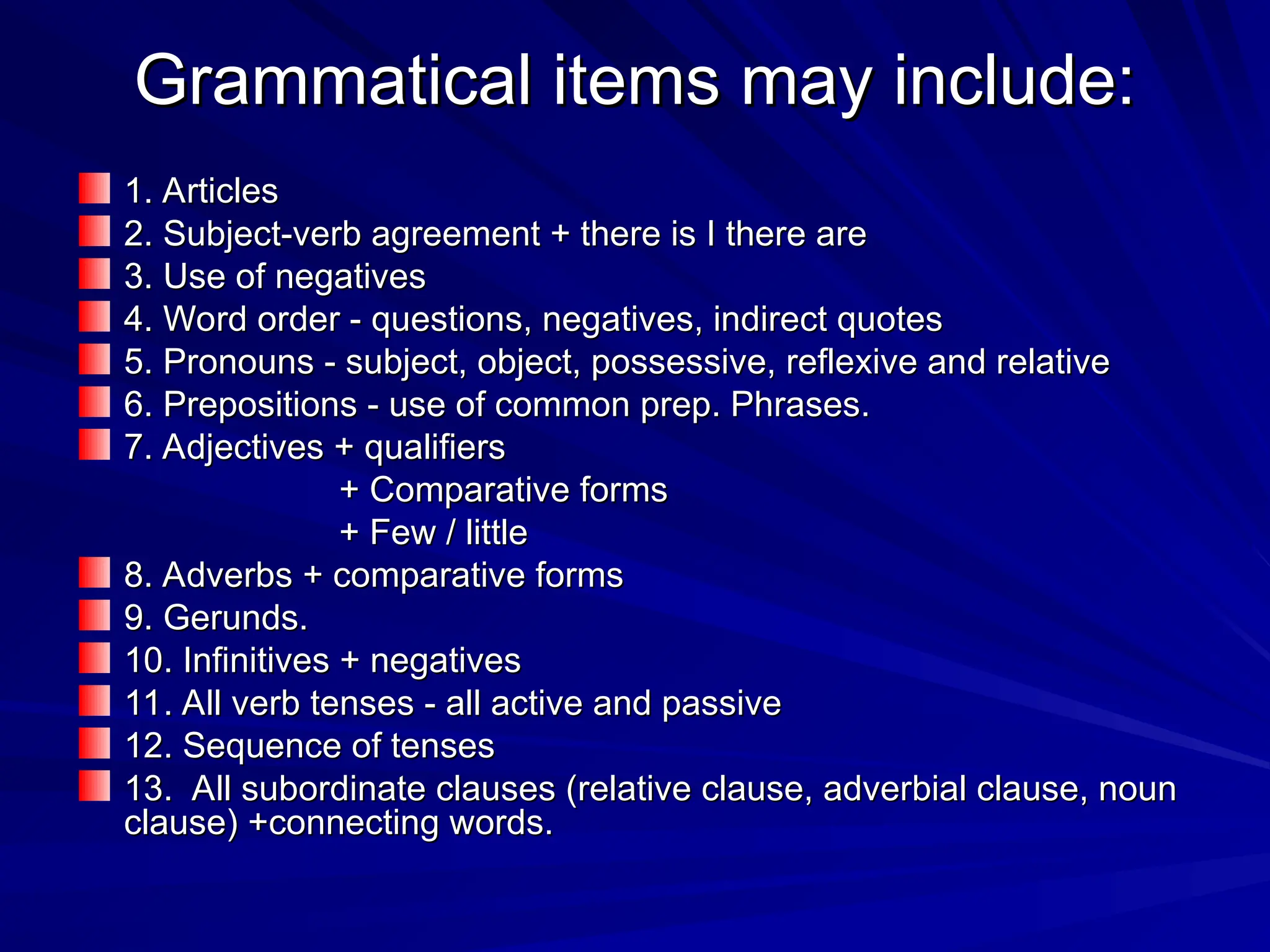
Grammatical items may include:
1. Articles
1. Articles
2. Subject-verb agreement + there is I there are
3. Use of negatives
3. Use of negatives
4. Word order - questions, negatives, indirect quotes
5. Pronouns - subject, object, possessive, reflexive and relative
6. Prepositions - use of common prep. Phrases.
7. Adjectives + qualifiers
+ Comparative forms
+ Comparative forms
+ Few / little
+ Few / little
8. Adverbs + comparative forms
9. Gerunds.
9. Gerunds.
10. Infinitives + negatives
11. All verb tenses - all active and passive
12. Sequence of tenses
13. All subordinate clauses (relative clause, adverbial clause, noun
clause) +connecting words.
Part II- Vocabulary:
Objective:
Objective:
To test students' knowledge of
common vocabulary words.
Contents
Contents
1. Some vocabulary items from high school
English textbooks.
English textbooks.
2. Items from general English vocabulary.
Part III- Reading comprehension:
Objective:
Objective:
To test students' knowledge of
common vocabulary words.
Contents
Contents
1. Finding the meaning of words in context
2. Finding the main idea of a paragraph
3. Finding the topic of a passage
4. Listing subordinating details
5. Recognizing the importance of some details
6. Making inferences or deductions
7. Using numbers in passages to solve problems
Let’s give it a try
Let’s give it a try.
.
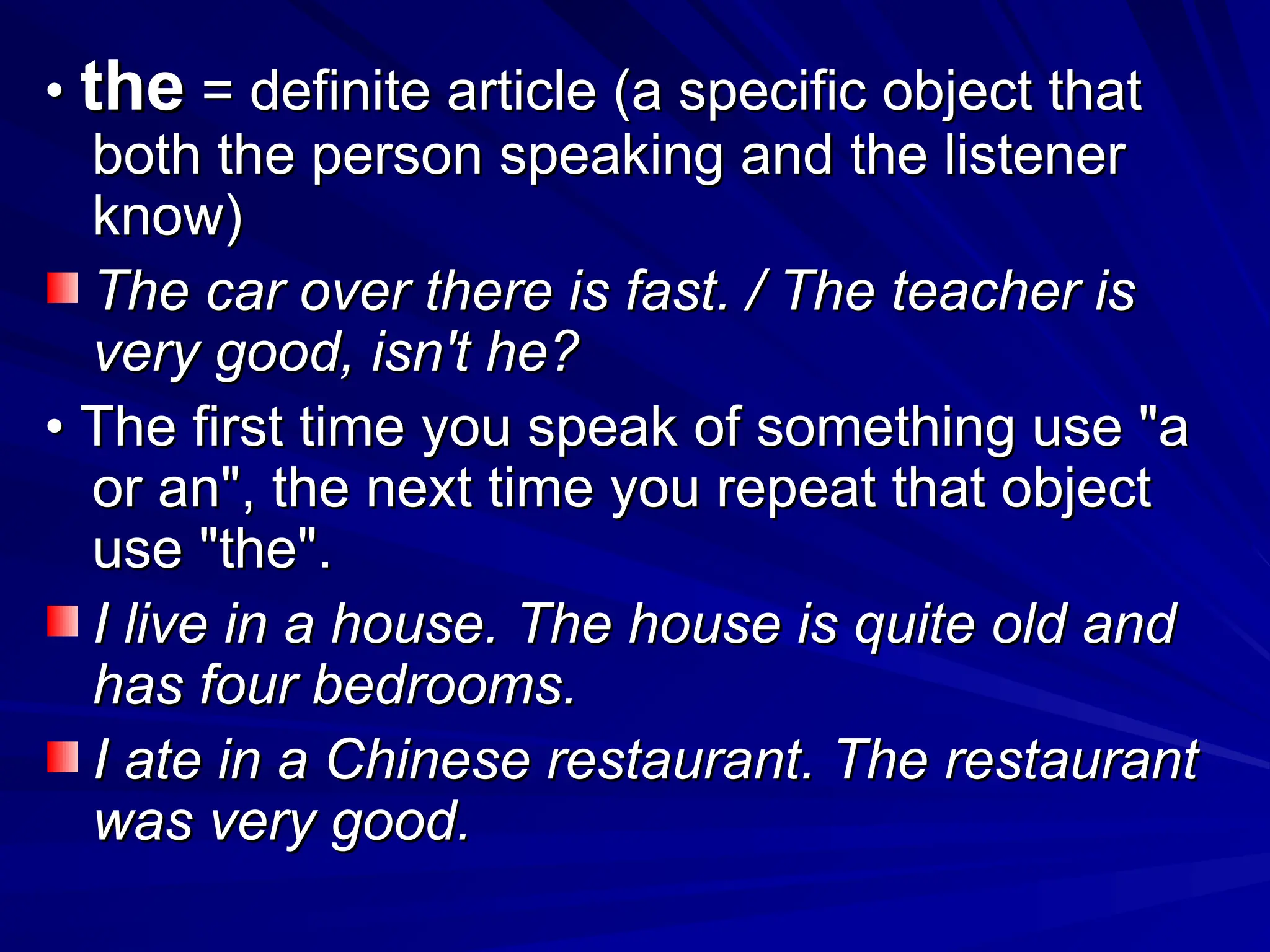
Grammar
Grammar
Articles
Articles
•
• a
a = indefinite article (not a specific object,
= indefinite article (not a specific object,
one of a number of the same objects) with
consonants.
consonants.
She has a dog. / I work in a factory.
•
• an
an = indefinite article (not a specific object,
= indefinite article (not a specific object,
one of a number of the same objects) with
vowels (a,e,i,o,u)
vowels (a,e,i,o,u)
Can I have an apple? / She is an English
teacher.
teacher.
•
• the
the = definite article (a specific object that
= definite article (a specific object that
both the person speaking and the listener
know)
know)
The car over there is fast. / The teacher is
very good, isn't he?
•
• The first time you speak of something use "a
The first time you speak of something use "a
or an", the next time you repeat that object
use "the".
use "the".
I live in a house. The house is quite old and
has four bedrooms.
has four bedrooms.
I ate in a Chinese restaurant. The restaurant
was very good.
was very good.
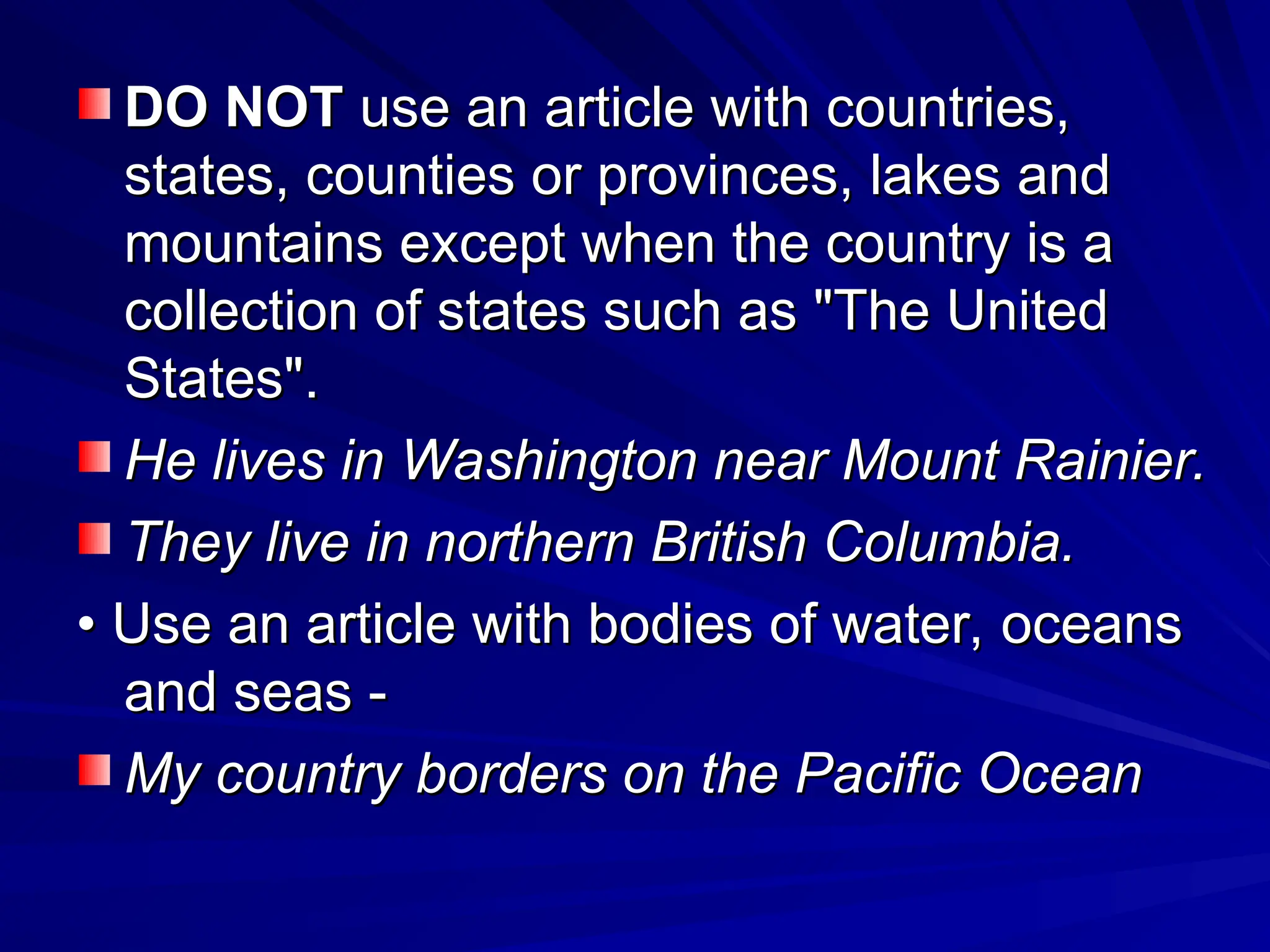
DO NOT
DO NOT use an article with countries,
use an article with countries,
states, counties or provinces, lakes and
mountains except when the country is a
collection of states such as "The United
States".
States".
He lives in Washington near Mount Rainier.
They live in northern British Columbia.
•
• Use an article with bodies of water, oceans
Use an article with bodies of water, oceans
and seas -
and seas -
My country borders on the Pacific Ocean
•
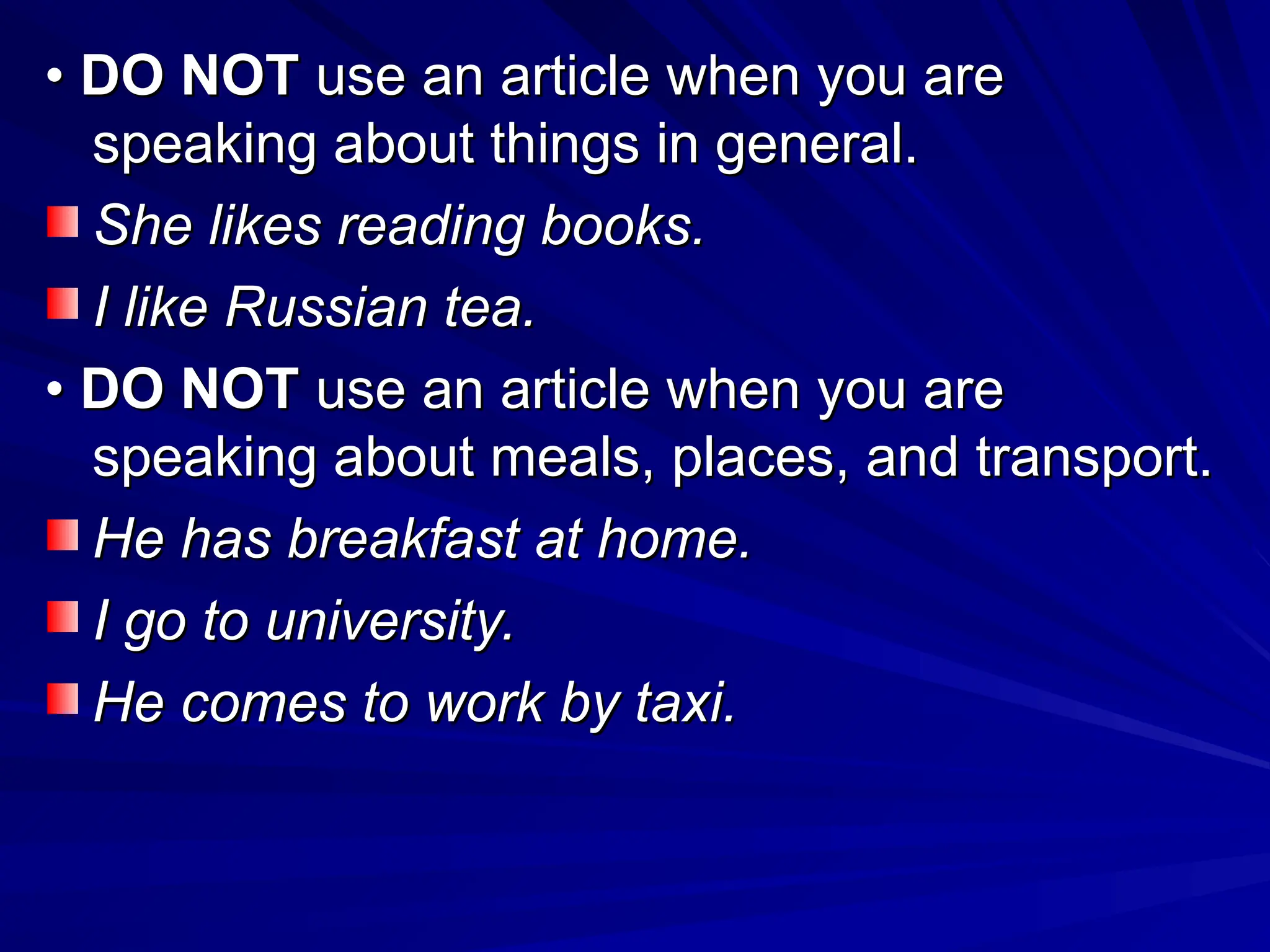
• DO NOT
DO NOT use an article when you are
use an article when you are
speaking about things in general.
She likes reading books.
I like Russian tea.
I like Russian tea.
•
• DO NOT
DO NOT use an article when you are
use an article when you are
speaking about meals, places, and transport.
He has breakfast at home.
I go to university.
I go to university.
He comes to work by taxi.
Check the handout for practice.
Subject-verb agreement
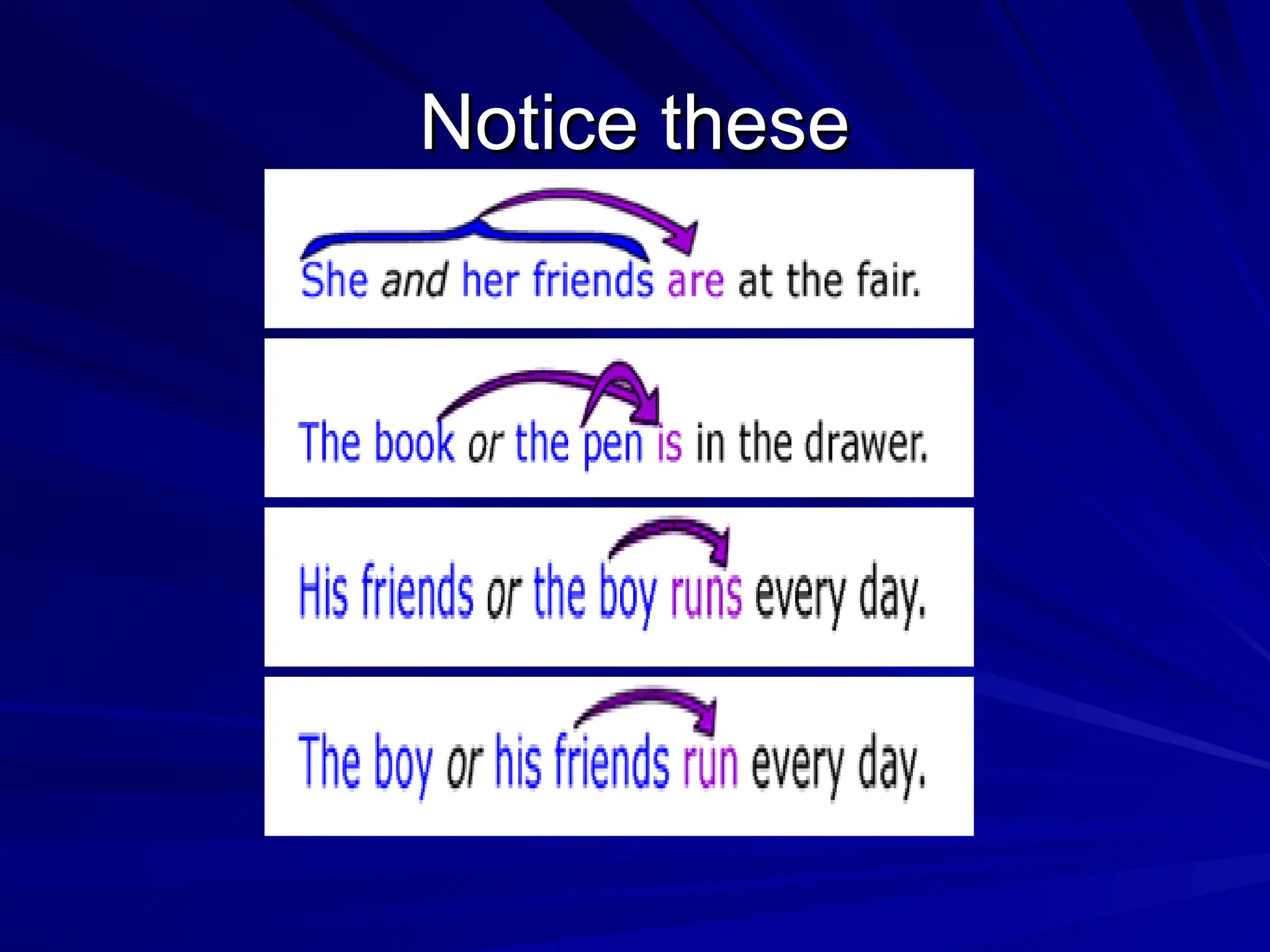
Notice these
Notice these
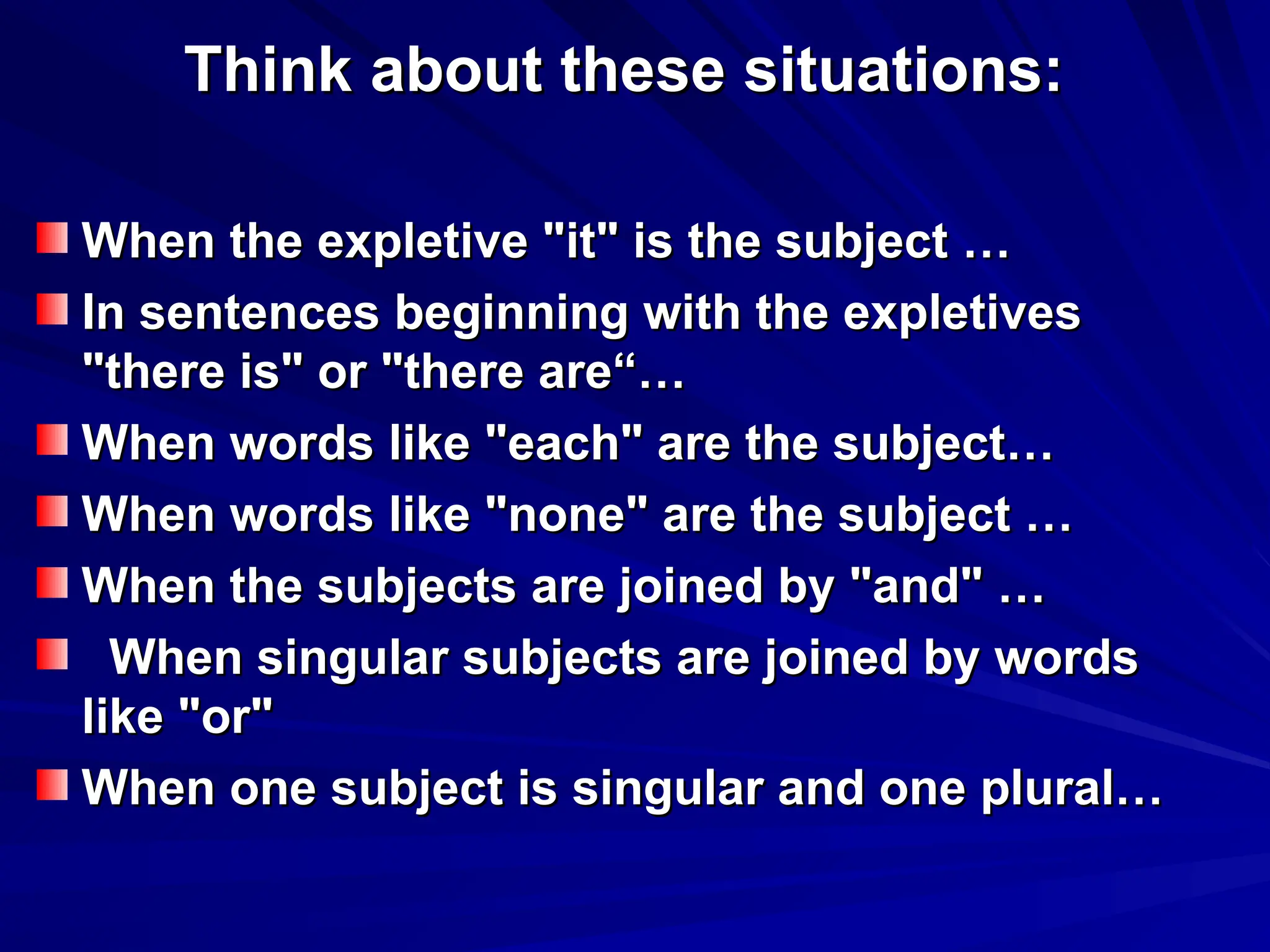
Think about these situations:
When the expletive "it" is the subject …
In sentences beginning with the expletives
"there is" or "there are“…
When words like "each" are the subject…
When words like "none" are the subject …
When the subjects are joined by "and" …
When singular subjects are joined by words
like "or"
like "or"
When one subject is singular and one plural…
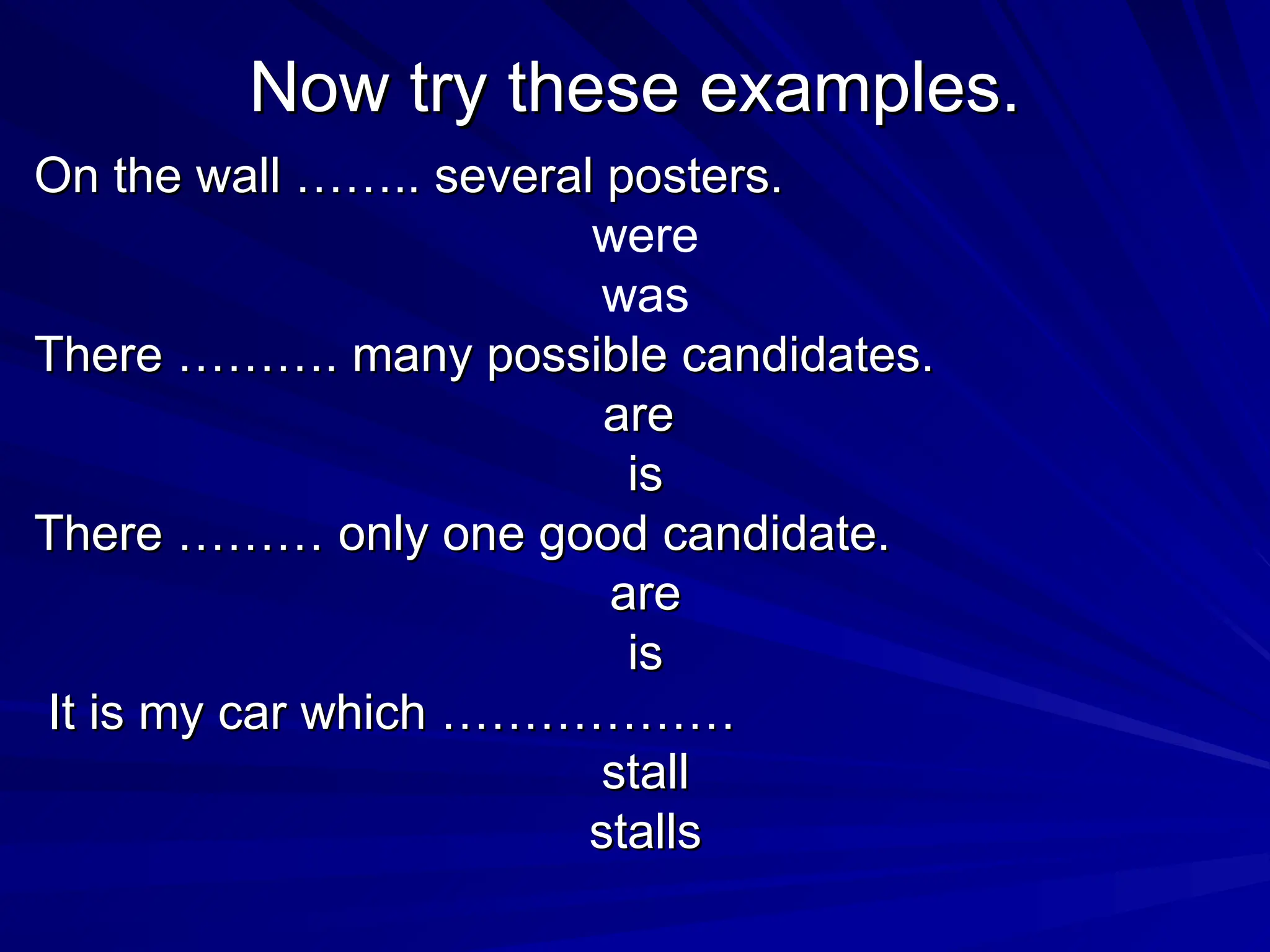
Now try these examples.
On the wall …….. several posters.
were
was
There ………. many possible candidates.
are
are
is
is
There ……… only one good candidate.
are
are
is
is
It is my car which ………………
stall
stall
stalls
stalls
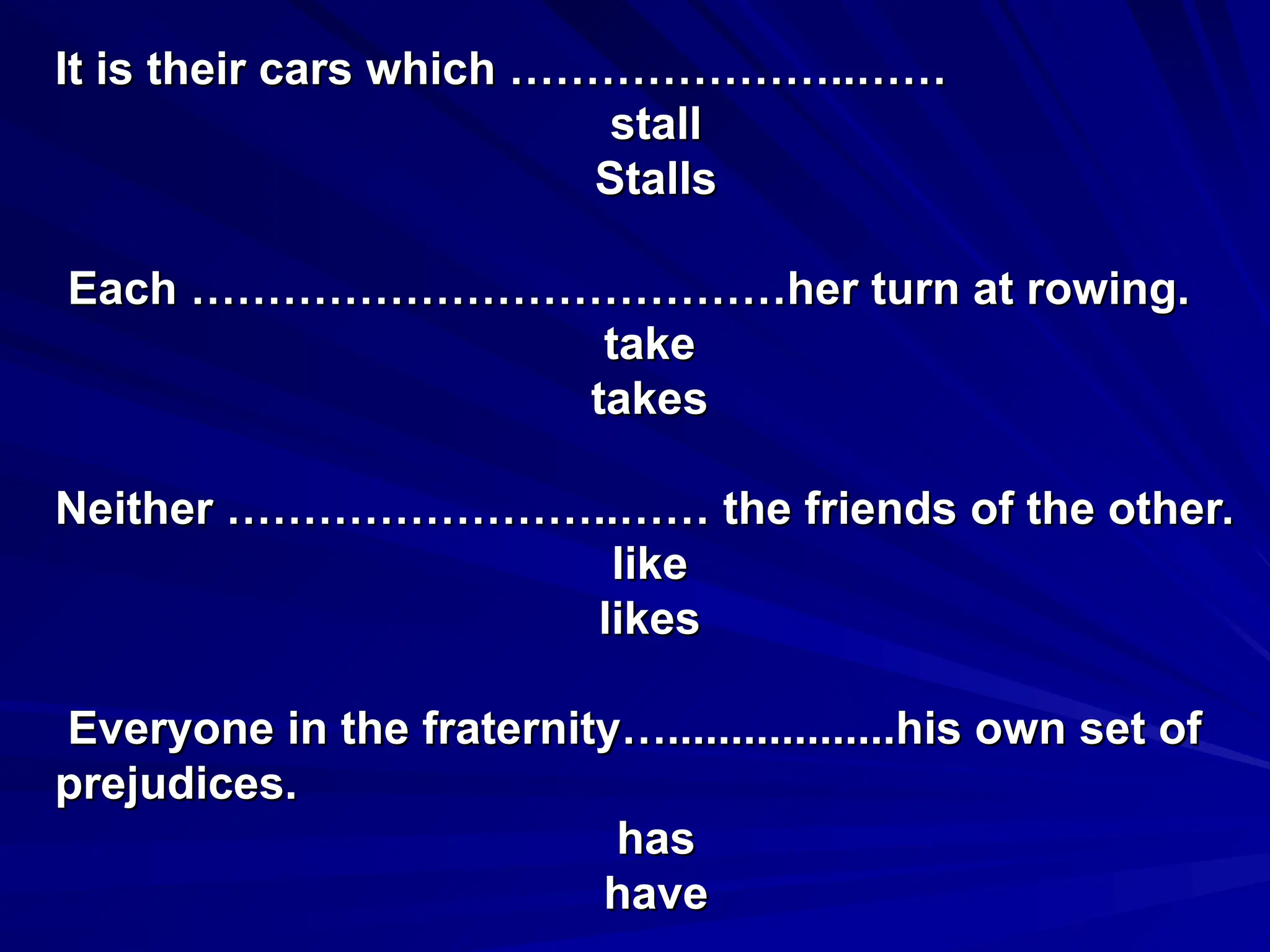
It is their cars which …………………..……
stall
stall
Stalls
Stalls
Each …………………………………her turn at rowing.
take
take
takes
takes
Neither ……………………..…… the friends of the other.
like
like
likes
likes
Everyone in the fraternity…..................his own set of
prejudices.
prejudices.
has
has
have
have
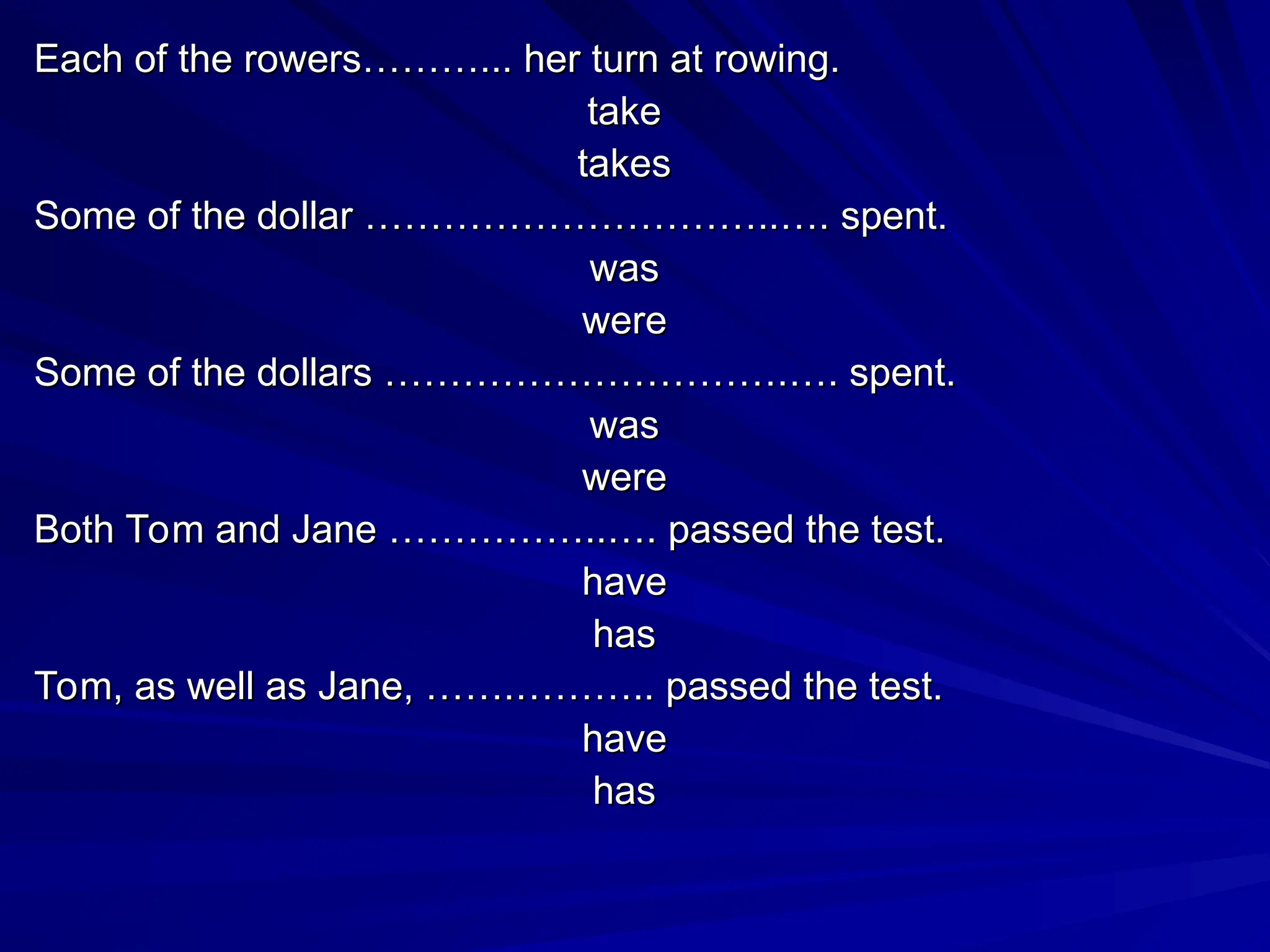
Each of the rowers………... her turn at rowing.
take
take
takes
takes
Some of the dollar …………………………..…. spent.
was
was
were
were
Some of the dollars ………………………….…. spent.
was
was
were
were
Both Tom and Jane ……………..…. passed the test.
have
have
has
has
Tom, as well as Jane, …….……….. passed the test.
have
have
has
has
Either the man or his wife…. the truth of the matter
knows
knows
know
know
Neither money nor power ……. important any longer.
was
was
were
were
Neither the television nor the radios ………….
works
works
work
work
Neither the radios nor the television …………….
works
works
work
work
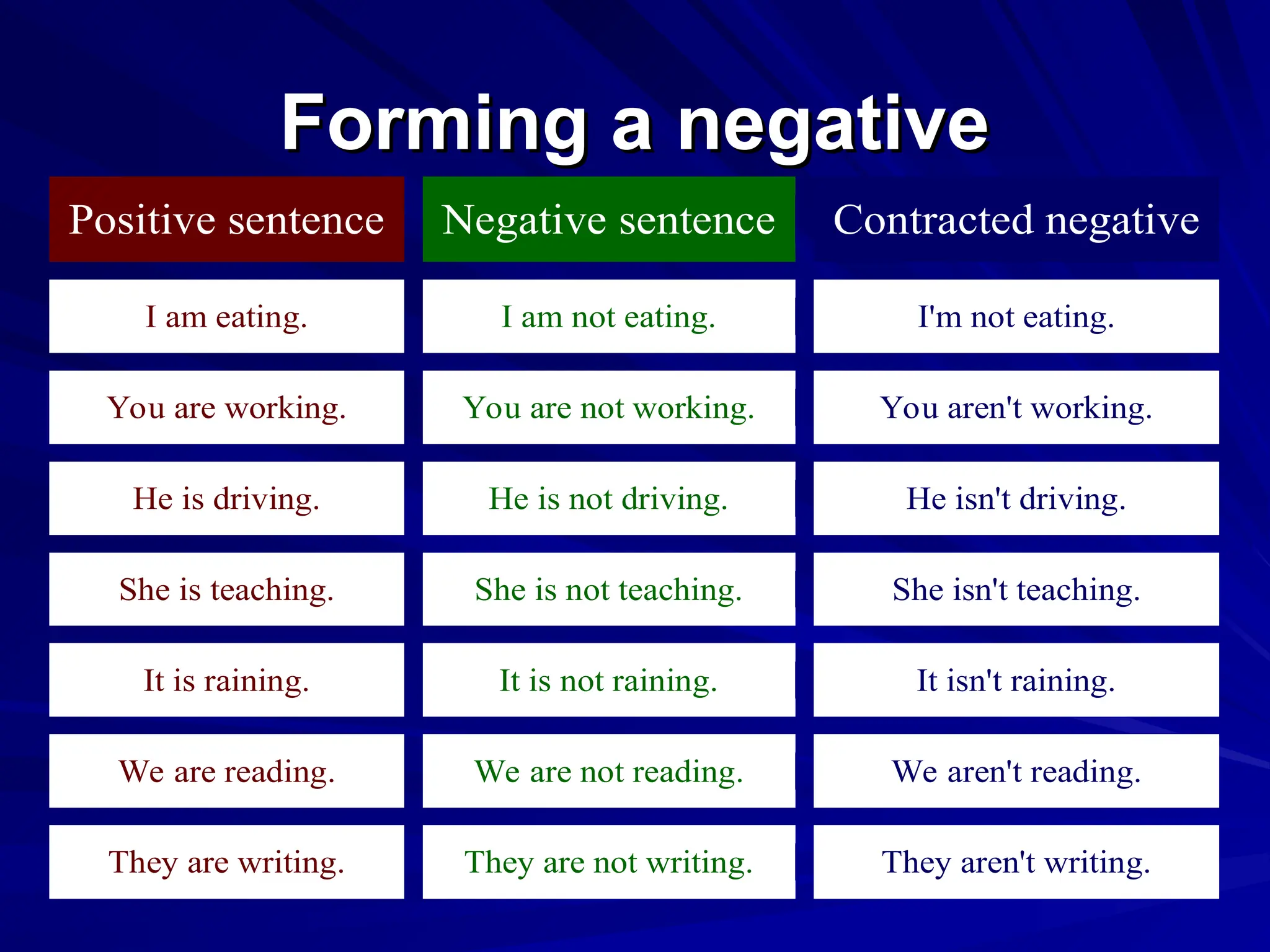
Forming a negative
Forming a negative
Positive sentence Negative sentence Contracted negative
I am eating. I am not eating. I'm not eating.
You are working. You are not working. You aren't working.
He is driving. He is not driving. He isn't driving.
She is teaching. She is not teaching. She isn't teaching.
It is raining. It is not raining. It isn't raining.
We are reading. We are not reading. We aren't reading.
They are writing. They are not writing. They aren't writing.
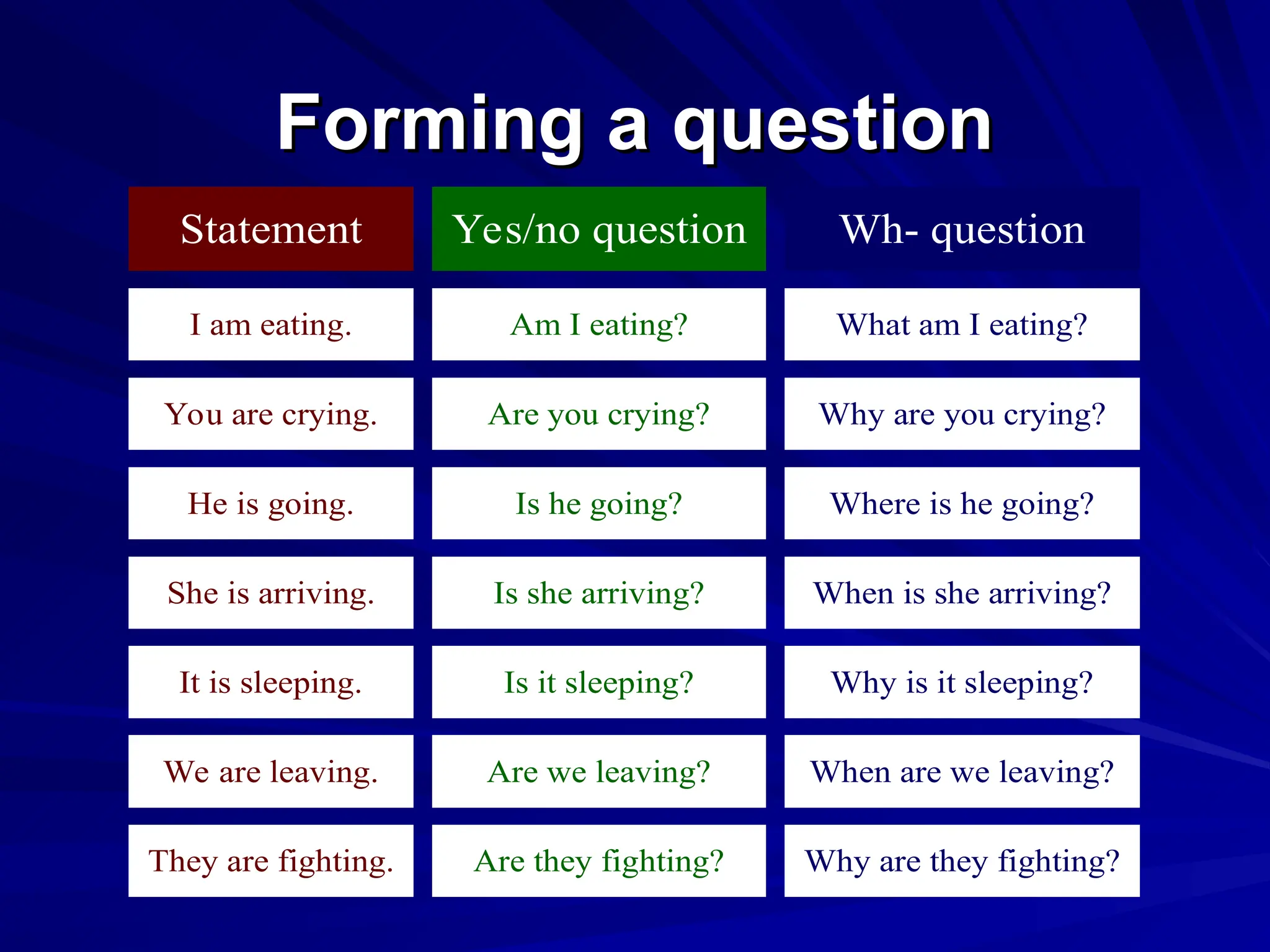
Forming a question
Forming a question
Statement Yes/no question Wh- question
I am eating. Am I eating? What am I eating?
You are crying. Are you crying? Why are you crying?
He is going. Is he going? Where is he going?
She is arriving. Is she arriving? When is she arriving?
It is sleeping. Is it sleeping? Why is it sleeping?
We are leaving. Are we leaving? When are we leaving?
They are fighting. Are they fighting? Why are they fighting?
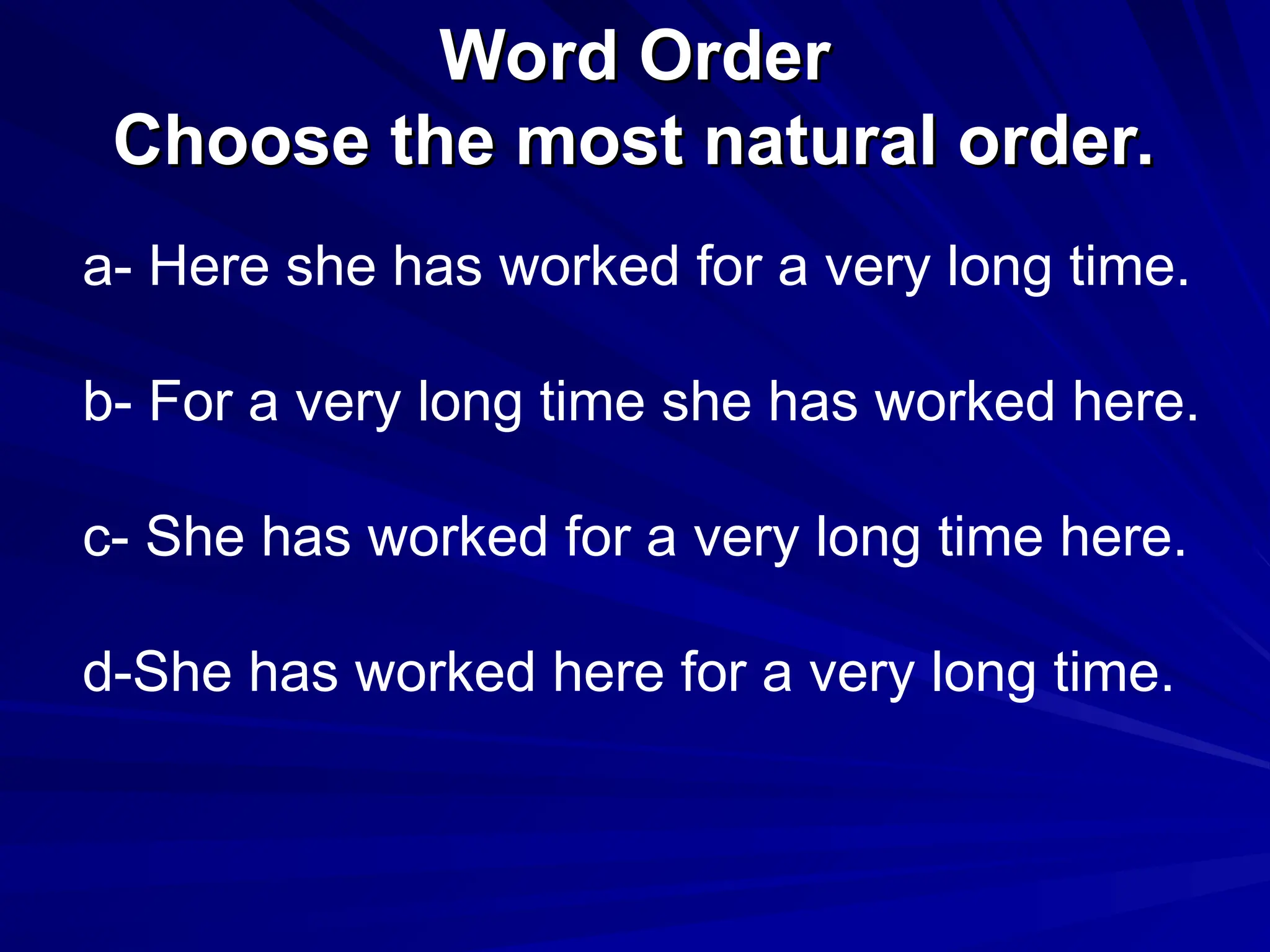
Word Order
Word Order
Choose the most natural order.
a- Here she has worked for a very long time.
b- For a very long time she has worked here.
c- She has worked for a very long time here.
d-She has worked here for a very long time.
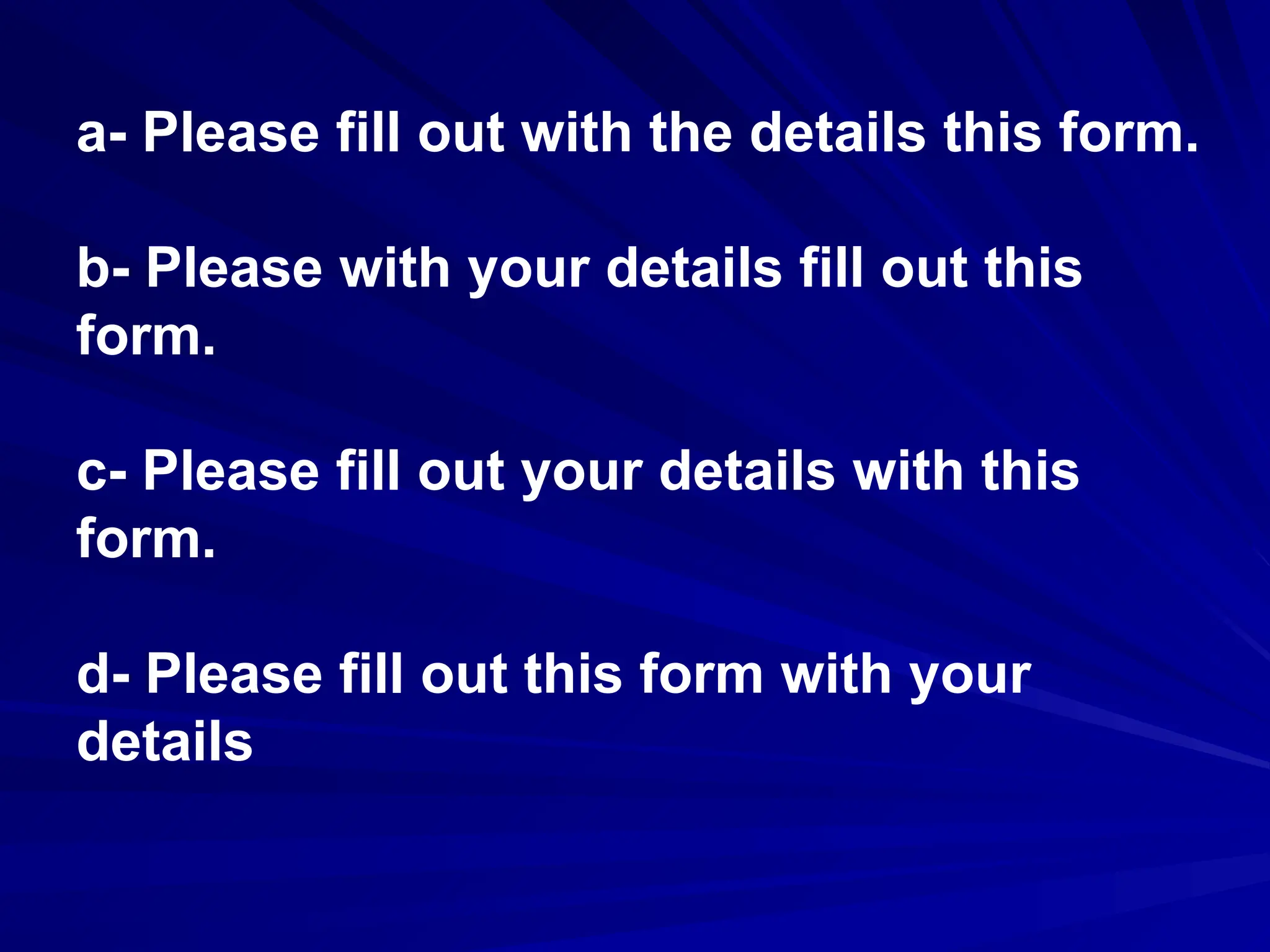
a- Please fill out with the details this form.
b- Please with your details fill out this
form.
c- Please fill out your details with this
form.
d- Please fill out this form with your
details
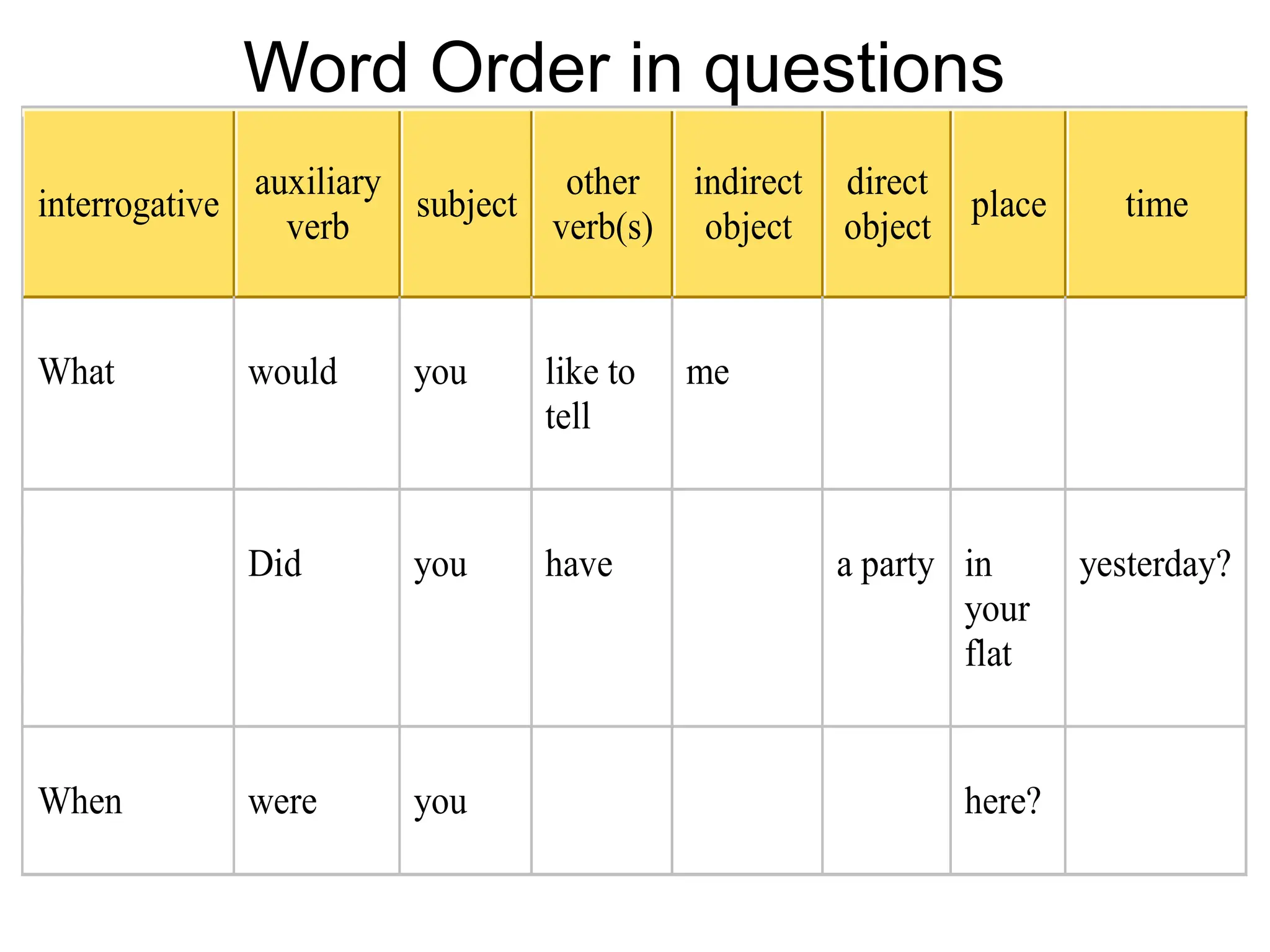
Word Order in questions
interrogative
auxiliary
verb
subject
other
verb(s)
indirect
object
direct
object
place time
What would you like to
tell
me
Did you have a party in
your
flat
yesterday?
When were you here?
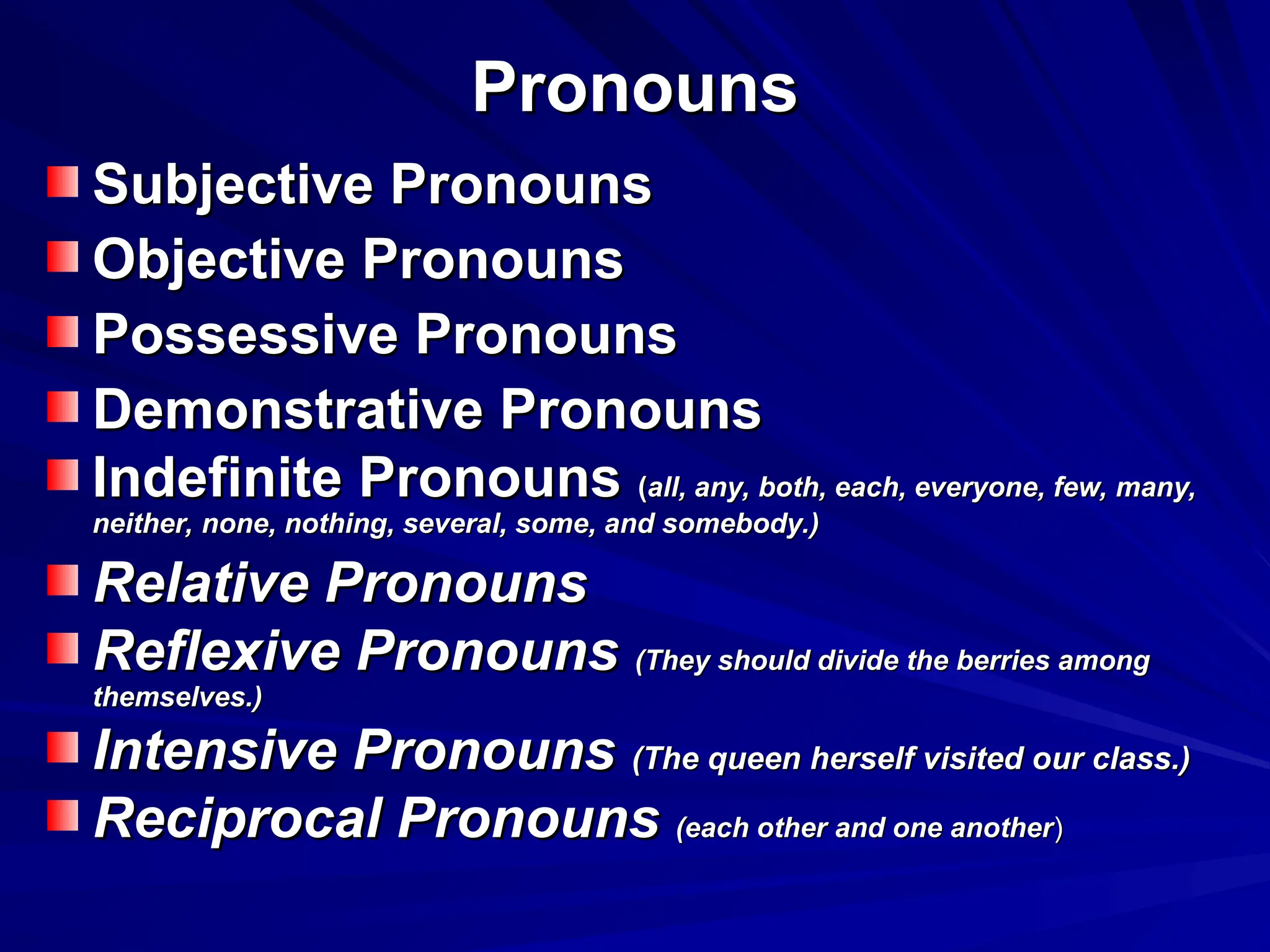
Pronouns
Pronouns
Subjective Pronouns
Subjective Pronouns
Objective Pronouns
Objective Pronouns
Possessive Pronouns
Possessive Pronouns
Demonstrative Pronouns
Indefinite Pronouns
Indefinite Pronouns (
(all, any, both, each, everyone, few, many,
all, any, both, each, everyone, few, many,
neither, none, nothing, several, some, and somebody.)
Relative Pronouns
Relative Pronouns
Reflexive Pronouns
Reflexive Pronouns (They should divide the berries among
(They should divide the berries among
themselves.)
themselves.)
Intensive Pronouns
Intensive Pronouns (The queen herself visited our class.)
(The queen herself visited our class.)
Reciprocal Pronouns
Reciprocal Pronouns (each other and one another
(each other and one another)
)
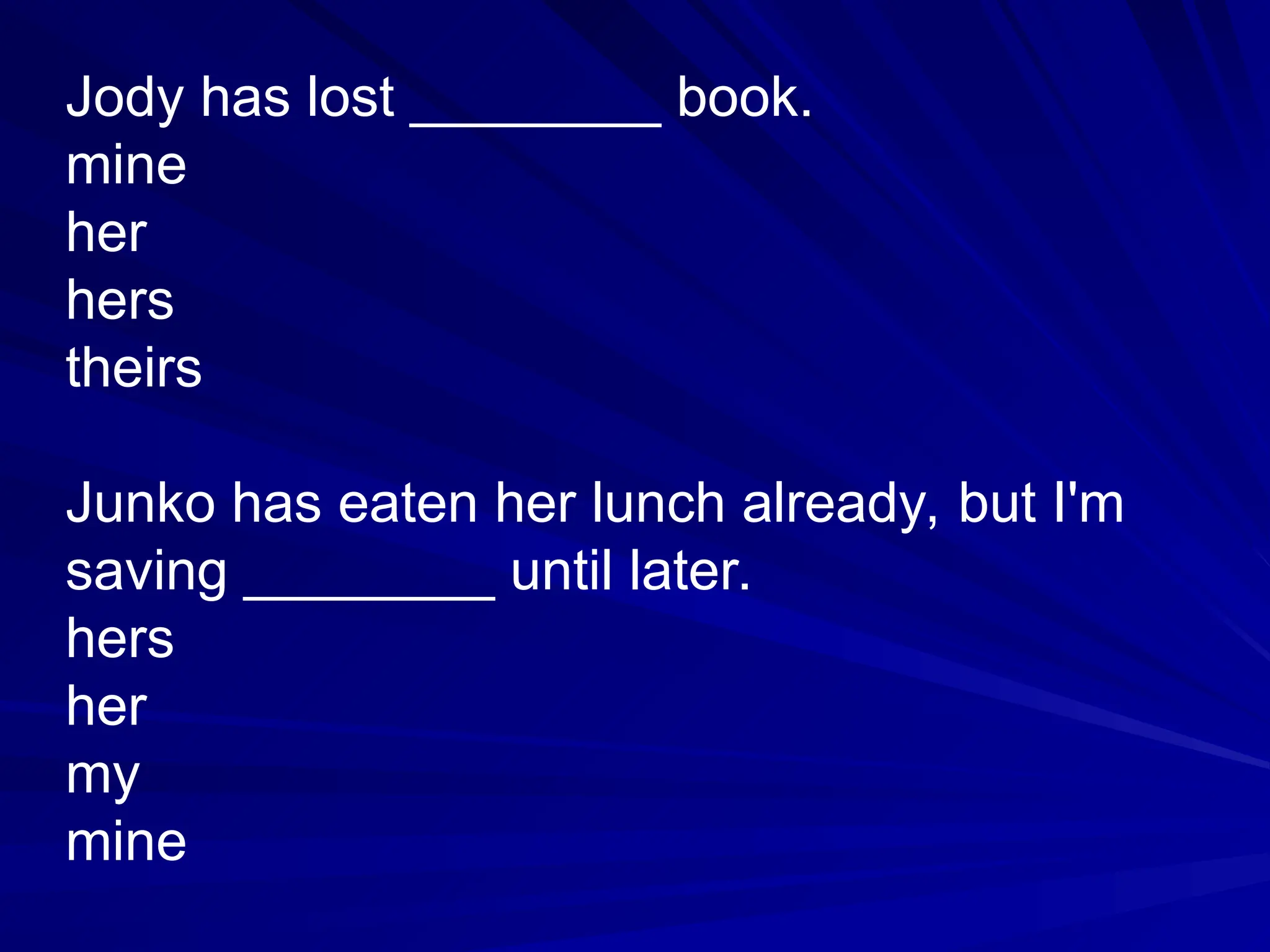
Jody has lost ________ book.
mine
her
hers
theirs
Junko has eaten her lunch already, but I'm
saving ________ until later.
hers
her
my
mine
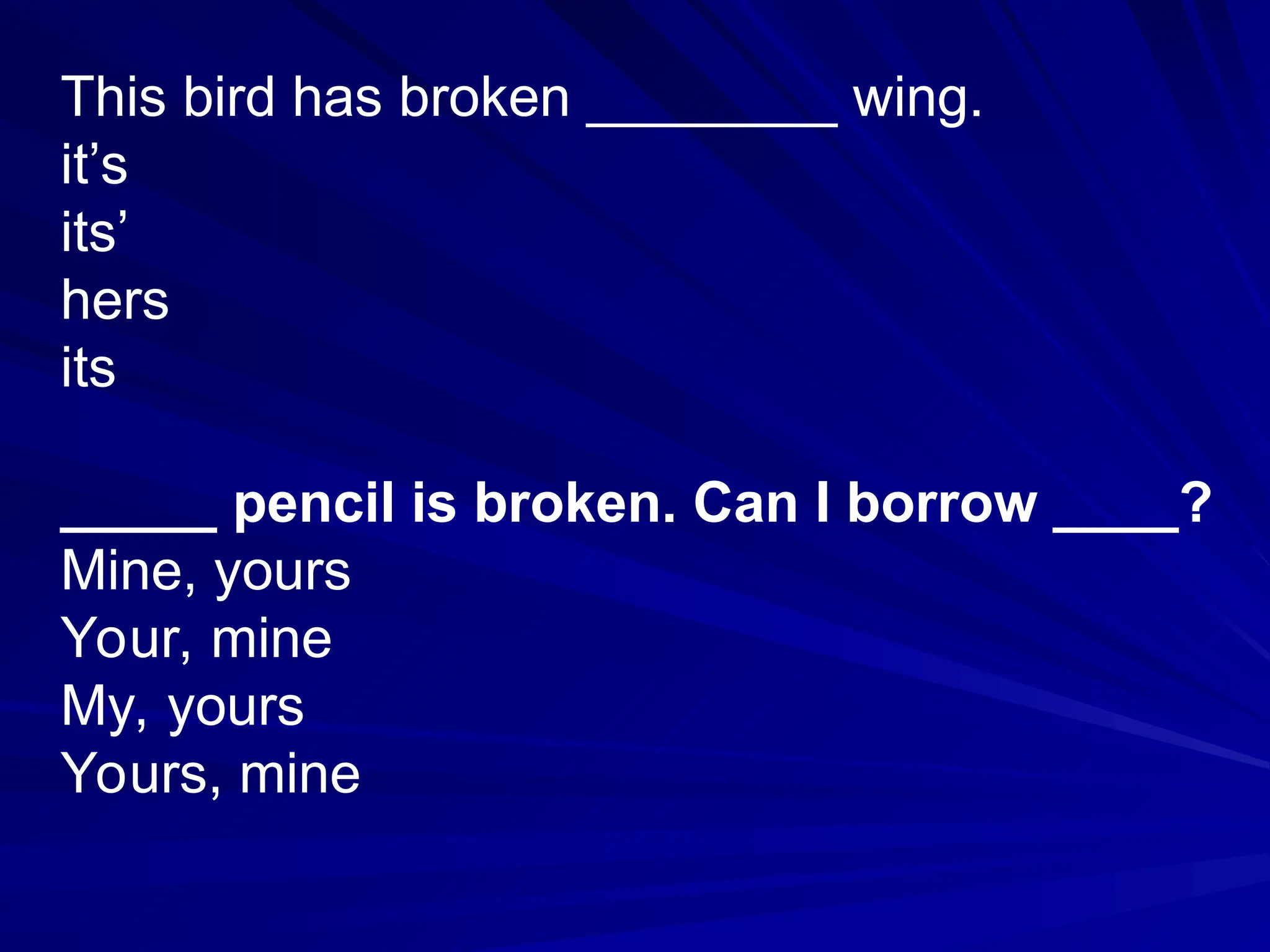
This bird has broken ________ wing.
it’s
its’
hers
its
_____ pencil is broken. Can I borrow ____?
Mine, yours
Your, mine
My, yours
Yours, mine
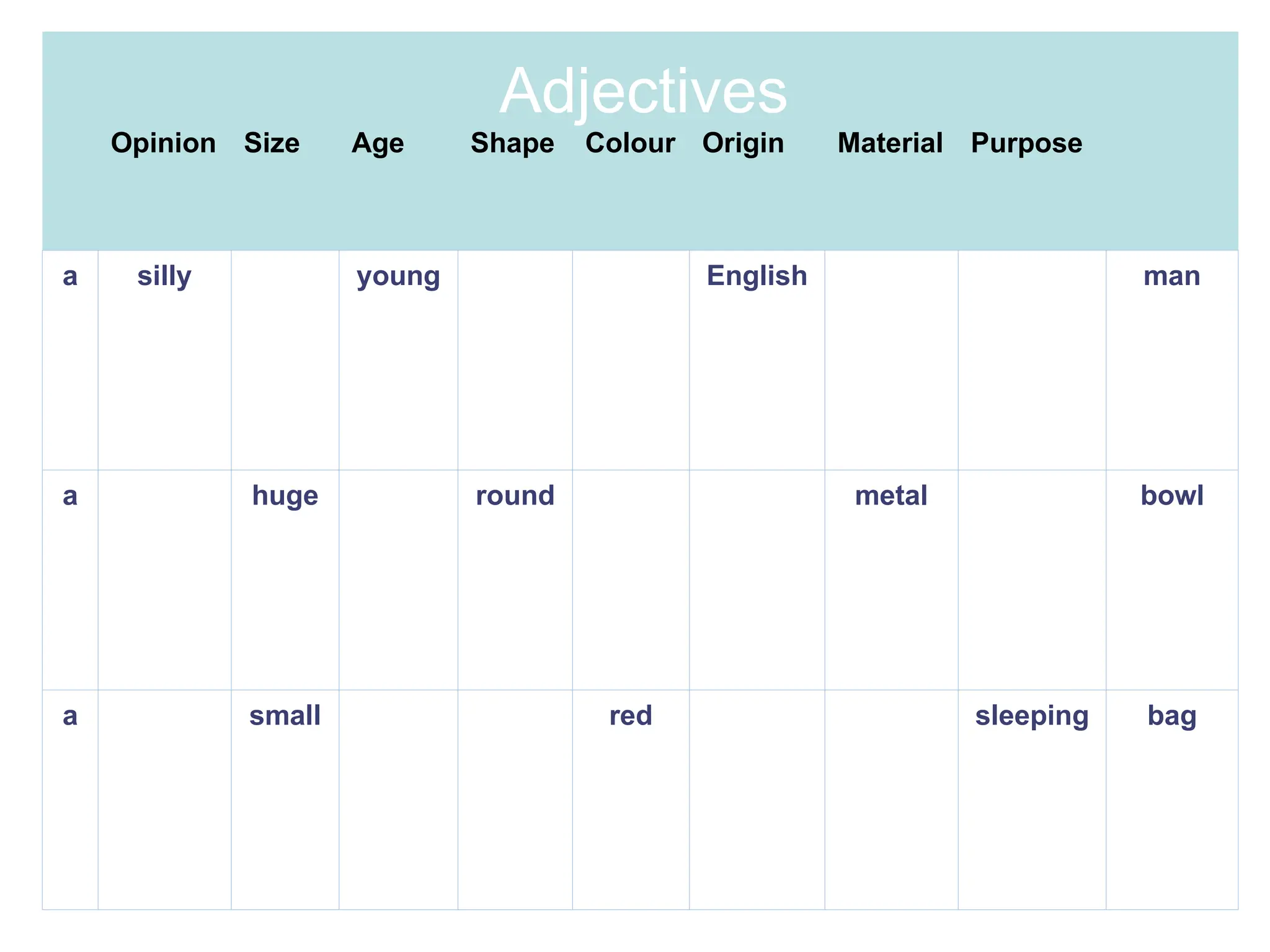
Opinion Size Age Shape Colour Origin Material Purpose
a silly young English man
a huge round metal bowl
a small red sleeping bag
Adjectives
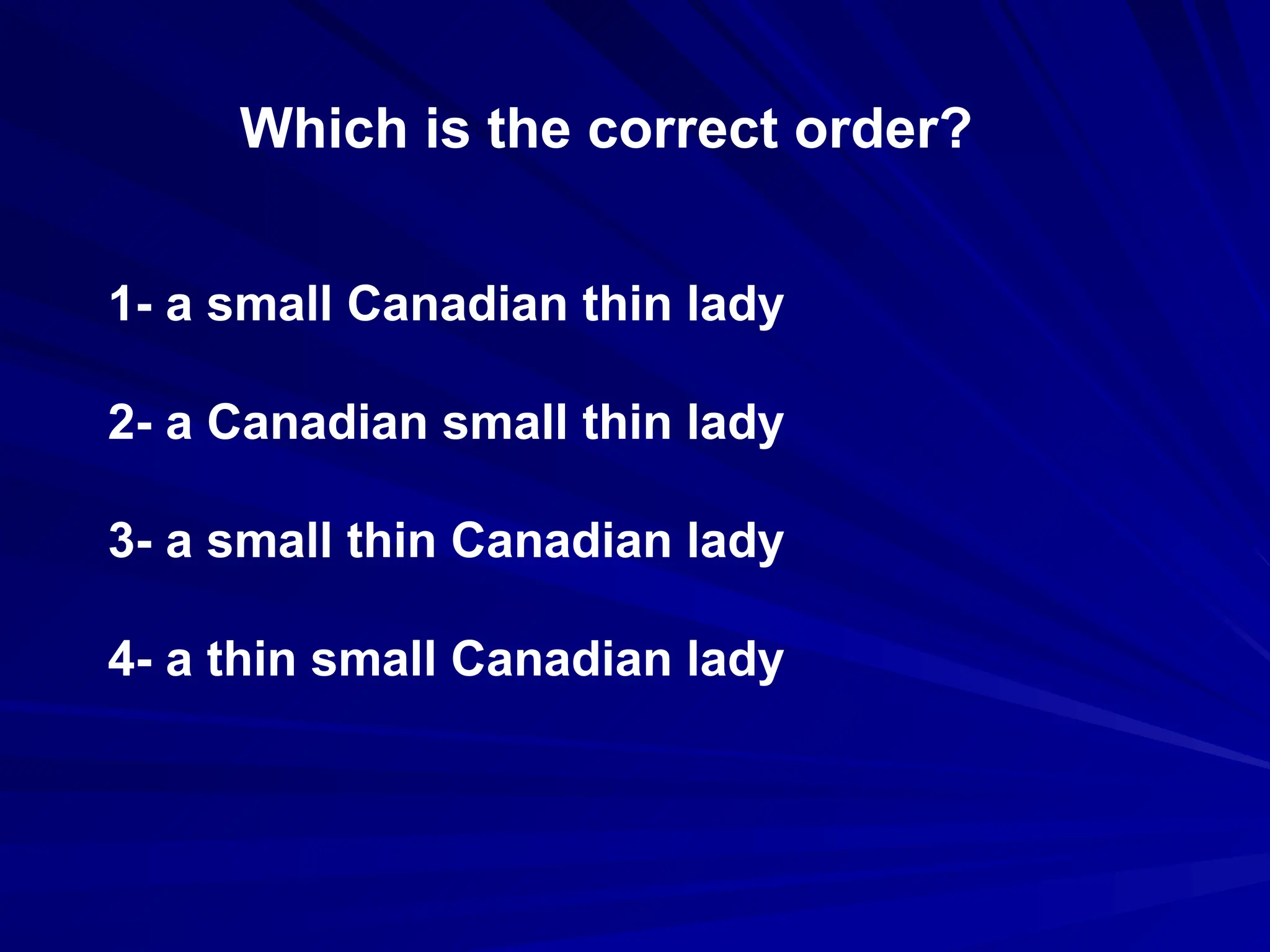
Which is the correct order?
1- a small Canadian thin lady
2- a Canadian small thin lady
3- a small thin Canadian lady
4- a thin small Canadian lady
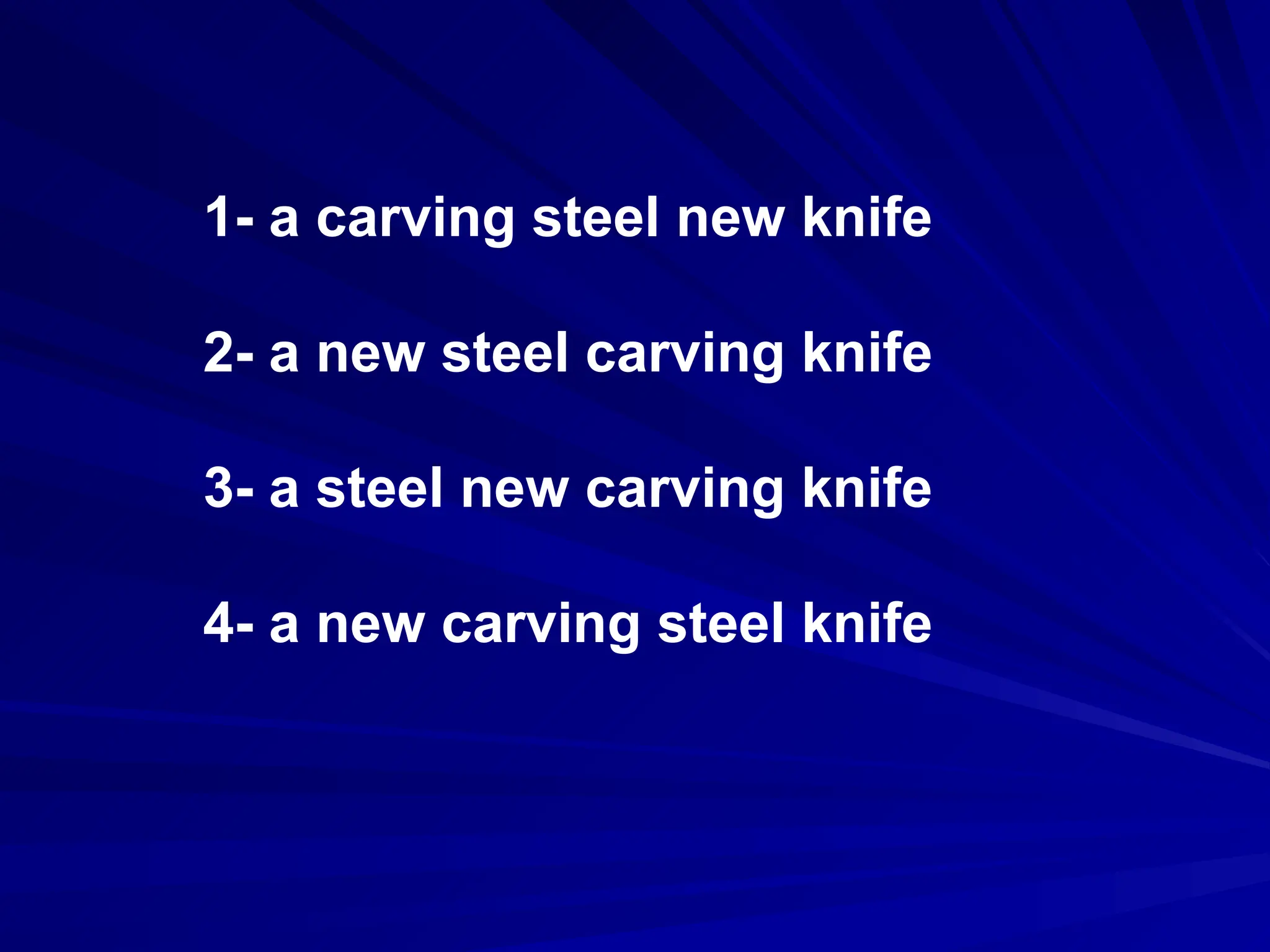
1- a carving steel new knife
2- a new steel carving knife
3- a steel new carving knife
4- a new carving steel knife
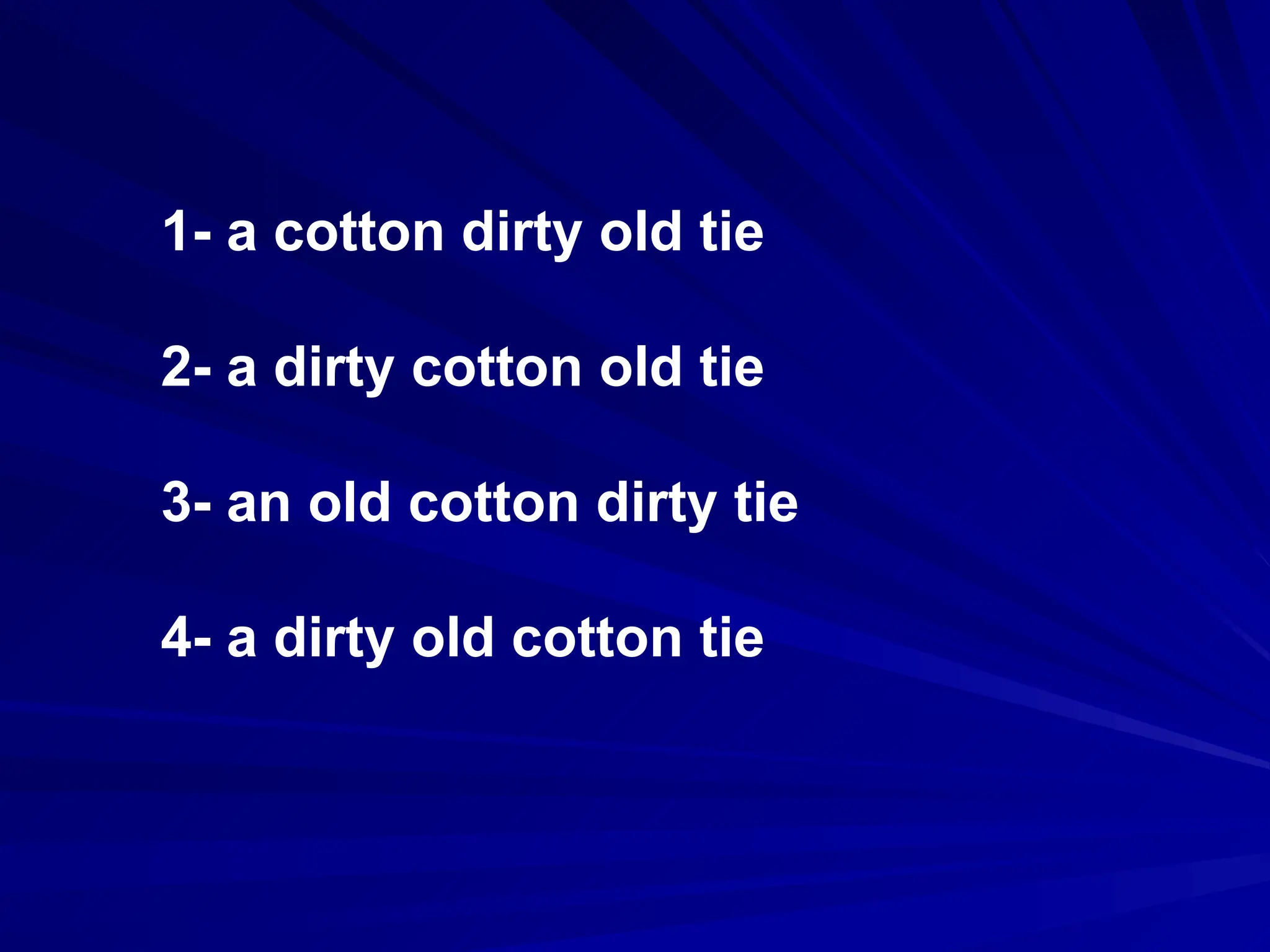
1- a cotton dirty old tie
2- a dirty cotton old tie
3- an old cotton dirty tie
4- a dirty old cotton tie
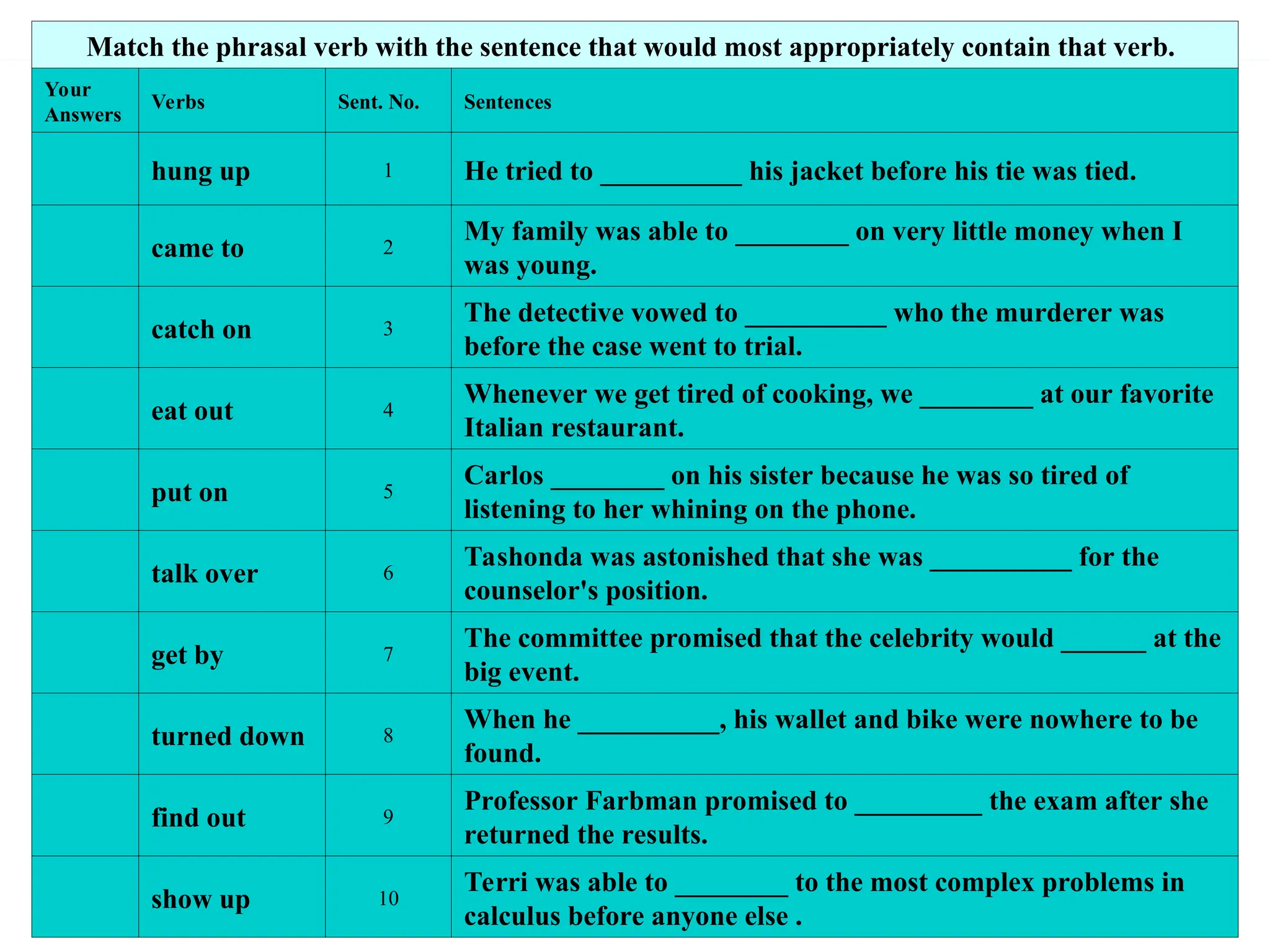
Phrasal verbs
Match the phrasal verb with the sentence that would most appropriately contain that verb.
Your
Answers
Verbs Sent. No. Sentences
hung up 1 He tried to __________ his jacket before his tie was tied.
came to 2
My family was able to ________ on very little money when I
was young.
catch on 3
The detective vowed to __________ who the murderer was
before the case went to trial.
eat out 4
Whenever we get tired of cooking, we ________ at our favorite
Italian restaurant.
put on 5
Carlos ________ on his sister because he was so tired of
listening to her whining on the phone.
talk over 6
Tashonda was astonished that she was __________ for the
counselor's position.
get by 7
The committee promised that the celebrity would ______ at the
big event.
turned down 8
When he __________, his wallet and bike were nowhere to be
found.
find out 9
Professor Farbman promised to _________ the exam after she
returned the results.
show up 10
Terri was able to ________ to the most complex problems in
calculus before anyone else .
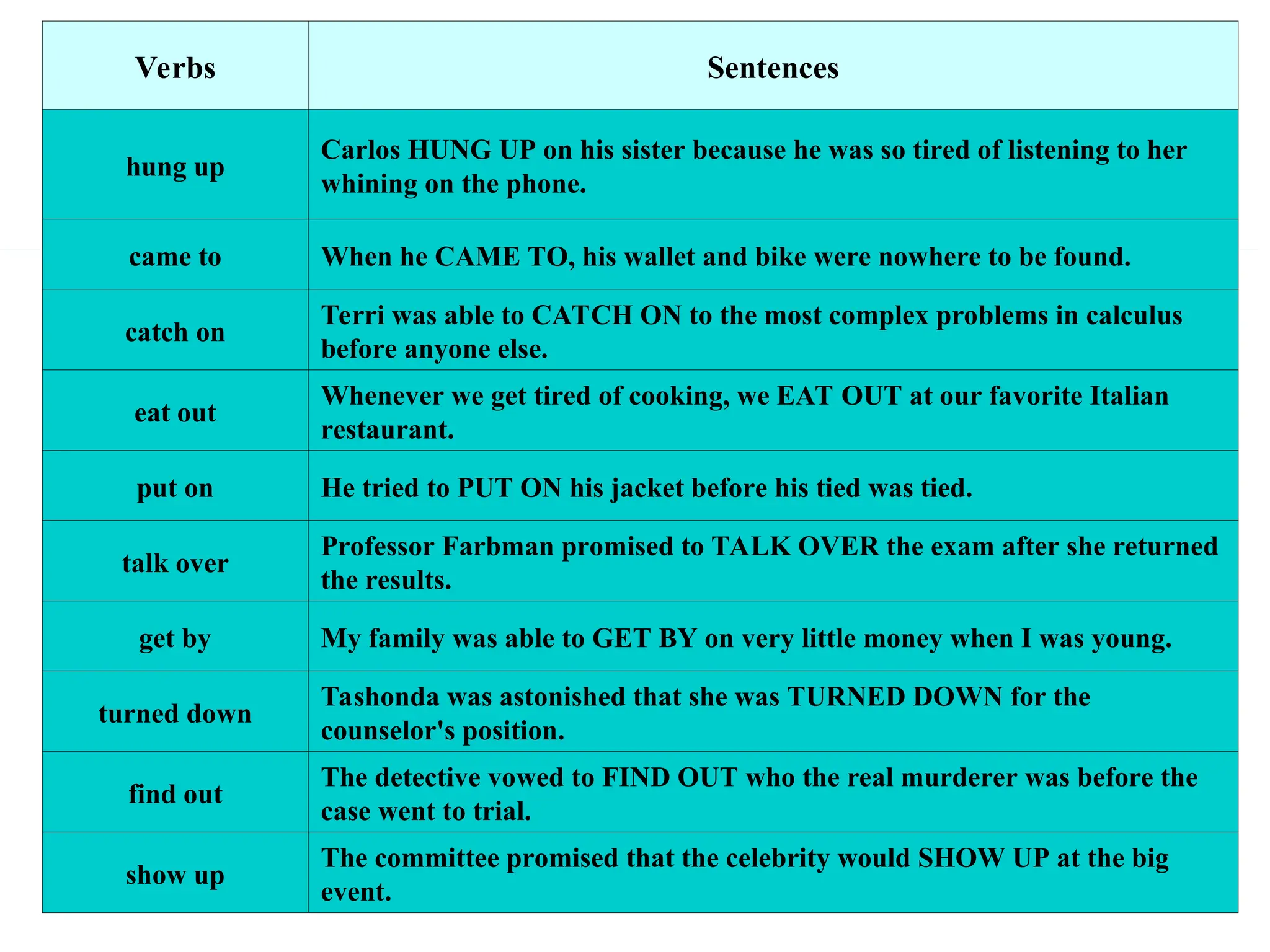
Verbs Sentences
hung up
Carlos HUNG UP on his sister because he was so tired of listening to her
whining on the phone.
came to When he CAME TO, his wallet and bike were nowhere to be found.
catch on
Terri was able to CATCH ON to the most complex problems in calculus
before anyone else.
eat out
Whenever we get tired of cooking, we EAT OUT at our favorite Italian
restaurant.
put on He tried to PUT ON his jacket before his tied was tied.
talk over
Professor Farbman promised to TALK OVER the exam after she returned
the results.
get by My family was able to GET BY on very little money when I was young.
turned down
Tashonda was astonished that she was TURNED DOWN for the
counselor's position.
find out
The detective vowed to FIND OUT who the real murderer was before the
case went to trial.
show up
The committee promised that the celebrity would SHOW UP at the big
event.
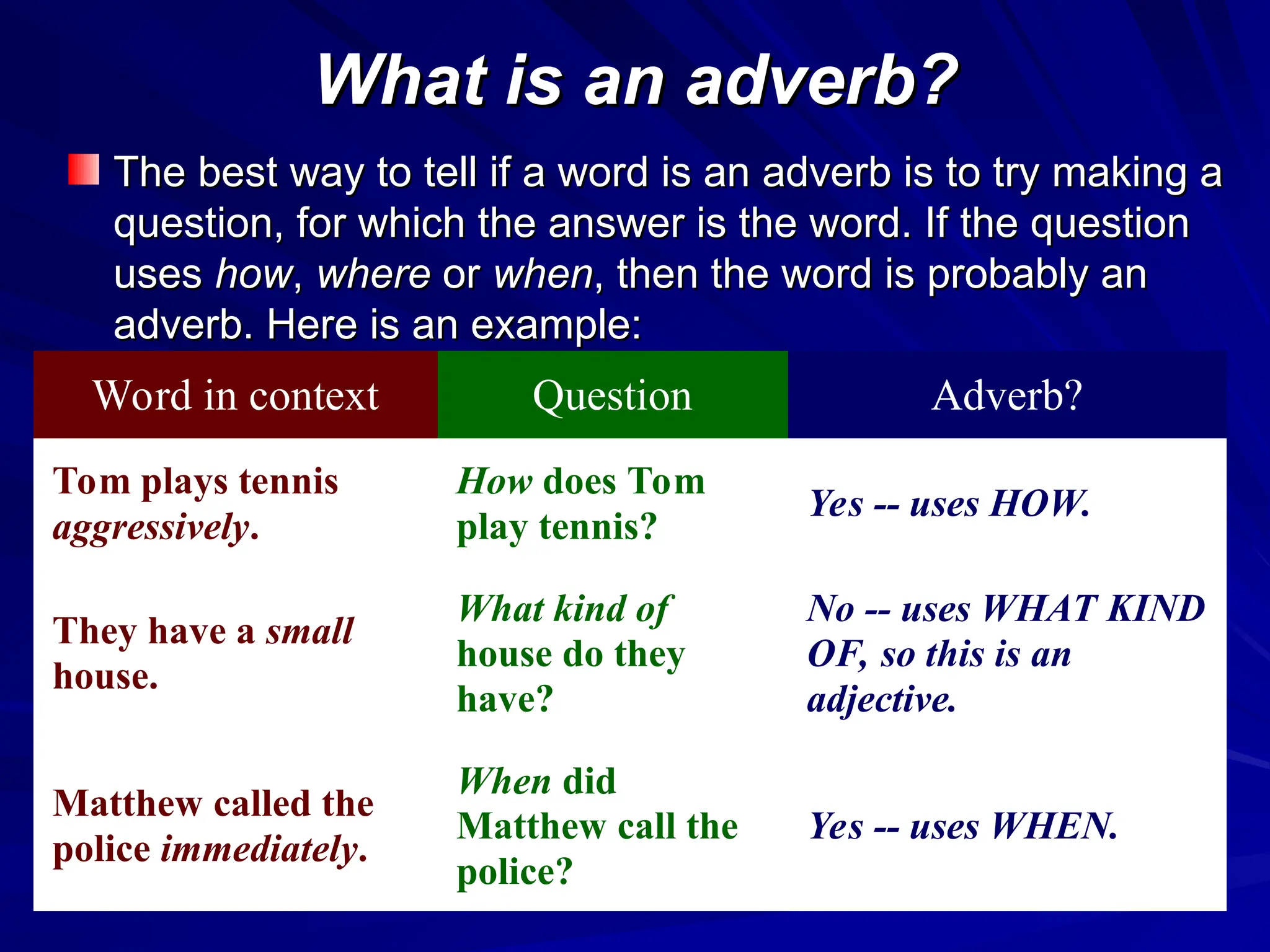
What is an adverb?
What is an adverb?
The best way to tell if a word is an adverb is to try making a
question, for which the answer is the word. If the question
uses
uses how
how,
, where
where or
or when
when, then the word is probably an
, then the word is probably an
adverb. Here is an example:
Word in context Question Adverb?
Tom plays tennis
aggressively.
How does Tom
play tennis?
Yes -- uses HOW.
They have a small
house.
What kind of
house do they
have?
No -- uses WHAT KIND
OF, so this is an
adjective.
Matthew called the
police immediately.
When did
Matthew call the
police?
Yes -- uses WHEN.
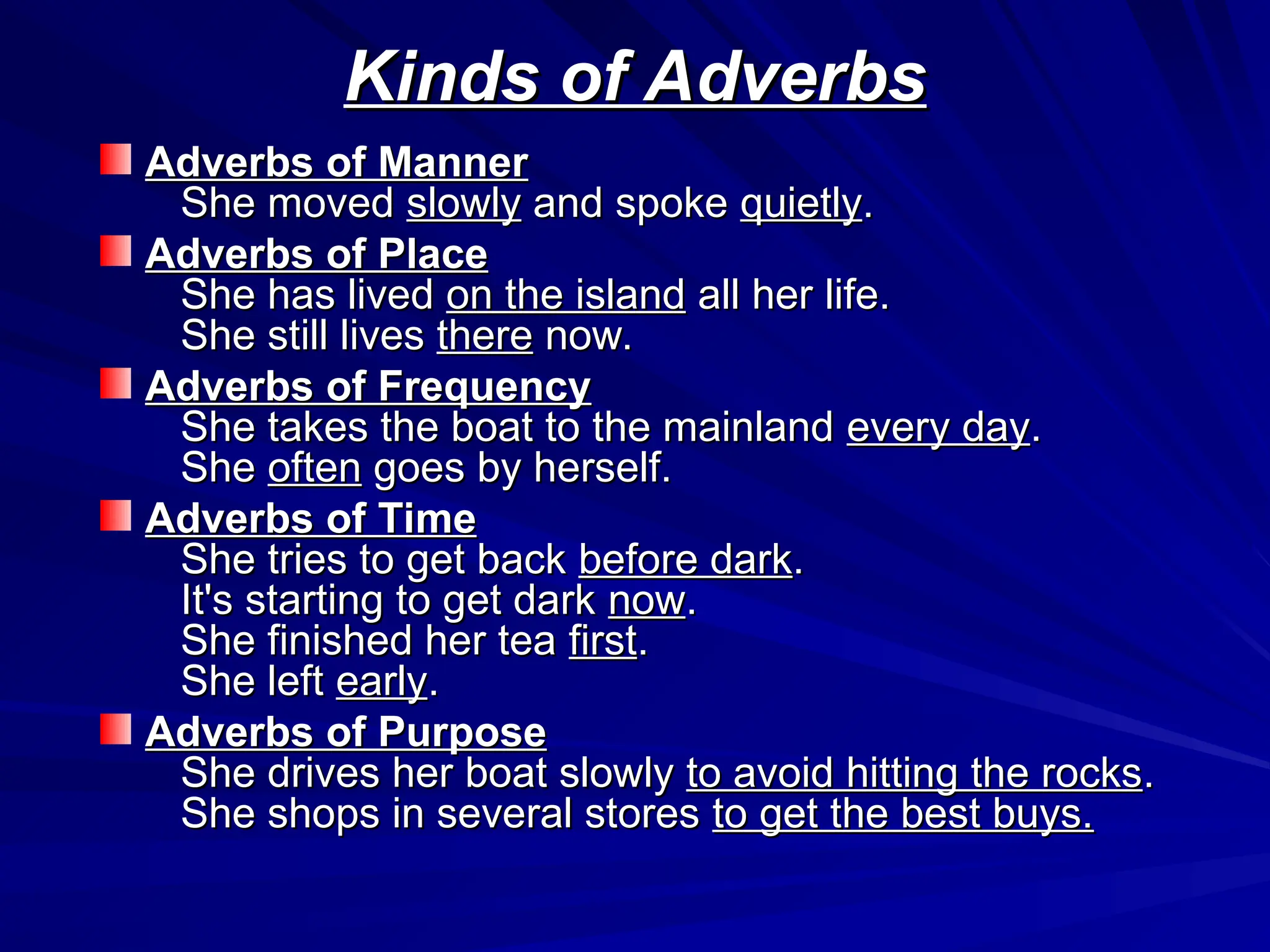
Kinds of Adverbs
Kinds of Adverbs
Adverbs of Manner
Adverbs of Manner
She moved
She moved slowly
slowly and spoke
and spoke quietly
quietly.
.
Adverbs of Place
Adverbs of Place
She has lived
She has lived on the island
on the island all her life.
all her life.
She still lives
She still lives there
there now.
now.
Adverbs of Frequency
She takes the boat to the mainland
She takes the boat to the mainland every day
every day.
.
She
She often
often goes by herself.
goes by herself.
Adverbs of Time
Adverbs of Time
She tries to get back
She tries to get back before dark
before dark.
.
It's starting to get dark
It's starting to get dark now
now.
.
She finished her tea
She finished her tea first
first.
.
She left
She left early
early.
.
Adverbs of Purpose
Adverbs of Purpose
She drives her boat slowly
She drives her boat slowly to avoid hitting the rocks
to avoid hitting the rocks.
.
She shops in several stores
She shops in several stores to get the best buys.
to get the best buys.
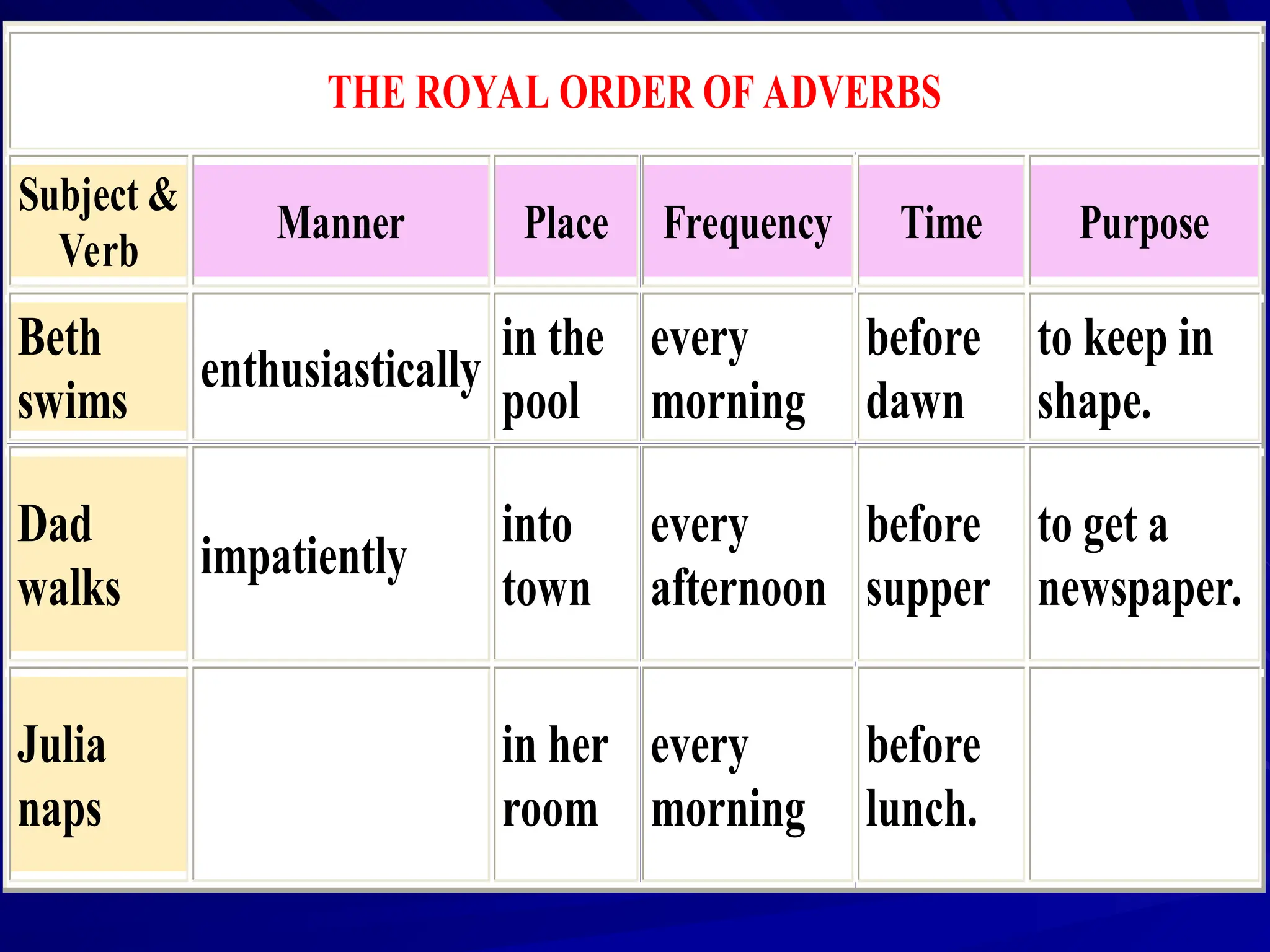
THE ROYAL ORDER OF ADVERBS
Subject &
Verb
Manner Place Frequency Time Purpose
Beth
swims
enthusiastically
in the
pool
every
morning
before
dawn
to keep in
shape.
Dad
walks
impatiently
into
town
every
afternoon
before
supper
to get a
newspaper.
Julia
naps
in her
room
every
morning
before
lunch.
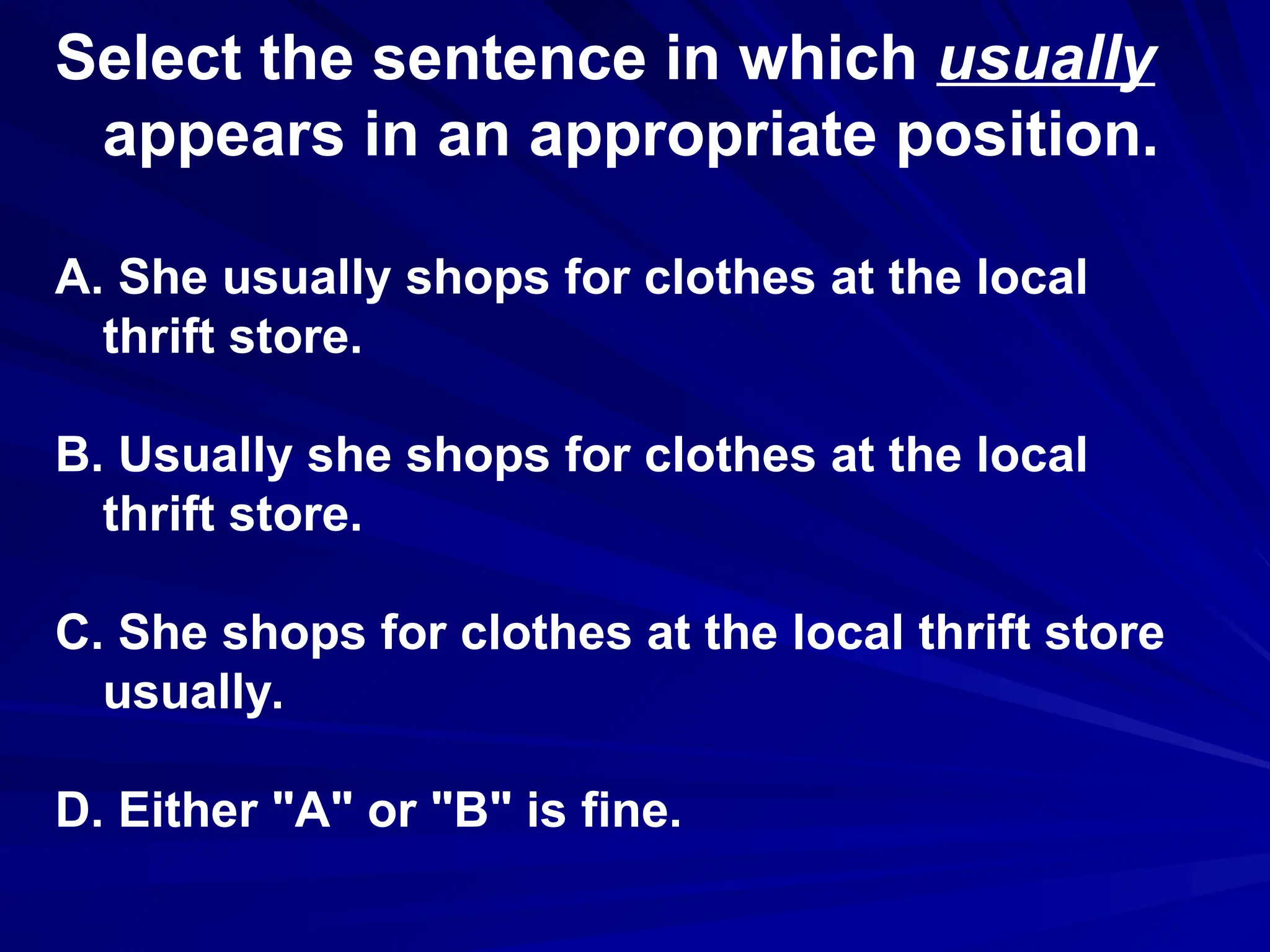
Select the sentence in which usually
appears in an appropriate position.
A. She usually shops for clothes at the local
thrift store.
B. Usually she shops for clothes at the local
thrift store.
C. She shops for clothes at the local thrift store
usually.
D. Either "A" or "B" is fine.
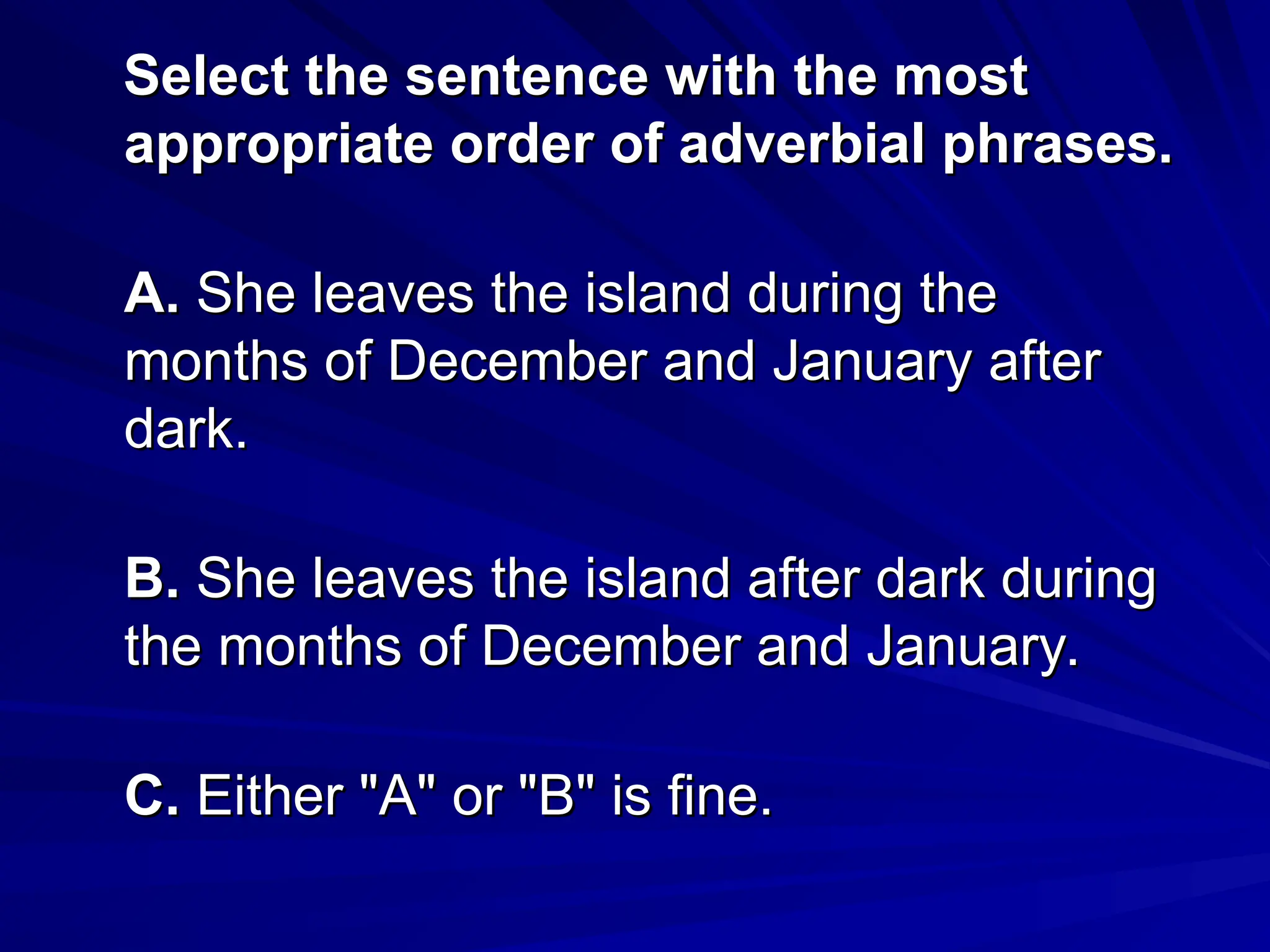
Select the sentence with the most
appropriate order of adverbial phrases.
A.
A. She leaves the island during the
She leaves the island during the
months of December and January after
dark.
dark.
B.
B. She leaves the island after dark during
She leaves the island after dark during
the months of December and January.
C.
C. Either "A" or "B" is fine.
Either "A" or "B" is fine.
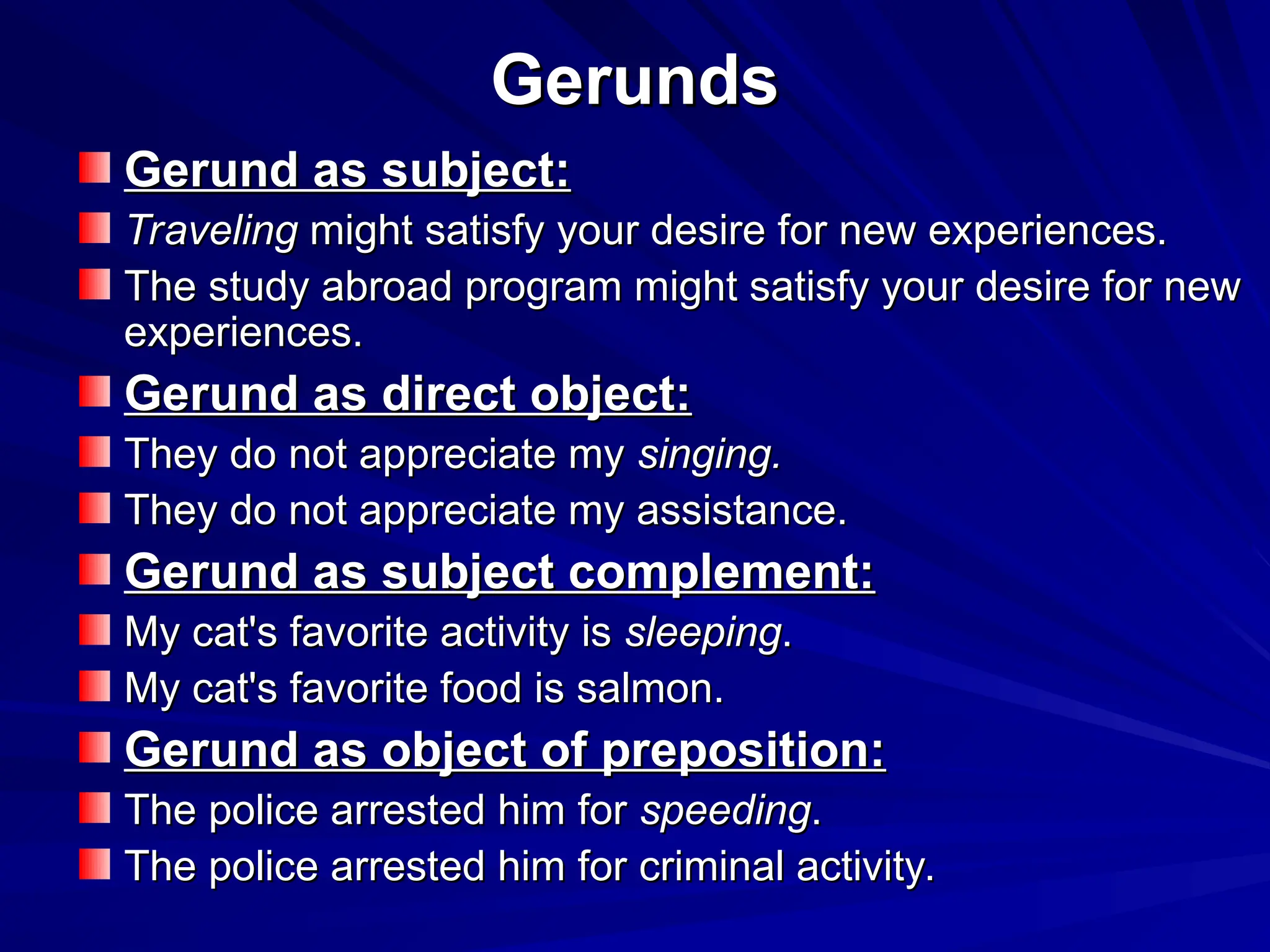
Gerunds
Gerunds
Gerund as subject:
Gerund as subject:
Traveling
Traveling might satisfy your desire for new experiences.
might satisfy your desire for new experiences.
The study abroad program might satisfy your desire for new
experiences.
experiences.
Gerund as direct object:
They do not appreciate my
They do not appreciate my singing.
singing.
They do not appreciate my assistance.
Gerund as subject complement:
My cat's favorite activity is
My cat's favorite activity is sleeping
sleeping.
.
My cat's favorite food is salmon.
Gerund as object of preposition:
The police arrested him for
The police arrested him for speeding
speeding.
.
The police arrested him for criminal activity.
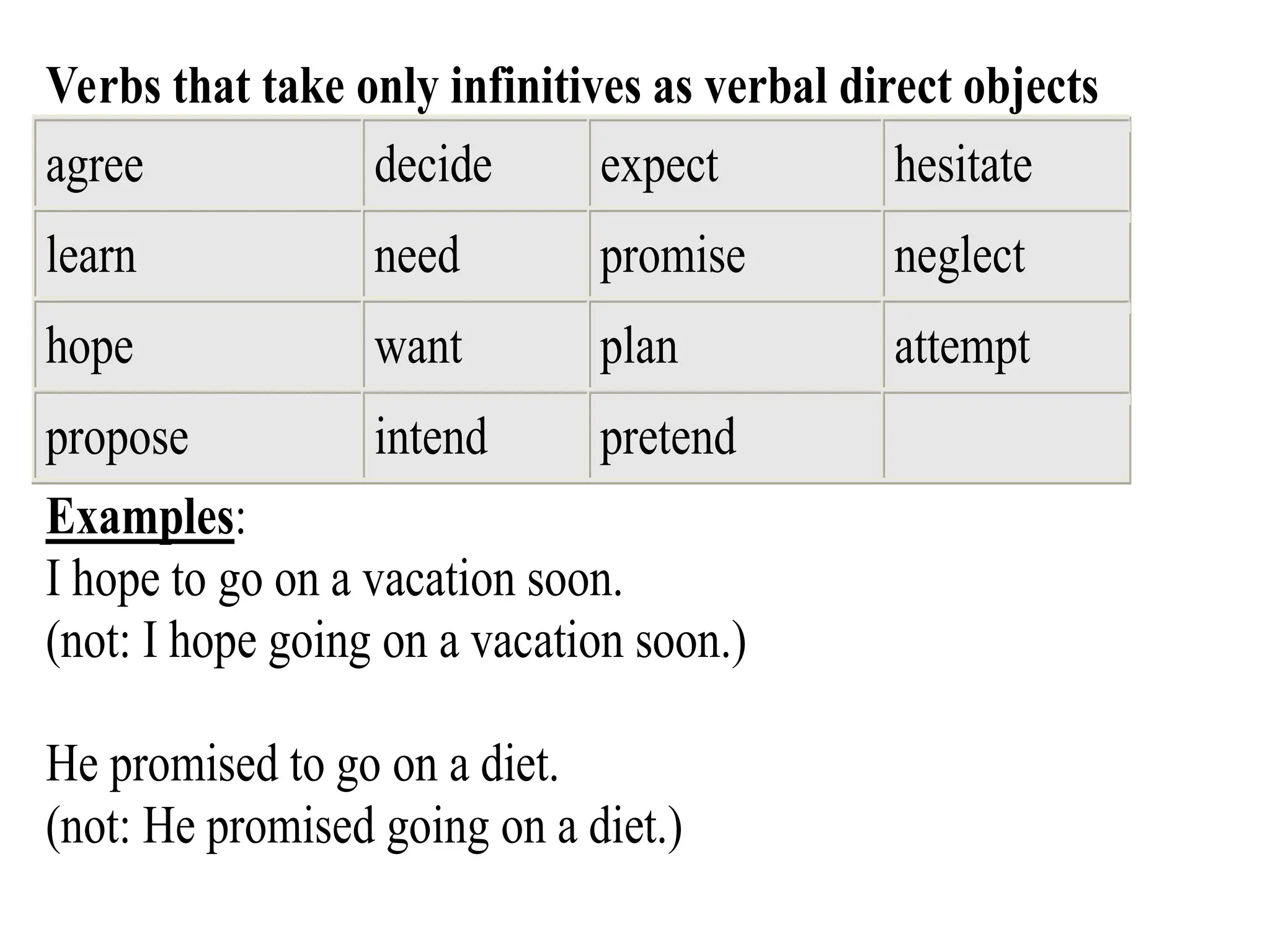
Verbs that take only infinitives as verbal direct objects
agree decide expect hesitate
learn need promise neglect
hope want plan attempt
propose intend pretend
Examples:
I hope to go on a vacation soon.
(not: I hope going on a vacation soon.)
He promised to go on a diet.
(not: He promised going on a diet.)
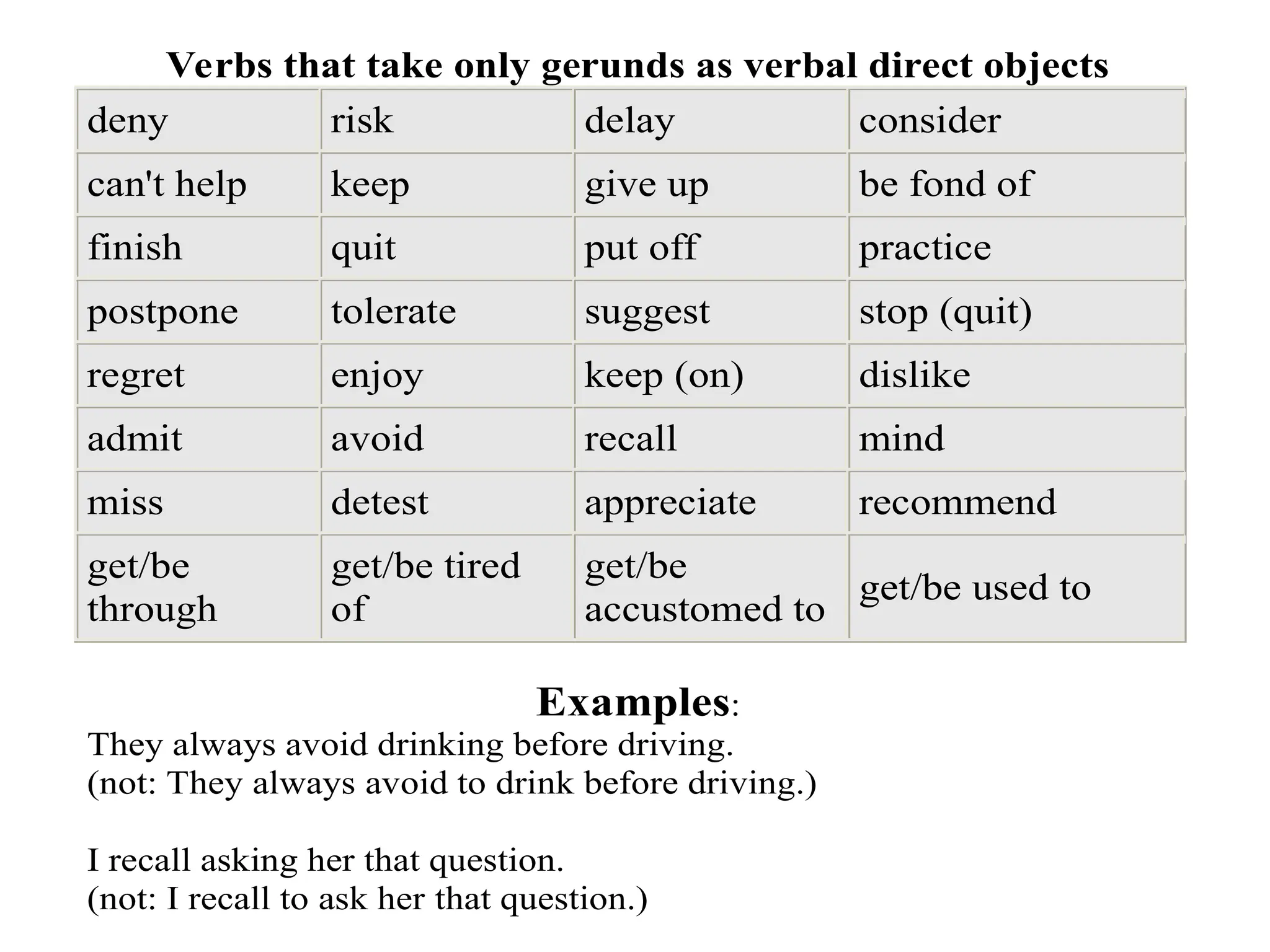
Verbs that take only gerunds as verbal direct objects
deny risk delay consider
can't help keep give up be fond of
finish quit put off practice
postpone tolerate suggest stop (quit)
regret enjoy keep (on) dislike
admit avoid recall mind
miss detest appreciate recommend
get/be
through
get/be tired
of
get/be
accustomed to
get/be used to
Examples:
They always avoid drinking before driving.
(not: They always avoid to drink before driving.)
I recall asking her that question.
(not: I recall to ask her that question.)
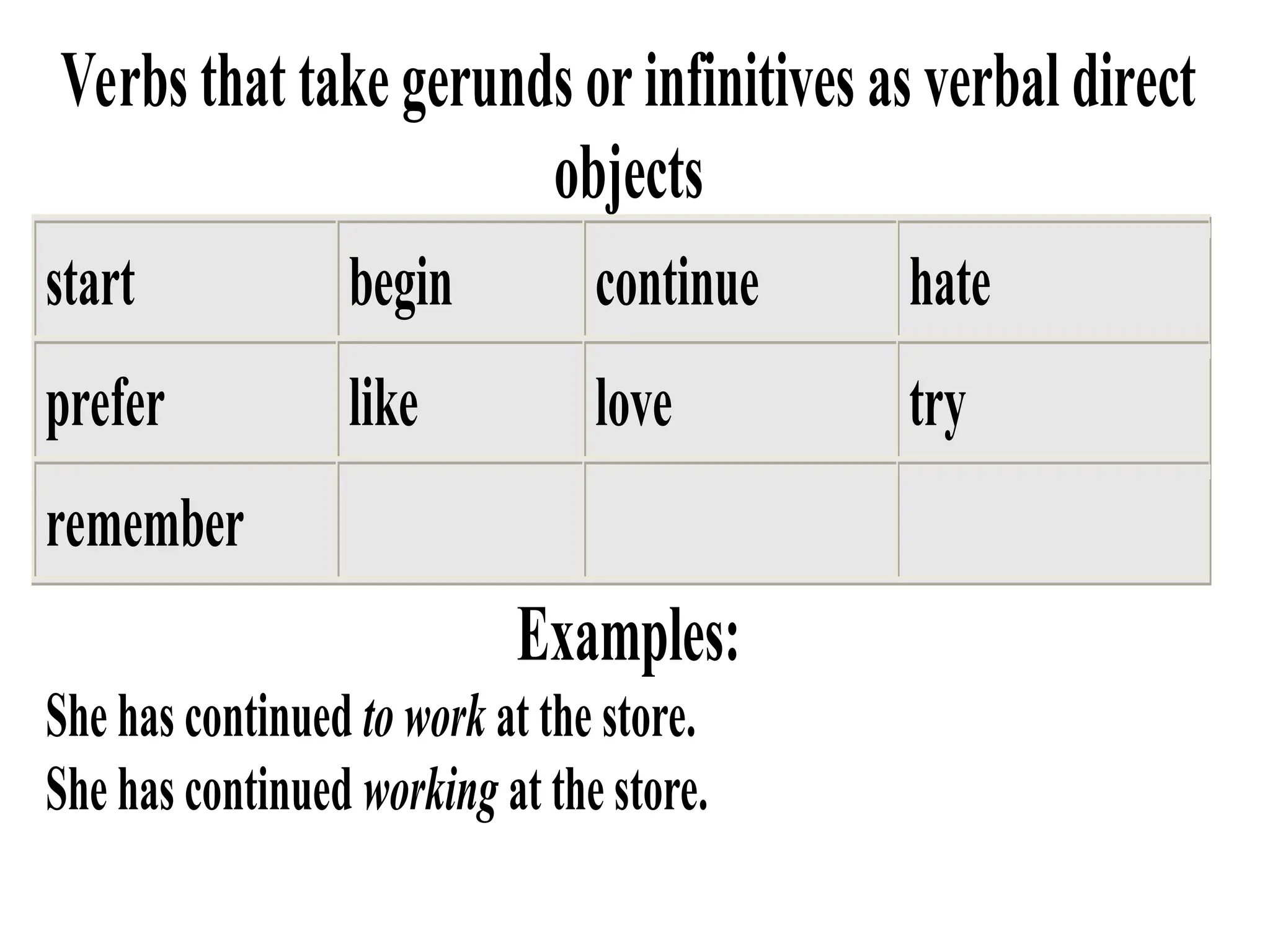
Verbs that take gerunds orinfinitives as verbal direct
objects
start begin continue hate
prefer like love try
remember
Examples:
She has continued to work at the store.
She has continued working at the store.
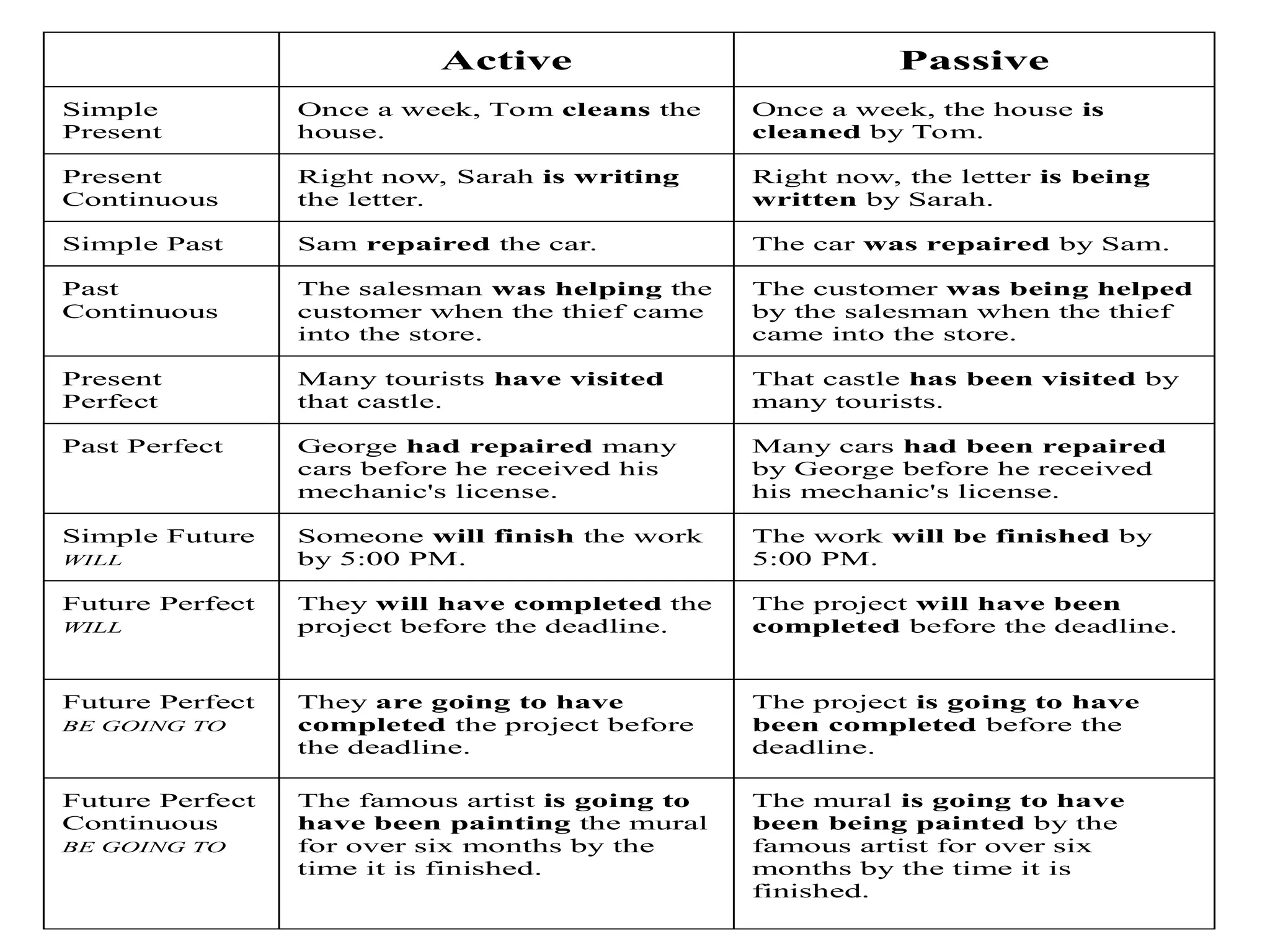
Active Passive
Simple
Present
Once a week, Tom cleans the
house.
Once a week, the house is
cleaned by Tom.
Present
Continuous
Right now, Sarah is writing
the letter.
Right now, the letter is being
written by Sarah.
Simple Past Sam repaired the car. The car was repaired by Sam.
Past
Continuous
The salesman was helping the
customer when the thief came
into the store.
The customer was being helped
by the salesman when the thief
came into the store.
Present
Perfect
Many tourists have visited
that castle.
That castle has been visited by
many tourists.
Past Perfect George had repaired many
cars before he received his
mechanic's license.
Many cars had been repaired
by George before he received
his mechanic's license.
Simple Future
WILL
Someone will finish the work
by 5:00 PM.
The work will be finished by
5:00 PM.
Future Perfect
WILL
They will have completed the
project before the deadline.
The project will have been
completed before the deadline.
Future Perfect
BE GOING TO
They are going to have
completed the project before
the deadline.
The project is going to have
been completed before the
deadline.
Future Perfect
Continuous
BE GOING TO
The famous artist is going to
have been painting the mural
for over six months by the
time it is finished.
The mural is going to have
been being painted by the
famous artist for over six
months by the time it is
finished.
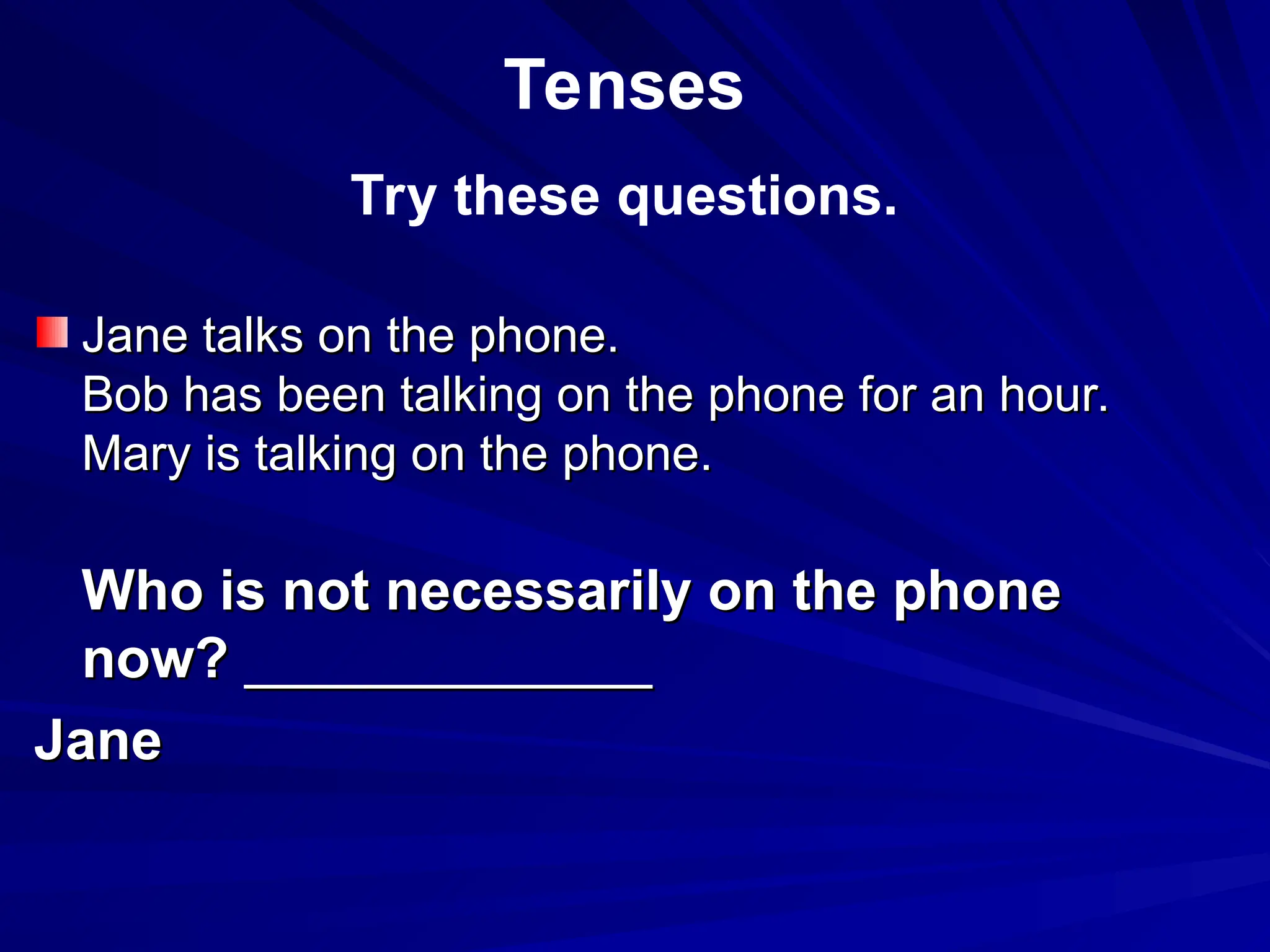
Jane talks on the phone.
Bob has been talking on the phone for an hour.
Mary is talking on the phone.
Who is not necessarily on the phone
now?
now? _____________
_____________
Jane
Jane
Tenses
Try these questions.
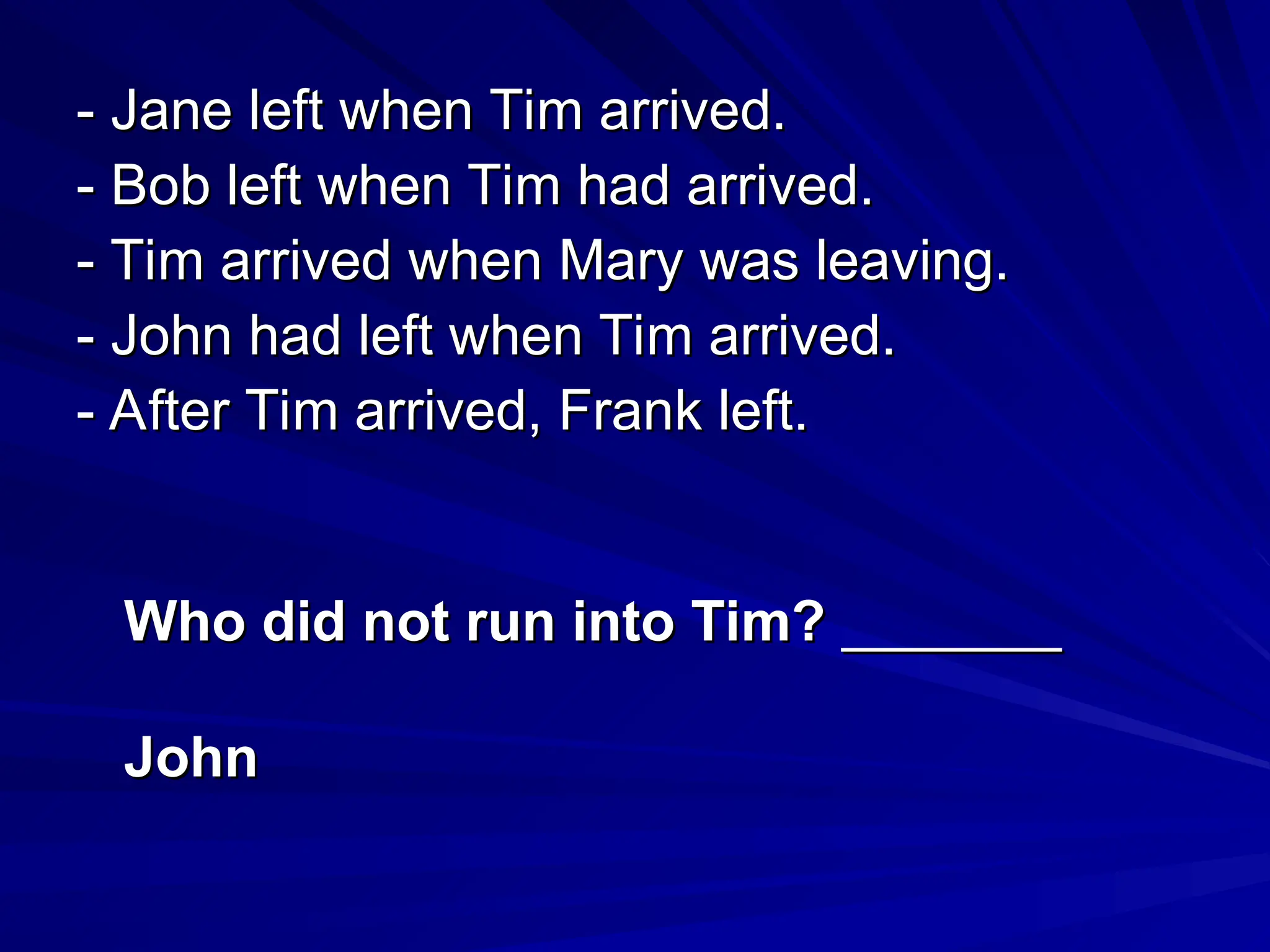
- Jane left when Tim arrived.
- Bob left when Tim had arrived.
- Tim arrived when Mary was leaving.
- John had left when Tim arrived.
- After Tim arrived, Frank left.
Who did not run into Tim?
Who did not run into Tim? _______
_______
John
John
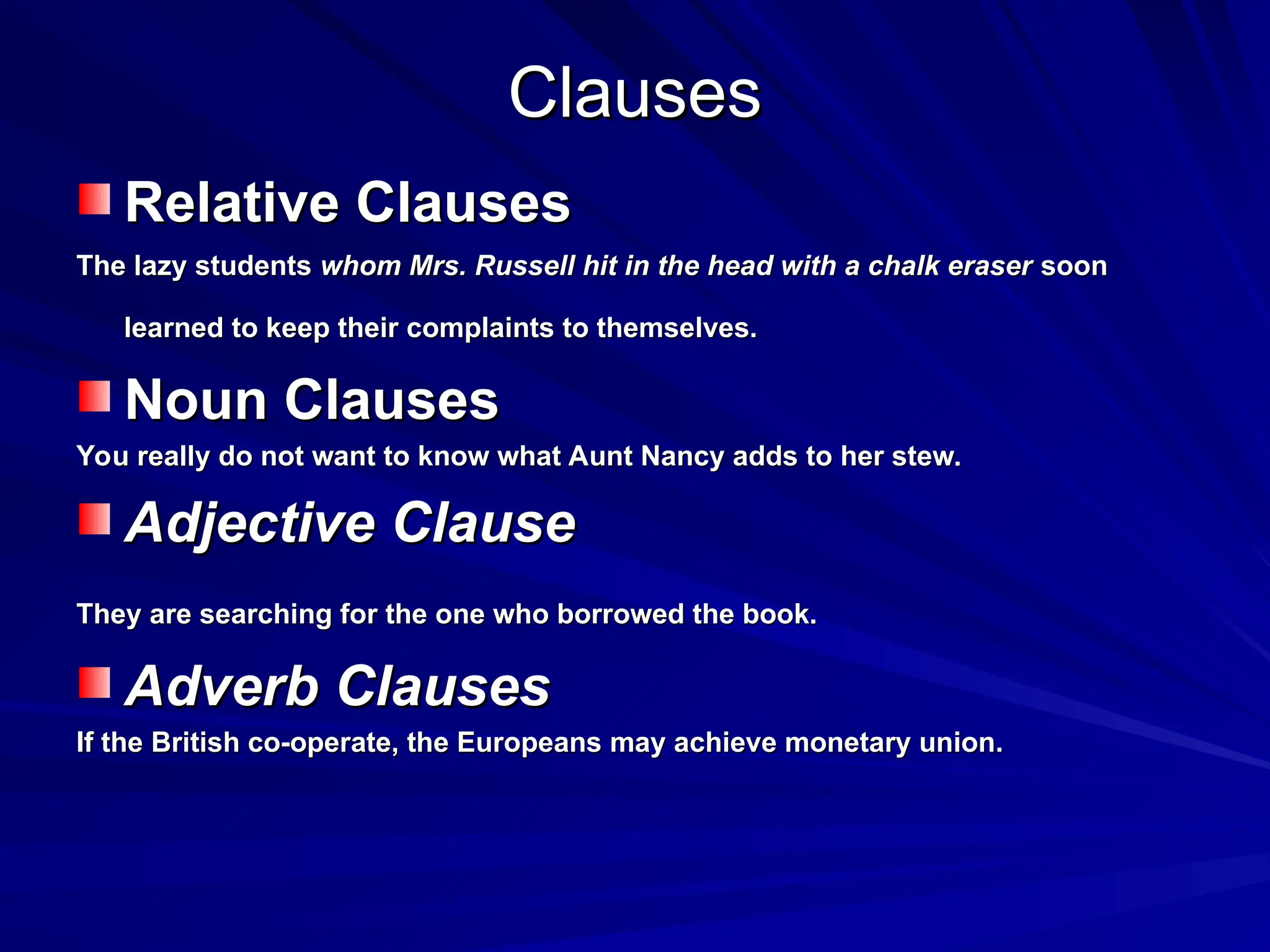
Clauses
Clauses
Relative Clauses
Relative Clauses
The lazy students
The lazy students whom Mrs. Russell hit in the head with a chalk eraser
whom Mrs. Russell hit in the head with a chalk eraser soon
soon
learned to keep their complaints to themselves.
Noun Clauses
Noun Clauses
You really do not want to know what Aunt Nancy adds to her stew.
Adjective Clause
Adjective Clause
They are searching for the one who borrowed the book.
Adverb Clauses
Adverb Clauses
If the British co-operate, the Europeans may achieve monetary union.
Vocabulary
Vocabulary
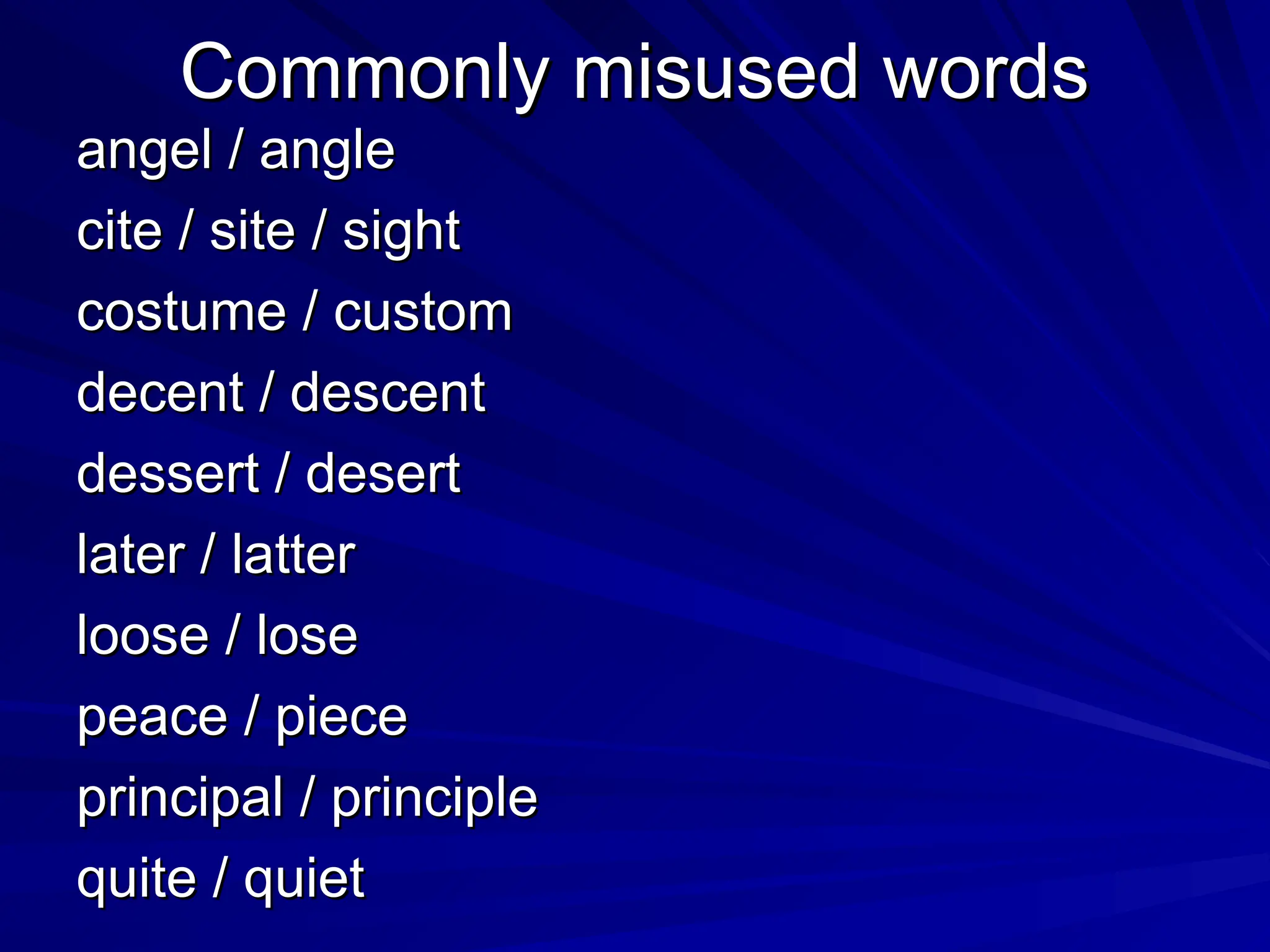
Commonly misused words
angel / angle
angel / angle
cite / site / sight
cite / site / sight
costume / custom
costume / custom
decent / descent
decent / descent
dessert / desert
dessert / desert
later / latter
later / latter
loose / lose
loose / lose
peace / piece
peace / piece
principal / principle
quite / quiet
quite / quiet
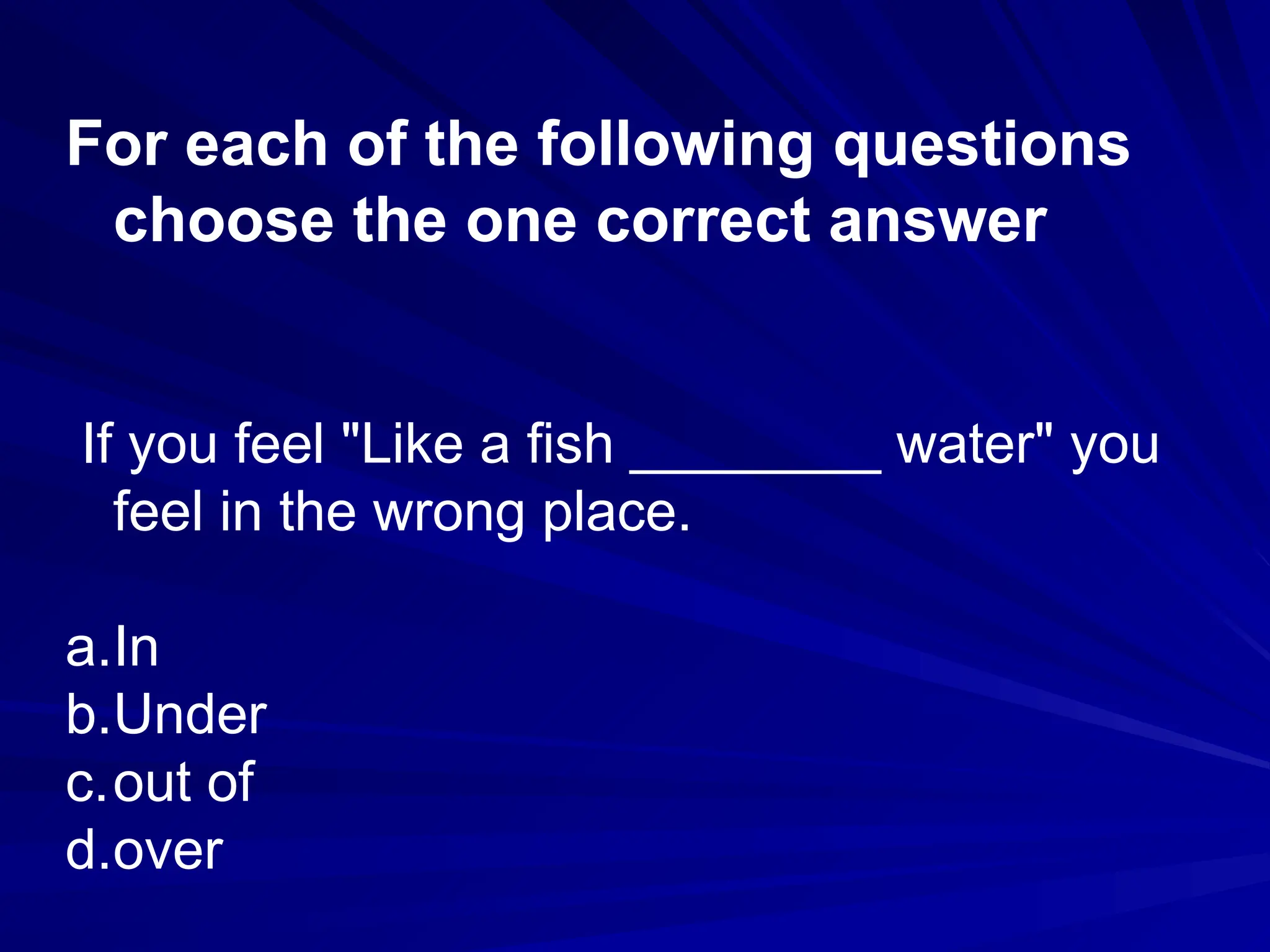
For each of the following questions
choose the one correct answer
If you feel "Like a fish ________ water" you
feel in the wrong place.
a.In
b.Under
c.out of
d.over
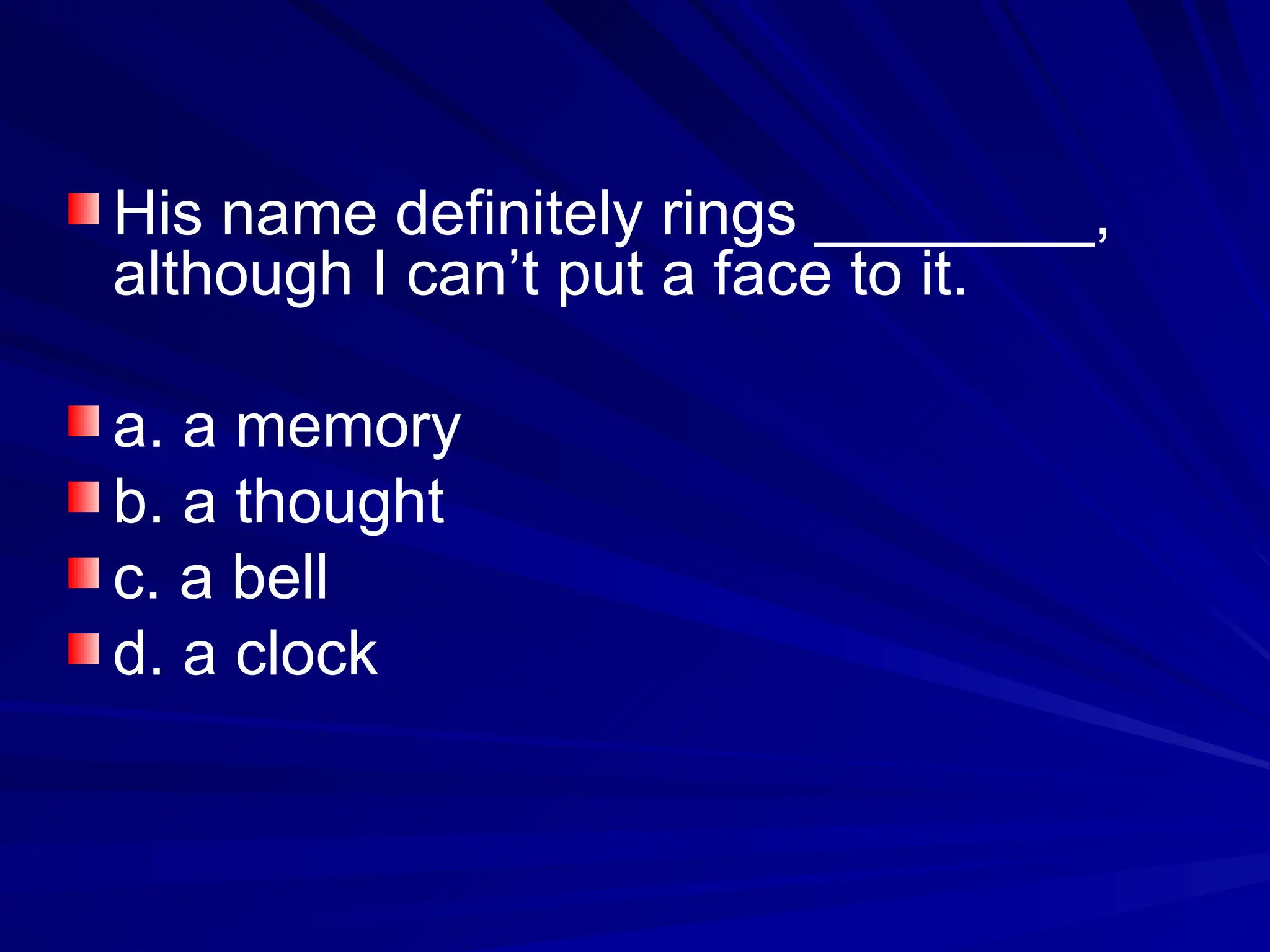
His name definitely rings ________,
although I can’t put a face to it.
a. a memory
b. a thought
c. a bell
d. a clock
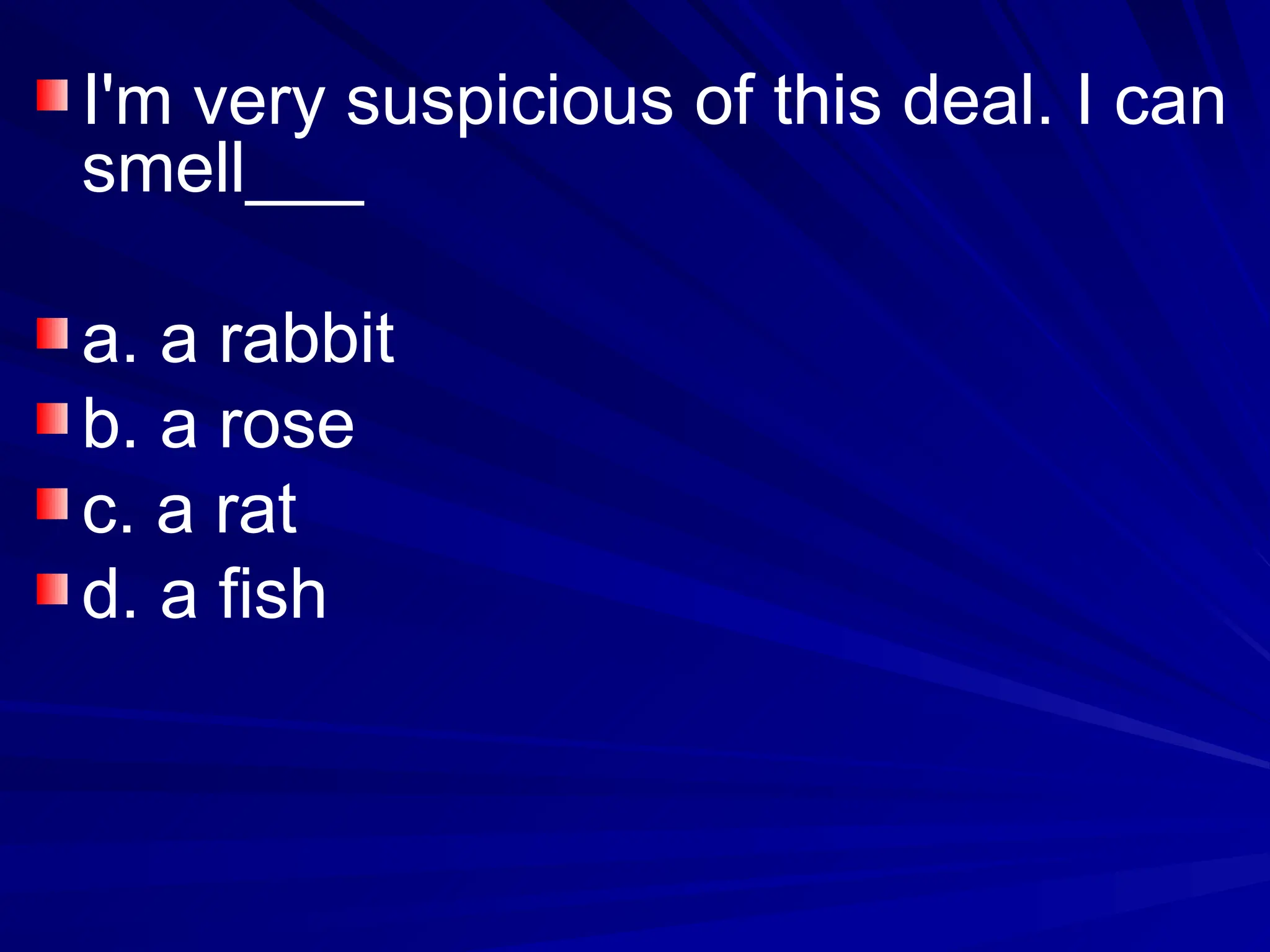
I'm very suspicious of this deal. I can
smell___
a. a rabbit
b. a rose
c. a rat
d. a fish
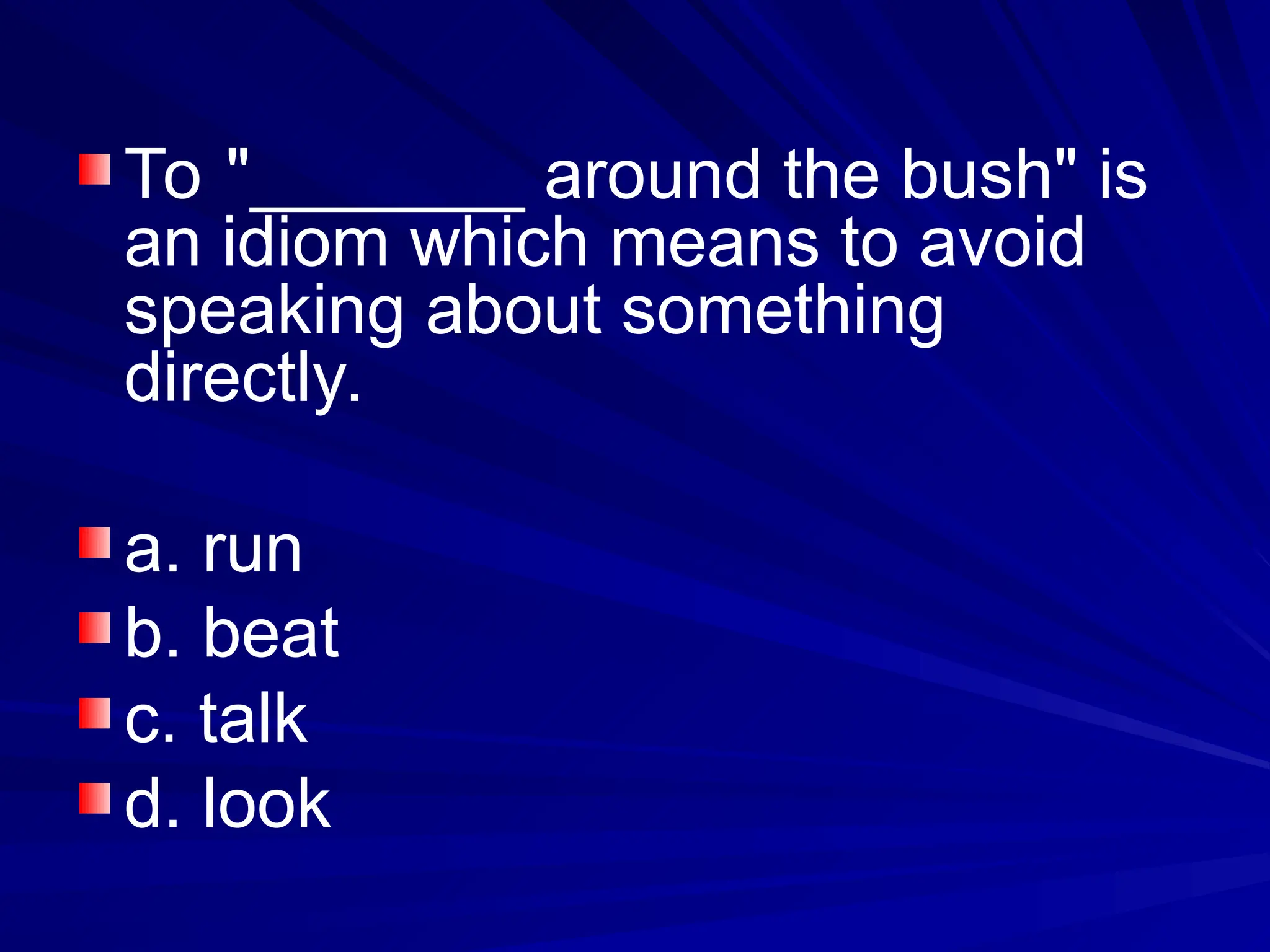
To "_______ around the bush" is
an idiom which means to avoid
speaking about something
directly.
a. run
b. beat
c. talk
d. look
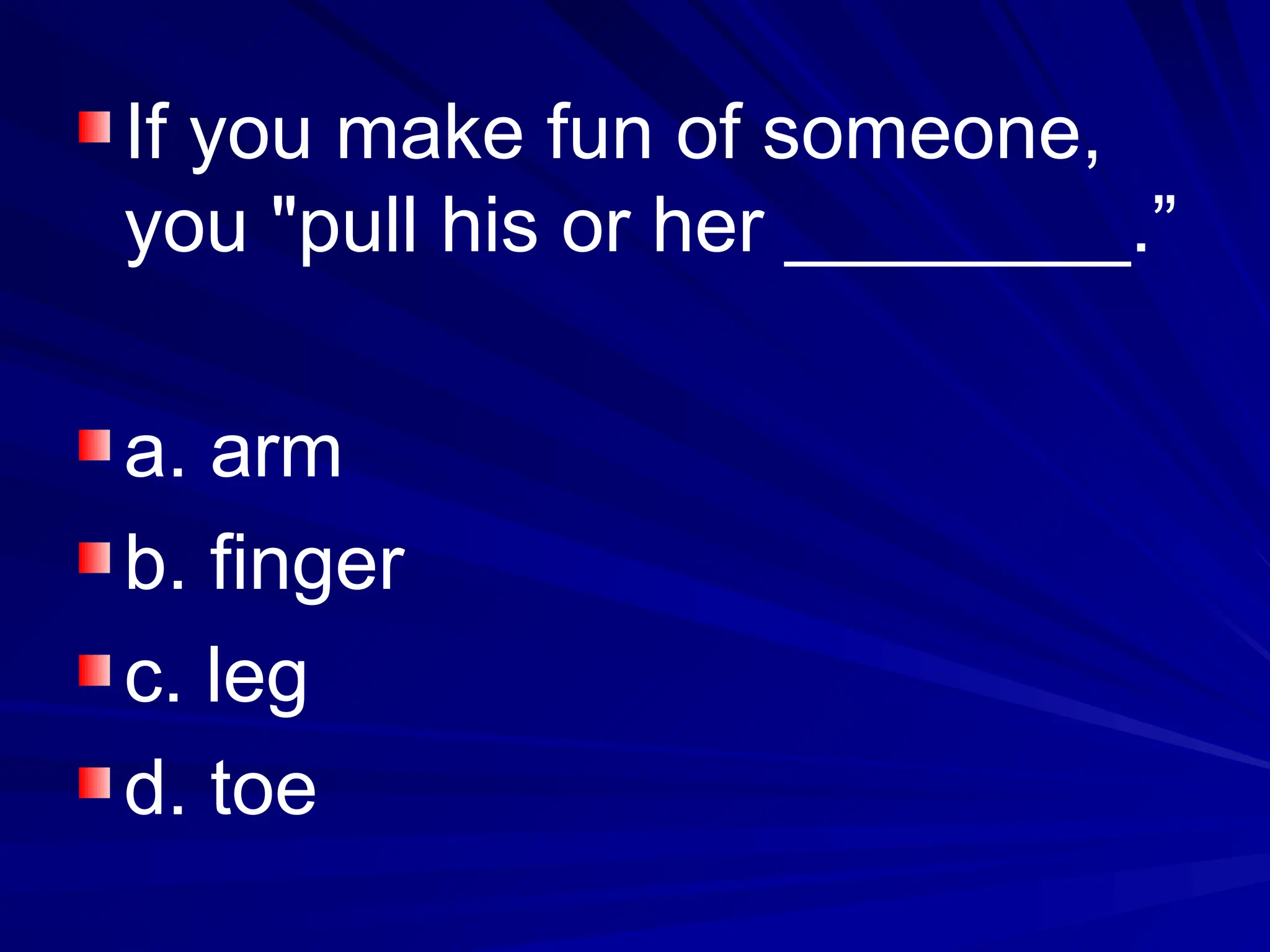
If you make fun of someone,
you "pull his or her ________.”
a. arm
b. finger
c. leg
d. toe
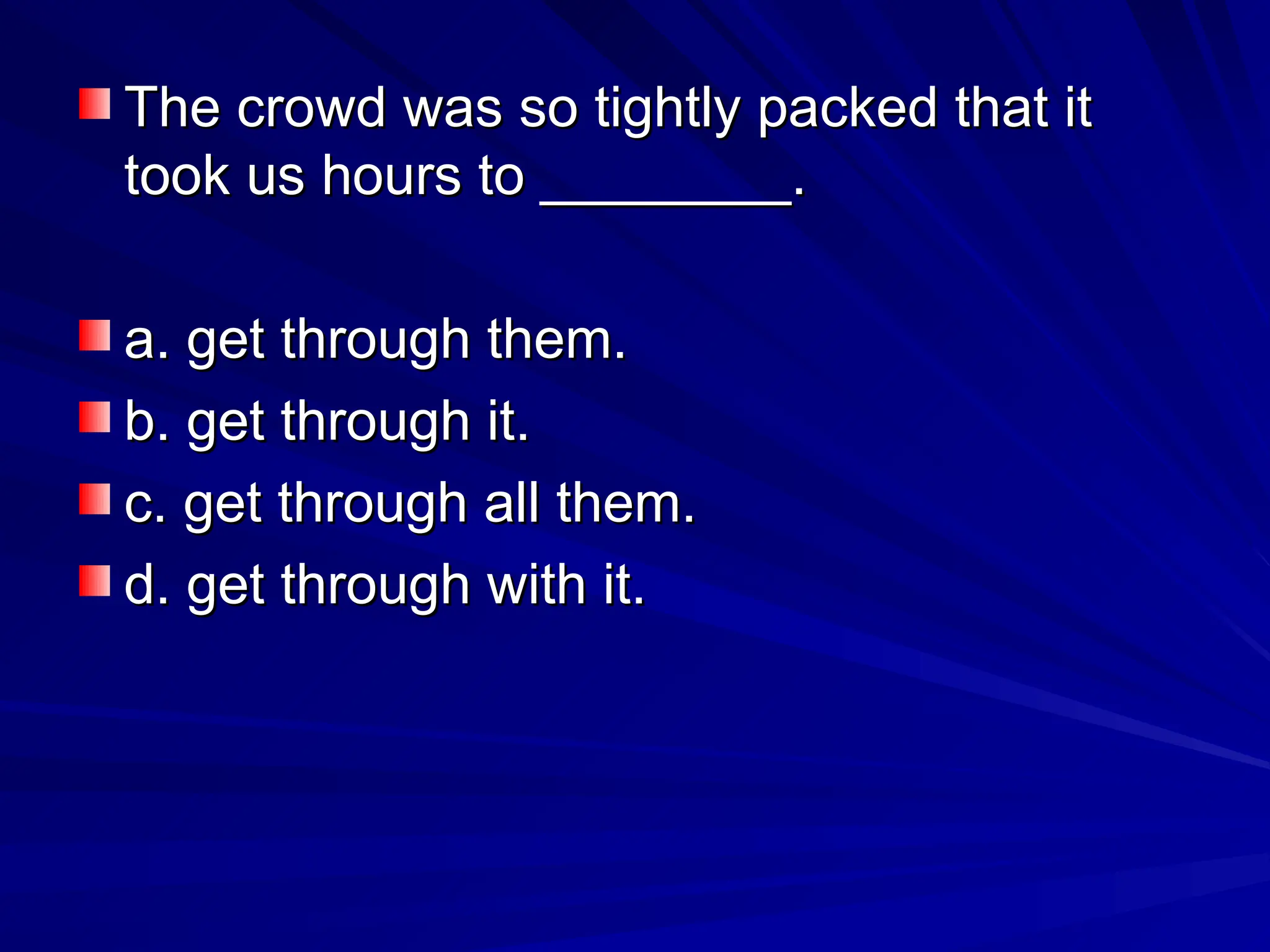
The crowd was so tightly packed that it
took us hours to ________.
a. get through them.
b. get through it.
b. get through it.
c. get through all them.
d. get through with it.
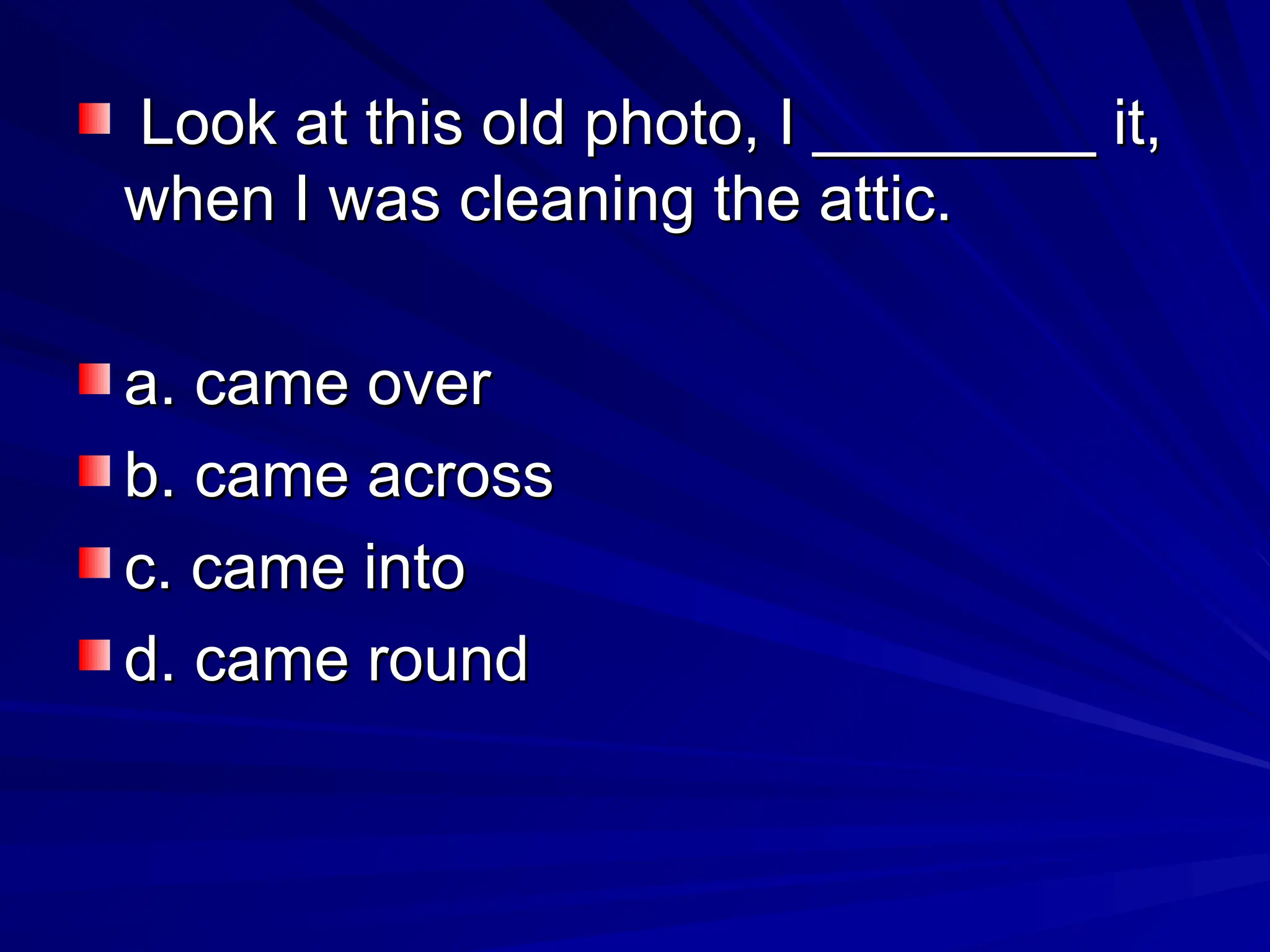
Look at this old photo, I ________ it,
when I was cleaning the attic.
a. came over
a. came over
b. came across
b. came across
c. came into
c. came into
d. came round
d. came round
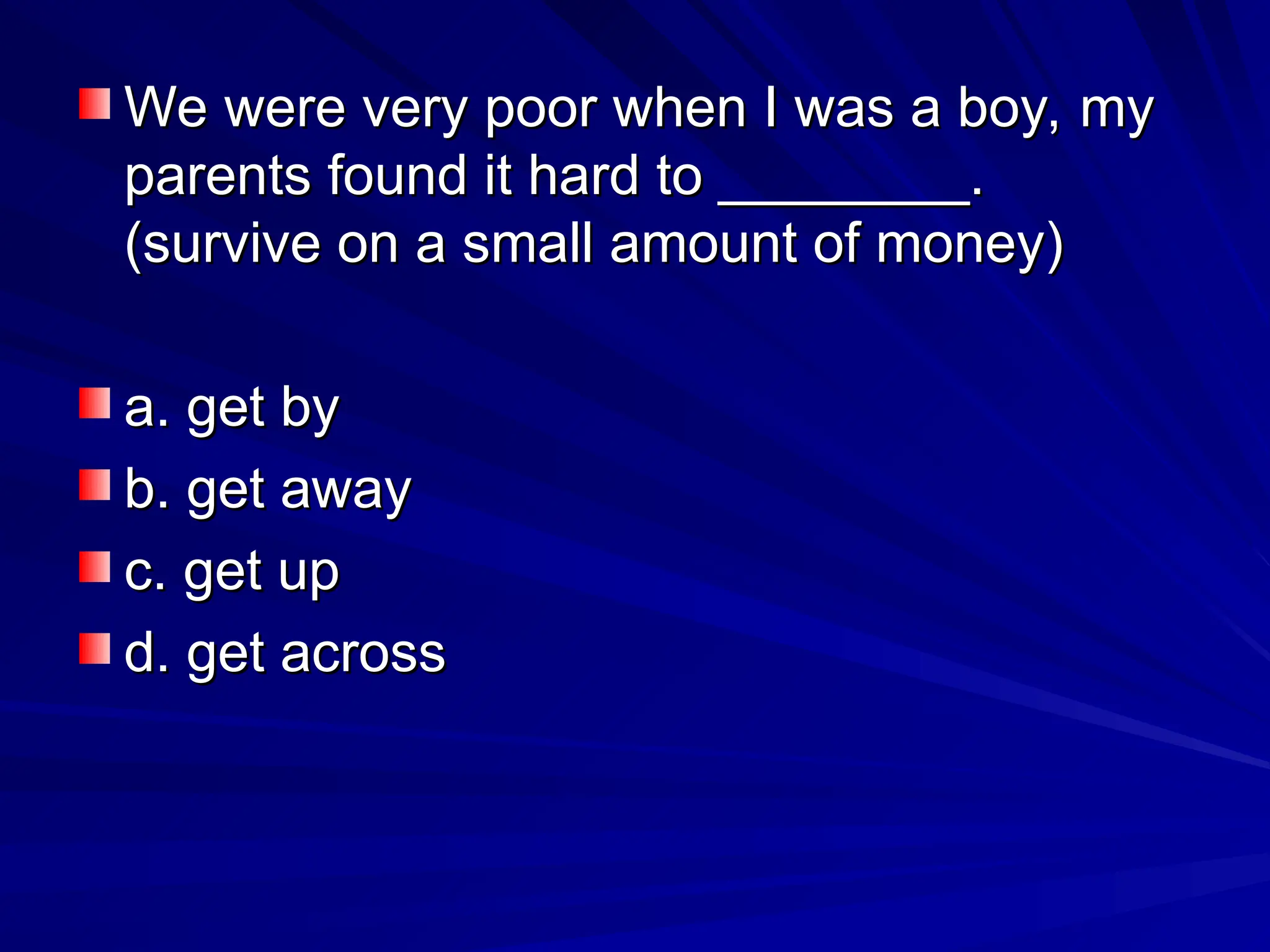
We were very poor when I was a boy, my
parents found it hard to ________.
(survive on a small amount of money)
a. get by
a. get by
b. get away
b. get away
c. get up
c. get up
d. get across
d. get across
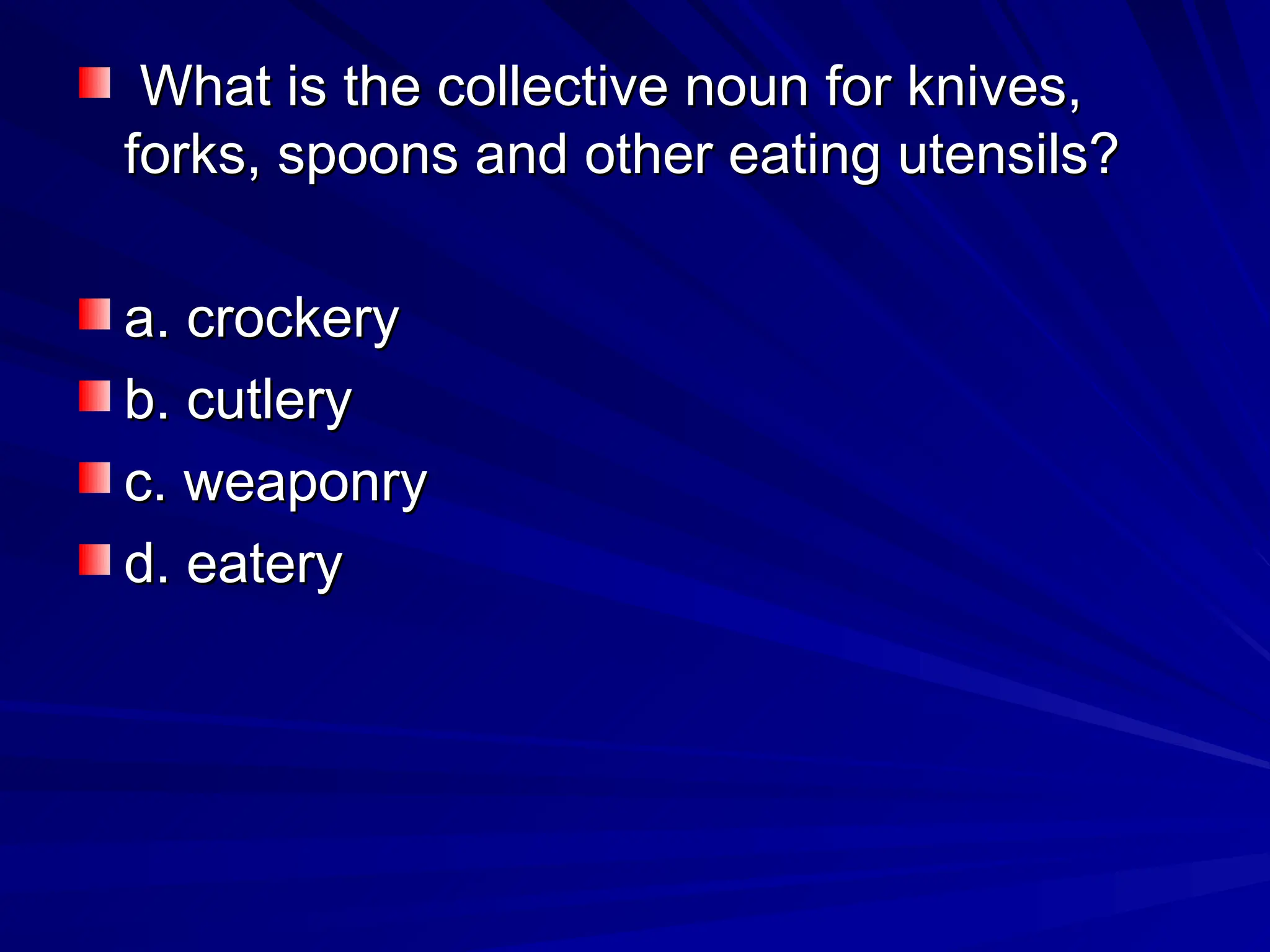
What is the collective noun for knives,
forks, spoons and other eating utensils?
a. crockery
a. crockery
b. cutlery
b. cutlery
c. weaponry
c. weaponry
d. eatery
d. eatery
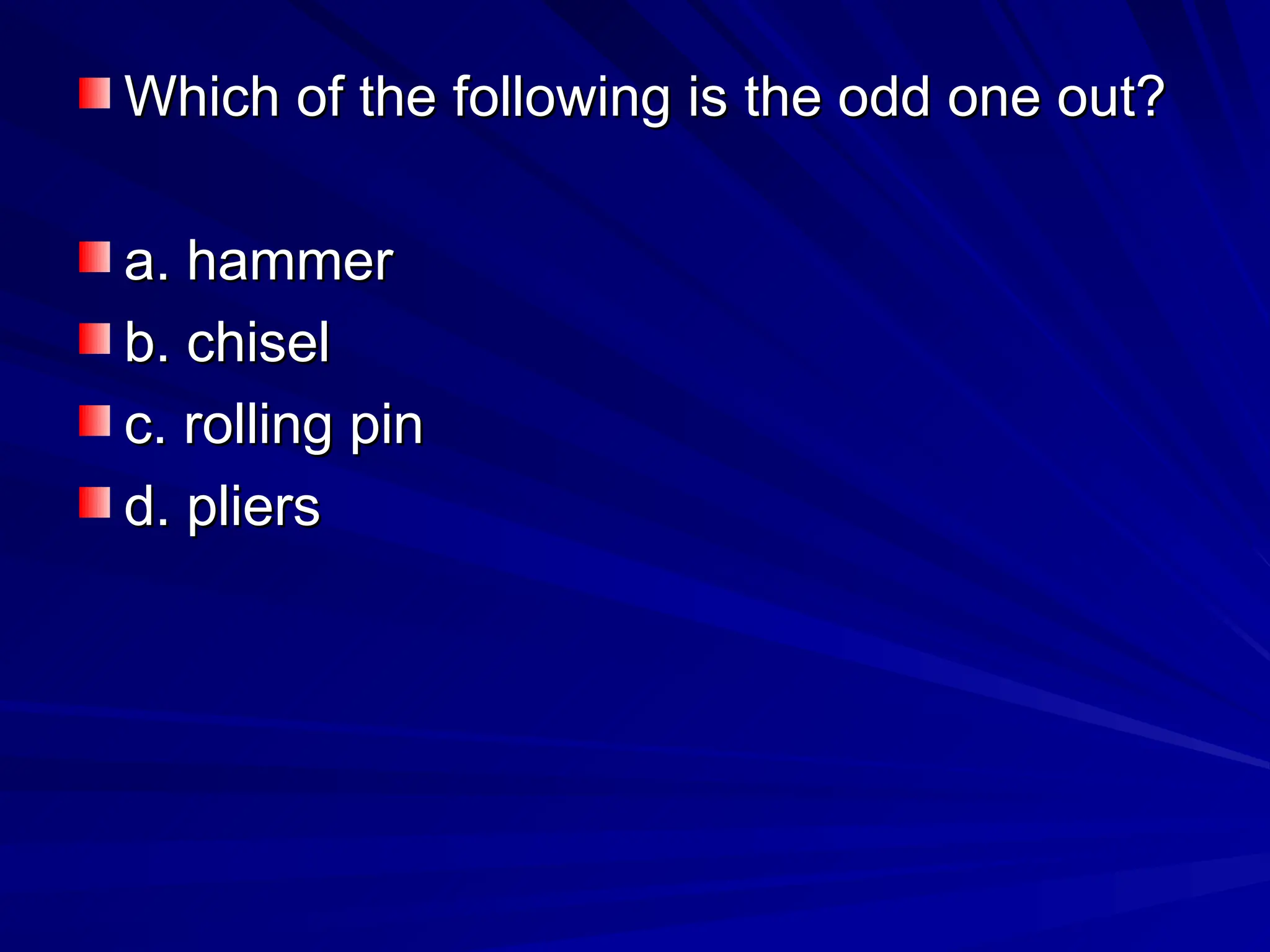
Which of the following is the odd one out?
a. hammer
a. hammer
b. chisel
b. chisel
c. rolling pin
c. rolling pin
d. pliers
d. pliers
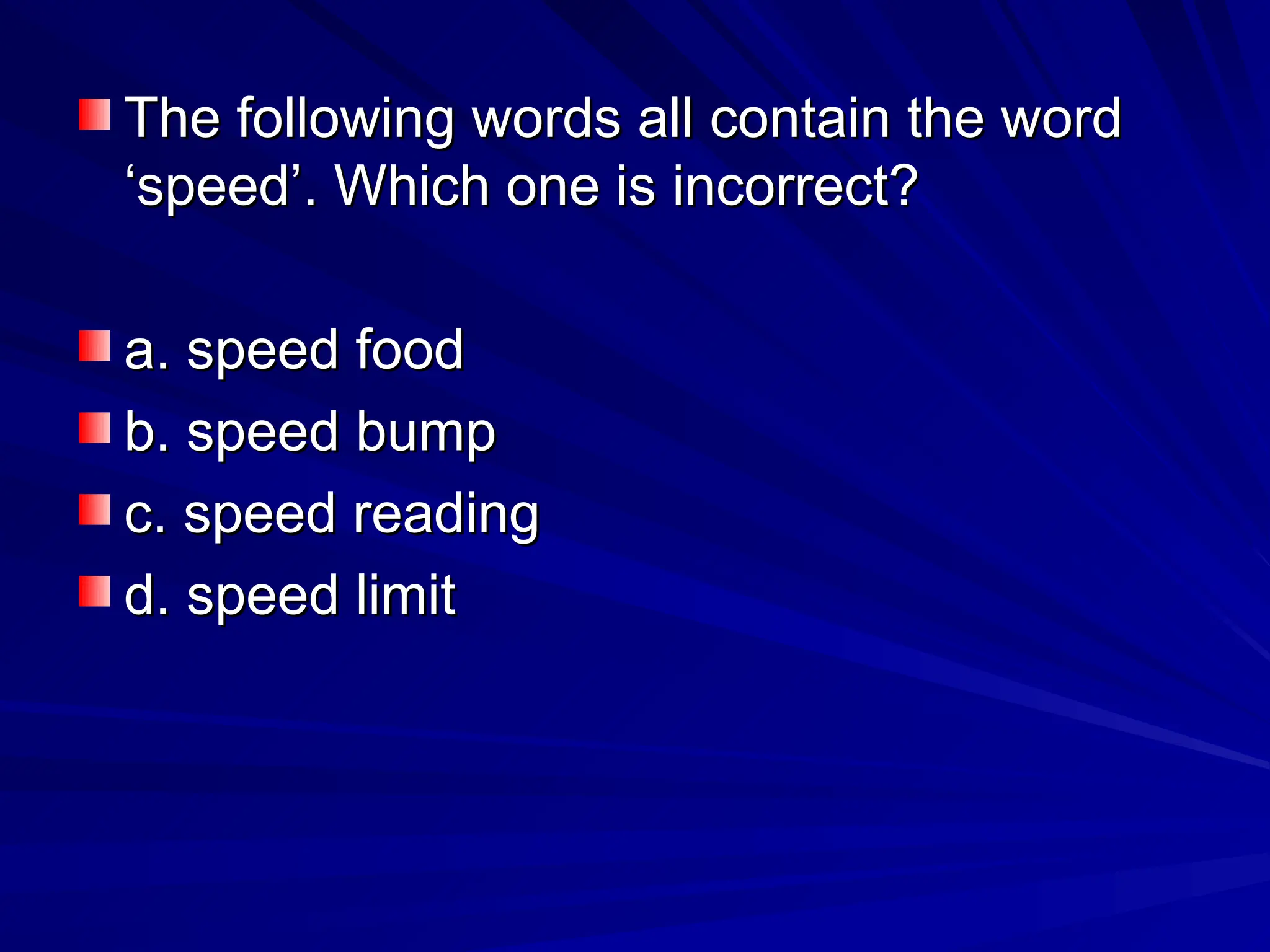
The following words all contain the word
‘speed’. Which one is incorrect?
a. speed food
a. speed food
b. speed bump
b. speed bump
c. speed reading
c. speed reading
d. speed limit
d. speed limit
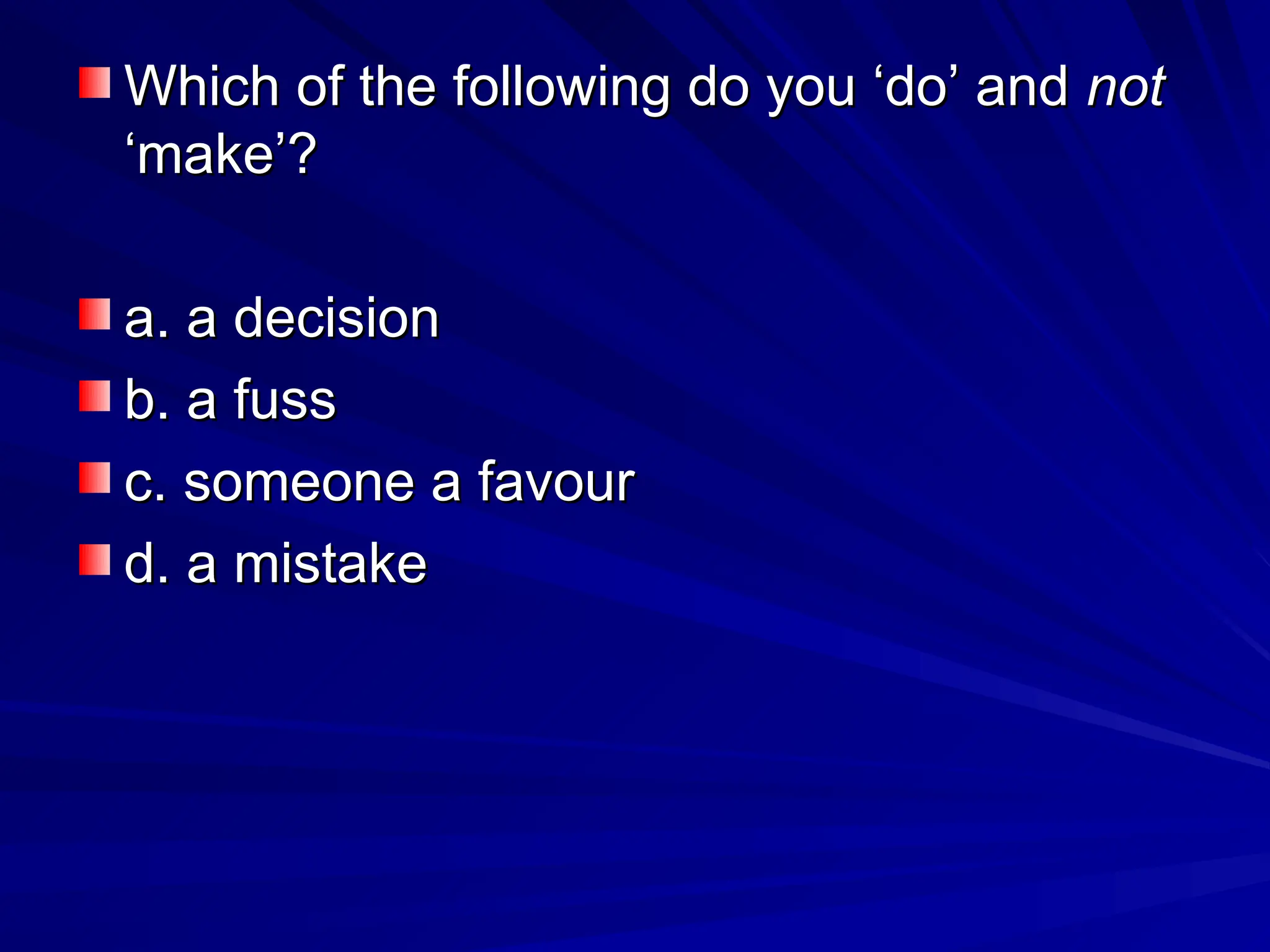
Which of the following do you ‘do’ and
Which of the following do you ‘do’ and not
not
‘make’?
‘make’?
a. a decision
a. a decision
b. a fuss
b. a fuss
c. someone a favour
c. someone a favour
d. a mistake
d. a mistake
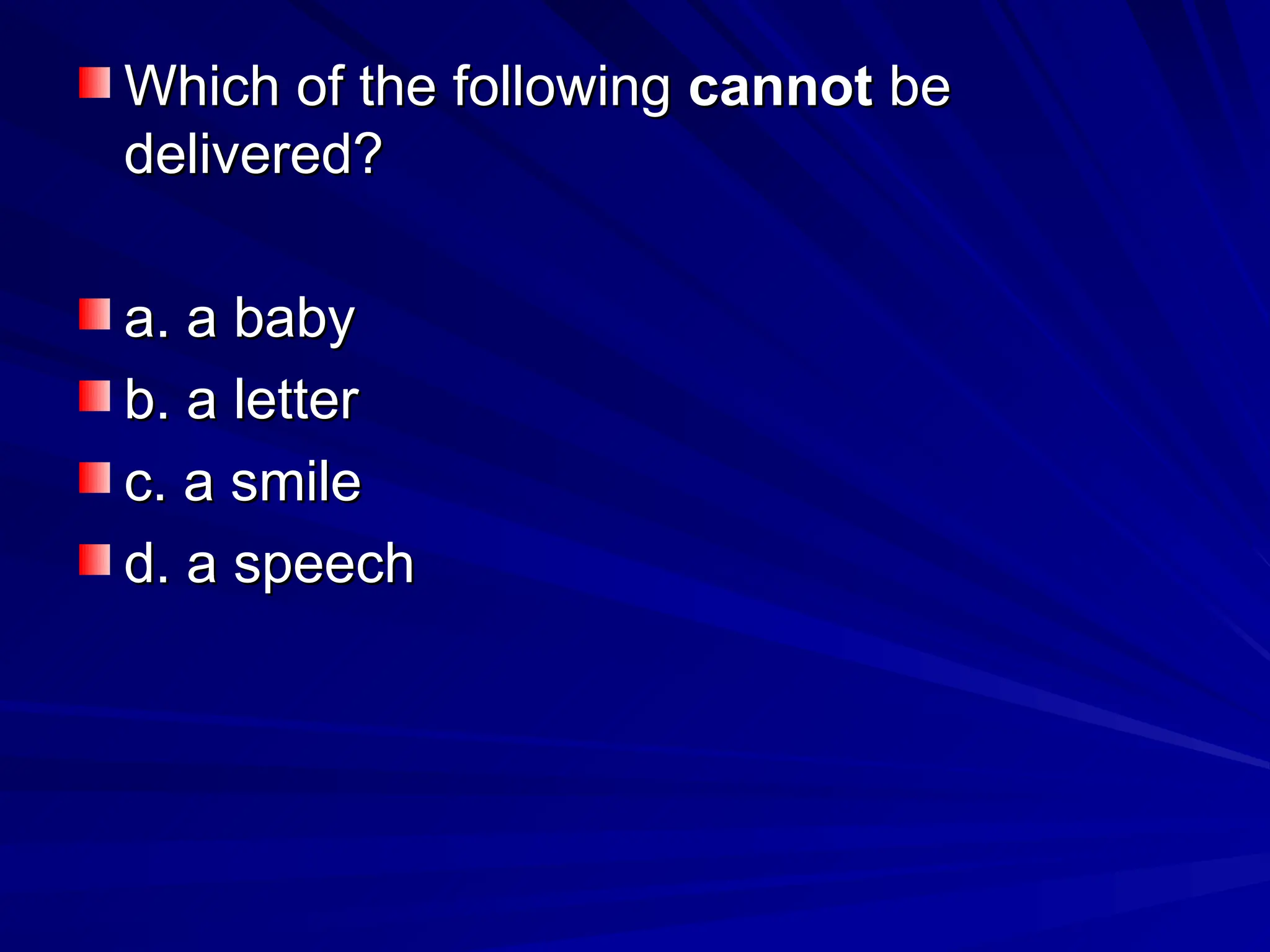
Which of the following
Which of the following cannot
cannot be
be
delivered?
delivered?
a. a baby
a. a baby
b. a letter
b. a letter
c. a smile
c. a smile
d. a speech
d. a speech
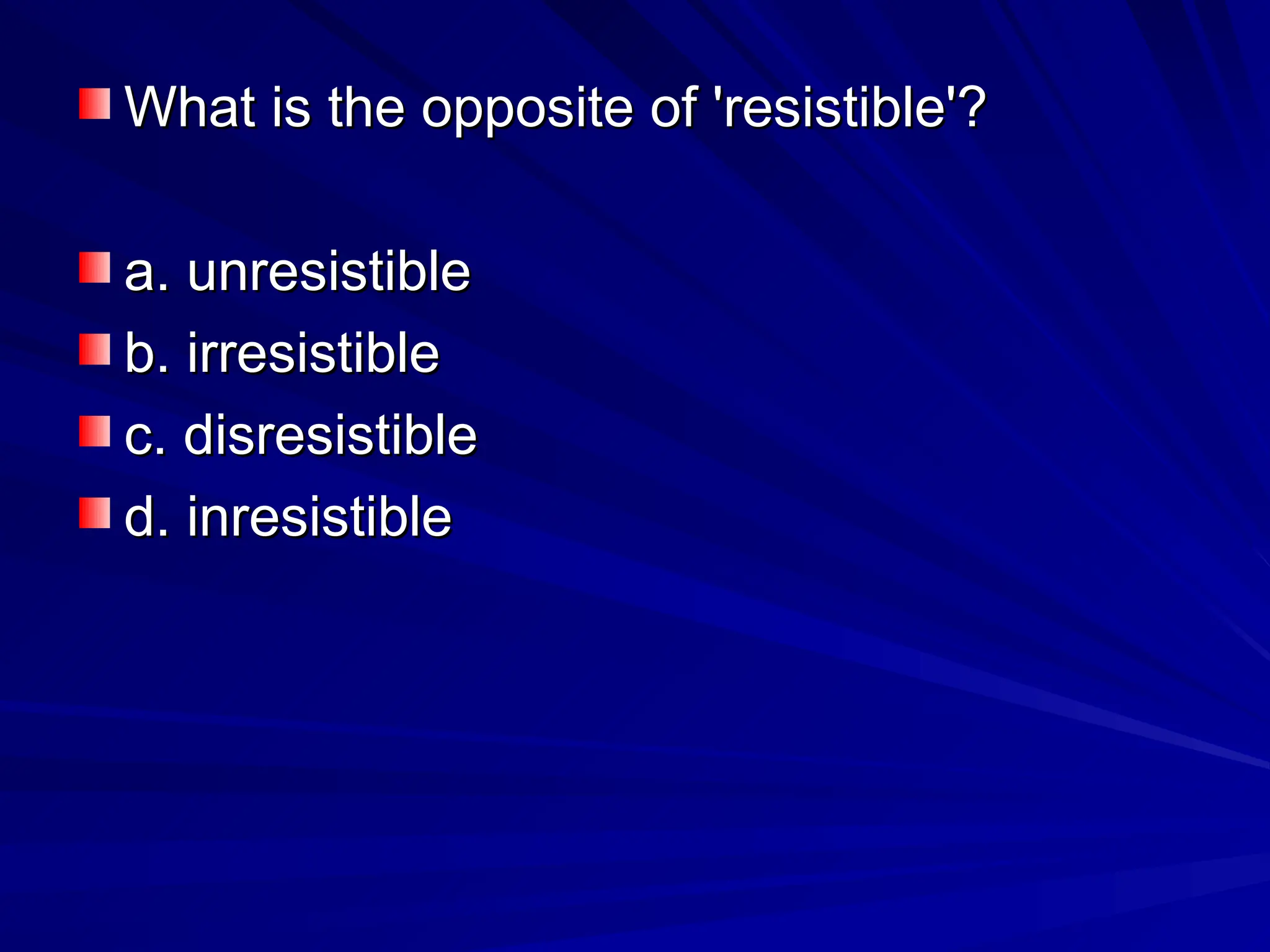
What is the opposite of 'resistible'?
a. unresistible
a. unresistible
b. irresistible
b. irresistible
c. disresistible
c. disresistible
d. inresistible
d. inresistible
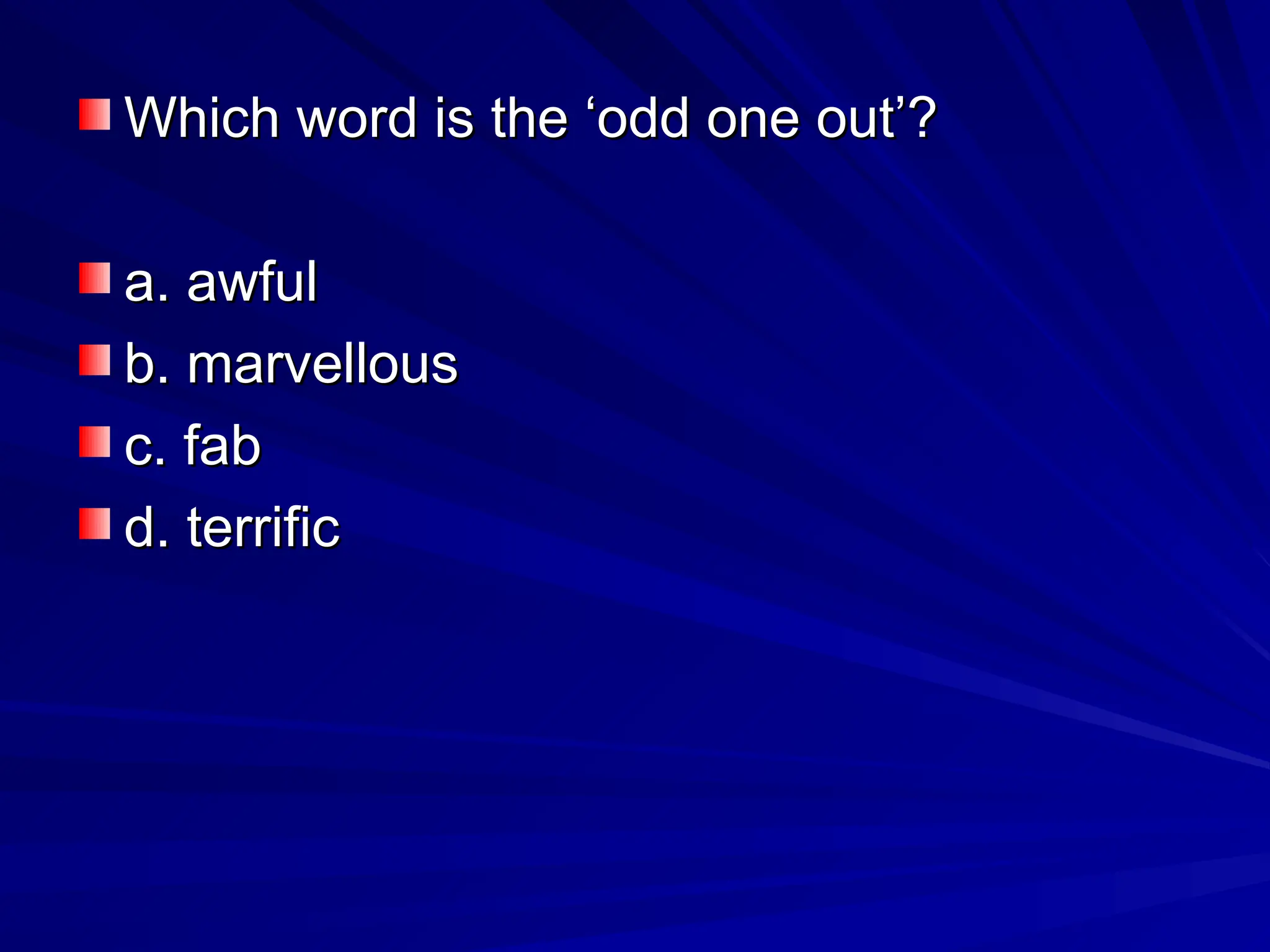
Which word is the ‘odd one out’?
a. awful
a. awful
b. marvellous
b. marvellous
c. fab
c. fab
d. terrific
d. terrific
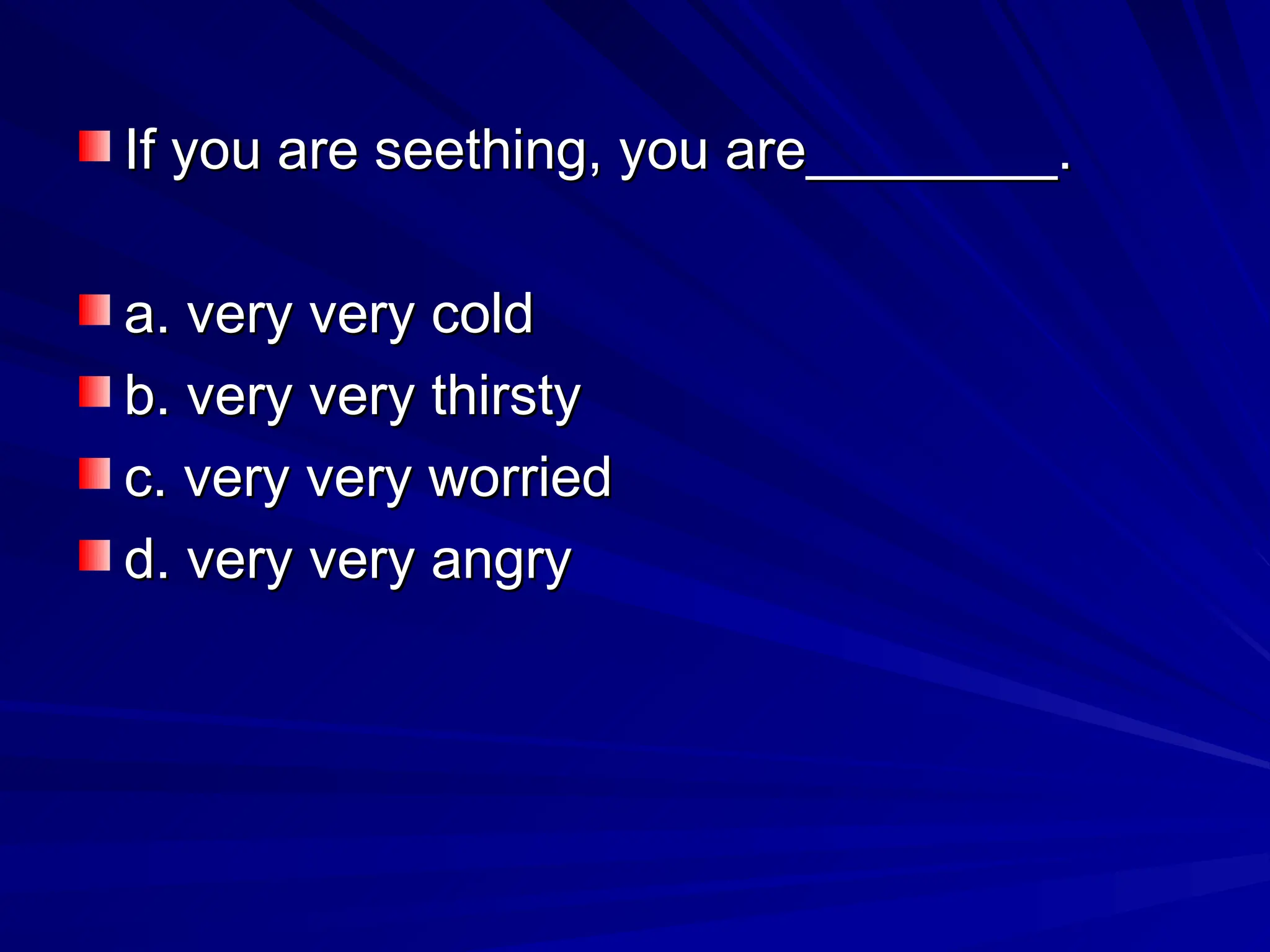
If you are seething, you are________.
a. very very cold
a. very very cold
b. very very thirsty
c. very very worried
d. very very angry
d. very very angry
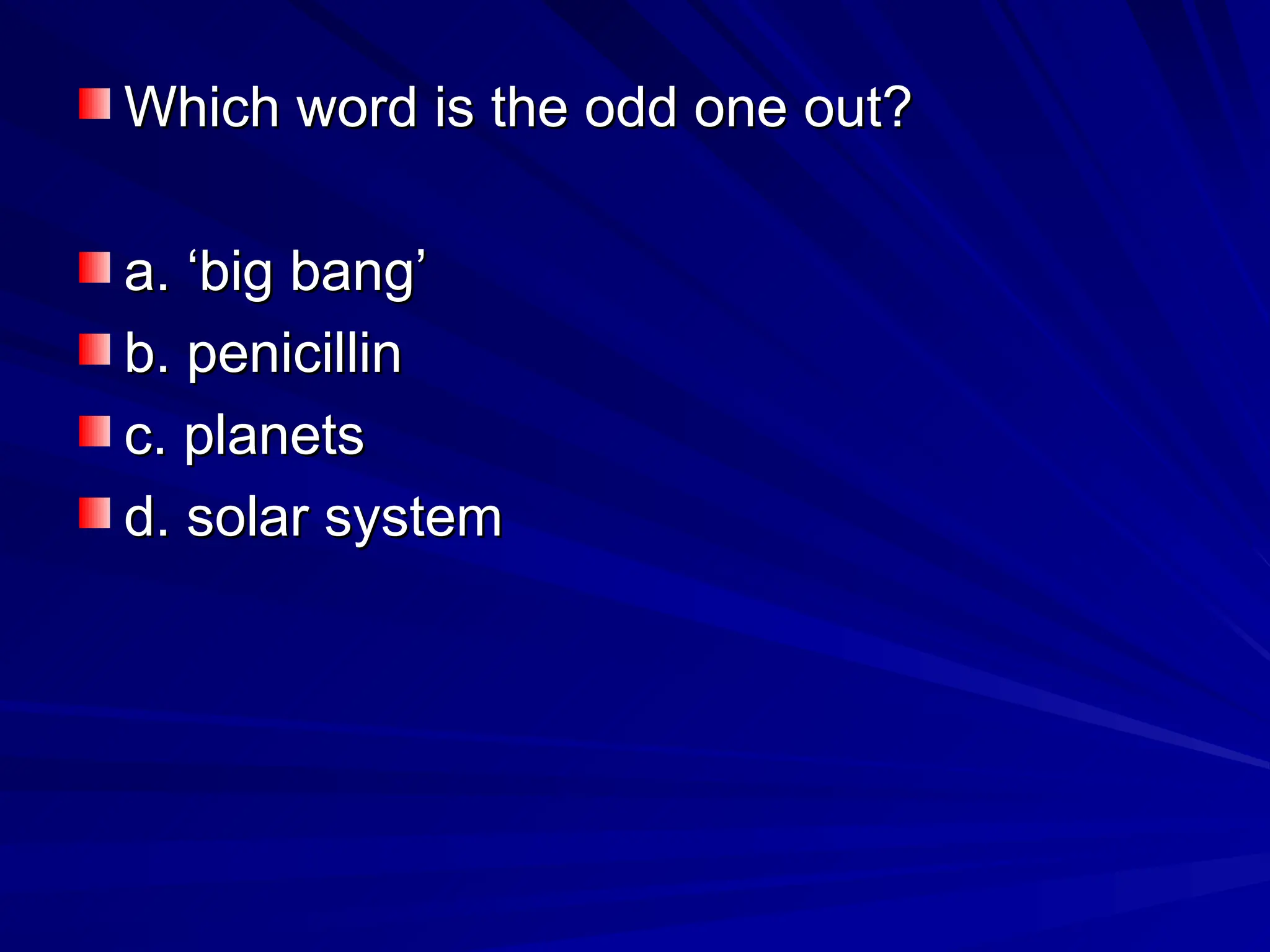
Which word is the odd one out?
a. ‘big bang’
a. ‘big bang’
b. penicillin
b. penicillin
c. planets
c. planets
d. solar system
d. solar system
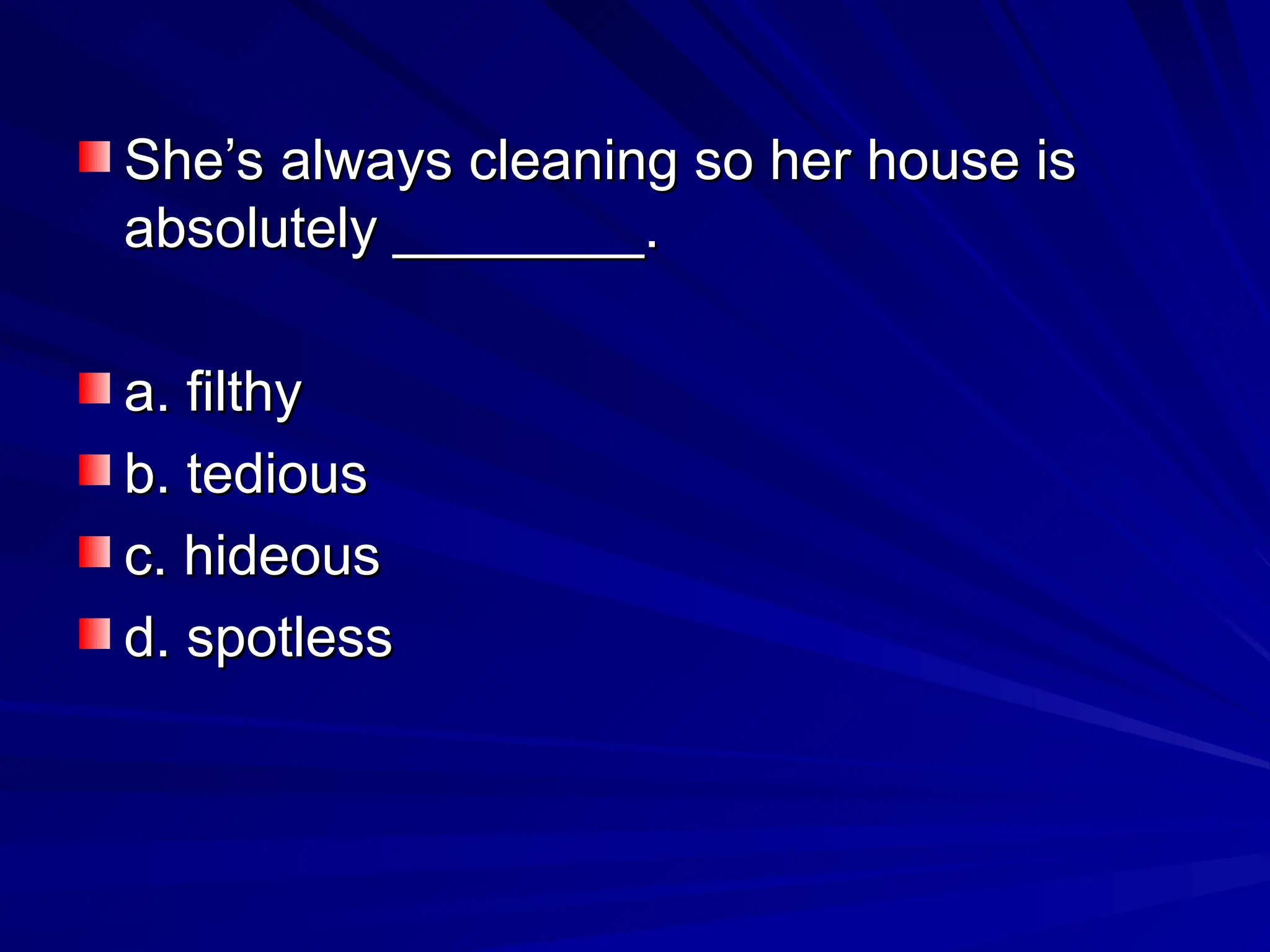
She’s always cleaning so her house is
absolutely ________.
a. filthy
a. filthy
b. tedious
b. tedious
c. hideous
c. hideous
d. spotless
d. spotless
If someone
If someone grills
grills you, he / she ________.
you, he / she ________.
a. asks you lots of difficult questions.
b. tells you lots of jokes and funny stories.
c. tells you all his / her problems.
d. makes you sit in the sun until you burn.
If you want to walk quietly, you ________.
a. stagger
a. stagger
b. march
b. march
c. tiptoe
c. tiptoe
d. limp
d. limp
More examples are available in the
handout.
handout.
Reading Comprehension
Read the following text and answer the
questions below.
questions below.
Elizabeth Blackwell was born in England in 1821 and
emigrated to New York City when she was ten years old. One day
she decided that she wanted to be a doctor. That was nearly
impossible for a woman in the middle of the 19
impossible for a woman in the middle of the 19th
th
century. After writing
many letters seeking admission to medical schools, she was finally
accepted by a doctor in Philadelphia. So determined was she that
she taught in a school and gave music lessons to earn money for her
tuition.
tuition.
In 1849, after graduation from a medical school, she decided
to further education in Paris. She wanted to be a surgeon, but a
serious eye infection forced her to abandon the idea.
Upon returning to the United States, she found it difficult to
start her own practice because she was a woman. By 1857, Elizabeth
and her sister, also a doctor, along with another female doctor,
managed to open a new hospital, the first for women and children.
Besides being the first female physician and founding her own
hospital, she also established the first medical school for women.
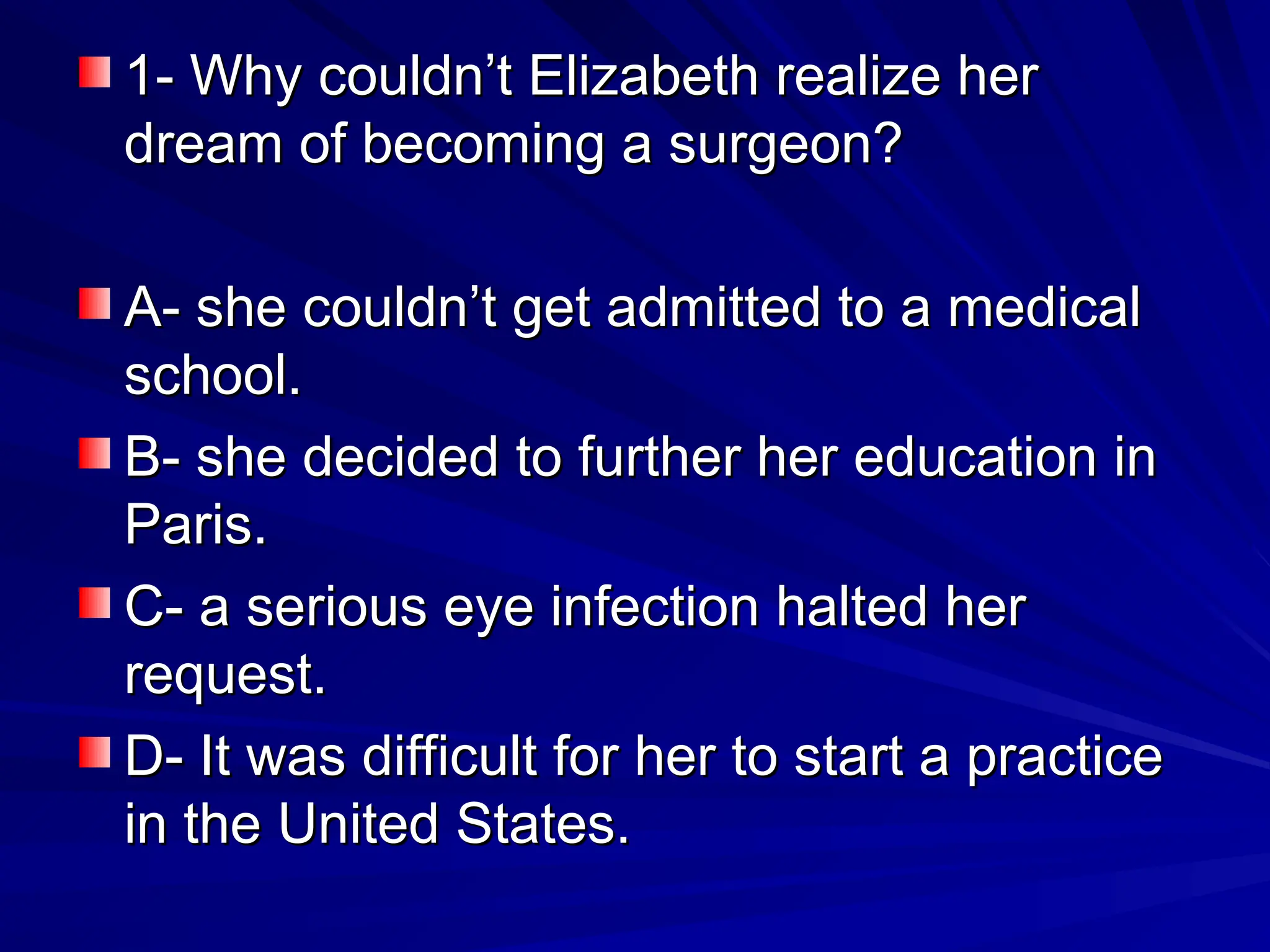
1- Why couldn’t Elizabeth realize her
dream of becoming a surgeon?
A- she couldn’t get admitted to a medical
school.
school.
B- she decided to further her education in
Paris.
Paris.
C- a serious eye infection halted her
request.
request.
D- It was difficult for her to start a practice
in the United States.
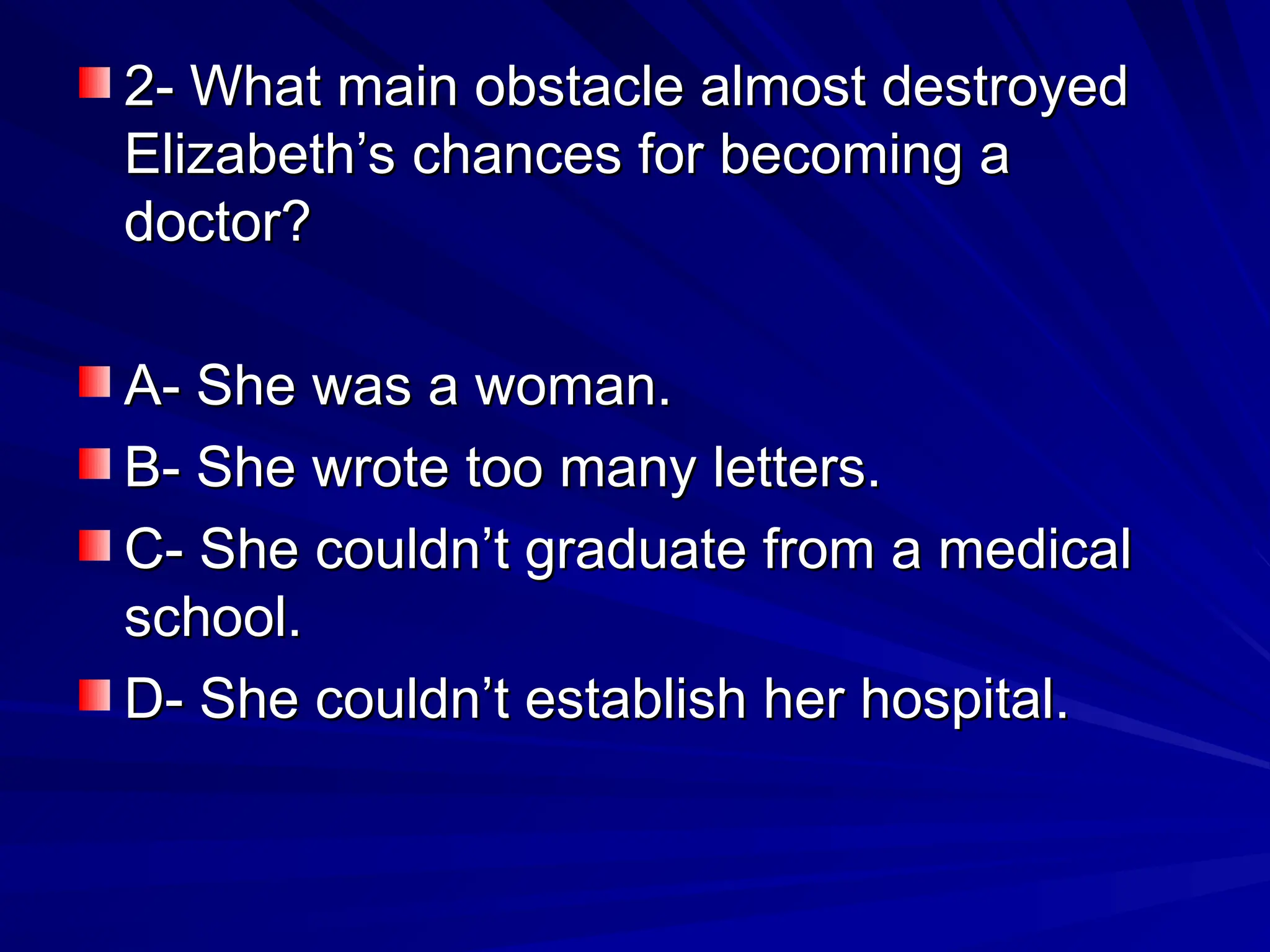
2- What main obstacle almost destroyed
Elizabeth’s chances for becoming a
doctor?
doctor?
A- She was a woman.
A- She was a woman.
B- She wrote too many letters.
C- She couldn’t graduate from a medical
school.
school.
D- She couldn’t establish her hospital.
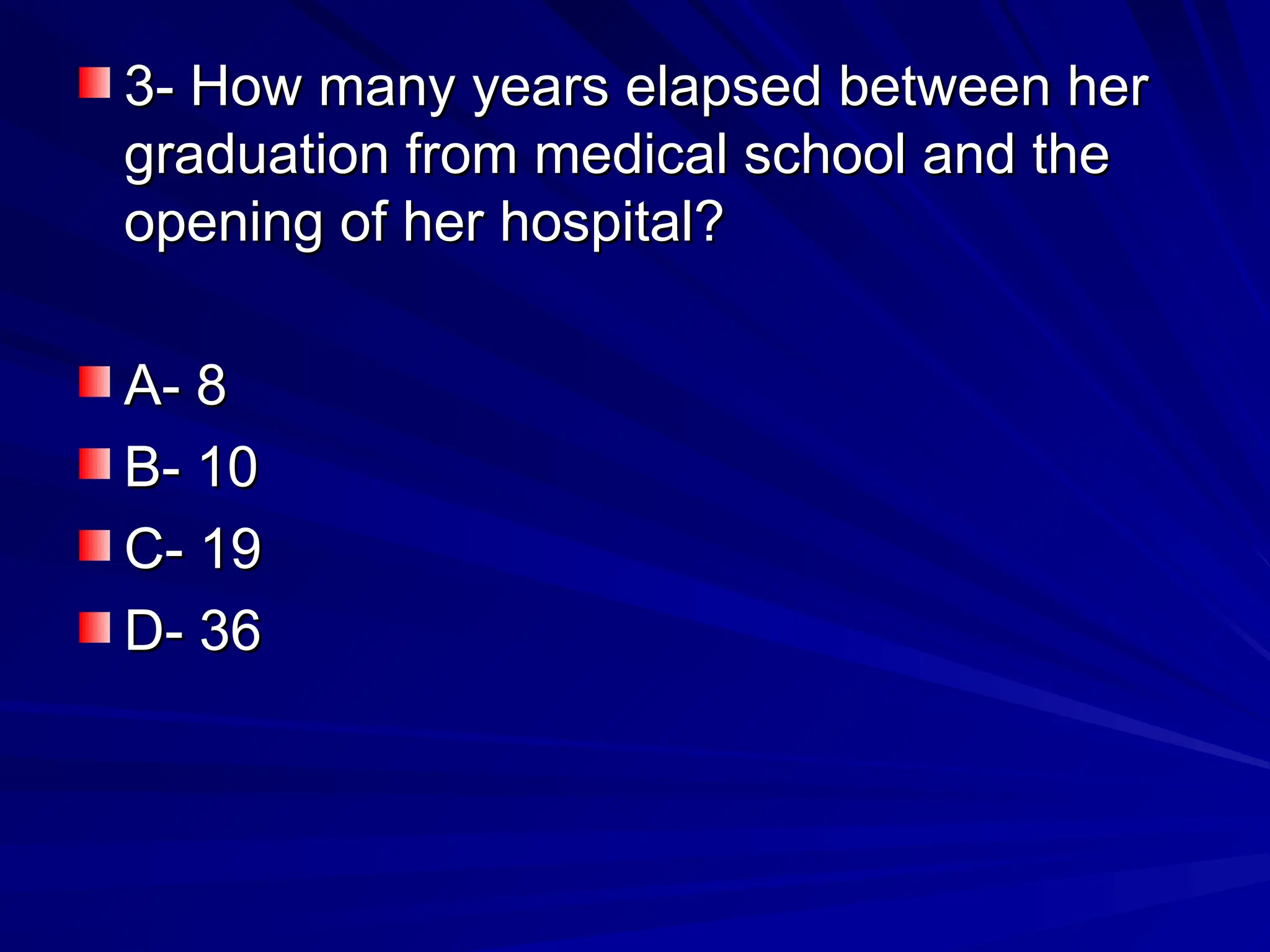
3- How many years elapsed between her
graduation from medical school and the
opening of her hospital?
A- 8
A- 8
B- 10
B- 10
C- 19
C- 19
D- 36
D- 36
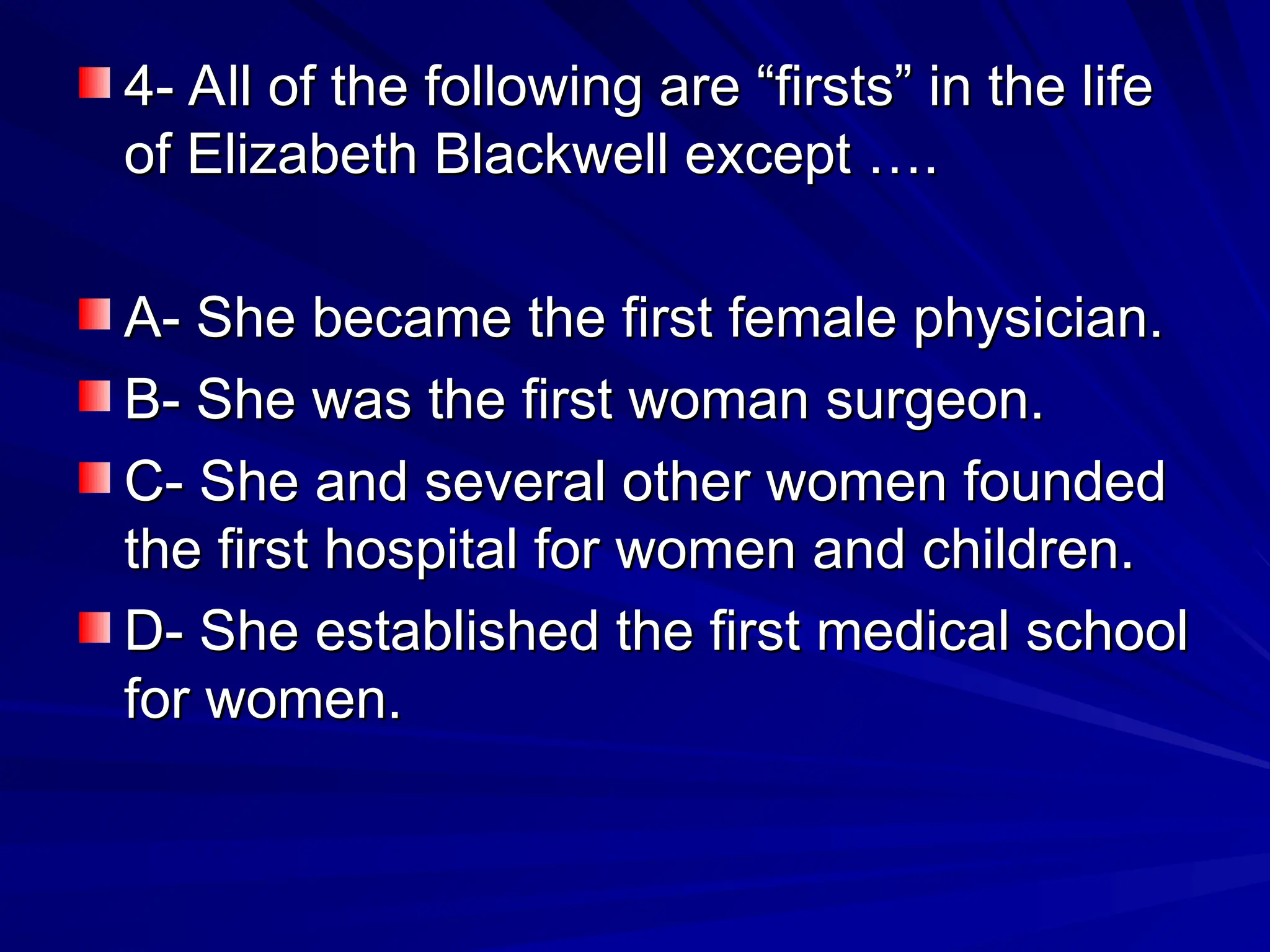
4- All of the following are “firsts” in the life
of Elizabeth Blackwell except ….
A- She became the first female physician.
B- She was the first woman surgeon.
C- She and several other women founded
the first hospital for women and children.
D- She established the first medical school
for women.
for women.
For Extra Vocabulary
Exercises
Exercises
&
&
Reading Comprehension
Questions,
Questions,
refer to the Handout.

aptitude-test questions answers form.ppt

  • 1.
    ‫التربية‬ ‫وزارة‬ ‫العام‬ ‫الفني‬‫التوجيه‬ ‫اإلنجليزية‬ ‫للغة‬ Ministry of Education ELT General Supervision ‫اختباري‬ ‫باجتياز‬ ‫الخاصة‬ ‫التدريبية‬ ‫الدورة‬ ‫التوفل‬TOEFL ‫األكاديمية‬ ‫والقدرات‬ Training Course for TOEFL & Aptitude Test ‫اإلنجليزية‬ ‫للغة‬ ‫العام‬ ‫الفني‬ ‫التوجيه‬ ‫إعداد‬ ‫من‬ Prepared by ELT General Supervision
  • 2.
    Standardized Tests Standardized Tests Astandardized test is an examination that A standardized test is an examination that attempts to determine and measure a attempts to determine and measure a person's ability to acquire, through future person's ability to acquire, through future training, some specific set of skills training, some specific set of skills (intellectual, motor, and so on). (intellectual, motor, and so on). The tests assume that people differ in their The tests assume that people differ in their special abilities and that these differences special abilities and that these differences can be useful in predicting future can be useful in predicting future achievements. achievements.
  • 3.
    For example, theSAT (Scholastic Aptitude For example, the SAT (Scholastic Aptitude Test) is a test designed to predict how Test) is a test designed to predict how well you will perform in college. It is not well you will perform in college. It is not designed to measure how well you did in designed to measure how well you did in high school, but how capable you are of high school, but how capable you are of learning all the new skills necessary to do learning all the new skills necessary to do well in college / university. well in college / university. ETS (Educational Testing Service) is ETS (Educational Testing Service) is responsible for many international responsible for many international standardized tests, such as TOEFL and standardized tests, such as TOEFL and others. others.
  • 4.
    Center for Measurements& Center for Measurements & Teaching Development Teaching Development Is the one responsible for designing and Is the one responsible for designing and administering Aptitude Tests for admission administering Aptitude Tests for admission in Kuwait University. in Kuwait University.
  • 5.
    ENGLISH APTITUDE TEST ENGLISHAPTITUDE TEST STUDENT INFORMATION STUDENT INFORMATION FOR FOR ENGLISH LANGUAGE ENGLISH LANGUAGE PROFICIENCY PROFICIENCY REQUIREMENTS REQUIREMENTS at Kuwait University at Kuwait University
  • 6.
    Admission/Placement Test Contents: Admission/PlacementTest Contents: This General English Test consists of the This General English Test consists of the following parts: following parts: (I) Grammar 35 Questions (I) Grammar 35 Questions (II) Vocabulary 35 Questions (II) Vocabulary 35 Questions (III) Reading comprehension 20 Questions (III) Reading comprehension 20 Questions Total Number of questions: 90 Items Total Number of questions: 90 Items Time:60 minutes Time:60 minutes
  • 7.
    Part I -Grammar: Part I - Grammar: Objective Objective: : To test student’s knowledge of To test student’s knowledge of general, basic English grammar. general, basic English grammar.
  • 8.
    Grammatical items mayinclude: Grammatical items may include: 1. Articles 1. Articles 2. Subject-verb agreement + there is I there are 2. Subject-verb agreement + there is I there are 3. Use of negatives 3. Use of negatives 4. Word order - questions, negatives, indirect quotes 4. Word order - questions, negatives, indirect quotes 5. Pronouns - subject, object, possessive, reflexive and relative 5. Pronouns - subject, object, possessive, reflexive and relative 6. Prepositions - use of common prep. Phrases. 6. Prepositions - use of common prep. Phrases. 7. Adjectives + qualifiers 7. Adjectives + qualifiers + Comparative forms + Comparative forms + Few / little + Few / little 8. Adverbs + comparative forms 8. Adverbs + comparative forms 9. Gerunds. 9. Gerunds. 10. Infinitives + negatives 10. Infinitives + negatives 11. All verb tenses - all active and passive 11. All verb tenses - all active and passive 12. Sequence of tenses 12. Sequence of tenses 13. All subordinate clauses (relative clause, adverbial clause, noun 13. All subordinate clauses (relative clause, adverbial clause, noun clause) +connecting words. clause) +connecting words.
  • 9.
    Part II- Vocabulary: PartII- Vocabulary: Objective: Objective: To test students' knowledge of To test students' knowledge of common vocabulary words. common vocabulary words.
  • 10.
    Contents Contents 1. Some vocabularyitems from high school 1. Some vocabulary items from high school English textbooks. English textbooks. 2. Items from general English vocabulary. 2. Items from general English vocabulary.
  • 11.
    Part III- Readingcomprehension: Part III- Reading comprehension: Objective: Objective: To test students' knowledge of To test students' knowledge of common vocabulary words. common vocabulary words.
  • 12.
    Contents Contents 1. Finding themeaning of words in context 1. Finding the meaning of words in context 2. Finding the main idea of a paragraph 2. Finding the main idea of a paragraph 3. Finding the topic of a passage 3. Finding the topic of a passage 4. Listing subordinating details 4. Listing subordinating details 5. Recognizing the importance of some details 5. Recognizing the importance of some details 6. Making inferences or deductions 6. Making inferences or deductions 7. Using numbers in passages to solve problems 7. Using numbers in passages to solve problems
  • 13.
    Let’s give ita try Let’s give it a try. .
  • 14.
    Grammar Grammar Articles Articles • • a a =indefinite article (not a specific object, = indefinite article (not a specific object, one of a number of the same objects) with one of a number of the same objects) with consonants. consonants. She has a dog. / I work in a factory. She has a dog. / I work in a factory. • • an an = indefinite article (not a specific object, = indefinite article (not a specific object, one of a number of the same objects) with one of a number of the same objects) with vowels (a,e,i,o,u) vowels (a,e,i,o,u) Can I have an apple? / She is an English Can I have an apple? / She is an English teacher. teacher.
  • 15.
    • • the the =definite article (a specific object that = definite article (a specific object that both the person speaking and the listener both the person speaking and the listener know) know) The car over there is fast. / The teacher is The car over there is fast. / The teacher is very good, isn't he? very good, isn't he? • • The first time you speak of something use "a The first time you speak of something use "a or an", the next time you repeat that object or an", the next time you repeat that object use "the". use "the". I live in a house. The house is quite old and I live in a house. The house is quite old and has four bedrooms. has four bedrooms. I ate in a Chinese restaurant. The restaurant I ate in a Chinese restaurant. The restaurant was very good. was very good.
  • 16.
    DO NOT DO NOTuse an article with countries, use an article with countries, states, counties or provinces, lakes and states, counties or provinces, lakes and mountains except when the country is a mountains except when the country is a collection of states such as "The United collection of states such as "The United States". States". He lives in Washington near Mount Rainier. He lives in Washington near Mount Rainier. They live in northern British Columbia. They live in northern British Columbia. • • Use an article with bodies of water, oceans Use an article with bodies of water, oceans and seas - and seas - My country borders on the Pacific Ocean My country borders on the Pacific Ocean
  • 17.
    • • DO NOT DONOT use an article when you are use an article when you are speaking about things in general. speaking about things in general. She likes reading books. She likes reading books. I like Russian tea. I like Russian tea. • • DO NOT DO NOT use an article when you are use an article when you are speaking about meals, places, and transport. speaking about meals, places, and transport. He has breakfast at home. He has breakfast at home. I go to university. I go to university. He comes to work by taxi. He comes to work by taxi.
  • 18.
    Check the handoutfor practice. Check the handout for practice.
  • 19.
  • 20.
  • 21.
    Think about thesesituations: Think about these situations: When the expletive "it" is the subject … When the expletive "it" is the subject … In sentences beginning with the expletives In sentences beginning with the expletives "there is" or "there are“… "there is" or "there are“… When words like "each" are the subject… When words like "each" are the subject… When words like "none" are the subject … When words like "none" are the subject … When the subjects are joined by "and" … When the subjects are joined by "and" … When singular subjects are joined by words When singular subjects are joined by words like "or" like "or" When one subject is singular and one plural… When one subject is singular and one plural…
  • 22.
    Now try theseexamples. Now try these examples. On the wall …….. several posters. On the wall …….. several posters. were was There ………. many possible candidates. There ………. many possible candidates. are are is is There ……… only one good candidate. There ……… only one good candidate. are are is is It is my car which ……………… It is my car which ……………… stall stall stalls stalls
  • 23.
    It is theircars which …………………..…… It is their cars which …………………..…… stall stall Stalls Stalls Each …………………………………her turn at rowing. Each …………………………………her turn at rowing. take take takes takes Neither ……………………..…… the friends of the other. Neither ……………………..…… the friends of the other. like like likes likes Everyone in the fraternity…..................his own set of Everyone in the fraternity…..................his own set of prejudices. prejudices. has has have have
  • 24.
    Each of therowers………... her turn at rowing. Each of the rowers………... her turn at rowing. take take takes takes Some of the dollar …………………………..…. spent. Some of the dollar …………………………..…. spent. was was were were Some of the dollars ………………………….…. spent. Some of the dollars ………………………….…. spent. was was were were Both Tom and Jane ……………..…. passed the test. Both Tom and Jane ……………..…. passed the test. have have has has Tom, as well as Jane, …….……….. passed the test. Tom, as well as Jane, …….……….. passed the test. have have has has
  • 25.
    Either the manor his wife…. the truth of the matter Either the man or his wife…. the truth of the matter knows knows know know Neither money nor power ……. important any longer. Neither money nor power ……. important any longer. was was were were Neither the television nor the radios …………. Neither the television nor the radios …………. works works work work Neither the radios nor the television ……………. Neither the radios nor the television ……………. works works work work
  • 26.
    Forming a negative Forminga negative Positive sentence Negative sentence Contracted negative I am eating. I am not eating. I'm not eating. You are working. You are not working. You aren't working. He is driving. He is not driving. He isn't driving. She is teaching. She is not teaching. She isn't teaching. It is raining. It is not raining. It isn't raining. We are reading. We are not reading. We aren't reading. They are writing. They are not writing. They aren't writing.
  • 27.
    Forming a question Forminga question Statement Yes/no question Wh- question I am eating. Am I eating? What am I eating? You are crying. Are you crying? Why are you crying? He is going. Is he going? Where is he going? She is arriving. Is she arriving? When is she arriving? It is sleeping. Is it sleeping? Why is it sleeping? We are leaving. Are we leaving? When are we leaving? They are fighting. Are they fighting? Why are they fighting?
  • 28.
    Word Order Word Order Choosethe most natural order. Choose the most natural order. a- Here she has worked for a very long time. b- For a very long time she has worked here. c- She has worked for a very long time here. d-She has worked here for a very long time.
  • 29.
    a- Please fillout with the details this form. b- Please with your details fill out this form. c- Please fill out your details with this form. d- Please fill out this form with your details
  • 30.
    Word Order inquestions interrogative auxiliary verb subject other verb(s) indirect object direct object place time What would you like to tell me Did you have a party in your flat yesterday? When were you here?
  • 31.
    Pronouns Pronouns Subjective Pronouns Subjective Pronouns ObjectivePronouns Objective Pronouns Possessive Pronouns Possessive Pronouns Demonstrative Pronouns Demonstrative Pronouns Indefinite Pronouns Indefinite Pronouns ( (all, any, both, each, everyone, few, many, all, any, both, each, everyone, few, many, neither, none, nothing, several, some, and somebody.) neither, none, nothing, several, some, and somebody.) Relative Pronouns Relative Pronouns Reflexive Pronouns Reflexive Pronouns (They should divide the berries among (They should divide the berries among themselves.) themselves.) Intensive Pronouns Intensive Pronouns (The queen herself visited our class.) (The queen herself visited our class.) Reciprocal Pronouns Reciprocal Pronouns (each other and one another (each other and one another) )
  • 32.
    Jody has lost________ book. mine her hers theirs Junko has eaten her lunch already, but I'm saving ________ until later. hers her my mine
  • 33.
    This bird hasbroken ________ wing. it’s its’ hers its _____ pencil is broken. Can I borrow ____? Mine, yours Your, mine My, yours Yours, mine
  • 34.
    Opinion Size AgeShape Colour Origin Material Purpose a silly young English man a huge round metal bowl a small red sleeping bag Adjectives
  • 35.
    Which is thecorrect order? 1- a small Canadian thin lady 2- a Canadian small thin lady 3- a small thin Canadian lady 4- a thin small Canadian lady
  • 36.
    1- a carvingsteel new knife 2- a new steel carving knife 3- a steel new carving knife 4- a new carving steel knife
  • 37.
    1- a cottondirty old tie 2- a dirty cotton old tie 3- an old cotton dirty tie 4- a dirty old cotton tie
  • 38.
    Phrasal verbs Match thephrasal verb with the sentence that would most appropriately contain that verb. Your Answers Verbs Sent. No. Sentences hung up 1 He tried to __________ his jacket before his tie was tied. came to 2 My family was able to ________ on very little money when I was young. catch on 3 The detective vowed to __________ who the murderer was before the case went to trial. eat out 4 Whenever we get tired of cooking, we ________ at our favorite Italian restaurant. put on 5 Carlos ________ on his sister because he was so tired of listening to her whining on the phone. talk over 6 Tashonda was astonished that she was __________ for the counselor's position. get by 7 The committee promised that the celebrity would ______ at the big event. turned down 8 When he __________, his wallet and bike were nowhere to be found. find out 9 Professor Farbman promised to _________ the exam after she returned the results. show up 10 Terri was able to ________ to the most complex problems in calculus before anyone else .
  • 39.
    Verbs Sentences hung up CarlosHUNG UP on his sister because he was so tired of listening to her whining on the phone. came to When he CAME TO, his wallet and bike were nowhere to be found. catch on Terri was able to CATCH ON to the most complex problems in calculus before anyone else. eat out Whenever we get tired of cooking, we EAT OUT at our favorite Italian restaurant. put on He tried to PUT ON his jacket before his tied was tied. talk over Professor Farbman promised to TALK OVER the exam after she returned the results. get by My family was able to GET BY on very little money when I was young. turned down Tashonda was astonished that she was TURNED DOWN for the counselor's position. find out The detective vowed to FIND OUT who the real murderer was before the case went to trial. show up The committee promised that the celebrity would SHOW UP at the big event.
  • 40.
    What is anadverb? What is an adverb? The best way to tell if a word is an adverb is to try making a The best way to tell if a word is an adverb is to try making a question, for which the answer is the word. If the question question, for which the answer is the word. If the question uses uses how how, , where where or or when when, then the word is probably an , then the word is probably an adverb. Here is an example: adverb. Here is an example: Word in context Question Adverb? Tom plays tennis aggressively. How does Tom play tennis? Yes -- uses HOW. They have a small house. What kind of house do they have? No -- uses WHAT KIND OF, so this is an adjective. Matthew called the police immediately. When did Matthew call the police? Yes -- uses WHEN.
  • 41.
    Kinds of Adverbs Kindsof Adverbs Adverbs of Manner Adverbs of Manner She moved She moved slowly slowly and spoke and spoke quietly quietly. . Adverbs of Place Adverbs of Place She has lived She has lived on the island on the island all her life. all her life. She still lives She still lives there there now. now. Adverbs of Frequency Adverbs of Frequency She takes the boat to the mainland She takes the boat to the mainland every day every day. . She She often often goes by herself. goes by herself. Adverbs of Time Adverbs of Time She tries to get back She tries to get back before dark before dark. . It's starting to get dark It's starting to get dark now now. . She finished her tea She finished her tea first first. . She left She left early early. . Adverbs of Purpose Adverbs of Purpose She drives her boat slowly She drives her boat slowly to avoid hitting the rocks to avoid hitting the rocks. . She shops in several stores She shops in several stores to get the best buys. to get the best buys.
  • 42.
    THE ROYAL ORDEROF ADVERBS Subject & Verb Manner Place Frequency Time Purpose Beth swims enthusiastically in the pool every morning before dawn to keep in shape. Dad walks impatiently into town every afternoon before supper to get a newspaper. Julia naps in her room every morning before lunch.
  • 43.
    Select the sentencein which usually appears in an appropriate position. A. She usually shops for clothes at the local thrift store. B. Usually she shops for clothes at the local thrift store. C. She shops for clothes at the local thrift store usually. D. Either "A" or "B" is fine.
  • 44.
    Select the sentencewith the most Select the sentence with the most appropriate order of adverbial phrases. appropriate order of adverbial phrases. A. A. She leaves the island during the She leaves the island during the months of December and January after months of December and January after dark. dark. B. B. She leaves the island after dark during She leaves the island after dark during the months of December and January. the months of December and January. C. C. Either "A" or "B" is fine. Either "A" or "B" is fine.
  • 45.
    Gerunds Gerunds Gerund as subject: Gerundas subject: Traveling Traveling might satisfy your desire for new experiences. might satisfy your desire for new experiences. The study abroad program might satisfy your desire for new The study abroad program might satisfy your desire for new experiences. experiences. Gerund as direct object: Gerund as direct object: They do not appreciate my They do not appreciate my singing. singing. They do not appreciate my assistance. They do not appreciate my assistance. Gerund as subject complement: Gerund as subject complement: My cat's favorite activity is My cat's favorite activity is sleeping sleeping. . My cat's favorite food is salmon. My cat's favorite food is salmon. Gerund as object of preposition: Gerund as object of preposition: The police arrested him for The police arrested him for speeding speeding. . The police arrested him for criminal activity. The police arrested him for criminal activity.
  • 46.
    Verbs that takeonly infinitives as verbal direct objects agree decide expect hesitate learn need promise neglect hope want plan attempt propose intend pretend Examples: I hope to go on a vacation soon. (not: I hope going on a vacation soon.) He promised to go on a diet. (not: He promised going on a diet.)
  • 47.
    Verbs that takeonly gerunds as verbal direct objects deny risk delay consider can't help keep give up be fond of finish quit put off practice postpone tolerate suggest stop (quit) regret enjoy keep (on) dislike admit avoid recall mind miss detest appreciate recommend get/be through get/be tired of get/be accustomed to get/be used to Examples: They always avoid drinking before driving. (not: They always avoid to drink before driving.) I recall asking her that question. (not: I recall to ask her that question.)
  • 48.
    Verbs that takegerunds orinfinitives as verbal direct objects start begin continue hate prefer like love try remember Examples: She has continued to work at the store. She has continued working at the store.
  • 49.
    Active Passive Simple Present Once aweek, Tom cleans the house. Once a week, the house is cleaned by Tom. Present Continuous Right now, Sarah is writing the letter. Right now, the letter is being written by Sarah. Simple Past Sam repaired the car. The car was repaired by Sam. Past Continuous The salesman was helping the customer when the thief came into the store. The customer was being helped by the salesman when the thief came into the store. Present Perfect Many tourists have visited that castle. That castle has been visited by many tourists. Past Perfect George had repaired many cars before he received his mechanic's license. Many cars had been repaired by George before he received his mechanic's license. Simple Future WILL Someone will finish the work by 5:00 PM. The work will be finished by 5:00 PM. Future Perfect WILL They will have completed the project before the deadline. The project will have been completed before the deadline. Future Perfect BE GOING TO They are going to have completed the project before the deadline. The project is going to have been completed before the deadline. Future Perfect Continuous BE GOING TO The famous artist is going to have been painting the mural for over six months by the time it is finished. The mural is going to have been being painted by the famous artist for over six months by the time it is finished.
  • 50.
    Jane talks onthe phone. Jane talks on the phone. Bob has been talking on the phone for an hour. Bob has been talking on the phone for an hour. Mary is talking on the phone. Mary is talking on the phone. Who is not necessarily on the phone Who is not necessarily on the phone now? now? _____________ _____________ Jane Jane Tenses Try these questions.
  • 51.
    - Jane leftwhen Tim arrived. - Jane left when Tim arrived. - Bob left when Tim had arrived. - Bob left when Tim had arrived. - Tim arrived when Mary was leaving. - Tim arrived when Mary was leaving. - John had left when Tim arrived. - John had left when Tim arrived. - After Tim arrived, Frank left. - After Tim arrived, Frank left. Who did not run into Tim? Who did not run into Tim? _______ _______ John John
  • 52.
    Clauses Clauses Relative Clauses Relative Clauses Thelazy students The lazy students whom Mrs. Russell hit in the head with a chalk eraser whom Mrs. Russell hit in the head with a chalk eraser soon soon learned to keep their complaints to themselves. learned to keep their complaints to themselves. Noun Clauses Noun Clauses You really do not want to know what Aunt Nancy adds to her stew. You really do not want to know what Aunt Nancy adds to her stew. Adjective Clause Adjective Clause They are searching for the one who borrowed the book. They are searching for the one who borrowed the book. Adverb Clauses Adverb Clauses If the British co-operate, the Europeans may achieve monetary union. If the British co-operate, the Europeans may achieve monetary union.
  • 53.
  • 54.
    Commonly misused words Commonlymisused words angel / angle angel / angle cite / site / sight cite / site / sight costume / custom costume / custom decent / descent decent / descent dessert / desert dessert / desert later / latter later / latter loose / lose loose / lose peace / piece peace / piece principal / principle principal / principle quite / quiet quite / quiet
  • 55.
    For each ofthe following questions choose the one correct answer If you feel "Like a fish ________ water" you feel in the wrong place. a.In b.Under c.out of d.over
  • 56.
    His name definitelyrings ________, although I can’t put a face to it. a. a memory b. a thought c. a bell d. a clock
  • 57.
    I'm very suspiciousof this deal. I can smell___ a. a rabbit b. a rose c. a rat d. a fish
  • 58.
    To "_______ aroundthe bush" is an idiom which means to avoid speaking about something directly. a. run b. beat c. talk d. look
  • 59.
    If you makefun of someone, you "pull his or her ________.” a. arm b. finger c. leg d. toe
  • 60.
    The crowd wasso tightly packed that it The crowd was so tightly packed that it took us hours to ________. took us hours to ________. a. get through them. a. get through them. b. get through it. b. get through it. c. get through all them. c. get through all them. d. get through with it. d. get through with it.
  • 61.
    Look at thisold photo, I ________ it, Look at this old photo, I ________ it, when I was cleaning the attic. when I was cleaning the attic. a. came over a. came over b. came across b. came across c. came into c. came into d. came round d. came round
  • 62.
    We were verypoor when I was a boy, my We were very poor when I was a boy, my parents found it hard to ________. parents found it hard to ________. (survive on a small amount of money) (survive on a small amount of money) a. get by a. get by b. get away b. get away c. get up c. get up d. get across d. get across
  • 63.
    What is thecollective noun for knives, What is the collective noun for knives, forks, spoons and other eating utensils? forks, spoons and other eating utensils? a. crockery a. crockery b. cutlery b. cutlery c. weaponry c. weaponry d. eatery d. eatery
  • 64.
    Which of thefollowing is the odd one out? Which of the following is the odd one out? a. hammer a. hammer b. chisel b. chisel c. rolling pin c. rolling pin d. pliers d. pliers
  • 65.
    The following wordsall contain the word The following words all contain the word ‘speed’. Which one is incorrect? ‘speed’. Which one is incorrect? a. speed food a. speed food b. speed bump b. speed bump c. speed reading c. speed reading d. speed limit d. speed limit
  • 66.
    Which of thefollowing do you ‘do’ and Which of the following do you ‘do’ and not not ‘make’? ‘make’? a. a decision a. a decision b. a fuss b. a fuss c. someone a favour c. someone a favour d. a mistake d. a mistake
  • 67.
    Which of thefollowing Which of the following cannot cannot be be delivered? delivered? a. a baby a. a baby b. a letter b. a letter c. a smile c. a smile d. a speech d. a speech
  • 68.
    What is theopposite of 'resistible'? What is the opposite of 'resistible'? a. unresistible a. unresistible b. irresistible b. irresistible c. disresistible c. disresistible d. inresistible d. inresistible
  • 69.
    Which word isthe ‘odd one out’? Which word is the ‘odd one out’? a. awful a. awful b. marvellous b. marvellous c. fab c. fab d. terrific d. terrific
  • 70.
    If you areseething, you are________. If you are seething, you are________. a. very very cold a. very very cold b. very very thirsty b. very very thirsty c. very very worried c. very very worried d. very very angry d. very very angry
  • 71.
    Which word isthe odd one out? Which word is the odd one out? a. ‘big bang’ a. ‘big bang’ b. penicillin b. penicillin c. planets c. planets d. solar system d. solar system
  • 72.
    She’s always cleaningso her house is She’s always cleaning so her house is absolutely ________. absolutely ________. a. filthy a. filthy b. tedious b. tedious c. hideous c. hideous d. spotless d. spotless
  • 73.
    If someone If someonegrills grills you, he / she ________. you, he / she ________. a. asks you lots of difficult questions. a. asks you lots of difficult questions. b. tells you lots of jokes and funny stories. b. tells you lots of jokes and funny stories. c. tells you all his / her problems. c. tells you all his / her problems. d. makes you sit in the sun until you burn. d. makes you sit in the sun until you burn.
  • 74.
    If you wantto walk quietly, you ________. If you want to walk quietly, you ________. a. stagger a. stagger b. march b. march c. tiptoe c. tiptoe d. limp d. limp
  • 75.
    More examples areavailable in the More examples are available in the handout. handout.
  • 76.
    Reading Comprehension Reading Comprehension Readthe following text and answer the Read the following text and answer the questions below. questions below.
  • 77.
    Elizabeth Blackwell wasborn in England in 1821 and Elizabeth Blackwell was born in England in 1821 and emigrated to New York City when she was ten years old. One day emigrated to New York City when she was ten years old. One day she decided that she wanted to be a doctor. That was nearly she decided that she wanted to be a doctor. That was nearly impossible for a woman in the middle of the 19 impossible for a woman in the middle of the 19th th century. After writing century. After writing many letters seeking admission to medical schools, she was finally many letters seeking admission to medical schools, she was finally accepted by a doctor in Philadelphia. So determined was she that accepted by a doctor in Philadelphia. So determined was she that she taught in a school and gave music lessons to earn money for her she taught in a school and gave music lessons to earn money for her tuition. tuition. In 1849, after graduation from a medical school, she decided In 1849, after graduation from a medical school, she decided to further education in Paris. She wanted to be a surgeon, but a to further education in Paris. She wanted to be a surgeon, but a serious eye infection forced her to abandon the idea. serious eye infection forced her to abandon the idea. Upon returning to the United States, she found it difficult to Upon returning to the United States, she found it difficult to start her own practice because she was a woman. By 1857, Elizabeth start her own practice because she was a woman. By 1857, Elizabeth and her sister, also a doctor, along with another female doctor, and her sister, also a doctor, along with another female doctor, managed to open a new hospital, the first for women and children. managed to open a new hospital, the first for women and children. Besides being the first female physician and founding her own Besides being the first female physician and founding her own hospital, she also established the first medical school for women. hospital, she also established the first medical school for women.
  • 78.
    1- Why couldn’tElizabeth realize her 1- Why couldn’t Elizabeth realize her dream of becoming a surgeon? dream of becoming a surgeon? A- she couldn’t get admitted to a medical A- she couldn’t get admitted to a medical school. school. B- she decided to further her education in B- she decided to further her education in Paris. Paris. C- a serious eye infection halted her C- a serious eye infection halted her request. request. D- It was difficult for her to start a practice D- It was difficult for her to start a practice in the United States. in the United States.
  • 79.
    2- What mainobstacle almost destroyed 2- What main obstacle almost destroyed Elizabeth’s chances for becoming a Elizabeth’s chances for becoming a doctor? doctor? A- She was a woman. A- She was a woman. B- She wrote too many letters. B- She wrote too many letters. C- She couldn’t graduate from a medical C- She couldn’t graduate from a medical school. school. D- She couldn’t establish her hospital. D- She couldn’t establish her hospital.
  • 80.
    3- How manyyears elapsed between her 3- How many years elapsed between her graduation from medical school and the graduation from medical school and the opening of her hospital? opening of her hospital? A- 8 A- 8 B- 10 B- 10 C- 19 C- 19 D- 36 D- 36
  • 81.
    4- All ofthe following are “firsts” in the life 4- All of the following are “firsts” in the life of Elizabeth Blackwell except …. of Elizabeth Blackwell except …. A- She became the first female physician. A- She became the first female physician. B- She was the first woman surgeon. B- She was the first woman surgeon. C- She and several other women founded C- She and several other women founded the first hospital for women and children. the first hospital for women and children. D- She established the first medical school D- She established the first medical school for women. for women.
  • 82.
    For Extra Vocabulary ForExtra Vocabulary Exercises Exercises & & Reading Comprehension Reading Comprehension Questions, Questions, refer to the Handout. refer to the Handout.