SPOC A Secure and Privacy-preserving Opportunistic
Computing Framework for Mobile-Healthcare Emergency
ABSTRACT:
With the pervasiveness of smart phones and the advance of wireless body sensor
networks (BSNs), mobile Healthcare (m-Healthcare), which extends the operation
of Healthcare provider into a pervasive environment for better health monitoring,
has attracted considerable interest recently. However, the flourish of m-Healthcare
still faces many challenges including information security and privacy
preservation. In this paper, we propose a secure and privacy-preserving
opportunistic computing framework, called SPOC, for m-Healthcare emergency.
With SPOC, smart phone resources including computing power and energy can be
opportunistically gathered to process the computing-intensive personal health
information (PHI) during m-Healthcare emergency with minimal privacy
disclosure. In specific, to leverage the PHI privacy disclosure and the high
reliability of PHI process and transmission in m-Healthcare emergency, we
introduce an efficient user-centric privacy access control in SPOC framework,
which is based on an attribute-based access control and a new privacy-preserving
scalar product computation (PPSPC) technique, and allows a medical user to
decide who can participate in the opportunistic computing to assist in processing
his overwhelming PHI data. Detailed security analysis shows that the proposed
SPOC framework can efficiently achieve user-centric privacy access control in m-
Healthcare emergency. In addition, performance evaluations via extensive
simulations demonstrate the SPOC’s effectiveness in term of providing high
reliable PHI process and transmission while minimizing the privacy disclosure
during m-Healthcare emergency.
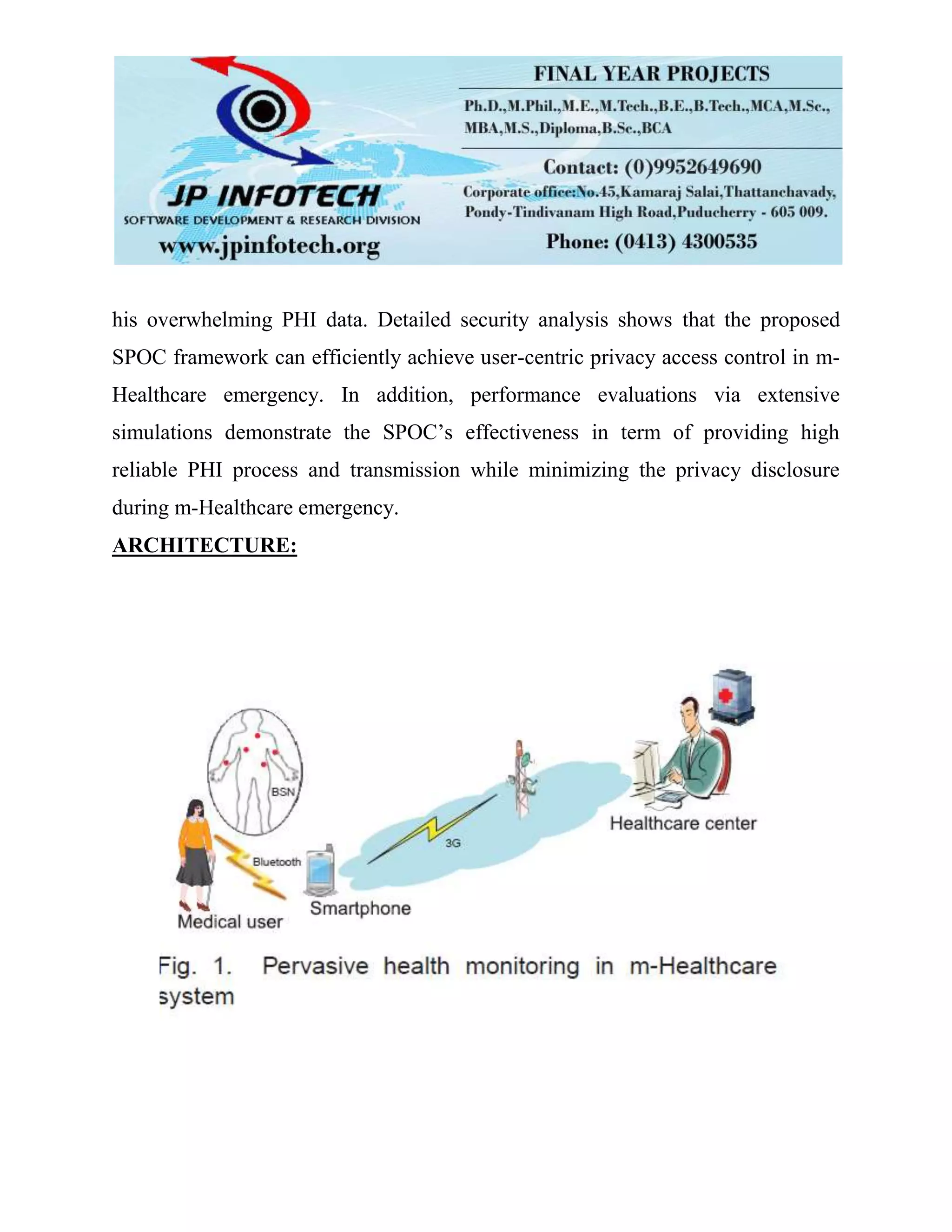
ARCHITECTURE:
EXISTING SYSTEM
The study of opportunistic computing has gained the great interest from the
research community recently.
The existing systems introduce the opportunistic computing paradigm in wireless
sensor network to solve the problem of storing and executing an application that
exceeds the memory resources available on a single sensor node. Especially, their
solution is based on the idea of partitioning the application code into a number of
opportunistically cooperating modules, and each node contributes to the execution
of the original application by running a subset of the application tasks and
providing service to the neighboring nodes.
Passarella et al. evaluate the performance of service execution in opportunistic
computing. Specifically, they first abstract resources in pervasive computing as
services, that are opportunistically contributed by providers and invoked by
seekers. Then, they present a complete analytical model to depict the service
invocation process between seekers and providers, and derive the optimal number
of replicas to be spawned on encountered nodes, in order to minimize the
execution time and optimize the computational and bandwidth resources used.
PROPOSED SYSTEM
In this paper, we propose a new secure and privacy preserving opportunistic
computing framework, called SPOC, to address this challenge. With the proposed
SPOC framework, each medical user in emergency can achieve the user-centric
privacy access control to allow only those qualified helpers to participate in the
opportunistic computing to balance the high-reliability of PHI process and
minimizing PHI privacy disclosure in m-Healthcare emergency. Specifically, the
main contributions of this paper are threefold. • First, we propose SPOC, a secure
and privacy-preserving opportunistic computing framework for m-Healthcare
emergency. With SPOC, the resources available on other opportunistically
contacted medical users’ smartphones can be gathered together to deal with the
computingintensive PHI process in emergency situation. Since the PHI will be
disclosed during the process in opportunistic computing, to minimize the PHI
privacy disclosure, SPOC introduces a user-centric two-phase privacy access
control to only allow those medical users who have similar symptoms to
participate in opportunistic computing. • Second, to achieve user-centric privacy
access control in opportunistic computing, we present an efficient attributebased
access control and a novel non-homomorphic encryption based privacy-preserving
scalar product computation (PPSPC) protocol, where the attributed-based access
control can help a medical user in emergency to identify other medical users, and
PPSPC protocol can further control only those medical users who have similar
symptoms to participate in the opportunistic computing while without directly
revealing users’ symptoms. Note that, although PPSPC protocols have been well
studied in privacy-preserving data mining, yet most of them are relying on time-
consuming homomorphic encryption technique. To the best of our knowledge, our
novel non-homomorphic encryption based PPSPC protocol is the most efficient
one in terms of computational and communication overheads. • Third, to validate
the effectiveness of the proposed SPOC framework in m-Healthcare emergency,
we also develop a custom simulator built in Java. Extensive simulation results
show that the proposed SPOC framework can help medical users to balance the
high-reliability of PHI process and minimizing the PHI privacy disclosure in m-
Healthcare emergency
Modules
 Medical User Module
Register User
Emergency Call
Send Report
View Report
Settings
 Trusted Authority Module
Modules Description:
Medical User:
In this module an application for Android smart phone is developed, to register the
medical user, then send and view their heal reports.
User Registration
The user is prompt to register with trusted authority to send the report and view
diagnosis, on the time of registration user need to give their personal information
such as name, age, address, contact number, email id. And username, password to
login and send the reports, User need to give the emergency contact number to call
immediately in emergency situations.
Emergency Call
The user can call the emergency number by pressing a simple button, no need to
open their dialer and entering the number or search the contacts and call the
number, the user is prompt to give the emergency number to call at the time of
registration, that number is called when the user in emergency situation by pressing
a simple button.
Send Report
User periodically sends their health information (PHI) such as Pulse rate, Blood
sugar, Blood pressure and Body temperature to the Trusted Authority. The values
are compared with threshold values and status is given as Normal or Emergency.
View Report
User can view the report sent to the Trusted Authority and the diagnosis received
from the trusted authority, then they can do the need full based on the diagnosis.
Settings
User has the options to update their personal information, username, password and
emergency number when they needed.
Trusted Authority
This module is developed as PHP project, Trusted Authority can login in the web
application running in the server and review all medical user PHI reports, time of
the report and status, and have the options to filter by the medical user name to
view the particular medical user report, then sent the diagnosis to the medical user
based on their PHI status to their Smartphone application, The user can receive the
diagnosis as the email in the address given at the time of registration, and can
receive the report in SMS in the number given.
HARDWARE REQUIREMENT
CPU type : Intel Pentium 4
Clock speed : 3.0 GHz
Ram size : 512 MB
Hard disk capacity : 40 GB
Monitor type : 15 Inch color monitor
Keyboard type : internet keyboard
SOFTWARE REQUIREMENT
Operating System: Android
Language : ANDROID SDK 2.3
Back End : SQLite
Documentation : Ms-Office
REFERENCE:
Rongxing Lu, Xiaodong Lin, and Xuemin (Sherman) Shen, “SPOC: A Secure and
Privacy-preserving Opportunistic Computing Framework for Mobile-Healthcare
Emergency”, IEEE TRANSACTIONS ON PARALLEL AND DISTRIBUTED
SYSTEMS, VOL. 24, NO. 3, MARCH 2013

Spoc a secure and privacy preserving opportunistic computing framework for mobile-healthcare emergency

  • 1.
    SPOC A Secureand Privacy-preserving Opportunistic Computing Framework for Mobile-Healthcare Emergency ABSTRACT: With the pervasiveness of smart phones and the advance of wireless body sensor networks (BSNs), mobile Healthcare (m-Healthcare), which extends the operation of Healthcare provider into a pervasive environment for better health monitoring, has attracted considerable interest recently. However, the flourish of m-Healthcare still faces many challenges including information security and privacy preservation. In this paper, we propose a secure and privacy-preserving opportunistic computing framework, called SPOC, for m-Healthcare emergency. With SPOC, smart phone resources including computing power and energy can be opportunistically gathered to process the computing-intensive personal health information (PHI) during m-Healthcare emergency with minimal privacy disclosure. In specific, to leverage the PHI privacy disclosure and the high reliability of PHI process and transmission in m-Healthcare emergency, we introduce an efficient user-centric privacy access control in SPOC framework, which is based on an attribute-based access control and a new privacy-preserving scalar product computation (PPSPC) technique, and allows a medical user to decide who can participate in the opportunistic computing to assist in processing
  • 2.
    his overwhelming PHIdata. Detailed security analysis shows that the proposed SPOC framework can efficiently achieve user-centric privacy access control in m- Healthcare emergency. In addition, performance evaluations via extensive simulations demonstrate the SPOC’s effectiveness in term of providing high reliable PHI process and transmission while minimizing the privacy disclosure during m-Healthcare emergency. ARCHITECTURE:
  • 3.
    EXISTING SYSTEM The studyof opportunistic computing has gained the great interest from the research community recently. The existing systems introduce the opportunistic computing paradigm in wireless sensor network to solve the problem of storing and executing an application that exceeds the memory resources available on a single sensor node. Especially, their solution is based on the idea of partitioning the application code into a number of opportunistically cooperating modules, and each node contributes to the execution of the original application by running a subset of the application tasks and providing service to the neighboring nodes. Passarella et al. evaluate the performance of service execution in opportunistic computing. Specifically, they first abstract resources in pervasive computing as services, that are opportunistically contributed by providers and invoked by seekers. Then, they present a complete analytical model to depict the service invocation process between seekers and providers, and derive the optimal number of replicas to be spawned on encountered nodes, in order to minimize the execution time and optimize the computational and bandwidth resources used.
  • 4.
    PROPOSED SYSTEM In thispaper, we propose a new secure and privacy preserving opportunistic computing framework, called SPOC, to address this challenge. With the proposed SPOC framework, each medical user in emergency can achieve the user-centric privacy access control to allow only those qualified helpers to participate in the opportunistic computing to balance the high-reliability of PHI process and minimizing PHI privacy disclosure in m-Healthcare emergency. Specifically, the main contributions of this paper are threefold. • First, we propose SPOC, a secure and privacy-preserving opportunistic computing framework for m-Healthcare emergency. With SPOC, the resources available on other opportunistically contacted medical users’ smartphones can be gathered together to deal with the computingintensive PHI process in emergency situation. Since the PHI will be disclosed during the process in opportunistic computing, to minimize the PHI privacy disclosure, SPOC introduces a user-centric two-phase privacy access control to only allow those medical users who have similar symptoms to participate in opportunistic computing. • Second, to achieve user-centric privacy access control in opportunistic computing, we present an efficient attributebased access control and a novel non-homomorphic encryption based privacy-preserving scalar product computation (PPSPC) protocol, where the attributed-based access
  • 5.
    control can helpa medical user in emergency to identify other medical users, and PPSPC protocol can further control only those medical users who have similar symptoms to participate in the opportunistic computing while without directly revealing users’ symptoms. Note that, although PPSPC protocols have been well studied in privacy-preserving data mining, yet most of them are relying on time- consuming homomorphic encryption technique. To the best of our knowledge, our novel non-homomorphic encryption based PPSPC protocol is the most efficient one in terms of computational and communication overheads. • Third, to validate the effectiveness of the proposed SPOC framework in m-Healthcare emergency, we also develop a custom simulator built in Java. Extensive simulation results show that the proposed SPOC framework can help medical users to balance the high-reliability of PHI process and minimizing the PHI privacy disclosure in m- Healthcare emergency Modules  Medical User Module Register User Emergency Call Send Report View Report Settings
  • 6.
     Trusted AuthorityModule Modules Description: Medical User: In this module an application for Android smart phone is developed, to register the medical user, then send and view their heal reports. User Registration The user is prompt to register with trusted authority to send the report and view diagnosis, on the time of registration user need to give their personal information such as name, age, address, contact number, email id. And username, password to login and send the reports, User need to give the emergency contact number to call immediately in emergency situations. Emergency Call The user can call the emergency number by pressing a simple button, no need to open their dialer and entering the number or search the contacts and call the number, the user is prompt to give the emergency number to call at the time of registration, that number is called when the user in emergency situation by pressing a simple button. Send Report
  • 7.
    User periodically sendstheir health information (PHI) such as Pulse rate, Blood sugar, Blood pressure and Body temperature to the Trusted Authority. The values are compared with threshold values and status is given as Normal or Emergency. View Report User can view the report sent to the Trusted Authority and the diagnosis received from the trusted authority, then they can do the need full based on the diagnosis. Settings User has the options to update their personal information, username, password and emergency number when they needed. Trusted Authority This module is developed as PHP project, Trusted Authority can login in the web application running in the server and review all medical user PHI reports, time of the report and status, and have the options to filter by the medical user name to view the particular medical user report, then sent the diagnosis to the medical user based on their PHI status to their Smartphone application, The user can receive the
  • 8.
    diagnosis as theemail in the address given at the time of registration, and can receive the report in SMS in the number given. HARDWARE REQUIREMENT CPU type : Intel Pentium 4 Clock speed : 3.0 GHz Ram size : 512 MB Hard disk capacity : 40 GB Monitor type : 15 Inch color monitor Keyboard type : internet keyboard SOFTWARE REQUIREMENT Operating System: Android Language : ANDROID SDK 2.3 Back End : SQLite Documentation : Ms-Office
  • 9.
    REFERENCE: Rongxing Lu, XiaodongLin, and Xuemin (Sherman) Shen, “SPOC: A Secure and Privacy-preserving Opportunistic Computing Framework for Mobile-Healthcare Emergency”, IEEE TRANSACTIONS ON PARALLEL AND DISTRIBUTED SYSTEMS, VOL. 24, NO. 3, MARCH 2013