Title: Spirituality VS Reality
Names of Author: Farhad, Sadeghi Amini
Name of the university: Canadian Arts & Sciences Institute , Canada
Contact details: sadeghiamini@gmail.com:
Keywords: Symbols, Signs, Ideologies
Theme/Session: Human & Symbols
Presentation preference: Virtual
Abstract
• When the early cave-dwelling humans began a social life, they became
organically divided into two different groups.
• Those belonging to the first group were of a kind always looking up to the
skies, searching for something bigger and stronger than themselves. They
looked for something phenomenal that would make their wishes come true
and solve their problems, especially to do with the health of their crops,
which was dependent on rain – and, rain came from the skies.
• The second group of our early ancestors was of the type who never looked
beyond their daily needs. They never thought of another life. They only
searched for the things that they needed in the immediate environment
around, not in the skies above. These people were hunter-gatherers who
were empirical and practical.
Introduction
Symbols and signs in visual arts
• Symbols and signs are the most ancient ways as to how humans share
their newly perceived concept with others within and outside of their
immediate tribes. This could take the form of primitive human trying
to share their ultimate ideas and understanding through signs and
symbols, be them animals, human, or of vegetation nature or a
combination of all. In visual arts gloss of any subject is dependent on
an abstract subject which demonstrates itself to their audiences by
means of very specific elements such as form, color and movement.
:
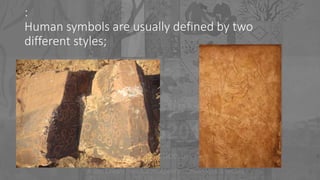
Human symbols are usually defined by two
different styles;
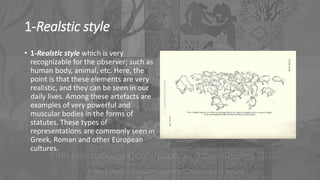
1-Realstic style
• 1-Realstic style which is very
recognizable for the observer; such as
human body, animal, etc. Here, the
point is that these elements are very
realistic, and they can be seen in our
daily lives. Among these artefacts are
examples of very powerful and
muscular bodies in the forms of
statutes. These types of
representations are commonly seen in
Greek, Roman and other European
cultures.
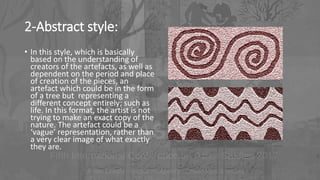
2-Abstract style:
• In this style, which is basically
based on the understanding of
creators of the artefacts, as well as
dependent on the period and place
of creation of the pieces, an
artefact which could be in the form
of a tree but representing a
different concept entirely; such as
life. In this format, the artist is not
trying to make an exact copy of the
nature. The artefact could be a
‘vague’ representation, rather than
a very clear image of what exactly
they are.
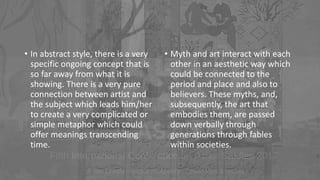
• In abstract style, there is a very
specific ongoing concept that is
so far away from what it is
showing. There is a very pure
connection between artist and
the subject which leads him/her
to create a very complicated or
simple metaphor which could
offer meanings transcending
time.
• Myth and art interact with each
other in an aesthetic way which
could be connected to the
period and place and also to
believers. These myths, and,
subsequently, the art that
embodies them, are passed
down verbally through
generations through fables
within societies.
Conclusion:
• Conclusion:
• Myth, signs, and symbols come from the first
mind-set At times skies are seen as the Father (or
where he resides) and the Earth is seen as the
Mother (which just as female human bears fruit),
and their child is the forest (as per Maori beliefs).
The “water” from the skies (the Father) made the
earth (the Mother) pregnant with fruits and
vegetation.
• People with this kind of mentality have built a
world their own, and have a special way of looking
to their own heart as well as to the other world.
Therefore, they never live on earth According to
this mentality, their permanent and eternal place
of residence is not on this soiled Earth, and as
such, and they are always gathering the necessary
vessel and equipment for this final journey to the
other world - to the real life as they believed.
• As a result, I have divided these early humans into
two groups with distinct and different cultures and
values. The first group has a ‘Virtual Culture’, while
the second group is endowed with a ‘Logical
Culture’.
• People with the first form of culture never picture
the nature and their surroundings as they are.
They see it the world as they wish it to be, such as
seen in Eastern/Oriental paintings. This is
especially evident in Persian painting. As you see,
African and Maori paintings are very similar, as are
the Indian and Egyptian paintings. Therefore, their
symbols and references are similar to each other’s,
leading me to conclude that the Maori motives and
Persian forms and their view of the world is very
similar to each other.
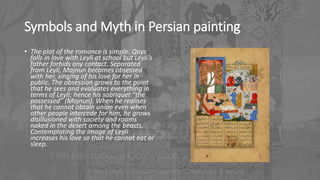
Symbols and Myth in Persian painting
• The plot of the romance is simple. Qays
falls in love with Leyli at school but Leyli’s
father forbids any contact. Separated
from Leyli, Majnun becomes obsessed
with her, singing of his love for her in
public. The obsession grows to the point
that he sees and evaluates everything in
terms of Leyli; hence his sobriquet “the
possessed” (Majnun). When he realises
that he cannot obtain union even when
other people intercede for him, he grows
disillusioned with society and roams
naked in the desert among the beasts.
Contemplating the image of Leyli
increases his love so that he cannot eat or
sleep.
• Mystics contrived many stories about Majnun
to illustrate technical mystical concepts such
as annihilation, love-madness (divānagi), self-
sacrifice, etc. Majnun’s selfless love and the
way he had lost himself in the beloved were
particularly attractive to the mystics. Majnun
provided mystics with a palpable example of
‘annihilation’ (fanāʾ) in the Beloved. Majnun’s
famous saying, “I am Leyli and Leyli is [I],”
corresponded to Ḥallāj’s mystical aphorism
(šaṭḥ): “I am he whom I love; whom I love is
[I]”.Mystics had several other pairs of lovers
such as “Maḥmud and Ayāz”, “Farhād and
Širin”, “Wāmeq andʿAḏrā” to explicate one
aspect of love, but the story of Leyli and
Majnun remained one of the most popular for
mystic poets. The Arabic aḵbār provided a rich
source of anecdotes for the mystic poets.
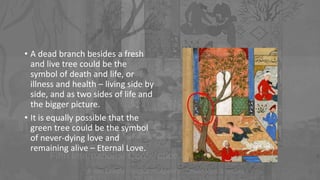
• A dead branch besides a fresh
and live tree could be the
symbol of death and life, or
illness and health – living side by
side, and as two sides of life and
the bigger picture.
• It is equally possible that the
green tree could be the symbol
of never-dying love and
remaining alive – Eternal Love.
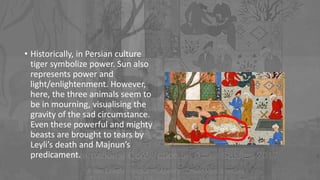
• Historically, in Persian culture
tiger symbolize power. Sun also
represents power and
light/enlightenment. However,
here, the three animals seem to
be in mourning, visualising the
gravity of the sad circumstance.
Even these powerful and mighty
beasts are brought to tears by
Leyli’s death and Majnun’s
predicament.
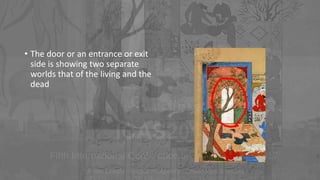
• The door or an entrance or exit
side is showing two separate
worlds that of the living and the
dead
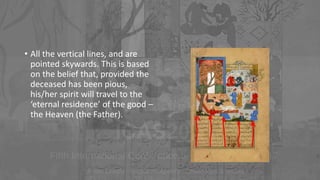
• All the vertical lines, and are
pointed skywards. This is based
on the belief that, provided the
deceased has been pious,
his/her spirit will travel to the
‘eternal residence’ of the good –
the Heaven (the Father).
1.Bibliography- Reference's photo
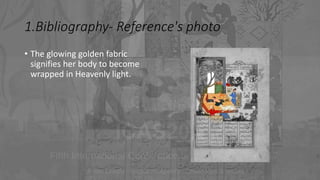
• The glowing golden fabric
signifies her body to become
wrapped in Heavenly light.
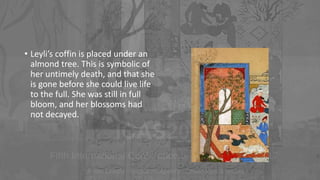
• Leyli’s coffin is placed under an
almond tree. This is symbolic of
her untimely death, and that she
is gone before she could live life
to the full. She was still in full
bloom, and her blossoms had
not decayed.
• Pic 01: Ahmad Nick Speech from Wikimedia Commons, the free media repository File: 1392 geometric
circle shape in relief rocky Arghyan province
• Pic 02: File: Zaragoza - Museo - Estela de Valpalmas.jpg from Wikimedia Commons, the free media
repository
• Pic 03: Grotta dell'Addaura from Wikipedia, the free encyclopedia the graffiti of Addaura
LocationPalermo, Sicily Elevation70 metres (230 ft)
• Pic 04: ile:Boletín de la Sociedad Aragonesa de Ciencias Naturales (1907) (20388676905).jpg
• From Wikimedia Commons, the free media repository Size of this preview: 800 × 524 pixels. Other
resolutions: 320 × 210 pixels | 640 × 419 pixels | 1,024 × 671 pixels | 1,280 × 839 pixels | 3,648 × 2,390
pixels.
• Pic 05: © 2005. Photo: S. Sosnovskiy.© 1986 Text: Guide to the Vatican: Museums and City. Pontifical
Monuments, Museums and Galleries. Tipografia Vaticana, p. 43.erseus with the head of
Medusa.Antonio Canova (1757—1822).Marble. 1801.Inv. No. 969.Rome, Vatican Museums, Pius-
Clementine Museum, Octagonal Court, Perseus Cabinet, 3(Musei Vaticani, Museo Pio-Clementino)
• Pic 06: File:Arte esquematico-Cruciforme.png from Wikimedia Commons, the free media repository
.Description
• Arte esquemático ibérico: antropomorfo cruciform Date24 September 2006 Source serf work
AuthorJosé-Manuel Benito Álvarez —> (Locutus Borg)
• *1Bibliography:
• Bibliographies of Neẓāmi.A. Rādfar, Ketāb-šenāsi-ye Neẓāmi-ye Ganjavi, Tehran, 1992.
• K. Talattof, “International Recognition of Nizami’s Work: A Bibliography,” in K. Talattof and J. W.
Clinton eds., The Poetry of Nizami Ganjavi: Knowledge, Love, and Rhetoric, New York, 2000, pp. 189-
204.
• Major editions.
• Leyli o Majnun, ed. Waḥid Dastgerdi, Tehran, 1934; ed. A. A. Alizada, Moscow, 1965; ed. Behruz
Ṯarvatiyān, Tehran, 1985; ed. Barāt Zanjāni, Tehran, 1990.
• Pic 07: Ficheiro:Arte esquemático-Petroglifoide Zig-Zag.png Origem: Wikipédia, a enciclopédia
livre.Descrição
• Arte esquemático ibérico: Figuras petroglifoides (Formas en Zig-Zag)Data24 de setembro de 2006
• Origemserf workAutorJosé-Manuel Benito Álvarez —> (Locutus Borg)
• Pic 08: DepartmentAncient Near Eastern Art (6,173)Artist / Maker / CultureElamite (52)
• Proto-Elamite (9) Object Type / MaterialMetal (70,126)Metalwork (14,749)Sculpture (25,697)Silver
(17,125)Vessels (22,453)Geographic LocationAsia (70,990)Iran (8,979) Date / Era 8000–2000 B.C.
(3,759)
• Pic 09: Container for Magical Substances (Naga Morsarang)Date: 19th–early 20th centuryGeography:
Indonesia, SumatraCulture: Toba Batak peopleMedium: Water buffalo horn, woodDimensions: H. 20
1/2 x W. 10 1/4 x D. 3 in. (52.1 x 26 x 7.6 cm)Classification: Bone/Ivory-SculptureCredit Line: Gift of Fred
and Rita Richman, 1987Accession Number: 987.453.1
• Pic 10: "The Mi'raj or The Night Flight of Muhammad on his Steed Buraq", Folio 3v from a Bustan of
Sa`di
• Artist: Sultan Muhammad Nur (ca. 1472–ca. 1536)Date: ca. 1525–35Medium: Ink, gold, and colors on
paper
• Accession: 1974.294.2On view in:Not on view
• Pic11: Lailā Summons Majnūn to Her Camp ‫مجنون‬ ‫و‬ ‫لیلی‬
• Photo by persian.painting on Flickr

Spirituality vs reality

  • 1.
    Title: Spirituality VSReality Names of Author: Farhad, Sadeghi Amini Name of the university: Canadian Arts & Sciences Institute , Canada Contact details: sadeghiamini@gmail.com: Keywords: Symbols, Signs, Ideologies Theme/Session: Human & Symbols Presentation preference: Virtual
  • 2.
    Abstract • When theearly cave-dwelling humans began a social life, they became organically divided into two different groups. • Those belonging to the first group were of a kind always looking up to the skies, searching for something bigger and stronger than themselves. They looked for something phenomenal that would make their wishes come true and solve their problems, especially to do with the health of their crops, which was dependent on rain – and, rain came from the skies. • The second group of our early ancestors was of the type who never looked beyond their daily needs. They never thought of another life. They only searched for the things that they needed in the immediate environment around, not in the skies above. These people were hunter-gatherers who were empirical and practical.
  • 3.
    Introduction Symbols and signsin visual arts • Symbols and signs are the most ancient ways as to how humans share their newly perceived concept with others within and outside of their immediate tribes. This could take the form of primitive human trying to share their ultimate ideas and understanding through signs and symbols, be them animals, human, or of vegetation nature or a combination of all. In visual arts gloss of any subject is dependent on an abstract subject which demonstrates itself to their audiences by means of very specific elements such as form, color and movement.
  • 4.
    : Human symbols areusually defined by two different styles;
  • 5.
    1-Realstic style • 1-Realsticstyle which is very recognizable for the observer; such as human body, animal, etc. Here, the point is that these elements are very realistic, and they can be seen in our daily lives. Among these artefacts are examples of very powerful and muscular bodies in the forms of statutes. These types of representations are commonly seen in Greek, Roman and other European cultures.
  • 6.
    2-Abstract style: • Inthis style, which is basically based on the understanding of creators of the artefacts, as well as dependent on the period and place of creation of the pieces, an artefact which could be in the form of a tree but representing a different concept entirely; such as life. In this format, the artist is not trying to make an exact copy of the nature. The artefact could be a ‘vague’ representation, rather than a very clear image of what exactly they are.
  • 7.
    • In abstractstyle, there is a very specific ongoing concept that is so far away from what it is showing. There is a very pure connection between artist and the subject which leads him/her to create a very complicated or simple metaphor which could offer meanings transcending time. • Myth and art interact with each other in an aesthetic way which could be connected to the period and place and also to believers. These myths, and, subsequently, the art that embodies them, are passed down verbally through generations through fables within societies.
  • 9.
    Conclusion: • Conclusion: • Myth,signs, and symbols come from the first mind-set At times skies are seen as the Father (or where he resides) and the Earth is seen as the Mother (which just as female human bears fruit), and their child is the forest (as per Maori beliefs). The “water” from the skies (the Father) made the earth (the Mother) pregnant with fruits and vegetation. • People with this kind of mentality have built a world their own, and have a special way of looking to their own heart as well as to the other world. Therefore, they never live on earth According to this mentality, their permanent and eternal place of residence is not on this soiled Earth, and as such, and they are always gathering the necessary vessel and equipment for this final journey to the other world - to the real life as they believed. • As a result, I have divided these early humans into two groups with distinct and different cultures and values. The first group has a ‘Virtual Culture’, while the second group is endowed with a ‘Logical Culture’. • People with the first form of culture never picture the nature and their surroundings as they are. They see it the world as they wish it to be, such as seen in Eastern/Oriental paintings. This is especially evident in Persian painting. As you see, African and Maori paintings are very similar, as are the Indian and Egyptian paintings. Therefore, their symbols and references are similar to each other’s, leading me to conclude that the Maori motives and Persian forms and their view of the world is very similar to each other.
  • 10.
    Symbols and Mythin Persian painting • The plot of the romance is simple. Qays falls in love with Leyli at school but Leyli’s father forbids any contact. Separated from Leyli, Majnun becomes obsessed with her, singing of his love for her in public. The obsession grows to the point that he sees and evaluates everything in terms of Leyli; hence his sobriquet “the possessed” (Majnun). When he realises that he cannot obtain union even when other people intercede for him, he grows disillusioned with society and roams naked in the desert among the beasts. Contemplating the image of Leyli increases his love so that he cannot eat or sleep.
  • 11.
    • Mystics contrivedmany stories about Majnun to illustrate technical mystical concepts such as annihilation, love-madness (divānagi), self- sacrifice, etc. Majnun’s selfless love and the way he had lost himself in the beloved were particularly attractive to the mystics. Majnun provided mystics with a palpable example of ‘annihilation’ (fanāʾ) in the Beloved. Majnun’s famous saying, “I am Leyli and Leyli is [I],” corresponded to Ḥallāj’s mystical aphorism (šaṭḥ): “I am he whom I love; whom I love is [I]”.Mystics had several other pairs of lovers such as “Maḥmud and Ayāz”, “Farhād and Širin”, “Wāmeq andʿAḏrā” to explicate one aspect of love, but the story of Leyli and Majnun remained one of the most popular for mystic poets. The Arabic aḵbār provided a rich source of anecdotes for the mystic poets.
  • 12.
    • A deadbranch besides a fresh and live tree could be the symbol of death and life, or illness and health – living side by side, and as two sides of life and the bigger picture. • It is equally possible that the green tree could be the symbol of never-dying love and remaining alive – Eternal Love.
  • 13.
    • Historically, inPersian culture tiger symbolize power. Sun also represents power and light/enlightenment. However, here, the three animals seem to be in mourning, visualising the gravity of the sad circumstance. Even these powerful and mighty beasts are brought to tears by Leyli’s death and Majnun’s predicament.
  • 14.
    • The dooror an entrance or exit side is showing two separate worlds that of the living and the dead
  • 15.
    • All thevertical lines, and are pointed skywards. This is based on the belief that, provided the deceased has been pious, his/her spirit will travel to the ‘eternal residence’ of the good – the Heaven (the Father).
  • 16.
    1.Bibliography- Reference's photo •The glowing golden fabric signifies her body to become wrapped in Heavenly light.
  • 17.
    • Leyli’s coffinis placed under an almond tree. This is symbolic of her untimely death, and that she is gone before she could live life to the full. She was still in full bloom, and her blossoms had not decayed.
  • 18.
    • Pic 01:Ahmad Nick Speech from Wikimedia Commons, the free media repository File: 1392 geometric circle shape in relief rocky Arghyan province • Pic 02: File: Zaragoza - Museo - Estela de Valpalmas.jpg from Wikimedia Commons, the free media repository • Pic 03: Grotta dell'Addaura from Wikipedia, the free encyclopedia the graffiti of Addaura LocationPalermo, Sicily Elevation70 metres (230 ft) • Pic 04: ile:Boletín de la Sociedad Aragonesa de Ciencias Naturales (1907) (20388676905).jpg • From Wikimedia Commons, the free media repository Size of this preview: 800 × 524 pixels. Other resolutions: 320 × 210 pixels | 640 × 419 pixels | 1,024 × 671 pixels | 1,280 × 839 pixels | 3,648 × 2,390 pixels. • Pic 05: © 2005. Photo: S. Sosnovskiy.© 1986 Text: Guide to the Vatican: Museums and City. Pontifical Monuments, Museums and Galleries. Tipografia Vaticana, p. 43.erseus with the head of Medusa.Antonio Canova (1757—1822).Marble. 1801.Inv. No. 969.Rome, Vatican Museums, Pius- Clementine Museum, Octagonal Court, Perseus Cabinet, 3(Musei Vaticani, Museo Pio-Clementino) • Pic 06: File:Arte esquematico-Cruciforme.png from Wikimedia Commons, the free media repository .Description • Arte esquemático ibérico: antropomorfo cruciform Date24 September 2006 Source serf work AuthorJosé-Manuel Benito Álvarez —> (Locutus Borg) • *1Bibliography: • Bibliographies of Neẓāmi.A. Rādfar, Ketāb-šenāsi-ye Neẓāmi-ye Ganjavi, Tehran, 1992. • K. Talattof, “International Recognition of Nizami’s Work: A Bibliography,” in K. Talattof and J. W. Clinton eds., The Poetry of Nizami Ganjavi: Knowledge, Love, and Rhetoric, New York, 2000, pp. 189- 204. • Major editions. • Leyli o Majnun, ed. Waḥid Dastgerdi, Tehran, 1934; ed. A. A. Alizada, Moscow, 1965; ed. Behruz Ṯarvatiyān, Tehran, 1985; ed. Barāt Zanjāni, Tehran, 1990. • Pic 07: Ficheiro:Arte esquemático-Petroglifoide Zig-Zag.png Origem: Wikipédia, a enciclopédia livre.Descrição • Arte esquemático ibérico: Figuras petroglifoides (Formas en Zig-Zag)Data24 de setembro de 2006 • Origemserf workAutorJosé-Manuel Benito Álvarez —> (Locutus Borg) • Pic 08: DepartmentAncient Near Eastern Art (6,173)Artist / Maker / CultureElamite (52) • Proto-Elamite (9) Object Type / MaterialMetal (70,126)Metalwork (14,749)Sculpture (25,697)Silver (17,125)Vessels (22,453)Geographic LocationAsia (70,990)Iran (8,979) Date / Era 8000–2000 B.C. (3,759) • Pic 09: Container for Magical Substances (Naga Morsarang)Date: 19th–early 20th centuryGeography: Indonesia, SumatraCulture: Toba Batak peopleMedium: Water buffalo horn, woodDimensions: H. 20 1/2 x W. 10 1/4 x D. 3 in. (52.1 x 26 x 7.6 cm)Classification: Bone/Ivory-SculptureCredit Line: Gift of Fred and Rita Richman, 1987Accession Number: 987.453.1 • Pic 10: "The Mi'raj or The Night Flight of Muhammad on his Steed Buraq", Folio 3v from a Bustan of Sa`di • Artist: Sultan Muhammad Nur (ca. 1472–ca. 1536)Date: ca. 1525–35Medium: Ink, gold, and colors on paper • Accession: 1974.294.2On view in:Not on view • Pic11: Lailā Summons Majnūn to Her Camp ‫مجنون‬ ‫و‬ ‫لیلی‬ • Photo by persian.painting on Flickr