Spinal Anaesthesia in Pediatric Patients
• Spinal anesthesia (SA) in pediatrics was first used by Bainbridge in 1899 in
an infant of 3 months with an incarcerated inguinal hernia.
• During the early 1980s, it was reintroduced as an alternative to general
anesthesia (GA) in high-risk and former preterm infants as a means to
reduce postoperative complications.
• Especially apnea and postoperative respiratory dysfunction, although this
utility has been questioned.
• Spinal anesthesia (SA) has been described in infants dating back to 1901
when Bainbridge described a technique in 12 patients aged 4-6 years old.
Introduction
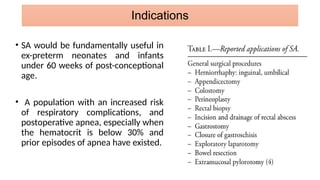
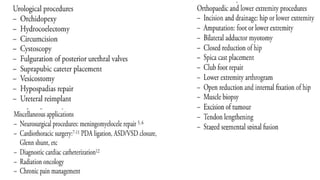
• SA would be fundamentally useful in
ex-preterm neonates and infants
under 60 weeks of post-conceptional
age.
• A population with an increased risk
of respiratory complications, and
postoperative apnea, especially when
the hematocrit is below 30% and
prior episodes of apnea have existed.
Indications
• Allergic reaction to local anesthetics (las),
• local or systemic infection (risk of meningitis),
• coagulopathy,
• intracranial hyper-tension,
• hydrocephalus,
• intracranial hemorrhage.
• Hypovolemia
• spinal deformities, such as spina bifida or myelomeningocele
Contraindications
• The spinal cord ends at the third or fourth lumbar vertebra in the
newborn and at the L1-L2 intersection at one year of age;
before one year of age, the spinal tap should be performed in
the L4-L5 or L5-S1 space.
Anatomical and Physiological Considerations
• The requirement for higher doses of LAs and a shorter duration of the anesthetic blockade
should be expected.
• At birth, the volume of cerebrospinal fluid (CSF) (4 mL/kg-1) is twice the volume in adults, and
50% of it is located in the spinal canal (compared with only 25% in adults), resulting in further
dilution of the medication.
• In addition, there is a higher proportion of nervous system structures with greater mass
compared to muscle and bone mass.
• The lower concentration of nodes of Ranvier, the neonate requires a higher concentration of
LAs; along with greater blood flow to the spinal cord with a more rapid uptake of drugs from the
subarachnoid space
• These phenomena are most pronounced in preterm rather infants compared to full-term infants.
Why SAB acts for shorter duration in Peds
• An imaginary line connecting the top of the iliac crests crosses the
spinal axis at the L4-L5 interspace in neonates and infants and
L3-L4 in older children. The presence in this area of a hairy
nevus, a hole or a lumbosacral asymmetric gluteal fold should
alert the physician staff to the possibility of an occult spinal
disorder
How to locate L4-5 in children
• The hemodynamic consequences of a high spinal block are usually
not important in young children, but the respiratory effects may
require ventilatory assistance.
• The total spinal block may be accompanied by a bronchospasm,
probably because of a decrease in circulating endogenous
catecholamines.
What are the main Hemodynamic effect of High
Spinal
• Like adults, the use of thin needles reduces the frequency of this complication (4-5%
with 25- or 27-gauge needles and 12-15% with 22-gauge needles).
• Recent studies have shown that needle design does affect the incidence of PDPH in
children, with this incidence being lower with pencil-point needles.
• PDPH is usually moderate, lasts only a few days, and is relieved by rest and minor
analgesics; when the headache is severe, prolonged or disabling, it may be necessary
to practice an epidural blood patch with a mean volume of autologous blood of 0.2-0.3
mL.kg-1.
Does PDPH occur in children?
• Transient neurologic symptoms occur in 1.5% of children after
SA with bupivacaine, and are the consequence of nerve root
irritation such as direct mechanical trauma with the needle,
extravasated blood from vessels and hemolysis around the
dorsal root ganglia, or subdural injection of the anesthetic.
• One of the measures recommended for preventing this
complication is to obtain a reflux of CSF by the cone of the
needle before injecting the LA
What are the chances of Complications?
• Epidemiological data suggest that infants have an increased
risk of complications with GA compared to older children and
adults.
• 102 vs 128 pts were compared.
• The hospital length of stay was shorter in the spinal anesthesia
group (median [IQR] of 5.3 hours [4.3, 7.2]) compared to the
general anesthesia group (17.1 hours [15.6, 17.5])
SAB vs GA
• The use of alpha-2 blockers (dexmedetomidine and clonidine) as analgesic
adjuvants and mild sedatives for pediatric patients is becoming popular.
• The sedative and analgesic properties of these drugs occur in the absence
of significant respiratory depression and therefore may make an ideal
supplement to SA in the infant population.
• In addition, of the multitude of sedation agents studied in pediatric patients,
dexmedetomidine appears to be least linked to neurodevelopmental
challenges.
• Furthermore, dexmedetomidine may lessen the risk of agitation during
surgery under SA.
• For these reasons, dexmedetomidine was used as the primary sedation
agent for many of the patients who received SA in this series
Best Sedative agent for the SAB
• However, we found that it was difficult to keep the side port of
the Whitacre in the intrathecal space, evidenced by the frequent
loss of cerebrospinal fluid (CSF) flow during injections. Once
CSF is free-flowing, aspiration is performed at multiple points
during the injection to ensure consistent CSF flow. If the ability
to aspirate CSF is lost, the syringe is disconnected until flow is
re-established at which time the remaining medication is
administered if aspiration can be performed.
Which is better, Quinke or Whittaker

Spinal Anaesthesia in Pediatric Pateints.pptx

  • 1.
    Spinal Anaesthesia inPediatric Patients
  • 2.
    • Spinal anesthesia(SA) in pediatrics was first used by Bainbridge in 1899 in an infant of 3 months with an incarcerated inguinal hernia. • During the early 1980s, it was reintroduced as an alternative to general anesthesia (GA) in high-risk and former preterm infants as a means to reduce postoperative complications. • Especially apnea and postoperative respiratory dysfunction, although this utility has been questioned. • Spinal anesthesia (SA) has been described in infants dating back to 1901 when Bainbridge described a technique in 12 patients aged 4-6 years old. Introduction
  • 3.
    • SA wouldbe fundamentally useful in ex-preterm neonates and infants under 60 weeks of post-conceptional age. • A population with an increased risk of respiratory complications, and postoperative apnea, especially when the hematocrit is below 30% and prior episodes of apnea have existed. Indications
  • 5.
    • Allergic reactionto local anesthetics (las), • local or systemic infection (risk of meningitis), • coagulopathy, • intracranial hyper-tension, • hydrocephalus, • intracranial hemorrhage. • Hypovolemia • spinal deformities, such as spina bifida or myelomeningocele Contraindications
  • 6.
    • The spinalcord ends at the third or fourth lumbar vertebra in the newborn and at the L1-L2 intersection at one year of age; before one year of age, the spinal tap should be performed in the L4-L5 or L5-S1 space. Anatomical and Physiological Considerations
  • 7.
    • The requirementfor higher doses of LAs and a shorter duration of the anesthetic blockade should be expected. • At birth, the volume of cerebrospinal fluid (CSF) (4 mL/kg-1) is twice the volume in adults, and 50% of it is located in the spinal canal (compared with only 25% in adults), resulting in further dilution of the medication. • In addition, there is a higher proportion of nervous system structures with greater mass compared to muscle and bone mass. • The lower concentration of nodes of Ranvier, the neonate requires a higher concentration of LAs; along with greater blood flow to the spinal cord with a more rapid uptake of drugs from the subarachnoid space • These phenomena are most pronounced in preterm rather infants compared to full-term infants. Why SAB acts for shorter duration in Peds
  • 8.
    • An imaginaryline connecting the top of the iliac crests crosses the spinal axis at the L4-L5 interspace in neonates and infants and L3-L4 in older children. The presence in this area of a hairy nevus, a hole or a lumbosacral asymmetric gluteal fold should alert the physician staff to the possibility of an occult spinal disorder How to locate L4-5 in children
  • 9.
    • The hemodynamicconsequences of a high spinal block are usually not important in young children, but the respiratory effects may require ventilatory assistance. • The total spinal block may be accompanied by a bronchospasm, probably because of a decrease in circulating endogenous catecholamines. What are the main Hemodynamic effect of High Spinal
  • 10.
    • Like adults,the use of thin needles reduces the frequency of this complication (4-5% with 25- or 27-gauge needles and 12-15% with 22-gauge needles). • Recent studies have shown that needle design does affect the incidence of PDPH in children, with this incidence being lower with pencil-point needles. • PDPH is usually moderate, lasts only a few days, and is relieved by rest and minor analgesics; when the headache is severe, prolonged or disabling, it may be necessary to practice an epidural blood patch with a mean volume of autologous blood of 0.2-0.3 mL.kg-1. Does PDPH occur in children?
  • 11.
    • Transient neurologicsymptoms occur in 1.5% of children after SA with bupivacaine, and are the consequence of nerve root irritation such as direct mechanical trauma with the needle, extravasated blood from vessels and hemolysis around the dorsal root ganglia, or subdural injection of the anesthetic. • One of the measures recommended for preventing this complication is to obtain a reflux of CSF by the cone of the needle before injecting the LA What are the chances of Complications?
  • 12.
    • Epidemiological datasuggest that infants have an increased risk of complications with GA compared to older children and adults. • 102 vs 128 pts were compared. • The hospital length of stay was shorter in the spinal anesthesia group (median [IQR] of 5.3 hours [4.3, 7.2]) compared to the general anesthesia group (17.1 hours [15.6, 17.5]) SAB vs GA
  • 13.
    • The useof alpha-2 blockers (dexmedetomidine and clonidine) as analgesic adjuvants and mild sedatives for pediatric patients is becoming popular. • The sedative and analgesic properties of these drugs occur in the absence of significant respiratory depression and therefore may make an ideal supplement to SA in the infant population. • In addition, of the multitude of sedation agents studied in pediatric patients, dexmedetomidine appears to be least linked to neurodevelopmental challenges. • Furthermore, dexmedetomidine may lessen the risk of agitation during surgery under SA. • For these reasons, dexmedetomidine was used as the primary sedation agent for many of the patients who received SA in this series Best Sedative agent for the SAB
  • 14.
    • However, wefound that it was difficult to keep the side port of the Whitacre in the intrathecal space, evidenced by the frequent loss of cerebrospinal fluid (CSF) flow during injections. Once CSF is free-flowing, aspiration is performed at multiple points during the injection to ensure consistent CSF flow. If the ability to aspirate CSF is lost, the syringe is disconnected until flow is re-established at which time the remaining medication is administered if aspiration can be performed. Which is better, Quinke or Whittaker