© 2015 KEMET Electronics
Solid Electrolytic Capacitors Designed
for High Temperature Applications
Kristin Tempel and Randy Hahn
High Temperature Electronics Network
July 7, 2015
http://go.kemet.com/wp1015
© 2015 KEMET Electronics
Outline
• Basic construction of Solid Tantalum Capacitor
• High temperature timeline
• Known temperature related failure mechanisms
• Technical challenges at high temperature
• Performance testing and path forward
• Questions
2
© 2015 KEMET Electronics
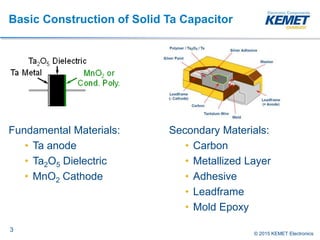
Basic Construction of Solid Ta Capacitor
Fundamental Materials:
• Ta anode
• Ta2O5 Dielectric
• MnO2 Cathode
Secondary Materials:
• Carbon
• Metallized Layer
• Adhesive
• Leadframe
• Mold Epoxy
3
© 2015 KEMET Electronics
What Makes Tantalum Special?
• Surface area per unit of weight creates high CV/g
– Volumetric efficiency
• Valve metal capable of growing thin dielectric
– High dielectric breakdown voltage: 470V/µm
Vr
Ta2O5
Thickness (nm)
2 16
4 32
6 48
16 128
35 280
50 400
𝑪 ∝
𝒌𝑨
𝒅
4
© 2015 KEMET Electronics
Surface Mount Tantalum Timeline
• 125°C maximum temperature for decades
• 2003 first 150°C release
• Capability increases by 25°C approximately every 4 years
• Multiple manufacturers poised to release 230°C platforms
125°C 150°C 175°C 200°C 230°C
2003 2007 2011 2015
5
© 2015 KEMET Electronics
Temperature Related Failure
Mechanisms
© 2015 KEMET Electronics
Temperature Related Failure Mechanisms
Known Failure Mechanism Method to Mitigate
Crystallization: defects in Ta-Ta2O5
interface creates leakage site
• Low charge Ta powders
• High Vf:Vr
• F-TECH technology increases
chemical purity and eliminates hidden
dielectric defects
Oxygen Migration into Ta metal from
Ta2O5 leave oxygen vacancies creating
conductivity across dielectric. Causes
cap change with bias, temperature,
frequency.
• Higher Vf:Vr
• Heat treatment
Ta
Ta2O5
7
© 2015 KEMET Electronics
Technical Challenges at High
Temperatures
© 2015 KEMET Electronics
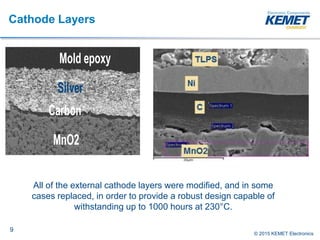
All of the external cathode layers were modified, and in some
cases replaced, in order to provide a robust design capable of
withstanding up to 1000 hours at 230°C.
Cathode Layers
Silver
MnO2
Carbon
Ta
Mold epoxy
9
© 2015 KEMET Electronics
MnO2 Solid Electrolyte
• Stable to temperatures in excess of 500°C
• Deposition process modified to ensure adequate buildup to
protect the anode
-8
-6
-4
-2
0
2
4
6
8
-10
-8
-6
-4
-2
0
0 200 400 600 800
HeatFlow
WeightLoss(%)
TGA for MnO2
Weight Loss (%) Heat Flow
10
© 2015 KEMET Electronics
Carbon Layer
• Binder in conventional Carbon 1
degrades at temperatures in excess
of 200°C
• In-house Carbon 2 formulated to
withstand continuous operation at
230°C
• Weight loss observed between 230-
400°C due to oxidation to CO2 of
oxygen containing surface functional
groups of carbon black
-10
0
10
20
30
40
-50
-40
-30
-20
-10
0
0 200 400 600 800
HeatFlow
WeightLoss(%)
TGA for Carbon 1
Weight Loss (%) Heat Flow
-5
0
5
10
15
20
25
30
-40
-30
-20
-10
0
0 200 400 600 800
HeatFlow
WeightLoss(%)
TGA for Carbon 2
Weight Loss (%) Heat Flow
-20
-15
-10
-5
0
0 100 200 300 400 500 600
WeightLoss(%)
TGA for Components of Carbon 2
Carbon Black Graphite Binder11
© 2015 KEMET Electronics
Metallized Layer
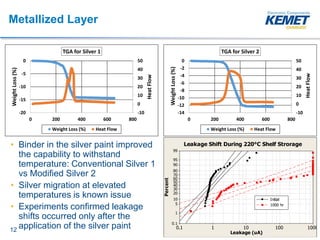
• Binder in the silver paint improved
the capability to withstand
temperature: Conventional Silver 1
vs Modified Silver 2
• Silver migration at elevated
temperatures is known issue
• Experiments confirmed leakage
shifts occurred only after the
application of the silver paint
-10
0
10
20
30
40
50
-20
-15
-10
-5
0
0 200 400 600 800
HeatFlow
WeightLoss(%)
TGA for Silver 1
Weight Loss (%) Heat Flow
-10
0
10
20
30
40
50
-14
-12
-10
-8
-6
-4
-2
0
0 200 400 600 800
HeatFlow
WeightLoss(%)
TGA for Silver 2
Weight Loss (%) Heat Flow
10001001010.1
99
95
90
80
70
60
50
40
30
20
10
5
1
0.1
Leakage (uA)
Percent
Initial
1000 hr
Leakage Shift During 220°C Shelf Strorage
12
© 2015 KEMET Electronics
Silver migration at elevated
temperature  unstable leakage
Nickel plating  stable leakage
Metallized Layer
100101
99
95
90
80
70
60
50
40
30
20
10
5
1
LC
Percent
16
1,555 0,5361 53 6,532 <0,005
1,438 0,3551 53 3,229 <0,005
1,403 0,3593 53 2,790 <0,005
1,477 0,3797 53 3,121 <0,005
1,400 0,3582 53 3,139 <0,005
Loc Scale N AD P
0h
250h
500h
750h
1000h
200C
Time @
Lognormal - 95% CI
Probability Plot of LC
DC Leakage (mA)
DC Leakage
10001001010,1
99
95
90
80
70
60
50
40
30
20
10
5
1
LC
Percent
16
0,6831 0,2943 30 1,591 <0,005
1,484 1,096 30 4,843 <0,005
3,032 1,308 30 0,962 0,013
3,802 0,9251 30 2,574 <0,005
Loc Scale N AD P
1xC/-/Ag 0h
1xC/-/Ag 250h
1xC/-/Ag 500h
1xC/-/Ag 750h
VAR 200ºC
TIME @
Probability Plot of LC
Lognormal - 95% CIDC Leakage
DC Leakage (mA)
KEMET has developed proprietary and patented materials and processes to successfully
plate metals on the carbon layer in Tantalum capacitors
Solid Electrolytic Capacitors with Improved Reliability, Chacko, Antony; US Patent 8,310,816 & 8,896,985 &
8,503,165
Solid Electrolytic Capacitors with High Temperature Leakage Stability, Chacko et al, USP Pending, US
2014/0055913
Several additional patents are pending13
© 2015 KEMET Electronics
Adhesive
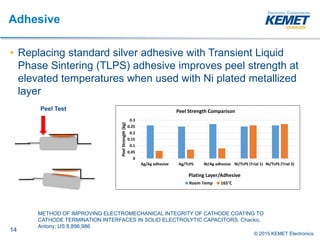
• Replacing standard silver adhesive with Transient Liquid
Phase Sintering (TLPS) adhesive improves peel strength at
elevated temperatures when used with Ni plated metallized
layer
METHOD OF IMPROVING ELECTROMECHANICAL INTEGRITY OF CATHODE COATING TO
CATHODE TERMINATION INTERFACES IN SOLID ELECTROLYTIC CAPACITORS, Chacko,
Antony; US 8,896,986
0
0.05
0.1
0.15
0.2
0.25
0.3
Ag/Ag adhesive Ag/TLPS Ni/Ag adhesive Ni/TLPS (Trial 1) Ni/TLPS (Trial 2)
PeelStrength(kg)
Plating Layer/Adhesive
Peel Strength Comparison
Room Temp 165°C
Peel Test
14
© 2015 KEMET Electronics
Encapsulant Material
• Severe layer separation occurred at high temperature with
conventional mold epoxies
• High temperature epoxy greatly enhanced ESR stability
Conventional Epoxy High Temperature Epoxy
Anode AnodeCathodeCathode
Epoxy Epoxy
© 2015 KEMET Electronics
• Breakdown voltage (BDV) is the ultimate test of dielectric strength
• BDV correlates with long term reliability
• SBDS is a non-destructive testing technique that simulates BDV
• Does not damage dielectric
• Screening performed on 100% of product
Screening of Electrolytic Capacitors, Freeman, Yuri; US Patent 7,671,603
Apparatus and Method for Screening Electrolytic Capacitors, Paulsen, Jonathan, et al. US 8,441,265
Simulated Voltage Break Down Screening
(SBDS): Concept
LKG Before vs. After Screening
495X107K016
0
2
4
6
8
10
12
14
16
18
0 2 4 6 8 10 12 14 16 18
DCL BEFORE uA
DCLAFTERuA
I(V) in KO D16-25
0
5
10
15
20
25
30
35
40
0 20 40 60
Voltage, V
Current,uA
#9
#12
1.2 MOhm
7.1 MOhm
9 MOhm
BDV
AVER
RV
16
© 2015 KEMET Electronics
Simulated Voltage Break Down Screening
(SBDS): Results
Final Voltage, V
Percent
50403020100
99.9
99
95
90
80
70
60
50
40
30
20
10
5
1
0.1
Mean 37.26
StDev 4.604
N 290
AD 66.448
P-Value <0.005
SCREENING
495X107K016 0646H128
BDV mean = 43 V. TEST V = 58.5. Rs = .47 Mohm. tmax = 90 s
Excellent
Weak
17
© 2015 KEMET Electronics
Performance Testing
© 2015 KEMET Electronics
Mounting Reflow Profile
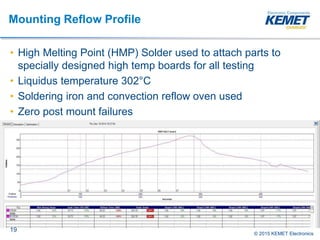
• High Melting Point (HMP) Solder used to attach parts to
specially designed high temp boards for all testing
• Liquidus temperature 302°C
• Soldering iron and convection reflow oven used
• Zero post mount failures
19
© 2015 KEMET Electronics
Capacitance Change with Temperature
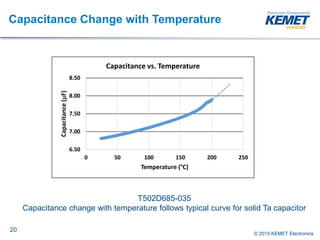
6.50
7.00
7.50
8.00
8.50
0 50 100 150 200 250
Capacitance(mF)
Temperature (°C)
Capacitance vs. Temperature
T502D685-035
Capacitance change with temperature follows typical curve for solid Ta capacitor
20
© 2015 KEMET Electronics
DC Leakage vs Temperature
0.0001
0.01
1
100
2.00 2.25 2.50 2.75 3.00 3.25 3.50
y=11*exp((0.55/8.62)*(2.0-x)*100)
Median DCL
25ºC65ºC105ºC155ºC200ºC
230ºC 175ºC 125ºC 85ºC 45ºC 0ºC
Vtest = 7V
Rs = 82k
Median DCL Calculated from a sample of 20pcs.
Inverse Absolute Temperature 1/T (10
-3
, K
-1
)
MedianDCL(mA)
Inverse Absolute Temperature vs. Median DCL. T502D685K035
Test Procedure:
• Parts subjected to temperatures ranging from 230°C to
0°C with 0.2Vr bias applied.
• Measurements were plotted on a lognormal graph
• Median leakage values from each temperature were
plotted vs inverse absolute temperature.
• The following Arrhenius equation was used to form a fit
line:
𝑀𝑒𝑑𝑖𝑎𝑛 𝐷𝐶𝐿 = 𝐷𝐶𝐿 𝑀𝑎𝑥 𝑇𝑒𝑚𝑝 × 𝑒
𝐸 𝑎
ℎ
×
1
𝑀𝑎𝑥 𝑇𝑒𝑚𝑝
−
1
𝑇𝑒𝑚𝑝
Where:
𝐸 𝑎= Activation Energy (eV)
ℎ=Boltzmann’s constant (8.62x10⁻⁵ eV K-1)
Temperatures in Kelvin
21
© 2015 KEMET Electronics
230°C Life Test Summary
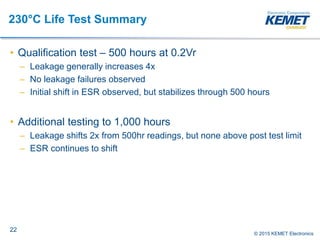
• Qualification test – 500 hours at 0.2Vr
– Leakage generally increases 4x
– No leakage failures observed
– Initial shift in ESR observed, but stabilizes through 500 hours
• Additional testing to 1,000 hours
– Leakage shifts 2x from 500hr readings, but none above post test limit
– ESR continues to shift
22
© 2015 KEMET Electronics
Thank You!
Kristin Tempel
New Product Development Engineer
Tantalum Innovation Center
http://go.kemet.com/wp1015

Solid Electrolytic Capacitor Design for High Temp Applications

  • 1.
    © 2015 KEMETElectronics Solid Electrolytic Capacitors Designed for High Temperature Applications Kristin Tempel and Randy Hahn High Temperature Electronics Network July 7, 2015 http://go.kemet.com/wp1015
  • 2.
    © 2015 KEMETElectronics Outline • Basic construction of Solid Tantalum Capacitor • High temperature timeline • Known temperature related failure mechanisms • Technical challenges at high temperature • Performance testing and path forward • Questions 2
  • 3.
    © 2015 KEMETElectronics Basic Construction of Solid Ta Capacitor Fundamental Materials: • Ta anode • Ta2O5 Dielectric • MnO2 Cathode Secondary Materials: • Carbon • Metallized Layer • Adhesive • Leadframe • Mold Epoxy 3
  • 4.
    © 2015 KEMETElectronics What Makes Tantalum Special? • Surface area per unit of weight creates high CV/g – Volumetric efficiency • Valve metal capable of growing thin dielectric – High dielectric breakdown voltage: 470V/µm Vr Ta2O5 Thickness (nm) 2 16 4 32 6 48 16 128 35 280 50 400 𝑪 ∝ 𝒌𝑨 𝒅 4
  • 5.
    © 2015 KEMETElectronics Surface Mount Tantalum Timeline • 125°C maximum temperature for decades • 2003 first 150°C release • Capability increases by 25°C approximately every 4 years • Multiple manufacturers poised to release 230°C platforms 125°C 150°C 175°C 200°C 230°C 2003 2007 2011 2015 5
  • 6.
    © 2015 KEMETElectronics Temperature Related Failure Mechanisms
  • 7.
    © 2015 KEMETElectronics Temperature Related Failure Mechanisms Known Failure Mechanism Method to Mitigate Crystallization: defects in Ta-Ta2O5 interface creates leakage site • Low charge Ta powders • High Vf:Vr • F-TECH technology increases chemical purity and eliminates hidden dielectric defects Oxygen Migration into Ta metal from Ta2O5 leave oxygen vacancies creating conductivity across dielectric. Causes cap change with bias, temperature, frequency. • Higher Vf:Vr • Heat treatment Ta Ta2O5 7
  • 8.
    © 2015 KEMETElectronics Technical Challenges at High Temperatures
  • 9.
    © 2015 KEMETElectronics All of the external cathode layers were modified, and in some cases replaced, in order to provide a robust design capable of withstanding up to 1000 hours at 230°C. Cathode Layers Silver MnO2 Carbon Ta Mold epoxy 9
  • 10.
    © 2015 KEMETElectronics MnO2 Solid Electrolyte • Stable to temperatures in excess of 500°C • Deposition process modified to ensure adequate buildup to protect the anode -8 -6 -4 -2 0 2 4 6 8 -10 -8 -6 -4 -2 0 0 200 400 600 800 HeatFlow WeightLoss(%) TGA for MnO2 Weight Loss (%) Heat Flow 10
  • 11.
    © 2015 KEMETElectronics Carbon Layer • Binder in conventional Carbon 1 degrades at temperatures in excess of 200°C • In-house Carbon 2 formulated to withstand continuous operation at 230°C • Weight loss observed between 230- 400°C due to oxidation to CO2 of oxygen containing surface functional groups of carbon black -10 0 10 20 30 40 -50 -40 -30 -20 -10 0 0 200 400 600 800 HeatFlow WeightLoss(%) TGA for Carbon 1 Weight Loss (%) Heat Flow -5 0 5 10 15 20 25 30 -40 -30 -20 -10 0 0 200 400 600 800 HeatFlow WeightLoss(%) TGA for Carbon 2 Weight Loss (%) Heat Flow -20 -15 -10 -5 0 0 100 200 300 400 500 600 WeightLoss(%) TGA for Components of Carbon 2 Carbon Black Graphite Binder11
  • 12.
    © 2015 KEMETElectronics Metallized Layer • Binder in the silver paint improved the capability to withstand temperature: Conventional Silver 1 vs Modified Silver 2 • Silver migration at elevated temperatures is known issue • Experiments confirmed leakage shifts occurred only after the application of the silver paint -10 0 10 20 30 40 50 -20 -15 -10 -5 0 0 200 400 600 800 HeatFlow WeightLoss(%) TGA for Silver 1 Weight Loss (%) Heat Flow -10 0 10 20 30 40 50 -14 -12 -10 -8 -6 -4 -2 0 0 200 400 600 800 HeatFlow WeightLoss(%) TGA for Silver 2 Weight Loss (%) Heat Flow 10001001010.1 99 95 90 80 70 60 50 40 30 20 10 5 1 0.1 Leakage (uA) Percent Initial 1000 hr Leakage Shift During 220°C Shelf Strorage 12
  • 13.
    © 2015 KEMETElectronics Silver migration at elevated temperature  unstable leakage Nickel plating  stable leakage Metallized Layer 100101 99 95 90 80 70 60 50 40 30 20 10 5 1 LC Percent 16 1,555 0,5361 53 6,532 <0,005 1,438 0,3551 53 3,229 <0,005 1,403 0,3593 53 2,790 <0,005 1,477 0,3797 53 3,121 <0,005 1,400 0,3582 53 3,139 <0,005 Loc Scale N AD P 0h 250h 500h 750h 1000h 200C Time @ Lognormal - 95% CI Probability Plot of LC DC Leakage (mA) DC Leakage 10001001010,1 99 95 90 80 70 60 50 40 30 20 10 5 1 LC Percent 16 0,6831 0,2943 30 1,591 <0,005 1,484 1,096 30 4,843 <0,005 3,032 1,308 30 0,962 0,013 3,802 0,9251 30 2,574 <0,005 Loc Scale N AD P 1xC/-/Ag 0h 1xC/-/Ag 250h 1xC/-/Ag 500h 1xC/-/Ag 750h VAR 200ºC TIME @ Probability Plot of LC Lognormal - 95% CIDC Leakage DC Leakage (mA) KEMET has developed proprietary and patented materials and processes to successfully plate metals on the carbon layer in Tantalum capacitors Solid Electrolytic Capacitors with Improved Reliability, Chacko, Antony; US Patent 8,310,816 & 8,896,985 & 8,503,165 Solid Electrolytic Capacitors with High Temperature Leakage Stability, Chacko et al, USP Pending, US 2014/0055913 Several additional patents are pending13
  • 14.
    © 2015 KEMETElectronics Adhesive • Replacing standard silver adhesive with Transient Liquid Phase Sintering (TLPS) adhesive improves peel strength at elevated temperatures when used with Ni plated metallized layer METHOD OF IMPROVING ELECTROMECHANICAL INTEGRITY OF CATHODE COATING TO CATHODE TERMINATION INTERFACES IN SOLID ELECTROLYTIC CAPACITORS, Chacko, Antony; US 8,896,986 0 0.05 0.1 0.15 0.2 0.25 0.3 Ag/Ag adhesive Ag/TLPS Ni/Ag adhesive Ni/TLPS (Trial 1) Ni/TLPS (Trial 2) PeelStrength(kg) Plating Layer/Adhesive Peel Strength Comparison Room Temp 165°C Peel Test 14
  • 15.
    © 2015 KEMETElectronics Encapsulant Material • Severe layer separation occurred at high temperature with conventional mold epoxies • High temperature epoxy greatly enhanced ESR stability Conventional Epoxy High Temperature Epoxy Anode AnodeCathodeCathode Epoxy Epoxy
  • 16.
    © 2015 KEMETElectronics • Breakdown voltage (BDV) is the ultimate test of dielectric strength • BDV correlates with long term reliability • SBDS is a non-destructive testing technique that simulates BDV • Does not damage dielectric • Screening performed on 100% of product Screening of Electrolytic Capacitors, Freeman, Yuri; US Patent 7,671,603 Apparatus and Method for Screening Electrolytic Capacitors, Paulsen, Jonathan, et al. US 8,441,265 Simulated Voltage Break Down Screening (SBDS): Concept LKG Before vs. After Screening 495X107K016 0 2 4 6 8 10 12 14 16 18 0 2 4 6 8 10 12 14 16 18 DCL BEFORE uA DCLAFTERuA I(V) in KO D16-25 0 5 10 15 20 25 30 35 40 0 20 40 60 Voltage, V Current,uA #9 #12 1.2 MOhm 7.1 MOhm 9 MOhm BDV AVER RV 16
  • 17.
    © 2015 KEMETElectronics Simulated Voltage Break Down Screening (SBDS): Results Final Voltage, V Percent 50403020100 99.9 99 95 90 80 70 60 50 40 30 20 10 5 1 0.1 Mean 37.26 StDev 4.604 N 290 AD 66.448 P-Value <0.005 SCREENING 495X107K016 0646H128 BDV mean = 43 V. TEST V = 58.5. Rs = .47 Mohm. tmax = 90 s Excellent Weak 17
  • 18.
    © 2015 KEMETElectronics Performance Testing
  • 19.
    © 2015 KEMETElectronics Mounting Reflow Profile • High Melting Point (HMP) Solder used to attach parts to specially designed high temp boards for all testing • Liquidus temperature 302°C • Soldering iron and convection reflow oven used • Zero post mount failures 19
  • 20.
    © 2015 KEMETElectronics Capacitance Change with Temperature 6.50 7.00 7.50 8.00 8.50 0 50 100 150 200 250 Capacitance(mF) Temperature (°C) Capacitance vs. Temperature T502D685-035 Capacitance change with temperature follows typical curve for solid Ta capacitor 20
  • 21.
    © 2015 KEMETElectronics DC Leakage vs Temperature 0.0001 0.01 1 100 2.00 2.25 2.50 2.75 3.00 3.25 3.50 y=11*exp((0.55/8.62)*(2.0-x)*100) Median DCL 25ºC65ºC105ºC155ºC200ºC 230ºC 175ºC 125ºC 85ºC 45ºC 0ºC Vtest = 7V Rs = 82k Median DCL Calculated from a sample of 20pcs. Inverse Absolute Temperature 1/T (10 -3 , K -1 ) MedianDCL(mA) Inverse Absolute Temperature vs. Median DCL. T502D685K035 Test Procedure: • Parts subjected to temperatures ranging from 230°C to 0°C with 0.2Vr bias applied. • Measurements were plotted on a lognormal graph • Median leakage values from each temperature were plotted vs inverse absolute temperature. • The following Arrhenius equation was used to form a fit line: 𝑀𝑒𝑑𝑖𝑎𝑛 𝐷𝐶𝐿 = 𝐷𝐶𝐿 𝑀𝑎𝑥 𝑇𝑒𝑚𝑝 × 𝑒 𝐸 𝑎 ℎ × 1 𝑀𝑎𝑥 𝑇𝑒𝑚𝑝 − 1 𝑇𝑒𝑚𝑝 Where: 𝐸 𝑎= Activation Energy (eV) ℎ=Boltzmann’s constant (8.62x10⁻⁵ eV K-1) Temperatures in Kelvin 21
  • 22.
    © 2015 KEMETElectronics 230°C Life Test Summary • Qualification test – 500 hours at 0.2Vr – Leakage generally increases 4x – No leakage failures observed – Initial shift in ESR observed, but stabilizes through 500 hours • Additional testing to 1,000 hours – Leakage shifts 2x from 500hr readings, but none above post test limit – ESR continues to shift 22
  • 23.
    © 2015 KEMETElectronics Thank You! Kristin Tempel New Product Development Engineer Tantalum Innovation Center http://go.kemet.com/wp1015