Special Purpose Vehicle
(SPV)
Topic No.06
Overview
What is SPV
Purpose of SPV
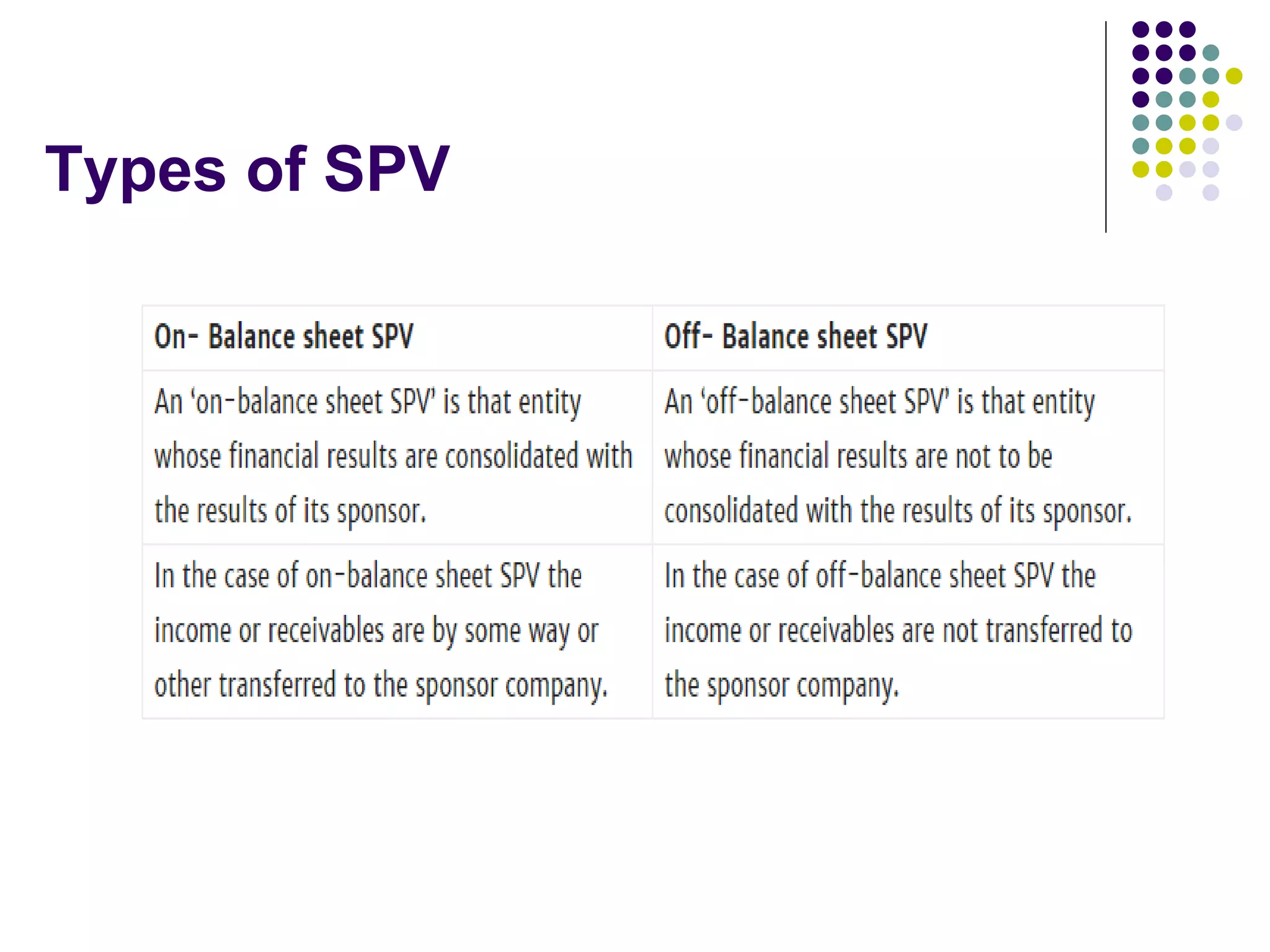
Type of SPV
Advantages of SPV
Disadvantages of SPV
Example
Special Purpose Vehicle or SPV
A special purpose vehicle (SPV) is a
financial entity created for the specific
purpose and limited purpose. It is separate
legal entity created by its sponsors or parent
company for fulfill a temporary objective of
the sponsoring firm. Its powers are very
restricted and its life is destined to end when
the purpose is attained.
Purpose of Creating SPV
SPV is usually created to isolate the parent
company from risk. In addition to isolating
risks, it is itself isolated from financial risks at
the parent company such as bankruptcy, and
it is sometimes called a bankruptcy remote
entity for this reason.
Types of SPV
Use of SPV
1. Risk sharing : A corporation’s project may entail significant risks. Creating an
SPV allows the corporation to legally isolate the risks of the project and then
share this risk with other investors.
2. Securitization : Securitization of loans is a common reason to create an SPV.
For example, when issuing mortgage-backed securities from a pool of
mortgages, a bank can separate the loans from its other obligations by
creating an SPV. The SPV allows investors in the mortgage-backed security
to receive payments for these loans before the other debtors of the bank.
3. Asset transfer : Certain types of assets can be hard to transfer. Thus, a
company may create an SPV to own these assets. When they want to
transfer the assets, they can simply sell the SPV as part of a mergers and
acquisitions (M&A) process.
4. Property sale : If the taxes on property sales are higher than that of the
capital gain, a company may create an SPV that will own the properties for
sale. It will allow them to sell the SPV instead of the properties and pay tax
on the capital gain instead of the property sales tax.
Web of contracts for SPV
Advantages of SPV
• Isolated financial risk
• Direct ownership of a specific asset
• Tax savings, if the vehicle is created in a
haven, such as the Cayman Islands
• Easy to create and set up the vehicle
Disadvantages of SPV
• Lower access to capital at the vehicle level
(since it doesn’t have the same credit as the
sponsor)
• Market to Market accounting rules could be
triggered if an asset is sold and thus impacts
the sponsor’s balance sheet
• Regulation changes could cause serious
problems for companies using these vehicles
• The optics surrounding SPVs is sometimes
negative
Example of SPV
Patna Highway Project Limited :
Patna Highway Projects is a special purpose
vehicle (SPV) formed by Gammon India Limited
for the construction of 4 Lanning Highway
Project in Patna State of Bihar for the National
Highway Authority of India.

Special purpose vehicle (spv)

  • 1.
  • 2.
    Overview What is SPV Purposeof SPV Type of SPV Advantages of SPV Disadvantages of SPV Example
  • 3.
    Special Purpose Vehicleor SPV A special purpose vehicle (SPV) is a financial entity created for the specific purpose and limited purpose. It is separate legal entity created by its sponsors or parent company for fulfill a temporary objective of the sponsoring firm. Its powers are very restricted and its life is destined to end when the purpose is attained.
  • 4.
    Purpose of CreatingSPV SPV is usually created to isolate the parent company from risk. In addition to isolating risks, it is itself isolated from financial risks at the parent company such as bankruptcy, and it is sometimes called a bankruptcy remote entity for this reason.
  • 5.
  • 6.
    Use of SPV 1.Risk sharing : A corporation’s project may entail significant risks. Creating an SPV allows the corporation to legally isolate the risks of the project and then share this risk with other investors. 2. Securitization : Securitization of loans is a common reason to create an SPV. For example, when issuing mortgage-backed securities from a pool of mortgages, a bank can separate the loans from its other obligations by creating an SPV. The SPV allows investors in the mortgage-backed security to receive payments for these loans before the other debtors of the bank. 3. Asset transfer : Certain types of assets can be hard to transfer. Thus, a company may create an SPV to own these assets. When they want to transfer the assets, they can simply sell the SPV as part of a mergers and acquisitions (M&A) process. 4. Property sale : If the taxes on property sales are higher than that of the capital gain, a company may create an SPV that will own the properties for sale. It will allow them to sell the SPV instead of the properties and pay tax on the capital gain instead of the property sales tax.
  • 7.
  • 8.
    Advantages of SPV •Isolated financial risk • Direct ownership of a specific asset • Tax savings, if the vehicle is created in a haven, such as the Cayman Islands • Easy to create and set up the vehicle
  • 9.
    Disadvantages of SPV •Lower access to capital at the vehicle level (since it doesn’t have the same credit as the sponsor) • Market to Market accounting rules could be triggered if an asset is sold and thus impacts the sponsor’s balance sheet • Regulation changes could cause serious problems for companies using these vehicles • The optics surrounding SPVs is sometimes negative
  • 10.
    Example of SPV PatnaHighway Project Limited : Patna Highway Projects is a special purpose vehicle (SPV) formed by Gammon India Limited for the construction of 4 Lanning Highway Project in Patna State of Bihar for the National Highway Authority of India.