-
Searching on Multi Dimensional
Data
106
COL
,
Slide Courtesy: Dan Tromer Piotyr
,
Indyk George Bebis
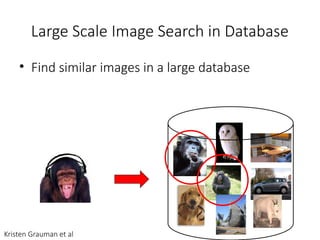
Large Scale Image Search in Database
• Find similar images in a large database
Kristen Grauman et al
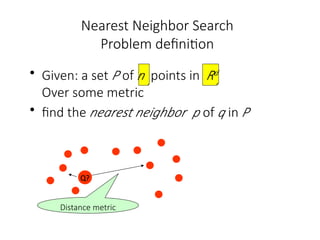
• Given: a set P of n points in Rd
Over some metric
• find the nearest neighbor p of q in P
Nearest Neighbor Search
Problem definition
Distance metric
Q?
4
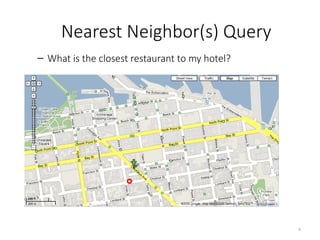
Nearest Neighbor(s) Query
– What is the closest restaurant to my hotel?
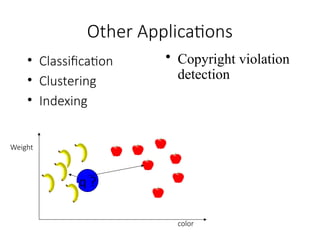
Other Applications
• Classification
• Clustering
• Indexing
q ?
• Copyright violation
detection
color
Weight
We will see three solutions
(or as many as time permits)…
• Quad Trees
• -
K D Trees
• Locality Sensitive Hashing
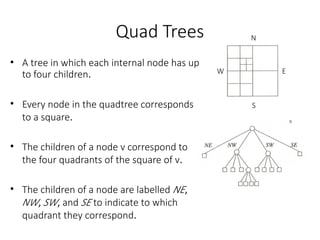
• A tree in which each internal node has up
.
to four children
• Every node in the quadtree corresponds
.
to a square
• The children of a node v correspond to
.
the four quadrants of the square of v
• The children of a node are labelled NE,
NW, SW, and SE to indicate to which
.
quadrant they correspond
N
W E
S
Quad Trees
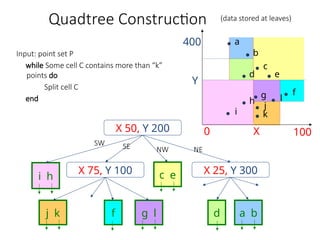
Quadtree Construction
Input: point set P
while Some cell C contains more than “k”
points do
Split cell C
end
j k f g l d a b
c e
i h
X
400
100
0
h
b
i
a
c
d e
g f
k
j
Y
l
X 25, Y 300
X 50, Y 200
X 75, Y 100
(data stored at leaves)
SW SE NW NE
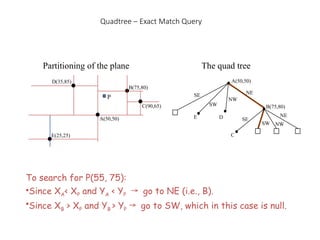
Quadtree – Exact Match Query
To search for P(55, 75):
•Since XA< XP and YA < YP go to NE (i.e., B).
→
•Since XB > XP and YB > YP go to SW, which in this case is null.
→
D(35,85)
A(50,50)
E(25,25)
·
·
·
·
Partitioning of the plane
P
B(75,80)
C(90,65)
·
The quad tree
SE
SW
E
NW
D
NE
SE
SW NW
NE
C
A(50,50)
B(75,80)
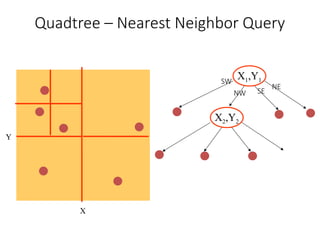
Quadtree – Nearest Neighbor Query
X
Y
X1,Y1
X2,Y2
SW
NE
SE
NW
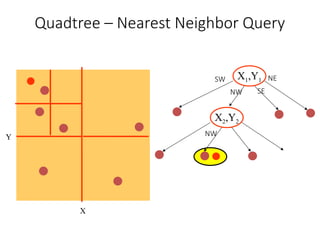
Quadtree – Nearest Neighbor Query
X
Y
X1,Y1
X2,Y2
NW
NW SE
NE
SW
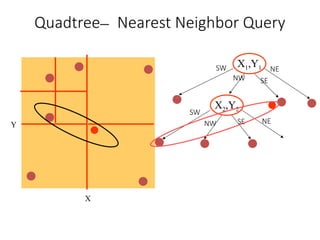
Quadtree– Nearest Neighbor Query
X
Y
X1,Y1
X2,Y2
NW
SW
SE
NE
SW
NW SE NE
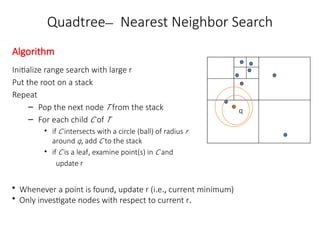
Algorithm
Initialize range search with large r
Put the root on a stack
Repeat
– Pop the next node T from the stack
– For each child C of T
• if C intersects with a circle (ball) of radius r
around q, add C to the stack
• if C ,
is a leaf examine point(s) in C and
update r
• , . .,
Whenever a point is found update r (i e current minimum)
• .
Only investigate nodes with respect to current r
Quadtree– Nearest Neighbor Search
q
• .
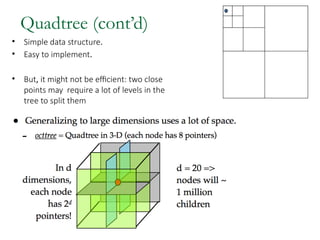
Simple data structure
• .
Easy to implement
• ,
But it might not be efficient: two close
points may require a lot of levels in the
tree to split them
Quadtree (cont’d)
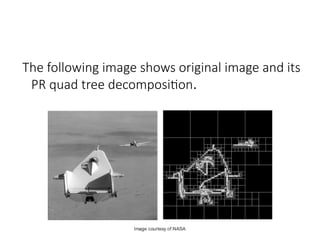
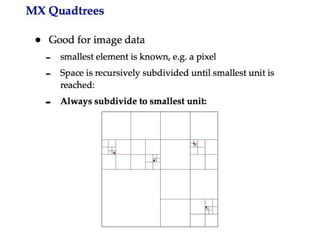
The following image shows original image and its
.
PR quad tree decomposition
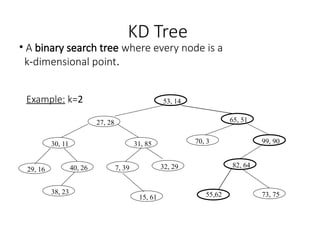
KD Tree
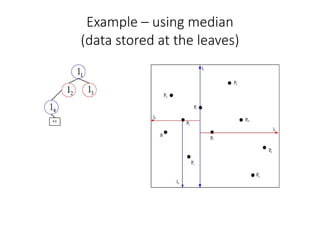
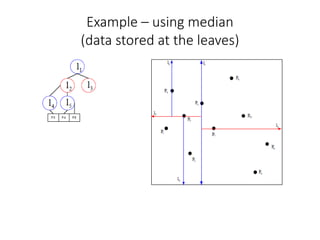
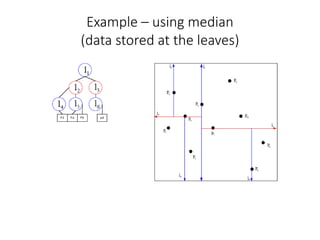
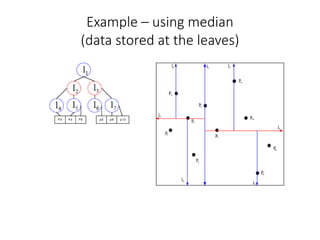
• A binary search tree where every node is a
- .
k dimensional point
53, 14
27, 28 65, 51
31, 85
30, 11 70, 3 99, 90
29, 16 40, 26 7, 39 32, 29 82, 64
73, 75
15, 61
38, 23 55,62
Example: 2
k=
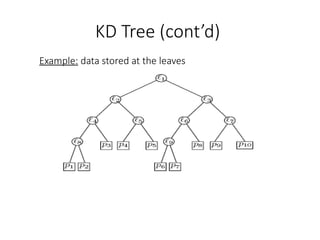
KD Tree (cont’d)
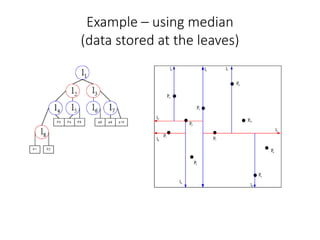
Example: data stored at the leaves
KD Tree (cont’d)
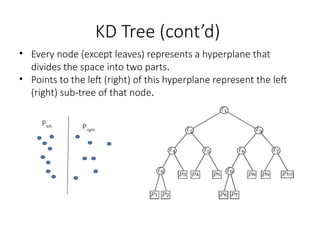
• Every node (except leaves) represents a hyperplane that
.
divides the space into two parts
• Points to the left (right) of this hyperplane represent the left
- .
(right) sub tree of that node
Pleft Pright
KD Tree (cont’d)
,
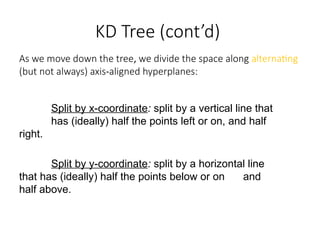
As we move down the tree we divide the space along alternating
-
(but not always) axis aligned hyperplanes:
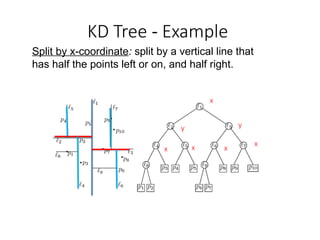
Split by x-coordinate: split by a vertical line that
has (ideally) half the points left or on, and half
right.
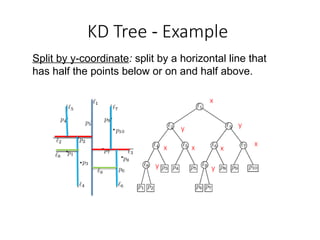
Split by y-coordinate: split by a horizontal line
that has (ideally) half the points below or on and
half above.
-
KD Tree Example
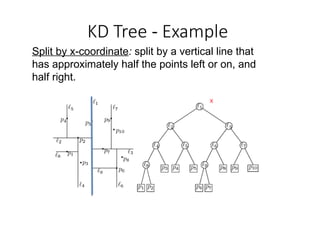
x
Split by x-coordinate: split by a vertical line that
has approximately half the points left or on, and
half right.
-
KD Tree Example
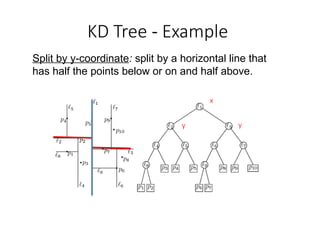
x
y
Split by y-coordinate: split by a horizontal line that
has half the points below or on and half above.
y
-
KD Tree Example
x
y
x
Split by x-coordinate: split by a vertical line that
has half the points left or on, and half right.
y
x
x
x
-
KD Tree Example
x
y
x
y
Split by y-coordinate: split by a horizontal line that
has half the points below or on and half above.
y
x
x
x
y
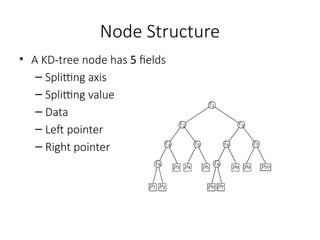
Node Structure
• - 5
A KD tree node has fields
– Splitting axis
– Splitting value
– Data
– Left pointer
– Right pointer
Splitting Strategies
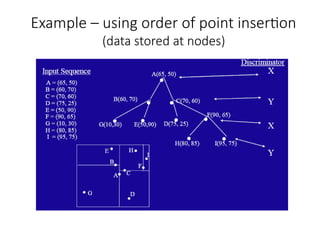
• Divide based on order of point insertion
– .
Assumes that points are given one at a time
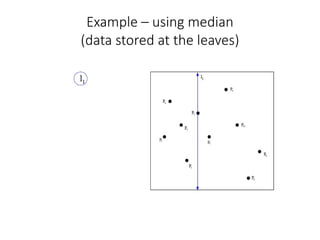
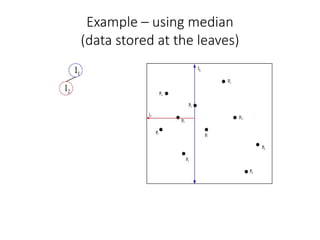
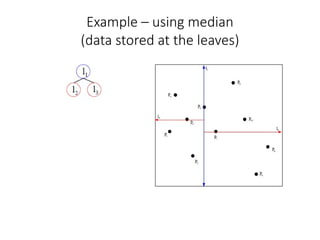
• Divide by finding median
– .
Assumes all the points are available ahead of time
• Divide perpendicular to the axis with widest spread
– Split axes might not alternate
… and more!
Example – using order of point insertion
(data stored at nodes)
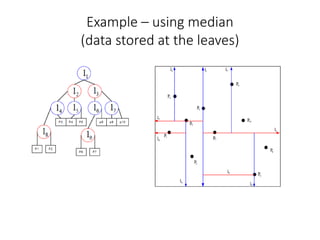
Example – using median
(data stored at the leaves)
Example – using median
(data stored at the leaves)
Example – using median
(data stored at the leaves)
Example – using median
(data stored at the leaves)
Example – using median
(data stored at the leaves)
Example – using median
(data stored at the leaves)
Example – using median
(data stored at the leaves)
Example – using median
(data stored at the leaves)
Example – using median
(data stored at the leaves)
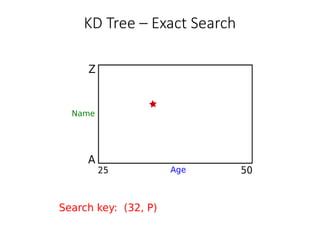
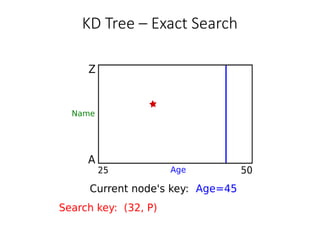
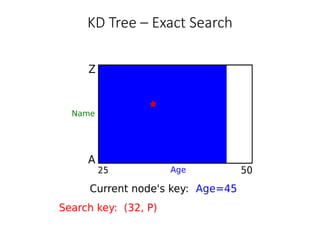
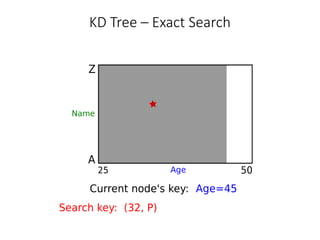
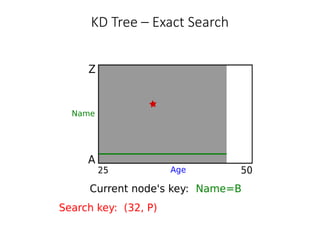
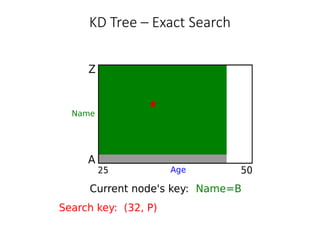
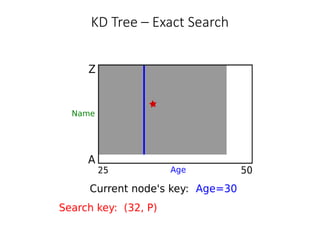
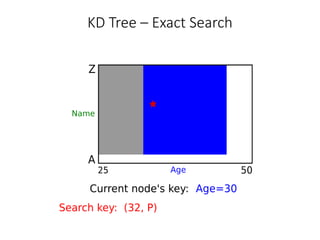
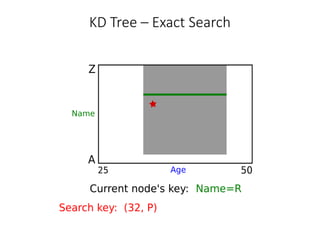
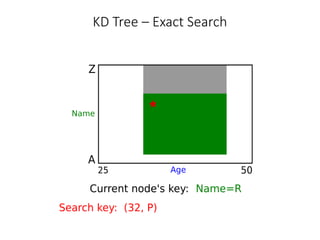
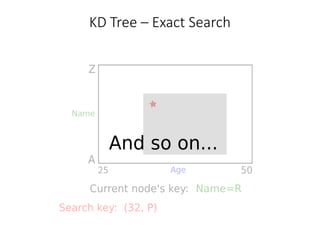
KD Tree – Exact Search
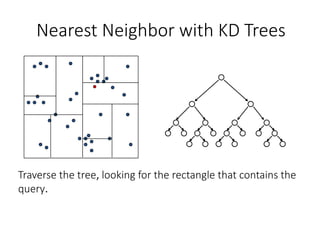
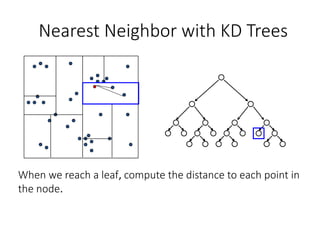
Nearest Neighbor with KD Trees
,
Traverse the tree looking for the rectangle that contains the
.
query
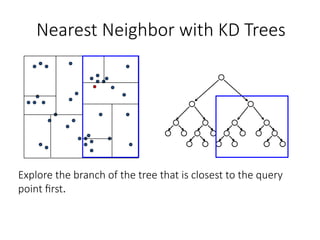
Explore the branch of the tree that is closest to the query
.
point first
Nearest Neighbor with KD Trees
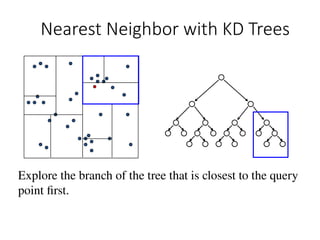
Explore the branch of the tree that is closest to the query
point first.
Nearest Neighbor with KD Trees
,
When we reach a leaf compute the distance to each point in
.
the node
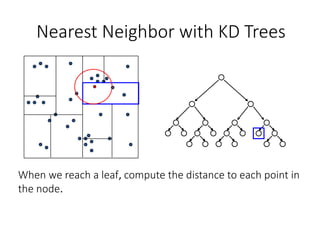
Nearest Neighbor with KD Trees
,
When we reach a leaf compute the distance to each point in
.
the node
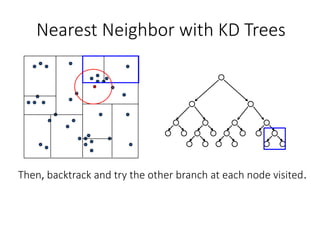
Nearest Neighbor with KD Trees
, .
Then backtrack and try the other branch at each node visited
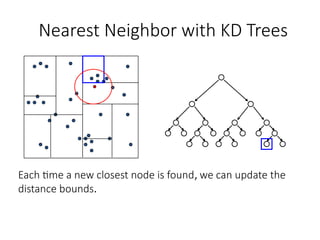
Nearest Neighbor with KD Trees
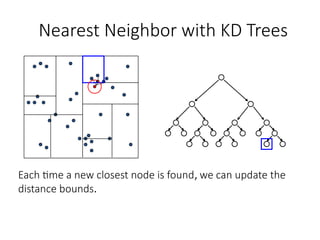
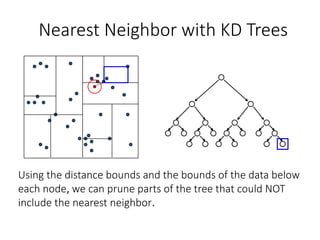
,
Each time a new closest node is found we can update the
.
distance bounds
Nearest Neighbor with KD Trees
,
Each time a new closest node is found we can update the
.
distance bounds
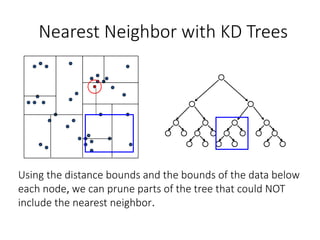
Nearest Neighbor with KD Trees
Using the distance bounds and the bounds of the data below
,
each node we can prune parts of the tree that could NOT
.
include the nearest neighbor
Nearest Neighbor with KD Trees
Using the distance bounds and the bounds of the data below
,
each node we can prune parts of the tree that could NOT
.
include the nearest neighbor
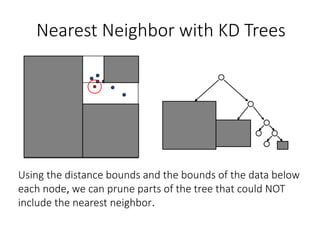
Nearest Neighbor with KD Trees
Using the distance bounds and the bounds of the data below
,
each node we can prune parts of the tree that could NOT
.
include the nearest neighbor
Nearest Neighbor with KD Trees
62
“Curse” of dimensionality
• Much real world data is high dimensional
• -
Quad Trees or KD trees are not suitable for
efficiently finding the nearest neighbor in
--
high dimensional spaces searching is
.
exponential in d
• ,
As d grows large this quickly becomes
.
intractable
63
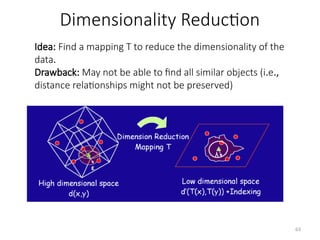
Dimensionality Reduction
Idea: Find a mapping T to reduce the dimensionality of the
.
data
Drawback: . .,
May not be able to find all similar objects (i e
distance relationships might not be preserved)
Locality Sensitive Hashing
• Hash the high dimensional points down to a
smaller space
• Use a family of hash functions such that close
.
points tend to hash to the same bucket
• .
Put all points of P in their buckets Ideally we want
the query q to find its nearest neighbor in its
bucket
-
Locality Sensitive Hashing
• Hash functions are -
locality sensitive, ,
if for a
random hash random function h, for any
pair of points ,
p q we have:
– Pr[h(p)=h(q)] is “high” if p is “close” to q
– Pr[h(p)=h(q)] is “low” if p is “far” from q
Do such functions exist ?
• , . .,
Consider the hypercube i e
– points from 0,1
{ }d
– Hamming distance ,
D(p q)= # positions on which p
and q differ
• Define hash function h by choosing a set I of k
,
random coordinates and setting
h(p) = projection of p on I
Example
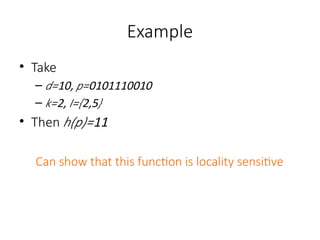
• Take
– 10, 0101110010
d= p=
– 2, 2,5
k= I={ }
• Then 11
h(p)=
Can show that this function is locality sensitive
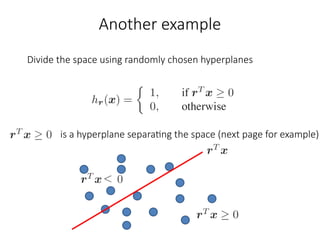
Another example
Divide the space using randomly chosen hyperplanes
is a hyperplane separating the space (next page for example)
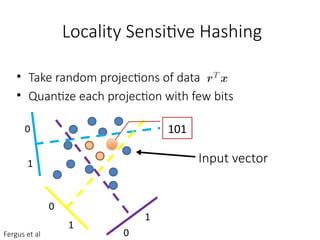
Locality Sensitive Hashing
• Take random projections of data
• Quantize each projection with few bits
0
1
0
1
0
1
101
Input vector
Fergus et al
How to search from hash table?
Q
111101
110111
110101
h r1…rk
Xi
N
hr1…rk
<< N
Q
[Kristen Grauman et al]
A set of data points
Hash function
Hash table
New query
Search the hash table
for a small set of images
results

spatial.pptx kd trees datastructure and algorithms

  • 1.
    - Searching on MultiDimensional Data 106 COL , Slide Courtesy: Dan Tromer Piotyr , Indyk George Bebis
  • 2.
    Large Scale ImageSearch in Database • Find similar images in a large database Kristen Grauman et al
  • 3.
    • Given: aset P of n points in Rd Over some metric • find the nearest neighbor p of q in P Nearest Neighbor Search Problem definition Distance metric Q?
  • 4.
    4 Nearest Neighbor(s) Query –What is the closest restaurant to my hotel?
  • 5.
    Other Applications • Classification •Clustering • Indexing q ? • Copyright violation detection color Weight
  • 6.
    We will seethree solutions (or as many as time permits)… • Quad Trees • - K D Trees • Locality Sensitive Hashing
  • 7.
    • A treein which each internal node has up . to four children • Every node in the quadtree corresponds . to a square • The children of a node v correspond to . the four quadrants of the square of v • The children of a node are labelled NE, NW, SW, and SE to indicate to which . quadrant they correspond N W E S Quad Trees
  • 8.
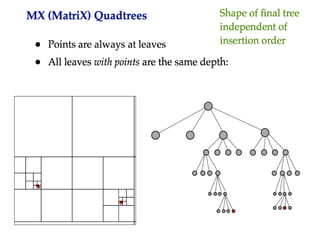
    Quadtree Construction Input: pointset P while Some cell C contains more than “k” points do Split cell C end j k f g l d a b c e i h X 400 100 0 h b i a c d e g f k j Y l X 25, Y 300 X 50, Y 200 X 75, Y 100 (data stored at leaves) SW SE NW NE
  • 9.
    Quadtree – ExactMatch Query To search for P(55, 75): •Since XA< XP and YA < YP go to NE (i.e., B). → •Since XB > XP and YB > YP go to SW, which in this case is null. → D(35,85) A(50,50) E(25,25) · · · · Partitioning of the plane P B(75,80) C(90,65) · The quad tree SE SW E NW D NE SE SW NW NE C A(50,50) B(75,80)
  • 10.
    Quadtree – NearestNeighbor Query X Y X1,Y1 X2,Y2 SW NE SE NW
  • 11.
    Quadtree – NearestNeighbor Query X Y X1,Y1 X2,Y2 NW NW SE NE SW
  • 12.
    Quadtree– Nearest NeighborQuery X Y X1,Y1 X2,Y2 NW SW SE NE SW NW SE NE
  • 13.
    Algorithm Initialize range searchwith large r Put the root on a stack Repeat – Pop the next node T from the stack – For each child C of T • if C intersects with a circle (ball) of radius r around q, add C to the stack • if C , is a leaf examine point(s) in C and update r • , . ., Whenever a point is found update r (i e current minimum) • . Only investigate nodes with respect to current r Quadtree– Nearest Neighbor Search q
  • 14.
    • . Simple datastructure • . Easy to implement • , But it might not be efficient: two close points may require a lot of levels in the tree to split them Quadtree (cont’d)
  • 17.
    The following imageshows original image and its . PR quad tree decomposition
  • 20.
    KD Tree • Abinary search tree where every node is a - . k dimensional point 53, 14 27, 28 65, 51 31, 85 30, 11 70, 3 99, 90 29, 16 40, 26 7, 39 32, 29 82, 64 73, 75 15, 61 38, 23 55,62 Example: 2 k=
  • 21.
    KD Tree (cont’d) Example:data stored at the leaves
  • 22.
    KD Tree (cont’d) •Every node (except leaves) represents a hyperplane that . divides the space into two parts • Points to the left (right) of this hyperplane represent the left - . (right) sub tree of that node Pleft Pright
  • 23.
    KD Tree (cont’d) , Aswe move down the tree we divide the space along alternating - (but not always) axis aligned hyperplanes: Split by x-coordinate: split by a vertical line that has (ideally) half the points left or on, and half right. Split by y-coordinate: split by a horizontal line that has (ideally) half the points below or on and half above.
  • 24.
    - KD Tree Example x Splitby x-coordinate: split by a vertical line that has approximately half the points left or on, and half right.
  • 25.
    - KD Tree Example x y Splitby y-coordinate: split by a horizontal line that has half the points below or on and half above. y
  • 26.
    - KD Tree Example x y x Splitby x-coordinate: split by a vertical line that has half the points left or on, and half right. y x x x
  • 27.
    - KD Tree Example x y x y Splitby y-coordinate: split by a horizontal line that has half the points below or on and half above. y x x x y
  • 28.
    Node Structure • -5 A KD tree node has fields – Splitting axis – Splitting value – Data – Left pointer – Right pointer
  • 29.
    Splitting Strategies • Dividebased on order of point insertion – . Assumes that points are given one at a time • Divide by finding median – . Assumes all the points are available ahead of time • Divide perpendicular to the axis with widest spread – Split axes might not alternate … and more!
  • 30.
    Example – usingorder of point insertion (data stored at nodes)
  • 31.
    Example – usingmedian (data stored at the leaves)
  • 32.
    Example – usingmedian (data stored at the leaves)
  • 33.
    Example – usingmedian (data stored at the leaves)
  • 34.
    Example – usingmedian (data stored at the leaves)
  • 35.
    Example – usingmedian (data stored at the leaves)
  • 36.
    Example – usingmedian (data stored at the leaves)
  • 37.
    Example – usingmedian (data stored at the leaves)
  • 38.
    Example – usingmedian (data stored at the leaves)
  • 39.
    Example – usingmedian (data stored at the leaves)
  • 40.
    KD Tree –Exact Search
  • 41.
    KD Tree –Exact Search
  • 42.
    KD Tree –Exact Search
  • 43.
    KD Tree –Exact Search
  • 44.
    KD Tree –Exact Search
  • 45.
    KD Tree –Exact Search
  • 46.
    KD Tree –Exact Search
  • 47.
    KD Tree –Exact Search
  • 48.
    KD Tree –Exact Search
  • 49.
    KD Tree –Exact Search
  • 50.
    KD Tree –Exact Search
  • 51.
    Nearest Neighbor withKD Trees , Traverse the tree looking for the rectangle that contains the . query
  • 52.
    Explore the branchof the tree that is closest to the query . point first Nearest Neighbor with KD Trees
  • 53.
    Explore the branchof the tree that is closest to the query point first. Nearest Neighbor with KD Trees
  • 54.
    , When we reacha leaf compute the distance to each point in . the node Nearest Neighbor with KD Trees
  • 55.
    , When we reacha leaf compute the distance to each point in . the node Nearest Neighbor with KD Trees
  • 56.
    , . Then backtrackand try the other branch at each node visited Nearest Neighbor with KD Trees
  • 57.
    , Each time anew closest node is found we can update the . distance bounds Nearest Neighbor with KD Trees
  • 58.
    , Each time anew closest node is found we can update the . distance bounds Nearest Neighbor with KD Trees
  • 59.
    Using the distancebounds and the bounds of the data below , each node we can prune parts of the tree that could NOT . include the nearest neighbor Nearest Neighbor with KD Trees
  • 60.
    Using the distancebounds and the bounds of the data below , each node we can prune parts of the tree that could NOT . include the nearest neighbor Nearest Neighbor with KD Trees
  • 61.
    Using the distancebounds and the bounds of the data below , each node we can prune parts of the tree that could NOT . include the nearest neighbor Nearest Neighbor with KD Trees
  • 62.
    62 “Curse” of dimensionality •Much real world data is high dimensional • - Quad Trees or KD trees are not suitable for efficiently finding the nearest neighbor in -- high dimensional spaces searching is . exponential in d • , As d grows large this quickly becomes . intractable
  • 63.
    63 Dimensionality Reduction Idea: Finda mapping T to reduce the dimensionality of the . data Drawback: . ., May not be able to find all similar objects (i e distance relationships might not be preserved)
  • 64.
    Locality Sensitive Hashing •Hash the high dimensional points down to a smaller space • Use a family of hash functions such that close . points tend to hash to the same bucket • . Put all points of P in their buckets Ideally we want the query q to find its nearest neighbor in its bucket
  • 65.
    - Locality Sensitive Hashing •Hash functions are - locality sensitive, , if for a random hash random function h, for any pair of points , p q we have: – Pr[h(p)=h(q)] is “high” if p is “close” to q – Pr[h(p)=h(q)] is “low” if p is “far” from q
  • 66.
    Do such functionsexist ? • , . ., Consider the hypercube i e – points from 0,1 { }d – Hamming distance , D(p q)= # positions on which p and q differ • Define hash function h by choosing a set I of k , random coordinates and setting h(p) = projection of p on I
  • 67.
    Example • Take – 10,0101110010 d= p= – 2, 2,5 k= I={ } • Then 11 h(p)= Can show that this function is locality sensitive
  • 68.
    Another example Divide thespace using randomly chosen hyperplanes is a hyperplane separating the space (next page for example)
  • 69.
    Locality Sensitive Hashing •Take random projections of data • Quantize each projection with few bits 0 1 0 1 0 1 101 Input vector Fergus et al
  • 70.
    How to searchfrom hash table? Q 111101 110111 110101 h r1…rk Xi N hr1…rk << N Q [Kristen Grauman et al] A set of data points Hash function Hash table New query Search the hash table for a small set of images results

Editor's Notes

  • #3 The solution strategy is: Select Features  feature space Rd Select distance metric  for example l1 or l2 Build data-structure for fast near-neighbor queries Scale-ability with n & with d is important
  • #7 Extension to the K-dimensional case
  • #10 Extension to the K-dimensional case
  • #11 Extension to the K-dimensional case
  • #12 Extension to the K-dimensional case
  • #70 Dd definition