Sparking Privacy
Conversations
through Popular
Media
MICHAEL ZIMMER, PHD
ASSISTANT PROFESSOR, SCHOOL OF INFORMATION STUDIES
DIRECTOR, CENTER FOR INFORMATION POLICY RESEARCH
UNIVERSITY OF WISCONSIN-MILWAUKEE
WWW.MICHAELZIMMER.ORG
Why Use Popular Media?
You’ll get more people to come to a screening than to a lecture
◦ (even if you sneak a mini-lecture in without them knowing)
Documentaries are more likely to have multiple views and perspectives,
to help spark dialogue
Patrons are more likely to challenge or critique something presented on
screen, rather than to a live person delivering a presentation
Even if fictionalized or overly-dramatic, stories help make privacy and
surveillance threats real
MICHAEL ZIMMER | CPW WEBINAR | MARCH 24, 2016
Strategies for Using Popular
Media
Feature the film/show in your promotion, but make time for a
“conversation” or “debate” after
◦ Watch the audience to make note of what they react to, then discuss those
parts in more detail
◦ Ask local teachers, advocates, lawyers, parents to sit on a panel to give their
reactions
◦ Map out the common trade-offs between security/convenience vs. privacy
If working with youth, provide a worksheet with 4-5 key issues or
controversies for them to identify while watching
◦ Ask if anything seemed “creepy”, or what surprised them most
◦ Ask students to argue a devil’s advocate position; create a mock debate
◦ Create lists of “good” vs. “bad” aspects of what was in the film, then push
them to recognize how these issues are rarely that simple
MICHAEL ZIMMER | CPW WEBINAR | MARCH 24, 2016
Popular Films
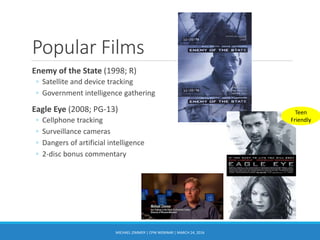
Enemy of the State (1998; R)
◦ Satellite and device tracking
◦ Government intelligence gathering
Eagle Eye (2008; PG-13)
◦ Cellphone tracking
◦ Surveillance cameras
◦ Dangers of artificial intelligence
◦ 2-disc bonus commentary
MICHAEL ZIMMER | CPW WEBINAR | MARCH 24, 2016
Teen
Friendly
Popular Feature Films
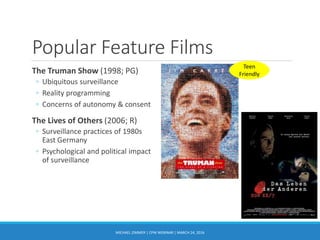
The Truman Show (1998; PG)
◦ Ubiquitous surveillance
◦ Reality programming
◦ Concerns of autonomy & consent
The Lives of Others (2006; R)
◦ Surveillance practices of 1980s
East Germany
◦ Psychological and political impact
of surveillance
MICHAEL ZIMMER | CPW WEBINAR | MARCH 24, 2016
Teen
Friendly
Documentaries
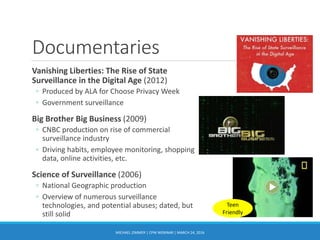
Vanishing Liberties: The Rise of State
Surveillance in the Digital Age (2012)
◦ Produced by ALA for Choose Privacy Week
◦ Government surveillance
Big Brother Big Business (2009)
◦ CNBC production on rise of commercial
surveillance industry
◦ Driving habits, employee monitoring, shopping
data, online activities, etc.
Science of Surveillance (2006)
◦ National Geographic production
◦ Overview of numerous surveillance
technologies, and potential abuses; dated, but
still solid
MICHAEL ZIMMER | CPW WEBINAR | MARCH 24, 2016
Teen
Friendly
Documentaries
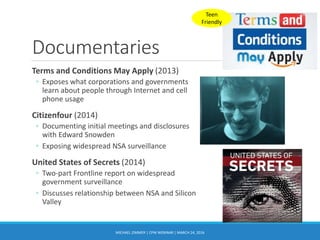
Terms and Conditions May Apply (2013)
◦ Exposes what corporations and governments
learn about people through Internet and cell
phone usage
Citizenfour (2014)
◦ Documenting initial meetings and disclosures
with Edward Snowden
◦ Exposing widespread NSA surveillance
United States of Secrets (2014)
◦ Two-part Frontline report on widespread
government surveillance
◦ Discusses relationship between NSA and Silicon
Valley
MICHAEL ZIMMER | CPW WEBINAR | MARCH 24, 2016
Teen
Friendly
Television
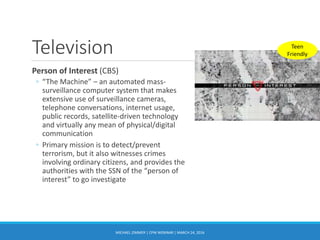
Person of Interest (CBS)
◦ “The Machine” – an automated mass-
surveillance computer system that makes
extensive use of surveillance cameras,
telephone conversations, internet usage,
public records, satellite-driven technology
and virtually any mean of physical/digital
communication
◦ Primary mission is to detect/prevent
terrorism, but it also witnesses crimes
involving ordinary citizens, and provides the
authorities with the SSN of the “person of
interest” to go investigate
MICHAEL ZIMMER | CPW WEBINAR | MARCH 24, 2016
Teen
Friendly
Television
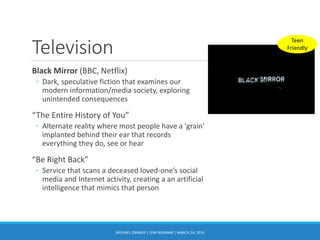
Black Mirror (BBC, Netflix)
◦ Dark, speculative fiction that examines our
modern information/media society, exploring
unintended consequences
“The Entire History of You”
◦ Alternate reality where most people have a 'grain'
implanted behind their ear that records
everything they do, see or hear
“Be Right Back”
◦ Service that scans a deceased loved-one’s social
media and Internet activity, creating a an artificial
intelligence that mimics that person
MICHAEL ZIMMER | CPW WEBINAR | MARCH 24, 2016
Teen
Friendly
Still like Books?
If you prefer book discussions, there is a growing body of privacy &
surveillance publications that are quite approachable for general
audiences…
◦ Privacy law expert Dan Solove maintains a very good list:
https://privacyandsecurityforum.com/nonfiction-books/
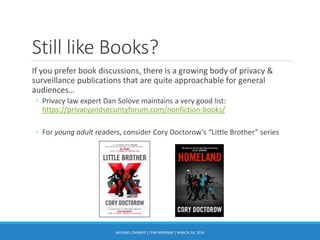
◦ For young adult readers, consider Cory Doctorow’s “Little Brother” series
MICHAEL ZIMMER | CPW WEBINAR | MARCH 24, 2016
Caveat
I’m not a lawyer, and I’m definitely not your library’s lawyer
Check your policies and legal guidance regarding copyright and
screening of films for public performance
Some resources:
◦ ALA Video & Copyright
◦ http://www.ala.org/tools/libfactsheets/alalibraryfactsheet07
◦ Movie Licensing USA: Public Libraries
◦ http://library.movlic.com/faq
◦ Films for the Humanities and Social Sciences
◦ http://ffh.films.com
MICHAEL ZIMMER | CPW WEBINAR | MARCH 24, 2016

Sparking Privacy Conversations through Popular Media

  • 1.
    Sparking Privacy Conversations through Popular Media MICHAELZIMMER, PHD ASSISTANT PROFESSOR, SCHOOL OF INFORMATION STUDIES DIRECTOR, CENTER FOR INFORMATION POLICY RESEARCH UNIVERSITY OF WISCONSIN-MILWAUKEE WWW.MICHAELZIMMER.ORG
  • 2.
    Why Use PopularMedia? You’ll get more people to come to a screening than to a lecture ◦ (even if you sneak a mini-lecture in without them knowing) Documentaries are more likely to have multiple views and perspectives, to help spark dialogue Patrons are more likely to challenge or critique something presented on screen, rather than to a live person delivering a presentation Even if fictionalized or overly-dramatic, stories help make privacy and surveillance threats real MICHAEL ZIMMER | CPW WEBINAR | MARCH 24, 2016
  • 3.
    Strategies for UsingPopular Media Feature the film/show in your promotion, but make time for a “conversation” or “debate” after ◦ Watch the audience to make note of what they react to, then discuss those parts in more detail ◦ Ask local teachers, advocates, lawyers, parents to sit on a panel to give their reactions ◦ Map out the common trade-offs between security/convenience vs. privacy If working with youth, provide a worksheet with 4-5 key issues or controversies for them to identify while watching ◦ Ask if anything seemed “creepy”, or what surprised them most ◦ Ask students to argue a devil’s advocate position; create a mock debate ◦ Create lists of “good” vs. “bad” aspects of what was in the film, then push them to recognize how these issues are rarely that simple MICHAEL ZIMMER | CPW WEBINAR | MARCH 24, 2016
  • 4.
    Popular Films Enemy ofthe State (1998; R) ◦ Satellite and device tracking ◦ Government intelligence gathering Eagle Eye (2008; PG-13) ◦ Cellphone tracking ◦ Surveillance cameras ◦ Dangers of artificial intelligence ◦ 2-disc bonus commentary MICHAEL ZIMMER | CPW WEBINAR | MARCH 24, 2016 Teen Friendly
  • 5.
    Popular Feature Films TheTruman Show (1998; PG) ◦ Ubiquitous surveillance ◦ Reality programming ◦ Concerns of autonomy & consent The Lives of Others (2006; R) ◦ Surveillance practices of 1980s East Germany ◦ Psychological and political impact of surveillance MICHAEL ZIMMER | CPW WEBINAR | MARCH 24, 2016 Teen Friendly
  • 6.
    Documentaries Vanishing Liberties: TheRise of State Surveillance in the Digital Age (2012) ◦ Produced by ALA for Choose Privacy Week ◦ Government surveillance Big Brother Big Business (2009) ◦ CNBC production on rise of commercial surveillance industry ◦ Driving habits, employee monitoring, shopping data, online activities, etc. Science of Surveillance (2006) ◦ National Geographic production ◦ Overview of numerous surveillance technologies, and potential abuses; dated, but still solid MICHAEL ZIMMER | CPW WEBINAR | MARCH 24, 2016 Teen Friendly
  • 7.
    Documentaries Terms and ConditionsMay Apply (2013) ◦ Exposes what corporations and governments learn about people through Internet and cell phone usage Citizenfour (2014) ◦ Documenting initial meetings and disclosures with Edward Snowden ◦ Exposing widespread NSA surveillance United States of Secrets (2014) ◦ Two-part Frontline report on widespread government surveillance ◦ Discusses relationship between NSA and Silicon Valley MICHAEL ZIMMER | CPW WEBINAR | MARCH 24, 2016 Teen Friendly
  • 8.
    Television Person of Interest(CBS) ◦ “The Machine” – an automated mass- surveillance computer system that makes extensive use of surveillance cameras, telephone conversations, internet usage, public records, satellite-driven technology and virtually any mean of physical/digital communication ◦ Primary mission is to detect/prevent terrorism, but it also witnesses crimes involving ordinary citizens, and provides the authorities with the SSN of the “person of interest” to go investigate MICHAEL ZIMMER | CPW WEBINAR | MARCH 24, 2016 Teen Friendly
  • 9.
    Television Black Mirror (BBC,Netflix) ◦ Dark, speculative fiction that examines our modern information/media society, exploring unintended consequences “The Entire History of You” ◦ Alternate reality where most people have a 'grain' implanted behind their ear that records everything they do, see or hear “Be Right Back” ◦ Service that scans a deceased loved-one’s social media and Internet activity, creating a an artificial intelligence that mimics that person MICHAEL ZIMMER | CPW WEBINAR | MARCH 24, 2016 Teen Friendly
  • 10.
    Still like Books? Ifyou prefer book discussions, there is a growing body of privacy & surveillance publications that are quite approachable for general audiences… ◦ Privacy law expert Dan Solove maintains a very good list: https://privacyandsecurityforum.com/nonfiction-books/ ◦ For young adult readers, consider Cory Doctorow’s “Little Brother” series MICHAEL ZIMMER | CPW WEBINAR | MARCH 24, 2016
  • 11.
    Caveat I’m not alawyer, and I’m definitely not your library’s lawyer Check your policies and legal guidance regarding copyright and screening of films for public performance Some resources: ◦ ALA Video & Copyright ◦ http://www.ala.org/tools/libfactsheets/alalibraryfactsheet07 ◦ Movie Licensing USA: Public Libraries ◦ http://library.movlic.com/faq ◦ Films for the Humanities and Social Sciences ◦ http://ffh.films.com MICHAEL ZIMMER | CPW WEBINAR | MARCH 24, 2016