HAYSSAM SALEH
Spark		/	Mesos Cluster	Optimization
Paris	Spark	Meetup April	28th 2016	@Criteo
Grappe
Clic
Nav
AT
DataLake
Avis
Evts.
Supports
Comptes
Spark Job
DataMart
Contribution
Visiteur
Session
Recherche
Bandeau
[LR]
[FD]																											
[Clic]
Project	Context
3
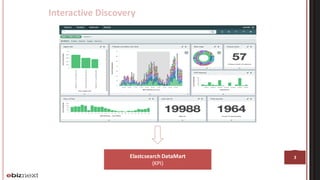
Interactive	Discovery
Elastcsearch DataMart
(KPI)
Interactive	Discovery
Elastcsearch DataMart
(KPI)
OBJECTIVES
— 100	Gb	of	data	/	day	=>	50	million	requests
— 40To	/	year
— How	we turned from a	4	hours job	on	:
¢ 6	nodes
¢ 8	cores &	32	Gb	per	node
¢ To	a	20	minutes	Job	on	:
¢ 4	nodes,	8	cores &	8	Gb	per	node
SUMMARY
¢ Spark	concepts
¢ Spark	UI	offline
¢ Application	Optimization
— Shuffling
— Partitioning
— Closures
¢ Parameters	Optimization
— Spark	Shuffling
— Mesos application	distribution
¢ Elasticsearch Optimization
— Google	“elasticsearch performance	tuning”	->	blog.ebiznext.com
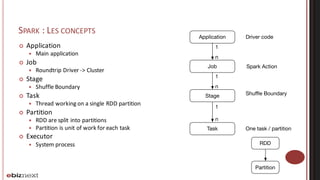
SPARK :	LES CONCEPTS
¢ Application
— Main	application
¢ Job	
— Roundtrip	Driver	->	Cluster
¢ Stage	
— Shuffle	Boundary
¢ Task
— Thread	working	on	a	single	RDD	partition
¢ Partition
— RDD	are	split	into	partitions
— Partition	is	unit	of	work	for	each	task
¢ Executor
— System	process
Application
Job
Stage
Task
1
n
n
n
1
1
Driver code
Spark Action
Shuffle Boundary
One task / partition
RDD
Partition
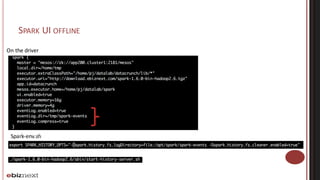
SPARK UI	OFFLINE
Spark-env.sh
On	the	driver
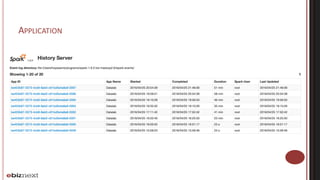
APPLICATION
JOBS
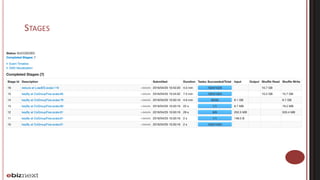
STAGES
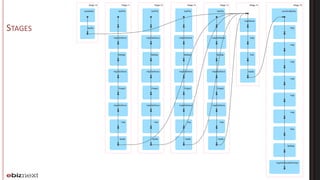
STAGES
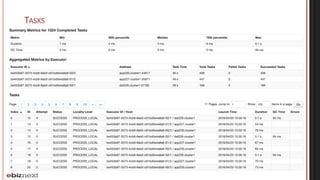
TASKS
SHUFFLING APPLICATION OPTIMIZATION
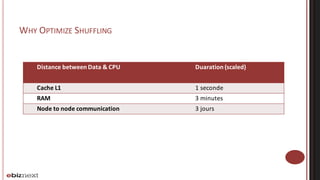
WHY OPTIMIZE SHUFFLING
Distance	between Data	&	CPU Duaration (scaled)
Cache	L1 1	seconde
RAM 3	minutes
Node to	node communication 3	jours
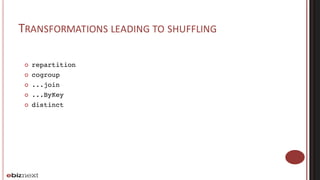
TRANSFORMATIONS LEADING TO SHUFFLING
¢ repartition
¢ cogroup
¢ ...join
¢ ...ByKey
¢ distinct
SHUFFLING OPTIMIZATION 1/2
(k1,	v1,	w1)
(k2,	v2,	w2)
(k3,	v3,	w3)
(k1,	v4	w4)
(k1,	v5,	w5)
(k3,v6,w6)
(k2,	v7,	w7)
(k2	v8,	w8)
(k3,v9,w9)
(k1,	v1)
(k2,	v2)
(k3,v3)
(k1,	v4)
(k1,	v5)
(k3,v6)
(k2,	v7)
(k2	v8)
(k3,v9)
map map map
(k1,	[v1,	v4,	v5]) (k3,	[v3,	v6,	v9]) (k2,	[v2,	v7,	v8])
groupByKey groupByKey groupByKey
(k1,v1+v4+v5) (k3,v3+v6+v9) (k2,	v2+v7+v8])
Shuffling
Bonus	:	OOM
SHUFFLING OPTIMIZATION 2/2
(k1,	v1,	w1)
(k2,	v2,	w2)
(k3,	v3,	w3)
(k1,	v4	w4)
(k1,	v5,	w5)
(k3,v6,w6)
(k2,	v7,	w7)
(k2	v8,	w8)
(k3,v9,w9)
(k1,	v1)
(k2,	v2)
(k3,v3)
(k1,	v4)
(k1,	v5)
(k3,v6)
(k2,	v7)
(k2	v8)
(k3,v9)
map map map
(k1,	v1+v45)) (k3,v3+v6+v9) (k2,	v2+v78)
reduceByKey (2/2) reduceByKey (2/2)
reduceByKey (2/2)
(k1,	v1)
(k2,	v2)
(k3,v3)
(k1,	v4+v5)
(k3,v6)
(k2,	v7+v8)
(k3,v9)
reduceByKey (1/2) reduceByKey (1/2) reduceByKey (1/2)
Less	shuffling
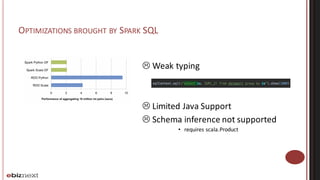
OPTIMIZATIONS BROUGHT BY SPARK SQL
L Weak	typing
L Limited	Java	Support
L Schema	inference	not	supported	
• requires	scala.Product
LES DATASETS – EXPERIMENTAL -
Scala
Java
J API	similar	to	RDD,	strongly	typed
REDUCE OBJECT SIZE
CLOSURES
CLOSURES
Indirect	reference.	Use	local	variables	instead
RIGHT PARTITIONING
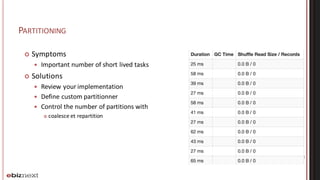
PARTITIONING
¢ Symptoms
— Important	number	of	short	lived	tasks
¢ Solutions
— Review your implementation
— Define custom	partitionner
— Control	the	number of	partitions	with
¢ coalesce	et	repartition
CHOOSE THE RIGHT SERIALIZATION ALGORITHM
REDUCE OBJECT SIZE
¢ Kryo Serialization
— Reduce	space	– up	to	10X
— Perform	gain	– 2X	to	3X
1.	Require	Spark	to	use	Kryo serialization
2.	Optimize	class	naming	=>	reduce	object	size
3.	Force	all	serialized	classes	to	register
Not	applicable	to	the	Dataset	API	that	use	Encoders	instead
DATASETS PROMISE
MEMORY TUNING
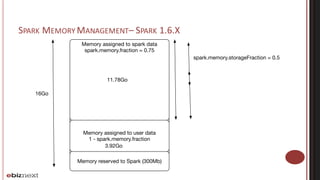
SPARK MEMORY MANAGEMENT– SPARK 1.6.X
Shuffle	fraction
Memory reserved to Spark (300Mb)
Memory assigned to user data
1 - spark.memory.fraction
Memory assigned to spark data
spark.memory.fraction = 0.75
spark.memory.storageFraction = 0.5
16Go
11.78Go
3.92Go
SPARK MEMORY MANAGEMENT – SPARK 1.6.X
¢ Storage	Fraction
— Host	cached	RDDs
— Host	broadcast	variables
— Data	in	this fraction	are	subject to	eviction
¢ Shuffling	Fraction
— Hold	Intermediate	Data
— Spill	to	disk	when	full
— Data	this	fraction	cannot	be	evicted	
by	other	threads
Memory reserved to Spark (300Mb)
Memory assigned to user data
1 - spark.memory.fraction
Memory assigned to spark data
spark.memory.fraction = 0.75
spark.memory.storageFraction = 0.5
16Go
11.78Go
3.92Go
SPARK MEMORY MANAGEMENT – SPARK 1.6.X
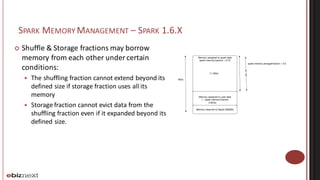
¢ Shuffle	&	Storage	fractions	may	borrow	
memory	from	each	other	under	certain	
conditions:
— The	shuffling	fraction	cannot	extend	beyond	its	
defined	size	if	storage	fraction	uses	all	its	
memory
— Storage	fraction	cannot	evict	data	from	the	
shuffling	fraction	even	if	it	expanded	beyond	its	
defined	size.
Memory reserved to Spark (300Mb)
Memory assigned to user data
1 - spark.memory.fraction
Memory assigned to spark data
spark.memory.fraction = 0.75
spark.memory.storageFraction = 0.5
16Go
11.78Go
3.92Go
THE SHUFFLE MANAGER
SPARK.SHUFFLE.MANAGER
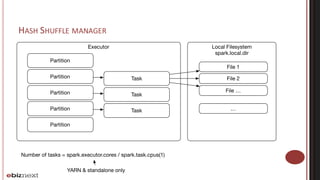
HASH SHUFFLE MANAGER
Executor
Partition
Partition
Partition
Partition
Partition
Task
Task
Task
Number of tasks = spark.executor.cores / spark.task.cpus(1)
YARN & standalone only
Local Filesystem
spark.local.dir
File 1
File 2
File …
…
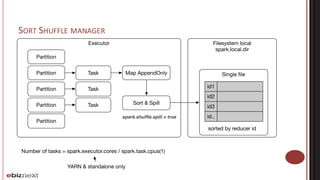
SORT SHUFFLE MANAGER
Executor
Partition
Partition
Partition
Partition
Partition
Task
Task
Task
Number of tasks = spark.executor.cores / spark.task.cpus(1)
YARN & standalone only
Filesystem local
spark.local.dir
Single fileMap AppendOnly
Sort & Spill
spark.shuffle.spill = true
id1
id2
id3
id..
sorted by reducer id
SHUFFLE MANAGER
¢ spark.shuffle.manager=	hash
— Perform	better	when	the	number	of	mapper/reducer	is	small	(generation	of	M	*	R	files)
¢ spark.shuffle.manager=	sort
— Perform	better	for	an	important	number	of	mapper/reducer
¢ Best	of	both	world
— spark.shuffle.sort.bypassMergeThreshold
¢ spark.shuffle.manager=	tungsten-sort	???
— Similar	to	sort	with	the	following	benefits	:
¢ Off-Heap	allocation
¢ Work	directly	on	binary	object	serialization	(much	smaller	than	JVM	objects)		– aka	memcopy J
¢ Use	8	bytes	/	record	pour	les	sort	=>	take	advantage	on	L*	cache
SPARK ON MESOS
COARSE GRAINED MODE
J Static	resource	allocation
Spark Driver
CoarseMesosSchedulerBackend
Mesos Master
Mesos Worker
CoarseGrainedExecutorBackend
Mesos Worker
CoarseGrainedExecutorBackend
Mesos Worker
CoarseGrainedExecutorBackend
Mesos Worker
CoarseGrainedExecutorBackend
Executor
Task Task
Task Task
Task
Task
…
COARSE GRAINED MODE
L Only	one	executor	/	node
L No	control	over	the	
number	of	executors 8 cores
16g
8 cores
16g
8 cores
16g
8 cores
16g
16 cores
16g
16 cores
16g
32 cores / 64Go 32 cores / 32Go
FINE GRAINED MODE
L Only	one	executor	/	node
L No	guaranty	of	resource	
availability
L No	control	over	the	
number	of	executors
Spark Driver
MesosSchedulerBackend
Mesos Master
Mesos Worker
CoarseGrainedExecutorBackend
Mesos Worker
CoarseGrainedExecutorBackend
Mesos Worker
CoarseGrainedExecutorBackend
Mesos Worker
MesosExecutorBackend
Executor
Task
…
Executor
Task
Executor
Task
Executor
Task
spark.mesos.mesosExecutor.cores (1)
SOLUTION 1	:	USE MESOS ROLES
¢ Limit	the	number	of	cores	/	node	on	each	mesos worker
L Must	be configured for	each Spark application
• Assign a	Mesos role to	your Spark job
8 cores
16g
8 cores
16g
8 cores
16g
8 cores
16g
SOLUTION 2	:	DYNAMIC ALLOCATION (COARSED GRAINED MODE ONLY)
¢ Principles
— Dynamically	add/remove	Spark	executors
¢ Requires	a	dedicated	process	to	move	shuffled	data	(spawned	on	each	Mesos
worker	through	Marathon)
QUESTIONS ?

Spark / Mesos Cluster Optimization