


MIGRATING
BATCH JOBS INTO
STRUCTURED STREAMING
Introduction to near real time analytics
MARCGONZALEZ.EU
Hi, I’m Marc!
Freelance Data Engineer
Developer, Consultant
(and now) speaker
5+ years of big data experience,
applied to classifieds market.
Q? sli.do #5910
Q? sli.do #5910
Q? sli.do #5910
Q? sli.do #5910
Q? sli.do #5910
Audience
• Experience with Dataframes.
• Experience with DStreams.
• Streams and tables theory.
• Beam model.
Q? sli.do #5910
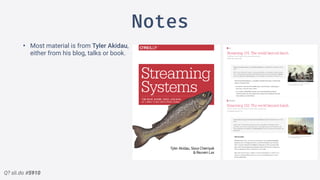
Notes
• Most material is from Tyler Akidau,
either from his blog, talks or book.
Q? sli.do #5910
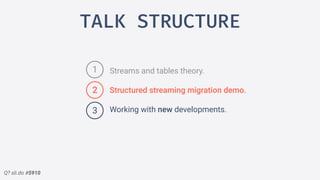
TALK STRUCTURE
Streams and tables theory.
Structured streaming migration demo.
Working with new developments.3
2
1
Q Q&A sli.do code: 5910
Q? sli.do #5910
TALK STRUCTURE
Streams and tables theory.
Structured streaming migration demo.
Working with new developments.3
2
1
Q? sli.do #5910
“Every Stream can yield a Table at a certain time,
& every Table can be observed into a Stream.”
1. Streams & Tables theory
Q? sli.do #5910
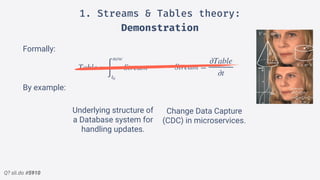
1. Streams & Tables theory:

Demonstration
Formally:
By example:
Stream =
∂Table
∂t
Table =
∫
now
t0
Stream
Underlying structure of
a Database system for
handling updates.
Change Data Capture

(CDC) in microservices.
Q? sli.do #5910
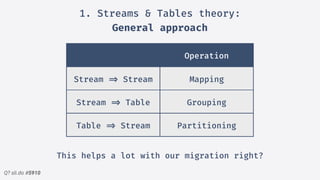
Operation
Stream !=> Stream Mapping
Stream !=> Table Grouping
Table !=> Stream Partitioning
This helps a lot with our migration right?
1. Streams & Tables theory:

General approach
Q? sli.do #5910
“Semantically batch is really just
a (strict) subset of streaming.”
1. Streams & Tables theory:
Batch & Streaming Engines
Q? sli.do #5910
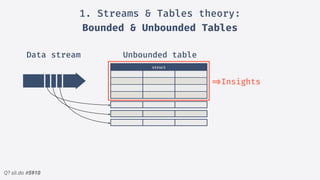
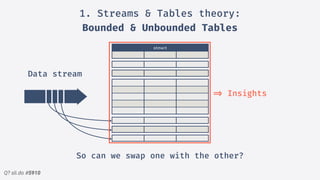
1. Streams & Tables theory:
Bounded & Unbounded Tables
struct
!=>Insights
Unbounded tableData stream
Q? sli.do #5910
1. Streams & Tables theory:
Bounded & Unbounded Tables
So can we swap one with the other?
struct
!=> Insights
Data stream
YES*
*but you’re going to need:
Tools for reasoning about time
Guarantee Correctness
Q? sli.do #5910
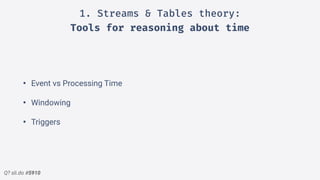
1. Streams & Tables theory:
Tools for reasoning about time
• Event vs Processing Time
• Windowing
• Triggers
Q? sli.do #5910
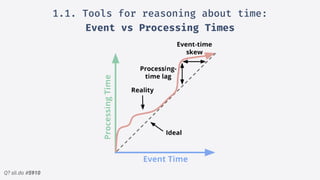
1.1. Tools for reasoning about time:
Event vs Processing Times
Q? sli.do #5910
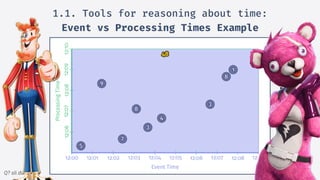
1.1. Tools for reasoning about time:
Event vs Processing Times Example
Q? sli.do #5910
1.1. Tools for reasoning about time:
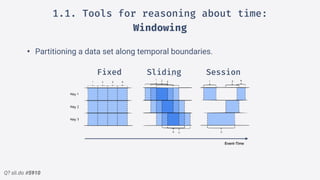
Windowing
• Partitioning a data set along temporal boundaries.
Fixed Sliding Session
Event-Time
Q? sli.do #5910
1.1. Tools for reasoning about time:
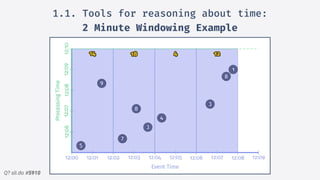
2 Minute Windowing Example
Q? sli.do #5910
1.1. Tools for reasoning about time:
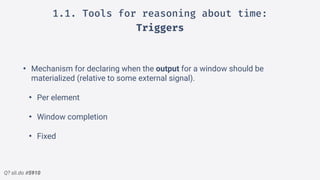
Triggers
• Mechanism for declaring when the output for a window should be
materialized (relative to some external signal).
• Per element
• Window completion
• Fixed
Q? sli.do #5910
1.1. Tools for reasoning about time:
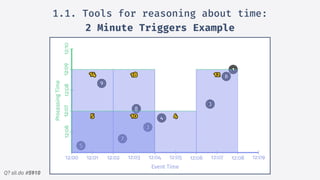
2 Minute Triggers Example
Q? sli.do #5910
1. Streams & Tables theory:
Correctness
• State
• Watermarks
• Late data firing
• Exactly one
Q? sli.do #5910
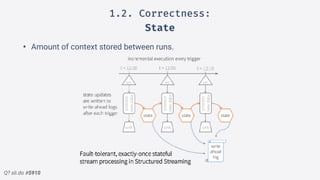
1.2. Correctness:
State
• Amount of context stored between runs.
Q? sli.do #5910
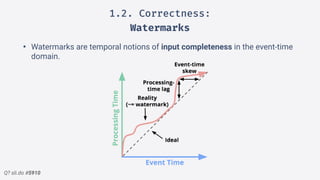
1.2. Correctness:
Watermarks
• Watermarks are temporal notions of input completeness in the event-time
domain.
Q? sli.do #5910
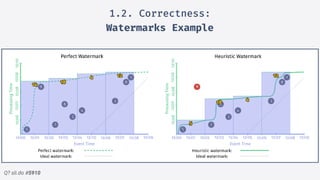
1.2. Correctness:
Watermarks Example
Q? sli.do #5910
1.2. Correctness:
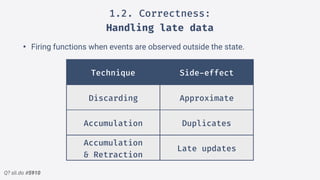
Handling late data
• Firing functions when events are observed outside the state.
Technique Side-effect
Discarding Approximate
Accumulation Duplicates
Accumulation

& Retraction
Late updates
Q? sli.do #5910
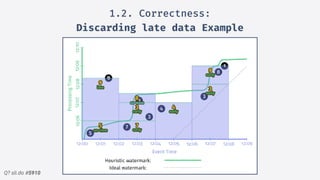
1.2. Correctness:
Discarding late data Example
Q? sli.do #5910
1.2. Correctness:
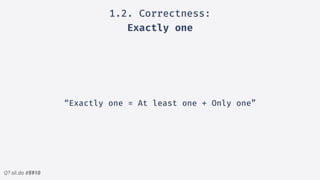
Exactly one
“Exactly one = At least one + Only one”
Q? sli.do #5910
1.2. Correctness:
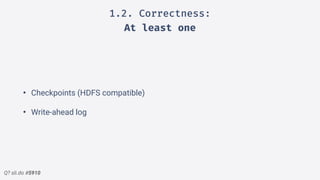
At least one
• Checkpoints (HDFS compatible)
• Write-ahead log
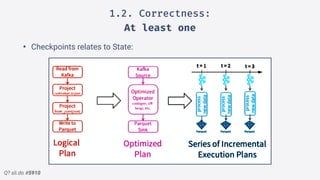
Q? sli.do #5910
1.2. Correctness:
At least one
• Checkpoints relates to State:
Q? sli.do #5910
1.2. Correctness:
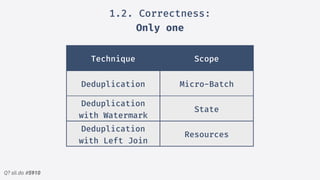
Only one
Technique Scope
Deduplication Micro-Batch
Deduplication

with Watermark
State
Deduplication

with Left Join
Resources
Q? sli.do #5910
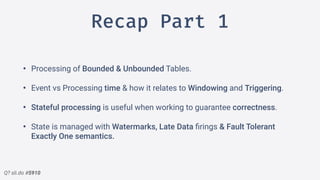
Recap Part 1
• Processing of Bounded & Unbounded Tables.
• Event vs Processing time & how it relates to Windowing and Triggering.
• Stateful processing is useful when working to guarantee correctness.
• State is managed with Watermarks, Late Data firings & Fault Tolerant
Exactly One semantics.
Q? sli.do #5910
TALK STRUCTURE
Streams and tables theory.
Structured streaming migration demo.
Working with new developments.3
2
1
Q? sli.do #5910
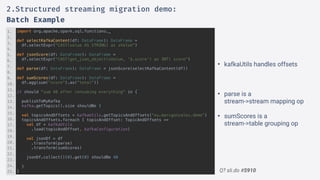
import org.apache.spark.sql.functions._
def selectKafkaContent(df: DataFrame): DataFrame =
df.selectExpr("CAST(value AS STRING) as sValue")
def jsonScore(df: DataFrame): DataFrame =
df.selectExpr("CAST(get_json_object(sValue, '$.score') as INT) score")
def parse(df: DataFrame): DataFrame = jsonScore(selectKafkaContent(df))
def sumScores(df: DataFrame): DataFrame =
df.agg(sum("score").as("total"))
it should "sum 48 after consuming everything" in {
publishToMyKafka
kafka.getTopics().size shouldBe 1
val topicsAndOffsets = kafkaUtils.getTopicsAndOffsets("eu.marcgonzalez.demo")
topicsAndOffsets.foreach { topicAndOffset: TopicAndOffsets =>
val df = kafkaUtils
.load(topicAndOffset, kafkaConfiguration)
val jsonDf = df
.transform(parse)
.transform(sumScores)
jsonDf.collect()(0).get(0) shouldBe 48
}
}
1.
2.
3.
4.
5.
6.
7.
8.
9.
10.
11.
12.
13.
14.
15.
16.
17.
18.
19.
20.
21.
22.
23.
24.
25.
2.Structured streaming migration demo:
Batch Example
• kafkaUtils handles offsets
• parse is a

stream->stream mapping op
• sumScores is a

stream->table grouping op
Q? sli.do #5910
def jsonScoreAndDate(df: DataFrame): DataFrame =
df.selectExpr(
"from_json(sValue, 'score INT, eventTime LONG, delayInMin INT') struct",
"timestamp as procTime")
.select(col("struct.*"), 'procTime)
.selectExpr("timestamp(eventTime/1000) as eventTime", "score", "procTime")
def parse(df: DataFrame): DataFrame = {
jsonScoreAndDate(selectKafkaContent(df))
}
def windowedSumScores(df: DataFrame): DataFrame =
df.groupBy(window($"eventTime", "2 minutes")).agg(sum("score").as("total"))
it should "sum 14, 18, 4, 12 after consuming everything in 2 minute windows" in {
val topicsAndOffsets = kafkaUtils.getTopicsAndOffsets("eu.marcgonzalez.demo")
topicsAndOffsets.foreach { topicAndOffset: TopicAndOffsets =>
val df = kafkaUtils
.load(topicAndOffset, kafkaConfiguration)
val jsonDf = df
.transform(parse)
.transform(windowedSumScores)
jsonDf
.sort("window").collect()
.foldLeft(Seq.empty[Int])(
(a, v) => a ++ Seq(v.get(1).asInstanceOf[Long].toInt)
) shouldBe Seq(14, 18, 4, 12)
}
}
1.
2.
3.
4.
5.
6.
7.
8.
9.
10.
11.
12.
13.
14.
15.
16.
17.
18.
19.
20.
21.
22.
23.
24.
25.
26.
2.Structured streaming migration demo:
Windowed Batch
• Extract eventTime from JSON
• Always try to enforce a
schema (JSON, AVRO)
• Fixed window partitions our
insight
Q? sli.do #5910
it should "sum 14,18,4,12 after streaming everything in 2 minute windows" in {
val topicsAndOffsets = kafkaUtils.getTopicsAndOffsets("eu.marcgonzalez.demo")
topicsAndOffsets.foreach { topicAndOffset: TopicAndOffsets =>
val df = spark.readStream
.format(“kafka")
.option(“kafka.bootstrap.servers", "localhost:9092")
.option("startingOffsets", "earliest")
.option("subscribe", topicAndOffset.topic)
.load()
df.isStreaming shouldBe true
val jsonDf = df
.transform(parse)
.transform(windowedSumScores)
val query = jsonDf.writeStream
.outputMode("update") //complete
.format("memory") //console
.queryName(queryName)
.trigger(Trigger.ProcessingTime("5 seconds")) //Once
.start()
query.awaitTermination(10 * 1000)
spark.sql(s"select * from $queryName order by window asc")
.collect()
.foldLeft(Seq.empty[Int])(
(a, v) => a ++ Seq(v.get(1).asInstanceOf[Long].toInt)
) shouldBe Seq(14, 18, 4, 12)
}
}
1.
2.
3.
4.
5.
6.
7.
8.
9.
10.
11.
12.
13.
14.
15.
16.
17.
18.
19.
20.
21.
22.
23.
24.
25.
26.
2.Structured streaming migration demo:
Windowed Stream Example
• read -> readStream, allowing S.S.S.
to take control over the input
offsets.
• Our dataframe is now a streaming
dataframe, & supports all previous
ops.
• write -> writeStream
• Modes: Complete, Update &
Append
• Sinks: Kafka, File, forEach,
memory & console for debug.
• Queryable state -> Eventual
Consistency
Q? sli.do #5910
it should "sum 5,18,4,12 after streaming everything in 2 minute windows" in {
timelyPublishToMyKafka
val topicsAndOffsets = kafkaUtils.getTopicsAndOffsets("eu.marcgonzalez.demo")
topicsAndOffsets.foreach { topicAndOffset: TopicAndOffsets =>
// Same reader as previous
val jsonDf = df
.transform(parse)
.withWatermark("eventTime", "2 minutes")
.transform(windowedSumScores)
val query = jsonDf
.writeStream
.outputMode(“update") //append
.format(“memory")
.queryName(queryName)
.trigger(Trigger.ProcessingTime("5 seconds”))
.start()
query.awaitTermination(15 * SECONDS_MS)
spark.sql(s"select window, max(total) from $queryName
group by window order by window asc")
.collect()
.foldLeft(Seq.empty[Int])(
(a, v) => a ++ Seq(v.get(1).asInstanceOf[Long].toInt)
) shouldBe Seq(5, 18, 4, 12)
}
}
1.
2.
3.
4.
5.
6.
7.
8.
9.
10.
11.
12.
13.
14.
15.
16.
17.
18.
19.
20.
21.
22.
23.
24.
25.
26.
2.Structured streaming migration demo:
Windowed Stream + Watermark Example
• Introduce a delay when
sending to kafka.
• We add a 2 minute watermark
• Event on a closed window gets
discarded!
• Append mode only sends
closed windows.
Q? sli.do #5910
Recap Part 2
• Reuse the same DF transformations
• Change read by readStream & write by writeStream
• Fixed triggers + start()
• Choosing the right Sinks + Output modes are key.
• State is managed through Spark Checkpoints. Do not mess with it!
Q? sli.do #5910
TALK STRUCTURE
Streams and tables theory.
Structured streaming migration demo.
Working with new developments.3
2
1
Q? sli.do #5910
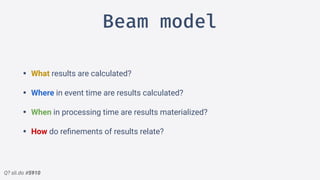
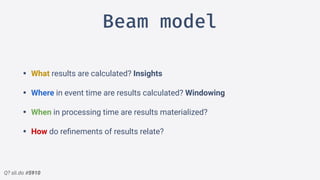
Beam model
• What results are calculated?
• Where in event time are results calculated?
• When in processing time are results materialized?
• How do refinements of results relate?
Q? sli.do #5910
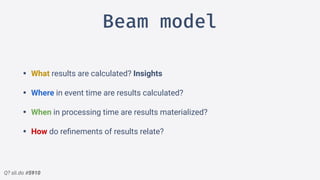
Beam model
• What results are calculated? Insights
• Where in event time are results calculated?
• When in processing time are results materialized?
• How do refinements of results relate?
Q? sli.do #5910
Beam model
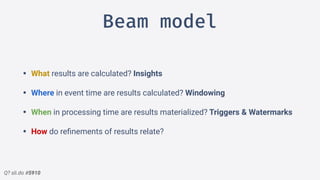
• What results are calculated? Insights
• Where in event time are results calculated? Windowing
• When in processing time are results materialized?
• How do refinements of results relate?
Q? sli.do #5910
Beam model
• What results are calculated? Insights
• Where in event time are results calculated? Windowing
• When in processing time are results materialized? Triggers & Watermarks
• How do refinements of results relate?
Q? sli.do #5910
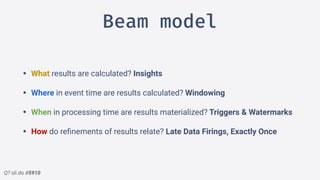
Beam model
• What results are calculated? Insights
• Where in event time are results calculated? Windowing
• When in processing time are results materialized? Triggers & Watermarks
• How do refinements of results relate? Late Data Firings, Exactly Once
Q? sli.do #5910
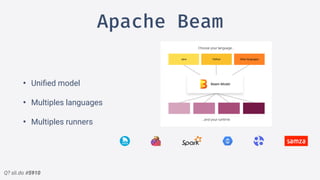
Apache Beam
• Unified model
• Multiples languages
• Multiples runners
Q? sli.do #5910
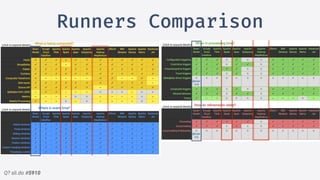
Runners Comparison
Q? sli.do #5910
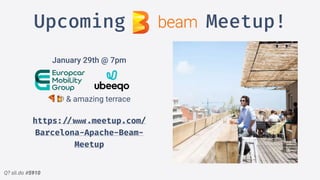
Upcoming Meetup!
January 29th @ 7pm


🍕🍺 & amazing terrace
https:!//!!www.meetup.com/
Barcelona-Apache-Beam-
Meetup
Q? sli.do #5910
Thank you!
sli.do

Spark Barcelona Meetup: Migrating Batch Jobs into Structured Streaming

  • 1.
    MIGRATING BATCH JOBS INTO STRUCTUREDSTREAMING Introduction to near real time analytics MARCGONZALEZ.EU
  • 2.
    Hi, I’m Marc! FreelanceData Engineer Developer, Consultant (and now) speaker 5+ years of big data experience, applied to classifieds market.
  • 3.
  • 4.
  • 5.
  • 6.
  • 7.
    Q? sli.do #5910 Audience •Experience with Dataframes. • Experience with DStreams. • Streams and tables theory. • Beam model.
  • 8.
    Q? sli.do #5910 Notes •Most material is from Tyler Akidau, either from his blog, talks or book.
  • 9.
    Q? sli.do #5910 TALKSTRUCTURE Streams and tables theory. Structured streaming migration demo. Working with new developments.3 2 1 Q Q&A sli.do code: 5910
  • 10.
    Q? sli.do #5910 TALKSTRUCTURE Streams and tables theory. Structured streaming migration demo. Working with new developments.3 2 1
  • 11.
    Q? sli.do #5910 “EveryStream can yield a Table at a certain time, & every Table can be observed into a Stream.” 1. Streams & Tables theory
  • 12.
    Q? sli.do #5910 1.Streams & Tables theory:
 Demonstration Formally: By example: Stream = ∂Table ∂t Table = ∫ now t0 Stream Underlying structure of a Database system for handling updates. Change Data Capture
 (CDC) in microservices.
  • 13.
    Q? sli.do #5910 Operation Stream!=> Stream Mapping Stream !=> Table Grouping Table !=> Stream Partitioning This helps a lot with our migration right? 1. Streams & Tables theory:
 General approach
  • 14.
    Q? sli.do #5910 “Semanticallybatch is really just a (strict) subset of streaming.” 1. Streams & Tables theory: Batch & Streaming Engines
  • 15.
    Q? sli.do #5910 1.Streams & Tables theory: Bounded & Unbounded Tables struct !=>Insights Unbounded tableData stream
  • 16.
    Q? sli.do #5910 1.Streams & Tables theory: Bounded & Unbounded Tables So can we swap one with the other? struct !=> Insights Data stream
  • 17.
    YES* *but you’re goingto need: Tools for reasoning about time Guarantee Correctness
  • 18.
    Q? sli.do #5910 1.Streams & Tables theory: Tools for reasoning about time • Event vs Processing Time • Windowing • Triggers
  • 19.
    Q? sli.do #5910 1.1.Tools for reasoning about time: Event vs Processing Times
  • 20.
    Q? sli.do #5910 1.1.Tools for reasoning about time: Event vs Processing Times Example
  • 21.
    Q? sli.do #5910 1.1.Tools for reasoning about time: Windowing • Partitioning a data set along temporal boundaries. Fixed Sliding Session Event-Time
  • 22.
    Q? sli.do #5910 1.1.Tools for reasoning about time: 2 Minute Windowing Example
  • 23.
    Q? sli.do #5910 1.1.Tools for reasoning about time: Triggers • Mechanism for declaring when the output for a window should be materialized (relative to some external signal). • Per element • Window completion • Fixed
  • 24.
    Q? sli.do #5910 1.1.Tools for reasoning about time: 2 Minute Triggers Example
  • 25.
    Q? sli.do #5910 1.Streams & Tables theory: Correctness • State • Watermarks • Late data firing • Exactly one
  • 26.
    Q? sli.do #5910 1.2.Correctness: State • Amount of context stored between runs.
  • 27.
    Q? sli.do #5910 1.2.Correctness: Watermarks • Watermarks are temporal notions of input completeness in the event-time domain.
  • 28.
    Q? sli.do #5910 1.2.Correctness: Watermarks Example
  • 29.
    Q? sli.do #5910 1.2.Correctness: Handling late data • Firing functions when events are observed outside the state. Technique Side-effect Discarding Approximate Accumulation Duplicates Accumulation
 & Retraction Late updates
  • 30.
    Q? sli.do #5910 1.2.Correctness: Discarding late data Example
  • 31.
    Q? sli.do #5910 1.2.Correctness: Exactly one “Exactly one = At least one + Only one”
  • 32.
    Q? sli.do #5910 1.2.Correctness: At least one • Checkpoints (HDFS compatible) • Write-ahead log
  • 33.
    Q? sli.do #5910 1.2.Correctness: At least one • Checkpoints relates to State:
  • 34.
    Q? sli.do #5910 1.2.Correctness: Only one Technique Scope Deduplication Micro-Batch Deduplication
 with Watermark State Deduplication
 with Left Join Resources
  • 35.
    Q? sli.do #5910 RecapPart 1 • Processing of Bounded & Unbounded Tables. • Event vs Processing time & how it relates to Windowing and Triggering. • Stateful processing is useful when working to guarantee correctness. • State is managed with Watermarks, Late Data firings & Fault Tolerant Exactly One semantics.
  • 36.
    Q? sli.do #5910 TALKSTRUCTURE Streams and tables theory. Structured streaming migration demo. Working with new developments.3 2 1
  • 37.
    Q? sli.do #5910 importorg.apache.spark.sql.functions._ def selectKafkaContent(df: DataFrame): DataFrame = df.selectExpr("CAST(value AS STRING) as sValue") def jsonScore(df: DataFrame): DataFrame = df.selectExpr("CAST(get_json_object(sValue, '$.score') as INT) score") def parse(df: DataFrame): DataFrame = jsonScore(selectKafkaContent(df)) def sumScores(df: DataFrame): DataFrame = df.agg(sum("score").as("total")) it should "sum 48 after consuming everything" in { publishToMyKafka kafka.getTopics().size shouldBe 1 val topicsAndOffsets = kafkaUtils.getTopicsAndOffsets("eu.marcgonzalez.demo") topicsAndOffsets.foreach { topicAndOffset: TopicAndOffsets => val df = kafkaUtils .load(topicAndOffset, kafkaConfiguration) val jsonDf = df .transform(parse) .transform(sumScores) jsonDf.collect()(0).get(0) shouldBe 48 } } 1. 2. 3. 4. 5. 6. 7. 8. 9. 10. 11. 12. 13. 14. 15. 16. 17. 18. 19. 20. 21. 22. 23. 24. 25. 2.Structured streaming migration demo: Batch Example • kafkaUtils handles offsets • parse is a
 stream->stream mapping op • sumScores is a
 stream->table grouping op
  • 38.
    Q? sli.do #5910 defjsonScoreAndDate(df: DataFrame): DataFrame = df.selectExpr( "from_json(sValue, 'score INT, eventTime LONG, delayInMin INT') struct", "timestamp as procTime") .select(col("struct.*"), 'procTime) .selectExpr("timestamp(eventTime/1000) as eventTime", "score", "procTime") def parse(df: DataFrame): DataFrame = { jsonScoreAndDate(selectKafkaContent(df)) } def windowedSumScores(df: DataFrame): DataFrame = df.groupBy(window($"eventTime", "2 minutes")).agg(sum("score").as("total")) it should "sum 14, 18, 4, 12 after consuming everything in 2 minute windows" in { val topicsAndOffsets = kafkaUtils.getTopicsAndOffsets("eu.marcgonzalez.demo") topicsAndOffsets.foreach { topicAndOffset: TopicAndOffsets => val df = kafkaUtils .load(topicAndOffset, kafkaConfiguration) val jsonDf = df .transform(parse) .transform(windowedSumScores) jsonDf .sort("window").collect() .foldLeft(Seq.empty[Int])( (a, v) => a ++ Seq(v.get(1).asInstanceOf[Long].toInt) ) shouldBe Seq(14, 18, 4, 12) } } 1. 2. 3. 4. 5. 6. 7. 8. 9. 10. 11. 12. 13. 14. 15. 16. 17. 18. 19. 20. 21. 22. 23. 24. 25. 26. 2.Structured streaming migration demo: Windowed Batch • Extract eventTime from JSON • Always try to enforce a schema (JSON, AVRO) • Fixed window partitions our insight
  • 39.
    Q? sli.do #5910 itshould "sum 14,18,4,12 after streaming everything in 2 minute windows" in { val topicsAndOffsets = kafkaUtils.getTopicsAndOffsets("eu.marcgonzalez.demo") topicsAndOffsets.foreach { topicAndOffset: TopicAndOffsets => val df = spark.readStream .format(“kafka") .option(“kafka.bootstrap.servers", "localhost:9092") .option("startingOffsets", "earliest") .option("subscribe", topicAndOffset.topic) .load() df.isStreaming shouldBe true val jsonDf = df .transform(parse) .transform(windowedSumScores) val query = jsonDf.writeStream .outputMode("update") //complete .format("memory") //console .queryName(queryName) .trigger(Trigger.ProcessingTime("5 seconds")) //Once .start() query.awaitTermination(10 * 1000) spark.sql(s"select * from $queryName order by window asc") .collect() .foldLeft(Seq.empty[Int])( (a, v) => a ++ Seq(v.get(1).asInstanceOf[Long].toInt) ) shouldBe Seq(14, 18, 4, 12) } } 1. 2. 3. 4. 5. 6. 7. 8. 9. 10. 11. 12. 13. 14. 15. 16. 17. 18. 19. 20. 21. 22. 23. 24. 25. 26. 2.Structured streaming migration demo: Windowed Stream Example • read -> readStream, allowing S.S.S. to take control over the input offsets. • Our dataframe is now a streaming dataframe, & supports all previous ops. • write -> writeStream • Modes: Complete, Update & Append • Sinks: Kafka, File, forEach, memory & console for debug. • Queryable state -> Eventual Consistency
  • 40.
    Q? sli.do #5910 itshould "sum 5,18,4,12 after streaming everything in 2 minute windows" in { timelyPublishToMyKafka val topicsAndOffsets = kafkaUtils.getTopicsAndOffsets("eu.marcgonzalez.demo") topicsAndOffsets.foreach { topicAndOffset: TopicAndOffsets => // Same reader as previous val jsonDf = df .transform(parse) .withWatermark("eventTime", "2 minutes") .transform(windowedSumScores) val query = jsonDf .writeStream .outputMode(“update") //append .format(“memory") .queryName(queryName) .trigger(Trigger.ProcessingTime("5 seconds”)) .start() query.awaitTermination(15 * SECONDS_MS) spark.sql(s"select window, max(total) from $queryName group by window order by window asc") .collect() .foldLeft(Seq.empty[Int])( (a, v) => a ++ Seq(v.get(1).asInstanceOf[Long].toInt) ) shouldBe Seq(5, 18, 4, 12) } } 1. 2. 3. 4. 5. 6. 7. 8. 9. 10. 11. 12. 13. 14. 15. 16. 17. 18. 19. 20. 21. 22. 23. 24. 25. 26. 2.Structured streaming migration demo: Windowed Stream + Watermark Example • Introduce a delay when sending to kafka. • We add a 2 minute watermark • Event on a closed window gets discarded! • Append mode only sends closed windows.
  • 41.
    Q? sli.do #5910 RecapPart 2 • Reuse the same DF transformations • Change read by readStream & write by writeStream • Fixed triggers + start() • Choosing the right Sinks + Output modes are key. • State is managed through Spark Checkpoints. Do not mess with it!
  • 42.
    Q? sli.do #5910 TALKSTRUCTURE Streams and tables theory. Structured streaming migration demo. Working with new developments.3 2 1
  • 43.
    Q? sli.do #5910 Beammodel • What results are calculated? • Where in event time are results calculated? • When in processing time are results materialized? • How do refinements of results relate?
  • 44.
    Q? sli.do #5910 Beammodel • What results are calculated? Insights • Where in event time are results calculated? • When in processing time are results materialized? • How do refinements of results relate?
  • 45.
    Q? sli.do #5910 Beammodel • What results are calculated? Insights • Where in event time are results calculated? Windowing • When in processing time are results materialized? • How do refinements of results relate?
  • 46.
    Q? sli.do #5910 Beammodel • What results are calculated? Insights • Where in event time are results calculated? Windowing • When in processing time are results materialized? Triggers & Watermarks • How do refinements of results relate?
  • 47.
    Q? sli.do #5910 Beammodel • What results are calculated? Insights • Where in event time are results calculated? Windowing • When in processing time are results materialized? Triggers & Watermarks • How do refinements of results relate? Late Data Firings, Exactly Once
  • 48.
    Q? sli.do #5910 ApacheBeam • Unified model • Multiples languages • Multiples runners
  • 49.
  • 50.
    Q? sli.do #5910 UpcomingMeetup! January 29th @ 7pm 
 
 🍕🍺 & amazing terrace https:!//!!www.meetup.com/ Barcelona-Apache-Beam- Meetup
  • 51.