SCHOOL OF ARCHITECTURE, BUILDING & DESIGN
Foundation of Natural Build Environment (FNBE) AUG 2014 INTAKE
ENGLISH 1
[ENGL0105 / ELG 30505]
NAME: JONATHAN LIM WEI JUN
STUDENT ID: 0321119
GROUP/SESSION: MONDAY 11AM-1PM GROUP
SUBMISSION DATE: 30TH APRIL 2015
26TH APRIL 2015
JOURNAL 01: SOCIAL PSYCHOLOGY
ENTRY 01: SOCIAL FACILITATION
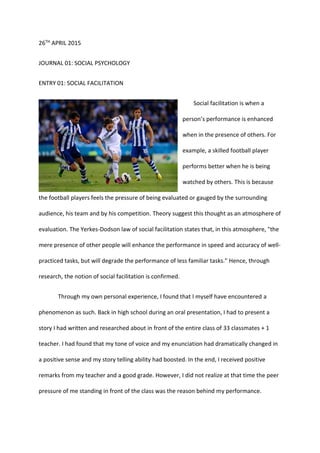
Social facilitation is when a
person’s performance is enhanced
when in the presence of others. For
example, a skilled football player
performs better when he is being
watched by others. This is because
the football players feels the pressure of being evaluated or gauged by the surrounding
audience, his team and by his competition. Theory suggest this thought as an atmosphere of
evaluation. The Yerkes-Dodson law of social facilitation states that, in this atmosphere, "the
mere presence of other people will enhance the performance in speed and accuracy of well-
practiced tasks, but will degrade the performance of less familiar tasks." Hence, through
research, the notion of social facilitation is confirmed.
Through my own personal experience, I found that I myself have encountered a
phenomenon as such. Back in high school during an oral presentation, I had to present a
story I had written and researched about in front of the entire class of 33 classmates + 1
teacher. I had found that my tone of voice and my enunciation had dramatically changed in
a positive sense and my story telling ability had boosted. In the end, I received positive
remarks from my teacher and a good grade. However, I did not realize at that time the peer
pressure of me standing in front of the class was the reason behind my performance.
Another example of this phenomenon that had occurred in my life was when I was
playing football back in secondary school against our seniors who were about 2 or 3 years
older than us. Because of their seniority, I was sure that we would be on the losing end.
However, during the game, I had this sudden adrenaline and pressure that drove me to
defend the “goalie” as good as possible. At the end of the game, our team had won,
surprisingly. Overjoyed and proud as we walked off the field, basking in our glory, believing
we had thrashed our seniors. However, looking back it could have been a hoax, leading us to
believe that we won instead of thinking it was their intention to lose. Who knows?
Nonetheless, I experienced social facilitation once again due to my team, the competition
and our coach.
In conclusion, the fact that in both events, my performance in the task that I am
prepared for or am good at becomes better when I was pressured by other people. I
imagined that I was being evaluated in the “atmosphere of evaluation”. Thus,
demonstrating the notion of social facilitation.
26TH APRIL 2015
JOURNAL 01: SOCIAL PSYCHOLOGY
ENTRY 02: SOCIAL LOAFING
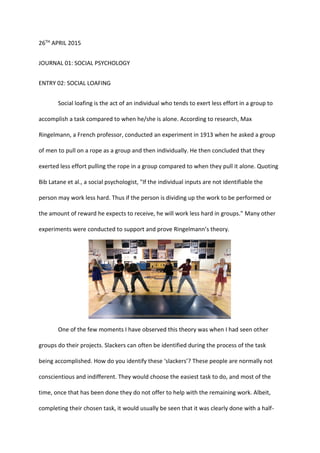
Social loafing is the act of an individual who tends to exert less effort in a group to
accomplish a task compared to when he/she is alone. According to research, Max
Ringelmann, a French professor, conducted an experiment in 1913 when he asked a group
of men to pull on a rope as a group and then individually. He then concluded that they
exerted less effort pulling the rope in a group compared to when they pull it alone. Quoting
Bib Latane et al., a social psychologist, "If the individual inputs are not identifiable the
person may work less hard. Thus if the person is dividing up the work to be performed or
the amount of reward he expects to receive, he will work less hard in groups." Many other
experiments were conducted to support and prove Ringelmann’s theory.
One of the few moments I have observed this theory was when I had seen other
groups do their projects. Slackers can often be identified during the process of the task
being accomplished. How do you identify these ‘slackers’? These people are normally not
conscientious and indifferent. They would choose the easiest task to do, and most of the
time, once that has been done they do not offer to help with the remaining work. Albeit,
completing their chosen task, it would usually be seen that it was clearly done with a half-
hearted attitude. And that is how you identify a ‘slacker’. The reason behind their attitude
towards the task is because they know that the rest of the team would carry the rest of the
effort to pass the project. Hence, not putting in 100% of his/her time and effort into their
work.
In conclusion, slackers are clear examples of people who are relative to the notion of
social loafing. However, I do admit that I myself slack sometimes. But hey, nobody is perfect.
26th APRIL 2015
JOURNAL 02: THE SELF
ENTRY 03: SOCIAL COMPARISON
Social comparison can be subdivided
into downward comparison and upward
comparisons. Social comparison is when we
compare ourselves to other people. This is
usually because we have the need to feel
good about ourselves, to boost our self-
esteem or to not feel bad ourselves. However, this could also result in your self-esteem
diminishing if the comparison is better than yours. An example would be when you would
compare your exam results to your friend’s results. In the first scenario, your friend’s results
is lower than yours, hence your self-esteem is enhanced. In the second scenario would be
your friend’s results is higher than yours, hence your self-esteem is diminished. Therefore,
your self-evaluation of your abilities and opinions are enhanced or diminished.
An example of social comparison that I have experienced is when my father had a
conversation with his friend about my achievements compared to his friend’s sons or
daughters, when I’m in the same room as them. As his friend’s sons accomplishments over--
achieve mine, my self-esteem is diminished. Well, so is my dad’s but mine is probably more
diminished. However, I begin to undermine my abilities and opinions. After some serious
thought, I decided to take it as an incentive to self-improve. Hence, my self-evaluation is
alleviated.
Besides, there are situations where the positions are reversed and my self-
evaluations of my abilities and opinions are enhanced. Thus, my self-esteem is also
enhanced. And hopefully so is my fathers. This phenomenon is known as downward
comparison.
In conclusion, social comparison affects a person’s ‘self’ through self-evaluation of
the ‘self’. In addition, it can enhance or diminish an individual’s self-concept. It can also be
seen as downward comparison.
26TH APRIL 2015
JOURNAL 03: SOCIAL COGNITION
ENTRY 04: COUNTERFACTUAL THINKING
Counterfactual thinking is when an individual imagines an alternative outcome of
what has already happened. These are the “what if’s” and the “if only’s”. Counterfactual
thinking is subdivided into upward counterfactuals and downward counterfactuals. Upwards
counterfactual thinking is beneficial to the situation, whereas downwards counterfactual
thinking worsens the situation. For example, “If I had cheated on my exam, I would have
been suspended or worse still expelled from school.” and “If only I had studied for the exam,
I would have passed with flying colours.” Upwards counterfactuals produce positive
emotions such as relief and satisfaction while downward counterfactuals produce negative
emotions such as regret and guilt. Based on personal experience in certain situations, I have
experienced both upward counterfactuals and downwards counterfactuals.
Firstly, I had experienced upward
counterfactuals when I had broken up with
my ex-girlfriend. After the break up, I had
thought to myself for some time, “you
know what, If hadn’t broken up with her, I
would still have to stay up late talking on
the phone, or go through endless arguments about minor and pointless issues or spend a
bomb on Valentines or Christmas.” This had made me feel satisfied and relieved that I had
made the right choice. However, this upward counterfactual didn’t stay for too long as time
passed by.
Secondly, the downwards counterfactual. This is when the truth kicked in. After a
month or two after the break up, I had found myself thinking, “if only I hadn’t let her go, I
would have someone to go to the movies with, spend time on Valentines with, or feel the
that warm feeling when you are next to the person of your dreams, or at least freaking hold
someone’s hand again.” On a more serious note, this is my example of downward
counterfactuals. As a result I had experienced emotions such as regret and grief.
In conclusion, this proves downward counterfactuals and upward counterfactuals
can be beneficial or can worsen a situation.
26TH APRIL 2015
JOURNAL 05: ATTITUDES
ENTRY 05: OPERANT CONDITIONING
Operant conditioning is an event or
antecedent that is followed by a response
with a reinforced stimulus. In other words,
an action that is motivated by
reinforcement or punishment to produce a
particular behaviour. B.F Skinner is said to
be the father or operant conditioning. One of his experiments that shows operant
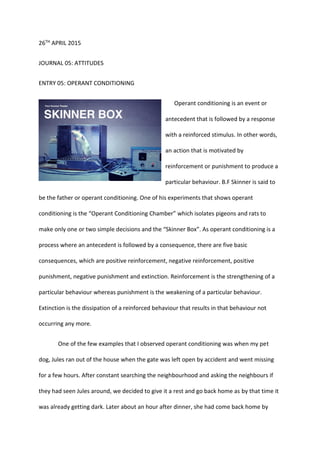
conditioning is the “Operant Conditioning Chamber” which isolates pigeons and rats to
make only one or two simple decisions and the “Skinner Box”. As operant conditioning is a
process where an antecedent is followed by a consequence, there are five basic
consequences, which are positive reinforcement, negative reinforcement, positive
punishment, negative punishment and extinction. Reinforcement is the strengthening of a
particular behaviour whereas punishment is the weakening of a particular behaviour.
Extinction is the dissipation of a reinforced behaviour that results in that behaviour not
occurring any more.
One of the few examples that I observed operant conditioning was when my pet
dog, Jules ran out of the house when the gate was left open by accident and went missing
for a few hours. After constant searching the neighbourhood and asking the neighbours if
they had seen Jules around, we decided to give it a rest and go back home as by that time it
was already getting dark. Later about an hour after dinner, she had come back home by
herself waiting in front of the gate. As the gate opened and she walked in, she was
welcomed back with a caning from my father and a scolding (even though their
communication were on different levels, he was probably hoping his tone of voice made an
impression of what he was trying to imply towards Jules). And from that day on, Jules never
ran away from the house again. That was an example of negative punishment where a
punishment averts future negative behaviours from occurring again. (Jules is now more
obedient and we love her more than ever from the bottom of our hearts and treat her like
family) As in like family, my siblings and I have also experienced similar punishments in
different situations as well.
In conclusion, operant conditioning is a moulding of our schema and it is a learning
process throughout our lives. Operant conditioning affects us in either a positive way or a
negative way as it will reinforce us to make future positive or negative decisions or
discourage us from positive or negative decisions.

SP Journal psychology

  • 1.
    SCHOOL OF ARCHITECTURE,BUILDING & DESIGN Foundation of Natural Build Environment (FNBE) AUG 2014 INTAKE ENGLISH 1 [ENGL0105 / ELG 30505] NAME: JONATHAN LIM WEI JUN STUDENT ID: 0321119 GROUP/SESSION: MONDAY 11AM-1PM GROUP SUBMISSION DATE: 30TH APRIL 2015
  • 2.
    26TH APRIL 2015 JOURNAL01: SOCIAL PSYCHOLOGY ENTRY 01: SOCIAL FACILITATION Social facilitation is when a person’s performance is enhanced when in the presence of others. For example, a skilled football player performs better when he is being watched by others. This is because the football players feels the pressure of being evaluated or gauged by the surrounding audience, his team and by his competition. Theory suggest this thought as an atmosphere of evaluation. The Yerkes-Dodson law of social facilitation states that, in this atmosphere, "the mere presence of other people will enhance the performance in speed and accuracy of well- practiced tasks, but will degrade the performance of less familiar tasks." Hence, through research, the notion of social facilitation is confirmed. Through my own personal experience, I found that I myself have encountered a phenomenon as such. Back in high school during an oral presentation, I had to present a story I had written and researched about in front of the entire class of 33 classmates + 1 teacher. I had found that my tone of voice and my enunciation had dramatically changed in a positive sense and my story telling ability had boosted. In the end, I received positive remarks from my teacher and a good grade. However, I did not realize at that time the peer pressure of me standing in front of the class was the reason behind my performance.
  • 3.
    Another example ofthis phenomenon that had occurred in my life was when I was playing football back in secondary school against our seniors who were about 2 or 3 years older than us. Because of their seniority, I was sure that we would be on the losing end. However, during the game, I had this sudden adrenaline and pressure that drove me to defend the “goalie” as good as possible. At the end of the game, our team had won, surprisingly. Overjoyed and proud as we walked off the field, basking in our glory, believing we had thrashed our seniors. However, looking back it could have been a hoax, leading us to believe that we won instead of thinking it was their intention to lose. Who knows? Nonetheless, I experienced social facilitation once again due to my team, the competition and our coach. In conclusion, the fact that in both events, my performance in the task that I am prepared for or am good at becomes better when I was pressured by other people. I imagined that I was being evaluated in the “atmosphere of evaluation”. Thus, demonstrating the notion of social facilitation.
  • 4.
    26TH APRIL 2015 JOURNAL01: SOCIAL PSYCHOLOGY ENTRY 02: SOCIAL LOAFING Social loafing is the act of an individual who tends to exert less effort in a group to accomplish a task compared to when he/she is alone. According to research, Max Ringelmann, a French professor, conducted an experiment in 1913 when he asked a group of men to pull on a rope as a group and then individually. He then concluded that they exerted less effort pulling the rope in a group compared to when they pull it alone. Quoting Bib Latane et al., a social psychologist, "If the individual inputs are not identifiable the person may work less hard. Thus if the person is dividing up the work to be performed or the amount of reward he expects to receive, he will work less hard in groups." Many other experiments were conducted to support and prove Ringelmann’s theory. One of the few moments I have observed this theory was when I had seen other groups do their projects. Slackers can often be identified during the process of the task being accomplished. How do you identify these ‘slackers’? These people are normally not conscientious and indifferent. They would choose the easiest task to do, and most of the time, once that has been done they do not offer to help with the remaining work. Albeit, completing their chosen task, it would usually be seen that it was clearly done with a half-
  • 5.
    hearted attitude. Andthat is how you identify a ‘slacker’. The reason behind their attitude towards the task is because they know that the rest of the team would carry the rest of the effort to pass the project. Hence, not putting in 100% of his/her time and effort into their work. In conclusion, slackers are clear examples of people who are relative to the notion of social loafing. However, I do admit that I myself slack sometimes. But hey, nobody is perfect.
  • 6.
    26th APRIL 2015 JOURNAL02: THE SELF ENTRY 03: SOCIAL COMPARISON Social comparison can be subdivided into downward comparison and upward comparisons. Social comparison is when we compare ourselves to other people. This is usually because we have the need to feel good about ourselves, to boost our self- esteem or to not feel bad ourselves. However, this could also result in your self-esteem diminishing if the comparison is better than yours. An example would be when you would compare your exam results to your friend’s results. In the first scenario, your friend’s results is lower than yours, hence your self-esteem is enhanced. In the second scenario would be your friend’s results is higher than yours, hence your self-esteem is diminished. Therefore, your self-evaluation of your abilities and opinions are enhanced or diminished. An example of social comparison that I have experienced is when my father had a conversation with his friend about my achievements compared to his friend’s sons or daughters, when I’m in the same room as them. As his friend’s sons accomplishments over-- achieve mine, my self-esteem is diminished. Well, so is my dad’s but mine is probably more diminished. However, I begin to undermine my abilities and opinions. After some serious thought, I decided to take it as an incentive to self-improve. Hence, my self-evaluation is alleviated.
  • 7.
    Besides, there aresituations where the positions are reversed and my self- evaluations of my abilities and opinions are enhanced. Thus, my self-esteem is also enhanced. And hopefully so is my fathers. This phenomenon is known as downward comparison. In conclusion, social comparison affects a person’s ‘self’ through self-evaluation of the ‘self’. In addition, it can enhance or diminish an individual’s self-concept. It can also be seen as downward comparison.
  • 8.
    26TH APRIL 2015 JOURNAL03: SOCIAL COGNITION ENTRY 04: COUNTERFACTUAL THINKING Counterfactual thinking is when an individual imagines an alternative outcome of what has already happened. These are the “what if’s” and the “if only’s”. Counterfactual thinking is subdivided into upward counterfactuals and downward counterfactuals. Upwards counterfactual thinking is beneficial to the situation, whereas downwards counterfactual thinking worsens the situation. For example, “If I had cheated on my exam, I would have been suspended or worse still expelled from school.” and “If only I had studied for the exam, I would have passed with flying colours.” Upwards counterfactuals produce positive emotions such as relief and satisfaction while downward counterfactuals produce negative emotions such as regret and guilt. Based on personal experience in certain situations, I have experienced both upward counterfactuals and downwards counterfactuals. Firstly, I had experienced upward counterfactuals when I had broken up with my ex-girlfriend. After the break up, I had thought to myself for some time, “you know what, If hadn’t broken up with her, I would still have to stay up late talking on the phone, or go through endless arguments about minor and pointless issues or spend a bomb on Valentines or Christmas.” This had made me feel satisfied and relieved that I had made the right choice. However, this upward counterfactual didn’t stay for too long as time passed by.
  • 9.
    Secondly, the downwardscounterfactual. This is when the truth kicked in. After a month or two after the break up, I had found myself thinking, “if only I hadn’t let her go, I would have someone to go to the movies with, spend time on Valentines with, or feel the that warm feeling when you are next to the person of your dreams, or at least freaking hold someone’s hand again.” On a more serious note, this is my example of downward counterfactuals. As a result I had experienced emotions such as regret and grief. In conclusion, this proves downward counterfactuals and upward counterfactuals can be beneficial or can worsen a situation.
  • 10.
    26TH APRIL 2015 JOURNAL05: ATTITUDES ENTRY 05: OPERANT CONDITIONING Operant conditioning is an event or antecedent that is followed by a response with a reinforced stimulus. In other words, an action that is motivated by reinforcement or punishment to produce a particular behaviour. B.F Skinner is said to be the father or operant conditioning. One of his experiments that shows operant conditioning is the “Operant Conditioning Chamber” which isolates pigeons and rats to make only one or two simple decisions and the “Skinner Box”. As operant conditioning is a process where an antecedent is followed by a consequence, there are five basic consequences, which are positive reinforcement, negative reinforcement, positive punishment, negative punishment and extinction. Reinforcement is the strengthening of a particular behaviour whereas punishment is the weakening of a particular behaviour. Extinction is the dissipation of a reinforced behaviour that results in that behaviour not occurring any more. One of the few examples that I observed operant conditioning was when my pet dog, Jules ran out of the house when the gate was left open by accident and went missing for a few hours. After constant searching the neighbourhood and asking the neighbours if they had seen Jules around, we decided to give it a rest and go back home as by that time it was already getting dark. Later about an hour after dinner, she had come back home by
  • 11.
    herself waiting infront of the gate. As the gate opened and she walked in, she was welcomed back with a caning from my father and a scolding (even though their communication were on different levels, he was probably hoping his tone of voice made an impression of what he was trying to imply towards Jules). And from that day on, Jules never ran away from the house again. That was an example of negative punishment where a punishment averts future negative behaviours from occurring again. (Jules is now more obedient and we love her more than ever from the bottom of our hearts and treat her like family) As in like family, my siblings and I have also experienced similar punishments in different situations as well. In conclusion, operant conditioning is a moulding of our schema and it is a learning process throughout our lives. Operant conditioning affects us in either a positive way or a negative way as it will reinforce us to make future positive or negative decisions or discourage us from positive or negative decisions.