Purpose






Overview of how we organize our efforts to help growers be successful
What’s behind the Pioneer® brand T Series
Research direction
Critical role of Plenish® high oleic soybeans in the overall marketplace
Answer your questions
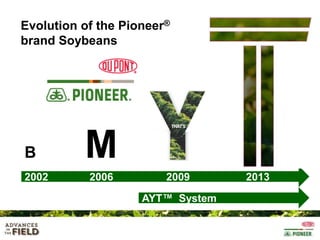
Evolution of the Pioneer®
brand Soybeans

B
2002

M
2006

2009

AYT™ System

2013
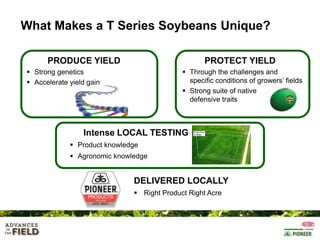
What Makes a T Series Soybeans Unique?
PRODUCE YIELD

PROTECT YIELD

 Strong genetics
 Accelerate yield gain

 Through the challenges and
specific conditions of growers’ fields
 Strong suite of native
defensive traits

Intense LOCAL TESTING
 Product knowledge
 Agronomic knowledge

DELIVERED LOCALLY
 Right Product Right Acre
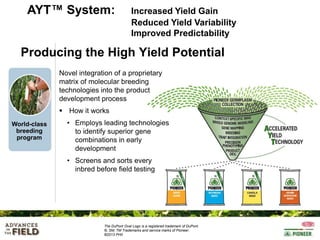
AYT™ System:

Increased Yield Gain
Reduced Yield Variability
Improved Predictability

Producing the High Yield Potential
Novel integration of a proprietary
matrix of molecular breeding
technologies into the product
development process
 How it works
World-class
breeding
program

• Employs leading technologies
to identify superior gene
combinations in early
development
• Screens and sorts every
inbred before field testing

The DuPont Oval Logo is a registered trademark of DuPont.
®, SM, TM Trademarks and service marks of Pioneer.
©2013 PHII
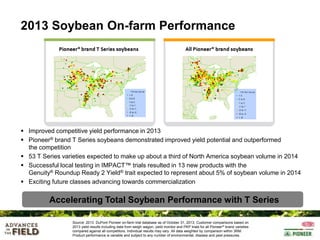
2013 Soybean On-farm Performance

 Improved competitive yield performance in 2013
 Pioneer® brand T Series soybeans demonstrated improved yield potential and outperformed
the competition
 53 T Series varieties expected to make up about a third of North America soybean volume in 2014
 Successful local testing in IMPACT™ trials resulted in 13 new products with the
Genuity® Roundup Ready 2 Yield® trait expected to represent about 5% of soybean volume in 2014
 Exciting future classes advancing towards commercialization

Accelerating Total Soybean Performance with T Series
Source: 2013 DuPont Pioneer on-farm trial database as of October 31, 2013. Customer comparisons based on
2013 yield results including data from weigh wagon, yield monitor and PKP trials for all Pioneer ® brand varieties
compared against all competitors. Individual results may vary. All data weighted by comparison within 3RM.
Product performance is variable and subject to any number of environmental, disease and pest pressures.
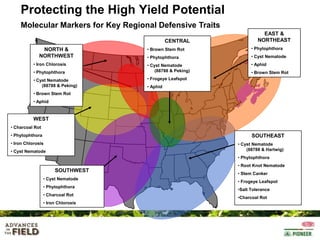
Protecting the High Yield Potential
Molecular Markers for Key Regional Defensive Traits
CENTRAL
NORTH &
NORTHWEST
• Iron Chlorosis
• Phytophthora
• Cyst Nematode
(88788 & Peking)

EAST &
NORTHEAST

• Brown Stem Rot

• Phytophthora

• Phytophthora

• Cyst Nematode

• Cyst Nematode
(88788 & Peking)

• Aphid
• Brown Stem Rot

• Frogeye Leafspot
• Aphid

• Brown Stem Rot
• Aphid

WEST
• Charcoal Rot
• Phytophthora

SOUTHEAST

• Iron Chlorosis

• Cyst Nematode
(88788 & Hartwig)

• Cyst Nematode

• Phytophthora
• Root Knot Nematode

SOUTHWEST
• Cyst Nematode
• Phytophthora
• Charcoal Rot
• Iron Chlorosis

• Stem Canker
• Frogeye Leafspot
•Salt Tolerance
•Charcoal Rot
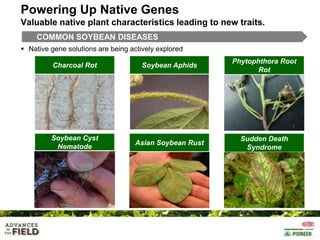
Powering Up Native Genes
Valuable native plant characteristics leading to new traits.
COMMON SOYBEAN DISEASES
 Native gene solutions are being actively explored
Charcoal Rot

Soybean Aphids

Phytophthora Root
Rot

Soybean Cyst
Nematode

Asian Soybean Rust

Sudden Death
Syndrome
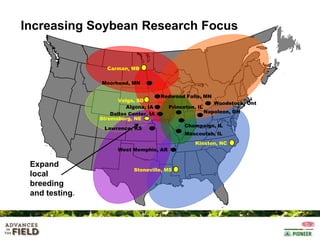
Increasing Soybean Research Focus

Carman, MB
Moorhead, MN
Volga, SD
Algona, IA
Dallas Center, IA
Stromsburg, NE

Redwood Falls, MN
Princeton, IL

Lawrence, KS

Woodstock, Ont
Napoleon, OH

Champaign, IL
Mascoutah, IL
Kinston, NC

West Memphis, AR

Expand
local
breeding
and testing.

Stoneville, MS
Soybean Research Growth
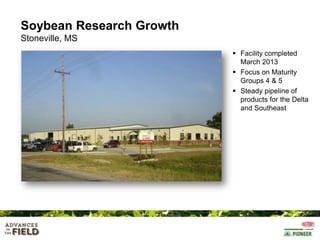
Stoneville, MS
 Facility completed
March 2013
 Focus on Maturity
Groups 4 & 5
 Steady pipeline of
products for the Delta
and Southeast
Soybean Research Growth
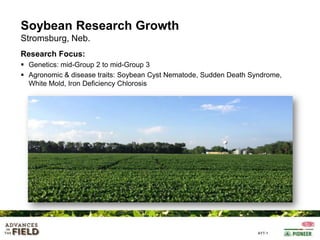
Stromsburg, Neb.
Research Focus:
 Genetics: mid-Group 2 to mid-Group 3
 Agronomic & disease traits: Soybean Cyst Nematode, Sudden Death Syndrome,
White Mold, Iron Deficiency Chlorosis

AYT-1
Improved “Testing Power”





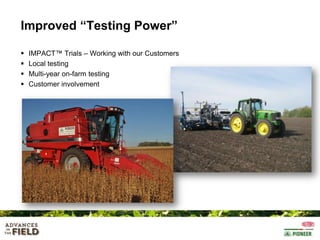
IMPACT™ Trials – Working with our Customers
Local testing
Multi-year on-farm testing
Customer involvement
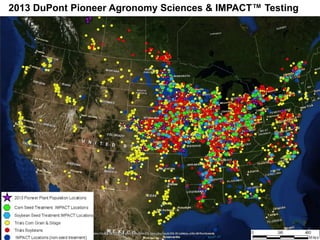
2013 DuPont Pioneer Agronomy Sciences & IMPACT™ Testing
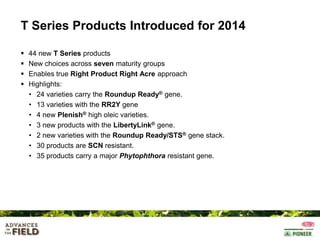
T Series Products Introduced for 2014





44 new T Series products
New choices across seven maturity groups
Enables true Right Product Right Acre approach
Highlights:
• 24 varieties carry the Roundup Ready® gene.
• 13 varieties with the RR2Y gene
• 4 new Plenish® high oleic varieties.
• 3 new products with the LibertyLink® gene.
• 2 new varieties with the Roundup Ready/STS® gene stack.
• 30 products are SCN resistant.
• 35 products carry a major Phytophthora resistant gene.
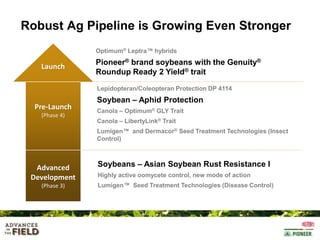
Robust Ag Pipeline is Growing Even Stronger
Optimum® Leptra™ hybrids

Launch

Pioneer® brand soybeans with the Genuity®
Roundup Ready 2 Yield® trait
Lepidopteran/Coleopteran Protection DP 4114

Pre-Launch
(Phase 4)

Soybean – Aphid Protection
Canola – Optimum® GLY Trait
Canola – LibertyLink® Trait
Lumigen™ and Dermacor® Seed Treatment Technologies (Insect
Control)

Advanced
Development
(Phase 3)
2008

Soybeans – Asian Soybean Rust Resistance I
Highly active oomycete control, new mode of action
Lumigen™ Seed Treatment Technologies (Disease Control)
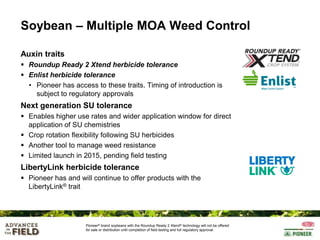
Soybean – Multiple MOA Weed Control
Auxin traits
 Roundup Ready 2 Xtend herbicide tolerance
 Enlist herbicide tolerance
• Pioneer has access to these traits. Timing of introduction is
subject to regulatory approvals

Next generation SU tolerance
 Enables higher use rates and wider application window for direct
application of SU chemistries
 Crop rotation flexibility following SU herbicides
 Another tool to manage weed resistance
 Limited launch in 2015, pending field testing

LibertyLink herbicide tolerance
 Pioneer has and will continue to offer products with the
LibertyLink® trait

Pioneer® brand soybeans with the Roundup Ready 2 Xtend® technology will not be offered
for sale or distribution until completion of field testing and full regulatory approval.
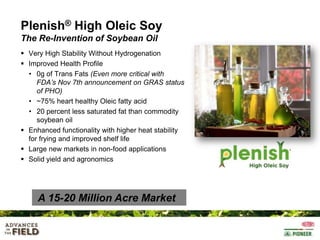
Plenish® High Oleic Soy
The Re-Invention of Soybean Oil
 Very High Stability Without Hydrogenation
 Improved Health Profile
• 0g of Trans Fats (Even more critical with
FDA’s Nov 7th announcement on GRAS status
of PHO)
• ~75% heart healthy Oleic fatty acid
• 20 percent less saturated fat than commodity
soybean oil
 Enhanced functionality with higher heat stability
for frying and improved shelf life
 Large new markets in non-food applications
 Solid yield and agronomics

A 15-20 Million Acre Market
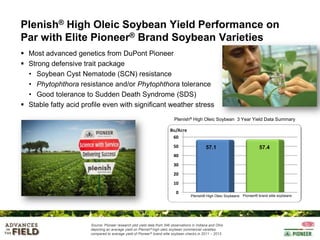
Plenish® High Oleic Soybean Yield Performance on
Par with Elite Pioneer® Brand Soybean Varieties
 Most advanced genetics from DuPont Pioneer
 Strong defensive trait package
• Soybean Cyst Nematode (SCN) resistance
• Phytophthora resistance and/or Phytophthora tolerance
• Good tolerance to Sudden Death Syndrome (SDS)
 Stable fatty acid profile even with significant weather stress
Plenish® High Oleic Soybean 3 Year Yield Data Summary

Bu/Acre
60
50

57.1

57.4

40
30
20
10
0

Plenish® High Oleic Soybeans Pioneer® brand elite soybeans

Source: Pioneer research plot yield data from 346 observations in Indiana and Ohio
depicting an average yield on Plenish® high oleic soybean commercial varieties
compared to average yield of Pioneer® brand elite soybean checks in 2011 – 2013.
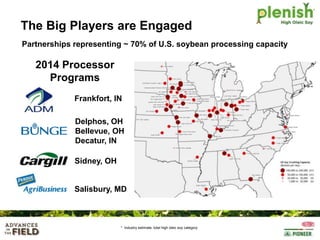
The Big Players are Engaged
Partnerships representing ~ 70% of U.S. soybean processing capacity

2014 Processor
Programs
Frankfort, IN
Delphos, OH
Bellevue, OH
Decatur, IN
Sidney, OH

Salisbury, MD

* Industry estimate, total high oleic soy category
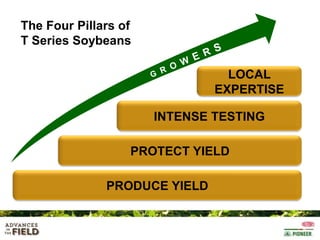
The Four Pillars of
T Series Soybeans
LOCAL
EXPERTISE
INTENSE TESTING
PROTECT YIELD
PRODUCE YIELD
Thank You!
Merci!
Soybean Update

Soybean Update

  • 2.
    Purpose      Overview of howwe organize our efforts to help growers be successful What’s behind the Pioneer® brand T Series Research direction Critical role of Plenish® high oleic soybeans in the overall marketplace Answer your questions
  • 3.
    Evolution of thePioneer® brand Soybeans B 2002 M 2006 2009 AYT™ System 2013
  • 4.
    What Makes aT Series Soybeans Unique? PRODUCE YIELD PROTECT YIELD  Strong genetics  Accelerate yield gain  Through the challenges and specific conditions of growers’ fields  Strong suite of native defensive traits Intense LOCAL TESTING  Product knowledge  Agronomic knowledge DELIVERED LOCALLY  Right Product Right Acre
  • 5.
    AYT™ System: Increased YieldGain Reduced Yield Variability Improved Predictability Producing the High Yield Potential Novel integration of a proprietary matrix of molecular breeding technologies into the product development process  How it works World-class breeding program • Employs leading technologies to identify superior gene combinations in early development • Screens and sorts every inbred before field testing The DuPont Oval Logo is a registered trademark of DuPont. ®, SM, TM Trademarks and service marks of Pioneer. ©2013 PHII
  • 6.
    2013 Soybean On-farmPerformance  Improved competitive yield performance in 2013  Pioneer® brand T Series soybeans demonstrated improved yield potential and outperformed the competition  53 T Series varieties expected to make up about a third of North America soybean volume in 2014  Successful local testing in IMPACT™ trials resulted in 13 new products with the Genuity® Roundup Ready 2 Yield® trait expected to represent about 5% of soybean volume in 2014  Exciting future classes advancing towards commercialization Accelerating Total Soybean Performance with T Series Source: 2013 DuPont Pioneer on-farm trial database as of October 31, 2013. Customer comparisons based on 2013 yield results including data from weigh wagon, yield monitor and PKP trials for all Pioneer ® brand varieties compared against all competitors. Individual results may vary. All data weighted by comparison within 3RM. Product performance is variable and subject to any number of environmental, disease and pest pressures.
  • 7.
    Protecting the HighYield Potential Molecular Markers for Key Regional Defensive Traits CENTRAL NORTH & NORTHWEST • Iron Chlorosis • Phytophthora • Cyst Nematode (88788 & Peking) EAST & NORTHEAST • Brown Stem Rot • Phytophthora • Phytophthora • Cyst Nematode • Cyst Nematode (88788 & Peking) • Aphid • Brown Stem Rot • Frogeye Leafspot • Aphid • Brown Stem Rot • Aphid WEST • Charcoal Rot • Phytophthora SOUTHEAST • Iron Chlorosis • Cyst Nematode (88788 & Hartwig) • Cyst Nematode • Phytophthora • Root Knot Nematode SOUTHWEST • Cyst Nematode • Phytophthora • Charcoal Rot • Iron Chlorosis • Stem Canker • Frogeye Leafspot •Salt Tolerance •Charcoal Rot
  • 8.
    Powering Up NativeGenes Valuable native plant characteristics leading to new traits. COMMON SOYBEAN DISEASES  Native gene solutions are being actively explored Charcoal Rot Soybean Aphids Phytophthora Root Rot Soybean Cyst Nematode Asian Soybean Rust Sudden Death Syndrome
  • 9.
    Increasing Soybean ResearchFocus Carman, MB Moorhead, MN Volga, SD Algona, IA Dallas Center, IA Stromsburg, NE Redwood Falls, MN Princeton, IL Lawrence, KS Woodstock, Ont Napoleon, OH Champaign, IL Mascoutah, IL Kinston, NC West Memphis, AR Expand local breeding and testing. Stoneville, MS
  • 10.
    Soybean Research Growth Stoneville,MS  Facility completed March 2013  Focus on Maturity Groups 4 & 5  Steady pipeline of products for the Delta and Southeast
  • 11.
    Soybean Research Growth Stromsburg,Neb. Research Focus:  Genetics: mid-Group 2 to mid-Group 3  Agronomic & disease traits: Soybean Cyst Nematode, Sudden Death Syndrome, White Mold, Iron Deficiency Chlorosis AYT-1
  • 12.
    Improved “Testing Power”     IMPACT™Trials – Working with our Customers Local testing Multi-year on-farm testing Customer involvement
  • 13.
    2013 DuPont PioneerAgronomy Sciences & IMPACT™ Testing
  • 14.
    T Series ProductsIntroduced for 2014     44 new T Series products New choices across seven maturity groups Enables true Right Product Right Acre approach Highlights: • 24 varieties carry the Roundup Ready® gene. • 13 varieties with the RR2Y gene • 4 new Plenish® high oleic varieties. • 3 new products with the LibertyLink® gene. • 2 new varieties with the Roundup Ready/STS® gene stack. • 30 products are SCN resistant. • 35 products carry a major Phytophthora resistant gene.
  • 15.
    Robust Ag Pipelineis Growing Even Stronger Optimum® Leptra™ hybrids Launch Pioneer® brand soybeans with the Genuity® Roundup Ready 2 Yield® trait Lepidopteran/Coleopteran Protection DP 4114 Pre-Launch (Phase 4) Soybean – Aphid Protection Canola – Optimum® GLY Trait Canola – LibertyLink® Trait Lumigen™ and Dermacor® Seed Treatment Technologies (Insect Control) Advanced Development (Phase 3) 2008 Soybeans – Asian Soybean Rust Resistance I Highly active oomycete control, new mode of action Lumigen™ Seed Treatment Technologies (Disease Control)
  • 16.
    Soybean – MultipleMOA Weed Control Auxin traits  Roundup Ready 2 Xtend herbicide tolerance  Enlist herbicide tolerance • Pioneer has access to these traits. Timing of introduction is subject to regulatory approvals Next generation SU tolerance  Enables higher use rates and wider application window for direct application of SU chemistries  Crop rotation flexibility following SU herbicides  Another tool to manage weed resistance  Limited launch in 2015, pending field testing LibertyLink herbicide tolerance  Pioneer has and will continue to offer products with the LibertyLink® trait Pioneer® brand soybeans with the Roundup Ready 2 Xtend® technology will not be offered for sale or distribution until completion of field testing and full regulatory approval.
  • 17.
    Plenish® High OleicSoy The Re-Invention of Soybean Oil  Very High Stability Without Hydrogenation  Improved Health Profile • 0g of Trans Fats (Even more critical with FDA’s Nov 7th announcement on GRAS status of PHO) • ~75% heart healthy Oleic fatty acid • 20 percent less saturated fat than commodity soybean oil  Enhanced functionality with higher heat stability for frying and improved shelf life  Large new markets in non-food applications  Solid yield and agronomics A 15-20 Million Acre Market
  • 18.
    Plenish® High OleicSoybean Yield Performance on Par with Elite Pioneer® Brand Soybean Varieties  Most advanced genetics from DuPont Pioneer  Strong defensive trait package • Soybean Cyst Nematode (SCN) resistance • Phytophthora resistance and/or Phytophthora tolerance • Good tolerance to Sudden Death Syndrome (SDS)  Stable fatty acid profile even with significant weather stress Plenish® High Oleic Soybean 3 Year Yield Data Summary Bu/Acre 60 50 57.1 57.4 40 30 20 10 0 Plenish® High Oleic Soybeans Pioneer® brand elite soybeans Source: Pioneer research plot yield data from 346 observations in Indiana and Ohio depicting an average yield on Plenish® high oleic soybean commercial varieties compared to average yield of Pioneer® brand elite soybean checks in 2011 – 2013.
  • 19.
    The Big Playersare Engaged Partnerships representing ~ 70% of U.S. soybean processing capacity 2014 Processor Programs Frankfort, IN Delphos, OH Bellevue, OH Decatur, IN Sidney, OH Salisbury, MD * Industry estimate, total high oleic soy category
  • 20.
    The Four Pillarsof T Series Soybeans LOCAL EXPERTISE INTENSE TESTING PROTECT YIELD PRODUCE YIELD
  • 21.

Editor's Notes

  • #6 As global food, feed, fuel and fiber consumption continues to increase, we must look for ways to enhance grain production to meet these growing demands. Pioneer is constantly looking for methods to enhance productivity and bring the best products to customers faster. The AYT™ system acts as a funnel as millions of experimental inbreds of interest go into the system and only a small percentage advance to field trials. Since the technology is able to screen and sort every inbred before it is planted in a research plot, researchers anticipate increasing the number of inbreds evaluated by tenfold over the next five years. Increasing the size of the breeding program through the AYT™ system ensures that Pioneer is able to test and advance products developed for specific environments and geographies, increasing genetic gain and further enabling its Right Product Right Acre strategy.  The AYT™ system employs a number of genetic technologies to identify superior genetic combinations earlier than traditional methods. Some of these scientific methods include genetic mapping, marker assisted selection (MAS) for simply-inherited traits, context-specific MAS (CSM) for complex traits, whole genome modeling, double haploids, laser assisted seed selection, and precision phenotyping methods. Through the AYT system, the genetic signal across the genome and at chromosomal hot spots associated with yield, disease resistance and other desirable traits are identified.
  • #7 Improved yield performance and successful IMPACT trial testing
  • #10 Schnebly / AltMO and IA version of soy slides Map – only slide needed for MO (TF to deliver)Mention of Stromsburg we are accelerating genetic gain (key focus!) increasing local testing Still focusing on native traits for yield and stability
  • #12 DuPont Pioneer Soybean ResearchWe continue to increase investment in research We are mining the deep Pioneer germplasm pool faster and more efficientlyDoubling the rate of genetic yield gain and further improving agronomic and defensive traits is our goalEnd result is to deliver best products for our customers with the desired technology optionsIn the past 5 years:Research testing has increased 10 fold Pioneer has doubled its number of research centers
  • #15 39 new T Series products represent the largest number of soybean varieties advanced in a single year by Pioneer.Offer growers a broad range of new choices across sevenmaturity groups.Enable Pioneer sales professionals to help growers place the right product on the right acreto maximize performance.Product highlights:34 varieties carry the Roundup Ready® gene.2 new Plenish® high oleic varieties. 2 new varieties with the Roundup Ready/STS® gene stack. 5 new products with the LibertyLink® gene. 32 products are SCN resistant. 29 products carry a majorPhytophthoraresistant gene.