South Africa’s Struggle:
Freedom in our Lifetime
September’s Theme
 Word meaning “separate” or “apartness”
 Racial discrimination and separation of whites, blacks,
coloureds, and Asians
 Schools, housing, jobs, and transportation
 Asians had fewer rights than whites but more than
blacks.
 Modern day “rainbow nation”
Apartheid
 Khoisan
 Thousands of years ago
 Hunter-gatherers and pastoralists
 Cattle, sheep, and goats
 Bantu
 3rd C. – 16th C.
 Farmers
 Cattle as currency/power
The First South Africans
 Portuguese arrive at the Cape of Good Hope (1487)
 First settlement (1652)
 Provisions stop for trading ships
 Composed of Dutch, some French and Germans
 Afrikaner = “African”
Arrival of Outsiders
 Granted settlers 28 acres (1/3 KM x 1/3 KM)
 Khoisan resisted in sporadic battles
 Defeated
 Dutch stole their cattle
 Afterward, Khoisan:
 Free laborers, tradesmen with settlers, retreated from
settlements
Conflict with Khoisan
 Becomes increasingly popular
 60,000 over the next 150 years
 From Madagascar, eastern Africa, western Africa,
India, and SE Asia
 Interbreeding of slaves and Khoisan and whites
 Descendants = “coloureds”
Slavery
 Boer = “farmer”
 Trekboer = “travelling farmer”
 Pioneers who settled north and east of Cape Town
 Until the 1810’s
 Violence to the east with Xhosa
 More organized and unified than Khoisan
 Defended territory well
Boer/trekboer
 Dutch East India Company goes bankrupt
 Britain takes over
 First large groups of British arrive
 Unlike Boers, do not adopt culture or language
 Called “English”
In Come the British
 British quickly abolished slavery in all colonies (1834)
 Boers lose free labor supply
 Afrikaners migrate north
 “Great Trek”
 To preserve a society with clear color-based distinctions
between master and servant
 Import Indians as indentured servants
 6,000
Impact of the English
 Reading on page 6
 Ss sketch and explain life working in the mines of
South Africa
Control of the Mines
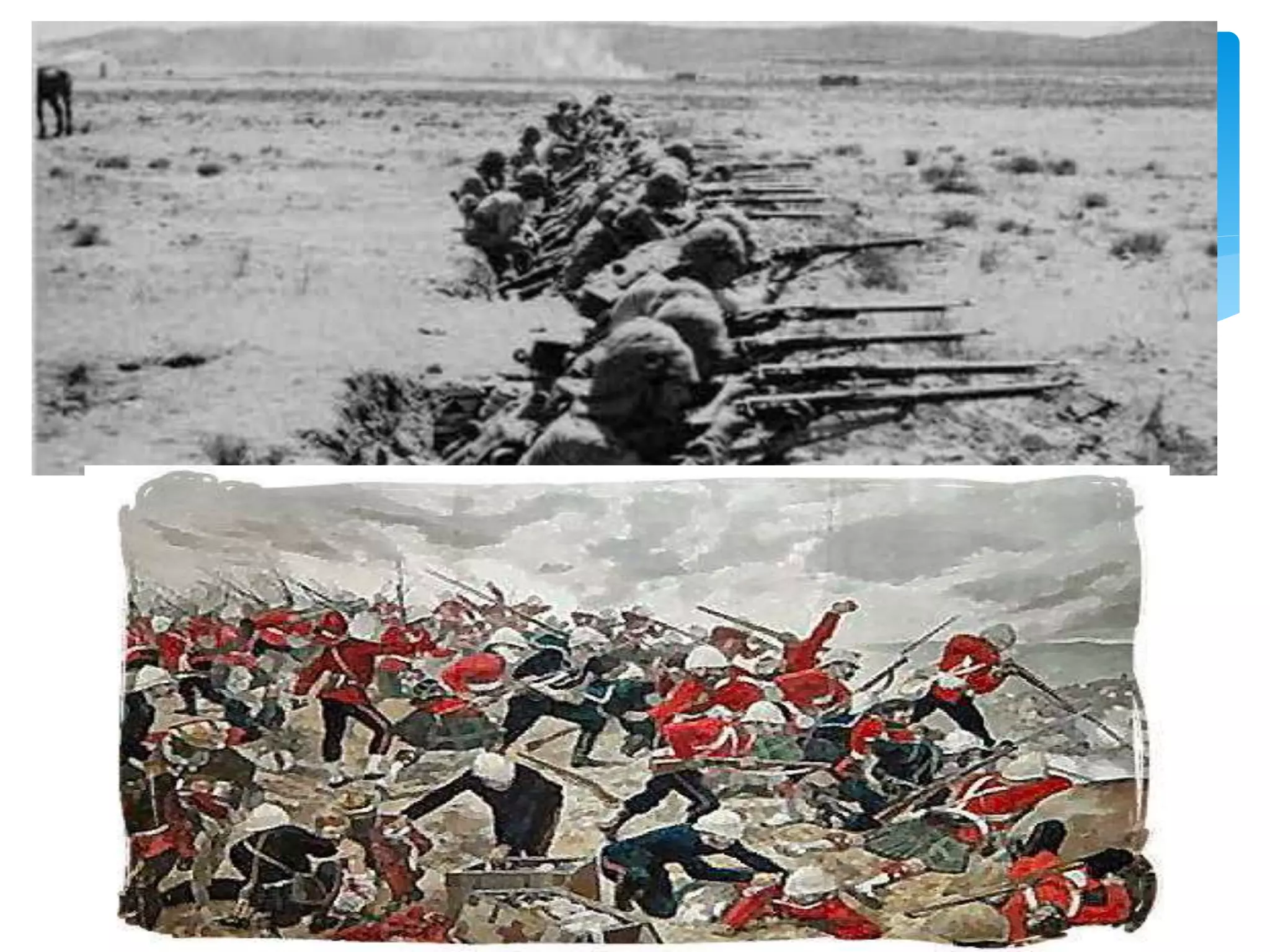
 Afrikaners launch attacks against the British for
control of the gold and diamond mines.
 Britain = 500,000 soldiers
 Afrikaners = 40,000 soldiers
 Britain implements scorched-earth campaign
 Women and children placed in concentration camps
 28,000 died of disease
 Fuels Afrikaner nationalism
Anglo-Boer War
 British colonies and Afrikaner Republics joined
together as Union of South Africa (1910)
 S. Africa self-governed, but part of British Empire
 Blacks fought on both sides
Those who fought with the British expected further rights
Nope
End of War
 Native Lands Act (1913)
 Legislation creating separate areas for Europeans and
Africans land ownership
 8% of countryside
Apartheid
 Formation of African National Congress, ANC (1912)
 Opposed discrimination through petitions
 “We are one.”
 Policy of passive resistance
 influenced by Mohandas Gandhi
 Lawyer for Indians in S. Africa (1893)
 Later forms South African Indian Congress, SAIC
Response to Apartheid
 Non-violent demonstration against passbooks (1919)
 Blacks needed to carry passbooks with them at all times
 Mounted police ran down protestors
 Officers encouraged white civilians to attack black
demonstrators
 Several protestors died
ANC Demonstration
 National Party victory brings ultra-right wing ideology
 Prohibition of Mixed Marriages Act (1949)
 Blacks and whites could not marry
 Population Registration Act (1950)
 Created three official races: white, African, and coloured
 African further divided, “divide and conquer”
 Asians = coloured
Election of 1948
 Group Areas Act (1950)
 Designation of all of the land of S. Africa
 Whites = 86% (best land), 20% of population
 Schools came under control of government
 Textbooks focused on white experiences
 Taught only basic, low-level skills for low-level jobs
More Effects of the Afrikaner Rise
 Group Areas Act forced blacks into townships in
urban areas
 Commuted to jobs such as gardeners, servants, and
factory workers
 One family in a 2/3 room house, often:
 No electricity, running water, sewer system
 Africans without a job were forced to the countryside
 Millions reassigned
Life in a Township
 Congress Youth League emerges from the ANC (1944)
 Adopts a confrontational stance
 Radicals
 ANC used non-violent means
 Boycotts and strikes
 Opposed Natives Abolition of Passes Act
 Actually required more information in passbook
More Opposition to Apartheid
 Inspired by Gandhi, ANC filled courts and prisons with
people arrested on pass offenses
 Overloading system
 Five months, eight thousand arrested an imprisoned
 Drew much support: coloureds, whites, Communists
 Began publishing magazines and newspapers
ANC opposition, cont.
 Criminal Law Act
 If the intent of the law-breaker was to protest the law,
the punishment was magnified
 3 years in prison and/or public flogging
More Apartheid
 Alexandra bus boycott (1957)
 Bus company introduced an increase to fares
 Residents of Johannesburg township in Alexandra
refuse to use bus system
 Walked or rode bicycles, up to 20 miles away
 Productivity fell, workers late and exhausted
 Decreased productivity leads to govt. subsidy of bus fares
Power of Change
 From the Youth League of the ANC, the Pan African
Congress, PAC, emerges
 African Nationalism = “Africanism”
 PAC was anti-colonial
 “government of the Africans, for the Africans,
by the Africans.”
 “mental revolution”
 Lose the “slave mentality”
Radicals Emerge
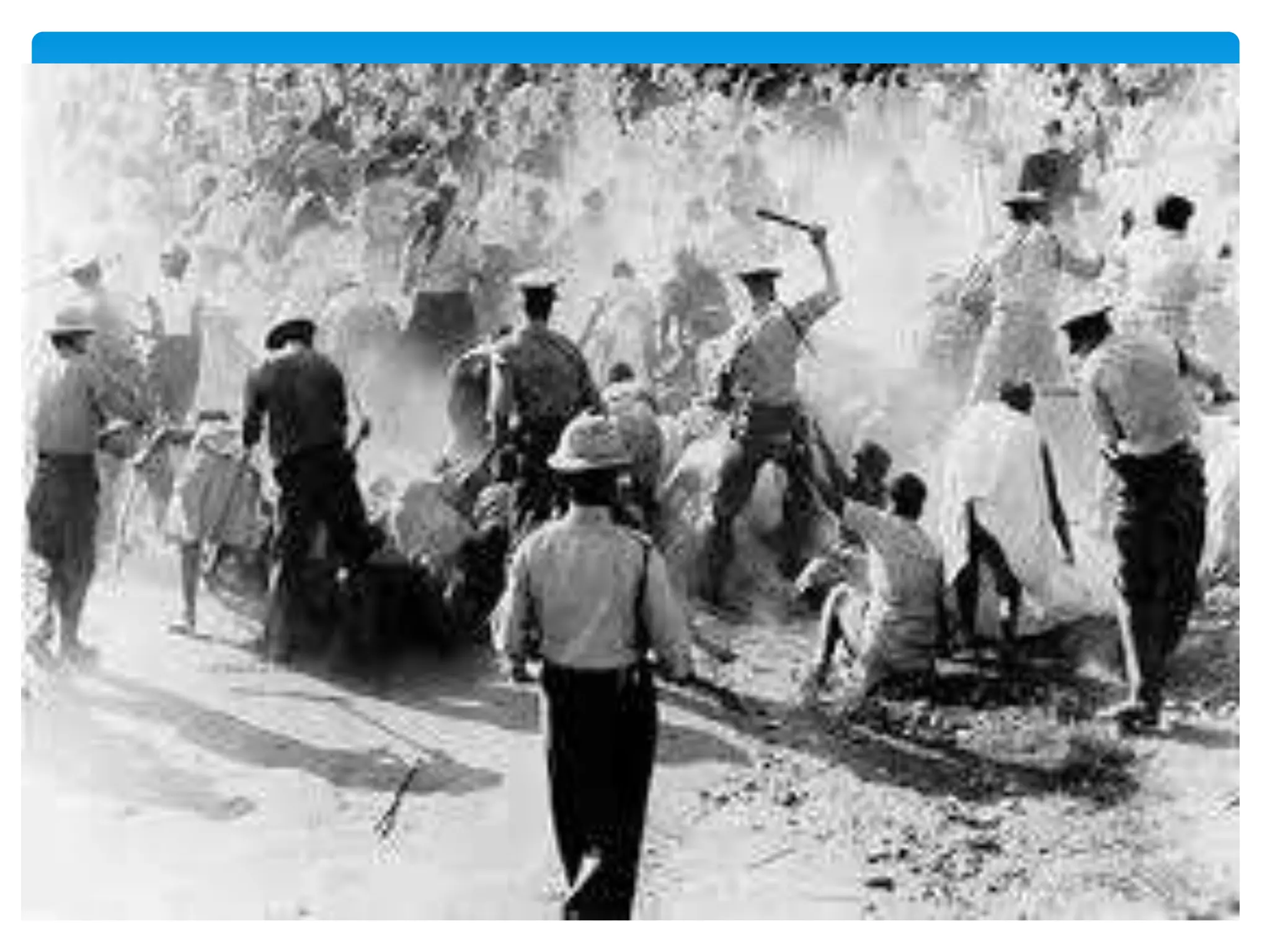
 PAC volunteers fanned out across South Africa to
recruit those willing to demand their own arrest
 Homeless, jobless, uneducated, and oppressed were
eager to participate
 PAC wrote a letter explaining they would surrender in
large numbers peacefully
 Protestors were under strict orders to avoid violence
Resistance in Sharpeville
 The crowd of 5,000 (many children) gathered at the
police station
 The surging crowd knocked over a police officer
 The crowd pushed further to see what happened
 Police opened fire, continuing to fire into the backs of
fleeing protestors
 69 Africans died and 186 wounded
The Sharpeville Massacre
 PAC called on workers to remain home
 Police forced themselves into worker homes and forced
abstainers to work
 More protests followed
 30,000 at the Parliament building in Cape Town
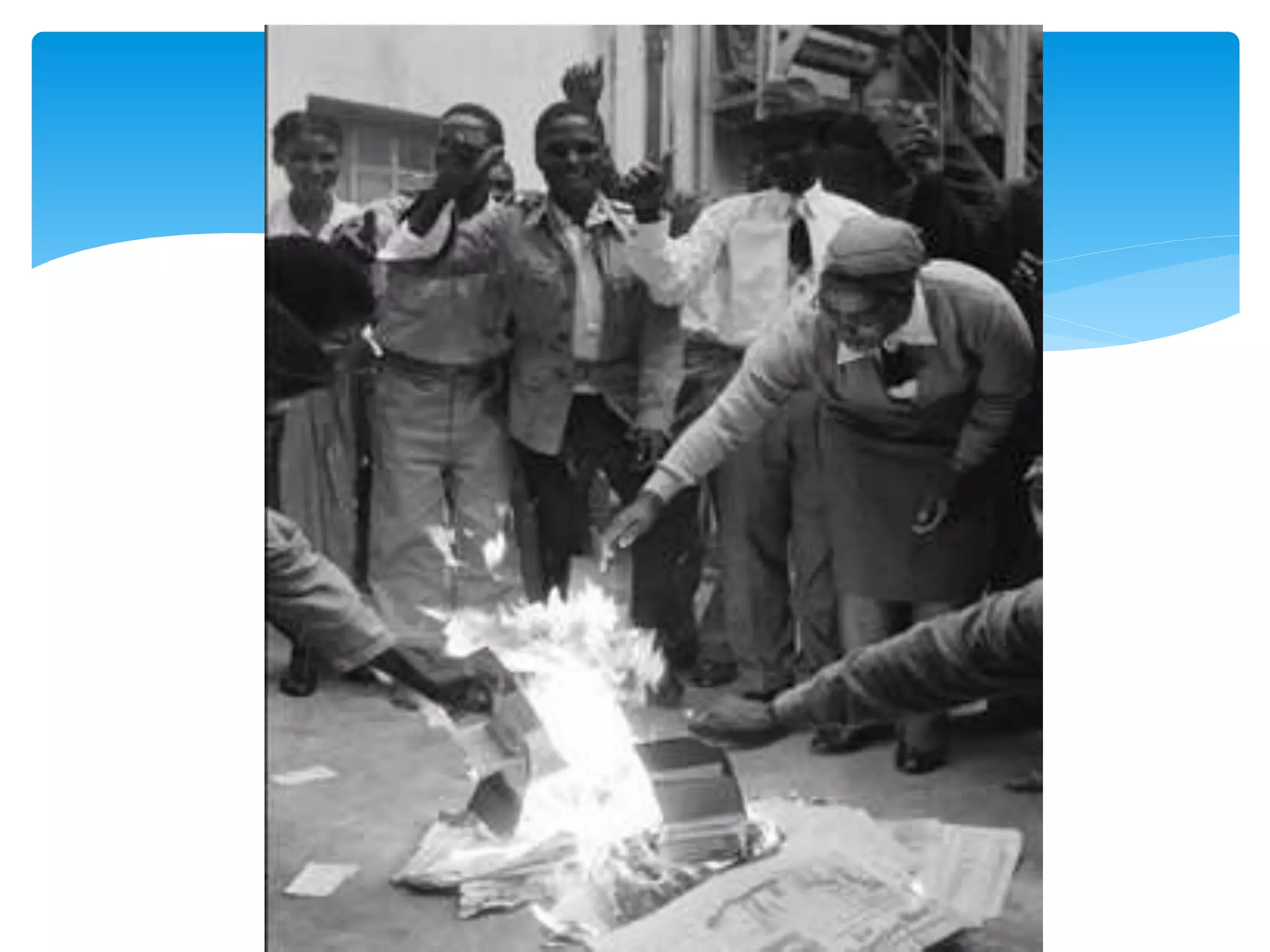
 ANC publicly called for a day of mourning, stay-at-
home campaign, and burned their passbooks
 Work refusal continued for 3 weeks
Responses to Sharpeville
 United States and Britain sharply criticize S. Africa’s
tactics
 Talk of sanctions further disrupts economy
 S. African govt. bans both the ANC and PAC
 18,000 people detained
 ANC/PAC meet clandestinely at night
 What should their next step be?
Government Reactions
 Read theme reading p.17 and choose the one option
that you would like to express.
 Read p. 18, 21, or 24 according to your decision.
 Await further instruction from your teacher.
Three Options
 Chief Albert Luthuli accepts the Nobel Peace Prize
(1961)
 Five days later, “Spear of the Nation” emerges
 Also called MK
 Led by Nelson Mandella
 Armed wing of the ANC, kept separate from Chief
Luthuli
 HQs in secluded house in Johannesburg,
paid for partly by Communist Party
Epilogue: Becoming South Africa
 Use of small bombs to damage administrative offices
 In eighteen months, launched 200 attacks
 Jails, railways, etc.
Actions of the MK
 PAC formed its own militant wing
 “Poqo” = “pure” or “independent”
 “The white people shall suffer, the black people will
rule. Freedom comes after bloodshed.”
 Incites widespread panic
 Hacking to death of five whites camping at a river (1963)
 Also killed several police officers
PAC’s Movement
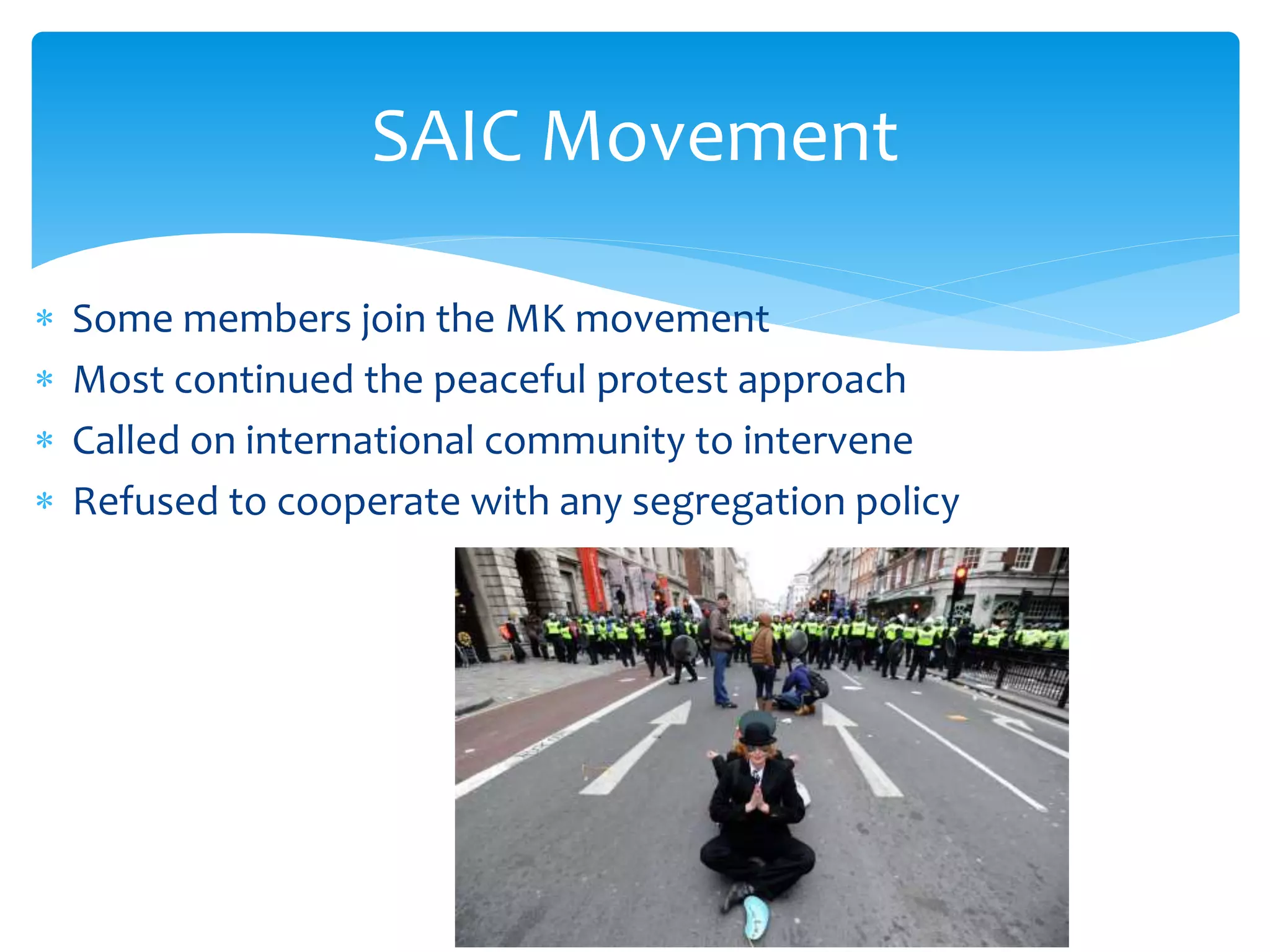
 Some members join the MK movement
 Most continued the peaceful protest approach
 Called on international community to intervene
 Refused to cooperate with any segregation policy
SAIC Movement
 S. African govt. responds to sabotage and guerilla
tactics
 Sabotage Act (1962)
 Able to arrest anyone believed to threaten security
 90-Day Act (1963)
 Able to detain for 90 days without charges or trial
 Hundreds of ANC and PAC arrested, including Nelson
Mandela (1964)
 Electric shock, beating, suffocation with plastic bags
 Mandela, and seven others, sentenced to life in prison
The Rivonia trial
 Steve Biko led the Black Consciousness Movement
 Based on Black Power movement in the U.S.
 Whites excluded from joining
 Soweto, South West Townships
 High school students angered at poor learning
conditions
 Lack of materials, adequate teachers, white-focused
studies
A New Generation of Protestors
 Over months, hundreds of people killed, 2500 injured
 Many young people left and trained as guerillas in
Mozambique
 Steve Biko later died in prison, a victim of torture
 Triggers more protests, increasingly violent
Response to Soweto Protests
 S. African police force over-extended
 Recruits blacks
 Protests continue
 State of Emergency (1985)
 Protestors against government and black
“conspirators”, African police officers
 “necklacing” = car tire filled with gasoline, placed
around neck, and ignited
 Black-on-black crimes encouraged by police
 Excuse for increased power and restrictions on blacks
Conflict Continues
 United States and other nations imposed sanctions
on South Africa
 Oil and arms
 De Klerk, new S. African president elected
 Releases Nelson Mandela from prison (1990)
 Unbanned anti-apartheid groups and met with leaders
 Removed apartheid laws (1991)
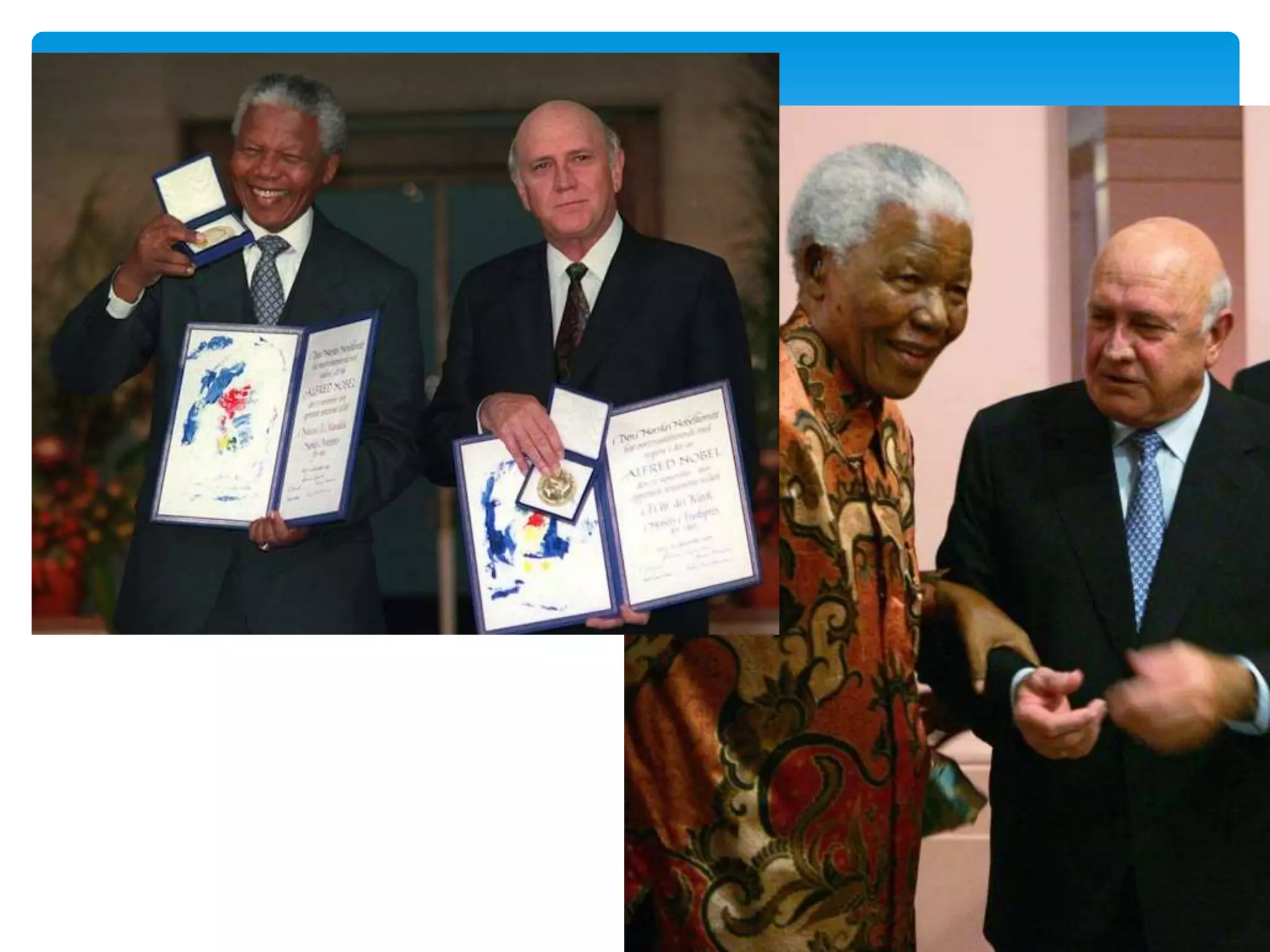
 Mandela and de Klerk jointly awarded the Nobel
Peace Prize (1993)
Liberation
 Truth and Reconciliation Commission, TRC
 Perpetrators on either side granted amnesty for crimes
if their act was politically motivated
 Testimony revealed before live audiences, often the
families of those involved
 Painful healing
 Families learned of prisoner gang rape, electrocution,
slow poisoning, shoved from windows to death, mass
burnings of bodies unceremoniously, intentional release
of cholera into water systems, and more.
 19,000 families received 1,500 BD in reparations
Healing a Hurting Land
 What can we learn from the struggle and
perseverance of the South African people?
 Which groups do you admire? Why?
 In hindsight, are there any changes you would have
made in the fight for equality?
Conclusion

South Africa’s Struggle

  • 1.
    South Africa’s Struggle: Freedomin our Lifetime September’s Theme
  • 4.
     Word meaning“separate” or “apartness”  Racial discrimination and separation of whites, blacks, coloureds, and Asians  Schools, housing, jobs, and transportation  Asians had fewer rights than whites but more than blacks.  Modern day “rainbow nation” Apartheid
  • 5.
     Khoisan  Thousandsof years ago  Hunter-gatherers and pastoralists  Cattle, sheep, and goats  Bantu  3rd C. – 16th C.  Farmers  Cattle as currency/power The First South Africans
  • 6.
     Portuguese arriveat the Cape of Good Hope (1487)  First settlement (1652)  Provisions stop for trading ships  Composed of Dutch, some French and Germans  Afrikaner = “African” Arrival of Outsiders
  • 7.
     Granted settlers28 acres (1/3 KM x 1/3 KM)  Khoisan resisted in sporadic battles  Defeated  Dutch stole their cattle  Afterward, Khoisan:  Free laborers, tradesmen with settlers, retreated from settlements Conflict with Khoisan
  • 8.
     Becomes increasinglypopular  60,000 over the next 150 years  From Madagascar, eastern Africa, western Africa, India, and SE Asia  Interbreeding of slaves and Khoisan and whites  Descendants = “coloureds” Slavery
  • 9.
     Boer =“farmer”  Trekboer = “travelling farmer”  Pioneers who settled north and east of Cape Town  Until the 1810’s  Violence to the east with Xhosa  More organized and unified than Khoisan  Defended territory well Boer/trekboer
  • 10.
     Dutch EastIndia Company goes bankrupt  Britain takes over  First large groups of British arrive  Unlike Boers, do not adopt culture or language  Called “English” In Come the British
  • 11.
     British quicklyabolished slavery in all colonies (1834)  Boers lose free labor supply  Afrikaners migrate north  “Great Trek”  To preserve a society with clear color-based distinctions between master and servant  Import Indians as indentured servants  6,000 Impact of the English
  • 12.
     Reading onpage 6  Ss sketch and explain life working in the mines of South Africa Control of the Mines
  • 13.
     Afrikaners launchattacks against the British for control of the gold and diamond mines.  Britain = 500,000 soldiers  Afrikaners = 40,000 soldiers  Britain implements scorched-earth campaign  Women and children placed in concentration camps  28,000 died of disease  Fuels Afrikaner nationalism Anglo-Boer War
  • 16.
     British coloniesand Afrikaner Republics joined together as Union of South Africa (1910)  S. Africa self-governed, but part of British Empire  Blacks fought on both sides Those who fought with the British expected further rights Nope End of War
  • 17.
     Native LandsAct (1913)  Legislation creating separate areas for Europeans and Africans land ownership  8% of countryside Apartheid
  • 18.
     Formation ofAfrican National Congress, ANC (1912)  Opposed discrimination through petitions  “We are one.”  Policy of passive resistance  influenced by Mohandas Gandhi  Lawyer for Indians in S. Africa (1893)  Later forms South African Indian Congress, SAIC Response to Apartheid
  • 19.
     Non-violent demonstrationagainst passbooks (1919)  Blacks needed to carry passbooks with them at all times  Mounted police ran down protestors  Officers encouraged white civilians to attack black demonstrators  Several protestors died ANC Demonstration
  • 20.
     National Partyvictory brings ultra-right wing ideology  Prohibition of Mixed Marriages Act (1949)  Blacks and whites could not marry  Population Registration Act (1950)  Created three official races: white, African, and coloured  African further divided, “divide and conquer”  Asians = coloured Election of 1948
  • 21.
     Group AreasAct (1950)  Designation of all of the land of S. Africa  Whites = 86% (best land), 20% of population  Schools came under control of government  Textbooks focused on white experiences  Taught only basic, low-level skills for low-level jobs More Effects of the Afrikaner Rise
  • 23.
     Group AreasAct forced blacks into townships in urban areas  Commuted to jobs such as gardeners, servants, and factory workers  One family in a 2/3 room house, often:  No electricity, running water, sewer system  Africans without a job were forced to the countryside  Millions reassigned Life in a Township
  • 25.
     Congress YouthLeague emerges from the ANC (1944)  Adopts a confrontational stance  Radicals  ANC used non-violent means  Boycotts and strikes  Opposed Natives Abolition of Passes Act  Actually required more information in passbook More Opposition to Apartheid
  • 27.
     Inspired byGandhi, ANC filled courts and prisons with people arrested on pass offenses  Overloading system  Five months, eight thousand arrested an imprisoned  Drew much support: coloureds, whites, Communists  Began publishing magazines and newspapers ANC opposition, cont.
  • 28.
     Criminal LawAct  If the intent of the law-breaker was to protest the law, the punishment was magnified  3 years in prison and/or public flogging More Apartheid
  • 29.
     Alexandra busboycott (1957)  Bus company introduced an increase to fares  Residents of Johannesburg township in Alexandra refuse to use bus system  Walked or rode bicycles, up to 20 miles away  Productivity fell, workers late and exhausted  Decreased productivity leads to govt. subsidy of bus fares Power of Change
  • 30.
     From theYouth League of the ANC, the Pan African Congress, PAC, emerges  African Nationalism = “Africanism”  PAC was anti-colonial  “government of the Africans, for the Africans, by the Africans.”  “mental revolution”  Lose the “slave mentality” Radicals Emerge
  • 32.
     PAC volunteersfanned out across South Africa to recruit those willing to demand their own arrest  Homeless, jobless, uneducated, and oppressed were eager to participate  PAC wrote a letter explaining they would surrender in large numbers peacefully  Protestors were under strict orders to avoid violence Resistance in Sharpeville
  • 33.
     The crowdof 5,000 (many children) gathered at the police station  The surging crowd knocked over a police officer  The crowd pushed further to see what happened  Police opened fire, continuing to fire into the backs of fleeing protestors  69 Africans died and 186 wounded The Sharpeville Massacre
  • 35.
     PAC calledon workers to remain home  Police forced themselves into worker homes and forced abstainers to work  More protests followed  30,000 at the Parliament building in Cape Town  ANC publicly called for a day of mourning, stay-at- home campaign, and burned their passbooks  Work refusal continued for 3 weeks Responses to Sharpeville
  • 37.
     United Statesand Britain sharply criticize S. Africa’s tactics  Talk of sanctions further disrupts economy  S. African govt. bans both the ANC and PAC  18,000 people detained  ANC/PAC meet clandestinely at night  What should their next step be? Government Reactions
  • 38.
     Read themereading p.17 and choose the one option that you would like to express.  Read p. 18, 21, or 24 according to your decision.  Await further instruction from your teacher. Three Options
  • 39.
     Chief AlbertLuthuli accepts the Nobel Peace Prize (1961)  Five days later, “Spear of the Nation” emerges  Also called MK  Led by Nelson Mandella  Armed wing of the ANC, kept separate from Chief Luthuli  HQs in secluded house in Johannesburg, paid for partly by Communist Party Epilogue: Becoming South Africa
  • 40.
     Use ofsmall bombs to damage administrative offices  In eighteen months, launched 200 attacks  Jails, railways, etc. Actions of the MK
  • 41.
     PAC formedits own militant wing  “Poqo” = “pure” or “independent”  “The white people shall suffer, the black people will rule. Freedom comes after bloodshed.”  Incites widespread panic  Hacking to death of five whites camping at a river (1963)  Also killed several police officers PAC’s Movement
  • 42.
     Some membersjoin the MK movement  Most continued the peaceful protest approach  Called on international community to intervene  Refused to cooperate with any segregation policy SAIC Movement
  • 43.
     S. Africangovt. responds to sabotage and guerilla tactics  Sabotage Act (1962)  Able to arrest anyone believed to threaten security  90-Day Act (1963)  Able to detain for 90 days without charges or trial  Hundreds of ANC and PAC arrested, including Nelson Mandela (1964)  Electric shock, beating, suffocation with plastic bags  Mandela, and seven others, sentenced to life in prison The Rivonia trial
  • 45.
     Steve Bikoled the Black Consciousness Movement  Based on Black Power movement in the U.S.  Whites excluded from joining  Soweto, South West Townships  High school students angered at poor learning conditions  Lack of materials, adequate teachers, white-focused studies A New Generation of Protestors
  • 46.
     Over months,hundreds of people killed, 2500 injured  Many young people left and trained as guerillas in Mozambique  Steve Biko later died in prison, a victim of torture  Triggers more protests, increasingly violent Response to Soweto Protests
  • 48.
     S. Africanpolice force over-extended  Recruits blacks  Protests continue  State of Emergency (1985)  Protestors against government and black “conspirators”, African police officers  “necklacing” = car tire filled with gasoline, placed around neck, and ignited  Black-on-black crimes encouraged by police  Excuse for increased power and restrictions on blacks Conflict Continues
  • 49.
     United Statesand other nations imposed sanctions on South Africa  Oil and arms  De Klerk, new S. African president elected  Releases Nelson Mandela from prison (1990)  Unbanned anti-apartheid groups and met with leaders  Removed apartheid laws (1991)  Mandela and de Klerk jointly awarded the Nobel Peace Prize (1993) Liberation
  • 51.
     Truth andReconciliation Commission, TRC  Perpetrators on either side granted amnesty for crimes if their act was politically motivated  Testimony revealed before live audiences, often the families of those involved  Painful healing  Families learned of prisoner gang rape, electrocution, slow poisoning, shoved from windows to death, mass burnings of bodies unceremoniously, intentional release of cholera into water systems, and more.  19,000 families received 1,500 BD in reparations Healing a Hurting Land
  • 52.
     What canwe learn from the struggle and perseverance of the South African people?  Which groups do you admire? Why?  In hindsight, are there any changes you would have made in the fight for equality? Conclusion