South Africa Droughts and Regional  Development Presented by Matt Ellis
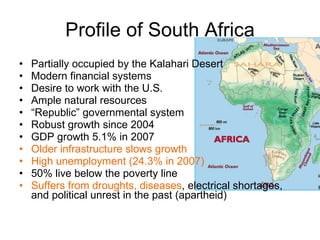
Profile of South Africa Partially occupied by the Kalahari Desert Modern financial systems Desire to work with the U.S. Ample natural resources “ Republic” governmental system Robust growth since 2004 GDP growth 5.1% in 2007 Older infrastructure slows growth High unemployment (24.3% in 2007) 50% live below the poverty line Suffers from droughts, diseases , electrical shortages, and political unrest in the past (apartheid)
Thirsty for Change… South Africa could benefit from water desalination facilities (13,000 worldwide, 60% in Middle East) The WWF acknowledges that water can be an enabler  or  a constraint to social and economic development EarthTrends.org studied “water resources and fresh water ecosystems in Africa”-found no desalination usage  anywhere  in Sub-Saharan Africa Reverse Osmosis (RO) and Distillation techniques exist RO: filtered, higher yield (45%), 10-500 ppm Distillation: heated and evaporated, 1-50 ppm *suggested CA drinking water standard is 500 ppm
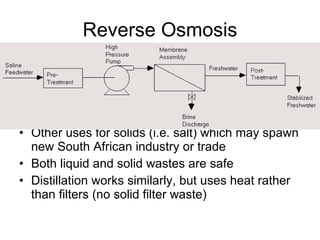
Reverse Osmosis Other uses for solids (i.e. salt) which may spawn new South African industry or trade Both liquid and solid wastes are safe Distillation works similarly, but uses heat rather than filters (no solid filter waste)
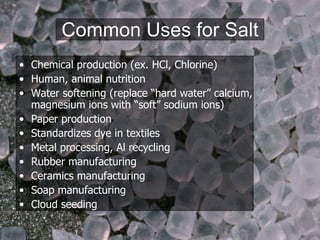
Common Uses for Salt Chemical production (ex. HCl, Chlorine) Human, animal nutrition Water softening (replace “hard water” calcium, magnesium ions with “soft” sodium ions) Paper production Standardizes dye in textiles Metal processing, Al recycling Rubber manufacturing Ceramics manufacturing Soap manufacturing Cloud seeding
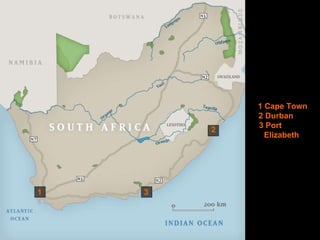
Creating infrastructure is best handled through local government: Entertain proposals from desalination specialist companies Realize that every solution is unique and does not have a panacea Award contract to best proposal and secure local employment for construction and staffing of completed facilities Issue municipal bonds to cover costs of construction and development Proposed sites: near Cape Town, near Durban, possibly near Port Elizabeth Strategy and Tactics
Map of south africa 1 Cape Town 2 Durban  3 Port  Elizabeth  1 2 3
Notable Desalination Specialists Africa Algeria: Hamma Water Desalination, Hyflux N. America GE, DuPont, Dow Chemical, Specific Equipment Co., Aquatech Int’l Corp, Matrix Desalination Inc., Arocon Desalination Systems Europe Spain: Acciona, Abengoa France: Veolia Germany: Siemens Austria: Christ Water Technologies Middle East Israel: IDE Asia Japan: Kurita Water Industries
Benefits of Fresh Water Regional growth potential Stimulate outside business interest May reduce disease(s) May increase the average life span May increase FDI (i.e. muni bonds, etc) May be a catalyst for  other  industries May reduce unemployment (24.3% in 2007)
Risks of Proposal May have unknown adverse environmental effects May be too expensive (i.e. energy costs) May not be valued by locals immediately Unknown future technologies may be a better long-term solution Change may not be immediate (i.e. regional growth)
Ongoing Alternatives Sustained regional drought Import potable water from regional suppliers Find a  cheaper  way to create ample potable water in South Africa
Conclusion South Africa could benefit from desalination technology: Provides fresh drinking, industrial, irrigation water Increase FDI Combat unemployment Combat diseases related to unsafe water Create sufficient infrastructure Create outside business interest Create other industries or means of trade
References California Coastal Commission: Seawater desalination in California  (n.d.).  Retrieved July 5, 2008, from  http://www.coastal.ca.gov/desalrpt/dchap1.html EarthTrends.org (2003).  Water Resources and Freshwater Ecosystems-- South Africa  . Retrieved July 5, 2008, from  http://earthtrends.wri.org/pdf_library/country_profiles/wat_cou_710.pdf Go2Africa.com (2008).  South Africa Map . Retrieved July 5, 2008, from  http://www.go2africa.com/south-africa/map#popup-406  Salt Insitute (n.d.).  The many uses of salt . Retrieved July 5, 2008, from  http://www.saltinstitute.org/16.html WorldAtlas.com (n.d.).  Africa: Major landforms . Retrieved July 5, 2008,  from http://www.worldatlas.com/webimage/countrys/afnewlnd.gif WWF (2008, January 10).  High Level Report: Water and Economic  Development . Retrieved July 5, 2008, from  http://www.panda.org/about_wwf/where_we_work/africa/where/south_ africa/wwf_south_africa_our_solutions/index.cfm?uProjectID=ZA0316

South Africa Drought Solutions

  • 1.
    South Africa Droughtsand Regional Development Presented by Matt Ellis
  • 2.
    Profile of SouthAfrica Partially occupied by the Kalahari Desert Modern financial systems Desire to work with the U.S. Ample natural resources “ Republic” governmental system Robust growth since 2004 GDP growth 5.1% in 2007 Older infrastructure slows growth High unemployment (24.3% in 2007) 50% live below the poverty line Suffers from droughts, diseases , electrical shortages, and political unrest in the past (apartheid)
  • 3.
    Thirsty for Change…South Africa could benefit from water desalination facilities (13,000 worldwide, 60% in Middle East) The WWF acknowledges that water can be an enabler or a constraint to social and economic development EarthTrends.org studied “water resources and fresh water ecosystems in Africa”-found no desalination usage anywhere in Sub-Saharan Africa Reverse Osmosis (RO) and Distillation techniques exist RO: filtered, higher yield (45%), 10-500 ppm Distillation: heated and evaporated, 1-50 ppm *suggested CA drinking water standard is 500 ppm
  • 4.
    Reverse Osmosis Otheruses for solids (i.e. salt) which may spawn new South African industry or trade Both liquid and solid wastes are safe Distillation works similarly, but uses heat rather than filters (no solid filter waste)
  • 5.
    Common Uses forSalt Chemical production (ex. HCl, Chlorine) Human, animal nutrition Water softening (replace “hard water” calcium, magnesium ions with “soft” sodium ions) Paper production Standardizes dye in textiles Metal processing, Al recycling Rubber manufacturing Ceramics manufacturing Soap manufacturing Cloud seeding
  • 6.
    Creating infrastructure isbest handled through local government: Entertain proposals from desalination specialist companies Realize that every solution is unique and does not have a panacea Award contract to best proposal and secure local employment for construction and staffing of completed facilities Issue municipal bonds to cover costs of construction and development Proposed sites: near Cape Town, near Durban, possibly near Port Elizabeth Strategy and Tactics
  • 7.
    Map of southafrica 1 Cape Town 2 Durban 3 Port Elizabeth 1 2 3
  • 8.
    Notable Desalination SpecialistsAfrica Algeria: Hamma Water Desalination, Hyflux N. America GE, DuPont, Dow Chemical, Specific Equipment Co., Aquatech Int’l Corp, Matrix Desalination Inc., Arocon Desalination Systems Europe Spain: Acciona, Abengoa France: Veolia Germany: Siemens Austria: Christ Water Technologies Middle East Israel: IDE Asia Japan: Kurita Water Industries
  • 9.
    Benefits of FreshWater Regional growth potential Stimulate outside business interest May reduce disease(s) May increase the average life span May increase FDI (i.e. muni bonds, etc) May be a catalyst for other industries May reduce unemployment (24.3% in 2007)
  • 10.
    Risks of ProposalMay have unknown adverse environmental effects May be too expensive (i.e. energy costs) May not be valued by locals immediately Unknown future technologies may be a better long-term solution Change may not be immediate (i.e. regional growth)
  • 11.
    Ongoing Alternatives Sustainedregional drought Import potable water from regional suppliers Find a cheaper way to create ample potable water in South Africa
  • 12.
    Conclusion South Africacould benefit from desalination technology: Provides fresh drinking, industrial, irrigation water Increase FDI Combat unemployment Combat diseases related to unsafe water Create sufficient infrastructure Create outside business interest Create other industries or means of trade
  • 13.
    References California CoastalCommission: Seawater desalination in California (n.d.). Retrieved July 5, 2008, from http://www.coastal.ca.gov/desalrpt/dchap1.html EarthTrends.org (2003). Water Resources and Freshwater Ecosystems-- South Africa . Retrieved July 5, 2008, from http://earthtrends.wri.org/pdf_library/country_profiles/wat_cou_710.pdf Go2Africa.com (2008). South Africa Map . Retrieved July 5, 2008, from http://www.go2africa.com/south-africa/map#popup-406 Salt Insitute (n.d.). The many uses of salt . Retrieved July 5, 2008, from http://www.saltinstitute.org/16.html WorldAtlas.com (n.d.). Africa: Major landforms . Retrieved July 5, 2008, from http://www.worldatlas.com/webimage/countrys/afnewlnd.gif WWF (2008, January 10). High Level Report: Water and Economic Development . Retrieved July 5, 2008, from http://www.panda.org/about_wwf/where_we_work/africa/where/south_ africa/wwf_south_africa_our_solutions/index.cfm?uProjectID=ZA0316