Keebler Cookies Inc. Matt Ellis Ron Taggart Marc Kirkland
Executive Summary CEO is Ernie Elf $30 Million annual revenue 4,000 employees (elves) Started in 1980 Headquarters and Factory is a tree trunk in a hidden forest
Executive Summary (cont.) Three Divisions Sales Production Administrative  Largest customers are grocery chains Target Audience  Kids who bring lunch daily
Sales Goals Increase Sales Increase Market Share Increase Efficiency of Sales Team
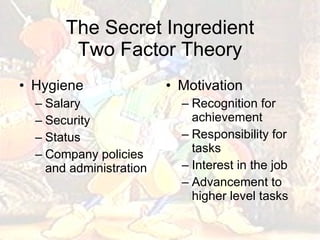
The Secret Ingredient Two Factor Theory Hygiene Salary Security Status Company policies and administration Motivation Recognition for achievement Responsibility for tasks Interest in the job Advancement to higher level tasks
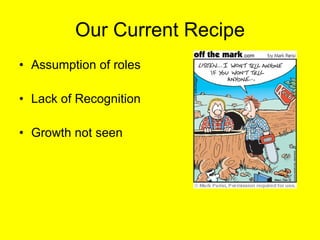
Our Current Recipe Assumption of roles Lack of Recognition Growth not seen
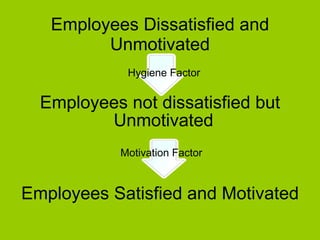
Employees Dissatisfied and Unmotivated Employees not dissatisfied but Unmotivated  Employees Satisfied and Motivated Hygiene Factor Motivation Factor
What to Implement Recognition for achievements Competitive Salary Clear channels for advancement  Additional Resources (phone, car, allowance)
Long Term Goals  Keep great team members Cohesive team Efficient Team 7% Comps per year
Keebler Production Long-term organizational goals: Capture a market share increase of 5% over the next 3 fiscal years Lower absenteeism below the 3% threshold Reduce employee turnover for monetary and employee morale reasons Keep employees content and motivated Offer competitive compensation plans Recognize hard work
The Secret Ingredient Change requires worker motivation Vroom’s Expectancy theory : People consciously choose to maximize pleasure, while minimizing pain (Best bang for the buck) 3 gauntlets to run for a positive result From a worker’s point of view: Expectancy : Can it be done? Can I do it? (0-1) Instrumentality : What’s in it for me? (1-0) Valence : Can I use the reward? (pos., 0, neg.)
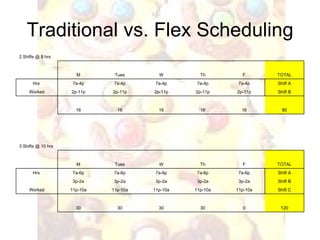
Our Current Recipe… 2 shifts produce M-F 7a-10p; ship product, repair and maintain facility Sat, Sun Results: 2 shifts total 16 hrs worked per day for 5 days, yielding 80 hrs of work per week
Traditional vs. Flex Scheduling 120 0 30 30 30 30 Shift C 11p-10a 11p-10a 11p-10a 11p-10a 11p-10a Worked Shift B 3p-2a 3p-2a 3p-2a 3p-2a 3p-2a   Shift A 7a-6p 7a-6p 7a-6p 7a-6p 7a-6p Hrs  TOTAL F Th W Tues M 3 Shifts @ 10 hrs 80 16 16 16 16 16 Shift B 2p-11p 2p-11p 2p-11p 2p-11p 2p-11p Worked Shift A 7a-4p 7a-4p 7a-4p 7a-4p 7a-4p Hrs  TOTAL F Th W Tues M 2 Shifts @ 8 hrs
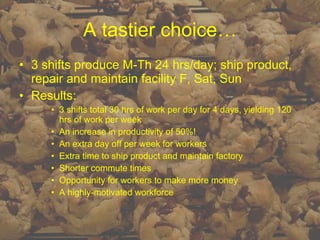
A tastier choice… 3 shifts produce M-Th 24 hrs/day; ship product, repair and maintain facility F, Sat, Sun Results: 3 shifts total 30 hrs of work per day for 4 days, yielding 120 hrs of work per week An increase in productivity of 50%! An extra day off per week for workers Extra time to ship product and maintain factory Shorter commute times Opportunity for workers to make more money A highly-motivated workforce
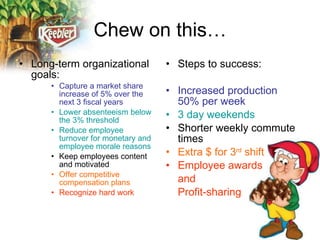
Chew on this… Long-term organizational goals: Capture a market share increase of 5% over the next 3 fiscal years Lower absenteeism below the 3% threshold Reduce employee turnover for monetary and employee morale reasons Keep employees content and motivated Offer competitive compensation plans Recognize hard work   Steps to success: Increased production 50% per week 3 day weekends Shorter weekly commute times Extra $ for 3 rd  shift Employee awards and  Profit-sharing
Goals Cross Training Teams Support team Building Behavior Maintain Long-Term Employment  Recognizing  Achievements
Adams’ Equity Theory We each seek a fair balance between what we put into our job and what we get out of it. We form perceptions of what constitutes a fair balance or trade of inputs and outputs by comparing our own situation with other colleagues.
Inputs & Outputs Effort, loyalty, hard work, commitment, skill, trust in our boss and superiors, support of colleagues and subordinates, and most of all personal sacrifice. Financial rewards- pay, salary, perks, benefits, plus intangibles- recognition, praise and thanks, and sense of achievement and advancement.
Results If we feel that inputs are fairly and adequately rewarded by outputs then we  are happy in our work and motivated to continue inputting at the same level. If we feel that our inputs out-weigh the outputs then we become unmotivated in relation to our job and employer.
References  Catalyst. (1996).  Making Work Flexible: Best Practices . Retrieved October 21, 2007, from:  www.catalystwomen.org/files/info/flexible%20work%20arrangesments%20infobrief.pdf . N.A. 2007. Two Factor Theory-Herzberg, Fredrick. Retrieved on October 23, 2007 from: www.valuebasedmanagement.net/methods_herzberg_two_factor_theory.html   Shiftwork Solutions LLC. (2006).  Shift Lengths and Shift Schedules . Retrieved October 21, 2007, from:  www.shift-work.com/information/shiftlength.htm   YVCOG. (1998).  Alternative Work Schedules . Retrieved October 21, 2007, from:  www.yvcog.org/ctr/altwork.htm
Questions? Thank You

Keebler Production Presentation

  • 1.
    Keebler Cookies Inc.Matt Ellis Ron Taggart Marc Kirkland
  • 2.
    Executive Summary CEOis Ernie Elf $30 Million annual revenue 4,000 employees (elves) Started in 1980 Headquarters and Factory is a tree trunk in a hidden forest
  • 3.
    Executive Summary (cont.)Three Divisions Sales Production Administrative Largest customers are grocery chains Target Audience Kids who bring lunch daily
  • 4.
    Sales Goals IncreaseSales Increase Market Share Increase Efficiency of Sales Team
  • 5.
    The Secret IngredientTwo Factor Theory Hygiene Salary Security Status Company policies and administration Motivation Recognition for achievement Responsibility for tasks Interest in the job Advancement to higher level tasks
  • 6.
    Our Current RecipeAssumption of roles Lack of Recognition Growth not seen
  • 7.
    Employees Dissatisfied andUnmotivated Employees not dissatisfied but Unmotivated Employees Satisfied and Motivated Hygiene Factor Motivation Factor
  • 8.
    What to ImplementRecognition for achievements Competitive Salary Clear channels for advancement Additional Resources (phone, car, allowance)
  • 9.
    Long Term Goals Keep great team members Cohesive team Efficient Team 7% Comps per year
  • 10.
    Keebler Production Long-termorganizational goals: Capture a market share increase of 5% over the next 3 fiscal years Lower absenteeism below the 3% threshold Reduce employee turnover for monetary and employee morale reasons Keep employees content and motivated Offer competitive compensation plans Recognize hard work
  • 11.
    The Secret IngredientChange requires worker motivation Vroom’s Expectancy theory : People consciously choose to maximize pleasure, while minimizing pain (Best bang for the buck) 3 gauntlets to run for a positive result From a worker’s point of view: Expectancy : Can it be done? Can I do it? (0-1) Instrumentality : What’s in it for me? (1-0) Valence : Can I use the reward? (pos., 0, neg.)
  • 12.
    Our Current Recipe…2 shifts produce M-F 7a-10p; ship product, repair and maintain facility Sat, Sun Results: 2 shifts total 16 hrs worked per day for 5 days, yielding 80 hrs of work per week
  • 13.
    Traditional vs. FlexScheduling 120 0 30 30 30 30 Shift C 11p-10a 11p-10a 11p-10a 11p-10a 11p-10a Worked Shift B 3p-2a 3p-2a 3p-2a 3p-2a 3p-2a   Shift A 7a-6p 7a-6p 7a-6p 7a-6p 7a-6p Hrs TOTAL F Th W Tues M 3 Shifts @ 10 hrs 80 16 16 16 16 16 Shift B 2p-11p 2p-11p 2p-11p 2p-11p 2p-11p Worked Shift A 7a-4p 7a-4p 7a-4p 7a-4p 7a-4p Hrs TOTAL F Th W Tues M 2 Shifts @ 8 hrs
  • 14.
    A tastier choice…3 shifts produce M-Th 24 hrs/day; ship product, repair and maintain facility F, Sat, Sun Results: 3 shifts total 30 hrs of work per day for 4 days, yielding 120 hrs of work per week An increase in productivity of 50%! An extra day off per week for workers Extra time to ship product and maintain factory Shorter commute times Opportunity for workers to make more money A highly-motivated workforce
  • 15.
    Chew on this…Long-term organizational goals: Capture a market share increase of 5% over the next 3 fiscal years Lower absenteeism below the 3% threshold Reduce employee turnover for monetary and employee morale reasons Keep employees content and motivated Offer competitive compensation plans Recognize hard work Steps to success: Increased production 50% per week 3 day weekends Shorter weekly commute times Extra $ for 3 rd shift Employee awards and Profit-sharing
  • 16.
    Goals Cross TrainingTeams Support team Building Behavior Maintain Long-Term Employment Recognizing Achievements
  • 17.
    Adams’ Equity TheoryWe each seek a fair balance between what we put into our job and what we get out of it. We form perceptions of what constitutes a fair balance or trade of inputs and outputs by comparing our own situation with other colleagues.
  • 18.
    Inputs & OutputsEffort, loyalty, hard work, commitment, skill, trust in our boss and superiors, support of colleagues and subordinates, and most of all personal sacrifice. Financial rewards- pay, salary, perks, benefits, plus intangibles- recognition, praise and thanks, and sense of achievement and advancement.
  • 19.
    Results If wefeel that inputs are fairly and adequately rewarded by outputs then we are happy in our work and motivated to continue inputting at the same level. If we feel that our inputs out-weigh the outputs then we become unmotivated in relation to our job and employer.
  • 20.
    References Catalyst.(1996). Making Work Flexible: Best Practices . Retrieved October 21, 2007, from: www.catalystwomen.org/files/info/flexible%20work%20arrangesments%20infobrief.pdf . N.A. 2007. Two Factor Theory-Herzberg, Fredrick. Retrieved on October 23, 2007 from: www.valuebasedmanagement.net/methods_herzberg_two_factor_theory.html Shiftwork Solutions LLC. (2006). Shift Lengths and Shift Schedules . Retrieved October 21, 2007, from: www.shift-work.com/information/shiftlength.htm YVCOG. (1998). Alternative Work Schedules . Retrieved October 21, 2007, from: www.yvcog.org/ctr/altwork.htm
  • 21.