EVALUATING SOURCES
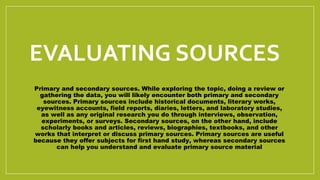
Primary and secondary sources. While exploring the topic, doing a review or
gathering the data, you will likely encounter both primary and secondary
sources. Primary sources include historical documents, literary works,
eyewitness accounts, field reports, diaries, letters, and laboratory studies,
as well as any original research you do through interviews, observation,
experiments, or surveys. Secondary sources, on the other hand, include
scholarly books and articles, reviews, biographies, textbooks, and other
works that interpret or discuss primary sources. Primary sources are useful
because they offer subjects for first hand study, whereas secondary sources
can help you understand and evaluate primary source material
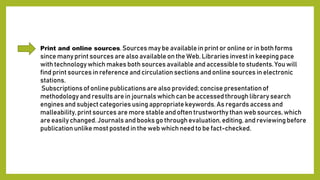
Print and online sources. Sources may be available in print or online or in both forms
since many print sources are also available on the Web. Libraries invest in keeping pace
with technologywhich makes both sources available and accessible to students. You will
find print sources in reference and circulation sections and online sources in electronic
stations.
Subscriptionsof online publications are also provided;concise presentationof
methodologyand results are in journals which can be accessed through library search
engines and subject categories using appropriate keywords. As regards access and
malleability,print sources are more stable and often trustworthy than web sources, which
are easily changed. Journals and books go through evaluation,editing,and reviewing before
publication unlike most posted in the web which need to be fact-checked.
2.2 KNOWING WHETHER A SOURCE SERVES YOUR PURPOSE
Is it relevant? How does the source relate to your purpose? What
will it add to your work? What are the author's
credentials? Look at the title and at any introductory
material a preface, abstract, or introduction-to see
what it covers. ?
?What are the author's credentials? What are the author's qualifications to write on the
subject? .? Is he or she associated with a particular
position on the issue? If the source is a book or a
periodical, see whether it mentions other works this
author has written. If it's a website, see whether an author
is identified. If one is, you might do aWeb search to see
what else you can learn about him or her.
2.2 KNOWING WHETHER A SOURCE SERVES YOUR PURPOSE
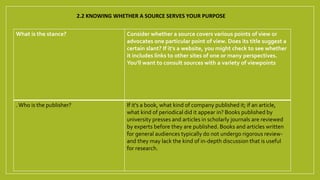
What is the stance? Consider whether a source covers various points of view or
advocates one particular point of view. Does its title suggest a
certain slant? If it's a website, you might check to see whether
it includes links to other sites of one or many perspectives.
You'll want to consult sources with a variety of viewpoints
.Who is the publisher? If it's a book, what kind of company published it; if an article,
what kind of periodical did it appear in? Books published by
university presses and articles in scholarly journals are reviewed
by experts before they are published. Books and articles written
for general audiences typically do not undergo rigorous review-
and they may lack the kind of in-depth discussion that is useful
for research.
2.2 KNOWING WHETHER A SOURCE SERVES YOUR PURPOSE
If it's a website, who is the sponsor? is the site maintained by an organization? An interest group? A
government agency? An individual? if the site doesn't give this
information, look for clues in the URL: edu is used mostly by
colleges and universities, gov by government agencies,org by on-
profit organizations, mill by the military, and com by commercial
organizations
What is the level? . Can you understand the material?Texts written for a general
audience might be easier to understand but are not likely to be
authoritative enough for academic work.Texts written for scholars
will be more authoritative but may be hard to comprehend.
2.2 KNOWING WHETHER A SOURCE SERVES YOUR PURPOSE
When was it published? See when books and articles were published. Check to see
when websites were last updated. (If the site lists no date, see
if links to other sites still work.) Recent does not necessarily
mean better-some topics may require very current information
whereas others may call for older sources.
Is it available? Is it a source you can get hold of? If it's a book and your school's
library doesn't have it, can you get it through interlibrary loan?
Does it include other useful
information? Is there a bibliography
that might lead you to other sources?
Is there a bibliography that might lead you to other
sources?How current are the sources it cites?
2.3 Doing Field Research
Field research refers to gathering primary data from a natural a research method
suited to an interpretive framework rather than environment to the scientific
method. To conduct field research, a researcher must be willing to step into new
environments and observe, participate, or experience those worlds. Mastering
certain communication skills can make a researcher interact with or have access to
observe a person or people and gather data along the way. The key point in field
research is that it takes place in the subject's natural environment, and to
appropriate one's language in dealing with people and situation is just as
important.
2.3.1 Types of Field Research Methods
Interviewing Experts. The term "experts" in this section does not only refer to scientific individuals
specialized in their fields, rather any persons having or involving authoritative knowledge about the
topic of interest. Whatever your goal, you can conduct interviews face-to- face, over the telephone, or
by mail or email. In general, you will want to use interviews to find information you cannot find
elsewhere.
2.3.2 Tips on Writing Questionnaires and Surveys
The following suggestions will help you create useful questionnaires and surveys.
⚫ Define your goal. The goal of a questionnaire or survey should be limited and focused, so that every question
will contribute to your research question. Also, people are more likely to respond to a brief, focused survey.
Define your sample. A survey gets responses from a representative sample of the whole group. The answers to
these questions will help you define that sample:
✓ Who should answer the questions? The people you contact should represent the whole population. For
example, if you want to survey undergraduate students at your school, your sample should reflect your school's
enrolment in terms of gender, year, major, age, and ethnicity, and others.
✓ How many people make up a representative sample? In general, the larger your sample, the more the
answers will reflect those of the whole group. But if your population is small-200 students in a history course, for
example-your sample must include a large percentage of that group.
• Decide on a medium. Will you ask the questions face-to-face? Over the phone?
On a website? By mail? Oral questionnaires work best for simple surveys or to
gather impersonal information. You're more likely to get responses to more personal
questions with written or Web-based questionnaires.
Design issues that differ, depending on the medium: written or Webbased surveys
should be neat and easy to read, while phone Interviews may require well-thought-
out scripts that anticipate possible answers and make it easy to record these
answers.
• Design good questions. The way you ask questions will determine the answers
you get, so take extra care to write questions that are clear and unambiguous.

EVALUATING-SOURCES.pptx

  • 1.
    EVALUATING SOURCES Primary andsecondary sources. While exploring the topic, doing a review or gathering the data, you will likely encounter both primary and secondary sources. Primary sources include historical documents, literary works, eyewitness accounts, field reports, diaries, letters, and laboratory studies, as well as any original research you do through interviews, observation, experiments, or surveys. Secondary sources, on the other hand, include scholarly books and articles, reviews, biographies, textbooks, and other works that interpret or discuss primary sources. Primary sources are useful because they offer subjects for first hand study, whereas secondary sources can help you understand and evaluate primary source material
  • 2.
    Print and onlinesources. Sources may be available in print or online or in both forms since many print sources are also available on the Web. Libraries invest in keeping pace with technologywhich makes both sources available and accessible to students. You will find print sources in reference and circulation sections and online sources in electronic stations. Subscriptionsof online publications are also provided;concise presentationof methodologyand results are in journals which can be accessed through library search engines and subject categories using appropriate keywords. As regards access and malleability,print sources are more stable and often trustworthy than web sources, which are easily changed. Journals and books go through evaluation,editing,and reviewing before publication unlike most posted in the web which need to be fact-checked.
  • 3.
    2.2 KNOWING WHETHERA SOURCE SERVES YOUR PURPOSE Is it relevant? How does the source relate to your purpose? What will it add to your work? What are the author's credentials? Look at the title and at any introductory material a preface, abstract, or introduction-to see what it covers. ? ?What are the author's credentials? What are the author's qualifications to write on the subject? .? Is he or she associated with a particular position on the issue? If the source is a book or a periodical, see whether it mentions other works this author has written. If it's a website, see whether an author is identified. If one is, you might do aWeb search to see what else you can learn about him or her.
  • 4.
    2.2 KNOWING WHETHERA SOURCE SERVES YOUR PURPOSE What is the stance? Consider whether a source covers various points of view or advocates one particular point of view. Does its title suggest a certain slant? If it's a website, you might check to see whether it includes links to other sites of one or many perspectives. You'll want to consult sources with a variety of viewpoints .Who is the publisher? If it's a book, what kind of company published it; if an article, what kind of periodical did it appear in? Books published by university presses and articles in scholarly journals are reviewed by experts before they are published. Books and articles written for general audiences typically do not undergo rigorous review- and they may lack the kind of in-depth discussion that is useful for research.
  • 5.
    2.2 KNOWING WHETHERA SOURCE SERVES YOUR PURPOSE If it's a website, who is the sponsor? is the site maintained by an organization? An interest group? A government agency? An individual? if the site doesn't give this information, look for clues in the URL: edu is used mostly by colleges and universities, gov by government agencies,org by on- profit organizations, mill by the military, and com by commercial organizations What is the level? . Can you understand the material?Texts written for a general audience might be easier to understand but are not likely to be authoritative enough for academic work.Texts written for scholars will be more authoritative but may be hard to comprehend.
  • 6.
    2.2 KNOWING WHETHERA SOURCE SERVES YOUR PURPOSE When was it published? See when books and articles were published. Check to see when websites were last updated. (If the site lists no date, see if links to other sites still work.) Recent does not necessarily mean better-some topics may require very current information whereas others may call for older sources. Is it available? Is it a source you can get hold of? If it's a book and your school's library doesn't have it, can you get it through interlibrary loan? Does it include other useful information? Is there a bibliography that might lead you to other sources? Is there a bibliography that might lead you to other sources?How current are the sources it cites?
  • 7.
    2.3 Doing FieldResearch Field research refers to gathering primary data from a natural a research method suited to an interpretive framework rather than environment to the scientific method. To conduct field research, a researcher must be willing to step into new environments and observe, participate, or experience those worlds. Mastering certain communication skills can make a researcher interact with or have access to observe a person or people and gather data along the way. The key point in field research is that it takes place in the subject's natural environment, and to appropriate one's language in dealing with people and situation is just as important. 2.3.1 Types of Field Research Methods Interviewing Experts. The term "experts" in this section does not only refer to scientific individuals specialized in their fields, rather any persons having or involving authoritative knowledge about the topic of interest. Whatever your goal, you can conduct interviews face-to- face, over the telephone, or by mail or email. In general, you will want to use interviews to find information you cannot find elsewhere.
  • 8.
    2.3.2 Tips onWriting Questionnaires and Surveys The following suggestions will help you create useful questionnaires and surveys. ⚫ Define your goal. The goal of a questionnaire or survey should be limited and focused, so that every question will contribute to your research question. Also, people are more likely to respond to a brief, focused survey. Define your sample. A survey gets responses from a representative sample of the whole group. The answers to these questions will help you define that sample: ✓ Who should answer the questions? The people you contact should represent the whole population. For example, if you want to survey undergraduate students at your school, your sample should reflect your school's enrolment in terms of gender, year, major, age, and ethnicity, and others. ✓ How many people make up a representative sample? In general, the larger your sample, the more the answers will reflect those of the whole group. But if your population is small-200 students in a history course, for example-your sample must include a large percentage of that group.
  • 9.
    • Decide ona medium. Will you ask the questions face-to-face? Over the phone? On a website? By mail? Oral questionnaires work best for simple surveys or to gather impersonal information. You're more likely to get responses to more personal questions with written or Web-based questionnaires. Design issues that differ, depending on the medium: written or Webbased surveys should be neat and easy to read, while phone Interviews may require well-thought- out scripts that anticipate possible answers and make it easy to record these answers. • Design good questions. The way you ask questions will determine the answers you get, so take extra care to write questions that are clear and unambiguous.