Source & Cite-Checking
Foreign & International Law
For the members of the
Connecticut Journal of International
Law
Prepared by Sarah E. Cox, M.A., M.L.I.S, J.D.
August 2014 (updated 2015)
Don’t reinvent the wheel!
Use guides, other authors’ writings,
etc. to find your source & get it.
Don’t spin your wheel! Ask for
assistance from a Reference Librarian.
CJIL Source/Cite Checkers LibGuide
Source & Cite-Checking for the Connecticut Journal
of International Law
• This guide has been specially prepared to assist you.
Use it to help you understand citations, find sources
and obtain them so they can be cite-checked.
Don’t reinvent the wheel!
• The guide provides starting places. If you cannot
readily verify the citation, find the source, or find out
how to get it using the guide, please see a reference
librarian before spending a lot of time on the problem .
Don’t spin your wheel!
Source Checking is a 3-Step Process
1. Verification of citations
2. Finding the sources cited
3. Getting the sources
Use the resources in the LibGuide
to assist you in each of these steps.
Verification of Citations - Tips
• You need to verify the accuracy of the citation in order to find the source.
• The author’s citation is not necessarily accurate. Be aware that names be
wrong, titles may be wrong, volume number, page numbers, dates,
document numbers, URLs, etc., etc. – any or all may be inaccurate.
• Using the abbreviation given in the citation (even if correct) will not help
you locate sources in most search engines and databases. You need to
understand what the abbreviation stands for in full and use the full title
in order to locate the source for the citation.
• You can use published journal articles, books, cases & digests and indices
to try to determine the proper citation for source. Don’t reinvent the
wheel!
Please remember that if you have problems, you can consult a Reference
librarian. Don’t spin your wheel!
Verification of Citations
Here are a few of the resources in the LibGuide to help
you to decipher the full title of the source that is being
cited:
Primary Law & Secondary Law
• World dictionary of legal abbreviations, 4 vols., 1991-
current - Print looseleaf at Reference Desk - includes
particular foreign countries and international
organizations.
• Cardiff Index to Legal Abbreviations – Electronic -
Covers English language legal abbreviations from 295
jurisdictions (including the U.S.)
• Guide to Foreign & International Citations, 2d ed., 2009
- Print at KZ1234 G84 2009 in Reference. See also 2006
edition in stacks.
See the LibGuide for more!
Verification of Citations
Secondary Law:
• Ulrich's Periodicals Directory - Electronic - NetID
may be required - Use the advanced search to
narrow by language, to find journals that have
ceased publication, etc.
• HeinOnline Index to Foreign Legal Periodicals
(IFLP) - Electronic -NetID may be required - Not
full-text - Does not use The Bluebook citation
format.
• HeinOnline Law Journal Library - Electronic -
NetID may be required - You can use Blue Book
citation abbreviations, if correct, in this database
See the LibGuide for more!
Verification of Citations
Non-legal foreign and international secondary sources:
• For journals, use Ulrich's Periodicals Directory - Electronic -
NetID may be required - Use the advanced search to narrow
by language, by subject, to find journals that have ceased
publication, etc.
• For newpapers, use Lexis.com - log into Lexis Advance then
click on research tab and click on Lexis.com then News &
Business tab.
• For books or parts of books, use WorldCat - You can use
author, title or any other information the author has given
you to try to decipher the citation.
Don’t spin your wheel! Ask a Reference Librarian for help.
Finding Sources
Foreign Law - Tips
• Use the research guides, databases, indexes and websites in
the LibGuide to assist you in finding the primary and
secondary sources that your article author cites.
• If you cannot find the cited source directly using one of
these, then look for articles, cases, books, etc. where other
authors may have cited the source you are looking for.
• Don’t reinvent the wheel! If someone else has found what
you are looking for, let them help you find it.
Finding Sources
Foreign Law
See the following subject specific UCONN Law Library
LibGuides:
• Foreign Law Research by Sarah Cox (updated 2015)
• Research Guide for Students Studying Abroad by Sarah Cox
(updated 2015)
• English Law by Sarah Cox (updated 2015)
• Insurance Law Research by Yan Hong (updated 2015) - Click
on Foreign Insurance tab.
Look at these from other libraries:
• Basic Guide to Researching Foreign Law by Mary Rumsey
(2005, updated 2014, GlobaLex)
• Foreign and Comparative Law by Marci Hoffman (2004,
updated 2014 - UC, Berkeley)
Finding Sources
Foreign Law
Here are few helpful databases & websites:
• Foreign Law Guide: Current Sources of Codes and
Basic Legislation in Jurisdictions of the World [NetId
may be required]
• Law Library of Congress - Guide to Law Online -
Nations of the World– free internet resource
• World Legal Information Institute (WorldLII) – free
internet resource.
Consult the LibGuide for other databases, websites,
research guides and other resources to assist you.
Finding Sources
International Law
Useful UCONN Law Library electronic LibGuides:
• Multinational and Foreign Treaties & International Agreements
by Sarah Cox (updated 2015)
• U.S. Treaties and International Agreements by Sarah Cox
(updated 2015)
• International Human Rights Law Research by Sarah Cox
(updated 2015).
• Sources of Public International Law by Sarah Cox (updated
2015)
• International Trade Law by Sarah Cox (updated 2015)
Finding Sources
International Law
Other useful research guides (but note that UCONN Law may not
have these resources):
• Frequently-Cited Treaties & Other International Instuments,
updated 2015 - electronic LibGuide University of Minnesota Law
Library.
• Winer, Archer & Louis-Jacques, International Law Legal Research
(2013 - print call no. KZ1234 W57 2013)
• Guide to International Legal Research (1990-current - the George
Washington journal of international law [and economics] –
Print - Call no. KZ1234 .G85 - most recent copy in Reference)
Use the Electronic Resource Guides (ERG), EISIL and other resources
that deal with international law topics at the ASIL website
See others in the LibGuide
Finding
Legal & Non Legal Secondary Sources
Articles:
• Legal Periodical Indexes -The UCONN Law Library has a
number of different legal periodical indexes that can be used
to find articles in English and non-English language
periodicals.
• E -Journal Locator - Use to find by title full-text electronic
journals and other periodicals to which UCONN has access.
NetID may be necessary to get access to particular database
• DOAJ: Directory of Open Access Journals - Includes a number
of foreign journals (legal and non-legal) in full-text.
• JSTOR - Full text of essential scholarly journals in many
academic fields, especially arts, literature, humanities, and
biology
Finding
Legal & Non-Legal Secondary Sources
Books and parts of books:
• Google Books – Free internet resource with many full-text out-of copyright
publications but you must register for account if you do not have gmail.
• HathiTrust - [NetId may be required] – Full text out-of-copyright books.
• Making of Modern Law: Foreign, Comparative and International Law, 1600-
1926 - [NetId may be required] Full-text database of monographs from the
17th to the early 20th century. If you know the title of the book you wish to
find, use the UCONN Law Library's online catalog as each title in the
database is separately cataloged.
• Szladits' Bibliography - available electronically on HeinOnline Parker School
Foreign & Comparative Law Publications database [NetID may be required]
A bibliography of articles and books in English on topics on foreign and
comparative law going back to 1789.
• WorldCat – Worldwide catalog of holdings of libraries, including UCONN –
You can search by author, title, publisher, year of publication, etc.
Finding Sources - Tips
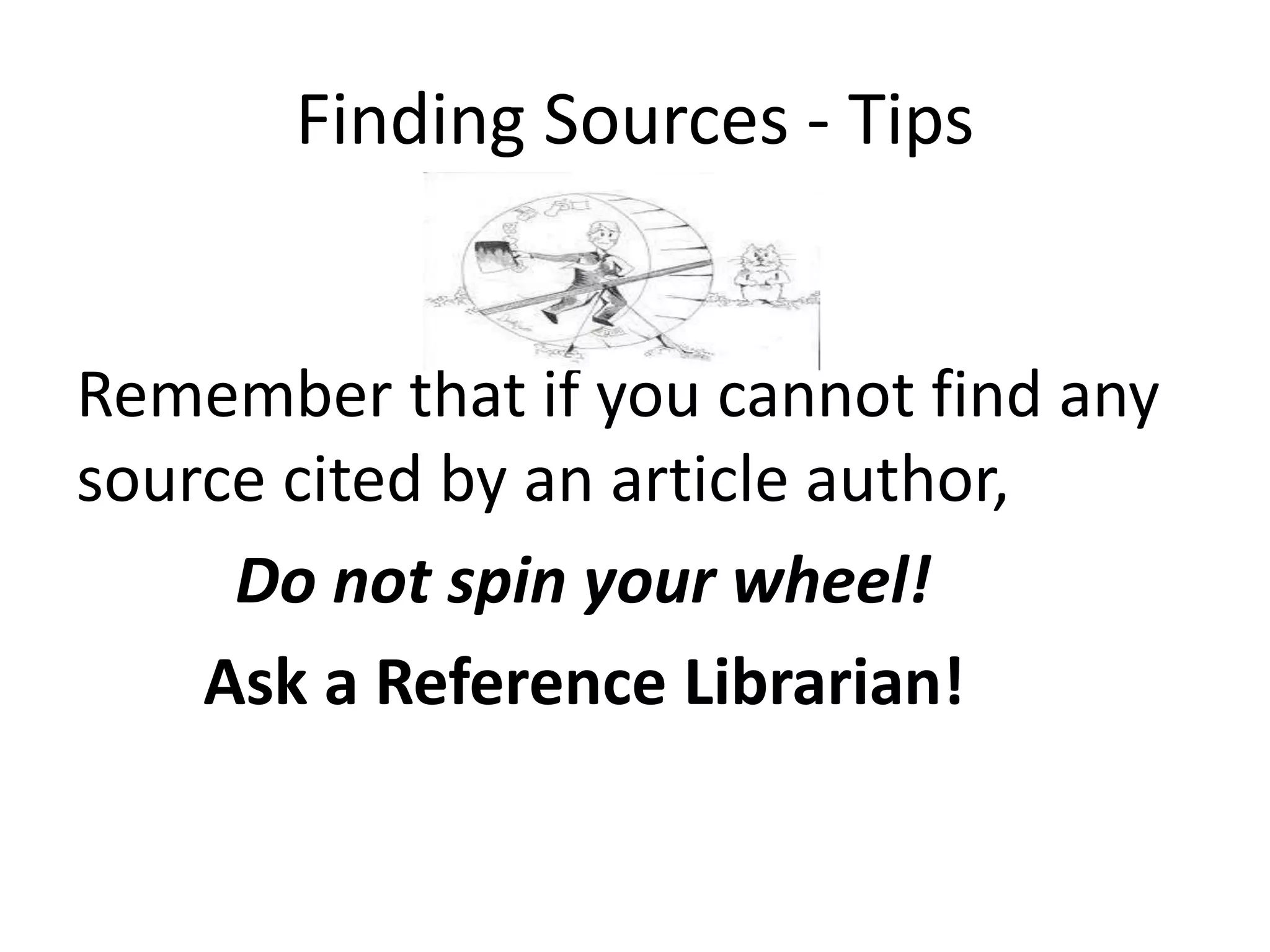
Remember that if you cannot find any
source cited by an article author,
Do not spin your wheel!
Ask a Reference Librarian!
Getting Sources - Tips
InterLibrary Loan (ILL)
• ILL is to be used judiciously. You must be aware of what you are asking
for and ensure that you are not asking for something you will not get..
• If you cannot find it on WorldCat, we cannot get it on ILL. Please
remember the ILL system does not recognize abbreviations.
• If our Law Library has access to the source or not enough of the libraries
that lend to us have it, your request will not go through.
• Certain things will not be provided by other libraries at all through ILL
(e.g. newspaper articles, non-circulating materials e.g., looseleafs and
reference).
• Certain things will not be provided for free through ILL (items held by
libraries who do not freely loan to us).
• Be sure to follow the CJIL procedures for submitting ILLs.
Cite-Checking
• Once you have received the source, you can verify
the accuracy of the citation.
• Remember that if there is an electronic version of
the text used by the author, you can probably verify
the accuracy of the citation without having to
request it on ILL. Use Google Scholar, Google Books,
HathiTrust, JSTOR, Making of Modern Law (MOML),
and other full-text searchable databases to assist you
in locating particular quotes and paraphrases.
• Also remember that the source cited by the author
may not be the most authoritative source to cite. It
is your responsibility to cite to the most
authoritative source.
Source & Cite-Checking – Final Tips
Use the LibGuide and other UCONN Law Library
resources to assist you.
• Don’t reinvent the wheel!
• Don’t spin your wheel!
Ask for assistance when you need it at the
Reference Desk. We are happy to help you!

Source & cite checking august 2014 (updated 2015)

  • 1.
    Source & Cite-Checking Foreign& International Law For the members of the Connecticut Journal of International Law Prepared by Sarah E. Cox, M.A., M.L.I.S, J.D. August 2014 (updated 2015)
  • 2.
    Don’t reinvent thewheel! Use guides, other authors’ writings, etc. to find your source & get it.
  • 3.
    Don’t spin yourwheel! Ask for assistance from a Reference Librarian.
  • 4.
    CJIL Source/Cite CheckersLibGuide Source & Cite-Checking for the Connecticut Journal of International Law • This guide has been specially prepared to assist you. Use it to help you understand citations, find sources and obtain them so they can be cite-checked. Don’t reinvent the wheel! • The guide provides starting places. If you cannot readily verify the citation, find the source, or find out how to get it using the guide, please see a reference librarian before spending a lot of time on the problem . Don’t spin your wheel!
  • 5.
    Source Checking isa 3-Step Process 1. Verification of citations 2. Finding the sources cited 3. Getting the sources Use the resources in the LibGuide to assist you in each of these steps.
  • 6.
    Verification of Citations- Tips • You need to verify the accuracy of the citation in order to find the source. • The author’s citation is not necessarily accurate. Be aware that names be wrong, titles may be wrong, volume number, page numbers, dates, document numbers, URLs, etc., etc. – any or all may be inaccurate. • Using the abbreviation given in the citation (even if correct) will not help you locate sources in most search engines and databases. You need to understand what the abbreviation stands for in full and use the full title in order to locate the source for the citation. • You can use published journal articles, books, cases & digests and indices to try to determine the proper citation for source. Don’t reinvent the wheel! Please remember that if you have problems, you can consult a Reference librarian. Don’t spin your wheel!
  • 7.
    Verification of Citations Hereare a few of the resources in the LibGuide to help you to decipher the full title of the source that is being cited: Primary Law & Secondary Law • World dictionary of legal abbreviations, 4 vols., 1991- current - Print looseleaf at Reference Desk - includes particular foreign countries and international organizations. • Cardiff Index to Legal Abbreviations – Electronic - Covers English language legal abbreviations from 295 jurisdictions (including the U.S.) • Guide to Foreign & International Citations, 2d ed., 2009 - Print at KZ1234 G84 2009 in Reference. See also 2006 edition in stacks. See the LibGuide for more!
  • 8.
    Verification of Citations SecondaryLaw: • Ulrich's Periodicals Directory - Electronic - NetID may be required - Use the advanced search to narrow by language, to find journals that have ceased publication, etc. • HeinOnline Index to Foreign Legal Periodicals (IFLP) - Electronic -NetID may be required - Not full-text - Does not use The Bluebook citation format. • HeinOnline Law Journal Library - Electronic - NetID may be required - You can use Blue Book citation abbreviations, if correct, in this database See the LibGuide for more!
  • 9.
    Verification of Citations Non-legalforeign and international secondary sources: • For journals, use Ulrich's Periodicals Directory - Electronic - NetID may be required - Use the advanced search to narrow by language, by subject, to find journals that have ceased publication, etc. • For newpapers, use Lexis.com - log into Lexis Advance then click on research tab and click on Lexis.com then News & Business tab. • For books or parts of books, use WorldCat - You can use author, title or any other information the author has given you to try to decipher the citation. Don’t spin your wheel! Ask a Reference Librarian for help.
  • 10.
    Finding Sources Foreign Law- Tips • Use the research guides, databases, indexes and websites in the LibGuide to assist you in finding the primary and secondary sources that your article author cites. • If you cannot find the cited source directly using one of these, then look for articles, cases, books, etc. where other authors may have cited the source you are looking for. • Don’t reinvent the wheel! If someone else has found what you are looking for, let them help you find it.
  • 11.
    Finding Sources Foreign Law Seethe following subject specific UCONN Law Library LibGuides: • Foreign Law Research by Sarah Cox (updated 2015) • Research Guide for Students Studying Abroad by Sarah Cox (updated 2015) • English Law by Sarah Cox (updated 2015) • Insurance Law Research by Yan Hong (updated 2015) - Click on Foreign Insurance tab. Look at these from other libraries: • Basic Guide to Researching Foreign Law by Mary Rumsey (2005, updated 2014, GlobaLex) • Foreign and Comparative Law by Marci Hoffman (2004, updated 2014 - UC, Berkeley)
  • 12.
    Finding Sources Foreign Law Hereare few helpful databases & websites: • Foreign Law Guide: Current Sources of Codes and Basic Legislation in Jurisdictions of the World [NetId may be required] • Law Library of Congress - Guide to Law Online - Nations of the World– free internet resource • World Legal Information Institute (WorldLII) – free internet resource. Consult the LibGuide for other databases, websites, research guides and other resources to assist you.
  • 13.
    Finding Sources International Law UsefulUCONN Law Library electronic LibGuides: • Multinational and Foreign Treaties & International Agreements by Sarah Cox (updated 2015) • U.S. Treaties and International Agreements by Sarah Cox (updated 2015) • International Human Rights Law Research by Sarah Cox (updated 2015). • Sources of Public International Law by Sarah Cox (updated 2015) • International Trade Law by Sarah Cox (updated 2015)
  • 14.
    Finding Sources International Law Otheruseful research guides (but note that UCONN Law may not have these resources): • Frequently-Cited Treaties & Other International Instuments, updated 2015 - electronic LibGuide University of Minnesota Law Library. • Winer, Archer & Louis-Jacques, International Law Legal Research (2013 - print call no. KZ1234 W57 2013) • Guide to International Legal Research (1990-current - the George Washington journal of international law [and economics] – Print - Call no. KZ1234 .G85 - most recent copy in Reference) Use the Electronic Resource Guides (ERG), EISIL and other resources that deal with international law topics at the ASIL website See others in the LibGuide
  • 15.
    Finding Legal & NonLegal Secondary Sources Articles: • Legal Periodical Indexes -The UCONN Law Library has a number of different legal periodical indexes that can be used to find articles in English and non-English language periodicals. • E -Journal Locator - Use to find by title full-text electronic journals and other periodicals to which UCONN has access. NetID may be necessary to get access to particular database • DOAJ: Directory of Open Access Journals - Includes a number of foreign journals (legal and non-legal) in full-text. • JSTOR - Full text of essential scholarly journals in many academic fields, especially arts, literature, humanities, and biology
  • 16.
    Finding Legal & Non-LegalSecondary Sources Books and parts of books: • Google Books – Free internet resource with many full-text out-of copyright publications but you must register for account if you do not have gmail. • HathiTrust - [NetId may be required] – Full text out-of-copyright books. • Making of Modern Law: Foreign, Comparative and International Law, 1600- 1926 - [NetId may be required] Full-text database of monographs from the 17th to the early 20th century. If you know the title of the book you wish to find, use the UCONN Law Library's online catalog as each title in the database is separately cataloged. • Szladits' Bibliography - available electronically on HeinOnline Parker School Foreign & Comparative Law Publications database [NetID may be required] A bibliography of articles and books in English on topics on foreign and comparative law going back to 1789. • WorldCat – Worldwide catalog of holdings of libraries, including UCONN – You can search by author, title, publisher, year of publication, etc.
  • 17.
    Finding Sources -Tips Remember that if you cannot find any source cited by an article author, Do not spin your wheel! Ask a Reference Librarian!
  • 18.
    Getting Sources -Tips InterLibrary Loan (ILL) • ILL is to be used judiciously. You must be aware of what you are asking for and ensure that you are not asking for something you will not get.. • If you cannot find it on WorldCat, we cannot get it on ILL. Please remember the ILL system does not recognize abbreviations. • If our Law Library has access to the source or not enough of the libraries that lend to us have it, your request will not go through. • Certain things will not be provided by other libraries at all through ILL (e.g. newspaper articles, non-circulating materials e.g., looseleafs and reference). • Certain things will not be provided for free through ILL (items held by libraries who do not freely loan to us). • Be sure to follow the CJIL procedures for submitting ILLs.
  • 19.
    Cite-Checking • Once youhave received the source, you can verify the accuracy of the citation. • Remember that if there is an electronic version of the text used by the author, you can probably verify the accuracy of the citation without having to request it on ILL. Use Google Scholar, Google Books, HathiTrust, JSTOR, Making of Modern Law (MOML), and other full-text searchable databases to assist you in locating particular quotes and paraphrases. • Also remember that the source cited by the author may not be the most authoritative source to cite. It is your responsibility to cite to the most authoritative source.
  • 20.
    Source & Cite-Checking– Final Tips Use the LibGuide and other UCONN Law Library resources to assist you. • Don’t reinvent the wheel! • Don’t spin your wheel! Ask for assistance when you need it at the Reference Desk. We are happy to help you!