What is a Sonnet?
Understanding the forms, meter,
rhyme, and other aspects of the
sonnet.
Sonnet Form
• The sonnet gets its name from the Italian
sonetto, which translates to “little song.”
• A sonnet has 14 lines.
• A sonnet must be written in iambic pentameter
• A sonnet must follow a specific rhyme scheme,
depending on the type of sonnet.
• A sonnet can be about any subject, though they
are often about love or nature.
• A sonnet introduces a problem or question in
the beginning, and a resolution is offered after
the turn.
Volta or “turn in thought”
The change that occurs between the octave and sestet in a sonnet is called a
volta, which is Italian for "turn". The volta is a vital part of almost all sonnets,
and it's often found at the end of the octave or the twelfth line in the
Shakespearean sonnet. However, the volta can occur anywhere in the sonnet.
The octave is the first eight lines of a sonnet, and it establishes the poem's
subject. The sestet is the next six lines, and it counteracts the octave by
shifting the poem's perspective. The volta is often indicated by words like "But",
"Yet", or "And yet".
Poets may use the volta to create a sudden shift in tone, highlight a contrast, or
engage the reader's attention. This departure from the conventional structure
can add complexity and depth to the poem. For example, a poet may place the
turn between lines 7 and 8 to create a specific rhyme scheme or to enhance the
poem's musicality.
In a Petrarchan sonnet, the volta occurs between the octet and sestet. In a
Shakespearean sonnet, the volta can occur between the 8th and 9th lines, or
between the 12th and 13th lines.
Iambic Pentameter
● A line of Iambic Pentameter is a line with ten
beats.
● An “Iamb” is two beats, or one “foot.”
● “Penta” is five (line has five “feet”).
● “Meter” is the rhythm of the poem.
● A “foot” is made of an unstressed syllable
and a stressed syllable (in that order).
English Sonnet
•An English Sonnet is also called a
Shakespearean Sonnet.
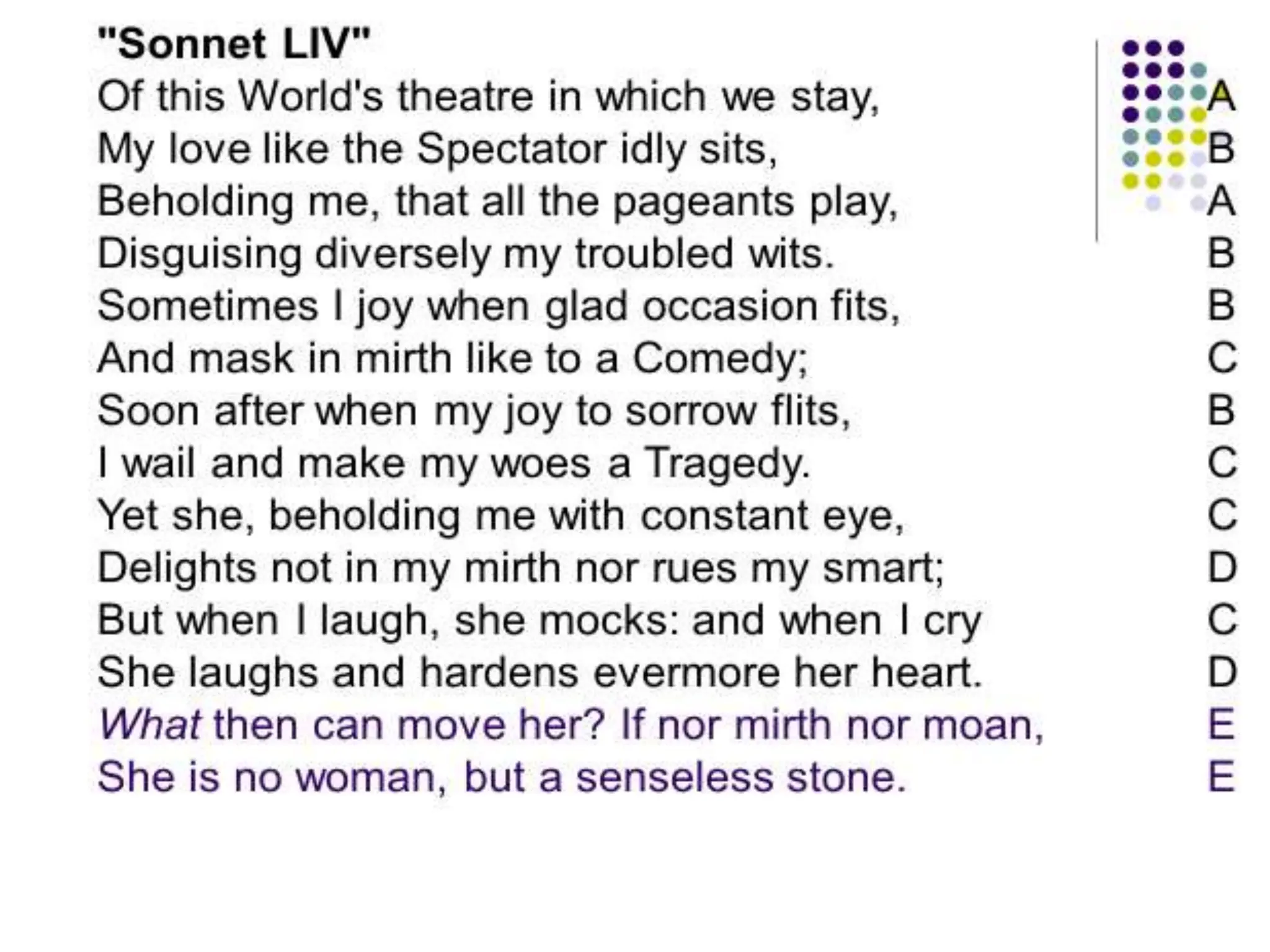
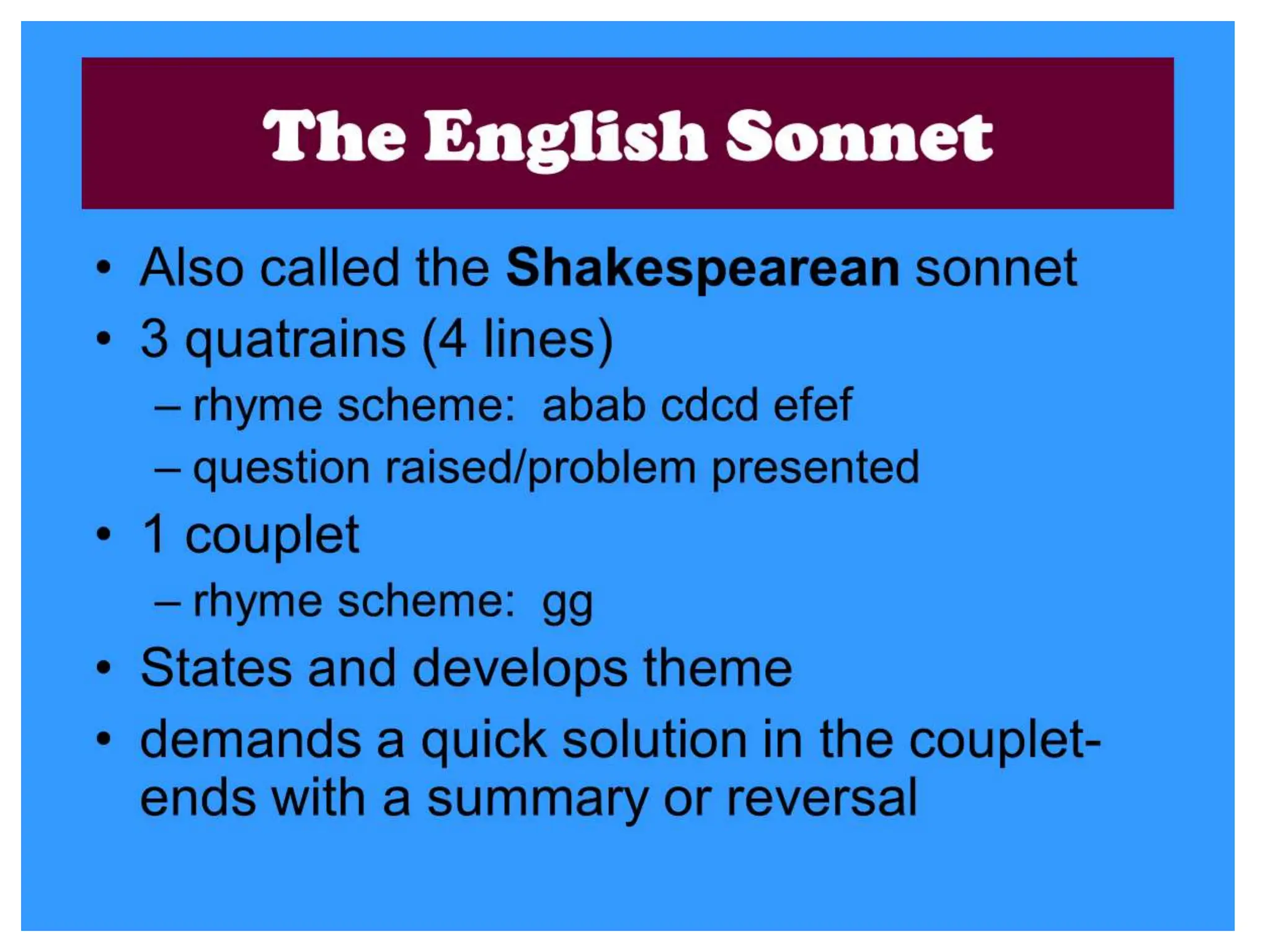
•It includes three quatrains (groups of four
lines) and a couplet (two lines).
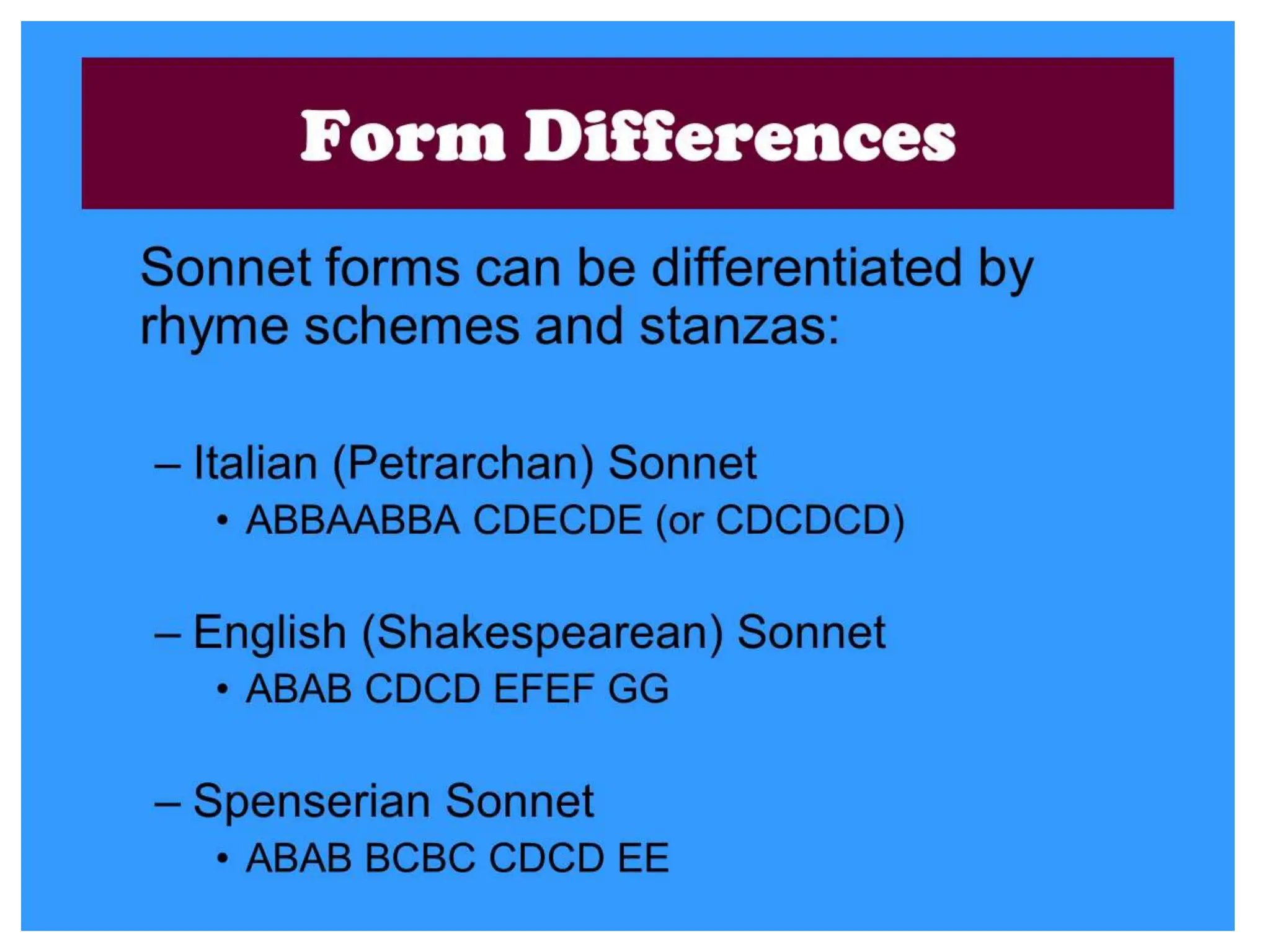
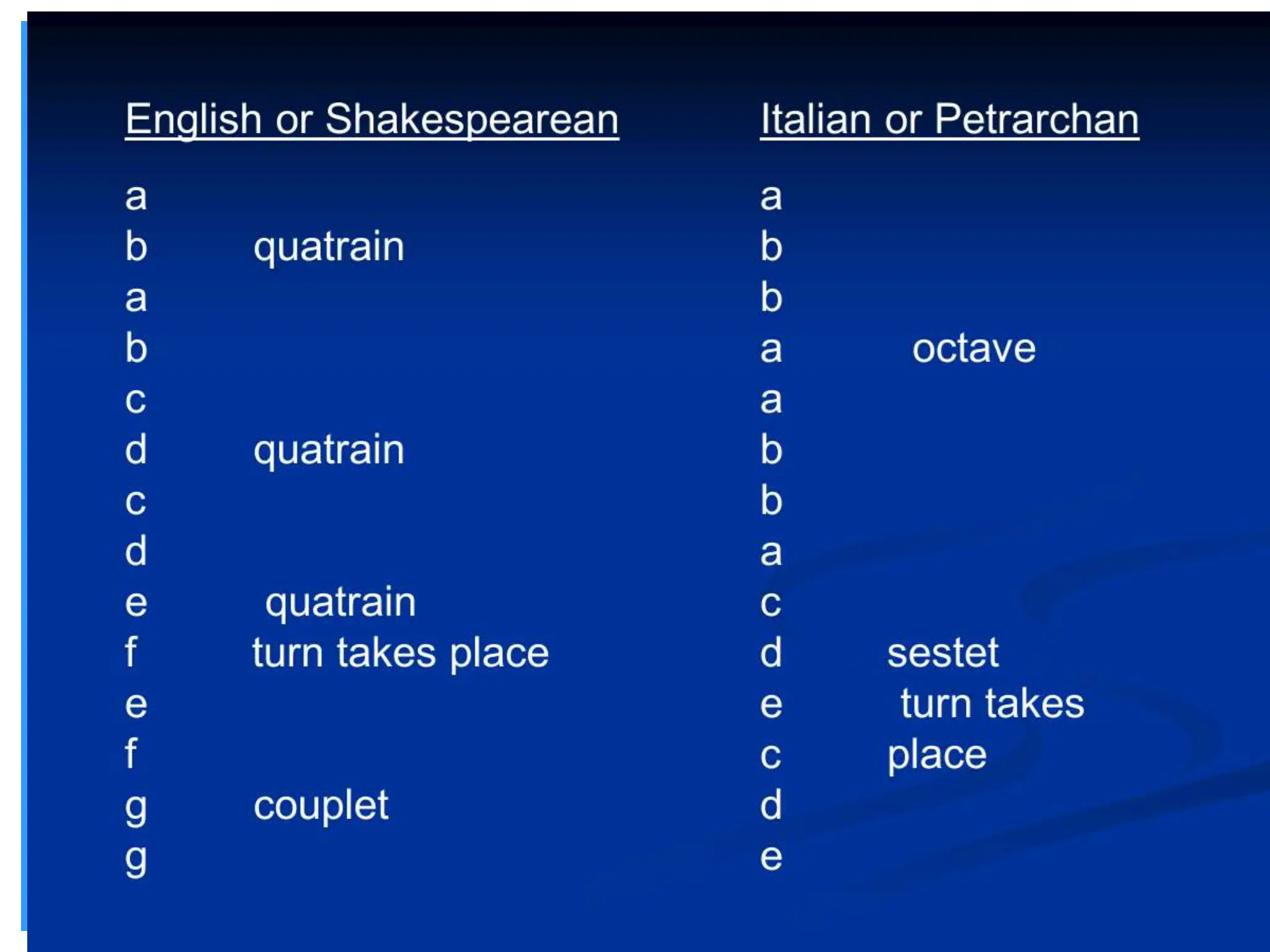
•The rhyme scheme is often abab cdcd efef
gg.
•The turn is either after eight lines or ten
lines.
Shakespearean Sonnet (English Sonnet)
● The majority of Shakespeare’s sonnets are about love
in some way. At times, the speaker is praising love
and other times he is cursing it.
● Other popular topics include:
○ The passage of time
○ Beauty
○ Mortality
The lines in a Shakespearean sonnet are written in
iambic pentameter.
○ The line has 10 total syllables.
○ It alternates between one unstressed and one
stressed syllable.
English Sonnet
• An English Sonnet is also called a
Shakespearean Sonnet.
• It includes three quatrains (groups of four
lines) and a couplet (two lines).
• The rhyme scheme is often abab cdcd efef
gg.
• The turn is either after eight lines or ten
lines.
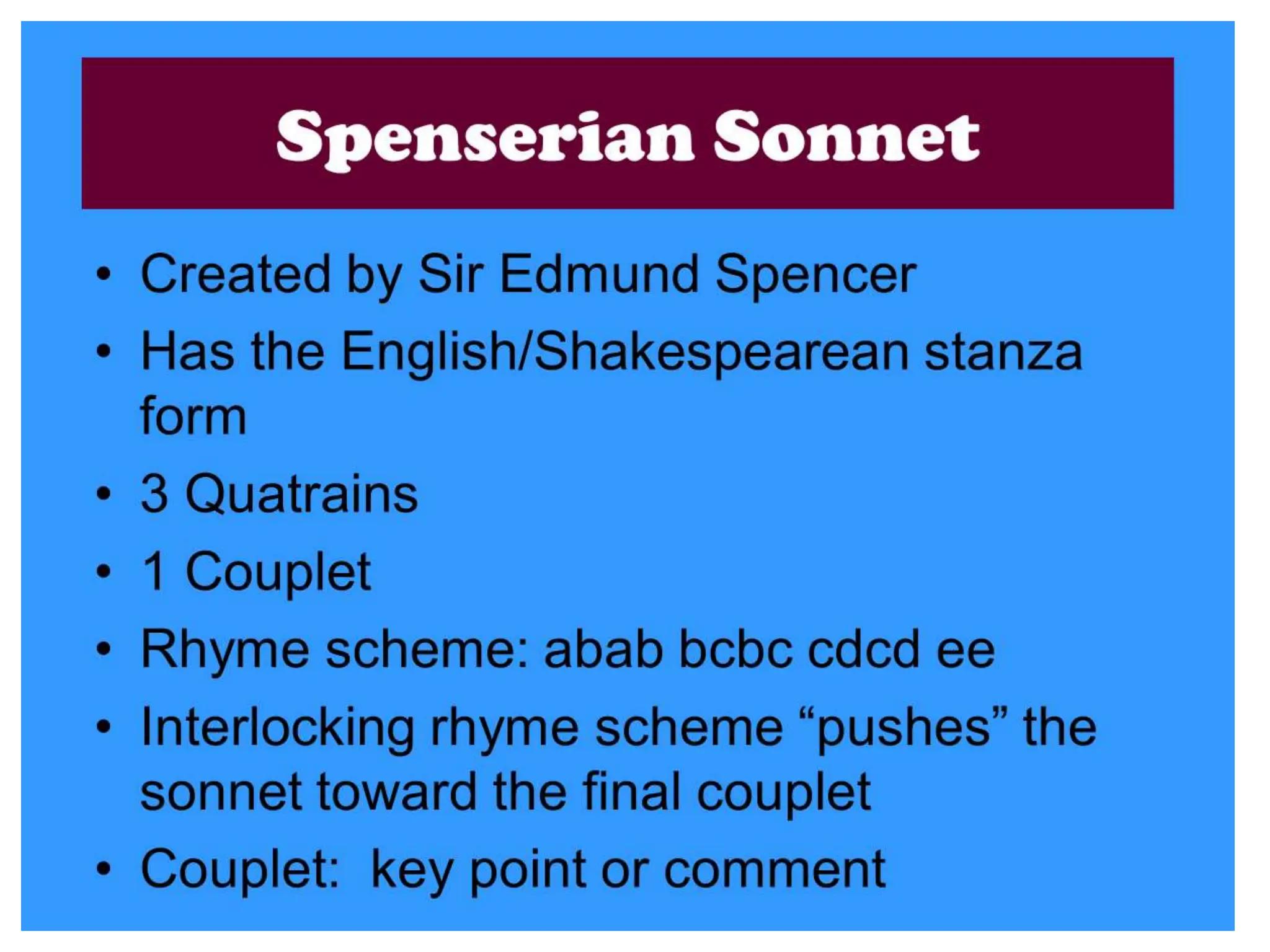
Spenserian Sonnet
● A variation of the English sonnet, it was
invented by 16th century poet Edmund
Spenser.
● It follows Shakespeare with 3 quatrains
and a couplet, but it employs a series of
couplet links between quatrains through a
rhyme scheme of: abab, bcbc, cdcd, ee.
● This style of poem is often called a
linking sonnet because the rhyme
pattern links the first three stanzas
together.
Italian Sonnet
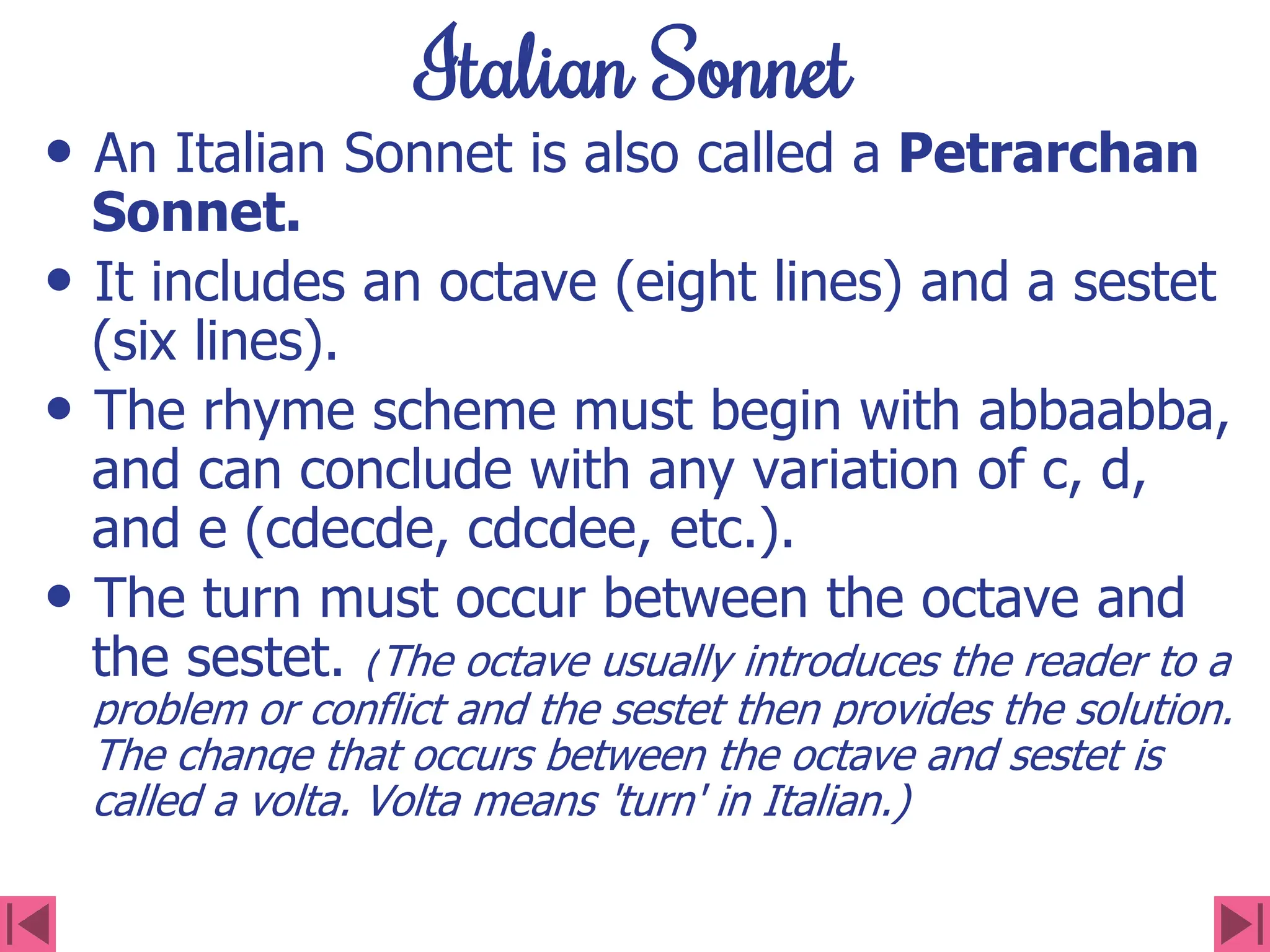
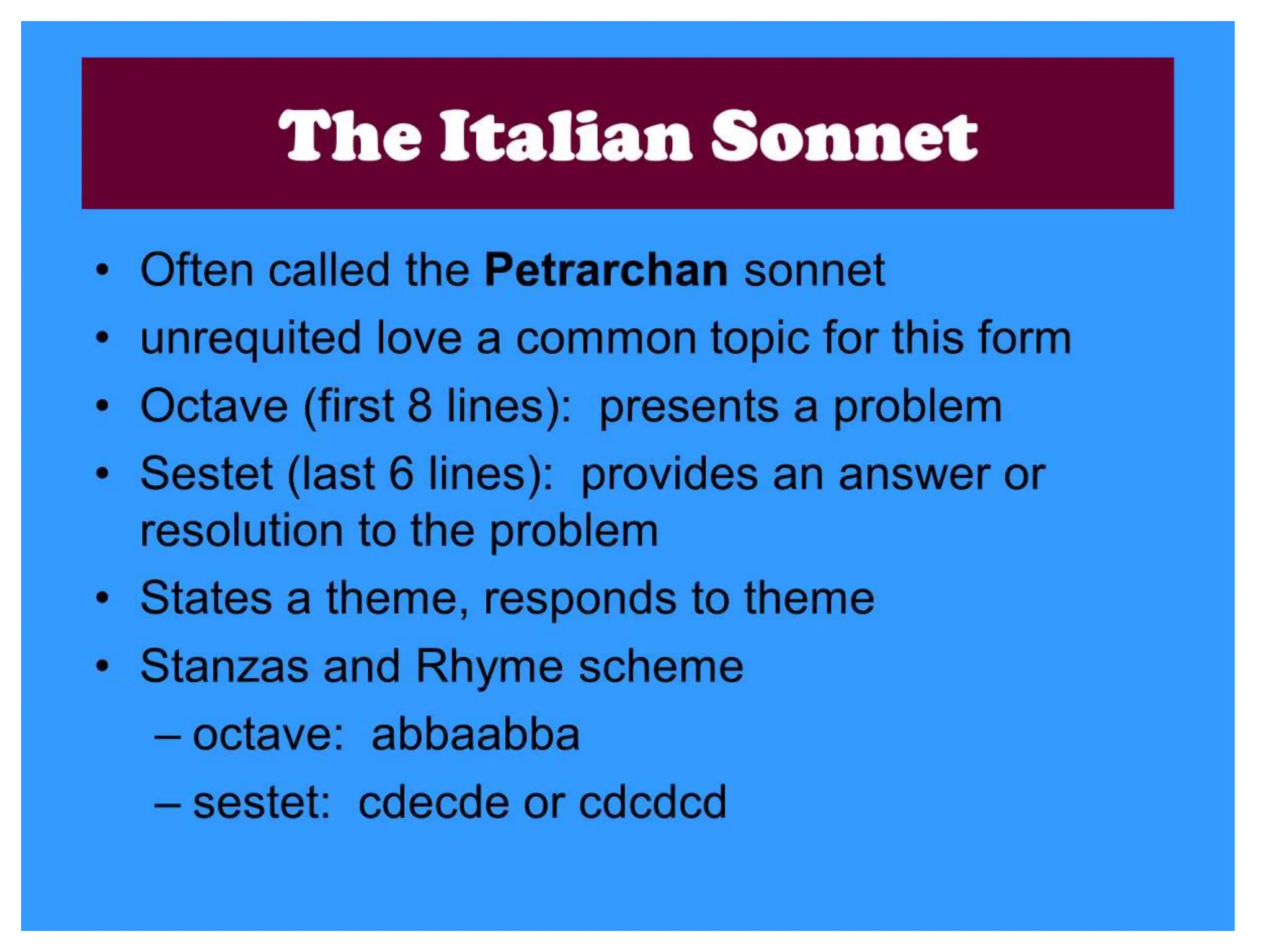
• An Italian Sonnet is also called a Petrarchan
Sonnet.
• It includes an octave (eight lines) and a sestet
(six lines).
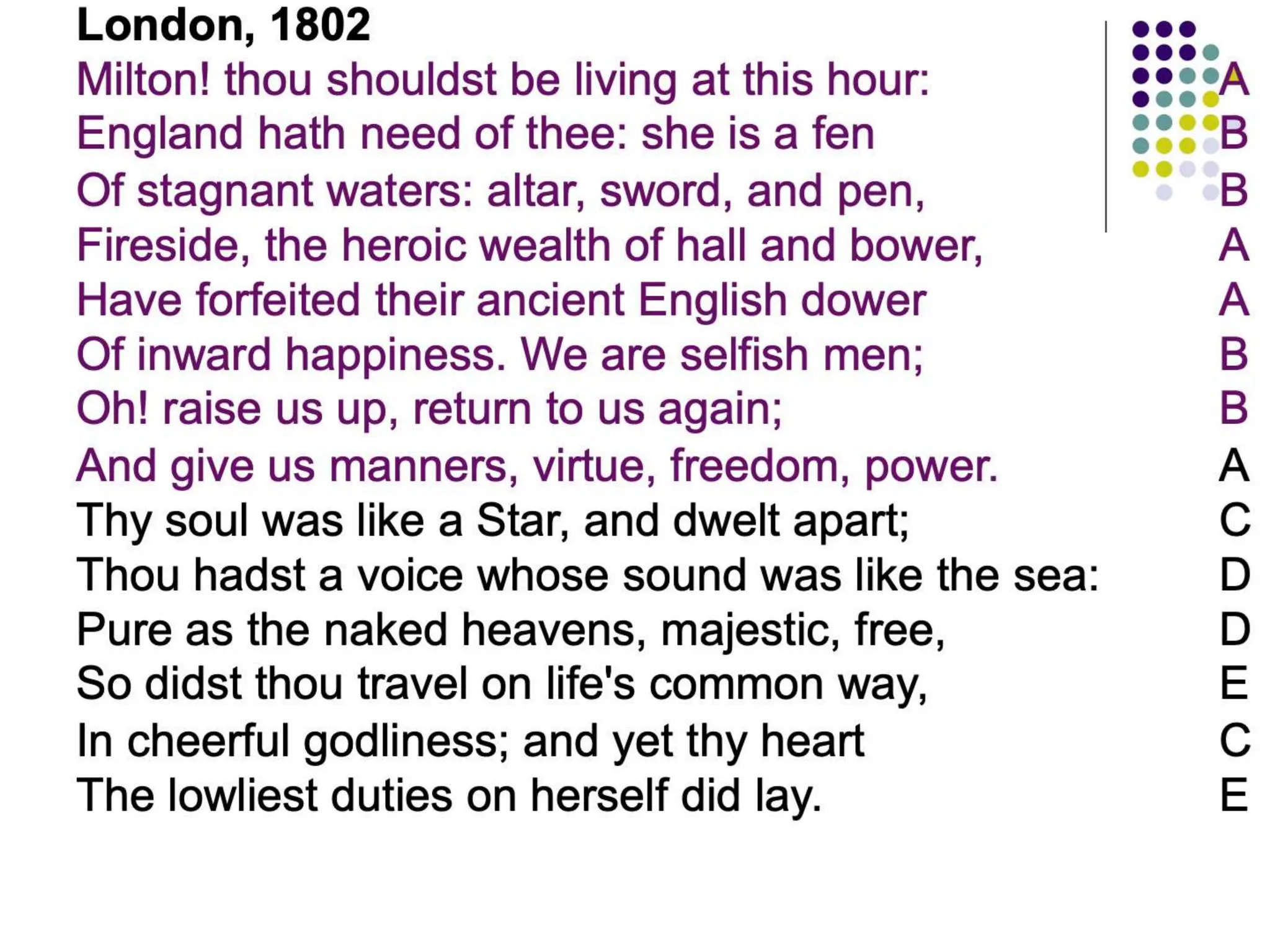
• The rhyme scheme must begin with abbaabba,
and can conclude with any variation of c, d,
and e (cdecde, cdcdee, etc.).
• The turn must occur between the octave and
the sestet. (The octave usually introduces the reader to a
problem or conflict and the sestet then provides the solution.
The change that occurs between the octave and sestet is
called a volta. Volta means 'turn' in Italian.)
Summary
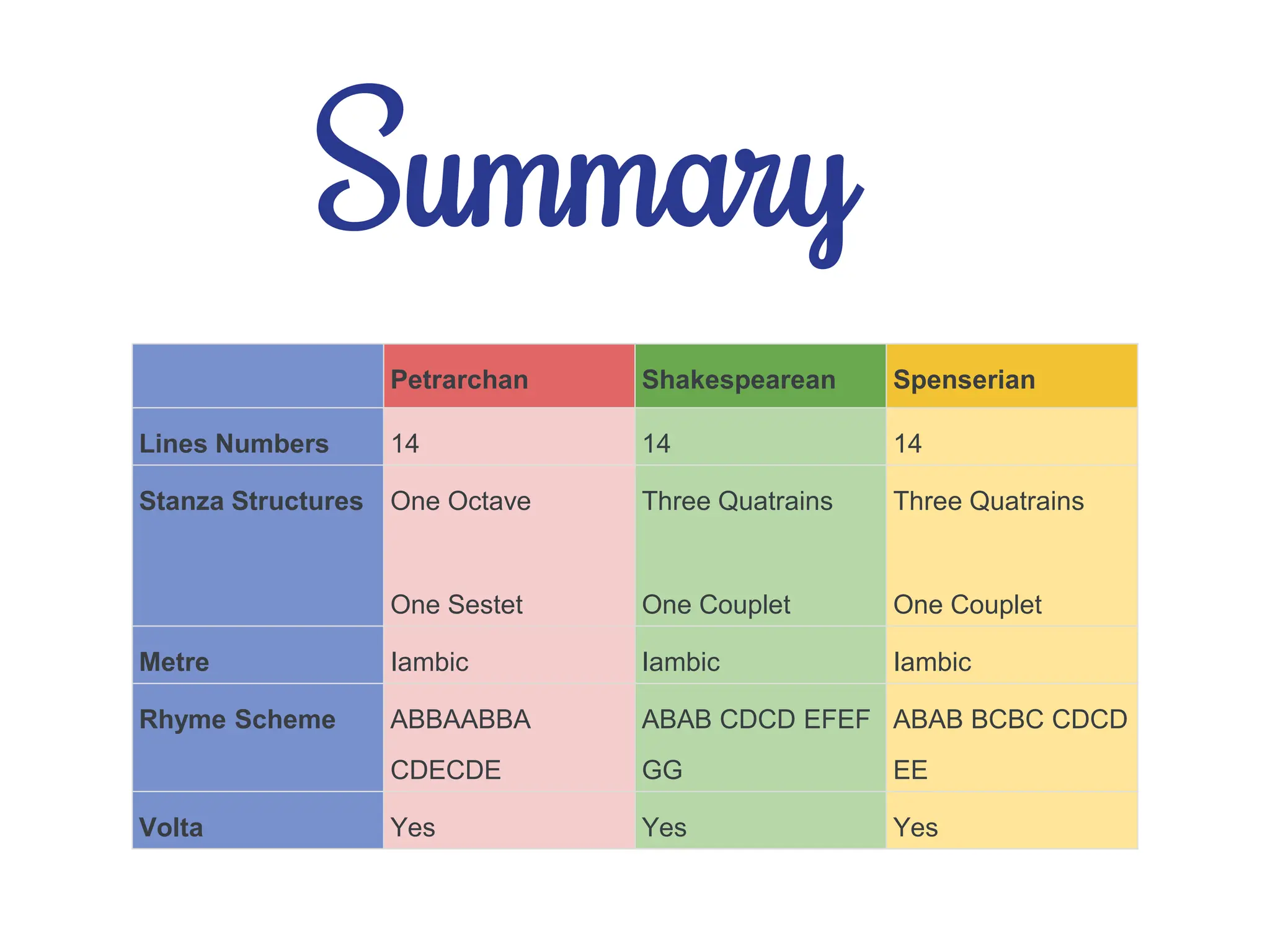
Petrarchan Shakespearean Spenserian
Lines Numbers 14 14 14
Stanza Structures One Octave
One Sestet
Three Quatrains
One Couplet
Three Quatrains
One Couplet
Metre Iambic Iambic Iambic
Rhyme Scheme ABBAABBA
CDECDE
ABAB CDCD EFEF
GG
ABAB BCBC CDCD
EE
Volta Yes Yes Yes
What is a Sonnet slideshow free for all.pptx

What is a Sonnet slideshow free for all.pptx

  • 1.
    What is aSonnet? Understanding the forms, meter, rhyme, and other aspects of the sonnet.
  • 2.
    Sonnet Form • Thesonnet gets its name from the Italian sonetto, which translates to “little song.” • A sonnet has 14 lines. • A sonnet must be written in iambic pentameter • A sonnet must follow a specific rhyme scheme, depending on the type of sonnet. • A sonnet can be about any subject, though they are often about love or nature. • A sonnet introduces a problem or question in the beginning, and a resolution is offered after the turn.
  • 3.
    Volta or “turnin thought” The change that occurs between the octave and sestet in a sonnet is called a volta, which is Italian for "turn". The volta is a vital part of almost all sonnets, and it's often found at the end of the octave or the twelfth line in the Shakespearean sonnet. However, the volta can occur anywhere in the sonnet. The octave is the first eight lines of a sonnet, and it establishes the poem's subject. The sestet is the next six lines, and it counteracts the octave by shifting the poem's perspective. The volta is often indicated by words like "But", "Yet", or "And yet". Poets may use the volta to create a sudden shift in tone, highlight a contrast, or engage the reader's attention. This departure from the conventional structure can add complexity and depth to the poem. For example, a poet may place the turn between lines 7 and 8 to create a specific rhyme scheme or to enhance the poem's musicality. In a Petrarchan sonnet, the volta occurs between the octet and sestet. In a Shakespearean sonnet, the volta can occur between the 8th and 9th lines, or between the 12th and 13th lines.
  • 4.
    Iambic Pentameter ● Aline of Iambic Pentameter is a line with ten beats. ● An “Iamb” is two beats, or one “foot.” ● “Penta” is five (line has five “feet”). ● “Meter” is the rhythm of the poem. ● A “foot” is made of an unstressed syllable and a stressed syllable (in that order).
  • 5.
    English Sonnet •An EnglishSonnet is also called a Shakespearean Sonnet. •It includes three quatrains (groups of four lines) and a couplet (two lines). •The rhyme scheme is often abab cdcd efef gg. •The turn is either after eight lines or ten lines.
  • 6.
    Shakespearean Sonnet (EnglishSonnet) ● The majority of Shakespeare’s sonnets are about love in some way. At times, the speaker is praising love and other times he is cursing it. ● Other popular topics include: ○ The passage of time ○ Beauty ○ Mortality The lines in a Shakespearean sonnet are written in iambic pentameter. ○ The line has 10 total syllables. ○ It alternates between one unstressed and one stressed syllable.
  • 7.
    English Sonnet • AnEnglish Sonnet is also called a Shakespearean Sonnet. • It includes three quatrains (groups of four lines) and a couplet (two lines). • The rhyme scheme is often abab cdcd efef gg. • The turn is either after eight lines or ten lines.
  • 8.
    Spenserian Sonnet ● Avariation of the English sonnet, it was invented by 16th century poet Edmund Spenser. ● It follows Shakespeare with 3 quatrains and a couplet, but it employs a series of couplet links between quatrains through a rhyme scheme of: abab, bcbc, cdcd, ee. ● This style of poem is often called a linking sonnet because the rhyme pattern links the first three stanzas together.
  • 10.
    Italian Sonnet • AnItalian Sonnet is also called a Petrarchan Sonnet. • It includes an octave (eight lines) and a sestet (six lines). • The rhyme scheme must begin with abbaabba, and can conclude with any variation of c, d, and e (cdecde, cdcdee, etc.). • The turn must occur between the octave and the sestet. (The octave usually introduces the reader to a problem or conflict and the sestet then provides the solution. The change that occurs between the octave and sestet is called a volta. Volta means 'turn' in Italian.)
  • 12.
    Summary Petrarchan Shakespearean Spenserian LinesNumbers 14 14 14 Stanza Structures One Octave One Sestet Three Quatrains One Couplet Three Quatrains One Couplet Metre Iambic Iambic Iambic Rhyme Scheme ABBAABBA CDECDE ABAB CDCD EFEF GG ABAB BCBC CDCD EE Volta Yes Yes Yes