Sometimes, Less Innovation Is Better
HBR Article By: Scott Berinato
Presentation by Satoshi Takano
cc: Leo Reynolds - https://www.flickr.com/photos/49968232@N00
https://hbr.org/2017/05/sometimes-less-innovation-is-better
Paolo Aversa and his
colleagues documented
every innovation on more
than 300 Formula 1 race
cars over 30 years and then
cross-referenced that data
with information on F1 race
results.
http://pubsonline.informs.org/doi/full/10.1287/orsc.2015.0984
They discovered that in
certain situations, more
innovation led to poorer
performance.
http://pubsonline.informs.org/doi/full/10.1287/orsc.2015.0984
Their conclusion: sometimes,
LESS innovation is better.http://pubsonline.informs.org/doi/full/10.1287/orsc.2015.0984
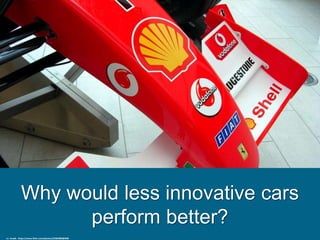
Why would less innovative cars
perform better?
cc: mnadi - https://www.flickr.com/photos/22965089@N00
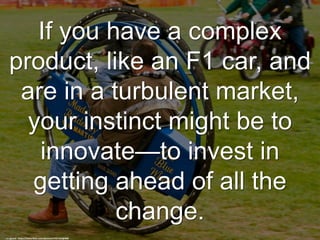
If you have a complex
product, like an F1 car, and
are in a turbulent market,
your instinct might be to
innovate—to invest in
getting ahead of all the
change.
cc: gazzat - https://www.flickr.com/photos/57557325@N00
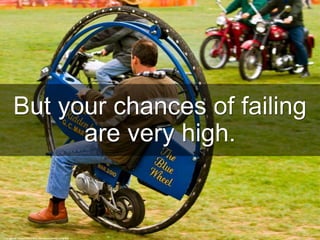
But your chances of failing
are very high.
cc: gazzat - https://www.flickr.com/photos/57557325@N00
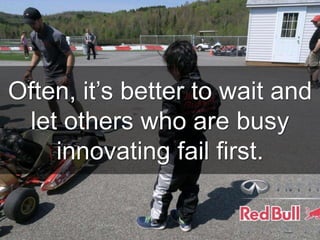
Often, it’s better to wait and
let others who are busy
innovating fail first.
For Example
cc: Rich. F21316 - https://www.flickr.com/photos/26098010@N00
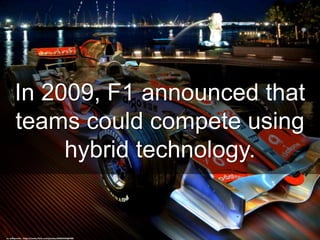
In 2009, F1 announced that
teams could compete using
hybrid technology.
cc: williamcho - https://www.flickr.com/photos/84493444@N00
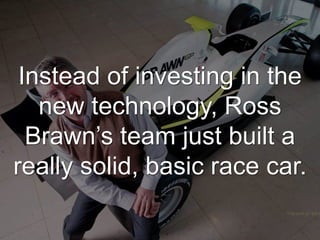
Instead of investing in the
new technology, Ross
Brawn’s team just built a
really solid, basic race car.
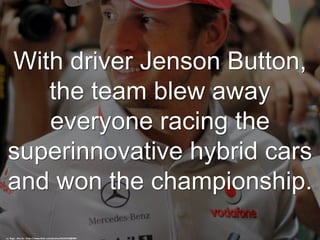
With driver Jenson Button,
the team blew away
everyone racing the
superinnovative hybrid cars
and won the championship.
cc: Rego - d4u.hu - https://www.flickr.com/photos/36234195@N04
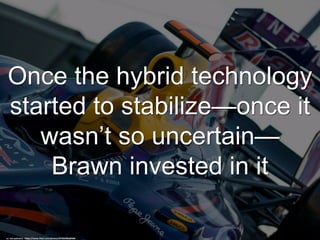
Once the hybrid technology
started to stabilize—once it
wasn’t so uncertain—
Brawn invested in it
cc: nan palmero - https://www.flickr.com/photos/97402086@N00
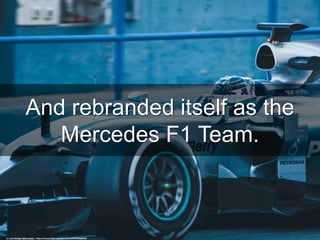
And rebranded itself as the
Mercedes F1 Team.
cc: Leo Hidalgo (@yompyz) - https://www.flickr.com/photos/69474058@N03
So, how do you know you’re in a
turbulent environment?
cc: Instant Vantage - https://www.flickr.com/photos/44312356@N04
3 Factors
cc: Abulic Monkey - https://www.flickr.com/photos/83221073@N00
One: the MAGNITUDE of change. How
much is the industry changing
compared with other times?
cc: daniel.julia - https://www.flickr.com/photos/60814789@N00
Two: the FREQUENCY of change. How
often are changes coming at you?
cc: yoppy - https://www.flickr.com/photos/44124362019@N01
Three: predictability. Can you
see changes coming?
cc: jlz - https://www.flickr.com/photos/32653260@N00
If predictability is low, and
either frequency is high or
magnitude is large, you
should scale back
innovation until things get
more stable.
cc: HALDANE MARTIN - https://www.flickr.com/photos/52634191@N08
If all three are working
against you, you should
innovate less.
cc: HALDANE MARTIN - https://www.flickr.com/photos/52634191@N08
Does this really apply to
other businesses?
cc: DocChewbacca - https://www.flickr.com/photos/49462908@N00
Absolutely.
cc: Joe Shlabotnik - https://www.flickr.com/photos/40646519@N00
Think of any complex product.
cc: Luke,Ma - https://www.flickr.com/photos/23249662@N03
Sudden changes create
instability that seem to beg
for innovation, but it’s
probably better to sit tight
and focus on execution and
efficiency.
cc: Luke,Ma - https://www.flickr.com/photos/23249662@N03
Think about music formats:
The frequency of change is
increasing, but it’s still not
that often.
cc: Fey Ilyas - https://www.flickr.com/photos/28968923@N08
Vinyl was around for
decades, CDs were around
for years. But magnitude is
massive when changes
take you from a CD to a
streaming service.
cc: jackol - https://www.flickr.com/photos/44124329962@N01
Apple Didn’t Invent
Music
Tesla Didn’t Invent
Electric Cars
Amazon Didn’t Invent
E-Commerce
cc: jackol - https://www.flickr.com/photos/44124329962@N01
Innovation-as-a-Process
• Grade each element’s
innovativeness on a scale of 0
to 3, where 3 was radical
innovation and 0 was little to
none.
• Vet it out with other
stakeholders.
cc: photographerglen - https://www.flickr.com/photos/10770008@N04
In SUMMARY:
Push the envelope in a
stable market, but focus on
efficiency in a turbulent
one.
cc: photographerglen - https://www.flickr.com/photos/10770008@N04
In a turbulent market, let
others fail first.
cc: photographerglen - https://www.flickr.com/photos/10770008@N04
Sometimes, Less Innovation Is Better
stakano@gmail.com
cc: acaben - https://www.flickr.com/photos/35034346178@N01

Sometimes, Less innovation is Better

  • 1.
    Sometimes, Less InnovationIs Better HBR Article By: Scott Berinato Presentation by Satoshi Takano cc: Leo Reynolds - https://www.flickr.com/photos/49968232@N00 https://hbr.org/2017/05/sometimes-less-innovation-is-better
  • 2.
    Paolo Aversa andhis colleagues documented every innovation on more than 300 Formula 1 race cars over 30 years and then cross-referenced that data with information on F1 race results. http://pubsonline.informs.org/doi/full/10.1287/orsc.2015.0984
  • 3.
    They discovered thatin certain situations, more innovation led to poorer performance. http://pubsonline.informs.org/doi/full/10.1287/orsc.2015.0984
  • 4.
    Their conclusion: sometimes, LESSinnovation is better.http://pubsonline.informs.org/doi/full/10.1287/orsc.2015.0984
  • 5.
    Why would lessinnovative cars perform better? cc: mnadi - https://www.flickr.com/photos/22965089@N00
  • 6.
    If you havea complex product, like an F1 car, and are in a turbulent market, your instinct might be to innovate—to invest in getting ahead of all the change. cc: gazzat - https://www.flickr.com/photos/57557325@N00
  • 7.
    But your chancesof failing are very high. cc: gazzat - https://www.flickr.com/photos/57557325@N00
  • 8.
    Often, it’s betterto wait and let others who are busy innovating fail first.
  • 9.
    For Example cc: Rich.F21316 - https://www.flickr.com/photos/26098010@N00
  • 10.
    In 2009, F1announced that teams could compete using hybrid technology. cc: williamcho - https://www.flickr.com/photos/84493444@N00
  • 11.
    Instead of investingin the new technology, Ross Brawn’s team just built a really solid, basic race car.
  • 12.
    With driver JensonButton, the team blew away everyone racing the superinnovative hybrid cars and won the championship. cc: Rego - d4u.hu - https://www.flickr.com/photos/36234195@N04
  • 13.
    Once the hybridtechnology started to stabilize—once it wasn’t so uncertain— Brawn invested in it cc: nan palmero - https://www.flickr.com/photos/97402086@N00
  • 14.
    And rebranded itselfas the Mercedes F1 Team. cc: Leo Hidalgo (@yompyz) - https://www.flickr.com/photos/69474058@N03
  • 15.
    So, how doyou know you’re in a turbulent environment? cc: Instant Vantage - https://www.flickr.com/photos/44312356@N04
  • 16.
    3 Factors cc: AbulicMonkey - https://www.flickr.com/photos/83221073@N00
  • 17.
    One: the MAGNITUDEof change. How much is the industry changing compared with other times? cc: daniel.julia - https://www.flickr.com/photos/60814789@N00
  • 18.
    Two: the FREQUENCYof change. How often are changes coming at you? cc: yoppy - https://www.flickr.com/photos/44124362019@N01
  • 19.
    Three: predictability. Canyou see changes coming? cc: jlz - https://www.flickr.com/photos/32653260@N00
  • 20.
    If predictability islow, and either frequency is high or magnitude is large, you should scale back innovation until things get more stable. cc: HALDANE MARTIN - https://www.flickr.com/photos/52634191@N08
  • 21.
    If all threeare working against you, you should innovate less. cc: HALDANE MARTIN - https://www.flickr.com/photos/52634191@N08
  • 22.
    Does this reallyapply to other businesses? cc: DocChewbacca - https://www.flickr.com/photos/49462908@N00
  • 23.
    Absolutely. cc: Joe Shlabotnik- https://www.flickr.com/photos/40646519@N00
  • 24.
    Think of anycomplex product. cc: Luke,Ma - https://www.flickr.com/photos/23249662@N03
  • 25.
    Sudden changes create instabilitythat seem to beg for innovation, but it’s probably better to sit tight and focus on execution and efficiency. cc: Luke,Ma - https://www.flickr.com/photos/23249662@N03
  • 26.
    Think about musicformats: The frequency of change is increasing, but it’s still not that often. cc: Fey Ilyas - https://www.flickr.com/photos/28968923@N08
  • 27.
    Vinyl was aroundfor decades, CDs were around for years. But magnitude is massive when changes take you from a CD to a streaming service. cc: jackol - https://www.flickr.com/photos/44124329962@N01
  • 28.
    Apple Didn’t Invent Music TeslaDidn’t Invent Electric Cars Amazon Didn’t Invent E-Commerce cc: jackol - https://www.flickr.com/photos/44124329962@N01
  • 29.
    Innovation-as-a-Process • Grade eachelement’s innovativeness on a scale of 0 to 3, where 3 was radical innovation and 0 was little to none. • Vet it out with other stakeholders. cc: photographerglen - https://www.flickr.com/photos/10770008@N04
  • 30.
    In SUMMARY: Push theenvelope in a stable market, but focus on efficiency in a turbulent one. cc: photographerglen - https://www.flickr.com/photos/10770008@N04
  • 31.
    In a turbulentmarket, let others fail first. cc: photographerglen - https://www.flickr.com/photos/10770008@N04
  • 32.
    Sometimes, Less InnovationIs Better stakano@gmail.com cc: acaben - https://www.flickr.com/photos/35034346178@N01