Copyright © Cengage Learning. All rights reserved.
5.3 Solving Trigonometric
Equations
2
What You Should Learn
• Use standard algebraic techniques to solve
trigonometric equations.
• Solve trigonometric equations of quadratic type.
• Solve trigonometric equations involving multiple
angles.
• Use inverse trigonometric functions to solve
trigonometric equations.
3
Introduction
4
Introduction
To solve a trigonometric equation, use standard algebraic
techniques such as collecting like terms and factoring.
Your preliminary goal is to isolate the trigonometric function
involved in the equation.
5
Example 1 – Solving a Trigonometric Equation
Solve 2 sin x – 1 = 0. Copy this slide, but not the next.
Solution:
2 sin x – 1 = 0
2 sin x = 1
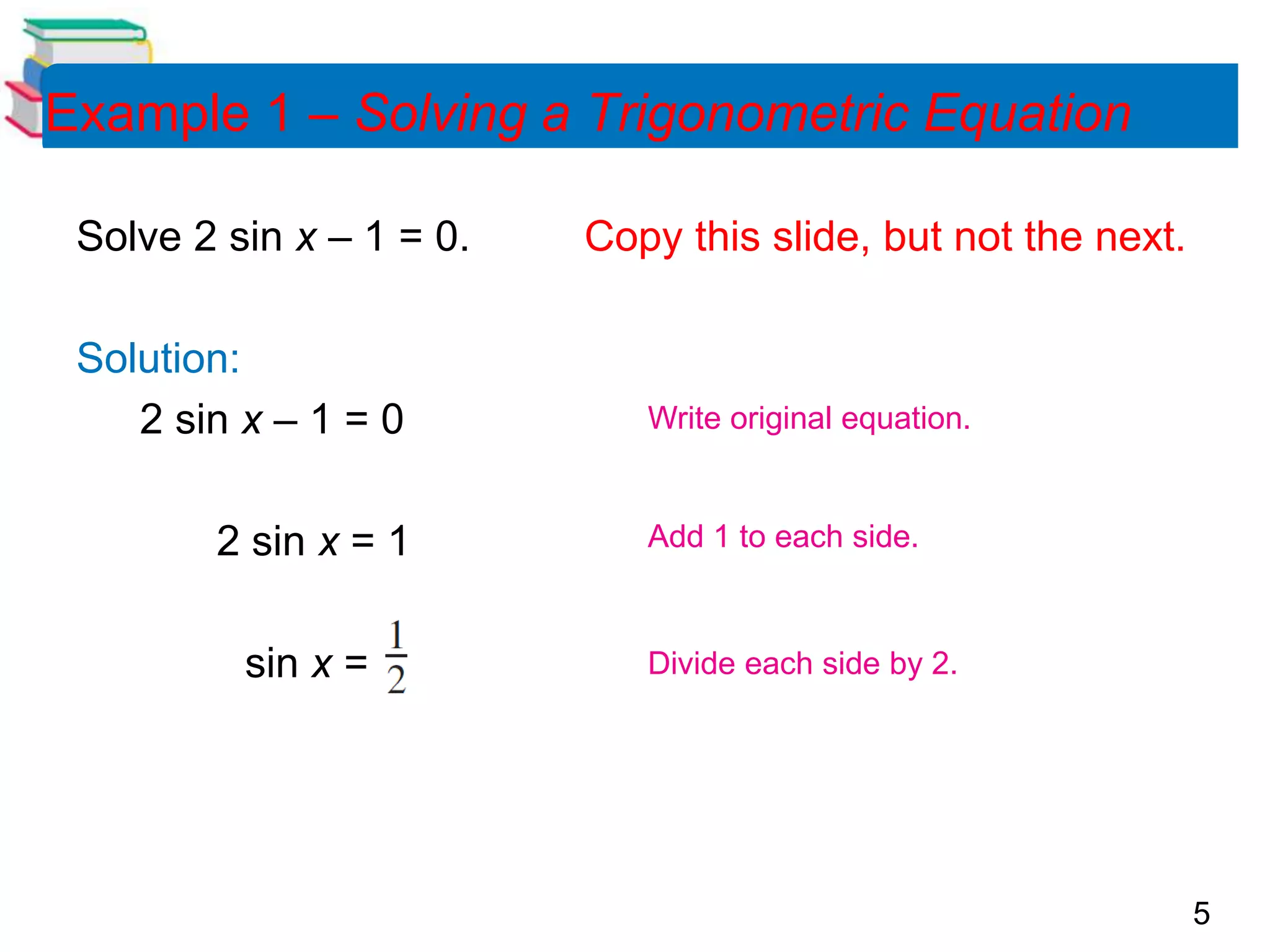
sin x =
Write original equation.
Add 1 to each side.
Divide each side by 2.
6
Example 1 – Solution
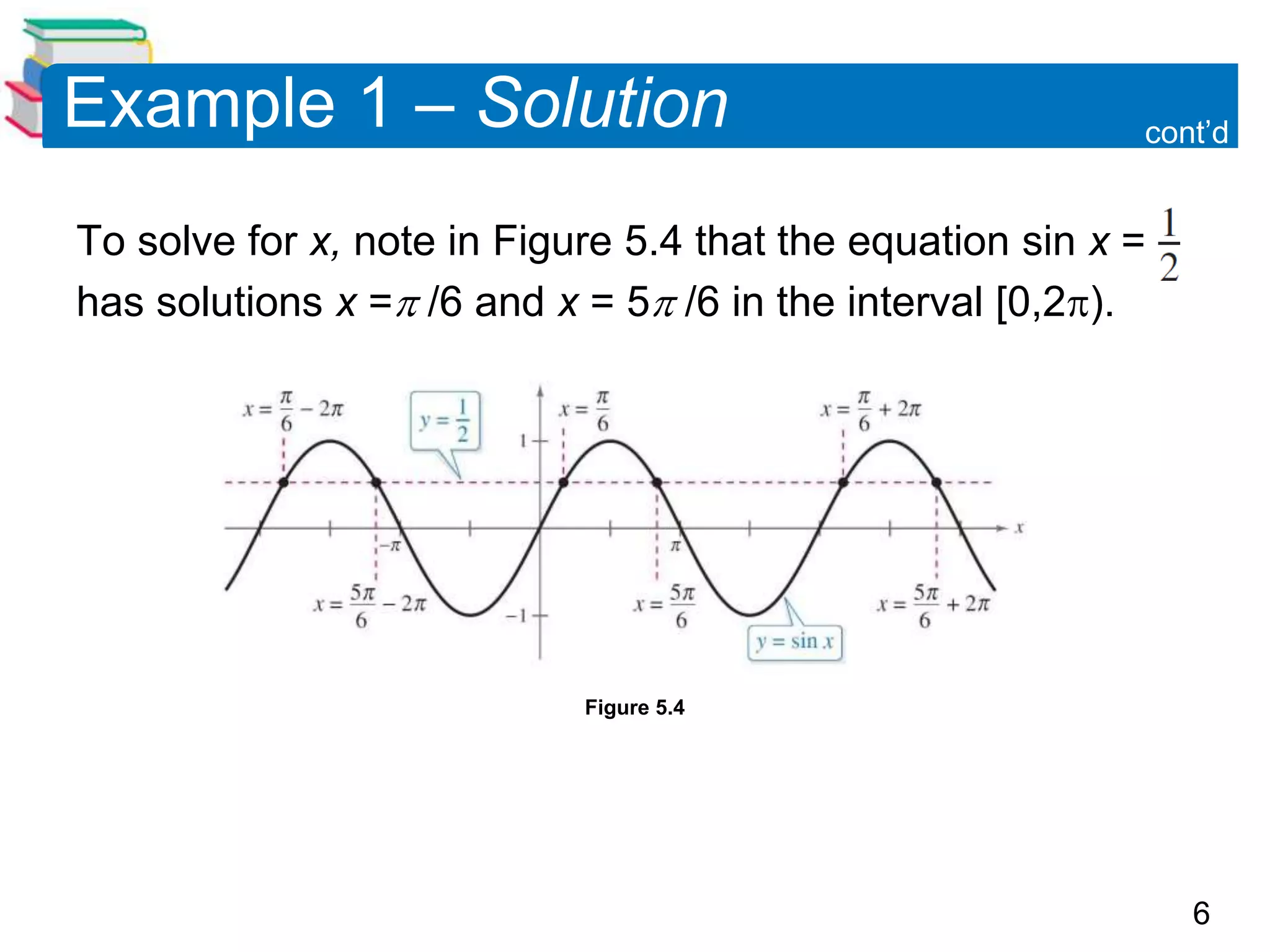
To solve for x, note in Figure 5.4 that the equation sin x =
has solutions x = /6 and x = 5 /6 in the interval [0,2).
cont’d
Figure 5.4
7
Example 1 – Solution
Moreover, because sin x has a period of 2, there are
infinitely many other solutions, which can be written as
and
where n is an integer, as shown in Figure 5.4.
cont’d
General solution
8
Equations of Quadratic Type
9
Equations of Quadratic Type
Many trigonometric equations are of quadratic type
ax2 + bx + c = 0, as shown below. To solve equations of
this type, factor the quadratic or, when factoring is not
possible, use the Quadratic Formula.
Quadratic in sin x Quadratic in sec x
2 sin2 x – sin x – 1 = 0 sec2 x – 3 sec x – 2 = 0
(sin x)2 – sin x – 1 = 0 (sec x)2 – 3 sec x – 2 = 0
10
Example 5 – Factoring an Equation of Quadratic Type
Find all solutions of 2 sin2 x – sin x – 1 = 0 in the interval
[0, 2).
Solution:
Treating the equation as a quadratic in sin x and factoring
produces the following.
2 sin2 x – sin x – 1 = 0
(2 sin x + 1)(sin x – 1) = 0
Write original equation.
Factor.
11
Example 5 – Solution
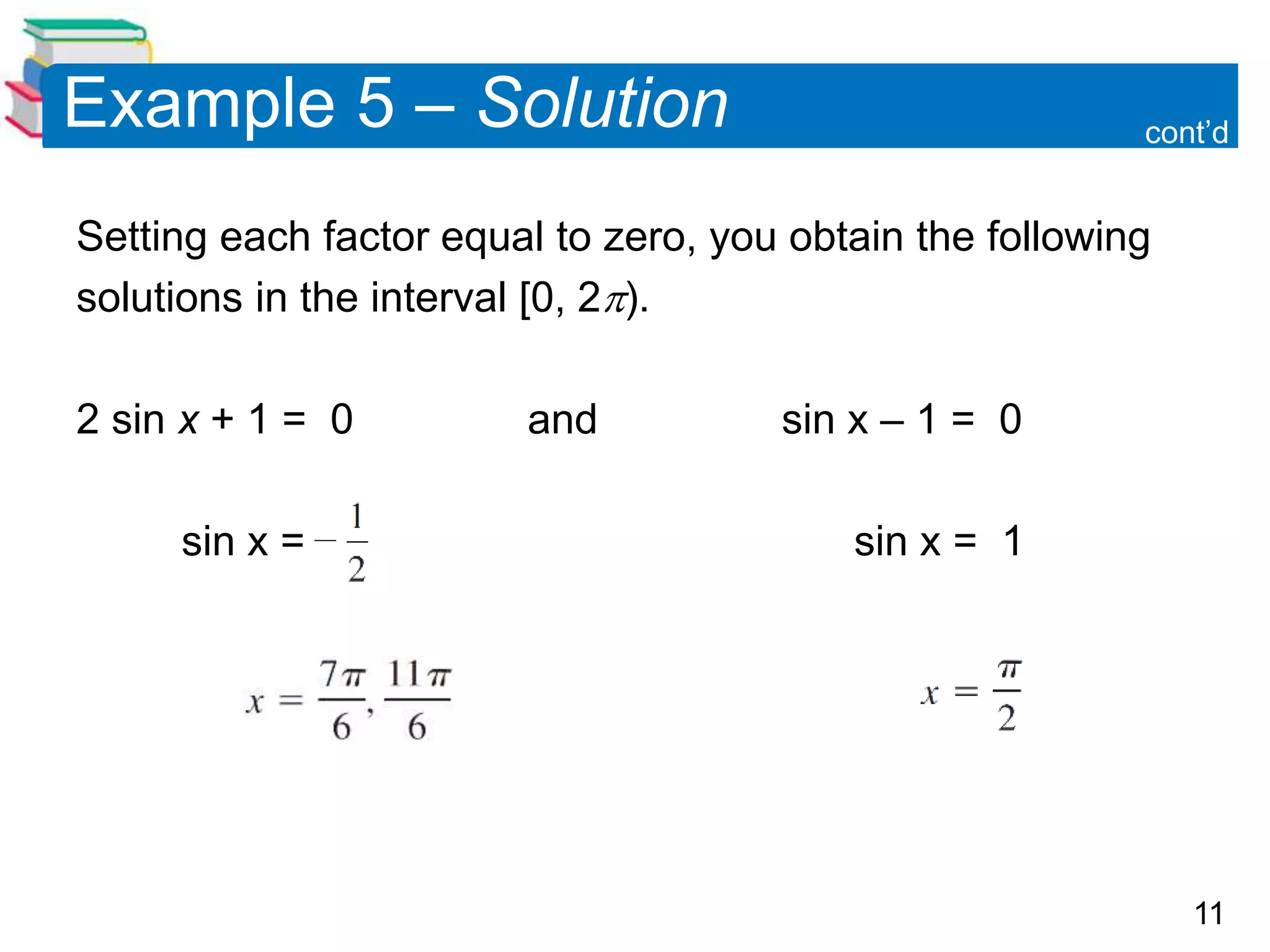
Setting each factor equal to zero, you obtain the following
solutions in the interval [0, 2).
2 sin x + 1 = 0 and sin x – 1 = 0
sin x = sin x = 1
cont’d
12
Functions Involving Multiple Angles
13
Functions Involving Multiple Angles
The next example involves trigonometric functions of
multiple angles of the forms sin ku and cos ku.
To solve equations of these forms, first solve the equation
for ku, then divide your result by k.
14
Example 8 – Functions Involving Multiple Angles
Solve 2 cos 3t – 1 = 0
Solution:
2 cos 3t – 1 = 0
2 cos 3t = 1
cos 3t =
Write original equation.
Add 1 to each side.
Divide each side by 2.
15
Example 8 – Solution
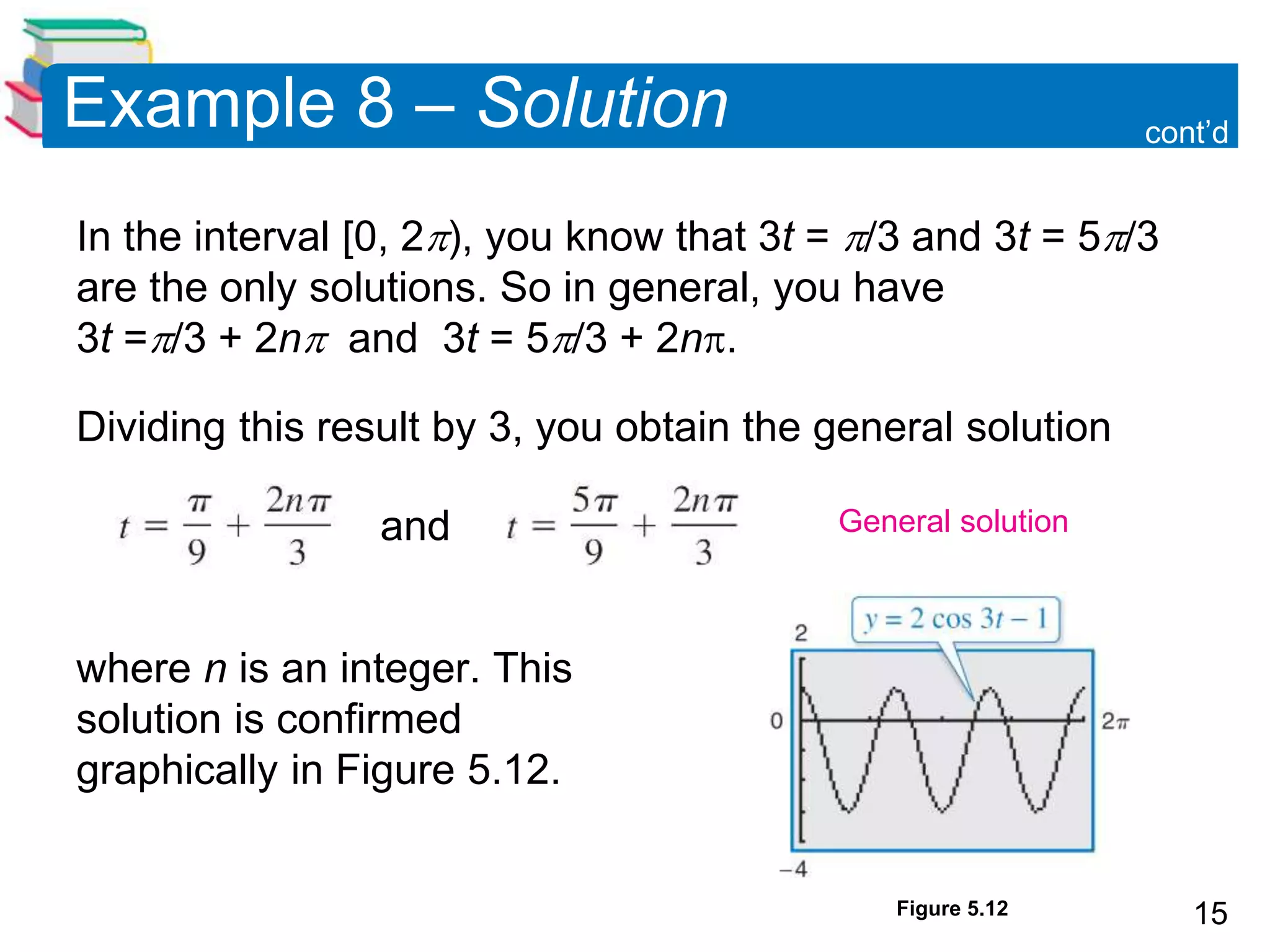
In the interval [0, 2), you know that 3t = 3 and 3t = 53
are the only solutions. So in general, you have
3t =3 + 2n and 3t = 53 + 2n.
Dividing this result by 3, you obtain the general solution
and
where n is an integer. This
solution is confirmed
graphically in Figure 5.12.
cont’d
General solution
Figure 5.12

14. trigo eqs.ppt

  • 1.
    Copyright © CengageLearning. All rights reserved. 5.3 Solving Trigonometric Equations
  • 2.
    2 What You ShouldLearn • Use standard algebraic techniques to solve trigonometric equations. • Solve trigonometric equations of quadratic type. • Solve trigonometric equations involving multiple angles. • Use inverse trigonometric functions to solve trigonometric equations.
  • 3.
  • 4.
    4 Introduction To solve atrigonometric equation, use standard algebraic techniques such as collecting like terms and factoring. Your preliminary goal is to isolate the trigonometric function involved in the equation.
  • 5.
    5 Example 1 –Solving a Trigonometric Equation Solve 2 sin x – 1 = 0. Copy this slide, but not the next. Solution: 2 sin x – 1 = 0 2 sin x = 1 sin x = Write original equation. Add 1 to each side. Divide each side by 2.
  • 6.
    6 Example 1 –Solution To solve for x, note in Figure 5.4 that the equation sin x = has solutions x = /6 and x = 5 /6 in the interval [0,2). cont’d Figure 5.4
  • 7.
    7 Example 1 –Solution Moreover, because sin x has a period of 2, there are infinitely many other solutions, which can be written as and where n is an integer, as shown in Figure 5.4. cont’d General solution
  • 8.
  • 9.
    9 Equations of QuadraticType Many trigonometric equations are of quadratic type ax2 + bx + c = 0, as shown below. To solve equations of this type, factor the quadratic or, when factoring is not possible, use the Quadratic Formula. Quadratic in sin x Quadratic in sec x 2 sin2 x – sin x – 1 = 0 sec2 x – 3 sec x – 2 = 0 (sin x)2 – sin x – 1 = 0 (sec x)2 – 3 sec x – 2 = 0
  • 10.
    10 Example 5 –Factoring an Equation of Quadratic Type Find all solutions of 2 sin2 x – sin x – 1 = 0 in the interval [0, 2). Solution: Treating the equation as a quadratic in sin x and factoring produces the following. 2 sin2 x – sin x – 1 = 0 (2 sin x + 1)(sin x – 1) = 0 Write original equation. Factor.
  • 11.
    11 Example 5 –Solution Setting each factor equal to zero, you obtain the following solutions in the interval [0, 2). 2 sin x + 1 = 0 and sin x – 1 = 0 sin x = sin x = 1 cont’d
  • 12.
  • 13.
    13 Functions Involving MultipleAngles The next example involves trigonometric functions of multiple angles of the forms sin ku and cos ku. To solve equations of these forms, first solve the equation for ku, then divide your result by k.
  • 14.
    14 Example 8 –Functions Involving Multiple Angles Solve 2 cos 3t – 1 = 0 Solution: 2 cos 3t – 1 = 0 2 cos 3t = 1 cos 3t = Write original equation. Add 1 to each side. Divide each side by 2.
  • 15.
    15 Example 8 –Solution In the interval [0, 2), you know that 3t = 3 and 3t = 53 are the only solutions. So in general, you have 3t =3 + 2n and 3t = 53 + 2n. Dividing this result by 3, you obtain the general solution and where n is an integer. This solution is confirmed graphically in Figure 5.12. cont’d General solution Figure 5.12