Solving Real-Life
Problems with Design
#TrainingTuesday
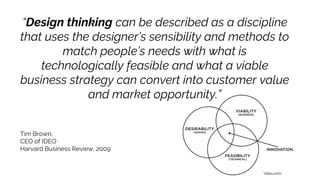
“Design thinking can be described as a discipline
that uses the designer’s sensibility and methods to
match people’s needs with what is
technologically feasible and what a viable
business strategy can convert into customer value
and market opportunity.”
Tim Brown,
CEO of IDEO
Harvard Business Review, 2009
*ideo.com
*Paris-Est d.school at École des Ponts
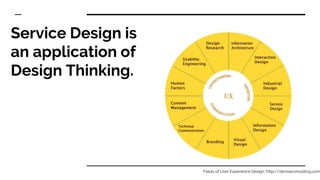
Service Design is
an application of
Design Thinking.
Fields of User Experience Design *http://deviseconsulting.com
Service Design
Services are intangible economic goods—they lead to outcomes as opposed to
physical things that people can own. Outcomes are generated by value
exchanges that occur through mediums called touchpoints.
1. People
2. Place such as physical space or virtual environment
3. Props such as objects and collateral used to produce the service
encounter
4. Partners include other businesses or entities that help produce the service* http://www.cooper.com/
Service Design
Service design is critical to making a cohesive experience across all channels.
Without effective service design, many companies break apart into
disconnected channels, with no one overseeing or coordinating.
Why use service design:
Bad experiences could mean losing customers due to frustration
There are many opportunities to leverage technology to create
new services
Well-designed service experiences differentiate companies
* http://www.cooper.com/
OpenLab
Located within Toronto General Hospital,
OpenLab is a design and innovation shop
dedicated to finding creative solutions that
transform the way healthcare is delivered and
experienced.
*OpenRounds every Tuesday @ noon
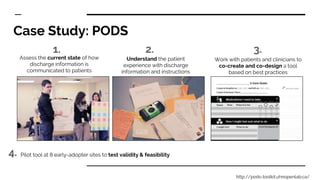
Case Study: PODS
Assess the current state of how
discharge information is
communicated to patients
Understand the patient
experience with discharge
information and instructions
Work with patients and clinicians to
co-create and co-design a tool
based on best practices
Pilot tool at 8 early-adopter sites to test validity & feasibility
1. 2. 3.
4.
http://pods-toolkit.uhnopenlab.ca/
Design Tools:
Journey Mapping
Exercise
Personas & Journey Mapping
Personas are profiles outlining features of a fictional person. It outlines their
social and demographic characteristics, their own needs, desires, habits and
cultural backgrounds. Based on deep research of potential or existing users.
Journey Maps are used as a way to visually tell a story from an individual's
perspective in terms of their relationship and experience with an organization, a
service or a product. They are useful when creating a new service or improving
an existing one.
* www.kate-sukpisan.com
Journey Mapping - Exercise
Get in groups of 2-3
Think of a specific service or company
Create a “persona” of a potential user
Think through all the “touchpoints” that specific user would have
Plot these interactions on a timeline
Categorize the interactions as positive, neutral or negative
Optional: for any negative interactions, think of ways it could be improved
*http://thisisservicedesignthinking.com/
Thank you!
Questions? Comments?
Connect now.
rasha.kubba@gmail.com
@rkubba
rashakubba.com
Rasha Kubba
space@nowcommon.is
@nowcommonTO
nowcommon.is
Now Common

Solving Real-Life Problems with Design

  • 1.
    Solving Real-Life Problems withDesign #TrainingTuesday
  • 2.
    “Design thinking canbe described as a discipline that uses the designer’s sensibility and methods to match people’s needs with what is technologically feasible and what a viable business strategy can convert into customer value and market opportunity.” Tim Brown, CEO of IDEO Harvard Business Review, 2009 *ideo.com
  • 3.
    *Paris-Est d.school atÉcole des Ponts
  • 4.
    Service Design is anapplication of Design Thinking. Fields of User Experience Design *http://deviseconsulting.com
  • 5.
    Service Design Services areintangible economic goods—they lead to outcomes as opposed to physical things that people can own. Outcomes are generated by value exchanges that occur through mediums called touchpoints. 1. People 2. Place such as physical space or virtual environment 3. Props such as objects and collateral used to produce the service encounter 4. Partners include other businesses or entities that help produce the service* http://www.cooper.com/
  • 6.
    Service Design Service designis critical to making a cohesive experience across all channels. Without effective service design, many companies break apart into disconnected channels, with no one overseeing or coordinating. Why use service design: Bad experiences could mean losing customers due to frustration There are many opportunities to leverage technology to create new services Well-designed service experiences differentiate companies * http://www.cooper.com/
  • 7.
    OpenLab Located within TorontoGeneral Hospital, OpenLab is a design and innovation shop dedicated to finding creative solutions that transform the way healthcare is delivered and experienced. *OpenRounds every Tuesday @ noon
  • 8.
    Case Study: PODS Assessthe current state of how discharge information is communicated to patients Understand the patient experience with discharge information and instructions Work with patients and clinicians to co-create and co-design a tool based on best practices Pilot tool at 8 early-adopter sites to test validity & feasibility 1. 2. 3. 4. http://pods-toolkit.uhnopenlab.ca/
  • 9.
  • 10.
    Personas & JourneyMapping Personas are profiles outlining features of a fictional person. It outlines their social and demographic characteristics, their own needs, desires, habits and cultural backgrounds. Based on deep research of potential or existing users. Journey Maps are used as a way to visually tell a story from an individual's perspective in terms of their relationship and experience with an organization, a service or a product. They are useful when creating a new service or improving an existing one.
  • 11.
  • 12.
    Journey Mapping -Exercise Get in groups of 2-3 Think of a specific service or company Create a “persona” of a potential user Think through all the “touchpoints” that specific user would have Plot these interactions on a timeline Categorize the interactions as positive, neutral or negative Optional: for any negative interactions, think of ways it could be improved
  • 13.
  • 14.
  • 15.

Editor's Notes

  • #3 Too narrow, is there a general def and is it useful to have one
  • #4 Add “DEFINE” between inspiration and Ideation. Inspiration is the problem or opportunity that motivates the search for solutions. Ideation is the process of generating, developing, and testing ideas. Implementation is the path that leads from the project stage into people’s lives. Read more at https://www.ideo.com/about/#Dqb6Mq4qBU51Z4q9.99
  • #6 Touchpoints are these exchange moments in which service users engage with the service. There are five different types of touch points: People, including employees and other customers encountered while the service is produced. Place, such as the physical space or the virtual environment through which the service is delivered Props, such as the objects and collateral used to produce the service encounter Partners, including other businesses or entities that help to produce or enhance the service Processes, such as the workflows and rituals that are used to produce the service (this relates the people, place, props and partners)