Dr Frost Learning is a registered charity
in England and Wales (no 1194954)
Last modified:
www.drfrost.org
@DrFrostMaths
Contact the resource team:
resources@drfrost.org
@DrFrostResource
Amanda Austin
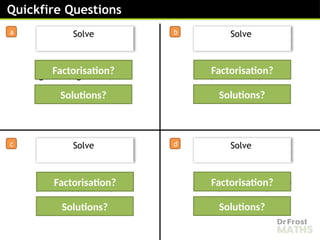
Solving Complex Quadratics by
Factorising
11th
February 2025
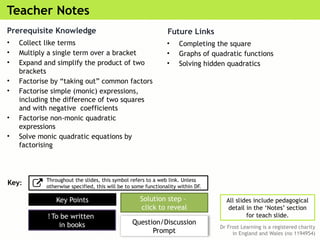
Teacher Notes
Dr Frost Learning is a registered charity
in England and Wales (no 1194954)
Key Points Solution step –
click to reveal
Question/Discussion
Prompt
! To be written
in books
All slides include pedagogical
detail in the ‘Notes’ section
for teach slide.
Key:
Throughout the slides, this symbol refers to a web link. Unless
otherwise specified, this will be to some functionality within DF.
Prerequisite Knowledge
• Collect like terms
• Multiply a single term over a bracket
• Expand and simplify the product of two
brackets
• Factorise by “taking out” common factors
• Factorise simple (monic) expressions,
including the difference of two squares
and with negative coefficients
• Factorise non-monic quadratic
expressions
• Solve monic quadratic equations by
factorising
Future Links
• Completing the square
• Graphs of quadratic functions
• Solving hidden quadratics
Dr Frost Learning is a registered charity
in England and Wales (no 1194954)
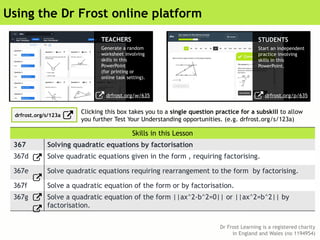
Using the Dr Frost online platform
Skills in this Lesson
367 Solving quadratic equations by factorisation
367d Solve quadratic equations given in the form , requiring factorising.
367e Solve quadratic equations requiring rearrangement to the form by factorising.
367f Solve a quadratic equation of the form or by factorisation.
367g Solve a quadratic equation of the form ||ax^2-b^2=0|| or ||ax^2=b^2|| by
factorisation.
TEACHERS
Generate a random
worksheet involving
skills in this
PowerPoint
(for printing or
online task setting).
STUDENTS
Start an independent
practice involving
skills in this
PowerPoint.
drfrost.org/w/635
Clicking this box takes you to a single question practice for a subskill to allow
you further Test Your Understanding opportunities. (e.g. drfrost.org/s/123a)
drfrost.org/p/635
drfrost.org/s/123a
How to use these slides
Dr Frost Learning is a registered charity in England and Wales (no 1194954)
Slide Title Explanation Default Animations*
Recap
To be used as a prior knowledge check or to review prerequisite
knowledge. Can be used as a starter or as part of the main lesson.
Green click-to-reveal boxes.
The Big Idea
To be used to highlight key concepts or theorems. This could include
the ‘why’ of the topic - including “real-life” contextual scenarios, or
putting into context of other mathematical concepts (past and
future).
Usually in sequence with some
green click-to-reveal boxes.
Example To be modelled by the teacher. Solution animates in sequence.
Test Your
Understanding
To be completed by students and used for Assessment for Learning,
primarily using mini-whiteboards.
Green click-to-reveal boxes.
For multi-step answers, reveal in
parts or click final answer to
reveal full solution.
Example
Problem Pair
To be used as ‘Example’ &‘Test Your Understanding’ above, within the
same slide to provide scaffold via visible modelled solution.
TYU column is blank initially, to focus attention on example.
Reveal question by clicking ‘Test Your Understanding’ banner.
Example animates in sequence.
Click the header to reveal TYU
question, then green click-to-
reveal boxes.
Quickfire
Questions
To be used as fluency practice. Multiple questions in rapid succession,
for calculations that can be completed mentally. Often used for
shorter questions/ formulae or to isolate a small part of the method.
Green click-to-reveal boxes. For
multi-step answers, reveal in
parts or click final line to reveal
full solution.
Multi-choice
Question
To be used as a diagnostic question. Multiple choice questions, with
plausible distractors, to allow teachers to diagnose misconceptions
and errors in student thinking, then adapt their lesson accordingly.
Arrow points to answer, on click.
Exam Question To be completed by teacher or student. Green click-to-reveal boxes.
Though many slides in this resource will have titles specific to the topic, the slide titles in the table below
are used consistently within DFL resources for specific pedagogical purposes.
Any atypical use of a slide type, including any change of animation* or intended use, will be outlined in the
Teacher Notes for the slide.
How to use these slides
Dr Frost Learning is a registered charity in England and Wales (no 1194954)
Slide Title Explanation Default Animations*
Recap
To be used as a prior knowledge check or to review prerequisite
knowledge. Can be used as a starter or as part of the main lesson.
Green click-to-reveal boxes.
The Big Idea
To be used to highlight key concepts or theorems. This could include
the ‘why’ of the topic - including “real-life” contextual scenarios, or
putting into context of other mathematical concepts (past and
future).
Usually in sequence with some
green click-to-reveal boxes.
Example To be modelled by the teacher. Solution animates in sequence.
Test Your
Understanding
To be completed by students and used for Assessment for Learning,
primarily using mini-whiteboards.
Green click-to-reveal boxes.
For multi-step answers, reveal in
parts or click final answer to
reveal full solution.
Example
Problem Pair
To be used as ‘Example’ &‘Test Your Understanding’ above, within the
same slide to provide scaffold via visible modelled solution.
TYU column is blank initially, to focus attention on example.
Example animates in sequence,
followed by TYU question with
green click-to-reveal boxes for
solution steps.
Quickfire
Questions
To be used as fluency practice. Multiple questions in rapid succession,
for calculations that can be completed mentally. Often used for
shorter questions/ formulae or to isolate a small part of the method.
Green click-to-reveal boxes. For
multi-step answers, reveal in
parts or click final line to reveal
full solution.
Multi-choice
Question
To be used as a diagnostic question. Multiple choice questions, with
plausible distractors, to allow teachers to diagnose misconceptions
and errors in student thinking, then adapt their lesson accordingly.
Arrow points to answer, on click.
Exam Question To be completed by teacher or student. Green click-to-reveal boxes.
Though many slides in this resource will have titles specific to the topic, the slide titles in the table below
are used consistently within DFL resources for specific pedagogical purposes.
Any atypical use of a slide type, including any change of animation* or intended use, will be outlined in the
Teacher Notes for the slide.
Dr Frost Learning is a registered charity
in England and Wales (no 1194954)
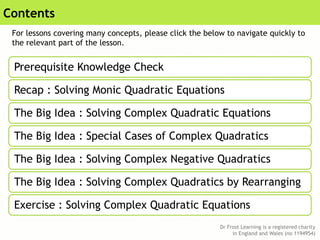
Contents
Prerequisite Knowledge Check
Recap : Solving Monic Quadratic Equations
The Big Idea : Solving Complex Quadratic Equations
The Big Idea : Special Cases of Complex Quadratics
The Big Idea : Solving Complex Negative Quadratics
The Big Idea : Solving Complex Quadratics by Rearranging
Exercise : Solving Complex Quadratic Equations
For lessons covering many concepts, please click the below to navigate quickly to
the relevant part of the lesson.
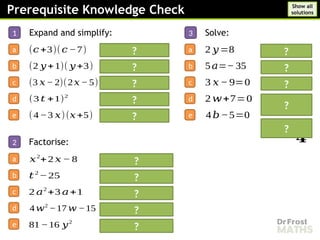
Prerequisite Knowledge Check
1
1
z
Expand and simplify:
1
2
z
Factorise:
a 𝑥2
+2 𝑥 − 8
b 𝑡2
−25
c 2 𝑎2
+3 𝑎+1
d 4𝑤2
−17 𝑤 −15
e 81 −16 𝑦2
a
b
c
d
e
(𝑐 +3)(𝑐 −7)
(2 𝑦 +1)( 𝑦+3)
(3 𝑥− 2)(2𝑥− 5)
(3 𝑡 +1)2
(4−3 𝑥)(𝑥 +5)
?
?
1
3
z
Solve:
a 2 𝑦=8
b 5𝑎=− 35
c 3 𝑥− 9=0
d 2𝑤+7=0
e 4𝑏−5=0
?
Show all
solutions
?
?
?
?
?
?
?
?
?
?
𝒃=
𝟓
𝟒
?
?
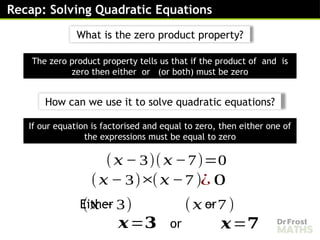
Recap: Solving Quadratic Equations
(𝑥 − 3)(𝑥 −7)=0
(𝑥 − 3)
Either or
×(𝑥 −7 )¿ 0
(𝑥 − 3) (𝑥 −7 )
𝒙=𝟑 𝒙=𝟕
If our equation is factorised and equal to zero, then either one of
the expressions must be equal to zero
or
The zero product property tells us that if the product of and is
zero then either or (or both) must be zero
What is the zero product property?
How can we use it to solve quadratic equations?
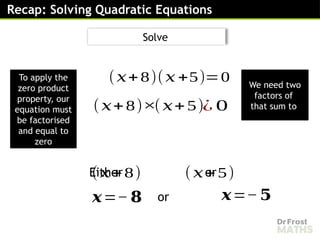
Recap: Solving Quadratic Equations
(𝑥+8)(𝑥 +5)=0
(𝑥+8)
Either or
×(𝑥+5)¿ 0
(𝑥+8) (𝑥+5)
𝒙=− 𝟖 𝒙=−𝟓
To apply the
zero product
property, our
equation must
be factorised
and equal to
zero
or
Solve
We need two
factors of
that sum to
or
𝒃=−𝟏or 𝒃=−𝟒
(𝒃+𝟏)(𝒃+𝟒)=𝟎
Solutions?
Factorisation?
Solutions?
Factorisation?
(𝒚 −𝟓)(𝒚 −𝟐)=𝟎
or
or
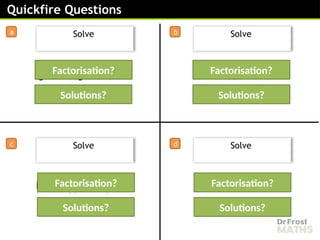
Quickfire Questions
a b
c
Solve
d
Solve
Solve Solve
Solutions?
(𝒂−𝟒)(𝒂+𝟑)=𝟎
Factorisation?
Solutions?
Factorisation?
Recap: Special Cases of Solving Quadratics
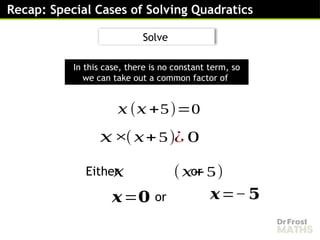
𝑥 (𝑥 +5)=0
𝑥
Either or
×(𝑥+5)¿ 0
𝑥 (𝑥+5)
𝒙=𝟎 𝒙=− 𝟓
In this case, there is no constant term, so
we can take out a common factor of
or
Solve
Recap: Special Cases of Solving Quadratics
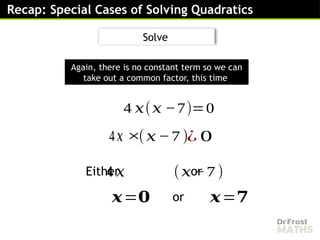
4 𝑥(𝑥 −7)=0
4𝑥
Either or
×(𝑥 −7 )¿ 0
4 𝑥 (𝑥 −7 )
𝒙=𝟎 𝒙=𝟕
Again, there is no constant term so we can
take out a common factor, this time
or
Solve
Recap: Special Cases of Solving Quadratics
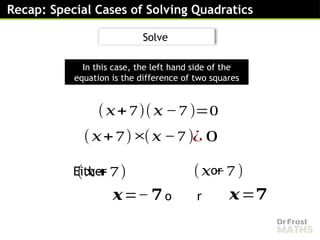
(𝑥+7)(𝑥 −7 )=0
(𝑥+7)
Either or
×(𝑥 −7 )¿ 0
(𝑥+7) (𝑥 −7 )
𝒙=−𝟕 𝒙=𝟕
In this case, the left hand side of the
equation is the difference of two squares
o r
Solve
Recap: Special Cases of Solving Quadratics
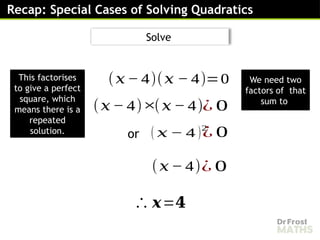
(𝑥 − 4)(𝑥 − 4)=0
(𝑥 − 4)
¿ 0
×(𝑥 − 4)¿ 0
(𝑥 − 4)
∴ 𝒙=𝟒
This factorises
to give a perfect
square, which
means there is a
repeated
solution.
Solve
We need two
factors of that
sum to
( 𝑥 − 4 )2
¿ 0
or
or
𝒃=𝟐
or
Quickfire Questions
a b
c
Solve
d
Solve
Solve Solve
or
(𝒚 +𝟖)(𝒚 −𝟖)=𝟎 𝒂(𝒂− 𝟏)=𝟎
(𝒃−𝟐)(𝒃−𝟐)=𝟎 𝟐 𝒙 (𝒙 −𝟏𝟏)=𝟎
Factorisation?
Solutions?
Factorisation?
Solutions?
Factorisation?
Solutions?
Solutions?
Factorisation?
The Big Idea: Solving Complex Quadratics
(𝑥 −5)
Either or
×(2 𝑥−3)¿ 0
(𝑥 −5) (2 𝑥−3)
𝒙=𝟓 2 𝑥=3
or
𝒙=
𝟑
𝟐
We can still use the zero product
property to solve this more
complex quadratic…
This quadratic equation expands to
give , so the coefficient of is greater
than .
What is the same and what is different about
this quadratic equation?
Solve
When our quadratic has a coefficient of
which is not , we get fractional solutions.
or
or
or
or
Quickfire Questions
a b
c
Solve
d
Solve
Solve Solve
?
?
?
?
The Big Idea: Solving Complex Quadratics
3 𝑥2
− 6 𝑥 − 𝑥+2=0
(𝑥 − 2)
Either or
(3 𝑥− 1)¿ 0
(𝑥 − 2) (3 𝑥 − 1)
𝒙=𝟐 3 𝑥=1
or
Solve
We need two
factors of (as
that sum to 3 𝑥(𝑥−2)−1(𝑥 − 2)=0
𝒙=
𝟏
𝟑
There are many ways to factorise this expression, but
here we will use splitting the middle term…
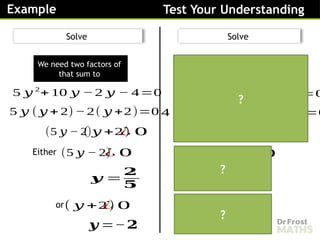
Example Test Your Understanding
Solve
Solve
(5 𝑦 − 2)
( 𝑦 +2)
¿ 0
Either
𝒚 =
𝟐
𝟓
( 𝑦 +2)
¿ 0
or
𝒚 =−𝟐
We need two factors of
that sum to
(5 𝑦 − 2)
¿ 0
We need two factors of
that sum to
5 𝑦 2
+ 10 𝑦 −2 𝑦 − 4=0
5 𝑦 (𝑦 + 2)−2( 𝑦 +2)=0
(4 𝑑 −1)
( 𝑑+ 3)
¿ 0
Either
𝒅=
𝟏
𝟒
( 𝑑+ 3)
¿ 0
or
𝒅=−𝟑
(4 𝑑 −1)
¿ 0
4 𝑑2
+12 𝑑 − 𝑑 −3=0
4 𝑑( 𝑑+ 3)− 1( 𝑑+3)=0
?
?
?
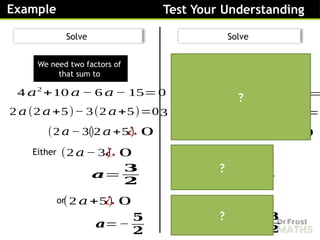
Example Test Your Understanding
Solve
Solve
(2 𝑎− 3)
(2 𝑎+5)
¿ 0
Either
𝒂=
𝟑
𝟐
(2 𝑎+5)
¿ 0
or
𝒂=−
𝟓
𝟐
We need two factors of
that sum to
(2 𝑎− 3)
¿ 0
We need two factors of
that sum to
4 𝑎2
+10 𝑎− 6 𝑎− 15=0
2 𝑎(2 𝑎+5)− 3(2 𝑎+5)=0
(3 𝑑 −1)
(2 𝑑+3)
¿ 0
Either
𝒅=
𝟏
𝟑
(2 𝑑+3)
¿ 0
or
𝒅=−
𝟑
𝟐
(3 𝑑 −1)
¿ 0
6 𝑑2
+ 9 𝑑 − 2 𝑑 − 3=
3 𝑑(2 𝑑+ 3)− 1(2 𝑑 +3)=0
?
?
?
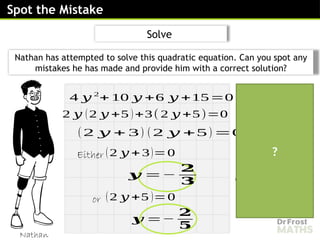
Spot the Mistake
Solve
( 2 𝑦 + 3) ( 2 𝑦 +5) =0
(2 𝑦 + 3)=0
Nathan has attempted to solve this quadratic equation. Can you spot any
mistakes he has made and provide him with a correct solution?
Either
Nathan has done
everything
correctly until the
final step, which
he has solved
incorrectly. Since
or
this leads to
correct answers of
or
?
𝒚 =−
𝟐
𝟑
(2 𝑦 +5 )=0
𝒚 =−
𝟐
𝟓
2 𝑦 (2 𝑦 +5 )+3( 2 𝑦 +5)=0
4 𝑦 2
+ 10 𝑦 +6 𝑦 +15=0
or
Nathan
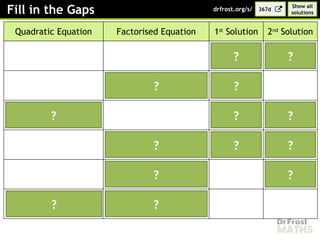
Fill in the Gaps
Quadratic Equation Factorised Equation 1st
Solution 2nd
Solution
? ?
? ?
? ? ?
? ? ?
? ?
?
?
Show all
solutions
367d
drfrost.org/s/
The Big Idea: Solving Complex Quadratics
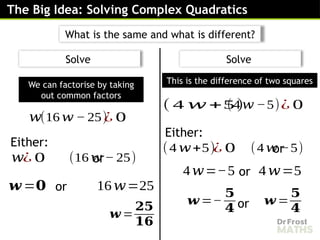
Solve
What is the same and what is different?
We can factorise by taking
out common factors
𝑤
¿ 0 or
(16 𝑤 − 25)
¿ 0
𝑤 (16𝑤 − 25)
𝒘 =𝟎 16𝑤=25
or
𝒘 =
𝟐𝟓
𝟏𝟔
Solve
This is the difference of two squares
( 4 𝑤 +5)
¿ 0 or
(4𝑤 −5)¿ 0
(4 𝑤+5) (4𝑤 −5)
4𝑤=−5 4𝑤=5
or
𝒘 =
𝟓
𝟒
𝒘 =−
𝟓
𝟒 or
Either:
Either:
or
or
or
or
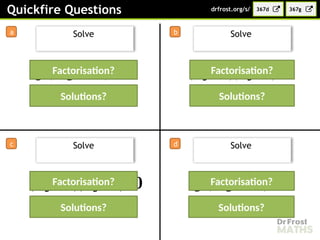
Quickfire Questions
a b
c
Solve
d
Solve
Solve Solve
𝒚 (𝟒 𝒚 −𝟗)=𝟎 (𝟐𝒚 −𝟑)(𝟐𝒚+𝟑)=𝟎
(𝟑𝒚 −𝟏)(𝟑𝒚+𝟏)=𝟎 𝒚 (𝟗 𝒚 −𝟏)=𝟎
Factorisation?
Solutions?
Factorisation?
Solutions?
Factorisation?
Solutions?
Factorisation?
Solutions?
367d
drfrost.org/s/ 367g
Comparing Methods
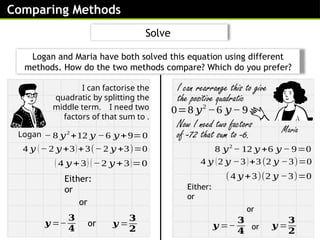
Solve
Logan and Maria have both solved this equation using different
methods. How do the two methods compare? Which do you prefer?
− 8 𝑦2
+12 𝑦 −6 𝑦 +9=0
Either:
or
( 4 𝑦 +3) (−2 𝑦 +3)=0
or
4 𝑦 (− 2 𝑦+3)+3(− 2 𝑦 +3)=0
𝒚 =
𝟑
𝟐
𝒚 =−
𝟑
𝟒
or
Maria
Logan
I can factorise the
quadratic by splitting the
middle term. I need two
factors of that sum to .
I can rearrange this to give
the positive quadratic
8 𝑦2
− 12 𝑦 +6 𝑦 − 9=0
Either:
or
(4 𝑦+3)(2 𝑦 −3)=0
or
4 𝑦 (2 𝑦 −3)+3(2 𝑦 −3)=0
𝒚 =
𝟑
𝟐
𝒚 =−
𝟑
𝟒
or
Now I need two factors
of -72 that sum to -6.
0=8 𝑦2
−6 𝑦− 9
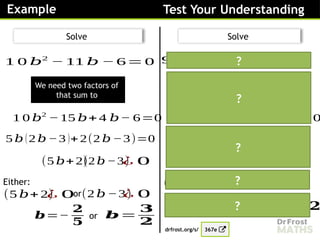
Example Test Your Understanding
Either:
Solve
Solve
(5 𝑏+2)
(2 𝑏−3)
¿ 0
𝒃=−
𝟐
𝟓
(2 𝑏 −3)
¿ 0
or 𝒃=
𝟑
𝟐
We need two factors of
that sum to
(5 𝑏+ 2)
¿ 0
1 0 𝑏2
−15 𝑏+ 4 𝑏− 6=0
5 𝑏 (2 𝑏 −3 )+2(2 𝑏 −3)=0
1 0 𝑏2
−11 𝑏 − 6= 0
or
(9 𝑥 − 2)
( 𝑥+ 2)
¿ 0
𝒙 =
𝟐
𝟗
( 𝑥+ 2)
¿ 0
or 𝒙=− 𝟐
We need two factors of
that sum to
(9 𝑥 − 2)
¿ 0
9 𝑥2
+ 18 𝑥 − 4 𝑥 −8=0
9 𝑥 ( 𝑥+2)− 2(𝑥 +2)=0
9 𝑥2
+ 14 𝑥 − 8= 0
or
?
?
?
?
?
Either:
367e
drfrost.org/s/
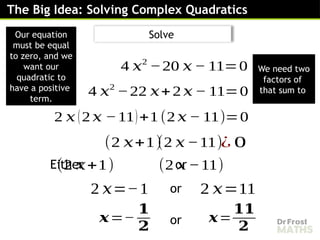
The Big Idea: Solving Complex Quadratics
4 𝑥2
−22 𝑥+2 𝑥 − 11=0
(2 𝑥+1)
Either or
(2 𝑥 −11)¿ 0
(2 𝑥+1) (2 𝑥 −11)
2 𝑥=−1 2 𝑥=11
or
Solve
We need two
factors of
that sum to
2 𝑥 (2 𝑥 −11)+1 (2 𝑥 − 11)=0
𝒙=
𝟏𝟏
𝟐
𝒙=−
𝟏
𝟐 or
4 𝑥2
−20 𝑥 − 11=0
Our equation
must be equal
to zero, and we
want our
quadratic to
have a positive
term.
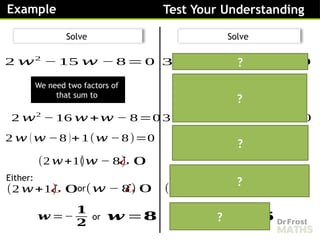
Example Test Your Understanding
Either:
Solve
Solve
(2 𝑤+1)
(𝑤 − 8)
¿ 0
𝒘 =−
𝟏
𝟐
(𝑤 − 8)
¿ 0
or 𝒘 =𝟖
We need two factors of
that sum to
(2 𝑤+1)
¿ 0
2 𝑤2
−16 𝑤+𝑤 − 8=0
2 𝑤 (𝑤 −8 )+ 1(𝑤 −8)=0
2 𝑤2
− 15 𝑤 − 8= 0
or
(3 𝑡 − 4)
(𝑡 + 5)
¿ 0
𝒕 =
𝟒
𝟑
(𝑡 + 5)
¿ 0
or 𝒕 =−𝟓
We need two factors of
that sum to
(3 𝑡 − 4)
¿ 0
3 𝑡 2
+ 15 𝑡 −4 𝑡 −20=0
3 𝑡 (𝑡+ 5) − 4(𝑡 +5)=0
3 𝑡 2
+ 11𝑡 − 20=0
or
?
?
?
?
?
Either:
Exam Question
[Edexcel GCSE June 2016 1H Q22]
Solve
[3 marks]
𝑥2
=4(𝑥2
−6 𝑥+9)
?
𝑥2
=4 𝑥2
−24 𝑥+36
3 𝑥2
−24 𝑥+36=0
𝑥2
−8𝑥+12=0
(𝑥−6)(𝑥 −2)=0
or
?
?
?
?
?
367e
drfrost.org/s/
𝒘 =−𝟏, 𝒙=−
𝟒
𝟓
𝒚 =−
𝟏
𝟑
, 𝒚 =
𝟑
𝟒
𝒂=
𝟏
𝟐
, 𝒂=
𝟔
𝟓
𝒕=−
𝟓
𝟑
, 𝒕=
𝟑
𝟓
?
?
?
?
1
a
Solve:
3
𝒂=
𝟏
𝟑
, 𝒂=𝟓
(3𝑎 −1)(𝑎−5)=0
b ( 𝑥+7) (2𝑥+5)=0
c (2 𝑦 −1)(3 𝑦+7)=0
d 5 𝑑(2 𝑑+1)=0
e (3 𝑥+2)(6−5 𝑥)=0
𝒙=− 𝟕,𝒙=−
𝟓
𝟐
𝒚 =
𝟏
𝟐
, 𝒚=−
𝟕
𝟑
𝒅=𝟎, 𝒅=−
𝟏
𝟐
𝒙=−
𝟐
𝟑
, 𝒙=
𝟔
𝟓
𝒙=𝟏𝟏 ,𝒙=−
𝟑
𝟐
[OCR GCSE(9-1) Nov 2018 1H Q16]
Solve by factorisation
?
4
𝒙=−
𝟑
𝟓
, 𝒙=
𝟏
𝟒
[WJEC Additional Maths June 2017 Q1]
Factorise and hence solve
Exercise (Available as a separate worksheet)
Show all
solutions
?
?
?
?
2
a
Solve:
𝒙=
𝟏
𝟐
, 𝒙=−𝟐
2 𝑥2
+3 𝑥− 2=0
b 5𝑤2
+9𝑤 +4=0
c 12 𝑦2
−5 𝑦 − 3=0
d 10𝑎2
−17𝑎+6=0
e 15𝑡2
+16 𝑡 −15=0
?
(𝒙−𝟏𝟏)(𝟐𝒙 +𝟑)=𝟎
?
(𝟓 𝒙+𝟑) (𝟒 𝒙 −𝟏)
?
𝒙=−𝟕,𝒙=−
𝟑
𝟐
?
𝒂=−
𝟑
𝟒
,𝒂=𝟏
𝒙=− 𝟕, 𝒙=
𝟓
𝟑
𝒘 =−
𝟕
𝟒
,𝒘=
𝟕
𝟒
𝒚 =
𝟒
𝟑
, 𝒚 =
𝟗
𝟐
𝒅=𝟎 , 𝒅=
𝟏𝟏
𝟒
?
?
?
?
?
𝒌=𝟎 , 𝒌=
𝟏
𝟓
𝒙=
𝟏𝟏
𝟔
,𝒙=−
𝟏𝟏
𝟔
𝒙=
𝟑
𝟐
, 𝒙=− 𝟖
𝒅=𝟎 , 𝒅=
𝟓
𝟒
𝒚 =
𝟐
𝟓
, 𝒚=−
𝟐
𝟓
?
?
?
?
?
5
a
Solve:
25 𝑦2
− 4=0
b 8 𝑑2
−10 𝑑=0
c 24−13𝑥 −2 𝑥2
=0
d 121 −36 𝑥2
=0
e 5 𝑘− 25 𝑘2
=0
𝒙=𝟏𝟑 ,𝒙=−
𝟕
𝟑
Solve
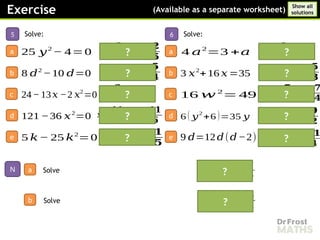
Exercise (Available as a separate worksheet)
Show all
solutions
6
a
Solve:
4 𝑎2
=3 +𝑎
b 3 𝑥2
+16 𝑥 =35
c 16 𝑤 2
= 49
d 6 ( 𝑦
2
+6 )=35 𝑦
e 9 𝑑=12𝑑(𝑑−2)
?
N
Solve
a
b

Solving Complex Quadratic by Factorising

  • 1.
    Dr Frost Learningis a registered charity in England and Wales (no 1194954) Last modified: www.drfrost.org @DrFrostMaths Contact the resource team: resources@drfrost.org @DrFrostResource Amanda Austin Solving Complex Quadratics by Factorising 11th February 2025
  • 2.
    Teacher Notes Dr FrostLearning is a registered charity in England and Wales (no 1194954) Key Points Solution step – click to reveal Question/Discussion Prompt ! To be written in books All slides include pedagogical detail in the ‘Notes’ section for teach slide. Key: Throughout the slides, this symbol refers to a web link. Unless otherwise specified, this will be to some functionality within DF. Prerequisite Knowledge • Collect like terms • Multiply a single term over a bracket • Expand and simplify the product of two brackets • Factorise by “taking out” common factors • Factorise simple (monic) expressions, including the difference of two squares and with negative coefficients • Factorise non-monic quadratic expressions • Solve monic quadratic equations by factorising Future Links • Completing the square • Graphs of quadratic functions • Solving hidden quadratics
  • 3.
    Dr Frost Learningis a registered charity in England and Wales (no 1194954) Using the Dr Frost online platform Skills in this Lesson 367 Solving quadratic equations by factorisation 367d Solve quadratic equations given in the form , requiring factorising. 367e Solve quadratic equations requiring rearrangement to the form by factorising. 367f Solve a quadratic equation of the form or by factorisation. 367g Solve a quadratic equation of the form ||ax^2-b^2=0|| or ||ax^2=b^2|| by factorisation. TEACHERS Generate a random worksheet involving skills in this PowerPoint (for printing or online task setting). STUDENTS Start an independent practice involving skills in this PowerPoint. drfrost.org/w/635 Clicking this box takes you to a single question practice for a subskill to allow you further Test Your Understanding opportunities. (e.g. drfrost.org/s/123a) drfrost.org/p/635 drfrost.org/s/123a
  • 4.
    How to usethese slides Dr Frost Learning is a registered charity in England and Wales (no 1194954) Slide Title Explanation Default Animations* Recap To be used as a prior knowledge check or to review prerequisite knowledge. Can be used as a starter or as part of the main lesson. Green click-to-reveal boxes. The Big Idea To be used to highlight key concepts or theorems. This could include the ‘why’ of the topic - including “real-life” contextual scenarios, or putting into context of other mathematical concepts (past and future). Usually in sequence with some green click-to-reveal boxes. Example To be modelled by the teacher. Solution animates in sequence. Test Your Understanding To be completed by students and used for Assessment for Learning, primarily using mini-whiteboards. Green click-to-reveal boxes. For multi-step answers, reveal in parts or click final answer to reveal full solution. Example Problem Pair To be used as ‘Example’ &‘Test Your Understanding’ above, within the same slide to provide scaffold via visible modelled solution. TYU column is blank initially, to focus attention on example. Reveal question by clicking ‘Test Your Understanding’ banner. Example animates in sequence. Click the header to reveal TYU question, then green click-to- reveal boxes. Quickfire Questions To be used as fluency practice. Multiple questions in rapid succession, for calculations that can be completed mentally. Often used for shorter questions/ formulae or to isolate a small part of the method. Green click-to-reveal boxes. For multi-step answers, reveal in parts or click final line to reveal full solution. Multi-choice Question To be used as a diagnostic question. Multiple choice questions, with plausible distractors, to allow teachers to diagnose misconceptions and errors in student thinking, then adapt their lesson accordingly. Arrow points to answer, on click. Exam Question To be completed by teacher or student. Green click-to-reveal boxes. Though many slides in this resource will have titles specific to the topic, the slide titles in the table below are used consistently within DFL resources for specific pedagogical purposes. Any atypical use of a slide type, including any change of animation* or intended use, will be outlined in the Teacher Notes for the slide. How to use these slides Dr Frost Learning is a registered charity in England and Wales (no 1194954) Slide Title Explanation Default Animations* Recap To be used as a prior knowledge check or to review prerequisite knowledge. Can be used as a starter or as part of the main lesson. Green click-to-reveal boxes. The Big Idea To be used to highlight key concepts or theorems. This could include the ‘why’ of the topic - including “real-life” contextual scenarios, or putting into context of other mathematical concepts (past and future). Usually in sequence with some green click-to-reveal boxes. Example To be modelled by the teacher. Solution animates in sequence. Test Your Understanding To be completed by students and used for Assessment for Learning, primarily using mini-whiteboards. Green click-to-reveal boxes. For multi-step answers, reveal in parts or click final answer to reveal full solution. Example Problem Pair To be used as ‘Example’ &‘Test Your Understanding’ above, within the same slide to provide scaffold via visible modelled solution. TYU column is blank initially, to focus attention on example. Example animates in sequence, followed by TYU question with green click-to-reveal boxes for solution steps. Quickfire Questions To be used as fluency practice. Multiple questions in rapid succession, for calculations that can be completed mentally. Often used for shorter questions/ formulae or to isolate a small part of the method. Green click-to-reveal boxes. For multi-step answers, reveal in parts or click final line to reveal full solution. Multi-choice Question To be used as a diagnostic question. Multiple choice questions, with plausible distractors, to allow teachers to diagnose misconceptions and errors in student thinking, then adapt their lesson accordingly. Arrow points to answer, on click. Exam Question To be completed by teacher or student. Green click-to-reveal boxes. Though many slides in this resource will have titles specific to the topic, the slide titles in the table below are used consistently within DFL resources for specific pedagogical purposes. Any atypical use of a slide type, including any change of animation* or intended use, will be outlined in the Teacher Notes for the slide.
  • 5.
    Dr Frost Learningis a registered charity in England and Wales (no 1194954) Contents Prerequisite Knowledge Check Recap : Solving Monic Quadratic Equations The Big Idea : Solving Complex Quadratic Equations The Big Idea : Special Cases of Complex Quadratics The Big Idea : Solving Complex Negative Quadratics The Big Idea : Solving Complex Quadratics by Rearranging Exercise : Solving Complex Quadratic Equations For lessons covering many concepts, please click the below to navigate quickly to the relevant part of the lesson.
  • 6.
    Prerequisite Knowledge Check 1 1 z Expandand simplify: 1 2 z Factorise: a 𝑥2 +2 𝑥 − 8 b 𝑡2 −25 c 2 𝑎2 +3 𝑎+1 d 4𝑤2 −17 𝑤 −15 e 81 −16 𝑦2 a b c d e (𝑐 +3)(𝑐 −7) (2 𝑦 +1)( 𝑦+3) (3 𝑥− 2)(2𝑥− 5) (3 𝑡 +1)2 (4−3 𝑥)(𝑥 +5) ? ? 1 3 z Solve: a 2 𝑦=8 b 5𝑎=− 35 c 3 𝑥− 9=0 d 2𝑤+7=0 e 4𝑏−5=0 ? Show all solutions ? ? ? ? ? ? ? ? ? ? 𝒃= 𝟓 𝟒 ? ?
  • 7.
    Recap: Solving QuadraticEquations (𝑥 − 3)(𝑥 −7)=0 (𝑥 − 3) Either or ×(𝑥 −7 )¿ 0 (𝑥 − 3) (𝑥 −7 ) 𝒙=𝟑 𝒙=𝟕 If our equation is factorised and equal to zero, then either one of the expressions must be equal to zero or The zero product property tells us that if the product of and is zero then either or (or both) must be zero What is the zero product property? How can we use it to solve quadratic equations?
  • 8.
    Recap: Solving QuadraticEquations (𝑥+8)(𝑥 +5)=0 (𝑥+8) Either or ×(𝑥+5)¿ 0 (𝑥+8) (𝑥+5) 𝒙=− 𝟖 𝒙=−𝟓 To apply the zero product property, our equation must be factorised and equal to zero or Solve We need two factors of that sum to
  • 9.
    or 𝒃=−𝟏or 𝒃=−𝟒 (𝒃+𝟏)(𝒃+𝟒)=𝟎 Solutions? Factorisation? Solutions? Factorisation? (𝒚 −𝟓)(𝒚−𝟐)=𝟎 or or Quickfire Questions a b c Solve d Solve Solve Solve Solutions? (𝒂−𝟒)(𝒂+𝟑)=𝟎 Factorisation? Solutions? Factorisation?
  • 10.
    Recap: Special Casesof Solving Quadratics 𝑥 (𝑥 +5)=0 𝑥 Either or ×(𝑥+5)¿ 0 𝑥 (𝑥+5) 𝒙=𝟎 𝒙=− 𝟓 In this case, there is no constant term, so we can take out a common factor of or Solve
  • 11.
    Recap: Special Casesof Solving Quadratics 4 𝑥(𝑥 −7)=0 4𝑥 Either or ×(𝑥 −7 )¿ 0 4 𝑥 (𝑥 −7 ) 𝒙=𝟎 𝒙=𝟕 Again, there is no constant term so we can take out a common factor, this time or Solve
  • 12.
    Recap: Special Casesof Solving Quadratics (𝑥+7)(𝑥 −7 )=0 (𝑥+7) Either or ×(𝑥 −7 )¿ 0 (𝑥+7) (𝑥 −7 ) 𝒙=−𝟕 𝒙=𝟕 In this case, the left hand side of the equation is the difference of two squares o r Solve
  • 13.
    Recap: Special Casesof Solving Quadratics (𝑥 − 4)(𝑥 − 4)=0 (𝑥 − 4) ¿ 0 ×(𝑥 − 4)¿ 0 (𝑥 − 4) ∴ 𝒙=𝟒 This factorises to give a perfect square, which means there is a repeated solution. Solve We need two factors of that sum to ( 𝑥 − 4 )2 ¿ 0 or
  • 14.
    or 𝒃=𝟐 or Quickfire Questions a b c Solve d Solve SolveSolve or (𝒚 +𝟖)(𝒚 −𝟖)=𝟎 𝒂(𝒂− 𝟏)=𝟎 (𝒃−𝟐)(𝒃−𝟐)=𝟎 𝟐 𝒙 (𝒙 −𝟏𝟏)=𝟎 Factorisation? Solutions? Factorisation? Solutions? Factorisation? Solutions? Solutions? Factorisation?
  • 15.
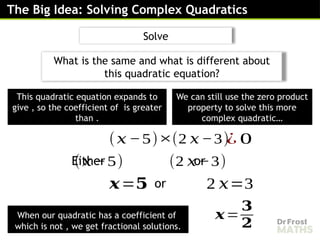
    The Big Idea:Solving Complex Quadratics (𝑥 −5) Either or ×(2 𝑥−3)¿ 0 (𝑥 −5) (2 𝑥−3) 𝒙=𝟓 2 𝑥=3 or 𝒙= 𝟑 𝟐 We can still use the zero product property to solve this more complex quadratic… This quadratic equation expands to give , so the coefficient of is greater than . What is the same and what is different about this quadratic equation? Solve When our quadratic has a coefficient of which is not , we get fractional solutions.
  • 16.
  • 17.
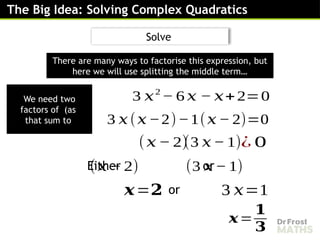
    The Big Idea:Solving Complex Quadratics 3 𝑥2 − 6 𝑥 − 𝑥+2=0 (𝑥 − 2) Either or (3 𝑥− 1)¿ 0 (𝑥 − 2) (3 𝑥 − 1) 𝒙=𝟐 3 𝑥=1 or Solve We need two factors of (as that sum to 3 𝑥(𝑥−2)−1(𝑥 − 2)=0 𝒙= 𝟏 𝟑 There are many ways to factorise this expression, but here we will use splitting the middle term…
  • 18.
    Example Test YourUnderstanding Solve Solve (5 𝑦 − 2) ( 𝑦 +2) ¿ 0 Either 𝒚 = 𝟐 𝟓 ( 𝑦 +2) ¿ 0 or 𝒚 =−𝟐 We need two factors of that sum to (5 𝑦 − 2) ¿ 0 We need two factors of that sum to 5 𝑦 2 + 10 𝑦 −2 𝑦 − 4=0 5 𝑦 (𝑦 + 2)−2( 𝑦 +2)=0 (4 𝑑 −1) ( 𝑑+ 3) ¿ 0 Either 𝒅= 𝟏 𝟒 ( 𝑑+ 3) ¿ 0 or 𝒅=−𝟑 (4 𝑑 −1) ¿ 0 4 𝑑2 +12 𝑑 − 𝑑 −3=0 4 𝑑( 𝑑+ 3)− 1( 𝑑+3)=0 ? ? ?
  • 19.
    Example Test YourUnderstanding Solve Solve (2 𝑎− 3) (2 𝑎+5) ¿ 0 Either 𝒂= 𝟑 𝟐 (2 𝑎+5) ¿ 0 or 𝒂=− 𝟓 𝟐 We need two factors of that sum to (2 𝑎− 3) ¿ 0 We need two factors of that sum to 4 𝑎2 +10 𝑎− 6 𝑎− 15=0 2 𝑎(2 𝑎+5)− 3(2 𝑎+5)=0 (3 𝑑 −1) (2 𝑑+3) ¿ 0 Either 𝒅= 𝟏 𝟑 (2 𝑑+3) ¿ 0 or 𝒅=− 𝟑 𝟐 (3 𝑑 −1) ¿ 0 6 𝑑2 + 9 𝑑 − 2 𝑑 − 3= 3 𝑑(2 𝑑+ 3)− 1(2 𝑑 +3)=0 ? ? ?
  • 20.
    Spot the Mistake Solve (2 𝑦 + 3) ( 2 𝑦 +5) =0 (2 𝑦 + 3)=0 Nathan has attempted to solve this quadratic equation. Can you spot any mistakes he has made and provide him with a correct solution? Either Nathan has done everything correctly until the final step, which he has solved incorrectly. Since or this leads to correct answers of or ? 𝒚 =− 𝟐 𝟑 (2 𝑦 +5 )=0 𝒚 =− 𝟐 𝟓 2 𝑦 (2 𝑦 +5 )+3( 2 𝑦 +5)=0 4 𝑦 2 + 10 𝑦 +6 𝑦 +15=0 or Nathan
  • 21.
    Fill in theGaps Quadratic Equation Factorised Equation 1st Solution 2nd Solution ? ? ? ? ? ? ? ? ? ? ? ? ? ? Show all solutions 367d drfrost.org/s/
  • 22.
    The Big Idea:Solving Complex Quadratics Solve What is the same and what is different? We can factorise by taking out common factors 𝑤 ¿ 0 or (16 𝑤 − 25) ¿ 0 𝑤 (16𝑤 − 25) 𝒘 =𝟎 16𝑤=25 or 𝒘 = 𝟐𝟓 𝟏𝟔 Solve This is the difference of two squares ( 4 𝑤 +5) ¿ 0 or (4𝑤 −5)¿ 0 (4 𝑤+5) (4𝑤 −5) 4𝑤=−5 4𝑤=5 or 𝒘 = 𝟓 𝟒 𝒘 =− 𝟓 𝟒 or Either: Either:
  • 23.
    or or or or Quickfire Questions a b c Solve d Solve SolveSolve 𝒚 (𝟒 𝒚 −𝟗)=𝟎 (𝟐𝒚 −𝟑)(𝟐𝒚+𝟑)=𝟎 (𝟑𝒚 −𝟏)(𝟑𝒚+𝟏)=𝟎 𝒚 (𝟗 𝒚 −𝟏)=𝟎 Factorisation? Solutions? Factorisation? Solutions? Factorisation? Solutions? Factorisation? Solutions? 367d drfrost.org/s/ 367g
  • 24.
    Comparing Methods Solve Logan andMaria have both solved this equation using different methods. How do the two methods compare? Which do you prefer? − 8 𝑦2 +12 𝑦 −6 𝑦 +9=0 Either: or ( 4 𝑦 +3) (−2 𝑦 +3)=0 or 4 𝑦 (− 2 𝑦+3)+3(− 2 𝑦 +3)=0 𝒚 = 𝟑 𝟐 𝒚 =− 𝟑 𝟒 or Maria Logan I can factorise the quadratic by splitting the middle term. I need two factors of that sum to . I can rearrange this to give the positive quadratic 8 𝑦2 − 12 𝑦 +6 𝑦 − 9=0 Either: or (4 𝑦+3)(2 𝑦 −3)=0 or 4 𝑦 (2 𝑦 −3)+3(2 𝑦 −3)=0 𝒚 = 𝟑 𝟐 𝒚 =− 𝟑 𝟒 or Now I need two factors of -72 that sum to -6. 0=8 𝑦2 −6 𝑦− 9
  • 25.
    Example Test YourUnderstanding Either: Solve Solve (5 𝑏+2) (2 𝑏−3) ¿ 0 𝒃=− 𝟐 𝟓 (2 𝑏 −3) ¿ 0 or 𝒃= 𝟑 𝟐 We need two factors of that sum to (5 𝑏+ 2) ¿ 0 1 0 𝑏2 −15 𝑏+ 4 𝑏− 6=0 5 𝑏 (2 𝑏 −3 )+2(2 𝑏 −3)=0 1 0 𝑏2 −11 𝑏 − 6= 0 or (9 𝑥 − 2) ( 𝑥+ 2) ¿ 0 𝒙 = 𝟐 𝟗 ( 𝑥+ 2) ¿ 0 or 𝒙=− 𝟐 We need two factors of that sum to (9 𝑥 − 2) ¿ 0 9 𝑥2 + 18 𝑥 − 4 𝑥 −8=0 9 𝑥 ( 𝑥+2)− 2(𝑥 +2)=0 9 𝑥2 + 14 𝑥 − 8= 0 or ? ? ? ? ? Either: 367e drfrost.org/s/
  • 26.
    The Big Idea:Solving Complex Quadratics 4 𝑥2 −22 𝑥+2 𝑥 − 11=0 (2 𝑥+1) Either or (2 𝑥 −11)¿ 0 (2 𝑥+1) (2 𝑥 −11) 2 𝑥=−1 2 𝑥=11 or Solve We need two factors of that sum to 2 𝑥 (2 𝑥 −11)+1 (2 𝑥 − 11)=0 𝒙= 𝟏𝟏 𝟐 𝒙=− 𝟏 𝟐 or 4 𝑥2 −20 𝑥 − 11=0 Our equation must be equal to zero, and we want our quadratic to have a positive term.
  • 27.
    Example Test YourUnderstanding Either: Solve Solve (2 𝑤+1) (𝑤 − 8) ¿ 0 𝒘 =− 𝟏 𝟐 (𝑤 − 8) ¿ 0 or 𝒘 =𝟖 We need two factors of that sum to (2 𝑤+1) ¿ 0 2 𝑤2 −16 𝑤+𝑤 − 8=0 2 𝑤 (𝑤 −8 )+ 1(𝑤 −8)=0 2 𝑤2 − 15 𝑤 − 8= 0 or (3 𝑡 − 4) (𝑡 + 5) ¿ 0 𝒕 = 𝟒 𝟑 (𝑡 + 5) ¿ 0 or 𝒕 =−𝟓 We need two factors of that sum to (3 𝑡 − 4) ¿ 0 3 𝑡 2 + 15 𝑡 −4 𝑡 −20=0 3 𝑡 (𝑡+ 5) − 4(𝑡 +5)=0 3 𝑡 2 + 11𝑡 − 20=0 or ? ? ? ? ? Either:
  • 28.
    Exam Question [Edexcel GCSEJune 2016 1H Q22] Solve [3 marks] 𝑥2 =4(𝑥2 −6 𝑥+9) ? 𝑥2 =4 𝑥2 −24 𝑥+36 3 𝑥2 −24 𝑥+36=0 𝑥2 −8𝑥+12=0 (𝑥−6)(𝑥 −2)=0 or ? ? ? ? ? 367e drfrost.org/s/
  • 29.
    𝒘 =−𝟏, 𝒙=− 𝟒 𝟓 𝒚=− 𝟏 𝟑 , 𝒚 = 𝟑 𝟒 𝒂= 𝟏 𝟐 , 𝒂= 𝟔 𝟓 𝒕=− 𝟓 𝟑 , 𝒕= 𝟑 𝟓 ? ? ? ? 1 a Solve: 3 𝒂= 𝟏 𝟑 , 𝒂=𝟓 (3𝑎 −1)(𝑎−5)=0 b ( 𝑥+7) (2𝑥+5)=0 c (2 𝑦 −1)(3 𝑦+7)=0 d 5 𝑑(2 𝑑+1)=0 e (3 𝑥+2)(6−5 𝑥)=0 𝒙=− 𝟕,𝒙=− 𝟓 𝟐 𝒚 = 𝟏 𝟐 , 𝒚=− 𝟕 𝟑 𝒅=𝟎, 𝒅=− 𝟏 𝟐 𝒙=− 𝟐 𝟑 , 𝒙= 𝟔 𝟓 𝒙=𝟏𝟏 ,𝒙=− 𝟑 𝟐 [OCR GCSE(9-1) Nov 2018 1H Q16] Solve by factorisation ? 4 𝒙=− 𝟑 𝟓 , 𝒙= 𝟏 𝟒 [WJEC Additional Maths June 2017 Q1] Factorise and hence solve Exercise (Available as a separate worksheet) Show all solutions ? ? ? ? 2 a Solve: 𝒙= 𝟏 𝟐 , 𝒙=−𝟐 2 𝑥2 +3 𝑥− 2=0 b 5𝑤2 +9𝑤 +4=0 c 12 𝑦2 −5 𝑦 − 3=0 d 10𝑎2 −17𝑎+6=0 e 15𝑡2 +16 𝑡 −15=0 ? (𝒙−𝟏𝟏)(𝟐𝒙 +𝟑)=𝟎 ? (𝟓 𝒙+𝟑) (𝟒 𝒙 −𝟏) ?
  • 30.
    𝒙=−𝟕,𝒙=− 𝟑 𝟐 ? 𝒂=− 𝟑 𝟒 ,𝒂=𝟏 𝒙=− 𝟕, 𝒙= 𝟓 𝟑 𝒘=− 𝟕 𝟒 ,𝒘= 𝟕 𝟒 𝒚 = 𝟒 𝟑 , 𝒚 = 𝟗 𝟐 𝒅=𝟎 , 𝒅= 𝟏𝟏 𝟒 ? ? ? ? ? 𝒌=𝟎 , 𝒌= 𝟏 𝟓 𝒙= 𝟏𝟏 𝟔 ,𝒙=− 𝟏𝟏 𝟔 𝒙= 𝟑 𝟐 , 𝒙=− 𝟖 𝒅=𝟎 , 𝒅= 𝟓 𝟒 𝒚 = 𝟐 𝟓 , 𝒚=− 𝟐 𝟓 ? ? ? ? ? 5 a Solve: 25 𝑦2 − 4=0 b 8 𝑑2 −10 𝑑=0 c 24−13𝑥 −2 𝑥2 =0 d 121 −36 𝑥2 =0 e 5 𝑘− 25 𝑘2 =0 𝒙=𝟏𝟑 ,𝒙=− 𝟕 𝟑 Solve Exercise (Available as a separate worksheet) Show all solutions 6 a Solve: 4 𝑎2 =3 +𝑎 b 3 𝑥2 +16 𝑥 =35 c 16 𝑤 2 = 49 d 6 ( 𝑦 2 +6 )=35 𝑦 e 9 𝑑=12𝑑(𝑑−2) ? N Solve a b

Editor's Notes

  • #5 Use to navigate to the required section quickly.
  • #6 Use the prerequisite knowledge check (on mini-whiteboards or in books) to assess whether students have the prerequisite skills needed to continue with the lesson. Click on green boxes to reveal answers, or click the Show all solutions box to reveal all answers simultaneously.
  • #7 This slide should be used to remind students of the zero product property, and how it can be used to solve quadratic equations that are factorised. Emphasise that the equation must be both factorised and equal to zero. The example can then act as a reminder of how we set out this process and the solutions. Click to reveal each prompt/step sequentially.
  • #8 This slide should be used to remind students of solving a quadratic equation which first needs factorising. Again, emphasise that the equation should be equal to zero, and remind students of the process of factorising i.e. looking for factor pairs of 40 that sum to 13. Click to reveal each step sequentially.
  • #9 Use quickfire questions (suitable for mini-whiteboards) to check students recall how to solve monic quadratics by factorising before progressing to non-monic quadratics. Click the green box to reveal questions and answers sequentially.
  • #10 The next four slides should be used to recap the special cases when solving quadratics by factorising. This first case is when the equation is factorised by taking out a common factor. Highlight that the zero product property still applies as we still have two expressions multiplying to equal zero. Click to reveal each step sequentially.
  • #11 In this a further example of the first case, a common factor is taken out of a non-monic quadratic. Draw attention to the fact that when 4x = 0, the solution is x = 0. Click to reveal each step sequentially.
  • #12 The second special case is where the quadratic factorises to give the difference of two squares. Click to reveal each step sequentially.
  • #13 The third special case is when the quadratic factorises to give a perfect square, resulting in one repeated solution. Emphasise that while most often a quadratic equation will have two distinct solutions, a perfect square produces one repeated solution. Click to reveal each step sequentially.
  • #14 Use quickfire questions (suitable for mini-whiteboards) to allow students to practise solving the special cases by factorising before progressing to non-monic quadratics. Click the green boxes to reveal questions and answers sequentially.
  • #15 This slide shows a first example of solving a non-monic quadratic by factorising. Students should spot that this factorisation results from a non-monic quadratic, but it is still factorised and equal to zero. The main focus should be that this results in a fractional answer and ensuring students can solve to find it correctly. Click to reveal each step sequentially.
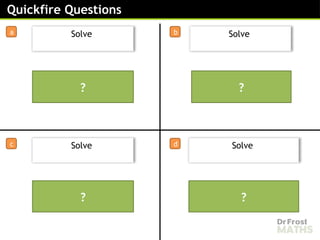
  • #16 Use quickfire questions (suitable for mini-whiteboards) to check students are confident solving factorised non-monics to get fractional solutions. Click the green boxes to reveal questions and answers sequentially.
  • #17 The slides now move to non-monic quadratic equations which require factorising. All slides will show factorising by splitting the middle term, although students may wish to factorise by inspection when given the choice. A reminder of where the sum/product comes from has been added as this is the first time it appears in these slides. Click to reveal each step sequentially.
  • #18 An example-problem pair of questions on solving non-monic quadratics; these first examples lead to one fractional solution and one integer solution. This can be used as ‘I do/You do’ on mini-whiteboards. Click the reveal the example sequentially, then click the Test Your Understanding header to reveal the second example. Finally click the green boxes to reveal the solution.
  • #19 A further example-problem pair of questions on solving non-monic quadratics that need factorising, this time producing two fractional solutions. This can be used as ‘I do/You do’ on mini-whiteboards. Click the reveal the example sequentially, then click the Test Your Understanding header to reveal the second example. Finally click the green boxes to reveal the solution.
  • #20 Use this slide to address a common misconception when solve non-monic quadratic equations, which is to incorrectly rearrange the resulting linear equations when finding fractional solutions. Click on the green box to highlight the mistakes and reveal the explanation and correct answers.
  • #21 This fill in the gaps exercise gives students some additional practice of solving non-monic quadratics by factorisation, along with some questions which involve working backwards. Click each green box to reveal individual answers, or click the Show all solutions button to reveal all.
  • #22 Use this slide to compare two of the special cases for solving quadratics – taking out common factors, and difference of two squares. Emphasise to students that although they look very similar, they are factorised using two very different methods. Click to reveal the solution to the left hand equation then the right hand equation sequentially.
  • #23 Use quickfire questions (suitable for mini-whiteboards) to give students practice of solving different types of quadratic equations that look very similar. Click the green boxes to reveal questions and answers sequentially.
  • #24 Use this slide to allow students to compare different methods for solving negative quadratic equations, either by splitting the middle term of a negative quadratic, or by rearranging to give a positive quadratic, then splitting the middle term. The slides which follow use the second method.
  • #25 An example-problem pair of questions on solving negative quadratics that need factorising by first rearranging to give a positive quadratic. This can be used as ‘I do/You do’ on mini-whiteboards. Click to reveal the example sequentially, then click the Test Your Understanding header to reveal the second example. Finally click the green boxes to reveal the solution.
  • #26 Use this slide to extend the idea of rearranging quadratics from negative quadratics to when there are terms on both sides of the equals sign. Emphasise that we must rearrange so one side of the equals sign is zero, and that it doesn’t matter which side; the important point is to ensure that the resulting quadratic ideally has a positive x squared term. Click to reveal each step sequentially.
  • #27 An example-problem pair of questions on solving quadratics that need rearranging before factorising. This can be used as ‘I do/You do’ on mini-whiteboards. Click to reveal the example sequentially, then click the Test Your Understanding header to reveal the second example. Finally click the green boxes to reveal the solution.
  • #28 Optional exam question involving rearranging to solve a non-monic quadratic, which can be used as a worked example or for AFL. Click on the green boxes to reveal each step of the solution.
  • #29 Independent task on solving non-monic quadratic equations available as a worksheet. Click on the green boxes to reveal answers or click show all solutions button to reveal all.
  • #30 Independent task on solving non-monic quadratic equations available as a worksheet. Click on the green boxes to reveal answers or click show all solutions button to reveal all.