Solving Equations Using 
Addition and Subtraction


                           1
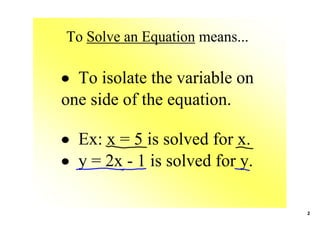
To Solve an Equation means...

• To isolate the variable on 
one side of the equation.

• Ex: x = 5 is solved for x.
• y = 2x ­ 1 is solved for y.

                                2
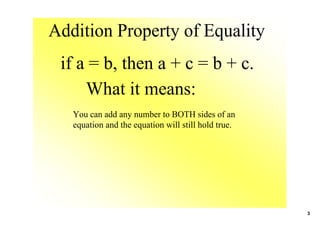
Addition Property of Equality
 if a = b, then a + c = b + c.
     What it means:
   You can add any number to BOTH sides of an 
   equation and the equation will still hold true.


                                                     3
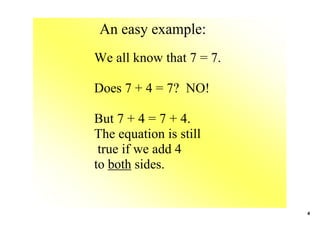
An easy example:
We all know that 7 = 7.

Does 7 + 4 = 7?  NO!

But 7 + 4 = 7 + 4.
The equation is still
 true if we add 4 
to both sides.


                          4
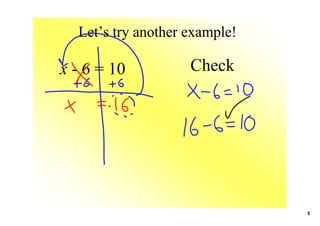
Let’s try another example!

x ­ 6 = 10          Check


                               5
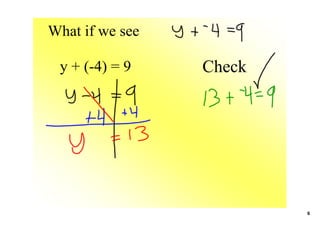
What if we see

  y + (­4) = 9   Check 


                          6
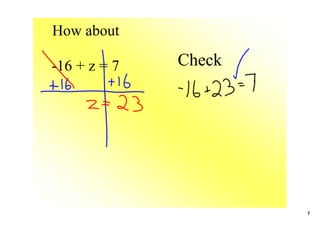
How about 

­16 + z = 7   Check  


                        7
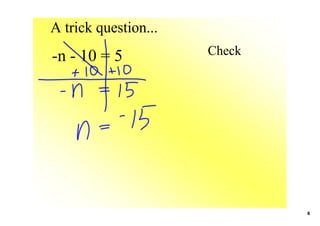
A trick question...
­n ­ 10 = 5           Check 


                               8
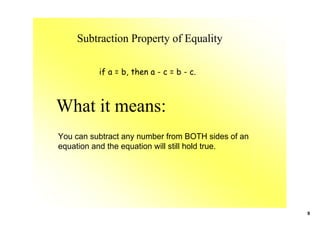
Subtraction Property of Equality

          if a = b, then a - c = b - c.


What it means:
You can subtract any number from BOTH sides of an 
equation and the equation will still hold true.


                                                     9
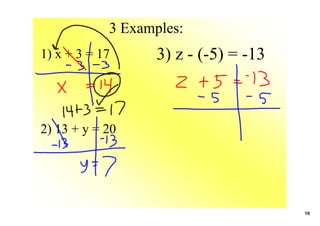
3 Examples:
1) x + 3 = 17      3) z ­ (­5) = ­13


2) 13 + y = 20


                                       10
11
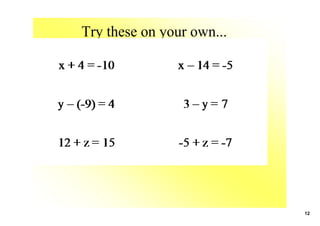
Try these on your own...


                           12
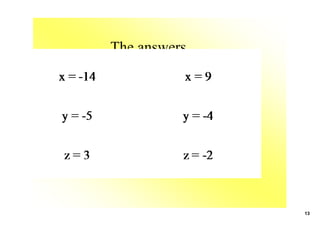
The answers...


                 13
14

Solve Eq Notes 02