vFabric Solutions for Partners to CapitalizeMichael Woodwoodm@vmware.com
AgendaCan vFabric Be a Game-Changer?SI/SO DriversSolutions that are Finding Success2Confidential
SI/SO MotivationsCompetitive BidsServices MarginMust be seen as an InnovatorMeet Project Timelines and ObjectivesTrusted Advisor3Confidential
Competitive Bids / Services MarginWhy Spend Half the Budget on Middleware?tcServer TCOGemFire – Cost Reduction of Data TierRabbitMQ – Open-Source and PowerfulCapitalize on Consolidation – Lean Infrastructure means Fewer ServersBuilt In Monitoring – Faster Root Cause AnalysisMore Dollars for Services!4Confidential
Innovative / Trusted AdvisorModern Applications Are Paramount and Spring+ DeliversSocial MediaBPM/BAM, IntegrationWeb/Portal/MobileModern BatchPaaS / IaaS / Private Cloud RoadmapExecute Modern Projects – Architectural Evolution in Mind5Confidential
Meet Project Timelines and BudgetsAutomated Deployment, ALM, Cloud DeliversSpring is More Productive Than JEE30% Faster Time to MarketSpringSourceToolSuiteCode2Cloud and DevCloud on the WaySpring Roo, Groovy/Grails, etc.Testing, Virtual Dev EnvironmentsSnapshots, Clones, etc., etc.6Confidential
Financial Services Company - ExampleOne SI proposed full Oracle Solutions Stack
Database + Coherence and Middleware Stack
Expensive, Unwieldy and Complex
Promise is that Services Hides Complexity
 Second SI proposed vFabric Solution
Primarily GemFire
Much Simpler Stack
Tremendous Cost Advantage
Second SI wins paid POC for a hundreds of thousand leading to much larger production implementation.7ConfidentialOpportunity is to facilitate clean transfers between financial institutions in real time.  Desired state is to have immediate data access anywhere.
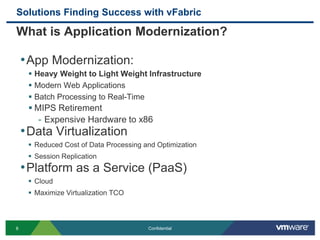
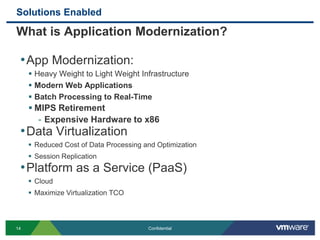
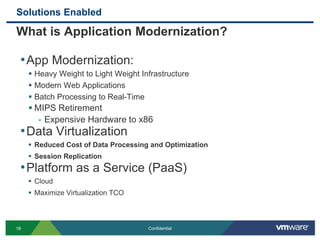
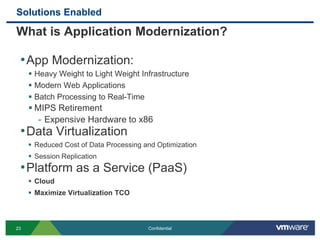
Solutions Finding Success with vFabricWhat is Application Modernization?App Modernization:Heavy Weight to Light Weight InfrastructureModern Web ApplicationsBatch Processing to Real-TimeMIPS RetirementExpensive Hardware to x86Data VirtualizationReduced Cost of Data Processing and OptimizationSession ReplicationPlatform as a Service (PaaS)CloudMaximize Virtualization TCO8Confidential
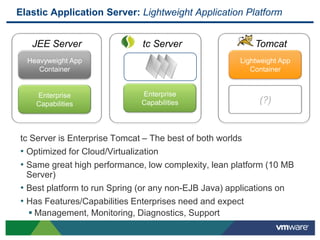
     Tomcat     tc ServerJEE ServerElastic Application Server: Lightweight Application PlatformLightweight App ContainerHeavyweight App ContainerEnterprise CapabilitiesEnterprise Capabilities(?)tc Server is Enterprise Tomcat – The best of both worldsOptimized for Cloud/VirtualizationSame great high performance, low complexity, lean platform (10 MB Server)Best platform to run Spring (or any non-EJB Java) applications onHas Features/Capabilities Enterprises need and expectManagement, Monitoring, Diagnostics, Support
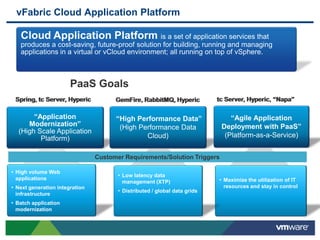
vFabric Cloud Application PlatformCloud Application Platform is a set of application services that produces a cost-saving, future-proof solution for building, running and managing applications in a virtual or vCloud environment; all running on top of vSphere.PaaS Goals   tc Server, Hyperic, “Napa”   tc Server, Hyperic, “Napa”  Spring, tc Server, Hyperic  Spring, tc Server, HypericGemFire, RabbitMQ, HypericGemFire, RabbitMQ, Hyperic“Agile Application Deployment with PaaS”(Platform-as-a-Service)“Agile Application Deployment with PaaS”(Platform-as-a-Service) “Data Virtualization”(High Performance Data Cloud) “High Performance Data” (High Performance Data Cloud)“Application Modernization”(High Scale Application Platform)“Application Modernization”(High Scale Application Platform)Customer Requirements/Solution TriggersCustomer Requirements/Solution TriggersHigh volume Web applications
Next generation integration infrastructure
Batch application modernization
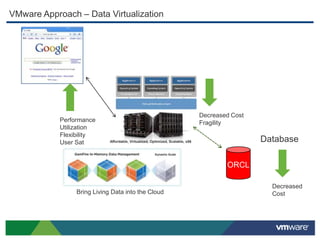
High volume Web applications
Next generation integration infrastructure
Batch application modernization
Maximize the utilization of IT resources and stay in control
Low latency data management (XTP)
Distributed / global data grids
Maximize the utilization of IT resources and stay in control
Low latency data management (XTP)

Solutions presentation

  • 1.
    vFabric Solutions forPartners to CapitalizeMichael Woodwoodm@vmware.com
  • 2.
    AgendaCan vFabric Bea Game-Changer?SI/SO DriversSolutions that are Finding Success2Confidential
  • 3.
    SI/SO MotivationsCompetitive BidsServicesMarginMust be seen as an InnovatorMeet Project Timelines and ObjectivesTrusted Advisor3Confidential
  • 4.
    Competitive Bids /Services MarginWhy Spend Half the Budget on Middleware?tcServer TCOGemFire – Cost Reduction of Data TierRabbitMQ – Open-Source and PowerfulCapitalize on Consolidation – Lean Infrastructure means Fewer ServersBuilt In Monitoring – Faster Root Cause AnalysisMore Dollars for Services!4Confidential
  • 5.
    Innovative / TrustedAdvisorModern Applications Are Paramount and Spring+ DeliversSocial MediaBPM/BAM, IntegrationWeb/Portal/MobileModern BatchPaaS / IaaS / Private Cloud RoadmapExecute Modern Projects – Architectural Evolution in Mind5Confidential
  • 6.
    Meet Project Timelinesand BudgetsAutomated Deployment, ALM, Cloud DeliversSpring is More Productive Than JEE30% Faster Time to MarketSpringSourceToolSuiteCode2Cloud and DevCloud on the WaySpring Roo, Groovy/Grails, etc.Testing, Virtual Dev EnvironmentsSnapshots, Clones, etc., etc.6Confidential
  • 7.
    Financial Services Company- ExampleOne SI proposed full Oracle Solutions Stack
  • 8.
    Database + Coherenceand Middleware Stack
  • 9.
  • 10.
    Promise is thatServices Hides Complexity
  • 11.
    Second SIproposed vFabric Solution
  • 12.
  • 13.
  • 14.
  • 15.
    Second SI winspaid POC for a hundreds of thousand leading to much larger production implementation.7ConfidentialOpportunity is to facilitate clean transfers between financial institutions in real time. Desired state is to have immediate data access anywhere.
  • 16.
    Solutions Finding Successwith vFabricWhat is Application Modernization?App Modernization:Heavy Weight to Light Weight InfrastructureModern Web ApplicationsBatch Processing to Real-TimeMIPS RetirementExpensive Hardware to x86Data VirtualizationReduced Cost of Data Processing and OptimizationSession ReplicationPlatform as a Service (PaaS)CloudMaximize Virtualization TCO8Confidential
  • 17.
    Tomcat tc ServerJEE ServerElastic Application Server: Lightweight Application PlatformLightweight App ContainerHeavyweight App ContainerEnterprise CapabilitiesEnterprise Capabilities(?)tc Server is Enterprise Tomcat – The best of both worldsOptimized for Cloud/VirtualizationSame great high performance, low complexity, lean platform (10 MB Server)Best platform to run Spring (or any non-EJB Java) applications onHas Features/Capabilities Enterprises need and expectManagement, Monitoring, Diagnostics, Support
  • 18.
    vFabric Cloud ApplicationPlatformCloud Application Platform is a set of application services that produces a cost-saving, future-proof solution for building, running and managing applications in a virtual or vCloud environment; all running on top of vSphere.PaaS Goals tc Server, Hyperic, “Napa” tc Server, Hyperic, “Napa” Spring, tc Server, Hyperic Spring, tc Server, HypericGemFire, RabbitMQ, HypericGemFire, RabbitMQ, Hyperic“Agile Application Deployment with PaaS”(Platform-as-a-Service)“Agile Application Deployment with PaaS”(Platform-as-a-Service) “Data Virtualization”(High Performance Data Cloud) “High Performance Data” (High Performance Data Cloud)“Application Modernization”(High Scale Application Platform)“Application Modernization”(High Scale Application Platform)Customer Requirements/Solution TriggersCustomer Requirements/Solution TriggersHigh volume Web applications
  • 19.
  • 20.
  • 21.
    High volume Webapplications
  • 22.
  • 23.
  • 24.
    Maximize the utilizationof IT resources and stay in control
  • 25.
    Low latency datamanagement (XTP)
  • 26.
  • 27.
    Maximize the utilizationof IT resources and stay in control
  • 28.
    Low latency datamanagement (XTP)

Editor's Notes

  • #3 For this presentation, we are going to discuss the vFabric opportunity as it relates to partners, with a bit of a focus on Service Integrator / Service Outsourcer market. After discussing how vFabric can specifically impact the SI/SO competitive landscape, then we will turn to discuss specific opportunities that can be delivered to your customers.
  • #4 So, as I understand them, these are the core drivers of a successful SI. You must be able to deliver a bid that is cost effective and right-sized for your customer. Competitively, you need to be perceived as an innovator while not ‘gouging’ your customer for margin. At the same time, you are looking to maximize margin due to wall street demands, you need enough of the right resources to deliver on your innovative promises, all while becoming a trusted advisor to the customer! Sounds like a tough job as many of these vectors are juxtaposed. If you are really going to help a customer innovate by transforming their systems, then you are often recommending more work (not less) than a simple repair, or base performance improvement, etc. This impacts project cost and timeline, and hurts the competitiveness of your bid, but strengthens your strategic position with the customer. What you need is a technology partner that better positions you to compete in all of these areas efficiently.
  • #5 Let’s start by discussing two of these juxtaposed SI drivers. You need to have competitive bids while maximizing your margins. With vFabric, you don’t invest so much of the product budget on the middleware. tcServer is the vFabric Java application management software which enables companies to run enterprise Java applications in physical or virtual environments with visibility into how the application is behaving and control. If you are going to market with Oracle or IBM, then you are aware of some of their cost structures – with tcServer, not only is the initial license and support cost 1/10th or better, but overall cost of ownership is way less than these other containers. This means that you are better positioned to include more resources in the deal, rather than roping off millions for a software vendor. GemFire can be a bit more expensive, but the kinds of engagements that demand that infrastructure are often large and very lucrative. GemFire is a powerful in memory data grid solution that allows customers to retire MIPS, reduce dependence on costly DB licenses, respond to customer requests in real-time, take batch processing times from hours to seconds, etc. The cost savings to a customer by utilizing GemFire will often pay for not only your current project, but the next several projects as well (one customer saved $44 million in the first year by accessing what was previously IMS data in GemFire, and retiring $44 million in MIPS). RabbitMQ is a messaging solution for addressing very demanding, dynamically scaling messaging challenges. Comparing it to JMS, for instance, is almost unfair as using JMS requires full WebLogic licensing (if we are talking about Oracle), which again is thousands a CPU. IBM does not favor JMS, but rather pushes MQ Series (which is very, very costly). Tibco is not cheap, etc. Not only does RabbitMQ provide market differentiating, best-of-breed features previously unheard of in the messaging world, it is free and open-source, but even with a full support contract with VMware is pennies on the dollar for your customers.vFabric also provides Hyperic for top-to-bottom monitoring and management of the entire platform. This improves time to market demands as well as time to resolution for bugs and/or application or infrastructure faults/errors. Without visibility into the infrastructure, data, and most important, the application code that you are delivering, your projects can bog down without good visibility throughout the stack, and vFabric provides this inherently.All of this means that you should be able to remain competitive, while improving your margins simply by moving some of the customer spend away from infrastructure, troubleshooting, kludgey coding practices, and tangled disparate products to a more seamless and simple infrastructure stack that provides deep and powerful capabilities like vFabric.
  • #6 As to establishing yourself as an Innovative Trusted Advisor, consider that the Spring Framework improves on Java by making it much simpler to work with. While this also addresses the previous slide (by shortening your TTM), it also provides frameworks for modern application design. Things like Social Media. Spring introduced Spring Social, a framework to allow developers to quickly and easily utilize social media in their applications (like Twitter, Facebook or LinkedIn). In Spring, developers can also utilize open BPM/BAM tooling like Activiti. Activiti is an open-source (FREE) BPM/BAM solution based on BPMN 2.0 standard process notation which allows your company to deliver rich BPM innovations that fit cleanly with Spring and light-weight less costly run-times. Consider that Oracle and IBM charges hundreds of thousands per CPU socket for their BPM solutions, and you will be able to deliver these rich and powerful business solutions at a fraction of that TCO because all of the license is composed of lean application servers (tcServer). Spring also provides a framwork for system to system integration, web (MVC – Model View Controller), mobile device support, modern batch processing, and has recently invested in a company called WaveMaker, which provides an open-source Portal product.WaveMaker is a widely used graphical tool that enables non-expert developers to build web applications quickly, that then run on vFabric. As we move towards this cloud-based infrastructure, how cool is it that we are putting tools in place to allow non-experts to leverage this light-flexible infrastructure in an automated way?What is important here is that you are being asked to solve tactical problems, but, as any good PM will tell you, you must look and position each project strategically. As customers are beginning to see benefits from the cloud, you will be delivering these modern applications with the cloud as your eventual deployment environment. vFabric is ideally suited to cloud deployments (as evidenced by VMForce, and others), and as such allows you to deliver on today’s challenges while positioning yourself as the innovative trusted advisor for where the customer needs to go to take advantage of Cloud.
  • #7 With regards to speeding time to market and achieving your project objectives within budget, vFabric and Spring are all about efficiency. Effeciency not only in terms of license, but required infrastructure, developer time, testing, troubleshooting, etc. For one, there have been several studies comparing application frameworks and how quickly developers can build similar applications. Spring (depending on the study) is at least 30% faster to develop in than traditional Java Enterprise Edition. 2nd, VMware provides SpringSourceToolSuite free of charge for any developer. The ToolSuite comes with many features that enable developers to get to market quickly, such as Spring Insight. Spring Insight peers into the execution of a developer’s Spring application showing a call by call trace of the application’s performance in microseconds, errors that may have occurred, even looking into poor performing SQL, etc. This feature alone ensures that code created in Spring is less buggy and more production ready the first time, improving TTM.From a time savings perspective, VMware is partnering with TaskTop on a project called Code2Cloud. C2C is a cloud-based ALM suite approach. That is, when your consultants go onsite to build out a new project, they do not need source control, ticketing systems, etc. for managing the application lifecycle. They can simply leverage these capabilities in the VMware/TaskTop cloud without dedicating an FTE to standing up and maintaining 5 or 6 such systems on site to provide these functions.DevCloud is another offering that is on the way, and that is a free environment for building and deploying Spring and vFabric application assets and testing them. In traditional environments where development teams must wait on operations to stand up hardware and networking assets, security, software installs and configurations, etc., this kind of capability can drive out substantial cost while greatly improving time to market. As a caveat, C2C is slated for Q4 this year, and DevCloud is also a future offering, but for this discussion, you should be aware of how VMware is continuing to innovate to drive greater efficiencies in development.vFabric and Spring are not only focused on the Spring Framework, but also provides tooling for several other rapid application development technologies like Spring Roo, Groovy and Grails. Without getting into details, these allow developers to generate much of the ‘plumbing’ code in an automated fashion. Anecdotally, a developer built a custom expense reporting application, deployed it to the Google cloud, showed the application running on a Droid phone, all in about 40 minutes using Spring Roo at our Tech Summit a year ago.Lastly, consider development environments where server environments are needed on demand to fully test, pilot, and prove application capabilities. These environments are need to be created and destroyed regularly. Utilizing VMware and vFabric, development shops can spin up development environments, test against them, snapshot problems to recreate issues, snapshot environments to recreate test, clone environments, etc. The efficiencies are substantial.
  • #9 Now, let’s look at a few other types of application modernization.
  • #11 Migration from Web Logic and Web SphereBatch and mainframe migration Unix to Linux migration (tc Server)
  • #15 Now, let’s look at a few other types of application modernization.
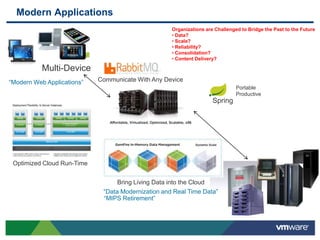
  • #16 Extending this discussion to several forms of application modernization, vFabric provides core capabilities that address various business challenges. Regardless of the application paradigm (mainframe, Sun, mobile device, etc.), vFabric provides what is needed to bring applications into the cloud, and drive out costs.First, <CLICK> customers use Spring to get to market faster and to build applications designed to run in any cloud or physical deployment. In terms of productivity, independent studies have shown that Spring developers get to market between 30 and 50% faster than traditional Java Enterprise development efforts. With regards to portability, Spring applications can run just about anywhere. Part of the reason for the popularity of Spring is that developers can write and test code in a simple and free environment (like Tomcat), then deploy to WebSphere, WebLogic, .NET or VMware’s own tcServer. This portability, then, extends to any cloud. For example, Google and VMForce leverage Spring as the standard for application development for their public cloud offerings.Next, <CLICK> Spring runs best in the vFabrictcServer. As previously discussed, tcServer is lean and scalable and is the best place to run Spring, and the best engine to run Java in the cloud. Next <CLICK> is GemFire, which brings enterprise data into the middle tier providing the benefits we discussed in the previous slide.<CLICK> RabbitMQ provides messaging for the cloud generation by allowing applications to abstract their communication away from programmatic APIs to a messaging protocol that can be consumed by any device or application. Surrounding and maximizing these investments is a product that is not yet released called vAppDirector. AppDirector, as the name implies, provides self-provisioning capabilities for the middleware components. In this way, developers would build out an application in Spring and deploy it with an ‘application blueprint’ which is simply a description of the required deployment platform. In other words, if your application requires 2 instances of an application server, plus a couple of VM’s with GemFire, etc., vAppDirector would request the appropriate images from the virtualized infrastructure and respond to your application deployment automatically. This capability changes the developer’s world as they do not need to wait for physical infrastructure to be provisioned, networking to be configured, software to be properly installed and configured, etc.This ‘Cloud Application Platform’ then <CLICK> drives these modernization efforts by enabling Data Improvements, MIPS retirement, Modern Web Applications and more.
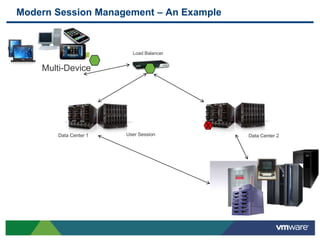
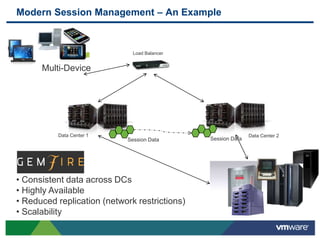
  • #17 Let’s start off by discussing modern web applications, and the need for session management. Many enterprise class web applications have a general architecture like the one pictured here. A web request comes into the global load balancer, and then the request is sent (in this case) to one of 2 globally distributed (WAN separated) data centers. The user clicks around, browsing the site, and potentially adding items to a shopping cart, filling out online forms, etc. <CLICK> All of these activities are stored locally on the application server responding to the web request as session data. <CLICK> <CLICK> In this case, the user session is pinned to Data Center 1. Within this data center, the session data is shared amongst local cluster members in order to allow for any single application server to fail with losing user data, <CLICK> But what happens if the user decides to save the shopping cart and come back in from another access point? The user could be out of luck in trying to retrieve their shopping cart information.
  • #18 With a modern approach, IT departments can optimize web session management through the use of a distributed data grid. Essentially, this approach makes session data much more manageable in a global environment. <CLICK> First, session data is not replicated to every node in a cluster, but is referenceable by any application node. This means that many fewer copies of the data are required to maintain availability. Second, <CLICK> this data grid approach means that the session data is asynchronously copied across the WAN to globally disparate data centers. <CLICK> This means that no matter how user requests are load balanced, session data is consistent, and no data is lost. GemFire is the vFabric solution that enables this behavior, and it drives additional value in terms improving session management locally, the ability to scale on demand, etc.(Optional information – Most clustering approaches (think IBM, JBoss) require every bit of session data to be replicated to every node in the cluster. As clusters grow, this adds greater and greater demand on the network, eventually hitting a point of dimishing returns where session replication is eating up all the time of the cluster. GemFire eliminates that issue by storing just a configurable number of copies (3 is a pretty good base number), and these copies are available to any node in the cluster. Replication, then, is manageable even to very large clusters.)
  • #19 Now, let’s look at a few other types of application modernization.
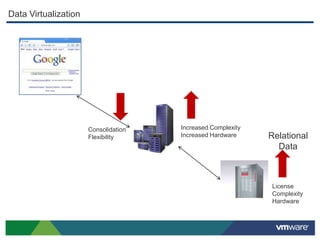
  • #20 With Regards to Data Virtualization, the big push is to handle more and more data, yet provide the data in more real-time operations. If we look at Oracle for a second, the recommendation might look like this.In this example, Oracle may recommend that you need to expand your data processing power by investing in Exadata, a very expensive database appliance system that improves I/O with Infiniband switches, huge memory, huge CPU, etc. Then you should also expand in the application tier by running large clusters of WebLogic on Oracle hardware. This solution is really no different than the original architecture, which is an application server working with a database, Oracle’s message is really “Pay us more for performance.”<CLICK> This approach, however, leads to more cost, more lock in, and often, more demand for all resources. What is the alternative?
  • #21 The question, then, is how does VMware’s approach differ? First, instead of implementing very costly servers (like the IBM P-Series, or SUN hardware), <CLICK> VMware advocates the utilization of much lighter weight x86 application servers to provide the compute capacity at the middle tier. Second, <CLICK> implement virtualization in order to better drive consolidation. Third, <CLICK> utilize modern light-weight middleware, such as vFabricGemFire to house living data in the cloud, alleviating the demand for high-end database offerings like Exadata. As most data is acted upon in the cloud, response time is amazing, and utilization of the database is greatly reduced restricting network cost as well as DB license cost.For this kind of solution, tcServer is also important as it optimizes the individual VM utilization by providing the right amount of infrastructure to service the application. Oracle for example will push a suite of heavy-weight products that must all run in the same VM to capitalize on the licensing construct.GemFire is a key element to the vFabric story. With GemFire, active data sets are available on the same, less expensive mid-tier servers that the modern, virtualized applications are running on. In this way, reliance on the mainframe for every live transaction is greatly reduced or eliminated. In other words, an update to an order is committed in the application server, and when there is time, GemFire will get around to updating the database. This solution provides for improved response times for the application, reduced cost in terms of hardware and software at the middle tier, and drives out DB cost as well. In many cases, the reduction in DB license paired with the cost saving inherent in better utilization of the hardware can fund not only the current modernization effort, but also the next.As a partner, if you have a consulting arm around development of applications, you would then propose an attached statement of work around application modifications required to address this new approach.
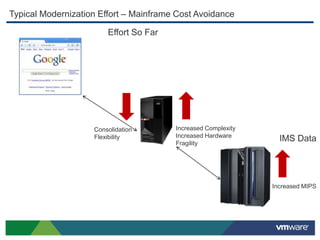
  • #22 A more difficult, but very valuable, data modernization effort surrounds antiquated mainframe applications, or web application design incorporating the mainframe (based on your view point). This opportunity is more services intensive compared to some of the other solutions discussed.Let’s take an IBM approach to modernizing legacy applications for the web. Traditionally, Mainframes suffer from a general inability to adapt to modern application workloads (i.e. they are not optimized for web or mobile computing). Compounding this, processing mainframe transactions is typically not real-time. Often, mainframes are processing batch workloads for periods of intense compute power consumption, and then rest. This paradigm does not lend itself to consolidation, and to defray the cost when the mainframe is underutilized, consumers are charged for utilization in the form of MIPS (Millions of Instructions Per Second). The higher the number of MIPS used, the more the customer pays. In this way, consumers of mainframes were able to avoid paying for unused capacity (in theory). However, as web applications continue to gain dominance, especially with the emergence of tablets and mobile devices of all shapes and sizes, IBM is forced to provide solutions to make mainframe data and logic available through more modern computing paradigms. To this end, IBM would propose that users of the mainframe purchase an IBM mid-tier server (P-Series or IBM BladeCenter, for example), and use WebSphere application server and some adapters to communicate with the mainframe and present a modern web application to the user. While this approach certainly modernized the interface, it produced interesting consequences in terms of license, cost, complexity and inflexibility. Not only does IBM license the new hardware and software at the middle-tier, but introduces integration logic that is invoked at every request. As with any modernization effort, the intent is to drive greater and more consistent utilization of the application. <CLICK> This drives up overall MIPS utilization along with the cost of the application itself, often resulting in a big win for IBM in terms of revenue, but driving up cost and complexity for the customer. The middle tier also ascribes to traditional application design, which is to hugely overprovision and underutilize the hardware, run way more software than needed, and drive lock in to IBM software by requiring utilization of proprietary integration solutions. All of this while introducing fragility, as a loss of functionality at the middle server impedes or breaks processing on the mainframe.Because of this approach to working to modernize the legacy application, much more cost and pain is introduced. Hence, organizations become gun-shy, and avoid such opportunities unless absolutely driven by market or legal forces.
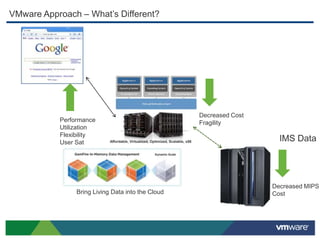
  • #23 The question, then, is how does VMware’s approach differ? First, instead of implementing very costly servers (like the IBM P-Series), <CLICK> VMware advocates the utilization of much lighter weight x86 application servers to provide the compute capacity at the middle tier. Second, <CLICK> implement virtualization in order to better drive consolidation. Third, <CLICK> utilize modern light-weight middleware, such as vFabricGemFire to house living IMS data in the cloud, alleviating the demand for mainframe resources and driving out cost while reducing fragility.GemFire is a key element to the vFabric story. With GemFire, active data sets are available on the same, less expensive mid-tier servers that the modern, virtualized applications are running on. In this way, reliance on the mainframe for every live transaction is greatly reduced or eliminated. In other words, an update to an order is committed in the application server, and when there is time, GemFire will get around to updating the Mainframe. This solution provides for improved response times for the application, reduced cost in terms of hardware and software at the middle tier, and drives out MIPS by alleviating the demand for IMS data from the mainframe. The reduction in MIPS alone can justify all other costs associated with this kind of modernization effort, as MIPS typically cost organizations millions. One customer implemented this approach and claims to have saved over $44 million in the first year on decreased MIPS alone.As a partner, if you have a consulting arm around development of applications, you would then propose an attached statement of work around application modifications required to address this new approach.
  • #24 Now, let’s look at a few other types of application modernization.
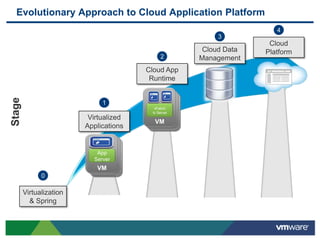
  • #26 Customers want a path to cloud computing and they are looking to VMware to help them set their Private / Hybrid cloud strategy both at the infrastructure layer and at the application platform layer.Many of our enterprise customers are using vSphere and Spring today. For those not at Stage 0, we recommend they get started there.Steps 1, 2, and 3 are about continuing along this journey to being able to embrace a platform that provides cloud-like capabilities within your datacenter or hosted (as part of VMware’s large ecosystem of servive providers such as Savvis, Terremark, etc.).Step 1: While a customer may be already using vSphere, Step 1 is about virtualizing Java workloads. These may be standard Java EE apps running on WebSphere, WebLogic, or JBoss. Hyperic plays a key role in this stage since it provides visibility into these applications running on physical architectures and maintains that level of visibility as these workloads are virtualized. Since about half of the apps deployed onto Java platforms today use Spring, many of these applications, once virtualized, are nicely prepared for Step 2.Step 2: tc server: better place to run their apps and much better suited for virtual. Lightwer weigh, less complex. Optimized for Spring and ideal for virtualized environments. Customers are able to run a higher density of instances of tc Server versus the heavyweight counterparts.Step 3: data management. We have purposely separated the management data away from the application server and have services in GemFire and RabbitMQ that are tightly focused on handling the needs of data management in cloud architectures.Step 4: is embracement of all of the moving parts of the platform and embracing policy-based operational automation capabilities. These capabilities are coming online in early 2011…which fits well with the customer adoption curve.
  • #30 This presentation is focused primarily on application infrastructure for the cloud generation of applications.Our agenda, or roadmap if you will, will cover three topics:[CLICK] Briefly cover VMware’s vision for the next decade of information technology and discussing how VMware is taking a uniquely comprehensive approach to enabling the next major era of IT across three major layers:Cloud Infrastructure, Cloud Application Platform, and End User Computing[CLICK] We will then drill down into the cloud application platform and the key drivers we are seeing that are driving requirements in this space[CLICK] And then we will drill down specifically into VMware vFabric, VMware’s cloud application platform solution that: Is comprised of Spring and new VMware vFabric product family: Modern application framework and integrated platform services Maximizes speed and innovation: enabling customers to bring new apps to market faster and with less complexity Extends the benefits of virtualization to the application: Provides an evolutionary path to the cloud whether private, public or hybrid