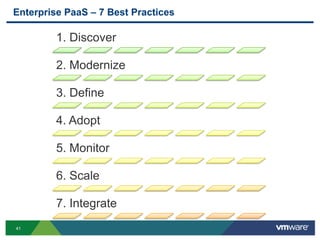
7 Best Practice when moving to Enterprise    PaaS
How do I start?How do I Start?I would like a PaaS but how?
Other people must have do this before?
How do I avoid the common pitfalls?Our StoryOur StoryWe travel the world helping enterprises adopt PaaS
Every enterprise is unique however there are common requirements
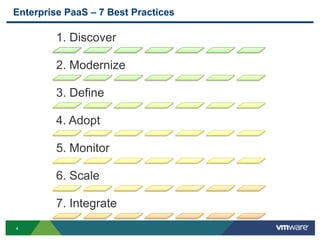
 Lets talk about a common set of best practices when considering adopting PaaSEnterprise PaaS – 7 Best Practices
DiscoverThe Current State
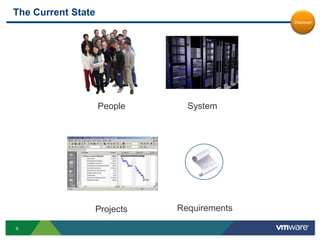
The Current StateDiscoverSystemPeopleRequirementsProjects
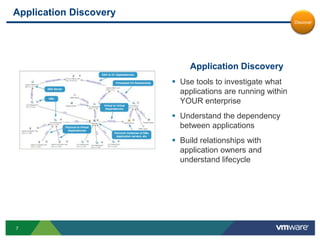
Application Discovery DiscoverApplication DiscoveryUse tools to investigate what applications are running within YOUR enterprise
Understand the dependency between applications
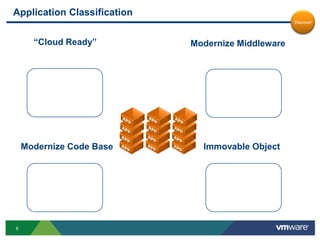
Build relationships with application owners and understand lifecycleApplication Classification Discover“Cloud Ready” Modernize MiddlewareImmovable ObjectModernize Code Base
ModernizeApplication Modernization
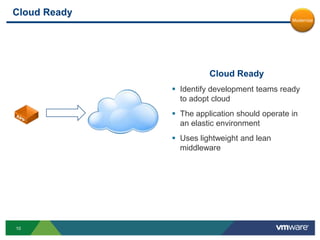
Cloud ReadyModernizeCloud ReadyIdentify development teams ready to adopt cloud
The application should operate in an elastic environment
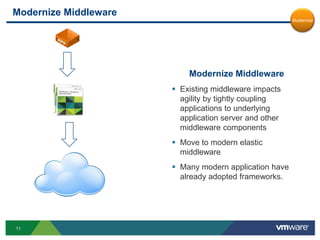
Uses lightweight and lean middleware Modernize MiddlewareModernizeModernize MiddlewareExisting middleware impacts agility by tightly coupling applications to underlying application server and other middleware components
Move to modern elastic middleware
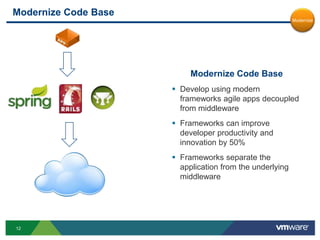
Many modern application have already adopted frameworks. Modernize Code BaseModernizeModernize Code BaseDevelop using modern frameworks agile apps decoupled from middleware
Frameworks can improve developer productivity and innovation by 50%
Frameworks separate the application from the underlying middleware Immovable ObjectModernizeImmovable ObjectThere will be application that can’t be redeveloped or migrated to an elastic application platform
Look at integration strategies that allow you to bridge the gap.DefineTarget State
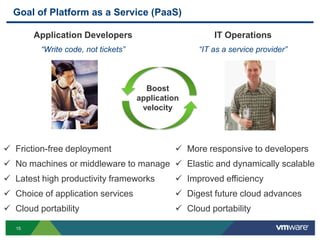
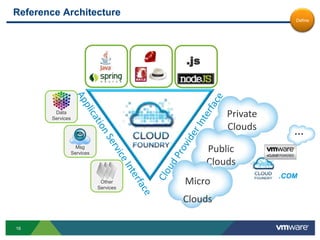
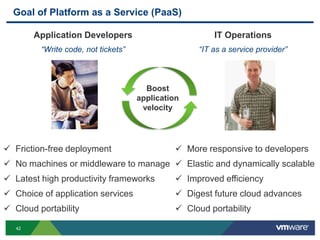
Goal of Platform as a Service (PaaS)Application Developers“Write code, not tickets”IT Operations“IT as a service provider”Boost application velocityFriction-free deployment
No machines or middleware to manage
Latest high productivity frameworks
Choice of application services
Cloud portability
More responsive to developers
Elastic and dynamically scalable
Improved efficiency
Digest future cloud advances
Cloud portabilityMsgServicesReference Architecture  Define.js…Data ServicesPrivate Clouds Other ServicesCloud Provider InterfaceApplication Service Interface.COMPublicCloudsMicroClouds
Reference Architecture Demonstration 17
Your RoadmapDefineDefine Your RoadmapPlan YOUR journey in YOUR timelines
Evolve YOUR business and IT at your pace
Define clear and achievable milestonesAdoptPlatform Adoption
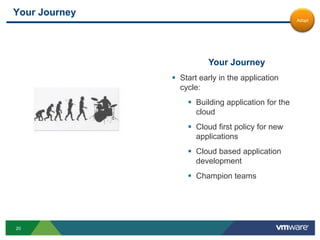
Your JourneyAdoptYour JourneyStart early in the application cycle:
Building application for the cloud
Cloud first policy for new applications
Cloud based application development
Champion teams PaaS DevelopmentDemonstration
MonitorPlatformMonitoring
MonitoringMonitorMonitoringPaaS is providing an application platform which requires a new way of looking at monitoring.
Monitor for application failures
Identity application load trends

7 steps to Enterprise PaaS

Editor's Notes

  • #16 As we think about it from an enterprise perspective, Cloud Foundry is an opportunity to boost application velocity through systemic productivity improvements across the entire dev and ops pipeline. Developers can focus on the app while IT delivers the platform as a service. PaaS speeds up prototyping, trial, testing, scale testing, production, updating, cloud-scaling apps.
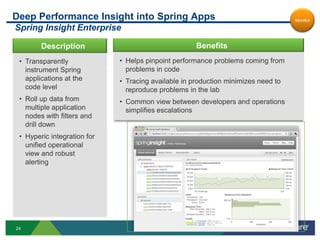
  • #25 Although Spring is famous for its openness and portability, we can take advantage of our deep understanding of Spring to add unique value for applications running on the vFabric platform. Spring Insight is a technology that provides code level tracing – tracking the time a transaction spends in each method and JDBC (database) call – transparently for Spring Applications. Basically, users get very deep information on the operation of a running Spring application just as a benefit for running in on vFabric. No code modifications or setup is required. Spring Insight has been available for developers for almost a year as part of the tc Server Developer Edition. This is a single-user, development-time solution that integrates helps developers find performance bottlenecks in their applications while running it on their local machines, typically inside our Eclipse-based IDE, SpringSource Tool Suite. Next year we will roll out Spring Insight Enterprise, which leverages the same code-level tracing technology but pulls together information from multiple application servers into a single console with roll-up views, drill downs, and historical comparisons. This solution has been designed to minimize the overhead of the monitoring so it is suitable for both test and production environments. While the Spring Insight Enterprise console is useful for both administrators and developers who may need to troubleshoot problems in production, it is also important that administrators and operations have a single place to go for vFabric monitoring. Therefore, Spring Insight Enterprise monitoring will be available not only as a stand-alone console but also through a plug-in to the Hyperic monitoring solution, enabling a single view across data from multiple sources and integrated alerting and control actions.
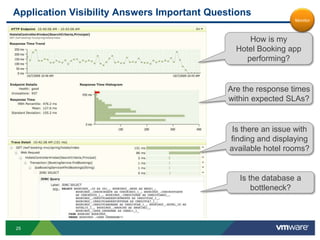
  • #26 Over the past year, we have invested a lot of effort in providing automatic visibility into Spring applications so that our customers can answer important questions about the behavior of their applications.In this particular example, we have a Hotel Booking application. By using the Spring Insight technology baked into our application platform, our customers can interact with a chart that illustrates how their application is performing and whether or not the response times are within the expected SLAs.If there is an issue, they are able to drill into the application further. Let’s say that certain response times for finding and displaying available hotel rooms look out of band…well, you can selectively drill into that request and see if the database is the bottleneck, for example. This level of visibility helps developers create high performing applications, but as we will cover in a moment, this information combined with visibility across the application infrastructure stack is also critical for delivering the proactive performance management required of today’s modern platforms.
  • #43 As we think about it from an enterprise perspective, Cloud Foundry is an opportunity to boost application velocity through systemic productivity improvements across the entire dev and ops pipeline. Developers can focus on the app while IT delivers the platform as a service. PaaS speeds up prototyping, trial, testing, scale testing, production, updating, cloud-scaling apps.