Download the full version and explore a variety of test banks
or solution manuals at https://testbankmall.com
Solution Manual for Operations Management 14th
Edition William J Stevenson
_____ Follow the link below to get your download now _____
https://testbankmall.com/product/solution-manual-for-
operations-management-14th-edition-william-j-stevenson/
Access testbankmall.com now to download high-quality
test banks or solution manuals
Here are some recommended products for you. Click the link to
download, or explore more at testbankmall.com
Test Bank for Operations Management 14th Edition William J
Stevenson
https://testbankmall.com/product/test-bank-for-operations-
management-14th-edition-william-j-stevenson/
Solution Manual for Operations Management 6th Canadian by
Stevenson
https://testbankmall.com/product/solution-manual-for-operations-
management-6th-canadian-by-stevenson/
Operations Management Stevenson 11th Edition Solutions
Manual
https://testbankmall.com/product/operations-management-stevenson-11th-
edition-solutions-manual/
Test Bank for Periodontology for the Dental Hygienist 4th
Edition by Perry
https://testbankmall.com/product/test-bank-for-periodontology-for-the-
dental-hygienist-4th-edition-by-perry/
Test Bank for Foundations of Addictions Counseling, 4th
Edition, David Capuzzi, Mark D. Stauffer
https://testbankmall.com/product/test-bank-for-foundations-of-
addictions-counseling-4th-edition-david-capuzzi-mark-d-stauffer/
Solution Manual for Decision Support and Business
Intelligence Systems, 9/E 9th Edition Efraim Turban,
Ramesh Sharda, Dursun Delen
https://testbankmall.com/product/solution-manual-for-decision-support-
and-business-intelligence-systems-9-e-9th-edition-efraim-turban-
ramesh-sharda-dursun-delen/
Test Bank for Introductory Chemistry: Concepts and
Critical Thinking 8th Edition Charles H. Corwin
https://testbankmall.com/product/test-bank-for-introductory-chemistry-
concepts-and-critical-thinking-8th-edition-charles-h-corwin/
Test Bank for 21st Century Astronomy, 6th Edition, Laura
Kay, Stacy Palen George Blumenthal
https://testbankmall.com/product/test-bank-for-21st-century-
astronomy-6th-edition-laura-kay-stacy-palen-george-blumenthal/
Solution Manual for Analysis, Synthesis and Design of
Chemical Processes, 4/E 4th Edition Jessica W. Castillo,
Richard Turton, Richard C. Bailie, Wallace B. Whiting,
Joseph A. Shaeiwitz
https://testbankmall.com/product/solution-manual-for-analysis-
synthesis-and-design-of-chemical-processes-4-e-4th-edition-jessica-w-
castillo-richard-turton-richard-c-bailie-wallace-b-whiting-joseph-a-
shaeiwitz/
Introduction to Operations and Supply Chain Management 4th
Edition Bozarth Test Bank
https://testbankmall.com/product/introduction-to-operations-and-
supply-chain-management-4th-edition-bozarth-test-bank/
Chapter 01 - Introduction to Operations Management
1-2
Copyright © 2021 McGraw-Hill. All rights reserved. No reproduction or distribution without the prior written consent of McGraw-Hill.
1. Given that the U.S. economy is becoming more service based, the percentage of employment in
manufacturing is declining while the percentage of employment in the service industry is
increasing. In addition, the loss of manufacturing jobs results in the loss of service jobs as well (a
general estimate is that four service jobs are lost for each manufacturing job lost).
2. The government could offer companies tax incentives for purchasing new equipment or for hiring
workers. In addition, the government could work with manufacturing companies to re-train
workers in more advanced manufacturing processes.
3. Manufacturing innovation is important because it requires high value-added knowledge work that
supports future innovation. Second, innovation generates high-paying jobs. Third, innovation is
important because it improves productivity, thereby slowing the outsourcing of jobs to lower
wage countries.
Reading: Agility Creates a Competitive Edge
The first solution could be for U.S. retailers to continue sourcing from China that part of demand that is
certain and to source uncertain demand from the same low-cost producers in Romania and Turkey.
Chapter 01 - Introduction to Operations Management
1-3
Copyright © 2021 McGraw-Hill. All rights reserved. No reproduction or distribution without the prior written consent of McGraw-Hill.
This approach provides the advantages of low-cost manufacturing in China and the flexibility provided by
the suppliers in Romania and Turkey. The disadvantage of this approach is that transportation times for
U.S. retailers still will be longer than the transportation times faced by Zara’s and H & M.
A second approach could be that U.S retailers find low-cost, flexible suppliers just across the border in
Mexico. The advantages of this approach include low wages and shorter transportation times. The primary
disadvantages to this approach involve the time and expense of locating new suppliers. Additionally, the
U.S. retailers might have to lend considerable support developing the capabilities of these suppliers.
Reading: Sustainable Kisses
1. Hershey’s and other companies engage in sustainable business practices because consumers
prefer to do business with companies that practice sustainable sourcing and ethical treatment of
workers. Many of the leaders in these businesses hold the same values. By educating farmers,
Hershey’s can also help to increase the longevity and yield of cocoa plants.
2. Hershey’s actions may influence retailers and customers in its supply chain to become better-
educated about sourcing, which may influence competitors to adopt similarly sustainable business
practices.
Operations Tour: Wegmans Food Markets
1. Customers judge the quality of a supermarket based on:
a. Quality of individual products.
b. Exterior and interior physical look of the store.
c. Effectiveness and efficiency of service personnel.
2. a. Customer satisfaction is the major key to the success of any operation; without it, the
company cannot survive.
b. Forecasting allows the company to plan the workforce levels, purchase quantities, inventory
levels, and capacity.
c. Capacity planning allows the company to balance the trade-off between shortages and excess
inventories and between waiting lines and idle time.
d. A good location can have a significant impact in attracting customers, thus improving sales.
e. Planning and controlling levels of inventory will assist with avoiding stockouts and avoiding
excess inventory levels.
f. Good layout of the store can assist in maximizing customer service and sales by strategically
directing customers through the store. An effective layout can also improve the efficiency of
the operations.
g. Effective scheduling of company workers and work hours can improve both customer service
and efficiency. An effective schedule provides convenient store hours, minimal customer
waiting lines, and minimal employee idle time.
3. Wegmans uses technology to track inventory and manage its supply chain, which lessen the risk
of occurrences of out-of-stock events, and to maintain freshness in its meat and produce
departments.
Chapter 01 - Introduction to Operations Management
1-4
Copyright © 2021 McGraw-Hill. All rights reserved. No reproduction or distribution without the prior written consent of McGraw-Hill.
Answers to Discussion and Review Questions
1. The term operations management relates to the management of systems or processes that create
goods and/or provide services. These processes involve the planning, coordination, and execution
of all activities within an organization that create goods and services. A supply chain is the
sequence of organizations, including their facilities, functions, and activities, that are involved in
producing and delivering a product or service. This sequence begins with basic suppliers of raw
materials and ends with the final customer. A supply chain includes activities and facilities
external to the internal operations function, e.g., sourcing and transportation of inbound materials.
2. The three primary functions are operations, finance, and marketing. Operations is concerned with
the creation of goods and services, finance is concerned with provision of funds necessary for
operation, and marketing is concerned with promoting and/or selling goods or services.
3. The operations function consists of all activities that are related directly to producing goods or
providing services. It is the core of most business organizations because it is responsible for the
creation of an organization’s goods or services. Its essence is to add value during the
transformation process (the difference between the cost of inputs and value and price of outputs).
4. Among the important differences between manufacturing and service operations are:
a. The nature and consumption of output.
b. Uniformity of input.
c. Labor content of jobs.
d. Uniformity of output.
e. Measurement of productivity.
Among the important similarities between manufacturing and service operations are:
a. Forecasting and capacity planning to match supply and demand.
b. Process Management
c. Managing variations
d. Monitoring and controlling costs and productivity
e. Managing the supply chain
f. Location planning, inventory management, quality control and scheduling
5. a. The Industrial Revolution began in the 1770s in England, and spread to the rest of Europe and
to the U.S. in the late eighteenth century and the early nineteenth century. A number of
inventions such as the steam engine, the spinning Jenny, and the power loom helped to bring
about this change. There were also ample supplies of coal and iron ore to provide the
necessary materials for generating the power to operate and build the machines that were
much stronger and more durable than the simple wooden ones they replaced.
Chapter 01 - Introduction to Operations Management
1-5
Copyright © 2021 McGraw-Hill. All rights reserved. No reproduction or distribution without the prior written consent of McGraw-Hill.
b. Frederick W. Taylor, who is often referred to as the father of scientific management,
spearheaded the scientific management movement. The science of management was based on
observation, measurement, analysis, improvement of work methods, and economic
incentives. Management should be responsible for planning, carefully selecting and training
workers, finding the best way to perform each job, achieving cooperation between
management and workers, and separating management activities from work activities.
c. Parts of a product made to such precision that each part would fit any of the identical items
bring produced. It meant that individual parts would not have to be custom made because
they were standardized.
d. Breaking up a production process into a series of tasks, each performed by a different worker.
It enabled workers to learn jobs and become proficient at them more quickly, avoiding the
delays of workers shifting from one activity to another.
6. a. The service sector now accounts for more than 70 percent of jobs in the U.S. and that figure
continues to increase.
b. Manufacturing is important in that it supplies a large proportion of exports and many service
jobs are dependent on manufacturing because they support manufacturing.
c. Farm products are an example of non-manufacturing goods because there is no production
and the products naturally grow without human intervention.
7. Models provide an abstraction and simplification of reality. Mathematical models are the most
abstract and most used in operations management. These models are used to assist in various
decision-making scenarios. One of the main reasons for building mathematical models is that the
experimentation with the model enables the decision-maker to analyze the model and make
inferences about a problem without actually manipulating the real situation or problem.
Therefore, the experimentation with the mathematical model rather than the actual problem or
situation is less time consuming and less expensive.
8. The degree of customization has important implications throughout a business organization.
Generally, higher degrees of customization involve more complexity in terms of production or
service, involve different forms of layout (arrangement of the workplace), require higher worker
skills, and have lower productivity.
9. a. Initial cost, convenience, parking, taxes, time, repairs, upkeep, etc.
b. Cost, technology, productivity, convenience, software applicability, etc.
c. Initial cost, repairs, warranty, upkeep, monthly payments and interest, dependability,
insurance costs, etc.
d. Control of the situation, class participation, perception, image, etc.
e. This would depend on the nature of the product or service being offered as well as the type of
customer. Computer literate customers might seek a web site. If customers are strictly local,
newspaper advertising might be a reasonable choice, especially if potential customers were
not actively seeking out the business. In addition, if the business is seasonal, newspaper
advertising might be preferred.
Chapter 01 - Introduction to Operations Management
1-6
Copyright © 2021 McGraw-Hill. All rights reserved. No reproduction or distribution without the prior written consent of McGraw-Hill.
10. Craft production: involves producing high variety of customized goods, low volume output with
skilled workers, and utilizing general-purpose equipment. The main advantage is the flexibility to
produce a wide variety of outputs providing many choices for the need of customers. The main
disadvantage is its inability to produce at low cost. Examples: tailoring, machine shop, print shop,
and landscaping.
Mass production: involves producing a few standardized goods at high volume of output with low
skilled workers utilizing specialized equipment. The main advantage is low cost, efficient
production. The main disadvantage is that it does not allow easy changes in volume of output,
product, or process design. Examples: automobiles, computers, mail sorting, appliances, paper,
soft drink bottling, etc.
Lean Production: involves producing more variety of goods than most production at moderate to
high volume of output. It requires high skilled workers, quality, employee involvement,
teamwork, and flatter organizational structure with fewer levels of management. It combines the
advantages of both mass production (high volume, low cost) and craft production (variety,
flexibility). Examples: similar to mass production.
11. Workers may not like to work in a lean production environment because there are fewer
opportunities for employee advancement, more worker stress due to higher levels of
responsibility and greater variability and expansion of job requirements.
12. a. Matching supply and demand is an important objective for every business organization.
Undersupply can result in dissatisfied customers, potential loss of business, and opportunity
costs. Oversupply can potentially result in additional cost to store the excess, the need to sell
the excess for a reduced cost, or the cost to dispose of the excess.
b. Managing a supply chain is important for several reasons, including matching supply and
demand, reducing transportation costs, achieving a competitive advantage, managing
inventories, and achieving supply chain visibility.
13. There are four basic sources of variation:
1. The variety of goods or services being offered: The greater the variety of goods and
services, the greater the variation in production or service requirements.
2. Structural variation in demand, such as trends and seasonal variations. These are generally
predictable. They are particularly important for capacity planning.
3. Random variation. This natural variability is present to some extent in all processes,
is present in demand for services and products, and generally cannot be influenced by
managers.
4. Assignable causes of variation: Variation caused by defective inputs, incorrect work
methods, out of adjustment equipment, and so on. This type of variation can be
reduced or eliminated by analysis and corrective action.
Variations can be disruptive to operations and supply chain processes, interfering with
optimal functioning. Variations result in additional cost, delays and shortages, poor quality, and
inefficient work systems. Poor quality and product shortages or service delays can lead to
dissatisfied customers and damage an organization’s reputation and image.
Chapter 01 - Introduction to Operations Management
1-7
Copyright © 2021 McGraw-Hill. All rights reserved. No reproduction or distribution without the prior written consent of McGraw-Hill.
14. The reasons for doing unethical things vary from person to person and from one situation to
another. Some of the possible reasons are listed below:
a. The decision-maker cannot recognize his or her action as unethical because of a lack of
morals or understanding or lack of sensitivity towards a given issue.
b. Even though the decision-maker recognizes his or her behavior or action as unethical, he or
she justifies it based on self-rationalization that involves justice theory. For example, the
decision-maker may think that the consequences of his or her decision is not going to hurt
other people or organizations in the short run but the potential long term effects may be
devastating.
c. The decision-maker knows that his or her action is unquestionably unethical. However, the
type of ethical behavior required is not in the personal portfolio of the decision-maker and
ethics in general is not important to him or her.
d. The decision-maker does not think he or she will be caught.
e. The self-interest of the decision-maker outweighs the ethical considerations.
15. Value added is defined as the difference between the cost of inputs before the transformation
process and the value or the price of output after the transformation process. In a manufacturing
process as the inputs are transformed to outputs, value is added to products in a number of
different ways. The value adding can take many different forms. For example, value can be added
by changing the product structurally (physical change) or transporting a product (a product may
have more value if it is located somewhere other than where it currently is).
16. Outsourcing can result in lower costs, the ability to take advantage of others’ expertise, and allow
businesses to focus on their core business. Outsourcing generally results in layoffs and some loss
of control. In addition, outsourcing to companies in other nations may result in problems due to
cultural or language differences, and increased shipping times for products.
17. Sustainability refers to service and production processes that use resources in ways that do not
harm ecological systems that support both current and future human existence. Business
organizations are increasingly facing sustainability regulations as well as pressures from
environmental groups to act responsibly toward the environment. Some organizations are
capitalizing on their “green” efforts in their advertising.
Taking Stock
1. When we decide to take an action there are usually consequences of that action and advantages
and disadvantages of taking that action. In other words, before we make a decision, we must
weigh the pros and cons of that decision. Trade-offs involve weighing of pros and cons regarding
a particular decision. For example, if a decision-maker decides to increase the level of inventory,
he or she has to consider the trade-off between increased level of customer service and the
additional inventory carrying cost.
2. It is important for the various functional areas to collaborate because collaboration will lead to
improved communication among the departments (functions) that in turn will improve the
performance of the firm. Collaboration will reduce the chance of sub-optimization by a functional
area due to the possibility that a particular functional area does not have enough information
about the other areas and their constraints or decisions.
Chapter 01 - Introduction to Operations Management
1-8
Copyright © 2021 McGraw-Hill. All rights reserved. No reproduction or distribution without the prior written consent of McGraw-Hill.
3. Product and service technology allows a company to develop new products faster. Process
technology enables a company to improve methods, procedures, and equipment used to produce
goods and to provide services. Information technology enables companies to process large
quantities of data quickly, to identify and track goods, to obtain point-of-sale data, and to
communicate documents electronically to suppliers and customers.
Critical Thinking Exercises
1. There are many implications due to the differences between delivery of services and production
of goods in manufacturing operations. For example, in a service firm, because the degree of
customer contact is high, we have to make sure that employees are better trained in customer
service than employees in a manufacturing industry. In a pure-service industry firm, we will build
a lot of slack in scheduling because of the uncertainty of input.
2. That would depend on whether supply was too large or too small. If there is over capacity, try to
increase demand through advertising and/or price reductions. If output (goods) can be stored, and
future demand is expected to be higher, store excess output for future demand. If supply is too
small, options might be to outsource, work overtime, or hire temporary workers. If there are few
or no competitors, increase prices.
3. Innovations might be product or service related, or process related. These typically
involve added cost and time for training and possibly new equipment or equipment changes, and
potential changes for the supply chain (e.g., new suppliers, new delivery requirements, etc.).
Process innovations can be disruptive to the workforce due to lower labor or machine time
requirements, which may result in job loss, retraining, and/or lower worker morale. New products
or services also probably will involve new advertising campaigns or other promotions, and the
need for consumer education. Consumers will have to adjust to new products or services, and
may have some difficulty if innovations entail increased complexity.
4. Managers should strive to find solutions in the best interests of all stakeholders. Technological
change such as automation, robotics, and AI may increase productivity and lead to lower
production costs. It may also replace human workers, which is a cost to the community and
workforce. Applying an ethical framework can help with ethical decision making.
5. a. Business people make unethical decisions for a variety of reasons including the following:
1. Pressure from superiors
2. Pressure for stakeholders
3. Not being informed
4. Keeping the company afloat
b. Their risks for unethical behavior including the following:
1. getting reprimanded
2. getting fired
3. losing reputation
Case: Hazel
1. a. Number of yards, number of mowers, number of workers, time to mow a given area, regular
maintenance, weather, length of growing season, time between necessary mowing.
b. Mowers, parts, fuel, lubricants, fertilizer, chemicals, tools, etc.
c. 1) Lawns, type of work, regular maintenance, workers.
Chapter 01 - Introduction to Operations Management
1-9
Copyright © 2021 McGraw-Hill. All rights reserved. No reproduction or distribution without the prior written consent of McGraw-Hill.
2) Weather, illness, overloads, emergencies, breakdowns.
d. Very important. Repeat business would be greatly affected and new business depends on
word of mouth and reputation.
e. Oil change, blade sharpening, motor tune-up, mower and filter clean up, etc.
2. a. Timing: not too late but not too soon.
b. Coverage: does not leave streaks.
c. Length of grass: not too long but not too short depending on the weather and time of year.
d. Trimming and clean-up (details).
3. a. Responsibility, possibly security, fringe benefits, regularity of work hours, cannot pass the
buck to someone else, decision-making, etc.
b. Responsibility, financial investment, work load, hiring of more employees, possibility of
greater government regulation, personnel problems tend to increase and a general increase in
all administrative work.
c. Risk involved in starting a new type of business using new technology and making it
successful, learning curve involved in the area of e-commerce, additional workload, hiring of
more employees in the area of Web design, computer programmers, etc.
4. Hazel has two options:
(1) Hazel could leave grass clippings on customers’ lawns.
Advantages: Decreases her time per lawn. Grass clippings serve as a natural fertilizer. Hazel
will not have to raise her prices.
Disadvantages: Customers may not like the mess left behind. In addition, over time,
customers’ lawns may build up thatch and have to be de-thatched.
(2) Hazel could take grass clippings to a landfill in a nearby city.
Advantages: Customers’ lawns will not build up thatch. Customers will appreciate the
appearance of their lawns.
Disadvantages: Hazel will need to raise prices due to her increased driving time and fuel
expense.
5. Yes, since Hazel promised the part-time workers a bonus of $25 for good ideas and since this idea
appears to hold promise, Hazel should honor her promise and pay the student $25. However, in
the future she might want to make the bonus offer contingent on continuing employment at the
time of implementation of the idea because after becoming aware that the idea was successfully
implemented, the idea may become an attractive option for the competitor. In addition, she might
want to include a confidentiality clause or a statement in the employment contract of the workers
regarding not sharing proprietary information that may be useful to competition.
6. a. Weather, worker absences due to illness, vacations, extra requests from customers,
new customers, and lost customers.
Chapter 01 - Introduction to Operations Management
1-10
Copyright © 2021 McGraw-Hill. All rights reserved. No reproduction or distribution without the prior written consent of McGraw-Hill.
b. At times she will have excess capacity while at other times she will have too little
regular capacity to handle the workload.
c. Revise schedules, work overtime if regular capacity is insufficient and/or hire
additional workers, if capacity exceeds demand layoff workers or find something else
productive for them to do such as maintenance of equipment, training, etc.
7. Use hand tools instead of power tools, and recycle grass clippings. Factors to take into account
include cost savings, quality, risk of injury, job completion times, training, reduction in pollution
(air and noise), and energy savings.
Other documents randomly have
different content
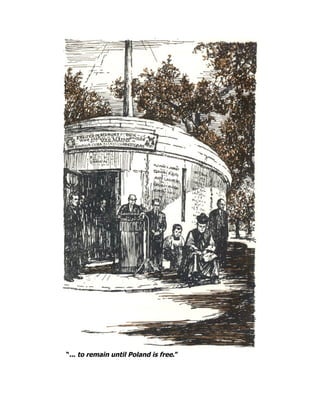
“... to remain until Poland is free.”
180
181
For five days, under a flimsy pretext of being concerned
for Paderewski’s safety, the authorities of Saragossa
kept the seven unwilling visitors confined to their hotel.
Finally a cable from President Franklin Roosevelt direct
to Generalissimo Franco got them out. No apology, no
further explanation was ever heard from Saragossa. But
by October, after a happy and reasonably relaxed trip
through Portugal, they all boarded the American Export
liner Excambion, and on November 6 they sailed into
New York harbor. It was Paderewski’s 80th birthday.
The Americans, who had loved and admired Paderewski
for almost half a century, would have worn him out with
receptions and dinners in his honor. But settling himself
quietly in the Buckingham Hotel, he spent his time and
strength in talking and corresponding with those who
were most important to the present and future welfare
of Poland. In June he asked to speak at a Polish war
veterans’ rally in Oak Ridge, New Jersey. The day was
hot and the rally itself was a steamy, exhausting affair.
Paderewski went home very tired and feeling as though
he had caught a cold. Within a week, on the 29th of
June, several hours after a priest had given him the
sacrament of Extreme Unction, Paderewski died.
At his funeral in St. Patrick’s Cathedral, with nearly
5,000 crowded inside and 35,000 outside lining Fifth
Avenue and the adjacent streets, Cardinal, then
Archbishop, Spellman eulogized Paderewski, saying “his
death steeps the entire civilized world in mourning.” And
then the train took his body to Washington where it lay
in state in the Polish Embassy until the following day.
The President of the United States had personally
arranged for Paderewski’s burial in a way that offered
the greatest honor in the country’s power. By special
182
183
order, the body was taken to Arlington Cemetery,
ordinarily reserved for American citizens who have
served in their country’s armed forces. As Paderewski’s
coffin, mounted on a military caisson, entered the gates
of Arlington, cannon fired a 19-gun salute, the highest
number possible to anyone not the head of a state.
Flanked by United States soldiers, sailors, and marines,
and joined by a squad of Polish soldiers in Canadian
uniform, the caisson moved to the very center of the
Cemetery. There, under the mast of the battleship
Maine, Paderewski’s coffin was placed in a vault “to
remain until Poland is free.”
The world is indebted to Paderewski in a very special
way. To it he brought a flaming vision of great music-
making. He placed before his listeners in singular glory
the music of Chopin, one of the greatest composers of
piano music the world has ever known. He carried to
corners of the earth some of the most powerful pianism
ever to be heard, never deviating from his own highest
standards of excellence. Then, when his country’s very
existence was at stake, he proved himself an equal or
even, in the opinion of some, a greater master in the
arena of international politics. His genius extended to
the devious ways of statecraft with the same
penetration it had shown in the mastering of music’s
subtlest arts. His ability to influence men was as forceful
when he spoke as it had been when channeled through
the keys of a Steinway concert grand. He was unique in
his lifetime. Nor has he had a successor.
FOR MORE ABOUT PADEREWSKI
Fisher, H. H. America and the New Poland. New
York: The Macmillan Co., 1928.
House, Edward Mandell. “Paderewski, the Paradox
of Europe,” Harper’s Magazine (New York), 1925.
——, and Seymour, Charles (eds.). What Really
Happened at Paris. New York: Charles Scribner’s
Sons, 1921.
Kellogg, Charlotte. Paderewski. New York: The
Viking Press, Inc., 1956.
Kellogg, Vernon. Herbert Hoover, The Man and His
Work. New York: D. Appleton Co., 1920.
Landau, Rom. Ignace Paderewski. New York:
Thomas Y. Crowell Co., 1934.
——. Pilsudski and Poland. New York: The Dial
Press, Inc., 1929.
War Memoirs of Robert Lansing. Indianapolis and
New York: The Bobbs-Merrill Co., Inc., 1935.
Paderewski, Ignace Jan, with Lawton, Mary. The
Paderewski Memoirs. New York: Charles
Scribner’s Sons, 1938.
185
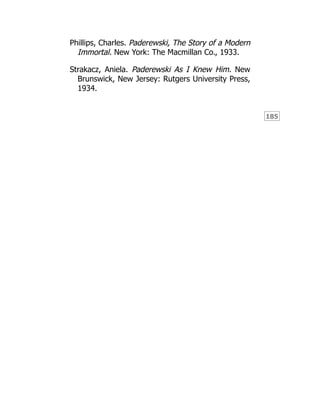
Phillips, Charles. Paderewski, The Story of a Modern
Immortal. New York: The Macmillan Co., 1933.
Strakacz, Aniela. Paderewski As I Knew Him. New
Brunswick, New Jersey: Rutgers University Press,
1934.
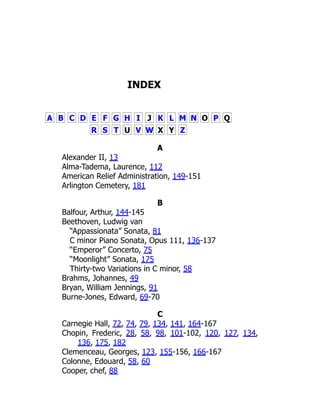
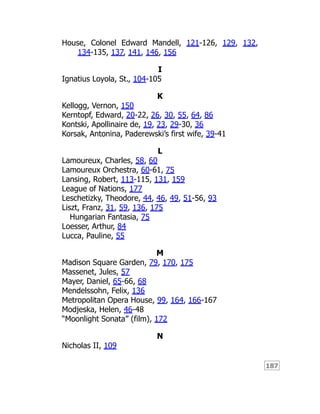
INDEX
A B C D E F G H I J K L M N O P Q
R S T U V W X Y Z
A
Alexander II, 13
Alma-Tadema, Laurence, 112
American Relief Administration, 149-151
Arlington Cemetery, 181
B
Balfour, Arthur, 144-145
Beethoven, Ludwig van
“Appassionata” Sonata, 81
C minor Piano Sonata, Opus 111, 136-137
“Emperor” Concerto, 75
“Moonlight” Sonata, 175
Thirty-two Variations in C minor, 58
Brahms, Johannes, 49
Bryan, William Jennings, 91
Burne-Jones, Edward, 69-70
C
Carnegie Hall, 72, 74, 79, 134, 141, 164-167
Chopin, Frederic, 28, 58, 98, 101-102, 120, 127, 134,
136, 175, 182
Clemenceau, Georges, 123, 155-156, 166-167
Colonne, Edouard, 58, 60
Cooper, chef, 88
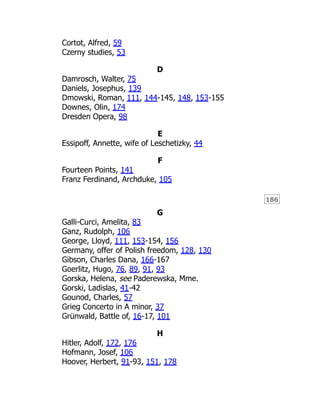
186
Cortot, Alfred, 59
Czerny studies, 53
D
Damrosch, Walter, 75
Daniels, Josephus, 139
Dmowski, Roman, 111, 144-145, 148, 153-155
Downes, Olin, 174
Dresden Opera, 98
E
Essipoff, Annette, wife of Leschetizky, 44
F
Fourteen Points, 141
Franz Ferdinand, Archduke, 105
G
Galli-Curci, Amelita, 83
Ganz, Rudolph, 106
George, Lloyd, 111, 153-154, 156
Germany, offer of Polish freedom, 128, 130
Gibson, Charles Dana, 166-167
Goerlitz, Hugo, 76, 89, 91, 93
Gorska, Helena, see Paderewska, Mme.
Gorski, Ladislas, 41-42
Gounod, Charles, 57
Grieg Concerto in A minor, 37
Grünwald, Battle of, 16-17, 101
H
Hitler, Adolf, 172, 176
Hofmann, Josef, 106
Hoover, Herbert, 91-93, 151, 178
187
House, Colonel Edward Mandell, 121-126, 129, 132,
134-135, 137, 141, 146, 156
I
Ignatius Loyola, St., 104-105
K
Kellogg, Vernon, 150
Kerntopf, Edward, 20-22, 26, 30, 55, 64, 86
Kontski, Apollinaire de, 19, 23, 29-30, 36
Korsak, Antonina, Paderewski’s first wife, 39-41
L
Lamoureux, Charles, 58, 60
Lamoureux Orchestra, 60-61, 75
Lansing, Robert, 113-115, 131, 159
League of Nations, 177
Leschetizky, Theodore, 44, 46, 49, 51-56, 93
Liszt, Franz, 31, 59, 136, 175
Hungarian Fantasia, 75
Loesser, Arthur, 84
Lucca, Pauline, 55
M
Madison Square Garden, 79, 170, 175
Massenet, Jules, 57
Mayer, Daniel, 65-66, 68
Mendelssohn, Felix, 136
Metropolitan Opera House, 99, 164, 166-167
Modjeska, Helen, 46-48
“Moonlight Sonata” (film), 172
N
Nicholas II, 109
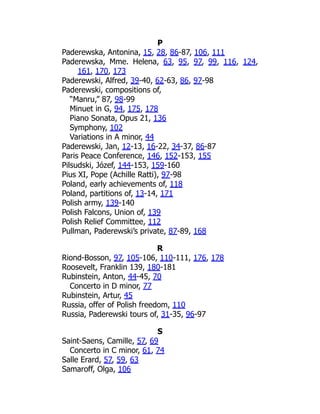
P
Paderewska, Antonina, 15, 28, 86-87, 106, 111
Paderewska, Mme. Helena, 63, 95, 97, 99, 116, 124,
161, 170, 173
Paderewski, Alfred, 39-40, 62-63, 86, 97-98
Paderewski, compositions of,
“Manru,” 87, 98-99
Minuet in G, 94, 175, 178
Piano Sonata, Opus 21, 136
Symphony, 102
Variations in A minor, 44
Paderewski, Jan, 12-13, 16-22, 34-37, 86-87
Paris Peace Conference, 146, 152-153, 155
Pilsudski, Józef, 144-153, 159-160
Pius XI, Pope (Achille Ratti), 97-98
Poland, early achievements of, 118
Poland, partitions of, 13-14, 171
Polish army, 139-140
Polish Falcons, Union of, 139
Polish Relief Committee, 112
Pullman, Paderewski’s private, 87-89, 168
R
Riond-Bosson, 97, 105-106, 110-111, 176, 178
Roosevelt, Franklin 139, 180-181
Rubinstein, Anton, 44-45, 70
Concerto in D minor, 77
Rubinstein, Artur, 45
Russia, offer of Polish freedom, 110
Russia, Paderewski tours of, 31-35, 96-97
S
Saint-Saens, Camille, 57, 69
Concerto in C minor, 61, 74
Salle Erard, 57, 59, 63
Samaroff, Olga, 106
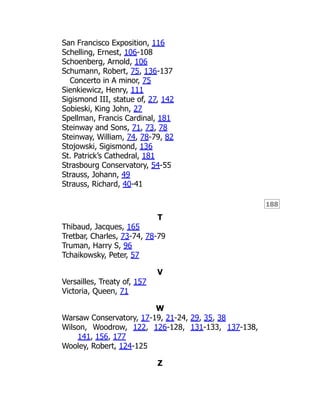
188
San Francisco Exposition, 116
Schelling, Ernest, 106-108
Schoenberg, Arnold, 106
Schumann, Robert, 75, 136-137
Concerto in A minor, 75
Sienkiewicz, Henry, 111
Sigismond III, statue of, 27, 142
Sobieski, King John, 27
Spellman, Francis Cardinal, 181
Steinway and Sons, 71, 73, 78
Steinway, William, 74, 78-79, 82
Stojowski, Sigismond, 136
St. Patrick’s Cathedral, 181
Strasbourg Conservatory, 54-55
Strauss, Johann, 49
Strauss, Richard, 40-41
T
Thibaud, Jacques, 165
Tretbar, Charles, 73-74, 78-79
Truman, Harry S, 96
Tchaikowsky, Peter, 57
V
Versailles, Treaty of, 157
Victoria, Queen, 71
W
Warsaw Conservatory, 17-19, 21-24, 29, 35, 38
Wilson, Woodrow, 122, 126-128, 131-133, 137-138,
141, 156, 177
Wooley, Robert, 124-125
Z
Zamek, 27, 142, 151
THE AUTHORS AND THEIR BOOK
Ruth Fox Hume was born in New York City and attended
the College of New Rochelle. She attended medical
school briefly, where she discovered that she was more
interested in the history of medicine than in its practice.
The result was Great Men of Medicine (Random House,
1947, revised, 1961) and Milestones of Medicine
(Random House, 1950). While she pursued her writing
career, she taught at Holy Cross Academy and Catholic
University. Some recent books include Our Lady Came
to Fatima (Farrar, Straus, and Cudahy, 1957), Saint
Margaret Mary (Farrar, Straus, and Cudahy, 1958), and
Florence Nightingale (Random House, 1959). Mrs. Hume
also writes book reviews for the Washington Evening
Star.
Paul Hume was born in Chicago and received a degree in
music from the University of Chicago. He became music
director of a “good music” radio station and then music
critic of the Washington Post, a position he has held for
sixteen years. He is a Professor of Music at Georgetown
University and has been the director of the Georgetown
Glee Club for twelve years. He is the author of Catholic
Church Music (Dodd, Mead and Co., 1956), as well as
many articles that have appeared in The Saturday
Review, The Sign, The Catholic Digest, and others.
190
THE LION OF POLAND is the first book on which the
Humes have collaborated. They live in Washington, D.C.,
with their four children, Paul, Michael, Ann, and Peter.
THE LION OF POLAND (Hawthorn, 1962) was designed
by Stefan Salter and completely manufactured by
American Book—Stratford Press, Inc. The body type is
Linotype Janson, based on the letters of Anton Janson,
a Dutch punchcutter who worked between 1660 and
1687.
A HAWTHORN BOOK
ABOUT CREDO BOOKS
Credo Books is an important news series of biographies
that will appeal to both boys and girls. The subjects of
these biographies are Catholic, but their stories are not
of their faith so much as how that faith helped them to
lead remarkable lives. Past and present will be
represented here: a sculptor who left a priceless
treasure of art to mankind, or a movie star who was an
idol to young and old alike; the president of a South
American country who fought against and lost his life to
Communist terrorists. Heroes are made by the
greatness of the human spirit and all the figures to be
portrayed in Credo Books were great in spirit, courage
and effort, no matter what task they took upon
themselves.
The authors of these new books have been carefully
chosen both for their ability to make biography come
alive for young people and their knowledge of their
subjects. Such authors as Gary Webster, Lon Tinkle,
Donald Demarest, Albert Orbaan, Terry Morris, Frank
Kolars and Jack Steffan will be represented.
To give Credo Books the benefit of their knowledge and
experience, an editorial board of distinguished
representatives from the fields of education,
librarianship and the Catholic press, as well as
Hawthorn’s own editorial staff, choose both subject and
author for each book in the series.
As an example of the variety of personalities in this new
series, you will find the following figures portrayed.
Operation Escape: The Adventure of Father
O’Flaherty, by Daniel Madden
To Far Places: The Story of Francis X. Ford, by Eva
K. Betz
The Lion of Poland: The Story of Paderewski, by
Ruth and Paul Hume
The Conscience of a King: The Story of Thomas
More, by Margaret Stanley-Wrench
Pen and Bayonet: The Story of Joyce Kilmer, by
Norah Smaridge
The Man Who Found Out Why: The Story of Gregor
Mendel, by Gary Webster
The Tall American: The Story of Gary Cooper, by
Richard Gehman
Wings of an Eagle: The Story of Michelangelo, by
Anne M. Peck with Frank and Dorothy Getlein
The Door of Hope: The Story of Katharine Drexel,
by Katherine Burton
Fire of Freedom: The Story of Col. Carlos Castillo
Armas, by Jack Steffan
Doctor America: The Story of Tom Dooley, by Terry
Morris
The Sea Tiger: The Story of Pedro Menéndez, by
Frank Kolars
The First Californian: The Story of Fray Junípero
Serra, by Donald Demarest
Wilderness Explorer: The Story of Samuel de
Champlain, by Charles Morrow Wilson
Transcriber’s Notes
Copyright notice provided as in the original—this e-text
is public domain in the country of publication.
In the text versions, delimited italics text in
_underscores_ (the HTML version reproduces the font
form of the printed book.)
Silently corrected palpable typos; left non-standard
spellings and dialect unchanged.
*** END OF THE PROJECT GUTENBERG EBOOK THE LION OF
POLAND: THE STORY OF PADEREWSKI ***
Updated editions will replace the previous one—the old editions
will be renamed.
Creating the works from print editions not protected by U.S.
copyright law means that no one owns a United States
copyright in these works, so the Foundation (and you!) can copy
and distribute it in the United States without permission and
without paying copyright royalties. Special rules, set forth in the
General Terms of Use part of this license, apply to copying and
distributing Project Gutenberg™ electronic works to protect the
PROJECT GUTENBERG™ concept and trademark. Project
Gutenberg is a registered trademark, and may not be used if
you charge for an eBook, except by following the terms of the
trademark license, including paying royalties for use of the
Project Gutenberg trademark. If you do not charge anything for
copies of this eBook, complying with the trademark license is
very easy. You may use this eBook for nearly any purpose such
as creation of derivative works, reports, performances and
research. Project Gutenberg eBooks may be modified and
printed and given away—you may do practically ANYTHING in
the United States with eBooks not protected by U.S. copyright
law. Redistribution is subject to the trademark license, especially
commercial redistribution.
START: FULL LICENSE
THE FULL PROJECT GUTENBERG LICENSE
PLEASE READ THIS BEFORE YOU DISTRIBUTE OR USE THIS WORK
To protect the Project Gutenberg™ mission of promoting the
free distribution of electronic works, by using or distributing this
work (or any other work associated in any way with the phrase
“Project Gutenberg”), you agree to comply with all the terms of
the Full Project Gutenberg™ License available with this file or
online at www.gutenberg.org/license.
Section 1. General Terms of Use and
Redistributing Project Gutenberg™
electronic works
1.A. By reading or using any part of this Project Gutenberg™
electronic work, you indicate that you have read, understand,
agree to and accept all the terms of this license and intellectual
property (trademark/copyright) agreement. If you do not agree
to abide by all the terms of this agreement, you must cease
using and return or destroy all copies of Project Gutenberg™
electronic works in your possession. If you paid a fee for
obtaining a copy of or access to a Project Gutenberg™
electronic work and you do not agree to be bound by the terms
of this agreement, you may obtain a refund from the person or
entity to whom you paid the fee as set forth in paragraph 1.E.8.
1.B. “Project Gutenberg” is a registered trademark. It may only
be used on or associated in any way with an electronic work by
people who agree to be bound by the terms of this agreement.
There are a few things that you can do with most Project
Gutenberg™ electronic works even without complying with the
full terms of this agreement. See paragraph 1.C below. There
are a lot of things you can do with Project Gutenberg™
electronic works if you follow the terms of this agreement and
help preserve free future access to Project Gutenberg™
electronic works. See paragraph 1.E below.
1.C. The Project Gutenberg Literary Archive Foundation (“the
Foundation” or PGLAF), owns a compilation copyright in the
collection of Project Gutenberg™ electronic works. Nearly all the
individual works in the collection are in the public domain in the
United States. If an individual work is unprotected by copyright
law in the United States and you are located in the United
States, we do not claim a right to prevent you from copying,
distributing, performing, displaying or creating derivative works
based on the work as long as all references to Project
Gutenberg are removed. Of course, we hope that you will
support the Project Gutenberg™ mission of promoting free
access to electronic works by freely sharing Project Gutenberg™
works in compliance with the terms of this agreement for
keeping the Project Gutenberg™ name associated with the
work. You can easily comply with the terms of this agreement
by keeping this work in the same format with its attached full
Project Gutenberg™ License when you share it without charge
with others.
1.D. The copyright laws of the place where you are located also
govern what you can do with this work. Copyright laws in most
countries are in a constant state of change. If you are outside
the United States, check the laws of your country in addition to
the terms of this agreement before downloading, copying,
displaying, performing, distributing or creating derivative works
based on this work or any other Project Gutenberg™ work. The
Foundation makes no representations concerning the copyright
status of any work in any country other than the United States.
1.E. Unless you have removed all references to Project
Gutenberg:
1.E.1. The following sentence, with active links to, or other
immediate access to, the full Project Gutenberg™ License must
appear prominently whenever any copy of a Project
Gutenberg™ work (any work on which the phrase “Project
Welcome to our website – the perfect destination for book lovers and
knowledge seekers. We believe that every book holds a new world,
offering opportunities for learning, discovery, and personal growth.
That’s why we are dedicated to bringing you a diverse collection of
books, ranging from classic literature and specialized publications to
self-development guides and children's books.
More than just a book-buying platform, we strive to be a bridge
connecting you with timeless cultural and intellectual values. With an
elegant, user-friendly interface and a smart search system, you can
quickly find the books that best suit your interests. Additionally,
our special promotions and home delivery services help you save time
and fully enjoy the joy of reading.
Join us on a journey of knowledge exploration, passion nurturing, and
personal growth every day!
testbankmall.com

Solution Manual for Operations Management 14th Edition William J Stevenson

  • 1.
    Download the fullversion and explore a variety of test banks or solution manuals at https://testbankmall.com Solution Manual for Operations Management 14th Edition William J Stevenson _____ Follow the link below to get your download now _____ https://testbankmall.com/product/solution-manual-for- operations-management-14th-edition-william-j-stevenson/ Access testbankmall.com now to download high-quality test banks or solution manuals
  • 2.
    Here are somerecommended products for you. Click the link to download, or explore more at testbankmall.com Test Bank for Operations Management 14th Edition William J Stevenson https://testbankmall.com/product/test-bank-for-operations- management-14th-edition-william-j-stevenson/ Solution Manual for Operations Management 6th Canadian by Stevenson https://testbankmall.com/product/solution-manual-for-operations- management-6th-canadian-by-stevenson/ Operations Management Stevenson 11th Edition Solutions Manual https://testbankmall.com/product/operations-management-stevenson-11th- edition-solutions-manual/ Test Bank for Periodontology for the Dental Hygienist 4th Edition by Perry https://testbankmall.com/product/test-bank-for-periodontology-for-the- dental-hygienist-4th-edition-by-perry/
  • 3.
    Test Bank forFoundations of Addictions Counseling, 4th Edition, David Capuzzi, Mark D. Stauffer https://testbankmall.com/product/test-bank-for-foundations-of- addictions-counseling-4th-edition-david-capuzzi-mark-d-stauffer/ Solution Manual for Decision Support and Business Intelligence Systems, 9/E 9th Edition Efraim Turban, Ramesh Sharda, Dursun Delen https://testbankmall.com/product/solution-manual-for-decision-support- and-business-intelligence-systems-9-e-9th-edition-efraim-turban- ramesh-sharda-dursun-delen/ Test Bank for Introductory Chemistry: Concepts and Critical Thinking 8th Edition Charles H. Corwin https://testbankmall.com/product/test-bank-for-introductory-chemistry- concepts-and-critical-thinking-8th-edition-charles-h-corwin/ Test Bank for 21st Century Astronomy, 6th Edition, Laura Kay, Stacy Palen George Blumenthal https://testbankmall.com/product/test-bank-for-21st-century- astronomy-6th-edition-laura-kay-stacy-palen-george-blumenthal/ Solution Manual for Analysis, Synthesis and Design of Chemical Processes, 4/E 4th Edition Jessica W. Castillo, Richard Turton, Richard C. Bailie, Wallace B. Whiting, Joseph A. Shaeiwitz https://testbankmall.com/product/solution-manual-for-analysis- synthesis-and-design-of-chemical-processes-4-e-4th-edition-jessica-w- castillo-richard-turton-richard-c-bailie-wallace-b-whiting-joseph-a- shaeiwitz/
  • 4.
    Introduction to Operationsand Supply Chain Management 4th Edition Bozarth Test Bank https://testbankmall.com/product/introduction-to-operations-and- supply-chain-management-4th-edition-bozarth-test-bank/
  • 5.
    Chapter 01 -Introduction to Operations Management 1-2 Copyright © 2021 McGraw-Hill. All rights reserved. No reproduction or distribution without the prior written consent of McGraw-Hill. 1. Given that the U.S. economy is becoming more service based, the percentage of employment in manufacturing is declining while the percentage of employment in the service industry is increasing. In addition, the loss of manufacturing jobs results in the loss of service jobs as well (a general estimate is that four service jobs are lost for each manufacturing job lost). 2. The government could offer companies tax incentives for purchasing new equipment or for hiring workers. In addition, the government could work with manufacturing companies to re-train workers in more advanced manufacturing processes. 3. Manufacturing innovation is important because it requires high value-added knowledge work that supports future innovation. Second, innovation generates high-paying jobs. Third, innovation is important because it improves productivity, thereby slowing the outsourcing of jobs to lower wage countries. Reading: Agility Creates a Competitive Edge The first solution could be for U.S. retailers to continue sourcing from China that part of demand that is certain and to source uncertain demand from the same low-cost producers in Romania and Turkey.
  • 6.
    Chapter 01 -Introduction to Operations Management 1-3 Copyright © 2021 McGraw-Hill. All rights reserved. No reproduction or distribution without the prior written consent of McGraw-Hill. This approach provides the advantages of low-cost manufacturing in China and the flexibility provided by the suppliers in Romania and Turkey. The disadvantage of this approach is that transportation times for U.S. retailers still will be longer than the transportation times faced by Zara’s and H & M. A second approach could be that U.S retailers find low-cost, flexible suppliers just across the border in Mexico. The advantages of this approach include low wages and shorter transportation times. The primary disadvantages to this approach involve the time and expense of locating new suppliers. Additionally, the U.S. retailers might have to lend considerable support developing the capabilities of these suppliers. Reading: Sustainable Kisses 1. Hershey’s and other companies engage in sustainable business practices because consumers prefer to do business with companies that practice sustainable sourcing and ethical treatment of workers. Many of the leaders in these businesses hold the same values. By educating farmers, Hershey’s can also help to increase the longevity and yield of cocoa plants. 2. Hershey’s actions may influence retailers and customers in its supply chain to become better- educated about sourcing, which may influence competitors to adopt similarly sustainable business practices. Operations Tour: Wegmans Food Markets 1. Customers judge the quality of a supermarket based on: a. Quality of individual products. b. Exterior and interior physical look of the store. c. Effectiveness and efficiency of service personnel. 2. a. Customer satisfaction is the major key to the success of any operation; without it, the company cannot survive. b. Forecasting allows the company to plan the workforce levels, purchase quantities, inventory levels, and capacity. c. Capacity planning allows the company to balance the trade-off between shortages and excess inventories and between waiting lines and idle time. d. A good location can have a significant impact in attracting customers, thus improving sales. e. Planning and controlling levels of inventory will assist with avoiding stockouts and avoiding excess inventory levels. f. Good layout of the store can assist in maximizing customer service and sales by strategically directing customers through the store. An effective layout can also improve the efficiency of the operations. g. Effective scheduling of company workers and work hours can improve both customer service and efficiency. An effective schedule provides convenient store hours, minimal customer waiting lines, and minimal employee idle time. 3. Wegmans uses technology to track inventory and manage its supply chain, which lessen the risk of occurrences of out-of-stock events, and to maintain freshness in its meat and produce departments.
  • 7.
    Chapter 01 -Introduction to Operations Management 1-4 Copyright © 2021 McGraw-Hill. All rights reserved. No reproduction or distribution without the prior written consent of McGraw-Hill. Answers to Discussion and Review Questions 1. The term operations management relates to the management of systems or processes that create goods and/or provide services. These processes involve the planning, coordination, and execution of all activities within an organization that create goods and services. A supply chain is the sequence of organizations, including their facilities, functions, and activities, that are involved in producing and delivering a product or service. This sequence begins with basic suppliers of raw materials and ends with the final customer. A supply chain includes activities and facilities external to the internal operations function, e.g., sourcing and transportation of inbound materials. 2. The three primary functions are operations, finance, and marketing. Operations is concerned with the creation of goods and services, finance is concerned with provision of funds necessary for operation, and marketing is concerned with promoting and/or selling goods or services. 3. The operations function consists of all activities that are related directly to producing goods or providing services. It is the core of most business organizations because it is responsible for the creation of an organization’s goods or services. Its essence is to add value during the transformation process (the difference between the cost of inputs and value and price of outputs). 4. Among the important differences between manufacturing and service operations are: a. The nature and consumption of output. b. Uniformity of input. c. Labor content of jobs. d. Uniformity of output. e. Measurement of productivity. Among the important similarities between manufacturing and service operations are: a. Forecasting and capacity planning to match supply and demand. b. Process Management c. Managing variations d. Monitoring and controlling costs and productivity e. Managing the supply chain f. Location planning, inventory management, quality control and scheduling 5. a. The Industrial Revolution began in the 1770s in England, and spread to the rest of Europe and to the U.S. in the late eighteenth century and the early nineteenth century. A number of inventions such as the steam engine, the spinning Jenny, and the power loom helped to bring about this change. There were also ample supplies of coal and iron ore to provide the necessary materials for generating the power to operate and build the machines that were much stronger and more durable than the simple wooden ones they replaced.
  • 8.
    Chapter 01 -Introduction to Operations Management 1-5 Copyright © 2021 McGraw-Hill. All rights reserved. No reproduction or distribution without the prior written consent of McGraw-Hill. b. Frederick W. Taylor, who is often referred to as the father of scientific management, spearheaded the scientific management movement. The science of management was based on observation, measurement, analysis, improvement of work methods, and economic incentives. Management should be responsible for planning, carefully selecting and training workers, finding the best way to perform each job, achieving cooperation between management and workers, and separating management activities from work activities. c. Parts of a product made to such precision that each part would fit any of the identical items bring produced. It meant that individual parts would not have to be custom made because they were standardized. d. Breaking up a production process into a series of tasks, each performed by a different worker. It enabled workers to learn jobs and become proficient at them more quickly, avoiding the delays of workers shifting from one activity to another. 6. a. The service sector now accounts for more than 70 percent of jobs in the U.S. and that figure continues to increase. b. Manufacturing is important in that it supplies a large proportion of exports and many service jobs are dependent on manufacturing because they support manufacturing. c. Farm products are an example of non-manufacturing goods because there is no production and the products naturally grow without human intervention. 7. Models provide an abstraction and simplification of reality. Mathematical models are the most abstract and most used in operations management. These models are used to assist in various decision-making scenarios. One of the main reasons for building mathematical models is that the experimentation with the model enables the decision-maker to analyze the model and make inferences about a problem without actually manipulating the real situation or problem. Therefore, the experimentation with the mathematical model rather than the actual problem or situation is less time consuming and less expensive. 8. The degree of customization has important implications throughout a business organization. Generally, higher degrees of customization involve more complexity in terms of production or service, involve different forms of layout (arrangement of the workplace), require higher worker skills, and have lower productivity. 9. a. Initial cost, convenience, parking, taxes, time, repairs, upkeep, etc. b. Cost, technology, productivity, convenience, software applicability, etc. c. Initial cost, repairs, warranty, upkeep, monthly payments and interest, dependability, insurance costs, etc. d. Control of the situation, class participation, perception, image, etc. e. This would depend on the nature of the product or service being offered as well as the type of customer. Computer literate customers might seek a web site. If customers are strictly local, newspaper advertising might be a reasonable choice, especially if potential customers were not actively seeking out the business. In addition, if the business is seasonal, newspaper advertising might be preferred.
  • 9.
    Chapter 01 -Introduction to Operations Management 1-6 Copyright © 2021 McGraw-Hill. All rights reserved. No reproduction or distribution without the prior written consent of McGraw-Hill. 10. Craft production: involves producing high variety of customized goods, low volume output with skilled workers, and utilizing general-purpose equipment. The main advantage is the flexibility to produce a wide variety of outputs providing many choices for the need of customers. The main disadvantage is its inability to produce at low cost. Examples: tailoring, machine shop, print shop, and landscaping. Mass production: involves producing a few standardized goods at high volume of output with low skilled workers utilizing specialized equipment. The main advantage is low cost, efficient production. The main disadvantage is that it does not allow easy changes in volume of output, product, or process design. Examples: automobiles, computers, mail sorting, appliances, paper, soft drink bottling, etc. Lean Production: involves producing more variety of goods than most production at moderate to high volume of output. It requires high skilled workers, quality, employee involvement, teamwork, and flatter organizational structure with fewer levels of management. It combines the advantages of both mass production (high volume, low cost) and craft production (variety, flexibility). Examples: similar to mass production. 11. Workers may not like to work in a lean production environment because there are fewer opportunities for employee advancement, more worker stress due to higher levels of responsibility and greater variability and expansion of job requirements. 12. a. Matching supply and demand is an important objective for every business organization. Undersupply can result in dissatisfied customers, potential loss of business, and opportunity costs. Oversupply can potentially result in additional cost to store the excess, the need to sell the excess for a reduced cost, or the cost to dispose of the excess. b. Managing a supply chain is important for several reasons, including matching supply and demand, reducing transportation costs, achieving a competitive advantage, managing inventories, and achieving supply chain visibility. 13. There are four basic sources of variation: 1. The variety of goods or services being offered: The greater the variety of goods and services, the greater the variation in production or service requirements. 2. Structural variation in demand, such as trends and seasonal variations. These are generally predictable. They are particularly important for capacity planning. 3. Random variation. This natural variability is present to some extent in all processes, is present in demand for services and products, and generally cannot be influenced by managers. 4. Assignable causes of variation: Variation caused by defective inputs, incorrect work methods, out of adjustment equipment, and so on. This type of variation can be reduced or eliminated by analysis and corrective action. Variations can be disruptive to operations and supply chain processes, interfering with optimal functioning. Variations result in additional cost, delays and shortages, poor quality, and inefficient work systems. Poor quality and product shortages or service delays can lead to dissatisfied customers and damage an organization’s reputation and image.
  • 10.
    Chapter 01 -Introduction to Operations Management 1-7 Copyright © 2021 McGraw-Hill. All rights reserved. No reproduction or distribution without the prior written consent of McGraw-Hill. 14. The reasons for doing unethical things vary from person to person and from one situation to another. Some of the possible reasons are listed below: a. The decision-maker cannot recognize his or her action as unethical because of a lack of morals or understanding or lack of sensitivity towards a given issue. b. Even though the decision-maker recognizes his or her behavior or action as unethical, he or she justifies it based on self-rationalization that involves justice theory. For example, the decision-maker may think that the consequences of his or her decision is not going to hurt other people or organizations in the short run but the potential long term effects may be devastating. c. The decision-maker knows that his or her action is unquestionably unethical. However, the type of ethical behavior required is not in the personal portfolio of the decision-maker and ethics in general is not important to him or her. d. The decision-maker does not think he or she will be caught. e. The self-interest of the decision-maker outweighs the ethical considerations. 15. Value added is defined as the difference between the cost of inputs before the transformation process and the value or the price of output after the transformation process. In a manufacturing process as the inputs are transformed to outputs, value is added to products in a number of different ways. The value adding can take many different forms. For example, value can be added by changing the product structurally (physical change) or transporting a product (a product may have more value if it is located somewhere other than where it currently is). 16. Outsourcing can result in lower costs, the ability to take advantage of others’ expertise, and allow businesses to focus on their core business. Outsourcing generally results in layoffs and some loss of control. In addition, outsourcing to companies in other nations may result in problems due to cultural or language differences, and increased shipping times for products. 17. Sustainability refers to service and production processes that use resources in ways that do not harm ecological systems that support both current and future human existence. Business organizations are increasingly facing sustainability regulations as well as pressures from environmental groups to act responsibly toward the environment. Some organizations are capitalizing on their “green” efforts in their advertising. Taking Stock 1. When we decide to take an action there are usually consequences of that action and advantages and disadvantages of taking that action. In other words, before we make a decision, we must weigh the pros and cons of that decision. Trade-offs involve weighing of pros and cons regarding a particular decision. For example, if a decision-maker decides to increase the level of inventory, he or she has to consider the trade-off between increased level of customer service and the additional inventory carrying cost. 2. It is important for the various functional areas to collaborate because collaboration will lead to improved communication among the departments (functions) that in turn will improve the performance of the firm. Collaboration will reduce the chance of sub-optimization by a functional area due to the possibility that a particular functional area does not have enough information about the other areas and their constraints or decisions.
  • 11.
    Chapter 01 -Introduction to Operations Management 1-8 Copyright © 2021 McGraw-Hill. All rights reserved. No reproduction or distribution without the prior written consent of McGraw-Hill. 3. Product and service technology allows a company to develop new products faster. Process technology enables a company to improve methods, procedures, and equipment used to produce goods and to provide services. Information technology enables companies to process large quantities of data quickly, to identify and track goods, to obtain point-of-sale data, and to communicate documents electronically to suppliers and customers. Critical Thinking Exercises 1. There are many implications due to the differences between delivery of services and production of goods in manufacturing operations. For example, in a service firm, because the degree of customer contact is high, we have to make sure that employees are better trained in customer service than employees in a manufacturing industry. In a pure-service industry firm, we will build a lot of slack in scheduling because of the uncertainty of input. 2. That would depend on whether supply was too large or too small. If there is over capacity, try to increase demand through advertising and/or price reductions. If output (goods) can be stored, and future demand is expected to be higher, store excess output for future demand. If supply is too small, options might be to outsource, work overtime, or hire temporary workers. If there are few or no competitors, increase prices. 3. Innovations might be product or service related, or process related. These typically involve added cost and time for training and possibly new equipment or equipment changes, and potential changes for the supply chain (e.g., new suppliers, new delivery requirements, etc.). Process innovations can be disruptive to the workforce due to lower labor or machine time requirements, which may result in job loss, retraining, and/or lower worker morale. New products or services also probably will involve new advertising campaigns or other promotions, and the need for consumer education. Consumers will have to adjust to new products or services, and may have some difficulty if innovations entail increased complexity. 4. Managers should strive to find solutions in the best interests of all stakeholders. Technological change such as automation, robotics, and AI may increase productivity and lead to lower production costs. It may also replace human workers, which is a cost to the community and workforce. Applying an ethical framework can help with ethical decision making. 5. a. Business people make unethical decisions for a variety of reasons including the following: 1. Pressure from superiors 2. Pressure for stakeholders 3. Not being informed 4. Keeping the company afloat b. Their risks for unethical behavior including the following: 1. getting reprimanded 2. getting fired 3. losing reputation Case: Hazel 1. a. Number of yards, number of mowers, number of workers, time to mow a given area, regular maintenance, weather, length of growing season, time between necessary mowing. b. Mowers, parts, fuel, lubricants, fertilizer, chemicals, tools, etc. c. 1) Lawns, type of work, regular maintenance, workers.
  • 12.
    Chapter 01 -Introduction to Operations Management 1-9 Copyright © 2021 McGraw-Hill. All rights reserved. No reproduction or distribution without the prior written consent of McGraw-Hill. 2) Weather, illness, overloads, emergencies, breakdowns. d. Very important. Repeat business would be greatly affected and new business depends on word of mouth and reputation. e. Oil change, blade sharpening, motor tune-up, mower and filter clean up, etc. 2. a. Timing: not too late but not too soon. b. Coverage: does not leave streaks. c. Length of grass: not too long but not too short depending on the weather and time of year. d. Trimming and clean-up (details). 3. a. Responsibility, possibly security, fringe benefits, regularity of work hours, cannot pass the buck to someone else, decision-making, etc. b. Responsibility, financial investment, work load, hiring of more employees, possibility of greater government regulation, personnel problems tend to increase and a general increase in all administrative work. c. Risk involved in starting a new type of business using new technology and making it successful, learning curve involved in the area of e-commerce, additional workload, hiring of more employees in the area of Web design, computer programmers, etc. 4. Hazel has two options: (1) Hazel could leave grass clippings on customers’ lawns. Advantages: Decreases her time per lawn. Grass clippings serve as a natural fertilizer. Hazel will not have to raise her prices. Disadvantages: Customers may not like the mess left behind. In addition, over time, customers’ lawns may build up thatch and have to be de-thatched. (2) Hazel could take grass clippings to a landfill in a nearby city. Advantages: Customers’ lawns will not build up thatch. Customers will appreciate the appearance of their lawns. Disadvantages: Hazel will need to raise prices due to her increased driving time and fuel expense. 5. Yes, since Hazel promised the part-time workers a bonus of $25 for good ideas and since this idea appears to hold promise, Hazel should honor her promise and pay the student $25. However, in the future she might want to make the bonus offer contingent on continuing employment at the time of implementation of the idea because after becoming aware that the idea was successfully implemented, the idea may become an attractive option for the competitor. In addition, she might want to include a confidentiality clause or a statement in the employment contract of the workers regarding not sharing proprietary information that may be useful to competition. 6. a. Weather, worker absences due to illness, vacations, extra requests from customers, new customers, and lost customers.
  • 13.
    Chapter 01 -Introduction to Operations Management 1-10 Copyright © 2021 McGraw-Hill. All rights reserved. No reproduction or distribution without the prior written consent of McGraw-Hill. b. At times she will have excess capacity while at other times she will have too little regular capacity to handle the workload. c. Revise schedules, work overtime if regular capacity is insufficient and/or hire additional workers, if capacity exceeds demand layoff workers or find something else productive for them to do such as maintenance of equipment, training, etc. 7. Use hand tools instead of power tools, and recycle grass clippings. Factors to take into account include cost savings, quality, risk of injury, job completion times, training, reduction in pollution (air and noise), and energy savings.
  • 14.
    Other documents randomlyhave different content
  • 15.
    “... to remainuntil Poland is free.”
  • 16.
    180 181 For five days,under a flimsy pretext of being concerned for Paderewski’s safety, the authorities of Saragossa kept the seven unwilling visitors confined to their hotel. Finally a cable from President Franklin Roosevelt direct to Generalissimo Franco got them out. No apology, no further explanation was ever heard from Saragossa. But by October, after a happy and reasonably relaxed trip through Portugal, they all boarded the American Export liner Excambion, and on November 6 they sailed into New York harbor. It was Paderewski’s 80th birthday. The Americans, who had loved and admired Paderewski for almost half a century, would have worn him out with receptions and dinners in his honor. But settling himself quietly in the Buckingham Hotel, he spent his time and strength in talking and corresponding with those who were most important to the present and future welfare of Poland. In June he asked to speak at a Polish war veterans’ rally in Oak Ridge, New Jersey. The day was hot and the rally itself was a steamy, exhausting affair. Paderewski went home very tired and feeling as though he had caught a cold. Within a week, on the 29th of June, several hours after a priest had given him the sacrament of Extreme Unction, Paderewski died. At his funeral in St. Patrick’s Cathedral, with nearly 5,000 crowded inside and 35,000 outside lining Fifth Avenue and the adjacent streets, Cardinal, then Archbishop, Spellman eulogized Paderewski, saying “his death steeps the entire civilized world in mourning.” And then the train took his body to Washington where it lay in state in the Polish Embassy until the following day. The President of the United States had personally arranged for Paderewski’s burial in a way that offered the greatest honor in the country’s power. By special
  • 17.
    182 183 order, the bodywas taken to Arlington Cemetery, ordinarily reserved for American citizens who have served in their country’s armed forces. As Paderewski’s coffin, mounted on a military caisson, entered the gates of Arlington, cannon fired a 19-gun salute, the highest number possible to anyone not the head of a state. Flanked by United States soldiers, sailors, and marines, and joined by a squad of Polish soldiers in Canadian uniform, the caisson moved to the very center of the Cemetery. There, under the mast of the battleship Maine, Paderewski’s coffin was placed in a vault “to remain until Poland is free.” The world is indebted to Paderewski in a very special way. To it he brought a flaming vision of great music- making. He placed before his listeners in singular glory the music of Chopin, one of the greatest composers of piano music the world has ever known. He carried to corners of the earth some of the most powerful pianism ever to be heard, never deviating from his own highest standards of excellence. Then, when his country’s very existence was at stake, he proved himself an equal or even, in the opinion of some, a greater master in the arena of international politics. His genius extended to the devious ways of statecraft with the same penetration it had shown in the mastering of music’s subtlest arts. His ability to influence men was as forceful when he spoke as it had been when channeled through the keys of a Steinway concert grand. He was unique in his lifetime. Nor has he had a successor.
  • 18.
    FOR MORE ABOUTPADEREWSKI Fisher, H. H. America and the New Poland. New York: The Macmillan Co., 1928. House, Edward Mandell. “Paderewski, the Paradox of Europe,” Harper’s Magazine (New York), 1925. ——, and Seymour, Charles (eds.). What Really Happened at Paris. New York: Charles Scribner’s Sons, 1921. Kellogg, Charlotte. Paderewski. New York: The Viking Press, Inc., 1956. Kellogg, Vernon. Herbert Hoover, The Man and His Work. New York: D. Appleton Co., 1920. Landau, Rom. Ignace Paderewski. New York: Thomas Y. Crowell Co., 1934. ——. Pilsudski and Poland. New York: The Dial Press, Inc., 1929. War Memoirs of Robert Lansing. Indianapolis and New York: The Bobbs-Merrill Co., Inc., 1935. Paderewski, Ignace Jan, with Lawton, Mary. The Paderewski Memoirs. New York: Charles Scribner’s Sons, 1938.
  • 19.
    185 Phillips, Charles. Paderewski,The Story of a Modern Immortal. New York: The Macmillan Co., 1933. Strakacz, Aniela. Paderewski As I Knew Him. New Brunswick, New Jersey: Rutgers University Press, 1934.
  • 20.
    INDEX A B CD E F G H I J K L M N O P Q R S T U V W X Y Z A Alexander II, 13 Alma-Tadema, Laurence, 112 American Relief Administration, 149-151 Arlington Cemetery, 181 B Balfour, Arthur, 144-145 Beethoven, Ludwig van “Appassionata” Sonata, 81 C minor Piano Sonata, Opus 111, 136-137 “Emperor” Concerto, 75 “Moonlight” Sonata, 175 Thirty-two Variations in C minor, 58 Brahms, Johannes, 49 Bryan, William Jennings, 91 Burne-Jones, Edward, 69-70 C Carnegie Hall, 72, 74, 79, 134, 141, 164-167 Chopin, Frederic, 28, 58, 98, 101-102, 120, 127, 134, 136, 175, 182 Clemenceau, Georges, 123, 155-156, 166-167 Colonne, Edouard, 58, 60 Cooper, chef, 88
  • 21.
    186 Cortot, Alfred, 59 Czernystudies, 53 D Damrosch, Walter, 75 Daniels, Josephus, 139 Dmowski, Roman, 111, 144-145, 148, 153-155 Downes, Olin, 174 Dresden Opera, 98 E Essipoff, Annette, wife of Leschetizky, 44 F Fourteen Points, 141 Franz Ferdinand, Archduke, 105 G Galli-Curci, Amelita, 83 Ganz, Rudolph, 106 George, Lloyd, 111, 153-154, 156 Germany, offer of Polish freedom, 128, 130 Gibson, Charles Dana, 166-167 Goerlitz, Hugo, 76, 89, 91, 93 Gorska, Helena, see Paderewska, Mme. Gorski, Ladislas, 41-42 Gounod, Charles, 57 Grieg Concerto in A minor, 37 Grünwald, Battle of, 16-17, 101 H Hitler, Adolf, 172, 176 Hofmann, Josef, 106 Hoover, Herbert, 91-93, 151, 178
  • 22.
    187 House, Colonel EdwardMandell, 121-126, 129, 132, 134-135, 137, 141, 146, 156 I Ignatius Loyola, St., 104-105 K Kellogg, Vernon, 150 Kerntopf, Edward, 20-22, 26, 30, 55, 64, 86 Kontski, Apollinaire de, 19, 23, 29-30, 36 Korsak, Antonina, Paderewski’s first wife, 39-41 L Lamoureux, Charles, 58, 60 Lamoureux Orchestra, 60-61, 75 Lansing, Robert, 113-115, 131, 159 League of Nations, 177 Leschetizky, Theodore, 44, 46, 49, 51-56, 93 Liszt, Franz, 31, 59, 136, 175 Hungarian Fantasia, 75 Loesser, Arthur, 84 Lucca, Pauline, 55 M Madison Square Garden, 79, 170, 175 Massenet, Jules, 57 Mayer, Daniel, 65-66, 68 Mendelssohn, Felix, 136 Metropolitan Opera House, 99, 164, 166-167 Modjeska, Helen, 46-48 “Moonlight Sonata” (film), 172 N Nicholas II, 109
  • 23.
    P Paderewska, Antonina, 15,28, 86-87, 106, 111 Paderewska, Mme. Helena, 63, 95, 97, 99, 116, 124, 161, 170, 173 Paderewski, Alfred, 39-40, 62-63, 86, 97-98 Paderewski, compositions of, “Manru,” 87, 98-99 Minuet in G, 94, 175, 178 Piano Sonata, Opus 21, 136 Symphony, 102 Variations in A minor, 44 Paderewski, Jan, 12-13, 16-22, 34-37, 86-87 Paris Peace Conference, 146, 152-153, 155 Pilsudski, Józef, 144-153, 159-160 Pius XI, Pope (Achille Ratti), 97-98 Poland, early achievements of, 118 Poland, partitions of, 13-14, 171 Polish army, 139-140 Polish Falcons, Union of, 139 Polish Relief Committee, 112 Pullman, Paderewski’s private, 87-89, 168 R Riond-Bosson, 97, 105-106, 110-111, 176, 178 Roosevelt, Franklin 139, 180-181 Rubinstein, Anton, 44-45, 70 Concerto in D minor, 77 Rubinstein, Artur, 45 Russia, offer of Polish freedom, 110 Russia, Paderewski tours of, 31-35, 96-97 S Saint-Saens, Camille, 57, 69 Concerto in C minor, 61, 74 Salle Erard, 57, 59, 63 Samaroff, Olga, 106
  • 24.
    188 San Francisco Exposition,116 Schelling, Ernest, 106-108 Schoenberg, Arnold, 106 Schumann, Robert, 75, 136-137 Concerto in A minor, 75 Sienkiewicz, Henry, 111 Sigismond III, statue of, 27, 142 Sobieski, King John, 27 Spellman, Francis Cardinal, 181 Steinway and Sons, 71, 73, 78 Steinway, William, 74, 78-79, 82 Stojowski, Sigismond, 136 St. Patrick’s Cathedral, 181 Strasbourg Conservatory, 54-55 Strauss, Johann, 49 Strauss, Richard, 40-41 T Thibaud, Jacques, 165 Tretbar, Charles, 73-74, 78-79 Truman, Harry S, 96 Tchaikowsky, Peter, 57 V Versailles, Treaty of, 157 Victoria, Queen, 71 W Warsaw Conservatory, 17-19, 21-24, 29, 35, 38 Wilson, Woodrow, 122, 126-128, 131-133, 137-138, 141, 156, 177 Wooley, Robert, 124-125 Z
  • 25.
    Zamek, 27, 142,151 THE AUTHORS AND THEIR BOOK Ruth Fox Hume was born in New York City and attended the College of New Rochelle. She attended medical school briefly, where she discovered that she was more interested in the history of medicine than in its practice. The result was Great Men of Medicine (Random House, 1947, revised, 1961) and Milestones of Medicine (Random House, 1950). While she pursued her writing career, she taught at Holy Cross Academy and Catholic University. Some recent books include Our Lady Came to Fatima (Farrar, Straus, and Cudahy, 1957), Saint Margaret Mary (Farrar, Straus, and Cudahy, 1958), and Florence Nightingale (Random House, 1959). Mrs. Hume also writes book reviews for the Washington Evening Star. Paul Hume was born in Chicago and received a degree in music from the University of Chicago. He became music director of a “good music” radio station and then music critic of the Washington Post, a position he has held for sixteen years. He is a Professor of Music at Georgetown University and has been the director of the Georgetown Glee Club for twelve years. He is the author of Catholic Church Music (Dodd, Mead and Co., 1956), as well as many articles that have appeared in The Saturday Review, The Sign, The Catholic Digest, and others.
  • 26.
    190 THE LION OFPOLAND is the first book on which the Humes have collaborated. They live in Washington, D.C., with their four children, Paul, Michael, Ann, and Peter. THE LION OF POLAND (Hawthorn, 1962) was designed by Stefan Salter and completely manufactured by American Book—Stratford Press, Inc. The body type is Linotype Janson, based on the letters of Anton Janson, a Dutch punchcutter who worked between 1660 and 1687. A HAWTHORN BOOK ABOUT CREDO BOOKS
  • 27.
    Credo Books isan important news series of biographies that will appeal to both boys and girls. The subjects of these biographies are Catholic, but their stories are not of their faith so much as how that faith helped them to lead remarkable lives. Past and present will be represented here: a sculptor who left a priceless treasure of art to mankind, or a movie star who was an idol to young and old alike; the president of a South American country who fought against and lost his life to Communist terrorists. Heroes are made by the greatness of the human spirit and all the figures to be portrayed in Credo Books were great in spirit, courage and effort, no matter what task they took upon themselves. The authors of these new books have been carefully chosen both for their ability to make biography come alive for young people and their knowledge of their subjects. Such authors as Gary Webster, Lon Tinkle, Donald Demarest, Albert Orbaan, Terry Morris, Frank Kolars and Jack Steffan will be represented. To give Credo Books the benefit of their knowledge and experience, an editorial board of distinguished representatives from the fields of education, librarianship and the Catholic press, as well as Hawthorn’s own editorial staff, choose both subject and author for each book in the series. As an example of the variety of personalities in this new series, you will find the following figures portrayed. Operation Escape: The Adventure of Father O’Flaherty, by Daniel Madden
  • 28.
    To Far Places:The Story of Francis X. Ford, by Eva K. Betz The Lion of Poland: The Story of Paderewski, by Ruth and Paul Hume The Conscience of a King: The Story of Thomas More, by Margaret Stanley-Wrench Pen and Bayonet: The Story of Joyce Kilmer, by Norah Smaridge The Man Who Found Out Why: The Story of Gregor Mendel, by Gary Webster The Tall American: The Story of Gary Cooper, by Richard Gehman Wings of an Eagle: The Story of Michelangelo, by Anne M. Peck with Frank and Dorothy Getlein The Door of Hope: The Story of Katharine Drexel, by Katherine Burton Fire of Freedom: The Story of Col. Carlos Castillo Armas, by Jack Steffan Doctor America: The Story of Tom Dooley, by Terry Morris The Sea Tiger: The Story of Pedro Menéndez, by Frank Kolars The First Californian: The Story of Fray Junípero Serra, by Donald Demarest Wilderness Explorer: The Story of Samuel de Champlain, by Charles Morrow Wilson
  • 30.
    Transcriber’s Notes Copyright noticeprovided as in the original—this e-text is public domain in the country of publication. In the text versions, delimited italics text in _underscores_ (the HTML version reproduces the font form of the printed book.) Silently corrected palpable typos; left non-standard spellings and dialect unchanged.
  • 31.
    *** END OFTHE PROJECT GUTENBERG EBOOK THE LION OF POLAND: THE STORY OF PADEREWSKI *** Updated editions will replace the previous one—the old editions will be renamed. Creating the works from print editions not protected by U.S. copyright law means that no one owns a United States copyright in these works, so the Foundation (and you!) can copy and distribute it in the United States without permission and without paying copyright royalties. Special rules, set forth in the General Terms of Use part of this license, apply to copying and distributing Project Gutenberg™ electronic works to protect the PROJECT GUTENBERG™ concept and trademark. Project Gutenberg is a registered trademark, and may not be used if you charge for an eBook, except by following the terms of the trademark license, including paying royalties for use of the Project Gutenberg trademark. If you do not charge anything for copies of this eBook, complying with the trademark license is very easy. You may use this eBook for nearly any purpose such as creation of derivative works, reports, performances and research. Project Gutenberg eBooks may be modified and printed and given away—you may do practically ANYTHING in the United States with eBooks not protected by U.S. copyright law. Redistribution is subject to the trademark license, especially commercial redistribution. START: FULL LICENSE
  • 32.
    THE FULL PROJECTGUTENBERG LICENSE
  • 33.
    PLEASE READ THISBEFORE YOU DISTRIBUTE OR USE THIS WORK To protect the Project Gutenberg™ mission of promoting the free distribution of electronic works, by using or distributing this work (or any other work associated in any way with the phrase “Project Gutenberg”), you agree to comply with all the terms of the Full Project Gutenberg™ License available with this file or online at www.gutenberg.org/license. Section 1. General Terms of Use and Redistributing Project Gutenberg™ electronic works 1.A. By reading or using any part of this Project Gutenberg™ electronic work, you indicate that you have read, understand, agree to and accept all the terms of this license and intellectual property (trademark/copyright) agreement. If you do not agree to abide by all the terms of this agreement, you must cease using and return or destroy all copies of Project Gutenberg™ electronic works in your possession. If you paid a fee for obtaining a copy of or access to a Project Gutenberg™ electronic work and you do not agree to be bound by the terms of this agreement, you may obtain a refund from the person or entity to whom you paid the fee as set forth in paragraph 1.E.8. 1.B. “Project Gutenberg” is a registered trademark. It may only be used on or associated in any way with an electronic work by people who agree to be bound by the terms of this agreement. There are a few things that you can do with most Project Gutenberg™ electronic works even without complying with the full terms of this agreement. See paragraph 1.C below. There are a lot of things you can do with Project Gutenberg™ electronic works if you follow the terms of this agreement and help preserve free future access to Project Gutenberg™ electronic works. See paragraph 1.E below.
  • 34.
    1.C. The ProjectGutenberg Literary Archive Foundation (“the Foundation” or PGLAF), owns a compilation copyright in the collection of Project Gutenberg™ electronic works. Nearly all the individual works in the collection are in the public domain in the United States. If an individual work is unprotected by copyright law in the United States and you are located in the United States, we do not claim a right to prevent you from copying, distributing, performing, displaying or creating derivative works based on the work as long as all references to Project Gutenberg are removed. Of course, we hope that you will support the Project Gutenberg™ mission of promoting free access to electronic works by freely sharing Project Gutenberg™ works in compliance with the terms of this agreement for keeping the Project Gutenberg™ name associated with the work. You can easily comply with the terms of this agreement by keeping this work in the same format with its attached full Project Gutenberg™ License when you share it without charge with others. 1.D. The copyright laws of the place where you are located also govern what you can do with this work. Copyright laws in most countries are in a constant state of change. If you are outside the United States, check the laws of your country in addition to the terms of this agreement before downloading, copying, displaying, performing, distributing or creating derivative works based on this work or any other Project Gutenberg™ work. The Foundation makes no representations concerning the copyright status of any work in any country other than the United States. 1.E. Unless you have removed all references to Project Gutenberg: 1.E.1. The following sentence, with active links to, or other immediate access to, the full Project Gutenberg™ License must appear prominently whenever any copy of a Project Gutenberg™ work (any work on which the phrase “Project
  • 35.
    Welcome to ourwebsite – the perfect destination for book lovers and knowledge seekers. We believe that every book holds a new world, offering opportunities for learning, discovery, and personal growth. That’s why we are dedicated to bringing you a diverse collection of books, ranging from classic literature and specialized publications to self-development guides and children's books. More than just a book-buying platform, we strive to be a bridge connecting you with timeless cultural and intellectual values. With an elegant, user-friendly interface and a smart search system, you can quickly find the books that best suit your interests. Additionally, our special promotions and home delivery services help you save time and fully enjoy the joy of reading. Join us on a journey of knowledge exploration, passion nurturing, and personal growth every day! testbankmall.com