Download the full version and explore a variety of test banks
or solution manuals at https://testbankbell.com
Operations Management Stevenson 12th Edition
Solutions Manual
_____ Follow the link below to get your download now _____
http://testbankbell.com/product/operations-management-
stevenson-12th-edition-solutions-manual/
Access testbankbell.com now to download high-quality
test banks or solution manuals
We have selected some products that you may be interested in
Click the link to download now or visit testbankbell.com
for more options!.
Operations Management Stevenson 11th Edition Solutions
Manual
http://testbankbell.com/product/operations-management-stevenson-11th-
edition-solutions-manual/
Operations Management Stevenson 12th Edition Test Bank
http://testbankbell.com/product/operations-management-stevenson-12th-
edition-test-bank/
Operations Management Stevenson 11th Edition Test Bank
http://testbankbell.com/product/operations-management-stevenson-11th-
edition-test-bank/
Test Bank for Introduction to Information Systems, 2/E 2nd
Edition Patricia Wallace
http://testbankbell.com/product/test-bank-for-introduction-to-
information-systems-2-e-2nd-edition-patricia-wallace/
Test Bank for Criminal Procedure for the Criminal Justice
Professional, 12th Edition, by John N. Ferdico, Henry F.
Fradella, Christopher D. Totten
http://testbankbell.com/product/test-bank-for-criminal-procedure-for-
the-criminal-justice-professional-12th-edition-by-john-n-ferdico-
henry-f-fradella-christopher-d-totten/
Test bank for Chemistry for Today: General Organic and
Biochemistry 9th Edition by Seager
http://testbankbell.com/product/test-bank-for-chemistry-for-today-
general-organic-and-biochemistry-9th-edition-by-seager/
Test Bank for Fundamentals of Anatomy & Physiology 11th
Edition by Martini
http://testbankbell.com/product/test-bank-for-fundamentals-of-anatomy-
physiology-11th-edition-by-martini/
Test Bank for Creative Approaches to Problem Solving A
Framework for Innovation and Change, 3rd Edition, Scott G.
Isaksen, K. Brian Dorval, Donald J. Treffinger,
http://testbankbell.com/product/test-bank-for-creative-approaches-to-
problem-solving-a-framework-for-innovation-and-change-3rd-edition-
scott-g-isaksen-k-brian-dorval-donald-j-treffinger/
Solution Manual for Guide to Networking Essentials 6th
Edition by Tomsho
http://testbankbell.com/product/solution-manual-for-guide-to-
networking-essentials-6th-edition-by-tomsho/
Test Bank for Drugs, Society, and Human Behavior 16th
Edition
http://testbankbell.com/product/test-bank-for-drugs-society-and-human-
behavior-16th-edition/
Chapter 01 - Introduction to Operations Management
1-1
Copyright © 2015 McGraw-Hill Education. All rights reserved. No reproduction or distribution without the prior written consent of McGraw-Hill
Education.
OPERATIONS MANAGEMENT STEVENSON 12TH
EDITION SOLUTIONS MANUAL
DOWNLOAD FULL CHAPTER AT:
HTTPS://TESTBANKBELL.COM/PRODUCT/OPERATIONS-
MANAGEMENT-STEVENSON-12TH-EDITION-SOLUTIONS-MANUAL/
CHAPTER 01
INTRODUCTION TO OPERATIONS MANAGEMENT
Teaching Notes
Many students come to this course with negative feelings, perhaps because they have heard that the
course includes a certain amount of quantitative material (which many feel uncomfortable with), or
perhaps because the course strikes them as “how to run a factory.” Others seem to have very little idea
about what operations management is. I view the initial meeting with my classes, and this first chapter, as
opportunities to dispel some of these notions, and to generate enthusiasm for the course.
Highlights of the chapter include the following:
1. Operations as one of the three main functional concerns of most organizations.
2. The role and job of the operations manager as a planner and decision-maker.
3. Different ways of classifying (and understanding) production systems.
4. System design versus system operation.
5. Major characteristics of production systems.
6. Contemporary issues in operations management.
7. Operations as essentially managerial (planning, staffing, etc.)
8. The historical evolution of production/operations management.
9. Manufacturing operations versus service operations.
10. The need to manage the supply chain.
Reading: Why Manufacturing Matters
1. Given that the U.S. economy is becoming more service based, the percentage of employment in
manufacturing is declining while the percentage of employment in the service industry is
increasing. In addition, the loss of manufacturing jobs results in the loss of service jobs as well (a
general estimate is that three service jobs are lost for each manufacturing job lost).
2. The government could offer companies tax incentives for purchasing new equipment or for hiring
workers. In addition, the government could work with manufacturing companies to re-train
workers in more advanced manufacturing processes.
Chapter 01 - Introduction to Operations Management
1-2
Copyright © 2015 McGraw-Hill Education. All rights reserved. No reproduction or distribution without the prior written consent of McGraw-Hill
Education.
3. Manufacturing innovation is important because it requires high value-added knowledge work that
supports future innovation. Second, innovation generates high-paying jobs. Third, innovation is
important because it improves productivity, thereby slowing the outsourcing of jobs to lower
wage countries.
Reading: Agility Creates a Competitive Edge
The first solution could be for U.S. retailers to continue sourcing from China that part of demand that is
certain and to source uncertain demand from the same low-cost producers in Romania and Turkey.
Chapter 01 - Introduction to Operations Management
1-3
Copyright © 2015 McGraw-Hill Education. All rights reserved. No reproduction or distribution without the prior written consent of McGraw-Hill
Education.
This approach provides the advantages of low-cost manufacturing in China and the flexibility provided by
the suppliers in Romania and Turkey. The disadvantage of this approach is that transportation times for
U.S. retailers still will be longer than the transportation times faced by Zara’s and H & M.
A second approach could be that U.S retailers find low-cost, flexible suppliers just across the border in
Mexico. The advantages of this approach include low wages and shorter transportation times. The primary
disadvantages to this approach involve the time and expense of locating new suppliers. Additionally, the
U.S. retailers might have to lend considerable support developing the capabilities of these suppliers.
Operations Tour: Wegmans Food Markets
1. Customers judge the quality of a supermarket based on:
a. Quality of individual products.
b. Exterior and interior physical look of the store.
c. Effectiveness and efficiency of service personnel.
2. a. Customer satisfaction is the major key to the success of any operation; without it, the
company cannot survive.
b. Forecasting allows the company to plan the workforce levels, purchase quantities, inventory
levels, and capacity.
c. Capacity planning allows the company to balance the trade-off between shortages and excess
inventories and between waiting lines and idle time.
d. A good location can have a significant impact in attracting customers, thus improving sales.
e. Planning and controlling levels of inventory will assist with avoiding stockouts and avoiding
excess inventory levels.
f. Good layout of the store can assist in maximizing customer service and sales by strategically
directing customers through the store. An effective layout can also improve the efficiency of
the operations.
g. Effective scheduling of company workers and work hours can improve both customer service
and efficiency. An effective schedule provides convenient store hours, minimal customer
waiting lines, and minimal employee idle time.
3. Wegmans uses technology to track inventory and manage its supply chain, which lessen the risk
of occurrences of out-of-stock events, and to maintain freshness in its meat and produce
departments.
Chapter 01 - Introduction to Operations Management
1-4
Copyright © 2015 McGraw-Hill Education. All rights reserved. No reproduction or distribution without the prior written consent of McGraw-Hill
Education.
Answers to Discussion and Review Questions
1. The term operations management relates to the management of systems or processes that create
goods and/or provide services. These processes involve the planning, coordination, and execution
of all activities within an organization that create goods and services. A supply chain is the
sequence of organizations, including their facilities, functions, and activities, that are involved in
producing and delivering a product or service. This sequence begins with basic suppliers of raw
materials and ends with the final customer. A supply chain includes activities and facilities
external to the internal operations function, e.g., sourcing and transportation of inbound materials.
2. The three primary functions are operations, finance, and marketing. Operations is concerned with
the creation of goods and services, finance is concerned with provision of funds necessary for
operation, and marketing is concerned with promoting and/or selling goods or services.
3. The operations function consists of all activities that are related directly to producing goods or
providing services. It is the core of most business organizations because it is responsible for the
creation of an organization’s goods or services. Its essence is to add value during the
transformation process (the difference between the cost of inputs and value and price of outputs).
4. Among the important differences between manufacturing and service operations are:
a. The nature and consumption of output.
b. Uniformity of input.
c. Labor content of jobs.
d. Uniformity of output.
e. Measurement of productivity.
5. a. The Industrial Revolution began in the 1770s in England, and spread to the rest of Europe and
to the U.S. in the late eighteenth century and the early nineteenth century. A number of
inventions such as the steam engine, the spinning Jenny, and the power loom helped to bring
about this change. There were also ample supplies of coal and iron ore to provide the
necessary materials for generating the power to operate and build the machines that were
much stronger and more durable than the simple wooden ones they replaced.
b. Frederick W. Taylor, who is often referred to as the father of scientific management,
spearheaded the scientific management movement. The science of management was based on
observation, measurement, analysis, improvement of work methods, and economic
incentives. Management should be responsible for planning, carefully selecting and training
workers, finding the best way to perform each job, achieving cooperation between
management and workers, and separating management activities from work activities.
c. Parts of a product made to such precision that each part would fit any of the identical items
bring produced. It meant that individual parts would not have to be custom made because
they were standardized.
d. Breaking up a production process into a series of tasks, each performed by a different worker.
It enabled workers to learn jobs and become proficient at them more quickly, avoiding the
delays of workers shifting from one activity to another.
Chapter 01 - Introduction to Operations Management
1-5
Copyright © 2015 McGraw-Hill Education. All rights reserved. No reproduction or distribution without the prior written consent of McGraw-Hill
Education.
6. a. The service sector now accounts for more than 70 percent of jobs in the U.S. and that figure
continues to increase.
b. Manufacturing is important in that it supplies a large proportion of exports and many service
jobs are dependent on manufacturing because they support manufacturing.
c. Farm products are an example of non-manufacturing goods because there is no production
and the products naturally grow without human intervention.
7. Models provide an abstraction and simplification of reality. Mathematical models are the most
abstract and most used in operations management. These models are used to assist in various
decision-making scenarios. One of the main reasons for building mathematical models is that the
experimentation with the model enables the decision-maker to analyze the model and make
inferences about a problem without actually manipulating the real situation or problem.
Therefore, the experimentation with the mathematical model rather than the actual problem or
situation is less time consuming and less expensive.
8. Degree of customization has important implications throughout a business organization.
Generally, higher degrees of customization involve more complexity in terms of production or
service, involve different forms of layout (arrangement of the workplace), require higher worker
skills, and have lower productivity.
9. a. Initial cost, convenience, parking, taxes, time, repairs, upkeep, etc.
b. Cost, technology, productivity, convenience, software applicability, etc.
c. Initial cost, repairs, warranty, upkeep, monthly payments and interest, dependability,
insurance costs, etc.
d. Control of the situation, class participation, perception, image, etc.
e. This would depend on the nature of the product or service being offered as well as the type of
customer. Computer literate customers might seek a web site. If customers are strictly local,
newspaper advertising might be a reasonable choice, especially if potential customers were
not actively seeking out the business. In addition, if the business is seasonal, newspaper
advertising might be preferred.
10. Craft production: involves producing high variety of customized goods, low volume output with
skilled workers, and utilizing general-purpose equipment. The main advantage is the flexibility to
produce a wide variety of outputs providing many choices for the need of customers. The main
disadvantage is its inability to produce at low cost. Examples: tailoring, machine shop, print shop,
and landscaping.
Mass production: involves producing a few standardized goods at high volume of output with low
skilled workers utilizing specialized equipment. The main advantage is low cost, efficient
production. The main disadvantage is that it does not allow easy changes in volume of output,
product, or process design. Examples: automobiles, computers, mail sorting, appliances, paper,
soft drink bottling, etc.
Lean Production: involves producing more variety of goods than most production at moderate to
high volume of output. It requires high skilled workers, quality, employee involvement,
teamwork, and flatter organizational structure with fewer levels of management. It combines the
advantages of both mass production (high volume, low cost) and craft production (variety,
flexibility). Examples: similar to mass production.
Chapter 01 - Introduction to Operations Management
1-6
Copyright © 2015 McGraw-Hill Education. All rights reserved. No reproduction or distribution without the prior written consent of McGraw-Hill
Education.
11. Workers may not like to work in a lean production environment because there are fewer
opportunities for employee advancement, more worker stress due to higher levels of
responsibility and greater variability and expansion of job requirements.
12. a. Matching supply and demand is an important objective for every business organization.
Undersupply can result in dissatisfied customers, potential loss of business, and opportunity
costs. Oversupply can potentially result in additional cost to store the excess, the need to sell
the excess for a reduced cost, or the cost to dispose of the excess.
b. Managing a supply chain is important for several reasons, including matching supply and
demand, reducing transportation costs, achieving a competitive advantage, managing
inventories, and achieving supply chain visibility.
13. There are four basic sources of variation:
1. The variety of goods or services being offered: The greater the variety of goods and
services, the greater the variation in production or service requirements.
2. Structural variation in demand, such as trends and seasonal variations. These are generally
predictable. They are particularly important for capacity planning.
3. Random variation. This natural variability is present to some extent in all processes,
is present in demand for services and products, and generally cannot be influenced by
managers.
4. Assignable causes of variation: Variation caused by defective inputs, incorrect work
methods, out of adjustment equipment, and so on. This type of variation can be
reduced or eliminated by analysis and corrective action.
Variations can be disruptive to operations and supply chain processes, interfering with
optimal functioning. Variations result in additional cost, delays and shortages, poor quality, and
inefficient work systems. Poor quality and product shortages or service delays can lead to
dissatisfied customers and damage an organization’s reputation and image.
14. The reasons for doing unethical things vary from person to person and from one situation to
another. Some of the possible reasons are listed below:
a. The decision-maker cannot recognize his or her action as unethical because of a lack of
morals or understanding or lack of sensitivity towards a given issue.
b. Even though the decision-maker recognizes his or her behavior or action as unethical, he or
she justifies it based on self-rationalization that involves justice theory. For example, the
decision-maker may think that the consequences of his or her decision is not going to hurt
other people or organizations in the short run but the potential long term effects may be
devastating.
c. The decision-maker knows that his or her action is unquestionably unethical. However, the
type of ethical behavior required is not in the personal portfolio of the decision-maker and
ethics in general is not important to him or her.
d. The decision-maker does not think he or she will be caught.
e. The self-interest of the decision-maker outweighs the ethical considerations.
Chapter 01 - Introduction to Operations Management
1-7
Copyright © 2015 McGraw-Hill Education. All rights reserved. No reproduction or distribution without the prior written consent of McGraw-Hill
Education.
15. Value added is defined as the difference between the cost of inputs before the transformation
process and the value or the price of output after the transformation process. In a manufacturing
process as the inputs are transformed to outputs, value is added to products in a number of
different ways. The value adding can take many different forms. For example, value can be added
by changing the product structurally (physical change) or transporting a product (a product may
have more value if it is located somewhere other than where it currently is).
16. Outsourcing can result in lower costs, the ability to take advantage of others’ expertise, and allow
businesses to focus on their core business. Outsourcing generally results in layoffs and some loss
of control. In addition, outsourcing to companies in other nations may result in problems due to
cultural or language differences, and increased shipping times for products.
17. Sustainability refers to service and production processes that use resources in ways that do not
harm ecological systems that support both current and future human existence. Business
organizations are increasingly facing sustainability regulations as well as pressures from
environmental groups to act responsibly toward the environment. Some organizations are
capitalizing on their “green” efforts in their advertising.
Taking Stock
1. When we decide to take an action there are usually consequences of that action and advantages
and disadvantages of taking that action. In other words, before we make a decision, we must
weigh the pros and cons of that decision. Trade-offs involve weighing of pros and cons regarding
a particular decision. For example, if a decision-maker decides to increase the level of inventory,
he or she has to consider the trade-off between increased level of customer service and the
additional inventory carrying cost.
2. It is important for the various functional areas to collaborate because collaboration will lead to
improved communication among the departments (functions) that in turn will improve the
performance of the firm. Collaboration will reduce the chance of sub-optimization by a functional
area due to the possibility that a particular functional area does not have enough information
about the other areas and their constraints or decisions.
3. Product and service technology allows a company to develop new products faster. Process
technology enables a company to improve methods, procedures, and equipment used to produce
goods and to provide services. Information technology enables companies to process large
quantities of data quickly, to identify and track goods, to obtain point-of-sale data, and to
communicate documents electronically to suppliers and customers.
Critical Thinking Exercises
1. There are many implications due to the differences between service and manufacturing
operations. For example, in a service firm, because the degree of customer contact is high, we
have to make sure that employees are better trained in customer service than employees in a
manufacturing industry are. In a pure-service industry firm, we will build a lot of slack in
scheduling because of the uncertainty of input.
2. That would depend on whether supply was too large or too small. If there is over capacity, try to
increase demand through advertising and/or price reductions. If output (goods) can be stored, and
future demand is expected to be higher, store excess output for future demand. If supply is too
small, options might be to outsource, work overtime, or hire temporary workers. If there are few
or no competitors, increase prices.
Chapter 01 - Introduction to Operations Management
1-8
Copyright © 2015 McGraw-Hill Education. All rights reserved. No reproduction or distribution without the prior written consent of McGraw-Hill
Education.
3. Innovations might be product or service related, or process related. These typically
involve added cost and time for training and possibly new equipment or equipment changes, and
potential changes for the supply chain (e.g., new suppliers, new delivery requirements, etc.).
Process innovations can be disruptive to the workforce due to lower labor or machine time
requirements, which may result in job loss, retraining, and/or lower worker morale. New products
or services also probably will involve new advertising campaigns or other promotions, and the
need for consumer education. Consumers will have to adjust to new products or services, and
may have some difficulty if innovations entail increased complexity.
4. a. Business people make unethical decisions for a variety of reasons including the following:
1. Pressure from superiors
2. Pressure for stakeholders
3. Not being informed
4. Keeping the company afloat
b. Their risks for unethical behavior including the following:
1. getting reprimanded
2. getting fired
3. losing reputation
Case: Hazel
1. a. Number of yards, number of mowers, number of workers, time to mow a given area, regular
maintenance, weather, length of growing season, time between necessary mowing.
b. Mowers, parts, fuel, lubricants, fertilizer, chemicals, tools, etc.
c. 1) Lawns, type of work, regular maintenance, workers.
2) Weather, illness, overloads, emergencies, breakdowns.
d. Very important. Repeat business would be greatly affected and new business depends on
word of mouth and reputation.
e. Oil change, blade sharpening, motor tune-up, mower and filter clean up, etc.
2. a. Timing: not too late but not too soon.
b. Coverage: does not leave streaks.
c. Length of grass: not too long but not too short depending on the weather and time of year.
d. Trimming and clean-up (details).
3. a. Responsibility, possibly security, fringe benefits, regularity of work hours, cannot pass the
buck to someone else, decision-making, etc.
b. Responsibility, financial investment, work load, hiring of more employees, possibility of
greater government regulation, personnel problems tend to increase and a general increase in
all administrative work.
c. Risk involved in starting a new type of business using new technology and making it
successful, learning curve involved in the area of e-commerce, additional workload, hiring of
more employees in the area of Web design, computer programmers, etc.
Chapter 01 - Introduction to Operations Management
1-9
Copyright © 2015 McGraw-Hill Education. All rights reserved. No reproduction or distribution without the prior written consent of McGraw-Hill
Education.
4. Hazel has two options:
(1) Hazel could leave grass clippings on customers’ lawns.
Advantages: Decreases her time per lawn. Grass clippings serve as a natural fertilizer. Hazel
will not have to raise her prices.
Disadvantages: Customers may not like the mess left behind. In addition, over time,
customers’ lawns may build up thatch and have to be de-thatched.
(2) Hazel could take grass clippings to a landfill in a nearby city.
Advantages: Customers’ lawns will not build up thatch. Customers will appreciate the
appearance of their lawns.
Disadvantages: Hazel will need to raise prices due to her increased driving time and fuel
expense.
5. Yes, since Hazel promised the part-time workers a bonus of $25 for good ideas and since this idea
appears to hold promise, Hazel should honor her promise and pay the student $25. However, in
the future she might want to make the bonus offer contingent on continuing employment at the
time of implementation of the idea because after becoming aware that the idea was successfully
implemented, the idea may become an attractive option for the competitor. In addition, she might
want to include a confidentiality clause or a statement in the employment contract of the workers
regarding not sharing proprietary information that may be useful to competition.
6. a. Weather, worker absences due to illness, vacations, extra requests from customers,
new customers, and lost customers.
b. At times she will have excess capacity while at other times she will have too little
regular capacity to handle the workload.
c. Revise schedules, work overtime if regular capacity is insufficient and/or hire
additional workers, if capacity exceeds demand layoff workers or find something else
productive for them to do such as maintenance of equipment, training, etc.
7. Use hand tools instead of power tools, and recycle grass clippings. Factors to take into account
include cost savings, quality, risk of injury, job completion times, training, reduction in pollution
(air and noise), and energy savings.
Enrichment Module I: Mathematical Models
Mathematical models represent and solve problems by using a system of mathematical symbols,
expressions, and relationships. One of the main reasons for building mathematical models is that the
experimentation with the model enables the decision-maker to analyze the model and to make inferences
about a problem without actually manipulating the real situation or problem. Therefore, the
experimentation with the mathematical model rather than the actual problem or situation is less time
consuming and less expensive. The “what if” capabilities of most well designed models provide the
decision-maker with important information and knowledge about a real problem. After obtaining valuable
information from a model, the decision-maker will now have a stronger basis for making the correct
judgment call or the right decision. In other words, the knowledge gained from a mathematical model can
be used to make better decisions about real problems without experimenting with the real situation. In the
absence of the information provided by a mathematical model, the decision-maker increases the risk
associated with experimenting with the real problem.
Chapter 01 - Introduction to Operations Management
1-10
Copyright © 2015 McGraw-Hill Education. All rights reserved. No reproduction or distribution without the prior written consent of McGraw-Hill
Education.
The value of a mathematical model depends on how closely it approximates the real problem. However, it
is not desirable for mathematical models to include relationships or details that are not related closely to
the core problem. In many cases, the real-world problem contains an overwhelming amount of detail. In
designing models, one needs to make sure that the important factors and conditions affecting the real-
world problem are incorporated while the unnecessary or less important details associated with the
problem are excluded. In other words, the mathematical model does not have to provide an exact or a very
close duplication of the real situation. However, it needs to provide better results or information than can
be obtained by common sense. In general, assuming the model utilizes only the necessary and relevant
information regarding a problem or a situation, the more closely it represents the true situation, the more
accurate the results and conclusions will be.
In developing a mathematical model, we generally consider the following:
1. a mathematical function that describes the problem’s objective.
2. definition of variables.
3. relevant assumptions.
4. constraints or restrictions placed on the problem.
5. model inputs.
a. controllable inputs (decision variables).
b. uncontrollable inputs (conditions or factors beyond the control of the decision-maker).
6. preparation of the data for the model (specification of the values of all uncontrollable inputs).
Mathematical modeling consists of the following steps:
1. Model Building: Development of the model including the specification of the controllable
variables, environmental conditions, assumptions, and mathematical statement of the model.
2. Data Gathering/Preparation: Collecting and preparing the data required by the model for easy
execution (solution) of the real-world problem.
3. Model Solution: Determining the values of decision variables.
4. Model Testing: Repeated execution of the model under different scenarios to make sure that it is
accurate.
5. Model Implementation: Application of the model to a real-world problem.
6. Model Analysis and Redevelopment: Assessment of the model and making necessary changes
based on the results of model solution, model testing, and implementation.
7. Preparation of Managerial Report: Summarization of the pertinent information in simple terms for
the appropriate stakeholders.
Chapter 01 - Introduction to Operations Management
1-11
Copyright © 2015 McGraw-Hill Education. All rights reserved. No reproduction or distribution without the prior written consent of McGraw-Hill
Education.
Enrichment Module II: Environmentally Responsible Manufacturing
Environmental concerns traditionally have not been a major concern of operations managers. However,
partially because of the efforts of the Environmental Protection Agency (EPA), there has been increased
regulation of manufacturers (e.g., the American Clean Air Act). In addition, the expectations of the
public, employees, and customers are forcing industries to develop less polluting and more
environmentally conscious ways of manufacturing that emphasize waste prevention, elimination, and
reduction. Environmentally responsible manufacturing involves emphasizing pollution control and
reduction of waste. Recycling of products and designing of products and parts that can be reused is a
major part of environmentally responsible manufacturing. Manufacturing companies are learning that
effective operations management includes environmental responsibility. As a result, many companies are
considering the environmental impact of their decisions much more than they used to.
Exploring the Variety of Random
Documents with Different Content
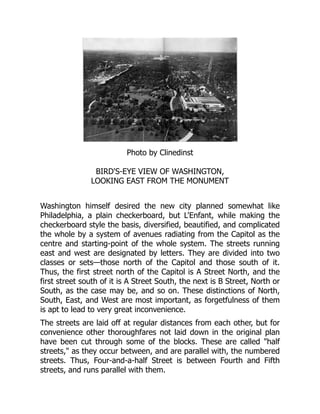
Photo by Clinedinst
BIRD'S-EYE VIEW OF WASHINGTON,
LOOKING EAST FROM THE MONUMENT
Washington himself desired the new city planned somewhat like
Philadelphia, a plain checkerboard, but L'Enfant, while making the
checkerboard style the basis, diversified, beautified, and complicated
the whole by a system of avenues radiating from the Capitol as the
centre and starting-point of the whole system. The streets running
east and west are designated by letters. They are divided into two
classes or sets—those north of the Capitol and those south of it.
Thus, the first street north of the Capitol is A Street North, and the
first street south of it is A Street South, the next is B Street, North or
South, as the case may be, and so on. These distinctions of North,
South, East, and West are most important, as forgetfulness of them
is apt to lead to very great inconvenience.
The streets are laid off at regular distances from each other, but for
convenience other thoroughfares not laid down in the original plan
have been cut through some of the blocks. These are called "half
streets," as they occur between, and are parallel with, the numbered
streets. Thus, Four-and-a-half Street is between Fourth and Fifth
streets, and runs parallel with them.
The avenues run diagonally across the city. New Jersey,
Pennsylvania, Maryland, and Delaware avenues intersect at the
Capitol, and Pennsylvania, New York, Vermont, and Connecticut
avenues intersect at the President's house. Pennsylvania Avenue is
the main thoroughfare. It is one hundred and sixty feet wide, and
extends the entire length of the city, from the Eastern Branch to
Rock Creek, which latter stream separates Washington from
Georgetown. It was originally a swampy thicket. The bushes were
cut away to the desired width soon after the city was laid off, but
few persons cared to settle in the swamp. Through the exertions of
President Jefferson, it was planted with four rows of fine Lombardy
poplars—one on each side and two in the middle—with the hope of
making it equal to the famous Unter den Linden, in Berlin. The
poplars did not grow as well as was hoped, however, and when the
avenue was graded and paved by order of Congress in 1832 and
1833 these trees were removed. Pennsylvania Avenue is handsomely
built up, and contains some buildings that would do credit to any
city. The distance from the Capitol to the President's house is one
mile, and the view from either point along the avenue is very fine.
Every circle, triangle, and square dedicated to monuments bears
testimony to the taste of the original design. So little respect,
however, was held for Major L'Enfant's plans that Daniel Carroll, one
of the original owners of the land, was in the act of building a
handsome house right across New Jersey Avenue. L'Enfant ordered it
torn down. This was done, much to the disgust of Carroll and to the
indignation of the commissioners. The government rebuilt the house
for Carroll, but was careful to place it in a more suitable location.
The old Duddington House, on Capitol Hill, was long a landmark of
the early Washington architecture.
There were some other acts of irritability on the part of L'Enfant,
acts which now show his just appreciation of his own great work. He
was paid $2,500 for his services and dismissed. He believed he
should have been pensioned, as would have been done in Europe.
Afterward he saw the city expand as the nation grew strong, while
he, a disappointed, poverty-stricken man, wandered, a pathetic
figure, about the Capitol until 1825, when he died. He had lived for
years on the Diggs farm, about eight miles from Washington, and
was buried in the family cemetery in the Diggs garden, and when
the dead of that family were removed his dust was left in an
unmarked grave.
Mr. Corcoran, the great banker of Washington, who died in 1888,
said he remembered L'Enfant as "a rather seedy, stylish old man,
with a long green coat buttoned up to his throat, a bell-crowned hat,
a little moody and lonely, like one wronged." The heart of a stranger
in a strange, ungrateful land.
The City of Washington is his monument. No one can now rob him
of that honor. Let us hope that he has awakened in His likeness and
is satisfied.
Could the Colonial Dames or the Daughters of the Revolution do a
more beneficent and popular act than to mark the resting-place of
Peter Charles L'Enfant, who drew the original plans of that city which
is to become the most beautiful city in the world?[1]
1. On April 28, 1909, the body of Major L'Enfant was moved to the National
Cemetery, at Arlington, where a suitable memorial will soon be erected.
The letters of General Washington abound in references to the
difficulty of obtaining money to fit the new city for capital purposes.
Virginia made a donation of $120,000 and the State of Maryland
gave $72,000. Afterward the latter State was induced to loan
$100,000 toward fitting the city for a capital.
The City of Washington was officially occupied in June, 1800. Since
then it has been the ward of Congress. Strangers, even at this late
day, often comment on the long distance between the Capitol
building and the Executive Mansion; but Washington strongly
impressed upon the mind of Major L'Enfant that the latter must be at
a considerable distance, so that members of Congress should not fall
into the habit of coming too frequently to call upon the President,
and thus waste the time of the executive head of the nation.
It is not the purpose in these sketches to dwell too much on the
history of Washington, but rather to make a picture of the city as it
is in the first decade of the twentieth century. A glimpse of it,
however, in the summer of 1814 is really necessary to complete our
references to the early days of the nation's capital.
In 1814 the city was captured by a small British force under General
Ross, and both wings of the Capitol building, with its library and
almost all the records of the government up to that date, were
destroyed by fire, also the White House, as the Executive Mansion
was even then called, and most of the departments, including the
Navy-yard.
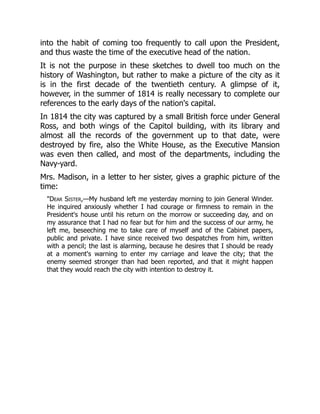
Mrs. Madison, in a letter to her sister, gives a graphic picture of the
time:
"Dear Sister,—My husband left me yesterday morning to join General Winder.
He inquired anxiously whether I had courage or firmness to remain in the
President's house until his return on the morrow or succeeding day, and on
my assurance that I had no fear but for him and the success of our army, he
left me, beseeching me to take care of myself and of the Cabinet papers,
public and private. I have since received two despatches from him, written
with a pencil; the last is alarming, because he desires that I should be ready
at a moment's warning to enter my carriage and leave the city; that the
enemy seemed stronger than had been reported, and that it might happen
that they would reach the city with intention to destroy it.
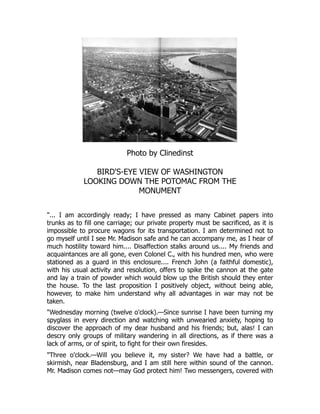
Photo by Clinedinst
BIRD'S-EYE VIEW OF WASHINGTON
LOOKING DOWN THE POTOMAC FROM THE
MONUMENT
"... I am accordingly ready; I have pressed as many Cabinet papers into
trunks as to fill one carriage; our private property must be sacrificed, as it is
impossible to procure wagons for its transportation. I am determined not to
go myself until I see Mr. Madison safe and he can accompany me, as I hear of
much hostility toward him.... Disaffection stalks around us.... My friends and
acquaintances are all gone, even Colonel C., with his hundred men, who were
stationed as a guard in this enclosure.... French John (a faithful domestic),
with his usual activity and resolution, offers to spike the cannon at the gate
and lay a train of powder which would blow up the British should they enter
the house. To the last proposition I positively object, without being able,
however, to make him understand why all advantages in war may not be
taken.
"Wednesday morning (twelve o'clock).—Since sunrise I have been turning my
spyglass in every direction and watching with unwearied anxiety, hoping to
discover the approach of my dear husband and his friends; but, alas! I can
descry only groups of military wandering in all directions, as if there was a
lack of arms, or of spirit, to fight for their own firesides.
"Three o'clock.—Will you believe it, my sister? We have had a battle, or
skirmish, near Bladensburg, and I am still here within sound of the cannon.
Mr. Madison comes not—may God protect him! Two messengers, covered with
dust, come to bid me fly; but I wait for him.... At this late hour a wagon has
been procured; I have had it filled with the plate and most valuable portable
articles belonging to the house; whether it will reach its destination, the Bank
of Maryland, or fall into the hands of British soldiery, events must determine.
Our kind friend, Mr. Carroll, has come to hasten my departure, and is in a very
bad humor with me because I insist on waiting until the large picture of
General Washington is secured, and it requires to be unscrewed from the wall.
This process was found too tedious for these perilous moments. I have
ordered the frame to be broken and the canvas taken out; it is done, and the
precious portrait placed in the hands of two gentlemen of New York for safe-
keeping. And now, my dear sister, I must leave this house, or the retreating
army will make me a prisoner in it by filling up the road I am directed to take.
When I shall again write to you, or where I shall be to-morrow, I can not tell."
We all know the story of Mrs. Madison's flight, of her return in
disguise to a desolated, burned, ruined home. She would have been
without shelter except for the open door of Mrs. Cutts, her sister,
who lived in the city. From that point she visited the ruins of all the
public buildings while she awaited her husband's return.
We are apt to think of the White House as a place of teas,
receptions, gayly dressed people, light, music, flowers, and laughter;
but it, too, has seen its tragedies.
Fifty years after the burning of the city the famous Stuart picture of
Washington, referred to in Mrs. Madison's letter, was retouched and
hung in the East Room, and still constitutes one of the few
ornaments of the Executive Mansion.
During Mr. Roosevelt's administration (1902-1903) extensive
alterations and additions were made to the Executive building.
The conservatory, so long an object of enjoyment to the public, was
removed to give place for a long white esplanade on the west,
forming the approach to the Executive offices, while on the east side
a white colonnade now provides a most desirable entrance for large
crowds on public occasions.
It has been a matter of regret to D. A. R. women, and to all the
patriotic women of the nation, that the portraits of the ladies of the
White House have been remanded to the basement corridors. Here
are now the portraits of Mrs. Van Buren, Mrs. Tyler, Mrs. Polk
(presented by ladies of Tennessee during Mr. Arthur's
administration), Mrs. Hayes (presented by the National Woman's
Christian Temperance Union during Mr. Hayes's term), and Mrs.
Benjamin Harrison (presented by the D. A. R.), and the portrait of
Mrs. Roosevelt, by Chartran.
III
THE CAPITOL BUILDING
he corner-stone of the old Capitol, which constitutes the
central portion of the new edifice, was laid the 18th of
September, 1793, by General Washington, in the
presence of a great concourse of people and with
imposing ceremonies.
The corner-stones of the wings were laid by President Fillmore, July
4, 1851. Webster delivered the oration of the occasion.
The old building is of yellow sandstone, kept painted white to
beautify and preserve it; the wings are of white marble. On its
central portico all our Presidents, from Andrew Jackson to President
McKinley, have taken the oath of office. President Roosevelt took the
oath of office at Buffalo. This building, which fronts the east, was set
in accordance with the astronomical observations of Andrew Ellicott,
an engineer from Bucks County, Pennsylvania, who succeeded Major
L'Enfant as general surveyor and engineer in the new city.
Ellicott is described as bearing a marked resemblance to Benjamin
Franklin, except that he was more of a Quaker in appearance,
wearing a long, fine gray broadcloth coat and a Quaker hat. He
awaits the resurrection in an unmarked grave at Ellicott City,
Maryland.
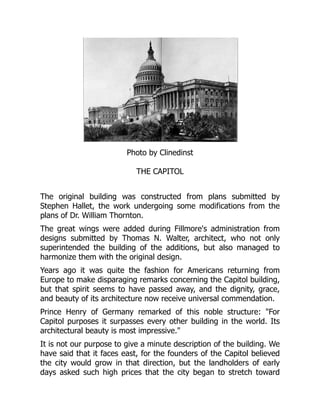
Photo by Clinedinst
THE CAPITOL
The original building was constructed from plans submitted by
Stephen Hallet, the work undergoing some modifications from the
plans of Dr. William Thornton.
The great wings were added during Fillmore's administration from
designs submitted by Thomas N. Walter, architect, who not only
superintended the building of the additions, but also managed to
harmonize them with the original design.
Years ago it was quite the fashion for Americans returning from
Europe to make disparaging remarks concerning the Capitol building,
but that spirit seems to have passed away, and the dignity, grace,
and beauty of its architecture now receive universal commendation.
Prince Henry of Germany remarked of this noble structure: "For
Capitol purposes it surpasses every other building in the world. Its
architectural beauty is most impressive."
It is not our purpose to give a minute description of the building. We
have said that it faces east, for the founders of the Capitol believed
the city would grow in that direction, but the landholders of early
days asked such high prices that the city began to stretch toward
the northwest, which is to this day the fashionable part for
residences, although Capitol Hill is much more beautiful as to
situation.
The base of the building is ninety-seven feet above the river. The
central structure is of Virginia yellow sandstone, which is kept
painted white. The wings are of Massachusetts marble, and the one
hundred columns of the extension porticoes are of Maryland marble.
The building covers three and one-half acres. It is seven hundred
and fifty-one feet long and three hundred and fifty feet wide.
The height of the dome above the rest of the building is two
hundred and fifty-seven feet, and its weight is eight million pounds.
This dome is surmounted by Crawford's statue of Freedom, nineteen
and one-half feet high, and weighing fifteen thousand pounds. The
entire edifice constitutes the highest public building in America not
located on a mountain, being sixty-eight feet higher than Bunker Hill
monument, and twenty-three feet higher than the steeple of Trinity
Church, in New York City.
Thomas G. Walker resigned his place as architect in 1865, and was
succeeded by the late architect of the Capitol, Mr. Edward Clark, who
died early in 1902. His great work had been to finish the west front
facing the city, and to harmonize the conflicting and foreign tastes of
the many decorators of the building.
Mr. Elliott Wood, the successor of Mr. Clark, had been the latter's
chief assistant. Mr. Wood had long been virtually in charge of the
Capitol.
The architects had a candidate ready because Mr. Wood was
practically an engineer; to meet this and yet give a faithful man his
due, the name of the position was changed to that of
Superintendent of the Capitol. He, like his predecessor, has much to
do in getting rid of the foreign artists' effects and in Americanizing
the whole.
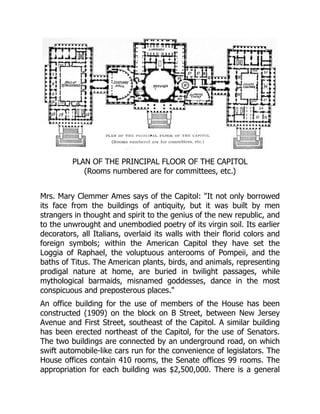
PLAN OF THE PRINCIPAL FLOOR OF THE CAPITOL
(Rooms numbered are for committees, etc.)
Mrs. Mary Clemmer Ames says of the Capitol: "It not only borrowed
its face from the buildings of antiquity, but it was built by men
strangers in thought and spirit to the genius of the new republic, and
to the unwrought and unembodied poetry of its virgin soil. Its earlier
decorators, all Italians, overlaid its walls with their florid colors and
foreign symbols; within the American Capitol they have set the
Loggia of Raphael, the voluptuous anterooms of Pompeii, and the
baths of Titus. The American plants, birds, and animals, representing
prodigal nature at home, are buried in twilight passages, while
mythological barmaids, misnamed goddesses, dance in the most
conspicuous and preposterous places."
An office building for the use of members of the House has been
constructed (1909) on the block on B Street, between New Jersey
Avenue and First Street, southeast of the Capitol. A similar building
has been erected northeast of the Capitol, for the use of Senators.
The two buildings are connected by an underground road, on which
swift automobile-like cars run for the convenience of legislators. The
House offices contain 410 rooms, the Senate offices 99 rooms. The
appropriation for each building was $2,500,000. There is a general
feeling in Washington that too much luxury pervades these
buildings.
IV
INTERIOR OF THE CAPITOL
n 1808 Jefferson made Benjamin Henry Latrobe
supervising architect of what we now call the old
Capitol, being the central portion of the present
building.
He constructed the original Senate Chamber, now the
Supreme Court Room, on the plan of the old Greek theater, the
general outline of which it yet retains. The House (now Statuary
Hall) also had a decidedly Grecian aspect. It was finished in 1811.
Statuary Hall is semicircular in shape, and has a vaulted roof. Its
ornamentation is not yet completed. This is right. It would not be
well to occupy all the space in one generation. We need the
perspective of time to know that which will be of permanent interest
to the world.
Here Clay presided, here Webster spoke, and here Adams stood for
the right of petition and for the abolition of human slavery. What
pictures these scenes would make! A plate in the floor southwest of
the center marks the spot in the House where John Quincy Adams
fell stricken with paralysis. In a room opening from the Hall is a
memorial bust, whose inscription reads: "John Quincy Adams, who,
after fifty years of public service, the last sixteen in yonder Hall, was
summoned to die in this room February 23 1848."
The room has special acoustic qualities which in early days
occasioned much trouble. A whisper scarcely audible to the ear into
which it is breathed is distinctly heard in another part of the hall. It
is one of the most remarkable whispering galleries in the world, and
its peculiar properties, accidentally discovered, produced no end of
disturbances before they were fully understood. Their effect has
been much modified by a recent change in the ceiling.
Each State is now permitted to place in Statuary Hall two statues of
its most renowned sons.
Virginia has Washington and Jefferson. Think of that! New
Hampshire has Daniel Webster, who made these walls echo with his
thrilling, patriotic sentences, and John Stark, of Bunker Hill fame,
who cried: "See those men? They are the redcoats! Before night
they are ours, or Molly Stark will be a widow!"
Pennsylvania has Robert Fulton, the inventor, and John Peter Gabriel
Muhlenberg, the preacher, Major-General in the Revolution. He was
also Senator and Member of Congress. New York has Robert R.
Livingston, of the Continental Congress, and Alexander Hamilton.
The latter was Washington's Secretary of the Treasury during both of
his Presidential terms. He had much to do with securing a good
financial system for the new government. His pathetic death
enhanced his fame and ruined Burr; but under the search-light of
history one can not help wondering had Burr been killed and
Hamilton survived that duel, would the halo of the latter have faded?
The statue of Hamilton is one of the best in the Hall. It was made in
Rome by Horatio Stone.
The Illinois memorial is the famous Vinnie Ream statue of Lincoln. I
wish, because it was done by a woman, that I could like it, but it is
weak and unworthy. In every line of his strong, patriotic face lived
the gospel of everlasting hope. This figure might well stand for one
vanquished in the race. (Was Jesus vanquished? Was Paul? Was
Luther? Was Lincoln?)
There is a small bust of Lincoln, by Mrs. Ames, which approaches
nearer the true ideal of the great apostle of Liberty.
Illinois is further represented by James Shields, Senator. It would
seem that men like Washington and Lincoln, who were the product
of national influences, should be venerated as representatives of the
nation rather than of individual States.
Missouri is represented by Frank Blair and Thomas H. Benton;
Vermont, by Jacob Collamer and Ethan Allen, the hero of
Ticonderoga; Oregon, by Edward Dickinson Baker, whose fine statue
is by Horatio Stone.
Jacques Marquette (by G. Trentanore), in the garb of a Catholic
priest, represents Wisconsin. Ohio has President Garfield and William
Allen.
Roger Sherman and John Trumbull represent Connecticut, and
Rhode Island memorializes Roger Williams and General Nathanael
Greene, of Revolutionary fame—the former, in his quaint sixteenth
century garb, standing as well for religious freedom as for the State
which he founded.
Massachusetts presents Samuel Adams's statue, by Annie Whitney,
and John Winthrop's, by R. S. Greenough. What a goodly company
they are, those New England heroes![2]
2. Since the above was written a statue of John James Ingalls, of Kansas, has
been placed in Statuary Hall; as well as a statue of Frances Willard, of
Illinois, who is the first woman in the United States to be so honored.
Will Kansas have the courage to place there the statue of John
Brown, of Osawatomie? He yet is a type of that unconventional
State, which regards no precedent, follows no pattern; that State
which, in a blind way, is striving to put the Ten Commandments on
top and to uphold the principles of the Sermon on the Mount, no
difference what man or what party goes down in the strife; that
State of which Whittier truthfully said:
We cross the prairie as of old
The pilgrims crossed the sea,
To make the West, as they the East,
The homestead of the free.
Upbearing, like the ark of old,
The Bible in our van,
We go to test the truth of God
Against the fraud of man.
A brave fight the State has made against fraud. The fight is yet on;
but who doubts that the truth of God "shall yet prevail," and who
would better stand for such a people than one who went down in
that fight with the "martyr's aureole" around his grizzled head?
Much, of course, must be left untold here; but it is hoped that what
has been said will create a desire to see and learn more of those
whom the State and the nation has here honored.
V
THE ROTUNDA
t is not the purpose in these sketches to go into any
minute descriptions of places or things in Washington.
To do that volumes would be needed, and then much
left untold.
The Rotunda is the central part of the old building of the
Capitol, and lies beneath the dome. It is circular in form, with a
diameter of ninety-five feet, and with a height to the canopy above
of a little over one hundred and eighty feet.
The panels of the Rotunda are set with life-size pictures, illustrating
important scenes in American history. There are "The Surrender of
Burgoyne, October 17, 1777"; "The Surrender of Cornwallis at
Yorktown, Virginia, October 19, 1781" and "The Resignation of
Washington, December 23, 1783." These are by Trumbull. They may
not be perfect, considered as works of art, but they commemorate
events whose memory should never die.
The surrender of Burgoyne was the greatest triumph of American
over British arms up to that date (October 17, 1777). Had his twelve
hundred Hessians been English patriots the result might have been
different. When the British officer was sent to inquire their condition
for a fight, the answer of the British was, "We will fight to a man."
But the Hessians replied, "Nix the money, nix the rum, nix fighten."
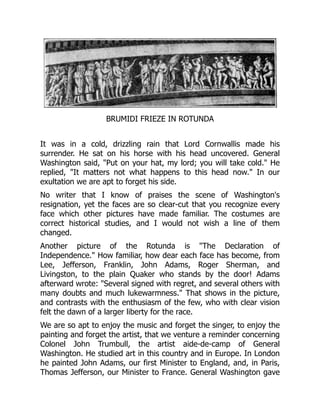
BRUMIDI FRIEZE IN ROTUNDA
It was in a cold, drizzling rain that Lord Cornwallis made his
surrender. He sat on his horse with his head uncovered. General
Washington said, "Put on your hat, my lord; you will take cold." He
replied, "It matters not what happens to this head now." In our
exultation we are apt to forget his side.
No writer that I know of praises the scene of Washington's
resignation, yet the faces are so clear-cut that you recognize every
face which other pictures have made familiar. The costumes are
correct historical studies, and I would not wish a line of them
changed.
Another picture of the Rotunda is "The Declaration of
Independence." How familiar, how dear each face has become, from
Lee, Jefferson, Franklin, John Adams, Roger Sherman, and
Livingston, to the plain Quaker who stands by the door! Adams
afterward wrote: "Several signed with regret, and several others with
many doubts and much lukewarmness." That shows in the picture,
and contrasts with the enthusiasm of the few, who with clear vision
felt the dawn of a larger liberty for the race.
We are so apt to enjoy the music and forget the singer, to enjoy the
painting and forget the artist, that we venture a reminder concerning
Colonel John Trumbull, the artist aide-de-camp of General
Washington. He studied art in this country and in Europe. In London
he painted John Adams, our first Minister to England, and, in Paris,
Thomas Jefferson, our Minister to France. General Washington gave
him sittings, and he traveled through the entire thirteen colonies
securing portraits. It was not until 1816, after thirty years of careful
preparation, that Congress gave him the commission to paint the
four great historical paintings now in the Rotunda. They are the best
authentic likenesses now in existence of the persons represented.
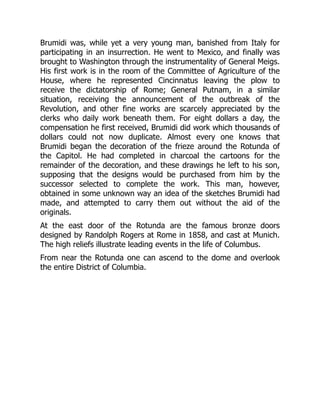
BRUMIDI FRIEZE IN ROTUNDA
"The Embarkation of the Pilgrims," by Wier, is considered the best
picture of the Rotunda. All the self-sacrifice of leaving country,
home, and friends is in the women's faces, "All for God" is in the
men's faces. It is the little leaven of Puritanism which yet keeps this
country sweet.
It is amusing to see the bands of Indians who are sent here to meet
the "Great Father" stop before "The Baptism of Pocahontas," painted
by Chapman. Evidently neither the faces nor the costumes suit
them, for they hoot and laugh, while they grunt with evident
approval at the picture of Boone's conflict with the savages and that
of William Penn's conference with the Indians of Pennsylvania.
At a height of sixty-five feet above the floor, and encircling the wall
at that point, about three hundred feet in circumference, runs a
fresco, by Brumidi and Castigni, in imitation high relief, which well
depicts periods of American history, illustrating from the days of
barbarism to civilization. It is incomplete at this time.
Brumidi was, while yet a very young man, banished from Italy for
participating in an insurrection. He went to Mexico, and finally was
brought to Washington through the instrumentality of General Meigs.
His first work is in the room of the Committee of Agriculture of the
House, where he represented Cincinnatus leaving the plow to
receive the dictatorship of Rome; General Putnam, in a similar
situation, receiving the announcement of the outbreak of the
Revolution, and other fine works are scarcely appreciated by the
clerks who daily work beneath them. For eight dollars a day, the
compensation he first received, Brumidi did work which thousands of
dollars could not now duplicate. Almost every one knows that
Brumidi began the decoration of the frieze around the Rotunda of
the Capitol. He had completed in charcoal the cartoons for the
remainder of the decoration, and these drawings he left to his son,
supposing that the designs would be purchased from him by the
successor selected to complete the work. This man, however,
obtained in some unknown way an idea of the sketches Brumidi had
made, and attempted to carry them out without the aid of the
originals.
At the east door of the Rotunda are the famous bronze doors
designed by Randolph Rogers at Rome in 1858, and cast at Munich.
The high reliefs illustrate leading events in the life of Columbus.
From near the Rotunda one can ascend to the dome and overlook
the entire District of Columbia.
VI
CONCERNING SOME OF THE ART AT THE
CAPITOL
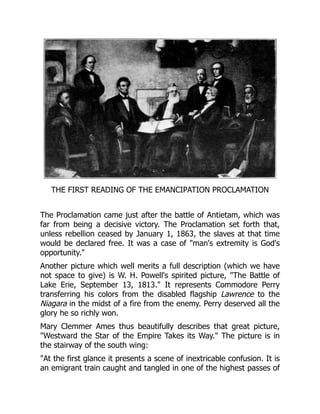
mong the interesting pictures in the Capitol is Frank B.
Carpenter's picture, "The First Reading of the
Emancipation Proclamation, September 22, 1862." Mr.
Lincoln was accustomed to speak of the act which this
picture represents as the central act of his
administration. Historians have recorded it the leading
event of the nineteenth century.
It changed the policy of the war, and was received by the army and
the people as a necessary war measure. According to Mr. Carpenter,
he takes the moment when Mr. Lincoln has just said: "Gentlemen, I
now propose to issue this Emancipation Proclamation."
Montgomery Blair said: "If you do, Mr. President, we shall lose the
fall elections." To this no one offered a reply. Mr. Seward, who sits in
front of the table, said: "Mr. President, should we not wait for a more
decisive victory, so that the rebels may know we are able to enforce
the Proclamation?" Mr. Lincoln leaned forward and said, in a low
voice: "I promised my God, if Lee were driven back from Maryland,
to issue the Proclamation." Mr. Seward said: "Mr. President, I
withdraw every objection." Chase, who stands back of the President
in the picture, and who was not always in sympathy with Mr. Lincoln,
laid his hand affectionately on Mr. Lincoln's shoulder, to show the
President that in this matter they were in perfect accord.
THE FIRST READING OF THE EMANCIPATION PROCLAMATION
The Proclamation came just after the battle of Antietam, which was
far from being a decisive victory. The Proclamation set forth that,
unless rebellion ceased by January 1, 1863, the slaves at that time
would be declared free. It was a case of "man's extremity is God's
opportunity."
Another picture which well merits a full description (which we have
not space to give) is W. H. Powell's spirited picture, "The Battle of
Lake Erie, September 13, 1813." It represents Commodore Perry
transferring his colors from the disabled flagship Lawrence to the
Niagara in the midst of a fire from the enemy. Perry deserved all the
glory he so richly won.
Mary Clemmer Ames thus beautifully describes that great picture,
"Westward the Star of the Empire Takes its Way." The picture is in
the stairway of the south wing:
"At the first glance it presents a scene of inextricable confusion. It is
an emigrant train caught and tangled in one of the highest passes of
the Rocky Mountains. Far backward spread the eastern plains, far
onward stretches the Beulah of promise, fading at last in the far
horizon. The great wagons struggling upward, tumbling downward
from mountain precipice into mountain gorge, hold under their
shaking covers every type of westward moving human life. Here is
the mother sitting in the wagon front, her blue eyes gazing outward,
wistfully and far, the baby lying on her lap; one wants to touch the
baby's head, it looks so alive and tender and shelterless in all that
dust and turmoil of travel. A man on horseback carries his wife, her
head upon his shoulder. Who that has ever seen it will forget her
sick look and the mute appeal in the suffering eyes? Here is the bold
hunter with his raccoon cap, the pioneer boy on horseback, a
coffeepot and cup dangling at his saddle, and oxen—such oxen! it
seems as if their friendly noses must touch us; they seem to be
feeling out for our hand as we pass up the gallery. Here is the young
man, the old man, and far aloft stands the advance-guard fastening
on the highest and farthest pinnacle the flag of the United States.
"Confusing—disappointing, perhaps—at first glance, this painting
asserts itself more and more in the soul the oftener and the longer
you gaze. Already the swift, smooth wheels of the railway, the shriek
of the whistle, and the rush of the engine have made its story
history. But it is the history of our past—the story of the heroic
West."
There are pictures and busts, or full-length statues, of almost every
great man of our nation. Some of them, within one hundred years,
will be turned over to the man's native State or town, with
complimentary notes and speeches the inner meaning of which is:
"We need the room for bigger men."
Before leaving the Capitol plaza a word must be said of Horatio
Greenough's statue of Washington, which sits in lonely grandeur
before the Capitol. Greenough was much in Rome, and the antique
became his model. The statue represents Washington sitting in a
large chair, holding aloft a Roman sword, the upper part of his body
naked, the lower part draped as Jupiter Tonans.[3]
3. On May 27, 1908, Congress appropriated $5,000 to move Greenough's statue
of Washington to the Smithsonian Institute. The removal was made
November 21, 1908.
This conception brings out the majestic benignity of the face of
Washington, and shows to the life every muscle and vein of his
magnificent form. Greenough said of his own work: "It is the birth of
my thoughts; I have sacrificed to it the flower of my days and the
freshness of my strength; its every lineament has been moistened
with the sweat of my toil and the tears of my exile. I would not
barter its association with my name for the proudest fortune that
avarice ever dreamed of."
The work, however, has met with more of criticism than of praise. A
statue should represent a man in the costume of his time.
Washington should have been shown either in the knee-breeches or
in the full military costume of his period. We want no foreign effects
in our statues. Washington had no aspiration to be either Jupiter or
Mars, but he earnestly desired to be a good and useful man.
In this connection a few words in relation to the character of future
paintings that shall be selected for the adornment of the Capitol may
not be amiss.
In Paris, at the Exposition in 1900, the writer was greatly impressed
by the manner in which France perpetuates historic events. The best
picture of the commission which settled the Spanish-American War
was painted by a Frenchman, the best picture of the Peace
Commission at the Hague was also French. One picture, which will
ever be valuable, represented President Carnot and his Cabinet in
the Exposition of 1889 receiving the representatives of all the
colonies of France.
Our country should have pictures of the inauguration of the
President, with his leading men about him; also of the receptions on
New-year's day, showing faces of foreign Ministers, the Cabinet,
Members of the Supreme Court, and our naval and military
commanders.
I remember one brilliant company at Secretary Endicott's, during the
first Cleveland administration. The Ministers of various foreign
nations, in court costumes and with all their decorations, were
present. General Sheridan, full of life and repartee, was there.
General Sherman had come over from New York to grace with his
presence the reception given by the Secretary of War. General
Greely, of Arctic fame, wore for the first time the uniform of a
brigadier-general. All the leading army officers, in brilliant uniforms,
were present. Senators Edmonds, Sherman, Logan, Evarts, Ingalls,
Wade Hampton, Leland Stanford, Vance, Voorhees, Allison, with
many others, were part of that memorable company. Mrs. Stanford
wore the famous Isabella diamonds. Among the guests were
Secretaries Vilas, Whitney, Bayard, and their accomplished wives; Mr.
Carlisle, then Speaker of the House, and his stately, genial wife; and
President and Miss Cleveland, who made an exception to the
Presidential rule of non-attendance at such functions, and by their
presence added to the pleasure of the occasion. Chief Justice Waite
and Justices Field, Miller, Blatchford, Gray, and Strong were present.
What a picture for history that representative company would now
be! We need an art fund—perhaps the Carnegie University
beneficence may provide it. Concerning the Capitol building, Charles
Sumner said: "Surely this edifice, so beautiful, should not be open to
the rude experiment of untried talent."
The Commission of Artists said: "The erection of a great National
Capitol occurs but once in the life of a nation. The opportunity such
an event affords is an important one for the expression of patriotic
elevation, and the perpetuation, through the arts of painting and
sculpture, of that which is high and noble and held in reverence by
the people; and it becomes them as patriots to see to it that no taint
of falsity is suffered to be transmitted to the future upon the
escutcheon of our national honor in its artistic record. A theme so
noble and worthy should interest the heart of the whole country, and
whether patriot, statesman, or artist, one impulse should govern the
whole in dedicating these buildings and grounds to the national
honor."
VII
THE SENATE CHAMBER
n visiting the Capitol building most people desire first to
see the Senate Chamber, possibly from the fact that the
names of the Senators are more familiar, because, as a
usual thing, men have been long in public life before
they have become Senators.
The Senate Chamber is 112 feet in length, 82 feet wide, and 30 feet
high. The floor rises like that of an amphitheater; the walls are
white, buff, and gold in color, and the ceiling consists of panels of
glass, each one bearing the coat of arms of a State. Opposite the
main entrance, on a platform of dark mahogany, are the desk and
chair of the President of the Senate, who is the Vice-President of the
United States, or, as in the present administration, a Senator elected
by his colleagues to preside over them when the office of Vice-
President has become vacant. Below the President is a larger desk
for the use of the Secretary of the Senate and his assistants.
The heating and ventilating of the Senate Chamber is said to be very
good. In winter, however, the room seems to be too warm. After an
absence of fifteen years, I find men who have been in the Senate
during that time have aged much more in appearance than their
contemporaries outside.
The mahogany desks of the Senators stand on a moss green carpet,
making a good color combination. The room is surrounded by a
gallery which seats about a thousand persons. This gallery is
divided. There is a private gallery for Senators' families and friends,
one part of which is set apart for the family of the President. It is
seldom occupied by the dwellers in the White House, but often by
visiting friends. The reporters' gallery is over the Vice-President's
desk. There sit those busy, bright men who keep you informed of
what the Senate is doing. The gallery opposite is for the diplomats.
It is always interesting to watch the faces of these distinguished
foreigners as they scan this body of lawmakers. Besides these there
are the gallery for ladies, or for gentlemen accompanied by ladies,
and the public gallery for men.
The Senate is the citadel of American liberty. Its great debates have
defined our constitutional rights and duties, and prevented many
violations of fundamental law. Here Clay, Calhoun, Webster, Benton,
Chase, Sumner, Seward, Harrison, Edmunds, Evarts, Ingalls, Logan,
and Wade Hampton, with hundreds of others equally eloquent and
equally patriotic, have stood for the right as they saw it, or sold their
souls for the mess of pottage.
The Republicans sit on the Vice-President's left and the Democrats
on the right. Although differing in ideas of governmental policy, we
must believe both sides are actuated by a love of country.
The world is beginning to expect the United States to be the final
court of appeals in behalf of the lesser nations, especially the other
American republics. It is the Senate's natural destiny, because of its
treaty-making power, to facilitate a better understanding between
nations, to prevent wrongs, to increase commerce, to secure
international peace, and thus to improve the governmental powers
of the world. So will our republic be the bridge over which the
nations of the earth will enter on a period of universal education and
modified self-government.
In my youth, on a visit to Washington, I saw Schuyler Colfax preside
over the Senate. He was a nervous, restless man, who gave no
attention to the Senator speaking, and while he was in the chair the
Senate became a noisy, turbulent body. At another time, for a few
hours, I saw Henry Wilson, who was Vice-President under Grant's
second term, preside over the Senate. Quiet, self-contained, serene,
watchful, attentive, he was an ideal presiding officer. Every battle of
life had left its mark on his strong, rugged face.
In December, 1885, I came to Washington and remained three
years. Vice-President Hendricks had died, and the Senate, which was
Republican, was presided over by John Sherman. He was in public
life from 1848 to the time of his death, and his name was identified
with almost every public measure from that time to the end of the
century. He was a man of great wisdom and good judgment, but
cold and without any of those qualities which tend to personal
popularity. Later, John James Ingalls, of Kansas, was elected
President pro tempore. Tall, stately, dignified, scholarly, thoughtful, a
skilled parliamentarian, it is probable the Senate never had a better
presiding officer. When Senator Ingalls occupied the chair the
business of the Senate was put through with such celerity and
dispatch that a visit to that usually prosy body became interesting.
Later, I saw Levi P. Morton, of New York, preside as Vice-President.
He was a fine business man who had served his country with honor
abroad, but had no training as a presiding officer. He was regarded
as fair in his rulings.
The Senate was later presided over by Senator Frye, of Maine, who
has had a long experience in legislative bodies, having served six
terms as representative from Maine, and having been elected to the
Senate in 1881, to fill the vacancy left by Blaine when he became
Secretary of State under Garfield. He was also a member of the
Peace Commission which met in Paris, September, 1898, to settle the
terms of peace between the United States and Spain. The Senate is
now presided over by Vice-President Sherman, who has served
twenty years as Representative from New York. He presided over the
Republican Convention in 1895, 1900 and 1908.
When I take friends to the Senate now I notice they ask first for Mr.
Aldrich, of Rhode Island; Bailey and Culbertson, of Texas; Lodge, of
Massachusetts; Nelson, of Minnesota; Tillman, of South Carolina;
Root, of New York; Owen and Gore, of Oklahoma; Curtis and
Bristow, of Kansas, and Dolliver, of Iowa.
When I was here from 1885 to 1888 the following were the stars:
Edmunds, who for quiet strength, massive force, persistent effort,
fertility of resource, and keen sagacity was never surpassed on the
floor of the Senate. Like Mr. Hoar, his sentences in rhetorical and
grammatical construction were fit for the Record just as they fell
from his lips. William M. Evarts, of New York, famous as counsel in
the Beecher trial, and attorney for the Republican party before the
Electoral Commission. He seemed like a man about to do some great
thing, but he originated no important national or international law.
Leland Stanford, noted for his philanthropy and great wealth, and
Wade Hampton and Senator Butler, both of South Carolina, were
picturesque and interesting figures. General Logan, Don Cameron,
Preston B. Plumb, Blackburn, and Beck, of Kentucky, stood next in
interest, but most of these have given place to a younger
generation.
The most interesting rooms in the north wing beside the Senate
Chamber are the President's room, Vice-President's reception-rooms,
and committee-room of the District of Columbia.
The walls of the President's room are in white and gold, with
crimson carpet, table, and chair effects—rather high lights if one had
to live in it, but very pleasing for the short visits made by the
President to the Capitol. On the last day of each term of Congress
the President comes to this room for an hour or two and signs any
bills which yet remain. He also answers the perfunctory question as
to whether he desires to present any further business to the Senate.
The Vice-President's room is much more used. When the Vice-
President in the Senate chamber grows tired "of weary lawyers with
endless tongues," he calls some one to the chair and slips into the
Vice-President's room, to rest and attend to his correspondence.
Garrett A. Hobart was the fifth Vice-President of the United States to
die during his term of office. The others were Elbridge Gerry, William
Rufus King, Henry Wilson, and Thomas A. Hendricks. Gerry was one
of the great statesmen of the revolutionary period and hailed from
Massachusetts. He was Vice-President in 1812, and died November
23, 1814, while on the way to the capital.
Charles Warren Fairbanks, a Republican from Indianapolis, Ind.,
became Vice-President March 4, 1905, at the beginning of Mr.
Roosevelt's second term. Mr. Fairbanks never held public office prior
to his election to the Senate in 1897, which place he held until he
resigned to take the oath of Vice-President.
Mr. Fairbank's influence in the City of Washington will long be
remembered as one of the pleasant memories of the Capital. At
church functions, at philanthropic or patriotic conventions, Vice-
President Fairbanks found time in his overcrowded life to preside. In
social life Mrs. Fairbanks was the idol of the D. A. R. women. Her
hospitable home was ever open for receptions, fetes and parties,
and not in this generation will Washington see a family so universally
beloved and so universally regretted.
James Schoolcraft Sherman, Republican of Utica, N. Y., took the oath
of office as Vice-President, March 4, 1909. He had been a member
of Congress for twenty years, and ranked as one of the five leading
members of the House of Representatives. His ability as a presiding
officer is recognized in both branches of Congress. The Cabinet
called together by President Taft is composed largely of new men at
Washington.
Mr. Philander Chase Knox, of Pennsylvania, takes up the duties of
the State Department so ably filled by John Hay, Elihu Root, and Mr.
Taft, with large knowledge of state affairs.
Mr. Franklin McVeagh, of Chicago, an able business man, takes
charge of the Treasury Department at a time when there is a
deficiency in the Treasury, and with a new tariff law to enforce.
Mr. Jacob McGavock Dickinson, like Mr. McVeagh, is a Democrat from
Chicago. As Secretary of War he will need all his great acumen in
managing the affairs of the nation from the Panama Zone to the
Philippine Islands.
Mr. George Woodward Wickersham, of New York, as Attorney-
General is a lawyer of high personal and professional qualifications.
Mr. George von Lengerke Meyer was transferred by President Taft
from the Post-office Department, whose service he greatly improved,
to the Secretaryship of the Navy.
Mr. Frank Harris Hitchcock, the new Postmaster-General, has had
long experience in postal affairs.
Mr. Charles Nagel, of St. Louis, Mo., has had a business experience
which will fit him for his arduous duties as Secretary of Labor and
Commerce.
Hon. James Wilson has been reappointed by President Taft as
Secretary of Agriculture, a position he has held for twelve years.
Mr. Richard Achilles Ballinger, the new Secretary of the Interior, of
Seattle, Wash., is of the New West. He has met a warm welcome at
Washington.
VIII
THE HOUSE OF REPRESENTATIVES
he Hall of Representatives is in the south wing of the
Capitol, and is similar in form and design to the Senate
Chamber, being semicircular, with a gallery of twelve
hundred seating capacity extending around the entire
hall.
Like the Senate, the walls are white, buff, and gold, and the ceiling
panels of glass, each showing in connection with a State coat of
arms the cotton plant in some stage of development.
The Speaker of the House sits at a desk of pure white marble, and in
front of him are several desks for the Secretary and his many
assistants.
A silver plate on each desk bears the name of its occupant. As in the
Senate, the Republicans occupy the left of the Speaker and the
Democrats the right.
When the House is in session the mace is in an upright position at
the table of the Sergeant-at-Arms on the right of the Speaker, and
when the House is adjourned, or in committee of the whole, it is
removed.
The mace is a bundle of ebony rods, bound together with silver
bands, having on top a silver globe, surmounted by a silver eagle. In
the British House of Commons the mace represents the royal
authority, but in the United States it stands for the power of the
people, which, tho not present in bodily form, yet is a force always
to be reckoned with. The one now in the House has been in use
THE MACE
since 1842. The Sergeant carries it before him as his symbol of
office when enforcing order, or in conducting a member to the bar of
the House by order of the Speaker.
The Speaker's room is across the lobby back
of his chair, and is one of the most beautiful
rooms in the building. It has velvet carpet,
fine, carved furniture, large bookcases and
mirrors, and its walls, as well as the walls of
the lobby, are hung with the portraits of
every Speaker, from our first Congress to
the present one.
Most of the pictures in the House of
Representatives with which I was familiar
fifteen years ago have been removed. Now
there remains but one—Brumidi's fresco
representing General Washington declining
the overtures of Lord Cornwallis for a two
days' cessation of hostilities.
Washington, like Grant, was an
"unconditional surrender" man.
Each State is entitled to a number of
Representatives in Congress, proportioned
upon the number of its population. The
State is districted by its own State
Legislature. Then the district selects its own
man, who is supposed to understand its
wants and needs, and elects him to
represent his people for two years.
He must be twenty-five years of age, seven
years a citizen of the United States, and a
citizen of the State which he represents. There are about three
hundred and fifty-six members and delegates. The latter represent
the territories of Oklahoma, New Mexico, Arizona, and Hawaii.
Welcome to our website – the perfect destination for book lovers and
knowledge seekers. We believe that every book holds a new world,
offering opportunities for learning, discovery, and personal growth.
That’s why we are dedicated to bringing you a diverse collection of
books, ranging from classic literature and specialized publications to
self-development guides and children's books.
More than just a book-buying platform, we strive to be a bridge
connecting you with timeless cultural and intellectual values. With an
elegant, user-friendly interface and a smart search system, you can
quickly find the books that best suit your interests. Additionally,
our special promotions and home delivery services help you save time
and fully enjoy the joy of reading.
Join us on a journey of knowledge exploration, passion nurturing, and
personal growth every day!
testbankbell.com


Operations Management Stevenson 12th Edition Solutions Manual

  • 1.
    Download the fullversion and explore a variety of test banks or solution manuals at https://testbankbell.com Operations Management Stevenson 12th Edition Solutions Manual _____ Follow the link below to get your download now _____ http://testbankbell.com/product/operations-management- stevenson-12th-edition-solutions-manual/ Access testbankbell.com now to download high-quality test banks or solution manuals
  • 2.
    We have selectedsome products that you may be interested in Click the link to download now or visit testbankbell.com for more options!. Operations Management Stevenson 11th Edition Solutions Manual http://testbankbell.com/product/operations-management-stevenson-11th- edition-solutions-manual/ Operations Management Stevenson 12th Edition Test Bank http://testbankbell.com/product/operations-management-stevenson-12th- edition-test-bank/ Operations Management Stevenson 11th Edition Test Bank http://testbankbell.com/product/operations-management-stevenson-11th- edition-test-bank/ Test Bank for Introduction to Information Systems, 2/E 2nd Edition Patricia Wallace http://testbankbell.com/product/test-bank-for-introduction-to- information-systems-2-e-2nd-edition-patricia-wallace/
  • 3.
    Test Bank forCriminal Procedure for the Criminal Justice Professional, 12th Edition, by John N. Ferdico, Henry F. Fradella, Christopher D. Totten http://testbankbell.com/product/test-bank-for-criminal-procedure-for- the-criminal-justice-professional-12th-edition-by-john-n-ferdico- henry-f-fradella-christopher-d-totten/ Test bank for Chemistry for Today: General Organic and Biochemistry 9th Edition by Seager http://testbankbell.com/product/test-bank-for-chemistry-for-today- general-organic-and-biochemistry-9th-edition-by-seager/ Test Bank for Fundamentals of Anatomy & Physiology 11th Edition by Martini http://testbankbell.com/product/test-bank-for-fundamentals-of-anatomy- physiology-11th-edition-by-martini/ Test Bank for Creative Approaches to Problem Solving A Framework for Innovation and Change, 3rd Edition, Scott G. Isaksen, K. Brian Dorval, Donald J. Treffinger, http://testbankbell.com/product/test-bank-for-creative-approaches-to- problem-solving-a-framework-for-innovation-and-change-3rd-edition- scott-g-isaksen-k-brian-dorval-donald-j-treffinger/ Solution Manual for Guide to Networking Essentials 6th Edition by Tomsho http://testbankbell.com/product/solution-manual-for-guide-to- networking-essentials-6th-edition-by-tomsho/
  • 4.
    Test Bank forDrugs, Society, and Human Behavior 16th Edition http://testbankbell.com/product/test-bank-for-drugs-society-and-human- behavior-16th-edition/
  • 5.
    Chapter 01 -Introduction to Operations Management 1-1 Copyright © 2015 McGraw-Hill Education. All rights reserved. No reproduction or distribution without the prior written consent of McGraw-Hill Education. OPERATIONS MANAGEMENT STEVENSON 12TH EDITION SOLUTIONS MANUAL DOWNLOAD FULL CHAPTER AT: HTTPS://TESTBANKBELL.COM/PRODUCT/OPERATIONS- MANAGEMENT-STEVENSON-12TH-EDITION-SOLUTIONS-MANUAL/ CHAPTER 01 INTRODUCTION TO OPERATIONS MANAGEMENT Teaching Notes Many students come to this course with negative feelings, perhaps because they have heard that the course includes a certain amount of quantitative material (which many feel uncomfortable with), or perhaps because the course strikes them as “how to run a factory.” Others seem to have very little idea about what operations management is. I view the initial meeting with my classes, and this first chapter, as opportunities to dispel some of these notions, and to generate enthusiasm for the course. Highlights of the chapter include the following: 1. Operations as one of the three main functional concerns of most organizations. 2. The role and job of the operations manager as a planner and decision-maker. 3. Different ways of classifying (and understanding) production systems. 4. System design versus system operation. 5. Major characteristics of production systems. 6. Contemporary issues in operations management. 7. Operations as essentially managerial (planning, staffing, etc.) 8. The historical evolution of production/operations management. 9. Manufacturing operations versus service operations. 10. The need to manage the supply chain. Reading: Why Manufacturing Matters 1. Given that the U.S. economy is becoming more service based, the percentage of employment in manufacturing is declining while the percentage of employment in the service industry is increasing. In addition, the loss of manufacturing jobs results in the loss of service jobs as well (a general estimate is that three service jobs are lost for each manufacturing job lost). 2. The government could offer companies tax incentives for purchasing new equipment or for hiring workers. In addition, the government could work with manufacturing companies to re-train workers in more advanced manufacturing processes.
  • 6.
    Chapter 01 -Introduction to Operations Management 1-2 Copyright © 2015 McGraw-Hill Education. All rights reserved. No reproduction or distribution without the prior written consent of McGraw-Hill Education. 3. Manufacturing innovation is important because it requires high value-added knowledge work that supports future innovation. Second, innovation generates high-paying jobs. Third, innovation is important because it improves productivity, thereby slowing the outsourcing of jobs to lower wage countries. Reading: Agility Creates a Competitive Edge The first solution could be for U.S. retailers to continue sourcing from China that part of demand that is certain and to source uncertain demand from the same low-cost producers in Romania and Turkey.
  • 7.
    Chapter 01 -Introduction to Operations Management 1-3 Copyright © 2015 McGraw-Hill Education. All rights reserved. No reproduction or distribution without the prior written consent of McGraw-Hill Education. This approach provides the advantages of low-cost manufacturing in China and the flexibility provided by the suppliers in Romania and Turkey. The disadvantage of this approach is that transportation times for U.S. retailers still will be longer than the transportation times faced by Zara’s and H & M. A second approach could be that U.S retailers find low-cost, flexible suppliers just across the border in Mexico. The advantages of this approach include low wages and shorter transportation times. The primary disadvantages to this approach involve the time and expense of locating new suppliers. Additionally, the U.S. retailers might have to lend considerable support developing the capabilities of these suppliers. Operations Tour: Wegmans Food Markets 1. Customers judge the quality of a supermarket based on: a. Quality of individual products. b. Exterior and interior physical look of the store. c. Effectiveness and efficiency of service personnel. 2. a. Customer satisfaction is the major key to the success of any operation; without it, the company cannot survive. b. Forecasting allows the company to plan the workforce levels, purchase quantities, inventory levels, and capacity. c. Capacity planning allows the company to balance the trade-off between shortages and excess inventories and between waiting lines and idle time. d. A good location can have a significant impact in attracting customers, thus improving sales. e. Planning and controlling levels of inventory will assist with avoiding stockouts and avoiding excess inventory levels. f. Good layout of the store can assist in maximizing customer service and sales by strategically directing customers through the store. An effective layout can also improve the efficiency of the operations. g. Effective scheduling of company workers and work hours can improve both customer service and efficiency. An effective schedule provides convenient store hours, minimal customer waiting lines, and minimal employee idle time. 3. Wegmans uses technology to track inventory and manage its supply chain, which lessen the risk of occurrences of out-of-stock events, and to maintain freshness in its meat and produce departments.
  • 8.
    Chapter 01 -Introduction to Operations Management 1-4 Copyright © 2015 McGraw-Hill Education. All rights reserved. No reproduction or distribution without the prior written consent of McGraw-Hill Education. Answers to Discussion and Review Questions 1. The term operations management relates to the management of systems or processes that create goods and/or provide services. These processes involve the planning, coordination, and execution of all activities within an organization that create goods and services. A supply chain is the sequence of organizations, including their facilities, functions, and activities, that are involved in producing and delivering a product or service. This sequence begins with basic suppliers of raw materials and ends with the final customer. A supply chain includes activities and facilities external to the internal operations function, e.g., sourcing and transportation of inbound materials. 2. The three primary functions are operations, finance, and marketing. Operations is concerned with the creation of goods and services, finance is concerned with provision of funds necessary for operation, and marketing is concerned with promoting and/or selling goods or services. 3. The operations function consists of all activities that are related directly to producing goods or providing services. It is the core of most business organizations because it is responsible for the creation of an organization’s goods or services. Its essence is to add value during the transformation process (the difference between the cost of inputs and value and price of outputs). 4. Among the important differences between manufacturing and service operations are: a. The nature and consumption of output. b. Uniformity of input. c. Labor content of jobs. d. Uniformity of output. e. Measurement of productivity. 5. a. The Industrial Revolution began in the 1770s in England, and spread to the rest of Europe and to the U.S. in the late eighteenth century and the early nineteenth century. A number of inventions such as the steam engine, the spinning Jenny, and the power loom helped to bring about this change. There were also ample supplies of coal and iron ore to provide the necessary materials for generating the power to operate and build the machines that were much stronger and more durable than the simple wooden ones they replaced. b. Frederick W. Taylor, who is often referred to as the father of scientific management, spearheaded the scientific management movement. The science of management was based on observation, measurement, analysis, improvement of work methods, and economic incentives. Management should be responsible for planning, carefully selecting and training workers, finding the best way to perform each job, achieving cooperation between management and workers, and separating management activities from work activities. c. Parts of a product made to such precision that each part would fit any of the identical items bring produced. It meant that individual parts would not have to be custom made because they were standardized. d. Breaking up a production process into a series of tasks, each performed by a different worker. It enabled workers to learn jobs and become proficient at them more quickly, avoiding the delays of workers shifting from one activity to another.
  • 9.
    Chapter 01 -Introduction to Operations Management 1-5 Copyright © 2015 McGraw-Hill Education. All rights reserved. No reproduction or distribution without the prior written consent of McGraw-Hill Education. 6. a. The service sector now accounts for more than 70 percent of jobs in the U.S. and that figure continues to increase. b. Manufacturing is important in that it supplies a large proportion of exports and many service jobs are dependent on manufacturing because they support manufacturing. c. Farm products are an example of non-manufacturing goods because there is no production and the products naturally grow without human intervention. 7. Models provide an abstraction and simplification of reality. Mathematical models are the most abstract and most used in operations management. These models are used to assist in various decision-making scenarios. One of the main reasons for building mathematical models is that the experimentation with the model enables the decision-maker to analyze the model and make inferences about a problem without actually manipulating the real situation or problem. Therefore, the experimentation with the mathematical model rather than the actual problem or situation is less time consuming and less expensive. 8. Degree of customization has important implications throughout a business organization. Generally, higher degrees of customization involve more complexity in terms of production or service, involve different forms of layout (arrangement of the workplace), require higher worker skills, and have lower productivity. 9. a. Initial cost, convenience, parking, taxes, time, repairs, upkeep, etc. b. Cost, technology, productivity, convenience, software applicability, etc. c. Initial cost, repairs, warranty, upkeep, monthly payments and interest, dependability, insurance costs, etc. d. Control of the situation, class participation, perception, image, etc. e. This would depend on the nature of the product or service being offered as well as the type of customer. Computer literate customers might seek a web site. If customers are strictly local, newspaper advertising might be a reasonable choice, especially if potential customers were not actively seeking out the business. In addition, if the business is seasonal, newspaper advertising might be preferred. 10. Craft production: involves producing high variety of customized goods, low volume output with skilled workers, and utilizing general-purpose equipment. The main advantage is the flexibility to produce a wide variety of outputs providing many choices for the need of customers. The main disadvantage is its inability to produce at low cost. Examples: tailoring, machine shop, print shop, and landscaping. Mass production: involves producing a few standardized goods at high volume of output with low skilled workers utilizing specialized equipment. The main advantage is low cost, efficient production. The main disadvantage is that it does not allow easy changes in volume of output, product, or process design. Examples: automobiles, computers, mail sorting, appliances, paper, soft drink bottling, etc. Lean Production: involves producing more variety of goods than most production at moderate to high volume of output. It requires high skilled workers, quality, employee involvement, teamwork, and flatter organizational structure with fewer levels of management. It combines the advantages of both mass production (high volume, low cost) and craft production (variety, flexibility). Examples: similar to mass production.
  • 10.
    Chapter 01 -Introduction to Operations Management 1-6 Copyright © 2015 McGraw-Hill Education. All rights reserved. No reproduction or distribution without the prior written consent of McGraw-Hill Education. 11. Workers may not like to work in a lean production environment because there are fewer opportunities for employee advancement, more worker stress due to higher levels of responsibility and greater variability and expansion of job requirements. 12. a. Matching supply and demand is an important objective for every business organization. Undersupply can result in dissatisfied customers, potential loss of business, and opportunity costs. Oversupply can potentially result in additional cost to store the excess, the need to sell the excess for a reduced cost, or the cost to dispose of the excess. b. Managing a supply chain is important for several reasons, including matching supply and demand, reducing transportation costs, achieving a competitive advantage, managing inventories, and achieving supply chain visibility. 13. There are four basic sources of variation: 1. The variety of goods or services being offered: The greater the variety of goods and services, the greater the variation in production or service requirements. 2. Structural variation in demand, such as trends and seasonal variations. These are generally predictable. They are particularly important for capacity planning. 3. Random variation. This natural variability is present to some extent in all processes, is present in demand for services and products, and generally cannot be influenced by managers. 4. Assignable causes of variation: Variation caused by defective inputs, incorrect work methods, out of adjustment equipment, and so on. This type of variation can be reduced or eliminated by analysis and corrective action. Variations can be disruptive to operations and supply chain processes, interfering with optimal functioning. Variations result in additional cost, delays and shortages, poor quality, and inefficient work systems. Poor quality and product shortages or service delays can lead to dissatisfied customers and damage an organization’s reputation and image. 14. The reasons for doing unethical things vary from person to person and from one situation to another. Some of the possible reasons are listed below: a. The decision-maker cannot recognize his or her action as unethical because of a lack of morals or understanding or lack of sensitivity towards a given issue. b. Even though the decision-maker recognizes his or her behavior or action as unethical, he or she justifies it based on self-rationalization that involves justice theory. For example, the decision-maker may think that the consequences of his or her decision is not going to hurt other people or organizations in the short run but the potential long term effects may be devastating. c. The decision-maker knows that his or her action is unquestionably unethical. However, the type of ethical behavior required is not in the personal portfolio of the decision-maker and ethics in general is not important to him or her. d. The decision-maker does not think he or she will be caught. e. The self-interest of the decision-maker outweighs the ethical considerations.
  • 11.
    Chapter 01 -Introduction to Operations Management 1-7 Copyright © 2015 McGraw-Hill Education. All rights reserved. No reproduction or distribution without the prior written consent of McGraw-Hill Education. 15. Value added is defined as the difference between the cost of inputs before the transformation process and the value or the price of output after the transformation process. In a manufacturing process as the inputs are transformed to outputs, value is added to products in a number of different ways. The value adding can take many different forms. For example, value can be added by changing the product structurally (physical change) or transporting a product (a product may have more value if it is located somewhere other than where it currently is). 16. Outsourcing can result in lower costs, the ability to take advantage of others’ expertise, and allow businesses to focus on their core business. Outsourcing generally results in layoffs and some loss of control. In addition, outsourcing to companies in other nations may result in problems due to cultural or language differences, and increased shipping times for products. 17. Sustainability refers to service and production processes that use resources in ways that do not harm ecological systems that support both current and future human existence. Business organizations are increasingly facing sustainability regulations as well as pressures from environmental groups to act responsibly toward the environment. Some organizations are capitalizing on their “green” efforts in their advertising. Taking Stock 1. When we decide to take an action there are usually consequences of that action and advantages and disadvantages of taking that action. In other words, before we make a decision, we must weigh the pros and cons of that decision. Trade-offs involve weighing of pros and cons regarding a particular decision. For example, if a decision-maker decides to increase the level of inventory, he or she has to consider the trade-off between increased level of customer service and the additional inventory carrying cost. 2. It is important for the various functional areas to collaborate because collaboration will lead to improved communication among the departments (functions) that in turn will improve the performance of the firm. Collaboration will reduce the chance of sub-optimization by a functional area due to the possibility that a particular functional area does not have enough information about the other areas and their constraints or decisions. 3. Product and service technology allows a company to develop new products faster. Process technology enables a company to improve methods, procedures, and equipment used to produce goods and to provide services. Information technology enables companies to process large quantities of data quickly, to identify and track goods, to obtain point-of-sale data, and to communicate documents electronically to suppliers and customers. Critical Thinking Exercises 1. There are many implications due to the differences between service and manufacturing operations. For example, in a service firm, because the degree of customer contact is high, we have to make sure that employees are better trained in customer service than employees in a manufacturing industry are. In a pure-service industry firm, we will build a lot of slack in scheduling because of the uncertainty of input. 2. That would depend on whether supply was too large or too small. If there is over capacity, try to increase demand through advertising and/or price reductions. If output (goods) can be stored, and future demand is expected to be higher, store excess output for future demand. If supply is too small, options might be to outsource, work overtime, or hire temporary workers. If there are few or no competitors, increase prices.
  • 12.
    Chapter 01 -Introduction to Operations Management 1-8 Copyright © 2015 McGraw-Hill Education. All rights reserved. No reproduction or distribution without the prior written consent of McGraw-Hill Education. 3. Innovations might be product or service related, or process related. These typically involve added cost and time for training and possibly new equipment or equipment changes, and potential changes for the supply chain (e.g., new suppliers, new delivery requirements, etc.). Process innovations can be disruptive to the workforce due to lower labor or machine time requirements, which may result in job loss, retraining, and/or lower worker morale. New products or services also probably will involve new advertising campaigns or other promotions, and the need for consumer education. Consumers will have to adjust to new products or services, and may have some difficulty if innovations entail increased complexity. 4. a. Business people make unethical decisions for a variety of reasons including the following: 1. Pressure from superiors 2. Pressure for stakeholders 3. Not being informed 4. Keeping the company afloat b. Their risks for unethical behavior including the following: 1. getting reprimanded 2. getting fired 3. losing reputation Case: Hazel 1. a. Number of yards, number of mowers, number of workers, time to mow a given area, regular maintenance, weather, length of growing season, time between necessary mowing. b. Mowers, parts, fuel, lubricants, fertilizer, chemicals, tools, etc. c. 1) Lawns, type of work, regular maintenance, workers. 2) Weather, illness, overloads, emergencies, breakdowns. d. Very important. Repeat business would be greatly affected and new business depends on word of mouth and reputation. e. Oil change, blade sharpening, motor tune-up, mower and filter clean up, etc. 2. a. Timing: not too late but not too soon. b. Coverage: does not leave streaks. c. Length of grass: not too long but not too short depending on the weather and time of year. d. Trimming and clean-up (details). 3. a. Responsibility, possibly security, fringe benefits, regularity of work hours, cannot pass the buck to someone else, decision-making, etc. b. Responsibility, financial investment, work load, hiring of more employees, possibility of greater government regulation, personnel problems tend to increase and a general increase in all administrative work. c. Risk involved in starting a new type of business using new technology and making it successful, learning curve involved in the area of e-commerce, additional workload, hiring of more employees in the area of Web design, computer programmers, etc.
  • 13.
    Chapter 01 -Introduction to Operations Management 1-9 Copyright © 2015 McGraw-Hill Education. All rights reserved. No reproduction or distribution without the prior written consent of McGraw-Hill Education. 4. Hazel has two options: (1) Hazel could leave grass clippings on customers’ lawns. Advantages: Decreases her time per lawn. Grass clippings serve as a natural fertilizer. Hazel will not have to raise her prices. Disadvantages: Customers may not like the mess left behind. In addition, over time, customers’ lawns may build up thatch and have to be de-thatched. (2) Hazel could take grass clippings to a landfill in a nearby city. Advantages: Customers’ lawns will not build up thatch. Customers will appreciate the appearance of their lawns. Disadvantages: Hazel will need to raise prices due to her increased driving time and fuel expense. 5. Yes, since Hazel promised the part-time workers a bonus of $25 for good ideas and since this idea appears to hold promise, Hazel should honor her promise and pay the student $25. However, in the future she might want to make the bonus offer contingent on continuing employment at the time of implementation of the idea because after becoming aware that the idea was successfully implemented, the idea may become an attractive option for the competitor. In addition, she might want to include a confidentiality clause or a statement in the employment contract of the workers regarding not sharing proprietary information that may be useful to competition. 6. a. Weather, worker absences due to illness, vacations, extra requests from customers, new customers, and lost customers. b. At times she will have excess capacity while at other times she will have too little regular capacity to handle the workload. c. Revise schedules, work overtime if regular capacity is insufficient and/or hire additional workers, if capacity exceeds demand layoff workers or find something else productive for them to do such as maintenance of equipment, training, etc. 7. Use hand tools instead of power tools, and recycle grass clippings. Factors to take into account include cost savings, quality, risk of injury, job completion times, training, reduction in pollution (air and noise), and energy savings. Enrichment Module I: Mathematical Models Mathematical models represent and solve problems by using a system of mathematical symbols, expressions, and relationships. One of the main reasons for building mathematical models is that the experimentation with the model enables the decision-maker to analyze the model and to make inferences about a problem without actually manipulating the real situation or problem. Therefore, the experimentation with the mathematical model rather than the actual problem or situation is less time consuming and less expensive. The “what if” capabilities of most well designed models provide the decision-maker with important information and knowledge about a real problem. After obtaining valuable information from a model, the decision-maker will now have a stronger basis for making the correct judgment call or the right decision. In other words, the knowledge gained from a mathematical model can be used to make better decisions about real problems without experimenting with the real situation. In the absence of the information provided by a mathematical model, the decision-maker increases the risk associated with experimenting with the real problem.
  • 14.
    Chapter 01 -Introduction to Operations Management 1-10 Copyright © 2015 McGraw-Hill Education. All rights reserved. No reproduction or distribution without the prior written consent of McGraw-Hill Education. The value of a mathematical model depends on how closely it approximates the real problem. However, it is not desirable for mathematical models to include relationships or details that are not related closely to the core problem. In many cases, the real-world problem contains an overwhelming amount of detail. In designing models, one needs to make sure that the important factors and conditions affecting the real- world problem are incorporated while the unnecessary or less important details associated with the problem are excluded. In other words, the mathematical model does not have to provide an exact or a very close duplication of the real situation. However, it needs to provide better results or information than can be obtained by common sense. In general, assuming the model utilizes only the necessary and relevant information regarding a problem or a situation, the more closely it represents the true situation, the more accurate the results and conclusions will be. In developing a mathematical model, we generally consider the following: 1. a mathematical function that describes the problem’s objective. 2. definition of variables. 3. relevant assumptions. 4. constraints or restrictions placed on the problem. 5. model inputs. a. controllable inputs (decision variables). b. uncontrollable inputs (conditions or factors beyond the control of the decision-maker). 6. preparation of the data for the model (specification of the values of all uncontrollable inputs). Mathematical modeling consists of the following steps: 1. Model Building: Development of the model including the specification of the controllable variables, environmental conditions, assumptions, and mathematical statement of the model. 2. Data Gathering/Preparation: Collecting and preparing the data required by the model for easy execution (solution) of the real-world problem. 3. Model Solution: Determining the values of decision variables. 4. Model Testing: Repeated execution of the model under different scenarios to make sure that it is accurate. 5. Model Implementation: Application of the model to a real-world problem. 6. Model Analysis and Redevelopment: Assessment of the model and making necessary changes based on the results of model solution, model testing, and implementation. 7. Preparation of Managerial Report: Summarization of the pertinent information in simple terms for the appropriate stakeholders.
  • 15.
    Chapter 01 -Introduction to Operations Management 1-11 Copyright © 2015 McGraw-Hill Education. All rights reserved. No reproduction or distribution without the prior written consent of McGraw-Hill Education. Enrichment Module II: Environmentally Responsible Manufacturing Environmental concerns traditionally have not been a major concern of operations managers. However, partially because of the efforts of the Environmental Protection Agency (EPA), there has been increased regulation of manufacturers (e.g., the American Clean Air Act). In addition, the expectations of the public, employees, and customers are forcing industries to develop less polluting and more environmentally conscious ways of manufacturing that emphasize waste prevention, elimination, and reduction. Environmentally responsible manufacturing involves emphasizing pollution control and reduction of waste. Recycling of products and designing of products and parts that can be reused is a major part of environmentally responsible manufacturing. Manufacturing companies are learning that effective operations management includes environmental responsibility. As a result, many companies are considering the environmental impact of their decisions much more than they used to.
  • 16.
    Exploring the Varietyof Random Documents with Different Content
  • 17.
    Photo by Clinedinst BIRD'S-EYEVIEW OF WASHINGTON, LOOKING EAST FROM THE MONUMENT Washington himself desired the new city planned somewhat like Philadelphia, a plain checkerboard, but L'Enfant, while making the checkerboard style the basis, diversified, beautified, and complicated the whole by a system of avenues radiating from the Capitol as the centre and starting-point of the whole system. The streets running east and west are designated by letters. They are divided into two classes or sets—those north of the Capitol and those south of it. Thus, the first street north of the Capitol is A Street North, and the first street south of it is A Street South, the next is B Street, North or South, as the case may be, and so on. These distinctions of North, South, East, and West are most important, as forgetfulness of them is apt to lead to very great inconvenience. The streets are laid off at regular distances from each other, but for convenience other thoroughfares not laid down in the original plan have been cut through some of the blocks. These are called "half streets," as they occur between, and are parallel with, the numbered streets. Thus, Four-and-a-half Street is between Fourth and Fifth streets, and runs parallel with them.
  • 18.
    The avenues rundiagonally across the city. New Jersey, Pennsylvania, Maryland, and Delaware avenues intersect at the Capitol, and Pennsylvania, New York, Vermont, and Connecticut avenues intersect at the President's house. Pennsylvania Avenue is the main thoroughfare. It is one hundred and sixty feet wide, and extends the entire length of the city, from the Eastern Branch to Rock Creek, which latter stream separates Washington from Georgetown. It was originally a swampy thicket. The bushes were cut away to the desired width soon after the city was laid off, but few persons cared to settle in the swamp. Through the exertions of President Jefferson, it was planted with four rows of fine Lombardy poplars—one on each side and two in the middle—with the hope of making it equal to the famous Unter den Linden, in Berlin. The poplars did not grow as well as was hoped, however, and when the avenue was graded and paved by order of Congress in 1832 and 1833 these trees were removed. Pennsylvania Avenue is handsomely built up, and contains some buildings that would do credit to any city. The distance from the Capitol to the President's house is one mile, and the view from either point along the avenue is very fine. Every circle, triangle, and square dedicated to monuments bears testimony to the taste of the original design. So little respect, however, was held for Major L'Enfant's plans that Daniel Carroll, one of the original owners of the land, was in the act of building a handsome house right across New Jersey Avenue. L'Enfant ordered it torn down. This was done, much to the disgust of Carroll and to the indignation of the commissioners. The government rebuilt the house for Carroll, but was careful to place it in a more suitable location. The old Duddington House, on Capitol Hill, was long a landmark of the early Washington architecture. There were some other acts of irritability on the part of L'Enfant, acts which now show his just appreciation of his own great work. He was paid $2,500 for his services and dismissed. He believed he should have been pensioned, as would have been done in Europe.
  • 19.
    Afterward he sawthe city expand as the nation grew strong, while he, a disappointed, poverty-stricken man, wandered, a pathetic figure, about the Capitol until 1825, when he died. He had lived for years on the Diggs farm, about eight miles from Washington, and was buried in the family cemetery in the Diggs garden, and when the dead of that family were removed his dust was left in an unmarked grave. Mr. Corcoran, the great banker of Washington, who died in 1888, said he remembered L'Enfant as "a rather seedy, stylish old man, with a long green coat buttoned up to his throat, a bell-crowned hat, a little moody and lonely, like one wronged." The heart of a stranger in a strange, ungrateful land. The City of Washington is his monument. No one can now rob him of that honor. Let us hope that he has awakened in His likeness and is satisfied. Could the Colonial Dames or the Daughters of the Revolution do a more beneficent and popular act than to mark the resting-place of Peter Charles L'Enfant, who drew the original plans of that city which is to become the most beautiful city in the world?[1] 1. On April 28, 1909, the body of Major L'Enfant was moved to the National Cemetery, at Arlington, where a suitable memorial will soon be erected. The letters of General Washington abound in references to the difficulty of obtaining money to fit the new city for capital purposes. Virginia made a donation of $120,000 and the State of Maryland gave $72,000. Afterward the latter State was induced to loan $100,000 toward fitting the city for a capital. The City of Washington was officially occupied in June, 1800. Since then it has been the ward of Congress. Strangers, even at this late day, often comment on the long distance between the Capitol building and the Executive Mansion; but Washington strongly impressed upon the mind of Major L'Enfant that the latter must be at a considerable distance, so that members of Congress should not fall
  • 20.
    into the habitof coming too frequently to call upon the President, and thus waste the time of the executive head of the nation. It is not the purpose in these sketches to dwell too much on the history of Washington, but rather to make a picture of the city as it is in the first decade of the twentieth century. A glimpse of it, however, in the summer of 1814 is really necessary to complete our references to the early days of the nation's capital. In 1814 the city was captured by a small British force under General Ross, and both wings of the Capitol building, with its library and almost all the records of the government up to that date, were destroyed by fire, also the White House, as the Executive Mansion was even then called, and most of the departments, including the Navy-yard. Mrs. Madison, in a letter to her sister, gives a graphic picture of the time: "Dear Sister,—My husband left me yesterday morning to join General Winder. He inquired anxiously whether I had courage or firmness to remain in the President's house until his return on the morrow or succeeding day, and on my assurance that I had no fear but for him and the success of our army, he left me, beseeching me to take care of myself and of the Cabinet papers, public and private. I have since received two despatches from him, written with a pencil; the last is alarming, because he desires that I should be ready at a moment's warning to enter my carriage and leave the city; that the enemy seemed stronger than had been reported, and that it might happen that they would reach the city with intention to destroy it.
  • 21.
    Photo by Clinedinst BIRD'S-EYEVIEW OF WASHINGTON LOOKING DOWN THE POTOMAC FROM THE MONUMENT "... I am accordingly ready; I have pressed as many Cabinet papers into trunks as to fill one carriage; our private property must be sacrificed, as it is impossible to procure wagons for its transportation. I am determined not to go myself until I see Mr. Madison safe and he can accompany me, as I hear of much hostility toward him.... Disaffection stalks around us.... My friends and acquaintances are all gone, even Colonel C., with his hundred men, who were stationed as a guard in this enclosure.... French John (a faithful domestic), with his usual activity and resolution, offers to spike the cannon at the gate and lay a train of powder which would blow up the British should they enter the house. To the last proposition I positively object, without being able, however, to make him understand why all advantages in war may not be taken. "Wednesday morning (twelve o'clock).—Since sunrise I have been turning my spyglass in every direction and watching with unwearied anxiety, hoping to discover the approach of my dear husband and his friends; but, alas! I can descry only groups of military wandering in all directions, as if there was a lack of arms, or of spirit, to fight for their own firesides. "Three o'clock.—Will you believe it, my sister? We have had a battle, or skirmish, near Bladensburg, and I am still here within sound of the cannon. Mr. Madison comes not—may God protect him! Two messengers, covered with
  • 22.
    dust, come tobid me fly; but I wait for him.... At this late hour a wagon has been procured; I have had it filled with the plate and most valuable portable articles belonging to the house; whether it will reach its destination, the Bank of Maryland, or fall into the hands of British soldiery, events must determine. Our kind friend, Mr. Carroll, has come to hasten my departure, and is in a very bad humor with me because I insist on waiting until the large picture of General Washington is secured, and it requires to be unscrewed from the wall. This process was found too tedious for these perilous moments. I have ordered the frame to be broken and the canvas taken out; it is done, and the precious portrait placed in the hands of two gentlemen of New York for safe- keeping. And now, my dear sister, I must leave this house, or the retreating army will make me a prisoner in it by filling up the road I am directed to take. When I shall again write to you, or where I shall be to-morrow, I can not tell." We all know the story of Mrs. Madison's flight, of her return in disguise to a desolated, burned, ruined home. She would have been without shelter except for the open door of Mrs. Cutts, her sister, who lived in the city. From that point she visited the ruins of all the public buildings while she awaited her husband's return. We are apt to think of the White House as a place of teas, receptions, gayly dressed people, light, music, flowers, and laughter; but it, too, has seen its tragedies. Fifty years after the burning of the city the famous Stuart picture of Washington, referred to in Mrs. Madison's letter, was retouched and hung in the East Room, and still constitutes one of the few ornaments of the Executive Mansion. During Mr. Roosevelt's administration (1902-1903) extensive alterations and additions were made to the Executive building. The conservatory, so long an object of enjoyment to the public, was removed to give place for a long white esplanade on the west, forming the approach to the Executive offices, while on the east side a white colonnade now provides a most desirable entrance for large crowds on public occasions. It has been a matter of regret to D. A. R. women, and to all the patriotic women of the nation, that the portraits of the ladies of the White House have been remanded to the basement corridors. Here
  • 23.
    are now theportraits of Mrs. Van Buren, Mrs. Tyler, Mrs. Polk (presented by ladies of Tennessee during Mr. Arthur's administration), Mrs. Hayes (presented by the National Woman's Christian Temperance Union during Mr. Hayes's term), and Mrs. Benjamin Harrison (presented by the D. A. R.), and the portrait of Mrs. Roosevelt, by Chartran.
  • 24.
    III THE CAPITOL BUILDING hecorner-stone of the old Capitol, which constitutes the central portion of the new edifice, was laid the 18th of September, 1793, by General Washington, in the presence of a great concourse of people and with imposing ceremonies. The corner-stones of the wings were laid by President Fillmore, July 4, 1851. Webster delivered the oration of the occasion. The old building is of yellow sandstone, kept painted white to beautify and preserve it; the wings are of white marble. On its central portico all our Presidents, from Andrew Jackson to President McKinley, have taken the oath of office. President Roosevelt took the oath of office at Buffalo. This building, which fronts the east, was set in accordance with the astronomical observations of Andrew Ellicott, an engineer from Bucks County, Pennsylvania, who succeeded Major L'Enfant as general surveyor and engineer in the new city. Ellicott is described as bearing a marked resemblance to Benjamin Franklin, except that he was more of a Quaker in appearance, wearing a long, fine gray broadcloth coat and a Quaker hat. He awaits the resurrection in an unmarked grave at Ellicott City, Maryland.
  • 25.
    Photo by Clinedinst THECAPITOL The original building was constructed from plans submitted by Stephen Hallet, the work undergoing some modifications from the plans of Dr. William Thornton. The great wings were added during Fillmore's administration from designs submitted by Thomas N. Walter, architect, who not only superintended the building of the additions, but also managed to harmonize them with the original design. Years ago it was quite the fashion for Americans returning from Europe to make disparaging remarks concerning the Capitol building, but that spirit seems to have passed away, and the dignity, grace, and beauty of its architecture now receive universal commendation. Prince Henry of Germany remarked of this noble structure: "For Capitol purposes it surpasses every other building in the world. Its architectural beauty is most impressive." It is not our purpose to give a minute description of the building. We have said that it faces east, for the founders of the Capitol believed the city would grow in that direction, but the landholders of early days asked such high prices that the city began to stretch toward
  • 26.
    the northwest, whichis to this day the fashionable part for residences, although Capitol Hill is much more beautiful as to situation. The base of the building is ninety-seven feet above the river. The central structure is of Virginia yellow sandstone, which is kept painted white. The wings are of Massachusetts marble, and the one hundred columns of the extension porticoes are of Maryland marble. The building covers three and one-half acres. It is seven hundred and fifty-one feet long and three hundred and fifty feet wide. The height of the dome above the rest of the building is two hundred and fifty-seven feet, and its weight is eight million pounds. This dome is surmounted by Crawford's statue of Freedom, nineteen and one-half feet high, and weighing fifteen thousand pounds. The entire edifice constitutes the highest public building in America not located on a mountain, being sixty-eight feet higher than Bunker Hill monument, and twenty-three feet higher than the steeple of Trinity Church, in New York City. Thomas G. Walker resigned his place as architect in 1865, and was succeeded by the late architect of the Capitol, Mr. Edward Clark, who died early in 1902. His great work had been to finish the west front facing the city, and to harmonize the conflicting and foreign tastes of the many decorators of the building. Mr. Elliott Wood, the successor of Mr. Clark, had been the latter's chief assistant. Mr. Wood had long been virtually in charge of the Capitol. The architects had a candidate ready because Mr. Wood was practically an engineer; to meet this and yet give a faithful man his due, the name of the position was changed to that of Superintendent of the Capitol. He, like his predecessor, has much to do in getting rid of the foreign artists' effects and in Americanizing the whole.
  • 27.
    PLAN OF THEPRINCIPAL FLOOR OF THE CAPITOL (Rooms numbered are for committees, etc.) Mrs. Mary Clemmer Ames says of the Capitol: "It not only borrowed its face from the buildings of antiquity, but it was built by men strangers in thought and spirit to the genius of the new republic, and to the unwrought and unembodied poetry of its virgin soil. Its earlier decorators, all Italians, overlaid its walls with their florid colors and foreign symbols; within the American Capitol they have set the Loggia of Raphael, the voluptuous anterooms of Pompeii, and the baths of Titus. The American plants, birds, and animals, representing prodigal nature at home, are buried in twilight passages, while mythological barmaids, misnamed goddesses, dance in the most conspicuous and preposterous places." An office building for the use of members of the House has been constructed (1909) on the block on B Street, between New Jersey Avenue and First Street, southeast of the Capitol. A similar building has been erected northeast of the Capitol, for the use of Senators. The two buildings are connected by an underground road, on which swift automobile-like cars run for the convenience of legislators. The House offices contain 410 rooms, the Senate offices 99 rooms. The appropriation for each building was $2,500,000. There is a general
  • 28.
    feeling in Washingtonthat too much luxury pervades these buildings.
  • 29.
    IV INTERIOR OF THECAPITOL n 1808 Jefferson made Benjamin Henry Latrobe supervising architect of what we now call the old Capitol, being the central portion of the present building. He constructed the original Senate Chamber, now the Supreme Court Room, on the plan of the old Greek theater, the general outline of which it yet retains. The House (now Statuary Hall) also had a decidedly Grecian aspect. It was finished in 1811. Statuary Hall is semicircular in shape, and has a vaulted roof. Its ornamentation is not yet completed. This is right. It would not be well to occupy all the space in one generation. We need the perspective of time to know that which will be of permanent interest to the world. Here Clay presided, here Webster spoke, and here Adams stood for the right of petition and for the abolition of human slavery. What pictures these scenes would make! A plate in the floor southwest of the center marks the spot in the House where John Quincy Adams fell stricken with paralysis. In a room opening from the Hall is a memorial bust, whose inscription reads: "John Quincy Adams, who, after fifty years of public service, the last sixteen in yonder Hall, was summoned to die in this room February 23 1848." The room has special acoustic qualities which in early days occasioned much trouble. A whisper scarcely audible to the ear into which it is breathed is distinctly heard in another part of the hall. It is one of the most remarkable whispering galleries in the world, and
  • 30.
    its peculiar properties,accidentally discovered, produced no end of disturbances before they were fully understood. Their effect has been much modified by a recent change in the ceiling. Each State is now permitted to place in Statuary Hall two statues of its most renowned sons. Virginia has Washington and Jefferson. Think of that! New Hampshire has Daniel Webster, who made these walls echo with his thrilling, patriotic sentences, and John Stark, of Bunker Hill fame, who cried: "See those men? They are the redcoats! Before night they are ours, or Molly Stark will be a widow!" Pennsylvania has Robert Fulton, the inventor, and John Peter Gabriel Muhlenberg, the preacher, Major-General in the Revolution. He was also Senator and Member of Congress. New York has Robert R. Livingston, of the Continental Congress, and Alexander Hamilton. The latter was Washington's Secretary of the Treasury during both of his Presidential terms. He had much to do with securing a good financial system for the new government. His pathetic death enhanced his fame and ruined Burr; but under the search-light of history one can not help wondering had Burr been killed and Hamilton survived that duel, would the halo of the latter have faded? The statue of Hamilton is one of the best in the Hall. It was made in Rome by Horatio Stone. The Illinois memorial is the famous Vinnie Ream statue of Lincoln. I wish, because it was done by a woman, that I could like it, but it is weak and unworthy. In every line of his strong, patriotic face lived the gospel of everlasting hope. This figure might well stand for one vanquished in the race. (Was Jesus vanquished? Was Paul? Was Luther? Was Lincoln?) There is a small bust of Lincoln, by Mrs. Ames, which approaches nearer the true ideal of the great apostle of Liberty. Illinois is further represented by James Shields, Senator. It would seem that men like Washington and Lincoln, who were the product
  • 31.
    of national influences,should be venerated as representatives of the nation rather than of individual States. Missouri is represented by Frank Blair and Thomas H. Benton; Vermont, by Jacob Collamer and Ethan Allen, the hero of Ticonderoga; Oregon, by Edward Dickinson Baker, whose fine statue is by Horatio Stone. Jacques Marquette (by G. Trentanore), in the garb of a Catholic priest, represents Wisconsin. Ohio has President Garfield and William Allen. Roger Sherman and John Trumbull represent Connecticut, and Rhode Island memorializes Roger Williams and General Nathanael Greene, of Revolutionary fame—the former, in his quaint sixteenth century garb, standing as well for religious freedom as for the State which he founded. Massachusetts presents Samuel Adams's statue, by Annie Whitney, and John Winthrop's, by R. S. Greenough. What a goodly company they are, those New England heroes![2] 2. Since the above was written a statue of John James Ingalls, of Kansas, has been placed in Statuary Hall; as well as a statue of Frances Willard, of Illinois, who is the first woman in the United States to be so honored. Will Kansas have the courage to place there the statue of John Brown, of Osawatomie? He yet is a type of that unconventional State, which regards no precedent, follows no pattern; that State which, in a blind way, is striving to put the Ten Commandments on top and to uphold the principles of the Sermon on the Mount, no difference what man or what party goes down in the strife; that State of which Whittier truthfully said:
  • 32.
    We cross theprairie as of old The pilgrims crossed the sea, To make the West, as they the East, The homestead of the free. Upbearing, like the ark of old, The Bible in our van, We go to test the truth of God Against the fraud of man. A brave fight the State has made against fraud. The fight is yet on; but who doubts that the truth of God "shall yet prevail," and who would better stand for such a people than one who went down in that fight with the "martyr's aureole" around his grizzled head? Much, of course, must be left untold here; but it is hoped that what has been said will create a desire to see and learn more of those whom the State and the nation has here honored.
  • 33.
    V THE ROTUNDA t isnot the purpose in these sketches to go into any minute descriptions of places or things in Washington. To do that volumes would be needed, and then much left untold. The Rotunda is the central part of the old building of the Capitol, and lies beneath the dome. It is circular in form, with a diameter of ninety-five feet, and with a height to the canopy above of a little over one hundred and eighty feet. The panels of the Rotunda are set with life-size pictures, illustrating important scenes in American history. There are "The Surrender of Burgoyne, October 17, 1777"; "The Surrender of Cornwallis at Yorktown, Virginia, October 19, 1781" and "The Resignation of Washington, December 23, 1783." These are by Trumbull. They may not be perfect, considered as works of art, but they commemorate events whose memory should never die. The surrender of Burgoyne was the greatest triumph of American over British arms up to that date (October 17, 1777). Had his twelve hundred Hessians been English patriots the result might have been different. When the British officer was sent to inquire their condition for a fight, the answer of the British was, "We will fight to a man." But the Hessians replied, "Nix the money, nix the rum, nix fighten."
  • 34.
    BRUMIDI FRIEZE INROTUNDA It was in a cold, drizzling rain that Lord Cornwallis made his surrender. He sat on his horse with his head uncovered. General Washington said, "Put on your hat, my lord; you will take cold." He replied, "It matters not what happens to this head now." In our exultation we are apt to forget his side. No writer that I know of praises the scene of Washington's resignation, yet the faces are so clear-cut that you recognize every face which other pictures have made familiar. The costumes are correct historical studies, and I would not wish a line of them changed. Another picture of the Rotunda is "The Declaration of Independence." How familiar, how dear each face has become, from Lee, Jefferson, Franklin, John Adams, Roger Sherman, and Livingston, to the plain Quaker who stands by the door! Adams afterward wrote: "Several signed with regret, and several others with many doubts and much lukewarmness." That shows in the picture, and contrasts with the enthusiasm of the few, who with clear vision felt the dawn of a larger liberty for the race. We are so apt to enjoy the music and forget the singer, to enjoy the painting and forget the artist, that we venture a reminder concerning Colonel John Trumbull, the artist aide-de-camp of General Washington. He studied art in this country and in Europe. In London he painted John Adams, our first Minister to England, and, in Paris, Thomas Jefferson, our Minister to France. General Washington gave
  • 35.
    him sittings, andhe traveled through the entire thirteen colonies securing portraits. It was not until 1816, after thirty years of careful preparation, that Congress gave him the commission to paint the four great historical paintings now in the Rotunda. They are the best authentic likenesses now in existence of the persons represented. BRUMIDI FRIEZE IN ROTUNDA "The Embarkation of the Pilgrims," by Wier, is considered the best picture of the Rotunda. All the self-sacrifice of leaving country, home, and friends is in the women's faces, "All for God" is in the men's faces. It is the little leaven of Puritanism which yet keeps this country sweet. It is amusing to see the bands of Indians who are sent here to meet the "Great Father" stop before "The Baptism of Pocahontas," painted by Chapman. Evidently neither the faces nor the costumes suit them, for they hoot and laugh, while they grunt with evident approval at the picture of Boone's conflict with the savages and that of William Penn's conference with the Indians of Pennsylvania. At a height of sixty-five feet above the floor, and encircling the wall at that point, about three hundred feet in circumference, runs a fresco, by Brumidi and Castigni, in imitation high relief, which well depicts periods of American history, illustrating from the days of barbarism to civilization. It is incomplete at this time.
  • 36.
    Brumidi was, whileyet a very young man, banished from Italy for participating in an insurrection. He went to Mexico, and finally was brought to Washington through the instrumentality of General Meigs. His first work is in the room of the Committee of Agriculture of the House, where he represented Cincinnatus leaving the plow to receive the dictatorship of Rome; General Putnam, in a similar situation, receiving the announcement of the outbreak of the Revolution, and other fine works are scarcely appreciated by the clerks who daily work beneath them. For eight dollars a day, the compensation he first received, Brumidi did work which thousands of dollars could not now duplicate. Almost every one knows that Brumidi began the decoration of the frieze around the Rotunda of the Capitol. He had completed in charcoal the cartoons for the remainder of the decoration, and these drawings he left to his son, supposing that the designs would be purchased from him by the successor selected to complete the work. This man, however, obtained in some unknown way an idea of the sketches Brumidi had made, and attempted to carry them out without the aid of the originals. At the east door of the Rotunda are the famous bronze doors designed by Randolph Rogers at Rome in 1858, and cast at Munich. The high reliefs illustrate leading events in the life of Columbus. From near the Rotunda one can ascend to the dome and overlook the entire District of Columbia.
  • 37.
    VI CONCERNING SOME OFTHE ART AT THE CAPITOL mong the interesting pictures in the Capitol is Frank B. Carpenter's picture, "The First Reading of the Emancipation Proclamation, September 22, 1862." Mr. Lincoln was accustomed to speak of the act which this picture represents as the central act of his administration. Historians have recorded it the leading event of the nineteenth century. It changed the policy of the war, and was received by the army and the people as a necessary war measure. According to Mr. Carpenter, he takes the moment when Mr. Lincoln has just said: "Gentlemen, I now propose to issue this Emancipation Proclamation." Montgomery Blair said: "If you do, Mr. President, we shall lose the fall elections." To this no one offered a reply. Mr. Seward, who sits in front of the table, said: "Mr. President, should we not wait for a more decisive victory, so that the rebels may know we are able to enforce the Proclamation?" Mr. Lincoln leaned forward and said, in a low voice: "I promised my God, if Lee were driven back from Maryland, to issue the Proclamation." Mr. Seward said: "Mr. President, I withdraw every objection." Chase, who stands back of the President in the picture, and who was not always in sympathy with Mr. Lincoln, laid his hand affectionately on Mr. Lincoln's shoulder, to show the President that in this matter they were in perfect accord.
  • 38.
    THE FIRST READINGOF THE EMANCIPATION PROCLAMATION The Proclamation came just after the battle of Antietam, which was far from being a decisive victory. The Proclamation set forth that, unless rebellion ceased by January 1, 1863, the slaves at that time would be declared free. It was a case of "man's extremity is God's opportunity." Another picture which well merits a full description (which we have not space to give) is W. H. Powell's spirited picture, "The Battle of Lake Erie, September 13, 1813." It represents Commodore Perry transferring his colors from the disabled flagship Lawrence to the Niagara in the midst of a fire from the enemy. Perry deserved all the glory he so richly won. Mary Clemmer Ames thus beautifully describes that great picture, "Westward the Star of the Empire Takes its Way." The picture is in the stairway of the south wing: "At the first glance it presents a scene of inextricable confusion. It is an emigrant train caught and tangled in one of the highest passes of
  • 39.
    the Rocky Mountains.Far backward spread the eastern plains, far onward stretches the Beulah of promise, fading at last in the far horizon. The great wagons struggling upward, tumbling downward from mountain precipice into mountain gorge, hold under their shaking covers every type of westward moving human life. Here is the mother sitting in the wagon front, her blue eyes gazing outward, wistfully and far, the baby lying on her lap; one wants to touch the baby's head, it looks so alive and tender and shelterless in all that dust and turmoil of travel. A man on horseback carries his wife, her head upon his shoulder. Who that has ever seen it will forget her sick look and the mute appeal in the suffering eyes? Here is the bold hunter with his raccoon cap, the pioneer boy on horseback, a coffeepot and cup dangling at his saddle, and oxen—such oxen! it seems as if their friendly noses must touch us; they seem to be feeling out for our hand as we pass up the gallery. Here is the young man, the old man, and far aloft stands the advance-guard fastening on the highest and farthest pinnacle the flag of the United States. "Confusing—disappointing, perhaps—at first glance, this painting asserts itself more and more in the soul the oftener and the longer you gaze. Already the swift, smooth wheels of the railway, the shriek of the whistle, and the rush of the engine have made its story history. But it is the history of our past—the story of the heroic West." There are pictures and busts, or full-length statues, of almost every great man of our nation. Some of them, within one hundred years, will be turned over to the man's native State or town, with complimentary notes and speeches the inner meaning of which is: "We need the room for bigger men." Before leaving the Capitol plaza a word must be said of Horatio Greenough's statue of Washington, which sits in lonely grandeur before the Capitol. Greenough was much in Rome, and the antique became his model. The statue represents Washington sitting in a large chair, holding aloft a Roman sword, the upper part of his body naked, the lower part draped as Jupiter Tonans.[3]
  • 40.
    3. On May27, 1908, Congress appropriated $5,000 to move Greenough's statue of Washington to the Smithsonian Institute. The removal was made November 21, 1908. This conception brings out the majestic benignity of the face of Washington, and shows to the life every muscle and vein of his magnificent form. Greenough said of his own work: "It is the birth of my thoughts; I have sacrificed to it the flower of my days and the freshness of my strength; its every lineament has been moistened with the sweat of my toil and the tears of my exile. I would not barter its association with my name for the proudest fortune that avarice ever dreamed of." The work, however, has met with more of criticism than of praise. A statue should represent a man in the costume of his time. Washington should have been shown either in the knee-breeches or in the full military costume of his period. We want no foreign effects in our statues. Washington had no aspiration to be either Jupiter or Mars, but he earnestly desired to be a good and useful man. In this connection a few words in relation to the character of future paintings that shall be selected for the adornment of the Capitol may not be amiss. In Paris, at the Exposition in 1900, the writer was greatly impressed by the manner in which France perpetuates historic events. The best picture of the commission which settled the Spanish-American War was painted by a Frenchman, the best picture of the Peace Commission at the Hague was also French. One picture, which will ever be valuable, represented President Carnot and his Cabinet in the Exposition of 1889 receiving the representatives of all the colonies of France. Our country should have pictures of the inauguration of the President, with his leading men about him; also of the receptions on New-year's day, showing faces of foreign Ministers, the Cabinet, Members of the Supreme Court, and our naval and military commanders.
  • 41.
    I remember onebrilliant company at Secretary Endicott's, during the first Cleveland administration. The Ministers of various foreign nations, in court costumes and with all their decorations, were present. General Sheridan, full of life and repartee, was there. General Sherman had come over from New York to grace with his presence the reception given by the Secretary of War. General Greely, of Arctic fame, wore for the first time the uniform of a brigadier-general. All the leading army officers, in brilliant uniforms, were present. Senators Edmonds, Sherman, Logan, Evarts, Ingalls, Wade Hampton, Leland Stanford, Vance, Voorhees, Allison, with many others, were part of that memorable company. Mrs. Stanford wore the famous Isabella diamonds. Among the guests were Secretaries Vilas, Whitney, Bayard, and their accomplished wives; Mr. Carlisle, then Speaker of the House, and his stately, genial wife; and President and Miss Cleveland, who made an exception to the Presidential rule of non-attendance at such functions, and by their presence added to the pleasure of the occasion. Chief Justice Waite and Justices Field, Miller, Blatchford, Gray, and Strong were present. What a picture for history that representative company would now be! We need an art fund—perhaps the Carnegie University beneficence may provide it. Concerning the Capitol building, Charles Sumner said: "Surely this edifice, so beautiful, should not be open to the rude experiment of untried talent." The Commission of Artists said: "The erection of a great National Capitol occurs but once in the life of a nation. The opportunity such an event affords is an important one for the expression of patriotic elevation, and the perpetuation, through the arts of painting and sculpture, of that which is high and noble and held in reverence by the people; and it becomes them as patriots to see to it that no taint of falsity is suffered to be transmitted to the future upon the escutcheon of our national honor in its artistic record. A theme so noble and worthy should interest the heart of the whole country, and whether patriot, statesman, or artist, one impulse should govern the whole in dedicating these buildings and grounds to the national honor."
  • 42.
    VII THE SENATE CHAMBER nvisiting the Capitol building most people desire first to see the Senate Chamber, possibly from the fact that the names of the Senators are more familiar, because, as a usual thing, men have been long in public life before they have become Senators. The Senate Chamber is 112 feet in length, 82 feet wide, and 30 feet high. The floor rises like that of an amphitheater; the walls are white, buff, and gold in color, and the ceiling consists of panels of glass, each one bearing the coat of arms of a State. Opposite the main entrance, on a platform of dark mahogany, are the desk and chair of the President of the Senate, who is the Vice-President of the United States, or, as in the present administration, a Senator elected by his colleagues to preside over them when the office of Vice- President has become vacant. Below the President is a larger desk for the use of the Secretary of the Senate and his assistants. The heating and ventilating of the Senate Chamber is said to be very good. In winter, however, the room seems to be too warm. After an absence of fifteen years, I find men who have been in the Senate during that time have aged much more in appearance than their contemporaries outside. The mahogany desks of the Senators stand on a moss green carpet, making a good color combination. The room is surrounded by a gallery which seats about a thousand persons. This gallery is divided. There is a private gallery for Senators' families and friends, one part of which is set apart for the family of the President. It is
  • 43.
    seldom occupied bythe dwellers in the White House, but often by visiting friends. The reporters' gallery is over the Vice-President's desk. There sit those busy, bright men who keep you informed of what the Senate is doing. The gallery opposite is for the diplomats. It is always interesting to watch the faces of these distinguished foreigners as they scan this body of lawmakers. Besides these there are the gallery for ladies, or for gentlemen accompanied by ladies, and the public gallery for men. The Senate is the citadel of American liberty. Its great debates have defined our constitutional rights and duties, and prevented many violations of fundamental law. Here Clay, Calhoun, Webster, Benton, Chase, Sumner, Seward, Harrison, Edmunds, Evarts, Ingalls, Logan, and Wade Hampton, with hundreds of others equally eloquent and equally patriotic, have stood for the right as they saw it, or sold their souls for the mess of pottage. The Republicans sit on the Vice-President's left and the Democrats on the right. Although differing in ideas of governmental policy, we must believe both sides are actuated by a love of country. The world is beginning to expect the United States to be the final court of appeals in behalf of the lesser nations, especially the other American republics. It is the Senate's natural destiny, because of its treaty-making power, to facilitate a better understanding between nations, to prevent wrongs, to increase commerce, to secure international peace, and thus to improve the governmental powers of the world. So will our republic be the bridge over which the nations of the earth will enter on a period of universal education and modified self-government. In my youth, on a visit to Washington, I saw Schuyler Colfax preside over the Senate. He was a nervous, restless man, who gave no attention to the Senator speaking, and while he was in the chair the Senate became a noisy, turbulent body. At another time, for a few hours, I saw Henry Wilson, who was Vice-President under Grant's second term, preside over the Senate. Quiet, self-contained, serene,
  • 44.
    watchful, attentive, hewas an ideal presiding officer. Every battle of life had left its mark on his strong, rugged face. In December, 1885, I came to Washington and remained three years. Vice-President Hendricks had died, and the Senate, which was Republican, was presided over by John Sherman. He was in public life from 1848 to the time of his death, and his name was identified with almost every public measure from that time to the end of the century. He was a man of great wisdom and good judgment, but cold and without any of those qualities which tend to personal popularity. Later, John James Ingalls, of Kansas, was elected President pro tempore. Tall, stately, dignified, scholarly, thoughtful, a skilled parliamentarian, it is probable the Senate never had a better presiding officer. When Senator Ingalls occupied the chair the business of the Senate was put through with such celerity and dispatch that a visit to that usually prosy body became interesting. Later, I saw Levi P. Morton, of New York, preside as Vice-President. He was a fine business man who had served his country with honor abroad, but had no training as a presiding officer. He was regarded as fair in his rulings. The Senate was later presided over by Senator Frye, of Maine, who has had a long experience in legislative bodies, having served six terms as representative from Maine, and having been elected to the Senate in 1881, to fill the vacancy left by Blaine when he became Secretary of State under Garfield. He was also a member of the Peace Commission which met in Paris, September, 1898, to settle the terms of peace between the United States and Spain. The Senate is now presided over by Vice-President Sherman, who has served twenty years as Representative from New York. He presided over the Republican Convention in 1895, 1900 and 1908. When I take friends to the Senate now I notice they ask first for Mr. Aldrich, of Rhode Island; Bailey and Culbertson, of Texas; Lodge, of Massachusetts; Nelson, of Minnesota; Tillman, of South Carolina; Root, of New York; Owen and Gore, of Oklahoma; Curtis and Bristow, of Kansas, and Dolliver, of Iowa.
  • 45.
    When I washere from 1885 to 1888 the following were the stars: Edmunds, who for quiet strength, massive force, persistent effort, fertility of resource, and keen sagacity was never surpassed on the floor of the Senate. Like Mr. Hoar, his sentences in rhetorical and grammatical construction were fit for the Record just as they fell from his lips. William M. Evarts, of New York, famous as counsel in the Beecher trial, and attorney for the Republican party before the Electoral Commission. He seemed like a man about to do some great thing, but he originated no important national or international law. Leland Stanford, noted for his philanthropy and great wealth, and Wade Hampton and Senator Butler, both of South Carolina, were picturesque and interesting figures. General Logan, Don Cameron, Preston B. Plumb, Blackburn, and Beck, of Kentucky, stood next in interest, but most of these have given place to a younger generation. The most interesting rooms in the north wing beside the Senate Chamber are the President's room, Vice-President's reception-rooms, and committee-room of the District of Columbia. The walls of the President's room are in white and gold, with crimson carpet, table, and chair effects—rather high lights if one had to live in it, but very pleasing for the short visits made by the President to the Capitol. On the last day of each term of Congress the President comes to this room for an hour or two and signs any bills which yet remain. He also answers the perfunctory question as to whether he desires to present any further business to the Senate. The Vice-President's room is much more used. When the Vice- President in the Senate chamber grows tired "of weary lawyers with endless tongues," he calls some one to the chair and slips into the Vice-President's room, to rest and attend to his correspondence. Garrett A. Hobart was the fifth Vice-President of the United States to die during his term of office. The others were Elbridge Gerry, William Rufus King, Henry Wilson, and Thomas A. Hendricks. Gerry was one of the great statesmen of the revolutionary period and hailed from
  • 46.
    Massachusetts. He wasVice-President in 1812, and died November 23, 1814, while on the way to the capital. Charles Warren Fairbanks, a Republican from Indianapolis, Ind., became Vice-President March 4, 1905, at the beginning of Mr. Roosevelt's second term. Mr. Fairbanks never held public office prior to his election to the Senate in 1897, which place he held until he resigned to take the oath of Vice-President. Mr. Fairbank's influence in the City of Washington will long be remembered as one of the pleasant memories of the Capital. At church functions, at philanthropic or patriotic conventions, Vice- President Fairbanks found time in his overcrowded life to preside. In social life Mrs. Fairbanks was the idol of the D. A. R. women. Her hospitable home was ever open for receptions, fetes and parties, and not in this generation will Washington see a family so universally beloved and so universally regretted. James Schoolcraft Sherman, Republican of Utica, N. Y., took the oath of office as Vice-President, March 4, 1909. He had been a member of Congress for twenty years, and ranked as one of the five leading members of the House of Representatives. His ability as a presiding officer is recognized in both branches of Congress. The Cabinet called together by President Taft is composed largely of new men at Washington. Mr. Philander Chase Knox, of Pennsylvania, takes up the duties of the State Department so ably filled by John Hay, Elihu Root, and Mr. Taft, with large knowledge of state affairs. Mr. Franklin McVeagh, of Chicago, an able business man, takes charge of the Treasury Department at a time when there is a deficiency in the Treasury, and with a new tariff law to enforce. Mr. Jacob McGavock Dickinson, like Mr. McVeagh, is a Democrat from Chicago. As Secretary of War he will need all his great acumen in managing the affairs of the nation from the Panama Zone to the Philippine Islands.
  • 47.
    Mr. George WoodwardWickersham, of New York, as Attorney- General is a lawyer of high personal and professional qualifications. Mr. George von Lengerke Meyer was transferred by President Taft from the Post-office Department, whose service he greatly improved, to the Secretaryship of the Navy. Mr. Frank Harris Hitchcock, the new Postmaster-General, has had long experience in postal affairs. Mr. Charles Nagel, of St. Louis, Mo., has had a business experience which will fit him for his arduous duties as Secretary of Labor and Commerce. Hon. James Wilson has been reappointed by President Taft as Secretary of Agriculture, a position he has held for twelve years. Mr. Richard Achilles Ballinger, the new Secretary of the Interior, of Seattle, Wash., is of the New West. He has met a warm welcome at Washington.
  • 48.
    VIII THE HOUSE OFREPRESENTATIVES he Hall of Representatives is in the south wing of the Capitol, and is similar in form and design to the Senate Chamber, being semicircular, with a gallery of twelve hundred seating capacity extending around the entire hall. Like the Senate, the walls are white, buff, and gold, and the ceiling panels of glass, each showing in connection with a State coat of arms the cotton plant in some stage of development. The Speaker of the House sits at a desk of pure white marble, and in front of him are several desks for the Secretary and his many assistants. A silver plate on each desk bears the name of its occupant. As in the Senate, the Republicans occupy the left of the Speaker and the Democrats the right. When the House is in session the mace is in an upright position at the table of the Sergeant-at-Arms on the right of the Speaker, and when the House is adjourned, or in committee of the whole, it is removed. The mace is a bundle of ebony rods, bound together with silver bands, having on top a silver globe, surmounted by a silver eagle. In the British House of Commons the mace represents the royal authority, but in the United States it stands for the power of the people, which, tho not present in bodily form, yet is a force always to be reckoned with. The one now in the House has been in use
  • 49.
    THE MACE since 1842.The Sergeant carries it before him as his symbol of office when enforcing order, or in conducting a member to the bar of the House by order of the Speaker. The Speaker's room is across the lobby back of his chair, and is one of the most beautiful rooms in the building. It has velvet carpet, fine, carved furniture, large bookcases and mirrors, and its walls, as well as the walls of the lobby, are hung with the portraits of every Speaker, from our first Congress to the present one. Most of the pictures in the House of Representatives with which I was familiar fifteen years ago have been removed. Now there remains but one—Brumidi's fresco representing General Washington declining the overtures of Lord Cornwallis for a two days' cessation of hostilities. Washington, like Grant, was an "unconditional surrender" man. Each State is entitled to a number of Representatives in Congress, proportioned upon the number of its population. The State is districted by its own State Legislature. Then the district selects its own man, who is supposed to understand its wants and needs, and elects him to represent his people for two years. He must be twenty-five years of age, seven years a citizen of the United States, and a citizen of the State which he represents. There are about three hundred and fifty-six members and delegates. The latter represent the territories of Oklahoma, New Mexico, Arizona, and Hawaii.
  • 50.
    Welcome to ourwebsite – the perfect destination for book lovers and knowledge seekers. We believe that every book holds a new world, offering opportunities for learning, discovery, and personal growth. That’s why we are dedicated to bringing you a diverse collection of books, ranging from classic literature and specialized publications to self-development guides and children's books. More than just a book-buying platform, we strive to be a bridge connecting you with timeless cultural and intellectual values. With an elegant, user-friendly interface and a smart search system, you can quickly find the books that best suit your interests. Additionally, our special promotions and home delivery services help you save time and fully enjoy the joy of reading. Join us on a journey of knowledge exploration, passion nurturing, and personal growth every day! testbankbell.com