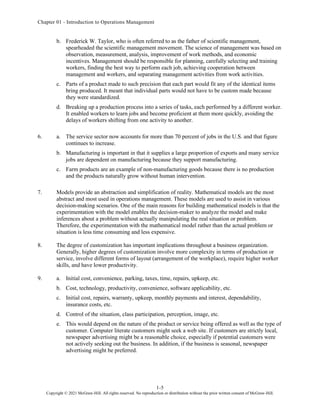
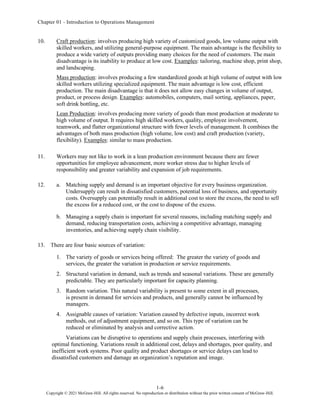
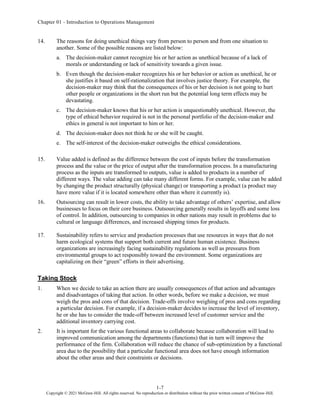
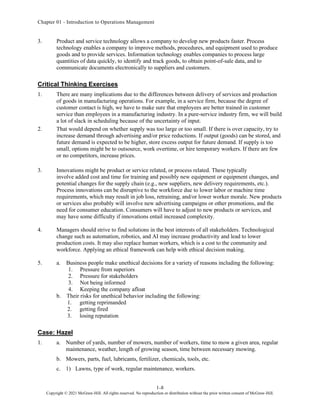
Solution Manual for Operations Management 14th Edition William J Stevenson
Solution Manual for Operations Management 14th Edition William J Stevenson
Solution Manual for Operations Management 14th Edition William J Stevenson
Solution Manual for Operations Management 14th Edition William J Stevenson
Solution Manual for Operations Management 14th Edition William J Stevenson
1.
Visit https://testbankbell.com todownload the full version and
explore more testbank or solutions manual
Solution Manual for Operations Management 14th
Edition William J Stevenson
_____ Click the link below to download _____
http://testbankbell.com/product/solution-manual-for-
operations-management-14th-edition-william-j-stevenson/
Explore and download more testbank or solutions manual at testbankbell.com
2.
Here are somerecommended products that we believe you will be
interested in. You can click the link to download.
Test Bank for Operations Management 14th Edition William J
Stevenson
http://testbankbell.com/product/test-bank-for-operations-
management-14th-edition-william-j-stevenson/
Solution Manual for Operations Management 6th Canadian by
Stevenson
http://testbankbell.com/product/solution-manual-for-operations-
management-6th-canadian-by-stevenson/
Operations Management Stevenson 11th Edition Solutions
Manual
http://testbankbell.com/product/operations-management-stevenson-11th-
edition-solutions-manual/
Test Bank For Human Physiology 15th Edition By Stuart Fox
http://testbankbell.com/product/test-bank-for-human-physiology-15th-
edition-by-stuart-fox/
3.
Test Bank forFoundations of Business 5th by Pride
http://testbankbell.com/product/test-bank-for-foundations-of-
business-5th-by-pride/
Investments Analysis and Management 13th Edition Jones
Test Bank
http://testbankbell.com/product/investments-analysis-and-
management-13th-edition-jones-test-bank/
Test Bank for Society The Basics, 11th Edition: Macionis
http://testbankbell.com/product/test-bank-for-society-the-basics-11th-
edition-macionis/
Test Bank for M Management, 3rd Edition : Bateman
http://testbankbell.com/product/test-bank-for-m-management-3rd-
edition-bateman/
Solution Manual for Children: A Chronological Approach,
5th Canadian Edition Robert V. Kail Theresa Zolner
http://testbankbell.com/product/solution-manual-for-children-a-
chronological-approach-5th-canadian-edition-robert-v-kail-theresa-
zolner/
4.
Test Bank forHuman Resource Information Systems Basics
Applications and Future Directions 4th Edition by Kavanagh
http://testbankbell.com/product/test-bank-for-human-resource-
information-systems-basics-applications-and-future-directions-4th-
edition-by-kavanagh/
“That may betrue; but if there is no help for it?”
“To accept that view is just what grieves the man who is not an
imbecile.”
The conversation stopped here. At the moment of parting Pan
Stanislav said,—
“By the way, I should prefer not to be with you on Sunday.”
“Maybe thou wilt do well to stay away.”
18.
CHAPTER XI.
A surprisewas waiting at home for Pan Stanislav; he found the
following despatch from Pani Emilia, “I leave here for home to-
morrow evening; Litka is well.” This return was unexpected, or at
least uncommonly hurried; but since the despatch contained an
assurance as to Litka’s health, Pan Stanislav understood that Pani
Emilia was returning for the sole purpose of occupying herself with
his affair, and his heart rose in gratitude. “There is an honest
nature,” said he to himself; “that is a friend.” And with thankfulness
there rose in his heart such hope, as if Pani Emilia had the ring of an
enchantress, or a magic rod, with which she could change the heart
of Panna Marynia in an instant. Pan Stanislav did not know clearly
how this could be done; but he knew that one person at least
wished him well with deep sincerity, would speak for him, would
justify him, would exalt his heart and character and diminish
prejudices, which the course of events had accumulated against him.
He calculated that Pani Emilia would be very persevering, and that
for her this would be a question of duty. A man who is troubled by
something is glad to find a person on whom to put responsibility. So
in moments of rising bitterness, especially, it seemed to Pan
Stanislav that Pani Emilia was responsible for his relations with
Marynia; for if she had not shown that letter from which Marynia’s
readiness to love him was evident, he would have been able to take
his mind and heart from her. Perhaps this was true, since in the
history of his feelings this letter did in fact play a leading part. It
showed him how near happiness had been, almost secured; to what
extent in her own mind Marynia had given him heart and soul. It is
more difficult to throw away happiness which is not only desired, but
begun; and, had it not been for that letter, Pan Stanislav might have
regretted the past less, forgotten it more easily, and reconciled
himself to the position more readily. At present he thought it even
19.
her duty tohelp him with all her power. Finally, he understood that
the affair would move, as it were, of itself; he hoped to see Marynia
often, and in conditions most favorable, since he would see her in a
house where he was loved and esteemed, and where like feelings
must be communicated to each guest. All this strengthened Pan
Stanislav’s hope; but it added new links to those which bound his
thoughts to Marynia. Previously he had promised himself not to go
to Bigiel’s (on Sunday); now he changed his decision, thinking that,
if only health permitted, Pani Emilia too would take part in the trip.
Aside from reasons connected with Marynia, he rejoiced from his
whole soul to see the beloved faces of Pani Emilia and Litka, who
were his greatest attachments in life so far.
That same evening he wrote a few words to Plavitski touching the
arrival, supposing that Marynia would be thankful for that
information; he gave notice at Pani Emilia’s, so that servants would
be waiting in the morning with tea; and he hired a commodious
carriage to take her and Litka to their home.
Next morning at five he was at the station; while waiting for the
train, he began to run briskly along the platform to warm himself
somewhat, since the morning was cool. Remote objects, the station
buildings, and the cars standing on the near rails, were sunk in fog,
which, very dense near the ground, became rose-colored and
shining higher up, announcing that the day would be pleasant.
Except officials and servants, there was no one on the platform yet,
because of the early hour; gradually, however, people began to
arrive. All at once two forms came out of the fog; in one of these
Pan Stanislav, with beating heart, recognized Marynia, who was
hastening, with her maid, to greet Pani Emilia. As he had not
expected the meeting, he was greatly confused at the first moment.
She stopped short, as if astonished or troubled. After a while,
however, he approached and extended his hand to her,—
“Good-day!” said he. “And truly it will be a good day for us both if
our travellers arrive.”
20.
“Then is itnot certain?” asked Marynia.
“Of course it is certain, unless something unlooked for prevents. I
received a despatch yesterday, and sent the news to Pan Plavitski,
thinking that you would be glad to hear it.”
“Thank you. The surprise was so pleasant!”
“The best proof of that is that you have risen so early.”
“I have not lost the habit of early rising yet.”
“We came too soon. The train will arrive only in half an hour.
Meanwhile I advise you to walk, for the morning is cool, though the
day promises to be fine.”
“The fog is clearing,” said Marynia, raising her blue eyes, which to
Pan Stanislav seemed violet in the light of the morning.
“Do you wish to walk along the platform?”
“Thank you; I prefer to sit in the waiting-room.”
And, nodding, she went away. Pan Stanislav began to fly with
hurried steps along the platform. It was somewhat bitter to think
that she would not remain; but he explained to himself that perhaps
this was not proper, and, besides, the bitterness was overcome by
the pleasant thought of how the coming of Pani Emilia would bring
them nearer, and how many meetings it would cause. A certain
wonderful solace and good-humor continued to rise in him. He
thought of the violet eyes of Marynia, and her face made rosy by the
coolness of the morning; he rushed past the windows of the hall in
which she was sitting, and said to himself almost joyfully,—
“Ah, ha! sit there, hide thyself! I will find thee.” And he felt with
greater force than ever how dear she might become to him, if she
would be kind even in a small degree. Meanwhile bells sounded; and
a few minutes later, in the fog, still dense at the earth, though the
sky above was blue, appeared the dim outlines of the train, which,
21.
as it approached,became more clearly defined. The engine, puffing
interrupted clumps of smoke, rolled in with decreasing movement,
and, stopping, began with noise and hissing to belch forth under its
front wheels the useless remnant of steam.
Pan Stanislav sprang to the sleeping-car; the first face at the window
was Litka’s, which at sight of him grew as radiant as if a sudden
sunbeam had fallen on it. The little girl’s hands began to move
joyously, beckoning to Pan Stanislav, who was in the car in one
moment.
“My dearest little kitten!” cried he, seizing Litka’s hand, “and hast
thou slept; art thou well?”
“I am well; and we have come home. And we’ll be together—and
good-day, Pan Stas!”
Right behind the little girl stood Pani Emilia, whose hand “Pan Stas”
kissed very cordially; and he began to speak quickly, as people do at
time of greeting,—
“Good day to the dear lady. I have a carriage. You can go at once.
My servant will take your baggage; I ask only for the check. They
are waiting for you at home with tea. Pray give the check. Panna
Plavitski is here too.”
Panna Plavitski was waiting, in fact, outside the car; and she and
Pani Emilia shook hands, with faces full of smiles. Litka looked for a
moment at Marynia, as if hesitating; after a while, however, she
threw herself on her neck with her usual cordiality.
“Marynia, thou wilt go with us to tea,” said Pani Emilia. “It is ready,
and thou art fasting, of course.”
“Thou art tired, travelling all night.”
“From the boundary we slept as if killed; and when we woke, we
had time to wash and dress. In every case we must drink tea. Thou
wilt go with us?”
22.
“I will, withthe greatest pleasure.”
But Litka began to pull at her mother’s dress.
“Mamma, and Pan Stas.”
“But, naturally, Pan Stas too,—he thought of everything. Thanks to
him, everything is ready. He must go with us, of course.”
“He must; he must!” cried Litka, turning to Pan Stanislav, who
answered, smiling,—
“Not he must; but he wants to.”
And after a moment all four took their places in the carriage. Pan
Stanislav was in excellent humor. Marynia was before him, and at his
side little Litka. It seemed to him that the morning brightness was
entering him, and that better days were beginning. He felt that
henceforth he would belong to an intimate circle of beings bound
together by comradeship and friendship, and in that circle would be
Marynia. Now she was sitting there before him, near his eye, and
near the friendship which both felt for Pani Emilia and Litka.
Meanwhile all four were talking joyously.
“What has happened, Emilka,” asked Marynia, “that thou hast come
so soon?”
“Litka begged so every day to come home.”
“Dost not like to live abroad?” asked Pan Stanislav.
“No.”
“Homesick for Warsaw?”
“Yes.”
“And for me? Now tell quickly, or it will be bad.”
Litka looked at her mother, at Marynia, and then at Pan Stanislav;
and at last she said,—
23.
“And for PanStas too.”
“Take this for that!” said Pan Stanislav, and he seized her little hand
to kiss it; but she defended herself as she could. At last she hid her
hand. He, turning to Marynia, and showing his sound white teeth,
said,—
“As you see, we are always quarrelling; but we love each other.”
“That is the way generally,” answered Marynia.
And he, looking her straight and honestly in the eyes, said,—
“Oh that it were the way generally!”
Marynia blushed slightly and grew more serious, but said nothing,
and began to converse with Pani Emilia.
Pan Stanislav turned to Litka.
“But where is Professor Vaskovski? Has he gone to Italy?”
“No. He stopped at Chenstohova, and will come the day after to-
morrow.”
“Is he well?”
“He is.”
Here the little girl looked at her friend, and said,—
“But Pan Stas has grown thin; hasn’t he, mamma?”
“Indeed he has,” answered Pani Emilia.
Pan Stanislav was changed somewhat, for he had been sleeping
badly, and the cause of that sleeplessness was sitting before him in
the carriage. But he laid the blame on cares and labor in his
business. Meanwhile they arrived at Pani Emilia’s.
When the lady went to greet her servants, Litka ran after her. Pan
Stanislav and Marynia remained alone in the dining-room.
24.
“You have nonearer acquaintance here, I suppose, than Pani
Emilia?” said Pan Stanislav.
“None nearer; none so beloved.”
“In life kindness is needed, and she is very kind and well-wishing. I,
for example, who have no family, can look on this as the house of a
relative. Warsaw seems different to me when they are here.” Then
he added, with a voice less firm, “This time I comfort myself also
with their arrival, because there will be at last something mutual and
harmonious between us.”
Here he looked at her, with a prayer in his eyes, as if he wished to
say, “Give me a hand in conciliation; be kind to me, too, since a
pleasant day has come to us.”
But she, just because she could not be for him altogether indifferent,
went always farther in the direction of dislike. The more he showed
cordial kindness, the more sympathetic he was, the more his action
seemed to her unheard of, and the more offended she felt at heart.
Having a delicate nature, and being, besides, rather timid, and
feeling really that a reply, if too ill-natured, might spoil the day’s
harmony, she preferred to be silent; but he did not need an answer
in words, for he read in her eyes as follows: The less you try to
improve our relations, the better they will be; and they will be best if
most distant. His joy was quenched in one moment; anger took its
place, and regret, still stronger than anger,—for it rose from that
charm which nothing could conquer, and to which Pan Stanislav
yielded himself with the conviction, too, that the gulf between him
and Marynia was in reality growing deeper each day. And now,
looking on her sweet and kind face, he felt that she was as dear as
she was lost irrecoverably.
The arrival of Litka put an end to that interval, grievous to him
beyond description. The little girl ran in with great delight, her hair
in disorder, a smile on her lips; but seeing them, she stopped
suddenly, and looked now at one, now at the other, with her dark
25.
eyes. At lastshe sat down quietly at a table with tea. Her joyousness
had vanished too, though Pan Stanislav, confining the pain in his
heart, strove to talk and be gladsome.
But he turned scarcely any attention to Marynia; he occupied himself
only with Pani Emilia and Litka; and, wonderful thing! Marynia felt
that as an additional bitterness. To the series of offences still another
was added.
On the following day Pani Emilia and Litka were invited to tea in the
evening at the Plavitskis’. Plavitski invited Pan Stanislav too, but he
did not go. And such is human nature that this again touched
Marynia. Dislike, as well as love, demands an object. Involuntarily
Marynia looked toward the door all the evening, till the hour struck
in which it was certain that Pan Stanislav would not come; then she
began to coquet so with Mashko that she transfixed Pani Emilia with
amazement.
27.
CHAPTER XII.
Mashko wasa very clever man, but full of self-love; he had no
reason, however, not to take the kindness which Marynia showed
him in good earnest. The unequal degree of it he attributed a little
to coquetting, a little to the changing disposition of the young lady;
and though the latter filled him with a certain alarm, this alarm was
not great enough to restrain him from taking a decisive step.
Bigiel divined the true state of affairs when he declared that Mashko
was in love. Such was the case really. At first Panna Plavitski pleased
him in a high degree; afterward, when he had thought the pros and
cons over, he came to the conviction that the pros had prevailed.
The young advocate valued property, it is true; but, gifted with great
sobriety of mind, and understanding perfectly the conditions in
which he found himself, he concluded that a very wealthy lady he
could not find and would not get. Richly dowered young ladies were
found either among the aristocracy of descent,—and for him their
thresholds were too lofty,—or among the world of financiers, who
sought connections with families bearing names more or less
famous. Mashko knew perfectly that his painted bishops and
armored men, whom Bukatski ridiculed, would not open bankers’
safes to him. He understood that even if they had been less
fantastic, his profession of advocate would itself be a certain
diminutio capitis in the eyes of great financial whales. On the other
hand, he had, in truth, a certain racial repugnance to that kind of
connection; while maidens of good descent had the uncommon
attraction which they have for parvenus generally.
Panna Plavitski had no dower, or at least a very insignificant one. In
taking her, however, he would free himself from all obligations to the
Plavitskis created by the purchase of Kremen. Secondly, by
connecting himself with a good family, he would endeavor to bring in
28.
a whole groupof noble clients, and this might be a very real profit;
finally, through the family relations of Marynia, he might in time
manage the business of a number, or a number of tens, of really
wealthy families,—a thing which had long been the object of his
efforts.
The Plavitskis, like all who are a little above middling country
families, had indeed relatives whom they did not greatly recognize;
they had also others who did not greatly recognize them. This,
however, was done not so much from reasons of pride as
involuntarily, by virtue of a certain social selection, through which
people seek in society persons who are more or less in the same
conditions of life as they themselves are. Great family festivals
united such separated relatives temporarily; and Mashko not only
found it agreeable to think that at his wedding there would be
perfectly well-sounding names, but he foresaw various possible
profits. The question would be merely one of cleverness to give
people of this kind an idea that it would be well on their part, good
and safe, to intrust their business to a man noted for energy, and,
more than all, one of their own class, since he is a relative. That
would be something like a dower given to a poor cousin. Mashko,
taking note of his own qualities, hoped to force himself on them, and
in time tower above them. He knew that this man or that would
come at first to him for such counsel as he might find in
conversation with an acquaintance, or a distant relative, who
happened to understand various questions; later on, as the counsels
proved good, he would come oftener, and at last put everything into
the hands of the counsellor. Helping others in this fashion, he could
himself sail out into broad waters, clear Kremen in time, advance to
considerable property, throw aside at last legal pursuits, which he
did not like, and which he considered only as a means of reaching
his object, and fix himself finally in lofty spheres of society as an
independent man, and at the same time a representative of superior
landed property resting on a firm basis. He had foreseen all this,
calculated and counted, before he determined to try for the hand of
Panna Plavitski.
29.
He had notforeseen, however, one thing; to wit, that he would fall
in love to such a degree as he had. For the time this made him
angry, for he judged that too strong a feeling was something
opposed to the balance which a man of high society should preserve
at all times. That balance was one of his illusions. If he had had no
need of forcing himself into that society, or had been born in it, he
might have permitted himself to love to his heart’s satisfaction.
In spite of all his keenness, he had not understood that one of the
chief privileges of this society, which considers itself privileged, is
freedom. For this reason he was not altogether content when his
heart melted too much in presence of Marynia. But, on the other
hand, the object toward which he strove grew identified the more in
him with that personal happiness which was verging almost on
intoxication.
These were new things for him, so new that the brightness of those
unknown horizons blinded him. Mashko had arrived at thirty and
some years of his life without knowing what rapture is. Now he
understood what happiness and charms were described by that
word, for he was enraptured with Marynia to the depth of his soul.
Whenever Plavitski received him in his room, and she was in the
adjoining one, Mashko was with her in thought to such a degree that
hardly could he understand what the old man was saying.
When she entered, there rose in his heart feelings utterly unknown
to him hitherto,—feelings tender and delicate, which made him a
better man than he was usually. His blue eyes changed their
ordinary steel and cold gleam to an expression of sweetness and
delight; the freckles on his face, by which he called to mind
Professor Vaskovski, became still more distinct; his whole form lost
its marks of formality, and he passed his fingers through his light
side whiskers, not like an English lord, but an ordinary love-stricken
mortal. He rose at last so high that he wished not only his own
good, but her good, evidently not understanding it otherwise than
through him and in him.
30.
He was somuch in love that, if rejected, he might become
dangerous, especially in view of his want of moral development, his
great real energy, and lack of scruples. Till then he had not loved,
and Marynia roused first in him all that was capable of loving. She
was not a brilliant beauty; but she possessed in the highest degree
the charm of womanliness, and that womanliness was the reason
that she attracted energetic natures specially. In her delicate form
there was something in common with a climbing plant; she had a
calm face, clear eyes, and a mouth somewhat thoughtful,—all this,
taken together, did not produce a mighty impression at the first
glance, but after a time every man, even the most indifferent, saw
that there was in her something peculiar, which made him remember
that he had in his presence a woman who might be loved.
In so far as Mashko felt himself better than usual, and in reality was
so during that epoch of his life, in that far had the spiritual level of
Marynia sunk since the Plavitskis came to Warsaw. The sale of
Kremen had deprived her of occupation and a moral basis of life.
She lacked a lofty object. Besides, the course of events had
accumulated in her bitterness and dissatisfaction, which turn always
to the injury of the heart. Marynia felt this herself distinctly; and a
few days after that evening when Pan Stanislav did not come to
them, she began first to speak of this to Pani Emilia, when at twilight
they were left by themselves in the drawing-room adjoining Litka’s
chamber.
“I see,” said she, “that we are not so outspoken with each other as
we used to be. I have wished to speak with thee openly, and I
cannot bring myself to do so, for it has seemed to me that I am not
worthy of thy friendship.”
Pani Emilia brought her sweet face up to Marynia’s head, and began
to kiss her on the temples.
“Ai, thou Marynia, Marynia! What art thou saying, thou, always calm
and thoughtful?”
31.
“I say so,for in Kremen I was more worthy than I am now. Thou
wilt not believe how attached I was to that corner. I had all my days
occupied, and had some sort of wonderful hope that in time
something very happy would come to me. To-day all that has
passed; and I cannot find myself in this Warsaw, and, what is worse,
I cannot find my former honesty. I saw how astonished thou wert
because I was coquetting with Pan Mashko. Do not tell me that thou
didst not see it. And dost thou think that I myself know why I acted
so? It must be because I am worse, or from some anger at myself,
at Pan Stanislav, at the whole world. I do not love Mashko; I will not
marry him. Therefore I act dishonestly, and with shame I confess it;
but moments come in which I should like to do an intended injustice
to some one. Thou shouldst break thy old friendship with me, for in
truth I am other than I have been.”
Here tears began to roll down Marynia’s face, and Pani Emilia fell to
quieting her and fondling her all the more; at last she said,—
“Pan Mashko is striving for thee most evidently; and I thought, I
confess, that thou hadst the intention of accepting him. I tell thee
now sincerely that that pained me, for he is not the man for thee;
but, knowing thy love for Kremen, I admitted thy wish to return to it
in this way.”
“At first I had such thoughts, it is true. I wished to persuade myself
that Pan Mashko pleased me; I did not like to repulse him. It was a
question with me of something else too, but it was a question also of
Kremen. But I could not convince myself. I do not want even
Kremen at such a price; but precisely in this lies the evil. For, in such
a case, why am I leading Pan Mashko into error, why am I deluding
him? Through simple dishonesty.”
“It is not well that thou art deluding him; but it seems to me that I
understand whence that flows. From repugnance to some one else,
and from the offence given by him. Is it not true? Console thyself,
however, with this, that the evil is not beyond remedy; for thou
mayst change thy action with Pan Mashko to-morrow. And, Marynia,
32.
it is needfulto change it while there is time yet, while nothing is
promised.”
“I know, Emilia; I understand that. But see, when I am with thee I
feel as formerly, like an upright and honest woman; I understand,
that not only a word binds, but conduct. And he may say that to
me.”
“Then tell him that thou hast tried to convince thyself that thou wert
in love with him, but could not. In every case, that is the only way.”
Silence followed; but both Marynia and Pani Emilia felt that they had
not begun yet to talk of that which, if it did not concern both,
concerned Pani Emilia most seriously. So, taking Marynia’s hands,
she said,—
“Now confess, Marynia, thou art coquetting with Mashko because
thou art offended by Pan Stanislav?”
“That is true,” answered Marynia, in a low voice.
“But does not this mean that the impression of his visit to Kremen,
and of thy first conversations with him, are not effaced yet?”
“Better if it were.”
Pani Emilia began to stroke her dark hair. “Thou wilt not believe how
good, clever, and noble a man he is. For us he has some friendship.
He has liked Litka always; this makes me grateful from my whole
soul to him. But thou knowest what an unardent and lukewarm
feeling friendship is usually. He in this regard even is exceptional.
When Litka was sick in Reichenhall, wilt thou believe it, he brought a
celebrated doctor from Monachium; but, not wishing to alarm us, he
said that the doctor had come to another patient, and that we
should take advantage of his presence. Think what care and
kindness! He is extremely reliable, a man to be trusted; and he is
energetic and just. There are intelligent men, but without energy;
others have energy, but lack delicacy of heart. He unites one to the
other. I forgot to tell thee that when Litka’s property was in danger,
33.
and when myhusband’s brother set about saving it, he found the
greatest aid in Pan Stanislav. If Litka were grown up, I would give
her to no one in the world with such confidence as to him. I could
not even recount to you how much kindness we have experienced
from him.”
“If as much as I have of evil, then very much.”
“Marynia, he did not intend that. If thou couldst but know how he
suffers for his rashness, and how sincerely he acknowledges his fault
touching thee.”
“He told me that himself,” answered Marynia. “I, my Emilka, have
pondered much over this,—to tell the truth, I have not thought of
another thing; and I cannot find that he is to blame. In Kremen he
was so pleasant that it seemed to me—to thee alone will I say this;
for to thee I have written it already—that on the Sunday evening
which he passed in our house I went to sleep with my head and
heart so filled with him that I am ashamed to speak of it now. And I
felt that one day longer, one friendly word more on his part, and I
should love him for my lifetime. It seemed to me that he also— The
next day he went away in anger. The fault was my father’s; it was
mine also. I was able to understand that; and dost remember the
letter I wrote thee at Reichenhall? Precisely the same trust which
thou hast in him, I too had. He went away; I myself do not know
why I thought, that he would return, or would write to me. He did
not return; he did not write. Something told me that he would not
take away Kremen; he took it. And afterward—I know that Pan
Mashko talked with him openly, and he urged Pan Mashko, and
assured him that he was thinking of nothing himself. Oh, my Emilia!
If it please thee, he is not to blame; but how much harm has he
done to me! Through him I have lost not only a beloved corner in
which I was working; but more, I have lost faith in life, in people, in
this,—that better and nobler things in this world conquer the low
and the evil. I have become worse. I tell thee sincerely that I cannot
find myself. He had the right to act as he has acted, I admit that; I
say so, and do not say that he is guilty. But he has broken some vital
34.
spring in me.There is no cure for that; it cannot be mended. How
can it? What is it to me that a change rose in him afterward; that he
regrets what he did; that he would be ready even to marry me?
What is that to me, if I, who almost loved him, not only do not love
him now, but must guard against repugnance? That is worse than if
I did not care for him. I know what thy wish is; but life must be built
on love, not on repugnance. How can I give my hand to him with
that feeling of offence in my soul and with that regret, that through
him, guilty or not guilty, so much has been lost to me? Thou thinkest
that I do not see his charm; but what can I do, when the more I see
him, the more I am repulsed, and if I had to choose I should choose
Pan Mashko, though he is less worthy? To everything good which
thou canst say of him I agree; but to everything I answer: I do not
love him; I never will love him.”
Pani Emilia’s eyes were filled with tears. “Poor Pan Stas,” said she, as
if to herself. And after a moment of silence she asked, “And art thou
not sorry for him?”
“I am sorry for him when I think of him as he was in Kremen; I am
sorry for him when I do not see him. But from the moment that I
see him, I feel nothing but—repulsion.”
“Yes; because thou knowest not how unhappy he was in
Reichenhall, and now he is still more unhappy. He has no one in the
world.”
“He has thy friendship, and he loves Litka.”
“My Marynia, that is something different. I am thankful to him from
my whole soul for his attachment to Litka; but that is something
different altogether, and thou knowest thyself that he loves thee a
hundred times more than Litka.”
In the chamber it had grown dark already; but soon the servant
brought in a lamp, and, placing it on the table, went out. By the
lamplight Pani Emilia beheld a whitish form crouched on the sofa
near the door which led to Litka’s room.
35.
“Who is there?Is that Litka?”
“I, mamma.”
In her voice there was something; Pani Emilia rose and went
hurriedly toward her.
“When didst thou come out? What is the matter?”
“I feel so ill in some way.”
Pani Emilia sat down on the sofa, and, drawing the little girl up to
her, saw tears in her eyes.
“Art thou crying, Litus? What is the matter?”
“Oh, so sad, so sad!”
And, inclining her head to her mother’s shoulder, she began to cry.
She was in reality sad, for she had learned that “Pan Stas” was more
unhappy than in Reichenhall, and that he loves Marynia a hundred
times more than her. That evening, when going to sleep and in her
nightdress, she nestled up to her mother’s ear and whispered,—
“Mamma, mamma, I have one very great sin on my conscience.”
“My poor little girl, what is troubling thee?”
She whispered in a still lower voice, “I do not like Panna Marynia.”
37.
CHAPTER XIII.
Pani Emilia,with Litka and Marynia, and with them Plavitski, were
going to the Bigiels to dine at their country house, which stood in a
forest at the distance of one hour and a half from the city. It was a
fine day in September; there were myriads of glittering spider-webs
in the air and on the stubbles. Leaves still fresh and green adhered
to the trees yet; here and there, through leafy openings, were visible
as it were fountains and bouquets of red and yellow. That pale and
faded autumn brought to Marynia’s mind her occupations in the
country, the odor of grain in the barns, the fields with stacks, and
the clear extent of the meadows, bounded way off somewhere on
the horizon by stretches of alder. She felt a yearning for that life and
that composure, in comparison with which the city, notwithstanding
the labor which seethed in its every-day existence, but which
Marynia was unable to appreciate, seemed to her idle and empty.
She felt now that that life in which she had found her own worth and
merit was lost beyond return to her, and on the other hand there
was not outlined before her anything that could take its place and
redeem it. She might, it is true, return by becoming Pani Mashko;
but her heart was filled with bitterness at that thought alone, and
Mashko, with his Warsaw self-confidence, with his freckles and his
side whiskers, with his aping an English lord, seemed to her simply
repulsive. Never had she felt withal a deeper feeling against Pan
Stanislav, who had taken Kremen from her, and put Mashko in place
of it. She was disgusted with Mashko at that moment, and it seemed
to her that she hated Pan Stanislav. She saw before her life with her
father on the pavement of Warsaw, without an object, without
occupation, without an ideal, with regret for the past and in view of
the past, and with emptiness in the future. For this reason that calm
autumn day, instead of quieting her, filled her with bitterness and
sorrow. On the whole, the journey was not joyous. Litka sat in gloom
38.
because “Pan Stas”was not with them. Pani Emilia gave all attention
to her, fearing lest that gloomy feeling might be connected with her
health. Plavitski alone was in genuine good-humor, especially at the
beginning of the journey. In his buttoned frock-coat, with a red
flower in the buttonhole, with a light-colored overcoat, and with
mustaches as pointed as needles, he thought himself beautiful, and
was sprightly, since rheumatism, which he felt at times, was not
troubling him, by reason of the good weather; secondly, before him
sat one of the most presentable women in Warsaw, who, as he
supposed, would not remain indifferent to so many charms, or in any
case would esteem them in so far as she would be able to note
them. Let her say at least to herself, “Oh, what a charming man that
must have been!” In the worst event, Plavitski would have been
satisfied with such a retrospective recognition. In this hope he was
really enchanting; for at one time he was lofty and fatherly, at
another sportive, setting out with the theory that young men of the
present do not know how to act politely with ladies. In politeness, as
he told Pani Emilia, he went as far as mythology, which was true
under a certain aspect, for he looked at her as would a satyr.
But all this was received with a faint smile and with too little
attention, hence he grew offended at last and began to speak of
something else; namely, that, thanks to the relations of his daughter,
he would become acquainted with the bourgeoisie, of which he was
glad, however, for hitherto he had seen that society only on the
stage, but it is necessary in life to meet the most varied kinds of
people, for it is possible to learn something from each of them. He
added finally, that it is the duty of certain circles not to estrange the
commonalty, but on the contrary to gather them in, and thus plant in
them sound principles; therefore he who had striven always to fulfil
his social duties did not halt before that mission. Here the noble
expression of his face took on a certain style of pensiveness, and in
that state of feeling they drove up to the villa of the Bigiels.
It stood in a forest of unmixed pines, in the neighborhood of other
villas, among old trees, which in places were felled, in places
39.
standing in groupsof a few, or of a few tens. They seemed to
wonder a little what such a new house was doing among them in the
old forest stillness; but they hospitably shielded it from the wind; on
fine days they surrounded it with balsamic air, permeated with the
odor of gum and resin.
The Bigiels, with a row of children, came out to meet the guests.
Pani Bigiel, who liked Marynia much, greeted her very cordially,
desiring, besides, to prepossess her thereby for Pan Stanislav; she
considered that the better Marynia understood how pleasant it might
be for her among them, the less difficulty would she make.
Plavitski, who, during his previous stay with Marynia in Warsaw, had
made the acquaintance of the Bigiels at Pani Emilia’s, but had limited
himself to leaving cards with them simply, showed himself now such
a gracious prince as was possible only to the most refined man, who
at the same time was fulfilling his mission of gathering in the
“bourgeoisie.”
“At the present day it is agreeable for any man to find himself under
the roof of a person like you; but all the more for me, since my
cousin, Polanyetski, has entered the career of commerce and is your
partner.”
“Polanyetski is a strong man,” answered Bigiel, with directness,
pressing the gloved hand of Plavitski.
The ladies retired for a moment to remove their hats; then, the air
being quite warm, they returned to the veranda.
“Is Pan Stanislav not here yet?” inquired Pani Emilia.
“He has been here since morning,” answered Bigiel; “but now he is
visiting Pani Kraslavski. The place is near by,” added he, turning to
Marynia; “not even half a verst distant. There are summer
residences everywhere about, and those ladies are our nearest
neighbors.”
40.
Welcome to ourwebsite – the ideal destination for book lovers and
knowledge seekers. With a mission to inspire endlessly, we offer a
vast collection of books, ranging from classic literary works to
specialized publications, self-development books, and children's
literature. Each book is a new journey of discovery, expanding
knowledge and enriching the soul of the reade
Our website is not just a platform for buying books, but a bridge
connecting readers to the timeless values of culture and wisdom. With
an elegant, user-friendly interface and an intelligent search system,
we are committed to providing a quick and convenient shopping
experience. Additionally, our special promotions and home delivery
services ensure that you save time and fully enjoy the joy of reading.
Let us accompany you on the journey of exploring knowledge and
personal growth!
testbankbell.com