E-GOV AFRICA 2013
A Totally Connected Government:
The Zim-Connect Project
Solomon Mhlanga
25 March 2013
Uganda
1
Outline
 Introduction
 Development Effectiveness
 The Results Based Management System
 E-Government
 A Totally Connected Government: The
Zim-Connect Project
2
Introduction
One of the objectives of Government is to guarantee an
effective and efficient public service delivery system.
The world over, Governments now operate under
conditions of :
 Dwindling resources,
 Rising demands for quality services and
 Rising demands for public sector accountability
3
Introduction
Trends in the 1990s: OECD Countries
 growing economic, social, and political
pressures.
 ballooning fiscal and budgetary deficits
 growing public demands for cost-effective
government services
 calls for accountability.
4
Introduction
Consequence:-
 forced to respond to public discontent
 Implemented measures for more
transparent and accountable governance at
all levels in the public sector.
 introduction of Results Oriented systems.
 In 1993, the US government passed the
Government Performance and Results Act.
5
Introduction
In the meantime Africa had colonial
hangover:
 continued to be preoccupied with rules
and procedures,
 emphasis was on delivering services in
compliance with specific guidelines, rules
and regulations.
 harder for these Governments to react to
the competitive pressures of globalization
and the rising demands of their citizens.
6
Development effectiveness
In the New Millennium Governments in Africa started
realising the need for sustained development effectiveness
and the need to manage their development processes in a
way that allowed them to achieve the greatest development
impact.
This could only be done through systems that deliver
services
 economically,
 efficiently, and
 effectively.
7
Development effectiveness
Many Public Sector Management reviews
persistently highlighted weak public
sector management (PSM) systems as the
key factor constraining the delivery and
achievement of development effectiveness
8
The new approach
In Zimbabwe the past couple of years has
seen a shift to a new approach to public
sector management that focuses on business
process re-engineering. This new approach
is the Results Based Management System.
9
The Results Based Management
System
A management philosophy and approach
that focuses on the timely achievement
of relevant goals and objectives through:
 Strategic planning,
 systematic implementation,
performance monitoring, measurement
reporting,
 systematic utilization of performance
information to improve policy decision
making
10
The Results Based Management
System
It is about improved performance that can be
described and measured and incorporates
lessons learnt while making necessary
adjustments during implementation.
11
e-Government
One of the key components of the Results
Based Management Programme is e-
Government.
e-Government
 use of Information Communication
Technologies to improve the internal
operations of public sector organizations
so as to provide efficient and effective
services.
12
Major Challenge!!!!
• Majority of services
are offered manually
• Citizens in long
queues
• CORRUPTION!!!!
13
What do citizens want.
(the 4 S’S)
Timeliness
Less Red Tape
Clustered
No Wrong Door
Confidence in
Government
14
What do citizens want (4 a’s
15
Services are expected to be accessible
to users, in terms of distance and
availability
Services should not be so expensive
Services should take account the local
social and political environment, and
be adapted to local needs.
Service should be in a form that users
find acceptable, for example culturally.
e-Government
In the last two years , as part of the Results Based
Management Program, the Zimbabwe Government has
embarked on a project to totally connect all government
operations with the following objectives:
• To improve service delivery to citizens
• To improve revenue collections
• To reduce costs
16
A Totally Connected Government:
The Zim-Connect Project:
The Zim-Connect: e-
Government
Framework and
Implementation
Strategy [2011-2015]
Infrastructure
Systems/
Applications
Capacity
Building/
Change
Management
17
A Totally Connected Government:
The Zim-Connect Project
Work has started to fully integrate
operations across Ministries using the
SAP platform.
18
ZimConnect : Totally Connected
Government
A Zimbabwean Case Study
Alex Marufu
Chief Operating Officer
Twenty Third Century Systems
e-Govt Development Stages
(Karen Layne & Jungwoo Lee, 2001)
Better
Service
Delivery
Cost
Reduction
Improve
Revenue
Collection
Give
Citizens a
voice
E-Govt Development
(Karen Layne & Jungwoo Lee, 2001)
 Integrate processes, Allow information sharing
◦ Share government information
◦ Do not ask citizens for information that government already has
◦ Smoothen the flow of information across departments/ministries
 Do not make inefficiency faster
◦ redesign processes if necessary
 Allow for multiple channels of access
◦ Government offices
◦ Web
◦ Mobile Platforms
◦ Digital Villages
Some design considerations
Overall Objectives
• Improve Service Delivery
• Introduce cost savings
• Increase revenue collection
• Citizen Feedback
Very simple requirements but challenging from
• Technology perspective
• Change management perspective
• Political perspective
Lands and Rural
Resettlement
Liquor Licensing Board
Mines and Mining
Develoment
State Procuremenmt
Board
Deeds, Companies
and Intellectual
Property
Public Service
Commission
Zimbabwe Investment
Authority
Chitungwiza Central
Hospital
R1
R2
R3
R4
R5
R6
R8
R9
R10
R11 R12
R13
R7
Current Ministerial/Agency Relationships
R13
Desired e-Government Setup
Deeds Companies
and Intellectual
Property
Lands and Rural
Resettlement
State
Procurement
Board
Mines and
Minerals
Development
Liquor Licensin
Board
Chitungwiza
Central Hospita
Zimbabwe
Investment
Centre
Public Service
Commission
Citizen interaction record
Citizen database
E-Government
Applications
CRM
Patient
Manage
ment
Clinical
System
Ambula
tory
Care
Manage
ment
Chitungwiza Central Hospital
SAP Scope
• Financials
• Materials Management
• Human Capital Management (incl Payroll)
• Workflow
• BI (Organizational Analytics)
• Expected Number of system users +/- 100
• Expected roll out to all major hospitals
Chitungwiza Hospital
• Based in Domitory town of Chitungwiza
• Low incomes
• Very high density
• 3rd largest population in Zimbabwe
• Main referral hospital in the town
• Fed by local clinics as well as direct services
Usage Planning
Allocation
Acquisition
Lands & Rural Resettlement Scope
Usage Monitoring
Estate Mgt
Billing
Lands Database
SAP Scope
• Financials-Asset Management
• Citizen Relationship Management (CRM)
• Portal (On-line Applications)
• Records Management
• Case Management
• Workflow Management
• Expected Number of system users +/- 600
Mandate of MLRR
• Acquire, Plan and Distribute land
• Manage land information
• Manage state-lands and provide security of
tenure
• Commission and maintain farm boundaries.
SAP Scope
 Financials-Revenue Management
 Citizen Relationship Management (CRM)
 Portal (On-line Applications)
 Records Management-(incl Database)
 Case Management
 Fleet Management
 Workflow Management
 Expected Number of system users +/- 100
Mines & Mineral Development
Mining
Claims
Prospecting
Orders
Precious
Stones
Milling
Licenses
Gold Buying
Licenses Mining
Information
Database
The Ministry is responsible for the efficient & effective harnessing of the
country’s mineral endowments for the country’s economic gain.
Mandate of Ministry of Mines
• To be at the centre of stimulating economic growth in the
country.
• To be the leading revenue generation arm of government.
• To lead in spearheading mining sector growth
 SAP Scope
 Financials
 Materials Management
 Citizen Relationship Management (CRM)
 Portal (On-line Applications)
 Human Capital Management
 Workflow Management
 Expected Number of system users +/- 30
Zimbabwe Investment Authority)
Investor
information
Investor
Registration
Investor
Tracking
Mandate
• Encouraging investment by domestic
and foreign investors;
• Facilitate and process investment
applications for approval;
• Attract domestic and foreign investors;
• Promote the decentralization of
investment activities
• Promote and co-ordinate investment
activities in enterprises or sectors of
the economy which are of strategic
importance to national development.
Investor
Customer
Services
SAP Scope
 Financials
 Citizen Relationship Management (CRM)
 Portal (On-line Applications)
 Records Management
 Case Management
 Workflow Management
 Expected Number of system users +/- 40
Companies and Deeds Office
Functions
The Deeds section
 maintaining an up to date register of all property ownership
 registration and maintenance of different types of deeds, caveats as well as cancellation of
bonds.
 This is administered under the Deeds Act: Chapter 20:05
Companies section
 registering all formal business organizations
 maintaining an up to date records.
Intellectual Property section
 protect ion of the property of the mind
 Promotion of technological and economic development through intellectual property.
Public Service Commission
SAP Scope
 Organisation Management
 Personnel Administration
 Time Management
 Training & Event Management
 Travel Management
 Personnel Planning & Development
 Electronic Recruitment
 Employee & Management Self Service (ESS/MSS
 Corporate Strategy and Salaries Administration
 Conditions of Service Agency
 Human Resources Agency
 Salary Services Bureau
 Assessment and Examinations Agency
 Performance Audit and Inspectorate Agency
 Discipline Agency
 Uniformed Forces Service Commissions Agency
 Human Resources Management Information Systems (HRMIS) Agency
 Legal Services Agency
 Pensions Agency
 Corporate Services/ Corporate Affairs Agency
 Finance and Administration
 Personnel
D
e
p
a
r
t
m
e
n
t
s
SAP Scope
 Citizen Relationship Management (CRM)
 Portal (On-line Applications)
 Records Management
 Case Management
 Workflow Management
 Expected Number of system users +/- 100
Liquor Licensing Board
Mandate
• Accept, Inspect and Approve Liquor License Applications
• Manage Liquor License and Inspection information
• Manage and provide information on site Inspections
• Recommend and maintain legislation on Liquor Licensing
• Maximization of revenue collection from issuance and renewals of licenses
• Mediating disputes within the liquor industry
• Proffer advice to all stakeholders in the liquor industry
SAP Scope
 Records Management
 Case Management
 Workflow Management
 Afaria
 Expected Number of system users +/- 30
Cabinet Secretariat
Manadate
• Offer secretarial service to cabinet
• Distribution of cabinet decisions to ministries
• Facilitates presentation of policies for consideration by
cabinet
• Follow up implementation of cabinet decision /policies
with ministries
State Procurement Board (SPB)
SAP Scope
 Electronic registration of suppliers
 Electronic procurement (core)
 Electronic requirements submissions
 Expected Number of system users +/- 30
Mandate
• Responsible for all procurement on behalf of
government and quasi government operations
above a certain minimum threshold
ZimConnect Project: A Totally
Connected Government
The ZimConnect: e-Government Framework and
Implementation Strategy [2011-2015]
Infrastructure
Systems/
Applications
Capacity
Building/
Change
Management
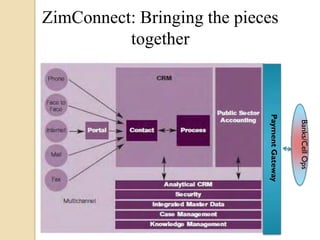
ZimConnect: Bringing the pieces
together
PaymentGateway
Banks/CellOps
LIMS
LIMS
PSC
LLB
ZIA
SPB
CDIP
MMD
Health
Citizen Portal/CRM
Government Private Cloud
Ministry Specific Applications
Access by Public and Citizens
NetWeaver
PFMS
Business
Architecture
Application
Architecture
Information
Architecture
Technical
Architecture
Business
Strategy
SOA Data Architecture Computing Data Network
Governance
Event
Architecture
BI Analytics &
Reporting
Storage Transport
Organization
Application
Portfolio
Metadata &
Semantics
Middleware Wireless
Process
Application
Development
Master Data
Management
Database Voice
Data Quality Device Video
Data Integration Monitoring
Business
Architecture
Application
Architecture
- PFMS
-PSC
-LIMS
Information
Architecture
Infrastructure
Architecture
Telecom
Architecture
Project
s
Infrastructure Telecom
Enterprise
Architecture
Technical
Sub-Domains
Enterprise
Architecture
Domains
Solution
Architecture
(Projects)
Information KiosksCapacity
Development
Application
Program Interface
Extended Enterprise
Architecture Technical
Sub-Domains
Enterprise Information Architecture : ZimConnect
Can it be done?
Skills/Capacity BuildingInfrastructure
Public Private Sector Partnership
Our experience with PFMS
Political Buy in
Funding
Change Management
German experience
ZimConnect : Totally Connected Government
A Zimbabwean Case Study
Alex Marufu
Chief Operating Officer
Twenty Third Century Systems
Thank you
42

Solomon Mhlangu

  • 1.
    E-GOV AFRICA 2013 ATotally Connected Government: The Zim-Connect Project Solomon Mhlanga 25 March 2013 Uganda 1
  • 2.
    Outline  Introduction  DevelopmentEffectiveness  The Results Based Management System  E-Government  A Totally Connected Government: The Zim-Connect Project 2
  • 3.
    Introduction One of theobjectives of Government is to guarantee an effective and efficient public service delivery system. The world over, Governments now operate under conditions of :  Dwindling resources,  Rising demands for quality services and  Rising demands for public sector accountability 3
  • 4.
    Introduction Trends in the1990s: OECD Countries  growing economic, social, and political pressures.  ballooning fiscal and budgetary deficits  growing public demands for cost-effective government services  calls for accountability. 4
  • 5.
    Introduction Consequence:-  forced torespond to public discontent  Implemented measures for more transparent and accountable governance at all levels in the public sector.  introduction of Results Oriented systems.  In 1993, the US government passed the Government Performance and Results Act. 5
  • 6.
    Introduction In the meantimeAfrica had colonial hangover:  continued to be preoccupied with rules and procedures,  emphasis was on delivering services in compliance with specific guidelines, rules and regulations.  harder for these Governments to react to the competitive pressures of globalization and the rising demands of their citizens. 6
  • 7.
    Development effectiveness In theNew Millennium Governments in Africa started realising the need for sustained development effectiveness and the need to manage their development processes in a way that allowed them to achieve the greatest development impact. This could only be done through systems that deliver services  economically,  efficiently, and  effectively. 7
  • 8.
    Development effectiveness Many PublicSector Management reviews persistently highlighted weak public sector management (PSM) systems as the key factor constraining the delivery and achievement of development effectiveness 8
  • 9.
    The new approach InZimbabwe the past couple of years has seen a shift to a new approach to public sector management that focuses on business process re-engineering. This new approach is the Results Based Management System. 9
  • 10.
    The Results BasedManagement System A management philosophy and approach that focuses on the timely achievement of relevant goals and objectives through:  Strategic planning,  systematic implementation, performance monitoring, measurement reporting,  systematic utilization of performance information to improve policy decision making 10
  • 11.
    The Results BasedManagement System It is about improved performance that can be described and measured and incorporates lessons learnt while making necessary adjustments during implementation. 11
  • 12.
    e-Government One of thekey components of the Results Based Management Programme is e- Government. e-Government  use of Information Communication Technologies to improve the internal operations of public sector organizations so as to provide efficient and effective services. 12
  • 13.
    Major Challenge!!!! • Majorityof services are offered manually • Citizens in long queues • CORRUPTION!!!! 13
  • 14.
    What do citizenswant. (the 4 S’S) Timeliness Less Red Tape Clustered No Wrong Door Confidence in Government 14
  • 15.
    What do citizenswant (4 a’s 15 Services are expected to be accessible to users, in terms of distance and availability Services should not be so expensive Services should take account the local social and political environment, and be adapted to local needs. Service should be in a form that users find acceptable, for example culturally.
  • 16.
    e-Government In the lasttwo years , as part of the Results Based Management Program, the Zimbabwe Government has embarked on a project to totally connect all government operations with the following objectives: • To improve service delivery to citizens • To improve revenue collections • To reduce costs 16
  • 17.
    A Totally ConnectedGovernment: The Zim-Connect Project: The Zim-Connect: e- Government Framework and Implementation Strategy [2011-2015] Infrastructure Systems/ Applications Capacity Building/ Change Management 17
  • 18.
    A Totally ConnectedGovernment: The Zim-Connect Project Work has started to fully integrate operations across Ministries using the SAP platform. 18
  • 19.
    ZimConnect : TotallyConnected Government A Zimbabwean Case Study Alex Marufu Chief Operating Officer Twenty Third Century Systems
  • 20.
    e-Govt Development Stages (KarenLayne & Jungwoo Lee, 2001)
  • 21.
  • 22.
    E-Govt Development (Karen Layne& Jungwoo Lee, 2001)
  • 23.
     Integrate processes,Allow information sharing ◦ Share government information ◦ Do not ask citizens for information that government already has ◦ Smoothen the flow of information across departments/ministries  Do not make inefficiency faster ◦ redesign processes if necessary  Allow for multiple channels of access ◦ Government offices ◦ Web ◦ Mobile Platforms ◦ Digital Villages Some design considerations Overall Objectives • Improve Service Delivery • Introduce cost savings • Increase revenue collection • Citizen Feedback Very simple requirements but challenging from • Technology perspective • Change management perspective • Political perspective
  • 24.
    Lands and Rural Resettlement LiquorLicensing Board Mines and Mining Develoment State Procuremenmt Board Deeds, Companies and Intellectual Property Public Service Commission Zimbabwe Investment Authority Chitungwiza Central Hospital R1 R2 R3 R4 R5 R6 R8 R9 R10 R11 R12 R13 R7 Current Ministerial/Agency Relationships R13
  • 25.
    Desired e-Government Setup DeedsCompanies and Intellectual Property Lands and Rural Resettlement State Procurement Board Mines and Minerals Development Liquor Licensin Board Chitungwiza Central Hospita Zimbabwe Investment Centre Public Service Commission Citizen interaction record Citizen database E-Government Applications CRM
  • 26.
    Patient Manage ment Clinical System Ambula tory Care Manage ment Chitungwiza Central Hospital SAPScope • Financials • Materials Management • Human Capital Management (incl Payroll) • Workflow • BI (Organizational Analytics) • Expected Number of system users +/- 100 • Expected roll out to all major hospitals Chitungwiza Hospital • Based in Domitory town of Chitungwiza • Low incomes • Very high density • 3rd largest population in Zimbabwe • Main referral hospital in the town • Fed by local clinics as well as direct services
  • 27.
    Usage Planning Allocation Acquisition Lands &Rural Resettlement Scope Usage Monitoring Estate Mgt Billing Lands Database SAP Scope • Financials-Asset Management • Citizen Relationship Management (CRM) • Portal (On-line Applications) • Records Management • Case Management • Workflow Management • Expected Number of system users +/- 600 Mandate of MLRR • Acquire, Plan and Distribute land • Manage land information • Manage state-lands and provide security of tenure • Commission and maintain farm boundaries.
  • 28.
    SAP Scope  Financials-RevenueManagement  Citizen Relationship Management (CRM)  Portal (On-line Applications)  Records Management-(incl Database)  Case Management  Fleet Management  Workflow Management  Expected Number of system users +/- 100 Mines & Mineral Development Mining Claims Prospecting Orders Precious Stones Milling Licenses Gold Buying Licenses Mining Information Database The Ministry is responsible for the efficient & effective harnessing of the country’s mineral endowments for the country’s economic gain. Mandate of Ministry of Mines • To be at the centre of stimulating economic growth in the country. • To be the leading revenue generation arm of government. • To lead in spearheading mining sector growth
  • 29.
     SAP Scope Financials  Materials Management  Citizen Relationship Management (CRM)  Portal (On-line Applications)  Human Capital Management  Workflow Management  Expected Number of system users +/- 30 Zimbabwe Investment Authority) Investor information Investor Registration Investor Tracking Mandate • Encouraging investment by domestic and foreign investors; • Facilitate and process investment applications for approval; • Attract domestic and foreign investors; • Promote the decentralization of investment activities • Promote and co-ordinate investment activities in enterprises or sectors of the economy which are of strategic importance to national development. Investor Customer Services
  • 30.
    SAP Scope  Financials Citizen Relationship Management (CRM)  Portal (On-line Applications)  Records Management  Case Management  Workflow Management  Expected Number of system users +/- 40 Companies and Deeds Office Functions The Deeds section  maintaining an up to date register of all property ownership  registration and maintenance of different types of deeds, caveats as well as cancellation of bonds.  This is administered under the Deeds Act: Chapter 20:05 Companies section  registering all formal business organizations  maintaining an up to date records. Intellectual Property section  protect ion of the property of the mind  Promotion of technological and economic development through intellectual property.
  • 31.
    Public Service Commission SAPScope  Organisation Management  Personnel Administration  Time Management  Training & Event Management  Travel Management  Personnel Planning & Development  Electronic Recruitment  Employee & Management Self Service (ESS/MSS  Corporate Strategy and Salaries Administration  Conditions of Service Agency  Human Resources Agency  Salary Services Bureau  Assessment and Examinations Agency  Performance Audit and Inspectorate Agency  Discipline Agency  Uniformed Forces Service Commissions Agency  Human Resources Management Information Systems (HRMIS) Agency  Legal Services Agency  Pensions Agency  Corporate Services/ Corporate Affairs Agency  Finance and Administration  Personnel D e p a r t m e n t s
  • 32.
    SAP Scope  CitizenRelationship Management (CRM)  Portal (On-line Applications)  Records Management  Case Management  Workflow Management  Expected Number of system users +/- 100 Liquor Licensing Board Mandate • Accept, Inspect and Approve Liquor License Applications • Manage Liquor License and Inspection information • Manage and provide information on site Inspections • Recommend and maintain legislation on Liquor Licensing • Maximization of revenue collection from issuance and renewals of licenses • Mediating disputes within the liquor industry • Proffer advice to all stakeholders in the liquor industry
  • 33.
    SAP Scope  RecordsManagement  Case Management  Workflow Management  Afaria  Expected Number of system users +/- 30 Cabinet Secretariat Manadate • Offer secretarial service to cabinet • Distribution of cabinet decisions to ministries • Facilitates presentation of policies for consideration by cabinet • Follow up implementation of cabinet decision /policies with ministries
  • 34.
    State Procurement Board(SPB) SAP Scope  Electronic registration of suppliers  Electronic procurement (core)  Electronic requirements submissions  Expected Number of system users +/- 30 Mandate • Responsible for all procurement on behalf of government and quasi government operations above a certain minimum threshold
  • 35.
    ZimConnect Project: ATotally Connected Government The ZimConnect: e-Government Framework and Implementation Strategy [2011-2015] Infrastructure Systems/ Applications Capacity Building/ Change Management
  • 36.
    ZimConnect: Bringing thepieces together PaymentGateway Banks/CellOps
  • 37.
    LIMS LIMS PSC LLB ZIA SPB CDIP MMD Health Citizen Portal/CRM Government PrivateCloud Ministry Specific Applications Access by Public and Citizens NetWeaver PFMS
  • 38.
    Business Architecture Application Architecture Information Architecture Technical Architecture Business Strategy SOA Data ArchitectureComputing Data Network Governance Event Architecture BI Analytics & Reporting Storage Transport Organization Application Portfolio Metadata & Semantics Middleware Wireless Process Application Development Master Data Management Database Voice Data Quality Device Video Data Integration Monitoring Business Architecture Application Architecture - PFMS -PSC -LIMS Information Architecture Infrastructure Architecture Telecom Architecture Project s Infrastructure Telecom Enterprise Architecture Technical Sub-Domains Enterprise Architecture Domains Solution Architecture (Projects) Information KiosksCapacity Development Application Program Interface Extended Enterprise Architecture Technical Sub-Domains Enterprise Information Architecture : ZimConnect
  • 39.
    Can it bedone? Skills/Capacity BuildingInfrastructure Public Private Sector Partnership Our experience with PFMS Political Buy in Funding Change Management German experience
  • 40.
    ZimConnect : TotallyConnected Government A Zimbabwean Case Study Alex Marufu Chief Operating Officer Twenty Third Century Systems
  • 41.